
Riverside City Zoning Code
CHAPTER 1115
SUPPLEMENTAL STANDARDS
1115.01 - Accessory buildings and use standards.
A.
Purpose. Accessory buildings or structures including a private garage shall be erected upon a lot where a principal building already exists. The use of the accessory building must be secondary and incidental to the principal structure and use. An accessory building that is attached to the main building shall comply with all the requirements of these regulations that are applicable to the principal building.
B.
Permit Required. A permit is required to be issued before an accessory building may be constructed or an accessory use may occur on a parcel or in a building (See Chapter 1105, Development Procedures). A major accessory building or use shall be approved by Planning Commission and a minor accessory building or use shall be approved by the Zoning Administrator.
C.
General Provisions. The following general provisions shall apply:
1.
Provisions Applicable to All Districts.
a.
No accessory building, use, or structure shall be located in a recorded easement;
b.
All accessory structures, unless otherwise permitted within this section, shall be located within rear and side yards only and shall be located no closer to any public street than its corresponding principal structure, unless such structure serves a substantial public purpose as determined by the Zoning Administrator. Examples of structures serving a substantial public purpose include, but are not limited to, bus shelters, benches, flag poles, little libraries, and public art;
c.
An accessory building or structure shall have a minimum rear yard setback of three feet and a minimum side yard setback of five feet;
d.
No accessory building or structure shall be erected or constructed prior to the erection or construction of the principal or main building, except in conjunction with the same. An accessory use or structure shall be located on the same lot as the principal use;
e.
Portable Storage Units may be permitted on a premises subject to the following:
1)
A maximum of one portable storage unit per dwelling unit and must be placed on the property in a manner which does not obstruct the public right-of-way.
2)
Certificate of Zoning Compliance required prior to installation.
3)
A portable storage unit (temporary storage containers, shipping containers, or similar storage structures) is intended to be used only for temporary storage. It is not intended to be used for long term on site storage and any such use in any zoning district is expressly prohibited.
4)
The outside dimensions shall not exceed 16 feet in length, eight feet in width, and nine feet in height.
5)
The unit must be placed on a paved surface in accordance with the Section 1113.11 of the Unified Development Ordinance (UDO).
6)
A portable storage unit may be placed in conjunction with a residential dwelling unit for a period of time not to exceed 14 consecutive days in duration from the time of delivery to the time of removal, up to a maximum of two times per calendar year.
7)
A portable storage unit may be placed on a nonresidential zoned premises provided:
i.
It is located for a period of time not to exceed 30 consecutive days in duration from the time of delivery to the time of removal, up to maximum of two times per calendar year; and
ii.
The unit is located in a manner which does not hinder pedestrian or vehicular access to the premises and does not obstruct intersection sight distance.
8)
In emergency situations, the Zoning Administrator may extend the length of time a portable storage unit can be located on a site.
9)
The Zoning Administrator is authorized to grant temporary exceptions to or modifications in writing of this section in special circumstances where a necessity exists for the use of a temporary building or structure. Such special circumstances may include, but are not limited to, the location of a field office required for a construction project. Such permission shall be limited to the time during which the use of such temporary structure is reasonably necessary for the project for which such exception was granted.
f.
Prohibited Accessory Uses. Except as provided in this code, the use of inflatable garages, portable garages, temporary structures, temporary carports, portable containers, shipping containers, and semi-tractor trailers used for storage (with or without wheels) shall not be used as permanent accessory structures in any zoning districts.
2.
Provisions Applicable to Residential Districts.
a.
No accessory building or structure located in a residential district shall exceed 15 feet in height or the height of the principal building, whichever is less;
b.
The total floor area of all accessory buildings and structures on a single family or two family residential premises shall not exceed the principal structures footprint square footage or exceed the maximum lot coverage in accordance with Chapter 1107;
c.
Accessory buildings or structures located on residential premises and greater than 100 square feet in floor area shall be architecturally consistent with the character of the house on the premises and include the following:
1)
A finished pitched roof surface of standing seam metal, seal tab asphalt shingles, clay tile, slate or wood shingles and overhang, window and door styles, trim features, and other architectural features;
2)
All other finish surfaces shall be either wood, brick, stone, metal, vinyl siding, vinyl screen or any combination thereof.
i.
All accessory structures, except temporary structures, shall compliment the principal structure in design, this includes, but is not limited to, color, siding or finish materials, trim work, doors, window frames, and roofing materials.
d.
A driveway, in accordance with Section 1113.11 of the Unified Development Ordinance (UDO) shall be required for any private garage;
1)
A residential driveway shall be a minimum of two (2) feet from any property line.
e.
An Open Sided Structure including a Gazebo or a Trellis shall meet the minimum standards stated in Section 1115.01.C above and the floor shall not exceed 200 square feet;
3.
Provisions Applicable to Nonresidential Districts.
a.
No accessory building or structure located in a nonresidential district shall exceed 20 feet in height or the height of the principal building whichever is less;
b.
No accessory building or structure located in a nonresidential district shall exceed 50 percent in floor area of that of the principal structure.
c.
Accessory buildings or structures located on nonresidential premises and greater than 100 square feet in floor area shall be architecturally consistent with the character of the principal structure on the premises.
d.
A driveway, in accordance with Section 1113.11 of the Unified Development Ordinance (UDO) shall be required for any accessory structure;
D.
Private Swimming Pools and Hot Tubs.
1.
Location, Area and Height.
a.
All hot tubs shall be located within the buildable area of a rear yard and completely covered while not in use. In the event a proposed hot tub has more than 150 square feet of area on the water surface when filled to capacity, all regulations for swimming pools shall apply;
b.
Any swimming pool or part thereof shall be setback a minimum of ten feet to a side or rear lot line and outside of any required easement.
c.
A swimming pool shall not be located underneath or within ten feet of an overhanging electric power line.
d.
Swimming pool accessories are limited to diving boards, slides and lights designed to illuminate the pool and the immediate surrounding area. None of these accessories may exceed ten feet in height from grade, such height to include handrails, supports and other safety devices.
2.
Fence of Swimming Pools.
a.
A swimming pool having a depth that exceeds 18 inches shall be completely enclosed by a fence of sturdy construction not less than 48 inches in height, measured from the level of the ground where located and be of such design and construction as to effectually prevent a child from crawling or otherwise passing though or under such fence. Above ground pools with apparatus surrounding the entrance more than 48 inches off the ground shall be deemed sufficient to meet this requirement.
b.
Any gate shall be self-locking and secured when not in use.
c.
Any fence shall comply with all other provisions of this UDO.
3.
Lights. All lights used for illuminating a swimming pool, hot tub or surrounding area shall be so designed, located and installed as to confine the direct beams thereof to the lot or parcel on which the pool is located.
4.
Application of Requirements. All provisions of this UDO shall apply to private or noncommercial swimming pools and hot tubs.
5.
Permits. All permits shall be obtained for the construction or installation of any swimming pool in accordance with the provisions of this UDO.
E.
Fences, Walls, and Ornamental Features.
1.
General Requirements.
a.
The height of a fence or wall shall be measured from the ground level of the outward face to the highest part of the fence or wall.
b.
A fence or wall that is supported by posts on the side of the fence shall be erected so that exposed posts and supporting cross elements face into the property where the fence or wall is constructed and the finished surface outward to adjoining parcels, lots or public right-of-way. This section shall not apply if the fence is the same on both sides such as split rail fences, or ornamental iron fences, or shadowbox fencing.
c.
Intersection Clearance: On a corner lot, the intersection clearance zone is an area between the curb line or edge of pavement of the two intersecting streets and a diagonal line connecting the curb or edge of pavement of intersecting streets at a point 30 feet from their point of intersection. In this intersection clearance zone, no fence/wall, ornamental feature, snow fence, mound or hedge shall exceed 36 inches in height above the grade of the edges of the pavement or street gutter except as permitted below.
d.
In an intersection clearance zone, a plant or tree not exceeding two feet in diameter at a point 36 inches above the grade of the edges of the pavement or street gutter and whose foliage is kept trimmed to such diameter up to at least seven feet above the grade, shall be permitted.
e.
Construction on Mound: Where a fence, wall, or ornamental feature is constructed on a mound, the permissible height of the fence, wall, or ornamental feature shall be reduced by the height of such mound or raised surface.
f.
Safety:
1)
A fence or wall having wire or metal barbs, prongs, spikes, cutting points or edges of any kind or any fence that is charged with electric current, shall be prohibited.
2)
No person shall install or cause to be installed along or adjacent to the boundary line of the front yard of any lot or parcel of ground in this City of Riverside, any barrier composed of one or more strands of wire, rope, cord, plastic or other type of line, stretched between stakes, poles, trees or other supports, located as above described. However, a temporary barrier of such type, so constructed or marked as to be readily visible, may be installed to prevent damage to a newly planted lawn, or other new planting or new driveway/sidewalk. The temporary barrier is to be maintained only for such length of time as is reasonably necessary.
2.
Types of Fences or Walls.
a.
A fence or wall shall be constructed using traditional or natural materials such as wood, brick, stone, wrought iron, chain link, vinyl, aluminum, or other similar material unless specifically prohibited elsewhere in this UDO. Additionally, plastic, vinyl, or aluminum may be used for any picket or post and rail fence and poured concrete may be used for any post and rail fence.
b.
The use of poured concrete, concrete masonry unit, metal panel, corrugated metal, rebar, or other similar product where the surface of such material is exposed and visible from any direction, shall be prohibited unless specifically permitted elsewhere in this Ordinance.
c.
Where 60% or more of the existing lots within the same block face are occupied by a nonconforming fence type in the front yard (i.e., chain link or solid board fences) the following infill standards shall apply to a proposed fence on an existing lot rather than the standards listed in Part 3. For the purposes of these infill regulations a block face is defined as the frontage on a public street located between intersecting public or private streets or alleys.
1)
The proposed fence shall fall within the range of fence setbacks of the two nearest lots containing fences within the same block face.
2)
If the proposed fence does not meet the standards of Part 3 then a waiver is required in accordance with Chapter 1105.19.
3.
Location and Height of Fences or Walls.
a.
A fence or wall having a height of 48 inches or less may be located in any yard. Fence posts may exceed this height of the fence by six inches.
1)
Retaining walls that exceed 48 inches high shall be benched so that no individual retailing wall exceeds a height of 6 feet.
b.
Chain link, solid board privacy fence or any wall, except as provided in this code, shall be prohibited in a front yard. Welded wire may be used as backing. Fencing in the front yard shall be at least 50% transparent (e.g. split rail or picket).
c.
A fence or wall having a maximum height of eight feet may be located in any rear or side yard.
d.
A fence or wall shall not project into a public right-of-way.
e.
Fences predating the adoption of this Unified Development Ordinance shall be considered preexisting, nonconforming and allowed provided they are kept in sound structural condition.
4.
Ornamental Features.
a.
Ornamental features including retaining walls or short sections of walls or fences that are primarily of a decorative rather than an enclosing nature may be located in any yard.
b.
Ornamental features placed in the front yard shall not exceed 20 feet in length and 48 inches in height.
c.
Ornamental features are subject to the intersection clearance zone requirements as defined in 1113.13.C.9.
5.
Mounds.
a.
The grading and drainage of mounds shall follow the requirements of Section 1113.17, Stormwater Drainage Standards.
b.
No mound exceeding 36 inches in height shall be erected in the intersection clearance zone on comer lots as defined in 1113.13.C.9.
6.
Decks, Porches, Patios, and Balconies.
a.
All decks, porches, and balconies shall be attached or continuous to the principal structure or principal building.
1)
Exception: A deck surrounding an above ground pool shall be considered a structural part of the pool and as such considered an extension of the total footprint of the accessory use associated with the pool.
b.
A deck, porch or balcony that is covered or extends more than three (3) feet above the average grade shall meet the setback requirement for principal buildings in the applicable zoning district. Covered decks, porches, or balconies in the front entrance of the principal structure shall be architecturally integrated or consistent with the overall design and style of the principal structure.
1)
Roofing material shall match that of the principal structure in color, dimension and material
2)
Trim, framing, and fascia shall be consistent with the principal structure in color, dimension and material.
3)
All supports, such as columns or posts, shall be consistent with the principal structure in color, materials, style and proportion.
c.
A deck, porch, or balcony where the platform surface is greater than thirty (30) inches above the existing grade must provide handrails.
d.
All decks, porches and balconies are subject to permitting requirements of Sections 1301.04 and 1115.01.B.
e.
A porch and balcony may be permitted in any yard subject to all applicable sections of the UDO.
f.
A deck or patio is permitted in the side or rear yard of a premises only, subject to all applicable sections of the UDO.
g.
A deck, porch or balcony where any portion of the platform surface is twelve (12) inches or more above the existing grade shall be setback a minimum of three (3) feet from the side and rear property lines and shall not occupy any part of a recorded easement.
h.
A balcony may extend into a required yard in accordance with subsection E(9) below.
i.
An uncovered deck or porch may not encroach into the required front yard more than one-fourth (1/4) of the required front yard setback distance applicable to that zoning district or 8 feet, whichever is less.
j.
The width of decks, porches and balconies permitted to extend into the required front yard setback area must be less than one-third (1/3) the width of the principal structure.
k.
The permitted building materials for decks, porches, balconies and patios may be concrete, wood, stone, or wood composite. Materials not architecturally consistent with the principal structure will be subject to the CDD review.
7.
Ramps.
a.
All ramps shall be attached or continuous to the principal structure or principal building.
b.
A ramp is permitted to be in the side or rear yard of a premises. It shall be setback a minimum of three (3) feet from the side and rear property lines and shall not occupy any part of a recorded easement.
c.
A ramp may be permitted in a front yard and shall not occupy any part of the required front yard setback.
d.
All portions of a ramp that have level platform surfaces, required or otherwise, shall conform to 1115.01.E.6.
e.
Ramps intended and designed for the use of handicapped persons are allowed to encroach into any required yard in any zoning district as long as they are constructed in accordance with ADA (Americans with Disabilities Act) standards and the Ohio Building Code for width, height and materials, and a building permit is issued by the appropriate permitting agency.
1)
One ramp for each entrance to the structure shall be permitted.
2)
In no case shall this section be construed to permit any other structure (e.g. deck or elevated patio) to encroach into any required yard. The sole intent of this regulation is to ensure that access to housing for handicapped or disabled persons is not impeded due to a lack of adequate ramps.
8.
Temporary Ramps.
a.
All temporary ramps shall be attached or continuous to the principal structure in accordance with the manufacturer's specifications.
b.
A temporary ramp is permitted to be in the front, side or rear yard of a premises and shall be setback a minimum of three feet from the side and rear property lines.
c.
A temporary ramp or portion of the temporary ramp shall not be permitted in any public right-of-Way.
d.
All portions of a temporary ramp that have level platform surfaces, required or otherwise, shall conform to 1115.01.E.6.
9.
Projection of Architectural Features.
a.
A cornice, canopy, eaves, or other architectural feature of a principal building may project into a required yard a distance not exceeding two (2) feet.
b.
A bay window, or chimney may project into a required yard a maximum distance of two (2) feet, provided such features do no occupy, in the aggregate, more than one-third (1/3) of the length of the building wall on which they are located.
c.
A balcony may project into a required rear yard a maximum distance of four (4) feet, provided such feature does not occupy, in aggregate, more than one-third (1/3) of the length of the building wall on which it is located.
d.
Architectural features, including balconies, bay windows, chimneys, and other similar structures, shall not project into a public right-of-way and cannot occupy a recorded easement.
e.
Entry steps and platforms four (4) feet or less above grade and four (4) feet or less in width, which are necessary for access to a permitted building or for access to a lot from a street are permitted within any yard.
F.
Garage Sales.
1.
Home Sale. Means a sale of personal property to the general public conducted in or on any property within a residential zoning district, to include, by way of example, garage sales, patio sales, yard sales, porch sales, driveway sales, motor vehicle sales, and the sale of boats, trailers, motorcycles, motor homes and the like.
2.
Prohibitions. No person shall sell or offer for sale at such home sale any merchandise that has been purchased, cosigned or otherwise acquired for purposes of resale. The offering of new merchandise for sale shall be evidence that such merchandise was acquired by the resident for purpose of resale. No person shall sell or offer at such sale any personal property except such as has been owned and maintained by such person or members of his family on or in connection with the premises on which such sale is held. The provisions of this paragraph shall not apply to not-for-profit corporations, churches, temples, schools, fraternities, sororities, associations, clubs, or lodges. Such organizations may conduct sales of personal property donated to them on real estate owned or occupied by such organizations subject to the provisions of Section 1105.13, Temporary Uses.
3.
Frequency and Duration of Home Sales. Only one such sale may be conducted by permit on any parcel of property once per quarter of a calendar year for a maximum of three consecutive days. No sale may commence before the hour of 8:00 a.m. or extend later than 8:00 p.m. This subsection shall not apply to the sale of motor vehicles, boats, trailers, motorcycles or motor homes.
4.
Personal property offered for sale may be displayed in the front, side, street side, or rear yard of any home provided that such personal property is not located within a public right of way or otherwise obstructs the clear vision of traffic.
5.
All signs advertising such sales shall be subject to the provisions of Chapter 1115.09, Sign Standards, and must be removed within 48 hours of the conclusion of the sale.
G.
Sale of Motor Vehicles, Boats, Trailers, Motorcycles and Motor Homes. The following provisions shall apply in the case of any motor vehicle, boat, trailer, motorcycle or motor home offered for sale:
1.
Such vehicles may be displayed for sale only upon a private driveway provided that the vehicle is not parked in the City of Riverside's right-of-way. Only one such item may be displayed at any time;
2.
No person shall park or leave standing the above named vehicles upon any property not owned or controlled by such person for the principal purpose of advertising or displaying it for sale.
H.
Parking of Motor Vehicles. Refer to Section 1113.11.B, Off Street Parking Standards of the UDO.
I.
Outdoor Storage, Residential. A person shall not place, store, or maintain outside, for a continuous period in excess of 24 hours, an item which is not customarily used or stored outside or made of a material that is resistant to damage or deterioration from exposure to the outside environment.
J.
Residential Recreational Equipment Tree Houses, Playhouses, and Swing Sets. In residentially zoned districts, pet enclosures, dog houses and other types of animal structures, playhouses, gazebos, tree houses, open play systems (swing sets), recreational equipment (excluding basketball standard backboard, and basket assemblies) and similar structures shall be located in the rear yard only, a minimum of seven feet from any lot line, a minimum of three (3) feet from another building or structure and shall not encroach into any recorded easement.
1.
If a playhouse, treehouse, or trampoline has more than 200 square feet of enclosed play area, the use shall be reviewed in the same manner as a detached accessory structure.
K.
Solar Energy Devices. Solar panels, as defined in this section, shall be permitted, provided that the panels conform to the following provisions:
1.
General provisions for all panels.
a.
All mounting brackets and related structural supports extending more than three inches above the roof surface shall be covered in a manner architecturally compatible with the building to screen from public visibility and/or abutting properties.
b.
All solar equipment, except portions of the collectors that must be black or clear glass or plastic to allow light transmission or heat absorption, including mounting brackets and/or screening materials, shall match the abutting surface color.
c.
No portion of any roof-mounted solar equipment may extend above the ridge line or below the gutter line.
d.
Solar panels shall be designed and located in order to prevent reflective glare toward any occupied structure on adjacent properties as well as any adjacent right-of-way.
2.
General provisions for panels visible from street. Solar panels and related equipment mounted on roofs clearly visible from the street shall conform to the following:
a.
The collectors shall be generally mounted parallel with the roof pitch;
b.
The distance between the roof and the uppermost portion of the solar panels shall not exceed 18 inches; and
c.
Roof penetration shall be used to conceal supply/return heating/cooling water lines and/or electrical wiring from public visibility.
3.
General provisions for panels not visible from street. Solar panels and related equipment mounted on roofs not clearly visible from the street shall conform to the following:
a.
The collectors shall be generally mounted parallel with the roof pitch;
b.
The distance between the roof and uppermost portion of the collectors shall not exceed 24 inches; and
c.
Exposed supply/return heating/cooling lines shall be permitted provided:
1)
The covering insulation is colored to match that of the roof and wall surfaces to which they are attached; and
2)
Eave penetration is used for perpendicular descent of heating/cooling lines from the roof to the exterior building wall surfaces.
4.
Ground mounted panels. Ground-mounted panels shall conform to the following:
a.
The collectors and all related mechanical equipment shall be located in the side or rear yard only;
b.
Shall not exceed eight feet in height above the adjacent grade; and
c.
All related mechanical equipment, other than the actual photoelectric panels, shall be fully screened from the adjacent properties by fencing or hedges.
5.
Permit required. An accessory structure permit must be approved prior to the installation of any solar panels or related equipment and must also meet the same setback requirements.
L.
Flag Poles.
1.
Flag Poles associated with non-residential lots shall be permitted subject to the following standards:
a.
Flag poles are permitted in all yards.
b.
Flag poles located upon property of Governmental Facilities and Places of Worship shall be limited to 50' in height, all other non-residential uses shall be limited to 30' in height. Height shall be measured from the lowest adjoining grade for the pole or the lowest adjoining grade for the building to which it is mounted. Flag poles may be mounted to flat roof structures only.
c.
The fall zone of any pole shall not encompass any neighboring structures or lie outside of the property where it is located.
d.
Flag poles shall be limited in number as specified below:
l)For
lots less than one acre in area, flag poles shall be limited to one pole per lot.
2)For
lots one acre or larger in area, flag poles shall be limited to one pole per each whole acre of lot area, not to exceed 5 poles in total.
2.
Flag Poles associated with residential lots shall be permitted subject to the following standards:
a.
Flag poles are permitted in all yards.
b.
Flag poles shall be limited to 25' in height within residential districts. Height shall be measured from the lowest adjoining grade for the pole or the lowest adjoining grade for the building to which it is mounted. Flag poles attached or mounted on buildings shall be limited to these same height limitations. No flagpole shall be attached to the roof of a building.
c.
The fall zone of any pole shall not encompass any neighboring structures or lie outside of the property where it is located.
d.
Flag poles shall be limited in number to one pole per lot.
M.
Outdoor Display, Sales, and Storage. Non-residential facilities or areas that are intended to be used permanently for outdoor display, sales, and storage (e.g., garden supply sales, outdoor product display, materials storage, and similar uses) that are accessory to the principal use may be permitted in non-residential zoning districts upon compliance with the following:
1.
Such uses shall not be placed within the right-of-way, within a vehicular use area, or in a location which will interfere with the intersection clearance zone requirements.
2.
Outdoor displays, sales and storage areas shall be shown on the plan approved as part of the zoning certificate application.
3.
Outdoor displays, sales, and storage shall be related to the principal use of the site and shall clearly be accessory and incidental to the principal use. Outdoor displays, sales, and storage shall be prohibited when the principal building is vacant.
4.
Outdoor display, sales and storage may be permitted within an area not greater than 800 square feet or 20% of the ground floor area of the building, whichever is greater, and shall be located at least 25 feet from any residentially used or zoned property.
5.
Outdoor display and sales areas may be permitted in the front yard provided that the merchandise is displayed along the sidewalk or walkway adjacent to the building. Outdoor display and sales areas may also be permitted in the side or rear yard without being located adjacent to the building. In all cases, the displays and sales areas shall be spaced a sufficient distance from the building, as dictated by the Fire Department, to satisfy all fire safety requirements.
6.
Outdoor Storage Additional Standards:
a.
Outdoor storage shall be screened from view from any abutting property.
b.
Outdoor storage may be permitted in areas that are designated for employees only and made inaccessible to the general public by means of a fence, wall or other permanent, secured enclosure or in areas that are set back a distance of not less than 50 feet from any public building entry, parking lot, pedestrian facility or similar publicly used area.
c.
Storage areas shall be spaced a sufficient distance from the building, as dictated by the Fire Department, to satisfy all fire safety requirements.
(Ord. 17-O-618, Passed 3-16-17; Ord. No. 20-O-718, § 1(Exh. A), 3-5-20; Ord. No. 21-O-768, § 1(Exh. A), 7-8-21; Ord. No. 23-O-816, § 1(Exh. A), 1-19-23)
1115.03 - Antennas.
A.
Purpose. This section is intended to comply with federal law, policies and guidelines. This section is also intended to comply with federal policies and guidelines in that it does not differentiate among types of antennas. This section is also intended to comply with the policies and guidelines and of state and federal laws including the Federal Telecommunications Act of 1996 in that it does not intend to impair the installation, maintenance, or use of antennas. However, this section is intended to preserve the City of Riverside's right to reasonably restrict placement of antennas for aesthetic issues such as the relative height of structures and trees, views, preservation of residential areas, and property value.
B.
Public Health, Safety and Welfare Objectives. The City Council intends to protect the public health, safety and welfare of the citizens of the City of Riverside from potential hazards and damage to property values and/or community character associated with the installation and maintenance of antennas within the City of Riverside. The restrictions and standards herein are intended to assure that all antennas installations are adequately constructed and located so as to minimize potential detrimental effects associated with such installations.
1.
Antennas shall be permitted as follows subject to the other requirements herein:
a.
One private noncommercial antenna, including satellite receiving dishes of one meter or less and antennas designed to receive television broadcast signals, shall be permitted for each dwelling unit in all Districts.
b.
One private noncommercial antenna serving a specific structure type, whether reception or transmission, is permitted per multiple family building.
c.
Two private noncommercial antennas serving a specific structure type, whether reception or transmission, is permitted per commercial use, whether freestanding or part of a multi-use building.
d.
Antennas for the purpose of receiving RF signals and for amateur or "ham radio" transmitting are permitted in all districts.
2.
Any antenna which does not fit into the above antenna types shall require a Conditional Use Permit.
C.
Size and Location Restrictions.
1.
All antennas shall be attached to the principal structure unless there is no practical placement location as determined by the DPPM.
2.
Satellite dishes less than 40 inches in diameter and television broadcast antennas are exempt from a permit but have locational regulations:
a.
Mounted to a principal structure. Each antenna shall be located on that portion of a hip, gable, or gambrel roof which does not face a public street and shall be mounted behind the highest roof peak on the main structure. On flat roofs an antenna shall be located in a way so as to minimize its visibility from other properties. When affixed to a masonry structure, antennas must be attached to the mortar joints, not the face of the stone or brick.
b.
Free standing mounted in the ground. Location is limited to the side or rear yard only and the maximum height or diameter of any television broadcast antenna, exclusive of structural supports, shall not exceed ten feet.
3.
Free Standing Antennas.
a.
The DPPM shall determine whether a free standing antenna is a suitable alternative to being mounted or anchored to the principal structure. The DPPM must consider other practical locations mounted or anchored to the principal structure before considering a free standing location.
b.
The following regulations shall apply to all free standing antennas, which are those antennas mounted in the ground, with or without guy wires.
c.
Free-standing antennas which are transmitting and/or receiving antennas shall not be higher than three feet above the roof line of the main structure.
d.
Free-standing antennas, capable of receiving transmissions only shall not exceed ten square feet in area.
D.
Aesthetic and Screening Requirements.
1.
All free-standing antennas shall be substantially screened by evergreen trees or shrubbery of at least the height of the unit, such screening may be open on one side to facilitate reception.
2.
The applicant shall demonstrate that the proposed location is such that during all seasons, no part of any ground-mounted antenna structure will be visible to the neighbors and the general public from a point that is between the ground level and six feet above ground level on surrounding property. This provision is satisfied by the installation of evergreen plantings, which shall screen the antennas at the time of installation.
3.
Antennas shall be of a color compatible with the surrounding landscape and structures, provided such antennas above the roof line may be of the natural color of the antenna structure.
E.
Structural Safety Requirements. The following structural safety requirements shall be applied to all antenna installations. The Montgomery County Building Regulations Division shall review antenna applications as required by the current version of the Ohio Building Code or Ohio Residential Code for conformance to these requirements.
1.
If guy wires are used, they shall be sufficiently visible to prevent accident or injury to any person.
2.
Every antenna shall be constructed in accordance with the current version of the Ohio Building Code or Ohio Residential Code, as amended, including the electrical provisions thereof and shall also comply with specifications of the manufacturer.
F.
Permit Required Application Requirements. All antennas, except for satellite receiving dishes of 40 inches or more and antennas designed to receive television broadcast and signals, shall be considered accessory structures and may only be installed upon obtaining a building permit from the Montgomery County Building Regulations Division if necessary, and documentation of compliance from the DPPM.
For all antennas other than a satellite receiving dish of 40 inches or less and antenna designed to receive television broadcast signals; the applicant must provide:
1.
A plot plan showing proposed location and dish projection at extremes of the satellite band to be viewed.
2.
Landscape plan showing existing and proposed vegetation for completely screening the installation from the neighboring properties and street view.
3.
A description of the use and purpose of the antenna, including whether it is receive only, transmitting only, or both.
G.
Impairment of Reception, Line of Sight and Technical Problems.
1.
The above regulations are not intended to impair the reception of an acceptable quality signal for satellite viewing dishes of 40 inches or more and an alternative location or landscape plan shall be permitted when it is shown that they would result in such impairment.
2.
The DPPM may consider alternate locations for an antenna which does not comply with this UDO, provided that the applicant has proven that such antenna will be entirely inoperable otherwise for any useful purpose, for reasons of "line of sight" or other technical reasons, or for reasons set forth in federal law or regulations.
(Ord. 17-O-618, Passed 3-16-17)
1115.05 - Home occupations.
A.
Purpose. It is the purpose of these regulations to ensure that a home occupation is so located and conducted that the average neighbor would not be aware of its existence. The standards for a home occupation are intended to ensure its compatibility with the residential character of the neighborhood.
B.
Home Occupation Standards.
1.
A home occupation is a business conducted by the residents living on the premises. At any one time, there may be present on the premises no more than one nonresident of the premises who is an employee, partner or contract worker of the home occupation.
2.
A home occupation shall be carried on wholly within the dwelling unit. No home occupation or any storage of goods, materials, or products connected with a home occupation shall be permitted in any accessory building, detached garage or any vehicle including a recreational vehicle.
3.
A home occupation shall be incidental to the use of a dwelling unit for residential purposes.
a.
No more than 25 percent of the total floor area or more than 500 square feet of the dwelling unit, whichever is less, may be used in connection with a home occupation.
b.
A home occupation may only be established on that portion of a dwelling unit finished into habitable living area. The uninhabitable areas of a dwelling unit including unfinished basements, attics, and attached garages may only be used to store incidental items related to the home occupation.
4.
There shall be no entrance or exit way specifically provided in the dwelling unit or on the premises for the conduct of a home occupation.
5.
A home occupation shall not change the outside appearance of the dwelling unit, premises or be visible from the street.
6.
No traffic shall be generated by a home occupation in greater volumes than would normally be expected in a residential neighborhood, and any need for parking generated by a home occupation shall be met off the street. In conformance with all off street parking requirements provided within this Unified Development Ordinance.
7.
Deliveries and shipping from a vehicle having a cargo area greater than 22 feet in length or having dual rear axles are prohibited.
8.
In no case shall a home occupation be open to the general public at times earlier than 8:00 a.m. or later than 6:00 p.m. Beyond these hours during which the home occupation may be open to the general public, the operator of the home occupation may schedule appointments with clients or customers and for Direct Sale of Consumer Products or Service where parties are held for the purpose of taking orders or selling merchandise.
9.
A home occupation shall produce no heat, sound, vibration, light, glare, dust, odor, smoke, or fumes detectable to normal sensory perception by a person located off the premises or beyond the walls of the dwelling unit if the dwelling unit is a part of a multi family building.
10.
A home occupation shall not create a hazard to person or property, result in electrical interference to nearby neighborhood machinery or equipment, or become a nuisance. Storage of any hazardous or toxic materials in quantities that could have a potentially significant environmental impact on the property or on the surrounding community is prohibited.
11.
A home occupation shall not cause an increase in the use of any one or more utilities (such as, but not limited to water, sewer, electricity, or waste collection) so that the total use does not exceed the average for a residence in the neighborhood.
12.
No outdoor display or storage of materials, goods, supplies, or equipment shall be allowed.
13.
The following uses are examples of permitted home occupations provided they do not violate any provisions of this Ordinance:
a.
Artistic endeavors including painting, sculpting, writing or composing;
b.
Computer programming, data processing, software design, web site design or word processing;
c.
Direct sale of consumer products or service;
d.
Dressmaking, sewing, or tailoring;
e.
Family Day Care, Type B;
f.
Home cooking, baking, food preparation, exclusive of a catering service;
g.
Home crafts such as rug weaving, lapidary work, or ceramics with kiln up to six cubic feet in size maximum;
h.
Home office; and
i.
Tutoring, including music instruction shall be limited to a maximum of two persons receiving instruction at any one time.
C.
Prohibited Home Occupations. Refer to Section 1107.01.B.2 of the UDO.
(Ord. 17-O-618, Passed 3-16-17)
1115.07 - Sexually oriented business standards.
A.
Purpose and Findings.
1.
Purpose. It is the purpose of this section to regulate sexually oriented businesses in order to promote the health, safety, and general welfare of the citizens of the City of Riverside, and to establish reasonable and uniform regulations to prevent the deleterious location and concentration of sexually oriented businesses within the City of Riverside. The provisions of this section have neither the purpose nor effect of imposing a limitation or restriction on the content of any communicative materials, including sexually oriented materials. Similarly, it is not the intent or effect of this section to restrict or deny access by adults to sexually oriented materials protected by the First Amendment, or to deny access by the distributors and exhibitors of sexually oriented entertainment to their intended market. Neither is it the intent nor effect of this section to condone or legitimize the distribution of obscene material.
2.
Findings. Based on evidence concerning the adverse secondary effects of adult uses on communities presented in hearings and in reports made available to the legislature and subsequently adopted by the Ohio General Assembly as findings under Section 3 of House Bill 23 (and on findings incorporated in the cases of Township of Littleton, Colorado v. Z.J. Gifts D 4, L.L.C. (2004), 541 U.S. 774; Township of Erie v. Pap's A.M. (2000), 529 U.S. 277; Barnes v. Glen Theatre, Inc. (1991), 501 U.S. 560; Township of Renton v. Playtime Theatres, Inc. (1986), 475 U.S. 41; Young v. American Mini Theatres (1976), 426 U.S. 50; California v. LaRue (1972), 409 U.S. 109; DLS, Inc. v. Township of Chattanooga (6th Cir. 1997), 107 F.3d 403; East Brooks Books, Inc. v. Township of Memphis (6th Cir. 1995), 48 F.3d 220; Harris v. Fitchville Township Trustees (N.D. Ohio 2000), 99 F. Supp.2d 837; Bamon Corp. v. Township of Dayton (S.D. Ohio 1990), 730 F. Supp. 90, aff'd (6th Cir. 1991), 923 F.2d 470; Broadway Books v. Roberts (E.D. Tenn. 1986), 642 F. Supp. 486; Bright Lights, Inc. v. Township of Newport (E.D. Ky. 1993), 830 F. Supp. 378; Richland Bookmart v. Nichols (6th Cir. 1998), 137 F.3d 435; Deja Vu v. Metro Government (6th Cir. 1999), 1999 U.S. App. LEXIS 535; Threesome Entertainment v. Strittmather (N.D. Ohio 1998), 4 F.Supp.2d 710; J.L. Spoons, Inc. v. Township of Brunswick (N.D. Ohio 1999), 49 F. Supp.2d 1032; Triplett Grille, Inc. v. Township of Akron (6th Cir. 1994), 40 F.3d 129; Nightclubs, Inc. v. Township of Paducah (6th Cir. 2000), 202 F.3d 884; O'Connor v. Township and County of Denver (10th Cir. 1990), 894 F.2d 1210; Deja Vu of Nashville, Inc., et al. v. Metropolitan Government of Nashville and Davidson County (6th Cir. 2001), 2001 U.S. App. LEXIS 26007; State of Ohio ex rel. Rothal v. Smith (Ohio C.P. 2002), Summit C.P. No. CV 01094594; Z.J. Gifts D 2, L.L.C. v. Township of Aurora (10th Cir. 1998), 136 F.3d 683; Connection Distrib. Co. v. Reno (6th Cir. 1998), 154 F.3d 281; Sundance Assocs. v. Reno (10th Cir. 1998), 139 F.3d 804; American Library Association v. Reno (D.C. Cir. 1994), 33 F.3d 78; American Target Advertising, Inc. v. Giani (10th Cir. 2000), 199 F.3d 1241; and other cases and on reports of secondary effects occurring in and around adult entertainment establishments in Phoenix, Arizona (1984); Minneapolis, Minnesota (1980); Houston, Texas (1983); Indianapolis, Indiana (1984); Amarillo, Texas (1977); Garden Grove, California (1991); Los Angeles, California (1977); Whittier, California (1978); Austin, Texas (1986); Seattle, Washington (1989); Oklahoma Township, Oklahoma (1986); Cleveland, Ohio (1977); Dallas, Texas (1997); St. Croix County, Wisconsin (1993); Bellevue, Washington (1998); Newport News, Virginia (1996); Tucson, Arizona (1990); St. Paul, Minnesota (1988); Oklahoma Township, Oklahoma (1986 and 1992); Beaumont, Texas (1982); New York, New York (1994); Ellicottville, New York (1998); Des Moines, Iowa (1984); Islip, New York (1980); Adams County, Colorado (1987); Manatee County, Florida (1987); New Hanover County, North Carolina (1989); Las Vegas, Nevada (1978); Cattaraugas County, New York (1998); Cleburne, Texas (1997); Dallas, Texas (1997); El Paso, Texas (1986); New York Times Square study (1994); Report to ACLJ on the Secondary Impacts of Sex Oriented Businesses (1996); findings from the Report of the Attorney General's Working Group On The Regulation Of Sexually Oriented Businesses (June 6, 1989, State of Minnesota); and on testimony to Congress in 136 Cong. Rec. S. 8987; 135 Cong. Rec. S. 14519; 135 Cong. Rec. S. 5636, 134 Cong. Rec. E. 3750; and also on findings from the paper entitled "Stripclubs According to Strippers: Exposing Workplace Sexual Violence," by Kelly Holsopple, Program Director, Freedom and Justice Center for Prostitution Resources, Minneapolis, Minnesota; and from "Sexually Oriented Businesses: An Insider's View," by David Sherman, presented to the Michigan House Committee on Ethics and Constitutional Law, Jan. 12, 2000; and from various other police reports, testimony, newspaper reports, and other documentary evidence), and subsequent findings in Sensations, Inc. v. City of Grand Rapids, Michigan Decency Action Council (6th Cir. 2008), 526 F.3d 291; 729, Inc. v. Kenton County Fiscal Court (6th Cir. 2008), 515 F.3d 485; and Andy's Rest. & Lounge, Inc. v. City of Gary (7th Cir. 2006), 466 F.3d 550, and the City of Riverside's independent review of the same) the City of Riverside finds:
a.
Adult entertainment establishments lend themselves to ancillary unlawful and unhealthy activities that are presently uncontrolled by the operators of the establishments.
b.
Certain employees of adult entertainment establishments, as defined in this Ordinance as adult theaters and cabarets, engage in a higher incidence of certain types of illicit sexual behavior than employees of other establishments.
c.
Sexual acts, including masturbation and oral and anal sex, occur at adult entertainment establishments, especially those that provide private or semiprivate booths or cubicles for viewing films, videos, or live sex shows. The "couch dances" or "lap dances" that frequently occur in adult entertainment establishments featuring live nude or seminude dancers constitute or may constitute the offense of "engaging in prostitution" under Ohio R.C. 2907.25.
d.
Offering and providing private or semi-private booths or cubicles encourages such activities, which creates unhealthy conditions.
e.
Persons frequent certain adult theaters, adult arcades, and other adult entertainment establishments for the purpose of engaging in sexual activity within the premises of those adult entertainment establishments.
f.
Numerous communicable diseases may be spread by activities occurring in sexually oriented businesses, including, but not limited to, syphilis, gonorrhea, human immunodeficiency virus infection (HIV AIDS), genital herpes, hepatitis salmonella, campylobacter and shigella infections, chlamydial, myoplasmal and ureoplasmal infections, trichomoniasis, and chancroid.
g.
Since 1981 and to the present, there has been an increasing cumulative number of reported cases of AIDS caused by the human immunodeficiency virus (HIV) in the United States: 600 in 1982, 2,200 in 1983, 4,600 in 1984, 8,555 in 1985, and 253,448 through December 31, 1992.
h.
A total of 10,255 AIDS cases had been reported in Ohio as of January 1999. Ohio has required HIV case reporting since 1990, and the reported information shows 7,969 people living with (HIV) (4,213) and (AIDS) (3,756) in the state.
i.
Since 1981 and to the present, there have been an increasing cumulative number of persons testing positive for the HIV antibody test in Ohio.
j.
The number of cases of early (less than one year) syphilis in the Unites States reported annually has risen. 33,613 cases were reported in 1982, and 45,200 cases were reported through November 1990.
k.
The number of cases of gonorrhea in the United States reported annually remains at a high level, with over one half million cases being reported in 1990.
l.
The Surgeon General of the United States in his report of October 22, 1986, has advised the American public that AIDS and HIV infection may be transmitted through sexual contact, intravenous drug abuse, and exposure to infected blood and blood components, and from an infected mother to her newborn.
m.
According to the best scientific evidence, AIDS and HIV infection, as well as syphilis and gonorrhea, are principally transmitted by sexual acts.
n.
Sanitary conditions in some adult entertainment establishments are unhealthy, in part, because the activities conducted there are unhealthy, and, in part, because of the unregulated nature of the activities and the failure of the owners and the operators of the facilities to self-regulate those activities and maintain those facilities.
o.
The findings noted in subsections A.2.a. to o. of this section raise substantial governmental concerns.
p.
Adult entertainment establishments have operational characteristics that require or mandate subject them to reasonable government regulation in order to protect those substantial governmental concerns.
q.
The enactment of this Ordinance will promote the general welfare, health, morals, and safety of the citizens of this City.
B.
Classification. Sexually oriented businesses are classified as follows:
1.
Adult arcades;
2.
Adult bookstores, adult novelty stores, or adult video stores;
3.
Adult cabarets;
4.
Adult motels;
5.
Adult motion picture theaters;
6.
Adult theaters;
7.
Escort agencies;
8.
Seminude model studies; and
9.
Sexual encounter centers.
C.
Inspection.
1.
For the purpose of ensuring compliance with this chapter, an applicant, operator or licensee shall, from time to time, but no more than four times a year in total, permit city law enforcement officers and official personnel of any other City of Riverside department or agency with responsibility for enforcement of this chapter, to inspect, during a licensee's regular business hours, that portion of the premises of a sexually oriented business that is open to the public.
2.
No inspections other than those described in subsection C.1 hereof are permitted to enforce this chapter unless consented to by the applicant, operator, or licensee or authorized through issuance of a valid search warrant.
D.
Location of Sexually Oriented Business.
1.
No person shall operate or cause to be operated a sexually oriented business in any zoning district other than I-1, Light Industrial, as defined and described in the Riverside UDO.
2.
A person shall commit an offense if that person operates or causes a sexually oriented business to be operated within 500 feet of the property line of:
a.
A church, synagogue, mosque, temple, or building which is used primarily for religious worship or related religious activities;
b.
A public or private educational facility including, but not limited to, child day care facilities, nursery schools, preschools, kindergartens, elementary schools, private schools, intermediate schools, junior high schools, middle schools, high schools, vocational schools, secondary schools, continuation schools, special educational schools, junior colleges, and universities. "School" includes the school grounds, but does not include facilities used primarily for another purpose and only incidentally as a school;
c.
A boundary of a residential district as defined in the UDO;
d.
A public park or recreational area which has been designated for park or recreational activities including, but not limited to, a park, playground, nature trails, swimming pool, reservoir, athletic field, basketball or tennis courts, pedestrian bicycle paths, wilderness areas, or other similar public land within the City of Riverside which is under the control, operation, or management of the City park and recreation authorities;
e.
The property line of a lot devoted to a residential use as defined in the UDO;
f.
An entertainment business which is oriented primarily towards children or family entertainment; or
g.
Any premises licensed pursuant to the alcoholic beverage control regulations of the State.
3.
No person shall cause or permit the operation, establishment, substantial enlargement, or transfer of ownership or control of a sexually oriented business within 1,000 feet of another sexually oriented business.
4.
No person shall cause or permit the operation, establishment, or maintenance of more than one sexually oriented business in the same building, structure, or portion thereof, or the increase of floor area of any sexually oriented business in any building, structure, or portion thereof containing another sexually oriented business.
5.
For the purpose of subsection D.2 hereof, measurement shall be made in a straight line, without regard to the intervening structures or objects, from the nearest portion of the building or structure used as the part of the premises where a sexually oriented business is conducted, to the nearest property line of the premises of a use listed in subsection B. hereof. The presence of a City of Riverside, County or other political subdivision boundary shall be irrelevant for purposes of calculating and applying the distance requirements of this section.
6.
For purposes of subsection D.3 hereof, the distance between any two sexually oriented businesses shall be measured in a straight line, without regard to the intervening structures or objects or political boundaries, from the closest exterior wall of the structure in which each business is located.
E.
Regulations Pertaining to Exhibition of Sexually Explicit Films, Videos, or Live Entertainment in Viewing Rooms.
1.
No person shall cause to be operated a sexually oriented business (other than an adult motel) which exhibits on the premises, in a viewing room of less than 150 square feet of floor space, a film, video cassette or DVD, live entertainment, or other electronic or digital reproduction which depicts specified sexual activities or specified anatomical areas, such viewing rooms shall comply with the following requirements:
a.
Upon application for a sexually oriented license, the application shall be accompanied by a diagram of the premises showing a plan thereof specifying the location of one or more manager's stations and the location of all overhead lighting fixtures and designating any portion of the premises in which patrons will not be permitted. A manager's station may not exceed 32 square feet of floor area. The diagram shall also designate the place at which the permit, if granted, will be conspicuously posted. A professionally prepared diagram in the nature of an engineer's or architect's blueprint shall not be required; however, each diagram should be oriented to the north or to some designated street or object and should be drawn to a designated scale or with marked dimensions sufficient to show the various internal dimensions of all areas of the interior of the premises to an accuracy of plus or minus six inches. The City of Riverside may waive the foregoing diagram for renewal applications if the applicant adopts a diagram that was previously submitted and certifies that the configuration of the premises has not been altered since it was prepared.
b.
The application shall be sworn to be true and correct by the applicant.
c.
No alteration in the configuration or location of a manager's station may be made without the prior approval of the City of Riverside.
d.
It is the duty of the licensee of the premises to ensure that at least one licensed employee is on duty and situated in each manager's station at all times that any patron is present inside the premises.
e.
The interior of the premises shall be configured in such a manner that there is an unobstructed view from a manager's station of every area of the premises to which any patron is permitted access for any purpose, excluding restrooms. Restrooms may not contain video reproduction equipment. If the premises has two or more managers stations designated, then the interior of the premises shall be configured in such a manner that there is an unobstructed view of each area of the premises to which any patron is permitted access for any purpose from at least one of the manager's stations. The view required in this subsection must be by direct line of sight from the manager's station.
f.
It shall be the duty of the licensee to ensure that the view area specified in subsection E.1.e hereof remains unobstructed by any doors, curtains, partitions, walls, merchandise, display racks, or other materials and, at all times, to ensure that no patron is permitted access to any area of the premises which has been designated as an areas in which patrons will not be permitted in the application filed pursuant to subsection E.1.k hereof.
g.
No viewing rooms may be occupied by more than one person at any time.
h.
The premises shall be equipped with overhead lighting fixtures of sufficient intensity to illuminate every place to which patrons are permitted access at an illumination of not less than five foot candles as measured at the floor level.
i.
It shall be the duty of the licensee to ensure that the illumination described above is maintained at all times that any patron is present in the premises.
j.
No licensee shall allow openings of any kind to exist between viewing rooms or booths.
k.
No person shall make or attempt to make an opening of any kind between viewing booths or rooms.
l.
The licensee shall, during each business day, regularly inspect the walls between the viewing booths to determine if any openings or holes exist.
m.
The licensee shall cause all floor coverings in viewing booths to be nonporous, easily cleanable surfaces, with no rugs or carpeting.
n.
The licensee shall cause all wall surfaces and ceiling surfaces in viewing booths to be consisted of, or permanently covered by, nonporous, easily cleanable material. No wood, plywood, composition board, or other porous material shall be used within 48 inches of the floor.
2.
A person having a duty under subsection E.1.a. through n. hereof commits a misdemeanor if he or she knowingly fails to fulfill that duty.
F.
Additional Regulations for Escort Agencies.
1.
An escort agency shall not employ any person under the age of 18 years.
2.
No person shall act as an escort, or agree to act as an escort, for any person under the age of 18 years.
G.
Additional Regulations Concerning Public Nudity.
1.
No person shall knowingly and intentionally in a sexually oriented business, appear in a state of nudity or engage in specified sexual activities.
2.
No person shall, knowingly or intentionally, in a sexually oriented business, appear in a seminude condition, unless the person is an employee who, while seminude, is at least six feet from any patron or customer and on a stage at least two feet from the floor.
3.
No employee shall, while seminude in a sexually oriented business, receive directly any pay or gratuity from any patron or customer, nor shall any patron or customer pay or give any gratuity directly to any employee, while that employee is seminude in a sexually oriented business.
4.
No employee shall, while seminude, knowingly and intentionally touch a customer or the clothing of a customer.
H.
Prohibition Against Children in a Sexually Oriented Business. No person shall knowingly allow a person under the age of 18 years on the premises of a sexually oriented business.
I.
Hours of Operation. No sexually oriented business, except for an adult motel, may remain open at any time between the hours of 1:00 a.m. and 8:00 a.m. on weekdays and Saturdays, and 1:00 a.m. and noon (12:00 p.m.) on Sundays.
J.
Exemptions. It is a defense to prosecution under subsection K. hereof that a person appearing in a state of nudity did so in a modeling class operated:
1.
By a proprietary school licensed by the State of Ohio, a college, junior college, or university supported entirely or partly by taxation;
2.
By a private college or university which maintains and operates educational programs in which credits are transferable to a college, junior college, or university supported entirely or partly by taxation; or
3.
In a structure:
a.
Which has no sign visible from the exterior of the structure and no other advertising that indicates a nude person is available for viewing;
b.
Where, in order to participate in a class, a student must enroll at least three days in advance of the class; and
c.
Where no more than one nude model is on the premises at any one time.
K.
Violations; Remedies; Penalty. See Section 1103.15, Ordinance Enforcement and Penalties.
(Ord. 17-O-618, Passed 3-16-17)
1115.09 - Sign standards.
A.
Purpose. The purpose of this sign section of the Ordinance is to:
1.
Protect each person's Constitutional right to freedom of speech;
2.
Protect the public health, safety, convenience, comfort, prosperity, and general welfare;
3.
Show respect for citizens' need for self-expression;
4.
Promote the use of signs that are aesthetically pleasing, of appropriate scale, and integrated with surrounding buildings and landscape, while preventing blight, in order to meet the City of Riverside's expressed desire for quality development;
5.
Protect the public from a traffic safety concern by reducing driver distraction, addressing driver fatigue, impairment, judgment, error, risk taking, and traffic violations that could occur from the distraction of certain signs.
B.
Objectives. This section regulates the time, place, and manner in which signs are displayed to achieve the following:
1.
Primary Objectives.
a.
Permit noncommercial signs on any property within the City of Riverside;
b.
Permit signs without unconstitutionally regulating the information conveyed by each sign;
c.
Permit signs which do not create a potential hazard to the public safety;
d.
Permit commercial signs appropriate to the land use and/or zoning classification of each property within the City of Riverside.
2.
Secondary Objectives.
a.
To create a more aesthetically pleasing City of Riverside;
b.
To eliminate visual clutter within the City of Riverside.
C.
Prohibited Signs and Sign Characteristics.
1.
Any sign placed in any public right-of-way except publicly owned signs such as traffic control signs and directional signs.
2.
Any sign or part thereof which is erected within or above a public right-of-way shall be prohibited. This provision shall specifically apply to any sign conveying a commercial or noncommercial message including a political sign.
3.
Any sign erected at or near any intersection of any streets in such a manner as to obstruct free and clear vision, or at any location where by reason of position, shape, or color, it may interfere with, obstruct the view of, or be confused with any authorized traffic sign, signal or device, or which makes use of the word "stop", "look", "danger", or other word phrase or symbol in such a manner as to interfere with, mislead, or confuse traffic shall be prohibited.
4.
Any sign mounted onto, above, or incorporated into, the roof of any building shall be prohibited unless otherwise specifically permitted by this Ordinance.
5.
Any lighter than air or inflatable sign situated on, attached or tethered to a premises, structure or vehicle shall be prohibited. A balloon measuring up to but not exceeding 24 inches in any dimension and is situated on, tethered or attached to the premises of a single family, two family, or three to four family dwelling unit shall be exempt provided said balloon is not displayed in conjunction with any other sign as defined by this UDO.
6.
Any sign with visible moving, revolving, rotating parts, visible mechanical movement or which conveys at any time the visual sensation or appearance of motion or presents a non-constant visual image to the eye of an observer shall be prohibited.
7.
Any sign utilizing an artificial illumination device which radiates intensity, beam spread, glare, flashing, blinking or color which interferes with the vision of persons not located on the premises shall be prohibited.
8.
Any sign utilizing a fixed or mobile beacon, strobe light, searchlight, signaling light, spotlight or similar apparatus, equipment or device, which is directed above or outside of a premises in such a manner so as to attract an unusual amount of visual attention of persons not located on the premises shall be prohibited.
9.
Any sign or part thereof of which utilizes flame as a source of light shall be prohibited.
10.
Any sign utilizing an energized lamp bulb where the surface of the bulb is directly visible to persons not located on the premises shall be prohibited.
11.
Any sign conveying misleading or unlawful commercial information shall be prohibited.
12.
Any sign which conveys visual information that is obscene, indecent, or immoral shall be prohibited.
13.
Any sign mounted on or attached to a vehicle shall be prohibited.
14.
A portable sign shall be prohibited.
D.
General Provisions. A sign shall be designed, erected, altered, reconstructed, moved and maintained in accordance with the provisions of this Section 1115.09 of this Ordinance unless specifically modified by another section of this Ordinance.
1.
Permits Required. A Certificate of Zoning Compliance (CZC) shall be obtained for erection, construction, relocation, or alteration of any sign unless exempted by the Planning and Program Management Department. A sign shall comply with all City of Riverside zoning regulations, and all County and State building, electrical, and fire codes, except as provided in subsection D.20.g hereof.
2.
Nonconforming Signs. See Nonconforming Lots, Nonconforming Uses of Land, Nonconforming Structures, Nonconforming Uses of Structures and Premises, and Nonconforming Characteristics of Use, Section 1103.13 of this Ordinance.
3.
Maintenance of Signs. Every sign, whether requiring a CZC or not, shall be maintained in a safe, presentable, and good structural condition at all times, including the replacement of a defective part, painting, cleaning, and other acts required for the maintenance of said sign.
4.
Dangerous or Defective Signs Not Permitted. A sign in dangerous or defective condition shall not be permitted on any premises. Any such sign shall be removed or repaired.
5.
Removal of Dangerous or Defective Signs. The City Manager or designee may immediately remove or cause to be removed any dangerous or defective sign which, in the opinion of the DPPM or designee, creates an immediate or potential danger to persons or property due to structural deficiencies, inadequate maintenance, or because of the location of the sign.
6.
Removal of Unlawful Sign in the Public Right-of-Way. The City Manager or designee may remove or cause to be removed any unlawful sign in the public right-of-way. Such signs will be destroyed or disposed of within five days of removal unless claimed by owner, except as provided in subsection 1115.09.D.20.g hereof.
7.
Duration of a Permitted Sign. Any sign permitted in this UDO shall be considered to be a permanent sign unless otherwise stated in this Ordinance.
8.
Sign Location with Respect to Frontages. Sign area permitted by virtue of a premises having lot frontage or building frontage shall be located only along that frontage which generated the permitted sign area.
9.
Noncommercial Flags. A flag conveying noncommercial information provided the number of flags does not exceed three on any premises, and provided the sign face area of any flag shall not exceed 60 square feet, shall be permitted in any zoning district.
10.
Installation of Flagpole in Sidewalk. A property owner may install a flagpole in accordance with the provisions of Ohio R.C. 723.012 titled "Wooden flagpole along right-of-way".
11.
Window Sign. Any sign located inside or behind a window shall not be subject to any provisions of this Ordinance, except the Prohibited Signs and Sign Characteristics contained in this Ordinance, provided that the window sign is located in a building where a commercial or an industrial use is permitted as a principal use, and provided that not more than 50 percent of the area of any window is devoted to window signage.
12.
Noncommercial Messages. Noncommercial information may be conveyed by any sign permitted under this Ordinance.
13.
Commercial Messages. All commercial information conveyed by any sign permitted under this Ordinance must pertain to the premises on which the sign is located.
14.
Static, Fixed Message. A sign must convey a static, fixed message. A static, fixed message under the provisions of this ordinance means any sign message must remain as a constant visual image for at least ten minutes.
15.
Electronic Message Center, Illumination.
a.
The message area of an electronic message center emit illumination up to but not exceeding intensity levels of 5,000 nits during daylight hours and 1,000 nits during nighttime hours for white illumination.
b.
An Electronic Message Center shall have illumination dimming technology to assure daytime and nighttime levels are not exceeded.
c.
Any illumination levels shall be preset by the manufacturer not to exceed the illumination levels stated above and is protected from end use manipulation of illumination levels by software or other means approved by the DPPM or appointed Designee. Manufacturer certification shall be required as a part of a sign permit request for an Electronic Message Center.
16.
Directional Signs. In addition to any other permanent or temporary sign permitted elsewhere in this Ordinance, permanent or temporary sign(s) which convey information which pertains to the direction of traffic movement onto or within a premises shall be permitted provided that:
a.
The sign face area shall not exceed two square feet and the total sign area shall not exceed four square feet.
b.
Sign height shall not exceed three feet if located within 25 feet of a public right-of-way or eight feet in height in any other location.
c.
The sign shall be located outside any public right-of-way, but shall not be subject to the general ground sign setback provision.
d.
The sign shall pertain to the premises on which it is located.
e.
A wall mounted directional sign may be placed at the entrance to any drive thru window.
17.
Ground Signs.
a.
Setback. Any permanent or temporary ground sign or any part thereof shall be located outside the public right-of-way.
b.
Lot Frontage. Ground signs shall generate sign area based upon lot frontage on a public right-of-way of at least 50 feet in width. Corner lots and through lots shall have only one lot frontage.
c.
Landscaping Requirements. A permanent ground sign shall require a single continuous landscaped area to be maintained beneath the sign in accordance with the following standards:
1)
The minimum landscaped area shall be equal to the area of the sign face.
2)
The landscaped area shall include all points where sign structural supports attach to the ground.
3)
Where the required landscaped area is adjacent to a paved surface accessible to vehicular traffic, a raised non-mountable curb suitable to prevent the encroachment of vehicles shall be required. The minimum distance between the face of any required curb and any part of the sign shall be 30 inches.
4)
The landscaped area shall include living plantings aesthetically located and maintained. The use of concrete, asphalt or any other paved surface inside the required landscaped area beneath the sign shall be prohibited.
18.
Projecting Signs.
a.
Shall not be less than eight feet in height above a sidewalk and 15 feet in height above a driveway.
b.
Shall be attached to the building wall at an angle of 90 degrees and no part of the sign shall project more than four feet from the wall.
c.
Shall not mask or interrupt a major architectural feature (such as, but not limited to, doors, windows, or trim).
d.
Shall not extend higher than the roof line of any single story structure, or higher on the wall than the bottom height of any second story window.
19.
Wall Signs.
a.
Shall not extend more than 12 inches from the wall of the building upon which it is mounted.
b.
Shall be inclined from the vertical only to the extent necessary for conformity to the general contour of the wall to which the sign is mounted.
c.
Shall not extend above the top of the wall and shall not extend beyond the limits of any wall to which they are attached.
d.
Shall not mask or interrupt a major architectural feature (such as, but not limited to, doors, windows, or trim).
e.
Shall have hidden structural supports.
20.
Temporary Signs. Temporary signs advertising noncommercial purposes are permitted as follows:
a.
Shall not be illuminated or have electronic message centers.
b.
May be a ground sign or a wall sign (banner).
c.
Temporary signs advertising noncommercial events not occurring on the property on which the sign is located are permitted provided such signs display noncommercial information only.
d.
Must follow the following size and display-time regulations:
1)
Sign face shall be a maximum of 12 square feet.
2)
Sign height shall not exceed four feet.
3)
May be displayed for a period of time not to exceed 21 days. At the expiration of the 21 days the temporary sign must be removed.
21.
Temporary signs advertising commercial purposes are permitted as follows:
a.
Shall not be illuminated or have electronic message centers.
b.
Must be located on the premises to which it refers.
c.
May be a ground sign or wall sign (banner):
1)
Sign face shall be a maximum of 12 square feet.
2)
Sign height shall not exceed four feet.
3)
Sign shall be displayed only during the normal hours of operation of a business.
4)
Sign shall be displayed for a maximum of 30 days in each evenly divided half of a calendar year for a business on a premises.
22.
Temporary signs in the right-of-way are prohibited except publicly owned signs such as traffic control signs and directional signs. See 1115.09.C.1.
23.
Exempted Sign.
a.
Flags (noncommercial), emblems and insignia of any governmental agency, subdivision and temporary displays of a patriotic, religious, charitable or civic character, political signs, and real estate signs shall be exempted from required permitting by this UDO.
b.
Temporary Real Estate Signs. In addition to any other temporary sign permitted elsewhere in this Ordinance on a premises, one additional temporary real estate sign per lot frontage shall be permitted which complies with the following requirements:
1)
Conveys information which pertains only to the for sale, for lease, or for rent status of the premises on which the sign is located. Information such as, but not limited to, "Sold", "leased", or "rented" information shall not be permitted on a sign under this provision.
2)
Single family and Two family Residential Uses.
A)
The sign area shall not exceed 12 square feet and the sign face area shall not exceed six square feet.
B)
Sign height shall not exceed four feet.
C)
The sign shall be a ground sign.
D)
A sign permit shall not be required.
3)
Nonresidential, Multi family, and Undeveloped Land Uses.
A)
The sign area shall not exceed 12 square feet and the sign face area shall not exceed six square feet for properties with a frontage of 100 linear feet or less.
B)
The sign area shall not exceed 32 square feet and the sign face area shall not exceed 16 square feet for properties with a frontage greater than 100 linear feet.
C)
The sign area shall not exceed 64 square feet and the sign face area shall not exceed 32 square feet for properties with a frontage of 200 linear feet or greater.
D)
A sign shall not exceed six feet in height.
c.
Temporary noncommercial signs located on private property provided that no such sign shall exceed 12 square feet in area within residential zoning districts and 16 square feet in area within nonresidential zoning districts.
E.
Signs Permitted for Undeveloped or Agricultural Land.
1.
Residential Zoned Land.
a.
Permanent Signs Prohibited.
1)
Permanent sign(s) shall be prohibited.
2.
Nonresidential or Agriculturally Zoned Land.
a.
Permanent Signs Prohibited.
1)
Permanent sign(s) shall be prohibited.
b.
Temporary Signs.
1)
Shall be limited to the same requirements for temporary signs for business, industrial, and other nonresidential uses as defined in subsection G.5 hereof.
F.
Signs Permitted for Residential Uses.
1.
Single or Two Family Residential Use.
a.
General.
1)
No sign may be illuminated.
2)
Projecting signs shall be prohibited.
b.
Ground Signs.
1)
Permanent ground signs shall be prohibited on any individual lot as defined by this Ordinance.
2)
A permanent ground sign may be permitted on a reserve parcel or other lands owned in common by residents living with a specific neighborhood, a neighborhood group or association for the purpose of identifying their neighborhood.
A)
A neighborhood identification sign must be located at the entrance to a neighborhood and fronting on a thoroughfare street as defined on the official Thoroughfare Plan.
B)
A maximum of one, single face sign shall be permitted at each neighborhood entrance.
C)
A sign shall have a maximum area of 15 square feet.
D)
A sign shall have a maximum height of six feet.
Figure 1115.09-1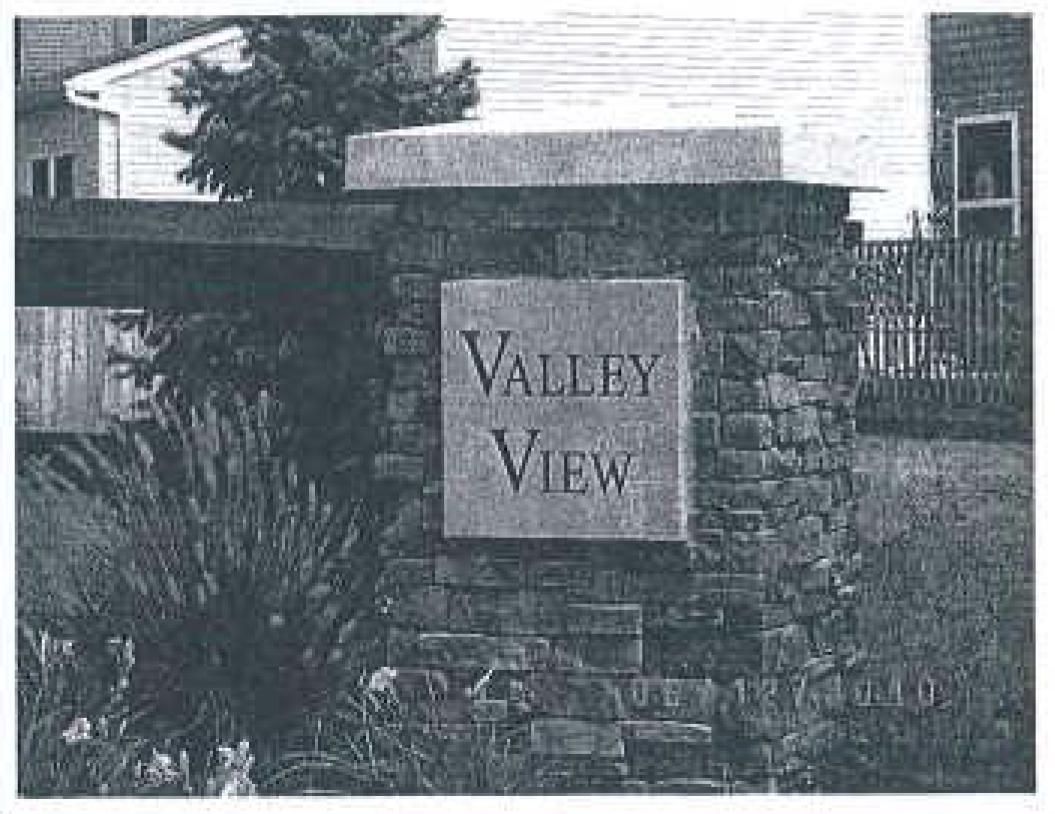
Figure 1115.09-2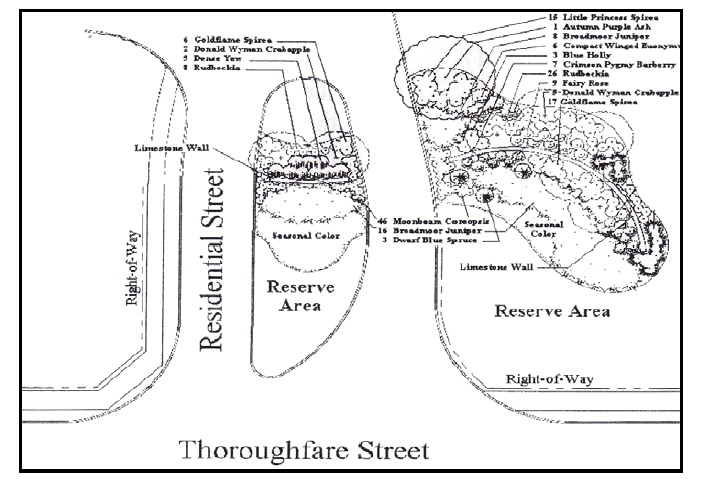
E)
A sign shall be mounted onto a brick, stone, or keystone wall, wood, or wrought iron fence, or earthen mound and the entire area shall be landscaped.
F)
A sign permit shall be required before a ground sign may be constructed. Plans for all signs including location, fences, walls or earth mounds and landscaping shall be submitted for approval.
c.
Wall Signs. Only one wall sign shall be permitted on each dwelling unit and each sign shall not exceed four square feet in sign area.
d.
Temporary Signs.
1)
Only temporary ground signs shall be permitted.
2)
A temporary ground sign advertising a home sale to be held on the premises shall be displayed for a period of time not to exceed three days maximum in any one evenly divided quarter of a calendar year for that premises.
3)
The sign face shall not exceed six square feet in area and the sign area shall not exceed 12 square feet.
4)
The sign height shall not exceed four feet.
5)
The sign shall be located outside any public right-of-way, but shall not be subject to the general ground sign setback provision.
2.
Multi Family Residential Use.
a.
General.
1)
No sign shall be internally illuminated. Only external artificial light sources directing light to the sign face shall be permitted.
A)
The color of any energized lamp used shall be white or yellow.
B)
Light fixtures shall be positioned in a manner that focuses light onto a sign face to prevent glare to persons off premises and the fixtures lens or bulb shielded from public view.
2)
A sign having an electronic message center shall be prohibited.
3)
Projecting signs and wall signs shall be limited to sign area no larger than four square feet.
b.
Ground Signs.
1)
Only one sign shall be permitted on each premises. However, the two sign faces of a ground sign may be split into two signs and situated on both sides of the main entrance to a multi family development providing:
A)
Each sign shall have only one sign face.
B)
The sign face area shall not exceed the maximum sign face area permitted by this Ordinance.
C)
Each sign shall be incorporated into a fence, wall, or earth mound and the entire area shall be landscaped.
D)
Written permission from the DPPM shall be required before a ground sign may be split. Plans for all signs including all fences, walls, or earth mounds and landscaping shall be submitted for approval.
2)
The sign height shall not exceed six feet.
3)
The permitted sign area shall not exceed one square foot of sign area per ten linear feet of lot frontage and shall not exceed 32 square feet in sign face area or 64 square feet in sign area.
c.
Temporary Signs.
1)
Temporary projecting and wall signs shall be prohibited.
2)
Temporary signs may be placed, for a period of time not to exceed 21 days maximum. At the expiration of the 21 day time period, the temporary sign must either be removed or replaced.
3)
The sign height shall not exceed six feet.
4)
The sign area shall not exceed one-half square foot of sign area per ten linear feet of lot frontage and the area of the sign face shall not exceed 12 square feet and the sign area shall not exceed 24 square feet.
G.
Signs Permitted for Business, Industrial, or Other Nonresidential Uses.
1.
General Provisions.
a.
No sign shall be located in such a manner as to be primarily viewed from residential property.
b.
Sign Illumination. No sign shall incorporate movement or the illusion of movement. Any illuminated sign or lighting device shall employ only light emitting a light of constant intensity, and no sign shall be illuminated by or contain flashing, intermittent, rotating or moving lights, or incorporate reflective materials which imitate or create the illusion of flashing or moving lights. In no event shall an illuminated sign or lighting device be placed or directed so as to permit the beams and illumination there from to be directed or beamed upon a public thoroughfare, highway, sidewalk or adjacent premises so as to cause glare or reflection that may constitute a traffic hazard or other nuisance. Signs shall not be lighted in a manner which obstructs traffic control or any other public informational signs. Signs visible from sight lines along streets shall not contain symbols or words, or red and green lights that resemble highway traffic signs for devices. These regulations shall not apply to holiday display lighting.
1)
A permanent sign may be illuminated.
2)
A permanent sign for a business, industrial, or nonresidential use where such use is located in a residential zoning district and the parcel where the use is situated does not have frontage to a thoroughfare street as defined by the Riverside Thoroughfare Plan shall not be internally illuminated.
3)
A temporary sign shall not be illuminated.
c.
A sign may include an electronic message center subject to the following requirements:
1)
The sign must be located in a nonresidential zoning district.
2)
The electronic message center shall be limited to a maximum of 40 percent of the sign face area not to exceed 12 square feet in area.
3)
Light emitted from the electronic message center shall be limited to a single illuminated copy color and a single, non-illuminated background color.
4)
The surface area of the remaining portion of the sign face shall be a solid and opaque surface.
2.
Ground or Projecting Signs.
a.
Only one ground or projecting sign shall be permitted on a premises.
b.
The ground or projecting sign shall not exceed one-half square foot of sign area per one linear foot of lot frontage not to exceed 32 square feet in sign face area or 64 square feet in sign area.
c.
Ground signs shall be a maximum height of six feet at the minimum sign setback line and for every additional five feet of sign setback; one foot may be added to the sign height not to exceed a total sign height of 16 feet.
d.
A property owner may exchange the permitted ground sign for a wall sign(s) provided:
1)
The sign area for this wall sign shall not exceed the sign face area of the ground sign that is permitted to the property by this Ordinance.
2)
The wall sign that is exchanged for a ground sign shall not be located on a building wall that is not used to generate permitted wall signage for this property.
3)
The building wall used to locate this wall sign shall not primarily face towards an abutting residential use nor toward a residential use across a street having a right-of-way width less than 82 feet as defined in the Thoroughfare Plan for the City of Riverside.
4)
No other ground sign shall be permitted on the premises unless otherwise permitted by this Ordinance. Other ground signs permitted by this Ordinance include but are not limited to temporary and directional signs.
5)
Written permission from the DPPM and a CZC shall be required before a ground sign may be exchanged for a wall sign.
3.
Wall Signs.
a.
There is a restriction of three wall signs or poster panels; the total sign area of all wall signs shall not exceed one and one-half square feet of sign area per one linear foot of building frontage. No more than three signs may be displayed on a building frontage.
b.
Wall signs shall be a maximum size of one and one-half square feet of linear building frontage, for multi tenant buildings, a building frontage is the individual tenant space as defined by this Ordinance. Multi tenant structures shall be allowed one wall sign per tenant, located above the primary entrance with a maximum size of 50 square feet per sign.
c.
In cases where a building wall other than the building entrance is clearly visible from more than 50 percent of a street frontage, a wall sign maybe located on the non-building entrance wall.
5.
Temporary Signs.
a.
Ground Signs (Temporary).
1)
Temporary ground signs may be displayed for a maximum of 21 consecutive days in any one quarter and a maximum of 84 days in a 12 month period.
2)
The sign area shall not exceed 16 square feet in sign face area or 32 square feet in sign area.
3)
The sign height shall not exceed six feet.
b.
Wall Signs (Temporary).
1)
Only one temporary wall sign will be permitted, for a period of time not to exceed 21 days maximum in any one evenly divided quarter of a calendar year, shall be permitted for anyone building frontage of a premises.
2)
The sign area shall not exceed 16 square feet.
(Ord. 13-O-535, Passed 9-19-13; Ord. 14-O-552, Passed 3-20-14; Ord. 17-O-618, Passed 3-16-17)
1115.11 - Supplemental standards for zoning districts.
A.
Requirements Applicable to All Zoning Districts.
1.
Height Modifications.
a.
The height limitations stipulated elsewhere in this Ordinance shall not apply to the places of public assembly in places of worship, schools and other permitted public and semipublic buildings, provided that these are located on the first floor of such buildings and provided that for each three feet by which the height of such building exceeds the maximum height otherwise permitted in the district, its side and rear yards shall be increased in width or depth by an additional foot over the side and rear yards required for the highest building otherwise permitted in the district.
2.
Environmental Requirements. No land or building in any district shall be used or occupied in any manner creating dangerous, injurious, noxious, or otherwise objectionable conditions which could adversely affect the surrounding areas or adjoining premises, except that any use permitted by this ordinance may be undertaken and maintained if acceptable measures and safeguards are taken to reduce dangerous and objectionable conditions to acceptable limits as established by the following requirements:
a.
Air Pollution. Air pollution shall be subject to the requirements and regulations established by the Ohio Environmental Protection Agency and the Regional Air Pollution Control Agency of the Montgomery County, Ohio Combined General Health District.
b.
Beekeeping. The keeping of honeybees in residential and agricultural districts is permitted under the following conditions:
1)
One hive shall be permitted for every 7,500 square feet of lot space.
2)
Hives shall not be located in any front yard and shall be at least 25 feet of any property line and ten feet from any dwelling.
3)
Fences and Shrubs. A solid fence or hedge six feet in height, parallel to any property line within 25 feet of the hive and extending at least 20 feet beyond the hive in both directions shall be required with all hives.
4)
Water Supply. An adequate supply of fresh water shall be maintained in a location on the lot which is readily available to all bee colonies on the lot throughout the day to prevent bees from congregating at other sources of water on nearby properties.
5)
Registration. All beekeepers are shall maintain their hives as set forth in Ohio R.C. Ch. 909, Apiaries. This includes obtaining annual registration certificates as noted in Ohio R.C. 909.02. Every hive shall include the owner's Apiary Identification number on no less than the base and one box. The identification number shall be on a side that is visible without moving or lifting of the hive. Any hive found to be without the identification number or expired Apiary Certificate shall be removed within 30 days.
6)
Prohibitions. No Africanized bees may be kept in the City of Riverside.
c.
Electrical Disturbance. No activities shall be permitted which emit electrical disturbance affecting the operation of any equipment other than that of the creator of such disturbances. Any generated electrical disturbance shall comply with all applicable regulations of the Federal Communications Commission.
d.
Erosion. No erosion, by either wind or water, shall be permitted which will carry objectionable substances for a distance of 100 feet or onto neighboring properties.
e.
Fire and Explosion Hazards. Adequate safety devices shall be provided where there are activities involving burning or storage of flammable or explosive materials, adequate safety devices shall be provided at any point. Adequate safety devices against the hazards of fire and explosion and adequate firefighting and fire suppression equipment and devices, standard in the industry shall be provided. Burning of waste materials in open fire is prohibited.
f.
Glare and Heat.
1)
Any operation producing intense light or heat, such as high temperature processes like combustion or welding, shall be performed within a wholly enclosed building and shall not be visible or detectable beyond any lot line bounding the premises.
2)
Welding that is required for exterior construction of a structure shall be exempt from these regulations.
g.
Liquid or Solid Wastes.
1)
No discharge at any point into any public sewer, private sewerage disposal system, stream, or into the ground, of any materials of such nature or temperature as can contaminate any water supply, interfere with bacterial processes in sewage treatment, or otherwise cause the emission of dangerous or offensive elements, shall not be permitted, except in accordance with minimum standards approved by the Montgomery County Health Department, the Ohio Department of Health, the Ohio Environmental Protection Agency, or such other governmental agency as shall have jurisdiction over such activities.
2)
The use of dumpsters or other types of reasonably accessible waste containers for the disposal of potentially dangerous liquid or solid waste materials shall not be permitted.
3)
The storage of toxic material in quantities greater than five gallons of shall be prohibited.
h.
Odors. No noxious odor shall be emitted by any use permitted in any district in such quantities as to be readily detectable by a person not located on the premises.
i.
Radioactive Materials. No activities shall be permitted which utilize fissionable or radioactive materials if their use results at any time in the release or emission of any fissionable or radioactive material into the atmosphere, the ground, or sewerage systems.
j.
Sound.
1)
No premises shall emit sound beyond any minimum building setback bounding the adjacent property.
k.
Trash Collection Facility.
1)
A trash collection facility shall include a large container such as a dumpster or a small container such as a garbage can, bag or other similar container. No trash collection facility shall be located or stored in the front yard of a premises.
2)
A small trash container(s) may be placed at the public right-of-way during the normal trash collection day for 12 hours prior to and 12 hours after trash pickup. A trash container may not be placed in the public right-of-way for a period exceeding 24 hours.
3)
A large trash collection facility shall be situated in a permanent location and placed on a concrete pad (3,000 psi minimum). A dumpster pad shall be of a dimension that will allow a dumpster to sit entirely on the pad and to permit the front wheels of a trash disposal truck to rest on the pad while emptying said dumpster.
l.
Vibration. Every use shall be so operated that ground vibration inherently and recurrently generated is not perceptible, without instruments, beyond any lot line bounding the premises. No vibration at any time shall produce an acceleration of more than 0.1G or shall result in any combination of amplitudes and frequencies beyond the "safe" range of the most recent edition of Table 7, U.S. Bureau of Mines Bulletin No. 442. The equation of said bulletin shall be used to determine the values for enforcement.
B.
Standards for Residential Land Uses.
1.
Average Depth of Front Yard. In Residential Zoning Districts, where the average depth of at least two existing front yards on lots within 100 feet of a lot in question and within the same block front is less or greater than the front yard depth prescribed elsewhere in this Ordinance, the required depth of the front yard on such lot shall be modified. In such a case, the depth of the front yard shall not be less than the average depth of existing front yards, or the average depth of existing front yards of the two lots immediately adjoining, or, in the case of a corner lot, the depth of the front yard immediately adjoining.
2.
Erection of One Principal Building on a Lot. In no case shall more than one principal building, and its accessory buildings, be located on one parcel or lot. This restriction shall apply to residential uses located within the R-1, R-2 and R-3 zoning districts.
C.
Architectural Standards for Nonresidential Land Uses.
1.
Purpose. The goal of these regulations is to encourage development that contributes to the City of Riverside as a unique place, reflecting the community's physical character and adding to it in appropriate ways. The architectural design of nonresidential developments, particularly large scale developments, determines much of the character and attractiveness along the thoroughfares of the City of Riverside. These standards require a basic level of architectural variety, details, and wall and roof materials that are considered traditional in Riverside where possible, provide compatible scale and mass to surrounding development, and mitigate negative impacts. These regulations serve as a basis to promote creative architectural design that is in context with its surroundings.
2.
General Architectural Design Requirements.
a.
These general architectural design requirements of exterior building elevation shall apply to all nonresidential uses within any base zoning district:
1)
Architectural elevations for all buildings shall be designed such that massing, materials, shape and scale of all new or modified principal buildings, and accessory buildings, shall create a unified design on the premises and shall be visually compatible with the surrounding buildings.
2)
The Planning Commission shall have the opportunity to review and approve the architectural design, as recommended by the DPPM, of all new nonresidential buildings and additions to existing buildings in accordance to the requirements of this Ordinance.
3)
The Planning Commission may adopt and maintain a Design Guideline to provide additional information and clarification of the standards contained in this Ordinance.
b.
Building Design and Mass.
1)
All architectural elevations of principal buildings shall consist of a tripartite scheme of a base, a body, and a cap.
A)
The base shall occupy the lowest portion of the elevation, and shall have a height no less than ten percent of the average wall height.
B)
The body shall occupy the middle portion of the elevation, and shall have a height no less than 60 percent of the average wall height.
C)
The cap shall occupy the highest portion of the elevation and shall have a height no less than ten percent of the average wall height, not to exceed the height of the base. Corner towers, or signage, mechanical screening shall not be considered part of the cap.
D)
The cap shall consist of at least one of the following architectural features: a cornice, parapet, awning, canopy, or eaves.
E)
The base and cap shall be clearly distinguishable from the body through changes in color, material, pattern, profile, or texture. A cap and base shall incorporate at least three of these design elements.
2)
Buildings that are characterized by a flat roof and a continuous wall elevation of uniform height shall contain three dimensional architectural elements which serve to break up the horizontal emphasis of the elevation. Building entrances, corners and other similar features are examples that may be characterized by a separate mass.
A)
These architectural elements shall present a balanced design for the entire building.
B)
For a single story building, required architectural elements shall have a height that exceeds the wall height of the dominant portion of the building by at least ten percent but no greater than the maximum building height required by the zoning district.
C)
Architectural elements shall be distributed in a manner that limits the length of a continuous wall section of uniform height to 100 feet.
c.
Building Wall Materials.
1)
Building Base. Brick, stone, manufactured masonry units with cut stone like size and appearance or textured concrete block shall be permitted as base siding materials. Faux stone veneer may be permitted by DPPM on a case by case basis. Exterior insulation finish system (E.I.F.S.), shall not be an acceptable base material in any case.
2)
Building Cap. Brick, stone, textured concrete block, flat finished metal paneling with concealed fasteners, finished wood, or applied materials such as exterior insulation finish system (E.I.F.S.), or other synthetic materials are examples of materials permitted for the building cap. Materials not specifically mentioned may also be permitted with the specific approval of the DPPM
3)
Building Body. Finished wood siding or planking with concealed fasteners, brick, stone, and flat finished metal paneling with concealed fasteners shall be permitted as siding materials for the body of the building. The following body materials are considered inappropriate, however, may be permitted with the specific approval by the DPPM on a case by case basis:
A)
Siding that imitates wood lap siding such as fiber cement siding or siding that imitates brick or stone. All siding shall be field painted with all trim to match in material and quality.
B)
Ceramic tile or ceramic block.
C)
Sheet metal, corrugated metal, or other similar metal panels with exposed fasteners or exposed ribs or profiles.
D)
Poured concrete, concrete block, textured concrete block, concrete panels, panels with an aggregate surface, or other similar concrete siding.
E)
Applied materials such as stucco or EIFS. EIFS shall have stone like appearance or brick stencil.
F)
Specific building/tenant trade dress or brand specific elements, materials, or treatments that differ from those approved above, or that do not comply with other design guidelines in this UDO shall be reviewed by the DPPM on a case by case basis.
d.
Roof Styles and Materials.
1)
Permitted roof styles shall include gable and hip roofs and low slope roofs. Other roof styles shall require specific approval by the DPPM on a case by case basis.
2)
Roofs predating the adoption of this UDO shall be considered preexisting nonconforming and allowed provided they are kept in sound structural condition.
3)
The height of any pitched roof shall not exceed one-half of the overall building height.
4)
Permitted materials for pitched roofs include wood, slate, fiberglass reinforced asphalt roof shingles and standing seam or terne metal. Except when used on flat roofs that are not generally visible, roll roofing, built up tar and gravel, metal panel or corrugated metal, plastic, or fiberglass roofing materials, other than fiberglass reinforced asphalt roof shingles shall be prohibited. Other roof materials shall require specific approval by the DPPM on a case by case basis.
e.
Roof Mounted Mechanical Equipment. Building walls, parapets, and/or roof systems shall be designed to conceal 50 percent of all roof mounted mechanical equipment from view to adjacent properties and public rights-of-way. Finished roof or equipment mounted metal panel screening of a color complimentary to the building must screen remaining equipment.
f.
Building Colors.
1)
Building Body. The body shall read as a single, subdued, earth tone color. A maximum of three accent colors are also permitted that are compatible with the body color.
2)
Building Base. The base shall read as a single, subdued, earth tone color.
3)
Building Cap. The cap shall consist of colors that are compatible with the building body color, any accent color and to each other.
4)
Roof. The roof color shall read as a single color that is compatible with all buildings wall colors.
5)
All other colors or combinations thereof are subject to DPPM approval on a case by case basis.
6)
Any building color or color combinations whose major function is to convey visual information or to attract visual attention is considered a sign and subject to the requirements of the sign section of this Ordinance.
7)
Specific building/tenant trade dress or brand specific elements, materials, or treatments that differ from those approved above, or that do not comply with other design guidelines in this UDO shall be reviewed by the DPPM on a case by case basis.
g.
Additional Design Requirements.
1)
These requirements apply to all nonresidential uses except those industrial uses that are exclusively and solely stated as permitted or conditional use within Permitted Land Uses in Base Zoning Districts for I 1, in the UDO. Permitted or conditional uses in these zoning districts that are either permitted or conditional uses in other zoning districts shall be subject to these regulations.
2)
These requirements are in addition to the General Architectural Design Requirements contained in this Ordinance.
3)
Massing of Buildings.
A)
Buildings shall be designed in a manner which disrupts and/or disperses the massing of the building through the use of projections and recesses. Building elevations shall reflect spaces that are either carved out of a mass or multiple masses of varying sizes grouped together. Examples include recesses, arcades, courtyards, vertical offsets, and horizontal offsets. See Figure 1115.11-1.
Figure 1115.11-1: Articulation of Building Mass and Bulk by the Use of Offsets and
Recesses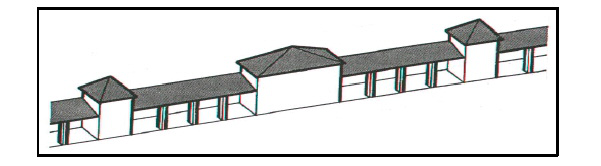
B)
Spaces that are carved out of a mass, and/or multiple masses grouped together, shall appear as proportional to one another and shall establish a pattern or rhythm to the building façade. Patterns may not be wholly consistent or symmetrical, but should establish dominant and subordinate proportions or patterns where possible.
C)
Building elevations greater than 100 feet in length, measured horizontally, shall incorporate projections or recesses in the wall plane. A projected or recessed area should comprise at least 20 percent of the overall length of the elevations.
D)
The maximum length of an uninterrupted wall plane shall be 100 feet.
E)
Walls greater than 50 feet in length shall be uniformly divided into bays through the use of columns, projecting ribs, offsets or reveals. See Figure 1115.11-2.
Figure 1115.11-2: Treatment of Wall Greater than 50 Feet in Length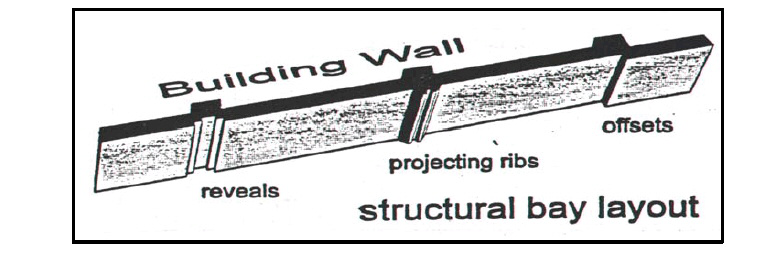
4)
Wall Openings (Doors and Windows).
A)
Building elevations that directly front a public street should contain windows which occupy at least 25 percent of the total wall surface area. The percent of the wall surface area used for windows that is less than this minimum requirement may be approved by DPPM on a case by case basis.
B)
Doors and windows shall be positioned in an orderly manner. Where appropriate, these elements shall form a pattern or visual rhythm along the building elevation. Main entries should be clearly articulated where possible. All entries shall be accessible per OBC, ADA and ANSI A117.1 guidelines.
C)
All doors and windows shall be articulated through the use of lintels, sills, and thresholds.
D)
All buildings with frontage to a public street shall contain at least one entrance on any façade fronting on a public street. All entrances designated for public or employee use shall be characterized by a separate mass and provide at least one of the following features: an overhang, awning, canopy, portico, or projection.
E)
Emergency exits, when located on the side or rear building elevation shall be exempt from this provision.
(Ord. 17-O-618, Passed 3-16-17)
1115.13 - Wireless communication facility standards, wireless telecommunication facilities.
A.
Legislative Purpose. The purpose of this section is to regulate the placement, construction and modification of wireless telecommunications facilities and their support structures in order to protect the public health, safety and welfare, while at the same time not unreasonably interfering with the development of the competitive wireless telecommunications marketplace in the community. Specifically, the purposes of this chapter are:
1.
To direct the location of various types of towers and wireless telecommunications facilities into appropriate areas of the City of Riverside.
2.
To protect residential areas and land uses from the adverse impacts of towers and wireless telecommunications facilities.
3.
To minimize visual impacts of towers and wireless telecommunications facilities through design, siting, landscaping and camouflaging techniques.
4.
To promote and encourage shared use and co-location of towers and antenna support structures as a primary option rather than construction of additional single use towers.
5.
To ensure that towers and wireless telecommunications facilities are compatible with surrounding land uses.
6.
To ensure that towers and wireless telecommunications facilities are designed in harmony with natural settings and in a manner consistent with current development patterns.
B.
Applicability. All towers, antenna support structures and wireless telecommunications facilities, any portion of which are located within the City of Riverside, Ohio, are subject to this chapter. Except as provided in this chapter, any use being made of an existing tower or antenna support structure on the effective date of this section shall be deemed a nonconforming structure and allowed to continue, even if in conflict with the terms of this chapter. Any tower site that has received approval in the form of a zoning permit by the City of Riverside, but has not yet been constructed shall be considered a nonconforming structure so long as such approval is current and not expired.
C.
Definitions as Used in this chapter.
1.
Antenna means any panel, whip, dish, or other apparatus designed for communications through the sending and/or receiving of electromagnetic waves, excluding any support structure other than brackets.
2.
Antenna support structure means any building or other structure other than a tower which can be used for location of wireless telecommunications facilities.
3.
Applicant means any person that applies for a permit pursuant to this chapter.
4.
Application means the process by which an applicant submits a request and indicates a desire to be granted a conditional use permit under the provisions of this UDO. An application includes all written documentation, verbal statements and representations in whatever form or forum, made by an application to the City of Riverside concerning such a request.
5.
City means the City of Riverside, Ohio.
6.
Co-location means the use of a wireless telecommunications facility or preexisting structure deemed suitable by appropriate technical analysis by more than one wireless telecommunications provider.
7.
Emergency means a reasonably unforeseen occurrence with a potential to endanger personal safety or health, or cause substantial damage to property, that calls for immediate action.
8.
Engineer means any engineer licensed by the State of Ohio.
9.
Equipment shelter means the structure in which the electronic receiving and relay equipment for a wireless telecommunications facility is housed.
10.
F.A.A. means the Federal Aviation Administration and any legally appointed, designated or elected agent or successor.
11.
F.C.C. means the Federal Communications Commission and any legally appointed, designated or elected agent or successor.
12.
Monopole means a support structure constructed to a single, self-supporting hollow metal tube securely anchored to a foundation.
13.
Person means any natural person, firm, partnership, association, corporation or other legal entity, private or public, whether for profit or not for profit.
14.
Tower means a self-supporting lattice, guyed, or monopole structure constructed from grade which supports wireless telecommunications facilities. "Tower" shall not include amateur radio operators' equipment, as licensed by the FCC.
15.
Wireless telecommunication facility means any cables, wires, lines, wave guides, antennas and any other equipment or facilities associated with the transmission or reception of communications as authorized by the FCC which a person seeks to locate or have installed upon a tower antenna support structure. However, "wireless telecommunications facilities" shall not include:
a.
Any satellite earth station antenna two meters in diameter or less which is located in an area zoned industrial or commercial.
b.
Any satellite earth station antenna one meter or less in diameter, regardless of zoning category.
c.
Antennas used by amateur radio operators.
D.
Standards Applicable to all Wireless Telecommunications Facilities.
1.
Construction Standards. All wireless telecommunications facilities and support structures shall be certified by a qualified Engineer licensed in the State of Ohio, to be structurally sound and, at a minimum, to be in conformance with the Ohio Basic Building Code and all other applicable Codes enforced by the Montgomery County Building Department.
2.
Natural Resource Protection Standards. The location of the wireless telecommunications facility shall comply with all natural resource protection standards established either in the UDO, this chapter or in other applicable ordinances and/or regulations, including those for flood plains, wetlands, groundwater protection, and steep slopes.
3.
Historic or Architectural Standards Compliance. Any application to locate a wireless telecommunications facility on a building or structure that is listed on a federal, state or local historic register, shall be subject to review by the Director of Planning and Program Management to ensure architectural and design standards are maintained.
4.
Color and Appearance Standards. All wireless telecommunications facilities shall be painted a noncontrasting gray or similar color minimizing their visibility, unless otherwise required by the Federal Communications Commission, Federal Aviation Administration and/or by the standards imposed under subsection D.3 hereof. All appurtenances shall be aesthetically and architecturally compatible with the surrounding environment by the means of camouflage deemed acceptable by the DPPM.
5.
Advertising Prohibited. No advertising shall be permitted anywhere upon or attached to a wireless telecommunications facility.
6.
Artificial Lighting Restricted. No wireless telecommunication facility shall be artificially lit except as required by the Federal Aviation Administration.
7.
Co-location. All wireless telecommunication facilities shall be subject to the co-location requirements set forth in Section 1115.13.E.
8.
Abandonment. All wireless telecommunications facilities shall be subject to the abandonment requirements set forth in Section 1115.13.J.
9.
Setback From Edge of Roof. Any wireless telecommunications facility and its appurtenances permitted on the roof of a building shall be set back one foot from the edge of the roof for each one foot in height of the wireless telecommunication facility. This setback requirement shall not apply to antennas that are less than two inches in thickness mounted to the sides of antenna support structures and which do not protrude more than six inches from the side of such an antenna support structure.
10.
Security Enclosure Required. All towers and equipment shelters shall be enclosed either completely or individually as determined by the City of Riverside. City of Riverside officials and fire and police personnel and co-locators shall have reasonable access. No fence shall be required on top of a building or other structure if access to the roof or top of the structure or building is secure.
11.
Existing Vegetation and Buffer Plantings. Existing vegetation (trees, shrubs, etc.) shall be preserved to the maximum extent possible. Buffer planting shall be located around the perimeter of the security enclosure as deemed appropriate by the City of Riverside. An evergreen screen may be required around the perimeter of the property in lieu of such buffer plantings.
12.
Access Control and Emergency Contact. "No Trespassing" signs shall be posted around the wireless telecommunication facility. Signs with a 24 hour telephone number of whom to contact in the event of an emergency shall be posted around the facility.
E.
Co-location Requirements.
1.
City of Riverside Study of Potential Public Sites. In order to encourage the location of a wireless telecommunications facility on publicly owned property or privately owned property with preexisting tower, building or structures deemed suitable by appropriate technical analysis, the City of Riverside shall undertake an identification of such properties, other than property used for park and recreation purposes, that the City of Riverside determines are suitable. The City of Riverside shall regularly update such identification and make the results available to the public upon request.
2.
Exemption From Proof of Co-location Availability. Persons locating a wireless telecommunications facility upon property identified in the study mentioned in subsection E.1 hereof shall be exempted from the requirements herein regarding presentation of proof that co-location is not available. However, such persons shall be subject to the requirements contained in subsection E.4 hereof.
3.
Exemption From Certain Requirements. Persons locating a wireless telecommunications facility on a publicly owned property identified by the City of Riverside to be suitable for such purpose shall be exempt from the requirements of subsections F., G., H. and I. hereof.
4.
Co-location Design Required. No new tower shall be constructed in the City of Riverside unless such tower is capable of accommodating at least one additional wireless telecommunication facility owned by another person.
5.
Technically Suitable Space. Authorization for a tower shall be issued only if there is not technically suitable space reasonably available on an existing tower or structure within the geographic area to be served.
6.
Application Requirements. With the permit application, the applicant shall list the location of every tower, building or structure within a reasonable proximity that could support the proposed antenna. The applicant must demonstrate that a technically suitable location is not reasonably available on an existing tower, building or structure within such area. If another communication tower owned by another party within such area is technically suitable, applicant must show that due diligence was made to negotiate an offer and that a favorable offer was made to the owner of such tower to co-locate an antenna on the tower and the offer was not accepted. If the applicant owns a tower within the City of Riverside, the applicant must, in addition show that an offer was made to the owner of such tower to co-locate an antenna on a tower owned by the applicant on reciprocal terms and the offer was not accepted. If such co-location offer has not been attempted by the applicant, then such other tower is presumed to be reasonably available.
F.
Agricultural Districts.
1.
Permitted Principal Use. The following wireless telecommunication facilities are permitted as a principal use upon a lot, other than a lot owned by the City of Riverside and used for park and/or recreation purposes, subject to the following requirements:
a.
Tower.
1)
Maximum Height. The maximum height shall be less than 200 feet. Towers 200 feet or more in height shall require approval as a conditional use under the guidelines of subsection F.1.c hereof.
2)
Minimum Setback from Property Lines. No tower shall be located a distance less than its height from the nearest property line.
3)
Minimum Setback from Residential Structure. No tower shall be located less than 200 feet from a structure used as a residence.
4)
Equipment Shelter. The minimum setbacks and yard requirements for principal structures shall apply and such shelter shall not be located above ground in any required front or side yard.
b.
Accessory Use. The following wireless telecommunication facilities are permitted as an accessory use upon a lot, other than a lot owned by the City of Riverside and used for park and/or recreation purposes, subject to the following requirements:
1)
Tower.
A)
Maximum Height. The maximum height shall be less than 200 feet. Towers 200 feet or more in height shall require approval as a conditional use under the guidelines of subsection F.1.c hereof.
B)
Minimum Setback from Property Lines. The minimum setbacks and yard requirements for principal structures shall apply.
C)
Minimum Setback from Residential Structure. No tower shall be located less than 200 feet from a structure used as a residence on any adjoining property.
D)
Equipment Shelter. The minimum setbacks and yard requirements for principal structures shall apply and such shelter shall not be located above ground in any required front or side yard.
2)
Antenna. The antenna shall not be attached to a structure used as a residence.
c.
Conditional Use. The following wireless telecommunication facilities are permitted as a conditional use upon a lot, other than a lot owned by the City of Riverside and used for park and/or recreation purposes subject to the following requirements:
1)
Tower.
A)
Maximum Height. Any height of such tower in excess of the distance of such tower from the nearest property line shall require approval of the Board of Zoning Appeals.
B)
Minimum Setback from Property Lines. The minimum setbacks and yard requirements shall be established by the Board of Zoning Appeals.
C)
Minimum Setback from Residential Structure. No tower shall be located a distance of less than its height from a structure used as a residence.
D)
Equipment Shelter. The minimum setbacks and yard requirements shall be established by the Board of Zoning Appeals and such shelter shall not be located above ground in any required front or side yard.
G.
Residential Districts. No wireless telecommunication facility is permitted as a principal, accessory or conditional use upon a lot zoned R-1; R-2; R-3 or R-4 within the City of Riverside.
H.
Office and Business District.
1.
Principal and Accessory Uses. No wireless telecommunication facility is permitted as a principal or accessory use upon a lot zoned within the City of Riverside.
2.
Conditional Use. The following wireless telecommunication facilities are permitted upon a lot zoned within the City of Riverside, as a conditional use, subject to the following requirements.
a.
Tower.
1)
Maximum Height. The maximum height shall be less than 200 feet. Towers 200 feet or more in height may be approved by the Board of Zoning Appeals.
2)
Minimum Setback from Property Lines. The minimum setbacks and yard requirements for principal structures shall apply.
3)
Minimum Setback from Residential Structure. No tower less than 200 feet in height shall be located less than 200 feet from a structure used as a residence. No tower 200 feet or more in height shall be located a distance less than its height from a structure used as a residence.
4)
Equipment Shelter. The minimum setbacks and yard requirements for principal structures shall apply and such shelter shall not be located above ground in any required front or side yard.
b.
Antenna. The antenna shall not be attached to a residential structure unless such structure is four or more stories in height.
I.
Industrial Districts.
1.
Permitted Principal Use.
a.
Tower.
1)
Maximum Height. The maximum height of such tower shall be less than the distance of such tower from the nearest property line.
2)
Minimum Setback from Property Lines. The minimum setbacks and yard requirements for principal structures shall apply.
3)
Minimum Setback from Residential Structure. No tower shall be located a distance less than its height from a structure used as a residence.
4)
Equipment Shelter. The minimum setbacks and yard requirements for principal structures shall apply and such shelter shall not be located above ground in any required front or side yard.
b.
Accessory Use. The following wireless telecommunication facilities are permitted as an accessory use upon a lot within the City of Riverside, subject to the following requirements:
1)
Tower.
A)
Maximum Height. The maximum height of such tower shall be less than the distance of such tower from the nearest property line.
B)
Minimum Setback from Property Lines. The minimum setbacks and yard requirements for principal structures shall apply.
C)
Minimum Setback from Residential Structures. No tower shall be located a distance less than its height from a structure used as a residence.
D)
Equipment shelter. The minimum setbacks and yard requirements for principal structures shall apply and such shelter shall not be located above ground in any required front or side yard.
2)
Antenna. The antenna shall not be attached to a residential structure unless such structure is four or more stories in height.
c.
Conditional Use. The following wireless telecommunication facilities are permitted as a conditional use upon a lot within the City of Riverside, subject to the following requirements:
1)
Tower.
A)
Maximum Height. Any height of such tower in excess of the distance of such tower from the nearest property line shall require approval of the Board of Zoning Appeals.
B)
Minimum Setback from Property Lines. The minimum setbacks and yard requirements shall be established by the Board of Zoning Appeals.
C)
Minimum Setback from Residential Structure. No tower shall be located a distance of less than its height from a structure used as a residence.
D)
Equipment Shelter. The minimum setbacks and yard requirements shall be established by the Board of Zoning Appeals and such shelter shall not be located above ground in any required front or side yard.
2)
Antenna. The antenna shall not be attached to a residential structure unless such structure is four or more stories in height.
J.
Abandonment of Tower.
1.
Required Notification. All providers utilizing towers shall present a report to the City of Riverside notifying it of any tower facility located in the City of Riverside whose use will be discontinued and the date this use will cease. Such report shall be filed with the City of Riverside 30 days prior to the cessation date. If at any time the use of the facility is discontinued for 180 days, the Zoning Inspector may declare the facility abandoned. The 180 day period excludes any dormancy period between construction and the initial use of the facility. The owner/operator of the facility will receive written notice from the Zoning Inspector and be instructed to either reactivate use of the facility within 180 days, or dismantle and remove the facility. If reactivation or dismantling does not occur, the City of Riverside will either remove the facility or will contract to have the facility removed and assess the owner/operator the costs.
2.
Required Notice to Owner. The City of Riverside must provide the tower owner 30 day notice and an opportunity to be heard before the Board of Zoning Appeals before initiating such action. After such notice has been provided, the City of Riverside shall have the authority to initiate proceedings to either acquire the tower and any appurtenances attached thereto at the current fair market value at that time, or in the alternative, order the demolition of the tower and all appurtenances.
3.
Right to Public Hearing by Owner. The City of Riverside shall provide the tower owner with the right to a public hearing before the Board of Zoning Appeals, which public hearing shall follow the 30 day notice required in subsection J.2 hereof. All interested parties shall be allowed an opportunity to be heard at the public hearing.
4.
Order of Abatement or Demolition. After a public hearing is held pursuant to subsection J.3 hereof, the City of Riverside may order the abatement or demolition of the tower. The City of Riverside may require the licensee to pay for all expenses necessary to acquire or demolish the tower.
K.
Application and Review Requirements.
1.
Required Information for Applications. All applications for wireless telecommunication facilities, including towers, shall include the information required under this section.
2.
Plot Plan Required. When a proposed wireless telecommunications facility or antenna support structure is to include a new tower, a plot plan of not less than one inch equals 100 feet shall be submitted. This plot plan shall indicate all building and land uses within 200 feet of the proposed facility. Aerial photos and/or renderings may augment the plot plan.
3.
Photo Simulations Required. Photo simulations of the proposed wireless telecommunication facility from affected residential properties and rights-of-way taken at designated locations shall be provided.
4.
Technical Necessity. The applicant shall demonstrate that the telecommunication tower is most ideally located where it is proposed in order to provide adequate coverage to the applicant's service area. There shall be an explanation of why the tower and the proposed site is technically necessary.
5.
Review by Radio Frequency Engineer. The evidence submitted by the applicant shall be reviewed by a radio frequency engineer, who will support or refute the evidence.
6.
Land Owner Support and Access. Where the wireless telecommunication facility is located on a property with another principal use the applicant shall present documentation that the owner of the property supports the application and vehicular access is provided to the facility.
7.
Required Site and Landscaping Plan. The applicant shall present a site and landscaping plan showing the following:
a.
Specific placement of the wireless telecommunication facility on the site.
b.
The location of existing structures, trees, and other significant site features.
c.
Type and locations of plant materials used to screen the facilities.
d.
The proposed color of the facilities.
8.
Co-location and Removal Agreement. The applicant shall present signed statements indicating that:
a.
The applicant agrees to allow for the potential co-location of additional wireless telecommunication facilities by other providers on the applicant's structure or within the same site location; and
b.
The applicant agrees to remove the facility within 180 days after its use is discontinued.
9.
Denial by Jurisdiction. Any decision to deny a request to place, construct or modify a wireless telecommunication facility and/or tower shall be in writing and supported by evidence contained in a written record.
L.
Variances. Any request to deviate from any of the requirements of this section shall require approval of a variance in conformance with the procedures set forth in the Riverside UDO.
(Ord. 17-O-618, Passed 3-16-17)
1115.14 - Small cell facilities and wireless support structures.
A.
Purpose and intent. The purpose of this section is to establish general procedures and standards for the siting, construction, placement, collocation, modification, operation, and removal of small cell facilities and/or wireless support structures within the City of Riverside.
The goals of this chapter are to:
1.
Provide standards for the siting, construction, placement, collocation, modification, operation, and removal of small cell facilities and wireless support structures within the City of Riverside.
2.
Establish criteria for making application to promote fair and efficient processing of applications.
3.
Ensure that small cell facilities and wireless support structures conform to all applicable health and safety regulations.
4.
Preserve the character of the City's neighborhoods by limiting the overall number of facilities within the City's right-of-way.
5.
Reduce visual clutter and preserve and enhance the aesthetic environment of the City of Riverside.
6.
Ensure the safety of motorists, pedestrians, and other users of the City's rights-of-way by limiting the placement and overall number of facilities within close proximity to roadways, sidewalks, or other such ways of travel.
7.
Establish a fair and reasonable method to recover costs incurred in administering this section.
B.
Definitions. Within this section, words with specific defined meanings are as follows:
Abandoned. Any small cell facilities or wireless support structures that are unused for a period of 365 days without the operator otherwise notifying the City and receiving the City's approval.
Agent. A person that provides the City written authorization to work on behalf of a public utility.
Antenna. Communications equipment that transmits or receives radio frequency signals in the provision of wireless service.
Applicant. Any person that submits an application to the City to site, construct, place, collocate, modify, operate, and/or remove a small cell facility or wireless support structure in the City of Riverside
Cable operator, cable service, franchise. These words have the same meanings as in the "Cable Communications Policy Act of 1984," 98 Stat. 2779, 47 U.S.C.A. 522.
Collocation, collocate. To install, mount, maintain, modify, operate, or replace wireless facilities on a wireless support structure or utility pole.
Decorative pole. A pole, arch, or structure other than a street light pole placed in the right-of-way specifically designed and placed for aesthetic purposes and on which no appurtenances or attachments have been placed except for any of the following:
A.
Electric lighting;
B.
Specially designed informational or directional signage;
C.
Temporary holiday or special event attachments.
Enclosure. A cabinet for equipment intended to conceal its contents, prevent electrical shock to users, and protect the contents from the environment.
Equipment. Electrical and/or mechanical devices or components.
Historic district. A building, property, or site, or group of buildings, properties, or sites that are either of the following:
A.
Listed in the national register of historic places or formally determined eligible for listing by the keeper of the national register, the individual who has been delegated the authority by the federal agency to list properties and determine their eligibility for the national register, in accordance with section VI.D.1.a.i—v of the nationwide programmatic agreement codified at 47 C.F.R. part 1, Appendix C;
B.
A registered historic district as defined in Ohio R.C. 149.311.
Municipal electric utility. The same meaning as in Ohio R.C. 4928.01.
Occupy, use. With respect to a right-of-way, to place a tangible thing in a right-of-way for any purpose, including, but not limited to, constructing, repairing, positioning, maintaining, or operating lines, poles, pipes, conduits, ducts, equipment, or other structures, appurtenances, or facilities necessary for the delivery of public utility services or any services provided by a cable operator.
Ohio Manual of Uniform Traffic Control Devices, OMUTCD. The uniform system of traffic control devices promulgated by the department of transportation pursuant to Ohio R.C. 4511.09.
Permit, work permit. A permit issued by the City that must be obtained in order to perform any work in, on, above, within, over, below, under, or through any part of the right-of-way, including, but not limited to, the act or process of digging, boring, tunneling, trenching, excavating, obstructing, or installing, as well as the act of opening and cutting into the surface of any paved or improved surface that is part of the right-of-way. Also, a permit issued by the City that must be obtained in order to occupy the City's right-of-way.
Permittee. A person issued a permit.
Person. Any natural person, corporation, or partnership and also includes any governmental entity.
Public utility. A wireless service provider as defined in Ohio R.C. 4927.01(A)(20) or any company described in Ohio R.C. 4905.03 except in divisions (B) and (I) of that section, which company also is a public utility as defined in Ohio R.C. 4905.02; and includes any electric supplier as defined in Ohio R.C. 4933.81.
Public way fee. A fee levied to recover the costs incurred by the City and associated with the occupancy or use of a right-of-way.
Right-of-way, public way. The surface of, and the space within, through, on, across, above, or below, any public street, public road, public highway, public freeway, public lane, public path, public alley, public court, public sidewalk, public boulevard, public parkway, public drive, public easement, and any other land dedicated or otherwise designated for a compatible public use, which, on or after July 2, 2002, is owned or controlled by a municipal corporation. "Right-of-way" excludes a private easement.
Small cell facility. A wireless facility that meets both of the following requirements:
A.
Each antenna is located inside an enclosure of not more than six cubic feet in volume or, in the case of an antenna that has exposed elements, the antenna and all of its exposed elements could fit within an enclosure of not more than six cubic feet in volume.
B.
All other wireless equipment associated with the facility is cumulatively not more than 28 cubic feet in volume. The calculation of equipment volume shall not include electric meters, concealment elements, telecommunications demarcation boxes, grounding equipment, power transfer switches, cut-off switches, and vertical cable runs for the connection of power and other services.
Small cell facility operator, operator. A wireless service provider, or its designated agent, or cable operator, or its designated agent, that operates a small cell facility and provides wireless service as defined in Ohio R.C. 4939.01(T). For the purpose of this chapter, "operator" includes a wireless service provider or cable operator that provides information services as defined in the "Telecommunications Act of 1996," 110 Stat. 59, 47 U.S.C.153(20), and services that are fixed in nature or use unlicensed spectrum.
Substantial change. Substantial change means the same as defined by the FCC in 47 C.F.R. § 1.40001 (b)(7), as may be amended, and as applicable to facilities in the public right-of-way, which defines that term as a collocation or modification that:
A.
Increases the overall height more than ten percent or ten feet (whichever is greater);
B.
Increases the width more than six feet from the edge of the wireless support structure;
C.
Involves the placement of any new enclosures on the ground when there are no existing ground-mounted enclosures;
D.
Involves the placement of any new ground-mounted enclosures that are ten percent larger in height or volume than any existing ground-mounted enclosures;
E.
Involves excavation or deployment of equipment outside the area in proximity to the installation and other wireless communications equipment already deployed on the ground;
F.
Would defeat the existing concealment elements of the wireless support structure; or
G.
Violates a prior condition of approval, provided however that the collocation need not comply with any prior condition of approval related to height, width, enclosures or excavation that is inconsistent with the thresholds for a substantial change.
Note: For clarity, the definition in this chapter includes only the definition of a substantial change as it applies to installations in the public right-of-way. The thresholds for a substantial change outlined above are disjunctive. The failure to meet any one or more of the applicable thresholds means that a substantial change would occur. The thresholds for height increases are cumulative limits. For sites with horizontally separated deployments, the cumulative limit is measured from the originally-permitted wireless support structure without regard to any increases in size due to wireless facilities not included in the original design. For sites with vertically separated deployments, the cumulative limit is measured from the permitted site dimensions as they existed on February 22, 2012.
Utility easement. An easement dedicated for the use of a Public Utilities Commission of Ohio regulated utility.
Utility pole. A structure that is designed for, or used for the purpose of, carrying lines, cables, or wires for electric distribution or telecommunications service. The term excludes street signs and decorative poles.
Wireless facility. Equipment at a fixed location that enables wireless communications between user equipment and a communications network, including all of the following:
A.
Equipment associated with wireless communications;
B.
Radio transceivers, antennas, coaxial or fiber-optic cable, regular and backup power supplies, and comparable equipment, regardless of technological configuration.
C.
The term includes small cell facilities.
D.
The term does not include any of the following:
1.
The structure or improvements on, under, or within which the equipment is collocated;
2.
Coaxial or fiber-optic cable that is between wireless support structures or utility poles or that is otherwise not immediately adjacent to or directly associated with a particular antenna.
Wireless service. Any services using licensed or unlicensed wireless spectrum, whether at a fixed location or mobile, provided to the public using wireless facilities.
Wireless service provider. A person who provides wireless service as defined in Ohio R.C. 4927.01(A)(20).
Wireless support structure. A pole, such as a monopole, either guyed or self-supporting, street light pole, traffic signal pole, a 15 feet or taller sign pole, or utility pole capable of supporting wireless small cell facilities. As used in Ohio R.C. 4939.031, this chapter, "wireless support structure" excludes all of the following:
A.
A utility pole or other facility owned or operated by a municipal electric utility;
B.
A utility pole or other facility used to supply traction power to public transit systems, including railways, trams, streetcars, and trolleybuses.
C.
Applicability. No small cell facility operator may collocate or remove a small cell facility or construct, maintain, modify, operate, replace, or remove wireless support structures in, along, across, upon, and/or under the right-of-way except in conformance with all provisions of this chapter and any other applicable requirements of the City of Riverside.
D.
Procedures.
1.
Permit required. Unless otherwise exempted, it shall be unlawful for any person to collocate or remove a small cell facility or construct, maintain, modify, operate, replace, or remove wireless support structures in, along, across, upon, and/or under the right-of-way unless a permit has been issued by the Zoning Administrator.
2.
Application requirements. This section specifies the necessary requirements for a complete permit application. A complete application shall consist of the following:
a.
Application fee. The applicant must provide the applicable permit application fee in the amount currently required by City of Riverside and listed in its permit fee schedule.
b.
RF compliance affidavit. Applicants must submit a sworn affidavit prepared and signed by an RF engineer with knowledge about the proposed project that affirms the proposed project will be compliant with all applicable governmental regulations in connection with human exposure to radiofrequency emissions. The affidavit must include:
(1)
All frequencies on which the equipment will operate;
(2)
How many channels will be used on each frequency;
(3)
The effective radiated power ("ERP");
(4)
Output level in measured watts; and
(5)
The height above ground for the lowest point on the lowest transmitter.
The required disclosures above must be included for all transmitters on the support structure, which includes without limitation existing collocated antennas and antennas used for wireless backhaul (such as microwave dish antenna or U/E relay).
c.
Regulatory authorization. To the extent that the applicant claims any regulatory authorization or other right to use the public right-of-way, the applicant must provide a true and correct copy of the certificate, license, notice to proceed or other regulatory authorization that supports the applicant's claim.
d.
Owner's authorization. Applicants must submit evidence sufficient to show that either:
(1)
The applicant owns the proposed support structure; or
(2)
The applicant has obtained the owner's authorization to file the application.
e.
Site plans and structural calculations. The applicant must submit fully dimensioned site plans, elevation drawings and structural calculations prepared, sealed, stamped and signed by a professional engineer licensed and registered by the State of Ohio. Drawings must depict any existing wireless facilities with all existing wireless communications equipment and other improvements, the proposed facility with all proposed wireless communications equipment and other improvements and the legal boundaries of the leased or owned area surrounding the proposed facility and any associated access or utility easements.
f.
Equipment and enclosure specifications. The applicant shall provide dimensioned elevations, cut sheets, material samples or other construction documents necessary to evaluate for compliance with this chapter.
g.
Statement of intent. The applicant shall provide a statement of a wireless support structure's intended purpose.
3.
Application type.
a.
Each application to collocate or remove a small cell facility or construct, maintain, modify, operate, replace, or remove wireless support structures in, along, across, upon, and/or under the right-of-way shall be classified as one of three types. The three types of applications are:
(1)
Small cell minor. An application that:
i.
Involves removal or replacement of small cell facilities and any associated equipment on an existing wireless support structure; and such removal or replacement does not constitute a substantial change; or
ii.
Involves the routine maintenance of a small cell facility.
(2)
Small cell substantial. An application that:
i.
Involves the installation of a new small cell facility on a wireless support structure; or
ii.
Involves the removal or replacement of a small cell facility on an existing wireless support structure and such removal or replacement constitutes a substantial change.
(3)
Wireless support structure. An application for a proposal to construct, modify or replace a wireless support structure in the right-of-way.
b.
Applications seeking to collocate a small cell facility to a wireless support structure owned by the City and located within the City right-of-way shall also be required to obtain an attachment certificate and shall be subject to an annual attachment fee in an amount set by the City's fee schedule.
4.
Decisions.
a.
The Zoning Administrator shall review the application for conformance with the standards of this chapter and shall either:
(1)
Approve, approve with conditions, or deny a small cell minor application; or
(2)
Grant or deny consent for small cell substantial and wireless structure applications.
b.
If a request is denied, the reasons for denial shall be provided in writing to the applicant.
c.
The City reserves the right to deny an application if any one of the following conditions exist:
(1)
The application does not comply with a provision of this chapter or a provision of the City of Riverside Codified Ordinances;
(2)
The applicant is not authorized to conduct business in the State of Ohio;
(3)
The applicant is not current in its obligation to pay to the City fees or taxes imposed by this chapter;
(4)
The design or location is deemed unsafe or non-compliant in regards to transportation and engineering standards for construction within the right-of-way;
(5)
The design is counter to the health, safety, and welfare of the City;
(6)
The design or location is in conflict with current or proposed accessibility standards;
(7)
The design does not meet standards related to electrical, structural, safety or construction best practices;
(8)
The proposed design is in conflict with existing infrastructure, facilities, and/or utilities.
d.
Except as allowed in subsection (e) below, applications shall be reviewed and a decision rendered according to Section 1115.14.D.4.a., Decisions, within the following time periods:
(1)
Small cell minor. Small cell minor applications shall be rendered within 60 days of the date of filing.
(2)
Small cell substantial. Small cell substantial applications shall be rendered within 90 days of the date of filing.
(3)
Wireless support structure. Wireless support structure applications shall be rendered within 120 days of the date of filing.
e.
The time period required in subsection d. above may be tolled only:
(1)
By mutual agreement between the applicant and the City;
(2)
If the application is determined to be incomplete; or
(3)
The number of applications exceeds the City's capacity to process them in a timely manner. If such number of applications exceeds capacity then the following tolling time periods may be instituted:
i.
The time period may initially be tolled for up to 15 days when the number of applications received within any consecutive 30 day period exceeds 25 applications;
ii.
For every additional 15 applications that the City receives above the 25 applications stated in i. above the time period may be tolled an additional 15 days; and
iii.
For every additional 30 applications that the City receives above the 25 applications stated in i. above the time period may be tolled an additional 15 days
iv.
However, in no instance shall the time tolled exceed 90 consecutive days.
f.
To toll the time period for incompleteness, the City shall provide the applicant notice within 30 days of the date of filing. Such notice shall include a listing of the missing documents and/or information. The time period resumes once the applicant submits a response. If an application is still incomplete, the City shall notify the applicant within ten days of the response.
g.
If multiple applications are received by the City to install two or more wireless support structures that would violate the spacing requirements of Section 1115.14.E.2., Design and Siting Requirements, or to collocate two or more small cell facilities on the same wireless support structure, the City shall process and render a decision in the order they are received.
h.
In the event that an application is received by the City to install a wireless support structure or small cell facility in a location in common with another application for a facility in the ROW, preference shall be granted in the following order of service provided:
(1)
Municipal infrastructure.
(2)
Water.
(3)
Electricity.
(4)
Gas.
(5)
Landline telephone.
(6)
Wireless service.
5.
Amendments. Amendments to an application in process which are not part of a response to a notice of incompleteness or a correction notice shall be treated as a new application.
6.
Issuance of permit and certificates.
a.
When an application is approved or granted consent, a permit shall be issued to the applicant authorizing the following:
(1)
Small cell work permit. A permit to perform the approved action, removal, replacement, or maintenance work, subject to any conditions;
(2)
Small cell collocation consent. Consent to perform the approved removal, replacement, or installation, and grant occupancy within the City right-of-way, subject to any permits or conditions;
(3)
Wireless support structure. Consent to construct, modify or replace a wireless support structure in the right-of-way, subject to any permits or conditions.
b.
An applicant seeking collocation of a small cell facility to a wireless support structure owned by the City and located within the City right-of-way shall be issued an attachment certificate authorizing such attachment, subject to any conditions.
7.
Scope of approval.
a.
No permit or certificate authorized by this chapter shall be transferrable.
b.
No permit or certificate authorized by this chapter shall convey title, equitable or legal, in the right-of-way.
8.
Duration of approval.
a.
The work authorized by the permit issued must be completed within 180 days from the date of issuance, unless otherwise conditioned as part of the approval.
b.
An attachment certificate for wireless applications is valid for ten years from the date of issuance and may be renewed by the applicant in successive five year terms. Any request for renewal is subject to approval by the Zoning Administrator and may be denied for cause.
c.
In the event that any court of competent jurisdiction invalidates any portion of federal law which mandates approval of any permit, such permit shall automatically expire one year from the date of the judicial order.
d.
In the event that any court of competent jurisdiction invalidates any portion of state law which mandates approval of any permit shall automatically expire 60 days from the date of the judicial order.
9.
Revocation. The following are grounds for revocation or denial of approval:
a.
The intentional provision of materially misleading information by the applicant (the provision of information is considered "intentional" where the applicant was aware of the inaccuracies or could have discovered the inaccuracies with reasonable diligence);
b.
The failure to comply with any condition of approval, order, or other applicable law, rule, or regulation;
c.
The site, structure or operation is otherwise not in compliance with any other provision(s) of applicable law;
d.
The subject site or use is otherwise not in compliance due to incomplete work or projects, or is not in compliance due to unperformed or slow to perform work as part of an open permit.
10.
Appeals. The Board of Zoning Appeals shall hear and decide upon appeals where it is alleged there is an error in any written decision in the enforcement of this Code.
a.
A complete written appeal shall be filed by the appellant within ten days of receiving a written decision or the appeal shall become void. The appeal shall be filed with the Clerk of Council. The written appeal shall:
(1)
Cite specific provisions of this chapter that are alleged to have been interpreted in error or the specific action being appealed and the grounds on which the appeal is being made;
(2)
Include any required application fee in an amount set by the City's fee schedule.
(3)
Include such other information as may be required to render a reasonable decision;
(4)
A statement as to why the appellant has standing as an aggrieved party to pursue the appeal.
b.
An aggrieved party, the City of Riverside City Manager, or the City Manager's designee, may appeal a decision in accordance with Section 1105.17, Appeals Procedure, of the Unified Development Code. Such appeal shall follow the outlined procedures.
c.
The Board of Zoning Appeals shall not be required to hear any case that has been the subject of an appeal during the previous 12 months, unless substantial new evidence, critical to the case, becomes available.
E.
Standards.
1.
General. The City of Riverside desires to promote orderly small cell facility and wireless support structure installations using the smallest and least intrusive means available to provide services to the community. All such installations in the public right-of-way shall comply with all applicable provisions in this section. All applications shall be subject to the following conditions:
a.
Compliance with all applicable laws. Permittee shall at all times maintain compliance with all applicable federal, state and local laws, regulations, ordinances, or other rules.
b.
Right to inspect. The City or its designee may inspect a small cell facility or wireless support structure within the right-of-way upon reasonable notice to the permittee. The permittee shall cooperate with all inspections. The City reserves the right to support, repair, disable, or remove any elements of the small cell facility or wireless support structure in emergencies or when the small cell facility or wireless support structure threatens imminent harm to persons or property.
c.
Contact information. Permittee shall at all times maintain accurate contact information for all parties responsible for the small cell facility or wireless support structure, which shall include a phone number, street mailing address, and email address for at least one natural person. All such contact information for responsible parties shall be provided to the Zoning Administrator.
d.
Indemnities. The permittee and, if applicable, the non-government owner of a small cell facility or wireless support structure shall defend, indemnify, and hold harmless the City and its agents, officers, officials, and employees from:
(1)
Any and all damages, liabilities, injuries, losses, costs, and expenses arising out of any claims, demands, lawsuits, writs of mandamus, or other actions or proceedings brought against the City to challenge, attack, seek to modify, set aside, void, or annul the City's approval of the applicable permit or certificate;
(2)
Any and all damages, liabilities, injuries, losses, costs, and expenses and any claims, demands, lawsuits, or other actions or proceedings of any kind, whether for personal injury, death, or property damage, arising out of or in connection with the activities or performance of the permittee or its agents, employees, licensees, contractors, subcontractors, or independent contractors; and
(3)
In the event the City becomes aware of any such actions or claims, the City shall promptly notify the permittee and shall reasonably cooperate in the defense. It is expressly agreed that the City shall have the right to approve, which approval shall not be unreasonably withheld, the legal counsel providing the City's defense, and the permittee (as applicable) shall reimburse City for any costs and expenses directly and necessarily incurred by the City in the course of the defense.
e.
Interference with City Communication Services. In the event that the City has reason to believe that permittee's operations are causing interference with the City's radio communications operations, then the permittee shall, at its cost, immediately cooperate with the City to either rule out permittee as the interference source or eliminate the interference. Cooperation with the City may include, but shall not be limited to, temporarily switching the equipment on and off for testing.
f.
Adverse impact. Permittee shall undertake all reasonable efforts to avoid undue adverse impacts to adjacent properties and/or uses that may arise from the construction, operation, maintenance, modification, or removal of the small cell facility or wireless support structure.
g.
Maintenance. The site and the small cell facility or wireless support structure, including but not limited to all landscaping, fencing, and related equipment, must be maintained in a neat and clean manner and in accordance with all approved plans and conditions of approval.
h.
Good condition. Small cell facilities and wireless support structures shall at all times employ best practices and maintain in use only the best available technology and methods for preventing failures and accidents so that the same shall not menace or endanger the life or property of any person.
i.
Graffiti and vandalism. Permittee shall remove any graffiti at permittee's sole expense.
j.
Exposure to RF Radiation. All small cell facilities must comply with all standards and regulations of the FCC and any other state or federal government agency with the authority to regulate RF exposure standards.
k.
Utility lines. Service lines must be undergrounded whenever feasible to avoid additional overhead lines.
l.
Relocation for public improvements. Permittee shall remove and relocate the permitted small cell facility and/or wireless support structure at permittee's sole expense to accommodate construction of a public improvement project by the City.
m.
Removal if discontinued. In the event that the use of a small cell facility is discontinued, the owner shall provide written notice to the City of its intent to discontinue use and the date when the use shall be discontinued. If a small cell facility is not removed within 90 days of discontinued use, the City may remove it at the owner's expense irrespective of the notice requirement under this section.
n.
Abandoned. In the event that the use of a small cell facility is abandoned, the City may remove it at the owner's expense.
o.
Site restoration.
(1)
Upon completion of the new work, the contractor shall restore the street and/or alley pavement as required;
(2)
Upon completion of the new work, the contractor shall restore all concrete walks, driveway aprons, and other concrete as required;
(3)
Upon completion of the new work, the contractor shall restore all tree lawns and/or sod strips with topsoil and sod.
p.
General construction. All work and designs shall comply with the following general standards for construction in the City's right-of-way:
(1)
City of Riverside Codified Ordinances;
(2)
City of Riverside Standard Construction Drawings;
(3)
City of Riverside Construction and Material Specifications;
(4)
Ohio Department of Transportation (ODOT) Location and Design Manual;
(5)
ODOT Standard Drawings;
(6)
ODOT Construction and Material Specifications;
(7)
Ohio Manual of Traffic Control Devices;
(8)
American Association of State Highway Transportation Officials (AASHTO) A Policy on Geometric Design of Highways and Streets;
(9)
AASHTO Roadside Design Guide;
(10)
AASHTO Guide for the Planning, Design, and Operation of Pedestrian Facilities;
(11)
AASHTO Guide for Development of Bicycle Facilities;
(12)
United States Access Board (USAB) Proposed Guidelines for Pedestrians in the Public Right-of-Way;
(13)
USAB American with Disabilities Act Accessibility Guidelines;
(14)
National Fire Protection Association 70 National Electric Code; and
(15)
All other applicable local, state, and federal codes and regulations.
q.
Taxes and assessments. To the extent taxes or other assessments are imposed by taxing authorities on the use of City property as a result of an applicant's use or occupation of the right-of-way, the applicant shall be responsible for payment of such taxes, payable annually unless otherwise required by the taxing authority.
r.
Interference. Small cell wireless and wireless support structures shall be constructed and maintained in such a manner that will not interfere with the use of other property.
s.
Financial condition. All owners must procure and provide to the City a bond, or must provide proof of an equivalent financial mechanism, to ensure compliance with all provisions of this chapter. Such bond or financial mechanism must specifically cover the cost of removal of the item placed in the right-of-way.
t.
Setbacks for visibility and access. Any new small cell facility or wireless support structure and other improvements associated with a new small cell facility or wireless support structure or an existing small cell facility or wireless support structure must be setback from intersections, alleys and driveways and placed in locations where it will not obstruct motorists' sightlines or pedestrian access.
u.
Obstructions. Any new small cell facility or wireless support structure and other improvements associated with a new small cell facility or wireless support structure or an existing small cell facility or wireless support structure shall not obstruct any:
(1)
Worker access to any above-ground or underground infrastructure for traffic control, streetlight or public transportation, including without limitation any curb control sign, parking meter, vehicular traffic sign or signal, pedestrian traffic sign or signal, barricade reflectors;
(2)
Access to any public transportation vehicles, shelters, street furniture or other improvements at any public transportation stop (including, without limitation, bus stops, streetcar stops, and bike share stations);
(3)
Worker access to above ground or underground infrastructure owned or operated by any public or private utility agency;
(4)
Fire hydrant access;
(5)
Access to any doors, gates, sidewalk doors, passage doors, stoops or other ingress and egress points to any building appurtenant to the right-of-way; or
(6)
Access to any fire escape.
v.
Historic or architecturally significant structures. Any new utility installation and other improvements associated with a new utility installation or an existing utility installation may not be placed directly in front of any historic or architecturally significant structures in prominent or highly visible locations.
w.
No placement of any small cell facility or wireless support structure shall necessitate tree trimming, cause removal of, or otherwise damage any tree located within the City's right-of-way or a designated utility easement. Such small cell facility or wireless support structure shall not be located within the eventual mature dripline or tree crown of any existing tree located within the City's right-of-way or a designated utility easement.
2.
Design and siting requirements.
a.
General requirements.
(1)
Wireless support structures shall align with other poles to achieve a uniform inline appearance.
(2)
Wireless support structures shall be setback from the edge of pavement according to applicable safety and construction standards as set forth in Section 1115.14.E.1, General.
(3)
All small cell facilities and wireless support structures and any related items shall be installed and maintained plumb and level and shall maintain an orderly and neat appearance.
(4)
All equipment and enclosures shall be attached, anchored and/or strapped tightly to poles using corrosion resistant steel hardware.
(5)
Wireless support structures shall support no more than two small cell facilities.
(6)
Ambient noise suppression measures or placement of the equipment in locations less likely to impact adjacent properties shall be required to ensure compliance with all applicable noise regulations.
(7)
Unless otherwise required for compliance with FAA or FCC regulations, the small cell facility or wireless support structure shall not include any permanently installed lights. Any lights associated with the equipment shall be appropriately shielded from public view. This shall not be interpreted to prohibit streetlights or the placement of luminaires by the City.
b.
Location.
(1)
In accordance with Ohio R.C. 4939.0314(D), Authority of a Municipal Corporation, the City shall reserve the right to propose an alternate location to the proposed location of a new wireless support structure, provided the alternate location is within 100 feet or a distance equal to the width of the right-of-way in or on which the new wireless support structure is proposed, whichever is greater. The City of Riverside also finds that certain locations and collocation configurations are preferred. A preferred location and collocation configuration should be utilized whenever possible and should only be surpassed if in the determination of the Zoning Administrator, clear and convincing evidence supports such a decision. Cost alone should not be grounds for such a determination. The order of preference is as follows:
i.
First, small cell facilities should be collocated on an existing pole or wireless support structure within a utility easement. If no such pole or wireless support structure is available then proceed to the next preference;
ii.
Second, small cell facilities should be collocated on an existing pole or wireless support structure within an alley. If no such pole or wireless support structure is available then proceed to the next preference;
iii.
Third, small cell facilities should be collocated on a new wireless support structure within a utility easement. If no such location is available then proceed to the next preference;
iv.
Fourth, small cell facilities should be collocated on a new wireless support structure within an alley. If no such location is available then proceed to the next preference;
v.
Fifth, small cell facilities should be collocated on a wireless support structure currently supporting a small cell facility located within the City right-of-way. If no such wireless support structure is available then proceed to the next preference;
vi.
Sixth, small cell facilities should be collocated on an existing pole located within the City right-of-way. If no such existing pole is available then proceed to the next preference;
vii.
Seventh, small cell facilities should be collocated on a new wireless support structure located within a utility easement. If no such location is available then proceed to the next preference;
viii.
Eighth, small cell facilities should be collocated on a new wireless support structure located within an alley. If no such location is available then proceed to the next preference
ix.
Ninth, small cell facilities should be collocated on a new wireless support structure located within the City right-of-way.
(2)
Any new wireless support structure shall be located at least 1,230 feet from any existing small cell facility.
(3)
Any wireless facility or new wireless support structure in any residential district shall be reviewed by the Planning Commission through the conditional use procedure outlined in Chapter 1105 of the UDO.
i.
Except in residential districts with existing underground utilities, all wireless facilities and new wireless support structures shall be prohibited.
(3)
Wireless facilities design.
i.
Wireless support structures shall be subject to the following design standards:
(a)
Wireless support structures shall be limited to 40 feet in height.
(i)
Except when the Zoning district restricts the building height to 35 feet or less the Wireless support structure shall be limited to a maximum of 35 feet, per Ohio R.C. 4939.0314(F)1.(ii).
(b)
Wireless support structures shall be capable of supporting at least two small cell facility operators.
(c)
New wireless support structures shall have the following design elements:
(i)
Material—aluminum poles;
(ii)
Color—black anodized;
(iii)
Diameter—12 inches;
(iv)
Style—smooth round tapered profile;
(v)
Base—trapezoidal pedestal base on a reinforced concrete footing/foundation pier;
(vi)
Exception—If the aesthetics and character of the immediate area would be better matched by a pole of a different material, color, style, or base, then such design elements may be substituted with an alternate design element. Such determination shall be based on the following factors:
(A)
The design features of nearby poles serving in a similar capacity;
(B)
The design features of the existing or proposed streetscape, district, or site;
(C)
The historical context of a district or specific site;
(D)
A desire to camouflage or conceal the pole from view.
(2)
Small cell facilities shall be subject to the following design standards:
i.
The City reserves the right to require the following:
(a)
Antenna and all associated equipment shall be concealed to the extent necessary for the aesthetic context of the small cell facility. Some possible configurations include but shall not be limited to the following:
(i)
Antenna(s) associated with the first fitting on a wireless support structure shall be top-mounted and concealed within a radome that also conceals the cable connections, antenna mount and other hardware. A side-mounted antenna may be approved if the mounted antenna would be a better match to the aesthetics and character of the immediate area and would promote the purposes of this chapter.
(ii)
GPS antennas be placed within the radome or directly above the radome not to exceed six inches.
(b)
Each antenna and all associated equipment shall not exceed six cubic feet in volume.
(c)
All portions of a small cell facility other than an antenna and as identified by the Ohio R.C. 4939.01(P)2, shall not exceed 28 cubic feet in volume per facility.
(d)
Small cell facilities mounted to a wireless support structure shall be completely concealed within a common enclosure capable of containing at least two small sell facilities. Such common enclosures shall:
(i)
Not exceed 24 cubic feet in volume;
(ii)
Not exceed 90 inches in height, 20 inches in width, or 20 inches in depth;
(iii)
Not extend more than 24 inches away from the pole on which it is mounted;
(iv)
Shall be centered on the vertical axis of the pole to which it is mounted;
(v)
Be mounted at a distance of at least ten feet measured from grade to the bottom of the enclosure;
(vi)
Be mounted on the side of the pole facing away from nearest traffic lane's direction of travel.
(e)
Such common enclosures shall have the following design elements:
(i)
Material. The enclosure material shall be metal, a composite, or an equivalent material as determined by the City of Riverside.
(ii)
Color. The enclosure shall match the color of the pole on which it is mounted.
(iii)
Style. The enclosure shall match the style of the pole on which it is mounted.
(iv)
Coordinated Design Elements. Common enclosures shall match the material, color, and style of nearby existing common enclosures when:
(A)
Such enclosures are located within 5,000 feet of an existing common enclosure; and
(B)
Such enclosures are mounted on wireless support structures of a similar or matching design.
(v)
Exception. If the aesthetics and character of the immediate area would be better matched by an enclosure a different material, color, style, or by deviating from the design of a nearby existing common enclosure, then such design elements may be substituted with an alternate design element. Such determination shall be based on the following factors:
(A)
The design features of nearby poles serving in a similar capacity;
(B)
The design features of the existing or proposed streetscape, district, or site;
(C)
The historical context of a district or specific site;
(D)
A desire to camouflage or conceal the enclosure from view.
(f)
All ground mounted equipment shall be placed in an underground vault. No above grade ground mounted equipment in service of a small cell facility is permitted unless the following conditions can be satisfied as determined by the City of Riverside:
(i)
The applicant has submitted clear and convincing evidence that the equipment cannot feasibly be pole-mounted, placed in an underground vault, or hidden within or integrated into an existing streetscape element (i.e. bus stop shelter). Increased costs alone shall not be a consideration. If a ground mounted enclosure is approved, the City shall reserve the right to require any of the following conditions:
(A)
Concealed enclosure. All equipment shall be completely concealed within a metal, composite, or equivalent material enclosure as determined by the City of Riverside.
(B)
Smallest size. The enclosure shall be no larger than necessary based on the smallest available size of the proposed equipment as determined by the City of Riverside.
(C)
Camouflage. Camouflaging elements may be required. Such elements may include, but shall not be limited to, public art displayed on the enclosure, strategic placement in less visible or obtrusive locations, placement within an existing streetscape element, landscape screening, and strategic painting or coating to camouflage such enclosure or equipment.
(ii)
The maximum height of any such enclosure shall be 30 inches.
3.
Reservation of right-of-way. The City reserves the right to reserve space for future public safety or transportation uses in the right-of-way or on a wireless support structure or pole owned or operated by the City in a documented and approved plan in place at the time an application is filed. A reservation of space shall not preclude placement of a pole or collocation of a small cell facility. If replacement of the City's pole or wireless support structure is necessary to accommodate the collocation of the small cell facility and the future use, the small cell facility operator shall pay for the replacement of the pole or wireless support structure, and the replaced pole or wireless support structure must accommodate the future use.
F.
Nonconformity. A nonconforming small cell facility and/or wireless support structure shall immediately lose its nonconforming designation and must be brought into compliance with all of the provisions of this chapter, and all other applicable City laws and ordinances or be removed if any of the following conditions are present:
1.
The nonconforming small cell facility and/or wireless support structure or a part of the nonconforming small cell facility and/or wireless support structure is altered, modified, relocated, replaced, or changed in any manner whatsoever;
2.
The nonconforming small cell facility and/or wireless support structure is damaged or deteriorated and requires any process of reconstruction, repair, maintenance, or restoration, and the cost of said reconstruction, repair, maintenance, or restoration exceeds 50 percent of the small cell facility and/or wireless support structure's replacement cost;
3.
The nonconforming small cell facility and/or wireless support structure is abandoned.
G.
Conflict with other provisions. In the event that any other applicable law or code requires any more restrictive requirements, the most restrictive requirement shall control.
H.
Severability. The provisions of any part of this chapter are severable. If any provision or subsection, or the application of any provision or subsection to any person or circumstances, is held invalid, the remaining provisions, subsection, and applications of such ordinance to other persons or circumstances shall not be made invalid as well. It is declared to be the intent of this section that the remaining provisions would have been adopted had such invalid provisions not been included in this chapter when originally adopted by Council.
I.
Penalties.
1.
Any person in violation of any of the terms of this chapter, or who, being the owner or agent of the owner of any lot, tract, or parcel of land, shall suffer or permit another to erect, construct, reconstruct, alter, repair, convert, attach, or maintain any such facility, shall be deemed to have violated the provisions hereof each day during the period such violation continues.
2.
If any utility installation is erected, constructed, reconstructed, altered, repaired, converted, attached, or maintained in violation of this chapter or of any regulations made pursuant hereto, the proper officer of the City, in addition to other remedies, may institute in the name of the City any appropriate action or proceeding, whether by legal process or otherwise, to prevent such unlawful erection, construction, reconstruction, alteration, repair, conversion, maintenance, attachment, or use, to restrain, correct, or abate such violation, to prevent the use of such utility installation, and/or to prevent any illegal act, conduct, business, or use in or about such utility installation.
3.
The City of Riverside is authorized to make requests and to issue orders regarding utility installations in the right-of-way for the purpose of public safety and compliance with this chapter of the Unified Development Ordinances. The City is also authorized to conduct visual and external inspections of utility installations in the right-of-way at any time and shall make efforts to coordinate with the provider responsible for a utility installation for any internal inspection of the relevant equipment.
(Ord. No. 19-O-690, § 1(Exh. A), 5-2-19)
1115.15 - Demolitions.
A.
Purpose. It is the purpose of this section to ensure that demolition projects conducted in the City of Riverside are done in a safe and complete manner. The end product of demolition will be a "park-like" graded grass lot.
B.
Applicability. These standards apply to all demolitions of residential, commercial and industrial principal and accessory structures. Fences, storage sheds, above ground swimming pools shall be exempt from this requirement. No structure, required to meet the standards of this section, shall be demolished, in whole or in part, without the issuance of a Demolition Permit prior to commencing work.
C.
Security Deposit. Applicants desiring a permit to demolish a structure shall deposit with the City a security deposit.
D.
Bond in Lieu of Security Deposit. In lieu of the security deposit required in subsection C. herein, an owner or authorized representative may deposit with the City a performance bond or irrevocable letter of credit in a sum equal to that required in subsection C. herein to ensure the completion of the demolition per the standards set forth herein.
E.
Forfeiture of Bond or Security Deposit. In the event that demolition is not completed per the standards set forth herein, the required security deposit, bond, or irrevocable letter of credit shall be forfeited and paid over to the City.
F.
Demolition Standards.
1.
Safety Precautions. The owner or authorized representative shall take appropriate safety precautions in order to prevent injury, property damage, and unauthorized entry. Reasonable control measures shall be in place at all times as necessary including, but not limited to, guard rails, barriers, warning lights, fences, and warning notices. Trenches, ditches or other excavations that are falling or tripping hazards shall not be left unattended unless protected by temporary fencing or other barrier designed to prevent unauthorized entry.
2.
Dust and Debris Control. The demolition site shall at all times be maintained in a manner to reduce the impact of dust on adjacent properties and prevent debris from falling on adjacent properties or public rights-of-way.
3.
Maintenance of the Right-of-Way. All streets, sidewalks and other areas in the public right-of-way shall be kept free of mud and/or debris as a result of demolition activities, including hauling and grading activities.
4.
Utilities. All utilities, including sanitary sewer, water, gas, and electric shall be disconnected and capped per the utility having jurisdiction's regulations. The Contractor is responsible for contacting the Ohio Utilities Protection Service (OUPS) to locate utilities and each individual utility to confirm the status of abandonment, retirement or capping of those utilities.
5.
Foundations. All footers and foundation walls shall be removed in their entirety.
6.
Concrete and Asphalt. All slabs, driveways, parking areas, driveway approaches and other areas of impervious surface shall be removed unless agreed upon in writing by the City prior to commencement of demolition. Public sidewalks shall remain. New curbing shall be installed in accordance with City specifications where driveway approaches were removed.
7.
Removal of Accessory Structures. When demolition includes demolition of the principal structure, all accessory structures, including but not limited to fences, decks, storage sheds, garages, and signs, shall be removed along with the principal structure unless agreed upon to remain prior to demolition.
8.
Tress and Landscaping. All trees and other landscaping shall be removed from the site unless agreed upon to remain prior to demolition.
9.
Finish Grading. All excavations shall be leveled with approved clean fill and compacted substantially to prevent future settling. Finish grade shall be level, smooth and free of rocks and/or other debris.
10.
Grass. Grass shall be replaced on the lot either by seed or sod. Seed shall be reasonable free of weeds or coarse grass and shall be evenly sown onto the topsoil. Demolition shall not be considered completed until grass has been restored to the site.
(Ord. 17-O-618, Passed 3-16-17; Ord. No. 21-O-778, § 1(Exh. A) 10-7-21)
1115.17 - Live/Work.
A.
Definition. A space within a building (a) that combines a commercial use with a living space for the owner of the commercial establishment and that person's household, (b) where the resident owner of the commercial establishment is responsible for the commercial use on the premises; and (c) where the commercial use is consistent with the zoning district in which it is located.
1.
Purpose. Business live/work units allow limited residential use in commercial establishments in B-1 and B-2 districts as a conditional use. The regulations of this section are intended to ensure that the residential use satisfies basic habitability standards and that the commercial viability of the unit is maintained.
2.
Standards. Live/work units shall comply with the following standards:
a.
Any conditional use application to establish a live/work unit or to change the use of a live/work unit shall specifically identify the nature of the work activities, the hours of operation, whether or not there will be one full-time employee or multiple part-time employees. The application shall also include a floor plan that identifies those areas of the unit to be used as a living space and those areas to be used as a work space. The floor plan shall include the nature and location of equipment.
b.
Parking shall be required in compliance with the applicable zoning district. Parking requirements shall be applied in a manner that considers each live/work unit as a single dwelling unit and that measures the floor area of the work space exclusive of the area devoted to living space.
B.
Residential portion of the live/work unit.
1.
The residential portion of the live/work unit must be constructed with a complete dwelling unit and shall include cooking space, sanitary facilities and sleeping space in compliance with Ohio Building Code and any other applicable codes, ordinances, laws, rules.
2.
The residential portion must be occupied by the business/property owner; the building cannot be leased or subleased.
3.
The residential portion shall not have a separate street address from the work space.
4.
Parking for resident(s) shall be prohibited in front of the building unless located on an approved driveway.
5.
The residential portion must be vacated if the business ceases.
C.
Work portion of the live/work unit.
1.
Only business uses as permitted in B1, B2 zones may be used as live/work units, and must comply with the requirements of the zoning district in which the live/work unit is located.
2.
The work portion of the live/work unit shall be designed or equipped exclusively or principally to accommodate commercial uses, and shall be regularly used for commercial activities and and/or display space by one or more occupants of the unit. A minimum of 50 percent of a structure's street front façade, at street level, shall be occupied by nonresidential uses.
3.
Businesses with live/work units shall not be established in conjunction with any of the following:
a.
Storage of flammable liquids or hazardous materials beyond those normally associated with a residential use;
b.
Welding, machining, or any open flame work; and
c.
Any other activity or use determined by the Zoning Administrator to not be compatible with residential activities and/or to have the possibility of affecting the health or safety of business live/work unit residents, because of the potential for the use to create dust, glare, heat, noise, noxious gases, odor, smoke, traffic, vibration or other impacts, or would be hazardous because of materials, processes, products or wastes.
D.
Other conditions common to both live/work components.
1.
Each component must obtain/possess a zoning certificate/occupancy permit specific to the use of the space.
2.
The conditional use permit and/or zoning certificate and/or occupancy permit is non-transferable; any new business owner or new property owner must recertify.
3.
Right to revoke by city. Any activity or use as a result of the live/work conditional use that is determined by the City of Riverside/Zoning Administrator to not be compatible with permitted principal uses and/or affecting the health or safety of residents may result in the City taking steps to revoke the conditional use by appealing to the Board of Zoning Appeals (BZA) when factors such as multiple or habitual code violations and other conditions threaten the purpose of the live/work use.
4.
Business live/work units are prohibited in shopping centers.
(Ord. No. 18-O-678, § 2(Exh. A), 5-16-19)

