
Riviera Beach City Zoning Code
ARTICLE I
- IN GENERAL
Sec. 31-1.- Definitions.
The following words, terms and phrases, when used in this chapter, shall have the meanings ascribed to them in this section, except where the context clearly indicates a different meaning:
Accessory building or structure means a subordinate building, the use of which is clearly incidental and related to that of the principal building or use of the land, and which is located on the same lot as that of the principal building or use.
Accessory use means a use that is customarily incidental to the principal use and so necessary or commonly to be expected that it cannot be supposed that the Code intended to prevent it. Accessory uses, unless otherwise provided, shall be located on the same premises as the principal use.
Advertisement means a form of communication used to persuade potential customers to purchase or consume a particular brand, product or service. Common methods used for advertising may include, but are not limited to: banners, billboards, business cards, brochures, electronic communication, fliers, the internet, letter head, magazines, mailings, newspapers, phone books, prints, publications, radio, signage, stamps, and television.
Affected area means the area on a plan or a development that is subject to the proposed modification, including but not limited to lot, structures, uses, or site elements.
Affordable housing means an owner-occupied or rental dwelling unit with a purchase cost, value, or monthly rental, as applicable, equal to or less than the amounts established by the applicable standards for those individuals whose income is at or below 60 percent of area median income as published by the United States Department of Housing and Urban Development and certified by the department of community and economic development.
Alley means a right-of-way which affords only a secondary means of access to property abutting thereon and is not intended or used for general traffic circulation, and is not over 20 feet in width.
Alterations, building means any change in the structure which will increase the number of dwelling units, the floor area or the height of the structure, or change the occupancy of the structure as established in the city's building code.
Apartment means a room or a suite of rooms occupied, or which is intended or designed to be occupied, as the home or residence of one individual, family or household, for housekeeping purposes.
Assisted living facility means any building or buildings, section or distinct part of a building, private home, boarding home, home for the aged, or other residential facility, whether operated for profit or not, which undertakes through its ownership or management to provide housing, meals, and one or more personal services for a period exceeding 24 hours to 15 or more adults.
Auto broker means any person who, for a fee, commission, or other valuable consideration paid by a consumer offers to provide, provides, or represents that he will provide a service of purchasing, arranging, assisting or effecting the purchase of an automobile as agent, broker or intermediary for a consumer. An auto broker business does not include any person registered as an auto dealer.
Baling means to tightly compress and secure into bales by wires, hoops, cords, or the like.
Bars, saloons, taverns, cocktail lounges, or nightclubs means any premises used primarily for the sale or dispensing of liquor by the drink for on-site consumption and where food may be available for consumption and where food may be available for consumption on the premises as accessory to the primary use.
Boardinghouse or lodging house means a building other than a hotel, where lodging or meals or both are served for compensation.
Building means any structure having a roof impervious to weather designated and suitable for the habitation or shelter of human beings or animals and the shelter or storage of properties or for use in any occupation for some purpose of trade and manufacture.
Building façade means an exterior building wall facing a street, path, or park.
Building frontage means the percentage of the total width of a lot which is required to be building façade(s).
Building, principal means a building for which the main or principal use of the lot on which the building is situated is contracted.
Briquetting means a molded block of any material.
CDD means the community development department.
Child care facility means an establishment, including any child care center or child care arrangement, other than a family day care home or large family child care home, which provides care to any number of children, which receives a payment, fee, or grant for any of the children receiving care, whether or not operating for profit.
Church means an enclosed structure for public or semipublic religious worship, irrespective of denomination. For the purposes of this code, churches include synagogues, mosques, temples, etc.
Coastal construction setback control line means a line established by the state department of environmental protection to prevent or reduce beach erosion and damage to coastal life and property pursuant to F.S. ch. 161.
Community garden means a defined area of land utilized collectively by a group of people to grow plant material including flowers or produce for profit or not-for-profit, including supplementary uses and structures associated with gardening and community gathering spaces.
Community residence means a form of permanent housing for groups that do not meet the definition of "family," consisting of persons who, by reason of a disability, require the assistance or support furnished by other residents of the community residence as well as the support services, if any, provided by the staff of the community residence. Its primary purpose is to provide shelter in a family-like environment; treatment is incidental as in any home. Community residences may be Type I or Type II, as further described in section 31-561. A community residence shall be considered a residential use of property for purposes of all zoning, building, and property maintenance codes.
Construction demolition debris recycling means the separation of reusable commodities (e.g. rebar) from those construction waster materials (concrete rubble, wood scraps, pieces of drywall, etc.) that remain after demolition and must be disposed of at a sanitary landfill.
Contiguous means lands which abut each other, or if separated by streets, ways, easements, pipelines, power lines, conduits and rights-of-way, are under one ownership.
Contractor storage yard means a fenced in area utilized by a contractor for the purpose of storing material and equipment.
Density means the total number of residential dwelling units per acre of land as specified within and limited by this chapter.
Development order means any order granting, denying or granting with conditions an application for a development permit.
Development permit means and includes any building permit, zoning permit, subdivision approval, rezoning, certification, special exception, variance, or any other official action of local government having the effect of permitting the development of land.
Drive-up, drive-through facility means any place of business or premises which serves, sells, or otherwise makes available its goods or services directly to customers situated in motor vehicles.
Driveway means the standard means of ingress and egress from private properties to public rights-of-way.
Dune means a ridge, mound or hill of sand which extends parallel to the shoreline along sandy coasts formed by wind and waves.
Dune, crest of means the highest point of a dune, or a line formed by such points.
Dwelling means a building or portion thereof, designed or used exclusively for residential occupancy, but not including trailers, mobile homes, hotels, motels, motor lodges, boardinghouses and lodging houses, tourist courts or tourist homes.
Dwelling, duplex means a building designed to be occupied by two families, living independently of each other.
Dwelling, multiple family means a building designed to be occupied by three or more families, living independently of each other.
Dwelling, single-family means a building designed exclusively for one-family occupancy.
Dwelling unit (DU) means a room or suite of two or more rooms suitable and designated for residential use and not occupied by more than one family doing its own cooking therein and having only one kitchen facility, located within a building.
Easement means a grant to the general public, a corporation or a certain person for use of a strip or parcel of land for a specific purpose.
Expression line means a continuous line on a building façade expressed by a variation in material or by a cornice or molding.
Family means one or more persons living together and interrelated by bonds of consanguinity, marriage, domestic partnership as defined in section 2-6 of the Palm Beach County Code of Ordinances, or legal adoption, or a group of persons up to three in number who are not so interrelated, occupying the whole or part of a dwelling as a single housekeeping unit, supplied with a kitchen or facilities for doing their own cooking on the premises, and who share common living facilities. Any person under the age of eighteen years whose legal custody has been awarded to the State Department of Children and Families or to a child-placing agency licensed by the Department, or who is otherwise considered to be a foster child under the laws of the state, and who is placed in foster care with a family, shall be deemed to be related to and a member of the family for the purposes of this definition. A family does not include residents of any nursing home; club; boarding or lodging house; dormitory; fraternity; sorority; or group of individuals whose association is seasonal or similar in nature to a resort, motel, hotel, boarding or lodging house.
Family day care home means an accessory use conducted in an occupied residence in which custodial care is regularly provided to one to six children, inclusive, and for which the owner or operator receives a payment, fee, or grant for any of the children receiving care, whether or not operating for profit.
Ferrous metal means any metals containing significant quantities of iron or steel.
Filling (service) stations means any building or plot of land used or designed to be used for the storage and retail sale of automotive fuels and lubricants and which may include facilities for washing, polishing, greasing, waxing, tire repairing and other minor repairs. No major vulcanizing, tire recapping or other major mechanical repairs shall be included in the operation of a filling station.
Floor area ratio (F.A.R.) means the total floor area built on a zoning lot, divided by the total lot area of that zoning lot.
Floor area, total means the sum of the areas of the several floors of the structure, as measured by the exterior faces of the walls, including fully enclosed porches and the like as measured by the exterior limits thereof, but excluding garage space which is in the basement or lower floors of a building. Carports, garages, breezeways and porches shall be excluded from the computation of floor area when a minimum floor area is specified in these provisions.
Floor footprint means the total indoor and outdoor footprint of a building at any given story. The 100-percent floor footprint is calculated by multiplying the maximum lot coverage by the overall size of the parcel. Some districts may limit the floor footprint by percentage at certain stories.
Garage, private means an accessory building or a portion of a main building designed or used for the storage of automobiles of the occupants of the main building. A carport would be considered a private garage.
Garage, public means a building or portion thereof, other than a private or storage garage, designed or used for the storage, servicing, repairing and equipping of motor vehicles.
Garage, storage means a building or portion thereof designed or used exclusively for the storage or parking of automobiles. Services, other than storage, shall be limited to refueling, lubrication, washing, waxing and polishing.
Health club means an establishment that provides members and nonmembers with equipment, space, and/or facilities for the purpose of physical exercise as a primary or secondary use.
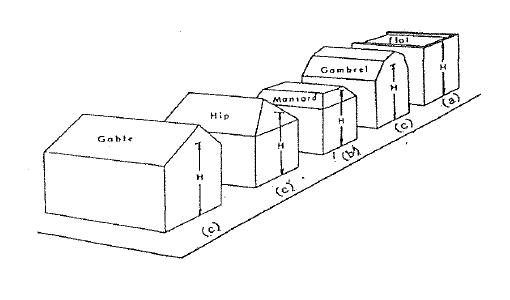
Height of building means the vertical distance measured from the minimum required floor or 18 inches above the crown of the road to: (a) the highest point of a flat roof; (b) the deck line of a mansard roof; (c) the average height between eaves and ridge for gable, hip, and gambrel roofs; or (d) the average height between high and low points for a shed roof. Parapet walls intended to provide screening for rooftop mechanicals may extend not more than five feet above the allowable height of a building.
Home based business means a business activity which:
(1)
Has its primary location in a residential dwelling unit and any on site retail transactions are only conducted at the residential dwelling;
(2)
Is conducted entirely within the dwelling by the occupants;
(3)
Is clearly incidental and secondary to the use of the dwelling for residential purposes; and
(4)
Does not change the residential character of the dwelling.
Hospital means a state-licensed institution that provides primary health services and medical or surgical care to humans, primarily inpatients, who are sick or injured, and including as an integral part of the institution, related facilities such as clinical laboratories, outpatient facilities, training facilities, central services facilities, and staff offices. Hospitals offer facilities and beds for use beyond 24 hours by persons needing medical treatment or service.
Hotel means any building containing principally sleeping rooms in which transient guests are lodged with or without meals, with no provision made for cooking in any individual room or suites. Such building would, structurally and for purposes of safety, be obliged to conform to the laws of the state regulating hotels.
Industrial equipment means farm tractors and implements, bulldozers, drag lines, cranes, derricks, heavy earth moving equipment normally used in farming, excavation and/or heavy construction activities.
Large family child care home means an occupied residence in which custodial care is regularly provided for up to 12 children, and for which the owner or operator receives a payment, fee, or grant for any of the children receiving care, whether or not operated for profit, and which has at least two full-time child care personnel on the premises during the hours of operation.
Laundry, self-service means a business rendering a retail service by renting to the individual customer equipment for the washing, drying and otherwise processing of laundry, with such equipment to be serviced and its use and operation supervised by the management.
Liner building means a building or part of a building constructed to shield parking, manufacturing, or industrial uses from the street that contains active uses with doors and windows opening onto the sidewalk to create an attractive, pedestrian-friendly, safe environment.
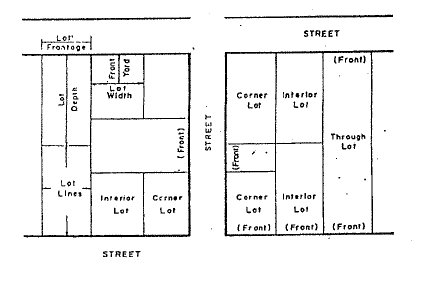
Lot means a parcel of land occupied or intended to be occupied by one main building and its accessory building with such openings and parking spaces as are required by the provisions of this chapter and having its principal frontage upon a street.
Lot area means the total horizontal area within the boundary lines of the lot.
Lot, corner means a lot abutting upon two or more streets at their intersection.
Lot coverage means the percentage of the total area of a lot covered by all principal and accessory buildings, or portions thereof, unless otherwise specified in this Code. The method of measuring lot coverage shall be by measurements to the outside face of exterior walls and shall include carports, garages, breezeways and porches unless otherwise specified.
Lot depth means the mean horizontal distance between the front and rear lot lines.
Lot front means and shall be construed to be the portion nearest the streets. For corner lots, the lot front shall be the narrowest portion abutting the street unless determined otherwise by the director of the CDEC.
Lot width means the horizontal distance between the side lot lines measured at the required front yard line and parallel to the front street line.
Low-THC cannabis means a plant of the genus Cannabis, the dried flowers of which contain 0.8 percent or less of tetrahydrocannabinol and more than 10 percent of cannabidiol weight for weight; the seeds thereof; the resin extracted from any part of such plant; or any compound, manufacture, salt, derivative, mixture, or preparation of such plant or its seeds or resin that is dispensed from a medical marijuana treatment center as defined in F.S. § 381.986.
Major recreational vehicle means any travel trailer, pickup camper or coach designed to be mounted on motorized vehicles, motorized dwelling or motor home, tent trailer, popout camper, case or box used for transporting recreational equipment, whether occupied by such equipment or not, any boat and boat trailer.
Marijuana means all parts of any plant of the genus Cannabis, whether growing or not; the seeds thereof; the resin extracted from any part of the plant; and every compound, manufacture, salt, derivative, mixture, or preparation of the plant or its seeds or resin, including low-THC Cannabis, which are dispensed from a medical marijuana treatment center for medical use by a qualified patient as defined in F.S. § 381.986.
Marina means a facility or structure which provides mooring, docking, anchorage, fueling, repairs or other services for watercraft.
Mean high water means the average height of the high waters over a 19-year period. For shorter periods of observation, mean high water means the average height of the high waters after corrections are applied to eliminate known variations and to reduce the result to the equivalent of a mean 19-year value.
Mean high water line means the intersection of the tidal plane of mean high water with the shore.
Medical cannabis has the same meaning provided at F.S. § 381.986(1)(f), titled "Marijuana".
Medical marijuana cultivation facility has the same meaning as "cultivation facility" as provided at Rule 64-4.001(11)(a), Florida Administrative Code, and includes any area approved by the state department of health for the cultivation of medical Cannabis.
Medical marijuana dispensary has the same meaning as "dispensing facility" as provided at Rule 64-4.001(11)(c), Florida Administrative Code, and includes any area approved by the state department of health for the dispensation of medical Cannabis.
Medical marijuana processing facility has the same meaning as "processing facility" as provided at Rule 64-4.001(11)(b), Florida Administrative Code, and includes any area approved by the state department of health for the processing of medical Cannabis.
Medical marijuana treatment center (MMTC) and/or medical marijuana treatment center dispensing facility (MMTC-DF) means a retail establishment, licensed by the state department of health as a "medical marijuana treatment facility," facility established by a licensed "medical marijuana treatment center," "dispensing organization," "dispensing organization facility," or similar use, that sells and dispenses marijuana, products containing marijuana, or related supplies, but does not engage in any other activity related to preparation, wholesale storage, distribution, transfer, cultivation, or processing of any form of marijuana, marijuana products, or related supplies, and does not allow on-site consumption of marijuana or marijuana products.
Mezzanine means an open and unobstructed floor level (except for railings for low walls not more than 42 inches tall) within a story, not exceeding one-third of the floor area of space in which it is located.
Mobile home, house or coach means a manufactured detached, transportable, single-family dwelling unit designed for long-term occupancy and arriving at the site where it is to be occupied as a complete dwelling unit, containing all conveniences and facilities, with plumbing and electrical connections provided for attachment to approved utility systems. To retain mobility, under-carriage and axles must remain attached to the unit.
Mobile home park or camp means any area where one or more mobile homes can be parked, designed or intended to be used as living quarters of one or more families. The site plan and all sanitary facilities of a mobile home park must conform to the requirements of the state and county health authorities.
Motel, tourist court or automobile court means a group of two or more attached, detached or semi-detached buildings, containing guest rooms or apartments with automobile storage or parking space provided in connection therewith, designed for use primarily by automobile transients.
Nonconforming building or structure means a building or structure or portion thereof existing at the effective date of this chapter, or any amendment thereto, which was designed, erected or structurally altered in such a manner that characteristics of the building or structure, other than use regulations, do not meet the provisions of this chapter.
Nonconforming use means the lawful use of land which use does not conform with the use regulations of the district in which it is located because the use existed prior to March 17, 1982.
Nonferrous metals means metals not containing significant quantities of iron or steel, including, without limitation, copper, brass, aluminum, bronze, lead, zinc, nickel, and alloys thereof.
Nursing home means an institution, building, residence, private home, or other place which undertakes through its ownership or management to provide for a period exceeding twenty-four-hour nursing care, personal care, or custodial care for three or more persons not related to the owner or manager by blood or marriage, who by reason of illness, physical infirmity, or advanced age require such services, but does include accommodations for providing care and treatment primarily for the acutely ill.
Open space means that part of a lot, including courts and yards, which:
(1)
Is open and unobstructed from its lowest level upward;
(2)
Is accessible to all residents on the lot without restrictions except as may be required for safety; and
(3)
Shall, in general, be available for entry and use by the occupants of the building or buildings on the premises;
but may include space located and treated to enhance the amenity of the development by providing landscaping, screening for the benefit of the occupants or neighboring area, or a general appearance of openness.
Outdoor storage area means an area permitted by the City of Riviera Beach, utilized for the permanent storage of goods, wares, merchandise, commodities, supplies or materials as an accessory use to an enclosed primary building.
Overlay zoning means a zoning district which is superimposed over another zoning district. The provisions of the overlay district are controlling if there is a conflict between the underlying zoning district and the overlay zoning district.
Parking lot means a durably surfaced area or plot of ground used for the storage or parking of more than four motor vehicles, either for compensation or as an accessory service to a business, industrial or residential use.
Patio home means a single-family dwelling unit designed with one windowless zero lot lined exterior site wall site planned to accommodate cluster development creating a sheltered, private outdoor living area for each dwelling unit.
Pawn shop means an establishment that is regularly engaged in the business of loaning money with products being used as collateral for a loan, but does not include financial institutions or any person who regularly loans money or any other thing of value on stocks, bonds, or other securities.
Place of worship means a special purpose building such as a church, synagogue, temple, or mosque that is used for religious observance by persons of similar beliefs, and that is architecturally designed and particularly adapted for the primary use of conducting, on a regular basis, formal religious services by a religious congregation.
Planned unit development (PUD) means a land area under unified control designed and planned to be developed in a single operation or by a series of prescheduled development phases according to an officially approved final master land use and site plan which does not necessarily correspond to the property development and use regulations of the zoning district in which the development is located.
Platted lot size means the minimum size of a buildable lot. For single family residential, see minimum property size per zoning classification, and for fee-simple town home (or similar type) multifamily residential the minimum platted lot size is 15 feet × 50 feet. For other multifamily residential, see minimum property size per zoning classification. Properties developed according to these standards shall be required to establish a property owners association for the continued maintenance of common areas. Note: Applicable density and setback regulations are regulated per specific zoning classification.
Private passenger vehicles means that type of vehicle primarily used to transport not more than nine persons for personal transportation. The term does not include such vehicles as campers, recreation vehicles, motor homes, or any other type of vehicle other than private passenger vehicles.
Private school means any building or part thereof which is designed, constructed, or used for education or instruction in any branch of knowledge by a private business including but not limited to instruction in dance or music or cheerleading as well as traditional studies such as math and/or science.
Professional office means a place used for conducting a business, profession, service, or government. Such facilities may include, but are not limited to, offices of attorneys, engineers, architects, physicians, dentists, accountants, banks, financial institutions, real estate companies, insurance companies, financial planners, or corporate offices, and exclude manufacturing activities.
Property line means the boundary line surrounding a lot.
Recess line means a continuous building setback occurring at a prescribed height.
Recovery community means a facility consisting of multiple dwelling units in a single multi-family structure that are not held out to the general public for rent or occupancy, that provides a drug-free and alcohol-free living arrangement for people in recovery from drug and/or alcohol addiction, which, taken together, do not emulate a single biological family and are under the auspices of a single entity or group of related entities. Recovery communities include land uses for which the operator is eligible to apply for certification from the State of Florida. A recovery community shall be considered a multi-family residential use of property for purposes of all zoning, building, and property maintenance codes.
Recovery residence means a type of community residence that provides lodging for more than three unrelated persons suffering from addiction, occupying the whole or part of a dwelling as a single housekeeping unit sharing common living, sleeping, cooking and/or eating facilities.
Recycling means to treat or process used or waste materials so as to make suitable for reuse.
Recycling center means a facility solely for the collection and sorting and/or separating of recyclable materials from the general public. On-site storage containers and bins used solely for the recycling of material such as aluminum, food and beverage containers, glass, paper, and plastic generated by residential property and business offices may be placed on the site.
Recycling facility means a facility for the collection and/or processing of recyclable materials with on-site storage containers or processing facilities used solely for the recycling of materials. These materials include aluminum, glass, paper, plastic, and excluding toxic and heavy metals such as but not limited to lead, cadmium, mercury, chromium, nickel, copper, arsenic, ferrous metals other than food and beverage containers generated by residential property, business or light manufacturing and are not recycling centers for the purposes of this section.
Restaurant (excluding drive-through) means an establishment where the principal business is the sale of food in a ready-to-consume state to persons who are seated within the principal building, seated outside on the premises, or for carryout.
Restaurant, drive-through, drive-in, means an establishment where the principal business is the sale of food in a ready-to-consume state to customers within the establishment and directly to customers on premises situated in motor vehicles.
Retail establishment means a place of business providing the sale and display of goods and/or sale of services directly to customers, with goods available for immediate purchase and removal from the premises by the customer. Retail goods include, but are not limited to, clothing, food, furniture, pharmaceuticals, books, art objects and the like. Retail services include, but are not limited to, barber shops, beauty salons, travel agencies, dry cleaning, health clubs, photo studios, funeral homes (no embalming on premises), pet care, repair establishments, and employment offices. For the purposes of this definition, retail establishments exclude adult entertainment, weapons sales, and the sale and servicing of vehicles or watercraft with engines larger than 50 horsepower.
School means any building or part thereof which is designed, constructed, or used for education or instruction in any branch of knowledge.
Scrap metal processing means a process by which metal materials ferrous or nonferrous, which would otherwise become solid waste, are collected, separated or processed, and reused or returned to use in the form of raw materials for efficient shipment, or to an end-user's specifications, by such means as baling, briquetting, compacting, flattening, grinding, crushing, mechanical sorting, shredding, cleaning or remanufacturing of products.
Screen enclosure means an area enclosed by screens, and having a screen roof.
Screen room means an area enclosed fully or partially by screens, and having a solid roof.
Self-service storage (self storage) means a place of business providing individual self-contained units which are available for short-term or long-term lease to the general public for the storage of goods and belongings. As a customary secondary use, designated areas may also be utilized for the storage of automobiles, trailers, recreational vehicles and similar rolling stock, as provided by an approved site plan. Outdoor storage must be shielded from view of adjacent property owners and public right-of-way.
Setback means the minimum distance required between buildings or buildings and property lines, to provide for the required open space. All setbacks shall be measured at a right angle from the property lines or building lines as the case may be.
Setback line means a line marking the minimum horizontal distance between the property line and the beginning point of the required setback or the buildable area, as this chapter may require in each particular case. All setback lines shall run parallel to the relevant property lines.
Shredding is a process by which metal is smashed, split, ripped, ground and cut into smaller pieces.
Site plan means a presentation drawing drawn to scale illustrating a proposed development and prepared in accordance with this chapter. Specific requirements for site plan approval submission are included in appropriate districts.
Slope means the amount of deviation of a surface from the horizontal, measured as a numerical ration, as a percent, or in degrees. Expressed as a ratio, the first number is the horizontal distance (run) and the second number is the vertical distance (rise), as 2:1. A 2:1 slope is a 50 percent slope.
Smelting is a metallurgical thermal processing operation in which the metal or matte is separated in fused form from nonmetallic materials or other undesired metals with which it is associated.
Special exception means a use, structure or PUD that would not be appropriate generally or without restriction throughout a particular zoning district, but would, if controlled as to number, area, location, or relocation to neighborhood, be appropriate.
Specialty medical facility means, a facility, regardless of size, offering non-overnight specialized treatment and services including, but not limited to, ambulatory surgical facilities, dialysis centers, substance abuse treatment facilities, outpatient rehabilitation facilities, birthing facilities, and urgent care facilities. This use also includes medical or dental offices which are larger than 5,000 square feet.
Specialty hospital means a hospital which offers a restricted range of services appropriate to the diagnosis, care, and treatment of patients with specific categories of medical or psychiatric illnesses or disorders which include: Specialty medical hospitals; specialty rehabilitation hospitals; specialty psychiatric hospitals, which may include beds licensed to offer intensive residential treatment programs; specialty substance abuse hospitals, which may include beds licensed to offer intensive residential treatment programs; and an addictions receiving facility.
Storefront church means the temporary or permanent use of space in a multi-tenant commercial building for public or semipublic religious worship.
Story means that portion of a building included between the surface of any floor and the surface of the floor next above it. If there is no floor above it, then space between the floor and the ceiling is a story.
Street means a public or private thoroughfare which affords the principal means of access to abutting property.
Street line means the dividing line between a lot, tract or parcel of land and the contiguous street right-of-way.
Streetwall means a low wall or hedge used to screen surface parking lots from view.
Structure means anything constructed or erected, the use of which requires a location on the ground, or attached to something having a location on the ground, including, but without limiting the generality of the foregoing, advertising signs, billboards, backstops for tennis courts, fences and pergolas.
Structure alterations means any change, except for repair or replacement, in the supporting members of a building such as bearing walls, columns, beams or girders, floor joists or roof joists. See also Building alterations.
Temporary labor employment office means an establishment engaged in providing temporary labor for the construction or industrial trades.
Timesharing means a form of ownership of property where use of the property is limited to certain time periods for varied individuals; also known as "interval ownership."
Town house means a dwelling unit, attached by party walls on one or both sides to one or two other dwelling units, which has its own ground level entrance and front and rear yards.
Toxic and heavy metals are metals that are poisonous, such as lead or mercury also metals that form poisonous soluble compounds and are not essential minerals, or are in a form that can negatively impact persons health.
Trailer means any portable structure or vehicle designed so as to be used as a conveyance upon the public streets and highways, containing a self-contained plumbing system which is not connected to an external sewerage and constructed in such a manner so as to permit occupancy thereof for dwelling or sleeping purposes.
Trailer coach means all types of mobile homes, self-propelled trucks or buses which have been converted or equipped with living and/or sleeping quarters, such as pickup trucks with living quarters installed, and converted buses. However, this excludes suburbans and other similar types of automobiles for private use which have been equipped with camping equipment and relocated materials.
Trailer court, camp or park means an area where one or more automobile trailers can be parked, designed or intended to be used as temporary living quarters of one or more families and intended primarily for automobile transients. The site plan and all sanitary facilities of a trailer camp must conform to the requirements of the state and county health authorities.
Use means any purpose for which buildings or other structures or land may be arranged, designed, intended, maintained or occupied; or any occupation, business, activity or operation carried on or intended to be carried on in a building or other structure or on land in accordance with this chapter.
Variance means a relaxation of certain regulations contained in this chapter where such variance shall not be contrary to the public interest and where, owing to conditions peculiar to the property and not the result of the actions of the applicant or owner, a literal enforcement of this chapter would result in unnecessary and undue hardship.
Vegetation line means a line, as identified by the state department of environmental protection, of the first appearance of permanent vegetation west of the Atlantic Ocean.
Veterinarian office or animal medical clinic means a business that provides medical care to domestic pets. Limited overnight boarding of pets incidental to and associated with the medical care shall be permitted as accessory to the medical services.
Warehouse means a structure, or part of a structure, for storing goods, wares and merchandise, whether for the owner or for others; and whether it is a public or private warehouse.
Yard means a required open space clear from the ground upward, unoccupied and unobstructed by any structure, except for fences, walls and vegetation as provided herein.
Yard, front means a yard across the full width of the lot extending between the front line of the lot and the main building.
Yard, ocean means any yard abutting the Atlantic Ocean.
Yard, rear means a yard across the full width of the lot extending between the rear line of the lot and the main building.
Yard, side means a yard extending between the side line of the lot and the main building and between the front yard setback line or the lot lines in absence of setback requirements.
(Ord. No. 2152, § 2(23.AA-1), 3-17-82; Ord. No. 2179, § 1, 2-2-83; Ord. No. 2314, § 1, 9-3-86; Ord. No. 2624, § 1, 2-16-94; Ord. No. 2772, § 1, 1-21-98; Ord. No. 2814, § 1, 4-21-99; Ord. No. 2863, § 1, 1-3-01; Ord. No. 3021, § 1, 11-15-06; Ord. No. 3070, § 2, 10-7-09; Ord. No. 3071, § 2, 10-7-09; Ord. No. 3072, § 2, 10-7-09; Ord. No. 3092, § 1, 5-18-11; Ord. No. 4026, § 2, 9-4-13; Ord. No. 4038, 2(Exh. A), 12-18-13, Ord. No. 4109, § 2, 5-2-18; Ord. No. 4114, § 2, 9-5-18; Ord. No. 4143, § 2, 9-16-20; Ord. No. 4149, § 2, 9-16-20; Ord. No. 4174, § 2, 9-1-21; Ord. No. 4210, § 2, 2-1-23; Ord. No. 4243, § 2, 2-21-24)
Cross reference— Definitions and rules of construction generally, § 1-2.
Sec. 31-2. - Purposes, authority for adoption of plan.
In order to lessen congestion in the streets; to secure safety from fire, panic and other dangers; to promote health and the general welfare; to provide adequate light and air; to prevent the overcrowding of land; to avoid undue concentration of population; to facilitate the adequate provision of transportation, water, sewerage, schools, parks and other public requirements; and to conserve the value of buildings and encourage the most appropriate use of land throughout the corporate area of the city, all in accordance with a comprehensive plan, there is hereby adopted and established an official zoning plan for the city. This plan is adopted pursuant to the authority conferred upon the city by former F.S. ch. 176.
(Code 1957, § 23-3)
Sec. 31-3. - Interpretation and effect of chapter.
In interpreting and applying the provisions of this chapter, they shall be held to the minimum requirements for the promotion of the public health, safety, morals and general welfare of the community. It is not intended by this chapter to interfere with or abrogate or annul any easements, covenants or other agreements betweenparties; provided, however, where this chapter imposes a greater restriction upon the use of buildings or premises or upon the height of buildings, or requires larger open spaces than are imposed or required by other ordinances, rules, regulations or by easements, covenants or agreements, the provisions of this chapter shall control.
(Code 1957, § 23-5)
Sec. 31-4. - Hearings generally; notice; deposits.
(a)
The planning and zoning board shall sit as a zoning board to hear all applications for the determination, establishment, amendment, supplementing or changing of zoning classifications and regulations. The zoning board shall recommend the boundaries of the various original districts and the appropriate regulations to be enforced therein. The zoning board shall make a preliminary report and hold public hearings thereon as required by law before submitting its final report; the city council shall not hold its public hearings or take action until it has received a final report of the planning and zoning board.
(b)
Notice of all public hearings conducted pursuant to this section shall be advertised as required by F.S. § 166.041, as may be amended.
(c)
In addition to the notice requirements of subsection (b) above, all non-city-initiated site plan applications subject to a public hearing, special exceptions and rezoning petitions shall be subject to the following additional notice requirements:
(1)
Mail notice.
a.
Petitioners shall mail notice of the public hearing to all property owners within 300 feet of the property affected by the proposed rezoning at least 15 days prior to the public hearing.
b.
The list of property owners shall be derived from the most recent official tax roll of Palm Beach County.
c.
Notice shall be provided by first class U.S. Mail, with the proper amount of postage attached to ensure delivery.
d.
At a minimum, the notice shall contain the time, date and location of the public hearing, the location of the property affected and the substance of the proposed rezoning.
e.
An affidavit attesting to the date of mailing and the completeness of the property owner's list shall be provided at least five days prior to the required public hearing. The affidavit shall also contain a copy of the mailer letter and the address list utilized.
(2)
Posting of property.
a.
The petitioner shall post signs on the property at least 15 days prior to any public hearing.
b.
The signs posted on the property shall be subject to criteria for size, contents and visibility established by the development services director.
c.
Signs shall be able to withstand normal weather events, and at least one sign shall be posted per 500 lineal feet of all property located along a public right-of-way, with a minimum of one sign per frontage.
d.
An affidavit, including photographs, attesting to the date of installation and number of signs installed shall be provided at least five days prior to the required public hearing.
(d)
The petitioner shall be responsible for payment of all advertising, mailing and posting costs required by this section. Petitioner shall deposit funds with the development services department in accordance with City of Riviera Beach's adopted fee schedule, as amended from time to time, prior to the date of the advertisement and mailing and shall pay the balance of the costs, if any, before the matter is heard by the appropriate board.
(Code 1957, § 23-4.1; Ord. No. 2969, § 2, 6-2-04; Ord. No. 4282, § 1, 10-15-25)
Sec. 31-5. - Modifications; protest; minimum vote; notice.
The determination, establishment, amendment, supplementation or change of zoning classifications, regulations or boundaries, may from time to time be amended, supplemented, changed or repealed. In case, however, of a protest against such change signed by the owners of 20 percent or more either of the area of the lots included in such proposed change or of those immediately adjacent in the rear thereof extending 500 feet therefrom, or of those directly opposite thereto extending 500 feet from the street frontage of such opposite lots, such amendments shall not become effective except by the favorable vote of three-fourths of the city council. The provisions of section 31-4 relative to public hearings and official notice shall apply equally to all changes or amendments.
(Code 1957, § 23-4.1)
Sec. 31-6. - Zoning regulations authorized; special exceptions, variances.
For the purpose of promoting the health, safety, morals or general welfare of the city, the city council may, by ordinance, regulate the location, height, bulk and size of buildings and other structures, the size of yards, courts and other open spaces, the density of population, and the uses of buildings, structures and land for trade, industry, business, residence or other purposes. Such ordinance may provide that the zoning board of appeals may, in appropriate cases and subject to appropriate principles, standards, rules, conditions and safeguards set forth in the ordinance, make special exceptions to the terms of the zoning regulations in harmony with their general purposes and intent. Such ordinance may provide that the zoning board of appeals may authorize variances from the strict application of the regulations in such situations and subject to such limitations as may be set forth in the ordinance.
(Code 1957, § 23-5.1)
Sec. 31-7. - Plot plans required.
Each application for a building permit shall be accompanied by a plot plan in duplicate, drawn to scale, showing the actual dimensions of the lot to be built upon, the size, shape and location of the building to be erected, and such other information as may be necessary to provide for the enforcement of this chapter. A record of such applications and plots shall be kept in the office of the city clerk. Where application is made to enlarge an existing nonconforming use, the application shall be accompanied by an affidavit giving the description of the premises owned at the date of the passage of Ordinance No. 422, dated June 26, 1957.
(Code 1957, § 23-10)
Sec. 31-8. - Violations, penalty.
Any person convicted of violating any of the provisions of this chapter, or the owner of any buildings or premises or part thereof where anything in violation of this chapter shall be placed or shall exist, and any architect, engineer, builder, contractor, agent or person employed in connection therewith and who shall be found guilty of having assisted in the commission of any such violation shall be punished as provided in section 1-11 of this Code. Each day that any violation of this chapter shall exist or continue shall be considered a separate offense.
(Code 1957, § 23-11)
Sec. 31-9. - Reasonable accommodation procedures.
Applicability. Reasonable accommodations in the land use and zoning context means providing individuals with disabilities or developers of housing for people with disabilities flexibility in the application of land use and zoning and building regulations, policies, practices and procedures, or even waiving certain requirements, when it is necessary to eliminate barriers to housing opportunities.
Reasonable accommodation procedures.
(1)
Purpose and general provisions. The purpose of this section is to establish procedures for processing requests for reasonable accommodation from the city's LDC and related rules, policies, practices, and procedures, for persons with disabilities as provided by the Federal Fair Housing Amendments Act (42 U.S.C. 3601 et seq.) (FHA), the Rehabilitation Act (29 U.S.C. 701) or Title II of the Americans with Disabilities Act (42 U.S.C. 12131 et seq.) (ADA). Any person who is disabled (or qualifying entities) may request reasonable accommodations with respect to the city's zoning and land use regulations, rules, ordinances, policies and procedures as provided by the FHA and ADA pursuant to the procedures set out in this section.
a.
Definitions:
For purposes of this section, a disabled individual or person is an individual who qualifies as disabled and/or handicapped under the FHA and/or ADA. For purposes of this section, a "qualifying entity" shall mean, a licensed service provider of the State of Florida, as defined by F.S. § 397.311, as amended from time to time. All qualifying entities shall submit as part of an application for a reasonable accommodation, proof of the licensable service component the qualifying entity holds pursuant to F.S. ch. 397, as amended from time to time.
Reasonable accommodation means an accommodation that does not impose an undue financial and administrative burden on the city and it does not fundamentally alter the zoning ordinance or residential nature of an area.
b.
The following general provisions shall be applicable:
1.
The city shall endeavor to inform the public, advising that disabled individuals or qualifying entities may request a reasonable accommodation.
2.
A disabled person may apply for a reasonable accommodation on his/her own behalf or may be represented at all stages of the reasonable accommodation process by a person designated in writing by the disabled person.
3.
The city shall provide assistance and accommodation as is required pursuant to the FHA and ADA in connection with a disabled person's request for reasonable accommodation, including without limitation, assistance with reading application questions, responding to questions, completing the necessary forms, filing an appeal, and appearing at a hearing to ensure the process is accessible.
4.
An applicant shall be required to apply for all applicable development review processes available in the city's LDC prior to filing out a request for reasonable accommodation, unless compliance with available development review processes would deprive the applicant, or persons with disabilities served by the applicant, of an equal opportunity to use and enjoy housing.
c.
Reasonable accommodation request form. A request by an applicant for reasonable accommodation under this section shall be made in writing by completion of a reasonable accommodation request form and submitted to the city's development services department. The reasonable accommodation request form shall be on a form specified by the director of development services. The reasonable accommodation form shall be maintained by the city's development services department and shall contain such questions and requests for information as are necessary for processing the reasonable accommodation request. The reasonable accommodation request form shall at a minimum require the following information:
1.
Name and contact information for applicant;
2.
Address of housing or other location at which accommodation is requested;
3.
Name and mailing address of subject property owner;
4.
Description of reasonable accommodation requested;
5.
Description of the specific regulation(s) and/or procedure(s) from which accommodation is sought;
6.
Reasons the reasonable accommodation may be necessary for the individual(s) with disabilities to use and enjoy the housing or other service;
7.
Name and contact information for applicant's authorized representatives, if applicable; and
8.
Signature of applicant, or authorized representative.
d.
Medical information. Upon submittal of any medical information or records, including but not limited to condition, diagnosis, or history related to a disabled individual, an applicant may request that the city, to the extent allowed by law, treat the information or records as confidential. The city shall thereafter endeavor to provide notice to the disabled individual, or their representative, of any request received by the city for disclosure of the medical information or documentation previously requested to be treated as confidential. The city will cooperate with the disabled individual, to the extent allowed by law, in actions initiated by such individual to oppose the disclosure of such medical information or documentation, but the city shall have no obligation to initiate, prosecute, or pursue any such action, or to incur any legal or other expenses, whether by retention of outside counsel, or allocation of internal resources in connection therewith, and may comply with any judicial order without prior notice to the disabled individual. Notwithstanding the above, all medical information qualified as privileged or confidential under Florida's Public Records law shall be kept confidential.
e.
Application sufficiency determination. When a reasonable accommodation request form has been completed and submitted to the city's development services department, it shall be referred to the director of development services, for review and consideration. The director of development services shall determine whether the application is sufficient or insufficient within ten days of submittal by reviewing the information required in the application. If it is determined that the application is not sufficient, a written notice shall be sent to the applicant specifying the deficiencies within the ten-day determination timeframe set forth herein.
1.
Notice. The notice of sufficiency determination shall be sent to the requesting party (i.e., the disabled individual or authorized representative) by certified mail, return receipt requested.
2.
Fee. There shall be no fee imposed by the city for a request for reasonable accommodation under this section or an appeal of a determination on such request, and the city shall have no obligation to pay an applicant's, or an appealing party as applicable, attorneys' fees or costs in connection with the request, or an appeal.
f.
Criteria for reasonable accommodation determination. In determining whether the reasonable accommodation request shall be granted or denied, the applicant shall be required to establish that they are protected under the fha or ada by demonstrating that they are handicapped or disabled, as defined in the FHA or ADA. Although the definition of disability is subject to judicial interpretation, for purposes of this section, the disabled individual must demonstrate to the city:
1.
A physical or mental impairment which substantially limits one or more major life activities; 2) a record of having such impairment; or, 3) that they are regarded as having such impairment; and
2.
That the proposed accommodations being sought are reasonable and necessary to afford disabled persons equal opportunity to use and enjoy housing.
g.
Authority. The director of development services shall issue a written determination within 45 days of the date of sufficiency, except as provided in section 1.i. below, and may in accordance with federal law, grant the accommodation request, (2) grant a portion of the request and deny a portion of the request and/or impose conditions upon the grant of the request, or (3) deny the request, in accordance with federal law. If the request is denied, the determination shall state the grounds therefore. All written determinations shall give notice of the right to appeal.
1.
Request for additional information timeframes. If additional information is required to make a final decision, the following shall apply:
i.
Within 45 days of sufficiency determination, a written notice requesting additional information may be requested, specifying what information is required.
ii.
The applicant shall have 15 days from the date of the written notice to respond to the request for additional information not to exceed 60 days from the date of the sufficiency determination.
iii.
If the additional information provided by the applicant satisfies staffs' request, a written determination shall be issued within 30 days.
iv.
If the applicant fails to provide the requested additional information within the 15-day period, a notification shall be issued to the applicant advising the applicant that the application is considered withdrawn and no further action by the city with regard to said reasonable accommodation request shall be required.
2.
Notice of proposed decision. All written determinations shall give notice of the right to appeal. The notice of determination shall be sent to the requesting party (i.e., the disabled individual or his/her representative) by certified mail, return receipt requested.
h.
Revocation of reasonable accommodation. Any reasonable accommodation received shall be subject to revocation or modification if the holder of the reasonable accommodation or the property upon which the accommodation is granted is found in violation of any provision of the written determination granting the reasonable accommodation by a court of law or by the special magistrate hearing code enforcement cases, and the holder of the reasonable accommodation has failed to correct such violation.
i.
Appeal. Within 30 days after the director of development services has rendered a decision on a reasonable accommodation request, or a revocation or modification of a reasonable accommodation, the applicant may appeal the decision. This timeframe shall be based upon the date of the letter mailed to the requesting party. All appeals shall contain a statement containing sufficient detail of the grounds for the appeal. Appeals shall be to a development special magistrate as set forth in this Code. The development special magistrate shall, after duly noticing the applicant of the public hearing for appeal, conduct a quasi-judicial hearing on the appeal. All testimony shall be under oath and cross-examination shall be permitted. The development special magistrate shall allow the applicant an opportunity to present evidence and argument on the matter and shall also allow the city to present evidence and argument. The development special magistrate may consider testimony from members of the public at the hearing. witnesses who refuse to be cross-examined may have their testimony stricken from the proceedings. Formal rules of evidence shall not apply, but fundamental rights of due process shall be observed and shall govern the proceedings. The development special magistrate shall have the power to impose supplemental rules to govern the proceedings, to issue subpoenas for evidence, to take testimony, under oath, and issue rulings. The special magistrate shall render a determination as soon as reasonably practicable, but in no event later than 60 days after an appeal has been filed. The development special magistrate may grant the application with or without condition, grant an alternative accommodation with or without condition, or deny the accommodation. Such hearing shall be de novo. a hearing officer's decision may be appealed to the Fifteenth Judicial Circuit Court by Petition for Writ of Certiorari.
j.
Time limitation. A determination granting, partially granting, or granting with conditions, a reasonable accommodation, may remain valid either for one year from the date of issuance, or by the date specified in a development order or associated condition of approval, otherwise it shall become null and void. This provision shall retroactively apply to all prior determinations for a reasonable accommodation prior to the effective date of this section.
k.
Change of owner/operator. When a facility that has received a reasonable accommodation approval changes ownership, the city must be notified within 60 days of the change of ownership. The city will review the change in ownership and may conduct an investigation and require the new owner/operator to apply for a new reasonable accommodation. This review shall be a case-by-case determination based on an individualized assessment.
(Ord. No. 4230, §§ 1, 2, 6-21-23)

