
Riviera Beach City Zoning Code
ARTICLE VI
SUPPLEMENTAL DISTRICT REGULATIONS
Sec. 31-541.- General application.
The requirements or regulations in this article qualify or supplement as the case may be the district regulations or requirements appearing elsewhere in this chapter.
(Ord. No. 2152, § 3(B)(23.AA-24), 3-17-82)
Sec. 31-542. - Accessory uses, buildings and structures permitted.
(a)
Uses permitted. Those uses which because of their nature do not warrant a separate zoning district, and buildings or structures customarily incidental or subordinate to the main use or building and located on the same lot, are permitted uses.
(b)
Property development standards.
(1)
Location. All accessory uses, buildings and structures shall be located on the same lot as the principal or main use and not within any required yard setbacks, except as provided in this chapter.
(2)
Height. No accessory use, building or structure shall exceed the height permitted in the district in which the principal use is located.
(3)
Use. Such accessory building shall not be rented or otherwise used as a separate unit.
(4)
Other. An accessory building may occupy not more than 30 percent of a required rear yard.
(5)
No accessory building shall be erected closer than five feet to the line of the abutting lot to the rear.
(6)
All accessory structures must maintain a minimum distance of two feet from established easement lines.
(Ord. No. 2152, § 3(B)(23.AA-24.I), 3-17-82)
Sec. 31-543. - Churches.
A church building is defined as an enclosed structure for public or semipublic religious worship and, when permitted, must meet the following requirements:
(1)
The minimum size plot of land shall be not less than 20,000 square feet in area and 100 feet in width.
(2)
Side yards shall be not less than 20 feet in residential districts and front and rear yards shall be not less than specified for the zoning district. No parking areas or driveways shall be permitted within five feet of a property line abutting residential zoned property.
(3)
Accessory buildings and uses may include offices of the church, church school or kindergarten, library, meeting rooms, residential structures for resident employees of the church, and others which are incidental to the operation of the church. Accessory buildings and uses shall be located on the same plot of land consisting of parcels contiguous to or across an alley, unless otherwise permitted in the zoning district.
(4)
Parking lots to serve the church may be permitted on noncontiguous plots of land located within 400 feet of the church plot.
(5)
a.
There shall be a minimum of 500 feet between a proposed church and existing churches.
b.
There shall be a minimum of 500 feet between a proposed church and existing bars or package stores.
These distances shall be measured along the route of ordinary pedestrian travel from the main front entrance of the proposed church to the main front entrance of an existing church, bar or package store.
(6)
Each application for a new church shall include written justification of the need for the proposed church at the requested location. This justification shall include at least the following information:
a.
The number of members in the church.
b.
A geographic breakdown of the church membership by zip code.
c.
The types of services to be offered by the church.
d.
Any other reasonable requirements made by the planning and zoning board or city council.
(7)
A proposed church that abuts residentially-zoned property shall construct a six-foot-high, finished masonry wall along the property line that abuts the residential property. This wall shall not be required in front-yard setback areas.
(8)
The city council reserves the right to limit the hours of operation for any new church that is located in a residential zoning district.
(9)
Storefront churches as defined in section 31-1 are not required to comply with the regulations in subsections 31-543(1) or (2). Church offices and meeting rooms are permitted in storefront churches, but the other accessory uses listed in § 31-543(3) are not permitted.
(Ord. No. 2152, § 3(B)(23.AA-24.II), 3-17-82; Ord. No. 2213, § 1, 9-21-83; Ord. No. 2657, § 4, 3-15-95; Ord. No. 4038, § 2(Exh. A), 12-18-13)
Sec. 31-544. - Child care, daycare and other preschool facilities.
[(a)]
Family day care home:
(1)
A family day care home is a permitted use in the following zoning districts:
— RS-5 Single-Family Dwelling District;
— RS-6 Single-Family Dwelling District;
— RS-8 Single-Family Dwelling District;
— RML-12 Low Density Multifamily Dwelling District;
— RD-15 Two-Family Dwelling District;
— RM-15 Multiple Family Dwelling District;
— RMH-15 Multifamily/Hotel District.
(2)
Shall only be an accessory use in a private residence and may function either for or not-for-profit.
(3)
Is limited to no more than six children at any one time and shall not exceed the applicable maximum number of children allowed by the Child Care Facilities Board of Palm Beach County.
(4)
The person furnishing such service shall have a current, valid permit from Palm Beach County Health Department for operation of a family day care home, as required by Article II of Chapter 39, Palm Beach County Code; and a City of Riviera Beach Certificate of Use and Business Tax Receipt categorizing the use as a "family day care home." A valid permit from the Palm Beach County Health Department or a letter of approval must be submitted when applying for a certificate of use and business tax receipt for the city.
(5)
A family day care home registered with the Department of Children and Families is specifically exempt from having to obtain any special exemption or use permit or pay any special fee in excess of $50.00 to operate in an area zoned for residential use (F.S. § 166.0445).
(6)
Baby-sitting services provided by an individual at the home of the parents or legal guardians of the child(ren) are deemed to be exempt from these provisions.
(7)
All family day care homes shall comply with state, county, and city codes and regulations, and with the standards established by the Child Care Facilities Board of Palm Beach County under the authority of Chapter 59-1698, Special Acts, Laws of Florida, as amended. In the event of a conflict between standards established by the state and those established by the Child Care Facilities Board of Palm Beach County, the more stringent shall apply.
[(b)]
Large family child care home:
(1)
A large family child care home requires city council approval via the special exception process and can only operate in the following zoning districts:
— RS-6 Single-Family Dwelling District;
— RS-8 Single-Family Dwelling District;
— RML-12 Low Density Multifamily Dwelling District;
— RD-15 Two-Family Dwelling District;
— RMH-15 Multifamily Dwelling District.
(2)
Requirements:
a.
Personnel: Two full-time child care personnel must be on the premises during the hours of operation. One of the full-time child care personnel must be the owner or occupant of the residence.
b.
Licensing: The large family child care home must first have operated as a licensed family child care home for 2 years at either the same or a different location, with an operator who has had a child development associate credential or its equivalent for 1 year, before seeking licensure as a large family child care home. The person furnishing such service shall update their current permit from Palm Beach County Health Department for operation of a large family child care home, and a City of Riviera Beach Certificate of Use and Business Tax Receipt categorizing the use as a "large family child care home." The updated permit from the Palm Beach County Health Department or a letter of approval must be submitted when applying for a certificate of use and business tax receipt for the city.
c.
Maximum number of children: A large family child care home shall be allowed to provide care for one of the following groups of children which shall include those children under 13 years of age who are related to the caregiver:
1.
A maximum of eight children from birth to 24 months of age; or
2.
A maximum of 12 children with no more than four children under 24 months of age.
A large family child care home shall not exceed the applicable maximum number of children allowed by the Child Care Facilities Board of Palm Beach County.
d.
Floor area: Facilities shall contain a minimum floor area of 35 square feet per child, exclusive of space devoted to bathrooms, halls, kitchen, offices, and storage.
e.
Outdoor area: There shall be a minimum area of 75 square feet of outdoor play area per child. The play area shall be located on the same lot as the principal use and shall not be located in the front yard setback or adjacent to any outdoor storage area. The play area shall be surrounded by a four to six-foot high opaque fence or wall. If the fence or wall is not entirely opaque, landscaping shall be installed, four to six feet in height at planting, to create an immediate minimum screening effect of 75 percent of the fenced or walled area. The lot shall be landscaped to code while considering visibility corridors for safety and prohibiting poisonous plant species.
f.
Parking and loading area: A minimum of two parking spaces shall be provided for large family day cares. Additionally, a pick-up and drop-off area for children shall be provided in a suitable area adjacent to the building and shall provide clear ingress and egress to the building as determined by the city engineer, police chief, and fire chief (or designees for the aforementioned). One of the required parking spaces may serve as the pick-up and drop-off area if located as indicated above.
g.
Separation requirement: Measured from parcel to parcel, there shall be a minimum of 250 feet between large family child care homes. No large family child care home shall be permitted within 250 feet of any package store, bar, nightclub, or adult entertainment establishment.
h.
Other regulations: All large family child care homes shall comply with state, county, and city codes and regulations, and with the standards established by the Child Care Facilities Board of Palm Beach County under the authority of Chapter 59-1698, Special Acts, Laws of Florida, as amended. In the event of a conflict between standards established by the state and those established by the Child Care Facilities Board of Palm Beach County, the more stringent shall apply.
[(c)]
Child care facility:
(1)
A child care facility requires city council approval via the special exception process and can only operate in the following zoning districts:
— RML-12 Low Density Multifamily Dwelling District;
— RM-15 Multifamily Dwelling District;
— CN Neighborhood Commercial;
— CG General Commercial.
(2)
Separation requirement: Measured from parcel to parcel, there shall be a minimum of 500 feet between child care facilities. No child care facility shall be permitted within 500 feet of any package store, bar, nightclub, or adult entertainment establishment.
(3)
Minimum floor area: There shall exist a minimum usable floor area, exclusive of any space devoted to the kitchen, halls, office, storage and bathroom facilities, of not less than 1,000 square feet is required. Facilities with capacities exceeding 25 children shall provide 35 square feet of additional floor area per child.
(4)
Property development regulations: The building height, setbacks, parking and total floor area shall be governed by the applicable zoning district and/or site plan review.
(5)
Parking and loading area: Parking shall be in accordance with section 31-577(14) of the city's Code of Ordinances. Additionally, a pick-up and drop-off area for children shall be provided in a suitable area adjacent to the building and shall provide clear ingress and egress to the building as determined by the city engineer, police chief, and fire chief (or designees for the aforementioned).
(6)
Outdoor play area:
a.
There shall be provided a minimum of 1,500 square feet of outdoor play area or 100 square feet of outdoor play area per child, whichever produces the larger area. The play area shall be located on the same lot as the principal use and shall not be located in the front yard setback or adjacent to any outdoor storage area. The play area shall be surrounded by a four to six-foot high opaque fence or wall. If the fence or wall is not entirely opaque, landscaping shall be installed, four to six feet in height at planting, to create an immediate minimum screening effect of 75 percent of the fenced or walled area. The lot shall be landscaped to code, while considering visibility corridors for safety and prohibiting poisonous plant species.
b.
For child care facilities with enrollments of 30 or more, the outside play area may be utilized on a split shift basis, provided that a written statement and schedule of play periods, with age groups, are submitted for prior approval by the community development director, and provided that minimum outdoor play area shall not be less than that required for one-third of the total enrollment.
(7)
Other: All child care facilities shall comply with state, county and city codes and regulations. A certificate of use and business tax receipt must be obtained from the city prior to operation. Submittal of an active permit from Palm Beach County Health Department or a letter of approval from the Palm Beach County Health Department must be submitted in order to apply for city licensing. In the event of a conflict between Palm Beach County's Rules and State family day care or large family child care standards, the more stringent shall apply.
(Ord. No. 2152, § 3(B)(23.AA-24.III), 3-17-82; Ord. No. 3092, § 2, 5-18-11; Ord. No. 4258 , § 2, 5-1-24)
Sec. 31-545. - Home occupations.
(a)
Purpose. The supplemental zoning regulations in this section are intended to allow the use of a residential dwelling unit for a secondary or small-scale occupation, such that the dwelling unit is not changed nor the residential character of the neighborhood adversely impacted.
(b)
Where permitted. Home occupations, as regulated by this Code, are permitted uses in all of the city's residential zoning districts. However, a home occupation shall not be in conflict with a restrictive covenant of a homeowner association or property owner association.
(c)
Prohibited uses. The following uses are specifically prohibited as home occupations:
(1)
Retail or wholesale sales on the premises, including food sales.
(2)
Personal services, such as barber or beauty shops.
(3)
Nursing home.
(4)
Vehicle or boat repair.
(d)
Standards for approval. In accordance with the purpose of this section, a home occupation:
(1)
Shall not necessitate any physical changes to a dwelling unit, such as separate doorways or extra parking spaces;
(2)
Shall not generate vehicular or pedestrian traffic which adversely impacts the residential character of the neighborhood; or
(3)
Shall not create any other adverse impacts on adjacent neighbors or the neighborhood.
(e)
Operation requirements.
(1)
Location. A home occupation must be conducted entirely within a dwelling unit or garage, but not in an open porch or carport. This restriction shall not prohibit off-premises sales or services involved in a home occupation.
(2)
Incidental nature. The area devoted to a home occupation shall not be the dominant use of a dwelling, and shall not exceed ten percent of the total square footage of living area or 200 square feet, whichever is least.
(3)
No change to character of dwelling. There shall be no external evidence, sign, noise or odor indicating that a dwelling is being used for a home occupation.
(4)
Employee restrictions. A home occupation must be conducted only by family members or other persons residing on the premises.
(5)
Occupational license. A city occupational license is required for any home occupation.
(6)
Number. Only one home occupation shall be permitted at a dwelling unit.
(7)
Advertising. No external evidence or sign shall advertise, display or otherwise indicate the presence of a home occupation, nor shall the street address of the home occupation be advertised through signs, television, radio or newspapers.
(8)
On-premises sales. A home occupation shall not involve the sale of any stock in trade, supplies, products or services on the premises, if such activity creates adverse traffic impacts on the area. Only occasional outside visitation shall be allowed. Occasional visitation is considered to be no more than two separate visits per day.
(9)
Outside storage. No equipment or materials involved in a home occupation shall be stored or displayed outside of the dwelling unit, including driveways.
(10)
Nuisances. A home occupation shall not involve the use of any mechanical, electrical or other equipment, materials or items which produce noise, electrical or magnetic interference, vibration, heat, glare, smoke, dust, odor or other nuisance outside the dwelling unit. There shall be no storage of hazardous or noxious materials at the site of the home occupation.
(f)
Violations. The department of community development and environmental control may issue a citation for a violation of the regulations in this section. The city's code enforcement board shall make a determination regarding the citation and shall take appropriate action. This action may include the revocation of the occupational license for the home occupation.
(Ord. No. 2152, § 3(B)(23.AA-24.IV), 3-17-82; Ord. No. 2624, § 4, 2-16-94)
Sec. 31-546. - Swimming pools.
This section applies to swimming pools in all districts, except where otherwise specified. Swimming pools, accessory to a primary site use, may be open, enclosed, or covered by a screen enclosure, and shall only occupy a required rear or side yard, providing that the following conditions are satisfied:
(1)
Rear yard setback. A minimum seven foot setback from the rear property line to swimming pool deck or platform, the exterior face of an infinity edge pool catch basin, or a screen enclosure associated with a swimming pool shall be provided, however, swimming pool decks may extend to the property line and be connected to a permitted dock and its related decking when abutting a body of water. There shall be a minimum seven-foot setback from the rear property line to the water's edge of a swimming pool or to the waterline of the catch basin of an infinity edge pool. For oceanfront properties located east of North Ocean Drive, this setback shall be measured from the 1997 Coastal Construction Control Line.
(2)
Side yard setback. A minimum seven foot setback from the side property line to a swimming pool deck or platform, the exterior face of an infinity edge pool catch basin, or a screen enclosure associated with a swimming pool shall be provided. There shall be a seven-foot minimum setback from side property line to the water's edge of a swimming pool or to the waterline of the catch basin of an infinity edge pool.
(3)
Corner properties within residential districts. For corner lots a twelve and one- half foot setback from the front property line and from the side lot line facing the street to the swimming pool, deck, platform or screen enclosure shall be provided. For corner lots with radial corners, the front setback and the side setback facing the street shall be taken from the midpoint of the curve of the corner of the property.
(4)
Residential locations with two fronts, or through lots. Lots with two fronts shall be permitted to place a pool and pool deck, with a minimum ten foot setback from the property line, at the functional rear of the house.
(5)
Walk space. A walk space at least 20 inches wide shall be provided between walls, fences or screen enclosures and the water's edge of a swimming pool.
(6)
Safety barrier. Every swimming pool shall be protected by a safety barrier, as required by the Florida Building Code, as amended from time to time.
(7)
Visual barrier. Swimming pools, when visible from any public street or alley, shall be screened from public view by an opaque landscape hedge, wall or fence, not less than five feet in height. A hedge shall be planted and maintained so as to form a continuous dense row of greenery, with plants spaced not less than 24 inches on center, in three gallon containers or larger when planted.
(8)
Drainage. If a patio or paved area is provided adjacent to or surrounding a pool, it shall be designed to drain away from the pool, but shall not drain onto adjacent properties. An exception to this rule may apply to perimeter flow pools.
(9)
Pool equipment. Pool equipment shall not be permitted within a required setback.
(10)
Commercial swimming pools. The minimum size of all commercial swimming pools shall be 450 square feet with a minimum width of 15 feet. A walkway, no less than four feet in width, is required around the swimming pool, exclusive of coping. Commercial swimming pools shall satisfy all applicable Florida Building Code requirements, as amended from time to time, and also any applicable requirements provided by a governmental agency having jurisdiction.
(Ord. No. 2152, § 3(B)(23.AA-24.V), 3-17-82; Ord. No. 4083, § 2, 8-3-16)
Sec. 31-547. - Walls and fences.
(a)
Property zoned for residential use, walls and fences shall be erected or maintained in accordance with the following:
(1)
Along or adjacent to lot lines in the required rear or side yard, maximum height shall be six feet.
(2)
In the required front yard, the maximum height shall be four feet.
(3)
On a corner lot, no fences or walls shall be erected or maintained to a height exceeding three feet above the crown of the roadway within 25 feet of the intersection of two streets.
(b)
On all property zoned for commercial use, maximum height shall be six feet.
(c)
On all property zoned for industrial use, maximum height shall be eight feet.
(d)
A waiver from the height provisions in the subsections above may be granted by the director of community development for nonelectric walls and fences used for athletic fields or recreational purposes.
(e)
On all commercial or industrial property development adjoining residential districts, a six-foot solid masonry wall shall be constructed prior to final certificate of occupancy or certificate of completion.
(f)
All easements shall be free and clear of walls and fences. An exemption may be granted only when the property owner has first agreed, in writing, to remove such obstruction upon the request of the city council and at the property owner's expense. This documentation shall be submitted, reviewed and approved by the city prior to the issuance of a permit.
(g)
No barbed wire shall be permitted as fencing within the corporate limits of the city, except that it may be permitted on the top of a fence six feet high or higher in industrial districts, not to exceed eight feet in total height.
(h)
Electric fences shall be permitted only in the general industrial (IG) zoning district, not to exceed eight feet in total height.
(i)
Electric fences shall be permitted only for use within outdoor storage areas in the general industrial (IG) zoning district, provided that the electric fence is installed and operated in the following manner:
(1)
Electric fencing shall be constructed or installed in conformance with the specifications set forth in International Electrotechnical Commission (IEC) Standard 60335-2-76.
a.
The energizer for an electric security fence must be driven by a commercial storage battery not to exceed 12 volts DC.
b.
The electric charge produced by the fence upon contact shall not exceed energizer characteristics set forth in paragraph 22.108 of the IEC and depicted in Figure 102 of IEC Standard No. 60335-2-76.
(2)
Fifty percent or more of the energy needed to electrify the fencing must be generated on site with the use of solar panels or an alternate zero emission power source.
(3)
No electric fence shall be installed unless its exterior is completely surrounded by an additional non-electric fence or wall, a minimum of six feet in height. If an electric fence is installed adjacent to a residentially zoned parcel, its exterior must be completely surrounded by an additional solid masonry wall, a minimum of six feet in height, in addition to landscape buffer requirements.
a.
There must be a clearance of four to 12 inches between the electric fence and the additional wall or fence, for the entire length of the electric fence.
b.
The exterior of this additional wall or fence must be landscaped according to article VIII. Landscape Regulations, of the City of Riviera Beach Code of Ordinances. An application for an electric fence shall be treated as a renovation development for which the city issues a building permit, as described in subsection 31-597(b).
(4)
The following required signage must be maintained and visible at all times denoting the electric fence. Signs that read: "Warning Electric Fence" at intervals of not less than 20 feet must be installed, maintained, and remain visible at all times. In no instance may there be less than one sign visible on each side of the fence. Signs can be a minimum of four inches by eight inches but must not exceed 12 inches by 18 inches. Additional signage may be required if determined necessary by the chief of police or the director of community development. Sign details must be submitted during the permitting process.
(5)
Electric fences shall be governed by burglar alarm fees and regulations.
(6)
Electric fences may be operational only after business hours. The fence must remain off during business hours.
(7)
One year after the issuance of an electric fence permit and yearly thereafter, the electric fence's owner must submit a maintenance report to the building official, police chief and fire chief, affirming concurrency with the aforementioned guidelines and regulations.
(j)
It shall be unlawful for any persons to install, maintain or operate an electric fence in violation of this section. The chief of police shall immediately abate, through the code enforcement process, any electric fence that is not properly maintained or does not meet any standard set forth in this section. The city may also avail itself of injunctive relief should the electric fence fail to be operated in accordance with this section.
(k)
Businesses that choose to own, operate and maintain an electrified fence, barbed wire, are solely responsible for any liability or damage caused by or stemming from the ownership or operation of these materials.
(Ord. No. 2152, § 3(B)(23.AA-24.VI), 3-17-82; Ord. No. 2213, § 1, 9-21-83; Ord. No. 3071, § 3, 10-7-09)
Sec. 31-548. - Miscellaneous yard, height and use regulations.
(a)
Every part of a required yard shall be open from its lowest point to the sky, unobstructed, except for the ordinary projection of sills, belt courses, cornices, buttresses, ornamental features and eaves.
(b)
In computing the depth of a rear yard, for any building where the yard opens onto an alley, one-half of such alley may be assumed to be a portion of the rear yard, unless otherwise prohibited.
(c)
The side yard requirements for a dwelling shall be waived where dwellings are permitted to be erected above stores or shops.
(d)
On double frontage lots, the required front yard shall be provided on both streets.
(e)
Public or semipublic buildings, hospitals, schools and churches, where permitted in a district, may be erected to a height not exceeding 75 feet, when the front, rear and side yards are increased an additional foot for each foot such buildings exceed the height limit otherwise provided in the district in which the buildings are built.
(f)
Chimneys, water tanks or towers, elevator bulkheads, stacks, spires, broadcasting towers, false mansards, parapet walls, similar structures and necessary mechanical appurtenances may be erected to a height in accordance with existing or hereafter adopted ordinances of the city.
(g)
Unless otherwise specified, all permitted uses which can be transferred from one district to another shall abide by the regulations of the district in which the use is to be located.
(h)
If a vacant lot in a district has an area or width, or both, less than the required minimum and was a lot of record at the time of the passage of the ordinance from which this article is derived, such lot may be occupied by a permitted structure, provided the minimum yard regulations of the districts are complied with.
(i)
Each single-family residence, duplex, triplex or fourplex constructed after December 6, 1989, shall have the ground floor, parking and landscaping on solid land. All such structures and accessory uses, if any, shall be built on a foundation firmly attached to the ground by concrete pour or stem walls, etc. No conventional structure shall be built on stilts or any other elevation device that leaves space between the ground level surface and the base of the structure, except where elevations of a few feet are required by law for manufactured homes, mobile homes or floodplains.
(Ord. No. 2152, § 3(B)(23.AA-24.VII), 3-17-82; Ord. No. 2478, § 4, 12-6-89)
Sec. 31-549. - Temporary labor employment office.
Temporary labor employment offices, where permitted, must meet the following requirements:
(1)
No outside waiting or loitering shall be permitted on the site of the day labor employment office.
(2)
No license for a temporary labor employment office shall be issued where the location of such proposed service is within 1,000 feet of another temporary labor employment office. The method of measurement shall be made or taken from the main front entrance of the existing temporary labor employment office to the main entrance of the applicant's place of business along the route of ordinary pedestrian traffic.
(Ord. No. 2772, § 4, 1-21-98)
Sec. 31-550. - Pawn shop.
A pawn shop, where, permitted, must meet the following requirement:
(1)
No license for a pawn shop issued where the location of such proposed business is within 1,000 feet of another pawn shop. The method of measurement shall be made or taken from the main front entrance of the existing pawn shop to the main entrance of the applicant's place of business along the route of ordinary pedestrian traffic.
(Ord. No. 2772, § 5, 1-21-98)
Sec. 31-551 - Principal arterial design standards overlay.
(a)
Objectives of this section.
(1)
The following standards are established for development along principal arterial roadways, excluding all areas having a downtown zoning district designation, to ensure that such uses are compatible with other uses permitted in the same district and to protect the public health, safety and welfare of the community.
(2)
The purpose of these standards is to promote designs that are architecturally compatible with the surrounding area and the design goals of the city.
(3)
These standards are designed to promote development and redevelopment where the physical, visual and spatial characteristics are established and reinforced through the consistent use of compatible architectural elements. Such elements shall relate the design characteristics of an individual building or project to the other existing and planned structures in a harmonious manner, resulting in a coherent overall development and redevelopment pattern and streetscape.
(4)
The standards used in this section are intended to discourage development types that bear little relation to the planned redevelopment pattern of the city.
(b)
Delineation of the overlay district. The Riviera Beach Principal Arterial Overlay District shall be superimposed on all properties fronting on any of the following roads in the city:
(1)
Dr. Martin Luther King Jr. Boulevard.
(2)
President Barack Obama Highway.
(3)
Blue Heron Boulevard.
(4)
Broadway (U.S. Highway No. 1).
(5)
13th Street.
(6)
Military Trail.
(7)
Congress Avenue.
(8)
Australian Avenue.
(c)
Applicability. This section shall apply to all new developments, and to additions or renovations valued in excess of 50 percent of improvement value within any 24-month period, and for signs or signage changes in excess of $500.00, as determined by the city's director of development services.
(d)
Variances. The development special magistrate may grant variances to these provisions according to the city's established variance process, as provided in Code section 31-42, as amended from time to time.
(e)
Appearance.
(1)
All structures on the same parcel of land or in the same development shall have a unified architectural theme. Color building elevations identifying said architectural theme shall be required to be submitted to the City for all applicable new developments, renovations, or additions.
(2)
Building walls exposed to public view shall be designed through the use of a coherent and clear architectural design consistent with the character of the building. Building designs should incorporate architectural details and natural lighting.
(3)
Buildings facing a public street or interior courtyard space shall be architecturally emphasized through entrance treatments and building details. Buildings with more than one facade facing a public street shall provide architectural treatment on each such facade.
(4)
Roofing shall be incombustible material such as shingles, clay or cement tiles, or metal.
(5)
Roof and exterior wall surfaces, with the exception of glass, shall be nonreflective. Reflective or mirrored glazing at ground level, visible from the sidewalk, is prohibited.
(6)
The rear and side of buildings shall be finished with material that in texture and color resembles the front of the building.
(7)
Glass windows and doors must make-up a minimum of twenty percent of the primary elevation and a minimum of ten percent of the secondary elevation. The primary elevation is defined as facing the abutting arterial road. The secondary elevation is defined as facing a perpendicular side road. Faux windows do not count towards the above mentioned required percentages.
(8)
The coloration of all building walls shall be with a maximum of three colors, exclusive of the roof color. The primary use of "earth tone" and neutral color palettes shall be required. Semi-transparent stains are recommended for application on natural wood.
(9)
Canopies over vehicular use areas shall have a maximum clearance of up to 14 feet above grade and shall be consistent with the main building design. The canopy columns shall be architecturally finished to match the building.
(10)
Work area or storage doors and open bays shall not open toward or otherwise be visible from any of the designated principal roads.
(11)
Heating, ventilation, air conditioning equipment, duct work, air compressors, other fixed operating machinery shall be either screened from public view or located so that such items are not visible from a designated arterial, adjacent residential properties or intersecting street.
(12)
No temporary structures shall be permitted, except those used in conjunction with and during construction. Office-type mobile units when used as temporary facilities shall be screened from view from a designated arterial and equipped with rigid skirting on all sides. Any towing gear shall be removed, and if not removable, shall be screened from a designated arterial.
(f)
Landscaping, walls and fencing. Development must comply with the landscaping requirements in article VIII of chapter 31 in the Riviera Beach Land Development Code as well as the items specified below:
(1)
Landscaped areas shall be surrounded with a six-inch raised curb.
(2)
Perimeter buffer landscape requirements. Landscape buffers shall be installed and maintained in accordance with the following standards.
a.
Right-of-Way (R-O-W) Buffer. R-O-W buffers shall be provided along all street R-O-W.
1.
Width: The total width of the buffer along streets, thoroughfares, or other means of vehicular access shall depend on the width of the street, as indicated in table 31-551(f)(2)a Width of R-O-W Buffer.
Table 31-551(f)(2)a - Width of R-O-W Buffer (Feet)
2.
Shrub hierarchy. R-O-W buffers shall include each of the shrub types listed in table 31-551(f)(2)b Shrub Planting Requirements.
Table 31-551(f)(2)b - Shrub Planting Requirements
3.
Planting pattern for a perimeter R-O-W buffer. One hundred percent of the buffer length shall be composed of a continuous opaque vertical landscape screen at least two feet in height, and composed of the shrub types listed in table 31-551(f)(2)b, Shrub Planting Requirements. The area of the buffer not planted with trees and shrubs shall be landscaped with ground treatment according to Florida friendly landscape provisions.
4.
Minimum tree quantities. R-O-W buffers shall contain one shade tree per 20 linear feet.
5.
Area measurement. The width of access ways and drive aisles that traverse required perimeter landscape buffers shall be included in the calculation of linear dimension and count towards required plant quantities.
6.
Buffer width reduction.The required buffer width may be reduced due to site constraints as determined by the development services director. The required quantity of shrubs may be reduced in proportion to the reduction in the buffer width, a maximum of 50 percent, to ensure the viability of the material. The required number of canopy trees or palms shall not be reduced, however, they may be rearranged to ensure proper growing area.
7.
Encroachment. No easement encroachment greater than five feet shall be permitted in required perimeter buffers, except for bisecting utility easements and required safe sight distance easements not to exceed a maximum of 50 percent of the required buffer width.
8.
Exemptions. R-O-W buffers are not required for individual single-family residential, townhouse lots, or the side of lot that abuts the Intracostal Waterway, private street rights-of-way internal to a PUD, and alleys.
(3)
Chain-link or similar fencing adjacent to a designated arterial roadway is prohibited. Where such fencing can be viewed from a designated arterial, landscaping or berms shall be provided to minimize visibility from the designated arterial.
(4)
Perimeter walls shall be architecturally compatible with the principal building.
(g)
Signage and lighting.
(1)
Monument signs compatible with the architectural design of the development are the only permitted freestanding sign. Only one such sign is permitted per roadway frontage and it can measure no more than seven feet high and six feet in width. If a property roadway frontage exceeds 400 feet, a second monument sign may be permitted on that frontage, so long as the two signs are separated by 100 feet or more.
(2)
Canopies shall not contain any signage, striping or other graphics.
(3)
Window signage, whether permanent or temporary, shall be permitted up to twenty percent coverage of a window.
(4)
Lighting fixtures shall be baffled and arranged so that illumination is deflected away from adjacent properties and roads.
(5)
All signage must comply with these regulations within five years of adoption of this section.
(6)
Fuel price digital signs shall be permitted as a monument sign feature subject to meeting the digital fuel price sign requirements of section 28-125.
(h)
Location criteria for developments with drive-up facilities. No drive-up facilities may be located along a principal arterial roadway unless approved in accordance with special exception section 31-61 of the city's code, and only in those zoning districts which currently permit drive-up facilities by right, or special exception.
(i)
Pedestrian connectivity.
(1)
Developments must consider and promote pedestrian connectivity within and around the site, including access to sidewalks and separation from roadways and drive aisles by utilizing landscaping, planters, bollards, and similar.
(2)
Developments adjacent to designated bus stops shall identify and fulfill requirements to implement a bus shelter or bus bench, which may require dedication of easement and maintenance accordingly.
(Ord. No. 2833, § 1, 9-21-99; Ord. No. 4073, § 4, 12-16-15; Ord. No. 4110, § 2, 5-2-18; Ord. No. 4149, § 2, 9-16-20)
Sec. 31-552. - Bars, saloons, taverns, cocktail lounges, or nightclubs.
In reviewing an application for these uses, the following requirements must be met:
(1)
Minimum required lot area shall be 10,000 square feet.
(2)
The proposed site shall be at least 500 feet from the property line of the nearest place of worship, school or child care center.
(3)
The proposed site shall be at least 500 feet from any other similar use.
(4)
The proposed site shall be at least 500 feet from a residential district.
(5)
Measurement shall be by a straight line from nearest property line to property line.
(6)
Buffering shall be provided in accordance with the City of Riviera Beach Landscaping Code. Additional site design standards may be required by the city council to protect neighboring residential districts or uses from negative impact.
(7)
Minimum distance and lot size requirements are exempted for properties located within the Community Redevelopment Agency (CRA).
(Ord. No. 2863, § 3, 1-3-01)
Sec. 31-553. - Fireworks and sparklers.
(a)
Definitions:
Building means a permanent structure containing no fewer than four outer walls and a roof enclosing said walls, constructed in accordance with the local building code and a duly issued building permit, and for which occupancy is authorized by a duly issued certificate of occupancy. For purposes of this section, the term building shall also include a part of the structure, such as a unit or space within a shopping center.
Commercial structure or building means a building constructed and used for the purpose of producing income. For purposes of this section, the term commercial building shall not include a building designed, constructed and used in accordance with the laws for residential occupancy.
Distributor means any person engaged in the business of selling fireworks or sparklers to a wholesaler.
Fireworks means and includes any combustible or explosive composition or substance or combination of substances or, except as hereinafter provided, any article prepared for the purpose of producing a visible or audible effect by combustion, explosion, deflagration, or detonation. The term includes, but is not limited to blank cartridges and toy cannons in which explosives are used, the type of ballons which require fire underneath to propel them, firecrackers, torpedoes, skyrockets, roman candles, dago bombs, and any fireworks containing any explosives or flammable compound or any tablets or other device containing any explosive substance.
Fireworks does not include sparklers approved by the Division of the State Fire Marshal of the Department of Insurance; toy pistols, toy canes, toy guns, or other devices in which paper caps containing twenty-five hundredths grains or less of explosive compound are used, providing they are so constructed that the hand cannot come in contact with the cap when in place for the explosion; and toy pistol paper caps which contain less than twenty hundredths grains of explosive mixture, the sale and use of which shall be permitted at all times.
Fireworks also does not include the following novelties and trick noisemakers, the sale and use of which shall be permitted at all times:
(1)
A snake or glow worm, which is a pressed pellet of not more than 10 grams of pyrotechnic composition that produces a large, snakelike ash which expands in length as the pellet burns and that does not contain mercuric thiocyanate.
(2)
A smoke device, which is a tube or sphere containing not more than 10 grams of pyrotechnic composition that, upon burning, produces white or colored smoke as the primary effect.
(3)
A trick noisemaker, which is a device that produces a small report intended to surprise the user and which includes:
a.
A party popper, which is a small plastic or paper device containing not more than 16 milligrams of explosive composition that is friction sensitive, which is ignited by pulling a string protruding from the device, and which expels a paper streamer and produces a small report.
b.
A booby trap, which is a small tube with a string protruding from both ends containing not more than 16 milligrams of explosive compound, which is ignited by pulling the ends of the string, and which produces a small report.
c.
A snapper, which is a small, paper-wrapped device containing not more than four milligrams of explosive composition coated on small bits of sand, and which, when dropped, explodes, producing a small report. A snapper may not contain more than 250 milligrams of total sand and explosive composition.
d.
A trick match, which is a kitchen or book match which is coated with not more than 16 milligrams of explosive or pyrotechnic composition and which, upon ignition, produces a small report or shower of sparks.
e.
A cigarette load, which is a small wooden peg that has been coated with not more than 16 milligrams of explosive composition and which produces, upon ignition of a cigarette containing one of the pegs, a small report.
f.
An auto burglar alarm, which is a tube which contains not more than ten grams of pyrotechnic composition that produces a loud whistle or smoke when ignited and which is ignited by use of a squib. A small quantity of explosive, not exceeding 50 milligrams, may also be used to produce a small report.
Manufacturer means any person engaged in the manufacture or construction of fireworks or sparklers.
NFPA means National Fire Protection Association.
Occupancy means the purpose for which a building or portion thereof is used or intended to be used.
Retailer means any person who, at a fixed place of business, is engaged in selling fireworks or sparklers to consumers at retail.
Seasonal retailer means any person engaged in the business of selling fireworks or sparklers at retail in this state from June 20 through July 5 and from December 10 through January 2 of each year.
Seller means any person, corporation, firm, or co-partnership engaged in the business of selling fireworks, including "manufacturer," "retailer," "seasonal retailer," "wholesaler," and "distributor."
Sparkler means a device which emits showers of sparks upon burning, does not contain any explosive compounds, does not detonate or explode, is hand held or ground based, cannot propel itself through the air, and contains not more than 100 grams of the chemical compound which produces sparks upon burning. Any sparkler that is not approved by the Division of the State Fire Marshal of the Department of Insurance is classified as fireworks.
Wholesaler means any person engaged in the business of selling fireworks or sparklers to a retailer.
(b)
The sale of fireworks shall only be permitted pursuant to an exception or exemption set forth in F.S. §§ 791.02, 791.04 or 791.07 and any such sale shall only be located in an IL or IG zoning district. The sale of fireworks shall only be permitted in a permanent commercial structure or building and any such sale will be prohibited in any temporary structure including but not limited to, a tent, canopy, trailer, open air stand, vehicle or any other structure not permanently located on the property at which the sale of fireworks is to take place. The sale and storage of fireworks shall be protected by an approved automatic sprinkler system that complies with minimum Extra Hazard Group-2 design criteria, in accordance with NFPA standards for such occupancy hazard. Additionally, pursuant to Palm Beach County Code 31-9.3, said structure shall be of non-combustible construction and shall be free standing with a minimum of ten feet from any contiguous building line.
(c)
When selling fireworks pursuant to an exception or exemption set forth in F.S. §§ 791.02, 791.04, or 791.07, the seller of fireworks shall require the purchaser to produce a photo identification or other such documents as are needed to establish the identity of the purchaser. Additionally, the seller shall document and retain for each sale:
(1)
The name, telephone number and home address of the purchaser;
(2)
A detailed description of the documents reviewed to establish the identification of the purchaser;
(3)
The date of the purchase or sale;
(4)
The name, telephone number and home address of the salesperson making the sale;
(5)
The specific nature of the use which qualified for the exception or exemption relied upon (i.e. "a sale at wholesale," "a sale to be shipped directly out-of-state," etc.);
(6)
The manufacturer's label name and the quantity for each firework sold; and
(7)
The proof reviewed by the seller to establish the exception or exemption applied to that sale, which shall at a minimum contain the following information:
a.
If the sale is at wholesale between manufacturers, distributors, and wholesalers who have registered with the Division of State Fire Marshal of the Department of Insurance, the seller shall record the registration number of the purchaser;
b.
If the sale is for fireworks that are to be shipped directly out-of-state, the seller shall record the name, address, and telephone number of the common carrier who will make the delivery and the date said fireworks were delivered to that common carrier;
c.
If the sale of fireworks is to a person holding a permit from any board of county commissioners or the governing body of a municipality, the seller shall review the permit and record the date, permit number, expiration date, and identity of the governing body issuing the permit;
d.
If the sale is for the use of fireworks by railroads or other transportation agencies for signal purposes or illumination, or for use in quarrying or blasting or other industrial use, the seller shall record the name, address and telephone number of the railroad, transportation agency, or other entity which will use the fireworks;
e.
If the sale is for blank cartridges for a show or theater, or for signal or ceremonial purposes in athletics or sports, the seller shall record the name, address, and telephone number of the organization sponsoring or producing the event or show;
f.
If the sale is for use by military organizations or organizations comprised of the armed forces of the United States, the seller shall record the name, address, and telephone number of the organization which will use the fireworks;
g.
If the sale is for the use solely and exclusively in frightening birds from agricultural works or fish hatcheries, the seller shall retain a copy of the statement that has been filed with the sheriff's office pursuant to the rules prescribed by the State of Florida Department of Agriculture and Consumer Services which must be provided by the purchaser prior to the sale of the fireworks.
(d)
If a purchaser claims to be exempt from registration requirements pursuant to an exemption set forth in F.S. § 791.04, in addition to the information required to be recorded in subsection c. above, the purchaser must provide a written notarized statement setting forth the basis of the exemption and the purpose for which the fireworks are being purchased.
(e)
The information required to be recorded shall be available for review, inspection and/or copying by the city or its agents at the location where the fireworks are being sold during the period that fireworks are being sold. Additionally, said information shall be retained by the seller for a period of 12 months from the date of sale, and if requested by the city or its agents, shall be produced for review at city hall during normal business hours. The request by the city or its agents shall be in writing and served upon the seller by certified mail, return receipt requested or by hand delivery to the seller at the last known address of such seller. The seller shall produce the requested information to the city or its agent within five business days after receipt of the written request.
(f)
It is unlawful for any seller, as defined herein, to sell fireworks without first obtaining, documenting and recording the information required to be recorded in subsection c. above.
(g)
It is unlawful for any seller of fireworks to fail to retain the information or records required to be recorded under this section for a period of 12 months from the date of sale or fail to make said information or records available for review, inspection and copying at the site of the sale.
(h)
It is unlawful for any seller of fireworks to fail to produce the information required to be recorded, copied and/or retained under subsection c. above within the time limits proscribed herein after the written request of the city or its agents.
(i)
It is unlawful for any person, corporation, firm, or co-partnership to misrepresent, misstate, or falsify a statutory exemption under Chapter 791, Florida Statutes for the purpose of inducing a sale of fireworks.
(j)
It is unlawful for any person, corporation, firm or co-partnership to manufacture fireworks or sparklers within the city.
(k)
The retail sale of sparklers, as defined by F.S. §§ 791.01(8) and 791.013, shall be limited to sale in CG and IL zoning districts. The sale of sparklers shall only be permitted in a permanent commercial structure or building and any such sale will be prohibited in any temporary structure including but not limited to, a tent, canopy, trailer, open air stand, vehicle or any other structure not permanently located on the property at which the sale of sparklers is to take place. The sale and storage of sparklers shall be protected by an approved automatic sprinkler system that complies with minimum Extra Hazard Group-2 design criteria, in accordance with NFPA standards for such occupancy hazard. Additionally, said structure shall be of non-combustible construction and shall be free standing with a minimum of ten feet from any contiguous building line and subject to the following requirements:
(1)
A hold harmless affidavit which holds the city harmless for any liability connected with the operation shall be provided to the city 15 days prior to the authorized sale of sparklers.
(2)
A certification of registration from the state fire marshal authorizing the sale of sparklers shall be provided to the city 15 days prior to the authorized sale of sparklers.
(3)
A signed and notarized affidavit of compliance with the state approved list of sparklers shall be signed under oath affirming that only products on the State Fire Marshal's Approved List of Sparklers and Novelty Items will be sold and that the seller understands that a violation of the affidavit may result in an injunction against the sale of sparklers shall be provided to the city 15 days prior to the authorized sale of sparklers.
(4)
A plan approved by the city fire department and the department of community development delineating storage, parking, sales area and signage shall be provided to the city 15 days prior to the authorized sale of sparklers.
(l)
Any violation of this section shall subject an offender to arrest pursuant to F.S. § 901.15, and prosecution pursuant to F.S. § 125.69.
(m)
Any violation of this section shall also subject an offender to seizure of the unlawful goods such that the police department of Riviera Beach and its officers shall, at the expense of the owner, seize, take, remove, or cause to be removed all stocks of fireworks or sparklers offered or exposed for sale, stored or held in violation of this section.
(Ord. No. 2918, § 2, 6-5-02)
Sec. 31-554. - Advertising within the City of Riviera Beach.
(a)
Purpose of article. The purpose of this section is to establish advertising regulations for businesses within the City of Riviera Beach, resulting in greater recognition of the city. The city's intent is to prevent the misleading and/or incorrect use of the names of municipalities in advertisements. Incorrect, misleading or false advertising of a municipality or region is subject to fees and penalties as outlined in this section.
(b)
Advertisements. All businesses that are located within the city limits of Riviera Beach are required to correctly advertise their location, regardless of the method used. If a business located within the city limits of Riviera Beach, chooses to advertise the name of the municipality or specific location in which it is situated, the following applies:
(1)
Listing a municipality incorrectly, or in a misleading manner in an advertisement is prohibited and will be subject to fees and penalties.
(2)
Advertising only a specific location within the city limits of Riviera Beach without listing the City of Riviera Beach is prohibited and will be subject to fees and penalties.
a.
"Riviera Beach" must appear in a similar style of text and a font size equal to or greater than the specific location that is also listed in the advertisement.
b.
Regardless of text style or font size selected, the size of lettering used to display "Riviera Beach," measured by height and width per letter, must be equal to or greater than the text used for any specific location listed in the advertisement.
c.
The color of text selected for displaying "Riviera Beach" must be as visible and as legible as the text displaying the specific location. Background colors or graphics that mask or conceal the text "Riviera Beach" are prohibited.
(c)
Annexed parcels. Businesses annexed into the city limits of Riviera Beach have a one-year grace period following their annexation to update their advertisements to conform to this Code. After the one-year grace period has ended, the business will be subject to fees and penalties as stated in this section.
(d)
Fees and penalties. Any business existing when this section was enacted has one year to comply with the provisions of this section, then shall be subject to the following fees and penalties. New businesses must immediately adhere to this Code in its entirety; any advertisements failing to adhere to this section shall be subject to the following fees and penalties.
(1)
Upon first violation, a notice of guidance will be sent and a penalty of $500.00 will be assessed. The cited business will have one month from the date the notice was received, to come into compliance with this Code.
a.
This $500.00 fee may be waived if the business comes into compliance within this one-month period or if the business demonstrates exigent circumstances to the satisfaction of the city manager.
b.
If the business in violation does not come into compliance after 30 days, a running fine of $500.00 per day will be assessed until compliance is achieved. If a separate timeline is agreed upon by the business entity and the city manager, these fees may be waived by the city manager if compliance to this Code is achieved in the agreed amount of time.
1.
The department of community development may choose not to renew a business's tax receipt until all violations are addressed and all fines are paid. If fines are not paid, the City of Riviera Beach has the right to place a lien on the property for the amount due.
2.
The department of community development may also choose to deny the issuance of permits pertaining to a party in noncompliance of this Code.
(e)
Enforcement of fees and penalties. The department of community development and the code enforcement division will be responsible for enforcement of these provisions.
(f)
Future resolutions. The following phrase will be added to all future site plan approval and business approval resolutions; "All future advertising must state that the development is located in the City of Riviera Beach. Fees and penalties in accordance with the Advertising Ordinance will be levied against the property owner and/or business for violation of this condition."
(Ord. No. 3070, § 2, 10-7-09)
Sec. 31-555. - Recycling center.
(a)
All materials must be stored indoors, other than receptacles/bins screened from the view of public rights-of-way used solely for the collection of recyclable materials from the general public on a concrete surface engineered to specific load. This includes the storage of materials waiting to be separated and separated materials waiting to be shipped.
(b)
Only sorting and separating of materials is allowed at recycling centers.
(c)
Landscape buffers must include a combination of walls, fences, gates, berms, trees, shrubbery, and sod and shall be located around the perimeter of the site and shall be at least 75 percent opaque.
(1)
Buffers for abutting properties shall be a minimum of five feet for industrial properties, ten-foot minimum for commercial properties, and 20-foot minimum for residential properties.
(d)
The city council reserves the right to limit the hours of operation for any new recycling center.
(e)
Internet protocol (IP) based surveillance cameras must be installed and monitoring access given to the police department.
(Ord. No. 3072, 4, 10-7-09)
Sec. 31-556. - Recycling facility.
(a)
(1)
[Generally.] All separating, crushing, compacting, processing and equipment must be indoors.
a.
The facility must include a roof and be entirely enclosed other than large roller/bay doors and windows.
All materials must be stored indoors on a concrete surface engineered to specific load with an oil and water separation pit to accommodate liquid collection and containment to ensure no contamination of ground water or soil. This includes the storage of materials waiting to be processed and processed materials waiting to be shipped. There shall be a minimum of 500 feet between proposed recycling facilities and residential properties.
b.
These distances shall be measured along a straight line of travel from the location of proposed facilities property line to the nearest residential property line.
(2)
Landscape buffers must include a combination of walls, fences, gates, berms, trees, shrubbery, and sod and shall be located around the perimeter of the site and shall be at least 75 percent opaque.
a.
Buffers for abutting properties shall be a minimum of five feet for industrial properties and ten-foot minimum for commercial properties.
(3)
Shredding, smelting, melting or changing the chemical content of material is prohibited.
(4)
Standard hours of operation shall be 7:00 a.m. to 6:00 p.m. of the same day. The city council reserves the right to limit the hours of operation for any new recycling facility.
(5)
Internet protocol (IP) based surveillance cameras must be installed and monitoring access given to the police department.
(b)
Building construction requirements. All office and administrative buildings constructed and/or renovated in conjunction with the operation of a scrap metal processing or recycling facility must at a minimum meet the United States Green Building Council's Leadership in Energy and Environmental Design (LEED) Silver Certification prior to the issuance of a certificate of occupancy.
(c)
Existing and nonconforming uses. Existing scrap metal or recycling facilities existing prior to the adoption of this Code are exempt from these regulations unless and until one of the following occurs. If any of the conditions listed in this section occurs, every future use of such premises shall be in conformity with the provisions of this Code within one year. Nothing in this Code restricts existing facilities from adding or purchasing new processing equipment, however a building permit is required to add any fixed structure. Nothing herein shall be construed as allowing or permitting the addition of land to the nonconforming use.
(1)
Modification, repair, upgrades, additions, renovations, voluntary or caused by acts of nature, greater than 100 percent of the appraised value of the structure.
(2)
If such nonconforming use of such structure is discontinued for a continuous period of 180 days.
(d)
Parking requirements. Parking shall be calculated using a combination of warehouse and office parking ratios added together for the total amount of spaces required. The warehouse ratio shall be calculated by the total square footage of storage area on the entire site at one space per 1,000 square feet up to 30 parking spaces with a letter or statement declaring the total number of employees that will be working at any given time. The office parking ratio shall be calculated by the total square footage of office space on the entire site at one space per 300 square feet.
(e)
Site assessment. Prior to operation of any facilities an American Society for Testing and Materials (ASTM) Phase 1 Environmental Site Assessment on the proposed site must be completed and submitted to the city for approval, said approval to occur within 30 days of submission of the site plan application.
(Ord. No. 3072, 4, 10-7-09)
Sec. 31-557. - Residential docks.
(a)
Residential docks and related marine facilities and vessels.
Definitions. The following words, terms and phrases, when used in this article, shall have the meanings ascribed to them in this section, except where the context clearly indicates a different meaning:
Boat lift means any device fixed to the ground, a seawall, post, piling or a dock, designed to lift watercraft clear of the water.
Canal means a stream or river or an artificial waterway with a width of less than 500 feet, which is not surrounded by land on all sides.
Canal dead end means the terminus or closed end section of a canal.
Dock means a floating, cantilevered, or pile supported structure, with a horizontal top surface, designed and used primarily for the securing of watercraft in the water, fishing, swimming or other water-related activity. The term dock shall include piers.
Dolphin means a single pile or cluster of closely driven piles used as a fender for a dock or as a mooring or guide for watercraft, but not used as a channel marker or as a dock piling.
Finger dock means a section of dock which extends roughly perpendicular to a shore-normal dock, but which is not a marginal dock. The term finger dock shall include "T" and "L" heads.
Marginal dock means a dock with the long axis is parallel to the shoreline, and which abuts the shoreline along its length.
Shore-normal dock means a dock with the long axis roughly perpendicular to the shoreline.
Mooring means any appliance used to secure a vessel other than to a dock or seawall.
Moored means attached to a dock or mooring facility.
Piling means the vertical support member of a dock, or a vertical member of relatively symmetrical cross-section, installed into the substrate and extending above the water to provide lateral support for a vessel.
Residential docks and related marine facilities means any structures and appurtenances thereto extending into or above any body of water from a residential zoning district, designed and used primarily for the securing of watercraft in the water, fishing, swimming or other water-related activity. It shall include docks, piers, terminal platforms, marginal docks, finger docks, boat lifts, wave attenuators, pilings, and dolphins.
Seawall means a vertical or near vertical wall between the water and the land, designed to hold back the soil, and prevent erosion of the soil.
Shoreline In canals, the shoreline is the platted property line of the subject property which is closest to and generally parallel to the canal. In all other waterbodies, the shoreline is the mean or ordinary high water line.
Side lines means the "projection" of the upland side property lines into the waterbody for purposes of side setbacks for residential docks and related marine structures and vessels in this chapter, as defined below:
(1)
On sovereignty submerged lands, side lines are the "riparian lines."
(2)
On privately owned submerged lands owned by the individual upland lot owner, the side lines are the side property lines.
(3)
On all submerged lands not included in a. or b. above, side lines shall be constructed as follows:
The landward end of the side line shall in every case be the intersection of the upland side property line with the shoreline. The side line projects waterward in a straight line from this point, over an infinite length. The side line projects waterward at an angle perpendicular to the shoreline (see Figure 1 below), with the following exceptions:
Where the shoreline reaches an inflection point at its intersection with the side property line (see Figure 2 below), or within ten feet of its intersection with the side property line on one side of the side property line only (see Figure 3 below), the side line shall extend waterward at an angle which bisects the angles of the shoreline on either side of the inflection point. Where the shoreline reaches inflection points at or within ten feet of its intersection with the side property line on both sides of the side property line (see Figure 4 below), the side line shall extend waterward at an angle which bisects the angles of the shorelines beyond the inflection points.
For curved shorelines, the angle of the shoreline for purposes of this section is the angle of the tangent to the curve, whether it be at its intersection with the side property line, or at an inflection point (see Figures 5 and 6 below).
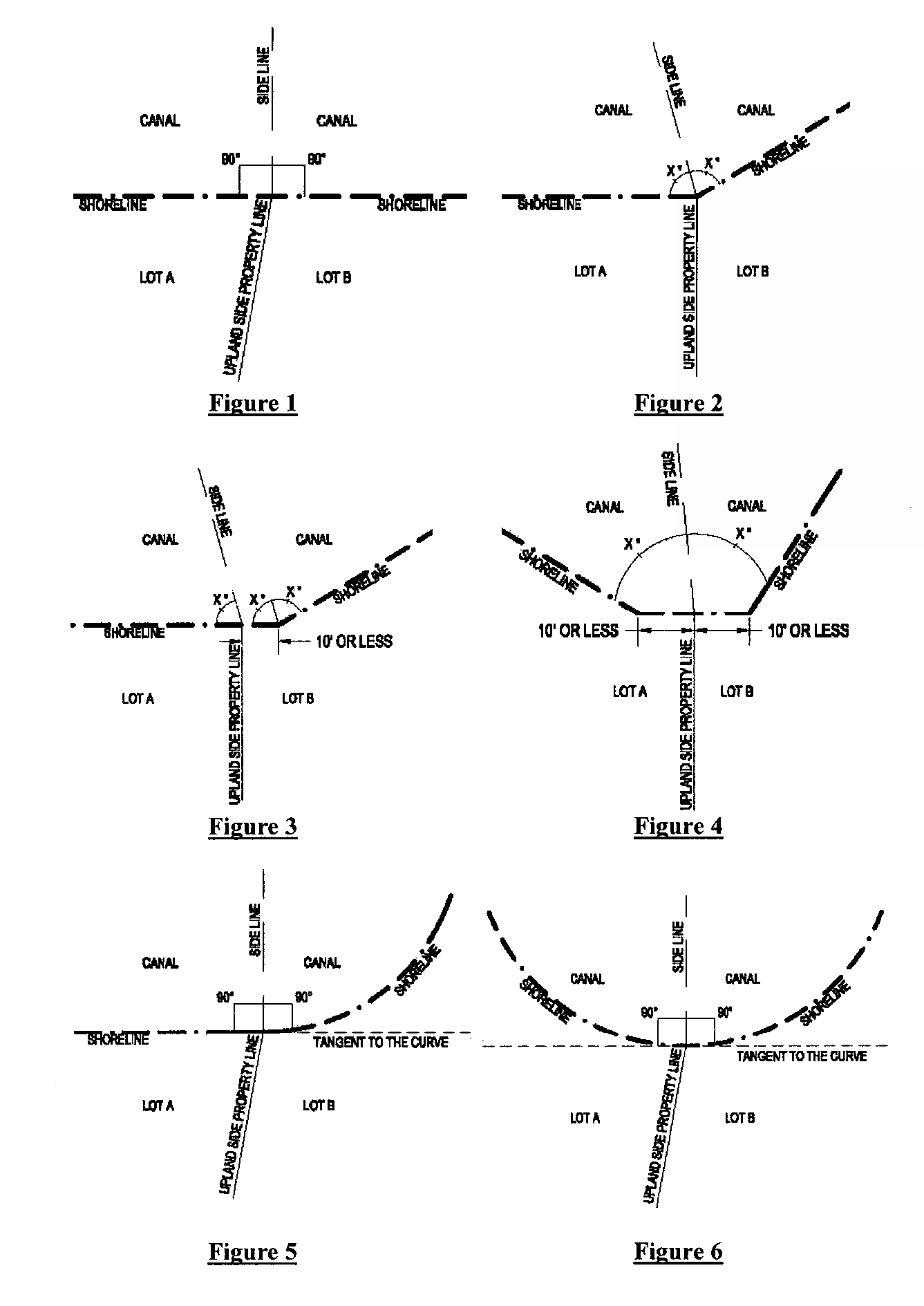
Vessel means a watercraft as defined in the definitions contained in F.S. Ch. 327.
Waterbody width means the distance from the shoreline of the subject property to the shoreline of the property across the waterbody, measured perpendicular to the shoreline of the subject property.
(b)
Docks and related marine facilities permitted as accessory use.
(1)
Accessory use. Residential docks and related marine facilities, including but not limited to docks, piers, boat lifts, dolphins, pilings, and moorings are permitted as an accessory use to the principal residential structure in all residential zoning districts, subject to the requirements of this chapter.
(c)
Regulations governing construction in canals.
(1)
The following regulations apply in canals within the city, reference the canals and waterbody map:
Residential docks and related marine facilities shall be setback from the side lines by five feet.
Except in the shore drive/palm drive canal, residential docks and related marine facilities shall not extend more than 25 percent of the waterbody width from the shoreline of the parcel to which the structure is accessory, or the following distance, whichever is less:
In the Lake Park Marina Canal, 21 feet.
In the Wilma Circle Canal, 30 feet, subject to any agreement with the submerged land property owner, Inlet Marina of Palm Beach, Ltd.
In the Gulfstream Way/Bimini Lane Canal, 30 feet.
In the Grand Bahama Lane Canal, 30 feet.
In the Morse Boulevard/Powell Drive Canal, 40 feet.
In the Sugar Sands Canal, 30 feet for properties fronting on Singer Drive, 40 feet for all other properties. The three longer, shore-normal existing docks on the south side are hereby specifically allowed to be maintained or rebuilt to the existing shore-normal and shore-parallel dimensions.
In the Yacht Harbor Canal (the finger extending east of the main harbor), 75 feet on the north and south sides, and 35 feet on the east side.
In the Shore Drive/Palm Drive canal, residential docks and related marine facilities shall not extend more than 33 percent of the waterbody width from the shoreline of the parcel to which the structure is accessory, or 25 feet, whichever is less.
On the north side of the Sugar Sands Canal, no vessel shall be moored in such a manner as to project more than 30 feet from the north side seawall.
Except in the Shore Drive/Palm Drive canal, no vessel shall be moored in such a manner as to obstruct more than 30 percent of the width of the waterbody in which the boat or other watercraft is moored.
In the Shore Drive/Palm Drive canal, no vessel shall be moored in such a manner as to obstruct more than 33 percent of the width of the canal.
Vessels shall be moored such that no part of a vessel, including anchors or lines, shall extend beyond the side lines.
Residential docks and related marine facilities shall be constructed in accordance with the following requirements and regulations:
a.
Marginal docks shall extend a maximum of eight feet out from the face of the bulkhead wall.
b.
Shore-normal docks shall not exceed a width of eight feet.
c.
Finger docks shall not exceed a width of eight feet.
d.
No dock shall be located closer to the side property line extended than half of its extension waterside.
e.
Shore-normal docks and finger docks shall be for vessel mooring only, and shall be spaced accordingly.
f.
Wave attenuators shall not be permitted, except at the mouth of a canal.
g.
Mooring buoys and anchors shall not be installed unless they are part of at least a two-point system which will secure the vessel within the limits specified in this chapter.
(d)
Regulations governing construction in waterbodies other than canals.
(1)
The following regulations apply in waterbodies other than canals, within the city:
Residential docks and related marine facilities shall be setback from the side lines by five feet.
Residential docks and related marine facilities shall not be located more than 25 percent of the waterbody width, or 200 feet, whichever is less, from the shoreline of the parcel to which the structure is accessory.
No vessel shall be moored in such a manner as to obstruct more than 25 percent of the width of the waterbody in which the boat or other watercraft is moored, or to unreasonably infringe on navigation. No part of a boat shall be moored so as to extend beyond the side lines.
Residential docks and related marine facilities shall be constructed in accordance with the following requirements and regulations:
Marginal docks or piers shall extend a maximum of 12 feet out from the face of the bulkhead wall.
Shore-normal docks shall not exceed a width of ten feet for a single-family dock, and twelve feet for a multi-family dock.
Finger docks shall not exceed a width of ten feet for a single-family dock, and twelve feet for a multi-family dock.
Any dock or overwater decking other than a marginal dock, and/or a single shore-normal dock and finger dock shall be for vessel mooring only and shall be spaced accordingly.
(e)
Regulations governing construction in all waterbodies.
The following regulations apply in all waterbodies within the city:
Each dock shall be provided with at least one ladder extending from the dock surface to one foot below mean low water.
Enclosures prohibited. Residential docks and related marine facilities shall not contain walls, roofs, coverings, or enclosures, other than dock boxes, covered or uncovered fish cleaning tables, utility pedestals, and trash receptacles.
Canal dead end or inside corner. In regard to construction waterside of any platted lot at the dead end of a canal or on the inside corner of a waterbody, a dock or a pier may be placed zero feet from the side line when all of the following requirements are complied with:
The lots abutting the side line shall be in a RS-5 Single Family Dwelling District.
At least one of the lots abutting the side line shall have less than 75 feet frontage on the water.
A dock or pier shall be constructed at the same time, by each of the abutting owners, with both owners' consent, on both sides of the side line in question.
The dock or pier on a lot shall be structurally independent of the dock or pier on the adjacent lot.
Commercial use prohibited. Use of residential docks and related marine facilities for commercial purposes is prohibited. However, the following shall not be construed to be "for commercial purposes": rental of a private residence with a dock or pier; construction by a developer of a dock or pier; or the sole act of mooring a commercial vessel at the vessel owner's private residential dock (this shall not be construed to allow commercial loading or unloading operations, or embarking or disembarking of paid personnel or passengers for hire). No dock shall contain an advertising sign.
Use of residential docks. Residential docks shall be used only by residents or their guests, and shall not be used by or rented or leased to nonresidents other than owners of the principal dwelling or dwellings. For the purpose of this section, the term guest shall mean a person or persons visiting the resident. In any case, a guest vessel may not be moored at the dock more than 60 nights within one calendar year.
Lighting. Artificial lighting may be installed on a dock for security or safety. Applicant must provide documentation that lighting will not adversely affect surrounding properties. Blinking or intermittent lights are prohibited.
Floating docks. Floating docks are permitted, subject to conformance with all requirements of this section and all applicable building codes.
(f)
Permits required.
(1)
Building permit required:
a.
A building permit is required for construction or expansion of all residential docks and related marine facilities, and for installation of lighting or other electrical facilities on such structures. The building permit shall be obtained prior to initiation of the construction or expansion.
b.
A building permit is not required for nonstructural repairs or maintenance, or for replacement of deck boards or something similar.
(2)
Additional application requirements.
a.
Proof that the applicant is the owner of the upland residential property adjacent to the waterbody.
b.
Two sets of construction plans prepared by and under the seal of a Florida Licensed Professional Engineer. Plans shall include a site plan drawn to scale sufficient to represent all elements of the proposed facilities, the shoreline/seawall of the upland property from which the dock will project, top of seawall elevation, the docks and related marine facilities of the adjacent properties, and the docks and related marine facilities across the waterbody from the proposed facilities, if within 100 feet of the proposed facilities. Adjacent and nearby facilities owned by others may be scaled from an aerial photograph, if indicated as such on the site plan, and if field verified by observation concurrent with preparation of the site plan.
c.
Written authorization for the proposed dock from the Florida Department of Environmental Protection (DEP) or South Florida Water Management District (SFWMD), and the U.S. Army Corps of Engineers (Corps), is required. A printout from the DEP's self-certification website shall be sufficient to meet this requirement, if it provides the applicable authorization. Such written approval shall not be expired.
(3)
Supporting documentation.
a.
In addition to the specific limits provided in this section, the proposed residential docks and related marine facilities and vessel mooring shall not preclude abutting or adjacent property owners from constructing residential docks or related marine facilities in accordance with this section.
b.
In addition to the specific limits provided in this section, the proposed residential docks and related marine facilities and vessel mooring shall not preclude abutting or adjacent property owners from mooring, maneuvering, or usage associated with their residential docks or related marine facilities legally existing or constructed in accordance with this section.
(g)
Maintenance. Residential docks and related marine facilities shall be maintained by the property owner in a safe, properly maintained condition as determined by the city code administrator. A licensed contractor or the property owner by way of owner builder building permit shall perform all work on residential docks and related marine facilities. A residential dock or related marine facility which is determined by the building official to be in an unsafe condition is hereby declared a public nuisance.
(h)
Nonconforming structures. Unless otherwise provided for, any existing residential dock or related marine facility that does not meet the requirements of this chapter shall not be added to or altered in any manner so as to increase the extent to which the structure is in violation of applicable requirements. Any existing residential dock or related marine facility legally constructed prior to this section may be repaired or replaced, except that if the residential dock or related marine facility has failed or been destroyed, it must be repaired or replaced within two years of its failure or destruction, or meet the other provisions of this section. Such docks shall be subject to all provisions of this Code relating to unsafe structures.
(i)
Measurement of docks and marine facilities. Unless otherwise provided herein, any required measurement associated with a dock or related marine facility shall be made from the property line of the property to which the dock or facility is accessory.
(Ord. No. 3076, § 1, 4-7-10)
Sec. 31-558. - Portable storage containers.
(a)
Portable storage containers. Portable storage container and/or any temporary storage unit, means any portable, weather-resistant receptacle designed and used for the temporary storage or shipment of household goods.
(b)
Portable storage containers are allowed in residential zoning districts.
(c)
A permit must be obtained from the city building division. The permit is valid for 30 days from the date of delivery of container. The following must be submitted with the permit application for the portable storage container.
(1)
Two copies of a drawing or plan showing the location of the portable storage container to scale on the property.
(2)
If applicable a copy of an approval letter from the property's Home Owners Association or Property Owners Association is required.
(d)
If a storage container is to be located on the property more than 30 days, an extension to the permit must be approved by the building official and a fee must be paid for the permit extension. This process must be followed for each subsequent permit extension. Additional fees will be required for each 30 days extension at increasing intervals to a maximum of three months. After which time if the portable storage container is not removed a citation from code enforcement will be issued for the maximum civil penalty of up to $500.00 per day.
(e)
No storage container shall be located closer than five feet from a property line unless approved by the community development director.
(f)
No storage container shall obstruct traffic vision or be located within a visibility triangle which is the triangular area of property located at a corner formed by the intersection of two or more public rights-of-way. Two sides being 25 feet in length along the abutting public right-of-way lines and pavement edges, measured from their point of intersection, and the third side being a line connecting the ends of the two other sides.
(g)
No portable storage container shall have dimensions greater than 20 feet in length and eight feet in width and height. Storage capacity shall be no greater than 1,280 cubic feet.
(h)
Not more than two portable storage containers smaller than 20 feet by eight feet and totaling 1,280 cubic feet shall be located on a property at any given time. Each separate portable storage container must be permitted and appropriate fees paid.
(i)
All portable storage containers in use on a lot shall be in a condition free from rust, peeling paint and other visible forms of deterioration.
(j)
In cases of emergency caused by natural disasters, floods, and fires a portable storage container may be acquired and a permit obtained after the fact within one week of the portable storage containers delivery. All other rules of portable storage container code must be followed and proof of the emergency will be required.
(k)
No portable storage container is to be located in the street or any part of the public right-of-way.
(Ord. No. 3097, § 1, 7-6-11)
Sec. 31-559. - Medical marijuana.
Medical marijuana treatment centers and/or medical marijuana treatment center dispensing facilities are strictly and specifically prohibited within all city zoning districts and within the jurisdictional boundaries of the city.
(Ord. No. 4109, § 3, 5-2-18)
Sec. 31-560. - Community residences and recovery communities—purpose.
The purpose of sections 31-561 and 31-562 is to provide for the general health, safety, and welfare of the City of Riviera Beach; to provide for the inclusion of persons with disabilities into residential settings by preventing de facto social service districts; and to protect persons with disabilities residing in community residences and recovery communities by establishing reasonable requirements for certification, licensure, or the equivalent.
(Ord. No. 4243, § 20, 2-21-24)
Sec. 31-561. - Standards for community residences.
(a)
Allowed zoning districts. Community residences are allowed as follows:
(1)
Type I community residences (up to six residents): are a permitted use in all zoning districts that allow residential uses, subject to the requirements of this section.
(2)
Type II community residences (between seven and 14 residents): are a permitted use in all zoning districts that allow multifamily housing, subject to the requirements of this section.
(b)
Typical uses.
(1)
Type I and Type II community residences include, but are not limited to, residential settings for persons who meet the following criteria:
a.
A person residing in an adult family care home as defined by F.S. § 429.65(2).
b.
A physically disabled or handicapped person as defined in F.S. § 760.22(7).
c.
A developmentally disabled person as defined in F.S. § 393.063(9)
d.
A non-dangerous person with a mental illness as defined in F.S. § 394.455(18).
e.
A child as defined in F.S. § 39.01(12) and (14); or
f.
A person suffering from addiction receiving care and treatment in a recovery residence.
(2)
In addition, Type II community residences include those residences as defined by section 419.001(1)(a), Florida Statutes.
(c)
License, Certification, or Recertification Requirements.
(1)
Community residences are required to have and maintain any license or certification that the State of Florida requires.
(2)
Recovery residences, except for chartered Oxford Houses, are required to be certified by the Florida Association of Recovery Residences (FARR). An existing recovery residence that, as of the effective date of Ordinance No. 4243, does not meet the requirements of this subsection shall have until December 31, 2024, to come into compliance or shall cease operation and safely relocate residents.
(3)
A community residence that has been denied a license or certification the State of Florida requires or a FARR certification or an Oxford House charter, or had such license, certification, or charter revoked, suspended, or denied renewal, shall cease operation within 60 days of the revocation, suspension, or denied renewal and safely relocate residents.
(d)
Siting/Location. A community residence shall not be located within a 660-foot radius of an existing community residence and shall not be located within a 1,200-foot radius of an existing recovery community.
(e)
Persons with disabilities may seek reasonable accommodation with respect to the requirements for community residences pursuant to section 31-9 of this chapter, which sets forth the procedure for such requests.
(Ord. No. 4243, § 21, 2-21-24)
Sec. 31-562. - Standards for recovery communities.
(a)
Allowed zoning districts. Recovery communities are a permitted use in all zoning districts that allow multifamily dwellings, subject to the requirements of this section.
(b)
License, certification, or recertification requirements.
(1)
Recovery communities are required to have and maintain any license or certification that the State of Florida requires.
(2)
Recovery communities are required to be certified by the Florida Association of Recovery Residences (FARR). An existing recovery community that, as of the effective date of Ordinance No. 4243, does not meet the requirements of this subsection shall have until December 31, 2024, to come into compliance or shall cease operation and safely relocate residents.
(3)
A recovery community that has been denied a license or certification the State of Florida requires or a FARR certification, or had such license or certification revoked, suspended, or denied renewal, shall cease operation within 60 days of the revocation, suspension, or denied renewal and safely relocate residents.
(e)
Siting/Location. A recovery community shall not be located within 1,200 linear feet of an existing recovery community and shall not be located within 1,200 linear feet of an existing community residence. Linear feet shall be measured from the nearest property line of the proposed recovery community to the nearest property line of the closest existing recovery community or community residence.
(f)
Persons with disabilities may seek reasonable accommodation with respect to the requirements for recovery communities pursuant to section 31-9 of this chapter, which sets forth the procedure for such requests.
(Ord. No. 4243, § 22, 2-21-24)
Sec. 31-563. - Standards for non-residential medical uses.
(a)
Purpose. The purpose of this section is to provide for the siting of medical treatment centers that are not residential in nature, to include hospitals, specialty medical facilities, and specialty hospitals, while ensuring that such facilities do not interfere with residential character of adjacent communities by causing excessive noise, light, and traffic.
(b)
Specialty medical facilities shall comply with the following standards:
(1)
Separation from residential uses. The facility shall be at least 250 feet from a residential zoning district.
(2)
Overnight treatment. Overnight treatment is prohibited.
(3)
Hours of operation. The facility shall not offer treatment or services between the hours of 10 p.m. and 7 a.m.
(c)
Specialty hospitals shall comply with the following standards:
(1)
Separation from residential uses. The hospital shall be at least 500 feet from a residential zoning district.
(2)
Overnight treatment. Overnight treatment is permitted.
(3)
Hours of operations. The hospital may be open 24 hours per day.
(4)
The specialty hospital shall be located on a site that has an area of at least three acres and fronts on or has direct access to and from an arterial or collector street.
(5)
Vehicular access and circulation systems and exterior signage shall be designed to provide safe and separate emergency vehicle access to the specialty hospital, with minimal conflicts with other vehicular or pedestrian traffic in the area.
(6)
A perimeter security plan is required and shall address at a minimum vehicular and pedestrian access to site, parking areas, and lighting.
(7)
Outdoor recreation and/or passive space shall be provided for both patients and visitors.
(d)
Hospitals shall comply with the following standards:
(1)
Separation from residential uses. The hospital shall be at least 500 feet from a residential zoning district.
(2)
Overnight treatment. Overnight treatment is permitted.
(3)
Hours of operations. The hospital may be open 24 hours per day.
(4)
The hospital shall be located on a site that has an area of at least four acres and fronts on or has direct access to and from an arterial or collector street.
(5)
Vehicular access and circulation systems and exterior signage shall be designed to provide safe and separate emergency vehicle access to the hospital, with minimal conflicts with other vehicular or pedestrian traffic in the area.
(6)
A perimeter security plan is required and shall address at a minimum vehicular and pedestrian access to site, parking areas, and lighting.
(7)
Outdoor recreation and/or passive space shall be provided for both patients and visitors.
(Ord. No. 4243, § 23, 2-21-24)

