
Riviera Beach City Zoning Code
ARTICLE V
- DISTRICT REGULATIONS
Sec. 31-96.- Designation of districts.
In order to classify, regulate and restrict the uses of the land and buildings; to regulate and restrict the height and bulk of buildings; to regulate the area of yards and other open spaces about buildings; and to regulate the intensity of land use, the city is hereby divided into classes of districts to be known as follows:
RS-5 single-family dwelling district
RS-6 single-family dwelling district
RS-8 single-family dwelling district
RD-15 two-family dwelling district
RML-12 low density multiple-family dwelling district
RM-15 multifamily dwelling district
RMH-15 multifamily/hotel district
RM-20 high density multifamily dwelling district
RMH-20 high density multifamily/hotel district
OP office and professional district
CN neighborhood commercial district
CG general commercial district
TLI transitional limited industrial district
IL limited industrial district
IG general industrial district
RO recreation/open space district
CF community facility district
U utilities district
MH mobile home district
PUD planned unit development district
SP Special Preservation
DC downtown core district
DG downtown general district
DR downtown residential district
DI downtown industrial district
DM downtown marine district
(Ord. No. 2152, § 3(B)(23.AA-2), 3-17-82; Ord. No. 2314, § 2, 9-3-86; Ord. No. 2529, §§ 6, 7, 3-20-91; Ord. No. 2530, § 1, 5-1-91; Ord. No. 4038, 2(Exh. A), 12-18-13; Ord. No. 4147, § 3, 10-7-20)
Sec. 31-97. - Official zoning map and zoning district boundaries.
(a)
The zoning districts and boundaries thereof are shown upon the map adopted, referred to herein and made a part hereof, copies of which map are filed with the city clerk; such map being designated as the "Zoning Map of Riviera Beach, Florida." Such map and all the notations, references and other information shown thereon shall be as much a part of this chapter as if the information set forth on such map were all fully described and set out herein.
(b)
In the creation by this chapter of the respective districts, the city council has given due and careful consideration to the peculiar suitability of each and every district for the particular regulations applied thereto, and the necessary proper and comprehensive groupings and arrangements of the various uses and densities of dwelling units and population in accordance with a well considered plan for the development of the city.
(c)
The boundaries of the districts shown upon the map adopted by this chapter or amendments thereto are hereby adopted and approved and the regulations of this chapter governing the use of land and buildings, the height of buildings, building site areas, the sizes of yards about buildings and other matters as set forth in this chapter, are hereby established and declared to be in effect upon all land included within the boundaries of each and every district shown upon such map.
(d)
Where uncertainty exists as to boundaries of any district shown on the zoning map, the following rules shall apply:
(1)
Where such district boundaries are indicated as approximately following street lines, alley lines, waterways or lot lines, such lines shall be construed to be such boundaries.
(2)
In unsubdivided property, waterways or where a district boundary divides a lot, the location of such boundary, unless the same is indicated by dimensions, shall be determined by use of the scale appearing on the map.
(3)
Where a district boundary divides the area of a lot unequally, the district classification and regulations of the larger portion shall apply to the remaining smaller portion of the lot.
(4)
Where any public street or alley is hereafter officially vacated or abandoned, the regulations applicable to each parcel of abutting property shall apply to the portion of such street or alley added thereto by virtue of such vacation or abandonment.
(5)
In case any further uncertainty exists, the legislative body shall interpret the intent of the map as to the location of such boundaries.
(e)
The city council may, from time to time, amend, change or repeal district boundaries in the manner prescribed in this chapter, upon recommendation by the planning and zoning board.
(Ord. No. 2152, § 3(B)(23.AA-3), 3-17-82)
Charter reference— Official map, art. IV, § 6.
Sec. 31-98. - Effect of annexation on zoning.
Whenever property is annexed to the city from another unit of local government, the district most similar to prior local government zoning as determined by the city council at the time of annexation shall be assigned.
(Ord. No. 2152, § 3(B)(23.AA-4), 3-17-82)
Sec. 31-116.- Purpose.
The RS-5 single-family dwelling district is intended to promote and preserve single-family dwellings as the principal use and uses incidental or accessory thereto. Large lot uses are required to maintain a low density of population.
(Ord. No. 2152, § 3(B)(23.AA-5.I), 3-17-82)
Sec. 31-117. - Use regulations.
(a)
Uses permitted. The following uses are permitted in the RS-5 single-family dwelling district:
(1)
Single-family dwellings and their customary accessory uses.
(2)
Home occupations.
(b)
Special exception. The following uses are permitted by special exception in the RS-5 single-family dwelling district: None.
(Ord. No. 2152, § 3(B)(23.AA-5.II), 3-17-82; Ord. No. 2624, § 2, 2-16-94)
Sec. 31-118. - Property development standards.
The property development standards in the RS-5 single-family dwelling district are as follows:
(1)
Minimum property size: 8,000 square feet, except any lake, pond, wetland, marsh, lagoon, estuary, bottomland, etc., that is filled after December 6, 1989, shall require a minimum dry lot size of one acre.
(2)
Minimum property width: 75 feet at the building line.
(3)
Maximum building height: 35 feet.
(4)
Minimum building setbacks:
a.
Front: 25 feet.
b.
Side: ten percent of width of lot or 7½ feet; 12½ feet corner lots street side.
c.
Rear: 15 percent of the length of the lot.
(5)
Minimum floor area: 1,200 square feet, exclusive of attached garages, carports, terraces, breezeways and porches.
(Ord. No. 2152, § 3(B)(23.AA-5.III), 3-17-82; Ord. No. 2478, § 1, 12-6-89)
Sec. 31-119. - Parking.
The parking regulations in the RS-5 single-family dwelling district shall be as stated in section 31-566 et seq.
(Ord. No. 2152, § 3(B)(23.AA-5.IV), 3-17-82)
Sec. 31-120. - Landscaping.
The landscaping requirements in the RS-5 single-family dwelling district shall be as stated in section 31-596 et seq.
(Ord. No. 2152, § 3(B)(23.AA-5.V), 3-17-82)
Sec. 31-121. - Nonconforming lots and structures.
(a)
Lots. If a vacant lot in the RS-5 single-family dwelling district has an area or width, or both, less than the above minimum and was a lot of record at the time of the passage of the ordinance from which this article was derived, the lot may be occupied by a single-family dwelling and its accessory uses, provided the minimum yard regulations of the district are conformed with.
(b)
Structures. All nonconforming structures in the RS-5 district which legally existed prior to adoption of the ordinance from which this article was derived shall be allowed to expand within the required setback lines without the necessity of first obtaining a variance.
(Ord. No. 2152, § 3(B)(23.AA-5.VI), 3-17-82; Ord. No. 2213, § 1, 9-21-83)
Sec. 31-136.- Purpose.
The RS-6 single-family dwelling district is intended to promote and preserve single-family dwellings as principal uses and uses incidental or accessory thereto together with recreational, religious and educational facilities.
(Ord. No. 2152, § 3(B)(23.AA-6.I), 3-17-82)
Sec. 31-137. - Use regulations.
(a)
Uses permitted. The following uses are permitted in the RS-6 single-family dwelling district:
(1)
Single-family dwellings and their customary accessory uses.
(2)
Parks, playgrounds and recreation facilities under the supervision of the city.
(3)
Home occupations.
(b)
Special exception. The following uses are permitted by special exception in the RS-6 single-family dwelling district: Churches and their educational buildings.
(Ord. No. 2152, § 3(B)(23.AA-6.II), 3-17-82; Ord. No. 2624, § 2, 2-16-94; Ord. No. 2657, § 1, 3-15-95)
Sec. 31-138. - Property development standards.
The property development standards in the RS-6 single-family dwelling district are as follows:
(1)
Minimum property size: 6,500 square feet.
(2)
Minimum property width: 60 feet at the building line.
(3)
Maximum building height: 35 feet.
(4)
Minimum building setbacks:
a.
Front: 25 feet.
b.
Side: ten percent of width of lot or 7½ feet; 12½ feet on street side.
c.
Rear: 15 percent of the length of the lot; need not be more than 25 feet.
(5)
Minimum floor area: 1,000 square feet exclusive of attached garages, carports, terraces, breezeways and porches.
(Ord. No. 2152, § 3(B)(23.AA-6.III), 3-17-82)
Sec. 31-139. - Parking.
The parking regulations in the RS-6 single-family dwelling district shall be as stated in section 31-566 et seq.
(Ord. No. 2152, § 3(B)(23.AA-6.IV), 3-17-82)
Sec. 31-140. - Landscaping.
The landscaping requirements in the RS-6 single-family dwelling district shall be as stated in section 31-596 et seq.
(Ord. No. 2152, § 3(B)(23.AA-6.V), 3-17-82)
Sec. 31-141. - Nonconforming lots and structures.
(a)
Lots. If a vacant lot in the RS-6 single-family dwelling district has an area or width, or both, less than the above minimum and was a lot of record at the time of the passage of the ordinance from which this article was derived, the lot may be occupied by a single-family dwelling and its accessory uses, provided the minimum yard regulations of the district are conformed with.
(b)
Structures. All nonconforming structures in the RS-6 district which legally existed prior to adoption of the ordinance from which this article was derived shall be allowed to expand within the required setback lines without the necessity of first obtaining a variance.
(Ord. No. 2152, § 3(B)(23.AA-6.VI), 3-17-82; Ord. No. 2169, § 2, 7-21-82; Ord. No. 2213, § 1, 9-21-83; Ord. No. 4243, § 4, 2-21-24)
Sec. 31-142. - Site plan review.
A site plan review in accordance with section 31-56 et seq. is required for the uses permitted by section 31-137(a)(2) and (a)(3).
(Ord. No. 2152, § 3(B)(23.AA-6.VII), 3-17-82)
Sec. 31-156.- Purpose.
The RS-8 single-family dwelling district is intended to provide areas within which single-family dwellings with accessory uses can thrive as a principal use and can be protected from the more intense activities or land uses. Recreational, religious and educational facilities shall also be permitted.
(Ord. No. 2152, § 3(B)(23.AA-7.I), 3-17-82)
Sec. 31-157. - Use regulations.
(a)
Uses permitted. The following uses are permitted in the RS-8 single-family dwelling district:
(1)
Single-family dwellings and their customary accessory uses.
(2)
Parks, playgrounds and recreation facilities under the supervision of the city.
(3)
Libraries, community centers; buildings or land used exclusively by the federal, state, county or city governments for public purposes.
(4)
Home occupations.
(b)
Special exception. The following uses are permitted by special exception in the RS-8 single-family dwelling district: Churches and their educational buildings.
(Ord. No. 2152, § 3(B)(23.AA-7.II), 3-17-82; Ord. No. 2624, § 2, 2-16-94; Ord. No. 2657, § 1, 3-15-95)
Sec. 31-158. - Property development standards.
The property development standards in the RS-8 single-family dwelling district are as follows:
(1)
Minimum property size: 5,000 square feet.
(2)
Minimum property width: 50 feet at the building line.
(3)
Maximum building height: 35 feet.
(4)
Minimum building setbacks:
a.
Front: 20 feet.
b.
Side: seven feet; 12½ feet on street side abutting street.
c.
Rear: 15 percent of the length of the lot; need not be more than 20 feet.
(5)
Minimum floor area: 800 square feet exclusive of attached garages, carports, terraces, breezeways and porches.
(Ord. No. 2152, § 3(B)(23.AA-7.III), 3-17-82)
Sec. 31-159. - Parking.
The parking regulations in the RS-8 single-family dwelling district shall be as stated in section 31-566 et seq.
(Ord. No. 2152, § 3(B)(23.AA-7.IV), 3-17-82)
Sec. 31-160. - Landscaping.
The landscaping requirements in the RS-8 single-family dwelling district shall be as stated in section 31-596 et seq.
(Ord. No. 2152, § 3(B)(23.AA-7.V), 3-17-82)
Sec. 31-161. - Nonconforming lots and structures.
(a)
Lots. If a vacant lot in the RS-8 single-family dwelling district has an area or width, or both, less than the above minimum and was a lot of record at the time of the passage of the ordinance from which this article was derived, the lot may be occupied by a single-family dwelling and its accessory uses, provided the minimum yard regulations of the district are conformed with.
(b)
Structures. All nonconforming structures in the RS-8 district which legally existed prior to adoption of the ordinance from which this article was derived shall be allowed to expand within the required setback lines without the necessity of first obtaining a variance.
(c)
Open carport. An open carport may be built to within five feet of the property line on one side of a residence in a subdivision that has 75 percent or more of the lots with houses existing and on lots 50 feet in width in existing subdivisions of record; provided, however, a clear distance of ten feet is maintained between the eaves of the carport and the eaves of the building on the adjoining property. Carports set closer than seven feet from the property lines shall not be enclosed.
(Ord. No. 2152, § 3(B)(23.AA-7.VI), 3-17-82; Ord. No. 2169, § 1, 7-21-82; Ord. No. 2213, § 1, 9-21-83; Ord. No. 4243, § 5, 2-21-24)
Sec. 31-162. - Site plan review.
A site plan review in accordance with section 31-56 et seq. is required for the uses permitted by section 31-157(a)(2)—(a)(4).
(Ord. No. 2152, § 3(B)(23.AA-7.VII), 3-17-82)
Sec. 31-176.- Purpose.
The RD-15 two-family dwelling district is intended primarily for development and preservation of duplex residential structures and their incidental or accessory uses. Recreational, religious and educational facilities, if found to be appropriate, shall also be permitted.
(Ord. No. 2152, § 3(B)(23.AA-8.I), 3-17-82)
Sec. 31-177. - Use regulations.
(a)
Uses permitted. The following uses are permitted in the RD-15 two-family dwelling district:
(1)
Single-family dwellings and their customary accessory uses.
(2)
Dwelling structures for two-family use (duplex).
(3)
Parks, playgrounds and recreation facilities under the supervision of the municipality.
(4)
Group homes and adult congregate living facilities.
(5)
Home occupations.
(b)
Special exception. The following uses are permitted by special exception in the RD-15 two-family dwelling district: Churches and their educational buildings.
(Ord. No. 2152, § 3(B)(23.AA-8.II), 3-17-82; Ord. No. 2213, § 1, 9-21-83; Ord. No. 2624, § 2, 2-16-94; Ord. No. 2657, § 1, 3-15-95)
Sec. 31-178. - Property development standards.
The property development standards in the RD-15 two-family dwelling district are as follows:
(1)
Minimum property size:
a.
Single-family dwelling: 5,000 square feet.
b.
Two-family dwelling: 5,500 square feet.
(2)
Minimum property width: 50 feet at building line.
(3)
Maximum building height: 35 feet or two stories.
(4)
Minimum building setbacks:
a.
Front: 25 feet.
b.
Side: seven feet; 12½ feet on street side abutting street.
c.
Rear: 20 feet.
(5)
Minimum floor area: 700 square feet for each multiple-family unit and 800 square feet for single-family units, exclusive of attached garages, carports, terraces, breezeways and porches.
(Ord. No. 2152, § 3(B)(23.AA-8.III), 3-17-82)
Sec. 31-179. - Parking.
The parking regulations in the RD-15 two-family dwelling district shall be as stated in section 31-566 et seq.
(Ord. No. 2152, § 3(B)(23.AA-8.IV), 3-17-82)
Sec. 31-180. - Landscaping.
The landscaping requirements in the RD-15 two-family dwelling district shall be as stated in section 31-596 et seq.
(Ord. No. 2152, § 3(B)(23.AA-8.V), 3-17-82)
Sec. 31-181. - Nonconforming lots and structures.
(a)
Lots. If a vacant lot in the RD-15 two-family dwelling district has an area or width, or both, less than the above minimum and was a lot of record at the time of the passage of the ordinance from which this article was derived, the lot may be occupied by a single-family dwelling and its accessory uses, provided the minimum yard regulations of the district are conformed with.
(b)
Structures. All nonconforming structures which legally existed prior to adoption of the ordinance from which this article was derived shall be allowed to expand within the required setback lines without the necessity of first obtaining a variance.
(Ord. No. 2152, § 3(B)(23.AA-8.VI), 3-17-82; Ord. No. 2213, § 1, 9-21-83)
Sec. 31-182. - Site plan review.
A site plan review in accordance with section 31-56 et seq. is required for the uses permitted by section 31-178(a)(3) and (a)(4).
(Ord. No. 2152, § 3(B)(23.AA-8.VII), 3-17-82; Ord. No. 2213, § 1, 9-21-83)
Sec. 31-186.- Purpose.
The RML-12 district is intended to provide for development of multifamily dwellings, and allows a low density of population. The district is basically residential in character, although customary accessory uses and amenities are permitted as subordinate use to main structure.
(Ord. No. 2529, § 6, 3-20-91)
Sec. 31-187. - Use regulations.
(a)
Uses permitted. The following uses are permitted in the RML-12 multiple-family dwelling district:
(1)
Any of the permitted uses in the RS-8 single-family dwelling district.
(2)
Multifamily dwelling units.
(3)
Family day care home.
(4)
Home occupations (see section 31-545).
(b)
Special exception. The following uses are permitted by special exception in the RML-12 multiple-family dwelling district:
(1)
Day care center.
(2)
Churches and their educational buildings.
(Ord. No. 2529, § 6, 3-20-91; Ord. No. 2624, § 2, 2-16-94; Ord. No. 2657, § 2, 3-15-95; Ord. No. 4243, § 6, 2-21-24)
Sec. 31-188. - Property development standards.
The property development standards for the RML-12 multiple-family dwelling district are as follows:
(1)
Minimum property size.
a.
Single-family dwelling: 6,500 square feet.
b.
Two-family dwelling: 7,500 square feet.
c.
Multiple-family: minimum lot size of 10,000 square feet and maximum density of 12 dwelling units per acre.
(2)
Minimum property width.
a.
One- and two-family dwellings: 60 feet.
b.
Multiple-family dwellings: 100 feet.
(3)
Maximum building height: 35 feet or three stories.
(4)
Minimum building setbacks.
a.
Front: 20 feet.
b.
Side for one-story structure: seven feet, except ten feet where the rear of units face the side yard.
c.
Side for two-story structure: ten feet.
d.
Side for corner lot: 12½ feet.
e.
Rear: 15 percent of the length of the lot or 20 feet, whichever is less.
(5)
Minimum floor area:
a.
One-bedroom apartments: 650 square feet.
b.
Two-bedroom apartments: 750 square feet. For each additional bedroom, total square footage shall increase by 100.
c.
Single-family homes: 800 square feet.
(Ord. No. 2529, § 6, 3-20-91)
Sec. 31-189. - Parking.
The parking requirements for the RML-12 multiple-family dwelling district shall be as stated in section 31-566 et seq.
(Ord. No. 2529, § 6, 3-20-91)
Sec. 31-190. - Landscaping.
The landscaping requirements for the RML-12 multiple-family dwelling district shall be as stated in section 31-596 et seq.
(Ord. No. 2529, § 6, 3-20-91)
Sec. 31-191. - Nonconforming lots and structures.
Regulations governing nonconforming lots and structures in the RML-12 multiple-family dwelling district shall be the same as those for the RS-6 single-family dwelling district.
(Ord. No. 2529, § 6, 3-20-91)
Sec. 31-192. - Site plan review.
A site plan review shall be required for all permitted uses in the RML-12 multiple-family dwelling district except the following:
(1)
Residential developments with up to and including five units.
(2)
Family day care home.
(Ord. No. 2529, § 6, 3-20-91; Ord. No. 4243, § 7, 2-21-24)
Sec. 31-193. - Special side yard provision diagram.
RML-12 SPECIAL SIDE YARD PROVISION
10-foot side yard when back doors face the side yard
(Ord. No. 2529, § 6, 3-20-91)
Sec. 31-196.- Purpose.
The RM-15 multifamily dwelling district is intended to provide for development of multifamily dwellings, and allows a medium density of population. The district is basically residential in character, although customary accessory uses and amenities are permitted as a subordinate use to the main structure.
(Ord. No. 2152, § 3(B)(23.AA-9.I), 3-17-82)
Sec. 31-197. - Use regulations.
(a)
Uses permitted. The following uses are permitted in the RM-15 multifamily dwelling district:
(1)
Any use permitted in the RS-8 single-family dwelling district.
(2)
Multifamily dwelling units.
(b)
Special exception. The following uses are permitted by special exception in the RM-15 multifamily dwelling district:
(1)
Residential planned unit developments (R-PUD).
(2)
Day care centers.
(3)
Mobile home parks.
(4)
Boardinghouses or lodging houses.
(5)
Guest houses or tourist homes.
(6)
Churches and their educational buildings.
(Ord. No. 2152, § 3(B)(23.AA-9.II), 3-17-82; Ord. No. 2386, § 1, 9-7-88; Ord. No. 2624, § 2, 2-16-94; Ord. No. 2657, § 3, 3-15-95; Ord. No. 4243, § 8, 2-21-24)
Sec. 31-198. - Property development standards.
The property development standards in the RM-15 multifamily dwelling district are as follows:
(1)
Minimum property size/density:
a.
Single-family dwelling: 5,000 square feet.
b.
Two-family dwelling: 5,500 square feet.
c.
Three-family dwelling: 7,000 square feet.
d.
Four-family dwelling: 8,500 square feet.
e.
Five or more units shall be density based, and shall be expressed in terms of maximum number of residential dwelling units permitted per acre of land. Maximum permitted density shall be 15 dwelling units per acre.
(2)
Minimum property width:
a.
One-family and two-family: 50 feet at the building line.
b.
Three-family and four-family dwellings: 60 feet at the building line.
c.
Five-family units and greater: 70 feet at the building line.
(3)
Maximum building height: 35 feet or three stories.
(4)
Minimum building setbacks:
a.
Front: 20 feet.
b.
Side: seven feet; 12½ feet on street side.
c.
Rear: 15 percent of the length of the lot or 20 feet, whichever is less.
(5)
Minimum floor area:
a.
Efficiencies: 400 square feet.
b.
One-bedroom apartments: 650 square feet.
c.
Two-bedroom apartments: 750 square feet. For each additional bedroom, total square footage shall increase by 100.
d.
Single family homes: 800 square feet.
(Ord. No. 2152, § 3(B)(23.AA-9.III), 3-17-82; Ord. No. 2213, § 1, 9-21-83; Ord. No. 3021, § 2, 11-15-06)
Sec. 31-199. - Parking.
The parking regulations in the RM-15 multifamily dwelling district shall be as stated in section 31-566 et seq.
(Ord. No. 2152, § 3(B)(23.AA-9.IV), 3-17-82)
Sec. 31-200. - Landscaping.
The landscaping requirements in the RM-15 multifamily dwelling district shall be as stated in section 31-596 et seq.
(Ord. No. 2152, § 3(B)(23.AA-9.V), 3-17-82)
Sec. 31-201. - Nonconforming lots and structures.
Regulations governing nonconforming lots and structures in the RM-15 multifamily dwelling district shall be the same as those for the RS-8 single-family dwelling district.
(Ord. No. 2152, § 3(B)(23.AA-9.VI), 3-17-82)
Sec. 31-202. - Site plan review.
A site plan review shall be required for all permitted uses in the RM-15 multifamily dwelling district except residential developments with up to and including five units.
(Ord. No. 2152, § 3(B)(23.AA-9.VII), 3-17-82)
Sec. 31-221.- Purpose.
The RMH-15 multifamily/hotel district is similar to the RM-15 multifamily dwelling district except that hotels and motels and their customary accessory uses, as found to be appropriate, may be permitted.
(Ord. No. 2152, § 3(B)(23.AA-10.I), 3-17-82)
Sec. 31-222. - Use regulations.
(a)
Uses permitted. The following uses are permitted in the RMH-15 multifamily/hotel district:
(1)
Single-family dwellings.
(2)
Two-family dwellings.
(3)
Multiple family dwellings.
(4)
Hotels, motels, apartment hotels.
(5)
Restaurants and shops accessory to hotels or motels, which uses shall not have signs or displays visible from the public street.
(6)
Private clubs as accessory to the residential uses.
(7)
Any use commonly accessory to the above uses.
(8)
Home occupations.
(b)
Special exception. The following uses are permitted by special exception in the RMH-15 multifamily/hotel district:
(1)
Residential planned unit development (R-PUD).
(2)
Timesharing.
(3)
Assisted living facilities.
(4)
Nursing home.
(Ord. No. 2152, § 3(B)(23.AA-10.II), 3-17-82; Ord. No. 2213, § 1, 9-21-83; Ord. No. 2386, § 2, 9-7-88; Ord. No. 2624, § 2, 2-16-94; Ord. No. 4243, § 9, 2-21-24)
Sec. 31-223. - Property development standards.
The property development standards in the RMH-15 multifamily/hotel dwelling district are as follows:
(1)
Minimum property size/density:
a.
Single-family dwelling: 5,000 square feet.
b.
Two-family dwelling: 5,500 square feet.
c.
Three-family dwelling: 7,000 square feet.
d.
Four-family dwelling: 8,500 square feet.
e.
Five or more units shall be density based, and shall be expressed in terms of maximum number of residential dwelling units permitted per acre of land. Maximum permitted density shall be 15 dwelling units per acre. Hotel/motel units shall be permitted at a density of 30 units per acre.
(2)
Minimum property width:
a.
One-family and two-family: 50 feet at the building line.
b.
Three-family and four-family dwellings: 60 feet at the building line.
c.
Five-family units and greater: 70 feet at the building line.
(3)
a.
Maximum building height: 35 feet or three stories.
b.
For projects of five units or more, the maximum building height may be increased to 45 feet if the project utilizes ground floor parking underneath the main structure, allowing the provision of increased landscape area along the street (minimum of 20 percent increased plant materials required).
(4)
Minimum building setbacks:
a.
Front: 20 feet.
b.
Side: seven feet; 12½ feet on street side.
c.
Rear: 15 percent of the length of the lot or 20 feet, whichever is less.
(5)
Minimum floor area:
a.
Efficiencies: 400 square feet.
b.
One-bedroom apartments: 650 square feet.
c.
Two-bedroom apartments: 750 square feet. For each additional bedroom, total square footage shall increase by 100.
d.
Single-family homes: 800 square feet.
(Ord. No. 2152, § 3(B)(23.AA-10.III), 3-17-82; Ord. No. 2213, § 1, 9-21-83; Ord. No. 3021, § 3, 11-15-06)
Sec. 31-224. - Parking.
The parking regulations in the RMH-15 multifamily/hotel district shall be as stated in section 31-566 et seq.
(Ord. No. 2152, § 3(B)(23.AA-10.IV), 3-17-82)
Sec. 31-225. - Landscaping.
The landscaping requirements in the RMH-15 multifamily/hotel district shall be as stated in section 31-596 et seq.
(Ord. No. 2152, § 3(B)(23.AA-10.V), 3-17-82)
Sec. 31-226. - Nonconforming lots and structures.
Regulations governing nonconforming lots and structures in the RMH-15 multifamily/hotel district shall be the same as those for the RS-8 single-family dwelling district.
(Ord. No. 2152, § 3(B)(23.AA-10.VI), 3-17-82)
Sec. 31-227. - Site plan review.
A site plan review shall be required for all permitted uses in the RMH-15 multifamily/hotel district except residential development with up to and including five units.
(Ord. No. 2152, § 3(B)(23.AA-10.VII), 3-17-82)
Sec. 31-241.- Purpose.
The RM-20 high density multifamily dwelling district is intended to provide for development of multifamily dwellings and allows a high density of population with a proportional increase in amenities as the density rises. The district is basically residential in character and promotes a high quality environment through aesthetically oriented property development standards.
(Ord. No. 2152, § 3(B)(23.AA-11.I), 3-17-82; Ord. No. 2179, § 1, 2-2-83; Ord. No. 2285, § 1, 7-17-85)
Sec. 31-242. - Use regulations.
(a)
Uses permitted. The following uses are permitted in the RM-20 high density multifamily dwelling district:
(1)
Multiple family dwellings.
(2)
Town houses.
(3)
Condominiums and cooperatives.
(4)
Private clubs as accessory to the residential uses.
(5)
Home occupations.
(6)
Any use commonly accessory to the above uses.
(b)
Special exception. The following uses are permitted by special exception in the RM-20 high density multifamily dwelling district:
(1)
Residential planned unit developments (R-PUD).
(2)
Mobile home parks.
(3)
Assisted living facilities.
(4)
Nursing homes.
(c)
Uses prohibited. No use, building or structures of a commercial nature, except that which provides for access to the public beach, shall be permitted east of the coastal construction control line.
(Ord. No. 2152, § 3(B)(23.AA-11.II), 3-17-82; Ord. No. 2179, § 1, 2-2-83; Ord. No. 2285, § 1, 7-17-85; Ord. No. 2624, § 3, 2-16-94; Ord. No. 2774, § 1, 4-1-98; Ord. No. 4243, § 10, 2-21-24)
Sec. 31-243. - Property development standards.
The property development standards in the RM-20 high density multifamily dwelling district are as follows:
(1)
Minimum property size/maximum density:
a.
Single-family dwellings: 8,000 square feet.
b.
Multifamily dwellings: maximum permitted density shall be 20 residential dwelling units per acre including the density bonus referred to in subsection (2) of this section. If the density bonus provision is not applied for, the maximum permitted density shall be 17 units per acre.
(2)
Bonus density: the bonus density shall be as established in chapter 26, entitled, Minority Employment and Affordable Housing Opportunity Plan.
(3)
Density transfers: calculation of total site area to derive appropriate density transfer shall be computed as follows:
a.
Total land area on Singer Island from the westernmost property line, east of the right-of-way of S.R. 703 (A1A) to the 1997 coastal construction setback line as established by the State of Florida shall be computed at 100 percent of the total dry land area between those two points.
b.
Total land area east of the 1997 coastal construction control line to the mean high water line or the easternmost property line, whichever is less, shall be calculated at 50 percent of the total land area between those two points.
c.
Total area of wetlands, marshes, lagoons and known mangrove habitat shall not be computed for density transfer purposes.
d.
No area of submerged land on Lake Worth shall be computed for density transfer purposes.
(4)
Maximum building height: 20 stories or 200 feet, excluding mechanical facilities, ornamental towers, antennas, and similar non-habitable building elements, which shall not exceed 20 feet in additional height. Such non-habitable building elements shall be screened and set back from the roof line in such a way as to avoid increasing the building's offsite ground-level shadow.
(5)
Minimum building setbacks:
a.
Front:
1.
Main structures more than two stories in height, 100 feet.
2.
Main structures two stories or less in height, 50 feet.
3.
Accessory structures, e.g., parking garages, recreational decks, boiler and generator rooms, etc., 50 feet. This regulation does not apply to ornamental walls and gatehouses, which shall set back 15 feet from the front property line.
b.
Side:
1.
Ten percent of the lot or 20 feet, whichever is greater, shall be maintained for all structures, excluding accessory structures two stories or less.
2.
The accessory structures, e.g., parking garages, recreational decks, boiler and generator rooms, etc., which are two stories or less, shall be set back a minimum of 20 feet.
c.
Rear: 15 percent of the lot, but not to exceed 100 feet.
d.
Ocean: the 1997 Coastal Construction Control Line.
e.
High-rise setback: all buildings in excess of two stories shall provide two feet additional setback from each property line (with exception of the ocean side setback line for property on Singer Island) for each additional story of height.
f.
For property located west of Lake Worth, minimum setbacks are as follows:
1.
Front: 20 feet.
2.
Side: seven feet; 12½ feet on side street.
(6)
Rear: 15 percent of the length of the lot or 20 feet, whichever is less.
(7)
High-rise setback: all buildings in excess of two stories shall provide two feet additional setback from each property line for each additional story of height.
(8)
Floor area ratio: the ratio of all aggregate residential floor area to site area shall not exceed 1.3:1.
(9)
Maximum lot coverage: 70 percent of the aggregate site area computed in subsection (3) of this section, density transfer, for all structures inclusive of accessory structures, i.e., parking structures, recreational decks, boiler and generator rooms, etc.
(10)
Maximum north/south width: 110 feet for main structures. For the purposes of this regulation the accessory structures, e.g., parking garages, etc., two stories or less in height shall not be considered as part of the main building.
(11)
Minimum recreation facilities and amenities:
a.
Outdoor: one swimming pool, one tennis court or comparable recreational space and a designated area for sunning, picnics, etc., for residents of the project. Additionally, the following amenities are optional: putting greens, shuffleboard courts, wading pools, observation decks, exercise paths, etc.
b.
Indoor: one multipurpose room for parties, games and group assembly and an exercise room. Additionally, the following amenities are optional: billiard room, library, sauna, etc.
c.
Note: a pavilion may be provided, either inside or outside, as a substitute for one of the above minimum requirements.
(Ord. No. 2152, § 3(B)(23.AA-11.III), 3-17-82; Ord. No. 2179, § 1, 2-2-83; Ord. No. 2214, § 3, 9-21-83; Ord. No. 2285, § 1, 7-17-85; Ord. No. 2774, §§ 2, 3, 4-1-98; Ord. No. 2803, § 1, 2-17-99; Ord. No. 2899, § 1, 6-20-01; Ord. No. 4061, § 2, 5-20-15)
Sec. 31-244. - Parking.
(a)
The required off-street parking requirements for an RM-20 high density multifamily district should conform to section 31-566 et seq.
(b)
For any projects east of Lake Worth, or west of Lake Worth which consist of less than five total acres, 75 percent of all required parking shall be placed under a permanent structure in a manner to effectively conceal such parking facility from the public right of way by landscaping and other means; or
(c)
For any projects west of Lake Worth consisting of five acres or larger, all required parking shall be provided in a manner to effectively conceal parking from the public right-of-way by landscaping or other means, including, without limitation, hedging, fencing, or walls.
(d)
Bonuses shall be as established in chapter 26, entitled, Minority Employment and Affordable Housing Opportunity Plan.
(e)
The maximum height for a parking garage shall be 60 feet.
(f)
Parking garages shall be concealed from S.R. 703 (A1A) using buffer landscaping and utilizing facade treatments which blend the parking garage structure with the main high-rise structures.
(Ord. No. 2152, § 3(B)(23.AA-11.IV), 3-17-82; Ord. No. 2179, § 1, 2-2-83; Ord. No. 2214, § 3, 9-21-83; Ord. No. 2285, § 1, 7-17-85; Ord. No. 4061, § 2, 5-20-15; Ord. No. 4247, § 2, 11-29-23)
Sec. 31-245. - Landscaping.
In addition to the requirements of section 31-596 et seq., the following landscaping criteria shall be provided:
(1)
Twenty percent of all gross vehicular use areas shall be landscaped.
(2)
For every 12 parking slips, a landscaped island five feet in width shall be provided.
(3)
Where environmentally sensitive land, wetlands and other conservation or preservation areas abut or are located within the site, at minimum there shall be a ten-foot wide landscape buffer surrounding said areas planted with ecologically appropriate native vegetation.
(4)
All property lines shall be provided with a sufficient landscape strip at least five feet in width, with one tree for every 50 linear feet.
(5)
Where the dune has been destroyed or depleted of landscaping in a manner that does not afford a natural protection from the elements, the dune shall be rebuilt and replenished with landscaping to provide the necessary protection and to reestablish the dune ecosystem. Re-establishing of the dune shall be designed to align with the natural dune and contours found to the north and south of the subject property.
(6)
Fifty percent of all required trees shall consist of native shade tree species.
(7)
The required shade trees shall be twelve feet in height with six-foot clear trunk at planting and reach 25 feet in height and a 16-foot spread as a minimum.
(8)
Preservation areas within a site shall be computed as a substitution for landscape areas.
(9)
Modification of wetlands and buffers along access roads shall be permitted to allow standard driveway access to a main facility and subordinate uses.
(Ord. No. 2152, § 3(B)(23.AA-11.V), 3-17-82; Ord. No. 2179, § 1, 2-2-83; Ord. No. 2285, § 1, 7-17-85; Ord. No. 4061, § 2, 5-20-15)
Sec. 31-246. - Site plan review.
A site plan review shall be required for all permitted uses in the RM-20 high density multifamily dwelling district, except single-family and two-family dwellings.
(Ord. No. 2152, § 3(B)(23.AA-11.VII), 3-17-82; Ord. No. 2179, § 1, 2-2-83; Ord. No. 2285, § 1, 7-17-85)
Sec. 31-261.- Purpose.
The RMH-20 high density multifamily/hotel district is similar to the RM-20 district except that hotels and motels and their customary accessory uses as found to be appropriate may be permitted. The district is basically residential in character and promotes a high quality environment through aesthetically oriented property development standards.
(Ord. No. 2152, § 3(B)(23.AA-12.I), 3-17-82; Ord. No. 2179, § 1, 2-2-83; Ord. No. 2285, § 1, 7-17-85)
Sec. 31-262. - Use regulations.
(a)
Uses permitted. The following uses are permitted in the RMH-20 high density multifamily/hotel district:
(1)
Single-family dwellings.
(2)
Two-family dwellings.
(3)
Multiple family dwellings.
(4)
Hotels, motels, apartment hotels.
(5)
Restaurants and shops accessory to hotels or motels.
(6)
Private clubs as accessory to the residential uses.
(7)
Home occupations.
(8)
Any use commonly accessory to the above uses.
(b)
Special exception. The following uses are permitted by special exception in the RMH-20 high density multifamily/hotel district:
(1)
Residential planned unit developments (R-PUD).
(2)
Timesharing.
(c)
Uses prohibited. No commercial use, building or structure, except that which provides for access to the public beach, shall be permitted east of the 1997 coastal construction setback line.
(Ord. No. 2152, § 3(B)(23.AA-12.II), 3-17-82; Ord. No. 2179, § 1, 2-2-83; Ord. No. 2285, § 1, 7-17-85; Ord. No. 2624, § 3, 2-16-94; Ord. No. 4061, § 3, 5-20-15)
Sec. 31-263. - Property development standards.
The property development standards in the RMH-20 high density multifamily/hotel district are as follows:
(1)
Minimum property size/maximum density:
a.
Single-family dwelling: 8,000 square feet.
b.
Multifamily dwelling: maximum permitted density shall be 20 residential dwelling units per acre, including the density bonus referred to in subsection (2) of this section. If the density bonus provision is not applied for, the maximum permitted density shall be 17 units per acre. Base density for hotels and motels shall be 30 units per acre. With the density bonus, the maximum permitted density for hotel/motel shall be 40 units per acre.
(2)
Bonus density: the bonus density shall be as established in chapter 26, entitled, Minority Employment and Affordable Housing Opportunity Plan.
(3)
Density transfers: calculation of total site area to derive appropriate density transfer shall be computed as follows:
a.
Total land area on Singer Island from the westernmost property line, east of the right-of-way of S.R. 703 (A1A) to the 1997 coastal construction setback line as established by the State of Florida shall be computed at 100 percent of the total dry land area between those two points.
b.
Total land area east of the 1997 coastal construction control line to the mean high water line or the easternmost property line, whichever is less, shall be calculated at 50 percent of the total land area between those two points.
c.
Total area of wetlands, marshes, lagoons and known mangrove habitat, shall not be computed for density transfer purposes.
d.
No area of submerged land on Lake Worth shall be computed for density transfer purposes.
(4)
Maximum building height: 20 stories or 200 feet, excluding mechanical facilities, ornamental towers and antennas, which shall not exceed 20 feet in additional height. Such non-habitable building elements shall be screened and set back from the roof line in such a way as to avoid increasing the building's offsite ground-level shadow.
(5)
Minimum building setbacks:
a.
Front:
1.
Main structures more than two stories in height, 100 feet.
2.
Main structures two stories or less in height, 50 feet.
3.
Accessory structures, e.g., parking garages, recreational decks, boiler and generator rooms, etc., 50 feet. This regulation does not apply to ornamental walls and gatehouses, which shall be set back 15 feet from the front property line.
b.
Side:
1.
Ten percent of the lot or 20 feet, whichever is greater, shall be maintained for all structures excluding accessory structures two stories or less.
2.
The accessory structures, e.g., parking garages, recreational decks, boiler and generator rooms, etc., which are two stories or less shall be set back a minimum of 20 feet.
c.
Rear: 15 percent of the lot, but not to exceed 100 feet.
d.
Ocean: the 1997 Coastal Construction Control Line.
e.
High-rise setback: all buildings in excess of two stories shall provide two feet additional setback from each property line (with exception of ocean side setback line) for each additional story of height.
(6)
Floor area ratio: the ratio of all aggregate residential floor area to site area shall not exceed 1.3:1.
(7)
Maximum lot coverage: 70 percent of aggregate site area computed in subsection (3) of this section, density transfer, for all structures inclusive of accessory structures, i.e., parking garages, recreational decks, boiler and generator rooms, etc.
(8)
Maximum north/south width: 110 feet for main structures. For the purposes of this regulation, the accessory structures, e.g., parking garages, etc., two stories or less in height shall not be considered as part of the main building.
(9)
Minimum recreation facilities and amenities:
a.
Outdoor: one swimming pool, one tennis court or comparable recreational space and a designated area for sunning, picnics, etc., for residents of project. Additionally, the following amenities are optional: putting green, shuffleboard court, wading pools, observation decks, exercise paths, etc.
b.
Indoor: one multipurpose room for parties, games and group assembly and an exercise room. Additionally, the following amenities are optional: billiard room, library, sauna, etc.
c.
Note: a pavilion may be provided, either inside or outside, as a substitute for one of the above minimum requirements.
(Ord. No. 2152, § 3(B)(23.AA-12.III), 3-17-82; Ord. No. 2179, § 1, 2-2-83; Ord. No. 2213, § 1, 9-21-83; Ord. No. 2214, § 4, 9-21-83; Ord. No. 2285, § 1, 7-17-85; Ord. No. 2899, § 2, 6-20-01; Ord. No. 4061, § 3, 5-20-15)
Sec. 31-264. - Parking.
(a)
The required off-street parking requirements for an RMH-20 high density multifamily/hotel district should conform to section 31-566 et seq.
(b)
Seventy-five percent of all required parking shall be placed under a permanent structure in a manner to effectively conceal such parking facility from the public right-of-way by landscaping and other means.
(c)
Bonuses shall be as established in chapter 26, entitled, Minority Employment and Affordable Housing Opportunity Plan.
(d)
The maximum height for a parking garage shall be 60 feet.
(e)
Parking garages shall be concealed from S.R. 703 (A1A) using buffer landscaping and utilizing facade treatments which blend the parking garage structure with the main high-rise structures.
(Ord. No. 2152, § 3(B)(23.AA-12.V), 3-17-82; Ord. No. 2179, § 1, 2-2-83; Ord. No. 2214, § 3, 9-21-83; Ord. No. 2285, § 1, 7-17-85; Ord. No. 4061, § 3, 5-20-15)
Sec. 31-265. - Landscaping.
In addition to the requirements of section 31-596 et seq., the following landscaping criteria shall be provided:
(1)
Twenty percent of all gross vehicular use areas shall be landscaped.
(2)
For every 12 parking spaces, a landscaped island five feet in width shall be provided.
(3)
Where environmentally sensitive land, wetlands and other conservation or preservation areas abut or are located within the site, at minimum there shall be a ten-foot wide landscape buffer surrounding said areas, planted with ecologically appropriate native vegetation.
(4)
All property lines shall be provided with a sufficient landscape strip at least five feet in width with one tree for every 50 linear feet.
(5)
Where the dune has been destroyed or depleted of landscaping in a manner that does not afford a natural protection from the elements, the dune shall be rebuilt and replenished with landscaping to provide the necessary protection and to reestablish the dune ecosystem. Re-establishing of the dune shall be designed to align with the natural dune and contours found to the north and south of the subject property.
(6)
Fifty percent of all required trees shall consist of native shade tree species.
(7)
The required shade trees shall be twelve feet in height with a six-foot clear trunk at planting and reach 25 feet in height and a 16-foot spread as a minimum.
(8)
Preservation areas within a site shall be computed as substitution for landscape areas.
(9)
Modification of wetlands and buffer area along access road shall be permitted to allow standard driveway access to main facility and subordinate uses.
(Ord. No. 2152, § 3(B)(23.AA-12.V), 3-17-82; Ord. No. 2179, § 1, 2-2-83; Ord. No. 2285, § 1, 7-17-85; Ord. No. 4061, § 3, 5-20-15)
Sec. 31-266. - Site plan review.
A site plan review shall be required for all permitted uses in the RMH-20 high density multifamily/hotel district except single-family and two-family dwellings.
(Ord. No. 2152, § 3(B)(23.AA-12.VII), 3-17-82; Ord. No. 2179, § 1, 2-2-83; Ord. No. 2285, § 1, 7-17-85)
Sec. 31-281.- Purpose.
The OP office and professional district is intended to provide for development of administrative, clerical and professional offices of residential scale and character, to serve nearby residential and commercial areas as well as the city as a whole. These uses are characterized by low volume of direct daily customer contacts. Secondarily, this district accommodates existing medium density residential uses. This district is designed to be a transitional zone and should be used to buffer low density residential uses from more intense land uses.
(Ord. No. 2152, § 3(B)(23.AA-13.I), 3-17-82)
Sec. 31-282. - Use regulations.
(a)
Uses permitted. The following uses are permitted in the OP office and professional district:
(1)
Any residential or commercial buildings and uses existing at the time of the adoption of the ordinance from which this chapter is derived.
(2)
Professional, business and financial offices, not including sale, display, storage or handling of merchandise on the premises.
(3)
Office and headquarters of trade, business, labor, political, social, religion, economics, or other similar organization, not including the sale, display, storage or handling of merchandise on the premises.
(4)
Retail and service facilities within an office building which may include barbershops, beauty shops, newsstands, and retail stores for the sale of books, gifts, flowers, tobacco, drugs and sundries. Such uses shall occupy no more than 25 percent of the floor space of the buildings.
(5)
Medical or dental clinics offices, including a laboratory.
(6)
Multiple family dwellings and group homes in accordance with RM-15 district regulations.
(7)
Temporary uses, if fronting on West Blue Heron Boulevard between Avenue "E" and Avenue "H" West (in accordance with section 31-522(b)).
(b)
Special exception. The following uses are permitted by special exception in the OP office and professional district:
(1)
Major manufacturing or corporate headquarters on sites of five acres or more.
(2)
Churches and their educational buildings.
(c)
Uses prohibited. The following uses are prohibited in the OP office and professional district:
(1)
Sale, display, storage or handling of merchandise on the premises, except as permitted above.
(2)
Trade or vocational schools.
(3)
Trade or personal service shops, including appliance repair or service, pest control, animal hospital, shoe repair, tailor, dressmaker, milliner, jewelry repair.
(4)
Mortuaries.
(5)
Employment agencies.
(Ord. No. 2152, § 3(B)(23.AA-13.II), 3-17-82; Ord. No. 2213, § 1, 9-21-83; Ord. No. 2657, § 3, 3-15-95; Ord. No. 2689, § 2, 10-18-95)
Sec. 31-283. - Property development standards.
The property development standards in the OP office and professional district are as follows:
(1)
Minimum property size: 8,000 square feet.
(2)
Minimum property width: 80 feet.
(3)
Maximum building height: 75 feet, except no building height shall exceed 35 feet within 50 feet of any residential district more restrictive than RM-20. Also, on all lands east of Lake Worth (Singer Island) the maximum building height shall be three stories or 40 feet, whichever is less.
(4)
Minimum building setbacks:
a.
Front: 25 feet.
b.
Side: ten feet.
c.
Rear: five feet; 15 feet when abutting against residential district.
(5)
Maximum lot coverage:
a.
Total ground coverage of all principal and accessory buildings shall not exceed the following:
b.
At least 20 percent of the plot area shall be used for landscaping. Such space shall be at ground level and maintained in lawns, shrubs and other landscaping.
(6)
Privacy wall: there shall be a six-foot high finished masonry or concrete wall on the rear and side property lines that are adjacent to residential districts.
(Ord. No. 2152, § 3(B)(23.AA-13.III), 3-17-82; Ord. No. 2478, § 2, 12-6-89)
Sec. 31-284. - Parking.
The parking regulations in the OP office and professional district shall be as stated in section 31-566 et seq.
(Ord. No. 2152, § 3(B)(23.AA-13.IV), 3-17-82)
Sec. 31-285. - Landscaping.
The landscaping requirements in the OP office and professional district shall be as stated in section 31-596 et seq.
(Ord. No. 2152, § 3(B)(23.AA-13.V), 3-17-82)
Sec. 31-286. - Nonconforming buildings.
Existing buildings not conforming to required setbacks, height limits or ground coverage may be used for offices but may not be enlarged if this increases the intent of the violation. The amount of outdoor living space and landscaping may be reduced below 20 percent if necessary in such cases.
(Ord. No. 2152, § 3(B)(23.AA-13.VI), 3-17-82)
Sec. 31-287. - Site plan review.
A site plan review shall be required for new developments and conversions of existing uses.
(Ord. No. 2152, § 3(B)(23.AA-13.VII), 3-17-82)
Sec. 31-301.- Purpose.
The CN neighborhood commercial district is intended to provide for development of relatively low intensity retail and/or service oriented convenience stores to serve nearby residential uses. This district is primarily designed to be developed as residential in character and allows multifamily residential uses.
(Ord. No. 2152, § 3(B)(23.AA-14.I), 3-17-82)
Sec. 31-302. - Use regulations.
(a)
Uses permitted. The following uses are permitted in the CN neighborhood commercial district:
(1)
Uses permitted in accordance with RM-15 district regulations.
(2)
Retail uses, including any or several of the following:
a.
Bakery.
b.
Bookstore.
c.
Boutique.
d.
Dairy products.
e.
Druggist or pharmacy.
f.
Florist.
g.
Gift shop.
h.
Home accessories, excluding furniture and major appliances.
i.
Food store or delicatessen.
j.
Hobby shop.
k.
Music store.
l.
Newsstand.
m.
Pet supply shop.
n.
Restaurant without drive-through facility or eating establishment without drive-through facility.
o.
Stationery store.
p.
Tobacco shop.
(3)
Service uses, including any or several of the following:
a.
Barber or beauty shop.
b.
Coin laundry or dry cleaning substation.
c.
Locksmith.
d.
Photographer.
e.
Shoe repair.
f.
Travel agency.
(b)
Uses permitted by special exception.
(1)
Convenience grocery store without gasoline pumps (no building larger than 3,500 square feet).
(2)
Churches and their educational buildings.
(3)
Specialty medical facility.
(Ord. No. 2152, § 3(B)(23.AA-14.II), 3-17-82; Ord. No. 2213, § 1, 9-21-83; Ord. No. 2386, § 3, 9-7-88; Ord. No. 2657, § 3, 3-15-95; Ord. No. 4243, § 11, 2-21-24)
Sec. 31-303. - Property development standards.
The property development standards in the CN neighborhood commercial district shall be as follows, provided that residential uses shall be governed by RM-15 regulations:
(1)
Minimum property size: 5,000 square feet.
(2)
Minimum property width: 50 feet.
(3)
Maximum building height: 35 feet or three stories.
(4)
Minimum building setbacks:
a.
Front: 20 feet.
b.
Side: seven feet.
c.
Rear: 12½ feet.
(5)
Minimum floor area: commercial uses, 800 square feet.
(6)
Maximum lot coverage: the maximum amount of area which may be covered by all nonresidential uses on the site requiring impervious ground coverage, including but not limited to structure, driveways and off-street parking areas, shall not exceed 80 percent of the total site area.
(7)
Privacy wall: there shall be a six-foot high finished masonry or concrete wall on the rear and side property lines that are adjacent to residential districts.
(Ord. No. 2152, § 3(B)(23.AA-14.III), 3-17-82)
Sec. 31-304. - Parking.
The parking regulations in the CN neighborhood commercial district shall be as stated in section 31-566 et seq.
(Ord. No. 2152, § 3(B)(23.AA-14.IV), 3-17-82)
Sec. 31-305. - Landscaping.
The landscaping requirements in the CN neighborhood commercial district shall be as stated in section 31-596 et seq.
(Ord. No. 2152, § 3(B)(23.AA-14.V), 3-17-82)
Sec. 31-306. - Site plan review.
A site plan review shall be required as follows:
(1)
Residential uses: see requirements for RM-15.
(2)
Nonresidential uses: required for all nonresidential uses.
(Ord. No. 2152, § 3(B)(23.AA-14.VII), 3-17-82)
Sec. 31-307. - Conformance with spirit of this district.
Nonresidential uses allowed in the CN neighborhood commercial district will be in close physical proximity to residential uses. It is mandatory that the operation and performance of all uses in the CN neighborhood commercial district shall be subservient to and be compatible with the peace and tranquility of a general residential environment. No operation or activity shall be allowed in any CN neighborhood commercial district which could disturb or annoy the residential inhabitants in the adjacent or nearby residential areas, including, but not limited to any of the following uses or activities, which are absolutely prohibited:
(1)
Outdoor storage or outdoor display that is visible from off of the premises.
(2)
Vibration, smoke, dust, fumes or glare to adjacent properties.
(3)
Operation or business activity at any time between the hours of midnight and 6:00 a.m.
(4)
Excessive, untimely or unnecessary noise resulting from the activity or operations, including noise caused by service functions, such as deliveries to or from motor vehicles. All such activities shall be scheduled to minimize annoyance to the nearby residential users.
(Ord. No. 2386, § 4, 9-7-88)
Sec. 31-321.- Purpose.
The CG general commercial district is intended to promote uses developed for retail and service needs of the entire community. This district includes uses usually associated with central business areas and shopping facilities which are ordinarily compatible with residential uses and do not involve any heavy machinery which will cause vibrations to the adjoining properties, create or emit noise, dust, odor, or noxious or toxic gas.
(Ord. No. 2152, § 3(B)(23.AA-15.I), 3-17-82; Ord. No. 2689, § 1, 10-18-95)
Sec. 31-322. - Use regulations.
(a)
Uses permitted. The following uses are permitted in the CG general commercial district:
(1)
Any use permitted in the CN neighborhood commercial district, except that residential use shall not be permitted.
(2)
Reserved.
(3)
Personal service establishments, such as barbershops, beauty parlors, medical and dental clinics, restaurants, stores, banks, professional and other offices, funeral homes, parking garages and lots, laundry pickup stations, shoe repair, tailoring, watch and clock repair, and locksmith.
(4)
Hospitals.
(5)
Bus passenger terminal.
(6)
Theaters and motion picture houses, except drive-in theaters.
(7)
Advertising panels or signs.
(8)
Private clubs.
(9)
Coin-operated personal service establishments, conforming to subsection (a)(2) in this section.
(10)
New car dealerships.
(11)
Churches and their educational buildings.
(b)
Special exception. The following uses may be permitted by special exception in the CG general commercial district:
(1)
Hotel/motel, in accordance with RMH-15 regulations.
(2)
Commercial planned unit development, C-PUD.
(3)
Inlet harbor center planned unit development, IHC-PUD, only within the boundaries of the inlet harbor center redevelopment agency.
(4)
Drive-in restaurants.
(5)
Filling stations.
(6)
Auto malls.
(7)
Car washes.
(8)
Bars, saloons, taverns, cocktail lounges, or nightclubs.
(9)
Gun shop.
(10)
Substance abuse clinics.
(11)
Shopping centers in excess of 20,000 square feet of building area.
(12)
Assisted living facilities.
(13)
Nursing homes.
(14)
Specialty medical facility.
(15)
Specialty hospital.
(c)
Uses prohibited. The following uses are prohibited in the CG general commercial district:
(1)
Residential uses, except as part of a PUD development.
(2)
Wholesale, industrial, warehousing and storage uses.
(3)
Pawn shop.
(Ord. No. 2152, § 3(B)(23.AA-15.II), 3-17-82; Ord. No. 2213, § 1, 9-21-83; Ord. No. 2313, § 1, 8-20-86; Ord. No. 2386, § 5, 9-7-88; Ord. No. 2561, § 1, 7-15-92; Ord. No. 2657, § 1, 3-15-95; Ord. No. 2689, § 1, 10-18-95; Ord. No. 2772, § 2, 1-21-98; Ord. No. 2863, § 2, 1-3-01; Ord. No. 4243, § 12, 2-21-24)
Sec. 31-323. - Property development standards.
The property development standards in the CG general commercial district are as follows:
(1)
Minimum property size: 10,000 square feet.
(2)
Minimum property width: 100 feet.
(3)
Maximum building height:
a.
On mainland (west of Lake Worth) not to exceed 65 feet (for bonus on mainland, see chapter 26).
b.
On Singer Island (east of Lake Worth) not to exceed 40 feet or three stories, whichever is less. There is no bonus applicable to Singer Island to increase these maximum height limits.
(4)
Minimum building setbacks:
a.
Front: 20 feet; however, if the lot is on a block where more than 50 percent of the frontage is already developed, this may be reduced to five feet.
b.
Side: 20 feet when abutting residential district; 15 feet on side street.
c.
Rear: 20 feet when abutting residential district.
(5)
Privacy wall: there shall be a six-foot high finished masonry or concrete wall on the rear and side property lines that are adjacent to residential districts. Such wall may be required adjacent to residential uses as determined by planning board and council.
(Ord. No. 2152, § 3(B)(23.AA-15.III), 3-17-82; Ord. No. 2213, § 1, 9-21-83; Ord. No. 2214, § 3, 9-21-83; Ord. No. 2271, § 1, 4-3-85; Ord. No. 2478, § 3, 12-6-89)
Sec. 31-324. - Parking.
The parking regulations in the CG general commercial district shall be as stated in section 31-566 et seq. The bonus shall be as established in chapter 26.
(Ord. No. 2152, § 3(B)(23.AA-15.IV), 3-17-82; Ord. No. 2214, § 3, 9-21-83)
Sec. 31-325. - Landscaping.
The landscaping requirements in the CG general commercial district shall be as stated in section 31-596 et seq.
(Ord. No. 2152, § 3(B)(23.AA-15.V), 3-17-82)
Sec. 31-326. - Nonconforming uses.
(a)
Residential uses. All existing residential uses which legally existed prior to the adoption of the ordinance from which this article was derived shall be allowed to repair, expand or remodel in accor-dance with RM-15 regulations without the necessity of first obtaining a variance.
(b)
Lots. If a vacant lot in this district has an area or width or both less than the above minimum and was a lot of record at the time of the passage of the ordinance from which this article was derived, the lot may be occupied by a commercial structure, provided the minimum yard regulations of the districts are conformed with.
(Ord. No. 2152, § 3(B)(23.AA-15.VI, VII), 3-17-82)
Sec. 31-327. - Site plan review.
A site plan review in accordance with section 31-56 et seq. is required for the uses permitted by the provisions of this division.
(Ord. No. 2152, § 3(B)(23.AA-15.VIII), 3-17-82)
Sec. 31-341.- Purpose.
The CM marine commercial district is intended to promote uses developed for boating activities and services. The district is primarily commercial in character and shall be developed to maintain compatibility with surrounding residential and commercial uses.
(Ord. No. 2152, § 3(B)(23.AA-16.I), 3-17-82)
Sec. 31-342. - Use regulations.
(a)
Uses permitted. The following uses are permitted in the CM marine commercial district:
(1)
Any use permitted in the CN district, except residential.
(2)
Private boating clubs.
(3)
Retail business or commercial use pertaining to fishing or boating which does not involve manufacturing.
(4)
Marinas, docks and boat slips for mooring boats used for either pleasure or commercial purposes.
(5)
Refueling stations for marine use only.
(6)
Repairing and servicing facilities for marine equipment.
(7)
Boat storage buildings.
(8)
Customary accessory uses to all of the above.
(b)
Special exception. The following uses may be permitted by special exception in the CM marine commercial district:
(1)
Marine ways and lifts for boats over 65 feet in length.
(2)
Facilities for research and assembly of equipment used in oceanography, marine biology and related fields.
(3)
Fish houses and fish processing plants with prior approval of the county health department.
(4)
Commercial planned unit development, C-PUD.
(5)
Inlet Harbor Center planned unit development, IHC-PUD, only within the Inlet Harbor Center redevelopment agency.
(Ord. No. 2152, § 3(B)(23.AA-16.II), 3-17-82; Ord. No. 2313, § 2, 8-20-86)
Sec. 31-343. - Property development standards.
The property development standards in the CM marine commercial district are as follows:
(1)
Maximum building height: 50 feet.
(2)
Minimum building setback:
a.
Front: 20 feet.
b.
Side: 12 feet; 15 feet on a side street; 20 feet when abutting against a residential district.
c.
Rear: 20 feet when abutting against a residential district.
(3)
Privacy wall: there shall be a six-foot high finished masonry wall on the rear and side property lines that are adjacent to residential districts.
(Ord. No. 2152, § 3(B)(23.AA-16.III), 3-17-82)
Sec. 31-344. - Parking.
The parking regulations in the CM marine commercial district shall be as stated in section 31-566 et seq.
(Ord. No. 2152, § 3(B)(23.AA-16.IV), 3-17-82)
Sec. 31-345. - Landscaping.
The landscaping requirements in the CM marine commercial district shall be as stated in section 31-596 et seq.
(Ord. No. 2152, § 3(B)(23.AA-16.V), 3-17-82)
Sec. 31-346. - Site plan review.
A site plan review in accordance with section 31-56 et seq. is required for the uses permitted by the provisions of this division.
(Ord. No. 2152, § 3(B)(23.AA-16.VII), 3-17-82)
Sec. 31-348.- Purpose.
The TLI transitional limited industrial district is intended to accommodate low intensity industrial uses that abut residential districts. All uses shall be of non-nuisance type and residential scale having low silhouette. This district is to provide employment near residential areas. The development standards are intended to provide adequate protection to adjacent residential uses.
(Ord. No. 2529, § 7, 3-20-91)
Sec. 31-349. - Use regulations.
The following uses are permitted by special exception in the TLI transitional limited industrial district provided that they are small operations, and the process of manufacturing or materials is such that the amount of dust, odor, gas, smoke or noise resulting therefrom will not be objectionable to adjacent residential properties. To help achieve this standard, no doors or windows shall remain open during the operation of the use except for deliveries, and air conditioning or a similar air handling system is required. No use shall be conducted outside of the building except for plant nursery.
Auto repairs and auto body shop.
Boat manufacturing.
Business offices accessory to primary industrial use.
Cold storage.
Confectionery, wholesale.
Contractors storage.
Electronic equipment manufacturing.
Engraving.
Food processing.
Furniture manufacturing.
Laboratories and industrial research.
Millwork.
Miniwarehouse for dead storage only.
Monument works.
Precision instruments and optics manufacturing.
Printing and publishing.
Sign shop.
Small appliance manufacturing.
Textile and clothing manufacturing.
Upholstery shop.
Warehousing.
Wholesaling.
Any use similar to the above uses.
(Ord. No. 2529, § 7, 3-20-91)
Sec. 31-350. - Property development standards.
The property development standards for the TLI transitional limited industrial district are as follows:
(1)
Minimum property size: 20,000 square feet.
(2)
Maximum building height: 25 feet.
(3)
Minimum building setbacks:
a.
Front: 25 feet; 40 feet for properties one acre or more or across the street from a residential district.
b.
Side: one yard of 15 feet, except 25 feet when adjacent to residential district.
c.
Rear: 20 feet, except 25 feet if adjacent to a residential district.
(4)
Maximum lot coverage (building): 45 percent.
(5)
Privacy wall and landscaping: Where abutting the residential areas, there shall be a ten-foot landscaped strip adjacent to the street frontage. There shall be a six-foot-high finished masonry wall adjacent to the rear and side property lines that are adjacent to residential districts. Trees shall be planted every 25 feet on the residential side of the wall. The trees shall be at least ten feet high at planting with a minimum crown spread of six feet. Automatic irrigation shall be provided. The same tree requirements shall also apply to the frontage of any industrial use across the street from a residential district. A four-foot hedge or wall shall screen any parking lot from the public right-of-way. All requirements of section 31-596 et seq. shall also be met.
(6)
Outdoor storage: No open storage of goods and materials shall exceed six feet in height or occur within the required setbacks or in front of the building.
(Ord. No. 2529, § 7, 3-20-91)
Sec. 31-351. - Parking.
No trucks shall be parked in front of the building if adjacent to a residential district. Also see section 31-566 et seq. For bonus reductions, see chapter 26.
(Ord. No. 2529, § 7, 3-20-91)
Sec. 31-352. - Nonconforming lots.
If a vacant lot in the TLI transitional limited industrial district has an area or width, or both, less than the above minimum and was a lot of record at the time of the passage of the ordinance from which this division was derived, such lot may be occupied by a commercial structure, provided the minimum yard regulations of the districts are conformed with.
(Ord. No. 2529, § 7, 3-20-91)
Sec. 31-353. - Site design standards diagram.
(Ord. No. 2529, § 7, 3-20-91)
Sec. 31-354.- Purpose.
The SLIO special light industrial office district is intended to achieve a higher standard of appearance where industrial districts front on major "gateway" or entrance arterial streets to the central part of the city.
(Ord. No. 2530, § 1, 5-1-91)
Sec. 31-355. - Use regulations.
Any use permitted in the IL limited industrial district, except contractors storage yard, lumber yard and auto repair/paint uses are permitted in the SLIO special light industrial office district, provided that the special standards in section 31-356 are met. Office uses do not have to be accessory to industrial uses.
(Ord. No. 2530, § 1, 5-1-91)
Sec. 31-356. - Property development standards.
The property development standards for the SLIO special light industrial office district are as follows:
(1)
Minimum property size: one acre.
(2)
Maximum building height: 50 feet for office buildings; 35 feet for industrial buildings.
(3)
Minimum building setbacks:
a.
Front: 40 feet.
b.
Side: 15 feet, unless the side yard abuts a street classified "arterial" in the comprehensive plan, in which case a 40-foot side yard is required.
c.
Rear: 20 feet.
(4)
Maximum lot coverage (building): 45 percent.
(5)
Privacy wall: There shall be a six-foot-high finished masonry wall on the rear and side property lines that are adjacent to residential districts.
(6)
Building design:
a.
Offices: The office functions of an industrial building shall face the arterial street.
b.
Overhead doors: No overhead doors or other loading facilities shall face the arterial street.
c.
Facade architecture: The facade facing the arterial street shall consist of building materials, color and signage that enhance the quality of the gateway or arterial corridor through a high quality of design. Windows and design features are required on the arterial facade in order to avoid a blank wall. Examples of design features include unified use of special eaves, wall and window treatments, substantial variation in facade depths, columns, porticos, cupolas, etc. Use of metal as a predominant building material is prohibited.
(7)
Arterial street buffer: There shall be a 25-foot landscaped buffer strip along the arterial street. The landscaping shall be of a high quality of design to exceed the requirements of section 31-596 et seq. and may include berming, terraced effects and imaginative use of rocks, water and specimen plants. If a fence is installed, it must be a decorative design acceptable to the city council. Chainlink and barbed wire fences are prohibited.
(Ord. No. 2530, § 1, 5-1-91)
Sec. 31-357. - Parking.
The parking requirements for the SLIO special light industrial office district shall be as stated in section 31-566 et seq.
(Ord. No. 2530, § 1, 5-1-91)
Sec. 31-358. - Landscaping.
[Except as otherwise required in this division,] the landscaping requirements for the SLIO special light industrial office district shall be as stated in section 31-596 et seq.
(Ord. No. 2530, § 1, 5-1-91)
Sec. 31-359. - Site plan.
Site plan review is required in the SLIO special light industrial office district.
(Ord. No. 2530, § 1, 5-1-91)
Sec. 31-361.- Purpose.
The IL limited industrial district is intended to promote developments of low intensity commercial and industrial uses. All uses shall be of nonnuisance type and residential scale having low silhouette. This district is to provide employment near residential areas and the development standards are intended to be compatible with adjacent residential uses.
(Ord. No. 2152, § 3(B)(23.AA-17.I), 3-17-82)
Sec. 31-362. - Use regulations.
(a)
Uses permitted. The following uses are permitted in the IL limited industrial district:
(1)
The following light industrial and manufacturing uses where the scale of operations and the process of manufacturing or treatment of materials is such that the amount of dust, odor, gas, smoke or noise resulting therefrom will not be objectionable to surrounding residential properties and where the operations are conducted in one or more buildings:
Appliance manufacturing.
Auto paint and body shop.
Auto repairs and auto body shop.
Bakeries, wholesale, large scale preparation.
Boats, manufacturing.
Business offices accessory to primary industrial use.
Cold storage.
Confectionery, wholesale, large scale preparation.
Cosmetics manufacturing.
Dairy processing.
Dry cleaning plant.
Electronic equipment manufacturing.
Engraving.
Food processing.
Furniture manufacturing.
Glass manufacturing.
Laundry plant.
Leather goods manufacturing.
Lumber yard.
Metal fabrication.
Millwork.
Monument works.
Motion picture studio.
Precision instruments and optics manufacturing.
Port related ship supply establishments and facilities.
Printing and publishing.
Textile and clothing manufacturing.
Tobacco products manufacturing.
Upholstery shop.
Welding shop.
Wholesaling.
New vehicle dealerships.
(2)
CN district uses, nonresidential, which shall be in accordance with chapter 26.
(b)
Special exception. The following uses may be permitted by special exception in the IL limited industrial district:
(1)
PUD.
(2)
Used car lots.
(3)
Beverage manufacturing and bottling works.
(4)
Laboratory industrial research.
(5)
Auto services, including transmission and oil change establishments.
(6)
Truck rental and leasing.
(7)
Specialty medical facility.
(8)
Specialty hospital.
(9)
Veterinarian office or animal medical clinic.
(10)
Contractor storage yard.
(11)
Auto broker.
(12)
Truck parking with associated warehouse building.
(13)
Indoor or outdoor amusement/recreational uses. These are uses like batting cages, trampoline or tumbling centers, bounce house centers, skating rinks, arcades, go-cart uses intended for use of the general public.
(14)
Grocery store.
(15)
Truck and bus parking as a primary use.
(Ord. No. 2152, § 3(B)(23.AA-17.II), 3-17-82; Ord. No. 2213, § 1, 9-21-83; Ord. No. 2214, § 3, 9-21-83; Ord. No. 2386, § 6, 9-7-88; Ord. No. 2963, § 1, 2-18-04; Ord. No. 4209, § 2, 2-1-23; Ord. No. 4243, § 13, 2-21-24)
Sec. 31-363. - Property development standards.
The property development standards in the IL limited industrial district are as follows:
(1)
Minimum property size: 20,000 square feet.
(2)
Maximum building height: 35 feet; 20 feet for open storage of goods and materials.
(3)
Minimum building setbacks:
a.
Front: 25 feet; 40 feet for properties of one acre or more.
b.
Side: 15 feet; sites one acre or less may be allowed to build to the property line on one side, thereby eliminating the side yard setback on that side, subject to submittal of appropriate access easement for maintenance purposes and approval by the planning and zoning board and city council. For development of sites more than one acre, see chapter 26.
c.
Rear: 20 feet.
(4)
Maximum lot coverage (building): 45 percent; additional ten percent coverage may be permitted by participating in the minority employment and affordable housing opportunity plan in chapter 26.
(5)
Privacy wall: there shall be a six-foot high finished masonry wall on the rear and side property lines that are adjacent to residential districts.
(Ord. No. 2152, § 3(B)(23.AA-17.III), 3-17-82; Ord. No. 2213, § 1, 9-21-83; Ord. No. 2214, § 3, 9-21-83; Ord. No. 2271, § 2, 4-3-85; Ord. No. 2285, § 1, 7-17-85)
Sec. 31-364. - Parking.
(a)
The parking regulations in the IL limited industrial district shall be as stated in section 31-566 et seq.
(b)
The bonus reductions for the IL limited industrial district shall be as established in chapter 26.
(Ord. No. 2152, § 3(B)(23.AA-17.IV), 3-17-82; Ord. No. 2214, § 3, 9-21-83)
Sec. 31-365. - Landscaping.
The landscaping requirements in the IL limited industrial district shall be as stated in section 31-596 et seq.
(Ord. No. 2152, § 3(B)(23.AA-17.V), 3-17-82)
Sec. 31-381.- Purpose.
The IG general industrial district is intended to promote development of industrial and manufacturing uses which would increase the tax base of the city and provide increased employment opportunities for the area residents.
(Ord. No. 2152, § 3(B)(23.AA-18.I), 3-17-82; Ord. No. 2285, § 1, 7-17-85)
Sec. 31-382. - Use regulations.
(a)
Uses permitted. The following uses are permitted in the IG general industrial district:
(1)
Any use permitted in the IL districts.
(2)
Manufacturing, processing and fabrication of any product or commodity except those enumerated hereinafter as prohibited uses or provided as special exceptions.
(3)
Outdoor drive-in theaters.
(4)
Public utility structures.
(5)
Railroad switching and make-up yards.
(6)
Petroleum storage but not in excess of 50,000 gallons at any one manufacturing or industrial location.
(7)
Liquid gas storage not in excess of 15,000 gallons at any one manufacturing or industrial location.
(8)
Any customary accessory use to all above facilities.
(9)
The following uses shall be permitted east of Broadway (U.S. No. 1) in this district only if directly related to Port of Palm Beach activities and not in conflict with the requirements of this district:
a.
Piers, docks and wharves.
b.
Terminals for freight or passengers arriving or departing by ship.
c.
Railroad lines and sidings for service wharfs and piers, and railroad right-of-way freight, terminals' team-tracks and spur tracks.
d.
Facilities for maintenance and repair of vessels.
e.
Ship supply establishments and facilities.
f.
Wholesale warehouse and retail establishments dealing primarily in bulk materials delivered by ship, and railroad or ship and truck in combination.
g.
Government and professional.
h.
Refueling stations for Port of Palm Beach District.
(10)
CN district uses excluding residential shall be in accordance with chapter 26.
(11)
Temporary labor employment office.
(12)
Pawn shop.
(13)
Recycling center.
(14)
Recycling facility.
(b)
Special exception. The following uses may be permitted by special exception in the IG general industrial district:
(1)
PUD.
(2)
Warehouses and storage uses, including outside storage supporting a principal use. Outside storage areas must be screened in with an opaque fence on all sides.
(3)
Reserved.
(4)
Asphalt and concrete mixing and batching, and product manufacture.
(5)
Foreign trade zone.
(6)
Adult entertainment establishments (see Ordinance No. 2648 [ch. 2.5]).
(7)
Self-service storage.
(8)
Specialty hospital.
(9)
Health clubs, indoor rock climbing walls and similar uses.
(10)
Veterinarian office or animal medical clinic.
(11)
Contractor storage yard in conjunction with an industrial office.
(12)
Auto broker.
(13)
Truck parking with associated warehouse building.
(14)
Truck or bus parking as the primary use.
(15)
Grocery store.
(16)
Indoor or outdoor amusement/recreational uses. These are uses like batting cages, trampoline or tumbling centers, bounce house centers, skating rinks, arcades, go-cart uses intended for use of the general public.
(c)
Uses prohibited. The following uses shall be prohibited in the IG general industrial district:
(1)
Residential uses.
(2)
Acid manufacture.
(3)
Cement, lime manufacture.
(4)
Distillation of bones.
(5)
Manufacture of explosives.
(6)
Fat, tallow or lard rendering.
(7)
Garbage, offal, or dead animal reduction.
(8)
Paper and pulp manufacture.
(9)
Petroleum refining.
(10)
Stockyards and slaughter of animals.
(11)
Soap manufacture.
(12)
Creosote treatment and manufacture.
(13)
Tanning, curing of hides or skins.
(14)
Tar distillation or manufacture.
(15)
Automobile wrecking or junkyards.
(16)
Radioactive materials, manufacturing of.
(17)
Construction demolition debris recycling.
(18)
Scrap metal processing.
(Ord. No. 2152, § 3(B)(23.AA-18.II), 3-17-82; Ord. No. 2214, § 3, 9-21-83; Ord. No. 2285, § 1, 7-17-85; Ord. No. 2386, § 7, 9-7-88; Ord. No. 2656, § 1, 8-16-95; Ord. No. 2772, § 3, 1-21-98; Ord. No. 2814, §§ 2, 3, 4-21-99; Ord. No. 2857, 5-17-00; Ord. No. 3072, § 3, 31-382, 10-7-09; Ord. No. 4143, § 3, 9-16-20; Ord. No. 4208, § 2, 2-1-23; Ord. No. 4243, § 14, 2-21-24)
Sec. 31-383. - Property development standards.
The property development standards in the IG general industrial district are as follows:
(1)
Minimum property size: One acre.
(2)
Maximum building height: 50 feet.
a.
Maximum building height for the central area of the port defined as that area bordered by W. Port Road and Broadway, Avenue E, and Dr. Martin Luther King Jr. Blvd.: 150 feet.
(3)
Minimum building setbacks:
a.
Front: 40 feet.
b.
Side: 15 feet; for bonus waiver, see chapter 26.
c.
Rear: 20 feet.
(4)
Maximum lot coverage (building): 45 percent; additional ten percent coverage may be permitted by participating in the minority employment and affordable housing opportunity plan in chapter 26.
(5)
Privacy wall: there shall be a six-foot high finished masonry wall on the rear and side property lines that are adjacent to residential districts.
(Ord. No. 2152, § 3(B)(23.AA-18.III), 3-17-82; Ord. No. 2214, § 3, 9-21-83; Ord. No. 4166, § 2, 6-2-21)
Sec. 31-384. - Parking.
(a)
The parking regulations in the IG general industrial district shall be as stated in section 31-566 et seq.
(b)
The bonus reductions for the IG general industrial district shall be as established in chapter 26.
(Ord. No. 2152, § 3(B)(23.AA-18.IV), 3-17-82; Ord. No. 2214, § 3, 9-21-83)
Sec. 31-385. - Landscaping.
The landscaping requirements in the IG general industrial district shall be as stated in section 31-596 et seq.
(Ord. No. 2152, § 3(B)(23.AA-18.V), 3-17-82)
Sec. 31-386. - Nonconformities.
The lawful existence of a use, structure or building at the effective date of adoption of the ordinance from which this chapter was derived, although such use, structure or building does not conform to the regulations of this division for permitted uses or property development standards, may be continued so long as it remains otherwise lawful subject to the provisions of this chapter.
(Ord. No. 2152, § 3(B)(23.AA-18.VI), 3-17-82)
Sec. 31-387. - Site plan review.
A site plan review in accordance with section 31-56 et seq. is required for the uses permitted by the provisions of this division.
(Ord. No. 2152, § 3(B)(23.AA-18.VII), 3-17-82)
Sec. 31-401.- Purpose.
The RO recreation/open space district is intended for outdoor recreational activities in which the participants are actively engaged, but which may also provide entertainment for spectators. The activities for which this district is provided are normally and primarily conducted in the open air, while related accessory uses may be in the open air or in a building or structure. The functional characteristics of this district may require its location within, or in close relationship to, residential areas, public recreational areas or scenic areas.
(Ord. No. 2152, § 3(B)(23.AA-19.I), 3-17-82)
Sec. 31-402. - Use regulations.
(a)
Uses permitted. The following uses are permitted in the RO recreation/open space district:
(1)
Archery range.
(2)
Baseball driving range.
(3)
Golf course.
(4)
Golf driving range.
(5)
Miniature golf course.
(6)
Shuffleboard court.
(7)
Swimming pool.
(8)
Tennis court.
(9)
Any use of the outdoor recreational type which is found by the city council to be similar in character to, and not more detrimental to surrounding property than a use listed as permissible in this section.
(10)
Accessory uses.
(b)
Uses prohibited. The following uses shall be prohibited in the RO district:
(1)
Any use not specifically approved by the city council.
(2)
Any industrial or manufacturing use.
(3)
Drive-in theater, drive-in restaurant or drive-in refreshment stand.
(Ord. No. 2152, § 3(B)(23.AA-19.II), 3-17-82)
Sec. 31-403. - Property development standards.
Because of the nature of uses involved and the variety of arrangement of uses and facilities on the site plan of development, broad development standards cannot be satisfactorily specified. For these reasons, and to assure efficient functioning and effective public service, the uses and site plans for development, improvement and operation are made subject to review and approval in each case by the planning board and city council.
(Ord. No. 2152, § 3(B)(23.AA-19.III), 3-17-82)
Sec. 31-404. - Parking.
The parking regulations in the RO recreation/open space district shall be as stated in section 31-566 et seq.
(Ord. No. 2152, § 3(B)(23.AA-19.IV), 3-17-82)
Sec. 31-405. - Landscaping.
The landscaping requirements in the RO recreation/open space district shall be as stated in section 31-596 et seq.
(Ord. No. 2152, § 3(B)(23.AA-19.V), 3-17-82)
Sec. 31-406. - Site plan review.
A site plan review in accordance with section 31-56 et seq. is required for the uses permitted by the provisions of this division.
(Ord. No. 2152, § 3(B)(23.AA-19.VI), 3-17-82)
Sec. 31-421.- Purpose.
The CF community facility district is intended to encompass land owned and/or administered by the city or other governmental or public agencies for purposes of providing public service.
(Ord. No. 2152, § 3(B)(23.AA-20.I), 3-17-82)
Sec. 31-422. - Use regulations.
(a)
Uses permitted. The following uses are permitted in the CF community facility district:
(1)
Municipal services and accessory buildings and structures including but not limited to the following:
a.
Fire stations.
b.
Police stations.
c.
Libraries.
(2)
Municipally owned and operated parks and recreation areas.
(3)
Educational institutions including but not limited to the following:
a.
Colleges and universities.
b.
Schools, public and private.
c.
Vocational schools and training centers and seminaries.
(b)
Special exception. The following uses may be permitted in the CF community facility district:
(1)
The following types of uses and other similar services may be permitted in this district provided if they are operated under the direct control of the municipality:
a.
Restaurant and other similar food service establishments.
b.
Lounges may be permitted if in conjunction with a restaurant operation.
c.
Gift shops.
d.
Beach apparel.
e.
Other recreation facilities.
f.
Sundries and confectionery establishments.
g.
Publicly owned and operated marinas and dry storage facilities.
h.
Specialty medical facilities.
(2)
State/county parks.
(3)
State/federal buildings and facilities.
(c)
Uses prohibited. Any use not specifically approved by the city council shall be prohibited in the CF district.
(Ord. No. 2152, § 3(B)(23.AA-20.II), 3-17-82; Ord. No. 4243, § 15, 2-21-24)
Sec. 31-423. - Property development standards.
Because of the nature of uses involved and the variety of arrangement of uses and facilities on the site plan of development, broad development standards cannot be satisfactorily specified. For these reasons, and to assure efficient functioning and effective public service, the uses and site plans for development, improvement and operation are made subject to review and approval in each case by the planning board and city council.
(Ord. No. 2152, § 3(B)(23.AA-20.III), 3-17-82)
Sec. 31-424. - Parking.
The parking regulations in the CF community facility district shall be as stated in section 31-566 et seq.
(Ord. No. 2152, § 3(B)(23.AA-20.IV), 3-17-82)
Sec. 31-425. - Landscaping.
The landscaping requirements in the CF community facility district shall be as stated in section 31-596 et seq.
(Ord. No. 2152, § 3(B)(23.AA-20.V), 3-17-82)
Sec. 31-426. - Site plan review.
A site plan review in accordance with section 31-56 et seq. is required for the uses permitted by the provisions of this division.
(Ord. No. 2152, § 3(B)(23.AA-20.VI), 3-17-82)
Sec. 31-441.- Purpose.
The U utilities district is intended to set aside an area restricted to the provision of utilities. This district is provided for large scale utility operations, which would not be compatible with uses in other zoning districts, and restricts from the district nonrelated uses.
(Ord. No. 2152, § 3(B)(23.AA-21.I), 3-17-82)
Sec. 31-442. - Use regulations.
(a)
Permitted uses. The following uses are permitted in the U utilities district:
(1)
Water and wastewater treatment facilities.
(2)
Electrical power generating plants.
(3)
Telephone communication facilities.
(4)
Customary accessory uses to above.
(b)
Reserved.
(Ord. No. 2152, § 3(B)(23.AA-21.II), 3-17-82)
Sec. 31-443. - Property development standards.
Because of the nature of uses involved and the variety of arrangement of uses and facilities on the site plan of development, broad development standards cannot be satisfactorily specified. For these reasons, and to assure efficient functioning and effective public service, the uses and site plans for development, improvement and operation are made subject to review and approval in each case.
(Ord. No. 2152, § 3(B)(23.AA-21.III), 3-17-82)
Sec. 31-444. - Parking.
The parking regulations in the U utilities district shall be as stated in section 31-566 et seq.
(Ord. No. 2152, § 3(B)(23.AA-21.IV), 3-17-82)
Sec. 31-445. - Landscaping.
The landscaping requirements in the U utilities district shall be as stated in section 31-596 et seq.
(Ord. No. 2152, § 3(B)(23.AA-21.V), 3-17-82)
Sec. 31-446. - Site plan review.
A site plan review in accordance with section 31-56 et seq. is required for the uses permitted by the provisions of this division.
(Ord. No. 2152, § 3(B)(23.AA-21.VI), 3-17-82)
Sec. 31-461.- Purpose.
The MH mobile home district is intended to provide an alternate housing choice for those who prefer mobile home living as an economic alternative to conventional dwelling units. This district shall be permitted only as a special exception in RM-15 and RM-20 districts.
(Ord. No. 2152, § 3(B)(23.AA-22.I), 3-17-82)
Sec. 31-462. - Use regulations.
The following uses shall be permitted in the MH mobile home district:
(1)
Mobile home parks for rental or ownership of lots for occupancy by mobile homes as living quarters, wherein the mobile home park is owned and/or operated as a unit.
(2)
Any customary accessory use for subsection (1) of this section.
(3)
The sale, by its owner or licensed dealer, of used mobile homes on lots presently or previously occupied by the owner of such mobile home. The sale of new mobile homes by a licensed dealer on a sales lot not to exceed five percent of the gross area of the park, for delivery within the park.
(4)
A centralized storage area designed to serve the residents of the park, which must be fenced and screened from view.
(5)
Recreational vehicles' parking.
(6)
Commercial uses, e.g., day care, personal services, food and beverage store, coin-operated laundry, newsstand and pharmacy, etc., shall be permitted subject to the following limitations and requirements:
a.
Such uses are wholly conducted within completely enclosed buildings.
b.
There are no signs or displays visible from any public street indicating such uses.
c.
Such uses are conducted for the convenience of occupants of the mobile home park and not normally made available to the other persons.
(Ord. No. 2152, § 3(B)(23.AA-22.II), 3-17-82)
Sec. 31-463. - Property development standards.
The property development standards in the MH mobile home district are as follows:
(1)
Minimum property size: ten acres.
(2)
Maximum density: ten mobile home units per acre.
(3)
Minimum lot size: 45 feet in width and 65 feet in depth.
(4)
Maximum height: 15 feet.
(5)
Minimum setbacks (lots):
a.
Front: 15 feet.
b.
Side: five feet.
c.
Rear: ten feet.
(6)
Special requirements:
a.
Each mobile home lot shall front on a street 50 feet right-of-way with pavement not less than 22 feet in width.
b.
Each mobile home lot shall be supplied with a parking space and a driveway extending from the right-of-way pavement to the required parking space.
c.
Structures of a permanent nature added or attached to a mobile home, such as enclosed porches, screened enclosures, storage closets and carports, shall conform to all applicable provisions of the building code. The total combined area of all such additions, except carports, shall not exceed the gross area of the mobile home itself.
d.
Each lot shall be supplied with water, sewer, electrical and telephone connections, with the service of such utilities to be underground.
e.
Recreation facilities: all mobile home parks shall provide recreation facilities of not less than six percent of the gross area. Yard space shall not be included in the calculation of this area. Lakes and waterways may be used to satisfy up to one-third of this requirement. At least one land recreation area shall be provided in any park.
(Ord. No. 2152, § 3(B)(23.AA-22.III), 3-17-82)
Sec. 31-464. - Parking.
The parking regulations in the MH mobile home district shall be as stated in section 31-566 et seq.
(Ord. No. 2152, § 3(B)(23.AA-22.IV), 3-17-82)
Sec. 31-465. - Landscaping.
The landscaping requirements in the MH mobile home district shall be as stated in section 31-596 et seq.
(Ord. No. 2152, § 3(B)(23.AA-22.V), 3-17-82)
Sec. 31-466. - Nonconformities.
Individuals or couples occupying the existing mobile home units on a year-round basis shall be permitted to make their units safe and sanitary by repairing, remodeling or replacement without the necessity of first obtaining a zoning variance.
(Ord. No. 2152, § 3(B)(23.AA-22.VI), 3-17-82)
Sec. 31-467. - Site plan review.
A site plan review in accordance with section 31-56 et seq. is required for the uses permitted by the provisions of this division.
(Ord. No. 2152, § 3(B)(23.AA-22.VII), 3-17-82)
Sec. 31-481.- Purpose.
The planned unit development district is intended to promote unified developments of residential, commercial and industrial projects, utilizing more creative and flexible concepts in site planning than would otherwise be possible through the strict application of property development standards established in corresponding zoning districts. This alternative of permitting planned unit developments as special and particular land uses should introduce a variety of architectural solutions, provide for the preservation of natural features and scenic areas, reduce land consumption by roads, separate vehicular and pedestrian circulation systems, originate approaches to a meaningful integration of open space networks and recreation areas within the development, establish neighborhood identity and focus, and ideally increase the desirability and convenience to the occupants of the planned unit development without causing adverse effects on adjoining properties.
(Ord. No. 2152, § 3(B)(23AA-23.I), 3-17-82)
Sec. 31-482. - Classification.
The following classes of planned unit development districts are established:
(1)
R-PUD, residential planned unit development district.
(2)
R-PUD(1), residential planned unit development district.
(3)
C-PUD, commercial planned unit development district.
(4)
I-PUD, industrial planned unit development district.
(5)
IHC-PUD, Inlet Harbor Center unit development district.
(Ord. No. 2152, § 3(B)(23.AA-23.I), 3-17-82; Ord. No. 2313, § 3, 8-20-86; Ord. No. 2529, § 1, 3-20-91)
Sec. 31-483. - Minimum site area.
(a)
The planned unit development district classification shall apply only to a tract of land comprising an area of not less than ten acres or more; however, an area of lesser size may be approved in certain circumstances upon evidence presented to the planning and zoning board and the city council to justify such reduction, that requirements for a PUD district and the benefits to be derived can be done in a lesser area and that permitting such lesser area is in conformity with the comprehensive plan of the city. The R-PUD(1) district shall have 50 acres or more.
(b)
In the Community Redevelopment Area (CRA), for projects proposed after December 1, 2021, IHC-PUDs may be permitted where the total project area is not less than two acres. Property located outside of the CRA that is adjacent or contiguous to a proposed IHC-PUD and in the same ownership may be included in the calculation of the minimum site area of the project and developed as part of the project if it is demonstrated that the inclusion of the property provides an increased economic benefit, enhances the overall project design, contributes to pedestrian connectivity and enables the provision of civic open spaces. For the purposes of this section, properties in the same ownership that are separated by a public right-of-way (road or street) shall be considered to be contiguous.
(Ord. No. 2152, § 3(B)(23.AA-23.II.A), 3-17-82; Ord. No. 2313, § 4, 8-20-86; Ord. No. 2529, § 2, 3-20-91; Ord. No. 4195, § 2, 8-17-22)
Sec. 31-484. - Unified control.
All land included for the purpose of development within a planned unit development shall be owned or under the control of the petitioner for such zoning designation, whether that petitioner is an individual, partnership or corporation, or a group of individuals, partnerships or corporations. The petitioner shall present firm evidence of the unified control of the entire area within the proposed planned unit development and shall state agreement that, if he proceeds with the proposed development, he will:
(1)
Do so in accordance with the final master land use and site plan of the development approved at the time of the granting of the PUD special exception, and such other conditions or modifications as may be attached to the special exception.
(2)
Provide agreements, covenants, contracts, deed restrictions or sureties acceptable to the city for completion of the undertaking in accordance with the adopted final master land use and site plan as well as for the continuing operation and maintenance of such areas, functions and facilities as are not to be provided, operated or maintained at general public expense.
(3)
Bind his development successors in title to any commitments made under subsections (1) and (2) of this section.
(4)
Secure written consents and agreements from all property owners of record within the planned unit development boundaries who have not joined in the PUD application that there is no objection to including their property in the overall land planning process of the planned unit development.
(5)
Recording in the public records of the county of a declaration of unity of title.
(Ord. No. 2152, § 3(B)(23.AA-23.II.B), 3-17-82)
Sec. 31-485. - Configuration of the site.
Any tract of land for which a planned unit development application is made shall contain sufficient width, depth and frontage on a publicly dedicated arterial or major street or appropriate access thereto as shown on the city's thoroughfare plan to adequately accommodate its proposed use and design.
(Ord. No. 2152, § 3(B)(23.AA-23.II.C), 3-17-82)
Sec. 31-486. - Conflict with other applicable regulations.
Where conflicts exist between these special planned unit development regulations and general zoning, subdivision and other applicable ordinance provisions, the special regulations set out in this division shall apply.
(Ord. No. 2152, § 3(B)(23.AA-23.II.D), 3-17-82)
Sec. 31-487. - Uses permitted in R-PUD residential planned unit development.
The following uses are permitted in the R-PUD residential planned unit development:
(1)
Any residential structure type and arrangement compatible with the purpose and intent of this special exception.
(2)
Residential accessory uses.
(3)
Home occupations.
(4)
Publicly operated parks and recreation areas or other facility operated by a nonprofit organization.
(5)
Public and private utility services and accessory buildings and structures, excluding sanitary landfill, incinerator, refuse and trash dumps, for the use of the development.
(6)
Recreation facilities and clubs.
(7)
Churches or places of worship and accessory buildings and structures.
(8)
Day care centers.
(9)
Nursing homes.
(10)
Clinics, medical, dental, chiropractic and veterinary, outpatient only.
(11)
Government services and accessory buildings and structures.
(12)
Business offices and studios.
(13)
Professional offices.
(14)
Financial institutions.
(15)
Personal services, including but not limited to barber shops, beauty salons and the like.
(16)
Hotels and motels.
(17)
Restaurants and lounges.
(18)
Bakeries, retail; limited preparation of products for on-premises sale.
(19)
Food and beverage stores.
(20)
Confectionery, retail; limited preparation of products for on-premises sale.
(21)
Drycleaning and laundry pickup stations.
(22)
Self-service laundry and dry cleaning.
(23)
Newsstands.
(24)
Automobile service stations; no major repairs.
(25)
Pharmacy.
(26)
Hardware, paint and garden supplies.
(27)
Assisted living facilities.
(Ord. No. 2152, § 3(B)(23.AA-23.III.A.1), 3-17-82; Ord. No. 4243, § 16, 2-21-24)
Sec. 31-488. - Uses permitted in C-PUD commercial planned unit development.
The following uses are permitted in the C-PUD commercial planned unit development:
(1)
Any permitted uses in R-PUD residential planned unit development except single-family dwellings and duplexes in accord with R-PUD density. For density bonus, see chapter 26.
(2)
Any use permitted in CN neighborhood commercial district.
(3)
Any use permitted in OP office professional district.
(4)
A C-PUD must be characterized by three or more significant revenue producing uses such as retail, office, residential, institutional, hotel/motel and recreational.
(Ord. No. 2152, § 3(B)(23.AA-23.III.A.2), 3-17-82; Ord. No. 2213, § 1, 9-21-83; Ord. No. 2214, § 3, 9-21-83)
Sec. 31-489. - Uses permitted in I-PUD industrial planned unit development.
The following uses are permitted in the I-PUD industrial planned unit development:
(1)
Any use permitted in the OP office professional district.
(2)
Any use permitted in the CN neighborhood commercial district (except residential uses).
(3)
Any use permitted in the IL limited industrial district.
(Ord. No. 2152, § 3(B)(23.AA-23.III.A.3), 3-17-82)
Sec. 31-490. - Uses permitted in IHC-PUD Inlet Harbor Center planned unit development.
The following uses are permitted in the IHC-PUD Inlet Harbor Center planned unit development:
(1)
Any use permitted in the R-PUD residential planned unit development except single-family dwellings and duplexes.
(2)
Any use permitted in the CG general commercial; the CN neighborhood/commercial and the CM commercial marine district.
(3)
Any use permitted in the OP office professional district.
(4)
An IHC-PUD must include three or more significant revenue-producing uses such as retail, office, residential, institutional, hotel/motel and recreational.
(Ord. No. 2152, § 3(B)(23.AA-23.III.A.4), 3-17-82; Ord. No. 2313, § 5, 8-20-86)
Sec. 31-491. - Uses permitted by special exception.
The following uses are permitted by special exception in each of the designated classes:
(1)
Home occupation in R-PUD.
(2)
Timesharing in R-PUD.
(3)
Any use permitted by special exception in OP, shall be similarly permitted in C-PUD.
(4)
Any use permitted by special exception in OP and IL shall be similarly permitted in I-PUD.
(Ord. No. 2152, § 3(B)(23.AA-23.III.B), 3-17-82)
Sec. 31-492. - Uses prohibited in the R-PUD residential planned unit development.
The following uses are specifically prohibited in the R-PUD residential planned unit development:
(1)
Any business creating noise, odor or vibrations discernible for a distance of 100 feet from the building in which such disturbance emanates.
(2)
Business involving manufacturing, processing or prefabrication of products.
(3)
Hospitals of any kind.
(4)
Bus terminals, taxi stands or truck terminals.
(5)
Theaters or motion picture houses.
(6)
Trailer camps or courts.
(7)
Advertising panels or signs, except as provided herein.
(8)
Car lots.
(9)
Drive-in hamburger or ice cream stands or businesses of a similar nature.
(10)
Cocktail lounges or bar rooms.
(11)
Storage warehouses.
(12)
Contractors' equipment storage or building supplies storage.
(13)
Mechanical shops and garages.
(14)
Bottling works.
(15)
Bakeries, only retail shop bakeries permitted.
(16)
Printing, book-binding, publishing.
(17)
Cold storage.
(Ord. No. 2152, § 3(B)(23.AA-23.III.C.1), 3-17-82)
Sec. 31-493. - Uses prohibited in the I-PUD industrial planned unit development.
Residential uses are specifically prohibited in the I-PUD industrial planned unit development.
(Ord. No. 2152, § 3(B)(23.AA-23.III.C.2), 3-17-82)
Sec. 31-494. - Property development standards for the R-PUD residential planned unit development.
The property development standards in the R-PUD residential planned unit development are as follows:
(1)
Single-family detached. The standards are the same as RS-5 single-family dwelling district in section 31-118.
(2)
Cluster housing, such as patio homes, townhouses, zero-lot lines, and multifamily structures. The property development standards are:
a.
Minimum lot size:
1.
Patio homes (attached, detached or on zero lot line): 2,400 square feet.
2.
Townhouses: 700 square feet.
b.
Minimum lot width:
1.
Patio homes (attached, detached or on zero lot line): 25 feet.
2.
Townhouses: 15 feet.
c.
Maximum height: 35 feet or three stories.
d.
Minimum floor areas:
With 100 square feet for each additional bedroom.
e.
Distance between buildings:
1.
Five-foot minimum.
f.
Setbacks: There are no required setbacks or yards except for the following:
1.
All setbacks shall be approved by the planning board and city council through the site plan review process.
2.
There shall be a setback or yard of not less than 25 feet in depth abutting all public road rights-of-way within or abutting a planned unit development district.
3.
There shall be a peripheral setback from boundary lines of the PUD of not less than 25 feet in depth. Except for access-ways, no portion of this peripheral setback may be used for parking or other vehicular use area.
(3)
Each dwelling unit or other permitted use shall have access to a public street, either directly or indirectly via a private approach road, pedestrian way, court or other area dedicated by common easement guaranteeing access. Permitted uses are not necessarily required to front on a dedicated road. The city shall be allowed access on privately owned roadways, easements and common open space to ensure the police and fire protection of the area, to meet emergency needs, to conduct city services, and to generally ensure the health and safety of the residents of the planned unit development.
(4)
Density: The overall gross residential density in R-PUD shall not exceed 15 dwelling units per acre. The maximum permitted density is 30 units per acre for hotel/motel and/or independent and assisted living units.
(5)
Groupings: The total length of any townhouse structure shall not exceed 12 units. No more than four consecutive units shall have the same front setbacks or front building line in order to promote unique development design.
(Ord. No. 2152, § 3(B)(23.AA-23.IV.A), 3-17-82; Ord. No. 2213, § 1, 9-21-83; Ord. No. 2800, § 2, 1-20-99; Ord. No. 4092, § 2, 1-18-17)
Sec. 31-495. - Property development standards for the R-PUD(1) residential planned unit developments.
Unless otherwise specified in this section, all regulations pertaining to R-PUD and other relevant ordinances shall be applicable to R-PUD(1). In all R-PUD(1) districts the minimum area shall be 50 acres. Where conflicts of land use and/or intensity of use occur at the project's boundary, then an additional perimeter setback of 25 feet shall be required.
(1)
Single-family detached:
a.
Minimum lot size: 4,000 square feet.
b.
Minimum lot width: 48 feet.
c.
Maximum building height: 35 feet.
d.
Minimum floor area: 900 square feet.
e.
Minimum building setbacks:
Front: 15 feet (for nongarage portion); 20 feet (for front-loaded garage portion); 10 feet (for side-loaded garage portion).
Side: six feet.
Rear: 15 feet.
Side corner: 12½ feet.
(2)
Cluster housing (patio and zero lot line only):
a.
Minimum lot size: 3,500 square feet.
b.
Minimum lot width: 40 feet.
c.
Maximum building height: 35 feet.
d.
Minimum floor area: 800 square feet.
e.
Minimum building setbacks:
Front: 15 feet (for nongarage portion); 20 feet (for front-loaded garage portion); 10 feet (for side-loaded garage portion when lot width is 48 feet minimum).
Side (interior and corner lot): ten feet.
Rear: 15 feet.
(3)
Townhouses or duplexes:
a.
Minimum lot size:
1.
Townhomes: 1,800 square feet.
2.
Duplexes: 2,400 square feet.
b.
Minimum lot width:
1.
Townhomes: 24 feet.
2.
Duplexes: 24 feet.
c.
Maximum building height:
1.
Townhomes: 35 feet.
2.
Duplexes: 35 feet.
d.
Minimum floor area:
1.
Townhomes: 800 square feet.
2.
Duplexes: 800 square feet.
e.
Minimum building setbacks:
Front:
Townhomes: 15 feet (for nongarage portion); 20 feet (for front-loaded garage portion); 10 feet (for side-loaded garage portion).
Duplexes: 15 feet (for nongarage portion); 20 feet (for front-loaded garage portion); 10 feet (for side-loaded garage portion).
Side:
Townhomes: 7½ feet.
Duplexes: 6 feet.
Rear:
Townhomes: 15 feet.
Duplexes: 15 feet.
f.
Length of buildings:
The total length of each structure shall not exceed six units.
No more than four consecutive units shall have the same front setbacks or front building line.
(4)
Multifamily housing:
a.
Distance from right-of-way and property line: minimum 20 feet plus five feet per story above two stories.
b.
Distance between buildings (face to face rear): minimum 30 feet plus 15 feet per story above two stories.
c.
Distance between buildings (side to side): minimum 15 feet plus ten feet per story above two stories.
d.
Distance between building (corner to corner): minimum five feet per story.
e.
Height of buildings: maximum 85 feet or seven stories.
f.
Length of buildings:
The total length of each structure shall not exceed 200 feet.
No more than four consecutive units shall have the same front setbacks or front building line.
(5)
Right-of-way and sidewalks standards:
a.
Generally, right-of-way standards shall comply with city subdivision street standards; however, private streets may have a minimum width of 24 feet pavement, including curb and gutter, subject to city council approval. Any private utility or other easements shall be separate from the private 24 foot right-of-way.
b.
Sidewalks shall be provided in a comprehensive system so as to serve all pods of the PUD. It may consist of a main loop with links to the individual pods. The system may be on one side of the streets, and where possible curvilinear and landscaped.
(6)
Parking standards:
a.
Common parking areas for recreation and boats: ten percent of total units times 320 square feet.
b.
Basic parking requirement is two spaces on lot for each dwelling unit, plus 0.25 space per dwelling unit in conveniently located group parking lots. However, the 0.25 space per dwelling unit is not required where group parking is provided, and where three parking spaces are provided on each individual lot. Note: Garage car spaces are counted toward required parking spaces.
(7)
Landscaping standards: Detailed landscaping plans shall be prepared by a state professional landscape architect, for the major road rights-of-way and recreation areas. Typical plans for each housing type shall be provided as well as grouped parking areas. Xeriscape techniques are encouraged; otherwise, all landscaped areas shall be irrigated.
(8)
Lighting standards: All utilities shall be underground. Lighting fixtures and poles shall be aesthetically selected so as to add an attractive character to the PUD. Lighting levels may vary to provide lighting interest, recognizing the need for security. Heights of lamp supports can vary commensurate with the lighting purpose.
(9)
Amenity package component: As a condition of PUD approval, the following minimum package of amenities are required to be provided as an integral component of the PUD. The required amenity types and standards may be modified, and substitutions made depending on the age group profile of the PUD population.
a.
Small park-tot lot: one park per 125 dwelling units, minimum 0.25 acre.
b.
PUD park: one park at 0.13 acre per 100 dwelling units, minimum 1.0 acre.
c.
Swimming pool (number of pools relate to number of dwelling units):
Minimum pool size: 25 feet by 50 feet/100—150 dwelling units.
Minimum pool size: 30 feet by 60 feet/150—200 dwelling units.
Minimum pool size: 40 feet by 75 feet/over 200 dwelling units.
Pool for 0—100 dwelling units may be required depending on general distribution of required pools as above.
d.
Tennis courts: one per 300 dwelling units.
e.
Recreation building: 150 square feet per 100 dwelling units.
f.
Walkway system: this shall be a comprehensive project-wide system, linking all the elements of the PUD in an attractive and convenient manner.
(10)
Location of amenities: The required amenities shall be located as geographically convenient as possible and are to be linked by the required walkway system. In the case of the phase pod development, pods may share local recreation and amenity packages, provided that the appropriate amenities will be built and usable concurrent with the completion of the first phase pod in the grouping.
(11)
Parks equipment: The required parks shall be developed with a variety of facilities, such as children's play areas, picnic areas, tennis courts, fitness trails, volleyball, basketball and handball courts as well as swimming pools and recreation buildings. All parks related to specific pods shall be fully developed either before or when 66 percent of their dwelling units are built, or bond posted to provide the development.
(Ord. No. 2529, § 5, 3-20-91; Ord. No. 2710, § 1, 6-19-96; Ord. No. 2760, § 1, 10-15-97)
Sec. 31-496. - Property development standards for the commercial (C-PUD) and industrial (I-PUD) PUDs.
The property development standards in the C-PUD commercial and I-PUD industrial planned unit development are as follows:
(1)
Setbacks: There are no required setbacks or yards except for the following:
a.
All setbacks shall be approved by the planning board and city council through the site plan review process.
b.
There shall be a setback or yard of not less than five feet in depth abutting all public road rights-of-way within or abutting a planned unit development district.
c.
In the C-PUD district there shall be a peripheral setback from boundary lines of the PUD of not less than 25 feet in depth. Except for accessways, no portion of this peripheral setback may be used for parking or other vehicular use area. This may be waived if the C-PUD is located within the central business area, as determined by the planning board and council.
d.
In the I-PUD district there shall be a peripheral setback from boundary lines of the PUD of not less than 50 feet in depth. Except for accessways, no portion of this peripheral setback may be used for parking or other vehicular use area.
(2)
Height: The maximum height shall be as follows:
a.
C-PUD maximum height shall be ten stories.
b.
I-PUD maximum height shall not exceed height of district for which development is to be located.
c.
For bonus, see chapter 26.
(3)
Lot coverage: I-PUD: 45 percent.
(Ord. No. 2152, § 3(B)(23.AA-23.IV.B), 3-17-82; Ord. No. 2213, § 1, 9-21-83; Ord. No. 2214, § 3, 9-21-83; Ord. No. 2271, § 4, 4-3-85)
Sec. 31-497. - Property development standards for the Inlet Harbor Center planned unit development (IHC-PUD).
The property development standards in the IHC-PUD Inlet Harbor Center planned unit development are as follows:
(1)
Setbacks: There shall be a setback of not less than 25 feet on the entire perimeter of an IHC-PUD except where retail stores, offices, or residential common or amenity spaces front public or private streets; in such cases, the setback shall be not less than 12.5 feet. Except for accessways, no portion of this peripheral setback may be used for parking or other vehicular use area.
(2)
Height: maximum height shall not exceed 25 floors nor 300 feet. For projects proposed after December 1, 2021 the maximum height shall not exceed 20 floors or 240 feet. For height bonus, see Chapter 26.
(3)
Lot coverage: 70 percent.
(4)
Floor area ratio (FAR): the density and intensity of all IHC-PUDs shall be determined by the use of floor area ratio; the maximum FAR for IHC-PUDs is five. For projects proposed after December 1, 2021, parking structures shall be included in determining this ratio unless the structure is incorporated into the overall footprint of the primary building.
(5)
All IHC-PUDs must incorporate civic open space as part of their site design.
(Ord. No. 2152, § 3(B)(23.AA-23.IV.C), 3-17-82; Ord. No. 2313, § 6, 8-20-86; Ord. No. 4195, § 3, 8-17-22)
Sec. 31-498. - Minimum and maximum area limitations.
(a)
In an R-PUD, the following percentages express the maximum land area that may be devoted to various land uses:
(b)
All planned unit developments shall contain at least equal to the following minimums:
(Ord. No. 2152, § 3(B)(23.AA-23.IV.D, E), 3-17-82; Ord. No. 2529, § 3, 3-20-91)
Sec. 31-499. - Open space requirements and computations.
Planned unit developments shall exhibit and maintain a total open space requirement at least equal to 35 percent of the gross area of the PUD. The following areas qualify wholly or partially as open space:
(1)
If the major recreation facility is concentrated in a localized section of the PUD with less than 30 percent of the residential dwelling units abutting it, only 50 percent of the area contained in the facility may count toward the open space requirement.
(2)
If, however, the major recreation facility is dispersed throughout the PUD with between 30 percent and 60 percent of the residential dwelling units abutting it, 75 percent of the area contained therein may count toward the open space requirement.
(3)
If more than 60 percent of the residential dwelling units abut the major recreation facility, 100 percent of the area contained therein may count toward the open space requirement.
(4)
Fifty percent of the area contained in manmade water bodies and canals with average water widths less than 60 feet, or 100 percent of the area if the canal or water body has an average water width wider than 60 feet, may count toward the open space requirement.
(5)
If the water body is natural and the shoreline vegetation will not be disturbed by the development, the total area contained therein may be counted as open space.
(6)
If natural habitats of unique and significant value are determined to exist, the director of CDEC shall require the area so defined to be left in an undisturbed state and adequately protected or incorporated into the design of the PUD as a passive recreation area with a minimum of improvements permitted. In either case the total area contained therein may be counted as open space.
(7)
The area contained in a continuous open space pedestrian system, consisting of permanently maintained walks and trails offering intradevelopment communication that is divorced from roads and streets may be counted as open space.
(8)
The area contained in miniparks which may or may not be a part of the open space system but contain at least one acre and have a minimum dimension of 100 feet, together with but not limited to benches, may be counted as open space.
(9)
The area occupied by a multiple use recreation building and its attendant outdoor recreation facilities may be counted as open space.
(10)
Any privately maintained or owned exterior open space adjacent to and for the exclusive use by the residents of the individual dwelling unit, enclosed or partially enclosed by walls, hedges, buildings or structures, including but not limited to balconies, terraces, porches, decks, patios and atriums, may be counted towards the total open space requirement, provided the total area contained therein does not exceed five percent of the gross area of the PUD, nor decrease the amount of ground level open space below that acreage equal to 30 percent of the gross area of the PUD.
(11)
All pervious land areas between the property or lot lines and the building or buildings thereon shall count as open space, except as herein otherwise provided.
(12)
The area contained in public and private streets is not considered as open space and receives no credit toward the open space requirement.
(13)
In all IHC-PUDs the area contained in all decks, plazas, roof gardens, open recreation areas and manmade waterways shall be counted in the computation of open space, regardless of standards set forth in subsections (1) through (11) of this section.
(Ord. No. 2152, § 3(B)(23.AA-23.IV.F), 3-17-82; Ord. No. 2313, § 6, 8-20-86)
Sec. 31-500. - Amenity package component.
As a condition of PUD approval, the following minimum package of amenities are required to be provided as an integral component of the PUD. The required amenity types and standards may be modified, and substitutions made depending on the age group profile of the PUD population.
(1)
Small park-tot lot: one park per 125 dwelling units, minimum 0.25 acre.
(2)
PUD park: one park at 0.13 acre per 100 dwelling units, minimum 1.0 acre.
(3)
Swimming pool (number of pools relate to number of dwelling units):
Minimum pool size: 25 feet by 40 feet/100—150 dwelling units.
Minimum pool size: 30 feet by 60 feet/150—200 dwelling units.
Pool for 0—100 dwelling units may be required depending on general distribution of required pools as above.
(4)
Tennis courts: one per 300 dwelling units.
(5)
Recreation building: 150 square feet per 100 dwelling units.
(6)
Walkway system: this shall be a comprehensive project-wide system, linking all the elements of the PUD in an attractive and convenient manner.
(Ord. No. 2529, § 4, 3-20-91)
Sec. 31-501. - Design criteria.
All planned unit developments shall observe and accommodate in the design solution the following objective and requirements:
(1)
General objectives.
a.
To provide a suitable environment by utilizing the potential advantages of the site, including suitable placement of the buildings and facilities in relation to the site and surrounding influences.
b.
To provide adequate open space related to buildings and other land improvements.
c.
To conveniently locate adequate car storage space within a reasonable distance to the proposed use.
d.
To preserve those existing trees and other natural features of the site.
e.
To enhance the appearance of the buildings and grounds with supplemental plantings to screen objectionable features and to control noise from areas or activities beyond the control of the PUD.
f.
All of the elements of the site plan shall be harmoniously and efficiently organized in relation to topography, the size and shape of the tract, the character of adjoining property, and the type and size of the buildings, in order to produce a livable economical land use pattern.
g.
Arrangements of buildings shall be in favorable relation to the natural topography, existing desirable trees, views within and beyond the site and exposure to the sun and other buildings on the site.
(2)
Access and circulation.
a.
Principal vehicular access points shall be designed to encourage smooth traffic flow and minimize hazards to vehicular or pedestrian traffic. Merging and turning lanes and traffic medians shall be required where existing or anticipated heavy traffic flows indicate needed controls. Minor streets within the PUD shall not connect with minor streets in adjacent developments in such a way so as to encourage through traffic. In addition, visibility triangles shall be maintained at all intersections.
b.
Access to the dwellings and circulation between buildings and other important project facilities for vehicular and pedestrian traffic shall be comfortable and convenient for the residents.
c.
Access and circulation for fire fighting equipment, furniture moving vans, garbage collection, deliveries and other large utility vehicles shall be planned with the appropriate design criteria as determined by the CDEC director.
d.
Streets shall not occupy more land than is required to provide access as indicated, shall not create unnecessary fragmentation of the development into small blocks, or be so laid out or constructed as to interfere with desirable drainage in or adjacent to the development.
e.
Where possible, all major streets shown on the master land use and site plan as arterials or collectors shall be controlled access facilities and the only vehicular access thereto shall be by public or private streets.
f.
Arterial and collector streets, whether public or private, shall connect with similarly classified streets in adjacent developments. If no streets exist, the CDEC director shall determine whether future connections are likely and desirable and shall have the authority to alter the design of the PUD to accommodate his judgment.
(3)
Garbage and refuse collection. Outdoor collection stations shall be provided for garbage and trash removal when individual collection is not made and indoor storage is not provided.
(Ord. No. 2152, § 3(B)(23.AA-23.V), 3-17-82)
Sec. 31-502. - Special requirements.
(a)
In any planned unit development containing structures on lots permitted by this section, ownership of the common areas which includes open space shall be held by either:
(1)
The lot owners, in which event each lot owner shall have an undivided interest in the common areas which shall be appurtenant to his lot. The undivided interest in the common area shall not be conveyed separately from the ownership of the lot;
(2)
A property owner association;
(3)
A combination of subsections (a)(1) and (a)(2) of this section.
(b)
The developer shall agree to provide agreements, covenants or deed restrictions running with the land. The agreements, covenants or deed restrictions shall provide for the maintenance of the common areas. They shall also provide that the portion of the plat containing open space may not be vacated in whole or in part unless the entire plat is vacated. If any residential unit built under this section is destroyed or removed for any cause, if replaced, such unit shall be replaced with a unit of at least similar size and type, however, not exceeding the dimensions of the previous unit.
(c)
A townhouse cluster shall be constructed as a whole, and no certificate of occupancy for a townhouse unit shall be issued until completion of that whole.
(d)
Required for nonresidential uses:
(1)
Enclosed uses. All uses, except automobile service stations, shall be operated entirely within enclosed buildings (except for PUDs industrial zoning districts).
(2)
Operating hours. No commercial use within a PUD residential zoning district shall commence business activities, including delivery and stocking operations, prior to 6:00 a.m. nor continue activities later than 11:00 p.m., except as otherwise provided in this Code.
(3)
Lighting. Artificial lighting used to illuminate the premises and/or advertising copy within a PUD in a residential zoning district shall be directed away from adjacent properties and shall be extinguished no later than 11:00 p.m. of the regular business day.
(4)
Outdoor storage. Outdoor storage of merchandise shall be permitted only when incidental to the commercial or industrial use located on the premises, provided that:
a.
The storage area shall not be located in any of the required setbacks or yards.
b.
The stored merchandise shall not protrude above the height of the enclosing walls or buildings, except for PUDs in industrial zoning districts.
(5)
In commercial zoning districts, ground floor frontage on major thoroughfares shall not be devoted to residential uses.
(6)
In commercial zoning districts, 15 percent of the gross floor area devoted to residential uses shall be provided as private residential recreation space. This space may be in balconies, rooftops or indoor facilities, etc.
(7)
Commercial vehicular traffic shall not be permitted to use residential streets for ingress and egress.
(Ord. No. 2152, § 3(B)(23.AA-23.VI), 3-17-82)
Sec. 31-503. - Parking and loading.
(a)
The off-street parking requirements are established in section 31-566 et seq. The bonus provisions are contained in chapter 26.
(b)
In addition to the parking ratios or standards provided in section 31-566 et seq., the following standard modifications may be allowed for parking in IHC-PUDs.
(1)
Reduction in parking ratios. Standard parking ratios may be reduced up to 25 percent for developments in IHC-PUDs.
(2)
Parking space size. The uniform parking space may be reduced to nine feet by 18 feet in the IHC-PUDs.
(Ord. No. 2152, § 3(B)(23.AA-23.VII), 3-17-82; Ord. No. 2214, § 3, 9-21-83; Ord. No. 2313, § 7, 8-20-86)
Sec. 31-504. - Landscaping.
The landscaping requirements in the PUD planned unit development district shall be as stated in section 31-596 et seq.
(Ord. No. 2152, § 3(B)(23.AA-23.VIII), 3-17-82)
Sec. 31-521.- Purpose and intent.
The purpose and intent of the special preservation district is to provide for land development regulations that address the use of special estuarine bottomlands, wetlands, and mangrove habitat while promoting the city's preservation policies contained within the city's comprehensive plan, including but not limited to the conservation element and future land use element. This district aims to protect and conserve the city's natural resources including, but not limited to, air, beaches, shores, fisheries, native plant and animal communities and ecosystems, wetlands, soils, water, wildlife and wildlife habitats, bottomlands, environmentally-sensitive lands and unique estuarine mangrove habitat found in and around the Lake Worth Lagoon.
(Ord. No. 4147, § 2, 10-7-20)
Sec. 31-522. - Use regulations.
(a)
Uses permitted. The following uses are permitted in the SP special preservation district:
(1)
Private residential fishing or viewing platforms and docks for non-motorized boats may be permitted subject to the following regulations:
a.
Platforms and docks shall not extend outward past the mean low water line.
b.
Construction must be fully achievable from an on-shore location.
c.
Permits must be obtained from DEP and/or all other applicable regulatory agencies.
(2)
Mitigation land banks.
(3)
Preservation land.
(b)
Special exception. The following uses may be permitted in the SP special preservation district:
(1)
None.
(c)
Uses prohibited. The following uses shall be prohibited in the SP special preservation district:
(1)
Any use not specifically stated as a use permitted within this section.
(Ord. No. 4147, § 2, 10-7-20)
Sec. 31-523. - Judicially determined vested rights.
The Special Preservation District shall not be construed nor implemented to impair or preclude judicially determined vested rights to develop or alter submerged lands.
(Ord. No. 4147, § 2, 10-7-20)
Sec. 31-526.- Purpose.
This category is resort commercial in character and is intended to promote resort and tourist related activities in a high quality environment through aesthetically oriented property development standards and to ensure compatibility with the surrounding area.
(Ord. No. 2922, § 1, 9-4-02; Ord. No. 2944, § 1, 11-5-03)
Sec. 31-527. - Definitions.
Resort hotel. A facility licensed by the State of Florida offering transient lodging accommodations for the general public for a fee and which may include restaurants, meeting rooms, entertainment and recreational facilities. All suites and rooms shall have maid service provided by the establishment; be fully furnished; and be served by a central switchboard telephone system. No permanent residential uses are permitted, all suites and/or rooms must be offered for use as transient lodging accommodations for the general public during each year.
Resort hotel suite. An area within a resort hotel licensed as a hotel or motel and/or resort condominium by the State of Florida, which area provides a sleeping accommodation and one kitchen or cooking facility for the use of one or more transient guests registered under one entry with the resort hotel. A resort hotel suite shall consist of a minimum floor area of 450 square feet (exclusive of bathroom, closet and balcony areas), and is permitted a maximum of two bedrooms. A resort hotel suite shall have only one door directly accessible to the common area hallway.
Resort hotel room. A room for the use of transient guests registered under one entry with the resort hotel. A resort hotel room shall consist of a minimum floor area of 120 square feet (exclusive of bathroom, closet and balcony areas), and is permitted a maximum of one bedroom. No kitchen or cooking facilities are permitted in a resort hotel room. A Resort Hotel Room shall have only one door directly accessible to the common area hallway.
High-rise structure. Any part of a structure three stories in height or more.
(Ord. No. 2922, § 1, 9-4-02; Ord. No. 2944, § 1, 11-5-03; Ord. No. 3003, § 1, 2-1-06)
Sec. 31-528. - Use regulations.
(a)
Uses permitted. The following uses are permitted in the RH zoning district:
(1)
Hotels, motels, resort hotels.
(2)
Restaurants, and shops and meeting facilities accessory to hotels or motels.
(3)
Multiple family dwellings.
(4)
Home occupations.
(5)
Any use commonly accessory to the above uses.
(b)
Uses prohibited. No building or structure shall be permitted east of the 1997 coastal construction control line, except dune walkovers, ramps or other similar structures whose sole purpose is to provide beach access.
(Ord. No. 2922, § 1, 9-4-02; Ord. No. 2944, § 1, 11-5-03; Ord. No. 4061, § 4, 5-20-15)
Sec. 31-529. - Property development standards.
The property development standards in the resort hotel district are as follows:
(1)
Density:
a.
Multifamily dwellings: Base minimum permitted density shall be 17 dwelling units per acre. When the Minority Employment and Affordable Housing Opportunity Plan bonus provision is used, the maximum permitted density shall be 20 residential dwelling units per acre.
b.
The base density for hotels, motels and resort hotels shall be 30 resort hotel suites per acre, 60 resort hotel rooms per acre. When the Minority Employment and Affordable Housing Opportunity Plan (MEAHOP) bonus provision is used, the maximum permitted density for hotels, motels and resort hotels shall be 40 resort hotel suites per acre, 80 resort hotel rooms per acre.
(2)
Bonus density: The bonus density shall be as established in the Minority Employment and Affordable Housing Opportunities Plan Chapter of the Land Development Code.
(3)
Density calculation:
a.
Density shall be calculated based on 100 percent of the total area of the site.
b.
No area of submerged land on Lake Worth shall be computed for gross density purposes.
(4)
Maximum building height: 20 stories or 200 feet, excluding mechanical facilities, ornamental towers and antennas, which shall not exceed twenty feet in additional height.
(5)
Minimum building setbacks:
a.
Front:
1.
All structures three stories or more in height, 100 feet.
2.
All structures two stories or less in height, 50 feet.
3.
Ornamental walls and gatehouses, shall be set back a minimum of 15 feet from the front property line.
b.
Side: Ten percent of the lot width or 20 feet, whichever is greater, shall be maintained for all structures excluding recreation decks which may be setback 20 feet provided they do not exceed 12 feet in height.
c.
Ocean: The 1997 Coastal Construction Control Line.
d.
High-rise setback: All buildings in excess of two stories shall provide two feet additional setback from each property line (with exception of ocean side setback line) for each additional story of height.
(6)
Maximum impervious coverage: 70 percent of site area as computed in subsection (3)a. of this section, for all structures inclusive of accessory structures, i.e., parking garages, recreational decks, boiler and generator rooms, etc.
(7)
Maximum north/south building width: 120 feet for high-rise structures.
(8)
Maximum east/west building width: 200 feet for each high-rise structure.
(9)
Distance between high-rise structures: 100 feet for high-rise buildings.
(10)
Minimum recreation facilities and amenities:
a.
Outdoor: One swimming pool, one regulation tennis court or comparable recreational space and a designated area for sunning, picnics, etc., for occupants of project.
b.
Indoor: One multipurpose room for parties, games and group assembly and one exercise room.
(11)
Floor area ratio: The floor area ratio shall not exceed 2.0:1.
(Ord. No. 2922, § 1, 9-4-02; Ord. No. 2944, § 1 11-5-03; Ord. No. 4061, § 4, 5-20-15)
Sec. 31-530. - Parking.
(a)
The required off-street parking requirements for an RH zoning district should conform to section 31-566 et seq. Resort hotel suites shall provide 1.5 parking spaces per suite and employee parking as applicable.
(b)
Seventy-five percent of all required parking shall be placed under a permanent structure in a manner to effectively conceal such parking facility from the public right-of-way by landscaping and other means.
(c)
For bonus, see Minority Employment and Affordable Housing Opportunity Plan regulations chapter.
(d)
The maximum height for a parking garage shall be 60 feet.
(e)
Parking garages shall be concealed from S.R. 703 (A1A) using buffer landscaping and utilizing facade treatments which blend the parking garage structure with the main high-rise structures.
(Ord. No. 2922, § 1, 9-4-02; Ord. No. 2944, § 1, 11-5-03; Ord. No. 4061, § 4, 5-20-15)
Sec. 31-531. - Landscaping.
In addition to the requirements of section 31-596 et seq., the following landscaping criteria shall be provided:
(1)
Twenty percent of all gross vehicular use areas shall be landscaped.
(2)
All property lines shall be provided with a landscape strip at least ten feet in width with one tree for every 20 linear feet, and shrubbery between each tree and ground cover and sod in remaining areas.
(3)
Where the dune has been destroyed or depleted of landscaping in a manner that does not afford a natural protection from the elements, the dune shall be rebuilt and replenished with native landscaping vegetation to provide the necessary protection and to reestablish the dune ecosystem. Re-establishing the dune shall be designed to align with the natural dune and contours found to the north and south of the subject property, as established by survey completed by a professional engineer and surveyor.
(4)
Where environmentally sensitive land, wetlands and other conservation or preservation areas abut or are located within the site, at minimum there shall be a ten-foot wide landscape buffer surrounding said areas planted with ecologically appropriate native vegetation.
(Ord. No. 2922, § 1, 9-4-02; Ord. No. 2944, § 1, 11-5-03; Ord. No. 4061, § 4, 5-20-15)
Sec. 31-532. - Site plan review.
A site plan review shall be required for all development within the RH zoning district. Notice of all site plan reviews shall be given to all property owners within 300 feet of the subject property and a notification sign shall be posted on the property at least ten days before said review.
(Ord. No. 2922, § 1, 9-4-02; Ord. No. 2944, § 1, 11-5-03)
Sec. 31-533. - Reserved.
Editor's note— Ord. No. 4061, § 4, adopted May 20, 2015, repealed former § 31-533 in its entirety which pertained to property within the community redevelopment area and derived from Ord. No. 2922, § 1, 9-4-02; Ord. No. 2944, § 1, 11-5-03.
Sec. 31-534.- Downtown districts generally.
(a)
Purpose and intent. The purpose and intent of the downtown districts is to guide the redevelopment of the Community Redevelopment Area of Riviera Beach and the surrounding properties into a vibrant downtown that:
(1)
Provides a variety of housing types to accommodate a diverse population;
(2)
Establishes a "park once" environment by providing a mix of uses within a pedestrian-friendly environment;
(3)
Maintains and enhances a continuous, inter-connected network of pedestrian- and bicycle-friendly streets that effectively links transit stations, bike paths, sidewalks, buildings, open spaces, and the waterfront;
(4)
Provides public open space in the form of civic parks, plazas, and greens;
(5)
Maintains and enhances public access to the waterfront; and
(6)
Encourages investment by accommodating new development at a range of scales including individual infill buildings and large redevelopment projects.
(7)
Maintains and improves real and perceived safety as a key component of walkability and sustainability.
(b)
Downtown districts named. To create the vibrant diverse character envisioned for the downtown area, five downtown zoning districts are hereby created and are being assigned to all land within the boundaries of the Community Redevelopment Area in the Downtown Mixed Use, Working Waterfront, General Industrial, High and Medium Density Multiple Family categories on the Comprehensive Plan's Future Land Use Map to carry out the 2010 Riviera Beach CRA Plan:
(1)
DC Downtown Core.
(2)
DG Downtown General.
(3)
DR Downtown Residential.
(4)
DI Downtown Industrial.
(5)
DM Downtown Marine.
(c)
Regulating plan for downtown districts. The Downtown Riviera Beach Regulating Plan depicts the following information:
(1)
District boundaries. The locations and boundaries of the downtown zoning districts shall be shown on both a map entitled "City of Riviera Beach Zoning Map" and a map entitled "Downtown Riviera Beach Regulating Plan." The Downtown Riviera Beach Regulating Plan depicts additional information necessary to apply the standards contained in this division and is hereby officially adopted as an integral part of these regulations.
(2)
Primary and secondary streets. Primary Streets are intended to develop overtime as superior pedestrian environments and, as such, are held to higher standards in the regulations regarding building placement, building frontage, and the location of parking and service uses. Streets not designated as Primary Streets are considered Secondary Streets, which will accommodate service functions and vehicular-oriented development needs including parking, loading, and drive-through facilities.
(3)
Marina Way. Marina Way is intended to provide both visual and pedestrian connections to Lake Worth and may or may not include vehicular access. Development along Marina Way shall be held to the same standards as development on primary streets and is also subject to the regulations and approval process set forth in the civic building, uses, and open space section (See section 31-538.).
(4)
Future streets and alleys. Potential future streets and alleys are designated on the regulating plan. Future streets and alleys are desired new vehicular and/or pedestrian connections to, or extensions of, existing streets that will improve the overall transportation network. Future streets are intended to be primary streets; future alleys provide vehicular access to parking and other service functions located behind buildings. Future street and alley designations are not precise alignments or specific locations. The appropriateness of and final street designation, alignment and location of these intended links of the transportation network will be determined during the development review process by the community development director. See section 29-65 for design standards for new streets and alleys.
(5)
Pre-approved redevelopment design areas. The regulating plan indicates areas where this code provides pre-approved redevelopment options for mobile home/trailer park properties to create mixed-use, pedestrian-friendly environments. See sectgion 31-540.
(6)
Other zoning districts. For the purpose of informing appropriate transitions of scale and use, lands assigned zoning districts other than the downtown zoning districts are also shown on the regulating plan.
(d)
General standards for all downtown districts.
(1)
Specific standards. Specific standards for each downtown zoning district are found in section 31-536.
(2)
General standards. General standards that apply to more than one downtown zoning district are found in section 31-535 and sections 31-537 through 31-540.
(3)
Conflicts. Where the requirements of these zoning districts conflict with other portions of this Code, the requirements of these districts shall prevail; however, no development may be approved that conflicts with the comprehensive plan.
(4)
Planned unit developments. The only new planned unit developments that are permitted within the CRA are IHC-PUDs. Planned unit developments approved prior to December 18, 2013, shall be governed by their respective planned development approvals. Their boundaries may not be expanded. Any amendments to the planned development approvals must comply with the comprehensive plan and the relevant downtown zoning districts to the extent practicable.
(e)
Review process for downtown districts. The purpose of site plan review is to ascertain whether a proposed new development follows the pattern of development described in the Community Redevelopment Area (CRA) Plan and conforms to all provisions of the Riviera Beach Comprehensive Plan and this Code. Except for single-family homes on existing lots, all applications for development approval within the CRA that are not otherwise permitted as nonconforming uses or structures shall comply with all requirements of this CODE.
(1)
Administrative process. In order to facilitate redevelopment in the downtown area, certain applications may be processed administratively.
a.
Applications for changes in use, renovations to buildings, redevelopment of sites with buildings existing as of the date of the ordinance from from which this division derives, and development in pre-approved redevelopment design areas may be processed administratively.
b.
The community development director shall review plans, including the exhibits listed in subsection 31-534(e)(2), for completeness and compliance with the provisions of this code, including the regulating plan in subsection 31-534(c). The community development director shall issue a final decision. Denials shall be in writing and shall specifically set forth the grounds for the denial. Any final decision of the director may be appealed to the zoning board of adjustment in accordance with the procedures established in this code for appeals of administrative decisions.
(2)
Standard review process.
a.
Applications for new development on vacant or undeveloped sites, development which proposes a reduction from the minimum building frontage requirements, or any application deemed by the community development director to have a significant impact to surrounding properties shall be reviewed by the planning and zoning board, CRA board, and approved by the city council.
b.
Special exceptions. Requests for special exceptions shall follow the review procedures and standards in sections 31-61 and 31-62 and shall also consider any additional standards defined herein (Division 26).
c.
Variances. Relief from certain requirements may be permitted pursuant to the process and variance standards in sections 31-39 through 31-41 of this Code.
(3)
All applications for site plan review shall be accompanied by exhibits prepared by qualified professionals, which shall include the following:
a.
A survey of existing conditions providing the following information:
1.
Gross land area (to the nearest 1/100 of an acre).
2.
Substantial, visual improvements (in addition to buildings) such as signs, parking structures, swimming pools, etc.
3.
Parking areas and number of parking spaces.
4.
Indication of access to a public way on land such as curb cuts and driveways, and to and from waters adjoining the surveyed tract, such as boat slips, launches, piers and docks.
b.
In addition to any other application requirements, drawings of the proposed conditions shall be provided depicting the following:
1.
Vicinity map showing the property in reference to nearby streets and street intersections.
2.
Location of the property lines, location of existing and proposed rights-of-way, location and dimension of existing/proposed easements, water courses and other essential features.
3.
Indication of primary or secondary street designations for all rights-of-way and any future street or alley connections provided.
4.
Cross section and street design type for new and existing streets and alleys as described in section 29-65.
5.
Location of vehicular access to site including driveways and curbs cuts.
6.
The outlines of all existing and proposed buildings showing setbacks, percentage of building frontage, dimensions, and points of pedestrian access.
7.
Identification and dimensions of frontage types for all primary pedestrian entrances.
8.
Building elevations and sections, showing overall building height and number of stories.
9.
Location and dimensions of all proposed signage
10.
Location and dimensions of all perimeter treatments (sidewalks, pedestrian walkways, street trees, fences, streetwalls, and/or landscaping).
11.
Location of all off-street parking, loading facilities, and waste collection areas.
12.
Schematic of drainage system.
13.
Location, type, and size (in square feet) of civic open spaces.
14.
Landscaping plans, including specifications of species, of plant material, location, and size. Lighting and landscaping plans shall be coordinated.
c.
A data table which indicates the following:
1.
Future land use category and zoning district.
2.
Total acres of the project.
3.
Number of dwelling units.
4.
Square feet of non-residential uses.
5.
Parking computations as described in section 31-539.
6.
Floor Area Ratio (FAR).
7.
Percentage of building frontage required and provided on Primary Streets as described in subsection 31-535(c).
8.
Public benefit height calculation, if applicable, as described in subsection 31-538(b)(7).
d.
Such other design data as may be needed to evaluate the project's compliance with the requirements of this Code.
(Ord. No. 4038, § 2(Exh. A), 12-18-13; Ord. No. 4194, § 2, 8-17-22)
Sec. 31-535. - Building standards for all downtown districts.
(a)
Building height. Unless otherwise specified herein, the height of buildings shall be measured in and regulated by the number of stories. Increasing the maximum number of stories allowed in a downtown district may not be approved as a variance. Stories are measured from the floor to the bottom of the lowest structural member that supports the story above. See Figure 31-535(2).
(1)
Stories located below grade are not counted for the purpose of measuring building height. In all districts, if this floor is elevated more than five feet above the adjacent sidewalk, the space below counts as the ground (first) story for the purposes of measuring building height.
(2)
The ground story of commercial or mixed-use buildings shall be ten feet to 18 feet tall.
(3)
The ground story of residential buildings shall be from nine feet to 14 feet tall.
(4)
Each story above the ground story in all buildings must be from eight feet to 12 feet tall; any upper story taller than 12 feet will count as two stories for the purpose of measuring building height.
(5)
Mezzanines that exceed 15 percent of the floor area are counted as stories for the purpose of measuring height.
(6)
Each parking garage level exposed to a street or civic open space shall be counted as a story for the purposes of measuring height. Parking levels fully concealed from view by a habitable story and use are not counted as stories for the purpose of measuring height. See Figure 31-535(1).
Figure 31-535(1)
Counting Number of Stories
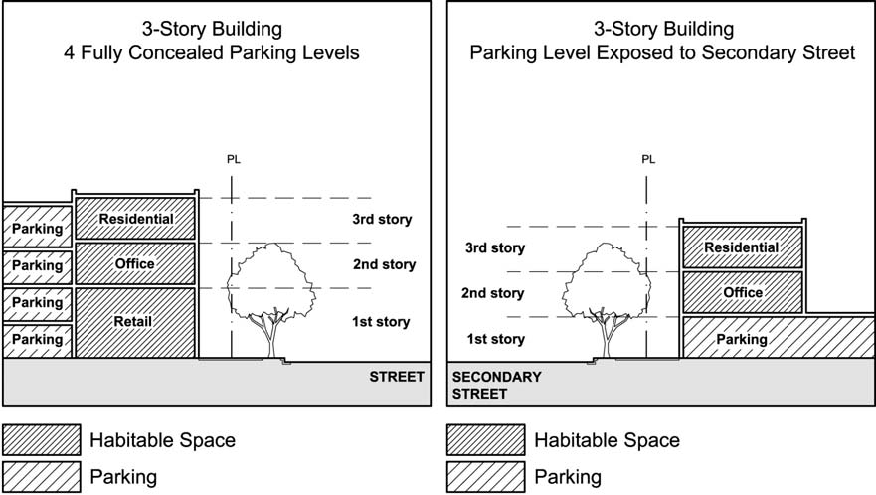
(7)
Within the downtown core and downtown general districts, residential units must have the floor of the first story elevated at least 18 inches above the adjacent sidewalk. Within the downtown residential district, residential units must have the floor of the first story elevated at least 12 inches above the adjacent sidewalk. Lobbies and common areas in multi-unit buildings may have a zero to six-inch ground floor finish level.
(8)
Flat roofs shall be enclosed by parapets no less than 42 inches high, or as required to screen equipment.
(9)
Mechanical equipment necessary to the operation or maintenance of the building such as, but not limited to, elevator, stair, and mechanical penthouses, cooling towers, vent stacks and antennae shall be enclosed and screened in such a manner that the enclosure is an integral part of the overall building design and provides a balanced and graceful silhouette, and ameliorates the visual impact from adjacent buildings. Minor features not exceeding one foot in height shall be exempted from this regulation. The incorporation of green energy resources, such as photovoltaic cells, is encouraged; however, significant features, such as windmills, require approval by the Community Development Director.
(10)
Architectural features such as church spires, steeples, belfries, cupolas, or similar, non-habitable structures are not limited by story height.
Figure 31-535(2)
Measuring Building Height
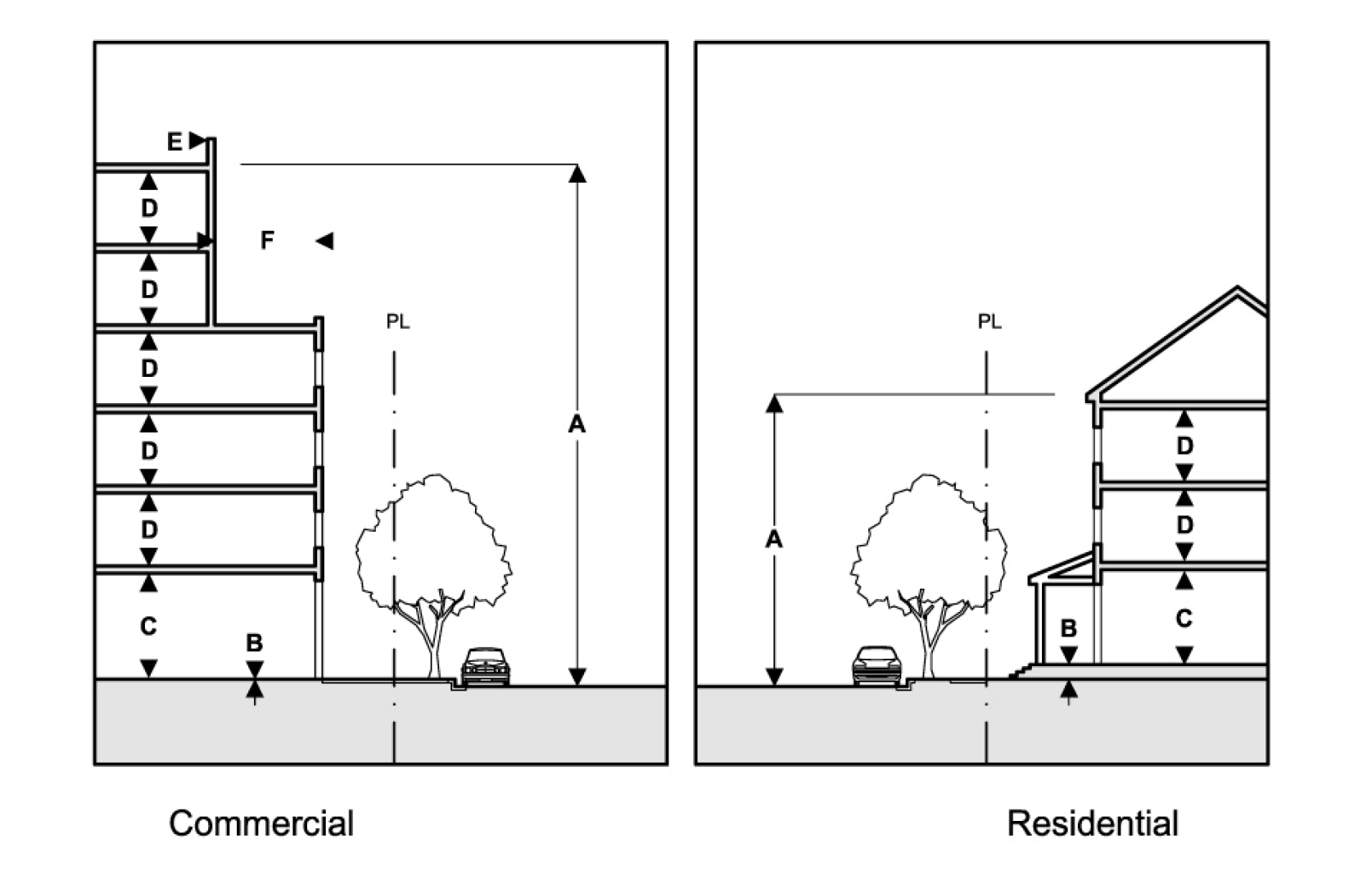
Table 31-535(a)
Building Height
(b)
Building placement. Each district contains dimensional requirements that regulate the disposition of new buildings on lots.
(1)
Front setbacks shall be measured from the property lines coinciding with public rights-of-way, including streets, paths, and parks, or from a civic open space that meets the requirements in subsection 31-538(b). See Figure 31-535(3).
(2)
In districts that allow development with no side or rear setback, the following limitations also apply:
a.
Side and rear setbacks are required only when an abutting property has a building existing as of the effective date of this ordinance [date] with windows facing the adjoining lot line. Then, new development shall set back to provide at least ten feet of separation between the existing and new buildings.
b.
All light and air shafts, including those necessary per the percentage of openings on building façades, shall be provided within the lot.
c.
In the DC downtown core district, buildings taller than four stories in height have additional setback requirements for the upper stories, as described in subsection 31-536(a).
(c)
Building frontage. Building frontage is the percentage of the total width of a lot which is required to be occupied by the primary façade of a building. Each zoning districts provides minimum building frontages.
(1)
The primary façade shall be parallel to the right-of-way, located in accordance with the minimum and maximum front setback requirements of the zoning district.
(2)
The location of the primary façade is not changed by architectural elements such as cornices, bay windows, awnings, porches, balconies, stoops, colonnades, arcades or forecourts.
(3)
The primary façade may adjust around a Civic Open Space that meets the requirements in subsection; 31-538(b) as shown in Figure 31-535(3).
Figure 31-535(3)
Building Frontage Requirement
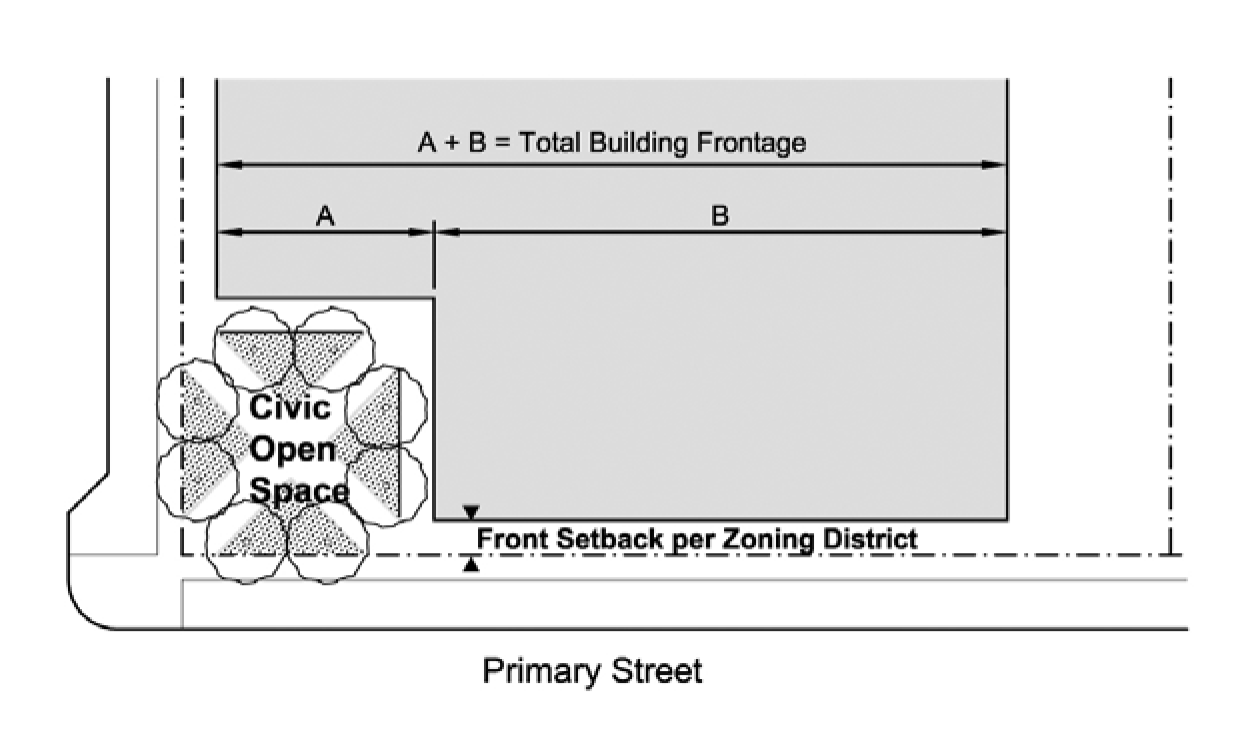
(d)
Density and floor area ratio.
(1)
The maximum density of residential units shall be determined as follows:
a.
For parcels with maximum density, expressed as dwelling units per acre, set forth by the future land use designation in the Riviera Beach Comprehensive Plan, the following calculation, with result rounded to the nearest whole number:
(Parcel Size in square feet / 43560) X Allowable Density = Maximum number of units
In mixed use buildings, the maximum number of units is not reduced by floor space dedicated to other uses.
b.
For parcels with a future land use designation in the Riviera Beach Comprehensive Plan that does not expressly limit density, the maximum number of residential units is limited by the overall floor area ratio allowed in the Riviera Beach Comprehensive plan and the regulations in this CODE that direct building form, story height, and the required number of parking spaces.
c.
Each dwelling unit must meet the minimum floor area in subsection 31-494(2)(d).
For downtown zoning districts, the total floor area is the sum of the areas of all floors of a structure, as measured by the exterior faces of the walls, including enclosed porches and the like. Garage space which is located below grade is not included in the computation of total floor area. Additional building square footage gained by using the Public Benefit Height Option in § Section 31-538(a)(7) is not included in the calculation of or limitation of maximum floor area ratio.
(e)
Frontage standards. The main entrance to every building shall be accessible directly from and face a public right-of-way or civic open space. The manner in which buildings are disposed along the street is a critical component of this CODE and is coordinated with the setback requirements for each district and the CRA Street Design Standards contained in section 29-65. Frontage standards, contained in section 31-537, define architectural and design components for the entrance(s) to buildings and the area between primary façades and property lines.
(f)
Building façade standards. In all downtown zoning districts, the following façade regulations apply:
(1)
Building façades facing streets or civic open spaces must have transparent windows covering between 20 percent and 75 percent of the wall area of each story as measured between finished floors. Transparent windows transmit at least 50 percent of visible daylight.
(2)
Windows and doors shall be vertically proportioned. Horizontal fenestration openings can meet this requirement by using muntins to subdivide glazed areas into vertical or square areas, or by using a series of vertically proportioned windows within the opening. Transom windows may be horizontal, and circular, square, and semi-circular windows may be used as limited accent elements within the facade.
(3)
All parapets shall have a cornice molding extending a minimum of two inches from the surface plane of the wall.
(4)
When required by the district, expression lines shall be moldings extending a minimum of two inches from the surface plane of the building wall. Expression lines are intended to be continuous façade elements and may not be covered by awnings or signs. Significant architectural elements such as columns, pilasters, and towers may interrupt expression lines.
Figure 31-535(4)
Building Façade Requirements
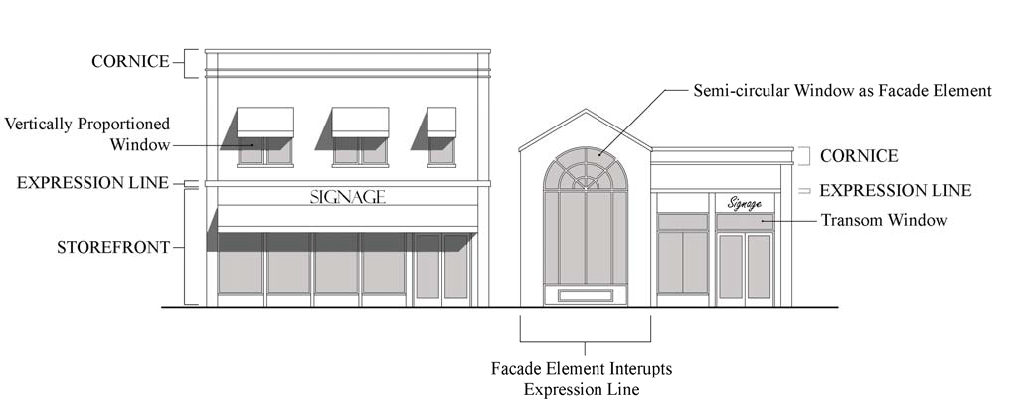
(5)
Building facades on primary streets shall be designed to visually screen uses permitted with limitations. Appropriate façade design incorporates the consistent use of materials and construction assemblies, fenestration patterns, architectural articulation, and features such as, but not limited to, the application of architectural screens, louvers, or glass, and the incorporation of vegetated surfaces and planters. Paint, faux treatments, scoring, construction joints, lighting, and material projections less than two inches are permitted, but do not fulfill the façade design requirements.
Figure 31-535(5)
Character Examples for Building Façade Screening
Uses Permitted with Limitations on Primary Streets
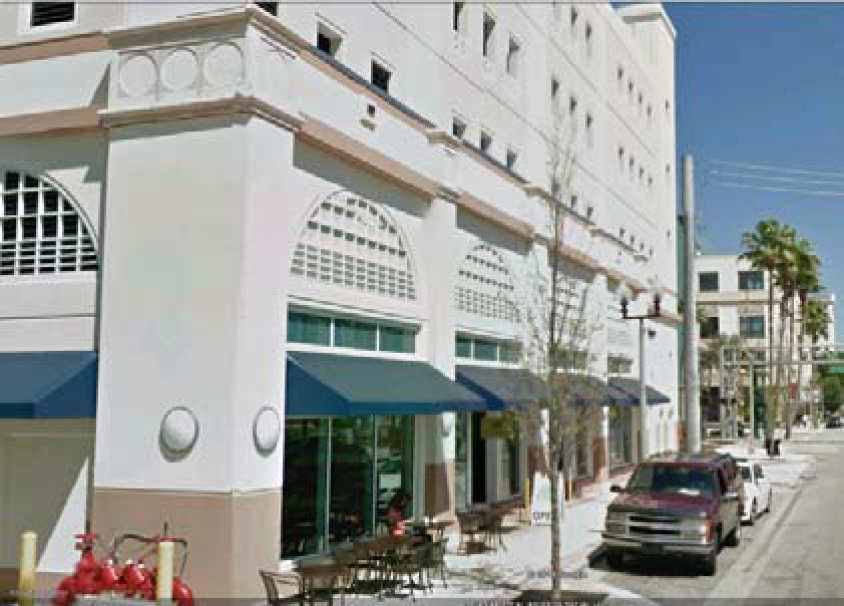 | 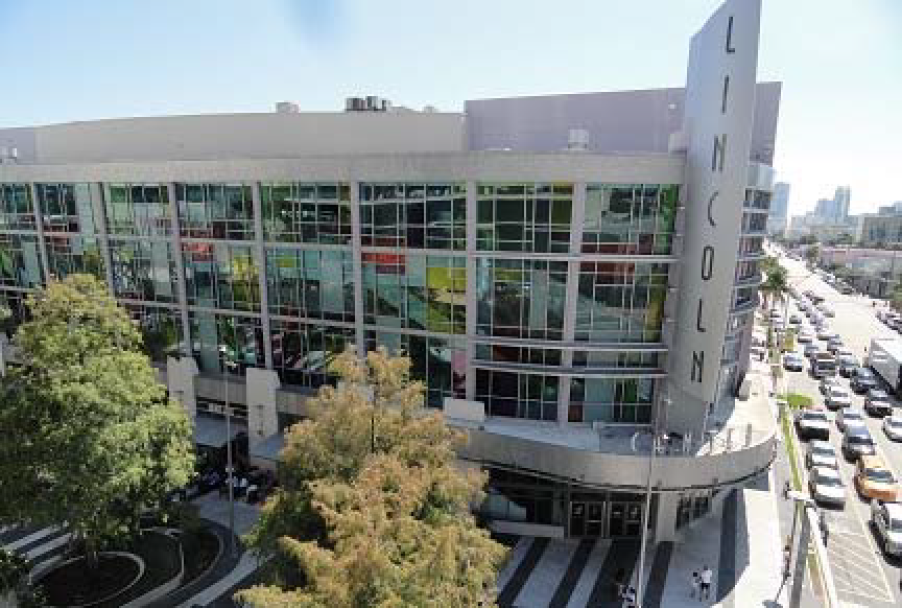 |
| The Clematis Street garage utilizes consistent building materials with fenestration patterns to establish an attractive façade screening the parking levels over the retail space. | The Lincoln Theater has the building circulation located along the streets, behind an architectural glass façade, screening the large expanses of blank walls within the movie theater. |
(g)
Paint colors. Paint colors are regulated in the Downtown zoning districts to establish a coordinated color scheme for the downtown, to encourage a range of harmonious color options for visual variety, to encourage light colors for energy savings, and to favor colors appropriate for a tropical environment. These regulations also apply to awning colors.
(1)
The coloration of all buildings shall be with "earth tone" or pastel colors and shall be harmonious with the adjacent properties. Semi-transparent stains are recommended for application on natural wood.
(2)
The following specific requirements also apply:
a.
Landowners may choose up to four colors for a single building (up to two body colors, up to two trim colors, and one accent color; these may be the same or different) and shall use at least two colors (one body color and one trim color).
b.
Architectural elements on the building facade, such as awnings and canopies, shall be in the same color(s) as the four chosen building colors.
c.
Body colors are intended for building walls, garden walls, and other primary building elements, and shall be used for no less than 70percent of the painted surface area of the building. If two shades of body color are used on a building, the transition should occur along a horizontal expression line with the lighter hue located above the darker one. Color combinations shall be complimentary to each other.
d.
Trim colors are intended for door frames, storefront elements, windows and window frames, railing, shutters, ornament, fences, and similar features. Trim colors shall be used for no more than 30 percent of the painted surface area of the building.
e.
The accent color is used to highlight special features such as doors, shutters, gates, ornament, or storefront elements. The accent color shall be used for no more than 20 percent of the painted surface of the building.
(3)
New development shall submit colored elevations for review.
(Ord. No. 4038, § 2(Exh. A), 12-18-13)
Sec. 31-536. - Regulations for each downtown zoning district.
(a)
DC downtown core district. The DC downtown core district promotes redevelopment of the commercial center of downtown Riviera Beach. The existing commercial corridor and marina area will become a vibrant, pedestrian-friendly, mixed-use district that accommodates shops, businesses, residences, marine-related, and entertainment uses.
(1)
Lot size, building placement, size, and height. Table 31-536(a) provides the dimensional requirements regarding lot size and building placement, size, and height for the downtown core district. Figure 31-536(1) illustrates the dimensional requirements from the table.
Table 31-536(a)
Downtown Core Dimensional Requirements
1 Side lot lines facing streets are regulated by front setback requirements.
2 All light and air shafts shall be provided within the lot See § 31-535(b)
3 See subsection 31-538(a)(2)c.
Figure 31-536(1)
Downtown Core Building Placement and Height
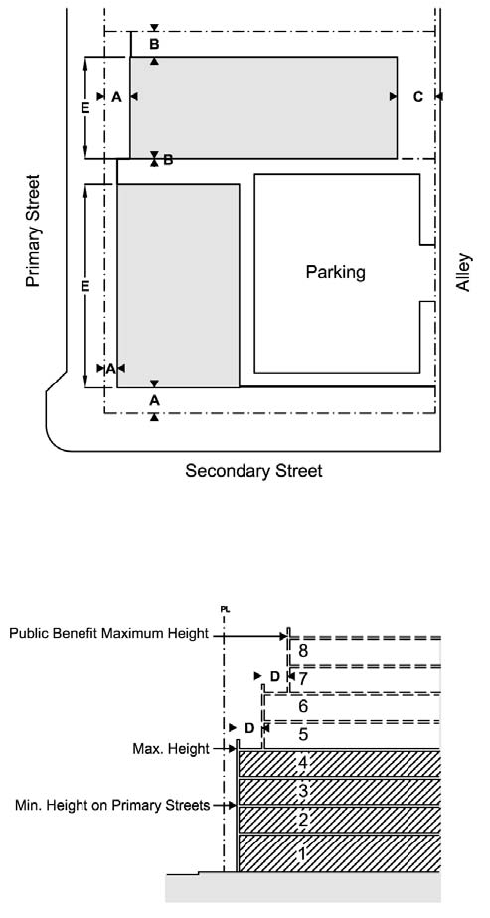
a.
Building frontage requirement. A minimum of 75 percent of the linear width of the lot along a primary street shall be occupied by the primary façade of a building, located in accordance with the minimum and maximum setbacks in Table 31-536(a). Secondary streets do not have a required minimum building frontage and buildings shall be located in accordance with the minimum setback in Table 31-536(a).
b.
Modification of building frontage requirement for marine uses. The minimum building frontage requirement on primary streets may be reduced for boat dealerships and mega-yacht facilities subject to these standards:
1.
Boat dealerships may display boats for sale, arranged in a uniformed and orderly fashion. Service and repair activities must be located within or behind a building or shall be located at least 30 feet from a Primary Street.
2.
In the absence of a building façade, a fence comprised of metal pickets with masonry piers spaced no less than 25 feet on center shall be installed along both Primary and Secondary Streets. See Figure 31-536(2). The fence shall be three feet to six feet in height, located in line with the front setback and shall have the following design features:
i.
Fences shall be metal picket with masonry piers.
ii.
Piers shall be masonry with smooth stucco finish, at least 16 inches wide by 14 inches deep, and may be up to six feet six inches in height. Piers shall have a precast, architectural grade concrete cap, sloped to shed water.
iii.
Light fixtures shall be installed on the top of the cap or mounted to the side of the piers. Lighting fixtures shall be decorative, scaled proportionally to the pier.
Figure 31-536(2)
Fence with Masonry Piers
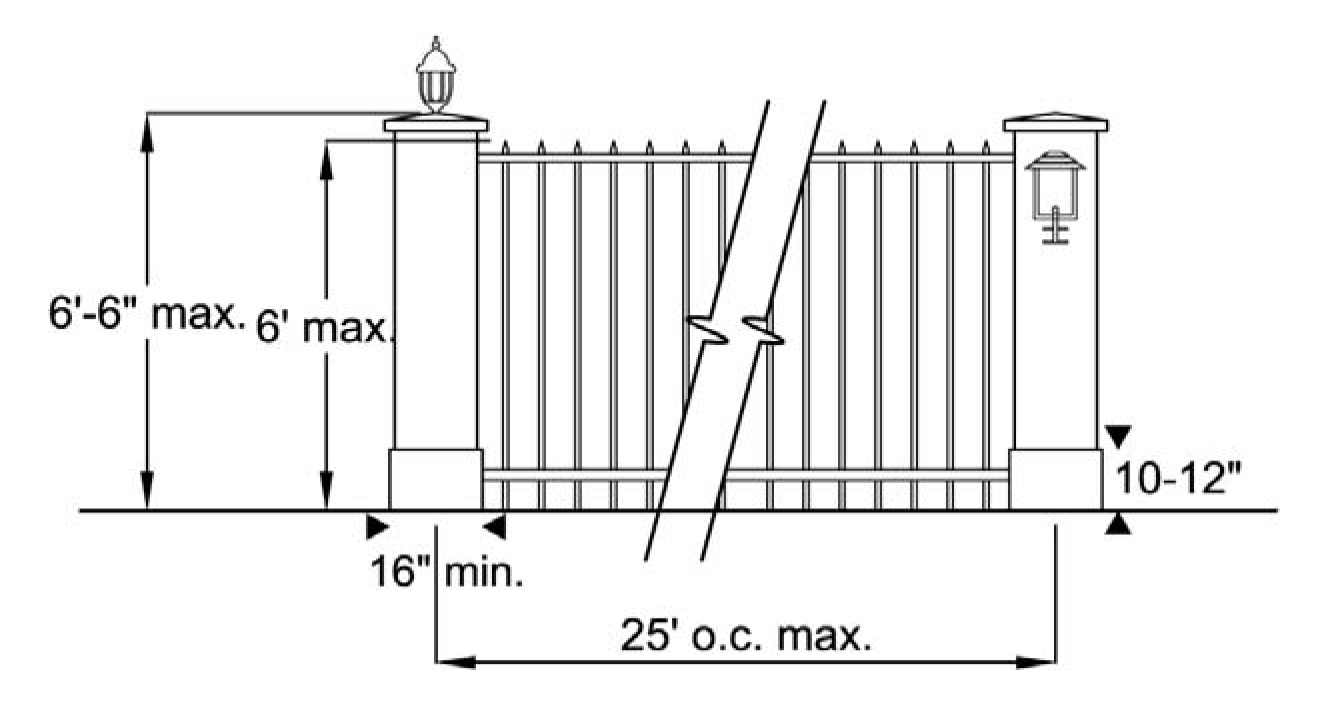
3.
Install on-street parking, if applicable.
(2)
Building height and massing standards.
a.
On primary streets, the minimum building height is two stories, except for fueling stations, which may be one story in height (see subsection 31-536(a)(3)).
b.
Maximum building height is four stories.
c.
Public benefit height option.
1.
Maximum building height is six stories for projects that opt to provide additional civic open space using the public benefit height option in subsection 31-538(b).
2.
Maximum building height is increased to eight stories for projects that opt to provide additional civic open space using the public benefit height option in subsection 31-538(b) and are also located in one of the following sites which, due to the prominent setting and/or proximity to large open areas, are appropriate for taller buildings:
i.
The east side of the intersection of Broadway and 13th Street for the purpose of creating a signature gateway entry to the marina area.
ii.
On the west side of Avenue C, between 12th Street and 16th Street, overlooking Bicentennial Park.
(iii)
Overlooking a new, single civic open space of at least 10,000 square feet in size, limited to the project providing the civic open space.
3.
The use of the public benefit height option on properties on Singer Island requires approval of a special exception. In addition to the standards in §§ 31-61 and 31-62, development shall meet the following standards:
i.
Ocean Mall is limited to five stories in height;
ii.
The project shall be designed to allow views to the horizon and provide an attractive skyline;
iii.
The project shall harmoniously transition in mass and height to adjoining development.
e.
Buildings over four stories are subject to additional requirements in order to ensure architectural articulation in the overall building massing.
1.
At the top of the fourth and sixth stories, a recess line of at least ten feet is required along at least 50 percent of building façades facing streets. Buildings built with no side or rear setbacks shall also provide recess lines of ten feet at the top of the fourth and sixth stories along 50 percent of the building elevation facing side or rear lot lines.
2.
Massing for buildings over four stories in height is regulated using a percentage of the maximum size of the floor footprint of the building per story of height. The 100 percent floor footprint is calculated by multiplying the maximum lot coverage by the overall size of the parcel. Table 31-536(b) depicts the maximum percentage of floorprint allowed per story of height within the DC Downtown Core district:
Table 31-536(b)
Percentage of Floor Footprint Allowed per Story
The arrangement of building mass is intentionally flexible to allow free design expression. However, the following massing characteristics must be evident in the building design:
(i)
The main volume of the building shall be oriented toward Primary Streets, away from side or rear lot lines to reduce impact on adjacent properties.
(ii)
Tower elements shall be located to appropriately respond to the urban condition of the specific site. Desirable tower locations emphasize street corners, main building entrances, gateways, or the visual axis of another street or civic open space.
(iii)
Massing articulation shall not wholly occur within the center of the block and must be evident on the street façade(s) using architectural variations such as changes in the number of stories, articulations in the eave or roofline, and/or adjusting the location of the front façade to accommodate a civic open space.
(3)
Building use.
a.
Uses permitted on all streets. The following uses are permitted in the DC downtown core district on both primary and secondary streets:
1.
Multifamily dwelling units.
2.
Professional office.
(i)
Drive throughs serving banks shall meet the configuration criteria in subsection 31-536(a)(3)c.4. but are not required to obtain a special exception.
3.
Retail establishments.
(i)
Drive throughs serving restaurants require special exception and shall meet the configuration criteria in § 31-536(a)(3)(c)(4).
4.
Hospitals.
5.
Marine-related businesses as follows:
(i)
Retail, office, or commercial uses pertaining to marine industries, which does not involve manufacturing.
(ii)
Show rooms and office uses for marine sales, repair, or manufacturing.
6.
Daycare (See section 31-544).
7.
Hotels/motels.
8.
Nursing homes.
9.
Assisted living facilities.
10.
Churches and their educational buildings; storefront churches.
11.
Civic open space (See section 31-538).
12.
Community Gardens.
b.
Uses Permitted on Secondary Streets and Permitted with Limitations on Primary Streets.
1.
The following uses are permitted in the DC district on Secondary Streets. On Primary Streets, these uses are also permitted, provided they are separated from the street for at least 20 feet with a use permitted on Primary Streets within the first story of a building up to three stories tall. On Primary Streets, these uses are also permitted provided they are separated from the street for at least 20 feet with a use permitted on Primary Streets within the first two stories of a building four stories tall or taller. Additional Building façade design requirements apply on Primary Streets (see § 31-535(f)):
i.
Parking garages and lots (whether principle or accessory use).
ii.
Theaters and motion picture houses.
iii.
Boat Dealerships.
iv.
Drive In restaurants.
v.
Repairing and servicing facilities for marine equipment, boats, or vehicles.
2.
Temporary surface parking lots in phased development projects, as approved by the community development director.
3.
Boat dealerships and mega-yacht facilities are permitted on primary streets with reduced building frontage requirements, subject to additional standards. See subsection 31-536(a)(1)b.
Figure 31-536(3)
Primary Street Use Limitations
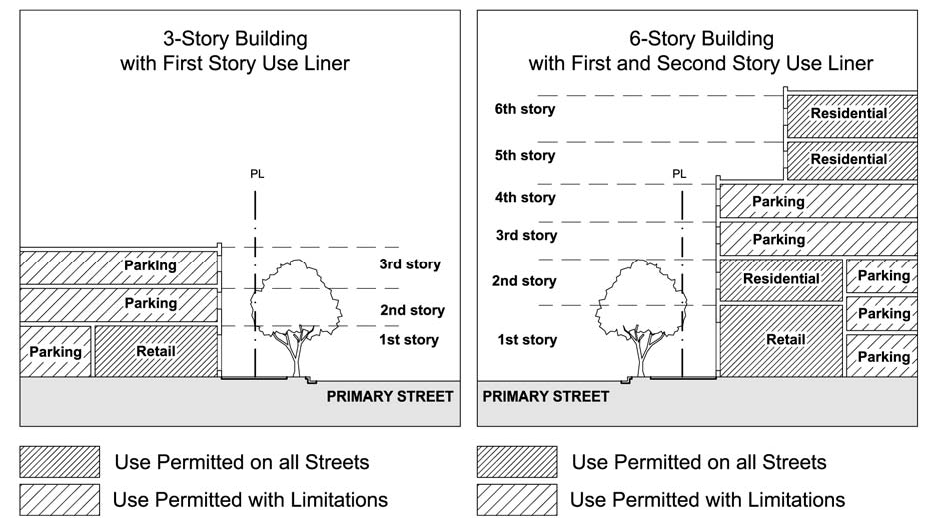
c.
Special exceptions. The following uses may be permitted by special exception in the DC district:
1.
Private clubs, bars, saloons, taverns, cocktail lounges, or nightclubs.
2.
Car washes.
3.
Fueling stations. Fueling stations require approval of a special exception. In addition to the standards in sections 31-61 and 31-62, development shall meet the following criteria: (i) A ground-story shop must be located along the street, with the gas pumps to the rear of the lot as illustrated in Figure 31-536(4). The shop shall have the primary entrance facing and directly accessible from the street; an additional entrance facing the parking lot is permitted. Fueling Stations may be one story in height.
Figure 31-536(4)
Downtown Fueling Station
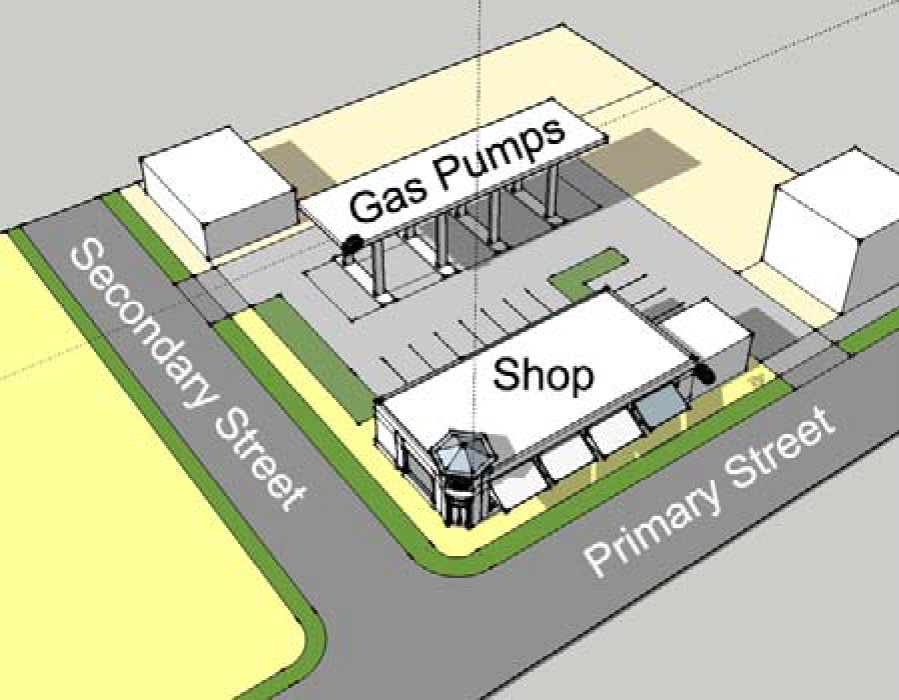
4.
Drive throughs. Drive throughs require approval of a Special Exception. In addition to the standards in §§ 31-61 and 31-62, development shall meet the following criteria:
(i)
The stacking area is accommodated along the side and/or in the rear of the lot.
(ii)
The drive-through window shall be located either in the rear or to the side of the building, close to the frontage street. Figure 31-536(5) illustrates methods of incorporating drive through uses.
Figure 31-536(5)
Drive Through Configuration Options
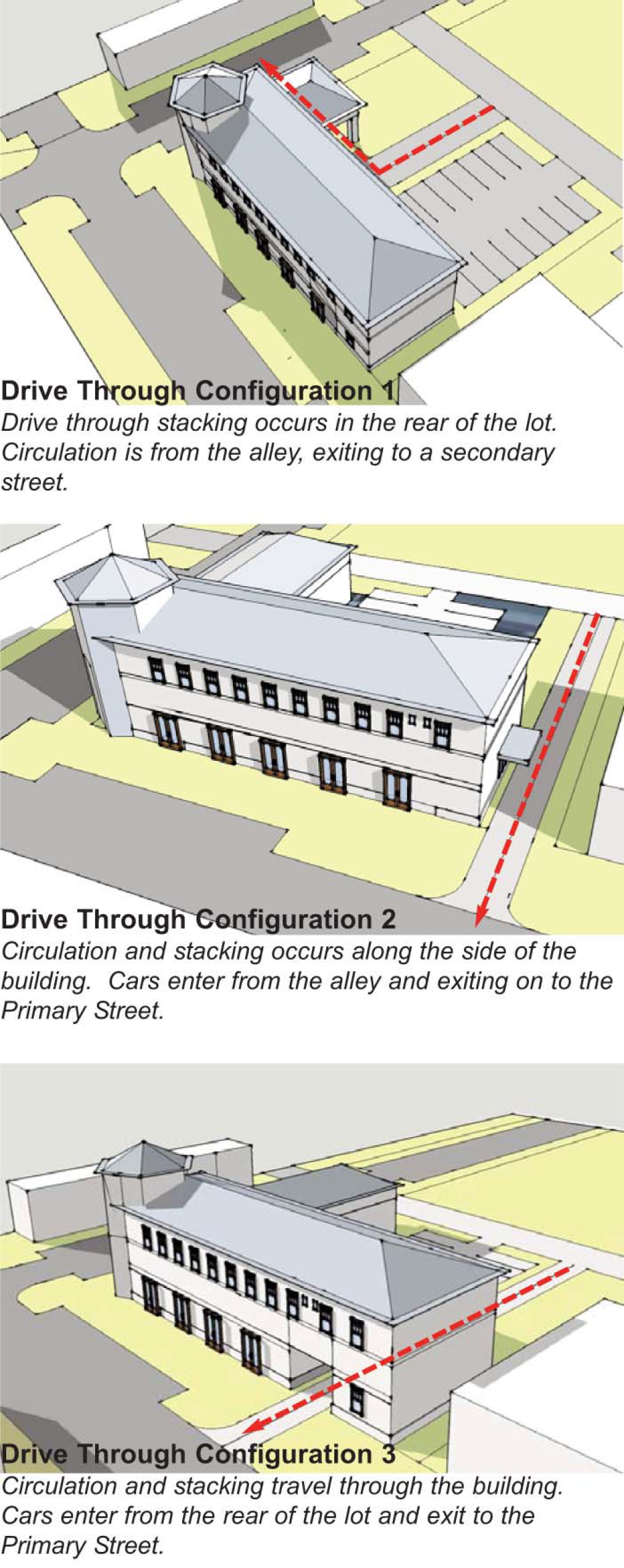
(4)
Frontage standards.
a.
The front setback and side setbacks facing streets shall be hardscaped. The hardscape design shall have the following characteristics:
1.
Street trees shall be installed as set forth in subsection 31-537(c), consistent with the appropriate street design in section 29-65.
2.
A pedestrian walkway shall be accommodated as set forth in subsection 31-537(b).
3.
Any setback area not needed to accommodate a pedestrian walkway may be landscaped using potted plants in removable planters or ground planting that does not obstruct views into storefront windows, and may also be used to accommodate merchandise displays or outdoor dining areas.
b.
The main entrance(s) to ground story commercial space(s) shall be directly from and face a public right-of-way or civic open space. Doors allowing public access shall occur at intervals no greater than 75 feet.
c.
Building entrances shall use at least one of the following frontage types detailed in subsection 31-537(a):
1.
Stoop.
2.
Forecourt.
3.
Bracketed balcony.
4.
Storefront.
5.
Arcade/colonnade.
d.
Buildings with more than 250 feet of street frontage shall provide a pedestrian accessway at least ten feet wide connecting the rear parking to the sidewalk area or establishing a cross-block connection.
(5)
Architectural standards.
a.
An expression line shall be provided at the top of the first story.
b.
Buildings taller than four stories shall design and compose building elevations facing side property line(s) as building façades. Prominent side building elevations are most likely to occur on large properties, capable of accommodating taller buildings with structured parking solutions. In order to ensure compatibility with adjacent smaller-scaled structures, the building elevation of the stories of the fifth story and higher shall provide a minimum façade transparency of 15 percent.
c.
In the absence of a building façade, a streetwall is required along both primary and secondary streets. Streetwalls shall be three feet to three feet six inches in height, located in line with the building façade or the front setback. Streetwalls shall be composed of either an opaque wall using the same material and color as the building or of a continuous, maintained hedge. See subsection 31-536(a)(1)b. for fence standards for marine uses. In addition, one shade tree per 20 lineal feet, uniformly spaced, shall be installed along the length the streetwall.
d.
An opaque, masonry wall six feet in height shall be built on the property line along all side and rear lot lines that abut single-family houses existing as of December 18, 2013, or lots in a residential zoning district. In addition one tree shall be planted every 20 feet along the wall.
(6)
Other applicable Standards. See section 31-535 and sections 31-537 through 31-540 for general standards that also apply to the DC district.
(b)
DG downtown general. The DG downtown general district promotes the redevelopment of the Avenue E corridor and adjacent areas into a mixed-use, pedestrian-friendly environment. Diverse housing options as well as commercial establishments serving the downtown population are permitted of a scale and intensity compatible with the adjacent residential neighborhoods.
(1)
Lot size, building placement, size, and height.
a.
Table 31-536(c) provides the dimensional requirements regarding lot size, building placement, size, and height for the DG district. Figure 31-536(6) illustrates the dimensional requirements from the table.
Table 31-536(c)
Downtown General Dimensional Requirements
1 Side lot lines facing streets are regulated by the front setback requirements
2 All light and air shafts shall be provided within the lot. See § 31-535(b).
Figure 31-536(6)Downtown General
Building Placement & Height
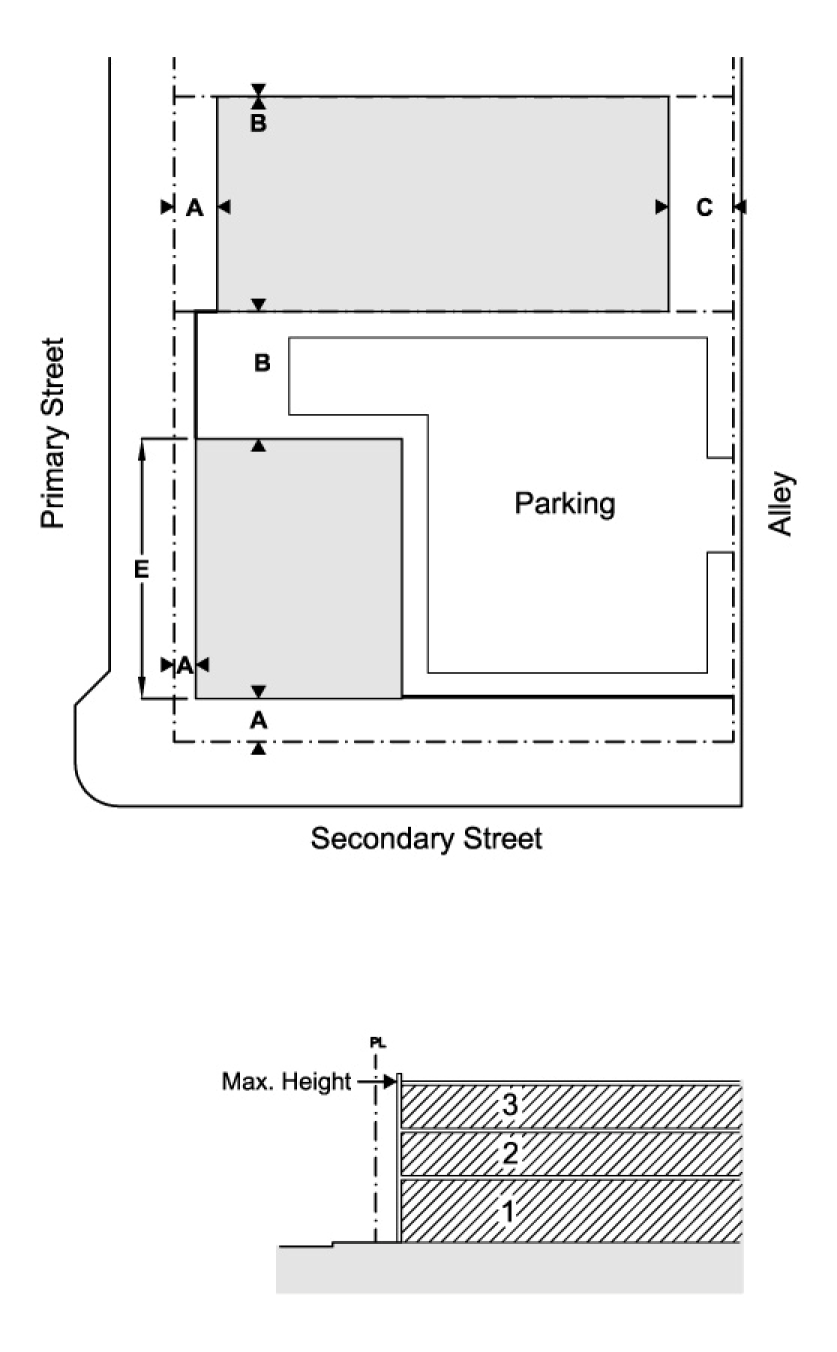
b.
The building types defined in the downtown residential district (DR) (See subsection 31-536(c)) may be used alternatively to regulate lot size, building placement, size, and height for residential development.
(2)
Use regulations.
a.
Uses permitted. The following uses are permitted by right in the DG district, except that on primary streets, parking (whether principle or accessory use) shall be separated from the street for at least 20 feet:
1.
Residential
2.
Professional office, except drive throughs are not permitted.
3.
Retail establishments, except drive throughs are not permitted.
4.
Daycare (See section 31-544.).
5.
Nursing homes.
6.
Assisted living facilities.
7.
Churches and their educational buildings; storefront churches.
8.
Civic open spaces (See section 31-538.).
9.
Community gardens.
10.
Specialty medical facility.
(3)
Frontage standards.
a.
The front setback and side setbacks facing streets shall be hardscaped. The hardscape design shall have the following characteristics:
1.
Street trees shall be installed as set forth in subsection 31-537(c), consistent with the appropriate street design in section 29-65.
2.
A pedestrian walkway shall be accommodated as set forth in subsection 31-537(b).
3.
Any setback area not used to accommodate a pedestrian walkway, may be landscaped adjacent to the building using potted plants in removable planters or ground planting that does not obstruct views into storefront windows, and may also be used to accommodate merchandise displays or outdoor dining areas.
b.
The main entrance(s) to ground story commercial space(s) shall be directly from and face a public right-of-way or civic open space. Doors allowing public access shall occur at intervals no greater than 75 feet.
c.
Building entrances shall use at least one of the following frontage types detailed in subsection 31-537(a):
1.
Stoop.
2.
Forecourt.
3.
Bracketed balcony.
4.
Storefront.
5.
Arcade/colonnade.
d.
Buildings with more than 250 feet of street frontage shall provide a pedestrian accessway at least ten feet wide connecting the rear parking to the sidewalk area or establishing a cross-block connection.
(4)
Architectural standards.
a.
An expression line shall be provided at the top of the first story.
b.
In the absence of a building façade, a streetwall is required along both primary and secondary streets. Streetwalls shall be three feet to three feet six inches in height, located in line with the building façade or the front setback. Streetwalls shall be composed of either an opaque wall using the same material and color as the building or of a continuous, maintained hedge. In addition, one shade tree per 20 lineal feet, uniformly spaced, shall be installed along the length the streetwall.
c.
An opaque, masonry wall six feet in height shall be built on the property line along all side and rear lot lines that abut single-family houses existing as of the date of this ordinance (date) or lots in residential zoning district. In addition, one shade tree per 20 lineal feet, uniformly spaced, shall be installed along the length the wall.
(5)
Other applicable Standards. See section 31-535 and sections 31-537 through 31-540 for general standards that also apply to the DG district.
(c)
DR Downtown residential district. The DR downtown residential district promotes infill and redevelopment of existing downtown residential neighborhoods. New residential uses will enhance and respect the existing neighborhood fabric and accommodate diverse housing options including apartments and townhouses in a manner that is compatible with single-family houses.
(1)
Building types. This district anticipates a mix of single and multi-family buildings. In order to ensure compatibility, new development shall be in form of one of the following building types:
a.
House. A single-family detached building with front, side and rear yards.
b.
Townhouse. A single-family attached building, attached on at least one side with a private rear yard.
c.
Apartment house. A detached building resembling a large house, but containing multiple dwellings above and/or beside each other.
d.
Courtyard building. A building designed to accommodate multiple dwellings above and beside each other, arranged around a central garden or patio that is partially or wholly open to the street.
(2)
Lot size, building placement and height.
a.
Table 31-536(d) provides the dimensional requirements for lot size, building placement, frontage, and height for each of the allowable building types in the DR district.
Table 31-536(d)
Downtown Residential District
Dimensional Requirements for Lot Size & Building Placement
1 These sizes reflect a fee-simple arrangement. In a condominium development, the lot sizes should be illustrated on the site plan, though not necessarily platted.
2 Corner lots must meet front setbacks on both streets. Front setbacks on infill lots shall either match the front setback of one of the adjacent buildings or shall be located between the setbacks.
3 See subsection 31-535(b).
4 See subsection 31-536(c)(2)c. for dimensional criteria for the courtyard
Figure 31-536(7)
Figure 31-536(8)
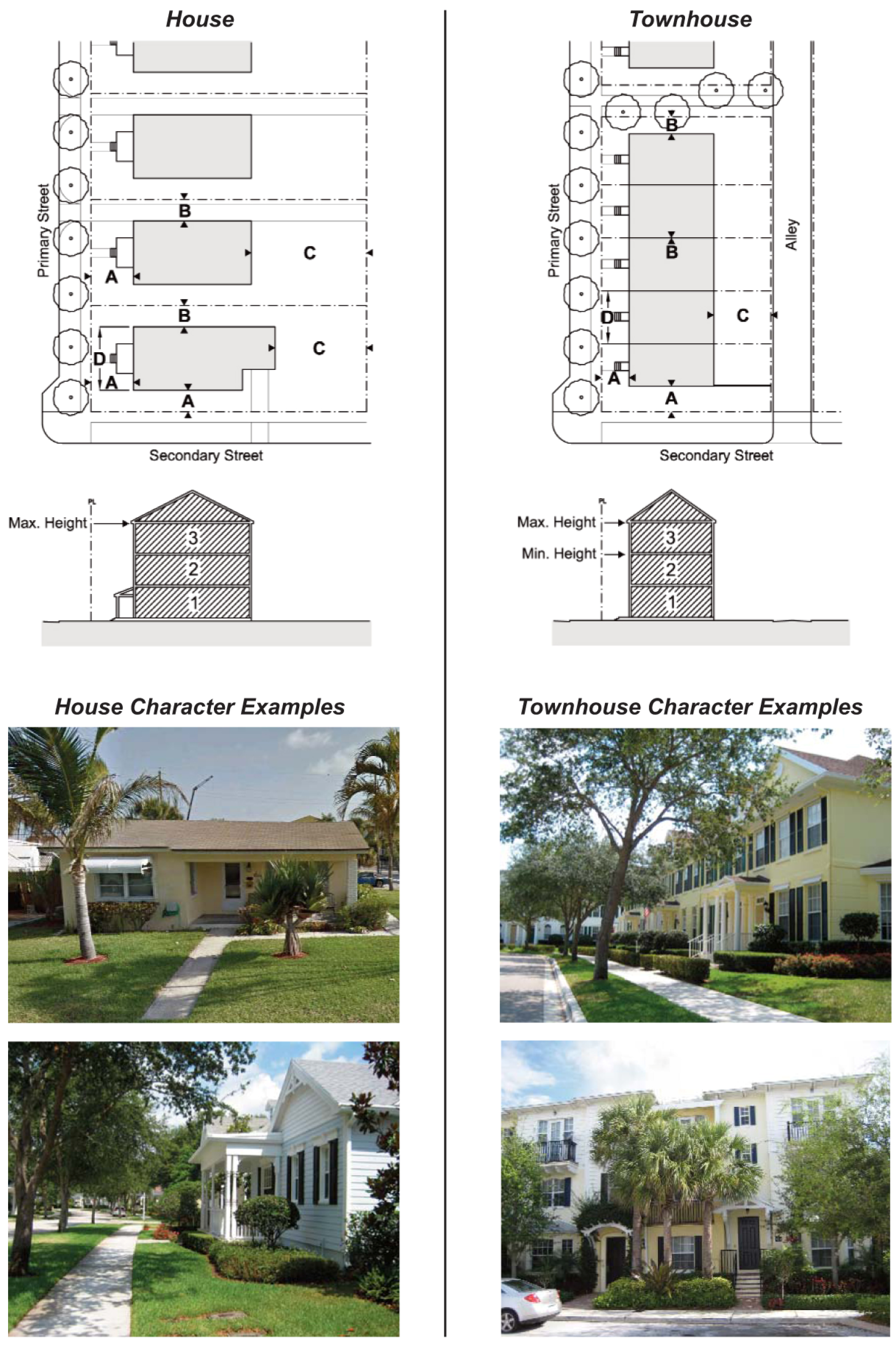
Figure 31-536(9)
Figure 31-536(10)
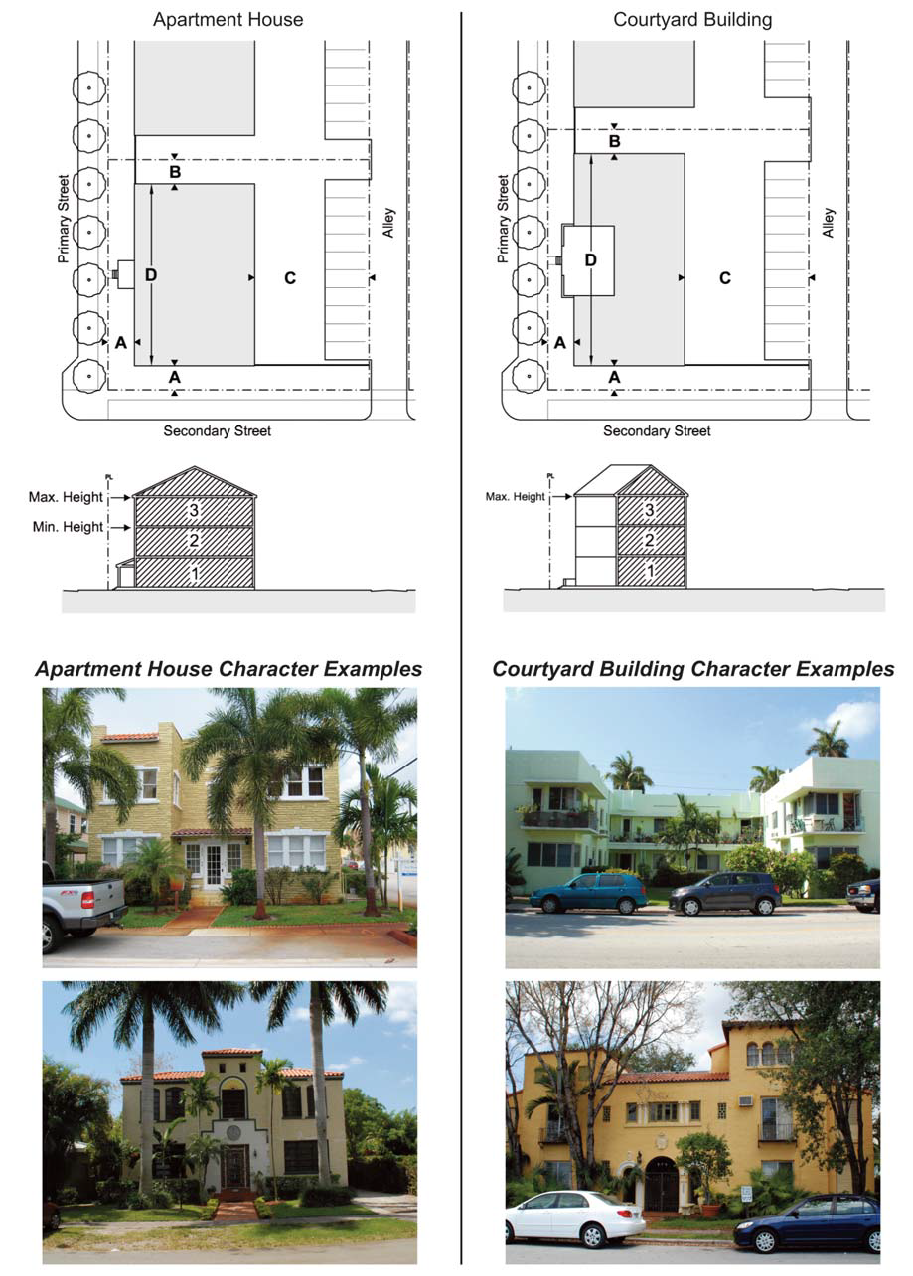
b.
Where the property to be developed abuts an existing building or buildings, the proposed building shall be located to match or provide a transition to the adjacent front setback. The community development director will administratively determine the appropriate front setback.
c.
Courtyard buildings have the following additional criteria:
1.
A courtyard, open to the sky, of at least 12 percent of the lot area shall be provided.
2.
The longer dimension of the courtyard shall be at least 30 feet if oriented east-west and at least 40 feet if oriented north-south.
3.
The main entrance to ground story dwellings shall be directly from the street or the common courtyard.
4.
In courtyards at least 35 feet wide, open-air porches, stoops, and balconies may encroach from two sides. In courtyards less than 35 feet wide, encroachment is permitted from one side.
5.
An open-air covered pedestrian passageway, at least ten feet wide, may connect the courtyard, through the building to the street. The passageway may be gated.
d.
Townhouses have the following additional criteria:
1.
Townhouses must have or install a rear alley to accommodate vehicular access and parking.
2.
Townhouses shall occur in an array of at least three, side by side.
3.
No more than eight contiguous townhouses shall occur without a pedestrian accessway of at least ten feet.
(3)
Use regulations.
a.
Uses permitted. The following uses are permitted in the DR district:
1.
Single-family dwellings.
2.
Multiple family dwellings, provided the dwelling is provided in the form of a townhouse, apartment house, or courtyard building, as described in subsection 34-536(c)(1).
3.
Home occupations.
4.
Community gardens.
5.
Civic open spaces (See section 31-538.).
b.
Special exception. The following uses may be permitted by special exception in the DR downtown residential district:
1.
Churches and their educational buildings.
2.
Daycare (See section 31-544.).
3.
Nursing homes.
4.
Assisted living facilities.
(4)
Frontage standards.
a.
The front setback and side setbacks facing streets shall be landscaped and shall have the following characteristics:
1.
Street trees shall be installed as set forth in subsection 31-537(c), consistent with the appropriate street design in section 29-65.
2.
A pedestrian walkway shall be accommodated as set forth in subsection 31-537(b).
3.
Any remaining setback area not used to accommodate a pedestrian walkway, shall be landscaped.
b.
Building entrances shall use at least one of the following frontage types detailed in subsection 31-537(a):
1.
Porch.
2.
Stoop.
3.
Bracketed balcony.
(5)
Parking for residential building types.
a.
House type. Parking shall be located to the side or rear of the house. Attached garages shall be recessed at least ten feet from the front façade of the house.
b.
Townhouse type.
1.
Townhouses must have or install a rear alley to accommodate vehicular access, garage access, and parking.
2.
Garage doors shall not face the street.
3.
Parking is not permitted in front setbacks or side setbacks facing streets.
c.
See section 31-539 for additional parking standards.
(6)
Other applicable standards. See section 31-535 and sections 31-537 through 31-540 for general standards that also apply to the DR district.
(d)
DI downtown industrial district. The downtown industrial district is intended to accommodate industrial uses, while achieving a high standard of appearance along streets in the downtown.
(1)
Lot size, building placement and height. Table 31-536(e) provides the dimensional requirements regarding lot size, building placement, frontage and height for the downtown industrial district. Figure 31-536(11) illustrates the dimensional requirements from the table. A liner building is required on primary streets to shield industrial uses from the street.
Table 31-536(e)
Downtown Industrial Dimensional Requirements
1 On Liner Buildings, side lot lines facing streets are regulated by the front setback requirements
2 See subsection 31-535(b).
Figure 31-536(11)
Downtown Industrial
Building Placement & Height
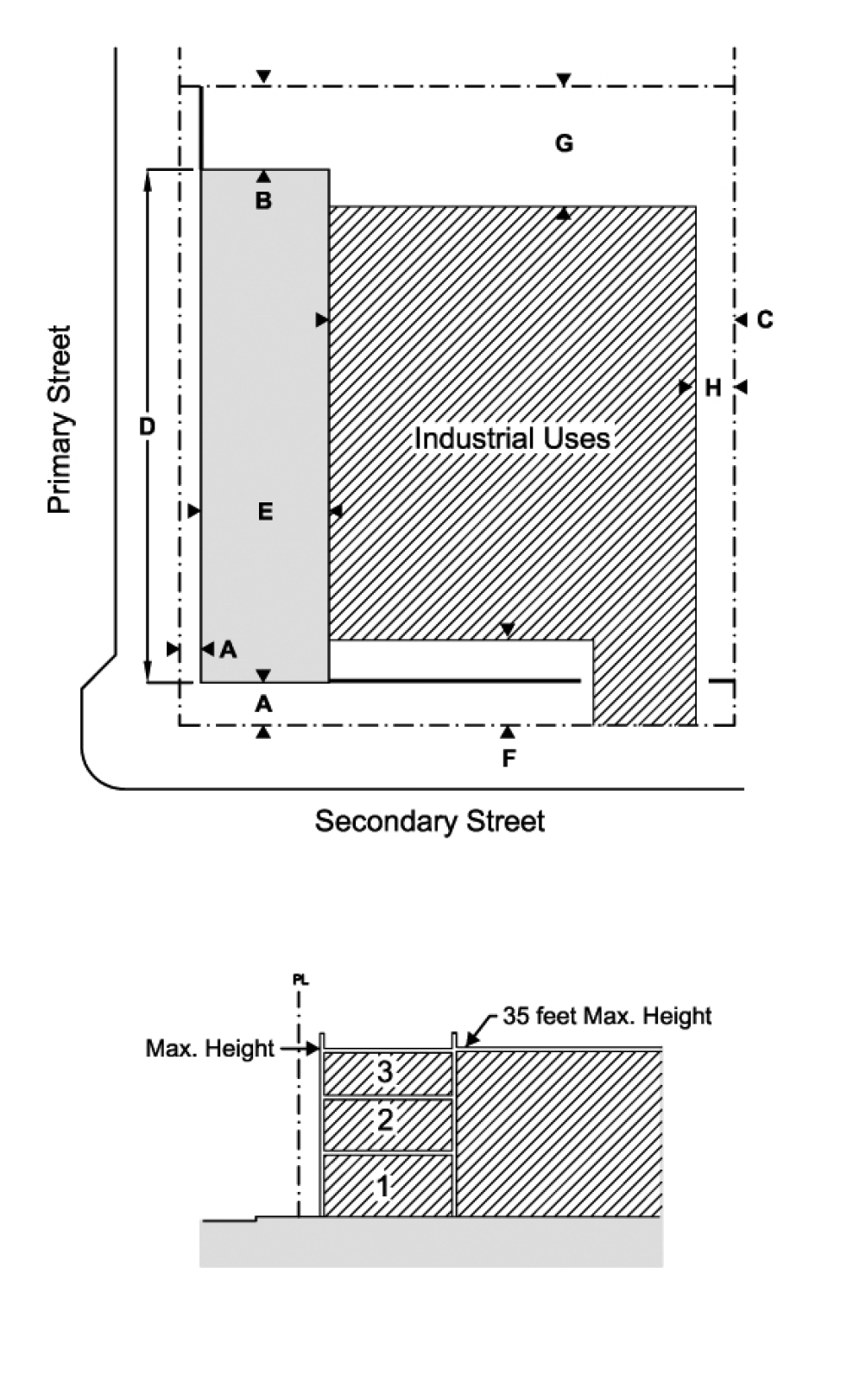
(2)
Use regulations.
a.
Uses permitted by right on primary streets. The following uses are permitted by right on primary streets in the DI district:
1.
Retail establishments.
2.
Professional office.
3.
Residential uses are permitted only in the upper stories of liner buildings.
4.
Retail, show rooms, and office functions of industrial and manufacturing uses. The industrial/ manufacturing aspect of the use shall be located in accordance with subsection 31-536(d)(2)b.
5.
Adult training centers.
6.
Civic open space (See section 31-538.)
7.
Community gardens.
b.
Uses permitted on secondary streets and permitted with limitations on primary streets. The following uses are permitted in the DI district on secondary streets. On primary streets, these uses are also permitted provided they are separated from the street for at least 20 feet with a use permitted on primary streets on the first story.
1.
The uses permitted by right in the IL limited industrial district.
2.
Auto services, including transmission and oil change establishments.
3.
Beverage manufacturing and bottling works.
4.
Laboratory industrial research.
5.
Truck rental and leasing.
6.
Warehouses and storage uses.
(3)
Frontage standards.
a.
The front setback and side setbacks facing streets shall be hardscaped. The hardscape design shall have the following characteristics:
1.
Street trees shall be installed as set forth in subsection 31-537(c), consistent with the appropriate street design in section 29-65.
2.
A pedestrian walkway shall be accommodated as set forth in subsection 31-537(b).
3.
Any setback area not used for the pedestrian walkway may be landscaped adjacent to the building using potted plants in removable planters or ground planting that does not obstruct views into or out of front windows.
b.
The main entrance(s) to ground story liner buildings shall be directly from and face a public right-of-way or civic open space. Doors allowing public access shall occur at intervals no greater than every 75 feet.
c.
Building entrances shall use at least one of the following frontage types detailed in subsection 31-537(a):
1.
Forecourt.
2.
Bracketed balcony.
3.
Storefront.
4.
Arcade/colonnade.
(4)
Architectural standards.
a.
An expression line shall be provided at the top of the first story.
b.
Overhead doors or other loading facilities shall not face primary streets and may not be counted toward fulfilling the minimum façade transparency requirements.
c.
In the absence of a building façade, a streetwall or fence is required along both primary and secondary streets. Streetwalls and fences shall be no higher than six feet and shall be located in line with the building façade or the front setback. Streetwalls shall be composed of an opaque wall using the same material and color as the building. Fences shall have a continuous, maintained hedge installed on the street side. In addition, one shade tree per 20 lineal feet, uniformly spaced, shall be installed along the length of the streetwall or fence on the street side.
d.
An opaque, masonry wall six feet in height shall be built on the property line along all side and rear lot lines that abut single-family houses existing as of December 18, 2013 or lots in residential zoning district. In addition, one tree shall be planted every 20 feet along the wall.
(5)
Other applicable Standards. See section 31-535 andsections 31-537 through 31-540 for general standards that also apply to the DI district.
(e)
DM downtown marine district. The DM downtown marine district promotes the use of marine industry, marine-related businesses and services, and boating activities within the downtown area, while recognizing the waterfront area is comprised of and surrounded by a diverse mix of uses. In order to ensure appropriate transitions between marine industry and other uses, including existing single-family houses, this district controls building form and the location of certain uses to establish a successful, vibrant downtown area, and to enhance access to the waterfront area.
(1)
Lot size, building placement and height.
a.
Table 31-536(f) provides the dimensional requirements regarding lot size, building placement, frontage, and height for the downtown marine district. Figure 31-536(12) illustrates the dimensional requirements from the table. A liner building is required on Primary Streets to shield certain marine uses from the street.
Table 31-536(f)
Downtown Marine Dimensional Requirements
1 On liner buildings, side lot lines facing streets are regulated by the front setback requirements
2 See subsection 31-535(b).
Figure 31-536(12)
Downtown Marine
Building Placement & Height
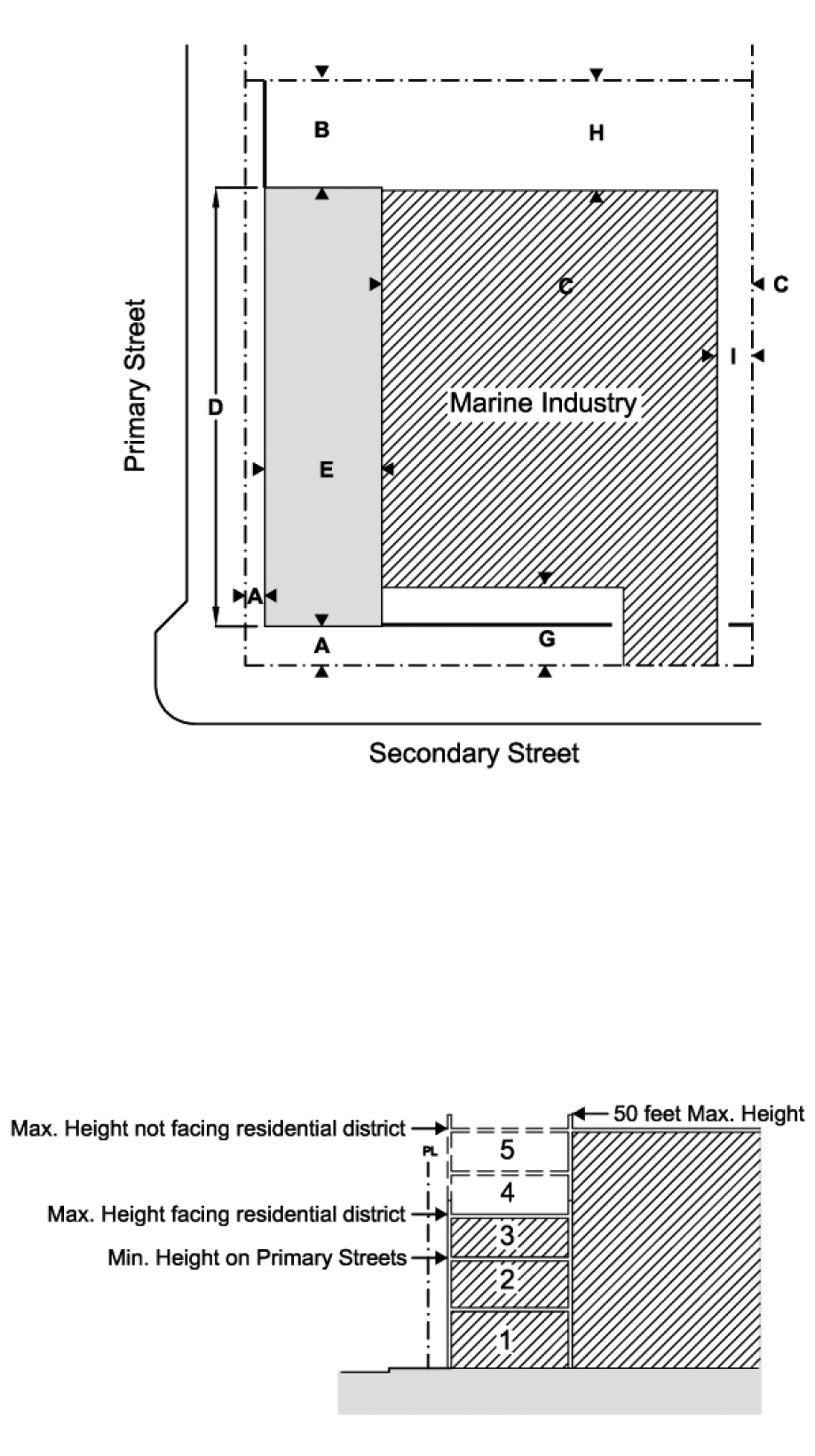
b.
Appropriate transitions between existing residential uses and marine industry.
1.
Along primary streets, parking and marine industry uses such as, but not limited to, refueling stations, boat storage buildings, exterior boat storage, and repairing, manufacturing, or servicing facilities shall be shielded from view of the street by a liner building. A liner building is allowed, but not required on secondary streets.
2.
For parcels in the DM district facing the fronts of existing single-family houses or lots located within a residential zoning district, one or more of the following options shall be used to provide an appropriate transition:
i.
In lieu of a liner building, one or more of the building types permitted in the DR downtown residential district, separated from the marine industry uses by a rear alley, shall line the street;
ii.
A liner building in accordance with regulations in Table 31-536(f) shall be installed; however, the front setback shall match or provide a transition to the front setback of the surrounding houses. The community development director will administratively determine the appropriate front setback.
iii.
In combination with either i. or ii. above, up to 60 percent of the property line facing a street may be a civic open space.
Figure 31-536(13)
Downtown Marine Residential Transitions
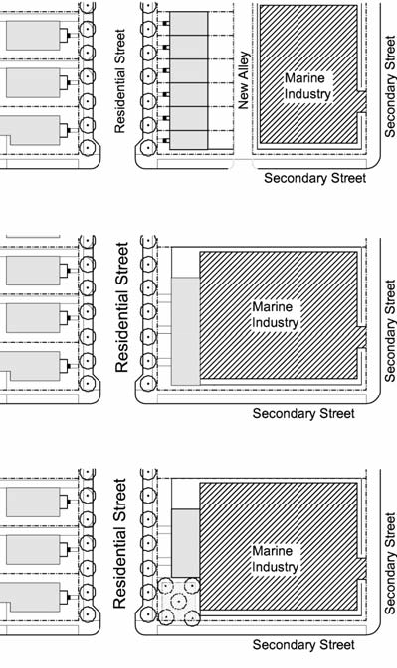
(2)
Use regulations.
a.
Uses permitted by right on primary streets. The following uses are permitted by right on primary streets in the DM district:
1.
Retail establishments.
2.
Residential and extended stay lodging uses are permitted only in the upper stories of liner buildings.
3.
Professional office.
4.
Retail, office, or commercial uses pertaining to marine industries, which do not involve manufacturing.
5.
The show rooms and office uses for marine industries that involve manufacturing. The manufacturing aspect of the industry shall be located in accordance with subsection 31-536(e)(2)b.
6.
Marinas.
7.
Marine-related adult training centers.
8.
Civic open space (See subsection 31-538(b)).
9.
Community gardens.
b.
Uses permitted on secondary streets and permitted with limitations on primary streets. The following uses are permitted in the DM district on secondary streets. On primary streets, these uses are also permitted provided they are separated from the street for at least 20 feet with a use permitted on primary streets on the first story.
1.
Parking garages and lots (whether principle or accessory use);
2.
Refueling stations for marine use only;
3.
Repairing, manufacturing, and servicing facilities for marine equipment;
4.
Boat storage buildings and exterior boat storage;
5.
Marine ways and lifts;
7.
Facilities for research, manufacturing, and assembly of equipment used in oceanography, marine biology, and related fields;
8.
Customary accessory uses to all of the above.
c.
Additional Uses permitted by right near the Port of Palm Beach. Storage and manufacturing of construction materials and related equipment, which rely upon marine transport as a component of the operations, are added to the permitted uses under §31-536(e)(2)(b) above, for properties located in the following area:
1.
East of Broadway; and
2.
Directly adjacent to the Port of Palm Beach or on the north side of 11th Street, across from the Port of Palm Beach. Lots with frontage on 12th Street are not eligible for the additional uses.
(3)
Frontage standards.
a.
The front setback and side setbacks facing streets shall be hardscaped. The hardscape design shall have the following characteristics:
1.
Street trees shall be installed as set forth in subsection 31-537(c), consistent with the appropriate street design in section 29-65.
2.
A pedestrian walkway shall be accommodated as set forth in subsection 31-537(b).
3.
Any remaining setback area not used for the pedestrian walkway, may be landscaped adjacent to the building using potted plants in removable planters or ground planting that does not obstruct views into or out of front windows.
b.
The main entrance(s) to ground story Liner Buildings shall be directly from and face a public right-of-way or civic open space. Doors allowing public access shall occur at intervals no greater than every 75 feet.
c.
Building entrances shall use at least one of the following frontage types detailed in subsection 31-537(a):
1.
Forecourt.
2.
Bracketed balcony.
3.
Storefront.
4.
Arcade/colonnade.
(4)
Architectural standards.
a.
Overhead doors or other loading facilities shall not face primary streets and may not be counted toward fulfilling the minimum façade transparency requirements.
b.
In the absence of a building façade, a streetwall or fence is required along both primary and secondary streets. Streetwalls and fences shall be no higher than six feet and shall be located in line with the building façade or the front setback. Streetwalls shall be composed of an opaque wall using the same material and color as the building. Fences shall have a continuous, maintained hedge installed on the street side. In addition, one shade tree per 20 lineal feet, uniformly spaced, shall be installed along the length of the streetwall or fence on the street side.
c.
An opaque, masonry wall six feet in height shall be built on the property line along all side and rear lot lines that abut single-family houses existing as of December 18, 2013 or lots in residential zoning district. In addition, one tree shall be planted every 20 feet along the wall.
(5)
Other applicable standards. See section 31-535 and sections 31-537 through 31-540 for general standards that also apply to the DM district.
(Ord. No. 4038, § 2(Exh. A), 12-18-13; Ord. No. 4243, §§ 17—19, 2-21-24)
Sec. 31-537. - Frontage standards.
The downtown zoning districts establish a predictable spatial framework to create a pedestrian-friendly environment supportive of infill redevelopment and multi-modal transportation options. Frontage standards ensure a superior pedestrian environment develops overtime that improves the overall visual appearance and use of downtown streets. These standards define architecture and design components for the entrance(s) to buildings and the area between building facades and streets.
(a)
Frontage types. The entrance(s) of every building shall be directly accessible from and face a public right-of-way or civic open space. Frontage Types define architectural characteristics for the detailing of these building entrances. Six distinct frontage types have been identified, which are appropriate for different types of buildings and uses. Table 31-537(a) identifies the frontage types appropriate for each zoning district by an "X" . Using one or more of frontage types identified is required.
Table 31-537(a)
Frontage Types per Zoning District
(1)
Porch. A porch is an open-air structure attached to a building forming a covered entrance large enough for comfortable use as an outdoor room. Porches are generally appropriate for single-family attached or detached houses. The main building façade is typically setback from the property line, creating a private front yard. Table 31-537(b) provides the dimensional requirements and the maximum allowable encroachment permitted by the zoning district. Figure 31-537(1) illustrates the dimensional requirements from Table 31-537(b).
Table 31-537(b)
Dimensional Requirements for Porches
Figure 31-537(1)
Figure 31-537(2)
Porch Frontage Type
Porch Character Example
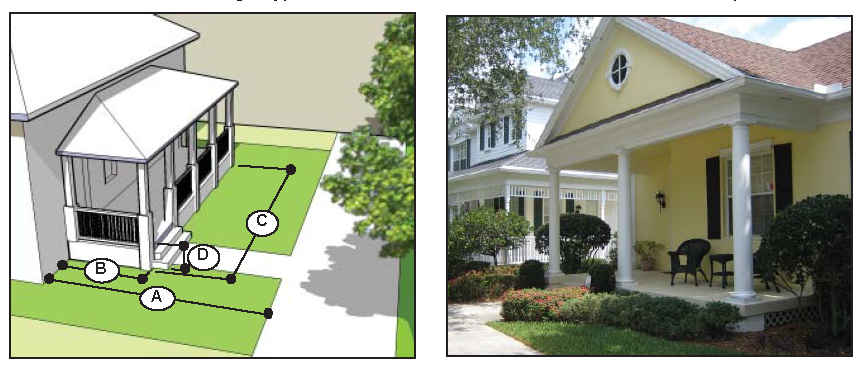
(2)
Stoop. A stoop is a small staircase leading to the entrance of a building that may be covered. The elevation of the stoop is necessary to ensure privacy for residential uses in the ground story of buildings. Stoops should provide sufficient space for a person to comfortably pause before entering or after exiting the building. Stoops are frontage types typically associated with townhouses and other residential building types. Table 31-537(c) provides the dimensional requirements and the maximum allowable encroachment permitted by the zoning district. Figure 31-537(3) illustrates the dimensional requirements from Table 31-537(c).
Table 31-537(c)
Dimensional Requirements for Stoops
Figure 31-537(3)
Figure 31-537(4)
Stoop Frontage Type
Stoop Character Example
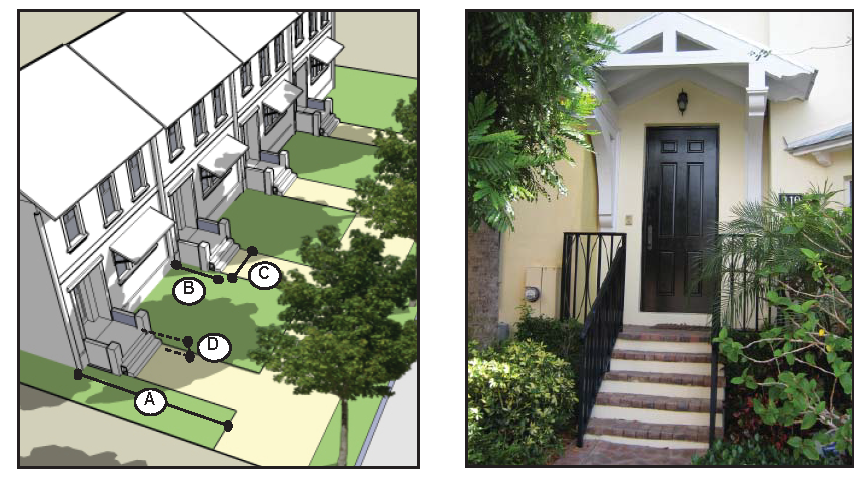
(3)
Bracketed balcony. A bracketed balcony is second-story platform projecting from the building wall, enclosed by a railing or balustrade, supported by brackets. The bracketed balcony is located over the main building entry, which provides cover for a person entering or exiting the building, emphasizes the entryway, and creates a semi-public space overlooking the street. Bracketed balconies are typically associated with buildings with commercial uses in the ground story; however, bracketed balconies can be used on residential building types when combined with a stoop.
a.
Table 31-537(d) provides the dimensional requirements and the maximum allowable encroachment permitted by the zoning district. Figure 31-537(5) illustrates the dimensional requirements from Table 31-537(d).
Table 31-537(d)
Dimensional Requirements for Bracketed Balcony
Figure 31-537(5)
Figure 31-537(6)
Bracketed Balcony Frontage Type
Bracketed Balcony Character Example
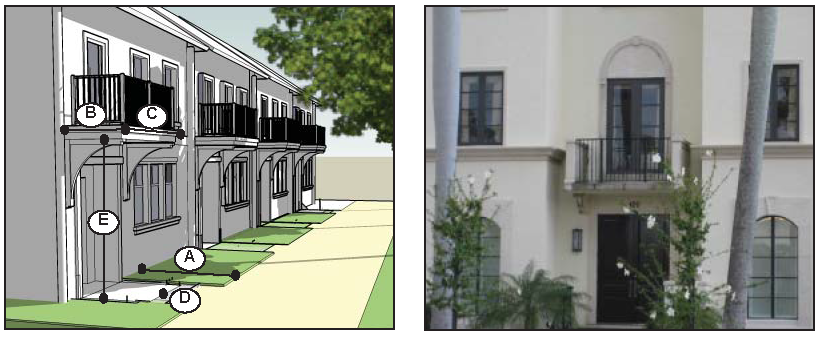
b.
Bracketed balcony elements.
1.
Brackets shall be made of wood, pre-cast concrete or steel.
2.
Brackets shall be designed to reflect their intended structural role and to define the entryway.
(4)
Forecourt. A forecourt is an open area in front of the main building entrance(s) designed as a small garden or hardscaped plaza. The forecourt may afford access to one or more first floor units and may incorporate storefronts for retail uses. The forecourt is suitable for outdoor seating for residents or restaurants. Forecourts are typically associated with multifamily, mixed-use, and commercial building types.
a.
Table 31-537(e) provides the dimensional requirements and the maximum allowable encroachment permitted by the zoning district. Figure 31-537(7) illustrates the dimensional requirements from Table 31-537(e).
Table 31-537(e)
Dimensional Requirements for Forecourt
Figure 31-537(7)
Figure 31-537(8)
Forecourt Frontage Type
Forecourt Character Example
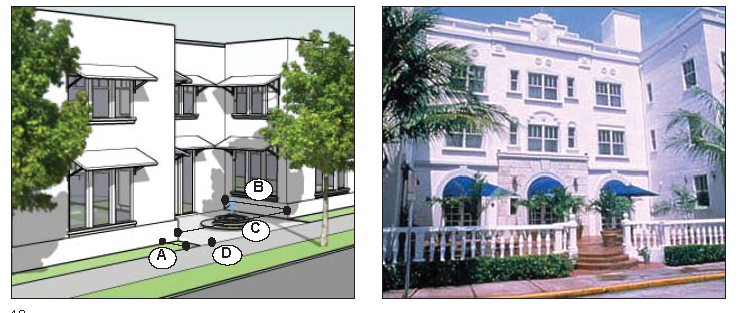
b.
Forecourt Elements
1.
Low walls or balustrades may extend into the front setback and shall be at least two feet six inches tall and shall not exceed three feet six inches in height.
2.
Low walls shall be constructed of similar material as the principal building, or be composed of a continuous, maintained hedge.
3.
Forecourts may be combined with the storefront frontage type.
4.
Awnings, if proposed, shall project at least four feet and no more than two feet from the edge of curb.
5.
Awnings shall be consistent with the architecture of the building. Internally illuminated or vinyl awnings are prohibited.
(5)
Storefront. The storefront is a frontage type placed along the property line, and is typically associated with retail and mixed-use buildings. The storefront must be designed in a way that promotes an attractive, convenient shopping experience. Storefronts are typically at sidewalk grade and are usually shaded by awnings or arcades.
a.
Storefront Dimensions. Table 31-537(f) provides the dimensional requirements and the maximum allowable encroachment permitted by the zoning district. Figure 31-537(9) illustrates the dimensional requirements from Table 31-537(f).
1.
Storefronts shall extend across at least 70% of the commercial/retail space.
2.
Storefronts shall be directly accessible from sidewalks; storefront doors may be recessed up to 10 feet.
Table 31-537(f)
Dimensional Requirements for Storefronts
Figure 31-537(9)
Figure 31-537(10)
Storefront Frontage Type
Storefront Character Example
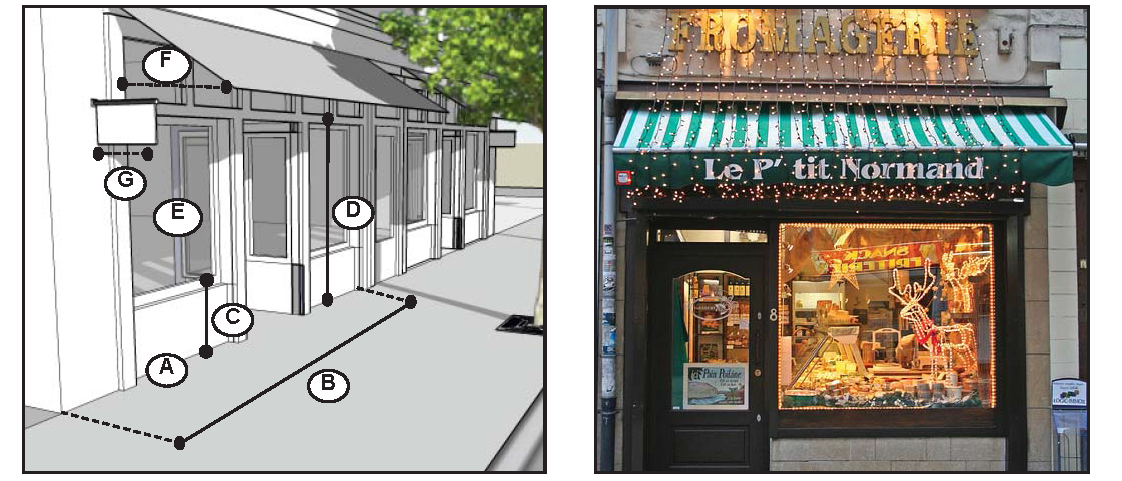
3.
Storefronts shall have transparent glazing of at least 70% of the facade area, comprised of storefront windows and doors. Storefront windows shall have a base one foot six inches to three feet high with transparent glazed areas extending from the base to at least eight feet in height as measured from sidewalk grade. Transparent glazing transmits at least 50% of visible daylight.
b.
Storefront elements.
1.
Awnings shall project a minimum of four feet from the building facade and no more than to within two feet from the face of curb.
2.
Awnings shall be sympathetic to the buildings' architecture and designed as an integral component of the overall signage package. All awnings shall be sloped 30 degrees from the horizontal plane and have both ends open. All awnings on street level shall have an eight inch vertical valance with concealed weight to prevent excessive movement in high winds. Internally illuminated or vinyl awnings are prohibited.
3.
Each ground story business may have one wall sign per street front. The wall sign shall be no greater than three feet in height by 60 percent of the width of the tenant space along the street front. The wall sign shall be located over the first story, below the second story. A name or logo printed on the awnings shall be considered as square footage against the overall dimensions of the sign band.
4.
Each ground story business may have one pedestrian blade sign per street front. Pedestrian blade signs may extend up to four feet from the building façade and shall not exceed three feet in vertical dimension, including all mounting brackets and hardware. Pedestrian Blade Signs shall be set back at least two feet from the end of the building or storefront. Pedestrian blade signs may not be internally illuminated.
5.
Window signs advertising special sales, events or services, store hours, and store name may be affixed to the inside of a window provided that their total area does not exceed 20 percent of the window area.
6.
Storefronts may be combined with forecourts or arcade/colonnades.
Figure 31-537(11)
Storefront Composition and Signage Examples
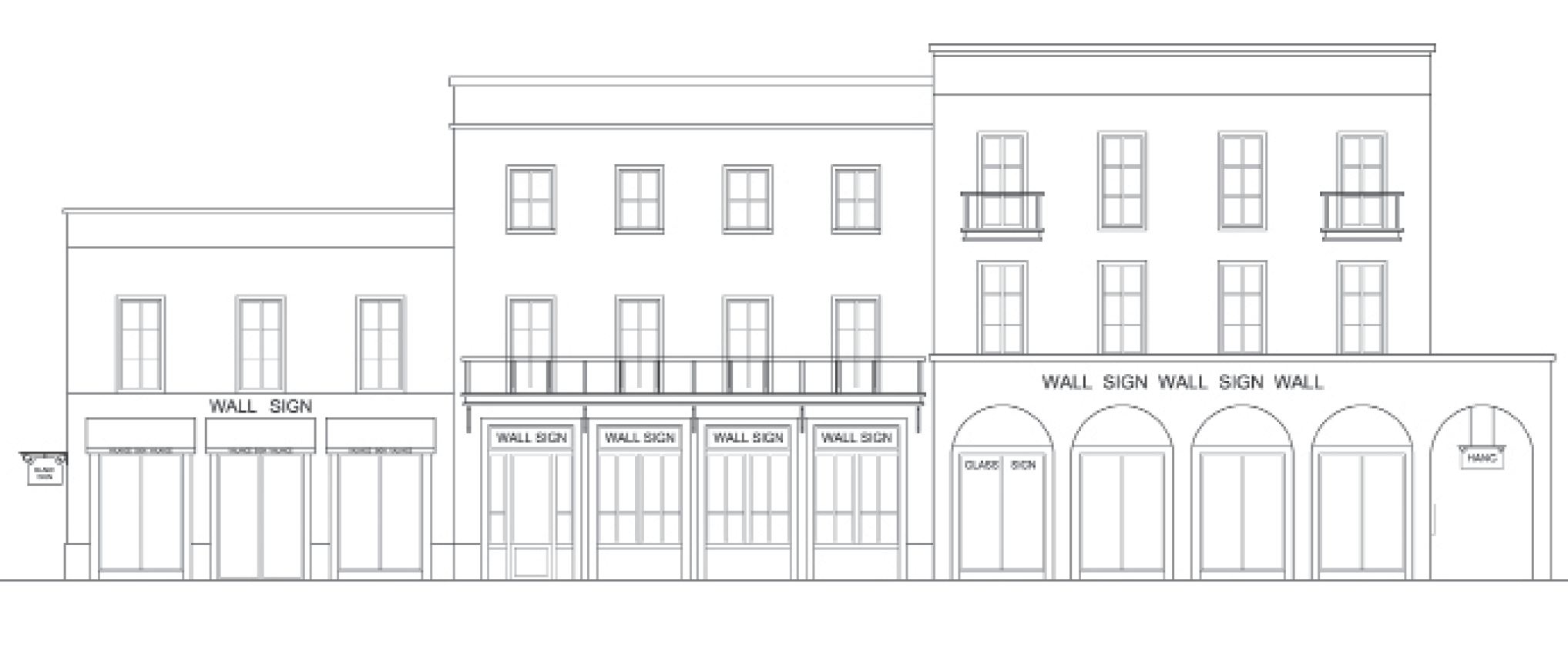
(6)
Arcade/colonnade. An arcade/colonnade is a covered, unglazed, linear hallway attached to the front of a building, supported by columns or pillars. The arcade/colonnade extends into the public right-of-way, over the sidewalk, creating a shaded environment ideal for pedestrians and conducive to retail. In arcades, upper stories of the building extend over the passageway. This frontage type is typically associated with retail and mixed-use buildings.
a.
Arcade/colonnade dimensions. Table 31-537(g) provides the dimensional requirements and the maximum allowable encroachment permitted by the zoning district. Figure 31-537(12) illustrates the dimensional requirements from Table 31-537(g).
1.
Arcades/ colonnades shall extend over the sidewalk. A sidewalk should not run parallel to an arcade or colonnade, which allows pedestrians to bypass retail or commercial windows. Use of the arcade/colonnade requires entering into a right-of-way agreement between the property owner and the City. This agreement shall establish liability and insurance responsibilities in a form acceptable to the City attorney.
Table 31-537(g)
Dimensional Requirements for Arcade/Colonnades
Figure 31-537(12)
Figure 31-537(13)
Arcade/Colonnade
Arcade/Colonnade Character Example
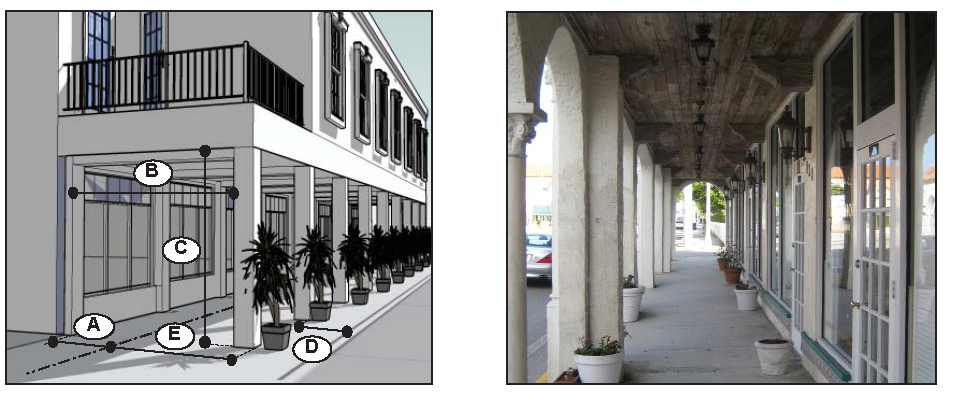
2.
Arcades/colonnades shall have a clear depth between the interior face of the columns and the building facade of at least ten feet and no more than 20 feet. If the distance between the property line and the face of curb is not sufficient to accommodate the minimum depth required for an arcade/colonnade, the building shall set back accordingly. If the distance between the property line and the face of curb is wide enough that using the minimum building setback results in an arcade with a clear depth greater than 12 feet, the minimum front setback may be administratively reduced by the community development director, taking into consideration the ultimate location of the face of curb based on the street design standards for the community redevelopment area set forth in section 29-65.
3.
Arcades/ colonnades shall have a clear height above the sidewalk of at least 12 feet.
4.
Support columns or pillars shall be placed no farther apart than they are tall, and shall be placed two to four feet from the face of the curb.
5.
Open-air terraces and habitable stories may extend over the arcade, up to the fourth story.
6.
Arcade/ colonnade ceilings shall be designed with coffers or exposed beams extruding at least six inches, aligned with columns or pillars.
b.
Arcade/Colonnade Elements.
1.
Arcade/colonnades shall be combined with storefronts.
2.
The height and proportions of the arcade/ colonnade shall be consistent with the style and proportions of the building to which it is attached.
3.
Each ground story business may have one wall sign not exceeding three feet in height by 60 percent of the storefront width on the first story facade of the arcade/colonnade.
4.
Each ground story business may have one wall sign under the covered area, not exceeding two feet in height by 60 percent of the storefront width.
5.
Each ground story business may have one pedestrian blade sign under the covered area. Pedestrian blade signs may extend up to four feet from the building façade and shall not exceed three feet in vertical dimension, including all mounting brackets and hardware. Pedestrian Blade Signs shall be set back at least two feet from the end of the building or storefront. Pedestrian blade signs may not be internally illuminated.
6.
Potted landscaping or ground planting shall be provided between the face of the columns or pillars and the face of curb.
Figure 31-537(14)
Example of Arcade/Colonnade Signage Examples
(b)
Pedestrian walkway. In order to ensure a superior pedestrian realm develops overtime, a pedestrian walkway may be required on-site to augment public sidewalk widths, especially along narrow rights-of-way. A pedestrian walkway is an area that forms a continuous route for pedestrians, which is unobstructed by trees, landscaping, street lights or utility poles. Pedestrian walkways may be composed of public sidewalks, hardscape on private property, or a combination of the two.
Figure 31-537(15)
Clear Width of Pedestrian Walkway
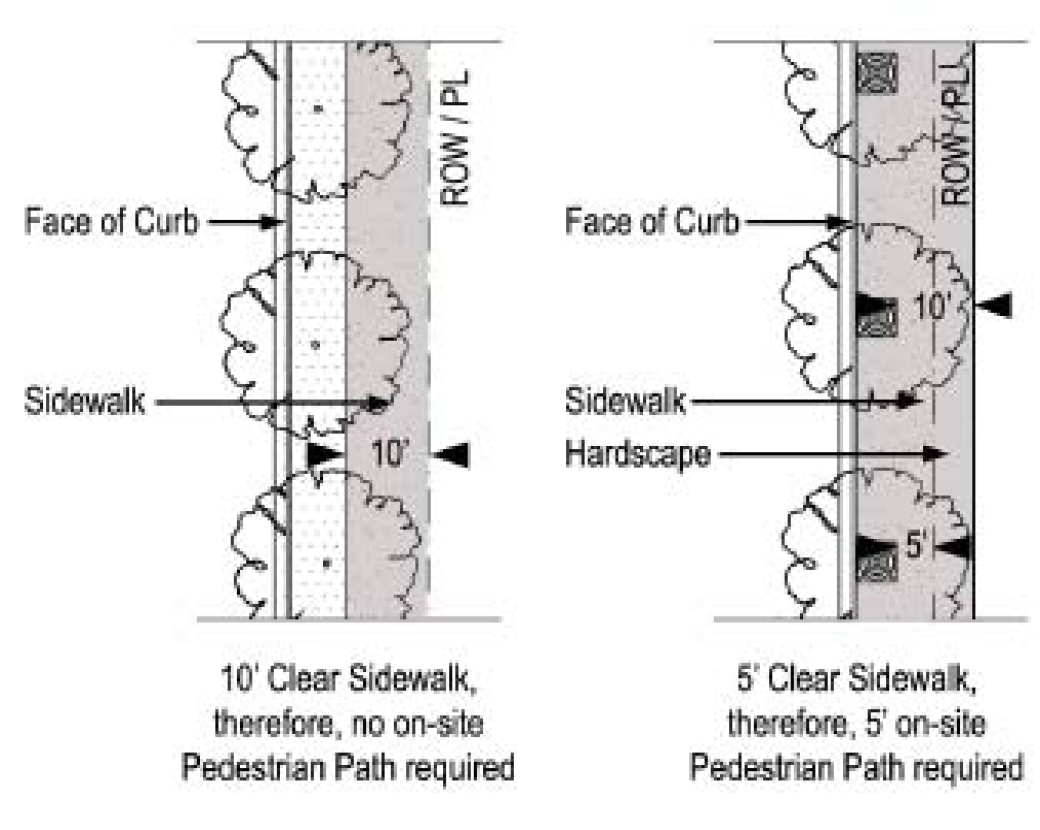
Table 31-537(g)
Dimensional Requirements for Pedestrian Walkways per Zoning District
(1)
Width of pedestrian walkway. The minimum width of pedestrian walkways shall be provided as depicted in Table 31-537(g). The proposed pedestrian walkway shall be demonstrated on site plans. In order to accommodate the required width of the pedestrian walkway, increasing the front setback beyond the minimum amount allowed by the zoning district may be necessary and buildings shall set back further than the maximum allowed per zoning district, if necessary. In the event the maximum front setback does not provide adequate space, the pedestrian walkway may be accommodated within the arcade/colonnade frontage type to meet the intent of the code.
(2)
Where an existing public sidewalk adjoins the property line, the paved area of the public sidewalk and the pedestrian walkway shall connect, thereby expanding the perceived width of the public sidewalk. An existing, adjoining public sidewalk may be counted toward fulfilling the minimum clear width of a pedestrian walkway.
(3)
All paving materials for the pedestrian walkway shall be compliant with ADA accessibility standards, and shall be constructed of concrete consistent with the adjacent sidewalk and acceptable to the Community Development and Engineering Departments.
(4)
Where a sidewalk or a pedestrian walkway crosses vehicular ingress/egress points, the pedestrian crossing shall be paved with material consistent with the paving material of the sidewalk or walkway, and shall be different from the vehicular surface.
(c)
Street trees. Street trees are intended to provide a shaded environment for the pedestrian, provide a physical separation between pedestrians and vehicles, and improve the overall visual appearance of the street.
(1)
All new construction, relocation of a building, or addition equal to or greater than 20 percent of the gross floor area of an existing building shall install street trees at the time of development. Street trees shall be a canopy species, planted in the public right-of-way directly in front of the property line(s), uniformly spaced no greater than 25 feet on center. Spacing of trees may only exceed 25 feet in order to accommodate curb cuts, fire hydrants, utilities, existing trees, and other infrastructure elements. Palm varieties may be used at corners, crosswalks, or to accent building entrances and may be permitted in lieu of shade trees when physical conditions may prevent the proper growth of shade trees, as determined by the community development director. Consistency in street tree species shall be established on both sides of the street along a block face. The first to develop shall establish the species.
(2)
Street trees shall be planted in planting strips, landscaped planters or tree grates consistent with the street design standards contained in section 29-65. Street trees shall be located along the curb side, in order to separate pedestrians from vehicular lanes.
(3)
All trees shall satisfy the following standards at the time of planting:
(i)
Canopy species: Minimum 14 feet in height with a clear trunk space of six feet and a spread of no less than eight feet.
(ii)
Palm trees: Minimum 18 feet in height, with a clear trunk space of eight feet.
(4)
In the event that site constraints such as utility easements prevent the installation of required street trees, removable planters of small palms and small shrubs, vines or seasonal flowers shall be installed. In addition, the building shall provide devices such as awnings or roof overhangs to establish a shaded pedestrian environment.
(Ord. No. 4038, § 2(Exh. A), 12-18-13)
_____
Sec. 31-538. - Civic open spaces.
(a)
Civic open spaces. Civic open spaces are maintained outdoor spaces which are accessible by the general public, improve the pedestrian environment, are aesthetically pleasing, and serve as an amenity for the city as a whole as well as for occupants of the building which the open space serves. Civic open spaces are generally constructed by landowners when they build on adjoining property.
(1)
Amount. On sites one acre or more in size, new buildings or additions of gross floor area equal to 20 percent or more to existing buildings, shall provide at least five percent of the size of the site as a civic open space. Dedicated rights-of-way and building setbacks may not count toward fulfilling the required amount.
(2)
Location. Civic open space may be provided either on site or off site, provided the civic open space is located within 660 feet of the building site, within the same zoning district, and within the CRA boundary.
(3)
Types of civic open spaces. Civic open space shall be designed as one of the following types:
a.
Green. A green is at least 2,000 square feet in size and adjoins streets on at least two sides. Greens are designed primarily for passive uses, consisting primarily of lawn with either formally or informally arranged landscaping.
b.
Plaza. A plaza is at least 2,000 square feet in size and adjoins a street on at least two sides. Plazas are mostly hardscaped with formal landscaping and a water feature.
c.
Playground. A playground shall be at least 2,500 square feet in size. Playgrounds shall provide children's play equipment and shaded seating. Playgrounds adjoin a street on at least one side and the proposed configuration should ensure easy surveillance of the area from the adjacent buildings and streets
d.
Square. A square is at least 10,000 square feet and adjoins streets on at least three sides. Squares may be up to 50 percent hardscaped, with formal landscaping. Squares accommodate both passive uses and community gatherings.
e.
Attached Green. The attached green is generally 3,000 to 6,000 square feet and spans the entire length of a block. Attached greens shall be at least 30 feet wide and are appropriate on the short end of a block. Attached greens are formally landscaped, with trees arranged in an allee or staggered allee configuration.
Figure 31-538(1)
Civic Open Spaces
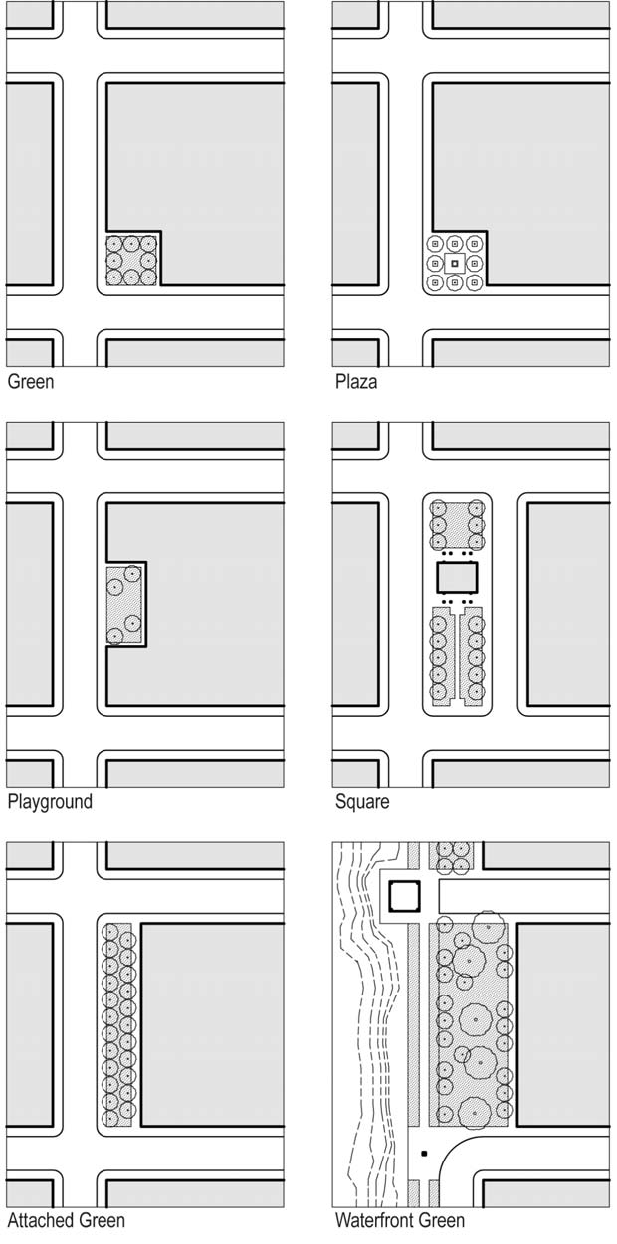
(4)
Configuration. Civic open spaces shall be configured as follows:
a.
The civic open space shall adjoin a street front property line for no less than 30 linear feet.
b.
Except for attached greens, civic spaces shall have a proportion so that the depth is no more than 2.5 times the frontage width, and the width is no more than five times the depth;
c.
Civic open spaces shall be lined by building facades or streets on all sides. In order to provide oversight of the space, buildings facing civic open spaces shall contain habitable uses; parking lots, parking garages, and storage areas are not considered habitable uses.
(5)
Additional standards. Civic open spaces shall meet the following minimum standards:
a.
Civic open spaces must be accessible to the public during all daylight hours;
b.
Civic open spaces must be situated to allow easy ingress and egress by pedestrians. Except for playgrounds, which may be fenced, no streetwalls, gates, fences or other impediments to pedestrian accessibility shall be permitted along the frontage line;
c.
Civic open spaces must be located at the sidewalk level;
d.
Civic open spaces must be open to the sky; however, open-air garden structures such as gazebos or band shells are permitted within civic open spaces;
e.
Landscaping shall be arranged in a manner reflective of description of the type of civic open space. One shade tree per 20 feet of perimeter of the space is required. Trees may be arranged in regular spacing or in informal clusters, depending on the type of open space. Trees shall be installed to provide shade along walkways and for benches. Substituting shade trees for multiple palm species is not permitted; however, adding palms to the landscape design is permitted.
f.
Each civic open space shall provide the following street furniture elements, specifications subject to approval by the City of Riviera Beach:
1.
One bench per 350 square feet of area;
2.
One drinking fountain;
3.
One bicycle rack with no less than four spaces;
4.
One trash receptacle;
5.
One pet clean up station.
g.
Fences are permitted only to enclose playgrounds. Fences may be composed of wood or metal pickets and shall not exceed four feet in height.
h.
Vehicular traffic shall not be permitted within a civic open space.
i.
Civic open spaces shall be designed to enhance user safety and security using Crime Prevention Through Environmental Design (CEPTED) principles by
1.
Being well lighted;
2.
Having one or more focal points within the open space visible from all perimeter streets;
3.
Having a clear landscape zone between three feet and eight feet in height providing sightlines unobstructed by berms or bushes.
(6)
Availability. Civic open space shall be developed and open for use prior to issuance of a certificate of occupancy for the building(s) for which the open space is required.
(7)
Public benefit height option. In order to encourage projects to provide civic open space in the downtown, increased building height is offered in the downtown core district.
a.
Civic spaces provided in order to receive the public benefit height option shall meet the following criteria:
1.
Comply with subsections 31-538(b)(2) through (6).
2.
In order to use the public benefit height option, civic open spaces must be at least 2,000 square feet in size. Dedicated rights-of-way, minimum building setbacks, and civic open space provided to meet the requirement in subsection 31-538(b)(1) may not count toward fulfilling this amount.
b.
The quantity of the additional building square footage permitted within the extra stories of height is directly related to the size, location, and accessibility by the general public of the proposed civic open space. Waterfront locations are considered the most desirable sites and therefore receive the highest factor.
Table Figure 31-538(a)
Public Benefit Factor
c.
Computing the benefit. The following formula computes the amount of building square footage allowed above the fourth story:
1.
Multiply the square footage of the proposed civic open space by the maximum number of stories allowed in the district without using the public benefit height.
2.
Multiply the result by the public benefit factor from Table Figure 31-538(a) that best describes the configuration of the proposed civic open space.
3.
The result is the total additional building square footage that can be placed within in the extra stories allowed by the district as the maximum Public Benefit Height (subject to floorplate limitations in the massing regulations).
For example, within the downtown core district, a project that proposes a civic open space of 2,000 square feet in size adjoining two streets and not located on the waterfront would compute the benefit as follows:
(2000 sf. × 4 stories × 2) = 16,000 square feet.
Therefore, 16,000 square feet could be arranged within the fifth through eighth stories (subject to floorplate limitations).
4.
The additional building square footage garnered by using the Public benefit height option is not included in the calculation of or limitation of maximum floor area ratio.
(Ord. No. 4038, § 2(Exh. A), 12-18-13)
Sec. 31-539. - Downtown parking and access.
(a)
Purpose and intent. This subsection provides modified parking regulations for off-street parking within the downtown zoning districts. These regulations recognize that the downtown is a compact, interconnected area with multimodal transportation options, and that improper placement of parking and mandatory duplication of the downtown parking supply on each building site separates the various land uses from each other. This separation reduces the viability of the mixed-use districts and harms the walkability of the streets in the downtown area. These regulations reflect the needs of the urban, mixed use downtown.
(b)
Minimum number of off-street parking spaces. The minimum number of parking spaces required in section 31-577, Off-street parking ratios, are modified by this section for use in the downtown zoning districts; the following regulations shall apply to determine the minimum number of off-street parking spaces required:
Table 31-539(a)
Downtown Zoning District Parking Ratios
(1)
Within the downtown core and downtown general districts, lots 100 feet in width or less are not required to provide off-street parking.
(2)
On-street parking located directly in front of the property line(s) may be counted toward fulfilling the total parking requirement in all downtown zoning districts.
(3)
Director of community development may administratively waive the minimum number of parking spaces if criteria such as market demand, parking availability, or unique circumstances of the project within the area justify a reduction.
(c)
Location and access. Parking and service areas shall be accessed and located at the rear or side of the building(s).
(1)
Parking is not permitted in front setbacks or in side setbacks facing streets, parks or civic open spaces. Parking lots may be located on the side of buildings provided the minimum building frontage requirement by the zoning district is met and the parking lots are screened from view of the street by a streetwall (See subsection 31-539(e).).
(2)
On primary streets, parking garages shall be lined by a use permitted by right for primary streets by the zoning district for at least 20 feet of depth on all stories. On secondary streets, parking garages not lined by such a use shall be screened by a façade design consistent with the main building design and/or shall employ landscaping planters with irrigation as an integral part of the façade design.
(3)
Alleys, when present, shall be the primary source of vehicular access to off-street parking. Alleys shall be a minimum width of 20 feet, and may be incorporated into parking lots and garages as standard drive aisles. Access to all properties adjacent to the alley shall be maintained.
(4)
When alleys are not present, primary vehicular access to off-street parking shall be from secondary streets. Access drives shall not exceed 24 feet in width.
(5)
When neither alleys nor secondary streets are present, primary vehicular access may be from a primary street. Access drives from primary streets shall not exceed 24 feet in width. In the instance that site constraints necessitate access from a primary street, and the provision of an access drive precludes meeting the minimum building frontage percentage required by the zoning district, the community development director may administratively allow a reduction from the minimum building frontage in order to allow vehicular access to the site.
Figure 31-539(1)
Vehicular Access
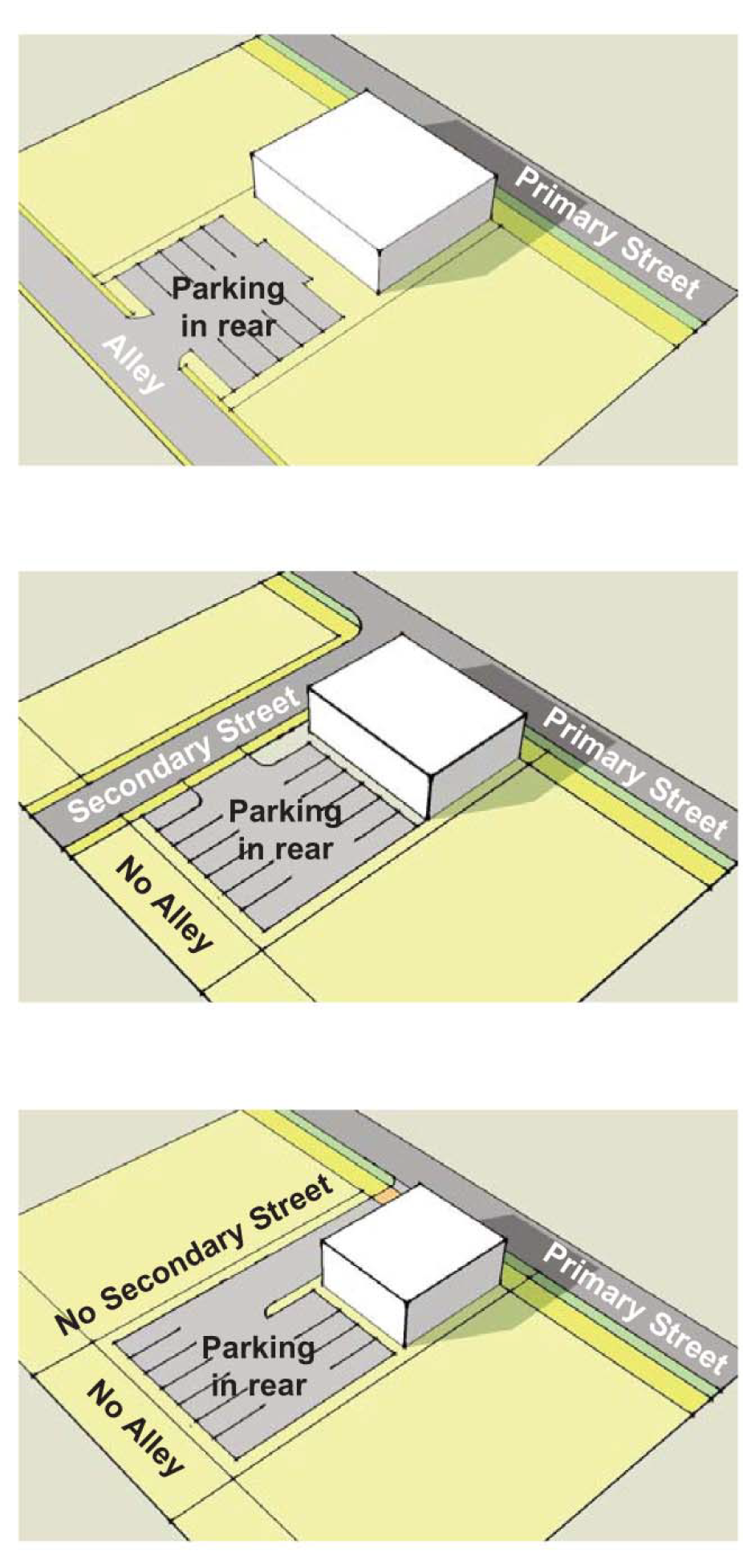
(6)
Within the downtown core and downtown general districts, when an alley is not present, vehicular access between adjacent parcels across property lines is required, and shall be accommodated within the site layout. The first property owner to develop shall be required to make an irrevocable offer of cross-access to the adjacent parcels prior to issuance of a development order. When adjacent property develops, a reciprocal cross-access agreement is required, and the physical connection shall be completed.
(7)
Parking lots and structures shall provide pedestrian access directly from a street. In addition, pedestrian access may also be provided directly from a building.
(8)
Buildings with more than 250 feet of street frontage on a block face shall provide a pedestrian accessway at least ten feet wide connecting the rear parking to the sidewalk area.
(9)
Public sidewalks may not be interrupted or deviated to accommodate drop-off or valet parking.
(10)
Within the CRA, offsite parking arrangements may be provided in lieu of on-site parking, as long as sufficient documentation of the location and the number of spaces is provided to the review authority.
(d)
Parking dimensions. The following minimum dimensions for parking bays and access aisle widths apply in lieu of the specific requirements in the design standards in section 31-576:
Table 31-539(b)
Downtown Zoning District Parking Dimensions
(e)
Parking lot landscaping requirements.
(1)
Streetwalls are required on both primary and secondary streets. Streetwalls shall be located in line with the building façade or in accordance with the front setback requirements. Streetwalls shall be three feet to three feet six inches in height, composed of either an opaque wall of the same material and color as the building or of a continuous, maintained hedge. One shade tree per 20 lineal feet, uniformly spaced, shall be installed along the length the streetwall within a planting area at least five feet wide. Streetwalls may have openings to accommodate automobile and pedestrian access.
(2)
Along side and rear lot lines, a landscape strip five feet in width shall be installed with trees planted at least 50 feet on center. When an alley is not present, openings shall be made to accommodate current or future vehicular connections between adjacent properties. Lots which interconnect their parking to adjacent lots may be administratively relieved of side/rear landscape strips in order to maximize the parking supply between the properties.
(3)
Parking lots shall provide either landscape islands or landscape trips as set forth below:
a.
One landscape island at least six feet in width, extending the entire depth of the parking bay and containing at least one shade tree shall be provided for every ten parking stalls; or
b.
A landscape strip at least six feet in width containing at least one shade tree for every 50 linear feet shall be provided between parking rows.
Figure 31-539(2)
Parking Lot Landscaping
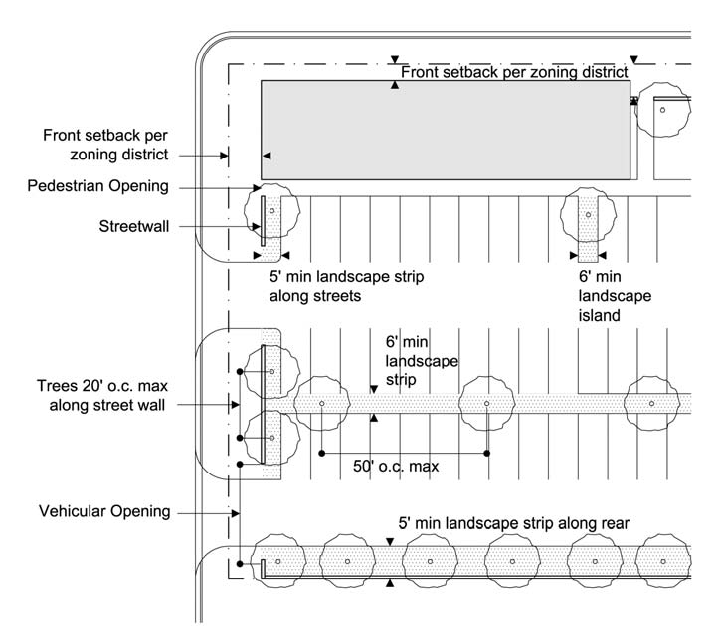
(f)
Bicycle parking requirements.
(1)
The minimum number of bicycle parking spaces required is set forth in Table 31-539(b).
Table 31-539(b)
Downtown Zoning District Bicycle Parking Ratios
(2)
Employee and resident bicycle parking facilities shall be highly visible to the intended users and protected from rain within a structure shown on the site plan. The facilities shall not encroach on any area in the public right-of-way intended for use by pedestrians. The facilities for employee, resident, and visitor bicycle parking must be highly visible from a building entrance, a full-time parking attendant, a full-time security guard or a visitor/customer entrance to ensure good natural surveillance. The Planning Director shall review the location, design, and details of the bicycle spaces as part of the site plan review. Residential condominium covenants shall not prohibit the storage of bicycles inside individual condominium units.
(3)
Offices greater than 50,000 square feet shall provide one shower per gender, up to a maximum of three showers per gender. Also, a minimum of one clothes storage locker per gender shall be installed for every required employee bicycle parking space. The lockers shall be installed adjacent to showers in a safe and secured area.
(Ord. No. 4038, § 2(Exh. A), 12-18-13)
Sec. 31-540. - Redevelopment design areas.
Conceptual redevelopment plans have been designed for certain areas which are likely to redevelop due to ownership consolidation, parcel size, or use. The boundary of each area with a redevelopment design is indicated on the regulating plan as "Pre-Approved Redevelopment Design Area." The purpose of redevelopment design areas is to guide the transformation of these parcels into a traditional neighborhood pattern, consistent with the conceptual plans contained in the Comprehensive Plan and with the vision of the Community Redevelopment Area Plan.
(a)
General concepts.
(1)
Zoning districts. The regulating plan designates appropriate downtown zoning districts within each redevelopment design area (RDA). In order to properly transition between scale and uses, more than one zoning district may be applied within a RDA. In this event, the site plan shall be consistent with the requirements of the designated district in that area of the parcel.
(2)
Future streets and alleys. The regulating plan designates the location of future streets and alleys within each RDA.
a.
Within a RDA, the locations of future streets and alleys reflect a site specific solution and provide the framework to establish a site plan with the following characteristics:
1.
Consistent with the scale and uses permitted by the zoning district;
2.
Responds to the geometry of the specific parcels within the RDA;
3.
Establishes important links to expand the existing street network;
4.
Ensures parking is located in the rear of buildings.
b.
Minor adjustments in the alignment and location of future streets and alleys may be administratively approved. Major changes such as eliminating a street or alley, or shifting a street so that connections to existing streets are not completed require City Commission approval.
c.
The site plan design shall utilize one or more of the street and alley cross-sections in the street design standards for the community redevelopment area contained in section 29-65.
(3)
Implementation. Redevelopment plans may be wholly or partially implemented. Individual properties can proceed with site plan review and development without the participation of other parcels and owners within the RDA. If the adjacent parcel has an approved site plan, the applicant shall complete links to any street or alley connections identified in the approved plan, and shall ensure buildings are compatibly oriented.
(b)
Specific redevelopment design areas. The City of Riviera Bach Beach Comprehensive Plan contains conceptual redevelopment plans for two areas designated on the regulating plan:
(1)
Western RDA. The city's preferred redevelopment plan for the RDA located on the west side of Broadway, north of Chateau Circle, has the following characteristics:
a.
Avenue E is reconnected through the properties;
b.
A system of new streets, alleys, and pedestrian paths connect the adjacent parcels to each other and to Broadway Avenue;
c.
Mixed-use buildings are located along Broadway Avenue;
d.
Townhouses and low-rise multi-family buildings provide a transition between the single-family houses located to the west and the mixed-use buildings facing Broadway Avenue;
e.
The fronts of buildings face the fronts of buildings, the backs of buildings face the backs of buildings;
f.
Civic open spaces are provided in the form of public parks, plazas, or greens, lined by streets and the fronts of buildings; and
g.
Off-street parking is accommodated in the rear of buildings.
(2)
Eastern RDA. The city's preferred redevelopment plan for the the RDA located on the east side of Broadway, north of 30th Street has the following characteristics:
a.
A system of new streets and alleys connect the parcels to each other, and between Broadway Avenue and Avenue A;
b.
Mixed-use buildings are located along Broadway Avenue;
c.
Multi-family buildings such as low-rise apartments and townhouses provide a transition between residential uses along Avenue A and the more intense uses along Broadway Avenue.
d.
The fronts of buildings face the fronts of buildings, the backs of buildings face the backs of buildings; and
e.
Off-street parking is accommodated in the rear of buildings.
(3)
Approval process.
a.
Follow the process in subsection 31-534(e).
(Ord. No. 4038, § 2(Exh. A), 12-18-13)

