
Rolling Hills City Zoning Code
CHAPTER 17
26 - VIEW PRESERVATION5
Editor's note— Ord. No. 354, § 7(Att. A(2)), adopted Oct. 23, 2017, repealed Ch. 17.26 in its entirety, and enacted new provisions to read as herein set out. Former Ch. 17.26, §§ 17.26.010—17.26.090 pertained to similar subject matter, and derived from Ord. No. 239, § 11, adopted in 1993; Ord. No. 292, §§ 4, 5, adopted in 2003; Ord. No. 295, § 7, adopted in 2004; Ord. No. 333, (Measure B), adopted March 18, 2013; Ord. No. 346, §§ 6B—F, adopted Feb. 8, 2016; and Ord. No. 357, (Measure C), adopted Nov. 27, 2017.
17.26.010 - Principles and intent.
The City recognizes the contribution of views to the overall character and beauty of the City. Views of the Pacific Ocean, Catalina Island, City lights and Los Angeles Harbor are a special quality of property ownership for many residential lots in the City. The City also recognizes the desire of many of its residents and property owners for beautiful and plentiful landscaping, including trees; and to preserve the landscaping that existed on a property at the time the property was purchased. The City realizes that this desire may sometimes conflict with the preservation of views, and that disputes related to view obstruction are inevitable. Owners and residents should maintain trees on their property in a healthy condition for both safety reasons and for preservation of outward views. Before planting trees, owners and residents should consider view blockage. By this chapter, the City establishes a process by which persons may seek to preserve and restore views which existed at any time since they purchased the property from unreasonable obstruction by the growth of vegetation. By this chapter the City also establishes a list of factors to be considered in determining appropriate actions to restore views while preserving the rights of property owners by not unreasonably reducing privacy or shade or other benefits provided by vegetation on a property. When a view obstruction dispute arises, the parties should act reasonably to resolve the dispute through friendly communication, thoughtful negotiation, compromise and other traditional means, such as discussions with the appropriate neighbors. Those disputes which are not resolved through such means shall follow the procedure established herein.
(Ord. No. 354, § 7(Att. A(2)), 10-23-2017)
17.26.020 - Definitions.
[The following words, terms and phrases, when used in this chapter, shall have the meanings ascribed to them in this section, except where the context clearly indicates a different meaning:]
"Crown" means the upper part of a tree, measured from the lowest branch, including all the branches and foliage.
"Crown raising" means the selective removal of lower limbs from a tree crown to provide clearance.
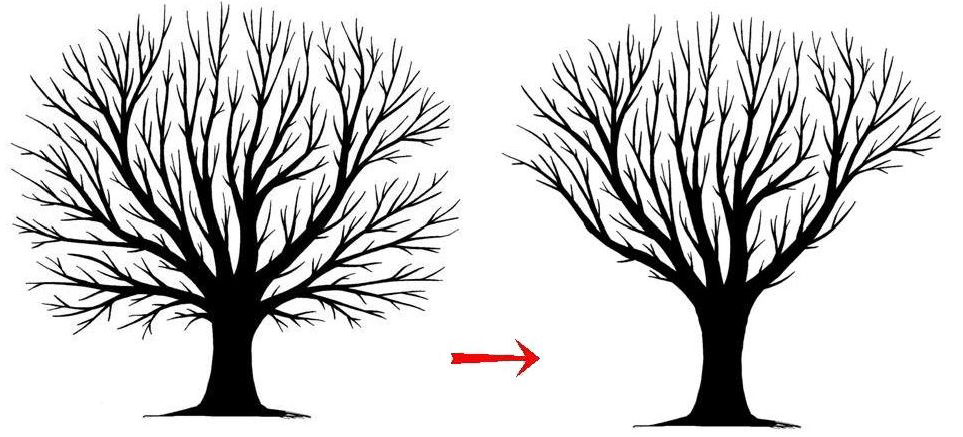
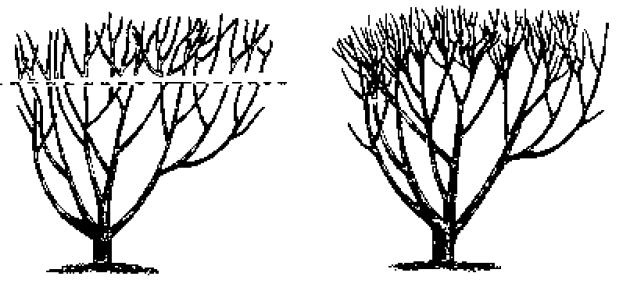
"Crown reduction" means the method of reducing the height and/or spread of a tree crown by making appropriate pruning cuts. This definition also includes reducing the top, sides or individual limbs of a tree by means of removal of the longest portion of limbs to a lateral limb large enough to assume the tree's growth.
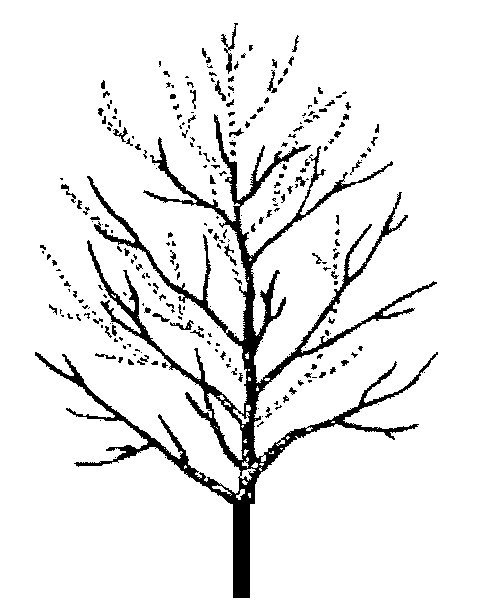
"Heading back" means cutting a shoot back to a bud or cutting branches back to buds, stubs, or lateral branches not large enough to assume apical dominance.
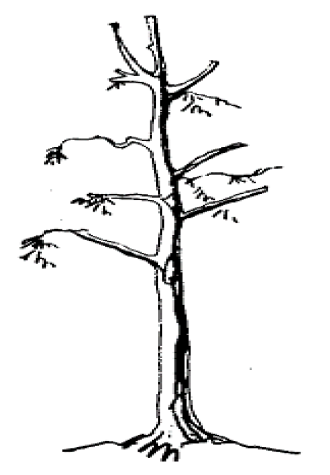
"Lacing" means the selective removal of live branches to provide light or air penetration through the tree or to lighten the weight of the remaining branches.
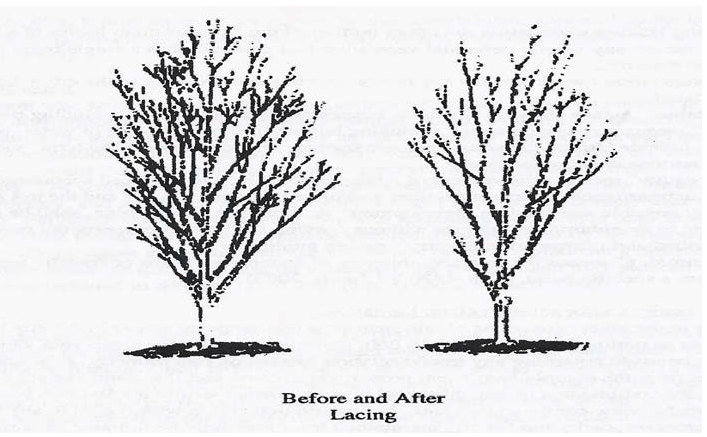
"Maintenance" means pruning a tree with the primary objective of preserving or improving tree health and structure and enhancing aesthetics.
"Pre-existing view" means the view that existed at any time since the complainant's property was most recently purchased for fair market value through an arm's length purchase or sale, as evidenced by a deed. The pre-existing view cannot be the result of a natural disaster or illegal activities.
"Pruning" removing branches (or occasionally roots) from a tree or other plant using approved practices, to achieve a specified objective.
"Topping" means cutting back a tree to a predetermined crown by cutting back large diameter branches to stubs and/or truncating the main stem/trunk in order to limit or reduce tree size.
"View" means a visually impressive scene or vista, such as the Pacific Ocean, off-shore islands, mountains, lights of the Los Angeles basin, the Palos Verdes Hills and canyons, the Los Angeles Harbor and/or Long Beach Harbor, and similar, as observed from a viewing point. A view may include structures or vegetation in the foreground or background of the view seeker's property. A "view" may be observed from one or more viewing point, and may be panoramic.
"View impairment" means any obstruction of a pre-existing view by vegetation on another property within the City that significantly diminishes that pre-existing view.
"Viewing point" means any view from the primary living area or active use area of a primary residence, excluding views from minor rooms, such as garages or closets, and also includes views from accessory buildings or structures, including pool decks and gazebos, but excluding animal pens, aviaries, corrals, greenhouses, porte cocheres, riding rings, run-in sheds, sheds, stable/barns, free-standing storage rooms, and tack rooms.
(Ord. No. 354, § 7(Att. A(2)), 10-23-2017)
17.26.030 - View impairment complaint considerations.
Subject to other provisions of this chapter, a property owner may initiate a view impairment complaint by way of the process set forth in Section 17.26.040. A person shall not be precluded from filing a view impairment complaint on grounds that vegetation located on the complainant's property contributes to impairment of the requested view. A person who has obtained a recommendation abating impairment of a view against a property shall not be precluded from filing a subsequent complaint to abate impairment of the same view by vegetation on another property.
(Ord. No. 354, § 7(Att. A(2)), 10-23-2017)
17.26.040 - View impairment dispute resolution process.
The complainant shall follow the process established by this chapter in seeking preservation or restoration of a pre-existing view.
A.
Initial Reconciliation.
1.
A complainant whose preexisting view is impaired shall first seek to informally resolve the impairment with the vegetation owner. The initial notification to the vegetation owner must be in writing, include a link to this chapter and contain the following language: "Failure of the vegetation owner to respond to the written request for initial reconciliation within sixty days from the date on the notification shall be deemed formal refusal by the vegetation owner to participate in the initial reconciliation." Additionally, any written notification to the vegetation owner must include any supporting evidence of the view obstruction, (as described by Section 17.26.050) and any requested remediation action. Remediation action may include an offer on behalf of the view seeker to perform continued maintenance, or to assist with replanting.
2.
During the initial reconciliation, the parties may request assistance from a certified arborist. The City may provide a link to the International Society of Arboriculture to allow residents to search for a certified arborist. If the parties reach an agreement, the signed agreement may be submitted to the City; however, there is no need to file anything with the City once an agreement between the parties is reached. If initial reconciliation is refused, or if the parties do not agree as to the existence and nature of the complainant's obstruction and the appropriate restorative action, the complainant may proceed with mediation.
B.
Mediation.
1.
If the initial reconciliation does not yield a resolution of the complaint, and the complainant wishes to further utilize the procedures under this chapter, then the complainant must request, in writing, that the vegetation owner enter into mediation. The vegetation owner shall have sixty days from the date of the request for mediation to accept or reject the request in writing. The vegetation owner's failure to respond within sixty days will be deemed a formal refusal of mediation and the complainant may proceed to an advisory hearing before the Committee on Trees and Views.
2.
The participants will have sixty days from the date of the filling of acceptance of mediation to select a mediator. If they cannot agree on a mediator within sixty days, they may jointly request that the City select a mediator. Any mediator which is selected pursuant to this subsection shall be provided with a link to a copy of this chapter.
3.
The mediator shall be guided by the provisions of this chapter, including the evaluation criteria set forth in Section 17.26.050, and the hierarchy of restorative actions set forth in Section 17.26.060, respectively, in attempting to resolve the view impairment complaint. The mediator shall also consider the recommendations of any arborists or experts regarding landscape techniques and/or maintenance procedures.
4.
The mediator's recommendation shall be advisory. Any agreement reached by the parties as a result of the mediation process described herein shall be reduced to writing and shall include steps for maintenance measures and any associated costs. The agreement shall be signed by all of the parties and may be submitted to the City.
C.
Advisory Opinion from the CTV. If the complainant is not satisfied by the recommendation of the mediator, the complainant may request a public hearing before the Committee on Trees and Views.
1.
View Impairment Complaint—Required Information. A view impairment complaint must be on a form provided by the City and shall consist of, but not be limited to, the following:
a.
A description of the nature and extent of the view, as well as of the alleged obstruction. If multiple views are identified, each must be disjointed and observable from a separate viewing area. Evidence of the views and alleged obstructions must be pertinent and may include, but is not limited to, documentary evidence, (as described by Section 17.26.050), dated photographs, or written declarations. Evidence must include the date the property was purchased by the complaining party.
b.
A description of the type and location of all vegetation alleged to cause obstruction, the address of the property upon which the obstructing vegetation is located, and the present vegetation owner's name and address.
c.
Documentary evidence establishing that attempts at initial reconciliation (as described in Section 17.26.040(A)) and mediation (as described in Section 17.26.040(B)) have been made and have failed to resolve the dispute.
d.
The view impairment complaint fee in the amount established by resolution of the City Council.
2.
View Impairment Complaint—Processing. City staff will review the complaint. If staff determines that the complaint is incomplete, a letter will be mailed to the complainant stating what is needed to complete the complaint within sixty days from the date of the letter. If the complaint is deemed complete, staff will process the complaint and prepare a notice pursuant to the requirements in Section 17.26.040(C)(4)(a)—(b), below. If the parties to a complaint voluntarily elect to resolve the issue privately at any time following the filing of the complaint, and notify the City of same, the City shall suspend the hearing before the Committee on Trees and Views until such time as the parties notify the City that they have resolved the issue (thereby eliminating the need for a hearing) or that they are unable to resolve the issue and wish to proceed with the hearing.
3.
View Impairment Complaint—Withdrawal. A complaint shall be deemed withdrawn and all proceedings shall be terminated with respect thereto, without prejudice, if:
a.
The parties to a complaint notify the City that it has been voluntarily resolved;
b.
The complainant fails or refuses to provide supplemental information requested by the City;
c.
The complainant fails or refuses to pay the cost of the expert services;
d.
The complainant requests a delay of the proceedings for more than one hundred eighty days (unless good cause exists for the delay); or
e.
The hearing before the Committee on Trees and Views is suspended by the parties to a complaint for more than one hundred eighty days.
4.
View Impairment Complaint—Review by Committee on Trees and Views.
a.
Notice Required. The City shall provide notice of the hearing a minimum of fifteen days prior to the hearing. The hearing shall not proceed unless proof is shown that the vegetation owner received notice of the hearing as provided herein:
i.
Notice shall be given by certified mail, return receipt requested, to the owner of the tree or other obstructing vegetation and to the complainant;
ii.
Notice shall be given by first class mail to all property owners within one thousand feet of the exterior boundary of the property on which the tree or other obstructing vegetation are located and to other persons who, in the Committee's judgment, might be affected.
b.
Content of Notice. The notice shall state the name of the complaining party or parties, the name of the property owner against whom the complaint is filed, a brief description of the tree(s) or other vegetation at issue, and the time and place of hearing. The notice shall invite written comments to be submitted prior to or at the hearing.
c.
Conduct of Hearing. The Committee shall adopt rules for the conduct of hearings. At the hearing, the Committee shall consider all written and oral testimony and evidence presented in connection with the complaint. If during the course of the proceedings it is discovered that information submitted in a complaint is inaccurate or incomplete such that it could be misleading, or a significant change has occurred impacting either the pre-existing view or the obstruction, an applicant may be directed to amend the complaint or submit supplemental information. In the event the Committee requires expert advice in consideration of the matter, the cost of obtaining such evidence shall be borne by the complainant, pursuant to written agreement with the City. The City shall select such expert and enter into an agreement only upon receipt of a payment for the selected service from the party. If the City determines that an arborist's testimony is required, said arborist shall either be a consulting or certified arborist.
d.
Findings. The Committee shall be guided by the provisions of this chapter, including the evaluation criteria set forth in Section 17.26.050, and the hierarchy of restorative actions set forth in Section 17.26.060, respectively, in attempting to resolve the view impairment complaint. Based on the evidence received and considered, the Committee shall make any of the following findings and adopt an advisory resolution in support of the foregoing determination:
i.
That no view exists within the meaning of this chapter;
ii.
That a view exists within the meaning of this chapter, but that the view is not significantly impaired; or
iii.
That a view exists within the meaning of this chapter and that it is significantly impaired.
The Committee shall make specific written findings in support of the foregoing determinations.
e.
Recommendation. If the Committee finds that a pre-existing view exists within the meaning of this chapter and that it is significantly impaired pursuant to the conditions outlined in Section 17.26.050, it shall recommend such restorative action as is necessary to abate the view impairment, pursuant to Section 17.26.060 of this chapter. The Committee may recommend conditions as are necessary to prevent future view impairments.
f.
As described in Section 17.26.060(B), the complainant may bear the cost of the initial restorative action, unless the parties agree to share the costs in some other manner. The City shall not be responsible for enforcement of the Committee's advisory resolution.
g.
Within sixty days of the date of the advisory resolution, if either or both parties disagree with the advisory resolution and wish to pursue a review hearing before the City Council, the disagreeing party must notify the City in writing that they wish to proceed with a review hearing before the City Council.
D.
Review Hearing before the City Council. If either party is not satisfied by the recommendation of the CTV, said party may request a public hearing before the City Council to review the decision of the CTV.
1.
Required Information. Requests for City Council review of a CTV decision must be in writing on a form provided by the City and shall consist of, but not be limited to, those reasons why the party is seeking review of the CTV decision before the City Council, including any supporting evidence as described by Section 17.26.050. The request for review of a CTV decision before the City Council must also be accompanied by the view impairment review fee, in the amount established by resolution of the City Council.
2.
Processing. City staff will review the request. If staff determines that the request form is incomplete, a letter will be mailed to the requester stating what is needed to complete the request form within sixty days from the date of the letter. If the request form is deemed complete, staff will process it and prepare a notice pursuant to the requirements in Section 17.26.040(C)(4)(a)—(b), below. If the parties voluntarily elect to resolve the issue privately at any time following the filing of the request form, and notify the City of same, the City shall suspend the hearing before the City Council until such time as the parties notify the City that they have resolved the issue (thereby eliminating the need for a hearing) or that they are unable to resolve the issue and wish to proceed with the hearing.
3.
Withdrawal. A request shall be deemed withdrawn and all proceedings shall be terminated with respect thereto, without prejudice, if:
a.
The parties notify the City that it has been voluntarily resolved;
b.
The requester fails or refuses to provide supplemental information requested by the City;
c.
The requester fails or refuses to pay the cost of the expert services;
d.
The requester seeks a delay of the proceedings for more than one hundred eighty days (unless good cause exists for the delay); or
e.
The hearing before the City Council is suspended by the parties to a complaint for more than one hundred eighty days.
4.
Review by City Council.
a.
Notice Required. The City shall provide notice of the hearing a minimum of fifteen days prior to the hearing. The hearing shall not proceed unless proof is shown that the parties received notice of the hearing as provided herein:
i.
Notice shall be given by certified mail, return receipt requested, to the owner of the tree or other obstructing vegetation and to the view seeker;
ii.
Notice shall be given by first class mail to all property owners within one thousand feet of the exterior boundary of the property on which the tree or other obstructing vegetation are located and to other persons who, in the Council's judgment, might be affected.
b.
Content of Notice. The notice shall state the name of the requesting party or parties, the name of the property owner against whom the request is made, a brief description of the tree(s) or other vegetation at issue, and the time and place of hearing. The notice shall invite written comments to be submitted prior to or at the hearing.
c.
Conduct of Hearing. The Council shall adopt rules for the conduct of hearings. At the hearing, the Council shall consider all written and oral testimony and evidence presented in connection with the request for review. If during the course of the proceedings it is discovered that information submitted in the request is inaccurate or incomplete such that it could be misleading, or a significant change has occurred impacting either the pre-existing view or the obstruction, an applicant may be directed to amend the request or submit supplemental information. In the event the Council requires expert advice in consideration of the matter, the cost of obtaining such evidence shall be borne by the party requesting the review, pursuant to written agreement with the City. The City shall select such expert and enter into an agreement only upon receipt of a payment for the selected service from the party.
d.
Findings. The Council shall be guided by the provisions of this chapter, including the evaluation criteria set forth in Section 17.26.050, and the hierarchy of restorative actions set forth in Section 17.26.060, respectively, in attempting to resolve the view impairment issue. The review hearing shall be conducted as a de novo hearing. The Council may act to uphold, overturn, or otherwise modify the CTV's original recommendation and shall make specific written findings in support of its determination.
e.
Recommendation. If the Council finds that a pre-existing view exists within the meaning of this chapter and that it is significantly impaired pursuant to the conditions outlined in Section 17.26.050, it shall recommend such restorative action as is necessary to abate the view impairment, pursuant to Section 17.26.060 of this chapter. The Council may recommend conditions as are necessary to prevent future view impairments. The City Council's recommendation is purely advisory and does not impose any obligation or requirement on the parties.
f.
If the parties agree with the Council's advisory resolution, they must notify the City in writing within fifteen days of adoption. As described in Section 17.26.060(B), the party that requested the review before the City Council may bear the cost of the initial restorative action, unless the parties agree to share the costs in some other manner. The City shall not be responsible for enforcement of the Council's advisory resolution. Within sixty days of the date of the advisory resolution, if either or both parties disagree with the advisory resolution and wish to pursue arbitration, the disagreeing party must notify the City in writing that they wish to proceed with arbitration.
E.
Arbitration. If the vegetation owner does not participate in mediation or mediation is unsuccessful or if either or all of the parties disagree with an advisory opinion of the City, and the parties voluntarily pursue resolution by binding arbitration then City will reimburse a portion of the parties' arbitration costs pursuant to City Council resolution. The following provisions establish the procedures required of the parties prior to any City reimbursement related to arbitration.
1.
The parties shall have sixty days from delivery of the request for arbitration to either accept or decline binding arbitration. Failure to respond within sixty days shall be deemed formal refusal of arbitration. If arbitration is accepted, the parties shall agree in writing to the selection of an individual arbitrator within sixty days of such acceptance. If the parties are unable to agree on a specific arbitrator within sixty days, they may jointly request that City staff randomly select an arbitrator.
2.
The arbitrator shall be guided by the provisions of this chapter in attempting to resolve the view impairment complaint. The decision of the arbitrator shall be submitted to the parties in writing and shall include the arbitrator's findings with respect to Sections 17.26.050 and 17.26.060 of this chapter. A copy of the arbitrator's report shall be filed with the City. Any decision of the arbitrator shall be enforceable pursuant to the provisions of Code of Civil Procedure section 1280, et seq.
3.
The complainant and vegetation owner shall each pay fifty percent of the costs of arbitration (unless the parties agree otherwise or allow the arbitrator discretion in allocating costs); at the conclusion of binding arbitration, the City shall reimburse the parties up to a uniform predetermined amount established by City Council resolution.
(Ord. No. 354, § 7(Att. A(2)), 10-23-2017)
17.26.050 - Considerations for applying the view preservation ordinance.
A.
The following nonexclusive factors, for which the parties can prove by a preponderance of the evidence, are to be considered in determining whether a pre-existing view has been obstructed:
1.
The viewing point(s) from which the view is observed;
2.
The extent of the view obstruction, both currently and at the maximum height the tree/vegetation is likely to reach (as described by the most current edition of the New Sunset Western Garden Book);
3.
The quality of the view, including the existence of landmarks, vistas, or other unique view features;
4.
The extent to which trees and/or vegetation have grown to obscure the enjoyment of the view from the claimant's property since the claimant acquired his/her property;
5.
The extent to which the vegetation on the property preserves privacy (visual and auditory), wind screening, energy conservation, and/or climate control;
6.
The extent to which the vegetation owner can establish the earliest known date when the complained of vegetation was planted or existed on the vegetation owner's real property; and
7.
The degree to which the complainant diligently tried to protect and maintain their view through informal agreements with the vegetation owner or prior vegetation owner(s) and to initiate initial discussions with the current vegetation owner; and the degree to which the current vegetation owner has reasonably participated in initial discussions.
B.
The following applicable, nonexclusive factors, for which the parties can prove by a preponderance of the evidence, may be considered in determining the appropriate restorative action, if any is necessary:
1.
The variety of tree, its projected rate of growth (as described by the most current edition of the New Sunset Western Garden Book) and maintenance requirements;
2.
The aesthetic quality of the tree(s), including but not limited to species characteristics, size, growth, form and vigor;
3.
Location with respect to overall appearance, design or use of the tree on the vegetation owner's property, including, but not limited to blending, buffering, or reduction in the scale or mass of a structure;
4.
Soil stability provided by the tree(s), considering soil structure, degree of slope and extent of the tree's root system;
5.
The extent to which the vegetation owner can establish the earliest known date when the complained of vegetation was planted or existed on the vegetation owner's real property;
6.
Privacy (visual and auditory) and wind screening provided by the tree(s) to the tree owner and to neighbors;
7.
Energy conservation, shade and/or climate control provided by the trees;
8.
Wildlife habitat provided by the trees.
(Ord. No. 354, § 7(Att. A(2)), 10-23-2017)
17.26.060 - Restorative action.
A.
Restorative actions may include, but are not limited to, the following, in order of preference, assuming no countervailing health or safety interest(s) exist:
1.
Lacing. Lacing is the most preferable pruning technique that removes excess foliage and can improve the structure of the tree.
2.
Crown Raising.
3.
Crown Reduction. Crown reduction is preferable to tree removal, if it is determined that the impact of crown reduction does not destroy the visual proportions of the tree, adversely affect the tree's growth pattern or health, or otherwise constitute a detriment to the tree(s) in question.
4.
Heading Back. Heading back is only to be permitted for trees specifically planted and maintained as a hedge, espalier, bonsai, or in pollard form and if restoration actions in subsections (A) through (C) of this section will not accomplish the determined preservation action and the subsequent growth characteristics will not create a future obstruction of greater proportions.
5.
Topping. Topping is only to be permitted for trees/vegetation species for which it is appropriate.
6.
Removal. Removal may be considered when the above-mentioned restoration actions are judged to be ineffective and may be accompanied by replacement plantings or appropriate plant materials to restore the maximum benefits lost due to vegetation removal.
B.
Restorative action shall include written conditions (including ongoing maintenance), directions, and a schedule by which the mandates must be completed, and may be made to run with the land and apply to successors in interest. The complainant may bear the cost of the initial restorative action, unless the parties agree to share the costs in some other manner. Subsequent maintenance of the vegetation in question may be performed at the cost and expense of the owner of the property on which the vegetation is growing, unless otherwise agreed to by the parties or required pursuant to any final arbitration agreement or court order. The vegetation shall be maintained so as not to allow for future view impairments.
C.
In cases where restorative action may affect the health of a tree, such actions should be carried out in accordance with standards established by the International Society of Arboriculture for use in the State of California. Severe pruning (heading back and/or topping) should be avoided due to the damage such practice causes to the vegetation's form and health. Where removal is required, replacement by appropriate species should be considered.
(Ord. No. 354, § 7(Att. A(2)), 10-23-2017)
17.26.070 - Litigation.
This section creates a private right of action for the view seeker against the vegetation owner under the provisions of this chapter. It is the intent of this chapter that the evaluation criteria set forth herein be utilized in adjudicating view equity claims in civil litigation. In the event of civil litigation, the plaintiff shall provide a copy of the complaint to the City.
The prevailing party in any civil action brought pursuant to this chapter shall be entitled to recover its reasonable costs and attorney's fees incurred in the litigation.
(Ord. No. 354, § 7(Att. A(2)), 10-23-2017)
17.26.080 - Committee on trees and views.
A Committee on Trees and Views is established for the purpose of administering advisory recommendations pursuant to Section 17.26.040(C) of this chapter. The Committee shall be composed of three members of the Planning Commission appointed by the Commission annually at the same time as the Commission selects its officers, or whenever a vacancy occurs. Committee meetings shall be scheduled as adjourned or special meetings of the Commission.
(Ord. No. 354, § 7(Att. A(2)), 10-23-2017)
17.26.090 - Enforcement and liability.
A.
Under no circumstances shall the City have any responsibility to enforce or seek any legal redress, civil or criminal, for any decision that any other person or entity makes concerning a view impairment complaint.
B.
The issuance of mediation findings, an arbitration award, or a court decision shall not create any liability of the City with regard to the restorative actions to be performed.
C.
A failure to comply with the provisions of this chapter is not a violation of this code, and the enforcement of this chapter shall be only by the affected and interested private parties.
(Ord. No. 354, § 7(Att. A(2)), 10-23-2017)

