
Romeo City Zoning Code
ARTICLE 46
VIII OFFSTREET PARKING AND LOADING
Cross reference — Streets, sidewalks and other public places, ch. 38; stopping, standing and parking, § 42-41 et seq.
Sec 46-611 Intent
The offstreet parking and loading requirements of this chapter are established to:
- Prevent congestion on public streets by providing clearly defined parking areas that are separated from roadways;
- Remove the hazard to pedestrians of emerging between parked vehicles onto a public street;
- Facilitate proper stormwater runoff;
- Prevent the generation of dust into the area; and
- Make clear the availability and arrangement of spaces to all users.
(Ord. No. 482, § 7.00, 7-17-2000; Ord. No. 575, § 46-611, 4-20-2026)
Sec 46-612 General Parking Requirements
It shall be the duty of both the owner and occupant of any premises to provide offstreet parking spaces as required in this article. Such offstreet parking areas shall be laid out, constructed and maintained in accordance with the following standards and regulations:
- Whenever a use or activity requiring offstreet parking is created, enlarged or increased in activity or intensity, offstreet parking spaces shall be provided on site and maintained as required by this chapter.
- Nothing in this section shall be construed to prevent the collective provision of offstreet parking facilities for two or more buildings or uses on separate sites, provided that, collectively, such parking shall not be less than the sum of requirements for the various uses computed separately. The provision for shared parking shall not be construed to allow for development without parking located reasonably proximate to the development it is intended to serve. Parking shall be reasonably distributed to fulfill the parking needs of each use being served and shall be irrevocably dedicated to each use.
- Where the owners of two buildings, whose operating hours do not overlap, desire to utilize common offstreet parking facilities, the planning commission may permit such dual function, at site plan review, provided that the following conditions have been met:
- The normal business hours of the two buildings or uses in no way overlap, except for custodial personnel. If there is a change of uses that no longer meets the criteria established for shared parking, the required number of spaces as provided in section 46-613 shall be installed.
- The common parking lot meets all of the locational requirements of this chapter with respect to each building or use.
- The site plan shall indicate a reserve area that is capable of accommodating the required number of parking spaces, if necessary. The developer shall execute an agreement, in a form satisfactory to the village attorney, that will obligate the property owners to install additional parking at the village council's request if the need arises.
- Offstreet parking facilities required shall be located within 300 feet of the permitted use it is intended to serve, such distance to be measured along lines of public access to the property between the nearest point of the parking facility and the building to be served.
- When units or measurements determining the number of required parking spaces result in the requirement of a fractional space, any fraction shall require one parking space.
- For the purpose of determining offstreet parking requirements for all uses, floor area shall mean the total gross floor area, as measured from the exterior walls. For those buildings which feature unique interior natural features, such as atriums and landscaped areas, the floor area occupied by such areas may be deducted from the gross floor area to calculate parking requirements.
- Whenever drive-through or vehicle stacking lanes are provided, such lanes shall be so located so as not to impede pedestrian or vehicular circulation on the site or on abutting sites, nor shall any drive-through lane cross a vehicle maneuvering lane or aisle. Unless otherwise provided in section 46-613, a minimum of four stacking spaces shall be provided for each service window. A minimum waiting space shall be 23 feet long by ten feet wide.
(Ord. No. 482, § 7.01, 7-17-2000; Ord. No. 575, § 46-612, 4-20-2026)
Sec 46-613 Minimum Number Of Offstreet Parking Spaces
The minimum number of offstreet parking spaces by type of use shall be determined in accordance with the following schedule. For those uses not specifically mentioned, the requirements for offstreet parking facilities shall be in accord with a use which is most similar in type as determined by the planning commission:
- Residential.
- The offstreet parking facilities required for one- and two-family dwellings shall be located on the same lot or plot of ground and shall consist of a paved parking space of at least nine feet by 20 feet, parking apron, two paved strips for wheels separated by grass, carport and/or garage. In lieu of asphalt or concrete pavement, brick pavers or similar dustfree durable surface may be permitted. Driveway approaches from the public roadway must be paved.
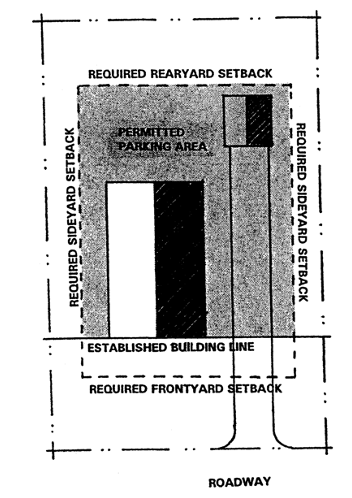 Permitted Parking Area
Such parking space shall be paved to provide not less than two offstreet parking spaces. Parking or storage of vehicles shall be restricted to paved areas. Paved driveways may be allowed in required side yards to provide access to a side-entry garage or to a detached garage located in the rear yard.
No motor vehicle shall be kept or stored in any residential zoning district, unless it shall be in operating condition and properly licensed or located inside a building. No storage of motor vehicles or recreational vehicles may be allowed within a required front yard or the established building line, whichever is more restrictive, or required side or required rear yard. - Multiple-family residential dwellings shall have two paved offstreet parking spaces for each one-bedroom dwelling unit. For each additional bedroom, one-half additional parking space shall be provided.
- For housing for the elderly, there shall be two spaces for each three dwelling units, and one for each employee. Should the dwelling units revert to general occupancy, two spaces per unit shall be provided. The location of this reserved parking area shall be shown on the site plan at the time of the original approval.
- For community buildings for multiple-family dwellings and mobile home parks, there shall be one space for each four persons allowed within the maximum occupancy load, as determined by the fire department.
- In multiple-family residential districts and mobile home parks where recreation vehicles are permitted, a secured storage area for such vehicles shall be provided and buffered from adjacent uses. No unlicensed motor vehicle of any type shall be parked within the development at any time, except within a covered building or the enclosed storage area. In the mobile home park district, no motorized recreation vehicles or boats shall be parked on individual home sites. All group offstreet parking lots shall be adequately lighted during hours of darkness with no more than one-half footcandle of illumination.
Use Required Parking Spaces 2. Institutional. a. Auditoriums (incidental to churches, schools and hospitals) One space for each three seats; plus one for each two employees. If no seats, one for each 50 square feet of floor area b. Churches or temples One space for each three seats or six feet of pew in the main worship area; plus spaces for any residential uses, as determined in accordance with the parking requirements established for residential uses. Additional spaces for ancillary facilities, such as social halls, schools, etc., may be required by the planning commission c. Convalescent homes One space for each two beds; plus one for each staff member d. Elementary schools One space per each employee, including teachers and administrators; plus one per each classroom or teaching station; plus one for each three seats in the auditorium or public assembly areas, as determined by the fire chief e. Junior high schools One space per each employee, including teachers and administrators; plus two for each classroom or teaching station; plus one for each three seats in the auditorium or public assembly areas, as determined by the fire chief f. Hospitals One space per bed, excluding bassinets; plus one space per employee and doctor on peak employment shift. Additional spaces shall be required for ancillary medical office buildings based on their individual requirements. Parking for emergency facilities shall be provided on the basis of one space per 100 square feet of floor area of the emergency room, patient treatment areas and waiting areas g. Libraries One space for every 300 square feet of gross floor area h. Museums One space for every 500 square feet of gross floor area i. Nursery schools, day nurseries or child care facilities One space for each employee; plus one space for each four students on the premises at one time. Adequate, but not fewer than five, stacking spaces shall be provided for pickup and dropoff j. Private clubs and lodges One space for each three members allowed within the maximum occupancy load, as determined by the fire department; plus one per employee k. Senior high schools and colleges One space for each employee, including teachers and administrators; plus one for each three students; plus the requirements of the auditorium, as determined by the fire chief. Additional spaces for ancillary facilities and activities may be required by the planning commission 3. Recreational. a. Bowling alleys Five spaces per lane, plus parking required for ancillary uses such as restaurants or lounges, as determined in accordance with the requirements of this section b. Dancehalls, roller rinks, amusement device centers, billiards, ice skating rinks, indoor shooting ranges, archery ranges and exhibition halls One space per three persons allowed at maximum occupancy load, as determined by the fire department c. Miniature golf One space per employee; plus 1¼ spaces per each hole; plus spaces for any ancillary uses as determined in accordance with the requirements of this section d. Swimming or tennis clubs and similar uses One space for each three member families; plus one per employee. If clubhouses are provided, one additional space shall be provided for each three persons allowed within the maximum occupancy load, as determined by the fire department e. Private parks One space for each two individual members or users f. Public recreation (other) One space for every two users at maximum capacity; plus one space for each employee g. Stadiums and sports arenas or similar places of assembly One space for each three seats or 60 inches of benches h. Racquet/tennis and exercise clubs One space for each two persons allowed within the maximum occupancy, as determined by the fire department; plus spaces required for any ancillary uses, as determined in accordance with the requirements of this section 4. Offices. a. Banks One space for each 100 square feet of floor area. Stacking lanes for drive-through tellers shall be provided, as required in section 46-612 b. Professional offices and business or administrative offices, except medical offices as indicated in subsection (4)c. of this section One space for each 200 square feet of gross floor area c. Clinics: medical, dental and veterinary One space for each employee; plus one space for each 150 square feet of gross floor area 5. Auto-related uses. a. Auto wash, hand or coin-operated Two exterior waiting spaces at entry; plus two exterior drying spaces for each bay; plus one space for each employee b. Enclosed self-service two-door time charge carwash Where all washing and drying operations are designed to take place within the building, four waiting spaces shall be provided for each bay; plus one space for each employee. A properly drained 50-foot-long drying lane shall also be provided at the exit of each washing lane or stall in order to prevent undue amounts of water from collecting on the public street and thereby creating a traffic hazard c. Auto wash, high speed commercial One space for each employee; plus 20 exterior waiting spaces at entry. A properly drained 50-foot-long drying lane shall also be provided at the exit of each washing lane or stall in order to prevent undue amounts of water from collecting on the public street and thereby creating a traffic hazard d. Auto service stations (gasoline and repair) and auto repair services, excluding heavy and major repair In addition to a service space to be provided at each pump, the following additional requirements shall apply: three spaces for each service bay; one per employee; plus one per each 200 square feet of retail floor area e. Self-service gasoline stations (gasoline and convenience retail; no repair) In addition to a service space to be provided at each pump, the following additional requirements shall apply: one space for each 200 square feet of retail floor area; plus one for each employee. A minimum of three shall be provided for each site f. Heavy and major auto repairs Three spaces for each service bay. No wrecked vehicles to be parked or stored outside (see section 46-393(1)) g. Quick oil changes Four spaces per bay; plus one per employee at the peak shift; one per 200 square feet of floor area used for retail sales h. New and used vehicle sales One space for each 300 square feet of sales area; one for each 200 square feet of office area; and three for each service bay 6. Commercial. a. Agricultural sales, greenhouses and nurseries One space per employee; plus one space for each 100 square feet of actual permanent or temporary areas devoted primarily to sales, excluding growing areas b. Banquet/catering halls One space for each two persons allowed within maximum occupancy, as determined by the fire department; plus one space per employee c. Beauty parlors/barbershops Three spaces for the first two chairs; plus 1½ spaces for each additional chair; or one space for each 75 feet of floor area, whichever is less d. Dry cleaners One space per each two employees, plus one space for each 150 square feet of floor area in the waiting area e. Funeral homes/mortuaries One space for each 50 square feet of assembly room floor space, parlors and slumber rooms f. Furniture and appliance, household equipment, repair shops; showroom of a plumber, decorator, electrician or similar trade; shoe repair; and other similar uses One space for each 500 square feet of gross floor area. For that floor area used in processing or storage, one additional space shall be provided for each two persons employed within or each 1,000 square feet, whichever is greater g. Laundromats and coin-operated dry cleaners One space for each two machines h. Motel, hotel or other commercial lodging establishments One space for each occupancy unit; plus one space for each employee; spaces required for ancillary uses, such as lounges, restaurants or conference areas, shall be determined on the basis of the individual requirements for each use as specified in this section i. Open air businesses One space for each 500 square feet of lot area used for retail sales, services and uses j. Retail stores, except as otherwise specified in this section One space for each 200 square feet of gross floor area k. Restaurants/lounges (excluding fast food or carryout establishments) One space for each 100 square feet of gross floor area or one space for each two persons allowed within maximum occupancy, whichever is greater l. Restaurants, fast food and drive-ins One space for each two employees; plus one space for each two seats intended for patrons within the restaurant building and one space for each 20 square feet of building floor area available in the order-waiting area m. Restaurants, carryout only One space per employee; plus 50 percent of the parking requirement for restaurants with permanent seating n. Specialty shops One space for each 200 square feet of gross floor area 7. Industrial. a. Industrial, wholesale or warehouse One space per 500 square feet of gross floor area b. Mini-warehouses or self-storage units Two spaces for the residential caretaker's unit; plus one space per 50 square feet of floor area used for office purposes - The offstreet parking facilities required for one- and two-family dwellings shall be located on the same lot or plot of ground and shall consist of a paved parking space of at least nine feet by 20 feet, parking apron, two paved strips for wheels separated by grass, carport and/or garage. In lieu of asphalt or concrete pavement, brick pavers or similar dustfree durable surface may be permitted. Driveway approaches from the public roadway must be paved.
(Ord. No. 482, § 7.02, 7-17-2000; Ord. No. 575, § 46-613, 4-20-2026)
Sec 46-614 Offstreet Parking Space Layout Standards, Construction And Maintenance
Offstreet parking lots shall be laid out, constructed and maintained in accordance with the following standards and regulations:
- No parking lot shall be constructed, enlarged or altered, unless and until a permit therefor is issued by the building department. Applications for a permit shall be submitted as per the requirements of site plan review in article VI of this chapter.
- Plans for the layout of an offstreet parking lot shall have dimensions consistent with the following standards:
- Ninety-degree pattern: Parking spaces and maneuvering lanes shall be provided based on one of the following alternatives:
Space Width (feet) Space Length (feet) Maneuvering Width (feet) Two Tiers of Parking & One Maneuvering Lane (feet) 9.0 20 22 62 9.5 20 20 60 - Sixty-degree pattern: 58 feet for two tiers of spaces, and one aisle/maneuvering lane, with the minimum aisle width being 20 feet.
- Forty-five degree pattern: 56 feet with two tiers of parking spaces, plus one aisle/maneuvering lane of at least 20 feet in width.
- All other drives or maneuvering lanes not indicated in subsections (2)a. through (2)c. of this section shall have a minimum width of 20 feet.
- Parking spaces to accommodate vehicles with trailers (boats and recreational vehicles) shall be at least 12 feet by 40 feet.
- All parking lot stalls shall be striped and maintained.
- Ninety-degree pattern: Parking spaces and maneuvering lanes shall be provided based on one of the following alternatives:
- Handicapped spaces shall be furnished as required by state law.
- Except in the central business district, parallel parking shall be prohibited.
- All parking spaces shall be provided with adequate access by means of paved maneuvering lanes or driveways. Spaces shall not be designed to permit backing directly onto a street, except in single- or two-family residential zoning districts.
- The entire parking area, including parking spaces, maneuvering lanes and drives required under this section, shall be paved with asphaltic or concrete surfacing in accordance with specifications of the village engineer, unless a cash deposit or irrevocable letter of credit acceptable to the village in an amount equal to 110 percent of the estimated cost of the improvement is given. Any improvements for which a letter of credit or cash deposit has been posted shall be installed by the end of the construction season following the posting.
- Offstreet parking areas shall be drained to dispose of all surface water accumulated in the parking area in such a way as to prevent drainage of water onto adjacent property or toward buildings, and drainage plans shall meet the specifications of the village engineer.
- In any area where front-end parking abuts a raised sidewalk or curbed landscaped area at least seven feet in width, the minimum parking stall depth of 20 feet, as otherwise specified in this section, may be decreased by up to two feet in depth in order to allow for a vehicle to overhang such landscaped area or such sidewalk. In no case shall the parking stall depth be decreased to allow a vehicle to overhang a required parking setback or property line. The parking lot shall be curbed to prevent vehicles from encroaching into a setback or property line.
- Ingress and egress to a parking lot for nonresidential purposes shall not be provided across land zoned for one-family or two-family residential purposes, except as provided in section 46-432. All such entrances and exits shall also be located at least 25 feet from any property zoned for one-family residential use.
- Parking lot lighting shall meet the requirements of section 46-575.
- The surface of the parking lot area shall be maintained and kept free from weeds, rubbish, refuse and debris.
- All parking serving other than one or two-family dwellings shall be side by side. Tandem parking shall be prohibited, except in church parking lots or where a multiple-family unit has its own separate two-car garage, their separate approach apron can be used for visitor parking. Tandem parking to a depth of three cars may be permitted in vehicle storage and inventory areas, provided such areas are under the control of employees and are not accessible by the general public.
- Except as otherwise provided in this article, required offstreet parking space shall be for the use of occupants, employees, visitors, customers, clients and patrons. Offstreet parking shall not be used for other than parking purposes or allowed to become unusable. The storage of vehicles or merchandise in any offstreet parking space is prohibited, except as permitted in conjunction with the principal or accessory use.
- The planning commission may require an access easement to provide for vehicular access to existing or contemplated adjacent parking lots to minimize the need for driveways to each facility and thereby decreasing hazards to vehicular traffic. In such instances, a reciprocal use agreement shall be signed by each owner in a form satisfactory to the village attorney and shall be recorded with the county register of deeds.
- Adequate ingress and egress to the parking lot by means of clearly limited and defined paved drives shall be provided for all vehicles. All parking areas shall be provided with an entrance and exit from the abutting public thoroughfare. Such entrance and exit may be combined as one. The number of driveways permitted for each site shall be determined by the planning commission as part of site plan review.
- Curbs, meeting the construction standards of the village engineer, shall be required. The use of bumper blocks is prohibited, except in such circumstances as determined by the planning commission where the site characteristics necessitate their use.
- Whenever a parking lot abuts a residentially zoned lot, a side yard setback of ten feet shall be provided between the parking lot and the adjoining residential property line. The parking lot setback from the road shall not be less than ten feet. The front and side yard setbacks between the road and the parking lot shall be landscaped.
- All parking lots abutting residential lots shall be screened as per the requirements of section 46-572.
- The use of any outdoor loud noise-producing device or public address system shall be prohibited.
(Ord. No. 482, § 7.03, 7-17-2000; Ord. No. 575, § 46-614, 4-20-2026)
Sec 46-615 Offstreet Loading And Unloading
- The number, size and location of offstreet loading and unloading area shall be provided whenever it is determined by the planning commission that the nature of the building or use is such that loading areas would be necessary.
- All loading or unloading areas shall provide a minimum height clearance of 14 feet.
- Loading and unloading areas shall be so located and designed that the vehicles intended to use them can maneuver safely and conveniently to and from a public right-of-way and complete loading and unloading operations without obstructing or interfering with any public right-of-way or any parking space or parking lot maneuvering lane or aisle, except in the CBD central business district.
- Unless otherwise specified, loading and unloading areas shall be provided only in rear or side yards. Overhead doors which may be used for the purpose of loading and unloading shall not be located on a front yard or street side elevation.
(Ord. No. 482, § 7.04, 7-17-2000; Ord. No. 575, § 46-615, 4-20-2026)
Sec 46-616 Banking Of Parking Spaces
The village recognizes that certain uses may function with less off-street parking than other uses permitted in the same zoning district. Notwithstanding the specific provisions of this chapter, banking parking spaces may be permitted at the request of an applicant if the applicant can demonstrate that the number of parking spaces required under this chapter is in excess of the actual requirements for the functional use of a building, for up to a percentage of the required number of parking spaces on the specific site, provided all the following conditions are met:
- In no case shall banking of parking spaces be permitted for a parcel requiring 20 or fewer parking spaces.
- An alternative parking site plan shall be submitted to the planning commission that conforms to this chapter, with the area where parking spaces will be banked clearly identified on the site plan, in addition to the areas where parking spaces will be initially constructed and used.
The alternative parking site plan shall show the number of parking spaces to be constructed and used, the number of parking spaces to be banked, and the layout of both parking areas. The areas designated for banking parking spaces shall be maintained as landscaped open space and may not be used for any other purpose. - The applicant shall demonstrate that all proposed parking areas to be used and banked parking areas can be developed in accordance with village, county and state standards and regulations, including, but not limited to, storm water management and wetland protection.
- Areas of land where parking construction has been banked shall be landscaped and maintained with grass or other acceptable plant materials. If that area is not disturbed during construction, it may, with the approval of the planning commission, be maintained in the natural vegetative condition that existed prior to the development, provided the natural vegetation is in keeping with the general appearance of the area.
- In addition to the above requirements, approval for banking of required parking spaces shall be granted only upon a finding by the planning commission that the proposal meets all of the following requirements:
- The applicant has demonstrated through substantial evidence that the specified occupant of the building, or the use of the building, will require less parking than the number of parking spaces required by this chapter.
- Parking shall not be permitted on any driveway,
- Parking shall not be permitted in any area not approved and developed for parking.
- Parking shall not be permitted in the area where parking space construction has been approved for banking until such time as that area is actually constructed for parking.
- The requested banking of parking spaces shall not create traffic or circulation problems on or off site.
- The requested banking of parking spaces shall be consistent with the public health, safety and welfare of the village and the purposes of this chapter.
- The owner or occupant of property for which the banking of parking spaces has been approved shall report any proposed change in the use or occupancy of the subject property to the village building official prior to said change. The building official shall evaluate the change and the site to determine if there is a need for some or all of the banked parking spaces to be constructed and installed.
- Upon determination by the building official, or his/her designee, that some or all of the banked parking spaces need to be constructed and installed, the applicant shall construct and install the number of previously banked parking spaces determined by the building official prior to any change in the use or occupancy of the property. The planning commission may permit deferral of the construction and installation of banked parking spaces for up to six months from the determination of need made by the village building official.
- In approving the banking of parking spaces, the planning commission may prescribe such conditions regarding the character, location, landscaping and other features that will, in its judgment, secure the objectives and purposes of this chapter. Violation of such conditions, when made a part of the terms under which the banking of parking spaces is approved, shall be deemed a violation of this chapter.
(Ord. No. 532, 1-19-2017; Ord. No. 575, § 46-616, 4-20-2026)
Adopted by Ord. 532 on 1/9/2017

