
Romeoville City Zoning Code
GENERAL REGULATIONS
§ 159.013 USE AND BULK.
(A) No building, structure, or land shall hereafter be used or occupied, and no building or part thereof, or other structure, shall be erected, raised, moved, reconstructed, extended, enlarged, or altered except in conformity with the regulations herein specified in the district in which it is located.
(B) All new buildings and structures shall conform to the building regulations established herein for the district in which each building shall be located, except that parapet walls, chimneys, cooling towers, elevator bulkheads, fire towers, stacks, and necessary mechanical appurtenances shall be permitted to exceed the maximum height provisions when erected in accordance with all other ordinances of the village.
(C) The maintenance of yards, courts, and other open space and minimum lot area legally required for a building shall be a continuing obligation of the owner of the buildings or of the property on which it is located, as long as the building or the property on which it is located, as long as the building is in existence. No legally required yards, courts, other open space, or minimum lot area allocated to any building shall, by virtue of change of ownership or for any other reason be used to satisfy yard, court, other open space, or minimum lot area requirements for any other building.
(D) No zoning lot improved with a building or buildings shall hereafter be divided into two or more zoning lots and no portion of any zoning lot which is improved with a building or buildings shall be sold, unless all zoning lots resulting from each division or sale and improved with a building or buildings shall not be less conforming to all bulk regulations of the zoning district in which the property is located.
(E) All location of required open spaces or yards or courts and other open space allocated to a building or dwelling group shall be located on the same zoning lot as the building or dwelling group, except as otherwise permitted in planned development and planned open spaces.
(F) No yards now or hereafter provided for a building existing on the effective date of this chapter shall subsequently be reduced below, or further reduced below if already less than, the minimum yard requirements of this chapter for equivalent new construction, except as provided in § 159.141.
(G) No landscaping or other obstructions shall, after the date of the adoption of this section, be installed or located within the sight triangle, as described in § 159.014.
(Ord. 07-0508, passed 2-21-07; Am. Ord. 08-0715, passed 11-19-08; Am. Ord. 09-0799, passed 12-16-09; Am. Ord. 15-1229, passed 11-18-15)
§ 159.014 SIGHT TRIANGLE.
(A) Intent and purpose.
(1) The following section pertains to the clear line of sight at intersections of streets and major driveways. The criteria are based on American Association of State Highway and Transportation Officials (AASHTO) and the Illinois Department of Transportation (IDOT) design procedures. This section has been adopted to provide for safe turning movements by providing clear visibility zones at intersections clear of obstructions such as trees, walls, signs, buildings, etc. This policy is not intended for determining traffic controls at intersections. The need for traffic controls is to be assessed by the rules and regulations contained in the Manual on Uniform Traffic Control Devices and as recommended by the Village Engineer.
(2) The application of intersection sight distance and stopping sight distance shall extend to all proposed and existing public street intersections and all proposed and existing intersections of private streets and drives with public streets, including multi-family and commercial entrances. This also includes local to local intersections such as those within proposed subdivisions. The village requires that both intersection and stopping sight distances shall be shown with their geometries on all final construction drawings and be analyzed during the traffic impact study process.
(B) Visual obstructions. Visual obstructions shall be defined as any object within intersection sight triangles between the heights of no more than three feet measured relative to the elevation of the nearest pavement crown. This is based on a driver eye height of three feet and an object height of three feet (AASHTO and IDOT). Overhanging branches or other elevated obstructions may not be any lower than ten feet measured relative to the elevation of the nearest pavement crown.
(C) Stop sign controlled intersections. In determining the area of the sight triangle for intersections with stop sign control, the following criteria shall be used:
(1) One-way stop control: The sight triangles for a stop controlled minor road at a T-intersection with left turns allowed shall be the same as for the two way stop control.
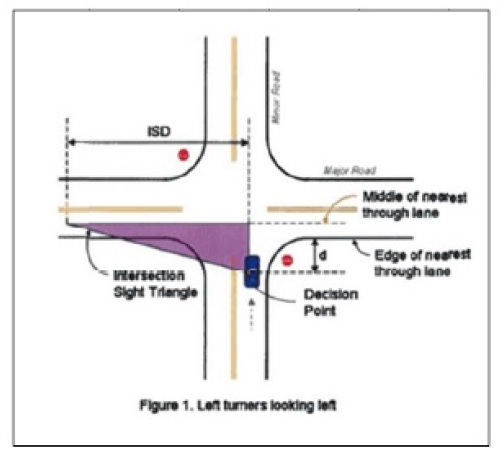
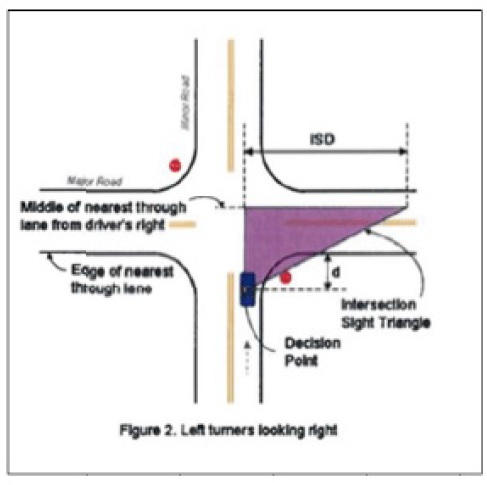
(2) Two-way stop control: The sight triangles for a stop controlled minor road with left turns allowed shall be based on Figures 1 & 2 and Tables 1 & 2. The left turning movement requires a longer intersection sight distance than the right turning movement; therefore, the criteria for the left turn conditions apply.
(a) Figure 1. Left turners looking left.
(b) Figure 2. Left turners looking right.
(c) Figure definitions and calculations.
1. ISD = Intersection Sight Distance. See table 1 and table 2.
2. d = Distance from the edge of nearest through lane to the decision point; 18 ft. preferred, 14.5 ft. minimum (AASHTO 2004). Any distance other than 18 ft. must be approved by the Village Engineer.
(d) Table 1.
Table 1. Intersection Sight Distance for Passenger Cars at Stop Controlled Intersections - Left turners looking left | ||||||||
Design Speed of Major Road (mph) | 20 | 25 | 30 | 35 | 40 | 45 | 50 | 55 |
ISD: Intersection Sight Distance (ft) Based on the equation below | 225 | 280 | 335 | 390 | 445 | 500 | 555 | 610 |
(e) Table 2.
Table 2. Intersection Sight Distance for Passenger Cars at Stop Controlled Intersections - Left turners looking right | ||||||||
Design Speed of Major Road (mph) | 20 | 25 | 30 | 35 | 40 | 45 | 50 | 55 |
ISD: Intersection Sight Distance (ft) Based on the equation below | 225 | 280 | 335 | 390 | 445 | 500 | 555 | 610 |
(f) Table definitions and calculations. Based on AASHTO - Geometric Design of Highways and Streets (2004) and IDOT BLR Sections 28 & 36.
1. Intersection Sight Distance (ISD) = Design speed (mph) x 1.47 x time gap (sec)
2. Intersection Sight Distance (ISD) - length of the leg of the sight triangle along the major roadway (ft)
3. Design speed of the major roadway (typically 5 mph over the posted speed limit)
4. 1.47 - conversion from mph to fps
5. Time gap is (7.5 sec - passenger car; 9.5 sec - single-unit truck; 11.5 sec - tractor/semitrailer) for a turning vehicle to enter a 2-lane major road without a median from a minor road with 3% or less grade. If the major road is multi-lane or has a median, add 0.5 sec per additional 12 feet crossed to turn left. If the minor road grade is >3%, add 0.2 sec per percent grade above.
(3) Right out only, stop control: The sight triangle for a stop controlled intersection with only right turns allowed from the minor road shall be based on Figure 3 and Table 3.
(a) Figure 3. Right turners looking left.
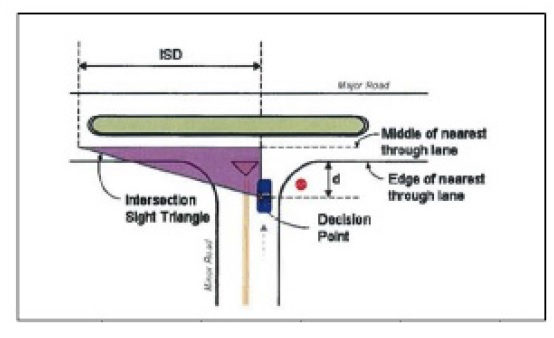
(b) Figure definitions and calculations.
1. d = Distance from the edge of nearest through lane to the decision point; 18 ft. preferred, 14.5 ft. minimum (AASHTO 2004). Use 15 ft. unless otherwise approved by the Village Engineer.
(c) Table 3.
Table 3. Intersection Sight Distance for Passenger Cars at Right Out Only - Right turners looking left | ||||||||
Design Speed of Major Road (mph) | 20 | 25 | 30 | 35 | 40 | 45 | 50 | 55 |
ISD: Intersection Sight Distance (ft) Based on the equation below | 195 | 240 | 290 | 335 | 385 | 430 | 480 | 530 |
(d) Table definitions and calculations. Based on AASHTO - Geometric Design of Highways and Streets (2004) and IDOT BLR Sections 28 & 36.
1. Intersection Sight Distance (ISD) = Design speed (mph) x 1.47 x time gap (sec)
2. Intersection Sight Distance (ISD) - length of the leg of the sight triangle along the major roadway (ft)
3. Design speed of the major roadway (typically 5 mph over the posted speed limit)
4. 1.47 - conversion from mph to fps
5. Time gap is (6.5 sec - passenger car; 8.5 sec - single-unit truck; 10.5 sec - tractor/semitrailer) for a turning vehicle to turn right from a minor road with 3% or less grade. If the minor road grade is >3%, add 0.2 sec per percent grade above 3.
(4) All-way stop control: The first stopped vehicle on one approach should be visible to the drivers of the first stopped vehicles on each of the other approaches.
(D) Traffic signal controlled intersections. The sight triangles for a traffic signal controlled intersection shall be described by the following conditions at each approach;
(1) Signals with off peak or night time flash operations shall follow the criteria for two way stop sign control on the red flashing approaches (Figures 1 & 2 and Tables 1 & 2).
(2) Signal approaches with right turns on red allowed that are not defined by IIA, shall follow the criteria for right out only, stop control (Figure 3 and Table 3.)
(3) Signal approaches not described by the conditions in either IIA or IIB shall use an intersection sight distance based on all-way stop control (ID).
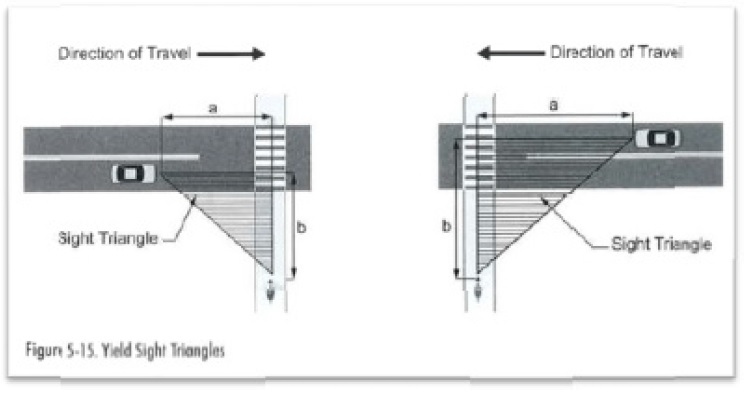
(E) Yield controlled intersections. The sight triangles for a yield controlled intersection shall be described by the following conditions at each approach. Please note this information is referenced from the Guide for the Development of Bicycle Facilities, AASHTO, 4th Edition, 2012.
(1) Intersections that are not controlled by stop signs or signals are to be considered as yield-controlled intersections.
(2) For yield-controlled intersections between multi-use paths and roadways use the following figures/tables to calculate the appropriate sight triangles. Approach sight triangles depend on the design speeds of both the path and the roadway. If yield control is to be used for either approach, it is desirable that available sight distance be adequate for a traveler on the yield-controlled approach to slow, stop, and to avoid a traveler on the other approach. The roadway leg of the sight triangle is based on bicyclists' ability to reach and cross the roadway if they do not see a potentially conflicting vehicle approaching the roadway, and have just passed the point where they can execute a stop without entering the intersection. Figure 5-15, Table 5-7 (For Roadway Leg), and Table 5-8 (For Path Leg) shall be used for this condition.
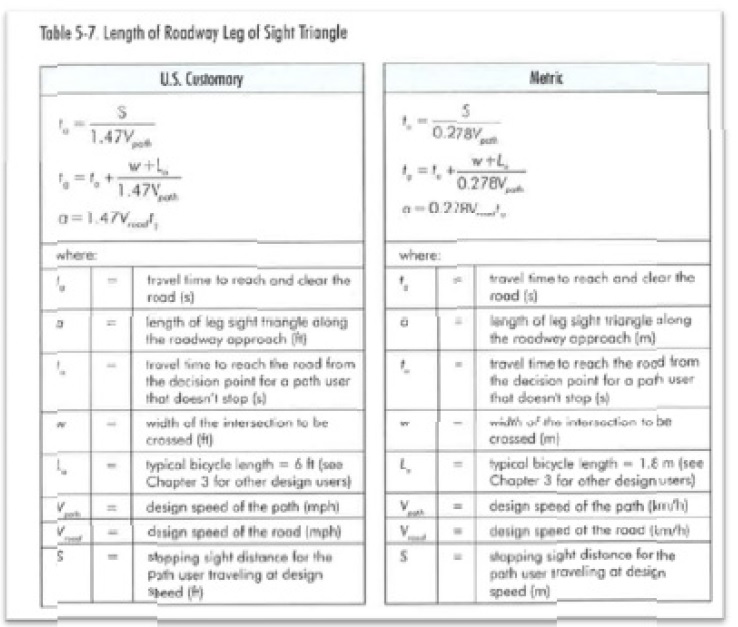
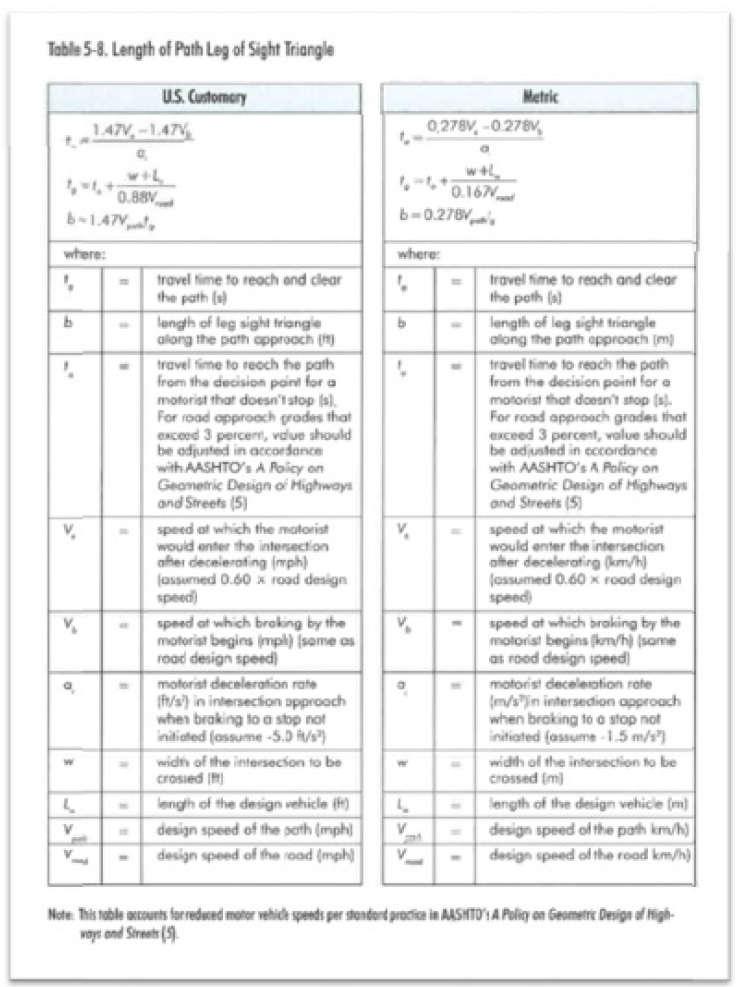
(3 ) For an uncontrolled intersection of a shared use path with a walkway (i.e, under yield control), a clear sight triangle extending at least 15 feet along the walkway should be provided (see Figure 5-16).
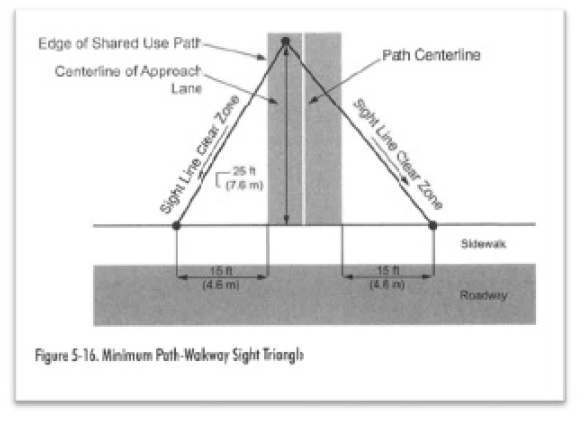
(4) If a shared use path intersects with another shared use path, sight triangles should be provided similar to a yield condition at a path-roadway intersection. However, both legs of the sight triangle should be based on the stopping sight distance of the paths. Use the equation in Table 5-7 for both legs of the sight triangle.
(Ord. 15-1229, passed 11-18-15)
§ 159.015 LOT COVERAGE.
STRUCTURE OR USE | FRONT YARD | CORNER SIDE YARD | REAR YARD | SIDE YARD
| STRUCTURE OR USE | FRONT YARD | CORNER SIDE YARD | REAR YARD | SIDE YARD
|
STRUCTURE OR USE | FRONT YARD | CORNER SIDE YARD | REAR YARD | SIDE YARD
| STRUCTURE OR USE | FRONT YARD | CORNER SIDE YARD | REAR YARD | SIDE YARD
| |
Air conditioner condenser unit, window units | P | P | P | P | Gazebos, and pergolas | P | ||||
Animal houses, for domestic animals, not to exceed 16 square feet in area and 4 feet in height | P | Greenhouse, private in accordance with § 159.020
| P | |||||||
Antenna, freestanding, for non-commercial purposes | P | Lamp posts | P | P | P | P | ||||
Arbors, trellises | P | P | P | P | Landscaping | P | P | P | P | |
Architectural ornamentation, e.g. sills, belt courses, cornices | P | P | P | P | Laundry drying (clotheslines) | P | ||||
Awnings and canopies, projecting no more than 48 inches from the structure | P | P | P | P | Lawn and garden ornaments, sculpture and statuary less than 3 feet in height, and garden furniture | P | P | P | P | |
Basketball backboards, located no less than 6 feet from any public sidewalk and 5 feet from any lot line | P | P | P | P | Outdoor storage of firewood | P | P | |||
Balconies, projecting no more than 60 inches from the structure but not less than 5 feet from any property line | P | P | P | P | P | |||||
Barbeque grills, in-ground | P | Parking or storing of trucks in accordance with § 159.010 & 159.105 - 159.116
| P | P | ||||||
Bay windows, having no foundation and projecting no more than 36 inches from the structure | P | P | P | P |
P | P | P | P | ||
Cabanas | P | Patio, open to the sky | P* | P | ||||||
Carport, permanent structure attached to the principal structure | Patio, permanently roofed-over | P | ||||||||
Children's playhouse, not to exceed 40 square feet in area | P | Porches, projecting no more than 8 feet from the structure and not less than 5 feet from any property line | P | P | P | P | ||||
Chimneys, having no foundation and projecting no more than 30 inches from the structure | P | P | P | P | Portico-chere, projecting no more than 14 feet from the structure | P | P | P | P | |
Decks, open to the sky and less than 36 inches above the ground as measured under the deck | P* | P | Public telephones, menu boards, and ATMs, except covered or enclosed, on a commercial or industrial lot and located not less than 10 feet from any property line | P | P | P | P | |||
Decks, open to the sky and 36 inches or taller as measured under the deck | P | Rain barrels or rain garden
| P
|
P
| ||||||
Decks, permanently roofed-over | P | Recreational equipment, e.g. childrens' swing set | P | |||||||
Decks, level with main floor of home, 36 inches or taller projecting no more than 12 feet from the structure. | P* | Satellite antennas, freestanding in accordance with § 159.020
| P | P | P | |||||
Dog runs, open to the sky and not to exceed 32 square feet in area | P | Signs and nameplates, in accordance with Part IV | P | P | P | P | ||||
Driveways and walkways | P | P | P | P | Solar energy devices, attached | P | P | P | P | |
Eaves and gutters, projecting no more than 36 inches from the structure | P | P | P | P | Solar energy devices, detached | P | ||||
Fall-out, storm shelters, attached or detached, above or below grade | P | Steps, at, above or below the first floor level | P | P | P | P | ||||
Fences and walls, more than three feet in height | P | P | P | |||||||
Fences and walls, 3 feet or less in height | P | P | P | P | Swimming pools, hot tubs, Jaccuzi and outdoor spas in accordance with § 159.020
| P | ||||
Fire escapes, open to the elements and projecting no more than five feet from the structure | P | P | P | P | Tennis, basketball courts | P | ||||
Fireplace, outdoor | P | Terraces, not more than 4 feet above level of adjoining ground | P | P | P | P | ||||
Flag poles, the height of which shall not exceed the distance from any lot line | P | P | P | P | Tool, garden shed or similar buildings or structures for domestic storage purposes in accordance with § 159.020
| P | ||||
P | Trash receptacles and enclosures | P | P | |||||||
Garden ponds, fountains, statuary and sculpture greater than 3 feet in height, artificial landscaping | P | Utility meters, distribution boxes, pedestals and other above ground appurtenances | P | P | P | P | ||||
Where 'P' indicates accessory structure or use is a permitted yard obstruction in the indicated yard as defined in this § 159.015
. | ||||||||||
Where '*' indicates that decks and concrete patios that are attached to the primary structure are allowed to encroach into the rear building setback. | ||||||||||
Accessory structures and uses not listed in this Table shall be considered as prohibited yard obstructions. Accessory structures and uses listed in this Table shall conform to the bulk regulations in § 159.020
unless otherwise specified in this Table. | ||||||||||
(Ord. 07-0508, passed 2-21-07; Am. Ord. 09-0800, passed 12-16-09; Am. Ord. 22-1794, passed 9-21-22)
§ 159.016 LOT AREA AND DIMENSIONS.
(A) When two or more parcels of land, each of which lacks adequate area and dimension to qualify for a permitted use under the requirements of the use district in which they are located, are contiguous and are held in one ownership, they shall be used as one zoning lot for the use.
(B) Any single lot or parcel of land held in one ownership which was of record at the time of adoption of this chapter, that does not meet the requirements for minimum lot width and area, may be utilized for a permitted use, provided that yards, courts, or usable open spaces are not less than 75% of the minimum required dimensions or area, except as provided in § 159.147, "Exemptions" of this chapter.
(Ord. 07-0508, passed 2-21-07; Am. Ord. 22-1794, passed 9-21-22)
§ 159.017 STREET ACCESS.
(A) Except as otherwise provided for in this chapter, every residential building shall be constructed or erected upon a lot, or parcel of land which abuts upon a street unless a permanent easement of access to a street was of record prior to the adoption of this chapter.
(1) All residential property shall have only one point of ingress/egress to and from the property into the public right-of-way. In the situation of a corner lot having an existing driveway, upon the establishment of another driveway with the approval and acceptance by the Building Inspector the property owner shall remove the original driveway access to the opposite street and replace with seed or sod.
(2) Exception, shall be where the lot width exceeds 100 feet across the frontage of the property where the owner may provide a horseshoe type of driveway.
(Ord. 07-0508, passed 2-21-07; Am. Ord. 22-1794, passed 9-21-22)
§ 159.018 NUMBER OF BUILDINGS PER LOT.
Except in the case of a planned development, not more than one principal detached building shall be located on a zoning lot, nor shall a principal detached building be located on the same zoning lot with any other principal building.
(Ord. 07-0508, passed 2-21-07; Am. Ord. 22-1794, passed 9-21-22)
§ 159.019 PARKING OF VEHICLES.
(A) Residential districts. The parking of vehicles in all residential districts shall comply with the following regulations:
(1) No vehicle shall be parked between the street and the front lot line, nor in any area other than upon an approved parking area. The parking of vehicles shall be limited to vehicles of the first division (as defined in the State Motor Vehicles Code); vehicles of the second division having a gross vehicle weight, including vehicle and attached equipment and maximum load, of 8,000 pounds or less; and, vehicles registered as recreational vehicles of 10,000 pounds or less.
(2) No inoperative or partially dismantled vehicle shall be permitted on any residential property, unless it is within an enclosed garage.
(3) No vehicle used for transporting flammable liquids, explosives, toxic or noxious materials shall be parked or stored in any residential district.
(4) Nothing in the provisions of this section shall be construed to prohibit trucks or other service vehicles from being parked temporarily for purposes of making deliveries or rendering service to the property owner.
(1) The parking regulations for residential uses within a business district are the same as those in the residential district.
(2) The outside parking or storage of any abandoned, damaged, inoperable, dismantled, or unregistered vehicle shall be prohibited in any business district except upon those properties for which that use has been established by this chapter.
(3) No vehicle used for transporting flammable liquids, explosives, toxic or noxious materials shall be parked or stored in any residential district.
(4) Nothing in the provisions of this section shall be construed to prohibit trucks or other service vehicles from being parked temporarily for purposes of making deliveries or rendering service to the property owner.
(1) Trailers of any type, herein defined, shall not be permanently affixed to the ground as a principal or accessory structure on a lot in any district.
(2) Travel, camping trailers or recreational vehicles of any type (not inclusive of boats, see below) shall not be parked or stored on any lot other than in a lawfully-established travel camp or trailer sales or manufacturing establishment; except that in a residential district, one travel trailer, camping trailer or recreational vehicle may be stored on a lot containing a dwelling unit, provided further that no major repair, disassembly, or rebuilding operations are conducted thereon; not more than one travel, camping trailer or recreational vehicle may be parked or stored in the open lot in a residential district, provided that it shall not be located within a required front or side yard setback for that district. In the event the trailer cannot be located within the rear yard area, it may be located within the required front or side yard, but the travel, camping trailer or recreational trailer when stored in the front, side or rear of the property, shall be located upon a properly maintained hard surface capable of supporting the weight of the vehicle, as approved by the Zoning Administrator and/or Code Enforcement Officer.
(3) Parking and use of trailers for temporary offices or storage uses shall be permitted provided that a permit has been issued by the Zoning Administrator, and when such use is incidental to and only for the period of time for the construction of the principal building. The trailer(s) must be located on the same or contiguous lot as the building being constructed.
(4) Boats may be parked or stored in the open when in the operation of a lawfully established principal use, and one boat may be stored or parked on a lot containing a dwelling unit, provided the boat shall not be parked or stored within a required front or side yard setback for the district, and provided further that no major repair, disassembly, or rebuilding operations are conducted thereon. In the event the boat cannot be located within a rear yard area, it may be located within the required front or side yard, but the boat when stored in the front, side or rear of the property, shall be located upon a properly maintained hard surface capable of supporting the weight of the vehicle, as approved by the Zoning Administrator and/or Code Enforcement Officer.
(5) Trailers, boats, and recreational vehicles shall not be converted and used for the storage of any household items.
(6) Amortization of all existing trailers, camping trailers, boats and recreational vehicles in violation of the regulations herein and shall be brought into conformance with all applicable regulations of this chapter within six months after notification of any violation.
(D) Temporary portable storage units. The use of temporary portable storage units, as defined in § 159.003, is allowed for periods less than 72 hours in conjunction with a move or a remodel, and shall comply with the following regulations:
(1) Temporary portable storage units shall not be placed on village owned property or public right-of-way.
(2) Temporary portable storage units shall be placed only on hard surfaces, such as asphalt or concrete.
(3) Temporary portable storage units shall not obstruct vision or be placed with the sight triangle, as defined in § 159.003.
(4) No more than one temporary portable storage unit may be placed on any residentially zoned property at any one time.
(5) Temporary portable storage units may be placed on a specific lot on not more than three occasions in any 6-month period.
(Ord. 07-0508, passed 2-21-07; Am. Ord. 22-1794, passed 9-21-22)
§ 159.020 ACCESSORY STRUCTURES OR USE.
No accessory structure or use, as defined herein shall hereafter be built, moved or remodeled, established, altered or enlarged unless such accessory structure or use is permitted by the ordinance. Accessory uses are permitted in any zoning district in connection with any principal use which is permitted within such district.
(A) Accessory use limitations and conditions. Each accessory structure and use shall comply with the applicable use limitations in the zoning district in which it is located and, in addition:
(1) Where an accessory structure is attached to the principal building, it shall be subject to and must conform to all regulations of this ordinance and other applicable ordinances of the village, i.e. Fire Prevention Code (Chapter 91), Building Code (Chapter 150).
(2) No accessory structure or use shall be constructed, occupied or established on any lot prior to the completion of the principal structure to which it is accessory.
(3) No accessory structure or use shall be permitted in any yard unless it is a permitted yard obstruction as provided in § 159.015.
(4) Outdoor storage, where permitted, shall be maintained in such a manner so as to prevent the over-growth of weeds, grasses and other obnoxious plant material, and the harboring of rodents and other animal and insect pests.
(5) Buildings and structures essential, incidental or customary to the pursuit of agriculture are exempt from the requirements of this section.
(6) On a corner lot occupied by a principal residential structure that is legally nonconforming with respect to the corner side yard set-backs, accessory uses and structures may be located in said corner side yard provided they maintain the same setback as the principal residential structure.
(7) The square foot area of all accessory buildings and structures, above grade level, shall be counted as part of the percentage of the total lot coverage as permitted in each zoning district. This shall include, but is not limited to, decks, sheds, detached garages, and swimming pools as defined in this section.
(8) Use restrictions. Except as permitted herein, accessory buildings or structures shall not be used for the keeping of livestock, poultry, or rabbits, whether or not for pecuniary gain unless the buildings and structures are located 50 feet from side and rear lot lines, and there shall be not more than one livestock for each 20,000 square feet of lot area with a minimum lot area of one acre.
(B) Permitted yard obstructions.
(1) No accessory structures and uses, except those which are permitted as obstructions in yards as indicated in § 159.015, Table of Permitted Yard Obstructions, shall be established, constructed or altered in, or moved to any yard. For the purpose of this section:
(a) Front yard shall refer to the open space on a lot between the front lot line and all of the vertical planes forming the front elevation of the principal structure;
(b) Rear yard shall refer to the open space on a lot between the rear lot line and all of the vertical planes forming the rear elevation of the principal structure, but excluding any corner side yard;
(c) Side yard shall refer to the open space on a lot between the side lot line and the vertical plane(s) forming the side elevation of the principal structure closest to the side lot line, but excluding any rear or front yard; and,
(d) Corner side yard shall refer to the open space on a lot between the corner side lot line and the vertical plane forming the side wall(s) of the principal structure closest to the corner side lot line, but excluding any rear or front yards.
(C) Location and height. All accessory structures and uses, permitted as obstructions in yards, as indicated in § 159.015, Table of Permitted Yard Obstructions, shall comply with the following requirements, unless provided otherwise in this ordinance:
(1) No accessory structure or use except fences shall be constructed, occupied or established on any public utility, drainage, or pipeline easement, except with the written permission of all utility companies and the village having rights to use the easement.
(2) No detached accessory structure, building or use, except fences and hedges, patios, walkways, driveways, hot tubs, or pergolas hereafter erected or altered shall be located less than ten feet from the principal building on the lot, or less than five feet from any other accessory structure on the lot.
(3) All accessory structures, buildings and uses, except fences, hedges, driveways, and walkways hereafter erected or altered shall be set back a minimum of five feet from the side lot line, ten feet from the rear lot line, and shall not be located in the required front or corner side yard setbacks, except as permitted in § 159.015. Except, in the area zoned R-5A an accessory structure may have a seven foot setback from the rear lot line.
(4) Detached accessory buildings or structures in residential districts shall not exceed one story in height. The total height of accessory buildings or structures shall not exceed 15 feet from the accessory structure pad to the ridge of the accessory structure, nor shall the height between the ground floor pad to the top of the finished wall exceed nine feet in height. Garage door height shall not exceed eight feet in height as measured form the floor pad of the garage.
(D) Time of construction. No accessory building, structure and/or use shall be constructed on any lot prior to the start of construction of the principal building to which it is an accessory.
(E) Use restrictions. Except as herein permitted for a specific permitted use, accessory buildings or structures shall not be used for the keeping of livestock, poultry, or rabbits, whether or not for profit unless the buildings or structures are located 50 feet from side or rear lot lines, and there shall be not more than one livestock for each 20,000 square feet of lot area with a minimum lot area of one acre.
(F) Types of buildings, structures and/or uses.
(1) Tents. Tents are temporary structures and shall not be erected, used, or maintained on any lot, except as provided herein.
(a) Temporary use of tents in residential districts is permitted for domestic recreational purposes subject to the following conditions:
1. That the tent is located on the same zoning lot as the principal structure.
2. That the tent shall comply with the yard and setback requirements of the district in which it is located.
3. That the tent shall be up for no more than 15 consecutive days and no more than three occurrences in a calendar year.
4. Tents in residential districts shall not be used for outdoor storage.
(b) Temporary use of tents in commercial and industrial districts is permitted subject to the following conditions:
1. That the tent is incidental to the business(es) located on the lot.
2. That the tent is used in conjunction with a special event or promotion by the business(es) on the lot.
3. That the tent is used adjacent an entrance of said business(es).
4. That the use of a tent occurs for a period not to exceed three consecutive days.
5. That not more than two such events shall be permitted on a lot during a calendar year.
6. That a personal property sales permit for a tent sale shall be obtained prior to erecting a tent.
(c) Temporary use of tents for religious, amusement or recreation purposes is permitted provided tents used for such purposes shall not:
1. Be used for a period to exceed one week.
2. Occur on a lot that will pose a safety hazard to pedestrians and motorists or interfere with the use and privacy of adjacent property.
3. Be located in any residential district, except on park, church, or school property, and shall comply with the yard requirements of the district in which it is located.
(2) Contractor's equipment. Contractor's equipment, supplies, or tools shall not be stored on any lot, unless the equipment, supplies, or tools are wholly enclosed within a building or vehicle. The use of storage containers to store contractor equipment shall be permitted solely on a lot with a valid building permit on which construction is taking place.
(3) Satellite television antenna, satellite dish, television, citizen band and amateur radio antenna's.
(a) In residential districts, no antenna or satellite dish shall be located in any front yard.
(b) In business, office, or manufacturing districts, no antenna or satellite dish shall be located in any front yard, and in all cases must be located in conformance with the setback requirements for accessory structures of the applicable zoning district.
(c) All parts of an antenna or dish shall be located at least five feet from any side or rear lot line in residential districts, and at least ten feet from any side or rear lot line in business, office, or manufacturing districts.
(d) In residential districts, satellite antenna or dishes shall not be located more than 15 feet above grade, and shall not exceed eight feet in overall diameter. In all business districts, satellite antennas or dishes shall not exceed 15 feet in overall diameter.
1. New technology has added satellite dishes/antennas that are 18 inches or less in size and are permissible within the side and rear yard setbacks, but not beyond the front edge of the principal building or structure.
2. If the satellite dish/ antenna is less than 24 inches in diameter a permit for installation is not required, if it is greater than this size a building permit must be obtained from the village as described herein.
3. The small dish may be secured to the roof in accordance with the manufacturer specifications and local building code, provided, that the overall height of the dish/antenna does not extend beyond the maximum height of the roof peak causing the dish/antenna to be visible from the public street.
(4) Residential driveways and curb cuts. All driveways in residentially zoned districts shall comply with the following:
(a) Driveways shall be concrete or asphalt and shall conform with the building requirements in Chapter 150.
(b) The maximum width of the curb cut in residential district shall be 25 feet.
(c) The minimum width of a driveway shall be nine feet.
(d) Shared driveways between two properties are permitted in the R-5A zoning district with the prior recording of a cross access easement against both properties.
(5) Private/public swimming pools. As used in this section, "swimming pool" means an outdoor artificial basin for holding water that is constructed, modified, improved, or installed in or above the ground of private residential property for the purpose of swimming or wading and that is capable of having a depth of 24 inches or more covering more than 25 square feet or that has a capacity of more than 200 gallons of water.
(a) No swimming pool, as defined herein, shall be permitted on a lot unless the pool has a protective fence with a locking ladder attached to it, or the yard in which the pool is located is completely enclosed by a fence not less than four feet in height.
(b) No swimming pool shall be located less than ten feet from any overhead utility line or less than five feet from any buried electric, telephone or cable television line.
(c) All swimming pools shall be equipped to be completely emptied of water, and the discharge shall be disposed of in such a manner that will not create a public nuisance in the street or on adjoining property.
(6) Sheds. All permanent structure sheds shall comply with the following:
(a) The maximum size of a permanent structure shed is 180 square feet.
(b) Permanent structure sheds must be affixed to a concrete slab, designed per the building regulations in Chapter 150.
(c) A maximum of one permanent structure shed is allowed per individual zoning lot.
(d) A resin/plastic shed, that is 64 square feet or less, shall not be considered a permanent structure shed under this section. Such a shed must only meet the side and rear accessory structure setback and not be located in an easement.
(7) Yard lamps. Outdoor yard lamps, gas or electric, are permissible provided that the following is adhered to:
(a) Lamp must be located a minimum of six feet from the back side of the public side walk.
(b) Have a low intensity luminaire as to not interfere or cast light onto adjacent properties or into the street.
(c) The yard lamp must be placed within a concrete foundation, with a bulb height not in excess of six feet.
(8) Wooden decks and patios.
(a) Wooden decks shall be installed in accordance with all applicable building codes and standard specifications of the village per Chapter 150.
1. All wooden decks shall be placed on concrete footings;
2. All wooden decks shall be approved by the Zoning Administrator for lot coverage;
3. All wooden decks not exceeding 100 square feet in size in R-5 and R-6 zoning districts will be allowed to exceed the maximum impervious lot coverage of 50% provided that no other accessory structure is currently located or being proposed to be located in the rear yard of a lot and provided that the total lot coverage after the proposed deck is no more than 65%. The deck shall be constructed on gravel four inches thick. No deck shall be permitted within a required yard setback or any easement of any kind.
(b) Concrete patios and walkways shall be installed in accordance with all applicable building codes and standard specifications of the village per Chapter 150.
1. All concrete walkways shall be a maximum of five feet wide. Any concrete structure wider than five shall be considered a patio;
2. All concrete patios and walkways are included in the overall lot coverage calculations of the property and shall be approved by the Zoning Administrator;
3. No concrete walkway or patio shall inhibit or alter drainage (i.e. flow of storm water or surface water) through drainage ditches or over public utility and/or drainage easements. The village has the right to review any and all installations to evaluate any impact to drainage.
(c) Brick patios and walkways shall be installed in accordance with all applicable building codes and standard specifications of the village.
1. All brick patios and walkways are included in the overall lot coverage of the property and shall be approved by the Zoning Administrator.
2. Decorative patio stone or block under 100 square feet in area does not require a permit. Patio stone or blocks are included in the overall lot coverage.
(9) Garage, private. A single garage structure, housing all permitted vehicle stalls may be built into the principal building, attached to the principal building, or provided for in a detached garage as a freestanding permanent accessory structure, but the permitted vehicle stalls shall not be split between any of the above. The maximum permitted number of vehicle stalls shall not exceed three vehicle stalls. The minimum vehicle stall size, inside of a garage shall not be less than ten feet in width and 20 feet in length, nor shall the stall size exceed 12 feet in width or 24 feet in length, of clear space inside of supporting walls or partitions. The minimum clear ceiling height shall be a minimum of seven feet. Additional storage areas may be included within a garage provided the storage area does not exceed five feet in width and 120 square feet in area. Height of all motor vehicle garage doors shall not exceed eight feet in height from the garage pad. The use of temporary structures as a garage or carport is strictly prohibited.
(a) The number of garage stalls will only be allowed if the following criteria are met:
1. 4,000 to 7,500 square feet of lot area may have up to two stalls.
2. 7,501 and greater square feet of lot area may have up to three stalls.
(b) All garages must have a driveway connecting the garage to the street. The driveway must be asphalt or concrete and a minimum of nine feet wide in accordance with this section and with all applicable building codes and standard specifications of the village per Chapter 150.
(c) Attached garage conversions. For any lot within the R-5A zoning district, conversion of an existing attached garage into living area is permitted with the following conditions:
1. If a detached garage is being proposed on a lot with an existing attached garage, the attached garage must be converted to living space so that there is only one garage remaining on the property. Permits for both the detached garage and attached garage conversion can be issued simultaneously.
2. If a detached garage is being proposed on a lot with an existing attached garage and requires a new driveway, the existing driveway shall also be removed so that there is only one driveway remaining on the property.
3. Conversion of attached garages to living space in any zoning district other than R-5A is strictly prohibited.
(d) Carports. Carports are permanent structures with a roof and two or more sides open, attached to the principal structure. After January 1, 2023, no new carport structures shall be permitted.
(Ord. 07-0508, passed 2-21-07; Am. Ord. 07-0550, passed 7-18-07; Am. Ord. 07-0551, passed 7-18-07; Am. Ord. 07-0552, passed 7-18-07; Am. Ord. 07-0553, passed 7-18-07; Am. Ord. 16-1306, passed 9-7-16; Am. Ord. 17-1348, passed 2-1-17; Am. Ord. 22-1794, passed 9-21-22)
§ 159.021 PERSONAL COMMUNICATION FACILITY.
(A) Special use permit required. No person shall establish, construct, maintain, or operate a personal communication facility without first obtaining a special use permit authorized and issue by the Village Board in accordance with the standards and procedures set forth in this chapter.
(B) Purpose. The purpose of this section is to establish a comprehensive set of regulations pertaining to the location, siting, development, design and permitting of personal communication facilities for all districts in the village in order to:
(1) Facilitate the development of wireless communications infrastructure in the village for commercial, public and emergency uses;
(2) Encourage the collocation of personal communication facilities;
(3) Encourage users of personal communication facilities to configure them in a manner which minimizes the adverse visual impact of such facilities;
(4) Enhance the ability of the providers of wireless communications services to provide such services to the community quickly, efficiently, and effectively;
(5) Establish the rules and procedures for approving zoning applications for personal communications facilities; and,
(6) Minimize the total number of personal communications facilities in the village.
(C) Scope. The provisions of this section shall apply to all personal communications facilities, whether such facilities are used as a principal use or as an accessory use unless otherwise exempted from these regulations.
(1) Pre-existing towers or antennas. Towers and antennas existing on the date this section is adopted shall not be required to meet the requirements of this section other than the requirements of divisions (F)(8) and (G) of this section.
(2) AM array. For purposes of implementing this section, an AM array, consisting of one or more towers united and supporting a ground system which functions as one AM broadcasting antenna, shall be considered one tower. Measurements for setbacks and separation distances shall be measured from the outer perimeter of the towers including the AM array. Additional towers may be added within the perimeter of the AM array by right.
(D) Exemptions. The following uses and activities are exempt from the regulations of this section.
(1) Satellite dishes 40 inches or less in diameter or diagonal measurement.
(2) Existing towers and antennae and any repair, reconstruction, or maintenance of these facilities which do not create a significant change in visual impact.
(3) Any tower or installation of any antenna which is owned and operated by a federally licensed amateur radio station operator as part of the amateur radio service, citizens band radio, or is used exclusively for receive-only antennae.
(4) Antennae and equipment and other apparatus completely located within an existing structure whose purpose is to enhance or facilitate communication function of other structures on the site.
(5) Personal communication facilities located on property owned, leased or otherwise controlled by the village or other government entity. Provided the lease or license authorizing such personal communication facility has been approved by the appropriate governing board and that the facility incorporates a monopole design. These facilities shall be for government purposes and uses. They shall not be for commercial use.
(6) Antennas not attached to a tower and incorporating stealth design amateur radio operation/receive only antennas. This section shall not govern any towers or the installation of any antenna that is 50 feet or less in height and is owned and operated by a federally-licensed amateur radio station operator or is used exclusively for receive-only antennas. No receive-only antennas shall exceed the highest point on the nearest residential rooftop of a dwelling by more than ten feet.
(E) Definitions. As used in this section the following word and terms shall have the meanings set forth herein:
(1) "ANCILLARY BUILDING." The building(s), cabinets(s), vault(s), closure(s) and equipment required for operation of telecommunication systems, including, but not limited to repeaters, equipment housing, relay equipment, ventilation and other electrical and mechanical equipment.
(2) "ANTENNA." A device commonly in the form of a metal rod, wire panel or dish, for transmitting or receiving electromagnetic radiation. An "ANTENNA" is typically mounted on a supporting tower, pole, mast, building, or other structure.
(3) "COLLOCATION." The placement of two or more antenna systems or platforms by separate FCC license holders on a structure such as a support structure, building, water tank, or utility pole.
(4) "GUYED TOWER." A tower which is supported by the use of cables (guy wires) which are permanently anchored.
(5) "LATTICE TOWER." A tower characterized by an open framework of lateral cross members, which stabilize the tower.
(6) "MAST." A vertical element consisting of a tube or rod which supports an antenna.
(7) "MONOPOLE." A single upright pole engineered to be self-supporting that does not require lateral cross supports or guys.
(8) "PERSONAL WIRELESS SERVICES." Commercial mobile services, unlicensed wireless services, and common carrier wireless exchange access services.
(9) "PERSONAL WIRELESS SERVICES FACILITIES." Facilities for the provision of personal wireless services.
(10) "STEALTH DESIGN." A personal wireless service facility that is designed or located in such a way that the antennas and/or towers are camouflaged, concealed, disguised and otherwise not readily recognizable as telecommunications equipment. Examples of stealth design include concealing antenna in clock-towers, bell steeples, on light poles, and integrating antenna into architectural elements on buildings by color, shape or location on the building.
(11) "TOWER." A vertical framework of cross elements which supports either an antenna, mast or both.
(12) "UNLICENSED WIRELESS SERVICE." The offering of telecommunications services using duly authorized devices which do not require individual licenses issued by the FCC, but does not mean the provision of direct-to-home satellite services as defined by the FCC.
(13) "WIRELESS COMMUNICATION FACILITY." An unstaffed facility for the transmission or reception of radio frequency (RF) signals, usually consisting of an equipment shelter, cabinet or other enclosed structure containing electronic equipment, a support structure, antennas or other transmission and reception devices. Amateur radio facilities and facilities used exclusively for the transmission of television and radio signals are not considered wireless communication facilities.
(14) "WIRELESS COMMUNICATION FACILITY, ATTACHED." A wireless communication facility that is affixed to an existing structure, e.g., an existing building wall or roof, mechanical equipment, tower or pole, water tank, utility pole, or light pole, that does not include an additional wireless communication support structure.
(15) "WIRELESS COMMUNICATION SUPPORT STRUCTURE." A new structure, tower, pole, or mass erected to support wireless communication antennas and connecting appurtenances. Support structure types include, but are not limited to monopoles, lattice towers, wood poles, and guyed towers.
(F) Performance standards.
(1) Equipment. Mobile or immobile equipment not used in direct support of a personal wireless service facility shall not be stored or parked on the site of a personal wireless service facility unless repairs to such facility are being made. Back-up generators shall be operated only during power outages and for testing and maintenance purposes. Noise attenuation measures shall be included to reduce noise levels. Testing and maintenance of generators shall occur only on weekdays between the hours of 8:00 a.m. and 5:00 p.m.
(2) Lighting. No signals or lights or illumination shall be permitted on a personal wireless service facility, unless required by the Federal Communications Commission (FCC), the Federal Aviation Administration (FAA), or the village. If illumination is required, the illumination alternative and design chosen must cause the least disturbance to the surrounding views.
(3) Signs. No personal wireless service facility shall be used or serve as a sign or bear any advertising emblem or logo other than the name of the manufacturer or provider in letters or graphics not to exceed four inches in height, unless orherwise required by the FCC.
(4) Aesthetics. The aesthetic standards for towers vary depending on the height. The height categories are 0-40 feet, 41-80 feet, and 81-120 feet. No tower may exceed 120 feet in height. Towers and antennas shall comply with the following requirements for each category:
(a) For towers 0 to 40 feet tall, the following standards apply:
1. All towers shall be totally screened or incorporate stealth design.
(b) For towers 41 to 80 feet tall the following standards apply:
1. Towers shall, subject to any applicable standards of the FAA, be painted a neutral color so as to reduce visual obtrusiveness.
2. At a tower site, the design of the buildings and related structures shall, to the extent possible, use materials, colors, textures, screening, and landscaping that will blend them into the natural settings and surrounding buildings.
3. Lattice towers are prohibited. Guy wires are prohibited. Towers must be a monopole design.
(c) For towers 81 to 120 feet the following standards shall apply:
1. Towers shall either maintain a galvanized steel finish or, subject to any applicable standards of the FAA, be painted a neutral color so as to reduce visual obtrusiveness.
2. At a tower site, the design of the buildings and related structures shall, to the extent possible, use materials, colors, textures, screening, and landscaping that will blend them into the natural settings and surrounding buildings.
3. Lattice towers are prohibited. Guy wires are prohibited. Towers must be a monopole design.
(d) If an antenna is installed on a structure other than a tower, the antenna and supporting electrical and mechanical equipment must be of a neutral color that is identical to, or closely compatible with, the color of the supporting structure so as to make the antenna and related equipment as visually unobtrusive as possible.
(5) Antennas on existing structures. Any antenna which is not attached to a tower may be approved by the village as an accessory use to any commercial, industrial, professional, institutional, or multi-family structure of 24 or more dwelling units, provided:
(a) The antenna does not extend more than 30 feet above the highest point of the structure;
(b) The antenna complies with all applicable FCC and FAA regulations;
(c) The antenna complies with all applicable building codes and safety standards as referenced in division (F)(7) of this section; and,
(d) The antenna utilizes stealth design.
(6) Antennas on existing towers. An antenna which is attached to an existing tower may be approved by the village. Also, to minimize adverse visual impacts associated with the proliferation and clustering of towers, collocation of antennas by more than one carrier on existing towers shall take precedence over the construction of new towers, provided such collocation is accomplished in a manner consistent with the following.
(a) A tower which is modified or reconstructed to accommodate the collocation of an additional antenna shall be of the same tower type as the existing tower, unless the village allows reconstruction as a monopole.
(b) Height.
1. An existing tower may be modified or rebuilt to a taller height, not to exceed 30 feet over the tower's existing height, to accommodate the collocation of an additional antenna and such height not exceeding 150 feet in total.
2. The height change referred to in this division may only occur one time per communication tower.
3. The additional height referred to in division (F)(6) of this section. shall not require a distance separation. The tower's pre-modification height shall be used to calculate such distance separations.
(c) On-site location.
1. A tower which is being rebuilt to accommodate the collocation of additional antenna may be moved onsite within 50 feet of its existing location.
2. After the tower is rebuilt to accommodate collocation, only one tower may remain on the site.
3. A relocated onsite tower shall continue to be measured from the original tower location for purposes of calculating separation distances between towers. The relocation of tower hereunder shall in no way be deemed to cause a violation of this section.
(7) Building codes/safety standards. To ensure the structural integrity of towers, the owner of the tower shall ensure that it is maintained in compliance with standards contained in the current and applicable state and local building codes and the applicable standards to towers that are published by the Electronic Industry Association, as amended from time to time. If, upon inspection, the village concludes that a tower fails to comply with such codes and standards and constitutes danger to person or property, then upon notice being provided to the owner of the tower, the owner shall have 30 days to bring such tower into compliance with such standards. Failure to bring such tower into compliance within 30 day period shall constitute grounds for removal of the tower or antenna at the owner's expense.
(8) Franchises. Owners and/or operators of towers or antennas shall certify that all franchises required by law for the construction and/or operation of a wireless communications system in the village have been obtained and shall file a copy of all required franchises with the Village Administrator.
(9) Inventory of existing sites. Each applicant for an antenna and/or tower shall provide the Zoning Administrator an inventory of its existing towers, antennas, or sites approved for towers and antennas, that are either within the jurisdiction of the village or within one mile of the border thereof, including specific information about the location, heights, and design of each tower. The Zoning Administrator may share such information with other applicants applying for administrative approvals of special use permits under this section or other organizations seeking to locate antennas within the jurisdiction of the village, provided however that the Zoning Administrator is not, by sharing such information, in any way representing or warranting such sites are available or suitable.
(10) Lot size. For purposes of determining whether the installation of a tower or antenna complies with the district bulk regulations, including, but limited to setback requirement, lot coverage requirements, and other such requirements, the dimensions of the entire lot shall control, even though the antennas or towers may be located on leased parcels or easements with such lots.
(11) Measurement. For purposes of measurement, tower setback and tower separation distances shall be calculated and applied to facilities located in the village irrespective of municipal jurisdictional boundaries.
(12) Multiple antenna/tower plan. The village encourages all plans for tower and antenna sites to be submitted in single application for approval of multiple towers and/or antenna sites. Applications for approval of multiple sites shall be given priority in the review process.
(13) Not essential services. Towers and antennas shall be regulated and permitted pursuant to this section and shall not be regulated or permitted as essential services, public utilities, or private utilities.
(14) Principal or accessory use. Antennas and towers may be considered principal or accessory uses. A different existing use of an existing structure on the same lot shall not preclude the installation of an antenna or tower on such lot.
(15) State or federal requirements. All towers must meet or exceed current standards or regulations of the FAA, the FCC, or any other agency of the state or federal government with the authority to regulate towers and antennas. If such standards and regulations are changed, then the owners of the towers and antennas governed by this section shall bring such towers and antennas into compliance with such revised standards and regulations, unless a different compliance schedule is mandated by the controlling state or federal agency.
(G) Additional application requirements. In addition to any information required for applications for special use permits pursuant to § 159.176, applicants for a special use permit for a personal communication facility shall submit the following information:
(1) A scaled site plan clearly indicating the location, type and height of the proposed tower, on-site land uses and zoning, adjacent land uses and zoning (including when adjacent to other municipalities), Master Plan classification of the site and all adjoining, adjacent roadways, proposed means of access, setbacks from the property lines, elevation drawings of the proposed tower and any other structure, topography, parking, and other information deemed by the Zoning Administrator to be necessary to assess compliance with this section.
(2) Legal description of the parent tract and leased parcel (if applicable).
(3) The setback distance between the proposed tower and the nearest residential unit, platted residentially zoned properties, and unplatted residentially zoned properties.
(4) The separation from the other towers described in the inventory of existing sites submitted pursuant to division (F)(9) of this section shall be shown on an updated site plan or map. The applicant shall also identify the type of construction of the existing tower(s) and the owner/operator of the existing tower(s), if known.
(5) A landscape plan showing specific landscape materials.
(6) Method of fencing, and finished color and, if applicable, the method of camouflage and illumination.
(7) A description of compliance with division (F) of this section and all applicable federal, state or local laws.
(8) A notarized statement by the applicant as to whether construction of the tower will accommodate collocation of additional antennas for future users.
(9) Identification of the entities providing the backhaul network for the tower(s) described in the application and other cellular sites owned or operated by the applicant in the municipality.
(10) A description of the suitability of the use of existing towers, other structures or alternative technology not requiring the use of towers or structures to provide the services to be provided through the use of the proposed new tower.
(11) A description of the feasible location(s) of future towers or antennas within the village based upon existing physical, engineering, technological or geographical limitations in the event the proposed tower is erected.
(H) Factors considered in granting special use permit for towers. In addition to any standards for consideration of special use permit applications pursuant to § 159.176, the Planning and Zoning Commission shall consider the following factors in determining whether to issue a special use permit, although the Planning and Zoning Commission may waive or reduce the burden on the application of one or more of these criteria if the Planning and Zoning Commission concludes that the goals of this section are better served thereby:
(1) Height of the proposed tower;
(2) Proximity of the tower to residential structures and residential district boundaries;
(3) Nature of uses on adjacent and nearby properties;
(4) Surrounding topography;
(5) Surrounding tree coverage and foliage;
(6) Design of the tower, with particular reference to design characteristics that have the effect of reducing or eliminating visual obtrusiveness;
(7) Proposed ingress and egress; and
(8) Availability of suitable existing towers, other structures, or alternative technologies not requiring the use of towers or structures.
(a) Availability of suitable existing towers, other structures, or stealth design. No new tower shall be permitted unless the applicant demonstrates to the reasonable satisfaction of the Planning and Zoning Commission that no existing tower, structure, or alternative technology that does not require the use of towers or structures can accommodate that applicant's proposed antenna. An applicant shall submit information requested by the Planning and Zoning Commission related to the availability of suitable existing towers, other structures or alternative technology. Evidence submitted to demonstrate that no existing tower, structure or alternative technology can accommodate the applicant's proposed antenna may consist of any of the following:
(b) No existing towers or structures are located within the geographic area which meet applicant's engineering requirements.
(c) Existing towers or structures are not of sufficient height to meet applicant's engineering requirements.
(d) Existing towers or structures do not have sufficient structural strength to support applicant's proposed antenna and related equipment.
(e) The applicant's proposed antenna would cause electromagnetic interference with the antenna on the existing towers or structures, or the antenna on the existing towers or structures would cause interference with the applicant's proposed antenna.
(f) The fees, costs, or contractual provisions required by the owner in order to share an existing tower or structure for sharing are unreasonable. Costs exceeding new tower development are presumed to be unreasonable.
(g) The applicant demonstrates that there are other limiting factors that render existing towers and structures unsuitable.
(h) The applicant demonstrates that an alternative technology that does not require the use of towers or structures, such as a cable microcell network using multiple low-powered transmitter/receivers attached to a wireline system, is unsuitable. Costs of alternative technology that exceed new tower or antenna development shall not be presumed to render the technology unsuitable.
(Ord. 07-0508, passed 2-21-07; Am. Ord. 11-0924, passed 10-5-11)
§ 159.022 PERFORMANCE STANDARDS - GENERAL.
The performance standards for all "Zoning Districts" are as follows with regards to: noise, smoke, odorous matter, vibration, toxic or noxious matter, glare or heat, fire, and explosive hazards.
(A) Any use established in a manufacturing district after the effective date of this chapter shall be so operated as to comply with the performance standards set forth herein for the district in which the use shall be located. No use lawfully established on the effective date of this chapter shall be so altered or modified as to conflict with, or further conflict with, the performance standards established for the district in which such use is located.
(B) All performance standards shall be governed by the current state or federal Environmental Protection Agency Regulations and the Occupational Safety Health Act (OSHA). Also, the performance standards shall be governed by the current Fire Department Guidelines and Requirements as recommended by the National Fire Protection Association, and any other local governing regulations.
(C) When hazardous liquids, gases, and toxic matter are allowed to be stored under this Chapter, then the Fire Department shall be advised in writing as to the conditions, materials, and manufacturer's recommendations with regard to fire fighting (including evacuation plans and emergency action plans and treatment). All applicable "Material Safety Data Sheets" (MSDS) shall be submitted to the Fire Departments, Fire Prevention Bureau, prior to product storage.
(D) Every and any building hereinafter constructed, expanded, remodeled, or in any way altered or modified shall have as part of its general design a decorative or functional structure having a height above grade of between 12 and 15 feet, and extending across not less than 50 percent of an exterior surface wall facing a street or roadway.
(E) In addition, not less than the first four feet, measured vertically from at grade, of any exterior surface facing a street or roadway, shall be covered with a brick, stone, or other decorative architectural material.
§ 159.023 PERFORMANCE STANDARDS - NOISE.
(A) At no point on the boundary of a residential district or commercial district shall the sound level of individual operation, plant, firm or corporation exceed the decibel levels in the designated octave bands shown in the table in this division for the zoning districts indicated, as measured by a sound level meter and associated octave band filter, manufactured according to standards prescribed by the American Standards Association (ASA). Impulsive-type noises shall be subject to the performance standards prescribed in this section, provided that such noises are capable of being accurately measured with this equipment.
Octave Band Frequency in Cycles Per Second | Maximum Permitted Sound Level (decibels) | |
Along Residential District Boundaries | Along Business District Boundaries | |
0 to 75 | 72 | 75 |
76 to 150 | 67 | 70 |
151 to 300 | 59 | 63 |
301 to 600 | 52 | 57 |
601 to 1,200 | 46 | 52 |
1,201 to 2,400 | 40 | 45 |
2,401 to 4,800 | 34 | 40 |
Over 4,800 | 32 | 38 |
(B) No person shall operate a motor-driven vehicle of a type not subject to registration for road use, at any time or under a condition of load, acceleration, or deceleration, in such a manner as to exceed an 82-decibel noise limit of any type on property zoned for business or residential use at a distance of not less than 50 feet from the path of travel.
§ 159.024 PERFORMANCE STANDARDS - VIBRATION.
No person located in a residential, business/commercial or industrial/manufacturing districts shall cause or permit, by the operation of impact tools, rotating equipment, or any other source of continuous or intermittent vibrations or sharp impulses and shocks into any structure having human occupancy, whether by virtue of residence, occupation, commerce, recreation, or other reason, and located on property in those districts (neither from one lot to another within any one district nor from a lot in one district to any lot in another district of any of the two designated), of any intensity perceptible without the aid of instruments, in the sense that the maximum amplitude of such vibrations shall never equal that level commonly referred to in the act as "imperceptible" or "threshold of perceptibility", or indistinguishable from ambient, whichever is higher. The maximum allowable vibration per inch per second shall not exceed 0.5 inches per second.
(Am. Ord. 06-0369, passed 2-1-06)
§ 159.025 PERFORMANCE STANDARDS - NOXIOUS, ODOROUS, AND TOXIC MATTER.
No use shall discharge either onto its own property or across the boundaries of the lot where any toxic, odorous, or noxious matter is located in such concentrations to be detrimental to or to endanger the public health, safety, comfort, or welfare, or cause appreciable injury or damage to property or business. All uses shall comply with existing and future sewer regulations of the village.
§ 159.026 PERFORMANCE STANDARDS - EMISSIONS.
(A) Smoke. No person owning, in charge of, or operating any fuel-burning, refuse-burning, combustion, or process equipment, process device, portable boiler, stacks, vents, or premises shall cause, suffer, or allow emission or discharge of smoke from any single such source into the atmosphere, the appearance, density, or shade of which is darker than No. 1 - 1/2 of the Ringlemann Chart.
(B) Particulate matter. No person shall cause or allow the emission of fugitive particulate matter from any process, including any material handling or storage activity, that is visible beyond the property line of the emission source.
§ 159.027 PERFORMANCE STANDARDS - FUEL BURNING EQUIPMENT.
No person shall cause, suffer, allow, or permit the burning of refuse or any type of waste whatsoever in any boiler, furnace, or other permissible fuel-burning equipment, unless the equipment is in compliance with all the applicable provisions of this Zoning Code.
§ 159.028 SPECIAL USES.
No use of a structure or land that is designated as a "special use" in any zoning district shall hereafter be established, and not existing special use shall hereafter be changed to another special use or enlarged, in such district unless a special use permit has been secured in accordance with the provisions of § 159.176 of this chapter.
§ 159.029 AIRPORTS.
Airports and surrounding territory are subject to the rules and regulations of the State Department of Aeronautics, Federal Aviation Administration (F.A.A.) and the following:
(A) Height of structures in areas surrounding the boundaries of airports having an established approach plan that has been approved by the State Department of Aeronautics and the F.A.A. shall be in accordance with the requirements set forth in the approach plan.
(B) Height of structures, in areas 10,000 lineal feet beyond the boundaries of the airports that do not have an established approach plan shall be governed by the following requirements:
(1) For an airport having the longest runway less than 3,950 lineal feet in length, structures located just beyond the boundaries of the airport shall not be in excess of 15 feet in height, and for every 200 lineal feet of additional distance from the airport boundaries, the height of structures may be increased by not more than ten feet.
(2) For an airport having a runway of 3,950 lineal feet or more in length, structures just beyond the boundaries of the airport shall not be in excess of 15 feet in height; and for every 200 lineal feet of additional distance from airport boundaries, the height of structures may be increased by not more than five feet, and where a runway has been designated as an instrument runway, the height of structures may be increased by not more than four feet in every 200 lineal feet of additional distance from airport boundaries, for the first 10,000 lineal feet, and for the area covered in the next 40,000 lineal feet, the height of structures may be increased by not more than five feet in every additional 200 lineal feet.
(C) Structures exceeding the limiting heights shall be considered obstructions to air navigation unless found not to be objectionable after a special aeronautical study. Such structures may be specifically authorized as a variation after a public hearing before the Zoning Board of Appeals and the Village Board and as provided by law.
§ 159.030 LANDSCAPING AND TREE PRESERVATION.
(A) Purpose. This section is established to create uniform landscape, screening and tree preservation standards for development of property in the village and review of plans therefore, in order to ensure that the village remains attractive, safe and comfortable. The landscape standards herein are established to:
(1) Promote, protect and preserve the general health and safety of the people of the community and, as part of the general welfare, insure aesthetic compatibility among land uses within the community;
(2) Conserve soil and reduce soil erosion, reduce storm water run-off, to provide oxygen regeneration to enhance air quality, and to reduce the effects of urban heat islands;
(3) Minimize the harmful or nuisance effects resulting from noise, dust, debris, motor exhaust, headlight glare, artificial light intrusions, objectionable sights or activities, or similar incompatible impacts conducted or created by adjoining or nearby land use;
(4) Safeguard the environmental quality and aesthetic character of the community by limiting the removal and insuring replacement of trees upon private property within the village;
(5) Preserve, insofar as practical, existing vegetation and topographical features by limiting unnecessary clearing and modification of land, encouraging the retention of existing mature trees, requiring the replacement of indigenous trees with approved species; and,
(6) Encourage the energy efficient operation of land uses in the public interest.
(B) Applicability. Landscaping required by this section shall be a condition to the issuance of a certificate of occupancy for any improvements built on a zoning lot in the village. The screening requirements of division (D)(4)(o) of this section shall be a condition for the issuance of any certificate of occupancy, business license, rental property certificate of occupancy, or any other approval issued by the village. The maintenance requirements of division (D)(4)(d) of this section apply to all required landscaping and approved landscaping plans. Village staff may enforce maintenance requirements at any time.
(C) Tree preservation and removal regulations:
(1) Scope. It shall be unlawful for any person to remove or cause the removal of any tree on private property having a caliper of four inches or greater in the village without having first obtained approval from the village of a tree preservation and removal plan as described herein. Trees located in public rights- of-way are governed by § 158.034. Nothing in this division (C) shall apply to tree removal by an owner of a lot having a single family, two-family or duplex dwelling located thereon.
(2) Tree preservation and removal plan required. A tree preservation and removal plan shall be required for any parcel of land involving the construction of any new building(s) or structure(s) or other site improvements, or the removal of a tree having a caliper of four inches or greater. All tree preservation and removal plans shall include or have attached thereto the following information:
(a) A tree survey.
(b) The location of those trees to be removed and preserved and the methods which are to be used to remove and preserve such trees during site development and/or tree removal procedures.
(c) A written statement indicating the reason for removal of the tree(s). A report from a licensed Illinois arborist may be requested by the Zoning Administrator if deemed appropriate.
(d) A general description of the tree(s) to be removed.
(e) Details, specifications and/or technical information of materials or procedures to be used to preserve and protect trees.
(3) General tree preservation and removal standards and criteria.
(a) Every reasonable effort shall be made to retain existing trees on the aforementioned tree survey through the integration of those trees into the site plan and landscape plan for a proposed development.
(b) Grading and construction equipment shall be forbidden from encroaching within the drip line of a tree.
(c) Crushed limestone hydrocarbons and other material detrimental to trees shall not be dumped within the drip line of any tree nor at any higher location where drainage toward the tree could conceivably affect the health of the tree.
(d) Snow fencing shall be temporarily installed at the periphery of the tree's drip line.
(e) Tree trunks and branches shall be protected when construction must occur within a tree drip line.
(f) No grade changes shall be allowed under drip line of any trees designated for preservation.
(g) To improve the survival rate of trees, root pruning and/or thinning should be performed in accordance with industry standards and practices.
(h) In the event that underground utility lines are proposed within five feet of the trunk of a tree, then auguring of the utility line should be considered and may be requested by the village.
(i) Tree replacement required. Any tree intended to be removed or unintentionally removed or damaged during construction on the lot shall be replaced in the manner herein prescribed.
1. In the event that a tree is designated for removal during the
construction process, such tree shall be replaced with new trees in accordance with the following schedule:
Caliper (inches) of trees to be removed | Number of Replacement Trees |
30 or greater | 6 |
13-29 | 5 |
4-12 | 4 |
Except that when a tree designated for removal is one of the species in the following list, each such tree shall be replaced with one replacement tree from the list of species provided in division (C)(3)(i)5.:
Common Name | Botanical Name |
Black Locust | Robinea psueodoacacia |
Box Elder | Acer negundo |
Buckthorn | Rhamnus cathartica |
Chokecherry | Prunus virginiana |
Cottonwood | Populus deltoides |
Chinese Elm | Ulmus parviflora |
Goldenchain Tree | Laburnum anagyroides |
Laurel Willow | Salix pentandra |
Mulberry | Morus sp. |
Osage Orange | Maclura pomifera |
Russian Olive | Elaeagnus angustifolia |
Siberian Elm | Ulmus pumila |
Tree of Heaven | Ailanthus altissma |
Weeping Willow | Salix babylonica |
Any tree destroyed by storm, disease, or infestation | Examples include trees with the Emerald Ash Borer or Dutch Elm Disease |
2. In the event that trees exist in a confined hedgerow condition they are prone to structural defects and more susceptible to disease and insect infestation resulting in a shortened life span and limited functional benefits when compared with trees planted appropriately in open areas. Therefore, trees in a hedgerow that are designated for removal during the construction process, which have an overall healthy appearance and decent form or "good" rating as determined by a certified arborist and "excellent" trees that are specimens as determined by a certified arborist, shall be replaced with new trees in accordance with the following schedule:
Caliper (inches) of trees to be removed | Number of Replacement Trees |
30 or greater | 6 |
13-29 | 5 |
4-12 | 4 |
Trees in a hedgerow that are designated for removal during the construction process, which have health problems or structural defects or "poor" and "fair" ratings as determined by a certified arborist, shall be replaced with one replacement tree from the list of species provided in division (C)(3)(i)5. The village may seek the opinion of an independent certified arborist regarding the quality of trees at the expense of the property owner, if requested by the Zoning Administrator.
3. In the event that a tree designated for preservation is destroyed, damaged, or removed during the construction process, such tree shall be replaced with new trees in accordance with the following schedule:
Caliper (inches) of removed tree | Number of Replacement Trees |
30 or greater | 10 |
13-29 | 8 |
4-12 | 6 |
4. All replacement trees shall have a minimum caliper of two and one-half (2.5) inches.
5. Replacement trees shall be limited to the following species:
Common Name | Botanical Name |
American Beech | Fagus grandifolia |
European Beech | Fagus sylvatica |
Ginko (male) aka. Maidenhair Tree | Ginko biloba |
Smoothleaf Elm (Dutch elm disease resistant cultivars only) | Ulmus carpinifolia (Accolade, Discovery, Homestead, Pioneer, & Regal cultivars) |
Common Hackberry | Celtis occidentalis |
Sugar Hackberry | Celtis laevigata |
Thornless Honeylocust | Gleditsia triacanthos var. inermis |
American Hophornbeam Aka. Ironwood | Ostrya virginiana |
Kentucky Coffeetree (male) | Gymnocladus dioicus |
American Linden aka. Basswood | Tilia americana |
Littleleaf Linden | Tilia cordata |
Silver Linden | Tilia tomentosa |
Miyabe Maple | Acer miyabe |
Norway maple | Acer platanoides |
Paperbark Maple | Acer griseum |
Red Maple | Acer rubrum |
Sugar Maple | Acer saccharum |
Bur Oak | Quercus macrocarpa |
Red Oak | Quercus rubra |
Chinkapin Oak | Quercus muehlenbergii |
Common Name | Botanical Name |
Swamp White Oak | Quercus bicolor |
Tuliptree; aka. Tulip Magnolia or Tulip Popular | Liriodendron tulipifera |
6. The landscape plan shall identify each replacement tree as a replacement tree and indicate its location, specie, and size. No replacement trees shall be used to satisfy the requirements for tree planting in public right-of-way or in parking lots.
7. Removal of trees designated for preservation shall be allowed only by amending the landscape plan.
8. Tree preservation and replacement required by this section shall be a condition to the issuance of a certificate of occupancy for any improvements constructed on a zoning lot in the village.
9. If it is impractical to plant the required number of replacement trees on the same zoning lot due to space limitations or the density of existing trees, the village shall require the owner to plant said tree(s) on other public property at the village's discretion; to make a cash contribution to the village in lieu of planting said trees; or to provide a combination of both at the option of the village. The cash contributions in lieu of replacement tree planting shall be used by the village solely for the expense of planting of replacement trees on public property.
10. Definition:
a. "HED GEROW." For the purposes of this division (C) a hedgerow shall be defined as a line of different types of bushes and trees growing very close together that form a hedge or boundary, usually between fields or along the sides of roads.
(4) Guidelines for reviewing tree removal plans. The village shall approve removal of a tree if one or more of the following conditions is present:
(a) It is necessary to remove a tree which poses a safety hazard to pedestrian or vehicular traffic or threatens to cause disruption of public safety.
(b) It is necessary to remove a tree which poses a safety hazard to structures.
(c) It is necessary to remove a tree which is diseased or has been weakened by age, storm, fire or other injury.
(d) It is necessary to observe good forestry practice, i.e., the number of healthy trees a given parcel of land will support.
(5) Tree removal permit. When tree removal is occasioned by any development or land use requiring the submission of a landscape plan, tree preservation and removal plan, site plan, or subdivision plan, said plan shall, upon approval by the village, constitute a tree removal permit.
(6) Failure to comply. If, in the opinion of the Zoning Administrator, the necessary precautions as specified in the tree preservation and removal plan were not undertaken before or maintained during construction, the land development permit for the parcel shall not be issued or, if previously issued, shall be revoked until such time as these precautions have been satisfied.
(D) Landscaping and screening regulations:
(1) Scope. A landscape plan prepared in accordance with the standards set forth in this section shall be required for any land development requiring a site plan review. Landscaping and screening required by this section shall be a condition to the issuance of a certificate of occupancy for any improvements built on a zoning lot in the village. The screening requirements of division (D)(4)(o) shall be a condition for the issuance of any certificate of occupancy, business license, rental property certificate of occupancy, or any other approval issued by the village. The maintenance requirements of division (D)(4)(d) apply to all required landscaping and approved landscaping plans. Village staff may enforce maintenance requirements at any time.
(2) Landscape plan required. A final landscape plan shall be completed by a landscape architect or a person capable of fulfilling all requirements set forth in this chapter. Applicants may elect to prepare a landscape plan in two phases: a preliminary landscape plan, and a final plan. Requests for relief or revisions to these requirements of this chapter may be submitted to the Zoning Administrator for his consideration.
(3) Content of landscape plan.
(a) Preliminary landscape plan. All preliminary landscape plans shall include or have attached thereto the following information:
1. The name, address and phone number of the landscape architect or other person who prepared the plan; scale, north arrow, date of preparation, and identification of the plans as a preliminary landscape plan.
2. The proposed location of all new plant materials shall be shown.
3. An indication of the character of suggested plant materials to be used, i.e. shade trees, ornamental trees, shrubbery, ground cover, etc.
4. A tree preservation and removal plan.
5. The location of existing natural site features, including, but not limited to, large boulders, rock outcroppings, wetlands and streams.
6. The location and dimension of all existing and proposed buildings, parking lots and driveways, roadways and right-of-way, sidewalks, bicycle paths, signs, fences, refuse disposal areas, free-standing electrical equipment, setbacks, easements, and other free-standing structure or features as determined by the Zoning Administrator.
7. Existing and proposed contours, including proposed berms, at one foot contour intervals.
(b) Final landscape plan. All final landscape plans shall include or have attached thereto to the following information:
1. The name, address and phone number of the landscape architect or other person who prepared the plan; scale, north arrow, date of preparation, and identification of the plan as a final landscape plan.
2. The location of existing and proposed improvements; including, but not limited to, buildings, with entry and exit points identified; all utilities, lighting, walls, and fences, parking areas (spaces delineated, including handicapped spaces, curbs); spot elevations and contours; existing and proposed berms; existing (4" caliper and larger with drip line) and proposed plant material; paved surfaces; sign locations; public rights-of-way and easements, including street widths; refuse disposal areas; property lines; and, other exterior landscape amenities, such as bike paths, plazas, architectural paving, flag poles, foundations, benches, and bicycle racks.
3. The planting schedule listing botanical names, common names, caliper or height, and quantity;
4. The proposed treatment of all ground surfaces (pea gravel, ground covers, sod, seed and/or prairie).
5. Other drawings and information as required; such as irrigation plan, if appropriate, grading and drainage plan, showing spot elevations and/or cross section, or methods to be used to protect plants and planted areas, e.g. curbs, ties, walls.
6. Tree preservation and removal plan.
7. Provide elevations, cross sections, samples and/or photographs to indicate; texture of exposed surfaces, landscape material, scale, color of exposed surfaces, planting in relation to buildings, if requested by the Zoning Administrator.
8. Provide technical information, samples, details, and/or photographs of materials to be used for light standards, benches, fences, walls, signage, safety lighting, and other site details.
(4) General design criteria.
(a) Scale and nature of landscape materials. The scale and nature of landscape material shall be appropriate to the site and structures thereon.
(b) Selection of plant material.
1. Planting materials used in conformance with the provisions of this section shall be:
a. Of good quality and of a species normally grown in Northeastern Illinois.
b. Capable of withstanding the extremes of individual site microclimates.
c. Selected for interest in its structure, texture, and color for its ultimate growth.
d. Harmonious to the design, and of good appearance.
e. In conformance with American Standard for nursery stock as approved by American National Standards Institute and issued as ANSI 2601.1986.
2. Evergreens shall be incorporated into the landscape treatment of a site, particularly in those areas screening parking lots from dedicated public rights-of-way or property zoned for residential use.
3. Minimum sizes for plant materials at time of installation for all landscape areas shall be as follows:
a. Deciduous trees shall be a minimum size of two and one-half inches caliper when installed. Evergreen trees shall be a minimum six feet in height when installed.
b. Deciduous shrubs (other than dwarf varieties) shall be a minimum of three feet in height at time of installation if used as a perimeter screen planting, and 30 inches in height for all other installations. Dwarf varieties and plants normally measured by spread shall be a minimum of 24 inches in height/spread.
c. Ground cover shall be so planted and spaced that complete coverage can be obtained within two years after date of installation.
d. Ornamental trees shall be used, especially in smaller planting areas, and shall have a minimum trunk size of two inches caliper, or be of a clump form at a minimum height of five feet.
4. Prohibited trees. The trees listed in division (C)(3)(i)1. Additionally, Silver maple (Acer saccharinum), all species of Poplar (populous), Catalpa, Birch (betula), and Ash (fraxinus).
5. Permitted trees. The trees listed in division (C)(3)(i)5. Additionally, ornamental trees where appropriate such as Apple Serviceberry (amelanchier x grandiflora), Crabapple (malus), and Dogwood (cornus). Evergreen trees where appropriate such as Concolor Fir (abies concolor), Limber Pine (pinus flexilis), and Serbian Spruce (picea omorika). Additional trees may be incorporated into the landscape plan with the approval of the Zoning Administrator provided they are not listed in the prohibited tree section.
(c) Installation of plant materials. Plant materials of all types and species shall be installed in accordance with the minimum technical specifications of the Illinois Landscape Contractors Association, including the provisions for guarantee and replacement.
1. Trees shall not be planted within ten feet of any fire hydrant, manhole, catch basin, or utility structure. Trees shall not be planted within five feet of any underground utility line.
(d) Maintenance of plant material. The owner of the premises shall be responsible for the maintenance, repair and replacement of all landscaping materials and barriers, including refuse disposal areas, walls, fences, and other amenities, as may be required by the provisions of this section.
1. A means of irrigating plant material shall be provided. Installation of an automatic underground sprinkling system is recommended.
2. Tree "topping," or severe trimming is prohibited. This includes the cutting of branches and/or the trunk of a tree in a manner which will substantially reduce the overall size of the tree area so as to destroy the existing symmetrical appearance or natural shape of the tree in a manner which results in the removal of main lateral branches leaving the trunk of the tree in a stub appearance.
3. The use of climbing spikes, nails, or hooks is prohibited except for total tree removal.
4. The attachment of signs, banners, lights and other similar items to site landscaping is prohibited except for temporary holiday decorations.
(e) Planting beds. Planting beds shall be mulched in their entirety with shredded bark or other similar organic material. Lava rock or large diameter (1-½" diameter or larger) bark chips ("chunk bark") are not acceptable. Gravel and stone mulches are not permitted, unless specifically approved in writing by the village. Mulch beds at time of planting shall extend a minimum of two feet beyond the center of a shrub.
(f) Walls and fences. Plant materials shall be placed intermittently against long expanses of building walls, fences and other barriers to create a softening effect. All wood fences proposed to be used to satisfy the requirements of this section shall be of red cedar, redwood, cypress, or other approved decay resistant treated wood, at least six feet high, and of solid construction. Wood fences shall be not less than 75% opaque, with all supporting posts exposed to the lot interior. Stockade type fences are not permitted.
(g) Detention/retention basins and ponds. Detention/retention basins and ponds areas shall be planted. Such plantings shall include shade and ornamental trees, evergreens, shrubbery, hedges and/or other live planting materials. Plants must be able to tolerate wet conditions if planted within the basin.
(h) Energy conservation.
1. Deciduous trees, shrubs and vines should dominate the south and west sides of buildings and plaza areas to provide shade during the summer and limited shade during winter.
2. Evergreens and other plant materials should be concentrated on the north side of buildings in a manner which dissipates the effect of winter winds.
(i) Berms. Earthen berms and existing topography shall, wherever practical, be incorporated into the landscape treatment of a site. Berms shall not exceed a maximum slope of three horizontal units to one vertical unit (3:1), except in parking islands, where the maximum slope shall not exceed two horizontal units to one vertical unit (2:1).
(j) Topography. Where natural, existing topographic patterns contribute to the beauty and utility of a development, they shall be preserved and developed. Modification of topography may be allowed where it contributes to the aesthetic quality of the site.
(k) Protection of plant material and/or people. In locations where plant
materials may be susceptible to injury or cause personal injury, appropriate curbs, tree guards, or other devices shall be provided.
(l) Areas where plant material will not prosper. In areas where general
planting will not prosper, other materials such as fences, walls and pavings of wood, brick, stone, pea gravel, and cobbles shall be used. Carefully selected plant material shall be combined with such materials where possible.
(m) Exterior landscape lighting. Lighting standards and fixtures when used to enhance the building design and the adjoining landscape shall be of a size and design compatible with the building and adjacent areas. Lighting shall be restrained in design, and excessive brightness and brilliant colors shall be avoided. Utility services shall be underground.
(n) Amenities. In business, office and industrial districts seating areas, paved areas, plant enclosures, benches, waste receptacles, lights, and other amenities shall be provided where appropriate.
(o) Service yard screening. Service yards, loading docks and other places that tend to be unsightly shall be screened from view. Screening shall be equally effective at all times of the year.
1. Trash dumpsters and other waste receptacles or equipment shall be stored in an enclosure that incorporates a solid wall on three sides and a solid single or double access gate on the fourth side.
a. The enclosure must meet the following criteria:
i. It must be at least six feet in height.
ii. It must be constructed of masonry materials, such as brick or stone.
iii. When the principl e structur e on a parcel was construc ted prior to August 6, 2003, the masonry walls may be substitu ted for vinyl fencing or wood fencing that incorporates a decorative element, such as dogeared or arched top, top and bottom rail, shadowbox construction, or lattice detail.
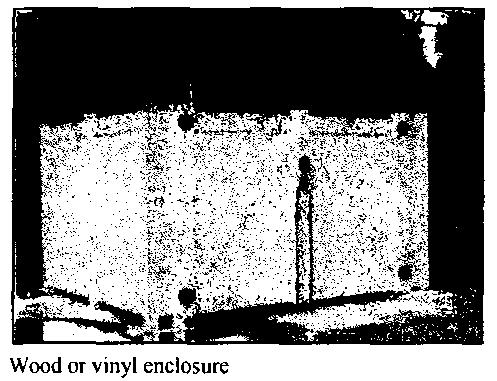
b. The gate must meet the following criteria:
i. It must be a solid single or double access gate.

ii. It must be of rigid construction and incorporate cross bracing.
c . The following additional criteria apply to both the enclosure and the gate(s):
i. They must be a single neutral earth-tone color that coordinates with the color of the principal structure.
ii. All wood fencing used must be constructed of decay-resistant exterior-grade treated lumber, such as cedar or redwood.
iii. All wood must be painted or stained.
iv. Fencing must be constructed of vertically-run slats that are at least three inches but no more than five inches in width.
2. All utility equipment (meters, transformers, etc.) shall be provided with appropriate planting screens.
3. Except when located across a street from residential zoned property, all garage doors and loading areas on non-residential property shall be concealed from view (at grade) from adjoining residential zoned property.
4. All outdoor storage facilities for raw materials and finished products within 500 feet of a residence district shall be effectively screened and enclosed by a solid wall or fence at least eight feet in height. If materials to be stored outdoors are in excess of eight feet in height, then landscape screening shall be provided in addition to the fence or wall installed along the outside perimeter of the fence or wall, equal or exceeding the height of the materials to be stored outdoors.
(p) Innovative landscaping. Innovative landscaping treatments are
encouraged and shall be considered as a positive attribute in connection with any request for a variation from the requirements of this chapter.
(q) Intersection visibility. Landscaping must be designed and installed in conformance with the sight triangle regulations of § 159.014.
(r) Edging. Edging is recommended to separate grass areas from shrubs, ground cover and mulch and shall be a good quality steel, plastic, or weather resistant (redwood, cedar) or treated wood secured with stakes.
(s) Artificial plants. No artificial plants of any type shall be used to satisfy any requirements of this section.
(t) Ground cover. All drainage swales and slopes having a slope of three vertical units to one horizontal unit (3:1) or greater shall be sodded. All other ground areas not covered by buildings, parking, sidewalks or other impervious surfaces, or occupied by planting beds shall be graded smooth with a minimum of four inches of black dirt after compacting and removing stumps, rocks and other debris, and shall be seeded or sodded to prevent soil erosion and sedimentation of public drainage systems, creeks, streams, rivers and wetlands.
(u) Water conservation. Wherever possible landscape designs and plant material which is indigenous and or drought tolerant should be used to reduce the need for irrigation.
(v) Flower beds. Flower beds are encouraged and shall be planted in masses in acceptable areas to create color, texture and visual interest. Native species are preferred and recommended.
(5) Additional right-of-way landscaping requirements. In addition to the general design criteria prescribed in division (C)(4) of this section, landscaping is required in public right-of-way in accordance with § 158.034.
(6) Additional parking lot landscaping requirements. In addition to the general design criteria prescribed in division (D)(4) of this section, the following requirements shall also apply to landscaping parking lots.
(a) Scope. All parking lots designed for 20 or more parking spaces shall be landscaped in accordance with the provisions of this section.
(b) Interior parking lot landscaping. To define circulation within a parking lot and to visually and physically break-up long rows of parking spaces, landscape islands are required to be provided within parking lot areas, as follows:
1. Parking aisle landscape islands. A landscaped island shall be provided at the end of each parking row. The island shall be protected by a continuous barrier curb and shall have a minimum width of seven feet, measured back-of-curb to back-of-curb, and shall have a depth equal to the adjoining parking space. Each parking aisle landscape island shall contain two shade trees.
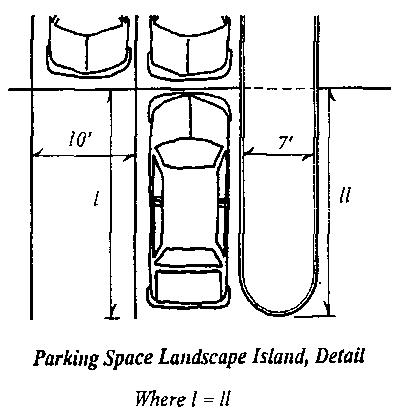
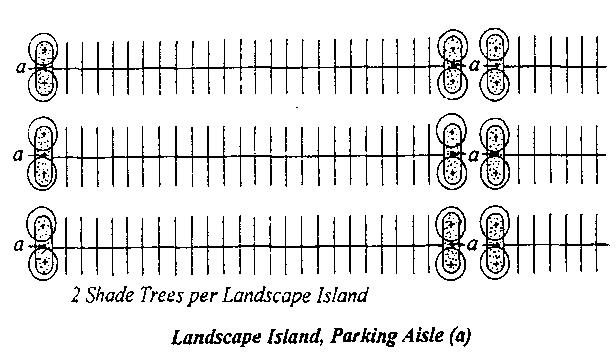
2. Parking space landsca pe islands . In addition to parking aisle landscape islands, one or more of the following alternatives shall be used to divide each row of parking having 20 spaces or more:
a. Full parking space landscap e island. One landscape island protected by a continuous barrier curb and having a minimum width of seven feet, measured back-of-curb to back-of-curb, and a depth equal to the adjoining parking space, may be provided for each 20 parking spaces in the parking row. Said landscape islands shall be dispersed throughout the parking row. Each said landscape island shall contain one shade tree;
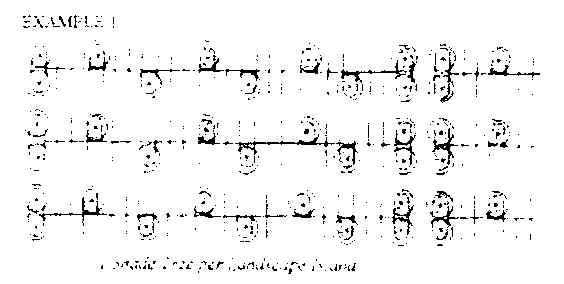
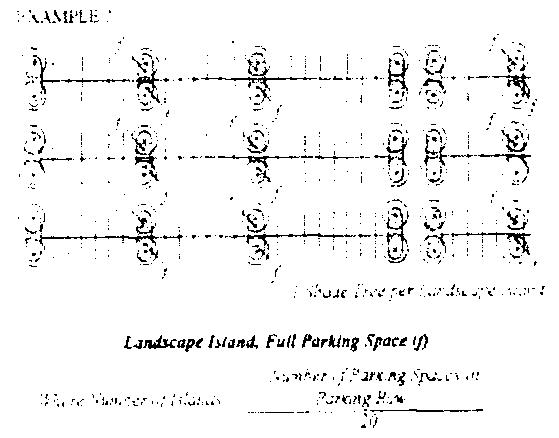
b. Partial parking space landscape island. One landscape island positioned at the front corner of a parking space, protected by a continuous barrier curb and having minimum dimensions of six and one-half feet square, measured back-of-curb to back-of-curb, may be provided for each ten parking spaces in the parking row. Said landscape islands shall be dispersed throughout the parking row and shall not be used in parking rows along the perimeter of a parking lot. Each said landscape island shall contain one shade tree.
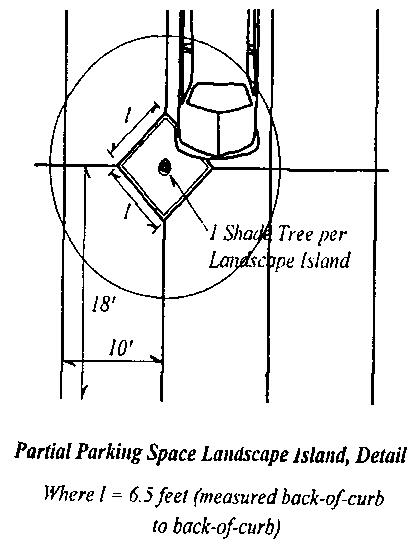
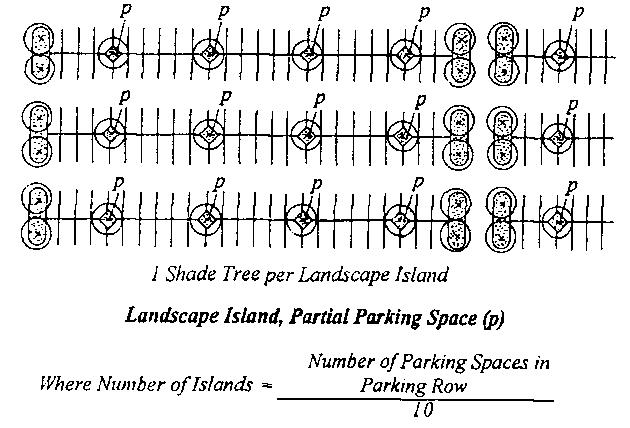
c. Continuous parking row landscape island .
i. A continuous landscape island protected by a continuous barrier curb and having a minimum depth of seven feet, measured back-of-curb to back-of-curb, may be provided between parking rows.
ii. Said landscape island shall not be used in parking rows along the perimeter of a parking lot. Each said landscape island shall contain one shade tree for each 20 parking spaces in the parking row.
3. Additi onal landsc aping standa rds. In additi on to the shade trees requir ed in this sectio n, each landsc ape island required herein shall be landscape with an appropriate number and selection of shrubs, flowers, groundcovers, sodded lawn and mulch. Shrubs planted in a parking lot landscape island shall not exceed a mature height of 30 inches above the adjoining pavement. No tree planted in a parking lot landscape island shall have branches lower than six feet above the adjoining pavement.
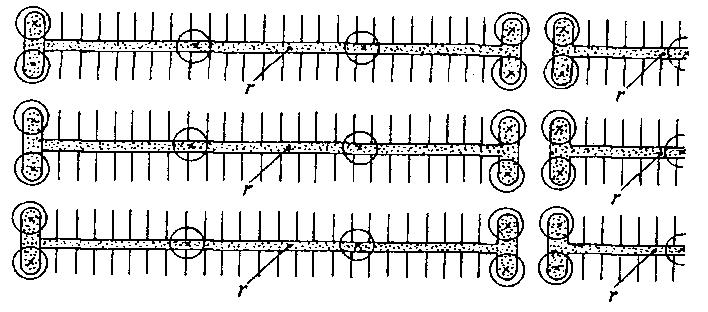
(c) Parking lot perimeter landscaping.
1. Front and corner side yards:
a. Where a parking lot is located in or adjacent a front or corner side yard in a residential district, continuous landscaping shall be provided across not less than 100% of the parking lot frontage to a minimum height of three feet. Such landscaping shall consist of any combination of berms, shade and ornamental trees, evergreens, shrubbery, hedges, and/or other live planting material. Plantings may be placed in clusters, containing at minimum seven evergreens and/or shrubs per cluster, spaced at intervals of approximately 35 feet along the frontage of the parking lot.
b. Where a parking lot is located in or adjacent a front or corner side yard not in a residential district, continuous landscaping shall be provided across not less than 60% of the parking lot frontage to a minimum height of three feet. Such landscaping shall consist of any combination of berms, shade and ornamental trees, evergreens, shrubbery, hedges, and/or other live planting material. Plantings may be placed in clusters, containing at minimum seven evergreens and/or shrubs per cluster, spaced at intervals of approximately 35 feet along the frontage of the parking lot. However, when a continuous row of shrubs or hedges is chosen, the entire parking lot frontage shall be screened.
2. Rear and side yards:
a. Where a parking lot is located in a yard adjacent a residential zoning district, landscaping shall be provided as follows:
i. Screening between the parking lot and the residential property line shall be a minimum of six feet in height.
ii. Shade trees shall be provided at the equivalent of one for each 50 lineal feet, or fraction thereof, of parking lot frontage and shall not be planted more than 40 feet apart.
iii . Other planting material, including ornamental trees, evergreens, shrubbery, hedges, and/or other live planting materials shall be provided at intermittent locations, covering at least 100% of the frontage of the parking lot.
iv. Except where occupied by planting beds, all side and rear yard perimeter landscaping area shall be sodded or seeded.
b. Where a parking lot is located in a yard adjacent a nonresidential zoning district; and a parking setback is provided, landscaping shall be provided across not less than 50% of that portion of the parking lot abutting the property line to a minimum height of three feet. Such landscaping shall consist of any combination of berms, shade and ornamental trees, evergreens, shrubbery, hedges, and/or other live planting materials. Plantings may be placed in clusters, containing not less than seven shrubs per cluster, spaced at intervals of approximately 35 feet along the property line.
(7) Additional foundation landscaping requirements. In addition to the general design criteria prescribed in division (D)(4) of this section, the following requirements shall also apply to foundation landscaping.
(a) Scope. All non-residential and multiple family development shall provide perimeter landscaping as prescribed herein. Parking lots located on the perimeter of a lot shall comply with the requirements of division (D)(6) of this section.
(b) Setback. A landscaping area not less than ten feet in width shall be
located around the perimeter of all buildings, except where impractical, i.e. loading dock areas, entryways, etc.
(c) Coverage. Required foundation landscaping areas shall remain open and free of all paving except where walks to buildings and other similar paving is required.
(d) Landscaping materials. Foundation landscaping consists of shade and ornamental trees, evergreens, shrubbery, hedges, and/or other live planting materials. Particular attention shall be paid toward screening mechanical equipment, bicycle parking areas, and loading docks; softening large expanses of building walls; and accenting entrances and architectural features of the building(s).
(8) Additional perimeter landscaping requirements. In addition to the general design criteria prescribed in division (C)(4) of this section, the following requirements shall also apply to foundation landscaping.
(a) Scope. All non-residential and multiple family development shall provide perimeter landscaping as prescribed.
(b) Non-residential property abutting non-residential property. Where non-residential property abuts property in a business, office or industrial district, landscaping shall be provided as follows:
1. Shade trees shall be provided at the equivalent of one for each 75 feet, or fraction thereof, of frontage along the abutting property line. Such trees shall be planted no more than 40 feet apart and may be clustered or spaced linearly as determined appropriate.
2. Other landscaping materials, including berms, ornamental trees, ever-greens, shrubbery, hedges, and/or other live planting materials shall be provided at appropriate locations along the abutting property line.
(c) Non-residential property abutting residential property. Where non-residential property abuts property in a residential district, landscaping shall be provided as follows:
1. A solid screen six feet in height, shall be provided along the entire length of the abutting property line. Such screen shall consist of a solid wood fence, berms, trees, evergreens, shrubbery, and/or other live planting materials, necessary to provide 100% coverage.
2. Shade trees shall be provided at the equivalent of one for each 75 feet, or fraction thereof, of frontage along the abutting property line. Such trees shall not be planted more than 40 feet apart and may be clustered or spaced linearly as determined appropriate.
(d) Multiple family residential property. Where a multiple family residential use abuts property in any zoning district, landscaping shall be provided as follows:
1. Shade trees shall be provided at the equivalent of not less than one for each 75 feet, or fraction thereof, of frontage along the abutting property line. Such trees shall not be planted more than 40 feet apart and may be clustered or spaced linearly as appropriate.
2. Other landscaping materials, including berms, if possible, ornamental trees, evergreens, shrubbery, hedges, and/or other live planting materials shall be provided at intermittent locations across 50% of the abutting property line. Shrubs shall be placed in clusters containing at least seven per cluster, spaced at intervals of approximately 35 feet along the abutting property line.
(E) Administration of landscaping and tree preservation regulations:
(1) Variations from requirements of this section.
(a) The village recognizes that, because of the wide variety of types of developments and the relationships between them, some flexibility in applying standards set forth in divisions (C) and (D) of this section are appropriate as long as the intent of specified requirements are met. The Zoning Administrator may authorize deviations not more than 20% from the requirements of any specific requirement set forth in divisions (C) and (D) of this section.
(b) Whenever the village allows or requires deviation from the requirements set forth in this section, it shall enter on the face of the landscape plan the reasons for allowing or requiring deviation from the requirements of this section.
(2) Certificate of occupancy. All required landscaping shall be installed prior to the issuance of a certificate of occupancy. If weather conditions or other circumstances beyond the developer's control prevent installation of all or portions of the landscape materials and all other requirements for the issuance of a certificate of occupancy have been met, a letter of credit or a performance guarantee approved by the Village Attorney to insure completion of approved landscaping shall be filed with the Village Administrator. The amount of the performance guarantee and the required completion data shall be recommended by the Zoning Administrator based on current costs and set by the Village Board. If such a letter of credit or performance guarantee has already been submitted for the proposed landscape improvements, the Village Board may permit the developer to extend the performance guarantee for an additional specified period of time.
(F) Guidelines for reviewing landscape plans. A landscape plan shall be approved if the following conditions are satisfied:
(1) The use of shrubs, flowers, berms and ground cover are used appropriately to enhance the overall appearance and function of the site or open spaces on the site;
(2) The planting of shade and ornamental and evergreen trees is used to define and enhance spaces on the site;
(3) The use of planting material to effectively screen adjacent dwelling units, service areas, and parking areas;
(4) The use of planting material to contribute to water conservation and energy efficiency;
(5) The use of planting material seasonal color, texture, size and form to create seasonal and visual interest and appeal in the community; and
(6) The composition, number, location, specie of landscape material, berms, fences and other features, and supporting documentation are provided as required by this section.
(Ord. 06-0369, passed 2-1-06; Am. Ord. 09-0744, passed 4-15-09; Am. Ord. 12-1013, passed 11-7-12; Am. Ord. 15-1229, passed 11-18-15)
§ 159.031 USES NOT SPECIFICALLY PERMITTED.
When a use is not specifically listed in the sections devoted to permitted uses, special uses, accessory uses, temporary uses, signage, and the like, it shall be determined that the uses are hereby prohibited.
§ 159.032 PUBLIC UTILITY EXEMPTIONS.
The following public utility and municipal uses are permitted in any Zoning District: poles, towers, wires, cables, conduits, vaults, laterals, pipes, mains, valves, or other similar distributing equipment (not including substations located on or above the surface of the ground), for the distribution to consumers of telephone or other communications, electricity, gas or water, or for the collection of sewage or surface water, provided that the installation and location shall conform with the rules and regulations of the applicable administrative authorities and the ordinances of the village.
§ 159.033 PUBLIC UTILITIES.
Each use hereafter established shall be served by a public sewerage collection system and water distribution system.
§ 159.034 HOME OCCUPATIONS.
(A) Intent and purpose.
(1) Traditionally, in zoning, certain occupational uses termed “home occupations” have been allowed in residential dwelling units. Such uses have been allowed largely on the basis that such uses are incidental to the use of the premises as a residence, that the nature of home occupational uses is such that they are compatible with or even belong in the home, or that home occupational uses are of a highly professional nature involving the use of mental rather than physical capabilities and are therefore compatible with residential land uses.
(2) It is recognized, however, by this village, that certain limited home occupations can be useful to both the general public as well as the resident/proprietor. Also recognized is the difficulty of writing and ordinance dealing with home occupations in a “middle-of-the-road” fashion, which is neither discriminatory nor arbitrary. It is the hope that both the citizens and the courts will recognize these difficulties; that the former will not abuse the privileges granted within the following test and that the latter will aid in the enforcement of the sometimes arbitrary restrictions necessary to preserve residential character in an expedient manner.
(3) With the above in mind, it is the intent and purpose of this section to provide for certain types of restricted occupational uses within residential districts. Only such uses will be allowed:
(a) Any home occupation that is customarily incidental to the principal use of a building as a dwelling shall be permitted in any dwelling unit;
(b) Are compatible with residential uses;
(c) Are limited in size; and
(d) Do not detract from the residential character of the neighborhood.
(B) Home occupations, required conditions. A home occupation is any gainful occupation or profession engaged in by an occupant of a dwelling unit which meets the following conditions and/or requirements. These are in addition to all of the use limitations applicable in the district in which a home occupation is located, no business license shall be issued unless it complies with the following restrictions in all residential districts.
(1) Size/space requirements. A home occupation shall be incidental to the principal use (residential), where no more than 25% of the floor area of a one-story dwelling unit and no more than 20% of the floor area of any other residential dwelling unit may be used in connection with the home occupation or for the storage purposes associated with the home occupation. Floor area of a dwelling unit is defined as all heated and ventilated and thereby habitable rooms and areas within the dwelling unit, including basements and habitable attic space.
(2) Retail sales. On the premises, retail sales shall be prohibited except for the retail sales of products, goods or trade work produced or fabricated on the premises as a result of the home occupation.
(3) Employment. Only members of the immediate family permanently residing on the premises shall be an employee in the home occupation.
(4) Hours of operation. In no case shall any permitted home occupation be open to the public at times earlier than 8:00 am nor later than 8:00 pm.
(5) Patronage. No more than five persons may avail themselves of the services provided by the home occupation use at a given dwelling unit at any given moment in time.
(6) Storage outdoor. There shall be no exterior storage outside the principal building or accessory structure of equipment, product or the like in conjunction with the home occupation.
(7) Conduct and appearance. The home occupation shall be conducted entirely within the principal residential building. There shall be no advertising or identification sign acknowledging the presence of the home occupation.
(8) Manufacturing. There shall be no manufacturing or processing of any sort conducted within the confines of the dwelling unit. Minor assembly of products or goods may be permitted, if done solely within the dwelling unit.
(9) Wholesaling. No wholesale, jobbing, or retail business shall be permitted unless sales are conducted entirely by mail or telephone and the business does not involve the receipt, shipment, delivery, or storage of merchandise/materials/product on or from the premises.
(10) Alterations. There shall be no alterations to the principal residential building or accessory structures, which changes the character thereof, as a dwelling unit.
(11) Equipment. No mechanical or electrical equipment may be used except such types as are customary for purely domestic, household, or hobby purposes.
(12) Deliveries. There shall be no deliveries to or from a home occupation with a vehicle larger than a one (1) ton truck (i.e. Federal Express, United Parcel Service, Emery, and the like).
(13) Performance standards. A home occupation shall produce no offensive noise, vibration, smoke, electrical interference, dust, odors, or heat. A home occupation as provided by this section shall be completely contained within the principal building. Any noise, vibration, smoke, electrical interference, dust, odors, or heat detectable beyond the property lines or beyond the walls of the dwelling unit, if the unit is part of a multifamily structure, shall constitute a violation of the terms of the provisions herein. The judgment of the Zoning Administrator shall be considered decisive and final in this matter unless formally appealed to the Planning and Zoning Commission within 45 days of the Zoning Administrator's written determination.
(14) Multiple family dwelling units. Home occupations that attract customers, clients, or students to the premises for sales or service shall not be permitted in multiple family dwelling units.
(C) Additional conditions for personal property sales (garage sales):
(1) Permit required. Before any person holds or conducts a personal property sale, such as but not limited to, garage sales, basement sales, yard sales, porch sales, estate sales or auctions for the purpose of selling used household, clothing or any personal property items which are owned by the resident(s) on the premises, a personal property sale permit for a garage sale shall be obtained from the village.
(2) Terms of permit.
(a) Sales shall not last longer than three consecutive days.
(b) Not more than two sales shall be permitted on the premises during a calender year.
(c) No goods purchased for resale may be offered for sale.
(d) No consignment goods may be offered for sale.
(e) Sales shall be conducted on the owner's property. Multiple family sales are permitted provided they are held on the property of one of the participating families.
(3) Conditions of permit.
(a) The permits shall be valid only upon demonstrating to and finding by the village that proper safety and environmental precautions have been taken to ensure the safety of the general public.
(b) The permit shall be posted on the premises in a conspicuous place so as to be readily seen by the public and village enforcement personnel.
(c) Any police or enforcement officer of the village shall have the right of entry to any premises showing evidence of personal property sale for the purpose of enforcement or inspection. Said enforcement official may close sale operations upon determination that a violation of this chapter exists and may arrest any person who violates any provision of this chapter.
(4) Application. Application for a Garage Sale permit shall be made at the office of the Zoning Administrator on forms furnished by the Zoning Administrator.
(5) Application fee. The application fee for a garage sale permit shall be established by the Village Board of Trustees and shall be posted in the office of the Village Clerk and may be altered and amended from time to time by the Mayor and Village Board.
(6) Penalty. Any person, firm, or corporation that violates any of the provisions of this section shall be subject to the penalty provisions of this chapter.
(D) Permits/fees/inspections:
(1) A business license establishing the home occupation may be issued by the Zoning Administrator, provided that all of the above criteria have been met by the applicant.
(2) A business license granted by this section shall be temporary in nature and shall be granted to a designated person who resides at a particular residential address. They are not transferable from person to person nor from address to address.
(3) Applications for a home occupation business license shall be filed with the Zoning Administrator, together with a one time filing fee according to the current "Fee Schedule" herein. The application shall then be reviewed to insure compliance with this section and the residential district in which the home occupation is located.
(4) There may be one annual inspection each year directed by the Zoning Administrator covered by the license. In addition, the Zoning Administrator or his or her designee, shall have the right at any time, upon reasonable request, to enter and inspect the premises covered by said license for safety and compliance purposes.
(5) The annual fee for continuing a license issued under this section shall be according to the current "Fee Schedule" herein, and shall be payable on May lst of each year.
(6) Licenses shall expire April 30 of each year, and once granted may be renewed without making another application, subject to the provisions of this section, by completing the renewal form described by the Zoning Administrator and paying the annual license fee. Failure to timely apply for renewal, and/or failure to pay for the business license, shall be grounds for revocation of the business license.
(E) General provisions.
(1) Should a license holder die or move to a new location, the existing license shall automatically terminate, except that, in the case of death, should a surviving spouse or child residing at the same address desire to continue the home occupation, written notice to that effect shall be given to the Zoning Administrator, and that person may be authorized continuation of that license.
(2) Business licenses, once granted, may be revoked by the village for cause after a public hearing before the Village Board. Complaints seeking the revocation of such license shall be filed with the Zoning Administrator and may be initiated by the Planning and Zoning Commission or three residents of the block (both sides where the home occupation is being conducted). All such revocation hearings shall be conducted in accordance with § 159.176. Publication and notification requirements shall be done in accordance with Ordinance Chapter 113.
(3) All businesses being conducted on properties zoned in a residential district on the effective date of this section shall have 90 days thereafter to apply for the necessary license.
(4) Persons who were conducting a business from properties zoned in a residential district on the effective date of this section must make application according to the procedures herein, however, they may continue to conduct such business pending final determination from the Zoning Administrator of their application. Should the application be denied for a license, all such persons shall have the opportunity for an appeal with the Planning and Zoning Commission as outlined by this chapter.
(F) Customary/permitted home occupations. Customary “home occupations” include, but are not limited to, the following list of occupations, provided, however, that each listed occupation shall be subject to the requirements of division (B) in this section:
(1) Art restoration, Art studio;
(2) Artists, authors, composers, painters, and sculptures;
(3) Baby sitting, including family day care home as defined by § 159.003;
(4) Beauty parlors and barber shops, single chair;
(5) Clergy, minister, priest for consultation purposes only or for the performance of religious rites;
(6) Consulting services* (i.e Architectural, Attorney, Engineering, Financial Planning/Investment Services, Interior Designer, Writing/Computer programming);
(7) Contracting, except as specifically prohibited;
(8) Data processing, telecommunications, high speed data transmissions or the like completed through the use of telephones, facsimiles, modems or other forms of telecommunications peripherals;
(9) Dentist may use his residence for consultation purposes only with general and/or limited treatments;
(10) Direct sale product distribution (Amway, Avon, Jaffra, Tupperware, Herbalife);
(11) Drafting and graphic services*;
(12) Dressmaking, seamstress, sewing, tailoring, contract sewing (one machine);
(13) Electronic designing;
(14) Flower arranging, Gardening, Landscape maintenance (without outdoor storage of materials and/or equipment);
(15) Home crafts such as model-making, rug-weaving, lapidary work, however, no machinery or equipment shall be used or employed other than what is customary to the home. Off-site sales;
(16) Home cooking and preserving;
(17) Home day care/baby sitting for less than five non-related children, as defined by this chapter;
(18) House cleaning services;
(19) Insurance sales or broker;
(20) Jewelry making; jeweler; watch repairs;
(21) Laundry, ironing services;
(22) Locksmith;
(23) Mail order, not including retail sales from the home;
(24) Music teachers, but regular instruction shall be limited to one pupil at a time, except for occasional groups;
(25) Photo developing, non-retail, no drop off service, delivery only;
(26) Real estate sales or broker;
(27) Sales representative, office only;
(28) Secretarial services;
(29) Security service, security systems, auto security systems, no installations at home;
(30) Swimming pool cleaning;
(31) Telephone answering, switchboard, call forwarding;
(32) Tutoring shall be limited: one to four students at a time;
(33) Typing, word-processing service;
(34) Wall papering;
(35) Woodworking, excluding cabinet making;
(36) Writing, computer programming.
* Not for the general assembly of groups of more than six and not for the installation or use of any mechanical or electrical equipment customarily incidental to the practice of any such profession.
(G) Prohibited home occupations. The following are “prohibited” home occupations in any residential districts, unless specifically permitted by the district regulations.
(1) Ambulance services;
(2) Animal kennels or hospitals;
(3) Appliance repair;
(4) Automobile repair; parts sales, upholstery, or detailing; washing service (including businesses working at customers homes);
(5) Barber shops and beauty shops above one chair;
(6) Boarding house, hotel, time share condominium;
(7) Carpentry work, cabinet makers;
(8) Catering;
(9) Ceramics, (kiln of six cubic feet or more);
(10) Churches, religious instruction;
(11) Contracting that involves masonry, plumbing or painting;
(12) Dancing schools;
(13) Dog breeders or dog re-sellers.
(14) Funeral homes or chapels;
(15) Gift shops;
(16) Gun smith/shop including sales and service;
(17) Health salons, gyms, aerobic exercise studios;
(18) Helium balloon sales;
(19) House painter;
(20) Limousine or pedicabs service;
(21) Major automobile repair (see definition § 159.003);
(22) Massage parlors;
(23) Medical or dental clinics/ offices or hospitals;
(24) Mortician, hearse service;
(25) Nursery schools and home day care centers (see definitions § 159.003);
(26) Painting of vehicles, trailers and/or boats;
(27) Private clubs;
(28) Private schools with organized classes;
(29) Restaurants, home dinettes, taverns and food preparation;
(30) Retail sales from the site (except direct distribution);
(31) Rental businesses;
(32) Skin care products (manufacturing of same);
(33) Small engine repair;
(34) Stables or animal care (veterinarian);
(35) Television repair;
(36) Lodging houses;
(37) Tow truck services;
(38) Trailer rentals or sales;
(39) Upholstery;
(40) Veterinary uses (including care, grooming, or boarding);
(41) Welding and machine shops.
(Am. Ord. 06-0369, passed 2-1-06; Am. Ord. 07-0599, passed 12-19-07)
§ 159.035 FENCES, WALLS, RETAINING WALLS AND HEDGES.
(A) General. This section governs the installation, replacement, alteration, relocation and maintenance of fences, walls, retaining walls, and hedges in the village.
(B) Permit required.
(1) Unless otherwise provided in this section, no fence, wall, retaining wall or hedge shall be installed, replaced, altered, or moved for any reason within the village prior to receiving a permit therefore.
(2) Applications for permits shall be in writing on the application form furnished by the village. The following information shall be submitted with each permit application.
(a) A plat of survey or other accurate and scaled drawing depicting:
1. The proposed location of the fence, wall, retaining wall, or hedge;
2. The location and dimensions of all structures existing on the site (including the primary building, all accessory structures and all existing fencing);
3. The property lines;
4. The easements;
5. The street lines, sidewalks and walkways; and,
6. For corner lots, the orientation of the neighboring building showing the direction in which the buildings face.
(b) A description of the proposed fence, wall, retaining wall, or hedge including the type, height, and construction materials.
(c) A copy of the village's drainage certificate, signed by the property owner.
(3) No permit shall be issued until it has been approved for zoning compliance by the Zoning Administrator and until it has been approved for building/structural compliance by the Building Commissioner.
(4) No permit shall be issued until after the permit fee has been paid in full.
(C) Impact on drainage. No fence, wall, retaining wall, garden, berm, landscaping, hedge or other structure shall inhibit or alter drainage (i.e. flow of storm water or surface water) through drainage ditches or over public utility and/or drainage easements.
(1) Landscaping in easements. Landscaping, other than seed or sod, is not recommended in drainage easements.
(a) When landscaping is installed, it shall not alter the grades nor shall it alter the flow of surface water. Landscaping features such as raised flower beds or gardens shall be avoided in drainage easement as they have the tendency to impact drainage.
(b) If it is determined that landscaping impedes or alters the surface water drainage on the property or other properties, the village may require the homeowner to remove the landscaping and the village has the right to remove, relocate, or alter the landscaping.
(2) Fences in easements. The village has the right to remove, relocate, or alter a fence, wall, retaining wall, or hedge located in an easement if the potential exists to impede or alter the surface water drainage of the property or any other property. If the fence needs to be removed to obtain access to utilities or for the maintenance of drainage for any reason, the village is not responsible for replacement or repair of the fence or any other homeowner improvements located within the easements.
(3) Grading restoration. When a fence is installed, all spoils shall be removed and the grading shall be restored to its original state. The soil spoils which are removed cannot be spread under the fence or in any drainage easement.
(D) Impact on visibility. No fence, wall, retaining wall or hedge shall be installed or located within the sight triangle at the intersection of two or more streets, roadways, driveways, or access drives as described in § 159.014. There shall be no significant obstruction to visibility between three feet and ten feet in height.
(1) Ten feet, measured along the right- of-way line of an intersecting street and the nearest edge of an intersecting driveway, where the intersection is between a street and a driveway within a residential zoning district.
(2) Thirty feet, measured along the right-of-way lines of two intersecting streets.
(3) Thirty feet, measured along the right-of-way line of an intersecting street and the nearest edge of an intersecting driveway or access drive, where the intersection is between a street and a driveway or access within a non-residential zoning district.
(4) In cases involving one or more private roads, the triangle shall be measured along the appropriate edge of such private road as if it had been publicly dedicated.
(5) Notwithstanding the foregoing, with respect to any fences, hedges, walls or retaining walls installed within a sight triangle as of the date of the adoption of this section, said fences, hedges, walls or retaining walls shall only be deemed to be in violation of this section to the extent that the same shall actually obstruct the view of other traffic available to any motorist lawfully operating any motor vehicle that is stopped at, turning through or traveling through any two intersecting streets or the intersection of a street and a driveway.
(6) The Village Manager or his designee shall have the right to review and approve an exception to the requirements of this section provided that the applicant is able to prove that the proposed fence shall not actually obstruct the view of other traffic available to any motorist lawfully operating any motor vehicle that is stopped at, turning through or traveling through any two intersecting streets or the intersection of a street and a driveway.
(E) Structural elements.
(1) Fences, walls and retaining walls shall be constructed such that no structural element faces a public street or neighboring property.
(2) The fence boards must be at least two inches above grade; however, they must be situated such that a four-inch sphere cannot pass under them.
(F) Definitions. For the purposes of this section the following definitions shall apply.
(1) Types of fences.
CHAIN LINK/CYCLONE FENCE. A fence constructed of chain link fabric that is finished at all edges, including a top and bottom rail.
DEVELOPMENT FENCE. A uniform fence, installed by the village, state, owners association, merchant's association, or developer that is within a development, along a common area (such as a school or park), or along a roadway.
FENCE. A manmade structure of wood, metal, masonry, plastic, or other synthetic materials designed, used and erected and affixed to real estate for the purpose of defining, enclosing or separating any portion of the real estate from adjoining land whether or not such fence is located on the boundary line of the property to which it appertains. A fence may include gates.
HEDGE. Any group of plantings designed so as to define a property edge similar to the function of a fence.
OPEN FENCE. A fence which has over its entirety at least 40% of the surface area in open space when viewed at a right angle to the fence.
PALISADE FENCE. A fence intended to guard federal or state regulated property against unauthorized entry. The fence normally consists of vertical pickets attached to horizontal rails and may include pales to discourage scaling but not including barbed, razor, or concertina wire.
PICKET FENCE. An open fence with spaces between vertically-run members (pickets). Pickets may not exceed three inches in width.
PRIVACY FENCE. A solid fence. The privacy fence provides little or no space between members and all fence boards rub along the same plane.
RETAINING WALL. Any wall designed or used to change the grade of the yard by creating a terrace or drop-off, commonly used to increase the level or useable area of a yard. The term retaining wall does not describe decorative edgings for planting beds, gardens or trees not located within drainage easements.
SHADOW BOX FENCE. A fence where vertical members are alternated on two different planes creating the overall look of a solid fence.
SOLID FENCE. A solid fence has less that 40% of the surface area in open space when viewed at a right angle to the fence.
SPLIT-RAIL FENCE. An open fence with horizontal members running between vertical posts.
WALL. An open or a solid fence constructed of masonry.
WROUGHT IRON FENCE. An open fence constructed of wrought iron, other metal, PVC, or anodized aluminum possessing similar aesthetic characteristics.
(2) Types of lots.
(a) The following chart demonstrates the different types of lots. The arrow points in the direction of the front of the houses. (See definitions in § 159.003.)
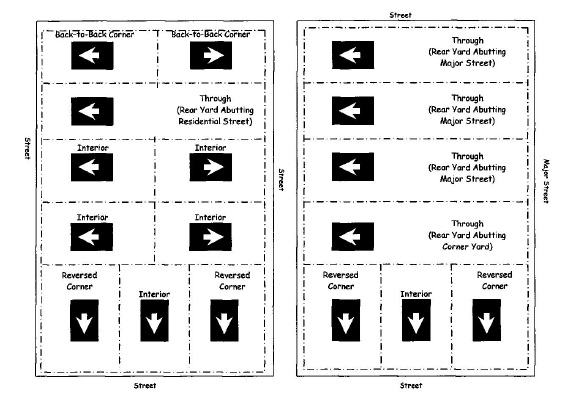
(b) For the purposes of this section the following standards shall apply.
1. If a through lot abuts a major street, back-to-back corner yard provisions shall apply to the rear yard.
2. If a through lot abuts a minor street, reversed-corner yard provisions shall apply to the rear yard.
3. If a corner side yard abuts a through lot on a major street, it shall be considered a back-to-back corner side yard.
4. If a corner side yard abuts a through lot on a minor street, it shall be considered a reverse corner side yard.
5. The side yard abutting the street on a through lot, shall be considered a reverse corner yard.
(3) Types of yards. The following chart demonstrates the different types of lots. The arrow points in the direction of the front of the houses. (See definitions in § 159.003.)
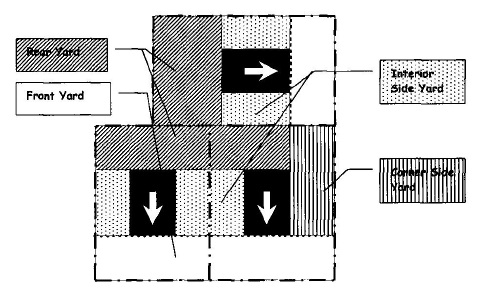
(G) Types of fences permitted in residential districts. The types of fences are dependant upon the type of yard. The following table identifies the types of fences permitted in each yard.
Types of Fences Permitted | ||||
Front Yard | Reverse Corner Yard | Back-to-Back Corner Yard | Rear Yard Fences on Interior Lots4 | |
Picket | Permitted | Permitted | Permitted | Permitted |
Split-Rail | Permitted | Permitted | Permitted | Permitted |
Privacy | Not Permitted | Not Permitted | Permitted* | Permitted* |
Shadow Box | Not Permitted | Not Permitted | Permitted | Permitted |
Chain Link/ Cyclone** | Not Permitted | Not Permitted | Not Permitted | Permitted |
Wrought Iron | Permitted | Permitted | Permitted | Permitted |
Hedge*** | Permitted | Permitted | Permitted | Permitted |
Walls | Not Permitted | Not Permitted | Permitted* | Permitted* |
* Privacy fences and walls not permitted in drainage easements. An exception to this requirement may be granted by the Village Manager or his designee in the case of through lots abutting major streets or highways. The exception may only be granted in cases where the easement has been studied by the Village Engineer and it has been determined that the easement will not carry a significant amount of water flow, that the fence will not be located in an overland flood route, and that the proposed fence will not alter or impede drainage flow. ** Chain Link/Cyclone fencing must be 11-gauge wire or heavier. *** The setback is determined by the distance between the trunk or stem of the shrub and the property line. The hedge may not overhang a public walk. | ||||
(H) Height of fences in residential districts. The fence height shall be based on location. The following height restrictions shall apply.
Height Restrictions | ||||
Front Yard | Reverse Corner Yard | Back-to-Back Corner Yard | Rear Yard Fences on Interior Lots | |
Maximum Height | 3 Feet | 3 Feet | 6 Feet | 6 Feet |
(I) Setback restrictions in residential districts. The fence setback shall be based on location. The following setback restrictions shall apply.
Setback Restrictions** | ||||
Front yard | Reverse Corner Yard | Back-to-Back Corner Yard | Rear Yard Fences on Interior Lots | |
Minimum Setback | 1 Foot* | 1 Foot | 1 Foot | None |
* No front yard fences shall run parallel to the front lot line. Fences are allowed along the side lot line. ** In addition to the setbacks from the property lines, no fence may be located (1) closer than 8 feet to the back of curb along a major street, (2) parallel and within 6 feet to an existing fence on the lot. | ||||
(J) Types of fences permitted in non-residential districts.
(1) Any fence constructed within the P-B Zoning District will be limited to a fence with a wrought iron appearance, full vinyl, or a chain link fence in which all portions of the fence are covered with a black vinyl coating. Any vinyl fences will be constructed out of a low reflectance neutral coloring.
(2) The types of fences shall be dependent upon the type of yard. The following table identifies the types of fences permitted in each yard.
Types of Fences Permitted | ||||
Front Yard | Reverse Corner Yard | Back-to-Back Corner Yard | Rear Yard Fences on Interior Lots4 | |
Picket | Permitted | Permitted | Permitted | Permitted |
Split-Rail | Permitted | Permitted | Permitted | Permitted |
Privacy | Not Permitted | Not Permitted | Permitted1 | Permitted1 |
Chain Link/ Cyclone2 | Not Permitted | Not Permitted | Not Permitted | Permitted |
Wrought Iron | Permitted | Permitted | Permitted | Permitted |
Hedge3 | Permitted | Permitted | Permitted | Permitted |
Walls | Not Permitted | Not Permitted | Permitted1 | Permitted1 |
Snow | Not Permitted | Not Permitted | Permitted (November to March) | Permitted (November to March) |
Specialty | Not Permitted | Not Permitted | Permitted (Sports, recreation, etc.) | Permitted (Sports, recreation, etc.) |
1 The village has the right to look at any and all installations to see if there is any impact to drainage. Privacy fences and walls will not be allowed in drainage easements that are determined to carry a significant amount of water flow. They will not be allowed in overland flood routes. 2 Chain Link/Cyclone fencing must be 11-guage wire or heavier. 3 The setback is determined by the distance between the trunk or stem of the shrub and the property line. The hedge may not overhang a public walk. 4 In the event that a lot backs onto a stormwater management facility, that does not directly access a public property or right-of-way, a gate shall be provided to allow access for inspection and maintenance of said stormwater management facility. | ||||
(K) Height of fences in non-residential districts. The fence height shall be based on location. The following height restrictions shall apply.
Height Restrictions | ||||
Front Yard | Reverse Frontage Corner Yard | Back-to-Back Corner Yard | Rear Yard Fences on Interior Lots | |
Maximum Height | 3 Feet | 3 Feet | 8 Feet | 8 Feet |
(L) Setback restrictions in non-residential districts. The fence setback shall be based on location. The following setback restrictions shall apply.
Setback Restrictions | ||||
Front Yard | Reverse Frontage Corner Yard | Back-to-Back Corner Yard | Rear Yard Fences on Interior Lots | |
Minimum Setback | Greater of: 1' to property line; 2' to sidewalk; 5' from curb | Greater of: 1' to property line; 2' to sidewalk; 5' from curb | None | None |
* No front yard fences shall run parallel to the front lot line. Fences are allowed along the side lot line. | ||||
(M) Access for repair. The village, utility company or quasi-utility company shall have the right, when necessary and convenient, to temporarily remove any fence, wall, retaining wall, hedge, landscaping (including gardens) and/or other accessory structures (sheds, pools, etc.) to allow access by its employees or contractors and equipment for the repair and maintenance of any equipment or other facility situated within or on any platted utility easement. In such cases the village, utility or quasi-utility shall not be held responsible for the replacement or repair of any fence, wall, retaining wall or hedge removed.
(N) Development fence.
(1) In the event that a development fence has been installed on a property or along any property line, the property owner must maintain said fence and may only replace it with fencing which matches in terms of color, height, location, setback, and design.
(2) Additionally, if a property abuts a common area or a major street, and that property is located immediately between two other properties also abutting the same common area or major street, any fencing installed in the property in question must match the development fencing installed on both neighboring properties if such development fencing on both such neighboring properties is identical, or must match the development fencing installed on one or the other of such neighboring properties in the event that the development fencing on such neighboring properties is not identical. For purposes of the preceding sentence, fencing shall be deemed to match other fencing when both fences in question (a) are of the same color, type and material; (b) are of the same height; and (c) are installed at the same setback from the relevant common area or major street.
(O) Palisade fence. A fence intended to guard federal or state regulate d property against unauthor ized entry. The fence normally consists of vertical pickets attached to horizontal rails and may include pales to discourage scaling but not including barbed, razor, or concertina wire. These fences are exempt for the height and setback requirements of this section and may follow the applicable federal or state guidelines for height and location. An example of a palisade fence is shown below.
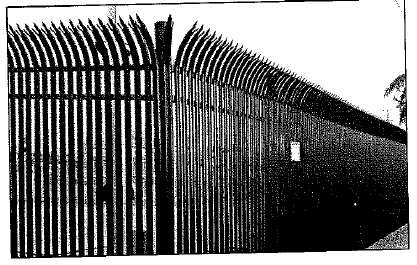
(P) Amortization. All non-conforming fences, walls, retaining walls and hedges shall be brought into compliance with all provisions of the Zoning Ordinance when, for any reason, said fence, wall, retaining wall or hedge is replaced.
(Am. Ord. 05-0284, passed 6-15- 05; Am. Ord. 07-0554, passed 7- 18-07; Am. Ord. 07-0594, passed 10-3-07; Am. Ord. 08-0715, passed 11-19-08; Am. Ord. 09-0799, passed 12-16-09; Am. Ord. 09- 0800, passed 12-16-09; Am. Ord. 11-0926, passed 10-5-11; Am. Ord. 15-1181, passed 3-18-15; Am. Ord. 15-1229, passed 11-18-15; Am. Ord. 19-1533, passed 1-16-19)
§ 159.036 APPEARANCE REVIEW (BEAUTIFICATION COMMISSION).
(A) Definitions. For the purpose of this section of the chapter the following definitions shall apply unless the context clearly indicates or requires a different meaning.
“APPEARANCE.” The outward aspect visible to the public.
“APPROPRIATE.” Sympathetic, or fitting, to the context of the site and the whole community.
“APPURTENANCES.” The visible, functional objects accessory to a part of a building.
“ARCHITECTURAL CONCEPT.” The basic aesthetic idea of a building, or group of buildings or structures, including the site and landscape development, that produces the architectural character.
“ARCHITECTURAL FEATURE.” A prominent or significant part or element of a building, structure, or site.
“ARCHITECTURAL STYLE.” The characteristic form and detail, as of buildings of a particular historic period.
“ATTRACTIVE.” Having qualities that arouse interest and pleasure in the observer. Beautification Commission The Beautification Commission of the village.
“BERM.” (See also “BERM,” § 159.003) A raised form of earth to provide screening or to improve the aesthetic character.
“CODE.” The Zoning Code (Ordinance No. 780, passed 4-1-81, as amended)
“COHESIVENESS.” Unity of composition between design elements of a building or a group of buildings and the landscape development.
“CONSERVATION.” (See also “CONSERVATION AREA” and “CONSERVATION EASEMENT”, § 159.003 of this chapter) The protection and care that prevent destruction or deterioration of historical or otherwise significant structures, buildings, or natural resources.
“EXTERIOR BUILDING COMPONENT.” An essential and visible part of the exterior of a building.
“EXTERIOR DESIGN FEATURE.” The general arrangement of any portion of a building, sign, landscaping, or structure and including the kind, color, and texture of the materials of such portion, and the types of roof, windows, doors, lights, attached or ground signs, or other fixtures appurtenant to such portions as will be open to public view from any street, place, or way.
“GRAPHIC ELEMENT.” A letter, illustration, symbol, figure, insignia, or other device employed to express and illustrate a message or part thereof.
“HARMONY.” A quality that represents an appropriate and congruent arrangement of parts, as in an arrangement of varied architectural and landscape elements.
“LANDSCAPE.” Plant materials, topography, and other natural physical elements combined in relation to one another and to man-made structures.
“LIGHT CUT-OFF ANGLE.” An angle from vertical, extending downward from a luminary, which defines the maximum range of incident illumination outward at the ground plan level.
“LOGIC OF DESIGN.” Accepted principles and criteria of validity in the solution of the problem of design.
“MECHANICAL EQUIPMENT.” Equipment, devices, and accessories, the use of which relates to water supply, drainage, heating, ventilating, air conditioning, and similar purposes.
“MISCELLANEOUS STRUCTURES.” Structures, other than buildings, visible from public ways. Examples are: memorials, stagings, antennas, water tanks, water towers, sheds, shelters, fences, walls, kennels, transformers, and drive-up facilities.
“PLANT MATERIALS.” Trees, shrubs, vines, ground covers, grass, perennials, annuals, and bulbs.
“PROPORTION.” Balanced relationship of parts of a building, landscape, structures, or buildings to each other and to the whole.
“SCALE.” Proportional relationship of the size of parts to one another and to the human figure.
“SCREENING.”(See also “SCREENING,” § 159.003) Structure of planting that conceals from view from public ways the area behind such structure or planting.
“SHRUB.” A multi-stemmed woody plant other than a tree.
“SITE BREAK.” A structural or landscape device to interrupt long vistas and create visual interest in a site development.
“STREET HARDWARE.” Man-made objects other than buildings that are part of the streetscape. Examples are: lamp posts, utility poles, traffic lights, traffic signs, benches, litter containers, planting containers, letter boxes and fire hydrants.
“STREETSCAPE.” The scene as may be observed along a public street or way composed or natural and man-made components, including buildings, paving, planting, street hardware, and miscellaneous structures.
“STRUCTURE.” Anything constructed or erected, the use of which requires permanent or temporary location on or in the ground.
“UTILITARIAN STRUCTURE.” A structure or enclosure relating to mechanical or electrical services to a building or development.
“UTILITY HARDWARE.” Devices such as poles, cross-arms, transformers and vaults, gas pressure regulating assemblies, hydrants, and buffalo boxes that are used for water, gas, oil, sewer, and electrical services to a building or a project.
“UTILITY SERVICE.” Any device, including wire, pipe, and conduit, which carries gas, water, electricity, oil, and communications into a building or development.
“VILLAGE.” The Village of Romeoville, Illinois.
(B) Appearance standards.
(1) The purpose of these standards is to establish a checklist of those items that affect the physical aspect of the villiage’s environs as it relates to the development of concepts for single family residential, multiple family residential, business, commercial, industrial and manufacturing land uses. Pertinent to appearance is the design of the site, building and structures, plantings, signage, street hardware, and miscellaneous other objects that are observed by the general public.
(2) The standards are not intended to restrict imagination, innovation, or variety, but rather to assist in focusing on design principles, which can result in creative solutions that will develop a satisfactory visual appearance within the village, preserve taxable values, and promote the public, health, safety, and welfare.
(3) This section (in its entirety) shall apply to properties being developed or having landscaping renovation in excess of 40% of any existing individual lots. No department or village official shall issue a permit provided for herein in violation of the regulations set forth herein.
(C) Relationship of building(s) to the site.
(1) The site shall be planned to accomplish a desirable transition with the streetscape and to provide for adequate planting, safe pedestrian movement, and parking areas;
(2) Site planning in which setbacks and yards are in excess of zoning requirements. It is encouraged to provide an interesting relationship between buildings;
(3) Parking areas shall be treated with decorative elements, building wall extensions, plantings, berms, or other innovative means so as to screen parking areas from view from public ways;
(4) Without restricting the permissible limits of the applicable zoning district, the height and scale of each building shall be compatible with its site and existing (or anticipated) adjoining buildings; and
(5) Newly installed utility services, and service revisions necessitated by exterior alterations shall be underground.
(D) Relationship of building(s) and site to adjoining areas:
(1) Adjacent buildings of different architectural styles shall be made compatible by such means as screens, sight breaks, and materials;
(2) Attractive landscape transition to adjoining properties shall be provided; and,
(3) Harmony in texture, lines, and masses is required. Monotony shall be avoided.
(E) Landscape and site treatment. Landscape elements included in these criteria consist of all forms of planting and vegetation, ground forms, rock groupings, water patterns, and all visible construction except buildings and utilitarian structures.
(1) Where natural or existing topographic patterns contribute to beauty and utility of development, they shall be preserved and developed. Modification to topography will be permitted where it contributes to good appearance;
(2) Grades of walks, parking spaces, terraces, and other paved areas shall provide an inviting and stable appearance for walking and, if seating is provided, for sitting;
(3) Landscape treatment shall be provided to enhance architectural features, strengthen vistas and important axis, and provide shade. Spectacular effects shall be reserved for special locations only;
(4) Unity of design shall be achieved by repetition of certain plant varieties and other materials and by correlation with adjacent developments;
(5) Plant material shall be selected for interest in its structure, texture, and color and for its ultimate growth. Plants that are indigenous to the area and others that will be hardy, harmonious to the design, and of good appearance shall be used;
(6) In locations where plants will be susceptible to injury by pedestrian or motor traffic, they shall be protected by appropriate curbs, tree guards, or other similar devices;
(7) Parking areas and traffic ways shall be enhanced with landscaped spaces containing trees or tree groupings;
(8) Where building sites limit planting, the placement of trees in parkways or paved areas is encouraged;
(9) Screening of service yards and other places that tend to be unsightly shall be accomplished by use of walls, fencing, planting, or combinations of these. Screening shall be equally effective in winter and summer;
(10) In areas where general planting will not prosper, other materials such as fences, walls, and pavings of wood, brick, stone, gravel, and cobbles shall be used. Carefully selected plants shall be combined with such materials where possible; and
(11) Exterior lighting, when used, shall enhance the building design and the adjoining landscape. Lighting standards and building fixtures shall be of a design and size compatible with the building and adjacent areas. Lighting shall be restrained in design and excessive brightness avoided.
(F) Building design.
(1) Architectural style is not restricted. Evaluation of the appearance of a project shall be based on the quality of its design and relationship to surroundings;
(2) Buildings shall have good scale and be in harmonious conformance with permanent neighboring developments;
(3) Materials.
(a) Materials shall have good architectural character and shall be selected for suitability to the type of buildings and the design in which they are used. Buildings shall have the same materials, or those that are architecturally harmonious, used for all building walls and other exterior building components wholly or partly visible from public ways;
(b) Materials shall be selected for suitability to the type of buildings and the design in which they are used;
(c) Materials shall be of durable quality; and,
(d) In any design in which the structural frame is exposed to view, the structural materials shall be compatible within themselves and harmonious with their surroundings.
(4) Building components, such as windows, doors, eaves, and parapets, shall have good proportions and relationships to one another;
(5) Colors shall be harmonious and shall use only compatible accents;
(6) Mechanical equipment or other utility hardware on roof, ground, or buildings shall be screened from public view with materials harmonious with the building, or they shall be so located as not to be visible from any public ways;
(7) Exterior lighting shall be part of the architectural concept. Fixtures, standards, and all exposed accessories shall be harmonious with the building design;
(8) Refuse and waste removal areas, service yards, storage yards, and exterior work areas shall be screened from view from public ways, using materials as stated in the criteria for equipment screening; and
(9) Monotony of design in single or multiple building projects shall be avoided. Variation from detail, form, facade and siting, shall be used to provide visual interest. In multiple building projects, variable siting of individual buildings may be used to prevent a monotonous appearance. In any instance, specifically, single family residential dwellings hereinafter erected shall not be like or substantially like any neighboring building now in existence, or for which a building permit is sought if it fronts upon the same street, within five buildings, structures or units of the proposed building.
(G) Signage.
(1) Every sign shall have good scale and proportion in its design and in its visual relationship to buildings and surroundings;
(2) Every sign shall be designed as an integral architectural element of the building and site to which it principally relates;
(3) The colors, materials, and lighting of every sign shall be restrained and harmonious with the building and site to which it principally relates;
(4) The number of graphic elements on a sign shall be held to the minimum needed to convey the sign's major message and shall be composed in proportion to the area of the sign face;
(5) Each sign shall be compatible with signs on adjoining premises and shall not compete for attention;
(6) Identification signs of a prototype design and corporation logos shall conform to the criteria for all other signs;
(7) No telephone number, facsimile numbers or the like shall be incorporated into the sign;
(8) If sign is in compliance with the criteria established by this section and §§ 159.121 through 159.133 then the permit may be authorized by the Zoning Administrator, if not then it must be presented to the Beautification Commission for review with final consideration by the Village Board of Trustees; and
(H) Miscellaneous structures and street hardware.
(1) Miscellaneous structures and street hardware shall be designed to be a part of the architectural concept of design and landscape. Materials shall be compatible with buildings, scale shall be good, colors shall be in harmony with buildings and surroundings, and proportions shall be attractive; and,
(2) Lighting in connection with miscellaneous structures and street hardware shall meet the criteria applicable to site, landscape, buildings and signs.
(I) Maintenance - planning and design factors.
(1) Continued good appearance depends upon the extent and quality of maintenance. The choice of materials and their use, together with the types of finishes and other protective measures, must be conducive to easy maintenance and upkeep;
(2) Materials and finishes shall be selected for their durability and wear as well as for their beauty. Proper measures and devices shall be incorporated for protection against the elements, neglect, damage, and abuse; and
(3) Provision for washing and cleaning of buildings and structures, and control of dirt and refuse, shall be included in the design. Configurations that tend to catch and accumulate debris, leaves, trash, dirt, and rubbish shall be avoided.
(J) Factors for evaluation. The following factors and characteristics, which affect the appearance of a development, will govern the Beautification Commission's evaluation of a design submission:
(1) Conformance to ordinances and this section;
(2) Logic of design;
(3) Exterior space utilization;
(4) Architectural character;
(5) Attractiveness;
(6) Material selection;
(7) Harmony and compatibility;
(8) Circulation - vehicular and pedestrian; and
(9) Maintenance aspects.
(K) Submittal requirements.
(1) All exhibits required for the permanent file (noted in the following) must be reduced to 11" x 17" by folding, photo reduction, and the like. However, larger mounting boards, material samples, or other exhibits not meeting this criteria may be used for the Commission presentation.
(2) Three black or blue-line prints (one of which shall be colored) of the following required drawings shall be submitted to the Zoning Administrator for presentation to the Commission.
(3) An adequate number of color photographs (polaroid type) are required to illustrate the site, including buildings and other existing features. Photos may also be used to illustrate installations on other sites that are similar to the applicant's proposal.
(L) Building construction, exterior remodeling, and additions submittal requirements (Including parking lots and landscaping).
(1) Site plan. A site plan is required containing the following information:
(a) Scale and north arrow;
(b) Address of site;
(c) All property and street pavement lines;
(d) Existing and proposed contours;
(e) Gross area of tract stated in square feet and acres;
(f) If parking is involved, show calculations for determining the required number of off-street parking spaces as required by § 159.019. Give the number of spaces actually proposed. Give the maximum number of employees, customers, and office vehicles that would be at the facility at any one time;
(g) Proposed ingress/egress to the site, including on-site parking area(s), parking stalls, and adjacent streets. Delineate traffic flow with directional arrows and indicate the location of direction signs or other motorist's aids (if any);
(h) Calculations for determining the required number of trees to be placed within the proposed parking area must be shown, as well as the designation of required buffer screens (if any) between the parking area and adjacent properties;
(i) Location of all isolated trees having a diameter of six inches or more. (Tree masses may be shown with a diagrammatic outline and a written inventory of individual trees included);
(j) Existing landscaping that will be retained and proposed landscaping shall be differentiated and shown on the plan. The type, size, number, and spacing of all plantings must be illustrated; and
(k) Location of all existing (to remain) and proposed buildings on the site and all buildings within 50 feet of the site's boundaries.
(2) Elevations. Complete elevations of all proposed construction and related elevations of existing structures (if any) are required containing the following information:
(a) Scale;
(b) All signs to be mounted on the elevations;
(c) Designation of the kind, color, and texture of all primary materials to be used;
(3) Section profiles. Two section profiles through the site are required containing the following information:
(a) Scale;
(b) Building(s);
(c) Lighting fixtures and standards;
(d) Signage.
(4) Material samples. Material samples are required for all major materials.
(M) Free-standing ground signs submittal requirements:
(1) Site plan. A site plan is required containing the following information:
(a) Scale and north arrow;
(b) Address of site;
(c) All property and street pavement lines;
(d) Proposed ingress/egress to the site, including on-site parking area(s), parking stalls, and adjacent streets. Delineate traffic flow with directional arrows and indicate the location of direction signs or other motorist's aids (if any);
(e) Location of existing and proposed landscaping;
(f) Location and height of all buildings on the site and all buildings within 50 feet of the site's boundaries;
(g) Location and height of all existing (to remain) and proposed signs on the site, complete with route of electrical supply to signs. Show required setbacks for sign from property lines; and
(h) Location of all existing (to remain) routing of electrical supply.
(2) Elevations. An elevation is required of each face of the proposed sign showing the following information:
(a) All specifications including size of letters and graphics;
(b) Description of sign and frame materials and colors including supports;
(c) Planter box details (if provided), i.e. construction of box, materials, plant types, sizes, number, and spacing;
(3) Section profile. A section profile through the site is required containing the following information:
(a) Scale;
(b) Building(s);
(c) Lighting fixtures and standards; and
(d) Landscaping.
(4) Material samples. Material samples are required for all major materials.
(5) Detailed drawings showing the following:
(a) Footings;
(b) Electrical wiring diagram;
(c) Wind stress calculations.
(N) Wall sign submittal requirements:
(1) Sign drawing. A scaled drawing of each face of the proposed sign is required showing the following information:
(a) All size specifications, including the size of letters and graphics;
(b) Description of the sign frame materials and colors;
(c) Wall anchorage details (Note: anchorage must be interior to the sign or camouflaged).
(2) Elevation. An elevation drawn to scale of the entire wall of the building to which the sign is to be fixed, correctly locating the sign.
(3) Detailed drawings. Detailed drawings showing the following information will be required to be submitted to the Inspectional Services Division of the Fire Department for technical review:
(a) Electrical wiring diagram; and
(b) Wind stress calculations.
(O) Lighting submittal requirements:
(1) Site plan. A site plan is required containing the following information:
(a) Scale and north arrow;
(b) Address of site;
(c) All property and street pavement lines;
(d) Proposed ingress/egress to the site, including on-site parking area(s), parking stalls, and adjacent streets;
(e) Location of existing and proposed landscaping;
(f) Location and height of all buildings on the site and all buildings within 50 feet of the site's boundaries;
(g) Location and height of all existing (to remain) and proposed lighting standards, complete with routing of electrical supply and circumference area that will be lighted by each standard.
(2) Lighting standard drawing. A scaled drawing of the proposed lighting standard(s) is required and should contain the following information:
(a) All size specifications;
(b) Information on lighting intensity (number of watts, iso-foot-candle diagram, and the like);
(c) Materials and color; and
(d) Ground and/or wall anchorage details.
(Am. Ord. 06-0369, passed 2-1-06; Am. Ord. 07-0508, passed 2-21-07)
§ 159.037 FLOOD PLAIN REGULATIONS.
(A) Intent and purpose. The regulations contained in this section, governing the development and use of land subject to flooding, are hereby established for the following purposes:
(1) To avoid or lessen the hazards to persons or damage to property resulting from the accumulation or run-off of storm and flood water;
(2) To protect the stream channels from encroachment;
(3) To maintain the capacity of the flood plain to retain flood waters;
(4) To provide for the development of flood plain lands with uses not subject to severe damage by flooding and compatible with the other uses permitted in the various zones;
(5) To permit only uses and improvements on flood plain lands that are not hazardous during flood periods; and
(6) To avoid the creation of new flood problems.
(B) Permitted uses. Only the following uses are permitted in flood plains regardless of the regulations of any zone established by this chapter:
(1) Agriculture;
(2) Arboretum or botanical garden;
(3) Archery range;
(5) Bulk material storage (any manufacturing district only. Materials not to include flammable liquids or materials which may float or dissolve in water);
(6) Contractors equipment storage (any manufacturing district only);
(7) Extraction of earth products;
(8) Flower farm;
(9) Grass or sod farm;
(10) Machinery storage yard (any manufacturing district only);
(11) Nursery, tree or shrub;
(12) Orchard;
(13) Park, public recreational; or
(14) Playground.
(C) Special uses. Upon recommendation by the Planning and Zoning Commission, after public hearing on the petition pertaining thereto, in accordance with the requirements set forth in § 159.176, Special Uses of this chapter, the Corporate Authorities of the village may, by "special use permit" allow the following:
(1) Camp, day;
(2) Club, outdoor recreational;
(3) Country Club;
(4) Golf course;
(5) Golf driving range;
(6) Park, commercial recreational;
(7) Picnic grove; or
(8) Utility installation.
(D) Requirements and restrictions. Any permitted or special use listed herein shall be subject to the provisions of the development regulations and flood control ordinances of the village. This section does not supersede the requirements contained within the development regulations or flood control ordinance of the village, it shall be understood that the more restrictive shall apply.
§ 159.038 RESIDENTIAL ILLUMINATION STANDARDS.
(A) Purpose. The residential illumination standards are intended to protect the public health and general welfare by controlling adverse impacts of glare and light trespass associated with poorly shielded or inappropriately directed lighting fixtures.
(B) Applicability. The residential illumination standards apply to all Residential Zoning Districts.
(C) Glare. Any outdoor lighting shall have the necessary shielding and/or beam-angle control and must be directed, shaded, shielded, or otherwise located, designed and controlled so as to prevent glare on adjacent properties and streets.
(D) Light spillage. All outdoor lighting must be designed, installed and maintained to avoid the adverse impact of glare and light trespass associated with poorly shielded or inappropriately directed lighting fixtures. Average maintained foot-candles at the property line may not exceed 0.10 foot-candles. The property line is the line bounding a lot from another lot or from a street.
(Ord. 17-1419, passed 12–6-17)
§ 159.039 SOLAR AND SMALL WIND ENERGY DEVICES.
(A) Intent and purpose. Uniform standards and procedures shall be established to manage the development, siting, installation, and operation of solar energy collection conversion systems (SECS) and small wind energy systems (SWES) to ensure that these devices are installed in a manner that will protect and promote public health and safety and preserve the character of the village.
(B) Definitions.
(1) "SMALL WIND ENERGY SYSTEMS (SWES)." A wind energy conversion system consisting of a wind turbine, a tower or post and associated controls of conversion electronics that is located on the ground as an accessory use/structure and with a nameplate capacity of less than 50 kilowatts for residential systems and less than 100 kilowatts for nonresidential systems.
(2) "SOLAR ENERGY CONVERSION SYSTEMS (SECS)." Solar energy collection panels are a type of photovoltaic (PV) system that collects energy from sunlight and converts it into usable energy for a building.
(C) Solar energy conversion systems (SECS).
(1) Solar panels shall be permitted on any roof in any zoning district as a permitted accessory use. No freestanding solar panels shall be allowed in any residential district.
(2) All frame and visible structural parts of the panels shall be neutral in color. No solar panel shall be artificially lighted.
(3) A building permit is required and the application shall conform to electrical/ building code for wind and load requirements.
(4) Solar panels shall be used primarily to generate energy for the property where it is located.
(5) Roof coverage shall not exceed more than 50% of the total roof surface of a structure.
(6) No solar panel shall be located closer than ten feet from an adjacent property line.
(7) Solar panels shall be parallel with the roof line when possible especially when visible from the right-of- way and shall not be elevated more than 30 degrees off the roof pitch where it is attached or no more than five feet whichever is less.
(Ord. 17-1420, passed 12-6-17)

