
Romeoville City Zoning Code
PLANNED UNIT
DEVELOPMENT
§ 159.150 GENERAL - PUD.
(A) Definition. A Planned Unit Development is defined as an area of land developed as a "special use" and as a single entity for a number of land uses including, but not limited to; residential, commercial, institutional, research and, industrial.
(B) Intent and purpose. The purpose of the Planned Unit Development regulations are to encourage and promote a more creative, imaginative and an environmentally sensitive design for the development of land by allowing a greater freedom and/or flexibility than is possible under the precise and rigid requirements of conventional zoning ordinances. The Planned Unit Development is therefore accomplished through the use of objective standards which shall establish goals and criteria for judgment rather than the application of a fixed formula. To this intent it shall allow for the diversification in the land uses permitted and variations to the relationships of land uses, structures, open spaces, and heights of structures in particular developments that are understood to be conceived and implemented as a comprehensive and cohesive unified project, while still requiring substantial compliance to the master plan for community development. It is further intended to encourage more imaginative site planning; contributing to a more rational and economic relationship to public services, while permitting optimum development of the land; and, whereas it shall encourage and facilitate the conservation of open lands, natural site features such as: woods, streams, wetlands, floodplains and the like as an integral component of a balanced ecology between nature and the development, which will provide for exceptional urban amenities and higher quality developments.
(C) Permitted location. A Planned Unit Development shall be considered as a special use in any residential, business, office, industrial or manufacturing zoning district.
(D) Permitted uses. In a Planned Unit Development, the following uses may be permitted subject to the criteria as established, provided, that no use shall be permitted except in conformity with a specific and precise development plan pursuant to the procedural and regulatory provisions as hereinafter set forth:
(1) Residential dwelling units in detached, semi-detached, attached, multi-storied structures, or any combination thereof;
(2) Non-residential uses as follows:
(a) Religious, cultural, recreational and educational uses;
(b) Business uses permitted in the "B-3" Highway/Regional Shopping District;
(c) Manufacturing/Industrial use permitted in the "M-R" Manufacturing/Research District;
(d) Business Parks as permitted in the "PB" Planned Business District; and
(e) Utility and municipal uses.
(E) Special uses. The Planned Unit Development is in itself a special use, where the following uses may be allowed by a "special use permit" in accordance with the provisions of § 159.176 of this chapter, and provided the uses are located on a lot of not less than ten acres with a minimum width of 400 feet and a minimum depth of 400 feet. If a special use permit is granted and portions of the property are sold reducing the lot size to less than four acres or reducing the width or depth of the property to less than 400 feet the special use permit will be deemed to have been revoked concurrent to that action.
(1) Special uses as listed in any residential district;
(2) Special uses as listed in the B-3 Highway/Regional Shopping District; and
(3) Special uses as listed in the M-R Manufacturing/Research District.
(F) Temporary uses. Upon application to and issuance by the Zoning Administrator of a permit thereof, the following use may be operated as a temporary use: processing, screening, washing yards and plants of the quasi-temporary nature connected with the construction of roads which are normally removed when a specific purpose is completed, are permitted under this classification after a permit is obtained from the Building Inspector. This permit shall be effective for a period not to exceed six continuous months and shall not be renewed for more than one successive period at the same location.
(G) Accessory uses. Accessory uses may include the following:
(1) Accessory uses, buildings, or other structures and devices customarily incidental to and commonly associated with a permitted or special use may be permitted, provided they are operated and maintained under the same ownership and on the same parcel, do not include structures or structural features inconsistent with the permitted or special use, and as regulated by §§ 159.020 and 159.003 under "Accessory Building or Use".
(2) Accessory uses may include the following:
(Am. Ord. 06-0369, passed 2-1-06; Am. Ord. 07-0508, passed 2-21-07)
§ 159.151 DEVELOPMENT STANDARDS.
In the development of a Planned Unit Development certain standards must be adhered to when designing the "General and Final Development Plans". Those standards are as follows:
(A) As a basis for determining the acceptability of a Planned Unit Development proposal, specific consideration shall be given as to whether or not it is consistent with the "Definition" and the "Intent and Purpose" of this section. That it has been prepared with competent professional advice and guidance in terms of planning, architecture and engineering and that it produces significant benefits in terms of improved environmental design;
(B) Specific lot size, density, open space, building location, height, size, floor area, building setbacks, parking, and other such requirements shall be based upon determination as to their appropriateness to the land uses and/or structures as they relate to the total environmental concept of the Planned Unit Development, and that they are consistent with the criteria set forth in this section and with those generally accepted as standards necessary to insure the protection of the general public health, safety and welfare. Such requirements shall be made a part of the approved "Final Development Plan" and shall be, along with the plan itself, be construed and enforced as a part of this chapter; and
(C) Engineering and subdivision design standards relative to street type, location and width, sidewalks, street lighting, infrastructure improvements, lot arrangement and other elements of site design shall be based upon the submission of detailed engineering drawings with standards showing the effectiveness of each element as it relates to the total plan. It is necessary for the plans to be consistent and compatibility with the existing land use patterns in the areas peripheral to the development. In no case shall minimal construction standards be less than those necessary to protect the general public health, safety and welfare. To this intent the specific provisions of the "Development Regulations, Chapter 158”. Precise standards proposed for the development shall be made a part of the approved "Final Development Plan" and shall be construed to be and enforced as part of this chapter.
(D) The following objectives shall be obtained through the use of the Planned Unit Development policies and procedures:
(1) To permit a maximum choice in the types of environment available to the public by allowing a development that would not be possible under the strict application of this and other village regulations pertaining to land development;
(2) To promote a creative approach to the use of land and related physical facilities that results in better design and development, with the inclusion of aesthetic amenities;
(3) To combine and coordinate architectural styles, building forms, and building relationships with a possible mixing of different urban uses in an innovative design;
(4) To encourage a pattern of development to preserve natural vegetation, topographic and geological features, and environmentally appropriate features;
(5) To provide for the prevention and control of soil erosion, surface flooding, and the preservation of subsurface water;
(6) To create a method for the permanent preservation of common open space for the continued use and enjoyment of the residents of the development;
(7) To provide for more usable and suitably located recreation facilities, schools, and other public and private facilities;
(8) To promote the more efficient use of the land, resulting in more economically feasible networks of utilities, streets, and other facilities;
(9) To encourage a land use which promotes the public health, safety, comfort, morals, and welfare;
(10) To create a method for the permanent preservation of architectural and historic landmarks.
(E) The Planned Unit Development is intended to provide for developments incorporating a single type or a variety of related uses which are planned and developed as a unit. The Planned Unit Development should provide amenities not otherwise required by law, and often establishes facilities and open space greater than the minimums required by law;
(F) The Planned Unit Development may consist of conventionally subdivided lots to be sold, unsubdivided single ownership lots, separate condominium ownership of structures, and/or other ownership methods that are considered appropriate for the subdivision of property. Also the development shall provide a plat of subdivision, which shall establish the location and extent of the features that will be incorporated into the Planned Unit Development.
(Am. Ord. 06-0369, passed 2-1-06)
§ 159.152 BUILDING STANDARDS.
(A) Single Family. Single Family dwelling units shall comply with the requirements of § 159.061 E-R, Estate Residential; § 159.062 R-1, Single Family Residential; § 159.063 R-2, Single Family Residential; § 159.064 R-3, Single Family Residential; § 159.065 R-4, Single Family Residential; § 159.066 R-5 Single Family Residential Districts of this chapter.
(B) Townhouses and attached residential. Townhouses and attached residential dwelling units shall comply with the requirements of § 159.067 R-6, Attached Residential District of this chapter.
(C) Multiple family. Multiple family dwelling units shall comply with the requirements of § 159.068 R-7, Multiple Family District of this chapter.
(F) Accessory buildings/structures. Accessory buildings or structures shall comply with the requirements of § 159.020 of this chapter.
(G) Height of buildings. The height of any building or structure to be erected or structurally altered shall not exceed 3-1/2 stories, nor 50 feet in height. Where additional building height is being considered, the setback or the required yard shall be increased by 1/2 foot for each foot of building height in excess of 50 feet.
(H) Land coverage and minimum lot size.
(1) Maximum land coverage. The maximum ground area that may be occupied by all of the buildings and structures shall not exceed 30% of the total ground area of the Planned Unit Development.
(2) Single Family Residential lot size. Single Family dwellings shall be located on individual lots whose area and dimensions are not less than 80% of the minimum lot area and dimensions required by the underlying zoning district(s).
(3) Townhouses and attached residential lot size. Townhouses and attached residential shall be located on tracts containing not less than the minimum required by § 159.067 R-6 district lot area requirements, exclusive of any area intended for public use. Such tracts shall contain no other uses except accessory buildings and automobile parking that are accessory to the dwelling units located thereon.
(4) Multiple family residential lot size. Multi-family dwellings, except townhomes, shall be located on tracts containing not less than the minimum area required by § 159.068 R-7, Multiple Family Residential, exclusive of any area intended for public use. Such tracts shall contain no other uses except accessory buildings and automobile parking that are accessory to the dwelling units located thereon. For multi-family dwelling buildings exceeding two stories in height, the required land area may be reduced by an amount equal to 50% of the floor area of all stories used for dwelling units above the first two stories.
(I) Setback requirements.
(1) Setbacks - Single Family Residential. In single family residential districts (E-R, R-1, R-2, R-3, R-4 and R-5) the same setbacks shall apply. In no case shall a building be closer to any other building than be the minimum required in the district or 1/2 the height of the building, whichever is greater. No buildings shall be located closer to the rights-of-way or property lines than 25 feet or 1/2 the height of the building whichever is greater.
(2) Setbacks - Multiple Family Residential. In multiple family residential districts (R-6 and R-7) the same setbacks shall apply. In no case shall a building be closer to any other building than be the minimum required in the district or 1/2 the height of the building, whichever is greater. No buildings shall be located closer to the rights-of-way or property lines than 25 feet or 1/2 the height of the building whichever is greater.
(3) Setbacks - Commercial/retail/ business. Yard areas and setback distances for commercial/retail/business buildings and for buildings in the PB District shall be as required in the respective districts. No building shall be located closer to an adjoining property line than the distance which would be required for a building in the adjoining district, or less than 1/2 the height of the building, whichever is greater. No building shall be located closer to the right-of-way line of the street than 25 feet nor less than 1/2 the height of the building, whichever is greater.
(J) Intensity and character of land use. In a Planned Unit Development, the suitability of the type and character of uses proposed and their intensity and arrangement on the site shall be based upon the following standards:
(1) Compatibility. Compatibility to the physical nature of the site, with particular concern for conservation of natural features (i.e. tree growth, streams, wetlands, geological features, natural resources, and the like); attention to the suitability of the soils for the uses proposed development; preservation of open space; and for the careful shaping of terrain to minimize scarring, insure suitable drainage; and for the preservation of natural terrain wherever appropriate.
(2) Attractiveness. Achievement of an attractive environment appropriate to the uses proposed, compatibility with existing development in the surrounding area and with official development plans for the area, with particular concern for preservation of ecological and economic balance.
(3) Local services impact. Capacity to be effectively serviced without creating a demand on schools, sanitary sewer, water and storm water management, recreational areas, streets and highways, or other public services substantially in conflict with that anticipated by the appropriate jurisdictional plans for such services or which could not be provided without adverse effect upon the jurisdictional area involved.
(4) Local demands. Adequate provisions for the practical functioning of the development in terms of circulation, parking, emergency services, mail and delivery service, street maintenance, and utility service.
(5) Public uses. Adequate provisions for appropriate sites for schools, parks, streets and highways, and other public facilities serving the proposed development.
(K) Common open space, park or other amenities. In a Planned Unit Development the provision for common open space, park land, or other amenity area serving the recreational aesthetic needs of the people in the development may be required as a condition to granting the exceptions to the normal requirements for development under ordinary zoning standards. Such requirements shall be based upon appropriate relationship to the character of the development, the need created for such area by the development, and the suitability or potential area for such use.
(1) Landscaping/naturalistic grounds. Such areas shall include landscaping or naturalistic grounds, water bodies, or specific recreational activity facilities, within the Planned Unit Development boundaries. These shall be of such size, shape, character and location as makes them practical recreational amenities, readily accessible and available for use by all of the residents of the development and/or by the general public. They shall be developed so that they are a contribution to the environmental quality of the development. Such space may not be used for parking, service or maintenance facilities, except as required for maintenance of the common open space. Within these areas common recreational buildings or structures of a non-commercial nature may be provided as noted hereinafter.
(2) Permanent open space. Adequate provisions shall be made for the establishment of permanent preservation and maintenance of such common open space, park land or amenity areas either by private reservation of dedication to the public:
(a) Dedication shall not be mandatory, but where public ownership is desired by the village, reservation for such purposes may be required by the village;
(b) In the case of private open space reservation, the open space to be reserved shall be protected against building development by conveying to the village as part of the conditions for project approval an open space easement over such areas restricting the area against any future building or use except as is consistent with that of providing landscaped open space for the aesthetic and recreational, cultural or other purpose compatible with the open space objective may be permitted only where specifically authorized as part of the final development plan of subsequent amendments with the expressed approval of the village Planning and Zoning Commission following approval of building, site, and operational plans;
(c) The care and maintenance of private open space reservations shall be assured by the establishment of appropriate management organization for the project. The manner in which to assure the maintenance and assessment of such cost to individual properties shall be determined prior to the approval of the final development plans and shall be included in the conditions of approval and in the title to each property;
(d) Ownership and tax liability of private open space reservation shall be established in a manner acceptable to the village and made a part of the conditions of the final development plan approval;
(e) Any areas of open space, such dedicated for passive actives shall be developed with a walking, jogging and/or biking pathway with a minimum width of eight feet and construction with a minimum base course prescribed by the Recreation Department.
(f) Any individual parcel of land dedicated for use as a public park shall have an area of not less than one acre (43,560 square feet), and a minimum frontage of not less than 150 feet across. The boundary of a public park shall not be less than 50 feet from any residential building.
(L) Additional land uses.
(Am. Ord. 06-0369, passed 2-1-06; Am. Ord. 07-0508, passed 2-21-07)
§ 159.153 APPLICATION PROCEDURES.
(A) Pre-application meeting procedures: Prior to the official submittal of an application for consideration of a planned unit development, the applicant can request a meeting with the Planning and Zoning Commission for a conceptual discussion as to the scope and the nature of the proposed development. After this meeting the applicant shall submit to the village the following information:
(1) General site information. General site data regarding existing site conditions, land characteristics, available community facilities, utilities, existing covenants, and other related information;
(2) Sketch plan. A sketch plan showing the proposed location and extent of the land uses, streets, lots, proposed master utility plan (i.e. water, sanitary, storm) and other features;
(3) Legal description. Legal description and land survey of the site proposed for the development; and
(4) Additional information. Additional information may be requested by the Planning and Zoning Commission so as to clarify various aspects of the proposed planned unit development. This additional data might include, but is not limited to, traffic, tax, and market analysis of the development, pertinent environmental information, and conceptual renderings of structures with the development.
(B) Application procedures: The subsequent procedures shall be followed when making application for a Planned Unit Development:
(1) Special use permit. A planned unit development shall be granted as a special use in accord with the procedures and standards of § 159.176, special uses of this chapter. Prior to the consideration of the planned unit development by the Village President and Board of Trustees, all hearings and recommendations as are required by this chapter shall be executed exclusively by the Planning and Zoning Commission;
(2) Application form. Application shall be made on forms provided by the village and shall be accompanied by the required plats and documents. Each step shall be reviewed and certified by the Planning and Zoning Commission as being in accordance with the planned unit development requirements; and
(3) Application fees. A non-refundable fee shall be levied at the time of application, in accordance with § 159.178 of this chapter. This fee is in addition to any and all other fees as may be required. Moreover, the applicant shall be responsible for any engineering, consulting, transcript, and other review costs as may be incurred by the village in the review of any and all plans.
(Am. Ord. 06-0369, passed 2-1-06)
§ 159.154 GENERAL DEVELOPMENT PLAN (GDP).
(A) General requirements. A General Development Plan for the proposed Planned Unit Development shall be submitted to the Planning and Zoning Commission for a Public Hearing, report, and recommendations to the Village President and Board of Trustees. Meetings with the other taxing bodies affected by the development will be necessary to fulfill the requirements of the General Development Plan review. The General Development Plan and supporting data shall be in accord with the stipulations of this section; and
(B) Documentation. Thirty-five copies, not to exceed 24" x 36" and one reduced copy not less than 11" x 17" shall be submitted of the general development plan and supporting data to the Village for review by the Village Staff and the Planning and Zoning Commission for certification of conformity with these regulations and for comments, recommendations and suggestions regarding the overall design.
(C) Public hearings. The Planning and Zoning Commission shall hold a public hearing on the application for a special use permit and the General Development Plan under a Planned Unit Development. Notice of the hearing, containing the location and brief description of the proposed development, which shall be published in a newspaper of general circulation in accordance with municipal and statutory requirements.
(D) Planning and Zoning Commission Action. It shall be the duty of the Planning and Zoning Commission to submit its report on each such application to the Village Board of Trustees within 60 days following the final adjournment of the aforesaid public hearing thereon, but failure to so submit such report within said period of time shall result in no impairment of the legality thereof nor of any action taken thereon or in connection therewith. Such report shall recommend:
(1) Approval of the General Development Plan as submitted;
(2) Approval subject to specific modifications or conditions; or
(3) Denial of the general development plan, which such report shall include findings of fact and shall specify the reasons for the Planning and Zoning Commissions recommendation. and
(4) No special use permit for a planned unit development shall be recommended by the Planning and Zoning Commission unless they have found the following to be evident:
(a) The establishment, maintenance, or operation of the special use/planned unit development will not be unreasonably detrimental to or endanger the public health, safety, morals, comfort, or general welfare;
(b) The special use/planned unit development will not be injurious to the use and enjoyment of other property in the immediate vicinity for the purpose already permitted, nor substantially diminish and impair property values within the neighborhood;
(c) The establishment of the special use/planned unit development will not impede the normal and orderly development and improvement of surrounding property for uses permitted in the district;
(d) Adequate utilities, access roads, drainage, or other necessary facilities have been or are being provided;
(e) Adequate measures have been or will be taken to provide ingress or egress so designed as to minimize traffic congestion in the public streets; and
(f) The special use/planned unit development shall in all other respects conform to the applicable regulations of the district in which it is located, except as those regulations may in each instance be modified by the Village Board pursuant to the recommendations of the Planning and Zoning Commission.
(E) Village Board of Trustees. The Village President and Board of Trustees, after receipt of the General Development Plan from the Planning and Zoning Commission, shall, within 60 days after its first regularly scheduled workshop meeting, approve, modify, or disapprove the general development plan. In the case of approval, or approval with modifications, the Village President and Board of Trustees may require special conditions to insure conformance with the intent of all comprehensive plan elements and the stated purposes of the planned unit development provisions of this chapter:
(1) Approval of the General Development Plan shall not constitute approval of the Final Development Plan, rather, it shall be deemed an expression of approval to the layout submitted on the General Development Plan as a guide to the preparation of the Final Development Plan which will be submitted for approval of the requirements of these regulations and any conditions placed upon the General Development Plan, if any. The Final Development Plan shall be approved if it conforms with the General Development Plan for the Planned Unit Development;
(2) The general and final development plans may be filed and approved simultaneously, or the final plan may be filed and approved without a general development plan, if all of the land is to be developed at one time, and if all requirements herein are met;
(3) No building permits shall be issued for any structure until the approval of the "Final Development Plan" and "Final Plat of Subdivision" by the Village Board of Trustees.
(F) Content - General Development Plan. The following information shall be required unless specifically waived by the Planning and Zoning Commission. A drawing of the planned unit development shall be prepared to a scale of not less than one inch equals 100 feet, and shall show such designations as proposed street names, all buildings and their use, common open space, recreation facilities, parking areas, service areas, and other facilities to indicate the character of the proposed development. The submission may be composed of one or more sheets and/or drawings, and shall include the following:
(1) Land uses. The pattern of proposed land use including shape, size and arrangement of proposed use areas, density, and environmental character, and the relationship to surrounding uses;
(2) Boundary survey. Boundary survey shall have an accurate legal description of the property area, boundary lines showing bearings, distances and property markers of the areas to be subdivided;
(3) Easements. Easements with their general location, width and purpose;
(4) Street, rights-of-way. Streets on and adjacent to the tract with their street name, right-of-way width, existing or proposed centerline elevations, pavement type, sidewalks, curbs, gutters, culverts and the like;
(5) Utilities, easements. Utilities on and adjacent to the tract with location, size, and invert elevation of sanitary and storm sewers, location and size of water mains. Location of gas mains, fire hydrants, electric and telephone lines, and street lights. Direction and distance to and size of nearest usable water mains and sewers adjacent to the tract, showing invert elevation of sewers (the location of gas, electric, and telephone lines may be deferred to the Final Development Plan by the Planning and Zoning Commission);
(6) Site elevations and contours. Elevations and contours shall be shown at one foot intervals, less if deemed necessary by the Village Staff and/or the Planning and Zoning Commission;
(7) Subsurface site conditions. Subsurface conditions with location and results of tests made to generally ascertain subsurface soil, rock, and ground water conditions;
(8) Additional site conditions. Other conditions on the property such as watercourses, flood plains, marshes, rock outcrops, wooded areas, isolated preservable trees one foot or more in diameter, houses, barns, accessory buildings, and other significant features;
(9) Additional adjacent conditions. Conditions on adjacent lands with the approximate direction and gradient of ground slope which can be interpreted from U.S.G.S. maps, including any embankments or retaining walls; character and location of major buildings, railroads, power lines, towers, and other nearby non-residential land uses or adverse influences; owners of adjacent unplatted land; for adjacent platted land, refer to subdivision plat by name, and show approximate percent build-up, typical lot size, and dwelling type;
(10) Existing zoning. Zoning on and adjacent to the property;
(11) Public improvements. Proposed public improvements such as highways, streets, or other major improvements planned by public authorities for future construction on, near, or affecting the tract;
(12) Open space amenities. The location, size, and character of recreational and open space areas designated for private reservation or reserved or dedicated for public uses such as schools, park, greenway, and the like or any other special amenity to be provided shall be indicated;
(13) General location of buildings. General location, purpose, and height, in feet and stories, of each building other than single family residence on individually platted lots;
(14) Map data. Map data to include the name of the development, name of the site planner, north point and scale, date of preparation, and acreage of site.
(G) Planned Unit Development characteristics. Explanation of the character of the planned unit development and the manner in which it has been planned to take advantage of the flexibility of these regulations, and referencing the general benefits that will accrue to the public as a result of the development.
(H) Statement of ownership. A statement of present and proposed ownership of all land within the project, including present tract designation according to official records in the offices of the County Recorder.
(I) Owner(s) name(s). The names and addresses of the persons to whom the notice of the hearing to be held by the Planning and Zoning Commission should be sent, including the subdivider the designer/land planner of the development, and the owners of the land immediately adjoining the land to be platted.
(J) Schedule of development. Development schedule indicating the following:
(1) Estimated stated in which the project will be built, with emphasis on area, density (gross and residential), land use, and public facilities such as open space to be developed with each stage. Overall design of each stage shall be shown on the plat and through supporting graphic material;
(2) Estimated dates for the beginning and completion of each stage of the development; and
(3) If different land use types are to be included within the planned unit development, the schedule must include the mix of uses to be built in each stage.
(K) Covenants and restrictions. Proposed agreements, provision, covenants and/or restrictions which will govern the use, maintenance, and continued protection of the planned unit development and any of its common open space.
(L) Densities and intensities. Provide preliminary statistics on the proposed gross and residential density, including the number of dwelling units by type and bedroom, and the number of buildings by type, This information should be submitted in conformity with the Planned Unit Development staging (i.e., densities at various stages), as well as for the overall project.
(M) Non-residential uses. Information on Non-residential and ancillary uses based on the type and amount within the residential development, including the amount of common open space.
(N) Service facilities: Provide information on all service facilities and off-street parking facilities.
(O) Architectural plans/renderings. Preliminary architectural plans and concepts for all primary buildings shall be submitted in sufficient detail to permit an understanding of the style of the development, the general design of the buildings, and the number, size and type of dwelling units.
(P) Landscape plans. Preliminary landscape plans and concepts for plant materials, earth sculpturing, berming, and aesthetic features shall be submitted in sufficient detail to understand the style of the development.
(Q) Utility facilities plan: Preliminary engineering plans shall be submitted which will indicate that the proposed development can be adequately serviced by the following:
(1) Streets, including classification, width of rights-of-way, width of pavement, and typical cross-section details;
(2) Sanitary sewers;
(3) Storm sewers and stormwater management techniques;
(4) Water supply system; and
(5) Street lighting program.
(R) School impact. Provide information on the student load and financial impact on the local school districts, including estimated scheduling of potential students.
(S) Tax impact study: Provide information on the estimated assessment and distribution of taxes to be generated by the proposed project, and the cost to the various taxing bodies to provide necessary services to the project.
(T) Economic impact and feasibility study. In order to minimize the possibility of adverse effects resulting from failure to implement an approved final development plan from the economic impact of its development upon the community, the proponents of the Planned Unit Development shall provide satisfactory evidence of their economic feasibility to finance the project, and that the economic prosperity of the area or the values of surrounding properties would not be adversely affected as compared to the impact of development which might reasonably have been anticipated under the zoning in effect at the time the Planned Unit Development was proposed.
(U) Traffic impact study. Provide information on the adequacy of the local transportation and thoroughfare system to handle anticipated traffic development. This analysis shall include the anticipated impact for both on-site and community (off-site) transportation systems.
(V) Environmental impact study. Provide information on the relationship between the proposed land uses and the natural environment of the area, including, but not limited to, the soils, geology, hydrology, and atmosphere. The "Natural Resource Opinions" of the United States Soil and Water Conservation District and/or the "Natural Resource Opinions Report" of the Will and South Cook Soil and Water Conservation district may be utilized as a part of these studies.
(W) Objectives. Provide a statement of planning objectives to be achieved by the Planned Unit Development. This statement should include a description of the proposed development and the rationale behind the assumptions and site plan of the developer.
(X) Other information. Provide any other information that the Planning and Zoning Commission may reasonably require for their evaluation of the proposed Planned Unit Development.
(Am. Ord. 06-0369, passed 2-1-06)
§ 159.155 FINAL DEVELOPMENT PLAN (FDP).
A Final Development Plan for implementation for all or phases of the Planned Unit Development may be submitted concurrently with the General Development Plan or within a reasonable period of time as determined by the Planning and Zoning Commission. The purpose of the Final Development Plan is to designate, with greater detail, the divisions of the land into common open space, home sites, exact building locations and any other subdivided tracts of land in accordance with the General Development Plan. If the Final Development Plan, which the Planning and Zoning Commission determines to be a reasonable phase of the total plan, has not been submitted within a reasonable time, the Planning and Zoning Commission may recommend revocation of the General Development Plan to the Village Board of Trustees.
(A) The required procedure for approval of the final plan shall be:
(1) A final planned unit development plan and other supporting data required for approval shall be submitted to the Planning and Zoning Commission in accordance with the provisions for final plan submission. Supporting data shall show in detail the design, precise location, and use of all buildings, and overall land development, as well as such additional information as the Planning and Zoning Commission may require.
(2) The final plan and supporting data shall be submitted to the Planning and Zoning Commission for certification that the final plan is in conformity with the approved preliminary plan. It shall be the duty of the Planning and Zoning Commission, within 30 days following the last Planning and Zoning Commission meeting wherein the final Planned Unit Development Plan was considered, to recommend approval or disapproval, and reasons therefore, to the Village Board.
(3) The Village Board, after receipt of the final plan, shall approve or disapprove the final plan, and shall, within 60 days after its first regularly scheduled meeting, pass an ordinance authorizing the planned unit development as a special use and allowing the issuance of all necessary permits, if approved. Permits are to be issued only after the final planned unit development plan and supporting data have been recorded with the County Recorder of Deeds, and shall be issued in full conformance with this chapter.
(4) Submission requirements. The final development plan must be submitted for approval in accordance with the agreed scheduling. The first final plan must be submitted not later than one year from the approval of the preliminary development plan, and construction as authorized by the issuance of a building permit must begin within six months of the date of the filing of the final development plan dealing with such construction; in the event that same is not done, the planned unit development special use shall be null and void, and the Planning and Zoning Commission shall initiate such action to revoke the PUD/SUP. If behind with agreed schedule filed with the final plan, the Planning and Zoning Commission may either extend the schedule period or shall initiate action to revoke the planned unit development special use. Extensions in the building schedule for one year periods may be recommended by the Planning and Zoning Commission and granted by the Village Board of Trustees.
(B) The Final Development Plan shall conform substantially to the General Development Plan as approved. The Final Development Plan shall include the following detailed construction and engineering plans and related detailed documents, suitable for recording with the County Recorder of Deeds, and shall be prepared in accordance with the following general requirements:
(1) An accurate legal description and map of the area covered by the plan, including the relationship to the total General Development Plan, at a scale of one inch equals 200 feet with contour lines at two foot intervals;
(2) If subdivided lands are included, a subdivision plat of all subdivided lands in the same form and meeting the requirements for subdivision plats;
(3) An accurate legal description of each separate unsubdivided use area, including common open space;
(4) Designation of the exact location of all buildings to be constructed, other than single family detached residences on individually platted lots;
(5) Certificates, seals, and signatures required for the dedication of lands and recording the documents;
(6) All common open space shall be conveyed to the homeowners association, including condominium owners, of the buildings within the planned unit development. This conveyance to contain covenants running with the land making those owners jointly responsible for the care, upkeep, and maintenance of all common open space. This covenant shall further provide that the village, its successors and assigns, shall have the right to bring any action at law or in equity to assess fines for the non-compliance with applicable municipal codes, or to compel the owners to provide such maintenance as may be required.
(7) All public facilities and improvements made necessary as a result of the planned unit development shall be either constructed in advance of the approval of the final plat; or, in lieu of that, escrow deposits, letter of credit (@ 125% of proposed improvement value) or commitments from banks or other financial institutions, in a form acceptable to the village, shall be posted by the sponsors of the planned unit development to guarantee construction of the required improvements.
(8) The pattern of public and private roads, driveways, walkways, and parking facilities and proposed design and construction standards;
(9) Detailed lot layout and subdivision platting, where required, in compliance with the Final Platting procedures in Chapter 158, Development Regulations of the Village;
(10) The arrangement of building groups, other than single family detached residential development;
(11) Minimum front, side and rear yard dimensions for all lots for single family dwellings and for lots or tracts for other residential buildings intended for separate ownership;
(12) Floor plans and elevations or perspectives showing the architectural treatment of all buildings other than single family detached residential;
(13) Statistical tabulations showing the apportionment of land uses, the density of residential use, the ratio of apartments by bedroom count, the percentage of ground cover by buildings, the floor area ratio, and the parking ratio;
(14) A listing of all buildings, other than residential, showing building height, specific occupancies together with gross floor area of each occupancy and floor area devoted to retail sales or service for each occupancy. A schedule of parking requirements and such information as may be available concerning anticipated lessees and tenants of the proposed buildings;
(15) Master Grading Plan and Water Shed Plan;
(16) Engineering plans for sanitary sewer, storm sewer and potable water system;
(17) Plans of off-street parking facilities showing pavement, ingress and egress, parking stalls, traffic patterns, drainage, and other required details;
(18) Location of all exterior lighting facilities and a complete description and technical data applicable to all exterior lighting fixtures and standards;
(19) Boundaries of all public parks, other common use open spaces, school, church sites, and the like;
(20) Location and description of all recreation facilities to be provided by the developer, indicating type of facilities, size and capacities;
(21) Landscape plans including plant materials list in accordance with § 159.030 of this chapter;
(22) Statement regarding proposed financing and ultimate ownership of all common-use facilities, roads, utilities, parking, recreational, and the like;
(23) If sites only are to be provided for construction of common use or community service facilities by public, religious or institutional agencies, a statement explaining the type of land transaction proposed together with the sale price or rental to be charged, if any, for use of such sites for such purposes as well as any restrictions to be placed upon the use and development of the sites for the purposes shown;
(24) Proposed development schedule showing the overall phasing anticipated, the relationship of the proposed Final Development Plan to the total schedule, the starting and anticipated completion time for the phase covered by the Final Plan, and the area of open space to provided in each phase of development;
(25) If the plan contemplates any portion of the project to be implemented or subsequently owned by other than the petitioner/ applicant, sufficient information concerning such arrangements shall be submitted to enable the Village to be assured that the development will be carried out in complete compliance with the spirit and intent of the approval granted;
(26) Updated information for the following impacts: school, tax, traffic, economic feasibility and environmental study;
(27) Agreements, bylaws, provisions, or covenants which govern the organizational structure, use, maintenance, and continued protection of the Planned Unit Development and any of its common services, common open areas or other facilities;
(28) Guarantee deposit. A deposit shall be made to the Village in cash, maintenance bond, irrevocable bankable letter of credit, or commitments from banks or other financial institutions, in a form acceptable to the Village and consistent with the provisions of the Development Regulations. This guarantee shall be furnished to cover the completion of the public infrastructure that is to be constructed within the planned unit development.
(29) Delinquent taxes. A certificate shall be furnished from the County Collector stating that he finds no delinquent taxes on subject property, and that all special assessments constituting a lien on the whole or any part of the property of the planned unit development have been satisfied.
(30) Any other plans, documents, or schedules deemed necessary by the village for proper evaluation of the proposal.
(C) Public hearings. If the Final Development Plan conforms substantially to the General Development Plan as approved, then, no public hearing shall be required, however, the Planning and Zoning Commission may hold informal hearings if it so desires, to determine the conformance of the Final Development Plan with the General Development Plan.
(D) Planning and Zoning Commission findings and action: It shall be the duty of the Planning and Zoning Commission to submit its report on the Final Development Plan to the Village Board of Trustees within 30 days following the final adjournment of the aforesaid public hearing thereon, but failure to so submit such report within said period of time shall result in no impairment of the legality thereof nor of any action taken thereon or in connection therewith. Such report shall provide findings of fact setting forth the reasons for recommendation on one of the following:
(1) Approval of the Final Development Plan as submitted;
(2) Approval subject to specific modifications or conditions; or
(3) Denial of the Final Development Plan. These findings shall set forth with particularity in what respects the proposal would or would not be in the public interest, including, but not limited to, the following:
(a) In what respect the proposed plan is consistent with the stated purpose of the planned unit development regulations;
(b) The extent to which the proposed plan meets the requirements and standards of the planned unit development regulations;
(c) The extent to which the proposed plan departs from the zoning and subdivision regulations or other Village regulations otherwise applicable to the subject property, including, but not limited to, the density, dimension, area, bulk, and use, and the reasons why these departures are deemed to be in the public interest;
(d) The method by which the proposed plan makes adequate provision for public services, provides for and protects designated common open space, and furthers the amenities of light, air, recreation, and visual enjoyment;
(e) The relationship and compatibility of the proposed plan to the adjacent properties and neighborhoods;
(f) The desirability of the proposed plan regarding physical development, tax base, and economic well being of the entire community; and
(g) The conformity with the intent and spirit of the comprehensive plan and the community planning objectives of the village.
(E) Conditions and guarantees. Prior to the granting of any planned unit development, the Planning and Zoning Commission may recommend, and the Village Board of Trustees may stipulate, such conditions and restrictions upon the establishment, location, design, layout, height, density, construction, maintenance, aesthetics, operation, and other elements of the planned unit development as deemed necessary for the protection of the public interest, improvement of the development, protection of the adjacent area, and to secure compliance with the standards of this chapter. In all cases in which planned unit developments are granted, the Village Board may require such evidence and guarantees as it may deem necessary as proof that the conditions stipulated in connection with the approval of the planned unit development are being, and will be, complied with.
(F) Conveyance of easements and utilities.
(1) All sanitary sewer lines and water mains within the planned unit developments in the village, which sanitary sewer lines are required by the Environmental Protection Agency (EPA) or other division or branch of the state government, to be owned, operated, or maintained by the village, and which mains are specified by the Village Engineer, shall be conveyed by the owner or developer of the development to the village free and clear of all liens and encumbrances by bond and proper bills of sale and such other documents, such as waivers of lien, as are deemed necessary by the Village Attorney.
(2) All these lines and mains shall be constructed and installed to the satisfaction of the Village Engineer, and the engineer shall be present at all times during construction and installation of the lines and mains.
(3) The owner or developer shall furnish the Village with three full sets of as-built plans, and shall grant the village a permanent easement of not less than ten feet (or as determined necessary by the Village Engineer) on each side of the sanitary sewer lines and water mains for the purpose of operation, maintenance, replacement, repair, and cleaning of the lines and mains.
(4) The owner or developer shall reimburse the village for all engineering fees, TV inspections, infiltration and pressure tests, and inspection expenses incurred by the Village relating to the lines and mains. The owner or developer shall also reimburse the village for all costs of maintenance, replacement, and repair (except cleaning) of the lines and mains, and all costs of returning the area to its original conditions, including, but not limited to, landscaping and paving, and shall enter into a binding written agreement with the Village to do so.
(5) The provisions of this section shall be fully complied with by the developers and owners of the planned unit developments in the village prior to the acceptance by the village of such lines and mains, and prior to the issuance of any certificates of occupancy by the village; and the village shall not acquire any responsibility for the lines and mains until they are accepted by a duly passed resolution of the Village President and Board of Trustees.
(G) (1) Village President and Board of Trustees. It shall be the duty of the Village Board of Trustees, within 60 days following receipt of the report of the Planning and Zoning Commission on the Final Development Plan, to approve the recommendation, approve the recommendation with their modifications, disapprove the recommendation or refer the matter back to the Planning and Zoning Commission for further review and action, but failure to do so within said period of time shall result in no impairment of the legality of the action of the Board of Trustees nor of any action taken thereon or in connection therewith.
(2) After approval is received, by ordinance, the village shall issue building permits providing that the Final Development Plan and supporting documentation has been recorded with the County Recorder of Deeds and construction drawings and the like have been reviewed, with the proof thereof, shall the building permits be issued.
(H) Recording of final documentation. The ordinance authorizing construction/development of the Planned Unit Development shall be effective only upon the recording of the Final Development Plan, Final Plat of Subdivision and supporting documentation with the Recorder of Deeds. The recording of the Final Development Plan and Final Plat of Subdivision shall be a tool to inform all who deal with the Planned Unit Development of the restrictions placed upon the land, and act as the zoning control device.
(I) Guarantees of performance. The provisions and requirements of Chapter 158 Development Regulations, § 158.005 Administration and Enforcement, division (E) Guarantees of Public Improvements, and § 158.010 General Requirements for Subdivisions, and § 158.015, Agreements, of the Code of Ordinances of the village shall apply to all Planned Unit Developments. The developer shall comply with these requirements prior to the final approval by the Village Board of Trustees on the Final Development Plan.
(Am. Ord. 06-0369, passed 2-1-06; Am. Ord. 08-0654, passed 5-21-08)
§ 159.156 AMENDMENTS TO THE PLANNED UNIT DEVELOPMENT.
The Planned Unit Development shall be developed only in accordance to the approved and recorded Final Development Plan with all the supporting documentation. The recorded Final Development Plan and the sub-sequential amendments, if any, shall be binding on the applicants, their successors, grantees and assignees which shall limit and control the use of the premises and location of structures in the Planned Unit Development as set forth therein. Changes to the recorded PUD may be made as follows:
(A) Major change. If major changes are proposed, a new public hearing is required during re-submission of the General or Final Development Plan. The Village Board of Trustees shall decide what constitutes a major change for each Planned Unit Development. All changes to the Final Development Plan shall be recorded with the County Recorder of Deeds as amendments to the Final Development Plan/Plat, or reflected in the recording of a new "corrected" Final Development Plan/Plat. The following constitutes a major change:
(1) A change which alters the concept or intent of the approved "General/Final Development Plans" for the Planned Unit Development;
(2) An increase in the gross residential density or intensity of land uses;
(3) An increase in the height of buildings;
(4) A reduction in the area set aside for common open space, park or school site, or in any case below that required for a minimum dedication;
(5) An increase in the bedroom count;
(6) Increase of the floor area for non-residential uses;
(7) An increase of the total ground area covered by buildings and structures;
(8) Changes in the road design standards below the minimum requirements of Chapter 158, Development Regulations; and
(9) Significant changes in the final governing agreements, being that of covenants, by-laws, provisions, etc. These changes shall be resubmitted and approved only under a new General/Final Development Plan with supporting data, wherein all changes therein or amendments thereto may be approved only by following the procedures for original approval.
(B) Minor changes. The Village Board of Trustees may approve minor changes to the Final Development Plan/Plat which do not change the concept or intent of the General Development Plan, without going through the General Development Plan approval procedures. Minor changes shall be any change not defined as a major change.
(C) Changes and/or amendments. No changes and/or amendments in the General or Final Development Plan/Plat approved hereunder shall be considered to waive any of the covenants or agreements limiting the use of land, buildings, structures and improvements within the Planned Unit Development unless specifically so stated.
(D) Development schedule. If the construction completion sequence set forth by the Final Development Plan is not followed at any phase in the construction of the Planned Unit Development, the Village Board of Trustees may direct the Building Inspector to refrain from issuing additional building or occupancy permits, except such as are necessary to conform to the construction completion sequence, until the development progress conforms to such required completion sequence.
(E) Additions. Land contiguous to an existing Planned Unit Development may be added to such Planned Unit Development provided such land is made a part of the original General Development Plan in all respects prior to its incorporation into such plan by an amendment of the Final Development Plan as provided in this section.
(F) Development fees. The requirements of § 159.178 of this code, which establish the fees for reviewing engineering designs and inspection construction of Planned Unit Development shall apply, as amended from time to time.
(Am. Ord. 06-0369, passed 2-1-06)
§ 159.157 PLANNED UNIT DEVELOPMENTS - RESIDENTIAL.
For planned unit developments located in one or more residential districts, exception may be made in the regulations of these districts, as provided herein:
(A) Use regulations. In developments containing over 50 dwelling units, uses specifically permitted and special uses in the B-1 District may be allowed, provided that these uses and accessory uses shall not occupy more than 10% of the gross floor area of the development.
(B) Bulk regulations. In accordance with individual district requirements.
(I) Accessory uses. All in accordance with regulations set forth in § 159.020.
(Am. Ord. 07-0508, passed 2-21-07)
§ 159.158 PLANNED UNIT DEVELOPMENTS - BUSINESS/ COMMERCIAL.
For planned developments located in one or more business districts, exceptions may be made in the regulations of these districts, as set forth herein:
(A) Use regulations. Uses listed as permitted and special uses in the residential and business districts are allowed.
(B) Bulk regulations. In the B-1 and B-2 Districts, not more than 12 dwelling units per gross acre are allowed, except that an efficiency unit shall be counted as 0.67 of a dwelling unit, and lodging room as 0.50 of a dwelling unit.
(I) Accessory uses. All in accordance with regulations set forth in § 159.020.
(J) Commercial design guidelines. The following building design guidelines shall apply to all structures.
(1) The facades of commercial establishments shall be architecturally detailed.
(2) Commercial structures will reflect an architecturally pleasing design.
(a) Examples of desired architecture:
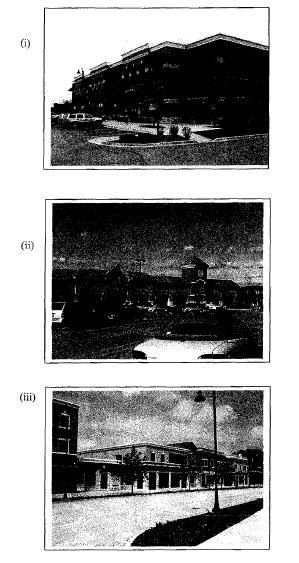
(3) Features incorporated into the building design will be considered as individual elements.
(a) Each structure must meet the minimum requirements for all Building Sections One through Five.
(b) Should a large user share a common wall with other structures, then that user will be subject to § 159.158(J)(6) and not § 159.158(J)(7). Large users shall be defined as a single occupant comprised of 8,000 square feet or more building space and possessing only two or less customer entrances. This space must be built for a specifically single occupant user, and have no intention of being divided into smaller tenant spaces at the time of construction. (Example: a 40,000 square foot electronics store is constructed in line with a multiple tenant structure).
(c) Should any structure share a wall with another structure, only the visible portion of that wall shall meet the number of required elements. Example: If two units share 200 lineal feet of wall surface and one of the users wall's extend an extra 100 lineal feet from the point in which the shared section ceases, then only that 100 lineal feet shall meet the element requirement.
(d) Should a facade be entirely blocked from public view by other structures or shared facades, then that facade will not have to meet the element requirement.
(e) Buildings that consist of more than one functional story shall contain similar design features as required per each section of the following code. However, the actual element requirements will not increase. Any additional elements will count for the section requirement. Concerning roof design, a functional second story will be considered the same as a false second story and will fulfill the roof design requirements if a detailed cornice is utilized.
(4) Certain elements can be counted twice. These particular features are as follows:
(a) Awnings, overhangs, and canopies which accentuate entry points, can also be counted for Section Two: Street Facing Facades or Section Five: Non Street Facing Facades.
(b) Architectural thematic lights that accentuate an entry point can also be counted for Section Two: Street Facing Facades or Section Five: Non Street Facing Facades.
(c) Medallions and other features that accentuate an entry point can also be counted for Section Two: Street Facing Facades or Section Five: Non Street Facing Facades.
(5) Definitions and examples of elements. In order to meet the criteria, any of the elements applied in Section One must be uniform in nature over the entire structure.
(a) Section One: Building Form and Massing.
1. Texture Change – A change in the surface quality, grain, or consistency of the building.
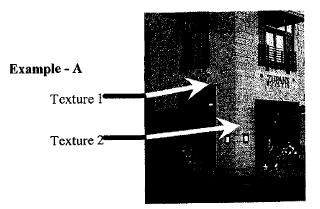
2. Pattern Change – A differentiation in the configuration, design, or arrangement of building materials in relationship to one another. Examples: changes in building form from straight lines to arches or changing the direction of bricks.
3. Color Change – A differentiation in the color of exterior materials used in construction of the actual building.
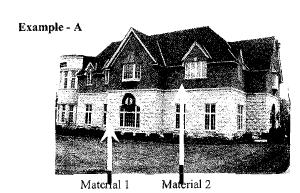
4. Material Change – A change in the physical material used to construct an individual building. Examples: Changes from brick to ground face block or limestone to granite.
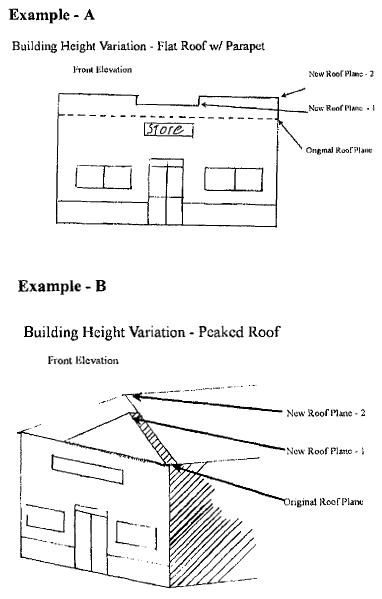
5. Height Variations – Height variations include roofline or peak sections which form a new roof plane. Variations which terminate at the same height plane as other variations will not be double-counted in the point system. Functioning second stories do not count for a height variation. However, second stories may qualify for the mix-use bonus. For false second stories, see § 159.158(J)(5)(c)6. The original height will count as a one height variation, essentially all buildings will start with one change.
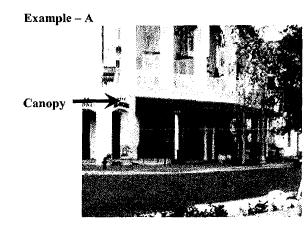
6. Canopy – A protective covering fashioned entirely over an entryway or pedestrian space, typically made of canvas. Other materials are acceptable.
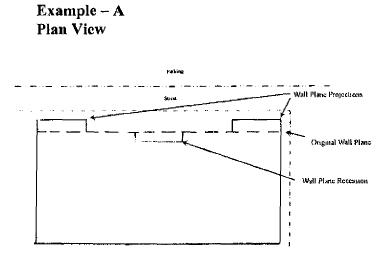
7. Recesses and Projections – A change in the wall plane in which a section of the building moves either closer to or further from the original wall plane of a structure. The original wall plane will count as one recess and projection; essentially all buildings will start with one change.
8. Arcade – A series of arches supported by piers or columns.
9. Single Tenant Buildings - A single tenant building shall be considered as a structure that possesses only one tenant and cannot be separated into smaller units with more than one occupant by a demising wall or any other means.
10. Multiple Tenant Buildings - A multiple tenant building shall be considered as a structure that possesses two or more tenants and can be separated into smaller units with more than one occupant by a demising wall or other means.
(b) Section Two: Street Facing Facades.
1. Street Facing Facades - Those facades that face any public street or major thoroughfare.
2. Colonnades – A series of, or row of, columns, usually spanned by lintels, i.e. beams.
3. Pilasters - A flat, rectangular vertical member projecting from a wall of which it forms a part. It usually has a base and a capital and is often fluted.
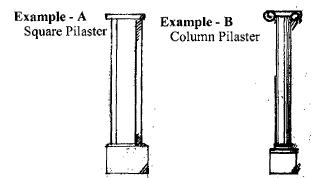
4. Columns – A vertical, weight carrying architectural member, circular in cross section and consisting of a base and fluted (sometimes omitted).
5. Exterior Architectural Window Frames - An enhanced frame around the exterior facade of a window incorporating one or more features, such as: pilasters, columns, pediments, stones, creative brick work, or the like.
6. Windows — Glass features that are translucent or semi-translucent in which a person can see into and out of a structure. Sheets of glass separated by only metal frames or other materials will be counted as one window. Windows will not be counted as separate unless they are separated by at least three inches of a material such as masonry, concrete, or an architectural window frame. Functional windows:
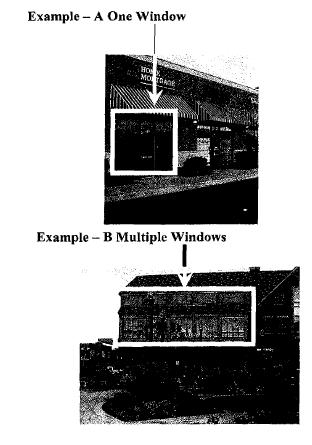
7. False Windows - Windows that do not see visually into a structure, but do have some sort of visual point of interest. Examples: display windows, pictures, and the like. Opaque or non-transparent windows do not qualify as an element.
8. Overhang - A feature that physically projects away from the building wall plane. Can be made up of various materials or built out of the building structure.
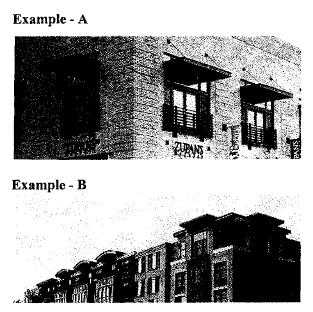
(c) Section Three: Roof Design.
1. Eave - The lower part of a roof which overhangs the building facade.
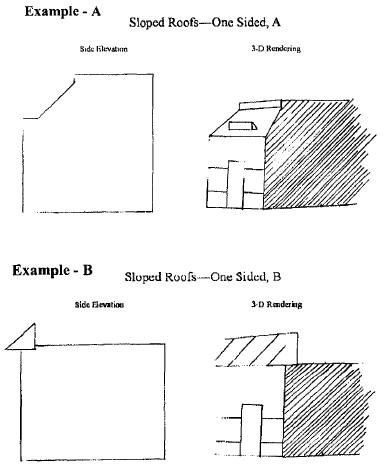
2. Sloped Roofs One-Sided - A roof projecting from or above the top of any structure that has a vertical slope between 30 and 80 degrees on one side, and is surrounded by walls that meet at 90 degree angles. Angles of a lesser or greater degree do not count.
3. Peaked Roofs Finished and Sloped on All Four Sides - A roof that climaxes at a peak and has slopes on all four sides. Does not need to cover the whole functional roof of the structure, rather screen all roof top equipment.
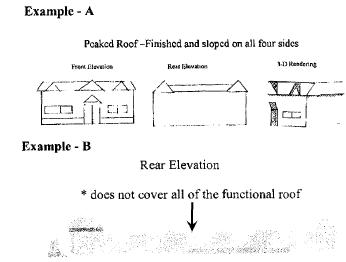
4. Complete sloped and peaked roof that covers the entire roof surface - A roof sloping on all four sides which climaxes at a peak. This type of roof does not cover 100% of the functional roof surface.
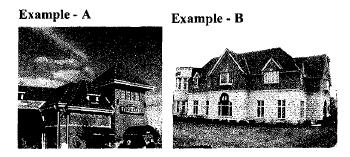
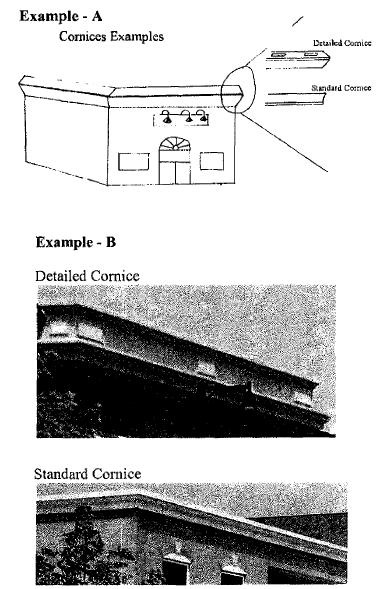
5. Cornice - The projecting crowning member of a roof, which frames the roof plane and screens rooftop equipment.
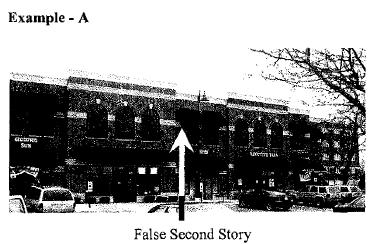
6. False Second Story - The use of additional vertical height on a structure to create a second story in exterior appearance only. The equivalent of a second story without having any inhabitable floor area.
(d) Section Four: Entry- Articulation.
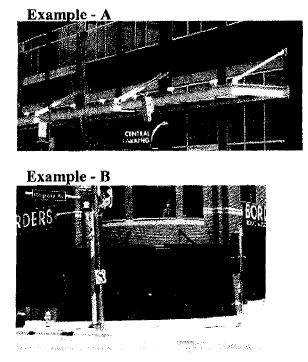
1. Overhang - A feature that physically projects away from the building wall plane to accentuate an ingress or egress point. Can be made up of various materials or built out of the building structure.
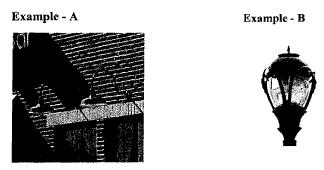
2. Architecturally Thematic Lights - Lights that are incorporated into the design of the building and go beyond a standard square light fixture. Strings of LED or neon lights do not count.
3. Portico - An entrance porch with a roof supported by columns. The portico shall include all necessary elements that an architecturally pleasing entry entails: lighting, columns pilasters, and architectural detailing.
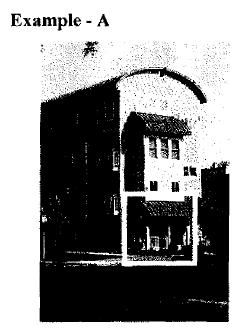
4. Columns - See § 159.158(J)(5)(b)4..
5. Exterior Architectural Window Frames - See § 159.158(J)(5)(b)5..
6. Knee Wall - Knee walls shall be a minimum of two feet in height.
7. Multiple Tenant Building Entry Ways - Multiple tenant entry ways in multiple tenant buildings will be defined as possessing an access point into a tenant space separated by a demising wall. Furthermore, each entryway must meet the minimum element standards as detailed in § 159.158(J)(5)(d). A differentiated entryway may not exceed more than 60 feet, and must occur at a logical division of the building.
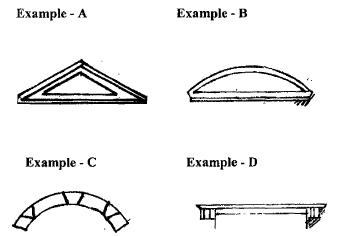
8. Pediments –
(e) Section Five: Non Street Facing Facades, see § 159.175(5)(b).
(f) Section Six: Bonuses
1. Outdoor patios - A clearly defined area set aside for outside dinning.
2. Mixed Use - Structures that contain commercial uses on the ground floor and additional uses on the second floor.
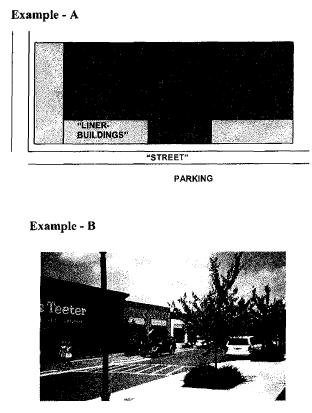
3. Lining of Buildings - Using smaller tenant space to surround (line) a larger big box user.
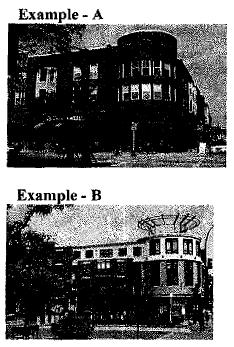
4. Changes in Building Form to Accentuate Corners - Change in the physical shape of the building at the corner to further articulate the entryway and differentiate the building form.
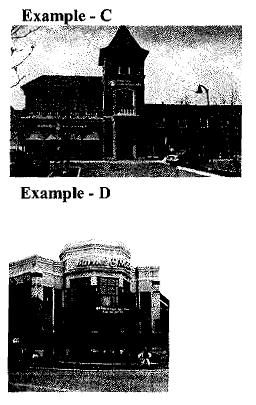
(6) Single tenant commercial building elements will be assessed as follows. Building elements will be assessed in the following manner, and must conform to the minimum number of elements set forth in the following sections.
(a) Certain features can be counted twice:
1. Awnings that accentuate an entry point can also be counted for Section Two: Street Facing Facades and Section Five: Non Street Facing Facades.
2. Architectural thematic lights that accentuate an entry point can also be counted for Section Two: Street Facing Facades and Section Five: Non Street Facing Facades.
3. Medallions and other features that accentuate an entry point can also be counted for Section Two: Street Facing Facades and Section Five: Non Street Facing Facades.
(b) Section One: Building Form and Massing. In order to meet the criteria any of the elements applied in Section One must be uniform in nature for the entire structure. Smooth concrete panels are not allowed. If the primary wall surface material is either concrete of tilt up concrete then a pattern must be utilized within the concrete surface such as a stamped brick pattern.
1. Table One:
Building Materials: A minimum of 3 of the following categories must be utilized. (Please indicate the number and type of changes utilized) | Retail 10,000 S.F. or less | Retail 10,000 to 50,000 S.F. or less | Retail 50,001 S.F. or greater |
Building Materials: A minimum of 3 of the following categories must be utilized. (Please indicate the number and type of changes utilized) | Retail 10,000 S.F. or less | Retail 10,000 to 50,000 S.F. or less | Retail 50,001 S.F. or greater |
Texture change | |||
Pattern change | |||
Color change | |||
Material change | |||
Building Form | |||
Height variations: Height differentiations shall not exceed a maximum of 5 feet. Variations shall include different peak heights on four sided or finished roofs; see Section Three. Height intervals cannot be less than 1 foot. | A minimum of 2 variations shall be required | A minimum of 3 variations shall be required | A minimum of 3 variations shall be required |
Recess or projection. Variation shall not exceed 5 feet of recess or projection from wall plane | A minimum of 2 variations shall be required. | A minimum of 3 variations shall be required. | A minimum of 3 variations shall be required. |
(c) Section Two: Street Facing Facades. Points will be assessed as follows: All street-facing and visible facades of a building shall include, at set intervals, either horizontally or vertically, architectural details such as:
(d) Table Two:
Facade Elements | Retail 10,000 S.F. or Less | Retail 10,000 to 50,000 S.F. or Less | Retail 50,001 S.F. or Greater |
Facade Elements | Retail 10,000 S.F. or Less | Retail 10,000 to 50,000 S.F. or Less | Retail 50,001 S.F. or Greater |
Elements (write the amount of elements included) | 4 elements are required per every 15 lineal feet of the facade | 4 elements are required per every 20 lineal feet of the facade | 3 elements are required per every 30 lineal feet of the facade |
Colonnades (Counts as one element per every 10 lineal feet.) | |||
Pilasters (Each pilaster counts as 1.5 elements and must be spaced at intervals no less than 20 feet.) | |||
Functional windows (Each functional window counts as 2.5 elements. Windows must be separated by an architectural frame for consideration.) | |||
False windows | |||
Pediments | |||
Exterior architectural window frames (Each complete architectural frame counts as 2 elements.) | |||
Facade Elements | Retail 10,000 S.F. or Less | Retail 10,000 to 50,000 S.F. or Less | Retail 50,001 S.F. or Greater |
Architectural detailing such as medallions, incorporated stone features, or the like. (Each medallion counts as 0.5 elements.) | |||
Architecturally thematic light fixtures. (Each light fixture counts as 0.5 elements.) | |||
Fabric awnings (Individual awnings count as 1 element.) | |||
Overhangs (Counts as 4 elements.) | |||
Columns (Counts as 3 elements.) |
(e) Section Three: Roof Design. Points for this section will be assessed as follows: Attention should be paid to the design of roofs. There must be variations in roof lines incorporating the following features:
1. Table Three Part I — Roof Form
Major Roof Form | Retail 10,000 S.F or Less | Retail 10,000 to 50,000 S.F. or Less | Retail 50,001 S.F. or greater |
Major Roof Form | Retail 10,000 S.F or Less | Retail 10,000 to 50,000 S.F. or Less | Retail 50,001 S.F. or greater |
Sloped roofs one-sided. | Must incorporate a combination of 8 elements from Group Two | Must incorporate a combination of 10 elements from Group Two | Must incorporate a combination of 12 elements from Group Two |
Peaked roofs finished and sloped on all 4 sides. Based on the amount of the roof perimeter covered by the finished roof. | 0-25% = 8 additional elements required from roof articulation section | 0-25% = 8 additional elements required from roof articulation section | 0-25 % = 8 additional elements required from roof articulation section |
26-50% = 6 additional elements required from roof articulation section | 26-50% = 6 additional elements required from roof articulation section | 26-50% = 6 additional elements required from roof articulation section | |
51-75 % = 4 additional elements required from roof articulation section | 51-75 % = 4 additional elements required from roof articulation section | 51-75 % = 4 additional elements required from roof articulation section | |
76-100% = 2 additional elements required from roof articulation section | 76-100% = 2 additional elements required from roof articulation section | 76-100% = 2 additional elements required from roof articulation section | |
Complete sloped and peaked roof that covers the entire roof surface. | No additional roof features required from roof articulation section. | No additional roof features required from roof articulation section. | No additional roof features required from roof articulation section. |
False Second Story with cornice. False second story must be constructed on all 4 sides of the structure and finished with a cornice. | No additional roof features required from roof articulation section. | No additional roof features required from roof articulation section. | No additional roof features required from roof articulation section. |
Aesthetic roof covering on sloped roofs only; slate, shale, clay, cedar shake, or other high quality shingle deemed appropriate by the Zoning Administrator. | Will substitute for 4 additional roof features required from roof articulation section. | Will substitute for 4 additional roof features required from roof articulation section. | Will substitute for 4 additional roof features required from roof articulation section. |
Major Roof Form | Retail 10,000 S.F or Less | Retail 10,000 to 50,000 S.F. or Less | Retail 50,001 S.F. or greater |
Parapets along flat roofs that must conceal all rooftop equipment. All parapets must cover 100% of the structure. | Must incorporate a combination of 10 elements from roof articulation section. | Must incorporate a combination of 12 elements from roof articulation section. | Must incorporate a combination of 34 elements from roof articulation section. |
2. Table Three Part II — Roof Articulation.
Roof Articulation | |
Overhanging eaves: must span entire facade. (Each facade counts as 5 roof articulation elements). | |
Dormers | |
Large roof pediment | |
Cornices: must span entire facade (Each facade counts as 2 elements.) | |
Detailed cornice sections (Must be at least 25 feet in length). | Will count as 1 articulation element. |
Cornice that incorporates additional architectural detailing. Must encompass 100% of the building | Substitutes for additional roof requirements such as: eaves, dormers, pediments, or each facade counts as 3 articulation elements. |
(f) Section Four: Entry-Articulation. Points for this section will be assessed as follows: Each primary entrance shall be accentuated by incorporating the following elements:
1. Table Four
Entry Articulation | Retail 10,000 S.F or Less | Retail 10,000 to 50,000 S.F. or Less | Retail 50,001 S.F. or greater |
Elements (write the amount of elements included). | 10 elements are required per each entrance | 10 elements are required per each entrance | 10 elements are required per each entrance |
Overhang (Counts as 4 elements.) | |||
Architectural detailing such as medallions, incorporated stone features, or the like. (Each medallion counts as 0.5 elements.) | |||
Planter or wing wall that incorporates landscaping. |
Entry Articulation | Retail 10,000 S.F or Less | Retail 10,000 to 50,000 S.F. or Less | Retail 50,001 S.F. or greater |
Architecturally thematic light fixtures. (Each light fixture counts as 0.5 elements.) | |||
Porticos (counts for 8 elements.) | |||
Pilasters. | |||
Columns. Does not include columns used as a support of a portico. | |||
Large pediments over doorways (Counts as 4 elements.) | |||
Exterior architectural door frames (Counts as two elements.) | |||
Canopy (Counts as 5 elements.) | |||
Windows (Counts as 2.5 Elements). | |||
(g) Section Five: Non Street Facing Facades. Points for this section will be assessed as follows: All non street-facing facades of a building shall include, at set intervals, either horizontally or vertically, architectural details such as:
1. Table Five
Facade Elements | Retail 10,000 S.F. or Less | Retail 10,000 to 50,000 S.F. or Less | Retail 50,001 S.F. or greater |
Elements (write the amount of elements included.) | 2.5 elements are required per every 15 lineal feet of the facade | 2 elements are required per every 25 lineal feet of the facade | 2 elements are required per every 30 lineal feet of the facade |
Colonnades (Counts as 1 element per every 10 lineal feet.) | |||
Pilasters (Each pilaster counts as 2 elements and must be spaced at intervals no less than 20 feet.) | |||
Functional windows (Each functional window counts as 2.5 elements. Windows must be separated by an architectural frame for consideration.) | |||
False windows | |||
Pediments | |||
Exterior architectural window frames (Each Complete architectural frame counts as 2 elements.) | |||
Facade Elements | Retail 10,000 S.F. or Less | Retail 10,000 to 50,000 S.F. or Less | Retail 50,001 S.F. or greater |
Architectural detailing such as medallions, incorporated stone features, or the like. (Each medallion counts as 0.5 elements.) | |||
Architecturally thematic light fixtures. (Each light fixture counts as 0.5 elements.) | |||
Fabric awnings (Individual awnings count as 1 element.) | |||
Overhangs (Counts as 4 elements.) | |||
Columns (Counts as 3 elements.) |
(h) Section Six: Building Bonuses. Points for this section will be assessed as follows: Points awarded from the bonus section can be used as a substitute for points required in other sections.
1. Table Six
Feature (the following extra features qualify as bonus and therefore can be substituted for elements in the previous five sections) | |
Building set close to the main or public street without large expanses of parking, no more than one row of parking between the public street and building. | 15 elements |
Outdoor patios, 10 points. With a clear separation between the patio and pedestrian paths. | 10 elements |
LEED Certification. | 30 elements |
Mixed use buildings. | 15 elements |
Lining of large retails | 20 elements |
Changes in building form to accentuate corners | 15 elements |
a. Additional bonuses: Should one section of the building go "above and beyond" the required amount of points, those points may be distributed to another section. A maximum of 20 elements will be allowed to be redistributed. A total of 20 elements can be redistributed over the design sections, but not more than ten elements per section. These bonus elements can be applied in addition to the elements list in Table Six, § 159.158(J)(6)(h)1.
b. If a whole development equaling five or more total lots chooses an encompassing architectural theme such as, "Prairie Style", "colonial", "gothic revival", or another theme, will result in the bonus of 50 bonus elements to be distributed to the different lots of the new development. Which new lots receive the bonus elements will be at the discretion of the developer, but no lot will be eligible for more that 12 element bonuses. These bonus elements can be applied in addition to the elements list in Table Six, § 159.158(J)(6)(h)1., and may exceed the ten element per section limit.
c. Should a developer choose to use architecturally designed light posts and fixtures away from the building such as on the sidewalks or in the parking lots, a bonus of ten elements will be granted. These bonus elements can be applied in addition to the elements list in Table Six, § 159.158(J)(6)(h)1.
d. A total of 30 additional element bonuses can be applied per building.
2. Penalties. No truck dock, trash facility, or otherwise conceived loading/unloading space shall face a major public or private street. If the development must be designed so as to have a facility face a major public or private street, then it must be properly screened as per § 159.030(D)(4)(o) and will result in a penalty of 15 elements on the respective facade on which the truck dock is located.
(7) Multiple tenant commercial building elements will be assessed as follows. Building elements will be assessed in the following manner, and must conform to the minimum number of elements set forth in the following sections.
(a) Certain features can be counted twice:
1. For multiple tenant buildings with three or more separate tenant spaces Section Four: Entryway Articulation shall be substituted for either Section Two: Street Facing Facades or Section Five: Non Street Facing Facades depending on the orientation of the multiple entrance facade. However, for elements to receive credit as entryway articulation they must fall within ten feet to either side of the entryway, but may extend to the roof line of the structure.
2. Awnings that accentuate an entry point can also be counted for Section Two: Street Facing Facades and Section Five: Non Street Facing Facades.
3. Architectural thematic lights that accentuate an entry point can also be counted for Section Two: Street Facing Facades and Section Five: Non Street Facing Facades.
4. Medallions and other features that accentuate an entry point can also be counted for Section Two: Street Facing Facades and Section Five: Non Street Facing Facades.
5. Features such as lights, medallions, pilasters, and the like which fall on the dividing line of individual tenant spaces will count as equal points for both tenant spaces. Points will only be awarded if the feature in question falls evenly in the space between two tenant spaces.
(b) Section One: Building Form and Massing. Elements for this section will be assessed as follows and should include: In order to meet the criteria all elements applied in Section One must be uniform in nature for the entire structure. If the primary wall surface material is either concrete or tilt up concrete then a pattern must be utilized within the concrete surface such as a stamped brick pattern.
1. Table One:
Building Materials. A minimum of 3 of the following categories must be utilized | Retail 10,000 S.F. or Less | Retail 10,000 to 50,000 S.F. or Less | Retail 50,001 S.F. or greater |
Building Materials. A minimum of 3 of the following categories must be utilized | Retail 10,000 S.F. or Less | Retail 10,000 to 50,000 S.F. or Less | Retail 50,001 S.F. or greater |
Texture change. | |||
Pattern change. | |||
Color change. | |||
Material change. | |||
Building Form | |||
Height variations: Height differentiations shall not exceed a maximum of 5 feet. Variations will include different peak heights on 4 sided or finished roofs; (See Section Three.) Height intervals cannot be less than 1 foot. | Height of parapet must be varied per the lesser of 40 lineal feet or 2 tenant spaces. | Height of parapet must be varied per the lesser of 40 lineal feet or 2 tenant spaces. | Height of parapet must be varied per the lesser of 40 lineal feet or 2 tenant spaces. |
Recess or projection. Variation shall not exceed 5 feet of recess or projection from wall plane. | Wall projections must be varied per the lesser of 40 lineal feet or 2 tenant spaces. | Wall projections must be varied per the lesser of 40 lineal feet or 2 tenant spaces. | Wall projections must be varied per the lesser of 40 lineal feet or 2 tenant spaces. |
2. Individual Unit Form. Units must be either differentiated in terms of form, color, or materials per the lesser of 40 lineal feet or two tenant spaces in the building to create the appearance of individual buildings. Alternating similar patterns will be accepted provided an architectural theme is adhered to and tenant spaces are clearly defined as separate.
3. Roof Form of Units. Changes in the appearance or shape of the roofline to further accentuate the individual units are mandatory. Changes must occur per the lesser of 40 lineal feet or two tenant spaces in the building to create the appearance of individual buildings. Alternating similar patterns will be accepted provided an architectural theme is adhered to and tenant spaces are clearly defined as separate.
(c) Section Two: Street Facing Facades. Points will be assessed as follows: All street-facing and visible facades of a building shall include, at set intervals, either horizontally or vertically, architectural details such as:
1. Table Two:
Facade Elements | Retail 10,000 S.F. or Less | Retail 10,000 to 50,000 S.F. or Less | Retail 50,001 S.F. or greater |
Facade Elements | Retail 10,000 S.F. or Less | Retail 10,000 to 50,000 S.F. or Less | Retail 50,001 S.F. or greater |
Elements (write the amount of elements included). | 4 elements are required per every 15 lineal feet of the facade | 4 elements are required per every 20 lineal feet of the facade | 3 elements are required per every 30 lineal feet of the facade |
Colonnades (Counts as 1 element per every 10 lineal feet.) | |||
Pilasters (Each pilaster counts as 1.5 elements and must be spaced at intervals no less than 20 feet.) | |||
Functional windows (Each functional window counts as 2.5 elements. Windows must be separated by an architectural frame for consideration.) | |||
False windows | |||
Pediments | |||
Exterior architectural window frames (Each complete architectural frame counts as 2 elements.) | |||
Architectural detailing such as medallions, incorporated stone features, or the like. (Each medallion counts as 0.5 elements.) | |||
Architecturally thematic light fixtures. (Each light fixture counts as 0.5 elements.) | |||
Fabric awnings (Individual awnings count as 1 element.) | |||
Overhangs (Counts as 4 elements.) | |||
Columns (Counts as 3 elements.) | |||
(d) Section Three: Roof Design. Points for this section will be assessed as follows: Attention should be paid to the design of roofs. There must be variations in roof lines incorporating the following features:
1. Table Three Part I — Roof Form
Major Roof Form | Retail 10,000 S.F. or Less | Retail 10,000 to 50,000 S.F. or Less | Retail 50,001 S.F. or greater |
Sloped roofs one-sided. | Must incorporate a combination of 8 elements from Group Two | Must incorporate a combination of 10 elements from Group Two | Must incorporate a combination of 12 elements from Group Two |
Major Roof Form | Retail 10,000 S.F. or Less | Retail 10,000 to 50,000 S.F. or Less | Retail 50,001 S.F. or greater |
Peaked roofs finished and sloped on all 4 sides. Based on the amount of the roof perimeter covered by the finished roof. | 0-25% = 8 additional elements required from roof articulation section | 0-25% = 8 additional elements required from roof articulation section | 0-25 % = 8 additional elements required from roof articulation section |
26-50% = 6 additional elements required from roof articulation section | 26-50% = 6 additional elements required from roof articulation section | 26-50% = 6 additional elements required from roof articulation section | |
51-75% = 4 additional elements required from roof articulation section | 51-75 % = 4 additional elements required from roof articulation section | 51-75 % = 4 additional elements required from roof articulation section | |
76-100% = 2 additional elements required from roof articulation section | 76-100% = 2 additional elements required from roof articulation section | 76-100% = 2 additional elements required from roof articulation section | |
Complete sloped and peaked roof that covers the entire roof surface. | No additional roof features required from roof articulation section. | No additional roof features required from roof articulation section. | No additional roof features required from roof articulation section. |
False second story with cornice. False second story must be constructed on all 4 sides of the structure and finished with a cornice. | No additional roof features required from roof articulation section. | No additional roof features required from roof articulation section. | No additional roof features required from roof articulation section. |
Aesthetic roof covering on sloped roofs only: slate, shale, clay, cedar shake, or other high quality shingle deemed appropriate by the Zoning Administrator. | Will substitute for 4 additional roof features required from roof articulation section. | Will substitute for 4 additional roof features required from roof articulation section. | Will substitute for 4 additional roof features required from roof articulation section. |
Parapets along flat roofs that must conceal all rooftop equipment. All parapets must cover 100% of the structure. | Must incorporate a combination of 8 elements from roof articulation section. | Must incorporate a combination of 10 elements from roof articulation section. | Must incorporate a combination of 12 elements from roof articulation section. |
2. Table Three Part H — Roof Articulation
Roof Articulation | |
Overhanging eaves: must span entire facade (Each facade counts as 5 roof articulation elements). | |
Dormers | |
Large roof pediment | |
Cornices: must span entire facade (Each facade counts as 2 elements.) | |
Detailed cornice sections (Must be at least 25 feet in length). | Will count as 1 articulation element. |
Cornice that incorporates additional architectural detailing. Must encompass 100% of the building. | Substitutes for additional roof requirements such as: eaves, dormers, pediments, or each facade counts as 3 articulation elements. |
(e) Section Four: Entry-Articulation. Points for this section will be assessed as follows: Each primary entrance shall be accentuated by incorporating the following elements:
1. Table Four
Multi-Tenant Entry Articulation | Retail 10,000 S.F. or Less | Retail 10,000 to 50,000 S.F. or Less | Retail 50,001 S.F. or greater |
Multi-Tenant Entry Articulation | Retail 10,000 S.F. or Less | Retail 10,000 to 50,000 S.F. or Less | Retail 50,001 S.F. or greater |
Elements (write the amount of elements included) | 15 elements are required per each entrance | 15 elements are required per each entrance | 15 elements are required per each entrance |
Overhang (Counts as 4 elements) | |||
Architectural detailing such as medallions, incorporated stone features, or the like. (Each medallion counts as 0.5 elements.) | |||
Planter or wing wall that incorporates landscaping. | |||
Architecturally thematic light fixtures (Each light fixture counts as 0.5 elements.) | |||
Porticos (Counts for 8 elements.) | |||
Pilasters. | |||
Columns. Does not include columns used as a support of a portico. | |||
Pediments over doorways (Counts as 4 elements.) | |||
Exterior architectural door frames (Counts as 2 elements.) | |||
Canopy (Counts as 5 elements.) | |||
Knee wall except for ingress and egress points (Counts as 5 elements.) ** Clear glass to the bottom of any structure is prohibited. | |||
Colonnades. | |||
Windows, functional. Must have architectural frame (Counts as 2 elements.) | |||
False windows | |||
Individual space fabric awnings (Counts as 2 elements.) | |||
(f) Section Five: Non Street Facing Facades. Points for this section will be assessed as follows: All non street facing facades of a building shall include, at set intervals, either horizontally or vertically, architectural details such as:
1. Table Five
Facade Elements | Retail 10,000 S.F. or Less | Retail 10,000 to 50,000 S.F. or Less | Retail 50,001 S.F. or greater |
Facade Elements | Retail 10,000 S.F. or Less | Retail 10,000 to 50,000 S.F. or Less | Retail 50,001 S.F. or greater |
Elements (write the amount of elements included). | 2.5 elements are required per every 15 lineal feet of the facade | 2 elements are required per every 20 lineal feet of the facade | 2 elements are required per every 30 lineal feet of the facade |
Colonnades (Counts as 1 element per every 10 lineal feet.) | |||
Pilasters (Each pilaster counts as 2 elements and must be spaced at intervals no less than 20 feet.) | |||
Functional windows (Each functional window counts as 2.5 elements. Windows must be separated by an architectural frame for consideration.) | |||
False windows | |||
Pediments | |||
Exterior architectural window frames (Each complete architectural frame counts as 2 elements.) | |||
Architectural detailing such as medallions, incorporated stone features, or the like. (Each medallion counts as 0.5 elements.) | |||
Architecturally thematic light fixtures. (Each light fixture counts as 0.5 elements.) | |||
Fabric awnings (Individual awnings count as 1 element.) | |||
Overhangs (Counts as 4 elements.) | |||
Columns (Counts as 3 elements.) | |||
(g) Section Six: Building Bonuses. Points for this section will be assessed as follows: Points awarded from the bonus section can be used as a substitute for points required in other sections.
1. Table Six
Feature (the following extra features qualify as bonus and therefore can be substituted for elements in the previous five sections) | |
Building set close to the main or public street without large expanses of parking, no more than one row of parking between the public street and building. | 15 elements |
Outdoor patios, 10 points. With a clear separation between the patio and pedestrian paths. | 10 elements |
LEED Certification. | 30 elements |
Mixed use buildings. | 15 elements |
Lining of large retails | 20 elements |
Changes in building form to accentuate corners | 15 elements |
2. Additional bonuses:
a. Additional bonuses: Should one section of the building go "above and beyond" the required amount of points, those points may be distributed to another section. A maximum of 20 elements will be allowed to be redistributed. A total of 20 elements can be redistributed over the design sections, but not more than ten elements per section. These bonus elements can be applied in addition to the elements list in Table Six § 159.158(J)(6)(g)1.
b. If a whole development equaling five or more total lots chooses an encompassing architectural theme such as, "Prairie Style", "colonial", "gothic revival", or another theme will result in the bonus of 50 bonus elements to be distributed to the different lots of the new development. Which new lot receives the bonus elements will be at the discretion of the developer, but no lot will be eligible for more that 12 bonus elements. These bonus elements can be applied in addition to the elements list in Table Six, § 159.158(J)(6)(g)1., and may exceed the ten element per section limit.
c. Should a developer choose to use architecturally designed light posts and fixtures away from the building such as on the sidewalks or in the parking lots, a bonus of 15 elements will be granted. These bonus elements can be applied in addition to the elements list in Table Six § 159.158(J)(6)(g)1., and may exceed the five elements per section limit.
d. A total of 30 additional bonus elements can be applied per building.
3. Penalties. No truck dock, trash facility, or otherwise conceived loading/unloading space shall face a major public or private street. If the development must be designed so as to have a facility face a major public or private street, then it must be properly screened as per § 159.030(D)(4)(o) and will result in a penalty of 15 elements on the respective facade on which the truck dock is located.
(8) Light pole design must comply with the following:
(a) All parking lot and pedestrian light poles must possess an architectural character. Refer to § 159.158(J)(5)(d)2.
(9) Materials shall be of durable quality with good architectural character.
(a) Buildings shall have the same materials, or those that are architecturally harmonious, used for all building walls and other exterior building components wholly or partly visible from public ways.
(b) Materials shall be selected for suitability to the type of buildings and the design in which they are used.
(c) In any design in which the structural frame is exposed to view, the structural materials shall be compatible within themselves and harmonious with their surroundings.
(d) Materials shall include brick, wood, stone, tinted and textured concrete, masonry units, etc.
(e) Colors should be of low reflectance, subtle, neutral or earth tone colors.
(f) Smooth-faced concrete blocks, pore-fabricated steel panels are not acceptable.
(g) EFIS will not be allowed for more than 15% of the ground floor elevation and 30% of any additional story or false second story.
(10) Exterior lighting shall be part of the architectural concept. Fixtures, standards, and all exposed accessories shall be harmonious with the building design.
(11) Landscaping shall conform to the requirement of § 159.030. Careful attention should be paid in the design of these buildings to insure that all foundation landscaping can be accommodated.
(12) Sign locations on all buildings will be required as part of the sign plans. These plans must identify sign placement "envelopes" of rectilinear spaces wherein signs are allowed. Signs are not allowed outside of the designated envelope nor are envelopes allowed to span between different tenant spaces.
(K) Site design guidelines. The following site design guidelines shall apply to all structures.
(1) Site layout.
(a) Buildings shall be sited so as to encourage pedestrian traffic and so as to highlight architectural features of the buildings.
(b) Focal points, vistas, public art and architectural features shall be incorporated into the site design. These elements shall be provided in the landscaping areas, at natural vistas, and in parking lot islands.
(c) The parking lot shall be surrounded by a landscaped berm except where impractical due to entrances and/or intersections.
(d) Parking shall be distributed around large buildings in order to reduce traveling distance and the overall scale of paved surface.
(e) At least one customer entrance shall be provided for each street-facing facade.
(f) Drop-off and pick-up points shall be integrated into the parking lot design. These shall be designed so as to accommodate private vehicles as well as transit.
(g) Snow clearing must be addressed by providing a designated snow piling area.
(h) A build-to line shall be established for all establishments located on out lots so as to accommodate a streetscape of buildings rather that one of parking spaces.
(2) Circulation.
(a) The circulation systems shall be designed to carry different types of traffic and to provide safe access to all parking spaces and access drives.
(b) Vehicular circulation systems providing access to parking areas shall be designed to reduce the potential for vehicular conflicts.
(c) Adequate stacking for vehicles shall be provided at the access points from parking areas.
(d) Entrances to the site shall be designed to accommodate vehicles, pedestrians, and cyclists. Special attention shall be paid to accommodate cyclists and pedestrians along property lines abutting the path system.
(e) In the event a vehicle deflector is provided, the deflector must consist of a landscaped area and a focal feature. The landscaping must incorporate ornamental trees, shrubs, flowers and grasses. The focal feature must be a unique piece of art or an architectural element consistent with the design of the buildings on the site.
(3) Pedestrian considerations.
(a) Sidewalks shall be provided along all sides of the lot that abut a public street.
(b) Continuous internal pedestrian walkways shall be provided from the public sidewalk or right-of-way to the principal entrance of all principal buildings on site. At a minimum, walkways shall connect focal points of pedestrian activity and shall feature adjoining landscaped areas.
(c) Sidewalks shall be provided along the full length of the building along any facade featuring a customer entrance and along any facade abutting parking areas. Such sidewalks shall be setback at least six feet from the facade of the building in order to provide planting beds for foundation landscaping, except where impractical due to entrances, etc.
(d) All internal pedestrian walkways shall be distinguished from driveways through the use of different surface treatments.
(e) Pedestrian ways shall be anchored by special design features and architectural elements that define circulation ways and outdoor spaces.
(f) Delivery and loading areas shall be designed so as not to disturb pedestrian and parking lot circulation and so as not to disturb adjoining neighborhoods.
(g) Sidewalks shall be five feet minimum in width. A variance will be considered for special circumstances with restricted space, however in no case shall a width less than four feet be allowed. Sidewalks that abut a public street shall be separated from the street with a landscaped parkway with a minimum width of six feet wherever practical.
(h) Sidewalk curb ramps. Sidewalk curb ramps shall be constructed at all intersections between sidewalks and streets, parking areas, driveways and other vehicular passageways. The ramps shall be of the truncated dome type and shall be constructed in accordance with the latest version of the Illinois Department of Transportation's Standard No. 424001, Curb Ramps for Sidewalks. The ramps shall also be placed at the ends of sidewalk island areas in parking areas, and adjacent to disabled-access parking stalls in sidewalk island areas in parking areas. The sidewalks shall meet the requirements of the ADA and ABA Accessibility Guidelines for Buildings and Facilities.
(i) Entranceways to buildings. Sidewalks at entranceways to buildings shall be constructed so that the entranceways meet the requirements of the ADA and ABA Accessibility Guidelines for Buildings and Facilities.
(Ord. 06-0388, passed 6-7-06; Am. Ord. 07-0508, passed 2-21-07; Am. Ord. 07-0557, passed 7-18-07; Am. Ord. 07-0558, passed 7-18-07; Am. Ord. 08-0657, passed 5-21-08)
§ 159.159 PLANNED UNIT DEVELOPMENTS - MANUFACTURING/INDUSTRIAL.
For planned developments located in one or more manufacturing/industrial districts, exceptions may be made in the regulations of these districts, as set forth herein:
(A) Use regulations. Uses listed as permitted and special uses in the business/ commercial and manufacturing/industrial districts are allowed.
(B) Bulk regulations.
(1) Yards. Yard requirements may be waived, except along the exterior boundaries of the development.
(2) Floor area ratio. Floor area ratio requirement of the district are applicable to the entire planned development and not to specific uses which may be located within the planned development. For this purpose, the net site area shall be used in the computation.
(D) Signage. All in accordance with regulations set forth in §§ 59.120 through 159.133.
(I) Design guidelines. The following building design guidelines shall apply to all structures.
(1) Facades.
(a) Architectural details shall be incorporated on all visible building facades, such as:
1. Textures.
2. Patterns.
3. Color building.
4. Forms used on front of facades.
(b) Building massing should be varied to create a logical hierarchy of building forms; to break up long expanses of facade and create shade and shadow.
(2) Entrances. Each principle building on a site should have clearly defined, highly visible customer entrances featuring at least three the following:
(a) Overhangs.
(b) Recesses/projections.
(c) Arcades.
(d) Raised cornice parapets.
(e) Peaked roof forms.
(f) Arches.
(g) Display windows.
(3) Building Materials.
(a) High quality building materials such as concrete, brick, and stone must be used on the facade of buildings. Vinyl siding, metal siding (including standing seam metal) and EIFS are prohibited.
(b) Building materials should be similar to the materials of the structures in the area. However, dissimilar materials may be permitted when incorporating other character- istics such as scale, form, architectural detailing and color to make the building compatible with the area.
(c) Materials requiring low maintenance are recommended over high maintenance materials. For instance, materials with integral color are generally recommended over materials require painting.
(4) Siting.
(a) Orient buildings so that building entries, office areas, and pedestrian-scale amenities are on the exposed sides of the facility.
(b) Configure buildings and circulation to conceal loading docks, rolling up doors, mechanical equipment, and outdoor areas with a high level of vehicular activity. Service and mechanical areas shall be designed as an architectural feature of the building and entirely screened from view.
(c) Provide sufficient buffer space and landscape treatment to migrate noise, visual clutter, or other negative impacts.
(Am. Ord. 07-0508, passed 2-21-07)

