
Romeoville City Zoning Code
BUSINESS/COMMERCIAL DISTRICT
§ 159.070 GENERAL REQUIREMENTS.
(A) Intent and purpose. The business districts set forth in this chapter are established to protect the public health, to promote public safety, comfort, convenience, and the general welfare, and to protect the economic base of the village and the value of property. These general purposes include, among others, the following specific objectives:
(1) To promote the most desirable use of land in accordance with a well considered plan so that adequate space is provided in appropriate locations for the various types of business and commercial type of uses, thereby protecting and strengthening the economic base of the village;
(2) To place in separate districts those businesses which may create noise, odors, hazards, unsightliness, or which may generate excessive traffic so as to adversely affect their neighbors;
(3) To permit selected business uses in districts where adjacency to or inclusion in a residence area has sufficient elements of service or convenience to those area to offset the disadvantages which may be created;
(4) To encourage the grouping in appropriate locations of compatible business uses which will tend to draw trade that is mutually interchangeable and so promote public convenience and business prosperity and contribute to the alleviation of traffic and pedestrian congestion; and
(5) To provide for the establishment of off-street parking facilities permitted and required so as to alleviate traffic congestion and so promote shopping convenience and business prosperity.
(B) Districts: There are hereby created the following districts:
(1) B-1, Local Shopping District;
(2) B-2, Community Shopping District;
(3) B-3, Highway/Regional Shopping District;
(4) B-4, Automotive Service District;
(5) P-B, Planned Business District.
(C) Residential dwelling units. Residential dwelling units are a "special use" within the B-1, Local Shopping District, provided they are located above the first floor and above a permitted business use. Residential dwelling units shall not be permitted on the ground floor of a business, or in the rear of a business establishment on the ground floor. The land area and density requirements of the R-6 District of this chapter shall apply to Residential dwelling units constructed in the B-1 District.
(D) Enclosure of operations. All business, commerce, serving, and processing shall be conducted within completely enclosed buildings, except:
(1) Off-street parking and loading;
(2) Drive-in types of operations, such as theaters and restaurant facilities;
(3) Outdoor sales lots, subject to the requirements of § 159.072(E);
(4) Outdoor dining areas when accessory to a permitted use;
(5) And as may otherwise be provided for herein.
(E) Off-street parking/loading and unloading facilities.
(1) Parking of trucks when accessory to the conduct of a permitted or special use shall be limited to vehicles having not over 1-1/2 ton capacity, except for pick-up or delivery services during normal business hours;
(2) Trucks in excess of 1-1/2 ton capacity shall not be parked in the open within 100 feet of a residence district boundary line;
(4) Parking is permitted within required front and rear yard areas, except it shall not be closer to any property line than as follows:
(a) B-1 District - ten feet;
(b) B-2 District - 20 feet;
(c) B-3 District - 25 feet;
(d) B-4 District - 15 feet;
(e) P-B District - see § 159.075(E)(9)(b).
(5) Parking is permitted in interior side yards provided that said side yard abuts commercially or industrially used or zoned property. A minimum setback of five feet shall be provided unless parking is shared.
(6) In addition to any other means of enforcement provided by the provisions of the Village Code of Ordinances, all sworn police officers of the village shall further be permitted to enforce the provisions of divisions (E)(1) and (E)(2) above by the means provided for in § 74.09 for the enforcement of violations of Chapter 74.
(G) Outdoor storage.
(1) All outdoor storage facilities for the building and accessory uses and products shall be enclosed by an architecturally pleasing fence, wall, or planting materials adequate to conceal the facilities from adjacent properties and the public street right-of-way.
(2) Outdoor storage areas shall be designed to be harmonious with the building and their design shall incorporate the same materials used in the building façade.
(3) Outdoor storage shall be included and shown within the required landscape plan according to the requirements of surfacing and curbing of § 159.108(D) of this chapter.
(4) Site and landscape plans shall be presented to the Fire Department, with an explanation as to the type of material being stored, housed or stocked within the outdoor storage area.
(5) Outdoor storage areas shall be landscaped in accordance with the landscaping requirements of this chapter.
(H) Landscaping. Placement of all landscaping shall be made in accordance with the provisions of this section and § 159.030, inclusive.
(1) All applications for building permit requested for new construction in any business/commercial district must have a previously approved landscape plan.
(2) The exterior storage of materials and inventory, shall be effectively screened from view from any district boundary line and right-of-way. Landscaping may consist of live or decorative plantings, or fencing.
(3) Where business/commercial uses abut or are across the street from a residential district, adequate landscape screening shall be provided to screen the business / commercial uses.
(J) Ingress/egress onto a public street.
(1) Access is limited to not more than two points of ingress and/or egress per lot except as modified in a PUD.
(2) Minimum width to be 24 feet at property line. Maximum width to be that of 40 feet at property line, unless additional width is required for safe access. This can include, but not limited to, two through lanes, one left turning lane and an appropriately landscaped island;
(3) Locations to be approved by the Village Engineer;
(4) Details of design and construction shall meet all village requirements; and
(5) Entrance curbs and storm drainage provisions shall be required on all street frontages, and shall meet with the approval of the Village Engineer and the standard specifications of the village.
(K) Land use development or change.
(1) Prior to the issuance of a building permit for any new construction or development within the B-1, B-2, B-3, B-4, and P-B districts, site, landscaping and development (engineering) plans shall have been approved.
(2) Any construction or development of a structure with more than 2,500 square feet or on a lot or parcel larger than one-acre in size shall occur only as a planned unit development.
(3) All shopping centers shall be developed as a planned unit development.
(4) Any construction or development not requiring the approval of a PUD may be approved by the Community Development Department except where action by the Village Board is required, such as approval of a special use permit, a Variance, or a similar action.
(5) Any change in use may be approved by the Community Development Department except where action by the Village Board is required, such as approval of a Special Use Permit.
(L) Special provisions. The following special provisions shall apply to those specific uses outlined in this section:
(1) All outdoor parking, storage and sales space shall be improved with a permanent, durable, and dustless surface (asphalt or concrete), and shall be graded and drained so as to dispose of all surface water without detriment to surrounding uses. All unpaved surfaces shall be sodded and landscaped;
(2) All outdoor storage facilities for fuel, raw materials, and products shall be enclosed by a fence, wall built of the same materials as the building, or plant materials adequate to conceal the facilities from adjacent properties and public rights-of-way;
(3) No wastes or materials shall be deposited upon a lot in such a form that they may be transferred off the property by natural causes or forces;
(5) Lighting used to illuminate any outdoor sales area, off-street parking or loading areas shall be so arranged and designed as to reflect the light away from adjoining properties;
(7) All outdoor dining areas shall be subject to the following conditions and restrictions:
(a) Outdoor seating, tables and canopies shall not obstruct any sidewalk or street, whether public or private.
(b) Outdoor dining areas shall be permitted only as accessory uses to a permitted use on the property.
(c) Fences and other protective barriers intended to provide privacy or to demarcate the limits of the outdoor dining area are permitted provide they are setback at least five feet from any public sidewalk and are not located in a vision triangle at the intersection of any two streets or at the intersection of a street and driveway.
(d) Outdoor dining areas shall be located on the same zoning lot as the use serves.
(e) Trash receptacles shall be provided in sufficient number to control litter and waste.
(f) Outdoor dining areas may be located in required yards, except that covered outdoor dining areas shall comply with all required building setbacks. No outdoor dining areas shall be located in any required yard or transition yard along any residential zoning district.
(g) Outdoor dining areas shall remain open to the elements. Table umbrellas, awnings and other temporary sun shade devices shall be permitted.
(h) No permanent fixtures related to or associated with outdoor dining areas shall be permitted on a public sidewalk within a public right-of-way.
(i) No live entertainment shall be provided in connection with outdoor dining areas. Speakers may be placed in outdoor dining areas but shall be modulated so as not to interfere with conversations outside the outdoor dining area.
(j) No outdoor dining area shall be used after the hour of 10:00 p.m.
(M) Commercial lighting standards.
(1) A photometric plan will be required as part of the final development plan for all nonresidential projects and for residential developments that utilize parking lots. It will also be required for billboards/signage where a final development plan is not required. The plan must show the location, size (wattage), mounting height, orientation, type, design, and plans for all outdoor lighting and signs including wall mounted lighting. The plan must show the levels of illumination in footcandles (fc) at ground level (minimum 10' x 10' grid). A catalog sheet showing the proposed lighting fixtures must be included.
(a) Lighting for photometric plans must be maintained and operable at all times.
(2) To reduce glare, only "fully shielded" or "full cutoff" light fixtures are allowed. Fully shielded means that no light is emitted above the horizontal plane passing through the lowest point of the light-emitting element, so that direct light emitted above the horizontal plane is eliminated. In addition, on sites adjacent to residential property, no direct light source (bulb/filament) shall be visible at the property line at ground level.
(3) The average maintained illuminance shall not exceed nor be less than 80% of the levels set below. Uses not listed below shall not exceed nor be less than 80% if the levels set by the Illuminating Engineering Society of North America (IESNA). The uniformity ratio shall not exceed the level set by the IESNA. These levels include:
Use
| Average
| Minimum
| Maximum
| Uniformity Ratio
|
(fc)
| (fc)
| (fc)
| (Avg/Min)
| |
Regional shopping center | 3.6 | 0.6 | -- | 6:1 |
Fast food facility | 3.6 | 0.6 | -- | 6:1 |
Commercial shopping center | 2.4 | 0.4 | -- | 6:1 |
Office parking | 2.4 | 0.4 | -- | 6:1 |
Neighborhood shops | 2.4 | 0.4 | -- | 6:1 |
Industrial parking | 2.4 | 0.4 | -- | 6:1 |
Church parking | 2.4 | 0.4 | -- | 6:1 |
Use
| Average
| Minimum
| Maximum
| Uniformity Ratio
|
(fc)
| (fc)
| (fc)
| (Avg/Min)
| |
Building entrances | -- | 5.0 | -- | -- |
Apartment parking lots | 1.6 | 0.3 | -- | 6:1 |
Truck parking and maneuvering areas | 2.4 | -- | -- | -- |
Bank drive thru and ATM areas | -- | -- | 40 | -- |
Service station: | ||||
- Pump islands | 30 | -- | 45 | -- |
- Service areas | 3 | -- | -- | -- |
Auto lots | 7 | 1.2 | 20 | 6:1 |
Note: These requirements only apply to areas used by vehicles and pedestrians. They do not apply to landscaped areas.
(4) Where non-residential sites are adjacent to residential sites, the light level at the property line produced by the non-residential lighting shall not exceed 0.0 footcandles.
(5) Except as otherwise allowed in the development regulations, luminaries shall not be mounted in excess of 30 feet above grade, or the height of the primary structure, whichever is less; provided however, luminaries located within 200 feet of a single family residential zoning district shall not be mounted in excess of 20 feet above grade or the height of the primary structure, whichever is less.
(6) Service-station canopy lighting shall be accomplished using flat-lens full-cutoff down-lighting fixtures, shielded in such a manner that the edge of the fixture shielded be level with or below the light source envelope.
(7) All other under-canopy lights must be fully recessed into the canopy.
(8) All non-residential lighting is required to be turned off no later than 60 minutes after business hours, only leaving the minimum lighting necessary for site security.
(a) The minimum site security lighting must meet the minimum standards in division (M)(3) of this section.
(b) Security lighting must be capable of being activated and turned off by photo sensors or time.
1. Security lighting must be illuminated ½ hour prior to sunset and turned off ½ after sunrise.
(c) Parking lots must meet the minimum illumination standards in division (M)(3) of this section.
(d) For all commercial buildings developed prior to the adoption of division (M)(1) of this section which were not required to submit a photometric plan to the village, wall mounted entrance/exit lighting is required for all entrances and exits on commercial buildings.
(9) Definitions and terms used in this section shall be defined by the IESNA handbook, latest edition.
(10) All freestanding poles shall:
(a) Be located within landscaped areas or planter islands, or on sidewalks, maintaining an accessible sidewalk width.
(b) Be located on a concrete base where no more than eight inches of the base is located above grade.
(c) Be located to avoid conflict with trees.
(d) All poles shall be numbered.
(11) Standard fixtures.
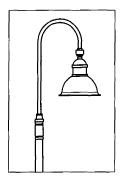
(a) The standard light fixture for retail and commercial developments in Romeoville shall be a matte black architectural style light fixture with an arched mounting arm and a bell-shaped reflector shade. Other earth-toned colors may be used if approved in a PUD. Both single and double mounted fixtures are acceptable. At a minimum, the standard fixture must be used around the perimeter of lots, along access and entrance drives in retail and commercial developments, in key locations, and exclusively on outlots and on lots smaller than three acres. Additional details, such as fluted poles, decorative trim on poles or mounting arms, and decorative bases may be incorporated into the design of the light fixtures.
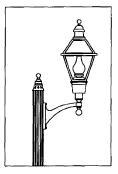
(b) The standard ornamental light fixture for use along the historic Route 66 corridor and in the Downtown District shall be a matte black traditionally styled colonial lantern with a four-sided tapered cage and solid black metal roof. The lantern shall be mounted on a fluted pole with a down swept arm mount. Finials should be incorporated on the top of the pole, top of the lantern, and on the mount, as shown in the illustration. Both single and double mounted fixtures are acceptable. The standard ornamental fixture shall be used along storefronts along the Route 53 corridor and along the sidewalks in Downtown Romeoville. The standard fixture must be used around the perimeter of lots, along access and entrance drives in retail and commercial developments, in key locations, and exclusively on outlots and on lots smaller than three acres.
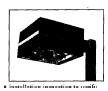
(c) In other locations, a standard box light with a decorative banding detail may be used. The standards box light must match the architectural lights in color. Additional details, such as decorative trim on poles and decorative bases may be incorporated into the design of the light fixtures provided that they are coordinated with the architectural style light fixtures.
(12) The village shall have the right to conduct a post-installation inspection to verify compliance with the requirements of this chapter, and if appropriate, to require a remedial action at no expense to the village.
(13) Non-conforming lighting; all lighting fixtures shall be brought into conformity when at such time as 50% or more of the poles are changed, replaced, or added on a property.
(14) The Village of Romeoville retains the right to require that when a non-residential property abuts a residential property or the light from any such non-residential property directly affects any other property that high pressure sodium lights shall be required.
(15) Linear lighting (including neon, fluorescent, rope-lighting, LED lighting, and low voltage strip-lighting) primarily intended as an architectural highlight to attract attention or used as a means to identification or advertisement shall be prohibited.
(16) Maintenance standards; all lighting fixtures present must be operable and compliant with the adopted International Property Maintenance Code.
(Am. Ord. 06-0369, passed 2-1-06; Am. Ord. 07-0508, passed 2-21-07; Am. Ord. 07-0509, passed 2-21-07; Am. Ord. 07-0556, passed 7-18-07; Am. Ord. 08-0702, passed 9-3-08; Am. Ord. 16-1306, passed 9-7-16; Am. Ord. 19-1585, passed 8-7-19; Am. Ord. 20-1628, passed 4-1-20)
§ 159.071 B-1 LOCAL SHOPPING DISTRICT.
(A) Intent and purpose. The B-1 District is composed of only those establishments which supply convenience goods or personal services, satisfying the daily needs of the residents of the abutting neighborhoods. While the District is designed to encourage limited size shopping centers with adequate off-street parking and loading facilities, the district is primarily intended for walk-in trade.
(B) Permitted uses. Permitted uses shall include the following:
(1) Art and school supplies;
(2) Bakeries, retail sales only, no baking permitted;
(3) Barber and beauty shops;
(4) Book and stationary shops;
(5) Camera and photographic equipment, not including film processing on site;
(6) Candy shop and ice cream store;
(7) Clothing repair and alterations;
(8) Coin and philatelic (stamp collector) stores;
(9) Dry cleaners and laundry, receiving station only, not including processing;
(10) Dry Goods, retail sales;
(11) Florists, retail sales only;
(12) Furrier, sales only;
(13) Gift shops;
(14) Hardware, paint, and wallpaper stores;
(15) Hobby shop;
(16) Household appliance stores, retail sales only;
(17) Jewelry, watch repair and sales, not including precious metal purchase stores;
(18) Laundromat;
(19) Medical clinic;
(20) Millinery (women's apparel for the head) store;
(21) Music stores dealing in the sales of phonographs, records, tape recorders, tapes, sheet music, compact disc, laser discs;
(22) Musical instruments, sales and lessons;
(23) Newsstands;
(24) Offices, business or professional;
(25) Professional offices for insurance, real estate, investment, and other professional offices. Not including depository and non-depository credit institutions, banks, currency exchanges, pay day loans, security and commodity brokers, exchanges and services;
(26) Photo studios;
(27) Radio and television sales and service, including video recorders, tapes, sales and rentals;
(28) Restaurants, sit down and carry-out only. No drive-in establishments and no alcohol;
(29) Shoe sales and repair;
(30) Tanning salon;
(31) Travel agency;
(32) Personal communication facility, located on property owned by the village or other government entity;
(33) Shopping center (PUD required).
(C) Special uses. Upon recommendation by the Planning and Zoning Commission, after public hearing on the petition pertaining thereto, in accordance with the requirements set forth in § 159.176, special uses of this chapter, the Corporate Authorities of the village may, by "special use permit" allow the following in the district:
(1) Churches and church-schools, and other places of worship;
(2) Gasoline service stations, retail sales only, with convenience stores.
(3) Liquor store-packaged goods, retail sales only;
(4) Nursery and day care centers;
(5) Public utility and governmental service uses;
(6) Residential, above the first floor of business/commercial uses;
(7) Restaurant with a beer and wine license, for consumption on the premises only;
(8) Outdoor dining areas, accessory to a permitted use serving liquor;
(9) Planned unit development.
(D) Temporary uses. Upon application to and issuance by the Zoning Administrator of a permit thereof, the following use may be operated as a temporary use: processing, screening, washing yards and plants of the quasi-temporary nature connected with the construction of roads which are normally removed when a specific purpose is completed, are permitted under this classification after a permit is obtained from the Building Officer. This permit shall be effective for a period not to exceed six continuous months and shall not be renewed for more than one successive period at the same location.
(E) Accessory uses. Accessory uses, buildings, or other structures and devices customarily incidental to and commonly associated with a permitted or special use may be permitted; provided they are operated and maintained under the same ownership and on the same parcel, do not include structures or structural features inconsistent with the permitted use or special use or with § 159.020 of this chapter. Accessory uses may include the following:
(1) Storage building/structure accessory and used exclusively by the occupants/tenants/owners of the premises;
(2) Real estate signs, not exceeding 32 square feet for each face and setback from every property line at least ten feet;
(3) Outdoor dining areas, subject to the requirements of § 159.070(K).
(F) Site and structure requirements. The following standards shall apply and be considered as minimum requirements for the district:
(1) District size. The minimum area for the B-2 District shall be not less than (43,560) square feet (one acre), nor more than four acres in size.
(2) Individual lot area. Individual lots within a B-1 District shall have a minimum area of 9,450 square feet.
(3) Individual Lot width/frontage.
Individual lot width shall be a minimum lot width of 70 feet, corner lots shall be a minimum of 120 feet.
(4) Lot depth. The minimum lot depth for each lot shall not be less than 135 feet.
(5) Lot coverage/impervious surface. Lot coverage shall not exceed 60% of the lot. Lot coverage plus impervious surface coverage shall not exceed a total of 85% of the total lot.
(6) Building height. No building or structure shall be erected or altered to exceed a maximum height of 25 feet or two stories, whichever is less.
(7) Setbacks.
(a) Front yards, shall be not less than 50 feet from the property line;
(b) Side yards, shall be not less than ten feet for each side yard from the property line;
(c) Rear yards, shall be not less than 30 feet from the property line; and
(d) Transitional yards, where the district adjoins a residential district, shall be provided in accordance with the following:
1. Where a side lot line coincides with a side or rear lot line of property in an adjacent residence district, a yard shall be provided along the side or rear lot line. This yard shall be equal in dimension to the minimum side yard which would be required under this chapter for residential use or the adjacent property in the residence district;
2. Where the extension of a front or side lot line coincides with the front lot line of an adjacent lot located in a resident district, a yard equal in depth to the minimum front yard required by this chapter on the adjacent lot in the residence district shall be provided along the front or side lot line for a distance of at least 25 feet, from such a lot in the residence district. There shall be an unobstructed, green setback of no less than ten feet along the remainder of the front or side lot line; and
3. If a rear lot line of a lot is contiguous to a side lot line of a lot located in a residence district, a rear yard shall be provided along that rear lot line equal in dimension to the minimum side yard required under this chapter on the adjacent residential lot.
(8) Floor area ratio (F.A.R.). For all uses the floor area ratio for each lot shall not exceed six tenths (0.6).
(Am. Ord. 07-0508, passed 2-21- 07; Am. Ord. 08-0651, passed 5- 21-08; Am. Ord. 09-0800, passed 12-16-09; Am. Ord. 11-0924, passed 10-5-11; Am. Ord. 12-0972, passed 4-4-12; Am. Ord. 14-1086, passed 2-5-14; Am. Ord. 18-1482, passed 5-16-18)
§ 159.072 B-2 COMMUNITY SHOPPING DISTRICT.
(A) Intent and purpose. The B-2 District is intended to provide facilities used as the main shopping area for residents of the village and other nearby communities and subdivisions. The Community Shopping District is to permit most types of business or commercial uses, offices, and service establishments; is normally centrally located with respect to the village; and is located at major intersections or along a major street.
(B) Permitted uses. Permitted uses shall include the following:
(1) Permitted uses as listed in the B-1 Local Shopping District;
(2) Amusement centers, indoor only;
(3) Antique shops;
(4) Art gallery, studio and sales;
(5) Army/Navy/Military surplus sales;
(6) Auto accessory stores, retail sales only, no repairs;
(7) Auto driving schools;
(8) Bakeries, with products produced on site;
(9) Bicycle sales and service;
(10) Blueprinting, photocopy services;
(11) Bookbinding services;
(12) Business machines, sales and service;
(13) Carpet and floor coverings, retail sales;
(14) China and glassware retail sales;
(15) Christmas Tree sales lots, temporary from November 21 to December 31 and in accordance with § 159.070(K);
(16) Costume rentals, sales;
(17) Child day care facility or mini day care center (see § 159.003 for definition);
(18) Department stores;
(19) Dog groomers without over night stays;
(20) Drapery sales and service;
(21) Electrical appliances and supplies, sales and service;
(22) Exhibition centers, meeting halls, community center;
(23) Farm and garden supply retail sales, no outside storage;
(24) Food/grocery stores;
(25) Funeral home, mortuary; no cremation;
(26) Furniture and home furnishings sales and service;
(27) Furrier, inclusive of incidental storage and minor repairs only;
(28) Health clubs, tennis/racquet clubs;
(29) Household appliances sales and service;
(30) Interior decorating sales and service;
(31) Library;
(32) Liquor store-packaged goods, retail sales only;
(33) Locksmith;
(34) Mail order, not including motor freight;
(35) Newspaper offices;
(36) Office supplies and equipment retail sales;
(37) Parking garages or lots; does not include motor vehicle storage or repair;
(38) Pet sales and supplies;
(39) Plumbing supplies sales and service;
(40) Restaurant, including drive-through facilities;
(41) Sewing machines sales and service;
(42) Sporting goods retail sales, not including firearm sales and services;
(43) Sports medicine/therapy;
(44) Tack shop;
(45) Taxidermists;
(46) Theaters, indoor only;
(47) Tobacco sales;
(48) Toy store;
(49) United States Post Offices;
(50) Personal communication facility, located on property owned by the village or other government entity.
(51) Professional offices for insurance, real estate, investment, security and commodity brokers, exchanges and services. Not including depository and non-depository credit institutions, banks, currency exchanges, and pay day loans.
(52) Uses not explicitly enumerated in this section as permitted uses, but closely similar thereto, provided that those uses are not explicitly mentioned as permitted or special uses elsewhere in this chapter;
(53) Seasonal garden shops.
(C) Special uses. Upon recommendation by the Planning & Zoning Commission, after public hearing on the petition pertaining thereto, in accordance with the requirements set forth in § 159.176, special uses of this chapter, the corporate authorities of the village may, by "special use permit" allow the following in the district:
(1) Special uses as listed in the B-1 Local Shopping District;
(2) Animal hospital, veterinarian office; no boarding;
(3) Banquet hall;
(4) Business and commercial schools, including dancing and music schools;
(5) Business colleges, trade schools;
(6) Car wash;
(7) Cartage, express, and special delivery services, not including motor freight;
(8) Clubs, public or private, indoor only;
(9) Depository and non-depository credit institutions, banks, currency exchanges, pay day loans, and similar uses subject to the following conditions.
(a) Drive through facilities are not permitted.
(b) Indoor and parking lot security cameras are required in conformance with section.
(c) Development of new depository and non-depository credit institutions, banks, currency exchanges, pay day loans, and similar uses.
1. New construction on heretofore vacant lots must be a minimum of two stories in height.
2. The second story must be functional and cover a minimum of 75% of the floor area of the first floor.
3. New institutions in existing buildings are not required to add a second story.
(10) Equipment rentals, with outdoor storage of, limited equipment repairs within the confines of the structure/building;
(11) Hospitals with ancillary uses;
(12) Hotels;
(13) Lounge;
(14) Outdoor dining areas, accessory to a permitted or special use serving liquor;
(15) Photo developing and processing;
(16) Printing, publishing, lithography;
(17) Massage parlor;
(18) Spa or day spa;
(19) Tattoo parlor, subject to all health regulations of village, county, and state;
(20) Restaurant with a beer and wine license, for consumption on the premises only;
(21) Taverns.
(D) Temporary uses. Upon application to and issuance by the Zoning Administrator of a permit thereof, the following use may be operated as a temporary use: processing, screening, washing yards and plants of the quasi-temporary nature connected with the construction of roads which are normally removed when a specific purpose is completed, are permitted under this classification after a permit is obtained from the Building Officer. This permit shall be effective for a period not to exceed six continuous months and shall not be renewed for more than one successive period at the same location.
(E) Accessory uses. Accessory uses, buildings, or other structures and devices customarily incidental to and commonly associated with a permitted or special use may be permitted provided they are operated and maintained under the same ownership and on the same parcel and that they do not include structures or structural features inconsistent with the permitted use or special use or with § 159.020. Accessory uses may include the following:
(1) Storage building/structure accessory and used exclusively by the occupants/tenants/ owners of the premises.
(2) Real estate signs, not exceeding 32 square feet for each face and setback from every property line at least ten feet.
(3) Outdoor dining areas, subject to the requirements of § 159.070(K).
(4) Outdoor sales areas, provided that they meet the following requirements:
(a) Outdoor sales must be restricted to private property and must be conducted only on the premises of the business operating the primary facility.
(b) Goods/merchandise may be stacked along the front of a building provided that it does not exceed eight feet in length, three feet in depth and three feet in height.
(c) Goods/merchandise may be stacked along the rear or side of a building provided that the area meets all building setbacks in the zoning district and the requirements of this Code.
(d) Goods/merchandise must be enclosed by an aesthetically-pleasing masonry structure or enclosure that complements the building and does not block any doors or windows. The structure must be completely enclosed on all sides and must incorporate a closing lid or door. The lid or door must be coordinated and made of a high quality material such as wrought iron. Additionally, the structure must meet the design criteria contained in § 159.158.
(e) No goods or merchandise shall be placed in any manner that violates the sight triangle requirements established in § 159.014.
(f) Goods/merchandise may not obstruct any sidewalk, walkway, or pedestrian path. Sidewalks, walkways, and pedestrian paths must have a minimum width of five feet free and clear of storage, displays, or sales.
(g) A safe loading area must be provided.
(h) Parking requirements must be met for the primary use and the increased requirement resulting from the use of the outdoor sales area.
(i) Goods/merchandise may not be displayed on gas pump islands or between gas pumps.
(j) Goods/merchandise must be located on an asphalt or concrete surface.
(k) Goods/merchandise must be kept in a neat and orderly fashion. Unenclosed merchandise, open bags, spilled merchandise, etc. will not be permitted.
(l) Sale operators must provide adequate lighting after dark. Where electricity is used, it must be serviced by an appropriate number of GFCI outlets protected by weatherproof boxes with metal in-use covers. Extension cords may be no longer than 25 feet, must be rated for wet use, and must be installed to be non-tripping and not in any vehicular path.
(m) Landscaping may not be eliminated to provide room for outdoor sales unless it is possible to relocate the landscaping while maintaining the overall character of the landscape plan for the site.
(n) Outdoor sales areas may only be used for seasonal items that must be kept out- doors (during the time of year when they are typically used), such as mulch, firewood, salt bags, flowers, topsoil, or other merchandise deemed appropriate by the Zoning Administrator.
(o) Other items, such as soft drinks, food, toys (including seasonal toys), and automobile maintenance equipment may not be sold outdoors.
(p) Single ice chests shall be exempt from the requirements of this section.
(q) Single 20-pound propane tanks located in designated storage and exchange sites shall be exempt from the requirements of this section. They must, however, be located on the side or rear of the building.
(r) With the exception of the propane tanks listed above, no flammable materials may be sold outdoors.
(s) Storage of trucks and trailers and sales and/or display of merchandise from trucks or trailers are prohibited.
(t) Outside sales and storage of goods/merchandise not in compliance with the above regulations must be approved by the Village Board.
(u) Submittal requirements: The following shall be submitted as part of an application for outdoor sales areas.
1. A site plan indicating property boundaries, parking location, sales location and size, signage and other information deemed appropriate
2. Letter of permission from property owner.
3. Statement as to how the site shall be maintained during the designated time period.
4. Applications for any additional permits required for the proposed outdoor sales such as temporary signs (which must comply with requirements of § 159.127).
5. A $200 deposit shall be required to ensure that cleanup of the site is accomplished within seven days after the expiration of the sales permit and to ensure that the conditions of the permit and requirements of this section are followed. If the cleanup is not accomplished in that time, or if the conditions of the permit are not met, the deposit shall be forfeited
6. The permit fee for an outdoor sales area (this fee may be waived by the Zoning Administrator where the entire profit from the operation is given to charity or used for charitable purposes.)
(5) Temporary sales or seasonal sales areas are permitted provided that they meet the requirements listed in division (4) above, except as modified by the following.
(a) Temporary/seasonal outdoor sales may also be allowed in the yard or parking area of the subject property.
(b) The outdoor sales area may not occupy a space larger than the smaller of 5,000 square feet or 10% of the overall square footage of the building.
(c) Seasonal outdoor sales of gardening products must be limited to the display and sale of flowers, vegetables, bagged garden products, landscape products and statuaries. Outdoor sales of fencing, lumber, and other similar products are prohibited.
(d) Temporary/seasonal outdoor sales of gardening products must be conducted by the operator of primary business on the premises with a current village business license that permits the sale of gardening products.
(e) Temporary or seasonal sales must be enclosed by a minimum of a rail/fence system or a greenhouse.
(f) Each permit for temporary/ seasonal sales areas shall be valid for a period of not more than 120 days. Only one permit shall be allowed per calendar year. Seasonal permits issued for periods less than 120 days will be counted as one permit. Temporary tent sales for special events shall be exempt from these requirements and shall be allowed in accordance with § 159.020(F)(1).
(g) Outdoor sales of Christmas trees must be limited to 60 days, beginning on November 1 and ending on December 31. A permit is required but shall not count as the single temporary/seasonal permit allowed per lot.
(6) Video gaming terminal locations, accessory to the conduct of a permitted use or approved special use authorizing the sale of alcoholic beverages for on-premises consumption, subject to the following conditions:
(a) The term "video gaming terminal" shall have the meaning set forth in § 138.01(E) of the Village Code of Ordinances.
(b) All persons seeking to operate video gaming terminals at a given location must possess all licenses required under the Video Gaming Act and Illinois Gaming Board regulations for the operation of video gaming terminals at the proposed location.
(c) No more than six video gaming terminals may be operated at a given location.
(d) All owners or persons allowing the use of premises for video gaming terminal operations must possess a current and valid liquor license issued by the village Local Liquor Control Commissioner.
(e) All proposed video gaming terminal special use permit locations shall be at least 100 feet from any school, church or house of worship. Distances shall be measured consistently with the then-current regulations or customary practices of the Illinois Gaming Board.
(f) The operation of video gaming terminal locations at any location qualified or proposing to qualify as a “licensed truck stop establishment” within the meaning of Section 5 of the Illinois Video Gaming Act, ILCS Ch. 230, Act 40, § 5 shall, in addition to complying with the applicable requirements of the Illinois Video Gaming Act and the then-current regulations of the Illinois Gaming Board, be subject to the following further conditions:
1. The licensed truck stop establishment serving as the video gaming terminal location shall be located on a principal lot containing not less than five acres, and which principal lot shall be the site of the convenience store required to be included as a part of such licensed tuck stop establishment, and of all fuel dispensing pumps required or contemplated to be provided as part of the licensed truck stop establishment. Provided that the licensed truck stop establishment complies with the preceding sentence and the other conditions of this section, the licensed truck stop establishment may provide all or some portion of the required number of dedicated truck parking spaces herein required on an adjacent lot containing not less than three acres that is under common ownership with the principal lot and which is contiguous to the principal lot, or separated from the principal lot only by a privately owned roadway constructed and maintained for the benefit of the subdivision or development that includes both the principal lot and the adjacent lot. For purposes of this § 159.072(E)(6)(f)1. only, the foregoing requirement of common ownership of the principal lot and the adjacent lot to be used for dedicated truck parking spaces may be satisfied by a licensed truck stop establishment by providing the village with documentary evidence reasonably acceptable to the village that establishes that each of such lots is leased to the same identical tenant under lease terms initially providing such tenant with the right to occupy each of such lots for not less than 30 years, where the terms of such leases further grant to the tenant the rights to use such lots for the conduct of a licensed truck stop establishment as referenced in this § 159.072(E)(6)(f); and
2. The convenience store included as part of such a licensed truck stop establishment shall consist of not less than 5,000 square feet in area; and
3. The licensed truck stop establishment serving as the video gaming terminal location shall provide that number of dedicated truck parking spaces equal to the sum of the number of pumps dispensing or able to dispense diesel or biodiesel fuel at such establishment plus the number of video gaming terminals proposed to be operated within such licensed truck stop. As used herein, a “dedicated truck parking space” shall mean and include an area designated by the owner or operator of the licensed truck stop establishment reserved for the exclusive use of its customers for the parking of trucks while patronizing the licensed truck stop establishment, capable of being occupied for such use without otherwise disrupting or affecting the operations of the licensed truck stop establishment, and which shall be not less than 65 feet in length and 12 feet in width, and constructed and surfaced as otherwise required by this Code and the Village Code of Ordinances.
(F) Site and structure requirements.
(1) District size. The minimum area for the B-2 District shall be not less than four acres, nor more than eight acres in size.
(2) Individual lot area. Individual lots within a B-2 District shall have a minimum area of 12,150 square feet.
(3) Individual lot width/frontage. Individual lot width shall be a minimum lot width of 90 feet, corner lots shall be a minimum of 150 feet.
(4) Lot depth. The minimum lot depth for each lot shall not be less than 135 feet.
(5) Lot coverage/impervious surface. Lot coverage/impervious surface shall not exceed 60% of the lot. Lot coverage plus impervious surface coverage shall not exceed a total of 85% of the total lot.
(6) Building height. No building or structure shall be erected or altered to exceed a maximum height of 25 feet or two stories, whichever is less.
(7) Setbacks.
(a) Front yards, shall be not less than 60 feet from the property line;
(b) Side yards, shall be not less than ten feet for each side yard from the property line;
(c) Rear yards, shall be not less than 30 feet from the property line; and
(d) Transitional yards, where the district adjoins a residential district, shall be provided in accordance with the following:
1. Where a side lot line coincides with a side or rear lot line of property in an adjacent residence district, a yard shall be provided along the side or rear lot line. This yard shall be equal in dimension to the minimum side yard which would be required under this chapter for residential use or the adjacent property in the residence district;
2. Where the extension of a front or side lot line coincides with the front lot line of an adjacent lot located in a resident district, a yard equal in depth to the minimum front yard required by this chapter on the adjacent lot in the residence district shall be provided along the front or side lot line for a distance of at least 25 feet, from such a lot in the residence district. There shall be an unobstructed, green setback of no less than ten feet along the remainder of the front or side lot line; and
3. If a rear lot line of a lot is contiguous to a side lot line of a lot located in a residence district, a rear yard shall be provided along that rear lot line equal in dimension to the minimum side yard required under this chapter on the adjacent residential lot.
(8) Floor area ratio (F.A.R.). For all uses the floor area ratio for each lot shall not exceed eight tenths (0.8).
(Am. Ord. 06-0369, passed 2-1-06; Am. Ord. 07-0509, passed 2-21-07; Am. Ord. 07-0599, passed 12-19-07; Am. Ord. 08-0651, passed 5-21-08; Am. Ord. 08-0715, passed 11-19-08; Am. Ord. 11-0924, passed 10-5-11; Am. Ord. 12-1021, passed 12-19-12; Am. Ord. 14-1086, passed 2-5-14; Am. Ord. 15-1180, passed 3-18-15; Am. Ord. 15-1229, passed 11-18-15; Am. Ord. 19-1564, passed 5-1-19; Am. Ord. 19-1604, passed 12-18-19; Am. Ord. 22-1794, passed 9-21-22)
§ 159.073 B-3 HIGHWAY/REGIONAL SHOPPING DISTRICT.
(A) Intent and purpose. The purpose of this district is intended to provide areas for those establishments which depend to a large extent on customers arriving by automobile, and whose market area extends beyond the village limits. This district should be located along a major arterial or highway, and should contain adequately-sized parcels of land with larger setbacks, open-clear viewing, and safely located entrances and exit points.
(B) Permitted uses. Permitted uses shall include the following:
(1) Permitted uses as listed in the B-2 Community Shopping District;
(2) Ambulance services, private;
(3) Animal hospitals, veterinarian office with no boarding;
(4) Business and commercial schools;
(5) Casket, casket supplies and sales;
(6) Catering;
(7) Commercial greenhouses;
(8) Equipment or car rentals, with outdoor storage of, limited equipment repairs within the confines of the structure/building;
(9) Heating, air conditioning sales and service with no outside storage;
(10) Hospitals;
(11) Linen, towel and diaper services;
(12) Monument sales;
(13) Orthopedic and medical supplies sales and service;
(14) Printing, publishing and lithography;
(15) Parcel delivery station, not including motor freight terminal;
(16) Personal communication facility, located on property owned by the village or other government entity;
(17) Radio and television studios, no transmission towers;
(18) Massage parlor;
(19) Spa or day spa;
(20) Tattoo parlor, subject to all health regulations of village, county, and state;
(21) Restaurant, including drive-through facilities, alcohol sales and outdoor seating;
(22) Food truck or food truck operator, subject to the requirements of Chapter 129 (Food Trucks and Food Truck Operators), but only when the food truck in question is operated in connection with the operation of an establishment licensed to serve alcoholic beverages for on premises consumption through a duly issued Class M-1 or Class O liquor license issued by the Local Liquor Control Commissioner in accordance with the provisions of Chapter 112 of the Village Code of Ordinances.
(C) Special uses. Upon recommendation by the Planning & Zoning Commission, after public hearing on the petition pertaining thereto, in accordance with the requirements set forth in § 159.176, Special Uses, the corporate authorities of the village may, by "special use permit" allow the following in the district:
(1) Special uses as listed in the B-2 Community Shopping District;
(2) Agricultural implements sales and service;
(3) Animal hospitals, veterinarian office, including boarding of animals;
(4) Automobile dealerships which concentrates its business primarily in the sale of new passenger vehicles, but also including the servicing of vehicles and the sales of used vehicles in connection with the dealership, subject to the following requirements:
(a) Must be located on a lot that is at least five acres in size;
(b) The property must include a sales/showroom and service building of at least 40,000 square feet in size;
(5) Building materials sales and service, where materials are stored within an enclosed area;
(6) Cannabis facility. As used in this chapter, "cannabis facility" shall mean a "dispensing organization," "infuser," "processor," or "transporter" as defined in the Compassionate Use of Medical Cannabis Pilot Program Act, 410 ILCS 130/1 et seq. and the Cannabis Regulation and Tax Act, PA 101-27 (hereinafter collectively referred to as the Cannabis Acts). In addition to all other special use permit standards required to be met pursuant to this chapter, distribution facilities for medical cannabis shall meet the specific standards listed below:
(a) Dispensing organizations, infuser, processor, transporter, located within the Village of Romeoville shall be and are required to be established, operated, and maintained in full compliance with the Cannabis Acts and all other applicable village ordinances and Illinois statutes.
(b) Dispensing organizations, infuser, processor, transporter, shall not be located within 750 feet of the property line of any pre-existing public or private pre-schools, elementary schools, secondary schools, or day care centers. Dispensing organizations, infuser, processor, transporter, shall not be located within 750 feet of any property zoned within the UD University zoning district. In addition, dispensing organizations, infuser, processor, transporter, shall not be located within 750 feet from any of the following identified locations: any public library within the limits of the village, the Romeoville Village Hall, the Romeoville Recreation Center, or the Edward Athletic and Event Center. For purposes of § 159.075(C)(7), the relevant distance shall be measured between the nearest points on the property lines of the lot(s), tract(s) or tax parcel(s) used for cannabis related uses, and the lot(s), tract(s) or tax parcel(s) or zoning districts from which any separation required by § 159.075(C)(7) shall be maintained.
1. In addition to the distance/separation requirements otherwise set forth in this section, any dispensing organization, infuser, processor, transporter, located in a B-3 zoning district shall not be located within 750 feet of any church or place of worship within the corporate limits of the village that is located in a zoning district other than a P-B zoning district, an M-1 zoning district or an M-2 zoning district.
(c) Dispensing organizations, infuser, processor, transporter, shall not be located in any building containing, in whole or in part, any residential uses.
(7) Crematoriums;
(8) Depository and non-depository credit institutions, banks, currency exchanges, pay day loans, and similar uses subject to the following conditions.
(a) Drive through facilities are permitted. New drive through facilities shall not face a public street.
(b) Indoor and parking lot security cameras are required in conformance with section.
(c) Development of new depository and non-depository credit uses.
1. New construction on heretofore vacant lots must be a minimum of two stories in height.
2. The second story must be functional and cover a minimum of 75% of the floor area of the first floor.
3. New institutions in existing buildings are not required to add a second story. Existing drive through facilities shall be allowed to continue but may not be expanded.
(9) Flex space with less than 50% office space but more than 20% office space;
(10) Full-service hotel;
(11) Lumber yards, provided that the yard contains a principal building of at least 5,000 square feet;
(12) Open sales lots in accordance with the special provisions as noted in § 159.070(L);
(13) Resale of used clothing and/or resale of used sporting equipment only; not to include pawn shops;
(14) Retail sale of general household merchandise previously owned by the intended user or consumer, including clothing, furniture, home decor items, kitchen utensils and small appliances, consumer electronics, sporting goods, toys, recreational equipment and other household goods, but excluding merchandise marketed, held out, sold, valued or otherwise considered as antique merchandise, and excluding pawn shops and precious metal purchase shops, subject to the following conditions:
(a) All sales of merchandise permitted hereunder shall be conducted entirely from within a freestanding building not less than 15,000 square feet in area;
(b) All buildings used for the sale of merchandise permitted hereunder shall include separate entrances for retail customers and persons delivering previously owned merchandise to the establishment;
(c) All deliveries of merchandise to a building used for the sale of merchandise as permitted hereunder shall be made in person to an employee of the establishment during such hours as the establishment is open to the general public, and the use of unattended containers, receptacles, depositories, boxes or like devices for the receipt or collection of merchandise to be sold as contemplated hereunder shall be prohibited.
(15) Sports arenas, stadiums;
(16) Sporting goods including firearms sales and service. Facility shall not include a firing range;
(17) Swimming pool sales and service;
(18) Theaters, including drive-in;
(19) Personal communication facility (see § 159.021);
(20) Self-storage facilities.
(D) Temporary uses. Upon application to and issuance by the Zoning Administrator of a permit thereof, the following use may be operated as a temporary use: processing, screening, washing yards and plants of the quasi-temporary nature connected with the construction of roads which are normally removed when a specific purpose is completed, are permitted under this classification after a permit is obtained from the Building Officer. This permit shall be effective for a period not to exceed six continuous months and shall not be renewed for more than one successive period at the same location.
(E) Accessory uses. Accessory uses, buildings, or other structures and devices customarily incidental to and commonly associated with a permitted or special use may be permitted; provided they are operated and maintained under the same ownership and on the same parcel, do not include structures or structural features inconsistent with the permitted use or special use or with § 159.021. Accessory uses may include the following:
(1) Storage building/structure accessory and used exclusively by occupants/tenants/owners of the premises;
(2) Real estate signs, not exceeding 32 square feet for each face and setback from every property line at least ten feet;
(3) Outdoor dining areas, subject to the requirements of § 159.070(K);
(4) Outdoor sales, subject to the requirements of § 159.072(E).
(5) Provision of massage or massage therapy, where incidental to or offered in conjunction with any of the following lawfully established principal uses: hospital, sanitarium, nursing home, physical therapy or rehabilitation clinic, health or fitness club, spa or day spa, or the practice of any branch of the healing arts as currently and validly licensed by the State of Illinois.
(F) Site and structure requirements.
(1) District size. The minimum area for the B-3 district shall be not less than ten acres. There is no maximum limit on the area of a B-3 district.
(2) Individual lot area. Individual lots within a B-3 district shall have a minimum area of 15,000 square feet.
(3) Individual lot width/frontage. Individual lot width shall be a minimum lot width of 100 feet, corner lots shall be a minimum of 160 feet.
(4) Lot depth. The minimum lot depth for each lot shall not be less than 150 feet.
(5) Lot coverage/impervious surface. Lot coverage/impervious surface shall not exceed 60% of the lot. Lot coverage plus impervious surface coverage shall not exceed a total of 85% of the total lot.
(6) Building height. No building or structure shall be erected or altered to exceed a maximum height of 40 feet or three stories, whichever is less.
(7) Setbacks:
(a) Front yards, shall be not less than 60 feet from the property line;
(b) Side yards, shall be not less than ten feet for each side yard from the property line;
(c) Rear yards, shall be not less than 30 feet from the property line; and,
(d) Transitional yards, where the district adjoins a residential district, shall be provided in accordance with the following:
1. Where a side lot line coincides with a side or rear lot line of property in an adjacent residence district, a yard shall be provided along the side or rear lot line. This yard shall be equal in dimension to the minimum side yard which would be required under this chapter for residential use or the adjacent property in the residence district;
2. Where the extension of a front or side lot line coincides with the front lot line of an adjacent lot located in a residence district, a yard equal in depth to the minimum front yard required by this chapter on the adjacent lot in the residence district shall be provided along the front or side lot line for a distance of at least 25 feet, from such a lot in the residence district. There shall be an unobstructed, green setback of no less than ten feet along the remainder of the front or side lot line; and,
3. If a rear lot line of a lot is contiguous to a side lot line of a lot located in a residence district, a rear yard shall be provided along that rear lot line equal in dimension to the minimum side yard required under this chapter on the adjacent residential lot.
(8) Floor area ratio (F.A.R.). For all uses the floor area ratio for each lot shall not exceed eight tenths (0.8).
(Am. Ord. 05-0312, passed 2-1-06; Am. Ord. 06-0369, passed 2-1-06; Am. Ord. 07-0508, passed 2-21-07; Am. Ord. 07-0509, passed 2-21-07; Am. Ord. 07-0599, passed 12-19-07; Am. Ord. 08-0651, passed 5-21-08; Am. Ord. 10-0816, passed 1-20-10; Am. Ord. 11-0924, passed 10-5-11; Am. Ord. 14-1086, passed 2-5-14; Am. Ord. 14-1097, passed 3-19-14; Am. Ord. 16-1290, passed 7-6-16; Am. Ord. 17-1375, passed 5-17-17; Am. Ord. 19-1533, passed 1-16-19; Am. Ord. 22-1794, passed 9-21-22; Am. Ord. 23-1826, passed 3-15-23)
§ 159.074 B-4 AUTOMOTIVE SERVICE DISTRICT.
(A) Intent and purpose. The purpose of this district is intended to provide certain areas for automotive service and related types of uses. The district is intended to be located away from major highways and residential uses.
(B) Permitted uses. Permitted uses shall include the following:
(1) Automotive dealerships, sales and services;
(2) Automotive driving schools;
(3) Automotive, truck and trailer rental agencies;
(4) Automotive parts and accessory stores, sales and service;
(5) Battery, mufflers, shocks and tires sales and service;
(6) Bottled gas sales and service;
(7) Diagnostic service centers, motor vehicles;
(8) Car wash, truck wash, mechanical or self service;
(9) Contractors yards;
(10) Equipment rentals and leasing services with outdoor repair services within a screened/enclosed yard;
(11) Filtration plants, pumping stations and waste-water treatment facilities;
(12) Garage, truck or bus;
(13) Heavy equipment sales and service;
(14) Motor vehicle body shop, repair and rebuilding;
(15) Motor vehicle towing services, no outdoor storage;
(16) Paint shop, automotive;
(17) Public service or municipal garage;
(18) Public utility and governmental service uses, including, but not limited to the following:
(a) Electric distribution stations;
(b) Fire and Police stations;
(c) Gas regulator stations;
(d) Radio and television towers and stations;
(e) Railroad rights-of-way;
(f) Telephone exchange buildings, microwave relay towers, and telephone transmission equipment and buildings.
(19) Personal communication facility, located on property owned by the village or other government entity;
(20) Auto repairs, indoor only, not including paint and body shop services;
(21) Boat, trailer, camper sales and service, in accordance with § 159.070(K);
(22) Mobile home sales and service, in accordance with § 159.070(K).
(23) Shopping center (PUD required).
(C) Special uses. Upon recommendation by the Planning and Zoning Commission, after public hearing on the petition pertaining thereto, in accordance with the requirements set forth in § 159.176, special uses of this chapter, the corporate authorities of the village may, by "special use permit" allow the following in the district:
(1) Heavy equipment sales and service, with outdoor storage;
(2) Paint shop, automotive, with outdoor storage;
(3) Truck stop with repair services;
(4) Motor vehicle towing services, with outdoor storage;
(5) Off premise or outdoor advertising (billboard) sign, see requirements contained in §§ 159.121 et seq. (Signage);
(6) Personal communication facility (see § 159.021);
(7) Gasoline service stations, retail sales only, with convenience stores;
(8) Planned unit development;
(9) Churches and church-schools, and other places of worship.
(D) Temporary uses. Upon application to and issuance by the Zoning Administrator of a permit thereof, the following use may be operated as a temporary use: processing, screening, washing yards and plants of the quasi-temporary nature connected with the construction of roads which are normally removed when a specific purpose is completed, are permitted under this classification after a permit is obtained from the Building Officer. This permit shall be effective for a period not to exceed six continuous months and shall not be renewed for more than one successive period at the same location.
(E) Accessory uses. Accessory uses, buildings, or other structures and devices customarily incidental to and commonly associated with a permitted or special use may be permitted; provided they are operated and maintained under the same ownership and on the same parcel, do not include structures or structural features inconsistent with the permitted use or special use or with § 159.020 of this chapter. Accessory uses may include the following:
(1) Storage building/structure accessory and used exclusively by the occupants/tenants/owners of the premises;
(2) Real estate signs, not exceeding 32 square feet for each face and setback from every property line at least ten feet;
(3) Outdoor sales, subject to the requirements of § 159.072(E).
(F) Site and structure requirements:
(1) District size. The minimum area for the B-4 District shall be not less than five acres.
(2) Individual lot area. Individual lots within a B-4 District shall have a minimum area of one acre, 43,560 square feet.
(3) Individual lot width/frontage. Individual lot width shall be a minimum lot width of 150 feet, corner lots shall be a minimum of 200 feet.
(4) Lot depth. The minimum lot depth for each lot shall not be less than 300 feet.
(5) Lot coverage/impervious surface. Lot coverage/impervious surface shall not exceed 60% of the lot. Lot coverage plus impervious surface coverage shall not exceed a total of 85% of the total lot.
(6) Building height. No building or structure shall be erected or altered to exceed a maximum height of 25 feet or two stories, whichever is less.
(7) Setbacks.
(a) Front yards, shall be not less than 50 feet from the property line;
(b) Side yards, shall be not less than ten feet for each side yard from the property line;
(c) Rear yards, shall be not less than 30 feet from the property line; and
(d) Transitional yards, where the district adjoins a residential district, shall be provided in accordance with the following:
1. Where a side lot line coincides with a side or rear lot line of property in an adjacent residence district, a yard shall be provided along the side or rear lot line. This yard shall be equal in dimension to the minimum side yard which would be required under this chapter for residential use or the adjacent property in the residence district;
2. Where the extension of a front or side lot line coincides with the front lot line of an adjacent lot located in a resident district, a yard equal in depth to the minimum front yard required by this chapter on the adjacent lot in the residence district shall be provided along the front or side lot line for a distance of at least 25 feet, from such a lot in the residence district. There shall be an unobstructed, green setback of no less than ten feet along the remainder of the front or side lot line; and
3. If a rear lot line of a lot is contiguous to a side lot line of a lot located in a residence district, a rear yard shall be provided along that rear lot line equal in dimension to the minimum side yard required under this chapter on the adjacent residential lot.
(8) Floor area ratio (F.A.R.). For all uses the floor area ratio (F.A.R.) for each lot shall not exceed one and two tenths (1.2).
(Am. Ord. 07-0508, passed 2-21- 07; Am. Ord. 07-0509, passed 2- 21-07; Am. Ord. 11-0924, passed 10-5-11; Am. Ord. 18-1482, passed 5-16-18)
§ 159.075 P-B, PLANNED BUSINESS DISTRICT.
(A) Intent and purpose. The purpose of the P-B District is to provide for a setting whereby multiple use, contemporary business park development can occur. The district may be established only in those instances where the compatibility of a wide variety of architect- ural design standards, landscape design standards, and restrictive covenants which have been previously adopted by the Village Board, have been found to exist at the time of any request to amend a current zoning parcel to the P-B District. Only parcels that are a minimum of 40 acres in size and under single ownership or unified control at the time of application shall be considered for amendment to the P-B District. The Village Board shall determine that adequacy of any proposed amendment to the P-B District. Because developments within the P-B District, like planned unit developments, are expected to incorporate multiple uses and a variety of design standards in a contemporary business park setting, which uses may have unique or unusual impacts on the use and enjoyment of property in the Village, the Village Board may authorize departures and exceptions from strict conformance with the dimension, area, height, bulk and other regulations and limitations of the P-B District, of the other provisions of this chapter and of the other codes and ordinances of the village, provided the same are specified in an annexation agreement, in an ordinance that provides for the zoning of property in the P-B District or in an ordinance or resolution that approves a conceptual, preliminary or final site plan for a use that is to be constructed in the district.
(B) Permitted uses. Permitted uses shall include the following:
(1) Casino (land based) subject to the approval of a development agreement by and between the village and developer;
(2) Offices: business, professional, governmental and medical;
(3) Service business uses shall include the following:
(a) Automobile rental or leasing service;
(b) Depository and non-depository credit institutions, banks, currency exchanges, pay day loans, and similar uses subject to the following conditions.
1. Drive through facilities are permitted. New drive through facilities shall not face a public street.
2. Indoor and parking lot security cameras are required in conformance with this chapter.
3. Development of new depository and non-depository credit institutions, banks, currency exchanges, pay day loans, and similar uses.
a. New construction on heretofore vacant lots must be a minimum of two stories in height.
b. The second story must be functional and cover a minimum of 75% of the floor area of the first floor.
c. New institutions in existing buildings are not required to add a second story. Existing drive through facilities shall be allowed to continue but may not be expanded.
(c) Conference centers;
(d) Data processing and computer center, including service and maintenance;
(e) Gas/service stations;
(f) Health, tennis, racquetball, recreation clubs, fitness clubs, and spa or day spa;
(g) Philanthropic and charitable institutions;
(h) Restaurants, including alcohol sales and service, and drive-in or drive-through service;
(i) Schools - business, corporate training, data processing or electronics.
(4) Industrial type uses shall include the following:
(a) Food processing, handling, distribution and warehousing;
(b) Laboratories, offices, and other facilities for research testing, data analysis and development;
(c) Light manufacturing and assembly;
(d) Printing and publishing;
(e) Storage and distribution not including bulk commodities or motor freight terminals;
(f) Product research and development;
(g) Warehouse including storage of materials, goods or products and office uses related thereto, provided that all storage occurs within a completely enclosed building;
(h) Showrooms and distribution facilities.
(5) Temporary uses of the land for the installation, maintenance and operation of facilities used by contractors in the ordinary course of construction related to a parcel of land which the temporary construction yard is an integral part, provided such facilities shall be located not less than 200 feet from any building used for residential purposes (that building not being a part of the development site subdivision-planned development), and provided that the period of such temporary use shall not exceed the duration of the construction for the development of the site;
(6) Accessory uses customarily incidental to the above uses or permitted in any of the Manufacturing Districts including structured parking. The retail uses permitted pursuant to this subdivision shall be included within the same building as to which such use is accessory, provided that the use permitted pursuant to this subdivision may be accessed directly from the outside by clients or customers and such use may be advertised by signage that is separate from that to which it is accessory;
(7) Personal communication facility, located on property owned by the village or other government entity;
(8) Shopping center (PUD required);
(9) Public utility and/or service type uses as follows:
(a) Essential services including fully-automated gas regulation stations;
(b) Railroad passenger stations when not located on railroad property;
(c) Water works, reservoirs, pumping stations, filtration plants and wells;
(d) Sewage treatment plants;
(e) Other governmental and utility service uses.
(10) Food truck or food truck operator, subject to requirements of Chapter 129 (Food Trucks and Food Truck Operators) of this Code of Ordinances.
(C) Special uses. Upon recommendation by the Planning & Zoning Commission, after public hearing on the petition pertaining thereto, in accordance with the requirements set forth in § 159.176, Special Uses of this Chapter, the corporate authorities of the village may, by "special use permit" allow the following in the district:
(1) Churches, church schools and other places of worship.
(2) Day care center and/or night care facilities;
(3) Full service hotel;
(4) Heliports;
(5) Hospitals;
(6) Hotel;
(7) Cannabis facility. As used in this chapter, "cannabis facility" shall mean a "dispensing organization," "infuser," "processor," or "transporter" as defined in the Compassionate Use of Medical Cannabis Pilot Program Act, 410 ILCS 130/1 et seq. and the Cannabis Regulation and Tax Act, P.A. 101-27 (hereinafter collectively referred to as the Cannabis Acts). In addition to all other special use permit standards required to be met pursuant to this chapter, distribution facilities for medical cannabis shall meet the specific standards listed below:
(a) Dispensing organizations, infuser, processor, transporter, located within the Village of Romeoville shall be and are required to be established, operated, and maintained in full compliance with the Cannabis Acts and all other applicable village ordinances and Illinois statutes.
(b) Dispensing organizations, infuser, processor, transporter, shall not be located within 750 feet of the property line of any pre-existing public or private pre-schools, elementary schools, secondary schools, or day care centers. Dispensing organizations, infuser, processor, transporter, shall not be located within 750 feet of any property zoned within the UD University zoning district. In addition, dispensing organizations, infuser, processor, transporter, shall not be located within 750 feet from any of the following identified locations: any public library within the limits of the village, the Romeoville Village Hall, the Romeoville Recreation Center, or the Edward Athletic and Event Center. For purposes of this division (C)(7), the relevant distance shall be measured between the nearest points on the property lines of the lot(s), tract(s) or tax parcel(s) used for cannabis related uses, and the lot(s), tract(s) or tax parcel(s) or zoning districts from which any separation required by this division (C)(7) shall be maintained.
1. In addition to the distance/separation requirements otherwise set forth in this section, any dispensing organization, infuser, processor, transporter, located in a P-B zoning district shall not be located within 750 feet of any church or place of worship within the corporate limits of the village that is located in a zoning district other than a P-B zoning district, an M-1 zoning district or an M-2 zoning district.
(c) Dispensing organizations, infuser, processor, transporter, shall not be located in any building containing, in whole or in part, any residential uses.
(8) Outdoor dining areas, accessory to a permitted use serving liquor.
(10) Satellite antenna dishes conforming to § 159.021;
(11) Other uses: Other non-retail office, financial, institutional and industrial uses, not specifically listed above when found to have economic and performance compatibility with the established uses or adjoining properties.
(D) General conditions.
(1) Not more than one principal building or structure shall be located on a zoning lot within this district, except as a planned development;
(2) Every use, unless expressly exempted by this section, shall be operated in its entirety within a completely enclosed building;
(3) Outdoor storage of goods, products, materials, supplies, machinery, or equipment shall not be permitted. Commercial vehicles shall be enclosed with a fence or a solid landscape screen or any combination thereof at a height of not less than six feet above grade;
(4) Except as otherwise provided, establishments of drive-in or drive-through types are prohibited;
(5) Every use, unless expressly exempted by this section shall comply with the "Performance Standards", §§ 159.022 through 159.027 of this chapter, if applicable. All retail uses, unless expressly exempted by this section, shall comply with the Business District standards provided in § 159.070 of this chapter;
(6) Requests for uses or building permits of an industrial nature in the P-B District, shall be required to be accompanied by a certificate from a scientific research laboratory or consultant approved by the Village Board certifying compliance with the "Performance Standards" as required in this section, if such certificate is requested by the Village Board;
(7) Not less than 15% of the lot area shall be provided for landscaping and open space purposes;
(8) A complete landscape plan prepared by a "landscape architect" or qualified landscape contractor shall be presented to the Planning and Zoning Commission for review and recommendation to the Village Board for their action before the issuance of a building permit; and
(9) Outside lighting shall be designed and placed so as not to be disturbing to adjacent residential areas or traffic or public roadways.
(E) Site and structure requirements.
(1) District size. The minimum area for the P-B District shall be not less than ten acres.
(2) Individual lot area. Individual lots within a P-B District shall have a minimum area of 20,000 square feet.
(3) Individual lot width/frontage. Individual lot width shall be a minimum lot width of 125 feet, corner lots shall be a minimum of 175 feet.
(4) Lot depth. The minimum lot depth for each lot shall not be less than 160 feet.
(5) Lot coverage/impervious surface. Lot coverage/impervious surface shall not exceed 60% of the lot. Lot coverage plus impervious 85% of the total lot.
(6) Building height. The height of any building or structure shall not exceed three stories or 50 feet, except as provided for in increased yard setbacks where additional building height is being considered, the setback or the required yard shall be increased by 1/2 a foot for each foot of building height in excess of 50 feet. Parking shall be permitted in the additional yard.
(7) Setbacks.
(a) Front yards, shall be not less than 50 feet in depth along major or secondary arterials, or a major collector as defined by § 159.003 and the Village of Romeoville Master Transportation Plan, or 35 feet along all other roadways;
(b) Side yards, there shall be two side yards, neither of which shall be less than 20 feet in width, except as provided by the divisions below;
(c) Rear yards, there shall be a rear yard of not less than 30 feet in depth, except as provided by the divisions below;
(d) Rear and side yards adjacent to water areas. When 50% or more of a rear or side property line is immediately adjacent to a natural water area or a storm water retention/detention area which includes, at its narrowest point, a minimum width of 20 feet, the required rear and side yard shall be ten feet. This provision shall only apply if adequate access is available to said water area; and,
(e) Transitional yards, where the district adjoins a residential district, shall be provided in accordance with the following:
1. Where a side lot line coincides with a side or rear lot line of property in an adjacent residence district, a yard shall be provided along the side or rear lot line. This yard shall be equal in dimension to the minimum side yard which would be required under this chapter for residential use or the adjacent property in the residence district;
2. Where the extension of a front or side lot line coincides with the front lot line of an adjacent lot located in a resident district, a yard equal in depth to the minimum front yard required by this chapter on the adjacent lot in the residence district shall be provided along the front or side lot line for a distance of at least 25 feet, from such a lot in the residence district. There shall be an unobstructed, green setback of no less than ten feet along the remainder of the front or side lot line; and
3. If a rear lot line of a lot is contiguous to a side lot line of a lot located in a residence district, a rear yard shall be provided along that rear lot line equal in dimension to the minimum side yard required under this chapter on the adjacent residential lot.
(8) Floor area ratio (F.A.R.). The floor area ratio shall not exceed six tenths (0.60) for a single story building, nor one (1.00) for a multi-story building.
(9) Special provisions.
1. Front Yard: 35 feet;
2. Side or Rear Yard: Ten feet;
3. Side or rear yard adjacent to a residential use: 50 feet; and
4. No parking in corner side yards.
(10) Accessory uses accessory uses, buildings, or other structures and devices customarily incidental to or commonly associated with a permitted or special use may be permitted, provided they are operated and maintained under the same ownership and on the same parcel and do not include structures or structural features inconsistent with the permitted or special use or with § 159.020 of this chapter. Accessory uses may include the following:
(a) Storage building /structure accessory to and used exclusively by the occupants/tenants/owners of the premises.
(b) Real estate signs not exceeding 32 square feet for each face and set back from every property line at least ten feet.
(c) Outdoor dining areas, subject to the requirements of § 159.070(K).
(Am. Ord. 06-0369, passed 2-1-06; Am. Ord. 07-0508, passed 2-21-07; Am. Ord. 07-0599, passed 12-19-07; Am. Ord. 08-0651, passed 5-21-08; Am. Ord. 09-0800, passed 12-16-09; Am. Ord. 10-0816, passed 1-20-10; Am. Ord. 11-0924, passed 10-5-11; Am. Ord. 12-0990, passed 7-18-12; Am. Ord. 14-1086, passed 2-5-14; Am. Ord. 16-1306, passed 9-7-16; Am. Ord. 18-1482, passed 5-16-18; Am. Ord. 19-1606, passed 12-18-19; Am. Ord. 20-1675, passed 12-16-20; Am. Ord. 23-1826, passed 3-15-23)
§ 159.076 DD - DOWNTOWN DISTRICT.
(A) Intent and purpose. The Downtown District is intended to create a distinctive, walkable neighborhood that features a variety and concentration of valuable destinations and activities. In conjunction with the Downtown Master Plan and the Downtown Design Guidelines, it is intended to:
(1) Create a more viable, walkable shopping experience;
(2) Introduce additional residents to the area;
(3) Create a compelling space for socializing and community events;
(4) Improve resident and visitor hospitality; and
(5) Improve and maintain the overall appearance.
(B) Permitted uses.
(1) Retail.
(a) Antique shops.
(b) Appliance stores.
(c) Art galleries, studios and sales.
(d) Art and school supply stores.
(e) Auto accessory stores, retail sales only, no repairs.
(f) Bakeries, in which manufacture of goods is limited to those retailed on the premises.
(g) Bicycle shops, sales and repairs.
(h) Book stores.
(i) Bridal shops.
(j) Business machine sales and service.
(k) Butcher shops.
(l) Camera stores.
(m) Camping equipment sales and rental (excluding trailers and similar campers).
(n) Candle shops.
(o) Candy and confectionery stores.
(p) Card shops.
(q) Carpet stores.
(r) Cell phone store.
(s) Children's apparel shops.
(t) China and glassware stores.
(u) Christmas shops.
(v) Clothing, sales, repair and alterations.
(w) Coin and philatetic (stamp collector) stores.
(x) Computers, sales and service.
(y) Convenience store.
(z) Creative industries.
1. Paint-it pottery.
2. Scrapbook stores.
3. Dance studios.
4. Martial arts studios.
(aa) Drapery sales and service.
(bb) Drug stores and pharmacies.
(cc) Dry cleaning and laundry.
(dd) Florist shops.
(ee) Food stores, including grocery, convenience and specialty (coffee, fudge, health, vitamins, and the like).
(ff) Furniture and home furnishing stores.
(gg) Gift shops.
(hh) Hardware, paint, and wallpaper stores.
(ii) Hearing aid stores.
(jj) Hobby shops.
(kk) Jewelry stores, watch repair and sales.
(ll) Ladies apparel stores.
(mm) Leather goods and luggage stores.
(nn) Linen and bath shops.
(oo) Men's apparel stores.
(pp) Millinery and haberdasheries.
(qq) Musical instrument sales and repairs.
(rr) Music stores dealing in the sales of phonographs, records, tape recorders, tapes, sheet music, compact discs, laser discs, and/or cassette tapes.
(ss) Newsstands.
(tt) Office supplies and equipment stores, retail sales.
(uu) Orthopedic and medical appliance stores.
(vv) Packaged liquor stores, provided that no more that 40% of the square footage of the retail establishment is used for liquor sales.
(ww) Pet stores, sales and supplies.
(xx) Photo studios.
(yy) Plumbing supplies sales and service.
(zz) Pottery shops.
(aaa) Radio and television sales and service, including video recorders, tapes, sales and rentals.
(bbb) Catalogue (order taking) offices of mail-order houses, retail.
(ccc) Sewing machine sales and services.
(ddd) Shoe sales and repair.
(eee) Special import stores.
(fff) Sporting goods sales, service, and rental.
(ggg) Sports card, comic book stores.
(hhh) Stationary stores.
(iii) Tobacco shops.
(jjj) Toy stores.
(kkk) Variety and notion stores.
(lll) Farmer's market.
(2) Dining and entertainment.
(a) Restaurants and eating places (without drive-through).
(b) Ice cream stores or stands.
(c) Delicatessens.
(d) Amusement centers, indoor only.
(3) Business and services.
(a) Artist and design studios.
(b) Depository and non-depository credit institutions, banks, currency exchanges, pay day loans, and similar uses subject to the following conditions.
1. Drive thrus are not permitted.
2. Indoor and parking lot security cameras are required in conformance with this chapter.
3. Development of new depository and non-depository credit institutions, banks, currency exchanges, pay day loans, and similar uses.
a. New construction on heretofore vacant lots must be a minimum of two stories in height.
b. The second story must be functional and cover a minimum of 75% of the floor area of the first floor.
c. New institutions in existing buildings are not required to add a second story.
(c) Beauty and barber shops.
(d) Brokerage houses.
(e) Catering services.
(f) Chambers of commerce.
(g) Charitable organizations.
(h) Child day care facilities or mini day care center (See § 159.003 for definition).
(i) Civic associations.
(j) Clothing and costume rental store.
(k) Clubs and lodges, private, fraternal or religious.
(l) Credit agencies.
(m) Currency exchanges.
(n) Data processing centers.
(o) Dry cleaning shops.
(p) Employment agencies.
(q) Electrical and household appliance sales and repair.
(r) Exhibition centers, meeting halls, community center.
(s) Furniture repair.
(t) Funeral parlor, mortuary (may include cremation as an accessory use).
(u) Furrier shops, storage and conditioning.
(v) General repair shops (not automotive).
(w) Gift wrapping and mailing services.
(x) Interior decorating sales and service.
(y) Laundries.
(z) Libraries.
(aa) Locksmiths.
(bb) Mailing and business centers (faxing, mailboxes, and the like).
(cc) Merchants' associations.
(dd) Newspaper offices.
(ee) Pet groomers, without overnight stays.
(ff) Photocopying and printing (including blueprints).
(gg) Photographic and art studio.
(hh) Picture framing.
(ii) Radio and television: service, repair and studios.
(jj) Real estate offices.
(kk) Security and commodity brokers.
(ll) Shoe repair shops.
(mm) Tailor or dressmaker shop.
(nn) Theaters, indoor only.
(oo) Travel agency.
(pp) Upholstery stores.
(qq) Video rentals.
(4) Professional offices.
(a) Accounting, auditing, and bookkeeping offices.
(b) Attorney and law offices.
(c) Business and management consultants.
(d) Engineering and architectural services.
(e) Insurance agencies.
(f) Investment companies.
(g) Land surveyors.
(h) Landscape architects.
(i) Professional consultants.
(j) Real estate offices.
(5) Medical offices - Doctor's, surgeon's and/or physician's offices including:
(a) Chiropractor's offices.
(b) Dentist's offices.
(c) Opticians.
(d) Ophthalmologists.
(e) Osteopath's offices.
(f) Podiatrist's offices.
(g) Medical clinic.
(6) Personal care.
(a) Barber.
(b) Hair salon.
(c) Nail salon.
(d) Tanning salon.
(e) Tailor or dressmaker shop.
(7) Institutional.
(a) Civic buildings.
(b) Museum.
(c) Post office.
(d) Theatres and auditoriums.
(e) Personal communication facility, located on property owned by the village or other government entity.
(f) Churches and church-schools, and other places or worship.
(8) Conditional uses - Normantown and Independence. The following uses are permitted in buildings located within 150 feet of Normantown Road or Independence Boulevard provided that they face and their lots have frontage on Normantown Road or Independence Boulevard.
(a) Drive-thru facilities for banks.
(b) Drive-thru facilities for pharmacies or drug stores.
(c) Drive-thru facilities for restaurants.
(d) Drive-thru facilities for ice cream stores.
(e) Christmas tree sales lots, subject to the requirements of § 159.072(E).
(f) Public parking garages.
(g) Community centers.
(h) Health clubs, tennis/racquet clubs.
(i) Commercial or trade schools (dance studios, music schools, or martial arts).
(j) Business schools.
(9) Conditional uses - residential. The following uses are permitted only on the south side of Alexander Circle and on the lots that are bounded on the west by Dalhart Avenue and on the east by Townhall Drive. (See picture, Appendix B(D))
(a) Three story multi-family condominiums buildings.
(b) Single-family, attached residences.
(10) Special uses. The following uses are permitted in the D-D as special uses.
(a) Apartments above ground floor commercial uses.
(b) Multi-family multi-story condominium buildings.
(c) Four-story buildings provided that the fourth-storey incorporates superior architectural detailing.
(d) Drive-thru facilities for banks.
(e) Drive-thru facilities for restaurants.
(f) Pubs. (The applicant shall be required to provide a business plan which shall describe the nature of the property, the size of the bar, the customer areas, whether there will be live entertainment, whether food will be served, and such other information as the Village shall reasonably require, including but not necessarily limited to a depiction of the proposed interior of the premises.)
(11) Accessory uses.
(a) For the purposes of this subchapter, accessory uses shall include buildings or other structures customarily incidental to, and commonly associated with a permitted or special use. These uses shall be permitted, provided they:
1. Are operated and maintained under the same ownership and are located on the same lot as the permitted or special use.
2. Do not include structures or structural features inconsistent with these uses.
(C) Site and structure requirements.
(1) Building height.
(a) Purpose. Multi-story buildings will line the Downtown streets creating an interesting, pedestrian-friendly environment.
(b) Description. The Downtown District will feature a variety of multi-story buildings housing different uses. As in a traditional downtown, heights will vary based on the use of the building and its location.
(c) Criteria /standard/regulations.
1. Commercial and mixed use buildings are subject to the following requirements:
a. The minimum building height is 20 feet.
b. Buildings must be at least two stories tall.
c. The maximum building height in 40 feet.
d. Additional height, in the case of superior architectural elements, may be permitted by special use permit subject to such conditions as the Village Board may reasonably require. See division(C)(10)(c).
2. Townhomes are subject to the following requirements.
a. Townhomes shall be between two and three stories in height, allowing the Downtown to step down in intensity into the surrounding neighborhoods.
b. The minimum height of the townhomes shall be 18 feet.
c. The maximum height of the townhomes shall be 35 feet.
d. Additional height, in the case of superior architectural elements, may be permitted by Special Use Permit subject to such conditions as the Village Board may reasonably require. See division(C)(10)(c).
3. Multi-family condominium buildings are subject to the following requirements.
a. Building height shall be maintained at three stories for multi-family condominium buildings. The Village Board may approve, as a special use, taller multi-family condominium buildings with superior arch- itectural elements, subject to such conditions as the Village Board may reasonably require. See division(C)(10)(c).
b. The minimum height of the multi-family condominium buildings shall be 25 feet.
c. The maximum height of the multi-family condominium buildings shall be 30 feet, unless taller buildings are approved by special use permit.
(2) Building setbacks.
(a) Purpose. The buildings in the Downtown District will be located close to the street to foster an animated, pedestrian- friendly environment.
(b) Discussion. By locating buildings closer to the street, the pedestrian experience is enhanced thereby fostering walking and window shopping. Buildings will be located such that they frame the pedestrian realm while providing ample space for business operation and private yards on the townhomes.
(c) Criteria/standard/regulation.
1. The building setbacks are as follow.
a. New construction and infill buildings must maintain the alignment of facades along the sidewalk edge by following a build-to line. Exceptions may be granted if the setback is pedestrian-oriented and contributes to the quality and character of the streetscape. (See diagram, Appendix B(E))
b. There is no minimum front/corner side yard setback except along Normantown Road and Independence Boulevard.
c. The front /corner side yard building setback line may be extended to 15 feet along all streets except Normantown Road and Independence Boulevard if the setback is pedestrian-oriented and contributes to the quality and character of the streetscape. (Examples are for outdoor dining areas and front yards on townhomes.) The setback must be covered in a hard surface and must be consistent with the village's Uniform Paving Plan. At a minimum, the hard surface must be concrete with a heavy brush finish and California score joints. Brick pavers, slate, and stamped concrete are also acceptable surface materials.
d. The minimum front/corner side yard setback is 40 feet along Normantown Road and Independence Boulevard, inclusive of one row of parking and a drive aisle.
e. The front/corner side yard building setback line may be extended to 55 feet along Normantown Road and Independence Boulevard if the setback is pedestrian-oriented and contributes to the quality and character of the streetscape. The setback must be covered in a hard surface and must be consistent with the village's Uniform Paving Plan. At a minimum, the hard surface must be concrete with a heavy brush finish and California score joints. Brick pavers, slate, and stamped concrete are also acceptable surface materials.
f. The minimum rear building setback line shall be ten feet.
g. There shall be no minimum setback line for interior sideyards.
(3) Building massing and form.
(a) Purpose. The streets of Downtown shall be reminiscent of a traditional downtown with a variety of different stores and buildings constructed over an extended period of time.
(b) Discussion. To give the impression of a traditional downtown, buildings shall either be small be multidimensional in scale.
(c) Criteria/standard/regulations.
1. Buildings shall face the streets on which they have frontage.
2. For every 50 linear feet of building frontage, there must be a change in horizontal plane to break up the large wall plane. The projection may consist of setbacks, recesses, changes in plane accompanied by material changes, roof decks, balconies, or bay windows. (See picture, Appendix B(F))
3. For every 50 linear feet of building frontage, there must also be a change in vertical plane. Height variations, stepped roofs, and gables may be used to satisfy this requirement.
4. There shall be no maximum lot coverage.
(4) Architectural theme. A variety of urban architectural themes may be used in the Downtown District. The architecture of Downtown will not be limited to one era as a variety of complimentary styles will create a diverse district with the appearance of a downtown built over time.
(5) Franchise/signature architecture franchise architecture or signature architecture (building design that is trademarked or identified with a particular chain or corporation and is generic in nature) is not allowed.
(6) Building design - commercial buildings.
(a) Purpose. Downtown will incorporate interesting and animated streetscapes that encourage pedestrianism.
(b) Discussion. Buildings in Downtown will be designed at a pedestrian scale to encourage people to stroll along the streets and visit multiple destinations. This involves the use of detailed building elements, especially along the ground floor elevation, that are interesting at a walker's pace.
(c) Criteria/standard/regulations.
1. Commercial buildings - essential elements. The following elements are essential to creating a pedestrian-oriented environment and must be incorporated into the design of each commercial and/or mixed-use building.
a. Buildings must maintain the quality of their character from any viewing angle (360 degree architecture). All sides of a building must be elevated. The materials used and horizontal design elements (such as banding) used on the primary facades must be wrapped around the building. (See picture, Appendix B(G))
b. The ground floor must generally be located as close to the sidewalk elevation level as possible so that it is at the same level as pedestrians passed by. (See picture, Appendix B(H))
c. Buildings shall maintain a distinction between ground floor and superior floor architectural treatments where the ground floor incorporates larger scaled display windows and weather protected entries and the superior floors incorporate smaller windows and design elements.
d. Building components, such as windows, doors, roofs, and balconies, shall have good proportions and relationships to one another. (See picture, Appendix B(I))
e. The buildings must be compatible with neighboring buildings. Buildings must be designed so that at least two of the following elements are similar to those on adjacent buildings.
(i) Wall heights.
(ii) Design of eaves.
(iii) Design and location pf parapets.
(iv) Location and scale of awnings.
(v) Design and scale of entryways.
(vi) Window styles.
f. An entrance must be provided to each business. Corner entrances and entrances facing each street are encouraged for businesses with frontage on multiple streets.
g. The primary entrance must be accentuated through the use of architectural embellishments such as columns, roof overhangs, and pilasters.
h. Pedestrian weather protection, in the form of an awning, canopy, recessed entry, or other building element must be incorporated into the design of each primary entrance to provide a covered pedestrian space. The space must meet the criteria set forth in these regulations.
i. The materials and colors, roof forms, fenestration, entries, signage and lighting used on the buildings must meet the supplemental regulations also contained in these guidelines.
(d) Commercial buildings - options. In addition to meeting the above requirements, building facades which face sidewalks or rights-of-way must incorporate at least three of the following elements.
1. Bay windows or other window treatments that extend out from the building facade.
2. Articulated or varied roof forms.
3. Columns defining the pedestrian area or entryway.
4. Detailed paneling framing the entry and windows.
5. Balconies or roof decks at upper stories.
6. Decorative iron railings (ex. Parisian balconies) at superior floor doors and windows.
7. Decorative iron railings to define pedestrian space.
8. Detailed window arch- itecture such as arched tops, columns framing windows and decorative lintels.
(e) Residential buildings - essential elements. The following elements are considered essential to creating an interesting residential streetscape and must be incorporated into the design of residential buildings.
1. Thirty-six inch tall decorative wrought iron fences shall be installed along the perimeter of the front yards of the townhome properties.
2. A mix of shrubbery must be installed around the base on the townhome or multi-family condominium buildings to screen the foundation.
3. Each townhome unit shall incorporate a front porch not less than five feet deep across no less than 50% of the front facade of the building. The front porch may project up to eight feet into the front yard or corner side-yard setback.
(f) Residential buildings - options. Residential buildings (townhomes or multi-family condominiums) shall include at least three additional ornamental features such as:
1. Decorative sills.
2. Cantilevered windows.
3. Copper/stone elements.
4. Bay windows or other window treatments that extend out from the building facade.
5. Articulated or varied roof forms.
6. Columns defining the entrance.
7. Balconies or roof decks at upper stories.
8. Decorative iron railings (ex. Parisian balconies) at superior floor doors and windows.
(7) Building materials and colors.
(a) Purpose. Building materials will be durable and complement the character of Downtown.
(b) Discussion. The village desires high quality materials on the exterior facades of buildings. Building material and color must be harmonious with others in the area. For example, limestone has a rich history in the area and should be utilized when possible on building exteriors.
(c) Criteria/standard/regulations.
1. Materials. The following guidelines pertain to exterior finishes in the Downtown District.
a. Medium to dark brick shall be used either as the primary building material or to accent other building materials. Dissimilar materials may be used when incorporating scale, form, color and other characteristics.
b. Materials shall be durable. Brick, stone and wood are permitted.
c. Aluminum, vinyl siding, T-111 or equivalent, and scored plywood are prohibited.
d. Modular brick is an acceptable material for all building types; however, oversize or large size bricks (greater than 30 square inches in area) may only be used as an accent.
e. Adding detail through the use of decorative banding and color or texture transitions is encouraged.
f. Plaster - stucco - and other similar materials (such as EIFS) are acceptable when used as a secondary material only, comprising no more than 30% of a single facade and not located on the ground floor elevation. Finishes must be smooth; no "cake icing".
g. Precast concrete and cast stone are acceptable if they embody the characteristics of natural stone.
h. Cement board siding is acceptable.
i. Pressure treated wood in not allowed as a finished material.
j. The use of wood shingle siding as an accent in dormers and gable as well as a wall finish is encouraged if compatible with the overall design of the building.
2. Material transitions.
a. When transitions in material are made, different materials shall meet only at a transition piece or a change in plane, for instance an inside corner.
b. Materials will not transition directly at an outside corner edge. One material will turn the corner and carry over to the side elevation to a point at which the corner looks solidly finished.
c. Corner trim pieces may be used where appropriate.
3. Color.
a. The color of buildings must complement the adjacent buildings' colors. At least 80% of the building shall be in a neutral color with light and bright colors used only as minor accents.
b. The color of brick or other natural building materials shall dictate the color family choice. Bricks in the red and brown tones are encouraged. Acceptable brick colors are listed in the table below; however, others are allowed provided that they fall within the color range of those listed in the table.
Acceptable Brick Colors | |
Cloud: | Old Smoky, Burgundy |
Denver Brick: | Old Settler, Rockford, Quarum, Black Walnut, Tuscany, Country Colonial, Hartford, Maison Rouge, Maplewood, Olde World, Brandywine |
Robinson Brick: | Cooperstown |
Pine Hall: | Vintage Red, Old Colonial |
(8) Awnings, canopies and arcades.
(a) Purpose. The pedestrian experience in Downtown will be improved by providing weather protection at each entry.
(b) Discussion. Canopies, awnings, arcades or recessed entrances will be required at the entrance to each business to shelter visitors. They will be designed to complement the human-scaled design.
(c) Criteria/standard/regulation.
1. The following standards apply to all commercial or mixed-use buildings.
a. Awnings must be sized, shaped and placed such that they fit within individual bays or structural divisions of the building facade rather than extend beyond a single bay to enhance the architectural quality of the buildings.
b. Glass canopies may be used as an alternative to awnings especially on darker or north-facing building facades to provide rain protection while allowing daylight to filter through to storefronts and second story windows.
c Vinyl and plastic awnings are prohibited.
d. The use of windows awnings on second stories and above to create a consistent design image for the building facade is encouraged. These awnings should be similar to those used on the ground floor in terms of style, materials, and color. (See picture, Appendix B(J))
(9) Building roofs.
(a) Purpose. Rooflines shall enhance the urban character of the Downtown District.
(b) Discussion. Flat roofs with architectural detailing shall be used to foster an interesting urban atmosphere.
(c) Criteria/standard/regulations.
1. Special roof shapes on corner locations can be used to help accent corners of blocks.
2. Use a visual terminus, such as a heavy cornice, at the tops of buildings to help articulate Downtown architecture.
3. Embellish parapets with brick detailing and stepped or sloped to achieve a visually interesting yet harmonious sequence along the building facade.
4. Use articulated and varied roof shapes on taller buildings.
(10) Windows, glazing, and doors.
(a) Purpose. Windows and doors will enhance the pedestrian experience by providing a visual connection to the inside of the buildings with commercial on the ground floor while aesthetically and functionally serving the building and users on upper floors and in residential areas.
(b) Discussion. By providing minimum standards for glazing (windows and doors) the aesthetics of buildings will improve and the pedestrian experience will be enhanced. Moreover, the windows will provide display areas for the businesses.
(c) Criteria/standard/regulation. The following criteria apply to all commercial and mixed-use buildings.
1. All street facing facades shall be lined with windows. Unless unavoidable due to physical constraints of the building or site, there shall be no horizontal expanse greater than 20 feet without a window or door.
2. Windows must cover at least 50% of the building area between two feet and eight feet above ground. However, expanses of glass greater than ten linear feet must be broken with other building materials to create an identifiable pedestrian-scale.
3. On ground floors, individual windows must be at least 60% transparent. For example tinted glass, frosted glass, textured glass, and materials applied to the interior of the windows to block views cannot cover more than 40% of the window surface.
4. Windows must cover at least 15% of the building's rear façade facing a public right of way, parking area or open space.
5. When appropriate to the architectural style of the building, bay windows are encouraged to articulate building elevations.
(11) Signage.
(a) Purpose. Attractive signs, at the appropriate scale for Downtown, shall identify businesses.
(b) Discussion. Signage shall be designed, lit, and constructed of materials appropriate for a downtown area. Large, back-lit box signs and other signs geared towards fast-moving automobiles are not appropriate. Pedestrian-scaled signage and signs geared to slow moving traffic shall be used.
(c) Criteria/standard/regulation.
The following criteria apply to business signage. Signs are prohibited on residential lots.
1. Projecting signs (geared toward the pedestrian) are encouraged. These signs shall be no greater than eight square feet. No less than 8 feet of clearance shall be provided between the sidewalk elevation and the lowest point of the projecting sign. Maximum distance between sign and building face is one foot. Signs cannot block or obliterate design details, windows or cornices of the building upon which they are placed. (See picture, Appendix B(K))
2. Flush mounted signs are permitted provided that they are either signboards or are constructed of die-cut letters made from materials consistent with the building. Letters and signboards cannot exceed two feet in height.
3. Window signs of high quality materials, such as paint or gold leaf, or that are etched into glass are permitted. They may not exceed 30% of the total area of the windows.
4. Individual letters identifying the businesses are permitted on the valence of awnings. The lettering must be consistent with the design and color scheme of the building and may not exceed ten inches in height.
5. Freestanding signage is not permitted in the Downtown District.
6. Internally illuminated signage is not permitted in any location.
7. Spot lights are acceptable for lighting signs but they must be oriented and shielded such that the source of light is not directly visible. (See Figure 11-4 pictures, Appendix B(L))
(12) Lighting.
(a) Purpose. Lighting in the Downtown District will foster a safe environment for pedestrians and automobilists.
(b) Discussion. Lighting in Downtown must be sufficient to foster a safe pedestrian environment. Lighting must be scaled such that it enhances the streetscape and urban environment.
(c) Criteria/standard/regulations. The following criteria apply to all commercial and mixed-use buildings.
1. Pedestrian scale ornamental lighting shall be used to replace or supplement taller, vehicular lighting while still maintaining safe roadway lighting levels.
2. Freestanding ornamental lights shall be no taker than 22 feet.
3. Building lights shall be diverted onto the buildings or the ground immediately adjacent to the building and shall not cast light above the roofline of the building.
4. The following lighting standards are recommended for streets, sidewalks, and pedestrian walkways. (Source: ANSI/IESNA RP-8-00)
Minimum Maintained Average Value (lux) | Minimum Maintained Average Value (fc) | Uniformity Ratio Eavg/Emin | Veiling Luminance RatioLvmax/Lavg | |
Collector Level Road | 12.0 | 1.2 | 4.0 | 0.4 |
Local Level Road | 6.0 | 0.6 | 4.0 | 0.4 |
5. The following lighting standards are recommended for parking lots. Lighting Levels (Source: ANSI / IESNA RP-8-00)
Minimum Horizontal Illuminance (lux) | 2 |
Minimum Horizontal Illuminance (fc) | 0.2 |
Uniformity Ratio, Maximum to Minimum | 20:1 |
Minimum Vertical Illuminance (lux) | 1 |
Minimum Vertical Illuminance (fc) | 0.1 |
If personal security or vandalism is a likely and/or severe problem, a higher lighting level may be required. | |
4. Higher lighting levels (four foot-candles) must be provided at building entries.
(13) Off-street parking.
(a) Purpose. Parking lots shall provide convenient access for users but shall not dominate the street.
(b) Discussion. Parking lots shall be sited, designed, and landscaped such that they are convenient, safe, and architecturally pleasing.
(c) Criteria/standard/regulation.
1. Location.
a. Parking lots are only allowed in rear yards, except along Normantown Road and Independence Boulevard.
b. One row of parking and one drive aisle shall be provided in all yards adjacent Normantown Road and Independence Boulevard.
c. Wherever possible, parking lots shall be shared.
2. Circulation.
a. Driving lanes, parking spaces and pedestrian routes will be clearly defined.
b. Medians will be used along drives and at the caps of parking aisles to delineate the parking spaces from the driving lanes. The medians will be at least four feet wide and will be landscaped with a variety of shrubs and flowers.
c. Pedestrian walkways will be provided throughout the parking lots. The walkways shall be delineated by using a variation in paved texture and/or color such as through the use of stone, brick or granite pavers, exposed aggregate, or stamped or colored concrete. Paint striping is not acceptable. (See picture, Appendix B(M))
d. Parking aisles will be interconnected. Dead-end parking lanes are discouraged. Dead-end parking lanes serving more than six spaces are prohibited.
3. Landscaping.
(a) Parking must be screened with fencing and plant material.
(b) Wrought iron fencing with masonry posts and details must be located along the perimeter of parking lots. The edges must be softened through the use of appropriate plant materials.
(c) The screening material must be designed such that sufficient access is provided to the site for safety. (See picture, Appendix B(N))
4. Residential parking requirements.
a. At least one interior parking space must be provided for each condominium unit in a multi-family building. The parking spaces must be located in a parking structure. The parking structure may be located underground, in the rear yard of the building provided that it is screened from view, or on the ground floor of the building in areas that do not front the street.
b. At least two interior parking spaces must be provided for each townhome unit. They must be provided in private garages on the individual lots.
c. Garages on townhome lots must be accessed from alleys.
d. Garages may either be attached to the dwelling or may be freestanding in the rear yard.
e. There is no minimum setback for townhome garages provided that they do not interfere with the vision triangle.
(14) Drive-through facilities.
(a) Purpose. Drive-through facilities will complement the Downtown without providing negative impacts to aesthetics and circulation.
(b) Discussion. Drive-through facilities are a reality in today's commercial climate. They are thus permitted in edge business locations but their impact must be mitigated through proper design.
(c) Criteria/standard/regulations.
1. When drive-throughs are utilized, they must be designed to minimize the appearance and impact of the drive-through stations through building style, materials and massing consistent with that of the principal structure. (See picture, Appendix B(O))
2. At least five on-site automobile stacking spaces must be provided for each establishment with a drive-through. In the event that there are multiple drive-through bays, three stacking spaces must be provided for each bay.
(Am. Ord. 06-0369, passed 2-1- 06; Am. Ord. 07-0509, passed 2- 21-07; Am. Ord. 08-0651, passed 5-21-08; Am. Ord. 10-0870, passed 8-4-10; Am. Ord. 11-0924, passed 10-5-11; Am. Ord. 12-0984, passed 5-2-12; Am. Ord. 18-1482, passed 5-16-18)
§ 159.080 INDUSTRIAL/MANUFACTURING DISTRICTS GENERAL REQUIREMENTS.
(A) Intent and purpose. The industrial/manufacturing districts set forth in this Chapter are established to protect the public health, to promote public safety, comfort, convenience, and the general welfare, and to protect and develop a sound economic tax base of the village and preserve/increase the value of property. These general purposes include, among others, the following specific objectives:
(1) To promote the most desirable use of land in accordance with a well considered plan so that adequate space is provided in appropriate locations for the various types of industrial and manufacturing type uses, thereby protecting and strengthening the economic base of the village;
(2) To place in separate districts those industrial/manufacturing uses, which may create noise, odors, hazards, unsightliness, or which may generate excessive traffic;
(3) To permit selected industrial/ manufacturing uses in districts where adjacency to or inclusion in a residence area has sufficient elements of service or convenience to those area to offset the disadvantages which may be created;
(4) To encourage the grouping in appropriate locations of compatible uses which will tend to draw trade that is mutually interchangeable and so promote public convenience and industrial/ manufacturing prosperity and contribute to the alleviation of traffic and pedestrian congestion;
(5) To provide for the establishment of off-street parking facilities permitted and required so as to alleviate traffic; and
(6) There are hereby created the following districts:
(a) M-R, Light Manufacturing Research Park District;
(b) M-1, Medium Manufacturing District;
(c) M-2, Heavy Manufacturing District.
(B) Residential dwelling units. Residential Dwelling units are a "permitted use" within the M-1, Medium Manufacturing District and M-2, Heavy Manufacturing District and are intended solely for use by the watchmen and their immediate family members, when located on the premises where they are employed in such capacity.
(C) Enclosure of operations. All industrial and manufacturing uses shall be conducted within completely enclosed buildings, except:
(1) Off-street parking and loading (see requirements);
(2) And as may otherwise be provided for herein.
(D) Off-street parking/loading and unloading facilities.
(1) Parking of trucks when accessory to the conduct of a permitted or special use shall be limited to vehicles having not over 1-1/2 ton capacity, exception for pick-up or delivery services during normal hours of operation;
(2) Trucks in excess of 1-1/2 ton capacity shall not be parked in the open within 100 feet of a residential district boundary line;
(4) All maneuvering and staging for parking, loading, and deliveries must be accommodated on site. There shall be no maneuvering or staging in streets.
(F) Outdoor storage.
(1) All storage for the building and accessory uses and products shall be enclosed within buildings, except as provided for in this section.
(a) The use of containers (freight, oversees, cargo, or portable-on-demand storage units, etc.) is prohibited, except for periods less than 72 hours in conjunction with a move or a remodel.
(b) In the event that it is not feasible to accommodate storage within buildings, it may be screened by an architecturally-pleasing masonry wall landscaped in accordance with the requirements of this chapter. The masonry fence must provide full 100% screening from neighboring properties and rights-of-way, as proven through the use of line-of-sight studies.
(c) In the event that it is not feasible to accommodate storage within the primary building, it may be enclosed in an accessory building that meets the following criteria.
1. One accessory storage building is allowed per zoning lot.
2. It must be located in the rear yard.
3. It may not exceed 1,000 square feet in area, 12 feet in height from the floor to the eave, or 15 feet in height from the floor to the roof peak.
4. It must be constructed on a concrete slab capable of supporting the material contained within the building. The concrete slab must be at least four inches thick.
5. The accessory building must be architecturally compatible with the principal structure. It must be constructed of durable materials and may not be sided with metal or fiberglass.
6. The accessory storage building may be used for storage purposes only. It may not be used for habitation, manufacturing, sales, or any non-storage use.
7. A minimum ten-foot pathway must be provided from an entrance to the principal structure to the entrance to the accessory storage building.
(2) Outdoor storage shall be included and shown within the required landscape plan.
(G) Landscaping. Placement of all landscaping shall be made in accordance with the provisions of this section and § 159.030, inclusive.
(1) All applications for building permit requested for new construction in any industrial/manufacturing district must have a previously approved landscape plan, which shall be submitted to the Village Planner for review and subject to approval by the Planning and Zoning Commission;
(2) The exterior storage of materials and inventory, where permitted by the Planning and Zoning Commission, shall be effectively screened from view from any district boundary line and right-of-way. Landscaping may consist of live or decorative plantings, or fencing, and must be approved by the Planning and Zoning Commission; and
(3) Where business/commercial uses abut or are across the street from a residential district, adequate landscape screening shall be provided, as determined by the Village Planner and approved by the Planning and Zoning Commission.
(1) Any use established in a Manufacturing District after the effective date of this chapter shall be so operated as to comply with the performance standards set forth herein for the district in which the use shall be located. No use lawfully established on the effective date of this chapter shall be so altered or modified as to conflict with, or further conflict with, the performance standards established for the district in which such use is located.
(2) All performance standards shall be governed by the current state or federal Environmental Protection Agency Regulations and the Occupational Safety Health Act (OSHA). Also, the performance standards shall be governed by the current Fire Department Guidelines and Requirements as recommended by the National Fire Protection Association, and any other local governing regulations.
(3) When hazardous liquids and gases and also toxic matter are allowed to be stored under this chapter, then the Fire Department shall be advised in writing as to the conditions, materials, and manufacturer's recommendations with regard to fire fighting (Including evacuation plans and emergency action plans and treatment).
(4) Every and any building hereinafter constructed, expanded, remodeled, or in any way altered or modified shall have as part of its general design a decorative or functional structure having a height above grade of between 12 and 15 feet, and extending across not less than 50 percent of an exterior surface wall facing a street or roadway.
(5) In addition, not less than the first four feet, measured vertically from at grade, of any exterior surface facing a street or roadway, shall be covered with a brick, stone, or other decorative architectural material.
(I) Ingress/egress onto a public street.
(1) Access is limited to not more than two points of ingress and/or egress per lot. The Village Board may approve additional points of access upon demonstration of need and sound traffic planning and management principles.
(2) Minimum width to be 24 feet at property line. Maximum width to be that of 40 feet at property line, or as may be approved by the Planning and Zoning Commission. This can include, but not limited to, two through lanes, one left turning lane and an appropriately landscaped island;
(3) Location to be approved by the Village Engineer, Village Planner and/or as directed by the Village Planning and Zoning Commission and Village Board;
(4) Details of design and construction shall meet all village requirements; and
(5) Entrance curbs and storm drainage provisions shall be required on all street frontages, and shall meet with the approval of the Village Engineer and the standard specifications of the village.
(J) Land Use development or change.
(1) Upon new construction/development of any property within the M-R, M-1 or M-2 Districts being either "permitted or special use", under this section, application must be to the village to have recommendations from Village Staff, Planning and Zoning Commission and final approval by the Village Board of Trustees.
(2) Upon the discontinuance of any "permitted or special use", under this section, the new use must make application to the Village to have said site and landscape plans reviewed by the Village Staff, Planning and Zoning Commission and Beautification Commission for compliance with this chapter and other regulations. Review by the Village Board of Trustees is not necessary for a permitted use by this section, however, special uses and other amendments to this Zoning Code are subject to further review by the Village Board; and
(3) Documentation regarding Use and bulk, Lot coverage, street access, parking requirements, accessory uses and landscaping all need to be submitted to the Village Planner, Planning and Zoning Commission and Village President and Board of Trustees for review and approval.
(4) Any construction or development of a structure with more than 2,500 square feet or on a lot or parcel larger than one-acre in size shall occur only as a planned unit development.
(K) Special provisions. The following special provisions shall apply to those specific uses outlined in this section:
(1) All outdoor parking, storage and sales space shall be improved with a permanent, durable, and dustless surface (asphalt or concrete), and shall be graded and drained so as to dispose of all surface water without detriment to surrounding uses. All unpaved surfaces shall be sodded and landscaped accordingly;
(2) All outdoor storage facilities for fuel, raw materials, and products shall be enclosed by a fence, wall, or plant materials adequate to conceal the facilities from adjacent properties and public rights-of-way;
(3) No wastes or materials shall be deposited upon a lot in such a form that they may be transferred off the property by natural causes or forces;
(5) Lighting used to illuminate any outdoor sales area, off-street parking or loading areas shall be so arranged and designed as to reflect the light away from adjoining properties;
(6) All outdoor parking areas shall conform with the off-street parking regulations as enumerated in § 159.019 of this chapter;
(7) Linear lighting (including neon, fluorescent, rope-lighting, LED lighting, and low voltage strip-lighting) primarily intended as an architectural highlight to attract attention or used as a means to identification or advertisement shall be prohibited.
(L) Manufacturing lighting standards.
(1) A photometric plan will be required as part of the final development plan for all nonresidential projects and for residential developments that utilize parking lots. It will also be required for billboards/signage where a final development plan is not required. The plan must show the location, size (wattage), mounting height, orientation, type, design, and plans for all outdoor lighting and signs including wall mounted lighting. The plan must show the levels of illumination in footcandles (fc) at ground level (minimum 10' x 10' grid). A catalog sheet showing the proposed lighting fixtures must be included.
(a) Lighting for photometric plans must be maintained and operable at all times.
(2) To reduce glare, only "fully shielded" or "full cutoff" light fixtures are allowed. Fully shielded means that no light is emitted above the horizontal plane passing through the lowest point of the light-emitting element, so that direct light emitted above the horizontal plane is eliminated. In addition, on sites adjacent to residential property, no direct light source (bulb/filament) shall be visible at the property line at ground level.
(3) The average maintained illuminance shall not exceed nor be less than 80% of the levels set below. Uses not listed below shall not exceed nor be less than 80% if the levels set by the Illuminating Engineering Society of North America (IESNA). The uniformity ratio shall not exceed the level set by the IESNA. These levels include:
Use
| Average
| Minimum
| Maximum
| Uniformity Ratio
|
(fc)
| (fc)
| (fc)
| (Avg/Min)
|
Use
| Average
| Minimum
| Maximum
| Uniformity Ratio
|
(fc)
| (fc)
| (fc)
| (Avg/Min)
| |
Regional shopping center | 3.6 | 0.6 | -- | 6:1 |
Fast food facility | 3.6 | 0.6 | -- | 6:1 |
Commercial shopping center | 2.4 | 0.4 | -- | 6:1 |
Office parking | 2.4 | 0.4 | -- | 6:1 |
Neighborhood shops | 2.4 | 0.4 | -- | 6:1 |
Industrial parking | 2.4 | 0.4 | -- | 6:1 |
Church parking | 2.4 | 0.4 | -- | 6:1 |
Building entrances | -- | 5.0 | -- | -- |
Apartment parking lots | 1.6 | 0.3 | -- | 6:1 |
Truck parking and maneuvering areas | 2.4 | -- | -- | -- |
Bank drive thru and ATM areas | -- | -- | 40 | -- |
Service station: | ||||
- Pump islands | 30 | -- | 45 | -- |
- Service areas | 3 | -- | -- | -- |
Auto lots | 7 | 1.2 | 20 | 6:1 |
Note: These requirements only apply to areas used by vehicles and pedestrians. They do not apply to landscaped areas.
(4) Where non-residential sites are adjacent to residential sites, the light level at the property line produced by the non-residential lighting shall not exceed 0.0 footcandles.
(5) Except as otherwise allowed in the development regulations, luminaries shall not be mounted in excess of 30 feet above grade, or the height of the primary structure, whichever is less; provided however, luminaries located within 200 feet of a single family residential zoning district shall not be mounted in excess of 20 feet above grade or the height of the primary structure, whichever is less.
(6) Service-station canopy lighting shall be accomplished using flat-lens full-cutoff down-lighting fixtures, shielded in such a manner that the edge of the fixture shielded be level with or below the light source envelope.
(7) All other under-canopy lights must be fully recessed into the canopy.
(8) All non-residential lighting is required to be turned off no later than 60 minutes after business hours, only leaving the minimum lighting necessary for site security.
(a) The minimum site security lighting must meet the minimum standards in division (L)(3) of this section.
(b) Security lighting must be capable of being activated and turned off by photo sensors or time.
1. Security lighting must be illuminated ½ hour prior to sunset and turned off ½ after sunrise.
(c) Parking lots must meet the minimum illumination standards in § 159.070(M)(3).
(d) For all manufacturing buildings developed prior to the adoption of division (M)(1) of this section which were not required to submit a photometric plan to the village, wall mounted entrance/exit lighting is required for all entrances and exits on commercial buildings.
(9) Definitions and terms used in this section shall be defined by the IESNA handbook, latest edition.
(10) All freestanding poles shall:
(a) Be located within landscaped areas or planter islands, or on sidewalks, maintaining an accessible sidewalk width.
(b) Have concrete bases painted to match the primary building color or finished to match parking screen walls, or shall have decorative steel bases.
(c) Be located to avoid conflict with trees.
(d) All poles shall be numbered.
(11) Commercial outlot lighting fixtures must be architecturally compatible with fixtures used elsewhere in the development.
(12) The village shall have the right to conduct a post-installation inspection to verify compliance with the requirements of this chapter, and if appropriate, to require a remedial action at no expense to the village.
(13) Non-conforming lighting; all lighting fixtures shall be brought into conformity when at such time as 50% or more of the poles are changed, replaced, or added on a property.
(14) The Village of Romeoville retains the right to require that when a non-residential property abuts a residential property or the light from any such non-residential property directly effects any other property that high pressure sodium lights shall be required.
(15) Linear lighting (including neon, fluorescent, rope-lighting, LED lighting, and low voltage strip-lighting) primarily intended as an architectural highlight to attract attention or used as a means to identification or advertisement shall be prohibited.
(16) Maintenance standards; all lighting fixtures present must be illuminated and complaint with the adopted International Property Maintenance Code.
(Am. Ord. 07-0508, passed 2-21- 07; Am. Ord. 07-0519, passed 3- 21-07; Am. Ord. 16-1306, passed 9-7-16; Am. Ord. 20-1628, passed 4-1-20)
§ 159.081 M-R, LIGHT MANUFACTURING/RESEARCH PARK DISTRICT.
(A) Intent and purpose.
(1) To provide for parcels of land for large, attractively landscaped sites for research activities or specialized compatible industrial activities, and office buildings;
(2) To require adequate off-street parking and limited access to roads through the use of frontage roads;
(3) To promote the grouping of M-R uses and oppose and discourage the hazards to safety and nuisance to traffic congestion generated by "strip-commercial" or "industrial developments";
(4) To provide some retail uses that service the manufacturing research uses within the industrial areas and that do not depend on the direct visits of retail customers;
(5) To promote manufacturing research development in planned industrial parks;
(6) To locate industrial uses on lands suitable for those purposes, but at locations that would not be harmful or disadvantageous to nearby or adjacent property;
(7) To encourage the grouping of compatible industrial activities, thereby promoting convenience, efficiency and safety in transportation; and
(8) To discourage the intrusion of residential and commercial uses which are incompatible with planned industrial uses.
(B) Permitted uses. No land shall be used or occupied and no building, structure, or premises shall be erected, altered, enlarged, occupied, or used, except as otherwise provided in this chapter for other than one or more of the following specified uses:
(1) Business service or office establishments:
(a) Bank or financial institutions;
(b) Business offices;
(c) Professional offices;
(d) Regional sales offices;
(e) Merchandise and product display space, but not direct sales; and,
(f) Clinics in conjunction with research.
(2) Industrial types of uses:
(a) Design firms;
(b) All manufacturing and industrial activities, including fabrication, processing, assembly, disassembly, repairing, cleaning, servicing, testing, packaging, and storage of materials, products, and goods that can be conducted wholly within enclosed buildings;
(c) Electronic industries;
(d) Laboratories and research firms involved in the research, experimentation or testing of materials, goods, or products; and,
(e) Printing, publishing, or lithography establishments.
(3) Public, quasi-public, and governmental buildings and facilities:
(a) Essential services-electric substation, sewage disposal plant, water well site;
(b) Office building; and,
(c) United States Post Office.
(4) Personal communication facility, located on property owned by the village or other government entity.
(5) Food truck or food truck operator, subject to the requirements of Chapter 129 (Food Trucks and Food Truck Operators Ordinance).
(C) Special uses. Upon recommendation by the Planning & Zoning Commission, after public hearing on the petition pertaining thereto, in accordance with the requirements set forth in § 159.176, special uses of this chapter, the corporate authorities of the village may, by "special use permit" allow the following in the district:
(1) Planned unit developments;
(2) Railroad rights-of-way and passenger stations, but not including railroad yards and shops;
(3) Warehousing and wholesaling, but not including motor freight terminals;
(4) Personal communication facility (see § 159.021);
(5) Establishments utilizing hookahs or water pipes;
(6) Contractor or construction shops;
(7) Automobile and truck painting, upholstering, repairing, reconditioning, and body and fender repairing, when done within the confines of a structure;
(8) Motor vehicle towing services, with outdoor storage of vehicles.
(D) Temporary uses. Upon application to and issuance by the Zoning Administrator of a permit therefore, the following uses may be operated as temporary uses:
(1) Temporary building, trailer, or yard for construction materials or equipment, both incidental and necessary to construction in the Zoning District. Each permit shall specify the location of the building or yard and the area of permitted operation. Each permit shall be valid for a period of not more than six calendar months and shall not be renewed for more than four successive periods at the same location;
(2) Temporary office, both incidental and necessary for the sale or rental of real property. Each permit shall specify the location of the office and the area of permitted operation. Each permit shall be valid for a period of not more than one year and shall not be renewed for more than five successive periods at the same location; and,
(3) Real estate subdivision sign not to exceed 100 square feet for each face. Sign shall be non illuminated. Each permit shall specify the location of the sign. Each permit shall be valid for a period of not more than one year and shall not be renewed for more than five successive periods at the same location.
(E) Accessory uses. Accessory uses, buildings, or other structures and devices customarily incidental to or commonly associated with a permitted use or special use may be permitted, provided they are operated and maintained under the same ownership, on the same parcel, and do not include structures or features inconsistent with the permitted use or special use.
(F) Prohibited uses.
(1) All uses not expressly authorized in this section.
(G) Site and structure requirements.
(1) Minimum lot area. A separate ground area of not less than 20,000 square feet shall be designated provided and continuously maintained for each structure of land containing a permitted or special use;
(2) Minimum lot frontage. A minimum lot frontage of 80 feet shall be provided for each permitted or special use;
(3) Front yard. All structures shall be set back a least 80 feet from the front lot line on dedicated roads and 130 feet from the center line on non-dedicated roads;
(4) Side yard. All structures shall be set in a distance of not less than 30 feet from the side lot line;
(5) Rear yard. All structures shall be set in a distance of not less than 30 feet from rear lot line;
(6) Maximum height. No structure or portion thereof shall exceed a height of 25 feet;
(7) Floor area ratio. Not to exceed 1.00; and
(8) Maximum lot coverage. Not more than 25 percent of the lot area may be occupied by buildings and structures including accessory buildings.
(H) Special provisions.
(1) Enclosure of operations. All business, servicing, or processing shall be conducted within completely enclosed buildings, except the following:
(a) Off-street parking or loading; and
(b) Accessory uses.
(a) Front Yard: 35 feet;
(b) Side or rear yard, not adjacent a residential zoning district: Ten feet, provided that the required setback for off-street parking, loading, and unloading areas may be reduced to zero if an easement providing access between and across the subject property and the adjoining lots(s) has been duly recorded. Such reduction in the required off-street parking, loading, and unloading area setback may only be permitted along the lot line coincident with the adjoining property that is party to the recorded access easement agreement.
(c) Side or rear yard adjacent to a residential use: 50 feet; and
(d) No parking in corner side yards.
(7) Outdoor storage. All in accordance with applicable regulations set forth in § 159.080(I); and
(8) Accessory uses. All in accordance with applicable regulations set forth in § 159.020.
(Am. Ord. 06-0369, passed 2-1-06; Am. Ord. 07-0508, passed 2-21-07; Am. Ord. 08-0652, passed 5-21-08; Am. Ord. 11-0924, passed 10-5-11; Am. Ord. 16-1306, passed 9-7-16; Am. Ord. 18-1482, passed 5-16-18)
§ 159.082 M-1, MEDIUM MANUFACTURING DISTRICT.
(A) Intent and purpose.
(2) All business, production, servicing, and processing shall take place within completely enclosed buildings unless otherwise specified. Within 150 feet of a residence district, all storage shall be in completely enclosed buildings, or structures, and storage located elsewhere in this district may be open to the sky but shall be enclosed by solid walls or fences (including solid doors or gates thereto at least eight feet high), but in no case lower in height than the enclosed storage and suitably landscaped. However, open off-street loading facilities and open off-street parking of motor vehicles under one and one-half ton capacity may be unenclosed throughout the district, except for the screening of parking and loading facilities as may be required under the provisions of §§ 159.105 through 159.116;
(4) Uses established after the effective date of this chapter shall conform fully to the performance standards herein set forth for the district.
(B) Permitted uses. No land shall be used or occupied and no building, structure, or premises shall be erected, altered, enlarged, occupied, or used, except as otherwise provided in this chapter for other than one or more of the following specified uses:
(1) Permitted Uses within the M-R District;
(2) Adult entertainment facility or similar use subject to the following conditions:
(a) Shall not be located within 250 feet of the property boundary of a residential use.
(b) Shall not be located within 1,000 feet of the property boundaries of any school, day care center, cemetery, public park, forest preserve, public housing, or place of religious worship.
(3) Apparel and other products manufactured from textiles;
(4) Art needle work and hand weaving;
(5) Automobile painting, upholstering, repairing, reconditioning, and body and fender repairing, when done within the confines of a structure;
(6) Awnings, Venetian blinds;
(7) Bakeries;
(8) Books, hand binding and tooling;
(9) Bottling and distribution of beverages; works;
(10) Brushes and brooms;
(11) Buildings equipment, building materials, lumber, coal, sand and gravel yards, and yards for contracting equipment of public agencies, or public utilities, or materials or equipment of similar nature, provided that the yard contain a principal building of at least 5,000 square feet.
(12) Cameras and other photographic equipment and supplies;
(13) Canning and preserving;
(14) Canvas and canvas products;
(15) Carpet and rug cleaning;
(16) Carting, express hauling, or storage yard;
(17) Ceramic products such as pottery and small glazed tile;
(18) Cleaning and dyeing establishments when employing facilities for handling more than 1,500 pounds of dry goods per day;
(19) Clothing;
(20) Consignment stores, pawn shops, resale stores, second hand stores, precious metal purchase stores and other similar uses;
(21) Contractor or construction shops, such as the following:
(a) Building
(b) Cement
(c) Electrical
(d) Refrigeration
(e) Air Conditioning
(f) Heating and ventilating
(g) Masonry
(h) Painting
(i) Plumbing
(j) Roofing
(k) Landscaping;
(22) Cosmetics and toiletries;
(23) Crematoriums;
(24) Creameries and dairies;
(25) Drugs with warehousing and distribution of such items;
(26) Electrical appliances, such as lighting fixtures, irons, fans, toasters, television receivers, and home movie equipment, but not including electrical machinery;
(27) Electrical supplies, manufacturing, and assembly of (such as wire and cable assembly switches, lamps, insulation, and dry cell batteries);
(28) Food products, processing and combining of, baking, boiling, canning, cooking, dehydrating, freezing, frying, grinding, mixing, and pressing;
(29) Fuel sales, no retail sales and no gas station uses;
(30) Fuel sales with storage of fuel oils, gasoline, and other flammable products limited to 120,000 gallons per tank, with the total storage on a zoning lot not to exceed 500,000 gallons;
(31) Fur goods, not including tanning and dyeing;
(32) Glass products, from previously manufactured glass;
(33) Hosiery;
(34) House trailers, manufacture;
(35) Ice, dry and natural;
(36) Ink mixing and packing, and inked ribbons;
(37) Laboratories, medical, dental, research, experimental, and testing, provided there is no danger from fire or explosion nor of offensive noise, vibration, smoke, dust, odors, heat, glare, or other objectionable influences;
(38) Laundries;
(39) Leather products, including shoes and machine belting, but not including tanning and dyeing;
(40) Luggage;
(41) Machine shops for tool, die, and pattern making;
(42) Meat products/meat packaging plant, not including a slaughter house;
(43) Metal finishing, plating, grinding, sharpening, polishing, cleaning, rustproofing, and heat treatment;
(44) Metal stamping and extrusion of small products, such as costume jewelry, pins, needles, razor blades, bottle caps, buttons, and kitchen utensils;
(45) Musical instruments;
(46) Orthopedic and medical appliances, such as artificial limbs, braces, supports, and stretchers;
(47) Palm reader, psychic or similar uses;
(48) Paper products, small, such as envelopes, stationery, bags, paper boxes, tubes, and wallpaper printing;
(49) Perfumes and cosmetics;
(50) Pharmaceutical products;
(51) Plastic products, but not including the processing of the raw materials;
(52) Precision instruments such as optical, medical, and drafting;
(53) Products from finished materials: plastic, bone, cork, feathers, felt, fibre, paper, fur, glass, hair, horn, leather, precious and semi-precious stones, rubber, shell, or yarn;
(54) Printing and newspaper publishing, including engraving and photoengraving;
(55) Public and community service uses:
(a) Bus terminals, bus garages, bus lots, street railway terminals, or street car houses;
(b) Electric substations, transmission structures and lines, wood or metal poles, and underground cables;
(c) Fire stations;
(d) Municipal or privately-owned recreation buildings or community centers;
(e) Parks and recreation areas;
(f) Police stations;
(g) Sewage treatment plants;
(h) Telephone exchanges;
(i) Water filtration plants;
(j) Water pumping stations; and,
(k) Water reservoirs.
(56) Public utility electric substations and distribution centers, gas regulations centers and underground gas holder stations;
(57) Repair of household or office machinery or equipment;
(58) Rubber products, small, and synthetic treated fabrics, (excluding all rubber and synthetic processing), such as washers, gloves, footwear, bathing caps, and atomizers;
(59) Silverware, plate and sterling;
(60) Soap and detergents, packaging only;
(61) Soldering and welding;
(62) Sporting and athletic equipment, such as balls, baskets, cues, gloves, bats, racquet, and rods;
(63) Statuary, mannequins, figurines, and religious and church art goods, excluding foundry operations;
(64) Storage of household goods;
(65) Storage of flammable liquids, fats, or oil in tanks each of 50,000 gallons or less capacity, but only after the locations and protective measures have been approved by local governing officials;
(66) Tattoo parlor, subject to all health regulations of village, county and state;
(67) Textiles, spinning, weaving, manufacturing, dyeing, printing, knit goods, yarn, thread, and cordage, but not including textile bleaching;
(68) Tool and die shops;
(69) Tools and hardware such as bolts, nuts, screws, doorknobs, drills, hand tools and cutlery, hinges, house hardware, locks, nonferrous material castings, and plumbing appliances;
(70) Toys;
(71) Wholesaling and warehousing, local cartage express facilities (but not including motor freight terminals);
(72) Personal communication facility, located on property owned by the village or other government entity.
(C) Special uses. Upon recommendation by the Planning and Zoning Commission, after public hearing on the petition pertaining thereto, in accordance with the requirements set forth in § 159.176, special uses of this chapter, the corporate authorities of the village may, by "special use permit" allow the following in the district:
(1) Banks and financial institutions;
(2) Business and professional offices;
(3) Carpet, floor, and wall coverings sales and service;
(4) Electrical, plumbing, hardware, HVAC sales and service;
(5) Firearms sales and service, including a firing range, indoor only;
(6) Furniture and office supplies, sales and service;
(7) Cannabis facility. As used in this chapter, "cannabis facility" shall mean either a "cultivation center," "dispensing organization," "craft grower," "infuser," "processor," or "transporter" as defined in the Compassionate Use of Medical Cannabis Pilot Program Act, 410 ILCS 130/1 et seq. and the Cannabis Regulation and Tax Act, P.A. 101-27 (hereinafter collectively referred to as the Cannabis Acts). In addition to all other special use permit standards required to be met pursuant to this chapter, distribution facilities for cannabis shall meet the specific standards listed below:
(a) Cultivation centers, craft growers:
1. Cultivation centers and craft growers located within the Village of Romeoville shall be and are required to be established, operated, and maintained in full compliance with the Cannabis Acts and all other applicable village ordinances and Illinois statutes.
2. Cultivation centers and craft growers shall not be located within 1,000 feet of the property line of any pre-existing public or private pre-schools, elementary schools, secondary schools, day care centers, home day care, group day care homes, part day child care facilities, or an area zoned for residential use.
3. Cultivation centers and craft growers shall not be located in any building containing, in whole or in part, any residential uses.
(b) Dispensing organizations, infuser, processor, transporter:
1. Dispensing organizations, infuser, processor, transporter, located within the Village of Romeoville shall be and are required to be established, operated, and maintained in full compliance with the Cannabis Acts and all other applicable village ordinances and Illinois statutes.
2. Dispensing organizations, infuser, processor, transporter, shall not be located within 750 feet of the property line of any pre-existing public or private preschools, elementary schools, secondary schools, or day care centers. Dispensing organizations, infuser, processor, transporter, shall not be located within 750 feet of any property zoned within the UD University zoning district. In addition, dispensing organizations, infuser, processor, transporter, shall not be located within 750 feet from any of the following identified locations: any public library within the limits of the village, the Romeoville Village Hall, the Romeoville Recreation Center, or the Edward Athletic and Event Center. For purposes of divisions (C)(7)(a)2., (C)(7)(b)2. and (C)(7)(b)2.A. of this section, the relevant distance shall be measured between the nearest points on the property lines of the lot(s), tract(s) or tax parcel(s) used for cannabis related uses, and the lot(s), tract(s) or tax parcel(s) or zoning districts from which any separation required by divisions (C)(7)(a)2., (C)(7)(b)2. and (C)(7)(b)2.A. of this section shall be maintained.
A. In addition to the distance/separation requirements otherwise set forth in this division (C)(7), any dispensing organization, infuser, processor, transporter, located in an M-1 or M-2 zoning district shall not be located within 750 feet of any church or place of worship within the corporate limits of
the village that is located in a zoning district other than a P-B zoning district, an M-1 zoning district or an M-2 zoning district.
3. Dispensing organizations, infuser, processor, transporter, shall not be located in any building containing, in whole or in part, any residential uses.
4. Any special use permit granted prior to the adoption of this division (C)(7)(b)4. for medical cannabis distribution under the Compassionate Use of Medical Cannabis Pilot Program Act prior to January 1, 2020 shall hereby also be deemed to permit the sale of recreational cannabis under and in accordance with the Cannabis Regulation and Tax Act.
(8) Motor freight terminals;
(10) Restaurants, including drive-thru facilities and alcohol sales and service;
(11) Retail sales of goods or products manufactured, assembled, or warehoused on the premises provided that no more than 20% of the building be used for retail space;
(12) Sales or leasing of truck, truck tractor, truck trailer, car, car trailer, buses, heavy equipment, farm equipment, and other similar uses when all equipment is in operable condition, provided that the lot contain a principal building of at least 5,000 square feet;
(13) Stadiums, auditoriums, and arenas;
(14) Self-service storage facilities (SSSF) not in excess of 15 feet in height to the ridge line of the units;
(15) Personal communication facility (see § 159.021);
(16) Planned unit development;
(17) Residential uses. Dwelling units for watchmen and their families when located on the premises where they are employed in such capacity.
(18) Uses not explicitly enumerated in this division as "special uses", but closely similar thereto, provided that these uses are not explicitly mentioned as a permitted or special use elsewhere in this zoning code.
(19) Churches and church schools, and other places of worship.
(D) Miscellaneous uses.
(1) Accessory uses;
(2) Radio and television towers;
(3) Temporary buildings for construction purposes, for a period not to exceed the duration of the construction; and
(4) Tent or fabric structures used for salt storage, sewage sludge storage, landscape material storage or other similar uses, but only if the same shall have been constructed or placed into use on or before August 7, 2019. Any tent or fabric structure other than those within the meaning of the preceding sentence shall only be permitted in accordance with the provisions of § 159.020(F)(1)(b).
(E) Site and structure requirements:
(1) Minimum area. The minimum area for the district shall be not less than ten acres.
(2) Individual lot area. Individual lots within a district shall have a minimum area of 20,000 square feet.
(3) Individual lot width/frontage. Individual lot width shall be a minimum of 100 feet, corner lots shall be a minimum of 125 feet.
(4) Lot depth. The minimum lot depth for each lot shall not be less than 200 feet.
(5) Lot coverage/impervious surface. Lot coverage shall not exceed 60% of the lot. Lot coverage plus impervious surface coverage shall not exceed a total of 85% of the total lot.
(6) Building height. No building or structure shall be erected or altered to exceed a maximum height of 40 feet or 3-1/2 stories, whichever is less.
(7) Setbacks.
(a) Front yards. A 25 foot front yard shall be required, from the property line. For properties having multiple frontages, a front yard setback shall be provided along each such street. For properties whose front yard abuts a residential district, the front yard setback shall be not less than 50 feet;
(b) Side yards. Side yard areas shall be not less than 20 feet in width, except that a side yard which abuts a residential district shall be not less than 30 feet;
(c) Rear yards. Not less than 25 feet, except when a rear lot line adjoins a railroad right-of-way including also spur or team track right-of-way, a rear yard need not be provided. Where abutting or across from a residential district, a 50 foot rear lot line shall be required.
(8) Floor area ratio (F.A.R.). For all uses the Floor area ratio (F.A.R.) for each lot shall not exceed eight-tenths (0.80).
(F) Special provisions:
(1) Enclosure of operations. All business, servicing, or processing shall be conducted within completely enclosed buildings, except the following:
(a) Off-street parking or loading; and
(b) Accessory uses.
(a) Front yard: required front yard setback;
(b) Side or rear yard, not adjacent a residential zoning district: Five feet side or ten feet rear, provided that the required setback for off-street parking, loading, and unloading areas may be reduced to zero if an easement providing access between and across the subject property and the adjoining lots(s) has been duly recorded. Such reduction in the required off-street parking, loading, and unloading area setback may only be permitted along the lot line coincident with the adjoining property that is party to the recorded access easement agreement.
(c) Side or rear yard adjacent to a residential use: 50 feet; and
(d) No parking in corner side yards.
(7) Outdoor storage. All in accordance with applicable regulations set forth in § 159.080(I); and
(8) Accessory uses. All in accordance with applicable regulations set forth in § 159.020.
(Am. Ord. 05-0312, passed 2-1-06; Am. Ord. 06-0369, passed 2-1-06; Am. Ord. 07-0508, passed 2-21-07; Am. Ord. 09-0800, passed 12-16-09; Am. Ord. 11-0924, passed 10-5-11; Am. Ord. 12-0972, passed 4-4-12; Am. Ord. 14-1086, passed 2-5-14; Am. Ord. 18-1482, passed 5-16-18; Am. Ord. 19-1586, passed 8-7-19; Am. Ord. 19-1606, passed 12-18-19; Am. Ord. 20-1675, passed 12-16-20; Am. Ord. 23-1826, passed 3-15-23)
§ 159.083 M-2, HEAVY MANUFACTURING DISTRICT.
(A) Intent and purpose.
(2) Within 150 feet of a Residence District, all business, production, servicing, processing, and storage shall take place or be within completely enclosed buildings, except that storage of materials or products may be open to the sky provided the storage area is enclosed with a solid wall or fence, as required within this chapter, or as additionally required by the Zoning Officer. However, within 150 feet of a Residence District, off-street loading facilities and off-street parking of motor vehicles under one and one-half ton capacity may be unenclosed, except for screening of parking and loading facilities as may be required under the provisions of §§ 159.112 through 159.116.
(B) Permitted. The following uses are permitted:
(1) Any use permitted in the M-1 District;
(2) Any production, processing, cleaning, servicing, testing, repair, or storage of materials, goods, or products which conforms to the performance standards established for this district;
(3) Cement block manufacturer;
(4) Personal communication facility, located on property owned by the village or other government entity.
(C) Special uses. Upon recommendation by the Planning and Zoning Commission, after public hearing on the petition pertaining thereto, in accordance with the requirements set forth in § 159.176, special uses of this chapter, the corporate authorities of the village may, by "special use permit" allow the following in the district:
(1) Any use which may be allowed as a "special use" in the M-1 District;
(2) Clean construction and demolition debris (CCDD) facility in conformance with the state statutes governing the siting, location, approval, notice, study and fees of such facilities. In addition, CCDD facilities must conform to the following standards:
(a) Facilities must obtain and maintain a permit from the Illinois Environmental Protection Agency (IEPA). Facilities must conform to all IEPA regulations and submit to all inspections from the IEPA or its designee, the Will County Land Use Department.
(b) The borders of the property shall be screened with a solid fence, wall, landscaped berm at least six feet in height, or natural screen barrier capable of providing 100% screening when the property is adjacent to or across the street from any district other than an industrial district or when the property abuts a public right-of-way.
(c) Facilities must ensure that no dirt, mud, dust, or debris is tracked onto any public roadway by vehicles leaving the site. Any costs for road cleaning shall be the sole responsibility of the applicant.
(d) All loads accepted for disposal at the site shall be able to trace back to their point of origin through the use of the applicable IEPA Certification form and a profile number unique to each generating source location. Records of loads accepted shall be kept in accordance with the site's IEPA permit or for a period of three years. In the event of consolidated loads accepted containing soils originating from more than one generator, a list of all origins will be traceable from the records or confirmation through analytical testing may be utilized.
(e) At a minimum, one random soil load delivered to the facility each day, shall be selected for a discharge inspection. The driver of any randomly selected load must be directed to discharge the load at a separate, designated location within the facility. The load shall be spread out and screened with a PID or other monitoring devices approved by the applicable authorities. Readings shall not exceed the background levels. Loads shall also be screened for non-CCDD materials. Documentation of results shall be recorded and the records kept per the site's IEPA permit. If the load is rejected then the load is to be immediately removed from the site and no further loads are to be accepted from the generating source until compliance with IEPA regulations can be re-established.
(f) Any rejected loads shall be reported to the applicable authorities within 24 hours. For all loads the owner or operator is required to report, at a minimum, name and location address of facility, the date and time of the inspection, the weight or volume of the CCDD or uncontaminated soil, the name of the hauler, the name of the hauling firm, the vehicle identification number or license plate number, the source site owner and operator, and the location of the site of origin of the fill.
(g) No on-site salvaging of CCDD materials or byproducts shall be allowed unless expressly permitted by the IEPA. Materials serving a beneficial use on site may be re-used.
(h) A plan for the reclamation of the land shall be provided as part of the application for the special use permit. The plan of reclamation shall be accompanied by security in an amount equal to the cost to cover the site with one foot of topsoil and appropriate seeding. The applicant shall provide a cost estimate for this work by a certified professional engineer. This estimate may be reviewed every five years and adjusted for the current state of the facility and the Construction Cost Index (CCI). Any security amount required by the IEPA may be deducted from this amount.
(i) In the event of facility closure by any enforcement agency, operations shall cease until the facility owner provides written proof that the matter has been resolved with the applicable authorities, and that such authorities or a court of competent jurisdiction have authorized the reopening and continued operation of the facility.
(3) Compost facility in conformance with the state statutes governing the siting, location, approval, notice, study and fees of such facilities. In addition, compost facilities must conform to following standards:
(a) Facilities must obtain and maintain a permit from the Illinois Environmental Protection Agency (IEPA). Facilities must conform to all IEPA regulations and submit to all inspections from the IEPA or its designee, the Will County Land Use Department.
(b) The borders of the property shall be screened with a solid fence, wall, or landscaped berm at least six feet in height when the property is adjacent to or across the street from any district other than an industrial district or when the property abuts a public right-of-way.
(c) Facilities must ensure that no dirt, mud, dust, or debris is tracked onto any public roadway by vehicles leaving the site. Any costs for road cleaning shall be the sole responsibility of the applicant.
(4) Electrical power generation station or facility in conformance with the state statutes governing the siting, location, approval, notice, study and fees of such facilities. In addition, such facilities must conform to following standards:
(a) Facilities must obtain and maintain a permit from the Illinois Environmental Protection Agency (IEPA). Facilities must conform to all IEPA regulations and submit to all inspections from the IEPA or its designee.
(b) The borders of the property shall be screened with a solid fence, wall, or landscaped berm at least six feet in height when the property is adjacent to or across the street from any district other than an industrial district or when the property abuts a public right-of-way.
(c) Facilities must ensure that no dirt, mud, dust, or debris is tracked onto any public roadway by vehicles leaving the site. Any costs for road cleaning shall be the sole responsibility of the applicant.
(5) Junk yards and automobile wrecking yards, provided they are contained within completely enclosed buildings or screened by a solid wall or uniformly painted solid fence at least 12 feet high. Outside storage not to exceed the height of the solid fence or if the topography of nearby residential areas within 660 feet allows for visual contact, outside storage shall not be seen;
(6) Mining or extraction of minerals, sand, gravel, topsoil, or other aggregates, including equipment, buildings, or structures for screening, crushing, mixing, washing, or storage, provided that:
(a) No open pit or shaft will be less than 200 feet from any property line or public right-of-way;
(b) All buildings or structures shall be located not less than 200 feet from any property line;
(c) The borders of the property shall be fenced with a solid fence or wall at least six feet in height when the property is adjacent to or across the street from any district other than an industrial district;
(d) A plan of development for the reclamation of the land shall be provided as part of the application for the special use permit. The plan of development shall be accompanied by a written agreement between the owner or his agent and the village and a performance bond in an amount equal to the cost of the reclamation of the land as set forth in the development plan;
(e) No blasting or other use of explosives is permitted unless specifically requested and authorized within the special use permit after the required public hearing by the Planning & Zoning Commission (PZC). If permitted by the Village Board, blasting must conform to the following standards:
1. The use, handling and detonation of explosives (sometimes referred to as "blasting") in connection with said quarrying operations shall be under the direct supervision of persons having the requisite experience and knowledge to conduct such operations with safety. If such persons are hereafter required to be licensed by any federal agency, State of Illinois or Will County, such persons shall meet the licensing requirements and obtain such license and furnish such proof to the village.
2. The storage of explosives shall be in accordance with all applicable federal and state laws and regulations and shall be stored in magazines, buildings, or structures which shall meet the safety requirements of such laws and regulations.
3. Blasting procedures shall be in accordance with modern techniques, generally accepted in the quarrying industry, whereby a shot shall consist of a series of drill holes containing quantities of explosives fired or detonated in sequence of multiple delays at intervals of milliseconds, so as to counteract and reduce the ground motion or earthborne vibration from each successive detonation (sometimes referred to as "short period delay blasting"). Blasting procedures shall be designed, on the basis of maximum charge per delay (that is, quantity of explosives in pounds per detonation) and distances in feet, so that the maximum ground vibration intensity shall not exceed 0.5 inches per second of ground particle velocity resulting from any shot or blast measured by any one of three mutually perpendicular planes of ground motion as recorded at the nearest existing building.
4. Blasting procedures shall be subject to and comply with the applicable lawful requirements of the Illinois Pollution Control Board, Illinois Department of Mines and Minerals, Mine Enforcement and Safety Administration (MESA) of the United States Department of the Interior, and any other governmental agency having jurisdiction thereof.
5. Blasting procedures shall be in conformity with approved safety regulations, customs, and practices generally accepted in the quarrying industry, and the safety regulations of governmental agencies having jurisdiction thereof.
6. Compliance with the provision of these regulations governing blasting procedures and quarrying operations shall be subject to review and inspection from time-to-time by authorized village officials, upon reasonable prior notice and during reasonable business hours.
7. The actual detonation of any blast will be restrictive to the local time period between 1:00 p.m. and 4:30 p.m. Monday through Saturday of each week. No blasting shall take place on Sunday or on the following legal holidays: New Year's Day, Martin Luther King Day, Memorial Day, Independence Day, Labor Day, Thanksgiving Day, and Christmas Day.
(7) Personal communication facilities;
(8) Pollution control facilities including, but not limited to, landfill and/or compaction operations, used in the disposal and/or storage of wastes, not classified as "hazardous, special wastes", by the appropriate county, state and/or federal governmental agencies.
(9) Recycling center, garbage transfer station or similar type of use in conformance with the state statutes governing the siting, location, approval, notice, study and fees of such facilities;
(10) Stockyards, slaughtering, livestock, poultry, and the like;
(11) Temporary building, trailer, or yard for construction materials or equipment, both incidental and necessary to construction in the Zoning District. Each permit shall specify the location of the building or yard and the area of permitted operation. Each permit shall be valid for a period of not more than six calendar months and shall not be renewed for more than four successive periods at the same location;
(12) Temporary office, both incidental and necessary for the sale or rental of real property. Each permit shall specify the location of the office and the area of permitted operation. Each permit shall be valid for a period of not more than one year and shall not be renewed for more than five successive periods at the same location; and,
(13) Real estate subdivision sign not to exceed 100 square feet for each face. Sign shall be non-illuminated. Each permit shall specify the location of the sign. Each permit shall be valid for a period of not more than one year and shall not be renewed for more than five successive periods at the same location.
(D) Temporary uses. Upon application to and issuance by the Zoning Officer of a permit therefore, the following uses may be operated as temporary uses:
(1) Temporary building, trailer, or yard for construction materials or equipment, both incidental and necessary to construction in the Zoning District. Each permit shall specify the location of the building or yard and the area of permitted operation. Each permit shall be valid for a period of not more than six calendar months and shall not be renewed for more than four successive periods at the same location;
(2) Temporary office, both incidental and necessary for the sale or rental of real property. Each permit shall specify the location of the office and the area of permitted operation. Each permit shall be valid for a period of not more than one year and shall not be renewed for more than five successive periods at the same location; and,
(3) Real estate subdivision sign not to exceed 100 square feet for each face. Sign shall be non illuminated. Each permit shall specify the location of the sign. Each permit shall be valid for a period of not more than year and shall not be renewed for more than five successive periods at the same location.
(E) Accessory uses. Accessory uses, buildings, or other structures and devices customarily incidental to or commonly associated with a permitted use or special use may be permitted, provided they are operated and maintained under the same ownership, on the same parcel, and do not include structures or features inconsistent with the permitted use or special use.
(F) Site and structure requirements.
(1) Minimum area. The minimum area for the district shall be not less than ten acres.
(2) Individual lot area. Individual lots within a district shall have a minimum area of one acre, 43,560 square feet.
(3) Individual lot width/frontage. Individual lots shall be a minimum width of 200 feet, corner lots shall be a minimum of 225 feet.
(4) Lot depth. The minimum lot depth for each lot shall not be less than 200 feet.
(5) Lot coverage/impervious surface. Lot coverage shall not exceed 60% of the lot. Lot coverage plus impervious surface coverage shall not exceed a total of 85% of the total lot.
(6) Building height. No building or structure shall be erected or altered to exceed a maximum height of 40 feet or 3-1/2 stories, whichever is less.
(7) Setbacks.
(a) Front yards. A 25 foot front yard shall be required, from the property line. For properties having multiple frontages, a front yard setback shall be provided along each such street. For properties whose front yard abuts a residential district, the front yard setback shall be not less than 50 feet;
(b) Side yards. Side yard areas shall be not less than 20 feet in width, except that a side yard which abuts a residential district shall be not less than 30 feet;
(c) Rear yards. Not less than 25 feet, except when a rear lot line adjoins a railroad right-of-way including also spur or team track right-of-way, a rear yard need not be provided. Where abutting or across from a residential district, a 50 foot rear lot line shall be required.
(8) Floor area ratio (F.A.R.). For all uses the floor area ratio (F.A.R.) for each lot shall not exceed eight-five hundredths (0.85).
(G) Special provisions.
(1) Enclosure of operations. All business, servicing, or processing shall be conducted within completely enclosed buildings, except the following:
(a) Off-street parking or loading; and
(b) Accessory uses.
(a) Front yard: Required front yard setback;
(b) Side or rear yard, not adjacent a residential zoning district: Five feet side or ten feet rear, provided that the required setback for off-street parking, loading, and unloading areas may be reduced to zero if an easement providing access between and across the subject property and the adjoining lots(s) has been duly recorded. Such reduction in the required off-street parking, loading, and unloading area setback may only be permitted along the lot line coincident with the adjoining property that is party to the recorded access easement agreement.
(c) Side or Rear yard adjacent to a residential use: 50 feet; and
(d) No parking in corner side yards.
(7) Outdoor storage. All in accordance with applicable regulations set forth in § 159.080(I); and
(8) Accessory uses. All in accordance with applicable regulations set forth in § 159.020.
(9) IEPA regulations adopted by reference. The standards, specifications, and regulations of the Illinois Environmental Protection Agency, latest editions, are hereby incorporated into this chapter and made a part thereof this reference. Such standards, specifications, and regulations shall include those as required by the following:
(a) Illinois Pollution Control Board Rules and Regulations: Public Water Supplies;
(b) Illinois Pollution Control Board Rules and Regulations: Livestock Waste;
(c) Illinois Pollution Control Board Rules and Regulations: Solid Waste;
(d) Illinois Pollution Control Board Rules and Regulations: Air Pollution Regulations;
(e) Illinois Pollution Control Board Rules and Regulations: Noise Pollution Control Regulations;
(f) Illinois Pollution Control Board Rules and Regulations: Water Pollution;
(g) State of Illinois: The Environmental Protection Act, and Illinois Pollution Control Board Rules and Regulations, Mine Waste Regulations.
(Am. Ord. 06-0369, passed 2-1-06; Am. Ord. 07-0508, passed 2-21-07; Am. Ord. 11-0924, passed 10-5-11; Am. Ord. 11-0925, passed 10-5-11; Am. Ord. 14-1086, passed 2-5-14)
§ 159.090 AIRPORT DISTRICTS GENERAL REQUIREMENTS.
(A) Intent and purpose. The airport districts are intended as a zoning designation applied to a large land area which includes a General Aviation/Reliever Category Airport as defined by FAA standards and related ancillary uses. These uses include, but are not limited to, those necessary for airport operations and certain airport related industrial and commercial uses. The district is further intended to allow for efficient airport operations and utilization of certain amenity uses. These general purposes include the following specific objectives:
(1) Promotion of the most desirable use of land in conformance with an FAA approved airport site plan;
(2) Promotion of the economic viability and operational value of the airport located within the district; and
(3) To encourage the development of the airport within the district as an entity which will benefit transportation and economic development on a local and regional basis.
(Ord. passed)
§ 159.091 AD-1, AIRPORT DISTRICT.
(A) Permitted uses. The following types of land use are permitted in this district:
(1) Uses designed to store or house aircraft (i.e. hangers, ground or the like);
(2) Uses designed for servicing and maintenance of aircraft;
(3) The construction, use and operation of runways designed for the ground and air movements of aircraft;
(4) General Aviation/Reliever Category Airports as defined by FAA standards and related ancillary uses;
(5) Residential uses, but only in conjunction with and on the same lot as an agricultural use or as allowed by applicable commercial or industrial district regulations;
(6) Lot areas and widths for public utility or governmental uses shall be as regulated by this section and not as recommended by the Planning and Zoning Commission and/or Village Board, respectively;
(7) All the uses listed or allowed as either permitted or Special Use or accessory uses under the A-1, P-1, B-1, B-2, B-3, B-4, M-R and M-1 districts shall be permitted uses in the AD-1 District, except personal communication facilities which shall be a special use in the AD-1 District and in accordance with §§ 159.042(N) and 159.176, except as provided in division (A)(10).
(8) Roadside stands 600 square feet or less in size used for the display and sale of any agricultural product, except live animals and located only on lots which include an agricultural use;
(9) For the purposes of this section, accessory uses shall be allowed as permitted or principal uses and subject to all principal use regulations;
(10) Personal communication facility; and
(11) Uses not explicitly enumerated in this section as permitted uses but are closely similar thereto provided that those uses are not explicitly listed as prohibited uses.
(B) Prohibited uses.
(1) Residential uses which are not in conjunction with or on the same lot as an agricultural use and residential uses which are not established as per applicable regulations of any commercial or industrial district or use;
(2) Public or private incinerators;
(3) Mining or extraction of minerals, sand, topsoil, gravel or other aggregates, including equipment, buildings or structures for screening, crushing, mixing, washing or storage except that this shall not prohibit earthwork related to site development;
(4) Cement block manufacture;
(5) Ready mix concrete or asphalt plants;
(6) Vehicle storage pounds or facilities, except for aviation equipment;
(7) Drive-in theaters;
(8) Junk yards and vehicle wrecking yards;
(9) Stone and gravel quarries, including crushing, grading, washing and loading equipment and structures;
(10) Sanitary landfill;
(11) Slaughtering of livestock, poultry and the like;
(12) Any uses listed under the M-2 classifications that is not allowed under the M-1 designation or otherwise listed as a prohibited use;
(13) Roadside agricultural product display and stands larger than 600 square feet in size, stands not located on a lot which includes an agricultural use or stands displaying for sale live animals; and
(14) Uses not explicitly enumerated in this section as permitted, but are closely similar thereto provided those uses are not explicitly listed as permitted uses.
(C) Site and structure requirements.
(1) District size. The minimum size of the AD-1 District shall be 162 acres;
(2) Lot Definition. For the purposes of this section a lot shall be defined as a subdivided or platted lot, the area of a large, unsubdivided, unplatted parcel leased as an individual lot, a parcel adjacent to a public street or roadway or any combination thereof. For the purposes of this section, the boundaries of leased lots shall be treated in the same manner as the boundaries of a subdivided, platted lot of record. For the purposes of this section, any lot line adjacent to a public or private street or roadway shall be considered a front lot line;
(3) Lot coverage. Lot coverage is not applicable.
(4) Building height. As regulated by the Federal Aviation Administration (FAA) for airports.
(5) Individual lot size and dimensions.
(a) Any lot adjacent to a public street of roadway shall have a minimum size of 10,000 square feet;
(b) Any lot adjacent to a public street or roadway shall have a minimum lot width of 50 feet as measured at the front property line as defined by this chapter;
(c) Any lot adjacent to a public street or roadway shall have a minimum lot depth of 100 feet as measured from the front property line as defined by this chapter;
(d) Lot size and dimensional requirements shall not apply to any lot not adjacent to a public street or roadway.
(6) Yards.
(a) Any structure on any lot which is adjacent to a public street or roadway shall be setback 50 feet from the property line adjacent to or parallel to that street;
(b) The distance between all structures on all lots within the district shall be as per or in accordance with applicable building and fire codes;
(c) No specific yard requirements shall apply to structures on lots which are not adjacent to a public street or roadway;
(d) The minimum transitional yard requirements for all structures shall be not less than those specified below:
1. Where a side lot line coincides with a side or rear lot line in an adjacent residential district, a yard shall be provided along such side lot line. Such yard shall be twice the dimension of the minimum side yard which is required for a residential use on the adjacent residential lot;
2. Where a rear lot line coincides with side lot line in an adjacent residential district, a yard shall be provided along such side lot line. Such yard shall be twice the dimension of the minimum side yard which is required for a residential lot;
3. Where a rear lot line coincides with a rear lot line in an adjacent residential district, a yard shall be provided along such a rear lot line. Such yard shall be not less than 40 feet in depth.
(7) Floor area ratio (F.A.R.). is not applicable.
(D) Special provisions.
(1) All non-aviation business, servicing, processing and the like shall be conducted and take place within completely enclosed buildings except roadside agricultural product sales and display stands and off-street parking;
(2) For the purposes of this section more than one principal building shall be allowed on one lot.
(6) Landscaping. Placement of all landscaping shall be made in accordance with the provisions of this section and traditional landscaping techniques. Any area on any individual lot within the AD-1 District not used for construction or vehicular purposes shall be adequately landscaped according to §§ 159.030, 159.080(G) and the following:
(a) All applications for building permit requested for new construction in the AD-1 District must have a previously approved landscape plan by the Village Planner and Planning and Zoning Commission;
(b) The landscaping plan must show all areas which will contain grass, ground cover, location of all trees, shrubbery, and other growth proposed. All areas designated for landscaping must be completed as soon as possible after the completion of the building, and no later than six months from the date of the occupancy permit;
(c) Landscaping or planting will not be delayed for a period in excess of one year after the completion of any building;
(d) Certificates of occupancy may not be issued prior to the time the landscaping requirements are completed. If so issued, certificates of occupancy shall then state: "Landscaping not approved, approval required within six months of the date of this certificate";
(e) Minor revisions from the landscaping plan may be made without obtaining prior approval. Amounts and location of land set aside for landscaping may not be reduced;
(f) The exterior storage of materials and inventory, where permitted by the Planning and Zoning Commission, shall be effectively screened from view from any district boundary line and right-of-way. Landscaping may consist of live or decorative plantings, or fencing, and must be approved by the Planning and Zoning Commission; and
(g) Where the AD-1 District abuts or is across the street from a residential district, adequate landscape screening shall be provided, as determined by the Village Planner, recommended by the Planning and Zoning Commission and approved by the Village Board of Trustees.
(7) Ingress and egress. Ingress/ egress to any lot off of or to any public street shall be subject to § 159.017 of this chapter and the following:
(a) Access is limited to not more than two combined ingress/egress points, or as may be recommended by the Planning and Zoning Commission and approved by the Village Board of Trustees;
(b) Minimum width to be 30 feet at property line. Maximum width to be 75 feet at property line, or as may be recommended by the Planning and Zoning Commission and approved by the Village Board of Trustees;
(c) Location to be approved by the Village Engineer, Village Planner and/or as directed by the village;
(d) Details of design and construction shall meet all Village requirements; and
(e) Entrance curbs and storm drainage provisions shall be required on all street frontages, and shall meet with the approval of the Village Engineer and the standard specifications of the village.
(8) Outdoor storage. Outdoor storage related to buildings or uses adjacent to or abutting any public street shall be subject to § 159.080(I) and the following:
(a) All outdoor storage facilities for the building and accessory uses and products shall be enclosed by an architecturally pleasing fence, wall, or planting materials adequate to conceal the facilities from adjacent properties and the public street right-of-way; and,
(b) Outdoor storage shall be included and shown within the required landscape plan.
(10) Inconsistent regulations. In the event of inconsistencies between the regulations of this district and other codes of the village, the regulations of this district shall apply.
(11) Land use changes.
(a) Upon the discontinuance of any "permitted or special use" the new use must make application to the village to have said site and landscape plans reviewed by the Village Staff, Planning and Zoning Commission and Village President and Board of Trustees; and
(b) Documentation regarding Use and bulk, lot coverage, street access, parking requirements, accessory uses and landscaping all need to be submitted to the village for review and approval by the Village Planner, Planning and Zoning Commission and Village President and Board of Trustees.
(Am. Ord. 06-0369, passed 2-1-06; Am. Ord. 07-0508, passed 2-21-07)
§ 159.092 AD-2, AIRPORT DISTRICT.
(A) Intent and purpose. The AD-2 District is intended as a designation assigned to areas adjacent and related to land zoned AD-1, reliever category airport facilities, and AD-1 Districts which include a reliever category airport by allowing mixed land uses, flexible, yet orderly development, to protect and promote public safety, comfort, convenience and the general public welfare, and to protect and enhance the economic value of parcels the district includes. These general purposes include the following specific objectives:
(1) Promotion of the most desirable use of land in conformance with an FAA approved airport site plan;
(2) Promotion of the economic viability and operational value of the airport located within the district; and
(3) To encourage the development of the airport within the district as an entity which will benefit transportation and economic development on a local and regional basis.
(B) Permitted uses.
(1) All the uses listed or allowed as either permitted or Special Uses or accessory uses under the A-1, P-1, B-1, B-2, B-3, B-4, M-R, M-1 and AD-1 districts shall be permitted uses in the AD-2 District, except personal communication facilities which shall be a special use in the AD-2 District and in accordance with §§ 159.042(N) and 159.176, unless the personal communication facility is located on village-owned property and in which case it shall be a permitted use;
(2) Residential uses, but only in conjunction with and on the same lot as an agricultural use or as allowed by applicable regulations of the aforementioned zoning districts;
(3) The construction and operation of runways, but only for the ground movement or transportation of aircraft;
(4) Lot areas and widths for public utility of governmental uses shall be as required by this section and not as recommended by the Planning and Zoning Commission or Village Board, respectively;
(5) Bars, taverns, cocktail lounges and package liquor stores when operated as an ancillary use to restaurants, hotels, motels, clubs and events sanctioned or sponsored by a governmental or educational jurisdiction;
(6) Public and community utility service uses; and
(7) Use not explicitly enumerated in this section as permitted uses, but are closely similar thereto provided those uses are not explicitly listed as prohibited uses, not withstanding § 159.031 of this chapter.
(C) Prohibited uses.
(1) Residential uses which are not in conjunction with or on the same lot as an agricultural use and residential uses which are not established as applicable regulations of any commercial or industrial district or use;
(2) Public or private garbage incinerators;
(3) Mining or extraction of minerals, sand, gravel, topsoil, or other aggregates, including equipment, buildings or structures for screening, crushing, mixing, washing, or storage except that this shall not prohibit the earthwork related to site development;
(4) The construction and operation of runways except only for the ground movement or transportation of aircraft;
(5) Airports;
(6) Roadside agricultural product display and sale stands larger than 600 square feet in size, stands not located on a lot which includes an agricultural use or stands displaying for sale live animals;
(7) Automobile racetracks, raceways, and speedways;
(8) Bars, taverns, cocktail lounges and packaged liquor stores which are not operated as an ancillary use to restaurants, hotels, motels, clubs and events sanctioned or sponsored by a governmental or educational jurisdiction;
(9) Cement block manufacture;
(10) Ready mix concrete or asphalt plants;
(11) Vehicle storage pounds or facilities;
(12) Drive-in theaters;
(13) Junk yards and vehicle wrecking yards;
(14) Stone and gravel quarries, including crushing, grading, washing and loading equipment and structures;
(15) Sanitary landfill;
(16) Slaughtering of livestock, poultry and the like;
(17) Any use listed under the M-2 classification which is not specifically listed as a permitted use under division (B) hereof, except those allowed under the M-1 designation and except as provided by division (B)(7) of this chapter;
(18) Any use listed under the AD-1 classification which is not specifically listed as a permitted use, under division (B) hereof, and except as provided by division (B)(7) of this chapter; and
(19) Uses not explicitly enumerated in this section but are closely similar thereto provided those uses are not explicitly listed as permitted uses.
(D) Accessory uses.
(1) Accessory uses and structures as defined by this chapter and including individual sewage disposal, water and sewer units or systems as regulated by the village, but subject to the following regulations:
(a) Shall be operated and maintained under the same ownership and located on the same lot as the permitted or principal use to which it is accessory;
(b) Shall be located in the rear or side yard areas only;
(c) Shall be located not less than ten feet from a lot line of adjoining lots, except on corner lots, not nearer to the rear lot line than the distance of the required side yard for the lot adjoining the rear lot line and not nearer to the side street line than the distance required for a side yard adjoining a street, or in the case of a reverse corner lot, the required front yard on the lot adjoining the rear lot line; and on through lots that do not have a rear lot line adjoining a no access strip, not nearer to the rear lot line adjoining a street than the distance required for a front yard. The aforementioned distances shall be doubled when adjacent to a residentially zoned property;
(d) Shall be no more than one story in height, except utility towers which may be of a height as approved by the Planning and Zoning Commission;
(e) Shall not be constructed or occupied prior to the construction and occupation of the lot's principal structure, respectively; and
(f) Shall cover no more than 50% of the side or rear yard area.
(2) Roadside stands used for the display and sale of any agricultural products, but subject to the following regulations:
(a) Shall be no more than 600 square feet in size;
(b) Shall not be used for the display or sale of live animals;
(c) Shall be allowed in any yard area;
(d) Shall be no closer than ten feet to any side or rear property line and no closer than 25 feet to any front property line; except on corner lots, not nearer to the rear lot line than the distance of the required side yard for the lot adjoining the rear lot line and not nearer to the side street line than the distance required for a side yard adjoining a street; or in the case of a reverse corner lot, the required front yard on the lot adjoining the rear lot line; and on a through lot that does not have a rear lot line adjoining a no access strip, not nearer to the rear lot line adjoining a street than the distance required for a front yard. The aforementioned distances shall be doubled when adjacent to a residentially zoned property;
(e) Shall be no more than 25 feet in height;
(f) Shall only be located on a lot which includes an agricultural use; and
(g) Shall cover no more than 50% of any rear, side or front yard area.
(3) Agricultural buildings and struc-tures, but subject to the following regulations:
(a) Shall be allowed in rear and side yard areas only;
(b) Shall be no closer than ten feet to any property line, except on corner lots, not nearer to the rear lot line than the distance of the required side yard for the lot adjoining the rear lot line and not nearer to the side street line than the distance required for a side yard adjoining a street, or in the case of a reverse corner lot, the required front yard on the lot adjoining the rear lot line; and on through lots that do not have a rear lot line adjoining a street than the distance required for a front yard. The aforementioned distances shall be doubled when adjacent to a resident-ially zoned property;
(c) Shall be no more than one story in height;
(d) Shall only be located on lots which include an agricultural use; and
(e) Shall cover no more than 50% of the rear or side yard area.
(E) Site and structural requirements:
(1) District size: An AD-2 District shall be no less than 20 acres in size.
(2) Lot definition. For the purposes of this section a lot shall be defined as a subdivided or platted lot, the area of a large, undivided, unplatted parcel leased as an individual lot, a parcel adjacent to a public street or roadway or any combination thereof. For the purposes of this section, any lot line adjacent to a public or private street or roadway shall be considered a front lot line.
(3) Individual lot sizes and dimensions:
(a) Individual lots within the AD-2 District shall have a minimum area or 10,000 square feet;
(b) Individual lots within the AD-2 District shall have a minimum lot width of 30 feet as measured at the front property line as defined by this Chapter; and
(c) Individual lots within the AD-2 District shall have a minimum depth of 100 feet as measured from any front lot line as defined by this chapter.
(4) Yards.
(a) Individual lots within the AD-2 District shall have the following minimum required yards or setbacks:
1. Front Yard: 50 feet;
2. Rear Yard: 20 feet; and
3. Side Yard: 15 feet.
(b) The minimum transitional yard requirements for all principal structures shall be not less than those specified below:
1. Where a side yard lot line coincides with a side or rear lot line in an adjacent Residential District, a yard shall be provided along such side lot line. Such yard shall be twice the distance of the minimum side yard required for a residential use on the adjacent residential lot;
2. Where a rear lot line coincides with a side lot line in an adjacent residential district, a yard shall be provided along such rear lot line. Such yard shall be twice the distance of the minimum side yard required for residential use on the adjacent residential lot; and
3. Where a rear lot line coincides with a rear lot line in an adjacent Residential District, a yard shall be provided along such rear lot line. Such yard shall be not less than 30 feet in depth.
(5) Lot coverage. The maximum lot coverage allowed on any individual lot within the AD-2 District shall be no more than 50%.
(6) Floor area ratio. The maximum floor area ratio on any individual lot within the AD-2 district shall be no more than 1.00.
(7) Building height. The maximum height of individual buildings on individual lot within the AD-2 District shall be subject to regulations imposed by the FAA as applicable.
(F) Special provisions. All business, servicing, processing and the like shall be conducted and take place within completely enclosed buildings, except roadside agricultural product sales and display stands and off-street parking and loading.
(4) Landscaping. Any area on any individual lot within the AD-2 District not used for construction or vehicular purposes, shall be adequately and attractively landscaped in accordance with plans reviewed by the Village Staff. The basis for this review shall be a comparison of said plans to conformance with the spirit and intent of the regulations listed herein.
(6) Outdoor storage.
(a) All outdoor storage facilities for the building and accessory uses and products shall be enclosed by an architecturally pleasing fence, wall, or planting materials adequate to conceal the facilities from adjacent properties and the public street right-of-way; and
(b) Outdoor storage shall be included and shown within the required landscape plan.
(8) Inconsistent regulations. In the event of inconsistencies between the regulations of this District and other Codes of the village, the regulations of this district shall apply.
(9) Land use change.
(a) Upon the discontinuance of any "permitted or special use" the new use must make application to the village to have said site and landscape plans reviewed by the Village Staff, Planning and Zoning Commission and Village President and Board of Trustees; and
(b) Documentation regarding Use and bulk, Lot coverage, street access, parking requirements, accessory uses and landscaping all need to be submitted to the village for review and approval by the Village Planner, Planning and Zoning Commission and Village President and Board of Trustees.
(Ord. 06-0369, passed 2-1-06; Am. Ord. 07-0508, passed 2-21-07)
§ 159.100 UNIVERSITY DISTRICT GENERAL REQUIREMENTS.
(A) Intent and purpose. The UD District is intended as a zoning designation applied to a large individual parcels held under single ownership or leasehold and which includes a college or university and related ancillary uses. The UD classification is further designed to allow and encourage the flexible, yet orderly development of such an area by emphasizing regulations which buffer and limit the cross-effects of District and adjacent land uses. This is intended to be achieved by imposing a maximum degree of regulations to only those District uses adjacent to public rights-of-way and those along and within the perimeter of the District. Reference to "maximum degree of regulations" is not intended to override the specific provisions of the UD District, but simply to point out the existence of specific restrictions elsewhere in this section.
(B) Permitted uses.
(1) All the uses listed or allowed as either permitted or special uses or accessory uses under the A-1, P-1, B-1, B-2, B-3, M-R and all residential zoning districts be shall be permitted uses in the UD District, except personal communications facilities which shall be a Special use in the UD District and in accordance with § 159.042(N) and 159.176 unless the personal communication facility is located on village-owned property and in which case it shall be a permitted use.
(2) Public or private garbage incinerators receiving or processing refuse generated within the boundaries of the district;
(3) Roadside stands 600 square feet or less in size used for the display and sale of any agricultural product, except live animals and located only on lots which include an agricultural use;
(4) Lot areas and lot widths for public utility or governmental uses shall be as required by this section and not as recommended by the Planning and Zoning Commission and Village Board, respectively;
(5) Bars, taverns, cocktail lounges and package liquor stores when operated as an ancillary use to restaurants, hotels, motels, clubs and events sanctioned or sponsored by a governmental or educational jurisdiction;
(6) The construction and operation of airport runways, but only for the ground movement or transportation of aircraft;
(7) Mobile home parks related to or utilized by a college or university;
(8) Uses designed to store or house aircraft;
(9) Uses designed for the servicing, fueling and maintenance of aircraft;
(10) Uses not explicitly enumerated in this section as permitted, but are closely similar thereto provided those uses are not explicitly listed as prohibited uses, not withstanding § 159.026, uses not specifically permitted by this chapter;
(11) Public and community service and utility uses;
(12) Weather service stations and/or facilities; and
(13) Churches and church-schools, and other places of worship.
(C) Prohibited uses.
(1) Public or private incinerators receiving or processing refuse generated outside the boundaries of the district;
(2) Roadside agricultural product display and sale stands larger than 600 square feet in size, stands not located on a lot which includes an agricultural use or stands displaying for sale live animals;
(3) Automobile racetracks, speedways and raceways;
(4) Mining or extraction of minerals, sand, gravel, topsoil or other aggregates, including equipment, buildings or structures for screening, crushing, mixing, washing, or storage except that this shall not prohibit earthwork related to site development;
(5) Bars, taverns, cocktail lounges and package liquor stores which are not an ancillary use to restaurants, hotels, motels, clubs and events sanctioned or sponsored by a governmental or educational jurisdiction;
(6) Construction and operation of airport runways, but only for the ground movement or transportation of aircraft;
(7) Railroad classification yards, freight terminals or maintenance yards or facilities;
(8) Mobile home parks not related to or utilized by a college or university;
(9) Cement block manufacture;
(10) Ready mix concrete and asphalt plants;
(11) Vehicle storage pounds or facilities;
(12) Drive-in theaters;
(13) Airports;
(14) Any use listed under the M-1 classification as a permitted use but which is not allowed under the M-R District, in which is otherwise listed as a prohibited uses under the M-R District, except as otherwise provided at division (B)(10) herein;
(15) Junk yards and vehicle wrecking yards;
(16) Stone and gravel quarries, including crushing, grading, washing and loading equipment and structures;
(17) Sanitary landfill;
(18) Slaughtering of livestock, poultry and the like;
(19) Any uses listed under the M-1, M-2, AD-1 or AD-2 classifications, except as provided by division (B)(10), herein;
(20) Uses not explicitly enumerated in this section as permitted, but are closely similar thereto provided those uses are not explicitly listed as prohibited uses, not withstanding § 159.026, uses not specifically permitted by this chapter;
(D) Site and structural requirements.
(1) Minimum site. Minimum site requirements in a U-D District shall be that of 30 acres;
(2) Individual Lots. Individual lot size and dimensions are not required;
(3) Setback requirements:
(a) Any structure on the parcel which is adjacent to, abuts or fronts a public street shall be setback 50 feet from the property line adjacent or parallel to that street. In addition, all structures within the District shall be setback from any other structure half the distance of its longest side and in accordance with any Building or Fire Code requirements, whichever is greater;
(b) The minimum transitional yard requirements for all structures within the U-D District shall be not less than the following:
1. Where a side lot line coincides with a side or rear lot line in an adjacent residential district, a yard shall be provided along such side lot line. Such yard shall be twice the dimension of the minimum side or rear yard required for the residential district;
2. Where a rear lot line coincides with a side or rear lot line in an adjacent residential district, a yard shall be provided along such rear lot line. Such yard shall be twice the dimension of the minimum side or rear yard required for the residential district;
3. Where a rear lot line coincides with a rear lot line in an adjacent residential district, a yard shall be provided along such a rear lot line. Such yard shall be not less than 40 feet in depth.
(4) Lot coverage. Lot coverage is not applicable.
(5) Floor area ratio (FAR). The FAR is not applicable.
(6) Building height.
(a) No building or structure except utility towers or airport related uses shall exceed a height of 40 feet or as allowed or required by applicable FAA regulations, whichever is more restrictive;
(b) Utility towers shall be no higher than that required or allowed by applicable FAA regulations.
(E) Special provisions.
(1) All business, servicing, processing and the like shall be conducted and take place within completely enclosed building except roadside agricultural product sales and display stands and off-street parking and loading;
(2) For the purposes of this section, more than one principal building shall be allowed on one lot;
(5) Performance and development standards. As required or allowed by Chapter 158 in its entirety, §§ 159.022 through 159.027 Performance Standards and all applicable Fire, Building, Construction, Electrical and Plumbing codes as adopted by the village.
(6) Landscaping. Any area on any individual lot within the UD District not used for construction or vehicular purposes shall be adequately and attractively landscaped in accordance with plans prepared and submitted by the lot occupant. The landscape design may incorporate native plant materials and existing site amenities or new forms and vistas may be introduced by the use of plant materials, earth sculptures and/or structures. Said plans will require review by the Village Staff, recommend- ation by the Planning and Zoning Commission and approval from the Village Board of Trustees. The basis for this review shall be a comparison of said plans to conformance with the spirit and intent of the regulations listed herein. Placement of all landscaping shall be made in accordance with the provisions of this section and traditional landscaping techniques.
(a) All building permit applications requested for new construction in the U-D District must have a previously approved landscape plan by the Village Planner, Planning and Zoning Commission and Village Board of Trustees;
(b) The landscaping plan must show all areas which will contain grass, ground cover, location of all trees, shrubbery, and other growth proposed. All areas designated for landscaping must be completed as soon as possible after the completion of the building, and no later than six months from the date of the occupancy permit;
(c) Landscaping or planting will not be delayed for a period in excess of one year after the completion of any building;
(d) Certificates of occupancy may not be issued prior to the time the landscaping requirements are completed. If so issued, certificates of occupancy shall then state: “Landscaping not approved, approval required within six months of the date of this certificate;”
(e) Minor revisions from the landscaping plan may be made without obtaining prior approval. Amounts and location of land set aside for landscaping may not be reduced;
(f) The exterior storage of materials and inventory, where permitted by the Planning and Zoning Commission, shall be effectively screened from view from any district boundary line and right-of-way. Landscaping may consist of live or decorative plantings, or fencing, and must be approved by the Planning and Zoning Commission; and
(g) Where the U-D District abuts or is across the street from a residential district, adequate landscape screening shall be provided, as determined by the Village Planner, recommended by the Planning and Zoning Commission and approved by the Village Board of Trustees.
(a) Access is limited to not more than two combined ingress/egress points;
(b) Minimum width to be 40 feet at property line. Maximum width to be 75 feet at property line, or as may be approved by the Planning and Zoning Commission;
(c) Location to be approved by the Village Engineer, Village Planner and/or as directed by the village;
(d) Details of design and construction shall meet all village requirements; and
(e) Entrance curbs and storm drainage provisions shall be required on all street frontages, and shall meet with the approval of the Village Engineer and the standard specifications of the village.
(8) Outdoor Storage. Outdoor storage related to buildings or uses adjacent to or abutting any public street shall be subject to § 159.080(I) and the following:
(a) All outdoor storage facilities for the building and accessory uses and products shall be enclosed by an architecturally pleasing fence, wall, or planting materials adequate to conceal the facilities from adjacent properties and the public street right-of-way; and,
(b) Outdoor storage shall be included and shown within the required landscape plan.
(10) Inconsistent regulations. In the event of inconsistencies between the regulations of this District and other codes of the village, the regulations of this district shall apply.
(11) Land use change.
(a) Upon the discontinuance of any "permitted or special use" the new use must make application to the Village to have said site and landscape plans reviewed by the Village Staff, Planning and Zoning Commission and Village President and Board of Trustees; and
(b) Documentation regarding Use and bulk, lot coverage, street access, parking requirements, accessory uses and landscaping all need to be submitted to the village for review and approval by the Village Planner, Planning and Zoning Commission and Village President and Board of Trustees.
(Am. Ord. 06-0369, passed 2-1- 06; Am. Ord. 07-0508, passed 2- 21-07; Am. Ord. 18-1482, passed 5-16-18)

