The following words and terms shall have the meaning set forth, except where otherwise specifically indicated. Words and terms not defined shall have the meaning indicated by common dictionary definition.
Accessory structure or use: A subordinate building or other structure, or use, that is located on the same lot on which the principal building or use is situated and that is reasonably necessary and incidental to the conduct of the principal building or use, when permitted by district regulations.
ADA: The Americans with Disabilities Act of 1990, as amended, and the State of Illinois Accessibility Code as amended.
Airport or heliport: An area of land or water which is used or intended for use for the landing and taking-off of aircraft, and any appurtenant areas which are used or intended for use for airport buildings or other airport facilities or rights-of-ways, including all necessary taxiway, aircraft storage and tie down areas, hangars and other necessary buildings and open spaces.
Alley: A dedicated public right-of-way, other than a street, that affords a secondary means of access to abutting property.
Alterations: Any change in size, shape, character, occupancy, or use of a building or structure.
Animal boarding or shelter: An establishment where pet animals are temporarily boarded, kept, or cared for, for remuneration, on an overnight basis or for purposes of sale or adoption. Animal boarding does not include animal hospitals, pet stores, or pet daycare, grooming and training establishments.
Animal hospital or veterinary clinic: A structure, or portion thereof, designed or used for the medical care, observation or treatment of domestic animals.
Apartment: A room or suite of rooms in a multiple-family structure, that is arranged, designed, used or intended to be used as a single housekeeping unit. Complete kitchen, bath, and toilet facilities, permanently installed, must always be included for each apartment.
Awning: A roof-like cover that is temporary in nature and that projects from the wall of a building for the purpose of shielding a doorway or window from the elements.
Banks and financial institutions: Commercial banks, savings and loan associations, currency exchange, brokerage offices and other similar financial institutions, but not including pawn shops.
Basement: That portion of a building having more than one-half of its height below the average lot grade.
Block: A tract of land bounded by streets, or by a combination of streets and public parks, cemeteries, bulkhead lines, or shorelines of waterways, or corporate lines of the Village.
Buildable area: The space remaining on a zoning lot after the minimum open space and setback requirements of this Title have been met.
Building: A permanently located, roofed, structure designed or intended for the enclosure, shelter or protection of persons, animals or moveable property of any kind and which is permanently affixed to the land.
Building height: The vertical distance measured from the sidewalk level or its equivalent established grade opposite the middle of the front of the building to the highest elevation of the roof in the case of a slant or flat roof; to the deck line of a mansard roof; and to the mean height level between eaves and ridge of a gable, hip or gambrel roof; provided that where buildings are set back from the street lines, the height of the building may be measured from the average elevation of the finished lot grade at the front of the building.
Building line: The line nearest the front of and across a zoning lot, establishing the minimum open space to be provided between the front line of a building or structure and the street right-of-way line.
Building, principal: A non-accessory building in which the main use of the lot, on which it is located, is conducted.
Bulk: The term used to indicate the gross floor area of a building in relation to the lot area, the height of the structure, and the percentage of land coverage allowable for each building on a zoning lot.
Cannabis business establishment: Adult-use cannabis cultivation center, craft grower, processing organization, infuser organization, dispensing organization or transporting organization.
Cannabis craft grower: A facility operated by an organization or business that is licensed by the Illinois Department of Agriculture to cultivate, dry, cure and package cannabis and perform other necessary activities to make cannabis available for sale at a dispensing organization or use at a processing organization, per the Cannabis Regulation and Tax Act, 410 ILCS 705/1-1 et seq., as it may be amended from time-to-time, and regulations promulgated thereunder.
Cannabis cultivation center: A facility operated by an organization or business that is licensed by the Illinois Department of Agriculture to cultivate, process, transport and perform necessary activities to provide cannabis and cannabis-infused products
to licensed cannabis business establishments, per the Cannabis Regulation and Tax Act, 410 ILCS 705/1-1 et seq., as it may be amended from time-to-time, and regulations promulgated thereunder.
Cannabis dispensing organization: A facility operated by an organization or business that is licensed by the Illinois Department of Financial and Professional Regulation to acquire cannabis from licensed cannabis business establishments for the purpose of selling or dispensing cannabis, cannabis-infused products, cannabis seeds, paraphernalia or related supplies to purchasers or to qualified registered medical cannabis patients and caregivers, per the Cannabis Regulation and Tax Act, 410 ILCS 705/1-1 et seq., as it may be amended from time-to-time, and regulations promulgated thereunder.
Cannabis infuser organization or infuser: A facility operated by an organization or business that is licensed by the Illinois Department of Agriculture to directly incorporate cannabis or cannabis concentrate into a product formulation to produce a cannabis-infused product, per the Cannabis Regulation and Tax Act, 410 ILCS 705/1-1 et seq., as it may be amended from time-to-time, and regulations promulgated thereunder.
Cannabis processing organization or processor: A facility operated by an organization or business that is licensed by the Illinois Department of Agriculture to either extract constituent chemicals or compounds to produce cannabis concentrate or incorporate cannabis or cannabis concentrate into a product formulation to produce a cannabis product, per the Cannabis Regulation and Tax Act, 410 ILCS 705/1-1 et seq., as it may be amended from time-to-time, and regulations promulgated thereunder.
Cannabis transporting organization or transporter: An organization or business that is licensed by the Illinois Department of Agriculture to transport cannabis on behalf of a cannabis business establishment or a community college licensed under the Community College Cannabis Vocational Training Pilot Program, per the Cannabis Regulation and Tax Act, 410 ILCS 705/1-1 et seq., as it may be amended from time-to-time, and regulations promulgated thereunder.
Carport: An open sided, roofed automobile shelter, usually formed by extension of the roof from the side of the building.
Children’s playhouse: The actual structure designed for children to play on and in, not including play equipment such as swings, slides and other apparatus.
Club, private (nonprofit): A nonprofit association of persons, who are bona fide members paying annual dues, which owns, hires or leases a building or portion thereof, the use of such premises being restricted to members and their
guests. The affairs and management of such private club are conducted by a board of directors, executive committee, or similar body chosen by the members. It shall be permissible to serve food and meals on the premises, providing
adequate dining room space and code compliant kitchen facilities are available. The sale of alcoholic beverages to members and their guests shall be subject to compliance with the village, state and federal ordinances.
Code or “this Code”: The Round Lake Municipal Code.
Commercial vehicle: Any vehicle operated for the transportation of persons or property in furtherance of any commercial or industrial enterprise, for-hire or not-for-hire, but not including a vehicle used in a ridesharing arrangement when being used for that purpose, or a recreational vehicle not being used commercially.
Community residence: A single dwelling unit occupied on a relatively permanent basis in a family like environment by unrelated persons with functional disabilities. Paid professional support staff, provided by a sponsoring agency, either living with the residents on a 24-hour basis or present whenever residents are present at the dwelling shall be required, unless a special use permit is issued. Community residences shall meet all federal, state and local
requirements including, but not limited to, licensing, health, safety and building code requirements. The community residence shall comply with zoning regulations for the use district in which it is located. Community residence excludes facilities that provide care for persons who have been convicted of a crime or who have been released from jail, or persons whose primary reason for placement is substance or alcohol abuse, or persons whose primary reason for placement is the treatment of a communicable disease. (See Transitional Treatment Facility).
Comprehensive plan: The Village of Round Lake Comprehensive Plan which is on file in the Community Development Department and on the Village website, dated January 4, 2016, as amended from time to time.
Contiguous: On contact, adjoining, or touching another object or item as distinguished from being adjacent.
Daycare center: Any childcare facility operated for profit or not for profit, that regularly provides day care for minor children and that must be licensed to render such day care by the Illinois Department of Children and Family Services (includes nursery schools).
Deck: An exterior floor system supported on at least two opposing sides by an adjoining structure and/or posts, piers, or other independent supports.
Density, gross: The numerical value obtained by dividing the total dwelling units of a development by the gross area of the residential land use.
Density, net: The numerical value obtained by dividing the total dwelling units of a development by the net area of the residential tract (excluding, public or private streets) of land containing the residential land use.
District: A section of the Village within which the regulations governing the use of land are the same.
Downtown plan: The Village of Round Lake Downtown Plan which is on file in the Community Development Department and on the Village website, dated March 21, 2005, as amended from time to time.
Drive-through: A business establishment so developed that its retail or service is provided to serve the patron while in their motor vehicle. A drive-through may be permitted in combination with other uses in instances where allowed by this Code.
Dwelling: A building or a portion thereof, but not a mobile home, designed or used for residential occupancy.
Dwelling, attached: A residential building which is joined to another dwelling at one or more sides by a party wall or walls.
Dwelling, detached: A residential building which is entirely surrounded by open space on the same lot.
Dwelling, multiple-family: A residential building containing three or more dwelling units.
Dwelling, single-family: A residential building containing one dwelling unit only.
Dwelling, two-family: A residential building containing only two-family dwelling units; also referred to as a duplex. A duplex dwelling shall be considered as one building for the purpose of determining yard requirements.
Dwelling unit: A single unit providing complete, independent living facilities for one or more persons, including permanent provisions for living, sleeping, eating, cooking and sanitation.
Easement: A grant by a property owner for the use of a strip or parcel of land by the general public, a corporation, or a certain person or persons for a specific purpose or purposes.
Effective Date: The date of enactment of the Round Lake Zoning Ordinance, also known as March 3, 2025.
Family: An individual or two or more persons related by blood, marriage or adoption, maintaining a common household in a dwelling unit; or a group of not more than five persons who are not related by blood, marriage or adoption, living as a common household in a dwelling unit, or as otherwise defined by the Federal Fair Housing Act of 1968, as amended from time to time.
Fence: A free-standing structure of metal, masonry, composition or wood or any combination thereof, resting on or partially buried in the ground and rising above ground level, and used for confinement, screening or partition purpose.
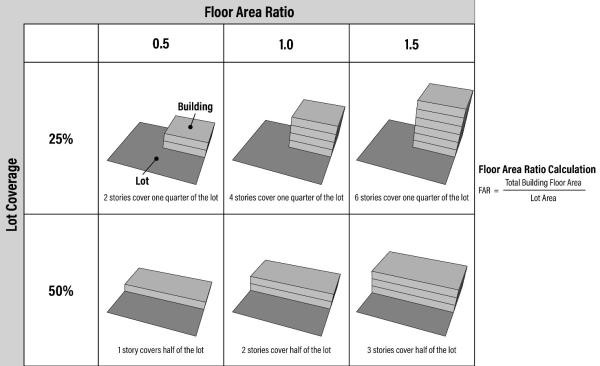
Floor area ratio (F.A.R.): The floor area ratio of the building or other structure on any lot is determined by dividing the floor area of such building or structure by the area of the lot on which the building or structure is located. When more than one building or structure is located on a lot, then the floor area ratio is determined by dividing the total floor area of all buildings or structures by the area of the lot, or in the case of planned unit development, by the net site area. The floor area shall be the sum of the gross horizontal area of the several floors of a building measured from the exterior walls. The floor area ratio requirements, as set forth under each zoning district, shall determine the maximum floor area allowable for a building (including both principal and accessory buildings) or other structure in direct ratio to the gross area of the lot.
Food store: A store that sell foods, fresh or frozen, and other items commonly sold in connection therewith and including, but not limited to, stores commonly referred to as dairy store, delicatessen, fruit and vegetable market, grocery store, health food store, nut shop and supermarket. Sales must be made at retail on the premises, and not for consumption on the premises.
Foot candle: A unit of illumination. Technically, the illumination of all points one foot distance from a uniform point source of one candle power.
Frontage: The length of a front lot line or lines along a public or private street.
Grade: The average level of the finished surface of the ground adjacent to the exterior walls of the building or structure.
Gross acre or acres: Real property containing forty-three thousand, five hundred sixty (43,560) square feet or one hundred sixty (160) square rods including streets, highways, roads, and right-of-way easements.
Height, maximum: A horizontal plane above and parallel to the average finished grade of the entire zoning lot at the height shown in the district regulations. No part of any structure shall project through the plane, except:
1. Chimneys, flues, stacks, fire escapes, gas holders, elevator enclosures, ventilators, skylights, water tanks and similar roof structures needed to operate and maintain the building on which they are located;
2. Flag poles, television aerials, satellite dishes, water towers and tanks, steeples and bell towers, carillons, monuments, cupolas, broadcasting and microwave transmitting and relay towers, communication towers and electric transmission line towers.
Home occupation: Any business or commercial activity that is conducted in whole or in part in a dwelling unit and is clearly subordinate to the residential use.
Hospital: An institution open to the public in which patients or injured persons are given primarily medical or surgical care; or for the care of contagious diseases or incurable patients, and including related facilities such as laboratories, outpatient departments, training facilities, central service facilities, and staff offices that are an integral part of the facility.
Hotel or motel: A building which provides sleeping accommodations for transient guests, and may include meeting rooms or a restaurant, and which provides customary hotel services such as maid service, the furnishing and laundering of linen, telephone and desk service, and the use and upkeep of furniture.
Junk yard: The use of any lot where waste, scrap metal, paper, rags, or similar materials are brought, sold, exchanged, stored, baled, packed, disassembled, or handled, including auto and building wrecking yards, but excluding similar uses taking place entirely within a completely enclosed building.
Kitchen: Any room used, or intended or designed to be used, for cooking or the preparation of food.
Laboratory: A building use established for scientific experimentation, research or testing.
Landscaping: The improvement of a lot, parcel, or tract of land with grass, shrubs, and trees. Landscaping may include pedestrian walks, flower beds, ornamental object such as fountains, statuary, and other similar natural and artificial object designed and arranged to produce an aesthetically pleasing effect.
Liquor Store: An establishment selling beer, wine or alcoholic liquor at retail to the general public in sealed bottles or other sealed containers for consumption or use away from the premises where establishment is located.
Loading and unloading space, off-street: An open paved area of land other than a street or a public way, the principal use of which is for the standing, loading and unloading of motor trucks, tractors, and trailers, to avoid undue interference with the public use of streets and alleys.
Lot area: The area of a horizontal plan bounded by the front, side and rear lot lines.
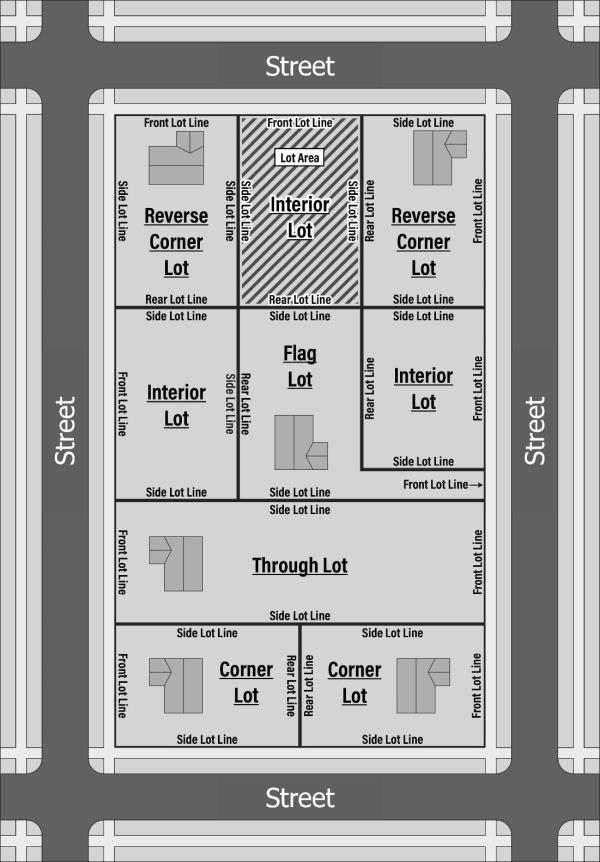
Lot, corner: A parcel of land situated at the intersection of two or more streets or adjoining a curbed street at the end of the block.
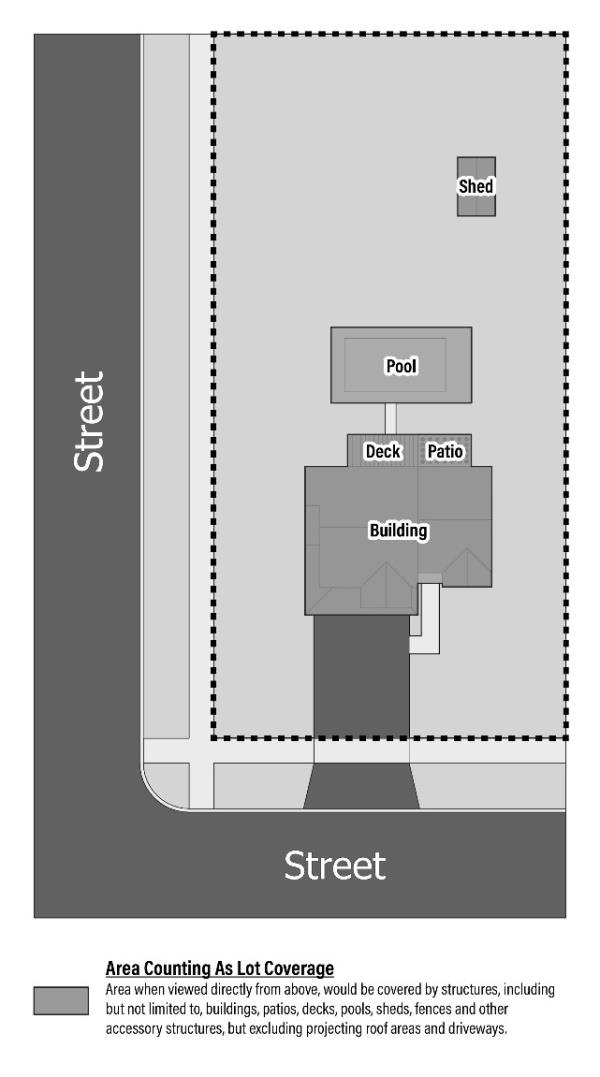
Lot coverage: means that percentage of a lot which, when viewed directly from above, would be covered by a structure or structures, or any part thereof, including, but not limited to, buildings, patios, decks, pools, sheds, fences and other accessory structures, but excluding projecting roof areas and driveways.
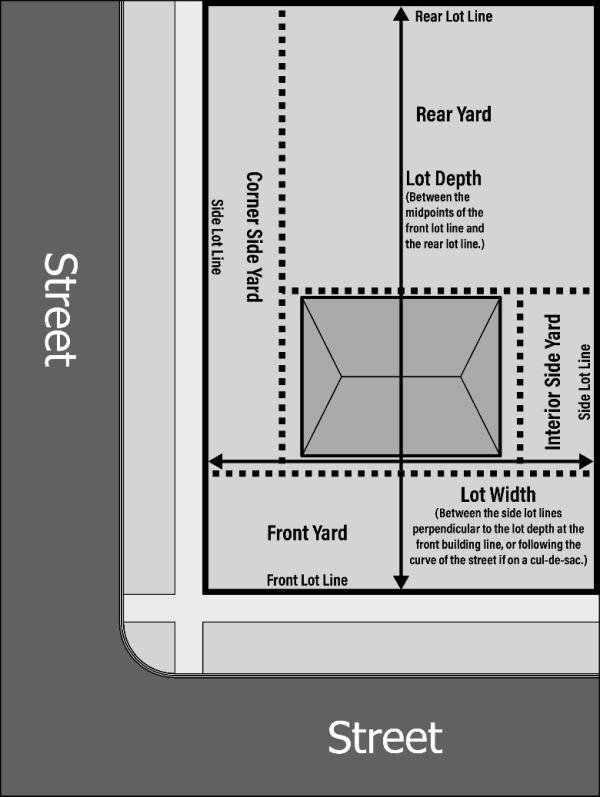
 Lot depth: The distance between the midpoint of the front lot line and the midpoint of the rear lot line.
Lot, flag: A lot with access to the bulk of the property by means of a narrow corridor.
Lot, interior: A lot other than a corner lot.
Lot line: A property boundary line of a lot.
Lot line, front: A street right-of-way forming a boundary of a lot; the lot line that faces the principal entrance of the principal building.
Lot line, rear: The boundary of a lot which is most distant from, and is most nearly parallel to, the front lot line.
Lot line, side: Any boundary of a lot which is not a front lot line or a rear lot line.
Lot of record: A lot that is part of a subdivision, the plat of which has been recorded in the Office of the Lake County Recorder’s, or a parcel of land separately described as a single tract of land in a recorded deed.
Lot, through: A lot having frontage on two parallel or approximately parallel streets, and that is not a corner lot. Also known as a double frontage lot.
Lot width: The horizontal distance between the side lot lines measured at right angles to the lot depth at the established front building line, or following the curve of the street if on a cul-de-sac.
Lot, zoning: A parcel of land that is designated by its owner or developer, at the time of applying for a zoning certificate, as a tract all of which is to be used, developed or built upon as a unit under single ownership. As long as it satisfies the above requirements, such lot may consist of:
1. A single lot of record; or
2. A portion of a lot of record; or
3. A combination of complete lots of record, complete lots and portions of lots of record, or portions of lots of record.
Manufacture: All manufacturing and industrial activities, including fabrication, processing, assembly, disassembly, repairing, cleaning, servicing, testing, packaging and storage of materials, products and goods that can be conducted wholly within enclosed buildings.
Medical office, clinic or center: An establishment where human patients are admitted for diagnosis and treatment by licensed physicians, medical practitioners, and professional associates who may jointly utilize the same reception area, medical supply, laboratory, x-ray, parking and other physical facilities.
Mobile home: A dwelling unit designated to be transported on streets and highways to the place where it is to be occupied as a dwelling unit complete and ready for year round and permanent occupancy; except for minor and incidental unpacking and assembly operations, location on jacks or permanent foundations, connected to the Village water and sewer system, and similar operations.
Motor vehicle accessory store: A store engaged primarily in the business of selling tires, batteries, seat covers, and other automobile accessories.
Motor vehicle repair: General repair, overall painting, engine repairing or rebuilding, reconditioning of motor vehicles and trailers such as body or framework and fender straightening.
Motor vehicle sales: The sale of new and used automobile and other motor vehicles in operating condition; the storage of automobiles and other motor vehicles in operating condition,; and which may include the accessory repair and servicing of such vehicles, including body work, painting, motor rebuilding, where conducted within a completely enclosed building.
Motor vehicle service station or gas station: A building or portion thereof, or lot used for offering for sale at retail to the public, fuels, oils, electric battery charging and accessories for motor vehicles; where repair service is incidental, where no storage or parking space is offered for sale or rent.
Motor vehicle wash: A building or portion thereof containing facilities for washing vehicles, using automatic production-line methods with a chain conveyor, blower, steam cleaning device, or other mechanical devices; or providing space, water and equipment for the hand washing of automobile whether by the customer or the operator.
Motor vehicle wrecking: The dismantling of used motor vehicles or trailers, the burning of combustible parts thereof, or the storage, sale or dumping of dismantled or wrecked motor vehicles or their parts.
Municipal facility or utility: Any building, structure, or appurtenance thereto, open space or parcel of property owned or leased by the Village, allowed in any use district.
Nonconforming lot of record: A lot of record that does not meet the lot area or lot width requirements of this Title for the zoning district in which it is located.
Nonconforming structure: An existing structure which does not comply in some respect with the lot size requirements or bulk regulations applicable to new structures in the zoning district in which it is located.
Nonconforming use: An existing use of a structure or land which does not comply in some respect with the use regulations applicable to new uses in the zoning district in which it is located.
Nursing home, convalescent home, or assisted living: An institution for the care of the aged or infirm, or a place of rest for those suffering bodily disorders, but not including facilities for surgical care or institutions for the care and treatment of mental illness, alcoholism, or narcotics addition; may also include skilled nursing, or memory care facilities.
Office: A room, group of rooms, or premises used for conducting the business and clerical affairs of a business, profession, service, industry, or government.
Open space and recreational areas: Recreational area is land specifically designed and intended for the active or passive recreational use of residents and shall include, but not be limited to public and private play lots, and parks, school sites, storm water detention or retention areas, if such areas are capable of being utilized for multipurpose recreational activities, pedestrian corridors, bicycle and equestrian trails, greenbelt and open space networks. Permanent common open space is parkways, medians, landscaped green space, and other similar areas which are not suitable for recreational purposes.
The Round Lake Zoning Ordinance.
Outdoor storage: The keeping of any goods, material, merchandise, or vehicles, in the same place for more than twenty-four (24) hours unless such goods, material, merchandise, or vehicles, have been authorized through the issuance of a permit for a temporary outdoor display, temporary seasonal
display, or special use permit.
Parking area: An open paved area of land, other than a street or public way, designed, arranged and made available for the parking of vehicles for occupants of the building for which the parking area is developed and accessory or for the public whether for compensation or not.
Parking space: A space within a public or private parking area, exclusive of access drive or aisles, ramps or columns, for the parking of one vehicle.
Pawn Shop: An establishment licensed, certified, or accredited by the appropriate local and state agencies that lends money in exchange for personal property that is used as collateral. Pawn Shops may purchase personal property outright or on the condition of selling it back to a customer with interest. Pawn Shops may include cash for gold establishments, which have the primary business of purchasing precious metals, jewelry, watches, and other similar items. Pawn Shop does not include Retail Sales Establishments such as antique stores and consignment stores.
Performance standard: A criterion to control noise, odor, smoke, toxic or noxious matter, vibration, fire and explosive hazards, or glare to be moved or removed.
Pet daycare, grooming and training: An establishment where pet animals are temporarily kept or cared for, groomed or trained, for remuneration, but are not kept overnight. Pet daycare, grooming and training does not include animal boarding or shelter establishments, animal hospitals, or pet stores.
Planned unit development (PUD): A parcel or tract of land that is developed as a unified project under single ownership or control where certain regulations in this Title, such as bulk and use standards, may be modified to allow for more
flexible planning in conformance with the planned development standards and approval processes set forth herein. Any condominium project of any size, any townhome project of any size, or any other residential project containing eight
units or more, whether in one building or more than one building, shall be considered a planned unit development. Any redevelopment project within the Downtown TIF District shall be considered a planned unit development.
Porch: A roofed-over structure, projecting out from the wall or walls of a main structure, and commonly open to the weather in part.
Portable storage container: A self-storage container that is delivered to and retrieved from a home or business for long-term off-site storage or on-site storage. Portable On Demand Storage, or PODS, is a familiar trade name for such containers. These containers are not on a chassis and do not have axles or wheels.
Public utility: Any person, firm, corporation or municipal department duly authorized to furnish, under public regulation to the public, electricity, gas, telephone, cable, transportation, potable water, sanitary sewage disposal, or storm sewer.
Recreational facility, commercial: A use which may contain indoor or outdoor swimming pools, tennis courts, gymnasiums, hand ball courts, pool and billiard rooms, bowling alleys and other similar uses when operated for profit.
Recreational vehicle: Any boat, boat trailer, water craft, snowmobile, dirt bike, all-terrain vehicle, air craft, trailer, any camping trailer, travel trailer, coach or motorhome, mini motor home, truck camper, or van camper, or other unit built or mounted on a vehicle or chassis, without permanent foundations, that may legally be driven or towed by motor vehicles or vehicles used primarily for recreational purposes.
Redevelopment: The removal or substantial removal of the principal buildings or structures from land and /or the construction or erection of other principal buildings or structures thereon, or the development of vacant properties.
Religious Institution: An institution maintained by a religious body where people assemble for religious purposes, ceremonies, and other similar events. Religious institutions include, but are not limited to, churches, chapels, temples, synagogues and mosques. A religious institution may include housing for members of religious orders and day care centers as accessory uses.
Remodeling: Any change in a structure, including a structural alteration (other than incidental repairs and normal maintenance) which may prolong its useful life, or the useful life of its supporting members such as bearing walls or partitions, columns, beams, girders or foundations; or the construction of any addition to, or enlargement of, a structure; or the removal of a structure.
Residential building: A building all or part of which contains one or more dwelling units, including single-family dwellings, two-family dwellings, and multiple-family dwellings.
Restaurant: A food service establishment, used, maintained, advertised, and/or held out to the public as a place where meals are served and where meals are actually and regularly served, such space being provided with adequate and sanitary kitchen and dining room equipment and capacity and having employed therein a sufficient number and kind of employees to prepare, cook, and serve to its customers or guests, complete meals.
1. Restaurant, carry-out or fast food: A restaurant whose principal business operation is the dispensing of edible foods stuff and/or beverage, ready for consumption on the premises, at outdoor tables, at stand-up counters, or to be carried off the premises.
2. Restaurant, quick service or fast casual: A restaurant whose principal business is the sale of food and/or beverages to consumers in a ready to consume state, and where the principal method of operation is characterized by order at a counter and sit down to eat, the service of food and/or beverages in paper, plastic, or disposable containers.
3. Restaurant, full service: A restaurant whose principal business is the sale of food and/or beverages to consumers in a ready to consume state, and where the principal method of operation is such that customers are provided with an individual menu, and are served their foods and beverages by a restaurant employee at the same table or counter at which food and beverages are consumed.
Retail sales: The sale of goods, merchandise and commodities for use or consumption.
Screening: means decorative fencing or evergreen vegetation maintained for the purpose of concealing from view the area behind such structures or evergreen vegetation.
Self-storage, mini warehouse: A building or buildings in a controlled access area that contain varying sizes of individual, compartmentalized and controlled access stalls or lockers for the storage of a customer’s goods or wares.
Setback: The distance between the lot line and the principal building on the lot.
Sign: See Title 18, Sign Code.
Short-term or vacation rental: See Chapter 15.60 (Residential Rental Property Registration and Inspection) of the Village Code for definition and regulations.
Structure: Anything erected, the use of which requires more or less permanent location on the ground or attached to something having a permanent location on the land.
Tavern: An establishment in which the primary use is the sale and service of alcoholic beverages to customers for consumption of the premises.
Tax increment financing district (TIF): A geographical area designated pursuant to the Tax Increment Allocation Redevelopment Act, 65 ILCS 5/11-74.4-1, et seq., where the property tax increments are used to fund projects in the area to encourage economic development. The Downtown Tax Increment Finance District was adopted by the Village Board January 4, 2021 by Ordinances 21-O-01, 21-O-02 and 21-O-03 and is governed by the Round Lake Downtown TIF Redevelopment Plan and Project.
Telecommunication antenna: A structure used to transmit and/or receive or radiate electromagnetic waves, communication, data, or other similar signals in order to facilitate the use of wireless devices. Small wireless facilities, as defined and regulated by Chapter 12.46 (Small Wireless Facilities) of the Village Code shall not be included within this definition.
Telecommunication facility: Equipment at a fixed location that enables wireless communications between user equipment and a communications network, including: a) equipment associated with wireless communications; and b) radio transceivers, telecommunication antennas, coaxial or fiber-optic cable, regular and backup power supplies, and comparable equipment, regardless of technological configuration. Telecommunication facility does not include: (i) the structure or improvements on, under, or within which the equipment is collocated; or (ii) wireline backhaul facilities, coaxial or fiber optic cable that is between wireless support structures or utility poles or coaxial, or fiber optic cable that is otherwise not immediately adjacent to or directly associated with an antenna. Telecommunication facilities erected or modified to support small wireless facilities (wireless support structures for small wireless facilities), as defined and regulated by Chapter 12.46 (Small Wireless Facilities) of the Village Code, shall not be included within this definition.
Telecommunications tower: Any structure that is designed and constructed primarily for the purpose of supporting one or more telecommunication antennas and telecommunications structures. Telecommunications towers are typically freestanding and include self-supporting lattice towers, guyed towers, or monopole towers. Telecommunications towers erected or modified to support small wireless facilities (wireless support structures for small wireless facilities), as defined and regulated by Chapter 12.46 (Small Wireless Facilities) of the Village Code, shall not be included within this definition.
Townhome: A building that consists of a row of three (3) or more attached dwelling units that share common firewalls, where each unit has its own individual exterior entrance.
Trailer: A vehicle standing on wheels or on rigid supports which is used for transporting boats, cargo or property.
Transitional Treatment Facility: Transitional living place for those in recovery from drugs or alcohol, or convicted criminals to begin the process of reintegration with society.
Use: Any purpose for which a structure or a tract of land may be designed, arranged, intended, maintained or occupied; also, any activity, occupation, business or operation carried on, or intended to be carried on, in a structure or on a tract of land.
Use regulations: The provisions of this Title which identify allowed uses, impose use limitations, require adherence to performance standards and regulate home occupations and principal, accessory and temporary uses.
Vestibule: A small entrance hall or room between the outer door and the interior of a building.
Wholesale sales: The sale of goods, merchandise and commodities for resale.
Yard: An open space on the same zoning lot with a principal building or group of buildings that is unoccupied and unobstructed from its lowest level to the sky, except as otherwise permitted in this Title, and which extends along a lot line and at right angles thereto to a depth or width specified in the yard regulations for the district on which the zoning lot is located.
Yard, corner side: The yard immediately adjoining a public street not otherwise defined as the front yard.
Yard, front: A yard extending across the full width of a zoning lot and lying between the front lot line and the nearest line of a building.
Yard, interior side: A yard extending along a side lot line and between the principal building, but excluding any area encompassed within a front yard or rear yard. Dimensions of minimum side yard specified in the district regulations of this title refer to the required width of each side yard rather than to the total width of both sides.
Yard, rear: A yard extending across the full width of the zoning lot (except in the case of corner lots) and between the rear line of the lot and the nearest line of the principal building.
Zoning administrator: The individual responsible for making interpretations and enforcing this Title. The Director of Economic and Community Development is the Zoning Administrator.
Zoning map: The map designating zoning districts incorporated into this Title as a part hereof.
HISTORY
Approved by Ord. 25-O-06 on 3/3/2025


