
Round Lake City Zoning Code
CHAPTER 17
20 ACCESSORY STRUCTURES AND USES
17.20.010 Accessory Structures And Uses Generally
A. Accessory structures and uses are permitted in any zoning district in connection with any principal use which is permitted within such district. B. No accessory structure shall be constructed or occupied on any lot prior to the completion of the principal building to which it is accessory. C. Accessory structures require a building permit unless otherwise noted herein. D. Accessory structures must be maintained in a safe, sanitary and secure fashion. E. No accessory structures or trees shall be placed on drainage or utility easements, but same may be used for gardens, shrubs, landscaping and other purposes that do not then or later interfere with the aforesaid uses or rights herein granted. The Village has the right, but not the obligation, to at any time, abate any encroachments placed on or over the easement area. Any costs incurred by the Village or its agents and subcontractors to abate the encroachments shall be paid for by the property owner. If the costs are not paid, a lien shall be placed on the property. F. Where a substantial part of the wall or an accessory building is part of the wall of the principal building or where an accessory building is attached to the principal building in a substantial manner as by a roof, such accessory building shall be counted as part of the principal building and conform to all regulations applicable thereto. G. Other accessory structures and uses not included in this Chapter shall be reviewed by the Zoning Administrator to determine if a permit is required and any special regulations that may be in place.
17.20.020 Bulk Regulations
Except as otherwise provided for in this Chapter or Title, the following bulk regulations shall apply:
A. Accessory structures and uses shall maintain the same side yard as are required for the principal building located on the zoning lot. Accessory structures and uses, except fences, shall be located a minimum of ten (10) feet from the any lot line unless otherwise established by this Chapter. B. No accessory structures shall be located in the front or side yard unless otherwise stated within this Chapter. No accessory structures are allowed in any easement or drainage swale. C. No part of any accessory structure shall be located closer than ten (10) feet to any principal building, unless it is attached to or forms a part of such principal building. D. The height of a detached accessory building or other accessory structure shall not exceed the height of the principal building on the zoning lot or be greater than 16 feet, whichever is more restrictive. E. No accessory building, other than a detached garage, may exceed one hundred twenty (120) square feet. Each accessory structure, building and use shall otherwise comply with the bulk regulations applicable in the district in which it is located. F. Only one of each type of the following accessory structures and buildings shall be allowed: swimming pools, gazebos, sheds, and detached garages as contained herein.
17.20.030 Permitted Accessory Structures And Uses
Any structure or use that complies with the terms of this Title and applicable building permit requirements may be allowed as an accessory structure or use. Below are more specifications for certain accessory structures. A. Accessory dwelling units (ADU). Accessory dwelling units are permitted within a principal or accessory building subject to approval of a permit application. Accessory dwelling units must be within a single-family property and located in a residential zoning district. Accessory dwelling units are not permitted in conjunction with two-family dwellings, townhomes, or multiple-family dwellings. 1. An accessory dwelling unit is permitted as part of the existing principal building, such as a basement, attached to a building, or as a free-standing accessory building. If an accessory dwelling unit is an attached unit, it needs to meet the setback requirements of the principal building. Attached units must have an entrance from the exterior separate from the principal building. Entrances: Only one (1) pedestrian entrance to the structure may be located on the front facing facade of the principal building. 2. Any exterior stairs to serve as the primary entrance to an attached or internal accessory dwelling unit within the principal building shall be located on the interior side or rear of the principal building. 3. No more than one accessory dwelling unit is permitted per zoning lot. 4. An accessory dwelling unit must not exceed 900 square feet in area. 5. On lots with accessory dwelling units, the property owner must maintain his or her permanent residence in either the principal building or the accessory dwelling unit. 6. For accessory dwelling units located in an accessory building, the exterior materials of the dwelling unit must be compatible with the principal building, including siding and trim materials, window design, roof shape, roof pitch, and roof material. 7. The accessory dwelling unit shall not be sold independently of the principal residential dwelling and may not be a separate lot of record. 8. Accessory dwelling units that are rentals must be registered and comply with the requirements set forth in Chapter 15.60 (Residential Rental Property Registration and Inspection) of this Code.
B. Arbors and trellises 1. Permitted in the front, side, and rear yard setbacks. 2. No building permit is needed; however, manufacturer’s directions for proper anchoring shall be followed.
C. Basketball hoops 1. Only one basketball hoop is permitted in the front yard. Basketball hoops must comply with setback regulations, but may be located within ten (10) feet of the principal structure. 2. No building permit is necessary. 3. Basketball hoops are not permitted in the public right of way, including cul-de-sac islands.
D. Children’s playhouses, swing sets and trampolines 1. Children’s playhouses, swing sets and trampolines are only permitted in the rear yard. 2. A building permit is not required for a playhouse; however, all playhouses shall meet the applicable provisions of Title 15, Buildings and Construction, of this Code.
E. Detached garages 1. No detached garage shall exceed seven hundred twenty-five (725) square feet. Architecture must be compatible with the principal building. 2. The height of a detached garage shall not exceed the height of the principal building or be greater than sixteen (16) feet in height, whichever is more restrictive. 3. Access to the detached garage shall be provided by an approved paved driveway.
F. Donation Bins 1. Maximum of two donation bins permitted outside. 2. Bin placement must not impede vehicle or pedestrian movement. 3. A Village licensed business must register the bin(s) located at their establishment on an annual basis. 4. Business is responsible for cleaning up any materials left outside of the bin(s). G. Electric vehicle charging stations 1. Installation of charging stations require a building permit prior to installation. 2. Charging level: the following are the standardized indicators of electrical force, or voltage at which an electric vehicle’s battery is recharged. Typical electric vehicle charging levels and specifications are: a. Level 1 – AC (alternating current) slow battery charging. Voltage is 120 volts. b. Level 2 - AC (alternating current) medium battery charging. Voltage is between 120 volts and 240 volts. c. Level 3 – DC (direct current) fast or quick battery charging. Voltage is greater than 240 volts. 3. Level-1 and Level-2 charging stations are permitted in every zoning district when accessory to a primary permitted use of said district. Charging stations located at single-family and multiple-family dwellings shall be designated as private use only. 4. Level-3 charging stations are permitted in commercial and industrial districts when accessory to a primary permitted use. The following regulations are for Level-3 commercial use electric vehicle charging stations: a. Parking Spaces: Charging station spaces reserved only for plug-in electric vehicles may be included in the overall calculation of minimum parking spaces required for the primary use by this Title, provided that such charging station spaces do not (a) account for more than 10% of the minimum parking spaces required, or (b) reduce the dimensions of adjoining spaces or the parking aisle or reduce the number of available spaces below the minimum required by this Title. Subject to the conditions of this Title, additional charging station spaces may be constructed but they will not count towards the minimum parking spaces required. b. No minimum number of charging station spaces is required. c. Charging Station Space Location and Design Criteria: (1) Maintenance: Charging station equipment shall be maintained in all respects, including the functioning of the charging equipment. The owner of the equipment shall be responsible for the maintenance of the charging station and shall provide warranty and service for the charging stations and infrastructure for the duration of their useful life. A phone number or contact information shall be provided on the charging station for reporting when the equipment is not functioning or other problems are encountered. (2) Charging Station Equipment: Charging station outlets and connector devices shall be no less than thirty-six inches (36”) and no higher than forty-eight inches (48”) from the ground or pavement surface where mounted, and shall be designed and located as to not impede pedestrian travel or create trip hazards on sidewalks. (3) Charging Station Equipment Protection: Adequate charging station equipment protection such as wheel stops, concrete filled steel bollards, or similar shall be used. (4) Lighting: Where charging station equipment is installed, adequate site lighting shall be provided in accordance with Village ordinances and regulations. d. Each charging station space shall be posted with signage indicating days and hours of operation if time limits or tow away provisions are enforced.
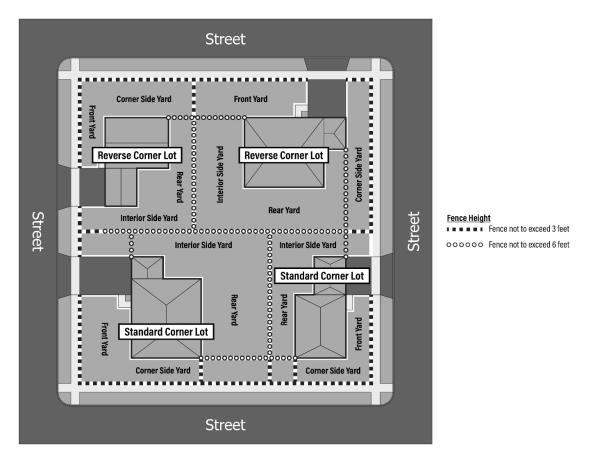
H. Fences 1. Fence Standards. All fences shall comply with the following standards: a. Fences shall be allowed in rear and side yards. Fences may also be allowed in front yards in conformance with 2. below. b. On corner lots, the yard where the front door is located shall be the front yard. c. No fence shall exceed six (6) feet in height in residential and commercial districts and eight (8) feet in height in industrial districts. d. No fence, nor any other encroachment including trees, bushes, and shrubs, shall be planted or constructed that obstructs sight or vision of passing motorists or in any way causes a dangerous or hazardous traffic condition. e. Fences may be permitted in the drainage easement or utility easement provided the property owner signs a waiver of indemnification and hold harmless agreement approved by the Village. Unless otherwise determined by the Public Works Department, any fence located in a drainage easement shall have four (4) inches of clearance from the ground to allow the free flow of stormwater. f. The following fences are prohibited: (1) Barbed wire; (2) Electrified fences (underground dog fence is permitted, no permit required); (3) Chain link fences with slats; (4) Snow fences; (5) Chicken wire fences; (6) Plastic weave construction or landscape fences (unless required during permitted construction). g. Any fence that has an unfinished side shall be erected so the unfinished side and supporting members face inward. h. Whenever a new business or industrial use abuts an existing residential district or a residential use, the owner of said business or industrial property shall be required to erect and maintain a board on board fence of six (6) feet in height to screen said business or industrial use from the residential district or residential use. A landscaped berm that forms a solid vegetated buffer may be used in lieu of a fence, if approved by the Zoning Administrator. i. Fence requirements for swimming pools are found in Title 15, Buildings and Construction, of this Code. j. A pet run/kennel requires a fence permit if not a freestanding structure.
2. Front Yard Fences. Fences are permitted in front yards, subject to the following: a. Fence height shall be measured from the average grade of the front yard. A front yard fence shall not exceed thirty-six (36) inches in height. b. Fences shall be no closer to the street than the property line or the inner edge of the public sidewalk closest to the building, whichever provides the greater setback from the public right-of-way. 3. Corner Lot Side Yard Fences. Exterior side yard fences shall be permitted on corner lots subject to the following: a. Exterior side yard fences shall not exceed thirty-six (36) inches in height, when installed at property line or sidewalk. Exterior side yard fences shall not exceed six (6) feet in height when installed on a building setback line. Height shall be measured from the average grade of the exterior side yard. b. Exterior side yard fences shall be set back at the property line or at the interior edge of the public sidewalk closest to the building whichever provides the greater setback from the public right-of-way, or at the building setback line if a taller fence is desired.
I. Free book exchanges 1. Book exchange structure means an enclosed structure that holds books/literacy material to share/exchange, in a pedestrian friendly accessible location, constructed and maintained by the property owner. The owner of the freestanding book exchange shall be solely responsible for the content of the materials and the books within the freestanding book exchange and be solely responsible for its maintenance and upkeep. No permit is needed. 2. Only one (1) book exchange structure is permitted per zoning lot. 3. A book exchange structure may be placed in the front or side yard setback in all zoning districts. 4. A book exchange located in a front or side yard: a. May not exceed five (5) feet in height when measured from the ground and must not exceed three (3) feet wide and two (2) feet deep. b. Must be made of material resistant to damage or deterioration from exposure to the outside elements. c. Must be properly mounted, bolted, or protected as necessary to withstand wind, rain, and other seasonal changes. d. Must be set back at least two (2) feet from any public right-of-way or sidewalk. If a sidewalk exists, then the freestanding book exchange must only be placed on the interior of the sidewalk. e. May not interfere with or impede traffic visibility. f. Must be constructed so that the finished side faces the street.
J. Gazebos and pergolas 1. If attached to the principal building, either directly or via a deck, the gazebo or pergola shall conform to the setback requirements regulating the principal building. 2. Setbacks for freestanding gazebos and pergolas shall conform to those regulating accessory structures as defined in this Section.
K. Greenhouses 1. Greenhouses are only permitted in the rear yard. 2. Greenhouses must have rigid sides (glass or plexiglass), and may not be a membrane structure.
L. Portable storage containers 1. A building permit is required for portable storage containers that remain on a property for more than fourteen (14) days. The maximum permitted time a portable storage container may remain on a property is ninety (90) days. 2. Portable storage containers are permitted only one (1) time each calendar year. 3. Portable storage containers shall be placed on a paved surface. 4. Placement of portable storage containers on public property or encroaching on a public sidewalk is prohibited. M. Rain garden 1. Rain gardens are allowed in all yards. 2. Rain gardens shall be located a minimum of two (2) feet from any lot line. 3. Loose soil associated with a rain garden must be covered or confined so that the soil is not moved from the lot, particularly after each growing season. 4. No building permit needed. N. Recreational vehicles. In all residential districts where parking facilities are incorporated, off-street storage of recreational vehicles and equipment shall be provided in accordance with the following requirements. No permit is required. 1. Recreational vehicles shall be parked in a completely enclosed building in a lawful manner or on a permitted hard surface driveway. 2. Not more than two (2) recreational vehicles shall be visible on a zoning lot. 3. Recreational vehicles are required to be accessible to the parking spot or host vehicle without being maneuvered over grass, lawn, unpaved surfaces, or curbs. 4. Recreational vehicles may only be set up for maintenance purposes for a period not to exceed forty-eight (48) hours. No one may stay in or live in recreational vehicles on the property (see Section 17.28.070). 5. Recreational vehicles shall be properly licensed and in good repair. 6. Recreational vehicles shall meet the height and weight requirements as set forth in the Illinois Vehicle Code (625 ILCS 5/1-100 et seq.). 7. No part of any recreational vehicle shall be allowed to encroach into the right-of-way or public sidewalk. 8. Parking of recreational vehicles on public property is prohibited.
O. Retaining walls 1. No retaining walls shall be constructed in Village easements or rights-of-way. 2. Mortar/concrete block or reinforced concrete is the recommended material for retaining walls. Retaining walls shall not be constructed of wood, timbers, or railroad ties. 3. Retaining walls less than thirty-six (36) inches above the lower grade level shall be buried at least six (6) inches below grade and do not require a permit. 4. Retaining walls thirty-six (36) inches or more above the lower grade level shall be required to obtain a permit. Walls installed during mass grading will be reviewed with the grading permit. When possible, all retaining walls shall be installed at the time of mass grading. Walls installed after mass grading require a separate permit. 5. Plans for retaining walls thirty-six (36) inches or more in height shall be stamped by a structural engineer to verify that the type of wall is appropriate for the specific location and the materials to be used are sufficient for the intended use. 6. Slopes of 2 to 1 or steeper shall require the use of retaining walls. 7. Retaining walls exceeding twenty-four (24) inches in height that resist lateral loads in addition to soil shall be designed to follow International Residential Code, as adopted by the Village. 8. For safety purposes, retaining walls over three (3) feet above the lower grade level shall have a fence on top. 9. Retaining walls constructed more than ten (10) feet above the lower grade level shall be terraced to include a landscaped area to break up the wall.
P. Satellite dish antennas 1. Location. If installed as a freestanding structure, dishes shall only be permitted in rear yards and shall be mounted directly upon the ground. Miniature dishes, which are those dishes less than twenty-five (25) inches in diameter, shall be located no closer than five (5) feet from any property line measured from the center of the foundation of the antenna support pole. Regular dishes (twenty-five (25) inches in diameter or more) shall be permitted only in rear yards containing 900 square feet or more and shall be located no closer than ten (10) feet from any property line measured from the center of the foundation of the antenna support pole. 2. Mounting. Dishes on walls shall be installed so that the bottom of the dish is no lower than twenty-five (25) inches below an eave or the peak of the roof, and provided that dishes on roofs shall be installed so that the top of the dish is no higher than twenty-five (25) inches above the peak of the roof. Placement of a miniature dish shall be on a rear wall unless signal reception demands warrant side wall installation. Dishes shall not be attached to or mounted upon chimneys. Dishes shall not be mounted, installed or otherwise placed on towers, similar forms of structural supports, or other accessory structures. A regular dish not exceeding a diameter of ten (10) feet may be installed on the roof of a business or industrial establishment, provided that it is set back at least three (3) feet from any edge of the roof and is mounted in such a way that it does not exceed eleven (11) feet in height as measured from the roof line. 3. Construction Specifications. All freestanding dishes must be erected in accordance with Village building codes, and all electric and/or transmission cable connecting the antenna to the principal building shall be underground. 4. Screening. All freestanding regular dishes shall be effectively screened by a six (6) foot fence or dense evergreen-type shrubbery or screening material to a minimum height of six (6) feet above ground level from any adjoining lot or street.
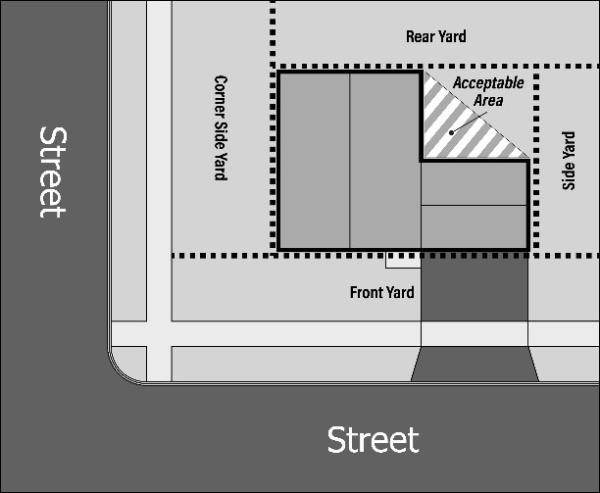
Q. Sheds 1. The maximum size of a shed shall be one hundred and twenty (120) square feet (10’ X 12’, for example). 2. Only one (1) shed shall be permitted per lot. 3. The maximum height of a shed shall be ten (10) feet. 4. Sheds located in side yards shall meet the principal building setbacks. 5. Moveable, plastic sheds are the exception to the above regulations. Movable, plastic storage sheds or boxes, less than 100 cubic feet, may be located in rear yards or side yards if it does not project past the plane of the residence and is not visible from the right-of-way. No building permit is required to install a movable plastic shed. No more than three (3) movable plastic sheds shall be permitted per lot. See diagram for acceptable locations.
R. Swimming pools and hot tubs 1. No portion of a swimming pool, hot tub, or water garden or its accessory equipment or structures, including but not limited to a deck, patio, pump, filter or walkway, shall be located less than ten (10) feet from property line. 2. Specific swimming pool and hot tub barrier requirements are found in Title 15, Buildings and Construction, of this Code. 3. Temporary pools require a permit and shall follow the regulations in Title 15, Building and Construction, of this Code. S. Temporary/seasonal vestibules for commercial or industrial structures 1. Temporary/seasonal vestibules shall be a solid color to match the principal building. 2. No signage shall be permitted on the temporary/seasonal vestibule. 3. Temporary/seasonal vestibules shall only be allowed between November 1 and April 15. 4. Temporary/seasonal vestibules are not permitted on doorways with existing vestibules. 5. Temporary/seasonal vestibules shall comply with the requirements in Title 15, Buildings and Construction, of this Code. T. None of the following shall be permitted as accessory buildings, structures or uses: 1. Any outdoor storage, except as specifically permitted elsewhere in this Title. 2. Carports (except where attached to the principal structure).

