
Royal Oak Charter Township
City Zoning Code
City Zoning Code
ARTICLE XI
SIGNS
Sec. 32-823.- Definitions.
The following words, terms and phrases, when used in this article, shall have the meanings ascribed to them in this section, except where the context clearly indicates a different meaning: (See illustrations.)
Accessory sign means a sign that pertains to the use of the premises on which it is located.
Animated sign means a sign that uses lights, moving parts, or other means to depict action, create an image of a living creature or person, or create a special effect or scene.
Area means the area of a sign as computed per section 32-831(d).
Awning sign means a sign that is painted on, printed on, or attached flat against the surface of an awning or canopy.
Banner sign means a sign made of fabric, cloth, paper, or other nonrigid material that is typically not enclosed in a frame.
Billboards. See Off-premises advertising sign.
Bulletin board means a type of "changeable copy" sign that displays the name of an institution, school, library, community center, fraternal lodge, park or other recreational facility, and may display announcements of services and activities.
Canopy sign. See Awning sign.
Changeable copy sign (automatic) means a sign on which the message changes automatically (for example, electronic or electric time and temperature signs).
Changeable copy sign (manual) means a sign on which the message is changed manually (for example, by physically replacing the letters).
Community bulletin board means a type of "changeable copy" sign that displays the name of a governmental unit, school, library, community center, park or other recreational facility, contains no commercial advertisements, and displays announcements of services and activities of general interest within the township.
Community special event sign means a signs and/or banner, including related decorations and displays celebrating a traditionally-accepted patriotic or religious holiday, or special municipal or school activities.
Construction sign means a temporary sign identifying the designer, contractors and sub-contractors, and material suppliers participating in construction on the property on which the sign is located.
Directional sign means a sign that is intended to direct the flow of vehicular and pedestrian traffic.
Festoon means a string or grouping of ribbons, tinsel, small flags, pinwheels or lights, typically strung overhead in loops.
Flashing sign means a sign that contains an intermittent or sequential flashing light source.
Freestanding sign means a sign that is erected upon or supported by the ground, including "pole signs" and "ground signs."
Gasoline price sign means a sign that is exclusively used to communicate the price of gasoline. If a brand identification sign is attached to or is a part of the sign advertising price, that portion of the sign used for advertising price shall be considered the gasoline price sign.
Ground sign means a three-dimensional, self-supporting, base-mounted freestanding sign, consisting of two or more sides extending up from the base, and upon which a message is painted or posted. The term "ground sign" may include a base-mounted cylindrical structure upon which a message is painted or posted.
Illegal sign means any sign that does not meet the requirements of this chapter and does not qualify for nonconforming status.
Incidental sign means a small sign, emblem, or decal informing the public of goods, facilities, or services available on the premises. The term "incidental signs" include credit card signs, signs indicating the hours of business, no smoking signs, signs used to designate bathrooms, and signs providing information on credit cards and business affiliations.
Mansard means a sloped roof or roof-like facade. A sign mounted on the face of a mansard roof shall be considered a wall sign.
Marquee means a permanent roof-like structure or canopy, supported by and extending from the face of the building.
Marquee sign means a sign attached to or supported by a marquee structure.
Moving sign means a sign in which the sign itself or any portion of the sign moves or revolves. The term "moving sign" includes a rotating sign. Such motion does not refer to the method of changing the message on the sign.
Mural means a design or representation that is painted or drawn on the exterior surface of a structure and does not advertise a business; product, service, or activity.
Nameplate means a nonelectric on-premises identification sign giving only the name, address, and/or occupation of an occupant or group of occupants.
Neon sign. See Outline tubing sign.
Nonconforming sign means:
(1)
A sign that is prohibited under the terms of this chapter, but was erected lawfully and was in use on the date of enactment of this chapter, or amendment thereto.
(2)
A sign that does not conform to the requirements of this chapter, but for which a variance has been granted by the township zoning board of appeals.
Nonresidential zoning district means an area of the township designated by this chaptere for a land use other than single-family, two-family, or multiple-family.
Obsolete sign means a sign that advertises a product that is no longer made or that advertises a business in longer in operation.
Off-premises advertising sign means a sign that contains a message unrelated to a business or profession conducted or a message related to a commodity, service, or activity sold or offered upon the premises where such sign is located. The term "off-premises advertising sign" includes a billboard.
On-premises advertising sign means a sign that contains a message related to a business or profession conducted or to a commodity, service, or activity sold or offered upon the premises where the sign is located.
Outline tubing sign means a sign consisting of glass tubing, filled with a gas such as neon, that glows when electric current is sent through it.
Parapet means the extension of a false front or wall above a roofline. Any sign mounted on the face of a parapet shall be considered a wall sign.
Pole sign means a type of freestanding sign that is elevated above the ground on poles or braces.
Political sign means a temporary sign relating matters subject to a vote in a local, state, or national election or referendum.
Portable sign means a sign designed to be moved easily and not permanently affixed to the ground or to a structure.
Poster pane sign means a type of temporary sign that is used to draw attention to matters that are temporary in nature, such as price changes or sales. "A" frame or sandwich signs are types of poster panel signs.
Projecting sign means a sign, other than a flat wall sign, that projects more than 12 inches from the face of the building or structure upon which it is located. A projecting roof sign is one that projects beyond the face or exterior wall surface of the building upon which the roof sign is mounted.
Public sign means a sign erected in the public interest by or upon orders from a local, state, or federal public official. Examples of a public sign include: legal notices, safety signs, traffic signs, memorial plaques, signs of historical interest, and similar signs.
Real estate development sign means a sign that is designed to promote the sale or rental of lots, homes, or building space in a real estate development (such as a subdivision or shopping center) that is under construction on the parcel on which the sign is located.
Real estate sign means a temporary sign that makes it known that real estate upon which the sign is located is for sale, lease, or rent.
Residential entryway sign means a sign that marks the entrance to a subdivision, apartment complex, condominium development, or other residential development.
Residential zoning district means an area of the township designated by this chapter for single-family, two-family or multiple-family land use.
Roof sign means any sign that extends above the roofline or is erected over the surface of the roof.
Roofline means the top edge of a roof or building parapet, whichever is higher, excluding cupolas, pylons, chimneys, or similar minor projections.
Rotating sign. See Moving sign.
Sign means any device, structure, fixture, or placard that uses words, numbers, figures, graphic designs, logos or trademarks for the purpose of informing or attracting the attention of persons. Unless otherwise indicated, the term "sign" includes interior and exterior signs that are visible from any public street, sidewalk, alley, park, or public property but not signs that are primarily directed at persons within the premises upon which the sign is located.
Stock market quote sign means a sign that displays a quote, in part or in total, of value of a stock or stocks as offered by an established financial trading market.
Temporary sign means a sign not constructed or intended for long term use. Examples of temporary signs include signs that announce a coming attraction, a new building under construction, a community or civic project, or other special events that occur for a limited period of time.
Time and temperature sign means a sign that display the current time and/or temperature.
Vehicle sign means a sign painted or mounted on the side of a vehicle, including a sign on the face of a truck trailer.
Wall sign means a sign attached parallel to and extending not more than 12 inches from the wall of a building. Painted signs, signs that consist of individual letters, cabinet signs, and signs mounted on the face of a mansard roof shall be considered wall signs. A permanent sign that is not affixed directly to a window or is positioned next to a window so that it is visible from the outside, shall also be considered a wall sign.
Window sign means a sign located in or on a window that is intended to be viewed from the outside. A permanent window sign, not affixed directly to a window or positioned next to a window in a manner that is visible from the outside, shall be considered wall sign.
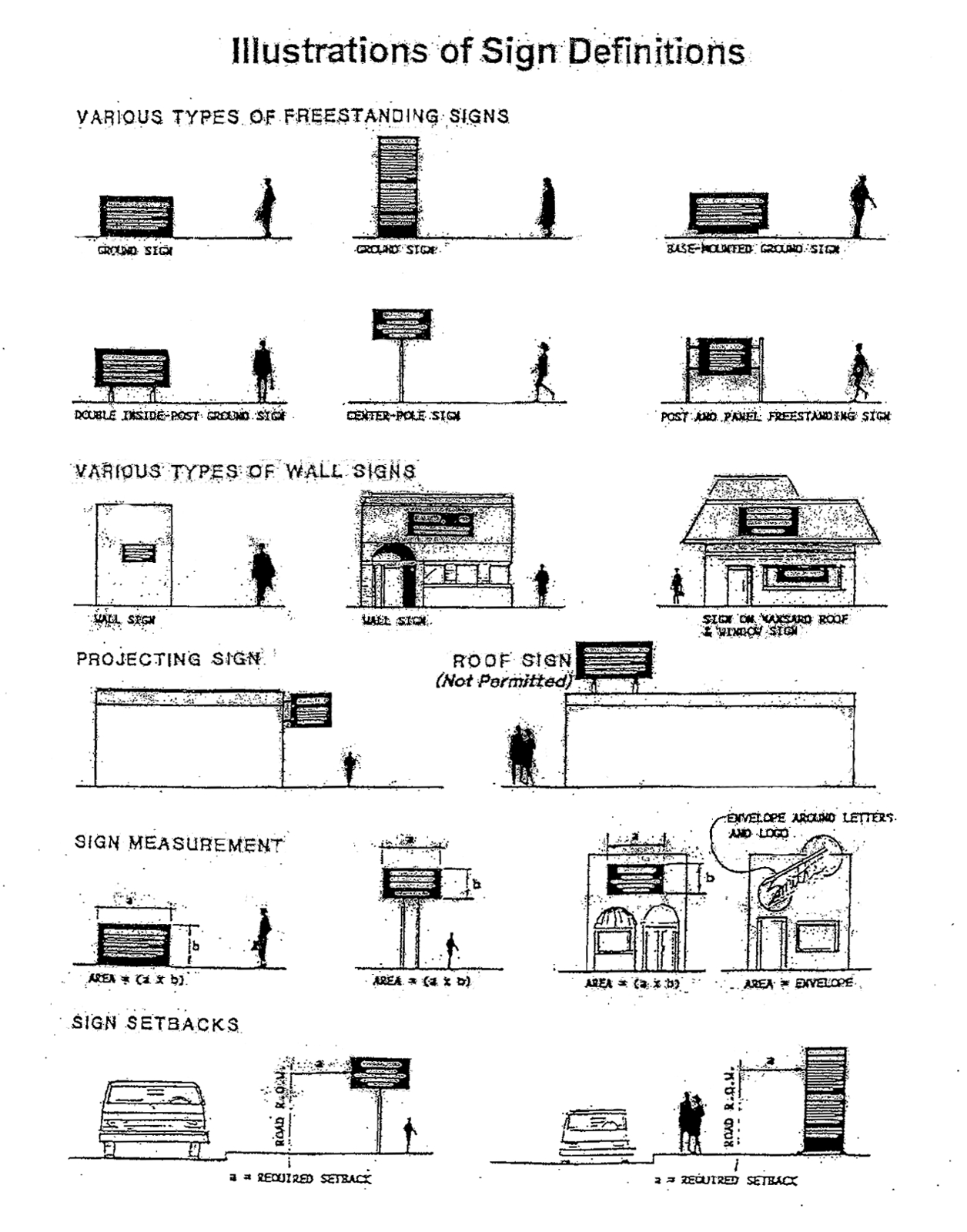
(Ord. of 7-16-1992, § 21.03)
Sec. 32-824. - Purpose.
This article permits signs and other displays that are needed for the purposes of identification or advertising, subject to certain standards. It is the intent of these regulations to meet the following objectives:
(1)
By reason of their area, dimensions, location, spacing, construction or manner of display, signs shall not endanger life or limb, confuse or mislead traffic, obstruct vision necessary for traffic safety, or otherwise endanger the public health or safety.
(2)
Signs should enhance the aesthetic appeal of the township. Thus, these regulations are intended to:
a.
Regulate the area and dimensions of signs to prevent the installation of signs that are out-of-scale with surrounding buildings and structures; and
b.
Prevent an excessive accumulation of signs that cause visual clutter and distraction.
(3)
Signs should not detract from neighborhood character nor diminish the value of surrounding properties.
(Ord. of 7-16-1992, § 21.01)
Sec. 32-825. - Scope of requirements.
It shall be unlawful for any person to erect, construct, or alter any sign in the township except in conformance with the provisions of this article and subject to the issuance of a permit by the township building official, unless a permit is exempted by section 32-830(a).
(Ord. of 7-16-1992, § 21.02)
Sec. 32-826. - Permit process.
(a)
Permit required. It shall be unlawful for any person to erect, alter, relocate, or structurally change a sign or other advertising structure, unless specifically exempted by this article, without first obtaining a permit in accordance with the provisions set forth herein. No permit shall issued by any township official prior to the payment of the appropriate fee as established by resolution of the township board.
(b)
Applications. Application for a sign permit shall be made upon forms provided by the building official. The following information shall be required:
(1)
Name, address, and telephone number of the applicant.
(2)
Location of the building, structure, or lot on which the sign is to be attached or erected.
(3)
Position of the sign in relation to nearby buildings, structures, and property lines.
(4)
Plans showing the dimensions, materials, method of construction, and attachment to the building or in the ground.
(5)
Copies of stress sheets and calculations, if deemed necessary, showing the structure as designed for dead load and wind pressure.
(6)
Name and address of the person owning, erecting, and maintaining the sign.
(7)
Schematic of electrical connections.
(8)
Insurance policy or bond, as required in this chapter.
(9)
Written consent of the owner or lessee of the premises upon which the sign is to be erected.
(10)
Other information as may be required by the building official to make the determination that the sign is in compliance with all applicable laws and regulations.
(c)
Review of application.
(1)
Planning commission review. Sign permit applications submitted in conjunction with the proposed construction of a new building or addition to an existing building shall be reviewed by the planning commission as a part of the required site plan review. All proposed signs must be shown on the site plan.
(2)
Building official review. The building official shall review the sign permit application for any sign proposed on a site or existing building where no other new construction is proposed or a site plan review is not required by this chapter.
(3)
Issuance of a permit. Following review and approval of a sign application by the planning commission or building official, as appropriate, the building official shall have the authority to issue a sign permit.
(d)
Exceptions. An existing sign shall not be enlarged or relocated except in conformity with the provisions set forth herein for new signs, nor until a proper permit has been secured. However, a new permit shall not be required for ordinary servicing or repainting of an existing sign message, cleaning of a sign, or changing of the message on the sign where the sign is designed for such changes (such as lettering on a marquee or numbers on a gasoline price sign). Furthermore, a permit shall not be required for certain exempt signs listed in section 32-830(a).
(Ord. of 7-16-1992, § 21.04)
Sec. 32-827. - Inspection and maintenance.
(a)
Inspection of new signs. All signs for which a permit has been issued shall be inspected by the building official when erected. approval shall be granted only if the sign has been constructed in compliance with the approved plans and applicable standards of township ordinances and codes. In cases where fastenings or anchorages are to be covered by brick or otherwise enclosed, the sign erector shall advise the building official when such fastenings are to be installed, so that inspection may be completed before enclosure.
(b)
Inspection of existing signs. The building official shall have the authority to routinely enter onto property to inspect existing signs. In conducting such inspections, the building official shall determine whether the sign is adequately supported, painted to prevent corrosion, and sufficiently secured or supported as to safely bear the weight of the sign and pressure created by the wind.
(c)
Correction of defects. If the building official finds that any sign is unsafe, insecure, improperly constructed, or poorly maintained, the sign erector, owner of the sign, or owner of the land shall make the sign safe and secure by completing any necessary reconstruction or repairs, or entirely remove the sign in accordance with the timetable established by the building official.
(d)
Removal of obsolete signs. Any sign that no longer identifies a business that is in operation, or that identifies an activity or event that has already occurred, shall be considered abandoned and shall be removed by the owner, agent, or person having use of the building or structure. Upon vacating a commercial or industrial establishment, the proprietor shall be responsible for removal of all signs used in conjunction with the business. However, where a conforming sign structure and frame are typically reused by a current occupant in a leased or rented building, the building owner shall not be required to remove the sign structure and frame in the interim periods when the building is not occupied, provided that the sign structure and frame are maintained in good condition and a safe manner.
(Ord. of 7-16-1992, § 21.05)
Sec. 32-828. - Alteration or reconstruction of nonconforming signs.
Any nonconforming sign shall be renovated, reconstructed or altered in any manner in full compliance with adopted township ordinances and codes, except that nonconforming signs must comply with the following regulations:
(1)
Repairs and maintenance. Normal maintenance shall be permitted, provided that any nonconforming sign that is destroyed by any means to an extent greater than 50 percent of the sign's precatastrophe fair market value, exclusive of the foundation, shall not be reconstructed. Normal maintenance shall include painting of chipped or faded signs; replacement of faded or damaged surface panels; or, repair or replacement of electrical wiring or electrical devices.
(2)
Nonconforming changeable copy signs. The message on a nonconforming changeable copy sign may be changed provided that the change does not create any greater nonconformity to this chapter.
(3)
Substitution. A nonconforming sign shall not be replaced with another nonconforming sign.
(4)
Modifications to the principal building. Whenever the principal building on a site on which a nonconforming sign is located is modified to the extent that site plan review and approval by the township is required, any nonconforming sign shall comply with this chapter or be removed.
(Ord. of 7-16-1992, § 21.06)
Sec. 32-829. - Appeal to zoning board of appeals.
Any party who has been refused a sign permit for a proposed sign may file an appeal with the zoning board of appeals, in accordance with this chapter. In determining whether a variance for a sign is appropriate, the zoning board of appeals shall study the sign proposal, giving consideration to any extraordinary circumstances, such as those listed in subsections (1) through (7) of this section, that would cause practical difficulty in complying with the sign standards. The presence of any one of the circumstances listed may be sufficient to justify granting a variance; however, the zoning board of appeals has the discretion to decline the grant of a variance even if certain of the circumstances is present.
(1)
A sign complying with this chapter can not be easily seen by passing motorists due to the configuration of existing buildings, trees, or other obstructions.
(2)
A sign complying with this chapter can not be seen by passing motorists in sufficient time to permit safe deceleration. The zoning board of appeals shall consider the width of the road, the number of moving lanes, the volume of traffic, and speed limits in determining whether such circumstances exist.
(3)
Existing signs on adjacent or nearby parcels would substantially reduce the visibility of a conforming sign on the subject parcel.
(4)
Construction of a conforming sign would require removal or severe alteration to natural features on the parcel, such as but not limited to:
a.
Removal of trees, alteration of the natural topography; or
b.
Obstruction of a drainage course.
(5)
Construction of a conforming sign would obstruct the vision of motorists or pedestrians or otherwise endanger the health, safety or welfare of passersby.
(6)
A variance from certain sign regulations would be offset by increased building setback, increased landscaping, or other such enhancements, so that the net effect of approval is a significant improvement in appearance of the site, compared to the result that would be otherwise achieved with construction of a conforming sign.
(7)
A sign that exceeds the permitted height or area standards of this article would be more appropriate for the scale of related site improvements because of the large area or extended frontage of the parcel or building.
(Ord. of 7-16-1992, § 21.07)
Sec. 32-830. - General provisions.
(a)
Exempt signs. The following signs shall be exempt from the requirement for a permit, however, these signs shall be subject to all other applicable provisions of this chapter:
(1)
Address numbers with a numeral height no greater than six inches for residences and 18 inches for businesses.
(2)
Nameplates identifying the occupants of the building, not to exceed a total of two square feet per building.
(3)
Memorial signs or tablets not to exceed two square feet.
(4)
Signs on a bus, truck, trailer, or other vehicle while operated and used for transport in the normal course of a business, provided that the primary use of the vehicle displaying the sign shall not be for the purpose of advertising a business on the premises where the vehicle is parked.
(5)
Public signs, including the authorized signs of a government body or public utility, including community bulletin boards, traffic signs, legal notices, railroad crossing signs, warnings of a hazard, and similar signs.
(6)
Flags bearing the official design or insignia of a nation, state, county, municipality, educational institution, or noncommercial organization.
(7)
Incidental signs, provided that total of all such signs shall not exceed two square feet.
(8)
Private traffic control signs that conform to the requirements of the Michigan Manual of Uniform Traffic Control Devices.
(9)
One private parking lot or driveway identification sign, not to exceed three square feet per sign and six feet in height.
(10)
Permanent signs on vending machines, gas pumps, or ice dispensers limited to information on the contents of such devices, provided that the sign area of each device shall not exceed six square feet.
(11)
Portable real estate "open house" signs with an area no greater than four square feet.
(12)
"Help wanted" signs soliciting employees for the place of business where posted, provided that the maximum area for all such signs shall not exceed six square feet.
(13)
A sign that is located completely within an enclosed building and is not visible from outside the building.
(14)
Plaques or signs designating a building as a historic structure approved by a local or state body authorized to place such signs by law, not to exceed a total of six square feet.
(15)
"No Trespassing," "No Soliciting," and "No Dumping" signs not to exceed a total of three square feet per site.
(16)
A sign used to direct vehicular or pedestrian traffic to parking areas, loading areas, or to certain buildings or locations on the site, subject to the following conditions:
a.
Directional signs shall not contain a logo or any other form of direct or indirect advertising.
b.
Directional signs shall not exceed four square feet in area, or four feet in height.
c.
Directional signs may be located in the front setback area, provided they are setback a minimum of three feet from the existing or planned right-of-way line of street or edge of the pavement of a private drive.
(b)
Prohibited signs. The following signs are strictly prohibited in any zoning district within the township:
(1)
A sign not expressly permitted by this chapter.
(2)
A sign that incorporates flashing or moving lights; however, time and temperature or stock market quote signs shall be permitted following site plan review.
(3)
Banners, pennants, festoons, spinners, and streamers, unless specifically permitted elsewhere is this chapter.
(4)
String lights used for commercial purposes, other than use as temporary holiday decorations.
(5)
Any sign erected on a tree or utility pole, except signs of a unit of government or utility.
(6)
Obsolete signs, as specified in section 32-827(d).
(7)
A sign that has any visible moving parts, visible revolving parts, visible mechanical movement, or other visible movement achieved by electrical, electronic, or mechanical means, including intermittent electric pulsations or movement caused by normal wind current.
(8)
Any sign or sign structure that:
a.
Is structurally unsafe;
b.
Constitutes a hazard to safety or health by reason of inadequate maintenance, dilapidation, or abandonment;
c.
Is capable of causing electric shock to person who come in contact with it; or
d.
Is not in good repair, such that it has broken parts, missing letters, or nonoperational lights.
(9)
Portable signs, unless expressly permitted in this chapter.
(10)
A sign that is affixed to a parked vehicle or trailer that causes the vehicle or trailer to be used principally for advertising purposes, rather than for transportation purposes.
(11)
A sign that obstructs free access to or egress from a required door, window, fire escape, or other required exit.
(12)
A sign that makes use of the words "Stop," "Look" or "Danger," or any other similar words, phrases, symbols, or characters, in such a manner as to interfere with, mislead, or confuse traffic.
(13)
A sign containing obscene, indecent, illegal, or immoral matter.
(14)
A sign installed, erected, or maintained in a manner not consistent with this chapter.
(15)
A roof sign.
(16)
A projecting sign.
(17)
A sandwich sign.
(18)
Any sign on street furniture, such as benches and trash receptacles.
(19)
Real estate signs that are no longer valid due to the sale, rental, lease, or abandonment of the property.
.....
(c)
Temporary signs. Temporary signs shall be permitted as specified in the following table:
Notes:
(a) The temporary sign shall comply with the setback requirements for the district in which it is located.
(b) On a corner parcel two signs, one facing each street, shall be permitted.
(c) One sign shall be permitted for each frontage on a secondary or major thoroughfare.
(d) The temporary sign may be located in the required setback area, but shall not be located within the road right-of-way.
(e) Community special event signs may include ground or wall signs, banners, pennants, or similar displays; the number, area and height of such signs shall be subject to planning commission approval.
(f) The total of all window signs, temporary and permanent, shall not exceed one-third of the total window area. The area of permanent window signs shall also be counted in determining compliance with standards for total area of wall signs.
(g) Temporary window signs that are faded, yellowed, ripped or otherwise damaged shall be removed immediately.
.....
(d)
Off-premises advertising signs. Freestanding advertising signs located at other than the location at which the activity is conducted shall be permitted in the M-1 and M-2 zoning districts of the township according to the adopted township zoning map and subject to the following provisions:
(1)
Maximum area. No such sign shall exceed 300 square feet in area per sign face.
(2)
Maximum height. The maximum height for such signs shall be 25 feet.
(3)
Setbacks.
a.
Off-premises advertising signs shall comply with all setback requirements for a structure in the zoning district in which they are located.
b.
No part of any such sign shall be located closer than 300 feet to any park, school, church, hospital, cemetery, or government building.
(4)
Distance from other signs.
a.
There shall be a minimum of 1,500 feet between off-premises advertising signs.
b.
There shall be a minimum of 100 feet between any off-premises advertising sign and any other on-premises sign.
(5)
Location. Off-premises advertising signs shall not be located on or over the roofs of buildings, nor shall they project over any public easement or right-of-way.
(e)
Church signs. Church signs shall be permitted subject to the same standards as other signs in the district in which the church is located.
(1)
Churches in residential districts may erect signs for identification purposes for:
a.
Identifying the church or church affiliated school;
b.
Identifying the parsonage, rectory, or convent;
c.
Identifying any other related facility;
d.
Advertising the time or subject of church services;
e.
Presenting other related information.
(2)
Such signs shall be subject to the following standards:
a.
Number. There shall be no more than one sign per site, except on a corner parcel, two signs, one facing each street shall be permitted. One additional sign shall be permitted for each school, parsonage, or other related facility.
b.
Area. The maximum area of each such sign shall be 32 square feet.
c.
Location. Signs shall comply with the setback requirements for the district in which they are located.
d.
Height. The maximum height of church signs shall be eight feet.
(Ord. of 7-16-1992, § 21.08)
Sec. 32-831. - Sign design standards.
(a)
Construction standards.
(1)
General requirements. All signs shall be designed and constructed in a safe and stable manner in accordance with the state construction code. All electrical wiring associated, with a freestanding sign shall be installed underground.
(2)
State construction code. All signs shall be designed to comply with minimum wind pressure and other requirements set forth in the state construction code.
(3)
Framework. All signs shall be designed so that the supporting framework, other than the supporting poles on a freestanding sign, is contained within or behind the face of the sign or within the building to which it is attached so as to be totally screened from view.
(b)
Illumination.
(1)
General requirements. Signs shall be illuminated only by steady, stationary, shielded light sources directed solely at the sign, or internal to it.
(2)
Nonglare, shielded lighting. Use of glaring undiffused lights or bulbs shall be prohibited. Lights shall be shaded so as not to project onto adjoining properties or thoroughfares.
(3)
Traffic hazards. Sign illumination that could distract motorists or otherwise create a traffic hazard shall be prohibited.
(4)
Bare bulb illumination. Illumination by bare bulbs or flames is prohibited, except that bare bulbs are permitted on changeable copy signs and theater marquees.
(c)
Location.
(1)
Within a public right-of-way. No sign shall be located within, project into, or overhang a public right-of-way, except as otherwise permitted herein.
(2)
Compliance with setback requirements. All signs shall comply with the minimum setback requirements for buildings or structures in the zoning district in which they are located as stated in division 12 of this article, except as otherwise permitted herein.
(d)
Measurement.
(1)
Sign area. The area of sign shall be computed as follows:
a.
General requirements. Where a sign consists of a generally flat surface or sign face on which lettering and other information is affixed, the sign area shall be computed by measuring the entire face of the sign.
b.
Individual letters. Where a sign consists of individual letters and logo affixed directly to a building, the area of the sign shall be computed by measuring the area of the envelope required to enclose the lettering and logo.
c.
Freestanding sign. The area of a double-faced freestanding sign shall be computed using only one face of the sign provided that:
1.
The outline and dimensions of both faces are identical; and
2.
The faces are back-to-back so that only one face is visible at any given time.
d.
Ground sign. The area of a ground sign shall be computed by measuring the entire vertical surface of a face upon which the letters and logo are attached. In the case of a multifaced ground sign, the area of the sign shall be computed using only one face of the sign.
e.
Cylindrical sign. The area of a cylindrical ground sign shall be computed by multiplying the diameter of the cylinder by its height.
(2)
Setback and distance measurements. The following guidelines shall be used to determine compliance with setback and distance measurements.
a.
The distance between two signs shall be measured along a straight horizontal line that represents the shortest distance between the two signs.
b.
The distance between a sign and a parking lot or building shall be measured along a straight horizontal line that represents the shortest distance between the outer edge of the parking lot or building.
c.
The distance between a sign and a building or property line shall be measured along a straight horizontal line that represents the shortest distance between the sign and the building.
(Ord. of 7-16-1992, § 21.09)
Sec. 32-832. - Residential district signs.
The following signs shall be permitted in R-1A, R-1B and R-M zoning districts, (see generalized schedule of sign standards included within this article):
(1)
Nameplate and street address. A nameplate sign an street address shall be permitted in accordance with section 32-830(a).
(2)
Real estate signs. Real estate signs shall be permitted in accordance with section 32-830(c).
(3)
Garage sale signs. Garage sale signs shall be permitted in accordance with section 32-830(c).
(4)
Church signs. Church signs shall be permitted in accordance with section 32-830(e).
(5)
Residential entryway signs. Permanent residential entryway signs shall be permitted in accordance with the following requirements:
a.
The sign area shall not exceed 50 percent of the entryway structure.
b.
There shall be no more than one such sign located at each entrance to a subdivision or development.
(6)
Signs for nonconforming uses. Each nonresidential use in an R-1A, R-1B, or R-M zoning district that constitutes a nonconforming land use as defined in this chapter shall be permitted one wall-mounted sign, subject to the following requirements:
a.
The maximum area for such a sign shall be two square feet.
b.
No such sign shall be illuminated.
*Specific sections in this chapter should be consulted for details.
Notes:
(a) One additional sign shall be permitted for each school, parsonage, or other related facility.
(b) One sign is permitted at each entrance to a subdivision or residential development.
(Ord. of 7-16-1992, § 21.10)
Sec. 32-833. - Nonresidential district signs.
The following signs shall be permitted in the nonresidential zoning districts, specifically the O-1, C-1, C-2, C-3, M-1, M-2, PD, and PP zoning districts (see generalized schedule of sign standards included within this article):
(1)
Signs for residential uses in a nonresidential zoning district. Signs for nonconforming residential land uses in zoning districts designated for nonresidential land uses shall be governed by the sign regulations for residential district uses set forth in section 32-830.
(2)
Signs for nonconforming nonresidential uses. Signs for nonconforming land uses in another designated zoning district (for example, a nonconforming commercial use in an industrial district) shall be governed by the sign regulations that are appropriate for the type of use, as specified in this chapter.
(3)
Wall signs. Wall signs shall be permitted in all nonresidential zoning districts subject to the following regulations:
a.
Number. One wall sign shall be permitted per street or highway frontage on each parcel. In the case of a multitenant building or shopping center, one wall sign shall be permitted for each tenant having an individual means of public access. Tenants who occupy a corner space in a multitenant structure shall be permitted to have one sign on each side of the building. Where several tenants use a common entrance in a multitenant structure, only one wall sign shall be permitted, but the total allowable sign area may be allocated on among two or more tenants.
b.
Area. The total area of a wall sign shall not exceed 1½ square feet per lineal foot of building frontage not to exceed a maximum of 150 square feet per site.
c.
Location. One wall sign may be located on each side of a building that faces a street or highway. Such sign must face the street or highway frontage.
d.
Vertical dimensions. The maximum vertical dimension of any wall sign shall not exceed one third of the building height.
e.
Horizontal dimensions. The maximum horizontal dimension of any wall-mounted sign shall not exceed three-fourths of the width of the building.
f.
Height. The top of a wall sign shall not be higher than whichever is lowest:
1.
The maximum height specified for the district in which the sign is located.
2.
The top of the window sills at the first level above the first story.
3.
The height of the building facing the street on which the sign is located.
g.
Off-premises advertising signs. Wall signs used as an off-premises advertising sign are only allowed in the M-1 And M-2 zoning districts. Off-premises advertising wall signs are subject to the provisions of this section and section 32-830(d), with the more restrictive dimensional requirement being applicable.
(4)
Freestanding signs. Freestanding signs shall be permitted in zoning districts designated in this chapter for nonresidential land uses regulations:
a.
Number. One freestanding sign shall be permitted per street or highway frontage on each approved nonresidential site. Such sign must face the street or highway frontage. In multitenant buildings or shopping centers the sign area may be allocated for use among two or more tenants. On parcels adjacent to I-696, no freestanding sign shall be permitted to face I-696.
b.
Area.
1.
The total area of the allowed freestanding sign shall not exceed one-half of a square foot per lineal foot of lot frontage, not to exceed 100 square feet per road frontage.
2.
One freestanding sign up to 200 square feet may be permitted for on a site approved as site plan for a planned development according to the applicable procedures of this chapter.
c.
Setback from the right-of-way. Freestanding signs may be located in a required front yard, provided that no portion of any such sign shall be located closer than 15 feet to the existing or planned street right-of-way line. If a parcel is served by a private drive or service road, no portion of a freestanding sign shall be closer than three feet to the edge of the private road. No portion of a freestanding sign shall be located closer than 25 feet to the right-of-way of I-696.
d.
Setback from residential districts. Freestanding signs shall be located no closer than 50 feet from any parcel zoned R-1A, R-1B, or R-M.
e.
Height. The height of a freestanding sign shall not exceed five feet. However, freestanding signs up to 15 feet in height may be permitted following site plan review by the township planning commission.
(5)
Marquee signs. Marquee signs shall be permitted for theaters located in commercial districts subject to the following requirements:
a.
Construction. Marquee signs shall consist of hard incombustible materials. The written message shall be affixed flat to the vertical face of the marquee.
b.
Vertical clearance. A minimum vertical clearance of ten feet shall be provided beneath any marquee.
c.
Projection. Limitations imposed by this chapter concerning projection of signs from the face of a wall or building shall not apply to marquee signs, provided that marquee signs shall comply with the setback requirements for the district in which they are located.
d.
Number. One marquee shall be permitted per street frontage.
e.
Area. A marquee sign shall not exceed 1½ square feet per lineal foot of building frontage.
f.
Compliance with area requirements for wall signs. The area of permanent lettering on a marquee sign shall be counted in determining compliance with the standards for total area of wall signs permitted on the parcel.
(6)
Awnings and canopies. Signs on awnings and canopies in zoning districts designated for nonresidential land uses shall be permitted, subject to the following standards:
a.
Coverage. The total area of the lettering and logo shall not exceed 25 percent of the total area of the awning or canopy that is visible from the street.
b.
Compliance with area requirements for wall signs. The area of signs on awnings or canopies shall be counted in determining compliance with the standards for total allowable area of wall signs permitted on the parcel.
c.
Projection. Limitations imposed by this chapter concerning projection of signs from the face of a wall or building shall not apply to awning and canopy signs, provided that such signs shall comply with the setback requirements for structures within the zoning district in which they are located.
d.
Address. Any lettering used solely for the purpose of presenting the numerals of the street address of a commercial use shall not be included within the computed sign area of a canopy sign, provided that the height and width of the numerals do not exceed that used for the lettering elsewhere on the canopy.
(7)
Gasoline price signs. Gasoline price signs shall be permitted subject to the following standards:
a.
Number. One gasoline price sign shall be permitted for each gas station.
b.
Area. Gasoline price signs shall not exceed 20 square feet.
c.
Setback. Gasoline price signs shall comply with the setback and height requirements for freestanding signs.
(8)
Temporary signs. Temporary signs shall be permitted in accordance with section 32-830(c).
(9)
Window signs. Temporary and permanent window signs shall be permitted on the inside in commercial and office districts provided that the total combined area of such signs (including incidental signs) shall not exceed 25 percent of the total window area. The area of permanent window signs shall be counted in determining compliance with standards for total area of wall signs on the parcel. Temporary window signs shall comply with the requirements in section 32-830(c).
(10)
Time/temperature/stock market quote signs. Time, temperature, and stock market quote signs shall be permitted in zoning district designated for nonresidential land use by this chapter subject to the following conditions:
a.
Frequency of message change. The message change shall not exceed a frequency of one every ten seconds.
b.
Area. The area of these types of signs shall be included within the maximum sign area permitted on the site.
c.
Number. One such sign shall be permitted per street frontage.
*Specific sections in this chapter should be consulted for details.
Notes:
(a) In the case of a multitenant building, one wall sign shall be permitted for each tenant having an individual means of public access. Tenants who occupy a corner space in a multitenant structure shall be permitted to have one sign on each side of the building. Where several tenants use a common entrance in a multitenant building, only one wall sign shall be permitted, but the total sign area should be allocated on an equal basis to all tenants.
(b) Only one freestanding sign shall be permitted for multitenant buildings or shopping centers, but the sign area may be allocated for use by individual tenants.
(c) The township board may permit a freestanding sign up to 200 square feet in area for a planned development.
(d) The area of permanent window signs and awnings and canopy signs shall be counted in determining compliance with the standards for total area of wall signs.
(e) Marquee signs shall be permitted for theaters located in commercial districts.
(f) Real estate signs offering unplatted vacant land for sale or lease may be up to 64 square feet in area.
(Ord. of 7-16-1992, § 21.11)

