
Royal Oak Charter Township
City Zoning Code
City Zoning Code
ARTICLE VII
LANDSCAPING
Sec. 32-714.- Intent and scope of requirements.
(a)
Intent. Landscaping enhances the visual image of the township, improves property values and alleviates the impact of noise, traffic, and visual distraction associated with certain land uses. Screening is important to protect less intensive uses from the noise, light, traffic, litter and other impacts of more intensive, nonresidential uses. Accordingly, these provisions are intended to set minimum standards for the design and use of landscaping, greenbelts, and screening, and for the protection and enhancement of the township's environment. More specifically, the intent of these provisions is to:
(1)
Improve the appearance of off-street parking areas, vehicular use areas, and property abutting public rights-of-way; and
(2)
Protect and preserve the appearance, character, and value of the neighborhoods that abut nonresidential areas, parking areas, and other intensive use areas, thereby protecting the public health, safety and welfare.
(b)
Scope of application. No site plan shall be approved unless it contains landscaping that meets or exceeds the requirements of this article. No building permit shall be issued by the building official until the required landscape plan is submitted and approved, and no certificate of occupancy shall be granted unless provisions of this section have been met or a performance guarantee has been posted in accordance with the provisions set forth in section 32-634.
(c)
Minimum requirements. The requirements in this article are minimum requirements. Under no circumstances shall they preclude the installation of more extensive landscaping.
(d)
Design creativity. Creativity in landscape design is encouraged. Accordingly, required trees and shrubs may be planted at uniform distances, randomly, or in groupings, depending on the designer's desired visual effect and, equally important, the intent of the township to coordinate landscaping on adjoining properties.
(Ord. of 7-16-1992, § 5.01)
Sec. 32-715. - General landscaping requirements.
(a)
General site requirements. All developed portions of the site shall conform to the following general landscaping standards, except where specific landscape elements, such as a greenbelt, berms, or screening are required:
(1)
All unpaved portions of the site shall be planted with grass, ground cover, shrubbery, or, other suitable live plant material, and shall extend to any abutting street pavement edge. Grass areas in the front yard of all nonresidential uses shall be planted with sod.
(2)
A mixture of evergreen and deciduous trees shall be planted on the unpaved open portions of nonresidential parcels where specific landscaping minimums are not required within this article. Based upon the overall appearance of the proposed site and the amount of landscaping provided elsewhere on the site, the total number of trees required shall be approved at the time of site plan review. Required trees may be planted at uniform distances, randomly, or in groupings.
(b)
Landscaping adjacent to roads and road rights-of-way. Landscaping adjacent to roads and road rights-of-way shall comply with the following planting requirements:
(1)
Minimum requirements. A landscaped area with a minimum depth of 20 feet shall be required on private property contiguous to Eight Mile Road. The landscaping area adjacent to other roads or road rights-of-way shall consist of a minimum depth of ten feet. This landscaped area shall exclude approved openings for vehicle and pedestrian access. Through lots or corner lots shall provide such landscaping along all adjacent road rights-of-way. Except for the right-of-way of Eight Mile Road, the planning commission may permit all or a portion of the landscaped area to be located within a road right-of-way or elsewhere within the front setback area, provided that the planning commission finds that all of the following conditions exist regarding the proposed relocation:
a.
The relocation is justified because of the physical characteristics of the site, the location of existing easements, sidewalks, or landscaping, the configuration of existing parking, the need to maintain emergency vehicle access, or because of other public health or safety concerns.
b.
The landscaped area will not result in less landscaped area than would be required if the landscaped area had been located on private property contiguous to the road right-of-way.
c.
The landscaped area is consistent with the intent of this section.
d.
The landscaped area will not jeopardize traffic safety or the general planning of the township.
(2)
Required plantings. For the purposes of computing length of road frontage, openings for driveways and sidewalks shall not be counted. Trees and shrubs may be planted at uniform distances, randomly, or in groupings.
(3)
Location.
a.
Where planted, trees shall comply with the following minimum setbacks, as measured from the center of the tree:
1.
Setback from edge of road: ten feet.
2.
Setback from fire hydrant: five feet.
3.
Setback from vehicular drive or sidewalk: five feet.
b.
When planted, shrubs shall comply with the following minimum setbacks, as measured from the edge of the shrub:
1.
Setback from edge of road: five feet.
2.
Setback from fire hydrant: five feet.
(c)
Berms. Where required, berms shall conform to the following standards:
(1)
Dimensions. Unless otherwise indicated or appropriate, required berms shall be measured from the grade of the parking lot or first ground adjacent to the berm, and shall be constructed with slopes no steeper than one foot vertical for each three feet horizontal (33 percent slope), with at least a two-foot flat area on top. Berms may undulate in height, subject to review and approval of berm design as shown on the site plan. Unless otherwise indicated, the maximum height of required berms shall be three feet.
(2)
Protection from erosion. Any required berm shall be planted with sod, ground cover, or other suitable live plant material to protect it from erosion so that it retains its height and shape. The use of railroad ties, cement blocks, and other types of construction materials to retain the shape and height of a berm shall be prohibited unless specifically reviewed and approved as part of a site plan by the planning commission.
(3)
Required plantings.
a.
Berms located in the front yard of nonresidential parcels. Berms located in the front yard of nonresidential parcels shall be landscaped in accordance with the requirements for landscaping adjacent to roads as set forth in section (b) of this section.
b.
Berms used for screening other than in the front yard. Berms used for screening other than in the front yard shall be landscaped in accordance with the requirements for screening, as set forth in subsection (e) of this section.
(4)
Measurement of berm length. For the purpose of calculating required plant material, berm length shall be measured along the exterior edge of the berm.
(d)
Greenbelts. Where required, greenbelts shall conform to the following standards:
(1)
Measurement of greenbelt length. For the purposes of calculating required plant material, greenbelt length shall be measured along the exterior edge of the greenbelt.
(2)
General planting requirements.
a.
Grass or ground cover requirements. Grass, ground cover, or other suitable live plant materials shall be planted over the entire greenbelt area, except where paved walkways are used.
b.
Tree and shrub requirements. Except where the greenbelt is used for screening, the following minimums are required:
c.
Distance from sidewalk. Plant materials shall not be placed closer than four feet from the right-of-way line where the greenbelt abuts a public sidewalk.
d.
Setback from property line. Plant materials shall be placed no closer than four feet from the property line or fence line.
(3)
Greenbelts used for screening. Greenbelts used for screening shall be landscaped in accordance with the requirements for screening as set forth in subsection (e) of this section.
(e)
Screening.
(1)
General screening requirements. Unless otherwise specified, wherever an evergreen or landscaped screen is required, screening shall consist of closely-spaced evergreen plantings (no farther than 15 feet apart) that can be reasonably expected to form a complete visual barrier that is at least six feet above ground level within three years of planting Deciduous plant materials may be used provided that a complete visual barrier is maintained throughout the year.
(2)
Screening of equipment. Mechanical equipment, such as air compressors, pool pumps, transformers, sprinkler pumps, satellite dish antennas, and similar equipment shall be screened on at least three sides. Insofar as practical, said screening shall exceed the vertical height of the equipment being screened by at least six inches within two years of planting.
(f)
Parking lot landscaping. In addition to required screening, all off-street parking areas shall also provide landscaping as follows:
(1)
Landscaping ratio. Off-street parking areas containing greater than 15 spaces shall be provided with at least ten square feet of interior landscaping per parking space. The amount of parking lot landscaping may be decreased to seven square feet per parking space where a berm is constructed to screen the parking from the road in accordance with section 32-716(a)(3), (b)(3) or (c)(3). Whenever possible, parking lot landscaping shall be designed to improve the safety of pedestrian and vehicular traffic, guide traffic movement, screen parked vehicles from public view and improve the appearance of the parking area.
(2)
Minimum area. Landscaped areas in parking lots shall be no less than five feet in any single dimension and no less than 150 square feet in area. Landscaped areas in or adjacent to parking lots shall be protected with curbing or other means to prevent encroachment of vehicles.
(3)
Other landscaping. Required landscaping elsewhere on the parcel shall not be counted in meeting the parking lot landscaping requirements.
(4)
Required plantings. Requirements for plant material shall be based on the location, size, and shape of the parking lot landscaped area. A minimum of one tree shall be planted per 300 square feet or fraction thereof of interior landscaped area. At least 50 percent of each interior landscaped area shall be covered by living plant material, such as sod, shrubs, ground cover, or trees. Plantings within parking lots shall comply with the requirements for unobstructed site distance set forth in section 32-625. The landscape plan shall indicate the species, sizes, and quantities of plant material proposed for such area.
(g)
Landscaping of rights-of-way. Public rights-of-way located adjacent to required landscaped areas and greenbelts shall be planted with grass or other suitable live ground cover, and shall be maintained by the owner or occupant of the adjacent property as if the rights-of-way were part of the required landscaped areas or greenbelts.
(1)
Trees and shrubs shall not be planted in the road right-of-way without first obtaining approval from the agency that has jurisdiction over the road.
(2)
Trees and shrubs shall be planted no closer to the edge of the road pavement than the distances specified in the following chart:
(h)
Maintenance of unobstructed visibility for drivers. No landscaping shall be established or maintained on any parcel or in any parking lot that will obstruct the view of drivers. Accordingly, all landscaping shall comply with the provisions concerning unobstructed sight distance set forth in section 32-625.
(i)
Potential damage to utilities and public facilities. Landscaping material shall not be planted in a manner that will interfere with or cause damage to underground utility lines, public roads, or other public facilities. Species of trees whose roots are known to cause damage to public roadways, sewers, or other utilities shall not be planted closer than 15 feet from any such roadways, sewers, or utilities. Trees shall be setback from overhead utility lines as indicated in the following chart:
(j)
Landscaping of divider medians. Where traffic on driveways, maneuvering lanes, private roads, or similar means of vehicular access are separated by a divider median, the median shall be curbed and have a minimum width of ten feet. A minimum of one deciduous or evergreen tree shall be planted for each 30 lineal feet or portion thereof of median. Trees may be planted at uniform distances, randomly, or in groupings, but in no instance shall the center-to-center distance between trees exceed 60 feet.
(k)
Irrigation. Each landscaped area shall have water access available as stated in section 32-718(b). The site plan shall indicate the proposed method of providing water to landscaped areas. Although not required, installation of an inground irrigation or sprinkler system is encouraged, particularly in front yards.
(Ord. of 7-16-1992, § 5.02)
Sec. 32-716. - Specific landscaping requirements for zoning districts.
(a)
Requirements for commercial, office, and industrial districts. All lots or parcels of land located in office, commercial, or industrial zoning districts shall comply with the following landscaping requirements:
(1)
General site landscaping. Exclusive of parking lot requirements, at least six percent of the total area of the site shall be maintained as landscaped open area. All such open areas shall conform to the general site requirements in section 32-715(a), except where specific landscape elements are required.
(2)
Landscaping adjacent to road or road right-of-way. All commercial, office, and industrial developments shall comply with the requirements for landscaping adjacent to the road or road right-of-way in section 32-715(b).
(3)
Berm requirements. A berm may be used to screen off-street parking from view of the road, in which case the berm shall be a maximum of three feet in height, and shall be planted in accordance with section 32-715(b). The berm shall be located entirely on private property, adjacent to the road right-of-way. Parking lot landscaping may be reduced if a berm is constructed to screen off-street parking, in accordance with section 32-715(f).
(4)
Screening. Landscaped screening or a wall shall be required wherever a nonresidential use in a commercial, office, or industrial distinct abuts land zoned for residential purposes. Landscaped screening shall comply with the requirements in section 32-715(e). If a wall is used instead of landscaping, the requirements in article VIII of this chapter shall be complied with.
(5)
Parking lot landscaping. Off-street parking areas containing greater than 15 spaces shall comply with the requirements for parking lot landscaping in section 32-715(f).
(b)
Requirements for multiple-family district. All lots or parcels of land located in the multiple-family zoning district shall comply with the following landscaping requirements:
(1)
General site landscaping. A minimum of two deciduous or evergreen trees, plus, four shrubs shall be planted per dwelling unit. Unless otherwise specified, required landscaping elsewhere in the multiple-family development shall not be counted in meeting these requirements for trees.
(2)
Landscaping adjacent to road or road right-of-way. All multiple-family developments shall comply with the requirements for landscaping adjacent to the road or road right-of-way in section 32-715(b).
(3)
Berm requirements. A berm may be used to screen off-street parking from view of the roadway or other public property, in which case the berm shall be a maximum of three feet in height, and shall be planted in accordance with section 32-715(b). The berm shall be located totally on private property, adjacent to the road right-of-way. Parking lot landscaping may be reduced if a berm is constructed to screen off-street parking, in accordance with section 32-715(f).
(4)
Screening. Landscaped screening or a wall shall be required on all sides of a multiple-family development, except on sides facing a road. Landscaped screening shall comply with the requirements in section 32-715(b) and (e). A wall may be used instead of landscaping adjacent to nonresidential districts, subject to the requirements in article VIII of this chapter.
(5)
Parking lot landscaping. Off-street parking areas containing greater than 15 spaces shall comply with the requirements for parking lot landscaping in section 32-715(f).
(6)
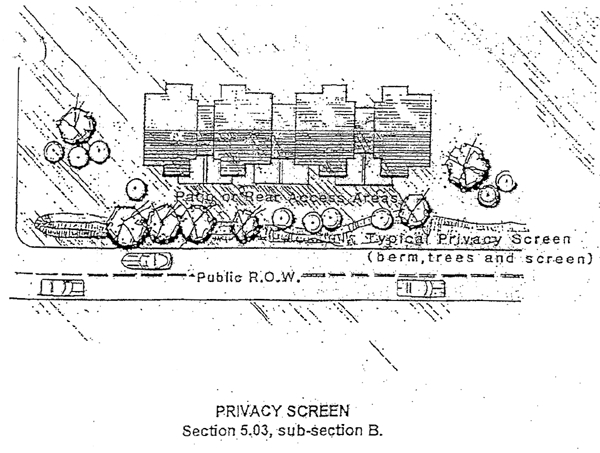
Privacy screen. Where multiple-family dwellings are designed so that open common areas or individual patio areas abut a public street, a landscaped privacy screen shall be provided (see illustration). The screen may consist of a combination of trees, shrubs, and landscaped berms, subject to site plan review and approval by the planning commission.
(c)
Requirements for nonresidential uses in residential districts. All nonresidential uses developed in residential zoning districts shall comply with the following landscaping requirements:
(1)
General site landscaping. At least ten percent of the site shall be maintained as landscaped open area. All such open areas shall conform to the general site requirements in section 32-715(a), except where specific landscape elements are required.
(2)
Landscaping adjacent to road or road right-of-way. All nonresidential developments located in residential districts shall comply with the requirements for landscaping adjacent to the road or road right-of-way in section 32-715(b).
(3)
Berm requirements. A berm may be used to screen off-street parking from view of the road, in which case the berm shall be a maximum of three feet in height, and shall be planted in accordance with section 32-715(b). The berm shall be located entirely on private property, adjacent to the road right-of-way. Parking lot landscaping may be reduced if a berm is constructed to screen off-street parking, in accordance with section 32-715(f).
(4)
Screening. Landscaped screening or a wall shall be required wherever a nonresidential use abuts zoned for residential purposes. Landscaped screening shall comply with the requirements in section 32-715(e).
(5)
Parking lot landscaping. Off-street parking areas containing greater than 15 spaces shall comply with the requirements for parking lot landscaping in section 32-715(f).
(Ord. of 7-16-1992, § 5.03)
Sec. 32-717. - Standards for landscape materials.
Unless otherwise specified, all landscape materials shall comply with the following standards:
(1)
Plant quality. Plant materials used in compliance with the provisions of this chapter shall be nursery grown, free of pests and diseases, hardy in the county, in conformance with the standards of the American Association of Nurserymen, and shall have passed inspections required under state regulations.
(2)
Nonliving plant material. Plastic and any other nonliving plant materials shall not be acceptable to meet the landscaping requirements of this chapter. Upon approval of the planning commission through site plan review, water bodies, boulder groupings, landscape furniture, and manmade landscape ornaments, singly or in combination may account for a maximum of 30 percent of the ground area to be landscaped.
(3)
Plant material specifications. The following specifications shall apply to all plant material proposed in accordance with the landscaping requirements of this chapter:
a.
Deciduous shade trees. Deciduous shade trees shall be a minimum of 2.5 inches in caliper measured 12 inches above grade with the first branch a minimum of four feet above grade when planted.
b.
Deciduous ornamental trees. Deciduous ornamental trees shall be a minimum of 1½ inches in caliper measured six inches above grade with a minimum height of four feet above grade when planted.
c.
Evergreen trees. Evergreen trees shall be a minimum of five feet in height when planted. Furthermore, evergreen trees shall have a minimum spread of 2.5 feet, and the root ball shall be covered in burlap and shall be at least ten times the caliper measured six inches above grade.
d.
Shrubs. Shrubs shall be a minimum of two feet in height when planted. Low growing shrubs shall have a minimum spread of 24 inches when planted.
e.
Hedges. Hedges shall be planted and maintained so as to form a continuous, unbroken, visual screen within two years after planting, barring unusual growing conditions, such as drought or disease. Hedges shall be a minimum of two feet in height when planted.
f.
Vines. Vines shall be a minimum of 30 inches in length after one growing season.
g.
Ground cover. Ground cover used in lieu of turf grasses in whole or in part shall be planted in such a manner as to present a finished appearance and reasonably complete coverage after one complete growing season.
h.
Grass. Grass area shall be planted using species normally grown as permanent lawns in the county. Grass, sod, and seed shall be clean and free of weeds, pests, and diseases. Grass may be sodded, plugged, sprigged, hydra-seeded or seeded. When grass is to be established by a method other than complete sodding or seeding, nurse grass seed shall be sown for immediate effect and protection until complete coverage is otherwise achieved. Straw or other mulch shall be used to protect newly seeded areas.
i.
Mulch. Mulch used around trees, shrubs, and vines shall be a minimum of three inches deep, and installed in a manner as to present a finished appearance.
j.
Undesirable plant material. Use of the following plant materials (or their clones or cultivars) is not encouraged because of susceptibility to storm drainage, disease, and other undesirable characteristics. Additional undesirable plant materials may be identified, a list of which shall be maintained by the building official.
1.
Box elder.
2.
American elm.
3.
Tree of heaven.
4.
European barberry.
5.
Northern catalpa.
6.
Poplar.
7.
Willow.
8.
Silver maple.
9.
Horse chestnut (nut bearing).
(Ord. of 7-16-1992, § 5.04)
Sec. 32-718. - Installation and maintenance.
(a)
Standards. The following standards shall be observed where installation and maintenance of landscape materials are required:
(1)
Installation. Landscaping shall be installed in a sound, workmanlike manner to ensure the continued growth of healthy plant material. Trees, shrubs, hedges, and vines shall be generously mulched at the time of planting.
Notes:
(a) See section 32-717 for detailed requirements.
(b) Measured 12 inches above grade.
(c) Measured six inches above grade.
(d) After one season.
(2)
Protection from vehicles. All landscaped areas shall be protected from vehicles through use of curbs or wheel stops. All landscape areas shall be elevated above the pavement to a height adequate to protect the plants from snow removal, salt, and other hazards.
(3)
Off-season planting requirements. If development is completed during the off-season when plants cannot be installed, the owner shall provide a performance guarantee to the township to ensure installation of required landscaping in the next planting season, in accordance with section 32-634.
(4)
Maintenance. Landscaping required by this chapter or as approved by the planning commission through site plan review shall be maintained in a healthy, neat, and orderly appearance, free from refuse and debris. All unhealthy and dead plant material shall be replaced immediately upon notice from the building official, unless the season is not appropriate for planting, in which case such plant material shall be replaced at the beginning of the next planting season.
(b)
Watering. All landscaped areas shall be provided with a readily available and acceptable supply of water, with at least one spigot located within 300 feet of all plant material to be established and maintained. Trees, shrubs, and other plantings and lawn areas shall be watered regularly throughout the growing season.
(c)
Repair and maintenance of landscape elements. All constructed or manufactured landscape elements, such as, but not limited to, benches, retaining walls, edging, and so forth, shall be maintained in good condition and neat appearance. Rotted, deteriorated, or damaged landscape elements shall be repaired, replaced, or removed upon notice from the building official.
(Ord. of 7-16-1992, § 5.05)
Sec. 32-719. - Treatment of existing plant material.
The following regulations shall apply to existing plant material:
(1)
Consideration of existing elements in the landscape design. In instances where healthy plant material exists on a site prior to its development, the planning commission may permit substitution of existing plant material in lieu of part or all of the requirements in this section, provided that such substitution is in keeping with the spirit and intent of this article and this section in general. Existing hedges, berms, walls, or other landscape elements may be used to satisfy the requirements set forth previously, provided that such existing elements conform with the requirements of this section.
(2)
Preservation of existing plant material. Site plans shall show all existing trees that are located in the portions of the site that will be built upon or otherwise altered, and are five inches or greater in caliper, measured 12 inches above grade. Such trees shall be clearly labeled "to be removed" or "to be saved" on the site plan. For trees labeled "to be saved" on the site plan, protective measures must be implemented during construction, such as the placement of fencing or stakes at the dripline around each tree. No vehicle or other construction equipment shall be parked or stored within the dripline of any tree or other plant material intended to be saved nor shall the grade of the soil within the dripline be changed as a result of the construction. In the event that existing healthy plant materials that are intended to meet the requirements of this chapter are removed, damaged or destroyed during construction, the plant material shall be replaced with the same species as the damaged or removed tree, in accordance with the following schedule:
(Ord. of 7-16-1992, § 5.06)
Sec. 32-720. - Modifications to landscape requirements.
In consideration of the overall design and impact of a specific landscape plan, and in consideration of the amount of existing plant material to be retained on the site, the planning commission may modify the requirements of this article, provided that any adjustment maintains the intent of this article and this section in general. In granting a modification, the planning commission shall make a finding of the following:
(1)
The public benefit intended by the landscape regulations will be better-achieved with a plan that varies from the strict requirements of this article; and
(2)
Strict adherence would be less effective and not enhance the site in the following ways:
a.
Topographic features or other unique features of the site create conditions such that strict application of the landscape regulations would result in a less effective screen than an alternative landscape design; or
b.
Parking, vehicular circulation, or land use are such that required landscaping would not enhance the site or result in the desired screening effect.
(Ord. of 7-16-1992, § 5.07)

