
Royal Oak Charter Township
City Zoning Code
City Zoning Code
ARTICLE VI
OFF-STREET PARKING AND LOADING
Sec. 32-691.- Off-street parking requirements.
(a)
Scope of off-street parking requirements. Compliance with the off-street parking regulations shall be required as follows:
(1)
General applicability. For all buildings and uses established after the effective date of the ordinance from which this chapter is derived, off-street parking shall be provided as required in this section. However, where a building permit has been issued prior to the effective date of the ordinance from which this chapter is derived and construction has been diligently carried on, compliance with the parking requirements at the time of issuance of the building permit shall be required.
(2)
Change in use or intensity. Whenever use of a building, structure, or lot is changed, parking facilities shall be provided as required by this chapter for the new use, regardless of any variance that may have been granted prior to change to a new use. If the intensity of use of any building, structure, or lot is increased through the addition of dwelling units, an increase in floor area, an increase in seating capacity, or through any other means, additional off-street parking shall be provided to accommodate the increase in intensity of use.
(3)
Existing parking facilities. Off-street parking facilities in existence on the effective date of the ordinance from which this chapter is derived shall not thereafter be reduced below, or if already less than, shall not be further reduced below the requirements for the use being served as set forth in this chapter. An area designated as required off-street parking shall not be changed to any other use unless equal facilities are provided elsewhere in accordance with the provisions of this chapter.
(4)
Additional off-street parking. Nothing in this chapter shall be deemed to prevent voluntary establishment of off-street parking facilities to serve an existing use of land or buildings, or to prevent provision of additional parking facilities beyond the minimum requirements of the chapter, provided all such parking conforms with the regulations herein.
(b)
General requirements. In all zoning districts, off-street vehicle parking facilities shall be provided and maintained as herein prescribed:
(1)
Location of parking.
a.
Proximity to building or use being served. Except as otherwise permitted for collective use of off-street parking, off-street parking for multiple-family and nonresidential uses shall be located on the same lot or parcel as the building or within 200 feet of the building it is intended to serve (measured from the nearest point of the building or use to the nearest point of the parking) provided that the pedestrian crossing of Eight Mile Road, Wyoming Avenue, Scotia Road, or Northend Avenue is not required. Where required parking is located on a lot or parcel that is under different ownership from the building it serves or is not contiguous to the building site, a formal written agreement or easement assuring the continuing usage of said parking for the building must be properly drawn and executed by the parties concerned and made part of the site plan approval.
b.
Within yards. Off-street parking in commercial and office districts may be located in a front, side, or rear yard, provided that all landscaping and berm requirements in article VII of this chapter are met, and provided further that off-street parking shall not be permitted within 20 feet of a residential district boundary, not within 20 feet of the traveled portion of any road right-of-way, unless screening is provided according to article VIII of this chapter. Off-street parking in multiple-family and industrial districts may be located in a side or rear yard or a nonrequired front yard, provided that all landscaping and berm requirements in article VII of this chapter are met, and provided further that off-street parking serving an industrial use shall not be permitted within 20 feet of a residential district.
(2)
Residential parking. Off-street parking spaces in single-family residential districts shall consist of a parking strip, driveway, garage, or combination thereof, and shall be located on the premises they are intended to serve. Such parking strips, driveways, garage floors, and other vehicle maneuvering areas shall be hard-surfaced with concrete, plant-mixed bituminous material, brick or stone. No parking shall be permitted on a regular basis on lawns or other unpaved areas on residential lots. Parking strips, driveways, garage floors, and other vehicular maneuvering areas shall be graded and drained so as to dispose of surface waters. Surface water shall not be permitted to drain onto adjoining property, unless in accordance with an approved drainage plan. Commercial and recreational vehicle parking in residential districts shall comply with the standards in subsection (d) of this section.
(3)
Control of off-site parking. It shall be unlawful to park, store, or offer for sale any motor vehicle or recreational vehicle on private property without the expressed or implied consent of the owner, holder, occupant, lessee, agent, or trustee of said private property. Where required parking is permitted on land other than on the same lot as the building or use being served, the land on which the parking is located shall be under the same ownership and control as the lot occupied by said building or use.
(4)
Access to parking. Each off-street parking space shall open directly onto an aisle or driveway of sufficient width and design as to provide safe and efficient access to or from a public street or alley in a manner that will least interfere with the smooth flow of traffic. Access to off-street parking that serves a nonresidential use shall not be permitted across land that is zoned or used for residential purposes.
.....
(5)
Collective use of off-street parking. Off-street parking for separate buildings or uses may be provided collectively subject to the following: the total number of spaces provided collectively shall not be less than the sum of spaces required for each separate use. However, in the case of an approved plan for development within the planned development district, the planning commission may reduce the total number of required spaces required for the combined uses by up to the following:
.....
(c)
Layout and construction. All off-street parking facilities containing four or more spaces, except those serving single-family residences, shall be designed, constructed, and maintained in accordance with the following requirements:
(1)
Review and approval requirements. Plans for the construction of any parking lot in conjunction with a new development shall be submitted for review and approval according to the normal site plan review procedures. Plans for expansion of an existing parking lot that is not associated with other new development shall be submitted to the building official for review and approval prior to the start of construction and shall not require site plan approval. Upon completion of construction, a parking lot must be inspected and approved by the building official before a certificate of occupancy can be issued for the use of the parking area and for the building or use the parking is intended to serve. Plans shall be prepared at a scale of not less than 50 feet equal to one inch. Plans shall include typical pavement cross sections and indicate existing and proposed grades, drainage, water mains and sewers, surfacing and base materials, and the proposed parking layout. The plans shall conform to all construction and design standards formally established by the township. In the event that required parking cannot be constructed because of cold or inclement weather, a temporary certificate of occupancy may be issued by the building official, provided the applicant first deposits a performance guarantee in accordance with section 32-634.
(2)
Dimensions.
a.
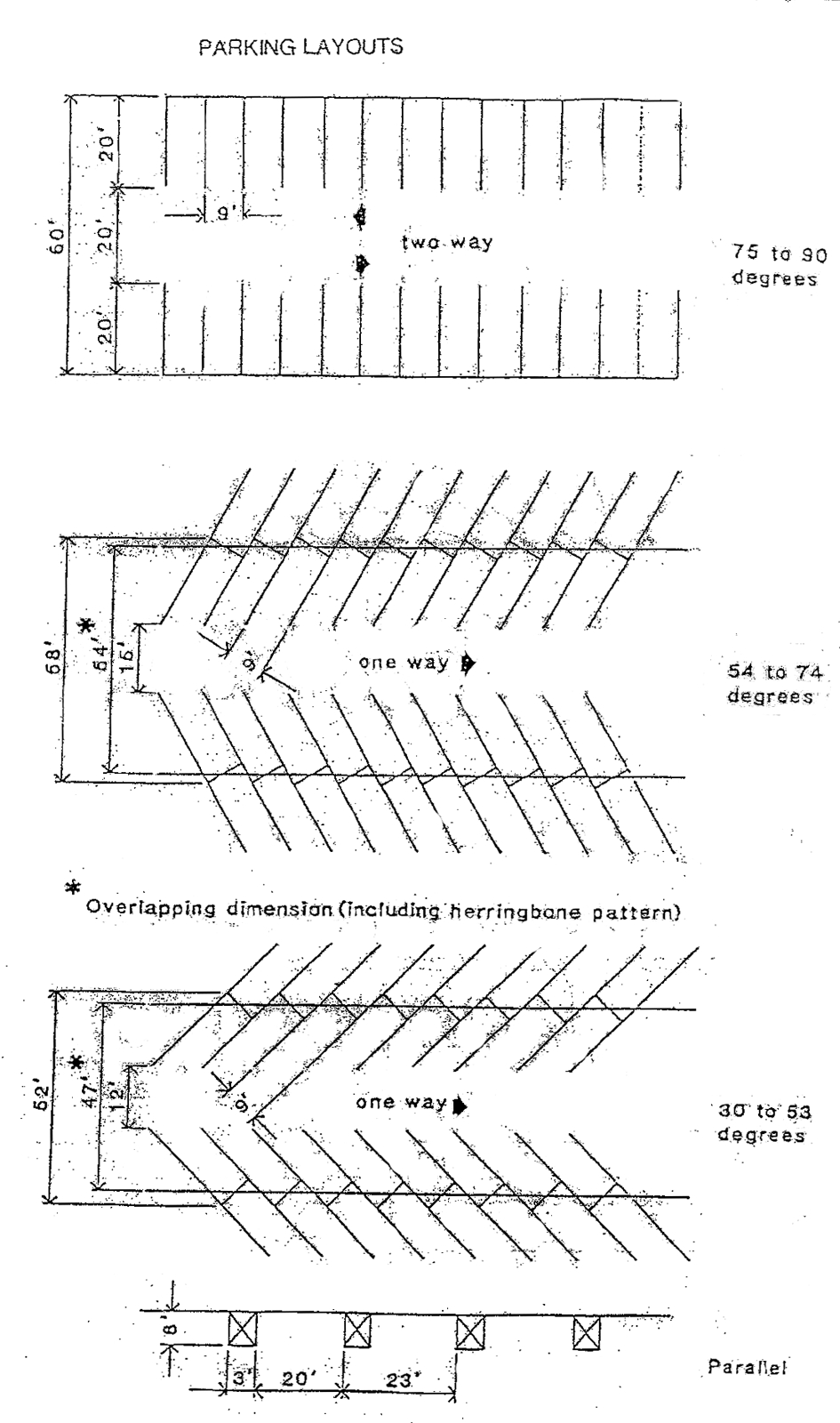
Off-street parking shall be designed to conform with the following standards and diagram:
Notes:
(a) Parallel spaces shall provide a three-foot-marked maneuvering area between stalls.
(b) Limited to one-way access aisles.
b.
Driveways providing access to residential, commercial or industrial uses shall comply with the following minimum standards:
*Main access driveways and internal circulation routes used by trucks shall be 31 feet in width.
.....
(3)
Stacking spaces. Stacking spaces shall be provided as required in the schedule of off-street parking. Stacking spaces shall be a minimum of ten feet wide and 20 feet in length, shall not extend into any public right-of-way or private access easement, and shall be distinctly separated from on-site parking so as not to interfere with ingress and egress to parking spaces.
(4)
Ingress and egress. All spaces shall be provided with adequate access by means of clearly defined maneuvering lanes and driveways. Spaces backing directly onto a street shall be prohibited. Entrances and exits from off-street parking lots shall be located at least 20 feet from the nearest point of any property zoned for single-family residential use.
(5)
Surfacing and drainage. Grading, surfacing, and drainage plans shall comply with township standards and shall be subject to review and approval by the building official. All off-street parking areas, access lanes, driveways and other vehicle maneuvering areas shall be hard-surfaced with concrete or plant-mixed bituminous material. Off-street parking areas, access lanes, and driveways shall be graded and drained so as to dispose of surface waters. Surface water shall not be permitted to drain onto adjoining property, unless in accordance with an approved drainage plan.
(6)
Curbs, wheel chocks. A curb of at least six inches in height shall be installed to prevent motor vehicles from being driven or parked so that any part of the vehicle extends within two feet of abutting landscaped areas, sidewalks, walls, streets, buildings, or adjoining property. In lieu of a curb, wheel chocks may be provided to prevent vehicles from extending over grass areas, setback lines, or lot lines. A freeway type guardrail is prohibited from use in lieu of curbs or wheel chocks.
(7)
Lighting. All parking areas, driveways, and walkways shall be illuminated to ensure the security of property and the safety of persons using such areas, in accordance with the requirements set forth in this chapter. All lighting shall be confined within and directed onto the parking area only.
(8)
Buildings. No building or structure shall be permitted on an off-street parking lot.
(9)
Signs. Accessory directional signs shall be permitted in parking areas in accordance with township sign regulations. The planning commission, upon review and recommendation of the public safety official, may require the posting of traffic control signs as it deems necessary to promote vehicular and pedestrian traffic.
(10)
Screening and landscaping. All off-street parking areas, except those serving single and two-family residences, shall be screened and landscaped in accordance with the provisions set forth in article VII of this chapter.
(11)
Striping. To facilitate movement and to help maintain an orderly parking arrangement, all parking spaces shall be clearly striped. Except for parallel parking spaces, each stall shall be delineated with four-inch wide double lines 24 inches apart. The width of the parking stall may be computed from the centers of the double striping.
(12)
Maintenance. All parking areas shall be maintained free of dust, trash, and debris. Surfacing, curbing, lighting fixtures, signage, lane marking, space striping, and related appurtenances shall be maintained in good condition.
(d)
Commercial and recreational vehicle parking in residential districts.
(1)
Commercial vehicle parking. One commercial vehicle only, with a rated capacity of not to exceed three-quarter-ton, may be parked on a residential lot, provided that the vehicle is not a utility truck, such as a wrecker, septic tank pumper, or a vehicle that carries flammable or toxic materials.
(2)
Recreational vehicle parking. Recreational vehicles as defined in section 32-4, including campers and other recreational equipment, may be parked or stored by the owner on residentially-used property subject to the following conditions:
a.
Connection to utilities. Recreational vehicles parked or stored shall not be connected to electricity, water, gas, or sanitary sewer facilities.
b.
Use as living quarters. At no time shall recreational vehicles parked or stored in residential districts be used for living or housekeeping purposes.
c.
Location. Recreational vehicles not parked in a garage shall be parked or stored entirely in the rear or side yard, but not less than five feet to a side or rear property line that abuts a residential use. On a corner lot, recreational vehicles must be parked and/or stored not less than 20 feet from an adjoining street.
d.
Temporary parking. Notwithstanding the provisions in subsection (d)(2)c of this section concerning location, recreational vehicles may be parked elsewhere on the premises prior to or after a trip for loading or unloading purposes for a period of not more than 48 hours prior to and 48 hours after use of the vehicle within a seven day period.
e.
Lot coverage. Recreational vehicles may occupy no more than 20 percent (existing standards) of the required rear yard.
f.
Sole transportation. A recreational vehicle designed for use on streets and highways may be parked in a driveway of a residence if it is the sole means of transportation to and from work for one or more of the permanent residents.
g.
Condition. Parked or stored recreational vehicles must be kept in good repair. Vehicles capable of being moved from place to place under their own power must be maintained in good running condition. All such vehicles must be properly registered in the name of the occupant of the dwelling unit, and, if required, have a current state license attached.
h.
Storage of mobile homes. The parking or storage of an unoccupied mobile home as defined in section 32-4, being designed as a permanent structure for residential occupancy, is prohibited, except as may be permitted in an approved mobile home park.
i.
Waiver of regulations. The provisions concerning connection to utilities, use as living quarters, and location may be waived for a single period of up to two weeks to permit repair of the occupant's or owner's equipment or to permit the parking of a recreational vehicle of a guest. Any such waiver shall be obtained from the building official.
j.
Multiple-family complexes and mobile home parks. The planning commission may require that a screened storage area be provided on the site of a multiple-family complex or mobile home park for parking and storage of recreational vehicles.
(3)
Vehicle storage and repair prohibited. The following is prohibited in all residential districts.
a.
Storage of inoperable or unlicensed vehicles. The storage of an inoperable or unlicensed motor vehicle as defined in the Michigan vehicle code, Public Act No. 300 of 1949 (MCL 257.1 et seq.), unless stored in compliance with subsection (d)(3)c of this section.
b.
Storage of recreational vehicles. The storage of any recreational vehicle as defined in section 32-4, except in compliance with subsection (d)(2) of this section.
c.
Repair or maintenance. The repair or maintenance of any vehicle that renders the vehicle inoperable for a period in excess of 72 hours, unless the vehicle under repair is registered to the owner of the property and the repair or maintenance activities are conducted entirely within an enclosed garage or other enclosed structure approved for such purpose by the township.
(Ord. of 7-16-1992, § 4.01)
Sec. 32-692. - Loading space requirements.
(a)
Scope of loading space requirements. Compliance with the following loading space regulations shall be required in order to avoid interference with the public use of streets, alleys, parking areas, driveways, sidewalks, and other public areas:
(1)
General applicability. On the same premises with every building, or part thereof, erected and occupied for manufacturing, storage, warehousing, display and sale of goods, including department stores, wholesale stores, markets, hotels, hospitals, mortuaries, laundries, dry cleaning establishments, and other uses involving the receipt or distribution of materials, merchandise, or vehicles, there shall be provided and maintained adequate space for loading and unloading as required in this section.
(2)
Change in use or intensity. Whenever use of a building, structure, or lot is changed, loading space shall be provided as required by this chapter for the new use, regardless of any variance that may have been in effect prior to change of use.
(b)
General requirements.
(1)
Location. Required loading space shall be located to the rear or side of the building being served such that it is screened from view from adjoining roads. Loading/unloading operations shall not interfere with vehicular traffic circulation on streets, alleys, or within off-street parking areas. Loading/unloading areas shall not be placed in required fire lanes.
(2)
Dimensions. Unless otherwise specified, each required loading space shall be a minimum of ten feet in width and 50 feet in length, with a minimum vertical clearance of 15 feet.
(3)
Surfacing and drainage. Loading areas shall be hard-surfaced with concrete or plant-mixed bituminous material. Loading areas shall be graded and drained so as to dispose of surface waters. Grading, surfacing, and drainage plans shall be subject to review and approval by the building official. Surface water shall not be permitted to drain onto adjoining property, a public easement, a public right-of-way or into the public sanitary sewer system, except in accordance with a township approved drainage plan.
(4)
Storage and repair prohibited. The storage of merchandise, sale of motor vehicles, storage of inoperable vehicles, or repair of vehicles is prohibited in required loading space.
(5)
Use of loading space. A required loading space shall be dedicated to loading and unloading purposes and shall not be counted or used for required parking.
(6)
Central loading. Central loading facilities may be substituted for individual loading spaces serving businesses on separate lots provided that all of the following conditions are fulfilled:
a.
Each business served shall have direct access to the central loading area without crossing a public street or alley.
b.
Total loading space provided shall meet the minimum requirements specified herein, in consideration of total floor area of all businesses served by the central loading space.
c.
No building served shall be more than 300 feet from the central loading area.
.....
(7)
Minimum loading space. The amount of required loading space shall be determined in accordance with the schedule that follows. In a planned development district, the planning commission may modify the minimum requirements. In other districts, the zoning board of appeals may reduce or modify the standards upon making the determination that another standard would be more appropriate considering of the number or type of deliveries expected or experienced for a particular use or site.
*Note:
Establishments containing less than 5,000 square feet of gross floor area shall provide adequate dedicated off-street loading space that is accessible by motor vehicle, but which does not interfere with pedestrian or vehicular traffic. The size of any such loading space shall be based on the types of delivery vehicles typically utilized by the establishment.
(Ord. of 7-16-1992, § 4.02)

