
San Angelo City Zoning Code
EXHIBIT A
ZONING ORDINANCE9
Editor's note— Printed herein is the zoning ordinance of the city, as adopted by the city council on January 4, 2000, as amended, previously published as chapter 12, exhibit A in the 1996 Code of Ordinances. Amendments to the ordinance are indicated by parenthetical history notes following amended provisions. The absence of a history note indicates that the provision remains unchanged from the original ordinance. Obvious misspellings and punctuation errors have been corrected without notation. Due to the nature of the zoning ordinance and the technicalities involved in adopting or amending it, such ordinance is printed herein as published in the 1996 Code, with only nonsubstantive formatting and style changes. Capitalization, punctuation and numbering of articles, sections and subsections have been retained. Additions made for clarity are indicated by brackets.
State Law reference— Municipal zoning authority, V.T.C.A., Local Government Code, ch. 211.
ARTICLE 2 - DEVELOPMENT REVIEW[10]
State Law reference— Zoning commission, V.T.C.A., Local Government Code, sec. 211.007; establishment and authority of zoning board of adjustment, V.T.C.A., Local Government Code, sec. 211.008 et seq.
ARTICLE 3 - USE REGULATIONS[11]
Editor's note— Section 309 was added and sections 309—316 were renumbered as 310—317 by an Ordinance adopted on February 15, 2005, §§ 2 and 3.
ARTICLE 4 - SPECIFIC USE STANDARDS[12]
Editor's note— Sections 415—423 were renumbered as sections 416—424 by § 4 of an Ordinance adopted May 16, 2006. Sections 413—424 were renumbered as sections 414—425 by § 7 of an Ordinance adopted June 15, 2010. Sections 408—425 were renumbered as sections 409—426 by § 5 of an Ordinance adopted April 15, 2014. Sections 410—426 were renumbered as sections 411—427 by § 3 of an Ordinance adopted March 15, 2015. Sections 416—427 were renumbered as sections 417—428 by an Ordinance adopted December 6, 2016. Sections 422—428 were renumbered as sections 423—429 by Ord. No. 2017-06-086, adopted June 20, 2017.
Sec. 101. - Title
This Exhibit "A" to Chapter 12 of the Code of Ordinances, 1996, San Angelo, Texas, shall be known and may be cited as the "Zoning Ordinance of the City of San Angelo," or simply as the "Zoning Ordinance."
Sec. 102. - Authority
This Zoning Ordinance is adopted pursuant to the powers granted and limitations imposed by the Constitution and laws of the State of Texas, the Charter of the City of San Angelo and other provisions of Texas statutory and common law that are relevant and appropriate.
Sec. 103. - Applicability and Jurisdiction
The provisions of this Zoning Ordinance shall apply to the use and development of all land within the City of San Angelo, unless specifically provided otherwise in this Zoning Ordinance.
Sec. 104. - Purpose
This Zoning Ordinance is adopted for the purpose of promoting the public health, safety and general welfare of the citizens of San Angelo. More specifically, this Zoning Ordinance provides for the division of land into different districts that, in combination with regulations pertaining to such districts, are designed in accordance with a comprehensive plan to achieve objectives that include, but are not limited to, the following:
1.
Promote the beneficial and appropriate development of all land and the most desirable use of land in accordance with a well-considered plan;
2.
Protect the character and the established pattern of desirable development in each area;
3.
Prevent or minimize land use incompatibilities and conflicts among different land uses;
4.
Maintain property values by stabilizing expectations and ensuring predictability in development; and
5.
Establish a process that effectively and fairly applies the regulations and standards of this Zoning Ordinance and respects the rights of property owners and the interests of citizens.
Sec. 105. - Design of These Regulations
A.
Allocation of Activity. By allocating to each major type of activity sufficient space in appropriate locations for development, these regulations have been designed:
1.
To distribute realistically the estimated maximum population which the City may have in the foreseeable future over the land available for residential purposes providing adequate light, air and usable open space; and
2.
To encourage economic activities for the health and well-being of the City.
B.
Interrelationship of Uses. By providing for the convenient and efficient interrelationship of related land uses, these regulations have been designed:
1.
To provide appropriate space near residences for services which increase safety and amenity and are not objectionable to residents nearby;
2.
To protect quasi-residential uses that benefit from a residential environment and which provide essential health and welfare services for the residents thereof;
3.
To encourage the tendency of retail and commercial development to cluster within defined areas to the mutual advantage of both consumers and merchants; and
4.
To provide opportunities for employment close to residential areas and thus to cut travel time from work to home.
C.
Incompatible Uses. By segregating incompatible land uses and thereby limiting danger and nuisance, these regulations have been designed:
1.
To protect areas against fire, explosion, noxious fumes and other hazards;
2.
To protect areas against noise, vibration, smoke, dust, odors, heat, glare and other objectionable influences;
3.
To protect areas against heavy and hazardous trucking traffic; and
4.
To protect adjacent areas and to protect the labor force at other establishments engaged in less offensive types of manufacturing and related activities by restricting to appropriate areas those manufacturing activities which create objectionable influences.
D.
Provision of Facilities. By requiring space off public streets for parking and loading and by limiting the bulk of buildings in relation to the land around them and to one another, these regulations have been designed:
1.
To limit congestion in pedestrian and vehicular traffic and in living conditions;
2.
To prevent overcrowding of land beyond capacity of streets and utilities;
3.
To limit loads on traffic, transit and service facilities; and
4.
To permit an advance measure of possible requirements for social, sanitary and utility services, and thereby to facilitate the adequate provision of transportation, water, sewage, streets, parks and other public requirements.
E.
Shape and Location of Buildings. By limiting the shape and locations of buildings, these regulations have been designed:
1.
To reduce the danger from conflagration;
2.
To provide adequate light and air;
3.
To provide privacy where desirable; and
4.
To provide usable open space.
Sec. 106. - Conflict with Other Laws
Wherever the requirements of this Zoning Ordinance are at variance with the requirements of any other lawfully adopted rules, regulations or laws, the more restrictive or that imposing the higher standards shall govern. However, this Zoning Ordinance is not intended to supplant or replace private deed restrictions and covenants, except where coincident with the provisions of this Zoning Ordinance and any other lawfully adopted rules, regulations or laws.
Sec. 107. - Compliance with Zoning District Standards
All development and use of land in the City shall comply with the following standards.
1.
No building, structure or land shall hereafter be used or occupied, and no building, structure or part thereof shall hereafter be erected, constructed, reconstructed, installed or structurally altered, except in conformance with all the regulations specified in this Zoning Ordinance.
2.
The lot area, required yards and other open spaces provided in connection with any structure or use, in order to comply with the regulation specified in this Zoning Ordinance, shall be situated on the same lot as the structure or use.
3.
No part of a yard, open space or off-street parking and loading area required in connection with this Zoning Ordinance shall be included as part of a yard, open space, off-street parking or loading area similarly required for another building, except as allowed under specific provisions for shared parking facilities (see Sec. 511, Off-Street Parking Standards).
4.
No yard or lot existing on the effective date of this Zoning Ordinance shall be reduced in dimension or area below the minimum requirements set forth herein. Yards or lots created after the effective date of this Zoning Ordinance shall meet the minimum requirements established herein.
Sec. 108. - Permits Issued in Conflict with Ordinance
Any permit issued in conflict with the provisions of this Zoning Ordinance shall be null and void and may not be construed as waiving any provisions of this Zoning Ordinance.
Sec. 109. - Official Zoning Map
The boundaries of the zoning districts established by this Zoning Ordinance shall be shown on a map or series of maps entitled "Official Zoning Map," an up-to-date copy of which shall be maintained in the office of the Planning Director. For purposes of adopting an Official Zoning Map, the zoning districts and overlay zones approved in accordance with City of San Angelo Zoning Chapter originally adopted by the governing body on March 23 of 1954, as amended and in effect immediately prior to adoption of this present Zoning Ordinance, shall be converted in accordance with the following schedule:
Furthermore, all special permits approved in accordance with the City of San Angelo Zoning Chapter originally adopted by the governing body on March 23 of 1954, as amended and in effect immediately prior to adoption of this present Zoning Ordinance, shall remain in force and effect as follows:
* the base zoning district underlying each such special permit shall be determined by the Official Zoning Map as set forth in the conversion schedule specified above; and
* if conditions imposed on a specially permitted use (as expressed in the particular ordinance authorizing said special permit) are more restrictive than general development standards applicable within the underlying zoning district and which concern substantially the same subject matter, the less restrictive standards shall apply.
Sec. 110. - Transitional Provisions
A.
Existing Permits and Uses
1.
This Zoning Ordinance is not intended to abrogate or annul (1) any permits issued before the effective date of this Zoning Ordinance, or (2) any easement, covenant or any other private agreement.
2.
Except as specifically provided, the provisions of this Zoning Ordinance shall not affect any building permit issued or any valid building permit application filed prior to the effective date of this Zoning Ordinance, provided that construction pursuant to such permit, if and when issued, is commenced within 6 months of the date of issuance of the permit and diligently pursued to completion.
3.
No presently illegal use shall be deemed to have been legalized unless specifically such use falls within a zoning district where the actual use is a conforming use. Otherwise, such uses shall remain legally nonconforming uses where recognized, or an illegal use, as the case may be.
4.
No offense committed, and no liability, penalty or forfeiture, either civil or criminal, shall be discharged or affected by the adoption of this Zoning Ordinance; but prosecutions and suits for such offenses, liabilities, penalties or forfeitures may be instituted or causes presently pending be proceeded with in all respects as if the prior zoning ordinance had not been repealed.
5.
If a use lawfully occupying land or buildings is classified by the Use Table in Sec. 310 as a conditional use in the zoning district in effect on the effective date of this Zoning Ordinance, such use shall not be considered a nonconforming use. The existing use shall be considered a lawful conditional use, the same as if the Planning Commission had expressly approved the location of that use on the lot where existing at the effective date of this Zoning Ordinance.
Sec. 111. - Severability
If any Section, subsection, sentence, clause, phrase or portion of this Zoning Ordinance is, for any reason, held invalid or unconstitutional by any court of competent jurisdiction, such portions shall be deemed a separate, distinct and independent provision, and such holding shall not affect the validity of the remaining portions of this Zoning Ordinance.
Sec. 201. - Development Review: General
A.
Preapplication Conference. An applicant for development approval may request a preapplication conference with the Planning Director. Prior to the conference, the applicant shall provide a description of the character, location and magnitude of the proposed development. The purpose of this meeting is to acquaint the participants with the requirements of this Zoning Ordinance and the views and concerns of the City.
B.
Application Forms. Every application for development approval shall be in a form specified by the Planning Director.
C.
Standard Application Submission Cycle. Applications that will be reviewed by the Planning Commission or the Zoning Board of Adjustment must be filed at least 21 days in advance of the scheduled public hearing, in order to allow adequate time for staff review and preparation of a staff report.
D.
Application Fees
1.
No application shall be processed until the established fee has been paid. This nonrefundable fee shall be established from time to time by the City Council to defray the actual cost of processing the application and providing public notice.
2.
No application fee shall be required when a text or map amendment is being proposed by the Planning Director, City Manager, City Council or Planning Commission.
E.
Completeness of Application. No application shall be processed until it has been deemed complete by the Planning Director. The Planning Director shall have 5 working days following the submission of the application to determine its completeness. If the application is deemed incomplete, the Director shall forward a letter to the applicant specifying the application's deficiencies, and no further review of the application shall proceed until the deficiencies are corrected. If the deficiencies are not corrected by the application deadline date, the application shall not be scheduled for public hearing.
F.
Procedures Requiring Public Notice
G.
Published Notice of Public Hearing Before City Council. Except as otherwise allowed by Subsection K of this section, whenever the provisions of this Zoning Ordinance require a public hearing before the City Council, notice shall be published in a newspaper of general circulation in the City of San Angelo at least 15 days before the public hearing. (Subsection G. amended by Ordinance adopted 2-15-05)
H.
Mailed Notice of Public Hearing
1.
General. Except as otherwise allowed by Subsection K of this section, and except as specifically required by Section 429 of this Zoning Ordinance with regard to certain waste-related uses, notice of required public hearings shall also be sent by mail to owners of real property within at least 200 feet from the lot lines of the land that is the subject of the application. Owners of real property shall be identified by reference to the most recent municipal property tax records. Notice shall be deemed mailed by virtue of its deposit with the United States Postal Service, properly addressed and with postage prepaid.
a.
For the Planning Commission's consideration of certain waste-related uses identified in Section 429 of this Zoning Ordinance, notice of required public hearings shall be sent by mail to owners of real property within at least 1,000 feet from the lot lines of the land that is subject to such application.
2.
Planning Commission and Zoning Board of Adjustment. Mailed notice shall be deposited with the United States Postal Service, before the 10th day before the public hearing by the Planning Commission or Zoning Board of Adjustment.
(Subsection H. amended by Ordinance adopted 2-15-05; subsection H.1. amended by sec. 1, Ordinance adopted 9-16-08)
I.
Content of Published and Mailed Notice. Published and mailed notices shall provide at least the following information:
1.
The general location of the land that is the subject of the application;
2.
A summary of the subject property's legal description or a street address or other locative information;
3.
The substance of the application;
4.
The time, date and location of the public hearing;
5.
A contact person for the City and their telephone number; and
6.
A statement that interested parties may appear at the public hearing and be heard with respect to the application.
J.
Posted Notice of Public Hearing at the Site Subject to Application. Posted notice of required public hearings is encouraged by the City. Signs shall be provided by the City; however, it is the responsibility of the applicant to ensure the signs are posted appropriately. The Zoning Board of Adjustment, Planning Commission and City Council, at its discretion, may each conduct a public hearing with or without such posted notice.
K.
Alternative Notice of Public Hearing Before a Joint Meeting of the Planning Commission and City Council. The City Council may, by a two-thirds vote, prescribe alternative means of notifying owners of property potentially affected by a particular proposed change in zoning classification. Such changes may include consideration of proposed Special Uses and Planned Development Districts, designation of overlay zones and other amendments to the official zoning map. Alternative notification procedures prescribed by City Council should offer an effective means of communicating the nature of such proposed changes, to the public, without strict conformance to mailed and published notice requirements stipulated elsewhere in this section concerning Development Review. Any such alternative notice must, however, be for a joint hearing held by the Planning Commission and City Council, on the particular proposed change which is the subject of the alternative notice. (Subsection K. added by Ordinance adopted 2-15-05)
Editor's note— Subsection K. was added and the remaining subsections redesignated by Ordinance adopted 2-15-05.
L.
Continuation of Public Hearings. A public hearing for which proper notice was given may be continued to a later date without complying with the notice provisions above, provided that the continuance is set for a date and time certain announced at the public hearing.
M.
Postponement of Public Hearing/Withdrawal of Application
1.
Once a public hearing has been scheduled in accordance with this Section, the applicant may request postponement or withdrawal of the application by notifying the Planning Department in writing by 12:00 noon on the Friday preceding the initially scheduled hearing. If the Planning Department does not receive such notification, the case will be heard as scheduled. The appropriate municipal board, commission or council is then authorized to take action on the case, after the scheduled hearing.
2.
An applicant will be allowed no more than one such postponement of a public hearing. If review of an application is postponed at the request of the applicant and set for hearing on a later date, such application will be reviewed at that time, without recourse to additional requests for postponement by the applicant. The appropriate municipal board, commission or council shall then be authorized to take action on the case after the scheduled hearing.
3.
After public hearing on any matter within the scope of this Zoning Ordinance, the appropriate municipal board, commission or council hearing such matter may defer action on it, for a period of time necessary to gather additional information.
4.
If an applicant withdraws an application for any of the following matters, such application shall not be heard within 1 year thereafter, except as specifically directed by majority vote of the City Council:
a.
Amendment to the Official Zoning Map (except Historic Overlay Zone);
b.
Conditional use approval; and
c.
Special use approval
N.
Rehearing. The Planning Commission will not hear a request for amendment to the Official Zoning Map (except Historic Overlay Zone), conditional use approval or special use approval on the same tract of land within one year following the final decision on any previous such request unless:
1.
The Planning Commission is specifically directed by majority vote of the City Council, to hear the subsequent request; or
2.
The subsequent request is for more restrictive zoning; or
3.
The zoning classification of other nearby properties in the immediate vicinity has changed.
Sec. 202. - Summary of Development Review Procedures
The following table summarizes the level of review for each development review procedure.
PD = Planning Director
ZBA = Zoning Board of Adjustment
DHRC = Design and Historic Review Commission
PC = Planning Commission
CC = City Council
RR = Review and Report
PH/R = Public Hearing and Recommendation
PH/FA = Public Hearing and Final Approval (except Administrative Approval or Adjustment)
A = Appeal
(Section 202 amended by sec. 9, Ordinance adopted 9-4-12)
Sec. 203. - Administrative Adjustments
A.
Purpose. Administrative adjustments are specified deviations from otherwise applicable development standards where development is proposed that would be (1) compatible with surrounding land uses; (2) in keeping with the public interest and (3) consistent with the purposes of this Zoning Ordinance.
B.
Administrative Adjustments Allowed. The Planning Director shall have the authority to grant only the following administrative adjustments:
1.
Allow an increase in the floor area of a residential accessory building above 50 percent of the total square footage of the principal structure, or above 100 percent of the total square footage of the principal structure on lots in Ranch & Estate (R&E) zoning districts, as long as the increase does not exceed 10 percent above the applicable maximum. (Subsection 1. amended by sec. 2, Ordinance adopted 8/2/11)
2.
Allow a delay in the provision of paved surface for off-street parking spaces required under the terms of this Zoning Ordinance, for a period of time up to 90 days, provided that only one such delay shall be allowed.
3.
Authorize a variance of up to 10 percent from the numerical standard set forth in Articles 4 or 5.
EXAMPLE: Minimum front yard requirement of 25 feet may be varied by up to 10% to a minimum of 22.5 feet.
4.
Allow an all-weather surface to be substituted for the requirement to pave the minimum off-street parking spaces required for single-family residences, where the Planning Department makes a finding that the character of the surrounding area is principally recreational or rustic in nature, with relatively narrow roadways not bordered by curbs and generally uncharacteristic of urban streets.
Editor's note— Subsection B.3 was repealed and the remaining subsections redesignated by Ordinance adopted 2-15-05.
C.
Submission of Application. A complete application for an Administrative Adjustment shall be submitted to the Planning Director, along with the appropriate application fee.
D.
Action by Planning Director. After determining that the application is complete, the Planning Director shall review the application and approve, approve with conditions or deny the application based upon the criteria below. A written decision including affirmative findings on the criteria set forth below shall be mailed to the applicant.
E.
Administrative Adjustment Criteria. To approve an application for an Administrative Adjustment, the Planning Director shall make an affirmative finding that the following criteria are met.
1.
That granting the Administrative Adjustment will ensure the same general level of land use compatibility as the otherwise applicable standards.
2.
That granting the Administrative Adjustment will not materially and adversely affect adjacent land uses and the physical character of uses in the immediate vicinity of the proposed development because of inadequate buffering, screening, setbacks and other environmental considerations.
3.
That granting the Administrative Adjustment will not adversely affect value of nearby property in any material way.
4.
That granting the Administrative Adjustment will be generally consistent with the purposes and intent of this Zoning Ordinance.
F.
Appeals. Appeal of an administrative adjustment to the Zoning Board of Adjustment shall be made within 30 days of the mailing of the Planning Director's decision in accordance with Sec. 214.
G.
Conditions. The Planning Director may impose such conditions on approval of an administrative adjustment as are necessary to accomplish the purpose of this Zoning Ordinance, to prevent or minimize adverse impacts upon the public and neighboring properties, and to ensure compatibility of the site with its surroundings. These conditions may include but are not limited to limitations on the size, bulk and location of buildings; provisions for landscaping, buffering and screening; limitations on sources of artificial lighting; and requirements for adequate vehicle ingress and egress.
H.
Effect of Administrative Adjustment
1.
Administrative approval of an adjustment shall authorize only the particular allowance, variation or exception which is specifically approved by the Planning Director. Administrative approval of such an adjustment runs with the land.
2.
Unless otherwise specified in the Planning Director's approval of an administrative adjustment, an application to commence construction of improvements that are the subject of the approved adjustment must be applied for and approved within 12 months from the date of the Planning Director's written acknowledgement of approval; otherwise, the administrative adjustment shall automatically become null and void. Upon written request, only one extension of the 12-month period may be granted by the Planning Director, if he/she determines that conditions of the site and immediately surrounding area are substantially unchanged. These permitted time frames do not change with successive owners of the subject property.
(Subsections G. and H. added by Ordinance adopted 8-3-04)
Sec. 204. - Urban Design Review
A.
Purpose. Large-scale buildings often have an extraordinary impact on the character of an urban neighborhood, as well as on the practical functioning of features within the public realm. The usefulness and value of nearby properties are often impacted by such larger buildings, in ways that require close examination and evaluation of such impacts. To this end, site plans for certain proposed buildings are subject to an urban design review, to ensure compatibility of large-scale buildings with neighboring uses, other buildings and the public realm.
B.
Applicability
1.
A review of urban design considerations shall be required in any of the following situations:
a.
Construction of a building which comprises at least 25,000 square feet of gross floor area.
b.
Construction of a building which comprises at least 10,000 square feet of gross floor area and which is located on the same lot as an existing building which comprises at least 25,000 square feet of gross floor area.
c.
Construction of more than one principal building for multifamily residential use on a single lot or tract of land.
d.
Construction of more than one principal building for single-family or two-family residential use on one lot in an RM-1 District, an RM-2 District, or where allowed in a commercial district.
2.
No permit for construction or expansion of such a building shall be issued by the Building Official until urban design review has been completed in accordance with this Section. All modifications and conditions required as a result of urban design review shall be incorporated in the construction of the proposed building and improvement of the surrounding site. All such modifications and conditions shall furthermore be a continuing obligation of the property owner. It shall be unlawful to discontinue, change or dispense with any modifications of conditions required as a result of urban design review.
(Subsections A. and B. amended by Ordinance adopted 8-3-04)
C.
Submission of Application. A complete application for examination of site plans for all buildings subject to urban design review shall be submitted to the Planning Director, along with the appropriate application fee.
D.
Review and Action by Planning Director. After determining that the application is complete, the Planning Director shall determine whether the plan meets the requirements of this Zoning Ordinance and the criteria set forth in subsection E. below. The Planning Director shall approve, approve with conditions, or deny the application based on these criteria. A written decision, including affirmative findings on these criteria, shall be mailed to the applicant.
E.
Urban Design Review Criteria. Urban Design review by the Planning Director shall be based upon the following:
1.
Impact Minimized: Whether and the extent to which the proposed construction and site improvements minimize adverse effects on adjacent properties. Some valid considerations of urban design review include but not limited to the following:
a.
maintain views and sight lines to property surrounding the site of proposed building;
b.
keeping natural vegetation and/or conforming to existing natural topography on the site of proposed building;
c.
easing traffic movement within, to and from the site of proposed building;
d.
minimizing the unsightly appearance of materials loading and unloading, as well as solid waste handling, on the site of proposed building;
e.
minimizing uncomfortable glare from artificial light sources on the site of proposed building;
f.
minimizing the disruptive visual impact of bulky building mass inappropriately scaled (i.e. not transitioned) to the less intensive and more articulated character of existing buildings nearby the proposed building;
g.
maintaining the closely-hemmed street facades of buildings massed in the historic city center of San Angelo;
h.
minimizing the vacuous, undefined openness of large area devoted to off-street parking; and
i.
conserving the fabric and appearance of historic, scenic or otherwise serviceable older buildings nearby the proposed building.
2.
Development Patterns: Whether and the extent to which the proposed building and site improvements will result in logical and orderly pattern of urban development. This includes the following:
a.
establishing an appropriate quality to the three-dimensional aspects of physical form as well as to the location of different uses;
b.
enhancing the visual relationship between natural form and man-made form;
c.
reinforcing patterns of neighborhood access and identity; and
d.
promoting functional focal points and visual landmarks within the urban fabric of San Angelo, sometimes, by clustering similar elements together to establish an easily recognizable and identifiable place.
F.
Appeal. Appeal of a urban design review to the planning commission shall be made within 30 days from the mailing of the Planning Director's decision in accordance with Section 214, 215 of this Chapter. The appeal shall be reviewed and decided by the planning commission within no more than 60 days following receipt of formal request seeking such appeal.
(Subsections E. and F. amended by Ordinance adopted 8-3-04)
Sec. 205. - Site Plan Review
A.
Purpose. The purpose of a Site Plan is to ensure that a development project is in compliance with all applicable City ordinances and requirements, including the requirement of this Zoning Ordinance and of the City's Land Development and Subdivision Ordinance, prior to commencement of construction. The purpose of this Section is not to create new substantive development requirements, but to establish a process to ensure that existing ordinance requirements are met.
B.
Applicability. This Section outlines when new development or an expansion to an existing, developed property is required to submit a site plan for review.
1.
No permit for construction or expansion of a building or other structure shall be issued until a site plan, if required, including any required engineering or construction plans, has been submitted and approved in accordance with this Section.
2.
No certificate of occupancy, or other final approvals, shall be issued for such buildings or structures until all site improvements, as shown on the approved site plan or established in conditions of approval for the site plan, have been completed or otherwise guaranteed, as approved by the Planning Director.
3.
Unless otherwise excepted herein, nothing in this Section shall preclude a new development occurring on previously undeveloped property from having to comply with any applicable requirements within the Zoning Ordinance, Land Development and Subdivision Ordinance, or any other City code, ordinance, or construction standard.
4.
Triggers. New construction or expansions to an existing property that meet any of the following criteria shall trigger the requirement for a site plan and all of the improvements outlined in this Section, unless otherwise specified:
a.
Construction of a new principal structure;
b.
The conversion of a residential use or structure to a nonresidential use.
c.
Expansion of an existing principal structure or expansion in land area of a use.
d.
Any other development where the City's Zoning Ordinance or Land Development and Subdivision Ordinance specifically require site plan approval.
5.
Exceptions. A major site plan shall not be required for Single-family or two-family residential construction, including associated accessory structures. However, proposed non-residential structures, such as a clubhouse, private recreation facility, gated entrance or guardhouse, etc. will require site plan review and approval for those facilities if triggered above.
6.
Required Improvements. Any development that triggers a Major Site plan must comply with all relevant city ordinance, standards, and specifications, where required by ordinance, except as modified below for a Minor Site Plan. This includes, but is not limited to, a review of the following in a Major Site Plan:
a.
Drive approaches, curb cuts, and driveway spacing
b.
Parking, including layout, striping, and surfacing requirements
c.
Curb and gutter
d.
Sidewalks and related pedestrian amenities
e.
Fire code requirements, including fire hydrants
f.
Screening, buffering, landscaping, and tree preservation
g.
Designated outdoor storage and outdoor display areas
h.
Fencing
i.
Lighting
j.
Location of freestanding signs
k.
Stormwater Management
l.
Flood Plain Management
7.
Minor Site Plan.
a.
A site plan is minor if it meets one of the following:
i.
Accessory use which is incidental to an established commercial development and which results in:
1.
No change in use, and
2.
No increased traffic or business activity or is only used for storage and/or warehousing, and
3.
No violation of height and placement standards contained within the Zoning Ordinance, and
4.
The gross floor area of a proposed structure or structures must be less than fifty (50) percent of the gross floor area of existing structures, and
5.
Which meets the current stormwater ordinance.
ii.
Construction of covered parking where parking already exists on an impervious surface. Said construction must result in no violation of height and placement standards contained in the Zoning Ordinance.
b.
Minor site plans will be subject to review by the city staff but will be exempt from any requirement to bring unassociated site elements into conformance with current standards. Specific items from which the minor site plan will be exempted shall include:
i.
Construction of curb and gutter along an existing street.
ii.
Modification of existing driveways or access unless additional access is proposed.
iii.
Additional parking as long as the proposed improvement does not result in a shortage of required parking.
C.
Application. A complete application, fees, and any other required information for site plan review shall be submitted to the Planning Director or designee.
1.
Area to be included on a site plan. When the overall development project is to be developed in phases, the site plan area shall include only the portion of the overall property that is to be developed/constructed. However, any excluded area must be separately developable as a stand-alone site in the future. This provision shall not be interpreted to allow portions of a property to be excluded so as to avoid development standards, other requirements, or otherwise required improvements to the site.
2.
Submittal and Timing. A Site Plan shall be submitted prior to or in conjunction with a building permit application.
3.
Submission and Contents. The purpose of site plan review is to ensure compliance with all relevant city ordinance, codes, and other requirements. To ensure the submission of adequate information, the Planning Director shall maintain and distribute a checklist of specific requirements for Site Plan review applications. All applications and related contents shall be submitted consistent with these requirements. The authorized reviewer may request additional information to complete the application for review to meet the site plan requirements.
D.
Review Criteria. The Planning Director, in consultation with relevant City staff in other City departments, shall review the Site Plan for compliance with all applicable City ordinances including the site plan's compliance with all provisions of the City's development ordinances, including this Zoning Ordinance, the Land Development and Subdivision Ordinance, Sign Ordinance, and other applicable City ordinances.
E.
Review and Approval.
1.
The Planning Director or designee shall be the responsible official for reviewing Site Plan applications. The Planning Director shall consult with relevant staff from City departments, the Development Review Committee, for review and comments on a proposed Site Plan. Based on the review from all relevant departments, the Planning Director shall make the final decision on Site Plan approval.
2.
The Planning Director, or designee, based on input from the Development Review Committee, may reject review of a Site Plan until adequate information for its review is provided by the applicant. Resubmission of a Site Plan, in this instance, shall not require an additional application fee.
3.
After completing the review of a Site Plan, the Planning Director, or designee, may take one of the following actions:
a.
Approve the site plan;
b.
Approve with conditions - in which case the site plan, along with a written list of conditions, together shall be considered the approved site plan;
c.
Disapprove the site plan
i.
If resubmitted with revisions within 60 days, no additional application or fee will be required for review,
ii.
If resubmitted with revisions at 60 days to 180 days, a reduced fee of 50% of the normal site plan application fee shall be required,
iii.
If resubmitted beyond 180 days, then a new application with standard fees shall be required.
4.
The Planning Director, or designee, may approve issuance of permits following conditional Site Plan approval when it is deemed that the required corrections to the Site Plan are minor in nature. However, no Certificate of Occupancy shall be issued until an amended site plan meeting all conditions has been submitted and approved.
5.
Prior to the issuance of a Certificate of Occupancy the Planning Director, or designee, shall inspect the site to ensure compliance with the Site Plan and any conditions imposed with the approval.
F.
Revisions to an approved Site Plan.
1.
Minor Revisions/Amendments: It is recognized that final architectural and engineering design may necessitate minor changes in the approved Site Plan. In such cases, the Planning Director, or designee, shall have the authority to approve minor revisions to an approved Site Plan. Such minor modifications shall be shown on an "amended Site Plan." If revisions are such that the Planning Director decides that the revisions should be reviewed by the Development Review Committee, a new Site Plan application and review shall be required. For a revision/amendment to be considered minor, the changes shall not cause any of the following circumstances to occur:
a.
An increase in the building footprint of any building(s) by more than 10%;
b.
A reduction in the originally approved separations between buildings by more than 10%;
c.
A reduction in the originally approved setbacks from property lines by more than 10%;
d.
A reduction in the ratio of off-street parking and loading space to gross floor area in the structures;
e.
A change that would result in a violation of a building code or city ordinance.
2.
Major Revisions/Amendments: In the event of revisions that do not constitute minor revisions as set out in subsection (F)(1), a new Site Plan application must be submitted, reviewed, and approved.
G.
Expiration and Extension.
1.
An approved Site Plan shall be valid for a period of 18 months. An application for a building permit for the site, consistent with the site plan, will extend the validity of the site plan for 18 months from the date of the approved permit.
2.
Prior to the lapse of approval for a Site Plan, the applicant may petition the Planning Director (in writing) for an extension of up to one year. If no petition for extension of Site Plan approval is submitted and granted, then the Site Plan shall be deemed to have expired and shall become null and void. Any new request for Site Plan approval shall be submitted with a new application form, with a new filing fee, and with new plans and materials in accordance with the procedures set forth in this Section.
H.
Compliance & Responsibilities.
1.
Duties and Responsible Parties.
a.
It shall be incumbent upon the Building Official, or designees, to make all inspections and certifications necessary to ensure that a structure is built in accordance with the approved Site Plan.
b.
In the event that the Building Official, or designees, finds that a condition or modification of the approved Site Plan or a provision of City Codes and Ordinances has not been met, they may issue a stop work order.
i.
It shall be incumbent upon the contractor or developer to correct those items that are in violation before construction may resume.
ii.
In the event that the structure has been completed, a Certificate of Occupancy shall not be issued by the Building Official until the conditions of the Site Plan or City Codes and Ordinances, as applicable, have been substantially fulfilled.
iii.
All action required in order to bring a structure into compliance with the approved Site Plan shall be the responsibility of the property owner.
c.
Following issuance of the Certificate of Occupancy, it shall be the continuing duty of the owner and occupant of the site, or their successors in interest, to maintain compliance with the approved Site Plan and amendments thereto. Failure to maintain compliance shall constitute a violation of this Zoning Ordinance and may result in revocation of the Certificate of Occupancy.
d.
Site may not become less conforming. Any site that is not subject to an approved site plan, or is governed by a pre-existing site plan that does not conform to the current standards of this Chapter, must maintain compliance with the standards within this Chapter to the extent that the site currently complies with those standards.
(Ord. No. 2022-043, § 1, 6-7-22)
Sec. 206. - Written Interpretations of Text or Official Zoning Map
A.
Authority. The Planning Director shall have authority to make all written interpretations concerning the provisions of this Zoning Ordinance and the Official Zoning Map.
B.
Request for Interpretation. A request for interpretation shall be submitted to the Planning Director in a form established by the Planning Director and made available to the public.
C.
Interpretation by Planning Director. Within ten working days after a request for interpretation has been submitted, the Planning Director shall: (1) review and evaluate the request in light of the text of this Zoning Ordinance, the Official Zoning Map, the Comprehensive Plan and any other relevant information; (2) consult with other staff, as necessary; and (3) render an opinion. The interpretation shall be provided to the applicant in writing by mail.
D.
Official Record. The Planning Director shall maintain an official record of interpretations. The record of interpretations shall be available for public inspection during normal business hours.
E.
Appeal
1.
Appeals of written interpretations made by the Planning Director shall be taken to the Zoning Board of Adjustment within 30 days of mailing of the interpretation, in accordance with the procedures in Sec. 214.
2.
In considering such an appeal, the Zoning Board of Adjustment shall review the interpretation and public testimony in light of the Comprehensive Plan, this Zoning Ordinance and the Official Zoning Map, and any other land use policies adopted by the Planning Commission or City Council, whichever are applicable.
3.
The Zoning Board of Adjustment shall affirm, modify or reverse the decision of the Planning Director in interpreting the provisions of this Zoning Ordinance and the Official Zoning Map. The Zoning Board of Adjustment shall modify or reject the interpretation only if it is not supported by substantial competent evidence or if the interpretation is deemed contrary to the intent and purpose of the Comprehensive Plan, this Zoning Ordinance or the Official Zoning Map.
Sec. 207. - Variances
A.
Purpose. Variances are deviations from the applicable standards for the zoning district where existing or proposed development is located, that would not be contrary to the public interest and, due to special conditions of the site or its surroundings, a literal enforcement of the provisions of this Zoning Ordinance would result in unnecessary hardship. Variances ensure that the spirit of this Zoning Ordinance is observed and substantial justice done. A variance shall not be granted to allow a use that is not allowed in the specific district in question by the use regulations in Article 3.
B.
Submission of Application. A complete application for a variance shall be submitted to the Planning Director on a form prescribed by the Director, along with the appropriate application fee.
C.
Hearing and Action by Zoning Board of Adjustment. After due notice, the Zoning Board of Adjustment shall hold a public hearing on an application for a Variance. At the public hearing, the Zoning Board of Adjustment shall consider the application, the relevant support materials and the public testimony given at the public hearing in light of the criteria below. After the close of the public hearing, the Zoning Board of Adjustment shall vote to approve, approve with conditions or deny the application for a Variance, pursuant to the criteria below.
D.
Allowed Variances. In exercising its authority to grant a variance, the Zoning Board of Adjustment shall affirmatively find that one or more of the following circumstances applies. In each instance, the Zoning Board of Adjustment shall further state in its minute record the specific nature of those circumstances which justify the variance.
1.
Special circumstances resulting in unnecessary hardship. A variance may be granted where special circumstances exist on the property related to the size, shape, area, topography, surrounding conditions or location that do not generally apply to other property in the same zoning district, and that the circumstances are such that strict application of this zoning ordinance would create an unnecessary hardship or deprive the applicant of reasonable use of the land or building.
2.
Overriding Public Interest. A variance may be granted if it will further an overriding public interest or concern, including, but not limited to:
a.
Preserving the natural environment;
b.
Promoting maintenance or reuse of older urban or historic buildings; or
c.
Helping to eliminate a nonconforming use at another location.
3.
Literal enforcement. A variance may be granted if it is found that the literal enforcement and strict application of this Zoning Ordinance will result in extraordinary circumstances inconsistent with the general provisions and intent of this ordinance, and that, in granting the variance, the spirit of the ordinance will be preserved and substantial justice done.
Editor's note— Subsection 3. was repealed and the following subsection redesignated by Ordinance adopted 2-15-05.
E.
Variances Not Allowed. In exercising its authority, the Zoning Board of Adjustment shall not grant a variance that would create any of the following effects.
1.
The effect of the variance on the specific property would adversely effect the land use pattern as outlined by any City land use plan or policy.
2.
The variance would be a material detriment to the public welfare or create injury to the use, enjoyment or value of property in the vicinity.
3.
The variance is not the minimum variance that will relieve the proven hardship.
4.
The variance would allow a use not allowed in the use table for the district in which the parcel is located.
5.
The variance will relieve the applicant of conditions or circumstances that are caused by the illegal subdivision of land, which subdivision of land caused the property to be unusable for any reasonable development under the existing regulations.
6.
The variance will relieve the applicant of conditions or circumstances that are self-imposed.
7.
The variance is grounded solely upon the opportunity to make the property more profitable or to reduce expense to the owner.
8.
The variance will modify any condition imposed by the Planning Commission or City Council as part of a conditional use, special use, Planned Development District or Planned Industrial Park.
9.
The variance would not only affect a specific parcel, but would be of such general nature as to constitute, in effect, a change in zoning of the parcel or a larger area, or would merit an amendment to this Zoning Ordinance.
F.
Variance Criteria. To approve an application for a Variance, the Zoning Board of Adjustment shall make an affirmative finding that each and every one of the following criteria are met.
1.
Special circumstances exist that are peculiar to the land or structure that are not applicable to other land or structures in the same zoning district and are not merely financial.
2.
These special circumstances are not the result of the actions of the applicant.
3.
Literal interpretation and enforcement of the terms and provisions of this Zoning Ordinance would deprive the applicant of rights commonly enjoyed by other land in the same zoning district, and would cause an unnecessary and undue hardship.
4.
Granting the variance is the minimum action that will make possible the use of the land or structure which is not contrary to the public interest, and would carry out the spirit of this Zoning Ordinance and substantial justice.
5.
Granting the variance will not adversely affect adjacent land in a material way.
6.
Granting the variance will be generally consistent with the purposes and intent of this Zoning Ordinance.
G.
Conditions. The Zoning Board of Adjustment may impose such conditions on a variance as are necessary to accomplish the purposes of this Zoning Ordinance, to prevent or minimize adverse impacts upon the public and neighborhoods, and to ensure compatibility of the site with its surroundings. These conditions may include but are not limited to limitations on size, bulk and location; standards for landscaping, buffering and screening, lighting and adequate ingress and egress; cash deposits, bonds and other guarantees of performance; other on-site improvements; and limitations on the duration or hours of operation of an allowed use.
H.
Effect of Variance.
1.
Issuance of a variance shall authorize only the particular variation which is approved in the variance. A variance shall run with the land.
2.
Unless otherwise specified in the variance, an application to commence construction of the improvements that were the subject of the variance request must be applied for and approved within 12 months of the date of the approval of the variance; otherwise, the variance shall automatically become null and void. Permitted time frames do not change with successive owners. Upon written request, only one extension of the 12-month period may be granted by the Planning Director if it is determined that conditions of the site and immediately surrounding area are substantially unchanged.
Sec. 208. - Conditional Use Review
A.
Who May File. An application for conditional use approval shall be submitted by the owner or agent authorized by affidavit to act on the owner's behalf, unless initiated by City officials ordinarily authorized to initiate amendments to the zoning map.
B.
Submission of Application. A complete application shall be submitted to the Planning Director, along with the appropriate fee. The Planning Director may require an application for conditional use approval to be accompanied by a site plan of existing and proposed development of the affected site.
C.
Applicable Development Standards. Unless otherwise specified in this Zoning Ordinance, no conditional use approval shall be granted for any use that does not conform with standards of the district in which it is located. Each conditional use shall also be subject to any specific use requirements set forth in Articles 3 through 5.
D.
Review by Planning Director. After determining that the application is complete, the Planning Director shall place the request on a meeting agenda for consideration by the Planning Commission.
E.
Hearing and Action by Planning Commission
1.
The Planning Commission shall, after appropriate notice, conduct a public hearing on each request for approval of a conditional use.
2.
At the public hearing, the Planning Commission shall consider the application, any pertinent comments by the City staff, and relevant support materials and public testimony given at the public hearing.
3.
After the close of the public hearing, the Planning Commission shall approve the request, approve the request with additional conditions, or deny the request. The Planning Commission may attach such conditions to a conditional use approval as are necessary to prevent or minimize adverse effects on other property in the neighborhood, including, but not limited to: limitations on size, bulk and location, provision of adequate ingress and egress, duration of conditional use approval, and hours of operation for the specific allowed activity.
F.
Conditional Use Approval Criteria. Approval of a conditional use by the Planning Commission shall be based upon the following criteria.
1.
Impacts Minimized. Whether and the extent to which the proposed conditional use creates adverse effects, including adverse visual impacts, on adjacent properties.
2.
Consistent with Zoning Ordinance. Whether and the extent to which the proposed conditional use would conflict with any portion of this Zoning Ordinance, including the applicable zoning district intent statement.
3.
Compatible with Surrounding Area. Whether and the extent to which the proposed conditional use is compatible with existing and anticipated uses surrounding the subject land.
4.
Effect on Natural Environment. Whether and the extent to which the proposed conditional use would result in significant adverse impacts on the natural environment, including but not limited to, adverse impacts on water and air quality, noise, stormwater management, wildlife, vegetation, wetlands and the practical functioning of the natural environment.
5.
Community Need. Whether and the extent to which the proposed conditional use addresses a demonstrated community need.
6.
Development Patterns. Whether and the extent to which the proposed conditional use would result in a logical and orderly pattern of urban development in the community.
G.
Expiration of Conditional Use Approval
1.
All Conditional Use approvals that require a permit from the City for implementation of the conditional use must acquire the permit within 12 months from the granting of the conditional use. The Planning Director, with significant evidence that the designated conditional use cannot be realistically implemented with due diligence within that time period, may grant a longer period of time, but in no event shall such extension period exceed an additional 12 months.
2.
If the designated use is not made of the property within the time limitation granted, the conditional use approval shall be canceled and revoked and be of no effect.
H.
Appeal
1.
Appeal of the Planning Commission's decision on conditional use approval shall be made within 30 days of the final action by the Planning Commission, to the City Council. The appeal shall be in writing, submitted to the Planning Director and processed in accordance with Sec. 214: Appeals.
2.
In considering such an appeal, the City Council shall review the decision in light of the Comprehensive Plan, this Zoning Ordinance, the Official Zoning Map, and any other land use policies adopted by the Planning Commission or City Council, whichever are applicable. The City Council shall modify or reject the decision of the Planning Commission only if it is not supported by substantial competent evidence or if the Planning Commission's decision is contrary to the Comprehensive Plan, this Zoning Ordinance or the Official Zoning Map.
3.
Appeal of the City Council's decision on any request for conditional use approval shall be made within 30 days of the final action by City Council, to a state District Court of competent jurisdiction in Tom Green County.
(Ord. No. 2018-120, § 1, 10-2-18)
Sec. 209. - Special Use Review
A.
Purpose. Special use review allows for review of specified larger-scale uses that may be appropriate in designated areas, provided that consideration is given to conditions that will minimize any negative impacts of the use.
B.
Who May File. An application for special use approval shall be submitted by the owner or an agent authorized by affidavit to act on the owner's behalf, unless initiated by City officials ordinarily authorized to initiate amendments to the zoning map.
C.
Submission of Application. A complete application shall be submitted to the Planning Director, along with the appropriate fee. The Planning Director may require an application for special use approval to be accompanied by a site plan of existing and proposed development of the affected site. A written statement describing how the proposed development meets any specific use requirements set forth in Articles 3 through 5 shall accompany the site plan.
D.
Applicable Development Standards. Unless otherwise specified in this Zoning Ordinance, no special use approval shall be granted for any use that does not conform with the dimensional standards of the district in which it is located. Each special use shall also be subject to any specific use requirements set forth in Articles 3 through 5.
E.
Review by Planning Director. After determining that the application is complete, the Planning Director shall place the request on a meeting agenda for consideration by the Planning Commission.
F.
Hearing and Recommendation by Planning Commission
1.
The Planning Commission shall, after appropriate notice, conduct a public hearing on each request for approval of a special use.
2.
At the public hearing, the Planning Commission shall consider the application, any pertinent comments by City staff, other relevant support materials and public testimony given at the public hearing.
3.
After the close of the public hearing, the Planning Commission shall recommend that the City Council approve the request, approve the request with additional conditions, or deny the request. The Planning Commission may propose such conditions as are necessary to prevent or minimize adverse effects on other property in the neighborhood, including, but not limited to: limitations on size, bulk and location, provision of adequate ingress and egress, duration of special use approval, and hours of operation for the special use so allowed.
4.
A recommendation by the Planning Commission to deny a request for special use shall be the final decision on that matter, if not appealed in writing to the City Council with [within] ten (10) days.
G.
Hearing and Action by City Council
1.
The City Council shall, after appropriate notice and a recommendation from the Planning Commission, conduct a public hearing on each request for approval of a special use, except for such requests which are recommended by the Planning Commission to be denied and are not formally appealed to City Council.
2.
At the public hearing, the City Council shall consider the application, any pertinent comments by City staff, the Planning Commission recommendation, other relevant support materials and public testimony given at the public hearing.
3.
After the close of the public hearing, the City Council shall approve the request, approve the request with additional conditions, or deny the request. The Council may attach such conditions to a special use approval as are necessary to prevent or minimize adverse effects on other property in the neighborhood, including, but not limited to: limitations on size, bulk and location, provision of adequate ingress and egress, duration of special use approval, and hours of operation of the special use.
4.
Where the Planning Commission has recommended denial of a proposed special use, or written protest against a proposed special use is made and signed by (a) the owners of 20 percent or more of the area subject to the special use or (b) the owners of 20 percent or more of the land area within 200 feet of the affected area, then the proposed special use shall require a favorable vote of at least three-fourths of all the members of the City Council to become effective. The area of rights-of-way and streets shall be included in any computation of land area under this subsection.
H.
Special Use Approval Criteria. Approval of a special use by the Planning Commission and City Council shall be based upon the following criteria.
1.
Impacts Minimized. Whether and the extent to which the site plan minimizes adverse effects, including adverse visual impacts, on adjacent properties.
2.
Consistent with Zoning Ordinance. Whether and the extent to which the proposed special use would conflict with any portion of this Zoning Ordinance, including the applicable zoning district intent statement.
3.
Compatible with Surrounding Area. Whether and the extent to which the proposed special use is compatible with existing and anticipated uses surrounding the subject land.
4.
Traffic Circulation. Whether and the extent to which the proposed special use is likely to result in extraordinarily prolonged or recurrent congestion of surrounding streets, especially minor residential streets.
5.
Effect on Natural Environment. Whether and the extent to which the proposed special use would result in significant adverse impacts on the natural environment, including but not limited to water or air quality, noise, stormwater management, wildlife, vegetation, wetlands and the practical functioning of the natural environment.
6.
Community Need. Whether and the extent to which the proposed special use addresses a demonstrated community need.
7.
Development Patterns. Whether and the extent to which the proposed special use would result in a logical and orderly pattern of urban development in the community.
I.
Expiration of Special Use Approval
1.
All Special Use approvals that require a permit from the City for implementation of the special use must acquire the permit within 12 months from the granting of the special use. The Planning Director, with significant evidence that the designated special use cannot be realistically implemented with due diligence within that time period, may grant a longer period of time, but in no event shall such extension period exceed an additional 12 months.
2.
If the designated use is not made of the property within the time limitation granted, the special use approval shall be canceled and revoked and be of no effect.
J.
Appeal. Appeal of a request for special use approval shall be made within 30 days of the final action by City Council to a state District Court of competent jurisdiction in Tom Green County.
(Ord. No. 2018-120, § 2, 10-2-18)
Sec. 210. - Planned Development Review
A.
Who May File. An application for rezoning to a Planned Development (PD) District may be submitted by an owner or an agent authorized by affidavit to act on the owner's behalf, unless initiated by City officials ordinarily authorized to initiate amendments to the zoning map. No application shall be accepted for a property less than one acre in land area.
B.
Preapplication Conference
1.
A prospective applicant for a PD District is encouraged to request a preapplication conference with the Planning Director, or a designee, prior to submission of a formal application.
2.
At the preapplication conference, the applicant shall present a draft concept plan in order for the staff to better assist the developer and ensure timely processing of the application.
3.
Based on the information provided by the applicant, the Planning Director or a designee shall provide preliminary comments concerning the proposed development and shall inform the applicant of any additional requirements for preparation of a formal application for rezoning to the PD District.
C.
Submission of Application
1.
A complete application for review of a PD District shall be submitted to the Planning Director on a form prescribed by the Director, along with the appropriate fee.
2.
The applicant shall submit a concept plan and a rezoning application, as well as any proposed covenants and restrictions governing the operation of any proposed common open space or facilities. The concept plan shall include at least a graphic element that illustrates those details of the proposed planned development that are appropriate for the application. The concept plan may also be accompanied by written text describing appropriate details of the proposed planned development.
3.
The applicant may also submit an initial site plan of actual building construction and other such improvements planned on the subject property.
4.
A subdivision plat meeting the submittal requirements of the City's Land Development and Subdivision Ordinance may also be submitted. An applicant for a single-family detached residential development may submit a final subdivision plat in lieu of a site plan for the first phase or phases of the project for approval in conjunction with adoption of the PD District.
D.
Review and Report by Planning Director. After determining that the application is complete, the Planning Director shall prepare a staff report, which may include a recommendation for approval or denial. A copy of the staff report on a proposed planned development shall be mailed to the applicant at least 5 working days prior to the public hearing on the application.
E.
Hearing and Recommendation by Planning Commission
1.
The Planning Commission shall, after appropriate notice, conduct a public hearing on each request for rezoning to the PD District.
2.
At the public hearing, the Planning Commission shall consider the application, the comments and recommendations of City staff, other relevant support materials and public testimony given at the public hearing.
3.
After the close of the public hearing, the Planning Commission shall prepare and deliver a report and recommendation to the City Council to approve or deny the proposed PD District. The Planning Commission may recommend conditions necessary to prevent or minimize adverse effects on other property in the neighborhood, including, but not limited to: limitations on size, bulk and location, provision of adequate ingress and egress, and hours of operation. A recommendation by the Planning Commission to deny a request for a proposed PD District shall be the final decision on the matter, if not appealed in writing to the City Council within ten (10) days.
4.
The Commission may simultaneously make its required findings on any final plat submitted by the applicant, in accordance with the standards set forth in the City's Land Development and Subdivision Ordinance.
F.
Hearing and Action by City Council
1.
After receipt of the final report from the Planning Commission, and after appropriate notice, a public hearing shall be held by the City Council before adopting any proposed PD District, except for such requests which are recommended by the Planning Commission to be denied and are not formally appealed to City Council.
2.
At the public hearing, the City Council shall consider the application, the comments and recommendations of City staff, the Planning Commission recommendation, other relevant support materials and public testimony given at the public hearing.
3.
After the close of the public hearing, the City Council shall approve, approve with conditions, or deny the application. The Council may require such conditions relating to the height, floor area, density, setback, landscaping, off-street/on-site parking and all other applicable standards as are necessary to ensure the health, safety and general welfare of the community.
4.
The City Council, upon consideration of the findings by the Planning Commission regarding plat approval, and if City Council approval is necessary, may approve a subdivision plat submitted by the applicant, which meets the standards set forth in the City's Land Development and Subdivision Ordinance, concurrently with approval of the specific PD District ordinance.
5.
If the applicant has included an initial site plan of actual building construction and/or other such improvements planned on the subject property, the Council shall take action on such request, if City Council approval is necessary as provided in this Section.
6.
Where the Planning Commission has recommended denial of a proposed PD District, or written protest against a proposed PD District is made and signed by (a) the owners of 20 percent or more of the area subject to the PD District ordinance or (b) the owners of 20 percent or more of the land area within 200 feet of the affected area, then the proposed PD District shall require a favorable vote of at least three-fourths of all the members of the City Council to become effective. The area of rights-of-way and streets shall be included in any computation of land area under this subsection.
G.
Amendments to PD District Ordinance. Any amendments to the terms and conditions of an approved PD District ordinance shall be subject to review and reconsideration, in accordance with procedures set forth in subsections A through F above.
H.
Site Plan Required
1.
No building permit may be issued and no construction or development requiring a building permit and situated within a PD District may commence unless a site plan has been approved for that phase of the project that is consistent with the approved concept plan. A site plan that is not consistent with the approved concept plan and specific PD District ordinance shall not be approved.
2.
Upon approval of a PD District, the applicant may submit a site plan to the Planning Director for each phase of the development in accordance with the phasing schedule of the concept plan.
I.
Approval of Minor Site Plans by Planning Director. The Planning Director or his/her designee may approve a site plan for development within a Planned Development District under the following conditions:
1.
The site plan is for the development of a use or uses allowed by the approved PD District ordinance specific to the subject site, and is not for the purpose of designating the allowable land uses on a particular tract or tracts, and meets the intent of the approved concept plan; or
2.
The site plan represents a minor change from the approved site plan; or
3.
The purpose of the site plan is to allow the expansion of an existing building, if the proposed expansion is consistent with the overall PD District conditions for that existing building, and if the proposed expansion meets all the requirements of the applicable PD District ordinance; and
4.
The site plan meets all requirements of other applicable City ordinances.
J.
Approval of Major Site Plans by Planning Commission
1.
The site plan for the first phase of a planned development may be considered and approved by the City Council simultaneously with approval of the PD District ordinance incorporating the concept plan.
2.
For site plans which cannot be approved administratively by the Planning Director as described above, the Planning Director shall forward the site plan to the Planning Commission, which shall review the site plan and either approve, approve with conditions, or deny the site plan based on the criteria set forth below.
3.
For developments consisting solely of single-family detached residential uses, a final plat may serve as the required site plan.
K.
Site Plan Approval Criteria. In approving or denying a site plan submitted under this Section, the following criteria shall be considered:
1.
safety of vehicular and pedestrian movements for the facility and area surrounding the site;
2.
safety from fire hazards and required means of fire control;
3.
protection from flooding and water damage;
4.
noise and lighting glare, and effect of such on adjacent neighborhoods;
5.
relation of signs to traffic control and effect on adjacent properties;
6.
adequacy of off-street parking and loading facilities;
7.
appropriateness of ingress and egress points for access, parking and loading, including existing and proposed ingress/egress/access easements and internal circulation, and protection of the public health by appropriate surfacing of all parking areas to control dust;
8.
appropriate placement of landscaping and screening;
9.
site coverage by structures and other improvements, and resulting impacts;
10.
siting of structures and other improvements relative to appropriate setbacks, height limitations, maintenance of views and sight lines, as well as other aesthetic considerations; and
11.
such other measures as might secure and protect the public health, safety, and general welfare.
L.
Amendments to Approved Site Plans. After approval of a site plan for construction in a PD District, minor alterations to the plan that do not affect the subdivision of the land, the general character or overall design of the plan may be approved by the Planning Director. The Planning Director may refer revisions to the Planning Commission in cases where the proposed revision constitutes a substantial alteration. Revisions submitted to the Planning Commission shall follow the same procedure required for approval of a major site plan.
M.
Appeals
1.
Any minor site plan that is denied by the Planning Director may be appealed by the applicant to the Planning Commission within 30 days of the final action in accordance with the procedures in Sec. 214.
2.
Any major site plan that is denied by the Planning Commission may be appealed by the applicant to the City Council within 30 days of the final action in accordance with the procedures in Sec. 214.
Sec. 211. - Historic Overlay Zone
A.
Purpose. The Historic Overlay Zone provides additional regulations that supplement the underlying base district regulations for the purpose of preserving historic landmarks and districts.
B.
Procedure for Designation of Landmark or District. Designation of historic landmarks or districts is accomplished through encompassing each such landmark or district within a Historic Overlay Zone by amendment to the Official Zoning Map for the City. Such an amendment must be approved by ordinance of City Council, following a public hearing and recommendation by the Design and Historic Review Commission, which shall act in place of the Planning Commission. The procedures of Section 213 regarding amendments to the Official Zoning Map shall apply, with delegation of the Planning Commission's duties and responsibilities to the Design and Historic Review Commission, and using criteria set forth in subsections C and D below.
C.
Criteria for Designation of Historic Landmarks. A Historic Landmark may be designated through application of the Historic Overlay Zone if it:
1.
possesses significance in history, architecture, archaeology, or culture;
2.
is associated with events that have made a significant contribution to the broad patterns of local, regional, state, or national history;
3.
is associated with the lives of persons significant in our past;
4.
embodies the distinctive characteristics of a type, period, or method of construction;
5.
represents the work of a master designer, builder, or craftsman;
6.
represents an established and familiar visual feature of the city;
7.
possesses high artistic values, or represents a significant and distinguishable entity whose components may lack individual distinction; or
8.
has yielded, or may be likely to yield, information important in prehistory or history.
D.
Criteria for Designation of Historic Districts. A Historic District may be designated through application of the Historic Overlay Zone if it:
1.
Contains properties and an environmental setting that meet one or more of the criteria for designation of an historic landmark; and
2.
Constitutes a distinct section of the city.
E.
Certificate of Appropriateness Required. No person shall carryout any exterior new construction, reconstruction, alteration, restoration; any exterior rehabilitation, including any addition to or expansion of an existing building; or, relocation of any historic landmark, on any property within a historic district without first securing a Certificate of Appropriateness. Nor shall any person make any material change in the light fixtures, signage (other than content of message), sidewalks, fences, steps, paving, building exterior or other exterior elements in a historic district or to a landmark, visible from a public right-of-way in that district, which affect the appearance and design cohesiveness within the district of the historic building or landmark, without first obtaining a Certificate of Appropriateness from either the Design and Historic Review Commission or Planning Director, as outlined below.
F.
Certificate of Appropriateness Required for Demolition. A permit for the demolition of a historic landmark or property within a historic district, including secondary buildings and landscape features, shall not be granted by the Building Official, without the review of a completed application for a Certificate of Appropriateness approved by the Design and Historic Review Commission, as provided for above.
G.
Review by Planning Director. The Planning Director, or designee, may:
1.
Review and approve, conditionally approve, or disapprove applications for the following:
a.
Like-for-like replacement, using the same material and design as the original and does not require structural modifications;
b.
Signage:
i.
All signs under 50 square feet;
ii.
Replacement of an existing sign that is substantially similar.
c.
Fences or walls that do not include any signage or message, nor contain any graphics, video, or television display;
d.
Landscaping associated with a private park, or within a public street right-of-way;
e.
Exterior painting or repainting of any part of a structure;
f.
All telecommunication towers and related facilities less than or equal to 35 feet in height;
g.
Any construction not visible from a public street right-of-way;
h.
Construction which is required by law, for the purpose of safety and access, including parking areas, driveways, sidewalks and walkways;
i.
Temporary structures and/or signs that will be in place no longer than thirty consecutive days;
j.
A food truck with a temporary food permit.
2.
Refer any application to the Design and Historic Review Commission for review and approval.
3.
Appeal of Planning Director's Decision. An applicant, designated representative or aggrieved individual may appeal a decision of the Planning Director made under this Section to the Design and Historic Review Commission by filing a written, signed notice of appeal stating the grounds for appeal with the Planning Director within 30 days of the Director's written decision.
H.
Review by Design and Historic Review Commission (DHRC). The DHRC has authority to review and approve, conditionally approve, or disapprove all requests that are not reviewed by the Planning Director under subsection G.1 or deferred by the Planning Director under subsection G.2.
I.
Certificate of Appropriateness Application Procedure.
1.
Prior to the commencement of any work requiring a Certificate of Appropriateness, the owner shall file an application for such a certificate with the Planning Director or designee. The application shall contain:
a.
Name, address, telephone number of applicant, detailed description of proposed work.
b.
Location and current photograph of the property and adjacent properties and historical photographs, if available.
c.
Elevation drawings of the proposed changes.
d.
Samples or description of materials to be used.
e.
If the proposal includes signs or lettering, a scale drawing showing the type of lettering to be used, all dimensions and colors, a description of materials to be used, method of illumination (if any), and a plan showing the sign's location on the property.
f.
Any other information which the Planning Director or designee may deem necessary in order to visualize the proposed work.
g.
Samples of materials to be used.
2.
A building permit shall not be issued for such proposed work until a Certificate of Appropriateness has first been issued by the Design and Historic Review Commission. The Certificate of Appropriateness required by this section shall be in addition to, and not in lieu of, any permit for building or other construction-related activity that may be required by any other City ordinance.
3.
The Design and Historic Review Commission shall review the application at a regularly scheduled meeting within forty-five (45) days from the date the fully completed application and application fee is received. The commission may take one of the following actions on the application for permit: approve, approve with modifications, or deny.
4.
All decisions of the Design and Historic Review Commission shall be in writing, adopted by motion of the Commission. The written decision shall include a statement of relevant findings. The decision shall be filed in the office of the Planning Director, with a copy mailed to the applicant.
J.
Criteria for Approval of a Certificate of Appropriateness. Approval of applications for Certificates of Appropriateness shall be determined by the Planning Director without public hearing, or by the Design and Historic Review Commission following a public hearing on the matter. In considering an application for a Certificate of Appropriateness, the Planning Director or Commission shall be guided by the guidelines below, and any other specific design guidelines adopted for a particular district or landmark:
1.
Properties that have been designated as "high" or "medium" priority within a historic resources survey, or those with a "low" priority designation for which demolition is requested, or those with no designation but within a historic district or designated as a landmark, shall be reviewed with the following criteria:
a.
The City's Central Business District Design Guidelines, Old Town District Design Guidelines, or other such guidelines approved by the City Council for the area within which the property falls;
b.
Any historic surveys or other information that would indicate the original design of the building or structure;
c.
The Guidelines for the Treatment of Historic Properties from the Secretary of the Interior; and,
d.
The following standards from the Secretary of the Interior's Standards for the Rehabilitation of Historic Buildings:
i.
Every reasonable effort shall be made to adapt the property in a manner which requires minimal alteration of the building, structure, object, or site and its environment.
ii.
The distinguishing original qualities or character of a building, structure, object, or site and its environment shall not be destroyed. The removal or alteration of any historic material or distinctive architectural features should be avoided when possible.
iii.
All buildings, structures, objects, and sites shall be recognized as products of their own time. Alterations that have no historical basis and which seek to create an earlier appearance shall be discouraged.
iv.
Changes which may have taken place in the course of time are evidence of the history and development of a building, structure, object, or site and its environment. These changes may have acquired significance in their own right, and this significance shall be recognized and respected.
v.
Distinctive stylistic features or examples of skilled craftsmanship which characterize a building, structure, object, or site shall be kept where possible.
vi.
Deteriorated architectural features shall be repaired rather than replaced, wherever possible. In the event replacement is necessary, the new material should reflect the material being replaced in composition, design, color, texture, and other visual qualities. Repair or replacement of missing architectural features should be based on accurate duplications of features, substantiated by historical, physical, or pictorial evidence rather than on conjectural designs or the availability of different architectural elements from other buildings or structures.
vii.
The surface cleaning of structures shall be undertaken with the gentlest means possible. Sandblasting and other cleaning methods that will damage the historic building materials should not be undertaken.
viii.
Every reasonable effort shall be made to protect and preserve archaeological resources affected by, or adjacent to, any project.
ix.
Contemporary design for alterations and additions to existing properties shall not be discouraged when such alterations and additions do not destroy significant historical, architectural, or cultural material, and such design is compatible with the size, scale, color, material, and character of the property, neighborhood, or environment.
x.
Wherever possible, new additions or alterations to buildings, structures, objects, or sites shall be done in such a manner that if such additions or alterations were to be removed in the future, the essential form and integrity of the building, structure, object, or site would be unimpaired.
2.
Properties designated as "low" priority, for which demolition is not being requested, shall not require a Certificate of Appropriateness. However, if located within the River Corridor, Downtown District, or Cultural District Overlay Zones, they will require a District Overlay Zone approval as outlined under Section 212 of the Zoning Ordinance, and shall be subject to review of any approved design guidelines adopted for these districts.
K.
Properties subject to a certificate of appropriateness review under this Section 211 do not require District Overlay Zone approval under Section 212 of the Zoning Ordinance.
L.
Economic Hardship Application Procedure.
1.
After receiving written notification from the Design and Historic Review Commission of the denial of a Certificate of Appropriateness, an applicant may commence the hardship process; or, this process may be simultaneous with the original Certificate of Appropriateness application procedure. No building permit or demolition permit shall be issued, unless the Commission makes a finding that hardship exists.
2.
When a claim of economic hardship is made, due to the effect of this ordinance, the owner must prove that:
a.
the property is incapable of earning a reasonable return, regardless of whether that return represents the most profitable return possible;
b.
the property cannot be adapted for any other use, whether by the current owner or by a purchaser, which would result in a reasonable return; and
c.
efforts to find a purchaser interested in acquiring the property and preserving it have failed.
3.
The applicant shall consult in good faith with the Commission, local preservation groups and interested parties in a diligent effort to seek an alternative that will result in preservation of the property. Such efforts must be shown to the Commission.
4.
The Commission shall hold a public hearing on the application within sixty (60) days from the date the application is received by the Planning Director. Following the hearing, the Commission has thirty (30) days in which to prepare a written recommendation to the building official.
5.
All decisions of the Commission shall be in writing. A copy shall be sent to the applicant by mail and a copy filed with the Planning Department. The Commission's decision shall state the reasons for granting or denying the hardship application.
M.
Appeal. An applicant for a Certificate of Appropriateness dissatisfied with the action of the Commission relating to the issuance or denial of a Certificate of Appropriateness shall have the right to appeal to the City Council within thirty (30) days after the written decision of the Commission is filed in the Planning Director's office with a copy mailed to the applicant. The City Council shall give notice, follow publication procedure, hold hearings, and make its decision in the same manner and according to the same procedures as provided in Section 213 of Chapter 12, Exhibit A "Zoning Ordinance," of the Code of Ordinances of the City of San Angelo, except that review and public hearing by the Planning Commission shall not be necessary.
N.
Enforcement. All work performed pursuant to a Certificate of Appropriateness issued under this Zoning Ordinance shall conform to any requirements included therein. It shall be the duty of the Building Official or his/her designee to inspect periodically any such work to assure compliance. In the event work is not being performed in accordance with the Certificate of Appropriateness, or upon notification of such fact by the Design and Historic Review Commission and verification by the Building Official, the Building Official shall issue a stop work order and all work shall immediately cease. No further work shall be undertaken on the project as long as a stop work order is in effect.
(Section 211 amended by sec. 10, Ordinance adopted 9-4-12; Ord. No. 2019-121, § 3, 9-17-19; Ord. No. 2022-057, § 1, 7-7-22)
Sec. 212. - River Corridor District Overlay Zone, Downtown District Overlay Zone, and Cultural District Overlay Zone
A.
Application.
1.
Any person or entity before commencing work on private or public property within the River Corridor District Overlay Zone, Downtown District Overlay Zone, or Cultural District Overlay Zone, shall make an application to the Planning and Development Services Department for review and approval.
2.
A property used exclusively for a single-family detached dwelling shall be exempt from this requirement, with the exception of a property adjacent to the Concho River.
3.
An application shall be required, but no application fee shall be assessed, for work that is a like for like replacement or for painting that is administratively approved.
B.
Definitions.
1.
Construction. The word "construction" shall include:
a.
Exterior improvements including new construction, alteration, restoration, rehabilitation, or reroofing of any structure or property;
b.
Moving a structure onto a lot.
2.
Structure. The word "structure" as used herein shall include buildings and structures of any type, including but not limited to: signs, fences, walls, and telecommunication towers and facilities.
3.
Work. "Work" includes construction and any other work described at subparts "C" and "D" of this Section, requiring review and approval.
C.
Review by Planning Director. The Planning Director, or designee, may:
1.
Review and approve, conditionally approve or disapprove applications for the following work:
a.
Signage:
i.
All signs under 50 square feet;
ii.
Replacement of an existing sign that is substantially similar.
b.
Fences or walls that do not include any signage or message, nor contain any graphics, video, or television display;
c.
Landscaping associated with a private park, or within a public street right-of-way;
d.
Exterior painting or repainting of any part of a structure;
e.
All telecommunication towers and related facilities less than or equal to 35 feet in height;
f.
Any construction not visible from a public street right-of-way;
g.
Construction which is required by law, for the purpose of safety and access;
h.
Temporary structures and/or signs that will be in place no longer than thirty consecutive days;
i.
A food truck with a temporary food permit.
2.
The Planning Director, or designee, may refer any application for approval of work to the Design and Historic Review Commission for review and approval.
D.
Review by Design and Historic Review Commission (DHRC). The Design and Historic and Review Commission shall be responsible for:
1.
Reviewing and approving, conditionally approving, or disapproving applications for the following construction:
a.
Construction of any part of a structure, canopy, or awning visible from a public right-of-way;
b.
All signs 50 square feet or greater;
c.
Fences or walls that advertise goods, services, facilities, events or attractions on or off the property, or that include any signage, message, graphics, video, or television display;
d.
All telecommunication towers and facilities 35 feet in height or greater;
e.
All other food trucks without a temporary food permit.
2.
Each application may be approved, denied, approved with conditions, approved with modifications, or tabled to obtain further information as may be deemed necessary by the Design and Historic Review Commission.
E.
Appeal of Planning Director's Decision. An applicant, designated representative or aggrieved individual may appeal a decision of the Planning Director made under this Section to the Design and Historic Review Commission by filing a written, signed notice of appeal stating the grounds for appeal with the Planning Director within 30 days of the Director's written decision.
F.
Appeal of DHRC Decision. An applicant, designated representative, aggrieved individual, or Planning Director, may appeal a decision of the Design and Historic Review Commission made under this Section to City Council by filing a written, signed notice of appeal stating the grounds for appeal with the Planning and Development Services Department within 30 days of the Design and Historic Review Commission decision.
G.
Review Criteria. Each application under this section shall be reviewed for compliance with the standards set forth in the "River Corridor Master Development Plan: 2006 Edition (RCMDP)."
H.
Freestanding Signs. No freestanding sign within the River Corridor District Overlay Zone, Downtown District Overlay Zone, or Cultural District Overlay Zone shall exceed 30 feet in height or 75 square feet in area.
I.
Intermodal Containers. Permanent intermodal containers are prohibited within the River Corridor District Overlay Zone, Downtown District Overlay Zone, and Cultural District Overlay Zone.
J.
Maps. The associated boundary maps of the River Corridor District Overlay Zone, Downtown District Overlay Zone, and Cultural District Overlay Zone shall be maintained in the City of San Angelo Planning and Development Services Department, Planning Division Office.
(Ord. No. 2019-120, § 1, 9-17-19)
Sec. 213. - Amendments to Text or Official Zoning Map
A.
Who May File
1.
Text Amendment. An application for amendment of the text of this Zoning Ordinance may be filed by the Planning Director, City Manager, Planning Commission or City Council. Any citizen may petition the Planning Commission, as-a-whole, to initiate an application for amendment to the text of this Zoning Ordinance
2.
Map Amendment. An application for an amendment of the Official Zoning Map (including any amendment required by other procedures in this Article) shall only be filed by the following persons. Any citizen may petition the Planning Commission, as-a-whole, to initiate an application for amendment to the text of this Zoning Ordinance.
a.
A person, firm or corporation that, together or separately, is an owner of the subject property.
b.
An authorized representative of such a person, firm or corporation. A notarized affidavit shall be required from the property owner designating such a representative.
c.
The City Council, Planning Commission or Historic Preservation Commission (only in the case of designation of an Historic Overlay Zone), acting of its own volition or at petition of the public. A resolution to initiate the amendment process shall appear in the minutes of the official body initiating the request.
d.
The Planning Director, acting in his/her capacity as technical advisor to the Planning Commission.
B.
Submission of Application. A complete application for amendment to the text of this Zoning Ordinance or the Official Zoning Map shall be submitted to the Planning Director, along with the appropriate fee.
C.
Review by Planning Director. After determining that the application is complete, the Planning Director shall place the request on a meeting agenda of the Planning Commission.
D.
Hearing and Recommendation by Planning Commission
1.
The Planning Commission shall, after required notice, conduct a public hearing on each request for an amendment of the Official Zoning Map. Any citizen may petition the Planning Commission, as-a-whole, to initiate an application for amendment to the text of this Zoning Ordinance. The Planning Commission shall then have the prerogative of deciding whether to conduct a hearing on any such proposed amendment. If a hearing on a proposed text amendment is not scheduled in advance by the Planning Director, the Planning Commission may resolve to schedule such a hearing. Regardless of whether a hearing is scheduled by the Planning Director or by resolution of the Commission, no hearing on a proposed text amendment shall be conducted until after required notice.
2.
At the public hearing, the Planning Commission shall consider the application, comments and recommendations of City staff, other relevant support materials and public testimony given at the public hearing.
3.
After the close of the public hearing, the Planning Commission shall recommend that the City Council approve, approve with modifications, or deny the proposed amendment based on the criteria in subsection G below.
A recommendation by the Planning Commission to deny a request for amendment of the Official Zoning Map shall be the final decision on the matter, if not appealed in writing to the City Council within ten (10) days.
4.
A tie vote by the Planning Commission on any proposed amendment to the Official Zoning Map or the text of this Zoning Ordinance shall be forwarded without recommendation to the City Council.
E.
Hearing and Action by City Council
1.
After receipt of the recommendation from the Planning Commission, and after appropriate notice, the City Council shall conduct a public hearing on each proposed change, except for requests to amend the Official Zoning Map which are recommended by the Planning Commission to be denied and are not formally appealed to City Council.
2.
At the public hearing, the City Council shall consider the application, comments and recommendations by City staff, the Planning Commission recommendation, other relevant support materials and public testimony given at the public hearing.
3.
The City Council may approve, approve with modifications, or deny the proposed amendment.
4.
Where the Planning Commission has recommended denial of the proposed amendment, or written protest against such amendment is made and signed by (a) the owners of 20 percent or more of the area subject to the zone change or (b) the owners of 20 percent or more of the area within 200 feet of the affected area, then the proposed amendment shall require a favorable vote of at least three-fourths of all the members of the City Council to become effective. The area of rights-of-way and streets shall be included in any computation of land area under this subsection.
F.
Appeal. Appeal of an amendment to the text of this Zoning Ordinance or the Official Zoning Map shall be made within 30 days of the final action by the City Council to a state District Court of competent jurisdiction in the Tom Green County.
G.
Amendment Criteria. The wisdom of amending the text of this Zoning Ordinance or the Official Zoning Map is a matter committed to the sound legislative discretion of the City Council and is not controlled by any one factor. In determining whether to adopt, adopt with modifications or deny the proposed amendment, the City Council shall at a minimum consider the following factors.
1.
Compatible with Plans and Policies. Whether the proposed amendment is compatible with the Comprehensive Plan and any other land use policies adopted by the Planning Commission or City Council.
2.
Consistent with Zoning Ordinance. Whether and the extent to which the proposed amendment would conflict with any portion of this Zoning Ordinance.
3.
Compatible with Surrounding Area. Whether and the extent to which the proposed amendment is compatible with existing and proposed uses surrounding the subject land and is the appropriate zoning district for the land.
4.
Changed Conditions. Whether and the extent to which there are changed conditions that require an amendment.
5.
Effect on Natural Environment. Whether and the extent to which the proposed amendment would result in significant adverse impacts on the natural environment, including but not limited to water and air quality, noise, stormwater management, wildlife, vegetation, wetlands and the practical functioning of the natural environment.
6.
Community Need. Whether and the extent to which the proposed amendment addresses a demonstrated community need.
7.
Development Patterns. Whether and the extent to which the proposed amendment would result in a logical and orderly pattern of urban development in the community.
(Ord. No. 2019-121, § 1, 9-17-19)
Editor's note— Ordinance No. 2019-121, § 1, adopted September 17, 2019 renumbered §§ 212—215 as §§ 213—216.
Sec. 214. - Development Allowed by Right
Uses allowed by right are those uses that are deemed compatible with other allowed uses of land in a zoning district, provided they are developed in conformity with other applicable regulations of this Zoning Ordinance. A complete application for development allowed by right shall be submitted to the Building Official, along with the appropriate review and inspection fee. If the Building Official determines that the proposed development is in compliance with all requirements of the City's Code of Ordinances, including but not limited to this Zoning Ordinance and the adopted building code, the Building Official shall issue a building permit.
(Ord. No. 2019-121, § 1, 9-17-19)
Editor's note— Former Sec. 213, see editor's note at Sec. 213.
Sec. 215. - Appeals
A.
Who May File. An appeal may be initiated by any owner, applicant, affected adjacent property owner, or resident of the City of San Angelo.
B.
Appropriate Review Body
1.
Planning Commission. The Planning Commission shall review appeals from the following decisions.
a.
Decision by the Planning Director in regard to an urban design review (Sec. 204).
b.
Decision by the Planning Director in regard to a minor site plan or amendment thereto in a PD District (Sec. 210)
2.
City Council. The City Council shall review appeals from the following decisions.
a.
Decision by the Planning Director in regard to a Type 1 Special Event (Sec. 205).
b.
Decision by the Planning Commission in regard to a conditional use (Sec. 208) or a major site plan or amendment thereto in a PD District (Sec. 210).
c.
Decision by the Historic Preservation Commission in regard to a certificate of appropriateness (Sec. 211).
d.
Decision by the Planning Commission in regard to a request for expansion of a nonconforming use (Sec. 609).
3.
Zoning Board of Adjustment. Unless otherwise specified in the subsections above, an appeal that alleges error in a decision or determination made by any administrative official in the routine enforcement of this Zoning Ordinance shall be reviewed by the Zoning Board of Adjustment.
C.
Submission of Application. A complete notice of appeal shall be submitted to the Planning Director, along with the appropriate application fee.
D.
Action. The appropriate review body may reverse, affirm or modify the previous decision or interpretation appealed from, and in so doing, the review body shall be deemed to have all the powers of the officer or decision-making body from whom the appeal was taken, including the power to impose reasonable conditions.
(Ord. No. 2019-121, § 1, 9-17-19)
Editor's note— Former Sec. 214, see editor's note at Sec. 213.
Sec. 216. - Decision-Making Bodies and Officials
The City decision-making bodies and officials described in this Section, without limitation upon the authority each possesses by law, have responsibility for implementing and administering this Zoning Ordinance in the manner described in this Section.
A.
Department of Planning and Development; Director. For the purposes of this Zoning Ordinance, the Department of Planning and Development, through its Director, shall be required to:
1.
Serve as the Secretary and provide technical assistance to the Planning Commission, Historic Preservation Commission, the River Corridor Commission, City Council and Zoning Board of Adjustment on regulations in this Zoning Ordinance;
2.
Render administrative adjustments to development standards;
3.
Render written interpretations of the map and text of this Zoning Ordinance;
4.
Render administrative decisions on Type 1 special events, urban design review, minor site plans for or amendments thereto in any PD District;
5.
Perform such other functions and duties as authorized in the City's Code of Ordinances and as may be duly delegated by the City Manager; and
6.
Initiate amendments to the map and text of this Zoning Ordinance.
B.
Planning Commission. For the purposes of this Zoning Ordinance, the Planning Commission shall be required to:
1.
Review and recommend to the City Council changes to the text of this Zoning Ordinance, changes to the Official Zoning Map (including designation of PD Districts), and approval of special uses;
2.
Hear and decide appeals from decisions of the Planning Director in regard to urban design review and minor site plans for development in any PD District;
3.
Render decisions on conditional uses and major site plans or amendments thereto in any PD District; and
4.
Perform such other functions and duties as authorized in the City's Code of Ordinances and as may be duly delegated to them by the City Council.
C.
City Council. For the purposes of this Zoning Ordinance, the City Council shall be required to:
1.
Take final action on changes to the text of this Zoning Ordinance, changes to the Official Zoning Map (including designation of PD Districts and Historic Overlay Zones), approval of Type 2 special events, and approval of special uses;
2.
Hear and decide appeals from decisions of the Planning Director in regard to Type 1 special events;
3.
Hear and decide appeals from decisions of the Planning Commission in regard to conditional uses and major site plans for or amendments thereto in any PD District; and
4.
Hear and decide appeals from decisions by the Historic Preservation Commission in regard to certificates of appropriateness.
D.
Zoning Board of Adjustment. The Zoning Board of Adjustment shall exercise the following powers and be required to:
1.
Hear and decide appeals that allege error in a decision or determination made by any administrative official in the routine enforcement of this Zoning Ordinance;
2.
Hear and decide appeals of any administrative adjustment by the Planning Director;
3.
Hear and decide requests for variances from the terms of this Zoning Ordinance.
E.
Design and Historic Review Commission. The Design and Historic Review Commission shall exercise the following powers and be required to:
1.
Review and recommend to the City Council designations of Historic Overlay Zones;
2.
Render decisions on Certificates of Appropriateness required for alteration, new construction or demolition of structures in Historic Overlay Zones.
(Subsection E. amended by sec. 3, Ordinance adopted 9-4-12)
F.
[Reserved.]
Editor's note— Subsection F. (River Corridor Development) was repealed by sec. 4 of Ordinance adopted 9-4-12.
(Ord. No. 2019-121, § 1, 9-17-19)
Editor's note— Former Sec. 215, see editor's note at Sec. 213.
Sec. 301. - Establishment of Districts
In order to carry out the provisions of this Zoning Ordinance, the City is hereby divided into distinct zoning districts upon which may be applied certain overlay zones.
A.
Base Zoning Districts
B.
Special Zoning Districts
C.
Overlay Zones
(Subsection C. amended by sec. 1, Ordinance adopted 2-15-05; Ord. No. 2019-122, § 1, 9-17-19)
Sec. 302. - Zoning of Newly Annexed Areas
All territory annexed to the City of San Angelo after the effective date of this Zoning Ordinance shall be classified as R&E, Ranch and Estate District. The Planning Commission shall, as soon as practicable after the annexation of any territory, recommend to the City Council a zoning plan of all the land within each newly annexed area. The zoning plan may or may not describe districts other than the R&E, Ranch and Estate District, as appropriate. The procedure used by the City Council to adopt such a zoning plan shall be the same as is provided by Texas state law for the adoption of an original zoning map and regulations. In so doing, the Planning Commission may hold a public hearing on rezoning concurrent with proceedings to undertake a proposed annexation, so that the City Council may take final action to approve rezoning and annexation of the same territory on the same meeting agenda.
Sec. 303. - Residential District Intent Statements
A.
R&E (Ranch and Estate) District. The Ranch and Estate District is intended to provide opportunities for development of low density, detached single-family residences on lots of at least one acre in a suburban or rural setting. This District is also intended to serve as a holding zone for vacant land areas annexed to the City.
B.
RS-1 (Single-Family Residential) District. The Single-Family Residential District is intended to provide opportunities for development of detached single-family residences at medium densities.
C.
RS-2 (Two-Family Residential) District. The Two-Family Residential District is intended to provide opportunities for development of detached single-family residences and two-family residences at medium densities.
D.
RS-3 (Zero Lot Line, Twinhome and Townhome Residential) District. The Zero Lot Line, Twinhome and Townhome District is intended to provide opportunities for medium density residential development using townhome, twinhome and zero lot line concepts to incorporate (1) more efficient use of land than typical single-family development, making needed housing more affordable; (2) design of dwellings that integrate and relate internal/external living areas resulting in more pleasant and enjoyable housing; and (3) placement of dwellings against the property line, permitting outdoor space to be grouped and utilized to its maximum benefit.
E.
RM-1 (Low-Rise Multifamily Residential) District. The Low-Rise Multifamily Residential District is intended to provide opportunities for development of low-rise, two-story or walk-up apartments.
F.
RM-2 (High-Rise Multifamily Residential) District. The High-Rise Multifamily Residential District is intended to provide opportunities for development of high-rise apartments.
G.
MHP (Manufactured Housing Park) District. The Manufactured Housing Park District is intended to provide opportunities for development of land with improvements and utilities specifically for the accommodation of manufactured housing in projects under unified management and control. These parks may include other services and common facilities for use by the residents. Any MHP district may include more than one manufactured housing park as long as each park within the district is under unified management and control.
H.
MHS (Manufactured Housing Subdivision) District. The Manufactured Housing Subdivision District is intended to provide opportunities for development of land subdivided into two or more lots for the purpose of sale and occupancy with manufactured housing units.
Sec. 304. - Commercial District Intent Statements
A.
CN (Neighborhood Commercial) District. The Neighborhood Commercial District is intended to provide opportunities for development of commercial development that serves and is supported by a relatively small surrounding area - a neighborhood. Allowable commercial uses include a wide variety of office activities, as well as a more limited range of retail trade and services aimed toward meeting the routine needs of residents in that neighborhood. Commercial development should be low intensity with small floor areas and limited traffic generation and trade area. The character of commercial development is compatible with the surrounding residential neighborhood. This District is also intended for commercial establishments whose activity, materials and merchandise are housed entirely inside the building, except as may be allowed by the General Development Standards of this Zoning Ordinance.
B.
CO (Office Commercial) District. The Office Commercial District is intended to provide opportunities for development of business, professional and financial offices. A limited range of retail trade and service uses may also be allowed in buildings containing primarily offices, if such use is functionally related to or directly serves the tenants of the offices in the same building.
C.
CG (General Commercial) District. The General Commercial District is intended to provide opportunities for development of commercial establishments of higher intensity, with larger trade area, floor area and traffic generation than Neighborhood Commercial uses. Limited outdoor storage, screened from adjacent residential uses, may be appropriate.
D.
CH (Heavy Commercial) District. The Heavy Commercial District is intended to provide opportunities for development of wholesale trade, retail sales, warehousing development, repair and service establishments, heavy and bulk equipment supply dealers or other such establishments that typically are characterized by outside storage of materials or merchandise.
E.
CBD (Central Business District). The Central Business District is intended to provide opportunities to promote the traditional downtown of San Angelo as a marketplace which serves a variety of needs in a relatively confined area. The central business district is intended to include office, retail sales, repair and service businesses, commercial recreation and entertainment, as well as residential uses. Development should complement neighboring activities in the area and promote a variety marketplace concept.
F.
CG (General Commercial) / CH (Heavy Commercial) District. The CG/CH District is intended as a transitional district for areas previously zoned C-2. The CG/CH classification is not available for requests for zone changes to land not zoned CG/CH on the initial effective date of this zoning ordinance. It allows most uses allowed in CG and CH Districts, but not all such uses. (Refer to the Use Table in Sec. 310.) It is intended that areas within CG/CH zoning districts will be changed to other zoning districts, based on comprehensive land use plans adopted by the City Council.
G.
CD (Cultural District Overlay). The Cultural District Overlay is intended to provide opportunities to promote the traditional and cultural heritage of San Angelo as an artistic celebration of cultures which serves a variety of needs in a relatively confined area. The district is intended to include office, retail sales, repair and service businesses, commercial recreation and entertainment, as well as residential uses. Development should complement neighboring activities in the area and promote a variety marketplace concept to enhance our historical and cultural assets of Fort Concho and the Concho River.
(Ord. No. 2025-048, § 1(Exh. A), 5-6-25)
Sec. 305. - Manufacturing and Industrial District Intent Statements
A.
OW (Office-Warehouse) District. The Office-Warehouse District is intended to provide opportunities for development of self-storage warehouses, small wholesale trade activities with limited truck traffic and integrated office/warehouse uses. Outdoor storage screened from public view may be appropriate, but completely unscreened open storage or display of merchandise, materials or equipment shall not be allowed.
B.
ML (Light Manufacturing) District. The Light Manufacturing District is intended to provide opportunities for businesses in the processing, manufacturing, storage and service industries, each of which are characterized by a relatively low degree of nuisance and adverse impact on neighboring property.
C.
MH (Heavy Manufacturing) District. The Heavy Manufacturing District is intended to provide opportunities for processing and manufacturing that is inherently noxious or dangerous due to the chemicals or processes involved. Outdoor storage is allowed.
Sec. 306. - PD (Planned Development) District
A.
Purpose. The purposes of the Planned Development District include, but are not limited to the following.
1.
To allow diversification of uses, structures, and open spaces and to promote flexibility of design in a manner compatible with existing and allowed uses of land on adjacent properties.
2.
To preserve the natural amenities and environmental assets of the land by encouraging the preservation and improvement of open space.
3.
To provide an appropriate balance between the intensity of development and the ability to provide adequate supporting public facilities and services.
4.
To promote the efficient use of land to facilitate a more economic arrangement of buildings, uses of land and utilities.
5.
To promote the development of vacant property within the presently developed urban area.
B.
Allowed Uses
1.
Any use or combination of uses otherwise authorized by these zoning regulations is allowed in a Planned Development (PD) District, if such use or uses is consistent with, and meets the standards for, the concept plan and PD District approved by the City Council. Allowable uses shall be listed in a use schedule in the specific ordinance establishing each PD District.
2.
It is intended that PD Districts conform as closely as possible to established zoning and subdivision regulations while still allowing maximum flexibility of design to make planned developments as desirable as possible.
3.
Each PD District ordinance is incorporated by reference into this Zoning Ordinance. Every individual PD District approved under the provisions of this Zoning Ordinance shall be considered as a zoning amendment applicable to the property involved. Conditions specified for the development of a PD District shall be construed as conditions precedent to the granting of a Certificate of Occupancy by the Building Official and compliance as required by the City of San Angelo.
C.
Review of Planned Development. A PD District shall be reviewed in accordance with the procedures in Sec. 210 and shall comply with the development standards in Sec. 505.
Sec. 307. - PIP (Planned Industrial Park) District
A.
Purpose. The purposes of the Planned Industrial Park (PIP) District include, but are not limited to the following.
1.
To allow diversification of uses, structures, and open spaces and to promote flexibility of design in a manner compatible with existing and allowed uses of land on adjacent properties.
2.
To preserve the natural amenities and environmental assets of the land by encouraging the preservation and improvement of open space.
3.
To provide an appropriate balance between the intensity of development and the ability to provide adequate supporting public facilities and services.
4.
To promote the efficient use of land to facilitate a more economic arrangement of buildings, uses of land and utilities.
5.
To promote the development of vacant property within the presently developed urban area.
B.
Allowed Uses
1.
No residential uses shall be allowed within the PIP District, except those designated for caretakers or security personnel employed on the premises.
2.
Any nonresidential use or combination of uses otherwise authorized by these zoning regulations is allowed in a PIP District, if such use or uses is consistent with, and meets the standards for, the concept plan and PIP District ordinance approved by the City Council. Allowable uses shall be listed in a use schedule in the specific ordinance establishing each PIP District.
3.
It is intended that PIP Districts conform as closely as possible to established zoning and subdivision regulations while still allowing maximum flexibility of design to make planned developments as desirable as possible.
4.
Each PIP District ordinance is incorporated by reference into this Zoning Ordinance. Every individual PIP District approved under the provisions of this Section shall be considered as a zoning amendment applicable to the property involved. Conditions specified for the development of a PIP District shall be construed as conditions precedent to the granting of a Certificate of Occupancy by the Building Official and compliance as required by the City of San Angelo.
C.
Review of Planned Industrial Park. A PIP District shall be reviewed in accordance with the procedures in Sec. 210 and shall comply with the development standards in Sec. 506.
Sec. 308. - HO (Historic Overlay Zone)
A.
Purpose. The City Council has declared that as a matter of public policy, the protection, enhancement, and perpetuation of landmarks or districts of historical and cultural importance and significance is necessary to promote the economic, cultural, educational, and general welfare of the public. It is recognized that San Angelo represents a unique confluence of time and place that shaped the identity of generations of citizens, collectively and individually, and produced significant historic, architectural and cultural resources that constitute their heritage. This overlay zone is intended for the following purposes.
1.
Protect and enhance the landmarks and districts which represent distinctive elements of San Angelo's historic, architectural, and cultural heritage.
2.
Foster civic pride in the accomplishments of the past.
3.
Protect and enhance San Angelo's attractiveness to visitors and the support and stimulus to the economy thereby provided.
4.
Insure the harmonious, orderly, and efficient growth and development of the city.
5.
Promote economic prosperity and welfare of the community by encouraging the use of such property within the city.
6.
Encourage stabilization, restoration, and improvements of such properties and their values.
B.
Establishment. Historic Overlay Zones may be established to encompass and preserve historic districts and landmarks. Historic Overlay Zones shall be applicable in all base zoning districts within or partially within the Historic Overlay Zone. Boundaries of the zone for individual sites or landmarks shall be aligned with recorded property lines, where feasible. Boundaries for districts shall be aligned with right-of-way lines, property lines, or other identifiable natural or man-made divisions. Allowed use of all property included in the Historic Overlay Zone shall continue to be governed by the base zoning district and all regulations pertaining thereto.
C.
Designation of Historic Landmarks and Districts. Designation of overlay zones for historic landmarks and districts, and any activity requiring a Certificate of Appropriateness, shall follow the procedures set forth in Sec. 211.
D.
Ordinary Maintenance. Nothing in this Zoning Ordinance shall be construed to prevent the ordinary maintenance and repair of any exterior architectural feature of a landmark or property within any Historic Overlay Zone, that does not involve a change in design, material, or outward appearance. In-kind replacement or repair shall be considered ordinary maintenance.
E.
Demolition by Neglect. No owner or person with an interest in real property designated as a landmark or included within an historic district shall permit the property to fall into a serious state of disrepair so as to result in the deterioration of any exterior architectural feature which would, in the judgment of the Design and Historic Review Commission, produce a detrimental effect upon the character of the historic district as a whole or the life and character of the property itself. Examples of such deterioration shall include the following.
1.
Deterioration of exterior walls or other vertical supports.
2.
Deterioration of roofs or other horizontal members.
3.
Deterioration of exterior chimneys.
4.
Deterioration or crumbling stucco or mortar.
5.
Ineffective waterproofing of exterior walls, roof, or foundations, including broken windows or doors.
6.
Deterioration of any feature so as to create a hazardous condition which could lead to the claim that demolition is necessary for the public safety.
(Subsection F. amended by sec. 11, Ordinance adopted 9-4-12; Ord. No. 2019-121, § 4, 9-17-19)
Sec. 309. - River Corridor District Overlay Zone.
A.
Purpose. The purpose of the River Corridor District Overlay Zone is the protection, enhancement, and perpetuation of the district's aesthetic, environmental, historical and cultural attributes necessary to promote the public interest in economic, cultural, and educational benefits of the district. The River Corridor District Overlay Zone will limit negative impacts that development might otherwise have on the aesthetics and related benefits of the district. Special consideration shall be given to the land along Concho River banks and adjacent properties. The River Corridor District Overlay will help to protect the City's natural resources by application of heightened design standards and allowances associated with specific uses. The River Corridor District Overlay is intended to:
1.
Protect and enhance the properties within the district overlay zone that represent distinctive elements of San Angelo's historic, architectural, and cultural heritage.
2.
Foster civic pride in the accomplishments of the past, present, and future.
3.
Protect and enhance San Angelo's attractiveness to visitors and thereby provide stimulus to the economy.
4.
Encourage stabilization, restoration, and improvement of properties in the District and enhance their values.
B.
Establishment. The River Corridor District Overlay Zone shall be applicable in all base zoning districts within or partially within the overlay zone. The boundaries for the district shall be aligned with right-of-way lines, property lines, or other identifiable natural or man-made divisions. Allowed use of all property included in the River Corridor Overlay Zone shall continue to be governed by the base zoning district and all regulations pertaining thereto.
C.
Procedures for Review within the River Corridor District Overlay. Review of applications within the River Corridor District Overlay shall follow the procedures set forth in Section 212.
(Ord. No. 2019-120, § 2, 9-17-19)
Sec. 310. - Downtown District Overlay Zone.
A.
Purpose. The San Angelo City Council intends to facilitate regeneration of Downtown San Angelo as a principal commercial service and cultural center of the City. It is recognized that Downtown San Angelo represents a unique confluence of historical, cultural and business influences that have shaped the identity of the district. As a result, City Council recognizes that it is in the public interest and benefit that the Downtown District Overlay Zone ensure the preservation of historical and cultural resources in the district and require application of quality design standards for development. This overlay zone is intended to:
1.
Protect and enhance the City's architectural, historical, and cultural heritage through appropriate design standards.
2.
Promote economic prosperity within the Downtown Overlay District by encouraging expanded occupancy and use of property and associated improvements.
3.
Encourage redevelopment of a mixture of uses, neighborhood services, and amenities Downtown that enhance its long term viability and success.
4.
Protect and enhance the area's attractiveness to visitors by ensuring that new development and redevelopment is consistent with the Downtown District Overlay Zone standards.
B.
Establishment. The Downtown District Overlay Zone shall be applicable in all base zoning districts within or partially within the overlay zone. Boundaries shall be aligned with right-of-way lines, property lines, or other identifiable natural or man-made divisions, where feasible. Allowed use of all property included in the Downtown District Overlay Zone shall continue to be governed by the base zoning district and all regulations pertaining thereto.
C.
Designation of Landmarks. Designation of Historic Landmarks and Districts. Review of applications within the Downtown District Overlay Zone shall follow the procedures set forth in Section 212.
(Ord. No. 2019-120, § 3, 9-17-19)
Sec. 311. - Cultural District Overlay Zone
I.
Purpose Statement
a.
The San Angelo City Council has declared that as a matter of public policy, the protection, enhancement, and perpetuation of districts of cultural importance and significance are necessary to promote the economic, cultural, educational, and general welfare of the public. It is recognized that San Angelo represents a unique convergence of time and place that shaped the identity of generations of citizens and produced significant historic, architectural and cultural resources that constitute their artistic heritage. This overlay zone is intended for the following purposes:
i.
Protect the cultural areas which represent distinctive elements of San Angelo's historic, architectural, and artistic heritage.
ii.
Foster civic pride and the preservation of cultural landmarks in this overlay zone.
iii.
Enhance the district's attractiveness to visitors and promote stimulus to the economy.
II.
Establishment
a.
The Cultural District Overlay (CD) zoning district shall be applicable in all base zoning districts within or partially within the overlay zone. The boundaries for the district shall be aligned with right-of-way lines, property lines, or other identifiable natural or manmade divisions.
III.
Map of the Cultural District Area
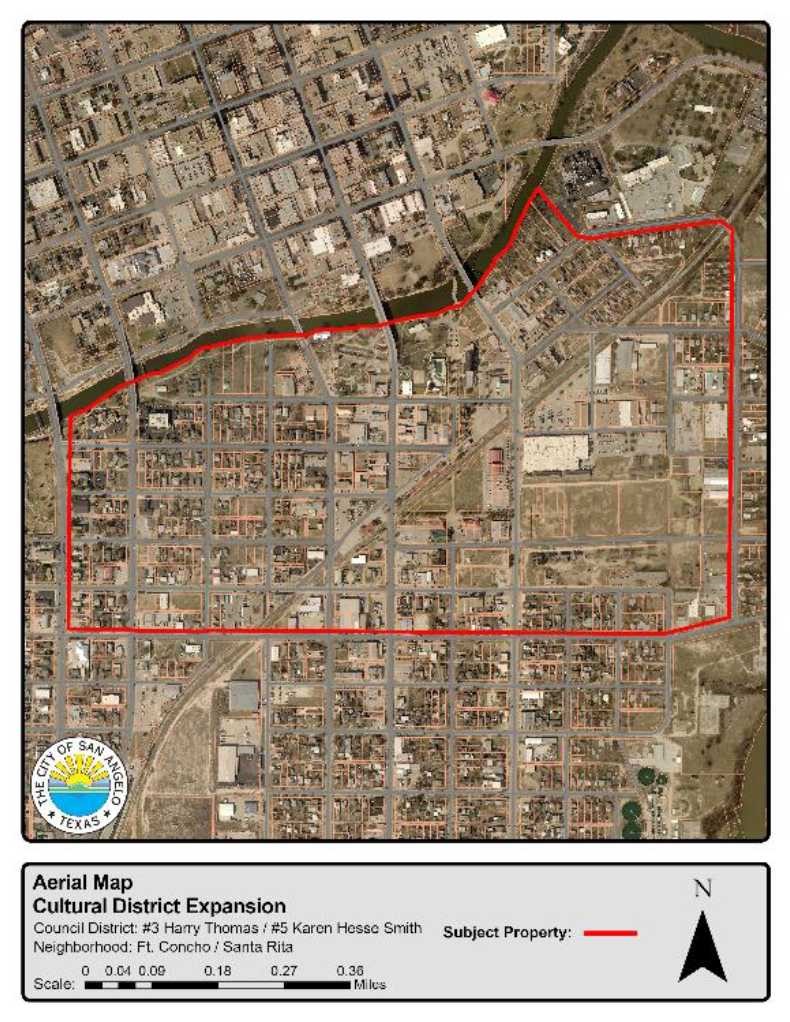
Boundaries are along the Concho River from S. Abe Street east to 222 Allen St. then southeast along Allen St. then turning south onto Rust St. then turning west on E Highland St. then north on Abe St. back to the Concho River. All properties and parts of properties within this boundary will be within the Cultural District (CD) zoning overlay.
IV.
Procedure for Zoning Designations
1)
As an overlay zoning district, the Cultural District Overlay (CD) shall be applicable in all zoning districts, or portions thereof within the district boundaries with the following exceptions:
a.
The areas with current single-family residential (RS-1) zoning located within the following boundaries and addresses: Beginning at the intersection of Rust St. and Baker St. heading east to the intersection of Wool St., Porter St. and Baker St. then turning Northwest along Porter Street, 167.5' past Bird St. and Allen St. turn right along the midline of the alleyway between Bird St. and Allen St. to the middle line of the alleyway between Bird St. Turn right onto Webb St. and following until the midline of the Texas Pacifico Railroad ROW. Turn left at the midline of the Texas Pacifico Railroad ROW heading northeast until the rail bridge intersects with Rust St. Follow Rust Street south until you intersect with Baker St. All areas within the boundary will be zoned low-rise multifamily (RM-1).
b.
Beginning at the intersection of W. Ave A and S. Randolph St. head east 695' to the alleyway running north and south between Hill St. and S. Irving St. Turn south at the alleyway for 340' to the midline of W. Ave. B then turn west along W. Ave. B to the intersection of Hill St. and W. Ave B. Turn South on Hill St until the intersection of Hill St. and W. Ave C. Turn right for 159' to the property line between 125 and 117 W. Ave C, turn south along the property line for 166' to the alleyway between W. Ave C and W. Ave D. turning east for 107' then south along the alleyway between Hitt St. and S. Irving St. for 176' until the midline of W Ave D. Turn West along W. Ave D until the intersection of W. Ave D and Hill St. At the Hill St. and W. Ave D intersection turn south on Hill St. for 168' until the alleyway between W. Ave D and W. Washington Dr. Turn west at midline of the alleyway for 816' past S Randolf St to the western property line of 325 W Ave D. Turn north along the western property line of 325 W Ave D for 165' to the midline of W. Ave D; turn east 12' to align with the western property line of 326 W. Ave D. then turn north along the 326 W Ave D property line for 169' to the midline of the alleyway between W. Ave D and W Ave C. then east for 18' to align with the western property line of 319 W. Ave C then north for 165' to the midline of W. Ave C. Turn west along W. Ave C to the intersection of W. Ave C and S. Koenigheim St. Turn north for 172' until the alleyway between W. Ave C and W. Ave B. Tuen east at the midline of the alleyway for 90' to the western property line of 329 W. Ave B. Turn north along the western property line of 329 W. Ave B for 168' to the midline of W. Ave B. Tuen east along W Ave B until the intersection of S. Randolph St and W. Ave B. Turn north on S. Randolph St. until the intersection of W. Ave A. All areas within the boundary will be zoned low-rise multifamily (RM-1).
The remaining areas shall be mixed-used from residential household living, neighborhood commercial, office warehouse, office commercial, manufacturing by artisans, and general commercial in nature; see Section 304(G), Cultural District Overlay (CD).
2)
Cultural District Overlay (CD) is intended to provide opportunities to promote the traditional and cultural heritage of San Angelo as an artistic celebration of cultures which serves a variety of needs in a relatively confined area. The district is intended to include office, retail sales, repair and service businesses, commercial recreation and entertainment, as well as residential uses. Development should complement neighboring activities in the area and promote a variety marketplace concept to enhance our historical and cultural assets of Fort Concho, El Paseo de Santa Angela, Municipal Pool, San Angelo Fine Arts Museum, Welcome Center and the Concho River.
3)
Short-Term Rentals shall be allowed by right within the Cultural District subject to annual review set forth in Section 406.
4)
Properties designated with a Historic Overlay or within a Historic District shall remain with those designations which fall within the Cultural District boundaries.
5)
Outdoor storage is limited to 30% of the CD zoned property.
a.
All outdoor storage by manufacturing and office warehouse, as well as previous uses of Heavy Commercial (CH) and Light Manufacturing (ML) shall be screened with opaque fencing which can display art and cultural scenes.
b.
All outdoor screening or opaque fencing shall be reviewed under Section 212 or Section 213 as applicable of the Zoning Ordinance.
c.
Exceptions:
i.
Manufacturing by artisan can be up to 50% outdoor storage to display products for sale;
ii.
Household living;
iii.
Public art on public property.
6)
Parking requirements can be modified under Section 511 in the Cultural District Overlay. Protection for residential properties shall be the guiding principles for parking decisions.
a.
New land use only parking lots shall have a landscape buffer of a minimum 5' from all property lines adjacent to street frontages except for drive approaches.
i.
For every 25 linear feet; one street tree and four shrubs shall be required;
ii.
Turf material can be the following:
1.
Xeriscape, or
2.
Live turf grasses, or
3.
Artificial turf types, or
4.
Maintained mulched planting beds.
V.
Specific uses and sign types restricted or not allowed in the Cultural District Overlay
a.
All signs in the District shall follow Section 12.04.017 of the Sign Ordinance and Section 211 or Section 212 as applicable of the Zoning Ordinance.
b.
All Banner style signs restricted to 30 days and only three times per year and must be reviewed under the Section 211 or Section 212 as applicable of the Zoning Ordinance.
c.
Electronic Message signs.
i.
Shall be reviewed under Article 12.04 Signs;
ii.
Shall be limited to a 15 square feet in size or smaller;
iii.
Shall be dimmed to 250 nits from dusk to dawn; and
iv.
Shall be reviewed under Section 212 or Section 213 as applicable of the Zoning Ordinance.
d.
The Fort Concho Historic District sign regulations will be applied to the buffer zone described in Section 12.04.018.
e.
Intermodal containers shall not be allowed on residential use properties. Intermodal containers used for storage only on commercial properties are allowable with the following options for screening:
i.
Opaque fencing meeting a minimum of 6' in height; or
ii.
Landscaping large enough to cover 60% of the vertical height of the container(s), and 80% of the horizontal width of the container(s); or
iii.
A full mural covering the visible side of the container from the right-of-way.
f.
Community Services of itinerant sheltering or alcohol and drug treatment shall not be allowed as a new use.
VI.
Development Standards in Cultural District Overlay
1.
2.
Property uses, signs and buildings which would not conform to the new Cultural District Overlay Zone (CD) would continue to be legal nonconforming until they reach a status applied under Article 6 - Nonconformities and the property has been vacated for two years losing their Building Code occupancy thus triggering a change of occupancy.
VII.
Procedures for Design Review
a.
Review of applications within the Cultural District Overlay shall follow the procedures set forth under Section 211 or Section 212 as applicable of the Zoning Ordinance.
b.
The provisions of the Cultural District Overlay apply specifically to exterior alterations, demolition, construction, moving in or removal of buildings, or structures within the boundaries of said overlay zone, on public or private property. Such activity proposed to be undertaken within a Cultural District Overlay shall be subject to approval of Design and Historic Review Commission and all conditions set forth therein, except as otherwise specified in Section 212(C) - Review by Planning Director.
c.
Public Art in this district shall be under the purview of the Public Arts Commission and/or City Council.
d.
In general, design changes should meet one or more of the following requirements:
i.
River Corridor Master Development Plan: 2006 Edition (RCMDP).
ii.
Possesses significance with respect to history, culture, architecture, archeology, paleontology, or as a natural site with a demonstrable cultural association.
iii.
Is associated with events that have made a significant contribution to the broad patterns of local, regional, state, national, or international history.
iv.
Embodies characteristics distinct to a type, period, or method of construction or architecture.
v.
Is associated with the lives of persons significant in local, regional, state, national, or international history.
vi.
Represents a distinctive and familiar visual feature of a neighborhood or of the city.
vii.
Represents the works of a master designer, architect, builder, or craftsman.
(Ord. No. 2019-120, § 1, 9-17-19; Ord. No. 2025-046, § 1(Exh. A), 5-6-25)
Sec. 312. - OS (Open Structure) Overlay Zone
A.
Purpose. The Zoning Ordinance of the City of San Angelo stipulates minimum open space required around the front and sides of most lots occupied by residences. Buildings are not generally allowed within such open space, so these required yards are sometimes referred to as minimum building setbacks. All roof-covered structures (including carports and porches) are considered buildings and are, therefore, generally subject to minimum building setback standards. Within an Open Structure (OS) Overlay Zone, however, open carports and porches shall be allowed to extend into minimum front and/or side yards which otherwise are required to be free of any buildings, subject to the conditions expressed herein this section.
For the purpose of this section, a carport shall be defined as a roof-covered structure accessory to a residence, substantially open on at least two of its sides, and which is designed or used for the storage of motor vehicles for the occupants of the residence to which it is accessory.
For the purpose of this section, a porch shall be defined as a roof-covered platform which is accessory to a residence, is usually attached to or part of and with direct access to such residence, and which is substantially open on at least two of its sides.
B.
Applicability. Allowances and conditions stipulated within this section concerning Open Structure (OS) Overlay Zones shall be applicable to any lot within the boundaries of such zones having been duly established by amendment to the official zoning map and which, furthermore, meets one of the following additional requirements:
1.
is located within an RS-1 District;
2.
is located within an RS-2 District;
3.
is located within an MHS District;
4.
is located within an RM-1 District;
5.
is located within an RM-2 District; or
6.
is located within a Commercial or Manufacturing zoning district, occupied by one or more residential building(s).
C.
Conditions Required for Carports and Porches Extending into Minimum Front and/or Side Yards Required on Lots in Open Structure (OS) Overlay Zones.
1.
Such carports and porches must be substantially open in character. To this end, a minimum of 7 feet from the finished floor (platform) level of any such carport or porch extending into minimum front and/or side yards shall be open and unencumbered by any structure, walls, screening, glasswork or ornamental components of any kind, except as follows:
a.
necessary vertical supports which shall be no greater than 12 inches in width or diameter; and
b.
if the carport or porch borders the wall of a building to which such carport or porch is attached, then any such side(s) of the carport or porch may be enclosed by said building wall.
2.
The leading edge or face of the roof covering any such carport or porch shall:
a.
not be closer than 5 feet from the front lot boundary and, furthermore, shall be separated by at least ten feet from the back of the street curb or, if a curb does not exist, from the edge of any street surface; and
b.
not be closer than 2 feet from any side lot boundary and, furthermore, shall be separated by at least 5 feet from the back of the street curb or, of [if] a curb does not exist, from the edge of any street surface.
3.
Neither the roof nor any vertical support for the roof on such carport or porch shall encroach into public rights-of-way for a street or alley, into an easement specifically designated to be open or unencumbered, or onto an adjacent lot or tract of land under the control of another party.
4.
Not more than 30 percent of minimum front yard area otherwise required on the lot shall be covered by the roof on a carport or porch allowed by this section.
5.
Other architectural conditions required of carports or porches extending into minimum front and/or side yards (otherwise required by the Zoning Ordinance) shall include the following:
a.
The roof covering on any such carport or porch shall be generally consistent with the materials, character and appearance of the roof covering the residence (including attached garage) to which that carport is accessory, unless such carport or porch is instead connected or adjacent to a detached accessory building, in which case the roof covering on that carport or porch shall be consistent with the materials, character and appearance of the roof covering that detached accessory building.
b.
Except as otherwise stated below, the pitch or shape of the roofline on any such carport or porch shall be integrated and consistent with the character and appearance of the roofline on the residence (including attached garage) to which that carport or porch is accessory, unless such carport is instead connected or adjacent to a detached accessory building.
(1)
If more than one roofline exists on such residence, then the pitch or shape of the roofline on the subject carport or porch shall be consistent with the character and appearance of the roofline on whatever portion of such residence is located closest to that carport or porch.
(2)
Roofs covering carports or porches may be flat or otherwise vary from the pitch or shape of the roofline on the residence to which that carport is accessory, in the following circumstances:
(a)
such carport or porch is connected or adjacent to a detached accessory building, or
(b)
such carport or porch is located interior to the lot and is substantially away from street view.
c.
For the purpose of enforcing the architectural conditions of this subsection, an applicant for permit to build a carport or porch potentially allowed (by this section) to extend into front or side yards required on a lot shall submit detailed construction drawings, exterior elevation drawings and specifications for the materials planned to be used in constructing the proposed carport or porch. The drawings must indicate how the proposed improvement will relate architecturally to the existing residence and/or accessory structure beside which the new carport or porch is proposed. Such drawings and specifications shall be submitted to the Building Official or his/her designee, in addition to whatever data is ordinarily required with an application for permit to build a carport or porch.
D.
Continuing Compliance
1.
For carports and porches allowed to extend into minimum front or side yards required on a lot, by the provisions of this section, it shall be a continuing obligation of the owner or occupant (of the residence to which such carport or porch is accessory) to comply with all above-stated conditions as well as with the following additional standard:
a.
The area underneath any such carport or porch shall remain clear of any junk, household trash, yard trash, debris or any and all other objectionable unsightly matter.
(Section 309 added by sec. 2, Ordinance adopted 2-15-05; Ord. No. 2019-121, § 2, 9-17-19)
Editor's note— Ord. No. 2019-121, § 2, adopted September 17, 2019, renumbered Secs. 309—317 as Secs. 312—320.
Sec. 313. - Use Table
All of the use categories listed in the Table below are explained in Sec. 312 through 317. The second column of the use table contains an abbreviated explanation of the respective use category. If there is a conflict between the abbreviated definition and the full explanation in Secs. 312 through 317, the provisions of Secs. 312 through 317 shall control.
A.
Allowed Uses. Uses identified with an "A" are allowed by right as set forth in Sec. 213. An "*" identifies uses that may be subject to additional specific use regulations set forth later in Article 4.
B.
Conditional Uses. Uses identified with a "C" are allowed subject to approval by the Planning Commission as set forth in Sec. 208. An "*" identifies uses that may be subject to additional specific use regulations set forth later in Article 4.
C.
Special Uses. Uses identified with an "S" are allowed subject to approval by the City Council as set forth in Sec. 209. An "*" identifies uses that may be subject to additional specific use regulations set forth later in Article 4.
D.
Excluded Uses. The following uses shall be excluded from any and all zoning districts within the city limits of San Angelo:
1.
Meat and poultry rendering of byproducts; and
2.
Chemical and nuclear waste storage dumps.
E.
Use Table. Allowed, conditional and mandatory planned development uses are set forth in the following Table. Uses that may be subject to additional specific use standards set forth in Article 4 are designated with an "*".
(Ordinance adopted 1-4-00; Ordinance adopted 5-16-06, § 1; Ordinance adopted 9-16-08, § 2; Ordinance adopted 6-15-10, § 1; Ordinance adopted 5-15-12, § 2; Ordinance adopted 4-15-14, § 1; Ordinance adopted 3-17-15, § 1; Ordinance adopted 1-17-17, § 1; Ordinance 2017-06-086, § 1, adopted 6-20-17; Ordinance 2018-054, § 1, adopted 4-17-18; Ord. No. 2019-030, § 1, 3-5-19; Ord. No. 2019-121, § 2, 9-17-19; Ord. No. 2024-029, § 1(Exh. A), 5-7-24; Ord. No. 2025-047, § 1(Exh. A), 5-6-25)
Editor's note— Former Sec. 310, see editor's note at Sec. 312.
Sec. 314. - Residential Structure Types
Household and Group Living uses must comply with the following table in regard to location of individual structure types. Residential Household and Group Living uses must comply with the following table in regard to location of individual structure types. Residential uses allowed in nonresidential districts may be housed in any type of residential structure except single-family detached and mobile and manufactured homes. All structure types are defined in Article 8, and additional standards are included in Section 501 for zero lot line dwellings, twinhomes and townhouses.
*Refer to Section 501 for additional standards.
**Structure type allowed only with approved group living use.
*** Refer to Section 501.F and Article 12.03 for additional standards.
(Ordinance adopted 1-4-00; Ordinance 2017-09-131, § 4, adopted 9-5-17; Ord. No. 2019-121, § 2, 9-17-19)
Editor's note— Former Sec. 311, see editor's note at Sec. 312.
Sec. 315. - Use Categories; General
A.
Basis for Classifications. Use categories classify land uses and activities into use categories based on common functional, product, or physical characteristics. Characteristics include the type and amount of activity, the type of customers or residents, how goods or services are sold or delivered and site conditions. The use categories provide a systematic basis for assigning present and future land uses into appropriate zoning districts.
B.
Principal Use Characteristics. Principal uses are assigned to the category that most closely describes the nature of the principal use. The "Characteristics" subsection of each use category describes the common characteristics of each principal use.
1.
Considerations Used in Categorizing Principal Uses. The following considerations shall be used to determine what category a use is in and whether the activities are to be considered principal or accessory uses.
a.
The actual or projected characteristics of the activity in relationship to the stated characteristics of each use category.
b.
The relative amount of site area or floor space and equipment devoted to the activity.
c.
Relative amounts of sales from each activity.
d.
The customer type for each activity.
e.
The relative number of employees in each activity.
f.
Hours of operation.
g.
Building and site arrangement.
h.
Vehicles used with the activity.
i.
The relative number of vehicle trips generated by the use.
j.
Signs.
k.
How the use advertises itself.
l.
Whether the activity is likely to be found independent of the other activities on the site.
2.
Developments with Multiple Principal Uses. When all principal uses of a development fall within one use category, the entire development is assigned to that use category. A development that contains a coffee shop, bookstore and bakery, for example, would be classified in the Retail Sales and Service category because all of the development's principal uses are in that category. When the principal uses of a development fall within different use categories, each principal use is classified in the applicable category and each use is subject to all applicable regulations for that category.
C.
Accessory Uses. Accessory uses are allowed by-right only in conjunction with a principal use. Unless otherwise stated, accessory uses are subject to the same regulations as the principal use. See also Sec. 402. Common accessory uses are listed as examples in the use category descriptions.
D.
Use of Examples. The "Examples" subsection of each use category lists common examples of uses included in the respective use category. The names of these sample uses are generic. They are based on common meanings and not on what a specific use may call itself. For example, a use that calls itself "Wholesale Warehouse" but that sells mostly to consumers, is included in the Retail Sales and Service category rather than the Wholesale Trade category. This is because the actual activity on the site matches the description of the Retail Sales and Service category.
(Ordinance adopted 1-4-00; Ord. No. 2019-121, § 2, 9-17-19)
Editor's note— Former Sec. 312, see editor's note at Sec. 312.
Sec. 316. - Residential Use Categories
A.
Group Living
1.
Characteristics. Group Living is characterized by the residential occupancy of a structure by a group of people who do not meet the definition of Household Living. The size of the group may be larger than the average size of a household. Tenancy is arranged on a monthly or longer basis. Uses where tenancy may be arranged for a shorter period are not considered residential. They are considered to be a form of transient lodging (see the Retail Sales and Service and Community Service categories). Generally, Group Living structures may often, but are not required to, have a common eating area for residents. The residents may receive care, training, or treatment.
2.
Accessory Uses. Accessory uses commonly associated with Group Living are recreational facilities and parking of vehicles for occupants and staff.
3.
Examples. Examples of Group Living include dormitories; fraternities and sororities; monasteries and convents; rooming and boarding houses; assisted living facilities for elderly residents; nursing and convalescent homes; some group homes for the physically or developmentally disabled, mentally or emotionally disturbed; temporary housing of more than one month but less than six months; and workforce housing. (Subsection 3. amended by sec. 2, Ordinance adopted 4-15-14)
4.
Exceptions
a.
Lodging where tenancy may be arranged for periods of less than 30 days is considered a hotel or motel use and classified in the Retail Sales and Service category.
b.
Lodging where the residents meet the definition of Household and where tenancy is arranged on a month-to-month basis, or for a longer period, is classified as Household Living.
c.
Facilities for rehabilitation of residents with alcohol- or drug-related dependencies are considered Recovery Facilities.
d.
Facilities for people who are under judicial detainment and under the supervision of sworn officers are included in the Detention Facilities category.
e.
A Community Home for occupancy by as many as 6 disabled persons and 2 supervisors may be classified as either Household Living or as Group Living, so long as such facility conforms to all applicable standards of Article 4 in this Zoning Ordinance.
B.
Household Living
1.
Characteristics. Household Living is characterized by the residential occupancy of a dwelling unit by a household. Tenancy is arranged on a month-to-month or longer basis. Uses where tenancy may be arranged for a shorter period are not considered residential. They are considered to be a form of transient lodging (see the Retail Sales and Service and Community Service categories).
2.
Accessory Uses. Accessory uses commonly associated with Household Living are recreational activities, raising of pets, hobbies, home occupations, storage of household goods, storage of supplies and equipment for maintaining the dwelling and associated yard, and parking and occasional maintenance of the occupants' vehicles.
3.
Examples. Uses include living in dwelling units found in single-family houses, duplexes, triplexes, fourplexes, twinhomes, townhouses and other multi-dwelling structures, retirement center apartments, manufactured housing and other structures with self-contained dwelling units. A Community Home for occupancy by as many as 6 disabled persons and 2 supervisors may be classified as Household Living, so long as such facility conforms to all applicable standards of Article 4 in this Zoning Ordinance.
4.
Exceptions. Lodging in a dwelling unit rented on less than a monthly basis, or where less than two-thirds of the units are rented on a monthly or longer basis is considered a hotel or motel use and is classified in the Retail Sales and Service category.
C.
Recovery Facilities
1.
Characteristics. Recovery facilities are characterized by programs that provide care and training or treatment for psychiatric, alcohol or drug problems, where patients are residents of the program, but where patients are not supervised by sworn officers. The size of the group may be larger than the average size of a household. Generally, Recovery Facilities may often, but are not required to, have a common eating area for residents. The residents may also receive care, training, or treatment.
2.
Accessory Uses. Accessory uses commonly associated with Recovery Facilities are recreational facilities and parking of vehicles for occupants and staff.
3.
Examples. Examples of Recovery Facilities include psychiatric, alcohol- or drug-dependency or rehabilitation centers.
4.
Exceptions. Facilities for people who are under judicial detainment and under the supervision of sworn officers are included in the Detention Facilities category.
(Ord. No. 2019-121, § 2, 9-17-19)
Editor's note— Former Sec. 313, see editor's note at Sec. 312.
Sec. 317. - Institutional and Civic Use Categories
A.
Colleges
1.
Characteristics. This category includes colleges and other institutions of higher learning that offer courses of general or specialized study leading to a degree. Colleges tend to be in campus-like settings or on multiple blocks.
2.
Accessory Uses. Accessory uses include offices, housing for students, food service, laboratories, health and sports facilities, theaters, meeting areas, parking, maintenance facilities and support commercial.
3.
Examples. Examples include universities, liberal arts colleges, community colleges, nursing and medical schools not accessory to a hospital and seminaries.
4.
Exceptions. Business and trade schools are classified as Retail Sales and Service.
B.
Community Services
1.
Characteristics. Community Services are uses of a public, non-governmental but not-for-profit, social service, or charitable nature generally providing a local service to people of the community. Generally, they provide the service on-site or have employees at the site on a regular basis. The service is ongoing, not just for special events. Community centers or facilities that have membership provisions should be open to the general public to join at any time (for instance, any senior citizen could join a senior center). The use may provide special counseling, education, or training of a public, nonprofit or charitable nature.
2.
Accessory Uses. Accessory uses may include offices; meeting areas; food preparation areas; parking, health and therapy areas; and athletic facilities.
3.
Examples. Examples include libraries, museums, senior centers, community centers, publicly owned swimming pools, youth club facilities, hospices, social service facilities, temporary shelters, vocational training for persons with physical or mental disabilities, crematoriums, columbariums and mausoleums.
4.
Exceptions
a.
Private lodges, clubs and private or commercial athletic or health clubs are classified as Retail Sales and Service.
b.
Commercial museums are classified as Retail Sales and Service.
c.
Parks are classified as Parks and Open Areas.
d.
Uses where tenancy is arranged on a month-to-month basis, or for a longer period, are residential and are classified as Household or Group Living.
C.
Day Care
1.
Characteristics. Day Care uses provide care, protection and supervision for children or adults on a regular basis, away from their primary residence, for less than 24 hours per day.
2.
Accessory Uses. Accessory uses include offices, outdoor recreation areas and parking.
3.
Examples. Examples include preschools, child care centers, nursery schools, latch key (after school) programs and adult day care programs.
4.
Exceptions. Day Care does not include public or private schools or facilities operated in connection with an employment use, shopping center or other principal use, where children are cared for while parents or guardians are occupied on the premises or in the immediate vicinity. Certain limited day care operations are allowed in all residential districts, as customary home occupations, subject to specific standards of Sec. 414.
D.
Detention Facilities
1.
Characteristics. Detention Facilities includes facilities for the judicially required detention or incarceration of people. Inmates and detainees are under 24-hour supervision by sworn officers, except when on an approved leave.
2.
Accessory Uses. Accessory uses include offices, recreational and health facilities, therapy facilities, maintenance facilities, hobby and manufacturing activities.
3.
Examples. Examples include prisons, jails, probation centers and juvenile detention homes.
4.
Exceptions
a.
Programs that provide care and training or treatment for psychiatric, alcohol, or drug problems, where patients are residents of the program, but where patients are not supervised by sworn officers, are classified as Group Living.
b.
Programs that provide transitional living experience for criminal offenders, such as halfway houses or restitution centers where residents are not under 24-hour supervision, are classified as Group Living.
E.
Hospitals
1.
Characteristics. Hospitals include uses providing medical or surgical care to patients and offering overnight care.
2.
Accessory Uses. Accessory uses include outpatient clinics, offices, laboratories, teaching facilities, meeting areas, cafeterias and other support commercial activity, parking, maintenance facilities and housing facilities for staff or trainees.
3.
Examples. Examples include medical centers and hospitals.
4.
Exceptions
a.
Uses that provide exclusive care and planned treatment or training for psychiatric, alcohol, or drug problems, where patients are residents of the program, are classified in the Recovery Facility category.
b.
Medical clinics that provide outpatient medical or surgical care exclusively, where patients are not kept overnight, are classified as Office.
c.
Emergency medical clinics are classified as Retail Sales and Service.
d.
Nursing and convalescent homes are classified as Group Living.
F.
Parks and Open Areas
1.
Characteristics. Parks and Open Areas are uses of land focusing on natural areas, large areas consisting mostly of vegetative landscaping or outdoor recreation, community gardens, or public squares. Land characterized as Parks and Open Area tends to have few structures.
2.
Accessory Uses. Accessory uses may include clubhouses, maintenance facilities, concessions, indoor recreation or education centers, caretaker's quarters and parking.
3.
Examples. Examples include parks, cemeteries, public squares, plazas, recreational trails, botanical gardens, nature preserves and land used for grazing animals (not part of a farm or ranch) kept for personal use and enjoyment.
4.
Exceptions
a.
Golf courses and golf driving ranges are not classified as Parks and Open Areas. Golf courses and golf driving ranges comprise a separate use category.
b.
Facilities intended to draw large numbers of people to specific events or shows are classified as Entertainment Events, Major. These include fairgrounds, sports arenas and outdoor amphitheaters.
G.
Religious Institutions
1.
Characteristics. Religious Institutions primarily provide meeting areas for religious worship and education.
2.
Accessory Uses. Accessory uses include classroom and meeting facilities used primarily for religious education, parking, caretaker's housing and on-site group living facilities such as convents, parsonages and rectories.
3.
Examples. Examples include churches, temples, synagogues and mosques.
4.
Exceptions.
a.
Ministries offering service to the general public, such as marriage counseling, are classified as Office.
b.
Public and private schools providing curriculum equivalent to a primary or secondary school are classified as Schools.
H.
Safety Services
1.
Characteristics. Safety Services are uses that provide public safety and emergency response services. They often need to be located in or near the area where the service is provided. Employees are regularly present on-site.
2.
Accessory Uses. Accessory uses include offices and parking.
3.
Examples. Examples include fire stations, police stations and emergency medical and ambulance stations.
I.
Schools
1.
Characteristics. This category includes public and private schools providing a basic curriculum equivalent to an elementary or secondary school.
2.
Accessory Uses. Accessory uses include play areas, cafeterias, recreational and sport facilities, auditoriums and before- or after-school day care.
3.
Examples. Examples include public and private daytime schools, boarding schools and military academies.
4.
Exceptions
a.
Preschools are classified as Day Care uses.
b.
Business and trade schools are classified as Retail Sales and Service.
J.
Utilities, Basic
1.
Characteristics. Basic Utilities are infrastructure service facilities that need to be located in or near the area where the service is provided. Basic Utility uses generally do not regularly have employees at the site. Services may be publicly provided, or provided by locally franchised private utility services.
2.
Accessory Uses. Accessory uses may include parking and control, monitoring, data or transmission equipment.
3.
Examples. Examples include water and sewage pump stations; electrical substations; water towers and reservoirs; stormwater retention and detention facilities; telephone exchanges; and park-and-ride facilities for mass transit.
4.
Exceptions
a.
Services where people are generally present are classified as Community Services, Offices, or Safety Services.
b.
Utility offices where employees or customers are generally present are classified as Offices.
c.
Bus barns are classified as Warehouse and Freight Movement.
d.
Yards and structures used for storage and servicing of utility-related vehicles, material and equipment are classified Industrial Services.
(Ordinance adopted 1-4-00; Ordinance 2017-06-086, § 2, adopted 6-20-17; Ord. No. 2019-121, § 2, 9-17-19)
Editor's note— Former Sec. 314, see editor's note at Sec. 312.
Sec. 318. - Commercial Use Categories
A.
Alcoholic Beverage Sales for On-Premises Consumption
1.
Characteristics. An establishment where liquor, wine, beer or any other alcoholic beverages are sold and consumed by the patrons, on the premises, whether served with or without food or other refreshment. An establishment that does not meet the requirements for the issuance of a Food and Beverage Certification from the Texas Alcoholic Beverage Commission pursuant to Section 25.13 of the Texas Alcoholic Beverage Code.
2.
Accessory Uses. Food service, dancing and live entertainment shall be allowed on the premises as an accessory use, subject to applicable standards for adult entertainment enterprises and sexually oriented businesses described elsewhere in this Zoning Ordinance.
3.
Examples. Examples include but are not limited to bars, taverns and nightclubs.
4.
Exceptions. A restaurant or other private establishment which provides seating arrangement for patrons to consume on-site prepared food and other refreshment, in which alcoholic beverages are provided as a supplemental service, meeting the requirements for issuance of a Food and Beverage Certificate from the Texas Alcoholic Beverage Commission pursuant to Section 25.13 of the Texas Alcoholic Beverage Code.
Editor's note— Subsection A. was added and the remaining subsections renumbered by Ordinance adopted 10-21-03.
B.
Auto and Boat Dealers
1.
Characteristics. Auto Sales firms involve the sales or leasing of consumer vehicles including passenger vehicles, motorcycles, light and medium trucks, recreational vehicles and boats.
2.
Accessory Uses. Vehicle Repair and maintenance shall be allowed on the same lot as an Auto or Boat Dealer, so long as such repair and maintenance is clearly subordinate, accessory and incidental to the Auto or Boat Dealer.
3.
Exceptions
a.
Sales, rental or leasing of heavy trucks and equipment or manufactured housing units are classified as Wholesale Trade.
C.
Campground/Recreational Vehicle Park
1.
Characteristics. Campgrounds and recreational vehicle parks are intended for camping units or recreational vehicles (of the general public) occupied as temporary living quarters for recreational, educational or vacation purposes.
2.
Accessory Uses. Accessory uses include laundry facilities, convenience groceries, indoor/outdoor games and boat rental.
3.
Exceptions. Travel trailers, motorized recreational vehicles and other such relocatable housing that does not meet the definition of either a "mobile home" or of "manufactured housing" may be occupied within a manufactured housing park, provided these types of accommodations do not exceed 30 percent of the total units in the park.
D.
Office
1.
Characteristics. Office uses are characterized by activities conducted in an office setting and generally focusing on business, government, professional, medical, or financial services.
2.
Accessory Uses. Accessory uses may include sundry shops, cafeterias, health facilities, parking, or other amenities intended primarily for the use of employees in the firm or building.
3.
Examples. Examples include professional services such as lawyers, accountants, engineers, or architects; financial businesses such as lenders, brokerage houses, bank headquarters, or real estate agents; data processing; sales offices; government offices and public utility offices; TV and radio studios; medical and dental clinics (not including veterinary clinics), medical and dental labs; and blood-collection facilities.
4.
Exceptions
a.
Offices that are part of and located with a principal use in another category are considered accessory to the firm's primary activity. Headquarters offices, when located on the same premises as or adjacent to a principal use in another category, are considered part of the other category.
b.
Offices for construction contractors and others who perform services off-site are included in the Office category if equipment and materials are not stored on the office site and fabrication, services, or similar work is not carried on at the office site.
c.
Veterinary clinics for small, non-hoofed animals shall be classified as a separate use category. Veterinary clinics for large, hoofed animals shall be classified as Industrial Services.
E.
Parking, Commercial
1.
Characteristics. Commercial Parking facilities provide parking that is not accessory to a specific use. A fee may or may not be charged. A facility that provides both accessory parking for a specific use and regular fee parking for people not connected to the use is also classified as a Commercial Parking facility.
2.
Accessory Use. In a parking structure only, accessory uses may include gasoline sales, car washing and vehicle repair activities if these uses provide service only to vehicles parked in the garage.
3.
Examples. Examples include short- and long-term fee parking facilities and mixed parking lots (partially accessory to a specific use, partly for rent to others).
4.
Exceptions
a.
Parking facilities that are accessory to a use, but for which a fee is charged to the public to park for occasional events nearby, are not considered Commercial Parking facilities.
b.
Parking facilities that are accessory to a principal use are not considered Commercial Parking uses, even if the operator leases the parking facility to the principal use or charges a fee to the individuals who park in the facility.
c.
Public transit park-and-ride facilities are classified as Basic Utilities.
F.
Plant Nurseries
1.
Characteristics. Plant Nurseries are comprised of land and buildings used for floricultural or horticultural plant production for retail or wholesale trade. This use category includes commercial greenhouses where the roof and sides of such buildings are made largely of transparent/translucent materials and in which temperature and humidity can be regulated for cultivation of delicate or out-of-season plants, for subsequent sale.
2.
Accessory Uses. Accessory uses include office buildings, barns and sheds for storing materials and equipment, [and] buildings for allowable retail sales. Selling lawn and garden supplies and equipment as well as plant material produced off-premises is ordinarily allowed in conjunction with a plant nursery, except in an R&E District.
3.
Exceptions. In R&E Districts, the only retail sales allowed are of plant material produced on those same premises. In R&E Districts, plant nurseries shall not include sales of lawn and garden supplies and equipment, nor shall the sale of plant material produced off-premises be allowed.
G.
Recreation and Entertainment, Outdoor
1.
Characteristics. Outdoor Recreation and Entertainment uses are large, generally commercial uses that provide continuous recreation or entertainment-oriented activities. They primarily take place outdoors. They may take place in a number of structures that are arranged together in an outdoor setting.
2.
Accessory Uses. Accessory uses may include concessions, restaurants, parking, caretaker's quarters and maintenance facilities.
3.
Examples. Examples include amusement parks, theme parks, miniature golf facilities and zoos.
4.
Exceptions
a.
Golf courses and golf driving ranges are classified as a separate, distinct use category.
b.
Uses that draw large numbers of people to periodic events, rather than on a continuous basis, are classified as Major Entertainment Events.
c.
An amusement facility housed entirely indoors is classified as Retail Sales and Service.
H.
Retail Sales and Service
1.
Characteristics. Retail Sales and Service firms are involved in the sale, lease or rent of new or used products to the general public. They may also provide personal services or entertainment, or provide product repair or services for consumer and business goods.
2.
Accessory Uses. Accessory uses may include offices, storage of goods and equipment, manufacture or repackaging of goods for on-site sale, and parking.
3.
Examples. Examples include uses from the four following groups:
a.
Sales Oriented: Stores selling, leasing, or renting consumer, home and business goods generally intended for actual use by the buyer or renter and not for resale, including art, art supplies, bicycles, clothing, dry goods, electronic equipment, fabric, furniture, garden equipment and supplies, gifts, groceries, hardware, home improvements, household products, jewelry, pets, pet food, pharmaceuticals, plants, printed material, stationery and videos.
b.
Personal Service Oriented: Branch banks, emergency medical care; laundromats, photographic studios; photocopy and blueprint services; print shops and lithographers (where finished goods are sold primarily on-site and to the general public, not to wholesalers); hair, tanning and personal care services; photo developing and clothes cleaning with customer drop-off and pickup; business, martial arts and other trade schools; dance or music classes, taxidermists; funeral homes; and animal grooming.
c.
Entertainment Oriented: Restaurants, cafes, delicatessens; indoor continuous entertainment activities such as arcades, bingo, bowling alleys and ice rinks; billiards/pool halls, dance halls; theaters, health clubs, gyms, membership clubs and lodges; hotels and motels.
d.
Repair Oriented: Repair of televisions, bicycles, clocks, watches, shoes, guns, small appliances and office equipment; tailoring; locksmith; and upholsterers.
4.
Exceptions
a.
Repair and service of household consumer motor vehicles, motorcycles and light and medium trucks is classified as Vehicle Repair. Repair and service of industrial vehicles and equipment and heavy trucks is classified as Industrial Service.
b.
Sales, rental, or leasing of heavy trucks and equipment or manufactured housing units are classified as Wholesale Trade.
c.
Hotels, restaurants and other services that are part of a truck stop are considered accessory to the truck stop which is classified as Industrial Service. In certain situations, hotels and motels may be classified as a Community Service use, such as short-term housing or mass shelter. See "Community Services."
d.
Auto and boat dealers are not classified as Retail Sales and Services. Auto and boat dealers are classified as a separate use category.
e.
Sales of farm and ranch supplies and/or equipment are classified as Wholesale Trade.
I.
Self-Service Storage
1.
Characteristics. Self-Service Storage uses provide separate storage areas for individual or business uses. The storage areas are designed to allow private access by the tenant for storing or removing personal property.
2.
Accessory Uses. Accessory uses may include living quarters for a resident manager or security and leasing offices. Use of the storage areas for sales, service and repair operations, or manufacturing is not considered accessory to the Self-Service Storage use. The rental of trucks or equipment is also not considered accessory to a Self-Service Storage use.
3.
Examples. Examples include facilities that provide individual storage areas for rent. These uses are also called mini-warehouses.
4.
Exceptions. A transfer and storage business where there are no individual storage areas or where employees are the primary movers of the goods to be stored or transferred is in the Warehouse and Freight Movement category.
J.
Vehicle Repair
1.
Characteristics. Vehicle Repair firms service passenger vehicles, light and medium trucks and other household consumer motor vehicles such as motorcycles, boats and recreational vehicles. Generally, the customer does not wait at the site while the service or repair is being performed.
2.
Accessory Uses. Accessory uses may include offices, sales of parts and vehicle storage.
3.
Examples. Examples include general automotive repair; specialty shops for transmission, brake, muffler, radiator or alignment repair; auto body shop; auto upholstery shop; auto customizing; and tire sales and mounting.
4.
Exceptions. Repair and service of industrial vehicles and equipment and of heavy trucks; towing and vehicle storage; and vehicle wrecking and salvage are classified as Industrial Service.
K.
Vehicle Service, Limited
1.
Characteristics. Limited Vehicle Service uses provide direct services to motor vehicles where the driver or passengers generally wait in the car or nearby while the service is performed.
2.
Accessory Uses. Accessory uses may include minor auto repair and minor auto parts sales.
3.
Examples. Examples include full-service, mini-service and self-service fuel stations; and quick lubrication services.
4.
Exceptions. Refueling facilities for vehicles that belong to a specific use (fleet vehicles) are considered accessory uses if they are located on the site of the principal use.
L.
Veterinary Clinics, Small Animals
1.
Characteristics. Diagnosis and treatment of diseases and injuries of animals, especially domestic animals. On-site diagnosis and treatment of large, hoofed animals shall not be allowed at such veterinary clinics. Outside boarding of any animals shall not be allowed.
2.
Accessory Uses. Accessory Uses shall include laboratories, parking, and fenced-in areas for exercising (not boarding) animals admitted for treatment or care.
3.
Exceptions. Veterinary clinics for on-site diagnosis and treatment of large, hoofed animals shall be classified as Industrial Services.
(Ordinance adopted 1-4-00; Ordinance adopted 10-21-03; Ordinance adopted 6-15-10, §§ 2, 3; Ordinance adopted 4-15-14, § 3; Ordinance 2018-054, § 2, adopted 4-17-18; Ord. No. 2018-119, § 1, 10-2-18; Ord. No. 2019-121, § 2, 9-17-19)
Editor's note— Former Sec. 315, see editor's note at Sec. 312.
Sec. 319. - Industrial Use Categories
A.
Frac Sand/Proppant Transloading and Warehousing Operation Use
1.
Characteristics. Frac Sand/Proppant Transloading and Warehousing Operation firms deal in the warehousing, transloading, and/or transport of industrial silica sand, processed frac sand, or proppants to and from any site.
2.
Accessory Uses. Accessory uses may include offices, truck fleet parking and maintenance areas, loading areas, and weigh stations.
3.
Exceptions.
a.
Firms that are involved in the manufacturing processes related to the preparation or processing of industrial silica sand (mineral aggregates or nonmetallic minerals) or proppant shall be classified as Manufacturing and Production and shall be subject to the Zoning Ordinance requirements contained therein.
b.
Firms that are involved in the warehousing, transloading, and/or transport of any frac sand or proppant-related waste material to and from any site shall be classified as Waste-Related and shall be subject to the Zoning Ordinance requirements contained therein.
c.
This use category shall not apply to firms that deal solely in the warehousing and/or transport of nonmetallic mineral products or materials mined from the earth that are typically used in construction, such as stone, gravel, or other aggregates, or their storage, processing, or transportation when the products are not intended to be sold or used as frac sand or proppant.
(Subsection A added by sec. 2, Ordinance adopted 3-17-15)
Editor's note— Former subsections A through F were redesignated as B through G, respectively, and a new subsection A was added by sec. 2 of Ordinance adopted 3-17-15.
B.
Industrial Service
1.
Characteristics. Industrial Service firms are engaged in the repair or servicing of industrial, business or household consumer machinery, equipment, products or byproducts. Firms that service household consumer goods do so by mainly providing centralized services for separate retail outlets. Construction contractors and building maintenance services and similar uses typically perform services off-site. Relatively few customers, especially the general public, come to the site.
2.
Accessory Uses. Accessory activities may include offices, parking and storage.
3.
Examples. Examples include welding shops, machine shops; tool repair; electric motor repair; repair of scientific or professional instruments; sales, repair and/or storage of heavy machinery, metal and building materials; towing and vehicle storage; heavy truck servicing (including wash) and repair; lawn mower service and repair; building, heating, plumbing and electrical contractors; utility, paving and road building contractors; mortuary and crematory services, not on same site as funeral home; large appliance repair; printing, publishing and lithography; exterminating, fumigating and pest control services; lawn and landscaping care and maintenance; janitorial and building maintenance services; sign making; research and development laboratories; industrial laundry, dry cleaning and carpet cleaning plants that primarily accept work from separate retail outlets; and veterinary clinics for large hoofed animals. (Subsection 3. amended by sec. 4, Ordinance adopted 6-15-10)
4.
Exceptions
a.
Construction-related contractors and others who perform services off-site are included in the Office category, if major equipment and materials are not stored at the site and fabrication or similar work is not carried on at the site.
b.
Hotels, restaurants and other services that are part of a truck stop are considered accessory to the truck stop.
c.
Printing, publishing and lithography in which finished goods are sold primarily on-site and to the general public are included in the Retail Sales and Service category.
d.
Sign making operations in which finished goods are limited to those no larger than what can be directly affixed or mounted onto a vehicle, window or wall (without the aid of an overhead crane) may be categorized as Retail Sales and Service. (Subsection d. added by sec. 5, Ordinance adopted 6-15-10)
C.
Manufacturing and Production
1.
Characteristics. Manufacturing and Production firms are involved in the manufacturing, processing, fabrication, packaging, or assembly of goods. Natural, man-made, raw, secondary, or partially completed materials may be used. Products may be finished or semi-finished and are generally made for the wholesale market, for transfer to other plants, or to order for firms or consumers. Goods are generally not displayed or sold on-site, but if so, they are a subordinate part of overall sales. Relatively few customers come to the manufacturing site.
In general, the difference between light and heavy uses is their effect on the surrounding area. If the uses routinely subject the surrounding area to noxious or malodorous impacts, they are considered heavy manufacturing and production. Light manufacturing in general is considered to have fewer noxious effects produced by noise, smoke, odor, dust, vibration or glare, in comparison with heavy manufacturing and production. See Sec. 415 in the Specific Use Standards.
2.
Accessory Uses. Accessory activities may include offices, cafeterias, parking, employee recreational facilities, warehouses, storage yards, repair facilities, truck fleets and caretaker's quarters.
3.
Examples. Examples include processing of food and related products; weaving or production of textiles or apparel; wood products manufacturing; woodworking, including cabinet makers; movie production facilities; production or fabrication of metals or metal products including enameling and galvanizing; manufacture or assembly of machinery, equipment, instruments, including musical instruments, vehicles, appliances, precision items and other electrical items; production of artwork and toys for mass distribution and marketing; and production of prefabricated structures, including manufactured homes.
Examples that are expressly included in the heavy manufacturing and production category include, but are not limited to each of the following:
a.
slaughterhouses and meatpacking;
b.
tanning or curing of furs, skins, leather or hides;
c.
wool pulling and scouring;
d.
cottonseed oil mills;
e.
refining of petroleum and coal products;
f.
manufacture and processing of stone, clay and concrete products;
g.
mixing and batching of concrete and asphalt;
h.
fabrication of boilers and tanks;
i.
manufacture and processing of chemicals, including gaseous products and fertilizer.
4.
Exceptions
a.
Manufacturing of goods (including printed material) to be sold primarily on-site and to the general public are classified as Retail Sales and Service.
b.
Manufacture and production of goods from composting organic material is classified as Waste-Related uses.
c.
Rendering of meat and poultry byproducts shall be prohibited from all zoning districts.
D.
Warehouse and Freight Movement
1.
Characteristics. Warehouse and Freight Movement firms are involved in the storage, or movement of goods for themselves or other firms. Goods are generally delivered to other firms or the final consumer, except for some occasional will-call pickups. There is little on-site sales activity with the customer present.
2.
Accessory Uses. Accessory uses may include offices, truck fleet parking and maintenance areas.
3.
Examples. Examples include separate warehouses used by retail stores such as furniture and appliance stores; household moving and general freight storage; cold storage plants, including frozen food lockers; storage of weapons and ammunition; wholesale distribution centers; truck or air freight terminals; freight forwarding services; bus barns; parcel services; major post offices; grain terminals; gasoline and petroleum product terminals and the stockpiling of sand, gravel, or other aggregate materials.
4.
Exceptions
a.
Uses that involve the transfer or storage of solid or liquid wastes are classified as Waste-Related uses.
b.
Mini-warehouses are classified as Self-Service Storage uses.
c.
Warehousing or freight facilities characterized by stabling or storage of livestock shall be classified as Heavy Manufacturing and Production.
E.
Waste-Related Use
1.
Characteristics. Waste-related uses are characterized by uses that receive solid or liquid wastes from others, for disposal on the site or for transfer to another location, as well as uses that collect sanitary wastes, and uses that manufacture or produce goods or energy from the composting of organic material. Waste-related uses also include uses that receive hazardous wastes from others.
Only certain types of waste-related uses are allowed with the Planning Commission's approval of a Conditional Use, in certain zoning districts. See Section 429 in Article 4 on Specific Use Standards.
2.
Accessory Uses. Accessory uses may include offices as well as repackaging and transshipment of byproducts.
3.
Examples. Examples include auto salvage yards, metal scrap yards, sanitary landfills, recyclable materials collection centers, waste composting plants, energy recovery plants, wastewater reclamation plants and hazardous waste collection sites.
4.
Exceptions. Disposal of dirt, concrete, asphalt and similar non-decomposable materials is considered fill. Chemical and nuclear waste storage dumps are prohibited from all zoning districts. Rendering of meat and poultry byproducts is prohibited from all zoning districts.
(Subsection E. amended by sec. 3, Ordinance adopted 9-16-08)
F.
Wholesale Trade
1.
Characteristics. Wholesale Trade firms are involved in the sale, lease, or rent of products primarily intended for distribution to other merchants or firms who will, in turn, distribute them to the ultimate consumer. The uses emphasize on-site sales or order taking and often include display areas. Businesses may or may not be open to the general public, but sales to the general public are limited. Products may be picked up on-site or delivered to the customer.
2.
Accessory Uses. Accessory uses may include offices, product repair, warehouses, parking, minor fabrication services and repackaging of goods.
3.
Examples. Examples include sale or rental of machinery, heavy equipment, heavy trucks, farm and ranch supplies, building materials, special trade tools, welding supplies, machine parts, electrical supplies, janitorial supplies, restaurant equipment and store fixtures; mail order houses; fuel oil distributors and/or solid fuel yards; wholesalers of food, clothing, auto parts, building hardware. (Subsection 3. amended by sec. 6, Ordinance adopted 6-15-10)
4.
Exceptions
a.
Firms that engage primarily in sales to the general public or on a membership basis are classified as Retail Sales and Service.
b.
Firms that are primarily storing goods with little on-site business activity are classified as Warehouse and Freight Movement.
c.
Livestock auctions, or any wholesale trade facilities characterized by stabling or storage of livestock, shall be classified as Heavy Manufacturing and Production.
(Ord. No. 2019-121, § 2, 9-17-19)
Editor's note— Former Sec. 316, see editor's note at Sec. 312.
Sec. 320. - Other Use Categories
A.
Agriculture
1.
Characteristics. Agriculture includes activities that primarily involve raising or producing plants.
2.
Accessory Uses. A single dwelling is allowed on each lot or tract of land used for agriculture. Barns, sheds and bins for storage of material, equipment and farm products (used or produced on-premises) are considered accessory and incidental to agricultural use. Stands for the sale of agricultural produce grown on the premises are allowed in conjunction with agricultural use.
3.
Examples. Examples include farming (except dairy farms); truck gardening; forestry or tree farming; horticulture and floriculture; and wholesale plant nurseries.
4.
Exceptions
a.
For the purpose of this Zoning Ordinance, agriculture does not include the use of property for production, processing or sale of animals.
b.
Dairy farms, milk production and animal feed lots are classified as Heavy Manufacturing and production.
c.
Livestock auctions, stockyards and sale barns are classified as Heavy Manufacturing and production.
B.
Animal Kennel
1.
Characteristics. An animal kennel includes any structure or premises where animals ordinarily considered household pets are kept, boarded, bred or trained, for commercial gain.
2.
Accessory Uses. Accessory uses may include an office building, as well as pens, barns and other enclosed structures necessary for sheltering animals. In nonresidential districts, accessory uses may also include multiple dwellings for proprietors and/or employees of the use.
3.
Examples. Examples include a dog kennel intended for breeding, training and/or boarding dogs.
4.
Exceptions. Animals kept on-premises for personal use and enjoyment of the owners and/or residents of those premises shall be allowed in any district, so long as such animal keeping conforms with provisions of Chapter 3 (Animal Control) in the City's Code of Ordinances.
C.
Manufacturing, Craft Work by Artisans
1.
Characteristics. Craft work and manufacturing, by artisans, shall be limited to processing and/or fabrication of finished or nearly finished goods made ready for sale to the general public, where said fabrication or processing is of substantially low intensity with an emphasis on handiwork. Processing or fabrication by machinery shall be minimized, to the extent that any related noise, vibration, smoke, electrical interference, dust, odors or heat shall not be discernible beyond the boundaries of the lot where such craft manufacturing is located. The sale of such craft-manufactured goods, to the general public, may or may not occur on the same premises where craft manufacturing occurs. Except where located in CBD or CG Districts, any retail trade occurring on the premises of such craft manufacturing shall be limited to items manufactured on-site.
2.
Accessory Use. Accessory activities may include retail sales of items manufactured on-site, offices, vehicle parking, and warehousing.
3.
Examples. Examples include fabrication of apparel items, hats, shoes and boots, fashion accessories including jewelry, musical instruments, toys, home furnishings and decorative items, as well as processing of food and beverages.
4.
Exceptions
a.
Goods manufacturing which intensively involves continuous use of machinery shall not be considered craft work by artisans and shall not be considered a component of this use category.
b.
Space devoted to any manufacturing enterprise and exceeding 15,000 square feet of floor area, no matter how low-intensity in character or how much handiwork is involved, shall not be considered craft manufacturing as defined by this use category.
(Subsection C. added by sec. 3, Ordinance adopted 5-16-06)
Editor's note— Subsection C. was added and subsections C. through H. were renumbered as D. through I. by secs. 2 and 3 of Ordinance adopted 5-16-06.
D.
Entertainment Event, Major
1.
Characteristics. Major Entertainment Event uses are characterized by activities and structures that draw large numbers of people to specific events or shows. Activities are generally of a spectator nature.
2.
Accessory Uses. Accessory uses may include restaurants, concessions, parking and maintenance facilities.
3.
Examples. Examples include stadiums, sports arenas, coliseums, auditoriums, exhibition and meeting areas, outdoor amphitheaters and fairgrounds.
4.
Exceptions
a.
Exhibition and meeting areas with less than 20,000 square feet of total event area are classified as Retail Sales and Service.
b.
Banquet halls that are part of hotels or restaurants are accessory to those uses, which are included in the Retail Sales and Service category.
c.
Theaters, including drive-in theaters, are classified as Retail Sales and Service.
d.
Recreation or entertainment uses conducted on a continuous basis are classified as Outdoor Recreation and Entertainment or as Retail Sales and Service uses.
E.
Horse Boarding and/or Riding Academy
1.
Characteristics. Horse boarding includes any structure or premises where equine animals are housed or boarded for a service charge or for hire. A riding academy includes any premises where horses are boarded and/or where instruction in riding, jumping or showing is offered and/or where the general public may, for a fee, hire horses for riding.
2.
Accessory Uses. Accessory uses may include an office building, as well as pens, stables, barns and other enclosed structures necessary for sheltering animals. In nonresidential districts, accessory uses may also include multiple dwellings for proprietors and/or employees of the use. In R&E Districts, only one dwelling unit is allowed on the premises.
3.
Examples. Examples include horse boarding stables and horse riding academies.
4.
Exceptions. Horses kept on-premises for personal use and enjoyment of the owners and/or residents of those premises shall be allowed in any district, so long as such horse keeping conforms with provisions of Chapter 3 (Animal Control) in the City's Code of Ordinances.
F.
Passenger Terminals
1.
Characteristics. Passenger Terminals includes facilities for the landing and take-off of flying vehicles, including loading and unloading areas. Aviation facilities may be improved or unimproved. Passenger Terminals also includes passenger terminals for aircraft, regional bus service and regional rail service.
2.
Accessory Uses. Accessory uses include freight handling areas, concessions, offices, parking and maintenance and fueling facilities.
3.
Examples. Examples include airports, bus passenger terminals for regional bus service, railroad passenger stations for regional rail service and helicopter landing facilities.
4.
Exceptions
a.
Bus and rail passenger stations for subregional service such as mass transit stops and park-and-ride facilities are classified as Basic Utilities.
b.
Private helicopter landing facilities that are accessory to another use, are considered accessory uses. However, they are subject to all the regulations and approval criteria for helicopter landing facilities.
G.
Mining
1.
Characteristics. Mining includes mining or extraction of mineral or aggregate resources from the ground for off-site use.
2.
Accessory Uses. Accessory uses include storage, sorting, stockpiling, or transfer off-site of the mined material.
3.
Examples. Examples include quarrying or dredging for sand, gravel or other aggregate materials; mining; and drilling and production of oil, natural gas, or geothermal resources.
H.
Telecommunications Facilities
1.
Characteristics. Telecommunications facilities include all devices, equipment, machinery, structures or supporting elements which in combination extend above a height of 35 feet (including the height of other structures or buildings on which such facilities are located) and are necessary to produce nonionizing electromagnetic radiation within the range of frequencies from 100 KHz to 300 GHz and operating as a discrete unit to produce a signal or message. Facilities may be self supporting, guyed, mounted on poles, other structures, light posts, power poles, or buildings. Facilities shall also include intertie and interconnection translators, connections from over-the-air to cable, fiber optic, or other landline transmission system.
2.
Accessory Uses. Accessory use may include transmitter facility buildings.
3.
Examples. Examples include broadcast towers, communication towers and point-to-point microwave towers.
4.
Exceptions
a.
Radio and television studios are classified in the Office category.
b.
Radio and television broadcast facilities that are public safety facilities are classified as Basic Utilities.
c.
A receive-only satellite or other dish antenna less than 18 inches in diameter is considered an accessory use.
I.
Any Uses Deemed Appropriate
1.
Characteristics. This entry allows consideration of uses not ordinarily allowed in the zoning district where those uses are proposed, but only where and in a manner that such uses provide an effective transition between less restrictive and more restrictive zoning districts. Such special uses can integrate otherwise hard edges between zoning districts of starkly contrasting character and, furthermore, help make use of long-vacant tracts on the boundary between different zoning districts.
2.
Accessory Uses. Accessory uses commonly associated with transitional uses include off-street parking for occupants and/or customers, storage of supplies and equipment for maintaining the facilities for such use(s) and offices directly associated with such use(s) of a nonresidential character.
3.
Examples. Examples include limited commercial storage in residential districts, and day care in residential districts.
4.
Exceptions. Mobile homes and manufactured homes shall not be allowed (by approval of a special use) at any location where otherwise prohibited by this zoning ordinance.
(Ordinance adopted 1-4-00; Ord. No. 2019-121, § 2, 9-17-19)
Editor's note— Former Sec. 317, editor's note at Sec. 312.
Sec. 401. - Accessory Apartments
One detached accessory apartment containing full facilities (sleeping quarters, living area, kitchen and bath) is allowed on the same lot as any existing single-family residential dwelling in RS-2 or RM-1 District, provided it meets all of the following conditions. Except as expressly allowed in this section, these conditions shall not be subject to variance.
1.
The accessory apartment shall be clearly subordinate to the primary dwelling unit. An accessory apartment shall contain less than 900 square feet in total floor area. The accessory apartment shall comprise less than 50 percent of the total enclosed square footage of the primary structure.
2.
The accessory apartment or the primary dwelling unit must be owner-occupied.
3.
The primary dwelling must be at least 5 years old at the time of the request for an accessory apartment permit.
4.
A detached accessory apartment shall meet all development standards generally applicable to accessory buildings or structures, including minimum building setbacks and limitations on overall density in the zoning district. See Section 402.
a.
Where two complete dwelling units are attached to each other on the same lot, they shall together be a two-family dwelling, without consideration to the relative size of each attached unit. A two-family dwelling shall meet all development standards for the district, including minimum building setbacks and limitations on overall density.
5.
Every effort should be made to avoid additional entrances or other visible changes on the facade of the unit facing the street. Modifications to the side or rear of the home shall, to the extent possible, conform to the design of the original residence. Any exterior stairs shall be placed onto the rear of the residence, or where rear placement is infeasible, onto the side of the residence. Exterior stairs shall be compatible in treatment to the original residence. Conversion of a detached garage to an accessory apartment is expressly allowed, so long as all applicable standards of this Zoning Ordinance and construction-related codes are met.
6.
Accessory units and the primary residence shall share utilities. No separate utility meters shall be allowed for an accessory apartment.
7.
One off-street parking space shall be required for each accessory apartment, in addition to that required for the primary dwelling unit. The additional required parking space shall be located on the same lot as the primary dwelling unit. Tandem parking shall be allowed. This requirement may be subject to a variance.
(Ordinance adopted 1-4-00)
Sec. 402. - Accessory Uses and Structures
Principal uses classified as allowed uses by the district regulations of this Zoning Ordinance shall be deemed to include accessory uses and activities that are customarily associated with, as well as appropriate, incidental and subordinate to allowed principal uses. Accessory uses and activities shall be subject to the same regulations as principal uses unless otherwise expressly stated.
A.
Accessory Buildings or Structures
1.
Setbacks. An accessory building may be detached from the principal building, or constructed such that it is physically attached to the principal building.
a.
An accessory building attached to a principal building, or located within ten feet of a principal building, shall be considered integral to the principal building, and shall meet the same minimum side and rear setback requirements as the principal building.
b.
For all accessory structures (attached or detached) in RS-1 or RS-2 Districts and which are substantially open, the minimum required rear setback shall be measured from the centerline of any alley adjoining the rear lot line, rather than from the rear lot line itself. To be considered substantially open and eligible for this reduced rear setback requirement, an accessory structure shall have a minimum of 7-½ feet above its finished floor level which is open and unencumbered by any walls, screening or glazing except as may be necessary for vertical structural supports which shall be no greater than 12 inches in width or diameter. No additional story (or half story) shall be allowed above any such substantially open accessory structure eligible for the reduced rear setback allowed by this paragraph.
c.
Except for those carports allowed in Sec. 513, no accessory building, either attached or detached, shall be allowed within the minimum front yard required on the lot.
d.
An accessory building that is detached from the principal building, or attached with only a breezeway, shall be allowed to extend into the required side or rear yard as follows:
i.
Where the wall or edge of the roof will adjoin a street or alley right-of-way, no setback shall be required; and
ii.
Where the wall or edge of the roof will adjoin any other side or rear lot line, a minimum setback of two feet from that side or rear lot line shall be maintained.
2.
Size. A maximum accessory building floor area of 600 square feet or 50 percent of the floor area of the principal building, whichever is greater, shall be permitted on any residential lot.
3.
Prohibited Structures. Intermodal Container, railroad cars, motor vehicles, truck or bus bodies, and other similar containers shall not be used as accessory buildings in any residential district, unless otherwise specified in the Zoning Ordinance.
B.
Accessory Buildings and Structures in the Ranch and Estate (R&E) Zoning District.
1.
Setbacks.
a.
Side yards: 5 feet
b.
Rear yard: 10 feet
2.
Size. Accessory buildings and structures shall be permitted up to 100% of the principal residential building or 10% of the site area, whichever is greater.
3.
Location. Accessory buildings and structures shall be located to the rear of the principal residential building.
C.
Accessory Buildings and Structures in the Zero Lot Line, Twinhome and Townhome (RS-3) Residential District.
1)
Setbacks.
a)
Side yards:
1)
One Side:
(a)
0-1 foot maximum for all buildings and structures.
2)
Other Side:
(a)
10 foot minimum setback, unless all of the following criteria are met, in which case the minimum setback may be reduced to a minimum of 5 feet.
(i)
Constructed with materials that are wholly noncombustible or with limited combustibility including fire retardant wood construction, as determined by the Fire Marshal, unless there is a minimum of 2 feet of separation from the principal building.
(ii)
The structure is unenclosed and is not encumbered by any structure, walls, screening, glasswork, or ornamental components of any kind, with the exception of necessary vertical supports which shall be no greater than 12 inches in width or diameter.
2)
Size. Not more than 30 percent of minimum side or rear yard area otherwise required on the lot shall be covered by the total of all structures allowed by this section.
3)
Location. Accessory buildings and structures shall be located to the side or rear of the principal building.
4)
Permitting. A permit shall be obtained from the Permits and Inspections Division for the structure.
D.
Satellite Dish Antennas in Nonresidential Districts. Satellite dish antennas in nonresidential districts shall meet the following conditions for installation.
1.
All permanent installations shall require a building permit, shall be installed according to the manufacturer's requirements and shall meet appropriate building setbacks.
2.
All antennas, whether for sales and service or for permanent installation, shall be located in a manner that will not interfere with pedestrian or vehicular movement, shall not be a visual obstruction to traffic, and will not eliminate off-street parking spaces required by this Zoning Ordinance.
E.
Satellite Dish Antennas in Residential Districts. Satellite dish antennas in residential districts shall meet the following conditions for installation.
1.
Antennas shall not be located in required front or side yards.
2.
The minimum distance between any point of the antenna and any property line shall be two feet.
3.
Installation on a roof is allowed, provided the total height of the structure and the antenna does not exceed the district standard set forth in Article 5.
F.
Wind Energy Conversion Systems, Noncommercial, in All Districts. Wind energy conversion systems are allowed as accessory structures in all zoning districts, provided the following standards are met.
1.
Wind energy conversion systems shall not exceed a maximum height of one hundred feet (100') measured from average natural ground level, to the highest point of the arc of the wind blades' elevation above such ground level.
2.
Wind energy conversion systems shall be prohibited from the entire front yard of all lots, that is, from all that space between each lot's front boundary and the closest wall of the principal building on that lot.
3.
Wind energy conversion systems shall be set back from all boundaries of any lot, by a distance equal to at least one hundred percent (100%) of the tower's height, as measured from average natural ground level, to the highest point of the arc of the wind blades' elevation above such ground level.
a.
Setback distance shall be measured from the base of each tower, at natural ground level, to the closest boundary of the lot.
4.
Wind energy conversion systems shall be separated from all unguarded (uninsulated) energized overhead electric power lines, by a distance equal to at least ten feet (10') as measured between such power lines and the furthest lateral extent of the arc of the wind blades.
5.
Multiple wind energy conversion systems are allowed on any lot, provided they are separated by a distance equal to at least the height of the tallest such tower, as measured from average natural ground level to the highest point of the wind blades' elevation above such ground level.
6.
The tower for any wind energy conversion system shall be either of monopole-type construction (with no guy wires for stabilizing support) or of lattice-type construction having either a triangular or rectangular shaped cross-section.
7.
The color of all wind energy conversion systems shall be of neutral tones or of earth tones such as subdued green or brown. Grey, including naturally darkening galvanized grey, is also an acceptable neutral tone. Wind energy conversions shall not be finished in bright or vivid colors intended to draw attention to the structure.
8.
It is an offense to install or operate any wind energy conversion system without first having obtained a building permit from the City of San Angelo. An application for building permit to install a wind energy conversion system shall be accompanied by the following illustrations drawn in sufficient detail to clearly describe the features indicated.
a.
A site plan showing boundaries and physical dimensions of the lot, as well as the exact planned location of (that is, setback from lot boundaries and separation between) each existing and proposed wind energy conversion system on the lot, at the base of each respective system's tower.
b.
An elevation view of the proposed wind energy conversion system, indicating its height, the type of construction (monopole or latticework), the width of its base at ground level, and the extent of the wind blades' arc.
c.
Standard drawings of structural components of each proposed wind energy conversion system including support structures, tower, base and footings in sufficient detail to allow for a determination that the structure conforms to the applicable building code adopted by the City of San Angelo. Drawings and any necessary calculations shall be certified in writing by a registered professional engineer and shall affirmatively state the proposed system will comply with such building code.
9.
Abatement. If a wind energy conversion system is not maintained in operational condition or in any way poses a potential safety hazard, the owner or operator shall take expeditious action to remedy the situation. If the City of San Angelo determines that a wind energy conversion system has been abandoned or does pose a safety hazard, the system shall be removed within forty-five (45) days of written notice to the owner or operator of the system.
a.
The City of San Angelo reserves the authority to abate any hazardous situation involving a wind energy conversion system, and to pass the cost of such abatement on to the owner or operator of the system.
(Ordinance adopted 1-4-00; Ordinance adopted 6-3-08, § 2; Ordinance adopted 12-6-16; Ordinance 2018-005 adopted 1-9-18; Ordinance 2018-042 adopted 4-3-18)
Sec. 403. - Adult Entertainment Enterprise/Sexually Oriented Businesses
A.
Location. All structures housing adult entertainment enterprises shall be located as follows.
1.
At least 1000 feet from the property boundary line of any lot used for church purposes, or any lot occupied by a public or private school having a curriculum equivalent to an elementary or secondary school (including outdoor athletic and recreation facilities directly associated with such a school).
2.
At least 1000 feet from another structure housing an adult entertainment enterprise.
3.
At least 500 feet from the boundary line of any residentially zoned lot or any lot or tract used for public park purposes.
B.
Measurements
1.
Measurements for determining the distances described above are to be measured in a straight line in all directions from the structure housing the adult entertainment enterprise to the nearest property line of any lot in a residentially zoned district, or any lot used for church or school, or any public park, or to any structure housing another adult entertainment enterprise.
2.
The measurements for a structure shall be taken from the furthest point that a structure extends in any direction, including overhanging roofs and all other projections or portions of said structure.
3.
Should the adult entertainment enterprise be located in conjunction with other buildings in a manner where the adult entertainment enterprise is clearly separated from other portions of the structure (for example, an adult bookstore in a shopping center), the adult entertainment enterprise structure's measurements shall be taken from the boundaries of the space in which the adult entertainment enterprise is housed or confined (not the entire shopping center, motel, or other such structure).
4.
Should the adult entertainment enterprise be located in conjunction with other buildings in a manner where the adult entertainment enterprise is situated above the ground level of a multi-story structure and is clearly separate from other activities within the structure (for example, an adult bookstore on an upper level of an office tower or hotel), the adult entertainment enterprise measurements shall be taken from the nearest entry to that portion of the structure housing the adult bookstore, thence to the nearest point of egress (elevator or stairs), thence to the nearest ground floor exit, thence in a straight line to the nearest point on any lot in a residential district, or any lot or tract used for church, school or public park purposes, and to any structure housing another adult entertainment enterprise.
C.
Compliance Review. Any person wishing to establish an adult entertainment enterprise must submit a site plan to the Planning Director setting out the dimensions and specific location of the adult entertainment enterprise in relation to lot boundaries, in addition to a signed and notarized statement certifying the proposed adult entertainment enterprise (represented on the accompanying site plan) complies with the location requirements set forth above. It shall be the responsibility of said applicant to provide the site plan and assure compliance with the location requirements of this Section. The applicant's submission of this site plan and certification shall signify initiation of the review process. The Planning Director shall have no more than 30 days to review the site plan and cite, in writing, any potential violations of provisions of this Zoning Ordinance.
D.
Non-Enlargement and Priority By Time. If two or more adult entertainment enterprises are within 1000 feet of one another and otherwise in a permissible location, the adult entertainment enterprise which was first established and continually operating at a particular location is the conforming use, and the later established business is nonconforming. Such nonconforming use shall not be increased, enlarged, extended, or altered except that the use may be changed to a conforming use.
E.
Expansion of Neighbors. An adult entertainment enterprise lawfully operating as a conforming use after adoption of this Zoning Ordinance is not rendered a nonconforming use by the location of a church, school, public park, or residentially zoned lot established after approval of the adult entertainment enterprise.
F.
Exemption from Locational Requirements
1.
In the event an owner of an existing or proposed adult entertainment enterprise wishes to claim an exemption from the provisions of this Section, the owner shall make application for a locational exemption from the requirements of this Section.
2.
The City Council shall grant an exemption from the locational restrictions, only if it makes all of the following findings:
a.
that the location of the adult entertainment enterprise will not have a detrimental effect on nearby properties or be contrary to the public safety or welfare;
b.
that the granting of the exemption will not violate the spirit and intent of this Zoning Ordinance;
c.
that the location of the adult entertainment enterprise will not downgrade the property values or quality of life in the adjacent areas or encourage the development of urban blight;
d.
that the location of adult entertainment enterprise will not be contrary to any program of neighborhood conservation, nor will it interfere with any urban renewal or restoration efforts; and
e.
that all other applicable provisions of this Zoning Ordinance will be observed.
3.
If an exemption is denied by the City Council, the applicant may seek prompt judicial review of such action in any court of competent jurisdiction.
4.
If the City Council grants an exemption, the exemption is valid for one year from the date of the City Council's action. Upon the expiration of an exemption, an adult entertainment enterprise will be in violation of the locational restrictions of this Section and the nonconforming use shall be illegal and shall terminate, unless the applicant applies for and receives another exemption. Such application shall be made with the San Angelo City Clerk at least 60 days prior to the expiration of the exemption.
5.
The grant of an exemption does not exempt the applicant from any provisions of this Zoning Ordinance, other than the locational restrictions of this Section.
G.
Appeal of Administrative Determinations. If existing or potential violations of any provisions of this Section are cited by the Planning Director, the person wishing to establish an adult entertainment enterprise shall have the right to appeal such interpretation to the Zoning Board of Adjustment which shall hear the case within 45 days of the appeal. The Board shall render its decision at or before the conclusion of the meeting. If the Zoning Board of Adjustment upholds the Planning Director's interpretation of potential violations, the person may seek prompt judicial review of such action in any court of competent jurisdiction. The action shall be promptly reviewed by the court.
Sec. 404. - Alcoholic Beverage Sales
The retail sale of alcoholic beverages for on-premise consumption shall always be considered a principal use. Such establishments may be located on the same lot or in the same building occupied by another principal use such as a restaurant or hotel.
Sec. 405. - Auto and Truck Sales
No outdoor speakers used in conjunction with the sales of cars or trucks are permitted within 500 feet of any residential zoning district or any lot or tract of land occupied by a residential use.
Sec. 406. - Bed and Breakfast Establishments and Short-Term Rentals
Specific use standards applicable to a bed and breakfast and short-term rentals are:
A.
General Standards.
1.
Unless allowed by right pursuant to the Use Table in Section 313, the operator of a Bed and Breakfast or a Short-Term Rental must obtain a Conditional Use approval from the Planning Commission, by submitting an application form approved by the Director of Planning and Development Services.
2.
A Conditional Use approved under this section shall be valid until the 1st of June immediately following the date of initial approval and shall thereafter automatically renew for subsequent one-year periods unless revoked by the Planning Commission in accordance with Subsection (D)(6) below. Regardless of the date of initial approval or last renewal, the next renewal date of a Conditional Use approved prior to the adoption of this amended ordinance shall be June 1, 2025.
3.
The application shall designate an "Operator" who must reside in Tom Green County, Texas and shall furnish a telephone number for the operator. The Operator name and phone number shall be furnished in the notice to owners of real property as required by Section 201 of this Zoning Ordinance. The Operator of a Bed and Breakfast or a Short-Term Rental must post conspicuously in the common area of each unit (1) the name and contact information of the operator, and (2) restrictions on noise as set out in Section 8.01.005 of the San Angelo Code of Ordinances. If the Operator's contact information subsequently changes, the Operator shall provide the City with written notice of any new contact information.
4.
The operator shall keep a current guest register in compliance with the state code.
5.
For the purposes of determining privacy fence requirements, a Bed and Breakfast or a Short-Term Rental will always be considered a residential use.
6.
On a residentially zoned property, all lighting shall be directed toward the establishment and not at surrounding neighbors.
7.
A minimum of two paved off-street parking spaces, plus one additional off-street parking space per separately rented guest room, shall be provided on the same lot or tract of land as the establishment, except in the CBD zoning district as outlined in Section 511.A.1 of this Zoning Ordinance.
8.
Neither a Bed and Breakfast nor Short-Term Rental establishment may be operated on a city-owned property that is leased for residential purposes.
9.
Initial applications and subsequent renewals shall not be approved until all required fees have been paid to the Planning and Development Services Department.
B.
Standards for a Short-Term Rental. In addition to the requirements in Section 406.A, the following shall apply on the premises of a Short-Term Rental establishment.
1.
Meal service may not be provided.
2.
Camping Units are prohibited on the premises of a Short-Term Rental establishment on a residentially zoned property.
3.
A Short-Term Rental use may not be located on a lot that is within 500 feet of a lot on which another Short-Term Rental use is located within a RS-1, RS-2, RS-3, R&E, or PD with underlying RS-1, RS-2, RS-3 and R&E zoning. This shall be measured from property line to property line, based on the two closest points, and shall not be varied by the Zoning Board of Adjustment. The restrictions contained in this subsection B(3) shall not affect any property which already has an approved Conditional Use for a Short-Term Rental prior to the adoption of this amended ordinance.
4.
A Short-Term Rental use may not be located on a lot that is within 500 feet of a fenced area or to the closest building of an elementary or secondary school. Measurements shall be taken from the two closest points as applicable. Only those school buildings that are utilized for educational activities and regularly occupied by students shall be considered for purposes of the distance limitation. This restriction shall not apply in those zoning districts that do not require a Conditional Use. This restriction shall not be varied by the Zoning Board of Adjustment. The restrictions contained in this subsection B(4) shall not affect any property which already has an approved Conditional Use for a Short-Term Rental prior to adoption of this amended ordinance.
C.
Standards for a Bed and Breakfast. In addition to the requirements in Section 406.A, the following shall apply to a Bed and Breakfast establishment:
1.
On a residentially zoned property, a maximum of four guest rooms shall be permitted in any one Bed and Breakfast establishment.
2.
No food preparation, except beverages, shall be permitted within individual guest rooms. Meal service may only be provided to overnight guests.
3.
Preparation and service of food for guests shall conform to all applicable regulations of the State of Texas and the City of San Angelo.
4.
On a residentially zoned property, the operator of the Bed and Breakfast shall be a full-time resident of the dwelling unit in which the Bed and Breakfast establishment is housed and shall remain on-site when the unit is occupied by guests.
5.
On a residentially zoned property, on-site sales will be permitted only as an accessory use to the Bed and Breakfast establishment; said sales will be limited to Bed and Breakfast guests only; no other sales not otherwise permitted in the zoning district shall be permitted on the premises of a Bed and Breakfast establishment.
6.
No exterior evidence of the Bed and Breakfast shall be allowed, except for one sign, no larger than six square feet, which is not internally lit.
D.
Appeals, Registration, Inspections, and Enforcement.
1.
The applicant or any citizen may appeal a decision of the Planning Commission to the City Council by submitting a written request to the Planning Director within fifteen (15) days of the decision of the Planning Commission. The appeal must be sworn and must identify each alleged point of error, facts and evidence supporting the appeal, and reasons why the action of the Planning Commission should be modified or reversed. City Council shall hear the appeal no later than thirty (30) days after the request is submitted to the Planning Director. City Council may affirm, modify, or reverse a decision of the Planning Commission. Appeal of the City Council's decision shall be made within thirty (30) days of the final action by City Council, to a state District Court of competent jurisdiction in Tom Green County.
2.
All Bed and Breakfast and Short-Term Rental establishments must be registered with the State of Texas and the City of San Angelo for the purpose of Hotel Occupancy Tax prior to operating.
3.
Prior to consideration by the Planning Commission for Conditional Use approval, a Bed and Breakfast or Short-Term Rental establishment shall be required to submit to and pass a safety inspection by the City Building Official. The City Building Official shall establish a comprehensive checklist of all inspection criteria and publish the same on the City's website. Additionally, the inspection criteria shall be provided to applicants as part of the application for a Bed and Breakfast or Short-Term Rental. At a minimum the inspection criteria shall address requirements for working smoke detectors, carbon monoxide detectors, fire extinguishers, working hot water heaters, posting of a 9-1-1 address and posting of an exit plan for the establishment.
4.
After initial approval, the owner shall obtain and comply with an annual safety inspection by the City Building Official's office. Additional inspections may be conducted by the City Building Official upon modification of the establishment in a manner affecting the health and safety of occupants, or to investigate complaints filed regarding the condition of the establishment with respect to health and safety.
5.
The offering of a dwelling unit for Bed and Breakfast rental or Short-Term Rental, or the solicitation for such rental, creates a rebuttable presumption of such use.
6.
Failure to comply with federal, state, and local law related to the operation of the establishment may result in suspension or revocation of the Conditional Use approval as determined by the Planning Commission. A public hearing on suspension or revocation shall be held in the same manner and in accordance with the same procedures required for initial approval of a Conditional Use. Appeal of a suspension or revocation may be made in the same manner as described in subsection (D)(1) above. In suspending or revoking a Conditional Use approval, the Planning Commission may consider the following:
i.
The severity, number, and disposition of citations or criminal complaints related to the operation of the establishment and filed against an owner, operator, or any occupant.
ii.
The severity, number, and disposition of minor complaints submitted by neighbors or other interested persons related to the operation of the establishment. A "minor complaint" shall mean a complaint documented in writing at or near the time of the alleged conduct being complained of, that is supported by facts and evidence, and that is submitted to the appropriate authority having jurisdiction over such complaint. Examples of minor complaints include police calls for service that do not result in issuance of a citation, and notices of violation issued by code enforcement that likewise do not result in a citation.
iii
Failure to timely report and remit hotel occupancy taxes.
iv.
Hotel tax reports reflecting no reported revenue for two or more quarters during any twelve-month period. It shall be a defense to suspension or revocation on this basis if the establishment owner or Operator provides prior written notice to the City Planning Department that the establishment has temporarily ceased operations due to repair or renovations.
v.
Failure to submit to safety inspections and operate in accordance with the inspection checklist promulgated by the City Building Official.
vi.
Relevant support materials provided by City staff or the respondent, public testimony provided at the hearing, or any other information that demonstrates the degree to which the owner, Operator, or an occupant has endangered public health, safety, or welfare.
vii.
Failure to maintain current contact information of the designated Operator both at the site of the Conditional Use and with the City.
viii.
Repeated failures by the designated Operator to timely respond to inquiries by City staff related to emergencies, operational concerns, or complaints from the public.
7.
To the extent of any conflict between this Section 406 and any other provision of the Zoning Ordinance, this Section 406 shall control with respect Conditional Uses for Bed and Breakfast and Short-Term Rentals.
(Ordinance adopted 5-15-12; Ordinance adopted 1-17-17, § 2; Ord. No. 2024-030, § 1(Exh. A), 5-7-24)
Sec. 407. - Campground/RV Parks
Specific use standards applicable to a Campground/Recreational Vehicle Park are:
A.
Location. The outer perimeter of the Recreational Vehicle Park lot or parcel of land shall be at least 1000 feet from the property boundary line of any residentially zoned lot or parcel of land designated as R&E, RS-1, RS-2, RS-3, RM-1, or RM-2 zoning district.
B.
Measurements. Measurements for determining the distances described above are to be measured in a straight line in all directions from the outer perimeter of the contiguous parcel of land on which the Recreational Vehicle Park is to be located.
C.
Judicial Review of Zoning Board of Adjustment Decision. Judicial review of a decision of the Zoning Board of Adjustment shall be as provided at Chapter 2, Section 2.07.064 of this Code.
D.
General Standards. In all zoning districts, the following will be required:
1.
Each park must be in compliance with all applicable City regulations and ordinances. A current, Annual Operator's Permit as provided for under Article 4.10, Division 2 of the City's Code of Ordinances is required for operation of a Campground/Recreational Vehicle Park.
2.
A minimum of ten (10) contiguous acres of property, uninterrupted by any publicly dedicated rights-of-way including streets or alleys. Easements and utility rights-of-ways shall count towards the required acreage.
3.
Placement of no more than ten (10) Spaces per acre. The total number of authorized spaces based on maximum density may be placed without limitation, so long as all required separation standards and space size standards required under Chapter 12, Exhibit "C," "Land Development Subdivision Ordinance" of this code are met. Recreational vehicles shall be spaced according to the separation requirements outlined in 415.C of this Ordinance as they relate to other recreational vehicles and pavement/curbing edges, and space size standards required under Chapter 12, Exhibit "C," "Land Development Subdivision Ordinance" of this code are met.
4.
Opaque screening requirements:
a.
Any Campground/Recreational Vehicle Park which abuts a collector or local street, as designated in the Thoroughfare Plan for the City of San Angelo, in accordance with setback and height requirements outlined in Chapter 5.
b.
A Campground/Recreational Vehicle Park will always be considered a nonresidential use as it pertains to the application of privacy fencing requirements outlined in Chapter 5.
5.
Required screening shall be constructed of one or a combination of the following materials and no less than eight (8) feet in height; chain link fencing with slats or corrugated metal, or walls which are part of another building or structure may not be substituted towards this requirement.
a.
Privacy fence, consisting of masonry, wood, or other non-reflective metallic materials with 20 year manufactured coating;
b.
Earthen berm; and/or
c.
Other combinations of materials as approved by the Planning Commission and City Council.
6.
Roads connecting the facility to the publicly dedicated right-of-way and all internal streets within the facility shall be paved with an approved surface as defined in Chapter 8 of this Zoning Ordinance. Street improvements and fire protection requirements in accordance with fire code regulations as adopted for the City of San Angelo will also be provided.
7.
All site lighting shall be shielded and directed at the Campground/Recreational Vehicle Park and not at surrounding properties.
8.
Primary access to the site shall not be allowed under any circumstance from a local street as indicated in the City of San Angelo Thoroughfare Plan. Only emergency vehicle access, where necessary, will be allowed from a local street; however, such emergency vehicle access shall utilize bollards, gates, or other means to restrict access to the site in accordance with the International Fire Code or as allowed by the Fire Marshal for the City of San Angelo.
9.
Accessory or storage buildings associated with an individual camping site(s) shall not be allowed.
10.
Maximum length of stay shall be as follows:
Six (6) months within a twelve (12) month period, and:
a.
No permanent living structures shall be allowed on the property, except for those of the park's on-site property manager(s), and employees of the park.
b.
15% of the Recreational Vehicle spaces for patrons within the park shall be exempt from this time restraint requirement. When calculation of this 15% results in a fractional number, this fractional number shall be rounded down. For example: 14.76 would be 14 spaces.
c.
Relocating a unit from one space to another within the Park does not restart the six month term.
11.
All motor vehicles within the site shall be properly licensed in accordance with the state in which the vehicle is registered, and shall be fully operational; motor vehicles which are not functional are prohibited.
12.
The operation of motor vehicles within the boundaries of the Campground/RV Park is limited to:
a.
Recreational Vehicles;
b.
Passenger vehicles of less than 14,000 pounds, including: cars, vans, golf carts, ATVs, motorcycles, mopeds, scooters, and light trucks, all of which must comply with City traffic regulations and ordinances exclusive of this Zoning Ordinance.
c.
Utility and service trucks providing services within the Park.
d.
Other vehicles and trailers used primarily for living quarters when intended to be used for living quarters or hauled as living quarters.
13.
The use of external generators on-site is strictly prohibited except in instances when the recreational vehicle is temporarily uninhabitable due to conditions outside the resident's control, and for a period not to exceed three working days.
14.
Addressing layout of every space within the park shall be made available for inspection in the operator's office.
15.
Campground RV Park operators shall permit a reasonable inspection of the premises by the Development Services Department or its designated representative to determine compliance with this Section and annual permitting.
16.
One parking space per RV unit shall be provided in accordance with the standards set forth in Section 511.F and 511.G of the Zoning Ordinance.
17.
Placement of any RV shall occur only on a surface which is sufficient to support the weight of the unit, and which shall consist of one or a combination of the following materials:
a.
paved surface as defined in Chapter 8 of the Zoning Ordinance,
b.
4" base of crushed granite or limestone, or
c.
2" of pavement millings.
(Section 407 added by sec. 4, Ordinance adopted 4-15-14)
Sec. 408. - Community Homes
To qualify as a community home allowable as either Household Living or Group Living, a residence must conform to all standards of this Section.
1.
A Community Home must be:
a.
a community-based residential home operated by:
the Texas Department of Mental Health and Mental Retardation,
a community center organized under Subchapter A, Chapter 534, Health and Safety Code, that provides services to persons with disabilities,
an entity subject to the Texas Non-Profit Corporation Act (Article 1396-1.01 et seq., Vernon's Texas Civil Statutes), or
an entity certified by the Texas Department of Human Services as a provider under the medical assistance program serving persons in intermediate care facilities for persons with mental retardation; or
b.
a personal care facility licensed under Chapter 247, Health and Safety Code, provided that the exterior structure retains compatibility with surrounding residential buildings. See Section 123.004 in the Texas Human Relations Code.
2.
A Community Home shall provide all the following services to persons with disabilities who reside in the home:
a.
food and shelter;
b.
personal guidance;
c.
care;
d.
habitation services; and
e.
supervision.
3.
Not more than six persons with disabilities (as defined in this Zoning Ordinance) and two supervisors may reside in a community home at the same time. The limitation or number of persons with disabilities applies regardless of the legal relationship of those persons to one another.
4.
A Community Home must meet all applicable licensing requirements.
5.
A Community Home shall not be established within one-half mile of an existing Community Home.
6.
The residents of a Community Home shall not keep for the use of residents of the home, either on the premises or on a public right-of-way adjacent to that home, motor vehicles in numbers exceeding the number of bedrooms in that home.
Sec. 409. - Firearms Range
In all except ML and MH Districts, the following limitations shall apply to operation of firearms ranges:
1.
Firearms ranges shall be completely enclosed within a building.
2.
Any noise emanating from discharge of firearms shall not be audible beyond the boundaries of the lot or tract of land where the firearms range is located.
(Ordinance adopted 1-4-00)
Sec. 410. - Frac Sand/Proppant Transloading and Warehousing Operations
General and Operational Standards. Frac Sand/Proppant Transloading and Warehousing Operations shall be subject to the following standards:
1.
No frac sand/proppant transloading and warehousing operations shall be permitted closer than 300 feet to any existing residence or residentially-zoned property in the City.
2.
No outdoor sand piles of frac sand, industrial silica sand intended for sale or use as frac sand, or proppant shall be permitted in the City.
3.
No truck hauling of industrial silica sand intended for use as frac sand, processed frac sand, or proppant shall be permitted on any roadway classified as a "Local Road" on the City's Major Thoroughfare Plan and as defined in the Subdivision Ordinance and City Code.
4.
Frac sand/proppant transloading and warehousing operations in the City shall only be permitted in the Heavy Manufacturing (MH) Zoning District.
5.
Owners and operators of any frac sand/proppant transloading and warehousing operation commencing on or after the adoption of this Article shall be processed in accordance with this Article and the additional procedures and requirements of this Article. No new frac sand/ proppant transloading and warehousing operation is allowed in the City except as provided in this Article.
6.
The operator shall undertake all measures necessary for the control of surface water runoff from frac sand/proppant transloading and warehousing operations in order to prevent pollution and erosion of sediment onto neighboring properties, surface water and groundwater, and shall also comply with the standards for erosion control set forth by City of San Angelo Code of Ordinance, Article 12.05, Stormwater Management.
7.
The operator shall ensure that all structures which may be utilized for the warehousing of industrial silica sand, processed frac sand, or proppant be roofed and enclosed on all sides.
8.
The operator shall be required to pave, with asphalt or concrete, all vehicular maneuvering, parking, loading, and transloading areas consistent with City paving standards.
9.
The operator shall ensure that lighting and off-site noise levels are in compliance with nuisance standards.
10.
The operator shall demonstrate compliance with all of the other relevant provisions of City Code.
(Ordinance adopted 3-17-15; § 3)
Sec. 411. - Gasoline Pump Island Canopies
A.
Parallel to the Public Right-of-Way. Gasoline pump island canopies that are not connected to another structure may extend to the property line, provided the posts, poles, bases and other supporting structures are set back a minimum of 12 feet from the property line where the pump island is situated parallel to the public right-of-way.
B.
Not Parallel to the Public Right-of-Way. Gasoline pump island canopies that are not connected to another structure may extend to the property line, provided the posts, bases and other supporting structures are set back a minimum of 20 feet from the property line where the pump island is not situated parallel to the public right-of-way. The measurements are to be made at right angles to the property line.
(Ordinance adopted 1-4-00; Ord. No. 2019-030, § 2, 3-5-19)
Editor's note— Ord. No. 2019-030, § 2, adopted March 5, 2019, renumbered Sections 412—419 as Sections 411—418.
Sec. 412. - Golf Driving Range
In approving a special use allowing a golf driving range in or nearby a residential zoning district, City Council shall take appropriate measures to minimize ill effects of harsh or uncomfortably bright light (i.e., glare) emanating from nighttime illumination, on any residentially zoned lot located outside the golf driving range.
(Ordinance adopted 1-4-00; Ord. No. 2019-030, § 2, 3-5-19)
Editor's note— Former Sec. 413, see editor's note at Sec. 411.
Sec. 413. - Home Occupations
In order to provide peace, quiet and domestic tranquility within all residential neighborhoods within the City and in order to help all residents gain freedom from excessive noise, excessive traffic, nuisance, fire hazards and other possible side effects of commercial uses being conducted in residential areas, the following standards shall apply to all home occupations.
A.
Criteria
1.
No person, other than members of the family who reside in the dwelling where a home occupation occurs, may engage in such occupation, profession, domestic craft, instructional or economic enterprise.
2.
The area utilized for the home occupation shall not exceed 25% of the gross floor area of the principal building where the home occupation occurs.
3.
In no way shall the appearance of the structure be altered or the occupation be conducted in a manner which would cause the premises to differ from its residential character either by the use of colors, materials, construction, lighting or the emissions of sounds, noise or vibrations. A home occupation shall produce no offensive noise, dust, odors or heat. A home occupation shall be completely contained within the principal building. Any noise, vibration, smoke, electrical interference, dust, odors, heat or visual or audio interference detectable beyond the property lines or beyond the walls of the dwelling unit, if the unit is part of a multifamily structure, shall constitute a violation of the terms of this Section.
4.
No detached accessory building may be used in conjunction with a home occupation.
5.
All material, equipment, and/or supplies used in conjunction with a home occupation shall be completely enclosed with no exterior storage, temporary or permanent, allowed.
6.
No stock, goods, wares or merchandise shall be sold on the premises other than that which is prepared or produced upon the premises. Direct sales on the premises of other merchandise is allowed by prior individualized invitation.
7.
Signage for home occupations shall be limited to one non-illuminated sign with a maximum area of two square feet.
8.
Delivery and pickup of materials to and from the home occupation shall not exceed two trips per week by a commercial vehicle. A "commercial vehicle" is that which is defined in Section 10.04.061 of the City's Code of Ordinances.
B.
Allowed Uses
1.
Allowed home occupations include, but are not limited to, the following.
a.
Teaching, tutoring, counseling or treatment of persons at a residence, so long as such services are provided to no more than ten persons per day (at that residence) and for no more than six days per week.
b.
The care of not more than six children under the age of 14 years during any one calendar day (excluding the caregiver's own children), and the care of an additional six elementary school age children during non-school hours only, so long as the total number of children (including a caregiver's own minor children) does not exceed a maximum of 12 at any given time.
2.
Allowable home occupations shall not include the following.
a.
Hair cutting or styling shops, nail salons or other beauty or cosmetic-related business.
b.
Tattoo parlors.
c.
Pet grooming.
d.
Any form of repair shop.
C.
Inspection. Home Occupation operators shall permit a reasonable inspection of the premises by the Planning Department or its designated representative to determine compliance with this Section.
(Ord. No. 2019-030, § 2, 3-5-19)
Editor's note— Former Sec. 414, see editor's note at Sec. 411.
Sec. 414. - Industrial Services
Within CG Districts, industrial services shall be limited to just the following activities, each of which shall be allowable only with the Planning Commission's specific approval of a Conditional Use in accordance with procedures set forth in Section 208:
1.
Repair of scientific or professional instruments;
2.
Exterminating, fumigating and pest control services;
3.
Lawn and landscaping care and maintenance;
4.
Large appliance repair
5.
Janitorial and building maintenance services;
6.
Research and development laboratories.
(Section 415 added by sec. 8, Ordinance adopted 6-15-10; Ord. No. 2019-030, § 2, 3-5-19)
Editor's note— Former Sec. 415, see editor's note at Sec. 411.
Sec. 415. - Intermodal Containers
A.
Permanent Intermodal Containers.
1.
Prohibited Zoning Districts and Overlay Zones. Permanent Intermodal Containers are prohibited in the RS-1, RS-2, RS-3, RM-1, RM-2, MHP, MHS, CO, and CBD Zoning Districts. They are also prohibited in the River Corridor, Historic Overlay Zones, on any property with an Historical Landmark designation, and on any otherwise vacant site.
2.
Standards for all permitted Zoning Districts.
a.
Prior to placement or installation of a Container on a site, a building permit, including a site plan, shall be submitted to the Building Official for approval.
b.
The stacking of Containers shall be prohibited.
c.
Each Container shall meet all required standards for principal buildings for the zoning district.
d.
No Container shall exceed 450 square feet.
e.
Trailers, semi-trailers, boxcars, or similar shall be prohibited. Open top, open side, and tank Containers shall also be prohibited.
3.
Additional standards applicable for CN, CG, and CG/CH Zoning Districts.
a.
No signage including business signs, logos, or other markings shall be permitted on or attached to a Container, except for small, incidental labeling.
b.
Each Container shall be painted an earth tone, neutral color, or match the principal building(s) on the site.
c.
Containers shall be located to the rear or side, but not street side, of the principal building on the site.
4.
Additional Standards for the Ranch and Estate (R&E) Zoning District.
a.
No more than one Container shall be allowed on a site of at least five acres in size. Containers are prohibited on sites less than five acres in size.
b.
No signage including business signs, logos, or other markings shall be permitted on or attached to a Container, except for small, incidental labeling.
c.
The container shall be painted an earth tone, neutral color, or match the principal residential building on the site.
d.
The Container shall be located to the rear of the principal residential building on the site.
5.
Existing Intermodal Containers.
a.
With the exception of those located within the Ranch & Estate Zoning District, sites where a permit has already been issued for the permanent placement of an Intermodal Container, prior to the adoption of this ordinance, shall be exempt from these requirements.
b.
All sites located within the Ranch & Estate Zoning District that have existing Intermodal Containers shall be brought into compliance with this Section within 90 calendar days of the effective date of this Ordinance.
B.
Temporary Intermodal Containers.
1.
Construction-Related Storage.
a.
The temporary placement of intermodal Containers, as well as trailers and semi-trailers, shall be allowed on the same tract of land, or on a tract lying directly adjacent to or across the street from the tract, where related permitted construction is occurring. Such placement shall not require a building permit or other approval by the City, provided that the following standards are met:
i.
Use of such trailer or Container shall be limited to storage of material and equipment used in conjunction with adjacent permitted construction.
ii.
Any such trailer or Container shall be removed within 60 days following completion of the project.
2.
Short-Term Storage.
a.
One Container shall be permitted on any site with residential zoning or a residential use for a period of 30 consecutive days, up to two times per calendar year.
b.
Container(s) shall be permitted in all other zoning districts for a period of 30 days, up to four times per calendar year
c.
Requests for time extensions shall be submitted in writing to the Planning Director prior to the expiration date of the permit. The Planning Director may grant extensions not exceeding in sum total 15 days.
3.
Containers shall not be located on a vacant site or within any public right-of-way. Containers shall not be located so as to block or interfere with the use of any fire lanes, drive aisles, maneuvering areas, or required parking spaces.
4.
A Container shall not exceed 160 square feet in area on any site with residential zoning or a residential use, except as permitted for construction-related storage and shall not exceed 450 square feet in all other zoning districts or for construction storage.
(Ordinance adopted 12-6-16, § 1; Ord. No. 2019-030, § 2, 3-5-19)
Editor's note— Former Sec. 416, see editor's note at Sec. 411.
Sec. 416. - Manufactured Housing Park Standards
A.
Land Area. The minimum land area required for a manufactured housing park is ten contiguous acres, uninterrupted by any publicly dedicated rights-of-way including streets or alleys. Easements and utility rights-of-way shall count towards the required acreage. No manufactured housing park shall be located closer than one thousand (1000) feet to any existing residential district. A current, Annual Operator's Permit as provided for under Article 4.10, Division 2 of the City's Code of Ordinances is required for operation of a Manufactured Housing Park.
B.
Density Limitations. Any lot or tract of land occupied by a manufactured housing park shall have a maximum density of ten dwelling spaces per gross acre. The total number of authorized spaces based on maximum density may be placed without limitation, so long as all required separation standards are met and space size standards required under Chapter 12, Exhibit "C," "Land Development Subdivision Ordinance" of this code are met.
C.
Separation Requirements.
1.
Manufactured housing units and all roof-covered structures shall meet the following separation requirements.
2.
A maximum 2-foot eave overhang shall be permitted within the separation areas as required below.
D.
Required Parking. A minimum of two off-street parking spaces shall be provided for each space, other than a Recreational Vehicle space, which shall have a minimum of one off-street parking space within a manufactured housing park.
E.
Skirting. Each manufactured housing unit shall be skirted with a material or product specifically designed for the skirting of manufactured homes. Required skirting shall be maintained so as not to provide a harborage for animals or create a fire hazard.
F.
Mobile Homes, Travel Trailers and Recreational Vehicles (RV's).
1.
A "mobile home" shall be allowed in any manufactured housing park.
2.
Travel trailers, motorized recreational vehicles and other such relocatable housing that does not meet the definition of either a "mobile home" or a "HUD-Code Manufactured Home" shall be permitted within any manufactured housing park, subject to the requirements of this Section, provided these types of accommodation as designated on the site plan required for permit do not exceed 30 percent of the total spaces in the park.
G.
State Standards. All mobile homes and manufactured housing units shall conform to the State of Texas Standards for manufactured housing anchorage, tie downs and blocking.
I.[H]
Permitting of New Parks, Expansions of Existing Parks, and Transfer of Ownership. A current, Annual Operator's Permit as provided for under Article 4.10, Division 2 of the City's Code of Ordinances is required for operation of a Manufactured Housing Park.
(Ordinance adopted 1-4-00; Ordinance adopted 4-15-14; Ord. No. 2019-030, § 2, 3-5-19)
Editor's note— Former Sec. 417, see editor's note at Sec. 411.
Editor's note— The subsection numbering in Section 417 is published herein exactly as adopted.
Sec. 417. - Manufacturing and Production
The following general performance standards shall be applicable to activity allowed (by right or by conditional approval) in Light Manufacturing Districts:
1.
No vibration shall be produced which is transmitted through the ground (and is discernible without the aid of instruments) at or at any point beyond the lot line.
2.
All noise shall be muffled so as to not be objectionable due to intermittence, beat frequency or shrillness.
3.
Visible emissions of air pollutants of any kind at ground level, past the lot line of the lot on which the source of emissions is located, are prohibited.
4.
No person shall cause or permit any materials to be handled, transported or stored in such a manner which allows or may allow particulate matter to become airborne.
5.
There shall be no emission or transmission of heat or heated air so as to be discernible from the lot line.
6.
Any condition or operation which results in the creation of odors of such intensity or character as to unreasonably interfere with the comfort of the public shall be removed, stopped or modified so as to remove the odor.
(Ordinance adopted 1-4-00; Ord. No. 2019-030, § 2, 3-5-19)
Editor's note— Former Sec. 418, see editor's note at Sec. 411.
Sec. 418. - Manufacturing, Craft Work by Artisans
For manufacturing activity categorized as craft work by artisans, the space devoted to any and all such craft manufacturing shall be limited to a maximum 15,000 square feet of total floor area in one or more buildings on a lot or tract of land within a commercial zoning district where manufacturing and production is not generally allowed.
(Ordinance adopted 5-16-06; Ord. No. 2019-030, § 2, 3-5-19)
Editor's note— Former Sec. 419, see editor's note at Sec. 411.
Sec. 419. - Mobile Food Units
A.
Purpose
1.
To establish the requirements for Mobile Food Units in order to:
a.
Maintain and improve property values by ensuring a minimum level of development quality relating to mobile food units.
b.
Provide direction to business owners that have the opportunity to increase jobs and business.
c.
Offer opportunities for new and existing food establishments to provide food choices where full restaurants may not be possible.
d.
Adapt to an evolving economy and support local entrepreneurship.
B.
Applicability
1.
The provisions of this section shall apply to the operation of mobile food units within the city limits.
2.
No new food service permits for a mobile food unit may be approved unless the applicable provisions of this section are met.
3.
No Certificate of Occupancy shall be issued for any property unless the applicable provisions of this section are met.
4.
Reoccupying a structure that has been vacant for more than two years requires compliance with applicable provisions of this section.
5.
The Provisions of this section shall not apply to private catering activities which are not open to the public.
C.
General Requirements - Mobile Food Units
1.
Mobile food units are permitted to conduct business in all commercial and manufacturing zoning districts, the Central Business District and Office-Warehouse zoning districts and where Industrial uses are permitted.
2.
Mobile food units may operate on residentially zoned properties that have approved conditional/special uses for non-residential uses.
3.
Mobile food units may operate up to six hours in a 24 hour period in residentially zoned areas on non-residential use properties that do not have an approved conditional/special use and, except for snow cone and prepackaged vendors, must be at least 100 feet from a residential structure.
4.
Mobile food units may operate up to six hours in a 24 hour period within a multi-family residentially zoned property with the property manager's written permission as to location and times of operation. A copy of the written permission shall be kept within the mobile food unit at all times.
5.
A mobile food unit shall not locate on any private or public property other than as legally permitted in parks or within street right-of-way, without written permission of the property owner to do so. A copy of the owner's written permission to operate in a specific location shall be kept within the mobile food unit at all times.
6.
A mobile food unit can operate from one location for up to three consecutive days but must then vacate that location for at least three days.
7.
A mobile food unit located on private property, except for a commissary location, shall require a minimum of an improved all-weather parking surface.
8.
A mobile food unit shall not occupy one location within the public right-of-way for more than 12 hours, or as limited by current parking regulations including downtown, except with an approved special event or street closure permit.
9.
A mobile food unit shall not operate in the public right-of-way within 100 feet of a public entrance of a permanent food service establishment when open for business. This buffer may be reduced upon written consent from the owner of that food service establishment agreeing to location and times of operation of the mobile food unit. A copy of the written agreement shall be kept within the mobile food unit at all times.
10.
Mobile food units shall not operate within 200 feet of a public or private school without written consent as to location and times for operation from the authorized school authority. A copy of the school's written consent shall be kept within the mobile food unit at all times.
11.
Except for snow cone and prepackaged vendors, mobile food units shall not park in the right-of-way within 200 feet of a residential structure, except in the Central Business District (CBD) zoning district.
12.
Mobile food units shall only be allowed to park in compliance with current parking regulations.
13.
A mobile food unit shall not locate in such a manner or location that obstructs, or can reasonably be expected to result in the obstruction of, any sidewalk, street, alley or other public place by causing people or vehicles to congregate at or about the mobile food unit, unless in accordance with an approved special event or street closure permit.
14.
A mobile food unit shall not block any fire lane, drive aisle, or access to any parcel or alley.
15.
No mobile food unit shall locate in such a manner as to restrict or obstruct line of sight visibility at or near an intersection of a driveway, approach or alleyway with a street, or at or near a street intersection within an adequate line of sight visibility.
16.
Each mobile food unit operator shall be responsible for proper disposal of solid waste associated with the business.
17.
Mobile food units shall only be allowed in designated areas within City parks.
18.
Mobile food units shall not operate in residentially zoned areas or parks between the hours of 10:30 p.m. and 7:00 a.m.
D.
Mobile Food Unit at Commissary
1.
A mobile food unit may only operate at a location for more than three consecutive days if located at their commissary, except in accordance with an approved special event or street closure permit.
2.
A mobile food unit operating from its commissary shall be parked on a paved surface.
3.
A mobile food unit operating from its commissary must comply with all setback lines established by the subject property's zoning district.
E.
Commissary Requirements
1.
A commissary is only allowed in a zoning district that allows retail sales and service, either by right or with an approved conditional or special use for retail sales and service.
2.
Mobile food unit commissaries shall comply with regulations contained in the zoning ordinance.
3.
Mobile food units shall submit a site plan for a commissary location when:
a.
New certificate of occupancy or change of occupancy for a new commissary is needed.
b.
Expansion or other improvements to a commissary that would normally trigger site plan review for any building/site expansion is proposed.
c.
There is an intent to operate a food truck from the commissary for more than three days per week.
4.
A mobile food unit commissary that is located within an overlay zone, or other established district, shall comply with all district standards and shall obtain all necessary approvals.
(Ord. No. 2019-030, § 3, 3-5-19)
Sec. 420. - Reserved
Editor's note— Ord. No. 2025-033, § 1, adopted May 6, 2025, repealed Section 420, which pertained to off-site signs and derived from Ordinance adopted Jan. 1, 2000.
Sec. 421. - Recovery Facility, Alcohol and Drug
Drug and alcohol recovery facilities shall be subject to the following standards.
1.
The facility shall meet all building, housing, and fire codes of the City.
2.
The facility shall have adequate off-street parking space for every vehicle possessed or utilized by occupants of the building. Such parking spaces must meet all applicable standards of the City.
3.
The facility shall be compatible with the neighborhood and shall not create undue density and congestion.
4.
The boundary line of any lot or tract of land occupied by such facilities shall be located no less than 300 feet (measured in a straight line between nearest boundaries) from each of the following:
a.
Any lot or tract of land occupied by a public or private school offering a curriculum equivalent to an elementary or secondary school;
b.
Any lot or tract of land located within an R&E, RS-1, RS-2, RS-3 or MHS District.
5.
Appropriate licenses and/or certifications from any federal or state agency shall be acquired and kept current.
6.
Professional staff must be on the premises at all times. Professional staff shall be defined as an individual with experience, training or knowledge in the appropriate rehabilitative field.
7.
No residential treatment shall be provided to any persons on parole from federal, state or county jails or prisons.
8.
If deemed necessary by the Chief of Police, additional security lighting shall be provided.
(Ordinance adopted 1-4-00)
Sec. 422. - Schools
A.
In all zoning districts where schools are permitted as-of-right, or by Conditional Use, the following standards shall apply:
1.
All ingress and egress from the property shall be from streets that meet minimum paving standards as outlined in the Land Development and Subdivision Ordinance.
2.
Materials and colors for all new construction shall be of high quality and generally consistent with any existing buildings on the property. The applicant shall submit to the Planning Director samples of materials and colors for approval prior to construction.
3.
Sidewalks shall be constructed in conformance with the Land Development and Subdivision Ordinance.
4.
Crosswalks shall be installed across all driveways connecting to sidewalks, building entrances, and disabled parking areas, as determined by the Planning Director.
5.
All lighting shall be fully shielded and shall not have any spillover glare onto adjacent properties. All parking areas and pathways shall be adequately lit to ensure safety of students, staff, and visitors.
6.
School buildings may have a height up to 45 feet, or the maximum height in the Zoning District, whichever is greater.
7.
All signs within a residential district shall comply with the following:
a.
Signs may be permitted to have a sign area up to 75 square feet.
b.
All electronic message signs in residential districts shall have installed light sensing devices or a scheduled dimming timer to automatically dim the light intensity during ambient low light conditions and at night. Maximum brightness shall not exceed 7,000 nits measured from the sign's face at its maximum brightness during daylight hours and shall not exceed 250 nits when measured from the sign's face at its maximum brightness at night. Prior to issuance of a permit for such sign, the applicant shall provide written certification from the sign manufacturer that the light intensity has been factory preset not to exceed the levels specified above. The City may order the sign brightness further reduced or other operational characteristics if it finds that it interferes with or poses a traffic safety hazard.
8.
All new schools and expansions of existing schools greater than 50% of the current gross floor area shall require a Traffic Impact Analysis to be submitted to the Planning Director for approval, and shall include any improvements both on-site and off-site as deemed necessary to mitigate traffic impacts.
9.
A Landscape Plan shall be submitted to the Planning Director for approval that includes a combination of drought resistant and low allergen trees, shrubs, and ground cover, as determined by the Planning Director.
10.
New schools and expansions of existing schools greater than 50% of the current gross floor area shall require vehicle stacking areas as outlined in Section 511.H.
(Ordinance 2017-06-086, § 3, adopted 6-20-17)
Sec. 423. - Restaurants, Bars and Taverns with Outdoor Seating
Outdoor seating areas shall be allowed in conjunction with existing or proposed restaurants, bars and taverns, subject to the following standards.
1.
All lights must be arranged and controlled so as to deflect glare or any uncomfortably bright, harsh light away from any nearby residential use.
2.
Outdoor seating areas may not generate noise in excess of 45 decibels (dB) between the hours of 10:00 p.m. and 6:00 a.m. or in excess of 55 decibels (dB) at all other times, as measured at the lot line of any residential use.
3.
All outdoor seating areas shall be included in the calculation of off-street parking requirements in Article 5. The addition of outdoor seating without the requisite minimum number of off-street parking spaces shall be considered a violation of this Zoning Ordinance.
(Ordinance adopted 1-4-00)
Sec. 424. - Self-Service Storage
Self-service storage facilities shall be allowed as a conditional use following approval by the Planning Commission and subject to the following standards.
1.
The facility shall be situated in a manner that avoids having substantial activity unreasonably close to any R&E, RS-1, RS-2 or RS-3 zoning district.
2.
The use of the facility and its individual storage units shall be limited to storage purposes only.
3.
No direct glare from any illumination on the site shall be visible from lots in any adjacent residential zoning district.
4.
Electrical service to any individual storage unit shall be limited to a single circuit providing a maximum force of 20 amperes, with no more than one duplex outlet providing single-phase electrical service of no more than 110 volts.
5.
Each individual unit shall be directly accessible from a paved apron that is improved to the same standards generally required for off-street parking areas, and the paved apron shall include a paved extension to the pavement on an adjoining street.
(Ordinance adopted 1-4-00)
Sec. 425. - Special Events
All special events shall comply with the permitting procedures in Sec. 205.
(Ordinance adopted 1-4-00)
Sec. 426. - Telecommunication Facilities
A.
Principal Use. Telecommunication transmission towers and other telecommunication facilities shall always be considered a principal use. They may be located on lots or on buildings occupied by another principal use.
B.
Applicability. This Section shall only apply to those telecommunications towers and related facilities that exceed 35 feet in height, including the height of other structures or buildings on which the telecommunication facilities are located.
C.
Setbacks. The following standards shall apply to all telecommunications facilities, except those located in the CBD District.
1.
The minimum setback between telecommunication facilities and all boundaries of the lot on which those facilities are located shall be equal to 20 percent of the height of the tower.
2.
Telecommunication facilities shall be set back a minimum of 50 feet from any existing right-of-way for any street.
3.
Peripheral supports and guy anchors for telecommunication towers may be located within required setbacks for the tower, provided that they shall be located entirely within the boundaries of the lot on which the tower is located and shall be located no closer than 5 feet from the boundary of the lot on which the tower is located, and no closer than ten feet from the boundary of an adjoining lot in a residential district.
D.
Separation from Residential Districts. All telecommunications facilities that exceed a height of 35 feet (including the height of the building on which they may be located) shall be set back at least 100 feet from the boundary of any lot or tract in a residential zoning district.
E.
Heights. The principal support structure for telecommunication facilities shall be allowed to exceed the height limit of the zoning district in which it is located, provided that the setback standards of this Section shall apply.
F.
Security Fences and Walls. Unless the telecommunication tower is located on top of a building, a fence or wall not less than 7 feet in height from finished grade shall be constructed around each telecommunication tower. The fence or wall shall comply with the following standards.
1.
Access to the tower shall be through a locked gate in the required fence or wall.
2.
If high voltage is necessary for the operation of the telecommunication tower and such high voltages are present in a ground grid or in the tower, signs located every 20 feet and attached to the fence or wall shall display in large bold letters the following: "HIGH VOLTAGE-DANGER."
G.
Airport Approach Paths. Telecommunication towers shall not encroach into or through any established public or private airport approach path as established by the Federal Aviation Administration (FAA) or by the Airport Zoning Regulations of the Code of Ordinances of the City of San Angelo.
H.
Removal of Obsolete Towers. All obsolete or unused telecommunication towers shall be removed within 12 months of cessation of use.
I.
Electromagnetic Radiation. Telecommunication towers shall comply with all applicable Federal Communications Commission (FCC) standards for non-ionizing electromagnetic radiation.
(Ordinance adopted 1-4-00)
Sec. 427. - Temporary Uses
A.
Construction-Related Offices.
1.
The temporary placement of a trailer housing construction-related offices shall be allowed on the same tract of land, or on a tract lying directly adjacent to or across the street from the tract, where related construction is occurring.
2.
Parking of a trailer housing construction-related offices shall not require a building permit or other approval from the City, provided that the following standards are met.
a.
Extension of temporary electric or plumbing service is made in accordance with all applicable codes, including required permits therefor.
b.
Use of any such trailer shall be limited to administrative offices for ongoing construction activity on the same tract of land, or on a tract lying directly adjacent to or across the street from the tract where construction activity is ongoing. The trailer shall not be used for dwelling purposes, even on a temporary basis.
c.
Any such trailer shall be removed within 60 days following completion of the project to which the offices are considered accessory.
B.
Construction-Related Storage. Yards for storage and marshaling of construction material and equipment shall be allowed on the same tract of land, or on a tract lying directly adjacent to or across the street from the tract, where related construction activity is occurring. All such material or equipment shall be for use in conjunction with the associated construction project. All such material and equipment shall be removed within 60 days following completion of the project.
C.
Real Estate Sales Offices in Residential Districts
1.
A real estate sales office may be operated from a model home or other building located within a recorded subdivision, provided that the use is limited to sale of lots or new homes within that same subdivision. The temporary use approval shall expire at such time as 95 percent of the lots within the subdivision have been sold.
2.
No mobile home, HUD-Code manufactured home or other portable building not constructed in conformance with the City's building code requirements shall be allowed as a temporary office for the sale of real estate, except in MHS Districts.
D.
Special Events and Seasonal Uses. All special events and seasonal uses shall comply with the permitting procedures in Sec. 205.
(Ordinance adopted 1-4-00; Ordinance adopted 12-6-16, §§ 2, 3)
Sec. 428. - Vehicle Service, Limited
In CN Districts, no vehicle service use shall occupy a facility with more than two service bays. Allowed services shall be limited to the following.
1.
Fluid changes.
2.
Lubrication.
3.
Sales and replacement of minor parts such as batteries, belts, bulbs, lamps, fuses and wipers.
4.
Battery recharging.
5.
State-mandated inspections.
6.
Tire sales, installation and repair.
7.
Brake repair and replacement.
8.
Replacement of shocks and struts.
9.
Sales and installation of custom auto parts and accessories that are not intended to enhance the performance of the engine, and that do not alter the original or "stock" components of automotive electric, transmission, suspension or exhaust systems.
(Ordinance adopted 1-4-00)
Sec. 429. - Waste-Related Uses
1.
Within CN, CO, CG, CG/CH, CBD and OW Districts, waste-related uses shall be limited to collection (from household and business consumers) of small items such as cans, glass, plastic and paper, for temporary storage and subsequent transport to other facilities for processing.
a.
Such recyclable material collection centers are allowable in CN, CO, CG, CG/CH, CBD and OW Districts only with the Planning Commission's specific approval of a Conditional Use, in accordance with procedures set forth in Section 208.
b.
At such recyclable material collection centers in CN, CO, CG, CG/CH, CBD and OW Districts, no mechanical means of collection or processing shall be allowed, including but not limited to the crushing of cans.
2.
Within CH, ML and MH Districts, the collection of small items such as cans, glass, plastic and paper, for temporary storage and subsequent transport to other facilities, shall generally be allowed without the Planning Commission's specific approval of a Conditional Use. At such recyclable material collection centers in CH, ML and MH Districts, mechanical means of collection or processing shall be allowed, including the crushing of cans.
3.
Within CH, ML and MH Districts, waste composting plants as well as energy recovery plants, wastewater reclamation plants and collection of hazardous wastes (as a principal use) shall be allowed only with the Planning Commission's specific approval of a Conditional Use, in accordance with procedures set forth in Section 208.
a.
Notice of required public hearings for the Planning Commission's consideration of any such Conditional Use (to allow a waste composting plant, an energy recovery plant, wastewater reclamation plant or collection of hazardous wastes, as a principal use) shall be sent by mail to owners of real property within at least 1000 feet from the lot lines of the land that is subject to such application, according to the most recent municipal property tax records.
(Ordinance adopted 1-4-00; Ordinance adopted 9-16-08)
Sec. 501. - Residential District Standards
Except as specifically provided elsewhere in this Zoning Ordinance, dwelling height and building density shall be not more than, and yards and lot size shall not be less than are specified in the Table below for the type of use in the district in which such use is located.
A.
Residential District Regulations. Development in residential districts shall conform to the following regulations.
NOTES:
[1] Additional lot area may be required under state law in circumstances where disposal of septic wastewater will be discharged through on-site waste treatment facilities (including septic systems).
[2] Single-family and two-family units require a minimum 25-foot front yard; multifamily residential and group living structures require a minimum 25-foot front yard; zero lot line, twin home units and townhouse units require a minimum 15-foot front yard, except on arterial streets, where the minimum front yard shall be 25 feet.
[3] Single-family and two-family units generally require a minimum 5-foot side yard on both sides; apartment dwelling units or group homes require a minimum 10-foot side yard on both sides; and zero lot line units generally require one side yard of at least ten feet, and the other side yard may be reduced to 0 feet, but not more than one foot. See Subsections C and D for side separation standards required of twin home and townhouse units, respectively.
[4] Twenty (20) feet except as allowed by Subsection 402.A.1.b, specifically, for certain substantially open structures.
[5] Single-family units and two-family units require a minimum 20-foot rear yard except as specifically allowed under Chapter 12, Exhibit "A," Article 4 "Specific Use Standards," Subsection 402.A.1.b for certain substantially open structures; zero lot line, townhouse and twin home units require a minimum 10-foot rear yard. Multifamily residential and group living structures require a minimum 20-foot rear yard.
[6] Overall minimum lot size for establishment of a Manufactured Housing Park is ten acres; within the overall lot, each space for placement of a mobile home or HUD-code manufactured home is required to be: (1) For any Manufactured Housing: (a) Two thousand four hundred square feet, with a minimum lot dimension of 34 feet if designed to accommodate a single or double wide Manufactured Home not exceeding 960 square feet within its walls; or (b). Three thousand six hundred square feet, with a minimum lot dimension of 40 feet if designed to accommodate a double or triple wide Manufactured Home exceeding 960 square feet within its walls; and (2) For any Mobile Home: (a) Two thousand four hundred square feet, with a minimum lot dimension of 34 feet if designed to accommodate a single or double wide Mobile Home not exceeding 960 square feet within its walls; or (b) Three thousand six hundred square feet, with a minimum lot dimension of 40 feet if designed to accommodate a double or triple wide Mobile Home exceeding 960 square feet within its walls. The minimum lot size for any Recreational Vehicle space shall be a minimum of 1500 square feet.
B.
Additional Standards for Zero Lot Line Dwellings
1.
Development of a zero lot line dwelling shall occur only on a lot that has been specifically platted in accordance with the provisions of the San Angelo Subdivision Ordinance to accommodate such a use.
2.
Side yards on lots with a zero lot line dwelling shall meet the following requirements.
a.
One side yard must be a minimum of ten feet.
b.
The remaining side yard may range from 0 feet, up to a maximum of one foot, except for lots where minimum setbacks required from side streets or from adjoining lots in other zoning districts necessitate this remaining side yard to be a minimum of 5 feet. In no circumstance shall the separation between a zero lot line home and any dwelling on an adjoining lot be less than ten feet.
c.
Any side yard abutting a street right-of-way must be a minimum of 5 feet.
d.
Any side yard abutting a lot in a different zoning district must be a minimum of 5 feet.
e.
A maximum 2-foot eave overhang is allowed within these required side yards.
3.
A perpetual easement with a minimum width of four feet shall be provided on the adjacent lot, for the maintenance of the wall of the dwelling with the zero lot line. This required easement shall be in favor of the lot on which a zero lot line is planned at or near the boundary to which this easement is adjacent. This required easement shall extend along the entire length of the side boundary to which the easement is adjacent.
4.
Except as permitted by subparagraphs a and b below, no doors or window openings of any kind (and no air conditioning units, utility meters and electric panel boxes) shall be allowed on the wall of a dwelling or accessory building that lies on or faces a zero lot line.
a.
Any portion of an exterior wall which lies at least three feet from and substantially parallel to the zero lot line side boundary shall not be considered on the zero lot line, and any portion of an exterior wall which lies substantially perpendicular to a zero lot line side boundary shall also not be considered on the zero lot line. Doors and windows shall generally be permitted on such walls, subject to the following limitation(s) and requirement(s):
(1)
If a door and/or window opens onto a courtyard substantially framed by a dwelling's exterior walls on at least three sides, and such door or window would offer the only practicable means of exterior access to and from a bedroom, then such door or window shall not be permitted.
(2)
If a door and/or window opens onto a courtyard which is substantially framed by a dwelling's exterior walls on at least three sides, and the remaining side(s) of such courtyard open(s) onto a zero lot line side boundary, then the remaining side(s) of such courtyard shall be enclosed by a privacy wall extending along that zero lot line side boundary. Said privacy wall shall be at least six feet (6') but no more than eight feet (8') in height and, furthermore, shall be composed of solidly opaque materials which are substantially the same as those comprising the adjoining exterior walls on the residence.
b.
One or more translucent windows (as approved by the Building Official) shall be allowed on the zero lot line side of the lot on which a dwelling or accessory building is located.
(1)
The cumulative area of such translucent window(s) shall not exceed 16 square feet in size.
5.
The roof of each unit must be designed to prevent stormwater runoff from draining onto the adjacent lot.
6.
Required easements shall be shown on the final plat. If required easements are not shown on the final plat of lots for zero lot line homes, then such easements shall be created by means of a replat or other separate legal instrument filed with the Clerk of Tom Green County, before permits for building are granted by the City.
7.
In no case shall the owner of any zero lot line dwelling be granted an easement on the adjoining property for the use or enjoyment of any portion of that property, except for a 4-foot maintenance easement in number 3 above.
C.
Additional Standards for Twinhomes
1.
Only one twinhome dwelling shall be allowed on a single lot.
2.
Any lot occupied by a twinhome dwelling shall have a minimum side yard of ten feet along any side boundary not adjacent to another twinhome structure.
D.
Additional Standards for Townhouses
1.
Only one townhouse dwelling shall be allowed on a single lot.
2.
For the purposes of this subsection, a cluster of attached townhouse dwellings shall be referred to as a townhouse structure. The minimum space required between townhouse structures shall be as follows.
a.
If the end walls are 4-hour rated firewalls (or better) as defined by the city's building code, no minimum space shall be required.
b.
In all other cases, a minimum spacing of ten feet shall be required. A maximum 2-foot eave overhang is allowed within this required separation area.
3.
A minimum space of ten feet shall be required between a townhouse structure and any other residential structure (other than a townhouse) or the side boundary of any lot in a nonresidential zoning district. A maximum 2-foot eave overhang is allowed within this required separation area.
4.
Walls between individual dwelling units in a townhouse structure shall be at least 1-hour rated firewalls, as defined by the City's building code, including adjoining walls and ceilings where a garage or carport is adjacent to or connected with any living area.
5.
The number of individual townhouse dwelling units in a townhouse structure shall be no more than 8 units, nor less than 3 units. The Building Official shall grant no certificates of occupancy for less than 3 attached dwellings in a townhouse structure.
E.
Additional Standards for Industrialized Housing.
1.
All industrialized housing shall have exterior siding, roofing, roof pitch, foundation fascia, and fenestration compatible with the single-family dwellings located within 500 feet of the outer boundaries of the lot on which the industrialized housing is proposed to be located.
2.
All industrialized housing shall comply with City building setbacks, subdivision control, square footage, and other site requirements applicable.
3.
All industrialized housing shall be securely fixed to a permanent foundation.
4.
Any property owner or authorized agent who intends to construct, erect, install, or move any industrialized housing into the City shall first make application to the Building Official and obtain the required permits.
5.
If the industrialized housing is the principal single-family dwelling on a lot:
a.
It shall have a value equal to or greater than the median taxable value for each single-family dwelling located within 500 feet of the outer boundaries of the lot on which the industrialized housing is proposed to be located, as determined by the most recent certified tax appraisal roll for the County. For purposes of this subsection, "value" shall mean the taxable value of the industrialized housing and lot after installation of the housing.
b.
If no single-family dwellings exist within 500 feet of the outer boundaries of the lot, the property owner shall not be required to demonstrate comparable value.
c.
If there are existing single-family dwellings, the Planning Director shall determine compliance with comparable value after the property owner has provided a list of the addresses and current tax valuations of all existing single-family dwellings within 500 feet of the lot on which the industrialized housing will be located and a statement from the tax assessor or a competent appraiser of the taxable value that the lot and industrialized housing will have after installation.
F.
Additional standards for manufactured homes in the RS-1, RS-2, or R&E Zoning Districts after September 5, 2017:
(a)
An applicant that seeks to place a manufactured home on a property may do so provided that a previous mobile home or manufactured home existed on the premises within one year (365 days) of the date of the application. The applicant shall provide evidence satisfactory to the Planning Director, or his designee, that a previous mobile home or manufactured home existed on the premises within the one year period.
(b)
All manufactured homes shall comply with city building setbacks, subdivision control, square footage, and other site requirements applicable for the applicable Zoning District and housing type.
(c)
The owner of an existing manufactured home may remove the manufactured home from its location and place another manufactured home on the same property, provided that the replacement is a newer manufactured home and is at least as large in living space as the prior manufactured home.
G.
Standards for Nonresidential Uses Allowed in Residential Districts. Principal nonresidential uses allowed in residential zoning districts identified in the table below shall be subject to the same General Development Standards as that certain type of housing which corresponds to such residential district, as follows.
H.
Yard Requirements along District Boundaries. Whenever a block face is intersected by a district boundary, all lots fronting on that block face shall conform with the minimum front yard requirements of the most restrictive district found on that block face.
I.
Yard Requirements for Accessory Structures. See Sec. 402: Accessory Uses and Structures
J.
Yard Determination by Planning Director. Where a lot does not conform to typical lot and block configuration, the Planning Director shall determine which lot lines shall be considered front, side and rear lot lines. In making this determination, the Planning Director shall take into consideration the pattern of adjacent lots, as well as the frontage of lots across an intervening street. Building orientation or address shall not determine yard requirements.
K.
Additional Standards for Front and Side Yards
1.
Where 35% or more of a block face between intersecting streets is developed with buildings which have observed, with a variation of five feet or less, a front yard greater or lesser than required by this Section, new buildings shall not be erected closer to the street right-of-way than the building line so established by those existing buildings. This regulation shall not be interpreted as requiring a minimum front yard of more than 50 feet.
2.
Where a building line is shown on a plat recorded with the Tom Green County Clerk, and such building line provides a front yard and/or side yard greater than required by this Section and is part of a comprehensive plan for orderly development of a subdivision with either a uniform or staggered building line, no building shall be located more than 5 feet closer to the street right-of-way than the building line established on the plat, as long as other minimum setback standards of this Section are met.
3.
For all uses in residential districts and for residential uses in any district, on a corner lot where another lot abutting the rear of that corner fronts onto a side street, there shall be a front yard required on all streetside boundaries of that corner lot. The minimum front yard required along streetside boundaries (of such corner lots) shall be equal to that minimally required on the interior lot which immediately adjoins each respective required front yard on the corner lot. For the purpose of this subsection, any separation by an alley, utility-owned right-of-way, watercourse or other drainage feature with a minimum width of ten feet shall cause nearby lots to not be abutting.
(Ordinance adopted 1-4-00; Ordinance adopted 4-18-06; Ordinance adopted 4-15-14; Ordinance adopted 5-2-17; Ordinance 2017-09-131, §§ 5, 6, adopted 9-5-17; Ord. No. 2020-091, § 1, 9-29-20)
Sec. 502. - Nonresidential District Standards
A.
Residential Uses in Nonresidential Districts. Within any nonresidential district, allowed residential uses shall conform with the residential bulk regulations regarding maximum floor area ratio, required yards and height that are most closely associated with the proposed type of residential use.
1.
Exceptions.
a.
Wherever a residential use is located in a CBD District, that residential use shall conform to development standards of the CBD District.
b.
Wherever residential use occupies the same building as nonresidential use, and such residential uses occupy no more floor area than do nonresidential components of that same building, then construction of such building shall conform to all development standards of the nonresidential district within which such building is situated.
B.
Nonresidential District Bulk Regulations. Except as specifically set forth elsewhere in this Zoning Ordinance, any nonresidential use in a nonresidential district shall conform to the following standards:
*NOTE: For the purpose of this Section, separation by an alley, utility-owned right-of-way, watercourse or other drainage feature with a minimum width of ten feet shall not be considered abutting.
C.
Determination of Yard Requirements. Where a lot does not conform to the typical lot and block configuration, the Planning Director shall determine which lot lines shall be considered front, side and rear lot lines. In making this determination, the Planning Director shall take into account consideration of the pattern of adjacent lots, as well as frontage of lots across any intervening street. Addresses assigned to existing buildings shall not determine yard requirements.
Sec. 503. - Multiple Principal Buildings or Uses
A.
Residential
1.
Only one principal building for single-family or two-family residential use shall be located upon a lot, unless in an RM-1 District or where allowed in a commercial zoning district.
a.
In an RM-1 District or where allowed in a commercial zoning district, more than one principal building for single-family and/or two-family residential use can occupy one lot, if an Urban Design Plan has been approved by the Planning Director in accordance with Section 204.
2.
Only one principal building for multifamily residential use may be located upon a lot, unless an Urban Design Plan has been approved by the Planning Director in accordance with Sec. 204: Urban Design Review.
B.
Nonresidential. More than one principal nonresidential building may be located on a lot, subject to the following requirements:
1.
The principal buildings shall conform to all of the open space, parking and density requirements applicable to the district where they are located.
2.
The Planning Director shall review such projects to ensure an appropriate arrangement of buildings is proposed. Such review shall be subject to appeal to the Zoning Board of Adjustment.
Sec. 504. - Outdoor Storage and Display in Nonresidential Districts
Outdoor storage and display shall be allowed in any nonresidential district in accordance with this Section. Any merchandise, material or equipment situated outdoors shall be subject to the requirements of this Section. For the purpose of this section, outdoor storage and display shall be broken down into three types, as follows.
A.
Type 1: Outdoor Display. Type 1 Outdoor Display shall be allowed adjacent to a principal building wall and extending to a distance no greater than 5 feet from the wall. Such storage shall not be permitted to block windows, entrances or exits, and shall not impair the ability of pedestrians to use the building.
B.
Type 2: Limited Outdoor Storage. Type 2 Limited Outdoor Storage shall not exceed 1,000 square feet or 10 percent of the total site area (whichever is greater), except in OW Districts where additional outdoor storage and display is allowed so long as it is completely screened from view outside the site, by a solid opaque wall or fence at least 6 feet in height.
C.
Type 3: General Outdoor Storage. Type 3 General Outdoor Storage shall be allowed in unlimited quantity, subject only to the location restrictions below.
D.
Exceptions
1.
Vehicles (including boats) shall not be considered merchandise, material or equipment subject to the restrictions of this Section.
2.
Waste generated on-site and deposited in ordinary refuse containers shall not be subject to the restrictions of this Section.
3.
Areas enclosed by solid, opaque walls on at least three sides and covered by a solid, opaque roof shall not be considered outdoor.
E.
Location of Outdoor Storage and Display
1.
Unless specifically authorized elsewhere in the City's Code of Ordinances, all outdoor storage and display shall be located outside the public right-of-way and/or at least 15 feet from the back edge of the adjacent curb or street pavement.
2.
No outdoor storage or display shall be allowed in required side yards.
F.
Allowed Storage Table. The three types of storage shall be allowed in the districts designated in the Table below.
Sec. 505. - Planned Development District Standards
A.
General Guidelines
1.
If a Planned Development District ordinance does not establish specific guidelines for land uses, landscaping, facade treatment, screening, setbacks, signage, parking, etc., then the minimum standards of the most similar district shall apply, based on an interpretation by the Planning Director. See the Table below.
2.
In the case of differences between requirements of a Planned Development District specifically set forth in a particular PD District ordinance and the listed districts in the Table above, the PD District ordinance requirements shall apply.
3.
In cases where the Planning Director and applicant cannot reach agreement regarding the site plan's conformance with the concept plan or written standards in a PD District ordinance, then the site plan shall be processed as a major site plan by the Planning Commission according to the procedures contained in Sec. 210, Planned Development Review.
B.
Development Standards. The following site development standards shall be considered minimum standards unless modified by the approved site plan:
1.
Setback, landscaping, signage, and off-street parking standards which are as restrictive as those established for the particular districts in which the use would ordinarily be allowed.
2.
Utility and street standards as established in the City's Land Development and Subdivision Ordinance. Street paving widths may be reduced, if other provisions are made for pedestrians, and/or if on-street parking is prohibited.
3.
Drainage standards as required by the Director of Public Works.
4.
All private park areas shall have grounds and equipment maintained in an attractive manner. The dedication of such areas to open space uses and the maintenance costs associated with such areas shall be assured by appropriate covenants and restrictions.
5.
If in the opinion of the Planning Commission, adequate access for safety vehicles, and emergency ingress and egress by other vehicles, is not provided by the proposed public or private street system, additional safety lanes may be required. These safety lanes shall be a minimum of 20 feet in width. The type of surfacing required, if any, will be determined by the Planning Commission. The safety lanes must remain free of any and all obstructions to access by safety vehicles at all times. These safety lanes shall be delineated on the site plan.
6.
Internal circulation, with approval of the Planning Commission, may be on private streets owned and maintained by an association, corporation, or other such legal entity approved by the City. A written agreement between the City and the legal entity shall be provided allowing vehicles and personnel of the City when on official business to use private streets or safety lanes for any purpose, at any time, without liability and further to allow the City to remove at any time any and all obstructions of any type in the safety lanes and assess the cost of removal to the owner or owners of the obstruction.
7.
Where private streets are planned, the Planning Commission may require dedication of right-of-way and/or construction of paving for a public street or streets through or into the planned development, as the Planning Commission deems necessary.
8.
In any planned development in which the provisions of this Zoning Ordinance and the City's subdivision regulations are in conflict, the Planning Commission, with recommendation from the Planning Director, shall make the decision as to which shall prevail.
Sec. 506. - Planned Industrial Park District Standards
A.
General Guidelines
1.
A Planned Industrial Park ordinance shall establish specific guidelines for land uses, landscaping, facade treatment, screening, setbacks, signage, parking, etc.
2.
Required development standards are set forth in the following Table.
3.
In the case of differences between requirements of a particular Planned Industrial Park ordinance and the standards in the Table above, the Planned Industrial Park ordinance requirements shall apply.
B.
Development Standards. The following site development standards shall be considered minimum standards unless modified by the approved site plan:
1.
Setback, landscaping, signage, and off-street parking standards that are as restrictive as those established for the particular districts in which the use would ordinarily be allowed.
2.
Utility and street standards as established in the City's Land Development and Subdivision Ordinance. Street paving widths may be reduced, if other provisions are made for pedestrians, and/or if on-street parking is prohibited.
3.
Drainage standards as required by the Director of Public Works.
4.
All private park areas shall have grounds and equipment maintained in an attractive manner. The dedication of such areas to open space uses and the maintenance costs associated with such areas shall be assured by appropriate covenants and restrictions.
5.
If in the opinion of the Planning Commission, adequate access for safety vehicles, and emergency ingress and egress by other vehicles, is not provided by the proposed public or private street system, additional safety lanes may be required. These safety lanes shall be a minimum of 20 feet in width. The type of surfacing required, if any, will be determined by the Planning Commission. The safety lanes must remain free of any and all obstructions to access by safety vehicles at all times. These safety lanes shall be delineated on the site plan.
6.
Internal circulation, with approval of the Planning Commission, may be on private streets owned and maintained by an association, corporation, or other such legal entity approved by the City. A written agreement between the City and the legal entity shall be provided allowing vehicles and personnel of the City when on official business to use private streets or safety lanes for any purpose, at any time, without liability and further to allow the City to remove at any time any and all obstructions of any type in the safety lanes and assess the cost of removal to the owner or owners of the obstruction.
7.
Where private streets are planned, the Planning Commission may require dedication of right-of-way and/or construction of paving for a public street or streets through or into the planned development, as the Planning Commission deems necessary.
8.
In any planned industrial park in which the provisions of this Zoning Ordinance and the City's subdivision regulations are in conflict, the Planning Commission, with recommendation from the Planning Director, shall make the decision as to which shall prevail.
Sec. 507. - Height
A.
Structures Allowed Above Height Limits
1.
Structures on Top of a Building. Wherever placed on top of a building, penthouses or bulkheads for housing elevators, stairways, tanks, ventilating fans or similar equipment required to maintain the building may be erected above height limits expressed in Section 501 (Residential District Standards) and in Section 502 (Nonresidential District Standards). Flagpoles, ornamental cupolas, domes, steeples or spires, as well as parapet walls not exceeding four feet in height, decorative towers, skylights, cooling towers, wind energy conversion systems, telecommunication facilities, satellite dish antennas as well as other radio or television receiving antennas, roof signs, flagpoles, chimneys, water tanks, silos or other similar structures may also be erected above said height limits.
a.
In no instance, however, shall any penthouse or roof-mounted structure extending above the applicable height limit (expressed in above-mentioned Sections 501 and 502) be allowed to provide additional floor area for ordinary use.
b.
In no instance, however, shall the height of telecommunication facilities or wind energy conversion systems exceed applicable limitations expressed elsewhere in this Zoning Ordinance, for such specific types of structures.
2.
Freestanding Structures. Freestanding flagpoles, water tanks, steeples or spires, as well as wind energy conversion systems and telecommunication facilities may be erected above the height limits expressed in Section 501 (Residential District Standards) and in Section 502 (Nonresidential District Standards).
a.
In no instance, however, shall the height of telecommunication facilities or wind energy conversion systems exceed applicable limitations expressed elsewhere in this Zoning Ordinance, for such specific types of structures.
(Subsection A. amended by secs. 3, 4, Ordinance adopted 6-3-08)
B.
Height in Aircraft Landing Approach Area
1.
No building or structure shall be erected, constructed, reconstructed, structurally altered, enlarged or moved within the limits of any restricted zone as set forth and designated by the Airport Zoning Regulations of the City's Code of Ordinances, so that its height, including all superstructures and appurtenances, will constitute a hazard to the safe landing and take-off of aircraft using the landing area of the airport to which the approach area is appurtenant.
2.
The regulations referred to in this Section shall be in addition to any other regulations of this Zoning Ordinance establishing building height limits.
3.
Where there is a question regarding the site-specific height allowed under this section, a determination shall be made by the San Angelo-Tom Green County Airport Zoning Board after consultation with the appropriate aeronautical authorities.
Sec. 508. - Buffers for Industrial Uses
No uses allowed exclusively in the ML or MH districts shall be allowed within 100 feet of any adjoining residential district.
Sec. 509. - Fences
A.
Required Privacy Fences
1.
A privacy fence shall be required where the side or rear lot line of a nonresidential use is adjacent to either of the following.
a.
A residential district boundary other than the R&E District.
b.
An existing residential use.
2.
This requirement shall not apply when an equivalent fence already exists.
3.
Properties immediately across a body of water, transportation, drainage or utility right-of-way, street or alley shall be considered adjacent if the intervening body of water, transportation, drainage or utility right-of-way, street or alley, is less than 80 feet wide.
B.
Height Standards for Required Privacy Fences
1.
All privacy fences shall meet the visual clearance requirements of Sec. 510 below.
2.
Maximum Fence Height in Residential Districts.
a.
No portion of any fence or enclosure in any residential district, excluding an R&E district, shall exceed a height of 8 feet.
b.
A substantially open fence with a ratio of solid portion to open portion equal to or less than 1 (solid) to 4 (open) may be constructed up to a height of ten feet.
3.
Maximum Height in Required Front Yards.
a.
Any fence or enclosure extending into a required front yard shall not exceed a height of four feet.
b.
Fences on land located in the CH, CBD, ML and MH Districts shall be exempt from this requirement. Fences for screening of manufactured housing developments in MHP and MHS Districts shall also be exempt from this requirement. Lastly, for land in any District for which a Special Use for "Campground/RV Park" has been approved and is actively in use, fences for screening of the park shall also be exempt from this requirement. (Subsection B.3.b. amended by sec. 8, Ordinance adopted 4-15-14)
c.
In the R&E District, a substantially open fence with a ratio of solid portion to open portion equal to or less than 1 (solid) to 4 (open) may be constructed up to a height of 6 feet.
(Ordinance adopted 1-4-00)
Sec. 510. - Visual Clearance on Corner Lots
Except for freestanding signs with appropriate visual clearance below the display area, any fence, structure, sign, tree or landscaping on a corner lot and situated within 30 feet of the intersection of the two street property lines shall not exceed a height of three feet, including topography, measured from the top of the street curb or, in the absence of a raised curb, 3-½ feet above elevation of the center of the pavement. For this purpose, the restricted area for visual clearance shall be considered as a triangle rather than an area bounded by an arc. Corner lots in the Central Business District (CBD) situated at signalized intersections and having unobstructed sidewalk areas similarly restricted for visual clearance and at least four feet (4') in width between the street edge and building along the two street property lines for a distance of at least thirty feet (30') from the intersection are exempt from this restriction.
(Ordinance adopted 1-4-00; Ordinance adopted 9-27-12)
Sec. 511. - Off-Street Parking Standards
A.
Purpose
1.
To ensure adequate parking supply for new uses and expansion of existing uses and to minimize the negative impacts on neighboring properties from spillover impacts of insufficient parking.
2.
To provide minimum spacing, maneuvering, and paving standards to ensure longevity and adequacy of parking lots throughout the City.
3.
To allow for options and alternatives to provide flexibility in meeting parking requirements.
B.
Off-Street Parking Required
1.
New Use or Construction. No nonresidential land use shall commence, and no final occupancy or inspection shall be issued for the use of land or a building for residential, commercial, industrial or any other purpose until adequate off-street parking as required in this Section has been provided.
2.
Expansion of Use or Floor Area.
a.
No expansion of up to 25 percent of land area for nonresidential land use shall commence, and no final certificate of occupancy shall issue or final inspection shall occur for the expansion of up to 25 percent of the floor area of a building for nonresidential use, until adequate off-street parking is provided for the expansion as required under this Section.
b.
No expansion greater than 25 percent of land area for nonresidential land use shall commence, and no final certificate of occupancy shall issue or final inspection shall occur for expansion of greater than 25 percent of the floor area of a building for residential or nonresidential use until, adequate off street parking for the current use plus the expansion is provided for as required under this Section.
c.
Notwithstanding subparts a and b above, expansion of existing single-family and two-family dwellings resulting in a total of 1,200 square feet of floor area or less are exempt from these parking requirements.
3.
Change of Occupancy. No Certificate of Occupancy shall be issued to allow a change from one major occupancy category to another as defined by the applicable International Building Code or other published code adopted by City of San Angelo ordinance unless off-street parking in conformity with the minimum standards of this Section has been provided for.
a.
When the new occupancy category requires the same or less than the required parking for the current occupancy category, no new parking is required.
b.
When the new occupancy category requires up to 25 percent more than the required parking for the current occupancy category, additional off-site parking shall be provided only for the increase required due to the change in occupancy category.
c.
When the new occupancy category requires greater than 25 percent of the required parking for the current occupancy category, 100 percent of the off-site parking required for the new occupancy shall be provided for.
4.
Exceptions.
a.
Parking in the Central Business District. No off-street parking shall be required in the Central Business District, however, should off-street parking be provided, it shall comply with the minimum off-street parking and loading standards required under Sections 511 and 512.
C.
Parking Lot Permit
1.
Permit Required. Any new parking area, expansion of an existing parking area, and new parking spaces not related to a building permit shall require a Parking Lot Permit. Repainting of existing parking spaces in the same configuration shall be exempt from the permit requirement.
2.
Requirements. The Parking Lot Permit shall be reviewed and approved by the Planning Director, the Building Official and City Engineer. An application for a Parking Lot Permit shall include as a minimum:
a.
A layout plan to scale delineating the location and type of all paved surfaces;
b.
Location of all parking and loading spaces and required striping;
c.
All parking, loading, and maneuvering area dimensions;
d.
Location of all lighting and screening;
e.
All grading, drainage and stormwater requirements;
f.
Pedestrian connections connecting the parking area to the principal use;
g.
Required application and fee; and
h.
Other information as may be necessary to ensure compliance with City standards.
D.
Required Off-Street Parking Table
E.
Parking Location
1.
All required off-street parking spaces shall be located on the same lot or tract of land as the building and/or activity they are intended to serve, or separated by an alley no more than 30 feet wide, except as provided below.
2.
All required off-street parking shall be located within a zoning district that allows the use it is intended to serve.
3.
Parking shall not be allowed in visual clearance triangles (see Sec. 510).
4.
No required parking space or maneuvering area within a parking lot shall be encroached upon by any other use, including, but not limited to refuse disposal or commercial display, sale, repair, dismantling or servicing of merchandise, materials, equipment or vehicles.
5.
The use of remote or off-premises parking shall be allowed to satisfy the requirements of this Section, including shared parking. Such parking shall be located no more than 500 feet from the facility or activity requiring such parking, and a permanent parking easement shall be secured and legally recorded. Remote or off-premises parking shall comply with all of the standards of this Section.
F.
Alternative Parking. The Planning Director, or designee, may approve an Alternative Parking Plan to allow for shared parking, parking provided off-site, or provision of fewer parking, loading, or stacking spaces than otherwise required, subject to the following standards. The Planning Director may require that the applicant enter into a development agreement with the City that outlines all requirements and a timeline to complete the required improvements. An Alternative Parking Plan found not acceptable by the Planning Director may be appealed to the Zoning Board of Adjustment through the normal variance request process.
1.
Shared Parking. Developments or uses with different operating hours or peak business periods may share off-street parking spaces if approved as part of an Alternative Parking Plan and if the shared parking complies with the all of following standards.
a.
Shared parking spaces must be located within 500 feet of the primary entrance of all uses served, measured along the shortest legal, practical walking route.
b.
A shared parking study providing an analysis of off-street parking needs and availability shall be submitted to the Planning Director, clearly demonstrating the feasibility of the proposed shared parking plan. The study must address, at a minimum, the size and type of the proposed development, the composition of users of the development sharing off-street parking, the anticipated rate of parking turnover and the anticipated peak parking and traffic loads for all uses that will be sharing off-street parking spaces.
c.
A shared parking plan shall be enforced through written agreement among all owners of record. An attested copy of the agreement among all owners of record must be submitted to the Planning Director for filing in the Planning & Development Services Department. The agreement must be accepted by the Director and filed prior to issuance of a building permit or certificate of occupancy for any use to be served by an off-site parking area. A shared parking agreement may be rescinded only if all required off-street parking spaces are otherwise provided in accordance with this Section.
d.
Adequate accessible pedestrian connections are provided connecting the shared parking area and the served uses, including on-street improvements where necessary.
2.
Off-site Parking. Developments that wish to utilize parking not provided on the development site may provide required parking off-site if such parking complies with all of the following standards.
a.
Off-site parking spaces must be located within 500 feet of the primary entrance of all uses served, measured along the shortest legal, practical walking route.
b.
Off-site parking shall be allowed through written agreement among all owners of record in a form approved by the Planning Director. An attested copy of the agreement between the owners of record must be submitted to the Planning Director for filing in the Planning & Development Services Department. The agreement must be accepted by the Director and filed prior to issuance of a building permit or certificate of occupancy for any use to be served by an off-site parking area. A shared parking agreement may be rescinded only if all required off-street parking spaces are otherwise provided in accordance with this Section.
c.
Adequate accessible pedestrian connections are provided connecting the off-site parking area and the subject development, including on-street improvements where necessary.
3.
On-Street Parking. On-street parking may be allowed to satisfy up to 50 percent of the required parking for a site.
4.
Reduced Parking. Developments which show a reduced need for parking based on the unique characteristics of a particular use or location, including shared parking, projected transit use, high percentage of non-motorized customer traffic, or as part of pedestrian-oriented mixed-use development, may be allowed to provide fewer parking spaces than otherwise required herein based upon sufficient evidence provided to the Planning Director in an Alternative Parking Plan.
G.
Rules for Determining Off-Street Parking Requirements
1.
When calculation of required off-street parking results in the requirement for a fractional space, any fraction up to and including ½ shall be disregarded in the calculation, and fractions over ½ shall require one additional off-street parking space.
2.
In the case of a use not specifically listed in the table above, the Planning Director shall determine a use on the table that is substantially similar to that proposed, and apply the accompanying off-street parking requirement, or determine a different standard.
3.
No part of required off-street parking facilities shall be included as parking required for another structure or use, except as provided in subsection F, "Alternative Parking" of this section.
4.
In the case of multiple principal uses located on a single lot or tract of land, the total required off-street parking shall equal the sum of the parking required for each of the various uses calculated separately. Except as provided in subsection F "Alternative Parking" of this section, required off-street parking for one use shall not also qualify as required off-street parking for any other use.
5.
For the purpose of computing off-street parking requirements for various retail trade activities, floor area shall mean the gross floor area (GFA) used or intended to be used for service to the public as customers, patrons, clients or patients, including areas occupied by fixtures and equipment used for display or sale of merchandise. GFA shall not include the area of floors or parts of floors used principally for non-public purposes such as: the storage, incidental repair, processing or packaging of merchandise, show windows, or offices incidental to management or maintenance. Fitting rooms, dressing rooms and alteration rooms shall also be excluded from the calculation of GFA area for the purpose of computing off-street parking requirements for various retail trade activities.
6.
Where an open surface is consistently used or intended for regular use for an activity allowed by the zoning district where situated, such open area shall be considered the same as if it were floor area within a building for purposes of calculating off-street parking requirements.
7.
In no circumstance shall new construction or installation of any principal building on a lot require any less than two off-street parking spaces to be provided in accordance with this Section.
H.
Maintenance and Design of Public Off-Street Parking Facilities
1.
Subject to exception specifically provided for under applicable ordinance, off-street parking facilities shall be paved with a paved connection to a public street, and constructed or improved only upon issuance of all required permits, including parking lot permits, curb cut approach permits and associated building permits. All parking facilities including employee, customer, and disabled parking areas shall be paved with an approved paved surface defined in Section 804 of the Zoning Ordinance and shall be clearly marked with appropriate striping and signage. Special Event uses and Temporary Uses allowed under this ordinance, and areas for storage or repair of vehicles or equipment, may be approved by the City Building Official or designee an all-weather surface in lieu of a paved surface.
2.
Required fire lanes within all parking areas shall be passable and drivable for emergency vehicles.
3.
The property owner shall be responsible for maintenance of all required off-street parking and loading facilities to the standards required under Article 5 "General Development Standards" of the Zoning Ordinance, so as to continually provide a suitable area for off-street parking use.
4.
Parking lot lighting, if provided, shall be fully shielded so as not to create any spillover light onto adjacent properties or streets.
5.
The standards of Article 5 "General Development Standards" shall be a continuing obligation of the property owner. It shall be unlawful to discontinue, change or dispense with any off-street parking spaces required under this Article without establishing alternative parking that meets the requirements of this Section. It shall also be unlawful to use buildings or land without acquiring and developing appropriate areas for off-street parking that meet the requirements of this Section.
6.
A curb, wheel stops or other suitable barrier may be required by the Planning Director or as a condition to a required permit to separate off-street parking areas from street or sidewalk public rights-of-way for public health and safety.
7.
All off-street parking facilities shall be so graded and drained as to suitably dispose of all surface water accumulated within the area in compliance with city code of ordinances, Article 12.05 "Stormwater Management" and adopted Stormwater Design Manual.
8.
In Ranch and Estate (R&E) zones, parking spaces located more than 50 feet from a lot line adjacent to an existing or proposed driveway approach an all-weather surface may be substituted for paved parking and a paved connection to the public street.
I.
Minimum Dimensions for Off-Street Parking
1.
Minimum required parking width shall be measured perpendicular to the parking angle.
2.
Minimum required parking length shall be measured along a line parallel to the parking angle.
3.
Minimum required maneuvering area shall be measured behind each parking space, perpendicular to the building or parking line, except for parallel parking which shall be measured beside each parking space parallel to the building or parking line.
4.
No parking or stacking space shall block any required maneuvering area.
5.
When off-street parking facilities are located adjacent to a public alley, the unobstructed width of the alley may be included in calculating the maneuvering space required under this Section.
6.
No more than two off-street parking spaces per street frontage on any site may utilize the adjacent public street for maneuvering, such as "head-in parking", but in no case shall head-in parking be from an existing or future arterial street in the City's Master Thoroughfare Plan.
7.
When off-street parking facilities are provided in excess of the minimum required under this Section said facilities shall comply with the minimum required standards and maneuvering space under this section.
J.
Vehicle Stacking Areas. A minimum number of off-street stacking spaces shall be provided as follows:
(Ordinance adopted 1-4-00; Ordinance adopted 8-3-04; Ordinance 2017-06-086, § 4, adopted 6-20-17; Ordinance 2017-06-087 adopted 6-20-17; Ord. No. 2019-075, § 1, 5-21-19)
Sec. 512. - Loading Standards
A.
Minimum Requirements. Every nonresidential building having at least 20,000 square feet of gross floor area hereafter erected, converted, extended or enlarged, shall provide and maintain the following off-street loading spaces.
1.
A minimum of one off-street loading space is required.
2.
For buildings that are occupied by manufacturing, storage, goods display, retail trade, wholesale trade and other similar industrial or commercial uses, one additional space for each additional 40,000 square feet or major fraction thereof shall be required.
3.
For offices, hotels, hospitals, schools and similar institutional uses, one additional space for each additional 60,000 square feet or major fraction thereof shall be required.
B.
Size of Loading Space. Each required loading space shall be not less than ten feet in width, 45 feet in length and 14 feet in height.
C.
Location of Loading Space
1.
All required off-street loading spaces shall be located entirely on the same lot or tract of land as the building they are accessory to.
2.
All required off-street loading spaces shall be located entirely outside of public rights-of-way for streets and alleys.
3.
No open area in a required off-street loading area shall be consistently encroached upon by any other use, including but not limited to refuse disposal, required off-street parking and maneuvering area, or the commercial display, sale, repair, dismantling or servicing of merchandise, materials, equipment or vehicles.
4.
In no case shall off-street parking or vehicle stacking spaces required by this Zoning Ordinance be part of the area used to satisfy off-street loading requirements.
5.
Access to required loading spaces shall be provided by nearby alleys and public streets, and preferably by means of exclusive service drives for trucks.
D.
Maintenance and Design of Off-Street Loading Spaces
1.
All required off-street loading spaces shall be adequately maintained by the owner, in accordance with the specifications of this Zoning Ordinance, so as to continually provide a suitable area for off-street loading.
2.
All areas used for required off-street loading shall be paved in accordance with minimum paving standards of this Zoning Ordinance.
3.
All loading spaces facing a street and located closer than 50 feet to any residential use or residential zoning district boundary shall be adequately screened with opaque walls, fencing, landscaping, and gates, or combination thereof. Opaque screening may be constructed of stone, masonry block, wood, and/or chain link fencing with slats.
4.
The standards of this Section shall be a continuing obligation of the property owner. It shall be unlawful to discontinue, change or dispense with any required off-street loading space without establishing alternative loading areas that meet the requirements of this Section. It shall be unlawful for the property owner to use or permit the use of buildings or land without having appropriate areas for off-street loading spaces that meet the requirements of this Section.
E.
Existing Loading Space. Loading space being maintained in connection with any existing principal use of a building on the effective date of this Zoning Ordinance shall thereafter be maintained so long as the building remains, unless equivalent replacement space is provided conforming to the requirements of this Section; provided, however, that maintenance of more loading spaces than are herein required for new construction shall not be required.
(Ordinance adopted 1-4-00; Ord. No. 2019-075, § 2, 5-21-19)
Sec. 513. - Carports in Required Yards
The supporting structure of a carport shall not be located within minimum front and/or side yards required by this Zoning Ordinance, except as specifically allowed within Open Structure (OS) Overlay Zones, as authorized by variance duly approved by the Zoning Board of Adjustment, and as otherwise set forth in this Section.
A.
Existing Carports. Existing carports which encroach into minimum front and/or side yards required by this Zoning Ordinance (and not located within an OS Overlay Zone and/or which exceed the limitations allowed of carports in OS Overlay Zones) shall be exempted from standards prohibiting carports within minimum front and/or side yards, subject to each such carport's compliance with all the following conditions:
1.
The carport was completed at that location prior to March 8, 1995.
2.
The carport does not encroach into public rights-of-way for a street or alley, into an easement specifically designated to be open or unencumbered, or onto an adjacent lot or tract of land under the control of another party.
3.
The carport is set back a minimum of 5 feet from the back of a curb bordering pavement in an adjoining street right-of-way or, if a curb does not exist, from the edge of any street surface.
4.
The carport is structurally sound, in the opinion of the Building Official.
5.
The carport is substantially open and unencumbered by side walls, screening, glasswork or ornamental components of any kind (except for necessary vertical supports) in minimum front and/or side yards required by this Zoning Ordinance.
6.
The area underneath any such carport is and remains continually clear of any junk, household trash, yard trash, debris or any and all other objectionable matter.
7.
The carport is accessory to a principal building located on the same lot as that carport, regardless of whether that carport is attached to or detached from the principal building.
B.
Carports Considered Legally Nonconforming
1.
Any existing carport which extends into minimum front and/or side yards required by this Zoning Ordinance and which was installed before enactment of minimum yard requirements on March 23, 1954 shall be considered legally nonconforming.
2.
Any existing carport which extends into minimum front and/or side yards required by this Zoning Ordinance and which was authorized in accordance with a variance or special exception duly approved by the Zoning Board of Adjustment shall be considered legally nonconforming.
3.
Any existing carport which extends into minimum front and/or side yards required by this Zoning Ordinance and which was authorized in accordance with an administrative adjustment duly approved by the Planning Director shall be considered legally nonconforming.
4.
In no case shall this Section be construed to legitimize any carport encroaching into public rights-of-way for a street or alley, into an easement specifically designated to be open or unencumbered, or onto an adjacent lot or tract of land under the control of another party.
(Section 513 amended by Ordinance adopted 2-15-05)
Sec. 601. - Continuance of Nonconformities
Nonconformities shall be allowed to continue in accordance with the regulations of this Article. If a use lawfully occupying land or buildings immediately before the effective date of this Zoning Ordinance, on January 4 of 2000, is classified by the Use Table in Sec. 310 as a conditional use in the zoning district where that use is located, such use shall not be considered a nonconforming use. The existing use shall be considered a lawful conditional use, the same as if the Planning Commission had expressly approved the location of that use on the lot where existing at the effective date of this Zoning Ordinance. If a use lawfully occupying land is classified as a conditional use subsequent to the effective date of this Zoning Ordinance on January 4 of 2000, by amendment of this Zoning Ordinance, such use shall be considered a legally nonconforming use subject to the restrictions contained within this article.
Sec. 602. - Expansion
A.
Nonconforming Use. No nonconforming use may be enlarged, expanded or extended to occupy a greater area of land or floor area than was occupied on the effective date of this Zoning Ordinance, except upon authorization by the Planning Commission and in conformance with the procedures set forth in Sec. 609. Establishment or extension of a lawful use in a nonconforming structure shall not be deemed the extension of a nonconforming use.
B.
Nonconforming Structure. No nonconforming structure may be enlarged, expanded or extended in such a manner that it shall be made more nonconforming (for example, by increasing the encroachment of a building into a required yard or by increasing the height of a structure above that allowed for the affected district). A nonconforming structure may be enlarged, expanded or extended so long as the nonconforming feature is not enlarged, expanded or extended, thereby making the structure more nonconforming.
Sec. 603. - Change in Use
A nonconforming use may be changed to another use as follows.
1.
A nonconforming use may be changed to a conforming use.
2.
A nonconforming use may be changed to another nonconforming use, provided the new use is of the same general character or less intensive in character (and thus more closely conforming). The determination of whether a proposed use is less intensive shall be made by the Planning Director in accordance with the provisions for written interpretations in Sec. 206. A nonconforming use, if changed to a less intensive nonconforming use, may not thereafter be changed back to a less conforming or more intensive use.
Sec. 604. - Abandonment
If a nonconforming use or structure is not operated during a continuous period of 12 months, said nonconforming use or structure shall be considered abandoned, and the structure or tract of land where the nonconforming use previously existed shall thereafter be occupied and used only in conformity with this Zoning Ordinance.
Sec. 605. - Damage and Destruction of Nonconformity
A.
Total Destruction or Obsolescence. A nonconforming use or structure shall not be extended or rebuilt in case of obsolescence or total destruction by fire or other cause.
B.
Partial Destruction
1.
In the case of a nonconforming use or structure partially destroyed by any cause, the Building Official shall be authorized to issue permits for complete reconstruction, so long as the Building Official determines that the cost of such reconstruction does not exceed 50 percent of the current replacement value for the entire structure.
2.
In the case of a nonconforming use or structure partially destroyed by any cause, where the costs of proposed reconstruction are determined by the Building Official to exceed 50 percent of the current replacement value for the entire structure, the Building Official shall be authorized to issue permits for reconstruction only when specifically authorized by the Planning Commission. Such rebuilding or restoration shall comply with the provisions of this Zoning Ordinance to the extent deemed reasonably practical, and the applicant shall make every reasonable effort to eliminate the nonconformities and bring the structure and site into substantial conformance with this Zoning Ordinance.
Sec. 606. - Maintenance and Repairs to Nonconforming Uses
A.
Normal Maintenance. Normal maintenance of a building or a structure containing a nonconforming use is allowed, including necessary nonstructural repairs and incidental alterations not extending the nonconforming use.
B.
Structural Changes. No structural alteration shall be made in a building or other structure containing a nonconforming use except when required by law.
C.
Major Repairs. No major repairs or substantial alterations shall be allowed unless and until the off-street parking and off-street loading space requirements of Article 5 are met.
Sec. 607. - Termination of Nonconforming Uses
1.
When in its judgment, the public convenience, health, safety and welfare will be substantially served, the City Council may, after receiving a recommendation from the Planning Commission and after public notice and public hearing, take action relative to the discontinuance of a nonconforming use. Required public notice shall be by mail and by newspaper publication, in accordance with the standards of Sec. 201.
2.
The City Council may require the discontinuance of a nonconforming use or structure under any plan whereby full value of the property can be amortized within a definite period of time, taking into consideration the general character of the neighborhood and the necessity for all property to conform with the regulations of this Zoning Ordinance.
3.
In addition, the City Council may require the removal of any structure or improvements located on property where discontinuance of a nonconforming use has been ordered if such improvements cannot, in the Council's opinion, be converted to a lawful use.
Sec. 608. - Residential Lots Platted Prior to 1940
On any lot separately owned on August 27, 1940 (the date on which San Angelo's original Zoning Ordinance was adopted), a single-family house may be erected without regard to the minimum lot area required by these regulations, provided that the use, height and minimum yard regulations of this Zoning Ordinance are met.
Sec. 609. - Authorizing Expansion of a Nonconforming Use
A.
Purpose and Applicability. Some uses of land will not conform to regulations of the zoning district in which they are located, even though such uses lawfully occupy that land before the effective date of this Zoning Ordinance. Such nonconforming uses require approval by the Planning Commission in order to be enlarged, expanded or extended to occupy more land or floor areas than prior to the effective date of this Zoning Ordinance.
B.
Submission of Application. A complete application for expansion of a nonconforming use shall be submitted to the Planning Director on a form prescribed by the Director along with the appropriate application fee. Any such application shall include plans or drawings sufficient in clarity and detail to describe existing use of the subject property as well as any proposed expansion.
C.
Hearing and Action by Planning Commission. The Planning Commission shall hold a public hearing on an application for enlargement of a nonconforming use. At the public hearing, the Planning Commission shall consider the application, any pertinent comments by the City staff, any relevant support materials and the public testimony given at the public hearing in light of the criteria below. After the close of the public hearing, the Planning Commission shall vote to approve, approve with conditions, or deny the application for enlargement of a nonconforming use, pursuant to the criteria below.
D.
Approval Criteria. Approval by the Planning Commission of any proposed enlargement of a nonconforming use shall be based upon the following criteria.
1.
Impacts Minimized. Whether and the extent to which the proposed expansion of a nonconforming use creates adverse effects, including adverse visual impacts, on adjacent properties.
2.
Compatible with Surrounding Area. Whether and the extent to which the proposed expansion of a nonconforming use is compatible with existing and anticipated uses surrounding the subject property.
3.
Effect on Natural Environment. Whether and the extent to which the proposed expansion of a nonconforming use would result in significant adverse impacts on the natural environment, including but not limited to adverse impacts on water and air quality, noise, stormwater management, wildlife, vegetation, wetlands and the practical functioning of the natural environment.
4.
Community Need. Whether and the extent to which the proposed expansion of a nonconforming use addresses a demonstrated community need.
5.
Development Patterns. Whether and the extent to which the proposed expansion of a nonconforming use would result in a logical and orderly pattern of urban development in the community.
E.
Conditions. The Planning Commission may impose such conditions on an expansion of a nonconforming use as are necessary to accomplish the purposes of this Zoning Ordinance, to prevent or minimize adverse impacts on the public and on neighborhoods, and to ensure compatibility of the site with its surroundings. These conditions may include, but are not limited to, limitations on size, bulk and location; requirements for landscaping, buffering and screening, lighting, and adequate ingress and egress; cash deposits, bonds or other guarantees of performance; other on-site improvements; and limitations on the duration or hours of operation of an expanded use.
F.
Expiration of Approval. A building permit for any approved expansion of a nonconforming use must be acquired and construction must be substantially complete within 12 months from the date on which the expansion was approved. The Planning Director may grant a longer period of time when provided with significant evidence that the approved expansion cannot realistically be constructed during the first 12 months, but in no event shall such extension period exceed an additional 12 months.
G.
Appeal
1.
Appeal of the Planning Commission's decision on expansion of a nonconforming use shall be made to the City Council within 30 days of the final action by the Planning Commission. The appeal shall be submitted in writing to the Planning Director and processed in accordance with Sec. 214, Appeals.
2.
In considering such an appeal, the City Council shall review the decision in light of the Comprehensive Plan, this Zoning Ordinance, the Official Zoning Map, and any other land use policies adopted by the Planning Commission or City Council, whichever are applicable. The City Council shall modify or reject the decision of the Planning Commission only if it is not supported by substantial competent evidence or if the Planning Commission's decision is contrary to the Comprehensive Plan, this Zoning Ordinance, or the Official Zoning Map.
3.
Appeal of the City Council's decision on any request for expansion of a nonconforming use shall be made within 30 days of the final action by City Council to a state District Court of competent jurisdiction in Tom Green County.
Sec. 701. - Enforcement
A.
General. The provisions of this Zoning Ordinance shall be administered and enforced by the Planning Director of the City of San Angelo or a duly authorized designee.
B.
Right to Enter. The Planning Director or any duly authorized person shall have the right to enter upon any premises at any reasonable time prior to the completion of buildings for the purpose of making inspections of buildings or premises when necessary to enforce this Zoning Ordinance.
C.
Stop Orders. Whenever any building work is being done contrary to the provisions of this Zoning Ordinance, the Planning Director may direct the Building Official to order the work stopped by notice in writing served on the owner or contractor doing or causing such work to be done, and any such person shall immediately stop such work until authorized by the Building Official to proceed with the work.
Sec. 702. - Inspection
The Planning Director, or his duly designated representative, is hereby empowered to cause any building, other structure, or tract of land to be inspected and examined and to order in writing the remedying of any condition found to exist therein, or thereat, in violation of any provision of these regulations. After any such order has been served, no work shall proceed on any building, other structure, or tract of land covered by such order, except to correct such violation or to comply with an order of the Planning Director.
Sec. 703. - Violations
1.
Any person who shall violate any of the provisions of this Zoning Ordinance or who shall fail to comply with any of the provisions of this Zoning Ordinance, or who shall build, alter or occupy any building in violation of any statement or plan submitted and approved hereunder, shall be guilty of a violation of this Code and punishable under this Code. Each day such violation shall be continued, or shall be allowed to continue to exist, shall constitute a separate offense.
2.
The owners or tenants of any building or property or part thereof where anything in violation of this Zoning Ordinance shall be placed or shall exist, and any architect, builder, contractor, agent, attorney, person, firm or corporation employed in connection therewith and who has assisted in the commission of such violations, shall be guilty of a separate offense, and upon conviction thereof, shall be fined in accordance with the general penalty provisions in Section 1.01.009 of the City's Code of Ordinances.
3.
In addition to prosecution in Municipal Court, the City of San Angelo may use all remedies available to it for the enforcement of this Zoning Ordinance, including but not limited to summary abatement, civil suits for penalties, and injunctions.
4.
In addition to the remedies provided for above, the enforcing officer may, in case any building or structures are erected, constructed, reconstructed, altered, repaired, converted or maintained, or any building, structure or land is used in violation of this Zoning Ordinance, institute any appropriate action or proceedings to prevent such unlawful erection, construction, reconstruction, alteration, repair, conversion, maintenance, or use to restrain, correct or abate such violation, to prevent the occupancy of said building, structure or land, or to prevent any illegal act, conduct of business or use in or about such premises.
Sec. 801. - Rules of Construction
A.
Meanings and Intent. All provisions, terms, phrases and expressions contained in this Zoning Ordinance shall be construed in accordance with the Ordinance's stated purposes.
B.
Text. In case of any difference of meaning or implication between the text of this Zoning Ordinance and any drawing, figure or illustration, the text shall control.
C.
Computation of Time. The time period within which an act is to be carried out shall be computed by excluding the first day and including the last day. If the last day is a Saturday, Sunday or a legal holiday, that day shall be excluded. Time-related words shall have the meanings ascribed below:
1.
"Day" means a calendar day unless working day is specified;
2.
"Week" means 7 calendar days;
3.
"Month" means a calendar month; and
4.
"Year" means a calendar year, unless a fiscal year is indicated.
D.
Delegation of Authority. Whenever a provision appears requiring a department head or some other officer or employee to perform an act or duty, it shall be construed as authorizing that department head or other officer to delegate responsibility for performing the required act to other city employees, unless the provision specifies otherwise.
E.
Technical and Non-Technical Words. Words and phrases shall be construed according to the common and approved usage of the language, but technical words and phrases that may have acquired a specific meaning in law shall be construed and understood according to such meaning.
F.
Public Officials, Bodies and Agencies. All public officials, bodies and agencies to which reference is made are those of the City of San Angelo, Texas, unless otherwise indicated.
G.
Mandatory and Discretionary Terms. The word "shall" is always mandatory. The word "may" is permissive.
H.
Conjunctions. Unless the context clearly indicates the contrary, conjunctions shall be interpreted as follows:
1.
"And" indicates that all items, conditions, provisions or events are connected; and
2.
"Or" indicates that one or more of the connected items, conditions, provisions or events shall apply.
I.
Tense, Numbers and Gender
1.
Words used in the past or present tense include the future as well as the past and present tense, unless the context clearly indicates the contrary.
2.
The singular shall include the plural and the plural shall include the singular, as the context suggests.
3.
Words of one gender shall apply to persons regardless of gender.
Sec. 802. - Rules for Interpretation of Official Zoning Map
A.
Map Labels. A district name or letter-number combination shown on the Official Zoning Map indicates that the regulations pertaining to the district designated by that name or letter-number combination extend throughout the whole area in the municipality bounded by the district boundary lines within which such name or letter-number combination is shown or indicated, except as otherwise provided by this Section.
B.
Uncertainty. Where uncertainty exists with respect to the boundaries of the various districts as shown on the map accompanying and made a part of this Ordinance, the following rules apply:
1.
In cases where a boundary line is given a position adjoining, coincident with, or within a street or alley or non-navigable stream, it shall be deemed to be in the center of the street, alley or stream, and if the actual location of such street, alley or stream varies slightly from the location as shown on the district map, then the actual location shall control.
2.
In cases where a boundary line is shown as being located a specific distance from a street line or other physical feature, this distance shall control.
3.
In cases where a boundary line is shown adjoining or coincident with a railroad or utility-owned right-of-way, it shall be deemed to be in the center of such right-of-way. Distances measured from a railroad shall be measured perpendicularly or radially from the center of the designated mainline track.
4.
Where the district boundary lines are not otherwise indicated, and where the property has been or may hereafter be divided into blocks and lots, the district boundaries shall be considered to be the lot lines, and where the districts designated on the Official Zoning Map are bounded approximately by lot lines, said lot lines shall be considered to be the boundary of such districts unless said boundaries are otherwise indicated on the map or by Ordinance.
5.
In unsubdivided property, unless otherwise indicated, the district boundary line on the Official Zoning Map shall be determined by the use of the scale contained on such map.
6.
Boundary lines indicated as approximately following City Limits shall be considered to follow the City Limits.
7.
All water areas within the City Limits are considered to be within a zoning district and controlled by applicable district regulations. District boundary lines over water areas are located by noted and scaled dimensions, by relation to physical features, by coincidence with the City Limit line, or by a straight line projection of the centerlines of streets as indicated on the district maps. Straight line district boundaries over water areas shall be assumed to continue as straight line until they intersect with each other or with the City Limit line.
8.
Boundary lines indicated as following shore lines shall be considered to follow such shore lines and, in the event of change in the shore line, shall be considered as moving with the actual shore line.
9.
Where existing physical or natural features contradict those shown on the Official Zoning Map, or in case any other uncertainty exists, the location of district boundaries shall be determined by the Planning Director.
Sec. 803. - Measurements
A.
Depth
1.
Lot Depth - The average horizontal distance between the front and rear lot lines.
2.
Rear Yard Depth - The average horizontal distance between the rear line of a principal building and the rear lot line.
B.
Fence Height. At every point along the run of a fence, the average distance between the top of the fence and the immediately adjacent ground surface on the two sides of the fence.
C.
Floor Area
1.
The floor area (or gross floor area) of a building is the sum of the gross horizontal areas of the several floors of the building, measured from the exterior faces of the exterior walls or from the centerline of walls separating two adjacent buildings on separate lots. In particular, the floor area of a building shall include basement space, elevator shafts and stairwells at each floor; floor space used for mechanical equipment; penthouses, interior balconies and mezzanines; enclosed porches; and accessory uses.
2.
Floor area for the purpose of computing off-street parking requirements for various retail trade activities shall mean the gross floor area used or intended to be used for service to the public as customers, patrons, clients or patients, including areas occupied by fixtures and equipment used for display or sale of merchandise. It shall not mean floors or parts of floors used principally for non-public purposes, such as the storage, incidental repair, processing or packaging of merchandise, for show windows, or for offices incidental to management or maintenance. Fitting rooms, dressing rooms and alteration rooms shall also be excluded from the definition of floor area for the purpose of computing off-street parking requirements for various retail trade activities.
3.
The floor area ratio of a building is the gross floor area of the building divided by the total area of the lot on which it is constructed or proposed.
(Subsection C.1. amended by Ordinance adopted 6-20-14)
D.
Height. The height of a building or portion of a building shall be measured from the average established grade at the street lot line or from the average natural ground level, if higher or where no street grade has been established, to the following point:
1.
Flat Roof - the highest point of the roof's surface;
2.
Mansard Roof - to the deck line; or
3.
Hip or Gable Roof - to the mean height between eaves and ridge.
(Subsection D. amended by sec. 5, Ordinance adopted 6-3-08)
E.
Lot Area. The total horizontal area within the lot lines of a lot.
F.
Lot Line
1.
Front Lot Line - For an interior lot or through lot, a front lot line is the street line. On a corner lot, the front lot line shall be any street line on which an immediate adjoining lot has a front boundary. A single lot may be required to have multiple front lot lines, for the purpose of this Zoning Ordinance. For one lot occupying an entire city block, the front lot line shall at a minimum include any boundary of that block which aligns with and/or lies across a street from any boundary of an adjoining block on which there are front lot lines.
2.
Rear Lot Line - Any lot line that is parallel to the front lot line or within 45 degrees of being parallel to the front lot line. A rear lot line shall also include any lot lines on an offset to a through lot that constitute the rear lot line of an adjacent lot.
3.
Side Lot Line - A side lot line is any lot line which is not a front lot line or a rear lot line.
G.
Seats. The seating capacity of a particular building. In the event individual seats are not provided, each 20 inches of benches or similar seating accommodations shall be considered as one seat for the purpose of this Zoning Ordinance.
H.
Story
1.
That portion of a building included between the upper surface of any floor and the upper surface of the floor immediately above, except that the topmost story shall be that portion of a building included between the upper surface of the topmost floor and the ceiling or roof above.
2.
If the finished floor level directly above a basement is more than 6 feet above the level of the immediately adjacent ground surface, such basement shall be considered a story.
3.
A floor level having a height of not more than 7 feet 6 inches covering a floor area of not more than 75 percent of the area of the floor of the story below is considered a half-story.
I.
Yards Defined. No part of a yard or other open space required about any building for the purpose of complying with the provisions of this Zoning Ordinance shall be included as a part of a yard or other open space similarly required for another building.
1.
Front yard - All that space between the street right-of-way line and the front line of the principal building. The minimum required front yard shall be as prescribed for the district, measured from the outside front corners of the building to the property street line, along the building front extended and along the building sides extended.
2.
Rear Yard - All that space between the rear line of the principal building and the rear lot line. The minimum required depth of rear yard shall be as prescribed for the district and shall be the distance between the rear line of the principal building and the rear lot lines, measured along the side lines of the building extended.
3.
Side Yard - All that space adjoining the sides of the principal building and between the front and rear yards.
J.
Yard Exceptions. Every part of any required yard shall be open and unobstructed, except for the following:
1.
Ordinary projection of window sills, belt courses and other ornamental features projecting a distance not to exceed 12 inches.
2.
Projection of chimneys and flues for a distance not to exceed 3-½ feet into required front and rear yards.
3.
Eaves and awnings on main residential buildings which project a distance of no more than two feet into required yards.
4.
Open or lattice-enclosed fire escapes and fireproof outside stairs, as well as balconies opening onto them, which may project into required rear yards a distance not to exceed 3-½ feet.
5.
Open carports allowed to extend into required front and side yards as set forth in Sec. 513.
6.
Open and unenclosed porches covered by a roof (but being unencumbered by walls, glazing or rigid screening of any kind) may project into required front or rear yards for a distance not to exceed 6 feet, provided that no supporting structure for such extensions shall be located within the required front or rear yard.
7.
Uncovered porches, decks and platforms that do not extend more than three feet above ground level may project into required rear yards and into required side yards, so long as such projections do not extend within less than two feet of any side lot line.
8.
Detached accessory buildings may be built in required side and rear yards in accordance with Sec. 402.
9.
An attached garage shall be considered an integral part of the principal building, and all required minimum yards shall be maintained from the outside corners of said garage. A detached garage or other accessory structure shall meet the requirements for accessory buildings in Sec. 402.
Sec. 804. - Defined Terms
For the purpose of interpreting and administering the provisions of this Zoning Ordinance, the words defined in this Chapter shall be given the meanings set forth below. All other words shall be given their common, ordinary meanings, as the context may reasonably suggest. In case of dispute over the meaning of a term not defined here or over the application of a definition set forth here, the Planning Director shall issue a written interpretation in accordance with Sec. 206.
ABUTTING: See "Adjacent."
ACCESSORY APARTMENT: An apartment containing full facilities (sleeping quarters, kitchen and bath) and on the same lot as an existing single-family residential dwelling unit that shares utilities and is clearly subordinate to the primary dwelling unit.
ACCESSORY STRUCTURE: A structure subordinate to the principal building on a lot, the use of which is customarily incidental to that of the principal building or to the principal use of the land.
ACCESSORY USE: A subordinate use or building customarily incidental to and located on the same lot with the main use or building.
ADJACENT (ADJOINING): Unless otherwise defined elsewhere in the text of this Zoning Ordinance, the terms adjacent and adjoining shall mean lying immediately next to one another, or having a common boundary.
ADULT ENTERTAINMENT ENTERPRISE/SEXUALLY ORIENTED BUSINESS: Any business activity whether in public, semi-public or private premises, which offers the opportunity to feel, handle, touch, paint, be in the presence of, or be entertained by the unclothed body or the unclothed specified anatomical areas of another person, or to observe, view, or photograph any such activity. Except as specifically provided otherwise herein, this definitions is not intended to include the following.
1.
Any business operated by or employing psychologists, physical therapists, athletic trainers, registered massage therapists, cosmetologists, or barbers, licensed by the State of Texas, performing functions authorized under the licenses held.
2.
Any business operated by or employing physicians, osteopaths, chiropractors or nurses, licensed by the State of Texas, engaged in practicing the healing arts.
3.
Any retail establishment whose major business is the offering of wearing apparel for sale to customer.
4.
A person appearing in a state of nudity, at a scheduled class for instruction in drawing, painting, sculpture, or photography operated as follows.
a.
By a proprietary school, licensed by the State of Texas; a college, junior college, or university supported entirely or partly by taxation.
b.
By a private college or university which maintains and operates educational programs in which credits are transferable to a college, junior college, or university supported entirely or partly by taxation.
c.
In a structure with all of the following characteristics.
(1)
No sign visible from the exterior of the structure and no other advertising that indicates a nude person is available for viewing.
(2)
Where, in order to participate in a class, a student must enroll at least three days in advance of the class.
(3)
Where no more than one nude model is on the premises at any one time.
Adult Entertainment Enterprises furthermore include, but are not limited to, the following:
1.
Adult Bookstore/Film Store. Any commercial establishment that, as one of its principal business purposes, offers for sale or rental for any form of consideration any one or more of the following.
a.
Books, magazines, periodicals or other printed matter, or photographs, films, motion picture[s], videocassettes or video reproductions, slides, or other visual representations which depict or describe "specified sexual activities" or "specified anatomical areas."
b.
Instruments, devices, or paraphernalia that are designed for use in connection with "specified sexual activities."
A commercial establishment may have other principal business purposes that do not involve the offering for sale or rental of material depicting or describing "specified sexual activities" or "specified anatomical areas" and still be categorized as an adult bookstore or adult film store. Such other business purposes will not serve to exempt such commercial establishments from being categorized as an adult bookstore or adult film store, so long as one of its principal business purposes is the offering for sale or rental for consideration the specified materials which depict or describe "specified sexual activities" or "specified anatomical areas." A principal business purpose need not be a primary use of an establishment, so long as it is a significant use, based upon the visible inventory or commercial activity of the establishment.
2.
Movie Arcade. Any business wherein is operated a film or videotape viewing device. A film or videotape viewing device or booth subject to these provisions is defined as:
a.
Viewing Booths/Arcades. An establishment or commercial enterprise which has within its structure an electrical or mechanical device which projects or displays any film, videotape or reproduction into a viewing area obscured by a curtain, door, or wall, or other enclosure which is designed for occupancy by no more than 5 persons, and is used for presenting material distinguished or characterized by a predominant emphasis on matters depicting, describing, or relating to "specified sexual activities" or "specified anatomical areas" for observation by 5 or fewer persons.
b.
Adult Motion Picture Theater. An establishment or commercial enterprise which has an enclosed building with a capacity of more than 5 persons and is used for presenting material distinguished or characterized by a predominant emphasis on matter depicting, describing or relating to "specified sexual activities" or "specified anatomical areas" for observation by patrons.
3.
Adult Cabaret. An establishment that regularly features the offering to customers of live entertainment which is intended to provide sexual stimulation or sexual gratification to such customers, including but not limited to dancing, posing, modeling, acting, and which is distinguished by or characterized by a predominant emphasis on matter depicting, describing, or relating to "specified sexual activities" or "specified anatomical areas."
4.
Adult Encounter Parlor. An establishment whose business consists of premises where customers either congregate, associate, or consort with employees who engage in "specified sexual activities" with or in the presence of such customers, or who display "specified anatomical areas" in the presence of such customers, with the intent of providing sexual stimulation or sexual gratification to such customers.
5.
Adult Lounge. An "adult cabaret" as defined above which is allowed or licensed pursuant to the Alcoholic Beverage Code, where alcoholic beverages may be served or sold.
6.
Adult Drive-In Theater. A drive-in theater used for presenting motion picture films, videocassettes, cable television, or any other such visual media, distinguished or characterized by a predominant emphasis on matter depicting, describing or relating to "specified sexual activities" or "specified anatomical areas."
7.
Adult Retail Store. This is a retail establishment in which:
a.
one of its principal business purposes is the sale or rental of items, products or equipment distinguished or characterized by an emphasis on "specified sexual activities" or "specified anatomical areas"; or
b.
any person is excluded by virtue of age from all or part of the premises generally held open to the public, where products or equipment are distinguished or characterized by an emphasis on "specified sexual activities" or "specified anatomical areas."
ALLEY: A public space or thoroughfare which affords only secondary means of access to property abutting thereon.
ALTERATION: For the purpose of regulating historic landmarks or any property within a historic district, shall mean any physical change to the exterior appearance of a building or structure, including but not limited to certain miscellaneous modifications not requiring a permit from the Building Official, such as:
1.
change of exterior color, by painting or other similar finish work;
2.
installation of siding; and
3.
window treatment, including but not limited to window replacements and awnings supported by an exterior wall.
ANIMAL FEED LOT: A relatively small, confined land area for fattening hoofed animals or holding them temporarily for shipment.
ANIMAL KENNEL: Any structure or premises where animals ordinarily considered household pets are kept, boarded, bred or trained, for commercial gain.
ANSI: American National Standards Institute.
APARTMENT: A room or suite of rooms in an apartment building used as a separate residence.
BASEMENT: That portion of a building below the ground floor which is located at least partly below grade, but located such that the vertical distance from grade to floor below is greater than the vertical distance from grade to ceiling.
BED AND BREAKFAST: An establishment used for dwelling purposes for a period of less than 30 consecutive days in which less than the entire dwelling unit is offered to transient guests for compensation.
BERM: A mound or wall of earthen materials raised up intended to separate two areas from one another.
BLOCK: An area within the City enclosed by streets and occupied by or intended for buildings.
BLOCK FACE: The distance along one side of a street between the nearest two streets that intersect said street on the same side.
BOARDING HOUSE or ROOMING HOUSE: A dwelling unit or group home where lodging is provided:
1.
For compensation;
2.
By prearrangement;
3.
In rooms without kitchen facilities;
4.
For 5 or more roomers or boarders;
5.
For periods of one week or longer; and
6.
With or without meals.
See also "Group Home."
BREEZEWAY: A passage that is one story in height, covered by a roof, and for which the sole purpose is to provide a covered or walkway connection between a main building and an accessory building. In determining the minimum setback required for buildings, connection by a breezeway shall not make any accessory building an integral part of the principal building on the lot.
BUFFER: An area reserved for fresh air and open space on a site preserved as a natural area. No structure or signage (permanent or temporary) of any kind shall be placed within this buffer. Landscaping, plantings, fences, berms[,] sidewalks and/or walkways shall count as natural area.
BUILDING: Any structure built for the support, shelter and enclosure of persons, animals, goods or movable property of any kind. Any roof-covered structure shall be considered a building.
CAMPGROUND: A lot or tract of land upon which two or more campsites are located, established or maintained for occupancy by camping units or recreational vehicles (of the general public) as temporary living quarters for recreational, education or vacation purposes.
CAMPING UNIT: Any tent, trailer, cabin, lean-to or similar structure established or maintained as temporary living quarters for recreational, education or vacation purposes. Excluded from the definition of a "Camping Unit" is one pup tent, which is a wedged-shaped tent for two persons, no more than 40 inches in height and 8 feet in length.
CARPORT: A roof-covered structure intended for the purpose of storing vehicles and remaining substantially open on at least two of its sides.
COMMISSARY: A Central Preparation Facility or servicing area as defined in 25 Texas Administrative Code, chapter 228, also known as the Texas Food Establishment Rules.
CONDITIONAL USE: A use allowed in a specific district, provided that approval is obtained from the Planning Commission and any special conditions are observed.
DISTRICT: A section of the City delineated for administrative purposes, within which regulations apply uniformly, for example, area, height, or use of buildings.
DISABILITY OR DISABLED PERSON: For the purpose of determining who is eligible for residency in a "community home" allowed as household living, a person with a disability means a person whose ability to care for himself, perform manual tasks, learn, work, walk, see, hear, speak, or breathe is substantially limited because the person has:
1.
an orthopedic, visual, speech or hearing impairment;
2.
Alzheimer's disease;
3.
pre-senile dementia;
4.
cerebral palsy;
5.
epilepsy;
6.
muscular dystrophy;
7.
multiple sclerosis;
8.
cancer;
9.
heart disease;
10.
diabetes;
11.
mental retardation;
12.
emotional illness.
DWELLING, SINGLE-FAMILY: A detached building having accommodations for and occupied by not more than one family or housekeeping unit, and which occupies a lot or tract of land on which no other dwelling unit (except an accessory apartment where explicitly allowed by this Zoning Ordinance) is situated. Separate guest quarters which do not include facilities for both cooking and sanitation are allowed to occupy a detached accessory structure on the same lot as a single-family dwelling.
DWELLING, TWO-FAMILY: A detached building having separate accommodations for and occupied by not more than two families or housekeeping units, and which occupies a lot or tract of land on which no other dwelling unit (except an accessory apartment where explicitly allowed by this Zoning Ordinance) is situated.
DWELLING, TOWNHOUSE: One unit of a series of three or more attached single-family dwelling units, separated by vertical lot line walls, with each dwelling unit having private entrances and being located on a separate lot.
DWELLING, TWINHOME: A single-family dwelling unit constructed as a two-unit structure with each unit located on a separate lot and separated by a vertical lot line wall.
DWELLING, ZERO LOT LINE: A single-family dwelling unit built on or near one side lot line, with open yards required on all remaining sides, and constructed as a detached unit on an individual lot.
DWELLING UNIT: A building or portion thereof designed and used for residential occupancy by a single household and including exclusive sleeping, cooking, and sanitation facilities.
FAMILY: A family is any number of individuals living together as a single housekeeping unit in which not more than four individuals are unrelated by blood, marriage or adoption.
FENCE: An artificial barrier of any material or combination of materials erected to enclose or screen areas of land.
FENCE, PRIVACY: A fence of wood, masonry or metal, permanently constructed of products commercially sold as fence materials and which provides a solid, opaque barrier.
FLOCCULANT: A substance that promotes the aggregation or clumping of particles.
FLOOR AREA or FLOOR AREA RATIO: See Sec. 803, Measurements.
FRAC SAND: Hydraulic fracture grade industrial silica sand used in the production and recovery of oil and gas.
FRAC SAND/PROPPANT-RELATED WASTE MATERIAL: Any by-products of frac sand/proppant operations displaced by extraction or use, or that are by-products of a manufacturing process that may or may not be scheduled for disposal at some other site as part of a reclamation plan.
FRAC SAND/PROPPANT TRANSLOADING AND WAREHOUSING OPERATIONS: Only those firms that deal in the warehousing, transloading, and/or transport of industrial silica sand, processed frac sand, or proppant to and from any site. The term "Frac Sand/Proppant Transloading and Warehousing Operations" does not apply to the warehousing, transloading, and/or transport of nonmetallic mineral products or materials mined from the earth that are typically used in construction, such as stone, gravel, or other aggregates, or their storage, processing, or transportation when the products are not intended to be sold or used as frac sand or proppant.
GLARE: Any intense, harsh or uncomfortably bright light.
GROUP HOME: A facility or dwelling unit housing more than four persons unrelated by blood, marriage or adoption, and that operates under a housekeeping management plan based on an intentionally structured relationship providing organization and stability. See also "Boarding House and Rooming House."
HEIGHT: See Sec. 803, Measurements.
HISTORIC DISTRICT: An area encompassed within an H-O (Historic) Overlay Zone and which contains multiple properties that together constitute a distinct section of the city, that is united historically or aesthetically by plan or physical development.
HORSE BOARDING (PUBLIC STABLE): Any structure or premises where equine animals are housed or boarded for a service charge or for hire.
HORSE RIDING ACADEMY: Any premises where equine animals are boarded and/or where instruction in riding, jumping, or showing is offered, and/or where the general public may, for a fee, hire equine animals for riding.
HOTEL: A building containing rooms intended or designed to be used or which are used, rented or hired out to be occupied or which are occupied for sleeping purposes by guests and where only a general kitchen and dining room are provided within the building or in an accessory building.
HOUSEHOLD or HOUSEKEEPING UNIT: Any one of the following.
1.
One or more persons related by blood, marriage or adoption, living together in a dwelling unit.
2.
A group of not more than four persons not related by blood, marriage, adoption, or legal guardianship living together in a dwelling unit.
3.
Two unrelated persons and their children living together in a dwelling unit.
HUD-CODE MANUFACTURED HOME: A structure constructed on or after June 15, 1976, according to the rules of the United States Department of Housing and Urban Development, transportable in one or more sections, which in the traveling mode is 8 body feet or more in width or 40 body feet or more in length (and when erected on a site, is 320 square feet or more), and which is built on a permanent chassis and designed to be used as a dwelling with or without a permanent foundation when connected to the required utilities, and includes the plumbing, heating, air conditioning and electrical systems.
INDUSTRIAL HOUSING: A residential structure that is designed for the use and occupancy of one or more families, that is constructed in one or more modules or constructed using one or more modular components built at a location other than the permanent residential site, and that is designed to be used as a permanent residential structure when the modules or modular components are transported to the permanent residential site and are erected or installed on a permanent foundation system as specified in this Ordinance. The term includes the plumbing, heating, air conditioning, and electrical systems. The term does not include any residential structure that is in excess of four stories or 60 feet in height as measured from the finished grade elevation at the building entrance to the peak of the roof. The term shall not mean nor apply to (i) housing constructed of sectional or panelized systems not utilizing modular components; or (ii) any ready built home which is constructed so that the entire living area is purposed of selling it and moving it to another location. Industrialized Housing is also known as a Modular Home.
INTERMODAL CONTAINER/CONTAINERS: The terms "Intermodal Container" or "Container" shall mean a standardized container used as an accessory structure on a site for the limited purpose of the storage of goods, materials and products, also known as a sea container or shipping crate.
LANDMARK: Any individual building, structure, object or site that is significant for historic, architectural or archaeological reasons.
LOT: A developed or undeveloped tract or parcel of land suitable for building purposes and legally transferable as a single unit of land. For the purpose of this Zoning Ordinance, a lot may or may not coincide with a lot shown on any recorded plat.
LOT AREA: See Sec. 803, Measurements.
LOT TYPES: (See also, Sec. 803, Measurements.)
1.
Corner Lot - A lot that adjoins the point of intersection of two or more street lines. Any lot adjoining a curved street at a point where the street line describes an arc subtended by an angle of 135 degrees or less shall also be considered a corner lot.
2.
Through Lot - A through lot is a lot that has two street lines that are opposite each other, and that are parallel to (or within 45 degrees of being parallel to) each other, and that is not a corner lot.
3.
Interior Lot - Any lot that is not a corner lot or a through lot.
LOT LINE: See Sec. 803, Measurements.
LOT OF RECORD: A lot which is part of a subdivision, the plat of which has been recorded in the office of the County Clerk of Tom Green County, or a parcel of land, the deed for which has been recorded in the office of the County Clerk of Tom Green County.
MAJOR REPAIR or SUBSTANTIAL ALTERATION: For off-street parking and loading purposes, these terms shall refer to either one or both of the following construction activities.
1.
Construction of additional floor area to an existing building equal to or in excess of 25 percent of the present floor area of the building in question.
2.
Repairs or alterations to an existing building, that are expected to increase the monetary value of that building by a factor of 50 percent or more, as determined by the Building Official.
MANUFACTURED HOUSING or MANUFACTURED HOME: see "HUD-Code Manufactured Home."
MANUFACTURED HOUSING PARK: A contiguous parcel of land with required improvements and utilities for the accommodation of occupied manufactured housing; may include services and facilities for the residents.
MANUFACTURED HOUSING SUBDIVISION: A tract or [of] land that is to be, or has been, divided or partitioned into two or more lots of adequate size for residential use by a subdivider or his agent for the purpose of sale and occupancy with manufactured housing units. The term subdivision includes resubdivision.
MANUFACTURED HOUSING SPACE or LOT: A designated parcel of land for the placement of a single manufactured housing unit and the exclusive use of its occupants, that is not located on a manufactured housing sales lot.
MOBILE FOOD UNIT: as defined in 25 Texas Administrative Code, chapter 228, also known as the Texas Food Establishment Rules.
MOBILE HOME: A structure that was constructed before June 15, 1976, transportable in one or more sections, which in the traveling mode is 8 body feet or more in width or 40 body feet or more in length, or, when erected on-site is 320 square feet or more, and that is built on a permanent chassis and designed to be used as a dwelling with or without a permanent foundation when connected to the required utilities, and includes the plumbing, heating, air conditioning and electrical systems.
NONCONFORMING USE or STRUCTURE: A building, structure or use of land lawfully occupied at the time of the effective date of this Zoning Ordinance, and which does not conform to the regulations of the district in which it is situated.
OFF-STREET PARKING SPACE: An area of appropriate dimensions for the parking of an automobile not located on a public street or alley. An off-street parking space may be enclosed or unenclosed, and includes a driveway connecting the parking space with a street or alley permitting free ingress and egress.
OFF-STREET LOADING SPACE: A space located on the subject property for the standing, loading and unloading of vehicles to avoid undue interference with the public use of streets and alleys.
OPEN SPACE: Area included in any side, rear or front yard or any unoccupied space on the lot that is open and unobstructed to the sky except for the ordinary projection of cornices, eaves or porches.
OPERATOR: Any person or entity who is engaged in, or who has applied for and been granted permission to engage in a frac sand/proppant related operation, whether individually, jointly, or through subsidiaries, agents, employees, contractors, or sub-contractors.
OVERLAY ZONE: A set of zoning requirements that is described in the Zoning Ordinance text, is outlined on the Official Zoning Map for the City of San Angelo, and is imposed in addition to those requirements of the zoning district which underlies it. Development in the overlay zone must conform to requirements of the underlying district, except as otherwise amended or modified by requirements of the overlay zone.
PARKING, ALL-WEATHER SURFACE: A surface consisting of compacted caliche, gravel, or a surface consisting of any similar material approved by the Building Official.
PARK MODEL RV (PMRV): A trailer-type RV that is designed to provide temporary accommodation for recreation, camping or seasonal use, without a permanent foundation. PMRVs (also sometimes referred to as recreational park trailers) are built on a single chassis, mounted on wheels and have a gross trailer area not exceeding 400 square feet in the set-up mode. They are certified by their manufacturers as complying with the ANSI A119.5 standard for recreational park trailers.
PAVED SURFACE or PAVING: Any of the following methods of covering a surface upon which motor vehicles may be driven:
1.
Hot Mix Asphaltic Concrete - Texas Highway Dept., Type F, minimum thickness of 1-¼ inches.
2.
Two Course Penetration - surface composed of two layers of crushed stone and asphalt. First Course - Texas Highway Department, Grade 2, Type D; Second Course - Texas Highway Department, Grade 4, Type D.
3.
Concrete - Reinforced concrete, minimum 28-day compressive strength of 3,000 psi, and minimum thickness of 5 inches.
4.
Brick Pavers or Other Special Finish Surfaces - any proposed paved surface finish other than those specified above shall be subject to review and approval by the Building Official. The applicant shall provide technical and design information as required by the Building Official.
PROPPANT: A solid material, typically treated sand or manmade ceramic materials, designed to keep an induced hydraulic fracture open, during or following a fracturing treatment[.]
RECREATIONAL VEHICLE: A vehicular type of portable structure without permanent foundation, which can be towed, hauled or driven and is primarily designed as temporary living accommodations for recreational, camping and travel use and including but not limited to travel trailers, truck campers, camping trailers and self-propelled motor homes.
RECREATIONAL VEHICLE PARK: See "Campground."
RECYCLING CENTER: A parcel of land, with or without buildings, upon which small items such as cans, glass, plastic and paper (collected from household and business consumers) are separated and processed for shipment for eventual reuse in new products.
RECYCLABLE MATERIALS COLLECTION CENTER: A use characterized by the collection (from household and business consumers) of small items such as cans, glass, plastic and paper, for temporary storage and subsequent transport to another facility for processing. No mechanical means of processing or collecting shall be allowed, including, but not limited to the crushing of cans.
REHABILITATION: The upgrading of a building previously in a dilapidated or substandard condition, for human habitation or use.
RENDERING, MEAT AND POULTRY BYPRODUCTS: Converting waste from animal slaughterhouses, kitchen grease, and/or livestock carcasses into industrial fats and oils or fertilizer, by melting down or extracting byproducts from such waste, specifically with the addition of a heat treatment.
RESTORATION: The replication or reconstruction of a building's original architectural features, usually, with regard to historic landmarks.
RIVA: Recreation Vehicle Industry Association, which operates a safety standards and inspection program that requires member manufacturers of all recreation vehicles, including park model RVs, to affix a RVIA standards program seal to every unit they build in their factories.
ROOMING HOUSE: See "Boarding House or Rooming House."
SEATS: See Sec. 803, Measurements.
SHORT-TERM RENTAL: An establishment used for dwelling purposes for a period of less than 30 consecutive days in which the entire dwelling unit is offered to transient guests for compensation. This shall not include a rental of a dwelling that is part of a contract for sale of the dwelling.
SIGN: Any object, device, display or structure, or part thereof, which is used to advertise, identify, display, direct or attract attention to an object, person, institution, organization, business, product, service, event or location by any means, including words, letters, figures, designs, symbols, fixtures, colors, illumination or projected images, excluding religious symbols.
SITE: The term "Site" shall mean a developed tract or parcel(s) of land, which may or may not coincide with a lot shown on any recorded plat, that is suitable for building purposes and legally transferrable as a single unit of land.
SPECIFIED ANATOMICAL AREAS: The following shall be considered specified anatomical areas:
1.
Less than completely and opaquely covered:
a.
human genitals, pubic region
b.
buttock
c.
female breast below a point immediately above the top of the areola; and
2.
Human genitals in a discernibly erect state, even if completely and opaquely covered.
SPECIFIED SEXUAL ACTIVITIES: The following shall be considered specified sexual activities:
1.
Human genitals in a state of sexual stimulation or arousal; or
2.
Acts of human masturbation, sexual intercourse, sodomy, acts of bestiality;
3.
Fondling or other erotic touching of human genitals, pubic region, buttock or female breast.
STORY: See Sec. 803, Measurements.
STREET: Any vehicular thoroughfare or public driveway, other than an alley, that is more than 20 feet in width and that has been formally dedicated or is actually used by the public as a thoroughfare, usually, including sidewalks and drainageways that line one or more of its sides.
STRUCTURAL ALTERATION: Any change in a supporting member of a building, such as a bearing wall, column, beams or girders.
STRUCTURE: A combination of materials held or put together is a specific way to form a construction for use, occupancy or ornamentation, whether installed on, above, or below the surface of land or water. Note that all buildings are considered structures; however, not all structures are buildings. See also "Building."
SNOW CONE VENDOR: A vendor that serves shaved or crushed ice with flavored syrup and other prepackaged foods and drinks. In no case, shall a snow cone stand serve cooked or heated food.
TANDEM PARKING: Parking two vehicles end to end in the same driveway.
USE: The purpose or activity for which land or buildings are designed, arranged or intended, or for which land or buildings are occupied or maintained.
WASTE COMPOSTING PLANT: A facility designed to receive organic material in the form of municipal solid waste, septic sludge, municipal sewage sludge and/or grease trap waste, as a base to make useful products from the composting of such organic material.
WIND ENERGY CONVERSION SYSTEMS, NONCOMMERCIAL: A machine (sometimes known as a wind turbine or windmill) designed for converting kinetic energy in the wind to mechanical or electrical energy, for the primary purpose of on-site use and not for resale or transmission off-site. Wind energy conversion systems include a tower and all directly connected facilities and associated control equipment, but not including any wired connections stemming from the tower.
WORKFORCE HOUSING: Temporary housing of one month or more but less than six months for occupancy by four or more unrelated persons in facilities commonly set up by or for employees of businesses in the oil and gas exploration, development and service industries at or within the vicinity of such industry projects, often at locations where temporary housing facilities are insufficient to meet escalating industry demands.
YARD: An open, unoccupied space on a lot on which a building is situated that is unobstructed from the ground to the sky (see also "Open Space").
YARD, REQUIRED: A required yard is that portion of the open area on a lot extending open and unobstructed from the ground to the sky along a lot line and from that lot line for a depth (or width) specified by the regulations of the district in which the lot is located.
ZONING MAP: The Official Zoning Map, incorporated into this Zoning Ordinance and made a part hereof.
(Section 804 amended by: Ordinance adopted 6-3-08, § 1; Ordinance adopted 9-16-08, §§ 5, 6; Ordinance adopted 4-15-14, § 9; Ordinance adopted 3-17-15, § 4; Ordinance adopted 12-6-16, § 4; Ordinance adopted 1-17-17, § 3; Ordinance adopted 5-2-17, § 2; Ord. No. 2019-030, § 4, 3-5-19)

