
Sandy City Zoning Code
CHAPTER 17
96 - MANUFACTURED DWELLING PARK STANDARDS
Sec. 17.96.00.- Intent.
These provisions are established to ensure a safe and healthful living environment for residents of manufactured dwelling parks and to ensure that a manufactured dwelling park can provide affordable quality housing compatible with adjacent land uses. In addition, these provisions are intended to ensure compliance with State regulations governing review of manufactured dwelling park development.
(Ord. No. 2024-01, § 1(Exh. A), 2-20-2024)
Sec. 17.96.10. - Area requirements.
A.
Minimum Size for Manufactured Dwelling Park = one acre.
B.
Minimum Size for Manufactured Home Space = 2,000 square feet.
Note: ORS 446.100(x) requires that the space be at least 30 feet wide and 40 feet long.
(Ord. No. 2024-01, § 1(Exh. A), 2-20-2024)
Sec. 17.96.20. - Permitted structures.
A.
Manufactured Homes and Mobile Homes (as defined in Chapter 17.10—Definitions).
B.
Prefabricated Structures (as defined in ORS 197A.015).
C.
Accessory Structures. Structures customarily incidental to the primary use in accordance with Chapter 17.74.
(Ord. No. 2024-01, § 1(Exh. A), 2-20-2024)
Sec. 17.96.30. - Setback and separation for the park perimeter.
A.
Setback Between Park Structures and Abutting Properties. Between abutting property and any dwelling or accessory park structure or a park road there shall be a minimum setback equal to the rear yard setback specified by the district of the abutting property but in no case shall the setback be less than five feet.
B.
Setback Between Park Structures and a Public Street Right-of-Way. Between the public right-of-way and any dwelling or accessory structure there shall be an average setback along the public street of 20 feet with a minimum setback equal to the front yard setback of the district. "Average setback" shall be calculated by averaging the smallest and largest setbacks along the street.
(Ord. No. 2024-01, § 1(Exh. A), 2-20-2024)
Sec. 17.96.40. - Park perimeter treatment.
A.
Perimeter Treatment. An applicant can choose one of two options for perimeter treatment.
1.
Option I—Abutting Public Streets. On lands adjacent to public streets a six-foot high site-obscuring screen shall be provided through the use of fencing and vegetation and/or earth sculpting and vegetation.
a.
Fencing. Any fence shall have an average 15-foot setback (average of the smallest and largest setbacks) from the public right-of-way and shall meet vision clearance requirements. Fencing closer than 15 feet to the public right-of-way shall be subject to the district's restrictions on front yard fencing. Expanses of fence or wall along public streets that are longer than 50 feet shall be designed to prevent visual monotony through the use of offsets, landscaping, and change in materials.
b.
Earth Sculpting. Any earth sculpting shall be used in conjunction with plant materials and when combined the screen will be a height of six feet in two years. This combination is subject to the following standards:
i.
The earth sculpting, as a minimum, shall include a berm whose form does not have a slope over 40 percent (1:2.5) on the side away from the area screened from view. The slope for the other side (screened area) may vary.
ii.
At least one row of deciduous and/or evergreen shrubs spaced not more than five feet apart shall be placed on this berm.
iii.
Lawn, low growing evergreen shrubs, and evergreen ground cover shall cover the balance of the setback area.
2.
Option II—Perimeters Abutting other Zoning Districts:
a.
A manufactured home space that abuts the perimeter setback shall be a minimum of 4,000 square feet.
b.
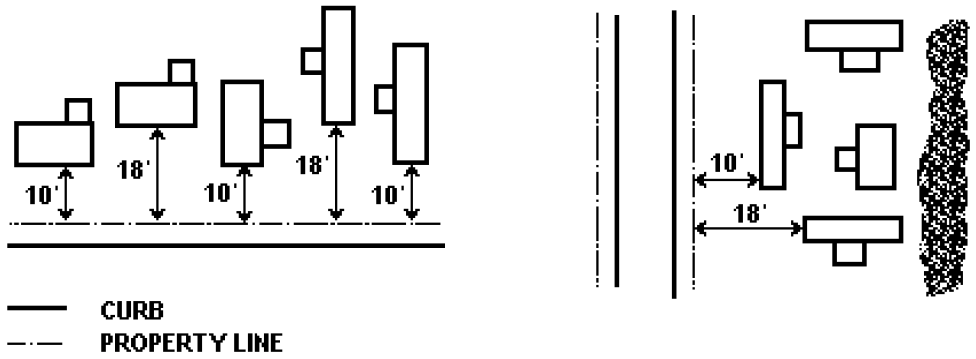
Manufactured homes abutting a public street shall have staggered setbacks and a variety of living unit orientations such as illustrated below. An offset is required between each adjacent dwelling and shall be at least eight feet as measured perpendicular from the street. At least 25 percent of units shall be oriented perpendicular to the other units, or
c.
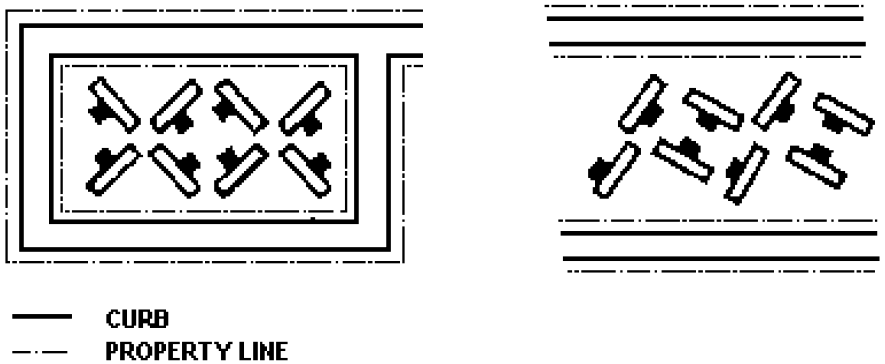
An alternative to the above is to utilize a uniform setback but provide a substantial (greater than 30 degrees) acute or obtuse angle from the street, such as illustrated below, or
d.
A third alternative is to establish an eight-foot minimum building offset between each adjacent dwelling by utilizing attached garages or triple wide expansions.
B.
Driveway access on local public streets may occur at the maximum frequency of one access for every two dwellings. Access from individual dwellings shall not be permitted on arterial streets. Access to collector streets is not permitted, unless approved by the City Engineer with a Variance application.
(Ord. No. 2024-01, § 1(Exh. A), 2-20-2024)
Sec. 17.96.50. - Setback and separation for structures within the park.
Setbacks and separation for structures within a manufactured dwelling park shall comply with applicable ORS statutes.
(Ord. No. 2024-01, § 1(Exh. A), 2-20-2024)
Sec. 17.96.60. - Site development standards.
A.
Parking and Accessways.
1.
Parking. Off-street parking facilities shall be provided on-site in accordance with Chapter 17.98.
2.
Street Widths. The minimum width for manufactured dwelling park streets shall be 20 feet. Streets serving more than 12 dwelling spaces shall be a minimum of 24 feet in width. Streets serving more than 30 dwelling spaces shall be a minimum of 28 feet in width. If on-street parking is permitted, ORS 446.095(1) requires a minimum width of 30 feet.
3.
Private Street Standards. Streets shall be paved to standards adopted by the City Engineer.
4.
Dead End Streets. Cul-de-sacs over 400 feet in length shall have a standard cul-de-sac bulb with a 38-foot curbside radius. Shorter dead end streets shall have a turn-around approved by the City Engineer.
5.
Walks. Paved walks, at least five feet wide and accessible to wheelchairs, shall be provided to connect park buildings to a park street or public street. In addition, a street sidewalk (or an equivalent pedestrian walking system) shall be provided to connect areas having more than 25 living units with the public sidewalk system.
6.
Lighting. Private park roadways shall be lighted at intersections and pedestrian crossings. Lighting shall comply with Chapter 15.30, Dark Sky Ordinance.
7.
Street Signs. Street identification signs shall be provided according to applicable City requirements.
8.
Fire Access. Access for fire protection services shall permit fire apparatus to approach within 100 feet of each dwelling. In addition, each manufactured dwelling space shall have direct access to a street to permit emergency escape. This access shall be an unobstructed area not less than 14 feet wide.
B.
Siting of Dwellings Within the Park.
1.
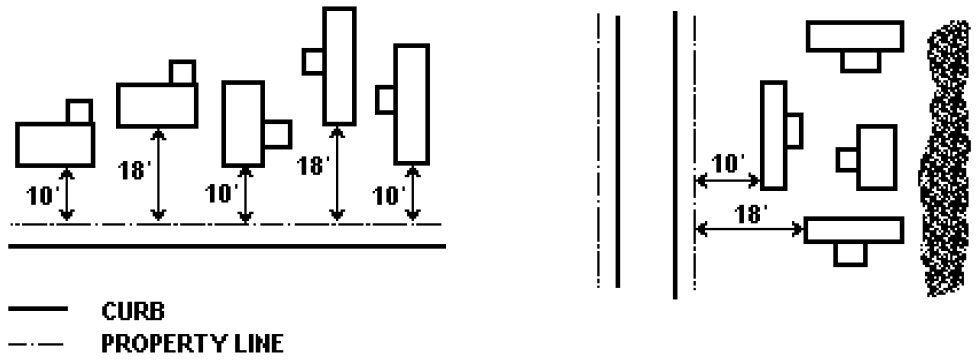
Dwellings shall have staggered setbacks from internal streets and a variety of living unit orientations such as illustrated below. An offset is required between each adjacent dwelling and shall be at least eight feet as measured perpendicular from the street. At least 25 percent of units shall be oriented perpendicular to the other units.
2.
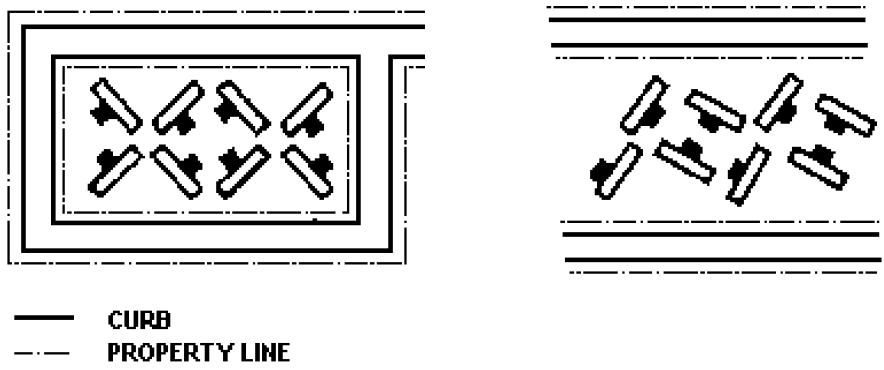
An alternative to the above is to utilize a uniform setback from internal streets but provide a substantial (greater than 30 degrees) acute or obtuse angle from the park street.
3.
Each dwelling shall include, at a minimum, two of the following design features:
a.
Dormers.
b.
Gables.
c.
Recessed entries.
d.
Covered porch entries.
e.
Pillars or posts.
f.
Bay or bow windows.
g.
Eaves of 12 inches or greater.
h.
Off-set of 16 inches or greater on building face or roof.
4.
No more than three identical units may be placed side by side.
C.
Public and Private Facilities.
1.
Each manufactured dwelling park space shall be provided with water, sanitary sewer, storm drainage and street facilities, natural gas services and underground electrical power, telecommunication, and cable television in accordance with the requirements of Chapter 15.20.
2.
Applications for manufactured dwelling parks that would adjoin an open, natural drainageway or would be located in a floodplain shall be reviewed in accordance with Chapter 17.60, Flood, Slope and Hazard provisions.
D.
Play Areas. Separate play areas shall be provided in all manufactured dwelling parks that accommodate children under 14 years of age unless each manufactured dwelling space has a minimum size of 4,000 square feet. Any required play area shall not be less than 2,500 square feet in area with no dimension less than 30 feet. There shall be at least 100 square feet of play area provided for each manufactured dwelling space. In the case of a large development, two or more play areas may be developed, provided that no individual play area is less than 2,500 square feet.
E.
Space Coverage. A dwelling and any other attached or detached structures shall not occupy more than 60 percent of a manufactured dwelling space used in conjunction with such dwelling.
F.
Decks. Each manufactured dwelling stand shall be provided with one or more, at least semi-private or private, outdoor living area adjacent to the dwelling, constructed of concrete, asphalt, flagstone, wood, or other hard surface material totaling at least 120 square feet of area and not less than eight feet wide in any dimension.
G.
Skirting. Each mobile home or manufactured home located in a manufactured dwelling park shall have continuous skirting that, in design, color and texture, appears to be an integral part of the exterior walls or the foundation of the dwelling.
(Ord. No. 2024-01, § 1(Exh. A), 2-20-2024)
Sec. 17.96.70. - Landscape plan.
A landscape plan is required prior to issuance of the building permit for the manufactured dwelling park. This plan shall be drawn to scale showing the location of existing trees and vegetation proposed for removal or retention on the site, the location and design of landscaped areas, the varieties, quantities, and sizes of trees and plant materials to be planted on the site, contour lines indicating any earth sculpting to be used, and other pertinent landscape information.
A.
Plant Coverage and Maintenance. Required landscape areas shall be covered by living plant material capable of attaining 90 percent ground coverage within five years and shall be continuously maintained and irrigated with permanent facilities sufficient to maintain the plant material.
B.
Plantings in Perimeter Area. In addition to the requirements specified in perimeter treatments above and in Chapter 17.92, Landscaping and Screening, landscaping shall be used to provide screening of decks and storage areas from the public roadway. Plant masses shall also be established between perimeter dwellings in order to reduce negative visual effects of roads and vehicle storage areas located within the park.
C.
Plantings Along Park Street.
1.
Street Trees. Street trees shall be provided in accordance with Chapter 17.92, Landscaping, Buffering, and Screening.
2.
Planting Continuity. Street trees similar in appearance shall be repeated to provide continuity for street plantings. Repetition of landscape elements such as lighting fixtures, consistent fencing styles, or similar carports shall complement this street tree pattern.
3.
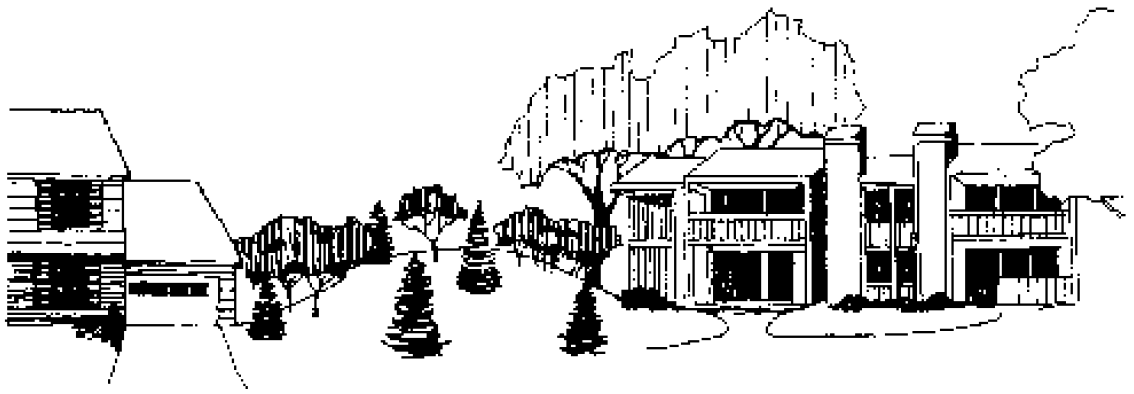
Street Focal Points. The real or apparent end of a street (where a street makes a right turn) provides a focused view, which shall be heavily vegetated with trees and shrubs spaced no more than 15 feet on center, either with foreground plants or (as below) with background plants.
(Ord. No. 2024-01, § 1(Exh. A), 2-20-2024)

