
Sandy City Zoning Code
CHAPTER 17
98 - PARKING, LOADING, AND ACCESS REQUIREMENTS35
Editor's note— Pre-republication, this chapter was last revised by Ord. No. 2020-06, effective May 6, 2020. Any amendments occurring post-republication have a history note in parenthesis at the bottom of the amended section.
Sec. 17.98.00.- Intent.
The intent of these regulations is to provide adequate capacity and appropriate location and design of parking and loading areas as well as adequate access to such areas. The parking requirements are intended to provide sufficient parking in close proximity for residents, guests/visitors, customers, and/or employees of various land uses. These regulations apply to both motorized vehicles (hereinafter referred to as vehicles) and bicycles.
(Ord. No. 2024-01, § 1(Exh. A), 2-20-2024)
Sec. 17.98.10. - General provisions.
A.
Provision and Maintenance. The provision of required off-street parking for vehicles and bicycles and loading facilities for vehicles is a continuous obligation. Building permits or other permits will only be issued after review and approval of site plans showing location of permanent access, parking and loading facilities.
B.
Unspecified Requirements. Vehicle and bicycle parking requirements for non-residential uses not specified in this chapter shall be determined by the Director based upon the requirements of similar specified uses.
C.
New Structure or Use. When a structure is constructed or a new use of land is commenced, on-site vehicle and bicycle parking and loading spaces shall be provided in accordance with Section 17.98.20 below or as otherwise modified through or specific area plan.
D.
Alteration of Existing Structures. When an existing structure is altered to the extent that the existing use is intensified, on-site vehicle and bicycle parking shall be provided in the amount required for such intensification. Alteration of existing structures, increased intensity, and change in use per Sections 17.98.10.D., E. and F. does not apply to commercial uses in the Central Business District (C-1).
E.
Increased Intensity. When increased intensity (e.g., adding floor area or dwelling units or changing to a use with a higher parking ratio) requires no more than four vehicle spaces, no additional parking facilities shall be required. However, the effects of changes, additions, or enlargements shall be cumulative. When the net effect of one or more changes generates a need for more than four spaces, the additional required spaces shall be provided. Additional spaces shall be required for the intensification but not for the original use.
F.
Change in Use. When an existing structure or use of land is changed in use from one use to another use as listed in Section 17.98.20 below and the vehicle and bicycle parking requirements for each use type are the same; no additional parking shall be required. However, where a change in use results in an intensification of use in terms of number of vehicle and bicycle parking spaces required, additional parking space shall be provided in an amount equal to the difference between the number of spaces required for the existing use and number of spaces required for the more intensive use.
G.
Time of Completion. Required parking spaces and loading areas shall be improved and available for use prior to issuance of a temporary certificate of occupancy and/or final building inspection or final certificate of occupancy.
H.
Inoperative Motor Vehicles. In all residential zoning districts, all motor vehicles incapable of movement under their own power or lacking legal registration shall be completely screened from public view.
I.
Truck Parking. In all residential zoning districts, no overnight parking of trucks or other equipment on wheels or tracks exceeding a one-ton capacity used in the conduct of a business activity shall be permitted except vehicles and equipment necessary for farming on the premises where such use is conducted.
J.
Mixed Uses. In the case of mixed uses, the total required vehicle and bicycle parking shall be the sum of requirements of individual uses computed separately.
K.
Conflicting Parking Requirements. When a building or use is planned or constructed in such a manner that more than one standard is applicable, the use that requires the greater number of parking spaces shall govern.
L.
Availability of Parking Spaces. Required vehicle and bicycle parking spaces shall be unobstructed, available for parking of vehicles and bicycles of residents, customers, patrons, and employees only, and shall not be used for storage of vehicles or materials or for parking of vehicles and bicycles used in conducting the business or use and shall not be used for sale, repair, or servicing of any vehicle or bicycle.
M.
Residential Parking Analysis Plan. A Residential Parking Analysis Plan shall be required for all new residential subdivisions, and partitions to include a site plan depicting all of the following:
1.
Location and dimension of required parking spaces as specified in Section 17.98.200.
2.
Location of areas where parking is not permitted as specified in Sections 17.98.200.A.3. and A.5.
3.
Location and design of parking courts (if applicable).
N.
Location of Required Parking.
1.
Off-street vehicle parking required for single family dwellings (both attached and detached) and duplexes shall be provided on the development site of the primary structure. At least two off-street vehicle parking spaces for detached single family homes and duplexes shall be located side-by-side. Tandem parking is only permitted for parking spaces that are not required to meet the minimum off-street parking requirements. Except where permitted by Section 17.98.40 below, required parking for all other uses in other districts shall be provided on the same site as the use or upon abutting property.
2.
Bicycle parking required for all uses in all districts shall be provided on the development site in accordance with Section 17.98.160 below.
O.
Unassigned Parking in Residential Districts.
1.
Multi-family dwelling units with more than ten required vehicle parking spaces shall provide unassigned parking. The unassigned parking shall consist of at least 15 percent of the total required parking spaces and be located to be available for use by all occupants and guests of the development. Tandem spaces and spaces in a garage shall not qualify as unassigned parking spaces.
2.
Multi-family dwelling units with more than ten required bicycle parking spaces may provide shared outdoor bicycle parking. The shared bicycle parking shall consist of at least 15 percent of the total required parking spaces and be located such that they are available for shared use by all occupants and guests of the development (i.e., shall not be restricted to access by only certain buildings or occupants).
P.
Fractions. When the sum of the required vehicle and bicycle parking spaces is a fraction of a space (0.5 or more of a space) a full space shall be required.
Q.
Maximum Parking Allowed. Commercial or Industrial zoned properties shall not be permitted to exceed the minimum off-street vehicle parking required by Section 17.98.20 by more than 30 percent.
(Ord. No. 2021-03, § 9(Exh. I), 5-17-2021; Ord. No. 2021-16, § 14(Exh. M), 8-16-2021; Ord. No. 2024-01, § 1(Exh. A), 2-20-2024)
Sec. 17.98.20. - Off-street parking requirements.
A.
Off-Street Parking Requirements. Off street parking shall conform to the following standards:
1.
Commercial uses in the Central Business District (C-1) are exempt from off street parking requirements. Residential uses in the Central Business District (C-1) have to provide off street parking per this section but may get a reduction per Section 17.98.30.B.
2.
All square footage measurements are gross square feet of total floor area.
3.
Twenty-four lineal inches of bench shall be considered one seat.
4.
Except as otherwise specified, parking for employees shall be provided based on one space per two employees for the largest shift in addition to required parking specified in subsections 8.—11. below.
5.
Where less than five parking spaces are required, then only one bicycle space shall be required except as otherwise modified in subsections 8.—11. below.
6.
In addition to requirements for residential off-street parking, new dwellings shall meet the on-street parking requirements in Section 17.98.200.
7.
Non-residential uses that rely on square footage for determining parking requirements may reduce the overall square footage of the use by deducting bathrooms, mechanical rooms, and other auxiliary rooms as approved by the Director.
8.
9.
10.
11.
(Ord. No. 2021-03, § 9(Exh. I), 5-17-2021; Ord. No. 2024-01, § 1(Exh. A), 2-20-2024)
Sec. 17.98.30. - Reduction of parking requirements.
A.
Transit Amenity Reduction.
1.
Any existing or proposed use in the C-2, C-3, or I-1 Zoning Districts subject to minimum parking requirements and located within 400 feet of an existing transit route may reduce the number of required parking spaces by up to ten percent by providing a transit stop and related amenities including a public plaza, pedestrian sitting areas, or additional landscaping provided such landscaping does not exceed 25 percent of the total area dedicated for transit oriented purposes.
2.
Uses qualifying for a reduction under Subsection A.1., may reduce the number of required parking spaces at a ratio of one parking space for each 100 square feet of transit amenity space provided above and beyond the minimum requirements.
3.
Uses that are not eligible for these reductions include truck stops, building materials and lumber sales, nurseries and similar uses not likely to be visited by pedestrians or transit customers.
B.
Residential Uses in the Central Business District and Village Commercial District Reduction. Required off-street parking for residential uses in the C-1 and C-3 Zoning District may be reduced by 25 percent.
(Ord. No. 2024-01, § 1(Exh. A), 2-20-2024)
Sec. 17.98.40. - Shared use of parking facilities.
A.
Except for single family dwellings (both attached and detached) and duplexes, required parking facilities may be located on an adjacent parcel of land or separated only by an alley or local street, provided the adjacent parcel is maintained in the same ownership as the use it is required to serve or a shared parking agreement that can only be released by the Director is recorded in the deed records of Clackamas County.
B.
In the event that several parcels occupy a single structure or parcel of land, the total requirements for off-street parking shall be the sum of the requirements for the uses computed separately.
C.
Required parking facilities for two or more uses, structures, or parcels of land may be satisfied by the same parking facility used jointly, to the extent that it can be shown by the owners or operators that the needs of the facilities do not materially overlap (e.g., uses primarily of day time versus night time uses) and provided that such right of joint use is evidenced by a deed, lease, contract or similar written instrument recorded in the deed records of Clackamas County establishing such joint use.
(Ord. No. 2024-01, § 1(Exh. A), 2-20-2024)
Sec. 17.98.50. - Setbacks.
A.
Parking areas, which abut a residential zoning district, shall meet the setback of the most restrictive adjoining residential zoning district.
B.
Required parking shall not be located in a required front or side yard setback area abutting a public street except in industrial districts. For single family and duplexes, required off-street parking may be located in a driveway.
C.
Parking areas shall be setback from a lot line adjoining a street the same distance as the required building setbacks. Regardless of other provisions, a minimum setback of five feet shall be provided along the property fronting on a public street. The setback area shall be landscaped as provided in this Code.
(Ord. No. 2024-01, § 1(Exh. A), 2-20-2024)
Sec. 17.98.60. - Design, size and access.
All off-street parking facilities, vehicular maneuvering areas, driveways, loading facilities, accessways, and private streets shall conform to the standards set forth in this section.
A.
Parking Lot Design. All areas for required parking and maneuvering of vehicles shall have a surface made of concrete or asphalt.
B.
Size of Space.
1.
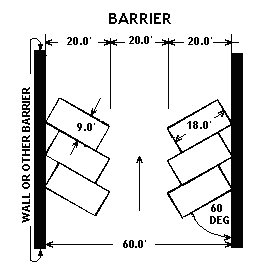
A standard parking space shall be a minimum of nine feet wide by 18 feet in length.
2.
A compact parking space shall be a minimum of eight feet wide by 16 feet in length.
3.
Accessible parking spaces shall be nine feet by 18 feet and include an adjacent access aisle meeting ORS 447.233. Access aisles may be shared by adjacent spaces. Accessible parking shall be provided for all uses in compliance with the requirements of the State of Oregon (ORS 447.233) and the Americans with Disabilities Act.
4.
Parallel parking spaces shall be a length of 22 feet.
5.
No more than 40 percent of the parking stalls shall be compact spaces.
6.
Parking spaces that do not conform to the dimensional standards in Subsections 1-5 shall be reviewed through the procedures in Chapter 17.66 of the Sandy Development Code.
C.
Aisle Width.
D.
Pedestrian Circulation.
1.
Pedestrian circulation shall be provided in the form of pathways in all new off-street parking lots. Pathways shall connect sidewalks adjacent to parking lots to the entrances of new buildings.
2.
Crosswalks. Where a pathway crosses a parking area or driveway ("crosswalk"), it shall be clearly identified with pavement markings or contrasting paving materials (e.g., pavers, light-color concrete inlay between asphalt, or similar contrast). The crosswalk may be part of a speed table to improve driver-visibility of pedestrians.
3.
Pathway Width and Surface. Pedestrian pathways shall be constructed in accordance with the sidewalk construction standards in the Utility Standard Details adopted by the City in 2004. Multi-use pathways (i.e., designed for shared use by bicyclists and pedestrians) shall be concrete or asphalt and shall conform to the Utility Standard Details.
(Ord. No. 2024-01, § 1(Exh. A), 2-20-2024)
Sec. 17.98.70. - On-site circulation.
A.
Groups of more than three parking spaces shall be permanently striped. Accessible parking spaces and accompanying access aisles shall be striped regardless of the number of parking spaces.
B.
Backing and Maneuvering. Except for a single family dwelling, duplex, or accessory dwelling unit, groups of more than three parking spaces shall be provided with aisles or turnaround areas so that all vehicles enter the right-of-way (except for alleys) in a forward manner. Parking spaces shall not have backing or maneuvering movements for any of the parking spaces occurring across public sidewalks or within any public street, except as approved by the City Engineer. Evaluations of requests for exceptions shall consider constraints due to lot patterns and impacts to the safety and capacity of the adjacent public street, bicycle and pedestrian facilities.
(Ord. No. 2024-01, § 1(Exh. A), 2-20-2024)
Sec. 17.98.80. - Access management.
A.
Access Spacing. All proposed development shall have access to a public right-of-way. Spacing requirements for access points and intersections are shown in the City of Sandy 2023 Transportation System Plan Tables 5 and 6 and in the following tables:
Table 17.98.80.A.1: Minimum Access Spacing Standards for City Street Facilities
Table 17.98.80.A.2: Minimum Access Spacing Standards for Highway 26
B.
Location and design of all accesses to and/or from arterials and collectors (as designated in the 2023 City of Sandy Transportation System Plan) are subject to review and approval by the City Transportation Engineer or Public Works Director. Where access spacing requirements on a collector or arterial cannot be met, access from a lower functional order street may be required. Exceptions may only be granted as part of a discretionary review, when approved by the City Engineer. Evaluations of exceptions shall consider posted speed of the street on which access is proposed, constraints due to lot patterns, and effects on safety and capacity of the adjacent public street, bicycle and pedestrian facilities.
C.
No development site shall be allowed more than one access point to any arterial or collector street (as designated in the 2023 City of Sandy Transportation System Plan) except as approved by the City Transportation Engineer or Public Works Director as part of a discretionary review. Evaluations of exceptions shall be based on a traffic impact analysis and parking and circulation plan and consider posted speed of street on which access is proposed, constraints due to lot patterns, and effects on safety and capacity of the adjacent public street, bicycle and pedestrian facilities.
D.
When developed property is to be expanded or altered in a manner that significantly affects on-site parking or circulation (i.e., removes or changes the location of driveways, parking spaces, or drive aisles), both existing and proposed accesses shall be reviewed under the standards in B and C above. As a part of an expansion or alteration approval, the City may require relocation and/or reconstruction of existing accesses not meeting those standards.
E.
The City or other agency with access permit jurisdiction has the authority to require the closing or consolidation of existing curb cuts or other vehicle access points, recording of reciprocal access easements (i.e., for shared driveways), developing a frontage street, installing traffic control devices, and/or other mitigation as a condition of granting an access permit to ensure the safe and efficient operation of the street and highway system.
(Ord. No. 2024-01, § 1(Exh. A), 2-20-2024)
Sec. 17.98.90. - Access to unimproved streets.
A.
Access to Unimproved Streets. Development without access to a City standard street may only occur when that development constitutes infill on an existing substandard public street, and when an exception is requested by the applicant and approved by the Director as part of a discretionary review. A condition of development shall be that the property owner signs an irrevocable petition for street improvements and/or a declaration of deed restrictions agreeing to future completion of street improvements. The form shall be provided by the City and recorded with the property through the Clackamas County Recorder's Office. This shall be required with approval of any of the following applications:
1.
Land partitions.
2.
Conditional uses.
3.
Building permits for new non-residential construction or structural additions to non-residential structures (except accessory development).
4.
Building permits for new residential units.
(Ord. No. 2024-01, § 1(Exh. A), 2-20-2024)
Sec. 17.98.100. - Driveways.
A.
A driveway to an off-street parking area shall be improved from the public right-of-way to the parking area a minimum width of 20 feet for a two-way drive or 12 feet for a one-way drive, but in either case not less than the full width of the standard approach for the first 20 feet of the driveway.
B.
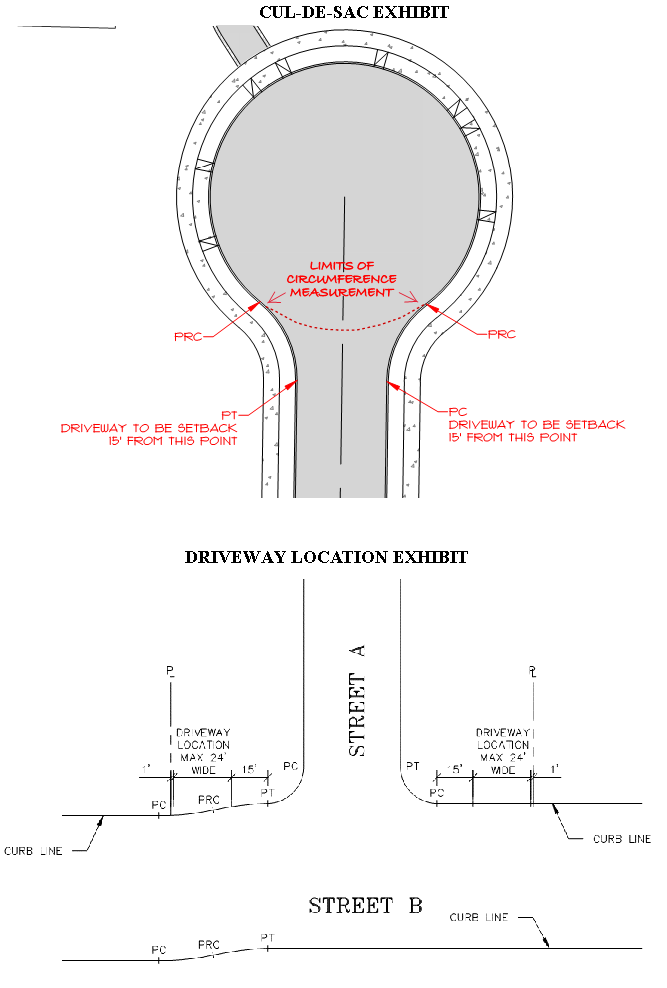
A driveway for a single-family dwelling or duplex shall have a minimum width of ten feet. The total width for one or more driveway approaches within the public right-of-way shall not exceed 24 feet in width measured at the bottom of the curb transition. A driveway approach shall be constructed in accordance with applicable city standards and the entire driveway shall be paved with asphalt or concrete. Driveway approaches may be shared by adjacent lots in cul-de-sacs in order to meet requirements for street tree planting and utility facilities (power and telecom pedestals, fire hydrants, streetlights, meter boxes, etc.).
C.
Driveways, aisles, turnaround areas and ramps shall have a minimum vertical clearance of 12 feet for their entire length and width. Such clearance may be reduced in parking structures if approved by the Director as part of a discretionary review.
D.
No driveway shall exceed a grade of 15 percent at any point along the driveway length, measured from the right-of-way line to the face of garage or furthest extent of the driveway. For any driveway that exceeds a grade of 8.3 percent, a staircase or ramp made of concrete or exterior grade wood shall be installed that connects the primary entrance of a building to the sidewalk.
E.
The nearest edge of a driveway approach shall be located a minimum of 15 feet from the point of curvature or tangency of the curb return on any street.
F.
The sum of the width of all driveway approaches within the bulb of a cul-de-sac as measured in section B., above shall not exceed 50 percent of the circumference of the cul-de-sac bulb. The cul-de-sac bulb circumference shall be measured at the curb line and shall not include the width of the stem street. The nearest edge of driveway approaches in cul-de-sacs shall not be located within 15 feet of the point of curvature, point of tangency or point of reverse curvature of the curb return on the stem street.
Acronyms on the next page:
PT = point of tangency
PC = point of curvature
PRC = point of reverse curvature
G.
The location and design of any driveway approach shall provide for unobstructed sight per the vision clearance requirements in Section 17.74.30. Requests for exceptions to these requirements may be made as part of a discretionary review and will be evaluated by the City Engineer considering the physical limitations of the lot and safety impacts to vehicular, bicycle, and pedestrian traffic.
H.
Driveways shall taper to match the driveway approach width to prevent stormwater sheet flow from traversing sidewalks.
(Ord. No. 2021-03, § 9(Exh. I), 5-17-2021; Ord. No. 2024-01, § 1(Exh. A), 2-20-2024)
Sec. 17.98.110. - Vision clearance.
A.
Except within the Central Business District, vision clearance areas shall be provided at intersections of all streets and at intersections of driveways and alleys with streets to promote pedestrian, bicycle, and vehicular safety. The extent of vision clearance to be provided shall be determined from standards in Chapter 17.74. For non-residential applications, and for residential applications processed through discretionary review, the determination of required vision clearance area shall take into account functional classification of the streets involved, type of traffic control present at the intersection, and designated speed for the streets.
B.
Traffic control devices, streetlights, and utility installations meeting approval by the City Engineer are permitted within vision clearance areas.
(Ord. No. 2024-01, § 1(Exh. A), 2-20-2024)
Sec. 17.98.120. - Landscaping and screening.
A.
Screening of all parking areas containing four or more spaces and all parking areas in conjunction with an off-street loading facility shall be required in accordance with zoning district requirements and Chapter 17.98. Where not otherwise specified by district requirement, screening along a public right-of-way shall include a minimum five feet depth of buffer plantings adjacent to the right-of-way.
B.
When parking in a commercial or industrial district adjoins a residential zoning district, a sight-obscuring screen that is at least 80 percent opaque when viewed horizontally from between two and eight feet above the average ground level shall be required. The screening shall be composed of materials that will achieve the required degree of screening within three years after installation.
C.
Except for a residential development which has landscaped yards, parking facilities shall include landscaping to cover not less than ten percent of the area devoted to parking facilities. The landscaping shall be uniformly distributed throughout the parking area and may consist of trees, shrubs, and ground covers.
D.
Parking areas shall be divided into bays of not more than 20 spaces in parking areas with 20 or more spaces. Between, and at the end of each parking bay, there shall be planters that have a minimum width of five feet and a minimum length of 17 feet for a single depth bay and 34 feet for a double bay. Each planter shall contain one tree with a canopy when mature that is at least 20 feet wide and ground cover. Truck parking and loading areas are exempt from this requirement.
E.
Parking area setbacks shall be landscaped with trees, shrubs, and ground cover as specified in Chapter 17.92.
F.
Wheel stops, bumper guards, or other methods to protect landscaped areas and pedestrian walkways shall be provided. No vehicle may project over a property line or into a public right-of-way. Parking may project over an internal sidewalk, but a minimum clearance of five feet for pedestrian circulation is required.
(Ord. No. 2024-01, § 1(Exh. A), 2-20-2024)
Sec. 17.98.130. - Paving.
A.
Parking areas, driveways, aisles, and turnarounds shall be paved with concrete, asphalt, or comparable surfacing, constructed to City standards for off-street vehicle areas.
B.
Where remodeling, alteration or addition is proposed on a site with existing gravel-surfaced parking areas, driveways, aisles, or turnarounds, the following standard shall be met:
No building permit shall be issued for remodeling, alteration or addition to any building or structure when the estimated cost thresholds in Subsections B.1. or B.2., below, are exceeded on any site with vehicle areas that do not meet the standards in Subsection A., unless the applicant agrees to pave such vehicle areas to the standards in Subsection A. in conjunction with the construction activity related to the building permit.
1.
Single-family and duplex dwellings: The estimated cost of the remodeling, alteration or addition exceeds 50 percent of the value of the building or structure before such remodeling, alteration or addition is commenced.
2.
Multi-family, commercial, and industrial development: The estimated cost of the remodeling, alteration or addition exceeds 20 percent of the value of the building or structure before such remodeling, alteration or addition is commenced.
C.
Gravel surfacing shall be permitted only for areas designated for non-motorized trailer or equipment storage, propane or electrically powered vehicles, or storage of tracked vehicles.
(Ord. No. 2024-01, § 1(Exh. A), 2-20-2024)
Sec. 17.98.140. - Drainage.
Parking areas, aisles and turnarounds shall provide for the on-site collection of drainage waters to eliminate sheet flow of such waters onto sidewalks, public rights-of-way and abutting private property, in compliance with Title 13 of the Sandy Municipal Code and the 2020 City of Portland Stormwater Management Manual, as adopted by the City of Sandy.
(Ord. No. 2024-01, § 1(Exh. A), 2-20-2024)
Sec. 17.98.150. - Lighting.
The Dark Sky Ordinance in Chapter 15 of the municipal code applies to all exterior lighting. Artificial lighting shall be provided in all required off-street parking areas and bicycle parking areas in compliance with SMC Chapter 15.30.
(Ord. No. 2024-01, § 1(Exh. A), 2-20-2024)
Sec. 17.98.160. - Bicycle parking facilities.
Multi-family developments, industrial, commercial and community service uses, transit transfer stations, and park and ride lots shall meet the following standards for bicycle parking facilities. The intent of this section is to provide secure bicycle parking that is visible from a building's primary entrance and convenient to bicyclists.
A.
Location.
1.
Bicycle parking shall be located on-site, and have direct access to both the public right-of-way and to the primary entrance of the primary structure. The nearest bicycle parking space shall be located within 50 feet of at least one primary building entrance, as measured along the most direct pedestrian access route.
2.
Bicycle parking areas shall be visible from building interiors through at least one window.
3.
For facilities with multiple buildings or parking lots, bicycle parking shall be located either:
a.
Within 50 feet of a primary entrance as measured along the most direct pedestrian access route, and distributed to serve all primary buildings; or
b.
If the bicycle parking area is more than 50 feet from a main entrance, it must be in a shared bicycle parking location along a pedestrian path or access way.
4.
If the bicycle parking area is located within the vehicle parking area, the bicycle facilities shall be separated from vehicular maneuvering areas by curbing, bollards, or landscaping to prevent damage to parked bicycles.
5.
Curb cuts shall be installed to provide access to bicycle parking areas.
B.
Bicycle Parking Space Dimensions.
1.
Each required bicycle parking space shall be at least two and one-half feet by six feet. If bicycle parking is covered, vertical clearance of seven feet shall be provided.
2.
An access aisle of at least five feet wide shall be provided and maintained beside or between each row of bicycle parking. Vertical or upright bicycle storage structures are exempted from the parking space length.
C.
Security.
1.
Bicycle parking facilities shall offer security in the form of either a lockable enclosure in which the bicycle can be stored or a stationary object (i.e., a "rack") upon which the bicycle can be located.
2.
"Bicycle rack" means a device to which bicycles can be securely attached and locked for parking purposes.
3.
Bicycle racks requiring user-supplied locks shall be designed so that the bicycle frame and one wheel can be locked to a rigid portion of the rack with a U-shaped lock.
4.
Bicycle racks shall be securely anchored to the ground or a structure with tamper-resistant hardware and shall be designed to support the bicycle at two points, including the frame.
5.
Shelter from precipitation is encouraged for all outdoor bicycle parking facilities. If more than 20 bicycle parking spaces are required, at least 25 percent of the spaces shall be covered or enclosed. If covered, the overhead clearance shall be at least 7 feet. Coverage can be provided through roof extensions, overhangs, awnings, arcades, carports, or enclosures.
D.
Signing. Where bicycle facilities are not directly visible from the public right-of-way, primary structure entry, or civic space then directional signs shall be provided to direct bicyclists to the bicycle parking facility.
E.
Exemptions. Temporary uses and other uses identified in Section 17.98.20 as not requiring bicycle parking are exempt from Section 17.98.160.
(Ord. No. 2024-01, § 1(Exh. A), 2-20-2024)
Sec. 17.98.170. - Carpool and vanpool parking.
New industrial, commercial, and community service uses with more than 100 employees shall meet the following minimum requirements for carpool and vanpool parking.
A.
Number and Marking. At least ten percent of the employee parking spaces shall be marked and signed for use as a carpool/vanpool space. The carpool/vanpool spaces shall be clearly marked "Reserved—Carpool/Vanpool Only."
B.
Location. Designated carpool/vanpool parking spaces shall be the closest employee parking spaces to the building entrance normally used by employees except for any handicapped spaces provided.
(Ord. No. 2024-01, § 1(Exh. A), 2-20-2024)
Sec. 17.98.180. - School design requirements.
A driveway designed for continuous forward flow of passenger vehicles for the purpose of loading and unloading children shall be located on the site of a school having a capacity greater than 50 students.
(Ord. No. 2024-01, § 1(Exh. A), 2-20-2024)
Sec. 17.98.190. - Off-street loading facilities.
A.
All commercial and industrial uses that anticipate loading and unloading of products/materials shall provide an off-street area for loading/unloading of products/materials.
B.
The required loading berth shall be not less than ten feet in width by 35 feet in length and shall have an unobstructed height clearance of 14 feet.
C.
Loading areas shall be screened from public view from public streets. The loading areas shall be screened from adjacent properties except in industrial districts and shall require the same screening as parking lots.
D.
Sufficient space for turning and maneuvering of vehicles shall be provided on the site in accordance with the standard specifications established by the City Engineer.
(Ord. No. 2024-01, § 1(Exh. A), 2-20-2024)
Sec. 17.98.200. - Residential on-street parking requirements.
A.
Residential On-Street Parking Requirements. Residential on-street parking shall conform to the following standards:
1.
In addition to required off-street parking, all new residential subdivisions and partitions shall provide one on-street parking space within 300 feet of each single family residence or duplex except as provided in Section 17.98.200.A.6. below. The 300 feet shall be measured in terms of walking distance from the primary entrance of the dwelling. Accessory dwelling units, multi-family developments, and conversions of single-family homes to duplexes are exempt from this standard.
2.
The location of residential on-street parking shall be reviewed for compliance with this section through submittal of a Residential Parking Analysis Plan as required in Section 17.98.10.M.
3.
Residential on-street parking shall not obstruct required clear vision areas and shall not violate any local or state laws.
4.
Parallel residential on-street parking spaces shall be a minimum of 22 feet in length.
5.
Residential on-street parking shall be measured along the curb from the outside edge of a driveway wing or curb cut. Parking spaces shall be set back a minimum of 15 feet from the point of tangency or curvature at an intersection and may not be located within ten feet of a fire hydrant.
6.
Portions of residential on-street parking required by this section may be provided in parking courts that are interspersed throughout a development when the following standards are met:
a.
No more than ten parking spaces shall be provided in a parking court, except parking courts that utilize backing movements into the right-of-way in which case the parking court shall be limited to two parking spaces;
b.
Parking spaces within a parking court shall be nine feet wide and 18 feet in depth. In no instance shall a vehicle or any appurtenances parked in a parking court protrude into the public right-of-way;
c.
Notwithstanding Section 17.98.70, vehicles parked in a parking court on a local street as defined in the 2023 City of Sandy Transportation System Plan are permitted to back onto the public right-of-way from the parking court so long as the parking court is limited to two parking spaces;
d.
A parking court shall be located within 300 feet of the dwellings requiring parking in accordance with the requirements of Section 17.98.10.M.;
e.
No more than two parking courts shall be provided within a block, with only one parking court provided along a block face;
f.
A parking court shall be paved in compliance with the standards of this chapter and constructed to the grading and drainage standards in 17.98.140;
g.
A parking court adjacent to a public right-of-way or private drive shall be privately owned and maintained. For any parking court there shall be a legal recorded document which includes:
•
A legal description of the parking court;
•
Ownership of the parking court;
•
Use rights; and
•
A maintenance agreement and the allocation and/or method of determining liability for maintenance of the parking court;
h.
A parking court shall be used solely for the parking of operable passenger vehicles.
(Ord. No. 2021-03, § 9(Exh. I), 5-17-2021; Ord. No. 2021-16, § 14(Exh. M), 8-16-2021; Ord. No. 2024-01, § 1(Exh. A), 2-20-2024)

