
Santa Rosa County Unincorporated
City Zoning Code
City Zoning Code
CHAPTER 1
- GENERAL PROVISIONS
1.01.00 - Generally.
These land development regulations are codified and published as an appendix to the Code of Ordinances of Santa Rosa County and form an integral part of that Code.
(Ord. No. 2021-13, § 3(Attch. B), 8-19-21)
1.02.00 - Title.
These land development regulations shall be known as the "Land Development Code of Santa Rosa County, Florida," and may be referred to as the LDC.
(Ord. No. 2021-13, § 3(Attch. B), 8-19-21)
1.03.00 - Authority.
The LDC is enacted pursuant to the requirements and authority of section 163.3202, Florida Statutes (F.S.), the general powers in Chapter 125, F.S. and Articles II and VIII of the Florida Constitution.
The lands subject to this ordinance include all unincorporated areas of Santa Rosa County.
1.03.01 Effective date.
The effective date of this ordinance shall be the date of receipt, by Santa Rosa County, of notice from the Florida Department of State that this Ordinance has been received and duly filed.
1.03.02 Ordinances repealed and replaced.
This ordinance repeals and replaces Ordinance 91-24 as amended. The provisions shall prevail over the terms of any previously adopted ordinance or resolution.
1.03.03 Review and update of the land development code.
It is intended that a full review and update be accomplished every five (5) years at a minimum. This does not preclude the ability to make amendments to the LDC during this time as the Board of County Commissioners see fit, see Section 11.05.08 for requirements.
(Ord. No. 2021-13, § 3(Attch. B), 8-19-21)
1.04.00 - Applicability.
1.04.01 Generally.
A.
The use of any parcel of land or any structure or any combination thereof, within the unincorporated areas of Santa Rosa County shall be in conformance with the requirements of the LDC.
B.
All development shall conform to the applicable standards, criteria, requirements and procedures of the LDC.
C.
Unless otherwise authorized in this LDC, no development shall proceed without a Final Development Order or Land Development Certificate and a Building Permit issued by the County, or where permitted by Section 11.01.02 or 11.01.03 only a Building Permit by the County.
D.
A Change of Use shall conform to the standards, criteria, requirements and procedures of the LDC.
E.
Unless otherwise authorized in this LDC, no Change of Use shall be permitted without a Final Development Order or Land Development Certificate and a Building Permit, or where permitted by Section 11.01.03 only a Building Permit by the County.
1.04.02 Division of land.
A.
Every division of land within the County (other than a division of land authorized by subsection D) resulting in new roads being created, shall be made by reference to a recorded Plat. Plats shall be approved in accordance with the procedural requirements set forth in Chapter 4 of the LDC.
B.
Every minor subdivision, division of land within the County which results in new lots, parcels, tracts, etc. not part of an existing subdivision made pursuant to this subsection and resulting in new lots, parcels, tracts, etc. shall either comply with subsection A or if they meet any of the following criteria:
1.
If the land is located on an Access Management Corridor;
2.
If the land is located in a Military or Public Airport Zone as specified in Chapter 8;
3.
If the land is in the Garcon Point Protection Area as identified in the Santa Rosa County Comprehensive Plan;
4.
If the new Lots, Parcels, Tracts, etc. are less than four (4) acres in size.
Owner/Developer will need to submit a drawing showing the metes and bounds descriptions of the lots, parcels, tracts, etc.; a sketch to scale showing the configuration, acreage and square footage of the original Lot and proposed division. For those divisions meeting criteria #4 above, an engineered drainage plan as required by Section 3.04.09.
Land conveyed in such developments may be described by metes and bounds, and shall be recorded by deed. This exemption will not apply to parcels located on deeded county rights-of-way where the actual roadway has not been constructed and has not been accepted for maintenance by the County and to parcels located on private roadways that were not approved by the County through the platting process, except those private roadways that existed as of April 24, 1986 and are shown and named on the County's original zoning maps.
C.
The County shall not issue a Final Development Order, Land Development Certificate or a Building Permit for Development proposed on a Lot, Parcel, Tract, etc. established in violation of this LDC.
D.
An assembly of platted lots may be disassembled (subdivided) without complying with either subsections A or B so long as no resulting lot bears a description or size other than as shown on a currently applicable, recorded Plat and each such resulting, previously platted lot complies in all respects with this LDC.
E.
All lots of record four (4) acres or less must provide an engineered drainage plan (to scale) pursuant to Section 4.04.00 prior to (or concurrent) with building permit or land clearing submittal application.
1.04.03 Relationship to the Comprehensive Plan.
A.
The LDC is intended to implement the Santa Rosa County Comprehensive Plan through the establishment of procedures for review of proposed Development and through the adoption of standards and criteria for such Development.
B.
Pursuant to Florida Statutes Ch. 163, Part II (Growth Policy), the LDC is based upon and implements the Comprehensive Plan. The Comprehensive Plan standing alone establishes only general guidelines and principles. It is not self-executing. It is implemented by the LDC. The Comprehensive Plan is general, while the LDC is specific
C.
The LDC is designed to implement the goals, policies and objectives of the Comprehensive Plan and is hereby deemed to be consistent and in accordance with the adopted Comprehensive Plan.
D.
The LDC is intended to guide development in compliance with the goals, policies, and objectives of the Comprehensive Plan.
E.
Any amendment to the text of the LDC shall be consistent with and in accordance with the Comprehensive Plan.
1.04.04 Injunctive and other relief.
Upon verification by the Code Enforcement Director or their designee that any provision of this law are being violated, the Code Enforcement Director or their designees may notify in writing the person responsible for the violation, stating the provisions of this law being violated and shall order the necessary steps to abate the violations within a reasonable time. If the violation is not abated or abatement commenced and diligently pursued within the time specified, the Code Enforcement Director or their designee, may institute any appropriate action or procedure to bring about compliance with any of the provisions of this ordinance. This remedy is in addition to any other remedy available to the County.
1.04.05 Savings clause.
Should any chapter, section, subsection, provision or clause of this LDC be declared by any court of competent jurisdiction to be unconstitutional or invalid for any reason whatsoever, the same shall not affect the validity of the LDC as a whole or any part thereof other than the part judicially determined to be invalid.
1.04.06. General penalty for violations.
A.
Whenever in this Land Development Code or the ordinances of the County relating to the Land Development Code any act is prohibited or is made or declared to be unlawful or an offense, or whenever in this Land Development Code or the ordinances of the County relating to the Land Development Code the doing of any act is required, or the failure to do any act is declared to be unlawful, where no specific penalty is provided therefore, the violation of any such provisions of the Land Development Code or such ordinances of the County shall be punished by a fine. This section shall not apply to offenses which are recognized by the laws of the state as misdemeanors, the penalties for which are provided by the laws of the state, which state penalties shall likewise be applicable under this Land Development Code. Each day any violation of any of the provisions of this Land Development Code or of any ordinances of the County relating to the Land Development Code shall continue shall constitute a separate offense.
B.
In addition to the penalties provided in subsection (A), any conditions caused or permitted to exist in violation of any of the provisions of this Land Development Code or the ordinance of the County related to Land Development shall be deemed a public nuisance and may be abated by the County as provided by law, and each day that any such offensive condition continues shall be regarded as a new and separate offense.
(Ord. No. 2021-13, § 3(Attch. B), 8-19-21)
1.05.00 - Purpose.
The LDC is adopted for the purpose of promoting the health, safety and general welfare of the people of the County and to provide orderly growth management rules and regulations for the unincorporated areas of Santa Rosa County. This ordinance is not intended to terminate growth but rather to provide mechanisms for growth management in order to serve the citizens of Santa Rosa County and toward that end, this ordinance is to be construed to accomplish its stated purposes and objectives.
1.05.01 Residential districts purpose.
The residential districts are designed to protect the health and safety of the public by providing sufficient space in appropriate locations to adequately meet the housing needs of the present and future population of the County, efficiently utilize the existing public ways and mitigate the effects of heavy traffic, protect residential areas against flood, fire, explosions, toxic and noxious matter, radiation, offensive noise, vibration, dust, and other particulate matter and glare. Protection against undue congestion by regulating density of population by requiring open space and landscaping where practical in order to open up residential areas to light and air and to enhance recreation and scenic qualities and facilitate surface drainage.
1.05.02 Commercial districts purpose.
The commercial districts are designed to promote the health and safety of the public by providing sufficient spaces for local retail services and trades catering specifically to the recurring shopping needs of the occupants of nearby residents and to protect both retail and service developments and nearby residences against flood, fire, explosion, toxic and noxious matter, radiation, offensive noise, vibration, dust, and other particulate matter and glare. Protection against undue congestion by regulating the intensity of retail and services developments consistent with their marketing functions, preserving open space and access to light and air and to provide sufficient and appropriate space, to meet the needs of the County's expected future economy and to encourage planned commercial development concentrated in regional, community and local commercial centers with adequate areas for vehicular and pedestrian circulation, open space and landscaped areas to facilitate surface drainage and enhance the scenic quality and to discourage a proliferation of commercial uses in non-commercial areas.
1.05.03 Industrial districts purpose.
The industrial districts are designed to promote the health and safety of the public by providing sufficient space in appropriate locations to meet the needs of the urbanizing area's expected economic expansion for all types of disruptive, industrial and related activities and to protect distributive, industrial and related activities as well as residential and related activities by providing for the separation of these uses and as far as possible provide that appropriate space needs for distributive and industrial activities by discouraging the use of such space for residential purposes. To permit industrial development which is reasonably free from danger of fire, explosions, toxic and noxious matter, radiation, dust, or other particulate matter, offensive noise, vibration, odorous matter, and glare by regulating the emission of such nuisances, through appropriate performance standards.
(Ord. No. 2021-13, § 3(Attch. B), 8-19-21)
1.06.00 - Rules of interpretation.
1.06.01 Generally.
The text within the LDC shall control where there is any conflict between text within the LDC and any caption, illustration or graphic presentation. Unless prohibited by context, references to any chapter, section or subsection shall include all subdivisions that chapter, section or subsection.
1.06.02 Rules of construction.
A.
Words used in the present tense shall include the future tense; words used in the singular number shall include the plural number; and words used in the plural number shall include the singular number.
B.
In computing any period of time prescribed or allowed by the LDC, the day of the act, event or default from which the designated period of time begins to run shall not be included. The last day of the period so computed shall be included unless it is a Saturday, Sunday or legal holiday. When the period of time prescribed or allowed is less than seven (7) days, intermediate Saturdays, Sundays and legal holidays shall be excluded in the computation.
C.
A word importing the masculine gender only shall extend and be applied to female persons and to firms, partnerships and corporations, as well as to male persons.
D.
The words "may" and "should" are always permissive and never mandatory.
E.
The word "shall" is always mandatory and not merely permissive.
F.
The word "month" shall mean thirty (30) calendar days.
G.
The word "person" shall extend and be applied to associations, clubs, societies, firms, partnerships and bodies politic and corporate, as well as to individuals.
H.
Whenever the LDC shall refer to a specific portion of the Code of Ordinances or the LDC itself, that reference shall include any subsequent amendment to the referenced portion or any subsequent provision superseding the provision.
1.06.03 Responsibility for interpretations.
All interpretations shall be the responsibility of the Planning Director.
1.06.04 Rules for interpretations of boundaries.
Where uncertainty exists as to the boundaries of districts shown on the Zoning Map or any other map incorporated in or referenced by the LDC, the following rules shall apply:
A.
Boundaries indicated as approximately following the centerlines of Streets, Alleys or other public rights-of-ways shall be construed to follow such centerlines. Where the Street, Alley or right-of-way has been vacated through official action of the governing body, the boundary shall be construed to follow the centerline of the vacated right-of-way.
B.
Boundaries indicated as approximately following platted Lot Lines, section lines or tract lines shall be construed to follow those lines.
C.
Boundaries indicated as approximately following City or Town limit lines shall be construes to follow such City or Town limit lines.
D.
Boundaries indicated as following railroad lines shall be construed to be midway between the main tracks.
E.
Boundaries indicated as following shorelines shall be construed to follow such shorelines and in the event of change in the shoreline shall be construed as moving with the actual shoreline.
F.
Boundaries indicated as approximately following the centerlines of canals, streams or other bodies of water shall be construed to follow such centerlines.
G.
Boundaries indicated as parallel to features described in sections 1.06.04.A through F above shall be construed as parallel to such features at the distance from the feature indicated on the Zoning Map. If a distance is not indicated on the Zoning Map, the distance shall be determined by the scale of the map.
H.
Where interpretation is needed as to the exact location of boundaries of any mapped area, the Planning Director shall make the necessary interpretation.
1.06.05 Applicability of sign code.
The County has adopted comprehensive regulations for Signs in the unincorporated areas of Santa Rosa County as part of this Land Development Code. Whenever this Land Development Code provides a regulation for a sign that meets the definitions of a sign as provided by the Sign Code, such requirement or regulation shall be subject to the Sign Code and such Sign shall comply with the Sign Code, unless that requirement or regulation states an express exemption from the Sign Code. In addition, if another section of the Land Development Code requires a sign that the Sign Code would not allow, the sign shall be allowed, but shall otherwise comply with and be subject to the requirements to the Sign Code.
(Ord. No. 2021-13, § 3(Attch. B), 8-19-21)
1.07.00 - Acronyms and definitions.
Words and phrases shall be construed according to the common approved uses of the language. Words with specific meaning in this LDC are defined below.
1.07.01 Acronyms.
ADA—American with Disabilities Act
BOCC—Board of County Commissioners
Dbh—diameter at breast height
DBPR—Florida Department of Business and Professional Regulations
FAA—Federal Aviation Administration
F.A.C.—Florida Administrative Code
FBC—Florida Building Code
FDEO—Florida Department of Economic Opportunity
FDEP—Florida Department of Environmental Protection
FDOT—Florida Department of Transportation
FHA—Federal Housing Administration
FS—Florida Statutes
GLA—Gross Leasable Area
ITE—The Institute of Transportation Engineers
LDC—Land Development Code
MUTCD—Manual on Uniform Traffic Control Devices
NWFWMD—Northwest Florida Water Management District
PUD—Planned Unit Development
PBD—Planned Business District
USACE—United States Army Corps of Engineers
ZB—Zoning Board
1.07.02 Definitions.
As used in the LDC, the following terms shall have the meanings assigned to them. When one or more defined terms are used together, their meanings shall also be combined as the context shall require or permit. All terms not specifically defined shall carry their usual and customary meanings. Undefined terms indigenous to a trade, industry or profession shall be defined when used in such context in accordance with their usual and customary understanding in the trade, industry or profession to which they apply.
Abandon. To discontinue the Use or occupancy of a structure or Lot.
Abandoned Well. A well that has had its use permanently discontinued or is in such disrepair that continued use for obtaining groundwater is impractical.
Abutting/Contiguous Property. Any property that is immediately adjacent to, touching.
Access, Point of. A driveway or other opening for vehicles into a public street.
Access. A way or means of approach to provide vehicular entrance or exit to a property.
Accessory Dwelling Unit. (See "Guest Cottage.")
Accessory Structure or Facility. A structure, or facility that is located on the same Parcel of property as the Principal Structure, the Use of which is incidental to the Use of the Principal Structure and subject to the provisions in section 5.02.00. Examples of Accessory Structures are detached garages, carports, storage sheds, swimming pools, screened enclosures, pole barns, hay sheds. For the purposes of Section 3.02.00, Floodplain Management, the term includes only accessory structures used for parking and storage.
Accessory Uses. A Use or structure which is incidental to the Principal Use or structure and which is located on the same Lot as the Principal Use or structure and subject to the provisions of section 5.02.00.
Accident Potential Zones (APZs). Those areas which have been identified as being significantly impacted by accident potential from aircraft as it applies to public and military airfields.
Addition (to an existing building). Any walled and roofed expansion to the perimeter of a building in which the addition is connected by a common load bearing wall other than a fire wall. If the walled and roofed addition is connected by a fire wall or is separated by independent perimeter load bearing walls it is considered new construction.
Administrative Services. Community facility activities typically performed by not-for-profit private or public social services, charitable organizations and utility administrative offices.
Adversely Affected Person or Aggrieved Person. Any person, natural or otherwise, who is suffering or will suffer an adverse effect to an interest protected or furthered by one or more of the ordinances of the County, including, but not limited to, interests related to health and safety, police and fire protection, densities and intensities of Development, transportation facilities or recreational facilities. The alleged adverse effect may be shared in common with other members of the community at large, but must exceed in material degree the general interest in community good shared by all persons.
Agriculture. The production of food and/or fiber.
Agriculture Related Activities. Those activities which are customarily incidental or accessory to an agricultural use, including, but not limited to, the maintenance of barns, storage sheds and farm equipment.
Airport. Any area of land or water designated and set aside for the landing and taking off of aircraft and utilized in the interest of the public for such purposes, including, but not limited to:
1.
Peter Prince Airport
2.
NAS Whiting Field (North and South) (fixed-wing and rotary-wing)
3.
Outlying Landing Field (OLF) Choctaw (Jet and fixed-wing)
4.
OLF Harold (rotary-wing)
5.
OLF Spencer (rotary-wing)
6.
OLF Pace (rotary-wing)
7.
OLF Santa Rosa (rotary-wing)
8.
OLF Site X (rotary-wing)
Airport Elevation. The highest point of the airport's land area measured in feet above mean sea level.
Airport Environs. That area which has been identified as being significantly impacted by airport noise and accident potential.
Airport Hazard. Any structure or tree or use of land which would exceed the federal obstruction standards contained in C.F.R. Section 77.21 (scope) 77.23 (standards), 77.25 (civil airports), 77.28 (military airports), 77.29 (helicopters), FAA Handbook 7400.2C (Procedures for Handling Airspace Matters), and FAA circular 1500/5300-4B (zoning and grants) which obstructs airspace required for the flight of aircraft in landing and taking off at an airport or is otherwise hazardous to such landing or taking off of aircraft.
Airport Hazard Area. Any area of land or water upon which an airport hazard might be established if not prevented by this ordinance.
Airspace Height. To determine height limits in all zones set forth in this ordinance, the data shall be above mean sea level elevation (AMSL) unless otherwise specified.
Alcoholic Beverage. A liquid brewed or distilled for human consumption containing more than one (1) percent alcohol by weight, including beer, wine and liquors.
Alley. A approved private way, not less than twenty (20) feet in width, which affords only a secondary access to abutting properties and which is not intended for general traffic circulation. A roadway which provides rear lot access to abutting properties. Alleys can provide the primary vehicular access to a property which fronts on a restricted access roadway or the secondary means of access to abutting property. Alleys are not intended for general traffic circulation, and on-street parking is prohibited. "No Parking" signs for each alley shall be maintained by the HOA. Alleys will not be accepted for maintenance by the County.
All Weather Access. A road with a hard driving surface (compacted clay, gravel or shell or asphaltic materials) when such road is designed and constructed in such a way as to permit runoff of stormwater from the driving surface under normal rainfall conditions. The driving surface must be free of water at 3" depths during normal rainfall events.
Alteration. Any construction which would result in a change in height or lateral dimensions of an existing structure.
Alteration of a Watercourse. A dam, impoundment, channel relocation, change in channel alignment, channelization, or change in cross-sectional area of the channel or the channel capacity, or any other form of modification which may alter, impede, retard or change the direction and/or velocity of the riverine flow of water during conditions of the base flood.
Amusement. A use, building or device intended or used primarily to entertain or amuse persons by means of physical or mechanical activity. Examples include, but are not limited to, carnival type concessions, rides such as roller coasters, go-cart rides, giant slides, bumper cars, helicopter rides or acceleration and bungee rides, arcades with game machines, rentals of personal water craft, sailboats, sailboards or water cycles, or miniature golf courses.
Antenna. A transmitting or receiving device used in telecommunications that radiates or captures electromagnetic waves.
Antenna Support Structure. Any building or other structure, other than a tower, which can be used for the location of Telecommunication Facilities.
Apartment. An independent housekeeping unit (room or suite of rooms) used exclusively for permanent or seasonal residential occupancy as a home or residence of one individual, family or household, and not including hotel rooms, motel rooms, lodging rooms, or other living units used for short-term occupancy of less than six months and one day. Each apartment unit shall contain a kitchen area with sink, and the unit shall contain a bathroom with bath and toilet facilities.
Apartment House. A building with at least three (3) separate housekeeping units and certain mechanical conveniences such as heat, light, or elevator service in common.
Appeal. A request for a review of the Planning and Zoning Department's interpretation of any provision of this ordinance or a request for a variance.
Appeal, Floodplain. A request for a review of the Floodplain Administrator's interpretation of any provision of Section 3.02.00
Appliance and Equipment Repair. The repair or modification of a device or instrument designed to perform a specific function, especially an electrical device, such as a toaster, for household use. Small appliances shall be those devices or instruments of thirty (30) pounds or less in weight. Large appliances shall be those devices or instruments more than thirty (30) pounds in weight.
Applicant. Any person that applies for a development order, access management, coastal construction, conditional use, itinerant vendor, major land clearing, minor land clearing, parent parcel, rezoning, special exception, variance, communication tower and/or communication antenna development permit or any other application within the Planning and Zoning Department or Engineering Department.
Application. The process by which an applicant submits a request to rezone, develop, construct, build, or modify a property. An application includes all written documentation, verbal statements and representations, in whatever form or forum made by an applicant to the County concerning a request.
Architect. A person registered and currently licensed to practice architecture in the State of Florida.
ASCE 24. A standard titled "Flood Resistant Design and Construction" that is referenced by the Florida Building Code, ASCE 24 is developed and published by the American Society of Civil Engineers, Reston, VA.
Assisted Living Facility. A system of housing and limited care that is designed for citizens who need some assistance with daily activities but do not require 24 hour nursing care.
Automobile Rental Service. The establishment primarily engaged in renting or leasing passenger automobiles.
Automobile Services: Major. The repair, alteration, restoration, towing or painting of automobiles, trucks, RVs, boats and other vehicles as a primary use. This use includes major engine/transmission repair, engine/transmission removal and replacement, and vehicle body work [and] repair facilities dealing with entire vehicles; such facilities typically provide towing, collision repair, other body work and painting services.
Automobile Services: Minor. Minor facilities specialize in limited aspects of repair and maintenance (e.g. muffler and radiator shops, quick-lube shops, brake repairs, air conditioning repairs, tire installation and repair centers, tune-up shops and car wash facilities). Does not include repair shops that are part of a vehicle dealership on the same site.
Average Grade. The average elevation between the highest and lowest exposed portion of the foundation of a building. For single family and duplex structures, average grade shall be the average grade of the subject and abutting lots.
Aviation Activities. This classification includes the design, development, production and operation of aircraft; activities such as air operations; aircraft storage hangars and accessory uses; flying clubs; rental excursions of aircraft and air cargo.
Background Traffic. The most recently available annual average daily traffic volume for a roadway segment, growth adjusted to the current year; plus "trips from approved development." Background traffic shall be adjusted for the:
1)
Addition of newly approved development trips assigned to each roadway segment, and
2)
Subtraction of trips associated with development orders which expired.
Base Flood. The flood having a one percent change of being equaled or exceeded in any given year.
Base Flood Elevation. The elevation of the base flood, including wave height, relative to the National Geodetic Vertical Datum (NGVD), North American Vertical Datum (NAVD) or other datum specified on the Flood Insurance Rate Map (FIRM). [Also defined in FBC, B, Section 202.]
Basement (or Cellar). A story, whether or not suitable for living purposes, partly underground by having more than one-half (½) its clear floor-to-ceiling height below the mean grade. The distance from grade to ceiling shall be at least four (4) feet, six (6) inches. For the purposes of 3.02.00, Floodplain Management, the term includes any portion of a building having its floor subgrade (below ground level) on all sides.
Beer. The term beer or the term "malt beverage," as used in this Ordinance, shall extend to and include all brewed beverages containing malt.
Block. A tract of land bounded by street, alleys, shorelines, waterways or other definite boundaries.
Boarding House. A dwelling used for the purpose of providing meals or lodging or both to persons other than members of the family occupying such dwelling.
Boat Basin. A facility, for recreational purposes only and neither for profit nor to render any service customarily carried on as a business, which is designed and used for the security or mooring of watercraft or accessories is allowed, except for the storage of fuel used by such craft.
Boat Repair Yard. A place where construction or repair of vehicles (including engines) designed to be operated on the water occurs.
BOCC. The Santa Rosa County Board of County Commissioners.
Borrow Pit. An area from which soil or other unconsolidated materials are removed and transported off the site to be used as fill for activities such as landscaping, building construction, highway construction and maintenance, or any other purpose. Excluded from this definition is excavation necessary and incidental to site development or building construction consistent with an approved development order.
Buffer Strip. A landscaped area of land separating two or more zoning districts or land uses.
Buildable Area. A building site area which shall be on a lot that is at least the minimum area required for the zone in which said lot is located. Such lot shall be consistent with all lot requirements within the respective zoning district. The term "buildable area" is not necessarily synonymous with the term "lot" as defined herein.
Building. Any structure having a roof supported by columns or walls and intended for the shelter, housing, or enclosure of any individual, animal, process, equipment, goods or materials of any kind, which is not intended to be moved once erected.
Building Area. The total ground area, taken on a horizontal plane at the mean grade level, of each building and accessory building, but not including uncovered entrance platforms, terraces and steps.
Building Frontage. The length of that side of the principal building on a premises which faces the frontage of that premises measured in a straight line and excluding any canopy or other portion of the building extending beyond its foundation.
Building Height. The vertical distance between the floor of the lowest habitable floor and the average of the height to the peak of the roof.
Building Line. The inner-most edge of any required yard or set back.
Building Official. The Director of the Building Department and all inspectors working under their authority.
Building, Setback. A line parallel to or concentric to the front lot line, tangent to the nearest part of the principal building, extending from side lot line to side lot line.
Building Permit. Written permission issued by the County to an applicant for the repair, replacement or improvement of land or a structure issued pursuant to one or more Building or life safety codes adopted by the County.
Bulk Plant (Liquified Petroleum). The term bulk plant shall mean a facility, the primary purpose of which is the storage of liquified petroleum gas, and which facility has a bulk storage capacity of 2,000 gallons water capacity or more.
Bulk Regulations. Provisions of the zoning code which govern the size of buildings and other structures and their relationships to each other and lot lines. Bulk regulations include: regulations relative to height limitations, required yards, limitations on floor area, building coverage, location of exterior walls with respect to lot lines, streets or other buildings, or other structural components and other similar development characteristics.
Business and Professional Office. Insurance and real estate brokerage services; photographic studio services, excluding sale of supplies and equipment; the provisions of advice, information or consultation of a professional nature (other than services classified as community facility activities or financial and banking services or medical services). This also includes executive management and administrative activities of private, profit oriented firms. These activities generally do not include the storage of goods and chattels for the purpose of sale.
CMRS. Commercial Mobile Radio Services, as defined in section 704 of the Telecommunications Act of 1996, which includes cellular, personal communications, specialized mobile radio, enhanced specialized mobile radio and similar services that currently exist or that may in the future be developed.
Campground. A place where buildings or sites for recreational vehicles or tents are rented for use as temporary living quarters for recreational purposes.
Canopy Tree. A canopy tree is defined as a plant species having an average mature crown spread of fifteen feet or greater, a mature height of over 25 feet when growing in Santa Rosa County and having a trunk(s) that eventually can be maintained in a clean condition, clear of lateral woody growth of five feet or greater.
Cemetery. A place dedicated to and used or intended to be used for the permanent interment of human remains or cremated remains. A cemetery may contain land or earth internment, mausoleum, vault, or crypt interment, a columbarium, ossuary, scattering garden, or other structure or place used or intended to be used for the internment or disposition of cremated remains; or any combination of one or more of such structures or places.
Certificate of Occupancy. Written permission issued by the County to an applicant indicating that a structure or improvement to land is complete and may be used, occupied or energized.
Champion Tree. A living tree measured to be the largest specimen of its species in the state as recorded in the champion tree registry of the University of Florida and the Division of Forestry, Florida Department of Agriculture and Consumer Services.
Change of Use. A process or result of replacing an existing use identified or similar to a use named in Table 2.03.02 with a different Use identified or similar to a different Use named in Table 2.03.02.
Child/Adult Care Center. An establishment where children or adults, other than members of the family occupying the premises, are cared for away from their own home by day or night. The term includes day nurseries or adult day care, but does not include foster homes.
Child/Adult Care Facility. Any child or adult care center (including day care or nursery school) or child/adult care arrangement that provides adult or child care for more than five children or adults unrelated to the operator and that receives a payment, fee or grant for any of the children receiving care, wherever operated and whether or not operated for profit. The following are not included:
1.
Public schools and non-public schools and their integral programs;
2.
Summer camps having children in full time residence;
3.
Summer day camps; and
4.
Religious schools normally conducted during vacation periods.
Child Care Facility/Family Day Care Home. An occupied residence in which child care is regularly provided for children from at least 2 unrelated families and which receives a payment, fee, or grant for any of the children receiving care, whether or not operated for profit. A family day care home shall be allowed to provide care for one of the following groups of children, which shall include those children under 13 years of age who are related to the caregiver:
(a)
A maximum of four children from birth to 12 months of age.
(b)
A maximum of three children from birth to 12 months of age, and other children, for a maximum total of six children.
(c)
A maximum of six preschool children if all are older than 12 months of age.
(d)
A maximum of 10 children if no more than 5 are preschool age and, of those 5, no more than 2 are under 12 months of age.
Church. A building designed and/or used for public worship.
Clinics (Medical). The provision of the therapeutic, preventive or corrective personal treatment services by physicians, dentists, and other licensed medical practitioners, as well as the provision of medical testing and analysis services. These services are provided to patients who are admitted for examination and treatment by a physician and with no overnight lodging.
Club. Activities typically performed by a group of persons for social or recreational purposes not operated for profit or to primarily render services which are customarily carried on as a business for profit.
Cluster Housing. A development in which homes are situated in groupings relatively close together, while larger areas of open space within the development form a buffer with adjacent land uses. Often this is accomplished through small individual lots, with the remainder of the land becoming common ground but it can include townhouses and condominiums.
Coastal A Zone. Flood hazard areas that are:
1.
Subject to wave heights between one and one-half (1½) feet and three (3) feet and seaward of the Limit of Moderate Wave Action shown on the Flood Insurance Rate Map,
2.
Designated Zone AE in the Navarre Beach Planning Area.
Coastal Construction Control Line. The line established by the State of Florida pursuant to section 161.053, F.S., and recorded in the official records of the community, which defines that portion of the beach-dune system subject to severe fluctuations based on a 100 year storm surge, storm waves or other predictable weather conditions.
Coastal High Hazard Area. A special flood hazard area extending from offshore to the inland limit of a primary frontal dune along an open coast and any other area subject to high velocity wave action from storms or seismic sources. Coastal high hazard areas are also referred to as "high hazard areas subject to high velocity wave action" or "V Zones" and are designated on Flood Insurance Rate Maps (FIRM) as Zone V1-V30, VE, or V.
Code of Ordinances, County Code or Code. Code of Ordinances of Santa Rosa County.
Code Enforcement Officer. The Code Enforcement Officer of the County or their designee.
Collocation. The mounting or installation of an Antenna on an existing tower, Building or structure for the purpose of transmitting and/or receiving radio frequency signals for communications purposes. The use of a communication tower by two or more CMRS license holders or by one license holder for more than one type of communication technology.
Commercial Canopy. A roof like cover that is intended for the shielding of parking areas, gas pumps, above ground storage tanks and areas from the elements.
Commercial Use. Activity carried out for monetary gain.
Commercial Amusement. Active or passive recreation facilities by profit oriented firms.
Commercial Subdivision. Is the division of a lot or parcel of land into two or more lots, sites, or other divisions of land for the purpose of creating a development for commercial or business related purposes with a building(s) constructed on the land or lot.
Communication Antenna. Any system of electrical conductors designed to transmit and/or receive electromagnetic waves.
Communication Tower. A structure which does not exceed two hundred-fifty feet (250) feet in height (including antenna) measured from grade on which transmitting and/or receiving antennas are located. This term "communication tower" shall not include towers utilized by amateur radio operators licensed by the Federal Communication Commission (FCC). Communications towers are generally described as either monopole, lattice, or guyed.
Community Center. A stand-alone public owned facility that provides facilities, services and activities.
Community Garden. Any piece of land gardened by a group of people, utilizing either individual or shared plots on private or public land. The land may produce fruit, vegetables or plants grown for their attractive appearance.
Community Residential Home. A dwelling unit licensed to serve six (6) or fewer residents who are clients of the Department of Elderly Affairs, the Agency for Persons with Disabilities, the Department of Juvenile Justice, or the Department of Children and Family Services or licenses by the Agency for Health Care Administration who operate as the functional equivalent of a family, including such supervision and care by supportive staff as may be necessary to meet the physical, emotional, and social needs of the residents. Homes licensed by the Agency for Health Care Administration that provide a living environment for 7 to 14 unrelated residents shall be considered Licensed Facilities or Special Residential Facilities.
Community Water System. Community water systems are those public water systems which serve at least 15 service connections used by year-round residents or regularly serves at least 25 year-round residents.
Conditional Use. A conditional use is a permitted use but is permitted only if certain conditions are satisfied. The Zoning Board reviews and acts on petitions for conditional uses and makes recommendations to the County Commission who then makes the final determination (see Section 5.07.00 et. seq.).
Construction. The act of any building, clearing, filling, excavation or substantial improvement in the size of use of any structure or the appearance of any land. When appropriate to the context, "construction" refers to the act of construction or the result of construction.
Construction and Demolition Debris. As defined by 403.703, Florida Statute.
Construction and Demolition (C&D) Debris Disposal Facility. A site, location, tract of land, or structure used solely for the disposal of construction and demolition (C&D) debris for which applicable state and local permits are required.
Construction Materials. Any material which is used for construction purposes. Materials include manufactured products such as components fittings, items of equipment and systems; naturally occurring materials such as stone, timber and thatch; fabric; mud and clay; cement, metals, bricks; aggregates; and concrete.
Contiguous. Sharing a common border, touching
County. County shall mean Santa Rosa County, Florida.
Crossfit Club. A place of business that features a high-intensity fitness program incorporating elements from several sports and types of exercise usually involving a workout program that integrates multiple sports and training regimens all in one.
Crosswalk. Any portion of a roadway at an intersection or elsewhere distinctly indicated for pedestrian crossing by signals, lines or other markings on the road surface.
Crossroad Communities (Residential). Residential Crossroads Communities would allow residential development up to four units per acre within one mile of identified crossroads and the Town of Jay.
Cultural Center. An area for the display, preservation and exhibition of objects of community and cultural interest in one or more of the arts or sciences. Cultural centers include museums, art galleries, libraries and similar uses.
Day-Night Average Sound Level (Ldn). A basic measure for quantifying noise exposure, namely, The A-weighted sound level averaged over a 24-hour time period, with a 10 decibel penalty applied to night time (10:00 p.m. to 7:00 a.m.) sound levels.
dBA. The unit of corrected noise level measured in accordance with the "A-weighting scale" which replicates the response characteristics of the ear.
Decibel. A unit for measuring the relative loudness of sound or sound pressure equal approximately to the smallest degree of difference of loudness or sound pressure ordinarily detectable by the human ear, the range of which includes about 130 decibels on a scale beginning with 1 for the faintest audible sound. Abbreviated dB.
Density. The number of dwelling units permitted per acre and expressed in terms of gross or net acreage.
Derelict Vehicle. A vehicle that exhibits a defect, damage or deterioration sufficient to preclude proper operation on the highway.
Design Flood. The flood associated with the greater of the following two areas:
1.
Area with a floodplain subject to a 1-percent or greater chance of flooding in any year; or
2.
Area designated as a flood hazard area on the community's flood hazard map, or otherwise legally designated.
Design Flood Elevation. The elevation of the "design flood," including wave height, relative to the datum specified on the community's legally designated flood hazard map. In areas designated as Zone AO, the design flood elevation shall be the elevation of the highest existing grade of the buildings perimeter plus the depth number (in feet) specified on the flood hazard map. In areas designated as Zone AO where the depth number is not specified on the map, the depth number shall be taken as equal to 2 feet.
Developer. An individual, partnership, corporation or other legal entity, or agent thereof, who undertakes the activities covered by this ordinance.
Development. Any man-made change to improved or unimproved real estate including, but not limited to, buildings or other structures, tanks, temporary structures, mining, dredging, filling, major land clearing, grading, paving, excavating, drilling operations other land disturbing activities or permanent storage of materials, but not including routine maintenance activities.
Distribution Center. An establishment engaged in the receipt, storage and distribution of goods, products, cargo and materials.
Drip Line. The circumferential vertical plane defined by the farthest points of foliage extending from the trunk of a tree.
Dormitories. A room, apartment or building containing sleeping accommodations operated for the use of students enrolled in an educational institution.
Drive-In Restaurant. An establishment where food is served to persons in vehicles for consumption on or off-premises.
Drive-In or Drive-Through Facilities. Those establishments where persons receive goods or services or drop off goods while remaining in a vehicle.
Drive-Through. That portion of a driveway through which the driver or passenger of a motor vehicle may conduct business or transfer items with an occupant of a building either through a window or through a device such as a mechanical drawer or a pneumatic tube.
Driveway (or Drive). A vehicular use area used for traffic circulation internal to a developed site.
Driveway Connection. That part of a vehicular use area located between the paved portion of any public, vehicular right-of-way owned, maintained or controlled by the County and the nearest private property line.
Drop-Off. That portion of a driveway incorporating an area where passengers may disembark from a vehicle.
Dry Cleaners. An establishment where the process of removing stains from wearing apparel, textiles, fabrics, rugs, etc. is carried on. It may include the process of dyeing clothes or fabrics.
Dune. A mound or ridge of loose sediments, usually sand-size sediments, lying landward of the beach and deposited by any natural or artificial mechanism.
Dwelling Unit (DU). One or more rooms, designed, occupied or intended for occupancy as separate living quarters, with cooking, sleeping and sanitary facilities provided within the dwelling for the exclusive use of a single family maintaining a household.
Dwelling (Multiple). A structure or group of structures on a parcel or building lot designed for occupancy by three (3) or more families living independently of each other and which individually or collectively comprise three (3) or more apartments (see "Apartment").
Dwelling (Single Family). A detached building designed for or occupied exclusively by one family as a housekeeping unit.
Dwelling (Two Family, Duplex). A detached building designed for or occupied exclusively by two (2) families only living independently of each other.
Easement. An interest in land owned by another which entitles the holder to a specific use or enjoyment.
Eaves. The extension or overhang of a roof, measured from the outer face of the supporting wall or column to the farthest point of the overhanging structure.
Educational Institution. A place for systematic instruction with a curriculum the same as customarily provided in a public school or college. These activities include nursery school and kindergarten facilities designed to provide a systematic program to meet organized training requirements.
Efficiency Apartment. A housekeeping unit consisting principally of one room and alcoves, equipped with kitchenette and bath.
Elevations. Means the height measured above mean sea level. All mean sea level (msl) elevations in this ordinance shall be measured from certified bench marks throughout the area.
Enclosed Living Area. Defined by measurements made from outside of exterior walls. Screened porches, garages, patios, and closets not opening to the interior shall not be construed to mean enclosed living area.
Encroachment, Flood. The placement of fill, excavation, buildings, permanent structures or other development into a flood hazard area which may impede or alter the flow capacity of riverine flood hazard areas.
Enforcement Official. The County Administrator or their designee.
Engineer. A person registered and currently licensed to practice professional engineering in the State of Florida. Radio frequency engineers do not have to be licensed by the State, however their qualifications must include specific experience with the field and employment or retention by the telecommunications provider in a professional, technical capacity.
Essential Service. The provision, by public utility, or communication services to the public related to fire safety, law enforcement, weather, provisions of electric, natural gas, water, or sanitary sewer service, or other circumstances affecting the health, safety, or welfare of the public.
Existing Building and Existing Structure. Any buildings and structures for which the "start of construction" commenced before June 26, 1976. [Also defined in FBC, B, Section 202.]
Façade. The portion of any exterior elevation of a building extending from finished grade to the top of the parapet wall or eaves, extending the entire width of the building elevation and exposed to public view.
Family. Two or more individuals related by blood, marriage or adoption and not more than four unrelated persons living together as a single housekeeping unit and doing their cooking on the premises, as distinguished from a group occupying a boarding house, lodging house or hotel, as herein defined.
Federal Emergency Management Agency (FEMA). The federal agency that, in addition to carrying out other functions, administers the National Flood Insurance Program.
Fence. A structure functioning as a boundary or barrier usually made of posts, boards, wire, rails, or netting. A fence differs from a wall in not having a solid foundation along its whole length.
Financial and Banking Services. Including full service banking; drive-in banking; loan companies; savings and loan services and stock brokerage services.
Finished Floor Elevation (FFE). The top of the structural slab and its elevation above sea level.
First Floor Level. Lowest floor of structure, as it relates to land use and zoning requirements.
Flood or Flooding. Means a general and temporary condition of partial or complete inundation of normally dry land areas from:
1.
The overflow of inland or tidal waters;
2.
The unusual and rapid accumulation or runoff of surface waters from any source.
Flood Damage-Resistant Materials. Any construction material capable of withstanding direct and prolonged contact with floodwaters without sustaining any damage that requires more than cosmetic repair.
Flood Hazard Area. The greater of the following two areas:
1.
The area within a floodplain subject to a 1 percent or greater chance of flooding in any year.
2.
The area designated as a flood hazard area on the community's flood hazard map, or otherwise legally designated.
Flood Insurance Rate Map (FIRM). An official map of a community, on which the Federal Emergency Management Agency has delineated both the areas of special flood hazard and the risk premium zones applicable to the community.
Flood Insurance Study (FIS). The official report provided by the Federal Emergency Management Agency. The report contains the Flood Insurance Rate Maps, flood profiles, as well as the Flood Boundary Floodway Map and the water surface elevation of the base flood.
Floodplain Violation. The failure of a structure or other development to be fully compliant with Santa Rosa County's flood plain management regulations. A structure or other development without the elevation certificate, other certifications, or other compliances required and presumed to be in violation until such time as that documentation is provided.
Floodplain Administrator. The office or position designated and charged with the administration and enforcement of this ordinance (may be referred to as the Floodplain Manager).
Floodplain Development Permit or Approval. An official document or certificate issued by the community, or other evidence of approval or concurrence, which authorizes performance of specific development activities that are located in flood hazard areas and that are determined to be compliant with this ordinance.
Floodway. The channel of a river or other riverine watercourse and the adjacent land areas that must be reserved in order to discharge the base flood without cumulatively increasing the water surface elevation more than one foot.
Floodway Encroachment Analysis. An engineering analysis of the impact that a proposed encroachment into a floodway is expected to have on the floodway boundaries and base flood elevations; the evaluation shall be prepared by a qualified Florida licensed engineer using standard engineering methods and models.
Floor. The top surface of an enclosed area in a building (including basement), i.e., top of slab in concrete slab construction or top of wood flooring in wood frame construction. The term does not include the floor of a garage used solely for parking vehicles.
Floor Area. The usable floor area of any dwelling unit, including outside walls, but exclusive of basements, garages or porches.
Floor Area, Gross. Total floor area of all stories of any structure including halls, stairways, elevator shafts, and other related uses, measured to outside faces of exterior walls.
Floor Area, Minimum. The area included within the surrounding walls of a building exclusive of vent shafts, courts, carports, garages, breezeways, patios, stairwells, and the like.
Florida Building Code. The family of codes adopted by the Florida Building Commission, including: Florida Building Code, Building; Florida Building Code, Residential; Florida Building Code, Existing Building; Florida Building Code, Mechanical; Florida Building Code, Plumbing; Florida Building Code, Fuel Gas.
Footprint. The surface area enclosed or covered by the footing, foundation or outermost projection for any floor of a building whichever area is greatest.
Forestry. The cultivation and harvesting of trees. The term shall not include the retail sale of trees or similar products.
Foster Care Facility. A Licensed Facility under this chapter that provides a family living environment including supervision and care necessary to meet the physical, emotional, and social needs of its residents. The capacity of such a facility may not be more than three residents.
Frontage. All of the property abutting any street, measured along the right-of-way.
Functional Area of Intersection. Physical area of the intersection, plus the vehicle storage queue area and the driver PIEV (perception, identification, evaluation, and volition) decision distance. Reference the Transportation Research Board Access Management Manual for further guidance.
Functionally Dependent Use. A use which cannot be used for its intended purpose unless it is located or carried out in close proximity to water, including only docking or port facility necessary for the loading and unloading of cargo or passengers, shipbuilding, and ship repair. The term does not include long-term storage, manufacture, sales, or service facilities.
Funeral Homes. Undertaking and funeral services involving the care and preparation of the deceased prior to burial, excluding cremators, crematory operations and columbaries.
Garage (Private). A detached accessory building or portion of a principal building for the parking or temporary storage of automobiles of the occupants of the premises, including carport.
Garage (Service and Repair). A building or portion thereof, used to provide major automotive repair not permitted as a part of a limited vehicular service and maintenance activity (see Section 6.03.03(P)). A storage and repair garage shall be classified as a limited impact manufacturing activity as defined in Section 6.03.04(B)(4).
Garage (Storage.) A building designed or used for the storage of automobiles. Services other than storage shall be limited to refueling, lubrication, washing, waxing and polishing.
Garage (Parking). Governmental or private commercial building or structure solely for the off-street parking or storage of operable motor vehicles.
Gazebo. A covered structure with open sides and designed to provide a shady resting place.
General Industrial. This classification includes activities such as heavy manufacturing, saw mills, asphalt and concrete plants, truck or bus terminal, service maintenance and storage facilities, solid waste disposal facilities, and salvage yards; manufacturing of products, primarily from extracted or raw material, or bulk storage and handling of such products and materials.
General Retail Sales and Services. Retail sale or rental from the premises of goods or both goods and services for personal, informational, or instructional service; department stores; hardware stores (without large scale warehousing); decorating services and sales; carpet stores, dry goods stores; personal sales and services; household goods and services; dry cleaning establishments using only non-flammable Class IV solvents; lawn and garden supplies; office equipment and supplies, and other similar goods and services.
Golf Course. A tract of land for playing golf, improved with tees, greens, fairways, hazards and which may include club houses and shelters. Commercial miniature golf courses and driving ranges and similar facilities are excluded from this activity as defined.
Grade. The level, contour, or slope of the finished or natural surface of the ground.
Grandfathered. A clause which permits the operator of a business or a land owner to be exempt from restrictions on use if the business or property continues to be used as it was when the law was adopted. This also pertains to approvals that have not expired but were obtained prior to the adoption of the new Land Development Code.
Grass. Narrow-leaved green herbage typically grown as lawns.
Greenbelt. An open area which may be cultivated or maintained in a natural state surrounding development or used as a buffer between land uses or to mark the edge of an urban or developed area.
Gross Acre. The horizontal area of 43,560 square feet that includes all surfaces.
Gross Acreage. The total number of acres within the perimeter boundary of a parcel of land.
Ground Cover. Plants, other than turf grass, normally reaching an average maximum height of not more than twenty-four (24) inches at maturity.
Ground Story or Ground Floor. The story having its floor level closest to grade at the entry of the building shall be considered the ground story or ground floor.
Group Home (Community Residential Facility). A dwelling unit licensed to serve residents who are clients of the Florida Department of Elderly Affairs, the Florida Agency for Persons with Disabilities, the Florida Department of Juvenile Justice, or the Florida Department of Children and Families or licensed by the Florida Agency for Health Care Administration. Such facilities shall be located consistent with the requirements of Chapter 419, F.S. as follows:
(a)
Group homes which provides a living environment for six (6) or fewer unrelated residents are deemed a single family dwelling unit may be located in single family or multifamily residential districts;
[b]
Group homes housing seven (7) or more residents shall be deemed multi-family dwelling units and permitted in any zoning district where multi-family dwellings are permitted, including the mixed-use land use categories.
Guest Cottage. A building occupying not more than 50% of the total floor area square footage of the main building. It shall comply with the general building height and yard regulations for main buildings. No mobile home or recreation vehicle as defined herein shall be considered as a guest cottage. An accessory building used for living quarters (guest house, guest cottage or accessory dwelling unit (ADU) must meet the requirements of the Florida Building Code.
Guest House (or Boarding House). Any structure including converted dwellings in which less than ten rooms, with or without meals, are rented or otherwise provided for compensation to transients for their temporary care and lodging.
Habitable, First Floor. The first floor usable for living which includes working, sleeping, eating, cooking or recreation, or any combination thereof. A floor used only for storage purposes is not a habitable floor.
Health Club. A place of business with equipment and facilities for exercising and improving physical fitness, including gymnasiums, indoor athletic service and similar uses.
Heavy Equipment. Refers to heavy-duty vehicles, specially designed for executing construction tasks, most frequently ones involving earthwork operations or other large construction tasks. Examples of heavy equipment could be backhoes, treaded tractors, dump trucks, and front end loaders this is not all inclusive.
Heavy Industry. The manufacturing of goods associated with mining, paper production, petroleum, chemicals, leather tanning, pulp or paper mills, fertilizer, ready mix concrete, transportation equipment, or electric power generation.
Height. The overall height of a structure, including any appurtenance thereon, and for the purposes of determining the height limitations set forth herein, the datum shall be mean sea level elevation unless otherwise specified. The height for a building shall be the vertical distance from the lowest habitable floor elevation to the highest finished roof surface in the case of flat roofs or to a point at the average height of the highest roof having a pitch.
Heritage Tree. A living tree of special protected status, 48 inches in diameter in North and Central Santa Rosa County and 24 inch in diameter in South Santa Rosa County or greater at four and one-half (4 ½) feet above grade.
Highest Adjacent Grade. The highest natural elevation of the ground surface, prior to construction, next to the proposed walls or foundation of a structure.
Historic Structure. For the purpose of Section 3.02.00, any structure that is determined eligible for the exception of the flood hazard area requirements of the Florida Building Code, Existing Building, Chapter 12 Historic Buildings.
Home Occupation. Any activity carried out for gain by a resident conducted as an accessory use in the resident's dwelling unit.
Hospital. A building where medical and surgical diagnosis or treatment is available to persons under the care of doctors and nurses and as an integral part of the institution, related facilities, central service facilities and staff offices can be accommodated.
Hotels and Motels. A building or other structure used, maintained, or advertised as a place where ten (10) or more rooms are offered on a short term or transient basis for sleeping or living accommodations and which may include as an accessory use one or more main dining room areas.
Hotel/Motel Unit. One or more rooms designed, occupied or intended for sleeping purposes by a transient guest.
Housekeeping Unit. (See Dwelling).
Impervious Surface. "Impervious" for purposes of applying permitting thresholds and exemption criteria means surfaces that do not allow, or minimally allow, the penetration of water, including semi-impervious areas, but excluding wetlands or other surface water. For other purposes, "impervious" means all artificial surfaces that are not pervious. Included as examples are building roofs and normal concrete asphalt pavements, sidewalks, awnings, etc.
Incidental. Accompanying but not a major part of something; of less importance.
Institutions. A not-for-profit establishment for public use.
Intersection. The area, whether or not signalized, within which vehicles traveling different roadways joining at any angle might collide.
Irrigation System. A permanent artificial watering system designed to transport and distribute water to plants.
Kennel, Veterinary or Animal Hospital, or Animal Shelter.
1.
The commercial business of breeding, buying, selling or boarding animals permitted in the County as pets,
2.
A licensed Veterinary or Animal Hospital where a licensed veterinarian is in charge, or
3.
A facility to shelter or board animals permitted in the County as a pet.
Kindergarten. A building used for the instruction of pre-school-aged children.
Land Area. The total land area within the property lines of a lot.
Land Clearing Activity (Major). Any activity involving the clearing, cutting, movement of soil, including stump removal, "root raking," excavation, filling or grading of land, or any other activity which alters land topography or vegetative cover. Also referred to as land disturbing. The term does not include routine maintenance activities; routine agriculture, silviculture activity in an agriculture zoning district; silviculture activity that has a Florida Division of Forestry Management Plan; or minor land clearing as defined herein.
Land Clearing Activity (Minor). Any activity that removes vegetative ground cover without disturbing the soil and without the removal of protected trees. The term does not include routine agriculture, silviculture activity in an agriculture zoning district, silviculture activity that has a Florida Division of Forestry Management Plan; or routine maintenance activity in any zoning district. Minor land clearing activities are exempt in agriculture zoning districts or on property with a single family residence or duplex located on it.
Land Clearing Debris. Rocks, soils, tree remains, trees and other vegetative matter which normally results from land clearing or land development operations
Land Clearing Debris (LCD) Disposal Facility. A site or facility used for the disposal of land clearing debris for which applicable state and local permits are required per 62-701.83, Florida Administrative Code, for offsite disposal of yard trash.
Land Development Certificate (or Development Order). A certificate issued by a Santa Rosa County official indicating that a proposed use of land is in conformity with the land use regulations as contained herein and is in conformity with the adopted Comprehensive Plan.
Land Disturbing. See Land Clearing (Major).
Land Surveyor. A land surveyor registered and currently licensed by the State of Florida.
Landfill. A solid waste disposal facility (distinguished from Construction and Demolition Debris and Land Clearing Debris Disposal Facilities) as defined in Chapter 62-701.200, Florida Administrative Code, for which specific permits are required.
Landscape. The surroundings of a structure which provide setting for that structure.
Landscaping. An act of modifying a landscape, or features used in such modification such as, but not limited to, trees, lawns, vegetation and grade changes.
Laundry, Self-Service. A business that provides coin operated washing, drying, dry cleaning and/or ironing machines for hire to be used by customers on the premises.
Letter of Map Change (LOMC). An official determination issued by FEMA that amends or revises an effective Flood Insurance Rate Map or Flood Insurance Study, Letters of Map Change include:
1.
Letter of Map Amendment (LOMA): An amendment based on technical data showing that a property was incorrectly included in a designated special flood hazard area. A LOMA amends the current effective Flood Insurance Rate Map and establishes that a specific property, portion of a property, or structure is not located in a special flood hazard area.
2.
Letter of Map Revision (LOMR): A revision based on technical data that may show changes to flood zones, flood elevations, special flood hazard area boundaries and floodway delineations, and other planimetric features.
3.
Letter of Map Revision Based on Fill (LOMR-F): A determination that a structure of parcel of land has been elevated by fill above the base flood elevation and is therefore, no longer located within the special flood hazard area. In order to qualify for this determination, the fill must have been permitted and placed in accordance with the community's floodplain management regulations.
4.
Conditional Letter of Map Revision (CLOMR): A Formal review and comment as to whether a proposed flood protection project or other project complies with the minimum NFIP requirements for such projects with respect to delineation of special flood hazard areas. A CLOMR does not revise the effective Flood Insurance Rate Map or Flood Insurance Study; upon submission and approval of certified as-built documentation, a Letter of Map Revision may be issued by FEMA to revise the effective FIRM.
Licensed Facility. A location providing day or residential care or treatment for elderly persons or disabled adults. The term "facility" may include, but is not limited to, any hospital, training center, state institution, nursing home, assisted living facility, adult family care home, adult day care center, group home, mental health treatment center, or continuing care community.
Light-Duty Truck. As defined in 40 C.F.R. 86.082-2, any motor vehicle rated at 8,500 pounds Gross Vehicular Weight Rating or less which has a vehicular curb weight of 6,000 pounds or less and which has a basic vehicle frontal area of 45 square feet or less, which is:
1.
Designed primarily for purposes of transportation of property or is a derivation of such a vehicle, or
2.
Designed primarily for transportation of persons and has a capacity of more than 12 persons; or
3.
Available with special features enabling off-street or off-highway operation and use.
Light Industry or Light Industrial. Research and Development activities, the manufacturing, compounding, processing, packaging, storage, assembly and/or treatment of finished or semi-finished products from previously prepared materials.
Limit of Moderate Wave Action. Line shown on FIRMs to indicate the inland limit of the one and one-half-foot (four hundred fifty-seven (457) mm) breaking wave height during the base flood.
Limited Impact Industrial. Activities such as processing, fabrication, assembly, packaging, wholesaling, warehousing, storage and distribution; limited manufacturing, fabricating, or assembling of parts or products, primarily from previously prepared materials; and service establishments such as heavy machinery or heavy equipment rental, laundry or dry cleaning, which are other than convenience sales services. Activity is performed in a fully enclosed building whenever practical and outdoor storage is allowed when visually screened. This classification excludes basic industrial processing from raw materials.
Limited Vehicular Service and Maintenance. Establishments such as gas stations for the dispensing of motor fuels and related products as retail and having pumps, underground storage tanks and other facilities for such activity and which may include the retail sale of minor automobile parts and accessories such as tires, batteries, spark plugs, fan belts, shock absorbers, mirrors, floor mats, cleaning and polishing materials and similar items, and which may include the inspection, servicing or minor repair of motor vehicles. These services shall not include body repair and painting, frame straightening, or tire recapping or vulcanizing.
Liquified Petroleum Gas. The term liquified petroleum gas shall mean and include any material which is composed predominantly of the following hydrocarbons, either by themselves or as mixtures: propane, propylene, butanes (normal butane or isobutane), and butylenes (including isomers).
Liquor. The term liquor, when used herein, shall be taken to include the words "distilled spirits" and shall extend to and include all spirituous beverages created by distillation and by mixture of distilled beverages by what is commonly termed "blending."
Loading Space. A space on the lot or parcel of land accessible to an alley or street.
Lot. A parcel of land situated in a platted subdivision occupied or intended for occupancy by one or more principal buildings or structures with or without accessory buildings and structures; including open space and parking spaces required by this Ordinance. A lot also may be defined by a metes and bounds description when such lot is not within a platted subdivision.
Lot (Corner). A lot abutting upon two or more streets at their intersection.
Lot (Depth). The depth of a lot is the distance measured in the mean direction of the side lines of the lot from the midpoint of the front lot line to the midpoint of the opposite main rear line of the lot.
Lot (Double Frontage or Through Lot). A lot having a frontage on two non-intersecting streets, as distinguished from a corner lot.
Lot (Flag). A lot fronting on or abutting a public road and where access to the public road is by a narrow private strip of land.
Lot (Interior). A lot other than a corner lot.
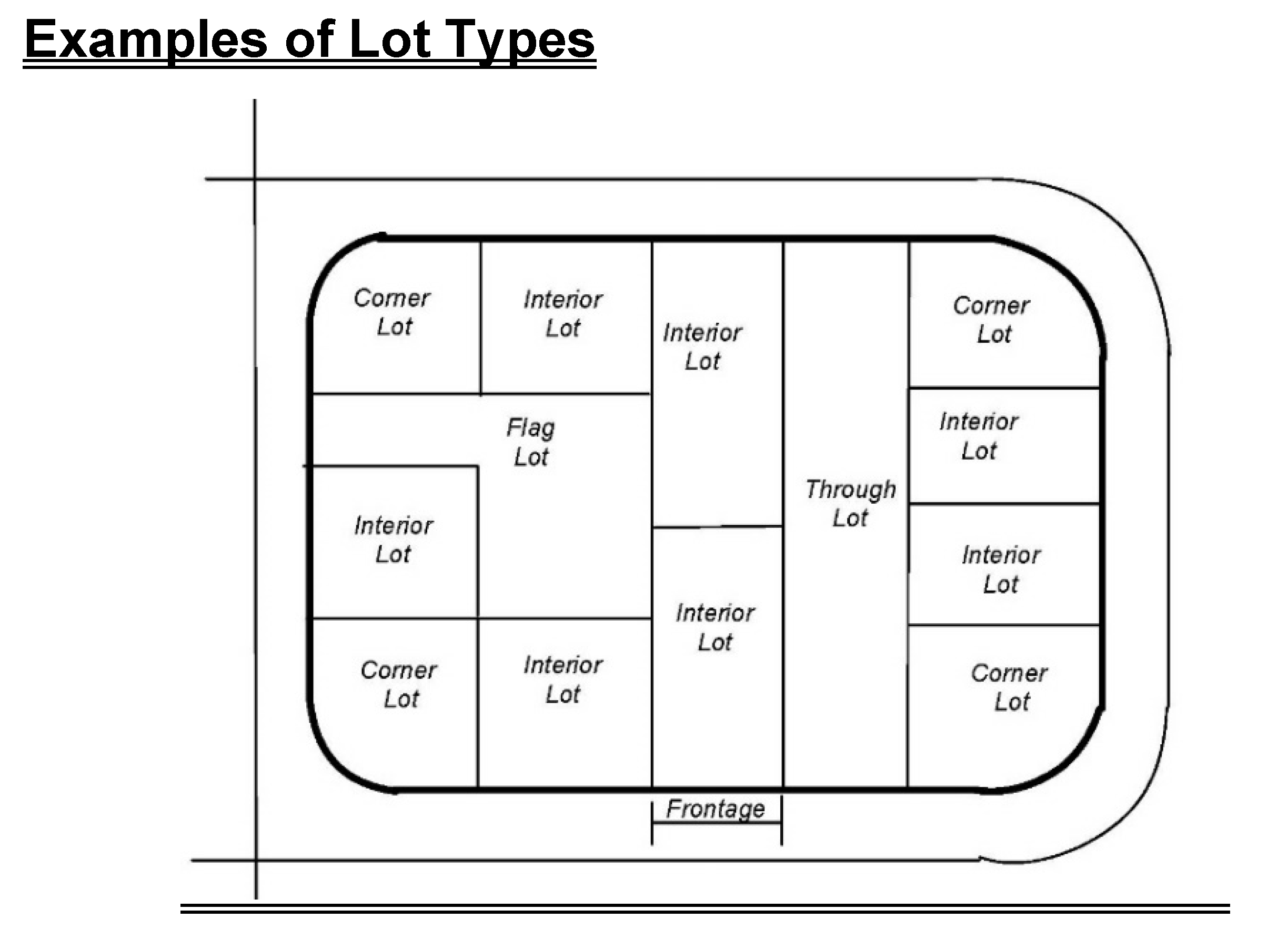
Lot (Lines). The lines bounding a lot.
Lot (of Record). A lot which is a part of a subdivision, the map of which has been recorded in the Office of the County Clerk of Santa Rosa County or a lot described by metes and bounds, the description of which has been thus recorded.
Lot (Width). The distance between the side lot lines; measured along the minimum front building setback line when a front yard is required in these regulations; otherwise, the lot width shall be the mean horizontal distance of the lot measured at right angles to the depth.
Lowest Floor. The lowest floor of the lowest enclosed area (including basement). An unfinished or flood resistant enclosure, usable solely for parking of vehicles, building access or storage in area other than a basement area is not considered a building's lowest floor; provided, that such enclosure is not built so as to render the structure in violation of the applicable non-elevation design requirements of the Florida Building Code or ASCE24.
Mailed Notice. Notice as specified in sections 11.03.02.
Manufactured Home. A structure, transportable in one or more sections, which is eight (8) feet or more in width and greater than four hundred (400) square feet, and which is built on a permanent, integral chassis and is designed for use with or without a permanent foundation when attached to the required utilities. The term "manufactured home" does not include a "recreational vehicle" or "park trailer." [Also defined in 15C-1.0110, F.A.C.]
Manufactured Home Park or Subdivision. A parcel (or contiguous parcels) of land divided into two or more manufactured home lots for rent or sale.
Marina. A public facility which provides secured moorings or dry storage for watercraft for value (a fee).
Marina (Recreational and Commercial). Public facilities located adjacent to a public navigable waterway and which are provided with slips and/or moorings for securing, servicing or repairing of watercrafts, but excluding industrial craft. Major repairs, such as construction or rebuilding of boats, installations of new bottoms or substantial structural additions or alterations, are prohibited as they are industrial activities.
Marina (Industrial). Public facilities located adjacent to a public navigable waterway and which are provided with slip and/or moorings for major repairs such as construction or rebuilding of boats.
Marina (Private). Facility associated with a private development as an amenity to the development and not open to the public
Market Value. The value of buildings and structures, excluding the land and other improvements on the parcel. Market value is the Actual Cash Value (like-kind replacement cost depreciated for age, wear and tear, neglect, and quality of construction), determined by a qualified independent appraiser, or tax assessment value adjusted to approximate market value by a factor provided by the Property Appraiser.
Marquees or Canopies. Any shelter, cover or projection extending beyond the outer face of the building wall designed and intended to be used for protection of entrances, walkways or windows.
Mean Sea Level (MSL). The average height of the surface of the Gulf for all stages of the tide, usually determined from hourly readings; or the mean between high and low tides as established by the National Geodetic Vertical Datum of 1929.
Medical Marijuana Dispensary. A dispensary is a location (whether business or non-profit) where patients can access cannabis (marijuana) in a legal and safe manner. Users get assistance from experts who find an optimal dosage and recommend the delivery method to achieve the optimal results when using medical marijuana.
Medical Services. The provision of therapeutic, preventative or corrective personal treatment services by physicians, dentists and other licensed medical practitioners, as well as the provision of medical testing and analysis services. These services are provided to patients who are admitted for examination and treatment by a physician and with no overnight lodging.
Mini-warehouses or Self Storage Facilities. One (1) or more structures containing two (2) or more exclusive, private access warehouse spaces.
Minor Subdivision. Minor subdivisions refer to any division of one parcel of land into two or more parcels in which all parcels have adequate existing county-maintained or county-approved street frontage and require no new streets or change in existing public streets. Parcels fronting on a deeded or platted right-of-way where the actual roadway has not been constructed and has not been accepted for maintenance by the County shall not qualify as minor subdivisions. For the purposes of this definition, county-approved street frontage shall include private named streets that were in existence as of April 24, 1986, and are shown and named on the County's original zoning maps, and private roads and their associated rights-of-way that have been approved by the County through the platting process.
Mobile Home. A structure transportable in one or more sections which is eight (8) body feet or more in width and which is built on an integral chassis and designed to be used as a dwelling when connected to the required utilities and includes the plumbing, heating, air conditioning, and electrical systems contained therein and is constructed to standards as promulgated by the United States Department of Housing and Urban Development and bearing the "H.U.D." insignia.
Mobile Home Park or Subdivision. A parcel (or contiguous parcels) of land divided into two or more mobile home lots for rent or sale. A new mobile home park or subdivision means a mobile home park or subdivision for which the construction of facilities for servicing the lots on which the mobile homes are to be affixed (including at a minimum, the installation of utilities, the construction of streets, and either final site grading or the pouring of concrete pads).
Modular Home. A residential structure, built in sections (modules) at a factory, assembled on site and bearing the insignia DBPR or its successor regulatory state agency on the inside of the home's electrical panel, designed for, erection or installation on a site-build permanent foundation.
Motor Vehicle. A self-propelled free moving vehicle, usually with four or more wheels, primarily for conveyance on a street or roadway.
Mulch. Non-living organic or synthetic materials customarily used in landscape design to retard erosion to retain moisture. Material such as straw, wood fiber, seed and hay, have been found to be very effective in preventing soil erosion. Bark chips and shredded bark by products of timber processing often are used as landscape mulches. They may be applied by hand or with a mulch blower.
Mylar. Shall mean a stable polyester film resistant to chemicals and heat. It shall be at least 0.003 inches thick.
Native Vegetation. Plants which occur naturally or have evolved in Santa Rosa County without assistance from humans.
Net Acreage. The total number of acres within the perimeter boundary of a parcel of land excluding, but not limited to, right-of-way, easements and lakes.
New Construction. Structures for which the "start of construction" commenced on or after the effective date of this ordinance. However, for the purposes of administration of the flood resistant construction requirements of Chapter Three and the Florida Building Code, structures for which the "start of construction" commenced on or after June 26, 1975 and includes any subsequent improvements to such structures.
New Development. Development of essentially vacant land, regardless of whether preexisting improvements have been removed from such land.
Non-complying Building or Structure. Any building or other structure which is a lawful use (permitted or non-conforming) but which does not comply with all applicable provisions of this Ordinance including bulk regulations, Performance Standards, or other requirements, either on the effective date of this Ordinance or as a result of any subsequent amendment.
Non-conforming Use. A use of a building or structure or of a tract of land which, at the time of the commencement of the use, was a permitted use in the zoning district, or any legal change thereto from time of the commencement thereof until the effective date of this Ordinance, but which does not, on the effective date of this Ordinance, conform to any one of the current permitted uses of the district in which it is located.
Nursing Home (Rest Home or Convalescent Home). Activities customarily performed by a home for the elderly or infirm in which three or more persons not of the immediate family are received, kept or provided with food, shelter and care for compensation. This activity shall not include state licensed volunteer adult foster care homes in which three or less foster adults are placed. Neither does the principal activity include hospitals, clinics or similar institutions devoted to the diagnosis and treatment of the sick or injured.
Obstruction. Any structure or tree which exceeds permissible height limitations or is otherwise hazardous to the landing or taking off of aircraft.
Open Space. Land or portions of land to be preserved and protected, whether municipally or privately owned and perpetually maintained for active or passive recreation or to meet lot coverage requirements. Includes, but is not limited to, the following terms: developed recreation, natural and landscaped areas, common open space, etc.
Overlay District. A special district which addresses special land use circumstances or environmental safeguards and is superimposed over the underlying existing zoning districts. Permitted uses in the underlying zoning district shall continue subject to compliance with the regulations of the overlay district.
Owner. The owner of the fee simple title of record, a binder, under a contract by agreement for deed, or a lessee under a written lease.
Parapet. A false front or wall extension above the roof of a building.
Parcel. A lot or contiguous group of lots in single ownership or under single control, and considered a unit for purposes of development.
Parking Garages. A public or private commercial building or structure solely for the off-street parking or storage of operable motor vehicles.
Parking Lot (Off-Street Public or Private). An open area at ground level providing two or more parking spaces with or without a parking fee and in which no sales are permitted.
Park Model Home. A unique trailer type RV that is designed to provide long-term or permanent placement at a destination where an RV could use. Park model homes are also known as recreational park trailers and are built on a single chassis mounted on wheels and which has a body width not exceeding fourteen (14) feet. They are certified by their manufacturer to comply with the American National Standards Institute (ANSI) A119.5 Park Model Recreational Vehicle Standard. Park model RVs are titled as vehicle. Also known as Park Trailer's and defined in F.S. 320.01.
Parking Space. An area used for and sufficient in size to store one automobile.
Park Trailer. See Park Model Home definition and defined in F.S. § 320.01.
Patio Home. A house in a suburban setting that is part of a unit of several houses attached to each other, typically with shared walls between units and with exterior maintenance and landscaping provided through an association fee. Patio homes are similar architecturally to townhouses or condo, only in miniature. Townhouses and condos are typically at least two stories high, patio homes typically max out at one to one and one-half stories.
Permissible Use (Permitted Use). Any use authorized in a particular zoning district or land use category, a permitted use, conditional use, or special exception use.
Person. Any individual, firm, co-partnership, corporation, company, association, joint-stock association, or body politic, and includes any trustee, receiver, assignee or other similar representative thereof.
Personal Service. A beauty parlor, shop, or salon, barber shop, massage, reducing or slenderizing studio, steam or Turkish baths or similar use.
Pit/Solid Waste Disposal Facilities. This classification includes activities such as borrow pits, resource extraction or mining, solid waste disposal facilities, and such activities.
Place of Worship. Activities customarily performed in a building where persons regularly assemble for religious worship and which building, together with its accessory buildings and uses, is maintained and controlled by a religious body organized to sustain public worship.
Planned Business District (PBD). An area of land of at least fifteen (15) acres devoted by its owner to development as a single entity for a number of dwelling units, and/or commercial uses in accordance with a plan which does not necessarily comply with the provisions of this ordinance with respect to lot size, lot coverage, setbacks, off-street parking, bulk or type of dwelling, density and other regulations.
Planned Business District and Planned Unit Development Definitions.
Common Open Space. An area of land, or an area of water, or combination of land and water within the area of a Planned Business Development or Planned Unit Development districts which is designed an intended for the use of enjoyment of residents or users of the Planned Business Development or Planned Unit Development in common. Common open space may contain such recreation structures and improvements as are desirable and appropriate for the common benefit and enjoyment of residents or users of the Planned Business Development or Planned Unit Development.
Gross Acreage. The total number of acres within the perimeter boundaries of a Planned Business Development or Planned Unit Development.
Land Owner. The legal or beneficial owner or owners of all the land proposed to be included in a Planned Business Development or Planned Unit Development: the holder of an option or a contract to purchase; or a person having possessory rights of equal dignity (such as a lease) will be deemed to be a land owner for the purpose of this Section.
Net Acreage. The total number of acres within the perimeter boundaries of a Planned Business Development or Planned Unit Development excluding areas devoted to streets, rights-of-way, easements, lakes, public and private open space and recreation areas.
Plan. Plans for development of land approved for Planned Business District or Planned Unit Development shall be processed in accordance with procedures established in the Santa Rosa County Subdivision Regulations. The preliminary development plan is to be submitted to the Santa Rosa County Planning and Zoning Department and County Engineer with the preliminary plat. The final development plan is submitted in the same manner for final plat approval.
Planned Unit Development Project (PUD). An organized comprehensive program for flexible planning approval of improvements on a parcel of land in compliance with basic and specific development objectives and regulations, allowing individualized land use and site plans.
Plant Nurseries and Landscape Services. Cultivation and sale of flowers, shrubs, trees and plants at wholesale, retail or both, as well as provision of related consultative services.
Plat. A map or drawing depicting the division of lands and lots, blocks, tracts, or sites being a complete exact representation of the boundary lines, streets, easements and other information in compliance with the Florida Plat Act and applicable County ordinances including this code.
Political Subdivision. Any county, city, town, village or other political subdivision or agency thereof, of any district, port commission, port authority or other such agency authorized to establish or operate airports in the state.
Pond (Lake/Surface Water Storage). A natural or man-made body of open water. Soil removed for the construction of man-made ponds must remain on the site from which it was removed.
Portable Storage Unit. Any container designed for the storage of personal property which is typically rented to owners or occupants of property for temporary use and which is delivered and removed by truck. Examples of Portable Storage Units include, but are not limited to, moving and storage containers, road and storage trailers and steel shipping containers.
Premises. Any land together with any structures occupying it.
Principal Building. The building in which the principal use of the lot on which it is situated is conducted.
Principal Use or Structure. The primary activity or the structure in which the primary activity occurs.
Product Display. A special presentation of the products a business is selling that is used to attract and even entice consumers. The nature of these displays can vary between industries. This is not intended to display the entire inventory, but a sample of each of the items offered for sale.
Project Parcel. That tract of real property comprising the gross acreage of all the land and water areas of a given project or development, including open space and parking. (See Gross Acreage).
Property Line. The recorded boundaries of a lot or tract of land under one ownership.
Protected Tree. A living tree eight (8) in diameter at a point four and one-half feet above ground level, unless being of size to be classified as a "heritage tree" as defined in this LDC or a "champion tree" as defined by the Florida Department of Agriculture and Consumer Services, Division of Forestry.
Public/Private Utilities and Public Facilities. Buildings, structures, equipment, or uses of land which are customary and necessary to the maintenance and operation of essential public services and major capital improvements, including transportation, sanitary sewer, electric and gas transmission systems, water distribution, collection and disposal, law enforcement, fire protection, communication, drainage, potable water, educational, parks and recreational, health systems and facilities, solar electrical generation facilities, and similar services and facilities.
Public Supply Potable Water Well. Public supply potable water well is any water well which supplies water for human consumption to a community water system.
Reasonable Access. The minimum number of access connections, direct or indirect, necessary to provide safe access to and from the thoroughfare, as consistent with the purpose and intent of this LDC and any applicable plans and policies of the County.
Recreation. Uses devoted to public or private parks, playgrounds, golf courses, dedicated beaches and similar uses.
Recreational Vehicle. A vehicle, including a park trailer, which is: (See section 320.01, F.S.)
1.
Built on a single chassis;
2.
Four hundred (400) square feet or less when measured at the largest horizontal projection;
3.
Designed to be self-propelled or permanently towable by a light-duty truck; and
4.
Designed primarily not for use as a permanent dwelling but as temporary living quarters for recreational, camping, travel, or seasonal use.
Recreational Vehicle Park (Campground). A licensed business entity engaged in the rental of two (2) or more parking spaces for temporary (6 months or less) parking of recreational vehicles.
Redevelopment. Development of pre-existing buildings or other improvements that in aggregate will equal or exceed the applicable threshold set forth below:
1.
For a parcel containing one or more pre-existing buildings consisting of less than a total of 2,000 square feet, aggregate expansion equal to or exceeding fifty-one percent (51%) of the total square footage of buildings or
2.
For a parcel containing one or more pre-existing buildings consisting of a total of 2,000 square feet or more, aggregate expansion equal to or exceeding thirty-five percent (35%) of the total square footage of the building,
3.
If there are multiple buildings on a site, the combined square footage of all buildings shall be used.
4.
For a parcel containing pre-existing improvements, any development that increases the number of required parking spaces by the lesser of ten (10) percent or ten (10) or more spaces.
Regulated substances.
1.
Any liquid or water soluble substance or material that, by reason of its toxic, caustic, corrosive, or other properties may degrade the water quality of public potable water supply wells and wellfields.
2.
Regulated substances shall include, but are not limited to, those liquid or water soluble substances, in their reportable quantities, as set forth in the U.S. Environmental Protection Agency (EPA) lists, as amended from time to time, entitled:
The List of Extremely Hazardous Substances and Their Threshold Planning Quantities (40 CFR part 355, Appendix A), and
List of Hazardous Substances and Reportable Quantities (40 CFR, Table 302.4).
3.
When the reportable quantity of a regulated substance is indeterminate, this section shall only apply whenever the aggregate sum of all quantities at any one time exceeds five gallons where said substance is a liquid, or 25 pounds where said substance is a solid.
Research and Development. Establishments primarily engaged in the research, development and controlled production of high technology electronic, industrial or scientific products or commodities for sale. Uses include aerospace and biotechnology firms, and non-toxic computer component manufacturers. This classification also includes assembly, testing and repair of components, devices, equipment, systems, parts and components; research and development laboratories including biochemical and chemical development facilities, pharmaceutical, and medical research.
Residential Dock or Pier. A dock or pier constructed adjacent to a residential lot for gratis recreational purposes and/or mooring of private boats.
Resource Extraction. (See "Borrow Pit.")
Restaurant. Establishment designed to serve foods and beverages which are consumed on the premises within the confines of the principal building or where the design or principal method of operation includes two or more of the following:
1.
Customers, normally provided with an individual menu are served generally in non-disposable containers by a restaurant employee at the same table or counter at which said items are consumed.
2.
Ice cream parlors and other small specialty restaurants having floor area exclusively within a shopping or office center and sharing common parking facilities with other businesses within the center.
3.
A cafeteria or cafeteria type operation where foods or beverages generally are served in non-disposable containers and consumed within the restaurant building.
4.
Customers purchase food or beverages for carry out, pick-up or drive-thru.
5.
Foods or beverages served generally in edible containers or in paper, plastic, or other disposable containers for consumption within the restaurant or for carry-out consumption.
Restricted Sales and Services. Small limited item shops and stores limited to retail sales of frequently needed small convenience items or services typically needed on a frequent and recurring basis such as barber and beauty care, small scale drug stores, dry cleaning pick up stations (excluding cleaning and repair services); specialty food shops such as wine and cheese stores, imported food shops, or similar unique limited item shops (excluding general food market stores); interior decorators with or without display and with no warehousing. This is intended to accommodate shops with limited inventory of goods directed expressly to a special market area including:
1.
A household market in the immediate vicinity as opposed to county wide.
2.
A specialized market with customized service demand; or
3.
A tourist oriented market area in the immediate vicinity. Scuba shops, repair shops, motor vehicle parts, health spas, wholesale, warehousing, and discount stores and similar general sales stores are expressly excluded.
Restrictive Covenants. Private regulations recorded with the final plat or deed, which limit or otherwise govern the use, intensity and development patterns of the land within a subdivision or parcel of land for a specified time. Restrictive covenants are not enforced by Santa Rosa County Code Enforcement and are considered a civil matter.
Retail Sales and Services. Business activities customarily providing retail convenience goods. Any such uses shall include department stores, variety stores, drug and sundry stores, restaurants, delicatessens, cafeterias, grocery and markets, gift shops, wearing apparel, home and auto supply, furniture and appliances, package stores, cocktail lounges, taverns, newsstands, book and stationery stores, shoe repair shops, luggage shops, bakeries and candy shops (provided that products made on the premises are sold on the premises), camera and photo supply shops, radio and television sales and service, art shops, pawn shops, electrical and lighting, laundry and dry cleaning pick up stations, coin operated or self service laundry, farm and garden supplies.
Rezoning. To change the zoning district classification of a parcel or parcels.
Road. (See "Street.")
Roof Line. The upper most line of the roof, including mansard roofs, or a building, or in the case of an extended facade, the upper most height of said facade. However, in the case of a slanted roof or A-frame type roof, roof line refers to the lower most edge of said roof.
Rural Activity Centers (Commercial). Specific limited commercial development within one mile of identified crossroads and the Town of Jay. Examples of permitted uses include small scale retail and grocery stores, restaurants, day care centers, gas stations, and feed stores.
Sand Dunes. Naturally occurring accumulations of sand in ridges or mounds landward of the beach.
Self Service Storage Facility. Any real property designed and used for the purpose of renting or leasing individual storage space to tenants who are to have access to such space for the purpose of storing and removing personal property. No individual space may be used for residential purposes.
Service Station. Any business engages primarily in the servicing of automotive vehicles, including the sale and delivery of fuel, lubricants and other products necessary to the operation of automotive vehicles. This term also includes the sale and installation of accessories, tires, batteries, seat covers and tire repair, cleaning facilities, minor engine tune up, wheel balancing and aligning, brake service, convenience stores with gas pumps, gas stations with or without repair facilities, and gas stations with or without fast food or drive-through restaurants.
Setback Line (Street). That line that is the required minimum distance from the street right-of-way line or any other lot line that establishes the area within which the principal structure must be erected or placed.
Shopping Center. A group of commercial establishments planned, constructed and managed as an entity with customer and employee parking provided on-site, provision for goods delivery separated from customer access, and designed to serve a community or neighborhood.
Shrub. A low woody plant usually with several permanent stems instead of a single trunk, normally reaching a maximum height of not more than five (5) feet.
Sign. Any device, attached or free-standing structure, or any combination of device or structure, made or any material, with or without a written message, figure, painting, drawing, logo symbol or other form, designed, placed, intended, or used to inform or attract attention. Including, but not limited to, all flags, banners, streamers, excluding flags and insignia of any government, state, county, city or agency thereof.
Silviculture. Activities related to the growing or harvesting of trees and that have obtained an Agriculture silviculture designation from the Property Appraiser or silviculture activity that has a Florida Division of Forestry Management Plan.
Site. A plot of land suitable for development, or on which a building or buildings has been built.
Site Plan. A plan, to scale, showing uses and structures proposed for a parcel of land required by this code this can include an Engineered plan. A site plan includes, but is not limited to, lot lines, streets, building sites, reserved open space, parking, existing buildings, major landscape features and proposed utility lines and easements.
Small Wind Energy System. A wind energy conversion system consisting of a wind turbine, structural support, and associated control or conversion electronics designed to supplement other electricity sources for a home, farm, or small business. The power generated is used for individual use, on-site by the property owner. The turbine may be roof or tower mounted.
Solar electrical generation facility or facilities. A production facility for electrical power that utilizes photovoltaic modules (panels) to convert solar energy to electricity whereby electricity that is produced is delivered to the transmission system and consumed off-site. Solar electrical generation facilities consist principally of photovoltaic modules, a mounting/racking system, power inverters, transformers, and associated components. Solar generation is generally the principal use of the property, but solar electrical generation facilities may also include administration/maintenance buildings, transmission lines, substations, collector yards, energy storage equipment, and related accessory uses and structures. For the use of this code Solar electrical generation facilities are considered a use by right within the Agricultural zoning districts. Solar electrical generation facilities are subject to all applicable regional, state and federal regulations.
Solid Waste. As defined by 403.703, Florida Statute.
Special Exception. A special exception is a use not generally permitted within a respective zoning district but may be authorized by the Zoning Board when such use is found to be substantially in harmony with the general purpose and intent of the zoning ordinance. Such use may be authorized only after strict compliance with the procedures expressly set forth in Section 5.06.00. Such special exceptions are limited to those uses specifically authorized in Section 5.06.00.
Special Flood Hazard Area (SFHA). An area in the floodplain subject to a 1 percent or greater chance of flooding in any given year. Special flood hazard areas are shown on FIRMs as Zone A, AO, A1-A30, AE, A99, AH, V1-V30, VE or V.
Special Residential Facility. A facility licensed to serve clients of the Department of Health and Rehabilitative Services which provides a living environment for unrelated residents who operate as a functional equivalent of a family, including such supervision and care by support staff as may be necessary to meet the physical, emotional and social needs of the residents. The clients (residents) are limited to: children, the aged, physically disabled, handicapped, developmentally disabled and mentally ill who do not constitute a direct threat to the health, property, and safety of the neighborhood.
Speed
Control Point. A speed control point shall be defined as any one of the following:
1.
Any design condition that requires a complete stop, such as the intersection of a residential street with a collector or arterial roadway, or a "T" intersection between residential streets.
2.
A low speed horizontal curve with the following design features:
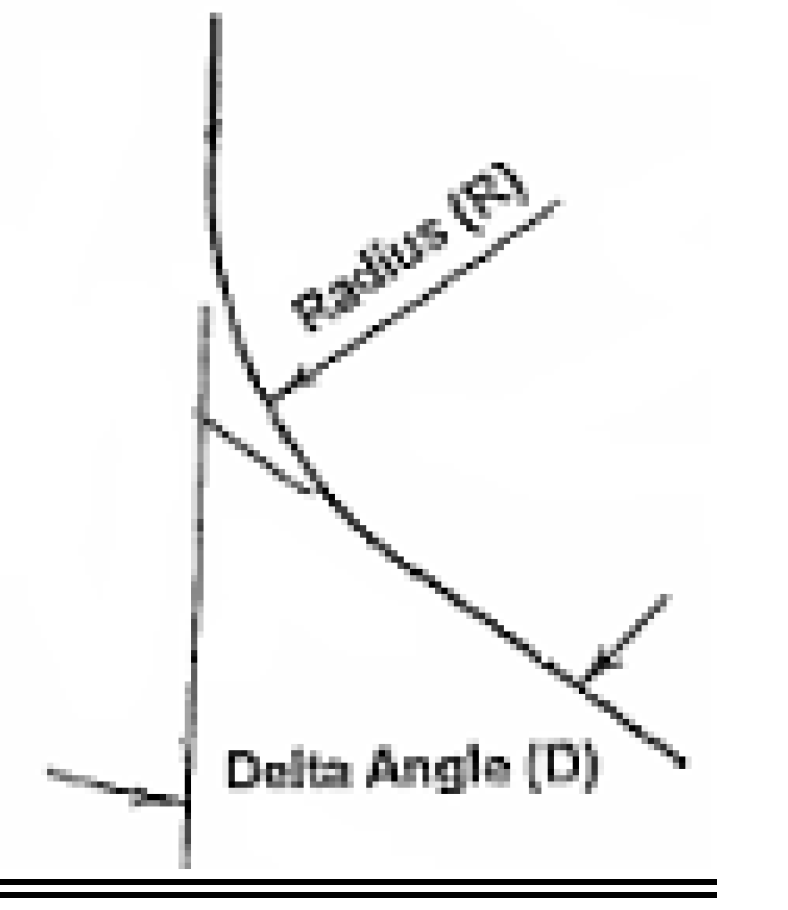
3.
A traffic calming element as defined below and as described in the Santa Rosa County Roadway Design Manual or approved by the County Engineer and Planning Director.
4.
Speed bumps/humps or unwarranted stop signs shall not be classified as speed control points.
Start of Construction. The date the building permit was issued for new construction and substantial improvements to existing structures, provided the actual start of construction, repair, reconstruction, rehabilitation, addition, placement or other improvement was within 180 days of the permit date. The actual start means the first placement of permanent construction of a structure (including manufactured home) on a site, such as the pouring of slabs or footings, installation of piles, construction of columns, or any work beyond the stage of excavation. Permanent construction does not include land preparation, such as clearing, excavation, grading and filling; nor does it include the installation of streets and/or walkways; nor does it include excavation for a basement, footings, piers or foundations or the erection of temporary forms; nor does it include the installation on the property of accessory buildings, such as garages or sheds not occupied as dwelling units or not part of the main structure. For a substantial improvement, the actual "start of construction" means the first alteration of any wall, ceiling, floor or other structural part of a building, whether or not that alteration affect the external dimensions of the building.
Story. That portion of a building included between the surface of any floor and the surface of the next floor above it, or if there is no floor above it, then the space between such floor and the ceiling next above it. In computing the height of a building, the height of a basement or cellar shall not be included if more than one-half (½) of its height is below the mean grade.
Story (Half). A story under a gabled, hipped or gambrel roof, the wall plates of which are on at least two opposite exterior walls and are not more than three (3) feet above the finished floor of such story.
Street (or Road). A public or private thoroughfare accepted or approved by the county that is used, or intended to be used for passage or travel by motor vehicles, transit vehicles, bicycles and pedestrians. The street functional classification hierarchy ranges from high-order roads (major arterials) to low-order roads (residential streets) and include the following:
Major Arterial. Roads serving as principal routes through the County. The purpose of these facilities is to move large volumes of traffic from one part of the region or County to another. Driveway access to a major arterial shall be restricted.
Minor Arterial. Roads providing connections between major activity centers of the County. Minor arterials augment the major arterial system for local and inter-County traffic by feeding traffic from collector and residential street systems onto major arterials. Driveway access to a minor arterial shall be restricted.
Major Collector. Roads providing connections between major activity centers and residential centers. Major collectors collect traffic from the lower-order roads to distribute to another major collector or arterial roadway. Driveway access to a major collector shall be restricted.
Minor Collector. Roads primarily providing for traffic movement to/from different neighborhoods. Minor collectors collect traffic from the lower-order roads to distribute to another minor collector or higher-order roadway. Driveway access to a minor collector shall be restricted.
Commercial/Industrial Street. Streets which directly serve abutting non-residential, commercial and industrial properties. Commercial/Industrial Streets are intended to provide safe property access and traveling conditions for motorists. These streets shall carry traffic having either a destination or origin on the street itself or from within the local industrial/commercial area.
Residential Collector Streets. Streets that collect and distribute traffic internally to and from a neighborhood. This is the highest order of street appropriate to a residential neighborhood and residential frontage along it shall be restricted.
Residential Streets. A type of street intended solely for residential subdivisions. These streets are intended to provide a safe and quiet environment for residents along the street and safe access and traveling conditions for motorists and pedestrians. These streets shall be completely free of or significantly minimize through traffic. The reduction or elimination of through traffic and the geometric design of the street are means to promote safety and to create a desirable residential neighborhood.
Secondary Road. Numbered roads that were previously owned by the State Department of Transportation and are now owned and maintained by Santa Rosa County (i.e. County Road 197 [CR197])
Street Line. A dividing line between a lot, tract or parcel of land and a contiguous street right-of-way.
Structure. Any object constructed, erected, or installed by man, the use of which requires permanent location on the land, or attached to something having a permanent location on the land.
Structured mounted wind system. A wind energy system mounted on a structure roof, walls, or other elevated surface that includes any base, blade, foundation, generator, nacelle, rotor, tower, transformer, vane, wire, inverter, batteries, or other components used in the system.
Structural Alterations. Any change in the supporting members of a building, such as bearing walls, bearing partitions, columns, beams or girders, or any complete rebuilding of the roof, exterior walls or any other change which results in increased or decreased height of a structure.
Subdivision. The division or re-division of a parcel of land into two or more parcels except for modifications, exceptions and revisions provided for in this ordinance.
Substantial Damage. Damage of any origin sustained by a building or structure whereby the cost of restoring the building or structure to its before-damaged condition would equal or exceed 50 percent of the market value of the building or structure before the damage occurred.
Substantial Improvement. Any repair, reconstruction, rehabilitation, addition, or other improvement of a building or structure, the cost of which equals or exceeds 50 percent of the market value of the building or structure before the improvement or repair is started. If the structure has incurred "substantial damage," any repairs are considered substantial improvement regardless of the actual repair work performed. The term does not, however, include either:
1.
Any project for improvement of a building required to correct existing health, sanitary, or safety code violations identified by the building official and that are the minimum necessary to assure safe living conditions.
2.
Any alteration of a historic structure provided the alteration will not preclude the structure's continued designation as a historic structure.
System height. The vertical distance measured from the ground level at the base of the tower to the uppermost vertical extension of any blade, or the maximum height reach by any part of the wind energy system.
Telecommunications Facilities. Any cable, wires, lines wave guides, antennas and any other equipment or facilities associated with the transmission or reception of communications which a person seeks to locate or has installed upon or near a Tower or Antenna Support Structure. However, the term "Telecommunications Facilities" shall not include:
a.
Any satellite earth station antenna two meters in diameter or less which is located in an area zoned for industrial or commercial use.
[b.]
Any satellite earth station antenna one meter or less in diameter, regardless of zoning category.
Telecommunications Tower. Means any structure designed and constructed for the purpose of supporting one or more communication antennas, including camouflaged towers, conventional wireless towers and low impact or stealth towers. The term includes towers to support antennas for transmitting or receiving personal wireless services and cellular telephone communications towers. The term includes equipment fundamental to the operations of the tower. The term does not include commercial radio and television broadcast towers, amateur short-wave radio towers or those towers used solely for private use dispatch services.
Temporary Building. A building or structure erected on a lot and not erected on a permanent foundation.
Tiny Home. A single family residential structure under 400 sq. ft. built on a permanent foundation.
Tiny Home on Wheels. A tiny house constructed on wheels and legally registered as a recreational vehicle.
Tower. A self-supporting lattice, guyed, or monopole structure constructed from grade which supports Telecommunications Facilities or wind generator.
Tower Site. Section of a lot completely contained within a lot meeting the requirements of the zoning district for the purposes of locating a communications tower.
Townhome. A multifamily dwelling in which each unit is accompanied by an exclusive and independent lot or parcel that is not part of any other unit nor is part of any commonly owned property.
Trade Service and Repair. Shops providing services requiring skilled labor or craftsmanship for the repair of household items, including appliances, typewriters, watches, locks and similar items, as well as printing, copy and blue printing services; and similar trades and services.
Traffic Calming Element. A device or design element that is intended to reduce traffic speeds and volumes on residential streets and residential collector streets where access to residential lots is provided. The purpose of traffic calming is to create a safe environment for motorized and non-motorized users alike.
Transient Resident. (See "Seasonal Resident.")
Travel Time Contour. Set of points, or contour line, where water takes an equal amount of time to reach a given destination such as a well.
Tree Removal Permit. A permit required by Section 4.07.05 and obtained pursuant to the procedures in section 11.02.12.
Trips From Approved Development. The sum of all new daily traffic volumes assigned to a roadways segment, since the adoption of the County's Comprehensive Plan, for approved development which no certificate of occupancy has been issued at the time of the most recent traffic count. Annual developments which were completed and certificates of occupancy issued as of the date of the most recent traffic counts for the roadway segments.
Turf. A surface layer of earth containing a dense growth of grass and its matted roots.
Understory Trees. Understory trees are generally small, shade tolerant trees that typically grow beneath canopy trees and have a mature height of 10—25 feet.
Use. The purpose for which land or building is arranged, designed, occupied or maintained.
Variance. A variance is the deviation from the requirements and provisions of this ordinance or, and authorization from the Zoning Board to deviate (in special situation) from the provisions of this ordinance when such deviation will not be contrary to the public interest and when owing to conditions peculiar to the property and not of actions of the applicant, a literal enforcement of the ordinance would result in unnecessary and undue hardship. A variance can only be authorized for height, area, bulk, and size of structure or yard size and open spaces. Establishment or expansion of a use otherwise prohibited shall not be allowed by variance, nor on non-conformities in the district or classification or in adjoining districts or classifications.
Variance, Flood. A grant of relief from the requirements of Section 3.02.00 of this ordinance or the flood resistant construction requirements of the Florida Building Code, which permits construction in a manner that would not otherwise be permitted by this ordinance or the Florida Building Code.
Vehicle. Any self-propelled conveyance designed and used for the purpose of transporting or moving persons, animals, freight, merchandise or any substance and shall include passenger cars, trucks, buses, motorcycles and scooters, but shall not include tractors, construction equipment or machinery or any similar device.
Vehicle Use Area. Any portion of a developed site used primarily for traffic circulation, parking or display of motorized vehicles.
Vehicular Sales and Service. The retail or wholesale sale or rental of motor vehicles and related equipment, such as dealerships, with incidental service and maintenance.
Vehicular Service and Maintenance. Establishments for the dispensing of motor fuels and related products as retail having pumps, underground storage tanks and other facilities for such activity and which may include the retail sale of minor automobile parts and accessories such as tires, batteries, spark plugs, fan belts, shock absorbers, mirrors, floor mats, cleaning and polishing materials and similar items, and which may include the inspection, servicing or minor repair of motor vehicles having one or more enclosed service bays or stalls. These services may include body repair and painting, frame straightening, or tire recapping or vulcanizing.
Veterinary Medical Services. The provision of animal medical care, treatment, and temporary boarding of such animals by a Florida licensed veterinarian.
Warranty. shall mean a registrant's two-year obligation to guarantee all materials and labor used by the registrant in performing certain obligations hereunder, including the materials and labor guarantee associated with a registrant's performance of make-ready work.
Watercourse. A river, creek, stream, channel or other topographic feature in, on, through, or over which water flows at least periodically.
Wellhead Protection Zone. 500 foot radius around public supply potable water wells, measured from the center of the wellhead.
Wetlands. Those areas that are inundated or saturated by surface water or ground water at a frequency and a duration to support, and under normal circumstances do support, a prevalence of vegetation typically adapted for life in saturated soils. Soils present in wetlands generally are classified as hydric or alluvial, or possess characteristics that are associated with reducing soil conditions. The prevalent vegetation in wetlands generally consists of facultative of obligate hydrophytic macrophytes that are typically adapted to areas having soil conditions described above. These species, due to morphological, physiological, or reproductive adaptations, have the ability to grow, reproduce or persist in aquatic environments or anaerobic soil conditions. Florida wetlands generally include swamps, marshes, bayheads, bogs, cypress domes and strands, sloughs, wet prairies, riverine swamps and marshes, hydric seepage slopes, tidal marshes, mangrove swamps and other similar areas. Florida wetlands generally do not include longleaf or slash pine flatwoods with an understory dominated by saw palmetto [Section 373.019(27), F.S]. The landward extent of wetlands is delineated pursuant to Rules 62-340.100 through 62-340.550 F.A.C. as ratified by Section 373.4211, F.S.
Wholesale Trades and Services. The display, limited storage and sale of goods to other firms for resale, excluding outside storage, except as otherwise provided in this Ordinance.
Wind Turbine. The generator, rotor blades, and other mechanical and electrical components mounted on a structure for the purpose of converting wind energy to electrical energy.
Wine. The term wine, as used herein, shall extend to and include all beverages made from fresh fruits, berries or grapes, either by natural fermentation or by natural fermentation with brandy added in the manner required by the laws and regulations of the United States. The term "wine" shall further include all sparkling wines, champagnes, combinations of the aforesaid beverages, vermouths and like products. Sugar, flavors and coloring materials may be added to wine to make it conform to the consumer's taste, provided the ultimate flavor or the color of the product is not altered to imitate a beverage other than wine or to change the character of the wine.
Yard. An open space on the same lot with a building between the building and the adjoining lot lines, unoccupied and unobstructed from the ground upward, except by trees or shrubbery, or as otherwise provided herein.
Yard (Front). A yard with full width and length of the lot extending from the nearest point of a building or structure, excluding permitted encroachments, to any front line of the lot. That part of any lot line abutting any established or proposed street right-of-way line other than an alley shall be a "front lot line."
Yard (Side). A yard which is not a front or a rear yard.
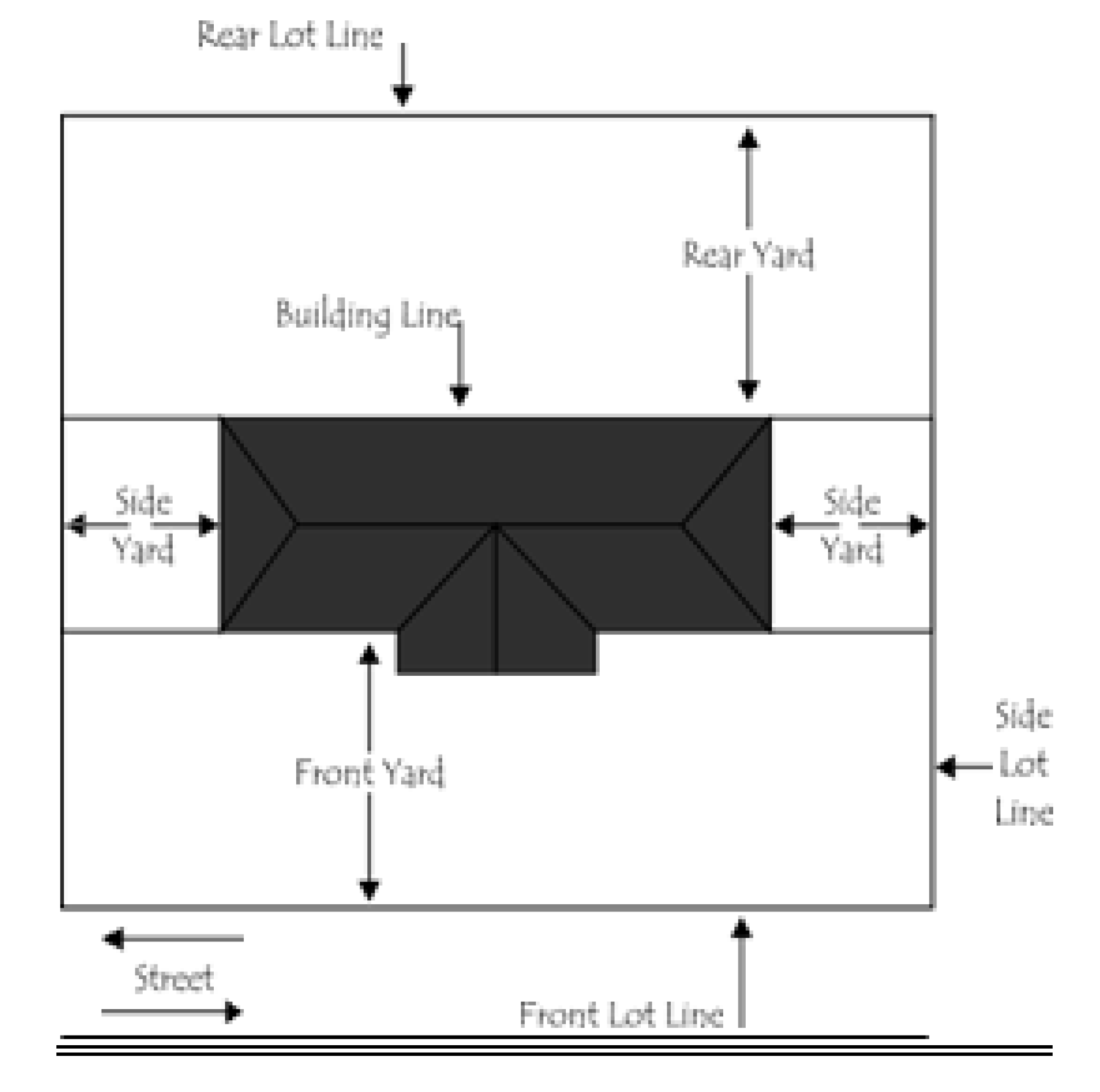
Yard (Rear). A yard extending across the rear of the lot measured between lot lines and being the minimum horizontal distance between the rear lot line and the rear of the main building or any projections other than permitted encroachments. On lots with one front lot line, the lot line opposite the front lot line shall be the rear lot line. On lots which abut more than one street, the remaining lot lines shall be considered side yards except as provided in Section 9.
Zero Lot Line. A developmental approach in which a dwelling unit is sited along one or more lot lines.
Zoo. Any facility, other than a pet shop or kennel, displaying or exhibiting one (1) or more species of wild animals and operated by a person, partnership, corporation or government agency licensed to keep such animals.
(Ord. No. 2021-13, § 3(Attch. B), 8-19-21; Ord. No. 2022-05, § 1, 4-28-22)

