
Santaquin City Zoning Code
10.48 PARKING
AND CIRCULATION STANDARDS
10.48.010 PURPOSE
The following regulations are established to increase safety and lessen congestion on public streets, to provide adequately for parking needs associated with the development of land and increased automobile usage, to set standards for off street parking according to the amount of traffic generated by each use, and to reduce the on street storage of vehicles. (Ord. 12-01-2006, 12-6-2006)
10.48.020 SCOPE
The following regulations shall apply to parking facilities for all new, reconstructed, or modified development sites for public agency projects, private nonresidential projects, and multi-family residential projects. These standards shall also apply to existing businesses which are nonconforming as to parking standards when such businesses apply for or make alterations to their parking facilities or when any structural alteration is proposed or made to the associated building. These standards will also apply if the change in use of a building occurs which would require additional parking than that provided. (Ord. 12-01-2006, 12-6-2006)
10.48.030 GENERAL PARKING STANDARDS
- Plot Plan Required: At the time a building permit is requested for any building or structure, or at the time the use of land is changed in a manner which requires additional off street parking space, a plot plan shall be submitted for review by the development review committee. Such plans must show the location and layout of the proposed spaces, ADA compliant spaces, access and drive aisles, roadways, curbs, and curb cuts. All parking spaces, drive aisles, and accesses shall meet the requirements for off street parking as set forth in this title and the Santaquin City fire codes, and construction and development standards. Parking and circulation plans must be stamped by an engineer licensed in the state of Utah. (Ord. 07-01-2016, 7-6-2016, eff. 7-7-2016)
- Parking Stall Dimensions: All parking spaces shall be a minimum of nine feet (9') wide by twenty feet (20') long and according to the following:
- Square Parking: Square parking is determined to be ninety degree (90°) parking, parallel parking, or any other parking where any one side of a parking stall lies flush with the exterior border of a parking facility. Square parking may also be interior parking oriented essentially parallel or perpendicular to the aisleway providing vehicular access to that parking stall. The dimensions of all square parking shall be measured along the boundaries of the parking stall as shown in figure 1 of this section.
- Angled Parking: The width of all angled parking stalls shall be measured perpendicular to the centerline of the parking stall, as shown below. The length of an angled parking stall, despite the angle, shall be measured along the short side of the parking stall, as shown in figure 1 of this section.
- Required Backing Distances: All parking stalls shall have a minimum clear backing area of twenty-six feet by nine feet (26' x 9') as measured from the rear of the parking stall in a manner parallel to the backing motions of a vehicle exiting the stall.
FIGURE 1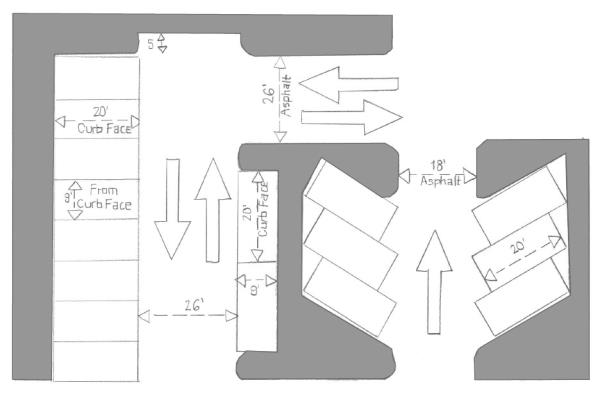
- Reduction In Stall Depth: Parking stall depth can be decreased to eighteen feet (18') under the following circumstances:
- Where cars overhang landscape areas which are at least ten feet (10') wide along street frontages and at least five feet (5') wide along side or rear property lines.
- Where cars overhang an overly large sidewalk area adjacent to a building which is at least six feet (6') wide.
- Parking Locations:
- Main Street: Parking facilities may be located to the rear or side of the associated building except for areas that are required to be landscaped.
- General commercial: Parking facilities may be located anyplace on the premises except for areas that are required to be landscaped.
- Parking stalls shall have a minimum spacing of six feet (6') from primary structures.
- Proximity To Use:
- The off street parking facilities required by this title shall be located on the same lot or within three hundred feet (300') of the parcel of land as the use they are intended to serve. Off street parking spaces which are required with a use shall be located within the same or similar zone as the associated use.
- Parking facilities not located on the same parcel as the associated use must provide documentation to the city of permanent lease, ownership, or shared parking agreement that runs with the land and business on the ground where such parking is located so long as the use is maintained or other parking is made available. Shared parking facilities or agreements must be approved by the land use authority before petitioning business operations commence and must be in accordance with the standards outlined below.
- Parking facilities not located on the same parcel as the associated use must comply with the applicable parking standards outlined below.
- Parking Area Landscaping: All parking areas shall comply with the landscaping and screening requirements found in the city's landscape standards (SCC 10.52).
- Parking Lot Surface, Drainage And Maintenance: Every parcel of land used as a parking or storage area shall be paved with asphalt, brick or concrete surfacing, and shall be so arranged and striped as to provide the orderly and safe loading or unloading, parking and storage of vehicles.
- Striping: Parking lot striping shall be maintained on a regular basis so that striping is visible for the safe ingress/egress and parking of vehicles.
- Maintenance: Parking lot shall be kept free of debris, including, but not limited to, trash, blowing debris, sand, dirt, gravel, etc.
- Surfacing: Parking lot surfacing shall be kept true to line and in accordance with city engineering approved finish grading and drainage plans.
- Drainage Plans: Drainage plans must be reviewed by the appropriate city department for compliance with adopted storm drainage standards, any storm drain master plans, and impacts on adjacent properties caused by a proposed development.
- Deviations To Surfacing Materials: The City Engineer shall review and may approve or deny other types of hard surfacing materials based on site drainage and grading, durability and adequacy of materials, and ability to withstand local climate and geologic conditions. Compacted or treated typical subgrade materials are not an appropriate surface material.
- Continuing Obligation: The required off street parking and loading facilities shall be a continuing obligation of the property owner so long as the use requiring vehicle parking or vehicle loading facilities continues. It shall be unlawful for an owner of any building or use to discontinue or dispense with the required vehicle parking or loading area which meets the requirements of this title. (Ord. 12-01-2006, 12-6-2006)
Amended by Ord. 11-01-2024 on 11/20/2024
10.48.040 NUMBER OF PARKING SPACES REQUIRED
- Rules For Computing Required Off Street Parking Spaces: For the purpose of computing required off street parking spaces which are required by this title, the following rules shall apply:
- "Floor area" shall mean gross floor area, unless otherwise specified for a particular use.
- In stadiums, sports arenas, churches, and other places of assembly in which benches or pews are used in place of seats, each eighteen inches (18") of length of such benches or pews shall be counted as one seat. Any remaining length of any one bench or pew shall be considered to be a whole seat. (Ord. 12-01-2006, 12-6-2006)
- Minimum Requirements: The number of off street spaces required below for each land use is established as minimum requirements:
Notes:Use Parking Required Residential: Attached single-family units1,3 2 parking spaces per unit. Garages will be counted as 1 parking space unless the garage dimension is a minimum of 20' x 20'. Bed and breakfast home 1 parking space for each bedroom and 1 space for each employee at work during the largest shift Dwelling, Two-family3 2 parking spaces per unit Mixed use development with residential dwellings1,3 Residential parking spaces shall follow attached single-family or multiple-unit dwelling requirements. Additional parking is required per nonresidential uses as provided below. Multiple-unit dwelling (apartments/condos)1,3 2 parking spaces per unit. Garages will be counted as 1 parking space unless the garage dimension is a minimum of 24' x 24'. Single-family as part of a PUD3,4 2 car garage per unit Retail commercial: Ancillary commercial 2 spaces per 1,000 sq. ft. Automotive Service and Repair 3 spaces per 1,000 sq. ft. (not including service bays), plus 2 stalls per service bay for the temporary storage of customer vehicles. Automotive Service Station 5 spaces per 1,000 sq. ft. Convenience commercial 5 spaces per 1,000 sq. ft. Heavy commercial 5 spaces per 1,000 sq. ft. Retail sales and services 5 spaces per 1,000 sq. ft. Commercial services, offices: Commercial recreation 1 parking space per 4 patrons, based on the design capacity of the facility Hotels and motels 1 parking space per room or suite, plus 1 parking space for each employee at work during the largest shift Medical clinics or offices, includes dentists and other healing art facilities 6 parking spaces per staff doctor, plus 1 parking space for each employee on the property during the largest shift Mortuaries and funeral homes 30 parking spaces or 1 space for each 25 sq. ft. of combined floor space in all assembly rooms, whichever is greater, plus 1 space for each employee typically at work during normal facility function Professional office or financial services (Not medic clinics or dentist or other healing art facilities.) 1 parking space per 200 sq. ft. of floor area in the building minus storage and bathroom areas Industrial: Business/research park 1 space per 1,000 sq. ft. of floor area or 1 space per 2 employees at work during the largest shift with Planning Commission approval Industrial, light 1 space per 1,000 sq. ft. of floor area Storage unit facility 1 space per site employee/manager on duty and 3 spaces per 50 units with a maximum of 8 spaces required. See also storage unit facility standards below2 Restaurants: Drive-in restaurants 1 space per 4 seats including outdoor seating or 1 space per 125 sq. ft. of gross floor area, whichever is greater Restaurants 1 space per 4 seats, including outdoor seating Public: Churches 1 parking space per 4 seating spaces in the main assembly room based on the design capacity of the structure Healthcare Facilities 1 visitor parking space per 3 patients' beds, plus 1 parking space for each employee at work during the largest shift Places of assembly (e.g., theaters, auditoriums, sports arenas, etc.) 1 parking space per 4 seating spaces Private clubs or lodges 1 parking space per 2 persons based on the design capacity of the facility Schools - commercial, vocational 1 space per teacher and staff member plus 1 space for every 5 students based on design capacity Schools - public, private or quasi-public Parking spaces required for public schools shall be determined by the Nebo or Juab School Districts, or the State of Utah as applicable. Private schools shall utilize similar standards as applied to public schools Special review: Automotive equipment sales or rental
Impound yards
Uses not mentioned
The required off street parking for any use not listed above shall be determined by the Planning Commission. The Planning Commission shall make the determination based on similar uses listed above, nature and impact of the use on public streets and adjoining properties, and typical customer and employee needs
1 Additional guest parking shall be provided as follows: The first 5 residential units (1≤ units ≤5) in a development require 1 parking space per residential unit. The next 5 residential units (5 < units ≤10) in a development require 0.75 parking space per residential unit. The next 5 residential units (10 < units ≤15) in a development require 0.50 parking space per residential unit. Residential units above 15 (units > 15) in a development require 0.25 parking space per residential unit. (Fractional spaces shall require a whole space.)
2 Businesses with warehouse and storage areas may utilize a 0.5 space per 1,000 square feet of storage area when determining required number of stalls.
3 Tandem parking is allowed behind legal parking spaces if the tandem parking space meets the size requirements found in 10.48.030
4 A garage is not required for a single-family detached dwelling in a PUD if the home is owner-occupied affordable housing
(Ord. 10-01-2017, 10-18-2017, eff. 10-19-2017)
- Americans With Disabilities Act (ADA): ADA parking requirements must be complied with in every way. This includes, but is not limited to, adequate stall dimensions, travel areas, pavement markings, signage, connectivity within a site, proximity to business entrances and access points.
- Reduction In Parking Requirements: Businesses or mixed use developments seeking a reduction in parking must receive special exception approval by the Planning Commission. Such exceptions shall be based on the following review considerations and conditions:
- Considerations For Reduction:
- Large Floor Area: The proposed business may have an exceptionally large floor area per volume of sales and customers; e.g., furniture store, car wash, etc.
- Shared Parking: Where compatible occupancies within mixed use buildings and development projects allow sharing of parking stalls, impervious parking areas and "heat island" effects can be reduced. Different occupancies often have parking demands that differ with the time of day or week. This allows sharing of parking spaces between occupancies and reducing the site area dedicated to car storage. In addition to the above review items, where a shared arrangement is proposed, the following shall also be provided for review and approval:
- A parking study must be conducted by a transportation engineer licensed in the State of Utah, which can illustrate peak hours and parking demands for the existing or proposed uses.
- The total number of parking spaces between the uses shall not be less than that needed to handle the yearly average peak hour parking demands for the individual uses.
- Shared parking facilities may have a reduction greater than that outlined above.
- Documentation of a permanent lease, easement, association agreement, or other supporting documents between parties sharing the parking must be obtained prior to final approvals for the affected development.
- Conditions For Parking Reduction:
- Compliance: All parking stalls and drive aisles will comply with the standards established by this section.
- Reduction Not Applicable To ADA: In no case shall any such reduction be applicable to any requirements of the Americans With Disabilities Act. The calculation of the required number of handicapped parking stalls shall be computed from the prereduction total.
- Impacts On Adjacent Properties: Impacts on adjacent properties will not be increased due to the lack of parking required by this Code.
- Considerations For Reduction:
- On Street Parking: Businesses located within the Main Street Business District Zones (i.e., CBD, MSC, MSR) or fronting on 100 South, may petition the Land Use Authority for a reduction in required on premises parking and the use of on street parking as a fraction of their required parking. Approvals of such request must be based on the following:
- There is no parking between the associated building and the public street.
- Due to site constraints, the total required parking cannot be provided on the associated property.
- On street parking will only be counted where adjacent to the business property.
- The location of on street parking is constructed to City standards and the street cross section provides for parking adjacent to the business's property.
- For mixed use developments, all required parking for residential units must be accommodated on site. Dedicated parking for nonresidential customers shall be provided in accordance with SCC 10.20.190 paragraph F. (Ord. 07-01-2016, 7-6-2016, eff. 7-7-2016)
- Storage Unit Facilities: The following parking standards shall apply to storage unit facilities:
- Outdoor storage and parking areas are for recreational vehicle storage only (i.e., boats, campers, trailers, jet skis, snowmobiles, automobiles).
- Outdoor vehicle storage areas shall be located only at the rear of the project where vehicles will not be visible from any public streets.
- Outdoor vehicle storage areas shall be designed so as not to block any driveways, accessways or parking aisles within the project. (Ord. 12-01-2006, 12-6-2006)
Amended by Ord. 10-03-2010 on 10/20/2010
Amended by Ord. 03-01-2021 on 3/2/2021
Amended by Ord. 12-01-2022 on 12/20/2022
Amended by Ord. 03-01-2025 on 3/4/2025
Amended by Ord. 04-05-2025 on 4/15/2025
10.48.050 ACCESS TO PARKING FACILTIES
- Access driveways shall be provided for access to and egress from all parking and loading facilities designed as provided in the Santaquin City construction standards. Each parking and loading space shall be easily accessible to the intended user.
- Forward travel in an automobile to and from parking facilities from a dedicated street or alley shall be required for all uses, except for parking which has been provided in connection with single- and multi-family dwellings. The parking area shall be adequate to facilitate the turning of vehicles to permit forward travel upon entering a street.
- Access to all off street parking facilities shall be designed in a manner which will not interfere with the movement of vehicular and pedestrian traffic.
- All commercial developments shall provide access to and between adjacent nonresidential properties and their associated parking areas. Such access shall be designed based on the adjacent or anticipated use of the adjoining property. (Ord. 07-01-2016, 7-6-2016, eff. 7-7-2016)
- Any development that exceeds an ADT (average daily trips) of two hundred fifty (250) trips shall provide a secondary access for ingress to and egress from the site. When a site is adjacent to a UDOT controlled right-of-way, the maximum ADT allowed before needing a secondary access for ingress to and egress from the site is five hundred (500) trips. (Ord. 04-02-18, 4-18-2018, eff. 4-19-2018)
Amended by Ord. 04-02-2018 on 4/18/2018
Amended by Ord. 01-01-2024 on 1/16/2024
10.48.060 CIRCULATION WITHIN A PARKING AREA
- Traffic Aisles: Circulation within a parking area shall comply with the following requirements:
- Parking areas with more than one aisle must be so arranged that a car need not enter the street to reach another aisle within the same parking area.
- Drive aisles within a parking facility shall be designed to accommodate two-way traffic and required backing distances from parking spaces. Drive aisle widths shall be provided as shown in figure 2 of this section. Aisles designed to accommodate one-way traffic shall be not less than eighteen feet (18') in width, measured perpendicular to the centerline of the aisle.
- Primary access points and an emergency access route shall be designed for the site to accommodate the City's largest emergency response vehicle, in accordance with City adopted IFC standards.
- Drive aisles adjacent to a building that exceeds thirty feet (30') in height must be a minimum of twenty six feet (26') in width and be located a minimum of fifteen feet (15') and a maximum of thirty feet (30') from the building and shall be parallel to one entire side of the building. (Ord. 09-02-2018, 9-18-2018, eff. 9-19-2018)
FIGURE 2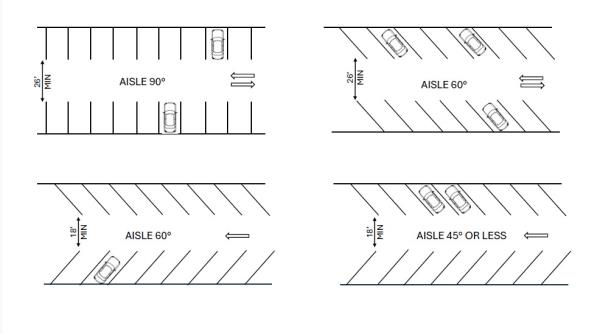
- Queuing Lanes For Drive-Up Or Drive-Through Businesses:
- Queuing lanes shall have a minimum width of ten feet (10').
- Queuing lanes shall provide a minimum queuing distance for three (3) vehicles in addition to a vehicle at the drive-up window (i.e., 80 feet).
- Queuing lanes are to be independent of circulation aisles and not interfere with required backing distances for parking stalls.
- Turning radii within or at exits from queuing lanes shall not be less than ten feet (10').
- Queuing lanes should be designed so that cars queue facing or along the rear of the associated building and vehicles can exit the queuing lane onto an approved development drive aisle or public street.
- Queuing lanes are prohibited between the building and the front property lines.
- A business may apply for a conditional use permit to queue contrary to the provisions of this section. Each such application shall establish that queuing does not conflict with the use of required parking stalls, Fire Code, Building Code; does not and will not result in queuing on any public street; and that it does not and will not interfere with any public rights-of-way.
- Queuing Areas For Automotive Service Bays:
- Adequate clear areas shall be provided at entry and exit points for the safe and unobstructed movements of vehicles for which the service bay has been designed to facilitate.
- Parking stalls shall not be located within areas necessary to facilitate the movement of vehicles entering or exiting service bays.
- Directional Signs and/Or Pavement Markings: Directional signs and/or pavement markings shall be required to differentiate between vehicular entrance and exit points to the streets as well as direct flow within a site.
- Pedestrian Crossings Within Developments: Pedestrian crossings within developments shall be established by raised crossings or change of surface materials or colors. The use of pavement markings and signage shall also be used where appropriate to assure pedestrian safety and visibility.
- Storage And Service Areas:
- Outside storage of materials or parts shall not cover required parking stalls nor block any driveway or pedestrian areas as approved on the site plan for the development.
- To alleviate the unsightly appearance of loading facilities, these areas shall not be located on the side(s) of the building facing the public street(s). Such facilities shall be located at the rear or side of the site.
- Additional screening, such as decorative walls along the sides of loading and service bay areas, may be required where a development abuts a residential zone or residential development.
- Access to trash enclosures, compaction devices, and service entries should be located to have minimal impact on the circulation of a site. (Ord. 12-01-2006, 12-6-2006)
Amended by Ord. 09-02-2018 on 9/18/2018
Amended by Ord. 04-01-2020 on 4/7/2020
Amended by Ord. 11-01-2024 on 11/20/2024
10.48.070 SITE LIGHTING
Site lighting shall be designed and installed for the primary purpose of providing visibility and safety around structures, within parking areas, and along vehicular and pedestrian travel areas. Careful consideration should be given to reducing the number of lights and resulting ambient light generated.
- Pole Heights: Luminary mounting heights are to be measured from the parking lot or driveway surface, to the bottom of the luminary device.
- Light poles shall not exceed sixteen feet (16') in height if located within one hundred feet (100') of a residential zone.
- Pole heights may not exceed twenty feet (20'). The location of lights and luminary amounts should give consideration to the following:
- Review of the site and landscape plans,
- Proposed land uses on the site,
- Impacts on the surrounding land uses and properties,
- Parking area size,
- Building mass,
- Location of the site with respect to other lighting sources, and
- Topography of site.
- Special consideration may be given to allowing pole heights of thirty five feet (35') for developments which are required to provide over one hundred fifty (150) parking stalls. The items of consideration in paragraph A,2 shall also be reviewed for this increased height.
- Pole Design:
- Metal fixtures or poles used should be black, dark brown or earth tone.
- The base of the pole shall be treated with paint, stain, stucco or another form of decorative cover.
- Each base of a light pole shall be placed within a landscape area where reasonably practicable.
- Luminary Devices:
- All luminary devices used to illuminate off street parking facilities or vehicle sales areas shall be so arranged as to reflect the light away from the adjoining premises and streets and be fully shielded and directed downward.
- Exterior wall mounted floodlights are expressly prohibited for use as customer parking lot illuminators. They may be utilized for security purposes around the building if shielded and set to motion detectors.
- Gas Station Canopies: All lighting on gas station canopies which serves to illuminate pump islands shall be recessed and designed to minimize glare and impact on motorists within or traveling by the site.
- Pedestrian Paths And Walking Areas: The intent of pathway lights is to provide pools of light to help direct pedestrians along the path, not to fully illuminate the path. Three foot (3') bollards with louvers and ten foot (10') pole mounted, down directed luminaries shall be utilized to maintain a minimum one horizontal foot-candle along the path.
- Photometric Lighting Plan: A photometric lighting plan is required for each new commercial development, in order to ensure adequate and appropriate lighting levels throughout the development. All site lighting should comply with the minimum lighting standards generally applied and recommended by the Illuminating Engineering Society of North America (IES). (Ord. 06-04-2009, 6-3-2009, eff. 6-4-2009)

