
Sault Ste Marie City Zoning Code
SECTION 10
1.02. - DEFINITIONS
200. [Definitions.]
For the purpose of this Ordinance, certain terms, or words used herein shall be interpreted as follows:
(a)
All words used in the present tense shall include the future; all words in the singular number include the plural number and all words in the plural number include the singular number; and the word "building" includes the word "structure," and "dwelling" includes "residence"; the word "person" includes "corporation," "co-partnership," "association," as well as an "individual"; the word "shall" is mandatory and the word "may" is permissive; the word "lot" includes the words "plot" or "parcel"; the words "used" or "occupied" includes the words "intended," "designed," or "arranged to be used or occupied."
(b)
Terms not herein defined shall have the meaning customarily assigned to them.
(c)
Alley: Any dedicated public way affording a secondary means of access to abutting property, and not intended for general traffic circulation.
(d)
Alterations: Any change, addition or modification to a structure or type of occupancy, and change in the structural members of a building, such as walls or partitions, columns, beams or girders, the consummated act of which may be referred to herein as "altered" or "reconstructed."
(e)
Apartments: The dwelling units in a multiple dwelling as defined herein:
(1)
Efficiency apartment: Is a dwelling unit consisting of not more than one (1) room in addition to kitchen and sanitary facilities.
(2)
One bedroom unit: Is a dwelling unit consisting of not more than three (3) rooms in addition to kitchen and necessary sanitary facilities.
(3)
Two bedroom unit: Is a dwelling unit consisting of not more than four (4) rooms in addition to kitchen and necessary sanitary facilities.
(4)
Three or more bedroom unit: Is a dwelling unit consisting of more than four (4) rooms in addition to kitchen and necessary sanitary facilities.
(f)
Auto repair garage: Is a place where the following activities may be carried out: General auto repair, vehicle body repair, engine rebuilding or repair, undercoating, painting, tire recapping, upholstery work, and auto glass work.
(g)
Basement: Is that portion of a building which is partly, or wholly below grade but so located that the vertical distance from average grade to the floor is greater than the vertical distance from the average grade to the ceiling. If the vertical distance from the grade to the ceiling is over five (5) feet, such basement shall be rated as a first story.
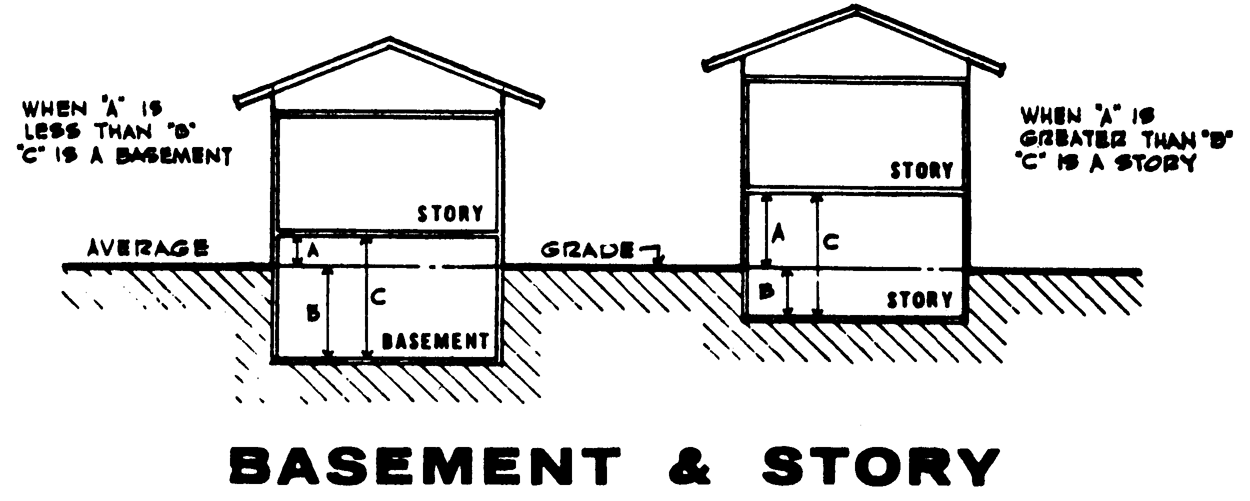
Basement & Story
(h)
Billboard: A billboard shall mean any structure or portion thereof designed or intended to be used for posting, painting, or otherwise affixing any advertising sign, which advertising sign does not pertain to the premises or to the use of premises on which the billboard is located or to goods sold or services rendered or activities conducted on such premises.
(i)
Building: Is any structure, mobile home, vehicle, tent, awning, or similar enclosure designed and intended for the shelter or enclosure of persons, animals or property of any kind.
(j)
Building, accessory: Is a subordinate building, the use of which is clearly incidental to that of the main building or to the use of the land.
(k)
Building, main: Is a building in which is conducted the principal use of the lot on which it is situated.
(l)
Building height: Is the vertical distance measured from the established grade of the center of the front of the building to the highest point of the roof surface for flat roofs; to the deck line of mansard roofs; and to the average height between eaves and ridge for gable, hip, and gambrel roofs; and the average height between the lowest point and the highest point on a shed roof. Where a building is located on sloping terrain, the height may be measured from the average ground level of the grade at the building wall.
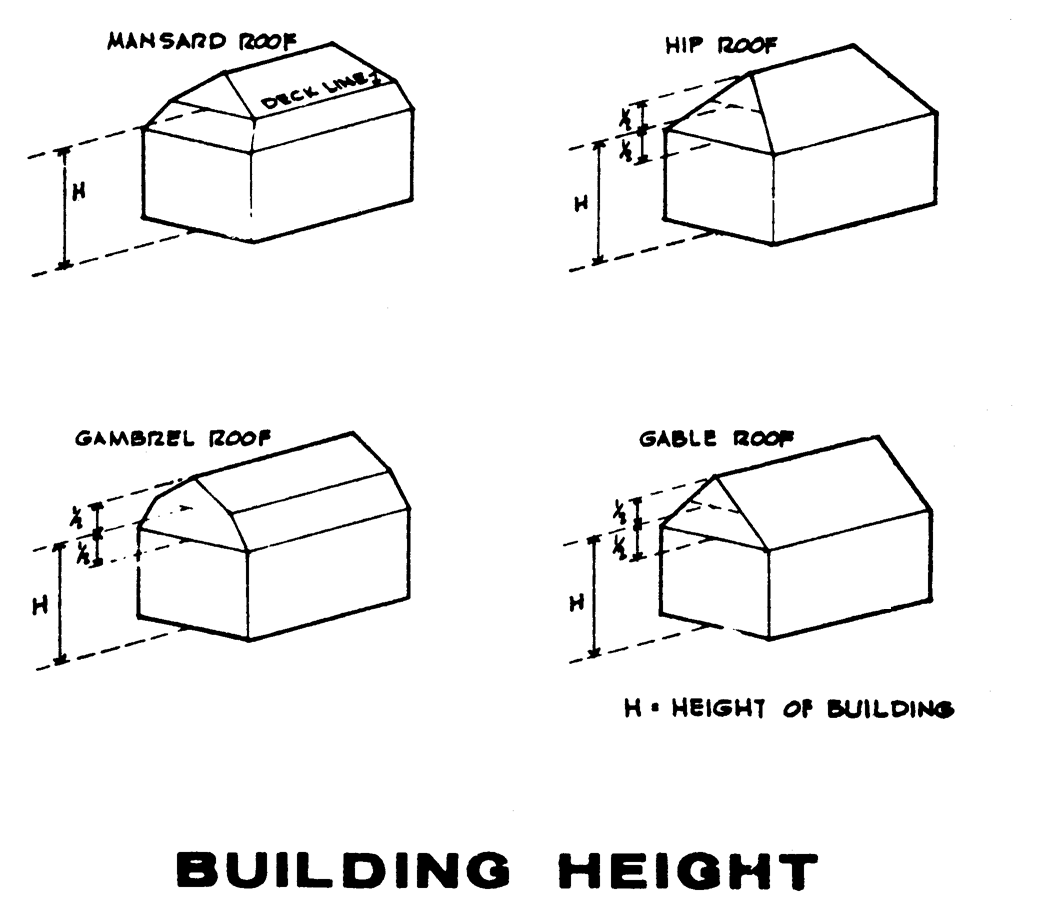
Building Height
(m)
Building line: Is a line formed by the face of the building, and for the purposes of this Ordinance, a building line is the same as a front setback line.
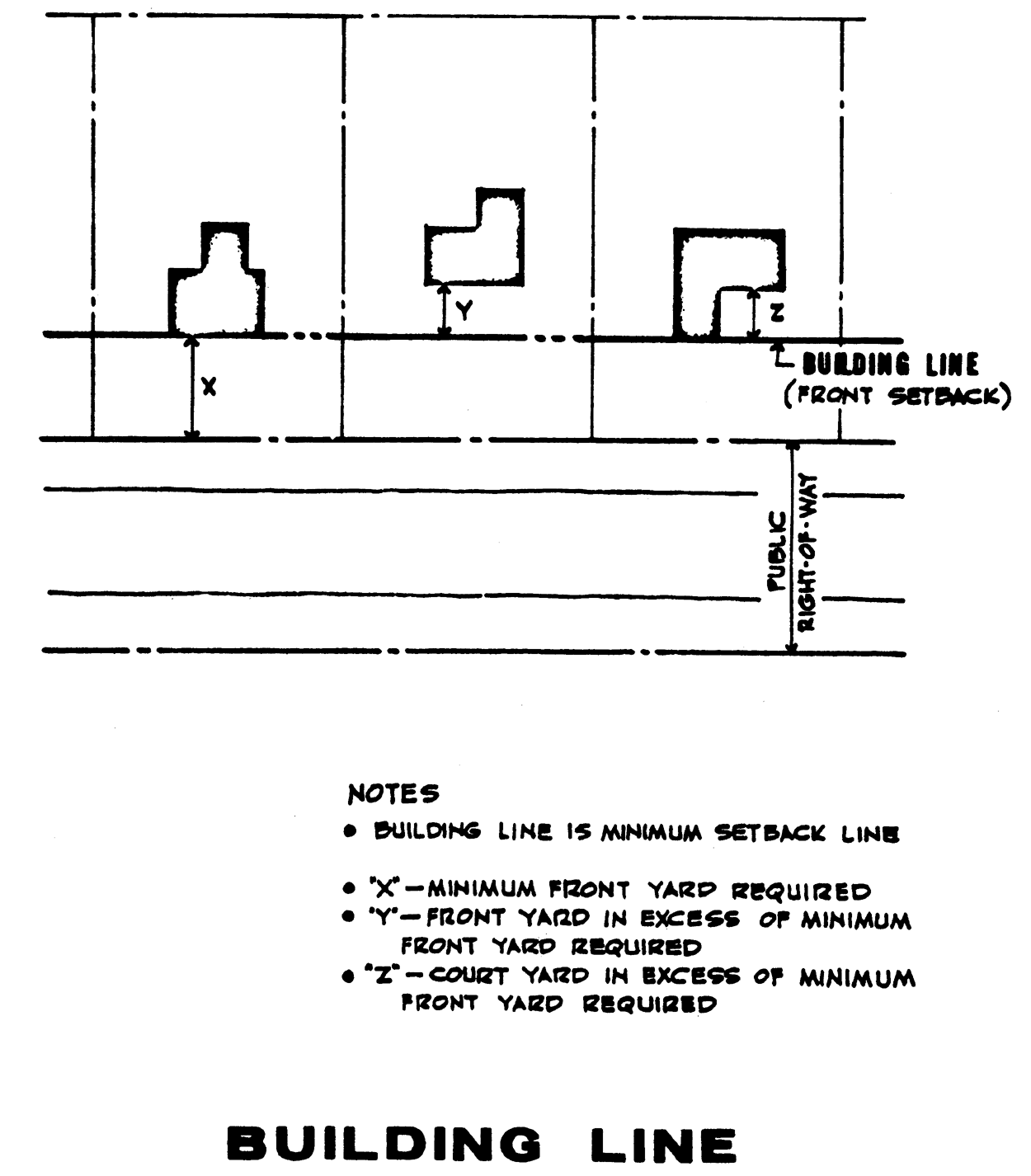
Building Line
(n)
Court: Is an open unoccupied space, other than a yard, and bounded on at least two sides by a building. A court extending to the front yard or front lot line or to the rear yard or rear lot line is an Outer Court. Any other court is an Inner Court.
(o)
Club: An organization of persons for special purposes or for the promulgation of sports, arts, science, literature, politics or the like, but not for profit.
(p)
District: Is a portion of the incorporated area of the City within which certain regulations and requirements or various combinations thereof apply under the provisions of this Ordinance.
(q)
Drive-in restaurant: A business establishment, for the serving of food and/or beverages, so developed that its retail or service character is dependent on providing a driveway approach or parking spaces for motor vehicles so as to serve patrons while in the motor vehicle rather than within a building or structure; or to permit patron self-service.
(r)
Dwelling unit: Is a building, or a portion thereof, designed for occupancy by one (1) family for residential purposes and having cooking facilities.
(s)
Dwelling, one-family: Is a building containing not more than one (1) dwelling unit and which complies with the following standards:
(1)
It is connected to public sewer and water supply systems in accordance with the City Code, or to such private on-site facilities approved by the health department where the City Code so permits.
(2)
The dwelling must be placed on a permanent foundation constructed on the site which meets building code requirements and shall have a wall of the same perimeter dimensions of the dwelling and constructed of such materials and type as required in the applicable building code for single-family dwellings. If the dwelling is a mobile home, it must be installed to manufacturer's set-up requirements, be secured by an anchoring system that meets the Michigan Mobile Home Commission requirements, have its wheels removed and its towing mechanism and undercarriage must not be exposed, and shall have a perimeter wall as required above.
(3)
The dwelling complies with all pertinent building and fire codes. In the case of a mobile home, all construction and all plumbing, electrical apparatus and insulation within and connected to said mobile home shall be of a type and quality conforming to the "Mobile Home Construction and Safety Standards" as promulgated by the United States Department of Housing and Urban Development, being 24 CFR 3280, and as from time to time such standards may be amended. Additionally, all dwellings shall meet or exceed all applicable roof snow load and strength requirements.
(4)
The dwelling contains no additions or rooms, or other areas which are not constructed with similar quality workmanship as the original structure, including permanent attachment to the principal structure and construction of a foundation as required therein.
(5)
There is provided, at the time of construction or placement of any dwelling, internal or external storage space equal to ten (10) per cent of the square footage of the dwelling.
(6)
The dwelling has a minimum width across any front, side or rear elevation of twenty (20) feet and complies in all respects with the building code. Where a dwelling is required by law to comply with any federal or state standards or regulations for construction and where such standards are different than those imposed by the City building code, such federal or state standards or regulations shall apply.
(7)
There shall be a minimum of a double pitched roof of not less than three (3) feet of rise for each twelve (12) feet of run.
(8)
The dwelling shall have a minimum of two (2) exterior doors with the second one being in either the rear or side of the dwelling, and each door shall be accessed by steps connected to said exterior door areas, or to porches or patios connected to said door areas, where a difference in elevation so requires.
(9)
The foregoing shall not be construed to prohibit innovative design concepts involving such matters as solar energy, view, unique land contour or relief from the common or standard designed homes, subject to review and approval by the Zoning Board of Appeals.
(t)
Dwelling, two-family: Is a building containing two (2) dwelling units and conforming in all other respects to the standards set forth in the definition of "Dwelling, one-family".
(u)
Dwelling, multiple-family: Is a building, or portion thereof, designed exclusively for occupancy by three (3) or more families living independently of each other. (Refer to "Apartments" definition for dwelling unit types).
(v)
Erected: Includes built, constructed, altered, reconstructed, moved upon, or any physical operations on the premises required for the construction. Excavation, fill, drainage, installation of utilities, and the like, shall be considered a part of erection.
(w)
Essential services: Means the erection, construction, alteration or maintenance by public utilities or municipal departments of underground, surface or overhead gas, electrical, steam, fuel, or water transmission or distribution systems, collection, communication, supply or disposal systems, including towers, poles, wires, mains, drains, sewers, pipes, conduits, cables, fire alarm and police call boxes, traffic signals, hydrants and similar accessories in connection therewith, but not including buildings which are necessary for the furnishing of adequate service by such utilities or municipal departments for the general public health, safety or welfare.
(x)
Family: Is one or two persons or parents, with their direct lineal descendants and adopted children (and including the domestic employees thereof), together with not more than two persons not so related, living together in the whole or part of dwelling unit comprising a single housekeeping unit. Every additional group of two or less persons living in such housekeeping unit shall be considered a separate family for the purpose of this Ordinance.
(y)
Fence: A structure of definite height and location to serve as an enclosure in carrying out the requirements of this Ordinance.
(z)
Fence, obscuring: A structure of definite height and location to serve as an obscuring screen in carrying out the requirements of this Ordinance.
(aa)
Floor area: For the purposes of computing the floor area in a residential dwelling unit, the sum of the horizontal areas of each story of the building shall be measured from the exterior faces of the exterior walls. The floor area measurement is exclusive of areas of basements, unfinished attics, attached garages, breezeways, and enclosed and unenclosed porches.
(ab)
Floor areas, usable: (For the purposes of computing parking) Is that area used for, or intended to be used for, the sale of merchandise or services or for use to serve patrons, clients, or customers. Such floor area which is used or intended to be used principally for the storage or processing of merchandise, or for utilities, shall be excluded from this computation of "Usable Floor Area." Measurements of floor area shall be the sum of the gross horizontal areas of the several floors of the building measured from the interior faces of the exterior walls. For the purposes of computing parking for those uses not enclosed within a building, the area used for the sale of merchandise, display of merchandise, and/or area used to serve patrons or clients shall be measured to determine necessary parking spaces.
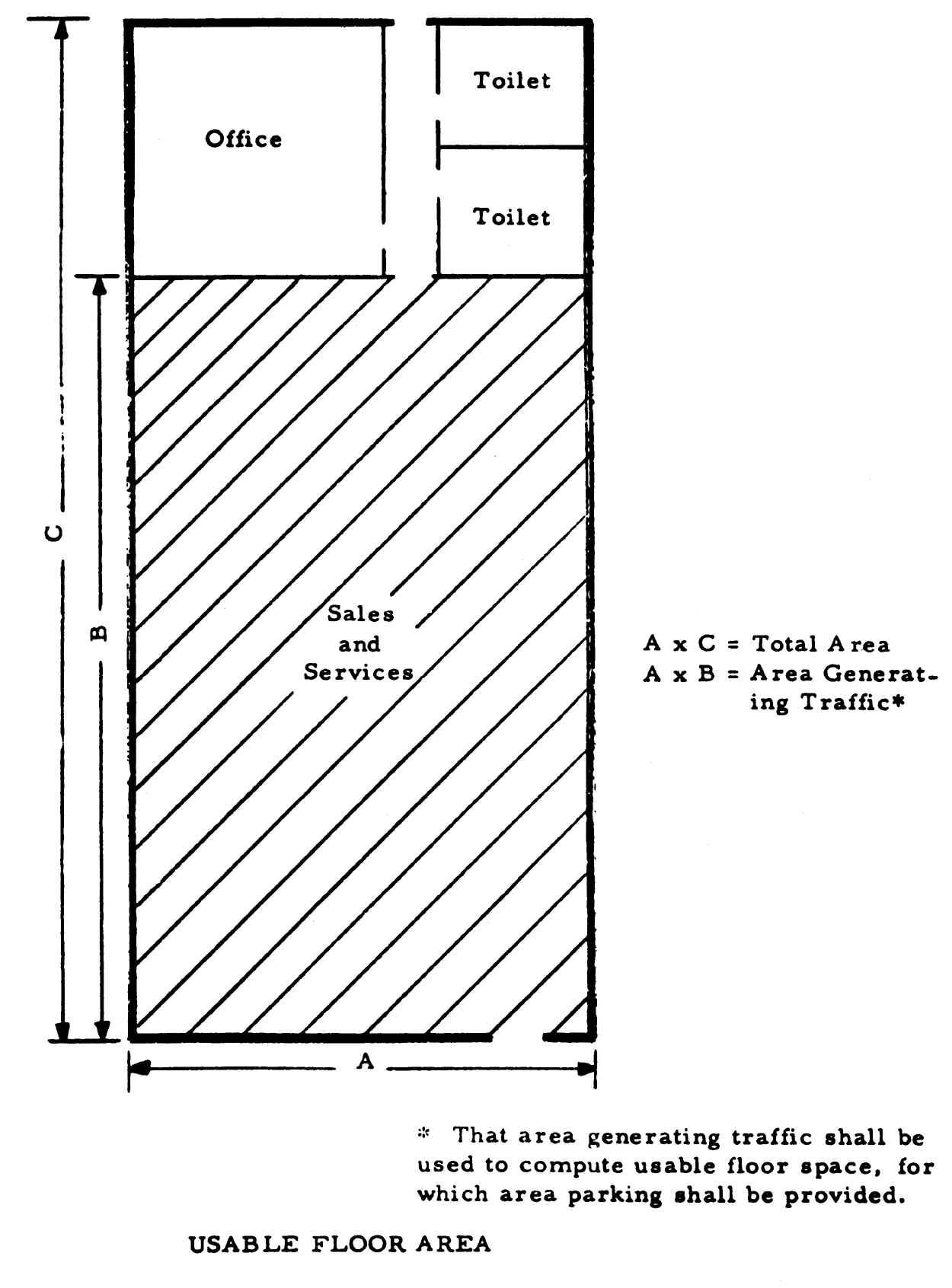
Usable Floor Area
(ac)
Gasoline service station: Is a place for the dispensing, sale, or offering for sale of motor fuels directly to users of motor vehicles, together with the sale of minor accessories and the servicing of and minor repair of automobiles. Prohibited activities include, but are not limited to, the following: Vehicle body repair, undercoating, painting, tire recapping, engine rebuilding, auto dismantling, upholstery work, auto glass work, and such other activities whose external physical effects could extend beyond the property line.
(ad)
Garage, private: An accessory building not over one (1) story or fifteen (15) feet in height used for parking or storage of motor vehicles, but not for commercial servicing or repair.
(ae)
Grade: The level of the street curb at the front of the building. Where a building abuts on two or more streets the grade shall be taken as a mean of grades calculated from the different streets. Where no curb has been established, the City Engineer shall set such curb level for the purpose of this Ordinance.
(af)
Greenbelt: A strip of land of definite width and location reserved for the planting of shrubs and/or trees. Referred to as a landscape buffer when used to meet the screening requirements of this appendix.
(ag)
Home-based business: A gainful occupation or profession carried on by an occupant of a dwelling unit as a use which is clearly incidental to the use of the dwelling for residential purposes and is not in conflict with the overall residential character of the dwelling and the neighborhood.
Home-based businesses may include but are not limited to services such as those provided by architects, artists, engineers, lawyers, accountants, state licensed cosmetologists, music teachers, dance instructors, dressmakers, computer training specialists, small appliance repair shops, watch/jewelry repair shops, and locksmith/gunsmith shops.
Home-based businesses shall not include medical offices, clinics, hospitals, veterinary clinics, kennels, animal grooming services, tourist homes, restaurants, engine or motorized vehicle repair services, large appliance repair services or similar uses.
(ah)
Junk yard: Is an open area where waste, used or second-hand materials are bought and sold, exchanged, stored, baled, packed, disassembled, or handled including, but not limited to, scrap iron and other metals, paper, rags, rubber tires, and bottles. A "junk yard" includes automobile wrecking yards and includes any area of more than two hundred (200) square feet for storage, keeping or abandonment of junk, but does not include uses established entirely within enclosed buildings.
(ai)
Kennel, commercial: Any lot or premises on which three (3) or more dogs or cats are either permanently or temporarily boarded.
(aj)
Loading space: An off-street space on the same lot with a building, or group of buildings, for temporary parking of a commercial vehicle while loading and unloading merchandise or materials.
(ak)
Lot: Is a parcel of land occupied, or which could be occupied, by a main building or a group of such buildings and accessory buildings, or utilized for the principal use and uses accessory thereto, together with such open spaces as are required under the provisions of this Ordinance. A lot may or may not be specifically designated as such on public records.
(al)
Lot of record: Is a parcel of land, the dimensions of which are shown on a document or map on file with the County Register of Deeds or in common use by City or County Officials, and which actually exists as so shown, or any part of such parcel held in record ownership separate from that of the remainder thereof.
(am)
Lot area: The total horizontal area within the lot lines of the lot.
(an)
Lot, corner: A lot where the interior angle of two adjacent sides at the intersection of the two streets is less than one hundred thirty-five (135) degrees. A lot abutting upon a curved street or streets shall be considered a corner lot for the purposes of this Ordinance if the arc is of less radius than one hundred fifty (150) feet and the tangents to the curve, at the two points where the lot lines meet the curve or the straight street line extended, form an interior angle of less than one hundred thirty-five (135) degrees.
(ao)
Lot, interior: Any lot other than a corner lot.
(ap)
Lot lines: The lines bounding a lot as defined herein.
(1)
Front lot line: In the case of an interior lot, the line separating said lot from the street. In the case of a corner lot, the front lot line is that line separating said lot from that street which is designated as the front street in the plat and in the application for a building permit or zoning compliance permit. In the case of a double frontage lot or a lot fronting on both a street and the St. Mary's River, both lot lines abutting on streets or on a street and the river shall be treated as front lot lines.
(2)
Rear lot line: The lot line opposite the front lot line. In the case of a lot pointed at the rear, the rear lot line shall be an imaginary line parallel to the front lot line, not less than ten (10) feet long lying farthest from the front lot line and wholly within the lot.
(3)
Side lot line: Any lot lines other than the front lot line or rear lot line. A side lot line separating a lot from a street is a side lot line. A side lot line separating a lot from another lot or lots is an interior side lot line.
(aq)
Lot coverage: The part or percent of the lot occupied by buildings, including accessory buildings.
(ar)
Lot depth: The horizontal distance between the front and rear lot lines, measured along the median between side lot lines.
(as)
Lot, double frontage: Is any interior lot having frontages on two more or less parallel streets as distinguished from a corner lot. In the case of a row of double frontage lots, all sides of said lots adjacent to streets shall be considered frontage, and front yards shall be provided as required.
(at)
Lot width: The horizontal distance between the side lot lines measured at the two points where the building line, or setback intersects the side lot lines.
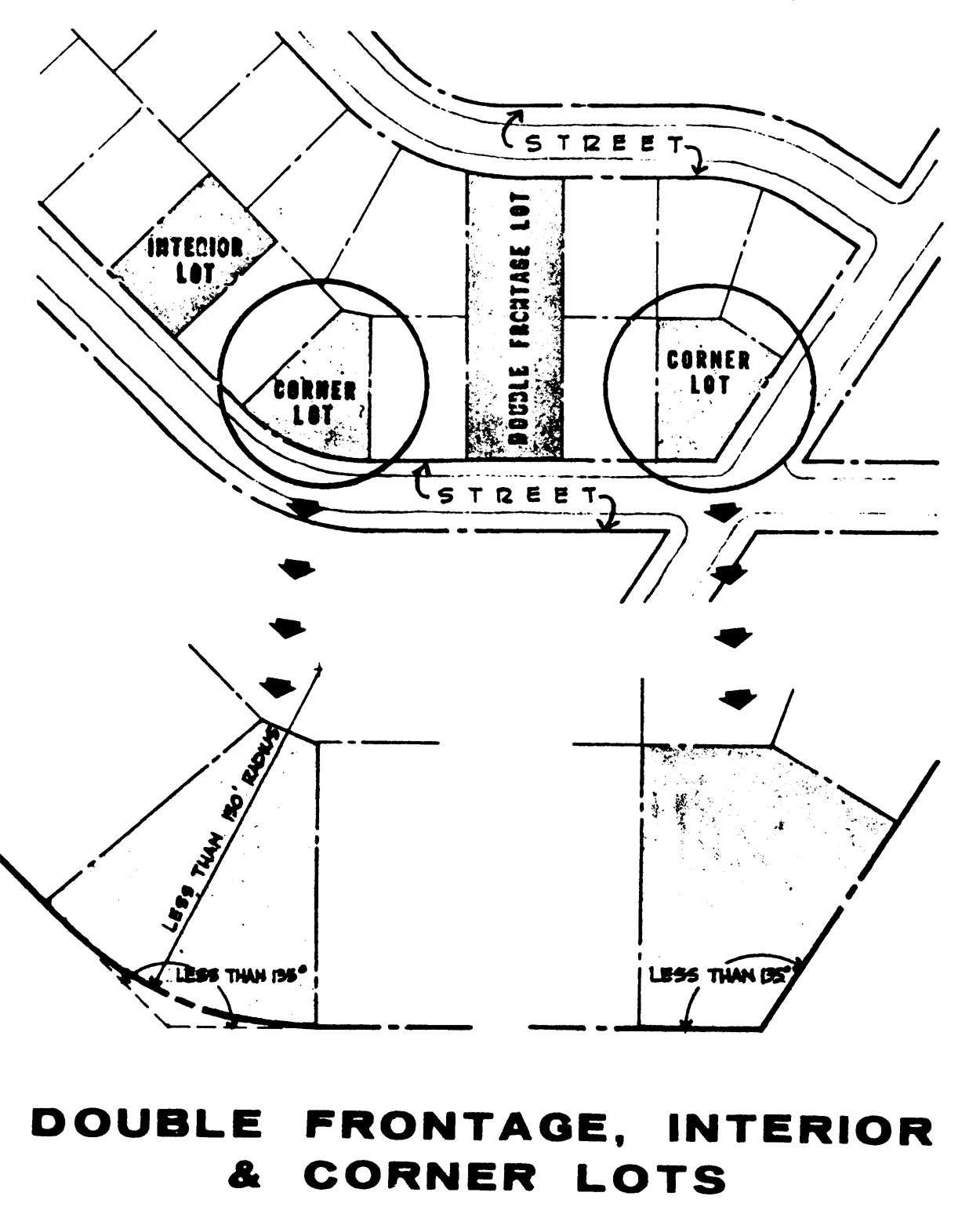
Double Frontage, Interior & Corner Lots
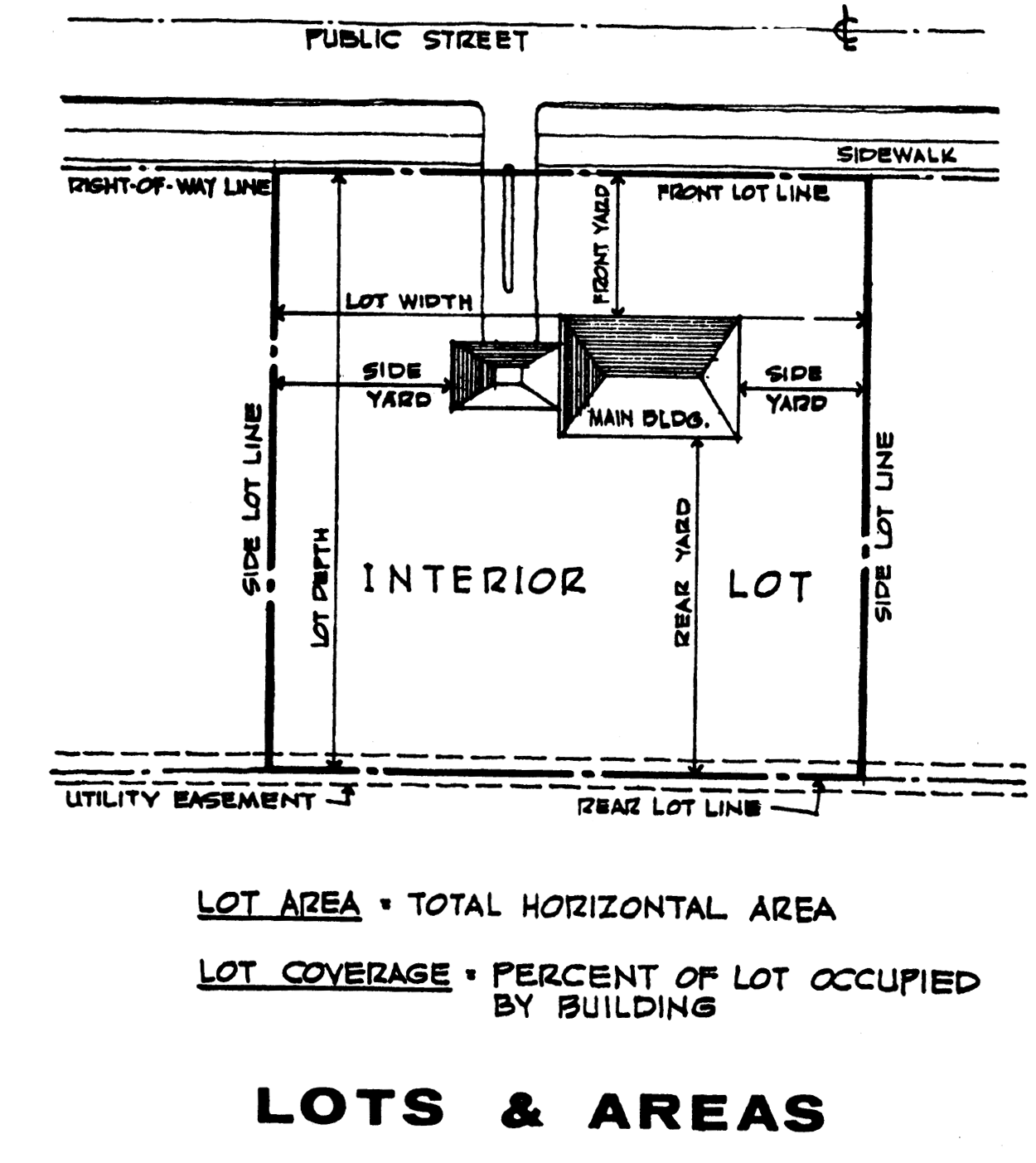
Lots & Areas
(au)
Master plan: Is the comprehensive plan including graphic and written proposals indicating the general location for streets, parks, schools, public buildings and all physical development of the City and includes any unit or part of such plan, and any amendment to such plan or parts thereof. Such plan may or may not be adopted by the Planning Commission and/or the City Commission.
(av)
Major thorofare: Is an arterial street which is intended to serve as a large volume trafficway for both the immediate City area and the region beyond, and may be designated as a major thorofare, parkway, freeway, expressway, or equivalent term to identify those streets comprising the basic structure of the street plan. For purposes of this Ordinance, major thorofares shall be considered to be streets so designated on the City of Sault Ste. Marie Master Plan.
(aw)
Secondary thorofare: Is an arterial street which is intended to serve as a trafficway serving primarily the immediate City area and serving to connect with major thorofares. For the purposes of this Ordinance, secondary thorofares shall be considered to be those streets so designated in the Master plan of the City of Sault Ste. Marie.
(ax)
Motel: A series of attached, semi-attached, or detached rental units containing bedroom, bathroom, and closet space. Units shall provide overnight lodging and are offered to the public for compensation and shall cater primarily to the public traveling by motor vehicles.
(ay)
Nonconforming building: A building or portion thereof, existing at the effective date of this Ordinance, or amendments thereto, that does not conform to the provisions of the Ordinance nor to the use regulations of the district in which it is located.
(az)
Nonconforming use: A use which lawfully occupied a building or land at the time this Ordinance, or amendments thereto, became effective, that does not conform to the use regulations of the district in which it is located.
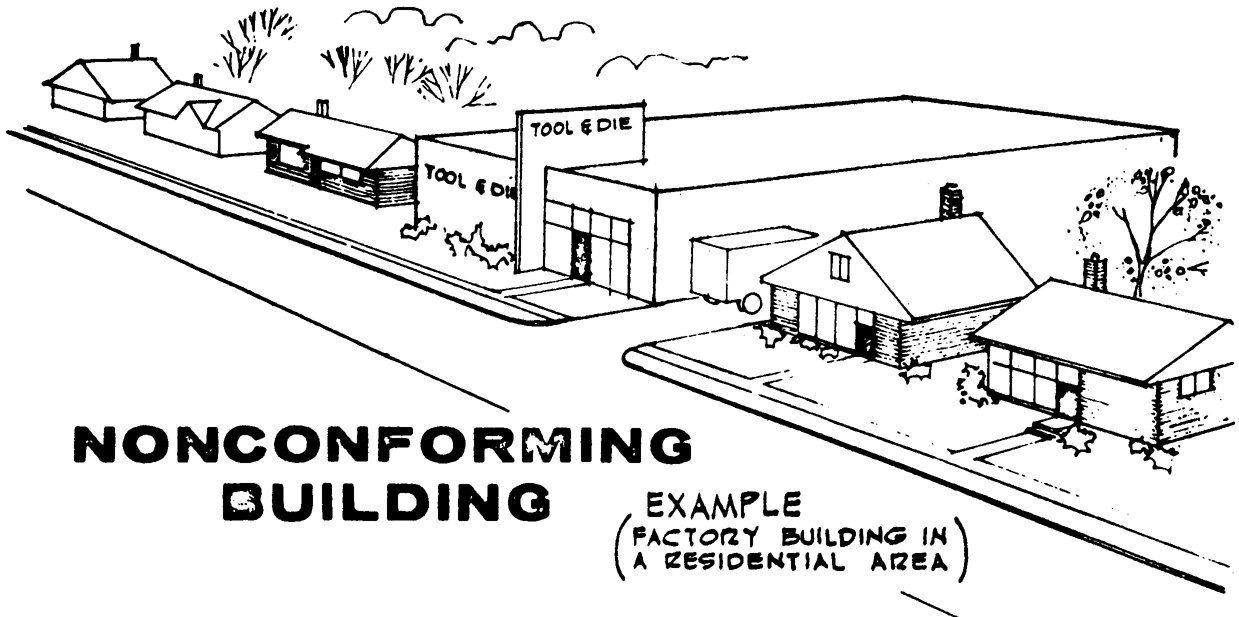
Nonconforming Building
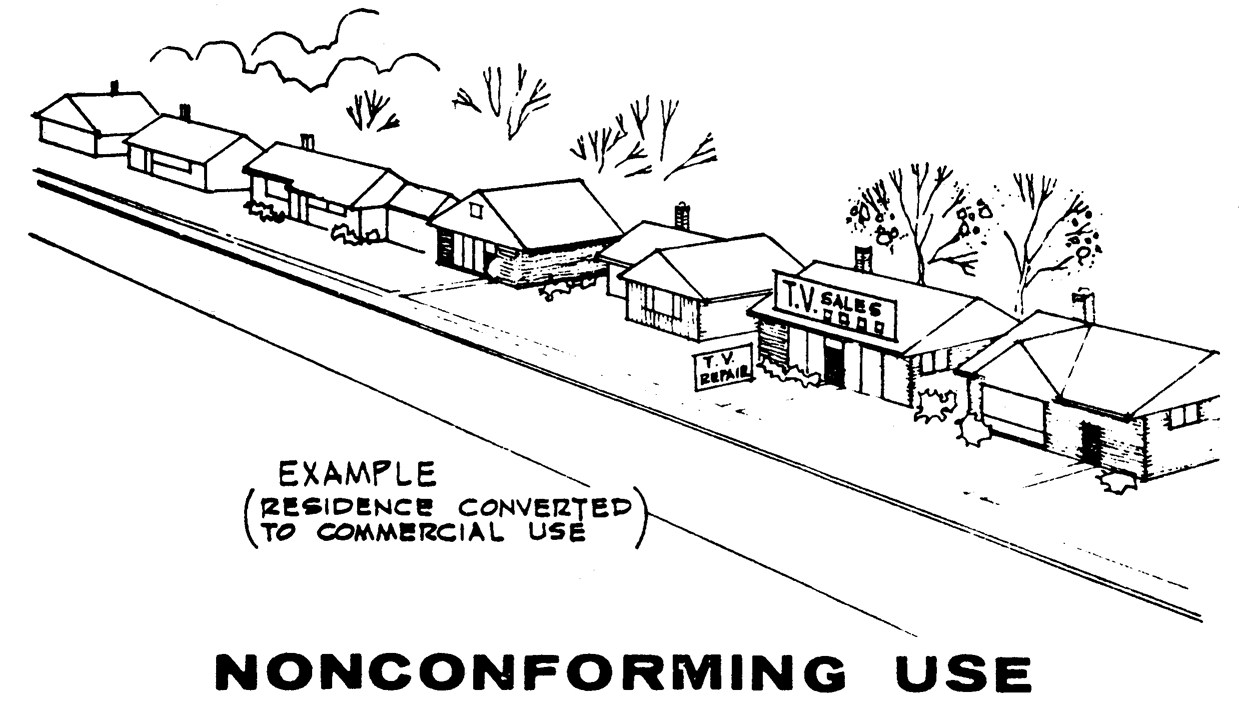
Nonconforming Use
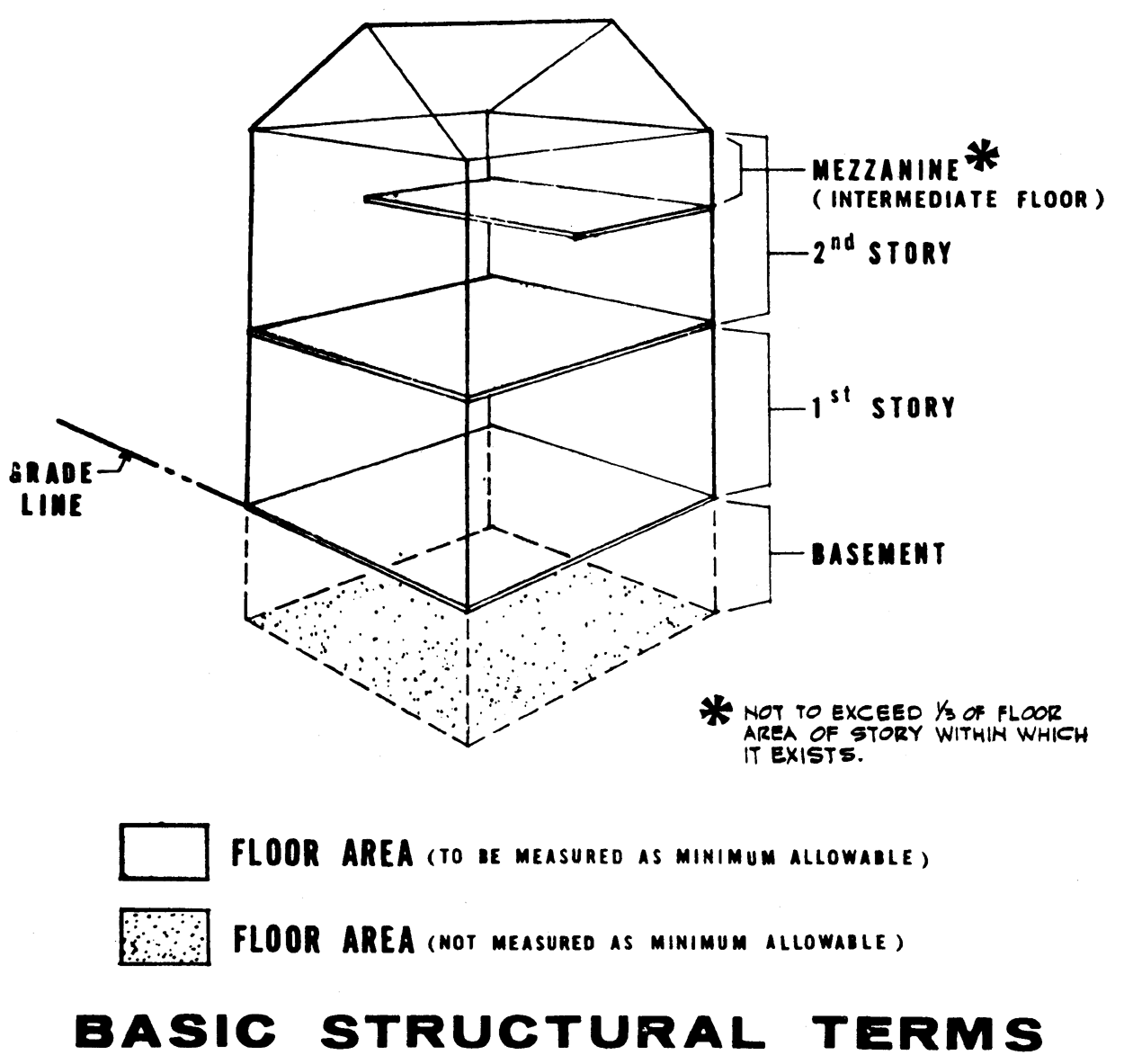
Basic Structural Terms
(ba)
Nursing or convalescent home: Is a structure with sleeping rooms where persons are housed or lodged and furnished with meals and nursing care for hire.
(bb)
Occupied: Includes the meaning of intent, design, or arranged for occupancy.
(bc)
Off-street parking lot: A facility providing vehicular parking spaces along with adequate drives and aisles, for maneuvering so as to provide access for entrance and exit for the parking of automobiles.
(bd)
Open front store: A business establishment, other than a drive-in restaurant or gasoline station or bank, so developed that service to the patron may be extended beyond the walls of the building, not requiring the patron to enter said building.
(be)
Parking space: Is hereby determined to be an area of definite length and width and shall be exclusive of drives, driveways, aisles or entrances giving access thereto and shall be fully accessible for the storage or parking of permitted vehicles.
(bf)
Public utility: Is any person, firm or corporation, municipal department, board or commission duly authorized to furnish and furnishing under Federal, State or municipal regulations to the public: Gas, steam, electriCity, sewage disposal, communication, telegraph, transportation, or water.
(bg)
Setback: The distance required to obtain front, side or rear yard open space provisions of this Ordinance.
(bh)
Sign: Is the use of any words, numerals, figures, devices, designs, or trademarks by which anything is made known (other than billboards) such as are used to show an individual, firm, profession or business, and are visible to the general public.
(bi)
Story: Is that part of a building included between the surface of one floor and the surface of the next floor, or if there is no floor above, then the ceiling next above.
(bj)
Street: Is a public thorofare which affords the principal means of access to abutting property and for the purposes of this Ordinance includes the entire street right of way.
(bk)
Structures: Is anything constructed or erected, the use of which requires location on the ground or attachment to something having location on the ground except driveways and pavement.
(bl)
Temporary building or use: Is a structure or use permitted by the Board of Appeals to exist during periods of construction of the main building or use, or for special events.
(bm)
Trailer coach (mobile home): Any vehicle designed, used, or so constructed as to permit its being used as a conveyance upon the public streets or highways and duly licensable as such, and constructed in such a manner as will permit occupancy thereof as a dwelling or sleeping place for one or more persons. Such trailer coach shall include units with or without wheels attached.
(bn)
Trailer court: Any plot of ground upon which three or more trailer coaches, occupied for dwelling or sleeping purposes, are or may be located.
(bo)
Travel trailer: A vehicle designed as a travel unit for occupancy as a temporary or seasonal vacation living unit.
(bp)
Use: Is the purpose for which land or a building is designed, arranged, or intended to be used, or for which land or a building is or may be occupied.
(bq)
Use, accessory: Is a use subordinate to the main use of a lot and used for purposes clearly incidental to those of the main use.
(br)
Use, main: Is the principal use to which the premises are devoted and the principal purpose for which the premises exist.
(bs)
Wall: A completely obscuring masonry structure of definite height and location to serve as an obscuring screen in carrying out the requirements of this Ordinance.
(bt)
Yards: The open spaces on the same lot with a main building or main use, unoccupied and unobstructed from the ground upward except as otherwise provided in this Ordinance, and as defined herein:
(1)
Front yard: Is an open space extending the full width of the lot, the depth of which is the minimum horizontal distance between the front lot line and the nearest line of the main building.
(2)
Rear yard: Is an open space extending the full width of the lot, the depth of which is the minimum horizontal distance between the rear lot line and the nearest line of the main building.
(3)
Side yard: Is an open space between a main building and side lot line, extending from the front yard to the rear yard, with width of which is the horizontal distance from the nearest point of the side lot line to the nearest point of the main building.
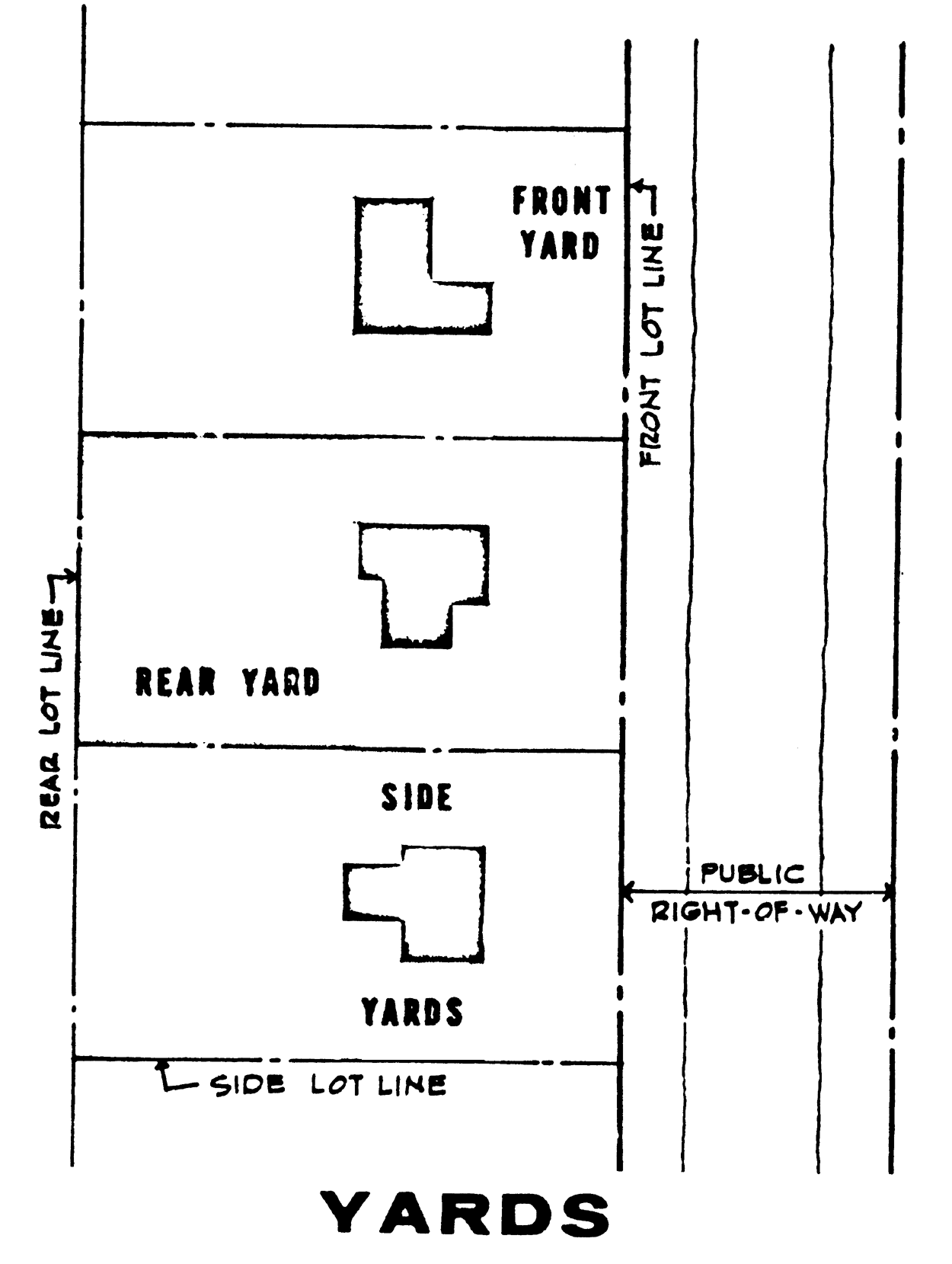
Yards
(bu)
Zoning exceptions and variances:
Exception: An exception is a use permitted only after review by the Planning Commission of an application; such review being necessary because the provisions of this ordinance covering conditions, precedent or subsequent, are not precise enough to all applications without interpretation, and such review is required by this ordinance.
Variance: Is a modification of the literal provisions of the Zoning Ordinance granted by the Board of Appeals when in its judgment the strict enforcement of the Zoning Ordinance would cause undue hardship owing to circumstances unique to the individual property on which the variance is granted.
The crucial points of variance are undue hardship, and unique circumstances, applied to property. A variance is not justified unless all of these elements are present in the case.
The "exception" differs from the "variance" in several respects. An exception does not require "undue hardship" in order to be allowed. The exceptions that are found in this ordinance appear as conditional uses authorized by special permit on review by the Planning Commission. These land uses could not be conveniently allocated to one zone or another, or the effects of such uses could not be definitely foreseen as of a given time. The general characteristics of these uses include one or more of the following:
(1)
They require large areas
(2)
They are infrequent
(3)
They sometimes create an unusual amount of traffic
(4)
They are sometimes obnoxious or hazardous
(5)
They are required for public safety and convenience.
(bv)
Accessory residential boat docking facilities: Boat docking facilities constructed for the exclusive use of the residential property owner, occupants or their transient guests.
(bw)
Fraternity, sorority or cooperative housing: A building used for the housing of unrelated individuals, living together as a single housekeeping unit, and comprising the principal place of residence for the members of a fraternity, sorority or similar housing cooperative. The restrictions of family composition and membership do not apply to this type of housing.
(bx)
Adjacent property: All parcels of property that an applicant's property comes in contact with at one (1) or more points, except for parcels that are legally adjacent but are in fact separated from the applicant's property by a public or private street, or alley.
(ca)
[Adult uses: The following definitions pertain to adult uses for the purposes of this appendix]:
A.
Adult uses: Adult uses include adult bookstores, adult motion picture theaters, adult mini-motion picture theaters, adult massage parlors, adult saunas, adult companionship establishments, adult health clubs, adult cabarets, adult novelty businesses, adult motion picture arcades, adult modeling studios, adult hotel or motel, and adult body painting studios, and other premises, enterprises, establishments, businesses or places open to some or all members of the public, at or in which there is an emphasis on the presentation, display, depiction or description of "specified sexual activities" or "specified anatomical areas" which are capable of being seen by members of the public.
1.
Specified anatomical areas:
a.
Less than completely and opaquely covered human genitals, pubic region, buttock, anus, or female breast(s) below a point immediately above the top of the areola.
b.
Human male genitals in a discernibly turgid state, even if completely and opaquely covered.
2.
Specified sexual activities:
a.
Actual or simulated sexual intercourse, oral copulation, anal intercourse, oral-anal copulation, beastiality, direct physical stimulation of unclothed genitals, flagellation or torture in the context of a sexual relationship, or the use of excretory functions in the context of a sexually relationship, and any of the following sexual-oriented acts or conduct: anilingus, buggery, coprophagy, coprophilia, cunnilingus, fellatio, necrophilia, pederasty, pedophilia, piquerism, sapphism, zooerasty; or
b.
Clearly depicted human genitals in the state of sexual stimulation, arousal or tumescence.
c.
Use of human or animal ejaculation, sodomy, oral copulation, coitus, or masturbation.
d.
Fondling or touching of nude human genitals, pubic region, buttocks, or female breast.
e.
Situations involving a person or persons, any of whom are nude, clad in undergarments or in sexually revealing costumes, and who are engaged in activities involving the flagellation, torture, fettering, binding or other physical restraint of any such persons.
f.
Erotic or lewd touching, fondling or other sexually-oriented contact with an animal by a human being.
g.
Human excretion, urination, menstruation, vaginal or anal irrigation.
B.
Adult use—Accessory: A use, business, or establishment having ten (10) percent or less of its stock in trade or floor area allocated to, or twenty (20) percent or less of its gross receipts derived from movie rentals or magazine sales.
C.
Adult use—Principal: A use, business, or establishment having more than ten (10) percent of its stock in trade or floor area (not including storerooms, stock areas, bathrooms, basement or any portion of the business not open to the public) allocated to, or more than twenty (20) percent of its gross receipts derived from, any adult use.
D.
Adult body painting studio: An establishment or business which provides the service of applying paint or other substance whether transparent or non-transparent to or on the body of a patron when such body is wholly or partially nude in terms of "specified anatomical areas."
E.
Adult bookstore: A business engaging in the barter, rental, or sale of items consisting of printed matter, pictures, slides, records, audiotapes, videotapes or motion picture film, if such shop is not open to the public generally but only to one (1) or more classes of the public, excluding any minor by reason of age, or if a substantial or significant portion of such items are distinguished or characterized by an emphasis on the depiction or description of "specified sexual activities" or "specified anatomical areas".
F.
Adult cabaret: An establishment which provides dancing or other live entertainment, if such dancing or other live entertainment is distinguished or characterized by an emphasis on the performance, dedication or description of "specified sexual activities" or "specified anatomical areas."
G.
Adult companionship establishment: A companionship establishment which excludes minors by reason of age, or which provides the service of engaging in or listening to conversation, talk or discussion between an employee of the characterized by an emphasis on "specified sexual activities" or "specified anatomical areas".
H.
Adult hotel: Adult hotel means a hotel from which minors are specifically excluded from patronage and wherein material is presented which is distinguished or characterized by an emphasis on matter depicting, describing or relating to specified sexual activities or specified anatomical areas.
I.
Adult massage parlor, health club: A massage parlor or health club which restricts minors by reason of age, and which provides the services of massage, if such service is distinguished or characterized by an emphasis on "specified sexual activities" or "specified anatomical areas".
J.
Adult mini-motion picture theater: A business premises within an enclosed building with a capaCity for less than fifty (50) persons used for presenting visual media material if such business as a prevailing practice excludes minors by virtue of age, or if said material is distinguished or characterized by an emphasis on the depiction or description of "specified sexual activities" or "specified anatomical areas" for observation by patrons therein.
K.
Adult modeling studio: An establishment whose major business is the provision, to customers, of figure models who are so provided with the intent of providing sexual stimulation or sexual gratification to such customers and who engage in specified sexual activities or display specified anatomical area while being observed, painted, painted upon, sketched, drawn, sculptured, photographed, or otherwise depicted by such customers.
L.
Adult motion picture arcade: Any place to which the public is permitted or invited wherein coin- or slug-operated or electronically or mechanically controlled still or motor picture machines, projectors or other image-producing devices are maintained to show images to five (5) or fewer persons per machine at any one time, and where the images so displayed are distinguished or characterized by an emphasis on depicting or describing specified sexual activities or specified anatomical areas.
M.
Adult motion picture theater: A business premises within an enclosed building with a capaCity of fifty (50) or more persons used for presenting visual media material if said business as a prevailing practice excludes minors by virtue of age, or if said material is distinguished or characterized by an emphasis on the depiction or description of "specified sexual activities" or "specified anatomical areas" for observation by patrons therein.
N.
Adult novelty business: A business which has as a principal activity the sale of devices which simulate human genitals or devices which are designed for sexual stimulation.
O.
Adult sauna: A sauna which excludes minors by reason of age, or which provides a steam bath or heat bathing room used for the purpose of bathing, relaxation, or reducing, utilizing steam or hot air as a cleaning, relaxing or reducing agent, if the service provided by the sauna is distinguished or characterized by an emphasis on "specified sexual activities" or "specified anatomical areas".
(cb)
[The following definitions pertain to accessory small wind energy turbines for the purpose of this appendix.]
A.
Accessory small wind energy turbine: A wind energy system that converts wind energy into electriCity primarily for on-site use through the use of specialized equipment or structures with a maximum output no greater than twenty (20) kilowatts. Such systems may be tower-mounted or structure-mounted.
B.
Decommissioning: The process of terminating the operation of a wind energy turbine by completely removing the entire wind energy turbine and all related structures, foundations, supports, and equipment.
C.
End of useful life: The point in time when a wind turbine is no longer annually documented to be fully operating in good working order by a certified manufacturer or installer's representative or other qualified technician.
D.
Height: For tower-mounted wind energy turbines, the height is the vertical distance measured from grade as determined according to the definition in Section 200(ae) to the uppermost vertical extension of a rotor blade or the maximum height reached by any part of the wind energy turbine. For structure-mounted wind energy turbines, the height is the distance measured from the highest point of the adjoining roof or structure, not including chimneys, antennae or similar structures, to the uppermost vertical extension of a rotor blade or the maximum height reached by any part of the wind energy turbine.
E.
Net-metering: A special metering and billing agreement between utility companies and their customers which facilitates the connection of sustainable energy generating systems to the power grid.
F.
Rotor: The rotating element of a wind energy turbine that acts as a multibladed airfoil assembly to extract kinetic energy directly from the wind.
G.
Site: The parcel of land or zoning lot occupied by the main use to which the wind energy turbine is accessory.
H.
Structure-mounted accessory small wind energy turbine: A structure-mounted wind energy system that converts wind energy into electriCity primarily for on-site use with a maximum output no greater than 10 kilowatts per turbine.
I.
Tower: A freestanding monopole that supports a tower-mounted wind energy turbine.
J.
Tower-mounted accessory small wind energy turbine: A tower-mounted wind energy system that converts wind energy into electriCity primarily for on-site use with a maximum output no greater than twenty (20) kilowatts.
K.
Useful life: The period of time during which a wind turbine, through inspection, maintenance, and needed repair, is annually documented to be fully operating in good working order by a certified manufacturer or installer's representative or other qualified technician.
(cc)
[The following definitions pertain to medical marihuana for the purpose of this appendix.]
A.
Marihuana (also known as "marijuana" and "cannabis"): The term shall have the meaning given to it in Section 7106 of the Michigan Public Health Code, 1978 PA 368, MCL 333.7106, as referred to in section 3(d) of the Michigan Medical Marihuana Act, Initiated Law 1 of 2008, MCL 333.26423(d).
B.
Medical marihuana caregiver home-based business: The cultivation, processing and distribution of marihuana for a registered qualifying patient or patients by an individual operating as a registered primary caregiver, as defined by and in compliance with the Michigan Medical Marihuana Act, Initiated Law 1 of 2008, MCL 333.26421, et seq., and the Michigan Department of Community Health Michigan Medical Marihuana Administrative Rules, and the requirements of this Ordinance.
C.
Medical marihuana cultivation facility: A building or part of a building or enclosed, locked facility used for the cultivation and processing of marihuana plants for medical use, other than that used by a registered primary caregiver operating with a home-based business permit in compliance with this Ordinance or that used by a registered qualifying patient cultivating no more than twelve (12) plants for his/her own use.
D.
Medical marihuana dispensary: A building or part of a building where one (1) or more registered primary caregivers or registered qualifying patients operate with the intent to transfer marihuana between primary caregivers and/or qualifying patients, not including the delivery of medical marihuana by a registered primary caregiver to his/her patient's primary place of residence as provided under the conditions for operation of a medical marihuana caregiver home-based business.
E.
Registered primary caregiver: A person who is at least twenty-one (21) years old and who has agreed to assist with a patient's medical use of marihuana and who has never been convicted of a felony involving illegal drugs and who holds a valid Michigan Medical Marihuana Registry card identifying him/her as a registered caregiver for at least one (1) but not more than five (5) registered qualifying patients.
F.
Registered qualifying patient: A person who has been diagnosed by a physician as having a debilitating medical condition and who holds a valid Michigan Medical Marihuana Registry card or a valid registry card or its equivalent from another state, district, commonwealth, or insular possession of the United States identifying him/her as a registered qualifying patient.
(cd)
Mixed use building: A building that contains at least one floor devoted to nonresidential uses and at least one floor devoted to residential uses.
(ce)
Dwelling, Accessory Dwelling Unit (ADU): a subordinate residence, but not a mobile home or travel trailer, constructed to comply with the Michigan Residential Code, which shares a parcel with a one-family dwelling and occupies all or part of a detached structure, is structurally attached to the one-family dwelling, or located within the one-family dwelling. For the purposes of this definition, subordinate shall mean of lesser habitable square footage than the one-family dwelling to which the ADU is accessory.
(Ord. No. 242A-84, 8-6-84; Ord. No. 270-87, § 1, 6-1-87; Ord. No. 308-89, § 1, 7-17-89; Ord. No. 342-90, § 1, 9-17-90; Ord. No. 355-91, § 1, 6-17-91; Ord. No. 447-01, § 1, 3-5-01; Ord. No. 450-01, § 1, 12-3-01; Ord. No. 519-10, 6-21-10; Ord. No. 520-10, 8-23-10; Ord. No. 532-12, 1-16-12; Ord. No. 533-12, § 1, 6-18-12; Ord. No. 537-13, § 1, 8-19-13; Ord. No. 627-25, § 1, 7-7-25)

