
Sault Ste Marie City Zoning Code
SECTION 10
1.17. - GENERAL PROVISIONS
1700. Conflicting regulations.
Wherever any provision of this Ordinance imposes more stringent requirements, regulations, restrictions or limitations than are imposed or required by the provisions of any other law or ordinance, then the provisions of this Ordinance shall govern. Whenever the provisions of any other law or ordinance impose more stringent requirements than are imposed or required by this Ordinance, then the provisions of such law or ordinance shall govern.
1701. Scope.
No building or structure, or part thereof, shall hereafter be erected, constructed, or altered and maintained, and no new use or change shall be made or maintained of any building, structure or land, or part thereof, except in conformity with the provisions of this Ordinance.
1702. Nonconforming lots, nonconforming uses of land, nonconforming structures, and nonconforming uses of structures and premises.
1.
Intent. Within the districts established by this Ordinance or amendments that may later be adopted there exist lots, structures, and uses of land and structures which were lawful before this Ordinance was passed or amended, but which would be prohibited, regulated, or restricted under the terms of this Ordinance or future amendment.
It is the intent of this Ordinance to permit these nonconformities to continue until they are removed. Such uses are declared by this Ordinance to be incompatible with permitted uses in the districts involved and shall not be enlarged upon, expanded or extended unless it can be conclusively shown to the Board of Appeals that such enlargement, expansion or extension will substantially improve the use and the environment of abutting uses and will not make abutting properties unusable as zoned.
To avoid undue hardship, nothing in this Ordinance shall be deemed to require a change in the plans, construction, or designated use of any building on which actual construction was lawfully begun prior to the effective date of adoption or amendment of this Ordinance and upon which actual building construction has been diligently carried on. Actual construction is hereby defined to include the placing of construction materials in permanent position and fastened in a permanent manner; except that where demolition or removal of an existing building has been substantially begun preparatory to rebuilding, such demolition or removal shall be deemed to be actual construction, provided that work shall be diligently carried on until completion of the building involved.
2.
Nonconforming lots. In any district in which single-family dwellings are permitted, notwithstanding limitations imposed by other provisions of this Ordinance, a single-family dwelling and customary accessory buildings may be erected on any single lot of record at the effective date of adoption or amendment of this Ordinance. This provision shall apply even though such lot fails to meet the requirements for area or width, or both, that are generally applicable in the district; provided that yard dimensions and other requirements not involving area or width, or both, of the lot shall conform to the regulations for the district in which such lot is located. Variance to yard requirements may be obtained through the Board of Appeals. Where two or more lots or combinations of lots and portions of lots with continuous frontage in single ownership at the time of passage or amendment of this Ordinance, and if all or part of the lots do not meet the requirements for lot width and area as established by this Ordinance, the lands involved shall be considered to be an undivided parcel for the purposes of this Ordinance, and no portion of said parcel shall be used or occupied which does not meet lot width and area requirements as established by this Ordinance, nor shall any division of the parcel be made which leaves remaining any lot with width or area below the requirements stated in this Ordinance.
3.
Nonconforming use of land. Where, at the effective date of adoption or amendment of this Ordinance lawful use of land exists that is made no longer permissible under the terms of this Ordinance as enacted or amended, such use may be continued, so long as it remains otherwise lawful, subject to the following provisions:
a.
No such nonconforming use shall be enlarged or increased nor extended to occupy a greater area of land than was occupied at the effective date of adoption or amendment of this Ordinance unless it can be conclusively shown to the Board of Appeals that such enlargement, expansion or extension will substantially improve the use and the environment of abutting uses and will not be cause for making abutting properties unusable as zoned.
b.
No such nonconforming use shall be moved in whole or in part to any other portion of the lot or parcel occupied by such use at the effective date of adoption or amendment of this Ordinance.
c.
If such nonconforming use of land ceases for any reason for a period of more than 30 days, any subsequent use of land shall conform to the regulations specified by this Ordinance for the district in which such land is located.
4.
Nonconforming structures. Where a lawful structure exists at the effective date of adoption or amendment of this Ordinance that could not be built under terms of this Ordinance by reason of restrictions on area, lot coverage, height, yards, or other characteristics of the structure or its location on the lot, such structure may be continued so long as it remains otherwise lawful, subject to the following provisions:
a.
No such structure may be enlarged or altered in a way which increases its nonconformity unless it can be conclusively shown to the satisfaction of the Board of Appeals that such enlargement or alteration will substantially improve the structure and the environment of abutting uses and will not be cause for making abutting properties unusable as zoned.
b.
Should such structure be damaged by any means to an extent of more than seventy-five (75%) percent of its replacement cost at the time of damage, it shall not be reconstructed except in conformity with the provisions of this Ordinance.
c.
Should such structure be moved for any reason for any distance whatever, it shall thereafter conform to the regulations for the district in which it is located after it is moved.
5.
Nonconforming uses of structure and land. If a lawful use of a structure, or of structure and land in combination, exists at the effective date of adoption or amendment of this Ordinance, that would not be allowed in the district under the terms of this Ordinance, the lawful use may be continued so long as it remains otherwise lawful, subject to the following provisions:
a.
No existing structure devoted to a use not permitted by this Ordinance in the district in which it is located shall be enlarged, extended, constructed, reconstructed, moved or structurally altered except in changing the use of the structure to a use permitted in the district in which it is located, or unless it can be conclusively shown to the Board of Appeals that such action would substantially improve the use of structure and land and would improve the environment of abutting uses and would not be cause for making abutting properties unusable as zoned.
b.
Any nonconforming use may be extended throughout any parts of a building which were manifestly arranged or designed for such use, and which existed at the time of adoption or amendment of this Ordinance, but no such use shall be extended to occupy any land outside such building.
c.
If no structural alterations are made, any nonconforming use of a structure, or structure and premises, may be changed to another nonconforming use provided that the Board of Appeals, either by general rule or by making findings in the specific case, shall find that the proposed use is equally appropriate or more appropriate to the district than the existing nonconforming use. In permitting such change, the Board of Appeals may require appropriate conditions and safeguards in accord with the purpose and intent of this Ordinance.
d.
Any structure, or structure and land in combination, in or on which a nonconforming use is superseded by a permitted use, shall thereafter conform to the regulations for the district in which such structure is located, and the nonconforming use may not thereafter be resumed;
e.
When a nonconforming use of a structure, or structure and premises in combination, is discontinued or ceases to exist for six consecutive months, the structure, or structure and premises in combination, shall not thereafter be used except in conformance with the regulations of the district in which it is located. Structures occupied by seasonal uses shall be excepted from this provision;
f.
Where nonconforming use status applies to a structure and premises in combination, removal or destruction of the structure shall eliminate the nonconforming status of the land.
6.
Repairs and maintenance. On any building devoted in whole or in part to any nonconforming use, work may be done in any period of 12 consecutive months on ordinary repairs, or on repair or replacement of non-bearing walls, fixtures, wiring or plumbing to an extent not exceeding 50 percent of the assessed value of the building, provided that the cubic content of the building as it existed at the time of passage or amendment of this Ordinance shall not be increased.
Nothing in this Ordinance shall be deemed to prevent the strengthening or restoring to a safe condition of any building or part thereof declared to be unsafe by any official charged with protecting the public safety, upon order of such official.
7.
Uses under exception provisions not nonconforming uses. Any use for which a general exception or special condition is permitted as provided in this Ordinance shall not be deemed a nonconforming use, but shall without further action be deemed a conforming use in such district.
8.
Change of tenancy or ownership. There may be a change of tenancy, ownership or management of any existing nonconforming uses of land, structures and premises provided there is no change in the nature or character of such nonconforming uses.
1703. Accessory buildings not containing an Accessory Dwelling Unit.
1.
Where the accessory building is structurally attached to a main building, it shall be subject to, and must conform to, all yard regulations of this Ordinance, applicable to main buildings.
2.
Accessory residential buildings shall not be erected in any required yard, except a rear yard.
3.
The ground floor area of an accessory building shall not exceed the ground floor area of the main building except in the RSV district where the ground floor area of an accessory building may be one and five tenths (1.5) times the ground floor area of the main building.
4.
No accessory building shall be located closer than five (5) feet to any main building as measured between overhangs and eaves.
5.
No detached accessory residential building in an R-1, RS-1, RS-2, R-1A, R-2, RM-1, RM-2 or RM-3 District shall exceed fifteen (15) feet in height. Accessory buildings in all other districts may be constructed to equal the permitted maximum height of structures in said district.
6.
No detached residential accessory building on a corner lot shall be located closer than fifteen (15) feet to any side or rear lot line that abuts a street right-of-way except that if the minimum front yard setback along said street is less than fifteen (15) feet, then the lesser front yard setback shall apply. No detached residential accessory building shall be located closer than five (5) feet to any side or rear lot line that abuts an alley right-of-way. In no instance shall an accessory building be located within a dedicated easement right-of-way.
7.
No detached accessory building shall be located closer than three (3) feet to any side lot line or three (3) feet to any rear lot line when there is no alley or street right-of way at the side or rear.
(Ord. No. 242A-84, 8-6-84; Ord. No. 437-98, § 1, 11-16-98; Ord. No. 441-99, § 3, 3-15-99; Ord. No. 524-11, 1-7-11; Ord. No. 627-25, § 1, 7-7-25)
1703.1. Accessory buildings containing an Accessory Dwelling Unit.
1.
Accessory buildings shall not be erected in any required yard, except a rear yard.
2.
The ground floor area of an accessory building shall not exceed the ground floor area of the main building.
3.
No accessory building shall be located closer than ten (10) feet to any main building, as measured between overhangs and eaves. Upon satisfaction of the fire separation requirements of the Michigan Residential Code, the distance may be reduced to not less than five (5) feet.
4.
No accessory building in an R-1, RS-1, RS-2, R-1A, R-2, RM-1, RM-2 or RM-3 District shall exceed twenty-five (25) feet in height. Accessory buildings in all other districts may be constructed to equal the permitted maximum height of structures in said district.
5.
No accessory building on a corner lot shall be located closer than fifteen (15) feet to any side or rear lot line that abuts a street right-of-way except that if the minimum front yard setback along said street is less than 15 feet, then the lesser front yard setback shall apply. No accessory building shall be located closer than five (5) feet to any side or rear lot line that abuts an alley right-of-way. In no instance shall an accessory building be located within a dedicated easement right-of-way.
6.
No accessory building shall be located closer than three (3) feet to any side lot line or three (3) feet to any rear lot line when there is no alley or street right-of-way at the side or rear.
7.
The design of an accessory building must complement the main building.
8.
Each Accessory Dwelling Unit shall have not less than one (1) dedicated parking space.
(Ord. No. 627-25, § 1, 7-7-25)
1703.2. Main buildings containing an Accessory Dwelling Unit.
1.
Where the ADU is structurally attached to a main building it shall be subject to and must conform to regulations of this Ordinance applicable to main buildings.
2.
The design of the ADU must complement the main building to which it is attached.
3.
Each Accessory Dwelling Unit shall have not less than one (1) dedicated parking space.
(Ord. No. 627-25, § 1, 7-7-25)
1704. Parking requirements.
There shall be provided in all districts at the time of erection or enlargement of any main building or structure, automobile off-street parking space with adequate access to all spaces.
1.
Off-street parking for other than residential uses shall be either on the same lot or within four hundred (400) feet of the building it is intended to serve, measured from the nearest point of the building to the nearest point of the off-street parking lot. Ownership shall be shown of all lots or parcels intended for use as parking by the applicant.
2.
Residential off-street parking spaces shall consist of a parking strip, driveway, garage, or combination thereof and shall be located on the premises they are intended to serve and subject to the provisions of Section 1703, Accessory Buildings, of this Ordinance.
3.
Any area once designated as required off-street parking shall not be changed to any other use unless and until equal facilities are provided elsewhere.
4.
Two (2) or more buildings or uses may collectively provide the required off-street parking in which case the required number of parking spaces shall not be less than the sum of the requirements for the several individual uses computed separately.
5.
In the instance of dual function of off-street parking spaces where operating hours of buildings do not overlap, the Board of Appeals may grant a variance.
6.
The storage of merchandise, motor vehicles for sale, trucks, or the repair of vehicles is prohibited.
7.
For those uses not specifically mentioned, the requirements for off-street parking facilities shall be in accord with a use which the Board of Appeals considers as being similar in type.
8.
For the purposes of computing the number of parking spaces required, the definition of "usable floor area" shall govern.
9.
Where off-street parking is provided through special assessments, the number of spaces required may be reduced by the Board of Appeals by that number of spaces which can be prorated to the use which was specially assessed.
10.
The number of minimum parking spaces per unit of measure as required in this Ordinance shall apply fully to the erection, alteration or extension of residential uses within the developed central business area, however, the provisions of parking spaces as required in the following item may be reduced by one-half (½) the minimum required spaces for all other uses within the developed central business area, being that area zoned B-2 on the zoning district map of this Ordinance and amendments thereto.
11.
Business and office buildings existing at the time of passage of this Ordinance in O-S, B-1, B-2, B-3 and T Districts shall not be required to provide parking space in addition to that provided at the time of passage of this Ordinance when remodelling or altering existing buildings; provided no increase in floor area is made. In those instances where floor areas are to be increased, parking spaces shall be provided for such increased area in accord with the provisions of this Ordinance.
12.
The minimum number of off-street parking spaces by type of use shall be determined in accordance with the following schedule:
(Ord. No. 242A-84, 8-6-84; Ord. No. 352-91, § 1, 7-15-91; Ord. No. 354, § 1, 6-17-91; Ord. No. 551-14, § 1, 10-6-14)
1705. Off-street parking space layout, standards, construction and maintenance.
Wherever the off-street parking requirements in 1704 above, require the building of an off-street parking facility, or where P-1 Vehicular Parking Districts are provided, such off-street parking lots shall be laid out, constructed and maintained in accordance with the following standards and regulations:
1.
No parking lot shall be constructed unless and until a permit therefor is issued. Applications for a permit shall be submitted with two (2) copies of plans for the development, and construction of the parking lot showing the provisions of this section will be fully complied with.
2.
Adequate ingress and egress to the parking lot shall be provided and shall receive the review and approval of the City Engineer, in order to provide for the greatest possible public safety and welfare. Such necessary directional signs and controls as are required shall be established and maintained by the owner or lessee of the parking lot.
3.
All spaces shall be provided adequate access by means of maneuvering lanes.
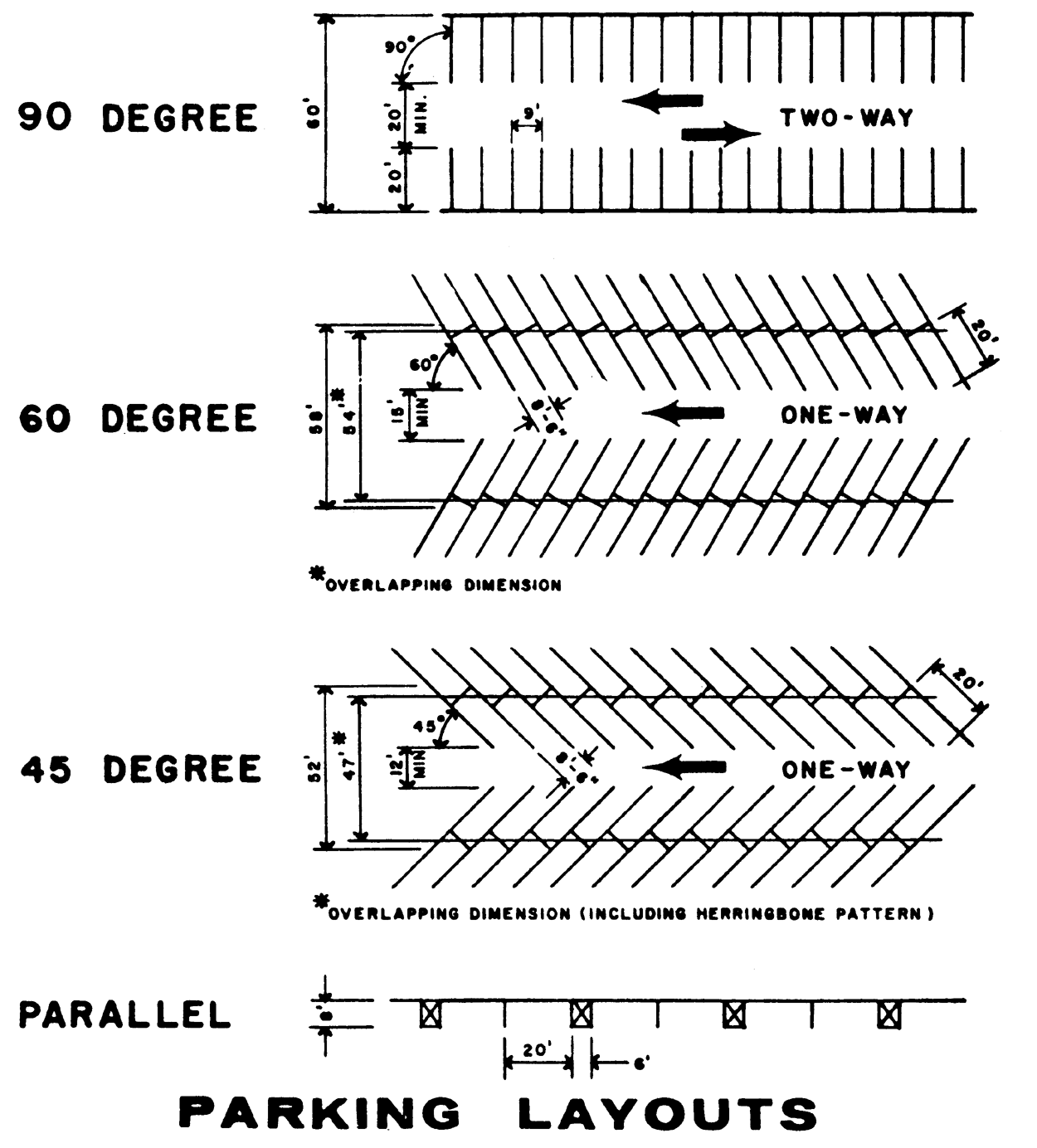
4.
Plans for the layout of off-street parking facilities shall be in accord with the following minimum requirements:
5.
All maneuvering lane widths shall require one-way traffic movement, with the exception of the 90° pattern where two-way movement may be permitted.
6.
Off-street parking areas shall be provided with a wall, obscuring fence or landscape buffer in accordance with the specifications of minimum distance and setback requirements of the P-1 District and the provisions of Section 1709, on all sides where the next adjacent zoning district is designated as a residential district.
7.
With the exception of parking spaces for one-and two-family residential dwelling units and except as provided elsewhere in this ordinance, the entire parking area, including parking spaces and maneuvering lanes, shall have a surfacing of concrete, bituminous paving, bituminous seal-coat, brick pavers or similar paving units or other dust-free material as approved by the City engineer. Such facilities shall be so drained as to dispose of all surface water accumulated in the parking area.
8.
All lighting used to illuminate any off-street parking area shall not exceed twenty (20) feet in overall height above ground level and shall be so installed as to be confined within and directed on the parking area only.
(Ord. No. 349-91, § 1, 4-15-91: Ord. No. 519-10, 6-21-10)
1706. Off-street loading and unloading.
On the same premises with every building, structure or part thereof, involving the receipt or distribution of vehicles or materials or merchandise, there shall be provided and maintained on the lot, adequate space for standing, loading, and unloading in order to avoid undue interference with public use of dedicated streets or alleys. Such space shall be provided as follows:
1.
All spaces in O-S, B-1, B-2 and B-3 Districts shall be provided in the ratio required in 10-1.14 [Section 10-1.16], Schedule of Regulations as minimum rear yard.
2.
All spaces in I-1 and I-2 Districts shall be laid out in the dimension of at least ten by fifty feet (10'×50'), or five hundred (500) square feet in area, with a clearance of at least fourteen (14) feet in height. All spaces in I-1 and I-2 Districts shall be provided in the following ratio of spaces to gross floor area:
1707. Conditional uses authorized by special permit.
Because the uses hereinafter referred to posses unique characteristics making it impractical to include them in a specific use district classification, they shall be permitted by the Planning Commission after the conditions specified and after public hearing notice of such hearing to be provided in accordance with the provisions of Section 1912. In every case, the uses hereinafter referred to shall be specifically prohibited from any R-1, RS-1, RS-2, R-2, RM or O-S Districts. These uses require special consideration since they service an area larger than the City and require sizable land areas, creating problems of control with reference to abutting use districts. Reference to those uses falling specifically within the intent of this section is as follows:
1.
Outdoor theaters. Because outdoor theaters possess the unique characteristic of being used only after darkness and since they develop a concentration of vehicular traffic in terms of ingress and egress from their parking area, they shall be permitted in I-1 Districts only. Outdoor theaters shall further be subject to the following conditions:
a.
The proposed internal design shall require approval from the Building Inspector and City Engineer as to adequacy of drainage, lighting and other technical aspects.
b.
Points of ingress and egress shall be available to the outdoor theater from abutting major thoroughfares and shall not be available from any residential street. Approval of ingress and egress points by the City Engineer shall be required.
c.
All vehicles, waiting or standing to enter the facility, shall be provided off-street waiting space. No vehicle shall be permitted to wait or stand within a dedicated right-of-way.
d.
The area shall be so laid out as to prevent the movie screen from being viewed from residential areas or adjacent major thoroughfares. All lighting used to illuminate the area shall be so installed as to be confined within and directed on to the premises of the outdoor theater site.
2.
Commercial television and radio towers and public utility microwaves, and public utility T.V. transmitting towers. Radio and television towers, public utility microwaves and public utility T.V. transmitting towers, and their attendant facilities shall be permitted in I-1 and I-2 Districts provided said use shall be located centrally on a continuous parcel of not less than one (1) time the height of the tower measured from the base of said tower to all points on each property line.
3.
Trailer courts.[4] Trailer courts may be permitted in the B-3 General Business Districts by the Planning Commission after it finds the use as not being contrary to the spirit and purpose of this Ordinance and subject further to the following requirements and conditions:
a.
The land parcel being proposed for trailer courts shall be of such land area as to provide for a minimum of at least twenty-five (25) trailer coach sites and shall not exceed a maximum of seven (7) trailer coach sites per acre.
b.
Eighty (80) percent of the trailer coach sites shall contain a minimum area of at least three thousand (3,000) square feet, and twenty (20) percent shall contain a minimum area of at least two thousand four hundred (2,400) square feet. All such trailer site areas shall be computed exclusive of service drives, facilities, and recreation space.
c.
All trailer courts shall have access to major or secondary thoroughfares within the City by directly abutting thereon. Frontage on said thoroughfare shall be equal to at least two hundred (200) feet in width.
d.
The trailer court shall be screened from adjacent residentially zoned properties in accordance with the provisions of Section 1709, Screening, buffering and landscaping.
e.
All trailer court developments shall further comply with Act 243 of Public Acts of the State of Michigan, 1959, (MCL § 125.1001 et seq.) as amended, and shall further comply with all codes and ordinances of the City.
4.
Race tracks (including midget auto and karting tracks). Because race tracks develop a concentration of vehicular traffic in terms of ingress and egress from their parking area and cause noise levels which may project beyond the property so used, they shall be permitted in the I-1 Districts when located abutting a major thoroughfare and shall be located on a parcel of land which is abutting land zoned for industrial purposes on all sides of the parcel in question, and shall be subject further to the following conditions and such other controls as the Planning Commission deems necessary to promote health, safety and general welfare in the City.
a.
All parking shall be provided as off-street parking within the boundaries of the development.
b.
All access to the parking areas shall be provided from major thoroughfares. Approval of ingress and egress points by the City Engineer and the Chief of Police shall be required.
c.
The race track shall be screened from adjacent residentially zoned properties in accordance with the provisions of Section 1709, Screening, buffering and landscaping.
5.
Public Utility and Railroad Facilities. Water supply and sewage disposal plants; heating and electrical power generating plants; railroad transfer and storage yards, including freight depots or stations, loading platforms, train sheds and car or locomotive shops; railroad rights-of-way; and similar public utility (including transportation) facilities may be permitted in any nonprohibited district subject to conditions as set forth in section 1910.
(Ord. No. 116, § 10-1.17(1707), 2-5-73; Ord. No. 242A-84, 8-6-84; Ord. No. 407-96, § 1, 5-26-96; Ord. No. 441-99, § 4, 3-15-99; Ord. No. 489-06, § 1, 9-18-06: Ord. No. 519-10, 6-21-10; Ord. No. 533-12, § 1, 6-18-12)
1707.1. Specified uses subject to special conditions.
Because the uses hereinafter provided for possess unique characteristics making it impractical to include them in the specific use district classification, they shall be permitted subject to the conditions imposed for each use.
1.
Adult uses. The nature of adult uses is such that they are recognized as having adverse secondary characteristics, particularly when they are accessible to minors and located near residential property or related residential uses such as schools, day care centers, libraries or parks, or to pedestrian-oriented businesses frequented by minors. Furthermore, the concentration of adult uses has an adverse effect upon the use and enjoyment of adjacent areas. The nature of adult uses requires that they not be allowed within certain zoning districts, or within minimum distances from each other or residential uses. Special regulation of adult uses is necessary to ensure that the adverse secondary effects would not contribute [to] or enhance criminal activity in the area of such uses nor will it contribute to the blighting or downgrading of the surrounding property and lessening of its value. As such, Adult Uses as defined in this Ordinance shall be subject to the following general provisions:
A.
General Provisions.
(1)
Activities classified as obscene are not permitted and are prohibited. In no instance shall the application or interpretation of this ordinance be construed to allow an activity otherwise prohibited by law.
(2)
Adult uses, either principal or accessory, shall be prohibited from locating in any building which is also utilized for residential purposes.
(3)
An adult use which does not qualify as an accessory use pursuant to Section 200, "Definitions," shall be classified as an adult use—principal.
B.
Adult Use—Principal. Adult use-principal shall be permitted in the B-3, General Business Districts, subject to the conditions herein imposed:
(1)
Adult use—principal shall be located at least five hundred (500) radial feet, as measured in a straight line from the closest point of the property line of the building upon which the adult use—principal is located to the property line of:
(a)
A residential zoning district.
(b)
A licensed day care center.
(c)
A public or private educational facility classified as an elementary, junior high or senior high.
(d)
A public library.
(e)
A public park.
(f)
Another adult use—principal.
(g)
Any church or church related organization.
(2)
No adult use—principal shall be located in the same building or upon the same property as another adult use—principal.
(3)
Adult use—principal shall adhere to the following signing regulations in addition to the sign regulations of section 1710 and the City Sign Code.
(a)
Sign messages shall be generic in nature and shall only identify the name of business.
(b)
Signs shall comply with the requirements of size and number for the district in which they are located.
C.
Adult use—accessory. Adult uses—accessory, shall be permitted in the B-3, "General Business Districts," subject to the conditions herein imposed:
(1)
Adult use—accessory shall comprise no more than ten (10) percent of the floor area of the establishment in which it is located.
(2)
Adult use—accessory shall comprise no more than twenty (20) percent of the gross receipts of the entire business operation.
(3)
Adult use—accessory shall not involve or include any activity except the sale or rental of merchandise.
(4)
Adult use—accessory shall be restricted from and prohibit access to minors by the physical separation of such items from areas of general public access:
(a)
Movie rentals. Display areas shall be restricted from general view and shall be located within a separate room, the access of which is in clear view and under the control of the persons responsible for the operation.
(b)
Magazines. Publications classified or qualifying as adult uses shall not be physically accessible to minors and shall be covered with a wrapper or other means to prevent display of any material other than the publication title.
(5)
Adult use—accessory shall be prohibited from both internal and external advertising and signing of adult materials and products.
(Ord. No. 450-01, § 1, 12-3-01)
1708. Performance standards.
No use otherwise allowed shall be permitted within any Use District which does not conform to the following standards of use, occupancy, and operation, which standards are hereby established as the minimum requirements to be maintained within said area:
1.
Smoke, dust, dirt and fly ash.[5] It shall be unlawful for any person, firm or corporation to permit the emission or discharge of any smoke, dust, dirt or fly ash in quantities greater than prescribed in the codes and ordinances of the City.
2.
Open storage. [6] The open storage of any equipment, vehicles and all materials, including wastes, shall be screened from public view, from public street and from adjacent properties by an enclosure consisting of a wall, obscuring fence or landscape buffer constructed in accordance with the provisions of Section 1709 and of a height of not less than six (6) feet to obscure such stored materials. Scrap, junk cars and other junk materials shall not be piled or stacked as open storage to a height in excess of twenty (20) feet. Dumpsters shall be screened in accordance with Section 1709.
3.
Glare and radioactive materials. Glare from any process (such as or similar to arc welding or acetylene torch cutting) which emits harmful rays shall be performed in such a manner as not to extend beyond the property line, and as not to create a public nuisance or hazard along lot lines. Radioactive materials and wastes, and including electromagnetic radiation such as X-ray machine operation, shall not be emitted to exceed quantities established as safe by the U.S. Bureau of Standards, when measured at the property line.
4.
Fire and explosive hazards.[7]
a.
The storage, utilization or manufacture of materials or products ranging from incombustible to moderate burning, is [as] determined by the Fire Chief, is permitted, subject to compliance with all other performance standards above mentioned.
b.
The storage, utilization, or manufacture of materials, goods, or products ranging from free or active burning to intense burning, as determined by the Fire Chief, is permitted subject to compliance with all other yard requirements and performance standards previously mentioned, and provided that the Fire Chief finds that said storage, utilization, or manufacture of goods, or products complies with the fire prevention standards in use by the City's Fire Department.
(Ord. No. 519-10, 6-21-10; Ord. No. 536-13, § 1, 7-15-13)
1709. Screening, buffering and landscaping.
Wherever in this Ordinance a greenbelt, obscuring fence, wall or planting is required, such greenbelt, obscuring fence, wall and/or planting shall be shall be constructed and/or planted in accordance with the provisions of this section.
1.
Screening requirements.
a.
Off-street parking for uses other than one- and two-family residential. A four-foot (4') high wall, obscuring fence, landscape buffer, or combination landscape buffer and berm shall be provided on all sides of the off-street parking area where adjacent property is zoned residential.
b.
Outdoor sale space for sale or retail of automobiles or house trailers or camp trailers. A four-foot (4') high wall, obscuring fence, landscape buffer, or combination landscape buffer and berm shall be provided on all sides of the outdoor sales space area where adjacent property is zoned residential.
c.
Self-storage facilities. A four-foot (4') high wall, obscuring fence, landscape buffer, or combination landscape buffer and berm shall be provided on all sides of the facility where adjacent property is zoned residential.
d.
Gasoline service stations. A four-foot (4') high wall, obscuring fence, landscape buffer, or combination landscape buffer and berm shall be provided on all sides of the development where adjacent property is zoned residential.
e.
Rebound tumbling facilities and similar devices. A four-foot (4') high wall, obscuring fence, landscape buffer, or combination landscape buffer and berm shall be provided on all sides of the facility where adjacent property is zoned residential.
f.
Outdoor storage of specified industrial uses and materials. A six-foot (6') high wall, obscuring fence, landscape buffer, or combination landscape buffer and berm shall be provided on all sides of the designated outside storage area that abut a public street or an adjacent property.
g.
Trailer courts. A four-foot (4') high wall, obscuring fence, landscape buffer, or combination landscape buffer and berm shall be provided on all sides of the trailer court where adjacent property is zoned residential.
h.
Race tracks. A four-foot (4') high wall, obscuring fence, landscape buffer, or combination landscape buffer and berm shall be provided on all sides of the development where adjacent property is zoned residential.
i.
Dumpsters. A wall, obscuring fence, landscape buffer, or combination landscape buffer and berm at least four feet (4') high or the height of the dumpster, whichever is greater, shall be provided on all sides of the dumpster that face a public street or an adjacent property.
2.
Greenbelt and landscaping requirements.
a.
Off-street parking along a public street. Except for one- and two-family residential uses, where off-street parking abuts a public street, a greenbelt shall be provided contiguous with the street frontage that abuts the lot, and provided with one (1) deciduous tree or evergreen tree and one (1) approved shrub per each twenty-five (25) lineal feet of street frontage or fraction thereof. Trees and shrubs may be planted anywhere along the street frontage provided that the total number are planted, each tree has a minimum bed of forty (40) square feet, with no dimension less than five (5) feet, and the distance between beds does not exceed ninety (90) feet.
b.
Interior off-street parking. Interior off-street parking lot landscaping is required when parking exceeds seventy-five (75) spaces. Such landscaping is required to break up the large interior expanse of the parking lot, and shall be provided at the rate of five (5) square feet per parking space. The minimum planting area shall be eighty (80) square feet with no dimension less than eight feet (8').
3.
Development standards.
a.
Walls. When used to meet the screening requirements of this section, a wall shall be constructed on both sides with face brick, poured-in-place simulated face brick, precast panels having simulated face brick, other decorative masonry material or stone.
b.
Obscuring fences. When used to meet the screening requirements of this section, an obscuring fence shall meet the following minimum specifications:
(1)
Fences shall be constructed of naturally durable or pressure-treated lumber or equivalent, with a minimum nominal one inch thickness and minimum nominal four- by four-inch (4 x 4) wood posts spaced not more than eight feet on centers. The finished side of the wood shall face abutting properties. Stockade fencing made up of closely fitted vertical boards with pointed tops is not permitted.
(2)
A slatted chain link fence may be constructed in the B-3, I-1 and I-2 districts only. The fence must not exceed the ratio of one part open to six parts of solid fencing.
c.
Landscape buffer. When used to meet the screening requirements of this section, a landscape buffer consisting of plant materials as specified in this section shall meet the following requirements:
(1)
The buffer may be developed with two rows of planting materials in a planting bed with a minimum width of eight feet (8').
(2)
In the B-3, I-1 and I-2 districts, a buffer may be developed with a chain link fence with one row of planting materials on the inside and with a minimum width of three feet (3').
(3)
The planting bed shall provide year round screening, be continuous along the screened boundary.
(4)
The buffer must achieve a minimum opaCity of at least eighty (80) percent based on the reasonable anticipated growth of the plants over a period of four years.
d.
Berms. Earth berms may be included as part of the required screening height, allowing for lower planting material. Side slopes of berms are not to exceed a ratio of one (1) foot rise to three (3) feet of run unless properly engineered. All slopes to be protected from erosion.
Suggested plantings that will provide the required eighty (80) percent opaCity for screening alone or in combination with a berm are listed in Section 1709.1.
e.
General greenbelt plant materials.
(1)
Spacing of plant material (except as provided for screening in section 1709.1).
(a)
Plant materials shall not be closer than four feet (4) feet from the fence line or property line.
(b)
Where planting materials are planted in two (2) or more rows, plantings shall be staggered in rows.
(c)
Evergreen trees shall be planted not more than thirty (30) feet on centers.
(d)
Narrow evergreens shall be planted not more than three (3) feet on centers.
(e)
Deciduous trees shall be planted not more than thirty (30) feet on centers.
(f)
Tree-like shrubs shall be planted not more than ten (10) feet on centers.
(g)
Large deciduous shrubs shall be planted not more than four (4) feet on centers.
(2)
Minimum size of plant materials (except as provided for screening in Section 1709.1).
(a)
Evergreen Trees: Juniper, Red Cedar, White Cedar, Pine, Spruce: Six (6) feet in height.
(b)
Narrow Evergreens: Pyramidal Arborvitae, Columnar Juniper, Irish Juniper: Three (3) feet in height.
(c)
Tree-like Shrubs: Flowering Crabs, Mountain Ash, Redbud, Rose of Sharon: Six (6) feet in height.
(d)
Large Deciduous Shrubs: Honey suckle, Viburnum, Mock-orange, Forsythia, Lilacs, Ninebark: Four (4) feet in height.
(e)
Large Deciduous Trees: Oaks, Hard Maples, Ash, Hackberry, Sycamore: Two inch (2") caliper.
(3)
Trees not permitted: Box Elder, Soft Maples (Silver Maple), Elms, Poplars (Lombardi and Cottonwood), Ailanthus (Tree of Heaven), Russian Olive.
(4)
General planting standards:
(a)
All plant materials shall be healthy, suitable for the site conditions and hardy to the project area.
(b)
Required landscape planting beds shall contain a minimum depth of twelve (12) inches of fertile topsoil and shall be protected from vehicle damage.
(c)
All required landscape-planting beds should be top-dressed and maintained with a minimum of four-inch (4") shredded hardwood bark mulch.
(d)
Trees and shrubs required under this section shall not be planted in a public right-of-way, nor shall they be planted under or over power lines, or underground utilities unless pre-approval in writing is obtained from the utility.
4.
General screening, buffering and landscaping provisions.
a.
Suitable materials equal in characteristics to the plant materials listed with the spacing as required may be provided, subject to horticultural confirmation.
b.
Required screening shall be located along the lot line except where underground utilities interfere or where this chapter requires conformance with front yard setback lines in abutting residential districts. Upon review of the site plan, the Planning Commission may approve or require an alternate location for the screening or may waive the requirements.
c.
Required screening may, upon approval of the Planning Commission be located on the opposite side of an alley right-of-way where a non-residential zone abuts a residential zone when mutually agreeable to affected property owners. The continuity of the required wall on a given block will be a consideration of the Planning Commission when making its determination.
d.
In the event of unusual conditions of a site such as unusual topography, size of the parcel to be developed, the soil or other sub-surface conditions, the presence of existing vegetation on the site that can act as partial or full screening, existing developed screening on an adjacent developed property, and other similar conditions that would make strict adherence to the requirements of this chapter serve no meaningful purpose or would make it physically impossible to install or maintain the required buffer or screen, the Planning Commission may alter these requirements as long as the existing site features and any additional buffer materials stipulated will screen the proposed use as effectively as the required buffer or screening.
e.
In cases where an adjacent residential district is considered to be an area or use in transition and will become nonresidential in the future as depicted in the Master Plan, the Planning Commission may waive or modify the screening, buffering and landscaping requirements when cause can be shown that no good purpose would be served.
(Ord. No. 519-10, 6-21-10; Ord. No. 533-12, § 1, 6-18-12)
1709.1 Suggested plantings for screening.
(Ord. No. 519-10, 6-21-10)
1710. Signs.
Any publicly displayed sign, symbol or notice on a premise to advertise the business there transacted, or name of person or firm conducting said business on premise, or directing to some other locale, shall be regulated as follows:
1.
All plans for the erection of signs shall be submitted to the City Engineer for review and approval and shall be further subject to all codes and ordinances of the City.
2.
Prior to the erection of a sign in a public right-of-way or overhanging a public right-of-way, the sponsor of such sign shall receive the approval of the proper governmental agency (City, County or State) having jurisdiction over such right-of-way.
3.
Billboards and signs not pertaining to the use conducted on the property on which they are located may be permitted only in I-1 and I-2 Districts.
Cross reference— Signs, Ch. 20.
1711. Condominium subdivisions.
Pursuant to the authority conferred by section 141 of Public Act 59 of 1978 (MCL 559.241), all condominium subdivisions must be reviewed by the Planning Commission to determine compliance with City development regulations.
(1)
Information required. Concurrently with the notice required to be given to the City pursuant to section 71 of Public Act 59 of 1978 (MCL 559.171), a person, firm or corporation intending to develop a condominium subdivision shall provide the following information with respect to the condominium subdivision.
a.
All information required by section 66 of Public Act 59 of 1978 (MCL 559.166);
b.
A staging plan for the project, if applicable;
c.
A draft copy of the proposed master deed;
d.
A site plan showing the location, size, shape, area and width of all condominium units;
e.
Specific locations, sizes, shapes and dimensions of all condominium units, general common elements and limited common elements as such terms are defined in Public Act 59 of 1978;
f.
A street construction, paving and maintenance plan for all private streets within the proposed condominium subdivision.
g.
A utility plan showing all sanitary sewer, water and storm sewer lines and systems and an indication of whether these utilities are intended to be developed as part of the City utility system or as an on-site community system or systems.
All information is to be kept current and updated until such time as a certificate of occupancy has been issued.
(2)
Site plans. Prior to recording of the master deed required by section 72 of Public Act 59 of 1978 (MCL 559.172), the condominium project shall undergo site plan review and approval pursuant to this ordinance. In addition, the City shall require appropriate engineering plans and inspections prior to the issuance of any certificates of occupancy.
(3)
Monuments required. All condominium projects which consist in whole or in part of condominium units which are building sites, mobile home sites or recreational sites shall be marked with monuments demarcating proposed ownership boundaries.
(4)
Streets and roads. All streets and roads in a single-family or two-family condominium project intended to be dedicated as public streets shall meet the design and construction standards set forth in articles VI and VII of the City subdivision regulations (chapter 23 of the City Code). All streets intended to be private shall be developed to construction, alignment and geometric specifications established by the engineering department as will insure adequacy of public safety access.
(5)
Utilities. All utilities proposed to develop and granted to the City shall be constructed to City specifications.
(6)
Easements. The condominium subdivision plan shall include all necessary easements granted to the City for the purpose of operating and providing public utilities.
(7)
Review. In its review, the Planning Commission may require such easements, road dedications and public improvements as are required to provide for continuity of utility, street and circulation systems, and to meet the public health, safety and welfare.
(Ord. No. 416-96, § 1, 10-21-96; Ord. No. 533-12, § 1, 6-18-12)
1712. Residential fences, walls, and similar protective barriers.
Fences, walls and similar protective barriers which are accessory to residential dwelling units are permitted subject to the following provisions.
1.
Fences, walls and similar protective barriers located within a side or rear yard shall not exceed six (6) feet in height.
2.
Fences, walls and similar protective barriers shall not be located in the front yard except as follows:
a.
Fences up to four (4) feet in height and of no more than seventy (70) percent solid construction with open spaces spread uniformly over the entire length may be located in the front yard.
3.
For the purposes of this section, in the case of double frontage lots, the entire front yard at the front of the main structure and also the required front yard setback area at the rear of the main structure shall be considered front yards, subject to the provisions of subsection 2. Any additional yard area at the rear of the main structure shall be considered a rear yard.
4.
For the purposes of this section, in the case of lots fronting on both a street and the St. Mary's River, the entire yard area between the main structure and the river and also the required front year setback area along the street shall be considered front yards, subject to the provisions of subsection 2. Any additional yard area along the street shall be considered a rear yard.
5.
For the purposes of this section, in the case of corner lots, the side and rear lot areas between the main building setback line and the street or within twenty (20) feet of the street, whichever distance is less, shall be considered front yards, subject to the provisions of subsection 2.
6.
Fences, walls and similar protective barriers up to twenty-five (25) feet in total length which are designed to serve as privacy screens and are located in the side or rear yard at least eight (8) feet from any property line may be up to eight (8) feet in height.
7.
No fences, walls and similar protective barriers above a height of three (3) feet from the established street grades shall be permitted within the triangular area formed at the intersection of any street right-of-way lines by a straight line drawn between said right-of-way lines at a distance along each line of twenty-five (25) feet from their point of intersection.
8.
Fences, walls and similar protective barriers shall not in any way obstruct or encroach upon any public street, sidewalk, or alley right-of-way.
9.
Fences, walls and similar protective barriers shall not contain sharp-pointed materials, barbed wire, electric current or charge of electriCity.
10.
All height dimensions are measured from the surface on the ground. Height measurement may exclude up to two (2) inches for open space between the bottom of a fence panel and the ground surface in most areas and up to six (6) inches for open space between the bottom of a fence panel and the ground in the occasional area of noticeably uneven ground. The height measurement may also exclude up to four (4) inches for decorative post tops.
11.
Fencing installed for the security of critical infrastructure sites operated by utility providers including, but not limited to, electrical substations, water towers/booster stations, and sewage lift stations may be installed at a height up to six (6) feet in any yard and may be of one hundred (100) percent solid construction.
12.
Barbed wire is permitted within all residential zoning districts to discourage unauthorized access to critical infrastructure sites operated by utility providers including, but not limited to, electrical substations, water towers/booster stations, and sewage lift stations. Such sites utilizing barbed wire shall otherwise adhere to the following provisions:
a.
Not more than three (3) strands of barbed wire may be installed.
b.
Barbed wire may only be installed in a horizontal orientation.
c.
The distance between the outer-most strands may not exceed two (2) feet.
d.
Where a fence utilizing barbed wire is within ten (10) feet of a property line, the barbed wire may only project vertically or toward the interior of the enclosure.
(Ord. No. 425-97, § 1, 5-19-97; Ord. No. 531-12, 1-3-12; Ord. No. 619-24, § 1, 8-20-18)
1712.1. Commercial fences, walls, and similar protective barriers.
Fences, walls, and similar protective barriers within the O-S, B-1, B-2, B-3, and T districts are permitted subject to the following provisions.
1.
Fences, walls, and similar protective barriers located within a side or rear yard shall not exceed six (6) feet in height.
2.
Fences, walls, and similar protective barriers shall not be located in the front yard except as follows:
a.
Fences up to four (4) feet in height and of no more than seventy (70) percent solid construction with open spaces spread uniformly over the entire length may be located in the front yard.
3.
Fences, walls, and similar protective barriers shall not be located within five (5) feet of a property line which is immediately adjacent to an improved public street or alley.
4.
Fences, walls, and similar protective barriers installed for the purposes of securing the perimeter of an active construction or demolition site, undeveloped parcel, or lands which contain otherwise hazardous conditions, may be secured by a perimeter fence not to exceed six (6) feet in height. The setback requirements in subsection 3 shall not apply.
5.
Fences, walls, and similar protective barriers installed for the purposes of securing seasonal outdoor or semi-outdoor retail spaces which are subordinate to a larger, adjacent indoor retail space may be enclosed by a fence not to exceed eight (8) feet in height when such fence is more than ten (10) feet from a property line. When within ten (10) feet of a property line, the height of the fence shall be limited to six (6) feet.
6.
No fences, walls, and similar protective barriers above a height of three (3) feet from the established street grades shall be permitted within the triangular area formed at the intersection of any street right-of-way lines by a straight line drawn between said right-of-way lines at a distance along each line of twenty-five (25) feet from their point of intersection.
7.
Fences, walls, and similar protective barriers shall not in any way obstruct or encroach upon any public street, sidewalk, or alley right-of-way.
8.
All height dimensions are measured from the surface on the ground. Height measurement may exclude up to two (2) inches for open space between the bottom of a fence panel and the ground surface in most areas and up to six (6) inches for open space between the bottom of a fence panel and the ground in the occasional area of noticeably uneven ground. The height measurement may also exclude up to four (4) inches for decorative post tops.
9.
Except as otherwise provided in subsection 10, barbed wire is only permitted within the B-3 district and shall be subject to the following provisions:
a.
Not more than three (3) strands of barbed wire may be installed.
b.
Barbed wire may only be installed in a horizontal orientation.
c.
The distance between the outer-most strands may not exceed two (2) feet.
d.
Where a fence utilizing barbed wire is within ten (10) feet of a property line, the barbed wire may only project vertically or toward the interior of the enclosure.
e.
Only common barbed wire is permitted. Razor wire, concertina wire, and their equivalents are prohibited.
f.
The bottom strand of barbed wire may not be less than six (6) feet above the established grade.
g.
For the purposes of determining the overall height of a fence, barbed wire sections shall not be considered.
10.
Barbed wire may be permitted within the O-S, B-1, B-2, and T districts to discourage unauthorized access to critical infrastructure sites operated by utility providers including, but not limited to, electrical substations, water towers/booster stations, and sewage lift stations. Such sites utilizing barbed wire shall otherwise adhere to the provisions of subsection 9. Wireless telecommunications facilities shall be subject to the provisions of Section 23.5, Article V.
11.
Fences, walls, and similar protective barriers shall not contain electric current or charge of electricity.
1712.2. Industrial and Marine Services fences, walls, and similar protective barriers.
Fences, walls, and similar protective barriers within the I-1, I-2, and MS districts are permitted subject to the following provisions.
1.
Fences, walls, and similar protective barriers located within a side or rear yard shall not exceed eight (8) feet in height.
2.
Fences, walls, and similar protective barriers shall not be located in the front yard except as follows:
a.
Fences up to six (6) feet in height may be located in the front yard.
3.
Fences, walls, and similar protective barriers shall not be located within five (5) feet of a property line which is immediately adjacent to an improved public street or alley.
4.
Fences, walls, and similar protective barriers installed for the purposes of securing the perimeter of an active construction or demolition site, undeveloped parcel, or lands which contain otherwise hazardous conditions, may be secured by a perimeter fence not to exceed six (6) feet in height. The setback requirements found in subsection 3 shall not apply.
5.
Fences, walls, and similar protective barriers installed for the purposes of securing seasonal outdoor or semi-outdoor retail spaces which are subordinate to a larger adjacent indoor retail space may be enclosed by a fence not to exceed eight (8) feet in height when further than ten (10) feet from a property line. Within ten (10) feet of a property line, the height shall be limited to six (6) feet.
6.
Fences, walls, and similar protective barriers installed for the purposes of securing open storage areas may be enclosed by a fence not to exceed ten (10) feet in height when located further than ten (10) feet from a property line. When located within ten (10) feet of a property line, the height shall be limited to eight (8) feet.
7.
No fences, walls, and similar protective barriers above a height of three (3) feet from the established street grades shall be permitted within the triangular area formed at the intersection of any street right-of-way lines by a straight line drawn between said right-of-way lines at a distance along each line of twenty-five (25) feet from their point of intersection.
8.
Fences, walls, and similar protective barriers shall not in any way obstruct or encroach upon any public street, sidewalk, or alley right-of-way.
9.
All height dimensions are measured from the surface on the ground. Height measurement may exclude up to two (2) inches for open space between the bottom of a fence panel and the ground surface in most areas and up to six (6) inches for open space between the bottom of a fence panel and the ground in the occasional area of noticeably uneven ground. The height measurement may also exclude up to four (4) inches for decorative post tops.
10.
The installation of barbed wire shall be subject to the following provisions:
a.
Not more than three (3) strands of barbed wire may be installed.
b.
Barbed wire may only be installed in a horizontal orientation.
c.
The distance between the outer-most strands may not exceed two (2) feet.
d.
Where a fence utilizing barbed wire is within ten (10) feet of a property line, the barbed wire may only project vertically or toward the interior of the enclosure.
e.
Only common barbed wire is permitted. Razor wire, concertina wire, and their equivalents are prohibited.
f.
The bottom strand of barbed wire may not be less than six (6) feet above the established grade.
g.
For the purposes of determining the overall height of a fence, barbed wire sections shall not be considered.
h.
Wireless telecommunications facilities shall be subject to the provisions of Section 23.5, Article V.
11.
Fences, walls and similar protective barriers shall not contain electric current or charge of electricity.
(Ord. No. 570-17, § 1, 3-6-17)
1713. Accessory small wind energy turbines.
Accessory small wind energy turbines are wind energy systems as defined in Section 200(cb) [Definitions]. Accessory small wind energy turbines are permitted in all districts subject to the following requirements:
1.
Manufacture and installation: Accessory small wind energy turbines shall be commercially manufactured units and must be installed by an authorized manufacturer's representative, certified technician, or under the supervision of a registered engineer.
2.
Maximum nameplate capaCity: The nameplate capaCity of maximum output shall not exceed twenty (20) kilowatts for tower-mounted accessory small wind energy turbines or ten (10) kilowatts for structure-mounted accessory small wind energy turbines.
3.
Maximum number of turbines per site: No more than one (1) tower-mounted accessory small wind energy turbine or two (2) structure-mounted accessory small wind energy turbines may be installed on any one (1) site.
4.
Maximum height: The height of a tower-mounted small wind energy turbine shall not exceed sixty-five (65) feet. The height of a structure-mounted small wind energy turbine shall not exceed fifteen (15) feet above the highest point of adjoining roof or structure, excluding chimneys, antennae or similar features. Tower-mounted small wind energy turbines more than thirty (30) feet to sixty-five (65) feet in height shall be considered a conditional or special land use subject to the general conditions and process set forth in Section 1910.
5.
Location and setbacks: Tower-mounted small wind energy turbines shall be located in the rear yard. A minimum setback equal to the height of the tower-mounted small wind energy turbine shall be required from any property line, public right-of-way, public easement or overhead utility lines.
Structure-mounted small wind energy turbines shall be set back from any property line, public right-of-way, public easement or overhead utility lines a minimum distance of the height of the wind energy system including the top of the blade in its vertical position as measured from where the turbine is attached to the structure.
6.
Clearance: The lowest extension of any rotor blade or other exposed moving component of a tower-mounted or structure-mounted small wind energy turbine shall be at least fifteen (15) feet above the ground, as measured from the highest point of grade within thirty (30) feet of the base of the small wind energy turbine, and also above the floor level of any outdoor habitable areas such as balconies, porches or decks.
7.
Appearance standards: Tower-mounted small wind energy turbines shall be of monopole design and shall not include guy wires or similar apparatus. Accessory small wind energy turbines shall not contain signage, banners, flags or advertising logos except for the identification of the turbine manufacturer and unit specifications for regulatory purposes. Exterior lighting shall be permitted only to meet FAA mandatory requirements.
8.
Construction and performance standards: Accessory small wind energy turbines shall meet the following construction and performance standards:
a.
[Standards:] Small wind energy turbines shall conform to all applicable state construction and electrical codes and local building permit requirements.
b.
[Control systems:] Accessory small wind energy turbines shall include an automatic braking, governing or feathering system in order to prevent uncontrolled rotation, over speeding or excessive pressure on the turbine.
c.
Vibration limits: An accessory small wind energy turbine shall not produce vibrations that are perceptible to a reasonable person of normal sensibilities beyond any property line of the site upon which it is located.
9.
Building permit required: Accessory small wind energy turbines shall require the issuance of a building permit. The building permit application must include a scaled site layout plan, turbine specifications, and any other information necessary for the administrating official to determine that the proposed wind turbine installation will meet the requirements of this section. The wind turbine must be installed and operational within six (6) months of the issuance of a building permit.
10.
Minimum site size: The site, as defined in Section 200(cb) above, where an accessory small wind energy turbine is installed shall be a minimum of two (2) acres in size.
Provided all other requirements of Section 1713 are met, a site of less than two (2) acres in size may be permitted if the owners, as identified in the City Assessor's records, of all adjacent properties, as defined in Section 200(bx), consent in writing to the installation of the proposed wind turbine on a site less than two (2) acres in size.
Upon determination that a building permit application for installation of an accessory small wind energy turbine on a site less than two (2) acres in size meets all other requirements, the administrating official shall notify the adjacent property owners of the applicant's request and include copies of the proposed site layout plan and turbine specifications.
11.
Annual inspection, maintenance and repair certification: The owner shall notify the administrating official of the date the wind turbine becomes operational. Beginning one (1) year after this date, the owner must submit documentation annually to the administrating official that the turbine has been inspected, maintained, repaired as necessary, and determined to be fully operating in good working order by a certified manufacturer or installer's representative or other qualified technician.
If such annual documentation is not submitted, the administrating official shall notify the owner in writing. If the owner does not submit the necessary documentation to the administering official within three (3) months of receipt of initial notification, the wind turbine shall be considered to be at the end of its useful life.
12.
Decommissioning: An accessory small wind energy turbine shall be decommissioned within six (6) months after the end of its useful life at the expense of the current property owner. If decommissioning does not take place within this six-month time period, the accessory small wind energy turbine shall thereafter be considered a public nuisance subject to abatement as provided by law.
(Ord. No. 520-10, 8-23-10)
Editor's note— Mobile homes, Ch.17.
--- (5) ---
Cross reference— Air pollution prevention control, Ch. 4.
--- (6) ---
Cross reference— Garbage, rubbish, litter, junk, Ch. 13.
--- (7) ---
Cross reference— Fire prevention and control, Ch. 12.

