
Sebring City Zoning Code
ARTICLE VI
DEFINITIONS8
The following words, terms and phrases, when used in this chapter, shall have the meanings ascribed to them in this section, except where the context clearly indicates a different meaning:
Accessory guest dwelling unit means a building or portion of a building used as a separate dwelling unit that has been created within or added onto a single-family home or a separate dwelling located on the same lot, generally with a independent means of access and occupied by members of a family or other nonpaying guest.
Accessory use or structure means any subordinate use or building customarily incidental to and located upon the same parcel of land with the principal building or use.
Adjacent properties means properties that have common border or property line with another lot even if separated by a right-of-way, alley, easement, street, railroad, etc.
Administrative adjustments means minor specified adjustments from the applicable regulations as specified in section 26-107 of the Code.
Alley means a narrow service way dedicated to public use providing a secondary means of access to abutting property, but not intended for general traffic circulation.
Alter, alteration means any change in size, shape, character, occupancy or use of a building or structure.
Alternative energy system means equipment used to generate thermal and/or electrical energy from nonutility sources.
Ambient air quality means air quality of the surrounding environment regulated by applicable laws.
Apartment house means the same as "multiple family."
Apartment unit means one or more rooms with private bath and kitchen facilities constituting an independent, self-contained dwelling unit in a building containing three or more dwelling units.
Architectural rhythm means the repetitive use of a group of visual elements across a building façade, which establishes a recognizable and coherent pattern of movement along a surface such as window and column arrangements, openings, and the extension of roof or cornice lines.
Architectural treatments mean enhancements applied to a building façade through painting, horizontal and vertical banding, belt courses, decorative cornices, simulated or faux texturing, or other similar material applications to provide ornamentation and visual interest.
Assisted living facility. (See Group living).
Basement means that portion of a building between the floor and ceiling which is partly below and partly above grade, but so located that the vertical distance from grade to floor below is less than the vertical distance from grade to ceiling; however, the distance from grade to ceiling shall be at least four feet six inches.
Bed and breakfast home means a private home where one to four rooms are made available to guests, which may not be zoned or licensed as a commercial facility and where limited food service is permitted.
Bed and breakfast inn means a commercial lodging endeavor with five to ten rooms. Breakfast is normally served and included in the charge for the room. There is no charge for liquor service and no on-site restaurant. Approximately 90 percent of the revenue for the bed and breakfast is derived from lodging charges.
Belt course means a continuous row or layer of stone, tile, brick, or other similar material across a wall or building surface.
Boarding home for sheltered care. (See Group living).
Boardinghouse. (See Group living).
Building means any structure, either temporary or permanent, located on real property.
Building envelope means the exterior dimensions of a building that comprise its visible form and mass. Including its height, width, depth, and shape.
Building mass means the combined physical impact of the shape and bulk of a building, as demonstrated by its height, width and depth.
Building, principal, means a building in which is conducted the main or principal use of the lot on which the building is situated.
Built environment means human-made spaces in which people live, work, and recreate on a day-to-day basis; an environment encompassed by places and spaces which have been created or modified by people including buildings, parks, and infrastructure and transportation systems.
Bulkhead, bulkhead line means the legally established property line of a lakefront lot, or the extent to which a lakefront lot can be filled.
Cafe zones means those areas designated by the city council, pursuant to the regulations of this Code, as being appropriate for the establishment of sidewalk cafes, as defined below.
Carport means a private garage not completely enclosed by walls and doors.
Cellar means that portion of a building located partly or wholly underground and having more than half its clear floor-to-ceiling height below the average grade of the adjoining ground.
Child care means the care, protection, and supervision of a child, for a period of less than 24 hours a day on a regular basis, which supplements parental care, enrichment, and health supervision for the child, in accordance with his or her individual needs, and for which a payment, fee or grant is made for care.
Child care facility includes any child care center or child care arrangement which provides child care for more than five children unrelated to the operator and which receives a payment, fee, or grant for any of the children receiving care, wherever operated, and whether or not operated for profit. The following are not included:
(1)
Public schools and nonpublic schools and their integral programs, except as provided in F.S. § 402.3025;
(2)
Summer camps having children in full-time residence;
(3)
Summer day camps;
(4)
Bible schools normally conducted during vacation periods;
(5)
Operators of transient establishments, as defined in Chapter 509, Florida Statutes, as amended, which provide child care services solely for the guests of their establishment or resort, provided that all child care personnel of the establishment are screened according to the level 2 screening requirements of Chapter 435, Florida Statutes, as amended; and
(6)
Group homes.
City administrator means the City Administrator of the City of Sebring.
Clinic means an establishment where patients, who are not lodged overnight, are admitted for examination and treatment by one person or a group of persons practicing any form of healing or health services to individuals, whether such persons are medical doctors, chiropractors, osteopaths, chiropodists, naturopaths, optometrists, dentists or any such profession, the practice of which is lawful in the state and the city.
Club, night, means a restaurant, dining room, bar or other similar establishment providing food or refreshments wherein floor shows or other forms of entertainment by persons are provided for guests.
Club, private, means those associations and organizations of a fraternal or social character, not operated for profit. The term "private club" shall not include casinos, nightclubs, or other institutions operated for business.
Community residences for the developmentally disabled. (See Group living).
Community residential home Type A. (See Group living).
Community residential home Type B. (See Group living).
Community shelters for victims of domestic violence. (See Group living).
Conditional use means a use of property that is allowed under this Code only by a conditional use permit.
Conditional use permit means a permit issued by the city council that authorizes the recipient to make use of property where the use is allowed only by a conditional use permit in accordance with the requirements of this chapter together with any additional requirements or safeguards imposed by the city council.
Congregate residences means apartments and dwellings with communal dining facilities and services, such as housekeeping, organized social and recreational activities, transportation services, and other support services appropriate for the residents and designed to provide a relatively independent lifestyle.
Continuing care retirement community means an age-restricted development that provides a continuum of accommodations and care, from independent living to longterm bed care, and enters into contracts to provide lifelong care in exchange for the payment of monthly fees and an entrance fee in excess of one year of monthly fees.
Convalescent home. (See Group living).
Cornice means a decorative feature, found under the eaves of a roof, or projecting architectural molding along the top of a building or a wall plane, the uppermost projecting section of an entablature.
Court means required open, unoccupied space on the same lot, and fully enclosed on at least three adjacent sides by walls of the main building. An "outer court" is any court facing for its full required width on a street, or on any other required open space not a court. An "inner court" is any other required court.
Decorative fence shall mean a fence constructed of wood, bamboo, aluminum, wrought iron, plastic, vinyl or composite material. Decorative fence shall not include any type of wire fencing, whether chain link or other wire fencing.
District means a portion of the territory of the city of which certain uniform regulations and requirements or various combinations apply under the provisions of this chapter.
Drive-in restaurant means any place or premises used for sale, dispersing or serving of food, refreshments or beverages in automobiles.
Dwelling means a structure or portion thereof that is used exclusively for human habitation, including one-family, two-family, and multiple-family dwellings, but not including hotels, motels, mobile homes, or RV's whether such mobile homes or RV's are mobile or located in a stationary fashion as when on blocks or other foundation. Dwelling includes modular buildings that are used exclusively for human habitation.
Dwelling, attached means a one-family dwelling with ground floor outside access, attached to two or more one-family dwellings by common vertical walls without openings.
Dwelling, detached means a dwelling that is not attached to any other dwelling by any means.
Dwelling, duplex (two-family) means a building designed for or occupied exclusively by two families, with separate housekeeping or cooking facilities for each family. Duplex dwelling is further defined as a building on a single lot containing two dwelling units each of which is totally separated from the other by an unpierced wall extending from ground to roof or an unpierced ceiling and floor extending from exterior wall to exterior wall, except for a common stairwell exterior to both dwelling units.
Dwelling, multiple-family means a building or group of buildings designed for and occupied by three or more families with separate housekeeping and cooking facilities for each family, to include apartments, townhouses and condominiums, including units that are located one over another. Multiple-family dwellings include adult retirement communities, congregate residences and continuing care retirement communities.
Dwelling, single-family, means a building designed for or occupied exclusively by one family; also "dwelling, one-family."
Dwelling, townhouse means a one-family dwelling in a row of at least three such units in which each unit has its own front and rear access to the outside, no unit is located over another unit, and each unit is separated from any other unit by one or more vertical common fire-resistant walls.
Dwelling, triplex means a building containing three dwelling units, each of which has direct access to the outside or to a common hall.
Dwelling unit means one or more rooms, designed, occupied, or intended for occupancy as separate living quarters, with cooking, sleeping, and sanitary facilities provided within the dwelling unit for the exclusive use of a single family maintaining a household.
Erected means built, constructed, reconstructed, moved upon or any physical operations on the premises required for building.
Extended care facility. (See Group living).
Exterior building elevations mean scaled drawings of all exterior facades of the building, including identification of all proposed major building materials, colors and textures, and all proposed wall signs.
Façade (building façade) means any side of a building facing a public right-of-way or pedestrian-oriented space and finished accordingly.
Façade articulation means physical changes in the depth of the surface of a building, demonstrated through, but not limited to, the application of recessed entranceways, attached columns, recessed or projected windows bays, and other forms of architectural expression.
Family means one or more persons living together as a single housekeeping unit as distinguished from a group occupying a boardinghouse, lodginghouse, club, fraternity or hotel.
Family day care home means an occupied dwelling in which child care is regularly provided for children from at least two unrelated families and which receives a payment, fee or grant for any of the children receiving care, whether or not operated for profit. A family day care home shall be allowed to provide care for one of the following groups of children, which shall include those children under 13 years of age who are related to the caregiver:
(1)
A maximum of four children from birth to 12 months of age.
(2)
A maximum of three children from birth to 12 months of age, and other children, for a maximum total of six children.
(3)
A maximum of six preschool children if all are older than 12 months of age.
(4)
A maximum of ten children if no more than five are preschool age and, of those five, no more than two are under 12 months of age.
Floor area shall mean the total gross floor area within the exterior enclosing walls of a dwelling or structure including cellars, basements, mezzanine, penthouses, corridors, and lobbies not including porches, breezeways, carports, terraces and garages but excluding any space with a floor-to-ceiling height of less than six feet six inches.
Form (building form) means the shape and mass of a building. Building shapes can emphasize certain directional characteristics either horizontal, vertical, or square/box.
Front plane of the house shall mean the straight line that begins at a point on one side lot line and extends through the wall of the living area of the house that is closest to the front lot line to a point on the opposite side lot line. For purposes of this definition, walls of garages, porte cocheres, sheds, or other accessory structures, whether or not attached to the house, shall not operate to extend the "front plane of the house" closer to the front lot line.
Garage or yard sale means a sale of used household or personal articles, such as furniture, tools or clothing, held on the seller's own premises.
Garage, private, means an accessory building or a portion of the principal building, used for the storage of automobiles of the occupants of the principal building; a carport is a private garage.
Garage, public, means a garage other than a private garage, available to the public, operated for gain and used for storage, repair, rental, greasing, washing, servicing, adjusting or equipping of automobiles or other vehicles.
Garage, storage, means a building or operation designed or used exclusively for the storage or parking of automobiles.
Group living means those residential uses characterized by the residential occupancy of a structure by a group of people who do not meet the description of household living (see "Household living" definition). The size of the group will generally be larger than the average size of a family. Tenancy is arranged for periods longer than one week. Generally, group living structures have a common eating area for residents. The residents may or may not receive any combination of care, training, or treatment, as long as they also reside at the site. Examples of group living include group homes, assisted living facilities, dormitories; fraternities and sororities; monasteries and convents; nursing and convalescent homes; group homes for the physically disabled, mentally retarded, or emotionally disturbed. Lodging where tenancy is arranged for one week or less are considered to be a form of transient lodging (see "Hotel and commercial" definitions and uses).
Assisted living facility means dwellings that provide rooms, meals, personal care, and supervision of self-administered medication. They may provide other services, such as recreational activities, financial services, and transportation. Assisted living facilities shall also be defined as set forth in F.S. § 429.02, as amended, and means any building or buildings, section or distinct part of a building, private home, boarding home, home for the aged, or other residential facility, whether operated for profit or not, which undertakes through its ownership or management to provide housing, meals, and one or more personal services for a period exceeding 24 hours to one or more adults who are not relatives of the owner or administrator.
Boarding home for sheltered care means a nonprofit or for-profit group home for the sheltered care of persons with special needs, which, in addition to providing food and shelter, may also provide some combination of personal care, social or counseling services, and transportation, (see Assisted living facility, Boardinghouse, Community residences for the developmentally disabled, Community shelters for victims of domestic violence, Family, Handicap).
Boardinghouse means a lodging establishment offering rooms on a short term basis that may not be classified as a hotel, motel, resort condominium, nontransient apartment or transient apartment. The term includes, but is not limited to, rooming houses, hostels and bed and breakfast inns (see Rooming house).
Care facility, extended means a longterm facility or a distinct part of a facility licensed or approved as a nursing home, infirmary unit of a home for the aged, or a governmental medical institution. (see Longterm care facility).
Care facility, intermediate means a facility that provides, on a regular basis, personal care, including dressing and eating and health-related care and services, to individuals who require such assistance but who do not require the degree of care and treatment that a hospital or skilled nursing facility provides.
Care facility, longterm means an institution or a distinct part of an institution that is licensed or approved to provide health care under medical supervision for 24 or more consecutive hours to two or more patients.
Care facility, residential health means dwellings usually occupied by the frail elderly that provide rooms, meals, personal care, and health monitoring services under the supervision of a professional nurse and that may provide other services, such as recreational, social, and cultural activities, financial services, and transportation.
Community residences for the developmentally disabled means a residential facility, licensed by the state, providing food, shelter, and personal guidance, with supervision, to developmentally disabled or mentally ill persons who require assistance, temporarily or permanently, in order to live in the community and shall include group homes, halfway houses, intermediate care facilities, supervised apartment living arrangements, and hostels.
Community residential home Type A means a dwelling unit with a fulltime, family-type living arrangement, in a private residential home where room, board, and personal care is provided on a 24-hour basis for six or fewer unrelated persons along with a maximum of two full-time supervisors or house parents who operate as the functional equivalent of a family, including such supervision and care by supportive staff as may be necessary to meet the physical, emotional, and social needs of the residents. This category includes, but is not limited to, community residential homes, adult family care homes, foster homes, and other similar group living homes. Such homes, when required, shall be licensed by the department of children and family services, department of elderly affairs, department of juvenile justice, agency for health care administration, agency for persons with disabilities, or other applicable state agency, department or division.
Community residential home Type B means a dwelling unit with a full time living arrangement, in a private residential home, where room, board, and personal care is provided on a 24-hour basis for seven to 14 unrelated persons along with a maximum of two full-time supervisors or houseparents. This category includes, but is not limited to, congregate/assisted living, community residential homes, foster homes, and other similar group living homes. Such homes, when required, shall be licensed by the department of children and families, department of elderly affairs, department of juvenile justice, agency for health care administration, agency for persons with disabilities, or other applicable state agency, department or division.
Community shelters for victims of domestic violence means a dwelling providing food, shelter, medical care, legal assistance, personal guidance, and other services to persons who have been victims of domestic violence, including any children of such victims, who temporarily require shelter and assistance in order to protect their physical or psychological welfare.
Convalescent home means a building or portion thereof, wherein living accommodations and care are provided for persons suffering from illness, other than mental or contagious, which is not of sufficient severity to require hospitalization, or for persons requiring institutional care after being discharged from a hospital other than a mental hospital.
Group home means a facility that provides a living environment for unrelated residents, including such supervision and care as may be necessary to meet the physical, emotional and social needs of the residents. Assisted living facilities, adult congregate living facilities, and homeless shelters, comparable in size to group homes are included in this definition. It shall not include clubs, monasteries or convents, hotels, motels, nursing homes, or emergency shelters (see "Boarding home for sheltered care").
Group living facility, Type C means any building or buildings, section or distinct part of a building, private home, boarding home, home for the aged, or other residential facility, which undertakes through its ownership or management to provide housing, meals, and one or more personal services on a 24-hour basis for 15 or more unrelated persons. This use includes, but is not limited to group living facilities include assisted living facility, boarding home for sheltered care, boardinghouse, extended care facility, intermediate care facility, longterm care facility, residential health care facility, community residences for the developmentally disabled, community residential home type a, community residential home Type B, community shelters for victims of domestic violence, convalescent home, group home, group living facility Type C, and group living facility Type D (all defined below). Group living also includes congregate living facilities and other similar group living facilities. Such facilities, when required, shall be licensed by the department of children and families, department of elderly affairs, department of juvenile justice, agency for health care administration, agency for persons with disabilities or other applicable state agency, department or division.
Group living facility, Type D means a group living home for individuals classified as former substances abusers, participants in inmate release programs, etc, including transitional care homes or transitional living facility.
Height of buildings means the vertical distance from the established grade at the center of the front of the building, to the highest point of the roof surface for a flat roof, to the deck line for a mansard or bermuda roof and to the mean height level between eaves and ridge for a gable, hip or gambrel roof, as shown on the following figure for height of buildings:
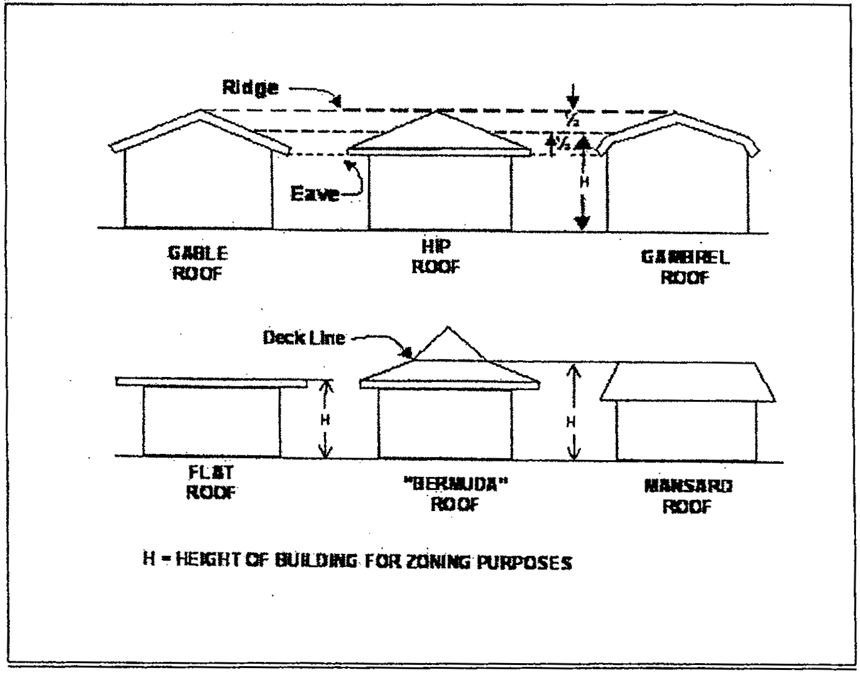
Figure for Height of Buildings
Historic property means historic property as defined in section 11-1 of the Sebring Code.
Hospice means a facility that specializes in the treatment of terminally ill people, typically providing the services of doctors and nurses to care for a patient and provide pain relief 24 hours a day.
Hotel means a building or a part of a building in which sleeping accommodations are offered to the public, as regulated by the division of hotels and restaurants of the department of business and professional regulations of the State of Florida, with no cooking facilities for use by the occupants, and in which there may be a public dining room for the convenience of guests. Access to sleeping rooms shall be through the inside lobby or office.
Household means a family living together in a single dwelling unit, with common access to and common use of all living and eating areas and all areas and facilities for the preparation and serving of food within the dwelling unit.
Household living means the residential occupancy of a dwelling unit by a family. Tenancy is arranged for periods longer than one week. Lodging where the residents meet the definition of household, and where tenancy is arranged for periods longer than one week are dwellings/household living. Uses where tenancy may be arranged for a shorter period are not considered residential and are considered to be a form of transient lodging. Examples include living in dwellings, single-family houses, duplexes, triplexes, multi-family, townhouses, apartments, condominiums, retirement center apartments, manufactured housing and other structures with self-contained dwelling units. Exceptions include lodging where tenancy is arranged for one week or less are considered to be a form of transient lodging (see Hotel or Motel definitions).
Impervious surface means the amount of the site that is covered by any material that substantially reduces or prevents the infiltration of stormwater into previously undeveloped land. This includes roofs, streets, sidewalks and parking lots, paved with asphalt, concrete, compacted sand, lime rock or clay.
Intermediate care facility. (See Group living).
Landscape wall means an opaque freestanding masonry, wood, metal, PVC or equivalent wall or pre-fabricated manufactured wall built along the property line or located within the landscape buffer for the purpose of screening or masking dumpsters, loading, unloading, storage, parking lot or other activities of an industrial use from adjacent residential.
Living space means the space within a dwelling unit utilized for sleeping, eating, cooking, bathing, washing and sanitation purposes, as amended from time to time.
Longterm care facility. (See Group living).
Lot means a parcel of land of at least sufficient size to meet the minimum zoning requirements for use, coverage and area, and to provide such and other open spaces as are required in this chapter. Such lots shall have frontage on an improved public street and may consist of:
(1)
A single lot of record;
(2)
A portion of a lot of record;
(3)
A combination of complete lots of record, and portions of lots of record; or
(4)
A parcel of land described by metes and bounds description; provided that in no case shall any lot or parcel be created that does not meet the requirements of this chapter.
Lot, corner, means a parcel of land at the junction of and abutting on two or more intersecting streets.
Lot depth means the distance measured in a mean direction of the side lines of the lot from midpoint of the front lot line to the midpoint of the opposite rear line of the lot.
Lot, front, means that portion of a lot abutting a street right-of-way. On corner lots, the front shall be that portion of the lot having the least horizontal distance as measured along each of the abutting street rights-of-way. Through lots shall be considered as having two fronts.
Lot, interior, means a lot other than a corner lot.
Lot lines mean the lines outlining the boundaries of a lot or parcel of land.
Lot of record means a lot that is the part of a subdivision, the plat of which has been recorded in the office of the clerk of circuit court of the county.
Lot, rear, means that portion of a lot lying at the opposite end to the front of a lot.
Lot, through, means an interior lot having frontage on two streets.
Lot width means the horizontal distance between the side lot lines when those lot lines are parallel measured at the front setback line. If side property lines are not parallel, the width shall be the length of a line at right angles to the axis (the axis is a line joining the midpoint of the front and rear lot lines) of the lot at a distance equal to the front setback required for the district in which the lot is located.
Map means the "Zoning Map of the City of Sebring."
Mobile home means any residential unit constructed to standards promulgated by the United Stated Department of Housing and Urban Development.
Mobile home park means a place set aside and offered for either direct monetary or for indirect benefit by any person, firm, corporation, municipality or other public body for the parking and accommodation of two or more mobile homes, travel trailers or recreation units occupied.
Modular building means a closed structure, building assembly, or system of subassemblies, which may include structural, electrical, plumbing, heating, ventilating, or other service systems manufactured in manufacturing facilities for installation or erection as a finished building or as part of a finished building, which shall include, but not be limited to, residential, commercial, institutional, storage, and industrial structures. The term includes buildings not intended for human habitation such as lawn storage buildings and storage sheds manufactured and assembled offsite by a manufacturer certified in conformance with Chapter 553, Florida Statutes. A modular building must be approved and bear the insignia of approval of the Florida Department of Business and Professional Regulation and a manufacturer's data plate. A mobile home is not a modular building for purposes of the Sebring Code.
Motel means a building or group of buildings, whether detached or in connected units, or as individual sleeping or dwelling units, as regulated by the Division of Hotels and Restaurants of the Department of Business and Professional Regulations of the State of Florida, designed primarily for transient automobile travelers and providing for accessory off-street parking facilities and having individual unit entrances opening to the outside. The term "motel" includes buildings designated as auto courts, tourist courts, motor lodges and similar appellations. Motels are further defined as a public lodging establishment which offers rental units with a direct exit to the outside of each rental unit, daily or weekly rates, off-street parking for each unit, a central office on the property with specified hours of operation and a bathroom or connecting bathroom for each rental unit.
Nonconforming use means the use of a building, structure or land existing on February 15, 1944, and which does not conform to the use regulations of the district in which it is situated.
Nursery school means a place for the day care and instruction of children not remaining overnight.
Nursing (convalescent) home means a home for the aged, chronically ill or incurable persons in which three or more persons, not of the immediate family, are received, kept or provided for with food and shelter or care for compensation, located on the basis of safety, land use compatibility, accessibility, convenience and the availability of public facilities and infrastructure, but not including hospitals, clinics or similar institutions devoted primarily to the diagnosis and treatment of the sick or injured. (see Convalescent home, Extended care facility, Intermediate care facility, Longterm care facility, and Residential health care facility).
Occupied includes the term "arranged, designed or intended to be occupied."
Off-street loading means designated areas located adjacent to buildings where trucks may load and unload cargo.
Open space means undeveloped, unpaved land suitable for passive recreation and/or conservation uses.
Parapet means a low, solid, protective wall or railing along the edge of a roof.
Parking:
Parking access means the part of a parking lot or parking area that allows motor vehicles ingress and egress from the street. (see Figure for Parking Access, Aisle, Bay, Space, and Stall)
Parking aisle means the traveled way by which vehicles enter and depart parking spaces. (see Figure for Parking Access, Aisle, Bay, Space, and Stall)
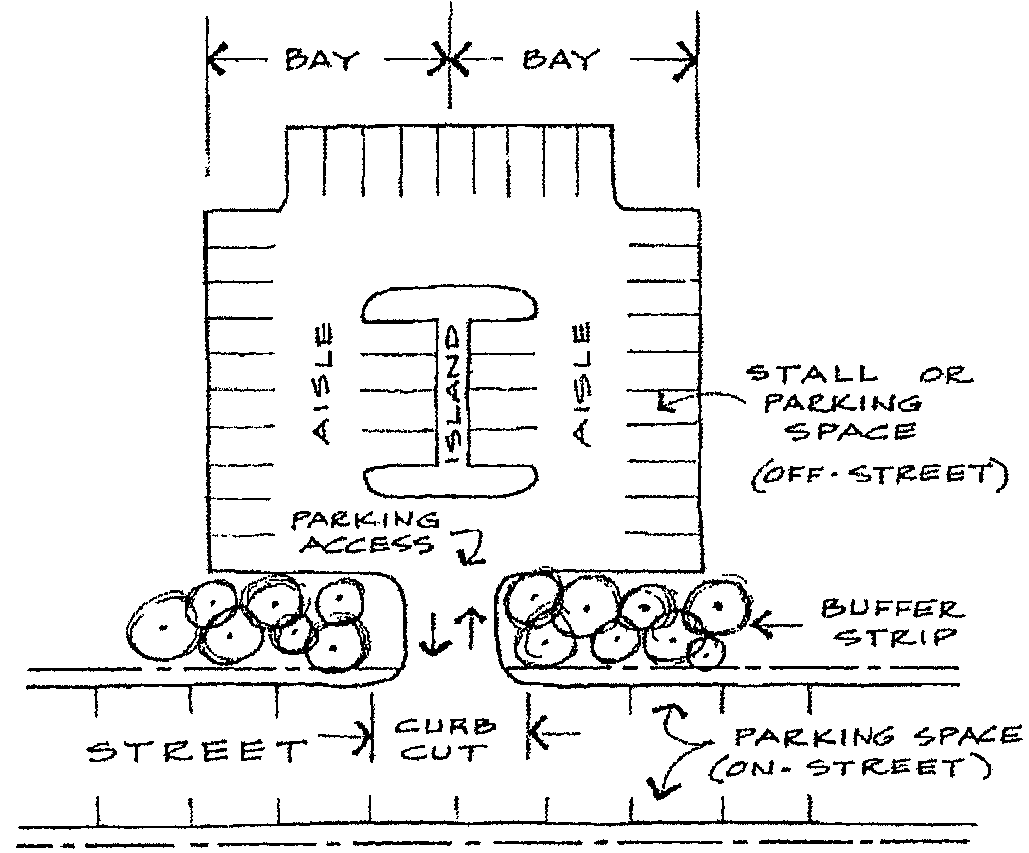
Figure for Parking Access, Aisle, Bay, Space, and Stall
Parking area means any public or private area, under or outside of a building or structure, designed and used for parking motor vehicles, including parking lots, garages, private driveways, and legally designated areas of public streets (see Garage).
Parking area, private means a parking area for the exclusive use of the owners of the lot on which the parking area is located or whomever else they permit to use the parking area.
Parking area, public means a parking area available to the public, with or without payment of a fee.
Parking, banked means required parking, the construction of which is permitted to be deferred until needed.
Parking bay means the parking module consisting of one or two rows of parking spaces and the aisle from which motor vehicles enter and leave the spaces (see Figure for Parking Access, Aisle, Bay, and Stall).
Parking lane means a lane designed to provide on-street parking.
Parking loop means a private street with perpendicular parking.
Parking lot means an off-street, ground-level open area that provides temporary storage for motor vehicles (see Parking area).
Parking meter means a device operated by the insertion of coins or other acceptable payment method, installed adjacent to a vehicle parking space on-streets or parking areas for the purpose of limiting the amount of time a vehicle can park.
Parking, off-site means parking provided for a specific use but located on a site other than the one on which the specific use is located.
Parking ratio means the number of parking spaces required per the sq. ft. of gross floor area.
Parking, shared means the joint utilization of a parking area for more than one use.
Parking space means a space for the parking of a motor vehicle within a public or private parking area (see Off-street parking space; On-street parking space; Stall; and see Figure for Parking Access, Aisle, Bay, Space, and Stall and Figure for Parking Space and Stall).
Parking space, handicapped means a space in a parking area with stall dimensions, access, and signage conforming to the Americans with Disabilities Act (ADA) or applicable state standards.
Parking space, off-street means a temporary storage area for a motor vehicle that is directly accessible to an access aisle and that is not located on a dedicated street right-of-way (see Figure for Parking Access, Aisle, Bay, Space, and Stall and Figure for Parking Space and Stall).
Parking space, on-street means a temporary storage area for a motor vehicle that is located on a dedicated street right-of-way (see Figure for Parking Access, Aisle, Bay, Space, and Stall and Figure for Parking Space and Stall).
Parking stall means the parking space in which vehicles park (see Figure for Parking Access, Aisle, Bay, Space, and Stall and Figure for Parking Space and Stall).
Parking structure means a building or structure consisting of more than one level and used to store motor vehicles (see Garage; Garage, Public).
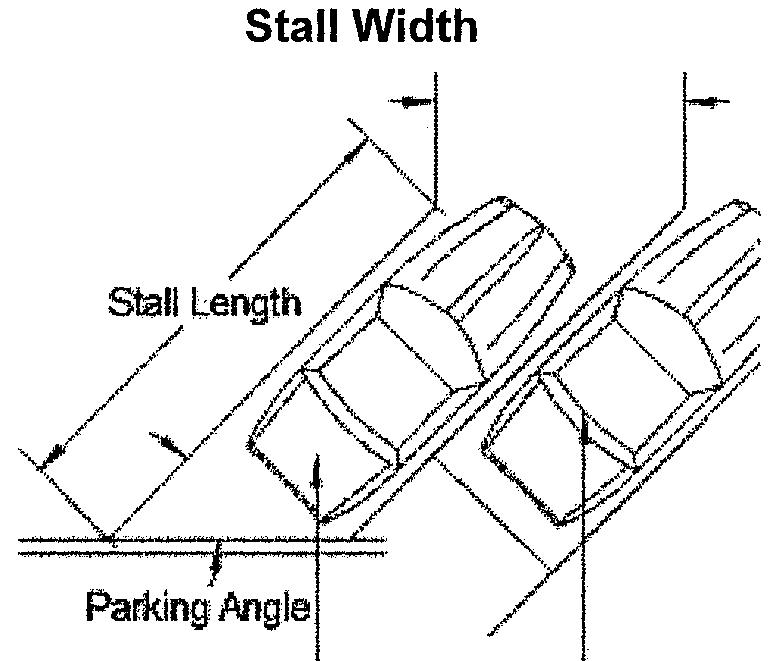
Figure for Parking Space and Stall
Pedestrian-oriented space means an area designed with an emphasis placed on the visual and functional needs of the pedestrian.
Permit holder means the holder of a valid sidewalk cafe permit under the terms and provisions of this article.
Personal service use means a business or occupation which provides services involving personal grooming or the care of a person's apparel, including, but not limited to, (1) barber and beauty shops, hair stylists; (2) clothing rental; (3) cosmeticians, manicurists/nail salons; (4) handcrafted or instructional art work studio; (5) laundry and dry cleaners (not including self- service laundromat) services; (6) pet grooming and/or daycare with no overnight boarding; (7) photographic studios; (8) safe deposit boxes; (9) shoe repair shops; (10) tailors; (11) tanning salons; and travel bureau.
Personal wireless services (PWS) means the transmission of, conveyance or routing of voice, data, audio, video, or any other information or signals to a point, or between or among points by or through, any electronic, radio, satellite, cable, optical, microwave, or other medium or method now in existence or hereafter devised, regardless of the protocol used for such transmission or conveyance, commercial mobile services, unlicensed wireless services and common carrier wireless exchange access services.
Personal wireless service (PWS) facilities means structures and PWS antennae for the provision of personal wireless services.
Place of assembly, nonresidential means a facility, parcel of land, building or structure or part thereto providing for the assembly of persons for interaction as a primary use, including community centers, and religious institutions, also referred to as place(s) of assembly for worship. Place(s) of assembly do not include community education or art centers, schools, instructional centers, daycare facilities, family day shelters, conservatories, convention centers, libraries, museums, residential dwellings, recreational and entertainment facilities, theaters or social service distribution facilities which fall under separate definitions in this Code.
Place of assembly, residential means all places of assembly is the use of a residential structure for the assembly of persons for interaction.
Planning and zoning director means the Planning and Zoning Director for the City of Sebring.
Post shall mean the decorative or support structures for a fence or wall and shall include columns, poles, pilasters, pillars, stanchions and the like.
Protected wellhead means those wellheads that serve community public water systems with a permitted capacity of 100,000 gallons per day (GPD) or more whether individually or in connection with other wellheads under a common consumptive use permit from the applicable water management district.
RV shall be defined as set forth in F.S. § 320.01, as amended, and means a recreational vehicle-type unit primarily designed as temporary living quarters for recreational, camping, or travel use, which either has its own motive power or is mounted on or drawn by another vehicle. The affixing of a recreational vehicle to the ground by way of tie-downs or other removable fasteners, and the attachment of carports, porches, screen rooms, and similar appurtenances by way of removable attaching devices, does not render the recreational vehicle a permanent part of the recreational vehicle site. The basic entities of RV's are:
(1)
The travel trailer, which is a vehicular portable unit, mounted on wheels, of such a size or weight as not to require special highway movement permits when drawn by a motorized vehicle. It is primarily designed and constructed to provide temporary living quarters for recreational, camping, or travel use. It has a body width of no more than eight and one-half feet and an overall body length of no more than 40 feet when factory-equipped for the road.
(2)
The camping trailer, which is a vehicular portable unit mounted on wheels and constructed with collapsible partial sidewalls which fold for towing by another vehicle and unfold at the campsite to provide temporary living quarters for recreational, camping, or travel use.
(3)
The truck camper, which is a truck equipped with a portable unit designed to be loaded onto, or affixed to, the bed or chassis of the truck and constructed to provide temporary living quarters for recreational, camping, or travel use.
(4)
The motor home, which is a vehicular unit which does not exceed the length, height, and width limitations provided in F.S. § 316.515, is a self-propelled motor vehicle, and is primarily designed to provide temporary living quarters for recreational, camping, or travel use.
(5)
The private motor coach, which is a vehicular unit which does not exceed the length, width, and height limitations provided in F.S. § 316.515(9), is built on a self-propelled bus type chassis having no fewer than three load-bearing axles, and is primarily designed to provide temporary living quarters for recreational, camping, or travel use.
(6)
The van conversion, which is a vehicular unit which does not exceed the length and width limitations provided in F.S. § 316.515, is built on a self- propelled motor vehicle chassis, and is designed for recreation, camping, and travel use.
(7)
The park trailer, which is a transportable unit which has a body width not exceeding 14 feet and which is built on a single chassis and is designed to provide seasonal or temporary living quarters when connected to utilities necessary for operation of installed fixtures and appliances. The total area of the unit in a setup mode, when measured from the exterior surface of the exterior surface of the exterior stud walls at the level of maximum dimensions, not including any bay window, does not exceed 400 square feet when constructed to ANSI A-119.5 standards, and 500 square feet when constructed to United States Department of Housing and Urban Development Standards. The length of a park trailer means the distance from the exterior of the front of the body (nearest to the drawbar and coupling mechanism) to the exterior of the rear of the body (at the opposite end of the body), including any protrusions.
(8)
The fifth-wheel trailer, which is a vehicular unit mounted on wheels, designed to provide temporary living quarters for recreational, camping, or travel use, of such size or weight as not to require a special highway movement permit, of gross trailer area not to exceed 400 square feet in the setup mode, and designed to be towed by a motorized vehicle that contains a towing mechanism that is mounted above or forward of the tow vehicle's axle.
Recreational vehicle park or RV park means a place set aside and offered by a person, for either direct or indirect remuneration of the owner, lessor, or operator of such place, for the parking, accommodation, or rental of five or more recreational vehicles or tents; and the term also includes buildings and sites set aside for group camping and similar recreational facilities. For the purposes of this chapter, the terms "campground," "camping resort," "RV resort," "travel resort," and "travel park," or any variations of these terms, are synonymous with the term "recreational vehicle park."
Residential health care facility. (See Group living).
Residential uses means activities within land areas used predominantly for housing.
Rooming house. (see Boardinghouse).
Screening means treatments used to visually shield or separate undesirable elements of a site. Commonly used to obscure parking areas, utilities, dumpsters, and other similar elements on a site.
Seawall means a wall erected so as to resist the encroachment of a lake or river.
Setback means a line parallel to and equidistant from the relevant lot line (front, rear, side) between which no buildings may be erected as prescribed in this ordinance.
Service station means any building or structure used for the dispensing, sale or offering for sale at retail of any automobile fuels, oils or accessories and in connection with which is performed general automotive servicing as distinguished from automotive repairs.
Shade Sail means a nonstructural canopy made to shelter people or things from rain or sun, such as products made by Coolaroo or Pheonix (see Figure for Shade Sails).
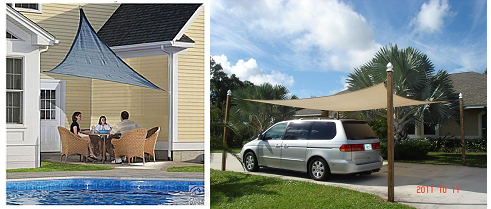
Figure for Shade Sails
Shed means a lawn storage building or storage shed not intended for human habitation and bearing the insignia of the Florida Department of Business and Professional Regulation.
Sidewalk means that portion of the public right-of-way between the roadway and the adjacent property lines and intended for use by pedestrians.
Sidewalk cafe means a use located on a sidewalk which is associated with an adjacent indoor eating and/or drinking establishment, where food and/or beverages are consumed on the sidewalk but without having cooking, storage, cooling, refrigeration or any preparation equipment located on the sidewalk. It is characterized by tables and chairs, which may be shaded by awnings, canopies or umbrellas.
Story means that portion of a building included between the surface of any floor and the surface of the next floor above it; or if there is no floor above it, the space between such floor and the ceiling next above it.
Street means a public thoroughfare that affords the principal means of access to abutting property. This includes avenue, road, lane, drive or other means for ingress or egress regardless of the term used to designate it, but not to include an alley.
Street, primary abutting. If more than one street abuts a subject property the "primary abutting street" shall be the street having the larger traffic count, as determined by the city.
Structural alteration means a change (except for repair or replacement), in the supporting members of a building, such as bearing walls, partitions, columns, beams, girders, joists, rafters, etc.
Structure means anything constructed or erected, the use of which requires more or less permanent location on the ground or which is attached to something having more or less permanent location on the ground.
Subdivision means the division or redivision of a parcel of land into three or more lots or parcels, either by plat or metes and bounds description for the purpose of transfer of ownership or development; or if a new street is involved, any division of a parcel of land.
Transitional care clinic means a clinic operated as a subordinate use in connection with and on the premises of a transitional care home, solely for providing physical, social, and psychological therapy or counseling by qualified personnel whose patients are limited to those who have recently resided in the transitional care home or families of those who are residing in or have recently resided in a transitional care home.
Transitional care home means a facility in which individuals live for a short period while receiving physical, social, or psychological therapy and counseling to assist them in overcoming physical or emotional problems.
Transitional living facility,as set forth in F.S. § 400.805, as amended, means a site where specialized health care services are provided, including, but not limited to, rehabilitative services, community reentry training, aids for independent living, and counseling to spinal-cord-injured persons and head-injured persons. This term does not include a hospital licensed under chapter 395 or any federally operated hospital or facility.
Used includes the term "arranged, designed or intended to be used."
Used car lot means a lot or parcel of land used for the display and sale of used cars.
Vehicle overhang means the portion of a vehicle extending beyond the wheel stops or curbs.
Visible from right-of-way means the subject property as viewed from any point of the adjacent public or private right-of-way or pedestrian oriented space.
Wellhead protection zone means the area between 100 and 500 feet of the city's existing or designated protected wellheads.
Yard is interchangeable with the term "setback."
Zone of exclusion means all land within a 100-foot radius of an existing or designated protected wellhead.
Figure VI.1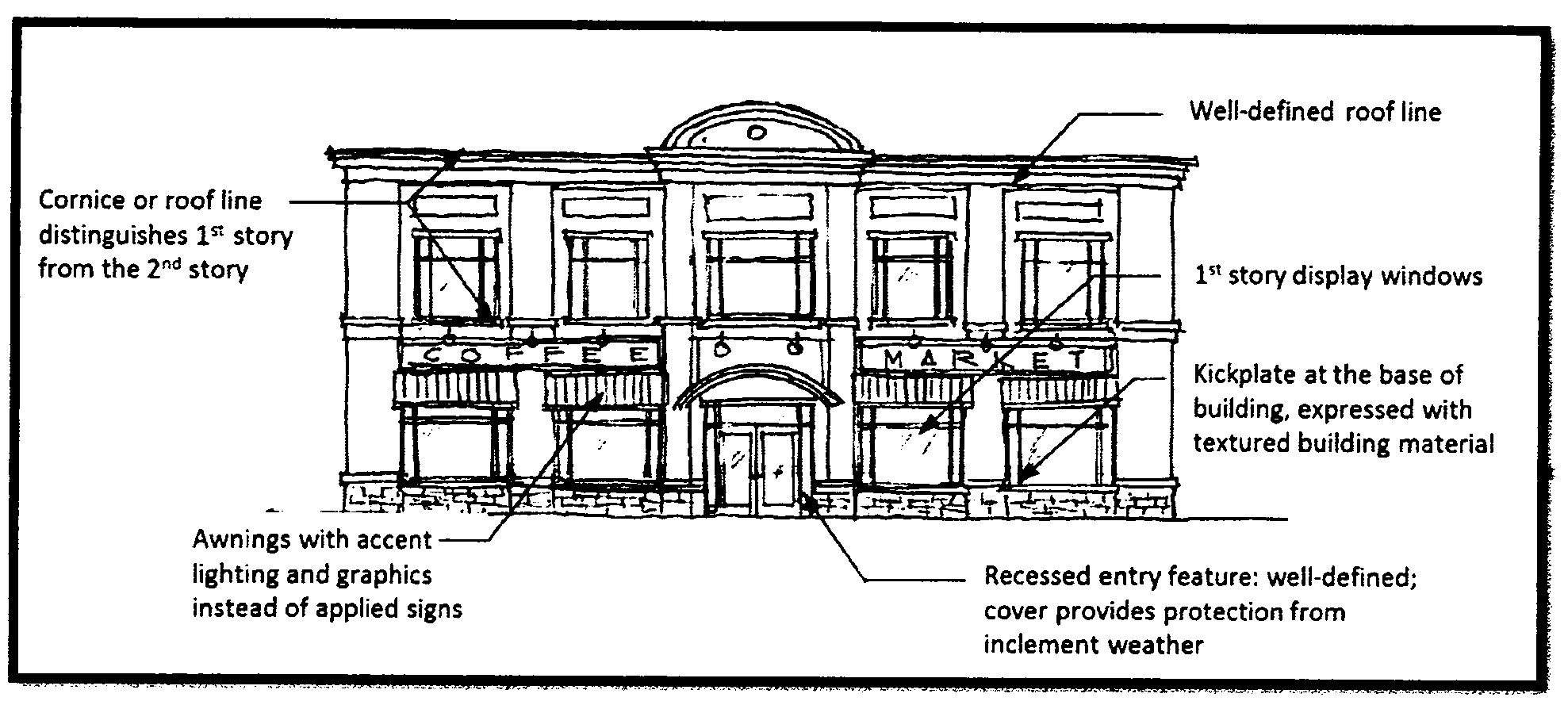
(Code 1981, § 22-1; Ord. No. 983, § 2, 9-1-1998; Ord. No. 1102, §§ 1, 2, 6-1-2004; Ord. No. 1139, § 1, 4-5-2005; Ord. No. 1162, § 1, 11-1-2005; Ord. No. 1231, § 1, 3-20-2007; Ord. No. 1245, § 1, 8-7-2007; Ord. No. 1254, § 1, 12-4-2007; Ord. No. 1311, § 1, 10-19-2010; Ord. No. 1320, § 1, 3-1-2011; Ord. No. 1324, § 1, 9-6-2011; Ord. No. 1335, § 35, 8-7-2012; Ord. No. 1355, § 2, 5-21-2013; Ord. No. 1464, § 1(Exh. A), 7-6-2021)
Editor's note— See editor's note to § 26-2.
Editor's note— Section 35 of Ord. No. 1335, adopted Aug. 7, 2012, renumbered and amended former § 26-2 as a new art. VI.

