


Severance City Zoning Code
ARTICLE 19
Review and Approval Procedures
Sec. 16.19.10.- Procedures summary
Applications and land use procedures shall be processed in accordance with Table 19.10 and this Article.
(Ord. No. 2023-08, §6)
Sec. 16.19.20. - General criteria for applications.
(a)
Eligible applicants. Unless otherwise specified in this Code, applications for review and approval may be initiated by the following entities.
(1)
The owner of the property that is the subject of the application; or
(2)
The owner's authorized agent; or
(3)
The Town Council acting on its own initiative or through recommendations brought to it by staff or the Planning Commission; or
(4)
Other entities that have rights provided by law.
When an authorized agent files an application under this Code on behalf of a property owner, the agent shall provide the Town with written documentation that the owner of the property has authorized the filing of the application.
When a review or decision-making body initiates action pursuant to this Code, it does so without influencing the approval or denial of the application.
(b)
Application forms. Applications required under this Code shall be submitted to the Community Development Department in a form and format specified by the Department. The Department and Director are authorized to establish submittal requirements and procedures to ensure all applications can be evaluated for conformance with this Code.
(1)
Modification. The Director may waive or modify certain requirements for specific information at the time of application due to the routine nature of the application or due to the context of the application making the information inapplicable for review against the standards and criteria of this Code.
(2)
Supplement. The Director may require further submittals or information, provided the request is required to evaluate compliance with this Code and/or adopted plans and policies.
(c)
Development review fees.
(1)
Fees shall be paid in accordance with the adopted and published Town fee schedule. The fee schedule may be revised and adopted annually by resolution of the Town Council and is available for review at the Town.
(2)
Applicants shall submit fees sufficient to cover the costs of administration, inspection, publication of notice and similar matters. Development review deposit fees will be charged to applicants for processing, reviewing, and administering applications such as but not limited to building permits, subdivision plats, rezoning requests, site plans, annexations, sign permits, variances, and all other administrative functions. In addition to the standard fees, the applicant and the owner of the property that is the subject of the application shall be required to pay any actual costs and fees incurred by the Town for review of the application by consultants and staff, including but not limited to engineering, surveying, legal and planning. Such fees shall include the hourly cost for any contracted professionals engaged by the Town for review of the application.
a.
The Town may require a deposit from applicants to offset the Town's costs for review prior to consideration of any application submittal pursuant to this Code. The Town shall not continue the processing of any application for which the applicant or the property owner has refused to deposit the funds to cover the Town's cost of review.
(d)
Concurrent applications. Multiple applications cannot be consolidated into one (1) application; however, when a project requires approvals under more than one (1) type of application, the Director may determine that each application may be submitted and reviewed concurrently based on the similarity of information needed and interrelationship between the applications.
(1)
Subdivision and site plan applications may be processed concurrently with annexation and initial zoning applications; however, such applications shall only be given final approval after annexation and initial zoning of the subject property are effective.
(2)
Site plans shall only be given final approval after a final plat approval is granted.
(e)
Withdrawal of an application.
(1)
The applicant may request to withdraw their application. Such request shall be in writing, either digital or print. Annexation applications with an approved resolution initiating annexation proceedings may only be withdrawn subject to approval by the Town Council.
(2)
After withdrawal, the Town will take no further action on the application.
(3)
The applicant may resubmit an application which shall be treated as a new application for purposes of review, scheduling, and payment of the application fees.
(4)
A request for withdrawal of an application from a noticed agenda is subject to the discretion of the decision-making body.
(f)
Inactive application. If the applicant fails to submit requested application materials within one hundred eighty (180) days of the request, the application shall become void, and the re-submittal of a new application and fees shall be required. The Manager may grant no more than two (2) extensions of time to this provision, of no more than six (6) months each, upon a written request by the applicant.
(g)
Lapse of approvals. Approvals of land use applications shall be null and void and shall automatically lapse if not completed or recorded within the approval time frames established by the procedures of this Code. A lapse of approval is not the same as vesting as established in statute and specified in Article 8 of this Code. If applicable, the lapse of approval time frames established by the procedures of this Code may be extended only when all of the following conditions exist:
(1)
The provisions of this Code must expressly allow the extension;
(2)
An extension request must be filed prior to the applicable lapse-of-approval deadline;
(3)
The extension request must be in writing and include justification; and
(4)
Unless otherwise noted, authority to grant extensions of time shall rest with the decision- making body that granted the original approval.
(Ord. No. 2023-08, §6)
Sec. 16.19.30. - Application steps
This Section is intended to outline typical development review steps administered by the Community Development Department for both administrative review and public hearing review applications, as identified in Table 19.10 under Procedures Summary. This information is not intended to reflect review timeframes or unique aspects of every application, including but not limited to the number of reviews required, situations beyond the Town's control, or individual approval requirements.
Figure 19.30.1: Public Hearing Application Types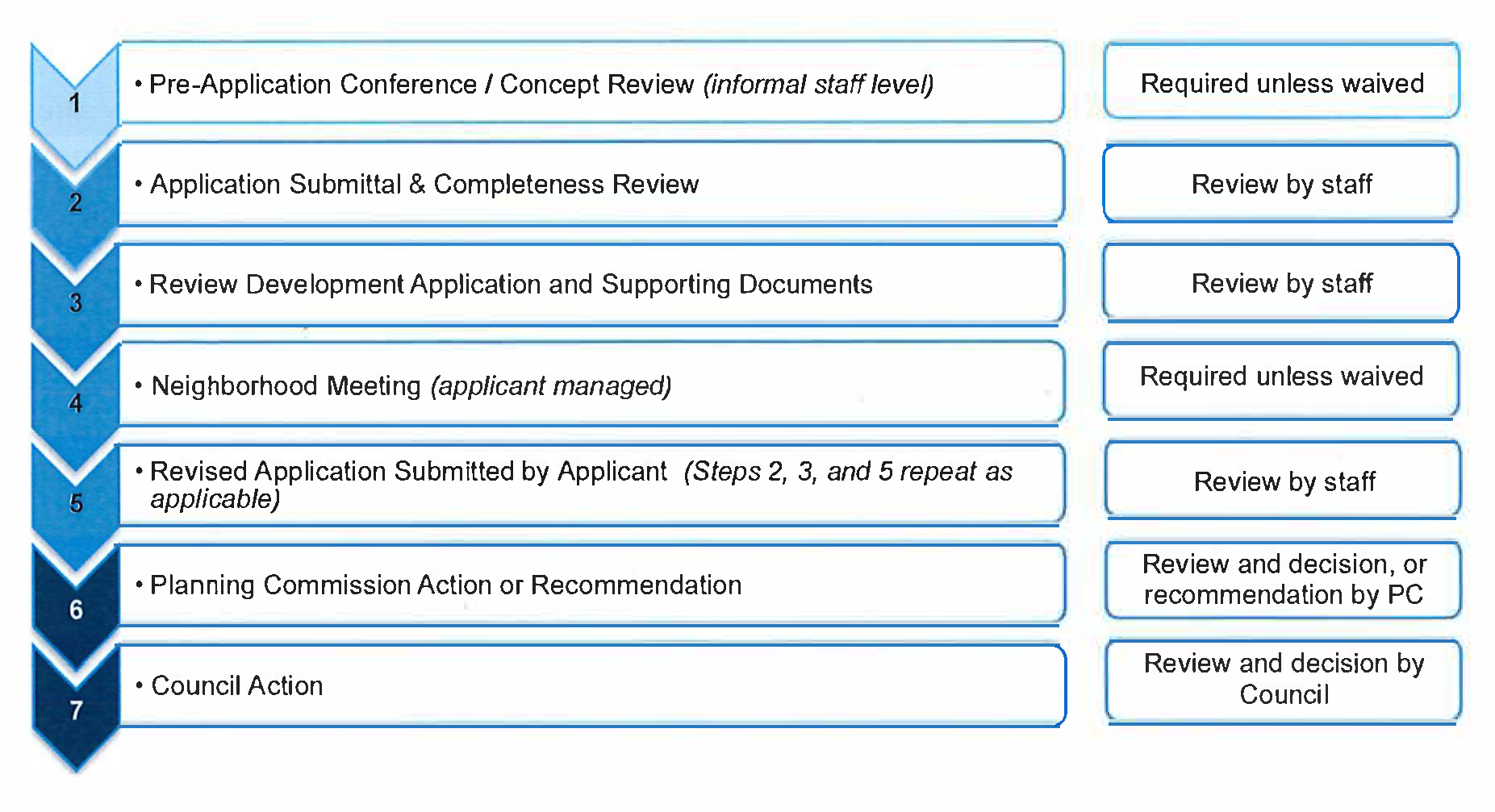
Figure 19.30.2: Administrative Application Types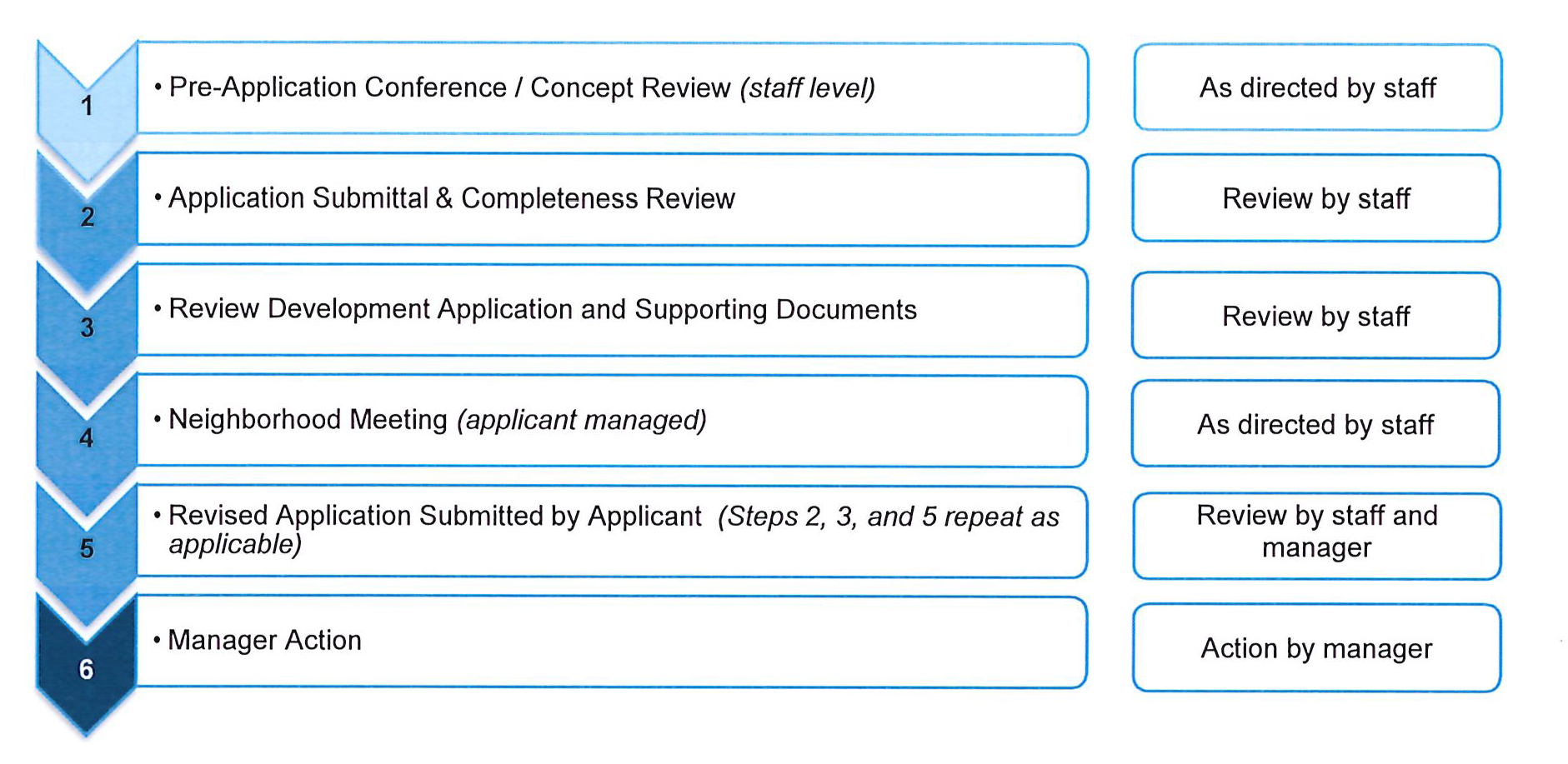
(1)
Step 1: Pre-Application Conference. This step (which may also be referred to as a concept review meeting, a concept plan, or pre-application review) provides an opportunity for an informal evaluation of the applicant's proposal and to familiarize the applicant and Town staff with the applicable provisions of this Code, the Town's Comprehensive Plan, and other documents as may be appropriate, including the Town's corridor plans, infrastructure requirements, and any other issues that may affect the applicant's proposal. This step is required for most application types and may be waived by the Manager depending on the unique characteristics of the development proposal. When required, the applicant shall submit the information required in accordance with the application and submittal requirements maintained by the Town.
a.
The applicant shall submit a request on a form or in a manner approved by the Town. Staff will coordinate a meeting with the applicant once all requested items have been submitted for the discussion.
b.
The meeting is an informal discussion of the preliminary development proposal with Town staff. The application shall submit the required information to facilitate discussion on the following topics:
1.
How the proposal meets the goals of the Comprehensive Plan, or other adopted plans or policies related to the application.
2.
The proposed use(s), general site layout, conceptual or anticipated design of the structure(s), and how the project relates to surrounding sites and public spaces.
3.
How the project will contribute to the area and further the intent of the existing or proposed zoning district.
4.
The development review processes and review criteria.
5.
Impacts to infrastructure planning including timing, phasing, or the need for any technical studies or outside agency coordination and review.
6.
Necessary public improvements as part of the proposal including but not limited to public and private utilities, sidewalks and/or trails, road improvements, parks, landscaping, or other improvements warranted by the development.
7.
Opportunities to improve designs, layout, and overall function to meet Town goals and policies.
c.
Informal evaluation not binding. The informal evaluation provided at the conference is not binding upon the applicant or the Town but is intended to serve as a guide to the applicant in making the development application and advising the applicant in advance of the development application of issues which may be presented to the appropriate decision-making body.
d.
Application required within six (6) months. After a pre-application conference has been held, an application must be submitted within six (6) months. If an application is not filed within such a timeframe, a new pre-application conference shall be required prior to filing an application, unless waived by the Manager.
(2)
Steps 2 and 3: Application Submittal and Review. Upon receipt of a development application and payment of the required fee, the Town shall take the following steps:
a.
Additional information. Town staff may require additional application-specific information, as necessary and appropriate to evaluate fully whether an application complies with the requirements of this Code.
b.
Completeness review. The Town shall determine if an application is complete. An application shall be considered complete if it is submitted in the required form, includes all submittal information specified by the Manager, and is accompanied by the applicable application fee(s).
1.
If an application is deemed complete, it shall be processed for formal review.
2.
If an application is determined to be incomplete, the Town shall notify the applicant of the deficiencies. No further processing or review of the application will occur until the deficiencies are corrected as requested and the application is re-submitted.
c.
Referral review. After determining that a development application is complete, Staff shall distribute the submittal to designated referral agencies for the opportunity to review and comment on an application. Referral agencies include but are not limited to adjacent or other local governments; state agencies; public and private utility providers; ditch companies; school districts; and other special districts such as the fire district. Referral agencies shall provide comments to Town staff on the application(s) within thirty (30) days of receiving a referral packet, unless otherwise specified by Town staff in the referral announcement. The applicant is encouraged to meet with referral agencies prior to the end of the referral period. The applicant is required to pay fees assessed by referral agencies.
d.
Staff review and comments. The Town shall coordinate a staff review and may provide the applicant the following information in writing:
1.
Comments or recommended change(s) based on the review of referral agencies, staff, and comments from any neighborhood meeting(s).
2.
Supplemental information required to support the application, address comments or the recommended changes.
e.
Resolution of issues. Staff shall compile and review all referral comments and provide a copy of all comments to the applicant. The applicant shall resolve outstanding issues to the maximum extent reasonably practicable. The applicant shall provide the Town with written responses addressing all referral and staff comment issues. At the discretion of the Manager, referral comments requiring significant changes to a development application, plan or proposal may require re-referral to any and all referral agencies.
(3)
Step 4: Neighborhood Meeting. In general, the Neighborhood Meeting should occur after the applicant has received the first round of referral responses as outlined in subsection 16.19.30.(b).4, above. The purpose of a neighborhood meeting is to provide an informal opportunity to inform the residents and landowners of the surrounding neighborhood(s) of the details of a proposed development and application, how the developer intends to meet the standards contained in this Code, and to receive public comment and encourage dialogue at an early step in the review process. No decision regarding the application will be made at the neighborhood meeting. A neighborhood meeting may be required as indicated in Table 19.10 under Procedures Summary. The applicant shall give mailed and posted notice of the neighborhood meeting to property owners, pursuant to the Notification Requirements found in Section 16.19.40 of this Code. An affidavit shall be submitted to the Town, by the applicant, stating that the notice requirement has been met. The applicant shall be responsible for scheduling the meeting, coordinating the meeting, and for retaining an independent facilitator if needed. Attendance at the meeting by Town staff is not required. The applicant shall prepare a written summary including a list of attendees of the neighborhood meeting. The written summary shall be provided to Town staff prior to noticing of any Public Hearing and included in the case record. During the review of an application, the Manager may require an additional neighborhood meeting where:
a.
The characteristics of the project are complex and present the potential for significant changes and unanticipated impacts on nearby or adjacent property.
b.
The proposal is likely to raise questions or concerns from adjacent property owners, beyond the typical allowances under the zoning district and/or the adopted plans or policies.
(4)
Step 5: Applicant Resubmits Revised Plans and Supporting Documents. Following the initial review by the Town and referral agencies and completion of a neighborhood meeting, as applicable, the applicant is responsible for resubmitting revised plans and supporting documents that address comments received by the Town and referral agencies. If the applicant chooses not to address any specific comment(s) or recommended change(s), a written explanation shall be included with the resubmittal that demonstrates a good faith effort to address the issue or justify why the comment was not addressed. Failure to address any comment or recommended change without explanation may be grounds for rejection of the revised application resubmittal. Steps 2, 3, and 5 repeat until the application is deemed ready for the next step in the process by the Manager.
(5)
Step 6 (administrative): Manager Action. For administrative applications, after consideration of the development application, the staff comments, comments received from other reviewers (if applicable), the Town Manager shall approve, approve with conditions, or deny the application based on its' compliance with the applicable approval criteria.
(6)
Step 6 (public hearing): Planning Commission Recommendation or Action. For public hearing applications, the Planning Commission may serve in the following two (2) capacities:
a.
As a recommending body that reviews the proposal against the criteria of this Code, adopted plans and policies, and the recommendation of professional staff, and provide a recommendation to the Town Council of approval, denial, or approval with conditions.
b.
As a deciding body that reviews the proposal against the criteria of this Code, adopted plans and policies, and the recommendation of professional staff, and make a final decision on a proposal to either approve, deny, or approve with conditions.
(7)
Step 7 (public hearing): Town Council Action. For public hearing applications, the Town Council serves as the decision body for certain applications, as specified on Table 19.10. Following review of the proposal against the criteria of this Code, adopted plans and policies, and the recommendation of the Planning Commission (if applicable) and professional staff, the Town Council may approve, deny, approve with conditions, or refer the application back to the Planning Commission for further review.
(Ord. No. 2023-08, §6)
Sec. 16.19.40. - Public hearing and notification requirements.
(a)
Public Hearing(s). Public hearings (hearings), if required under this Code, shall be conducted according to the following procedures:
(1)
A hearing shall be scheduled within a reasonable time as allowed by the schedules of the Town officials and staff. The Manager or staff, as delegated, are responsible for the scheduling of all public hearings.
(2)
Subject to subsection (3) that follows, the hearing shall be open to the public and any person may appear at a public hearing and submit evidence, either individually or as a representative of a person or an organization. Each person who appears at a public hearing shall state their name, address and, if appearing on behalf of a person or organization, the name and mailing address of the person or organization being represented.
(3)
The decision-maker conducting the public hearing may exclude testimony or evidence that it finds to be irrelevant, immaterial, or unduly repetitious.
(4)
Continuance of public hearing. The decision-maker conducting the public hearing may, on its own motion or at the request of any person, continue the public hearing to a fixed date, time, and place. All continuances shall be granted at the discretion of the body conducting the public hearing.
(5)
Record. An audio recording shall be made of all hearings, and transcripts of such hearings may be requested within thirty (30) calendar days of the close of the hearing. Transcripts shall be provided within a reasonable time after deposit of the cost of the preparation of the transcript with the Town.
(6)
Modification of application at hearing.
a.
In response to questions or comments by persons appearing at the hearing or to suggestions or recommendations by the Town Council, Planning Commission or Board of Adjustment (BOA), the applicant may agree to modify his or her application, including the plans and specifications submitted.
b.
Unless such modifications are so substantial or extensive to materially change the plans, the hearing body may approve the application with the stipulation that the permit will not be issued until plans reflecting the agreed-upon changes are submitted to the Town for review and approval as an administrative act.
(b)
Notice requirements. Notice shall be provided for each application as indicated in Table 19.10 and Table 19.40 below. The applicant shall be responsible for all costs of such notices.
(1)
Annexations. Annexation notifications shall be completed in accordance with Colorado statute, see C.R.S. 31-12-101 et seq.
(2)
Mailed notice requirements. Where mailed notice is required under this Code, the following requirements shall be met:
a.
Content. The mailed notice shall include a description of the proposal; the location of the meeting or hearing; the date, time, and location of the meeting or hearing; and information regarding public comment.
b.
Mailing list. Where required by statute or this Chapter, the mailed notice shall be sent to the following groups:
1.
All record landowners within one thousand (1,000) feet of the outer boundary of the land subject to the application no later than fifteen (15) calendar days before the hearing (unless otherwise specified by state statute or the Manager).
2.
To other interested property owners, such as mineral interest owners of record, mineral and oil and gas lessees for the property and appropriate ditch companies no later than fifteen (15) calendar days before the hearing (unless otherwise specified by state statute).
3.
To other parties of interest or referral agencies as determined by the Manager no later than fifteen (15) calendar days before the hearing (unless otherwise specified by state statute).
c.
Affidavit of compliance. A notarized affidavit of the applicant's compliance with the mailed notice requirements shall be provided to the Director prior to the meeting or public hearing to which the notice relates. Failure to provide the affidavit for a public hearing shall result in continuation of the public hearing.
d.
Surface development notification. Notices shall be mailed to the mineral estate owner no later than required by state statute, see C.R.S. 24-65.5-103.
(3)
Posted notice requirements. If notice by posting of the property is required by statute or this Chapter, such notice shall occur by prominently posting signs on the property that is the subject of the proposed action. Such signs shall be posted no less than fifteen (15) calendar days prior to the hearing (unless otherwise specified by state statute) and shall be easily legible from the nearest public streets. The sign shall be in the format available from the Town.
a.
Affidavit of compliance. If posting was done by the applicant, the applicant shall provide (prior to the hearing) a notarized affidavit showing that the property was posted within the specified time.
b.
When applicant has made all reasonable and good faith efforts to maintain posted notice, failure of this posted notice will not be grounds to invalidate the application.
(4)
Published notice requirements. The Town Clerk shall give notice of any public hearing required as follows:
a.
Notice shall be given to potentially interested persons by means of either publishing a notice one (1) time in a newspaper of general circulation in the area or on a publicly accessible website or on a page accessible through a direct link from the homepage, conspicuously placed, not less than fifteen (15) calendar days prior to the hearing. A publicly accessible website means the Town's official website or other private website designated by the Town for the publication of legal notices that is accessible via the Internet.
b.
This notice shall state the date, time, and place of the hearing, identify the lot, parcel or property that is the subject of the application or appeal and give a brief description of the action requested or proposed. Proof of publication shall be made part of the record at the time of the public hearing.
(Ord. 2023-08, §6; Ord. 2025-02 §5)
Sec. 16.19.50. - Annexation.
(a)
Purpose. Annexation is a discretionary, legislative act. Accordingly, the Town shall never be compelled to annex, unless otherwise required by state law, even if all annexation requirements have been satisfied. The purpose of this Section is to establish a procedure to bring land under the jurisdiction of the Town in compliance with the Colorado Municipal Annexation Act of 1965 (hereafter referred to as "Act"), as amended. This Article, in part, provides supplemental requirements for annexation pursuant to the Act and is not to be construed as altering, modifying, eliminating, or replacing any requirement set forth in that Act or any requirements set forth in other portions of this Code. In the event of a conflict between the Act, the provisions of this Section, or any requirements set forth in other portions of this Code, it is the expressed intent of the Town Council that the more stringent provision shall control.
(b)
Three-Mile Plan. The Severance Comprehensive Plan shall serve as and shall constitute the "plan in place" referenced in Section 31-12-105(1)(e), C.R.S., unless a different plan, supplement or revision is expressly adopted to serve as a plan in place. The plan in place may also be commonly referred to as the "Three-Mile Plan" and such plan shall be deemed automatically updated annually on January 1 of each year without further action by the Town unless a change or modification is necessary and is adopted by resolution or ordinance by the Town Council. The absence of a specific reference in such plan to a particular parcel of land proposed for annexation shall not be interpreted as a statement of intent to not annex such parcel of land; it is the plan and intent of the Town Council to evaluate and to consider for potential annexation all property within three (3) miles of the Town's then-existing municipal boundaries upon submission of a petition or as otherwise permitted by this Article and the Colorado Municipal Annexation Act of 1965. The absence in the plan of a specific reference to any character or extent of streets, subways, bridges, waterways, waterfronts, parkways, playgrounds, squares, parks, aviation fields, other public ways, grounds, open spaces, public utilities and terminals for water, light, sanitation, transportation and power to be provided by the Town, and the proposed land uses for the area shall not be interpreted as a failure to comply with Section 31-12-105(1)(e), C.R.S., but shall be interpreted as a plan by the Town to determine the appropriate character or extent of land uses and services through the Town's applicable processes of annexation, planning and development approvals on a case-by-case basis. The plan in place may also be amended or modified to more specifically identify the character or extent of land uses and services at any time or contemporaneously with any annexation.
(c)
Water resources required at annexation. All surface and sub-surface water rights appurtenant to or underlying the territory to be annexed shall be dedicated and conveyed to the Town concurrently with and as a condition to the annexation. The severance of ownership or control of the appurtenant water rights from the annexed property shall preclude its annexation as the Town Council may determine in its sole discretion. The Town may also require as a condition of annexation the dedication and conveyance of all supplemental water resources in such amounts as necessary to support full development of the territory to be annexed.
(1)
The Town Manager shall administratively approve the required deed form and title assurances for the conveyance of all water rights to the Town. Such conveyance shall require, at a minimum, the warranty of title given by the grantor in a special warranty deed. The grantor shall provide Town with an opinion of title from a qualified water rights attorney that grantor has good and marketable title to the water rights. All reasonable costs incurred by the Town in reviewing the opinion shall be borne by the grantor. The annexation agreement and/or deed shall provide that, in the event it is determined after the recordation of the deed that the deed did not vest in the Town marketable title to the water rights, the development entitlements granted in reliance on the dedication shall be suspended until the title defect is cured or alternative water rights are conveyed to and accepted by the Town in accordance with this Code.
(2)
It shall be the responsibility of the landowner, at their sole expense, to obtain a final decree to any water rights, or for approval of an augmentation plan for not-non-tributary groundwater, prior to conveyance to the Town. Under special circumstances, as determined by the Town Council in its absolute discretion, the Town may participate in such adjudications or accept un-adjudicated groundwater, provided that the cost of adjudication and yield from the subsequent adjudication are addressed in the applicable development agreement or annexation agreement.
(d)
The Town may require as a condition of annexation the payment of additional amounts by the petitioners or others deemed necessary, beneficial or advantageous by the Town, including but not limited to payments to offset anticipated costs or expenses of providing services to the annexed property or residents of the annexed area, to mitigate anticipated impacts to the annexed area or to surrounding lands, to upgrade infrastructure within the Town, or to defray any costs or expenses of the Town.
(e)
Review criteria. The Town shall evaluate annexations according to the following criteria:
(1)
The annexation complies with the Municipal Annexation Act of 1965, as amended (C.R.S. 31-12-101 et seq.).
(2)
The proposed annexation complies with the Comprehensive Plan goals and objectives, other adopted plans and policies, and any other relevant information in determining whether it is in the best interests of the Town to grant or deny the petition for annexation.
(3)
The proposed annexation promotes geographical balance of the Town's land use pattern.
(4)
Adequate facilities and services are or will become available to support the current or future development within the annexation area. Certain public facilities and amenities are necessary and must be constructed as part of any territory annexed to the Town in order for the public needs to be served by such facilities (including but not limited to streets, bridges, public parks and recreation areas, water and sanitary sewer facilities, school sites, fire and police station sites and storm drainage facilities).
(5)
The annexation shall be shown not to create any additional cost or burden on the then-existing residents of the Town.
(6)
The applicant has demonstrated that the proposed annexation follows all pertinent intergovernmental agreements to which the Town is a party.
(7)
The applicant acknowledges and agrees that it is the applicant's responsibility to apply for exclusion from any applicable special districts.
(8)
The proposed annexation is needed to accommodate future land use requirements.
(9)
Unless otherwise agreed to, the landowner has waived in writing any preexisting vested property rights as a condition of annexation.
(f)
Notice and review procedures. In addition to the specific notice and review procedures required by state statutes at the time of annexation, and in accordance with the general procedures Section of this Code, the following specific procedures apply to annexations:
(1)
A petition for annexation shall be signed by more than fifty percent (50%) of the landowners in the area and owning more than fifty percent (50%) of the land area of the proposed annexation.
(2)
An application form, related fees, and supporting documents includes plans, reports, and studies shall be provided by the applicant consistent with the application checklist requirements available through the Town.
(3)
The annexation assessment report is necessary for the Town to evaluate the feasibility and impacts of the proposed annexation on the Town's infrastructure, including but not limited to the ability to serve with streets, water, sanitary sewer, storm sewer, parks and recreation, schools, police, and fire protection; compliance with the Comprehensive Plan; sources of revenue from the property; the Town's costs to serve the proposed development and other related matters.
(4)
Published and posted notice of the Public Hearings required Municipal Annexation Act of 1965 (C.R.S. § 31-12-101, et seq., as amended) shall be provided as required by C.R.S. § 31-12-108. If applicable, the Town shall prepare the annexation impact report in accordance with C.R.S. § 31-12-108.
(5)
Resolution regarding statutory compliance. The Town Manager shall report to the Town Council an assessment of whether the petition for annexation complies with C.R.S. § 31-12-107. The Town Council shall review the petition and the Manager's report and shall, by resolution, make a finding that the petition is or is not in substantial compliance with C.R.S. § 31-12-107.
a.
If the petition is found to be in substantial compliance with C.R.S. § 31-12-107, the procedure outlined in C.R.S. § 31-12-108 to § 31-12-110 shall be followed.
b.
If the Town Council finds that the petition is not in substantial compliance with C.R.S. § 31-12-107, then no further action shall be taken on the application for annexation.
(6)
The Town Council shall hold a public hearing on the annexation and based upon the applicable review criteria and the recommendations from staff, approve the annexation by ordinance or deny the annexation.
(g)
Effect of decision. Town action on the annexation application shall not become final unless all requirements of the annexation ordinance and state statutes have been satisfied, as certified by the Manager. When all requirements have been satisfied, the ordinance, the annexation agreement, and the annexation map shall be recorded with the Weld County Clerk and Recorder.
(h)
Annexation agreement. Except for Town-owned property, Town-initiated annexation of enclaves, annexations upon election, or when waived by the Manager, an annexation agreement is required for all annexation applications and before the annexation may be approved. The Town will provide the applicant with a draft agreement to review and finalize as part of the development review process. The annexation agreement in a form approved by the Town Attorney must be executed by the property owner(s) prior to scheduling the public hearings on the annexation proceedings. The annexation application is reviewed and considered by the Town Council as part of the overall annexation request.
(Ord. No. 2023-08, §6)
Sec. 16.19.60. - Initial zoning and rezoning.
(a)
Purpose. The procedure for establishing or changing the boundaries or area of any zone district, or for establishing or changing the zoning classification of any parcel of land within the Town, as shown on the official zoning map of the Town shall be as provided in this Section. An official map amendment may be necessary to:
(1)
Establish initial zoning with an annexation application;
(2)
Correct a manifest error in an ordinance;
(3)
Implement the Comprehensive Plan goals and policies;
(4)
Implement a change in the regulations and restrictions of an area;
(5)
To account for changed or changing conditions in a particular area or in the Town generally; and/or
(6)
To reflect or implement a change in public policies with respect to development.
(b)
Review criteria. No application for rezoning of property shall be approved unless it is demonstrated:
(1)
The proposed zoning bears a reasonable relationship to the general welfare of the community; and
(2)
At least one (1) of the following additional factors exists:
a.
The proposed zoning is consistent with or promotes the goals and/or policies of the Comprehensive Plan, and any other applicable Town adopted plans and/or policies; or
b.
If the proposed zoning would be in conflict with the goals or policies of the Comprehensive Plan, the proposed rezoning demonstrates an improvement over the existing zoning in implementing the goals or policies of the comprehensive plan; or
c.
The property to be rezoned was previously zoned in error; or
d.
There has been a material change in the character of the neighborhood or in the Town, such that the proposed zoning would be in the public interest and consistent with the change; or
e.
The proposed zoning serves a community need or amenity that was not considered at the time of the initial zoning of the property.
(c)
Review procedures. In addition to the general procedures found in this Code, the following requirements are specific to rezoning applications:
(1)
The application shall include a written statement describing the proposal and addressing the following points:
a.
Rationale for the proposed rezoning.
b.
Present and future impacts on the existing adjacent zone districts, uses and physical character of the surrounding area.
c.
Impact of the proposed zone on area access and traffic patterns.
d.
Availability of utilities for any potential development.
e.
Present and future impacts on public facilities and services, including but not limited to fire, police, water, sanitation, roadways, parks, schools, and transit.
f.
The relationship between the proposal and the Comprehensive Plan.
g.
Public benefits arising from the proposal.
h.
The applicant shall provide contact information to the Town with mineral interest owners of record, mineral and oil and gas lessees for the property, and appropriate ditch companies.
(2)
The application is encouraged to be accompanied by an illustrative site plan. The illustrative site plan is intended to supply enough information about the development for the Town Staff to evaluate and for the Town Council to make a decision on the rezoning application. The information to be supplied will be determined by the Manager as part of the pre-application review but should indicate the feasibility and design characteristics of the development potential of the property.
(3)
Applications for rezoning may run concurrently with related development applications at the direction of the Manager.
(4)
Following review by staff and referral agencies, and any necessary resubmittal(s), the Town shall schedule review of the rezoning request by the Town Council during a public hearing.
(5)
The Town Council shall hold a public hearing and make a final decision on the rezoning application by ordinance.
(d)
Effect of decision. Upon approval of a rezoning request to the official zoning map by the Town Council, the Town shall cause an appropriate revision of the official zoning map to be prepared. If the applicant initiated the rezoning request, the petitioner shall pay the Town's cost for the preparation of the revision to the official zoning map. The Town shall record a copy of the official zoning map amendment with the county.
(e)
General rezoning of the Town. Whenever the zoning district map is in any way to be changed or amended incidental to or as part of a general revision of the zoning code, whether such revision is made by repeal of the existing zoning code and enactment of a new zoning code or otherwise, the requirement of an accurate survey map or other sufficient legal description thereof, and the notice to and listing of names and addresses of owners of real property in the area of the proposed change, shall be waived. However, the proposed zoning map shall be available for public inspection with the Town for fifteen (15) days prior to the public hearing on such amendments.
(f)
Zoning of annexed territory. The procedure for the initial zoning of property annexed or to be annexed to the Town shall follow, to the extent practicable, the procedures applicable herein to rezonings. In such circumstances, the zoning procedures may be instituted at any time after a resolution of intent to annex is adopted pursuant to C.R.S. § 31-12-106, as amended, or after a petition for annexation or a petition for annexation election has been found to be valid in accordance with C.R.S. § 31-12-107, as amended.
(1)
The proposed zoning ordinance shall not be passed before the date when the annexation ordinance is passed.
(2)
Any area annexed shall be initially zoned by the Town within ninety (90) days from the effective date of the annexation ordinance, despite any legal review that may be made challenging the annexation. During such ninety (90) day period, or such portion thereof as is required to zone the territory, the Town shall not issue a building permit for any portion(s) of the newly annexed area.
(Ord. No. 2023-08, §6)
Sec. 16.19.70. - Minor subdivision.
(a)
Purpose. Minor subdivisions establish or alter legal boundaries of parcels consistent with the Town's regulations and design criteria of this Code, but do not significantly alter the character of the subdivision nor adversely affect the functions of transportation, utilities, drainage, and other services and providers. The Town Council expressly delegates and grants to the Town Manager the authority to review and approve through the administrative process lot line adjustments and minor subdivisions, as defined by this Code. The authority granted and delegated hereby shall include the authority to execute and file with the office of the county clerk and recorder a subdivision plat conforming to the requirements of this Section. The authority granted and delegated hereby is subject to the following conditions and limitations:
(1)
The alteration or creation of legal boundaries for five (5) or fewer lots, blocks, tracts, and/or outlots;
(2)
The resulting lots can be served by municipal services through existing public improvements or through the construction of public improvements;
(3)
The resulting lots meet the minimum lot size requirements of the zone district in which the lots are located;
(4)
The lot line adjustment or minor subdivision is not being utilized to circumvent the regular process of review or other provisions of the subdivision design standards, particularly as it pertains to the number of lots created by the process itself, the impacts of the development or improvements, or in conjunction with other lot line adjustment or minor subdivision applications;
(5)
The establishment of land as a condominium common interest community, as defined in the Condominium Ownership Act, or the Colorado Common Interest Ownership Act, as appropriate; and
(6)
The establishment of zero lot line townhouse and small lot detached developments, as defined in this Code, and that do not exceed five (5) acres in aggregate size or involves the creation and dedication of any public rights-of-way to the Town.
(b)
Review criteria. The Manager shall approve a lot line adjustment or minor subdivision if it meets the following criteria:
(1)
As applicable, the minor plat or lot line adjustment complies with all applicable use, development, and design standards set forth in this Code;
(2)
As applicable, the minor plat or lot line adjustment is consistent with the terms and conditions of any previously approved development plan;
(3)
Existing or proposed utility facilities and services within the service area for the proposed subdivision are currently or will be adequate to meet the expected impact on and use of utility facilities and services by all possible uses of the proposed subdivision, and such uses will not compromise the overall operation of the applicable Town utility enterprise or other utility service provider or the quality of service to be provided to existing customers of the applicable Town utility enterprise or other utility service provider; and
(4)
The plat will not result in significant adverse impacts on adjacent properties, or such impacts will be substantially mitigated.
(c)
Review procedures. In addition to the specific review procedures required in accordance with the general procedures Section of this Code, the following specific procedures apply to minor subdivision applications.
(1)
The Manager shall review each lot line adjustment application or proposed minor plat relative to the applicable approval criteria.
(2)
If the Manager determine at any point in the process that the application is no longer eligible to continue or does not meet the criteria as a minor subdivision, the Manager may deny the application or allow the applicant to reclassify as a preliminary subdivision according to additional required information or fees.
(3)
All construction plans for subdivision-related public improvements shall be referred to the Town Engineer, Director of Public Works, and applicable utility providers for review and approval.
(4)
After staff and referral agency review, and any necessary resubmittals to address all outstanding review comments, the Manager shall act to approve, approve with conditions, or deny the lot line adjustment application or proposed minor plat. The Manager shall make a final decision on the lot line adjustment plat or minor plat.
(d)
Effect of decision. If the minor subdivision is approved, the Town shall have the signed plat recorded with the county. A recorded minor subdivision shall create a vested property right for two (2) years as specified in the vested property rights Section of this Code, unless otherwise specified in a fully executed agreement.
(Ord. No. 2023-08, §6)
Sec. 16.19.80. - Minor plat amendments.
(a)
Purpose. The Manager may approve minor amendments to approved plats, which shall be recorded and shall control over the preceding non-residential plat without vacation of that plat, if the application is signed by the applicants only and the sole purpose of the amending plat is to:
(1)
Correct an error in a course or distance shown on the preceding plat;
(2)
Add a course or distance that was omitted on the preceding plat;
(3)
Correct an error in a real property description shown on the preceding plat;
(4)
Correct any other type of scrivener or clerical error or omission previously approved by the municipal authority responsible for approving plats, including lot numbers, acreage, street names, and identification of adjacent recorded plats;
(5)
Correct an error in courses and distances of lot lines between two (2) adjacent lots if:
a.
Both lot owners join in the application for amending the plat;
b.
Neither lot is abolished;
c.
The amendment does not attempt to remove recorded covenants or restrictions; and
d.
The amendment does not have a material adverse effect on the property rights of the owners of the plat.
(6)
Relocate a lot line to eliminate an inadvertent encroachment of a building, structure, or other improvement on a lot line or easement; or
(7)
Relocate or remove one (1) or more lot lines between one (1) or more adjacent lots if all of the following have been met:
a.
The owners of all those lots join in the application for amending the plat;
b.
Lots must be combined so that no lot is created as a non-conforming lot, and no existing non-conforming lot remains; and
c.
The amendment does not attempt to remove recorded covenants or restrictions.
(8)
Add one (1) lot line between two (2) adjacent lots if, at the Manager's discretion, the lot line does not alter the character of the subdivision nor adversely affect the functions of transportation, utilities, drainage, and other services and providers.
(Ord. No. 2023-08, §6)
Sec. 16.19.100. - Major subdivisions.
(a)
Purpose. The purpose of the major subdivision review process is to ensure compliance with the subdivision standards and requirements set forth in this Code, while encouraging quality development generally consistent with the goals, policies, and objectives found in the Town's Comprehensive Plan.
(b)
Applicability.
(1)
General. The procedures of this Section, and the standards and requirements set forth in this Code, shall apply to all subdivisions that are not lot line adjustments or minor subdivisions, including subdivisions or re-subdivisions created by an exercise of the power of eminent domain by an agency of the state or Town, unless specifically excluded by state statute.
(2)
Subdivision approval is a prerequisite to other approvals. Except with respect to property which is platted as a lot or part of a subdivision approved in accordance with the provisions of this Code (or prior law, if applicable), no building permit or certificate of occupancy shall be issued for any of the following and no person shall perform any of the following:
a.
Construction of any new principal building or structure;
b.
Enlargement of any principal building used for nonresidential purposes by more than twenty-five percent (25%) of the existing floor area of such building; or
c.
An act which changes the use of any building.
(c)
Restriction on sale or transfer of subdivided land without an approved plat. Any person who transfers or sells any land located within the Town by reference to a plat that has not been approved by the Town and recorded by Weld County shall be guilty of a violation of this Code. The Town also may enjoin such transfer or sale by filing an action for an injunction.
(d)
Preliminary plats.
(1)
Purpose. The preliminary subdivision application is the first step in the major subdivision process, followed by the final subdivision application as outlined in this Code. The preliminary subdivision process provides detailed planning review of development patterns, street networks, block and lot layout, and preliminary engineering for future development prior to preparation of detailed construction and engineering plans.
(2)
Preliminary plat application submittal requirements.
a.
Submittal requirements as specified by the Town and identified within the application checklist, on file with the Community Development Department.
b.
Preliminary plat drawing standards. The preliminary plat drawing shall comply with the following standards:
1.
The preliminary plat shall be prepared by or under the direct supervision of a registered land surveyor, shall be signed and stamped by said surveyor and shall meet applicable state requirements.
2.
Except for parcels separated by public rights-of-way, public tracts or railroads, parcels not contiguous with each other shall not be included in one (1) plat, nor shall more than one (1) plat be made on the same sheet. Contiguous parcels owned by different parties may be included on one (1) plat, provided that all owners join in the dedication and acknowledgment.
3.
Lengths on the preliminary plat boundary shall be shown to the nearest hundredth of a foot, and bearings shall be shown in degrees, minutes and seconds.
4.
The perimeter survey description of the proposed subdivision shall include at least one (1) tie to an existing section monument of record and a description of monuments. The survey shown shall not have an error greater than one (1) part in ten thousand (10,000).
5.
Bearings, distances and curve data of all perimeter boundary lines shall be indicated outside the boundary line, not inside, with the lot dimensions.
c.
General development information. A written description of the existing conditions on the site and the proposed development shall include an explanation of how:
1.
Public facilities are consistent with the following adopted Town documents, which are on file in the Town's Community Development Department:
i.
Comprehensive Plan;
ii.
Transportation Master Plan;
iii.
E. Harmony Road/WCR 74 and 1st Street/WCR 23 Corridor Plan;
iv.
Water, Sewer, and Non-potable Water Master Plans, if applicable;
v.
Storm Water Master Plan, if applicable; and
vi.
Other adopted documents related to Town utility enterprises or Town capital improvements.
d.
Phasing. A preliminary plat shall designate the boundaries of phases for which separate final plats will be presented for approval. Each phase, either alone or in conjunction with previously approved and recorded phases, must meet all of the requirements of this Code.
e.
Preliminary grading and drainage plan and report. The purpose of the preliminary drainage plan and report is to identify existing site conditions and drainage problems, as well as those anticipated to result from development (whether on site or off site), and to present conceptual solutions to those problems. Historic drainage patterns and the effects of off-site drainage areas on the development and the effects of the development on downstream properties must be thoroughly assessed. This plan and report must be certified by a Colorado-registered professional engineer and include approximate earthwork quantities (how earthwork on the site is "balanced"), storm drainage concepts such as locations of pipe and other conveyance facilities, locations for on-site detention or downstream structural improvements and soil erosion and sedimentation control plans and specifications. It must also discuss the impacts on any existing floodways and/or floodplains, both on and adjacent to the site, as well as any Federal Emergency Management Agency (FEMA) applications required. It must also discuss previously submitted drainage studies for the site or project and their influence on the proposed stormwater facility design for the site, and if applicable, the Storm Water Master Plan, how recommendations in the Storm Water Master Plan affect the stormwater facility design for the site, and how the proposed stormwater facility design complies with the Storm Water Master Plan. It must also provide sufficient information for an initial assessment of whether the proposed stormwater facility design for the site can safely convey storm water runoff through the development to an adequate storm water system and accessible point of disposal with sufficient system capacity to carry necessary flow of the proposed development without overflowing downstream channels and existing storm drainage facilities or causing damage to property.
f.
Preliminary water and sewer plan and study. A Colorado-registered professional engineer shall prepare this plan. It is necessary that the engineer consult with the appropriate utility service providers regarding the design of all utilities throughout the subdivision. It must discuss the projected total water needs of the development for domestic consumption and fire protection, including without limitation, data on projected annual usage (GPY), average day demand (GPM/GPD), and maximum day demand (GPM/GPD), peak hour flow (GPM), as well as the projected total flow of sewage through a treatment plant expected to be generated by the proposed development. It must also discuss previous water and sewer studies for the site or project and their influence on the proposed design for water and sewer facilities, and if applicable, the Water, Sewer, and/or Non-potable Water Master Plans, how recommendations in the Water, Sewer, and/or Non-potable Water Master Plans affect the proposed water and sewer improvements for the site, and how the proposed water and sewer improvements for the site comply with the Water, Sewer, and/or Non-potable Water Master Plans. If located within the boundaries of the Town's water, non-potable water, or sewer utility enterprise respective service areas, it must also provide sufficient information for an initial assessment of the proposed development's impact on all parts of the Town's sanitary sewage collection system (including without limitation laterals, interceptors, lift stations, treatment plants, points of discharge), potable and/or non-potable water systems (including without limitation water source, water quality, treatment, storage, pumping facilities, and metering devices), as well as an evaluation of the adequacy of the Town's water, non-potable water, and/or sewer (where applicable) utility enterprises, respectively, to serve the proposed development together with existing development and development which is reasonably probable of connecting to the applicable Town utility system (e.g., legal buildable lots in approved subdivisions for which building permits have not been issued).
g.
Preliminary landscape and open space plan. The landscape plan must address the treatment of all exterior spaces. Landscape Plans are to be designed to meet the requirements of this Code and show approximate locations of trees, shrubs, groundcovers, turf, buffering, fences, walls and other site amenities that will be included in the landscape plan.
h.
Traffic study. This study must be prepared by a professional Traffic Engineer and must identify the projected impacts to the local and regional traffic system. Town will engage a third-party Traffic Engineer at applicant's expense. The projected direct roadway impacts and proposed share of regional improvements and intersections must be identified.
i.
Mineral, oil and gas rights documentation. Evidence that the surface owner has contacted all lessees of mineral, oil and gas rights associated with the site must be provided. Included in the evidence must be the name of the current contact person, his or her phone number and mailing address for each of the mineral owners or lessees. Said evidence may be provided to Town staff in a mineral interests report prepared by a certified petroleum landman, title company or attorney and an affidavit certifying the completion of this requirement.
j.
General ecological resource survey. A survey prepared by a qualified biologist, geologist, ecologist or similar qualified professional identifying the potential/absence/habitat of a threatened or endangered species and wetlands or other ecologically sensitive area must be provided. Said survey shall make practical recommendations regarding treatment or mitigation of the findings.
(3)
Preliminary plat review criteria. A preliminary subdivision shall be reviewed according to the following criteria:
a.
The subdivision complies with all applicable use, development, and design standards set forth in this Code that have not otherwise been modified or waived pursuant to this this Code.
b.
The mix of land uses within the project area conforms with the existing or proposed zoning and furthers the following planning objectives:
1.
The proposal promotes the Town's adopted plans, goals, and policies;
2.
Proposed residential development adds diversity to the Town's housing supply;
3.
Proposed commercial development will benefit the Town's economic base;
4.
Parks and open space are incorporated into the site design;
5.
The proposed project protects the Town's environmental quality; and
6.
The development enhances cultural, historical, educational, and/or human service opportunities.
c.
The transportation designs are adequate and meet the standards set by the Severance Transportation Master Plan and the Severance Construction Standards given existing and planned capacities of the Town's municipal street system.
d.
Negative impacts on adjacent land uses have been identified and satisfactorily mitigated.
e.
The subdivision will not create lots that are undevelopable or that are burdened with costs that would preclude development from occurring on other property.
f.
The preliminary grading and drainage plan and report:
1.
Indicates the stormwater management facility design for the proposed development adequately addresses all stormwater management and stormwater impacts anticipated to result from the proposed development (whether on site or off-site);
2.
Indicates that the proposed stormwater management facility design has considered the drainage basin as a whole and maintains the historic drainage path within the basin;
3.
Indicates that the proposed stormwater management facility design can safely convey storm water runoff to an adequate storm drainage system and accessible point of disposal with sufficient system capacity to carry not only the necessary flow of the proposed development but also, where applicable, the runoff from those areas adjacent to and upstream from the proposed development itself, without overflowing downstream channels and existing storm drainage facilities or causing damage to downstream properties; and
4.
Demonstrates that stormwater runoff from the proposed development will not conflict with other land uses or negatively impact lands downstream, nor will it impair or disrupt any existing floodways and/or floodplains, both on and adjacent to the site or the functioning of other utility systems, both on and adjacent to the site.
g.
The preliminary water and sewer plan and study:
1.
Indicates the proposed water, non-potable and sewer systems for the proposed development can be feasibly connected to the applicable Town utility enterprise system or other utility service provider's utility system;
2.
Indicates the proposed water, non-potable and sewer systems for the proposed development conform to the Town's Water, Sewer, and/or Non-potable Water Master Plans, where applicable; and
3.
Confirms that there will be adequate resources, facilities, and utility systems to adequately support and serve the proposed development together with existing development and development which is probable of connecting to the applicable Town utility system (e.g., legal buildable lots in approved subdivisions for which building permits have not been issued).
h.
The amount of unused capacity of existing utility facilities and services, including without limitation, water, non-potable water, sanitary sewer, presently available to serve the proposed development, while maintaining sufficient and acceptable levels of service to existing development and development which is reasonably probable of connecting to the applicable Town utility system (e.g., legal buildable lots in approved subdivisions for which building permits have not been issued). The Town Engineer shall be responsible for completing and presenting a capacity assessment for the proposed development to the decision-maker, and the applicant shall be furnished a copy of such assessment in advance.
i.
The recommendations of the Town Engineer and/or other agencies, together with any supporting analysis or other information presented, regarding the available capacity of the water, non-potable water, sanitary sewer, and storm drainage utility systems that will be impacted by the proposed development, and whether existing utility facilities and services are presently available to, and adequate to serve, the proposed subdivision.
j.
As applicable, the proposed phasing plan for development of the subdivision is rational in terms of available infrastructure capacity.
k.
Existing or proposed utility facilities and services within the service area for the proposed subdivision are currently or will be adequate to meet the expected impact on and use of utility facilities and services by all possible uses of the proposed subdivision, and such uses will not compromise the overall operation of the applicable Town utility enterprise or other utility service provider or the quality of service to be provided to existing customers of the applicable Town utility enterprise or other utility service provider.
(4)
A preliminary plat shall not be approved unless the decision-maker determines that:
a.
The Town's or other utility service provider's potable and non-potable water supply and distribution systems are or will be adequate to deliver the projected treated and non-potable water needs of the proposed development, including pressure and flow for normal operation of plumbing fixtures, water using appliances, requirements set by the responsible fire protection agency, and irrigation, when considered together with the following:
1.
Buildings under construction that will be connected;
2.
Buildings required to connect, but not as yet connected to the utility;
3.
Legal buildable lots in approved subdivisions for which building permits have not been issued;
4.
Other proposed subdivisions that have received final plat stage approval and have paid all applicable water utility fees;
5.
Other proposed developments that have received site plan stage approval and have paid all applicable water utility fees.
b.
The Town's or other utility service provider's sanitary sewage collection system is or will be adequate to accommodate the sewage disposal needs of the proposed development, when considered together with the following:
1.
Buildings under construction that will be connected;
2.
Buildings required to connect, but not as yet connected to the utility;
3.
Legal buildable lots in approved subdivisions for which building permits have not been issued;
4.
Other proposed subdivisions that have received final plat stage approval and that have paid all applicable wastewater (sanitary sewer) utility fees;
5.
Other proposed developments that have received site plan stage approval and have paid all applicable wastewater (sanitary sewer) utility fees.
c.
The Town's or other utility service provider's storm drainage collection system is or will be adequate to accommodate the projected flows of the proposed development, when considered together with the following:
1.
Buildings under construction that will be connected to the utility;
2.
Buildings required to connect, but not as yet connected to the utility;
3.
Legal buildable lots in approved subdivisions for which building permits have not been issued.
(5)
Preliminary plat review procedures. In addition to the specific review procedures required in accordance with the general procedures Section of this Code, the following specific procedures apply to preliminary subdivision applications:
a.
After staff and referral agency review, and any necessary resubmittals to address all outstanding review comments, the Town shall schedule review by the Planning Commission.
b.
The Planning Commission shall hold a public hearing and make a recommendation on the preliminary plat to the Town Council. Following review and a decision by the Planning Commission, the Town shall schedule a review and final decision by the Town Council.
c.
The Town Council shall hold a public hearing and make a final decision on the preliminary subdivision plat.
(6)
Public improvements required. The decision-maker can condition its approval and require on-site and off-site improvements or contributions to off-site improvements to ensure the proposed development will be served by adequate water, sewer, and storm drainage facilities. These improvements include, but are not limited to:
a.
The construction of mains in all public and private streets or utility easements within and adjacent to the proposed development;
b.
The construction of mains through the development to serve the lots and buildings within the development and to adjacent properties to allow them to connect to and extend the water or sewer system;
c.
The construction of off-site improvements needed to:
1.
Connect to the existing system;
2.
Provide the storage and flows needed to meet the level of service standards and the requirements of the water system plan;
3.
Provide collection capacity needed to meet the level of service standards and the anticipated demand from the service area;
4.
Provide the storage and flows needed to meet the water demands generated by the proposed development; or
5.
Provide the storage and flows needed to supply the fire flows needed to serve the development.
d.
The construction of pressure-reducing valves and similar appurtenances to provide pressure zone separation in the distribution system;
e.
The construction of lift and/or pump stations needed to serve the development if it is in a special pressure zone or because of topographical considerations. This will only be required or allowed in accordance with designated permanent lift and/or pump stations listed or shown in the current water system plan or sewer system plan;
f.
The construction of replacements or improvements to existing facilities in order to maintain an established level of service for sanitary sewage discharge from the service area or for water system demand and fire flow to the development;
g.
The construction of replacements or improvements to existing off-site facilities to the extent that the new development would cause the level of service for existing customers to drop below existing standards; or
h.
The transfer or dedication of easements or land needed for the construction and maintenance of utility system improvements.
(7)
Effect of decision on preliminary plats. Approval of the preliminary plat does not constitute approval of the final plat. The preliminary plat shall not be recorded and use of the preliminary plat for the purpose of selling or transferring interests in real estate shall be deemed a violation of this Code. Approval of a preliminary plat shall be effective for two (2) years. If no development or change in requirements has occurred that would affect the proposed plat at the end of the effective approval period, the Town Council may, at the request of the applicant, extend its approval an additional year without the submission of a new preliminary plat by re-approving the original preliminary plat. No extensions of approval shall be granted more than once. Extensions of a preliminary subdivision approval are at the discretion of the Town Council. An approved preliminary plat shall lapse and be of no further force and effect if a complete final plat application for the subdivision or a phase of the subdivision has not been submitted within two (2) years after the approval date of the preliminary plat or within the Town Council approved extension period. In the case of partial final plat submission or subsequent partial final plat submissions, the approval of the remaining portion of the preliminary plat shall automatically gain an extension of one (1) year with each final plat.
a.
Construction work. No construction work shall begin on the proposed improvements in the proposed subdivision prior to approval of the final plat; however, the subdivider may undertake certain ground excavations for grading and drainage purposes if the Town Engineer issues the proper permits, and/or Public Works Department, at the subdivider's risk.
(e)
Final plats.
(1)
Purpose. The purpose of the final plat is to review the proposed subdivision for proper final engineering subdivision design; for legal requirements to accurately represent real estate interests; to provide for dedication of lands required for public use and for the construction of public improvements; and for conformance with the form of the preliminary plat.
(2)
Final plat application submittal requirements.
a.
Submittal requirements as specified by the Town and identified within the application checklist, on file with the Community Development Department.
b.
A PDF file and an AutoCAD™ drawing file of the final plat in an electronic format specified by the Town Engineer.
c.
Final plat drawing that complies with the following standards:
1.
The plat shall be prepared by or under the direct supervision of a registered land surveyor, shall be signed and stamped by said surveyor and shall meet applicable state requirements.
2.
Except for parcels separated by public rights-of-way, public tracts or railroads, parcels not contiguous with each other shall not be included in one (1) plat, nor shall more than one (1) plat be made on the same sheet. Contiguous parcels owned by different parties may be included on one (1) plat, provided that all owners join in the dedication and acknowledgment.
3.
Lengths shall be shown to the nearest hundredth of a foot, and bearings shall be shown in degrees, minutes and seconds.
4.
The perimeter survey description of the proposed subdivision shall include at least one (1) tie to an existing section monument of record and a description of monuments. The survey shown shall not have an error greater than one (1) part in ten thousand (10,000).
5.
Bearings, distances and curve data of all perimeter boundary lines shall be indicated outside the boundary line, not inside, with the lot dimensions.
6.
Names and signatures of all owners of equitable interest in the property shall be on the plat and shall be made in black drawing ink.
(3)
Review procedures. In addition to the specific review procedures required in accordance with the general procedures Section of this Code, the following specific procedures apply to final subdivision applications:
a.
The applicant may proceed with the preparation of the final plat and other documents to be submitted with the application simultaneously with, or following approval of the Preliminary plat, at the risk of the subdivider. No final action shall be taken on a final plat until the corresponding Preliminary Plat has been approved and, if applicable, associated approval conditions have been satisfied.
b.
Following staff and referral agency review, and any necessary resubmittals to address all outstanding review comments, the Town shall schedule a review by the Town Council.
c.
The Town Council shall review at a public meeting and make a final decision on the final subdivision plat. The Town Council has final authority to approve, approve with conditions, or disapprove the final plat, accept the dedications, and to enter into and authorize the execution of a development agreement associated with the final plat.
d.
Final plats that differ from approved preliminary plats. If there are significant changes on the final plat from the form of the approved preliminary plat, the final plat submittal shall require review and approval in the same manner as the preliminary plat (i.e., hearings before the Planning Commission and the Town Council). Significant changes include, but are not limited to, modifications of street patterns, lot layout, drainage ways, grading, density, utility systems or public improvements. The Manager shall review the final plat changes to determine the conformance to the preliminary plat and shall determine if the changes are sufficiently significant to require a new preliminary plat submittal. The subdivider may appeal the Manager's decision to the Planning Commission within fourteen (14) days of the decision.
e.
Complete engineering plans and specifications. Concurrent with final plat approval, the applicant shall prepare and submit the following for administrative approval by the Town prior to commencement of construction:
1.
Construction plans and profiles. The plans and profiles shall be prepared by a registered professional engineer licensed in the State of Colorado. Plans shall be twenty-four (24) inches high by thirty-six (36) inches wide and shall provide the following information:
i.
The horizontal to vertical scales shall be chosen to best depict the aspects of the design.
ii.
The minimum horizontal scale is to be 1" = 100'.
iii.
The minimum vertical scale is to be 1" = 10'.
iv.
The typical road geometric and structural cross section is to be shown on each plan sheet.
v.
The plan must show right-of-way lines and widths, road names, lot lines, tangent lengths and bearings, curve radii, delta angles, curve lengths, chord lengths and bearings, stationing at all beginning of curves and end of curves, intersections, structures, angles, curb lines, cross pans, traffic-control devices (islands, striping, signs, etc.), drive cuts, curb returns and radii and all other features to enable construction in accordance with approved standards and standard engineering practice. Stationing may be centerline if approved by the Town Engineer. Construction plans shall include water lines and appurtenances, sewer lines and appurtenances, stormwater lines and appurtenances and any other wet utilities such as non-potable water systems and irrigation ditches.
vi.
The profiles shall include existing and proposed grades at curb and gutter or centerline of street elevation at point of intersection of vertical curves, intersections, grade breaks, point of curb return, point of reverse curve and other critical points, structures and all other features required to enable construction in accordance with the standards adopted by this Code.
vii.
Signature blocks for all utility providers shall be included unless otherwise provided in agreement form.
viii.
Structure details. Sufficient data shall be given to construction of major structures and road appurtenances, such as bridges, culverts, gutters, drives, walks, cross pans, etc.; detail shall include orientation line and grade, cross-sections, dimensions, reinforcement schedules, materials, quality specification, etc., or as the Town Engineer may approve.
ix.
Final water report. A final water report, including hydraulic analysis and pipe sizing calculations, shall be included.
x.
Final sanitary sewer report. A sanitary sewer report including hydraulic analysis and pipe sizing calculations shall be included.
xi.
Sewage collection and water supply distribution plans, profiles, and specifications. The plans, profiles and specifications shall be prepared by a registered professional engineer and shall be accompanied by written approvals from the applicable water and sanitation district.
xii.
Final drainage plans and reports. Based on the approved preliminary drainage plan, a final report is to be submitted in accordance with the Greeley Drainage and Design Criteria, as amended, or as the Town Engineer may approve. The plan and report must provide:
a)
Cross-sections of each water carrier showing high water elevations for one hundred (100) year runoff and adjacent features that may be affected thereby.
b)
Written approvals, as may be required, from other agencies or parties that may be affected by the drainage proposals (i.e., FEMA, Larimer County and Weld County, ditch companies).
c)
Supporting calculations for runoffs, times of concentration, flow capacity with all assumptions clearly stated with proper jurisdiction when needed or requested.
d)
Erosion control plans, when required.
e)
Sizing of all pipes, inlets, conveyance ways and other appurtenances.
xiii.
Final grading plan. The final grading plan shall be twenty-four (24) inches high by thirty-six (36) inches wide and shall illustrate existing and proposed contours and lot and block grading details.
xiv.
Soils report. The soils report shall detail pavement design and construction requirements and shall be submitted after overlot grading is complete.
2.
Final landscape and open space plan. The landscape plan must address the treatment of all exterior spaces. Landscape plans are to be designed to meet the requirements of this Code and show trees, shrubs, groundcovers, turf, buffering, fences, walls, and other site amenities that will be included in the plan. All plant materials must be adapted to the physical limitations of the local climate and specific conditions of the landscape plan. All plant materials must meet specifications of the American Association of Nurseryman for No. 1 grade. All street trees must be selected from the Town's recommended tree list.
i.
Landscape plan drawn to scale (not greater than 1" = 50') on sheets sized twenty-four (24) inches by thirty-six (36) inches, which includes:
a)
Project name.
b)
Scale, north arrow, and date of preparation.
c)
Existing and proposed streets and street names.
d)
Lot lines, easements and public rights-of-way as shown on the subdivision plat, including gross and net area of all parcels.
e)
Location of proposed building footprints and parking areas.
f)
Location of storage, loading and service areas.
g)
Existing and proposed two (2) foot contours (based on USGS datum).
h)
Natural features, wetlands, wildlife corridors, floodplains, streams, ditches, and other waterways.
i)
Location of existing and proposed utilities (utility lines can be "ghosted" in on the landscape plan to vary the line types for cleaner drawings).
ii.
All existing trees within the proposed site and adjacent to the site must be accurately identified on the plan. Existing trees must be labeled as to their size, species and, if they are intended to remain, be removed, or transplanted. All replacement mitigation trees will need to be shown separately on the plan. Tree protection standards for existing trees to remain shall be included in the plan.
iii.
The extent and location of proposed trees, shrubs and perennials and quantities of each species—Plant materials are to be drawn at two-thirds (⅔) of their mature size.
iv.
Landscape schedule, including the represented plant symbol, Latin name, common name, planting size and number of individual plants. All plant materials are to meet the minimum size requirements as provided in this Code.
v.
Proposed treatment of all ground surfaces must be clearly indicated, including turf, paving, mulch, native grass, seeded grass, and so on. Grass areas are to be specified as seed or sod and a seed mix/rate specified.
vi.
Sight distance triangles must be shown at street intersections pursuant to the table within this Code.
vii.
Project-specific landscape notes and details to ensure the proper planting, establishment, and survival of plant materials, along with additional notes detailing the warranty for plant materials and continued maintenance, shall be included.
viii.
Open space trail network and pedestrian circulation system.
ix.
Areas to be irrigated and method of irrigation.
x.
Proposed grading of the project site, including drainage swales, detention basins and retaining walls. Off-site grading for infrastructure improvements will need to be included, as well.
xi.
Notes for conservation and retention of topsoil and landscape soil preparation.
xii.
Restoration, revegetation or enhancement of disturbed natural areas or open space features.
xiii.
Park/open space structures, signage, play equipment and other landscape amenities and appurtenances.
f.
Improvements required. Applicants shall be required to pay for and construct all on-site and off-site public improvements and common facilities that are required to adequately serve the proposed development or are deemed necessary to address the impact caused by the proposed development. Payment for and construction of such on-site and off-site public improvements and common facilities shall be a requirement of the approval of a proposed development under this Code. The public improvements and common facilities required to be paid for and constructed as part of the proposed development shall be governed by a separate development agreement pursuant to this Code.
g.
Improvement guarantees. The subdivider shall provide any required guarantees to the Town Clerk prior to the recording of the final plat, unless otherwise authorized by the Town Council. Improvement guarantees shall be in a form specified and subject to the requirements and conditions detailed within this Code, the Town's Standards and Specifications, and the approved and executed subdivision agreement.
h.
Subdivision agreements. The Mayor or other authorized Town representative shall sign any related subdivision agreement.
(4)
Review criteria. A final subdivision shall be reviewed according to the following criteria:
a.
The final subdivision plat is in substantial conformance with the approved preliminary subdivision plat, and incorporates all recommended changes, modifications, and conditions attached to approval of the preliminary plat. For the purposes of this Code, substantial conformance, including design adjustments made to meet any conditions of preliminary subdivision approval, is determined as follows:
1.
Does not change any land use of the proposed subdivision plat.
2.
Does not significantly change the number of lots or residential density.
3.
Does not contain changes that would render the final subdivision plat in nonconformance with the requirements of this Code.
4.
Does not contain significant changes in street alignment and/or access points or other public elements such as drainage improvements, utility lines, or facilities.
5.
Does not significantly change any measurable standard (other than above).
6.
The development complies with this Code, the Comprehensive Plan, and Town adopted plans and/or policies.
7.
All applicable technical standards, including the provision of water of sufficient amount and quality, have been met.
b.
All applicable technical standards, including the provision of water of sufficient amount and quality, have been met.
c.
Plans and specifications for improvements connected with development of the subdivision comply with the subdivision development and design standards set forth in this Code, and any other relevant Town, county, state, or federal regulations, except to the extent modifications, variances, or exceptions have been expressly permitted by the terms of the preliminary plat approval. All construction plans for improvements shall be approved by the Town Engineer prior to the Town Council action on the final plat.
d.
The applicant has either installed all required improvements or has executed a subdivision agreement.
e.
The applicant has paid or satisfied all applicable fees and charges.
(5)
Effect of decision. Within sixty (60) days of the Town Council's approval of a final plat, which shall have all permitted modifications, waivers, or variances expressly noted thereon, the applicant shall provide to the Town one (1) fully executed copy of the approved final plat along with such other documents and fees as may be required by the Town Council or this Code. The Mayor and other authorized Town representatives shall sign the final plat. The Town shall then record the final plat and any signed subdivision agreement in the office of the Weld County Clerk and Recorder. The applicant shall pay all required recording fees. The time periods provided for in this Section may be extended for an additional sixty (60) days by the Manager upon written request and a showing of good cause. The Town Council's approval of any final plat shall be void if the applicant fails to comply with the time requirements of this Section.
a.
Original plats. The applicant shall submit for recording two (2) Mylar copies of the final plat, one (1) Mylar copy of all other plans and one (1) paper copy of everything to the Town. Original Mylars and documents shall become the property of the Town. Applicant will submit a digital copy of all files.
(6)
Sales prior to recording of final plat. Except as provided in this Section, it is unlawful for any subdivider or agent of a subdivider to transfer, sell or advertise, offer, or agree to transfer or sell any separate interest in property before a final subdivision plat for such property has been approved in accordance with the provisions of this Article and recorded with the County.
(Ord. No. 2023-08, §6)
Sec. 16.19.110. - Site plan.
(a)
Purpose. The purpose of the site plan review process is to show how the proposed site layout will be developed in compliance with the development and design standards and regulations of this Code, and to encourage quality development reflective of the goals, policies, and objectives of the Town's Comprehensive Plan. For land uses requiring a site plan review, such uses may be established in the Town, and building permits may be issued, only after a site plan showing the proposed development has been approved in accordance with the procedures and requirements of this Section. Approval of a Site Plan pursuant to this Section shall not constitute a "vested property right" to develop the property in accordance with the approved plan as "vested property right" is defined in C.R.S. § 24-68-101 et seq. or otherwise, unless the Town Council take specific action, in accordance with the provisions of this Code.
(b)
Applicability. A site plan shall be required for the following:
(1)
All development, including additions, in all zone districts except for single-family or duplex residential dwelling uses;
(2)
Establishment of a use by special review; or
(3)
Any change of use from one primary use classification to another (e.g., residential use to commercial use).
(c)
Site plan application submittal requirements.
(1)
Submittal requirements as specified by the Town and identified within the application checklist, on file with the Community Development Department.
(2)
Grading and drainage plan and report. The purpose of the drainage plan and report is to identify existing site conditions and drainage problems, as well as those anticipated to result from development (whether on-site or off-site), and to present conceptual solutions to those problems. Historic drainage patterns and the effects of off-site drainage areas on the development and the effects of the development on downstream properties must be thoroughly assessed. This plan and report must be certified by a Colorado-registered professional engineer and must include approximate earthwork quantities (how earthwork on the site is "balanced"), storm drainage concepts, such as locations of pipe and other conveyance facilities, locations for on-site detention or downstream structural improvements, and soil erosion and sedimentation control plans and specifications. It must also discuss the impacts on any existing floodways and/or floodplains both on and adjacent to the site as well as any FEMA applications required. It must also discuss previously submitted drainage studies for the site or project and their influence on the proposed stormwater facility design, and if applicable, the Storm Water Master Plan, how recommendations in the Storm Water Master Plan affect the stormwater facility design for the site, and how the proposed stormwater facility design complies with the Storm Water Master Plan. It must also provide sufficient information for an initial assessment of whether the proposed stormwater facility design can safely convey storm water runoff through the development to an adequate storm water system and accessible point of disposal with sufficient system capacity to carry necessary flow of the proposed development without overflowing downstream channels and existing storm drainage facilities or causing damage to property.
(3)
Utility plans and report prepared by a registered professional engineer. It is necessary that the engineer consult with the appropriate utility service providers regarding the design of all utilities through the proposed development. It must discuss the projected total water needs of the development for domestic consumption and fire protection, including without limitation, data on projected annual usage (GPY), average day demand (GPM/GPD), and maximum day demand (GPM/GPD), peak hour flow (GPM), as well as the projected total flow of sewage through a treatment plant expected to be generated by the proposed development. It must also discuss previous water and sewer studies for the site or project and their influence on the proposed design for water and sewer facilities, and if applicable, the Water, Sewer, and/or Non-potable Water Master Plans, how recommendations in the Water, Sewer, and/or Non-potable Water Master Plans affect the proposed water and sewer improvements for the site, and how the proposed water and sewer improvements for the site comply with the Water, Sewer, and/or Non-potable Water Master Plans. If located within the boundaries of the Town's water, non-potable water, or sewer utility enterprise respective service areas, it must also provide sufficient information for an initial assessment of the proposed development's impact on all parts of the Town's sanitary sewage collection system (including without limitation laterals, interceptors, lift stations, treatment plants, points of discharge), potable and/or non-potable water systems (including without limitation water source, water quality, treatment, storage, pumping facilities, and metering devices), as well as an evaluation of the adequacy of the Town's water, non-potable water, and/or sewer (where applicable) utility enterprises, respectively, to serve the proposed development together with existing development and development which is reasonably probable of connecting to the applicable Town utility system (e.g., legal buildable lots in approved subdivisions for which building permits have not been issued).
(d)
Review criteria. The site plan shall be reviewed according to the following criteria.
(1)
The site plan is consistent with the Town's Comprehensive Plan.
(2)
The site plan is consistent with any previously approved subdivision plat, or any other precedent plan or land use approval as applicable.
(3)
No buildings or structures infringe on any easements so as to impact the full use and enjoyment of the easement.
(4)
The proposed site grading is consistent with the requirements of adopted storm drainage criteria or master drainage plans.
(5)
The site plan conforms to all applicable development, density, and design standards of this Code.
(6)
The drainage and utility plans and studies confirm that there will be adequate resources, facilities, and utility systems to adequately support and serve the proposed development together with existing development and development which is reasonably probable of connecting to the applicable Town utility system (e.g., legal buildable lots in approved subdivisions for which building permits have not been issued).
(7)
The amount of unused capacity of existing utility facilities and services, including without limitation, water, non-potable water, sewer, and storm drainage, presently available to serve the proposed development, while maintaining sufficient and acceptable levels of service to existing development. The Town Engineer shall be responsible for completing and presenting a capacity assessment for the proposed development to the decision-maker, and the applicant shall be furnished a copy of such assessment in advance.
(8)
The recommendations of the Town Engineer and/or other agencies, together with any supporting analysis or other information presented, regarding the available capacity of the water, non-potable water, sewer, and storm drainage utility systems that will be impacted by the proposed development, and whether existing utility facilities and services are presently available to, and adequate to serve, the proposed development.
(9)
Public facilities are consistent with the following adopted Town documents, which are on file in the Town's Community Development Department:
a.
Comprehensive Plan;
b.
Transportation Master Plan;
c.
E. Harmony Road/WCR 74 and 1st Street/WCR 23 Corridor Plan;
d.
Water, sewer, and non-potable water master plans, if applicable;
e.
Other adopted documents relating to Town utility enterprises and Town capital improvements.
(10)
Existing or proposed utility facilities and services within the service area for the proposed development are currently or will be adequate to meet the expected impact on and use of utility facilities and services by all possible uses of the proposed development, and such uses will not compromise the overall operation of the Town's utility enterprises or other utility service provider or the quality of service to be provided to existing customers of the applicable Town utility enterprise or other utility service provider.
(11)
Any significant, adverse impacts anticipated from the proposed development will be mitigated or offset to the maximum extent reasonably practicable.
(12)
As applicable, the proposed phasing plan for the development is rational in terms of available infrastructure capacity.
(e)
A site plan shall not be approved unless the decision-maker determines that:
(1)
The Town's or other utility service provider's potable and non-potable water supply and distribution systems are or will be adequate to deliver the projected treated and non-potable water needs of the proposed development, including pressure and flow for normal operation of plumbing fixtures, water using appliances, requirements set by the responsible fire protection agency, and irrigation, when considered together with the following:
a.
Buildings under construction that will be connected;
b.
Buildings required to connect, but not as yet connected to the utility;
c.
Legal buildable lots in approved subdivisions for which building permits have not been issued;
d.
Other proposed subdivisions that have received final plat stage approval and have paid all applicable water utility fees.
(2)
Other proposed developments that have received site plan stage approval and have paid all applicable water utility fees.
(3)
The Town's or other utility service provider's sanitary sewage collection system is or will be adequate to accommodate the sewage disposal needs of the proposed development, when considered together with the following:
a.
Buildings under construction that will be connected;
b.
Buildings required to connect, but not as yet connected to the utility;
c.
Legal buildable lots in approved subdivisions for which building permits have not been issued;
d.
Other proposed subdivisions that have received final plat stage approval and that have paid all applicable wastewater (sanitary sewer) utility fees;
e.
Other proposed developments that have received site plan stage approval and have paid all applicable wastewater (sanitary sewer) utility fees.
(4)
The Town's or other utility service provider's storm drainage collection system is or will be adequate to accommodate the projected flows of the proposed development, when considered together with the following:
a.
Buildings under construction that will be connected to the utility; and
b.
Buildings required to connect, but not as yet connected to the utility; and
c.
Legal buildable lots in approved subdivisions for which building permits have not been issued.
(f)
Review procedures. In addition to the general procedures found in this Code, the following requirements are specific to site plan and site plan amendment applications:
(1)
Requests for alternative compliance or a variance from the criteria of this Code shall be processed concurrently with the site plan review but are subject to additional review, application fees as established by the Town, and adopted application submittal requirements.
(2)
The Town may require the applicant to execute a development agreement to ensure the completion of all on-site and off-site improvements as shown on the site plan drawings and identified in accompanying technical reports and studies to the site plan application.
(3)
Following review by staff and referral agencies, and any necessary resubmittal(s), the Town shall schedule review of the site plan request by the Planning Commission or Town Council, where applicable.
(4)
If a use by special review is required, then the Planning Commission shall review the site plan request and make a final decision on the application.
(5)
For all other developments for which a site plan is required, then the Town Council shall review the site plan request and make a final decision on the application.
(g)
Public improvements required. The decision-maker can condition its approval and require on-site and off-site improvements or contributions to off-site improvements to ensure the proposed development will be served by adequate water, sewer, and storm drainage facilities. These improvements include, but are not limited to:
(1)
The construction of mains in all public and private streets or utility easements within and adjacent to the proposed development;
(2)
The construction of mains through the development to serve the lots and buildings or structures within the development and to adjacent properties to allow them to connect to and extend the water or sewer system;
(3)
The construction of off-site improvements needed to:
a.
Connect to the existing system;
b.
Provide the storage and flows needed to meet the level of service standards and the requirements of the water system plan;
c.
Provide collection capacity needed to meet the level of service standards and the anticipated demand from the service area;
d.
Provide the storage and flows needed to meet the water demands generated by the proposed development; or
e.
Provide the storage and flows needed to supply the fire flows needed to serve the development.
(4)
The construction of pressure-reducing valves and similar appurtenances to provide pressure zone separation in the distribution system;
(5)
The construction of lift and/or pump stations needed to serve the development if it is in a special pressure zone or because of topographical considerations. This will only be required or allowed in accordance with designated permanent lift and/or pump stations listed or shown in the current water system plan or sewer system plan;
(6)
The construction of replacements or improvements to existing facilities in order to maintain an established level of service for sanitary sewage discharge from the service area or for water system demand and fire flow to the development;
(7)
The construction of replacements or improvements to existing off-site facilities to the extent that the new development would cause the level of service for existing customers to drop below existing standards; or
(8)
The transfer or dedication of easements or land needed for the construction and maintenance of utility system improvements.
(h)
Effect of decision. Approval of the site plan application shall authorize the applicant to apply for a building permit or other construction related permits associated with the project.
(1)
A building permit shall be issued after a site plan has been approved and a development agreement in a form approved by the Town Attorney reflecting any additional requirements, if necessary, has been executed and recorded. With Town approval, an applicant may submit a building permit application concurrent with the site plan application or during the review process. Building permits shall not be issued for any development that is not in conformance with the approved site plan.
(2)
Development of the site shall comply with the approved design and all conditions included in the site plan. A certificate of occupancy shall not be issued for a building or structure constructed in violation of an approved site plan.
(3)
The site plan shall be effective for a period of two (2) years from the date of approval unless stated otherwise in the written site plan approval. Building permits shall not be issued based on site plans that have an approval date more than two (2) years old. For multi-phased plans, building permits shall not be issued based on an approval date more than two (2) years from the date of Phase I approval, or as otherwise described in the approved phasing plan and/or executed agreement. The decision-maker may grant a one-time extension for a maximum of one (1) year upon written request of the applicant, prior to expiration of the site plan. The remainder of any unbuilt portion of the site plan at the time of expiration shall be null and void and require new site plan application and approval.
(i)
Amendments to approved site plans. The following minor amendments may be reviewed and approved administratively by Town staff:
(1)
Changes in drives, parking, and sidewalks, if such changes further the intent of the site plan and this Code and are acceptable to the Town Engineer and Director of Public Works.
(2)
Changes in building height, setback, or similar provisions relating to the location of structures, site improvements, or open space areas or other measurable standard, necessitated by engineering or other unforeseen difficulties, of ten percent (10%) or less, provided that the underlying zone district dimensional standards are met.
(3)
Changes to exterior building materials, architectural elements, landscaping, sign placement, lighting fixtures, utility boxes, equipment, panels, and other similar elements that the Manager may determine to be "minor."
(4)
Addition of an accessory structure less than five hundred (500) square feet in size.
(5)
All plans so modified shall be revised to show the authorized changes and shall become a part of the permanent records of the Town.
(6)
Changes to approved site plans that exceed the ten percent (10%) threshold, or other major modifications that the Manager determine not to be "minor," shall be considered as a new site plan application.
a.
Such amendments shall require Planning Commission approval or Town Council approval, as applicable, to become effective. A complete site plan application shall be prepared and submitted in compliance with the requirements set forth in this Code.
(Ord. No. 2023-08, §6)
Sec. 16.19.120. - Land Development Code (text) amendments.
(a)
Purpose. The Town Council, Planning Commission, or Town staff may initiate amendments to the text of these regulations. Whenever the zoning district map is in any way to be changed or amended incidental to or as part of a general revision of the zoning code, whether such revision is made by repeal of the existing zoning code and enactment of a new zoning code or otherwise, the requirement of an accurate survey map or other sufficient legal description thereof, and the notice to and listing of names and addresses of owners of real property in the area of the proposed change, shall be waived. However, the proposed zoning map shall be available for public inspection in the Town Hall during regular business hours for fifteen (15) days prior to the public hearing on such amendments.
(b)
Review criteria. A text amendment shall be reviewed according to the following criteria.
(1)
The amendment furthers the purposes of the Code.
(2)
The amendment improves the efficiency and effectiveness of administering the Code.
(3)
The amendment is consistent with the Comprehensive Plan and other adopted plans and/or policies.
(4)
The amendment incorporates innovations in land use and development practices that were not envisioned at the time the Code was written.
(5)
The amendment promotes the public health, safety, and welfare of the Town's residents.
(c)
Review procedures. In addition to the general procedures found in this Code, the following requirements are specific to text amendment requests:
(1)
Requests may run concurrently with a related Comprehensive Plan or other adopted plan amendment if the amendment or plan has met the legal and policy requirements for approvals independently of the proposed code amendment.
(2)
Amendments require the recommendation of the Planning Commission to the Town Council.
(3)
The Town Council may recommend the request be returned to the Planning Commission for further review or request additional information prior to acting on the request.
(d)
Effect of decision. Amendments to the text of this Code shall be approved by the Town Council as an ordinance and be effective after the date specified in the ordinance. The Town shall incorporate the approved amendments into this Code.
(e)
Annual review. Town staff may provide a summary report of any formal issues, concerns, or suggested updates regarding this Code to the Planning Commission for review and consideration on an annual basis or as needed. The Planning Commission may direct action, additional research, or investigation into elements of this Code that may need modified. The intent of the annual review is to provide an opportunity to keep the Code current and ensure its viability and responsiveness over time.
(Ord. No. 2023-08, §6)
Sec. 16.19.130. - Use by special review.
(a)
Purpose. As a general proposition, a special use is a use which is permitted within the underlying zone district (that is, it adds to the uses designated for an underlying zoning district), but which because of the possibility that the proposed use could become incompatible in certain respects with other uses within the zone due to expected adverse effects of the activity, special permission is required before the land may be put to that use. The special use approval only represents a determination that as to the land, a use additional to those permitted will be allowed. Accordingly, the purpose of use by special review is not to exclude uses, but to evaluate the proposed use against criteria that are intended to reveal a fact that shows the particular use proposed at the particular location proposed would have an adverse effect unique and different (above and beyond) from those inherently associated with such a use, irrespective of its location, and to determine the need to make, and to permit the government to impose, reasonable or appropriate conditions on the permitted use to alleviate any undue concerns for health or public welfare caused by adverse land effects of the proposed use.
(b)
Review criteria. A use by special review shall be reviewed according to the following criteria.
(1)
Whether the proposal is consistent with the goals and vision of the Comprehensive Plan and other adopted plans and/or policies of the Town as applied to the particular location of Town proposed in the application.
(2)
Whether the proposal furthers the intent of the underlying zone district.
(3)
Whether the proposed use is consistent with any applicable use-specific standards set forth in the Code.
(4)
Whether the proposal will result in an over-intensive use of land or depletion of natural resources.
(5)
Whether the proposal will cause significant air, odor, water, or noise pollution.
(6)
Whether the proposed use will injure the value of adjoining properties or make surrounding property worth more without the use than with it.
(7)
Whether the proposal will require a level of community resources greater than that presently available for the same or similar proposal occurring in another part of the Town.
(8)
Whether facilities and services (including sewage and waste disposal, water, gas, electricity, police and fire protection, and streets and transportation, as applicable) will be available to serve the subject property while maintaining adequate levels of service for existing development.
(9)
Whether a limited approval timeframe for the requested use is necessary to:
a.
Limit the duration of the use;
b.
Assess the use against changing conditions in the area; or
c.
Ensure periodic reporting and ongoing enforcement of any approvals.
(c)
Review procedures. In addition to the general procedures found in this Code, the following requirements are specific to use by special review applications:
(1)
A complete application shall include the following minimum requirements:
a.
A written request with justification for the use by special review.
b.
An illustrative site plan with necessary information to review conformance of any construction with standards of this Code, and to review any performance criteria for the proposal.
(2)
Relationship to site plan requirements. If a site plan is necessary for the proposed use by special review, then a site plan application shall be processed concurrently with the use by special review application, as required by the Town. In such cases, the Planning Commission shall be the final decision-making entity for both the site plan and the use by special review. The Planning Commission shall render separate decisions on the applications based on the applicable approval criteria in this Section 16.19.130 (for the use by special review) and Section 16.19.120 (for the site plan).
(3)
Following review of the request by staff and referral agencies, and any necessary resubmittal(s), the Manager shall schedule review and final action of the request by the Planning Commission.
(4)
The Planning Commission shall hold a public hearing and make a final decision on the use by special review request.
(5)
The Planning Commission may include conditions on the approval to mitigate concerns with the physical development, operations, or maintenance.
(6)
The decision of the Planning Commission may be appealed by the applicant to the Board of Adjustments within fifteen (15) days of the date of the decision thereon.
(7)
Appeals must be filed with the Town Clerk. The Board of Adjustments shall complete its review at a public meeting and render its decision to uphold or deny the Planning Commission's decision within thirty (30) days of the filing of the request for an appeal. The Board of Adjustment's review shall be limited to consideration only of the record before the Planning Commission. The standard of review for such an appeal shall be limited to an "abuse of discretion." Under this standard, the Board of Adjustment may only overturn the Planning Commission's decision if it finds that the Planning Commission abused its exercise of discretion.
(d)
Effect of decision. Approval of a use by special review allows the applicant to apply for a site plan application, as applicable, prior to a building permit or other applicable development and construction permits.
(1)
Approval of a use by special review shall lapse and be considered null and void:
a.
If the use itself, or if permanent construction in conjunction with such use, has not commenced within one (1) year of the approving action, or within the time frame established as a condition of approval of the use by special review. The Manager may grant a one (1) year extension to this timeframe that is ratified by the Planning Commission. This timeframe is distinct from any duration limits, periodic reviews, or renewal periods once the use is established, which may be a condition of approval by the Town; or
b.
If the use is no longer active or in operation for a period of twelve (12) consecutive months; or
c.
Upon a change of primary use of the property.
(2)
The Manager may approve minor changes upon meeting each of the following criteria:
a.
The change expands the floor area, height, or other dimensional standards of the original approval by less than ten (10) percent;
b.
There is not a change of use or significant increase in the intensity of the use that could adversely impact adjacent properties;
c.
The change does not exceed the limits or violate any specific conditions of the original approval; and
d.
The change complies with all other provisions of this Code.
All other proposed changes to the use shall require an amendment to the use by special review through the same procedures and criteria as the original application.
(3)
A use by special review may be revoked or amended by the Planning Commission through the same procedures granting the original use by special review approval, upon a finding that the conditions of approval have not been met, the applicant's noncompliance with any approved site plan or development agreement, if applicable, or that the use has otherwise violated the provisions of this Code. The Manager shall first notify the applicant in writing of the said violation and shall provide the applicant with a 30-day period in which to abate the violation. Failure of the applicant to abate cited violations within thirty (30) days shall result in the commencement of a hearing process before the planning commission. Upon completion of such review, the Planning Commission may revoke the special review use or amend the original approval.
(Ord. No. 2023-08, §6)
Sec. 16.19.140. - Appeals.
(a)
Purpose. The appeals process allows for the review of a Town Staff decision, as permitted under this Code, to determine if there was an error or abuse of discretion in any order, requirement, decision, determination, refusal, or interpretation made by any Town Staff in interpreting and/or enforcing the provisions of this Code. Is the intention of this Section that all questions arising in connection with the interpretation and enforcement of this Code shall be presented first to the appropriate department, that such questions shall be presented to the Board of Adjustment only on appeal from the decisions of that Department, and that recourse from the decision of the Board of Adjustment shall be to the courts. It is further the intention of this Section that the duties of the Town Council in connection with this Code shall not include the hearing or passing upon disputed questions that may arise in connection with the enforcement thereof.
(b)
Review criteria. The Board of Adjustment's review shall be limited to consideration only of the record before the decision-maker. The standard of review for such an appeal shall be limited to an "abuse of discretion." Under this standard, the Board of Adjustment may only overturn the contested action if it finds that the decision-maker abused its exercise of discretion.
(1)
The technical meaning of the provision being appealed.
(2)
Evidence of the way the provision has been interpreted in the past.
(3)
The positive or negative impact of the requested appeal on the achievement of stated development goals and policies of the Town, as outlined in this Code.
(4)
The intent of the provision in implementing the Comprehensive Plan and other adopted plans and/or policies of the Town.
(c)
Review procedures. Appeal requests shall be filed in writing with the Town no later than fifteen (15) days from the date of the order, requirement, decision, or determination being appealed. Failure to make a timely and complete appeal request shall be considered a waiver of the appellant's rights to appeal to the Town's Board of Adjustment.
(1)
An appeal to the Board of Adjustment may be brought by any person, firm, corporation, office, department, board, bureau, or commission aggrieved by the order, requirement, permit, decision, or determination that is the subject of the appeal, or by the Manager, on behalf of the Town.
(2)
Appeals must be filed with the Town Clerk.
(3)
Applicants for an appeal request must submit the following to be deemed a complete appeal request.
a.
Written notice of the appeal on a form approved by the Town.
b.
A description and the date of the final order, requirement, decision, or determination being appealed.
c.
A description of the grounds for the appeal, including specific allegations of error.
(4)
An appeal halts all proceedings in furtherance of the order, requirement, decision, or determination appealed from unless the Town certifies that it could cause imminent peril to life or property.
(5)
Once the appeal is determined to be complete, the Manager shall schedule review and action by the Board of Adjustment.
(6)
The Board of Adjustment shall complete its review at a public meeting and render its decision, by majority vote, to uphold or deny the decision on the item or contested action being appealed within thirty (30) days of reviewing an appeal.
(7)
The Board of Adjustment will have available to it the entire record of the contested action that was presented to or conducted before the applicable decision-maker.
a.
While the Board of Adjustment will not be considering any new evidence or information, the appellant has submitted an appeal request containing written argument, and the appellant will have an opportunity to submit arguments orally to the Board of Adjustment regarding its position in the appeal.
b.
The chair may place reasonable restrictions on such arguments, but the decision to place any such limits or specific parameters on the conduct of the proceeding is entirely up to the chair. For example, the chair may limit the length of time for appellant's initial oral argument to thirty (30) minutes as well as limit the length of time for the Board of Adjustment's questioning of the appellant to thirty (30) minutes.
c.
An appellant shall be notified in writing of any such limitations in advance. Furthermore, an appellant shall be given an opportunity to reserve any portion of their time allotted for initial oral argument for use during the period of Board of Adjustment questioning or to make final statements after Board of Adjustment questioning (for example, the appellant may only want to use ten (10) of their thirty (30) minutes to make their initial arguments, and reserve ten (10) of the remaining twenty (20) minutes for use to address questions and ten (10) minutes for their final statement to the Board after addressing Board questions).
d.
Finally, the appellant shall be entitled to make a closing argument before Board deliberation.
(8)
Following the oral argument before the Board, the Board of Adjustment will deliberate and render a decision on the appeal request.
(d)
Effect of decision. The Board of Adjustment's decision shall be final and appealable.
(1)
Appeals from decisions made by the Board of Adjustment shall be to the courts pursuant to the applicable Colorado Rules of Civil Procedure.
(Ord. No. 2023-08, §6)
Sec. 16.19.150. - Variances.
(a)
Purpose. The variance process is intended to provide limited relief from the requirements of this Code in those cases where strict application of a particular requirement will create a practical difficulty or unnecessary hardship prohibiting the use of land in a manner otherwise permitted under this Code. It is not intended that variances be granted merely to remove inconveniences or financial burdens that the requirements of this Code may impose on property owners in general. Rather, it is intended to provide relief where the requirements of this Code render the land difficult or impossible to use because of some unique physical attribute of the property itself or some other factor unique to the property for which the variance is requested.
(b)
Limitations.
(1)
Variances may be issued for the following dimensional standards: (i) setbacks (primary and accessory structures); (ii) lot frontage; (iii) lot coverage; (iv) building height (primary and accessory structures); (v) sign area or height; and (vi) parking.
(2)
No variance shall be granted to permit a use of land not otherwise permitted in the applicable zone district.
(3)
A lot width or area variance associated with a subdivision will be considered as part of the subdivision process, except that no minor subdivision plat shall be processed by the Town if it involves a lot width or area variance.
(4)
No variance shall be granted to increase the size or height of signs by more than ten percent (10%) above the requirements and limitations of this Code.
(5)
No variance shall be granted to decrease the amount of required parking by more than ten percent (10%) below the requirements of this Code.
(6)
No variance shall be granted to change either (a) a condition attached to an approved rezoning or special use, (b) a condition attached to an approved site plan; or (c) a condition attached to an approved final plat.
(7)
The Board of Adjustment may not change or alter this Code or change the zoning district map of the Town.
(c)
Review criteria. The Board of Adjustment may approve a variance only if it finds that there is an exceptional and undue hardship, whereby the application falls within any one (1) of the categories set forth in paragraphs (1), (2) or (3) of this subsection, and the application satisfies any one (1) of the criteria of paragraph (4) through (7) of this subsection.
(1)
Disability. There is a disability affecting the owners or tenants of the property or any member of the family of an owner or tenant who resides on the property, which impairs the ability of the disabled person to utilize or access the property.
(2)
Unusual conditions. There are unusual physical circumstances or conditions, including, without limitation, irregularity, narrowness, or shallowness of the lot; or exceptional topographical or other physical conditions, unique to the affected property; and
(3)
Compatibility. The property could be developed in conformity with the provisions of this Chapter, but the proposed variance will result in a building or structure form that is reasonable, customary, and consistent with or more compatible, in terms of building height, siting, and design elements, with the existing neighborhood in which the subject property is located.
(4)
Hardship.
a.
Without the variance, there is no reasonable use of the property; or
b.
Strict compliance prevents improvement of the property in a manner which is reasonable, customary, and consistent with other properties in the area; or
c.
Strict compliance would require significant or unjustified expense in light of the scope of the project, or would result in destruction or demolition of all or a portion of the existing building, structure, or other attractive features of the property; or
d.
If the variance is denied, the development or use of the property cannot yield a reasonable return in service, use or income as compared to adjacent conforming property in the same zoning district; provided, however, that loss of a more convenient or profitable use of property, or similar financial advantage, that similar variances have been granted elsewhere, or the fact that a more profitable use of the property might be had if a variance were granted are not grounds for a variance.
(5)
Exceptional hardship.
a.
The hardship is one (1) suffered by the applicant alone and not by neighbors or the general public; or
b.
The hardship is unique and unusual, or so, rather than one (1) shared by many surrounding properties.
(6)
Undue hardship.
a.
the hardship is not the result of the applicant's own actions; or
b.
The hardship is the result of predecessors in interest of the property, which could not have been foreseen to create difficulty in complying with this Article for future improvements.
(7)
Degree of requested variance.
a.
The requested variance the minimum that will afford relief and the least possible modification of the requirements of the zoning code; or
b.
the variance will neither result in the extension of a nonconforming situation, nor authorize the initiation of a nonconforming use of land, nor conflict with the goals and policies of the comprehensive plan and this Code; or
c.
Corrective measures can be imposed upon the variance request to mitigate or to protect neighboring properties against the anticipated, expected impacts or adverse effects of the variance.
(d)
Variance procedures.
(1)
A request for variance may be initiated only by the property owner or their authorized representative.
(2)
A complete application shall include the following minimum requirements:
a.
A written request with the relief sought, together with the justification for the variance request, specifying the facts or circumstances that are alleged to show that the application meets the approval criteria.
b.
A conceptual site plan or plot plan with necessary information to review the request in relation to existing site conditions and the criteria of this Code.
(3)
A variance request shall be processed prior to or concurrently with a site plan application, as required by the Town.
(4)
Following review of the request by staff and necessary referral agencies, and any necessary resubmittal(s), the Town shall schedule review by the BOA.
(5)
The Board shall conduct a public hearing on the proposed variance.
(6)
Approval by a majority of the Board present shall be necessary to grant a variance.
a.
The Board may impose conditions or special requirements that best assure the criteria for approval are in place and maintained by the applicant, or to mitigate anticipated impacts of the variance, and that any violation of these conditions shall be considered a violation of an approval.
(e)
Effect of decision. Upon determination of a variance, the findings of approval or denial shall be by resolution with the justifications set forth. Upon approval, the applicant may proceed with the next steps in the process including but not limited to a site plan or building permit application.
(f)
Lapse. Any variance granted shall become null and void:
(1)
If the variance is not exercised (e.g., building permit obtained, substantial construction commenced) within one hundred eighty (180) days of the date it is granted;
(2)
If the approval or conditions of approval of the variance is violated;
(3)
If the Manager finds that redevelopment or modification of the subject property makes compliance with this Code possible without the previously approved variance; or
(4)
If the Manager finds that the alleged hardship or difficulty upon which the variance is based has been eliminated.
(Ord. No. 2023-08, §6)
Sec. 16.19.160. - Administrative adjustments.
(a)
Purpose. The administrative adjustment process permits adjustments to certain provisions of this Code otherwise applicable to a property pursuant to the procedures in this Section. Administrative adjustments, comprised of two (2) types—alternative compliance and minor modifications—may authorize minor changes to pending applications, or to approved plans and permits, and relief from specified standards as stated in this Section.
(1)
Alternative compliance requests are intended to relieve unnecessary hardship in complying with the strict letter of this Code, and to promote context-sensitive development, which are minor deviations from otherwise applicable standards that may be approved by the Manager. Alternative compliance requests are to be used when the small size of the modification requested, and the unlikelihood of any adverse effects on nearby properties or the neighborhood, make it unnecessary to complete a formal variance process. They are not intended to relieve specific cases of financial hardship, nor to allow circumventing the intent of this Code and its standards.
(2)
Minor modifications are intended to ensure compliance with federal law.
(b)
Applicability.
(1)
Alternative compliance requests to relieve unnecessary hardship. As part of the review and approval of any procedure set forth in this Code, the Manager may approve adjustments of up to a maximum of five (5) percent from sign height or area and up to a maximum of ten (10) percent from the following general development and zoning district standards, provided that the applicable approval criteria listed below are met:
a.
Minimum lot area, coverage, and frontage requirements;
b.
Setback, parking, and building height requirements;
c.
Subdivision design and improvements standards; and
d.
Any other quantitative development standards set forth in this Code.
(2)
Minor modifications to ensure compliance with federal law.
a.
Compliance with Federal Religious Land Use and Institutionalized Persons Act of 2000 (RLUIPA).
1.
The Manager may grant minor modifications to any use, building form, or design standard or any other provision stated in this Code in order to eliminate a substantial burden on religious exercise as guaranteed by the RLUIPA, as amended.
2.
In no circumstance shall the Manager approve an adjustment that allows a religious assembly use, or any uses/structures/activities accessory to it, in a zone district where this Code prohibits such use or accessory use/structure/activity.
3.
In granting an administrative adjustment, the Manager may require conditions that will secure the objectives of the modified standard and that will mitigate any potential adverse impact on the environment or on adjacent properties, including but not limited to additional landscaping or screening.
b.
Reasonable accommodations under Federal Fair Housing Act (FFHA).
1.
The Manager may grant minor modifications to provide reasonable accommodations under the FFHA. In the application for a minor modification under this subsection, the applicant shall identify the type of housing being provided and cite the specific provisions of the FFHA that require reasonable accommodations be made for such housing. The Manager may grant the following types of minor modifications to assure reasonable accommodations required by law:
i.
Modify any minimum distance or spacing requirements, building setback, height, open space or building coverage, or landscaping requirement by no more than ten percent (10%); or
ii.
Reduce any off-street parking requirement by no more than one (1) space.
2.
The Manager may approve a type of reasonable accommodation different from that requested by the applicant if the Manager concludes that a different form of accommodation would satisfy the requirements of the FFHA with fewer adverse impacts on adjacent areas. The decision of the Manager shall be accompanied by written findings of fact as to the applicability of the FFHA, the need for reasonable accommodations, and the authority for any reasonable accommodations approved. Requests for types of accommodation that are not listed above may only be approved through a variance or official map amendment (rezoning) process.
(c)
Review criteria. An administrative adjustment request shall be reviewed based on the following criteria.
(1)
The adjustment is necessary to satisfy the federal requirements for reasonable accommodation of housing for protected groups under the Federal Fair Housing Act.
(2)
The adjustment is necessary to eliminate a substantial burden on religious exercise as guaranteed by the federal Religious Land Use and Institutionalized Persons Act of 2000.
(3)
The alternative will not alter the essential character of the neighborhood or district in which the property is located, nor diminish the value, use, or enjoyment of adjacent properties.
(4)
The alternative will result in an outcome that equally meets or exceeds the goals of the Comprehensive Plan, this Code, and adopted plans and/or policies by the Town.
(5)
The alternative shall not alter any land use and dimensional standards of this Code.
(6)
The alternative shall be based on specific site conditions and unique site context.
(7)
The proposed alternative shall meet or exceed the design objective of the adopted design standard.
(8)
The alternative shall consider the context of the broader community benefits such as:
a.
Enhanced architectural features that complement or improve the character of the surrounding area.
b.
Adaptive reuse of existing buildings.
c.
Considerations of improved sustainability and mitigation of environmental impacts.
d.
Enhanced pedestrian amenities and features.
(d)
Review procedures. In addition to the general procedures found in this Code, the following requirements are specific to administrative adjustment requests.
(1)
A complete application shall include the following minimum requirements:
a.
A written justification for the alternative compliance or minor modification request addressing the review criteria above.
b.
A comparison of the requested alternative compliance or minor modification against the existing criteria of this Code.
c.
Supporting images and details that illustrate the requested alternative. An alternative compliance or minor modification request may be processed prior to submitting a formal site plan application. The details related to an alternative compliance or minor modification shall be part of the formal site plan drawings.
(2)
Following review of the request by staff and necessary referral agencies, and any necessary resubmittal(s), the Manager shall schedule such person's review.
(3)
The Manager shall review and provide a determination on the request.
(4)
Notation on approving documents. Any approved administrative adjustment shall be specified on the approved plat, development plan, approval letter, or approving document for which the modifications were sought.
(5)
Conditions of approval. The Manager may attach any condition of approval to an administrative adjustment necessary to protect the health, safety, and welfare of the community, to secure the objectives of the modified standard, and to minimize adverse impacts on adjacent properties.
(Ord. No. 2023-08, §6)
Sec. 16.19.170. - Dedication and vacation of easements.
(a)
Purpose. The dedication and vacation of easements is the process to officially record or eliminate easements that grant specific access and property interests stated on the recorded document, typically a plat or separate easement instrument.
(b)
Eligibility. Easements may be dedicated or vacated in association with a minor or major subdivision process, or by this Section of the Code.
(1)
Eligible applicants for the dedication of an easement(s) include any person or entity with a property interest in the abutting and underlying land. The owner of the underlying land must be involved in the dedication process.
(2)
Eligible applicants for the vacation of an easement(s) shall be the easement holder or underlying property owner.
(c)
Review criteria.
(1)
The legal requirements for recording or eliminating the easement(s) have been established, and all forms and fees required by the Town have been submitted.
(2)
The applicant has provided proof of ownership and provided notice to all other ownership interests in the easement or affected property.
(3)
The request will not be detrimental to any adjacent property owner.
(4)
No owner or entity with a property interest in the easement has objected.
(5)
All parties with interest in or potentially impacted by the request have received notice and have had time to comment, including public and private utility providers.
(6)
For a vacation, there is no current or future public purpose for the easement when considering the Comprehensive Plan and other adopted plans or policies.
(7)
The vacation does not result in an easement configuration that could create difficulty in the provision of services or installation of public improvements.
(8)
For dedication, there are no conflicts with existing or planned easements and/or infrastructure.
(9)
The application meets all other procedures and requirements of the Colorado Statutes, the Colorado Constitution, and the Municipal Code.
(d)
Review procedures. In addition to the general procedures found in this Code, the following requirements are specific to dedicating or vacating easements within the Town:
(1)
The applicant shall submit an application, a plat, or other legal document showing the proposed vacation or dedication, the effect to adjacent or abutting properties, and a legal description as warranted based on the request.
(2)
The Town shall evaluate the application for completeness and coordinate review of the application per Section 16.19.30. The review shall include a request for comments from all referral agencies who may have facilities or other interest in the easement.
(3)
The Town may require the applicant to complete a consent form from the applicant for all applicable public and private utility providers.
(4)
The Manager shall make a final decision following review and analysis by staff and referral agencies.
(e)
Effect of decision. After approval of an easement dedication or vacation, the Town shall record the plat or other legal document with the County.
(Ord. No. 2023-08, §6)
Sec. 16.19.180. - Dedication and vacation of rights-of-way.
(a)
Purpose.
(1)
The procedure for vacation of streets, alleys, or other public ways, and vesting of title upon vacation, shall conform to state law as provided in Section 43-2-301, et seq., C.R.S., 1973, as amended. In addition, said vacation shall conform to the specific procedure as provided in this Section. The Town Council has the authority to vacate public roads, which include any public street, alley, lane, parkway, avenue, road, trail, or other public right-of-way (ROW) designated or dedicated on a subdivision plat, or conveyed by deed, or acquired by prescriptive use, whether or not it has been used as such.
(b)
Eligibility. ROW may be dedicated or vacated in association with a major subdivision process, or by the procedures of this Section of the Code.
(1)
Eligible applicants for a dedication or a vacation include the Town or any person or entity with a property interest in the abutting and underlying land. For ROW abutting multiple property owners, the Town may require all owners to be part of the application.
(c)
Review Criteria—Dedication.
(1)
The dedication of property to be put into use as public ROW shall be left to the sound discretion of the Town Council. The Town Council shall not exercise its discretion to dedicate public rights-of-way, unless it meets the following criteria:
a.
The applicant shall own the property free and clear of any encumbrances;
b.
The ROW to be dedicated is consistent with the goals of the Town's Comprehensive Plan, transportation plan, and/or all other adopted plans or policies of the Town; and
c.
The dedication shall help meet a Town goal, as determined by recommendation from Town staff to the Town Council.
(d)
Review criteria—Vacation.
(1)
Vacation of public roads shall be left to the sound discretion of the Town Council and the applicant shall have the burden of presenting sufficient information to justify the requested vacation. The Town Council shall not exercise its' discretion to vacate any public road, unless it meets the following criteria:
a.
No property would be left without reasonable access or provision of any public facilities or utility services by reason of the vacation;
b.
The public road is no longer necessary for public use or convenience;
c.
The vacation will not restrict access to any parcel so that access is unsafe, unreasonable, or economically prohibitive;
d.
Adequate easements have been reserved for use and/or maintenance by the Town or other utility agencies; and
e.
The vacation is consistent with the goals of the Town's Comprehensive Plan.
(2)
In exercising discretion to vacate a public road, the Town Council may also consider impacts on mobility, parking, traffic, and safety, as well as any benefits to the Town that will result from removing the right-of-way from the municipal street system.
(e)
Review procedures. In addition to the general procedures found in this Code, the following requirements are specific to dedicating or vacating rights-of-way (ROW) in the Town:
(1)
The applicant shall submit an application, a plat, or other legal document showing the proposed vacation or dedication, the effect on adjacent or abutting property, and a legal description as warranted based on the request.
(2)
The Town shall evaluate the application for completeness and coordinate review of the application per Section 16.19.30. The review shall include a request for comments from all referral agencies who may have facilities or other interest in the ROW.
(3)
The Town may require the applicant to complete a consent form for all applicable public and private utility providers.
(4)
Following review and analysis by staff and referral agencies, the Manager shall schedule a review by the Town Council.
(5)
The Town Council shall make a final decision and may condition a decision to vacate ROW on reserving any interest it determines necessary to serve a public purpose or the interests of the affected property.
(f)
Effect of decision. After approval of a right-of-way dedication or vacation, the Town shall record the ordinance with the county.
(Ord. No. 2023-08, §6)