
Severance City Zoning Code
ARTICLE 5
Site Development Standards
Sec. 16.5.110. - Overview.
(a)
Purpose. The intent of this Code language is as follows:
(1)
Value the design, function, and appropriate application of several types of open space systems, rather than solely the quantity of space;
(2)
Screen and mitigate visual impacts of high intensity portions of sites and developments, particularly focusing on the impact on public rights-of-way and adjacent property; and
(3)
Provide important transportation connections, as well as recreational opportunities and access.
(b)
Provisions. The provisions of this Section are in addition to the requirements of the underlying zone district and supersede the zone district requirements. In the event of a discrepancy between the two, the Town Manager and/or their designee's decision shall be final. These requirements supplement Article 6 Design Standards and should be used together with the use specific design criteria, as adopted, and amended by the Town. All landscaping, open space, and buffering standards shall be consistent with the Town's non-potable water requirements.
(Ord. No. 2025-15, § 3(Exh. A), 8-12-25)
Sec. 16.5.115. - Open space standards.
(a)
General criteria. The following criteria shall apply to all open spaces within the Town:
(1)
Uses designated within an open space area shall be appropriate to the context, character, and intensity of the development.
(2)
No land shall be reserved by the applicant as non-buildable parcels or designated as open space unless it is of sufficient size, shape, and topographically suitable to be of practical use or service as part of a complete open space system that supports development.
(3)
The land area designated as open space within subdivision developments shall not be credited toward the minimum landscape requirements or landscape area for site specific developments.
(4)
Oil and gas wells, both active and abandoned, shall not be counted towards the overall open space percentages.
(5)
Open space shall consist of lands maintained in native vegetation and used for buffering or habitat preservation. Irrigation is applied as necessary for maintenance.
(6)
Areas designated as public open space shall be both visibly and physically accessible to the community. Public access shall be provided to all public open spaces directly from the public rights-of-way and trail system(s).
(7)
Street, node, activity, walkway, and conflict lighting is required. Lighting shall meet the requirements of this Code.
(8)
Ponds and lakes may count as open space provided, they are active and at a minimum allow for non-motorized boats, swimming, and floatable devices.
(9)
To coordinate open and civic spaces into a system that integrates the public realm with surrounding development, subdivision design and location of open space types shall consider the following:
a.
Connections and integrations with public streetscapes and other civic destinations, such as schools, to improve visibility and access;
b.
The accessibility of neighborhoods to recreation opportunities for active living;
c.
The opportunity for natural spaces to preserve groves of trees, streams, unusual and attractive topography, and other desirable natural landscape features and views;
d.
The opportunity for formal gathering places to be a focal point for compact, walkable places, located as an extension of the streetscapes at highly traveled and visible locations;
e.
The types of spaces that reinforce character of the area or create gateways and transitions to distinct places; and
f.
The distribution of spaces so all developments have similar proximity to other types of open and civic space appropriate to its context.
(10)
An internal pedestrian way or trail system shall be provided.
(b)
Open space development standards.
(1)
General criteria.
a.
Of the required open space for developments, no more than twenty percent (20%) may be classified as passive open space.
b.
Open space designs shall be context sensitive. Compact and formal gathering spaces are most appropriate in walkable commercial and mixed-use areas. Spacious and natural areas are most appropriate in larger and spread-out development areas.
c.
See Article 6 Design Standards for additional site design criteria.
(2)
Residential development criteria.
a.
Rural residential developments shall provide a minimum twenty percent (20%) of the gross land area as functional open space, which may include agricultural land, natural areas, trails, and lands dedicated for other similar purposes.
b.
Residential developments shall provide a minimum of twenty-five percent (25%) of the gross land area as functional open space. An exception may be granted by the Manager for infill Town center projects.
c.
Residential developments with fifty (50) or more units shall incorporate a minimum of one (1) centrally located multifunctional park. For multi-family projects, this park may count towards the amenity points specified within Article 6 Design Standards. See dedication requirements in Article 4.
(3)
Nonresidential development criteria.
a.
Nonresidential developments shall provide a minimum of fifteen percent (15%) of the gross land area as functional open space. An exception may be granted by the Manager for infill Town center projects.
(c)
Minimum landscape requirements for all open spaces.
(1)
Edge landscaping and entryways.
a.
Edges of commercial developments shall contain high-quality landscaping. Berms, meandering walks, a mix of irrigated turf, shrub beds, ornamental trees, evergreen trees, and shade trees are encouraged.
b.
The perimeter treatment adjacent to roadways should include a minimum twenty (20) feet varying width landscape buffer with a minimum ten-foot community pathway, unless otherwise specified in this Code.
c.
Entryways and areas visible from public streets shall have some type of landscape component that may include window boxes, hanging baskets, large pots, and planting beds.
(2)
All plants shall be carefully chosen to provide for seasonal interest, texture, variety, drought tolerance, zone hardiness, and to promote year-round use.
(3)
Landscaping shall be designed to minimize water demand, maintenance, the need for chemical fertilizers, and maintain applicable site triangle requirements.
(4)
Except for turf or native grasses, or similarly approved ground covers, no one (1) species may exceed twenty-five percent (25%) of the total plant palette.
(5)
All required and approved vegetation shall be maintained in healthy condition. Dead or diseased plants shall be removed immediately and replaced by the next growing season. New plants shall meet the minimum size requirements.
(6)
Plant materials adjacent to or within sidewalks, pathways, trails, plazas, and other routes or gathering spaces shall maintain sidewalk clearance requirements for accessibility.
(7)
Water, water taps, and an irrigation system shall be provided by the developer of sufficient size, quantity, and configuration; consistent with the adopted construction standards and specifications.
(8)
All landscaping improvements, amenities, and features shall be maintained, repaired, and replaced by the party responsible, as approved by the Town.
(9)
Street and perimeter trees shall be provided at 50-foot intervals around the edge of open space areas based on tree species spacing criteria, and placed to avoid conflicts with lighting, parking, and access.
(10)
Minimum tree planting sizes shall conform to adopted Town specifications, unless otherwise specified by the Town.
a.
Two-inch caliper deciduous.
b.
One and one-half (1.5) inch caliper ornamental.
c.
Six-foot tall evergreen.
(11)
Minimum shrub and ornamental grass planting sizes shall conform to adopted Town specifications, unless otherwise specified by the Town.
a.
Five-gallon sized container.
(12)
The amount of turf grass shall be determined by the intended use of the open space.
a.
Turf areas shall be naturalized, avoiding rectangular shapes and forms, unless required for a specific sports activity. Turf grass shall be avoided in heavily shaded areas.
b.
Turf grasses shall be drought tolerant.
(13)
Use of perennial ground cover is required and shall cover no less than one-half (0.5) of the minimum required shrub area. The use of native and drought-tolerant species is encouraged.
(d)
Water conservation. The following water conservation criteria applies to any project or development within the Town:
(1)
A minimum of seventy percent (70%) of shrubs or trees shall be classified as very low or low water use.
(2)
No more than ten percent (10%) of shrubs or trees shall be classified as high water use.
(3)
Sites over three (3) acres shall be organized into distinct hydrozones according to their microclimatic needs and water requirements.
(4)
Plants with similar water requirements shall be grouped together in the same irrigation zones.
(5)
Grass turf areas classified as medium or high water use shall be limited to high use or high visibility areas.
(6)
Grass varieties listed as low water use may be used without limitation.
(e)
Storm drainage facilities as open space areas.
(1)
Storm drainage facilities may be designed and integrated into open spaces and may be counted towards the open space requirements provided the stormwater function is clearly secondary to the overall purpose of the space.
(2)
The stormwater facility shall not alter the function or usability of the space in any way.
(3)
No more than forty percent (40%) of the designated park area can be dedicated to stormwater management.
(4)
Maintenance and management of the portion of the facility serving stormwater function must be clearly defined, whether that is a public dedication or whether it is an obligation of the owner or property owner's association.
(5)
These multi-use facilities must provide for active recreational amenities such as fitness parks, play structures, etc., as approved by the Town.
(f)
Ownership and maintenance. Ownership and maintenance of public open space(s) shall be determined by the Town during the entitlement process based on the type of open space provided.
(1)
Generally, the homeowners' association or business owners' association shall own and maintain public and private common open space.
(2)
Maintenance of trails shall be determined during the entitlement process.
(3)
Conservation areas set aside as part of a subdivision within the Rural Residential zone district shall be owned and maintained by the owners' association, unless otherwise agreed to by the Town.
(4)
Stormwater detention and retention areas that also function as open space shall be owned and maintained by a homeowners' association, unless otherwise agreed to by the Town.
(5)
Areas designated as open space shall be maintained according to the designated function of the area. For areas that remain in private ownership, a mechanism to assure that maintenance will be funded in perpetuity shall be in place at the time of entitlements, as approved by the Town.
(6)
Parks dedicated to the Town as part of a developer's park dedication requirements will be owned and maintained by the Town, unless otherwise determined during the entitlement process.
(Ord. No. 2025-15, § 3(Exh. A), 8-12-25)
Sec. 16.5.120. - Open space types.
Open space(s) shall be designed and located based on the following standards and guidance. To recognize the value, context, and function of well-designed open space, in addition to simply the amount of space, amenities will be required based on the size of the development.
(a)
Natural area.
(1)
Design guidelines. An undeveloped area that contains significant natural features or habitat worthy of preservation, and which provides environmental, aesthetic, and recreational benefits. Features such as riparian corridors and wetlands, scenic vistas, and prominent topography, protected species nesting and migration areas, or substantial groupings of important plant types characterize natural areas. These areas contain little or no constructed improvements or maintained landscapes other than trails to access the natural area.
(2)
Recommended size. The size of a natural area should be based on the site characteristics and potential continuity of similar natural features in the area, along with the potential to connect to adjacent natural areas that contribute to an area of at least five (5) contiguous acres.
(3)
Applicability.
a.
Rural residential areas.
b.
Low-density residential areas.
c.
Any other area of natural amenity with regional significance.
d.
Service areas are dependent on contributing natural features.
(b) Trail corridor.
(1)
Design guidelines. An undeveloped area of continuous linear natural features, often following a stream, floodplain, or road corridor. A trail corridor should be used for recreation and non-motorized transportation through pedestrian or multi-use trails. It includes few construction improvements except those to enhance travel or recreational use.
(2)
Recommended size.
a.
20-foot minimum width.
b.
Thirty (30) feet or greater in width is ideal.
c.
Size is dependent on topography and natural features.
d.
No minimum length, but the trail corridor needs to provide significant continuity in the trail system or connection between streetscape and/or on-street trails and coordinate with other plans. Trail corridors may be narrower in more constrained or urban conditions.
(3)
Applicability.
a.
Alternative (off-street) transportation routes between neighborhoods and centers.
b.
Along major streets in the network as expanded right-of-way.
c.
Used to preserve linear natural features in more densely developed neighborhoods and activity centers.
d.
Service Area. Dependent on the extent of linear features or associated major street plans. However, to serve pedestrian interests, development served by trail corridors should be within one thousand (1,000) feet of trail access points.
(c)
Park.
(1)
Design guidelines. A park has a predominantly natural landscape although small portions may be designed and constructed for aesthetic purposes, formal gatherings, and structured recreation purposes.
(2)
Recommended size.
a.
Five (5) to fifteen (15) acres for neighborhood parks
b.
Fifteen (15) acres or greater for Community or Regional Parks
(3)
Applicability.
a.
Low-density residential.
b.
Urban residential neighborhoods.
c.
Mixed-use commercial activity centers.
d.
Community and regional activity centers.
e.
Service area. Neighborhood parks within one-quarter (0.25) of a mile and community parks within one (1) mile.
(d)
Green.
(1)
Design guidelines. An open space for unstructured recreation or aesthetic landscaping. A green is bordered by public rights-of-way or internal access ways on at least two (2) sides. Front building facades and/or formal edge landscaped elements define any boundaries of the green nor bordered by public rights-of-way or internal access ways. Frontage on rights-of-way or internal access ways may be accommodated by pedestrian connections. Generally, there are few constructed elements except for small gathering places created as a focal point for the green.
(2)
Recommended size of one-half (0.5) acre up to three (3) acres in size.
(3)
Applicability.
a.
Urban residential neighborhoods.
b.
All activity centers.
c.
Service area. Within two blocks and no more than one thousand (1,000) feet from a residential neighborhood.
(e)
Plaza.
(1)
Design guidelines. An open space for civic purposes and formal gatherings. Building facades define any boundaries of a plaza not bordered by public rights-of-way or other active pedestrian corridors. Access shall be accommodated by at least two (2) well-defined and easily identified areas for public access. A plaza is comprised of constructed materials to withstand heavy pedestrian traffic gathering, but contains intermittent lawns, landscape beds, or trees in a formal ornamental pattern.
(2)
Recommended size. Five hundred (500) square feet minimum up to one (1) quarter of an acre.
(3)
Applicability.
a.
All activity centers.
b.
Service area. Within the same block or immediately adjacent to developments and no more than six hundred (600) feet away.
(f)
Courtyard or patio.
(1)
Design guidelines. A small open space accessible to the public streets but serving one (1) or a few surrounding buildings. Courtyards are primarily bordered by building facades but have at least one (1) side fully or partially bordered by a public right-of-way. A courtyard contains a balance of formal landscape features and constructed materials to withstand heavy pedestrian traffic and gathering.
(2)
Recommended size. Four hundred (400) square feet minimum up to five thousand (5,000) square feet.
(3)
Applicability.
a.
Urban residential neighborhoods.
b.
All activity centers.
c.
Service area. Within the same block and no more than three hundred (300) feet away.
(Ord. No. 2025-15, § 3(Exh. A), 8-12-25)
Sec. 16.5.125. - Supplemental open space provisions.
(a)
Natural areas.
(1)
The local fire department must review proposed natural areas as part of the planning process.
(2)
A minimum six-foot "courtesy strip" must be mowed on all sides of all trails, fences, and structures within the designated natural area.
(3)
All combustible materials and supplies must be located ten (10) feet or more from all structures.
(4)
No fireworks, open campfires, or smoking are permitted in defined "natural areas."
(Ord. No. 2025-15, § 3(Exh. A), 8-12-25)
Sec. 16.5.130. - Amenity points.
The following amenity points shall be required for residential projects, based on the total number of units:
Up to ten (10) dwelling units equals one (1) amenity point.
From eleven (11) to thirty (30) dwelling units equals three (3) amenity points.
From thirty-one (31) to fifty (50) dwelling units equals five (5) amenity points.
From fifty-one (51) to one hundred and fifty (150) dwelling units equals six (6) amenity points.
More than one hundred and fifty-one (151) dwelling units equals seven (7) amenity points.
(a)
Amenity point credits.
(1)
Credit shall be given for incorporating features into required open spaces as listed below. Credits may be provided for amenity features not included in this list. Such credit shall be based on the determination of the Manger, based on a review of the variety of amenities proposed. Final decision by the Manger may be appealed in accordance with the appeals procedures of this Code.
a.
Two (2) amenity points each.
1.
Community building—Large (more than two thousand and five hundred (2,500) square feet).
2.
Pool or splash park site (more than two thousand (2,000) square feet).
3.
Multifunctional playgrounds with commercial grade equipment; large (greater than two thousand and five hundred (2,500) square feet playground zone area).
b.
One (1) amenity point each.
1.
System of trails throughout the entire development. Trails shall be designed to provide interesting and distinct areas for walking, bicycling and/or riding in areas separate from and in addition to traditional sidewalks. Trails shall be designed and constructed as required by the Town.
2.
Community building; small (less than two thousand and five hundred (2,500) square feet).
3.
Fitness center (five (5) or more pieces of equipment).
4.
Dog park—Large.
5.
Multifunctional playgrounds with commercial grade equipment; medium (one thousand (1,000) to two thousand and five hundred (2,500) square feet playground zone area).
6.
Court games (tennis, volleyball, basketball, etc.) at least one thousand (1,000) square feet in size.
c.
One-half (0.5) amenity points each.
1.
Dog run.
2.
Fitness center (fewer than five (5) pieces of equipment).
3.
Plazas, courtyards, community gazebo, or community gardens with irrigation systems and defined garden edges of at least one thousand (1,000) square feet in size.
4.
Public art, as approved by the Manager.
5.
Picnic/barbeque areas with commercial grade equipment.
6.
Multifunctional playgrounds with commercial grade equipment; small (less than one thousand (1,000) square feet playground zone area).
7.
Outdoor exercise equipment (minimum of four (4) pieces).
(Ord. No. 2025-15, § 3(Exh. A), 8-12-25)
Sec. 16.5.150. - Buffering standards.
(a)
Buffer design criteria. The buffer levels shall be designed according to the standards below in Table 16.5.150.a. The buffer width exists independent of and may include any setback, parking perimeter buffer area, or other open space requirement such that the larger requirement will control. Efficient site design can allow the area to meet both requirements.
Table 16.5.150.a.
Buffer Planting Requirements by Buffer Level
(b)
Buffer levels. The following Table 16.5.150.b establishes the appropriate buffer level for each zone district within the Town. This criterion applies to common property lines and alleyways for all development activities.
•Buffer levels are defined below in Table 16.5.150.b.
•Fields without a number are held to the minimum residential buffering standards.
•The following zone district abbreviations are used:
ºRural Residential (RR)
ºSuburban Perimeter (SP)
ºTown Core (TC)
ºDevelopment Node (DN)
The following use categories are abbreviated and captured after the zone district abbreviation, as applicable:
ºResidential (R)
ºPublic (P)
ºCommercial (C)
ºIndustrial (I)
Table 16.5.150.b
Required Buffer Levels by Zone District and Land Use
(Ord. No. 2025-15, § 3(Exh. A), 8-12-25)
Sec. 16.5.160. - Supplemental buffering design provisions.
(a)
Residential density transition area. All proposed developments located adjacent to or abutting a differing zone district and/or development pattern shall provide an area of transitional residential densities with complimentary lot sizes and residential product types to create a cohesive neighborhood design. All transition areas shall be approved through the platting and/or site plan review process.
(b)
Plant materials in the buffer area may satisfy the landscape requirements, but where the buffer would require more plants than otherwise required, the greater requirement shall apply.
(c)
Parking shall not be permitted in the required buffer area, however the required buffer and the required parking lot perimeter buffer area as required in this Code may overlap with the more stringent of the two (2) standards controlling.
(d)
Trash collection areas and trash bins shall not be allowed within the buffer area.
(e)
There shall be no storage of merchandise and supplies within the buffer area.
(f)
Additional buffering materials or requirements may be required based on the unique site context within the community as determined through the review process.
(g)
Alternative buffering requirements may be available for certain commercial projects within the community as determined through the review process.
(h)
Buffering along public roadways and open space areas should be undulated, meeting the minimum requirements of the table and be consistent with the design vision of any adopted plans or policies.
(i)
Where required, earthen berms shall be a minimum height of three (3) feet.
(Ord. No. 2025-15, § 3(Exh. A), 8-12-25)
Sec. 16.5.170. - Pedestrian connectivity standards.
(a)
General pedestrian circulation criteria. Pedestrian connectivity within and adjacent to a development project is required. Each development shall provide a combination of trails, sidewalks, or widened streets to accomplish multi-modal connectivity.
(1)
Off-street pedestrian links can be accomplished with the use of open greenways and drainage conveyance corridors with meandering trails or paths.
(2)
Each rural residential zone district subdivision must contain a 20-foot minimum perimeter landscape buffer with a minimum six-foot-wide community pathway.
(3)
Sidewalks adjacent to all school sites and parks require a minimum width of five (5) feet or wider.
(4)
Projects shall connect to Severance trail network whether that be through newly dedicated neighborhood trails or connections to a previously established Severance trail network. See neighborhood and regional trail criteria below in this Section.
(b)
Multi-family development pedestrian circulation criteria.
(1)
A pedestrian network that interconnects all dwelling units and uses, and common open space shall be provided throughout each development.
(2)
The network shall be made up of sidewalks, walkways, multi-use pathways, and trails
(3)
Pedestrian walks and spaces shall be provided as necessary to ensure that projects are easily navigated and enjoyable for the pedestrian
(4)
The pedestrian networks shall include gathering and seating areas. These areas shall provide benches, landscaping, and other street furniture where appropriate.
(5)
The pedestrian network shall connect to adjacent developments, trail systems, and sidewalk systems.
(6)
Sidewalks shall be separate and distinct from motor vehicle circulation to the greatest extent possible.
(c)
Nonresidential commercial and office development pedestrian circulation criteria.
(1)
Sites shall include direct pedestrian connections and circulation routes at the same or greater frequency as is provided by streets, driveways, and internal access streets.
(2)
Pedestrian access and circulation within a site shall provide dedicated pedestrian facilities that connect each of the following:
a.
Public entrances of all buildings;
b.
Public sidewalks on adjacent streets or internal access streets;
c.
Required open space and other site amenities;
d.
Community trails located within the vicinity of the site; and
e.
Adjacent project sites, where pedestrian access between sites via the sidewalks on streets or internal access streets is remote or nonexistent.
(3)
Pedestrian traffic shall be separate and distinct from motor vehicle circulation to the greatest extent possible. If that is not possible, potential hazards shall be mitigated using the following strategies:
a.
Special paving, pavement markings, signs, striping and/or bollards.
b.
Median refuge areas, traffic calming features, and landscaping.
c.
Lighting or other means to clearly delineate pedestrian areas.
(4)
Internal sidewalk widths shall meet the following minimum criteria:
a.
General width of five (5) feet.
b.
Along a building façade that abuts a parking area or along parking with vehicle overhangs a width of eight (8) feet.
c.
Along a building façade with a primary entrance a width of ten (10) feet.
(5)
Pedestrian walkways shall feature adjoining landscaped areas that include trees, shrubs, benches, flower beds, ground cover or other materials for not less than fifty percent (50%) of its length. Context is a deciding factor when determining final percentages within the Town Core Zone District.
(6)
Sidewalks shall be located an average of eight (8) feet away from the façade of the building to provide planting beds for foundation landscaping, except where features such as arcades, display windows or entryways are part of the façade. Context is a deciding factor when determining distance and location within the Town Core Zone District and projects may be granted relief from this setback requirement.
(d)
Neighborhood trails. In all residential subdivisions, neighborhood trails shall create both an internal network and connections to surrounding properties, as appropriate. The following design criteria shall apply to neighborhood trails:
(1)
They shall connect to existing and planned Town trails, parks and open spaces, schools, employment centers, and community facilities. If the project does not include or is not adjacent to a school or park, the project shall provide trail access oriented in the direction of the nearest school or park to facilitate access on existing or future trails or sidewalks. When the intermediate land is undeveloped, future development shall continue the trail system to the park or school.
(2)
When feasible, shopping areas, parks, and schools shall provide trail connections to adjacent residential subdivisions.
(3)
The system should be designed to provide interesting and distinct areas for walking and bicycling in areas separate from and in addition to traditional sidewalks.
(4)
The trails shall be ten (10) feet in width and paved with six-inch thick concrete, unless otherwise specified by the Town through adopted Construction Standards and Specifications.
a.
Trails surfaced with crusher fines and less than ten (10) feet in width may supplement paved trails but shall not be used in-lieu of paved trails.
(5)
They shall be open to all members of the public. Restrictions on types of uses are allowed, as approved by the Town.
(6)
Documentation that outlines the ongoing maintenance plans, as well as administrative and financial management of the trails systems, shall be provided as part of the entitlement process. Trails shall be maintained in perpetuity either by the owner's association, metropolitan district, or other legal entity approved by the Town, unless otherwise agreed to by the Town.
(7)
Pedestrian scale lighting is required on trails near amenities, structures, and/or tie-ins to public sidewalks and streets. Lighting shall meet the requirements of this Code.
(8)
Bicycle parking shall be provided at the entry to internal and peripheral open space and park areas. The design and type of bicycle parking structure shall be coordinated with the Town.
(e)
Regional trails. Regional trail systems are intended to provide recreational and enhanced regional mobility options connecting the Town to surrounding communities and locations of interest. The following design criteria shall apply to regional trails.
(1)
Trails shall be designed in accordance with the Town's adopted construction standards and specifications, the most recently published volume of the AASHTO Guide for Development of Bicycle Facilities, and the Americans with Disabilities Act (ADA).
(2)
Where a subdivision either borders or includes portions of the Great Western Trail, a minimum ten-foot-wide paved trail is required for the entirety of the trail within or adjacent to the property.
(3)
Trails shall be constructed of six-inches thick mesh concrete in accordance with the Town's adopted construction standards and specifications.
(4)
Regional trails may be owned and maintained by the Town and may be required to be installed as part of a development project.
(Ord. No. 2025-15, § 3(Exh. A), 8-12-25)
Sec. 16.5.210. - Parking design standards.
The following design standards shall apply to all required off-street parking areas:
(a)
Off-street parking areas shall be designed so that vehicles may exit without backing onto a public street, unless site-specific constraints such as parcel shape, size, or access limitations make such a configuration infeasible.
(b)
Off-street parking areas shall be designed to ensure that parked vehicles do not encroach upon or extend into public rights-of-way. In addition, any vehicular overhang that extends into a pedestrian access area shall not reduce the minimum clear pedestrian path width below five (5) feet.
(c)
Any off-street parking area with more than twenty (20) spaces shall provide internal landscaping islands. All parking lot landscaping shall be in addition to any other required site landscaping.
Landscaping islands shall be placed at both ends of each parking row. The required number of internal landscaping islands shall be as follows:
(1)
No more than ten (10) parking spaces shall be allowed in a continuous row without a landscaped island;
(2)
Each landscape island shall be equal in size to one (1) standard parking space;
(3)
Each landscape island shall contain a minimum of one (1) deciduous shade tree and three (3) shrubs. For every additional two hundred (200) square feet of landscaped island area, one (1) additional deciduous shade tree and three (3) additional shrubs shall be required;
(4)
The area dedicated to landscape islands shall be provided in addition to any internal pedestrian accessway required under this Section; and
(5)
Parking lots containing more than one hundred (100) spaces shall be divided into distinct parking blocks of no more than one hundred (100) spaces each, with each block meeting the standards outlined above.
(d)
Any off-street parking area with more than one (1) drive aisle shall provide and maintain internal pedestrian accessways. A parking space shall be located within ten (10) spaces or one hundred (100) feet, whichever is closer, to an internal pedestrian accessway, unless site-specific constraints exist.
(e)
All off-street parking areas shall maintain an eight-foot-wide perimeter buffer in addition to other required site landscaping. The buffer shall be designed to screen and soften views of the parking area year-round using a combination of evergreen or dense landscaping, landscape screen walls, earthen berms, or similar elements. The buffer area shall include the following at a minimum.
(1)
Two (2) deciduous shade trees for each fifty (50) linear feet; and
(2)
Three (3) shrubs for each ten (10) linear feet of buffer area.
(f)
To support walkable, vibrant, and visually cohesive places, the following parking design standards shall apply to the Town Core and Development Node Zone Districts:
(1)
Parking shall not be located between the building and adjacent pedestrian pathways unless approved by the Town due to unique site constraints and circumstances.
(2)
Parking shall be located behind buildings or fully integrated above or below the first floor whenever possible. If parking must be located elsewhere due to site constraints, it shall be screened from public view using a combination of year-round landscaping, low walls, berms, or similar screening elements.
(3)
Parking shall be accessed from the rear of the property on parcels with alleys or rear access points. If parking is to be accessed from the front property line, parking access shall be consolidated to minimize new curb cuts and conflicts with existing roadways and pedestrian pathways.
(4)
For parcels without rear or side access, driveways serving on-site parking should be avoided on Harmony Road. When necessary, such driveways should be minimized in width and provide adequate visibility for pedestrians.
(Ord. No. 2025-15, § 3(Exh. A), 8-12-25)
Sec. 16.5.220. - Parking requirements.
(a)
Shared off-street parking. Shared off-street parking may be used when there are opportunities to support parking demand through shared off-street parking for compatible uses (such as a theater and an office building, which would have staggered peak hours). Shared parking shall only be utilized when approved by the Town in a site plan or development agreement.
(b)
Adjacent on-street parking. To promote a pedestrian scale, to encourage an environment of safety and to maximize land use efficiency and land devoted to parking in the Town Core Land Use District, parking may be satisfied using adjacent on-street parking or shared rear-lot parking areas. On-street parking shall only be counted towards minimum parking standards as specified in Table 16.5.220.a below.
(c)
Land use parking requirements. For uses not included in the following table, the review process shall determine the appropriate parking requirements. Cells with n/a designate there are either no requirements, or the specific use is not applicable based on the underlying zone district.
Table 16.5.220.a.
Land Use Parking Requirements by Zone District
(d)
Parking space dimensions. Parking stalls for automobiles shall meet the following standards:
(1)
All dimensions represent the minimum requirement for any required parking space and typical dimensions for spaces not designated as accessible parking spaces. Dimensions shown in Table 16.5.220.b are in feet.
Table 16.5.220.b.
Minimum Parking Space Dimensions Based on Parking Angle
(2)
Compact spaces. Up to forty percent (40%) of required parking spaces may be reduced to eight (8) feet in width by sixteen (16) feet in depth to allow for compact vehicles, provided signage and a plan for management of the spaces are provided as part of the review process.
(Ord. No. 2025-15, § 3(Exh. A), 8-12-25)
Sec. 16.5.230. - Accessible parking requirements.
The following accessible parking spaces shall be provided based upon the total number of parking spaces required, as determined in Table 16.5.220.a or through the review process.
Table 16.5.230.
Accessible Parking Requirements
(a)
Accessible parking design requirements. For every eight (8) accessible parking spaces, there must be at least one (1) van-accessible space. In no event shall there be fewer than one (1) van-accessible space.
(1)
Accessible parking spaces shall be required for all retail, office, business, industrial and institutional uses and multi-family units, and similar uses.
(2)
Accessible parking spaces shall be designated with painted symbols and standard identification signs, as required by ADA requirements.
(3)
Accessible parking spaces shall be located as close as possible to the nearest accessible building entrance.
(4)
Accessible parking space dimensions. If these dimensions differ from the ADA Design Guidelines, the ADA Design Guidelines shall govern.
a.
Parking spaces must be at least eight (8) feet in width by eighteen (18) feet in depth, with a five-foot-wide access aisle.
b.
Van-accessible spaces must be at least eight (8) feet in width by eighteen (18) feet in depth, with an eight-foot-wide access aisle.
c.
Accessible parking spaces that are parallel to an accessible pedestrian walkway may have the same dimensions as those for standard vehicles.
(Ord. No. 2025-15, § 3(Exh. A), 8-12-25)
Sec. 16.5.350. - Lighting overview.
(a)
Intent. The intent of this division is for the following:
(1)
Provide adequate light for safety and security;
(2)
Promote efficient and cost-effective lighting to conserve energy;
(3)
Reduce light pollution, light trespass, glare, and offensive light sources;
(4)
Prevent inappropriate, poorly designed, or poorly installed outdoor lighting;
(5)
Encourage quality lighting design that is functional, aesthetically pleasing, and complementary to the architectural style of buildings; and
(6)
Require light fixture shielding, establish maximum uniformity ratios, and establish maximum light levels within and along property lines.
(Ord. No. 2025-15, § 3(Exh. A), 8-12-25)
Sec. 16.5.355. - Evaluation of exterior lighting.
Exterior lighting shall be evaluated as part of the development review process to ensure that the functional and security needs of the project are met in a way that does not adversely affect adjacent properties or neighborhoods. The degree to which exterior night lighting affects a property owner or neighborhood will be examined considering the light source, level of illumination, hours of illumination and need for illumination in relation to the effects of the lighting on the adjacent property owners and the neighborhood. All development projects requiring a site plan or building permit application shall provide a photometric plan to illustrate conformance with this Section.
(a)
Lighting plans required. A lighting plan shall be submitted with any site plan application or building permit application, whichever occurs first, in which outdoor lighting is proposed or required except for a single-family detached dwelling unit on an individual lot. The lighting plan shall meet all requirements specified in the lighting plan requirements form as maintained by the Town Manager and/or their designee.
(b)
Final inspection and certification. Prior to a building permit final inspection or the issuance of a certificate of occupancy, the applicant shall provide certification that the outdoor lighting as installed complies with the approved illumination plan and the requirements of this Section unless waived or amended by the Town Manager and/or their designee in writing. The certification shall be submitted in a format prescribed by the Town Manager and/or their designee. The certification affidavit shall be completed by the owner, applicant, or their designee acknowledging the on-site lighting was installed and will be maintained subject to the approved lighting plan.
(Ord. No. 2025-15, § 3(Exh. A), 8-12-25)
Sec. 16.5.360. - Design standards for exterior lighting.
(a)
LED light source required. Light-emitting diode (LED) light sources shall be required for all site plan and building permit applications. Outdoor lighting shall be LED "Dark Sky" compliant, per the International Dark Sky Association requirements for reducing light pollution and minimizing glare.
(b)
Use of high-pressure sodium lamps. Use of high-pressure sodium lamps is prohibited.
(c)
Architectural lighting of building facades. The lighting of a building facade for architectural, aesthetic, or decorative purposes is permitted subject to the following restrictions:
(1)
All upward aimed light shall be fully shielded, fully confined from projecting into the sky by eaves, roofs, or overhangs, and mounted as flush to a wall as possible.
(2)
Building facade lighting shall be fully shielded and mounted as flush to a wall as possible.
(3)
Building facade lighting shall not extend beyond the highest point of any structure.
(4)
Building facade lighting that is measurable at the ground level shall be included in the maximum allowable light levels.
(d)
Unshielded lighting.
(1)
Unshielded lighting that emits greater than twenty (20) foot-candles but less than twenty-five (25) foot-candles at any given location on a site is permitted if the fixture is activated by a motion sensor for security purposes only. All security lighting shall be aimed at and located in such a manner as to prevent glare and light trespass. The light shall only turn on when activated and shall turn off within five (5) minutes of activation. Motion sensor activated lighting shall not be triggered by any movement or activity located off the property on which the light is located.
(2)
All lamps and bulbs located in residential zones shall be within a fully shielded fixture or must be within a light fixture where the bulb or lamp are obscured from view by a material that diffuses the light, (i.e., frosted or milk-colored materials), except as otherwise permitted in this Section. See Figure 16.5.360.a of this Section below.
Figure 16.5.360.a Fully Shielded Light Fixture Examples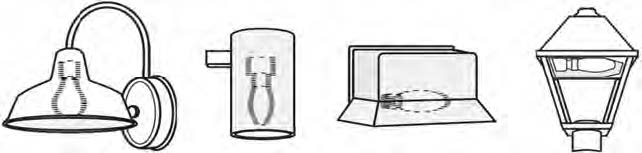
(e)
Signs. All exterior signs shall be required to meet the standards for this Section. In addition, all exterior signs are also subject to the requirements set forth in the sign code.
(f)
Standards for lights adjacent to residential zoning districts, residential uses, or public rights-of-way. Any light fixture located within ten (10) feet of a property line of a residential zoning district, an existing residential use, or within ten (10) feet of a public right-of-way, except as permitted in this Article of this Section shall be as follows.
(1)
Oriented away from the property line, residential zone, residential use, and/or right-of-way; and
(2)
Shielded on the side closest to the property line, residential zone, residential use, or public right-of-way.
(g)
Canopy and awning lighting. Lighting fixtures mounted under canopies and awnings shall be aimed downward and installed such that the bottom of the light fixture or its lens, whichever is lower, is recessed or mounted flush with the bottom surface of the canopy. A full cutoff light fixture may project below the underside of a canopy. All light emitted by an under-canopy fixture shall be substantially confined to the ground surface directly beneath the perimeter of the canopy. No lighting, except that permitted by the sign ordinance, shall be permitted on the top or sides of a canopy.
(h)
Flagpoles. A flagpole meeting the requirements of the land use code may be illuminated by one (1) upward aimed fully shielded spotlight light fixture which shall not exceed three thousand five hundred (3,500) lumens. The light fixture shall be placed as close to the base of the flagpole as reasonably possible.
(i)
Strings of lights. No person shall use a string of lights on property with nonresidential uses except as approved by the Town Manager and/or their designee.
(1)
Strings of lights may only be used if they are approved by the Town Manager and/or their designee or as part of an outdoor lighting plan or landscape plan. The plan must comply with all standards of this Article. The purpose of such lighting is intended to create pleasing pedestrian spaces, such as outdoor dining or patio areas, utilizing low lighting levels.
(2)
Strings of lights permitted under this Subsection shall be displayed in compliance with the following standards:
a.
The string of lights contains only low wattage bulbs that are approved by the Town;
b.
The string of lights shall be located within a pedestrian way, plaza, patio, outdoor dining area, or the primary entry into a building;
c.
The string of lights is not placed in any required landscape setback adjacent to a street; and
d.
The string of lights shall be maintained and not obstruct pedestrian pathways or be detrimental to the health, safety, and welfare of the Town.
(j)
Parking lot lights and trees. Parking lot light fixtures and poles shall be located such that trees located within the parking lot do not obscure the operation of the light fixture.
(k)
Full cutoff fixtures. Full cutoff fixtures shall be installed and maintained in a horizontal position as designed.
(l)
Color temperature. All exterior lighting shall not exceed a correlated color temperature (CCT) of three thousand and five hundred (3,500) degrees Kelvin.
(Ord. No. 2025-15, § 3(Exh. A), 8-12-25)
Sec. 16.5.365. - Lighting levels.
Maximum light levels at any point along a property line shall not exceed 0.1 footcandles within or adjacent to a residential zone or 0.2 footcandles within or adjacent to a nonresidential zone. Maximum light levels shall not exceed the thresholds established in Table 16.5.365. below.
Table 16.5.365.
Lighting Level Requirements by Zone District
;dv=6q;(Ord. No. 2025-15, § 3(Exh. A), 8-12-25)
Sec. 16.5.370. - Light style and prohibited lights.
(a)
Light style. The style of lights shall be consistent with the style and character of architecture proposed on the site. Light fixtures that illuminate signage shall be compatible with the architecture of the building on which they are placed.
(b)
Prohibited light types. No person shall install any of the following types of outdoor lighting fixtures:
(1)
Mercury vapor lamps.
(2)
Blinking, flashing, moving, revolving, flickering, changing intensity, and chase lighting, except lighting for temporary seasonal displays, lighting for public safety or required for air traffic safety.
(3)
Any light fixture that may be confused with or construed as a traffic-control device.
(4)
Any upward oriented lighting except as otherwise provided for in this Article.
(5)
Searchlights, beacons, and laser source light fixtures.
(6)
Exposed linear lamps that include, without limitation, light emitting diode (LED), and fluorescent lighting, primarily intended as an architectural highlight to attract attention or used as a means of identification or advertisement except as permitted by sign criteria of the land use code.
(7)
Any lamp or bulb, except for seasonal displays and landscape ornamental lighting, which is visible beyond the property line on which it is located.
(8)
Any lamp or bulb with a correlated color temperature (CCT) that exceeds three thousand and five hundred (3,500) degrees Kelvin unless otherwise stated by this Article.
(Ord. No. 2025-15, § 3(Exh. A), 8-12-25)
Sec. 16.5.375. - Exemptions.
The standards of this Section shall not apply to the following types of exterior lighting:
(a)
Ornamental lighting. Low voltage (twelve (12) volts or less), low wattage ornamental landscape lighting fixtures, and solar operated light fixtures having self-contained rechargeable batteries.
(b)
Strings of light. Strings of lights located on properties in all residential zoning districts or on properties that are used exclusively for residential uses shall be exempt from the requirements of this Chapter.
(c)
Aviation lighting. Lighting used exclusively for aviation purposes. All heliport lighting, except lighting associated with emergency facilities, shall be turned off when the heliport is not in use.
(d)
Right-of-way lighting. Public lighting that is located within the right-of-way.
(e)
Seasonal lighting displays. Lighting commonly associated with outdoor displays celebrating holidays and seasons.
(f)
Because of their limited hours of operation and unique requirements for nighttime visibility, ball diamonds, playing fields, tennis courts and other similar outdoor recreational uses, both public and private, shall be exempt from the general provisions of this Article unless otherwise restricted by the Town. However, exterior lighting for such uses shall be extinguished no later than 11:00 p.m.
(Ord. No. 2025-15, § 3(Exh. A), 8-12-25)
Sec. 16.5.380. - Resources.
Recommended references include the Illuminating Engineering Society of North America publications RP-8-00, RP-20-98 and RP-33-99, and as may be amended from time to time.
(Ord. No. 2025-15, § 3(Exh. A), 8-12-25)
Sec. 16.5.410. - Overview.
Intent. The regulations in this Section are intended to coordinate the use, placement, physical dimensions and design of all signs within the Town.
(Ord. No. 2025-15, § 3(Exh. A), 8-12-25)
Sec. 16.5.415. - Sign permit requirements.
To ensure compliance with the regulations of this Section, a sign permit shall be required to erect, move, alter, reconstruct or repair any permanent or temporary sign, except signs that are exempt from permits in compliance with this Section of the Code. A sign permit shall be required for those temporary signs specified in Section 16.5.425 of this Code. In multiple-tenant buildings, a separate permit shall be required for each business entity's sign. Separate building and electrical permits may be required for signs and will be determined on a case-by-case basis. Changing or replacing the copy on an existing lawful sign shall not require a permit, provided that the copy change does not change the nature of the sign or render the sign in violation of this Section.
(a)
Sign permit application requirements. Applications for sign permits shall be made in writing. Fees shall be in accordance with the Town's fee schedule available upon request from Town Staff.
(b)
Application requirements for temporary signs. Applications for temporary sign permits shall be made in writing. Fees shall be in accordance with the Town's fee schedule available upon request from Town Staff.
(c)
Town Staff review and approval. When the Town Staff has determined the application to be complete, the Town Staff shall review the sign permit in accordance with the established review criteria and shall have the authority to approve, approve with conditions or deny the sign permit. Upon the Town Staff's approval of the sign permit, the sign permit and any building or electrical permits required for the sign shall be issued to the applicant.
(d)
Review criteria. The following considerations shall be made by the Town.
(1)
The sign meets the requirements of this Section.
(2)
The sign conforms to the requirements of the adopted building and electrical codes.
(3)
The sign does not interfere with pedestrian or vehicular safety.
(4)
The sign does not detract from the character of an architecturally significant or historic structure.
(5)
The sign is not located in a place that has a negative impact on adjacent property.
(6)
The sign does not detract from the pedestrian quality of the street or area.
(7)
The sign does not add to an over-proliferation of signs on a particular property or area.
(e)
Appeal of sign permit denial or approval with conditions. Any appeal of the Town Staff's denial of a sign permit or approval with conditions shall be made to the BOA as provided in this Code.
(f)
Waivers. Any request for an increase in the maximum allowable area for a sign or for signs not expressly permitted in these regulations requires approval by the Town Council as part of a use by special review.
(g)
Enforcement.
(1)
Discontinued establishments; removal of signs. Whenever a business, industry, service or other use is discontinued, the sign pertaining to the use shall be removed or obscured by the person or entity owning or having possession over the property on which the sign is located within ninety (90) days after the discontinuance of such use.
(2)
Illegal signs.
a.
Penalties. Illegal signs shall be subject to the enforcement provisions of this Article.
b.
Removal of illegal signs in the public right-of-way. The Town may cause the removal of any sign within the public right-of-way or on property that is otherwise abandoned that is not in compliance with the requirements of this Article.
c.
Storage of removed signs. Signs removed in compliance with this Section shall be stored by the Town for thirty (30) days, during which they may be recovered by the owner only upon payment to the Town for costs of removal and storage. If not recovered within the 30-day period, the sign and supporting structure shall be declared abandoned and Title shall vest with the Town. The costs of removal and storage (up to thirty (30) days) may be billed to the owner. If not paid, the applicable costs may be imposed as a tax lien against the property.
d.
If any person or entity erects any temporary sign for which a temporary sign permit is required without receiving a permit, the person or entity shall be ineligible to receive a temporary sign permit for the remainder of the calendar year.
(Ord. No. 2025-15, § 3(Exh. A), 8-12-25)
Sec. 16.5.420. - Exempt signs.
The following types of signs are exempt from permit requirements of this Section and may be placed in any land use district. All such exempt signs, except government signs, shall be located outside a public right-of-way. Exempt signs shall not interfere with traffic signs or the sight distance triangle at intersections. Evidence of the owner's permission to install a sign shall be required upon request by the Town.
(a)
Nonvisible. Signs that are not visible beyond the boundaries of the lot or parcel upon which they are located and/or from any public thoroughfare or right-of-way, except that such signs shall be subject to the safety regulations of the building code and electrical code adopted by the Town.
(b)
Address. Nonilluminated signs, not to exceed two (2) square feet in area, that identify the address and/or occupants of a dwelling unit or of an establishment.
(c)
Building identification, historical markers. Non-illuminated signs constructed of metal or masonry that are permanently affixed to buildings or structures for the purpose of identifying the name of a building, date of erection or other historical information as approved by the Town Staff.
(d)
Bulletin board. Bulletin board signs not exceeding fifteen (15) square feet in gross surface area, accessory to a church, school or public or nonprofit institution.
(e)
Construction. Temporary construction signs, provided that the following requirements are met:
(1)
Signs in conjunction with any residential use shall not exceed eight (8) square feet each.
(2)
Signs in conjunction with all other uses shall have a maximum area of sixteen (16) square feet each.
(3)
Only one (1) such sign oriented per street front per premises shall be erected. Any two (2) such signs located on the same premises shall be located at least one hundred (100) feet apart as measured by using a straight line.
(4)
Such signs shall not be illuminated.
(5)
Such signs shall only appear at the construction site.
(6)
Such signs shall be removed within the earliest seven (7) days after completion of the project or one (1) year of installation.
(f)
Courtesy. Nonilluminated or indirectly illuminated signs that identify, as a courtesy to customers, items such as accepted credit cards, redemption stamps offered, menus or prices are limited to one (1) such sign for each use, not to exceed four (4) square feet per face or eight (8) square feet in total aggregate area for all such signs. Such signs may be attached to the building as projecting or wall signs, affixed to a door or window, suspended from a canopy or included as an integral part of a freestanding sign.
(g)
Decorations (holiday). Temporary decorations or displays, when such are clearly incidental to and customarily and commonly associated with any national, state, local or religious holiday or celebration shall be displayed for not more than sixty (60) days in any one (1) year and may be of any type, number, area, height, location, illumination or animation.
(h)
Directional. On-premises directional and instructional signs not exceeding six (6) square feet in area a piece.
(i)
Doors. Signs affixed to door glass that identify the name and/or address of an establishment.
(j)
Farm products. Seasonal farm product signs.
(k)
Flags. Flags, crests or banners of nations, organizations of nations, states and cities, or professional, fraternal, religious or civic organizations, except when displayed in connection with commercial promotion.
(l)
Garage, estate or yard sale or farm auction. Signs that advertise a private garage or yard sale on the lot where the sign is located shall be displayed no more than twice per year per dwelling unit for a period not to exceed three (3) days.
(m)
Memorial. Memorial signs, plaques or grave markers that are noncommercial in nature.
(h)
Notice boards. Notice Boards for public or religious institutions.
(o)
Oil and gas operation. Identification signs for any oil and gas operation.
(p)
Political. Political signs displayed on private property.
(q)
Special events. Temporary special event signs and banners for religious, charitable, civic, fraternal or similar nonprofit or not-for-profit organizations, or private noncommercial special events.
(r)
Text or copy changes on conforming or legal nonconforming signs are specifically designed to permit changes of the text or copy provided that no structural changes are made to the sign and that the name of the business to which the sign belongs is not changed on the sign.
(Ord. No. 2025-15, § 3(Exh. A), 8-12-25)
Sec. 16.5.425. - Temporary signs.
Such signs shall otherwise be in conformance with all applicable requirements contained in this Section. All such temporary signs, except government signs, shall be located outside a public right-of-way. Temporary signs shall not interfere with traffic signs or the sight distance triangle at intersections. Evidence of the owner's permission to install a sign shall be required upon request by the Town. Temporary signs shall be allowed only with a valid permit and upon proof of compliance with this Section. Temporary signs include but are not limited to the following:
(a)
Banners used to decorate or attract attention to a business establishment, H-frame (freestanding) real estate-type signs and any other signs not of a permanent nature advertising special event, provided that the following criteria are considered:
(1)
The business is licensed and has received approval for a temporary sign from the Town.
(2)
The signs are displayed in conjunction with a grand opening celebration for a period not to exceed thirty (30) days and renewable up to an additional maximum period of thirty (30) days.
(3)
The signs are displayed in conjunction with a special sale for a period not to exceed thirty (30) days.
(4)
The signs are displayed no more than two (2) times per calendar year per establishment. Each business or property owner shall be limited to one (1) temporary sign of any of the following types per business or property. In cases involving multiple tenants on a single property, each tenant shall be allowed one (1) temporary sign.
(b)
Banner-type signs.
(1)
The banner shall be securely attached to the wall of the establishment, freestanding signs or light poles on private property, except as provided for in in this Code.
(2)
The maximum height of each sign shall not exceed three (3) feet, and the width shall not exceed eight (8) feet.
(3)
The sign shall be made of high-quality material.
(c)
Freestanding signs that advertise special events, not including those signs advertising the sale or lease of the property.
(1)
They shall be limited to a maximum of twelve (12) square feet per side and a maximum height of four (4) feet.
(2)
They shall be constructed of high-quality materials.
(d)
Development signs.
(1)
A freestanding sign, not exceeding sixteen (16) square feet in area and six (6) feet in height, may be permitted on the site of a new housing or commercial project following approval of a development plan. Temporary development signs shall be limited to a maximum of three (3) years' duration, upon acceptance of improvements by the Town or when all building permits have been issued, whichever occurs first.
(2)
Any freestanding directional subdivision sign not located at the site of the new housing development shall be out of the Town right-of-way and on private property. Signs shall be ninety-six (96) square feet or less and under twelve (12) feet in height. Any freestanding directional subdivision signage exceeding sixteen (16) square feet and six (6) feet in height shall only be permitted on properties of five (5) acres or more and spaced at intervals of a minimum of four hundred (400) linear feet of road frontage.
(3)
Permits may be granted for one (1) year and may, at the discretion of the Town Manager and/or their designee, be renewable annually for up to three (3) years.
(4)
All such temporary signs shall be removed within seven (7) days after the real estate closing or lease transaction.
(5)
No sign allowed under this Subparagraph shall be illuminated.
(Ord. No. 2025-15, § 3(Exh. A), 8-12-25)
Sec. 16.5.430. - Prohibited signs.
(a)
Flashing, rotating, blinking or moving signs, animated signs, signs with moving, rotating or flashing lights or signs that create the illusion of movement, except for time-and-temperature devices.
(b)
Any sign that is erected in such a location as to cause visual obstruction or interference with motor vehicle traffic or traffic-control devices, including any sign that obstructs clear vision in any direction from any street intersection or driveway.
(c)
Neon, distracting colors, mechanical or electrical appurtenances, such as "revolving beacons," that are designed to compel attention.
(d)
Pole-mounted signs.
(e)
Roof signs.
(f)
Off-premises advertising signs or any other sign not pertinent and incidental to the permitted use on the property where located, except for temporary subdivision directional signs and political signs and except for signs permitted in this Code.
(g)
Any sign located in such a way as to intentionally deny visual access to an existing sign.
(h)
Vehicle-mounted signs, including but not limited to signs painted on or attached to semi-trailers or cargo containers, when exhibited on private property adjacent to the public right-of-way for the purpose of advertising the business or services offered on the property. Vehicle-mounted signs used in connection with a special event are exempted from the requirements of this Section during the duration of the special event only. Upon the conclusion of the special event, such signs must be dismantled. For the purposes of this Subparagraph, the term special event shall mean a parade, circus, fair, carnival, festival, farmers' market or other similar event that is different in character from the customary or usual activities generally associated with the property on which the special event is to occur.
(i)
Portable signs or signs not permanently affixed or attached to the ground or to any structure, except for real estate signs attached to posts driven into the ground, window signs and temporary barriers.
(j)
Rotating signs.
(k)
Searchlights.
(l)
Inflatable freestanding signs or tethered balloons.
(m)
Fabric signs, flags, pennants or banners when used for commercial advertising purposes, except as permitted in Section 16.5.425 of this Code.
(n)
Any sign or sign structure that meets the following:
(1)
It is structurally unsafe.
(2)
Constitutes a hazard to safety or health by reason of inadequate maintenance or dilapidation.
(3)
It is not kept in good repair.
(4)
It is capable of causing electrical shocks to people likely to come in contact with it.
(Ord. No. 2025-15, § 3(Exh. A), 8-12-25)
Sec. 16.5.435. - Sign calculations.
Areas calculated shall be measured using standard mathematical formulas. Unless specifically stated, calculations shall be based on sign surface area.
(a)
Sign surface area. The sign surface area consists of the entire area within a continuous perimeter enclosing the extreme limits of a sign display.
(1)
Sign face. The sign face consists of the area or display surface, including any frame or border used for the message, which includes but is not limited to writing, representation, emblem or any figure of similar character.
(2)
Double-faced (back-to-back) signs. The area calculation of double-faced signs shall be regarded as a single sign only if mounted on a single structure and if the distance between each sign face does not exceed two (2) feet at any point.
(3)
Wall signs. If a sign is attached to a wall, only that portion of the wall onto which the sign face or letters are placed shall be calculated in the sign area.
(b)
Sign height. The height of a sign shall be measured from the highest point of a sign to the ground surface beneath it. When berms are used in conjunction with signage, the height of the sign shall be measured from the mean elevation of the fronting street.
(c)
Proportionate size and scale. The scale of signs shall be appropriate for the building on which they are placed and the area in which they are located. Building signs shall be harmonious in scale and proportion with the building facade to which they are mounted.
(Ord. No. 2025-15, § 3(Exh. A), 8-12-25)
Sec. 16.5.440. - Sign design standards.
(a)
Sign location and placement.
(1)
Signs shall neither visually overpower nor obscure architectural features.
(2)
Integrate signs with the building and landscaping. Signs shall be carefully coordinated with the architectural design, overall color scheme and landscaping of the area.
(3)
Unified sign band. Whenever possible, signs located on buildings with the same block face shall be placed at the same height to create a unified sign band. Wall signs shall be located at the first-floor level only for retail and other commercial uses.
(4)
Monument signs should be located in a planter setting within a landscaped area at the primary entries to residential, commercial and industrial developments to provide an overall project identity. A maximum of one (1) monument sign per entry is permitted.
(5)
Pedestrian-oriented signs are encouraged. It is desirable to include a pedestrian-oriented sign as one (1) of the permitted signs for a business.
(6)
Road right-of-way. No sign shall be erected within the public right-of-way.
(b)
Sign illumination. Sign illumination shall complement, not overpower, the overall composition of the site.
(1)
Signs must be lighted downward with fully shielded luminaries wherein only the face of the sign is illuminated. Signs shall be lighted only to the minimum level for nighttime readability.
(2)
Outdoor internally illuminated advertising signs must either be constructed with an opaque background and translucent text and symbols or with a colored background and generally lighter text and symbols.
(3)
Neon tubing is an acceptable method of sign illumination for window signs in commercial districts.
(c)
Insurance on signs. Owners of projecting signs extending over a public right-of-way shall be required to maintain public liability insurance in an amount to be determined appropriate by the Town, in which the Town is named as an additional insured. Satisfactory proof of such insurance must be provided to the Town upon request.
(d)
Maintenance of signs.
(1)
The owner of a sign and the owner of the premises on which such sign is located shall be jointly and severally liable to maintain such sign, including any illumination sources, in neat and orderly condition and in a good working order at all times and to prevent the development of any rust, corrosion, rotting or other deterioration in the physical appearance or safety of such sign. The sign must also comply with all building and electrical codes.
(2)
The owner of any sign regulated by this Section shall be required to keep signs and supporting hardware, including temporary signs and time-and-temperature signs, structurally safe, clean and free of visible defects and functioning properly at all times. Repairs to signs shall be equal to or better in quality of materials and design than the original sign.
(3)
All signs and all components thereof, including sign structures and sign faces, shall be kept neatly painted, in a good state of repair and in compliance with all building and electrical codes. The Town may inspect any sign governed by this Section and shall have the authority to order the painting, repair, alteration or removal of a sign that constitutes a hazard to safety, health or public welfare by reason of inadequate maintenance, dilapidation or obsolescence.
(e)
Standards for specific sign types.
(1)
The following four (4) tables include specific sign standards for residential uses, business and commercial uses, the Town Core Zone District, and the Industrial Sub-District areas.
Table 16.5.435.a.
Residential Use Sign Standards
Table 16.5.435.b.
Business and Commercial Use Sign Standards
Table 16.5.435.c.
Town Core District Sign Standards
Table 16.5.435.d.
Industrial Sub-District Sign Standards
(Ord. No. 2025-15, § 3(Exh. A), 8-12-25)

