
Severance City Zoning Code
ARTICLE 3
Zoning
Sec. 16.3.10.- Zoning districts and boundaries.
(a)
Zoning districts. To carry out the provisions of this Code and the Comprehensive Plan, the Town is divided into the following zoning districts.
(1)
Rural Residential (RR).
a.
Rural Residential Conservation (RR-C).
b.
Rural Residential Agricultural (RR-A).
(2)
Suburban Perimeter (SP).
(3)
Town Core (TC).
(4)
Development Nodes (DN).
a.
Development Node Industrial (DN-I).
(b)
Official zoning map. The boundaries and classifications of established districts are as depicted on the "Town of Severance Zoning Map," which may from time to time be revised, updated, or redrafted. The zoning map adopted and to be used for reference shall be that map bearing the most recent date of publication and approval by the Town.
(1)
Interpretation of zoning district boundaries. If uncertainty exists on the zoning map, district boundaries shall be on section lines, lot lines, the centerlines of highways, streets, alleys, railroad rights-of-way or such lines extended; municipal corporation lines; natural boundary lines such as streams or other lines to be determined using scales shown on the map.
(2)
Amendment upon zoning or modification. Upon enactment of any ordinance annexing and establishing zoning or modifying existing zoning for any property and upon final passage thereof, the Town shall amend the prior existing zoning map to include the annexed area with the proper zoning classification or show the amended classification. Such updated official map shall contain, in table form, the date and number of the ordinance amending it, the title of the change, the date the map was amended to reflect each amendment and the initials of the person who checked and approved the change to the map.
(3)
Cost of amending zoning. Any person who proposes zoning for property being annexed or proposes modifying existing zoning shall bear the entire cost of amending the zoning map, including all notification costs. The Town shall provide applicants with a copy of the current fee schedule and a fee agreement form upon request.
(4)
Public inspection; storage of original. A copy of the zoning map shall be available and on display on the Town's official website and at Town Hall during normal business hours.
(Ord. No. 2025-15, § 3(Exh. A), 8-12-25)
Sec. 16.3.20. - Principal and conditional uses permitted by zoning district.
(a)
General application of land uses.
(1)
Uses designated as "uses by right" are allowed in a zone district as a matter of right but shall be required to conform to all requirements of this Code. If Code requirements are not met the Town reserves the right to deny a project based on noncompliance.
(2)
Uses classified as "uses by special review" are not allowed as a matter of right but may be approved by the Town Council with additional review and certain justification above and beyond the requirements of this Code consistent with the review criteria in Article 2 of this Code for the use by special review process.
(3)
Land uses not otherwise identified in this Code may be proposed. To allow such uses, the new or unlisted land use must be determined to be similar to either a use by right or a use by special review listed within that zone district. The term "similar" shall mean that the use can be reasonably interpreted to fit into a similar use category as identified in this Code. Town Staff will make a written determination regarding any request for a land use not listed in this Code. If a determination is made that the proposed use is similar to either a listed use by right or a use by special review, it will be processed as a use by special review under the provisions of this Code.
(Ord. No. 2025-15, § 3(Exh. A), 8-12-25)
Sec. 16.3.30. - Private property agreements and covenants.
This Code is not intended to revoke, repeal, abrogate, or impair any easement, covenant, condition, restriction, or other private property agreement applicable to the underlying real property. In no case shall the Town be obligated to enforce the provisions of any easements, covenants, conditions, restrictions, or agreements between private parties or between a private party and a homeowners' association or metropolitan district. It is the responsibility of the property owner to comply with private property agreements and requirements such as covenants, design guidelines, and homeowners' association or metropolitan district rules and regulations. In no instance shall the private property requirements be less restrictive than the requirements of this Code and any other adopted codes of the Town.
(Ord. No. 2025-15, § 3(Exh. A), 8-12-25)
Sec. 16.3.40. - Management plans required.
A management plan is required for any project and/or development proposal within the Town of Severance. Examples of management plans and criteria for submitting a management plan are available from the Town.
(Ord. No. 2025-15, § 3(Exh. A), 8-12-25)
Sec. 16.3.50. - Zone district design standards overview.
The Town's adopted development and design criteria can be found in Articles 5 and 6 of this Code. The intent of these standards is to promote creative and unique developments and projects throughout the Town.
(Ord. No. 2025-15, § 3(Exh. A), 8-12-25)
Sec. 16.3.100. - Intent.
(a) The intent of the rural residential zone district is to provide large lot, low-density, single-family detached residential development. Development in this district requires centralized water but may not be served by central sewer. Other municipal infrastructure services may be limited.
(b) The Rural Residential Zone District includes two (2) sub-zoning categories as outlined below. Further specifics on these sub-zonings are outlined in Sections 16.3.140 and 16.3.145 of this Code.
(1)
Rural residential agricultural development can occur within or outside designated rural residential areas. The type of development, referred to as Agricultural (Ag) Residential, is characterized by large-lot residential subdivisions that include an agricultural component. The agricultural component may include one (1) of the following:
a.
Associated with each individual lot; or
b.
Shared among a select number of lots; or
c.
Comprised of a stand-alone agricultural parcel.
Similar to rural residential development, Ag residential development is limited by the availability or feasibility of infrastructure. The lot size in Ag residential areas is determined by the agricultural use associated with the land rather than by a fixed minimum acreage per lot.
(2)
Rural residential conservation development can occur within designated rural residential areas. This type of development emphasizes preserving large portions of land for open space, agricultural, or conservation easements, which complement the layout of rural subdivision lots. The specific requirements for densities, open space allocation, and design standards are detailed in Section 16.3.145 of this Code.
(Ord. No. 2025-15, § 3(Exh. A), 8-12-25)
Sec. 16.3.105. - Lot and building standards.
(a)
Gross maximum density. Two and one-half (2.5) acres per dwelling unit (i.e., fifty (50) acres divided by two and one-half (2.5) acres equals twenty (20) lots).
(1)
Lot sizes may be smaller than two and one-half (2.5) acres if the development contains managed open space or preserved agricultural land with clustered lots to achieve the maximum density.
(2)
Final lot count may be limited by infrastructure or geographic constraints.
(b)
Minimum lot sizes. One and one-quarter (1.25) acres.
(1)
Diversity and flexibility of lot sizes is highly encouraged.
(c)
Setbacks. For areas not governed by building envelopes, the minimum setback shall be as shown on the following Table 16.3.105.
Table 16.3.105.
Rural Residential Setback Criteria
(Ord. No. 2025-15, § 3(Exh. A), 8-12-25)
Sec. 16.3.110. - Land uses.
(a)
Uses by right. These may require a site plan at the direction of Town Staff based on the intensity and potential impacts of the proposal.
(1)
Residential land uses include the following:
Accessory dwelling.
Home-based business.
Single-family attached and detached dwellings.
(2)
Commercial, retail, or service land uses include the following:
Agriculture, commercial and noncommercial.
(3)
Public, quasi-public, other land uses include the following:
Golf courses.
Outdoor recreation.
Places of worship and assembly.
Public and private parks.
Schools.
(b)
Uses by special review. Land uses not identified may be considered with additional review as determined by Town Staff.
(Ord. No. 2025-15, § 3(Exh. A), 8-12-25)
Sec. 16.3.115. - Layout standards.
(a)
Typical subdivision layout details include the following:
(1)
Individual lots shall be accessed by an internal rural roadway system.
(2)
Each lot shall have frontage onto a roadway.
(3)
Fencing shall be open and maintained along the perimeter street frontage.
(4)
The main entrance to a subdivision shall have a monument sign and landscaping.
(5)
The perimeters adjacent to major roadways shall be landscaped and shall provide pathways for pedestrian linkages.
(6)
Open space and drainage corridors within the subdivision shall provide opportunities for pedestrian linkage to adjacent subdivisions.
(b)
Typical single-family lot layout. The vision for a typical single-family lot is to create a buildable area and identify septic envelopes and open/landscape areas.
(c)
Individual wastewater treatment systems (such as underground septic and leach fields and above ground ponds) must be shown on building permit plot plan.
(Ord. No. 2025-15, § 3(Exh. A), 8-12-25)
Sec. 16.3.125. - Fencing.
(a)
Fencing along major roadways and public areas shall be of a rural character. The treatment should be consistent within the entire development. Fencing located along collector or arterial roads shall be open rail/open character, wood and set back from the right-of-way a minimum of twenty (20) feet. Fencing shall be made visually interesting and shall avoid creating a "tunnel" effect. Style of fencing for neighborhood should strive for consistency with surroundings and intended design. Compliance with this standard may be accomplished by integrating architectural elements such as brick or stone columns and incorporating articulation or openings into the design. Varying the alignment or setback of the fence and softening the appearance of fence lines with plantings or similar techniques is also encouraged. Privacy fences should not be used along major roadways and public areas. For agriculture uses, T-post fences, wire fences and electric fences are allowed as per the management plan.
(b)
Perimeters not associated with major roadways shall be fenced by the developer with T-post and wire fencing or better. Internal common areas, including pedestrian connectivity pathways and drainage conveyance channels, shall be fenced by the developer using materials consistent with the development. Management and maintenance of all fencing shall be addressed in the developer's management plan.
(Ord. No. 2025-15, § 3(Exh. A), 8-12-25)
Sec. 16.3.130. - Entries and signage.
Entry signs and entry features should be a visual and attractive focal point for the development. The type and size of signs should be appropriate for the size of the subdivision. Rural character is highly encouraged. Signage shall be shown on the site plan.
(Ord. No. 2025-15, § 3(Exh. A), 8-12-25)
Sec. 16.3.135. - Managed individual wastewater treatment system standards.
(a)
Owners and/or applicants are required to submit documentation of approval for individual wastewater treatment systems (such as underground septic and leach fields and above-ground ponds) from Weld County as part of a development or permit application with the Town. The Town does not regulate individual wastewater treatment standards.
(b)
Any screening or buffering required for above ground systems shall be provided in accordance with the Town's landscaping and buffering standards of this Code.
(1)
The location and extents of such systems shall be reflected on the development application and building permit plot plan drawings when submitted to the Town.
(Ord. No. 2025-15, § 3(Exh. A), 8-12-25)
Sec. 16.3.140. - Rural residential agriculture sub-zoning.
The rural residential agricultural sub-zoning is intended to allow private property owners to annex existing agricultural operations into the Town and continue operations. The process for receiving the rural residential agricultural sub-zoning is the same as any other zoning request and may either come through the annexation process or a rezoning of an existing annexed property. The following are characteristics of the agriculture sub-zoning design:
(a)
Agriculture components retained.
(b)
Served by domestic water.
(c)
Joint access points to and from county roads to reduce driveways where practical. (Existing agricultural access permitted in Weld County may be maintained if no further subdivision is taking place).
(d)
No interior fencing required.
(e)
Density characteristics include the following:
(1)
Minimum lot size (with septic) is ten (10) acres.
(2)
Gross density is one (1) dwelling unit for every fifteen (15) acres.
(f)
Perimeter treatment characteristics include the following:
(1)
Fencing to be addressed on fencing plan.
(2)
Road right-of-way is the same as rural residential.
(3)
Connectivity to adjacent subdivisions are not specifically required, but adequate access points and alignment of access points is required.
(4)
Landscaping that can be native.
(Ord. No. 2025-15, § 3(Exh. A), 8-12-25)
Sec. 16.3.145. - Rural residential conservation sub-zoning.
The rural residential conservation sub-zoning is intended to allow private property owners to annex large, existing agricultural or open lands into the Town with a restriction on a portion of the property that conserves the land as farmland or open space in perpetuity. As an incentive to the property owner, the owner will be allowed to develop the unencumbered lands into a greater number of lots with more diverse sizes than the rural residential agriculture sub-zoning. The following are characteristics of the conservation sub-zoning design:
(a)
Conservation component retained (conservation easement, dedicated open space, agricultural operation).
(b)
Served by domestic water.
(c)
Joint access points to and from county roads to reduce driveways where practical.
(d)
No interior fencing required, but fencing along public roadways may be required to be adjacent to residential lots.
(e)
Density is defined by the following example and based on percentage of open space:
(1)
Minimum initial land size equals sixty (60) gross acres. A minimum of sixty percent (60%) or thirty-six (36) acres shall be perpetually conserved, and on the remaining land twenty-four (24) acres, two (2) lots will be allowed. If a farmstead already exists, it can be platted as a third lot. With each additional ten (10) acres of contiguous land, sixty percent (60%) or six (6) acres shall adjoin the original conserved land, and one (1) additional lot shall be allowed. Once platted and developed, no future plats of the initial land that increase the number of lots or reduce the amount of the conserved land will be allowed. Examples include the following scenarios:
a.
Seventy (70) acres times sixty percent (60%) equals 42 acres conserved and three (3) lots on twenty-eight (28) acres
b.
Eighty (80) acres times sixty percent (60%) equals forty-eight (48) acres conserved and four (4) lots on thirty-two (32) acres
c.
One hundred (100) acres times sixty percent (60%) equals sixty (60) acres conserved and six (6) lots on forty (40) acres
d.
One hundred and twenty (120) acres times sixty percent (60%) equals seventy-two (72) acres conserved and eight (8) lots on forty-eight (48) acres
e.
One hundred and sixty (160) acres times sixty percent (60%) equals ninety-six (96) acres conserved and twelve (12) lots on sixty-four (64) acres
f.
One hundred and eighty (180) acres times sixty percent (60%) equals one hundred and eight (108) acres conserved and fourteen (14) lots on seventy-two (72) acres
g.
Any single home or farmstead can be platted as one (1) additional lot
(2)
Conservation land shall be contiguous and available for large areas of farming or rural open space. Lots may be clustered or scattered. Minimum lot size equals three (3) acres. Diversity of lot sizes is encouraged. Any grouping of lots using a shared access and exceeding four (4) lots shall have an internal roadway designed and shall be built to rural residential specifications of the Town. Groups of two (2), three (3), or four (4) lots shall have a hard-surface shared-access pad connected to the perimeter public roadway. Each shared-access pad shall be concrete measuring forty (40) feet wide by one hundred (100) feet long by six (6) inches thick, with private drives serving individual lots from the shared-access pad. Driveways serving individual lots shall be contained within the lot and shall be owned and maintained by the lot owner. Single lot access to the roadways will be discouraged.
(f)
Perimeter treatments include the following:
(1)
Fencing adjacent to right-of-way shall be addressed in fencing plan. Criteria and maintenance responsibilities shall be described in the management plan.
(2)
Road right-of-way. Right-of-way dedication shall adhere to the Severance Transportation Master Plan. Maintenance of public roadways shall be the responsibility of the Town.
(3)
Road cross section may be modified at staff discretion based on proposed number of lots and anticipated traffic. Letter from a licensed traffic engineer shall be required in cases in which proposed changes differ from transportation plan. A minimum dirt road cross section of thirty-two (32) feet will be required adjacent to proposed residential lots for any rural residential conservation development.
(4)
Connectivity to adjacent subdivisions or undeveloped lands shall be reviewed on a case- by-case basis.
(5)
Landscaping between the fencing (if applicable) or property line of any lot (excluding conservation lots) and the public roadway shall be native, drought-tolerant grasses. Management and maintenance responsibilities of these areas shall be described in the management plan.
(Ord. No. 2025-15, § 3(Exh. A), 8-12-25)
Sec. 16.3.210. - Intent.
(a)
The suburban perimeter residential land use category includes a mix of residential densities with access to public water, sewer, streets, and open spaces. This district is meant for residential homes and excludes large industries and other large intense uses. Home businesses, civic organizations, and some types of commercial and agricultural uses are allowed but will be limited in size and density. The main purpose of this district is to meet a wide range of housing choices, and to provide neighborhoods that invite walking to gathering places, services and conveniences that are integrated into the rest of the community by a pattern of streets, blocks, and other linkages.
(Ord. No. 2025-15, § 3(Exh. A), 8-12-25)
Sec. 16.3.220. - Lot and building standards.
(a)
Density, height, and setback criteria. The following Table 16.3.220 includes the minimum density, lot size, setback criteria, and maximum height allowed within the Suburban Perimeter zone district. Cells with n/a means the specific criteria is not applicable in that situation. Supplemental criteria is included below the table.
Table 16.3.220.
Suburban Perimeter Lot and Building Standards
(1)
Accessible building elements (e.g., elevator shafts and stairways) are permitted to extend above the maximum building height.
(2)
An attached dwelling unit with a shared party wall may have a zero-foot side yard setback on the side of the lot where the dwelling units combine.
(3)
The rear setback for an alley loaded attached dwelling unit project may have a reduced rear setback, at the discretion and approval of the Town.
(4)
The corner side setback requirement applies to a side lot line bordering a public road or street that is not designated as the front yard. This does not apply to a designated alleyway.
(5)
Attached accessory structures shall meet the requirements of the main structure.
(6)
Detached accessory structures shall maintain a minimum separation from the main structure as required by adopted building and fire codes.
(7)
Steeples, chimneys, roof-mounted mechanical equipment, and similar architectural and mechanical elements may exceed the maximum height by no more than twenty percent (20%).
(b)
Lot diversity. Development plans shall include a diversity of lot sizes. On projects of one hundred and fifty (150) acres or less, a minimum of four (4) lot sizes is required. On projects of one hundred and fifty (150) acres or more, a minimum of six (6) lot sizes is required. This may be met through additional housing types outlined in the following Subsection (c).
(c)
Product diversity. A mix of permitted housing types shall be included in any individual development plan to the extent reasonably feasible, depending on the size of the parcel. To promote such variety, the following minimum standards shall be met:
(1)
The following minimum number of housing types is required on any project development plan:
a.
A minimum of two (2) housing types is required on any project development plan containing less than one hundred fifty (150) acres, including such plans that are part of a phased overall development.
b.
A minimum of three (3) housing types is required on any project development plan containing one hundred and fifty (150) acres or more.
(2)
Housing types include the following mix.
a.
Single-family attached dwellings.
1.
Duplex units.
2.
Townhome units.
b.
Alley loaded design.
c.
Patio home design.
d.
Multi-family dwellings, by additional review.
(Ord. No. 2025-15, § 3(Exh. A), 8-12-25)
Sec. 16.3.230. - Land uses.
(a)
Uses by right. These may require a site plan at the direction of Town Staff based on the intensity and potential impacts of the proposal.
(1)
Residential land uses include the following:
Accessory dwelling.
Bed and breakfast establishments.
Home-based business.
Single-family attached and detached, townhomes, multi-family, and senior housing.
(2)
Commercial, retail, or service land uses include the following:
Adult day centers.
Child care centers.
Long-term care facilities.
Neighborhood shopping centers.
Office, financial, medical services, and clinics.
(3)
Public, quasi-public, other land uses include the following:
Golf courses.
Neighborhood parks.
Outdoor recreation.
Places of worship and assembly.
Schools.
(b)
Uses by special review. Land uses not identified may be considered with additional review as determined by Town Staff.
Workshops/small custom industry.
(Ord. No. 2025-15, § 3(Exh. A), 8-12-25)
Sec. 16.3.240. - Layout standards.
(a)
Typical layout. Each subdivision proposal should address the appropriate elements of the Comprehensive Plan, as suggested by the following. Subdivisions in the suburban perimeter shall be designed with an internal urban roadway system to serve lots within the subdivision. The edges adjacent to major roadways shall be landscaped and shall provide community pathways for pedestrian linkages. Landscape buffers adjacent to major roadways should vary in width, and perimeter fencing shall be visually interesting. The main entrance to the subdivision typically will have appropriately scaled monument sign and landscaping. Open space, drainage corridors and roadways within the subdivision can provide opportunities for pedestrian linkage to adjacent subdivisions, the Town Core, and the Severance Greenway. See Articles 5 and 6 for additional development and design criteria, as applicable.
(b)
Roadway plans must identify collector roadways and adhere to requirements set forth in the transportation plan.
(1)
The spacing and frequency of connector streets are to be determined with each application. Connector streets shall connect neighborhoods to perimeter arterial streets and adjacent properties. Please refer to the transportation plan.
(2)
Internal street design should incorporate the following whenever possible:
a.
Three- and four-way intersections.
b.
The use of a grid or modified grid.
c.
View corridors.
d.
Focal points.
(Ord. No. 2025-15, § 3(Exh. A), 8-12-25)
Sec. 16.3.270. - Fencing.
(a)
Lots adjoining greenbelts shall have common area fencing. Common area fencing shall be "articulated" with fence columns, fence details, varying depths of greenbelts, etc.
(b)
All subdivisions shall submit master fence plans that will include fence locations, details and criteria, including the following items:
(1)
Perimeter fence and/or common area fencing.
(2)
All perimeter fencing shall be wood unless otherwise approved by Board.
(3)
Encouraged fence height is six (6) feet. Maximum fence height may be eight (8) feet along arterial and connector streets by variance.
(4)
Fence amenities, columns, and walls.
(5)
Rear and side yard fencing (private).
(6)
Side and front-yard fencing visible from right-of-way, greenbelt, and common areas.
(7)
Master fence plan, which shall show where in a subdivision each type of fence shall be located.
(8)
Terminations of common area fencing (encouraged to have a column or fence amenity).
(9)
Fencing ornamented with details that shall be uniform throughout the development.
(10)
All common area fencing and private fencing that is visible from right-of-way, greenbelt, and/or common areas shall have a common fence color, as identified on the master fence plan.
(Ord. No. 2025-15, § 3(Exh. A), 8-12-25)
Sec. 16.3.280. - Entries and signage.
Entries shall contain the following features:
(a)
Located adjacent to arterial/connector street intersections or primary access to the project.
(b)
Appropriately scaled monument/signage at primary access to identify the project.
(c)
Adequate landscaping on both sides of primary project access to create an enhanced entry experience.
(d)
Access to subdivisions that is limited to main entry roads adjoining arterial or collector roads. The number of accesses may vary, depending on size and location of development and results from traffic impact study. See Article 4 for minimum access point requirements. Driveways shall not have access directly onto adjacent county roads.
(e)
The entries to the development should provide a focal point with signage and landscaping. Signage shall be designed to be appropriate to the scale of the development and in conformance with the sign regulations of this Code. Signage shall be shown on the site plan.
(Ord. No. 2025-15, § 3(Exh. A), 8-12-25)
Sec. 16.3.310. - Intent.
(a)
The Town Core District serves as the heart of the community with a broad range of complimentary land uses. It is desirable to encourage a variety of commercial, retail, service, restaurant, entertainment and other uses interspersed with residential homes, lofts and apartments.
(Ord. No. 2025-15, § 3(Exh. A), 8-12-25)
Sec. 16.3.320. - Lot and building standards.
(a)
Density, height, and setback criteria. The following Table 16.3.320 includes the maximum density, lot size, setback criteria, and maximum height allowed within the Town Core Zone District. Cells with n/a means the specific criteria is not applicable in that situation. Supplemental criteria is included below the table.
Table 16.3.320.
Town Core Lot and Building Standards.
(1)
Accessible elements are permitted to extend above the maximum building height.
(2)
An attached dwelling unit with a shared party wall may have a zero-foot side yard setback on the side of the lot where the dwelling units combine.
(3)
The rear setback for an alley loaded attached dwelling unit project may have a reduced rear setback, at the discretion and approval of the Town.
(4)
The corner side setback requirement applies to a side lot line bordering a public road or street that is not designated as the front yard. This does not apply to a designated alleyway.
(5)
Attached accessory structures shall meet the requirements of the main structure.
(6)
Detached accessory structures shall maintain a minimum separation from the main structure as required by adopted building and fire codes.
(7)
Steeples, chimneys, roof-mounted mechanical equipment, and similar architectural and mechanical elements may exceed the maximum height by no more than twenty percent (20%).
(8)
A height and shadow study may be required by the Town as part of the review of a three-story structure and shall be required for any requests over three (3) stories.
(9)
Where applicable, building heights shall transition to adjacent residential properties and be no greater than two (2) stories taller than the tallest adjacent residential structure. Appropriate buffering and landscaping shall be incorporated as required in this Code.
(Ord. No. 2025-15, § 3(Exh. A), 8-12-25)
Sec. 16.3.330. - Land uses.
(a)
Uses by right. These may require a site plan at the direction of Town Staff based on the intensity and potential impacts of the proposal.
(1)
Residential land uses include the following:
•Accessory dwelling.
•Adult day centers.
•Bed and breakfast establishments.
•Family child care homes.
•Home-based business.
•Long-term care facilities.
•Multi-family dwellings.
•Senior/age-restricted housing.
•Single-family dwellings, attached or detached.
(2)
Mixed land uses include the following:
•Flex buildings (start as residential and shift to commercial over time).
•Live/work units and buildings.
•Mixed-use buildings (residential, commercial, office, workshops, etc.).
(3)
Commercial, retail, or service land uses include the following:
•Administrative, office, and research facilities.
•Appliance sales and service facilities.
•Automobile service and repair—Minor facilities.
•Banks and financial institutions.
•Bars/taverns/microbreweries.
•Business offices (contractors, electronic repair, small engine, motorcycle).
•Car/motor vehicle washes.
•Child care centers.
•Commercial and retail businesses, indoor sales, and services.
•Entertainment facilities, commercial theaters, etc.
•Equipment (small) rental establishments without outdoor sales.
•Gasoline/fueling stations.
•Greenhouses, whether public or private.
•Grocery stores.
•Hospitals.
•Hotels/motels (no room limit).
•Inns (up to twelve (12) rooms).
•Laundromats and dry-cleaning retail outlets.
•Medical and dental offices and clinics.
•Movie theaters.
•Office building.
•Parking lots and parking garages (as principal use).
•Passenger terminals or park-n-rides.
•Personal and business service shops.
•Professional offices.
•Push carts (sidewalk vending).
•Restaurants.
•Retail sales stores.
•Vehicle sales facilities, including sales of automobiles, motorcycles, RVs, boats, and trucks.
•Veterinary clinics.
•Workshops and custom small industries, including art studios with/without sales.
(4)
Public, quasi-public, other land uses include the following:
•Accessory buildings and uses incidental to the principal use.
•Clubs and lodges.
•Community gardens.
•Conference/convention center.
•Farmer's markets.
•Fire stations.
•Municipal use facilities.
•Museums.
•Parks and open spaces.
•Parks and playgrounds—Neighborhood.
•Outdoor amphitheaters.
Places of worship and assembly.
•Public or other nonprofit recreational use facilities.
•Public utility main lines and substations.
•Rest stops.
•Schools (all types).
(b)
Uses by special review. Land uses not identified may be considered with additional review as determined by Town Staff.
(1)
Residential land uses include the following:
•Boarding and rooming houses.
•Group homes.
•Safe houses for adults or children with up to eight (8) people.
•Single-room occupancy boarding houses.
(2)
Commercial, retail or service land uses include the following:
•Agricultural, noncommercial.
•Agriculture, commercial.
•Automobile service and repair—Major facilities.
•Cremation facilities.
•Dry cleaning facilities.
•Equipment rental (heavy) establishments with outdoor sales.
•Fireworks sales—Temporary.
•Kennels, small animal.
•Mini-storage facilities—Enclosed.
•Recycling processing and sales facilities (including biofuel).
•Retail and supply yard establishments with outdoor storage.
•Roadside or temporary retail stands/tents.
•Farm implement, heavy equipment, and mobile/manufactured home sales facilities.
•Storage facilities for outdoor storage of RVs, boats, trailers, etc.
•Truck depots.
•Truck maintenance facilities.
(3) Public, quasi-public, other land uses include the following:
•Alternative power generation facilities.
•Bus shelters.
•Cemeteries.
•Wireless telecommunications facilities.
(4)
Industrial land uses include the following:
•Heavy industrial facilities.
(Ord. No. 2025-15, § 3(Exh. A), 8-12-25)
Sec. 16.3.360. - Fencing.
Front yard fencing in the Town Core shall be open wood picket or wrought iron and shall not exceed forty-two (42) inches in height. Brick or stone columns are encouraged. Privacy fencing between lots or to screen users shall be allowed per review and approval as a part of a final plat or site plan approval. Privacy fencing shall not exceed six (6) feet in height and shall be minimized and placed so that the visual impact to surrounding uses and the public right-of-way is minimized. Landscape buffering in place of or associated with privacy fencing is encouraged. Privacy fencing, if located adjacent to the public right-of-way, shall be separated from the public right-of-way by a landscape buffer.
(Ord. No. 2025-15, § 3(Exh. A), 8-12-25)
Sec. 16.3.370. - Entries and signage.
Entries to commercial areas shall be identified by high-quality, ground-mounted signs and/or monumentation. Landscaping shall identify entries with enhanced plantings (flower beds, ornamental trees, etc.). Signage shall be designed to be appropriate to the scale of the development and in conformance with the sign regulations of this Code. Signage shall be shown on the site plan.
(Ord. No. 2025-15, § 3(Exh. A), 8-12-25)
Sec. 16.3.410. - Intent.
(a)
The development node zone district captures key intersections within the Town's growth management area (GMA) but outside the Town Core Zone District area. These nodes are important to the future economic vitality of the community and are planned to be served by urban infrastructure, which may offer the opportunity for higher intensity land uses.
(b)
Development node industrial sub-zoning (see Section 16.3.440) is intended for the concentration of industrial land uses and will include separate requirements intended to provide adequate mitigation to potential impacts.
(c)
The Town expects that future development within these areas will be a collective vision created through collaboration between the landowner/developer and the Town, incorporating the guiding principles of the Comprehensive Plan and other adopted Town plans. The Town shall adhere to these guiding principles while evaluating the development proposals within the development nodes.
(d)
The uses, development patterns, and standards for this zone district are intended to promote and guide development that is suitable to the location, aesthetically complementary to the overall vision of the Town, economically viable, and conforming to the Comprehensive Plan.
(Ord. No. 2025-15, § 3(Exh. A), 8-12-25)
Sec. 16.3.420. - Lot and building standards.
(a)
Density, height, and setback criteria. The following Table 16.3.420 includes the minimum density, lot size, setback criteria, and maximum height allowed within the development node zone district. Cells with n/a means the specific criteria is not applicable in that situation. Supplemental criteria is included below the table.
Table 16.3.420.
Development Node Lot and Building Standards
(1)
Accessible elements are permitted to extend above the maximum building height.
(2)
An attached dwelling unit with a shared party wall may have a zero-foot side yard setback on the side of the lot where the dwelling units combine.
(3)
The rear setback for an alley loaded attached dwelling unit project may have a reduced rear setback, at the discretion and approval of the Town.
(4)
The corner side setback requirement applies to a side lot line bordering a public road or street that is not designated as the front yard. This does not apply to a designated alleyway.
(5)
Attached accessory structures shall meet the requirements of the main structure.
(6)
Detached accessory structures shall maintain a minimum separation from the main structure as required by adopted building and fire codes.
(7)
Steeples, chimneys, roof-mounted mechanical equipment, and similar architectural and mechanical elements may exceed the maximum height by no more than twenty percent (20%).
(8)
A height and shadow study may be required by the Town as part of the review of a three-story structure and a use by special review approval shall be required for any requests over three (3) stories.
(9)
Where applicable, building heights shall transition to adjacent residential properties and be no greater than two (2) stories taller than the tallest adjacent residential structure.
Appropriate buffering and landscaping shall be incorporated as required in this Code. See Articles 5 and 6 for development and design criteria.
(10)
The Town may approve a reduced side and rear setback through an administrative adjustment process during the site plan review in the Development Node Zone District when the following criteria are met:
a.
The reduced setback shall be no less than ten (10) feet from all property lines;
b.
The reduced setback is not adjacent to the Suburban Perimeter Zone District containing single-family housing;
c.
The height of the building within the reduced setback area is no more than a single story in height; and
d.
Required easements, utilities, and landscaping and buffering criteria can be accommodated within the reduced setback area.
(Ord. No. 2025-15, § 3(Exh. A), 8-12-25)
Sec. 16.3.430. - Land uses.
(a)
Uses by right. These may require a site plan at the direction of Town Staff based on the intensity and potential impacts of the proposal.
(1)
Residential land uses include the following:
•Bed and breakfast establishments.
•Family child care homes.
•Adult day centers.
•Long-term care facilities.
•Multi-family dwellings.
•Senior housing.
•Single-family attached dwellings and townhomes.
(2)
Mixed land uses include the following:
•Flex buildings (that start as residential and shift to commercial over time).
•Live/work units and buildings.
•Mixed-use buildings (residential, commercial, office, workshops, etc.).
(3)
Commercial, retail, or service land uses include the following:
•Administrative, office, and research facilities.
•Appliance sales and service facilities.
•Automobile service and repair (minor) facilities.
•Banks and financial institutions.
•Bars/taverns/microbreweries.
•Business offices (for contractors, electronic repair, small engine, motorcycle).
•Car/motor vehicle washes.
•Child care centers.
•Commercial and retail businesses with indoor sales and service.
•Entertainment facilities, commercial theaters, etc.
•Equipment (small) rental establishments without outdoor sales.
•Gasoline/fueling stations.
•Greenhouses, whether public or private.
•Grocery stores.
•Hospitals.
•Hotels/motels (no room limit).
•Inns (no room limit).
•Laundromats and dry-cleaning retail outlets.
•Medical and dental offices and clinics.
•Movie theaters.
•Office buildings.
•Parking lots and parking garages (principal use).
•Passenger terminals or park-n-rides.
•Personal and business service shops.
•Professional offices.
•Restaurants.
•Retail sales—General stores.
•Retail sales buildings.
•Vehicle sales businesses, including automobiles, motorcycles, RVs, boats, and trucks.
•Veterinary clinics for small animals with no outside kennels.
•Veterinary hospitals for large animals.
(4)
Public, quasi-public, other land uses include the following:
•Accessory buildings and uses incidental to the principal use.
•Clubs and lodges.
•Community gardens.
•Conference/convention centers.
•Farmer's markets.
•Fire stations.
•Municipal use facilities.
•Museums.
•Outdoor amphitheaters.
•Parks and open spaces.
•Parks and playgrounds—Neighborhood.
•Places of worship and assembly.
•Public or other nonprofit recreational use facilities.
•Public utility main lines and substations.
•Rest stops.
•Schools, public and private.
(b)
Uses by special review. Land uses not identified may be considered with additional review as determined by Town Staff.
(1)
Residential land uses include the following:
•Boarding and rooming houses.
•Group homes.
•Safe houses for adults or children with up to eight (8) people.
•Single-family detached dwellings.
•Single-room occupancy boarding houses.
(2)
Commercial, retail or service land uses include the following:
•Agriculture, commercial.
•Agriculture, noncommercial.
•Automobile service and repair (major) facilities.
•Cremation facilities.
•Dry cleaning plants.
•Equipment rental (heavy) establishments with outdoor sales.
•Kennels for small animals.
•Roadside or temporary retail stands/tents.
•Sales of farm implements, heavy equipment, mobile/manufactured homes.
(3)
Public, quasi-public, other land uses include the following:
•Alternative power generation facilities.
•Bus shelters.
•Wireless telecommunications facilities (no antenna).
(Ord. No. 2025-15, § 3(Exh. A), 8-12-25)
Sec. 16.3.440. - Development node industrial sub-zoning.
The development node industrial sub-zoning is contemplated and approved at the time of annexation for a specific property. Upon approval of an annexation and zoning with this designation, the following land uses become allowed rather than by additional review. The following list of uses is not necessarily comprehensive, and during the annexation and zoning process, additional uses may be included by annexation agreement. Additional standards for setbacks, landscaping, fencing, and infrastructure are outlined as follows. Any other requirements are determined through development review.
(a)
Industrial land uses include the following:
•Laboratory and/or research facilities.
•Light industrial facilities.
•Manufacturing plants, including assembly, sales, and service of commodities.
•Retail supply yards and storage facilities.
•Recycling facilities (including biofuel) processing and sales facilities.
•Solar facilities (see Article 9 for Solar Facilities Development).
•Storage facilities (both indoor and outdoor).
•Truck depots and truck maintenance facilities.
•Warehouse, distribution, and wholesale use facilities.
•Workshops and custom small industry facilities, including art studios with/without sales.
(b)
Architectural standards.
Architectural standards within the development node industrial zone shall mimic the materials and type shown for standard development node uses such as commercial (see Article 6 of this Code).
(Ord. No. 2025-15, § 3(Exh. A), 8-12-25)
Sec. 16.3.450. - Layout standards.
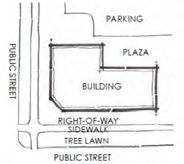
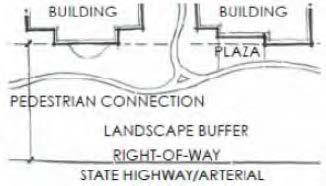
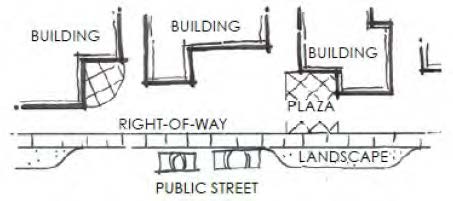
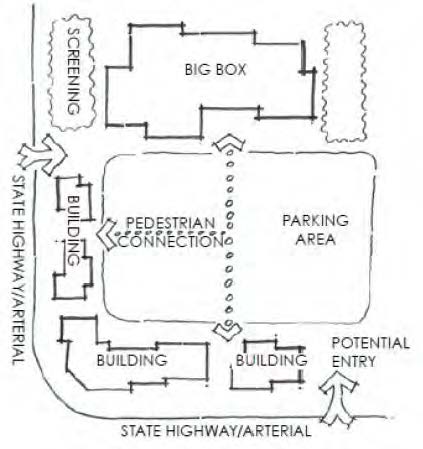
The Town's adopted development and design criteria can be found in Article 5 Development Standards and Article 6 Design Criteria. The intent of these regulations are to promote creative and unique developments and projects within the Development Node District. Examples of the intended character represented by the criteria in Articles 5 and 6 are illustrated below:
(a)
Public street orientation diagram. In areas where a state highway or arterial street is not present, buildings shall be oriented toward the public right-of-way to keep parking lots behind the buildings.
(b)
State highway/arterial orientation diagram. Where property abuts a state highway or arterial street, large landscape buffers are required. Delivery areas and trash enclosures shall be screened from the public right-of-way.
(c)
On-street parking diagram. In areas where the right-of-way is narrow, on-street parking, a variety of building setbacks and building edges articulated toward the street are encouraged.
(d)
Big box orientation diagram. Big box retailers shall be oriented away from the right-of-way with frontage buildings to screen parking.
(Ord. No. 2025-15, § 3(Exh. A), 8-12-25)
Sec. 16.3.460. - Fencing.
Front-yard fencing in the development nodes shall be open wood picket or wrought iron and shall not exceed forty-two (42) inches in height. Brick or stone columns are encouraged. Privacy fencing between users or to screen users shall be allowed per review and approval as a part of a final plat or site plan approval.
Privacy fencing shall not exceed six (6) feet in height and shall be minimized and placed so that the visual impact to surrounding uses and the public right-of-way is minimized. Landscape buffering in place of or associated with privacy fencing is encouraged. Privacy fencing, if located adjacent to the public right-of-way, shall be separated from the public right-of-way by a landscape buffer.
(Ord. No. 2025-15, § 3(Exh. A), 8-12-25)
Sec. 16.3.470. - Entries and signage.
Entries to commercial areas shall be identified by high-quality, ground-mounted signs and/or monumentation. Landscaping shall identify entries with enhanced plantings as shown (flower beds, ornamental trees, etc.). Signage shall be designed to be appropriate to the scale of the development and consistent with the sign regulations of this Code. Signage shall be shown on the site plan.
(Ord. No. 2025-15, § 3(Exh. A), 8-12-25)
Sec. 16.3.520. - Home-based businesses.
Home-based businesses must meet the following standards:
(a)
In addition to the family occupying the dwelling containing the home-based business, there shall not be more than one (1) outside employee working at the site of the home-based business.
(b)
The home-based business shall not exceed one thousand (1,000) square feet or thirty percent (30%) of the total floor area of the dwelling, whichever is less, or can be in an accessory building not to exceed five hundred (500) square feet. The home-based business shall be conducted entirely within the dwelling or designated accessory building, except as required for state-licensed in-home family child care.
(c)
The home-based business shall be clearly incidental and secondary to the use of the dwelling for dwelling purposes and must not change the residential character thereof.
(d)
There shall be no change in the outside appearance of the building or premises or other visible evidence of the conduct of such home-based business, including advertising signs larger than two (2) square feet in total size. No other displays or advertising that solicit or direct people to the address other than the single sign limited to two (2) square feet in total area are permitted.
(e)
There must be no exterior storage on the premises of material or equipment used as a part of the home-based business unless it is enclosed and lot coverage requirements for accessory uses are met.
(f)
No equipment or process shall be used in such home-based business that creates any glare, fumes, odors, or other objectionable conditions detectable to the normal senses off the lot if the occupation is conducted in a single-family dwelling or outside the dwelling unit if conducted in other than a single-family dwelling.
(g)
The following uses, because of their tendency to go beyond the limits permitted for home-based businesses and thereby impair the use and value of the residential area, shall not be permitted as home-based businesses.
(1)
Medical marijuana center.
(2)
Medical marijuana optional premises cultivation operation.
(3)
Medical marijuana-infused products manufacturing.
(4)
Auto repair or motorized implement repair.
(5)
Dance, music or other types of instruction (if more than four (4) students are instructed at one (1) time).
(6)
The painting of vehicles, trailers or boats.
(7)
Private schools with organized classes.
(8)
Welding and fabrication shops.
(9)
Nursing homes.
(10)
Any retail or wholesale sales to consumers upon the premises not incidental to the home-based business (i.e., hair care products at a hair stylist).
(h)
All exterior aspects of the home-based business operation shall not disrupt the residential character of the area.
(i)
No traffic, services, or deliveries shall be generated by the home occupation that is abnormal to a residential neighborhood. In general, this shall be limited to the following:
(1)
No more than one (1) customer vehicle parked at the property at a time, except for drop off of children for child care or instruction.
(2)
No more than ten (10) client visits per week, except for drop-off of children for child care or instruction.
(3)
Delivery of products or materials is limited to that normally associated with residential purposes.
(4)
All parking necessary for the use shall meet the neighborhood design standards, and be confined to the garage, driveway or street directly in front of the dwelling.
(j)
The property shall comply with all Town building codes and property maintenance standards.
(k)
Use of utilities shall be limited to that typically associated with residential purposes.
(l)
Any home-based business, not meeting these criteria or otherwise denied a permit by the Town, may only be approved by a special use permit.
(Ord. No. 2025-15, § 3(Exh. A), 8-12-25)
Sec. 16.3.530. - Accessory dwellings.
(a)
Intent. The regulations in this Section are intended to address the construction, conversion, expansion, or improvement of accessory dwellings within the Town and to ensure all accessory dwellings are constructed, converted, expanded or improved, and occupied, in compliance with the Town's adopted life safety codes and building regulations, including but not limited to, building, fire, utility, or stormwater codes.
(b)
Administrative approval required. To ensure compliance with the regulations in this Section, an application and administrative approval shall be required to construct, convert, expand, or improve any accessory dwelling within the Town. For purposes of this Section, "improve" or "improvements" means any alteration, repair, addition, expansion, reconstruction, replacement, renovation, or any work in or upon a building or structure for which a building permit is required pursuant to the Town's adopted building regulations.
(c)
Application requirements; fees. Applications for the construction, conversion, expansion, or improvement of any accessory dwelling shall be made in writing and shall include all information, documents, and plans necessary for the Town to determine whether the accessory dwelling complies with the standards set forth in this Section. The applicant shall pay all fees established by resolution of the Town Council.
(d)
Town Staff review and decision. When the Town Staff has determined the application for the construction, conversion, expansion, or improvement of an accessory dwelling to be complete, the Town Staff shall review the application to determine if the application complies with the standards set forth in this Section, and shall approve, approve with conditions, or deny the application. Upon the Town Staff's approval of the application, any building permits required for the accessory dwelling shall be issued to the applicant.
(e)
Standards. The following standards apply to all accessory dwellings for which construction, conversion, expansion, or improvements commences on or after the effective date of the ordinance from which this Section was derived.
(1)
There shall be no more than one (1) accessory dwelling on a residential lot.
(2)
No portion of a lot on which an accessory dwelling is located may be subdivided from, or legally described differently than, the lot containing the principal residential unit.
(3)
No portion of a structure containing an accessory dwelling may have ownership different from the ownership of the principal dwelling unit.
(4)
The accessory dwelling shall be affixed to an engineered permanent foundation.
(5)
An internal or attached accessory dwelling shall be separated from the principal dwelling by a firewall meeting building and fire codes.
(6)
Accessory dwelling utilities shall be connected through the principal residential dwelling. Additional water dedication or water or sanitary sewer tap upsize may be required to account for increase in demand beyond the expectation of the original dedication or capacity of the original tap.
(7)
Prior to issuance of any building permit for an accessory dwelling, the applicant shall furnish to the Town a statement by the water service provided and wastewater service provider confirming each provider's capacity to service the property upon the construction of the proposed accessory dwelling. If the property is served by a well or onsite wastewater treatment system, the applicant shall furnish information sufficient for the Town to determine that such facilities are adequate to service the accessory dwelling.
(8)
The accessory dwelling shall comply with any application residential design standard.
(9)
For purposes of calculating residential density, each accessory dwelling shall count as one-half (0.5) dwelling unit.
(10)
The size of an accessory dwelling unit shall be no larger than the size of the principal dwelling unit on the same lot as the accessory dwelling unit.
(Ord. No. 2025-15, § 3(Exh. A), 8-12-25)

