
Shady Cove City Zoning Code
DEVELOPMENT REVIEW
AND SITE DESIGN REVIEW
§ 154.310 PURPOSE.
The purpose of this section is to:
(A) Provide rules, regulations and standards for efficient and effective administration of site development review;
(B) Carry out the development pattern and plan of the city and its comprehensive plan policies;
(C) Promote the public health, safety and general welfare;
(D) Lessen or avoid congestion in the streets, and secure safety from fire, flood, pollution and other dangers;
(E) Provide adequate light and air, prevent overcrowding land and facilitate adequate provision for transportation, water supply, sewage and drainage;
(F) Encourage the conservation of energy resources; and
(G) Encourage efficient use of land resources, full utilization of urban services, mixed uses, transportation options and detailed, human-scaled design.
(Ord. 225, passed 10-20-1994, § 24.1)
§ 154.311 APPLICABILITY.
Development review or site design review shall be required for all new developments and modifications of existing developments, except that regular maintenance, repair and replacement of materials (e.g., roof, siding, awnings and the like) parking resurfacing and similar maintenance and repair shall be exempt. The criteria for each type of review are as follows.
(A) Site design review. Site design review is a discretionary review (Type III) conducted by the Planning Commission with a public hearing. (See § 154.379.) It applies to all developments in the city, except those specifically listed under this section. Site design review ensures compliance with the basic development standards of the land use district (e.g., building setbacks, lot coverage, maximum building height), as well as the more detailed design standards and public improvement requirements.
(B) Development review.
(1) Development review is a non-discretionary or "ministerial" review (Type I) conducted by the city without a public hearing. (See § 154.377 for review procedure.)
(2) It is for less complex developments and land uses that do not require site design review approval. Development review is based on clear and objective standards and ensures compliance with the basic development standards of the land use district, such as building setbacks, lot coverage, maximum building height and similar provisions.
(3) Development review is required for all the types of development listed below:
(a) Single-family detached dwelling (including manufactured homes), when required by a condition of land division approval;
(b) A single duplex, up to two single-family attached (townhouse) units or a single triplex which is not being reviewed as part of any other development and accessory parking on the same lot;
(c) Building additions and minor modifications to development approvals;
(d) Any proposed development which has a valid conditional use permit;
(e) Major modifications to a development with a conditional use permit shall require review and approval in accordance with §§ 154.395 through 154.404;
(f) Home occupation, subject to review under §§ 154.290 through 154.295;
(g) Accessory residential structures including accessory dwellings; and
(h) Other developments, when required by a condition of approval.
(Ord. 225, passed 10-20-1994, § 24.2)
§ 154.312 DEVELOPMENT REVIEW APPROVAL CRITERIA.
Development review shall be conducted only for the developments listed in § 154.311. It shall be conducted as a Type I procedure, as described in § 154.377. Prior to issuance of building permits, the following standards shall be met:
(A) The proposed land use is permitted by the underlying land use district;
(B) The land use, building/yard setback, lot area, lot dimension, density, lot coverage, building height and other applicable standards of the underlying land use district and any subdistrict(s) are met;
(C) All applicable Building and Fire Code standards are met; and
(D) The approval shall lapse, and a new application shall be required, if a building permit has not been issued within one year of site review approval or if development of the site is in violation of the approved plan or other applicable codes.
(Ord. 225, passed 10-20-1994, § 24.3)
§ 154.313 SITE DESIGN REVIEW; APPLICATION REVIEW PROCEDURE.
Site design review shall be conducted as a Type III (or Type II) procedure using the procedures in § 154.379, and using the approval criteria contained in § 154.315.
(Ord. 225, passed 10-20-1994, § 24.4)
§ 154.314 SITE DESIGN REVIEW; APPLICATION SUBMISSION REQUIREMENTS.
All of the following information is required for site design review application submittal.
(A) General submission requirements. The applicant shall submit an application containing all of the general information required by § 154.379, as applicable.
(B) Site design review information. An application for site design review shall include the following information, as deemed applicable by the city.
(1) Existing conditions map. At a minimum the site map shall contain the following:
(a) The applicant's entire property and the surrounding property to a distance sufficient to determine the location of the development in the city, and the relationship between the proposed development site and adjacent property and development. The property boundaries, dimensions and gross area shall be identified;
(b) Topographic contour lines at intervals determined by the city;
(c) Identification of slopes greater than 5%;
(d) The location and width of all public and private streets, drives, sidewalks, pathways, rights-of-way and easements on the site and adjoining the site;
(e) Potential natural hazard areas, including any areas identified as subject to a 100-year flood, areas subject to high water table, and areas mapped by the city, county or state as having a potential for geologic hazards;
(f) Resource areas, including marsh and wetland areas, streams, wildlife habitat identified by the city or any natural resource regulatory agencies as requiring protection;
(g) Site features, including existing structures, pavement, large rock outcroppings, areas having unique views and drainage ways, canals and ditches;
(h) Locally or federally designed historic and cultural resources on the site and adjacent parcels or lots;
(i) North arrow, scale, names and addresses of all persons listed as owners on the most recently recorded deed;
(j) Name and address of project designer, engineer, surveyor and/or planner, if applicable; and
(k) Other information as determined by the city. The city may require studies or exhibits prepared by qualified professionals to address specific site features.
(2) Proposed site plan. The site plan shall contain the following information, if applicable:
(a) The proposed development site, including boundaries, dimensions and gross area;
(b) Features identified on the existing site analysis map, which are proposed to remain on the site;
(c) Features identified on the existing site map, if any, which are proposed to be removed or modified by the development;
(d) The locations and dimensions of all proposed public and private streets, drives, rights-of-way and easements;
(e) The location, elevations and dimensions of all existing and proposed structures, utilities, pavement and other improvements on the site. Setback dimensions for all existing and proposed buildings shall be provided on the site plan;
(f) The location and dimensions of entrances and exits to the site for vehicular, pedestrian and bicycle access;
(g) The location and dimensions of all parking and vehicle circulation areas (show striping for parking stalls and wheel stops, as applicable);
(h) Pedestrian and bicycle circulation areas, including sidewalks, internal pathways, pathway connections to adjacent properties and any bicycle lanes or trails;
(i) Loading and service areas for waste disposal, loading and delivery;
(j) Outdoor recreation spaces, common areas, plazas, outdoor seating, street furniture and similar improvements, as applicable;
(k) Location, type and height of outdoor lighting;
(l) Location of mail boxes, if applicable;
(m) Name and address of project designer, if applicable;
(n) Location of bus stops and other public or private transportation facilities;
(o) Locations, sizes and types of signs (see §§ 154.350 through 154.362); and
(p) Other information, determined by the city. The city may require studies or exhibits prepared by qualified professionals to address specific site features (e.g., traffic, noise, environmental features, natural hazards and the like), in conformance with this chapter.
(3) Architectural drawings. Architectural drawings shall be submitted showing:
(a) Building elevations (as determined by the city) with building height and width dimensions;
(b) Building materials, color and type; and
(c) The name of the architect or designer.
(4) Preliminary grading plan.
(a) A preliminary grading plan prepared by a registered engineer shall be required for developments which would result in the grading (cut or fill) of 500 cubic yards or greater.
(b) The preliminary grading plan shall show the location and extent to which grading will take place, indicating general changes to contour lines, slope ratios, slope stabilization proposals and location and height of retaining walls, if proposed. Surface water detention and treatment plans may also be required.
(5) Landscape plan. A landscape plan is required and shall conform to the requirements of § 154.318
.
(6) Sign drawings. Sign drawings shall be required in conformance with §§ 154.350 through 154.362.
(7) Information. Letter or narrative report documenting compliance with the applicable approval criteria contained in § 154.316.
(Ord. 225, passed 10-20-1994, § 24.5; Ord. 287, passed 4-5-2018)
§ 154.315 APPROVAL CRITERIA.
The review authority shall make written findings with respect to all of the following criteria when approving, approving with conditions or denying an application:
(A) The application is complete, as determined in accordance with §§ 154.314 and 154.375 through 154.382;
(B) The application complies with all of the applicable provisions of the underlying land use district, including building and yard setbacks, lot area and dimensions, density and floor area, lot coverage, building height, building orientation, architecture and other special standards as may be required for certain land uses;
(C) The applicant shall be required to upgrade any existing development that does not comply with the applicable land use district standards, in conformance with §§ 154.270 through 154.276;
(D) The application complies with the design standards contained in Chapter 95;
(E) Conditions required as part of a land division, conditional use permit, master planned development, specific area plan or other approval shall be met; and
(F) Exceptions to criteria, above may be granted only when approved as a variance.
(Ord. 225, passed 10-20-1994, § 24.6)
§ 154.316 BONDING AND ASSURANCES.
(A) Performance bonds for public improvements. On all projects where public improvements are required, the city shall require a bond in an amount not greater than 100% or other adequate assurances as a condition of site development approval in order to guarantee the public improvements.
(B) Release of performance bonds. The bond or assurance shall be released when the city finds the completed project conforms to the site development approval, including all conditions of approval.
(C) Completion of landscape installation. Landscaping shall be installed prior to issuance of occupancy permits, unless security equal to the cost of landscaping as determined by the city or a qualified landscape architect is filed with the City Recorder assuring the installation within six months after occupancy. If the installation of the landscaping is not completed within the six-month period, the security may be used by the city to complete the installation.
(D) Business license filing. The applicant shall ensure that all business occupants of the completed project, whether permanent or temporary, shall apply for and receive a city business license prior to initiating business.
(Ord. 225, passed 10-20-1994, § 24.7)
§ 154.317 DEVELOPMENT IN ACCORDANCE WITH PERMIT APPROVAL.
(A) Development shall not commence until the applicant has received all of the appropriate land use and development approvals (i.e., site design review approval) and building permits. Construction of public improvements shall not commence until the city has approved all required public improvement plans (e.g., utilities, streets, public land dedication and the like).
(B) The city may require the applicant to enter into a development agreement (e.g., for phased developments and developments with required off-site public improvements), and may require bonding or other assurances for improvements, in accordance with § 154.316. Development review and site design review approvals shall be subject to all of the following standards and limitations.
(1) Modifications to approved plans and developments. Minor modifications of an approved plan or existing development, shall be processed as a Type I procedure and require only development review. Major modifications, shall be processed as a Type III procedure and shall require site design review.
(2) Approval period. Development review and site design review approvals shall be effective for a period of one year from the date of approval. The approval shall lapse if:
(a) A building permit has not been issued within a one-year period; or
(b) Construction on the site is in violation of the approved plan.
(C) Extension. The city shall, upon written request by the applicant, grant an extension of the approval period not to exceed one year; provided that:
(1) No changes are made on the original approved site design review plan;
(2) The applicant can show intent of initiating construction on the site within the one-year extension period;
(3) There have been no changes to the applicable ordinance provisions on which the approval was based. If there have been changes to the applicable ordinance provisions and the expired plan does not comply with those changes, then the extension shall not be granted; in this case, a new site design review shall be required; and/or
(4) The applicant demonstrates that failure to obtain building permits and substantially begin construction within one year of site design approval was beyond the applicant's control.
(Ord. 225, passed 10-20-1994, § 24.8)
§ 154.318 LANDSCAPING.
(A) Purpose. This section contains standards for landscaping and screening. The regulations are intended to protect public health, safety, and welfare by reducing development impacts (e.g., glare, noise, and visual impacts) on adjacent uses; minimizing erosion; slowing the rate of surface water runoff, thereby reducing infrastructure costs; buffering pedestrians from vehicle maneuvering areas; cooling buildings and parking lots in summer months with shade; and enhancing the city’s appearance.
(B) Applicability.
(1) Division (C) of this section establishes design standards for landscaping and screening. Projects in the General Commercial and Public Uses zoning district requiring site design review approval shall meet the landscape standards of division (C). Property owners are required to maintain landscaping and screening pursuant to division (C)(6).
(2) Section 154.085 establishes design standards for when a fence or a wall not attached to a building is to be erected, extended, or otherwise altered. It also applies to situations where this code requires screening or buffering (e.g., outdoor or unenclosed storage uses).
(C) Landscaping and screening.
(1) General landscape standard. All portions of a lot not otherwise developed with buildings, accessory structures, vehicle maneuvering areas, or parking shall be landscaped.
(2) Minimum landscape area. All lots shall conform to the minimum landscape area standards of The Planning Commission, consistent with the purposes in division (A) of this section, may allow credit toward the minimum landscape area for existing vegetation that is retained in the development.
(3) Plant selection. A combination of deciduous and evergreen trees, shrubs, and ground covers shall be used for all planted areas, the selection of which shall be based on local climate, exposure, water availability, and drainage conditions, among other factors. When new vegetation is planted, soils shall be amended and irrigation shall be provided, as necessary, to allow for healthy plant growth. The selection of plants shall be based on all of the following standards and guidelines:
(a) Use plants that are appropriate to the local climate, exposure, and water availability. The presence of utilities and drainage conditions shall also be considered. The city may rely on Oregon State University Extension Service bulletins, University of Washington Urban Forestry Program guidelines, or other Firewise expert sources in evaluating landscape plans.
(b) Plant species that do not require irrigation once established (naturalized) are preferred over species that require irrigation.
(c) Trees shall be not less than two-inch caliper for street trees and 1.5-inch caliper for other trees at the time of planting. Trees to be planted under or near power lines shall be selected so as to not conflict with power lines at maturity.
(d) Shrubs shall be planted from five-gallon containers, minimum, where they are for required screens or buffers, and two-gallon containers minimum elsewhere.
(e) Shrubs shall be spaced in order to provide the intended screen or canopy cover within two years of planting.
(f) All landscape areas, whether required or not, that are not planted with trees and shrubs or covered with allowable non-plant material, shall have ground cover plants that are sized and spaced to achieve plant coverage of not less than 50% at maturity.
(g) Bark dust, chips, aggregate, or other non-plant ground covers may be used, but shall cover not more than 50% of any landscape area. Non-plant ground covers cannot be a substitute for required ground cover plants.
(h) Where storm water retention or detention, or water quality treatment facilities are proposed, they shall be planted with water-tolerant species.
(i) Existing mature trees that can thrive in a developed area and that do not conflict with other provisions of this code shall be retained where specimens are in good health, have desirable aesthetic characteristics, and do not present a hazard.
(j) Landscape plans shall avoid conflicts between plants and buildings, streets, walkways, utilities, and other features of the built environment.
(k) Evergreen plants shall be used where a sight-obscuring landscape screen is required.
(l) Deciduous trees may be used where summer shade and winter sunlight is desirable.
(m) Landscape plans shall provide focal points within a development, for example, by preserving large or unique trees or groves or by using flowering plants or trees with fall color.
(n) Landscape plans shall use a combination of plants for seasonal variation in color and yearlong interest.
(o) Where plants are used to screen outdoor storage or mechanical equipment, the selected plants shall have growth characteristics that are compatible with such features.
(p) Landscape plans shall provide for both temporary and permanent erosion control measures, which shall include plantings where cuts or fills, including berms, swales, storm water detention facilities, and similar grading, are proposed.
(q) When new vegetation is planted, soils shall be amended and irrigation provided, as necessary, until the plants are naturalized and able to grow on their own.
(r) Where landscaping is not otherwise feasible, planter boxes or decorative tubs shall be installed. Planting shall be consistent with in-ground landscaping requirements.
(4) Parking lot landscaping. All of the following standards shall be met for parking lots. If a development contains multiple parking lots, then the standards shall be evaluated separately for each parking lot.
(a) A minimum of 10% of the total surface area of all parking areas, as measured around the perimeter of all parking spaces and maneuvering areas, shall be landscaped. Such landscaping shall consist of canopy trees distributed throughout the parking area. A combination of deciduous and evergreen trees, shrubs, and ground cover plants is required. The trees shall be planted so that they provide a partial canopy cover over the parking lot within five years. At a minimum, one tree per 12 parking spaces on average shall be planted over and around the parking area.
(b) All parking areas with more than 20 spaces shall provide landscape islands with trees that break up the parking area into rows of not more than 12 contiguous parking spaces. Landscape islands and planters shall have dimensions of not less than 48 square feet of area and no dimension of less than six feet, to ensure adequate soil, water, and space for healthy plant growth.
(c) All required parking lot landscape areas not otherwise planted with trees must contain a combination of shrubs and groundcover plants so that within two years of planting, not less than 50% of that area is covered with living plants.
(d) Wheel stops, curbs, bollards, or other physical barriers are required along the edges of all vehicle-maneuvering areas to protect landscaping from being damaged by vehicles. Trees shall be planted not less than two feet from any such barrier.
(e) Trees planted in tree wells within sidewalks or other paved areas shall be installed with root barriers, consistent with applicable nursery standards.
(5) Screening requirements. Screening is required for outdoor storage areas, unenclosed uses, and parking lots, and may be required in other situations as determined by the Planning Commission. Landscaping shall be provided pursuant to the standards of divisions (C)(5)(a)-(c), below:
(a) Outdoor storage and unenclosed uses. All areas of a site containing or proposed to contain outdoor storage of goods, materials, equipment, and vehicles (other than required parking lots and service and delivery areas, per site design review), and areas containing junk, salvage materials, or similar contents, shall be screened from view from adjacent rights-of-way and residential uses by a sight-obscuring fence, wall, landscape screen, or combination of screening methods. See also § 154.085 (Commercial) or § 154.105 (Public Uses) for related fence and wall standards.
(b) Parking lots. The edges of parking lots shall be screened to minimize vehicle headlights shining into adjacent rights-of-way and residential yards. Parking lots abutting a sidewalk or walkway shall be screened using a low-growing hedge or low garden wall to a height of between three feet and four feet.
(c) Other uses requiring screening. The Planning Commission may require screening in other situations as authorized by this code, including, but not limited to, outdoor storage areas, blank walls, and as mitigation where an applicant has requested an adjustment.
(6) Maintenance. All landscaping shall be maintained in good condition, or otherwise replaced by the property owner or tenant, consistent with the landscaping standards of this chapter.
(Ord. 287, passed 4-5-2018)
§ 154.319 NON-RESIDENTIAL BUILDINGS.
(A) Purpose and applicability.
(1) The following requirements apply to non-residential development, including individual buildings and developments with multiple buildings such as shopping centers, office complexes, mixed-use developments, and institutional campuses. The standards are intended to create and maintain a built environment that is conducive to pedestrian accessibility, reducing dependency on the automobile for short trips, while providing civic space for employees and customers, supporting natural surveillance of public spaces, and creating human- scale design. The standards require buildings placed close to streets, with storefront windows (where applicable), with large building walls divided into smaller planes, and with architectural detailing character of Northwest Contemporary Rustic.
(2) The standards are intended to enhance/ support the continued development of the city, reinforcing it as an attractive place to work, shop, and conduct business. It is not the city's intent to create an architectural theme, but rather to ensure that new buildings and exterior alterations fit within the context of their surroundings and contribute toward the development of compact, walkable commercial and mixed-use districts. Specifically, the standards:
(a) Draw upon the local vocabulary of building styles and elements, including compatibility with architectural style of Northwest Contemporary Rustic where applicable;
(b) Create a sense of street enclosure with appropriate building heights and detailing;
(c) Require the use of contextually appropriate materials, textures and colors; promote a storefront character (windows, pedestrian shelter, furnishings, etc.);
(d) Encourage a diversity of building facades and rooflines that fall into a consistent rhythm;
(e) Promote corner lots as focal points;
(f) Improve the streetscape with adequate civic space, street furnishings and public art; and
(g) Encourage energy and water conservation, and the use of renewable resources.
(B) Building orientation. The following standards apply to new buildings and building additions that are subject to site design review. The Planning Commission may approve adjustments to the standards as part of a site design review approval.
(1) Buildings subject to this section shall conform to the applicable build-to line standard. The standard is met when at least 80% of the abutting street frontage shall have a building placed no farther from at least one street property line than the required build-to-line. The Planning Commission, through site design review, may waive the build-to line standard where it finds that one or more of the conditions in divisions (B)(1)(a) through (g) of this section occurs.
(a) A proposed building is adjacent to a single-family dwelling, and an increased setback promotes compatibility with the adjacent dwelling.
(b) The standards of the roadway authority preclude development at the build-to line.
(c) The applicant proposes extending an adjacent sidewalk or plaza for public use, or some other pedestrian amenity is proposed to be placed between the building and public right-of-way.
(d) The build-to line may be increased to provide a private open space (e.g., landscaped forecourt), between a residential use in a mixed-use development (e.g., live-work building with ground floor residence) and a front or street property line.
(e) A significant tree or other environmental feature precludes strict adherence to the standard and will be retained and incorporated in the design of the project.
(f) A public utility easement or similar restricting legal condition that is outside the applicant's control makes conformance with the build-to line impracticable. In this case, the building shall instead be placed as close to the street as possible given the legal constraint, and pedestrian amenities (e.g. plaza, courtyard, landscaping, outdoor seating area, etc.) shall be provided within the street setback in said location.
(g) An expansion is proposed on an existing building that was lawfully created but does not conform to the above standard, and the building addition moves in the direction of compliance where practicable.
(2) All buildings shall have at least one primary entrance (i.e., tenant entrance, lobby entrance, breezeway entrance, or courtyard entrance) facing an abutting street (i.e., within 45 degrees of the street property line); or if the building entrance must be turned more than 45 degrees from the street (i.e., front door is on a side or rear elevation) due to the configuration of the site or similar constraints, a pedestrian walkway must connect the primary entrance to the sidewalk.
(3) Off-street parking, trash storage facilities, and ground-level utilities (e.g., utility vaults), and similar obstructions shall not be placed between building entrances and the street(s) to which they are oriented. To the extent practicable, such facilities shall be oriented internally to the block and accessed by alleys or driveways.
(4) Off-street parking shall be oriented internally to the site to the extent practicable.
(5) Where a development contains multiple buildings and there is insufficient street frontage to meet the above building orientation standards for all buildings on the subject site, a building's primary entrance may orient to plaza, courtyard, or similar pedestrian space containing pedestrian amenities. When oriented this way, the primary entrance(s), plaza, or courtyard shall be connected to the street by a pedestrian walkway.
(C) Large-format developments. Plans for new developments, or any phase thereof, with a total floor plate area (ground floor area of all buildings) greater than 20,000 square feet, including land divisions in the General Commercial Zoning District shall meet all of the following standards in divisions (C)(1) through (C)(9), below. The Planning Commission may approve adjustments to the standards as part of a site design review approval.
(1) The site plan or preliminary subdivision plan, as applicable, shall comply with the street connectivity standards. The plan approval shall bind on all future phases of the development, if any, to the approved block layout.
(2) The site shall be configured into blocks with building pads that have frontage onto improved streets meeting city standards, and shall contain interior parking courts and with interconnected pedestrian walkways.
(3) The build-to line standards shall be met across not less than 50% of the site's street frontage, except the build-to standard does not apply where a railroad, expressway, water body, topographic constraint, or similar physical constraint makes it impractical to orient buildings to a particular street or highway.
(4) Walkways shall connect the street right-of-way to all primary building entrances, and shall connect all primary building entrances to one another, including required pedestrian crossings through interior parking areas, if any. The Planning Commission may condition development to provide facilities, including a requirement for lighting, stairways, ramps, and midblock pedestrian access ways (e.g., to break up an otherwise long block) to ensure reasonably safe, direct, and convenient pedestrian circulation.
(5) Buildings placed at a block corner shall have a primary entrance oriented to the block corner. That entrance shall be located within 35 feet of the corner and shall have a direct and convenient pedestrian walkway connecting to the corner sidewalk.
(6) All buildings shall orient to a street. Where it is not practical to orient all buildings to streets due to existing parcel configuration or a similar site constraints, buildings may orient to a "shopping street" providing, at a minimum, on-street parking (parallel or angled parking), eight-foot sidewalks (which shall include a four-foot zone for street trees and furnishings such as benches and other street furniture), and pedestrian-scale lighting.
(7) Each building that is proposed as orienting to a shopping street shall have at least one primary entrance oriented to the shopping street.
(8) Where a building fronts both a shopping street and a public street, that building shall contain at least one primary entrance oriented to each street; except that an entrance is not required where the public street is not improved with a sidewalk and the city determines that sidewalk improvements to the public street cannot be required as a condition of approval.
(9) All other provisions of this Code apply to large-format developments.
(D) Primary entrances and windows. The following standards apply to new buildings and building additions and remodels that are subject to site design review. The Planning Commission may approve adjustments to the standards as part of a site design review approval.
(1) All elevations of building. Architectural designs shall address all elevations of a building. Building forms, detailing, materials, textures, and color shall contribute to a unified design with architectural integrity. Materials used on the front facade must turn the building corners and include at least a portion of the side elevations, consistent with the building's overall composition and design integrity.
(2) Pedestrian entrances. Ground level entrances oriented to a street shall be at least partly transparent for natural surveillance and to encourage an inviting and successful business environment. This standard may be met by providing a door with a window(s), a transom window above the door, or sidelights beside the door. Where ATMs or other kiosks are proposed on any street-facing elevation, they shall be visible from the street for security and have a canopy, awning, or other weather protection shelter.
(3) Corner entrances. Buildings on corner lots are encouraged to have corner entrances. Where a corner entrance is not provided, the building plan shall provide an architectural element or detailing (e.g., tower, beveled corner, art, special trim, etc.) that accentuates the corner location.
(4) Street level entrances. All primary building entrances shall open to the sidewalk and shall conform to Americans with Disabilities Act (ADA) requirements, as applicable. Primary entrances above or below grade may be allowed where ADA accessibility is provided.
(5) Windows - general. Except as approved for parking structures or accessory structures, the front/street-facing elevations of buildings shall provide display windows.
(6) Storefront windows. Storefront windows shall consist of framed picture or bay windows, which may be recessed. The ground floor, street-facing elevation(s) of all buildings shall comprise at least 60% transparent windows, measured as a section extending the width of the street-facing elevation between the building base (or 30 inches above the sidewalk grade, whichever is less) and a plane 72 inches above the sidewalk grade.
(7) Defined upper story(ies). Building elevations shall contain detailing that visually defines street level building spaces (storefronts) from upper stories. The distinction between street level and upper floors shall be established, for example, through the use of awnings, canopies, belt course, or similar detailing, materials. Upper floors may have less window area than ground floors, but shall follow the vertical lines of the lower level piers and the horizontal definition of spandrels and any cornices.
(8) Buildings not adjacent to a street. Buildings that are not adjacent to a street or a shopping street, such as those that are setback behind another building and those that are oriented to a civic space (e.g. internal plaza or court), shall meet the 60% transparency standard on all elevations abutting civic spaces(s) and on elevations containing a primary entrance.
(9) Side and rear elevation windows. All side and rear elevations, except for zero-lot line or common wall elevations, where windows are not required, shall provide not less than 30% transparency.
(10) Projecting windows, display cases. Windows and display cases shall not break the front plane of the building (e.g., projecting display boxes are discouraged). For durability and aesthetic reasons, display cases, when provided, shall be flush with the building facade (not affixed to the exterior) and integrated into the building design with trim or other detailing. Window flower boxes are allowed provided they do not encroach into the pedestrian through-zone.
(11) Window exceptions. The Planning Commission may approve an exception to the above standards where existing topography makes compliance impractical. Where an exception to the window transparency requirement is made for parking garages or similar structures, the building design must incorporate openings or other detailing that resembles the window patterns (rhythm and scale).
(E) Articulation and detailing. The following standards apply to new buildings, building additions and remodeling that are subject to site design review. The Planning Commission may approve adjustments to the standards as part of a site design review approval.
(1) Articulation. All building elevations that orient to a street or civic space must have breaks in the wall plane (articulation) of not less than one break for every 30 feet of building length or width, as applicable, as follows:
(a) A "break" for the purposes of this division is a change in wall plane of not less than 12 inches in depth. Breaks may include but are not limited to an offset, recess, window reveal, pilaster, frieze, pediment, cornice, parapet, gable, dormer, eave, coursing, canopy, awning, column, building base, balcony, permanent awning or canopy, marquee, or similar architectural feature.
(b) The Planning Commission through site design review may approve detailing that does not meet the 12 inch break-in-wall-plane standard where it finds that proposed detailing is more consistent with the architecture of buildings existing in the vicinity.
(c) Changes in paint color and features that are not designed as permanent architectural elements, such as display cabinets, window boxes, retractable and similar mounted awnings or canopies, and other similar features, do not meet the 12 inch break-in-wall-plane standard.
(d) Building elevations that do not orient to a street or civic space need not comply with the 12 inch break-in-wall-plane standard but should complement the overall building design.
(2) Change in materials. Elevations should incorporate changes in material that define a building's base, middle, and top, as applicable, and create visual interest and relief. Side and rear elevations that do not face a street, public parking area, pedestrian access way, or plaza may utilize changes in texture and/or color of materials, provided that the design is consistent with the overall composition of the building.
(3) Ground floor and upper floor division. A clear visual division shall be maintained between the ground level floor and upper floors, for example, through the use of a belt course, transom, awning, canopy, or similar division.
(4) Vertical rhythms. New construction or front elevation remodels shall reflect a vertical orientation, either through breaks in volume or the use of surface details.
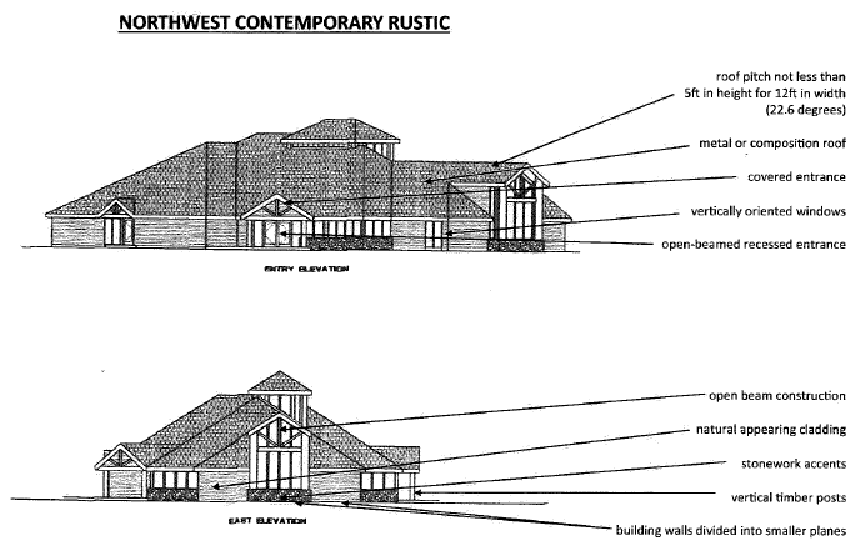
(5) Design characteristics. New construction shall include a minimum of five of the following Northwest Contemporary Rustic design elements as shown on Figure A:
(a) Roof pitch not less than five feet in height for 12 feet in width (22.6 degrees);
(b) Metal or composition roof;
(c) Covered entrance;
(d) Vertically oriented windows;
(e) Open-beamed recessed entrance;
(f) Open beam construction;
(g) Natural appearing cladding;
(h) Stonework accents;
(i) Vertical timber posts; and
(j) Building walls divided into smaller planes.
(F) Pedestrian shelters. The following standards apply to new buildings and building additions that are subject to site design review. The Planning Commission may approve adjustments to the standards as part of a site design review approval.
(1) Minimum pedestrian shelter coverage. Permanent awnings, canopies, recesses, or similar pedestrian shelters shall be provided along at least 75% of the ground floor elevation(s) of a building where the building abuts a sidewalk, civic space, or pedestrian access way. Pedestrian shelters used to meet the above standard shall extend at least five feet over the pedestrian area; except that the Planning Commission, through site design review, may reduce the above standards where it finds that existing right-of-way dimensions, easements, or building code requirements preclude standard shelters. In addition, the above standards do not apply where a building has a ground floor dwelling, as in a mixed-use development or live-work building, and the dwelling has a covered entrance.
(2) Pedestrian shelter design. Pedestrian shelters shall comply with applicable building codes, and shall be designed to be visually compatible with the architecture of a building. If mezzanine or transom windows exist, the shelter shall be below such windows where practical. Where applicable, pedestrian shelters shall be designed to accommodate pedestrian signage (e.g., blade signs), while maintaining required vertical clearance.
(G) Mechanical equipment.
(1) Building walls. Where mechanical equipment, such as utility vaults, air compressors, generators, antennae, satellite dishes, or similar equipment, is permitted on a building wall that abuts a public right-of-way or civic space, it shall be screened. Standpipes, meters, vaults, and similar equipment need not be screened but shall not be placed on a front elevation when other practical alternatives exist; such equipment shall be placed on a side or rear elevation where practical.
(2) Rooftops. Except as provided below, rooftop mechanical units shall be setback or screened behind a parapet wall so that they are not visible from any public right-of-way or civic space. Where such placement and screening is not practicable, the Planning Commission may approve painting of mechanical units in lieu of screening; such painting may consist of muted, earth-tone colors that make the equipment visually subordinate to the building and adjacent buildings, if any.
(3) Ground-mounted mechanical equipment. Ground-mounted equipment, such as generators, air compressors, trash compactors, and similar equipment, shall be limited to side or rear yards and screened with fences or walls constructed of materials similar to those on adjacent buildings. Hedges, trellises, and similar plantings may also be used as screens where there is adequate air circulation and sunlight, and irrigation is provided. The city may require additional setbacks and noise attenuating equipment for compatibility with adjacent uses.
(H) Materials and color. Building exteriors shall conform to the following standards. The Planning Commission may approve adjustments to the standards as part of a site design review approval.
(1) Primary materials. Permitted exterior cladding materials shall include those listed in division (E)(5) of this section, and other materials found to be similar in appearance and durability, subject to site design review, commercial buildings subject to this section should use materials that avoid the appearance of industrial or temporary buildings.
(2) Substitute materials. Substitute materials that are equal in appearance and durability to those listed in division (H)(1) of this section may be approved through site design review. The applicant will be required to provide specifications from the manufacturer.
(3) Color. Color schemes shall conform to the adopted color palette on file at the City Hall. Reflective, luminescent, sparkling, and "day-glow" colors and finishes are prohibited.
(4) Prohibited materials for building faces. The following materials shall not be used on walls or vertical building surfaces.
(a) Corrugated metal panels, similar metal products, corrugated fiberglass panels, or any other material that requires corrugation, seams, or similar manipulation of the exterior surface to prevent deflection of the surface. Architectural metal panels with recessed seams no closer than 36 inches on center at the edge of the panel may be used when consistent with the other standards. Other metal products may be used as structural members or accents, such as "I-Beam" canopies, brushed metal finishes, etc.
(b) Sheet plywood, including textured plywood siding.
(c) Unfinished materials, such as plain concrete masonry units (CMU) or raw concrete, unless the material is designed and fabricated to be left unfinished, rather than receiving a field-applied finish covering.
Figure A
(Ord. 289, passed 11-15- 2018)
§ 154.320 CIVIC SPACE AND PEDESTRIAN AMENITIES.
(A) Purpose. This section provides standards for civic spaces where such areas are required or provided voluntarily. Civic spaces allow for light and air circulation, visual relief, pedestrian resting areas, and opportunities for socialization in the most densely developed parts of the city. The code allows projects within General Commercial and Public Uses to meet minimum landscape area standards by providing civic space adjacent to street frontages or in courtyards or plazas between buildings, instead of with planted areas elsewhere on a lot as is typically done for residential developments.
(B) Applicability. Design of large-scale buildings and developments. The standards in division (B)(3), below, shall apply to "large-scale buildings and developments", as defined in divisions (B)(1) through (B)(2) of this section:
(1) Buildings with greater than 10,000 square feet of enclosed ground-floor space (i.e., "large-scale"). Multi-tenant buildings shall be counted as the sum of all tenant spaces within the same building shell; and
(2) Multiple-building developments with a combined ground-floor space (enclosed) greater than 20,000 square feet (e.g., shopping centers, public/institutional campuses, and similar developments).
(3) All large-scale buildings and developments, as defined in divisions (B)(1) and (B)(2) of this section, shall provide human-scale design by conforming to all of the following criteria:
(a) Incorporate changes in building direction (i.e., articulation), and divide large masses into varying heights and sizes. Such changes may include building offsets; divisions in surface materials; and use of windows, screening trees; small-scale lighting (e.g., wall-mounted lighting, or up-lighting); and similar features. Note: the example shown above
is meant to illustrate examples of these building design elements, and should not be interpreted as a required architectural style.
(C) Standards.
(1) Civic space standards. At least 3% of every development site shall be designated and improved as civic space (plaza, landscaped courtyard, or similar space) that is accessible to the general public, pursuant to all of the following standards in divisions (C)(1)(a) through (e) of this section:
(a) The highest priority locations for civic space improvements are those with the highest pedestrian activity (e.g., street corners and pedestrian access ways), as generally illustrated.
(b) Civic spaces shall abut a public right-of-way or otherwise be connected to and visible from a public right-of-way by a sidewalk or pedestrian access way. Access ways shall be identifiable with a change in paving materials (e.g. pavers inlaid in concrete or a change in pavement scoring patterns or texture).
(c) Where public access to a civic space is not practical due to existing development patterns, physical site constraints, or other hardship presented by the applicant, the city may allow a private area, such as an outdoor eating area attached to a restaurant, in finding the project complies with the standard.
(d) All civic spaces shall have dimensions that allow for reasonable pedestrian access. For example, by extending the width of an existing sidewalk by four feet, a developer might provide space for an outdoor eating area; whereas a larger development at a street corner could meet the standard by creating a plaza adjacent to a building entrance.
(e) Civic space improvements shall conform to § 154.318, Landscaping.
(2) Pedestrian improvements in civic spaces. Except as provided below, where this section requires the provision of civic space, such space shall be improved with pedestrian amenities, pursuant to the following standards in divisions (C)(2)(a) through (d) of this section:
(a) Pedestrian amenities shall be provided in an amount equal to or greater than 0.5% of the estimated construction cost of the proposed building(s). A licensed architect, landscape architect, or other qualified professional, shall prepare cost estimates for civic space improvements, which shall be subject to review and approval by the City Planner.
(b) Pedestrian amenities include plaza surfaces (e.g., pavers, landscapes, etc.), sidewalk extensions (e.g. with outdoor cafe space), street furnishings (e.g., benches, public art, pedestrian-scale lighting, water fountains, trash receptacles, bus waiting shelters, shade structures, or others), way-finding signs, or similar amenities, as approved by the City Planner.
(c) Where a civic space adjoins a building entrance it should incorporate a permanent weather protection canopy, awning, pergola, or similar feature.
(d) The city may accept pedestrian amenities proposed within a public right-of-way (e.g., street corner or mid-block pedestrian access way) and grant the developer credit toward fulfilling the above improvement standard.
(3) Exception for minor projects. Building additions and remodels are not required to provide civic space where the estimated cost of the proposed building improvement is less than 30% of the existing assessed value of improvements on the subject site. Cost estimates are based on those used to estimate building permit fees, or other independent and credible source, subject to review and approval by the City Planner. Assessed values shall be the market value of record at the Jackson County Assessor's Office.
(4) Exception for in lieu fee. The Planning Commission can approve an exception where the city finds that the creation of civic space is not practicable based on the project location or other relevant factors.
(Ord. 289, passed 11-15-2018)
§ 154.321 DRIVE-UP AND DRIVE-THROUGH USES AND FACILITIES.
(A) Purpose. Where drive-up or drive-through uses and facilities are allowed, they shall conform to all of the following standards, which are intended to calm traffic, provide for adequate vehicle queuing space, prevent automobile turning movement conflicts, and provide for pedestrian comfort and safety.
(B) Standards. Drive-up and drive-through facilities (i.e., driveway queuing areas, customer service windows, teller machines, kiosks, drop-boxes, or similar facilities) shall meet all of the following standards:
(1) The drive-up or drive-through facility shall orient to and receive access from a driveway that is internal to the development and not a street.
(2) The drive-up or drive-through facility shall not be oriented to street corner.
(3) The drive-up or drive-through facility shall not be located within 20 feet of a street right-of-way.
(4) Drive-up and drive-through queuing areas shall be designed so that vehicles will not obstruct any street, fire lane, walkway, bike lane, or sidewalk.
(Ord. 289, passed 11-15-2018)

