
Shady Cove City Zoning Code
SIGN REGULATIONS
§ 154.350 PURPOSE AND INTENT.
This section recognizes the importance of signs in the community and establishes regulations intended to protect the public from damage or injury caused by or attributable to distractions and obstructions caused by improperly designed, installed, or located signs. The regulations attempt to improve the appearance of the city, minimize visual clutter, and comply with ODOT standards for National Scenic Byways, while giving businesses an opportunity to attract and inform customers.
(Ord. 225, passed 10-20-1994, § 29.1; Ord. 269, passed 9-18-2014)
§ 154.351 APPLICATION.
Unless otherwise exempt under § 154.353, anyone proposing new signs shall be required to make application and pay a permit fee as established by a resolution of the City Council.
(Ord. 225, passed 10-20-1994, § 29.1; Ord. 269, passed 9-18-2014)
§ 154.352 DEFINITIONS.
For the purpose of this subchapter, the following definitions apply unless the context clearly indicates or requires a different meaning.
ALTERATION. Any change excluding content, and including, but not limited to, the size, shape, method of illuminations, position, locations, materials, construction, or supporting structure of a sign.
AWNING. A shelter projecting from and supported entirely from the exterior wall of a building and constructed of rigid or non-rigid materials on a supporting framework.
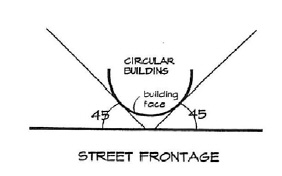
BUILDING FACE OR WALL. All window and wall area of a building in one plane or elevation. In the case of a round or curved building, the "front" face or wall shall be determined as the portion that lies between the two 45-degree tangents from the street frontage, as illustrated below:
BUILDING FRONTAGE. The exterior wall surfaces of a building that directly or most directly face a specific direction, usually a street, but in some cases a parking lot. The width of the property line that fronts a particular street is considered that property's frontage. In some cases, such as a corner lot, a property may have more than one FRONTAGE.
BUILDING OFFICIAL. The officer or other person charged with the enforcement of this code or his or her duly authorized deputy or assistant. The administration of this code is the responsibility of the City Administrator.
BULLETIN BOARD. A permanent sign intended to accommodate changeable copy, such as private or public notices, special event information, and other short-term messages, and is generally at a scale suitable for pedestrians and not intended to be read by passing motorists. (Also, see KIOSK.)
CANOPY. A non-movable awning or roof-like structure attached to a building.
CHANGEABLE COPY OR READER-BOARD SIGN. A sign structure that is often internally or externally illuminated and intended to accommodate changeable lettering, numbering, graphic displays or other short-term messages. Often used for commercial messages and for information pertaining to current or coming events of general interest.
CITY ADMINISTRATOR. The City Administrator for the City of Shady Cove or the City Administrator's designee.
CUT-OUT SIGN. Any visual or graphic display in the form of figures, letters, numbers or other characters or representatives in cut-out or irregular forms. The signs may be free-standing or attached to a building or other structure.
DIRECTIONAL SIGN. A permanent sign which is designed solely for the purpose of directing motor vehicle, pedestrian, bicycle or other traffic, or individuals, toward a specific destination or route.
ELECTRIC SIGN. Any sign containing electrical wiring or requiring electricity for its function or illumination.
ELECTRONIC MESSAGE SIGN. Any sign whose message or display is presented with patterns of lights which may be changed intermittently by an electronic process.
FASCIA SIGN. See WALL SIGN.
FLASHING SIGN. Any sign which incorporates intermittent electrical impulses to a source of illumination or revolving in a manner which creates the illusion of flashing, or which changes color or intensity or illumination. Examples include electric or electronic time, date and temperature signs and other electronic message signs.
FREE-STANDING SIGN. A sign that is supported by columns, uprights or braces in or upon the ground and not attached to any building.
GRADE. The level of the surface of the ground, whether or not paved, that lies immediately below a sign or proposed sign location. When a slope is involved, the grade shall be the average of the levels at each supporting member of the sign's structure.
GROUND SIGN. See FREE-STANDING SIGN.
IDENTIFICATION SIGN. A sign intended solely to inform the public of the particular use of a property, building, office and the like and which may include the address, suite number or other identifying information, but that typically does not include other advertising or messages not related to the identification of the premises.
ILLEGAL SIGN. Any sign which was erected or altered in violation of the city's sign regulations that were in effect at the time of the action. (Also, see NONCONFORMING SIGN.)
ILLUMINATED SIGN. Any sign which utilizes a source of light, either internally or externally
(1) DIRECT ILLUMINATION. A source of illumination on the surface of the sign or from within a translucent sign.
(2) INDIRECT ILLUMINATION. A source of light that is either attached to the sign structure or located nearby, and that is directed toward the sign to illuminate its exterior surface.
INCIDENTAL SIGN. A sign intended primarily for the convenience and direction of the public, which is informational only, and which does not include the advertising of products or services. These signs may include business hours signs, credit card signs, entrance and exit signs, and other signs that may be required by law.
KIOSK. A free-standing structure having areas designed for the placement or attachment of personal or public notices, advertisements or other messages. It may function much like a "bulletin board" for messages of a short-term nature and often include identification of the business on whose property it is located.
MAINTAIN. To permit a sign, sign structure, or any part thereof to continue. Or, to repair, refurbish, or keep in good order and repair a sign, structure, or any part of each.
MARQUEE. A permanent roofed structure attached to and supported by a building and projecting
away from the building, usually over a public walkway and common to theaters.
MOVING OR ANIMATED SIGN. Any sign that includes action or motion, including flashing lights, color changes, revolving or waving actions, but not including, wind actuated elements, such as flags, pennants, or banners. These signs do not include public service signs such as time, date, temperature signs.
MULTIPLE-COPY SIGNS. Any sign structure that contains identification of or information about more than one business or other land use or which contains more than one type of message.
NONCONFORMING SIGN. Unlike an "illegal sign", a nonconforming sign was legally established but no longer conforms to the current standards or requirements of this subchapter.
PAINTED SIGN. A sign which is painted directly onto the surface of a building or other structure that was not specifically designed as a sign structure.
PORTABLE SIGN. Any free-standing sign which is not permanently fixed on the site by either attachment to a fixed structure or embedded into the ground, and which can be readily moved. Sandwich board or "A"-frame signs are typical of this type.
PROJECTING SIGN. Any sign which is attached to a structure or building face and:
(1) Extends outward from that structure or building for a distance greater than 16 inches or;
(2) Has a face which is not parallel to the face of the building or structure and extends beyond the face of the building for any distance.
READER BOARD. See CHANGEABLE COPY.
ROOF SIGN. A sign erected upon or above the roof or parapet wall structure of a building and which is wholly or partially supported by the building.
SANDWICH BOARD SIGN. See PORTABLE SIGN.
SHOPPING CENTER/BUSINESS COMPLEX SIGN. A single sign structure intended for the placement of two or more identification signs related to businesses services, or primary goods offered in the center or business complex.
SIGN. Any words, number, logos, flags, banners or other material that are placed or constructed primarily to convey a message, and which is visible from public or private streets or other property.
SIGN STRUCTURE. Any structure specifically intended to support a sign or which may also be a part of the sign. May include supports, uprights, braces, framework and other members that may be needed to support the sign and keep it in place.
TEMPORARY SIGN. A sign that is not permanently affixed and which is intended for a short-term use, such as to advertise an activity, such as a special promotion, sale, fund-raising activity, special event or for use until a permanent sign can be erected. TEMPORARY SIGNS typically include devices such as banners, flags, pennants, searchlights, balloons and the like.
UNDER MARQUEE SIGN. A sign attached to the underside of a marquee or canopy and protruding over a public or private pedestrian walkway. Often used in shopping centers and areas having covered sidewalks.
WALL GRAPHICS. Any mosaic, mural or painting, or graphic art technique or combination of same, implanted, applied or otherwise placed directly onto a wall or fence and containing no copy, advertising symbols, logos, trademarks or other references to any product, service, goods, persons, places or issues. These are generally considered to be "art" and not signs and as such, are not subject to the regulations included in this subchapter.
WALL SIGN. A sign attached directly to or erected against the wall of a building with the face in
a parallel plane to the building wall and extending no more than 12 inches from the wall.
WIND SIGN OR DEVICE. Any sign or device that is intended to serve the function of a sign, in attracting attention to a particular site, business or premise, and which because of its design or materials is caused to flutter, wave, revolve, sparkle or otherwise move as a result of the pressures of a wind or breeze including inflatable air dancers, tube dancers, fan dancers.
WINDOW SIGN(S). Are those which are painted, displayed or placed on the interior of the window or glass door.
(Ord. 225, passed 10-20-1994, § 29.2; Ord. 269, passed 9-18-2014; Ord. 291, passed 6-6-2019)
§ 154.353 CONFORMANCE.
(A) No sign may be erected unless it conforms to the provisions of this subchapter.
(B) Sign permits shall be obtained prior to the erection of any sign, unless exempt.
(Ord. 225, passed 10-20-1994, § 29.3; Ord. 269, passed 9-18-2014; Ord. 291, passed 6-6-2019) Penalty, see § 154.999
§ 154.354 EXEMPTIONS FROM PERMIT REQUIREMENTS.
The following signs do not require permits or fees, but may be subject to other provisions of this chapter or International Building Code:
(A) Traffic signs, signals and other traffic-control devices erected by the city or other public authority;
(B) Public notices pertaining to public health or safety issues, erected by the city or approved by the city;
(C) Permanent plaques, cornerstones, name plates and other building identification markings attached to or carved into the building materials and which are an integral part of the structure;
(D) Address numbers;
(E) Signs located within a building, with the exception of strobe lights and moving or animated signs that are visible from any private or public roadway, or from adjacent properties;
(F) Legal nonconforming signs, except that the signs shall conform to this subchapter if they are altered or replaced or upon the change of occupancy type of the business;
(G) Flags on permanent flag poles designed for the routine raising and lowering of flags;
(H) Wall graphics, as defined; and
(I) Temporary signs, subject to § 154.358(C).
(Ord. 225, passed 10-20-1994, § 29.4; Ord. 269, passed 9-18-2014; Ord. 291, passed 6-6-2019)
§ 154.355 PROHIBITED SIGNS.
The following signs are prohibited within the city limits and shall be removed:
(A) Strobe lights and signs containing strobe lights or any other flashing, blinking or moving lights which are visible beyond any property line;
(B) Signs placed on trailers and parked with the primary purpose of providing a sign that is not otherwise allowed;
(C) Any private sign placed within a public right-of-way or overhanging a public right-of-way;
(D) Any sign that is determined by the City Administrator to be a hazard to public safety due to its design, materials, physical conditions or placement;
(E) Signs painted on or otherwise attached to trees, natural rocks or other landscape or natural features;
(F) Signs, which by reason of size, location, movement, content, coloring, or manner of illumination may be confused with or construed as a traffic, street, or emergency sign or signal, or cause any other hazardous or disruptive situation;
(G) Signs affixed to publically owned poles or signs in the public right-of-way;
(H) No fluorescent colors shall be used in the design or construction of a sign;
(I) Any sign placed on private property without the owner's permission; and
(J) "Tube dancers".
(Ord. 225, passed 10-20-1994, § 29.5; Ord. 269, passed 9-18-2014; Ord. 291, passed 6-6-2019) Penalty, see § 154.999
§ 154.356 SIGN MEASUREMENTS.
(A) The area of sign faces shall include the entire sign area, including any surrounding frames or cabinet edges.
(B) Sign area does not include supports, foundations or structures that are not part of the sign.
(C) Only one side of a double-faced sign is counted in the total area.
(D) When signs are constructed of individual letters or other pieces attached to a wall or other flat surface, the sign area is determined by a perimeter line drawn around and containing all the pieces.
(E) Multiple-copy signs or shopping center signs consisting of several individual signs on the same support structure (as illustrated below) are calculated as the total of all individual sign components.
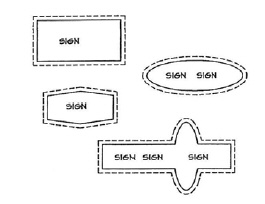
(F) A round or cylindrical sign is calculated as the total area that can be seen at one time from one position.
(G) The height of signs is measured from "grade", as defined, to the highest point of the sign or sign frame.
(H) Sign clearances are measured from "grade" directly below the subject sign to the bottom of the sign or sign frame.
(I) Corner signs shall be assigned to one of the frontages by the applicant and shall conform to the requirements for that frontage only.
(Ord. 225, passed 10-20-1994, § 29.6; Ord. 269, passed 9-18-2014; Ord. 291, passed 6-6-2019)
§ 154.357 NONCONFORMING SIGNS.
Legally established signs that no longer conform to city sign regulations are permitted to remain, subject to the following.
(A) Except as provided in division (C) of this section, maintenance, repairs and the changing of sign faces are permitted; provided, structural alterations are not made and the sign face is not enlarged.
(B) Except as provided in division (C) of this section, any sign in service as of June 6, 2019 is allowed to remain, as long as it complied with the ordinances in existence at the time the sign permit was issued. A nonconforming sign may not be relocated or
structurally altered without achieving full compliance with these regulations.
(C) Any temporary sign that is nonconforming shall be removed immediately.
(Ord. 225, passed 10-20-1994, § 29.7; Ord. 269, passed 9-18-2014; Ord. 291, passed 6-6-2019)
§ 154.358 SPECIFIC SIGN DEVELOPMENT STANDARDS.
(A) Placement requirements for all signs.
(1) With the exception of public authority and other traffic-related signs, all signs shall be erected totally within the boundaries of the site.
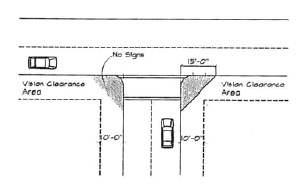
(2) Vision clearance areas shall be maintained at all intersections of private or public roadways, alleys and driveways, to prohibit the placement of any sign within 15 feet of the intersections that obstructs the view between heights of three feet and eight feet. Freestanding signs in vision clearance areas shall be no higher than three feet or, if on a pole, the bottom of the sign must be a minimum of eight feet from the natural grade.
(3) A visio n clear ance setba ck shall be maintained a distance of at least ten feet from the edge of any existing road or from the proposed edge of a planned road.
(4) A vehicle clearance vertical distance of 14 feet from grade to the lowest part of the sign is required for any sign extending over any area in which motor vehicles travel or park, including driveways, parking lots and loading areas.
(B) Additional placement requirements for permanent signs.
(1) A pedestrian clearance vertical distance of eight feet from grade or sidewalk surface to the lowest part of the sign is required for any sign extending over walkways or sidewalks, including "under marquee signs", as defined.
(2) Signs may extend into a public right-of-way only when over a sidewalk or other area not utilized by motor vehicles. The extension shall be no more than six feet beyond the property line and no lower than eight feet above grade or above the surface of the sidewalk.
(3) When roadways or public sidewalks are installed, improved or widened, the City Engineer may direct the property owner to relocate or remove an existing sign, at the owner's expense, if it is determined that the improvements to the roadway or sidewalk will result in an unsafe sign condition.
(C) Additional placement requirements for temporary signs.
(1) Temporary signs and their support structures shall be removed within 45 days of the date of erection, unless they are approved as permanent signs and installed accordingly.
(2) Temporary signs shall not be permanently attached to the ground, a building or to any other structure, although they may be attached securely to prevent theft or wind damage.
(3) In any residential district, temporary signs shall be allowed on a parcel or lot without issuance of a permit and shall not affect the amount or type of signs otherwise allowed by this chapter. These signs shall not be restricted by content, but are usually and customarily used to advertise real estate sales, political or ideological positions, garage sales, home construction or remodeling, and similar activities. Temporary signs shall be removed within seven days after sales, elections, or other events.
(4) Temporary signs are subject to the same setback and clearance requirements of any other sign and shall not cause a hazard to public safety or block the visibility of motorists.
(5) Wind signs or devices that flutter, wave, sparkle or otherwise move from the pressures of the wind are considered temporary signs or devices and shall be used for special purposes and not as a permanent sign device.
(Ord. 225, passed 10-20-1994, § 29.8; Ord. 269, passed 9-18-2014; Ord. 291, passed 6-6-2019) Penalty, see § 154.999
§ 154.359 COMMERCIAL DISTRICT SIGN REGULATIONS.
The following types, numbers, sizes and features of signs are allowed in all commercial zoning districts of the city.
(A) Free-standing signs.
(1) Maximum height of any free-standing sign shall be 35 feet from grade to highest point on the sign or structure.
(2) One free-standing sign is permitted per site; provided, the sign can be placed at least 50 feet from the nearest previously existing free-standing sign of an adjacent business sign.
(3) The maximum sign area for any free-standing sign shall be 48 square feet. A double faced sign may have 48 square feet of sign area on each side.
(4) A shopping center or business complex sign or other sign that combines several sign allowances into a single multiple-copy sign for design or aesthetic purposes may be allowed a total sign area of 64 square feet per side in order to maximize the sign's efficiency and reduce the actual number of free-standing signs.
(5) Any free-standing signs of a temporary nature shall be anchored in place, shall not be within any public right-of-way or on a public sidewalk, shall be no larger than five square feet in sign area and shall extend no higher than 42 inches above the grade.
(B) Signs attached to buildings.
(1) If there is a free-standing sign on the site, then the maximum allowable additional sign area for that site shall be no greater than one and one-half square feet for each linear foot of business frontage.
(2) If the site has no existing free-standing sign, then the maximum allowable sign area for that site shall be no greater than two square feet for each linear foot of business frontage.
(3) Regardless of the total size of the building wall area, any sign attached or painted on to a building, shall not exceed 100 square feet of wall area on the face of any side.
(4) No sign that is attached to a building shall extend above the highest point of the building.
(5) There is no limit on the number of individual signs; provided, the above-stated limitations are maintained for square footage of sign area.
(6) Incidental signs, including directional sign, hours of operation and the like shall not be included in all sign area calculations.
(C) Other provisions.
(1) Signs in any commercial district may be illuminated directly, indirectly or internally; provided, the lighting is directed away from any residences or light-sensitive land uses and away from on-coming traffic.
(2) Moving, rotating, flashing, animated or other similar signs including "tube dancers" are prohibited in the city.
(3) Reader-board or electronic message signs shall be permitted only if no part of the sign is continuously moving and the messages or other parts of the sign change no more frequently than once every 15 seconds.
(4) Wall graphics, as defined, are exempt from sign requirements.
(5) One A-frame/sandwich board/sign on wheels not to exceed eight-square feet in area per side for each business entrance is allowed. The edges of each sign face shall not be more than 36-inches apart. The sign may not be lighted or powered by any means.
(a) The sign may be located within the public right-of-way (sidewalk) if placed directly in front of the business displaying the sign.
(b) The sign must be placed to allow a minimum of four feet of clearance on the sidewalk.
(c) In no case may the sign be displayed when a business is closed.
(Ord. 225, passed 10-20-1994, § 29.9; Ord. 269, passed 9-18-2014; Ord. 291, passed 6-6-2019)
§ 154.360 RESIDENTIAL DISTRICT SIGN REGULATION.
The following types, numbers, sizes and features of signs are allowed in all residential districts of the city.
(A) Free-standing signs.
(1) One free-standing sign shall be permitted at each street entrance to a neighborhood, subdivision, mobile home park, apartment or condominium complex, or other homogenous residential area. The sign shall be designed specifically for that development or area and is subject to approval by the Planning Commission at the time of site plan review. The sign shall be no larger than 32 square feet of sign area and no higher than six feet from grade.
(2) Residential sites having one or two dwelling units may have one freestanding permanent sign, not to exceed a sign area of three square feet per sign.
(3) Residential sites having three or more dwelling units may have one freestanding sign per building, not to exceed a sign area of four square feet per sign.
(4) Any free-standing signs of a temporary nature shall be anchored in place, shall not be within any public right-of-way or on a public sidewalk, shall be no larger than five square feet in sign area and shall extend no higher than 42 inches above grade.
(B) Signs attached to buildings. Any of the free-standing sign limitation outlined in division (A) above may be applied to wall signs or roof signs in lieu of a free-standing sign; provided, the signs do not extend above the roofline.
(C) Other provisions.
(1) Special care shall be taken in residential zoning districts to direct all sign lighting away from residences and away from on-coming traffic.
(2) Moving, rotating, flashing, animated or other similar signs are prohibited in the city.
(3) Reader-board or electronic message signs shall be permitted in residential districts only when associated with and operated and maintained by a public agency, school district or quasi-public entity such as a fraternal organization, church, senior or community multipurpose center and only when approved by the Planning Commission upon findings that a sign is necessary for the function or operation of that public or quasi-public entity and is for the general welfare of the community in general. A sign may be approved to a maximum sign area of 50 square feet.
(4) Wind signs or devices that flutter, wave, revolve, sparkle or are otherwise moved by the wind are prohibited from residential zoning districts.
(Ord. 225, passed 10-20-1994, § 29.10; Ord. 269, passed 9-18-2014; Ord. 291, passed 6-6-2019)
§ 154.361 VARIATIONS TO SIGN REGULATIONS.
(A) (1) With the exception of those sign types that are expressly prohibited, the Planning Commission may make minor adjustments to sign heights, numbers of signs and sign area requirements within 20% of the code requirements.
(2) Any requests of an applicant in excess of the 20% variation shall be processed in accordance with §§ 154.415 through 154.420.
(B) A nonconforming sign may not be relocated or structurally altered without achieving full compliance with these regulations.
(Ord. 225, passed 10-20-1994, § 29.11; Ord. 269, passed 9-18-2014; Ord. 291, passed 6-6-2019) Penalty, see § 154.999
§ 154.362
Materials and construction standards. All signs and their supporting members may be constructed of any suitable material, subject to the provisions of this chapter and meeting building code requirements, including but not limited to the following:
(A) All glass used in the sign shall be shatter-resistant or, if plastic, approved by the building code;
(B) All signs shall be designed, constructed, and erected in accordance with the requirements of the Oregon State Structural Code and the Uniform Sign Code and shall resist the applicable wind loads set forth in the aforementioned codes;
(C) All illuminated signs must be installed subject to the requirements of the State Electrical Code. All electrically illuminated signs shall be listed, labeled, and tested by a testing agency recognized by the state of Oregon;
(D) All signs, together with all of their supports, braces, guys, and anchors, shall be maintained at all times in a state of good repair. All signs and the site upon which they are located shall be maintained in a neat, clean, and attractive condition. Signs shall be kept free from excessive rust, corrosion, peeling paint, or other surface deterioration. The display surfaces of all signs shall be kept neatly painted or posted. Signs that are faded, torn, damaged, or otherwise unsightly, or in a state of disrepair, shall be immediately repaired or removed; and
(E) Handmade signs are not permitted. All signs must be professionally manufactured.
(Ord. 291, passed 6-6-2019)
VIOLATIONS.
It shall be unlawful for any person to violate the standards or requirements of this subchapter and punishment for the violations shall be in accordance with that of any other chapter violation.
(Ord. 225, passed 10-20-1994, § 29.12; Ord. 269, passed 9-18-2014) Penalty, see § 154.999

