
Silverthorne City Zoning Code
ARTICLE XI
Building Code Enforcement
Sec. 4-11-1. - Adoption of standards.
The following materials are hereby adopted in their entirety as part of the Silverthorne Town Code, subject to the modifications as set forth in Section 4-11-2 herein, directly below:
(1)
The International Building Code, 2018 edition, published by the International Code Council, Inc.
(2)
The International Residential Code, 2018 edition, including Appendices F, K, and Q published by the International Code Council, Inc.
(3)
The International Mechanical Code, 2018 edition, including Appendix A, published by the International Code Council, Inc.
(4)
The International Plumbing Code, 2018 edition, published by the International Code Council, Inc.
(5)
The International Fuel Gas Code, 2018 edition, including Appendices A and B, published by the International Code Council, Inc.
(6)
The International Existing Building Code, 02018 edition, published by the International Code Council, Inc.
(7)
The International Energy Conservation Code, 2018 edition, published by the International Code Council, Inc.
(8)
The ICC Electrical Code, 2000 edition—Administrative Provisions, published by the International Code Council, Inc.
(9)
The International Swimming Pool and Spa Code, 2018 edition, as amended, published by the International Code Council Inc.
(10)
The Uniform Code for Building Conservation, 1997 Edition, including Appendix Chapter 3, published by the International Conference of Building Officials.
(11)
The Uniform Code for the Abatement of Dangerous Buildings, 1997 Edition, published by the International Conference of Building Officials.
(12)
The National Electrical Code, 2023 Edition, published by the National Fire Protection Association.
(Ord. 2013-11 §1, 2013; Ord. 2015-2 § 1; Ord. 2019-20 §1(Exh. A); Ord. No. 2021-12 §1; Ord. 2023-10 § 1)
Sec. 4-11-2. - Amendments.
The codes [adopted in Section 4-11-1] are hereby made subject to the incorporation of the following additions, deletions and modifications:
(a)
2018 International Building Code.
(1)
Section 101.1 Title is amended by adding the name, Building Code of the Town of Silverthorne.
(2)
Section 101.4.3 Plumbing is amended by deleting the last sentence that references the International Private Sewage Disposal Code.
(3)
Section 101.4.4 Property Maintenance is deleted in its entirety.
(4)
Section 102.6 Existing Structures is amended by removing the reference to the International Property Maintenance Code.
(5)
Section 103.2 Appointment is amended to read as follows:
103.2 Building Official. The Building Official is hereby authorized and directed to enforce all of the provisions of this code. Nevertheless, such authorization and direction shall be neither an express nor implicit guaranty that all buildings and structures have been constructed in accordance with all of the provisions of this code, nor be deemed as any representation as to the quality of such buildings or structures in any manner.
(6)
Section 103.3 Deputies is amended to read as follows:
103.3 Deputies. In accordance with the prescribed procedures of this jurisdiction, the building official shall have the authority to appoint a deputy building official, related technical officers, inspectors, plan examiners and other employees. Such employees shall have those powers and duties as have been expressly delegated by the building official, subject to modification from time to time.
(7)
Section 104.8 Liability is amended by adding the following first paragraph:
The adoption and implementation of this code, as well as any previous Building Construction and Housing Standards adopted by the Town of Silverthorne, shall not be deemed to give rise to a duty of care on the part of any public entity, public employee or agent. Neither this code nor any previous Building Construction and Housing Standards shall create any affirmative duty or be deemed to establish any affirmative representation on behalf of the Silverthorne Town Council, Town of Silverthorne, the Building Official, its employees, officials or agents.
(8)
Sections 105.1.1 and 105.1.2 Annual Permit and Annual Permit Records are hereby repealed in their entirety.
(9)
Section 105.5 Expiration is amended to read as follows:
105.5 Expiration. (a) Every permit issued by the building official under the provisions of this code shall expire 18 months after the date of issue. The building official is authorized to grant an extension to the validity of such permits, for a period of time not to exceed 18 months. Such extensions shall be based upon written request by an applicant demonstrating, to the discretion of the Building Official, justifiable cause for the extension, and shall be effective as of the day of written approval. In special circumstance deemed by the Building Official, a secondary one year extension beyond the 1st extension may be granted for a fee of 50% of the original building permit fee. (b) Every stand-alone technical (mechanical, electrical, plumbing, fireplace, and photovoltaic) permit issued by the building official under the provisions of this code shall expire 6 months after the date of issue. Standalone window and hot tub permits issued by the building official under the provisions of this code shall also expire 6 months after the date of issue. The building official is authorized to grant an extension to the validity of such permits, for a period of time not to exceed 3 months. Such extensions shall be based upon written request by an applicant demonstrating, to the discretion of the Building Official, justifiable cause for the extension, and shall be effective as of the day of written approval.
(9A)
Section 105 is amended by the addition of the following subsections:
105.8 Sanitation. After permit issuance and before any approved work is started, toilets are required at all construction job sites.
105.9 Dumpsters. After permit issuance and before any approved work is started, dumpsters, adequate in size to handle trash and unwanted materials from the permitted project, shall be in place.
105.10 Construction noise. Construction noise, including the operation of construction equipment or vehicles, shall be restricted to the hours of 7:00 a.m. to 7:00 p.m., Monday through Saturday. No Construction is permitted on Sundays.
105.11 Temporary identification. After permit issuance and before any approved work is started, temporary addresses, conforming to Sections 501.2 or R319.1, must be posted on all job sites and must be maintained until permanent numbers are in place.
(10)
Section 107.1 General is amended to read as follows:
107.1 General. Submittal documents consisting of construction documents, statement of special inspections, geotechnical report and other data shall be submitted in one or more sets with each permit application. The construction documents, to include structural analysis, shall be prepared by a registered design professional. The Building Official may waive the requirement for a design professional when it is found that the nature of the work is such that a design professional is not necessary to obtain compliance with the code. Where special conditions exist, the Building Official is authorized to require additional construction documents to be prepared by a registered design professional.
(11)
Section 109.2 Schedule of Permit Fees is amended to read as follows:
109.2 Schedule of permit fees. On buildings, structures, electrical, gas, mechanical, and plumbing systems or alterations requiring a permit, a fee for each permit fee shall be paid as required, in accordance with the Town of Silverthorne Construction Permit Fee Schedule.
(12)
Section 109.3 Building Permit Valuations is amended to add the following sentence:
109.3 Building permit valuations. The applicant for a permit shall provide an estimated valuation at the time of application. The valuation used for the building permit shall include the valuation of work for which the permit is being issued, including labor and materials, for the plumbing, electrical, gas, mechanical and fireplace systems. If, in the opinion of the building official, the valuation is underestimated on the application, the permit shall be denied, unless the applicant can show detailed estimates to meet the approval of the building official. Final building permit valuation shall be set by the building official.
(13)
Section 109.4 Work Commencing Before Permit Issuance is amended to read as follows:
109.4 Work commencing before permit issuance. Any person who commences any work on a building, structure, electrical, gas, mechanical or plumbing system before obtaining the necessary permits or proceeds with work beyond the scope of work authorized by any permit, including a conditional permit, shall be subject to an investigation fee in addition to the permit fee. The investigation fee shall be collected whether or not a permit is then or subsequently issued. The investigation fee shall be equal to the permit fee as set forth in this fee schedule. The payment of such investigation fee shall not exempt any person from compliance with all other provisions of this code nor from any penalty prescribed by law.
(13A)
Section 109.6 Refunds is added to read as follows:
109.6 Refunds. The building official may authorize refunding of any fee paid hereunder that was erroneously paid or collected. The building official may authorize refunding of not more than 80 percent of the permit fee paid when no work has been done under a permit issued in accordance with the adopted codes. The building official may authorize refunding of not more than 80 percent of the plan review fee paid when an application for a permit for which a plan review fee has been paid is withdrawn or canceled before any plan reviewing is done. The building official shall not authorize refunding of any fee paid except on written application filed by the original permit holder not later than 180 days after the date of fee payment.
(13B)
Subsection 110.3.1 Improvement survey required is added as follows:
110.3.1 Improvement survey required. Prior to requesting a foundation inspection, an improvement location certificate of the lot, prepared by a Colorado State licensed surveyor, shall be submitted to the Community Development Department to verify that any new construction is located in accordance with the approved plans. The survey must be approved before the foundation inspection will be performed.
(14)
Section110.3.5 Lath and Gypsum Board Inspection is amended by deleting the exception.
(15)
Section 110 Inspections is amended by adding a new subsection to read as follows:
110.7 Reinspections. A reinspection fee, as specified in the Town of Silverthorne Construction Permit Fee Schedule, may be assessed for each inspection or reinspection when such portion of work for which inspection is called is not complete or when corrections called for are not made. Reinspection fees may be assessed when any of the following conditions exist:
a.
the inspection record card is not posted or otherwise available on the work site,
b.
the approved plans are not readily available to the inspector,
c.
the applicant fails to provide access on the date for which the inspection is requested, or
d.
deviation from plans requiring the approval of the building official.
In instances where reinspection fees have been assessed, no additional inspection of the work will be performed until the reinspection fees have been paid.
(16)
Section 111.1 Use and occupancy is amended to read as follows;
111.1 Use and occupancy. No building or structure shall be used or occupied, as defined in amended Section 202, and no change in the existing occupancy classification of a building or structure or portion thereof shall be made until the Town has issued a certificate of occupancy or completion therefore as provided herein. Issuance of a certificate of occupancy or completion shall not be construed as an approval of a violation of the provisions of this code or of other ordinances of the Town. Certificates presuming to give authority to violate or cancel the provisions of this code or other ordinances of the Town shall not be valid.
(17)
Section 111.2 Certificate issued is amended by changing the opening paragraph to read as follows:
111.2 Certificate issued. After the building official inspects the building or structure and finds no violations of the provisions of this code or any applicable laws of the Town, and all required fees have been paid, the building official shall issue a certificate of occupancy. The Town may delay the issuance of the certificate of occupancy for fifteen (15) days from the date of the final building inspection to allow other departments and entities to inspect for, and approve, compliance with their regulations. The certificate of occupancy shall contain the following:
(18)
Section 111.3 Temporary Occupancy is deleted in its entirety.
(19)
Section 111.4 Revocation is amended to read as follows:
Section 114.4 Revocation. The Town may, in writing, suspend or revoke a certificate of occupancy issued under the provisions of this code whenever the certificate of occupancy is issued in error, or on the basis of incorrect information supplies, or when it is determined that the building or structure or portion thereof is in violation of any of the provisions of this code, or that the real property upon which the building or structure is located is in violation of any applicable ordinance or regulation of the Town or is in violation of any development approval or approved site plan for such property.
(20)
Section 111 Certificate of Completion is amended by adding a new subsection to read as follows:
111.5 Certificate of Completion. A Certificate of Completion shall be issued for minor work not directly related to occupancy when such work complies with the provisions of this code and all other laws and regulations implemented by the code enforcement agency.
(21)
Section 113.1 General is hereby deleted as written and replaced with the following:
113.1 General. Appeals or orders, decisions or determinations made by the building official relative to the application and interpretation of this code shall be made to the Board of Adjustment as provided in Section 5.2 of the Town of Silverthorne Home Rule Charter.
(22)
Section 113.3 Qualifications is hereby deleted in its entirety.
(23)
Section 201.3 Terms defined by other codes is amended by addition the following at the end of the sentence:
…, or the Building Coode of the Town of Silverthorne, or the Silverthorne Town Code.
(24)
Section 202 Definitions is amended by adding the following definitions within the alphabetical order of the existing definitions:
BEDROOM. See POTENTIAL SLEEPING ROOM.
LOFT. A habitable room or floor in a building that is open to the room or floor directly below, which may or may not qualify as a mezzanine.
POTENTIAL SLEEPING ROOM. A room or space within a dwelling unit having a floor area, with 5 feet or more of ceiling height, of at least 70 square feet will be considered a sleeping room in accordance with the following:
In a building defined as a dwelling or lodging house, any space or room having two of the following factors shall be considered a sleeping room. In a building defined as an apartment house or hotel, any room or space having one of the following factors shall be considered a sleeping room:
a.
Has walls and doors to separate it from other habitable spaces
b.
Meets the definition of a loft as amended by the Town of Silverthorne
c.
Has a closet or similar provision for clothes storage
d.
Has a full or partial bathroom connected to the space or room, or has a path of travel to a full or partial bathroom which does not first pass through a habitable space.
Rooms or spaces determined by these criteria to be sleeping rooms, regardless of any names, labels, or intended uses proposed by the building designer or owner, shall have emergency escape and rescue opening per the 2018 International Building Code, Section 1030, smoke detectors per Section 907, and carbon monoxide detectors per IBC Section 915.
Any alteration to the room or space previously mentioned will be required to be made permanent in nature. The elimination of doors or closets will be made in such a manner that the construction cannot be readily reinstalled.
STORAGE. A room or space within a dwelling unit available for storing something.
UNFINISHED SPACE. A room or space within a dwelling unit with no interior partition walls, no gypsum board (unless required by code), no finishes (mud, tape, and/or paint) on areas requiring gypsum board, and no floor finishes.
(25)
Section 501.2 Address Identification. Approved numbers or addresses shall be provided for new buildings in such a position as to be clearly visible and legible from the street or roadway fronting the property. Letters or numbers shall be a minimum of 5 inches in height and of minimum 0.5 inch stroke, the premise identification characters shall be reflective. When the building is more than 150 feet from the curb or shoulder of the street, the address characters shall be affixed to a post or sign on the property, within 10 feet of the property line and visible from the street. Permanent numbers or addresses must be in place prior to requesting the final inspection and must be approved before a certificate of occupancy may be issued.
(26)
Section 718 Concealed Spaces is amended by adding two new subsections to read as follows:
718.6 Factory-built fireplace enclosures. Combustible construction enclosing factory-built fireplaces with class A chimneys shall be protected on the interior (fireplace) side by one-hour fire resistive construction.
718.7 Factory-built chimney enclosures. Factory-built class A chimneys shall be enclosed within a continuous enclosure protected on the interior (flue) side by not less than one-hour fire resistive construction.
Exception: The portion of the chimney located in the same room as the appliance and the portion of the chimney above the finished roof are not required to be enclosed. However, if they are enclosed, the interior of the shaft shall be protected by one-hour fire resistive construction.
(27)
Section 901.2 Fire protection systems is amended by changing the opening paragraph to read as follows:
901.2 Fire protection systems. Fire protection systems shall be installed, repaired, operated and maintained in accordance with this code and the International Fire Code, as adopted and amended in the Silverthorne Town Code, Chapter 4, Article XI, Division 5, Fire Safety.
(28)
Section 901.5 Acceptance Tests is amended by changing the opening paragraph to read as follows:
901.5 Acceptance Tests. Fire protection systems shall be tested in accordance with this code and the International Fire Code, as adopted and amended in the Silverthorne Town Code, Chapter 4, Article XI, Division 5, Fire Safety.
(29)
Section 1010.1.9.4 Locks and latches item 2.2 is amended to read as follows:
1010.1.9.4 Item 2.2 A readily visible durable sign is posted on the egress side on or adjacent to the door stating: THIS DOOR TO REMAIN UNLOCKED DURING BUSINESS HOURS. The sign shall be in letters 1 inch high on a contrasting background.
(30)
Section 1106 Parking and Passenger Loading Facilities is deleted in its entirety.
(31)
Table 1106.1 Accessible Parking Spaces is hereby repealed in its entirety.
(32)
Chapter 12 Interior Environment is amended by adding a new section to read exactly as set forth in Appendix F of the 2018 IRC. This shall be applicable for R2 and R3 occupancies.
(33)
Section 1503 Weather Protection is amended by adding a new subsection and an exception to read as follows:
1503.7 Snow-shed barriers. Roofs shall be designed to prevent accumulations of snow from shedding onto exterior balconies, decks, pedestrian and vehicular exits from buildings, stairways, sidewalks, streets, alleys, areas directly above or in front of gas utility or electric utility meters, or adjacent properties.
Exception 1: Roof areas with a horizontal dimension of no more than 48 inches (1,219 mm) that will not receive snow shedding from a higher roof. The horizontal projection shall be measured perpendicular to the exterior wall line from the edge of the roof or eave to any intersecting vertical surface.
Exception 2: Roofs equipped with mechanical barriers secured to roof framing members or, to solid blocking secured to framing members, in accordance with the manufacturer's installation instructions. Individual devices installed in a group to create a barrier to prevent snow shedding shall be installed in at least two rows with the first row no more than 24 inches from the edge of the roof or eave. The rows shall be parallel with the bottom edge of the roof and the devices shall be staggered no more than 24 inches on center from those in adjacent rows. Continuous snow barriers shall be secured to roof framing at no more than 48 inches on center. Continuous barriers shall be installed parallel with the exterior wall line and no more than 24 inches from the edge of the roof or eave.
(34)
Section 1503.8 Roof Drainage. Roofs shall be oriented and positioned, or otherwise arranges and designed, to prevent water from dripping and ice accumulating at required pedestrian exits and means of egress components and required accessible routes. Where additional exits or accessible routes are provided for egress purposes, this section shall apply only to the main exit and route.
Exception: Roofs equipped with gutters and leaders conforming with Section 1503.4. Such gutters and leaders shall be provided with approved heat tracing installed in accordance with the manufacturer's installation instructions and the ICC Electrical Code, to prevent ice build-up and blockages.
(35)
Section 1505.1 General is amended to read as follows:
1505.1 General. All roof coverings on new construction shall be Class A. Class A roof assemblies and roof coverings required to be listed by this section shall be tested in accordance with ASTM E 108 or UL 790. In addition, fire-retardant-treated wood roof coverings shall be tested in accordance with ASTM D 2898.
Table 1505.1 and all footnotes to the table Minimum Roof Covering Classification for Types of Construction are hereby repealed in their entirety.
(36)
Section 1507.1 Scope is amended by inserting a new subsection to read as follows:
1507.1.2 Ice dam protection. An ice dam protection underlayment that consists of an approved self-adhering polymer modified bitumen sheet shall be used with all roof coverings. This ice dam protection underlayment shall extend up the slope of the roof from the drip-edge of the roof or eave and cover the entire roof decking surface.
(37)
Section 1507.8 Wood Shingles is amended to read as follows:
1507.8 Wood shingles. The installation of wood shingles shall comply with the provisions of this section.
Table 1507.8 Wood Shingle and Shake Installation is hereby repealed in its entirety.
(38)
Section 1507.9 Wood Shakes is amended to read as follows:
1507.9 Wood shakes. The installation of wood shakes shall comply with the provisions of this section.
(39)
Section 1608.1 is amended by adding the following exception:
Exception: A uniform, non-reducible design snow load of 75 pounds per square foot may be used for the design of roof snow loads.
(40)
Section 1608.2 Ground Snow Loads is amended to read as follows:
1608.2 Ground Snow loads. The ground snow load to be used in determining the design snow loads for roofs shall be 80 pounds per square foot.
(41)
Section 1612.3 Establishment of Flood Hazard Areas is amended to read as follows:
1612.3 Establishment of flood hazard areas. To establish flood hazard areas, the governing body shall adopt a flood hazard map and supporting data. The flood hazard map shall include, at a minimum areas of special flood hazard as identified by the Federal Emergency Management Agency in an engineering report entitled, "The Flood Insurance Study for the Town of Silverthorne," currently in effect, as amended or revised with the accompanying Flood Insurance Rate Map (FIRM) and Flood Insurance Study (FID) and related supporting data along with any revisions thereto. The adopted flood hazard map and supporting date are hereby adopted by reference and declared to be part of this section.
(42)
Section 1803.2 Investigations required is amended to read as follows:
1803.2 Investigations required. The owner or applicant shall submit a foundation and soils investigation to the building official with each permit submittal for new foundations supporting new construction.
Exception: In other than public use occupancies, this requirement may be waived, at the discretion of the building official, for minor additions and projects such as uncovered deck or uninhabited, detached accessory buildings.
(43)
Section 1809.5 Frost Protection is amended to add the following sentence:
Frost line of the locality is established as 40 inches below grade.
(44)
Section 2113 Masonry Chimneys is amended by adding the following subsections to read as follows:
2113.21 Limitation on the type and number of devices. Solid fuel burning devices that are not properly certified are prohibited in new construction. Outdoor wood-fired hydronic heaters shall not be allowed on properties less than 5 acres. The number of certified solid fuel burning devices that may be installed in newly constructed buildings shall not exceed the number as outlined in the Town of Silverthorne Code Section 4-8-2: Solid Fuel Burning Devices.
NEW CONSTRUCTION, for the purpose of this section, is construction of a residential, commercial, industrial, agricultural or accessory building. This shall include any modifications, replacement or relocation of existing solid fuel burning devices. However, modifications to solid fuel burning devices shall not include repair, replacement or relocation of flue pipe.
SOLID FUEL BURNING DEVICES are any fireplace, stove, firebox, or other device intended and/or used for the purpose of burning wood, coal, pulp, paper, pellets or other non-liquid or non-gaseous fuel.
Section 2113.22 Factory built chimneys
a.
Factory built chimneys shall be supported at intervals not to exceed 10 feet by wall straps or equivalent.
b.
Factory built chimneys shall have the outer wall of adjacent chimney sections fastened together by three sheet metal screws, installed approximately 120 degrees apart. Such fastenings shall be in addition to and not in lieu of those requirements mandated by the manufacturers' instructions, except when specifically prohibited by those instructions or the terms of their listing.
Exception: Where approved manufacturers' locking bands are used.
c.
The points of termination of a factory built chimney shall not be within 10 inches vertically of the point of termination of any adjacent chimney or appliance vent within 24 inches horizontally. No factory built chimney shall terminate closer than 24 inches to combustible finish materials.
(45)
Section 2303.1.11 Round Timber Poles and Piles is amended by adding the following paragraph:
All logs used in a structural capacity must be graded and marked by an approved grading agency, in conformance with DOC PS 20. In lieu of a grade mark, a certificate of an onsite inspection issued by a 3rd party lumber grading or inspection agency may be accepted.
(46)
Section 2308.7.13 Wood Trusses is amended by adding the following sentence:
Trusses shall be blocked at bearing points.
(47)
Section 2901.1 Scope is amended by deleting the reference to the International Private Sewage Disposal Code.
(48)
Section (P) 2902.1.2 Single-User Toilet Facility and Bathing Room Fixtures is amended to read exactly as follows:
Section (P) 2902.1.2 Single-User Toilet Facility and Bathing Room Fixtures. Single-user toilet facilities and bathing rooms and family or assisted-use toilet rooms and bathing rooms shall be identified as being open for use to all persons, regardless of gender. A single-occupant restroom is one that contains only one toilet and a sink, or a toilet and urinal with a sink, and is intended for use by one occupant at a time. Family or assisted-use restrooms must also be designated as gender-neutral. All gender neutral bathrooms are to be signed accordingly.
(49)
Section 2902.2 Exception 2 Separate Facilities is amended to read as follows:
2902.2 Exception 2. Separate facilities shall not be required in structures or tenant spaces with a total occupant load, including both employees and customers, of 30 or less.
(50)
Section (P) 2902.2 Separate facilities is amended to add a fifth exception:
Exception 5. Gender neutral single-user toilet facility and bathing room fixtures.
(51)
Chapter 30 is amended by adding four new sections and subsections to read as follows:
Section 3009.1 Permits required. It shall be unlawful to install any new elevator, moving walk, escalator or dumbwaiter, or to make major alterations to any existing elevator, dumbwaiter, escalator or moving walk, as defined in Par XII of ASME A17.1-2007, without first having obtained a permit for such installation for the building official. Permits shall not be required for maintenance or minor alterations.
Section 3009.2 Certificate of inspection required. It shall be unlawful to operate any elevator, dumbwaiter, escalator or moving walk without a current certificate of inspection issued by the building official. Such certificate shall be issued upon payment of prescribed fees and the presentation of a valid inspection report indicating that the conveyance is safe and that the inspections and tests have been performed in accordance with Par X of the ASME A17.1-2007. Certificates shall not be issued when the conveyance is posted as unsafe pursuant to Section 3010.
Exception: Certificates of inspection shall not be required for conveyances within a dwelling unit.
Section 3009.3 Application for permits. Application for a permit to install shall be made on forms provided by the building official, and the permit shall be issued to an owner upon payment of the permit fees specified in this section.
Section 3009.4 Application for certificates of inspection. Application for a certificate of inspection shall be made by the owner of an elevator, dumbwaiter, escalator or moving walk. Applications shall be accompanied by an inspection report as described in Section 3009. Fees for certificates of inspection shall be as specified in this section.
Section 3009.5 Fees. A fee for each permit or certificate of inspection shall be paid to the building official as prescribed in the Town of Silverthorne Construction Permit Fee Schedule.
Section 3010.1 Detailed requirements. For detailed design, construction and installation requirements, see Chapter 16 and the appropriate requirements of ASME A17.1-2007.
Section 3011.1 General. The owner shall be responsible for the safe operation of and maintenance of each elevator, dumbwaiter, escalator and moving walk installation and shall cause periodic inspections to be made on such conveyances as required in this section.
Section 3011.2 Periodic inspections and test. Routine and periodic inspections and tests shall be made as required by Par X of ASME A17.1-2007.
Section 3011.3 Alterations, repairs and maintenance. Alterations, repairs and maintenance shall be made as required by Part XII AS<E A17.1-2007.
Section 3011.4 Inspection costs. All costs of such inspections and tests shall be paid by the owner.
Section 3011.5 Inspection reports. After each required inspection, a full and correct report of such inspection shall be filed with the building official.
Section 3012.1 Unsafe conditions. When an inspection reveals an unsafe condition of an elevator, moving walk, escalator or dumbwaiter, the inspector shall immediately file with the owner and the building official a full and true report of such inspection and such unsafe condition. If the building official finds that the unsafe condition endangers human life, the building official shall cause to be placed on such elevator, escalator or moving walk, in a conspicuous place, a notice stating that such conveyance is unsafe. The owner shall see to it that such notice of unsafe condition is legibly maintained where placed by the building official. The building official shall also issue an order in writing to the owner requiring the repairs or alterations to be made to such conveyance that are necessary to render it safe and may order the operation thereof discontinued until the repairs or alterations are made or the unsafe conditions are removed. A posted notice of unsafe conditions shall be removed only by the building official when satisfied that the unsafe conditions have been corrected.
(52)
Chapter 36.
The International Building Code is amended to add Chapter 36 to read exactly as set forth in Chapter 45 of the IRC, Fire Mitigation.
(b)
2018 International Existing Building Code.
(1)
Section 101.1 Title is amended by adding the name, "Silverthorne Town Code."
(2)
Section 101.4.2 Buildings Previously Occupied is amended by deleting the reference to the International Property Maintenance Code.
(3)
Section 103.2 Appointment is amended to read exactly as set forth in IBC Amendment 103.2.
(4)
Section 103.3 Deputies is amended to read exactly as set forth in IBC Amendment 103.3.
(5)
Section 104.8 Liability is amended to read exactly as set forth in IBC Amendment 104.8.
(6)
Section 105.5 Expiration is amended to read exactly as set forth in IBC Amendment 105.5.
(7)
Section 109 Inspections is amended to add a new subsection.
109.7 Reinspections to read exactly as set forth in IBC Amendment 110.7.
(8)
Section 113.4 Violation Penalties is amended to read exactly as set forth in IBC 114.4.
(9)
Section 1301.3.2 Compliance with Other Codes is amended by deleting the reference to the International Property Maintenance Code.
(10)
Section 1301.4 Investigation and Evaluation is amended to read as follows:
Section 1301.4 Investigation and evaluation. For proposed work covered by this section, the building owner shall cause the existing building to be investigated and evaluated in accordance with the provisions of this section by a design professional licensed to practice in the State of Colorado.
(11)
Section 1301.6 Evaluation Process is amended by adding the following first paragraph.
The building owner shall cause the existing building to be evaluated in accordance with the provisions of this section by a design professional(s) licensed to practice in the State of Colorado.
(c)
2018 International Swimming Pool and Spa Code.
(1)
Section 101.1 Title is amended by adding the name, "Silverthorne Town Code."
(2)
Section 103.2 Appointment is amended to read exactly as set forth in IBC Amendment 103.2.
(3)
Section 103.3 Deputies is amended to read exactly as set forth in IBC Amendment 103.3.
(4)
Section 103.4 Liability is amended to read exactly as set forth in IBC Amendment 104.8.
(5)
Section 105.5.3 Expiration is amended to read exactly as set forth in IBC Amendment 105.5.
(6)
Section 106.18 Reinspection and testing is amended to read exactly as set forth in IBC Amendment 110.7.
(7)
Section 107.4 Violation Penalties is amended to read exactly as set forth in IBC 114.4.
(8)
Section 108 Means of Appeal is amended to read exactly as set forth in IBC 113.
(d)
2018 International Residential Code.
(1)
Section R101.1 Title is amended to read as follows: These provisions shall be known as the Residential Code for One-and Two-Family Dwellings of The Town of Silverthorne, and shall be cited as such and will be referred to herein as "this code."
(2)
Section R101.2 Scope Exception is amended to read as follows:
Section R101.2 Exception. The following shall be permitted to be constructed in accordance with this code.
(3)
Section R102.7 Existing Structures is amended by deleting the reference to the International Property Maintenance Code.
(4)
Section R103.3 Deputies is amended to read exactly as set forth in IBC amendment 103.3.
(5)
Section R104.8 Liability is amended by adding a first paragraph to read exactly as set forth in IBC amendment 104.8.
(6)
Section R105.2 1 Work Exempt from Permit is amended to read exactly as set forth in IBC 105.2 1.
(7)
Section R105.5 Expiration is amended to read exactly as set forth in IBC amendment 105.5.
(8)
Section R106.1 Submittal Documents the first paragraph is amended to read exactly as set forth in IBC amendment 107.1.
(9)
Section R108.2 Schedule of Permit Fees is amended to read exactly as set forth in IBC amendment 109.2.
(10)
Section R108.3 Building Permit Valuations is amended to read exactly as set forth in IBC 109.3 including the amendment.
(11)
Section R108.6 Work Commencing Before Permit Issuance is amended to read as set forth in IBC amendment 109.4.
(12)
Section R109 Inspections is amended by adding a new subsection to read as set forth in IBC amendment 110.7.
(13)
Section R201.3 Terms defined in other codes is amended by adding the following at the end of the sentence:
…, the Building Code of the Town of Silverthorne, or the Silverthorne Town Code.
(14)
Section R202 Definitions is amended by adding the following definitions within the alphabetical order of the existing definitions:
HOMEOWNER BUILDER is hereby defined as any individual who is the owner of the property subject to a building permit if the home is being built for the occupancy of the homeowner builder, and not for the purposes of commercial or residential development. Such homeowner builders may be allowed to pull building and technical permits to perform work on a detached single family residence, based in entirety upon their classification as the Homeowner. It shall be the duty of the individual applying for the permit to establish, to the satisfaction of the Building Official, that he or she is in fact a Homeowner Builder. Family trusts, Limited Liability Corporations and Partnerships do not meet the criteria of a Homeowner Builder.
Exception: An owner of an attached single family residence may be issued permits as a Homeowner Builder for exterior decks or detached accessory buildings
LOFT is amended to read exactly as IBC amendment 202.
POTENTIAL SLEEPING ROOM is amended to read exactly as IBC amendment 202.
UNFINISHED SPACE. A room or space within a dwelling unit with no interior partition walls, no gypsum board (unless required by code), no finishes (mud, tape, and/or paint) on areas requiring gypsum board, and no floor finishes.
STORAGE. A non-habitable room or space within a dwelling unit used for storage. A storage room or space shall not have TV or internet outlets, closets, or other improvements outside of what is typical for storage areas. Light and ventilation is not required in the non-habitable space per code. This space is not approved for living, sleeping, eating or cooking.
TOWNHOUSE. A single-family dwelling unit constructed in a group of two or more attached units in which each unit extends from foundation to roof and with a yard or public way on at least two sides.
(15)
Table R301.2(1) Climatic and Geographic Design Criteria is amended to read as follows:
"TABLE R301.2(1)
CLIMATIC AND GEOGRAPHIC DESIGN CRITERIA
* The Town of Silverthorne entered into the National Flood Insurance Program in November 1979. The date of the currently effective Flood Insurance Reference Map shall preside.
For SI: 1 pound per square foot = 0.0479 kN/m.0 2, 1 mile per hour = 1.609 km/h.
(a) Weathering may require a higher strength concrete or grade of masonry than necessary to satisfy the structural requirements of this code. The grade of masonry units shall be determined from ASTM C 34, C 55, C 62, C 73, C 90, C 129, C 145, C 216 or C 652.
(b) The frost line depth may require deeper footings than indicated in Figure R403.1 (1). This part of the table is filled in depending on whether there has been a history of local damage. Piers supporting only deck with no roof elements may be a minimum of 24" below grade. One story, detached garages, with no plumbing are allowed to have a 18" frost protected, monolithic slab as a foundation.
(c) This part of the table is filled in depending on whether there has been a history of local damage.
(d) Wind exposure category shall be determined on a site-specific basis in accordance with Section R301.2.1.4.
(e) Reflects local climates or local weather experience as determined by the building official.
(f) Seismic Design Category determined from Section R301.2.2.2.
(i) In accordance with R905.1 as amended.
(j) From the 100 year (99%) value on the National Climatic Data Center data table "Air Freezing Index- USA Method (Base 32degrees F)"
(k) From the National Climatic Data Center data table "Air Freezing Index-USA Method (Base 32 degrees F)"
(16)
Section R301.2.3 Snow loads is amended to read as follows:
R301.2.3 Snow loads. Buildings shall be designed in accordance with accepted engineering practice. Design snow loads shall be determined in accordance with Section 7 of ASCE 7, using ground snow load of 80 pounds per square foot.
Exception: Roofs may be designed using a uniform, non-reducible design snow load of 75 pounds per square foot, in accordance with section R301.6.
(17)
Table R301.5 Minimum Uniformly Distributed Live Loads is amended by changing the live loads listed for decks, exterior balconies and fire escapes to 75 pounds per square foot.
(18)
Section R302.1 is amended to read as follows:
R302.1 Exterior walls. Construction, projections, openings and penetrations of exterior walls of dwellings and accessory buildings shall comply with Table R302.1(1); or dwellings equipped throughout with an automatic sprinkler system installed in accordance with all applicable provisions of the governing fire district's code shall comply with Table R302.1 (2).
(19)
Table R302.1(2) Exterior Walls Footnote a—Dwellings with Fire Sprinklers is hereby amended to read as follows:
a.
For residential subdivisions where all dwellings are equipped throughout with an automatic sprinkler system installed, permitted and inspected to show compliance with all applicable requirements of the governing fire district's code, the fire separation for nonrated exterior walls and rated projections shall be permitted to be reduced to 0 feet, and unlimited unprotected openings and penetrations shall be permitted, where the adjoining lot provides an open setback yard that is 6 feet or more in width on the opposite side of the property line.
(20)
Section R302.2.2 Parapets items 1 and 2 are amended to read as follows:
1.
Where a fire sprinkler system in accordance with requirements of the governing fire district's code is provided, the common wall shall be not less than a 1-hour fire-resistance-rated wall assembly tested in accordance with ASTM E119, UL 263 or Section 703.3 of the International Building Code.
2.
Where a fire sprinkler system in accordance with requirements of the governing fire district's code is not provided, the common wall shall be not less than a 2-hour fire-resistance-rated wall assembly tested in accordance with ASTM E119, UL 263 or Section 703.3 of the International Building Code.
(21)
Section R302.13 Exception 1 Fire protection of floor is amended to read as follows:
R302.13 Exception 1. Floor assemblies located directly over a space protected by an automatic sprinkler system permitted, installed and inspected as required by the fire district having jurisdiction.
(22)
Section R302.13 Exception 2 Fire protection of floor is amended to read as follows:
R302.13 Exception 2. Floor assemblies located directly over a crawlspace with a maximum 4' headroom occurring anywhere within the crawlspace. The headroom shall be measured from grade to the bottom of the floor joists.
(23)
Section 303.5.1 Intake Openings is amended by adding the following subsection:
R303.5.1.1 Snow depth. Any required air intake openings that terminate outdoors shall be located a minimum of 3 feet above final grade.
Exception: With prior approval of the building official, openings may be protected from snow accumulation and drifting by decks, roofs, cantilevers, or similar means providing equivalent protection.
(24)
Section R310.1 Emergency Escape and Rescue Opening Required exception 2 is amended to read as follows:
2.
Where the dwelling or townhouse is equipped with an automatic sprinkler system installed in accordance with the requirements of the governing fire district's code, sleeping rooms in basements shall not be required to have emergency escape and rescue openings provided that the basement has one of the following:
2.1.
One means of egress complying with Section R311 and one emergency escape and rescue opening.
2.2.
Two means of egress complying with Section R311.
(25)
Section R313 is hereby amended to read as follows:
Section R313 Dwelling Unit Fire Sprinkler Systems and Internal Fire Protection.
Section R313.1 General. All structures under the scope of this code are to be provided sprinkler systems as designated, reviewed, installed and inspected by the applicable Fire District per section R313.1.1 through R313.1.2.
Section R313.1.1 Sprinklers required. Structures greater than 6,000 square feet are to be sprinklered per the Fire District having jurisdiction. Square footages shall include all attached garages and any detached structures within 3 feet of the residence. Square footage shall be measured from exterior wall to exterior wall. Fire separations within the structure shall not be utilized to reduce the measured square footages of the structure(s).
Section R313.1.2 Additions. Any addition which increases the total square footage of the residence to greater than 6,600 square feet is to be provided with sprinkler systems at the addition only. Where the size of the addition itself is greater than 6,000 square feet, the addition as well as the existing residence shall be provided with sprinklers. Where the addition increases the total square footage of the residence to greater than 6,600 square feet and the alterations to the existing structure results in the removal of interior wall and ceiling finishes exposing the structure, sprinkler systems shall be retro-fitted into the existing residence as well as the addition.
Section R313.2 Internal fire protection. Residences between 4,000 and 6,000 square feet shall be provided with ⅝" Type 'X' drywall or ½" cementious board throughout the structure.
(26)
Section R319.1 Address Identification is amended to read as follows:
R319.1 Address identification. Approved numbers or addresses shall be provided for all new and altered buildings in such a position as to be plainly visible and legible from the street or road fronting the property. Address characters shall be reflective, at least five inches (127 mm) in height and shall be of a color that contrasts with the background on which they are mounted.
(27)
Section 324.6.2.1 Alternative Setback at Ridge shall be amended to read as follows:
R324.6.2.1 Alternative setback at ridge. Where an automatic sprinkler system is installed within the dwelling in accordance with NFPA 13D or all applicable requirements of the governing fire district's code, setbacks at ridges shall comply with one of the following:
1.
For photovoltaic arrays occupying not more than 66 percent of the plan view total roof area, not less than 18-inch (457 mm) clear setback is required on both sides.
2.
For photovoltaic arrays occupying more than 66 percent of the plan view total roof area, not less than a 36-inch (914 mm) clear setback is required on both sides of a horizontal ridge.
(28)
Section R325.3 Area Limitation exception is amended to read as follows:
Section R325.3 exception. The aggregate area of a mezzanine located within a dwelling unit equipped with a fire sprinkler system in accordance with the requirements of the governing fire district's code shall not be greater than one-half of the floor area of the room, provided that the mezzanine meets all of the following requirements:
1.
Except for enclosed closets and bathrooms, the mezzanine is open to the room in which such mezzanine is located.
2.
The opening to the room is unobstructed except for walls not more than 42 inches (1067 mm) in height, columns and posts.
3.
The exceptions to Section R325.5 are not applied.
(29)
Section R401.1 Soil tests is amended to read as follows:
R401.1 Soil tests. A foundation and soils investigation is required with each permit submittal for new foundations supporting new construction. This test shall be made by an approved agency using an approved method.
Exception: At the discretion of the building official, this requirement may be waived for minor additions and projects such as an uncovered deck, or uninhabited, detached accessory buildings.
(30)
Section R502.1.1 Sawn Lumber is amended to read as follows:
R502.1.1 Sawn lumber. Sawn lumber, dimension lumber and logs for joists, beams and girders shall be identified by a grade mark of a lumber grading or inspection agency that has been approved by an accreditation body that complies with DOC PS 20. In lieu of a grade mark, a certificate of inspection issued by a lumber grading or inspection agency meeting the requirements of this section may be accepted.
(31)
Section R602.1.1 Sawn Lumber is amended to read as follows:
R602.1.1 Sawn lumber. Sawn lumber, dimension lumber and logs for studs, plates and headers shall be identified by a grade mark of a lumber grading or inspection agency that has been approved by an accreditation body that complies with DOC PS 20. In lieu of a grade mark, a certificate of inspection issued by a lumber grading or inspection agency meeting the requirements of this section may be accepted.
(32)
Section R802.1.1 Sawn Lumber is amended to read as follows:
R802.1.1 Sawn lumber. Sawn lumber, dimension lumber and logs for rafters, trusses and ceiling joists shall be identified by a grade mark of a lumber grading or inspection agency that has been approved by an accreditation body that complies with DOC PS 20. In lieu of a grade mark, a certificate of inspection issued by a lumber grading or inspection agency meeting the requirements of this section may be accepted.
(33)
Section R802.10.3 Bracing is amended to read as follows:
Trusses shall be blocked at bearing points.
(34)
Section R902.1 Roofing Covering Materials is amended to read as follows:
R902.1 Roofing covering materials. Roofs shall be covered with materials as set forth in Sections R904 and R905. Class A roofing shall be installed on all new buildings. Class A roofing required to be listed by this section shall be tested in accordance with UL 790 or ASTM E 108. Roof assemblies with coverings of brick, masonry, slate, clay or concrete roof tile, exposed concrete roof deck, ferrous or copper shingles or sheets, and metal sheets and shingles, shall be considered Class A roof coverings. Where required for roof drainage, scuppers shall be placed level with the roof surface in a wall or parapet. The scupper shall be located as determined by the roof slope and contributing roof area.
(35)
Section R905.1.2 Ice Barriers is amended to read as follows:
R905.1.2 Ice barriers. An ice dam protection underlayment that consists of an approved self-adhering polymer modified bitumen sheet shall be used with all roof coverings. This ice dam protection underlayment shall extend up the slope of the roof from the drip-edge of the roof or eave and cover the entire roof decking surface.
(36)
Section R1004.4 Unvented Gas Log Heaters is amended to read as follows:
R1004.4 Unvented gas log heaters. Installation of unvented gas log heaters is prohibited.
(37)
Section R1004 Factory-Built Fireplaces is amended by adding a new subsection R1004.6 to read exactly as set forth in IBC amendment 718.6 and 718.7.
(38)
Section R1005 Factory-Built Chimneys is amended by adding three new subsections to read as follows:
R1005.9 Factory-built chimney enclosures is to read exactly as set forth in IBC amendment 718.7.
R1005.10 Limitations on the type and number of devices is to read exactly as set forth in IBC amendment 2113.21.
R1005.11 Factory built chimney is to read exactly as set forth in IBC amendment 2113.22.
(39)
Table N1102.1.2 (IECC R402.1.2) Insulation and Fenestration Requirements by Component Fenestration U-Factor column is amended to read 0.32 for Climate Zone 7 and 8.
(40)
Table N1102.1.2 (IECC R402.1.2) Insulation and Fenestration Requirements by Component is amended to add the following footnote:
Table N1102.1.2 footnote j R23 Blown in bibs are permitted to be installed in walls in lieu of the R20+5. If utilizing the R23, the roof/ceiling insulation reductions detailed in N1102.2.1 and N1102.2.2 are not allowed.
(41)
Section N1102.2.10 (IECC R402.2.10) Slab-on-Grade Floors is amended to read as follows:
N1102.2.2.10 Slab-on-grade floors. Slab-on-grade floors with a floor surface less than 40 inches below grade shall be insulated in accordance with Table N1102.1.2. The insulation shall extend downward from the top of the slab on the outside or inside of the foundation wall. Insulation located below grade shall be extended the distance provided in Table N1102.2.2 by any combination of vertical insulation, insulation extending under the slab or insulation extending out from the building. Insulation extending away from the building shall be protected by pavement or by a minimum of 10 inches of soil.
(42)
Section 1102.4.1.2 (R402.4.1.2) Testing is amended to add the following exception:
Exception: Homes that have been inspected by an approved third party verifying that air barriers and air sealing has been installed in accordance with sections 2 and 4 of ENERGY STAR Certified Homes, Version 3/3.1 (Rev.09) Thermal Enclosure System Rater Checklist.
(43)
Section M1701 General is amended to add a new subsection to read as follows:
M1701.3 Combustion air terminations. All combustion air terminations shall be a minimum of 36 inches above finished ground level.
(44)
Section M1804.2.5 Direct Vent Terminations is amended to add the following sentence:
The bottom of the vent terminal shall be located at least 36 inches above finished ground level.
(45)
Section M1804.2.6 (4) Mechanical Draft Systems is amended to read as follows:
M1804.2.6 (4) Mechanical draft systems. The bottom of the vent terminal shall be located at least 36 inches above finished ground level.
(46)
Section M2002.4 Flood-Resistant Installation is amended to add the following sentence:
All mechanical rooms (boiler, water heater, and furnace rooms) are to be provided with a floor drain.
(47)
Section M2101.10 Tests is amended by adding the following sentence at the end of the paragraph: Hydronic tubing may be tested with a 50 (psi) air test for 30 minutes.
(48)
Section M2103.4 Testing is amended by adding the following sentence at the end of the paragraph: Hydronic tubing may be tested with a 50 (psi) air test for 30 minutes.
(49)
Section M2105.28 Testing is amended by adding the following sentence at the end of the paragraph: Assembled loop systems may be tested with a 50 (psi) air test for 30 minutes.
(50)
Section G2406.2 Prohibited Locations is amended to eliminate exceptions 3 and 4.
(51)
Section G2406.3 Outdoor Locations is amended to add the following sentence: All exterior fire pits and fireplaces shall not be installed on or under combustible structures unless the entire appliance is listed and tested as one unit for that application.
(52)
Section G2407.11 #8 Combustion Air Ducts is amended to read as follows:
#8. Combustion air intake openings located on the exterior of a building shall have the lowest side of such openings located not less than 36 inches vertically from the adjoining finished ground level.
(53)
Section G2417.4.1 Test Pressure is amended to read as follows:
G2417.4.1 Test pressure. The test pressure to be used shall be not less than one and one-half times the proposed maximum working pressure, but not less than 10 psig (69 kPa gauge) for threaded pipe, 60 psig for welded pipe, irrespective of design pressure. Where the test pressure exceeds 125 psig (862 kPa gauge), the test pressure shall not exceed a value that produces a hoop stress in the piping greater than 50 percent of the specified minimum yield strength of the pipe.
(54)
Section G2425.8 Equipment Not Required to be Vented is amended to eliminate item #7: Room heaters listed for unvented use.
(55)
Section G2427.4.1 Plastic Piping is amended to add the following sentence: All plastic piping used as vents or combustion air is to be tested with a 5 psi air test for 15 minutes.
(56)
Section 2427.8 #2 Venting System Termination Location is amended to read as follows:
#2. A mechanical draft venting system, excluding direct-vent appliances, shall terminate not less than 4 feet below, 4 feet horizontally from, or 1 foot above any door, operable window or gravity air inlet into any building. The bottom of the vent terminal shall be located not less than 36 inches above finished ground level.
(57)
Section G2432 General is amended by adding a new subsection to read as follows:
G2432.4 Gas logs. Gas logs may be installed in solid-fuel-burning fireplaces provided:
a.
The gas log is installed in accordance with the manufacturer's installation instructions.
b.
If the fireplace is equipped with a damper it shall either be removed or welded in an open position.
c.
The flue passageway shall be not less than 1 square inch per 2,000 Btu/h input and not more than 4 square inches per 2,000 Btu/h input.
d.
Gas logs shall be equipped with a pilot and shall have a listed safety shutoff valve.
e.
Gas logs shall be vented with a Class A Chimney.
f.
Gas logs may be installed in factory-built fireplaces only when (a) the fireplace and gas logs are listed for use together as an individual unit (b) the fireplace is approved for use with any listed gas log or (c) the fireplace manufacturer provides prior written approval for the installation.
g.
Gas logs shall be provided with a motorized damper interlocked with the electronic ignition of the unit.
Exception: The installation of gas logs in factory built fireplace units for which the manufacturer cannot be identified or located may be approved by the building official in her or his discretion. Any approval shall be based at a minimum, on written evidence submitted by the gas log manufacturer that the installation of their product will not compromise the integrity of the existing fireplace.
(58)
Section G2433 Log Lighters is amended to read as follows:
G2433 Log lighters are prohibited.
Exception: Log lighters are allowed if listed as a component of EPA phase II appliances and approved by the Building Official.
(59)
Section G2445 Unvented Room Heater is amended to read as follows:
G2445 Prohibited installation. Installation of unvented room heaters is prohibited.
(60)
Section P2503.5.1 the first paragraph is amended to read as follows:
P2503.5.1 Rough plumbing. DWV systems shall be tested upon completion of the rough piping installation by water or by air with no evidence of leakage. Either test shall be applied to the drainage system in its entirety or in sections after rough piping has been installed, as follows:
(61)
Section P2503.6 Shower Liner Test: This section is deleted in its entirety.
(62)
Section P2503.7 Water-Supply System Testing is amended to read as follows:
P2503.7 Water-supply system testing. Upon completion of the water-supply system or a section of it, the system or portion completed shall be tested and proved tight under a water pressure of not less than the working pressure of the system or, for piping systems, by an air test of not less than 50 psi. This pressure shall be held for not less than 15 minutes. The water used for tests shall be obtained from a potable water source.
(63)
Section P2801.6.2 Pan Drain Termination is amended to read as follows:
P2801.6.2 Pan drain termination. The pan drain shall extend full-size and terminate over a suitably located indirect waste receptor or floor drain. All water heater rooms shall be equipped with a floor drain.
(64)
Section P2804.6.1 #5 Requirements of discharge pipe is amended to read as:
#5. Discharge to the floor, to the pan serving the water heater or storage tank or to a waste receptor.
(65)
Section P2904 Dwelling Unit Fire Sprinkler Systems is repealed in its entirety.
(66)
Sections P2910, P2911, P2912, P2913, and P3009 Nonpotable Water Systems, On-Site Nonpotable Water Reuse Systems, Nonpotable Rainwater Collection and Distribution Systems, Reclaimed Water Systems, and Subsurface Landscape Irrigation Systems are amended to add the following sentence:
All non-potable water sources and reclaimed water systems are to be compliant to this code and the latest version of any amendments to State of Colorado plumbing code as adopted by the state plumbing board.
(67)
Chapters 34 35 36 37 38 39 40 41 42 and 43 General Requirements, Electrical Definitions, Services, Branch Circuit and Feeder Requirements, Wiring Methods, Power and Lighting Distribution Devices and Luminaires, Appliance Installation, Swimming Pools, Class 2 Remote-Control, Signaling and Power-Limited Circuits are repealed in their entirety.
(68)
Chapter 45 Fire Hazard Mitigation Requirement for New Construction. The International Residential Code is amended by adding a new chapter as follows:
CHAPTER 45
FIRE HAZARD MITIGATION REQUIREMENT FOR NEW CONSTRUCTION
SECTION 4501
GENERAL
4501.1 Purpose. The purpose of this chapter is to establish minimum design and construction standards for the protection of life and property from fire, within the Wildland Urban Interface. These provisions are meant to aid in the prevention and suppression of fires and lessen the hazards to structures from wildland fires as well as the hazards to wildlands from structure fires.
4501.2 Scope. All new building construction, including any additions and decks, shall be compliant to the applicable provisions of Sections 4501.2.1 through 4501.2.6.
Exception: Temporary buildings and buildings or structures used for the sole purpose of providing shelter for agricultural implements, farm products, livestock or poultry.
4501.2.1 Class A roof. A Class A roof shall be provided on all structures.
4501.2.2 Roof repair. The roof covering on buildings or structures in existence prior to adoption of this code that are replaced or have 25 percent or more replaced in a 12-month period shall be replaced with a roof assembly that complies with a Class A rating when tested in accordance with ASTM E 108 or UL790.
4501.2.3 Gutters and downspouts. Gutters and downspouts shall be constructed of noncombustible material. Gutters shall be provided with an approved means to prevent the accumulation of leaves and debris in the gutter.
4501.2.4 Exterior glazing. Exterior windows, window walls and glazed doors, windows within exterior doors, and skylights shall be tempered glass, multilayered glazed panels, glass block or have a fire protection rating of not less than 20 minutes.
4501.2.5 Soffit and gable vents. All soffit and gable vents shall have a maximum 3/16 inch opening.
4501.2.6 Defensible space. A defensible space shall be provided as specified in the Sections (add Section numbers):
4501.2.6.1 General. The property shall be divided into three zones. These zones are (Figure 1):
Figure 1
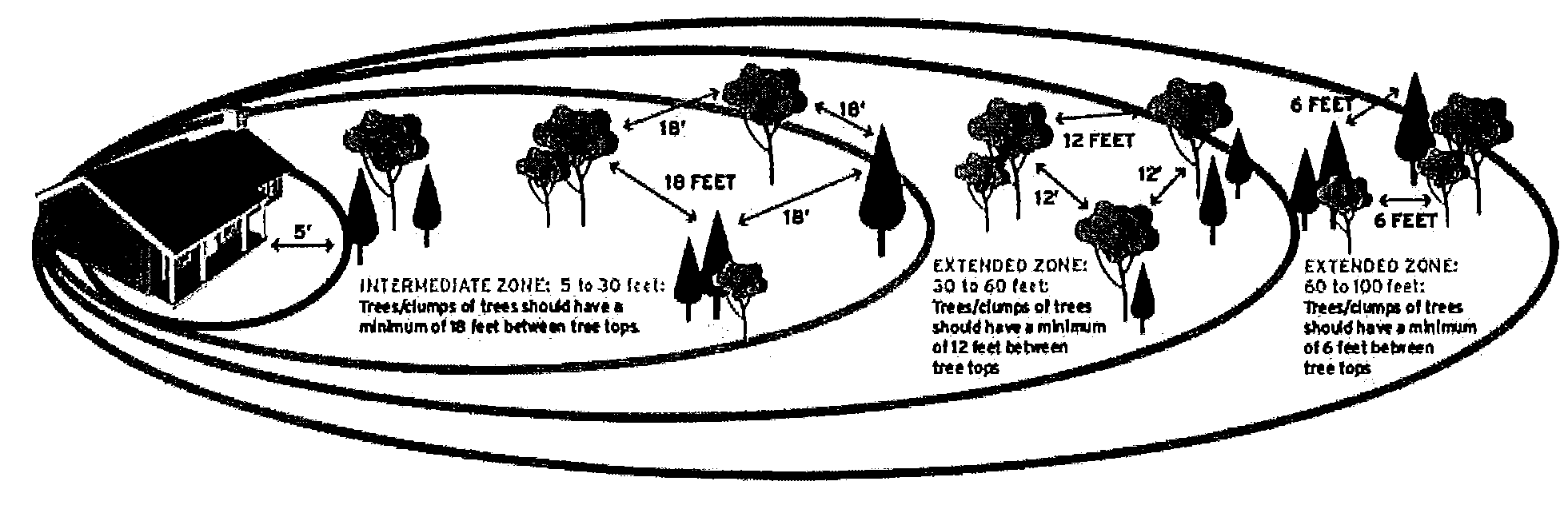
4501.2.6.1.1 The Immediate Zone — 0 to 5 feet from the furthest attached exterior point of the home. This is the most important zone of the defensible space, according to the Firewise® program, to take immediate action on as it is the most vulnerable to embers. The following specific standards apply to the creation of defensible space within the Immediate Zone:
4501.2.6.1.1.1 All dead and diseased trees, shrubs, and other landscaping materials shall be removed.
4501.2.6.1.1.2 All vegetation and combustible and flammable materials shall be moved away from exterior walls, under the eaves, and/or decks. This includes: mulch, ground fuels, flammable plants, leaves and needles, firewood piles.
4501.2.6.1.2 The Intermediate Zone — 5 to 30 feet from the furthest attached exterior point of the home. This is the landscaping/hardscaping zone of the defensible space through the use of careful landscaping or creating breaks that can help influence and decrease fire behavior. The following specific standards apply to the creation of defensible space within the Intermediate Zone:
4501.2.6.1.2.1 All dead and diseased trees, shrubs, and other landscaping materials shall be removed. Removal of ladder fuels (vegetation under trees) shall occur so a surface fire cannot reach the crowns of the trees.
4501.2.6.1.2.2 Limb up trees to a height of 10 feet. For shorter trees, trim to a height of 1/3 the overall tree height.
4501.2.6.1.2.3 Trees shall be spaced to have a minimum of eighteen feet between the crowns with the distance increasing with the percentage of slope.
4501.2.6.1.2.4 Firewise ® trees and shrubs in this zone should be limited to small clusters of a few each to break up the continuity of the vegetation across the landscape.
4501.2.6.1.2.5 Irrigated trees, shrubs, and other landscaping material shall be preserved if they are limbed to remove dead branches and well-spaced to reduce the risk of a fire spreading to other vegetation or structures.
4501.2.6.1.3 The Extended Zone up to 60 Feet — 30 to 60 feet and 60 feet to the property line from the furthest attached exterior point of the home. This zone focuses on interrupting a fire's path and keeping the flames smaller and on the ground. The following specific standards apply to the creation of defensible space within the Extended Zone up to 60 feet:
4501.2.6.1.3.1 All dead and diseased trees, shrubs, and other landscaping materials shall be removed.
4501.2.6.1.3.2 The accumulation of ground litter and debris shall be disposed of or dispersed.
4501.2.6.1.3.3 Small conifers growing between mature trees shall be removed.
4501.2.6.1.3.4 Vegetation adjacent to storage or other outbuildings shall be removed.
4501.2.6.1.3.5 Trees shall be spaced to have a minimum of twelve feet between the crowns with the distance increasing with the percentage of slope.
4501.2.6.1.4 The Extended Zone Over 60 Feet — This zone focuses on interrupting a fire's path and keeping the flames smaller and on the ground. The following specific standards apply to the creation of defensible space within the Extended Zone over 60 feet:
4501.2.6.1.4.1 All dead and diseased trees, shrubs, and other landscaping materials shall be removed.
4501.2.6.1.4.2 The accumulation of ground litter and debris shall be disposed of or dispersed.
4501.2.6.1.4.3 Small conifers growing between mature trees shall be removed.
4501.2.6.1.4.4 Vegetation adjacent to storage or other outbuildings shall be removed.
4501.2.6.1.4.5 Trees shall be spaced to have a minimum of six feet between the crowns with the distance increasing with the percentage of slope.
Exception: Nothing in this chapter shall require the removal of healthy trees, shrubs, and other landscaping materials required by a Town or the County as part of an approved landscaping plan. The removal of landscaping is limited by a property line.
4501.3 Fees. The fees for fire hazard mitigation inspections shall be in accordance with the Summit County Building Department Fee Schedule, and collected by the Fire District having jurisdiction.
SECTION 4502
DEFINITIONS
For the purpose of this chapter, certain terms are defined as follows:
AUTHORITY HAVING JURISDICTION (AHJ) is defined as Summit County Government or one of its designated representatives.
BUILDING SIZE as referenced in Section 4504 is the total floor area. Square footages shall include all attached garages and any detached structures within 3' of the residence. Square footage shall be measured from exterior wall to exterior wall.
DEFENSIBLE SPACE. Defensible space is the natural or landscaped area around a dwelling or other structure that has been modified to reduce the spread of fire from an approaching wildland fire, or to reduce a structure fire from moving into the surrounding vegetation. Creating Defensible Space does not usually require the removal of all trees or other vegetation.
FIRE WISE LANDSCAPING is defined as trees, shrubs, and other materials which meet the criteria for fire-resistant landscaping.
GROUND FUELS. All combustible materials such as grass, duff, loose surface litter, tree or shrub roots, rotting wood, leaves, peat, or sawdust that typically support combustion.
MITIGATION. Action that moderates the severity of a fire hazard or risk.
STRUCTURE IGNITION ZONE. The area around a specific structure and associated accessory structures, including all vegetation that contains potential ignition sources and fuels.
TREE CROWN is the needle or leaf bearing part of a tree. The crown edge is the tree's drip edge.
WELL-SPACED means that the space between the crowns of trees, or between the crowns of trees and the center point of other landscaping, is adequate to reduce the risk of a fire spreading to other vegetation or structures. The adequacy of spacing depends upon slopes, vegetation size, vegetation types (trees, shrubs, grass), and other fuel characteristics (including, but not limited to, fuel compaction and chemical content). In general, a minimum of ten-feet between the widest portion of the crowns of individual trees or groups of trees is adequate. Additional spacing may be required on steeper slopes.
WILDLAND-URBAN INTERFACE. The Wildland Urban Interface or WUI is defined as the line, area, or zone where structures and other human development meet or intermingle with undeveloped lands or vegetative fuels or as otherwise defined in the County Wildfire Protection Plan.
(69)
Section AF103.5 Passive Submembrane Depressurization System is amended to add the following exception:
Exception: The radon vent pipe is allowed to terminate within the structure as long as it is sealed to withstand a minimum of 5psi of pressure.
(70)
Section AF103.6.1 Vent Pipe is amended to add the following exception:
Exception: The radon vent pipe is allowed to terminate within the structure as long as it is sealed to withstand a minimum of 5psi of pressure.
(e)
2018 International Mechanical Code:
(1)
Section 101.1 Title is amended by adding the name, "Town of Silverthorne".
(2)
Section 103.2 Appointment is amended to read exactly as set forth in IBC Amendment 103.2.
(3)
Section 103.3 Deputies is amended to read exactly as set forth in IBC Amendment 103.3.
(4)
Section 103.4 Liability is amended to read exactly as set forth in IBC Amendment 104.8.
(5)
Section 106.4.3 Expiration is amended to read exactly as set forth in IBC Amendment 105.5.
(6)
Section 106.4.4 Extensions is hereby repealed in entirety.
(7)
Section 106.5.2 Fee schedule is amended to read as follows:
106.5.2 Fee schedule. The fees for mechanical work shall be in accordance with the Town of Silverthorne Permit Fee Schedule.
(8)
Section 106.5.3 Fee refunds is amended to read as follows:
106.5.3 Fee refunds. The code official shall authorize the refunding of fees in accordance with the Town of Silverthorne Permit Fee Schedule.
(9)
Section 107.2 Inspections and Testing is amended to add a new subsection to read as follows:
107.2.6 Reinspections is to read exactly as set forth in IBC Amendment 110.7.
(10)
Section 108.4 Violation Penalties is amended to read exactly as set forth in IBC 114.4.
(11)
Section 108.5 Stop Work Orders is amended to read exactly as set forth in IBC 115.
(12)
Section 109 Means of Appeal is hereby repealed in its entirety and reenacted to read exactly as set forth in IBC section 113.
(13)
Section 301 General is amended to add a new subsection to read as follows:
301.19 Floor drains. All mechanical rooms (furnace, boiler, water heater rooms) shall be provided with a floor drain.
(14)
Section 701 General is amended by adding a new subsection to read as follows:
701.2 Terminations. Vent and combustion air ducts shall terminate a minimum of 36" above finished ground level.
(15)
Section 804.3.4 Horizontal Terminations is amended by changing #6 to read as follows:
#6. The bottom of the vent termination shall be located not less than 36 inches above finished grade.
(16)
Section 805 Factory Built Chimneys is amended by adding a new section to read exactly as set forth in IBC Amendments 718.6, 718.7, and 2113.22.
(17)
Section 903.3 Unvented Gas Log Heaters is amended to read as follows:
903.3 Unvented gas log heaters. Unvented gas log heaters are prohibited.
(18)
Section 905 Fireplace Stoves and Room Heaters is amended by adding a new subsection as follows:
905.4 Limitation on the type and number of devices is to read exactly as set forth in IBC Amendment 2113.21.
(19)
Section M1208.1 Testing is amended by adding a sentence at the end of the paragraph as follows:
Hydronic tubing may be tested with a 50 (psi) air test for 30 minutes.
(f)
2018 International Plumbing Code.
(1)
Section 101.1 Title is amended by adding the name "Town of Silverthorne".
(2)
Section 101.3 Intent is amended to add the following:
The intent of this code is to meet or exceed the requirements of the State of Colorado Plumbing Code. When technical requirements, specifications or standards in the Colorado Plumbing Code conflict with this code, the more restrictive shall apply.
(3)
Section 103.2 Appointment is amended to read exactly as set forth in IBC Amendment 103.2.
(4)
Section 103.3 Deputies is amended to read exactly as set forth in IBC Amendment 103.3.
(5)
Section 103.4 Liability is amended to read exactly as set forth in IBC Amendment 104.8.
(6)
Section 106.5.2 Fee Schedule is amended to read exactly as set forth in IMC Amendment 106.5.2.
(7)
Section 106.5.3 Expiration is amended to read exactly as set forth in IBC Amendment 105.5.
(8)
Section 106.5.4 Extensions is hereby repealed in its entirety.
(9)
Section 107.2 Required Inspections and Testing is amended to add a new subsection as follows:
107.2.6 Reinspections is to read exactly as set forth in IBC amendment 110.7.
(10)
Section 108.4 Violation Penalties is amended to read exactly as set forth in IBC 114.4.
(11)
Section 108.5 Stop Work Orders is amended to read exactly as set forth in IBC 115.
(12)
Section 109 Means of Appeal is repealed in its entirety and reenacted to read exactly as set forth in IBC section 113.
(13)
Section 301 General is amended to add a new subsection as follows:
301.8 Floor drains. All mechanical rooms (furnace, boiler, water heater rooms) shall be provided with a floor drain.
(14)
Section 305.4.1 Sewer Depth is amended to read as follows:
305.4.1 Sewer depth. Building sewers shall be installed in accordance with the standards and subject to the approval of the Town of Silverthorne.
(15)
Section 312.3 Drainage and Vent Air Test is amended to delete the first sentence: 'Plastic pipe shall not be tested using air.'
(16)
Section 312.5 Water Supply System Testing is amended to delete the portion of the sentence reading "for piping systems other than plastic".
(17)
Section 312.6 Gravity Sewer Test is amended to read as follows:
312.6 Gravity sewer test. Testing of the building sewer shall be in accordance with the standards and subject to the approval of the Town of Silverthorne.
(18)
Section 312.7 Forced Sewer Test is amended to read as follows:
312.7 Forced sewer test. Testing of the building sewer shall be in accordance with the standards and subject to the approval of the Town of Silverthorne.
(19)
Section 312.9 Shower Liner Test is hereby repealed in its entirety.
(20)
Section 403.1 Minimum Number of Fixtures is amended to add the sentence as set forth in IBC amendment 2902.1.
(21)
Section 403.2 Separate Facilities is amended to add a fourth exception:
Exception: 4. Gender neutral single-user toilet facility and bathing room fixtures.
(22)
Section 403.2.1 Family or Assisted-Use Toilet Facilities Serving as Separate Facilities is amended to read exactly as set forth in IBC amendment 2902.1.2.
(23)
Section 504.7.2 Pan Drain Termination is amended to read as follows:
504.7.2 Pan drain termination. The pan drain shall extend full-size and terminate over a suitably located indirect waste receptor or floor drain.
(24)
Section 608.18 Protection of Individual Water Supplies is amended to read as follows:
608.18 Protection of individual water supplies. An individual water supply shall be located and constructed so as to be safeguarded against contamination in accordance with Summit County Environmental Health regulations.
(25)
Section 608.18.1 through 608.18.8 are deleted.
(26)
Section 610.1 General is amended to read as follows:
610.1 General. New or repaired potable water systems shall be purged of deleterious matter and disinfected prior to utilization. The method to be followed in accordance with this requirement shall be that method or methods prescribed by the governing water authority.
(27)
Section 701.2 Connection to Sewer Required is amended to read as follows:
701.2 Connection to sewer required. Every building in which plumbing fixtures are installed and as well as all premises having drainage piping shall be connected to a public sewer, where available, or an approved private sewage disposal system in accordance with Summit County Environmental Health Department requirements.
(28)
Section 903.1 Roof Extension is amended to add 12 inches.
(29)
Chapter 13 and 14 Nonpotable Water Systems and Subsurface Landscape Irrigation Systems are amended to add the following sentence:
All non-potable water sources and reclaimed water systems are to be compliant to this code and the latest version of any amendments to State of Colorado plumbing code as adopted by the state plumbing board.
(g)
2018 International Fuel Gas Code.
(1)
Section 101.1 Title is amended by adding the name, "Town of Silverthorne."
(2)
Section 103.2 Appointment is amended to read exactly as set forth in IBC Amendment 103.2.
(3)
Section 103.3 Deputies is amended to read exactly as set forth in IBC Amendment 103.3.
(4)
Section 103.4 Liability is amended to read exactly as set forth in IBC Amendment 104.8.
(5)
Section 106.5.3 Expiration is amended to read exactly as set forth in IBC Amendment 105.5.
(6)
Section 106.5.4 Extensions is hereby repealed in its entirety.
(7)
Section 106.6.2 Fee schedule is amended to read exactly as set forth in IMC amendment 106.5.2.
(8)
Section 106.6.3 Fee refunds is amended to read exactly as set forth in IMC amendment 106.5.3
(9)
Section 107.2 Required Inspections and Testing is amended to add a new subsection to read as follows:
107.2.6 Reinspections to read exactly as set forth in IBC amendment 110.7.
(10)
Section 108.4 Violation Penalties is amended to read exactly as set forth in IBC 114.4.
(11)
Section 108.5 Stop Work Orders is amended to read exactly as set forth in IBC 115.
(12)
Section 109 Means of Appeal is hereby repealed in its entirety and reenacted to read exactly as set forth per IBC section 113.
(13)
Section 303.2 Hazardous Locations is amended to add a sentence to read as follows:
Section 303.2 Hazardous locations. All exterior fire pits and fireplaces shall not be installed on or under combustible structures unless the entire appliance is listed and tested as one unit for that application.
(14)
Section 303.3 Prohibited Locations is amended to eliminate exceptions 3 and 4.
(15)
Section 304.11 Combustion Air Ducts #8 is amended to read as follows:
#8. Combustion air intake openings located on the exterior of a building shall have the lowest side of such openings located not less than 36 inches above finished ground level.
(16)
Section 406.4.1 Test Pressure is amended to read exactly as set forth in IRC Amendment G2417.4.1
(17)
Section 501.8 Equipment Not Required to be Vented is amended to eliminate exceptions 8 and 10.
(18)
Section 503.4.1 Plastic Piping is amended to add the following sentence:
All plastic piping used as vents or combustion air is to be tested with a 5 psi air test for 15 minutes.
(19)
Section 503.8 Venting System Termination Location is amended to add a sentence that reads as follows: (applicable to items 2 and 3)
The bottom of all vent terminations and air intakes shall be located not less than 36 inches above finished ground level.
(20)
Section 506 Factory Built Chimneys is amended by adding new subsections to read exactly as set forth in IBC Amendments 718.6, 718.7, 2113.21 and 2113.22.
(21)
Section 602.1 General is amended to read as follows:
602.1 General. Decorative appliances for installation in approved solid fuel-burning fireplaces shall be tested in accordance with ANSI Z21.60 and shall be installed in accordance with the manufacturer's installation instructions.
(22)
Section 602 Decorative Appliances for Installation in Fireplaces is amended by adding a new subsection 602.4 Gas logs to read exactly as set forth in as IRC Amendment G2432.
(23)
Section 603.1 General is amended to read as follows:
603.1 General. Log lighters are prohibited.
(24)
Section 618.4 Prohibited Sources is amended to add a subsection as follows:
Section 618.4.1 Outside Air Sources. Outside air shall be obtained from an exterior opening located not less than 36 inches above finished ground level.
(25)
Section 621 Unvented Room Heaters is hereby repealed in its entirety.
(26)
Section 634 Chimney Damper Opening Area is hereby repealed in its entirety.
(h)
2018 International Energy Conservation Code.
(1)
Section C101.1 is amended by adding the name, "Town of Silverthorne."
(2)
Table C402.1.3 is amended to add "or R-23 B.I.B." in both columns for zone 7 and in the row for "Walls, above grade - wood framed and other".
(3)
Section C402.5 Air Leakage-Thermal Envelope (Mandatory) is amended to add the following sentence:
C402.5 Air leakage-thermal envelope (Mandatory). A certified third party, approved by the Building Official, shall inspect and approve the measures as stated in C402.5.1 through C402.5.8 in lieu of the thermal envelope requirements of this section.
(4)
Section R101.1 is amended by adding the name, "Town of Silverthorne."
(5)
Table R402.1.2 is amended to add a footnote 'j' as set forth in IRC Amendment N1102.1.2.
(6)
Table R402.1.2 Fenestration U-Factor column is amended to read 0.32 for Climate Zone 7 and 8:
(7)
R402.2.10 is amended to read as follows:
R402.2.10 Slab-on-grade floors with a floor surface less than 40 inches below grade shall be insulated in accordance with Table N1102.1.1. The insulation shall extend downward from the top of the slab on the outside or inside of the foundation wall. Insulation located below grade shall be extended the distance provided in Table N1102.2.2 by any combination of vertical insulation, insulation extending under the slab or insulation extending out from the building. Insulation extending away from the building shall be protected by pavement or by a minimum of 10 inches of soil.
(8)
Section R402.5 Air Leakage - Thermal Envelope (Mandatory) is amended to add the following exception:
Exception: Projects that have been inspected by an approved third party verifying that air barriers and air sealing has been installed in accordance with sections 2 and 4 of ENERGY STAR Certified Homes, Version 3/3.1 (Rev.09) Thermal Enclosure System Rater Checklist.
(i)
The Uniform Code For Building Conservation.
(1)
Chapter 1 is amended by adding a new section to read as follows:
SECTION 3 Violation Penalties is to read exactly as set forth in IBC 113.4.
(2)
SECTION 201 Administration is to read exactly as set forth in IBC amendment 103.2.
(3)
Section 205 is amended by adding the following additional first paragraph to read exactly as set forth in IBC amendment 104.8.
(4)
Section 207 is amended to read as follows:
SECTION 207 Board of Review is to read exactly as set forth in IBC amendment 112.
(5)
Section 301 is amended by amending the definition of Building Code to read as follows:
BUILDING CODE is the International Building Code or the International Residential Code, whichever is applicable, published by the International Code Council, Inc., as adopted by this jurisdiction.
(j)
Uniform Code for the Abatement of Dangerous Buildings.
(1)
Section 310 is amended by amending the definition of Building Code to read as follows:
BUILDING CODE is the International Building Code or the International Residential Code, whichever is applicable, published by the International Code Council, Inc., as adopted by this jurisdiction.
(Ord. 2013-11 §1; Ord. 2015-2, §2; Ord. 2019-20, § 1(Exh. A); Ord. No. 2021-16, §1)
Sec. 4-11-3. - Enforcement.
The provisions of this Chapter shall be administered and enforced by the Community Development Department through the Building Official and/or such other authority as may be appointed by the Town Council. The Building Official shall be an employee of the Town as part of the Community Development Department, accountable to the Community Development Director and subject to the personnel policies of the Town.
(Prior code 192-6; Ord. 1995-1 §1; Ord. 2003-20 §3)
Sec. 4-11-4. - Right of entry.
This section is hereby deleted and reserved for future use.
Sec. 4-11-5. - Stop-work orders.
This section is hereby deleted and reserved for future use.
Sec. 4-11-6. - Building permit required.
It shall be unlawful to commence the excavation for or the construction of any building or other structure, including accessory structures, or to store building material or construct entrances or parking lots, commence the moving, structural alterations, conversions, extensions, enlargements, alteration or repairs, except usual repairs not requiring permits under this Article or any other Town ordinance, of any structure, including accessory structures, fences or walls, until a building permit for such work has been issued. Repairs that are deemed by the Community Development Department to be in the usual course of maintenance or upkeep of a structure will not require a building permit.
(Prior code 192-9; Ord. 1995-1 §1; Ord. 2003-20 §3)
Sec. 4-11-7. - Application for and issuance of building permit.
Applications for, requirements for and issuance of building permits shall be in accordance with this Article. Unless otherwise expressly provided, every structure designed for occupancy by human beings shall, only after payment of the then-current tap fees and before the same shall be occupied or used, connect with the Town's water and sewer systems.
(Prior code 192-10; Ord. 2003-20 §3)
Sec. 4-11-41. - Adoption of standards.
The following standard codes, as hereinafter amended, are hereby adopted by reference:
(1)
The National Electrical Code, 2017 Edition, published by the National Fire Protection Association.
(2)
In compliance with state statutes, any subsequent electrical code adopted by the Colorado State Electrical Board after the effective date of the ordinance codified herein.
(Ord. 2013-11 §1; Ord. 2019-20, § 1(Exh. A))
Sec. 4-11-42. - Amendments.
The following sections of the ICC Electrical Code - Administrative Provisions, 2000 Edition, are amended:
2000 ICC ELECTRICAL CODE - ADMINISTRATIVE PROVISIONS.
(1)
Section 101.1 is amended to read as follows:
101 Title. These regulations shall be known as the ICC Electrical Code TM - Administrative Provisions of Summit County and shall be cited as such. The ICC Electrical Code TM ; - Administrative Provisions in combination with the separately adopted National Electrical Code will be referred to herein as "this code." The ICC Electrical Code TM ; - Administrative Provisions in combination with the separately adopted National Electrical Code will be referred to throughout all other building construction and housing standards adopted by the Town of Silverthorne as the ICC Electrical Code.
(2)
Section 102.1 is amended by adding the following subsection:
102.1.1 Conflicts. If a conflict should arise between any section of this code and any other section of the Silverthorne Town Code, the intent of this code, as stated in Section 101.3, shall be enforced, at the discretion of the building official.
(3)
Section 201.3 is amended to delete the reference to the International Energy Conservation Code, the International Private Sewage Disposal Code, and the International Property Maintenance Code.
(4)
Section 301.2. Building Official is amended to read exactly as set forth in IBC Amendment 103.2.
(5)
Section 301.3 Deputies is amended to read exactly as set forth in IBC Amendment 103.3.
(6)
Section 302.9 Liability is amended to read exactly as set forth in IBC Amendment 104.8.
(7)
Section 401.3 Work exempt from permits is amended to establish the following additional exceptions:
a.
Portable motors or other portable appliances energized by means of a cord or cable having an attachment plug end to be connected to an approved receptacle when that cord or cable is permitted by this code.
b.
Repair or replacement of fixed motors, transformers or fixed approved appliances of the same type and rating in the same location.
c.
Repair or replacement of current-carrying parts of any switch, contactor or control device.
d.
Repair or replacement of electrodes or transformers of the same size and capacity for signs or gas tube systems.
e.
The wiring for temporary theater, motion picture or television stage sets.
f.
Low-energy power, control, and signal circuits of Class II and Class III as defined in this code.
g.
The installation, alteration, or repair of electrical wiring apparatus, or equipment, or the generation, transmission, distribution or metering of electrical energy, or in the operation of signals or the transmission of intelligence by public or private utilities in the exercise of their function as a serving utility.
(8)
Section 403.2 Expiration is amended to read exactly as set forth in IBC Amendment 105.5.
(9)
Section 403.3 Extensions is hereby repealed in its entirety.
(10)
Section 403.6 Information on the permit is amended to read as follows:
403.6 Information on the permit. The code official shall issue all permits required by this code on an approved form furnished for that purpose. The permit shall contain a general description of the operation or occupancy and its location and any other information required by the code official.
(11)
Section 404.2 Schedule of fees is amended to read exactly as set forth in IBC Amendment 109.2.
(12)
Section 404.3 Work commencing before permit issuance is amended to read as follows:
404.3 Work commencing before permit issuance. Any person who commences any work before obtaining the necessary permits shall be subject to an investigation fee established by the code official, which shall be in addition to any other required permit fee. The investigation fee shall be as set forth in the Silverthorne Construction Permit Fee Schedule and subject to modification from time to time.
(13)
Section 404 is amended by inserting three new subsections to read as follows:
404.6 Reinspections shall read exactly as set forth in IBC Amendment 109.7
404.7 Temporary heat inspections. Inspections for authorizing temporary and/or permanent connection of the electrical system to the source of energy shall be deemed Temporary Heat inspections. To obtain this inspection, the applicant shall pay a Temporary Heat inspection fee in accordance with the Silverthorne Construction Permit Fee Schedule prior to the inspection being performed.
Exception: Temporary heat inspections performed and approved during an electrical rough-in inspection.
(14)
404.8 Plan Review Fees. The plan review fees for electrical work shall be in accordance with the Silverthorne Construction Permit Fee Schedule.
(15)
Section 1101 is hereby repealed in its entirety.
(16)
Section 1101 Board of Review is reenacted to read exactly as set forth in IBC section 113.
(17)
Section 1102 is hereby repealed in its entirety.
(18)
Section 1103 is hereby repealed in its entirety.
(19)
Section 1202 and all subsections therein are hereby repealed in their entirety.
(20)
Section 1203 and all subsection therein are hereby repealed in their entirety.
(Ord. 2013-11 §1; Ord. 2019-20, § 1(Exh. A))
Sec. 4-11-81. - Adoption of standards.
There is hereby adopted, for the purpose of prescribing regulations governing conditions hazardous to life and property from fire, hazardous materials and explosion, that certain Code known as the International Fire Code, 2018 Edition, including Appendix Chapters B, C, D, E, F, G, H, I, J, K, M, N, O, and P, published by the International Code Council, by Section 2 of this resolution (the "International Fire Code").
(Ord. 2013-15 §1; Ord. 2019-21, §1(Exh. A); Ord. No. 2021-15, §1(Exh. A)
Sec. 4-11-82. - Amendments.
The following sections of the International Fire Code, 2018 Edition, are amended:
(1)
102.4 Amend this section to read Application of Building Code. The design and construction of new structures shall comply with the International Building Code or International Residential Code and the International Fire Code, and any alterations, additions, changes in use or changes in structures required by this code, which are within the scope of the International Building Code or International Residential Code, shall be made in accordance therewith.
(2)
102.7 Amend this section to read Referenced codes and standards. The codes and standards referenced in this code shall be the most currently published edition of those that are listed in Chapter 80, and such codes and standards shall be considered part of the requirements of this code to the prescribed extent of each such reference and as further regulated in Sections 102.7.1 and 102.7.2.
(3)
105.1.2 Amend item #2 to read Types of permits.
2.
Construction permits. A construction permit allows the applicant to construct, enlarge, alter, repair, move, demolish, or change the occupancy of a building or structure, the likes of which are regulated by this code. A construction permit also allows the applicant to install or modify systems and equipment for which a permit is required by Section 105.7.
(4)
105.4.1 Amend this section to read Submittals.Construction documents and supporting data shall be submitted with each application for a permit and in such form and detail as required by the fire code official. The construction documents shall be prepared by a registered design professional where required by the jurisdiction in which the project is to be constructed.
(5)
105.6.30 Amend this section to read Mobile food preparation vehicles. A permit is required for mobile food preparation vehicles equipped with appliances.
(6)
105.6.33 Amend this section by removing the Exception. Open Burning. An operational permit is required for the kindling or maintenance of an open fire or a fire on any public street, alley, road, or other public or private ground. Instructions and stipulations of the permit shall be adhered to.
Exception: Recreational fires
(7)
105.7 Amend this section to read Required Construction Permits. The fire code official is authorized to issue construction permits for work, or the likes of which are regulated by this code, and as set forth in Section 105.7.1 through 105.7.26.
(8)
105.7.25 Amend this section to read Temporary membrane structures and tents. A construction permit is required to erect an air-supported temporary membrane structure, a temporary stage canopy or a tent having an area in excess of 200 square feet (18.58 m2).
(9)
105.7.26 Add the following section Wildfire Mitigation. The holder of a construction permit is required to perform defensible space requirements of Appendix P that do not fall under a voluntary wildfire mitigation program.
(10)
108.1.1 Add the following section Procedures. To request a hearing before the board of appeals, the applicant shall file a request in writing to the fire chief. The fire chief shall arrange for the board of appeals to meet within 10 working days from the receipt of the request. All applicable fees as stated in the fire district or fire authority fee schedule shall be paid at the time the written request is made.
(11)
108.3 Amend this section to read Qualifications. The board of appeals shall consist of members who are qualified by experience and training to pass on matters pertaining to hazards of fire, explosions, hazardous conditions, or fire protection systems.
(12)
109.4 Amend this section to read Violation penalties. Persons who shall violate a provision of this code or shall fail to comply with any of the requirements thereof or who shall erect, install, alter, repair or do work in violation of the approved construction documents or directive of the fire code official, or of a permit or certificate used under the provisions of this code, shall be guilty of a misdemeanor, punishable by a fine or by imprisonment, or both such fine and imprisonment as determined by the court. Each day that a violation continues after due notice has been served shall be deemed a separate offense.
(13)
111.4 Amend this section to read Failure to comply. Any person who shall continue any work after having been served with a stop work order, except such work as that person is directed to perform to remove a violation or unsafe condition, shall be liable for a fine as determined by the court and shall be subject to a fee as adopted by the fire district or fire authority.
(14)
Amend or add the following definitions:
CONTROLLED BURNING. Any fire intentionally ignited to meet specific land management objectives, such as to reduce flammable fuels, restore forest or ecosystem health, recycle nutrients, or prepare an area for new trees or vegetation. Controlled burning may also be known by the terms "Prescribed Burning" or "Pile Burning."
DEFENSIBLE SPACE. The selection, location, grouping, and maintenance of vegetation on the property in such a manner that the opportunity for fire to burn directly to a structure is minimized.
FIRE AREA. The aggregate floor area enclosed and bounded by fire walls meeting the requirements of Section 706 of the International Building Code and exterior walls or horizontal assemblies of a building. Areas of the building not provided with surrounding walls shall be included in the fire area if such areas are included within the horizontal projection of the roof or floor above. For buildings constructed under the International Residential Code, the fire area is the aggregate floor area enclosed and bounded by exterior walls of a building.
FIREWISE® LANDSCAPING is defined as trees, shrubs, and other materials which meet the criteria for fire resistant landscaping.
GROUND FUELS. All combustible materials on, in or near the ground such as grass, duff, loose surface litter, tree or shrub roots, rotting wood, leaves, peat, or sawdust that typically support combustion.
MITIGATION. Action that moderates the severity of a fire hazard or risk.
MOBILE FOOD PREPARATION VEHICLES. Vehicles that contain cooking equipment for the purpose of preparing and serving food to the public. Vehicles intended for private recreation shall not be considered mobile food preparation vehicles.
MOBILE FUELING. The operation of dispensing liquid fuels from tank vehicles into the fuel tanks of vehicles. Mobile fueling may also be known by the terms "Mobile fleet fueling," "Wet fueling," "Wet hosing," or "Hot fueling."
PERMANENT OUTDOOR FIREPLACE OR FIRE RING. A permanently constructed feature with a screen that prevents ember emissions and without air gaps in surrounding sides and a solid bottom, or earthen bottom free of roots and other organic material, used to contain campfires and prevent them from spreading and turning into wildfires.
PORTABLE OUTDOOR FIREPLACE. A commercially designed and manufactured device with a screen that prevents ember emissions and is placed on a surface barren of combustible materials.
RECREATIONAL FIRE. An outdoor fire on private land contained to a commercially designed and manufactured fireplace, a permanent outdoor fireplace or fire ring, or a portable outdoor fireplace that is assembled, located, and operated in accordance with the manufacturer's or designer's instructions. The fire shall not exceed a total fuel area of 3 feet (914 mm) or less in diameter and 2 feet (610mm) or less in height. A solid fuel source such as wood or charcoal must be used and the fire is intended for pleasure, religious, ceremonial, cooking, warmth or similar purposes. Recreational fires shall not be used for the purpose of waste removal or trash incineration.
STRUCTURE IGNITION ZONE. The area around a specific structure and associated accessory structures, including all vegetation that contains potential ignition sources and fuels.
TREE CROWN. The needle or leaf bearing part of a tree. The crown edge is the tree's drip edge.
WILDLAND-URBAN INTERFACE. An area where wildland fuels abut structures, with a clear line of demarcation between residential, business, and public structures and wildland fuels.
OCCUPANCY CLASSIFICATION.
Institutional Group I-1 - Five or fewer persons receiving care. A facility such as the above with five or fewer persons receiving such care shall be classified as Group R-3 or shall comply with the International Residential Code provided an automatic sprinkler system is installed in accordance with Section 903.3.1.3.
Institutional Group I-2 - Five or fewer persons receiving care. A facility such as the above with five or fewer persons receiving such care shall be classified as Group R-3 or shall comply with the International Residential Code provided an automatic sprinkler system is installed in accordance with Section 903.3.1.3.
Residential Group R-3 - Care facilities within a dwelling. Care facilities for five or fewer persons receiving care that are within a single-family dwelling are permitted to comply with the International Residential Code provided an automatic sprinkler system is installed in accordance with Section 903.3.1.3.
(15)
304.1.2 Amend this section to read Vegetation. Weeds, grass, vines or other growth that is capable of being ignited and endangering property, shall be cut down and removed by the owner or occupant of the premises. Vegetation clearance requirements in urban-wildland interface areas shall be in accordance with Appendix P, local codes, policies, and ordinances.
(16)
304.3.3 Amend to add Exception #3. Capacity exceeding 1.5 cubic yards. 3. Storage in a structure shall not be prohibited where the structure is in compliance with local codes, policies, and ordinances as mandated by the authority having jurisdiction.
(17)
304.3.4 Amend to add Exception #3. Capacity of 1 cubic yard or more. 3. Storage in a structure shall not be prohibited where the structure is in compliance with local codes, policies, and ordinances as mandated by the authority having jurisdiction.
(18)
307.4.3 Amend this section by removing the Exception. Portable outdoor fireplaces used at one- and two-family dwellings.
(19)
308.1.4 Amend this section and exception #3 and add exception #4 to read: Open-flame cooking devices. Charcoal burners, wood pellet burners, and other open-flame cooking devices shall not be operated on combustible balconies or within 10 feet (3048 mm) of combustible construction.
3.
LP-gas cooking devices having LP-gas container with a water capacity not greater than 48 pounds [nominal 20 pounds (9.1 kg) LP-gas capacity].
4.
Where a more restrictive code, policy, ordinance, or covenant exists.
(20)
311.2.2 Amend exception #3 to read: Fire protection.
3.3.
Where approved by the fire code official, fire alarm and sprinkler systems are permitted to be placed out of service in seasonally occupied buildings: that will not be heated, where fire protection systems will be exposed to freezing temperatures, where fire areas do not exceed 6,000 square feet (557.42 m 2 ), and/or that do not store motor vehicles or hazardous materials.
(21)
315.3 Amend this section to read Storage in buildings. Storage of materials in buildings shall be orderly and stacks shall be stable. Storage of combustible materials shall be separated from heaters or heating devices by distance or shielding so that ignition cannot occur. Storage room doors shall be provided with approved signs.
(22)
315.3.1 Amend exceptions #1 and #2 to read: Ceiling clearance.
1.
The 2-foot (610 mm) ceiling clearance is not required for storage along walls in nonsprinklered areas of buildings where the storage does not exceed 30-inches (762 mm) in depth.
2.
The 18-inch (457 mm) ceiling clearance is not required for storage along walls in areas of buildings equipped with an automatic sprinkler system in accordance with Section 903.3.1.1, 903.3.1.2 or 903.3.1.3 where the storage does not exceed 30-inches (762 mm) in depth.
(23)
315.3.3 Amend this section to read Equipment rooms. Combustible material shall not be stored in boiler rooms, mechanical rooms, electrical equipment rooms, and other rooms where a potential ignition source exists, as determined by the fire code official.
(24)
319.1 Amend this section to read General. Mobile food preparation vehicles that are equipped with appliances shall comply with this section.
(25)
319.4.1 Amend this section to read Fire protection for cooking equipment. Cooking equipment that produces smoke or grease-laden vapors shall be protected by automatic fire extinguishing systems in accordance with Section 904.12.
(26)
319.8 Amend this section to read LP-gas systems. Where LP-gas systems provide fuel, such systems shall comply with Chapter 61 and Sections 319.8.1 through 319.8.5.
(27)
403.12.3 Amend this section to read Crowd managers. Where facilities or events involve a gathering of 500 people or more, crowd managers shall be provided in accordance with Sections 403.12.3.1 through 403.12.3.3.
(28)
403.12.3.1 Amend exceptions #1 and #2 to read Number of crowd managers.
1.
Outdoor events with fewer than 500 persons in attendance shall not require crowd managers.
2.
Assembly occupancies used exclusively for religious worship with an occupant load not exceeding 500 shall not require crowd managers.
(29)
505.1 Amend this section to read Address identification. New and existing buildings shall have approved address numbers, building numbers or approved building identification placed in a position that is plainly legible and visible from the street or road fronting the property. These numbers shall contrast with their background. Where required by the fire code official, address numbers shall be provided in additional approved locations to facilitate emergency response. Address numbers shall be Arabic numerals or alphabet letters. Numbers shall be a minimum of 5 inches (127 mm) high, unless otherwise approved, with a minimum stroke width of .5 inch (12.7 mm). Where access is by means of a private road and the building cannot be viewed from the public way, a monument, pole or sign or means shall be used to identify the structure. Address numbers shall be maintained.
(30)
508.1 Amend this section to read General. Where required by other sections of this code, buildings, structures, or facilities that are more than 4 stories (including basements) in height or are greater than 50,000 square feet (4645 m 2 ) within surrounding exterior walls, and in all buildings classified as high-rise buildings by the International Building Code, a fire command center for fire department operations shall be provided and shall comply with Sections 508.1.1 through 508.1.6.
(31)
508.1.5 Amend this section to read Features. A Fire Command Center shall be required in buildings, structures, or facilities that are more than 4 stories (including basements) in height or are greater than 50,000 square feet (4645 m2) within surrounding exterior walls. The fire command center shall be provided and comply with Sections 508.1.1 through 508.1.6.
(32)
603.6.6 Add a section to read Chimneys and Heating Appliances. Chimneys and fireboxes for solid, fuel burning appliances shall be inspected annually by a qualified individual or company. They shall be inspected for soundness, corrosion, proper support, and freedom from combustible deposits. A certificate of inspection in a form acceptable to the fire code official shall be forwarded to the fire department upon completion.
(33)
603.9 Amend this section to read Gas and utility meters. Above-ground gas and utility meters, regulators and piping subject to damage shall be protected by a barrier complying with Section 312 or otherwise protected in an approved manner. Gas and utility meters and piping shall be protected from snow & ice shedding from a roof area. Areas around gas and utility meters shall be kept clear of snow and ice build-up at all times.
(34)
606.9 Add a section to read Communication. All elevators shall be equipped with two-way communication equipment and the equipment shall be operable at all times.
Exception: One- and two-family dwellings
(35)
701.2.2 Add section to read Fire-resistance-rated labeling. The fire-resistance rating shall be marked in an approved manner on the following fire resistance rated construction features:
1.
Structural members
2.
Exterior walls
3.
Fire walls, fire barriers, fire partitions
4.
Horizontal assemblies
5.
Shaft enclosures
(36)
701.3.1 Add section to read Smoke barriers labeling. The fire-resistance rating and smoke-resistant characteristics of smoke barriers shall be marked in an approved manner on the rated construction feature.
(37)
803.13 Amend this section to read Laminated products factory produced with an attached wood substrate. Laminated products factory produced with or without an attached wood substrate shall comply with one of the following:
(38)
901.4.2 Amend this section to read Nonrequired fire protection systems. A fire protection system or portion thereof not required by this code, the International Building Code, or the International Residential Code shall be installed throughout a building for complete protection provided that such installed system meets the applicable requirements of this code, the International Building Code, and the International Residential Code.
(39)
901.4.3 Amend this section to read Fire areas. Where buildings, or portions thereof, are divided into fire areas so as not to exceed the limits established for requiring a fire protection system in accordance with this chapter, such fire areas shall be separated by fire walls constructed in accordance with the International Building Code or horizontal assemblies constructed in accordance with the International Building Code, or both, having a fire-resistance rating of not less than that determined in accordance with the International Building Code.
(40)
901.7 Amend this section to read Systems out of service. Where a required fire protection system is out of service, the fire department shall be notified immediately and where required by the fire department, the building shall either be evacuated or an approved fire watch shall be provided for all occupants left unprotected by the shutdown until the fire protection system has been returned to service.
(41)
901.9 Amend this section to read Termination of monitoring services. For fire protection systems required to be monitored by the authority having jurisdiction, notice shall be made to the fire code official whenever system monitoring services are terminated. Notice shall be made in writing, to the fire code official by the provider of the monitoring service being terminated.
(42)
903.2.1 Amend this section to read Group A. An automatic fire sprinkler system shall be provided throughout buildings as Group A occupancies as provided in this section.
(43)
903.2.1.1 Amend this section to read and delete conditions #3 and #4 Group A-1. 903.2.1.1 Group A-1. An automatic sprinkler system shall be provided throughout buildings containing Group A-1 occupancies where one of the following conditions exists: 1. The fire area exceeds 6,000 square feet (557 m2). 2. The fire area has an occupant load of 50 or more.
(44)
903.2.1.2 Amend this section to read and delete condition #3 Group A-2. An automatic sprinkler system shall be provided throughout buildings containing Group A-2 occupancies where one of the following conditions exists: 1. The fire area exceeds 5,000 square feet (464 m 2 ). 2. The fire area has an occupant load of 50 or more.
(45)
903.2.1.3 Amend this section to read and delete condition #3 Group A-3. An automatic sprinkler system shall be provided throughout buildings containing Group A-3 occupancies where one of the following conditions exists: 1. The fire area exceeds 6,000 square feet (557 m2). 2. The fire area has an occupant load of 50 or more.
(46)
903.2.1.4 Amend this section to read and delete condition #3 Group A-4. An automatic sprinkler system shall be provided throughout buildings containing Group A-4 occupancies where one of the following conditions exists: 1. The fire area exceeds 6,000 square feet (557 m2). 2. The fire area has an occupant load of 50 or more.
(47)
903.2.1.6 Amend this section to read and delete the exception Assembly occupancies on roofs. Where an occupied roof has an assembly occupancy with an occupant load exceeding 50 for Group A occupancies, an automatic sprinkler system shall be provided throughout the building in accordance with Section 903.3.1.1 or 903.3.1.2.
(48)
903.2.1.7 Amend this section to read Multiple fire areas. An automatic sprinkler system shall be provided where multiple fire areas of Group A-1, A-2, A-3 or A-4 occupancies share exit or exit access components and the combined occupant load of these fire areas is 50 or more.
(49)
903.2.2 Amend this section to read and delete the exception Ambulatory care facilities. An automatic sprinkler system shall be installed throughout the entire building containing an ambulatory care facility where either of the following conditions exist at any time:
1.
Four or more care recipients are incapable of self-preservation.
2.
One or more care recipients that are incapable of self-preservation are located at other than the level of exit discharge serving such a facility.
(50)
903.2.3 Amend conditions #1 and #3 to read and delete the exception Group E. An automatic sprinkler system shall be provided for Group E occupancies as follows:
1.
Throughout all Group E fire areas greater than 6,000 square feet (557 m 2 ) in area.
3.
The Group E fire area has an occupant load of 50 or more.
(51)
903.2.4 Amend this section and conditions #1, #2, #3, and #4 to read All Group F. An automatic sprinkler system shall be provided throughout all buildings containing a Group occupancy where one of the following conditions exists:
1.
A Group F fire area exceeds 6,000 square feet (557 m 2 ).
2.
A Group F fire area is located more than two stories above grade plane.
3.
The combined area of all Group F fire areas on all floors, including any mezzanines, exceed 6,000 square feet (557 m 2 ).
4.
A Group F occupancy used for the manufacture of upholstered furniture or mattresses exceeds 2,500 square feet (232 m 2 ).
(52)
903.2.6 Amend exception #3 to read Group I. 3. In buildings where Group I-4 day care is provided on levels other than the level of exit discharge, an automatic sprinkler system in accordance with Section 903.3.1.1 shall be installed.
(53)
903.2.7 Amend conditions #1, #2, and #3 to read Group M.
1.
A Group M fire area exceeds 6,000 square feet (557 m 2 ).
2.
A Group M fire area is located more than two stories above grade plane.
3.
The combined area of all Group M fire areas on all floors, including any mezzanines, exceeds 6,000 square feet (557 m 2 ).
(54)
903.2.9 Amend conditions #1, #2, and #3 to read Group S-1.
1.
A Group S-1 fire area exceeds 6,000 square feet (557 m 2 ).
2.
A Group S-1 fire area is located more than two stories above grade plane.
3.
The combined area of all Group S-1 fire areas on all floors, including any mezzanines, exceeds 6,000 square feet (557 m 2 ).
(55)
903.2.9.1 Amend conditions #1 and #2 to read Repair garages.
1.
Buildings having two or more stories above grade plane, including basements, with a fire area containing a repair garage exceeding 6,000 square feet (557 m 2 ).
2.
Buildings not more than one story above grade plane, with a fire area containing a repair garage exceeding 6,000 square feet (557 m 2 ).
(56)
903.2.9.2 Amend this section to read Bulk storage of tires. Buildings and structures where the area for the storage of tires exceeds 10,000 cubic feet (283 m 3 ) shall be equipped throughout with an automatic sprinkler system in accordance with Section 903.3.1.1.
(57)
903.2.10 Amend condition #1 to read Group S-2 enclosed parking garages. 1. Where the fire area of the enclosed parking garage exceeds 6,000 square feet (557 m 2 ).
(58)
903.2.11.1 Amend this section to read Stories without openings. An automatic sprinkler system shall be installed throughout all buildings, where the floor area of the story exceeds 1,500 square feet (139 m 2 ) and where the story does not comply with the following criteria for exterior wall openings:
(59)
903.2.11.1.2 Amend this section to read Openings on one side only. Where openings in a story are provided on only one side and the opposite wall of such story is more than 75 feet (22 860 mm) from such openings, the building shall be equipped throughout with an approved automatic sprinkler system, or openings shall be provided on not fewer than two sides of the story.
(60)
903.2.11.1.3 Amend this section to read Basements. Where any portion of a basement is located more than 75 feet (22 860 mm) from openings required by Section 903.2.11.1, or where walls, partitions or other obstructions are installed that restrict the application of water from hose streams, the building shall be equipped throughout with an approved automatic sprinkler system.
(61)
903.2.11.3 Delete exceptions #1 and #2 Buildings 55 feet or more in height.
(62)
903.2.13 Add a new section to read Group B or Mixed Occupancies. An automatic sprinkler system shall be provided throughout all buildings containing Group B or mixed occupancies where one of the following conditions exists: 1. The fire area exceeds 6,000 sq. ft. (577 m 2 ). 2. Where the combined fire areas of Group B and mixed occupancies on all floors including mezzanines and basements is greater than 6,000 sq. ft. (577 m 2 ).
(63)
903.2.14 Add a new section to read Buildings Constructed under the International Residential Code. An automatic sprinkler system installed in accordance with Section 903.3.1.3 shall be provided throughout all detached one and two-family dwellings and multiple single-family dwellings (townhouses), complying with the requirements of the International Residential Code, whose total aggregate fire area exceeds 6,000 square feet (577 m 2 ). Exception: Unless otherwise required by more restrictive local codes, policies, amendments, ordinances, or plat note.
(64)
903.3.1.3 Amend this section to readNFPA 13D sprinkler systems. Automatic sprinkler systems installed in one- and two-family dwellings; Group R-3; Group R-4, Condition 1; and townhouses shall be permitted to be installed throughout in accordance with NFPA 13D and local codes, ordinances, and policies.
(65)
903.3.8 Amend this section to read Limited area sprinkler systems—Limited area sprinkler systems as required in the International Residential Code shall be in accordance with the standards listed in Section 903.3.1 except as provided in Sections 903.3.8.1 through 903.3.8.5.
(66)
903.4 Amend exception #1 to read and delete exceptions #2, #3, and #5 Sprinkler system supervision and alarms. 1. Automatic sprinkler systems valves, pumps, and tanks in one- and two-family dwellings.
(67)
905.3 Delete the exception. Required installations.
(68)
905.3.1 Amend this section and conditions #2 and #3 to read and delete condition #1 Height. Class I standpipe systems shall be installed throughout buildings where any of the following conditions exist:
2.
The floor level of the highest story is located more than 20 feet (603.5 m) above the lowest level of the fire department vehicle access.
3.
The floor level of the lowest story is located more than 20 feet (603.5 m) below the highest level of fire department vehicle access.
(69)
905.3.1.1 Add a new section to read Building Area. In buildings exceeding 10,000 sq. ft. (929 m 2 ) within surrounding exterior walls, an approved Class I standpipe system shall be provided where any portion of the building's interior is more than 140 feet (42.67 m) of travel, vertically and/or horizontally, from the nearest point of fire department vehicle access.
(70)
905.4 Amend conditions #1 and #6 of this section to read Location of Class I standpipe hose connections.
1.
In every required interior exit stairway, a hose connection shall be provided for each story above and below grade plane. Hose connections shall be located at the intermediate landing unless otherwise approved by the fire code official.
6.
Where the most remote portion of a nonsprinklered floor or story is more than 140 feet (45 720 mm) from a hose connection or the most remote portion of a sprinklered floor or story is more than 200 feet (60 960 mm) from a hose connection, the fire code official is authorized to require that additional hose connections be provided in approved locations.
(71)
907.6.6 Amend this section to read and delete exception #3 Monitoring. Fire protection systems required by this chapter, the International Building Code, or the International Residential Code shall be monitored by an approved supervising station in accordance with NFPA 72.
(72)
915.1 Amend this section to read General. Carbon monoxide detection shall be installed in new buildings in accordance with Sections 915.1.1 through 915.6 and in accordance with State Statute. Carbon monoxide detection shall be installed in existing buildings in accordance with Section 1103.9 and in accordance with State Statute.
(73)
1010.1.9.4 Amend this condition 2.2 to read Locks and latches. 2.2. A readily visible, durable sign is posted on the egress side on or adjacent to the door stating: THIS DOOR TO REMAIN UNLOCKED DURING BUSINESS HOURS. The sign shall be in letters 1 inch (25 mm) high on a contrasting background.
(74)
1103.5 Amend this section to read Sprinkler systems. An automatic sprinkler system shall be provided in existing buildings in accordance with Sections 1103.5.1 through 1103.5.5.
(75)
1103.5.5 Add a new section to read Additions and alterations to existing buildings. Existing buildings constructed prior to adoption of this code, with a fire area exceeding 6,000 square feet (577 m 2 ), undergoing additions, alterations or remodel work shall be evaluated under the International Fire Code, for the need for additional fire protection. Portions of buildings separated by approved fire walls as outlined in Chapter 7, Section 707 of the International Building Code may be considered as separate buildings.
(76)
1103.5.5.1 Add a new section to read Existing buildings with a fire area not exceeding 6,000 sq. ft. (577 m2). An automatic sprinkler system shall be provided throughout a building undergoing an addition and/or alteration work whose new aggregate fire area of the building exceeds 6,000 square feet (464 m 2 ).
(77)
1103.5.5.2 Add a new section to read Existing buildings with a fire area exceeding 6,000 sq. ft. (577 m2). An automatic sprinkler system shall be provided throughout a building undergoing addition work that increases the fire area of the existing building.
(78)
1103.5.5.3 Add a new section to read Alterations to existing buildings with a fire area exceeding 6,000 sq. ft. (577 m2). An automatic sprinkler system shall be provided throughout a building when the area undergoing alterations equals or exceeds 50% of the aggregate fire area of the building. Exception: Alterations limited to the removal and replacement or the covering of existing materials, elements, equipment, or fixtures using the same materials, elements, equipment or fixtures that serve the same purpose.
(79)
1103.6.1 Amend this section to read Existing multi-story buildings. Existing buildings with occupied floors located more than 40 feet (12192 mm) above the lowest level of fire department access or more than 40 feet (12192 mm) below the highest level of fire department access shall be equipped with standpipes.
(80)
1103.9 Amend this section to read Carbon monoxide alarms. Carbon monoxide alarms shall be installed in existing dwelling units and sleeping units where those units include any of the conditions identified in Section 915.1. The carbon monoxide alarms shall be installed in the locations specified in Section 915.2 and the installation shall be in accordance with Section 915.4.
(81)
2403.2.7 Amend this section to read Welding warning signs. Welding, cutting and similar spark-producing operations shall not be conducted in or adjacent to flammable vapor areas or dipping or coating operations unless precautions have been taken to provide safety. Conspicuous signs with the following warning shall be posted in the vicinity of flammable vapor areas, dipping operations and paint storage rooms:
NO WELDING THE USE OF WELDING OR SIMILAR SPARK-PRODUCING EQUIPMENT IN OR NEAR THIS AREA IS DANGEROUS BECAUSE OF FIRE AND EXPLOSION HAZARDS. WELDING AND CUTTING SHALL BE DONE ONLY UNDER THE SUPERVISION OF THE PERSON IN CHARGE.
(82)
3103.2 Amend this section to read and delete exceptions #2, #2.1, #2.2 and #2.3 Approval required. Tents and membrane structures having an area in excess of 200 square feet (19 m 2 ) shall not be erected, operated or maintained for any purpose without first obtaining a permit and approval from the fire code official.
(83)
3103.6 Amend this section to read Construction documents. A detailed site and floor plan for tents or membrane structures shall be provided with each application for approval. The tent or membrane structure floor plan shall indicate details of the means of egress facilities, seating capacity, arrangement of the seating and location and type of heating and electrical equipment. See fire code official for additional local requirements.
(84)
3105.2 Amend this section to read Approval. Temporary special event structures in excess of 200 square feet (18.58 m 2 ) shall not be erected, operated or maintained for any purpose without first obtaining approval and a permit from the fire code official and the building official.
(85)
5001.1 Amend exception #10 to read Scope. 10. The storage of wines in wooden barrels and casks.
(86)
5104.2.2 Amend this section to read Aerosol cooking spray products. Storage of aerosol cooking spray products in A, B, E, F, M, and R occupancies shall not be more than 1,000 pounds (454 kg) net weight.
(87)
5701.2 Amend condition #10 section to read Nonapplicability. 10. The storage of wines in wooden barrels and casks.
(88)
Chapter 80 amend this section to add Referenced Standards NFPA 1—2015 Fire Code Chapter 38.
_____
(89)
Table B105.1(1) Amend this section to read:
TABLE B105.1(1) REQUIRED FIRE FLOW FOR ONE- AND TWO-FAMILY DWELLINGS, GROUP R-3 AND R-4 BUILDINGS AND TOWNHOUSES
(90)
D103.6 Amend this section to read Signs. Where required by the fire code official, fire apparatus access roads shall be marked with permanent NO PARKING—FIRE LANE signs complying with Figure D103.6. Signs shall have a minimum dimension of 12 inches (305 mm) wide by 18 inches (457 mm) high and have red letters on a white reflective background. Signs shall be posted on one or both sides of the fire apparatus road as required by Section D103.6.1 or D103.6.2 and at intervals as required by the Fire Code Official.
(91)
J101.1 Amend this section to read New buildings shall have a building information sign(s) that shall comply with Sections J101.1.1 through J101.7. Existing buildings may be brought into conformance with Sections J101.1 through J101.9 when one of the following occurs:
(92)
N103.3 Amend this section to read N103.3 Crowd managers. Where events involve a gathering of more than 500 people, trained crowd managers shall be provided in accordance with Section 403.12.3.
SECTION P101
GENERAL
P101.1 Scope. This appendix provides a methodology for reducing wildland fire ignition hazards around structures that will be located in a wildland-urban interface area and provides minimum requirements to reduce the potential of structure ignition from wildland fires while ensuring continuity between required and voluntary mitigation activities.
SECTION P201
DEFINITIONS
P201.1 Definitions. The following terms are defined in Chapter 2:
Defensible Space
Firewise® Landscaping
Ground Fuels
Mitigation
Structure Ignition Zone
Tree Crown
Wildland-Urban Interface
SECTION P301
FUEL MODIFICATION AREA
P301.1 General. The property shall be divided into three zones. These zones are (Figure P301):
1.
The Immediate Zone — 0 to 5 feet from the furthest attached exterior point of the home.
2.
The Intermediate zone — 5 to 30 feet from the furthest attached exterior point of the home.
3.
The Extended Zone, 30 to 60 feet and 60 to 100 feet from the furthest attached exterior point of the home.
Exception:
1.
Nothing in this appendix shall require the removal of healthy trees, shrubs, and other landscaping materials required by a Town or the County as part of an approved landscaping plan.
2.
Property past a property line.
Figure P301
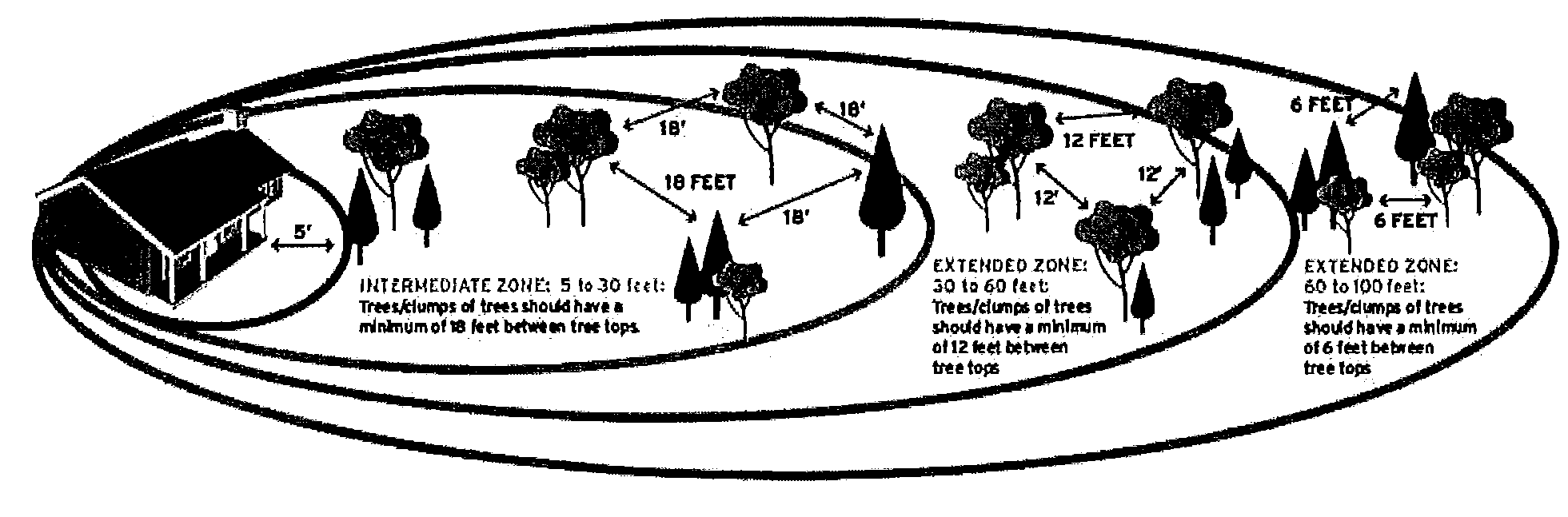
SECTION P401
THE IMMEDIATE ZONE
P401.1 General. This is the most important zone of the defensible space, according to the Firewise® program, to take immediate action on as it is the most vulnerable to embers. The following specific standards apply to the creation of defensible space within the Immediate Zone:
1.
All dead and diseased trees, shrubs, and other landscaping materials shall be removed.
2.
All vegetation and combustible and flammable materials shall be moved away from exterior walls, under the eaves, and/or decks. This includes:
2.1
Mulch
2.2
Ground fuels
2.3
Flammable plants
2.4
Leaves and needles
2.5
Firewood piles
SECTION P501
THE INTERMEDIATE ZONE
P501.1 General. This is the landscaping/hardscaping zone of the defensible space through the use of careful landscaping or creating breaks that can help influence and decrease fire behavior. The following specific standards apply to the creation of defensible space within the Intermediate Zone:
1.
All dead and diseased trees, shrubs, and other landscaping materials shall be removed.
2.
Removal of ladder fuels (vegetation under trees) shall occur so a surface fire cannot reach the crowns of the trees.
2.1
Limb up trees to a height of 10 feet. For shorter trees, trim to a height of ⅓ of the overall tree height.
3.
Trees shall be spaced to have a minimum of eighteen feet between the crowns with the distance increasing with the percentage of slope.
4.
Firewise® trees and shrubs in this zone should be limited to small clusters of a few each to break up the continuity of the vegetation across the landscape.
5.
Irrigated trees, shrubs, and other landscaping material shall be preserved if they are limbed to remove dead branches and well-spaced to reduce the risk of a fire spreading to other vegetation or structures.
SECTION P601
THE EXTENDED ZONE UP TO 60 FEET
P601.1 General. This zone focuses on interrupting a fire's path and keeping the flames smaller and on the ground by:
1.
All dead and diseased trees, shrubs, and other landscaping materials shall be removed.
2.
The accumulation of ground litter and debris shall be disposed of or dispersed.
3.
Small conifers growing between mature trees shall be removed.
4.
Vegetation adjacent to storage or other outbuildings shall be removed.
5.
Trees shall be spaced to have a minimum of twelve feet between the crowns with the distance increasing with the percentage of slope.
SECTION P701
THE EXTENDED ZONE OVER 60 FEET
P701.1 General. This zone focuses on interrupting a fire's path and keeping the flames smaller and on the ground by:
1.
All dead and diseased trees, shrubs, and other landscaping materials shall be removed.
2.
The accumulation of ground litter and debris shall be disposed of or dispersed.
3.
Small conifers growing between mature trees shall be removed.
4.
Vegetation adjacent to storage or other outbuildings shall be removed.
5.
Trees shall be spaced to have a minimum of six feet between the crowns with the distance increasing with the percentage of slope.
(Ord. 2013-15 §1; Ord. 2019-21, §1(Exh. A; Ord. No. 2021-15, §1(Exh. A))
Sec. 4-11-161. - Definitions.
As used in this Division, the following terms shall have the meanings indicated:
Hazard to health or safety includes any activity so recognized by the United States, the State or the ordinances of the Town. Such hazards shall also include activities likely to cause foul or offensive odors, promote the growth or propagation of disease-carrying insects, pollute the air or groundwaters of adjacent property, create loud or offensive sounds or cause drainage and runoff to occur in other than historical patterns.
Inoperable vehicle means any automobile, truck or self-propelled vehicle incapable of moving under its own power or which lacks a valid current license plate or does not comply with the minimum safety requirements of the Colorado Motor Vehicle Law.
Nuisance means any substance, act, occupation, condition or use of property declared a nuisance by this Article or declared a nuisance by the State or by any court or agency thereof, or known as a nuisance at common law, or which is of such nature and duration as to:
a.
Substantially annoy, injure or damage the comfort, health, repose or safety of the public.
b.
In any way render the public insecure in life or in the use of property.
c.
Unlawfully and substantially interfere with, obstruct or tend to obstruct or render dangerous for passage any street, alley, highway or other public way.
Offensive or unwholesome business or establishment means any business or establishment involving the provision of goods or services to others in exchange for something of value, which business or establishment may create, foster or maintain any hazard to health or safety.
(Prior code 137-1, 153-1; Ord. 2003-20 §3)
Sec. 4-11-162. - Nuisances prohibited.
No person being the owner, agent or occupant or having under his or her control any building, lot or premises or unimproved real estate within the Town limits shall maintain or allow any nuisance to be or remain therein.
(Prior code 137-2; Ord. 2003-20 §3)
Sec. 4-11-163. - Authority of Town to declare nuisances.
Any act, condition, substance, occupation or use of property which substantially meets the criteria of a nuisance as defined in Section 4-3-161 above may be so declared by the Town Council, and nothing in Section 4-3-164 below shall be construed to limit the power of the Town to make such declaration.
(Prior code 137-3; Ord. 2003-20 §3)
Sec. 4-11-164. - Nuisances declared.
(a)
Unwholesome business. Offensive or unwholesome businesses or establishments are prohibited. From and after the effective date of this Article, it shall be unlawful for any person to allow or suffer upon his or her premises or any premises which he or she is entitled to possess any offensive or unwholesome business or establishment within the Town, or within one (1) mile beyond the outer limits of the Town as such outer limits are now, or may be hereafter, constituted. Any slaughterhouse or other place for slaughtering animals within the Town is therefore declared to be a nuisance.
(b)
Junkyards and dumping grounds. All places used or maintained as junkyards or dumping grounds or for the wrecking or disassembling of automobiles, trucks, tractors or machinery of any kind or for the storing or leaving of worn out, wrecked or abandoned automobiles, trucks, tractors, trailers, boats and house trailers or machinery of any kind, or of any of the parts thereof, or for the storing or leaving of any machinery or equipment used by contractors or builders or by other persons, which places essentially interfere with the comfortable enjoyment of life or property by others, are hereby declared to be nuisances.
(c)
Discharge of noxious liquids. The discharge out of or from any house or place of foul or noxious liquid or substance of any kind whatsoever into or upon any adjacent ground or lot or into any street, alley or public place in the Town is hereby declared a nuisance.
(d)
Stale matter. The accumulation of any stale, putrid or stinking fat or grease or other matter is hereby declared to be a nuisance.
(e)
Sewer inlet. Any article or materials accumulated in any sewer, sewer inlet or privy vault that shall have a sewer connection, which cause or might cause such sewer, sewer inlet or privy vault to become noxious or offensive to others or injurious to public health, are hereby declared to be nuisances.
(f)
Dead animals; removal. The body of any animal which has died and which is undisposed of after twenty-four (24) hours after death is hereby declared to be a nuisance.
(g)
Stagnant ponds. Any cellar, vault, drain, sewer, pond of water or other place in the Town that shall be noxious or offensive to others, or injurious to public health, through an accumulation or deposit of noxious, offensive or foul water or other substances shall be deemed a nuisance. This applies in all cases for which no other specific provisions are made in this Article or any other ordinance of the Town.
(h)
Open wells, cisterns or excavations. It is hereby declared that excavations exceeding five (5) feet in depth, cisterns and wells or an excavation used for storage of water are public nuisances unless the same are adequately covered with a locked lid or other covering weighing at least sixty (60) pounds or are securely fenced with a solid fence to a height of at least five (5) feet, and it shall be unlawful for any person to permit such nuisance to remain on premises owned or occupied by him or her. Any well or cistern on any property within the limits of the Town, whenever a chemical analysis or other proper test or the location of the same shows that the water of said well or cistern is probably contaminated, impure or unwholesome, shall be deemed a nuisance. Any abandoned or unused well or cistern shall be filled with dirt and covered.
(i)
Noisemaking devices to attract children. The use of bells, whistles, sirens, music, horns or any other noisemaking devices for the purpose of attracting children or minors to any vehicle upon the streets, highways, rights-of-way, alleys or public ways of the Town for the purpose of selling, distributing or giving away any product whatsoever to such minors is hereby declared to be a public nuisance and hazard and is expressly prohibited and shall be unlawful, except such activities carried on as part of duly authorized public parades or processions.
(j)
Handbills, flyers, posters and placards. Any handbill, flyer, poster, placard or painted or printed matter which shall be stuck, posted or pasted upon any public or private house, vehicle, store or other building or upon any fence, power pole, telephone pole or other structure without the permission of the owner, agent or occupant of the property shall be deemed a nuisance.
(k)
Unused appliances. Any unused, inoperable or abandoned refrigerator, washer, dryer, freezer or other appliance within any accessible yard, lot or carport within the limits of the Town is hereby declared a nuisance.
(l)
Vacant buildings. It is declared a nuisance for the owner of any vacant building to fail to replace any broken window or fail to secure any other means of entry into such building within seventy-two (72) hours after notice is given by the Town.
(m)
Transporting of garbage or manure. The transport of manure, garbage, swill or offal upon any street in the Town in a vehicle which is not fitted with a substantially tight enclosed box thereon allowing no portion of such filth to be scattered or thrown into such street is hereby declared a nuisance.
(n)
Removal of inoperable vehicle. Any inoperable vehicle parked on any lot or parcel of property in the Town is a nuisance. For purposes of this Section, inoperable vehicle shall mean any vehicle (including but not limited to motor vehicles, trailers, snowmobiles and ATV's) which does not have current license or registration, is incapable of moving or operating on its own power or as originally manufactured, or is missing, in the judgment of authorized Town officials, any significant component part. However, not more than two (2) unlicensed vehicles owned by the owner or occupant of the property may be stored, for repair or restoration purposes only and not for sale, in a garage, or in the rear yard of the property if screened from public view by a permanent opaque wall or fence at least six (6) feet in height.
(o)
Barking, yelping, howling or mewing by dogs or cats. Any dog or cat which, by loud or frequent or habitual barking, yelping, howling or mewing, causes a serious annoyance to the neighborhood or to persons passing to and fro upon the streets or sidewalks is hereby declared a nuisance.
(p)
Accumulation of garbage, refuse, etc. Any accumulation of refuse, trash or other waste or discarded material, including discarded building and construction materials, is hereby declared to be a nuisance.
(q)
Smoke and odor from burning. Any smoke and odor resulting from the burning of refuse, trash or other materials, including but not limited to those materials outlined in Subsection (p) above, is hereby declared to be a nuisance.
(r)
Accumulation of manure. The accumulation of manure or other animal waste in quantities which causes complaints from neighboring property owners is hereby declared a nuisance. This provision does not apply to a light spread of manure upon lawns or gardens or which is plowed under the surface of the ground.
(s)
Disorderly house. The keeping of any dwelling, boardinghouse, rooming house or other residential property in violation of any provision of this Chapter, including any violation of maximum occupancy limitations imposed by that Article or any condition of approval of the use of property imposed by action of the Town is a nuisance. A disorderly house shall also include keeping any such property in a condition or manner which generates law enforcement calls disproportionate to other properties in the neighborhood or which negatively affects neighboring properties and/or residents, whether by continuous or excessive noise or by maintenance of the property in an unsightly or unwholesome manner, noxious or offensive to others or injurious to public health. For purposes of enforcement of this Subsection, the person responsible for the maintenance of a disorderly house may be the owner of the property, lessee, sublessee, tenant, occupant or renter, jointly or severally.
(t)
Fences in disrepair. Any fence which comes into disrepair or is not maintained is hereby declared a nuisance.
(Prior code 137-4; Ord. 1995-1 §1; Ord. 1995-8 §25; Ord. 1999-14 §§25—29; Ord. 2003-20 §3)
Sec. 4-11-165. - Offensive or unwholesome business prohibited.
Offensive or unwholesome businesses or establishments are prohibited within the Town and within one (1) mile beyond the outer limits of the Town and it shall be unlawful to open, operate, carry on or maintain such a business or establishment.
(Prior code 153-2; Ord. 2003-20 §3)
Sec. 4-11-166. - Certain businesses prohibited near schools.
No tannery, stable, pigsty or privy, whether within or outside the Town limits, shall be permitted to operate, open or carry on within three thousand (3,000) feet of any school.
(Prior code 153-3; Ord. 2003-20 §3)
Sec. 4-11-167. - Complaints.
Complaints of nuisances may be made in writing to any Town official. Whenever possible, any complaint shall state the nature of such nuisance, the location, including street address, name of the owner, agent or occupant of the building or lot, if known, and the name and address of the complainant.
(Prior code 137-5; Ord. 2003-20 §3)
Sec. 4-11-168. - Inspections; right of entry; emergencies.
(a)
Whenever necessary to make an inspection to enforce any of the provisions of this Article, or Article VIII, Division 3 (Tree Conservation and Replacement), Article VIII, Division 4 (Removal of Dead, Diseased and Beetle-Infested Trees), Article VIII, Division 5 (Fire Hazard Mitigation) and Article VIII, Division 6 (Noxious Weed Control), or whenever an authorized Town official shall have reasonable cause to believe that there exists in any building or upon any premises any condition which constitutes a nuisance hereunder, the authorized Town official may enter such building or premises at all reasonable times to inspect the same or to perform any duty under this Article. If such building or premises are occupied, the authorized Town official shall first present proper credentials and demand entry; and if such building or premises are unoccupied, he or she shall first make a reasonable effort to locate the owner or occupant or other person having charge or control of the building or premises and, upon locating said owner, occupant or other person or persons, shall present proper credentials and demand entry. If entry is refused, the authorized Town official shall give the owner or occupant, or if said owner or occupant cannot be located after a reasonable effort, he or she shall leave at the building or premises, twenty-four (24) hours' written notice of intention to inspect. The notice given to the owner or occupant or left on the premises as aforesaid shall state that the property owner has the right to refuse entry and that, in the event such entry is refused, inspection may be made only upon issuance of a search warrant by the Municipal Judge of the Town or a judge of any other court having jurisdiction.
(b)
After the expiration of said twenty-four-hour period from the giving or leaving of notice, the authorized Town official may appear before the Municipal Judge of the Town and, upon a showing of probable cause, shall obtain a search warrant entitling him or her to enter said building or go upon such premises. Upon presentation of said search warrant and proper credentials, or possession of the same in the case of an unoccupied building or premises, said official may enter into said building or go upon said premises using such reasonable force as may be necessary to gain entry.
(c)
For the purposes of the above Subsection (b), a determination of probable cause will be based upon reasonableness, and if a valid public interest justifies the intrusion contemplated, then there is probable cause to issue a search warrant. The person applying for such warrant shall not be required to demonstrate specific knowledge of the condition of the particular structure or premises in issue in order to obtain a search warrant. It shall be unlawful for any owner or occupant of said building or premises to resist reasonable force used by any authorized agent acting pursuant to this Section.
(d)
Whenever an emergency situation exists in relation to the enforcement of any of the provisions of this Article, the authorized Town official, upon a presentation of proper credentials or identification in the case of an occupied building or premises, or possession of said credentials in the case of an unoccupied building or premises, may enter into any building or go upon any premises within the jurisdiction of the Town. In said emergency situation, such person or his or her authorized representative may use such reasonable force as may be necessary to gain entry into said building or upon said premises.
(e)
For purposes of the above Subsection (d), an emergency situation shall include but not be limited to any situation where there is imminent danger of loss of life, limb and/or property. It shall be unlawful for any owner or occupant of said building or premises to resist reasonable force used by the authorized official acting pursuant to this Subsection.
(f)
In addition to, or in lieu of, the procedures described above, an authorized representative of the Town may appear before the Municipal Judge of the Municipal Court and, upon presentation of an affidavit showing probable cause, may request a search warrant entitling such authorized representative of the Town to enter said building or upon such premises. The supporting affidavit shall allege sufficient facts to warrant a person of reasonable caution to believe that a nuisance as defined by this Article, or a condition within the scope of Article VIII, Division 3 (Tree Conservation and Replacement), Article VIII, Division 4 (Removal of Dead, Diseased and Beetle-Infested Trees or Article VIII, Division 5 (Fire Hazard Mitigation) is located or maintained on the premises to be searched. In determining whether probable cause for issuance of a search warrant exists, the Municipal Judge may consider, in addition to any other evidence or matters of which judicial notice may be taken:
(1)
The totality of the facts and circumstances known to the affiant;
(2)
The affiant's experience and training in evaluating the existence or probable existence of a nuisance or other prohibited condition; and
(3)
Whether there is a fair probability that evidence of a nuisance or other condition as described above will be found.
After obtaining a search warrant, the authorized representative of the Town may enter the subject building or premises using such reasonable force as may be necessary to gain entry, to the extent property damage occasioned thereby is minimized to the degree possible. It shall be unlawful for any owner or occupant of said building or premises to resist reasonable force used by any authorized agent acting pursuant to this Section.
(Prior code 137-6; Ord. 1995-1 §1; Ord. 2003-20 §3; Ord. 2007-17 §1; Ord. 2007-24 §1)
Sec. 4-11-169. - Conviction and abatement of nuisances; failure to comply.
(a)
Any person convicted in the Municipal Court of any violation of this Division shall immediately correct the violation and may be punished as provided in Section 1-1-19 of this Code.
(b)
Upon the discovery of any nuisance on public or private property in the Town, the authorized representative of the Town, may, in the exercise of discretion, notify in writing the owner of the property on which the nuisance is discovered and require said owner to abate the same. The reasonable time for abatement shall not exceed ten (10) days, unless extended for good cause at the reasonable discretion of the person issuing the notice. Such notice shall state that, if the nuisance is not abated within the time period stated in the notice, then the Town will seek an abatement order from the Municipal Court and will assess the cost of such abatement, together with an additional five-percent assessment for inspection and incidental costs, and an additional ten-percent assessment for the costs of collection, as a lien against the property to be collected in the same manner as real estate taxes against the property.
(c)
Service of notice. If written notice to abate is given, it shall be served on the owner and, if different, to the responsible party by:
(1)
Posting a copy of the notice in a conspicuous place on the premises upon which said nuisance exists; and
(2)
By mailing a copy of the notice by certified United States mail, to the last known address of the owner of said premises as reflected in the Summit County real estate or tax assessment records; or
(3)
By hand delivery.
(d)
Abatement order. If the person notified shall neglect or refuse to comply with the notice to abate the nuisance within the time specified, such person shall be guilty of a violation of this Article and the Town Attorney may apply to the Municipal Court for an abatement order as follows:
(1)
The application shall be accompanied by an affidavit or testimony establishing to the satisfaction of the Court, based on a preponderance of the evidence, that a nuisance as defined by this Article exists on the subject property, and that the Town has complied with the notice requirements of Subsections (b) and (c) above, and that the owner has failed to abate the identified nuisance upon the property.
(2)
The Town shall give notice to the owner and, if different, to the responsible party, of the subject premises of its application for the abatement order in the manner as provided above in Subsection (c).
(3)
The notice of application for an abatement order shall include a copy of the Town's application and its affidavit or a summary of its anticipated testimony in support of its application, as well as the time, date and place at which the Town will appear before the Municipal Court to request entry of the abatement order.
(4)
At the stated time, date and place, the Municipal Court Judge shall hold a hearing to review the application for abatement order, the affidavit, if any, and any testimony or other evidence offered by the Town in support of the application, as well as any testimony or other evidence presented by the owner, if present.
(5)
Thereafter, the Municipal Court is authorized to enter an order authorizing the Town to enter upon such property, abate the nuisance and recover its costs as provided by Section 4-11-170 below.
(6)
Upon the Municipal Court's issuance of an order authorizing the abatement of a nuisance, the Town shall abate said nuisance or cause the same to be abated.
(Ord. 1999-14 §30; Ord. 2001-18 §4; Ord. 2003-20 §3; Ord. 2007-17 §2; Ord. 2019-17, §4)
Sec. 4-11-170. - Costs of abatement.
(a)
The person or persons responsible for any nuisance within the Town shall be liable for and pay and bear all costs and expenses of its abatement. Unless otherwise provided in this Code, the actual costs of abatement, together with an additional five-percent assessment for inspection and incidental costs and an additional ten-percent assessment for costs of collection, shall be assessed against the owner of any private property upon which a nuisance was abated and such costs and expenses may be collected by the Town in any action at law, referred for collection by the Town Attorney or assessed against the property as hereinafter provided.
(b)
The Town shall mail notice of the assessment by certified mail to the owner at his or her address as shown in the County Tax Assessor's records, and such costs shall be paid to the Town within thirty (30) days thereafter. The notice shall notify the owner that work has been performed and of the nature of the work and demand payment of the costs thereof, including an additional five-percent assessment for inspection and other incidental costs in connection therewith and an additional ten-percent assessment for costs of collection. The notice shall also state that, if said amount is not paid within thirty (30) days after mailing the notice, it shall become an assessment on and a lien against the property of said owner, will be certified by the Town Clerk to the County Treasurer as an assessment against such property, and will be collected in the same manner as real estate taxes upon the property.
(c)
Failure to pay the assessment within thirty (30) days shall cause it to become a lien against such property until paid and shall have priority over all liens, except general taxes and prior special assessments.
(d)
The Town Clerk shall certify any assessment not paid when due to the County Treasurer, who shall collect the assessment, including the five-percent assessment for inspection and incidental costs and the additional ten-percent assessment for costs of collection, in the same manner as other taxes are collected.
(Ord. 2007-17 §3)
CHAPTER 4
Community Development

