
Sleepy Hollow City Zoning Code
CHAPTER 5
BUSINESS DISTRICTS
Sec. 8-5-1. - Purpose.
A.
B-1 business district: The purpose of the B-1 business district is to govern the location and development of moderate intensity commercial uses, office research uses, office warehouse and light industrial uses on sites of ten acres and larger in size within the village. This district is intended to be used only where the property fronts on arterial Route 72 east of Sleepy Hollow Road, and shall not be used in currently unincorporated areas beyond the village limits in accordance with restrictions on potential business and commercial development in such areas imposed by the jurisdictional boundary and land use agreement between the City of Elgin and the Village of Sleepy Hollow dated March 8, 1993. The area and bulk requirements of this chapter are designed to permit these moderate intensity uses in such a way as to enhance and protect the character of the village.
B.
B-2 village business district: The purpose of the B-2 village business district is to govern the location and development of low to moderate intensity commercial and office uses on sites of one acre up to 15 acres in size within the village. This district is intended to be used only where the property fronts on arterial Route 72 east of Sleepy Hollow Road. The area and bulk requirements of this chapter are designed to permit these low to moderate intensity uses in such a way as to enhance and protect the low density residential character of the village (see subsection 8-1-3.C of this title). The nature, appearance and operation of such uses shall be compatible with the character of the neighboring area in the village.
C.
B-3 commercial and mixed use district: The purpose of the B-3 commercial and mixed use district is to govern the location and development of a mixture of commercial and other miscellaneous uses, for the operation of businesses which generate sales tax revenues and for other purposes. This district is intended to be located only where the property is located on the west side of, and fronts on, Randall Road in the village. The location of this district, together with the applicable intensity and bulk requirements for uses in this district, are designed to permit various commercial uses, and other uses, in such a way as to have no deleterious effect on the primarily residential character of the village, while at the same time recognizing the opportunities for uses commensurate with the high traffic volume on Randall Road.
(Ord. 97-8, 5-19-1997; Ord. 2003-1, 2-3-2003; Ord. 2016-8, 7-5-2016)
Sec. 8-5-2. - Permitted uses.
A.
B-1 business district:
1.
Commercial: Commercial uses permitted in the B-1 business district shall include shopping centers as well as restaurants (excluding fast food or drive-in restaurants), health clubs, catering services, etc. Offices may be permitted on a nonground level. Exclusive warehousing (a use with 60 percent or more of the floor area devoted to storage uses), truck stops and truck terminals are specifically prohibited.
2.
Offices and conference centers: Corporate, general, medical, business, professional or governmental offices, restaurants (excluding drive-in or drive-through restaurants) and supporting shops shall be permitted. Combination office/warehouse and office/light industrial manufacturing uses are prohibited on lots not a part of a business park (see business parks below). No temporary offices shall be permitted except during building construction when contractors' offices shall be permitted during the construction period.
Conference centers may contain conference areas, entertainment areas, kitchen facilities and temporary living quarters for corporate executives and guests. No such conference center shall exceed 10,000 square feet in total area nor shall its living quarters be occupied for more than four consecutive days or for more than 40 percent of the time in any calendar year.
3.
Business parks: Business parks shall be planned and developed as an integrated development for at least five individual businesses, where special attention is paid to circulation, parking, aesthetics and compatibility and where the individual lot sizes are not to be less than one acre. A business park shall constitute a minimum of ten acres.
Combination office/warehouse and office/light industrial manufacturing shall be permitted only in business parks. Further, multiple office/warehouse and office/light industrial uses are permitted on individual lots. At least 15 percent of the total square footage shall be devoted to office type uses.
Hotels and motels with ballroom facilities, restaurants, shops and meeting rooms shall be permitted within a business park. Hotels and motels shall neither exceed 400 rooms nor be less than 100 rooms in size.
4.
Research laboratories: The operations and activities of such uses shall be conducted wholly inside a building or buildings, and no use shall emit odors, gas, dust, smoke, lighting, radioactivity, nuclear radiation or any other effects to an extent offensive, objectionable or dangerous to any surrounding or nearby properties.
B.
B-2 village business district:
1.
Commercial: Commercial uses permitted in the B-2 village business district shall include the following: shopping centers; freestanding retail uses; health clubs; restaurants; banquet facilities; and service businesses in general, except as otherwise prohibited herein.
Commercial uses not permitted in the B-2 village business district shall include the following: financial institutions; gasoline service stations; auto repair; car wash; and any other commercial use the nature, appearance, or operation of which is not in character with the village.
2.
Offices: Office uses permitted in the B-2 village business district shall include corporate, general, medical, business, professional or governmental offices.
Office uses not permitted in the B-2 village business district shall include any office uses whose nature, appearance or operation is not in character with the village, and any temporary offices, except contractors' offices, which shall be permitted only during the building construction period.
C.
B-3 commercial and mixed use district:
1.
Permitted uses: Commercial uses permitted in the B-3 commercial and mixed use district shall include the following: freestanding general retail uses; seasonal retail uses; festivals, carnivals, and outdoor amusement parks and other outdoor amusement uses; agricultural uses, including farming, greenhouses, and indoor storage and maintenance of farming equipment.
2.
Prohibited uses: The following uses shall be prohibited: service businesses; offices, except ancillary to warehousing, storage, and distribution uses; health clubs; financial institutions; automobile service stations; automobile repair shops; car washes; and any other use not primarily engaged in a business operation that will generate sales tax revenue.
3.
Special uses: Special uses may be allowed as set forth in section 8-5-13 of this chapter.
(Ord. 4-7-A5-35, 8-21-1989; amd. Ord. 97-8, 5-19-1997; Ord. 2016-8, 7-5-2016; Ord. 2017-2, 1-16-2017; Ord. 2022-9, 8-1-2022)
Sec. 8-5-3. - Lot area and bulk requirements.
A.
B-1 business district:
1.
Intensity and bulk maximums/minimums:
(Ord. 4-7-A5-35, 8-21-1989; amd. Ord. 97-8, 5-19-1997)
2.
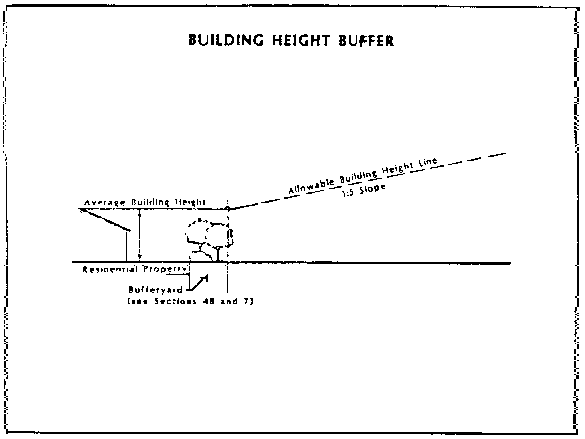
Building height limitations: The heights of proposed buildings adjoining residential uses shall be limited and tied to the width of the buffer yard. For every foot a proposed building exceeds the average height of the adjoining residential structures, a five-foot setback from the inside of the buffer yard shall be provided. The maximum building setback shall not exceed 300 feet (see illustration 1 of this section). The first ten percent of the setback shall be kept in landscaped area and shall not be devoted to parking, loading or retention.
Illustration 1
3.
Minimum site area:
a.
Minimum site area shall be ten acres. Sites shall be single or multiple lots controlled for development by a single interest. No property shall be subdivided unless the subdivision fully complies with the subdivision ordinance (see title 9 of this Code) and all other applicable code provisions.
b.
The average lot size shall be 80,000 square feet; the minimum lot area shall be 40,000 square feet.
4.
Floor area and landscape surface ratios: The maximum floor area ratio (FAR) and the minimum landscape surface ratio (LSR) shall be governed by subsection A.1 of this section.
a.
The floor area ratio (FAR) is the total of all usable floor area of the buildings divided by the site area in accordance with the following formula:
b.
"Floor area", for the purposes of this chapter, is "usable floor area" and shall be defined as the sum of the gross horizontal areas of the several floors of a building or structure, measured from the interior faces of the interior walls or from the interior line of walls separating two buildings or structures, including the following:
(1)
Floor area of the basement if: it has headroom of seven feet or more or if it is used for purposes other than disaster shelter;
(2)
Penthouses, other than that area used for mechanical equipment;
(3)
Attics having headroom of seven feet or more;
(4)
Accessory storage areas located within working spaces, such as counters, racks or closets or storage used in the conduct of the business or used and calculated in the gross leasable area for multi-tenant buildings; and
(5)
Space devoted to the production of goods or to business or professional offices.
c.
Usable floor area shall not include:
(1)
Elevator shafts and stairwells on each floor;
(2)
Floor spaces and shafts used for mechanical, telephone and electrical equipment;
(3)
Attics having headroom of less than seven feet;
(4)
Areas used for storage, except as required by subsection A.4.b(4) of this section;
(5)
Space devoted to off-street parking or loading facilities;
(6)
Entrance lobbies and atrium type areas;
(7)
Washrooms intended for general public use;
(8)
Mechanical penthouses;
(9)
Interior balconies and mezzanines; and
(10)
Enclosed porches.
d.
Landscape surface ratio (LSR) is the area of land devoted to pervious landscaping divided by the site area in accordance with the following formula:
B.
B-2 village business district:
1.
Intensity and bulk maximums/minimums:
2.
Minimum and maximum zoning district area: Zoning district area shall be a minimum of one acre up to a maximum of 15 acres. Zoning district areas shall be a single lot or multiple lots controlled for development by a single interest. No property shall be subdivided unless the subdivision fully complies with the subdivision ordinance (see title 9 of this Code) and all other applicable code provisions.
3.
Floor area and landscape surface ratios: The maximum floor area ratio (FAR) and the minimum landscape surface ratio (LSR), as defined in subsection A.4 of this section, shall be governed by subsection B.1 of this section.
4.
Building height defined: "Building height" in the B-2 district is defined as the vertical distance measured from the natural grade to the highest point on such building.
C.
B-3 commercial and mixed use district:
1.
Intensity and bulk minimums: The floor area ratio and minimum landscape surface ratio shall be as prescribed for the B-2 village business district, in subsection B of this section.
2.
Minimum and maximum zoning district area: The minimum area for any B-3 commercial and mixed use district shall be 15 acres.
3.
Maximum building height: The maximum building height of any structure on the premises shall not exceed 30 feet, except for any barn structure which shall not exceed 55 feet in height.
4.
Building height defined: "Building height" in the B-3 Commercial and mixed use district is defined as the vertical distance measured from the natural grade to the highest point on such building.
(Ord. 4-7-A5-35, 8-21-1989; Ord. 97-8, 5-19-1997; Ord. 2003-1, 2-3-2003; Ord. 2016-8, 7-5-2016)
Sec. 8-5-4. - Yard requirements.
A.
Setbacks: All buildings shall have a setback of at least 50 feet from any property line along an arterial road right-of-way, at least 20 feet from any property line along an internal street, as defined in section 8-1-5 of this title, and at least 40 feet from any property line along a road or street other than an arterial road or an internal street.
All buildings shall have a setback of at least 20 feet in the rear and the side yards from any property line created within a development site in the B-1 and B-2 business districts by subdivision of the original zoned property, and a setback of at least 25 feet in the rear and the side yards from any property line of the original zoned property that does not run along a street.
B.
Buffer yards: Buffer yards shall be provided as required in section 8-5-7 of this chapter. There shall be no parking or drives permitted in buffer yards. Where necessary, access roads may cross buffer yards but shall be oriented to minimize the area consumed by such crossing.
(Ord. 4-7-A5-35, 8-21-1989; Ord. 97-8, 5-19-1997)
Sec. 8-5-5. - Off-street parking and loading.
A.
Off-street parking: Off-street parking requirements, in addition to other requirements of this chapter, shall be as follows:
1.
Whenever any building is erected for any of the uses permitted in the B-1, B-2 or B-3 business districts, parking spaces shall be provided on the lot, or in the building, according to the following schedule:
2.
Off-street parking shall meet the following requirements for size:
a.
A required off-street parking space shall be at least nine feet in width and at least 18 feet in length, exclusive of access drives, aisles, ramps and columns. Up to 25 percent of the stalls may be eight feet in width and at least 15 feet in length, exclusive of access drives, aisles, ramps and columns, if such spaces are designated for compact cars.
b.
The minimum width of the driving lane between parking stalls shall be:
B.
Off-street loading: Off-street loading spaces and docks are not required for normal deliveries of mail, office supplies, office equipment or furniture as long as the items delivered are neither sold as a part of a retail business on the premises nor are a part of an office/warehouse storage operation. Where regular deliveries of merchandise or storage materials occur or where trucks or trailers may be parked overnight or for more than three hours (except for moving tenants), off-street loading spaces shall be provided.
1.
Parking: No trucks or trailers shall park with engines or other mechanical equipment running between the hours of 10:00 p.m. and 6:00 a.m.
2.
Number: The minimum number of loading spaces accessory to buildings, structures and uses hereafter erected, structurally altered or enlarged in this district shall be in accordance with the following schedule:
Structures or uses having less than 20,000 square feet of floor area shall provide receiving facilities accessible by motor vehicles off an adjacent alley, service drive or other space on the same zoning lot.
3.
Size: A required loading space shall be at least ten feet in width and at least 25 feet in length and shall have a vertical clearance of not less than 15 feet.
4.
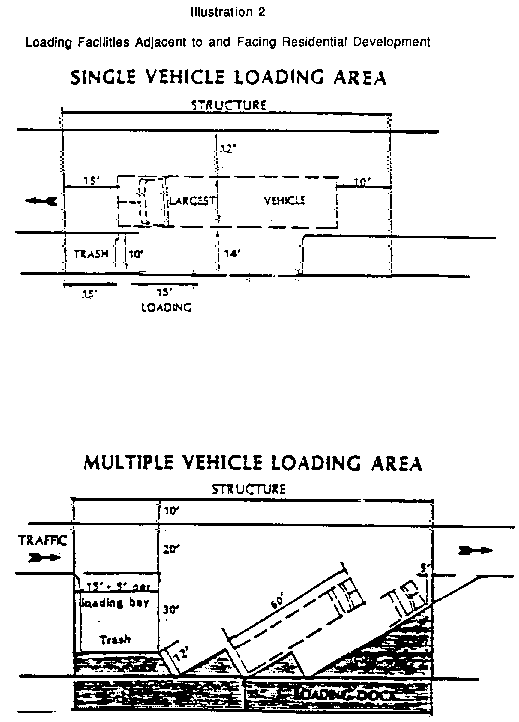
Abutting residential development: Where loading facilities face adjacent residential development, the loading area shall be enclosed in accordance with subsection C, illustration 2 of this section. All trash facilities shall also be within the enclosure.
5.
Variations: Notwithstanding any other provision of this chapter, variation of loading requirements specified in this section may be permitted, subject to review and recommendation by the planning and zoning commission and approval by the village board of trustees.
6.
Planning and zoning commission review: Design, circulation and landscaping of the loading areas shall be subject to review by the village planning and zoning commission to ensure they are fully screened from general public view.
C.
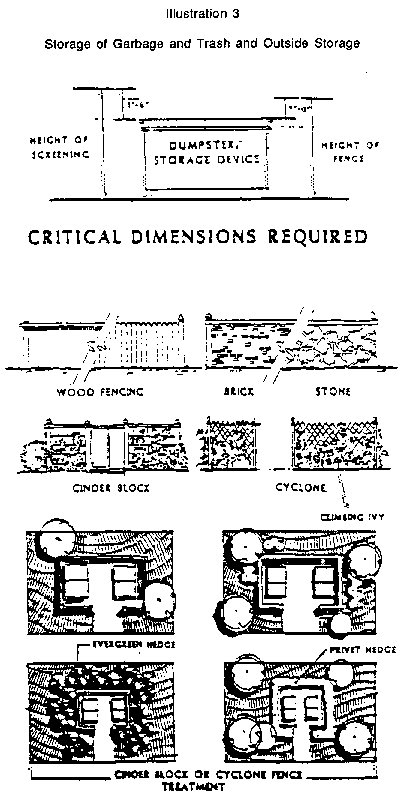
Storage of garbage and trash and outside storage: All garbage cans, trash containers and other storage devices situated on any property shall be closed containers with lids and shall be concealed or suitably screened from public view. Fencing or landscaping shall be used to totally obstruct vision into the storage areas by the alternatives set forth in illustration 3 of this subsection C or their equivalent.
1.
Fencing and landscaping for storage areas shall be maintained in good condition and kept litter free. All garbage cans, trash containers and other garbage storage devices shall be emptied and the contents thereof properly disposed of not less than once every seven days.
2.
No portion of any lot shall be used for open or unenclosed storage of any kind.
(Ord. 4-7-A5-35, 8-21-1989; Ord. 2018-8, 4-16-2018; Ord. 2018-16, 8-6-2018)
Sec. 8-5-6. - Buildings per lot and applicable standards.
In the B-1 and B-2 business districts, no more than one principal structure per lot shall be permitted in accordance with this title, except where it is approved as a shopping center, is approved as a land development, and is approved as if it were a subdivision. No property shall be subdivided or approved as a land development unless the subdivision fully complies with the village subdivision ordinance and all other applicable provisions.
In the B-3 commercial and mixed use district, more than one principal structure and/or use shall be allowed on a single lot.
The definitions, regulations, and standards contained in this title and the subdivision ordinance shall apply to all projects within the B-1, B-2, and B-3 business districts, unless either waived by the village engineer upon approval by the building officer, and the village planning and zoning commission, or superseded by regulations in this title. All references contained in the preceding sections to the term "subdivision" shall include projects within the B-1, B-2, or B-3 business districts. Similarly, all references in said preceding sections to "subdivider" shall mean and include developers within the B-1, B-2, or B-3 business districts.
(Ord. 2018-8, 4-16-2018)
Sec. 8-5-7. - Minimum buffer yard requirements.
The following requirements are intended to mitigate the potentially adverse impacts on adjacent land uses of such as dirt, litter, noise, glare of lights, signs, and unsightly buildings and parking areas. The buffer yard requirements have been designed to ensure that indicated buffer yards actually function as "buffers" appropriate to the given land use situation.
A.
Determination of buffer yard requirements: The following procedure shall be used to determine the type of buffer yard required in the B-1 and B-2 business districts:
1.
Type A buffer yards shall be provided when the buffer yard abuts other uses in the B-1 and B-2 business districts, but not a road or street.
2.
Type B buffer yards shall be provided when the buffer yard runs along internal roads, as defined in section 8-1-5 of this title, constructed within a development site in the B-1 and B-2 business districts.
3.
Type C buffer yards shall be provided when the buffer yard abuts Route 72 or other arterial roads.
4.
Type D buffer yards shall be provided when the buffer yard abuts residential uses or residential zoning districts (excluding detached, single-family dwellings or detached, single-family residential zoning districts), and also when the buffer yard abuts Route 72 or other arterial roads where detached, single-family dwellings or detached, single-family residential zoning districts are across the road therefrom and adjacent thereto.
5.
Type E buffer yards shall be provided when the buffer yard abuts detached single-family dwellings, detached single-family dwelling zoning districts or where it abuts a residential street with residential on the other side.
6.
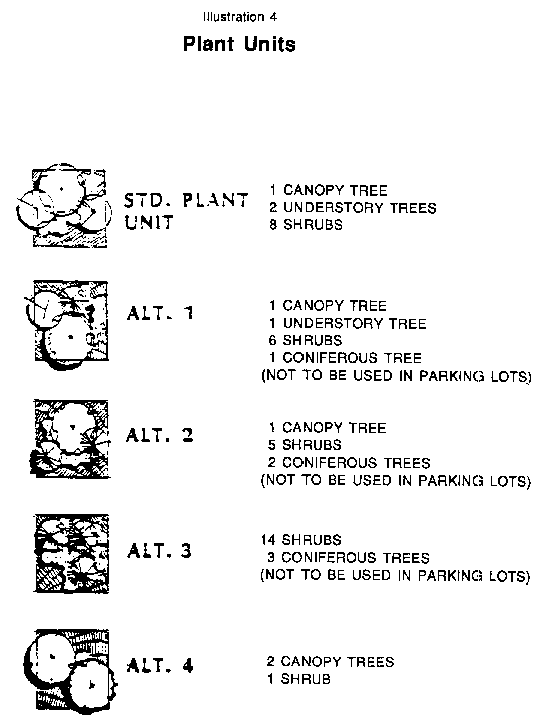
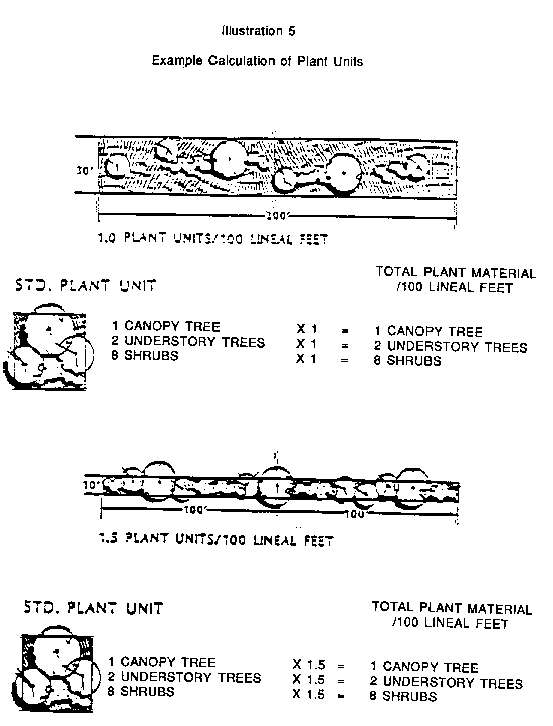
The plants required to be planted in buffer yards are expressed in plant units per 100 linear feet of buffer yard and are quantified in Tables 1 and 2 of this section along with the permitted minimum buffer yard widths based upon buffer yard type. The plant unit alternatives are shown in subsection E, illustration 4 of this section.
TABLE 1
MINIMUM BUFFER YARD REQUIREMENTS IN THE B-1 BUSINESS DISTRICT
(Per 100 Linear Feet)
TABLE 2
MINIMUM BUFFER YARD REQUIREMENTS IN THE B-2 VILLAGE BUSINESS DISTRICT
(Per 100 Linear Feet)
B.
Substitutions: Evergreen understory trees and shrubs may be substituted for required deciduous understory trees and shrubs without limitation.
C.
Minimum plant sizes for buffer yards: All plant units shall meet the following minimum size requirements at the time of planting:
D.
Provision of buffer yards: Landowners developing in the B-1, B-2 or B-3 business districts shall provide the entire required buffer yard where the buffer yard abuts a use established prior to the adoption of this chapter. Where the buffer yard abuts vacant property, the developer shall only provide one-half of the required buffer yard.
E.
Ownership of buffer yards: Buffer yards may remain in the ownership of the original developer (and assigns) of a land use, or they may be subjected to deed restrictions and subsequently be freely conveyed. They may also be transferred to any consenting grantees, such as adjoining landowners, a park or forest preserve district, the village or an open space preservation or conservation group. Any such conveyance must adequately guarantee the protection of the buffer yards for the purposes of this chapter.
(Ord. 4-7-A5-35, 8-21-1989; Ord. 97-8, 5-19-1997; amd. Ord. 2016-8, 7-5-2016)
Sec. 8-5-8. - Natural areas and landscaping.
A.
Woodlands: Woodlands are areas greater than 10,000 square feet covered by trees with generally interlocking canopies, where the canopy trees have a diameter, at breast height (dbh), of at least eight inches. Woodland areas shall be protected and preserved by limiting clearing and the cutting of trees therein. No more than 40 percent of woodland area trees shall be cut or destroyed. Where the full width of a bufferyard is within a woodland, that bufferyard area shall be exempt from the buffer planting requirements.
B.
Wetlands: Areas where standing water is retained periodically and hydric vegetation has adapted to the area are defined as wetlands. "Wetlands" include all areas designated as "marsh" in the Hydrologic Investigations Atlas of the U.S. Geologic Survey and all areas designated as Houghton Series, Lena Series and Marsh in the Soil Survey of Kane County, Illinois.
Wetlands shall be preserved as permanent open space. Wetlands may be deepened or enlarged, but they shall not be filled except pursuant to a permit issued by the U.S. Army Corps of Engineers.
C.
Floodway and floodplains: No areas of regulatory floodway or floodplain, as defined in the FEMA Floodway and Flood Boundary Map and Flood Insurance Rate Map, shall be cleared or altered in any way, nor shall any such area contribute to the calculation of floor area ratio (FAR) or landscape surface ratio (LSR) to determine the intensity of development on the site.
D.
Landscaping: In order to be compatible with and promote the wooded character of the village, all areas not covered by impervious surfaces shall be landscaped in a manner that will promote the establishment of natural wooded areas. The following minimum standards shall be followed:
1.
Bufferyards:
a.
Bufferyards, as required by section 8-5-7 of this chapter, shall be landscaped so that 70 percent of their area is in natural plantings (see subsection D.4 of this section). No more than 30 percent of the total area may be in water features, unless waived by the village planning and zoning commission. Berms shall be installed so that parking areas are screened from view by either berms or natural plantings.
b.
B-1 and B-2 business district buffer yards shall be landscaped in accordance with the requirements outlined in section 8-5-7 of this chapter.
2.
Landscaped areas: All landscaped areas, excluding buffer yards, shall have an average of at least 15 trees per acre. Any combination of canopy trees of three inch caliper or evergreen trees of six foot height may be used.
3.
Existing trees: Existing trees located on the property and preserved as part of the landscape shall count on a one for one basis for the required material.
4.
Natural areas: Natural areas are those portions of the buffer yards that are planted with canopy trees, understory trees and shrubs interbedded to form a planting arrangement with all three heights of plant material intermixed. The ground cover may be bark or wood chips, natural unmowed grasses, flowers, ivy, pachysandras or other similar ground covers. These areas shall contain at least 70 percent of the required plant material of the buffer yard total plant material.
5.
Water features: Water features are areas with a permanent pool of water. These areas may be decorative and they may also provide for required stormwater detention. Such features shall have their edges landscaped with rock, stone, emergent littoral vegetation or other materials that will prevent shoreline erosion or exposure of bottom areas during low water periods and shall be continuously aerated.
(Ord. 4-7-A5-35, 8-21-1989; Ord. 2018-8, 4-16-2018)
Sec. 8-5-9. - Access.
Access to any site must conform to Kane County requirements and the following:
A.
In the B-1 business district:
1.
Sites with site areas of more than 50 acres shall be permitted one access on each major street on which they have a minimum of 500 feet of frontage. Additional access points may be permitted by the village planning and zoning commission where it would improve traffic flows, permit shared access or reduce congestion.
2.
Sites with site areas of 25 to 50 acres may be permitted a single access on each major street on which they have a minimum of 500 feet of frontage, unless specifically required to do otherwise by the Village.
3.
Sites with site areas of less than 25 acres shall be required to take access from adjoining areas by the village to minimize curb cuts. A traffic analysis shall be submitted to the village engineer in this regard.
4.
Under no circumstances shall curb cuts be less than 120 feet apart.
B.
In the B-2 village business district:
1.
Sites shall be required to submit a circulation plan showing vehicular connections to adjoining properties for a distance of 500 feet or to the nearest road, whichever is less. Once a plan is established in any block, it shall be the plan governing future development in that block.
2.
The village may grant temporary access to properties and require their closure when access through adjoining properties is acquired.
3.
The village may limit vehicular access to one for every 500 feet or one for every 750 feet if either Kane County or the state believes a closer access would either add to congestion or create a hazardous condition.
4.
Under no circumstances shall curb cuts be less than 200 feet apart.
C.
The planning and zoning commission may require that an applicant for classification of any property in the B-1, B-2, or B-3 zoning districts submit a plan for access and circulation, and may recommend an overall access and/or circulation plan, for the property covering several properties. Such a plan may require the sharing of access locations or temporary access among different uses or owners on the property. All affected landowners, except those with a previously approved plat, shall conform to such a plan once it is adopted by the village board of trustees.
D.
All internal roads, streets and drives, as defined in section 8-1-5 of this title, within a development site property classified in the B-1, B-2 or B-3 business districts shall be privately owned and maintained, and shall be built to minor street standards, the specifications for which are established from time to time by the village engineer and are on file with the village clerk. To ensure the maintenance and upkeep of such roads where a property is to be subdivided, the owner developer first shall submit appropriate documents, such as covenants, conditions and restrictions, for review and recommendation by the village attorney and approval by the village board of trustees.
(Ord. 2016-8, 7-5-2016; Ord. 2018-8, 4-16-2018)
Sec. 8-5-10. - Permitted signage.
In the B-1 and B-2 business districts, no freestanding sign of any kind shall be flashing, electronically or electrically moving, or physically moving (twisting, turning or waving through motorized or natural forces), nor shall any pennants or other such attention seeking devices be employed. Gas illuminated signs as described in subsection D.6.b of this section shall be allowed for window display only, in accordance with subsection D.6.b of this section. No other gas illuminated signs shall be allowed.
In the B-3 commercial and mixed use district, signs shall be subject to review and recommendation by the planning and zoning commission and approval by the board of trustees of a signage plan to be submitted at the time of application to classify a property or properties in the B-3 district, or at the time of submitting a development plan for the property thereafter.
A.
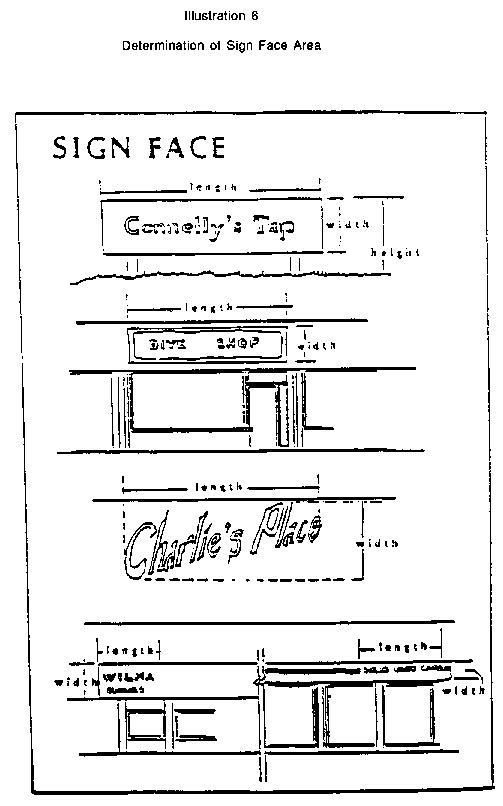
Sign face area: "Signs" shall be defined by the sign face area which is determined by the following (see also illustration 6 of this subsection A):
1.
For signs whose message is fabricated together with the background which borders or frames that message, the sign face area shall be the total area of the entire background.
2.
For signs whose message is applied to a background which provides no border or frame, the sign face area shall be the area of the smallest rectangle that can encompass all words, letters, figures, emblems and any other elements of the sign's message.
3.
For freestanding signs, the entire surface area of the sign on which copy could be placed is the sign face area. The supporting structure or bracing of a sign shall not be counted as a part of the sign's face area. Where a sign has two display faces that are back to back, the area of only one face shall be considered the sign face area. Where a sign has more than one display face, all areas which can be viewed simultaneously shall be considered the sign face area.
B.
Location and height measurement:
1.
No sign shall be attached to a roof except those mounted to the roof and not extending higher than the roofline and meeting all other sign regulations.
2.
Signs may be located within a required buffer yard along any right-of-way except where otherwise prohibited in this chapter. No signs, however, shall be located along any side or rear lot line within a required buffer yard.
3.
The height of a wall sign shall be measured from the base of the building below the sign to the top of the sign face. The top of the sign shall be neither higher than the maximum permitted building height nor more than three feet higher than the highest ceiling elevation in the building.
4.
The height of a freestanding sign shall be measured from the mean ground level to the highest point of the sign face area or its supporting structure, including, but not limited to, any base, pedestal, posts, frame, or any other part of the sign structure, whichever is greater.
C.
Temporary signs:
1.
During the course of construction, temporary real estate and realtor signs may be erected to advertise that the premises upon which the signs are located are for sale, rental or lease, provided, however, that no more than one double-faced sign shall be placed at each project entrance. Such signs shall be removed within 30 days after said premises are sold, rented or leased or within 30 days after said premises reach 85 percent occupancy. No such sign shall exceed 72 square feet per face.
2.
Construction signs denoting the architect, engineer or contractor may be erected during construction. There shall be only one such sign per building, and it shall not exceed 36 square feet in area. This sign shall be on the building or within 20 feet of the building.
3.
No temporary signage shall exceed 12 feet in height.
D.
Permanent signs:
1.
Wall sign:
a.
The size of any such sign shall not exceed seven percent of the area of the wall on which it is to be located.
b.
No permanent wall sign shall exceed 200 square feet.
c.
There shall be no more than one wall sign per building, subject to the following exceptions:
(1)
Provided, however, for any building which fronts directly on State Route 72 in the village, and is occupied by only one business, there shall be allowed up to three wall signs per building on the following conditions: there shall be not more than one wall sign on any one side of the building; any such sign(s) shall identify no more than one business, which business shall be located within said building; and there shall be no wall sign on the southerly face of any such building.
(2)
Provided further, on any building which faces State Route 72 in the village, and which is occupied by more than one business, there shall be allowed one wall sign for each such business, located only on the face of the building on which the main entrance to each respective business is located; there shall be not more than one wall sign on any side of the building, except the side facing Route 72; any such sign(s) shall identify no more than one business, which business shall be located within said building; and in no case shall any such wall sign be located on the southerly face of such building.
(3)
For purposes of this subsection, "fronts directly" shall mean having a setback not greater than 150 feet from the nearest point of the front of the building to the right-of-way. "Facing" shall mean that the front facade of the building is substantially parallel to the right-of-way. Any building the front of which is located greater than 150 feet at its nearest point from the front of the building to the right-of-way, or having another building located between it and State Route 72, shall be considered not to "front directly" to State Route 72 but shall be considered to be "facing".
2.
Address sign: Each building may have a sign containing its address not to exceed six square feet in area.
3.
Freestanding structural sign:
a.
In office parks where the building exceeds 150,000 square feet, there shall be no more than one freestanding multifaced structural sign per building in addition to the permitted wall sign.
b.
No freestanding structural sign face shall exceed 60 square feet in area, and the height shall not exceed six feet.
c.
For a multi-occupant, in line commercial building, one freestanding sign, with dimensions not larger than eight feet by 12 feet, and a maximum display area not larger than 60 square feet, shall be permitted (for a directory of occupants, or otherwise).
4.
Window sign:
a.
Any permanent window sign painted on, or attached to, or placed behind the glass of a window shall cover not more than 30 percent of the total area of window glass facing the street per floor of the property occupied by the business in question, and shall state only the name of the business occupying the property. No more than one window sign shall be allowed per business property.
b.
A temporary window sign shall be permitted, but shall be limited to total coverage of not more than 25 percent of the total area of window glass facing the street per floor of the property occupied by the business in question. Any temporary window sign shall be displayed for not more than 30 days.
5.
Architectural features: Each development may have either a single architectural feature or a single entrance feature at each entrance. Single architectural features shall have neither a total surface area of more than 350 square feet nor a height greater than 30 feet. Single entrance features shall have neither a total surface area of more than 225 square feet nor a height greater than 30 feet. all such features shall be subject to architectural review by the planning and zoning commission. Where the location of the feature, the adjoining landscaping, the topography of the site, or other factors make a larger feature desirable, such variation may be permitted, subject to review and recommendation by the planning and zoning commission and approval by the village board of trustees, provided it is found that such a feature will not adversely affect neighbors, but will lead to a better design or a safer project.
6.
Illumination:
a.
Permanent signs and architectural features may be backlighted, illuminated by spotlights which have been shielded to eliminate glare from adjoining highways, roads or streets, or from any nearby property, or lighted by internal sources for the letters of such sign only, and not for any background on the sign.
b.
Signs may be illuminated utilizing neon, argon, or other gas, provided that any tubing or other vessel containing the gas is not exposed to public view but is covered with a translucent material or otherwise shielded from direct view.
(1)
For gas illuminated signs, two such signs shall be allowed per retail establishment, to be placed in a storefront window only, with the following sign face area limitations:
(A)
One such sign shall not exceed ten square feet in area; a second such sign shall not exceed four square feet; provided in all cases, the total sign area of all permitted window signs shall not exceed 65 percent of the total storefront window area.
(B)
Area shall be measured by the smallest rectangular lines which would encompass all words, letters, figures, emblems or any other elements contained in the sign's message.
(C)
Any such sign may contain text, graphics, or motion type graphics display. Any such sign shall be kept in good repair. Should any portion of the sign fail, it shall be repaired within 14 days or the entire sign shall be removed.
(D)
For purposes of this section, a "storefront window" shall mean any and all transparent glass surface facing the nearest public roadway adjacent to the retail property in question, including for any retail property located on the corner of two public roadways, the two public roadways nearest the retail property.
7.
Planning and zoning commission review: all permanent signs shall be reviewed by the village planning and zoning commission for coordination of color and design with surrounding signage.
E.
Traffic directional signs:
1.
Each sign shall neither exceed nine square feet in area nor be higher than four feet above ground.
2.
Signs indicating the flow of traffic and ingress and egress routes shall be used as required.
F.
Street entrance identification signs: These signs shall be used as required to indicate street entrances.
(Ord. 4-7-A5-35, 8-21-1989; Ord. 92-22, 8-17-1992; Ord. 97-8, 5-19-1997; Ord. 2001-2, 1-16-2001; Ord. 2002-11, 3-18-2002; Ord. 2003-33, 12-15-2003; Ord. 2003-34, 12-15-2003; Ord. 2006-23, 10-2-2006; Ord. 2018-8, 4-16-2018)
Sec. 8-5-11. - Exterior lighting standards.
These standards are intended to protect motorists, pedestrians, and neighboring properties from excessive light or glare from B-1, B-2 and B-3 business district developments.
A.
Lighting standards: Lighting and types of luminaries for parking lots, internal roads, drives and walkways shall conform to the following limitations:
Note:
1.
See descriptions of types of luminaries below.
Illumination shall be measured in foot-candles at six inches above ground level in a horizontal position at the inside of the buffer yard. A direct reading portable light meter with color and cosine corrected sensor and multiple scales shall be used. The meter shall have been tested and calibrated to an accuracy of ± five percent not more than one year before its use. Measurements shall be made after dark. The difference between "lights on" measurements and "lights off" measurements shall be used to determine the illumination, thereby eliminating the effects of ambient light.
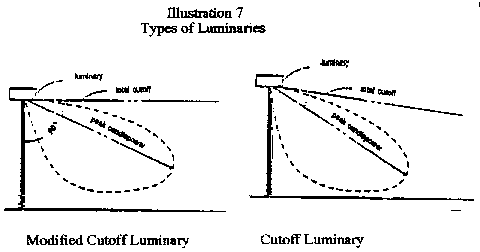
"Cutoff" is defined as a line initiating from the luminary above which the light source is completely shielded.
B.
Types of luminaries: There are two basic types of luminaries to be used in B-1, B-2, and B-3 Business District developments, as shown in illustration 7 of this subsection B.
1.
Modified cutoff luminary: This luminary has a cutoff of 90 degrees from the perpendicular, so that its light source is not visible above a horizontal line running through the center of the luminary. Compared to a no cutoff luminary, whose light source is visible from above the luminary, this fixture greatly reduces glare into the sky and lessens "light pollution" at night.
2.
Cutoff luminary: This luminary has a cutoff of less than 90 degrees from the perpendicular, so that at some point distant from the luminary, the light source is totally shielded from view. This fixture reduces glare to a minimum. Except as in subsection C of this section, all cutoff luminaries shall be designed and located so that the cutoff line terminates at least ten feet inside the property line of the development.
3.
Floodlighting: Floodlighting of buildings shall not exceed one foot-candle measured at the face of the building at a height equal to one-half of the building height.
C.
Street lighting: All street lighting shall meet village and/or state specifications for illumination.
(Ord. 97-8, 5-19-1997; Ord. 2016-8, 7-5-2016)
Sec. 8-5-12. - Mechanical penthouses or accessory buildings.
Where mechanical penthouses are installed, they shall be designed to blend into the architecture of the building and shall not cause the total height of the building to exceed the maximum allowable height specified in section 8-5-3 of this chapter. A penthouse shall not be counted as a story, provided that:
A.
The penthouse is less than ten feet in height; and
B.
The penthouse floor area covers less than 25 percent of the roof area.
In the event that a mechanical accessory building is supplied, it shall be fully screened from view by a combination of berms and evergreens. This screening shall require approval by the planning and zoning commission.
(Ord. 2018-8, 4-16-2018)
Sec. 8-5-13. - Special uses.
A.
Standards; conditions: The following special uses may be allowed in the B-1, B-2 and B-3 business districts in the village:
Adult-use cannabis dispensing facility, subject to the provisions of sections 3-12-1 et seq. of the Village Code.
Amateur radio antenna, subject to the standards established in section 8-1-14 of this title, except that subsection 8-1-14.A.5 of this title shall have no effect in the business districts in the village.
1.
Conditions for termination: Any special use granted for the installation of an antenna shall cease upon the occurrence of any of the following events:
a.
There is no owner of the premises who is licensed;
b.
The special use is abandoned, for any reason, for a period of 180 days or greater;
c.
The special use is revoked for failure to abide by any and all applicable laws, ordinances, rules, regulations, or specific conditions.
B.
B-1 business district: The following special uses may be allowed in the B-1 business district:
Amateur radio antennas, pursuant to subsection A of this section.
Telecommunications towers, subject to the standards established in section 8-1-15 of this title.
C.
B-2 village business district: The following special uses may be allowed in the B-2 village business district:
Amateur radio antennas, pursuant to subsection A of this section.
Commercial kennel.
Drive-in or drive-through facilities for any use otherwise permitted pursuant to subsection 8-5-2 of this chapter.
1.
Standards for drive-in or drive-through facilities: The following standards shall apply to the granting of any special use for a drive-in or drive-through facility in the village, in addition to the standards set forth in section 8-6-4 of this title:
a.
The audio level for any voice system for taking orders, or otherwise communicating with customers, shall have a decibel level not greater than 35 decibels measured at a distance 100 feet from any outside speaker.
b.
There shall be appropriate design for both ingress and egress to the site; vehicle stacking on the site; and the safety of vehicular movements on the site, all as evidenced by a traffic study prepared by a traffic engineer.
c.
There shall be placed adjacent to any vehicle stacking lanes on the site dense shrubs and/or trees, not less than three feet in height at time of planting, where any such lane or lanes abut any residential district or any public right-of-way.
Motor vehicle sales, new and used.
Outdoor eating and/or drinking facilities.
1.
Any outdoor seating and/or drinking areas shall be subject to the following standards, in addition to the standards specified in section 8-6-4 of this title:
a.
Setbacks shall be as follows:
(1)
Not less than 15 feet from any street right-of-way.
(2)
Not less than ten feet from any lot line.
(3)
Not less than 90 feet from any adjoining residential zoning district line.
b.
Any licensee shall at all times comply with the provisions of title 6, chapter 1, "Public Areas and Waterways", of this Code.
c.
The licensee shall not permit such noise in any outdoor seating area as shall cause a disturbance of the peace to any adjacent or surrounding properties and uses.
d.
Outdoor seating shall not be allowed after 11:00 p.m., Sunday through Thursday, and after 12:00 midnight Friday and Saturday, each week; and after 12:00 midnight on the day before any federal holiday.
e.
The licensee shall maintain any outdoor seating area in a clean, sanitary, and well kept condition, free of litter, at all times; the licensee shall provide adequate receptacles for trash in the outdoor seating area.
f.
Outdoor drinking facilities shall be subject to such other and further restrictions as are set forth in title 3, chapter 3, "Liquor Control", of this Code.
g.
The corporate authorities may impose such other and further restrictions on outdoor eating and/or drinking facilities as it deems reasonably advisable or necessary for the proper and orderly design and operation of same.
Self-service storage units.
Telecommunications towers, subject to the standards established in section 8-1-15 of this title.
D.
B-3 commercial and mixed use district: The following special uses shall be allowed in the B-3 commercial and mixed use district:
Freestanding parking areas for storage of trucks and semitrailers.
Freestanding parking lots or vehicle parking facilities.
Telecommunications towers, subject to the standards in section 8-1-15 of this title.
(Ord. 2001-20, 11-5-2001; amd. Ord. 2004-1, 1-5-2004; amd. Ord. 2006-24, 10-2-2006; Ord. 2014-4, 4-7-2014; Ord. 2016-8, 7-5-2016; Ord. 2017-2, 1-16-2017; Ord. 2019-16, 12-16-2019; Ord. 2020-08, 8-3-2020; Ord. 2022-10, 8-1-2022)

