
Snowmass Village City Zoning Code
ARTICLE II
Definitions
Sec. 16A-2-10.- Purpose.
The purpose of this Article is to define words, terms and phrases contained within this Land Use and Development Code.
(Ord. 4-1998 §1)
Sec. 16A-2-20. - Definitions.
The following words shall have the following meanings when used in this Development Code.
Accessory building means a subordinate building, the use of which is customarily incidental to that of the principal use of the land and which is located on the same lot or parcel with the principal building or use. Accessory buildings shall not be provided with a kitchen or bath facilities sufficient to render them suitable for permanent residential occupancy (except to permit the installation of an accessory employee unit). An accessory building may include facilities such as a pool facility, greenhouse, garage, carport or storage facility.
Accessory caretaker unit (ACU) means an area attached to or within a single-family detached dwelling, or above or below a detached garage that is located on a lot zoned for a single-family dwelling. The ACU shall be subject to the provisions of Section 16A-3-230(1), Standards for an Accessory Caretaker Unit. An ACU shall have a separate exterior entrance and shall contain an ACU kitchen, a bathroom and sleeping facilities.
Accessory employee unit (AEU) means a residential building area attached to or within a single-family detached dwelling, or above or below a detached garage, that is located on a lot zoned for a single-family dwelling that meets the following requirements and those set forth in Section 16A-3-230.
Accessory use means a use that is naturally and normally incidental to, subordinate to and devoted exclusively to the principal use of the premises and does not change the basic character thereof, as determined by the principal use. Accessory uses may include accessory employee units (AEUs), a manager's unit and parking.
Alley means a roadway intended for limited public use that connects to one (1) or more public streets.
Antenna reception or transmission device means a structure or device for the reception and/or transmission of aerial or satellite signals, including television signals, AM or FM radio signals, telemetry signals, data communication signals or any other reception or transmission signals using free air space as a medium, whether for commercial or private use, but excluding any device that is less than one (1) meter in diameter or diagonal measurement, and excluding an antenna that is designed solely to receive television broadcast signals.
Association means a group of owners formed to further the common interests of some or all or the owners of property, who are members of the association.
Awning means a roof-like cover that projects from a structure for the purpose of shielding a doorway or window from the elements. An awning may be capable of being retracted into the face of the building.
Basement orbasement space means any one (1) floor level of a building located in a manner that at least fifty percent (50%) of its floor-to-ceiling height of surrounding walls is subgrade area, as defined herein.
Bedroom means any room for sleeping within a dwelling unit that contains closet space and has access to bathroom facilities. Dens, family rooms or recreational rooms shall be considered bedrooms if determined to meet this definition.
Bighorn sheep winter range means those portions of the overall distribution typically used by bighorn sheep through all or nearly all of the winter season for foraging and for shelter from severe weather conditions. Generally, bighorn sheep winter range is those parts of the overall distribution of the species where ninety percent (90%) of the individuals are located from first heavy snowfall to green-up during the average five (5) winters out of ten (10).
Building means any permanent structure built for the shelter or enclosure of persons or property of any kind. Building does not include advertising signs or fences.
Building setback means an open space other than a court, not in an alley or street, unoccupied and unobstructed by any buildings or above grade related structures, except as otherwise provided in this Code.
Building setback, front means an area extending the full width of the lot or parcel, the depth of which is measured by the least horizontal distance between the front lot line and that area defined as the building site or envelope.
Building setback, rear means an area extending the full width of the lot or parcel, the depth of which is measured by the least horizontal distance between the rear lot line and that area defined as the building site or envelope.
Building setback, side means an area extending from the front lot line to the rear lot line, the width of which is measured by the least horizontal distance between the side lot line and that area defined as the building site or envelope.
Building site or envelope means that portion of a lot or parcel designated as the area within which a building or structure may be erected and within which other site disturbance may occur, as described in Section 16A-4-320(b)(2), Limitations on Site Disturbance.
Business means any establishment, profession, occupation or activity engaged in by a person with the object of profit, gain, benefit or advantage, direct or indirect, that is conducted on premises within the Town.
Caregiver, for the purpose of determining occupancy of an AEU, is a person employed or contractor by the owner or occupant of the primary residence to, as a primary duty and in consideration for such occupancy, assists an individual residing in the primary residence with personal care or household tasks that are necessary for everyday life, including care for a child or a sick, elderly, or disabled person.
Caretaker, for the purposes of determining occupancy of an AEU, shall mean a person employed or contracted by the owner or occupant of the primary residence to, as a primary duty and in consideration for such occupancy, maintain, manage, or care for the subject property.
Caretaker unit means a dwelling unit that is attached to or is within a detached single-family dwelling unit that is located on a lot zoned for a single-family dwelling, approved by the Town prior to December 10, 1997. The unit should be occupied by employees, senior citizens or disabled individuals. A caretaker unit shall contain a kitchen with refrigerator and sink, and cooking, sanitation and sleeping facilities. Cooking facilities shall not be limited to just a hot plate and/or microwave oven. Sanitation facilities shall include a bath and/or shower.
Commercial recreation facility means racquet club, athletic club, gymnasium, swimming pool, skating rink and similar facilities, but does not include stables.
Community facility, major means public and quasi-public institutions, educational facilities, fire station, community center, church, library, museum, town hall, conference facilities not directly associated with lodges/hotels or other facilities, information centers and major public transportation and maintenance facilities that may include terminals, parking areas, service buildings and major shelters.
Community facility, minor or accessory means minor public transportation facilities, trash collection dumpsters, public safety related facilities, above-grade facilities that are appurtenant to underground utilities, and similar facilities that are accessory and necessary for the servicing of allowed or special review uses.
Comprehensive plan means a compendium of reports, charts, graphs, drawings, maps or plans as may be adopted, or any portion thereof or any amendment thereto, that set forth recommendations and policies for guiding future growth and development, while providing for the public's health, safety and general welfare. The Town of Snowmass Village Comprehensive Plan adopted by the Town Council pursuant to Ordinance 7, Series of 1998, is the officially adopted comprehensive plan of the Town.
Condominium plat means a survey description or map of a condominium interest in a structure for the purpose of title conveyance.
Condominium unit means an individual air space unit, together with the interest in the common elements appurtenant to such unit, as defined and recognized by the Colorado Common Interest Ownership Act.
Condominiumization means the process by which condominium units are created in a property previously owned in total by one (1) individual, partnership, corporation, joint venture or other legal entity.
County means the County of Pitkin, Colorado.
Cul-de-sac means a local street terminating in a vehicular turnaround.
Day care home means the regular care and supervision of more than two (2) but not more than six (6) children at any time within a dwelling who are not related to the inhabitants of the dwelling, whether or not compensation is provided for such services. The care and supervision of two (2) or fewer children at any time not related to the inhabitants of the dwelling shall be considered to be in-home babysitting, which is a home occupation.
Developer means the person(s) undertaking any development activity as described herein.
Development means any of the following activities pursuant to this Land Use and Development Code: (a) the subdivision of a parcel of land into two (2) or more parcels, divisions or ownerships; (b) the construction, reconstruction, conversion, expansion or structural alteration, relocation or enlargement of any buildings, structures or accessory structure; (c) any use, change in use or change in intensity of use of any buildings, land or water; or (d) any clearing, grading, filling, excavating or other movement of land.
Disabled person, is one having a physical or mental impairment, and the impairment has a substantial and long-term adverse effect on the person's ability to carry our normal day-to-day activities.
Disclosure statement means the statement prepared by a developer pursuant to Section 16A-5-550, Time Share, together with any amendments or supplements thereto.
Dormitory means any building or portion thereof intended or designated specifically for sleeping facilities for an individual or a group of more than four (4) unrelated individuals. A dormitory shall have sanitation facilities either within or in close proximity to sleeping areas. Accessory uses may include laundry and kitchen facilities located outside designated sleeping areas.
Dwelling, multi-family means a building containing two (2) or more dwelling units sharing vertical and/or horizontal party walls in which each dwelling unit is designated for and used as a dwelling exclusively by one (1) family and their guests. Multi-family dwelling units may be made available for short-term rental. For purposes of determining the restricted housing employee generation rate for a use pursuant to Subsection 16A-4-410(a), a multi-family dwelling within a proposed development shall be classified as one (1) of the following:
a.
Multi-family-1 means a multi-family dwelling or group of multi-family dwellings located within the same PUD, consisting of at least twenty-five (25) dwelling units and in which the owners of the dwelling units located therein have the opportunity to participate in a centralized:
1.
Check-in facility;
2.
Property management program; and
3.
Rental management/unit management program;
(provided that the applicant can establish to the Town's reasonable satisfaction that at least sixty-seven percent [67%] of the dwelling units within such dwellings can reasonably be expected to participate in said centralized management program). Does not include multi-family dwellings operated and maintained, in whole or in part, as a hotel/lodge.
b.
Multi-family-2 means a multi-family dwelling which does not conform to the definition of multi-family-1 dwellings.
Dwelling, single-family attached. See Dwelling, multi-family.
Dwelling, single-family detached means a detached principal building designated for and used as a dwelling unit exclusively by one (1) family and their guests.
Dwelling, two-family (also known as a duplex) means a detached principal building containing no more than two (2) dwelling units sharing a common wall between both dwelling units or sharing a common ceiling or floor, in whole or in part, connecting the two (2) dwelling units, each of which is designed for and used as a dwelling unit exclusively by one (1) family.
Dwelling unit means any building or portion thereof, used exclusively for residential occupancy, that contains living facilities, including provisions for sleeping, eating, cooking and sanitation, and is intended for occupancy by a family and its guests, independent of other families or guests. A dwelling unit shall contain only one (1) kitchen and does not include hotels, motels, tents, seasonal vacation cabins, camper trailers or other structures designed for temporary occupancy. A dwelling unit may also be referred to as a dwelling. Any dwelling unit shall be deemed to be a principal building.
Elk concentration areas means those areas that because of their slope, aspect, elevation and vegetation are capable of providing elk sufficient food and cover to survive the most difficult winter months of average winters. The densities of elk in concentration areas are twice as great as those in surrounding winter ranges in the average five (5) winters out of ten (10).
Elk migration corridors means the routes elk use to migrate between summer ranges and winter ranges.
Elk production areas means those lands on which pregnant female elk give birth to their young in the early spring. Elk production areas are undisturbed areas inhabited by female elk that contain free-flowing water, an ample understory of low-lying vegetation that provides good hiding cover and sufficient food.
Elk severe winter range means those areas that because of their relatively low elevation, aspect, slope, limited snowpack, or natural or man-made physical barriers, provide elk sufficient food and cover during those months where there is maximum snowpack or minimum temperatures during the most severe winters (the worst two [2] of ten [10] winters).
Employee, AEU, for the purposes of determining occupancy of an AEU, shall mean a person employed within the Town at the time of initial tenancy and who shall remain employed within the Town or County for a minimum of eight (8) months of any calendar year.
Employee, qualified for an AEU, for the purposes of determining occupancy of an AEU, shall mean an employee as defined in the Permanent Moderate housing regulations as adopted in Chapter 17, Article I of the Code.
Family means any individual, or two (2) or more persons related by blood or marriage or between whom there is a legally recognizable relationship, or not more than two (2) unrelated adults and their related children; or a group of not more than four (4) unrelated adults occupying the same dwelling unit on a continuous basis for a period of time greater than one (1) month.
Fire Department means the Roaring Fork Fire Rescue (RFFR).
Floor area means the sum of the horizontal area of a structure, measured as described in Section 16A-3-210, Measurement of Dimensional Limitations, and stated in square feet.
Floor area, allowable means the maximum allowed floor area permitted for the lot as specified within Table 3-2, Schedule of Dimensional Limitations.
Floor area ratio (FAR) means a ratio determined by dividing the floor area of a structure, in square feet, by the total area of a lot or parcel, in square feet.
Full time equivalent (FTE) shall mean the conversion of part-time work hours to the equivalent number of full-time work hours based on a forty-hour work week.
Furnished sleeping area (FSA) means a room, typically within a hotel/lodge or multi-family-1 dwelling unit, furnished to accommodate sleeping occupants, including lock-off rooms. For purposes hereof, a room containing no bed but which may have one (1) or more "sofa beds" or "Murphy beds" shall not constitute a furnished sleeping area unless such room is located within a studio unit or lock-off room.
General services means warehouses, wholesale businesses, manufacturing, laboratories and similar uses.
Golden eagle nest site means the bed or receptacle prepared by a golden eagle for its eggs and young. Golden eagle nest sites typically occur on cliffs, but trees are sometimes used. Nests are generally located so the birds are provided an unobstructed view of surrounding areas, affording maximum foraging opportunities.
Grade, above or below means any improvement or feature that is above or below finished or existing grade measured vertically from said improvement or feature.
Grade, existing means the ground surface elevation or natural/historic grade in existence prior to the initiation of the current development or subdivision improvements on a parcel of land. If it is determined that existing grade has been altered prior to submission of a development application for the purpose of evading this definition, or due to natural land movement, the deposition of material on the property by others, or similar acts not willfully done by the owner of the property at that time, then the Planning Director shall establish what had been existing grade prior to the alteration, and shall measure from that elevation.
Grade, finished means the elevation of the ground surface following development. After issuance of a Certificate of Occupancy, the finished grade shall become the existing grade for consideration of any proposed development, redevelopment or permit applications in the future.
Group care facility means medical facility, day care center, child nursery and similar care facilities that are licensed by the State.
Group home means a residential building that is owned and operated by a nonprofit organization, or is owned and operated by an individual or group of individuals who actually reside at and maintain their primary place of residence in the group home that is occupied by not more than eight (8) persons who are sixty (60) years of age or older who do not require skilled or intermediate care facilities.
Hardscape means that part of a parcel's ground surface consisting of structures such as plazas, patios, driveways and parking areas made with hard impervious materials.
Health club (general) means an area offering cardiovascular and strength training equipment including electronic cardio machines, free and machine weights, and may include aerobic or other physical activity facilities.
Health club (spa) means an area in a hotel or resort property offering such amenities as steam baths, saunas, massage, hydrotherapy, face and other body treatments.
Home occupation means an occupation or a profession that is conducted within a dwelling unit or on the premises thereof and is clearly incidental and secondary to the use of the dwelling unit for residential purposes.
Hotel/lodge rooms andsuites mean a building or portion thereof containing rooms, areas or separate spaces intended for temporary occupancy by guests typically by the day or week, each of which contains sanitation facilities and may contain a small kitchen area. The hotel or lodge, generally, provides one (1) or more enhanced levels of service, such as:
a.
A level of staffing, amenities, service or facilities above that customarily found in multi-family dwellings;
b.
Twenty-four-hour front lobby check-in with in-house maid, concierge, room and maintenance services; and
c.
Standardized fixtures and furnishings with central phone, cable, heating, air conditioning and hot water systems for all units. Accessory use facilities may include associated office space, central laundry or laundry facilities used by the occupants, meeting rooms and similar service/support facilities, none of which shall constitute independent commercial uses.
Illumination, indirect, when applied to signs, shall mean reflected light only from a concealed light source outside the sign face which reflects from the sign face only or from the sign face and sign copy.
Indoor entertainment facilities means theater, performing arts center and similar facilities.
Indoor recreation facility means climbing walls, video games, table games, paintball games and similar facilities.
Interim site development and land use plan means graphic and descriptive material that identifies the existing and approved densities, uses, height, size, parking and other development parameters for all or any portion of a property as may be required by the Planning Director to sufficiently define and describe the project area.
Joint authority, when purporting to give authority to three (3) or more officers or other persons, means authority is given to a majority of such officers or persons, unless it is otherwise declared.
Kitchen means an area designated or intended for cooking, that contains at least a sink and cooking facilities, which include a range and/or counter top burners.
Kitchen, AEU means an area designated for cooking that contains, at a minimum, a twelve-cubic-foot refrigerator, a six-gallon capacity sink, a stove with four (4) cooking surface burners or elements and an oven, and an area for food storage, as allowed for modification by the Town Manager or designee.
Land, real estate andreal property means lands, tenements, hereditaments, water rights, possessory rights and claims.
Law denotes applicable federal law, the Constitution and statutes of the State, the ordinances of the Town and, when appropriate, any and all rules and regulations which may be promulgated thereunder.
Lock-off room means a room in a hotel or lodge which can be locked off from any other room in the hotel or lodge, allowing it to be individually occupied. A lock-off room may contain sanitation facilities, but may not contain a kitchen. Each lock-off room shall be considered to be a hotel or lodge room.
Lot means a parcel of real property, as shown with a separate and distinct number or letter on a plat recorded in the County Clerk and Recorder's Office, or when not so platted in a recorded subdivision, a parcel of real property held under separate ownership from surrounding property.
Lot area means the total horizontal area within the lot lines of a lot.
Lot line, front means the property line dividing a lot from a street or located adjacent to the principal means of access.
Lot line, rear means the property line opposite the front lot line.
Lot line, side means any lot line other than the front and rear lot lines.
Manager's unit means a dwelling unit, which may be a single-family detached dwelling unit, or a dwelling unit provided within a structure containing multi-family dwelling units, single-family attached dwelling units, dormitories, hotel or lodge rooms, or commercial uses and services, specifically intended for occupancy by a resident manager of the principal use. A manager's unit may be considered as an accessory employee unit (AEU).
Managing agent means the person responsible for operating and maintaining a time share project.
Maximum floor area means the maximum amount of floor area allowed on an individual lot, unless otherwise provided by this Code.
Maximum parking spaces means the maximum number of allowed parking spaces which shall be capped for a particular zone district or use on a site as provided by this Code.
Mean high water mark means the visible line on the edge of a river, stream, creek, lake or pond up to which the presence and action of water are so usual and long conditioned so as to create a distinct character with respect to vegetation and the nature of the soil.
Minimum parking spaces means the minimum number of parking spaces that shall be required per bedroom or unit, dormitory sleeping area, hotel/lodge room, commercial space or other use, unless otherwise provided by this Code.
Mule deer severe winter range means those areas that because of their physical characteristics (such as relatively low elevation, limited snowpack or natural or man-made physical barriers) provide mule deer sufficient food and cover during those months when there is maximum snowpack or minimum temperatures of the most severe winters (the worst two [2] winters out of ten [10]).
Occupied means arranged, designed, built, altered, converted, rented or leased, or intended to be occupied.
Office means a room or a series of rooms where business, professional or governmental services are made available to the public. Office includes a business office occupied by persons such as realtors, travel agents, advertising agents, insurance agents, brokerage houses and lenders, and a professional office occupied by persons such as physicians, dentists and other health care professionals, lawyers, architects, engineers, surveyors, planners, accountants and other professionals.
Open space means a portion of a lot or parcel which shall be unoccupied and unobstructed by any above-grade structures, parking areas, roads, driveways or real property zoned Open Space, depending on the context.
Open space, common means a parcel of land, an area of water or a combination of land and water within a site designated in a planned unit development, specially planned area or subdivision, designed and intended primarily for the use or enjoyment of residents, occupants and owners of the development, condominium or subdivision.
Open use recreation site means land designated for public recreational use, either publicly owned or privately owned and available on a fee, nonfee or membership basis, including but not limited to such facilities as playgrounds and play fields, ski/snowboard areas, trail networks, golf courses, tennis courts and similar court installations for outdoor entertainment.
Owner, applied to a building or land, means any part owner, joint owner, tenant in common, joint tenant or tenant by the entirety, of the whole or a part of such building or land.
Paved or paving means any asphalt, concrete or similar impervious wearing surfaces.
Person means natural person, joint venture, joint stock company, partnership, association, club, company, corporation, business, trust or organization, or the manager, lessee, agent, servant, officer or employee of any of them.
Personal and business services shall mean shops primarily engaged in providing services generally involving the care of the person or such person's apparel or rendering services to business establishments such as laundry or dry-cleaning retail outlets, portrait/photographic studios, beauty or barber shops, employment services or mailing or copy shops.
Planned unit development means an area of land controlled by one (1) or more land owners, to be developed under unified control or a unified plan of development for residential, commercial, educational, recreational, public and/or other uses, the plan for which may vary certain dimensional limitations of the underlying zone district within specified limits, or may establish the applicable dimensional limitation for the property, as provided in Article V, Division 3, Planned Unit Developments.
Planned unit development modification means an adjustment, release or removal of certain provisions of a final planned unit development (PUD) plan. A modification of floor area, height, required parking spaces, setback requirements and other minor adjustments may be permitted in accordance with the review procedures of Section 16A-5-250, Administrative Modifications. Changes in use or substantial changes in floor area, height, parking and setbacks that change the nature of the PUD plan are considered an amendment and are subject to the provisions of Section 16A-5-390, Amendment of Final PUD.
Planned unit development plan means the final provisions, terms and conditions for a planned unit development or any development, approved in accordance with Article V, Division 3, Planned Unit Development. An approved planned unit development plan shall constitute the final zoning and development regulations for the specific area for which it has been adopted.
Planning Director means an official of the Town designated by the Town Manager, who may hold the title of Director or head of the Planning Department, the Director of the Community Development Department or the Director of the Planning and Building Department.
Premises means any land, structure, lodge, store, office, salesroom, warehouse or other place of business situated within the Town which is owned, leased or occupied by a business.
Pre-sketch plan means a narrative and plan proposal submitted to the Town for nonbinding comment prior to the submission of a sketch plan.
Principal use means the main or primary purpose for which a structure or land is designed, arranged or intended, or for which it may be occupied or maintained as provided in the Code.
Private recreation facilities means tennis courts, swimming pools and similar facilities that are owned and operated by a property owner's association or as an amenity of a hotel/lodge or private club and are intended for use by members and guests.
Property means both real and personal property.
Public parking lot means an area owned by or leased to the Town that is designated for the short-term storage (not to exceed seven [7] days without a change of location) of private automobiles. A public parking lot is not intended to primarily serve a single condominium complex, apartment complex or hotel facility.
Public utility uses, facilities and services means the following and similar uses, facilities and services: above-grade or below-grade water storage tanks, substations, transformers and related structures; service access roads; and underground public utility transmission and distribution lines, and other minor underground improvements associated therewith.
Purchaser means any person, other than the developer or a lender, who is buying a time share estate.
Recreational-related facilities, conditional means special on-mountain events to host more than five hundred (500) people at one (1) time; special summer attractions, including hang gliding, paragliding, zip line, commercial jeeping or commercial mountain biking; overnight camping facilities; events related to recreational operations of the ski mountain; indoor recreational facilities that change the primary use of the building; dining and food services associated with night operations for ice skating and tubing; private dining ski/snowboard clubs on the private lands located on the mountain; commercial snowmobile tours; alpine slides; and any nighttime operations requiring lighting.
Retail sales establishment means a business engaged in selling goods or merchandise to the general public for personal or household consumption and rendering services incidental to the sale of such goods.
Ridgeline means those lands at the crest or top of a ridge, hillside or mesa, as viewed from Brush Creek Road, Owl Creek Road or the Town Community Park. A ridgeline is the visual line at which the ground and the sky appear to meet. A ridgeline does not include any ridge that is not the highest on the hillside or mesa, or that can be viewed with a higher portion of the hillside or mesa as its backdrop.
Right to use estate means a transferable contract right, which does not fall within the definition of either an interval estate or a time-span estate, providing for or allowing the exclusive use or occupancy of a dwelling unit by one (1) or more persons during any annually recurring period of time defined and established by a schedule, recorded or unrecorded, and agreed to by the owners including, without limitation, licenses or club memberships.
Riparian habitat means the land within the waterway, the waterway and those lands located between the water's edge (of rivers, streams, creeks, ponds and lakes) and upland areas, whose soils allow for or tolerate a high water table and provide sufficient moisture in excess of that otherwise available locally, so as to support interacting assemblages of plants, animals and aquatic communities whose presence is either directly or indirectly attributed to water-influenced or water-related factors.
Road means a public or private way for vehicular traffic including roadway and sidewalk area, being the entire width from lot line to lot line or easement line to easement line. Road includes the terms highway, road, place, avenue and other similar designations.
Roadway means that portion of a public or private street improved, designed or ordinarily used for vehicular traffic.
Sign means an object or device or any part thereof visible from a street, sidewalk or mall that is used to advertise, identify, display, direct or attract the attention of a pedestrian or motorist to an object, place, person, institution, organization, business, product, service, event or location by any means, including words, letters, figures, designs, logos, fixtures, colors, illumination or projected images.
Sign, awning means a sign comprised of lettering and/or logos that is located on the valance thereof.
Sign, freestanding means a sign supported by poles, uprights or braces extending from the ground or from an object on the ground, providing that no part of the sign is attached to any part of a building.
Sign, hanging means a sign which hangs from a covered arcade, soffit, beam or other overhanging part of a structure.
Sign, joint identification means a sign that identifies all business located in a single building or building complex, or a sign that identifies individual buildings within a complex.
Sign, on premises means a sign that advertises goods, services, facilities or events available on the premises upon which the sign is located.
Sign, projecting means a sign that is supported by a building or other structure which projects over any sidewalk or pedestrian or other landscaped area.
Sign, temporary means any nonpermanent sign or banner erected, affixed or maintained for a limited period of time.
Sign, wall-mounted means a sign attached to or painted on a wall of a building, the display surface of the sign being parallel to the wall of the building to which the sign is attached.
Sign, window means a sign, meant to be permanent, that is visible from the exterior of a building and is painted on a window or depicted upon any material placed on, taped on or hung immediately behind a window.
Ski-related facilities means alpine and Nordic ski/snowboard areas, related uses and support or appurtenant facilities typically associated with the use and operations of ski/snowboard area; outdoor recreation uses, games and facilities; skier services; food service/kitchen/cafeteria operations; tours; sledding and tubing hills; group activities, social events and racing competitions for less than five hundred (500) people at one (1) time; indoor recreation facilities that do not change the primary use of the building; recreational trails of all types; restaurant and picnic facilities; vehicle maintenance facilities and their related storage of materials; domestic water pump houses and treatment facilities; and race arena and terrain park facilities.
Slope means the inclination of land from the horizontal, determined by dividing the horizontal run of the slope into the vertical rise of the same slope and converting the resulting figure into a percentage value. For purposes of regulation and measurement, a slope must involve an elevation change of at least ten (10) feet within a horizontal distance of at least thirty (30) feet measured in increments as approved by the Planning Director.
Special event means any short-term event that is civic, educational, cultural or entertainment-oriented in nature that may or may not be open to participation by the general public.
State means the State of Colorado.
Street means any public or private highway, road, lane, alley, cul-de-sac, avenue, bridge, viaduct, underpass, overpass or tunnel in the Town, dedicated or devoted to public use.
Street, arterial means any street which provides direct year-round connection to another jurisdiction, or which links such roads, and is intended or used primarily for free-flowing traffic movement. Traffic velocity is generally greatest on arterial streets, due primarily to roadway design. The arterial streets within the Town are Brush Creek Road, Highline Road and Owl Creek Road.
Street, collector means any street into which local streets feed and which connects directly with an arterial street. The collector streets within the Town are Carriageway, Divide Road, Faraway Road, Horse Ranch Drive, Meadow Road, Pinecrest Drive, Sinclair Road, Snowmass Club Circle, Two Creeks Drive and Wood Road.
Street, local means any street providing for the movement of vehicles within a geographically limited area such as a single-family or two-family residential subdivision containing numerous lots, or between a group of connected multi-family complexes or commercial complexes. A local street that serves a multi-family or commercial development must serve more than one (1) multi-family or commercial property complex. A local street provides access to abutting properties, or provides access to and from a collector street or a local street. A local street carries more traffic than a minor street, but less than a collector street. A local street connects directly to a collector street or another local street which connects to a collector street, or to an arterial street.
Street, minor means any street providing for the movement of vehicles within a single-family or two-family residential subdivision. It provides access to abutting properties, and it generally serves a minimal number of lots, usually no more than five (5) to seven (7) lots. Traffic volumes are less than experienced on local streets. A minor street may connect into either a collector or local street.
Structure means anything constructed or erected, which requires location on the ground or attached to something having a location on the ground, but not including poles, lines, cables or other transmission or distribution facilities of public utilities.
Subdivider means the person, including the owner or agent for the owner, dividing or proposing to divide land so as to constitute a subdivision to be shown on a recorded plat.
Subdivision means the division of any tract or parcel of land, with or without improvements thereon, into two (2) or more lots, tracts, parcels, sites, separate interests (including leasehold interests, condominium units or interest as defined in the Colorado Common Interest Ownership Act, and interval estates as defined herein), interests in common or other divisions for the purpose, whether immediate or future, of sale or development. Subdivision shall also mean condominiumization as is defined herein, and specifically includes the division or conversion of any existing units, including dwelling units, office or other building into condominiums, or time share estates. It also includes subdivision relating to the process of subdividing land or property previously subdivided. Unless this method of disposition is adopted for the purpose of evading this definition, the term subdivision as defined in this Section shall not apply to the following divisions of or interests in land or condominium units:
a.
Court order. The division of land by order of any court in the State or by operation of law.
b.
Security instruments. The division of land by a lien, mortgage, deed of trust or any other security instrument.
c.
Cemetery lots. The division of land which creates cemetery lots.
d.
Mineral interests. The division of land which creates an interest or interests in oil, gas or minerals which are now or hereafter severed from the surface ownership of real property.
e.
Undivided joint ownership interests. The creation of undivided joint ownership interests (including leasehold interests) in a particular dwelling unit, or condominium unit; provided, however, that no agreement exists, either recorded or unrecorded, between co-owners providing for or allowing the exclusive use or occupancy of the property by one (1) or more co-owners during any annually recurring period of time, if said agreement is in any way binding or effective on any assignee or future owner of an undivided joint interest fractional fee, interval estate, right-to-use or other similar interest in such property.
Subgrade or subgrade area means levels of a structure located partially or entirely below grade. The percentage of the gross area of a partially below grade level to be counted as subgrade shall be the surface area of the exterior walls that is unexposed or otherwise below existing grade or finished grade, whichever is the most restrictive, divided by the total exterior wall area of that level.
a.
Example: If the walls of a two-thousand-square-foot level are forty percent (40%) exposed above the lower post construction grade, then sixty percent (60%) is counted as subgrade.
____________________________________________________________________
Figure 2-1
Determining the Amount of a Floor to Be Counted as Subgrade Area.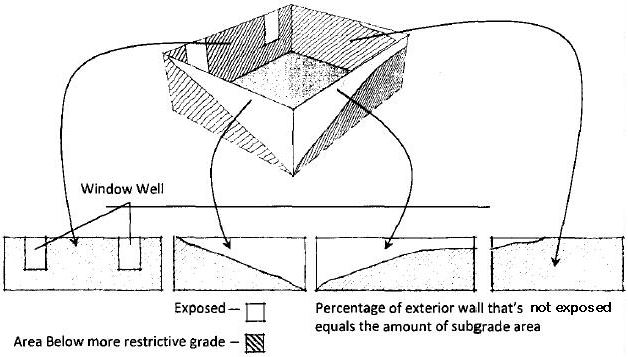
Note: Window wells on exterior foundation walls shall be considered exposed.
Figure 2-2
Measuring the Area of a Subgrade Wall.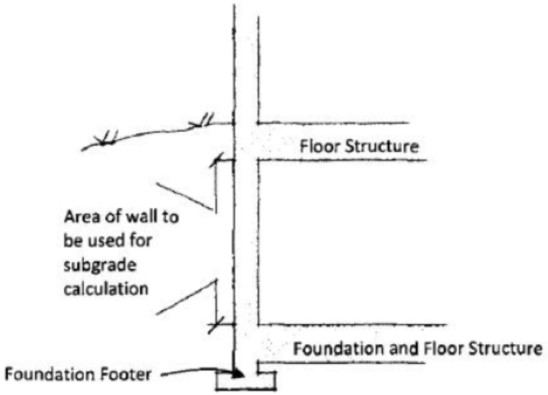
b.
For the purposes of this Section and as shown in Figures 2-2 above and 2-3 and 2-4 below, the exterior wall area to be measured shall be the interior wall area projected outward.
c.
When considering multi-level subgrade spaces, adjacent interior spaces shall be considered on the same story if the vertical separation between the ceilings of the spaces is less than fifty percent (50%) of the distance between the floor and ceiling of either space as shown in Figure 2-3 below.
Figure 2-3
Determining Different Building Levels.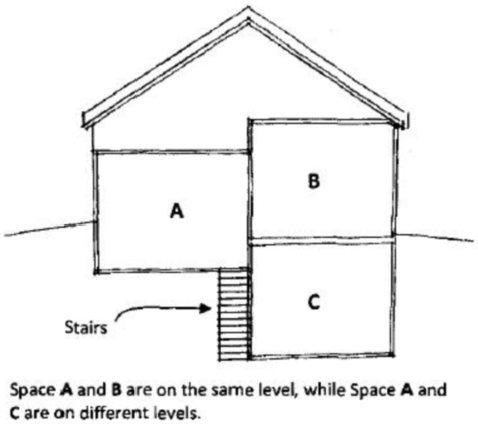
Figure 2-4
Determining Wall Height Calculations for Measuring the Area of a Recessed Subgrade
Wall.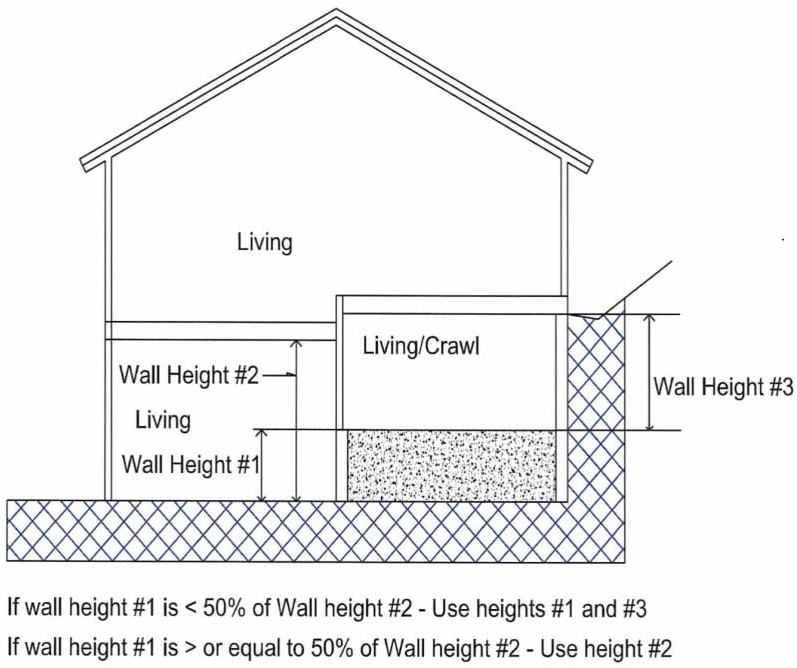
____________________________________________________________________
Temporary use means any use that is of a temporary or short-term nature that is not allowed as a use by right, or as an accessory use, or as a special review use in the particular zone district where the use is proposed and receives approval pursuant to Section 16A-5-260, Temporary Uses.
Tenant andoccupant means any person who occupies all or a part of a building or land, whether alone or with others.
Time share estate means an interval estate, a time-span estate or a right-to-use estate.
Time share instruments means any documents recordable or nonrecordable, by whatever name denominated, creating or regulating a time share project and which contain restrictions or covenants regulating the use, occupancy or disposition of a time share project, including any amendments or supplements to the documents, but excluding any law, ordinance or governmental regulation.
Time share owner means any person vested with legal title to a time share estate.
Time share program means any arrangement whereby the use, occupancy or possession of a unit or combination of units has been or may be subject to the creation of time share estates. The time share program includes the organizational, marketing and management schemes to be employed by the developer/seller of the time share estates which have been submitted to, reviewed and approved by the Town.
Time share project means all or a portion of real property including, without limitation, a single dwelling unit or combination of dwelling units to be either constructed or converted to time share estates pursuant to a time share program.
Time share unit means a unit, which may include a dwelling unit, the ownership or use of which is subject to an arrangement, whether in the form of deed restriction, license, right-to-use agreement, lease or other form, between co-owners or co-users, which provides for or allows the exclusive use or occupancy of the dwelling unit by one (1) or more co-owners or co-users during any annually recurring period of time if said agreement is in any way binding or effective on any assignee or future owner of the unit or any fractional interest therein. For the purpose of this definition a time shared dwelling unit includes a time shared estate as defined by the statutes of the State.
Time span estate means a combination of an undivided interest in a present estate in fee simple in a time shared unit, the magnitude of the interest having been established by the time of the creation of the time span either by the time share project instruments or by the deed conveying the time span estate, and an exclusive right to possession and occupancy of the unit during an annually recurring period of time defined and established by a recorded schedule set forth or referred to in the deed conveying the time span estate.
Town means the Town of Snowmass Village, in the County of Pitkin, and State of Colorado, or the area within the territorial limits of the Town of Snowmass Village, and such territory outside of the Town over which the Town has jurisdiction or control by virtue of any constitutional or statutory provision.
Town Council means the Town Council of the Town of Snowmass Village.
Trails, public means facilities designated for nonmotorized traffic that receive public maintenance.
Underlying zoning means any of the zone districts established in Article III, Zone Districts, that is designated for a specific parcel.
Unit, restricted means a unit that may not be bought and sold on the free market and is subject to price, income, occupancy or other restrictions. Restrictions are generally associated with the deed, although other means may be utilized.
Unit, unrestricted means a unit that may be bought and sold on the free market. It is not subject to any of the restrictions associated with restricted units, although there may be other minimal restrictions placed on said units by an association.
Use means the purpose or activity for which the land or structure is designated, arranged or intended, or for which it is occupied or maintained.
Vested property rights means the right to undertake and complete the development and use of real property, subject to the terms and conditions of a site specific development plan.
Water District means the Snowmass Water and Sanitation District.
Wildfire hazard area means an area containing or directly affected by wildfire hazard. Lands may be classified as having no, low, moderate or severe wildfire hazard, considering the type and density of vegetation that is present on the land, and its slope and aspect. The Colorado State Forest Service uses the following system to classify wildfire hazards:
"O" means areas of no hazard, where no fuels are present.
"A" means areas of low hazard, where grass shrubs and brush less than one (1) foot in height are present. These areas also include aspen, cottonwood, willow and riparian habitats, grasslands, meadows and all low brush except oak, sage and ceanothus.
"B" means areas of medium hazard, where medium density conifers having separated crowns are present, along with surface fuels such as litter and herbaceous plants, with some reproduction and deadwood on the ground.
"C" means areas of severe hazard, where dense conifers with moderate to heavy surface fuels are present, or medium density stands of conifers where under-story fuels classified as "X" are present.
"X" means areas of severe hazard, where dense brushy vegetation, such as sage, oak, ceanothus, coniferous reproduction or other "oily," highly flammable vegetation is present.
Workforce housing means any dwelling unit that is restricted to use for the sale or rent to qualified employees pursuant to the Permanent Moderate Housing Regulations, a restricted housing agreement approved by the Town, or other restrictions approved by the Town for such uses, or that otherwise meets the definition of "affordable housing" under C.R.S. § 29-32-101.
Written means printed, typewritten, copied, faxed, stamped or otherwise reproduced in permanent visible form.
(Ord. 4-1998 §1; Ord. 1-1999 §1; Ord. 5-1999 §3; Ord. 10-1999 §1; Ord. 11-1999 §3; Ord. 9-2000 §1; Ord. 10-2001, §1; Ord. 09-2004 §§1-3; Ord. 32-2004 §A-1; Ord. 16-2010 §1; Ord. 3-2011 §3; Ord. 4-2013 §3; Ord. 6-2015 §1(Exh. A); Ord. 13-2019 §2(Exh. A); Ord. 2-2020, §2(Exh. A); Ord. 3-2023, § 2(Exh. A); Ord. No. 10-2024, §2(Exh. A); Ord. No. 11-2025, §2(Exh. A))

