
Social Circle City Zoning Code
ARTICLE 3
- USE STANDARDS
Sec. 3.1.- Residential uses.
3.1.1. General. The residential use category includes definitions and, in some cases, limited use regulations, for uses that provide for long-term residential occupancy by individual households or by groups of people. The Fair Housing Act (42 U.S.C. Section 3604(f)(3)) makes it unlawful to make a dwelling unavailable to a person because of race, color, national origin, sex, familial status, handicap, or disability. No policy or practice of this ordinance is intended to have a disparate impact on a protected class.
3.1.2. Household living. Household living is the residential occupancy of a dwelling unit by a single household, including, single-family detached, single-family attached, multi-unit building, and live-work uses.
A.
Single-family detached.
1.
One principal dwelling unit on a single lot, which may also include an accessory dwelling unit in the form of an accessory suite or garden cottage, if allowed by the subject zoning district and in accordance with subsection 3.7.3, accessory dwelling units.
2.
Single-family detached uses authorized in residential districts shall not be less than 1,600 heated square feet.
B.
Single-family detached uses on deficient lots of record.
1.
For any single-family detached uses proposed on existing lots of record established prior to the enactment of this chapter that are deficient in any horizontal dimensional standards, alternative compliance is permitted by calculating the percentage the subject lot is of the minimum lot size required by zoning district. That proportion may be applied to any other required dimensional standards applied in the horizontal plane, except those standards that are already expressed as a percent of the whole (e.g.: impervious surface ratio).
2.
Example: An R-25 zoned lot that is 14,320 square feet is 58.08 percent of the minimum lot size of 25,000 square feet (14,320/25,000). Applying that proportion to the remainder of the dimensional standards in the R-25 district, the following standards may apply:
a.
Maximum impervious surface ratio: 70 percent (no change for regulations expressed as a percent of the whole)
b.
Lot frontage: 29 feet (50 feet*58.08%)
c.
Front setback: 17.4 feet (30 feet*58.08%)
d.
Side and rear setbacks: 5.8 feet (10 feet *58.08%)
3.
In no case shall the setback standards be reduced to less than ten feet for the street and rear yards and five feet side setbacks.
Image 3.1.2.A. Single-Family Detached Dwellings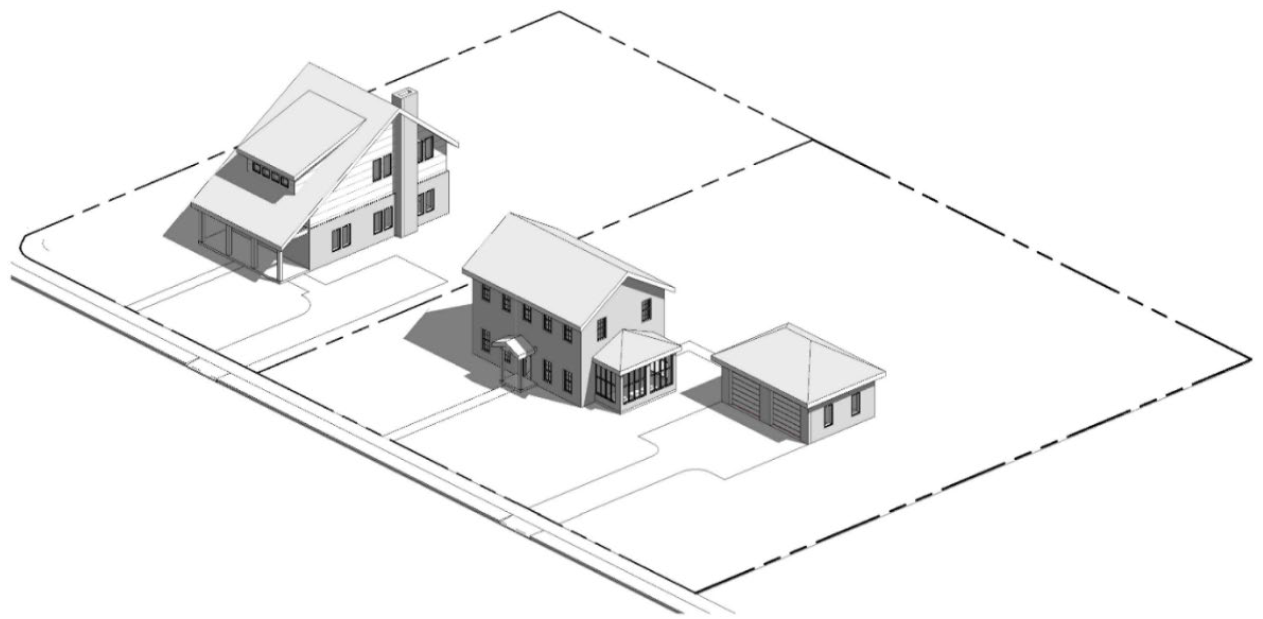
C.
Single-family attached. A building that accommodates two or more dwelling units, where each unit is separated by a common wall from the lowest level to the roof with a private outside entrance but not necessarily occupying an individual lot. This term includes duplexes, triplexes, and townhouses, either fee simple or condominium owned.
1.
Single-family attached uses authorized in residential districts shall not be less than 1,000 heated square feet.
2.
Each single-family attached unit shall have a minimum of 200 square feet of private yard or other outdoor porch/balcony space in either the front or rear, not including driveways and alleys.
Image 3.1.2.C. Single-Family Attached Dwellings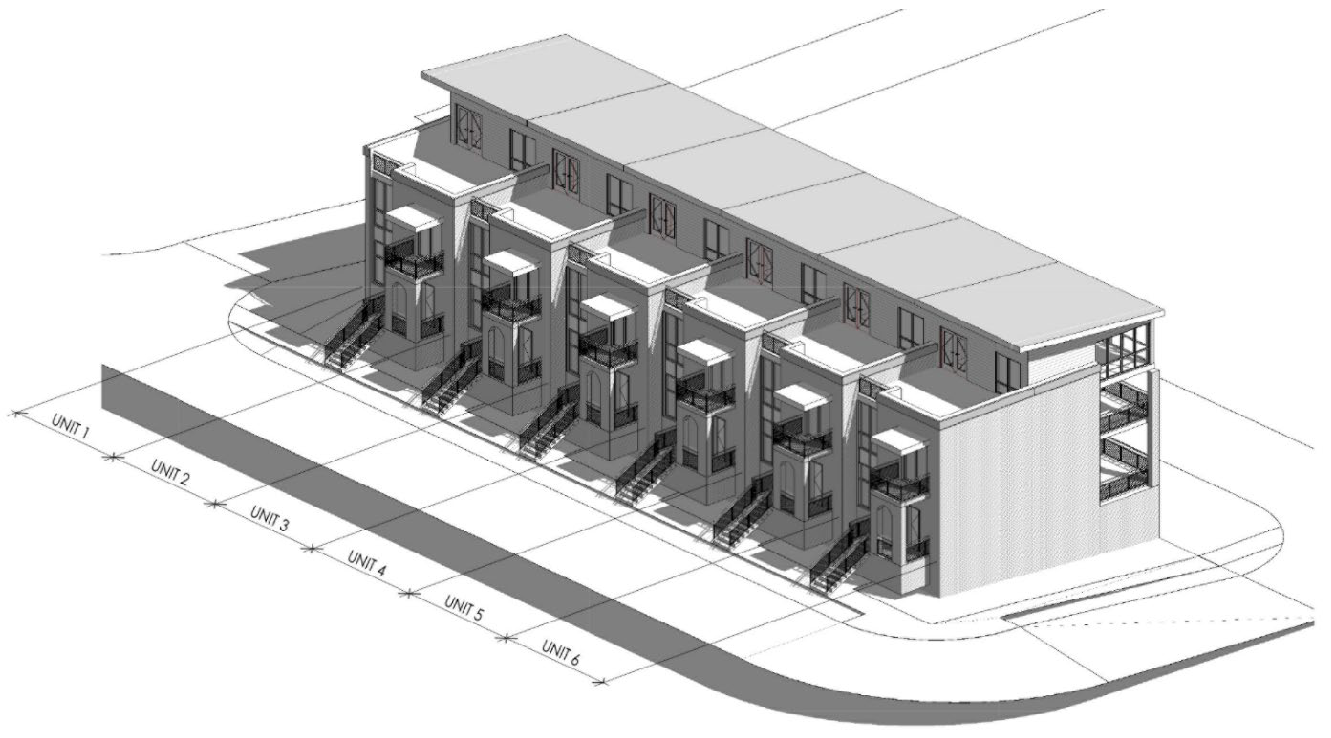
D.
Industrialized home. A dwelling unit manufactured in accordance with the Georgia Industrialized Building Act (O.C.G.A. §§ 8-2-1 et seq.), and the Rules of the Commissioner of the Georgia Department of Community Affairs issued pursuant thereto, and meeting the following development standards:
1.
A minimum width in excess of 28 feet.
2.
A minimum roof pitch of 5:12, which means having a pitch equal to at least five inches of vertical height for every 12 inches of horizontal run. Any dwelling unit for which a building permit was obtained prior to the adoption of this ordinance may be extended, enlarged, or repaired as otherwise provided by this ordinance with the same roof pitch as that allowed by the previous building permit.
3.
A minimum roof overhang of 12 inches is required. All roof surfaces exposed to view shall be covered with asphalt or fiberglass shingles, wood shakes or shingles, standing seam (non-corrugated tin or steel), clay tiles, slate, or similar materials.
4.
A curtain wall, un-pierced except for required ventilation and access, shall be installed so that it encloses the area located under the home to the ground level. Such a wall shall have a minimum thickness of four inches and shall be constructed of masonry or similar material as approved by the zoning administrator.
5.
The dwelling shall be placed on a permanent foundation, either slab or pier, which meets the requirement of the Standard Building Code. In addition, the dwelling shall be completely underpinned with masonry, stone, or other similar materials manufactured for the purpose of underpinning as approved by the community development director. Installation shall be in accordance with the Rules and Regulations for Manufactured Homes made and promulgated by the state safety fire commissioner and shall be completed prior to permanent electrical service.
6.
Utility meters shall be mounted to the structure rather than on a utility pole, and all axles, tongues, and transporting and towing apparatus shall be removed before occupancy.
7.
A landing shall be installed at each doorway. The minimum size of the landing shall be four feet by six feet (excluding steps) at each doorway. The structure shall include steps which lead to ground level, and both landing and steps shall meet the requirements of the Standard Building Code.
8.
The dwelling shall be installed in accordance with O.C.G.A. §§ 8-2-110 et seq., and the rules promulgated thereunder.
9.
Any replacement of a preexisting manufactured home or mobile home with a new manufactured or mobile home shall be permitted in accordance with O.C.G.A. §§ 36-66-7 et seq.
E.
Design standards required for all single-family uses (detached, attached, and industrialized).
1.
Exterior finish materials.
a.
Exterior building materials shall be primarily brick, stone, other masonry, glass, wood, or cementitious fiberboard. Other materials such as vinyl may be used only as trim materials.
b.
All exposed foundation walls and a water table a minimum of 18—30 inches in height from finished grade on all sides of the building shall be faced with brick, stone, or marble.
c.
All brick, stone, or other masonry shall be full- or half-depth. Simulated veneer panels are prohibited. Simulated masonry that are individually stacked or applied are acceptable.
d.
Metal shall be permitted only as metal split seam roofing or as an architectural accent comprising a maximum of ten percent of any one façade. Acceptable metal materials are limited to architectural metal panels, architectural metal cladding, metal mesh, and perforated metal. Examples of metal materials not permitted include but are not limited to stock PEMB metal skins commonly referred to as 'R-panel' and sheet metal systems with exposed fasteners, except as required for perforated metal.
2.
Exterior color requirements.
a.
Painted façades shall contain one primary color, one trim color, and a maximum of one accent colors. Accent color shall not exceed ten percent of the total wall area with each elevation counted separately.
b.
With the exception of architectural elements such as, but not be limited to, balconies, building foundations, decks, doors, patios, porches and windows, no more than three differing exterior finish materials, exterior colors, or any combination thereof shall be used on any building.
3.
Architectural requirements.
a.
Garage doors shall not take up more than 40 percent of the linear width of any street facing façade.
b.
Garage doors shall be offset from the front façade a minimum of five feet.
c.
All single-family attached buildings shall include a continuous street/sidewalk no less than four feet in width connecting front entrances of all dwellings.
d.
At least 50 percent of single-family attached façades that face public streets shall be constructed of brick, stone, or textured masonry units. All brick, stone, or other masonry shall be full- or half-depth. Simulated veneer panels are prohibited. Simulated masonry that are individually stacked or applied are acceptable.
e.
The front façades shall have architectural modulation and detail that includes features such as varied materials and wall planes, varied roof forms and roof lines, balconies, porches, bay windows, varied window sizes and shapes, shutters, entrance doors, sidelights, pilasters, varied garage door designs, and other features to provide visual interest.
f.
Stoops and porches, where facing streets or open spaces, shall be a minimum of four feet deep.
g.
All chimneys and fireplace enclosures on the exterior of the façade shall extend to the ground.
4.
Site requirements.
a.
Uses that have garages shall provide driveways at least 25 feet in depth, as measured from back of sidewalk to the garage door, sufficient to accommodate a passenger vehicle without any portion of the vehicle overhanging or obstructing adjacent sidewalks.
b.
Lots shall provide at least two trees in the front, side, or rear yards for shade and enjoyment. Such trees shall be shown on House Location Plans (HLP) submitted for review at the building permit stage. No certificate of occupancy shall be issued until those two trees are planted. They shall measure at least three-inch caliper and be of any species permitted by the tree ordinance. Trees may be counted toward minimum lot tree density requirements in section 7.3, tree ordinance. To be accepted, plantings shall be located outside any drainage or utility easements applicable to the property.
F.
Multi-unit building. A building or set of buildings containing a group of dwelling units on a common lot containing separate living units for four or more families, having separate or joint entrances, and including apartments and condominiums. These are specifically distinguished from units defined as single-family attached dwellings.
1.
Dwelling units in multi-unit buildings shall not be less than 800 heated square feet.
2.
A minimum 20 percent of the lot shall be provided in open space in accordance with section 7.4, landscaping and open space.
3.
Buildings shall conform to the following design standards:
a.
Sixty percent of exterior building materials on façades visible from the public right-of-way or an adjoining residential zoned lot shall be brick or stone. Masonry shall wrap corners to avoid appearance of being applied.
b.
Façades shall be broken up, both vertically and horizontally, through building materials and offsets.
c.
Roof line shall be varied.
d.
Building shall utilize a variety of materials to create visual interest.
e.
Building entrances shall be well-marked and identifiable from the building form.
f.
Common walls and common floors ceiling between units shall be constructed to meet a sound transmission coefficient (STC) rating of 50 or higher.
Image 3.1.2.F. Multi-Unit Building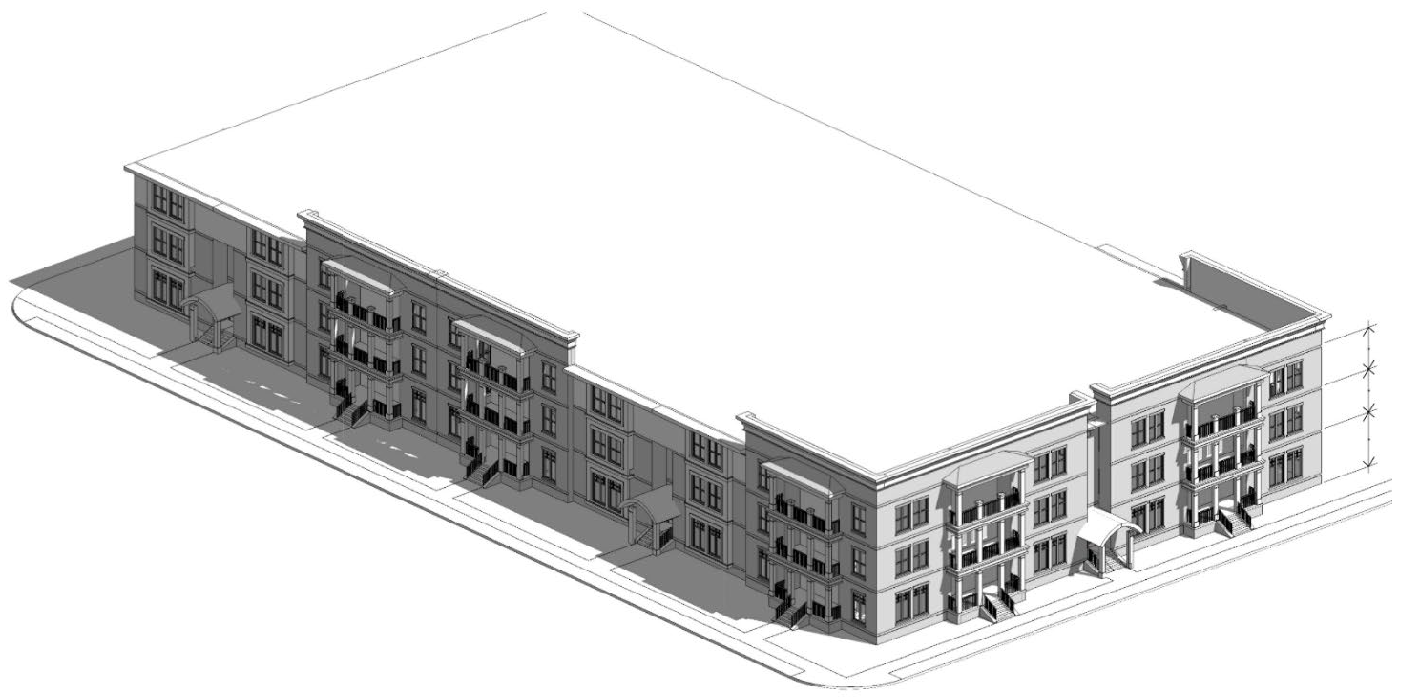
G.
Additional requirements applicable to household living uses.
1.
Continuous pedestrian circulation system is required throughout new residential developments. Systems shall link to all planned or developed recreational open space, transit facilities, or existing public sidewalks or public rights-of-way that are located adjacent the development.
2.
All internal sidewalks shall be least five feet in width and located on both sides of any public or private street or drive.
3.
Vinyl and EIFs are prohibited external building materials.
4.
Utility requirements.
a.
Individual systems for water, fuel/gas, and HVAC shall be required for each unit.
b.
Individual metering shall be provided for water, electric, and fuel/gas utilities.
c.
Easements for utility lines shall be provided in the common ownership area where lateral service connections shall take place.
3.1.3. Live-work. A building or space within a building used jointly for residential and non-residential uses allowed within the subject zoning district.
A.
Live-work units shall be mixed-use dwellings that are fire separated from adjacent units as attached dwellings such as single-family attached units or as part of a larger mixed-use building.
B.
An occupational tax certificate shall be required for operation of a business. The business shall not be considered a home occupation.
3.1.4. Group living. Group living is residential occupancy of a building or any portion of a building by a group other than a household. Tenancy is arranged on a long-term (at least 30-day) basis. Buildings or spaces occupied by group living uses contain individual rooms with private or shared bathroom facilities and may also contain shared kitchen facilities, and/or common dining and living areas for residents. Residents may or may not receive any combination of care, training, or treatment, but those receiving such services shall reside at the site. The following describe sub-categories of group living uses:
A.
Assisted living. An establishment registered with the State of Georgia as an assisted living home.
B.
Convent or monastery. Group dwellings for members of religious orders.
C.
Nursing home. An establishment providing inpatient, skilled nursing and rehabilitative services to patients who require health care but not hospital services. Care is ordered by and under the direction of a physician.
D.
Personal care home. The use of a dwelling unit to provide or arrange for the provision of housing, food service, and one or more personal services, including watchful oversight, for two or more adults who are not related to the owner or administrator by blood or marriage. "Personal services" include assistance with or supervision of self-administered medication and essential activities of daily living such as eating, bathing, grooming, and dressing. Personal care homes do not provide skilled nursing or other medical services or admit and retain residents who need continuous medical or nursing care.
1.
The personal care home must be operated in a manner compatible with the neighborhood and must not be detrimental to adjoining properties as a result of traffic, noise, light, refuse, parking or other activities.
2.
In residential districts, the resident manager or caretaker is counted as part of any limit on persons.
3.
For all building permitting procedures, personal care homes will be considered commercial uses.
4.
To prevent the institutional atmosphere created by concentrating or clustering of personal care homes, thereby defeating the goal of integrating individuals into the community, each personal care home must be located a minimum of one-fourth-mile from any other personal care home when located in an residential zoned district.
E.
Temporary shelter. The provision of overnight housing and sleeping accommodations for persons who have no permanent residence and are in need of temporary, short-term housing assistance, and in which may also be provided meals and social services including counseling services.
F.
Transitional housing. The provision of long-term but not permanent living accommodations for persons who have no permanent residence and are in need of long-term housing assistance.
G.
The following regulations apply to all group living and their accessory uses, except personal care homes (six or fewer residents):
1.
Applicable group living uses are allowed only on lots with frontage on an arterial or collector street.
2.
Uses require a minimum lot area of three acres with a minimum public street frontage of 100 feet.
(Ord. No. 2023-3, § 1(Exh. A), 6-20-2023)
Sec. 3.2. - Institutional uses.
3.2.1. General. The institutional use category includes definitions and, in some cases, limited use regulations, for public, quasi-public, civic and institutional uses.
3.2.2. Cemetery. Lands and facilities for the interment of humans or domestic household pets, including columbarium, and mausoleums.
3.2.3. Club or lodge. The use of a building or lot by a membership-based organization that restricts access to its facility to bona fide, dues-paying members and their occasional guests and in which the primary activity is a service not carried on as a business enterprise. Private clubs and lodges are characterized by definite membership qualifications, payment of fees and dues, regular meetings and a constitution and bylaws. Examples include country clubs and fraternal organizations.
3.2.4. Daycare. Uses providing care and supervision for children or adults away from their primary residence for less than 24 hours per day. The following describe the sub-categories of daycare uses:
A.
Small daycare. A daycare use for six or fewer individuals.
B.
Large daycare. A daycare use for seven or more individuals.
C.
The following regulations apply to all daycares as noted and their accessory uses:
1.
All small daycare uses shall provide at least 30 square feet of indoor activity area and at least 100 square feet of outdoor activity area per enrollee, based on maximum capacity. No more than 50 percent of the floor area of a dwelling unit may be used for an allowed day care use.
2.
All required outdoor activity areas for all daycare uses shall be enclosed by a fence or wall at least four feet in height.
3.
No dwelling unit in which a daycare use is conducted may be modified to alter its appearance as a residential building.
4.
All daycare uses shall comply with applicable off-street parking regulations and provide safe vehicle turnaround areas on the subject lot.
5.
No occupational tax certificate allowing the operation of a daycare use may be issued until the applicant has provided proof that all required state permits have been obtained.
3.2.5. Educational services. The following describe the sub-categories of educational service uses:
A.
School. Public and private schools at the primary, elementary, middle, and high school level providing basic, compulsory, state-mandated education.
B.
Business or trade school. Uses in an enclosed building that focuses on teaching the skills needed to perform a particular job. Examples include schools of cosmetology, computer training facilities, vocational schools, administrative business training facilities and similar uses. Schools and other training facilities that involve outdoor work or training activities are classified as industrial services.
C.
College or university. Academic institutions of higher learning that are accredited or recognized by the state and offer courses of general or specialized study.
D.
Tutoring. Uses that focus on instruction for personal or professional enrichment.
E.
The following regulations apply to schools and college or university services:
1.
Applicable educational services are allowed only on lots with frontage on an arterial or collector street.
2.
Uses require a minimum lot area of three acres, with a minimum public street frontage of 100 feet.
3.2.6. Hospital. Uses providing medical or surgical care to patients and offering inpatient (overnight) care. The following regulations apply to Hospitals and their accessory uses:
A.
Hospitals are allowed only on lots with frontage on an arterial or collector street.
B.
Hospitals require a minimum lot area of three acres, with a minimum public street frontage of 100 feet.
3.2.7. Library and cultural exhibit. Museum-like preservation and exhibition of objects in one or more of the arts and sciences, gallery exhibition of works of art or library collections of books, manuscripts and similar materials operated by a public or quasi-public agency.
3.2.8. Place of worship.
A.
General description. Buildings or sites used for conducting organized religious services. Examples include synagogues, temples, mosques, and churches. Typical accessory uses include schools, religious education, social gathering rooms, food service facilities, indoor and outdoor recreation facilities, day care centers, kindergartens, cemeteries, funeral/mortuary services, occasional seasonal sale of goods with or without outdoor display of merchandise, and similar uses. Crematoriums are not permitted, unless the place of worship is located within a district that permits a crematorium as a principal use or the activity is defined as a funeral/mortuary service. The following describe the sub-categories of place of worship uses:
1.
Small place of worship. Place of worship with a seating or occupant capacity of no more than 100 persons.
2.
Large place of worship. Place of worship with a seating or occupant capacity of more than 100 persons.
3.
The following regulations apply to places of worship and their accessory uses when the section 2.3, principal uses table indicates supplemental regulations apply:
a.
Places of worship are allowed only on lots with frontage on an arterial or collector street.
b.
Places of worship require a minimum lot area of three acres, with a minimum public street frontage of 100 feet.
3.2.9. Utility facility. Infrastructure services that typically have substantial visual or operational impacts on nearby areas. Typical uses include high-voltage electric substations, utility-scale power generation facilities and utility-scale water storage facilities, such as water towers and reservoirs.
(Ord. No. 2023-3, § 1(Exh. A), 6-20-2023)
Sec. 3.3. - Commercial uses.
3.3.1. General. The commercial use category includes definitions and, in some cases, supplemental use regulations, for uses that provide a business service or involve the selling, leasing, or renting of merchandise to the general public. The commercial use sub-categories are listed below.
3.3.2. Animal service. The following describe the sub-categories of animal service uses:
A.
General. When located within a planned center, these uses shall comply with the following:
1.
Adequate sound and odor control shall be provided so the use does not create a nuisance.
2.
No outside runs or kennels shall be allowed.
B.
Boarding. The keeping of and care for any number of companion animals for remuneration or profit. Typical uses include boarding kennels, pet resorts/hotels, doggy or pet day care facilities, dog training centers, and animal rescue shelters.
1.
Any building or structure in which animals are kept or exercised shall be set back at least 100 feet from any residentially zoned lot.
C.
Grooming. Salons and grooming shops for the bathing and clipping of companion animals.
D.
Veterinary. Animal hospitals and veterinary clinics staffed by veterinarians.
1.
No outside animal runs or kennels are allowed unless located in a zoning district that permits boarding, in which case, the regulations that apply to animal boarding shall be met.
3.3.3. Eating and drinking. An establishment that serves food or beverages for on- or off-premises consumption as its principal business. The following describe the sub-categories of eating and drinking establishment uses:
A.
Restaurant. An establishment that serves food or beverages for on- or off-premises consumption as its principal business. Typical examples of restaurant uses include principal use restaurants, cafés, cafeterias, ice cream/yogurt shops, donut shops, and coffee shops.
B.
Bar. Uses that cater primarily to adults, 21 years of age and older, and that sell and serve beer, wine, or alcoholic liquor for on-premises consumption as their principal business. Typical uses include bars, taverns, and nightclubs.
C.
Brew pubs. Any eating establishment with the sale of prepared meals and food and in which beer or malt beverages are manufactured or brewed subject to the barrel production limits and regulations under state law. Brewing activities shall be:
1.
Accessory to sales and consumption of food and beverages on-premises.
2.
Shall be located in a wholly enclosed building.
3.
Production space shall be limited subject to state law.
4.
No outdoor equipment or outdoor storage is permitted.
D.
Coffee roastery. A facility where coffee may be sorted, roasted, and processed, or packaged for use and consumption. The use is usual and customary to a restaurant or coffee shop or café.
E.
Craft establishment (brewery, winery, meadery, or tap room). An establishment where wine or malt beverages are manufactured (brewed, rectified, or blended), bottled, packaged, and/or distributed for wholesale and/or retail distribution.
1.
Production space shall be limited subject to state law.
2.
Storage tanks shall comply with screening requirements.
3.
Craft establishments shall be allowed the following accessory uses:
a.
Guided tours.
b.
Concerts.
c.
Tasting rooms.
d.
Special events.
e.
Distribution between 7:00 a.m. and 10:00 p.m., or as more stringently restricted in chapter 10, alcohol and entertainment regulations.
4.
Craft establishments shall not:
a.
Produce more than 2,000,000 gallons of spirits annually.
b.
Exceed 15,000 square feet.
c.
Produce noxious odors.
3.3.4. Entertainment and event space. Buildings and other facilities that accommodate public assembly for spectator-oriented sports, amusement, or entertainment events. Typical uses include event centers, theaters, and cinemas. The following describe the sub-categories of entertainment and spectator event space uses:
A.
Small event space. Assembly and entertainment uses with a seating or occupant capacity of no more than 100 persons.
B.
Large event space. Assembly and entertainment uses with a seating or occupant capacity of more than 100 persons.
C.
The following regulations apply to entertainment and spectator event space and their accessory uses when section 2.3, principal uses table indicates limited use regulations apply:
1.
Assembly and entertainment uses are allowed only on lots with frontage on an arterial or collector street.
2.
Assembly and entertainment uses require a minimum lot area of five acres, with a minimum public street frontage of 200 feet.
3.3.5. Financial services. Uses related to the exchange, lending, borrowing and safe keeping of money. Automatic teller machines, kiosks, and similar facilities that do not have on-site employees or amplified sound are not classified as financial service uses if they meet the criteria for classification as a drive-thru or accessory use. Typical examples of financial service use types are federally chartered banks, credit unions, convenient cash businesses, and pawnshops. The following describe the sub-categories of financial service uses:
A.
Banks, credit unions, brokerage, and investment services. Financial institutions, including, but not limited to banks and trust companies, credit agencies, holding (but not primarily operating) companies, and other investment companies.
B.
All other financial service types. Financial service providers which include the following:
1.
Check cashing establishment. An establishment licensed by the state pursuant to O.C.G.A. §§ 7-1-700 et seq.
2.
Precious metal broker. An establishment engaged in whole or in part in the business of buying gold, precious metals or jewelry.
3.
Pawnshop. An entity engaged in whole or in part in the business of lending money on the security of pledged goods (as that term is defined in O.C.G.A. §§ 44-12-130(5)), or in the business of purchasing tangible personal property on a condition that it may be redeemed or repurchased by the seller for a fixed price within a fixed period of time, or in the business of purchasing tangible personal property from persons or sources other than manufacturers or licensed dealers as part of or in conjunction with the business activities described in this definition.
4.
All other financial service types are subject to the following supplemental regulations:
a.
Lots on which other financial services are located shall have frontage on an arterial street.
b.
All other financial services are prohibited within 1,000 feet of an existing check cashing establishment, precious metal broker, or pawnshop.
c.
Check cashing establishments shall operate as an independent principal use and not be combined with any other use.
3.3.6. Funeral and mortuary. Uses that provide services related to the death of a human or companion animal, including funeral homes and mortuaries. Alkaline hydrolysis, or water cremation, is considered a funeral and mortuary service.
3.3.7. Lodging. Uses that provide temporary overnight sleeping accommodations or lodging for guests paying a fee or other form of compensation for a period of less than 30 consecutive days. The 30-day period is applied to the consecutive term of stay, regardless of the length of any individual agreement. Lodging uses sometimes provide food or entertainment, primarily to registered guests. The following describe the sub-categories of lodging uses:
A.
Bed and breakfast. A lodging establishment in a detached house in which the resident owner/ operator offers accommodations and meal service to overnight guests for compensation. The following supplemental regulations apply to bed and breakfasts:
1.
The length of stay for guests in a bed and breakfast may not exceed 14 continuous days, and guests may not re-register for at least 30 days from the termination of their previous stay.
2.
The bed and breakfast shall be occupied by the owner or renter of the principal dwelling unit.
3.
The minimum lot area required for a bed and breakfast use is 20,000 square feet. The detached house in which the use is located shall have floor area of at least 2,500 square feet.
4.
No separate kitchen facilities are allowed.
5.
At least one off-street parking space shall be provided for each bedroom.
6.
The residential character of the dwelling shall be maintained.
7.
An occupational tax certificate is required to operate a bed and breakfast.
B.
Hotel. A building in which lodging or boarding and lodging facilities are provided for transient guests and offered to the public for compensation. Ingress and egress to and from all rooms are through an inside lobby or office supervised by a person in charge at all hours.
C.
Motel. One or more buildings in which board and/or lodging are provided for transient guests for compensation. Ingress and egress to and from all rooms are made primarily directly from an exterior walkway rather than from an inside lobby.
D.
Extended-stay motel/hotel. Any building which are used, rented, or hired out to be occupied for sleeping purposes for guests and contain kitchen facilities for food preparation, including but not limited to such facilities as refrigerators, stoves, and ovens. May also be known as "apartment hotels."
E.
Short-term rental. The accessory use of an owner-occupied residential dwelling unit or portion of such dwelling unit for lodging.
1.
A maximum of one rental agreement is permitted for each structure on the lot at any one time.
2.
A 24-hour contact shall be identified and accessible for any complaints.
3.
A maximum of two people per bedroom are permitted at the property at any time during the rental period.
4.
All short-term rentals shall register on a platform that collects hotel/motel tax as a condition of usage agreement (e.g.: Airbnb or VRBO).
5.
Any person conducting a short-term rental shall apply for and receive an occupational tax certificate prior to operating. Proof of compliance with all supplemental use regulations herein shall be provided with the application.
3.3.8. Medical service. Personal health services including prevention, diagnosis and treatment services for humans, as provided by physicians, dentists, nurses and other health personnel. Medical service uses are performed in an office setting with no overnight care. Typical uses include offices of physicians, dentists, psychiatrists, psychologists, physical therapists and chiropractors. Surgical, rehabilitation and other medical centers that do not involve overnight patient stays are included in this use subcategory, as are medical and dental laboratories, blood banks, and kidney dialysis centers, unless otherwise expressly indicated.
3.3.9. Office. Uses that focus on providing executive, management, administrative and professional services other than those included in the medical service use subcategory. Also includes broadcast and recording studios and uses engaged in scientific research and testing services leading to the development of new products and processes that do not involve the mass production, distribution or sale of such products.
3.3.10. Consumer service. Uses that provide low-impact repair, maintenance, and improvement services to individual consumers and small businesses. The following describe the sub-categories of consumer service uses:
A.
Consumer maintenance and repair service. Uses that provide maintenance, cleaning, and repair services for consumer goods on a site (i.e., customers bring goods to the site of the repair/maintenance business). Typical uses include laundry and dry-cleaning pick-up shops, tailors, taxidermists, dressmakers, shoe repair, picture framing shops, copy shops, locksmiths, vacuum repair shops, electronics repair shops and similar establishments. Businesses that offer repair and maintenance service for large equipment or technicians who visit customers' homes or places of business are classified as an "industrial service."
B.
Personal service. Uses that provide personal support and improvement services. Typical uses include barbers, hair and nail salons, tanning salons, travel agencies, and day spas. Also includes uses involved in providing tattoos, piercing, and similar forms of body art.
C.
Studio or instructional service. Uses that focus on providing individual or small group instruction or training in fine arts, music, dance, drama, fitness, language or similar activities. Also includes dance studios, ballet academies, yoga studios, martial arts instruction, tutoring, photography studios and other studios for artists that do not involve the use of power tools or power machinery.
3.3.11. Sexually oriented business. Sexually oriented businesses are adult bookstores, adult video stores, adult dancing establishments, adult mini-motion picture theaters, adult motion picture arcade, adult video store, erotic dance establishment, or escort service, as those terms are defined in chapter 10, article V, adult entertainment establishments of the Municipal Code.
A.
It is a purpose of this UDC to regulate sexually oriented businesses in order to promote the health, safety, and general welfare of the citizens of the city, and to establish reasonable and uniform regulations to prevent the deleterious secondary effects of sexually oriented businesses within the city. The provisions of this UDC have neither the purpose nor effect of imposing a limitation or restriction on the content or reasonable access to any communicative materials, including sexually oriented materials. Similarly, it is neither the intent nor effect of this UDC to restrict or deny access by adults to sexually oriented materials protected by the First Amendment, or to deny access by the distributors and exhibitors of sexually oriented entertainment to their intended market. Neither is it the intent nor effect of this UDC to condone or legitimize the distribution of obscene material.
B.
Findings and rationale. Based on evidence of the adverse secondary effects of adult uses presented in hearings and in reports made available to the mayor and city council, and on findings, interpretations, and narrowing constructions incorporated in the cases of:
City of Littleton v. Z.J. Gifts D-4, L.L.C., 541 U.S. 774 (2004); City of Los Angeles v. Alameda Books, Inc., 535 U.S. 425 (2002); City of Erie v. Pap's A.M., 529 U.S. 277 (2000); City of Renton v. Playtime Theatres, Inc., 475 U.S. 41 (1986); Young v. American Mini Theatres, 427 U.S. 50 (1976); Barnes v. Glen Theatre, Inc., 501 U.S. 560 (1991); California v. LaRue, 409 U.S. 109 (1972); N.Y. State Liquor Authority v. Bellanca, 452 U.S. 714 (1981); Sewell v. Georgia, 435 U.S. 982 (1978); FW/PBS, Inc. v. City of Dallas, 493 U.S. 215 (1990); City of Dallas v. Stanglin, 490 U.S. 19 (1989); and Flanigan's Enters., Inc. v. Fulton County 596 F.3d 1265 (11 th Cir. 2010); Peek-a-Boo Lounge v. Manatee County, 630 F.3d 1346 (11 th Cir. 2011); Daytona Grand, Inc. v. City of Daytona Beach, 490 F.3d 860 (11 th Cir. 2007); Jacksonville Property Rights Ass'n, Inc. v. City of Jacksonville, 635 F.3d 1266 (11 th Cir. 2011); Artistic Entertainment, Inc. v. City of Warner Robins, 331 F.3d 1196 (11 th Cir. 2003); Artistic Entertainment, Inc. v. City of Warner Robins, 223 F.3d 1306 (11 th Cir. 2000); Williams v. Pryor, 240 F.3d 944 (11 th Cir. 2001); Williams v. A.G. of Alabama, 378 F.3d 1232 (11 th Cir. 2004); Williams v. Morgan, 478 F.3d 1316 (11 th Cir. 2007); Gary v. City of Warner Robins, 311 F.3d 1334 (11 th Cir. 2002); Ward v. County of Orange, 217 F.3d 1350 (11 th Cir. 2002); Boss Capital, Inc. v. City of Casselberry, 187 F3d 1251 (11 th Cir. 1999); David Vincent, Inc. v. Broward County, 200 F.3d 1325 (11 th Cir. 2000); Sammy's of Mobile, Ltd. V. City of Mobile, 140 F.3d 993 (11 th Cir. 1998); Lad y J. Lingerie, Inc. v. City of Jacksonville, 176 F.3d 1358 (11 th cir. 1999); This That And The Other Gift and Tobacco, Inc. v. Cobb County, 285 F.3d 1319 (11 th Cir. 2002); DLS, Inc. v. City of Chattanooga, 107 F.3d 403 (6 th Cir. 1997); Grand Faloon Tavern, Inc. v. Wicker, 670 F.2d 943 (11 th Cir. 1982); International Food & Beverage Systems v. Ft. Lauderdale, 794 F.2d 1520 (11 th Cir. 1986); 5634 E. Hillsborough Ave., Inc. v. Hillsborough County, 2007 WL 2936211 (M.D. Fla. Oct. 4, 2007), aff'd, 2008 WL 4276370 (11 th Cir. Sept. 18, 2008) (per curiam); Fairfax MK, Inc. v. City of Clarkston, 274 Ga. 520 (2001); Morrison v. State, 272 Ga. 129 (2000); Flippen Alliance for Community Empowerment, Inc. v. Brannan, 601 S.E.2d 106 (Ga. Ct. App. 2004); Oasis Goodtime Emporium I, Inc. v. DeKalb County, 272 Ga. 887 (2000); Chamblee Visuals, LLC v. City of Chamblee, 270 Ga. 33 (1998); World Famous Dudley's Food & Spirits, Inc. v. City of College Park, 265 Ga. 618 (1995); Airport Bookstore, Inc. v. Jackson, 242 Ga. 214 (1978); Imaginary Images, Inc. v. Evans, 612 F.3d 736 (4 th Cir. 2010); LLEH, Inc. v. Wichita County, 289 F.3d 358 (5 th Cir. 2002); Ocello v. Koster, 354 S.W.3d 187 (Mo. 2011); 84 Video/Newsstand, Inc. v. Sartini, 2011 WL 3904097 (6 th Cir. Sept. 7, 2011); Plaza Group Properties, LLC v. Spencer County Plan Commission, 877 N.E.2d 877 (Ind. Ct. App. 2007); East Brooks Books, Inc. v. Shelby County, 588 F.3d 360 (6 th Cir. 2009); Entm't Prods., Inc. v. Shelby County, 588 F.3d 372 (6 th Cir. 2009); Sensations, Inc. v. City of Grand Rapids, 526 F.3d 291 (6 th Cir.); World Wide Video of Washington, Inc. v. City of Spokane, 368 F.3d 1186 (9 th Cir. 2004); Ben's Bar, Inc. v. Village of Somerset, 316 F.3d 702 (7 th Cir. 2003); H&A Land Corp. v. City of Kennedale, 480 F.3d 336 (5 th Cir. 2007); Hang On, Inc. v. City of Arlington, 65 F.3d 1248 (5 th Cir. 1995); Fantasy Ranch, Inc. v. City of Arlington, 459 F.3d 546 (5 th Cir. 2006); Illinois One News, Inc. v. City of Marshall, 477 F.3d 461 (7 th Cir. 2007); G.M. Enterprises, Inc. v. Town of St. Joseph, 350 F.3d 631 (7 th Cir. 2003); Richland Bookmart, Inc. v. Knox County, 555 F.3d 512 (6 th Cir. 2009); Bigg Wolf Discount Video Movie Sales, Inc. v. Montgomery County, 256 F. Supp. 2d 385 (D. Md. 2003); Richland Bookmart, Inc. v. Nic ho ls, 137 F.3d 435 (6 th Cir. 1998); Spokane Arcade, Inc. v. City of Spokane, 75 F.3d 663 (9 th Cir. 1996); DCR, Inc. v. Pierce County, 964 P.2d 380 (Wash. Ct. App. 1998); City of New York v. Hommes, 724 N.E.2d 368 (N.Y. 1999); Taylor v. State, No. 01-01-00505-CR, 2002 WL 1722154 (Tex. App. July 25, 2002); Fantasyland Video, Inc. v. County of San Diego, 505 F.3d 996 (9 th Cir. 2007); Gammoh v. City of La Habra, 395 F.3d 1114 (9 th Cir. 2005); Starship Enters. Of Atlanta, Inc. v. Coweta County, No. 3:09-CV-123, R. 41 (N.D. Ga. Feb. 28, 2011); High Five Investments, LLC v. Floyd County, No. 4:06-CV-190, R. 128 (N.D. Ga. Mar. 14, 2008); 10950 Retail, LLC v. Fulton County, No. 1:06-CV-1923, R. 62 Order (N.D. Ga. Dec. 21, 2006); 10950 Retail, LLC v. Fulton County, No. 1:06-CV-1923, R. 84 Contempt Order (N.D. Ga. Jan. 4, 2007); Z.J. Gifts D-4, L.L.C. v. City of Littleton, civil Action No. 9—N-1696, Memorandum Decision and Order (D. Colo. March 31, 2001); People ex rel. Deters v. The Lion's Den, Inc., Case No. 04-CH-26, Modified Permanent Injunction Order (Ill. Fourth Judicial Circuit, Effingham County, July 13, 2005); Reliable Consultants, Inc. v. City of Kennedale, No. 4:05-CV-166-A, Findings of Fact and Conclusions of Law (N.D. Tex. May 26, 2005); Goldrush II v. City of Marietta, 267 Ga. 683 (1997); and based upon reports concerning secondary effects occurring in and around sexually oriented businesses, including, but not limited to, "Correlates of Current Transactional Sex among a Sample of Female Exotic Dancers in Baltimore, MD," Journal of Urban Health (2011); "Does the Presence of Sexually Oriented Businesses elate to Increased Levels of Crime?" Crime & Delinquency (2012) (Louisville, KY); Metropolis, Illinois - 2011-12; Manatee County, Florida - 2007; Hillsborough County, Florida - 2006; Clarksville, Indiana - 2009; El Paso, Texas - 2008; Memphis, Tennessee - 2006; New Albany, Indiana - 2009; Louisville, Kentucky - 2004; Fulton County, GA - 2001; Chattanooga, Tennessee - 1999-2003; Jackson County, Missouri - 2008; Ft. Worth, Texas - 2004; Kennedale, Texas - 2005; Greensboro, North Carolina - 2003; Dallas, Texas - 1997; Houston, Texas - 1997, 1983; Phoenix, Arizona - 1995-98, 1979; Tucson, Arizona - 1990; Spokane, Washington - 2001; St. Cloud, Minnesota - 1994; Austin, Texas - 1986; Indianapolis, Indiana - 1984; Garden Grove, California - 1991; Los Angeles, California - 1977; Whittier, California - 1978; Oklahoma City, Oklahoma - 1986; New York, New York Times Square - 1994; the Report of the Attorney General's Working Group On The Regulation Of sexually Oriented Businesses, (June 6, 1989, State of Minnesota); Dallas, Texas - 2007; "Rural Hotspots: The Case of Adult Businesses," 19 Criminal Justice Policy Review 153 (2008); "Stripclubs According to Strippers: Exposing Workplace Sexual Violence," by Kelly Holsopple, Program Director, Freedom and Justice Center for Prostitution Resources, Minneapolis, Minnesota; "Sexually Oriented Businesses: An Insider's View," by David Sherman, presented to the Michigan House Committee on Ethics and Constitutional Law, Jan. 12, 2000; Law Enforcement and Private Investigator Affidavits (Pink Pony South, Forest Park, GA, and Adult Cabarets in Sandy Springs, GA), the Mayor and City Council finds:
1.
Sexually oriented businesses, as a subcategory of commercial uses, are associated with a wide variety of adverse secondary effects including, but not limited to, personal and property crimes, prostitution, potential spread of disease, lewdness, public indecency, obscenity, illicit drug use and drug trafficking, negative impacts on surrounding properties, urban blight, litter, and sexual assault and exploitation. Alcohol consumption impairs judgment and lowers inhibitions, thereby increasing the risk of adverse secondary effects.
2.
Sexually oriented businesses should be separated from sensitive land uses to minimize the impact of their secondary effects upon such uses, and should be separated from other sexually oriented businesses, to minimize the secondary effects associated with such uses and to prevent an unnecessary concentration of sexually oriented businesses in one area.
3.
Each of the foregoing negative secondary effects constitutes a harm which the city has a substantial government interest in preventing and/or abating. This substantial government interest in preventing secondary effects, which is the city's rationale for this section, exists independent of any comparative analysis between sexually oriented and non-sexually oriented businesses. Additionally, the city's interest in regulating sexually oriented businesses extends to preventing future secondary effects of either current or future sexually oriented businesses that may locate in the city. The city finds that the cases and documentation relied on in this section are reasonably believed to be relevant to said secondary effects.
4.
The city hereby adopts and incorporates herein its stated findings and legislative record related to the adverse secondary effects of sexually oriented businesses, including the judicial opinions and reports related to such secondary effects.
C.
Prohibited locations. It shall be unlawful to establish, operate, or cause to be operated a sexually oriented business in the city that is located:
1.
Within 1,000 feet, measured property line to property line, from a school (public or private), day care, community center, recreational facility, park, place of worship, hospital, or other similar uses where children regularly gather.
2.
Within 1,000 feet, measured property line to property line, from another sexually oriented business.
D.
Measurements.
1.
Measurement of the required spacing between sexually oriented businesses shall be made in a straight line without regard to intervening structures or objects, between the closest points on the property lines of the two sexually oriented businesses.
2.
Measurement of the required spacing between a sexually oriented business and a residential district, place of worship, park, or public library shall be made in a straight line without regard to intervening structures or objects, from the closest part of the structure containing the sexually oriented business to the closest point on the boundary line of the residential district or the closest point on the property line of the place of worship, park, or public library.
3.3.12. Sports and recreation. Provision of sports or recreation primarily by and for participants. Spectators are incidental. Examples include bowling alleys, health clubs, skating rinks, billiard parlors, miniature golf courses, batting cages, and go-cart tracks. The following describe the sub-categories of sports and recreation, participation uses:
A.
Indoor. Participant sports and recreation uses conducted entirely within buildings.
B.
Outdoor. Participant sports and recreation uses conducted wholly or partially outside of buildings.
3.3.13. Vehicle sales and service. The following describe the subcategories of vehicle equipment and service uses:
A.
Fuel station. A use engaged in retail sales of vehicle fuels for personal vehicles, other than fleet fueling facilities and truck stops, which are regulated as industrial service uses. In addition to the general requirements, fuel stations require the following:
1.
Any new fuel station shall be located at least 2,500 feet from any existing fuel station.
2.
Any pavement associated with vehicles shall be screened from view, except for drive entrances, using landscaping (see article 8, site standards).
3.
No fuel station may be located within 50 feet of the lot line of a residential zoned district.
4.
Measurements. Measurements shall be taken without regard to the city limits and are measured property line to the property line, regardless of where the fuel pumps are located on the site.
B.
Vehicle sales. Uses primarily engaged in the sales of personal, consumer-oriented motor vehicles, such as automobiles, pick-up trucks, motorcycles and personal watercraft. The sale of large trucks, construction equipment, agricultural equipment, aircraft or similar large vehicles are regulated as trucking and transportation terminals.
C.
Vehicle sales, remote. A type of vehicle sales use where the point of sale occurs off-site, typically online or via telephone, but where vehicle pick-up can occur on-site by appointment only. This use is distinguished from an office use for an auto brokerage where there is no inventory stored on-site.
D.
Vehicle rentals. Uses primarily engaged in the rental of personal, consumer-oriented motor vehicles, such as automobiles, pick-up trucks, motorcycles and personal watercraft. The rental of large trucks, construction equipment, agricultural equipment, aircraft or similar large vehicles are regulated as trucking and transportation terminals.
E.
Vehicle maintenance and repair, minor. Uses that repair, install, or maintain the mechanical components of automobiles, trucks, vans, trailers or motorcycles or that wash, clean or otherwise protect the exterior or interior surfaces of such vehicles. Typical examples include oil-change shops, muffler shops, tire shops, and auto repair shops providing motor and mechanical repair services.
F.
Vehicle maintenance and repair, major. Uses that primarily conduct motor vehicle body work and repairs or that apply paint to the exterior or interior surfaces of motor vehicles by spraying, dipping, flow-coating or other similar means. Typical examples include body and paint shops.
G.
General requirements. These requirements apply to all motor vehicle equipment sales and service uses:
1.
No trailer or mobile building is permitted on the property (other than a temporary construction office).
2.
No part of any service buildings or equipment may be located between a primary structure and the street.
3.
Vehicles shall not be displayed on elevated platforms. All exterior display areas shall be located at ground level.
4.
Vehicles shall be parked in orderly fashion similar to a regular parking lot.
5.
Outdoor display of tires is prohibited.
6.
Outdoor washing and detailing of vehicles is prohibited. All vehicle service shall be conducted inside a building.
3.3.14. Retail sales. Uses involving the sale, lease, or rental of new or used goods to the ultimate consumer. Examples of specific retail use types include retail sales of convenience goods, consumer shopping goods, and building supplies, and equipment. The following describe the sub-categories of retail sales uses:
A.
General retail sales. Typical uses include drug stores, department stores, florists, quick-service copy shops, TV and electronics stores, jewelry stores, camera shops, bike shops, sporting goods stores, office supply stores, furniture stores, and apparel stores.
B.
Fireworks sale. Use primarily for the retail display and sale of consumer fireworks to the public that does not include a tent, canopy, or membrane structure. The term primarily in this subsection means that 80 percent or greater of the fireworks store is used for the retail display and sale of consumer fireworks to the public.
1.
No more than 25 percent of such retail display space is used for consumer fireworks and items or products as provided under O.C.G.A. § 25-10-1(b)(2)1;
2.
A fireworks sale use must be located at least 200 feet from any residential zoned district;
3.
All fireworks sale uses shall be consistent with all codes referenced in chapter 1, section 1-7, adoption of state minimum standard codes.
C.
Liquor store. A store primarily engaged in the off-sale of general alcohol, including beer, wine, and distilled spirits, and where other items (e.g., dry goods and food products) may also be sold as an ancillary use. Liquor stores are subject to all requirements of chapter 10, alcohol and entertainment regulations and shall also satisfy the following requirements:
1.
The front entrance of all liquor stores shall be clearly visible from public street.
2.
Liquor store uses shall be in stand-alone buildings.
3.
A liquor store shall contain more than 8,000 square feet of combined showroom and storage space.
4.
In addition to the minimum square footage, liquor stores shall maintain a minimum inventory of at least $450,000.00 in distilled spirits, beer, wine or a combination thereof available for sale.
5.
All buildings and premises shall provide adequate lighting to be safe for customers to transact business therein.
6.
Where an applicant for a liquor store is not the owner of the premises, a copy of applicant's current lease with the owner of premises shall be submitted with the occupational tax certificate.
D.
Vape shop or other smoke store. Any premises dedicated to the display, sale, distribution, delivery, offering, furnishing, or marketing of tobacco/CBD, tobacco/CBD products, or tobacco/CBD paraphernalia; provided, however, that any grocery store, supermarket, convenience store or similar retail use that only sells conventional cigars, cigarettes, CBD, or tobacco as an ancillary sale shall not be defined as a "vape shop or other smoke store." In any case, stores selling these products shall comply with the following restrictions:
1.
No smoking shall be permitted on the premises at any time.
2.
No sales may be solicited or conducted on the premises by minors.
3.
No self-service smoke, smoke product, or smoke paraphernalia displays shall be permitted.
4.
No distribution of free or low-cost smoke, smoke products, or smoke paraphernalia, as well as coupons for said items, shall be permitted.
E.
Smoking lounge. An establishment which sells tobacco and/or promotes the smoking of tobacco products or other any other substance on its premises. The term "smoking lounge" includes but, is not limited to: cigar lounges, hookah cafes, smoke lounges, smoke clubs, or smoke bars.
(Ord. No. 2023-3, § 1(Exh. A), 6-20-2023)
Sec. 3.4. - Industrial uses.
3.4.1. General. The industrial use category includes definitions and, in some cases, supplemental use regulations, for industrial uses. It also includes uses that store or distribute materials or goods in large quantities and uses involved in basic industrial processes.
3.4.2. Design standards applying to all industrial uses. For any industrial uses instituted in the city, these standards shall be met in lieu of any conflicting design or development standards:
A.
Site development.
1.
Locate primary site access on/off of designated truck routes, highways, or major arterials, not residential streets. Routes shall be prioritized to create the lowest impact on residential uses.
2.
Access driveways between adjoining properties shall be shared to minimize the number of curb cuts. Curb cuts shall be concentrated at side streets or mid-block and ensure that they do not interfere with sidewalks and crosswalks.
3.
Existing street grid shall be maintained—including use of alleys for site ingress and egress—to the greatest extent possible to avoid the creation of new superblocks.
4.
Provide direct paths of travel for pedestrian destinations within development site and to adjoining sites.
5.
Developments shall have the option to implement the required sidewalk installation along each right-of-way or to develop and internal pedestrian circulation network for the purposes of non-motorized leisure and inter-parcel transportation.
6.
For larger developments, buildings and structures shall be clustered to allow for shared circulation and parking, easy access to common outdoor spaces, and to promote pedestrian safety.
7.
All signage (including wayfinding, directory, and wall signs) shall have a unified design theme.
8.
All parking areas, entrances, and pedestrian walkways shall be illuminated to improve safety. However, the site shall not be over-lit to avoid spillover impacts onto adjoining properties. Light sources should be integrated within the buildings or shielded to reflect down onto the ground. The lighting standards of section 8.7, lighting apply.
B.
Building form and materials.
1.
Façades shall be varied and articulated to avoid large monotonous walls. Where the building mass cannot be broken up, building walls may be articulated through the use of texture, color, material changes, or other façade treatments.
2.
Building materials visible from the public right-of-way shall convey a sense of permanence and meet the following material specifications, as applicable:
a.
Façades using corrugated metal shall provide:
i.
A minimum of an 18-inch brick water table along the length of the façade.
ii.
Screening at regular intervals with evergreen landscape plantings.
b.
Tilt-up concrete is an acceptable façade material.
3.
Building entries shall be oriented toward the predominant public view, usually the street frontage.
4.
Highly reflective building materials and finishes that direct heat and glare onto nearby buildings are prohibited.
5.
High-intensity colors may be used as accent colors only. These colors are limited to ten percent of each façade.
6.
All mechanical equipment shall be appropriately screened from view from the public right-of-way. Large vent stacks and similar features visible from the right-of-way are prohibited. Roof top mounted equipment shall be shielded from view by parapet walls at least 12 inches higher than the tallest equipment.
7.
Exterior support equipment shall have a functional placement and be located where it can best integrate with the building's architecture. Exposed industrial systems and equipment shall be architecturally integrated where practical.
8.
Utility facilities shall be placed underground.
C.
Walls and fences.
1.
Walls and fences with expanses greater than 100 feet uninterrupted shall be broken up with landscaping, pilasters, offsets in the alignment of the wall or fence, and/or changes in material, color, or texture.
2.
Fences or walls shall use materials and colors consistent with the architectural character of the main building.
3.
Fences and walls visible and within 300 feet of the public right-of-way or an adjoining residential use shall be constructed of aluminum, steel, iron, pre-cast concrete, stone, or brick.
D.
Parking and loading.
1.
On-site parking, loading, and outdoor storage areas shall be located to the side or rear of buildings.
2.
Truck parking or loading docks shall not be located adjoining to residential uses or be placed along the primary street frontage.
3.
Corner locations shall be reserved for buildings, not parking, loading, or outdoor storage.
4.
Loading areas and larger commercial vehicle traffic shall be separated from areas that are used for public parking and public entrances.
5.
Outdoor storage, truck parking, and truck maneuvering areas shall be paved or employ mitigation techniques to prevent dust or other airborne particles from leaving the site.
E.
Buffers.
1.
A minimum 30-foot natural buffer shall be provided along rights-of-way. For some low- or medium-impact uses, the ROW buffering width may be reduced to better fit with the surrounding area.
2.
A minimum 200-foot natural buffer shall be provided where an industrial use is adjoining to a vulnerable use (homes, parks, and institutional uses like places of worship, schools, and day cares). This buffer applies even if the industrial site is separated from a vulnerable use by a street or alley.
3.
Natural buffers shall consist of landscaping, which may be combined with walls or berms. Natural buffer landscaping shall include a mix of broadleaf evergreen and deciduous trees, shrubs, and groundcover to maintain a year-round tree canopy and screening. Mixing of small, medium, and large trees and shrubs is preferred.
3.4.3. Fabrication and production. Uses primarily involved in the manufacturing, processing, fabrication, packaging, or assembly of goods made for the wholesale market, for transfer to other plants, or for firms or consumers.
The following describe the subcategories of fabrication and production uses:
A.
Artisan. Uses involved in the creation of art works or custom goods by hand manufacturing involving the use of hand tools and small-scale, light mechanical equipment in a completely enclosed building with no outdoor operations, storage or regular commercial truck parking/loading, but which may include retail sales of goods produced on on-site.
B.
Limited. Uses that process, fabricate, assemble, treat, or package finished parts or products without the use of explosive or petroleum materials. This subcategory does not include the assembly of large equipment and machinery and has very limited external impacts in terms of noise, vibration, odor, hours of operation, and traffic. Common examples include apparel manufacturing, bakery products manufacturing, bottling plants, ice manufacturing, mattress manufacturing and assembly, musical instrument manufacturing, newspaper printing and binderies, or concrete mixing facilities where no raw materials are processed (to be distinguished from cement production facilities).
C.
General. Uses that process, fabricate, assemble, or treat materials for the production of large equipment and machines as well as fabrication and production uses that because of their scale or method of operation regularly produce odors, dust, noise, vibration, truck traffic or other external impacts that are detectable beyond the property lines of the subject property. Common examples include dairy products manufacturing, foundries, chrome plating, crematoriums, electroplating, fiberglass manufacturing, flour mills, paper products manufacturing, and automobile manufacturing and production. Uses that regularly use hazardous chemicals or procedures or produce hazardous byproducts are prohibited.
3.4.4. Industrial service. Uses engaged in the maintenance, repair or servicing of industrial, business or consumer machinery. Examples include janitorial, carpet cleaning, extermination, plumbing, electrical, window cleaning and similar building maintenance services; welding shops; machine shops; heavy truck servicing and repair; publishing and lithography; redemption centers; laundry, dry cleaning and carpet cleaning plants; photofinishing laboratories, and maintenance and repair services that are not otherwise classified.
3.4.5 Storage, distribution, wholesale.
A.
Uses involved in the storage or movement of goods for themselves or other firms or the sale, lease, or rental of goods primarily intended for industrial, institutional, or commercial businesses.
B.
Storage, distribution, and wholesale uses have particular growth, location, and transportation needs that, unlike residential or other land uses, make them ill-suited to certain locations. Nor can they simply be located anywhere, particularly when options exist to locate them closer to highway interchanges and where industry-preference and land use compatibility remains the greatest.
C.
The following describe the subcategories of storage, distribution, and wholesaling uses:
1.
Equipment and materials storage. Outdoor uses related to outdoor storage of equipment, products, or materials, whether or not stored in containers.
2.
Self-service storage. An enclosed use that provides separate, small-scale, self-service storage facilities leased or rented to individuals or small businesses. Facilities are designed and used to accommodate interior access to storage lockers or drive-up access from passenger vehicles.
3.
Trucking and transportation terminals. Uses engaged in the sales, rental, dispatching, or long-term or short-term storage or parking of large trucks, buses, fleet fueling facilities and truck stops, construction equipment, agricultural equipment, and similar large vehicles, including parcel service delivery vehicles, taxis, boats, recreational vehicles, and limousines. This use also includes uses engaged in the moving of household or office furniture, appliances and equipment from one location to another, including the temporary on-site storage of those items.
4.
Warehouse. Uses conducted within a completely enclosed building that are engaged in long-term and short-term storage of goods and that do not meet the definition of "self-service storage" use or a "trucking and transportation terminal." This use includes cold storage uses.
a.
These uses can, if not properly sited and scaled, result in significant negative impacts, from the intensive consumption of undeveloped land to the degradation of habitat, air and water resources, quality of life, public health, safety, infrastructure, and transportation networks; therefore, this category of uses is permitted by right only as an accessory use to a legally established principal use.
b.
A use characterized in this category can be considered for certain sites as a principal use through the special land use permit process as identified in the principal use table. The impacts identified herein shall be considered when making those legislative decisions.
5.
Wholesale sales and distribution. Uses engaged in the wholesale sales, bulk storage and distribution of goods. Such uses may also include incidental retail sales and wholesale showrooms. Expressly includes the following uses: bottled gas and fuel oil sales, monument sales, and portable storage building sales.
3.4.6. Data management or processing center. Use involving a building or premise in which the majority of the use is occupied by computers and/or telecommunications and related equipment, including supporting equipment, where information is processed, transferred and/or stored. The following describe the subcategories of data management and processing center uses:
A.
Data center. A facility or portion of a facility housing networked computer systems and telecommunications equipment used for remote storage, processing, and distribution of data.
B.
Commercial crypto-currency mining. Facility where commercial cryptocurrency transactions are verified and added to the public ledger, through the use of server farms employing data processing equipment. Such facilities shall comply with the following:
1.
Fire safety requirements.
a.
Fire suppression. An active clean agent fire protection system shall be provided and maintained in good working order within any structure which contains a commercial cryptocurrency mining use. High sensitivity smoke detectors shall be installed and operational in order to activate this clean agent fire suppression system.
b.
There shall be an emergency electricity termination switch installed outside of any containment structure which contains a commercial cryptocurrency mining use.
c.
Containment space. The equipment used in any commercial cryptocurrency mining use shall be housed in an individually metered, electrically grounded and metal-encased structure with a fire rating designed to resist an internal electrical fire for at least 30 minutes. The containment space shall contain baffles that will automatically close in the event of fire independent of a possible electric system failure.
d.
All building requirements required by this section, including but not limited to heat transfer apparatuses, fire detection/suppression systems, or containment structures shall be designed by a Georgia-licensed engineer and in accordance with all applicable codes and standards.
2.
Heat safety requirements.
a.
The ambient temperature inside of a containment space which houses a commercial cryptocurrency mining use shall not exceed 120 degrees Fahrenheit at any time. No person shall be permitted to regularly inspect and work within the containment area which houses a commercial cryptocurrency mining use if the ambient temperature within the containment area exceeds 90 degrees Fahrenheit.
b.
Any commercial cryptocurrency mining use shall ensure that no more than 20 percent of the heat dissipated by the mining activity shall be released directly to the outside when the average daily temperature is less than 40 degrees Fahrenheit.
3.
Nuisance abatement.
a.
No commercial cryptocurrency mining use may cause adverse or detrimental effects to adjoining properties, owners, or residents that diminish the quality of life or increase the costs of serving their business or maintaining their homes.
b.
No commercial cryptocurrency mining use shall produce a noise level exceeding ninety decibels (90 dB) from a distance of 25 feet from the exterior of the containment structure.
3.4.7 Junk or salvage yard. A use where waste, scrap, used, or second-hand materials are bought, sold, exchanged, stored, baled, packed, disassembled, crushed, processed, or handled for reclamation, disposal or other similar purposes, including but not limited to scrap iron and other metals, paper, rags, rubber tires, inoperable vehicles, and bottles.
(Ord. No. 2023-3, § 1(Exh. A), 6-20-2023)
Sec. 3.5. - Agricultural uses.
3.5.1. Agricultural, commercial.
A.
Commercial agriculture activities of all types, livestock and poultry farms, dairy farms, fisheries, the raising and harvesting of crops, and uses of similar nature. More than 30 poultry, ten pigs, or ten other livestock shall constitute a commercial agriculture activity. This does not include personal agriculture, which allows raising backyard chickens for the provision of eggs, beekeeping, or gardening to provide for personal household use.
1.
When an AG property with this land use abuts an R-25, R-15, or RMD property, a minimum buffer of 150 feet is required upon the AG property. When an AG property with this land use abuts an LI, HI, or other district, a minimum buffer of 100 feet is required upon the AG property.
2.
The minimum lot size for raising livestock is five acres.
3.
Accessory structures related to livestock raising must be at least 50 feet from a shared property line.
3.5.2. Community garden.
A.
Areas that are managed and maintained by a group of individuals to grow and harvest food crops or non-food crops (e.g., flowers). A community garden area may be divided into separate garden plots for cultivation by one or more individuals or may be farmed collectively by members of the group. Community gardens may be principal or accessory uses and are subject to the following supplemental use regulations:
1.
On-site sales of community garden food products are permitted as an accessory use.
2.
The community garden site shall be designed and maintained to prevent any chemical pesticide, fertilizer, or other garden waste from draining onto adjoining properties.
3.
On-site trash, recycle, and compost containers shall be located and maintained as far as practicable from residential dwelling units located on other lots.
4.
The property shall be maintained free of tall weeds and debris. Dead garden plants shall be regularly removed and, in any instance, no later than December 1 of each year.
5.
The perimeter of all community gardens shall be fenced in accordance with section 8.5, fences and walls.
3.5.3. Farmers market/produce stand. A temporary structure at which agricultural products, such as raw vegetables, fruits, herbs, flowers, plants, nuts, honey and eggs, are sold. Value-added agricultural products that are made from raw products grown, such as jams, jellies, oils, vinegars, and cheeses may also be sold.
3.5.4. Livestock sales.
A.
Livestock includes any animals of the equine, swine, or bovine class including goats, sheep, mules, cattle, hogs, pigs and other grazing animals, and all ratites, including, but not limited to, ostriches, emus, and rheas.
B.
No livestock sales allowed within 100 feet of a residential district.
3.5.5. Tree farm/forestry. The use of land for the raising and harvesting of timber, pulp woods, and other non-edible forestry products for commercial purposes, including the temporary operation of a sawmill and/or chipper to process the timber cut from that parcel or adjoining parcels.
3.5.6. Agri-tourism/agri-entertainment.
A.
Agri-entertainment is defined as the gathering of individuals for social, celebratory, or entertainment purposes at an agricultural location (venue) located in an agricultural district, wherein a fee is charged by the owner or representative of the property for the use of the venue.
B.
Agri-entertainment Uses shall comply with the following standards:
1.
Parking shall be permitted on grass or gravel.
2.
The maximum number of attendees to occupy any agri-entertainment event barn or structure on the premises shall be regulated by the fire marshal.
3.
The occupancy of the agri-entertainment event barn or primary event structure shall not exceed the occupancy load provisions of the Uniform Building Code and those occupancy load limits shall be posted on the premises at all times.
4.
The use of the premises for an agri-entertainment venue shall be permitted only after the issuance of a certificate of occupancy by the city.
5.
Any improvements required to support the property as an agri-entertainment venue shall be made only after the issuance of a building permit.
6.
Outdoor activities within the agri-entertainment event barn or primary event structure shall not involve the outside amplification of voice, music, and/or instruments except as approved as a special event permit.
7.
Agri-entertainment events shall commence no earlier than 9:00 a.m. and shall terminate no later than 10:00 p.m. on Sunday through Thursday and no later than 12:00 a.m. on Friday and Saturday.
8.
For the purpose of this section, termination shall mean the termination of food, drinks, service, and entertainment with the understanding that attendees will need a reasonable amount of time after termination to exit the premises.
9.
All agri-entertainment events shall be provided with adequate potable water and sanitary waste disposal systems as approved by Social Circle.
10.
All agri-entertainment events shall provide for adequate access and egress for emergency vehicles as determined through the development review process.
11.
All agri-entertainment events shall be provided with adequate personnel to assist with parking, emergency, and other potential impacts of each event.
12.
If the property being considered for agri-entertainment use is "bona-fide conservation use property" as defined under O.C.G.A. §§ 48-5-7.1 through 48-5-7.4, caution should be used to ensure that the proposed agri-entertainment use of the property does not constitute a breach of the conservation covenants applicable to the property.
3.5.7. Riding academy; equestrian center. Commercial equine facilities including ranches, boarding stables, riding schools and academies, exhibition facilities (for shows or other competitive events), and barns, stables, corrals, and paddocks accessory and incidental to these uses.
3.5.8. Farm winery/meadery.
A.
A winery/meadery is a facility which meets the following criteria:
1.
Makes at least 40 percent of its annual production from agricultural produce grown in the state where the winery/meadery is located; and
2.
Is located on premises, a substantial portion of which is used for agricultural purposes, including the cultivation of grapes, berries, honey, or fruits to be utilized in the manufacturing or production of wine or mead; and
3.
Is owned and operated by persons who are engaged in the production of a substantial portion of the agricultural produce used in its annual production.
B.
A winery/meadery may have accessory uses such as tasting rooms, event spaces, and similar provided that any commercial accessory use be setback from adjacent agriculturally zoned or residentially zoned districts a minimum of 100 feet.
3.5.9. Solar energy facilities (solar farm or other similar renewable facility). A production facility for electric power that utilizes photovoltaic modules (panels) to convert solar energy to electricity whereby the electricity that is produced is delivered to the transmission system and consumed offsite. Solar farms consist principally of photovoltaic modules, a mounting/racking system, power inverters, transformers, and associated components. Solar generation is generally the principal use of the property, but solar farms may also include administration/maintenance buildings, transmission lines, substations, energy storage equipment and related accessory uses and structures.
A.
Solar energy facilities shall be permitted to pay 90 percent into recompense when replanting of trees are determined infeasible in lieu of the maximum recompense limitation of section 7.3.7, alternative compliance.
B.
For purposes of calculating impervious surface ratio, the area of the solar panels and transmission lines shall be considered pervious.
(Ord. No. 2023-3, § 1(Exh. A), 6-20-2023)
Sec. 3.6. - Wireless communications.
3.6.1. General. The supplemental wireless communication facility regulations of this section shall be applied within the constraints of state and federal law, the Federal Telecommunications Act of 1996 and Section 6409 of the Federal Middle Class Tax Relief and Job Creation Act of 2012, as well as all applicable rulings of the FCC and the Streamlining Wireless Facilities and Antennas Act of 2019, as codified in Title 36, Chapters 66B and 66C.
3.6.2. Wireless communication types. The wireless communication use category includes definitions and, in some cases, supplemental use regulations, for wireless communication facilities and wireless support structures. The location of wire communication facilities/structures may be permitted under the provision of this section. The intent of this section is to provide for the appropriate location and development of communication towers to serve the residents and businesses of the city; minimize adverse visual impacts of towers through careful design, siting, landscape and innovative camouflaging techniques; and to encourage and concentrate the location of new communication towers in areas which are not zoned for residential use. The following are regulations for wireless communication facilities:
A.
Wireless communication facility. The equipment and network components necessary to provide wireless communications service, excluding the underlying wireless support structure. The term includes antennas, accessory equipment, transmitters, receivers, base stations, power supplies, cabling, and associated equipment necessary to provide wireless communications services.
1.
Carrier on wheels (COW). A portable, self-contained wireless facility that can be moved to a location and set up to provide wireless services on a temporary or emergency basis. A COW is normally vehicle-mounted and contains a telescoping boom as the antenna support structure.
2.
Co-location. The placement or installation of wireless communication facilities on existing structures, including electrical transmission towers, water towers, buildings and other structures customarily used for and capable of structurally supporting the attachment of wireless communication facilities in compliance with all applicable codes and regulations.
3.
Concealed wireless facility. any wireless communication facility that is integrated as an architectural feature of an existing structure or any new wireless support structure designed to camouflage or conceal the presence of antennas or towers so that the purpose of the facility or wireless support structure is not apparent to a casual observer.
B.
Wireless support structure. A freestanding structure, such as a monopole or tower, designed to support wireless communication facilities.
3.6.3. Standards for all wireless communications uses.
A.
Wireless communication facilities are allowed in accordance with section 2.3, principal uses table. In addition, the following activities are permitted as of right in all districts:
1.
Removal or replacement of transmission equipment on an existing wireless support structure that does not result in a substantial modification of the wireless communication facility; and
2.
Ordinary maintenance of existing wireless communication facilities and wireless support structures; and
3.
Distributed antenna systems when located within a building or on the exterior of a building.
B.
Removal of abandoned antenna and towers. Any wireless support structure that is not actively used by wireless carriers for a continuous period of six consecutive months will be considered abandoned, and the owner of the wireless support structure shall remove it within 60 days of receiving written notice from the city. The city shall ensure and enforce removal by means of its existing regulatory authority, with costs of removal charged to the owner.
C.
Existing towers and antennas. Wireless telecommunication facilities lawfully existing on or before the effective date of this UDC are allowed to remain in place and continue in use and operation. Ordinary maintenance and co-location is permitted, provided than any substantial modification requires review and approval in accordance with the special use procedures of division 7.5, amendments and special uses.
D.
Safety standards. To ensure the structural integrity of communication structures, the owner of a structure shall ensure that it is maintained in compliance with standards contained in applicable local building codes and the applicable standards for towers that are published by the Electronic Industries Association, as amended from time to time. Tower owners shall conduct periodic inspections of communication towers at least once every three years to ensure structural integrity. Inspections shall be conducted by a structural engineer licensed to practice in the state.
E.
Regulatory compliance. All structures and facilities shall meet or exceed current standards and regulations of the FAA, the FCC, and any other agency of the state or federal government with the authority to regulate communications towers and antennas. If such standards and regulations are changed then the owners of the communications towers and antennas into compliance with such revised standards and regulations within six months of the effective date of such standards and regulations, unless a more stringent compliance schedule is mandated by the controlling federal agency.
F.
Lighting. No illumination is permitted on an antenna or tower unless required by the FCC, FAA, or other state or federal agency of jurisdiction, in which case the community development director shall review the available lighting alternatives and approve the design that would cause the least disturbance to the surrounding uses and views.
G.
Signage. No signage is permitted on a facility or structure, except official signs as defined herein.
H.
Visual impact.
1.
Structures shall either maintain a galvanized steel finish or subject to any applicable standards of the FAA or other applicable federal or state agency, or be painted a neutral color, so as to reduce visual obtrusiveness.
2.
At a structure site, the design of the buildings and related structures shall, to the extent possible, use materials, colors, textures, screening, and landscaping that will blend the tower facilities to the natural setting and built environment.
I.
Decisions.
1.
The environmental effects of radio frequency emissions may not serve as a basis to approve, deny, or otherwise regulate a telecommunication facility to the extent that emissions comply with Federal Communications Commission regulations.
2.
All decisions denying a request to place, construct, or modify a wireless communication use must be in writing and be supported by a written record documenting the reasons for the denial and the evidence in support of the decision.
J.
The placement of additional buildings or other supporting equipment necessarily required in connection with an otherwise authorized wireless communication use is specifically authorized.
3.6.4. Co-locations and concealed wireless facilities. The requirements of this section apply to installments on existing buildings and structures on private property.
A.
Antennas that are attached or affixed to existing wireless support structures or alternative telecommunication support structures are permitted as of right in all zoning districts, provided that the antenna does not substantially change the physical dimensions of such structure.
B.
Co-locations and concealed facilities in residential zoned districts shall be visually screened from view of all abutting lots. Facilities in other zoning districts must be screened or designed and installed so as to make the antenna and related equipment as visually unobtrusive as possible.
C.
If a facility is installed on a structure other than a tower, the facility and supporting electrical and mechanical equipment must be of a neutral color that is identical to, or closely compatible with, the color of the supporting structure so as to make the antenna and related equipment as visually unobtrusive as possible.
D.
Co-location antennas or concealed facilities that substantially change the physical dimensions of such structure require special use permit approval. For the purpose of this section, "substantial change" shall mean:
1.
Increases height by more than ten percent or 20 feet, whichever is greater, as measured from facility as it existed prior to enactment of this section.
2.
Appurtenances added protrude from body of structure more than 20 feet in width.
3.
If it involves installing more than the standard number of cabinets for the technology involved, not to exceed four cabinets; or if it involves installation of any cabinets if there are no pre-existing cabinets or involves installation of ground cabinets that are more than ten percent larger in height or overall volume than any other associated ground cabinets.
4.
Involves excavation or deployment outside the current "site." "Site" shall be defined as the current boundaries of the leased or owned property surrounding the tower and any access or utility easements.
5.
For concealed or stealth-designed facilities, if a modification would defeat the concealment elements of the wireless tower or base station.
6.
The modification would not comply with other conditions imposed on the applicable wireless support structure or base station, unless the non-compliance is due to an increase in height, increase in width, addition of cabinets, or new excavation that does not exceed the above thresholds.
3.6.5. Wireless support structures. The requirements of this section apply to stand-alone towers and structures.
A.
Height requirements.
1.
For a single user, maximum height is 70 feet.
2.
For two users, maximum height is 100 feet.
3.
For three users, maximum height is 150 feet.
4.
Towers clustered at the same site shall be of similar height and design.
5.
Towers shall be erected a minimum height necessary to provide parity with existing similar tower supported antenna and shall be freestanding where the negative visual effect is less than would be created by use of a guyed tower.
B.
Setbacks. Wireless support structures shall be set back from all property lines a distance that is at least equal to its engineered fall zone.
C.
Security. Communication towers shall be enclosed by decay-resistant security fencing not less than six feet in height and shall be equipped with an appropriate anti-climbing device that meets the fencing and wall requirements of this UDC.
D.
Landscaping. Landscaping shall be used to effectively screen the view of the tower compound from adjoining public rights-of-way, public property, and residential property and shall be as follows:
1.
A buffer area no less than six feet wide shall commence at the base of the tower.
2.
The buffer zone shall consist of materials of a variety and spacing which can be expected to grow to form a continuous hedge at least five feet in height within two years of planting.
3.
Trees and shrubs in the vicinity of guy wires shall be of a kind that would not exceed 20 feet in height or would not affect the stability of the guys, should they be uprooted, and shall not obscure visibility of the anchor from the transmission building or security facilities staff and maintenance.
4.
Native vegetation on the site shall be preserved to the greatest practical extent. The applicant shall provide a site plan showing existing significant vegetation to be replanted to replace that lost.
5.
In lieu of these standards, the community development director may allow use of an alternate detailed plan and specifications for landscape and screening, including plantings, fences, walls, and other features designed to screen and buffer towers and accessory uses. The plan shall accomplish the same degree of screening achieved by the provisions above, except as lesser requirements are desirable for adequate visibility for security purposes.
3.6.6. Application requirements. In the case where a special use permit is required, the information required herein shall be required for the special use review process. Regardless, the information shall be provided with a permit for the construction or a facility or support structure.
A.
Each applicant requesting approval of a wireless communication use must provide to the community development director, as a part of the application, an inventory of its existing facilities that are either within the city and/or within one-quarter mile of the city boundaries, including information regarding the location, height, and design of each facility.
B.
No new wireless support structure may be permitted unless the applicant demonstrates that no existing facility or structure can accommodate the applicant's proposed antenna. Evidence must be submitted at the time of application demonstrating that no existing facility or structure can accommodate the applicant's proposed antenna and may consist of one or more of the following:
1.
No existing facilities or structures are located within the geographic area required to meet applicant's engineering requirements.
2.
Existing facilities or structures are not of sufficient height to meet applicant's engineering requirements.
3.
Existing facilities or structures do not have sufficient structural strength to support applicant's proposed antenna and related equipment.
4.
The applicant's proposed antenna would cause electromagnetic interference with the antenna on the existing facilities or structures, or the antenna on the existing facilities or structures would cause interference with the applicant's proposed antenna.
5.
The fees, costs, or contractual provisions required by the owner in order to share an existing or structure or to adapt an existing facility or structure for sharing are unreasonable; or
6.
There are other limiting factors that render existing facilities and structures unsuitable.
(Ord. No. 2023-3, § 1(Exh. A), 6-20-2023)
Sec. 3.7. - Accessory structures and uses.
3.7.1. Accessory uses allowed. The accessory use category includes definitions and, in some cases, supplemental use regulations, for accessory uses allowed only in connection with lawfully established principal uses.
A.
Allowed uses. Allowed accessory uses are limited to those expressly regulated in this section, as well as those that, in the determination of the community development director, satisfy all of the following criteria:
1.
They are customarily found in conjunction with the principal use of the subject property; and
2.
They are subordinate and clearly incidental to the principal use of the property; and
3.
They serve a necessary function for or contribute to the comfort, safety, or convenience of occupants of the principal use.
B.
Time of construction and establishment. Accessory uses may be established only after the principal use of the property is established.
C.
Location. Accessory uses shall be located on the same lot as the principal use to which they are accessory, unless otherwise expressly stated.
3.7.2. Accessory buildings and structures.
A.
Accessory buildings and structures are subject to the same regulations that apply to principal uses and structures on the subject lot, unless otherwise expressly stated.
B.
An accessory building or structure shall be clearly subordinate to the primary structure in all dimensional aspects.
C.
Accessory buildings attached to the principal building by conditioned spaces are considered part of the primary structure and are subject to the lot and building regulations that apply to the principal building.
D.
Accessory buildings attached by breezeways, passageways, or similar means are not considered part of the primary structure and are subject to accessory building and structure regulations.
E.
Accessory buildings shall be located in the rear or side yard.
F.
A maximum of two accessory structures shall be permitted per lot.
G.
Accessory buildings or structures are prohibited to be accessory to any single-family attached use.
H.
Building separation. Accessory buildings shall be separated by a minimum distance of ten feet from the principal building on the lot, unless the accessory building is located entirely within the principal building setbacks, in which case, no separation is required. Structures less than 30 inches in height are not subject to building separation requirements.
I.
Maximum area. In all residential zoned districts, the total of all accessory structures shall have a gross square footage of no greater than 50 percent of the gross square footage of the principal building, with a maximum of 1,000 square feet per lot.
3.7.3. Accessory Dwelling Units (ADU).
A.
An accessory dwelling unit is a smaller, secondary home on the same lot as a primary, single-family detached dwelling. ADUs are independently habitable and provide the basic requirements of shelter, heating, cooking, and sanitation. There are two types of ADUs:
1.
Garden cottages. Detached structures where examples include converted garages, second story garage apartments, or new construction.
2.
Accessory suites. Portions of structures or buildings attached to or part of the principal dwelling. Examples include converted living space, attached garages, basements or attics; additions; or a combination thereof.
B.
Accessory structures. ADUs are considered accessory structures and shall comply with all accessory structure regulations subsection 3.7.2, accessory structures and uses in addition to those dedicated specifically to ADUs in subsection 3.7.3, accessory dwelling units.
C.
Quantity. One ADU is permitted per single-family detached residentially zoned lot or dwelling.
D.
Creation. An ADU may be created through new construction, conversion of an existing structure, addition to an existing structure, or conversion of a qualifying existing house to a garden cottage while simultaneously constructing a new principal dwelling on the site.
E.
Design. Design standards for ADUs are stated in this section. If not addressed in this section, base zoning district standards apply.
1.
All ADUs (accessory suites and garden cottages) shall meet the following requirements:
a.
Size. An ADU shall be no more than 1,000 square feet or the 50 percent the size of the principal dwelling, whichever is less.
b.
Parking. No additional parking is required for an ADU. Existing required parking for the principal dwelling shall be maintained or replaced on-site.
c.
Building standards. ADUs shall comply with all building and lot regulations for primary and accessory structures, as applicable based on the type of ADU.
2.
Accessory suites shall meet the following additional requirements:
a.
Location of entrances. Only one entrance may be located on the façade of the principal dwelling facing the street, unless the principal dwelling contained additional entrances before the accessory suite was created. An exception to this regulation is entrances that do not have access from the ground, such as entrances serving balconies or decks.
b.
Exterior stairs. Fire escapes or exterior stairs for access to an upper-level accessory suite shall not be located on the front of the principal dwelling and shall be setback a minimum of five feet from the front building façade.
3.
Garden cottages shall meet the following additional requirements:
a.
Minimum lot area. The minimum lot area for a garden cottage is two acres.
b.
Height. The maximum height allowed for a garden cottage is the lesser of 24 feet or the height of the principal dwelling.
c.
Building coverage. The building coverage of a garden cottage shall not exceed 575 square feet.
d.
Exterior finish materials. Exterior finish materials shall visually match in type, size, and placement of the exterior finish materials of the principal dwelling.
e.
Roof pitch. The roof pitch shall be the same as the predominant roof pitch of the principal dwelling.
f.
Windows. If the street-facing façade of the ADU is visible from the street, its windows shall match, in proportion and orientation, the windows of the principal dwelling.
g.
Eaves. If the principal dwelling has eaves, the ADU shall have eaves that project from the building. If the principal dwelling does not have eaves, no eaves are required for the ADU.
h.
Garden cottages must meet historic design standards, if applicable.
Image 3.7.3. Accessory Dwelling Unit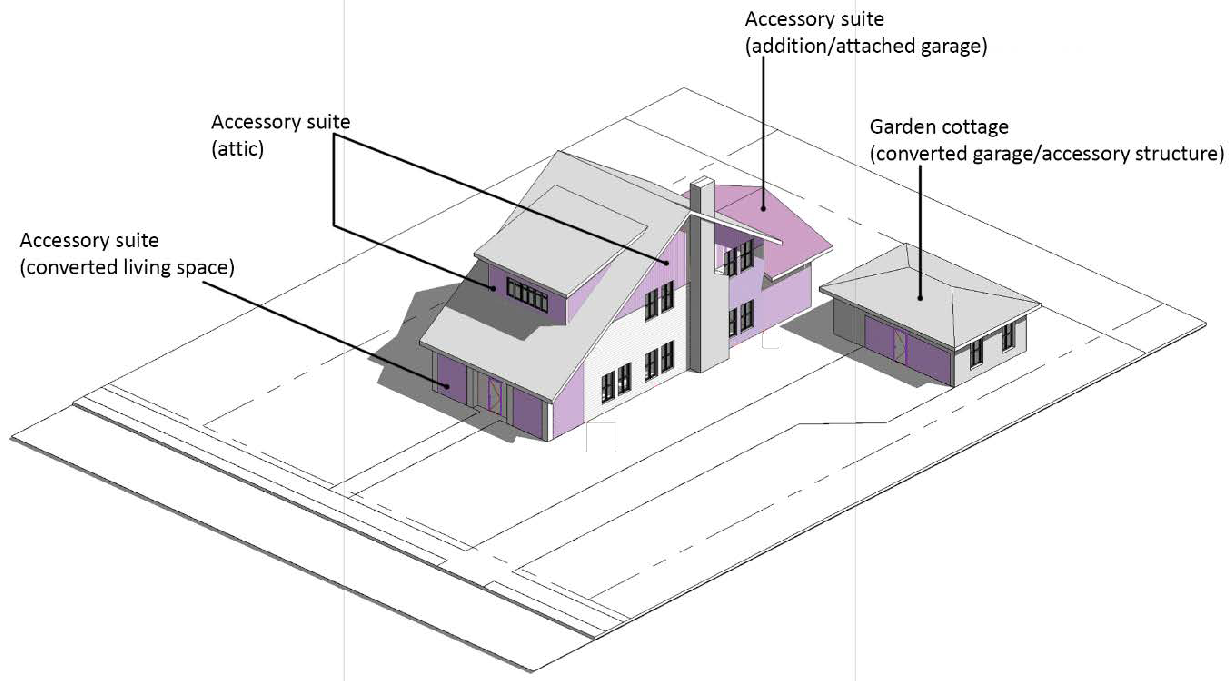
3.7.4. Backyard chickens. Chickens as "household pets" shall be authorized in accordance with chapter 9, article III, section 9-72 of the City Code.
3.7.5. Drive-thru, drive-in, and drive-up facility. An accessory use that offers service directly to occupants of motor vehicles. Such uses are typically associated with restaurants, banks, and pharmacies. Facilities are not permitted to be stand-alone or operate as principal uses.
3.7.6. Electric vehicle charging station.
A.
Electric vehicle charging stations may be counted toward satisfying minimum off-street parking space requirements.
B.
Vehicle charging equipment shall be designed and located so as to not impede pedestrian, bicycle, or wheelchair movement or create safety hazards on sidewalks.
C.
Electric vehicle charging stations shall be posted with signage indicating that the space is reserved for electric vehicle charging purposes only. For purposes of this provision, "charging" means that an electric vehicle is parked at an electric vehicle charging station and is connected to the battery charging station equipment.
D.
Electric vehicle charging stations shall be maintained in all respects, including the functioning of the equipment. A phone number or other contact information shall be provided on the equipment for reporting when it is not functioning, or other problems are encountered.
E.
Electric vehicle charging stations in AG, R-25, R-15, and RMD zoned districts shall be prohibited within five feet of the front façade, unless it is contained in a structure.
3.7.7. Home occupations. The home occupation regulations of this section are intended to allow residents to engage in customary home-based work activities, while also helping to ensure that neighboring residents are not subjected to adverse operational and land use impacts (e.g., excessive noise or traffic or public safety hazards) that are not typical of residential uses.
A.
Exclusions. The following uses are not considered home occupations and are not subject to the home occupation regulations of this section. Each use is allowed as indicated in the table of permitted uses.
1.
Personal care homes.
2.
Day care.
3.
Bed and breakfast.
4.
Short-term rentals.
B.
Prohibited home occupations. The following uses are expressly prohibited as home occupations:
1.
Any type of assembly, cleaning, maintenance, or repair of vehicles or equipment with internal combustion engines or of large appliances (such as washing machines, clothes dryers or refrigerators); and
2.
Dispatch centers or other businesses where employees come to the site and are dispatched to other locations; and
3.
Equipment or supply rental businesses; and
4.
Taxi, limo, van, or bus services; and
5.
Tow truck services; and
6.
Firearms sales establishment; and
7.
Eating or drinking places; and
8.
Funeral or interment services; and
9.
Animal care, grooming, or boarding businesses; and
10.
Any use involving the use or storage of vehicles, products, parts, machinery or similar materials or equipment outside of a completely enclosed building.
C.
Standards applicable to all home occupations.
1.
Home occupations shall be accessory and secondary to the principal use of a dwelling unit for residential purposes. They may not change the character of the residential building they occupy or adversely affect the character of the surrounding neighborhood.
2.
Home occupations shall not produce light, noise, vibration, odor, parking demand, traffic, or other impacts that are not typical of a residential neighborhood.
3.
Home occupations shall be operated so as not to create or cause a nuisance.
4.
Any tools or equipment used as part of a home occupation shall be operated in a manner or sound-proofed so as not to be audible beyond the lot lines of the subject property.
5.
External structural alterations or site improvements that change the residential character of the lot upon which a home occupation is located are prohibited. Examples of such prohibited alterations include construction of parking lots, the addition of commercial-like exterior lighting or the addition of a separate building entrance that is visible from abutting streets.
6.
Home occupations and all related activities, including storage (other than the lawful parking or storage of vehicles), shall be conducted entirely within the dwelling unit or accessory building or structure, as permitted.
7.
The area devoted to all home occupations present on the property is limited to 25 percent of the dwelling unit's floor area or 650 square feet, whichever is less.
8.
No window display or other public display of any material or merchandise is allowed.
9.
The use or storage of hazardous substances is prohibited, except at the "consumer commodity" level, as that term is defined in 49 C.F.R. Section 171.8.
10.
Only passenger automobiles, passenger vans, and passenger trucks may be used in the conduct of a home occupation. No other types of vehicles may be parked or stored on the premises. This provision is not intended to prohibit deliveries and pickups by common carrier delivery vehicles (e.g., United States Postal Service, United Parcel Service, FedEx, et al.) of the type typically used in residential neighborhoods.
11.
Home occupations complying with the regulations of this section are permitted to operate in accessory dwelling units or other accessory structures or buildings.
3.7.8. Outdoor storage.
A.
The outdoor storage regulations of this section apply to the storage of goods, materials, and equipment as an accessory use to commercial or industrial use types when located outside of enclosed buildings, including:
1.
Material in boxes, in crates, or on pallets; and
2.
Overnight storage of vehicles awaiting repair (not including new vehicles for sale) and construction and contractor's equipment, including lawnmowers; and
3.
Fleet vehicles; and
4.
Construction material such as lumber, pipe, steel and unpackaged soil, mulch, recycled material, or similar items; and
5.
Other items like appliances, merchandise, equipment, garbage, landscape waste, glass, and rubbish.
B.
Storage shall be fully enclosed by a fence not less than six feet in height containing opaque material to provide visual screening. Operable fleet vehicles do not require screening.
3.7.9. Swimming pools.
A.
Swimming pools are considered accessory structures and shall comply with all accessory structure regulations section 3.7, accessory buildings and structures in addition to those dedicated specifically to swimming pools in this section.
B.
Pool heaters and pumps shall not be located in a front yard and shall be least ten feet from any property line.
C.
Swimming pools shall be located in the rear yard and shall be setback a minimum of ten feet from rear lot lines and 12 feet from side lot lines. Setbacks are measured from the outermost edge of the pool decking to the nearest the applicable lot line.
D.
Commercial accessory swimming pools shall be approved only after receipt of written approval from the Walton or Newton County Board of Health.
3.7.10. Unmanned retail structure. An unmanned retail structure stores or dispenses items for sale, rent, or customer pick-up/drop-off that are accessible from the exterior of a building. This use includes the outdoor placement of soft drink or similar vending machines, propane gas storage racks, ice storage bins, automated teller machines (ATMs), donation bins, and other similar machines. This use may be freestanding or attached to a principal structure.
A.
General.
1.
Up to one unmanned retail structure is allowed per acre of a lot or fraction thereof, not to exceed a maximum of three total on lots three acres or larger.
2.
An unmanned retail structure shall not exceed a footprint of 50 square feet and eight feet in height.
3.
An unmanned retail structure shall not encroach on any required site elements such as landscaping, buffers, setback areas, parking, or pedestrian access.
B.
Building signs may be applied to the unmanned retail structure, provided that they follow the sign requirements in this chapter for signage and do not cause the lot to exceed its allocation of sign area.
3.7.11. Vending machine fulfillment center. A vending machine fulfillment center is a structure often affiliated with vehicle sales for the display of products, where products are displayed in a single-or multi-story tower, whether attached to another structure or standalone. Products may be displayed for sale, pick-up, or otherwise.
A.
Vending machine fulfillment centers are only permitted as accessory structures to otherwise compliant principal uses occupying a principal structure.
B.
Whether the structure is attached to the principal structure or not, signage shall only be permitted on all associated structures as if only a single structure exists.
(Ord. No. 2023-3, § 1(Exh. A), 6-20-2023)
Sec. 3.8. - Temporary uses.
3.8.1. Temporary construction structures.
A.
Construction dumpsters. Temporary refuse containers to store trash and recycling during affiliated construction activities, which are not enclosed.
B.
Portable storage containers. Designed for the temporary storage of fixtures, furnishings, equipment, or other household goods and materials (also known as PODs). Portable storage containers exclude structures designed for the occupancy by any individual or domestic animal or used as a place of business. When not associated with a valid permit, portable storage containers or temporary dumpsters shall not be parked or stored for more than 15 consecutive days or a total of more than 30 days during any calendar year.
C.
Construction trailers. Occupiable structures used for temporary management of construction activities and related services.
D.
Standards applying to all temporary construction structures.
1.
Temporary construction structures may be parked or stored on any lot when used in conjunction with a valid, unexpired building or land development permit.
2.
All temporary construction structures shall be completely removed from the premises within 30 days of issuance of the final certificate of occupancy or project close-out pertaining to the building(s)/land development associated with the construction.
3.8.2. Temporary outdoor sales of merchandise.
A.
Any applicant for a permit for temporary outdoor sales of merchandise shall demonstrate compliance with the regulations of this section through an annual permit obtained by the community development department as an occupational tax certificate.
B.
Temporary sales activities are subject to the following regulations:
1.
No such temporary outdoor sales of merchandise may be conducted on public property, within any public right-of-way, and no display or sales area may block safe pedestrian movement.
2.
Tents may be used in conjunction with temporary sales activities for a maximum of five days over a one-month period.
3.
No operator, employee, or representative may solicit directly to the motoring public.
4.
No temporary outdoor sales may be located within or encroach upon any drainage easement, public sidewalk or right-of-way, required parking spaces, fire lanes, designated loading areas, driveways, maneuvering aisles, or ADA minimum sidewalk width within private sidewalks or other areas intended for pedestrian movement.
3.8.3. Temporary stage or tent.
A.
Temporary stages require the review and approval of a building permit.
B.
Tents over 400 square feet require the review and approval of a building permit.
C.
All tents shall comply with all codes referenced in chapter 1, section 1-7, adoption of state minimum standard codes.
3.8.4. Food truck. A retail food establishment that is readily moveable in a motorized wheeled vehicle or a towed wheeled vehicle designed and equipped to serve food.
(Ord. No. 2023-3, § 1(Exh. A), 6-20-2023)

