
Sonoma County Unincorporated
City Zoning Code
City Zoning Code
ARTICLE 82
- Design Review.
Sec. 26-82-005.- Purpose.
Purpose: in order to carry out the objectives of this chapter and to protect values, plans for new or altered uses, structures and land divisions in certain zoning districts shall be reviewed by the planning director or his appointed design review committee. The intent of this article is not to stifle individual initiative, but to set forth the minimums necessary to achieve a healthful community whose property values are protected from unplanned developments.
(Ord. No. 4643, 1993.)
Sec. 26-82-010. - Preliminary development plan requirements.
All development shall be planned as a unit. Applications for design review approval shall be accompanied by a development plan, including the entire parcel or parcels to be developed.
Approval of the preliminary development plan shall concentrate on the general acceptability of land uses, open space configuration, conformity to adopted general plans or area land use plans, specific uses and densities proposed and their interrelationships and relationship to the surroundings. The preliminary development plan application shall include the following:
(a)
Proposed land uses, showing general location of open space, building areas and specific uses;
(b)
The proposed maximum density for residential uses measured in units per gross acre;
(c)
The type and location of proposed major public facilities;
(d)
Topography at intervals determined by the planning director;
(e)
A tabulations of the total land area and percentage thereof designated for various uses;
(f)
General circulation pattern indicating both public and private vehicular and pedestrian ways, including trail systems where proposed;
(g)
Relationships of present and future land uses to the surrounding area and any adopted general plan, specific plan or area land use plan;
(h)
A statement of provisions for ultimate ownership and maintenance of all parts of the development, including streets, structures and open space;
(i)
A preliminary report indicating provisions for storm drainage, sewage, disposal, grading and public utilities;
(j)
Delineation of development staging, if any;
(k)
Significant natural features such as trees, rock outcroppings and bodies of water;
(l)
Existing manmade features and areas where natural materials are to be deposited and removed;
(m)
Methods of preventing soil erosion or slippage;
(n)
Any other data deemed necessary by the planning director.
(Ord. No. 4643, 1993.)
Sec. 26-82-020. - Final development plans.
Before a building permit or a zoning permit may be issued for any zoning district in which this section is applicable, final plans of development shall be approved by the planning director. Such final development plans shall include a plot plan and elevations drawn to a workable scale, depicting the following:
(a)
Topography, significant natural features and trees;
(b)
Location and design of buildings and structures including materials to be used;
(c)
Location and type of landscaping, irrigation and its relationship to open spaces and existing vegetation, and any adopted county low-water use regulations;
(d)
Location and design of off-street parking and loading facilities, and any required public roadway improvements;
(e)
Location and type of fences and walls;
(f)
Location of trash storage areas;
(g)
Location and design of signs and exterior night lighting;
(h)
Grading plans as necessary to meet the requirements of the Sonoma County tree protection ordinance;
(i)
Any other data deemed necessary by the planning director.
In the case of a development of a group of commonly designed building, the planning director may limit his review to typical elevations.
(Ord. No. 4643, 1993.)
Sec. 26-82-030. - General development standards.
(a)
The orientation of building sites shall be such as to maintain maximum natural topography and cover.
(b)
The design of buildings, fences and other structures shall be evaluated on the basis of harmony with site characteristics and nearby buildings, including historic structures, in regard to height, texture, color, roof characteristics and setback.
(c)
Streets shall be designed and located in such a manner as to maintain and preserve mutual topography, cover, significant landmarks and trees; to necessitate minimum cut and fill; and to preserve and enhance views and vistas on or off the subject parcel.
(d)
Horticultural groundcovers and other surfacing shall be used to prevent dust and erosion where natural vegetation and groundcover is disturbed or removed.
(e)
All refuse collection areas shall be enclosed on all sides unless, by nature of the building design, the trash areas are obscured from the adjacent properties and from vehicular and pedestrian traffic. Refuse enclosures shall be of six-foot (6′) height with adequate access for refuse vehicles.
(f)
Where nonresidential or high-density residential areas are adjacent to low-density residential areas (R1), the planning director may require six-foot (6′) screening in the form of a wall or landscape planting; except, that screen shall be reduced to three feet (3′) if within or abutting a required front setback. The height limit may be modified where, because of differences in ground elevation, the purposes of this section would be better met. The precise location and type of screening shall be determined by the planning director.
(g)
The color, size, height, lighting and landscaping of appurtenant signs and structures shall be elevated for compatibility with local architectural motif and the maintenance of view and vistas of natural landscapes, recognized historic landmarks, urban parks or landscaping.
(h)
A complete system of underground utilities shall be provided in accordance with public utility commission regulations.
(i)
All mechanical or air-conditioning apparatus shall be screened from view and baffled for sound.
(j)
Each unit of development, as well as the total development, shall create an environment of desirability and stability. Every structure, when completed and in place, shall have a finished appearance.
(k)
A minimum of eight percent (8%) of all parking lot areas where more than ten (10) parking spaces are provided shall be landscaped. The landscaping shall be uniformly distributed and provision shall be made for its perpetual maintenance.
(l)
The parking layout shall conform to the dimensions on the following diagram. Where two-way traffic is desired, aisle widths shall be a minimum of twenty feet (20′), except where item F of the diagram requires a greater width. The planning director may modify the layout provided the goals of this chapter are achieved. Such modifications may include, but are not limited to parking at other angles than indicated, a combination of parking angles or a herringbone pattern. (Diagram shown at end of this section).
(m)
Circulation within a parking area shall be such that:
(1)
A car entering the parking area need not enter a street to reach another side;
(2)
Except for parking areas accommodating three (3) or fewer vehicles, a car entering a street or highway can do so by traveling in a forward direction.
(n)
All lighting in parking areas shall be arranged to prevent director glare or illumination onto adjacent properties.
(o)
Off-street parking areas and driveways, exclusive of required landscaping, shall be surfaced with materials approved by the planning director. Paved parking areas shall be painted with lines showing parking spaces and with directional arrows, showing traffic movements.
(p)
Required residential covered off-street parking facilities shall be located on the premises they are intended to serve, and shall not extend into a required front yard or any other required yard abutting a street.
(q)
Off-street parking for other than residential uses shall be on the premises they are intended to serve or within three hundred feet (300′) thereof. Where parking is provided on sites other than that of the use, a parking easement stipulating to the permanent reservation of the use of the site for parking, shall be recorded with the county recorder and filed with the building inspector and planning director prior to the issuance of building or zoning permits.
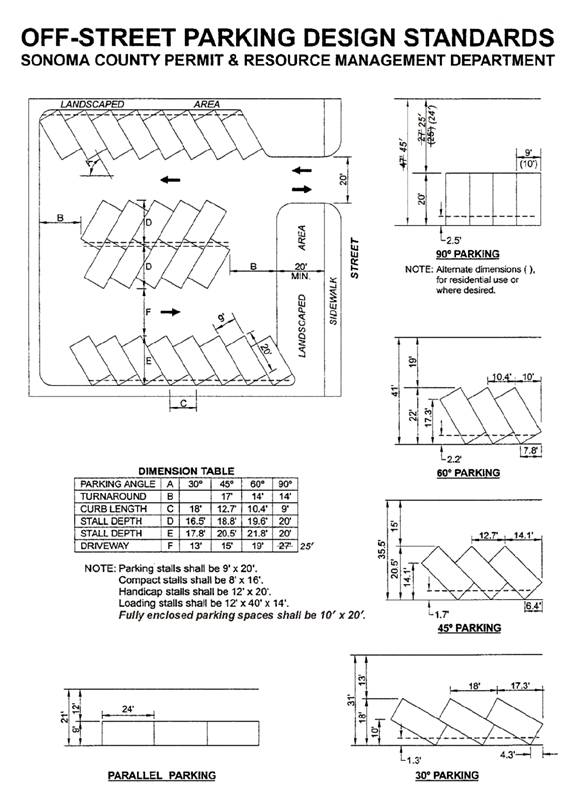
(Ord. No. 5711 § 9 (Exh. J), 2007; Ord. No. 4643, 1993.)
Sec. 26-82-040. - Approval of building permits, zoning permits and land use—Status of approved preliminary and final development plan(s), and improvement agreements.
(a)
Compliance. No building permit, zoning permit nor land use approval shall be issued in any zoning district where this article is applicable until the preliminary and final development plan(s) have been approved by the planning director or other applicable decision making body.
The planning department shall not authorize final building inspection or any level of occupancy of the building(s) until satisfied that: all on-site improvements shown on the grading and utility drawings are installed or bonded for in accordance with the site plan approved by the design review committee; the buildings are constructed in accordance with the illustrative building elevation drawings, material samples and color samples approved by the design review committee; the landscaping and landscape irrigation system are installed or bonded for in accordance with the drawings approved by the design review board and that all conditions of approval are met.
(b)
Improvement Agreements.
(1)
If the improvement works required as a condition of an approval of a project by the design review committee are not satisfactorily completed before the issuance of a building permit(s) the owner(s) of the property shall, prior to the issuance of such permit(s), enter into an agreement with county, agreeing to have the work completed within the time required, and specifying that should such work not be satisfactorily completed within the time limit, in addition to any other remedies it may have, the county may complete all specified improvements and be completely reimbursed for such improvements by the owner of the property. For purposes of this section, "improvement works" means those landscape, street and drainage improvements required as a condition of design review. Any such improvement agreement shall be approved as to form by the county counsel and shall include, but not be limited to:
(i)
Construction of all improvements works per the approved plans; provided, however, that the development shall not be obligated to complete design review improvements in the event the developer elects not to construct the underlying project;
(ii)
Completion of improvements within one (1) year from approval of design review. This completion date may be extended by the county as provided in this chapter;
(iii)
Warranty by developer that construction of on-site drainage improvements will not adversely affect any portion of adjacent properties;
(iv)
Payment of inspection fees in accordance with the county's established fees and charges;
(v)
Improvement security;
(vi)
Maintenance and repair of any defects or failures and causes thereof;
(vii)
Release and indemnification of the county from all liability incurred as a result of construction associated with the development and payment of all reasonable attorney's fees that the county may incur because of any legal action arising as a result of construction associated with the development;
(viii)
Registered civil engineer's, architect's or landscape architect's written verification to the county, based upon field inspection, that landscaping, private road and drainage improvements located on the property and subject to the agreement have been constructed in substantial conformance with approved plans.
(2)
Modification of Improvement Agreements. Improvement agreements may be modified to reduce the amount of security in recognition of the partial completion of improvements, and to allow changes to improvement plans as approved by the design review committee as specified under the terms of an existing agreement. All modifications of improvement agreements shall be at the discretion of the county of Sonoma, upon written request by the developer. In consideration of a modification to reduce the amount of security, the following will be required:
(i)
Engineer's, architect's, landscape architect's or licensed Contractor's written verification to the county that the partially constructed landscaping, private road and drainage improvements located on the property and subject to the agreement have been completed in substantial conformance with approved plans;
(ii)
Revised improvement construction estimate to reflect current improvement costs as approved by the responsible department;
(iii)
Revised improvement securities in accordance with revised construction cost estimates;
(iv)
A fee shall be paid to the county to cover the actual costs for processing the modification.
(3)
Extension of Improvement Agreements. The completion date for any improvements to be constructed under an improvement agreement may be extended by the county of Sonoma upon written request by the developer and the submittal of evidence to justify such extension. The request shall be made not less than thirty (30) days prior to the expiration of the improvement agreement. Any such extension shall be authorized in writing by the county. Any request for extension, at the discretion of the county, may be denied. In consideration of the extension, the following will be required:
(i)
In those cases where construction has not commenced, revision of the improvement plan to provide the current design and construction standards required by the responsible department;
(ii)
Revised improvement construction estimate to reflect current improvement costs as approved by the responsible department;
(iii)
Increase of improvement securities in accordance with revised construction estimates;
(iv)
Increase in any inspection fees to reflect current fees;
(v)
The design review committee may impose additional requirements it may deem necessary as a condition to approving any time extension for the completion of improvements;
(vi)
A fee shall be paid to the county to cover the actual costs for processing the extension.
(4)
Amount of Security to Accompany Improvement Agreement. Applicant/developer shall, prior to county's execution of the design review agreement, deliver to county the following security in a form satisfactory to the county counsel:
(i)
Either a cash deposit, a corporate surety bond or an instrument of credit sufficient to assure county that the improvement work approved by the county will be satisfactorily completed. Nothing contained in this section shall be construed to require duplicate security for improvements for which the county, as principal obligee, is already holding security;
(ii)
If required by county, a cash deposit, corporate surety bond, or instrument of credit sufficient to assure county that wet weather construction mitigation measures will be constructed in accordance with the approved plan.
(5)
Release of Improvement Securities. The performance security for dedicated improvements shall be released only upon acceptance of the improvements by the county and, if required as a condition of design review, approved warranty security has been filed with the county. The performance security for other improvements shall be released only upon satisfactory passage of final inspection by the county. Additional, with respect to improvements which will not be dedicated and accepted by the county, the applicant/developer shall comply with Section 3093 of the Civil Code and deliver forthwith to the planning director or the directors' appointed designee, a copy of the notice of completion and the engineer's, architect's or licensed landscape architect's written verification based upon field inspection of satisfactory completion as required for the landscaping, private road and drainage improvements; and, if required as a condition of design review, shall deliver to the county any required maintenance and/or warranty agreements and security, prior to the release of the performance security.
(6)
Delegation to Approve Improvement Agreements. Where the board of supervisors has, by resolution, adopted a standard form design review agreement which conforms to the requirements of this section, the planning director is authorized to execute such agreements and accept security therefore on behalf of the county, including any extensions or minor modification thereto which are consistent with this section.
(7)
The planning director may waive the requirement for an improvement agreement and securities on landscape and irrigation improvements when found appropriate and the applicant enters into an agreement with the county to hold occupancy on the project pending completion of all required improvements. In considering such a waiver, the planning director shall review the scale of the project, visibility of the project from adjacent roads and properties, and demonstrated prior performance of the applicant.
(Ord. No. 5933, § II(j), 5-10-2011; Ord. No. 4643, 1993; Ord. No. 3707.)
Sec. 26-82-050. - Design review requirement.
(a)
No permit shall be issued for any project requiring design review approval unless and until drawings and plans have been approved by the design review committee or other applicable decision making body as the case may be. All buildings, structures and grounds shall be developed in accordance with the approved drawings and plans.
(b)
The design review committee, composed of three (3) members appointed by the planning director, shall be responsible for and shall have the authority to approve drawings and plans within the meaning of this section. The committee, or other applicable decision-making body as the case may be, shall endeavor to provide that the architectural and general appearance of buildings or structures and grounds are in keeping with the character of the neighborhood and are not detrimental to the orderly and harmonious development of the county and do not impair the desirability of investment or occupation in the neighborhood.
(c)
The planning director may waive the above requirement for design review committee approval of a project in the following instances. In such cases, administrative design review approval shall be required as described in (d) below.
(1)
New commercial, institutional or industrial uses permitted by zoning in existing buildings or uses that have been previously authorized by use permit or design review approval. Approval shall be based on a review of the property to assure compliance with the terms and conditions of the original authorization of the use. Additional conditions may be required to implement the objectives of the Sonoma County general plan, applicable specific or area plans, any local area development guidelines and the Sonoma County Code;
(2)
Signs for residential, commercial, industrial and institutional uses permitted by this chapter, for which a sign program has been approved, or for appurtenant signs less than thirty-two (32) square feet, which are not located along a designated scenic corridor;
(3)
Minor facade changes or building additions for residential, institutional, commercial and industrial uses not requiring use permit approval or for such uses for which a use permit has been granted, if such changes or additions involve less than twenty percent (20%) of the existing floor area, do not exceed five thousand (5,000) square feet and are exempt from the provisions of the California Environmental Quality Act;
(4)
Fruit and produce stands (if exempt from CEQA);
(5)
Bed and breakfast inns (subsequent to use permit approval);
(6)
Any other project requiring design review approval as specified in this chapter which in the opinion of the planning director based on the small scale and the nature of the development should qualify for administrative design review.
(d)
Administrative design review approval shall consist of a formal written waiver specifying conditions, if any. Copies of the written waiver will be distributed to the applicant and any interested persons. The administrative determination is appealable to the design review committee within ten (10) calendar days following the mailing date of the report. An appeal is made by filing the appropriate application and required fees with the county planning department.
(e)
Any interested person may appeal any decision made by the design review committee pursuant to this chapter to the planning commission. An appeal shall be filed in writing with the planning director within ten (10) days after the decision that is the subject of the appeal. The appeal shall specifically state the basis for the appeal and shall be accompanied by the required filing fee.
(f)
The design review committee may, if it deems it advisable, refer any application for design review approval to the planning commission for its decision.
(Ord. No. 5537 § 2 (b), (c), 2004; Ord. No. 4643, 1993.)

