
Sopchoppy City Zoning Code
ARTICLE IV
- ZONING DISTRICT REGULATIONS
Sec. 119-114. - A-1 Agriculture District.
(a)
Scope and district intent. This section applies to the A-1 Agricultural District. The intent of this district is to preserve prime agricultural and forestry lands from urban development; to permit agricultural and forestry related activities to function economically while protecting the environmental integrity and other surface waters from the impacts of urban development.
(b)
Permitted uses and structures.
(1)
Principal uses and structures.
a.
Farming.
b.
Raising of animals and poultry.
c.
Single-family residences, no more than one dwelling per ten acres.
(2)
Accessory uses and structures. Uses of land customarily incidental and subordinate to one of the permitted principal uses.
(3)
Prohibited uses and structures. All uses not specifically or provisionally permitted herein.
(c)
Special exceptions. At the discretion of the city council.
(d)
Development standards.
(1)
Building setback. A minimum building setback of 25 feet shall be required from the boundary of any property line bordering a state highway.
(2)
Signs. See chapter 115.
(3)
Off-street parking and loading requirements.
a.
All parking areas must be constructed with pervious materials.
b.
See sections 119-239 and 119-243.
(Ord. No. 91-1, § 510, 3-11-1991)
Sec. 119-115. - R-1 High Density Residential District.
(a)
Scope and district intent. The provisions of this section apply to the R-1 High Density Residential District. The intent of this district is to ensure the health, safety and physical well-being of residents by limiting the extent and density of single-family residential development to four dwelling units per acre and by directing growth to those areas where public services are available and where soils are suitable for development.
(b)
Permitted uses and structures.
(1)
Principal uses and structures.
a.
One single-family detached dwelling per lot.
b.
Parks, schools and playgrounds.
c.
Private noncommercial recreation areas, swimming pools and golf courses.
(2)
Accessory uses and structures. Uses of land customarily incidental and subordinate to one of the permitted principal uses, unless otherwise excluded, including, but not limited to accessory structures that provide residential or home occupation functions that do not increase the parking needs of the primary structure by greater that one space.
(3)
Prohibited uses and structures. All uses not specifically or provisionally permitted herein including mobile homes.
(c)
Special exceptions. After public notice and hearing and appropriate conditions and safeguards the local planning agency may permit as special exceptions:
(1)
Buildings connected with the construction which must be removed after use is discontinued.
(2)
Fire stations.
(3)
Commercial establishments.
(d)
Development standards.
(1)
Minimum lot size: One-fourth acre (10,890 square feet).
(2)
Minimum lot dimensions: Width 60 feet, depth 100 feet.
(3)
Building setback: For all residential structures or accessory structures there shall be provided:
a.
Front yard: 15 feet.
b.
Rear yard: 20 feet for principal structures and ten feet for accessory structures.
c.
Existing residential structures or accessory structures encroaching into the required setbacks may be rebuilt in the same footprint but cannot be remodeled or reconstructed to increase the original encroachment.
A minimum building setback of 25 feet shall be required from the boundary of any property line bordering a state highway.
(4)
Maximum building height: 35 feet in height. Also see section 119-211.
(5)
Signs: See chapter 115.
(6)
Off-street parking and loading requirements: See sections 119-239 and 119-243.
(e)
Additional provisions.
(1)
Where applicable, standards for the flood damage prevention, stormwater management and the conservation overlay district shall be in effect for lands within this district.
(2)
Exceptions and modifications: All provisions of section 119-35 shall apply to development within this district.
(Ord. No. 91-1, § 520, 3-11-1991; Ord. No. 2014-03, § 1(Exh. A), 4-14-2014; Ord. No. 2023-02, 2-13-2023)
Sec. 119-116. - R-2 Medium Density Residential District.
(a)
Scope and district intent. The provisions of this section apply to the R-2 Medium Density Residential District. The intent of this district is to ensure the health, safety and physical well-being of residents by limiting the extent and density of single-family residential development and directing growth to those areas where public services are available and where soils are suitable for development.
(b)
Permitted uses and structures.
(1)
Principal uses and structures.
a.
One single-family detached dwelling per lot.
b.
Parks, schools and playgrounds.
c.
Private noncommercial recreation areas, swimming pools and golf courses.
d.
Mobile homes.
(2)
Accessory uses and structures. Uses of land customarily incidental and subordinate to one of the permitted principal uses, unless otherwise excluded.
(3)
Prohibited uses and structures. All uses not specifically or provisionally permitted herein.
(c)
Special exceptions. After public notice and hearing and appropriate conditions and safeguards, the local planning agency may permit as special exceptions:
(1)
Buildings connected with the construction which must be removed after use is discontinued.
(2)
Fire stations.
(3)
Commercial establishments.
(d)
Development standards.
(1)
Minimum lot size: One dwelling per one acre.
(2)
Minimum lot dimensions: Width shall be no less than 100 feet.
(3)
Building setback: For all residential structures or accessory structures there shall be provided:
a.
Front yard: 15 feet.
b.
Rear yard: 20 feet for principal structures and ten feet for accessory structures.
c.
Existing residential structures or accessory structures encroaching into the required setbacks may be rebuilt in the same footprint but cannot be remodeled or reconstructed to increase the original encroachment.
(4)
Maximum building height: 35 feet in height. Also see section 119-211.
(5)
Signs: See chapter 115.
(6)
Off-street parking and loading requirements: See sections 119-239 and 119-243.
(e)
Additional provisions.
(1)
Where applicable, standards for the flood damage prevention, stormwater management regulations and the conservation land use district shall be in effect for lands within this district.
(2)
Exceptions and modifications: All provisions of section 119-35 shall apply to development within this district.
(Ord. No. 91-1, § 530, 3-11-1991; Ord. No. 2024-03, 6-10-2024)
Sec. 119-117. - R-3 Low Density Residential District.
(a)
Scope and district intent. The provisions of this section apply to the R-3 Low Density Residential District. The intent of this district is to ensure the health, safety and physical well-being of residents by limiting the extent and density of single-family residential development and directing growth to those areas where public services are available and where soils are suitable for development.
(b)
Permitted uses and structures.
(1)
Principal uses and structures.
a.
One single-family detached dwelling per lot.
b.
Parks, schools and playgrounds.
c.
Private noncommercial recreation areas, swimming pools and golf courses.
d.
Mobile homes.
(2)
Accessory uses and structures. Uses of land customarily incidental and subordinate to one of the permitted principal uses, unless otherwise excluded.
(3)
Prohibited uses and structures. All uses not specifically or provisionally permitted herein including mobile homes.
(c)
Special exceptions. After public notice and hearing and appropriate conditions and safeguards, the local planning agency may permit as special exceptions:
(1)
Buildings connected with the construction which must be removed after use is discontinued.
(2)
Fire stations.
(3)
Commercial establishments.
(d)
Development standards.
(1)
Minimum lot size: One dwelling per five acres.
(2)
Minimum lot dimensions: Lot width shall be a minimum of 300 feet.
(3)
Building setback: For all residential structures or accessory structures there shall be provided:
a.
Front yard: 15 feet.
b.
Rear yard: 20 feet for principal structures and ten feet for accessory structures.
c.
Existing residential structures or accessory structures encroaching into the required setbacks may be rebuilt in the same footprint but cannot be remodeled or reconstructed to increase the original encroachment.
(4)
Maximum building height: 35 feet in height, also see subsection (e) of this section.
(5)
Signs: see chapter 115.
(6)
Off-street parking and loading requirements: See sections 119-239 and 119-243.
(e)
Additional provisions.
(1)
Where applicable, standards for the flood damage prevention, stormwater management regulations and the conservation overlay district shall be in effect for lands within this district.
(2)
Exceptions and modifications: All provisions of section 119-35 shall apply to development within this district.
(3)
Appropriate permits from the state department of health and DEP must be obtained prior to issuance of city development permit.
(Ord. No. 91-1, § 540, 3-11-1991; Ord. No. 2024-03, 6-10-2024)
Sec. 119-118. - R-4 Highway Residential District.
(a)
Scope and district intent. The provisions of this section apply to the R-4 Highway Residential District. The intent of this district is to provide areas suitable for single-family and mobile home dwelling units and to reduce urban sprawl.
(b)
Permitted uses and structures; principal uses and structures.
(1)
Single-family dwellings.
(2)
Mobile homes.
(c)
Special exceptions.
(1)
Home occupations such as the office or studio of a physician, surgeon, dentist, osteopath, chiropractor, lawyer, accountant, architect, engineer, musician, minister or photographer who shall reside on the premises and providing that the area in which the business is located shall not exceed 2,500 square feet and shall mimic the character of the primary dwelling unit and providing further there is no advertising visible from the street except a small professional announcement;
(2)
Hospitals, infirmaries, clinics, rest homes, convalescent homes or other health service facilities;
(3)
The renting of rooms or the furnishing of table board in a dwelling occupied as a private residence;
(4)
Institutions of a religious, educational and philanthropic nature, including libraries;
(5)
Churches and other places of worship, parish houses and Sunday school buildings;
(6)
Federal, state, county or municipal office buildings, municipal police, fire and utility stations and municipal utility equipment and appliances;
(7)
Municipal recreation buildings and municipal parks and playgrounds;
(8)
Clubs, lodges, social or community center buildings except those the chief activity of which is gainful service or activity usually conduct as a business;
(9)
School buildings, school or college dormitories, fraternity and sorority houses when such fraternity or sorority occupying such house is recognized by a chartered university or college, or university; or
(10)
Group homes, foster homes.
(d)
Development standards.
(1)
Minimum lot area: Single-family dwelling or mobile home; one dwelling per acre.
(2)
Minimum lot dimensions: Single-family/mobile home:
a.
Width: The lot side abutting the highway shall be not less than 300 feet in length.
b.
Depth: Not applicable.
(3)
Minimum building setbacks:
a.
Front yard: 15 feet.
b.
Rear yard: 20 feet for principal structures and ten feet for accessory structures.
c.
Existing residential structures or accessory structures encroaching into the required setbacks may be rebuilt in the same footprint but cannot be remodeled or reconstructed to increase the original encroachment.
(4)
Maximum building height: 35 feet in height. Also see section 119-211.
(e)
Signs. See chapter 115, off-street parking and loading requirements, see sections 119-239 and 119-243.
(f)
Additional provisions.
(1)
Potable water must be available from a source certified by DEP as being safe for human consumption.
(2)
Site plans must include wastewater treatment facilities plans which do not conflict with F.A.C. ch. 64E-6.
(3)
Where applicable, standards for the flood damage prevention, stormwater management regulations and conservation overlay district shall be in effect for lands within this district.
(4)
Minimum lot size, lot dimensions, and building setbacks for uses allowed as a special exception shall not be any less than those required for single-family dwellings, and as a condition of approval, may be increased as deemed necessary and reasonable to protect adjacent properties.
(5)
All mobile homes shall be secured by tie-downs for protection of units and adjacent properties against wind damage in accordance with local and/or state statutes requiring tie-downs. In addition, they shall be in accordance with accepted industry standards for the area. Mobile homes shall be skirted and have the tongue removed.
(Ord. No. 91-1, § 550, 3-11-1991; Ord. No. 2023-02, 2-13-2023; Ord. No. 2024-03, 6-10-2024)
Editor's note— Ord. No. 2023-02, adopted Feb. 13, 2023, set out provisions intended to amend § 119-116(c)(1); however, said provisions have been redesignated as amendments to § 119-118(c)(1), at the editor's discretion.
Sec. 119-119. - Reserved.
Editor's note— Ord. No. 2014-03, § 1(Exh. A), adopted April 14, 2014, repealed § 119-119, which pertained to R-5 Moderate Density Residential District and derived from Ord. No. 91-1, § 1, 2004.
Sec. 119-120. - C-1 Commercial District.
(a)
Scope and district intent. The provisions of this section apply to the C-1 Commercial District. The intent of this district is to provide for commercial development near present concentrations of population.
(b)
Permitted uses and structures.
(1)
Principal uses and structures.
a.
Financial, real estate, insurance and other professional services.
b.
Retail sales including such retail services as barbershops and beauty shops, laundry and dry cleaning facilities.
c.
Restaurants, lounges, food services, public assembly halls and entertainment centers.
d.
Automotive and engine repair shops and other repair services.
e.
Warehousing retail or wholesale facilities.
f.
Undertaking establishments and funeral homes.
g.
Automobile sales and storage.
h.
Commercial recreation.
i.
Filling stations.
j.
Hotels and motels (low impact, 50 or fewer units).
k.
Churches and community houses.
l.
Public buildings.
m.
Residential uses subject to the development standards of the R-1, R-2, R-3 and R-4 zoning districts.
(2)
Accessory uses and structures.
a.
Uses of land customarily incidental and subordinate to one of the permitted principal uses, unless otherwise excluded.
b.
Residential uses occupying the same building as a commercial business.
(3)
Prohibited uses and structures. All uses not expressly or provisionally permitted herein.
(c)
Special exceptions. After public notice and hearing and appropriate conditions and safeguards, the local planning agency may permit as special exceptions:
(1)
Hotels, motels and time-share vacation units (high impact, over 25 units) subject to review as provided by section 101-41.
(2)
Uses listed as permitted by special exception in the residential zoning district.
(3)
Industrial enterprises.
(d)
Development standards.
(1)
Minimum lot size. For commercial development no minimum lot size, lot width, lot depth, or frontage; however, existing lots may not be subdivided. (See note 3.)
(2)
Building setback: For all commercial or accessory structures there will be provided:
a.
A setback of 25 feet from the boundary of the property line bordering any road.
b.
Setback a minimum of ten feet from any other property line, except for attached or common-wall construction.
c.
Lot width: Minimum lot width 100 feet where an OSDS is used.
(3)
Maximum building height and Maximum Floor Area Ratio (FAR): 35 feet in height, 50 percent FAR.
(4)
Signs: See chapter 115.
(5)
Off-street parking and loading requirements: See sections 119-239 and 119-243.
(6)
All new commercial construction shall comply with the city's adopted design standards.
(e)
Additional provisions.
(1)
When applicable standards for the flood damage prevention, stormwater management regulations and shall be in effect for lands within this district.
(2)
Automotive, automotive engine repair and marine engine repair facilities shall comply with state and federal requirements where applicable.
(3)
Where an OSDS is used, lot size must not conflict with criteria in F.A.C. ch. 64E-6.
(Ord. No. 91-1, § 570, 3-11-1991; Ord. No. 2014-03, § 1(Exh. A), 4-14-2014; Ord. No. 2024-03, 6-10-2024)
Sec. 119-121. - C-2 Highway Commercial District.
(a)
Scope and district intent. The provisions of this section apply to the C-2 Highway Commercial District. The intent of this district is to provide for commercial development at the U.S. 319/S.R. 372 intersection.
(b)
Permitted uses and structures.
(1)
Principal uses and structures.
a.
Financial, real estate, insurance and other professional services.
b.
Retail sales including such retail services as barbershops and beauty shops, laundry and dry cleaning facilities.
c.
Restaurants, lounges, food services, public assembly halls and entertainment centers.
d.
Automotive and engine repair shops and other repair services.
e.
Warehousing retail or wholesale facilities.
f.
Undertaking establishments and funeral homes.
g.
Automobile sales and storage.
h.
Commercial recreation.
i.
Filling stations.
j.
Hotels and motels (low impact, 50 or fewer units).
k.
Churches and community houses.
l.
Public buildings.
m.
Residential uses subject to the development standards of the R-1 and R-2 zoning districts.
(2)
Accessory uses and structures.
a.
Uses of land customarily incidental and subordinate to one of the permitted principal uses, unless otherwise excluded.
b.
Residential uses occupying the same building as a commercial business.
c.
Industrial uses.
(3)
Prohibited uses and structures. All uses not expressly or provisionally permitted herein.
(c)
Special exceptions. After public notice and hearing and appropriate conditions and safeguards, the local planning agency may permit as special exceptions:
(1)
Hotels, motels and time-share vacation units (high impact, over 25 units) subject to review as provided by section 101-41.
(2)
Uses listed as permitted by special exception in all the residential zoning district.
(d)
Development standards.
(1)
Minimum lot size: Commercial lots abutting either U.S. 319 or S.R. 372 must have a minimum of 300 feet abutting the highway.
(2)
Building setback: For all commercial or accessory structures there will be provided:
a.
A setback of 25 feet from the boundary of the property line bordering any road.
b.
Setback a minimum of ten feet from any other property line, except for attached or common-wall construction.
c.
Lot width: Minimum lot width 300 feet where lot abuts U.S. 319/S.R. 372.
(3)
Maximum building height and Floor Area Ratio (FAR): 35 feet in height; 40 percent FAR.
(4)
Signs: See chapter 115.
(5)
Off-street parking and loading requirements: See sections 119-239 and 119-243.
(6)
All new commercial construction shall comply with the city's adopted design standards.
(e)
Additional provisions.
(1)
When applicable standards for the flood damage prevention and stormwater management regulations shall be in effect for lands within this district.
(2)
Automotive, automotive engine repair and marine engine repair facilities shall comply with state and federal requirements where applicable.
(3)
Where an OSDS is used, lot size must not conflict with criteria specified by the state.
(Ord. No. 91-1, § 580, 3-11-1991; Ord. No. 2014-03, § 1(Exh. A), 4-14-2014; Ord. No. 2024-03, 6-10-2024)
Sec. 119-122. - P-1 Public District.
(a)
Scope and district intent. The provisions of this section apply to the P-1 Public District. The intent of this district is to preserve publicly owned land within the city limits for use by the public. The P-1 district includes Sopchoppy City Park, St. Marks Wildlife Preserve, school board property and city owned property.
(b)
Permitted uses and structures.
(1)
Wildlife preserves (St. Marks, Wildlife Preserve).
(2)
Education facilities (school board property).
(3)
City government facilities (city owned property).
(4)
Recreation facilities (city park).
(c)
Prohibited uses and structures. All uses not specifically permitted herein.
(d)
Development standards. No development is permitted in the St. Marks Wildlife preserve, except as allowed by the U.S. Forestry Service.
(1)
Development within the Sopchoppy City Park shall be limited to recreation related facilities.
(2)
Development on school board property shall be limited to school related facilities.
(3)
Development on other city owned property shall be limited to public facilities.
(4)
All development within the P-1 district shall conform to the development standards contained in the land development code.
(Ord. No. 91-1, § 590, 3-11-1991)
Sec. 119-123. - D-1 Downtown Overlay District.
(a)
Purpose. The purpose of the Downtown Overlay District (DOD) is to help maintain the traditional central business district as a vital and focal point of the city through continued enhancement of its accessibility, appearance, preservation, utilization, and facilities. The purpose of the DOD is also to promote high quality development, as provided for by Policy 8.3 of the Comprehensive Plan, which states that the city shall:
(1)
Require that development be consistent with the characteristics of adjacent and nearby development.
(2)
Encourage the use of existing structures over new construction.
(3)
Limit substantial modification or alteration of the existing building front elevation or site that adversely impacts the character, history and identity of the property and adjacent properties.
(4)
Allow mixed commercial/residential use of structures at densities of up to eight dwelling units per gross acre.
(5)
Preserve and enhance existing buffers where appropriate to reduce the visual and noise impacts to surrounding properties.
(6)
Require that new development/redevelopment retain on-street parking where possible.
(7)
Allow for flexibility in the number of parking spaces required for new development within the DOD. The cty shall take into consideration that public parking and street parking is available for use within the DOD.
(8)
Allow for flexibility in the lot size, set back requirements, height size and buffering requirements for development within the DOD. The city shall take into consideration the characteristics of adjacent and nearby development to ensure that new development is appropriate in scale, size and overall esthetics with existing development
(9)
Encourage nonresidential uses to be oriented toward the pedestrian. Commercial uses in mixed use developments should be encouraged on the ground floor to prevent blank walls with little visual interest for the pedestrian. Office and/or residential units should be encouraged above ground floor retail
(b)
DOD relation to underlying zoning classification. The underlying zoning designation within the DOD remains commercial or residential as shown on the Future Land Use Map and Official Zoning Map. As an overlay district, the DOD modifies the land development standards of the underlying district (also referred to as base district). Whenever the requirements of the DOD impose a more or less restrictive standard than the provisions of the underlying zoning district stated elsewhere in this ordinance, the requirements of the overlay district shall govern. Modifications to the land development standards of the existing base district for development within the DOD are not variances and the terms are not synonymous.
(c)
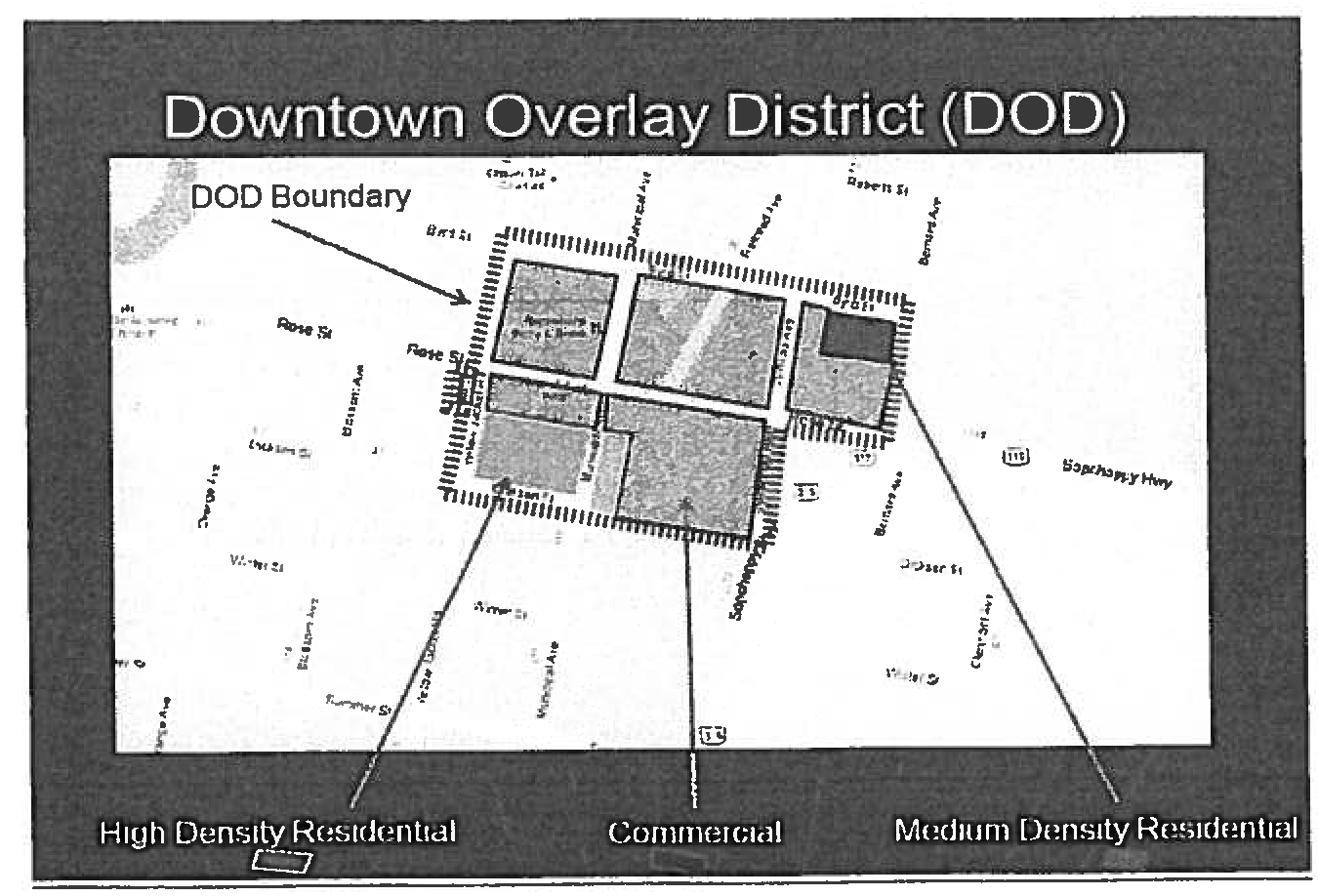
DOD boundaries. The following boundaries are designated as the Downtown Overlay District (DOD) within the City of Sopchoppy. The DOD is bounded by Byrd St. to the north, Yellow Jacket Road to the west, Dickson Street to the south and Winthrop Avenue and Barnard Avenue to the east, as shown in the map below.
The location and boundaries of the DOD are established as shown on the City of Sopchoppy Official Zoning Map, dated April 14, 2014, as amended.
(d)
Application. Commencing on the date of the adoption of this section the overlay district standards will apply to the following:
(1)
All newly constructed buildings or structures.
(2)
All exterior building improvements and sign changes for which a building and/or sign permit is required. Overlay district standards are applicable only to the changed element or improvement.
(3)
All new or reconstructed parking areas with five or more spaces.
(4)
All Temporary and permanent signage.
(e)
Grandfather. Any building, structure, parking area or sign that lawfully exists at the time this ordinance is enacted, which would not otherwise be permitted under may be continued in the same manner as existed before the effective date of the Ordinance, but any future construction, additions, reconstruction, renovation, or sign erection shall be subject to the requirements of this ordinance.
(f)
Compliance. The design guidelines of the DOD are non-mandatory. The developer may choose to comply only with the underlying zoning district requirements or propose development that is consistent with the DOD design guidelines. The City encourages development that is consistent with the DOD design guidelines.
(g)
Development approval process. At the time of application for any development permit within the DOD, the Planning Development and Review process shall be followed which is found in sections 101-119 of this ordinance. If development is proposed that deviates from the underlying zoning district regulations, the applicant shall demonstrate how the proposed building, structure, improvement, renovation or sign complies with the DOD design guidelines before final approval is considered by the city.
(h)
Design guidelines: Public facilities and infrastructure. The following provides design guidelines for public infrastructure and facilities such as streets, parking, sidewalks, public art and open space.
(1)
Sidewalks and bike paths.
a.
Development should be pedestrian-oriented and should complement pedestrian activity by providing bike paths, pedestrian amenities, street furniture, and buildings fronted to the sidewalks with little or no setbacks.
b.
Continuous pedestrian walking areas — sidewalks, crosswalks — are encouraged to create connections to uses both within and outside the DOD.
c.
Walkways may include shade, benches, small water features, public art, trash receptacles, and lighting.
d.
Sidewalks/walkways should be designed for safety and pedestrian convenience.
e.
Pedestrian comfort and safety can be achieved by creating an appropriate width of sidewalk and where feasible, adequate buffering from traffic.
(2)
Streets and parking.
a.
Streets should be well-landscaped, tree-lined corridors designed for both pedestrian and vehicular use.
b.
Parking areas should be landscaped, shaded, and pedestrian paths and walkways from parking areas to buildings should be lighted.
c.
On-street parking (angled or parallel) is encouraged.
d.
The establishment of way finding signage along streets and in parking areas is encouraged.
e.
Rapid changes in the cross slope of driveways or ramps (exceeding two percent) are discouraged.
(3)
Open space and Streetscape.
a.
Landscape plans addressing shading, visual screening, visual variety and interest should be prepared and presented with all development proposals.
b.
Walls and fences should be softened with vegetation. Where a new wall or fence would create a continuous surface greater than 20 feet in length, it should also be softened visually with tree, shrub, and vine plantings.
c.
Trees should be used throughout paved areas and along pedestrian pathways to provide shade and to reduce heat build-up and glare.
d.
"Pocket parks" or small courtyards are encouraged along streets, pedestrian pathways and between buildings.
e.
Pocket parks should be appropriately sited and arranged to encourage their use. Pocket parks should be visible from the street or pedestrian pathway.
(4)
Public art.
a.
Public art should be incorporated into public spaces.
b.
Decorative banners on light poles are encouraged to help identify entry into the city.
c.
Include art in courtyards and pocket park design. Consider any built element as an opportunity for art, such as building walls, manhole covers, paving, railings, seating and overhead structures.
d.
Examples of low cost art include painted wall murals or etched concrete.
(h)
Design guidelines: Commercial and other non-residential buildings. Any modifications to existing structures should be compatible with the prevailing historic architectural character of the surrounding area. Compatible designs do not seek to imitate the historic architecture found in downtown area, but do reflect their surroundings in terms of design concepts — mass, scale, rhythm, color, materials, and building arrangement. Compatible designs should be in harmony with the surrounding development. Store front facades experience significant change during a building's life and hold the most potential for creative alterations affecting both the character of the building and the streetscape. In an effort to promote quality design for storefronts, the following guidelines should be considered:
(1)
Entries/doorways
a.
Commercial storefront entries are typically recessed and/or sheltered by a covered arcade structure, canopy or awning. This provides more area for display space, a sheltered transition area to the interior of the store and emphasizes the entrance. Recessed entries should be retained and are strongly encouraged.
(2)
Facade color.
a.
Adjacent buildings should be painted different, but complementary colors.
b.
Different window frame and sash colors are encouraged but should complement the main color of the building.
c.
Stripes, polka dots, checkerboard patterns and other distracting paint combinations are discouraged. Examples of distracting paint combinations include: highly-reflective colors that cause glare, large dark buildings or surfaces, large areas of dark glass, unless deeply-recessed, colors so dark or intense as to neutralize shadow patterns, excessively bright colors except for use in small areas.
(3)
Awnings and canopies.
a.
Awnings are encouraged and should have a single color or other color combination that is harmonious with adjacent development.
b.
Awning shape should relate to the window or door opening. Barrel shaped awnings should be used to complement arched windows while rectangular awnings should be used on rectangular windows.
c.
All awnings should be well maintained, washed regularly, and replaced when faded or torn.
d.
When there are several businesses in one building, awnings of the same color should be used with simple signs on the valance flap that may vary in type style and color to differentiate the individual businesses within the building.
(4)
Doors and window design.
a.
When considering the installation of new windows, it is important that the new design be sympathetic and compatible with the facade theme of the whole block (streetscape).
b.
Discourage introducing or changing the location or size of windows or other openings that alter the architectural rhythm, alignment or character of the original building.
c.
If a window has deteriorated beyond repair or is missing, the replacement should match the original window in terms of design and materials.
d.
Avoid the use of windows and shutters that are not in keeping with the original style of the building.
e.
Every effort should be made to maintain and repair an original door, if possible.
(7)
Signs.
a.
Signs in the downtown area shall be consistent with the City of Sopchoppy sign regulations ordinance. An effectively designed sign should:
1.
Be compatible with the surrounding physical and visual character of the area;
2.
Promote the "individuality" of establishments;
3.
Identify the business clearly and attractively;
4.
Enhance the building on which it is located; and
5.
Reduce the amount of visual clutter caused by excessive and poorly placed signage.
(8)
Architectural character.
a.
New construction and infill buildings should maintain the existing alignment of facades along the street front. Exceptions would be if the setback is pedestrian-oriented and contributes to the quality and character of the streetscape. An example would be outdoor dining.
b.
Building size should maintaining a human building scale, rather than monolithic or oversize scale by avoiding large featureless facade surfaces. Smaller scale buildings and the use of traditionally-sized building components help to establish human scale and maintain the character of downtown.
c.
Use of awnings and arcades to provide shade and visual interest are encouraged.
d.
Preserving the historic character of buildings when renovating is highly encouraged.
e.
Buildings that derive their image primarily from applied treatments that express corporate identity are discouraged. Corporate colors or designs should only be used as minor accents.
f.
Exterior trash and storage areas, service yards, loading, areas, heating, and air conditioning units should be screened or camouflaged from view.
(9)
Building materials.
a.
Building materials should be respectful to the architectural style of the building and compatible with nearby and adjacent buildings. Highly reflective, shiny or mirror-like materials that reflect glare into the surrounding environment are discouraged.
(10)
Landscaping.
a.
Excessive use of paving, driveways or walkways that cover traditionally open space is discouraged.
b.
Traditional garden landscaping using regional flora is encouraged.
(i)
Design guidelines for residential buildings. New, repaired and rehabilitated housing should be compatible with the prevailing architectural character of the surrounding area.
(1)
Massing, form and setbacks.
a.
The massing, form and setbacks for new housing should be similar to that in the immediate vicinity.
(2)
Roofs.
a.
In general residential roofs are of several recognized types: single or multiple gable, hip roofs and central pitch roofs. Roofs on new buildings should be compatible with these basic roof styles.
(3)
Door and window openings.
a.
Window placement on rehabilitated and new homes should be compatible with traditional patterns of surrounding areas. Doorways should be highlighted with awnings, stoops, porches, walkways and other decorative elements. Windows should generally fit within typical local home types; single or multi-paned double hung sash. Decorative molding window trim and shutters are encouraged as methods for enlivening a facade.
(4)
Exterior materials.
a.
External building materials should be of wood, brick, block, fiber-cement siding or other siding of similar or texture and quality of surrounding residential development.
(5)
Colors.
a.
Color schemes should take into account all the architectural elements of a building, including roof, siding, doors and trim. Architectural trim colors should be cohesive throughout the architectural composition and colors chosen for outbuildings should be harmonious with the primary structure. Colors should be compatible with other buildings in the area.
(6)
Outbuildings.
a.
The use of outbuildings (garages, storage sheds) separate from the main building is encouraged on lots that may accommodate them. These outbuildings should be composed and designed to harmonize with the main house.
b.
Exterior storage areas should be permanent structures. Temporary pre-fabricated metal or plastic storage structures are not encouraged.
(7)
Fences and walls.
a.
Fences should be comprised of durable materials including wood, iron and PVC.
b.
The use of chain link fences in front yards is discouraged.
(8)
Landscaping.
a.
Traditional lawn and garden landscaping using regional flora is encouraged.
b.
Concrete or gravel lawns, front patios and circular driveways are not encouraged.
(9)
Multi-family housing.
a.
Multi-family housing includes attached townhouses, multi-story condos, and duplex residences. For all new multi-family housing, the residential guidelines provided herein should apply.
(Ord. No. 2014-03, § 1(Exh. A), 4-14-2014)
Sec. 119-124. - IND-1 Industrial District.
(a)
Scope and district intent. The provisions of this section apply to the IND-1 Industrial District. The intent of this district is to provide for light industrial development that does not adversely impact nearby concentrations of population.
(b)
Permitted uses and structures.
(1)
Any use permitted in the C-1 and C-2 zoning districts (Commercial and Highway Commercial).
(2)
Any of the following are permitted uses if conducted wholly within a completely enclosed building or within an area enclosed on all sides with a solid wall, compact evergreen hedge or uniformly painted board fence, not less than six feet in height.
a.
Manufacture, compounding, processing, packaging or treatment of: bakery goods, candy, cosmetics, dairy products, honey, drugs and pharmaceutical products, soap (cold process only), and food products, except fish or meat products, sauerkraut, vinegar, yeast, and the rendering or refining of fats and oils.
b.
Manufacture, compounding, assembling or treatment of articles or merchandise from the following previously prepared materials: bone, broom corn, cellophane, canvas, cloth, cork, feathers, felt, fiber, fur, glass, hair or bristles, hom, leather, paper, plastics or plastic products, precious or semi-precious metals or stones, shell textiles, tobacco, wax (paraffin, tallow, etc.), wood (excluding sawmill or planing mill), yarns, paint (not employing a boiling process).
c.
Manufacture of: glass, pottery or other similar ceramic products (using only previously prepared sand or pulverized clay and kilns fired only by electricity or gas), musical instruments, toys, novelties, rubber or metal stamps.
d.
Manufacture and maintenance of: electric and neon signs, billboards, commercial advertising structures and displays, sheet metal products, including heating or cooling and ventilating ducts and equipment, cornices, eaves and the like.
e.
Automobile or trailer assembling, painting, upholstering, rebuilding, reconditioning, sale of used parts, truck repair or overhauling, tire rebuilding or recapping, battery manufacture and the like.
f.
Blacksmith and welding shop or machine shop (excluding punch presses over 20 tons rated capacity, and drop hammer), foundry casting. electroplating and electro-winding lightweight nonferrous metals not causing noxious fumes or odors.
g.
Laundry, cleaning or dyeing works, carpet and rug cleaning.
h.
Distribution plant, ice and cold storage plant, beverage bottling plant.
i.
Wholesale business, storage building or warehouse.
j.
Assembly of electrical appliances: radios and phonographs, including the manufacture of small parts only, such as coils, condensers, transformers, crystal holders and the like.
k.
Laboratory: experimental, photo or motion picture film, testing, medical and dental.
l.
Veterinary or cat or dog hospital or kennels.
m.
Aircraft engine, engine parts and auxiliary equipment manufacturing.
n.
Manufacturing of search, detection, navigation, guidance, aeronautical and nautical systems and instruments.
o.
Manufacturing of plastics and resin, semiconductors and related devices, noncorrosive storage batteries, electrical and electronic equipment and components.
p.
Manufacturing of medical and dental equipment and supplies manufacturing.
q.
Building material sales yard, contractor's equipment sales yard (only) or rental of equipment commonly used by contractors.
r.
Retail lumber yard, including only incidental mill work, feed yard.
s.
Truck yard or terminal.
t.
Automobile or automotive body and fender shop.
u.
Public utility service yard.
(3)
Accessory uses and structures.
a.
Uses of land customarily incidental and subordinate to one of the permitted principal uses, unless otherwise excluded.
b.
One-family dwelling unit, conventional construction, or manufactured home or mobile home as watchman or caretaker's quarters in conjunction with an established, permitted use.
(4)
Prohibited uses and structures. All uses not expressly or provisionally permitted herein.
(c)
Special exceptions. After public notice and hearing and appropriate conditions and safeguards, the local planning agency may permit as special exceptions:
(1)
Uses listed as permitted by special exception in the commercial and residential zoning districts.
(d)
Development standards.
(1)
Minimum lot size. For industrial development no minimum lot size, lot width, lot depth, or frontage: however, existing lots may not be subdivided.
(2)
Building setback: For all industrial or accessory structures there will be provided:
a.
A setback of 25 feet from the boundary of the property line bordering any road.
b.
Setback a minimum of ten feet from any other property line, except for attached or common-wall construction.
c.
Lot width: Minimum lot width 100 feet where an OSDS is used.
(3)
Maximum building height and Maximum Floor Area Ratio (FAR): 35 feet in height; 50 percent FAR.
(4)
Signs: See chapter 115.
(5)
Off-street parking and loading requirements: See sections 119-239 and 119-243.
(e)
Additional provisions.
(1)
When applicable standards for the flood damage prevention, storm water management regulations and shall be in effect for lands within this district.
(2)
Automotive, automotive engine repair and marine engine repair facilities shall comply with state and federal requirements where applicable.
(3)
Where an OSDS (on-site disposal system) is used, lot size must not conflict with criteria in F.A.C. ch. 64E-6.2.
(4)
Where industry adjoins, faces or confronts residential property or a major or secondary thoroughfare, such industrial use shall provide a yard of not less than 10 percent of the lot depth or width on the side or sides abutting, facing or confronting said uses.
(5)
Gasoline or petroleum shall not be stored in tanks of more than 10,000 gallons capacity each, located not less than 25 feet from building or lot line and no closer than 100 feet to a residential zone.
(6)
Liquefied petroleum gases (LPG) bulk station shall be designed, constructed and maintained in compliance with provisions of National Fire Protection Association NFPA Standards No. 58.
(Ord. No. 2014-03, § 1(Exh. A), 4-14-2014)
Sec. 119-143. - Scope and intent; designation; regulations.
(a)
Scope and intent. This section applies to the conservation overlay district. This district is intended to protect the Sopchoppy River by establishing special land use and planning requirements on adjacent uplands. The conservation overlay district is also intended to protect the ecological and drainage functions of 100-year floodprone areas. The conservation land use district is an overlay district whose requirements are in addition to those of the underlying zoning district.
(b)
Designation. The conservation land use district is hereby established and shall consist of land within the 100-year floodplain elevation adjacent to the Sopchoppy River and other areas of the city which are located within the 100-year floodprone elevation. The conservation land use district also includes some land in the vicinity of the St. Marks Wildlife Preserve. The official zoning map is on file with the city clerk and is hereby declared to be a part of this chapter. The map is a guide to the location of the district; its actual extent with respect to particular parcel shall be determined on a case-by-case basis at the time of application for development approval.
(c)
Regulations.
(1)
Structures shall set back a minimum of 60 feet from the inland boundary of the Sopchoppy River. Within this 60-foot setback no impervious surfaces shall be permitted. The following exceptions may be allowed to this setback requirement: Erosion control and shoreline stabilization structures landward of the Sopchoppy River only after a variance has been issued upon a clear demonstration of hardship. The construction of adequately designed, flexible shore protection structures such as planting of appropriate native vegetation is encouraged and preferred to the construction of rigid shore protection structures (such as bulkheads and revetments). Vertical walls without armoring, such as riprap and sandbags, on the waterward face are prohibited on natural waterbodies. An approved stormwater management plan shall be required prior to variance approval for erosion control structures.
(2)
All plans for development within the conservation overlay district shall ensure:
a.
That the basic function and productivity of the area within the 100-year floodprone elevation and the Sopchoppy River are maintained, including preservation of rare and endangered flora and fauna.
b.
Land development shall be consistent with a safe environment, adequate community facilities, and a desire to minimize environmental hazards.
c.
No wastes shall be discharged into Sopchoppy River without first being given the degree of treatment necessary to fully protect, and/or improve the present water quality adjoining this area.
d.
All construction within the 100-year flood plain shall conform to FEMA building standards as per section 107.86 (flood hazard reduction standards).
e.
Density for all new development in the CON-1 district shall not exceed one unit per five acres.
g.
For development proposed on conservation lands that are adjacent to the St. Marks National Wildlife Preserve, the city shall request comments from the U.S. Forest Service prior to the issuance of a development permit.
(3)
All development within the conservation overlay district shall comply with section 101-38 planning review and approval, and article II of chapter 105, the stormwater management requirements.
(4)
Hazardous waste storage.
a.
The bulk storage of hazardous materials, as defined by the Federal Environmental Protection Agency (EPA) schedule 40 CFR part 261, subparts C and D, is a specifically excluded use within the conservation overlay district. For the purposes of this section, bulk storage is defined as more than 100 kilograms (220 pounds) of EPA listed hazardous materials or more than one kilogram (2.2 pounds) of EPA listed acutely hazardous materials. In general, every effort should be made to secure small amounts of these materials, as well as common, less hazardous chemicals and substances, from release into the environment.
b.
The storage and dispensing of petroleum products within the conservation overlay district is not permitted.
(5)
Outdoor storage of waste and materials. No outdoor storage of waste or materials used in seafood processing without proper treatment pursuant to the state standards, machine maintenance wastes or solid waste shall occur within 50 feet of the Sopchoppy River; and, no discharge of such waste and materials shall occur except with proper treatment pursuant to the state standards.
(6)
In order to minimize stormwater contamination, all roof covering must be constructed of tin (metal or untreated wood, or a comparable material which will not contaminate runoff from the roof. No asbestos, asphalt or other petroleum-based materials shall be used unless stormwater is collected by gutters, grass swales, French drains or other appropriate methods, pursuant to F.A.C. ch. 62-25.
(Ord. No. 91-1, § 465, 3-11-1991; Ord. No. 2014-03, § 1(Exh. A), 4-14-2014)
Sec. 119-144. - CON-1 Conservation Overlay District.
(a)
Scope and district intent. The provisions of this section apply to the CON-1 Conservation Overlay District. The intent of this district is to protect the water quality of the Sopchoppy River, to ensure a beautiful environment and a thriving economy for the residents of the area, to protect property from flood damage, to protect the natural vegetative and hydrological functions of 100-year floodplain elevations.
(b)
Permitted uses and structures.
(1)
Principal uses and structures.
a.
Wildlife preserves.
b.
Public and private preservation areas.
c.
Uses of a similar nature as determined by the local planning agency.
d.
Agriculture.
e.
Residential.
(2)
Accessory uses and structures. Uses of land customarily incidental and subordinate to one of the permitted principal uses.
(3)
Prohibited uses and structures. All uses not specifically or provisionally permitted herein.
(c)
Special exceptions. None.
(d)
Development standards. See section 119-143.
(Ord. No. 91-1, § 500, 3-11-1991)
Sec. 119-160. - Preamble—Short title.
These regulations apply to planned unit developments governing land located within the city which is to be used to accommodate vehicles designed for recreational purposes and the person who uses them. The short title of the regulations shall be "Sopchoppy RV Park Supplemental District Regulations."
(Ord. No. 2023-01, § I, 2-13-2023)
Sec. 119-161. - District intent.
These regulations create and regulate planned unit developments in which recreational vehicle parks may be operated for the convenience of persons desiring accommodations for recreational activities and vehicles designed for recreational purposes while also establishing guidelines to protect the health, safety, and welfare of the city and its residents. Persons desiring to use land located within the city as a recreational vehicle park shall seek rezoning as a planned unit development and satisfy the requirements of these regulations. Each district approved under these regulations shall be known as a "Sopchoppy RV Park Planned Unit Development."
(Ord. No. 2023-01, § II, 2-13-2023)
Sec. 119-162. - Definitions.
Fifth-wheel trailer. The "fifth-wheel trailer" is a vehicular unit mounted on wheels, designed to provide temporary living quarters for recreational, camping, or travel use or gross trailer area not to exceed 400 square feet in the setup mode, and designed to be towed by a motorized vehicle that contains a towing mechanism mounted above or forward of the tow vehicle's rear axle.
Lot. A parcel of land occupied by, or to be occupied by, a single recreational vehicle unit or park model trailer and its accessories and including the open spaces and yards required under these regulations.
(1)
Lot line: The boundary dividing a lot from a right-of-way, adjoining lot, or other adjoining tract of land.
a.
Front lot line: The lot lines abutting street right-of-way lines or points of access.
b.
Rear lot line: The lot line opposite the front lot line.
c.
Side lot line: Lot lines other than the front or rear lot lines.
Park model trailer. The "park model trailer" is a transportable unit with a body width not exceeding 14 feet built on a single chassis and primarily designed to provide seasonal living quarters when connected to utilities necessary for operation of installed fixtures and appliances. The total area of the unit in a setup mode, when measured from the exterior surface of the exterior stud walls at the level of maximum dimensions, not including any bay window, does not exceed 400 square feet when constructed to ANSI A-119.5 standards, and 500 square feet when constructed to United States Department of Housing and Urban Development Standards.
Private motor coach. The "private motor coach" is a vehicular unit built on a self-propelled bus type chassis having no fewer than three load-bearing axles, and is primarily designed to provide temporary living quarters for recreational, camping, or travel use.
Recreational vehicle. "Recreational vehicle" means a recreational vehicle-type unit primarily designed as temporary living quarters for recreational, camping, or travel use, which either has its own motive power or is mounted on or drawn by another vehicle.
Recreational vehicle park. "Recreational vehicle park" means a place set aside and offered by a person, for either direct or indirect remuneration of the owner, lessor, or operator of such place, for the parking, accommodation, or rental of five or more sites for recreational vehicle units or park model trailers. For the purposes of these regulations, the terms "campground," "camping resort," "RV resort," "travel resort," and "travel park," or any variations of those terms, are synonymous with the term "recreational vehicle park."
Recreational vehicle unit. Recreational vehicle unit includes recreational vehicle, private motor coach, van conversion, and fifth-wheel trailer.
Van conversion. The "van conversion" is a vehicular unit which is built on a self-propelled motor vehicle chassis, and is designed for recreation, camping, and travel.
(Ord. No. 2023-01, § III, 2-13-2023)
Sec. 119-163. - Uses.
(a)
Principal uses.
(1)
The principal use of land located within a Sopchoppy RV Park Commercial District is to provide accommodations for recreational vehicle units and the users thereof who visit the city and surrounding areas to engage in recreational activities, attend local events, and/or otherwise enjoy the forests, rivers and waterways, bike and hiking trails, festivals, social activities, and other sites and events of historical, ecological, and/or social interest within the city and its environs.
(2)
Recreational vehicle parks may include convenience stores designed to service residents of the park, without fuel sales, other than propane which may be supplied to residents of the park provided all licenses and insurances required by law are obtained or the requirements are otherwise satisfied.
(b)
Temporary/seasonal/periodic accommodations. Recreational vehicle parks generally accommodate transitory and seasonal visitors who reside in the park for periods of 180 days or less. Nothing within these regulations, however, precludes the rental of lots located within the RV park commercial district for longer time-periods provided that only one recreational vehicle unit may be stored on each lot, except for specific areas within the park that are designed for recreational vehicle unit storage and which are approved for that purpose during or after the rezoning process under these regulations.
(Ord. No. 2023-01, § IV, 2-13-2023)
Sec. 119-164. - Land and lot requirements.
(a)
Dimension and area regulations. Dimension and area requirements for lots and structures within Sopchoppy RV Park Commercial Districts are as follows:
(1)
Minimum development area: 25 acres;
(2)
Minimum lot width: 25 feet;
(3)
Minimum lot depth: 60 feet;
(4)
Setbacks within lot (all structures):
a.
Front yard: 20 feet from the front lot line;
b.
Rear yard: 15 feet from the rear lot line;
c.
Side yard: Six feet from the side lot line.
(5)
Density: Not to exceed ten units per gross acre.
(b)
Affixation of recreational vehicle unit. The affixing of a recreational vehicle unit to the ground by way of tie-downs or other temporary fasteners, and the attachment of carports, porches, screen rooms, and similar appurtenances by way of temporary attachments does not render the recreational vehicle unit a permanent part of the recreational vehicle site.
(c)
Flood zone. Recreational vehicles and park model trailers that are placed in an area designated as a flood zone at the time of placement shall be fully licensed and ready for highway use, which means the recreational vehicle or park model trailer is on wheels or a jacking system attached to the site only by quick-disconnect-type utilities and security devices, and has no permanent attachments such as additions, rooms, stairs, decks, and porches and can be readily moved within 24 hours' notice of a storm or flood event.
(d)
No sale of individual lots. The lots approved for rental within a Sopchoppy RV Park Commercial District may not be individually resold or offered for sale without specific application and approval by the city council. Nothing herein shall be construed to permit the sale in fee simple of lots that are inconsistent with the comprehensive plan.
(Ord. No. 2023-01, § V, 2-13-2023)
Sec. 119-165. - Utilities.
(a)
Sewage. Sewage or sanitary-waste facilities shall be in accordance with the requirements of city, county, and state codes and ordinances.
(b)
Potable water. Potable water shall be provided by the City of Sopchoppy subject to supply availability. There will be a single point of connection to the city's system with a single meter and back flow prevention devise consistent with the city's cross connection prevention plan.
(c)
Trash. The owner of the park shall contract with the appropriate entity for the collection and hauling of trash. All receptacles shall be "bear proof" design. No trash shall be allowed to accumulate within the park and no burning of household trash shall be allowed. Horticulture waste may be composted on site provided there are no wildlife attractants within the composted waste.
(Ord. No. 2023-01, § VI, 2-13-2023)
Sec. 119-166. - Buffer/recreational space.
(a)
Buffer. Parks adjacent to other districts and public rights-of-way shall require a minimum ten-foot buffer area and screening. The screening acceptable in such buffer areas shall consist of trees, shrubs, plants, berms, grass, walls or fencing and other landscaping features, structures, artifacts, and devices approved at the time of rezoning of the property under these regulations. Screening adjacent to Highway 319 shall be opaque.
(b)
Recreational space. Each recreational vehicle park shall include a minimum of one acre of land or area which is set aside for recreational use. Open green areas that are set aside or used for the benefit of park residents such as nature trails, docks, pools, and piers shall satisfy the requirements of this section.
(Ord. No. 2023-01, § VII, 2-13-2023)
Sec. 119-167. - Permitted accessory structures and uses.
(a)
Accessories/Amenities. The following facilities and structures shall be permitted in Sopchoppy RV Park Supplemental Districts approved under these regulations provided that the requirements of applicable building codes are satisfied:
(1)
Clubhouses, i.e., recreational halls and similar structures for community events and recreation;
(2)
Shower and bathroom facilities;
(3)
Indoor and outdoor kitchen and cooking facilities;
(4)
Shelters designated for picnic and other outdoor recreational activities;
(5)
Laundry facilities constructed for the primary purpose of serving park residents only;
(6)
Living unit for resident manager with garage or storage facility for the operational use only;
(7)
Sheds and other structures used for the storage of vehicles, lawn mowers and other equipment used to maintain the park;
(8)
Pool and pool facilities;
(9)
Tennis, pickleball, and shuffleboard courts and other designated areas used for similar recreational activities;
(10)
Designated storage and parking areas;
(11)
Nurseries and greenhouses; and
(12)
Barns and workshops used for park employees and/or residents.
(Ord. No. 2023-01, § VIII, 2-13-2023)
Sec. 119-168. - Supplemental provisions.
All provisions of chapter 105, environmental and natural resource protection, chapter 107, floods and chapter 115, signs are applicable within the Sopchoppy RV Park Supplemental Districts.
(Ord. No. 2023-01, § X, 2-13-2023)

