
South St Paul City Zoning Code
ARTICLE VII
OFF-STREET PARKING AND LOADING
Sec. 118-351.- Applicability.
The off-street parking, loading and unloading requirements shall apply to all buildings, structures, and land uses hereinafter established or authorized. Regulations and requirements are as provided in this article.
(Code 1992, § 1500.27)
Sec. 118-352. - General provisions.
(a)
Reduction limitation. Existing off-street parking and loading spaces on the effective date of the ordinance adopting this chapter shall not be reduced in number unless said number exceeds the requirements set forth herein.
(b)
Benches in places of public assembly. In stadiums, sport arenas, churches, and other places of public assembly in which patrons or spectators occupy seats, benches, pews, or other similar seating facilities, each 24 inches of the seating facility shall be counted as one seat for the purpose of determining requirements for off-street parking facilities under this section.
(c)
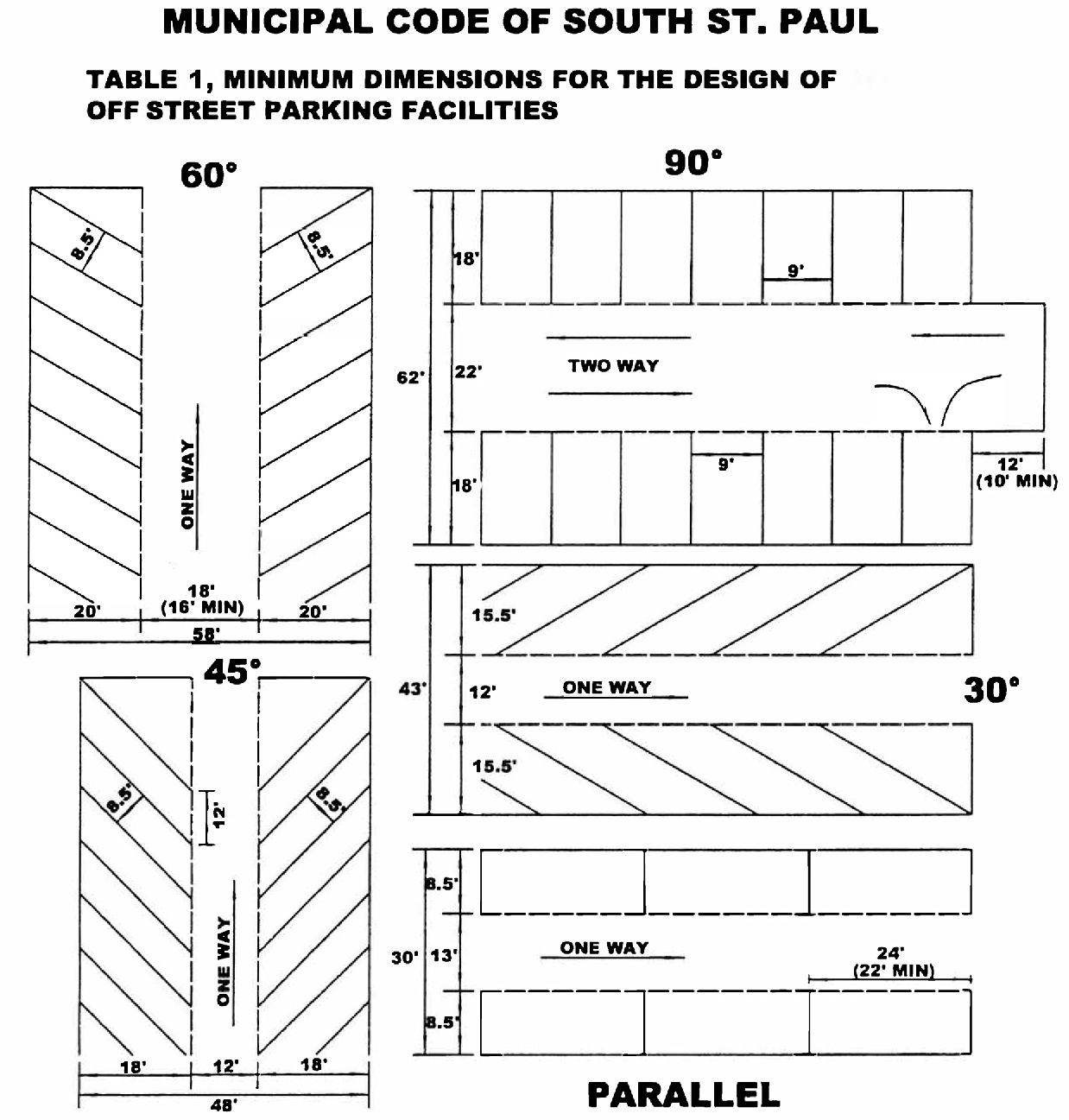
Parking spaces. Each parking space shall not be less than nine feet wide and 18 feet in length, exclusive of an adequately designed system of access drives. Parking lots that separate vehicles based on size may be designed with parking spaces less than or greater than nine feet wide and 18 feet in length, depending upon the size of the vehicle to be accommodated as long as adequate space is provided for easy and safe ingress and egress for the vehicle to be parked.
(d)
Use of parking facilities.
(1)
Residential uses. Off-street parking facilities accessory to residential uses shall be utilized solely for the parking of passenger vehicles. Under no circumstances shall required parking facilities accessory to residential structures be used for the parking of employees, owners, tenants, or customers of off-premises business or manufacturing establishments.
(2)
Truck and commercial vehicle parking for nonresidential uses.
a.
Off-street parking facilities that are accessory to a nonresidential use in a residential zoning district shall be limited to operable, single rear axle vehicles of not more than 15,000 pounds gross vehicle weight. This regulation shall apply only to vehicles that are parked regularly at a site and shall not apply to pick-up and delivery activities or to the temporary use of vehicles during construction.
b.
The C-1 and CGMU zoning districts have restrictions on the size of trucks and commercial vehicles that can be parked outdoors in their off-street parking facilities. These rules, which are contained within the text of each zoning district, shall apply only to vehicles that are parked regularly at a site and shall not apply to pick-up and delivery activities, or to the temporary use of vehicles during construction.
c.
An institutional use, such as a church or school, may store one licensed and operable bus outside on the property provided that the property is at least one acre in size, even if that type of parking would not normally be allowed due to the other provisions of this Code. The bus must be owned or leased by the institutional use and parked at least five feet from any property line on a paved parking surface.
(e)
Parking and circulation plans.
(1)
Purpose. South St. Paul is an urban small town with on-street parking, walkable neighborhoods, a well-developed sidewalk system, bicycling infrastructure, and reliable transit service. The city acknowledges that traditional minimum parking requirements often do not account for other transportation modes or for constantly evolving consumer trends and may result in oversized off-street parking lots and land that is not being put to its highest and best use. The city desires to allow flexibility from minimum parking requirements and off-street loading requirements while still ensuring that large commercial and institutional land uses provide adequate facilities to meet the needs of visitors and avoid over-burdening nearby public streets.
(2)
Eligibility.
a.
Any nonresidential permitted use in the C-1, CGMU, MMM, GB, I-1, and I zoning districts and any nonresidential institutional use in an R-district shall be eligible to submit a parking and circulation plan to the city council if they are seeking a modified minimum parking requirement that is different from the requirements stated in section 118-354 and they do not qualify for an exemption under section 118-352(i).
b.
A modification to an off-street loading requirement may be allowed in any zoning district via a parking and circulation plan review by the city council.
(3)
Process. The applicant shall submit their parking and circulation plan for review by the planning commission and city council as part of a site plan submittal. The review shall follow the process outlined in section 118-47.
(4)
Review criteria. The city council may approve, reject, or approve with modifications any parking and circulation plan. The city council may require the full amount of parking spaces required under section 118-354 or the city council may, at their discretion, establish a modified parking requirement for these projects. They will consider factors such as industry guidelines, travel demand management strategies implemented by the applicant, parking need studies provided by the applicant, availability of transit and pedestrian connections, availability of on-street and shared parking, and any dedicated bicycle parking that is provided at or near the proposed use. In approving deviations from the Code's off-street loading requirements, the city council will consider the nature of the proposed use, the characteristics of the property and site plan, the characteristics of adjacent streets and alleys, and information provided by the city engineer.
(5)
Compliance. No building permit or certificate of occupancy may be granted prior to the approval of a parking and circulation plan if a use does not meet its default minimum parking requirements or loading requirements under the City Code. The Applicant shall be required to comply with any conditions that are placed upon the parking and circulation plan approval.
(f)
Control of off-street parking facilities. When required, accessory off-street parking facilities are provided elsewhere than on the lot on which the principal use served is located, they shall be in the same ownership or control, either by deed or longterm lease, as the property occupied by such principal use, and the owner of the principal use shall file a recordable document with the zoning administrator requiring the owner and the heirs and assigns thereof to maintain the required number of off-street parking spaces during the existence of said principal use.
(g)
Prohibited use of parking spaces. Required off-street parking space in any zoning district shall not be utilized for open storage of goods and materials or for the storage of vehicles that are inoperable, not currently licensed, for sale, for rent, or other nonparking purposes.
(h)
Maximum lot coverage by surface parking. For residential uses in residential districts, no more than 25 percent of the property shall be surfaced or utilized for driveway space or uncovered surface parking.
(i)
Minimum space requirements. The number of off-street parking spaces required for various land uses as specified herein shall be considered the default minimum requirements.
(1)
A greater or lesser total number of off-street parking spaces may be required by the city council for conditional uses, interim uses, and planned unit developments. Additionally, a modified parking requirement may be granted to eligible nonresidential permitted uses that have submitted a parking and circulation plan for review.
(2)
In evaluating a request for a modified parking requirement, the city council will consider factors such as anticipated business volume, number of employees, number of visitors, hours and nature of business operation, industry guidelines, travel demand management strategies implemented by the applicant, parking need studies provided by the applicant, availability of transit and pedestrian connections, availability of on-street and shared parking, and any dedicated bicycle parking that is provided at or near the proposed use.
(3)
For nonresidential uses in the CGMU, C-1, MMM, and GB districts:
a.
New construction.
1.
New construction of a principal building with 7,500 square feet or less of gross floor area which contains only permitted uses shall not have a set parking requirement. This shall also apply to commercial use spaces in commercial-residential mixed-use buildings so long as the total size of the commercial space in the building does not exceed 7,500 square feet of gross floor area.
2.
New construction of a principal building that has more than 7,500 square feet of gross floor area must meet the minimum parking requirements listed in section 118-354 or shall provide a parking and circulation plan for review by the city council as part of the site plan review. This requirement shall also apply to commercial use spaces in commercial-residential mixed-use buildings when the total size of the commercial space exceeds 7,500 square feet of gross floor area. The city council may approve, reject, or approve with modifications any parking and circulation plan. The city council may establish a minimum parking requirement following the process and criteria outlined in section 118-352(e).
b.
Reuse of existing buildings.
1.
The reuse of an existing principal building by one or more permitted uses shall not have a set parking requirement if the building contains 15,000 square feet or less of gross floor area. This shall also apply to commercial use spaces in commercial-residential mixed-use buildings so long as the total size of the commercial space in the building does not exceed 15,000 square feet of gross floor area.
2.
The reuse of an existing principal building with more than 15,000 square feet of gross floor area shall require a parking and circulation plan for review by the city council as part of a formal site plan review if: (1) the project involves a change of use, (2) the new use requires more parking under section 118-354 than the former use, and (3) the new use will not adhere to the minimum parking requirements listed in section 118-354. This requirement shall also apply to commercial use spaces in commercial-residential mixed-use buildings when the total size of the commercial space exceeds 15,000 square feet of gross floor area. The city council may approve, reject, or approve with modifications any parking and circulation plan. The city council may establish a minimum parking requirement following the process and criteria outlined in section 118-352(e).
c.
For conditional uses and planned unit developments in the CGMU, C-1, MMM, and GB districts, spaces shall be provided in the amounts and locations as per approved site development and use plans and conditions, as may be determined by city council. The city council will consider factors such as anticipated business volume, number of employees, number of visitors, hours and nature of business operation, industry guidelines, travel demand management strategies implemented by the applicant, parking need studies provided by the applicant, availability of transit and pedestrian connections, availability of on-street and shared parking, and any dedicated bicycle parking that is provided at or near the proposed use.
1.
A restaurant, café, or similar use which only requires a conditional use permit for on-sale liquor shall continue to be treated as a restaurant use when determining parking requirements. It will still benefit from the provisions listed above which remove set parking requirements for permitted uses of a certain size.
2.
A retail store which only requires a conditional use permit for off-sale liquor shall continue to be treated as a retail store when determining parking requirements. It will still benefit from the provisions listed above which remove set parking requirements for permitted uses of a certain size.
3.
Auto sales, auto service, and auto repair, which are car-oriented uses that require extensive car parking, shall adhere to the minimum parking requirements listed in section 118-354 unless otherwise approved as part of a planned unit development or through the granting of a variance.
(4)
Parking requirements for residential uses in the MMM district are regulated by section 118-127, MMM, mixed markets and makers district.
(j)
Parking on grass, yards prohibited. In all zoning districts within the city, off-street parking of any type of motor vehicle shall be permitted only on driveways or parking areas that are constructed of asphalt or concrete material. No more than one-third of the front yard of any property used for residential purposes may be paved for parking areas. Parking in landscaped yards and boulevards is prohibited, except as follows:
(1)
For any property used for residential purposes, in order to aid in snow removal from residential streets and alleys, from November 15 to April 1, up to three motor vehicles registered to the property owner or occupant may be parked in a landscaped rear or side yard. Parking in a front yard is prohibited.
(2)
For any property used for residential purposes, a recreational vehicle may be parked in a landscaped rear or side yard if the following conditions are met:
a.
The recreational vehicle is not permanently affixed to the ground in a manner that would prevent its removal;
b.
The recreational vehicle is not used for living, sleeping, or housekeeping purposes;
c.
The recreational vehicle is in good, operable condition and is properly licensed for operation;
d.
The recreational vehicle is not partially dismantled or used for sale or parts;
e.
The recreational vehicle is registered to the property owner or occupant on which the recreational vehicle is stored;
f.
The recreational vehicle is stored on a parking pad constructed of asphalt, concrete, landscape pavers or uniform rock, as depicted on a plan approved by the zoning administrator. The parking pad must encompass the entire parking area on which the recreational vehicle is located. If uniform rock is used, the rock must be contained by the use of edging and commercial-grade weed prevention fabric.
(3)
For any property used for residential purposes, no more than two recreational vehicles may be stored in a grassy landscaped rear or side yard of a lot or a combination of contiguous lots in common ownership, if they meet the following requirements:
a.
They are noncommercial utility trailers, typically used for transporting boats, snowmobiles, ATVs or similar vehicles; and
b.
They are less than 20 feet in length (as measured from the tongue of the trailer to the rear of the trailer, but not including any vehicle that may be stored on the trailer and extends beyond the rear of the trailer); and
c.
They have a GVW rating of less than 9,000 pounds.
Exterior storage of items on the trailer other than a boat, snowmobile, ATV or similar vehicle is prohibited. All landscaped areas used for such parking or storage of utility trailers must comply with section 66-49 regarding weeds.
(4)
For any property used for commercial purposes, passenger vehicles may be parked in paved portions of rights-of-way if the vehicles do not obstruct sidewalks, paths, rights-of-way or sight triangle areas. Parking in landscaped areas is prohibited.
(k)
Parking of oversized recreational vehicles. The parking of oversized recreational vehicles on any property used for residential purposes must comply with the following conditions:
(1)
The oversized recreational vehicle must be parked in a driveway or parking area that is constructed of asphalt or concrete material;
(2)
The oversized recreational vehicle must be parked at least five feet from the property line; and
(3)
The oversized recreational vehicle must not obstruct sidewalks, paths, rights-of-way or sight triangle areas.
(l)—(q)
Reserved.
(r)
Accessible parking spaces and passenger loading zones. Parking spaces and passenger loading zones for persons with disabilities shall be designed in accordance with the provisions of the Accessibility Guidelines for Buildings and Facilities of the Americans with Disabilities Act (ADA).
(Code 1992, § 1500.27, subd. 1; Ord. No. 1193, §§ 1—3, 9-4-2007; Ord. No. 1379, § 1, 5-3-2021; Ord. No. 1388, § 1, 2-7-2022; Ord. No. 1417, § 5, 1-16-2024; Ord. No. 1431, § 36, 2-3-2025)
Sec. 118-353. - Design and maintenance of off-street parking areas.
(a)
Driveway restrictions. Parking areas shall be designed so as to provide adequate means of access to a public street or alley. Such access driveway widths and surface type shall be in accordance with standards approved by the city engineer, but in no case shall they exceed 22 feet in width unless approved or required by the city engineer. Driveway access shall be so designed and located as to cause the least interference with traffic movement on a street or alley. Driveway accesses onto public streets shall be subject to the following:
(1)
There shall be only one driveway access off a public street for each one-family residential lot.
(2)
On a residential lot that has less than 60 feet of street frontage, access to off-street parking must be from an abutting improved alley if available. These properties may not have driveway access to the public street if an alley is available. This provision may be waived by the zoning administrator if it is determined in the review of a building permit or site plan review application that there are circumstances unique to the property that make this impractical, unreasonable, or harmful to the public safety including, but not limited to, topography that prevents the improved alley from being easily accessed from the dwelling unit on the subject property. On corner lots, access to off-street parking may be from the side street. On cul-de-sac lots, access to off-street parking may be from the cul-de-sac.
(b)
Calculating space. When calculating the number of off-street parking spaces required results in a fraction that is one-half or more, such fraction shall require a full space. No street or alley right-of-way shall be used in calculating space for required off-street parking unless this is explicitly permitted in a specific zoning district or is approved by the city council as part of a parking and circulation plan that is reviewed following the procedures outlined in section 118-352(e).
(c)
Signs. No signs shall be located in any off-street parking area except as necessary for orderly operation of traffic movement and such signs shall not be a part of any permitted advertising space.
(d)
Drainage. Off-street parking areas shall be so graded and constructed as to drain all water from the parking area and access drive in a manner as approved by the city engineer. All parking area and access drive surfacing must be completed prior to occupancy of the principal use building served unless otherwise approved by the city engineer.
(e)
Lighting. Any lighting used to illuminate off-street parking shall be so designed and arranged as not to allow the direct source of light to be directly visible from the adjoining property; in most cases, this will require that the light be aimed downward in a vertical direction. However, in no case shall parking lot lighting exceed two footcandles in a business or industrial zone, nor one-half footcandle in a residential zone, all as measured at the lot line.
(f)
Curbing and landscaping. All open off-street parking areas designed to have head-in parking along the property line shall provide six-inch integral concrete curb and gutter around the entire perimeter of the parking and driveway areas not less than five feet from the side property line. When said parking area is for six or more vehicles, a curb shall be installed and screening not over four feet in height shall be erected along the front yard setback line with grass or other plantings to occupy the space between the parking area and the front sidewalk or street curb. Wheel guards as approved by the city engineer may be utilized in lieu of other requirements.
(g)
Planting islands. For each additional 3,000 square feet or a portion thereof of parking area beyond the first 3,000 square feet, one planting island of identical size to the neighboring parking space, but not less than 200 square feet, shall be installed within the interior of the parking lot, unless otherwise approved by the zoning administrator. All planting islands installed shall have six-inch integral concrete curb and gutter around the entire perimeter, and a landscaped interior.
(h)
Screening, six parking spaces or more. When a required off-street parking area for six or more vehicles is located adjacent to a residential use or district, a fence or screening not less than four feet in height shall be erected along the residential property line; additional screening may be required by the zoning administrator.
(i)
Maintenance of off-street parking areas. It shall be the joint responsibility of the parking lot operator and landowner of the principal use or building to reasonably maintain the parking area, access drive, landscaping, and fencing and screening. Surfaced areas shall be kept free of dirt and debris, potholes, major cracks, material deterioration, and snow piles. Landscaping shall be maintained in a healthy condition and replaced if lost to winterkill, drought, or other causes.
(j)
Access. All off-street parking spaces shall have access from driveways and not directly from the public street. Except for one-family and two-family homes, all vehicular egress from off-street parking areas shall be forward-moving rather than backing onto a public street, unless otherwise approved by the city engineer.
(k)
Site plan review for parking lots. The construction of a new or expanded parking lot shall require a site plan review which shall be processed in accordance with section 118-47.
(l)
Minimum distance from building. In any zoning district other than for one-family, two-family, and three-family homes, no parking space shall be closer than five feet to any building, except for garage parking.
(m)
Fire lanes. Fire access lanes shall be provided as required by the fire code, state building code, or the city engineer based upon advice from the city fire department.
(n)
Calculation of floor space for retail uses. Floor space, for purposes of calculating required parking space for retail uses, shall include only the floor area devoted to retail sales and shall not include storage space, restroom, interior pedestrian mall space, unless retail activities are to be located on floor area of said mall, hallways, enclosed walkways, utility rooms, window displays, office of building management or maintenance, lobbies, or similar floor space not generating a demand or need for parking space. Due consideration shall, however, be given to floor area which may and could reasonably be expected to be converted to retail or other commercial activity and thereby increase the need for parking.
(o)
Shopping centers and large retail outlets. Shopping centers or individual retail outlets with over 30,000 square feet of floor area shall provide parking on the basis of three spaces per 1,000 square feet of gross leasable or useable floor area, as the case may be.
(p)
Setbacks (yards). Except as specifically authorized and permitted by zoning district provisions, off-street parking shall not be located on required yards.
(q)
Location. Off-street parking is subject to the following:
(1)
All required off-street parking shall be located on the same lot as the principal building unless otherwise approved by the zoning administrator in accordance with this section, approved as part of a conditional use permit, or approved by the city council as part of a parking and circulation plan that is reviewed following the procedures outlined in section 118-352(e).
(2)
No driveway or off-street parking area shall be located closer than two feet from an adjacent lot zoned or used for residential purposes unless granted an exception by section 118-273.
(3)
Independent accessory surface parking lots shall require a conditional use permit and must comply with the following performance standards:
a.
Single-family homes, two-family homes, and three-family homes are not eligible for this conditional use permit.
b.
The independent accessory surface parking lot parcel must be located in a zoning district that allows the principal use.
c.
The independent accessory surface parking lot must be located within 500 feet of the principal use, measured from the nearest property line of each parcel.
d.
The lot is to be used only for parking of operable passenger motor vehicles of employees, customers or guests of the principal use, who shall be responsible for its maintenance.
e.
Exterior storage is not allowed.
f.
Sales of motor vehicles, repair work or servicing of any kind is not allowed.
g.
The independent accessory surface parking lot must comply with all paving, landscaping, and screening requirements that are applicable to accessory parking lots in the underlying zoning district. Additional requirements may be imposed as part of the conditional use permit based on the parking lot proposal and the character of the area.
h.
Independent accessory surface parking lots are discouraged from being located on a corner lot and some zoning districts may prohibit this placement. If located on a corner lot, the property lines of the independent accessory parking lot that adjoin the street must be buffered by a low masonry wall, decorative fence, extensive landscaping, or a combination of those treatments.
i.
The acreage of the independent accessory surface parking lot parcel and the principal use parcel shall both be considered for the purposes of calculating compliance with minimum floor area ratio requirements and any other similar requirements that may exist in an underlying zoning district.
j.
The independent accessory surface parking lot parcel and the principal use parcel must be in common ownership and shall be tied together by deed restriction, or a comparable legal instrument and the parking lot parcel may not be sold separately without the city's written consent unless the parking lot infrastructure is removed before the sale.
k.
In lieu of a conditional use permit, the property owner may combine the principal use parcel and the independent accessory surface parking lot parcel through a lot combination or replat if the lots are adjacent to or abutting each other, are in the same zoning district, and are not divided by a road or alley.
l.
This section shall not apply to:
1.
Surface parking lots that are a principal use in zoning districts where they are allowed.
2.
Parking facilities at the Fleming Field Municipal Airport.
3.
Public parking lots provided by the city.
(Code 1992, § 1500.27, subd. 2; Ord. No. 1388, § 1, 2-7-2022; Ord. No. 1408, § 5, 6-5-2023; Ord. No. 1424, § 11, 5-20-2024; Ord. No. 1431, § 37, 2-3-2025; Ord. No. 1432, § 5, 3-3-2025; Ord. No. 1436, § 2, 1-21-2025)
Sec. 118-354. - Off-street parking spaces required.
Under section 118-352, some land uses in certain zoning districts do not have a set parking requirement and certain other land uses may secure a modified parking requirement with the approval of the city council. Unless a land use is granted a modified parking requirement under section 118-352, the default off-street parking spaces required by various land uses shall be as follows:
(1)
Single-family, two-family, and three-family dwellings:
a.
A minimum of two spaces is required for a single-family dwelling.
b.
A minimum of three spaces is required for a two-family dwelling.
c.
A minimum of four spaces is required for a three-family dwelling.
(2)
Multifamily buildings with four or more dwelling units, townhouse developments, and residential dwelling units that are part of a mixed-use development:
a.
A minimum of one space is required for each one-bedroom or efficiency unit.
b.
A minimum of two spaces is required for each unit with more than one bedroom.
c.
The following exceptions to these requirements shall be provided for properties with commercial or mixed-use zoning that are within 1,320 feet of a stop on a fixed-route transit line, measured from the transit stop to the nearest property line of the parcel:
1.
Mixed-use buildings that include a commercial space which occupies at least 50 percent of the ground-floor level or 5,000 square feet, whichever is less. There shall be no minimum parking requirement for the first four dwelling units. At least one parking stall shall be provided for each additional dwelling unit.
2.
Residential buildings that are co-located on a parcel that also contains a commercial or mixed-use building in the C-1 Retail Business zoning district. There shall be no minimum parking requirement for the first four dwelling units that are located on these parcels. At least one parking stall shall be provided for each additional dwelling unit.
(3)
Elderly (senior citizen) housing: Reservation of parking space adequate for one space per dwelling unit. Initial development, however, shall require only one-half space per dwelling unit with additional spaces provided if and when needed as determined by the city council.
(4)
Churches, theaters, auditoriums, reception or meeting halls, and other places of assembly: One space for each three seats or for each six feet of pew length based upon maximum design capacity.
(5)
Offices: One space for each 400 square feet of gross floor space.
(6)
Hotel/motel: One space per guest room, plus one space per employee during the busiest shift. Bar, restaurant, reception hall, and convention center uses that are part of a motel or hotel operation are subject to the parking requirements for those uses but each required parking stall provided for a guest room shall also count towards the satisfaction of the parking requirement of each other use that is part of the hotel operation.
(7)
Schools, elementary and junior high: Three spaces for each classroom plus one space for each three persons who may be accommodated or seated at special meetings, athletic events, and similar occasions.
(8)
Schools, high school through college: One space for each four students based on design capacity plus three additional spaces for each classroom. In addition, one space shall be provided for each three persons who may attend a special occasion, athletic event, or similar assembly.
(9)
Hospital/clinic: One space for each three hospital beds, plus one space for each three employees, other than doctors, plus one space for each resident and regular staff doctor. Bassinets shall not be counted as beds. In no instance, however, shall the amount of parking provided for a medical facility be less than the sum total of patients to be served at any one time plus one space for each three employees.
(10)
Sanitarium, convalescent home, rest homes, or institution: One space for each six beds, for which accommodations are offered, plus one space for each three employees.
(11)
Drive-in food establishment: One space for every three seats provided inside the building plus additional parking and stacking space as may be required by the city council.
(12)
Bowling alley: Three spaces for each bowling lane plus additional spaces as may be required for related uses such as a bar or restaurant.
(13)
Motor fuel (service) station: Three spaces for each enclosed bay or service stall, plus one space for each employee.
(14)
Retail sales and service establishments: One space for each 400 square feet of gross floor area.
(15)
Medical and dental clinic: At least one space for each 400 square feet of gross floor area.
(16)
Restaurants, cafés, bars, taverns, clubs: One space for each three seats, based on maximum design capacity.
(17)
Undertaking or funeral establishments: One space for each funeral vehicle maintained on the premises plus one space for each three seats provided based upon maximum design capacity. Parking space shall be provided for making up a funeral procession if required by the city council.
(18)
Furniture store, wholesale use, automobile and truck sales, repair shops (except vehicle repair shops): One space for each 500 square feet of gross floor space plus one space for each two employees.
(19)
Industrial, warehouse, storage, handling of bulk goods: One space for each two employees on maximum shift or one space for each 2,000 square feet of gross floor space, whichever is the greater requirement. Parking spaces shall also be provided for visitors and salespersons if need is anticipated.
(20)
Uses not specifically noted: Where a use is not specifically listed herein, the required minimum off-street parking spaces shall be as determined by the zoning administrator using this section as a guide.
(21)
Planned unit developments, interim uses, and conditional uses: Spaces shall be provided in amounts and locations as per approved site development and use plans and conditions, as may be determined by the city council.
(22)
Automobile repair, bus terminal, taxi terminal, boat and marine sales and repair, bottling company, shop for a trade employing six or less people, garden supply store, building material sales within a building: Six spaces plus one additional space for each 800 square feet of floor area over 1,000 square feet.
(23)
Skating rink, dance hall, or public auction house: 20 spaces plus one additional space for each 200 square feet of floor space over 2,000 square feet or one space for each three persons to be accommodated on the premises, whichever parking requirement is greater.
(24)
Commercial recreation: One space per each two employees plus one space for each three persons that may be accommodated at any one time based upon maximum design capacity.
(25)
Community centers, libraries, clubs and lodges, art galleries: One space per 400 square feet of floor area in the building.
(26)
Animal hospitals and professional service offices: One space for each 400 square feet of gross floor area.
(27)
Business service establishment: One parking space for each 400 square feet of gross floor area.
(28)
Financial institutions: Banks and other financial institutions shall have at least four stacking spaces per drive-in window and one off-street parking space for each 400 square feet of gross floor area.
(29)
Carwash and other drive-in businesses: Stacking space shall be provided as determined necessary by the city engineer.
(30)
Outdoor sales lots: There shall be one space for each 800 square feet of display area or one space for each ten vehicles for sale where cars and trucks are displayed.
(31)
Child day care facility and adult day care facility: One space per employee on maximum shift.
(Code 1992, § 1500.27, subd. 3; Ord. No. 1327, § 1, 10-16-2017; Ord. No. 1357, § 1, 6-1-2020; Ord. No. 1365, § 1, 9-21-2020; Ord. No. 1379, § 1, 5-3-2021; Ord. No. 1388, § 1, 2-7-2022; Ord. No. 1432, § 6, 3-3-2025)
Sec. 118-355. - Off-street loading and unloading areas.
The regulations and requirements set forth in this subchapter shall apply to required and non-required loading and unloading facilities in all districts:
(1)
Location. All required loading berths shall be off-street and shall be located on the same lot as the building or use to be served unless otherwise approved by the city council as part of a parking and circulation plan that is reviewed following the procedures outlined in section 118-352(e). A loading berth shall be located at least 25 feet from the intersection of two street rights-of-way and at least 50 feet from a residential district or use, unless located within a building. Loading berths shall not occupy the required front yards.
(2)
Size. In residential districts, each required berth provided shall be at least ten feet by 20 feet unless otherwise approved or required during a site plan review. For nonresidential uses or where large trucks may load or unload, each required berth shall not be less than 12 feet in width, 50 feet in length, and 14 feet in height unless otherwise approved or required during a site plan review.
(3)
Access. Each loading berth shall be located with appropriate and safe vehicular access to a street or alley and in a manner that will least interfere with traffic and pedestrian movements.
(4)
Prohibited use. Any space allocated as a required loading berth or maneuvering area so as to comply with the terms of this section shall not be used for the storage of goods, trash, snow, inoperable vehicles nor be included as a part of the space requirements necessary to meet off-street parking area standards.
(5)
Alterations. When the footprint of an existing structure is substantially altered to accommodate a new use that requires the receipt or distribution of materials or merchandise by trucks or similar vehicles, the structure shall provide off-street loading space as required for a new structure unless this is deemed impractical by the city.
(6)
Schools. No public or private school campus shall load or unload buses from public streets but shall provide off-street loading and unloading facilities unless otherwise approved by the city council as part of a parking and circulation plan that is reviewed following the procedures listed in Section 118-352(e). School campuses existing on February 7, 2021 which already load or unload buses from public streets are exempt from this requirement.
(7)
Repair and service in residence districts. No motor vehicle repair work or service for hire of any kind shall be permitted in conjunction with loading facilities provided to serve residential buildings.
(8)
Central loading. Central loading facilities may be substituted for loading berths on individual building lots provided the following conditions are met:
a.
Each lot or building served shall have direct access to the central loading area without crossing streets or alleys at grade.
b.
Total berths provided shall meet the requirements based on the sum total of the several types of uses served.
c.
No building or lot served shall be more than 300 feet removed from the central loading area.
(9)
Number of loading berths required for new structures.
a.
Business and office establishments may load or unload from a public street or alley if it can be demonstrated to the satisfaction of the zoning administrator and city engineer that this can be done in a safe and functional manner. Business and office buildings containing more than 10,000 square feet of gross floor area may be required to provide off-street loading facilities as part of a site plan review, based on the specific nature of the building and use.
b.
Health institutions and medical buildings shall have one berth for buildings containing 18,000 to 100,000 square feet of gross floor area plus one additional berth for each additional 100,000 square feet of gross floor area or fraction thereof unless otherwise approved by the city council as part of a parking and circulation plan that is reviewed following the procedures outlined in section 118-352(e).
c.
Schools, churches, and other educational and religious institutions shall have one berth for buildings containing 10,000 to 200,000 square feet of gross floor area plus one additional loading berth for each additional 200,000 square feet of gross floor area or fraction thereof unless otherwise approved by the city council as part of a parking and circulation plan that is reviewed following the procedures outlined in section 118-352(e).
d.
Recreational facilities and social functions requiring substantial receiving or distribution by vehicles of supplies or materials shall have one berth for buildings containing 10,000 to 100,000 square feet of gross floor area plus one additional berth for each additional 100,000 square feet of gross floor area up to 500,000 square feet of gross floor area or fraction thereof in excess of 500,000 square feet unless otherwise approved by the city council as part of a parking and circulation plan that is reviewed following the procedures outlined in section 118-352(e).
e.
Apartment buildings containing more than four dwelling units may be required to provide off-street loading berths if deemed necessary during site plan review.
f.
Industrial uses shall provide off-street loading areas as determined necessary during site plan review. Where feasible, loading docks shall be located to minimize visibility from public streets and adjoining properties.
(10)
Surface type, materials, drainage. The surface type, materials, and drainage of all off-street loading areas shall be as approved by the city engineer.
(11)
Use of certain spaces for loading or unloading prohibited. No fire lane, parking space for the handicapped, or similar space shall be used for loading or unloading.
(12)
Taxi or transit bus. Taxi or transit bus requirements shall be as approved by the city council.
(Code 1992, § 1500.27, subd. 4; Ord. No. 1388, § 1, 2-7-2022)
(Ord. No. 1388, § 2, 2-7-2022)

