
Southbury City Zoning Code
SECTION 11
- Lighting.
11.1 Purpose: The purpose of these lighting regulations is to provide specific standards that promote adequate, energy efficient, non-intrusive lighting as required for public safety while reducing and eliminating adverse effects (such as light pollution, light trespass, glare, and sky glow, consistent with the goals of the International Dark-Sky Association) from on-site illumination upon the use, value, and enjoyment of nearby properties and the community in general. These regulations seek to promote an environment free from elements that may jeopardize the health or welfare of the general public or degrade the quality of life in this town and neighboring towns.
Editor's note— Ord. of 11-9-11, § II, replaced §§ 11.1—11.3.3 in their entirety. Former §§ 11.1—11.3.3 pertained to similar information and carried no history note.
11.2 Definitions:
11.2.1 Candela: The power emitted by a light source in a particular direction.
11.2.2 Dynamic Sign: An electronic, illuminated sign whose display, text, message, or illumination may be changed more than once per day including, but not limited to electronic messages, animation, video, and moving, flashing, scrolling, intermittent, flickering, or sequential images.
11.2.3 Foot-candle: A unit of illumination, equal to the illumination of a surface, one (1) square foot in area, on which there is a luminous flux of one (1) Lumens uniformly distributed, or equal to the illumination of a surface all points of which are at a distance of one (1) foot from a uniform point source of one (1) Candela; equal to approximately 10.7639 lux. Abbreviated fc.
11.2.4 Foot-lambert: A unit of Luminance equal to 1/Π Candela per square foot or 3.4262591 Candelas per square meter (nits). It describes the amount of light that passes through or is emitted from a particular area.
11.2.5 Full Cutoff: See fully shielded.
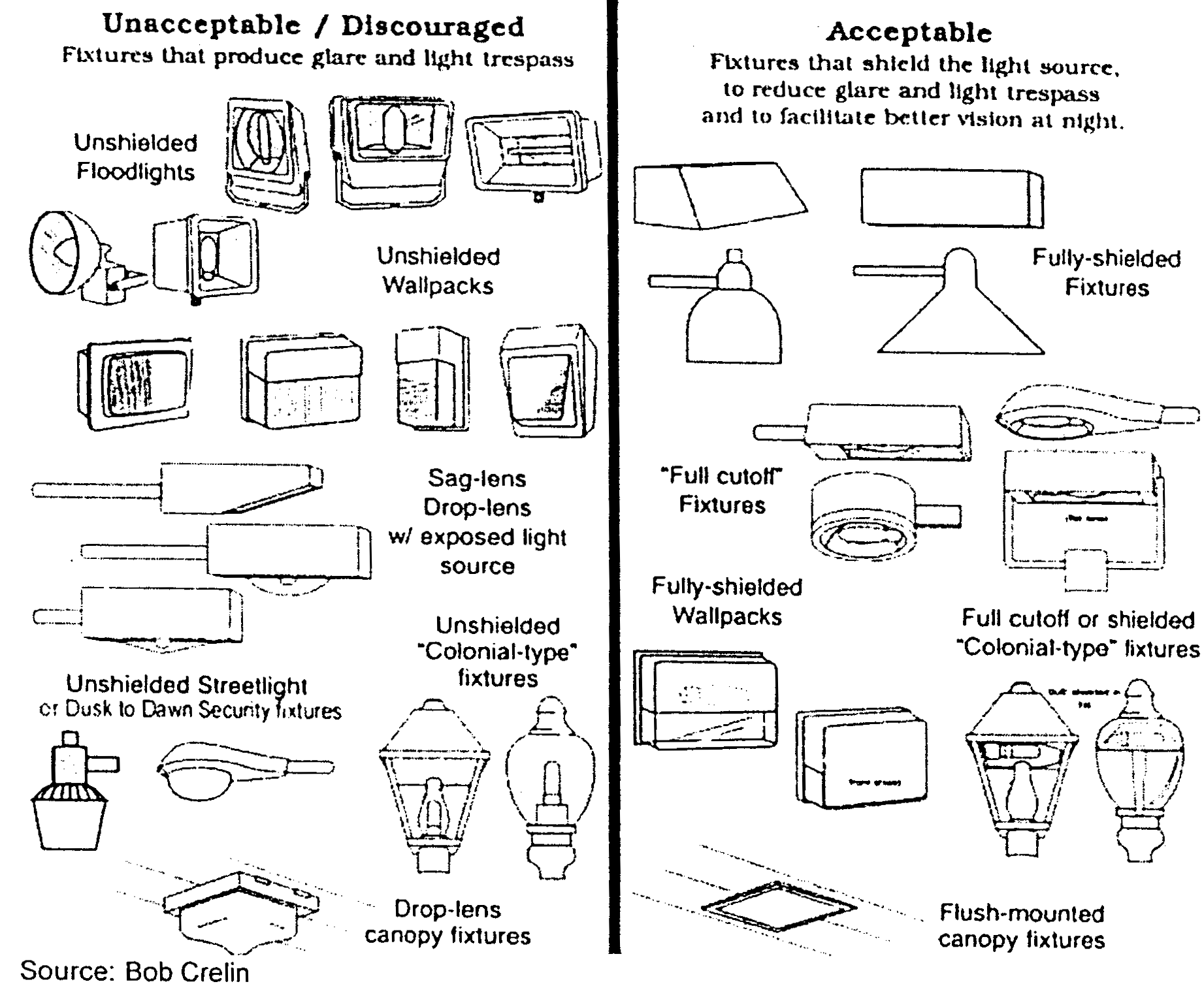
11.2.6 Fully Shielded: A light fixture constructed in such a manner that all light emitted by the fixture, either directly from the lamp or a diffusing element, or indirectly by reflection or refraction from any part of the fixture, is projected below the horizontal plane. See Section 11.10 for examples.
11.2.7 Glare: Light produced by a bright source within the visual field that is sufficiently brighter than the level to which the eyes are adapted to cause annoyance, discomfort, or loss in visual performance and visibility.
11.2.8 High Intensity and High Contrast Lighting: For the purpose of this regulation, the term high intensity and high contrast lighting refers to any lighting source that produces text, symbols, shapes, or images resulting in a visual effect that is perceived by the eye as intense or distracting, and may include incandescent, vapor/gas discharge, LED, LCD, plasma, holographic, lasers, or any other technology that produces a high contrast with light from ambient sources or high intensity effect.
11.2.9 Light Fixture: Complete lighting unit, consisting of one (1) or more lamps (bulbs or tubes that emit light), along with the socket and other parts that hold the lamp in place and protect it, wiring that connects the lamp to a power source, and a reflector that helps direct and distribute the light.
11.2.10 Light Trespass: Light being transmitted across property boundaries, onto property not containing the originating light source. See Section 11.4.5.
11.2.11 Lumen: A measure of the amount of light emitted by lamps.
11.2.12 Luminaire: See light fixture.
11.2.13 Luminance: The intensity of light reflected or emitted from a unit area of surface, such as a sign face — measured in Nits.
11.2.14 Luminous Tube: A transparent or translucent tube filled with a gas or gas mixture (including neon, argon, mercury, or other gasses), caused to emit light by the passage of an electric current, and commonly bent into various forms for use as decoration or signs, such as a neon tube. Does not include common fluorescent tubes or compact fluorescent lamps.
11.2.15 Nit: A unit of Luminance equal to one (1) Candela per square meter.
11.2.16. Outdoor Athletic Lighting: The illumination of any area, outside of a fully enclosed building, in order to facilitate the conduct of a sport, recreational activity, athletic event, competition, or other outdoor event. Outdoor athletic lighting shall include, but not be limited to, the illumination of tennis courts; miniature golf; tennis courts; football, soccer, baseball, lacrosse, field hockey, track, or other fields; golf driving ranges; equestrian rinks; pitch and putt courses; ice skating or hockey rinks; and all similar uses. Outdoor athletic lighting shall include such activities regardless of sponsorship of the event or ownership of the property.
11.2.17 Searchlight: A lighting assembly designed to direct the output of a contained lamp in a specific tightly focused direction (a beam) with a reflector located external to the lamp, and with a swiveled or gimbaled mount to allow the assembly to be easily redirected. Such lights are used commonly to sweep the sky for advertisement purposes.
11.2.18 Temporary Lighting: Lighting which will not be used for more than one (1) seven (7) day period within a calendar year with not more than one (1) seven (7) day extension. Temporary lighting is intended for uses which by their nature are of a limited duration (e.g. civic events, construction projects, etc.). See Section 11.7.
11.2.19 Temporary Transitional Athletic Lighting: Temporary lighting on property owned by the town or Regional School District 15 which has been authorized by the zoning enforcement official and the board of selectmen for a contiguous period of not more than ninety (90) days for illumination of outdoor athletic activities.
11.2.20 Trans illuminated Sign: A translucent sign that is internally illuminated by a light source or sources that are not externally visible.
11.2.21 Uniformity (Horizontal): The ratio of maximum vs. minimum Luminance over an area.
11.3 Standards for All Districts:
11.3.1 Applicability: The standards set forth in this Section 11.3 shall apply to all new or significantly updated or modified lighting or illuminated signs, except as provided in Section 11.7 below
11.3.2 Glare: All outdoor illumination shall be provided and maintained in a manner that safeguards against glare off the property.
11.3.3 Shielding: All outdoor light fixtures with an initial output greater than or equal to one thousand four hundred (1,400) Lumens (typical output of a sixty (60) watt incandescent lamp) shall be full cutoff, and except as provided in 11.3.6 shall be installed and maintained in such a manner as to be horizontal to the ground so that the cutoff characteristics of the fixture are maintained. The goal is to minimize or eliminate visibility of the light source at the property boundary to the extent practical. All outdoor lighting light fixtures with an initial output less than one thousand four hundred (1,400) Lumens are exempt from this shielding requirement.
11.3.4 Efficiency: The preferred standard for lighting efficiency shall be not less than sixty (60) Lumens per electrical watt.
11.3.5 Unintentional Luminous Sources: Light emanating from inside a building shall comply with the requirements for light trespass at the property boundary as set forth herein for the applicable Zoning District.
11.3.6 Architectural Lighting: Illumination of buildings, flagpoles, signs, architectural, and landscape features shall conform to the following:
a.
Light fixtures shall be shielded, such as by visors or baffles, to control spillage of light beyond the outside edge of the object intended to be illuminated.
b.
Light fixtures shall be aimed only at the targeted architectural features and not be aimed across streets, driveways, parking spaces, or sidewalks.
c.
Illumination of objects other than signs shall not result in the Luminance of the illuminated object exceeding five (5) foot-candles in a Residential District or ten (10) foot-candles in a Business District, Industrial District, PUD, or PDD. For maximum illumination of signs, see Sections 11.4.10.c. and 11.5.4.
11.3.7 Prohibited Lighting: The following types of lights are prohibited in all Districts:
a.
Strips of light intended to outline or highlight a structure, whether composed of linear light tubes or a sequence of individual illumination sources except as provided in Section 11.7.
b.
Light sources that oscillate or vary in intensity or color to the degree that the modulation is perceptible to the human eye.
c.
Lasers.
d.
Luminous tube lights.
e.
Searchlights.
f.
Light sources that emit color temperatures in the yellow range (< 2700K) such as sodium vapor lights or in the blue range (> 6500K).
g.
Illumination of entire buildings. Building illumination shall be limited to security lighting and lighting of specific architectural features pursuant to Section 11.3.6.
h.
Electronic sign boards (i.e. digital billboards), dynamic signs, and signs containing visible high intensity and high contrast lighting other than provided for in Section 10 or Section 11.6.3.
i.
Commencing two (2) years from the effective date of this revised Section 11, Temporary Transitional Athletic Lighting as defined in 11.2.18.
11.4 Commercial and Industrial Standards:
11.4.1 Applicability: The standards set forth in this Section 11.4 shall apply in all Business and Manufacturing Zones, Planned Development Districts, Planned Development Units, Public Utility Districts, and Special Exception Uses in a Residential Zone. Additionally, any commercial or industrial use that is located in a Residential Zone that submits an application for a change to the site will be subject to the more stringent requirements of Sections 11.4 or 11.5. The standards defined herein shall apply to all exterior lighting as well as lighting that is located within a building or structure and which illuminates the exterior.
Exemptions: The following uses are exempt from the standards of this Section 11.4.:
a.
Pre-existing, nonconforming lighting installations may be maintained unless the modifications listed below occur and are deemed substantial in the judgment of the planning commission:
i.
Replacement, modification, relocation, or addition to light fixtures.
ii.
Addition to or relocation of lighting poles.
iii.
Change in light source intensity.
iv.
Change of use of the site.
v.
Replacement, modification, relocation, or addition to buildings on the site.
vi.
Change in parking lot layout or on-site traffic flow.
When a substantial modification occurs, the entire outdoor lighting installation on the site shall be subject to this Section 11.4. Where modifications are proposed which the commission does not consider to be substantial, it may require or permit lighting which more nearly complies with this Section 11.4, even if such lighting does not fully comply with this section.
b.
Lighting subject to Section 11.6, Outdoor Athletic Facility Standards, shall not be subject to this Section 11.4.
c.
Lighting specified in Section 11.7.
11.4.2 General Standards and Guidance: The commercial and industrial lighting standards set forth herein have been developed to minimize illumination while providing safe and efficient entry onto, travel within, and exit from the site. Lighting sources shall be fully shielded and shall not impart an illumination footprint on-site nor off-site greater than the values defined herein. Lighting sources within a site shall generally consist of a uniform color, intensity, and technology.
11.4.3 Source, Footprint and Intensity: The following standards for minimum and maximum exterior illumination shall be based on the activity at each site. Foot-candles shall be measured at finished grade level. When more than one (1) activity type (as specified below) is proposed, the illumination level for each activity type shall be between the specified minimum and maximum levels.
11.4.4 Vertical Distribution and Cutoff: No upward lighting is permitted except as provided in 11.3.6. Details of such proposed lighting shall be submitted to the planning commission for review and approval.
11.4.5 Light Trespass: No more than 0.05 foot-candles is permitted at any property boundary within or abutting a residential zone; no more than two and one-half (2.5) foot-candles permitted at the property boundary where abutting sites have contiguous parking lots and driveways; and no more than one-half (0.5) foot-candles is permitted at any other property boundary. Illuminance generated from a single Luminaire placed at the intersection of a vehicular driveway and public roadway accessing the site is allowed to use the centerline of the public roadway as the site boundary for a length of two (2) times the driveway width centered at the centerline of the driveway.
11.4.6 Location of Lights: Exterior lighting shall be subject to the following restrictions:
a.
Lighting on buildings shall not be mounted on canopy fascias or rooftops. All light fixtures shall be mounted under or below the canopy. Light fixtures within canopies shall be downward facing and mounted flush or recessed.
b.
Light fixtures shall be located not more than twenty-five (25) feet above the finished grade if supported by or attached to a pole or other structure.
11.4.7 Hours of Primary Illumination: Outdoor lighting shall be automatically shut off or reduced to not more than the minimum level as defined in 11.4.3 within one (1) hour after the hours of activity (as defined in the statement of use for the site) have ended. Lighting that illuminates a loading dock must be equipped with the capability to automatically reduce or turn off the lighting sources (via motion detection or similar technology) when not in use. Details of the lighting controls shall be presented to the planning commission for review and approval.
11.4.8 Unintentional Luminous Sources: Large expanses of internally illuminated windows or wall openings visible from the property boundary are to be avoided. Buildings with a window-wall ratio greater than thirty-five (35) percent on walls that are visible from the property boundary shall be automatically shut off within one (1) hour after the hours of activity (as defined in the statement of use for the site) have ended.
11.4.9 Interior Lights: Any interior light fixture with initial output great than one thousand four hundred (1,400) Lumens and mounted such that any part of the light fixture is lower than the upper edge of a window, wall opening, or exterior door must be fully shielded.
11.4.10 Trans illuminated and Floodlighted Signs: Trans illuminated and floodlighted signs shall not exceed the following maximum brightness standards measured at any point on the surface of the sign:
a.
Luminous plastic or glass letter signs in which the symbols or lettering are internally illuminated shall not exceed forty (40) foot-lamberts. Such signs are preferred over those in 11.4.10.b.
b.
Luminous background silhouette signs with opaque letters shall not exceed twenty (20) foot-lamberts.
c.
Floodlighted signs shall not exceed twenty (20) foot-lamberts, and shall conform to Section 11.3.6.
11.4.11 High Intensity and High Contrast Lighting Signs: Except as provided in Section 10, signs that use visible high intensity and high contrast lighting sources are not permitted in commercial zones. The intention of this regulation is to prohibit signs that are visually distracting or result in glare. Such signs shall comply with the provisions of Section 10 and the following standards:
a.
Two (2) levels of brightness shall be provided and shall be automatically adjusted for day and night conditions. The preferred technique is a photocell sensor that changes the source brightness for day/night conditions. Timer-based control is an acceptable alternative if the day/night transition is adjusted for seasonal changes. Specific proposal for the day/night change technique shall be defined in the applicant's application.
b.
The maximum brightness shall not exceed one thousand (1,000) ft.-lamberts for day mode, and shall not exceed one hundred twenty (120) ft.-lamberts for the night mode.
c.
High intensity and high contrast lighting can emit spectrally pure colors, and in view of the fact that certain colors such as the green portion of the spectrum are perceived as less distracting, the applicant may propose an alternative standard that may exceed the brightness limits defined in paragraph 11.4.11.b. Application for any sign that proposes to exceed paragraph 11.4.11.b limits must be presented to the planning commission and must be accompanied by an actual model sign that emits the same color spectrum and brightness as the proposed sign. Text size/font and sign area must approximate the final proposed sign. The model sign must be able to operate in day and night mode and will be made available to the commission for evaluation. Such application must include the CIE Color Coordinates, as established by the International Commission on Illumination, of the proposed sign. Should the commission determine that the sign does not produce distracting or excessive brightness due to the color coordinates; the commission may approve the alternative. Intensity and CIE coordinates shall be documented in the application.
d.
The applicant shall provide a written certification from the sign manufacturer that day and night time light intensity and color coordinates have been factory pre-set not to exceed the Luminance limits and to not allow changes to the color coordinates, and that these settings are protected from end-user modification by password-protected software or other method as deemed appropriate by the planning commission or their designee.
11.4.12 Data Submission: Certification from a qualified lighting professional shall be provided to the planning commission, stating that the lighting plan complies with the standards of this section. A computer-generated print-out of the illuminated area in grid plan view using five (5) foot grid spacing is the preferred format and shall depict the average light level at each grid point. Iso-contours may be provided as a less desirable format. Cut sheets with light source distribution curves for all proposed lighting sources shall be provided as part of the application. All lighting sources includes, but is not limited to, architectural lighting, building- and pole-mounted light fixtures, and illuminated signs. Exact model, type, and intensity of each illumination source (i.e.; lamp element or elements) installed in each lighting fixture shall be specified. Lighting analyses will take into account the effect of aging and will use the illumination values predicted at ninety (90) percent of lamp life.
After installation a qualified lighting professional shall measure the resultant light intensity, and the applicant shall submit documentation that the lighting complies with these regulations. The applicant may request that the planning commission or a designated representative conduct a site visit in lieu of the certification if the applicant believes that the lighting is in conformance with these regulations. The planning commission reserves the right to require as-built measurements following a site inspection.
11.4.13 Performance Bonds: No certificate of zoning compliance or certificate of occupancy shall be issued until the improvements required by this regulation and as depicted in the applicant's lighting plan are completed as certified by the authorized land use official, or until their completion has been guaranteed by the posting of a performance bond from a banking institution of sufficient amount to cover the estimated cost of materials and labor, as approved by the zoning enforcement officer. Such performance bonds shall be in the form of cash, passbook assignment, letters of credit, or, if required by Connecticut General Statues, surety bonds. The form of the surety bond shall be to the satisfaction of the commission's legal counsel.
11.5 Residential Standards:
11.5.1 Applicability: The standards set forth in this Section 11.5 shall apply to properties located in Residential Zones except for those uses subject to Sections 11.4 or 11.6. Any commercial or industrial use that is located in a Residential Zone that submits an application for a change to the site will be subject to the more stringent requirements of Sections 11.4 or 11.5.
Exemptions: The following uses are exempt from the standards of this Section 11.5:
a.
Pre-existing, nonconforming lighting installations may be maintained unless the modifications listed below occur and are deemed substantial in the judgment of the planning commission:
i.
Replacement, modification, relocation, or addition to light fixtures.
ii.
Addition to or relocation of lighting poles.
iii.
Change in light source intensity.
iv.
Change of use of the site.
v.
Replacement, modification, relocation, or addition to buildings on the site.
vi.
Change in parking lot layout or on-site traffic flow.
When a substantial modification occurs, the entire outdoor lighting installation on the site shall be subject to this Section 11.5. Where modifications are proposed which the Commission does not consider to be substantial, it may require or permit lighting which more nearly complies with this Section 11.5, even if such lighting does not fully comply with this Section 11.5.
b.
Lighting subject to Section 11.6, Outdoor Athletic Facility Standards, shall not be subject to this Section 11.5.
c.
Lighting specified in Section 11.7.
11.5.2 Light Trespass: No more than 0.05 foot-candles is permitted at any property boundary.
11.5.3 Location of Lights: Light fixtures mounted to free standing poles shall be installed at a height of twelve (12) feet or less.
11.5.4 Floodlighted Signs: Floodlighted signs shall not exceed ten (10) foot-lamberts at any point in the sign, and shall conform to Section 11.3.6.
11.5.5 Trans illuminated and High Intensity and High Contrast Lighting Signs: Trans illuminated signs and signs that use visible high intensity and high contrast lighting sources are not permitted in Residential Zones.
11.6 Outdoor Athletic Facility Standards:
11.6.1 Applicability. This Section 11.6 shall apply to all outdoor athletic lighting as defined in these regulations, regardless of zoning designation.
Exemptions: The following uses are exempt from the standards of this Section 11.6.:
a.
Pre-existing, nonconforming lighting installations may be maintained unless the modifications listed below occur and are deemed substantial in the judgment of the planning commission:
i.
Replacement, modification, relocation, or addition to light fixtures.
ii.
Addition to or relocation of lighting poles.
iii.
Change in light source intensity.
iv.
Change of use of the site.
When a substantial modification occurs, the entire outdoor athletic lighting installation on the site shall be subject to this Section 11.6; however, the commission may permit lighting which more nearly complies with this Section 11.6, even if such lighting does not fully comply with this section.
b.
Lighting specified in Section 11.7.
11.6.2 Permitted Use: Outdoor athletic lighting with an illuminated play surface of three thousand (3,000) square feet or less and no light fixture(s) mounted to a pole at a height greater than twelve (12) feet are considered an ancillary use and are permitted as of right, subject to the provisions of Section 11.3. Outdoor athletic lighting with an illuminated play surface greater than three thousand (3,000) square feet or light fixture(s) mounted to a pole at a height greater than twelve (12) feet is prohibited unless a special exception is approved by the planning commission pursuant to Sections 7.2 and 7.3.6.
11.6.3 High Intensity and High Contrast Lighting Scoreboards: Scoreboards comprised of visible high intensity and high contrast lighting sources are permitted for the display of only information directly related to the current athletic activity (such as team names, play time remaining, scores, timeouts, etc.) subject to the provisions of Section 10 and further subject to the following standards:
a.
Scoreboards must be turned off thirty (30) minutes after an athletic event.
b.
Two (2) levels of brightness shall be provided and shall be automatically adjusted for day and night conditions. The preferred technique is a photocell sensor that changes the source brightness for day/night conditions. Timer-based control is an acceptable alternative if the day/night transition is adjusted for seasonal changes. Specific proposal for the day/night change technique shall be defined in the applicant's application.
c.
The maximum brightness shall not exceed one thousand (1,000) ft.-lamberts for day mode, and shall not exceed one hundred twenty (120) ft.-lamberts for the night mode.
d.
The applicant shall provide a written certification from the sign manufacturer that day and night time light intensity and color coordinates have been factory pre-set not to exceed the Luminance limits and to not allow changes to the color coordinates, and that these settings are protected from end-user modification by password-protected software or other method as deemed appropriate by the planning commission or their designee.
11.6.4 Hours of Operation: Lights shall be shut off within thirty (30) minutes after the event has ended or 10:00 p.m., whichever is earlier; however, operation past 10:00 p.m. may be permitted for special occasions by the zoning enforcement officer if he/she deems such extended operation to be in the greater public interest.
11.7 Exemptions: The following uses are exempt from the lighting requirements of these regulations:
a.
Temporary lighting as defined in 11.2.17.
b.
Temporary transitional athletic lighting, as defined in 11.2.18, for a period commencing on the effective date of this revised Section 11 and terminating two (2) years thereafter.
c.
Lighting required by federal regulations (cell towers, etc.).
d.
Emergency lighting no greater than required by CT Fire Safety Code, or other applicable public safety regulations or codes.
e.
Subdued, decorative light strings that do not vary in intensity or color such as C-7, C-9, or mini-lights (including LEDs) rated at less than three (3) Volts/string may be used to accent landscaping, trees, or ornamental features of a structure, but not to the extent of drawing attention to the use or site for commercial purposes, nor to attract attention from passing motorists or pedestrians.
f.
Light strings on property owned by the town, including public highway rights of way of the town or the state.
g.
Submerged pool lighting.
11.8 Severability: If any of the provisions of this Section 11 or the application thereof is held invalid, such invalidity shall not affect other provisions or applications of this section which can be given effect, and to this end, the provisions of this Section 11 are declared to be severable.
11.9 Law Governing Conflicts: Where any provision of federal, state, county, or town law or ordinance conflicts with any provision of the Section 11, the most restrictive shall govern unless otherwise required by law.
(Ord. of 11-9-11, § II)
11.10 Examples of Light Fixtures
(Ord. of 11-9-11, § II)

