
Spalding County Unincorporated
City Zoning Code
City Zoning Code
ARTICLE 22C
MILL VILLAGE DISTRICT OVERLAY MV
Sec. 2201C.- Purpose.
The purpose of the Mill Village District Overlay (MV) is to preserve the unique character and heritage of the residential areas of Spalding County that were previously located nearby to sites of former textile mills. Houses within the vicinities of the many textile mills located in Griffin and Spalding County were constructed to provide housing for employees of the nearby textile mill. Textile mills operating in Griffin and Spalding County during the late 19th and 20th centuries were the driving force of the economic and industrial development of Griffin and Spalding County.
These residential areas, known as Mill Villages, constituted unique neighborhoods generally located around the specific textile mill where the residents were employed. Houses in the Mill Village were constructed with a consistent architectural style and character, providing housing for either one (1) or two (2) families in a single structure. The unique character of the Mill Village was created by a streetscape of repetitive massing, construction, and design of homes with several different housing styles. The repetition of house forms and architectural design, at a neighborhood scale, created the unique character of the Mill Villages in Griffin and Spalding County.
The redevelopment and preservation of the architectural character and integrity of the Mill Villages will improve the aesthetics of the residential area, promote affordable home ownership and preserve the history of and recognize the contribution of the textile mill employees who were residents of the Mill Village to the economic development of Griffin and Spalding County. The Mill Village District Overlay will:
A.
Guide revitalization of the neighborhood;
B.
Protect and preserve the elements which provide the distinctive character and setting of the Mill Village; and
C.
Plan for new single-family residential infill construction that is compatible and complementary to the character of the existing neighborhood.
(Res. No. A-21-02, § 1, 5-3-21)
Sec. 2202C. - Identification of property located within the MV overlay zone.
The geographic areas which are located within the MV District Overlay are depicted on the official MV District Overlay Map, which is incorporated herein by reference, as if fully set forth. The MV District Overlay Map is also adopted as part of the Official Zoning Map of Spalding County, Spalding County Zoning Ordinance, Article 23.
(Res. No. A-21-02, § 1, 5-3-21)
Sec. 2203C. - Permitted uses.
A.
The following principal uses are permitted in the MV District Overlay:
1.
Conventionally constructed single family dwelling of at least one thousand (1,000) heated square feet that meets the residential construction standards set forth in section 2204C.
B.
The following principal uses are permitted as special exceptions in the MV District Overlay:
1.
Any permitted use identified in Article 13 C-1A Neighborhood Commercial District section 1303(A)—(E).
C.
The following accessory uses are permitted in MV district overlay:
1.
Integrated solar energy system.
D.
The following accessory uses are permitted as special exceptions in MV districts:
1.
Rooftop solar energy system, meeting the following standards:
a.
Shall follow all building code structural standards (building permit required).
b.
Shall not exceed maximum allowable height of building.
c.
No indemnity bonding or decommissioning required.
(Res. No. A-21-02, § 1, 5-3-21; Res. of 10-23-25 (1), §§ 37, 38)
Sec. 2204C. - Residential construction standards.
All new residential construction, structures, additions, or alterations within the MV District Overlay shall comply with the following standards:
A.
House construction/design. The following architectural design or construction elements must be maintained:
1.
Elevated slab or pier foundation;
2.
Lap siding;
3.
Window casings;
4.
Open front porch (minimum six (6) feet deep with shed or hip roof);
5.
Raised panel door; and
6.
8 x 12—12 x 12 roof pitch.
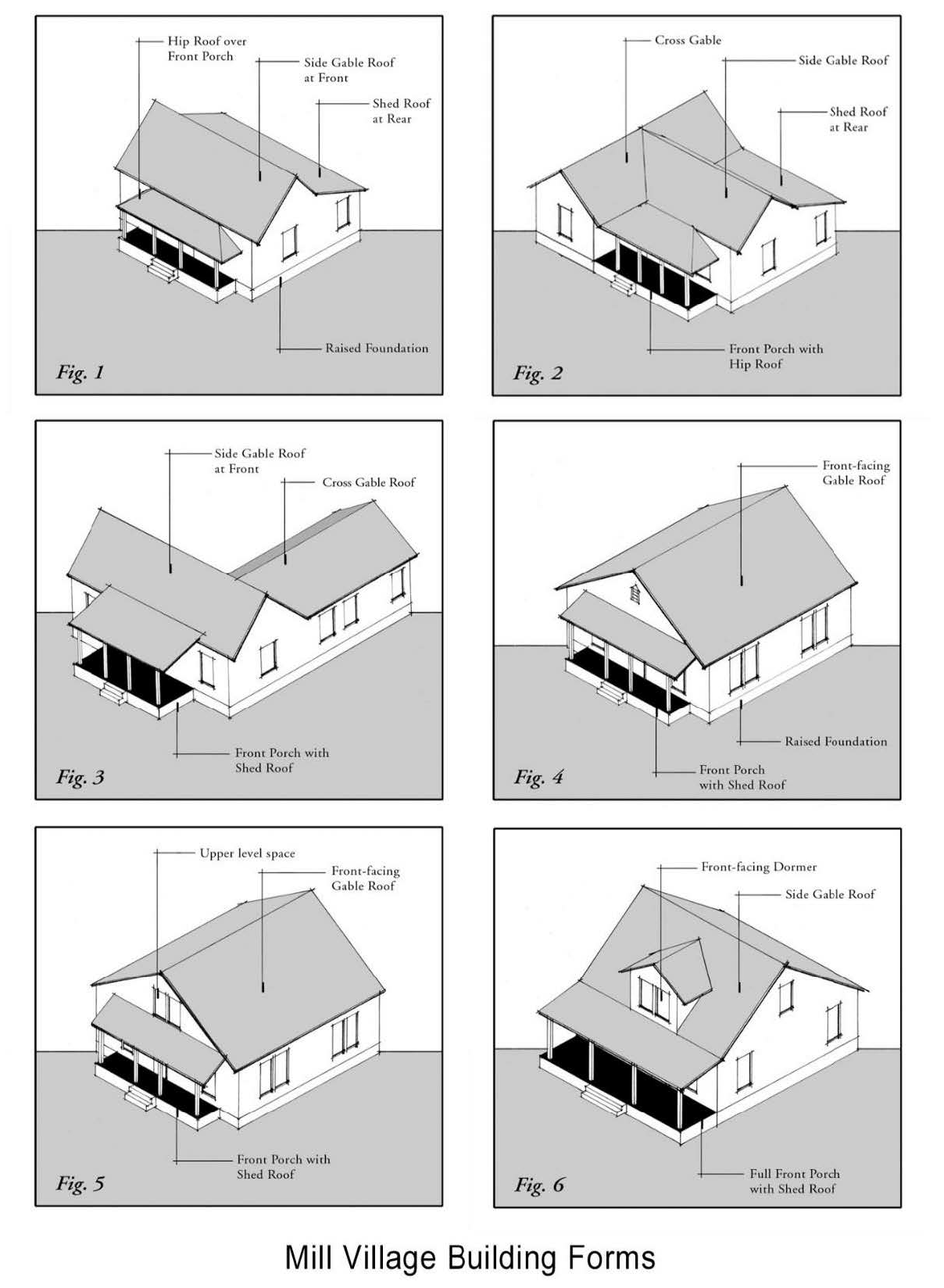
The architectural design of any new dwelling constructed in the Mill Village District Overlay shall substantially comply with the housing depicted in Table MV-1, Mill Village Building Forms.
Table MV-1
B.
Street or block characteristics. Any new construction or addition to an existing dwelling must be consistent with existing structures on the street or block with regard to:
1.
Consistent front setback;
2.
Consistent side setback and distance between houses; and
3.
Identified Mill Village house architectural style.
C.
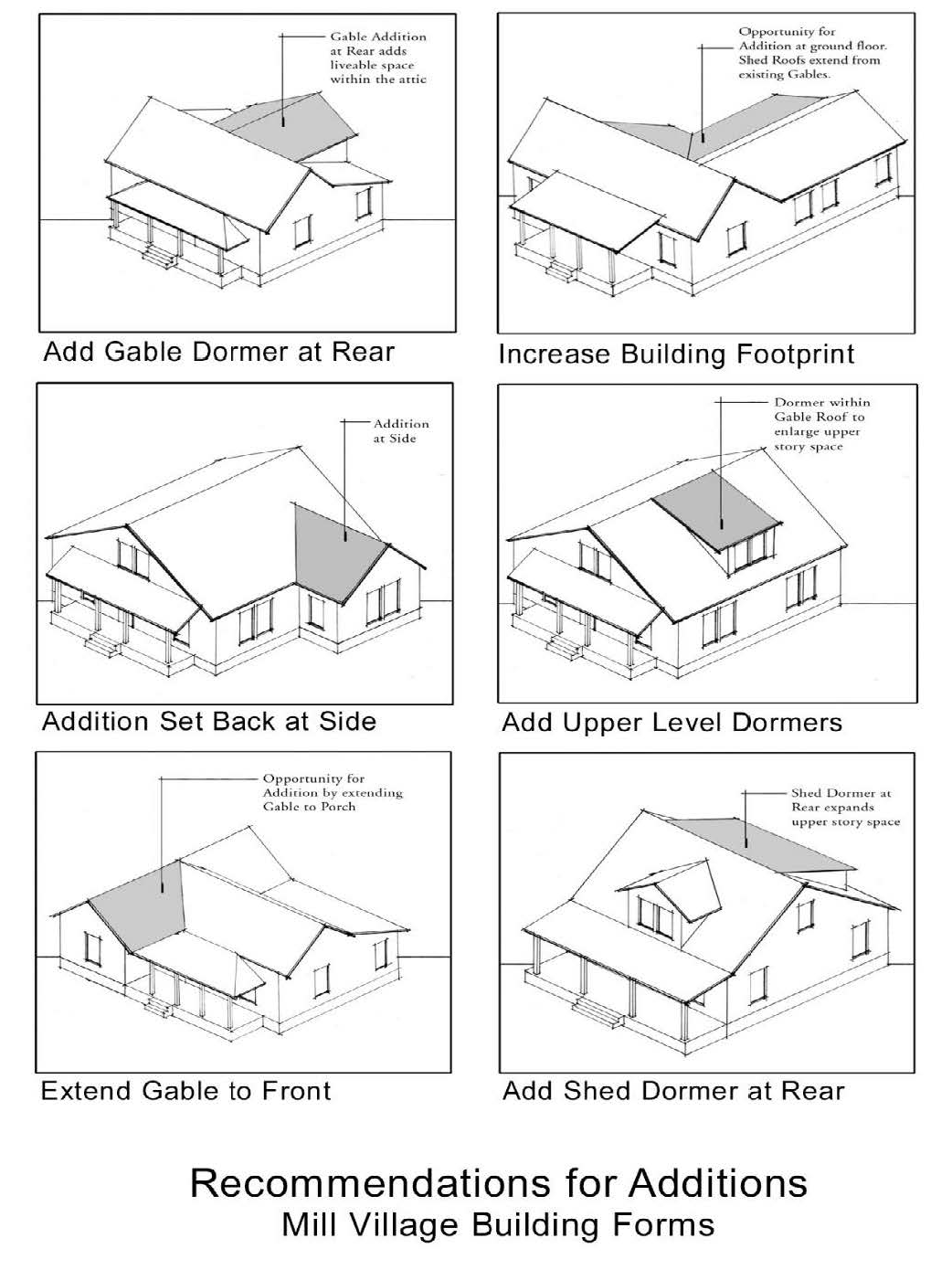
Additions to existing structures. Additions shall be limited to the rear or side of the principal structure or existing attic space may be altered to create habitable space, subject to the following requirements:
1.
Side additions shall be recessed one-fourth of the width from the front façade of the principal structure and constructed out of the same materials;
2.
Rear additions may encroach up to fifteen (15) feet into the rear setback provided that in no case can the addition be closer than ten (10) feet from the property line; and
3.
Attic alterations shall not change the overall height of the principal structure and shall not change the exiting pitch of the primary roof.
The architectural design of any addition or alteration of any existing structure in the MV District overlay shall substantially comply with the additions or alterations depicted in Table MV-2, Recommendations for Additions, Mill Village Building Forms.
Table MV-2
D.
Exterior wall coverings. If siding is to be repaired or replaced, the replacement siding shall be consistent with the original siding, scale and direction. Wood clapboard siding is preferred; however, cementitious, vinyl, or other horizontal sheet siding is permitted provided:
1.
The siding mimics the appearance of wood grain lap siding; and
2.
Window trim, corner boards, and fascia are left in place or replaced with new material consistent with the original materials.
E.
Porches.
1.
Front porches shall not be enclosed with screen, glass, or other material;
2.
Porches should have shed or hip roofs compatible with the surrounding structures;
3.
Porches greater than eighteen (18) inches high should use wood or wrought iron rails, or materials with similar appearance; and
4.
New decks and screened in or otherwise enclosed porches are permitted provided they are located to the rear of the structure and screened from the street view.
F.
Mechanical systems. Mechanical systems where practical should be located out-of-sight from public rights-of-way or screened with shrubs or fencing. For the purposes of this subsection, "mechanical systems" shall be defined to include, but not be limited to:
1.
Conditioning and heating condensers;
2.
Window units, or other exterior units;
3.
Exterior staircases with access to second or third story apartments;
4.
Satellite dishes;
5.
Solar collectors; and
6.
Electric and gas meters.
G.
Parking and driveways.
1.
Parking areas should be located at the side or rear of the house when practical;
2.
Parking and driveway areas shall be clearly distinguished from other parts of the yard and should be constructed of an impervious surface.
H.
Sanitary and waste refuse. Sanitary and waste refuse storage and collection facilities on the lot must be placed at the side or rear of the property and shall be appropriately screened from street view.
(Res. No. A-21-02, § 1, 5-3-21)
Sec. 2205C. - Conflicts with existing zoning.
In the event of a conflict between the requirements of the MV District Overlay and any other provision of the Spalding County Zoning Ordinance, the requirements of the MV District Overlay shall control.
(Res. No. A-21-02, § 1, 5-3-21)

