
Spanish Fork City Zoning Code
PART 4
DEVELOPMENT
ORD 08-20
37-22
22-19
24-19
06-20
03-21
17-2023
24-2023
27-22
04-2025
07-2025
03-2026
ORD 14-22
18-2024
07-21
05-2024
20-2024
21-2024
09-2023
19-2024
13-2025
22-2023
02-2026
17-19
07-20
15.4.04.010 Sale Of Plats Or Parcels Prior To Approval And Recordation Prohibited
No person shall subdivide any tract of land which is located wholly or in part within the corporate limits of the City, nor shall any person sell, exchange, offer for sale, purchase, or offer to purchase any parcel of land which is any part of a subdivision of a larger tract of land as hereinafter described, nor shall any person offer for recording any deed conveying such parcel of land or any interest therein unless there is first recorded a plat of such land which has been prepared and recorded in compliance with the requirements of this Title, or a waiver granted in accordance with Utah Code Ann. §10-9a-605.
15.4.04.020 Approval Required
- Subdividing Land. It shall be unlawful for any person to create a subdivision or subdivide for the purpose of transferring, selling, conveying, or assigning any tract or parcel of land, which is located wholly or in part in the City except in compliance with this Title.
- Subdivisions. It shall be unlawful for any person to sell or exchange or to offer to sell or exchange any parcel of land which is part of a subdivision of land, or recorded in the office of the Utah County Recorder as a subdivision unless the subdivision has been approved by the City and complies with the provisions of this Title.
- Building Permit Conditions. No building permit shall be issued until the final subdivision plat has been recorded by the City at the office of the Utah County Recorder and the following improvements are installed and accepted by the City:
- All essential improvements to meet the building and fire codes
- Six (6) inches of compacted road base in all areas where asphalt will be placed.
(Ord. No. 29-17, Amended 12/12/2017)
15.4.04.030 Endangering Health Or Property Prohibited
No subdivision shall be developed in the City which, in the opinion of the City Council, is incompatible to the health or well-being of the citizens of Spanish Fork and the future lot owners when the subdivision is completed.
15.4.04.040 Amended Plats
In all subdivisions which have been recorded and in which changes have been made which changed the subdivision materially, an Amended Plat must be filed and recorded in accordance with the provisions of this Title. In situations where modifications are limited to the adjustment of lot lines and all affected property owners consent to the modifications, an applicant shall apply to have a Minor Plat Amendment approved. The information required with an application for Minor Plat Amendment approval shall match those found with Final Plat applications. The fee for Minor Plat Amendment approval shall be set forth by the City Council in the City’s budget. The DRC may waive individual submittal requirements as the DRC finds appropriate. Upon finding that all applicable standards have been met, the DRC shall approve the Minor Plat Amendment. Once all requirements have been met and any required bonds have been posted, the Plat will be submitted to the Utah County Recorder’s Office for recordation. (Ord. No. 04-14, Amended 04/01/2014)
15.4.04.050 Exceptions To Avoid Hardship
Whenever the tract to be subdivided is, in the opinion of the City Council, of such unusual shape or size or is surrounded by such development or unusual conditions that the strict application of the requirements contained herein would result in real difficulties and substantial hardships or injustices, the City Council may vary or modify such requirements so that the subdivider is allowed to develop his or her property in a reasonable manner but so, at the same time, the public welfare and interests of the City and surrounding area are protected and the general intent and spirit of this Title is preserved.
15.4.04.060 Filing Of Preliminary Plats
- Prior to filing a Preliminary Plat, the developer may submit an application for Concept Review with the Community Development Department. To apply for a Preliminary Plat approval, applicants must follow instructions on the electronic form provided by the Community Development Department and submit all required materials. Plans submitted for Preliminary Plat approval shall be provided in this format:
- A pdf and computer aided design (CAD) file of the plat in a dwg or dxf format. The CAD file of the subdivision must be in the 1927 North American Datum (NAD27) or 1983 North American Datum (NAD83) State Plane.
- The City will review the submission and notify the developer of any changes that must be made. The developer shall have a written response to all redlines corrected. Once these changes are made, a PDF file of the plat must be submitted to the Community Development Department.
- All drawings, CAD files, and packets must be updated and re-submitted to the City with any changes made that were required by the DRC, Planning Commission, or City Council after each meeting.
- In the event a pending ordinance, which has been formally initiated, would prohibit the Plat approval, the application need not be accepted, unless the pending ordinance has not been adopted within 180 days of its formal initiation. A subdivision application shall meet the requirements in place at the time of submittal, or the requirements of any ordinance which has been formally initiated at the time of submittal.
(Ord. No. 04-14, Amended 04/01/2014) (Ord. No. 14-16, Amended 09/20/2016)
Amended by Ord. ORD 08-20 on 6/16/2020
Amended by Ord. 37-22 Amending Title 15 of the Spanish Fork Municipal Code Pertaining to Development Applications , Annexations, Environmental Reviews and Master Planned Developments on 11/15/2022
15.4.04.070 Form And Content Of Preliminary Plats
- Each Preliminary Plat shall be accompanied by a filing fee in the amount established by the City Council in the annual budget. Each Preliminary Plat of a subdivision shall contain the following information:
- The proposed name of the subdivision.
- The names and addresses of the Developer and the Civil Engineer of the subdivision.
- The names of all adjacent subdivisions and property owners.
- The location of the subdivision as a part of some larger subdivision or tract of land referred to in the records of the County Recorder. In such case, a sketch of the prospective street system of the un-platted parts of the subdivider's land shall be submitted and the street system of the part submitted shall be considered in light of existing master street plans or other commission street studies.
- A tie to a section corner. All horizontal data shall be based on the 1927 North American Datum (NAD27) or 1983 North American Datum (NAD83) State Plane Coordinate System, Utah Central Zone, US Foot. Horizontal datum shall be clearly written on all plat drawings.
- A contour map with vertical intervals not to exceed two feet. Contours shall be clearly labeled. All vertical data shall be based on the 1929 North American Vertical Datum (NAVD29) or 1988 North American Vertical Datum (NAVD88). Vertical datum shall be written on plat.
- Show all existing and proposed streets, alleys, easements, watercourses including flood zone areas, irrigation ditches, fence lines, utilities, buildings, public areas and any other important features within 200 feet of the tract to be subdivided.
- Phasing plan showing how proposed development will function until the subdivision is completed.
- A table including: total acreage of area proposed for development, acreage of individual phases, total acreage in lots, total acreage in open space, percent of open space, total number of lots, and density in lots per acre, and total acreage in flood zone.
- The date of preparation, a standard engineering scale of not more than 100 feet to the inch, a north arrow, and a vicinity map.
- A stamp and signature of a Civil Engineer licensed in the state of Utah.
- The following documents must accompany the Preliminary Plat:
- Soils Report. The developer must provide a detailed soils report addressing the following issues for the subdivision: hill stabilization, road design including CBR or existing soils, foundation design, groundwater impacts, and general soil stability. The report must be stamped and signed by a Civil Engineer licensed in the state of Utah. The report shall include a minimum groundwater height factor for a peak month in a wet year for the lowest buildable floor elevation. The lowest buildable floor elevation shall be a minimum of three (3) feet above the highest groundwater level in a wet year. Foundation drains shall be required as outlined in §15.4.16.070.
- Storm Water Plan. The developer must provide a detailed storm water plan for the subdivision according to the Storm Water Drainage Design Manual. This plan shall include all calculations showing that it meets all the requirements of the Construction Standards and the Drainage Design Manual. Plans and calculations must be stamped and signed by a civil engineer licensed in the state of Utah.
- Traffic Impact Study. The developer must submit a traffic impact study performed by a professional engineer licensed in the state of Utah, unless waived by the City Engineer.
- Wetland Delineation Study. If the City Engineer or designee determines that there are potential wetlands in a development the Developer shall submit a wetlands delineation by a qualified wetlands scientist. This delineation will be reviewed by a qualified wetlands scientist hired by the city. All costs for the delineation and review shall be borne by the developer.
- Title Report. The developer shall provide the City with a title report showing clear title for all of the properties in the proposed development.
- Other Jurisdictional Approvals. The developer shall acquire approvals from any agency or company having affected properties or utilities.
- In addition to the above, a MPD subdivision packet shall include a project overview, plat drawings, product elevations, landscape plan, description and design of amenities, CC&R's, and soil reports. The description and design of amenities shall include detailed drawings and pictures of proposed playgrounds, open space, trails, streetscapes, architectural variety, fencing, and any other items deemed necessary by the City Planner.
(Ord. No. 14-12, Amended 09/28/2012) (Ord. No. 04-14, Amended 04/01/2014) (Ord. No. 16-17; Amended 06/20/2017)
15.4.04.080 Approval Or Disapproval - Procedure
- Each plat submitted to the City shall be referred to the DRC for review to insure conformity to the present ordinances and standards and for adequacy and availability of public facilities.
- Approval of a preliminary subdivision plat shall not be granted until such time as the applicant has provided information, to the satisfaction of the City Engineer, to establish that adequate public facilities exist in the areas affected by the development to accommodate the development.
- The public facilities to which the preceding paragraph applies shall include the following:
- The City culinary water system, including quantity, quality, treatment, storage capacity, transmission capacity, and distribution capacity.
- The City sanitary sewer system, including treatment, overall capacity, outfall lines, laterals, and collector lines.
- The City electric power system, including generation, transformation, transmission, and distribution.
- The storm water system, including drainage and flood control facilities.
- Streets and roads, including arterial and collector roads, sidewalks, curb and gutter, and related transportation facilities.
- City pressurized irrigation system, including transmission and distribution capacity.
- The adequacy of public facilities shall be determined in accordance with the Spanish Fork City development standards, the various master plans and the comprehensive general plan of the City, and at the discretion of the City Engineer. In the event that the City Engineer determines that adequate public facilities are not available and will not be available by the time of final plat approval, so as to assure that adequate public services are available at the time of occupancy, the following alternatives may be elected, at the discretion of the City Council:
- Allowing the developer to voluntarily construct those public facilities which are necessary to service the proposed development and provide adequate facilities as determined by the City Engineer and by entering into an appropriate form of pioneering or development agreement, which may include, as deemed appropriate by the City Engineer, provisions for recoupment of any expenses incurred above and beyond those reasonably necessary for or related to the need created by or the benefit conferred upon the proposed development, and the method and conditions upon which recoupment is to be obtained. If an owner or developer plans to apply for a pioneering agreement at the conclusion of a project, the owner or developer shall submit a Notice of Pioneering Intent Application, pay the applicable fees, and post a bond for the pioneering infrastructure. Any pioneering agreement authorized by this paragraph must be requested within 120 days of the completion and acceptance by City of the improvements. The City Public Works Director may extend the deadline for up to an additional term upon good cause show. A request for a pioneering agreement shall be made on forms provided by the City. An application fee in an amount to cover the City’s expenses in preparing the pioneering agreement shall be included. The amount of the fee shall be established by the City Council in the annual budget or by resolution. Upon execution of a pioneering agreement a Notice of Development Obligations, giving notice of the existence of the pioneering agreement, shall be recorded against the properties that are benefitted by the pioneering infrastructure. The Public Works Director is authorized to sign Notices of Pioneering Intent and notices of Development Obligations and record them against the properties to be benefitted by the pioneering infrastructure.
- Requiring the timing, sequencing, and phasing of the proposed development consistent with the availability of adequate public facilities.
- Deferring Final Plat approval and the issuance of building permits until all necessary public facilities are adequate and available.
- Denying plat approval and allowing the applicant to reapply when adequate public facilities are available.
- The applicant shall follow the procedures set forth in Utah Code Ann. §73-1-15.5, as it may be amended from time to time, in contacting any applicable irrigation company whose facilities will be affected by the development. The applicant is to follow the requirements of said section in piping, improving, or relocating any irrigation facilities. Construction plans, in compliance with said section, shall be submitted with the application. The applicant is to provide a certificate of compliance that satisfies the City Engineer that it is compliant with the law.
Existing irrigation ditches located on the site or adjacent to a property boundary, within 10 feet, shall be treated in accordance with this section. Ditches shall be piped with a sufficient size pipe to handle the irrigation need or, if approved by the Development Review Committee, an opaque fence or wall shall be constructed to screen the ditch from lots within the plat. Fences and walls shall be placed on a lot line or parcel line, which shall be two feet from the tow of the ditch embankment. Any land between the fence or wall and the ditch may not be included within lots. Such land shall be maintained by the owner or may be dedicated to the City. Piping shall be coordinated with the City Engineer and the irrigation company or ditch owner by following the provisions of Utah Code Ann. §73-1-15.5, unless otherwise approved by the City Engineer. If the ditch carries greater than 50 cubic feet per second average flow, the Development Review Committee has the discretion to require piping, fencing, and/or landscaping.
Development Review Committee may waive this requirement for areas zoned commercial or industrial.
Developers are responsible for the protection of irrigation ditches and facilities from damage resulting from the development work. - If the plat is not in conformity with the Design and Development Standards of this Title, the DRC shall refer it back to the subdivider or developer with a list of items necessary to bring the plat into compliance. If the plat is in conformity, it will be submitted to the Planning Commission with suggestions and comments noted thereon. The Commission may continue the matter to further study the issues presented. The Commission may approve, deny or approve with conditions the proposed Preliminary Plat. If any conditions are attached, the Preliminary Plat shall be corrected to reflect such changes and an accurate Preliminary Plat shall be submitted to the City. Changes made in the Preliminary Plat by the DRC, Commission, or Council must be made before proceeding to the next step.
Receipt of this accurate copy shall be authorization for the developer to proceed with the preparation of plans and specifications for the minimum improvements hereinafter required by this Title and with the preparation of the Final Plat. Original Preliminary Plats are subject to the standards, policies, and regulations that are in effect at the time of approval for each of the Final Plats.
(Ord. No. 11-13, Amended 07/13/2013) (Ord. No. 15-14, Amended 10/07/2014) (Ord. No. 03-18, Amended 02/20/2018) (Ord. No. 20-18, Amended 11/20/2018) (Ord. No. 03-18, Amended 02/20/2018)
Amended by Ord. 22-19 on 10/7/2019
Amended by Ord. 24-19 on 10/15/2019
Amended by Ord. 06-20 on 6/16/2020
Amended by Ord. 03-21 on 2/16/2021
Amended by Ord. 17-2023 Amending Section 15.4.16.020 and 15.4.04.080 of the Spanish Fork Municipal Code Pertaining to the Notices of Pioneering Intent on 8/15/2023
15.4.04.090 Duration Of Preliminary Approval
A Preliminary Plat application expires if it is not approved by the City within 24 months from the time its application is submitted and accepted.
Approval of the Preliminary Plat by the City shall be valid for a period of 24 months after approval. A Preliminary Plat remains active if a Final Plat is recorded at least every 24 months. If a Final Plat has not been recorded within the 24-month period, the Preliminary Plat must again be submitted to the City for re-approval.
Preliminary approval of a large tract shall not be voided if the Final Plat of the first section thereof recorded within 24 months and no more than 24 months have expired between the recording of each consecutive Final Plat. (Ord. No. 03-18, Amended 02/20/2018)
Amended by Ord. 22-19 on 10/7/2019
15.4.04.100 Filing Of Final Plats
Within two (2) years after approval of the Preliminary Plat the applicant must make application for Final Plat approval, receive Final Plat approval and have a plat recorded. Application is made by following instructions on the electronic form provided by the Community Development Department and submit all required materials with the following:
- A Computer Aided Design (CAD) file in a dwg or dxf format and a PDF file of the plat. The CAD file of the subdivision must be in the 1927 North American Datum (NAD27) or 1983 North American Datum (NAD83) State Plane Coordinate System, Utah Central Zone, US Foot, with a tie to a section corner.
- All fees for the Final Plat application are due upon filing the application.
The City will review the submission and notify the developer of any changes that must be made. The developer shall have a written response to all redlines corrected. Once these changes are made, a PDF file of the plat must be submitted to the Community Development Department.
Each Final Plat shall be accompanied by a filing fee established by the City Council in its annual budget, together with any impact, inspection, testing, connection, or other fees which are due before recording.
A Final Plat application expires if it is not approved by the City within 12 months from the time its application is submitted and accepted.
(Ord. No. 04-14, Amended 04/01/2014) (Ord. No. 14-16, Amended 09/20/2016) (Ord. No. 03-18, Amended 02/20/2018)
Amended by Ord. 22-19 on 10/7/2019
15.4.04.110 Form And Contents Of Final Plats
- The developer must submit a mylar of the Final Plat to the City in a format approved by the City and County. The Final Plat of a subdivision shall contain the following:
- A tie to a section corner and the state plane coordinates of each point. All horizontal data shall be based on the 1927 North American Datum (NAD27) or 1983 North American Datum (NAD83) State Plane Coordinate System, Utah Central Zone, US Foot. Horizontal datum shall be clearly written on the plat.
- Accurate dimensions for all lines, angles and curves used to describe boundaries, streets, alleys, easements, areas to be reserved for public use, and other important features; the lines, angles, dimensions, state plane coordinates, bearings, areas and numbers of all lots, blocks and parts reserved for any reason within the subdivision. All dimensions shall be determined by an accurate field survey which shall balance and close as required by the county.
- All lots and blocks are to be numbered, addressed, and named in accordance with the street numbering and naming system assigned by the City Engineer.
- A statement that “All drinking water and pressurized irrigation lines up to and including the meter, all sanitary sewer mains, all electric meters, and all electric and SFCN communication service lines up to the mast on overhead installations and to the top of the meter base for underground installations are dedicated to Spanish Fork City”.
- Plats and signatures shall be in waterproof ink on a 24x36 inch mylar sheet. There shall be an unencumbered margin of one and one-half (1 1/2) inches on the left-hand side of the sheet and not less than a half (1/2) inch margin around the outer three (3) sides of the sheets. The scale shall be a standard engineering scale of no more than 100 feet to the inch.
- A stamp and signature of a surveyor licensed in the state of Utah.
- A statement that “All municipal utility easements platted hereon are in perpetuity for installation, maintenance, repair, and replacement of public utilities, public walls, fences, sidewalks, trails, and appurtenant parts thereof and the right to reasonable access to grantor’s easement shall run with the real property and shall be binding upon the grantor and the grantor’s successors, heirs and assigns”.
- All building permits for the subdivision shall comply with the Development Soils Report and Mass Grading Plan. Elevation certificates shall be reviewed and approved by the City Engineer or his/her designee as required.
- The date of preparation, a standard engineering scale of not more than 100 feet to the inch, a north arrow, and a vicinity map.
- All offsite easements required to provide services or utilities to the project shall be recorded with the Utah County Recorder’s office prior or in conjunction with the Final Plat recordation.
- The following documents must accompany the Final Plat:
- Construction Plans. A complete set of construction plans must accompany the Final Plat. Construction plans must meet the requirements of this Title as well as the standards found in Chapter 39.20 Improvement and Design Requirements of the Construction Standards.
- Soils Reports. A Final Plat Soils Report shall provide a detail of lot by lot summary addressing finished floor elevation including basements. The report shall include a minimum groundwater height factor for peak month in a wet year, and also address all Hillside Development Standards. The basement finished floor shall be a minimum elevation of three (3) feet above the highest groundwater level in a wet year.
- Storm Water Plan. The developer shall provide a final drainage plan and report according to the Storm Water Drainage Design Manual.
- Mass Grading Plan. The developer shall provide a final subdivision grading plan showing each individual property. The site shall be designed to eliminate flooding or standing water on any private property.
(Ord. No. 14-12, Amended 09/18/2012) (Ord. No. 29-17, Amended 12/12/2017) (Ord. No. 20-18, Amended 11/20/2018)
15.4.04.120 Review And Approval Procedure Of Final Plats
Final plat and construction drawings shall be submitted to the City for review to insure conformity to the present ordinances and standards and for the adequacy and availability of public facilities. If the Final Plat or construction drawings are not in conformity, the City shall refer it back to the subdivider or developer with a list of items necessary to bring the Final Plat or construction drawings into compliance. If the Final Plat and construction drawings are in conformity, the plat or complete drawings will be submitted to the DRC with suggestions and comments noted thereon. The DRC shall act as the land use authority for Final Plat approval.
After considering the recommendation of the City Engineer, the DRC may table the matter, approve, or grant approval upon conditions stated. If approved, the City Manager, Community Development Director, City Attorney, and City Engineer shall sign the Final Plat. If any conditions are attached, the Final Plat or construction drawings shall be amended to reflect such changes and an accurate Final Plat shall be submitted to the City, prior to signing.
Original and Preliminary Plats are subject to the standards, policies, and regulations that are in effect at the time of approval for each of the Final Plats. (Ord. No. 14-16, Amended 09/20/2016)
Amended by Ord. 24-2023 Amending Various Sections of the Spanish Fork Municipal Code Pertaining to Title 15 updates and Amendments Regarding Adding Illustrations, Mailboxes, and Off-Street Parking on 12/12/2023 on 12/12/2023
15.4.04.130 Recordation - Copy To Be Supplied To City Engineer
Following acceptance by the DRC, the Final Plat, bearing all official approvals, shall be deposited in the office of the Utah County Recorder for recording by the City. Only the City may record Final Plats. Approval expires and the plat must be resubmitted for approval if all the materials required to record the plat are not provided to the City within one (1) year of the plat’s approval. All inspection, testing and/or connection fees required by ordinance shall be paid and permits required shall be obtained prior to the recording of the Final Plat. (Ord. No. 15-14, Amended 10/07/2014)
Amended by Ord. 24-2023 Amending Various Sections of the Spanish Fork Municipal Code Pertaining to Title 15 updates and Amendments Regarding Adding Illustrations, Mailboxes, and Off-Street Parking on 12/12/2023 on 12/12/2023
15.4.04.140 Commencement/Completion Time Frame
- Prior to the construction of any improvements required by this Title, the subdivider shall furnish to the City Engineer the following:
- Approved sets of construction plans.
- Full security deposit (bond) required by this Title (§15.4.16.110).
- Inspection fee deposit.
- Subdivision Bond Agreement for Improvements.
- Hold a preconstruction meeting.
- Meet all conditions for approval as established by the DRC.
- All improvements within subdivisions must be completed within one (1) year from the date of recording of the final plat. If improvements are not completed within the time limitation imposed herein, the City may forfeit any bond or surety, which has been posted by the owner or subdivider.
- The one (1) year warranty period begins when all of the infrastructure and landscaping required by this Title or the Development Standards is inspected and accepted by the City, including all punch list items. Additional punch list items may be added if further inspections reveal that the approval requirements have not been met.
(Ord. No. 20-18, Amended 11/20/2018)
Amended by Ord. 24-2023 Amending Various Sections of the Spanish Fork Municipal Code Pertaining to Title 15 updates and Amendments Regarding Adding Illustrations, Mailboxes, and Off-Street Parking on 12/12/2023 on 12/12/2023
15.4.04.150 Amendments To Final Plat
The City Engineer may approve minor amendments to approved Final Plats before the Final Plat is recorded, if he/she finds that the proposed amendments do not jeopardize the interest of the City or adjoining property owners. The types of minor amendments contemplated by this section may include, but not be limited to, legal description mistakes, minor boundary changes, and items that should have been included on the original Final Plats. Major amendments to unrecorded approved Final Plats shall go back through the approval process. Amendments to record the Final Plat shall be in accordance with State law and any policies or procedures adopted by the City.
15.4.04.160 Building Permits
The City may issue a building permit upon application and compliance with the requirements of law and once the final plat is recorded and all improvements which are necessary to meet the building and fire codes are installed, accepted by the City Engineer or designees, and in service for the entire plat. In the event asphalt pavements is not installed, building permits may be issued if there is six (6) inches of compacted road base in all areas to be paved. (Ord. No. 24-17, Amended 10/17/2017) (Ord. No. 29-17, Amended 12/12/2017)
15.4.04.170 Appeals
Any decision of the DRC approving a Final Plat may be appealed to the Appeal Authority. Any appeal must be taken within 15 days of the final decision of the DRC. Appeals must follow the procedures set forth in §15.1.04.050. Any decision by the Appeal Authority concerning a Final Plat shall be final and non-appealable.
15.4.04.180 Filing Of Minor Subdivision Plat
Minor Subdivision Plats may be approved for subdivisions of five (5) or fewer lots where those lots conform to applicable zoning standards and where all required infrastructure is adjacent to the subject property. Application for Minor Subdivision Plat approval can be made by following instructions provided by the Community Development Department. The following materials are required for a complete application:
A Computer Aided Design (CAD) file and a PDF file of the plat. The CAD file of the subdivision must be in the 1927 North American Datum (NAD27) or 1983 North American Datum (NAD83) State Plane Coordinate System, Utah Central Zone, US Foot, with a tie to a section corner.
The application fee as defined in the City's Annual Budget.
The City will review the submission and notify the applicant of any changes that must be made. Once these changes are made, PDF file of the plat must be submitted to the Community Development Department. Once approved by the DRC, the applicant must insure that a copy of the signed and approved construction plans is on site at all times during construction. Each Minor Subdivision Plat shall be accompanied by a filing fee established by the City Council in its annual budget, together with any impact, inspection, testing, connection or other fees which are due before recording.
Amended by Ord. 22-19 on 10/7/2019
15.4.04.190 Form And Contents Of Minor Final Plats
- The developer must submit a mylar of the Minor Subdivision Plat to the City in a format approved by the City and County. The Minor Subdivision Plat shall contain the following:
- A tie to a section corner and the state plane coordinates of each point. All horizontal data shall be based on the 1927 North American Datum (NAD27) or 1983 North American Datum (NAD83) State Plane Coordinate System, Utah Central Zone, US Foot. Horizontal datum shall be clearly written on the plat.
- Accurate dimensions for all lines, angles and curves used to describe boundaries, streets, alleys, easements, areas to be reserved for public use, and other important features; the lines, angles, dimensions, state plane coordinates, bearings, areas and numbers of all lots, blocks and parts reserved for any reason within the subdivision. All dimensions shall be determined by an accurate field survey which shall balance and close as required by Utah County.
- All lots and blocks are to be numbered, addressed and named in accordance with the street numbering and naming system assigned by the City Engineer.
- A statement that “All drinking water and pressurized irrigation lines up to and including the meter, all sanitary sewer mains, all electric meters, and all electric and SFCN communication service lines up to the mast on overhead installations and to the top of the meter base for underground installations are dedicated to Spanish Fork City”.
- Plats and signatures shall be in waterproof ink on a 24x36 inch mylar sheet. There shall be an unencumbered margin of one and one-half (1 1/2) inches on the left-hand side of the sheet and not less than a half (1/2) inch margin around the outer three (3) sides of the sheets. The scale shall be a standard engineering scale of no more than 100 feet to the inch.
- A stamp and signature of a surveyor licensed in the state of Utah.
- A statement that “All public utility easements platted hereon are in perpetuity for installation, maintenance, repair, and replacement of public utilities, public walls, fences, sidewalks, trails, and appurtenant parts thereof and the right to reasonable access to grantor’s easement shall run with the real property and shall be binding upon the grantor and the grantor’s successors, heirs and assigns”.
- All Building Permits for the subdivision shall comply with the Development Soils Report and Mass Grading Plan. Elevation certificates shall be reviewed and approved by the City Engineer or his/her designee as required.
- The date of preparation, a standard engineering scale of not more than 100 feet to the inch, a north arrow, and a vicinity map.
- All offsite easements required to provide services or utilities to the project shall be recorded with the Utah County Recorder’s office prior to or in conjunction with the Minor Subdivision Plat recordation.
- The following documents must accompany the Minor Subdivision Plat:
- Construction Plans. A complete set of construction plans must accompany the Minor Subdivision Plat. Construction plans must meet the requirements of this Title as well as the standards found in Chapter 39.20 Improvement and Design Requirements of the Construction Standards.
- Soils Reports. A soils report shall provide a detail of lot by lot summary addressing finished floor elevation including basements. The report shall include a minimum height factor for peak month in a wet year, and also address all Hillside Development Standards.
- Storm Water Plan. The developer shall provide a final drainage plan and report according to the Storm Water Drainage Design Manual.
- Mass Grading Plan. The developer shall provide a final subdivision grading plan showing each individual property. The site shall be designed to eliminate flooding or standing water on any private property.
(Ord. No. 29-17, Amended 12/12/2017)
15.4.04.200 Review And Approval Procedure Of Minor Final Plats
Minor Subdivision Plat and construction drawings shall be submitted to the City for review to insure conformity to the present ordinances and standards and for the adequacy and availability of public facilities. If the Minor Subdivision Plat or construction drawings are not in conformity, the City shall refer it back to the subdivider or developer with a list of items necessary to bring the Minor Subdivision Plat or construction drawings into compliance. If the Minor Subdivision Plat and construction drawings are in conformity, the plat or complete drawings will be submitted to the DRC with suggestions and comments noted thereon. The DRC shall act as the Land Use Authority for Minor Subdivision Plat approval. If approved, the City Manager, Community Development Director and City Engineer shall sign the Minor Subdivision Plat. If any conditions are attached, the Minor Subdivision Plat or construction drawings shall be amended to reflect such changes and an accurate Minor Subdivision Plat shall be submitted to the City, prior to signing. A Minor Subdivision Plat application expires if it is not approved by the City within 12 months from the time its application is submitted and accepted.
Amended by Ord. 22-19 on 10/7/2019
15.4.04.210 Recordation Of Minor Final Plats
Following acceptance by the DRC, the Minor Subdivision Plat bearing all official approvals shall be deposited in the office of the County Recorder for recording by the City. Only the City may record Minor Subdivision Plats. Approval expires and the plat must be resubmitted for approval if all the materials required to record the plat are not provided to the City within one (1) year of the plat's approval. All inspection, testing and/or connection fees required by ordinance shall be paid and permits required shall be obtained prior to the recordation of the Minor Subdivision Plat.
Amended by Ord. 22-19 on 10/7/2019
Amended by Ord. 24-2023 Amending Various Sections of the Spanish Fork Municipal Code Pertaining to Title 15 updates and Amendments Regarding Adding Illustrations, Mailboxes, and Off-Street Parking on 12/12/2023 on 12/12/2023
15.4.04.220 Commencement/Completion Time Frame For Minor Final Plats
- Prior to the construction of any improvements required by this Title, the subdivider shall furnish to the City Engineer the following:
- Approved sets of construction plans.
- Full security deposit (bond) required by this Title (§15.4.16.110).
- Inspection fee deposit.
- Subdivision Development Agreement.
- Hold a preconstruction meeting.
- Meet all conditions for approval as established by the Council.
- All improvements within subdivisions must be completed within one (1) year of the date of recordation. If improvements are not completed within the time limitation imposed herein, the City may forfeit any bond or surety, which shall have been posted by the owner or subdivider.
15.4.04.230 Amendments To Minor Final Plats
The City Engineer may approve minor amendments to approved Minor Subdivision Plat before the Minor Subdivision Plat is recorded, if he/she finds that the proposed amendments do not jeopardize the interest of the City or adjoining property owners. The types of minor amendments contemplated by this section may include, but not be limited to, legal description mistakes, minor boundary changes and items that should have been included on the original Minor Subdivision Plat. Major amendments to unrecorded approved Minor Subdivision Plat shall go back through the approval process. A Minor Subdivision Plat Amendment application expires if it is not approved by the City within 12 months from the time the application is submitted and accepted.
Amended by Ord. 22-19 on 10/7/2019
15.4.04.240 Building Permits For Minor Final Plats
The City may issue a Building Permit upon application and compliance with the requirements of law and once the final plat is recorded and all improvements which are necessary to meet the building and fire codes are installed, accepted by the City Engineer, and in service for the entire plat. In the event asphalt pavement is not installed, Building Permits may be issued if there is six (6) inches of compacted road base in all areas to be paved. (Ord. No. 04-14, Amended 04/01/2014) (Ord. No. 29-17, Amended 12/12/2017)
15.4.08.010 Purpose
The Site Plan review process is established in order to assure that development proposed for Spanish Fork City will comply with all zoning and development standards. The general appearance of developments shall contribute to an orderly, sustainable, and harmonious appearance and a safe and efficient development.
It is not the purpose of this Chapter that design should be so rigidly controlled so as to stifle creativity or individual expression, or that substantial additional expense be incurred; rather, it is the intent of this Chapter that any control exercised be the minimum necessary to achieve the objectives as stated above.
15.4.08.020 Site Plan Required
- Requirement. Site Plan review shall be required for the following:
- All proposed new commercial or industrial developments.
- All additions to commercial or industrial structures.
- Any change of use of an existing commercial or industrial site or structure.
- All Conditional Use Permits or Uses Subject to Conditions.
- Some projects such as minor additions to non-residential structures may not need a complete review.
- The Community Development Director may waive full Site Plan review, including fees, if it is determined that such review will not further the purpose of the City’s development standards.
15.4.08.030 Application And Review Process
- Application for Site Plan Approval is made by following instructions provided by the Community Development Department. Prior to submitting an application for Site Plan Review an applicant may submit an application for Concept Review. The following materials are required for a complete application: computer aided design (CAD) file in a dwg or dxf format and a Portable Document Format (PDF) file of dxftheformatplat. The CAD file of the subdivision must be in the 1927 North American Datum (NAD27) or 1983 North American Datum (NAD83) State Plane Coordinate System, Utah Central Zone, US Foot, with a tie to a section corner. All fees for the Site Plan application are due upon filing the application.
- Each Site Plan shall be accompanied by a filing fee in the amount established by the City Council in the annual budget.
- Information required for Staff Review including the following:
- Proposed name of Site Plan at lower right hand corner.
- Name and address of developer on the lower right hand corner.
- Name and address of engineer/architect/surveyor at the lower right hand corner.
- Date of preparation.
- Statement that “All drinking water and pressurized irrigation lines up to and including the meter, all sanitary sewer mains, all electrical meters, and all electric and SFCN communication service lines up to the mast on overhead installations and to the top of the meter base for underground installations are dedicated to Spanish Fork City”.
- Licensed Land Surveyor/Engineer Stamp and Signature.
- Title block with name and location.
- Vicinity map and north arrow.
- Standard engineered scale B 1" = 100' or less.
- Description of boundary of development.
- Section tie/bearing of section line based on NAD27 or NAD83 State Plane Coordinates. Horizontal datum shall be clearly marked on all plat drawings.
- Adjacent property owners names and buildings within 200 feet of proposed development.
- Existing and proposed fences.
- Existing and proposed streets with names and widths within 200 feet of site.
- Existing and proposed water courses, culverts, and irrigation ditches.
- Flood zones or wetlands as per NWI wetland map.
- Existing and proposed power lines (labeled), gas lines, water mains, fire hydrants and valves with pipe size.
- Existing and proposed sewer mains and manholes with pipe sizes.
- Existing and proposed storm drains.
- Existing and proposed public utility easements.
- Minimum of two (2) foot contours of existing elevations, with note that all vertical data is based on NAVD29 or NAVD88. Vertical datum shall be written on the plan.
- Typical street cross section.
- Building setbacks dimensioned on the Site Plan.
- Parking stalls (9'x18') and calculations identifying the required number of handicapped and non-handicapped parking spaces in the development.
- Photometric lighting plan.
- Dumpster location, height and materials used.
- Location and screening plan for mechanical equipment.
- Note on Site Plan if building is to be sprinkled.
- Finish floor elevation.
- Type of building and occupancy per International Building Code.
- Project phasing (if applicable).
- Table with the following:
- Total acreage of area proposed for development.
- Total area and percent of site in landscaping (open space).
- Total building area and dimensions - separate areas for different uses (office, warehouse, shop, etc.).
- Total developed and undeveloped area.
- Total number of parking spaces required and proposed (including ADA parking stalls).
- Total impervious area.
- Landscaped plan prepared by a licensed landscape architect:
- Planting schedule showing plant material and sizes.
- Planting plan.
- Irrigation plan.
- Off-street parking plan showing circulation and number and size of spaces.
- Vehicular and pedestrian circulation ingress, egress, and internal movement.
- Location and function of any loading and servicing facilities.
- Scale drawings of exterior building elevations and an indication of building materials to be used. Architectural drawings shall be drawn to a scale of no smaller than 1/8" = 1-foot.
- Elevations and/or architectural renderings of building facades facing public right-of-way. Said elevations or renderings must be sufficiently complete to show building heights and roof lines, the location and height of any walls, signs, light standards, openings in the facade, and the general architectural character of the building.
- All existing and proposed signs for the development.
- Grading plan with detailed elevations showing the drainage of the property. Sites shall be designed to eliminate drainage of water to adjacent properties. Site Grading Plan shall address soil types of material on the project site to ensure it is suitable for growth of landscaping and adequate percolation rates which are applicable to the design.
- Construction plans which conform to the standards found in section 39.20 Improvement and Design Requirements of the Spanish Fork City Construction Standards.
- Soils report addressing the following issues for the site: hill stabilization, road design, foundation design, groundwater impacts, and general soil stability. Report must be stamped and signed by a civil engineer licensed in the state of Utah. The report shall include a minimum groundwater height factor for a peak month in wet year for the lowest buildable floor elevation. The lowest buildable floor elevation shall be a minimum of three (3) feet above the highest groundwater level in a wet year. Foundation drains shall be required as outlined in §15.4.16.070.
- Public Utility Easement documents and/or deeds for all utilities or public facilities required by the City.
- Detailed storm water plan for the site according to the Storm Water Drainage Design Manual. This plan shall include all calculations showing that it meets the requirements of the Construction Standards and the Drainage Design Manual. Plans and calculations required by of Chapter 39.20 of the Construction Standards must be stamped and signed by a civil engineer licensed in the state of Utah.
- Approvals from any agency or company having affected properties or utilities.
- Other data or plans or reports deemed necessary by the Planning, Public Works, or Fire and Police Departments. In the event that a traffic study, environmental study or other technical study is required, the applicant may be required to pay additional review fees. The additional review fees will be utilized to prepare studies deemed necessary by the City Engineering Department or to perform a peer review of work submitted on behalf of the applicant.
- The City will review the submission and notify the developer of any changes that must be made. The developer shall have a written response to all redlines corrected. Once these changes are made, a PDF file of the plat must be submitted to the Community Development Department.
(Ord. No.14-12, Amended 10/18/2012) (Ord. No. 14-16, Amended 09/20/2016) (Ord. No. 16-17; Amended 06/20/2017)
Amended by Ord. 22-19 on 10/7/2019
Amended by Ord. ORD 08-20 on 6/16/2020
15.4.08.040 Approval Or Disapproval - Procedure
Each Site Plan submitted to the City shall be referred to the DRC, for review to insure conformity to the present ordinances and standards and for adequacy and availability of public facilities. The DRC may table the matter to further study the issues presented. The DRC may approve, reject, or grant approval upon the conditions stated. If approved, the DRC shall express its approval with whatever conditions are attached. If any conditions are attached, the Site Plan shall be amended to reflect such changes and an accurate Site Plan shall be submitted to the City. Receipt of this accurate copy shall be authorization for the developer to proceed with the preparation of plans and specifications for the minimum improvements hereinafter required by this Title. Original Site Plans are subject to the standards, policies, and regulations that are in constraints for the proposed development.
- Staff Review.
- Application for Site Plan approval can be made by following instructions on the electronic form provided by the Community Development Department and by submitting a in a computer aided design (CAD) file of the plans on a CD, or by an e-mail in a dwg or dxf format. The CAD file of the subdivision must be in the 1927 North American Datum (NAD27) or 1983 North American Datum (NAD83) State Plane Coordinate System, Utah Central Zone, US Foot, with a tie to a section corner.
(Ord. No. 04-14, Amended 04/01/2014)
Amended by Ord. 24-2023 Amending Various Sections of the Spanish Fork Municipal Code Pertaining to Title 15 updates and Amendments Regarding Adding Illustrations, Mailboxes, and Off-Street Parking on 12/12/2023 on 12/12/2023
15.4.08.050 Duration Of Approval
A Site Plan application expires if it is not approved by the DRC within 12 months from the time a complete application is submitted and accepted. Approval of the Site Plan by the DRC shall be valid for a period of 12 months after approval unless, upon application by the developer, the DRC grants an extension or a Building Permit is issued and maintained for the project. An extension may not exceed six (6) months.
All City improvements required for a Site Plan approval must be completed within one (1) year of the date of approval by the DRC. Improvements which are not completed within the time limitation imposed herein may result in the forfeiture of any bond or surety which shall have been posted by the owner or subdivider. (Ord. No. 14-12, Amended 09/18/2012) (Ord. No. 03-18, Amended 02/20/2018)
15.4.08.060 Amendments To Site Plan
The Community Development Director may approve minor amendments do not jeopardize the interest of the City or adjoining property owners. The types of minor amendments contemplated by this section may include, but not be limited to, legal description mistakes, minor boundary changes, and items that should have been included on the original Site Plan. Major amendments to the final Site Plan shall go back through the approval process. (Ord. No. 14-16, Amended 09/20/2016)
15.4.08.070 Appeals
Any decision of the DRC approving a Site Plan may be appealed to the Appeal Authority. Any appeal must be taken within 15 days of the final decision of the DRC. Appeals must follow the procedures set forth in §15.1.04.050. Any decision by the Appeal Authority concerning a Site Plan shall be final and non-appealable.
15.4.12.010 Impact Fees, Authorization
Spanish Fork City is hereby authorized to establish and collect impact fees as a condition of granting subdivision plat approval and/or as a condition of the issuance of a building permit.
15.4.12.020 Purpose Of Impact Fees, Limitations
The purpose of impact fees is to provide necessary funding for capital improvements to public facilities incurred due to new development. Impact fees may be assessed for water, sewer, pressurized irrigation, electric power, storm drainage, streets and roads, recreation, and public safety. (Ord. No. 07-11, Amended 05/17/2011)
15.4.12.030 Determination
The Council may set impact fees based on studies and analyses of the anticipated costs to provide adequate public facilities to new developments. The amount of the impact fee shall not exceed the anticipated cost of providing adequate public facilities which become necessary as a result of the development. In setting the amount of the fee, the Council shall take into consideration the following factors:
- The cost of existing capital facilities.
- The manner of financing existing facilities.
- The relative extent to which newly developed property and other properties within the City have already contributed to the costs of existing capital facilities.
- The relative extent to which newly developed properties and other properties within the City will contribute to the cost of existing capital facilities in the future.
- The relative extent to which newly developed properties are entitled to a credit because the City may be requiring owners or developers to provide common facilities that have historically been provided by the City and financed through general taxation or other charges in other parts of the City.
- The extraordinary costs, if any, in servicing newly developed properties.
- The time-price deferential inherent in fair comparison of amounts paid at different times.
15.4.12.040 Method Of Assessing
The Council may establish and assess impact fees by an impact fee enactment and by complying with the notice and hearing provisions of State law. For those impact fees due with a building permit, the fee in place on the date the permit was applied for will apply. For those impact fees due at plat recordation, the fees in place on the date of recording of the plat will apply.
(Ord. No. 14-16, Amended 09/20/2016)
Amended by Ord. 22-19 on 10/7/2019
15.4.12.050 Special Exceptions
- The Council retains the authority to adjust any impact fee imposed in order to respond to unusual circumstances in specific cases and to ensure that impact fees are fairly imposed. Economic hardship shall not be considered an unusual circumstance justifying an adjustment to the impact fee.
- The Council may, at its sole discretion, adjust any impact fee, on the basis of justice and equity, based upon studies and data submitted by the developer.
- The Council may, at its sole discretion, waive any impact fee for governmental development or other development activities with broad public purposes. Any development undertaken to gain a profit, whether or not a profit is realized, does not qualify as a broad public purpose.
- The Council may, at its sole discretion, allow a full or partial credit against impact fees for any system improvements provided by the developer that are required as a condition of approval of the development activity.
15.4.12.060 Existing Structures
Where the following conditions are met, credit will be given towards the impact fees for replacement structures:
- The subject property was located within Spanish Fork City limits on July 1, 1995.
- A dwelling or business was located on the subject property on July 1, 1995.
- Municipal services such as water, sewer, or power were being provided to the subject property on July 1, 1995.
Credit towards impact fees will be limited to the services provided to the property for the existing service size. (Ord. No. 04-14, Enacted 04/01/2014)
15.4.12.070 Reimbursable Projects
Growth related infrastructure that does not have local connections shall be eligible for 100% reimbursement through impact fees. All roads along non-residential and multi-family development shall be considered to have local connection to the development. Parks shall not be considered to have local connection. If there are local connections, the difference between the regional and local infrastructure cost shall be eligible for reimbursement from impact fees.
Roadway impact fee reimbursement shall only apply to improvements and land from back of curb to back of curb unless offsite along previously developed land. Intersection impact fee reimbursement shall be calculated by averaging the percent impact fee eligible of the two intersecting streets.
Eligible projects become reimbursable once they are added to the Impact Fee Facilities Plan (IFFP). The City Public Works Director will determine when projects will be added to the IFFP.
Design costs for development projects may be reimbursed through impact fees only under the following conditions:
a. The design costs are incurred exclusively for system improvements that are not local development project improvements.
b.The design contract for system improvements is separate and independent from the original development design contract for on-site work.
Applications for Impact Fee reimbursement must be submitted within six (6) months after the project has passed final inspection and entered the warranty phase. Applications submitted after this period shall not be eligible for reimbursement.
| Pressure Pipe | ||
| Description | Percent Increase | |
| PI | Drinking Water | |
| 6" C-900 Waterline w/ Trench Patch | 0.00% | N/A |
| 8" C-900 Waterline w/ Trench Patch | 7.14% | 0.00% |
| 10" C-900 Waterline w/ Trench Patch | 13.33% | 6.67% |
| 12" C-900 Waterline w/ Trench Patch | 23.53% | 17.65% |
| 14" C-905 Waterline w/ Trench Patch | 27.78% | 22.22% |
| 24" HDPE Waterline w/Trench Patch | 48.00% | 44.00% |
| ||||||||||||||||||||||
| Sanitary Sewer Pipe | |
| Description | Percent Increase |
| 8" PVC Sewer | 0.00% |
| 10" PVC Sewer | 16.00% |
| 12" PVC Sewer | 30.00% |
| 15" PVC Sewer | 44.00% |
| 18" PVC Sewer | 51.16% |
| 21" PVC Sewer | 56.70% |
| 24" PVC Sewer | 60.38% |
| 30" PVC Sewer | 68.42% |
| 36" PVC Sewer | 73.58% |
| Electric Lines | |
| Description | Percent Increase |
| 600 amp Underground Line | 28.00% |
| 600 amp Overhead Line | 20.78% |
| Roadway Cost - Residential Area | |||
| Roadway Classification | Roadway Width* | Asphalt Depth* | %IF |
| Major Arterial 7 Lane | 91 | 5 | 72.5% |
| Minor Arterial 5 Lane | 80 | 5 | 70.4% |
| Major Collector 3 Lane | 61 | 4 | 45.8% |
| Collector 3 Lane | 56 | 4 | 39.0% |
| Minor Collector 2 Lane | 43 | 4 | 25.3% |
| Residential Local | 34 | 3 | N/A |
| *Top Back to Curb to Top Back of Curb | |||
| Roadway Cost - Commercial & Multi Family Area | |||
| Roadway Classification | Roadway Width* | Asphalt Depth* | % IF |
| Major Arterial 7 Lane | 91 | 5 | 64.4% |
| Minor Arterial 5 Lane | 80 | 5 | 61.7% |
| Major Collector 3 Lane | 61 | 4 | 30.0% |
| Collector 3 Lane | 56 | 4 | 21.2% |
| Minor Collector 2 Lane | 43 | 4 | 3.6% |
| Commercial Collector 3 Lane | 56 | 5 | 28.0% |
| Commercial Local 2 Lane | 43 | 4 | N/A |
| *Top Back to Curb to Top Back of Curb | |||
(Ord. No. 14-16, Enacted 09/20/2016)
(Ord. No. 22-17, Enacted 09/19/2017)
Amended by Ord. 06-20 on 6/16/2020
Amended by Ord. 27-22 Amending Section 15.4.12.070 of the Spanish Fork Municipal Code Pertaining to Reimbursable Projects on 7/12/2022
Amended by Ord. 04-2025 Reimbursable Projects on 5/20/2025
Amended by Ord. 07-2025 Amending Reimbursable Projects for Impact Fees on 8/5/2025
Amended by Ord. 03-2026 Reimbursable Projects on 4/7/2026
15.4.16.010 Availability Of Adequate Public Facilities
- Approval of a Preliminary Plat or Site Plan shall not be granted until such time as the applicant has provided information, to the satisfaction of the City Engineer, to establish that adequate public facilities exist in the areas affected by the development to accommodate the development.
- The public facilities to which the preceding paragraph applies shall include the following:
- The City Culinary Water System, including quantity, quality, treatment, storage capacity, transmission capacity, and distribution capacity.
- The City Sanitary Sewer System, including treatment, overall capacity, outfall lines, laterals, and collector lines.
- The City Electric Power System, including generation, transformation, transmission, and distribution.
- The Storm Water System, including drainage and flood control facilities.
- Streets and Roads, including arterial and collector roads, sidewalks, curb and gutter, and related transportation facilities.
- Recreational Facilities, including ballparks, playgrounds, and trails.
- Secondary Irrigation, including transmission and distribution capacity.
- The adequacy of public facilities shall be determined in accordance with the Spanish Fork City Design and Development Standards, the various master plans and the Comprehensive General Plan of the City, and at the discretion of the City Engineer.
15.4.16.020 Unavailability Of Adequate Public Facilities
- In the event that the City Engineer determines that adequate public facilities are not available and will not be available by the time of approval, so as to assure that adequate public services are available at the time of occupancy, the following alternatives may be elected, at the discretion of the City Council:
- Allowing the developer to voluntarily construct those public facilities which are necessary to service the proposed development and provide adequate facilities as determined by the City Engineer and by entering into an appropriate form of pioneering, or developers agreement, which may include, as deemed appropriate by the City Engineer, provisions for recoupment of any expenses incurred above and beyond those reasonably necessary for or related to the need created by or the benefit conferred upon the proposed development, and the method and conditions upon which recoupment is to be obtained. Any pioneering agreement authorized by this paragraph must be requested within 120 days of the completion and acceptance by the City of the improvements. The City Public Works Director may extend the deadline for up to one additional term upon good cause show.
- Requiring the timing, sequencing, and phasing of the proposed development consistent with the availability of adequate public facilities.
- Deferring approval and the issuance of building permits until all necessary public facilities are adequate and available.
- Denying approval and allowing the applicant to reapply when adequate public facilities are available.
- In the event the City installs infrastructure improvements which benefit specific properties, it may also recover reimbursement on a pro-rata basis from the benefitted properties when they develop, on the same basis as a developer would recover reimbursement with a pioneering agreement as set forth in paragraph A. A notice of pioneering intent may be recorded once the improvements are budgeted.
- If an owner or developer plans to apply for a pioneering agreement at the conclusion of a project, the owner or developer shall submit a Notice of Pioneering Intent Application, pay the applicable fees, and post a bond for the pioneering infrastructure. The Public Works Director shall record a Notice of Pioneering Intent against the properties that will be benefitted by the pioneering infrastructure. The notice is not a lien on the property.
- When a pioneering agreement is granted, or the City installs infrastructure for which it will be reimbursed, the Public Works Director shall record a Notice of Development Obligations against the benefitted properties so that a future owner/developer will be on notice of development costs associated with that parcel. The notice is not a lien on the property. The City is is not obligated to collect money for pioneering work if a Notice of Pioneering Intent or Notice of Development Obligations is not recorded or statutes or case law preclude the charging for the pioneering work.
- Any Notice of Pioneering Intent shall be removed with the filing of a Notice of Development Obligation.
(Ord. No. 9-13, Amended 06/18/2013) (Ord. No. 20-18, Amended 11/20/2018)
Amended by Ord. 06-20 on 6/16/2020
Amended by Ord. 17-2023 Amending Sections 15.4.16.020 and 15.4.04080 of the Spanish Fork Municipal Code Pertaining to the Notices of Pioneering Intent on 8/15/2023
15.4.16.030 Improvement Installations
- No improvements may be installed until the Final Plat is recorded. Thereafter, all improvements shall be installed in accordance with the Design and Development Standards unless waived by the City Engineer for unique conditions. A waiver is intended to be extremely difficult to obtain and is to be based on rare and unusual circumstances. Any waiver, variation, or substitution from the standards must be authorized in writing by the City Engineer or his/her designee. The expense of all such improvements and installations, including but not limited to expenses for all of the foregoing items and for area-wide topographical drainage, engineering, ecological or other work or study, shall be borne by the owner or subdivider or developer subject to such terms and conditions as may be required by the City Council by way of ordinance, resolution, contract, or otherwise. The failure of any owner or subdivider to comply with the terms of this provision or his/her failure to complete the installation of all of the foregoing installations, fixtures or improvements or such others as may be required by the City Council from time to time, shall result in the forfeiture pro tanto of the bond or other security posted. Any developer or subdivider forfeiting a bond may jeopardize his/her/its ability to do future projects in the City, following a hearing before the City Council. Any subdivision not in full compliance with this section shall not be connected to or receive any of its municipal services, including but not limited to water, sewer, irrigation, electricity, or refuse removal services.
- The developer or subdivider shall be responsible for the protection of any existing improvements on public or private property at the start of work or placed there during the progress of the work. Existing improvements shall include but are not limited to permanent surfacing, curbs, ditches, driveways, culverts, fences, walls and landscaping. Any surface improvements damaged as a result of construction shall be restored or replaced to an equal or better condition than before. This shall be accomplished in a timely manner.
- The developer or subdivider shall be responsible for maintaining existing road surfaces suitable for travel by the public. The developer or subdivider shall be responsible for all dust and mud control and all claims and damages resulting from failure to maintain the construction area.
- New residential developments shall not be designed to allow direct access from individual lots or homes to arterial streets or major collector streets. Masonry walls shall be provided along the sides of residential developments, which have reverse or side frontage to arterial streets, major collector streets, or interstates as outlined in the Construction Standards. The Council may waive the requirement in those instances where the height of the interstate, arterial street, or major collector street is significantly higher than the top of the wall. The Council may also waive the requirement for a masonry wall if a park or open space area is adjacent to such streets. The Council may waive all fencing requirements or impose non-sight obscuring fencing, at their sole discretion.
(Ord. 14-05, Amended 11/15/2005) (Ord. 04-17, Amended 02/07/2017) (Ord. No. 29-17, Amended 12/12/2017)
Amended by Ord. 22-19 on 10/7/2019
15.4.16.040 Fees
Fees may be charged by the City for the purpose of defraying expenses of all work performed by the City or its agents in connection with processing or approving the application for a subdivision, reviewing a Preliminary Plat and a Final Plat or for inspecting or installing a fixture or apparatus in any subdivision. Such fees shall in no case be less than the fee charged for similar services provided by the City to persons who are not subdividers.
15.4.16.050 Utility Connection
It shall be the responsibility of the developer to connect to all available utilities or improvements wherever they are located and extend those improvements to and through the development to obtain approval of said subdivision. The requirement to extend utilities through a development may be waived if it is determined unnecessary by the DRC. The developer or subdivider shall provide easements for all utility extensions through private property. The developer or subdivider shall also provide a ten-foot public utility easement along public rights-of-way or streets and along all other property lines. If setbacks are less than ten feet then public utility easements shall be the full extent of the setback. (Ord. 14-05, Amended 11/15/2005) (Ord. No. 29-17, Amended 12/12/2017)
15.4.16.060 Sewage Facilities
- Parcels may be approved with a septic system when the provisions of §13.24.040 and the following minimum requirements are met:
- The owner signs a recordable instrument waiving the right to protest or otherwise object to the creation of a special assessment area, public improvement district, or other mechanism to be created for the purpose of providing the City sanitary sewer system.
- The City sanitary sewer system shall be connected to the residence at the owner's expense at such time that the City sanitary sewer system is within 300 feet of the parcel. A lien requiring the connection to the sanitary sewer shall be recorded against the parcel. The lien may be released upon connection to the sanitary sewer system.
- The septic system sanitary sewer meets all requirements of Federal, State, County or municipal law and regulations at the time of installation.
- No more than one building containing a septic system sanitary sewer may be constructed on each parcel unless for an ADU.
- The septic system shall be at least 25 ft from the parcel line on all sides.
- Parcel is no smaller than one-third (1/3) acre if created on or before January 1, 2000 or five (5) acres if created after January 1, 2000.
- Accessible City sanitary sewer is not within 300 feet of the parcel.
Amended by Ord. ORD 14-22 Amending Septic Tank Regulations on 3/15/2022
Amended by Ord. 18-2024 For the Title 15 Amendment 15.4.16.060 - Sewer Facilities on 10/1/2024
15.4.16.070 Foundation Drains
All geo-technical studies shall include a recommendation on foundation drains. If a foundation drain is recommended, a storm drain system with laterals to each foundation drain shall be installed. If the geo-technical study does not recommend foundation drains for projects with Group 2, 3, and 4 soils, a review of the report by a geo-technical engineer hired by the City shall take place. The cost of the review shall be borne by the developer. If the reviewing engineer recommends foundation drains, they shall be required. When required, the foundation drain system shall be placed around concrete or masonry foundations that retain earth and enclose habitable or usable spaces located below grade. (Ord. No. 16-17; Amended 06/20/2017)
15.4.16.080 Water Transfer
Each developer of a subdivision shall transfer to the City the quantity and type of water rights or cash in lieu as determined and established from time to time by resolution of the City Council. The transfer shall be calculated upon application for final plat, site plan, and building permit. The purpose of the section is to assure the City has an adequate water supply to provide water to the development, or to replace water which is provided to the development. Water is accepted when it is delivered to the City accompanied with a change application signed by all necessary parties, except for Strawberry Water, which requires a water dedication agreement executed by the owner rather than a change application. The amount of acre feet of water available per share is based on an 80% precipitation year. (Ord. No. 17-18; Amended 08/07/2018) (Ord. No. 20-18, Amended 11/20/2018)
Amended by Ord. 06-20 on 6/16/2020
15.4.16.085 Street Improvements
- General. The developer or subdivider shall dedicate to the City and construct all improvements shown in the street cross-sections in the Construction Standards, together with such other infrastructure improvements required for the development as specified by the Council in accordance with the City Construction Standards and/or other policies adopted by the City. The design and all street work shall be done as directed and under the supervision of the City Engineer or his/her designee.
- Cul-de-sacs. The maximum length of a cul-de-sac is 400 feet measured from the nearest right-of-way line of the adjoining street to the center of the cul-de-sac, and the minimum radius of the cul-de-sac is 62 feet at the property line.
- Curbs, Gutters, and Sidewalks. Curbs, gutters, and sidewalks shall be built along all public streets according to the Construction Standards. All curbs, gutters, and sidewalks shall connect to existing curbs, gutters, and sidewalks within a reasonable area as determined by the City Engineer or his/her designee.
- Partial-Streets Widths. In certain conditions, and when special approval is given, partial road widths may be allowed. A partial road width shall include half the road plus 10 feet. The road shall also include a three (3) foot shoulder along the unfinished portion of the street with a minimum two (2) percent slope away from the edge of pavement. A cut or fill beyond the shoulder shall have a maximum slope of 3H:1V. In the appropriate asphalt taper. All City improvements must be made in dedicated City right-of-way or public utility easements. “No Parking” signs shall be installed on the opposite side of the road from the development.
- Turn-arounds. Temporary turn-arounds are to be provided on all streets which extend more than one (1) lot from an intersection. These are to be recorded as easements. These easements may be abandoned when a permanent street is extended and dedicated. They shall be 96 feet in diameter and consist of a minimum of eight (8) inches of compacted road base. If a temporary turnaround is located along the frontage of a subdivided lot, the roadway including asphalt, curb, and gutter and sidewalk shall be improved.
- Grades. The maximum grade allowed for any City street is eight (8) percent unless otherwise approved by the City Public Works Director. In no case shall grades greater than 12% be allowed. The minimum grade allowed for any City street is zero-point forty-five (0.45) percent. The City Engineer or his/her designee may allow a minimum grade of zero-point thirty-five (0.35) percent if the roadway has incorporated Low Impact Development (LID) systems. The maximum grade allowed for any private driveway is 12%.
- Pedestrian Connections. Pedestrian connections may be required in situations where the DRC finds that the design creates an impediment for pedestrian travel within a development or neighborhood. Particular attention will be paid to providing pedestrian access to public spaces such as schools and parks. Pedestrian access corridors will be 12 feet in width or wider. Sidewalks may be required on non-residential sites to connect buildings with sidewalks in public streets, to connect one site with adjacent sites or to provide a connection between two public streets.
- Two Points of Access. A maximum of 35 units shall be allowed with a permanent single access street. A maximum of 50 units shall be allowed with a temporary single access if there are provisions to provide a secondary access at a future date. All secondary access roads shall be paved according to the Construction Standards.
- Local Street Connections. Where parallel or nearly parallel streets are 600 feet or longer, a local street connection between those two (2) streets shall be required, unless this requirement is expressly waived by the DRC.
(Ord. No. 14-05, Amended 11/15/2005) (Ord. No. 14-12, Amended 09/18/2012) (Ord. No. 04-14, Amended 04/01/2014) (Ord. No. 29-17, Amended 12/12/2017)
15.4.16.090 Time Limitation For Completion
- All improvements listed in the Chapter must be completed within one (1) year from the date of recordation, unless the City Engineer requires an earlier completion date. An extension for completion of improvements may be granted by the City Council for up to an additional one (1) year. A request for an extension must be submitted to the City Council, in writing, explaining the reasons for the requested extension.
- The City Engineer may require certain of the improvements to be completed prior to the one (1) year period. The City Engineer shall have the discretion to designate what improvements shall be completed and within what time frame. 10 days after written notice of the failure to complete improvements is given, the City may proceed to have the improvements completed and may execute upon the security posted in order to pay for the same.
(Ord. No. 15-14, Amended 10/07/2014)
15.4.16.100 Conflict Of Interest
No employee or agent of the City shall work for or be employed by any contractor or subdivider for the purpose of installing any plumbing or sewer fixture, pipes or connections, or for the purpose of installing or supervising the installation of any curb, gutter, street or sidewalk, or for the purpose of surveying any portion of the subdivision or proposed subdivision, or for the purpose of installing or supervising the installation of any electrical wiring, connections, apparatus or fixture, provided that this section shall not apply to independent engineering contractors employed by the City.
15.4.16.110 Security For Improvements Required
The owners and/or developers of property shall deposit security with the City to guarantee proper installation of all required improvements in accordance with the plans, specifications, time limitations, and conditions relating thereto as meets with the approval of the Council or such personnel as the Council shall designate. A “Subdivision Bond Agreement for Improvements” shall be executed by the parties in a standard form provided by the City. The Public Works Director is authorized to sign the agreement on behalf of the City. The amount of the security shall be 110% of the City’s estimated costs of the improvements. Security shall be in form of cash in the minimum amount of 10% of the City’s bond amount. The balance of the security shall be in the form of cash, an irrevocable letter of credit or an escrow bond.
Irrevocable letters of credit or escrow bonds shall be executed by financial institutions acceptable to the City and authorized to conduct business in the State of Utah, and must be in the form approved by the City. The bond or letter of credit, as required by this section, must be posted prior to recording of the plat. Upon completion, inspection, approval, and acceptance of the improvements, the security, less 10%, shall be released to the developer. 10% of the security amount shall be held for a period of one (1) year following final inspection and acceptance to warrant improvements for this time period.
The 10% retained for the warranty period shall be in cash. The cash amount may be released one (1) year after installation, final inspection, and acceptance by City, including any punch list items, if no repairs or replacement are required to the infrastructure installed. If any repairs or replacement are required, the entire 10% amount retained for the warranty shall continue to be retained until all items have been replaced and repaired and a one (1) year item on the replaced or repaired items has elapsed. (Ord. No. 09-13, Amended 06/18/2013) (Ord. No. 04-14, Amended 04/01/2014) (Ord. No. 20-18, Amended 11/20/2018)
15.4.16.120 Parking
- Purpose: To provide adequate, but not excessive, parking to meet the needs of residents, employees, and business patrons, in a manner this is functional, safe, and aesthetically pleasing.
- General Requirements:
- Off-street parking is not required for permitted uses in the C-D Downtown Commercial district, except for residential uses, which must meet the requirements that are otherwise prescribed in subparagraph C.
- Each parking space shall be at least nine (9) feet wide and 18 feet deep (See parking design standards in the Construction and Development Standards for details on aisle widths, maneuvering areas, and fire lanes).
- Required parking shall be provided in highly visible, well-lit areas with clearly identified pedestrian paths to building entrances. Parking may not be provided in secluded areas in the backs of buildings that are remote from building entrances.
- Required parking may not be used for the storage or display of materials.
- Required parking may not be occupied with storage containers, tractor trailers or other items that inhibit the use of the space for customer parking.
- Tandem parking (front to rear) is permitted except as required parking for ADUs.
- All parking spaces and driveway areas serving such parking spaces shall be surfaced with concrete, asphalt, or paving blocks except that portions of driveway areas located farther than 200 feet from a public road and which service a single residence home in the R-R or A-E zoning districts may be constructed and surfaced to an all-weather standard as approved by the City Engineer. Such surfacing may include gravel, slag, or similar materials.
- Required parking shall be provided on-site or on contiguous lots. Exceptions to this requirement may be granted by the City Council for projects in the R-3 and R-4 Zones where up to 20% of the development's required parking may be provided on-street. This exception may be granted after the applicant demonstrates that counting on-street parking will not result in a parking deficiency or other adverse condition.
- Backing and maneuvering areas shall be provided on-site for all uses other than single-family, twin homes, and duplexes.
- For the purpose of identifying required parking, square feet shall mean the gross floor area of the building.
- No part of any vehicle may overhang onto a public sidewalk or within five (5) feet of a street curb where no sidewalk exists.
- All parked vehicles must comply with the City’s clear vision area requirements §15.3.16.150.
- Parking of commercial vehicles in residential districts is limited to one (1) commercial vehicle with a one (1) ton chassis, having a capacity of not more than 10,000 pounds’ gross vehicle weight rating (GVWR).
- Landscaping and screening of parking lots shall be in accordance with the requirements of §15.4.16.130, Landscaping, Buffering, Walls, and Fences.
- Parking Requirements by Use:
USE MINIMUM # OF SPACES Arcades 1:100 square feet Auditorium, Stadium, Event Center, Private Clubs, Health Clubs, Theaters 1:100 square feet or 1:5 seats, whichever is greater Auto Repair 1:100 square feet Automobile Service Station 1:200 square feet Banks, Financial Institutions 1:250 square feet Barber Shop or Beauty Shop 1:100 square feet Batting Cages 1:cage Bowling Alley 4:lane Churches 1:5 seats or 90 linear inches per pew Child Care Center 1:employee, plus 1:10 children General/Professional Office 1:300 square feet Golf Course 6:hole Golf Course (Miniature) 2:hole Home Furnishings, Major Appliances 1:5000 square feet Hospitals 1:bed Indoor Pickleball Facility 4:per cort, no less than 12 Indoor Playground 1:250 square feet Indoor Playground in I-1 zone 1:300 square feet Instructional Studio 1:400 square feet Lube and Tire Centers 1:300 square feet Manufacturing/Assembly/Wholesale/Warehouse 1:employee on the highest shift Mixed Uses or Unlisted Uses To be determined by the Community Development Director Motels/Hotels 1:room Motels/Hotels - Restaurants/Banquet/Meeting Room Space 1:200 square feet Medical/Dental Office 1:200 square feet Residential single-family A garage with space for at least one (1) vehicle and additional space so that a minimum of two (2) parking spaces per home are provided.
Residential multi-family A garage with space for at least one (1) vehicle and additional space so that a minimum of two (2) parking spaces per homes are provided. In addition, one (1) guest parking space is required for every three (3) homes. Restaurant - freestanding 1:100 square feet Restaurant - associated with another use (Motel/Hotel, School, Recreation Facility or similar) 1:200 square feet Retail/Shopping Center (including up to 10% restaurant, health club, beauty shops, additional percentages calculated at rate for each use) 1:250 square feet Retirement/Senior Housing/Nursing Home 1:employee on highest shift plus 0.4:unit School, Elementary 2:classroom School, Middle or Junior High 3:classroom School, High School 7:classroom School, College 10:classroom School, Vocational/Technical 1:2 students Storage Building/Space 0.5 per 1,000 square feet of storage space Trampoline Park 1:300 square feet Water Park, Theme Parks To be determined by the Community Development Director
(Ord. No. 04-14, Amended 04/01/2014)
(Ord. No. 11-15, Amended 06/16/2015)
(Ord. No. 14-16, Amended 09/20/2016)
(Ord. No. 16-17; Amended 06/20/2017)
(Ord. No. 12-19, Amended 06/18/2019)(Ord. No. 14-19, Amended 07/09/2019)
Amended by Ord. 22-19 on 10/7/2019
Amended by Ord. 07-21 on 5/18/2021
Amended by Ord. 24-2023 Amending Various Sections of the Spanish Fork Municipal Code Pertaining to Title 15 updates and Amendments Regarding Adding Illustrations, Mailboxes, and Off-Street Parking on 12/12/2023 on 12/12/2023
Amended by Ord. 05-2024 Amending Title 15 of the Spanish Fork Municipal Code Pertaining to Event Centers and Entertainment Uses on 3/19/2024
Amended by Ord. 20-2024 Amending Title 15 of the Spanish Fork Municipal Code Pertaining to Event Centers and Entertainment Uses on 12/10/2024
Amended by Ord. 21-2024 Amending Title Amendments Indoor Pickleball Facility on 12/10/2024
15.4.16.130 Landscaping, Buffering Walls, And Fences
- Purpose: It is in the public interest to enhance, conserve, and stabilize property values by encouraging pleasant and attractive landscapes and surroundings, providing proper separations between uses, conserving public water resources and promoting water efficient landscapes. The purpose of this chapter is to protect and enhance the environmental, economic, recreational, and aesthetic resources in Spanish Fork by promoting attractive properties by establishing standards and practices for the design, installation and maintenance of water efficient landscapes throughout the City.
- Landscape Requirements for Single-family and Twin Home Residential Uses.
- All single-family and twin home residential lots shall have the front yard, side-street yards for corner lots and park strips landscaped within one (1) year of receiving a Certificate of Occupancy. Interior side and back yards must be landscaped within two (2) years of receiving a Certificate of Occupancy.
- All portions of a lot that are not improved with impervious materials must be landscaped within the above-described timelines. Weeds do not qualify as required landscaping. Landscaped areas shall be maintained in a neat, clean, and orderly condition. This includes the removal of litter, proper pruning, lawn mowing, weeding, dead-heading of perennial plants, fertilizing, replacement of dead plants, and regular watering of all landscaped areas.
- Required landscaping in the park strips, front yards and side yards that are visible from the street shall be comprised of approved turf or live plant material with an automated irrigation system. Zero-scape may only be used in back yards that are not visible from the street. Water-conserving designs are encouraged (see §15.4.16.130(C) Water-Conserving Landscape Design Recommendations for Single-family and Twin Home Residential Uses).
- Artificial turf is a synthetic ground cover designed to mimic the appearance of natural grass. It consists of fibers made from polypropylene, polyethylene, or a blend of these materials, tufted onto a backing material such as polypropylene or polyurethane. Artificial turf features lifelike blades with a minimum pile height of 1.5 inches and includes a mix of at least two shades of green and a thatch layer of beige or tan. Indoor or outdoor carpeting is not artificial turf and it is prohibited to use crumb rubber as infill material for artificial turf. Synthetic ground coverings installed for use as putting greens, bocce courts or for other similar activities are not considered artificial turf. The use of artificial turf in park strips, front yards and side yards that are visible from the street is not permitted. The use of artificial turf in front yards and side yards that are visible from the street is subject to the same area limitations that apply to the use of lawn.
- No more than 70% of a lot shall be surfaced with impervious materials. No more than 60% of the front and side-street setback areas can be improved with impervious surfaces.
- Where park strips are sufficiently wide, street trees are required in accordance with the provisions found in 12.08.
- Lawn shall not be less than eight (8) feet wide at its narrowest point.
- Lawn and artificial turf shall not exceed 35% of the front and side-yard landscape area. The landscape area does not include footprints of buildings or structures, sidewalks, typical driveways, and other non-irrigated areas intentionally left undeveloped.
- Lawn and artificial turf shall not be installed in park strips. Lawn shall not be installed on paths, or on slopes greater than 25% or 4:1 grade.
- Water-Conserving Landscape Design Recommendations for Single-family and Twin Home Residential Uses.
- Water-conserving Landscape Design is encouraged. The Localscapes® Program, the Salt Lake City Plant List and Hydrozone Schedule 2013 prepared by Salt Lake City Public Utilities, and the Utah State University Center for Water-efficient Landscaping, shall be primary references for the design and installation of water-conserving plants and landscapes in Spanish Fork City (see Spanish Fork Water-Conserving Landscape Online Resource List at www.spanishfork.org). These and other resources included in the list offer user-friendly design ideas, recommendations, programs, examples and inspiration for the implementation of water-conserving landscapes for single-family and twin home uses, as well as those for developer/contractor installed projects.
- The landscaped areas of the front yard, side and rear yards should follow Localscapes® five-step process as follows and as detailed in the Spanish Fork City Water-wise Landscape Design Elements & Principles Guidebook (2022) and the Localscapes® Program (see Spanish Fork Water-Conserving Landscape Online Resource List at www.spanishfork.org).
- Create a central open space in the front and rear yards consisting of lawn, hardscape, groundcover, gravel or compacted mulch.
- Create smaller gathering areas constructed of hardscape shall be placed outside of the central open shape. In a landscape without lawn, gathering areas may function as the central open shape.
- Fill remaining areas with planting beds composed of water-conserving plants and water-efficient irrigation systems.
- Locate activity zones outside of the central open shape that are surfaced with materials other than lawn.
- Provide paths and walkways to link the different areas of the yard together. These should be constructed of hardscape, mulch, other groundcover or non-lawn materials.
- Landscape Requirements for Multi-family, Professional Office, Commercial and Industrial Uses.
- The following standards shall be required for all new developer and contractor installed landscapes for the following project types:
- Multi-family residential uses;
- Professional Office and Non-residential or Non-commercial uses;
- Commercial uses; and
- Industrial uses.
- The standards do not apply to single-family, twin home and similar residential uses (see Section C. General Landscape Requirements for Single-family and Twin Home Residential Uses).
- The standards are not intended to conflict with other landscape requirements as defined by Utah law, including stormwater retention requirements and low-impact development guidelines. Notwithstanding these outdoor standards, whenever any requirement may conflict with Utah law, such conflicting requirements shall not apply.
- At maturity, all applicable landscapes are required to have enough plant material (perennials, decorative grasses, shrubs, groundcovers and similar) to create at least 50% living plant cover at maturity at the ground plane, not including tree canopies.
- General design requirements, the following describes the general landscape design requirements for each type of use.
- Multi-family Residential Uses.
- Minimum of 25% on-site landscaping as a percentage of total site area, except in the R-5 Zone where 20% on-site landscaping is required.
- Minimum one (1) tree provided for every 1,000 square feet of required landscaping area.
- Parking lots shall include landscape islands within the parking lot, with a minimum 108 square foot planter island separating every 10 parking spaces in a row. Required landscape islands shall be at least six (6) feet wide, and shall be individual islands in single-loaded parking lots or merged with the required island on the opposite side of a double-loaded configuration. Each required landscape island shall include a single shade tree as identified on the City’s approved list of Street and Shade Trees (one (1) tree for single loaded, and two (2) trees for each merged double-loaded island). These trees shall count toward meeting the minimum required trees for the site.
- Minimum 15-foot-wide planting area adjacent to all public streets, which shall include trees with a maximum spacing of 30 feet, which shall count toward meeting the minimum required trees for the site. The planting areas may be partially or completely within the street right-of-way area. The specific trees used shall be selected from the City’s approved Street and Shade Tree List. On streets included in the Shade Tree Master Plan, the trees selected shall include the mix of trees as prescribed by the Plan. Street and Shade trees must be planted within 30 feet of the public street curb, and wherever possible, 50% of the required Street and Shade Trees must be planted in the park strip. These trees shall count toward meeting up to 50% of the minimum number of required trees for the site based on the amount of required landscaping.
- A minimum 10 foot wide planting buffer and a six (6) foot decorative wall are required where any multi-family use abuts another property. These trees shall count toward meeting the minimum required trees for the site. An exception to the six (6) foot decorative wall requirement may be granted if the Development Review Committee finds that the multi-family use and adjacent uses are designed to create an integrated campus-like environment. In such cases, the planter area shall include shade trees are spaced a maximum of 30 feet apart. In situations where a non-conforming site is occupied by commercial uses and no changes are proposed to structures or parking areas, the site may be approved for new uses allowed in the applicable zone without requiring the construction of a masonry wall.
- In cases where it is determined that the tree species in the approved Street and Shade Tree List (see Appendix X) would adversely impact utility lines and public infrastructure, the use of substitute tree species may be approved by the Community Development Director.
- In cases where it is determined that the tree species in the approved Street and Shade Tree List (see Appendix X) would adversely impact utility lines and public infrastructure, the use of substitute tree species may be approved by the Community Development Director.
- Lawn shall not be installed in park strips, paths, or on slopes greater than 25% or 4:1 grade.
In situations where a non-conforming site is occupied by commercial uses and no changes are proposed to structures or parking areas. the site may be approved for new uses allowed in the applicable zone without requiring the construction of a masonry wall.
- Professional Office and Non-residential or Non-commercial Uses.
- Minimum of 20% on-site landscaping as a percentage of total site area.
- Minimum one (1) tree provided for every 1,000 square feet of required landscaping area.
- Parking lots shall include landscape islands within the parking lot, with a minimum of 108 square feet of planter area for every 10 parking spaces. Required landscape islands shall be individual islands of landscaping and shall be at least six (6) feet wide. Required planter areas shall include Street and Shade Trees, as identified on the City’s approved Street and Shade Tree List, with a maximum spacing of 30 feet (see Section 12.08 Street Trees and Park Strip Design for details).
- Minimum 15 foot wide planting area adjacent to all public streets, which shall include trees with a maximum spacing of 30 feet. The planter area may be partially or completely within the street right-of-way area. The specific trees used shall be selected from the City’s approved Street and Shade Tree List. In locations included in the Shade Tree Master Plan, the selected trees shall include the mix of trees as prescribed by the Plan. Street and Shade Trees must be planted within 30 feet of the public street curb wherever possible, with 50% of the required Street and Shade Trees required to be planted in the park strip. These trees shall count toward meeting up to 50% of the minimum number of required trees for the site based on the amount of required landscaping.
- A minimum 10-foot-wide planting buffer is required where the site abuts a residential use or district. The planting buffer shall include trees with a maximum spacing of 30 feet. A six (6) foot decorative wall shall be constructed where the site abuts a residential district. Where the use of the adjacent property is residential but zoned Commercial Office, Commercial 1, Commercial 2, Commercial Downtown, Urban Village Commercial, Business Park or Shopping Center, a solid fence (not chain link with slats or similar) may be constructed in place of the decorative wall. In situations where adjacent sites are designed to function as an integrated campus, the Development Review Committee may consider alternatives to the six (6) foot wall.
- In cases where it is determined that utilizing tree species found in the approved Street and Shade Tree List would adversely impact utility lines, the use of substitute tree species may be approved by the Community Development Director.
- No more than 20% of the required landscaping shall be irrigated turf grass outside of active recreation areas, and no turf area shall be less than eight (8) feet in width. At maturity, multi-family and non-residential landscapes are required to have enough plant material (perennials and shrubs) to create at least 50% living plant cover at maturity at the ground plane, not including tree canopies.
- Lawn and artificial turf shall not be installed in park strips. Lawn shall not be installed on paths or on slopes greater than 25% or 4:1 grade.
In situations where a non-conforming site is occupied by professional office uses and no changes are proposed to structures or parking areas, the site may be approved for new uses allowed in the applicable zone without requiring the construction of a masonry wall.
- Commercial Uses.
- Minimum of 15% on-site landscaping as a percentage of total site area.
- Minimum one (1) tree provided for every 1,000 square feet of required landscaping area.
- Parking lots shall include landscape islands within the parking lot, with a minimum 108 square foot planter island separating every 10 parking spaces in a row. Required landscape islands shall be at least six (6) feet wide, and shall be individual islands in single-loaded parking lots or merged with the required island on the opposite side of a double-loaded configuration. Each required landscape island shall include a single shade tree as identified on the City’s approved list of Street and Shade Trees (one (1) tree for single loaded, and two (2) trees for each merged double-loaded island). These trees shall count toward meeting the minimum required trees for the site.
- Minimum of 15-foot-wide planter area adjacent to all public streets, which shall include one (1) Street Tree for each 30 feet of frontage along all public streets. The specific trees used shall be selected from the City’s approved Street and Shade Tree List. For sites included in the Shade Tree Master Plan, the trees selected shall include the mix of trees as prescribed by the Plan. Street and Shade Trees must be planted within 30 feet of the public street curb, and wherever possible 50% of the required Street and Shade Trees must be planted in the park strip. These trees shall count toward meeting up to 50% of the minimum number of required trees for the site based on the amount of required landscaping.
- A minimum 10-foot-wide planting buffer where the site abuts a residential use or district. The planting buffer shall include trees with a maximum spacing of 30 feet, which shall count toward meeting the minimum required trees for the site. A six (6) foot high decorative wall shall be constructed where the site abuts a residential district. Where the use of the adjacent property is residential but zoned Commercial Office, Commercial 1, Commercial 2, Commercial Downtown, Urban Village Commercial, Business Park or Shopping Center, a solid Fence (not chain link with slats or similar) may be constructed in place of the decorative wall. Also, in situations where adjacent sites are designed to function as an integrated campus, the Development Review Committee may consider alternatives to the six (6) foot high decorative wall.
- In cases where it is determined that utilizing tree species found in the approved Street and Shade Tree List would adversely impact utility lines, the use of substitute tree species may be approved by the Community Development Director.
- In order to ensure construction requirements are met and City utilities are not damaged, Spanish Fork City shall require applicants to provide a deposit with the construction of each non-residential project valued at $50,000 or more. The deposit amount shall be determined in the City budget and will be refunded to whomever paid the application fees containing that line item. If the required landscape cannot be installed prior to the issuance of the Certificate of Occupancy, a landscaping deposit will be required for the estimated cost of installing the required landscape. Once the landscaping is complete and approved, the landscaping deposit will be refunded to whomever paid it.
- No more than 20% of the required landscaping shall be irrigated turf grass outside of active recreation areas, and no turf area shall be less than eight (8) feet in width. At maturity, multi-family and non-residential landscapes are required to have enough plant material (perennials and shrubs) to create at least 50% living plant cover at maturity at the ground plane, not including tree canopies.
- Lawn and artificial turf shall not be installed in park strips. Lawn shall not be installed on paths or on slopes greater than 25% or 4:1 grade.
- Industrial Uses.
- Minimum of 10% on-site landscaping as a percentage of total site area.
- Minimum one tree provided for every 1,000 square feet of required landscaping area.
- Parking lots shall include landscape islands within the parking lot, with a minimum 108 square foot planter island separating every 10 parking spaces in a row. Required landscape islands shall be at least six (6) feet wide, and shall be individual islands in single-loaded parking lots or merged with the required island on the opposite side of a double-loaded configuration. Each required landscape island shall include a single shade tree as identified on the City’s approved list of Street and Shade Trees (one (1) tree for single loaded, and two (2) trees for each merged double-loaded island). These trees shall count toward meeting the minimum required trees for the site.
- A minimum 15-foot-wide planting area shall be located adjacent to all public streets, which shall include trees with a maximum spacing of 30 feet. The specific trees used shall be selected from the City’s approved Street and Shade Tree List. On streets included in the Street and Shade Tree Master Plan, the selected trees shall include the mix of trees as prescribed by the Plan. Street and Shade Trees must be planted within 30 feet of the public street curb and wherever possible, and 50% of the required Street and Shade Trees must be planted in the park strip. These trees shall count toward meeting up to 50% of the minimum number of required trees for the site based on the amount of required landscaping.
- A minimum of 10-foot-wide planting area and six (6) foot high decorative wall are required where a site abuts a residential use or district. The planter area shall include trees with a maximum spacing of 30 feet. These trees shall count toward meeting the minimum number of required trees for the site based on the amount of required landscaping.
- In cases where it is determined that utilizing tree species found in the approved Street and Shade Tree List would adversely impact utility lines, the use of substitute tree species can be approved by the Community Development Director.
- No more than 15% of the required landscaping shall be irrigated turf grass outside of active recreation areas, and no turf area shall be less than eight (8) feet in width. At maturity, multi-family and non-residential landscapes are required to have enough plant material (perennials and shrubs) to create at least 50% living plant cover at maturity at the ground plane, not including tree canopies.
- Lawn and artificial turf shall not be installed in park strips. Lawn shall not be installed on paths or on slopes greater than 25% or 4:1 grade.
- Multi-family Residential Uses.
- The following standards shall be required for all new developer and contractor installed landscapes for the following project types:
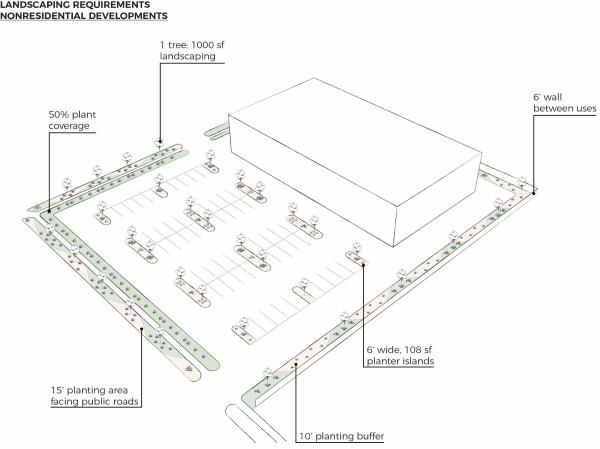
6. Water-Conserving Landscape Design Requirements for Multi-family, Professional Office, Public, Commercial and Industrial uses.
a. General Water-conserving Design.
i. Plants selected for landscape areas shall be well-suited to the microclimate and soil conditions at the project site. Plants with similar water needs shall be grouped together as much as possible.
ii. Areas with slopes greater than 25% shall be landscaped with deep-rooting, water-conserving plants for erosion control and soil stabilization. No turf grasses or overhead irrigation is allowed on slopes greater than 25%.
iii. Exemptions. Sports fields, turf play areas within parks, school grounds, golf courses and cemeteries may be deemed exempt from the landscape water allowance limitations of this chapter with approval by the Community Development Director. All other portions of this chapter shall apply.
iv. Mulch. After the completion of planting, all irrigated non-turf areas shall be covered with a minimum three (3) inch to four (4) inch layer of mulch to retain water, inhibit weed growth, and moderate soil temperature. Nonporous material shall not be placed under the mulch. Drip irrigation is required where turf grasses are not being utilized.
v. Soil Preparation. Soil preparation will be suitable to provide healthy growing conditions for the plants and to encourage water infiltration and penetration. Soil preparation shall include scarifying the soil to a minimum depth of six inches (6") and amending the soil with organic material as per recommendations of the landscape designer/ landscape architect based on the required soils report.
b. Plant Selection. The Localscapes® Program, the Salt Lake City Plant List and Hydrozone Schedule 2013 prepared by Salt Lake City Public Utilities, and the Utah State University Center for Water-efficient Landscaping shall be primary references for the design and installation of water-conserving plants and landscapes in Spanish Fork City (see Spanish Fork Water-Conserving Landscape Online Resource List at www.spanishfork.org).
c. Documentation.
i. Landscape Plan Documentation Package. A copy of a landscape plan documentation package shall be submitted to and approved by the City prior to issuance of any permit. The landscape plan documentation package shall be prepared by a professional landscape architect.
ii. The landscape plan documentation package shall consist of the following items:
a. Project Data Sheet. The project data sheet shall contain:
- project name and address;
- applicant or applicant agent's name, address,
- phone and email;
- landscape architects name, address, phone and
- email; and
- landscape contractor's name, address, phone.
b. Planting Plan: A detailed planting plan shall be drawn at an appropriate scale suitable for identifying the location of all plant materials. The plan shall include a summary table indicating the following.
- zoning classification;
- proposed development type/use;
- adjacent development zones and uses;
- project/lot size in acres and square feet;
- landscape requirement in square feet;
- percentage of landscape provided in square feet;
- landscape coverage required in square feet;
- total number parking spaces proposed;
- parking landscape island area required in square feet;
- total number of landscape islands required at 108 square feet minimum area, 6’ minimum width;
- number of trees provided at one (1) tree per 1,000 square feet;
- number of frontage trees required at 30' on center;
- number of buffer trees required at 30' on center; and
- number of frontage trees provided at 30' on center.
c. Irrigation Plan: A detailed irrigation plan shall be drawn at the same scale as the planting plan and shall contain:
- layout of the irrigation system
- a legend summarizing the type and size of all components of the system, including manufacturer name and model numbers;
- inclusion of a WaterSense labeled smart irrigation controller which automatically adjusts the frequency and/or duration of irrigation events in response to changing weather conditions. All controllers shall be equipped with automatic rain delay or rain shut-off capabilities.
- static water pressure in pounds per square inch (psi) at the point of connection to the public water supply;
- flow rate in gallons per minute and design operating pressure in psi for each valve and precipitation rate in inches per hour for each valve with sprinklers;
- EPA Water Allowance Table; and
- installation details for irrigation components.
d. Grading Plan: A grading plan shall be included in the application drawing set at the same scale as the planting plan. The plan shall contain:
- property lines and street names, existing and proposed buildings, walls, fences, utilities, paved areas and other site improvements, and
- existing and finished contour lines and spot elevations for the proposed site improvements.
e. Topsoil Report: A topsoil report shall be provided describing the required depth, composition, and bulk density of the topsoil, in addition to recommendations for soil amendments. The planting plan shall incorporate the recommendations of the topsoil report into the planting specifications.
f. Landscape Water Allowance: Use the WaterSense Water Budget Tool provided by the US Environmental Protection Agency to calculate the water allowance for the site.
- The Water Budget Tool is available as a MS Excel spreadsheet (xlsx).
- The spreadsheet and instructions are available at https://www.epa.gov/watersense/water-budget-tool
E. Landscape Requirements for Multi-family and Non-residential Uses.
1. General Requirements
a. All irrigation systems shall be appropriate for the designated plant material to achieve the highest water efficiency. Drip irrigation and bubbler systems shall be used in all landscape areas except those that contain lawn. Drip irrigation systems shall be equipped with a pressure regulator, filter, flush-end assembly, and any other appropriate components.
b. Each irrigation valve shall irrigate landscaping with similar site, slope and soil conditions, and plant materials with similar watering needs. Lawn and planting beds shall be irrigated on separate irrigation valves. In addition, drip emitters and sprinklers shall be placed on separate irrigation valves.
c. At least three to four (3-4) inches of mulch, permeable to air and water, shall be used in planting beds to control weeds and improve the appearance of the landscaping.
d. At maturity, single-family landscapes are recommended to have enough plant material (perennials and shrubs) to create at least 50% living plant cover at maturity at the ground plane, not including tree canopies.
e. At maturity, multi-family and non-residential landscapes are required to have enough plant material (perennials and shrubs) to create at least 50% living plant cover at maturity at the ground plane, not including tree canopies.
f. Lawn and artificial turf should not be installed in park strips. Lawn should not be installed on paths less than eight (8) feet in width, or on slopes greater than 25% or 4:1 gradient.
2. Trees.
a. Purpose. The planting and growth of healthy trees contribute to making Spanish Fork an attractive and healthy community. Planting the correct type of tree in the right setting is an important factor for ensuring Spanish Fork will continue to be an attractive and resilient city in the future. Landscape design and implementation practices are therefore required to ensure existing trees are preserved to the greatest degree possible, and that newly planted trees survive and thrive. This is particularly important for street trees and trees located in the highly-visible front yards of all properties in the city. The purpose of this section is to define permitted and prohibited trees for use in Spanish Fork and to identify the standards that apply to the selection and planting of correct trees in different locations.
b. Tree Selection and Standards
Planting the right type of tree in the correct setting is an important factor for ensuring that Spanish Fork will continue to be an attractive and resilient city in the future. This is a function of the specific location where the tree is planted, and the size of the soil/planting area, as described below and detailed in the Spanish Fork Approved Street and Shade Tree List. In addition to those requirements, tree restrictions may be subject to requirements of other government agencies (UDOT, for example) and utilities with below and above-ground electrical, gas and cable services. In order to accomplish this, the following standards and practices shall be required.
i. Selection and planting of street trees contained in the Spanish Fork Approved Street and Shade Tree List.
ii. Existing trees should be preserved whenever possible.
iii. When removing vegetation and plantings around the trunks and bases of existing trees when installing water efficient landscapes, special care should be taken to not damage the roots of existing trees.
iv. Newly planted trees need additional water during the first years of planting in order to become established. In addition to properly designed irrigation systems, other methods such as drip hoses and “gator bags” should be used to provide more water for new trees, particularly when irrigation water is unavailable.
v. Street trees shall be selected based on a combination of their approximate size at maturity, Tree Size at maturity as follow:
- Large Trees –45 feet tall or greater at maturity;
- Medium Trees –30-45 feet tall at maturity;
- Small Trees – less than 30 feet tall at maturity.
vi. Nursery Stock Specifications - trees should be grown in a recognized nursery in accordance with good horticultural practice (American Association of Nurseryman Standards, ANSI Z60.1, as amended, or similar). Trees should be healthy, vigorous stock grown under climatic conditions similar to the locality of the project and free of disease, insects, eggs, larvae, and defects such as knots, sun-scale, injuries, abrasions, or disfigurement.
vii. Minimum Tree Size: the minimum size of all deciduous trees shall be two (2) inch caliper minimum, measured as provided in the American Association of Nurseryman Standards, ANSI Z60.1, as amended, or similar. Evergreen trees shall be not less than six (6) feet in height, measured from ground level, unless approved in writing by the Community Development Director.
viii. Permitted Trees - General
- Large Planting Areas: Select from the Large Tree List. Planting area width shall be a minimum of 10 feet wide, which is generally sufficient to accommodate large trees with maximum size, shade and energy conservation benefits, while providing space for root and branch growth that will not conflict with site features;
- Medium Planting Areas: Select from the Medium Tree List. Planting area width shall be a minimum of eight (8) feet wide, which is generally sufficient to accommodate medium size trees while providing space for root and branch growth that will not conflict with site features;
- Small Planting Areas: Select trees from the Small Tree List. Planting area width shall be no smaller than six (6) feet, which is considered the absolute minimum space necessary to accommodate small size trees.
c. Prohibited Tree List
- See Prohibited Tree List.
d. Street Trees and Park Strip Design
- See Spanish Fork Approved Street and Shade Tree List and other requirements.
- Park strips shall be designed as part of the adjacent use and landscape treatment.
3. Other Standards, Requirements and Maintenance Considerations
a. Artificial turf is a synthetic ground cover designed to mimic the appearance of natural grass. It consists of fibers made from polypropylene, polyethylene, or a blend of these materials, tufted onto a backing material such as polypropylene or polyurethane. Artificial turf features lifelike blades with a minimum pile height of 1.5 inches and includes a mix of at least two shades of green and a thatch layer of beige or tan. Indoor or outdoor carpeting is not artificial turf and it is prohibited to use crumb rubber as infill material for artificial turf. Synthetic ground coverings installed for use as putting greens, bocce courts or for other similar activities are not considered artificial turf. The use of artificial turf in front yards and side yards that are visible from the street is subject to the same area limitations that apply to the use of lawn.
b. Zero-scape is a landscape design method that eliminates the need for irrigation water by eliminating plants from the landscape. Zero-scape landscapes are typified by yards and landscape areas covered with pavement, other paving and hardscape materials, gravel, rock and stone. Zero-scape landscapes treatments in park strips, front yards and side yards that are visible from the street do not meet the goals of creating an attractive and livable city and are not permitted in Spanish Fork City.
c. Shrubs over five feet in height and/or-width at maturity shall be five (5) gallons minimum when planted. Smaller shrubs, ground covers, perennials, forbs and decorative grasses shall be one (1) gallon size minimum when planted.
d. Planting areas shall be separated from parking areas and driveways by a raised six (6) inch concrete curb.
e. Landscaped areas shall be maintained in a neat, clean, and orderly condition. This includes the removal of litter, proper pruning, lawn mowing, weeding, deadheading for perennial plants, fertilizing, replacement of dead plants, and regular watering of all landscaped areas.
f. The Community Development Director may waive, at their discretion, the size requirements for required landscaping provided that the developer provides financial assurance that the landscaping will survive or be replaced after the first two (2) growing seasons. Trees and bushes shall be replaced after the first two (2) growing seasons if they die or fail to reach the minimum required size by October 15 of the second year after the landscaping was installed and inspected by the City
F. Plan Review, Construction Inspection and Post-Construction Monitoring
- As part of the site plan or subdivision application, a copy of the required landscape plan documentation package shall be submitted to the city for review and approval before a permit shall be issued and construction begins.
- All landscape plan documentation packages submitted must be stamped by a professionally licensed landscape architect (PLA).
- All installers, designers and auditors shall meet State and local license, insurance, and bonding requirements, and be able to show proof of such.
- During construction, site inspection may be performed by the Community Development Department.
- A guarantee of the installation of required improvements shall be made to the City in the form of a deposit for the estimated cost of required work at the time of building permit issuance.
- Spanish Fork City reserves the right to perform site inspections at any time before, during or after the irrigation system and landscape installation, and to require corrective measures if requirements of this chapter are not satisfied.
G. Links and References. www.spanishfork.org/waterwise.
(Ord. No. 23-10, Amended 11/16/2010)
(Ord. No. 10-14, Amended 05/20/2014)
(Ord. No. 15-15, Amended 09/15/2015)
(Ord. No. 05-16, Amended 04/05/2016)
(Ord. No. 14-16, Amended 09/20/2016)
(Ord. No. 04-17, Amended 02/07/2017)
(Ord. No. 01-17, Amended 01/03/2017)
(Ord. No. 25-17, Amended 10/17/2017)
(Ord. No. 03-18, Amended 02/20/2018)
(Ord. No. 06-19, Amended 04/16/2019)
(Ord. No. 12-19, Amended 06/18/2019)
Amended by Ord. 22-19 on 10/7/2019
Amended by Ord. ORD 08-20 on 6/16/2020
Amended by Ord. 09-2023 Amending Title 25 of the Spanish Fork Municipal Code Pertaining to Landscape Regulations on 6/6/2023
Amended by Ord. 24-2023 Amending Various Sections of the Spanish Fork Municipal Code Pertaining to Title 15 updates and Amendments Regarding Adding Illustrations, Mailboxes, and Off-Street Parking on 12/12/2023 on 12/12/2023
Amended by Ord. 19-2024 Amending Title 15.4.16.130, of the Spanish Fork Municipal Code Pertaining to Landscaping, Buffering Walls, and Fences on 10/15/2024
Amended by Ord. 20-2024 Amending Title 15 of the Spanish Fork Municipal Code Pertaining to Event Centers and Entertainment Uses on 12/10/2024
Amended by Ord. 13-2025 Title 15 Amendments: Adding Event Center to C-O on 10/21/2025
15.4.16.140 Solid Waste Receptacle Areas
Multi-family dwellings, and non-residential uses shall provide solid waste receptacle areas screened on three (3) sides with a masonry wall having a height at least one (1) foot above any receptacle or container. A steel site-obscuring gate at least six (6) feet in height is required. This requirement may be waived or modified by the DRC when it is determined that a “roll-out” residential style container is sufficient for the type of operation proposed, or, the screen wall requirement may be waived when solid waste receptacle areas are sufficiently screened or otherwise located within the project to not be visible by or adversely impact adjoining properties.
Amended by Ord. 09-2023 Amending Title 15 of the Spanish Fork Municipal Code Pertaining to Landscape Regulations on 6/6/2023
15.4.16.150 Fencing And Clear Vision Area
- General Fencing Requirements
- A Building Permit is required for all fences that are taller than three (3) feet. No fee is charged for Fence Permits unless the Permit is required by the Building Code.
- The maximum height of a fence is six (6) feet in all non-industrial zoning districts; fence pillars are not to exceed six and one-half (6 1/2) feet in height. The Council may waive the height requirement at its sole discretion. In the industrial 1, Industrial 2 and Industrial 3 and Public Facilities zones, fences, fence pillars and walls may be eight (8) feet tall.
- The maximum height of a solid fence within the front yard setback area is three (3) feet. Substantially open fences such as chain link, or wrought iron may be four (4) feet high.
- A residential lot with over 200 feet of frontage and that is a minimum of 20,000 square feet in areas, may obtain permission from the Community Development Director to locate a solid six (6) foot tall fence within a front yard. The fence must maintain a minimum setback of 10 feet from the front property line
- A fence located within the front yard setback shall not be located in front of the residence, but must be to the sides of the residence. Clear vision requirements shall still apply
- No more than 50% of the lot frontage shall have said fencing within the front yard setback.
- The area between said fencing and the property line shall be landscaped within one (1) year of installing said fencing.
- A residential lot with over 200 feet of frontage and that is a minimum of 20,000 square feet in areas, may obtain permission from the Community Development Director to locate a solid six (6) foot tall fence within a front yard. The fence must maintain a minimum setback of 10 feet from the front property line
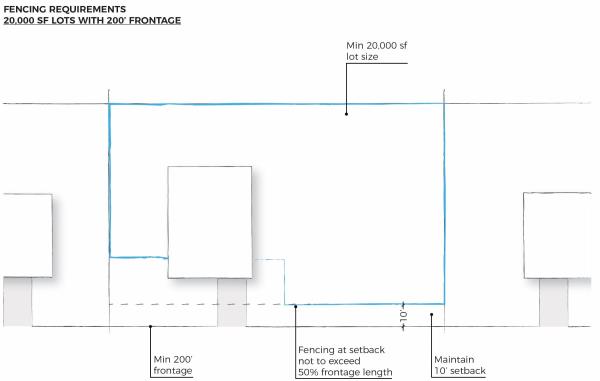
- An irregular shaped residential lot with over 200 feet of frontage and that is a minimum of 15,000 square feet in area, may obtain permission form the Community Development Director to locate a solid six (6) foot tall fence within a front yard.
- A fence located within the front yard setback shall not be located in front of the residence, but must be to the sides of the residence. Clear vision requirements shall still apply.
- No more than 60% of the lot frontage shall have said fencing within the front yard setback.
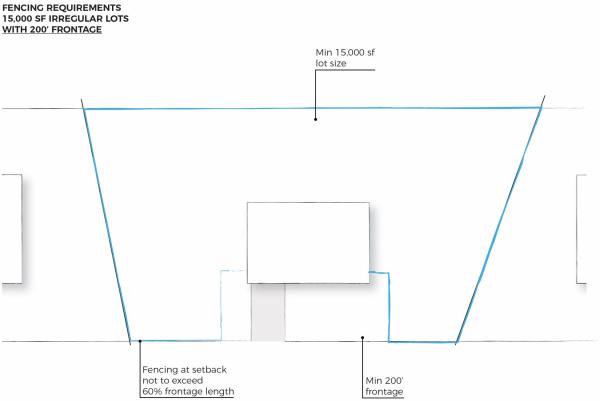
- Barbed wire fencing is allowed in A-E, R-R, I-1 and I-2 districts.
- Razor wire and other similar type fencing are allowed in C-2, I-1 and I-2 districts when located above a height of six (6) feet, subject to DRC approval. Additional screening of any such fence with plant materials may be required.
- Fences must be built with a minimum setback of three (3) feet around the following utilities: fire hydrants, water meters (culinary and irrigation), telephone pedestals, power boxes and cable boxes.
- The clear vision area is formed by extending lines from each curb face to the point that the lines intersect, measuring back 45 feet along each curb face and connecting those points. Fencing, planting and other obstacles are restricted within this area as follows:
- No solid fence shall exceed a height of three (3) feet, measured from the curb. Open fences such as chain link and wrought iron may be as tall as four (4) feet in the clear vision area, measured from the curb.
- Trees in park strips shall be pruned to maintain a clear area below 14 feet in height.
- Trees on private property must be pruned to maintain a clear area below eight (8) feet in height.
- Other site obscuring obstacles of that are three (3) feet or taller may not be placed in the clear vision area.
- A second clear vision area is also required at each driveway or where the rear of a corner lot adjoins an interior lot’s driveway. This clear vision area is formed by extending lines from the point that the driveway or property line intersects the sidewalk, measuring back 20 feet along the sidewalk and the driveway or property line and connecting those points. The same restrictions for landscaping, fencing and obstacles apply in this area.
- The clear vision area is formed by extending lines from each curb face to the point that the lines intersect, measuring back 45 feet along each curb face and connecting those points. Fencing, planting and other obstacles are restricted within this area as follows:
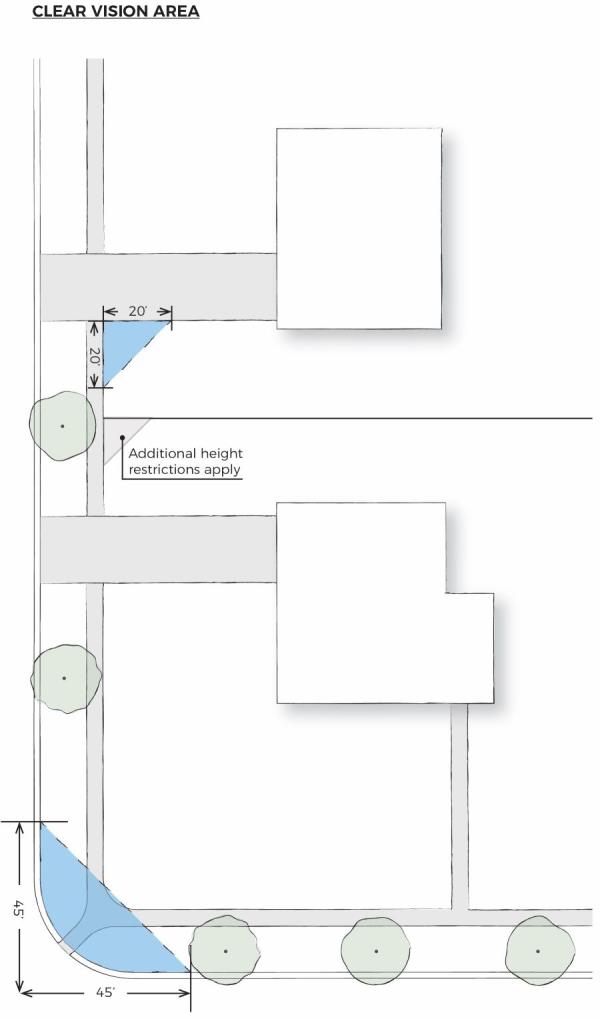
Amended by Ord. 09-2023 Amending Title 15 of the Spanish Fork Municipal Code Pertaining to Landscape Regulations on 6/6/2023
Amended by Ord. 22-2023 Amending Section 15.4.16.150 Fencing and Clear Vision Area of the Spanish Fork Municipal Code Pertaining to the Height and Setback Requirements for Fences in Irregular Shaped Residential Lots on 10/17/2023
Amended by Ord. 24-2023 Amending Various Sections of the Spanish Fork Municipal Code Pertaining to Title 15 updates and Amendments Regarding Adding Illustrations, Mailboxes, and Off-Street Parking on 12/12/2023 on 12/12/2023
Amended by Ord. 20-2024 Amending Title 15 of the Spanish Fork Municipal Code Pertaining to Event Centers and Entertainment Uses on 12/10/2024
Amended by Ord. 02-2026 Fencing and Clear Vision Area on 4/7/2026
15.4.16.160 Site Reclamation
Upon redevelopment of sites, which are 10 acres or larger in size, which have concrete products from prior uses available on site, limited to old gravel pits or construction dump sites, and the concrete products are of use in constructing new improvements in the new development, portable rock crushers may be allowed to help prepare the material that is on-site for reuse in the new development. Crushed material shall neither be exported from the site, nor shall material be brought to the site from another location to be crushed. The crusher must be a minimum of 200 feet from a neighboring property line. The crushing operation shall only be permitted for a limited and specified duration of time, as determined by the Community Development Director. Appropriate measures for that site shall be imposed by the Community Development Director to limit the impact of noise and dust on surrounding land uses, including a limited time and specified hours. (Ord. No. 16-14, Enacted 11/18/2014)
15.4.16.170 Hillside Development
- Introduction. The procedures contained in this section are provided to give direction to consultants as to when slope stability analysis should be completed and minimum general guidelines for completing the analysis. Additional effort above and beyond these requirements may be required based on site specific constraints and characteristics.
- Purpose and Intent. The standards, guidelines and criteria of this section are intended to:
- Protect the public from flooding, erosion and other environmental hazards that may result from the development of sensitive hillsides;
- Minimize the threat and consequential damage of fire in hillside areas;
- Preserve natural vegetation, geologic features, wildlife habitat and open space;
- Minimize the amount of grading and earthwork, including street excavation and site grading;
- Design and construct roads, where necessary, in such a way as to minimize scars from cuts and fills and to avoid permanent scarring of hillsides and other sensitive land areas, and to make them easily accessible for fire protection, snow removal, school buses, and emergency vehicles; and
- Preserve and enhance visual and environmental quality.
- Slopes. Any land or parcel having a slope greater than or equal to 3H:1V shall be deemed to be land having a "steep slope" within the meaning of this section. Close proximity to a steep slope shall be defined as the horizontal distance from the slope which is less than or equal to the vertical distance from the crest of the slope to the toe of the slope. No person shall be permitted to grade, excavate, fill, erect any structure, or otherwise disturb an undisturbed hillside area that exceeds a 3H:1V slope. Any person proposing to grade, excavate, fill or to erect any structure on any slope or hillside with a slope between 4H:1V and 3H:1V or within close proximity to a slope greater than or equal to 4H:1V, shall be required to submit a site-specific geotechnical report with a slope stability analysis. Other areas that require a slope stability analysis are discussed in paragraph H below. The City will have that report reviewed by its own geotechnical engineer. The cost of that review will be borne by the applicant.
Prior to any excavation, cutting, or filling on slopes in excess of 10H:1V, a land disturbance permit shall be obtained from the City. Prior to issuing the permit, the City will have qualified professionals review the plans to ensure public safety and to take precautions against potential slides. The type and number of professionals will be determined by the City Engineer on a case by case basis. The cost of the professional review will be borne by the applicant. In no case will construction be allowed in, above, below, or laterally within 200 feet of a landslide, debris flow, or potential debris flow.
Cut and fill slopes shall be constructed to eliminate sharp angles of intersection with the existing terrain and shall be rounded and contoured as necessary to blend with existing topography to the maximum extent possible, as determined in the sole discretion of the City Engineer. The City will not accept the dedication and maintenance of cut and fill slopes except those within the required street right-of-way. Maintenance of cut and fill slopes outside of street rights-of-way are the responsibility of the individual property owner. Where a cut or fill slope occurs between two (2) lots, the slope shall normally be made a part of the downhill lot. Cut and fill slopes shall not be allowed to disrupt existing drainage channels.
The current version of the Building Code adopted by the Utah Uniform Building Code Commission regulating excavation and grading shall be complied with. - Building Sites. Each building lot shall contain a buildable area of not less than 4,000 square feet with a natural slope that is less than 3H:1V. The buildable area shall have minimum length and depth dimensions of 50 feet.
No structure, primary or accessory, shall be located within 20 feet of a 3H:1V slope. No slope in excess of 10H:1V shall be disrupted without first obtaining a land disturbance permit, described in paragraph D.
An exception to these building site requirements is granted for existing building lots in platted and recorded subdivisions, provided that each lot, prior to construction, provide the geotechnical report required in paragraph A, and as described in more detail in the Construction Standards. - Drainage. Required storm water runoff collection facilities shall be designed so as to retain storm water runoff on development sites for a sufficient length of time so as to prevent flooding and erosion during storm water runoff flow periods. Retainage amounts and times shall mirror historical amounts and times. Required storm water runoff collection facilities shall be so designed as to divert surface water away from natural slopes, cut faces, or sloping surfaces of a fill. French drains are not acceptable.
Storm water detention or retention facilities should not be placed near the crest of natural or manmade slopes.
Curb, gutter, and pavement designs shall be such that water on roadways is prevented from flowing off the roadways.
Natural drainage shall be rip-rapped or otherwise stabilized to the satisfaction of the City Engineer below drainage and culvert discharge points for a distance sufficient to convey the discharge without channel erosion.
Waste material from construction, including soil and other solid materials, shall not be deposited within a natural or manmade drainage course nor within irrigation channels.
Sediment catchment ponds shall be constructed downstream from each development, unless sediment retention facilities are otherwise provided. - Vegetation and Revegetation. Every effort shall be made to conserve topsoil which is removed during construction for later use on areas requiring vegetation or landscaping, e.g., cut and fill slopes.
Areas not contained within lot boundaries shall be protected with adapted, fire-resistant species of perennial vegetation cover after all construction is completed. New planting shall be protected with organic cover.
All disturbed soil surfaces shall be stabilized before final acceptance of the development by the City. The developer shall be fully responsible for any destruction of native vegetation which is required to be retained in all areas under the ownership and control of the developer. The developer shall carry the responsibility for such areas both for the developer’s own employees and for all subcontractors from the first day of construction until final acceptance of the development by the City. The developer shall be responsible for replacing such destroyed vegetation.
Prior to the termination of the development improvements bond, any dead plant materials required to be installed by the developer shall be replaced and a new bond issued to assure establishment of the replaced materials. - Areas Requiring Slope Stability Analysis. Slope stability analysis shall be performed for all sites meeting the following criteria:
- Cut or fill slopes at or steeper than 3H:1V and 20 feet or taller in vertical height.
- Natural slopes at or greater than 4H:1V but less than 3H:1V, and 20 feet or taller in vertical height. Natural slopes at or steeper than 3H:1V shall not be disturbed without the Development Review Committee’s approval. A slope exceeding 3H:1V may be disturbed if the hillside is determined to have existing, potentially adverse geologic conditions, in which case the City Engineer or his/her designee may approve remediation efforts.
- Natural and cut slopes with potentially adverse geologic conditions such as bedding, foliation, or other features that could present slope stability issues.
- Natural and engineered slopes that are potentially impacted by a geologic hazard such as a landslide, irrespective of the slope height or gradient.
- Buttresses and stability fills.
- Cut, fill or natural slopes for water retention basins or flood-control channels.
- Slope Stability Analysis Requirements.
- Slope stability analyses should consider off-property conditions above and below the slope being evaluated. Analysis should demonstrate that the proposed hillside development will not affect adjacent sites or limit adjacent property owner’s ability to develop their site.
- A licensed, experienced geotechnical engineer and licensed, experienced geologist should be used to complete all slope stability analyses. The geologist and geotechnical engineer should collaborate their efforts to develop a rational subsurface model, ground motion parameters and soil strengths. The geotechnical engineer should perform the stability calculations, the geologist shall interpret geologic data and prepare the subsurface model (geologic cross section), and both shall stamp the final report.
- Except for the derivation of the input ground motion for pseudo-static and seismic deformation analyses, slope stability analysis and evaluations should be performed in general accordance with Recommended Procedures for Implementation of DMG Special Publication 117, Guidelines for Analyzing and Mitigating Landslide Hazards in California (Blake et al. 2002).
- Static and pseudo-static slope stability should be completed using limit-equilibrium software such as SLIDE, SLOPE/W or another similar program. Analysis method chosen (circular, block, etc.) should be best suited toward the specific site and geologic conditions. Subsurface conditions in the model should represent worst-case anticipated conditions with regards to groundwater elevation and moisture content characteristics of the soil.
- Design ground motions for use in the pseudo-static and seismic deformation analysis should be based on the PGA as determined from probabilistic analysis for the maximum credible earthquake (MCE), with spectral acceleration factored for site conditions in accordance with the currently adopted IBC. Seismic analysis of a slope may be performed using the pseudo-approach. An appropriate seismic coefficient should be selected based on a rational approach, such as Blake et. al 2002, Hynes and Franklin 1984, or a similar published and generally accepted procedure. A rational basis for selection of seismic coefficient (e.g. probabilistic ground motion, Site Class, etc.) shall be clearly presented in the final report.
- For situations where unacceptable factors of safety are determined or when the site contains other constraints such as long shallow failures, a permanent slope deformation analysis should be performed. Estimates of permanent seismic displacement should be performed using the procedures outlined in Bray and Travesarou (2007). For this and other screening procedures, the calculated seismic displacements shall be 5 cm or less for a slope or proposed mitigation measure.
- The minimum acceptable factor of safety for static slope stability is 1.5. The minimum acceptable factor of safety for pseudo-static slope stability is 1.0. These are the minimums required by the City; based on actual conditions and the uncertainties associated with the site, the Geotechnical Engineer may select higher factors of safety, as deemed appropriate.
- Adequate evaluation of slope stability for a given site requires a thorough and comprehensive geologic and geotechnical engineering investigation. The investigation should include but may not be limited to the following; review of available published geologic information (including maps, reports, and historic air photos), geologic field mapping, subsurface exploration, groundwater elevation determination and accurate soil profile characterization. Borings should extend to a depth of at least ¾ of the height of the slope at a minimum and preferably the full height of the slope (this requirement may be waived if the geology is clearly exposed on the slope face). Deeper borings may be required based on the site conditions and proposed construction. Test pits may be allowed, particularly for shorter slopes, if access can be obtained to allow placement of the test pits near the top, bottom and middle of the slope so as to provide an accurate characterization of the soil profile, and geologic conditions allow a reasonable geologic interpretation of the entire slope based on the earth materials exposed in the test pits.
- Accurate soil parameters are critical to providing a reliable slope stability analysis. Samples should be obtained from each soil strata of reasonably different engineering characteristics and appropriate laboratory tests completed to determine parameters for shear strength (friction angle and cohesion) and unit weight for each layer. In the case of landslide deposits tests to assess residual shear strengths should be performed in suspected shear zones to obtain accurate soil information. Direct shear, ring shear, simple shear, or triaxial shear tests (as appropriate) should be completed to obtain shear strength parameters. For unconsolidated granular soils, in-situ testing (e.g. SPT, CPT) may also be used to develop soil strength profiles.
- Streets and Driveways. All streets within a hillside area shall be designed to meet the standards required for streets in all other areas of the City. Street and driveway grades shall not exceed 8%, unless authorized by the City Engineer. The City Engineer may not authorize street or driveway grades in excess of 12%.
- Submittals. Submittals for review shall include report text that should contain a summary of the analysis along with conclusions and recommendations based on the data presented. As a minimum, all reports should include the following element:
- Slope stability modeling – basis for model, input data, and graphic output.
- Boring and/or test pit logs.
- Geologic cross sections prepared by a licensed geologist (graphic output from a limit equilibrium software will not be accepted as a substitute for a geologic cross section). Subsurface geologic and groundwater conditions must be illustrated on geologic cross sections and must be utilized by the Geotechnical Engineer for the slope stability analyses.
- A local geology map presenting the results of field mapping and literature review. The map should be prepared at an appropriate scale (generally no smaller than 1”=100’, larger is preferred), and should show geologic units, geologic structures/orientations, proposed and existing grades, and the location of the geologic cross-sections.
- Laboratory data including shear strength plots.
- Computer input and output files for the slope stability analysis.
- Fire Protection. Lot size and potential placement of buildings thereon shall be such that adequate clearance from combustible materials is provided, as determined by the City’s Fire Marshal.
All easements for firebreaks for safety of built-up areas shall encompass access for firefighting personnel and equipment and such easements shall be dedicated for this specific purpose by being recorded with the plat, or by easement if there is no plat.
The inability to provide water pressure at fire hydrants consistent with the standards set by the Insurance Service Organization for fighting fires shall be justification for denial of a development request.
(Ord. No. 07-15, Enacted 02/17/2015)
Amended by Ord. 17-19 on 9/2/2019
15.4.16.180 Neighborhood Mailboxes
Residential Preliminary Plats are required to identify locations for neighborhood mailboxes, also known as Neighborhood Delivery Collection Box Units, meeting the following criteria:
- Neighborhood mailboxes shall contain collection boxes with one (1) unit for each lot in a residential subdivision that is less than 6,000 square feet and two (2) units for each lot that is 6,000 square feet or larger.
- Location of neighborhood mailboxes must be approved by the City after considering factors such as street design, traffic levels, traffic movements, impact on adjacent properties and convenience for the neighborhood residents.
- Neighborhood mailboxes may not be located on collector or arterial roads unless otherwise approved by the City.
- Neighborhood mailboxes are to be located at least 200 feet from an intersection.
- Residential units in more than one Final Plat may share a neighborhood mailbox location, provided that the neighborhood mailboxes are to be installed with the first Final Plat approved which shares that neighborhood mailbox location and no Certificates of Occupancy will be issued until there is a neighborhood mailbox available for that residential unit.
- Neighborhood mailboxes are to be placed in the park strip between the sidewalk and the curb.
- Neighborhood mailboxes are to be anchored in concrete from the curb to the sidewalk and out two (2) feet on either side of the boxes.
- United States Postal Service regulations for Neighborhood Delivery Collection Box Units must be followed.
(Ord. No. 03-18, Enacted 02/20/2018)
Amended by Ord. 24-2023 Amending Various Sections of the Spanish Fork Municipal Code Pertaining to Title 15 updates and Amendments Regarding Adding Illustrations, Mailboxes, and Off-Street Parking on 12/12/2023 on 12/12/2023
15.4.20.010 Statutory Authorization, Findings Of Fact, And Purpose And Methods
- Statutory Authorization. The City of Spanish Fork elects to comply with the requirements of the National Flood Insurance Act of 1968 (P.L. 90-488, as amended). The National Flood Insurance Program (NFIP) is a voluntary program administered by the Federal Emergency Management Agency (FEMA), a component of the U.S. Department of Homeland Security, and City of Spanish Fork community officials have elected to join the program, participate, and enforce this Flood Damage Prevention Ordinance and the requirements and regulations of the NFIP. The NFIP, established in the aforesaid act, provides that areas of the City of Spanish Fork having a special flood hazard be identified by FEMA, and that floodplain management measures be applied in such flood hazard areas. Furthermore, City of Spanish Fork may elect to administer the Flood Damage Prevention Ordinance to areas not identified as Special Flood Hazard Areas (SFHAs) by FEMA on the community’s effective Flood Insurance Rate Map (FIRM), if the community has documentation to support that there is an inherent risk of flooding in such areas.
- Finding of Fact
- The flood hazard areas of the City of Spanish Fork are subject to periodic inundation which results in loss of life and property, health and safety hazards, disruption of commerce and governmental services, and extraordinary public expenditures for flood protection and relief, all of which adversely affect the public health, safety, and general welfare.
- These flood losses are created by the cumulative effect of obstructions in floodplains that cause an increase in flood heights and velocities, and by the occupancy of flood hazards areas by uses vulnerable to floods and hazardous to other lands because they are inadequately elevated, flood-proofed, or otherwise protected from flood damage.
- Statement of Purpose. It is the purpose of this ordinance to promote the public health, safety, and general welfare and to minimize public and private losses due to flood conditions in specific areas by provisions designed to:
- Protect human life and health;
- Minimize expenditure of public money for costly flood-control projects;
- Minimize the need for rescue and relief efforts associated with flooding that are generally undertaken at the expense of the general public;
- Minimize prolonged business interruptions;
- Minimize damage to public facilities and utilities, such as water and sewer mains, electric and telephone lines, and streets and bridges located in floodplains.
- Help maintain a stable tax base by providing for the sound use and development of flood-prone areas in such a manner as to minimize blight to future flood-prone areas;
- Ensure that potential buyers are notified that property is in a flood area.
- Methods of Reducing Flood Losses. In order to accomplish its purposes, this ordinance uses the following methods:
- Restrict or prohibit uses that are dangerous to health, safety or property in times of flood, or cause excessive increases in flood heights or velocities;
- Require that uses vulnerable to floods, including facilities which serve such uses, be protected against flood damage at the time of initial construction;
- Control the alteration of natural floodplains, stream channels, and natural protective barriers, which are involved in the accommodation of flood waters;
- Control filling, grading, dredging and other development which may increase flood damage;
- Prevent or regulate the construction of flood barriers which will unnaturally divert flood waters or which may increase flood hazards to other lands.
Adopted by Ord. 07-20 on 6/16/2020
15.4.20.020 Definitions
Unless specifically defined in Section 15.1.04.020, words or phrases used in this ordinance shall be interpreted to give them the meaning they have in common usage and to give this ordinance its most reasonable application.
Adopted by Ord. 07-20 on 6/16/2020
15.4.20.030 General Provisions
- Lands to which this Ordinance Applies. The ordinance shall apply to all areas of special flood hazard identified by FEMA within the jurisdiction of the City of Spanish Fork.
- Basis for Establishing the Areas of Special Flood Hazard. The areas of special flood hazard identified by the Federal Emergency Management Agency in a scientific and engineering report entitled, "The Flood Insurance Study for Utah County and Incorporated Communities," dated June 19, 2020, with accompanying FIRMs, and any revisions thereto are hereby automatically adopted by reference and declared to be a part of this ordinance.
- Annexation. When the community annexes any land from a neighboring jurisdiction, the City of Spanish Fork will manage and regulate the annexed land under this ordinance.
- Establishment of Development Permit. A Floodplain Development, preliminary plat approval, site plan approval, or a building permit, shall be required to ensure conformance with the provisions of this ordinance.
- Compliance. No structure or land shall hereafter be located, altered, or have its use changed without full compliance with the terms of this ordinance and other applicable regulations.
- Abrogation and Greater Restrictions. This ordinance is not intended to repeal, abrogate, or impair any existing easements, covenants, or deed restrictions. However, where this ordinance and another ordinance, easement, covenant, or deed restriction conflict or overlap, whichever imposes the more stringent restrictions shall prevail.
- Interpretation. In the interpretation and application of this ordinance, all provisions shall be:
- considered as minimum requirements;
- liberally construed in favor of the governing body; and
- deemed neither to limit nor repeal any other
- Warning and Disclaimer. The degree of flood protection required by this ordinance is considered reasonable for regulatory purposes and is based on scientific and engineering considerations. On rare occasions greater floods can and will occur and flood heights may be increased by man-made or natural causes. This ordinance does not imply that land outside the areas of special flood hazards or uses permitted within such areas will be free from flooding or flood damages. This ordinance shall not create liability on the part of the community or any official or employee thereof for any flood damages that result from reliance on this ordinance or any administrative decision lawfully made thereunder.
- Severability. If any section, provision, or portion of this ordinance is adjudged unconstitutional or invalid by a court, the remainder of the ordinance shall not be affected.
Adopted by Ord. 07-20 on 6/16/2020
15.4.20.0400 Administration
- Designation of the Floodplain Administrator. The City Engineer or his/her appointee is hereby appointed the Floodplain Administrator and implement the provisions of this ordinance and other appropriate sections of 44 CFR (National Flood Insurance Program Regulations) pertaining to floodplain management.
- Duties and Responsibilities of the Floodplain Administrator. Duties and responsibilities of the Floodplain Administrator shall include, but not be limited to, the following:
- Maintain and hold open for public inspection all records pertaining to the provisions of this ordinance.
- Review permit application to determine whether proposed building site, including the placement of manufactured homes, will be reasonably safe from flooding.
- Review, approve or deny all applications for development permits required by adoption of this ordinance.
- Review permits for proposed development to assure that all necessary permits have been obtained from those Federal, State or local governmental agencies (including Section 404 of the Federal Water Pollution Control Act Amendments of 1972, 33 U.S.C. 1334) from which prior approval is required.
- Where interpretation is needed as to the exact location of the boundaries of the areas of special flood hazards (for example, where there appears to be a conflict between a mapped boundary and actual field conditions) the Floodplain Administrator shall make the necessary interpretation.
- Notify, in riverine situations, adjacent communities and the State Coordinating Agency which is State Engineer’s office, prior to any alteration or relocation of a watercourse, and submit evidence of such notification to the Federal Emergency Management Agency.
- Assure that the flood carrying capacity within the altered or relocated portion of any watercourse is maintained.
- When base flood elevation data has not been provided in accordance, the Floodplain Administrator shall obtain, review and reasonably utilize any base flood elevation data and floodway data available from a Federal, State or other source, in order to administer the provisions of this ordinance.
- When a regulatory floodway has not been designated, the Floodplain Administrator must require that no new construction, substantial improvements, or other development (including fill) shall be permitted within Zones A1-30 and AE on the community's FIRM, unless it is demonstrated that the cumulative effect of the proposed development, when combined with all other existing and anticipated development, will not increase the water surface elevation of the base flood more than one foot at any point within the community.
- Under the provisions of 44 CFR Chapter 1, Section 65.12, of the National Flood Insurance Program regulations, a community may approve certain development in Zones A1-30, AE, AH, on the community's FIRM which increases the water surface elevation of the base flood by more than one foot, provided that the community first applies for a conditional FIRM revision through FEMA (Conditional Letter of Map Revision).
- Permit Procedures. Application for a preliminary plat, site plan, or building permit within a special floodplain hazard area shall be presented to the Floodplain Administrator on forms furnished by him/her and may include, but not be limited to, plans in duplicate drawn to scale showing the location, dimensions, and elevation of proposed landscape alterations, existing and proposed structures, including the placement of manufactured homes, and the construction fences, and the location of the foregoing in relation to areas of special flood hazard and areas of special erosion hazard.
Additionally, the following information is required:
- Elevation (in relation to mean sea level), of the lowest floor (including basement) of all new and substantially improved structures;
- Elevation in relation to mean sea level to which any nonresidential structure shall be floodproofed;
- A certificate from a registered professional engineer or architect that the nonresidential floodproofed structure shall meet the floodproofing criteria of Section 15.4.20.050(B);
- Description of the extent to which any watercourse or natural drainage will be altered or relocated as a result of proposed development.
- A bank stability/erosion hazard analysis performed by a licensed professional engineer, including site photographs, that evaluates potential flood-related erosion hazards and identifies appropriate erosion hazard mitigation measures to protect any structural improvements proposed in the area of special erosion hazard.
- A geotechnical report that includes: at least one measurement of the ambient groundwater surface elevation on the site of proposed development collected between May 1 and May 31 (unless otherwise approved by the Floodplain Administrator); an engineer' s estimate of the maximum anticipated groundwater elevation anticipated on the site during periods of flooding on the Spanish Fork River, referencing nearby base flood elevations on the current FIRM and all other available sources; and an engineer's recommendation with regard to the lowest elevation(s) that the lowest floor(s) (including basement) of all new and substantially improved structures should be constructed to be protected from flooding from groundwater and groundwater that could be influenced by surface water during periods of flooding.
- A grading permit shall be obtained from the Floodplain Administrator before any excavation or fill work that could modify the flood hazards defined on the community's FIRM is completed in the area of special erosion hazard area.
- Maintain records of all such information.
- Flood Plain Permit Approval or Denial. Approval or denial of a preliminary plat, site plan, or any permit required by shall be based on all of the provisions of this ordinance and the following relevant factors:
- The danger to life and property due to flooding or erosion damage;
- The susceptibility of the proposed facility and its contents to flood damage and the effect of such damage on the individual owner;
- The danger that materials may be swept onto other lands to the injury of others;
- The compatibility of the proposed use with existing and anticipated development;
- The safety of access to the property in times of flood for ordinary and emergency vehicles;
- The cost of providing governmental services during and after flood conditions including maintenance and repair of streets and bridges, and public utilities and facilities such as sewer, gas, electrical and water systems;
- The expected heights, velocity, duration, rate of rise and sediment transport of the flood waters and the effects of wave action, if applicable, expected at the site;
- The availability of alternative locations, not subject to flooding or erosion damage, for the proposed use; and
- The relationship of the proposed use to the comprehensive plan for that area.
- Variance Procedures. The City Council shall act as the appeal authority and shall hear and render judgment on requests for variances from the requirements of this ordinance.
- Any person or persons aggrieved by the decision of the City Council may appeal such decision in the courts of competent jurisdiction.
- The Floodplain Administrator shall maintain a record of all actions involving an appeal and shall report variances to the Federal Emergency Management Agency and the State Office of Emergency Management upon issuing a variance.
- Variances may be issued for new construction and substantial improvements to be erected on a lot of one-half acre or less in size contiguous to and surrounded by lots with existing structures constructed below the base flood level, providing the relevant factors in Section C of this Article have been fully considered. As the lot size increases beyond the one-half acre, the technical justification required for issuing the variance increases.
- Upon consideration of the factors noted above and the intent of this ordinance, the City Council may attach such conditions to the granting of variances as it deems necessary to further the purpose and objectives of this ordinance.
- Variances shall not be issued within any designated floodway if any increase in flood levels during the base flood discharge would result.
- Variances may be issued for the repair or rehabilitation of historic structures upon a determination that the proposed repair or rehabilitation will not preclude the structure's continued designation as a historic structure and the variance is the minimum necessary to preserve the historic character and design of the structure.
- Prerequisites for granting variances:
- Variances shall only be issued upon a determination that the variance is the minimum necessary, considering the flood hazard, to afford relief.
- Variances shall only be issues upon:
- showing a good and sufficient cause;
- a determination that failure to grant the variance would result in exceptional hardship to the applicant, and
- a determination that the granting of a variance will not result in increased flood heights, additional threats to public safety, extraordinary public expense, create nuisances, cause fraud on or victimization of the public, or conflict with existing local laws or ordinances.
- Any application to whom a variance is granted shall be given written notice that the structure will be permitted to be built with the lowest floor elevation below the base flood elevation, and that the cost of flood insurance will be commensurate with the increased risk resulting from the reduced lowest floor elevation.
- Variances may be issued by a community for new construction and substantial improvements and for other development necessary for the conduct of a functionally dependent use provided that:
- the criteria outlined in Section 15.4.20.040(D)(1)-(10) are met, and
- the structure or other development is protected by methods that minimize flood damages during the base flood and create no additional threats to public safety.
Adopted by Ord. 07-20 on 6/16/2020
15.4.20.050 Provisions For Flood Hazard Reduction
- General Standards. In all areas of special flood hazards the following provisions are required for all new construction and substantial improvements:
- All new construction or substantial improvements shall be designed (or modified) and adequately anchored to prevent flotation, collapse or lateral movement of the structure resulting from hydrodynamic and hydrostatic loads, including the effects of buoyancy.
- All new construction or substantial improvements shall be constructed by methods and practices that minimize flood damage.
- All new construction or substantial improvements shall be constructed with materials resistant to flood damage.
- All new construction or substantial improvements shall be constructed with electrical, heating, ventilation, plumbing, and air conditioning equipment and other service facilities that are designed and/or located so as to prevent water from entering or accumulating within the components during conditions of flooding.
- All new and replacement water supply systems shall be designed to minimize or eliminate infiltration of flood waters into the system.
- All new construction shall be required to connect to City's sanitary sewer system.
- On-site waste disposal systems shall be located to avoid impairment to them or contamination from them during flooding.
- No solid walls, solid fences, or other structures that could disrupt flowing water in an area of special flood hazard shall be constructed in a position or direction contrary to the direction of flowing water.
- Specific Standards. In all areas of special flood hazards where base flood elevation data has been provided, the following provisions are required:
- Residential and Nonresidential Construction - New residential and nonresidential construction and substantial improvement of any structure shall have the lowest floor (including basement), elevated to two feet above the base flood elevation. A registered professional engineer, architect, or land surveyor shall submit a certification to the Floodplain Administrator that the standards of this ordinance are satisfied.
- Enclosed Areas – including enclosures, crawlspaces, subgrade crawlspaces, and attached garages - new construction and substantial improvements, with fully enclosed areas below the lowest floor that are usable solely for parking of vehicles, building access or storage in an area other than a basement and which are subject to flooding shall be designed to:
- automatically equalize hydrostatic flood forces on exterior walls by allowing for the entry and exit of floodwaters.
- Flood vents meeting ICC-ES standards may be used with the bottom of all openings shall be no higher than one foot above grade and a minimum of two openings, or
- Vents certified by a registered professional engineer or architect meet or exceed the following minimum criteria:
- A minimum of two openings having a total net area of not less than one square inch for every square foot of enclosed area subject to flooding shall be provided.
- The bottom of all openings shall be no higher than one foot above grade.
- Openings may be equipped with screens, louvers, valves, or other coverings or devices provided that they permit the automatic entry and exit of floodwaters. Enclosures are areas that have a height greater than 5 feet from the enclosure floor to the finish floor elevation above. Crawlspaces have at least one side of the crawlspace floor at or above the exterior grade. The crawlspace floor must be less than 5 feet from the finish floor elevation above. Subgrade crawlspaces have an exterior grade that cannot be more than 2’ above crawlspace floor elevation and a finish floor elevation of floor immediately above cannot be more than 5’ above the crawlspace floor.
- Manufactured Homes
- Require that all manufactured homes to be placed within Zone A on a community's FHBM or FIRM shall be installed using methods and practices which minimize flood damage. For the purposes of this requirement, manufactured homes must be elevated and anchored to resist flotation, collapse, or lateral movement. Methods of anchoring may include, but are not limited to, use of over-the-top or frame ties to ground anchors. This requirement is in addition to applicable State and local anchoring requirements for resisting wind forces.
- Require that manufactured homes that are placed or substantially improved within Zones A1-30, AH, and AE on the community's FIRM on sites (i) outside of a manufactured home park or subdivision, (ii) in a new manufactured home park or subdivision, (iii) in an expansion to an existing manufactured home park or subdivision, or (iv) in an existing manufactured home park or subdivision on which a manufactured home has incurred "substantial damage" as a result of a flood, be elevated on a permanent foundation such that the lowest floor of the manufactured home is elevated to or above the base flood elevation and be securely anchored to an adequately anchored foundation system to resist flotation, collapse, and lateral movement.
- In A-1-30, AH, and AE Zones, require that manufactured homes to be placed or substantially improved in an existing manufactured home park to be elevated so that the lowest floor is at or above the Base Flood Elevation; OR the chassis is supported by reinforced piers no less than 36 inches in height above grade and securely anchored.
- Recreational Vehicles - Require that recreational vehicles placed on sites within Zones A1-30, AH, and AE on the community's FIRM either:
- be on the site for fewer than 180 consecutive days and be fully licensed and ready for highway use, or
- meet the permit requirements of Section 15.4.20.040(C), and the elevation and anchoring requirements for "manufactured homes" of this section. A recreational vehicle is ready for highway use if it is on its wheels or jacking system, is attached to the site only by quick disconnect type utilities and security devices and has no permanently attached additions.
- Special Erosion Hazards - In all areas of special erosion hazards the following provisions are required for all new construction or substantial improvements:
- Erosion Hazard. No new construction or substantial improvements shall be designed or constructed until a licensed professional engineer certifies that no erosion hazard exists on the reach of open channel adjacent to or upstream from the proposed site for a distance of at least 150 feet or until any potential erosion hazard is mitigated by measures designed by a registered professional engineer and accepted by the Floodplain Administrator.
- Set Back. All permanent structures shall be set back a minimum of 60 feet from the top of bank of the nearest open channel that conveys runoff water.
- Grading Permit. No excavation or fill that could modify the flood hazards defined on the FIRM shall be performed without applying for and receiving a grading permit from the Floodplain Administrator.
- No solid walls, solid fences, or other structures that could disrupt flowing water in an area of special erosion hazard shall be constructed in a position or direction contrary to the direction of flowing water.
- In all areas of special flood hazard, all areas of special erosion hazard, and areas with potentially high groundwater levels the following provisions are required for all new construction or substantial improvements: As part of the building or development permit process, a geotechnical report shall be completed that includes a licensed professional engineer's recommendation with regard to the lowest elevation(s) that the lowest floor(s) (including basement) of all new and substantially improved structures should be constructed to be protected from flooding from groundwater and groundwater that could be influenced by surface water during periods of flooding.
- Standards for Subdivision Proposals.
- All subdivision proposals including the placement of manufactured home parks and subdivisions shall be consistent with the provisions of this ordinance.
- All proposals for the development of subdivisions including the placement of manufactured home parks and subdivisions shall meet Development Permit requirements of this ordinance.
- Base flood elevation data shall be generated for subdivision proposals and other proposed development including the placement of manufactured home parks and subdivisions which is greater than 50 lots or 5 acres, whichever is lesser.
- All subdivision proposals including the placement of manufactured home parks and subdivisions shall have adequate drainage provided to reduce exposure to flood hazards.
- All subdivision proposals including the placement of manufactured home parks and subdivisions shall have public utilities and facilities such as sewer, gas, electrical and water systems located and constructed to minimize or eliminate flood damage.
- Standards for Areas of Shallow Flooding (AO/AH Zones)
Located within the areas of special flood hazard established in Section 15.4.20.030(B), are areas designated as shallow flooding. These areas have special flood hazards associated with base flood depths of 1 to 3 feet where a clearly defined channel does not exist and where the path of flooding is unpredictable and where velocity flow may be evident. Such flooding is characterized by ponding or sheet flow; therefore, the following provisions apply:
- All new construction and substantial improvements of residential structures have the lowest floor (including basement) elevated above the highest adjacent grade at least as high as the depth number specified in feet on the community's FIRM (at least two feet if no depth number is specified).
- All new construction and substantial improvements of non-residential structures
- have the lowest floor (including basement) elevated above the highest adjacent grade at least as high as the depth number specified in feet on the community's FIRM (at least two feet if no depth number is specified), or;
- together with attendant utility and sanitary facilities be designed so that below the base flood level the structure is watertight with walls substantially impermeable to the passage of water and with structural components having the capability of resisting hydrostatic and hydrodynamic loads of effects of buoyancy.
- A registered professional engineer shall submit a certification to the Floodplain Administrator that the standards of Section 15.4.20.040(C) are satisfied.
- Require within Zones AH or AO adequate drainage paths around structures on slopes, to guide flood waters around and away from proposed structures.
- FIRMs may also identify areas of shallow flooding hazards with an average depth less than 1 foot deep (shaded Zone X). These areas may be between the flood hazard boundaries defined for the 1- and 0.2-percentchance-annual-flood or associated with base flood depths less than 1 foot where a clearly defined channel does not exist and where the path of flooding is unpredictable and where velocity may be evident. Such flooding is generally characterized by sheet flow. Therefore, the following provisions apply for all new construction or substantial improvements of residential and nonresidential structures:
- All new construction or substantial improvements have the lowest floor (including basement) elevated above the estimated depth of the base flood and above the highest groundwater level that is anticipated to occur during periods of flooding.
- Require within shaded X Zones positive ground slopes away from structures and adequate drainage paths around structures on sloping ground to guide flood water around and away from proposed structures.
- A registered professional engineer shall submit certification to the Floodplain Administrator that the standards of this Section. as proposed is satisfied.
- Floodways
Floodways located within areas of special flood hazard established in 15.4.20.030, are extremely hazardous areas due to the velocity of flood waters which carry debris, potential projectiles and erosion potential, the following provisions shall apply:
- Designate a regulatory floodway which will not increase the Base Flood level more than 1 foot.
- Encroachments are prohibited, including fill, new construction, substantial improvements and other development within the adopted regulatory floodway unless it has been demonstrated through hydrologic and hydraulic analyses performed in accordance with standard engineering practice that the proposed encroachment would not result in any increase in flood levels within the community during the occurrence of the base flood discharge.
- All new construction and substantial improvements shall comply with all applicable flood hazard reduction provisions of Section 15.4.20.050 in this ordinance.
- Under the provisions of 44 CFR Chapter 1, Section 65.12, of the National Flood Insurance Regulations, a community may permit encroachments within the adopted regulatory floodway that would result in an increase in base flood elevations, provided that the community first applies for a conditional FIRM and floodway revision through FEMA.
- Standard for Areas of Special Erosion Hazard
In order to prevent damage to structures in areas subject to special erosion hazards, the following provisions shall apply.
- No structural development will be allowed to be constructed in an area of special erosion hazard unless the potential erosion hazards have been evaluated and mitigated and buildings meet minimum setback requirements in subsection (B)(6) of this section.
- No excavation or fill that could modify flood hazard boundaries defined on the FIRM shall be performed in areas of special erosion hazard without a grading permit, in accordance with (B)(6) of this section.
- No solid walls, solid fences, or other structures that could disrupt flowing water in an area of special flood hazard or special erosion hazard shall be constructed in a position or direction contrary to the direction of flowing water to create additional flooding and erosion hazards.
- Penalties for Violation
No structure or land shall hereafter be constructed, located, extended, converted, or altered without full compliance with the terms of this ordinance and other applicable regulations. Violation of the provisions of this ordinance by failure to comply with any of its requirements (including violations of conditions and safeguards established in connection with conditions) shall constitute a Class C misdemeanor and shall be punished as provided in Section 1.16.010 of the Spanish Fork Municipal Code, for each violation. In addition, a person who violates this ordinance shall pay all costs and expenses involved in the case. Nothing herein contained shall prevent Spanish Fork City from taking such other lawful action as is necessary to prevent or remedy any violation.HISTORY
Adopted by Ord. 07-20 on 6/16/2020
15.4.24.010 Inspections And Enforcement
A. Inspections and Enforcement.
1. Spanish Fork City or an environmental professional appointed by the City may inspect all work products pursuant to the provisions of Part 4 for adequate compliance.
B. Asbestos and Lead.
1. Spanish Fork City adheres to the Utah County and Utah Division of Air Quality standards and rules for asbestos and lead inspections and abatement. An asbestos and lead inspection or survey is required prior to the demolition of any infrastructure.
2. An excavation permit, a Certificate of Occupancy or other construction and demolition authorizations shall not be issued until such time that all of the requirements of Title 15 Part 4 have been met.
C. Diverting or Discharging of Groundwater.
1. Contaminated groundwater or groundwater suspected of contamination may not be dewatered, diverted or discharged without proper testing, permitting, and treatment. The groundwater contaminant plume must be properly characterized prior to dewatering, pumping, diverting or discharging groundwater as determined by the appropriate DEQ and US EPA Guidelines.
a. This section does not supersede routine environmental investigations.
Amended by Ord. 37-22 Amending Title 15 of the Spanish Fork Municipal Code Pertaining to Development Applications , Annexations, Environmental Reviews and Master Planned Developments on 11/15/2022
15.4.24.020 Phase I Environmental Site Assessments
A. A Phase I Environmental Site Assessment is an inquiry conducted by an environmental professional pursuant to the federal AAI standards and American Society for Standards and Materials (ASTM) International Standard E1527-21 or the most current, ASTM International and AAI standards.
B. A Phase I Environmental Site Assessment is required by the City:
1. Prior to any new developments or expansions of an existing development. 2. At the request of the City. 3. At the request of another government agency. 4. Prior to the acquisition or annexation of any land and/or infrastructure by the City.
C. The City requires the assessment of non-ASTM issues as defined by ASTM E1527-21, including but not limited to;
1. Business Environmental Risk (BERs) as defined in ASTM E1527-21. 2. Wetlands 3. Asbestos 4. Lead 5. Wells and groundwater 6. Paleontology and archaeology 7. Historic structures 8. Threatened and Endangered species 9. Ecological resources 10. Indoor air quality or industrial hygiene 11. Drinking water 12. Mold 13. Radon 14. Emerging contaminants or controlled substances 15. Waste vehicle tires
D. The City requires additional inquiries into agricultural, ranch and farm land environmental issues. In addition to the routine ASTM questionnaire, the City requires additional interrogatories regarding agricultural environmental issues and may include but are not limited to:
1. Pesticide mixing stations 2. Banned or outdated pesticides 3. Inventory of agrichemicals 4. Veterinarian supplies 5. Improper storage of agrichemicals 6. Feedlots 7. Effluent ponds 8. Methane issues 9. Livestock Dipping Vats, and pesticides particularly toxaphene 10. Suspected or Lost wells 11. Locate current and former buildings both at FARM HQ and outbuildings 12. Historical Building issues 13. Old or abandoned cemeteries 14. Asbestos and lead in old buildings 15. Wetland acreages 16. Well inventory and water rights. 17. Well water quality data 18. Nitrate in groundwater 19. Heating oil tanks 20. Waste oil tanks 21. Drums 22. Hidden landfills 23. Above ground petroleum storage tanks 24. Dairy 25. Septic Tank/leach field status 26. Underground tanks 27. Repair shops 28. Drains 29. Wash stations 30. Waste drums, tanks and other debris discarded on lands 31. Cisterns 32. Hazardous wastes 33. Waste vehicle tires
E. Whereas the current ASTM Standard E1527-21 does not require recommendations in the Phase I ESA; however, generally, the City desires a recommendations section in the Phase I ESA report.
1. If no additional work or investigations are necessary or recommended, then it should be so stated in the report.
F. The City may from time-to-time request to be added as a User of the Phase I Environmental Site Assessment depending on the circumstances and shall be determined on a case-by-case basis by the City and the appointed environmental professional.
G. A Phase I ESA may be used within one (1) year prior to the transaction associated with the property with the provision that certain components are updated within 180 days prior to the date of the transaction. Components requiring upgrading according to ASTM E1527-21 are:
1. Interviews. 2. Searches for land title encumbrances. 3. Reviews of regulatory databases. 4. Visual inspections of the subject property and adjoining properties. 5. Declaration of the environmental professional responsible for the assessment or update.
Amended by Ord. 37-22 Amending Title 15 of the Spanish Fork Municipal Code Pertaining to Development Applications , Annexations, Environmental Reviews and Master Planned Developments on 11/15/2022
15.4.24.030 National Environmental Policy Act (NEPA)
A. The City and all contractors shall comply with NEPA. The usage of federal monies, lands or other assets of the federal government in any given transaction can potentially trigger regulations pursuant to NEPA.
Amended by Ord. 37-22 Amending Title 15 of the Spanish Fork Municipal Code Pertaining to Development Applications , Annexations, Environmental Reviews and Master Planned Developments on 11/15/2022
15.4.24.040 Phase I ESA Oversight
A. The City or it’s consultant may review all Phase I ESA reports prior to final approval of the report by the City. Additional site work or revisions of the report may be required.
Amended by Ord. 37-22 Amending Title 15 of the Spanish Fork Municipal Code Pertaining to Development Applications , Annexations, Environmental Reviews and Master Planned Developments on 11/15/2022
15.4.24.050 Phase II Environmental Site Investigations
A. A Phase II Environmental Site Investigation is conducted upon the identification of potential environmental issues, potential recognized environmental conditions, or upon the identification of recognized environmental conditions.
1. A Phase II Environmental Site Investigation may or may not necessarily be conducted subsequent to a Phase I ESA.
B. A Phase II Environmental Site Investigation work plan must be submitted to the City for review and approval.
C. The City adheres to industry best practices and standards and to the rules for site investigations pursuant to those set forth by the Utah Department of Environmental Quality (DEQ) and the US EPA.
D. For sites regulated pursuant to the Utah Division of Environmental Response and Remediation (DERR) petroleum underground storage tank (PST) and above ground petroleum storage tank (APST) programs, the City adheres to the standards and rules of DERR.
1. The Environmental Professional shall be a certified Groundwater and Soil Sampler. 2. Sample results shall be compared to DERR Initial Screening Levels for residential usage or Tier 1 criteria where approved by DERR and the appointed environmental professional. 3. Samples will be collected according to the June 1, 2021 Utah Petroleum Storage Tank Environmental Media Sampling Handbook or current.
E. For sites unrelated pursuant to the DERR tank programs, then Phase II investigations will be conducted pursuant to the standards, rules and practices of DEQ and the US EPA. Screening level standards are as follows;
1. Groundwater results will be compared to US EPA Maximum Contaminant Levels (MCLs). 2. Soil samples shall be compared to US EPA Regional Screening Levels (RSLs). 3. For those chemicals for which groundwater MCLs are not provided, then groundwater results are compared to the tap water screening levels under the US EPA RSLs for the residential usage exposure scenario. 4. US EPA RSL guidelines for cumulative risk exposure to multiple contaminants when each individual contaminant may be under the RSLs. 5. Vapors shall be compared to the US EPA Vapor Intrusion Screening Level guidance and standards. 6. Releases from heating oil tanks, agricultural tanks, small tanks and other unregulated tanks will be regulated by the Division of Water Quality or the DERR by virtue of the written Memorandum of Understanding between the two agencies.
F. Collect samples for analysis of semi-volatile organic compounds and total petroleum hydrocarbon fractionation at non-underground storage tank (UST) sites. Include polycyclic aromatic hydrocarbons (PAHs) in the analyses at non-UST sites.
G. Address vapor intrusion.
H. Collect samples for additional analyses appropriate to the location and history of location.
I. Collect sufficient samples to demonstrate land usage is safe for residential or industrial usage.
J. A Health and Safety Plan (HASP) shall be written and posted on site at all times during the investigation.
K. All Occupational Safety and Health Administration (OSHA) regulations shall be followed during Phase II Investigations.
Amended by Ord. 37-22 Amending Title 15 of the Spanish Fork Municipal Code Pertaining to Development Applications , Annexations, Environmental Reviews and Master Planned Developments on 11/15/2022
15.4.24.060 Constituents Of Concern
A. In addition to the sampling and analysis for the wide array of constituents of concern required for adequate characterization of any plume at any given parcel, a Phase II Environmental Site Investigation must also include the following additional analyses:
1. Hexavalent chromium when samples for hazardous metals are collected and analyzed. 2. Semi-volatile compounds including polycyclic aromatic hydrocarbons when any petroleum contamination is suspected. 3. Total petroleum hydrocarbon fractionation when any petroleum contamination is suspected.
Amended by Ord. 37-22 Amending Title 15 of the Spanish Fork Municipal Code Pertaining to Development Applications , Annexations, Environmental Reviews and Master Planned Developments on 11/15/2022
15.4.24.070 Phases II ESI Oversight
A. The City may take such action as necessary to supervise, verify, or inspect any Phase II investigation work to confirm work is conducted adequately to protect human health and the environment. All work may be reviewed by a third-party environmental professional as appointed by the City. Any incurred City costs will be paid for by the developer.
Amended by Ord. 37-22 Amending Title 15 of the Spanish Fork Municipal Code Pertaining to Development Applications , Annexations, Environmental Reviews and Master Planned Developments on 11/15/2022
15.4.24.080 Contaminant Release Reporting
A. All contaminant release reporting to the appropriate agencies must follow county, state and federal laws.
Amended by Ord. 37-22 Amending Title 15 of the Spanish Fork Municipal Code Pertaining to Development Applications , Annexations, Environmental Reviews and Master Planned Developments on 11/15/2022
15.4.24.090 Remediation And Mitigation
A. Remediation and Mitigation is required;
1. When requested by the City. 2. Prior to development. 3. Where appropriate as determined by the City, in some circumstances, remediation may occur concurrently with development work if pre-approved by the City. 4. When residential screening levels have not been achieved in a residential exposure risk scenario. 5. When commercial screening levels have not been achieved in a commercial exposure risk scenario. 6. When residential screening levels have not been achieved on commercial sites where adjoining properties are residential in usage. 7. When required pursuant to any jurisdictional government agency. 8. Human health and the environment may be affected as determined by the City’s appointed environmental professional.
B. A remedial action plan (RAP) or corrective action plan (CAP) must be approved by the City.
C. Vapor intrusion into existing and future structures must be addressed pursuant to DEQ and US EPA guidelines.
1. Excavation and removal of subsurface debris and contaminants does not necessarily eliminate vapor hazards. 2. Systems which mitigate vapor intrusion are routinely incorporated into building construction plans. 3. Groundwater can be a source of vapors for vapor intrusion into buildings.
D. Sites regulated pursuant to DERR PST program shall be investigated and remediated pursuant to the DEQ PST corrective action program;
1. Remediation is typically conducted by a State Certified PST Consultant. 2. Sampling is typically conducted by State Certified Groundwater and Soil Sampler.
E. All other sites not regulated under the PST program shall be investigated and remediated pursuant to DEQ and US EPA rules and guidelines. Under such circumstances, screening levels are as follows;
1. US EPA MCLs for groundwater. 2. US EPA RSLs for residential exposure risk scenarios. 3. US EPA RSLs for industrial/commercial risk scenarios. 4. US EPA RSL guidelines for cumulative risk exposure to multiple contaminants when each individual contaminant concentration may be below the RSLs.
F. Remedial Actions are to be properly and legally conducted pursuant to all local, county, state and federal environmental laws.
G. All final remedial and mitigation reports shall be legally defensible and are subject to review and approval by the City’s appointed environmental professional.
H. A Health and Safety Plan (HASP) shall be written and posted on site at all times during the investigation.
I. All OSHA regulations shall be followed during remedial actions.
Amended by Ord. 37-22 Amending Title 15 of the Spanish Fork Municipal Code Pertaining to Development Applications , Annexations, Environmental Reviews and Master Planned Developments on 11/15/2022
15.4.24.100 Remediation And Mitigation Oversight
A. The City may take such action as necessary to supervise, verify, or inspect any remedial action and mitigation work to confirm work is conducted adequately to protect human health and the environment. All work may be reviewed by a third-party environmental professional as appointed by the City.
Amended by Ord. 37-22 Amending Title 15 of the Spanish Fork Municipal Code Pertaining to Development Applications , Annexations, Environmental Reviews and Master Planned Developments on 11/15/2022
15.4.24.110 Fees, Costs, Financial Assurance, Responsible Party
A. The responsible party to Municipal Code Title 15 Part 4 may be liable to the City for all costs incurred as a result of supervision or verification.
B. For purposes of this section, costs incurred by the City shall include, but shall not necessarily be limited to, the following: actual labor costs of city personnel, including benefits and administrative overhead; costs of the equipment operation; costs of any contract labor and materials.
C. The remedies provided for by this section shall be in addition to any other remedies provided by law.
D. City requires financial assurance from the responsible party that sufficient funds are available for the completion of any investigation and/or remedial action plan in its entirety including but not limited to escrow holdings and bonds.
E. Development or other work cannot proceed until the City has a written commitment from the responsible party for reimbursing the City for environmental costs and fees and for providing financial assurances such as a bond or escrow.
Amended by Ord. 37-22 Amending Title 15 of the Spanish Fork Municipal Code Pertaining to Development Applications , Annexations, Environmental Reviews and Master Planned Developments on 11/15/2022

