
Springfield City Zoning Code
ARTICLE IV
GENERAL PROVISIONS
Conflict of Requirements. Where any provision of this Code imposes greater restrictions upon the subject matter than the other provisions of this Code, the provision imposing the greater restriction or regulation shall be deemed to be controlling. The specific controls over the general.
4.1 - Abandoned Real Property.
4.1.1 For any public street or alley which is hereafter officially vacated or abandoned, the regulations applicable to each parcel of abutting property shall apply to the centerline of the property which is abandoned. In the event abandoned property is not divided at the centerline for abutting properties, the zoning districts applicable shall apply to such ownership line as determined by virtue of such abandonment.
4.1.2 For any public property other than streets or alleys the regulations applicable to the zoning district which abuts the abandoned property for the greatest number of linear feet shall apply to the entire property.
4.2 - Abandoned Motor Vehicles.
4.2.1 No person shall park, store or keep any unkempt, junked, or wrecked motor vehicle on any public or private property which is visible from any public or private street or right-of-way or from adjacent property in excess of 60 days, unless permission is granted upon application to the Planning and Zoning Board.
Compliance with this section may be achieved by: (1) removing the motor vehicle from the property; (2) placing the motor vehicle in an enclosed building; or (3) screening it from public view at all times, utilizing fencing, walls or natural vegetation that effects a complete visual screen from public view year-round. Any fencing must comply with the regulations for the applicable zoning district.
4.2.2 For purposes of this section, a "motor vehicle" shall mean any machine designed or intended to travel over land or water by self-propulsion or while attached to a self-propelled vehicle, and shall include without limitation all-terrain vehicles and electric and gasoline-powered motorized carts. For purposes of this section, a motor vehicle shall be considered junked, unkempt or wrecked, and the owner or lessee of the property on which the motor vehicle is located shall be deemed in violation of this section, when one or more of the following conditions are met:
i.
The motor vehicle is in a state of disrepair or neglect, or is dilapidated, inoperable, partially dismantled, or wrecked; or
ii.
The motor vehicle is scrapped, unkempt or abandoned from its original or intended use and cannot be used for its original or intended use in its present condition; or
iii.
The motor vehicle is a type requiring license plates and/or validation/registration decals and said motor vehicle is without a current license plate or current validation/registration decals, provided however that this subsection 4.2(b)(3) shall not apply to all-terrain vehicles and electric and gasoline-powered motorized carts.
4.2.3 No person shall park, store or keep any abandoned motor vehicle on any public or private property. A motor vehicle shall be considered abandoned and the owner, operator or lessee thereof shall be deemed in violation of this section when one or more of the following conditions are met:
i.
It is left for a period of more than 72 hours on property owned, leased or operated by the City of Springfield without the permission of the City of Springfield; or
ii.
It is left on any private property without the consent of the property owner, occupant or lessee thereof for a period of more than 48 hours; or
iii.
It is left on any public street or highway for a period of more than 72 hours; or
iv.
It is left on any private property without having been moved or maintained for more than 90 days; or
v.
It is left on public grounds or City of Springfield-owned property for longer than 24 hours in violation of a law or ordinance prohibiting parking.
4.3 - Access Control.
In order to promote the safety of motorists and pedestrians and to minimize traffic congestion and conflict by reducing the magnitude of and the number of points of contact, the following regulations shall apply:
4.3.1 A point of access, that is, a driveway or other opening for vehicles onto a public street, shall not exceed 25 feet in width, except as otherwise provided in this section.
4.3.2 The maximum number of points of access permitted onto any one street shall be as follows:
4.3.3 In lieu of any two openings permitted on any one street, there may be permitted a single point of access up to 35 feet in width. However, service stations shall be permitted two openings, not to exceed 35 feet each in width along any abutting public street, provided that such property abuts such street for a distance of not less than 120 feet.
4.3.4 There shall be a minimum distance of 12 feet between any two openings onto the same street.
4.3.5 No point of access shall be allowed within 20 feet of an intersection as measured from the right-of-way lines of any street.
4.3.6 No curbs shall be cut or altered and no point of access or opening for vehicles onto a public street shall be established without a permit issued by the appropriate local governing authority under the supervision of the appropriate official.
4.3.7 At least one point of access for all properties shall be designed and maintained for adequate access of emergency vehicles.
4.4 - Accessory Buildings in Residential Districts.
No Accessory Building in a district that allows a residential use shall be erected in any required courtyard or any front yard, except as provided hereafter. An Accessory Building may be erected as part of a Principal Building or if at least six feet therefrom, may be connected thereto by a breezeway or similar structure.
4.4.1 Corner Lots in Residential Districts. In any Residential district, where a corner lot adjoins in the rear a lot fronting on the side street, no part of any Accessory Building on such corner lot shall be nearer to the side road lot line than the least width of the side yard required for the Principal Building to which it is accessory.
4.4.2 Setbacks for Accessory Buildings in Districts that allow Residential use.
i.
Buildings that exceed 200 square feet or 15 feet in height. Accessory Buildings shall be a distance at least ten feet from the rear lot lines. Side and front setbacks for Accessory Buildings shall be the same as required for the Principle Building on the lot.
ii.
Accessory Buildings less than 200 square feet and less than 15 feet in height. Accessory Buildings shall be a distance at least four feet from the rear and side lot lines. Front setbacks for Accessory Buildings shall be the same as required for the Principle Building on the lot.
4.4.3 Number of Structures. Not more than two Accessory Buildings, including a private garage, shall be located in any district that allows residential use, on one lot.
4.4.4 Architectural Projects. Chimneys, leaders, cornices, eaves, gutters and bay windows, and the like, may extend no more than 24 inches into any required yard.
(Ord. No. 2019-14, § 1, 9-11-2019)
4.5 - Accessory Dwelling Units (not including Caretaker's Dwelling Unit).
One (1) accessory dwelling unit shall be permitted as an accessory use to a single-family principal dwelling located in the AR or R-1 district. Such use is not required to be included in the gross residential density calculations. Manufactured homes, recreational vehicles and travel trailers shall not be used as accessory dwelling units. For an accessory dwelling unit, the following shall apply:
4.5.1 Location.
i.
The unit may be attached to or detached from the principal dwelling in accordance with the standards of 4.4.
ii.
When the unit is attached, it shall share a common wall with and have a separate entrance from the principal dwelling or be connected by a covered walkway. When the unit shares a common wall with the principal dwelling, the entrance to the unit shall be located along the side or rear façade of the dwelling.
iii.
When the accessory dwelling is detached from the principal dwelling, it shall be separated from the Principal Building by at least 10 feet.
iv.
Any portion of an accessory dwelling unit over 20 feet in height shall be located at least 20 feet from a rear property line that does not abut a lane.
v.
An attached accessory dwelling unit shall meet the setback standards for the principal dwelling.
4.5.2 Building Size.
i.
The floor area of the accessory dwelling unit shall be a maximum of 40% of the footprint of the principal dwelling or 1,250 square feet, whichever is less.
ii.
The accessory dwelling unit shall contain a minimum of 400 square feet of heated area.
iii.
The accessory dwelling unit shall contain no more than two (2) bedrooms.
iv.
The height of the accessory dwelling unit shall not exceed the height of the principal dwelling.
4.5.3 Architectural Style. Such use shall be designed in a similar architectural style as the principal dwelling.
4.5.4 Owner Occupancy Required.
Prior to the issuance of a building permit for construction of an accessory dwelling, an applicant shall provide proof of homestead exemption status that establishes ownership and residence on the property unless building permits for both units are being applied for together. In such case, an affidavit must be submitted stating the property owner intends to reside on the property in either the principal residence or the accessory dwelling unit. In addition, all applicants must submit an affidavit signed by the property owner, which has been recorded in the real property records of Effingham County, attesting that the property will be used as the owner's primary residence and that it will not be subdivided, and that the accessory dwelling unit shall not be sold separate from the principal dwelling
4.5.5 Certificate of Occupancy.
The accessory dwelling may not be occupied without first obtaining a Certificate of Occupancy from the Building Department.
(Ord. No. 2023-03, § 1, 2-14-2023)
4.6 - Bed and Breakfast.
Licensed bed and breakfast inn shall be allowed in permitted areas, subject to the following:
4.6.1 No food preparation, except beverages, is permitted within individual guestrooms.
4.6.2 Meal service may be provided only to registered guests.
4.6.3. The operator of the bed and breakfast inn shall be a full-time resident of the structure in which the bed and breakfast inn is housed.
4.6.4 A maximum of four guest rooms shall be permitted by right, and a maximum of eight guest rooms may be permitted following approval as a special use.
4.7 - Buffers and Screening.
4.7.1. Purpose: The purposes of this section include but are not limited to:
A.
Protecting persons, property, and rights-of-way from potentially adverse effects of adjacent land use activity of a more intensive nature;
B.
Improving the appearance of the community by enhancing the appearance of streets, buildings, and parking areas;
C.
Preserving trees and plants;
D.
Maintaining and increasing property values by requiring site appropriate landscaping to be incorporated into development;
E.
Reducing soil erosion and increasing site permeability that is essential to stormwater management and aquifer recharge;
F.
Mitigating air, water, dust, noise and heat pollution; and
G.
Preserving existing vegetation as an integral part of wildlife habitats and incorporating plants and ecosystems into landscape design.
4.7.2. Use Buffer Plan Required:
A.
Except as otherwise required in this section, a use buffer plan shall be submitted with all: (1) applications for a change in land use; (2) requests for building permit or site development; (3) applications for conditional use approval; and (4) for any other proposal where site plan approval is required by the Code of the City of Springfield, Georgia. Buffers shall be located on the site for which approval is requested.
B.
The use buffer plan shall show in detail the layout of the proposed development including the arrangement of buildings, structures, parking areas, permanent open spaces, and the location of proposed buildings and of existing or proposed buildings on adjacent properties. The plan shall also show the location of proposed buffers including a detailed description or sketch of such buffer materials to be used. Where trees or shrubs are required for a use buffer, the use buffer plan shall include a provision for an irrigated water source capable of watering vegetation within the use buffer.
C.
The provisions of this section shall not apply to uses or zoning districts where greater or more intensive buffer elements are required elsewhere by the Code of the City of Springfield, Georgia. Where a conflict exists, the most restrictive buffer and screening standard shall apply.
D.
Elements of the use buffer plan may be included in the landscape plan as a single submittal, provided that the landscape and buffer plan are drawn to the same scale.
E.
When more than one use exists within the same building and on the same property, the required buffer shall be determined by the use with the more restrictive buffer requirement as provided elsewhere in this section or the Code of the City of Springfield, Georgia.
4.7.3. Approval of Use Buffer Plan: City Staff shall approve or deny use buffer plans.
4.7.4. Use Buffers: The purpose of a use buffer is generally to provide screening that serves to either obscure the view of adjacent buildings or uses or to achieve a degree of opacity that prevents clear recognition of the use being buffered, and also to reduce the impact on adjacent properties of noise, air, water, dust, and heat pollution created by certain uses. Except as otherwise provided by this section, where a property abuts a street, a use buffer shall not be required along the side of the property that abuts the street. The width and opacity of the required use buffer increases with the degree of incompatibility between uses.
A.
Land Use Classes: There are seven classes of land uses for the purpose of determining the type of use buffer that is required. Within each Land Use Class are land use categories, specific land uses and zoning districts. The Land Use Class of vacant property shall be determined by its zoning district. Where a proposed use is not listed in any Land Use Class listed below, City Staff shall have discretion to determine the Land Use Class to which the proposed use belongs.
1.
Class 1: Class 1 uses are low-impact, primarily residential uses, including, without limitation, the following:
i.
One-family detached dwelling;
ii.
Duplex dwelling;
iii.
Customary accessory buildings incidental to one family and duplex dwellings;
iv.
Forestry and non-commercial horticulture or agriculture, but not including the keeping of poultry or farm animals;
v.
Outdoor community parks, playgrounds, and other non-commercial recreational facilities excluding recreational vehicle parks;
vi.
Unlighted, regulation-size or par three golf courses, including normal club house and pro shop activities, and other business activity associated with country clubs;
vii.
Licensed Family Child Care Learning Homes defined in Ga. Comp. R. & Regs. 290-2-3-.03(k);
viii.
Other like uses; and
ix.
Vacant land within the following zoning districts: R-1, R-2, AR, R-4, RO, DT, and PUD.
2.
Class 2: Class 2 uses are low-impact, primarily multifamily residential uses, including, without limitation, the following:
i.
Townhome dwelling;
ii.
Customary accessory buildings incidental to townhome dwelling;
iii.
Limited multifamily dwelling;
iv.
Bed and breakfast inns;
v.
Existing home used as a professional office;
vi.
Short-term vacation rental unit; and
vii.
Other like uses.
3.
Class 3: Class 3 uses include multifamily residential uses not included in Land Use Class 2, including, without limitation, the following:
i.
Multi-family dwelling;
ii.
Group dwelling;
iii.
Customary accessory buildings incidental to multi-family dwelling and group dwelling;
iv.
Children's home;
v.
Senior residential facilities or nursing homes;
vi.
Other like uses; and
vii.
Vacant land within the following zoning districts: R-3.
4.
Class 4: Class 4 uses are low-impact non-residential uses, including, without limitation, the following:
i.
Commercial recreational facilities such as parks;
ii.
Public and private schools;
iii.
Licensed Child Care Learning Centers defined in Ga. Comp. R. & Regs. 591-1-1-.02(d);
iv.
Churches, synagogues, temples or other places of worship;
v.
Semi-Private Institutions;
vi.
Philanthropic institutions;
vii.
Camps excluding recreational vehicle and travel trailer overnight camping sites;
viii.
State parks excluding recreational vehicle and travel trailer overnight camping sites;
ix.
Restaurants including full-service, dine-in and take-out;
x.
Drive-in commercial uses and drive-thru facilities;
xi.
Personal services such as salons and beauty parlors;
xii.
Fitness centers less than 50,000 square feet;
xiii.
Laundromats;
xiv.
Vending machines as a primary use;
xv.
Animal hospitals, clinics, or kennels without an outdoor area for animals;
xvi.
Retail sales and shopping centers less than 50,000 square feet (unless specifically listed in another Land Use Class);
xvii.
Museum;
xviii.
Art gallery;
xix.
Library;
xx.
All office use;
xxi.
Medical or dentistry services;
xxii.
Cemetery;
xxiii.
Commercial agricultural pursuits as a primary use and structures incidental thereto, other than keeping of poultry or farm animals;
xxiv.
Vocational, technical, or related educational facilities, provided such schools are intended to provide curriculum focused on vocational education;
xxv.
Parking garage;
xxvi.
Post office;
xxvii.
Artisan manufacturing;
xxviii.
Other like uses; and
xxix.
Vacant land within the following zoning district: B-1.
5.
Class 5: Class 5 uses are medium-impact non-residential uses, including, without limitation, the following:
i.
Entertainment facilities such as movie theaters, bowling alleys, civic centers, and game halls;
ii.
Recreational vehicle and travel trailer overnight camping sites;
iii.
Government-owned utilities;
iv.
Mortuaries;
v.
Personal services such as salons and fitness centers more than 50,000 square feet;
vi.
Drive-in theaters;
vii.
Commercial greenhouses and plant nurseries;
viii.
Research and testing facilities;
ix.
Animal hospitals, clinics, or kennels with an outdoor area for animals;
x.
Commercial riding stables;
xi.
Retail sales or shopping centers 50,000 square feet or larger;
xii.
Equipment sales and repair;
xiii.
Garages for service and/or vehicular sales;
xiv.
Mobile and modular home sales;
xv.
Stone or monument works;
xvi.
Machine shops;
xvii.
Solar farms;
xviii.
Vehicle service station;
xix.
Storage as a primary use;
xx.
Hospital;
xxi.
Arena;
xxii.
Convention center;
xxiii.
Outdoor recreation (unless specifically listed in another Land Use Class);
xxiv.
Truck terminal;
xxv.
Stand-Alone Car Wash; and
xxvi.
Other like uses.
6.
Class 6: Class 6 uses are high-impact non-residential uses, including, without limitation, the following:
i.
Commercial agricultural pursuits as a primary use, and structures incidental thereto, such as keeping of poultry or farm animals;
ii.
Wholesale business such as warehouses and bulk sales facilities;
iii.
Lumber yards or places for the storage, treatment or refining of lumber;
iv.
Auto salvage;
v.
Outdoor sales and/or storage such as feed, grain, dirt and/or gravel sales;
vi.
Transportation/communication/utility uses (unless specifically listed in another Land Use Class);
vii.
Other like uses; and
viii.
Vacant land within the following zoning districts: I-1.
7.
Class 7: Class 7 uses are the highest-impact non-residential uses, including, without limitation, the following:
i.
Any use in which the primary activity is the assembling, fabrication, finishing, manufacturing, packaging, or processing of goods, excluding artisan manufacturing or industry;
ii.
Waste-related uses (unless specifically listed in another Land Use Class);
iii.
Detention and correctional facilities; and
iv.
Other like uses.
8.
Residential Developments of five lots and/or units will be required to provide additional planted and undisturbed buffers per section 4.7.6 Additional Screening for Residential Developments.
B.
Determination of Buffer Type:
Table 4.7.4-1 identifies the buffer type for a given development based on its Land Use Class and the Land Use Class of the adjacent property.
C.
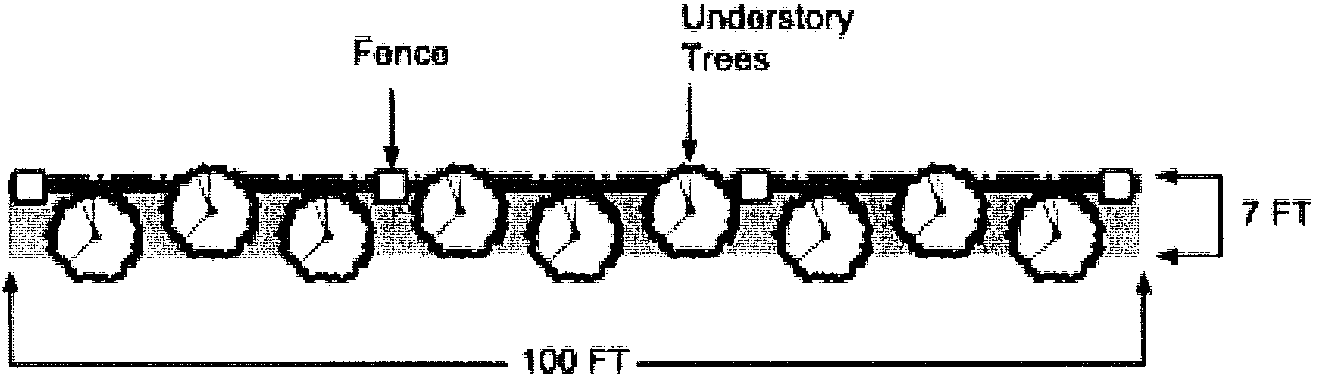
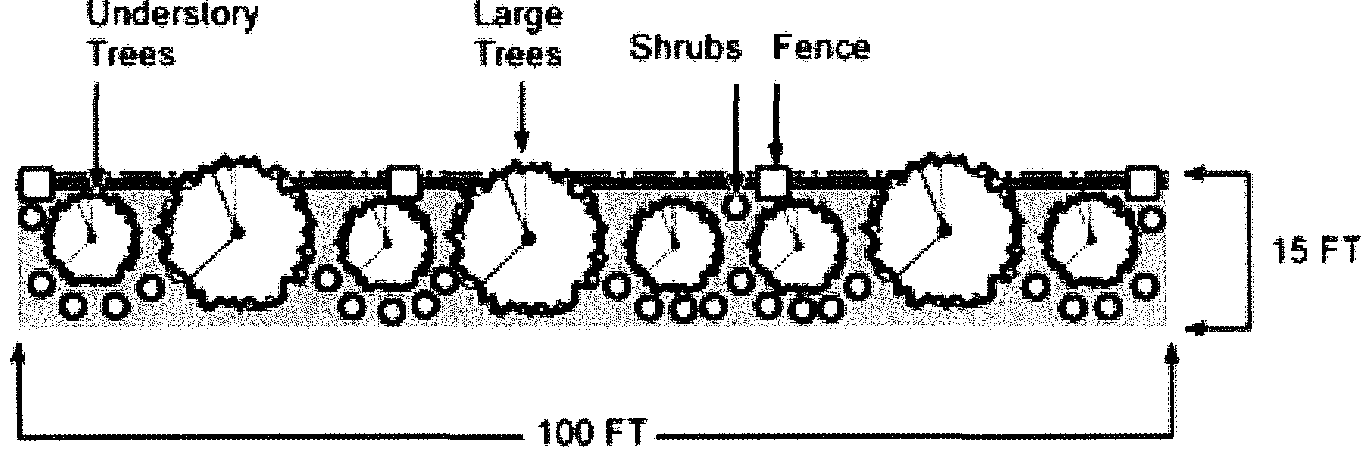
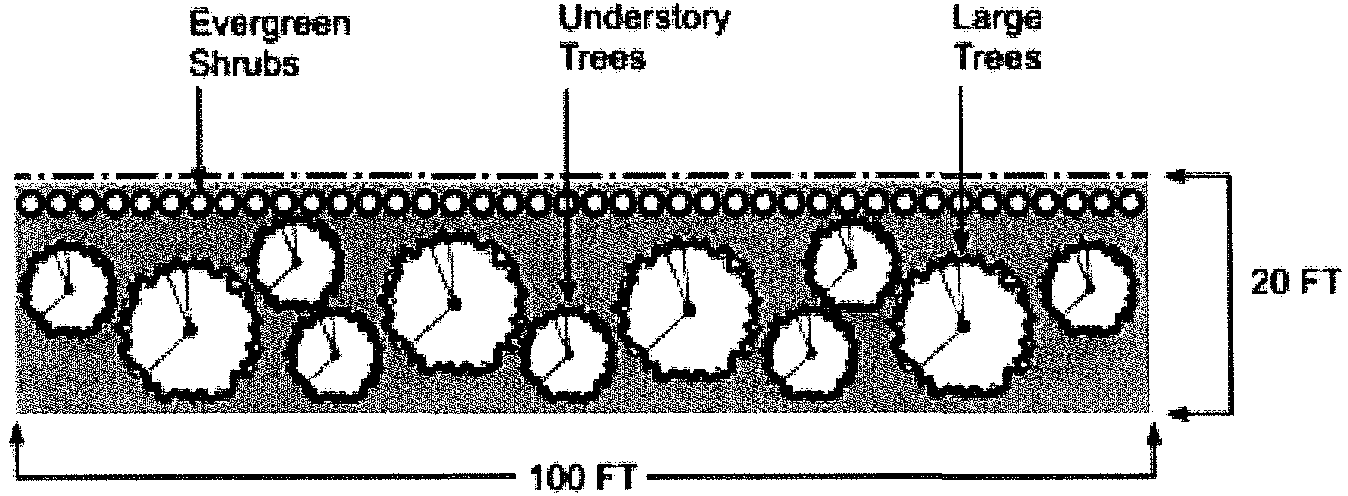
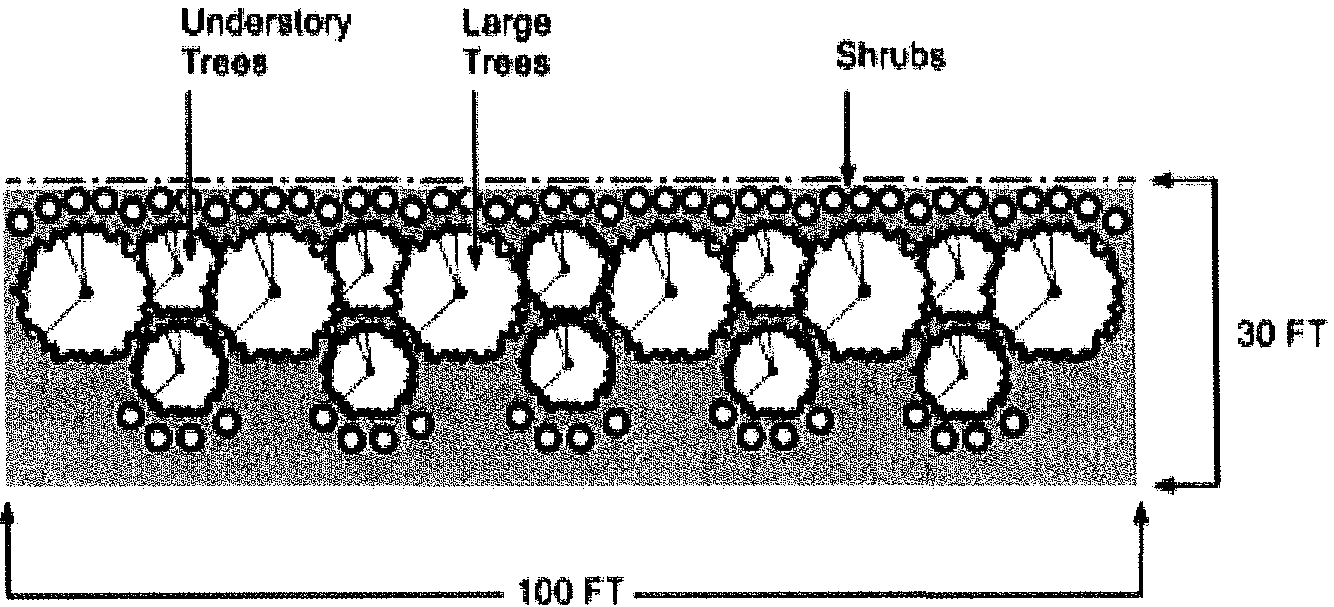
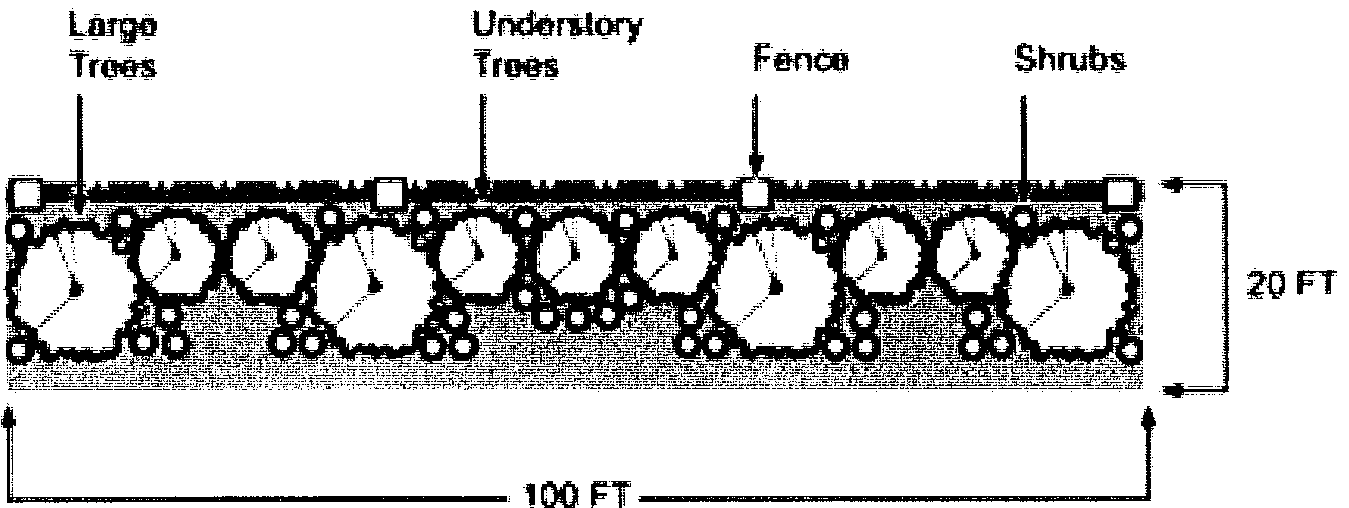
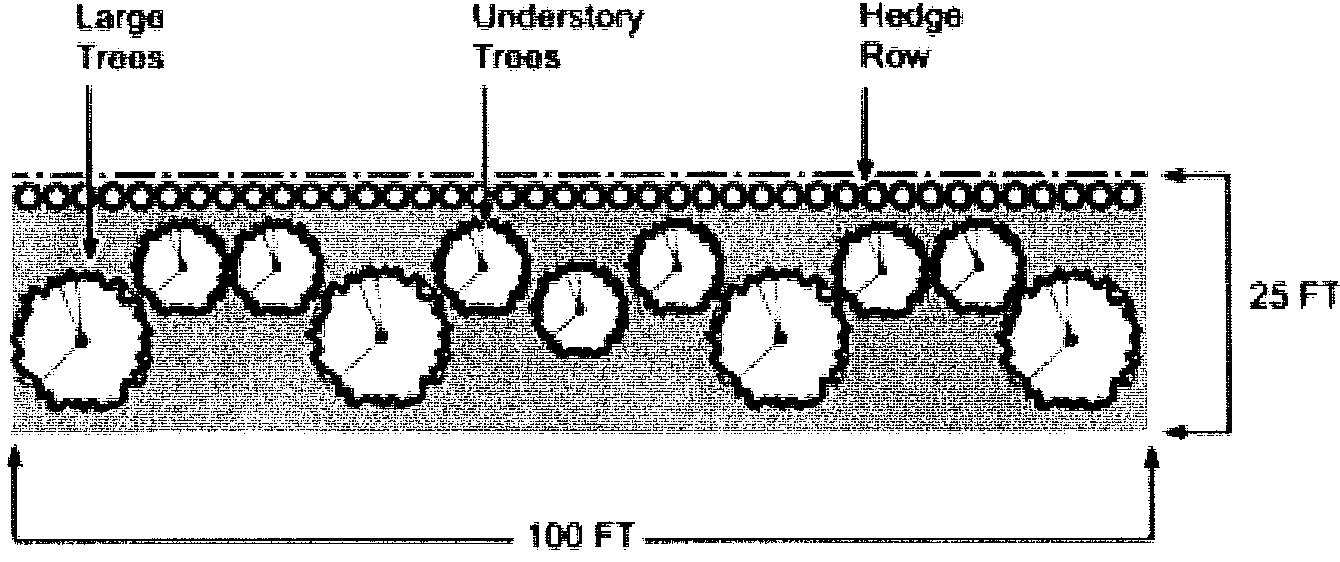
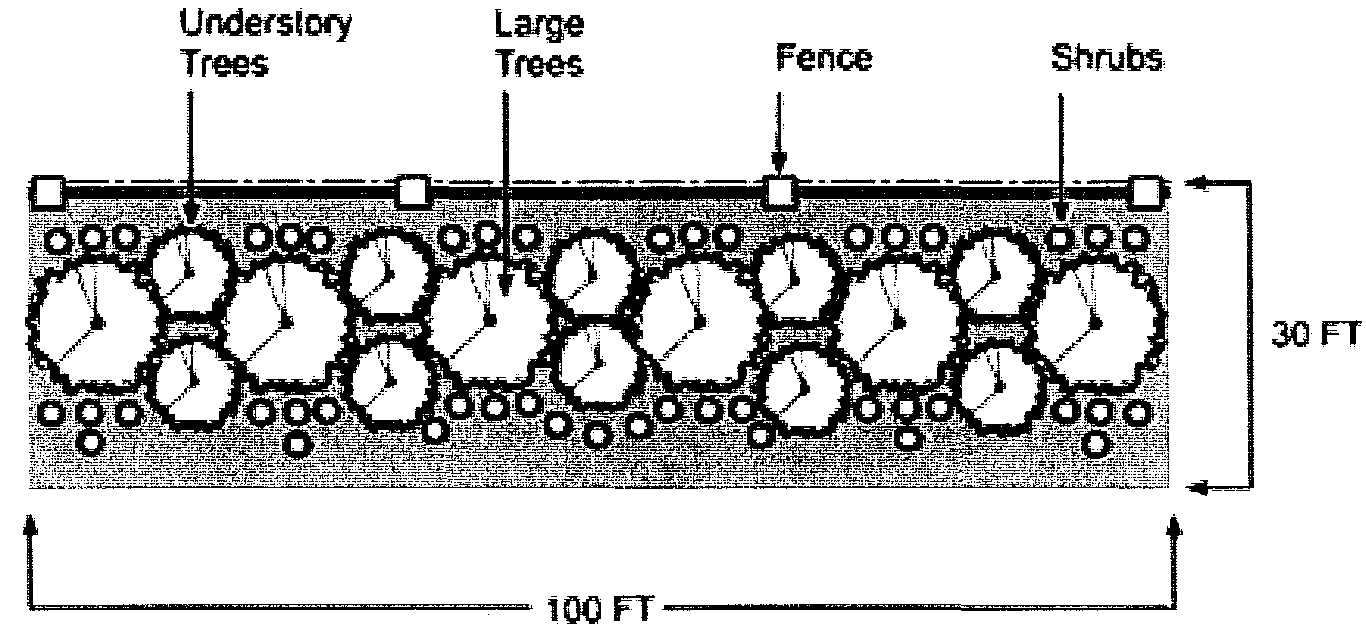
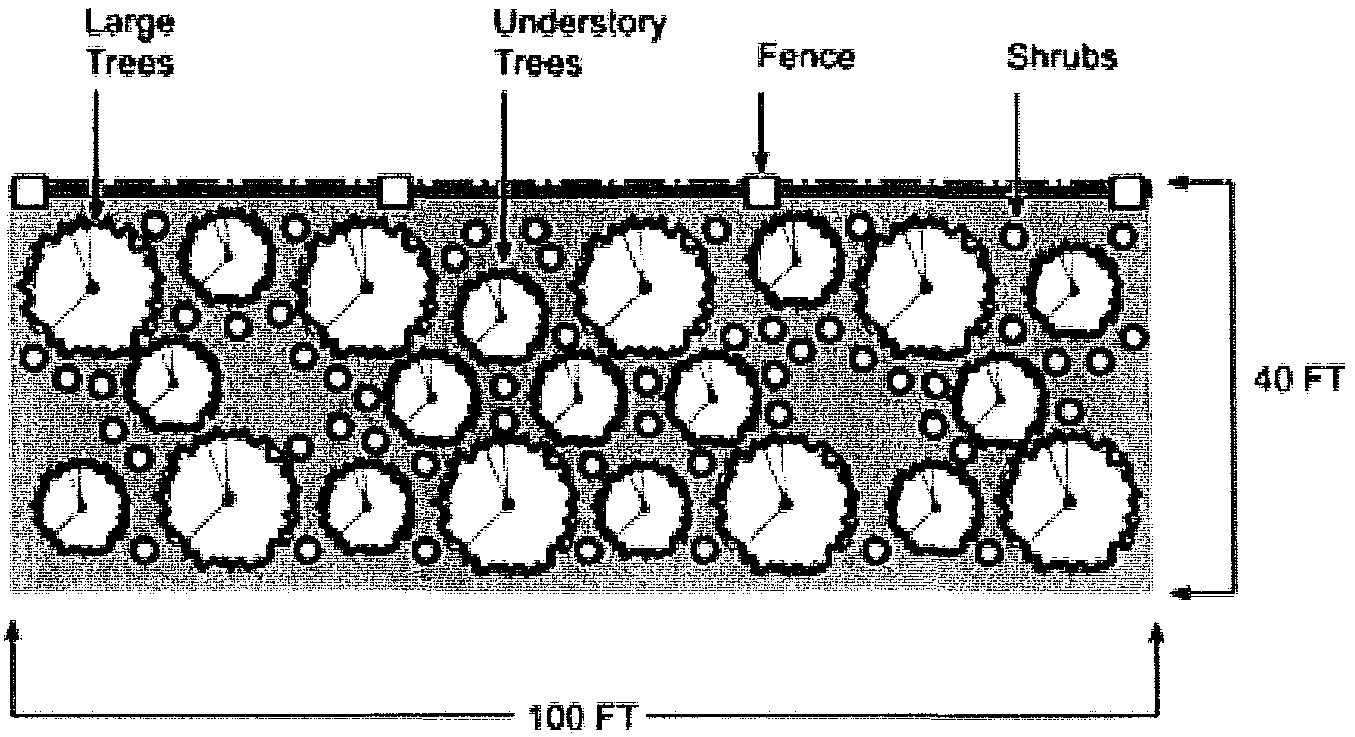
Use Buffer Types and Options: The following tables contain the minimum standards for the various types of use buffers referenced in this section. Options are available for most types. The minimum buffer planting standards listed for each type and option are per 100 linear feet of buffer. Large and understory trees shall be used as specified. Acceptable species for large, and understory trees are found at Tables 1 and 2. Acceptable shrub species are found at Table 3.
| Figure 4.7.4-1: Type A Buffer Planting Options |
|---|
 |
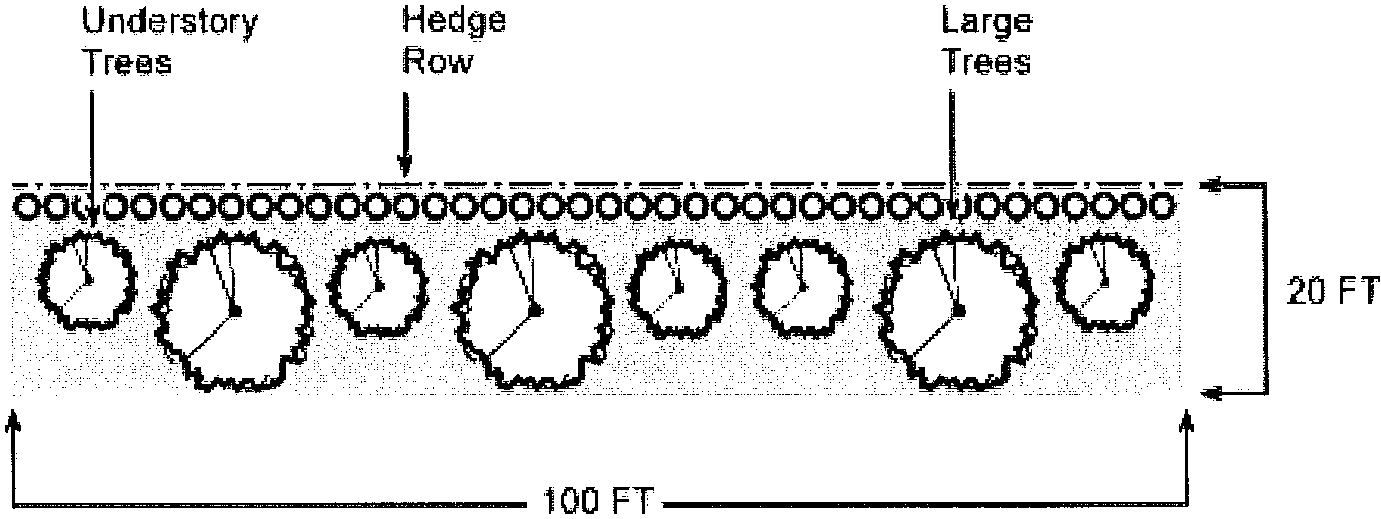 |
| Figure 4.7.4-2: Type B Buffer Planting Options |
|---|
 |
 |
 |
| Figure 4.7.4-3: Type C Buffer Planting Options |
|---|
 |
 |
| Figure 4.7.4-4: Type D Buffer Planting Options |
|---|
 |
| Figure 4.7.4-5: Type E Buffer Planting Requirements |
|---|
 |
4.7.5. Off-Street Parking Lot Buffer: The purpose of this buffer is to screen vehicular parking areas from adjacent properties and street rights-of-way.
A.
Applicability:
1.
An Off-Street Parking Lot Buffer shall be required where a parking lot containing four or more parking spaces adjoins other properties or where a parking lot abuts a public or private road right-of-way.
2.
An Off-Street Parking Lot Buffer shall not be required where a Use Buffer is required, or in areas designated for the display of vehicles for sales, rental, or leasing purposes.
4.7.6 Additional Screening for Residential Developments:
A.
Developments of residential properties consisting of 5 housing lots (and/or units) or more are required to leave an undisturbed buffer with a width of no less than 20 feet against any adjacent properties.
1.
This provision shall apply to all developments containing single family homes, duplex developments, townhomes, or limited multifamily dwellings.
2.
This provision shall apply to all developments that involve the creation of 5 or more single family homes, duplex developments, townhomes, or limited multifamily dwellings that share a common lot, regardless of the individual residential units and/or structures being rented or owner-occupied.
3.
If the land to be developed has no existing vegetation, or that existing vegetation is determined by the Zoning Official to be insufficient to provide an adequate buffer, a Type C Buffer shall be required.
4.
The buffer provided by this provision shall be shown as a sperate parcel within the development and not to be included in the individual lots created or be used in the calculation of minimum setback requirements.
B.
Developments of Multifamily residential properties shall be required to leave an undisturbed vegetative buffer with a width of no less than 20 feet against all adjacent non-residential properties.
C.
When development of property for residential use occurs along an existing street, installation of a 15 feet street tree buffer shall be required along any side of the property abutting the street. Trees within this street tree buffer shall be planted at a rate of one per 35 feet on center using "soldier" spacing (one tree every 35 feet, on center, in a continuous row). Such trees shall be no less than two and one-half inches DBH at the time of installation. This required 15 feet buffer area shall not be used in the calculation of minimum setback requirements for individual lots.
4.7.7. Design Standards and Maintenance:
A.
General: The height of the fence, wall, tree, hedge row, or other vegetation within the buffer shall conform to the requirements of Section 4.51 Vision Clearance at Intersections.
B.
Maintenance: All parts of a buffer shall be maintained in a safe and visually attractive manner.
C.
Fences and walls:
1.
In general, fences and walls serve two purposes: (1) to achieve a degree of opacity that prevents clear recognition of the use being buffered; and (2) to minimize the level of auditory disturbance that the use being buffered may cause adjacent properties.
2.
The design of the fence or wall shall be of the same architectural style as the principal building or buildings on the lot.
3.
Except where otherwise allowed by these regulations or where a variance is requested and granted, any fence or wall shall be opaque so as to prevent the passage of light and debris, and shall be constructed of textured or split-faced block, brick, stone, stucco over concrete block, painted concrete block, finished concrete block, architectural tile, decay resistant wood, or similar opaque materials. Decay resistant wood includes wood that is naturally decay resistant (e.g. cedar, cypress, redwood) or wood that has been chemically and/or mechanically treated (e.g. chromate copper arsenate [CCA]) to a retention rate such that the manufacturer provides a guarantee against decay for 40 years.
4.
Unfinished concrete block shall not be permitted.
5.
The height of a fence or wall shall not exceed eight feet. Fences and walls shall be interrupted at intervals not exceeding 25 feet by architectural features such as pilasters or columns or by various species of plants that are at least as tall as the fence or wall or taller.
6.
The fence or wall shall be set back not less than five feet from the property line unless otherwise approved by City Staff.
7.
The height of a fence or wall shall be measured from the finished grade at the base of the fence or wall to the top of the fence or wall, but shall not include columns or posts.
D.
Vegetation: In general, the purpose of vegetation in a buffer is to achieve a degree of opacity that prevents clear recognition of the use being buffered. There shall be no encroachment of structures or paving within the area designated as a buffer.
1.
Plant location: All plant materials within buffers shall be installed to achieve the maximum level of opacity.
2.
Trees:
i.
Where trees are required as a part of a buffer plan, the developer's buffer plan shall indicate each species of tree that will be part of the buffer. Acceptable species of large and understory trees are listed in Tables 1 and 2. All trees and shrubs within the buffer shall be of the evergreen variety except where City Staff determines that a non-evergreen variety would better suit the buffer. City Staff shall have the discretion to prohibit any species of tree from being placed in a buffer, even if the species of tree to be prohibited is listed in Table 1 or 2.
ii.
As a buffer matures, it is anticipated that understory trees may not survive the shading by large trees. Where the buffer has achieved opacity, dead understory trees do not have to be replaced. However, in the above-described situation, dead understory trees shall be removed to maintain the buffer in a safe and visually attractive condition.
3.
Hedge rows: For newly established hedge rows, shrubs shall be a minimum of three feet in height in order to achieve 50 percent of the required buffer at plant maturity. Shrubs used in hedge rows shall be planted between 18 and 30 inches apart, measured from the base of the plant. Further, shrubs used in hedge rows shall be planted on center in a continuous row.
4.
Shrubs:
i.
Where shrubs are required as a part of a buffer plan, the developer's buffer plan shall indicate each species of shrub that will be part of the buffer. Acceptable shrub species are found in Table 3. City Staff shall have the discretion to prohibit any species of shrub from being placed in a buffer, even if the species of shrub to be prohibited is listed in Table 3.
5.
Preserved stands of vegetation within buffers: It shall be preferred to preserve mature stands of natural vegetation within buffers to the maximum extent possible. The acceptability of stands of mature natural vegetation within buffers shall be determined by City Staff.
4.7.8. General Variances: The City Council may approve variances from these requirements at the request of the property owner if all of the following findings are made:
A.
The variance would be in keeping with the overall character of the area;
B.
The variance would not be contrary to the purpose and intent of these regulations;
C.
The variance would not be detrimental to existing or proposed surrounding uses; and
D.
The variance would serve public purposes to a degree equal to or greater than the standards replaced.
4.7.9. Variances for Security Purposes: The City Council may approve variances where the Chief of Police determines that security would be compromised by construction of a buffer designed in strict conformance with the requirements of this section.
4.7.10. Exemptions:
A.
Properties located within the DT (Downtown) zoning district shall be exempt from all buffer requirements of this section other than those set forth in Section 4.7.5 (Off-Street Parking Lot Buffers). However, the Land Use Class of properties within the DT zoning district shall be used to determine the buffer requirements of properties adjacent to the DT zoning district.
4.7.11. Annexation: The Land Use Class of vacant land that the City annexes shall be assigned the Land Use Class that corresponds with its zoning district.
4.7.12. Appeals: Any decision made by City Staff under this section shall be appealable to the City Council.
4.7.13. Severability: If any section, clause, sentence, or phrase of this section is held to be invalid or unconstitutional by any court of competent jurisdiction, then said holding shall in no way effect the validity of the remaining portions of this section.
Table Index:
TABLE 1: Large Canopy Trees Species List
TABLE 2: Understory Tree Species List
TABLE 3: Shrub Species List
(Ord. No. 2021-03, § 2(Exh. A), 4-13-2021; Ord. No. 2023-02, §§ 1, 2, 1-10-2023)
4.8 - Buildings on Through Lots.
Where a lot extends through from one street to another, the setback requirement for each such street shall be complied with and any building shall have dual facing. No Accessory Buildings or other structures shall be placed on through lots if said structures would conflict with other building values or uses on the same street. On lots having frontage on more than two streets, the minimum front yard shall be provided in accordance with the provisions of this ordinance on at least two of the street frontages.
(Ord. No. 2021-03, § 2(Exh. A), 4-13-2021)
Editor's note— Ord. No. 2021-03, § 2(Exh. A), adopted April 13, 2021, added a new provision designated as § 4.7 and subsequently renumbered 4.7—4.51 to read as 4.8—4.52.
4.9 - Camping and Recreational Equipment.
Any owner of camping and recreational equipment, including but not limited to travel trailers, pick-up coaches, motorized homes and boat trailers may park or store such equipment on private residential property subject to the following conditions:
4.9.1 Such parked or stored camping and recreational equipment shall not be occupied or used for living, sleeping or housekeeping purposes, except for temporary visitors not to exceed ten days.
4.9.2 If the camping or recreational equipment is parked or stored outside of a building, it shall be parked or stored, if possible to the rear of the front building line of the lot.
4.9.3 Notwithstanding the provisions of subsection 4.23.2 above, camping and recreation equipment may be parked anywhere on the premises while actually being loaded or unloaded.
(Ord. No. 2021-03, § 2(Exh. A), 4-13-2021)
4.10 - Churches and Schools.
Public schools shall be subject to the regulations in this resolution set forth in Section 5.3.
4.10.1 Private schools, churches and religious institutions shall be permitted in single-family residential districts, two-family residential districts, multi-family residential districts, and general commercial districts provided that the following requirements are complied with.
4.10.1.1 Off-street parking shall be provided as set forth in this article.
4.10.1.2 The Principal Building and Accessory Buildings shall comply with the yard and setback requirements of the districts in which it is located; and in no case less than the minimum requirements set forth in the district.
(Ord. No. 2021-03, § 2(Exh. A), 4-13-2021)
4.11 - Cemeteries, Mausoleums.
No premises shall be used or occupied for the purpose of burial, storage or interment of human remains, nor for a family burial plot, cemetery, or mausoleum without City Council approval. No land for which a plat has not been recorded shall be used for any burials. The dead shall not be buried or placed closer than ten feet to any highway right-of-way, nor closer than ten feet to any other property line.
(Ord. No. 2021-03, § 2(Exh. A), 4-13-2021)
4.12 - Certain Building and Land Use Exempted.
4.12.1 Agricultural Uses. Traditional gardening and non-commercial horticulture or agriculture is allowed in any district which allows residential use. Hogs, cattle, poultry, sheep, goats, livestock, horses, and other birds or animals generally regarded as and kept as farm animals are prohibited in any district except AR-1.
4.12.2 Public or Semi-Public Uses. Nothing in the ordinance shall prohibit the erection, construction, alteration or maintenance of essential services, by public utilities or County, City or government agencies and no zoning certificate shall be required for any such structures; provided, however, that the provisions of this paragraph shall not apply to buildings, towers or storage yards of such public utilities or governmental agencies except when conforming to the procedures specified by the General Planning Enabling Act of 1957 as amended in 1973 by the General Assembly of Georgia.
(Ord. No. 2021-03, § 2(Exh. A), 4-13-2021)
4.13 - Conversion of Dwelling.
The conversion of any building into a dwelling, or the conversion of any dwelling so as to accommodate an increased number of dwelling units of families, shall be permitted only within a district in which a new building for similar occupancy would be permitted under this ordinance, and only when the resulting occupancy will comply with the requirements governing new construction in such district with respect to minimum lot size, lot area per dwelling unit, percentage of lot coverage, dimensions of yards and other open spaces, and off-street parking. Each conversion shall be subject also to such further requirements as may be specified hereinafter within the article applying to such district.
(Ord. No. 2021-03, § 2(Exh. A), 4-13-2021)
4.14 - Deed Restriction.
These regulations shall not lesson any previous deed restrictions or restrictive covenants recorded with any deed, plat, or other legal document relating to the use of lot and building requirements. The person or agency in the capacity of administering and enforcing these regulations shall abide by any deed restrictions or restrictive covenants provided the restrictions are known.
(Ord. No. 2021-03, § 2(Exh. A), 4-13-2021)
4.15 - Excavation of Sand, Gravel, or Other Materials (for Industrial Commercial Use).
Excavation shall be considered a temporary use, and shall be permitted only in an Industrial district. The extent of excavation shall not be nearer than 100 feet to any school, church, dwelling, or highway. Operations for drilling, blasting, and excavating purposes shall not be conducted earlier than 7:00 a.m., not later than 7:00 p.m. during any day except Sunday. On Sunday, all operations shall cease.
New excavations shall require the approval of the City Council which will check the health, safety, and nuisance features involved, and require such measures as will protect the public interest.
(Ord. No. 2021-03, § 2(Exh. A), 4-13-2021)
4.16 - Existing Lot Record.
Any lot of record existing at the effective date of this ordinance in any "R" districts may be used for the erection of a single family dwelling, with approval of governing authority, even though its area and width is less than the minimum requirements set forth herein, except as set forth hereafter. Front, side and rear yards shall conform with the requirements of this ordinance as closely as possible.
Where two adjacent lots of record with less than the required area and width are held by one owner, the request for a permit shall be referred to the governing authority which may require that the two lots be combined and used for one main building.
(Ord. No. 2021-03, § 2(Exh. A), 4-13-2021)
4.17 - Existing Uses.
Nothing contained in this ordinance shall be deemed or construed to prohibit a continuation of the particular lawful use or uses of any land, building, structure, improvement or premises legally existing in the respective districts at the time this resolution becomes effective; provided, however, that if any such existing lawful uses change to a different use after the date of the adoption of this resolution, such different use shall conform to the provisions of this resolution regulating the particular district in which said premises is situated. If any legally existing use or occupancy of a building or premises conflicts with any requirement of this resolution or any of its amendments, such building shall not be moved, structurally altered or added to except after a public hearing.
All future buildings, structures, repairs, alterations or other improvements shall comply with all district requirements contained herein, and such structural provisions of the building code and other regulations as have been incorporated herein and made a part hereof, including any building on which construction has been suspended at the time this resolution was adopted and any building for which foundations were not completed at said time.
No non-conforming building or structure shall be extended, except when authorized by the City Council which may permit one enlargement or extension up to 25 percent of the floor area or the structure as it existed at the time of passage of this ordinance.
(Ord. No. 2021-03, § 2(Exh. A), 4-13-2021)
4.18 - Fences.
Except in industrial, or general commercial districts, no fence, wall, or screened structure, excluding retaining walls and plants and shrubbery, over eight feet in height shall be built within any required yard.
4.18.1 Front-yard fences shall consist of more than 75% open voids, as viewed on a horizontal plane. and not more than 42" high. Chain link fencing is prohibited in front yards.
4.18.2 Rear and Side yards on residential lots may have Privacy Fencing. This fencing must not extend past the front corner of the home on residential lots.
4.18.3 Barbed wire fences are prohibited on any residential property.
4.18.4 The finished side of a fence must face out when visible from the public right-of-way.
(Ord. No. 2021-03, § 2(Exh. A), 4-13-2021)
4.19 - Garbage Disposal.
Garbage or other refuse shall be deposited only in approved garbage cans or in approved garbage disposal areas.
(Ord. No. 2021-03, § 2(Exh. A), 4-13-2021)
4.20 - Home Occupations.
4.20.1
Home occupations, with the exception of commercial stables or kennels and any occupation which customarily requires the use of a panel or delivery truck, may be conducted where allowable only after approval of the building and zoning official who may deny or grant approval of such home occupation in accordance with the zoning regulations. Those home occupation that do not comply with the specifications listed herein shall apply to city council for approval and follow procedures set forth in article V — planning & zoning procedures. City council may act upon the request after receiving recommendation from the planning & zoning board and holding a public hearing.
i.
The home occupation shall be conducted within the principal building and primarily by members of the family residing in the building. No more than one person shall work in the home who is not a resident of the premises. Additional employees shall be permitted to the business provided they do not work on or at the premises.
ii.
Not more than 20 percent of the gross footprint of any buildings on the property at the time of application may be used for a home occupation.
iii.
For the purpose of identification of such use, one non-illuminated wall sign not exceeding one square foot in area may be allowed. Such signs shall identify only the name of the profession and the name of the occupant of the premises and shall be mounted against a wall of the principal building.
iv.
No motor power other than electrically operated motors shall be used in the premises of the home in conjunction with such home occupation and the total horsepower of such permitted electrical motors shall not exceed three horsepower, or one horsepower for any single motor.
v.
There shall be no alteration in the residential character of the premises in connection with such home occupation unless so authorized by city council. No storage of items related the business will be visible from the public right-of-way.
vi.
The home occupation shall not generate pedestrian or vehicular traffic or demand for parking. No more than one commercial vehicle and one trailer may be used in the conducting of the business. No more than one commercial vehicle and one trailer may be parked at the home location. There shall be no use of, parking, or storage of tractor trailers, vehicles over 10,000 pounds, heavy equipment, or pull-type trailers, greater than 18 feet in length, related to the home occupation. All vehicles and trailers related to the business must be stored in the side or rear yard.
vii.
No merchandise or articles for sale shall be displayed for advertising purposes and no sign or device relative to the sale of such merchandise shall be displayed on the premises.
viii.
No article or materials used in connection with such home occupation shall be stored other than in and enclosed building on the premises. No hazardous materials of a quantity not typically found in the home will be allowed.
ix.
Any home occupation as provided for in this section may be reviewed by city council at any time following the approval of such use and may revoke permission to continue such home occupation at any time thereafter.
x.
There shall be no disturbance or emission of offensive noise, vibration, smoke, dust, odor, heat, glare, traffic hazard, nor shall there be any unhealthy or unsightly condition.
xi.
A beauty parlor which is operated in a room separate from but attached to a dwelling unit and which uses equipment other than those customarily found in a home shall be deemed a permissible home occupation under the following specific conditions:
a.
Such beauty parlor shall occupy not more than 500 square feet of floor space.
b.
There shall be no more than two employees, one of whom shall reside in the dwelling unit to which the beauty parlor is attached.
xii.
No more than two home occupations shall be permitted at any one address.
xiii.
The following uses are not permitted as home occupations:
a.
Vehicle and/or automotive body repair.
b.
Commercial greenhouse or commercial nursery.
c.
Medical or dental lab.
e.
Day care, for more than six minors or adult daycare centers.
f.
Restaurants.
4.20.2
Application procedure: Application for a home occupation shall be filed with the building and zoning department upon forms furnished by the City of Springfield.
i.
Home occupations require an annual fee and evaluation to obtain an occupation tax certificate for a home occupation. Home occupation permits may be renewed as long as the operation satisfies the city's home occupation requirements.
ii.
By submitting an application for a home occupation tax certificate or renewal, the applicant hereby agrees to allow the building and zoning department access to the applicant's residence to conduct any required inspections upon 48 hours notification of the intended inspection date and time. The applicant also agrees to allow building and zoning department access to their residence to investigate alleged violations of this article upon 48 hours notification of the intended inspection date and time. The failure of an applicant to comply with this inspection requirement shall result in immediate revocation or denial of the home occupation permit or application.
iii.
Approved Home Occupations shall not be expanded, and the use as stated in the permit shall not be changed. Any such changes shall result in immediate revocation or denial of the home occupation permit or application.
iv.
Approved Home Occupations shall not cause a nuisance to the surrounding community or alter the residential nature of the surrounding community. Authorization for any home occupation that operates in violation the requirements of this ordinance or that are the subject of one or more verified and substantiated complaints may be immediately revoked or denied renewal.
v.
In the event of revocation or denial of a home occupation request, the applicant or the general public may appeal the decision of the building and zoning official by requesting an evaluation by the city council-pursuant to Article V of this ordinance.
4.20.3
Permit and fees.
i.
The home occupation business shall pay the annual City of Springfield Occupation Tax as set forth in the adopted fee schedule.
4.20.4
Exceptions.
i.
This chapter shall not apply to residential "garage sales" or "yard sales" not related to the home occupation.
ii.
This chapter shall not apply to the occasional sale of personal property.
(Ord. No. 2021-03, § 2(Exh. A), 4-13-2021; Ord. No. 2024-02, § 1 Att. A, 2-13-2024)
4.21 - Land and Water Fills, Dredging, Excavations, and Mining.
No person shall engage in the filling of land or water areas, dredging, the excavation of land or removal of earth and no mining operation shall be undertaken without application to the City Council.
(Ord. No. 2021-03, § 2(Exh. A), 4-13-2021)
4.22 - Land Subject to Flooding.
No building or mobile home shall be moved into or constructed in a flood prone area unless the first floor elevation is one foot above the highest elevation at that location expected to be flooded in a 100 year flood.
(Ord. No. 2021-03, § 2(Exh. A), 4-13-2021)
4.23 - Minimum Living Area.
Excluding accessory dwelling units, no single or multiple family living units shall be constructed with a total living area of less than 800 square feet. Provided, however, that a special exception to the minimum living area requirements shall be granted for the construction of efficiency type apartments having no separate bedrooms, if it is established that the granting of such exception will not adversely affect the interest of the general public or the character of the surrounding neighborhood. Application for any such special exception shall be made to the City Council which shall hold a public hearing as set forth in this ordinance. The City Council may require the submission of plans in connection with such applications-showing the location and type of construction proposed-and may impose such additional requirements as a condition of the granting of the request as it deems reasonable and appropriate. (This section shall not apply to mobile homes meeting all other requirements of this ordinance.)
(Ord. No. 2021-03, § 2(Exh. A), 4-13-2021)
4.24 - Multiple Housing.
Multiple housing developments may be developed in any multi-family district provided that:
4.24.1 Maximum percent of lot coverage shall not exceed that which is required for the districts in which the project is located.
4.24.2 Height limits, front, side, or rear yard requirements shall be met in accordance with the district in which such group housing is permitted.
(Ord. No. 2021-03, § 2(Exh. A), 4-13-2021)
4.25 - Moving of Buildings.
Whenever a building is moved from any location to a site within Springfield, the building shall immediately be made to conform to all provisions of the Building, Plumbing and Electrical Codes, if any, and zoning regulations. The person causing the building to be moved shall secure a building permit from the Building and Zoning Department
(Ord. No. 2021-03, § 2(Exh. A), 4-13-2021)
4.26 - Non-Conforming Buildings or Structures.
Any lawful use of any dwelling, building, or structure existing at the effective date of this ordinance may be continued, even though such use does not conform to the provisions hereof. If no structural alterations are made, a non-conforming use of a building may be changed to another non-conforming use of a more restricted classification. Whenever a non-conforming use has been changed to a more restricted use or to a conforming use, such use shall not thereafter be changed to a less restricted use. No non-conforming buildings or structure shall be extended, or enlarged except when authorized by the City Council which may permit one enlargement or extension up to 50 percent of the floor area of the structure as it existed at the time of passage of this ordinance.
Whenever the use of a building shall become non-conforming through a change in the zoning ordinance or in the district boundaries, such use may be continued, and if no structural alterations are made, may be changed to another non-conforming use of the same or of a more restricted classification.
A non-conforming use of a building or portion thereof which is hereafter disconnected for a continuous period of six months shall not again be used except in conformity with the regulations of the district in which such building is located.
(Ord. No. 2021-03, § 2(Exh. A), 4-13-2021)
4.27 - Non-Conforming Lots.
4.27.1 Remedies. Where two or more non-conforming lots with continuous frontage are under the same ownership or where a non-conforming lot has a continuous frontage with a larger tract under the same ownership, such lot or lots shall be combined to form one or more building sites meeting the lot requirements of the district in which they are located.
4.27.2 Dwelling on Non-Conforming Lots. A building permit may be issued for a single family dwelling on any non-conforming lot excluding sub-standard lots, provided that the remedies set forth in this section cannot be complied with and provided that the regulations of the district in which the lot is located are met.
4.27.3 Non-Conforming Uses of Land. The non-conforming use of land not involving any Principal Building or structure existing on the effective date of this ordinance may be continued for a period not more than three years, provided, however, that no such non-conforming use of land shall in any way be expanded or extended wither on the same or adjoining property.
In such non-conforming use of land or any portion thereof, discontinued or changed, any future use of such land shall be in conformity with the provisions of the ordinance.
4.27.4 Dwelling on Sub-Standard Lots. The governing authority may authorize the issuance of a building permit for a single family dwelling for a sub-standard lot only after it has been determined that remedies as set forth in the section cannot be complied with. The governing authority may also grant such variances on lot and building requirements in cases of hardship, if conditions detrimental to the public health, safety, and welfare are not caused.
(Ord. No. 2021-03, § 2(Exh. A), 4-13-2021)
4.28 - Non-Conforming Use of Buildings and Structures.
Use of any buildings or structures not in conformance with these regulations pertaining to uses permitted on the effective date of this resolution may not be:
4.28.1 Change to another non-conforming use except where it is determined by the City Council that the design, construction, and character of the building is unsuitable for uses permitted in the district in which such nonconforming use is situated. The City Council shall hold a public hearing, as set forth in this ordinance, in order to determine the question of suitability for uses permitted in the district in which such building is located.
4.28.2 Re-established after discontinuance for six months except where it is determined by the City Council that the design, construction, and character of the building is unsuitable for use permitted in the district in which such non-conforming use is situated. The City Council shall hold a public hearing, as set forth in the ordinance, in order to determine the question of suitability for uses permitted in the district in which such building is located.
4.28.3 Extended, enlarged, or expanded except when authorized by the City Council which may permit one enlargement or extension up to 25 percent of the floor area of the structure as it existed at the time of passage of this ordinance.
(Ord. No. 2021-03, § 2(Exh. A), 4-13-2021)
4.29 - Notice of Starting Work.
The Building and Zoning Official shall be given at least 24-hours of notice by owner or applicant prior to commencement of work at the site under zoning permit.
(Ord. No. 2021-03, § 2(Exh. A), 4-13-2021)
4.30 - Nuisances.
Nothing shall be allowed on the premises in any district which would in any way be offensive or obnoxious to a person of ordinary sensibilities by reason of the emission of odors, liquids, gas, dust, smoke, vibration or noise; nor shall anything be placed, constructed or maintained that will in any way constitute a nuisance to adjacent property owners, residents, or to the community. All uses must satisfactorily comply with the requirements of the State Department of Natural Resources, United States Environmental Protection Agency, and any other applicable law or regulation.
(Ord. No. 2021-03, § 2(Exh. A), 4-13-2021; Ord. No. 2025-09, § 1, 5-13-2025)
4.31 - Senior Residential Facilities.
Senior residential facilities shall include convalescent homes, homes for the aged, and such other facilities designed to take care of the aged or persons unable to care for themselves without supervision or assistance. Such residential facilities shall be permitted only with City Council approval in any multi-family residential district. Such uses shall comply with all regulations applicable to the district. Such uses shall comply with the off-street parking requirements set forth in this ordinance. In addition, such uses shall meet the minimum requirements as set forth by state or federal agencies regulating such activities and shall, upon application, for either building permit or occupancy certificate, provide certificates indicating approval by such state and federal agencies.
(Ord. No. 2021-03, § 2(Exh. A), 4-13-2021)
4.32 - Obstruction to Vision at Road Intersection.
In order to minimize accidents caused by obstruction to vision at road intersections, the following regulations shall apply in all districts:
4.32.1 Within the area formed by the right-of-way lines of intersecting roads and a straight line connecting points on such right-of-way lines, at a distance of 20 feet from their points of intersection there shall be a clear space with no obstruction to vision between the height of 30 inches and a height of ten feet above the average grade of each road as measured at the centerline thereof.
(Ord. No. 2021-03, § 2(Exh. A), 4-13-2021)
4.33 - Off-Street Parking and Loading.
In all districts off-street facilities shall be provided and properly maintained, as set forth in this section for any building which is hereafter erection, enlarged or increased in capacity. Such facilities shall be made available for public use, area adjacent to dwelling excepted. Section 4.32 does not apply to the Downtown District.
4.33.1 Size and access. Each off-street parking space shall have an area of not less than 180 square feet exclusive of access drives or aisles and be in usable shape and condition, except in the case of dwellings and shall have no parking area containing less than three spaces. There shall be adequate ingress and egress to all parking spaces. Where a lot does not abut on a public or private alley or easement of access, there shall be provided an access drive leading to the parking or storage areas or loading spaces. Such access drive shall be not less than ten feet in width in the case of a dwelling, and not less than 20 feet in width in all other cases.
Access to off-street parking areas shall be limited to several well-defined locations, and in no case shall there be unrestricted access along the length of a street or alley.
4.33.2 Number of Parking Spaces Required. The numbers of off-street parking spaces required are set forth in the following table. Where the use of the premises in not specifically mentioned, requirements for similar uses shall apply.
Reduction in the Number of Parking Spaces Required. The numbers of off-street parking spaces required may be reduced by up to twenty-five (25) percent upon approval of the Zoning Office. The applicant shall provide justification for such request for consideration by the Zoning Official.
4.33.3 Location of Off-Street Parking Spaces.
i.
Such parking spaces as required in this section shall in no part exist upon and no portion of any vehicle shall overhang, the right-of-way of any public road, street, alley or walkway. Provisions for on-street parallel parking may be permitted upon approval of the Zoning Office. In such case where parallel on-street parking is permitted, parking space(s) located wholly or more than fifty (50) percent in front of a building may be counted in the calculations for such building use.
ii.
The parking spaces for all dwellings shall be located on the same plot as the main building.
iii.
Parking spaces for all other uses shall be provided on the same plot with the main building or not more than 300 feet distance, as measured along the nearest pedestrian walkway provided that such area is under the same ownership as the principal use.
iv.
Parking requirements for two or more uses of the same or of different types may be provided by the establishment of the required number of spaces for each use in a common parking space area provided that all such uses being served by a common parking area are under the same ownership. Accessory uses shall not be required to have additional parking spaces other than those required by the principal use.
v.
Off-street parking areas may be situated in any residential district abutting any commercial district or industrial district to a depth not exceeding 120 feet and provided that all off-street parking lot improvements as provided in Section 4.32.4 of this article are complied with.
4.33.4 Parking Lot Improvement Requirements. Any off-street parking lots serving any use other than dwellings of four units per building or less shall meet the following off-street parking lot improvement requirements:
i.
Off-street parking areas for more than five vehicles, and off-street loading areas shall be effectively screened on each side which joins or faces residential or industrial premises situated in any residential district.
ii.
Surfacing for all retail sales and services, business service and professional services serving the general public and having access to and abutting a paved street, the off-street parking area shall be provided with a hard surface, all-weather pavement of asphalt or concrete and shall be so graded and drained to provide for the adequate run-off and disposal of surface water. Requirements of this paragraph may be varied only upon approval by the City Council.
iii.
Where lighting facilities are required for the parking area, they shall be designed and installed so as to reflect the light away from any contiguous residentially zoned property.
iv.
Off-street parking areas for more than twenty vehicles shall provide one shade tree for each ten spaces. Canopy trees planted in parking islands shall have 400 square feet of unpaved soil for root development. The standard tree island shall be 20 feet by 20 feet; provided, however, that where the islands are an extension of a ten-foot-wide landscape median, the islands may be reduced in width to 16 feet. Islands shall not be separated by more than 12 parking spaces, including the landscaped ends of drive aisles. Islands shall be designed so as to minimize foot traffic across them.
4.33.5 Off-Street Loading Requirements.
i.
Every hospital, institution, commercial or industrial building or similar use having a floor area of 20,000 square feet or more and requiring receipt or distribution by vehicle of materials or merchandise shall have at least one permanent off-street loading space for each 20,000 square feet of gross floor area or fraction thereof immediately adjacent to the Principal Building.
ii.
Every building which requires the receipt or distribution by vehicle of material or merchandise, shall provide off-street loading berths in accordance with the following tables:
iii.
Every off-street loading and unloading space shall have direct access to the public street or alley and shall have the following minimum dimensions:
Length, 30 feet; width, 12 feet; height, 14 feet.
(Ord. No. 2021-03, § 2(Exh. A), 4-13-2021)
4.34 - Overhanging or Extruding Projections.
In Single Family Residential Districts, Multi-Family Residential Districts and Mobile Home Park Districts, every part of a required yard or court shall be open from its lowest point to the sky unobstructed except for the customary projection of sills, belts, courses, cornices, ornamental features, and eaves; provided, however, that none of the above projection shall extend into a required yard more than 36 inches. Open or enclosed fire escapes, outside stairways, balconies, chimneys, flues or other projections shall not extend into any required yard except that uncovered steps may project not more than three feet into the required yard.
(Ord. No. 2021-03, § 2(Exh. A), 4-13-2021)
4.35 - Parking of Truck Tractors, Semi-Trailers, Truck-Tractor and Semi-Trailer Combinations or Trucks.
4.35.1 Declaration of purpose. The standards established for truck-tractors, semi-trailers, truck-tractor and semi-trailer combinations or trucks in this section are designed to regulate their parking within all zoning districts in the City. With the deregulation of the trucking industry and subsequent increase of independent truckers, parking of trucks throughout the City could become a nuisance and unsightly. In addition, to unsightliness, is the concern for potential damage to residential streets, which are not designed to carry these loads. It is the purpose of this subsection to regulate truck-tractor, semi-trailer, truck-tractor and semi-trailer combinations or truck parking to eliminate those conditions which are a nuisance, unsightly and cause the deterioration of property and property values.
4.35.2 Definitions.
i.
Semi-trailer. The term "semi-trailer", for section 4.35, means a vehicle of the trailer type so designed and used in conjunction with a truck-tractor that a considerable part of its load rests upon and is carried by the truck-tractor and includes a trailer drawn by a truck-tractor and semi-trailer combination.
ii.
Truck. The term "truck", for section 4.35, means a motor vehicle which is self-propelled and has a gross vehicle weight of 10,000 pounds or more, used for the transportation of property.
iii.
Truck-tractor. The term "truck-tractor", for section 4.35, means a motor vehicle designed and used primarily for drawing other vehicles and not constructed to carry a load other than a part of the weight of the vehicle and load drawn.
iv.
First Offense. The term "first offense", for section 4.35, means the semi-trailer, truck, truck-tractor was parked in violation of this ordinance. Each twenty-four hour period that this violation occurs by the semi-trailer, truck, or truck-tractor at the same location an additional first offense violation fee will apply.
v.
Second Offense. The term "second offense", for section 4.35, means the semi-trailer, truck, truck-tractor parked in violation of this ordinance which has already been issued a first offense for another location. Each twenty-four hour period that this violation occurs by the semi-trailer, truck, or truck-tractor at the same location an additional second offense violation fee will apply.
vi.
Third Offense. The term "third offense", for section 4.35, means the semi-trailer, truck, truck-tractor was parked in violation of this ordinance and had previously been issued a first and second offense citation for another location. Each twenty-four hour period that this violation occurs by the same semi-trailer, truck, or truck-tractor at the same location an additional third offense violation fee will apply.
4.35.3 Parking on Government or Private Property.
i.
In order to park a semi-trailer, truck, or truck-tractor on government or private owned property the owner of the government or private property must sign a permission form authorizing the semi-trailer, truck, or truck-tractor to be parked on the government or private property.
ii.
The permission form must clearly state the date authorized for parking, the signature of the property owner and must be posted on the driver's door window or the back drivers side of the semi-trailer. A Springfield Police Officer should be able to ride by the semi-trailer, truck or truck-tractor and easily view this form.
4.35.4 Prohibited uses.
i.
The uses set forth in this subsection shall not be considered as permitted uses or accessory uses in commercial or industrial or multifamily districts.
ii.
The parking of any truck-tractor, semi-trailer and semi-trailer combination or truck, within the city limits, is unlawful except:
a.
Where such parking is necessary in the connection with construction activity which is actually occurring on the property pursuant to a valid and current building permit;
b.
For a period of up to 12 hours, or such longer time as permitted by an officer of the Springfield Police Department, where such parking is for the purpose of unloading or loading materials, supplies or inventory to be used in connection with the business activity occurring on the property; but not for the purpose of storage of such materials, supplies or inventory pending sale;
c.
Where such vehicles are actually being offered for sale or lease by the business located on the property, but only if such sale or lease activity is permitted by this code;
d.
Where such parking is in connection with paper recycling or other similar activity conducted by non-profit organizations;
e.
Where such parking is for the purpose of loading or unloading and shall not exceed 12 hours;
f.
A vehicle customarily used in connection with a business where the vehicle is parked;
g.
Permitted parking on government or private property as set forth in Section 4.35.3; or
h.
Businesses that have purchased and have been issued a City of Springfield Occupation License (Business License), so long as this does not create a nuisance for the surrounding property owners. This section excludes home occupations.
4.35.5 Nothing in this subsection shall be deemed to permit the parking of such vehicle at a location on the property which:
i.
Would obstruct the visibility of vehicle traffic or pedestrian movement; or
ii.
Would interfere with access by emergency vehicles or equipment; or
iii.
Is within 300 feet of any residentially zoned property, except:
(a)
Where such parking is for the purpose of performing maintenance on a truck or truck-tractor without a trailer or semi-trailer attached on Sundays between 1:00 pm and 5:00 pm.
(b)
Where such parking is for the purpose of loading or unloading for a period of time not exceeding 12 hours; or
iv.
Is otherwise in violation with any ordinance, rule or regulation of the City.
4.35.6 Violation/Citation Fees.
i.
First Offense $100.00 per each 24 hour violation
ii.
Second Offense $250.00 per each 24 hour violation
iii.
Third Offense $500.00 per each 24 hour violation
(Ord. No. 2020-02, § 1, 3-10-2020; Ord. No. 2021-03, § 2(Exh. A), 4-13-2021)
4.36 - Environmental Protection.
All buildings and construction activity must comply with all federal, state, and local regulations, including but not limited to the wetland protection provisions of the Clean Water Act.
(Ord. No. 2021-03, § 2(Exh. A), 4-13-2021)
4.37 - Patios.
Patios may not be located closer than ten feet to any adjacent property line.
(Ord. No. 2021-03, § 2(Exh. A), 4-13-2021)
4.38 - Pending Applications for Building Permits.
Nothing herein contained shall require any change in the overall layouts, plans, construction, size or designated use of any development, building, structure, or part thereof, for which official approval and required permits have been granted, or where no approvals or permits are necessary, where construction has been legally started, before the enactment of this ordinance and completed within a one-year period.
(Ord. No. 2021-03, § 2(Exh. A), 4-13-2021)
4.39 - Performance Standards.
These performance standards shall apply to all non-residential uses and are intended to prevent the establishment of any facility or condition that may cause a nuisance as defined below. All uses must comply with the City's nuisance ordinance.
4.39.1 The emission of grey smoke at a density greater than No. 1 on the Ringlemann chart published by the U.S. Nureau of Mines (Power's micro-Ringlemann chart, McGraw-Hill Publishing Co., 1954, may be used) shall not be permitted except grey smoke of a shade not darker than No. 2 may be emitted for not more than four minutes, in any 30 minutes. These provisions, applicable to grey smoke, shall also apply to visible smoke of a different color but with equivalent apparent opacity.
4.39.2. Odor. No emission of unpleasant gases or other odorous matter shall be permitted in such quantities as to be offensive to a person of ordinary sensibilities outside the lot lines of the tract. Any process which may involve the creation of emission of any odors shall be provided with a secondary safeguard system, so that control will be maintained if the primary safeguard system should fail.
4.39.3. Toxic Gases. The emission of gases or fumes injurious to persons of ordinary sensibilities or property beyond the lot lines occupied by the use is prohibited.
4.39.4 Glare and Heat. Glare and heat from arc welding, acetylene torch cutting or similar processes shall be preformed so as not to produce glare which is visible, or objectionable heat, beyond the property line of the lot on which the operation is located. Direct glare from incandescent exposed lights shall not be viable from adjoining streets or properties.
4.39.5 Sewage. No discharge is permitted at any point in any private sewage disposal system or stream or into the ground, of any materials in such a way or of such nature or temperature as could contaminate any water supply, or otherwise cause the emission of dangerous or objectionable elements, except in accordance with the standards as approved by water pollution control boards of appropriate agencies of the State Department of Natural Resources.
4.39.6 Vibration. Any use creating intense earthshaking vibration shall be set back as far as possible from the lot lines on all sides, and, in no case shall any such vibration be perceptible along any lot line.
4.39.7 Solid Waste. There shall be no accumulation of solid waste conducive to the breeding of rodents or insects. All handling and disposal of Solid Waste should comply with Chapter 26 of the Springfield Code of Ordinances.
(Ord. No. 2021-03, § 2(Exh. A), 4-13-2021; Ord. No. 2025-09, §§ 2, 3, 5-13-2025)
4.40 - Permitted Building Area.
The Principal Building on any lot or parcel of land shall be erected within the area bounded by the building lines established by setback or yard requirements. Accessory Buildings may be erected within any building line established for the Principal Building and in required rear yards as may be otherwise provided in these regulations.
(Ord. No. 2021-03, § 2(Exh. A), 4-13-2021)
4.41 - Principal Building on a Lot.
Except in Mobile Home Parks and the group housing projects as provided in these regulations, only one Principal Building and no more than two Accessory Buildings may hereafter be erected on any lot of record. Any dwelling shall be deemed to be the Principal Building on the lot on which the same is located. An addition to any building shall not be construed as a Principal Building.
(Ord. No. 2021-03, § 2(Exh. A), 4-13-2021)
4.42 - Retaining Walls.
Nothing in these regulations shall be construed to prohibit or to prevent the erection of a retaining wall on any property provided that such retaining wall does not adversely affect the natural flow of surface water or create any other adverse effect upon adjacent or adjoining properties. However, any application for a retaining wall shall be subject to approval of the building and zoning official before the issuance of a permit.
(Ord. No. 2021-03, § 2(Exh. A), 4-13-2021)
4.43 - Road Frontage Required.
No lot shall contain any dwelling unless it abuts at least 20 feet on public street, or unless it conforms to the easement of access required in Section 4.3.
(Ord. No. 2021-03, § 2(Exh. A), 4-13-2021)
4.44 - Shopping Centers.
Shopping centers are hereby defined as a group of retail stores or shops under single ownership or management established as a shopping entity with common parking facilities, ingress and egress, loading and unloading facilities. Shopping centers shall be permitted in any general commercial district and may be developed in accordance with approval of a plat of a subdivision or development as approved by the City Council. The shopping center shall not be divided into separate lots for each store or use. No permit shall be issued for the construction of shopping centers until the plans and specifications-including the design of ingress and egress roads, parking facilities and other such items as may be found of importance-have been approved by the City Council. Parking area including maneuvering areas, ingress and egress roads, and driving lanes shall be paved and kept in good repair at all times with a hard, all-weather surface. All points of access shall be to the public road; however, there shall be no public roads or alleys within the shopping center property. Except as otherwise provided in this section all uses within the shopping centers shall conform with other regulations as set forth in this resolution. Shopping centers shall require site plan approval as required in Section 4.46 prior to the issuance of any permits. Parking areas, including maneuvering areas, ingress and egress roads, and driving lanes shall be paved and kept in good repair at all times. All points of access shall be to a public road. Shopping centers shall include pedestrian facilities to provide for safe access from parking areas to the building(s).
(Ord. No. 2021-03, § 2(Exh. A), 4-13-2021)
4.45 - Signs.
4.45.1 Purpose and findings. The city council finds that signs provide an important medium through which persons may convey a variety of noncommercial and commercial messages. However, left completely unregulated, the number, size, design characteristics, and locations of signs in the city can become a threat to public safety as a traffic hazard and a detriment to property values and to the city's general public welfare, as well as create an aesthetic nuisance. The city finds that there is a substantial need directly related to the public health, safety and welfare to comprehensively address these concerns through the adoption of the following regulations. The purpose and intent of the governing authority of the city in enacting the ordinance from which this chapter is derived are as follows:
(a)
To protect the health, safety and general welfare of the citizens of the city, and to implement the policies and objectives of a comprehensive development plan of the city through the enactment of a comprehensive set of regulations governing signage in the city;
(b)
To regulate the erection and placement of signs within the city in order to provide safe operating conditions for pedestrian and vehicular traffic without unnecessary and unsafe distractions to drivers or pedestrians;
(c)
To preserve the value of property on which signs are located and from which signs may be viewed;
(d)
To maintain an aesthetically attractive city in which signs are compatible with the use patterns of established zoning districts;
(e)
To maintain for the city's residents, workers and visitors a safe and aesthetically attractive environment and to advance the aesthetic interest of the city;
(f)
To establish comprehensive sign regulations that effectively balance legitimate business and development needs with a safe and aesthetically attractive environment for residents, workers, and visitors to the city;
(g)
To provide fair and reasonable opportunities for advertisement by the business community located within the city so as to promote the economic vitality of local businesses;
(h)
To ensure the protection of free speech rights under the state constitution and the United States Constitution within the city;
(i)
To establish an approval system to allow specific types of signs in zoning districts consistent with the uses, intent and aesthetic characteristics of those districts;
(j)
To allow certain signs that are small, safe, unobtrusive and incidental to the principal use of the respective lots on which they are located, subject to the substantive requirements of this chapter but without a requirement for approval or permits;
(k)
To provide for temporary signs in limited circumstances;
To place reasonable controls on nonconforming signs that are by definition contrary to the public health, safety and welfare while protecting the constitutional rights of the owners of said nonconforming signs; and
(m)
To provide for the maintenance of signs, and to provide for the enforcement of the provisions of this chapter.
4.45.2 Definitions. The following words, terms, and phrases, when used in this chapter, shall have the meanings ascribed to them in this section, except where the context clearly indicates a different meaning:
Abandoned sign means any sign that contains or exhibits broken panels, visible rust, visible rot, damaged support structures, or missing letters or which is otherwise dilapidated, unsightly, and for which no person accepts maintenance responsibility. Also, any sign advertising an activity, business, product or service no longer conducted and/or any sign associated with a business or commercial use that has ceased operations for six months or more.
Animated sign means a sign that all or any part thereof visibly moves or uses movement or a change of lighting to depict action or to create a special effect or scene. This includes signs that rotate or revolve to display a message in more than one direction. Provided, however, that official traffic control devices and warning signs conforming to the manual of uniform traffic control devices are excluded from this definition. Electronic signs are excluded from this definition.
Banner means a sign other than a flag with or without characters, letters, illustrations or ornamentation applied to cloth, paper or fabric that is intended to be hung either with a frame or without a frame. Neither flags nor canopy signs are considered banners. Standard informational signs are excluded from the definition of a banner.
Beacon means any light with one or more beams directed into the atmosphere or directed at one or more points not on the same lot as the light source; also, any light with one or more beams that rotate or move.
Billboard sign means any freestanding sign, typically with a single pole support, where the surface area is over 175 square feet. A billboard sign typically directs attention to a business, commodity or service located, sold, or offered at a location other than the premises on which the billboard is located
Cabinet sign, also referred to as a box sign, means any sign which consists of an enclosed cabinet or box with signage on one or more sides made of translucent materials that create an enclosure for a light source that can shine through the sides or face of the sign.
Candela means a unit of luminous intensity equal to 1/6 O of the luminous intensity per square centimeter of a blackbody radiating at the temperature of solidification of platinum (2.046K).
Canopy sign means a sign affixed to, superimposed upon, or painted on any roof or roof-like structure which is extended over a sidewalk, walkway, or vehicle access area. Canopy sign may also mean a sign hanging from or painted on an awning.
Channel lettering means a three-dimensional sign composed of individually crafted letters. Letters may be illuminated by internal or external lighting sources. Each letter is individually mounted on a common surface.
Commercial message means sign copy which advertises or directs attention to a business, product, service or transaction, whether existing or proposed.
Directional sign means a sign specifically placed to manage and avoid conflicting vehicular movements.
Director means the director of the community development department, or a designee thereof.
Double-faced sign means a sign which has two display areas placed back-to-back against each other and the interior angle formed by the display areas is not greater than 60 degrees, where one sign face is designed to be seen from one direction and the other face from another direction.
Electronic sign means a message on a lawfully permitted sign, the electronic portion of which may be changed at intervals by electronic process or by remote control.
Entrance wall sign means any single faced sign attached to or erected and confined within the limits of an exterior wall generally along the perimeter of a development.
Facade means the exterior wall of a building or tenant space.
Feather flag means a sign made of paper, cloth, thin plastic or similar lightweight material oriented in a vertical direction and supported by a harpoon-style pole or staff driven into the ground as its primary means of support.
Flag means any fabric containing colors, patterns, logos or symbols used for decorative purposes or as a symbol of a government or other entity or organization. Feather flags are excluded from the definition of flag.
Flagpole means a freestanding structure or a structure attached to a building or to the roof of a building on a parcel of record and used for the sole purpose of displaying flags.
Free standing sign means any sign that is supported by pylons, solid structures, or supports that are placed on or anchored in the ground and that are wholly independent from any structure or building; and does not meet the definition of a monument sign or billboard sign.
Hanging signs, also referred to as blade signs, means signs are that affixed to a building, pole or other structure by a horizontal element extending away from the structure. The sign is affixed by connections at the top of the sign and hangs freely from the horizontal support.
Historic sign means a sign deemed worthy of preservation because of its value to the city for one or more of the following reasons:
(a)
It is an outstanding example of a sign representative of its era;
(b)
It is one of the few remaining examples of past sign design or style;
(c)
It is a sign associated with an event or person of historic or cultural significance to the city; or
(d)
It is a sign of esthetic interest that is continuing to contribute to the cultural or historical development and heritage of the city.
Illegal sign means any sign that was erected in violation of the laws, as they existed at the time the sign was approved or signs that were not built in conformity with the approved application or signs requiring approval that were erected without approval first having been obtained.
Illuminated sign means a sign that has light cast upon the sign from a source either internal to the sign or from an external light source directed primarily toward such sign.
LED sign is a type of electronic sign utilizing light-emitting diodes or similar technology to form some or the entire sign message. LED signs are a form of electronic signs.
Luminance means a measure of the brightness of a luminous surface, measured in candelas per unit area.
Monument sign means a permanently affixed sign supported by structures or supports that are placed on or anchored in the ground and that are wholly independent from any structure or building for support with a base of a width not less than the width of the sign face. The sign shall constitute a solid visual block from the base to the top of the sign, and typically comprised of masonry.
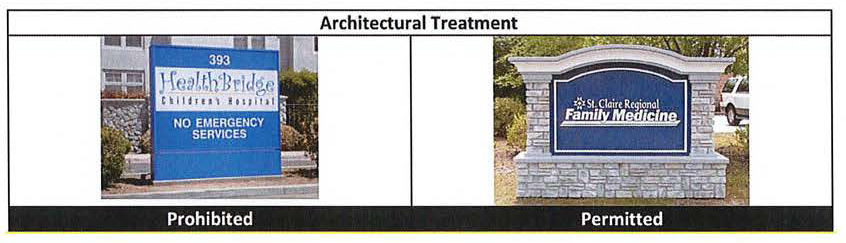
Multi-faced sign means a sign structure with more than two sign faces situated so that each sign face is facing a different direction.
Nits means a unit of measurement of luminance, or the intensity of visible light, where one nit is equal to one candela per square meter.
Nonconforming sign means any sign, legal at the time of erection, but which does not conform to the provisions of this chapter.
Out of store marketing device is any facility or equipment which is located outside of a primary building on a site zoned for nonresidential uses, which is used for the primary purpose of providing a product or service without the owner's or agent's immediate presence, and which is manufactured to include a color, form, graphic, illumination, symbol, and/or writing thereon to communicate information regarding the product or service provided thereby to the public. Examples of out-of-store marketing devices include: bank ATM units, vending machines, newspaper racks, drink machines, ice boxes, and phone booths.
Pennant, streamer means any lightweight plastic, fabric, or other material, whether or not containing a message of any kind, suspended from a rope, wire, or string, usually in a series, designed to move in the wind.
Planned commercial center means any commercial, office, industrial or mixed-use development that contains any combination of offices, residences, retail or industrial uses with a common entry from a public street and are managed as a whole and in accordance with all applicable requirements of the zoning ordinance.
Portable sign means any sign which is not permanently affixed to the ground or to a structure, including but not limited to signs on trailers or signs mounted or painted on vehicles which are parked in such a manner as to serve the purpose of a sign. Sidewalk signs, standard informational signs and banners are excluded from this definition.
Projecting sign means any sign which is attached perpendicular to a building or other structure and extends more than 12 inches horizontally from the plane of the building wall.
Pump-island sign means a sign located on, affixed to, or under a canopy over pump islands of a service station or convenience store with gas pumps.
Road, accessible means any road or street that provides a means of ingress and egress to the lot.
Roof sign means a sign attached to or supported by the roof of a building that extends above the immediately adjacent roof line of the building or a sign that is wholly or partially above the roof line of a building.
Rotating sign. See Animated sign.
Sidewalk signs are defined as an A-frame or easel-style sign to be placed on or adjacent to the sidewalk in conjunction with a business establishment.
Sign means a device, structure or representation for visual communication which is used for the purpose of bringing the subject thereof to the attention of others. For purposes of this chapter, the term "sign" shall include the structure upon which a sign face is located. Flags and banners shall be included within this definition only as provided elsewhere herein. Seasonal holiday decorations shall not be included within the definition of "sign" and regulated as such.
Special event shall be defined for the purpose of this chapter any organized for profit or nonprofit activity having as its purpose entertainment, recreation, and/or education which takes place on public property or takes place on private property but requires special public services such as the use of parks, public streets, rights-of-way, or sidewalks. Special events may include, but are not limited to, activities such as run/walk events, cycling events, street festivals, parades, triathlon/biathlon, grand openings, concerts, assemblies, block parties, and certain outdoor promotional events.
Standard informational sign means a non-illuminated sign with a rigid sign face made for short term use, containing no reflecting or motion simulating elements that would interfere with a driver's operation of a motor vehicle, and which is mounted on a post, stake or metal frame with a thickness or diameter not greater than three and one half inches. Banners are not included in the definition of a standard informational sign.
Store front means the exterior wall of a single, undivided unit located within a planned commercial center or business park.
Street frontage means the lot line that shares a common boundary with any road or street.
Suspended sign means a sign securely suspended above a pedestrian passageway from beneath a canopy or awning, or affixed to the building facade and oriented perpendicular to the building facade.
Temporary sign means a sign of a non-permanent nature. Examples of temporary signs include, but are not limited to signs or posters relating to sales, a business event or sale or general advertisement, concerts, events, and the like. Portable or shelled signs shall be considered a temporary sign.
Tri-vision sign means a sign designed with a series of triangular slats that mechanically rotate in sequence with one another to show three different sign messages in rotation.
Wall sign means a sign fastened, placed or painted upon or parallel to the exterior wall of the structure itself, whether front, rear or side of the structure.
Wayfinding sign means signage used to assist the public in navigating and locating parking, individual tenants, activity centers, ingress/egress points, and other features internal to a site and that is not visible from public rights-of-way. Examples:
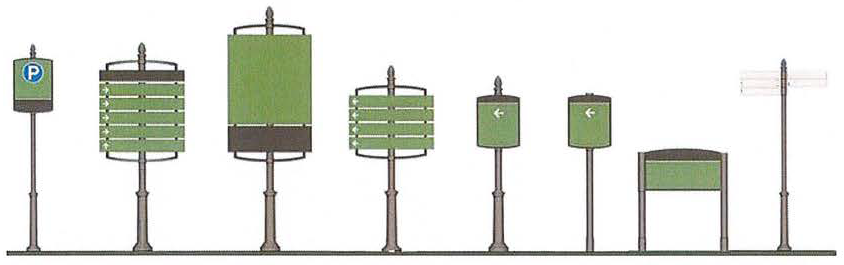
Window sign means any sign that is placed inside a window, within two feet of a window, or upon the window panes or glass, either inside or outside the building, and is visible from the exterior of the structure.
4.45.3 Administration and enforcement.
4.45.3.1 Sign approval.
(a)
Except as specifically excluded from the requirements for obtaining approval, it shall be unlawful for any person to post, display, substantially change, or erect a sign in the city without first having obtained a sign approval or any other permit required by this chapter or other ordinances of the city. Notwithstanding the foregoing, signs which are not visible from a public right-of-way or from neighboring properties shall not be subject to the standards of this chapter.
4.45.3.2 Application information.
(a)
Applications for sign approvals required by this chapter shall be filed by the sign owner or the owner's agent with the director. The application shall describe and set forth the following:
(1)
The street address of the property upon which sign is to be located and a map or visual representation of the property which bears an indication of the proposed location of the sign;
(2)
The name and address of the owner of the real property upon which the subject sign is to be located;
(3)
Consent of the owner, or the owner's agent, granting permission for the placement or maintenance of the sign;
(4)
The type of sign to be erected, the area of the sign, the height of the sign, the shape of the sign, how the sign is to be illuminated (if at all) and an explanation of how the sign is to be mounted or erected;
(b)
The applicant shall apply for all other permits or licenses required by city ordinances and state laws and regulations. Obtaining a sign approval does not exempt the applicant from obtaining and complying with all other permits required for the sign structure. Signs which overhang public right-of-way, require the use of electricity, or are over six feet in height, shall require a building permit and undergo inspection during and after installation of the sign.
(c)
Each application shall contain an agreement to indemnify and save the city harmless of all damages, demands or expenses of every character which may in any manner be caused by the sign or sign structure. Each applicant shall present to the department, upon request, a certificate of liability insurance covering the sign and any damages caused by the sign prior to the issuance of a sign approval.
4.45.3.3 Time for consideration and issuance. The director shall process all sign applications within 15 business days of the director's actual receipt of an application. The director shall give notice to the applicant of his/her decision and return the approved application to the applicant. Any fees shall be due before an approved sign application can be returned to the applicant. Notice of denial of a sign application shall be given by hand delivery, by electronic mail, or by mailing a notice, by certified mail, return receipt requested, to the address on the application on or before the 15th business day after the director's receipt of the application. If mailed, notice shall be deemed to have been given upon the date of mailing in conformity with this section. If the director fails to act within the 15-day period, the applicant shall provide written notice to the director of such failure. If the director fails to act within 15 days of receipt of such notice, the application shall be deemed to have been approved unless the sign is not an illegal sign.
4.45.3.4 Denial and revocation.
(a)
Procedure. The director shall deny applications for signs that do not comply with the provisions of this chapter, incomplete applications, and applications containing any false material statements. Should it be determined that a sign approval was issued pursuant to an incomplete application or an application containing a false material statement, or that an approval has been erroneously issued in violation of this chapter, the director shall revoke the approval. Should the director deny or revoke an approval, the reasons for the denial or revocation are to be stated in writing and hand delivered, by electronic mail, or mailed by certified mail, return receipt requested, to the address on the application on or before the 15th business day after the director's receipt of the application. Any application denied and later resubmitted shall be deemed to have been submitted on the date of resubmission, instead of the date of the original submission. Violation of any provision of this chapter and any other applicable state laws or city ordinance regulating signage will be grounds for denying an application or revoking an approval granted by the city for the erection of a sign. No application shall be denied or revoked, except for due cause as hereinafter defined. "Due cause" is the violation of the provisions of this chapter, other applicable ordinances, state or federal law regulating signage, or the submission of an incomplete application or an application containing false material statements.
(b)
Appeals. The city council shall have the power and duty to hear and decide appeals where it is alleged that there is an error in the denial or revocation of a sign application or approval under this chapter. All such appeals shall be heard and decided pursuant to the following criteria and procedural requirements:
(1)
Appeal of decision by administrative officials. A denial or revocation pursuant to this chapter shall be appealable by notifying the city clerk and specifying the grounds thereof, within 30 calendar days after the action appealed from was taken.
(2)
Decision of the City Council. Following the consideration of all testimony, documentary evidence, and matters of record, the city council shall make a determination on each appeal. An appeal shall be sustained only upon an expressed finding that the administrative official's action was based on an erroneous finding of a material fact, or that the administrative official acted in an arbitrary manner. In exercising its powers, the council may reverse or affirm, wholly or partly, or may modify the order, requirement, decision or determination appealed from, and to that end shall have all the powers of the administrative official from whom the appeal was taken and may issue or direct the issuance of an approval provided all requirements imposed by all other applicable laws are met.
(3)
Time for final decision. A final decision will be rendered by the council within 90 days from the date an appeal is filed with the city clerk. If a final decision is not rendered within the 90-day period, the decision sought to be appealed shall be reversed.
(c)
Certiorari. In the event a person whose application has been denied or revoked is dissatisfied with the decision of the board of appeals, a person shall petition for writ of certiorari to the superior court of Effingham County as provided by law.
4.45.3.5 Forfeiture of signs. Any sign installed or placed on public property, or in any median, or in any public right-of-way, except in conformance with the requirements of this section, shall be forfeited to the public and subject to confiscation. Signs may be placed on private property only with the consent of the property owner. In addition to other remedies hereunder, the city shall have the right to recover from the owner or person placing or maintaining such a sign the full costs of removal and disposal of such sign.
4.45.3.6 Expiration. A sign approval shall become null and void if the sign for which the approval was issued has not been completed and fully installed within six months after the date of approval; provided, however, that where an applicant can demonstrate that a contractor was timely engaged to construct the permitted sign, but the fabrication has not yet been completed due to the fault of the contractor, one 60-day extension may be granted by the director or his/her designee. No refunds will be made for fees paid for sign approvals or building permits that expired due to failure to erect an approved sign. If an individual later desires to erect a sign at the same location, a new application must be processed and another fee paid in accordance with the fee schedule applicable at such time.
4.45.4 Regulations and restrictions by sign type.
4.45.4.1 Banners. Banners shall conform to the following standards:
(a)
Each banner shall not exceed 30 square feet in size and no banner shall be mounted so as to extend above the horizontal plane of the roof where the building wall and roof meet or shall not extend more than eight feet above grade when on the ground;
(b)
Each banner must be individually attached to poles, mast arms, or other structures;
(c)
No more than one banner shall be displayed per street frontage;
(d)
Banners shall be allowed for a period not exceeding 30 days with no more than three such 30-day periods being permitted per calendar year per business;
(f)
All banners must be maintained in good condition as provided for flags in this code section.
4.45.4.2 Billboard signs.
(a)
Any pre-existing Billboards shall not be left in a state of disrepair. Any failing or unsafe structures shall be immediately repaired or removed. The building official has the authority to inspect and determine the structural stability of any and all billboards located within the city. The owner of the billboard will have the right to provide a third party inspection report to prove the billboard structure is sound.
4.45.4.3 Canopy signs. Canopy signs shall be no less than eight feet above the ground when erected over pedestrian walkways at the lowest extremity of the sign. The area of the canopy sign shall not exceed ten percent of the area of the canopy. For canopy signs located above flat canopies, the height shall not exceed two feet and the length shall not exceed 50 percent of the length of the canopy. The area of a canopy sign shall be deducted from the allowable area of a wall sign.
4.45.4.4 Construction sign. The following regulations apply to construction signs:
(1)
One additional sign shall be allowed during construction in all zoning districts;
(2)
The sign shall not be illuminated, not exceed 16 square feet in area and six feet in height above ground level; and
(3)
The sign shall be allowed beginning with the commencement of construction and ending with the issuance of a certificate of occupancy or installation of a permanent sign, whichever occurs first.
4.45.4.5 Electronic signs.
(a)
Electronic signs are prohibited on or adjacent to residential use or DT district parcels. Electronic signs shall comply with all of the following requirements:
(1)
No message may be displayed for less than six seconds;
(2)
No message may be repeated at intervals less than three seconds;
(3)
No segmented message may last longer than ten seconds;
(4)
Electronic signs shall not exceed a maximum illumination of 6,300 nits during the daylight hours and a maximum illumination of 500 nits between dusk to dawn, as measured from the sign's face at maximum brightness;
(5)
The electronic sign shall be limited to 50 percent of the sign area of the allowable square footage of sign area;
(6)
Electronic monument signs shall be limited to a maximum height of eight feet, and sign copy area shall be limited to 70 square feet;
(7)
Electronic signs shall contain a default of an electronic freeze and a black screen in the event of a sign malfunction; and
(8)
No electronic sign shall be illuminated by blinking, scrolling, intermittent, or flashing lights simulating movement. Content shall be static messages only, videos and/or animated images shall not be permitted on LED signs.
4.45.4.6 Feather flags.
(a)
Feather flags shall follow the same standard as temporary signs. Feather flags shall not be located within the right-of-way and shall be maintained in good condition. Deteriorating, faded, ripped or torn flags shall not be allowed.
(b)
Feather flags are prohibited within ten feet of the right-of-way within the downtown (DT) district. The purpose of this restriction is to eliminate distractions to drivers within areas of high pedestrian traffic and to avoid feather flags becoming a nuisance to pedestrians within the ROW.
4.45.4.7 Flags.
(a)
All flags greater than two square feet shall be displayed on flagpoles, which may be vertical or mast arm flagpoles. In nonresidential districts, flagpoles shall not exceed the allowable building height in the applicable zoning district. Flagpoles in single family residential districts shall not exceed 25 feet in height or the height of the primary structure on the lot, whichever is less.
(b)
The maximum dimensions of any flag shall be proportional to the flagpole height. The hoist side of the flag shall not exceed 20 percent of the vertical height of the flagpole. In addition, flags are subject to the following limitations:
(c)
Each lot shall be allowed a maximum of two flagpoles.
(d)
A maximum of two flags shall be allowed per flagpole.
(e)
A vertical flagpole must be set back from all property boundaries a distance which is at least equal to the height of the flagpole.
(f)
Flags and flagpoles shall be maintained in good repair, and to the extent applicable shall be in compliance with the building code. Flagpoles with broken halyards shall not be used and flags which are torn or frayed shall not be displayed.
(g)
On officially designated city, state, or federal holidays, there shall be no maximum flag size or number or other limitations on display.
(h)
This section shall not be construed to restrict the right to display eligible flags as banners or noncommercial signage as provided elsewhere in this chapter.
4.45.4.8
Free standing or pylon signs.
(a)
Free standing signs supported by one or more exposed pylons shall have a decorative base of brick or masonry a minimum of 24 inches tall. No exposed concrete shall be allowed. Similar architectural materials that reflect the architecture of the development may be considered.
(b)
Pylon supports shall be a minimum of eight inches in diameter.
(c)
Single poles/pylons supporting hanging signs or sign blades in the downtown district shall not be considered free standing signs.
4.45.4.9 Illumination.
(a)
No sign shall give off light that glares, blinds or has any other such adverse effect on traffic or adjacent properties.
(b)
The light from an illuminated sign shall be established in such a way that adjacent properties and roadways are not adversely affected and that no direct light is cast upon adjacent properties and roadways. Illuminated signs constructed or maintained within 75 feet of any single-family lot property line shall be externally illuminated.
(c)
Internally Illuminated signs shall be allowed in districts which allow commercial uses, unless specifically prohibited. Illuminated signs shall be maintained and be free of cracks, holes, or visible discoloration.
(d)
Neon signs shall be allowed in non-residential districts. All flashing or rotating neon signs or lights are prohibited in all districts.
(e)
Cracked, damaged, or partially lit neon signs shall be repaired or removed.
(f)
Neon window signs shall be permitted, but are limited to one per facade and signs shall not exceed six square feet in size.
4.45.4.10 Monument signs.
(a)
Monument sign structures must be constructed of brick, stone masonry or similar architectural material and reflect the architecture of the development. No exposed concrete block.
(b)
The height of all monument signs at their highest point above the level of the ground shall not exceed the height specified in this ordinance; however, when the ground level is lower than the level of the adjoining street pavement, then a sign may be raised so as to be no more than the allowable height above the level of the pavement.
(c)
Monument signs in residential areas.
(i)
Monument signs in residential areas are only permitted at the entrance to any residential subdivision or real estate development for a residential use;
(ii)
No sign in a residential district may be illuminated, except for monument signs that are compliant with the provisions of this ordinance. No monument sign may be internally illuminated unless backlit illumination is used;
4.45.4.11 Nonconforming signs.
(a)
The city finds that nonconforming signs may adversely affect the public health, safety and welfare. Such signs may adversely affect the aesthetic characteristics of the city and may adversely affect public safety due to the visual impact of said signs on motorists and the structural characteristics of said signs.
(b)
Any nonconforming sign that is not used or that is not leased for a continuous period of six months shall not be reused for sign purposes unless and until it fully conforms with the terms and requirements of this chapter.
(c)
Illegal signs must be removed within 30 days of notice from the city.
(d)
No structural repairs, or changes in shape, size or design, to any nonconforming sign shall be permitted except to make a nonconforming sign comply with all requirements of this chapter. Routine maintenance and changing of copy shall be permitted as long as such maintenance or changing of copy does not result in or change the shape, size, or design. Any change from a non-electronic format to an electronic format is considered a change in design and not permitted with respect to a nonconforming sign, unless the sign is brought fully into compliance with all requirements at the time of such change. Signs which are structurally unsound or present a hazard to persons or property must be removed within two days upon notification by the city.
(e)
A nonconforming sign structure may not be replaced by another nonconforming sign structure, except that a nonconforming sign may be rebuilt where the original sign structure has been damaged or destroyed by nature or an act of God. No such replacement structure may have a sign area or height greater than the original structure.
4.45.4.12 Out-of-store marketing device.
(a)
Out-of-store marketing devices shall only be allowed in commercial (B) districts.
(b)
The marketing device shall not exceed eight feet in height and shall not be illuminated except for illumination intrinsic to the device.
(c)
The marketing device shall be located on a property with an existing principal use.
(d)
The marketing device shall not be located within the minimum setback, landscape areas, or transitional buffers.
(e)
If located within a parking lot, the marketing device shall not reduce the number of parking spaces beyond the minimum required within the zoning district for the subject property.
4.45.4.13 Standard informational signs. The following shall apply to standard informational signs:
(a)
One sign per lot not to exceed 16 square feet in area, or multiple signs not to exceed an aggregate sign area of 16 square feet.
(b)
All standard informational signs shall be erected to a height not greater than six feet above ground level.
4.45.4.14 Sidewalk signs.
(a)
The following shall apply to sidewalk signs:
(1)
Sign composition material: Wood or metal (dry erase or chalk board style).
(2)
Placement: Must be placed in conjunction to a business establishment authorized on the subject lot and be situated to allow for clear passage with a minimum accessible sidewalk width of 36 inches and compliance with the Americans with Disabilities Act.
(3)
Number of signs allowed: One per establishment.
(4)
Maximum height: Three feet.
(5)
Sign area: Not larger than six square feet.
(7)
All sidewalk signs shall be removed daily upon cessation of business hours and shall be stored indoors.
(8)
No sidewalk signs shall be lit, contain neon illumination, or contain plastic construction or embellishment.
(9)
Evidence of neglect or dilapidation of any sidewalk sign shall provide cause for immediate removal.
4.45.4.15 Temporary signs.
(a)
Temporary signs and banners may be allowed for a period of up to 21 days only. A maximum of two temporary signs may be allowed on a property at the same time. Temporary signage shall be allowed on a property no more than three times per calendar year.
4.45.4.16
Wayfinding signage.
(a)
Location. Wayfinding signs shall not be affixed or otherwise attached to trees, traffic signals, benches, street signs, or fencing, and shall be subject to the following regulations:
(1)
Signs must allow for a minimum five-foot-wide clear pedestrian pathway to and from all building entrances and exits.
(2)
Signs for courtyard entries shall be limited to one sign for all businesses located within the courtyard, utilizing the same common entry. Signs shall be located within ten feet of the courtyard entrance.
(b)
Size. Wayfinding signs shall be a maximum of 16 square feet in area and ten feet in height.
(c)
Design. Wayfinding signs shall have a compatible design, be constructed of durable materials with a substantial base and landscape plantings, and colors that complement the existing allowable signage for the center subject to the approval of the director or his/her designee.
4.45.4.17 Wall, roof, or projecting signs.
(a)
Wall or projecting signs shall be securely fastened to the building surface.
(b)
Projecting signs may project from the building provided that no projecting sign shall be maintained less than eight feet above the ground level when erected over pedestrian walkways
(c)
No wall or projecting sign shall extend above the roof line or parapet wall. Exceptions may be approved by the director for buildings in the DT district, provided a historical reference can be shown.
(d)
Exterior walls that are horizontally inset or offset from other wall faces along the same side of a building shall only be permitted to have affixed sign structures which maintain a minimum distance of one foot from the vertical side edges and the horizontal top edge of the wall face.
4.45.4.18 Window signs.
(a)
Window signs consisting of more than 50 percent open voids may cover up to 80 percent of a single window.
(b)
Solid or opaque window signs shall be limited to 30 percent of the window area.
(c)
For building facades with more than one window: No more than 50 percent of the windows of one facade shall be covered in signage. Doors with more than 50 percent glazing shall be counted as windows for this section.
(d)
Address numbers placed on the entry door shall not count as signs, provided that the number/letters are less than ten inches tall.
4.45.5 General regulations and restrictions.
4.45.5.1 Exemptions. The following signs shall be exempt from the approval requirements of this chapter; provided, however, that such signs shall be subject to all other provisions of this chapter:
(a)
Window signs;
(b)
Standard informational signs;
(c)
Signs for the sole purpose of displaying street numbers not exceeding six inches in height for residential uses and 12 inches in height for nonresidential uses;
(d)
Flags on lots in all districts and banners on lots in single family residential zoning districts;
(e)
Nongovernmental traffic control devices in or adjacent to parking areas and driveways and signs located at railroad crossings;
(f)
Signs and warning devices meeting the standards of the manual on uniform traffic control devices and installed or utilized by governmental authority or by persons and entities duly authorized to work on the public rights-of-way while such work is in progress;
(g)
Out-of-store marketing device;
(h)
Sidewalk signs meeting the requirements of this ordinance;
(i)
Wayfinding signs.
4.45.5.2 Fees. Sign application and building permit fees shall be paid in accordance with the fee schedule applicable at the time of application.
4.45.5.3 Prohibited signs. The following types of signs are prohibited throughout the city:
(a)
Signs placed in the dedicated right-of-way of any state maintained public road other than publicly owned or maintained signs and signs pertaining to railroad crossings;
(b)
Signs that overhang any portion of the right-of-way dedicated for vehicular traffic;
(c)
Signs that contain words, pictures, or statements which are obscene, as defined by O.C.G.A. § 16-12-80, as amended;
(d)
Signs that simulate an official traffic control device, warning sign, or regulatory sign or which hide from view any traffic control device, signal or public service sign;
(e)
Signs that emit or utilize in any manner any sound capable of being detected on any traveled road or highway by a person with normal hearing abilities;
(f)
Signs that interfere with road or highway visibility or obstruct or otherwise interfere with the safe and orderly movement of traffic or which otherwise pose a hazard to traffic due to structural deficiencies in the structure of such signs;
(g)
Signs erected by nailing, fastening or affixing the sign in any manner to any tree, curb, utility pole, natural feature, or other structure except as may be set forth herein;
(h)
Animated signs;
(i)
Signs that obstruct any fire escape, any means of egress or ventilation or that prevent free passage from one part of a roof to any other part thereof, as well as signs attached to any fire escape;
(j)
Signs that do not conform to city building and electrical codes;
(k)
Multi-faced signs, including:
1.
Tri-vision signs; and
2.
LED signs not meeting the standards set in this ordinance;
(l)
Signs erected after the effective date of the most recently adopted sign ordinances that are in violation of said ordinances.
(m)
Any sign constructed of non-durable material including, but not limited to, paper, cardboard or flexible plastic. This provision does not apply to flags, banners, or special event signs;
(n)
Portable signs;
(o)
Abandoned signs as defined by this ordinance.
(p)
Any sign that is structurally unsound, or is a hazard to traffic or pedestrians;
(q)
Illegal signs;
(r)
Signs consisting in whole or in part of a series, line, or row of lights, whether supported by cables or other physical means, within 150 feet of a street and visible therefrom. Notwithstanding the foregoing, holiday lights and decorations displayed not more than 30 days before a holiday shall be exempted from this section.
(s)
Roof signs;
(t)
Any sign not specifically authorized by this ordinance.
4.45.5.4 Owner's consent required. No sign may be approved or posted on property without the consent of the property's owner or authorized agent. Should it be determined that a sign was erected on a lot pursuant to an alleged agent's incorrect representation that the record owner of the lot in fact gave permission for the erection of a sign, the approval for such sign shall be revoked as provided herein.
4.45.5.5 Measurement of sign area and height.
(a)
The area of a sign shall be computed as the area within the smallest continuous polygon comprised of not more than eight straight lines enclosing the limits of a sign face, together with any sign face cabinet or frame or material, texture, or color forming an integral part of the sign face used to differentiate the sign face from the structure upon which it is placed. If polygons established around wall signs located on the same street oriented wall are within 24 inches or less of one another, then the area of the sign shall be measured within one continuous polygon. For double-faced signs, the side of the sign with the largest sign area shall be used in computing the sign area. For monument signs, sign area includes the face of the structure that the message is affixed to, not including the base.
(b)
The height of a sign shall be computed as the distance from the base of the sign structure at grade to the top of the highest attached component of the sign. Grade used for height calculations shall be construed to be the lower of existing grade prior to construction or the newly established grade after construction, exclusive of any filling, berming, mounding, or excavating solely for locating the sign. In cases in which the normal grade cannot reasonably be determined, sign height shall be computed on the assumption that the elevation of the normal grade at the base of the sign is equal to the elevation of the nearest point of the crown of a public street or the grade of the land at the principal entrance to the principal structure on the zone lot, whichever is greater. Where the normal grade is below the normal grade of a public street, the sign base can be raised to the elevation of the normal grade of the street before the height limitations are applied (surveyor's certificate required).
4.45.5.6 Restrictions for residential uses.
(a)
Additional monument signs in residential developments.
(1)
Residential developments with more than one identifiable section, as shown on an approved preliminary plat, may be allowed internal identification monument signs of 16 square feet on one side of the entrance to each section.
4.45.5.7 Restrictions for non-residential uses.
(a)
In addition to all other applicable regulations in this chapter, all nonresidential districts not developed as a planned commercial center are limited to the following signs:
i.
Downtown district:
a.
Painted wall signage in the downtown district (DT) may be increased in size if historic reference is provided.
b.
Signage may be increased in size if the facade of an existing building has a sign band that would allow a sign larger than the maximum listed in this ordinance.
c.
Signage on historic building facades shall not extend beyond or outside of that area within an established sign band.
(b)
A lot developed as a planned commercial center shall be allowed the following:
(c)
Institutional, educational and government uses: Monument signs. One maximum 32-square-foot entry wall or monument sign or two single-faced entrance wall or monument signs not to exceed 16 square feet for each side of the development's entrance shall be permitted for each street on which the property has up to and including 500 linear feet of frontage. The sign shall have a maximum height of six feet and shall not be internally illuminated unless backlit illumination is used. Changeable copy shall not be permitted.
4.45.5.8 Restrictions for other zoning districts.
(a)
Hwy 21 Overlay District. Signage in the Hwy 21 Overlay District may exceed signage restrictions listed herein, provided that they meet all restrictions and regulations stated in the Hwy 21 Overlay District Ordinance.
(b)
Downtown district. Signage in the downtown (DT) district shall abide by this ordinance. Additional and further restrictions set forth in the DT Ordinance shall be enforced. When there is a conflict, the more restrictive sign standard shall apply.
4.45.5.9
Height and setback requirements. All signs shall be set back as follows, unless a more restrictive setback is specified in conditions of zoning or otherwise in this chapter:
(a)
Five feet from the right-of-way. No sign shall project over a road way designated for vehicular traffic.
(b)
All signs shall be so located and shall provide such vertical clearance as to provide for safe, convenient and unobstructed passage for pedestrians.
(c)
Banners shall be exempt from the setback requirements, but shall not encroach upon or project over the right-of-way.
(d)
Window signs are only allowed on the ground floor of a building.
4.45.5.10 Convenience stores and service stations with pump islands. In addition to the signs otherwise allowed in this chapter, convenience stores and service stations with pump islands may have signage subject to the following limitations:
(a)
Within the limits of the canopy covering the pump islands, one sign per canopy face that is visible from the public street frontage with a maximum of twelve square feet allowed per canopy sign.
(b)
Within the limits of the canopy covering the pump islands, pump-island signs shall be limited to no more than two signs per island, not to exceed four square feet per sign. However, total square footage of all pump island signs shall not exceed 24 square feet.
(c)
Accessory car wash, if a separate drive-through car wash building is on site, one additional wall sign per street facing wall, not to exceed six square feet, may be permitted.
4.45.5.11 Variances.
(a)
Where a literal application of this chapter, due to special circumstances, would result in an unusual hardship in an individual case, a variance may be granted by the city council after receiving evidence that the applicant meets all of the following criteria:
(1)
Exceptional conditions pertaining to the property where the sign is to be located because of its size, shape, or topography, which are not applicable to other lands or structures in the area;
(2)
Granting the variance would not confer on the applicant any significant privileges which are denied to others similarly situated;
(3)
The exceptional circumstances are not the result of action by the applicant;
(4)
The requested variance is the minimum variance necessary to allow the applicant to enjoy the rights commonly enjoyed by others similarly situated;
(5)
Granting of the variance would not violate more than one standard of this chapter; and
(6)
Granting the variance would not result in allowing a sign that interferes with road or highway visibility or obstructs or otherwise interferes with the safe and orderly movement of traffic.
(b)
No variance shall be granted to a sign which increases the maximum dimension of the sign more than 20 percent of that allowed by this section.
(c)
No variance shall be granted which increases the maximum square footage of a sign more than 20 percent of that allowed by this section.
(d)
No variance shall be granted to increase the size or height of a banner, sidewalk, wayfinding, construction or standard informational signage.
4.45.5.12 Severability. In the event a court of competent jurisdiction finds that any section, sentence, clause or phrase of this chapter is void, such invalidity shall not affect the remaining sections, sentences, clauses or phrases of this article. The offending provisions shall be severed from the article and the remainder of the article shall continue in full force and effect.
(Ord. No. 2021-03, § 2(Exh. A), 4-13-2021; Ord. No. 2021-09, § 1, 9-14-2021; Ord. No. 2022-02, § 2(Exh. A), 1-11-2022; Ord. No. 2023-26, § 1 Att. A, 12-12-2023; Ord. No. 2024-08, § 1, 3-12-2024)
4.46 - Site Plan Approval.
4.46.1 Scope. Applicants seeking to obtain a building permit in the City of Springfield must first obtain site plan approval from the City Council for the following types of development:
i.
Shopping Centers;
ii.
Industrial uses;
iii.
Multifamily building(s) containing three or more units;
iv.
Any other use specifically requiring site plan approval by this Ordinance.
v.
Any developments which require the platting, construction, or opening of new streets, water or sewer facilities, or improvement of existing streets
4.46.2 Site Plan Requirements:
1)
Name of project and name of owner of the property;
2)
Names of project planner and developer and contact information;
3)
North arrow;
4)
Date, including all revision dates;
5)
General location map;
6)
Total area and development area in acres;
7)
Zoning District and any zoning variances or conditions. If a project is in a Planned Unit Development, the name of the planned development and the date it was approved;
8)
Zoning of contiguous properties and existing uses on contiguous property;
9)
Boundary survey of the site with dimensions and bearings referenced to a permanent marker;
10)
Existing topography at one (1) foot contour intervals or spot elevations often enough to adequately determine the slope of the site;
11)
Flood zone boundary lines and flood hazard area statement;
12)
Existing and proposed easement locations and uses including the holder o of the easement and any restrictions imposed by the easement;
13)
Required yards (building setbacks);
14)
Existing streets, buildings, water bodies, wetlands, and development setback line;
15)
Existing water lines, sewer lines, and fire hydrants;
16)
Existing storm water drainage structures;
17)
Proposed locations of storm water detention areas, if required;
18)
Locations, dimensions, building area, and uses of all proposed buildings and structures. Indicate building overhangs including, but not limited to, balconies, cantilevers, eaves, and bay windows.
19)
Conceptual building elevations;
20)
Location of any exiting or proposed underground storage tanks;
21)
Curb cuts, vehicular access and circulation;
22)
Pedestrian and other types of circulation;
23)
Off street parking and loading areas and dimensions;
24)
Recreation areas;
25)
Buffer dimension and composition;
26)
Refuse collection areas;
27)
Proposed and existing sign locations;
28)
Project phasing, if applicable;
29)
All trees with a trunk diameter of twenty-four (24) inches or more, measured four and five-tenths (4.5) feet up from the ground;
30)
Outdoor lighting arranged in a manner which will protect the highway and neighboring properties from direct glare of hazardous interference of any kind;
31)
Location of existing graves;
32)
Signed seal of the design professional.
4.46.3 Other required information that may be presented separately or on the Site Plan:
1)
Tabulation of the project density in dwelling units per net acre, if applicable;
2)
Tabulation of site coverage, allowed and proposed;
3)
Tabulation of impervious surface coverage;
4)
Tabulation of the number of required parking and loading spaces, required and proposed;
5)
A statement describing the character and intended use of the development;
6)
If common facilities, then including, but not limited to, recreation areas, private streets, and common open spaces to be provided. Statements as to how they will be provided and maintained shall be submitted;
7)
Description or drawing of the proposed water and sewer system;
8)
Description or drawing of the proposed store water drainage system.
(Ord. No. 2021-03, § 2(Exh. A), 4-13-2021)
4.47 - Storage Facilities.
4.47.1 All storage facilities shall be completely screened from roads or developed area with a solid fence or wall a minimum of six feet, maintained in good condition as determined by the governing authority, and painted except for masonry construction, or with suitable plantings.
4.47.2 No operations shall be conducted which shall cause a general nuisance or endanger the public health.
4.47.3 All existing storage facilities shall comply with these requirements within one year of the date of this ordinance, or shall then terminate their operation.
4.47.4 Any single unrepairable or unrepaired item must be removed from the premises within 90 days.
(Ord. No. 2021-03, § 2(Exh. A), 4-13-2021)
4.48 - Swimming Pools, Private, Community or Club.
4.48.1 Private Swimming Pools. A private swimming pool in the ground or permanent installations above the ground, but not including farms ponds, as regulated herein, shall be any pool, lake or open tank not located within a completely enclosed building and containing or normally capable of containing water to a depth at any point greater than one and one half feet. No such swimming pool shall be allowed in a "B-1" or any "R" District unless it complies with the following conditions and requirements:
i.
The pool is intended and is to be used solely for the enjoyment of the occupants or the principal use of the property on which it is located, and their guests, and no fee shall be charged.
ii.
The swimming pool and all of the area used by the bathers shall be so walled or fenced as to prevent uncontrolled access by children from the street or adjacent properties. The said fence or wall shall not be less than four feet in height and maintained in good condition and grounded for electricity per national electric safety code. The area surrounding the enclosure, except of the parking spaces, shall be suitably landscaped with grass, hardy shrubs and trees and maintained in good condition. Existing pools shall conform in 90 days to these requirements. Inspection by the zoning office to ascertain conformance with the law shall be made before use of the pool by the owner or any friend or relative of the owner or paid-member will be allowed. The inspection shall be made within one week of completion of all construction.
(Ord. No. 2021-03, § 2(Exh. A), 4-13-2021)
4.49 - Time Limitation.
No permit for construction, erection, or alteration of any building or structure or part thereof, or for signs or outdoor advertisements, or part thereof, shall be valid for more than one year unless work at the site has commenced within such period.
(Ord. No. 2021-03, § 2(Exh. A), 4-13-2021)
4.50 - Trailers and Mobile Offices.
No trailer shall be parked, unless specifically permitted to provide space for the conduct of business, in which case it may be used temporarily for office purposes during the construction of Principal Building or a road on the issuance of a temporary permit by the City Council.
(Ord. No. 2021-03, § 2(Exh. A), 4-13-2021)
4.51 - Vending Machines.
4.51.1 Vending Machines shall be allowed only in permitted districts as referenced in this ordinance. Any vending machines placed or installed in conflict with this article shall be removed at the expense of the owner. Vending machines as defined by this ordinance shall be subject to the following provisions:
a.
All Vending machines subject to permitting or approval by the Department of Public Health or the Department of Agriculture must have such approval before installation.
b.
Vending machines or units must be licensed to operate in the City of Springfield before installation; or be affiliated with a business that is currently licensed to operate in Springfield.
c.
Vending machines must be maintained and kept in working order
d.
Current emergency contact information shall be conspicuously placed on each vending machine.
e.
The number of outdoor vending machines shall be limited to 1 per parcel.* Installation of additional units may be granted upon request to City Council if the additional units are not in detriment to the public good or impair the purpose and intent of this ordinance.
f.
Any constructed vending structures shall require a building permit. (Large automated vending units with an attached architectural roof shall be considered in compliance with this provision.)
g.
The vending machine or structure shall not be placed in the public right-of-way and shall be situated as to not impede access, block parking areas or create unsafe conditions, nor shall it be located adjacent to any ADA required parking. At no time shall the operation of a vending machine or structure reduce the number of parking spaces on a property below the minimum required by City Code or ordinance.
h.
Vending machines and structures shall meet the minimum principle setbacks for the district in which it is located.
i.
All vending structures or machines must be placed on a level foundation or pad of appropriate thickness. Construction of foundations may require a building permit.
j.
Vending machines must have a proper drainage system for any water draining from the vending unit. Vending machines are not permitted to drain onto neighboring properties or create unsafe or undesirable conditions due to improper drainage.
k.
Any installed safety measures such as bollards shall be painted to match the color of the vending machine or structure.
l.
Vending machines shall not fall in to disrepair or present a negative visual impact on the streetscape or general aesthetic of the City
m.
Vending machines shall not become the source of litter or trash.
n.
All equipment or appurtenances including the vending machine and any vending machine structure shall be removed within 30-days of the closure or ceasing of operations of the vending machine.
4.51.2 Automated Ice Vending Machines and Units. In addition to all ordinances and parts of ordinances pertaining to vending machines, automated ice vending machines and/or units shall also be subject to the following provisions:
a.
The unit shall be enclosed, unmanned with a maximum of 225 SF
b.
Only one ice vending machine shall be allowed per parcel.
c.
The unit or structure shall not be placed in the public right-of-way.
d.
At least one dedicated parking space and one drive through lane with room for the stacking of two cars or a vehicle with a trailer shall be required for the ice vending machine.
e.
The ice vending unit shall be connected to public utilities if water service is required and public utilities are available.
f.
The following architectural design standards shall be met:
i.
Exterior Finishes shall be simulated wood, brick, brick facing, stucco, or other permitted materials consistent with the zoning district in which it is located.
ii.
Architectural roof or screening consistent with the district in which it is located shall be required to screen mechanical equipment and other rooftop appurtenances.
g.
Automated Ice Vending structures shall be allowed permanent signage attached to the structure or unit. Such signs shall not exceed 30 SF each in size and shall be limited to two signs per vending unit or structure.
h.
Ice vending units shall not use generators as a primary source of power.
(Ord. No. 2019-04, § 1, 4-9-2019; Ord. No. 2021-03, § 2(Exh. A), 4-13-2021)
4.52 - Vision Clearance at Street Intersections.
No fence, wall, terrace, sign, shrubbery, planting or structure or object capable of obstructing driver vision between the heights of thirty (30) inches and ten (10) feet above the finished street level shall be permitted on a corner lot within twenty-five (25) feet of the point formed by the intersection of the street right-of-way lines (or such lines extended in case of a rounded corner) which bound said lot.
(Ord. No. 2021-03, § 2(Exh. A), 4-13-2021)

