
Springfield Charter Township
City Zoning Code
City Zoning Code
ARTICLE V
- SUPPLEMENTAL REGULATIONS
Sec. 40-621. - Community recreation centers.
Community recreation centers are subject to the following:
(1)
The site shall have direct accessibility to a paved public road.
(2)
A minimum 100-foot setback shall be required between the principal structure and any adjacent residentially zoned or used property.
Sec. 40-622. - Environmental education centers.
Environmental education centers are subject to the following:
(1)
Off-street waiting space shall be available for dropoff and pickup of visitors by school buses and private automobiles outside of the right-of way of any public street.
(2)
All buildings shall be set back at least 50 feet from all abutting property lines.
Sec. 40-623. - Golf courses, including accessory clubhouses, driving ranges, pro shops, maintenance buildings and recreational facilities.
Golf courses, including accessory clubhouses, driving ranges, pro shops, maintenance buildings and recreational facilities, are subject to the following:
(1)
The site shall have direct accessibility to a paved public road.
(2)
The location of structures, such as the clubhouse and accessory buildings, and their operations shall be reviewed by the planning commission to ensure minimum disruption of the adjacent properties, and as much distance as is practicable shall be provided between golf course structures and activities abutting residential properties. A minimum 50-foot setback shall be required between any structures and any residentially zoned or used property, except that a minimum 100-foot setback shall be required between any maintenance building and/or yard and any adjacent residentially zoned or used property.
(3)
All storage, service and maintenance areas when visible from adjoining residentially zoned or used land shall be screened in accordance with the requirements set forth in section 40-721.
(4)
Swimming pool areas shall be surrounded with a protective fence, six feet in height, and entry shall be provided by means of a controlled gate.
(5)
Winter activities such as skating, crosscountry skiing, sledding and tobogganing may be permitted by the township board, if it finds such uses to be consistent with the standards found in section 40-145.
Sec. 40-624. - Public and private elementary, middle and high schools.
Public and private elementary, middle and high schools are subject to the following:
(1)
The minimum lot area shall be ten acres for elementary schools, 20 acres for middle schools, and 40 acres for high schools.
(2)
Off-street waiting space shall be available for dropoff and pickup of students by school buses and private automobiles outside of the right-of-way of any public street.
(3)
A minimum 50-foot setback shall be required between the principal structure and any adjacent residentially zoned or used property.
Sec. 40-625. - Colleges, universities and other such institutions of higher learning, both public and private, offering courses in general, technical, or religious education.
Colleges, universities and other such institutions of higher learning, both public and private, offering courses in general, technical, or religious education, are all subject to the following:
(1)
The minimum site area shall be 40 acres.
(2)
All ingress and egress from said site shall be directly on to a major thoroughfare as so designated on the thoroughfare plan of the Springfield Township Master Plan.
(3)
No building shall be closer than 100 feet to any property line.
Sec. 40-626. - Public and private nursery and kindergarten schools.
Public and private nursery and kindergarten schools are subject to the following:
(1)
The subject parcel shall have the minimum lot area, width and setback requirements for the zoning district in which it is located.
(2)
The property shall be maintained in a manner that is consistent with the character of the neighborhood.
(3)
Off-street waiting space shall be available for dropoff and pickup of students by school buses and private automobiles outside the right-of-way of any public street.
(4)
There shall be an outdoor play area of at least 5,000 square feet provided on the premises. Said play area shall not be located within the front yard setback. This requirement may be waived by the planning commission if a public play area is within 500 feet of the subject parcel.
(5)
All outdoor play areas shall be enclosed by a fence that is designed to discourage climbing, and is at least four feet in height, but no higher than six feet.
Sec. 40-627. - Day care centers.
Day care centers are subject to the following:
(1)
The site shall meet the minimum lot area requirements of the zoning district in which the use is located but in no case shall be less than one acre.
(2)
All buildings shall meet the minimum setback requirements of the zoning district in which the use is situated, except that no building shall be located any closer than 50 feet from the boundary of a neighboring residentially zoned or used property.
(3)
A separate dropoff and pickup area shall be provided adjacent to the main building entrance, located off of a public street and the parking access lane, and shall be of sufficient size so as to not create congestion on the site or within a public roadway.
(4)
A day care center shall only be located on a paved county primary road or state trunkline.
(5)
There shall be an outdoor play area of at least 5,000 square feet provided on the premises. Said play area shall not be located within the front setback. This requirement may be waived by the planning commission if public play area is available 500 feet from the subject parcel. All required outdoor play areas shall be enclosed by a fence that is designed to discourage climbing and is at least four feet in height, but no higher than six feet.
(6)
The property shall be maintained in a manner that is consistent with the character of the neighborhood.
(7)
The hours of operation shall not exceed 16 hours within a 24-hour period. Activity between the hours of 10:00 p.m. and 6:00 a.m. shall be limited so that the dropoff and pickup of children is not disruptive to neighboring residents.
(8)
Appropriate licenses with the state shall be maintained.
Sec. 40-628. - Automobile repair facility, minor; automobile filling/convenience station; automobile filling/mixed use station; and automobile filling/service station.
Automobile repair facilities, minor, automobile filling/convenience stations, automobile filling/mixed use stations, and automobile filling/service stations are subject to the following:
(1)
The lot for the automobile service station shall have 150 feet of frontage on the principal street serving the station.
(2)
The use at the proposed location will not create a traffic hazard or traffic nuisance because of its location or the location of its driveways:
a.
As compared to similar uses;
b.
Considering turning movements in relation to other lots, existing buildings, or proposed buildings on or near the site and the traffic pattern from such buildings;
c.
Considering its location near a vehicular or pedestrian entrance or crossing to a public or private school, park, playground or hospital, or other public use or place of public assembly; and/or;
d.
Considering its location and proximity to other surrounding uses.
(3)
Driveway tapers and acceleration and deceleration lanes shall be designed according to the provisions set forth in section 40-684—Driveway approaches. Driveway spacing shall be in conformance with section 40-683—Access management and may be no closer than 20 feet to the side property line, with the exception of combined driveways that may be located on or adjacent to a property line. The maximum width of each driveway at the right-of-way line shall be no more than 30 feet unless modified by the planning commission during the site plan review process to ensure adequate access of delivery and emergency vehicles. Whenever possible, a combined driveway for both service station and an adjacent commercial property shall be designated and provided.
(4)
If a separate automobile wash is proposed, it must maintain a minimum distance of 25 feet from any lot line, and shall not encroach on the required front, side or rear yards.
(5)
Additional screening or noise buffering pursuant to section 40-721(b)(3). Screening between land uses, may be required at the discretion of the township taking into consideration adjacent land uses.
(6)
All buildings must be oriented so that service bay and automobile wash doors face away from any abutting residentially zoned or used property.
(7)
If a canopy is proposed over the gasoline pumps, the canopy design must relate to the facade design of the main building. The minimum clear distance to the canopy bottom shall be 16 feet with a maximum canopy height of 20 feet. Canopy height may be increased to 25 feet if a pitched roof is incorporated in the design. The location of the canopy must meet all minimum setback requirements for the district as enumerated in section 40-572.
(8)
Outside sales areas shall be located within five feet of the building. One display/sales rack may be permitted adjacent to each row of pump islands. Propane sales shall be located outside the principal building in an enclosure designed and approved for such purpose. All outside sales areas, displays, racks, and/or enclosures shall not obstruct pedestrian or vehicular access ways.
(9)
Vehicles awaiting repair must be parked in a designated parking space. One such vehicle per service bay may be parked on-site for no more than 48 hours.
(10)
One tow-truck that is accessory to the subject principal use may be parked on-site within a designated parking space.
(Ord. No. 2019(11), § 1, 10-10-2019)
Sec. 40-629. - Automobile repair facility, major.
Automobile repair facilities, major, are subject to the following:
(1)
The site for any such use shall (except for frontage on a public street and any outdoor vehicle storage areas) be screened in accordance with section 40-721(b)(3).
(2)
The outside storage of permitted automobiles shall be screened as follows: All vehicles shall be screened from off-site view by walls (including building walls) or fences at least eight feet in height. However, a screening wall or fence less than eight feet high, but not less than six feet high, existing on the date of enactment of the ordinance from which this section is derived may serve in lieu of such eight-foot wall or fence. The material and surface of such walls or fences shall be approved by the body responsible for site plan review, vine-covered or otherwise improved by the use of planting. All outside storage areas shall be specifically shown on the site plan, and be approved by the township.
(3)
Wrecked, damaged or otherwise inoperable motor vehicles shall be stored in said parking/storage area for a period not to exceed 72 hours. No more than a total of three such vehicles per service bay shall be stored at any time.
(4)
Devices and controls adequate to meet the standards enumerated in article VI relative to sound, vibration, smoke, odor, heat, glare, or gases shall be installed.
(5)
Adequate means of sanitary disposal of any waste material shall be provided.
(6)
Storage of materials, supplies, equipment or similar items shall be in an enclosed building.
(7)
Dismantling and/or salvaging of vehicles for parts recovery in this district is prohibited.
Sec. 40-630. - Self-storage facility.
Self-storage facilities are subject to the following requirements and conditions:
(1)
Prohibited activity in relationship to the rental of units.
a.
No activity other than rental of storage units shall be allowed. No commercial, wholesale, retail, industrial or other business use on, or operated from, the facility shall be allowed. Examples of prohibited activities (commercial or personal) include but are not limited to:
1.
Auctions, wholesale or retail sales, miscellaneous or garage sales, except those conducted by the owner of the self-storage facility to dispose of those items abandoned by individual tenants.
2.
The servicing, repair or fabrication of motor vehicles, boats, trailers, lawnmowers, appliances, furniture, machinery or other similar property.
3.
The operation of power tools, painting equipment, compressors, welding equipment or similar tools and equipment.
4.
The storage of goods needed and used on a regular basis as part of a business.
b.
The storage of any toxic, explosive, corrosive, flammable or hazardous material is prohibited. Fuel tanks on any motor vehicles, boat, lawnmower or similar property will be drained or removed prior to storage. Batteries will be removed from vehicles before storage and shall not be stored within units under any circumstances.
c.
All outdoor storage of automobiles and recreational vehicles shall be screened in accordance with section 40-721(b)(3).
(2)
General requirements.
a.
The minimum lot area used for self-storage facilities shall be two acres. Other uses on the same property shall not be included in the two-acre minimum area.
b.
Each facility must provide for emergency vehicle access at all times.
c.
No structure may exceed one story in height.
d.
The total lot coverage by structures shall be limited to 50 percent of the total lot area used for the self-storage facility.
(3)
Parking, drives and loading areas.
a.
One parking space for every 150 storage spaces or fraction thereof shall be located adjacent to the project office. A minimum of three such spaces shall be provided.
b.
Distance between storage unit buildings shall be a minimum of 24 feet.
c.
All storage units must be accessible by safe circular drives clearly marked to distinguish direction (if one-way).
d.
During the site plan review process the applicant must demonstrate that emergency vehicles and other vehicles that would typically utilize such a facility can circulate through the site adequately, i.e., entering and exiting the site without having to back up.
(Ord. No. 2012(3), § 1, 6-14-2012)
Sec. 40-631. - Truck stops.
Truck stops are subject to the following:
(1)
All buildings established in relation to a truck stop shall be no closer than 1,000 feet from residentially zoned or used property.
(2)
A minimum width of any driveway intended to accommodate truck traffic shall be 36 feet wide at the right-of-way line.
(3)
The facility shall provide adequate parking for truck layover, truck scales and adequate space for queuing at gas/fuel islands.
(4)
Outdoor storage of disabled vehicles is prohibited.
(5)
Outdoor storage of truck parts or supplies is prohibited.
(6)
The facility may not be located within 1,000 feet of any public or private school, hospital, church, nursing home or housing complex containing more than 50 residential units, measured from the nearest lot line on a straight line.
Sec. 40-632. - Fleet fuel storage and dispensing facility.
Fleet fuel storage and dispensing facilities are subject to the following:
(1)
Devices and controls adequate to meet the standards enumerated in section 40-453 relative to sound, vibration, smoke, odor, or gases shall be installed.
(2)
Adequate means of sanitary disposal of any waste material shall be provided.
(3)
Any proposed catchbasins on the site shall, at a minimum, contain grease/oil separators.
(4)
Storage of materials, supplies, equipment, vehicles or similar items shall be in an enclosed building. Outside storage is prohibited.
Sec. 40-633. - Encumbering of land required to satisfy regulations.
No portions of a lot or parcel used in connection with an existing or proposed building, structure, or use, and necessary for compliance with the area, height, bulk, density, placement, and related provisions of this chapter shall through sale or otherwise be used as part of the lot or parcel required in connection with any other building, structure, or use existing or intended to exist at the same time.
(Ord. No. 26, § 16.00, 9-13-1990)
Sec. 40-634. - Exception to height limits.
No building or structure shall be erected, converted, enlarged, or structurally altered to exceed the height limit hereinafter established for the district in which the building is located. Exceptions shall be subject to the following provisions:
(1)
Roof structures for the housing of elevators, stairways, tanks, ventilating fans, or similar equipment required to operate and maintain the building, and fire or parapet walls, skylights, towers, steeples, stage lofts, and screens, flagpoles, chimneys, individual domestic radio and television aerials, energy conservation devices, roof-mounted wind energy conversion systems, water tanks, or similar structures may be erected above the height limits herein prescribed. However, other than solar panels, which are regulated in section 40-655, no such structure, may be erected to exceed by more than 15 feet the height limits of the district in which it is located; nor shall such structure have a total area greater than ten percent of the roof area of the building; nor shall such structure be used for any residential purposes or any commercial or industrial purposes other than a use incidental to the main use of the building.
(2)
Public communication or public utility microwave towers shall be subject to the provisions of section 40-648.
(Ord. No. 26, § 16.10, 9-13-1990; Ord. of 5-13-2010, § 1; Ord. No. 2022(5), § 3, 9-8-2022)
Sec. 40-635. - Permitted projections into required setbacks.
Certain architectural features such as cornices, eaves, gutters, awnings, and bay windows may project no more than three feet into the required front or rear yard and no more than two feet into the required side yard.
(Ord. No. 26, § 16.11, 9-13-1990)
Sec. 40-636. - Obstructions to visibility.
No obstructions to vision creating a safety hazard shall be permitted at road intersections, within road rights-of-way, or at driveway approaches.
(Ord. No. 26, § 16.12, 9-13-1990)
Sec. 40-637. - Moving buildings.
Moving of buildings within, into, and out of the township shall be approved by the township board prior to such moving. Approval shall be contingent upon the board determining that the following conditions have been met:
(1)
Adequate insurance is provided to protect any improvements in the public right-of-way.
(2)
Adequate police protection has been arranged for with the appropriate police agency.
(3)
Where a structure is moved into the township, the structure must comply completely with all codes and ordinances prior to obtaining a certificate of occupancy.
(4)
Adequate financial guarantees are posted with the township to ensure completion of the building and site work within one year from placement of the building on the site.
(5)
Proper arrangements have been made and routes chosen to ensure continuation of school bus, police, fire, emergency, and similar services to all areas of the township.
(Ord. No. 26, § 16.15, 9-13-1990)
Sec. 40-638. - Single-family dwelling unit standards.
No single-family dwelling located outside a mobile home park or mobile home subdivision shall be permitted unless said dwelling unit conforms to the following standards:
(1)
Square footage. Each such dwelling unit shall comply with the minimum square footage requirements of this chapter.
(2)
Dimensions and codes. Each such dwelling unit shall have a minimum width across any front, side, or rear elevation of 20 feet and shall comply in all respects with the state construction code, including minimum heights for habitable rooms. Where a dwelling is required by law to comply with any federal or state standards or regulations for construction and where such standards or regulations for construction are different than those imposed by the state construction code, then and in that event such federal or state standard or regulation shall apply.
(3)
Foundation. Each such dwelling unit shall be firmly attached to a permanent foundation constructed on the site in accordance with the state construction code and shall have a wall of the same perimeter dimensions of the dwelling and constructed of such materials and type as required in the state construction code. All dwellings shall be securely anchored to the foundation in order to prevent displacement during windstorms.
(4)
Undercarriage. Prefabricated dwelling units shipped to the site shall not be installed with attached wheels or axles. Additionally, no dwelling shall have any exposed towing mechanism, undercarriage, or chassis.
(5)
Sewage disposal or water supply. Each such dwelling unit shall be connected to a public sewer and water supply or to such private facilities approved by the local health department.
(6)
Storage area. Each such dwelling unit shall contain a storage area either in a basement located under the dwelling, in an interior closet or utility room, or in a separate or attached structure of standard construction similar to or of better quality than the principal dwelling, which storage area shall be equal to ten percent of the square footage of the dwelling or 100 square feet whichever shall be less.
(7)
Architecture. All dwellings shall be aesthetically compatible in design and appearance with other residences in the vicinity. All homes shall have a roof overhang of not less than six inches on all sides or alternatively with window sills or roof drainage systems concentrating roof drainage at collection points along the sides of the dwelling. The dwellings shall not have less than two exterior doors with the second one being in either the rear or side of the dwelling. Steps shall be required for exterior door areas or to porches connected to said door areas where required by the state construction code.
(8)
Compatibility determination. The compatibility of design and appearance shall be determined by the township. Determination of compatibility shall be based upon the character design, and appearance of residential dwellings, located outside of mobile home parks, within 2,000 feet of the subject dwelling. This subsection shall not be construed to prohibit innovative design concepts involving such matters as solar energy, view, and unique land contour.
(9)
Additions. Each such dwelling unit shall contain no addition or room or other area which is not constructed with similar quality workmanship, materials, and construction standards as the original structure, including permanent attachment to the principal structure and construction of a foundation as required herein.
(10)
Building permit. All construction required herein shall be commenced only after a building permit has been obtained in accordance with the state construction code provisions and requirements.
(11)
Exceptions. The standards in this section shall not apply to a mobile home located in a licensed mobile home park except to the extent required by state or federal law or otherwise specifically required in this chapter and pertaining to such parks. Mobile homes which do not conform to the standards of this section shall not be used for dwelling purposes within the township unless located within a mobile home park or mobile home subdivision district for such uses, or unless used as a temporary residence as otherwise provided in this chapter.
(Ord. No. 26, § 16.16, 9-13-1990; Ord. No. 2018(1), § 1, 1-11-2018)
State Law reference— Mobile home exclusionary ordinances prohibited, MCL 125.2307(3).
Sec. 40-639. - Lots abutting water bodies.
(a)
In any district where lots abut a lake, stream, pond, river, or any other body of standing water, whether permanent or intermittent, with an ordinary high-water mark (including, without limitation, a wetland with intermittent ponding), the minimum setback of any principal or attached accessory structure from the ordinary high-water mark shall be 50 feet. Docks and boat houses shall be exempt from these provisions.
(Ord. No. 26, § 16.17, 9-13-1990; Ord. No. 2020(8), § 2, 12-10-2020; Ord. No. 2021(1), 1-14-2021)
Sec. 40-640. - Lot depth to width ratios.
The depth of a lot shall not exceed the width of a lot by a ratio of more than 4:1.
(Ord. No. 26, § 16.18, 9-13-1990)
Sec. 40-641. - Minimum house size.
The following minimum house sizes shall apply in all residential zoning districts:
(1)
One story: 1,000 square feet.
(2)
1½ story: 1,250 square feet.
(3)
Two story: 1,500 square feet.
(Ord. No. 26, § 16.19, 9-13-1990)
Sec. 40-642. - Minimum frontage on a public road.
(a)
All lots or parcels shall meet minimum lot width requirements at the minimum required front setback from the street or road and shall front on a public road which has been accepted for maintenance by the county road commission, or a road which is part of a condominium development where design, construction, and perpetual maintenance of the road have been approved by the township.
(b)
Notwithstanding subsection (a) of this section, the creation of a lot or parcel which does not meet minimum lot width requirements shall be allowed under the following conditions and procedures:
(1)
Application shall be made to the zoning administrator.
(2)
The application shall be on a form provided by the township and a scale drawing showing:
a.
The current lot lines and dimensions;
b.
The proposed lot lines and dimensions;
c.
The proposed means of access for the lot or parcel;
d.
The location of all proposed buildings or structures, and any other information deemed necessary by the zoning administrator in his/her discretion, to consider the application.
(3)
The zoning administrator may refer the application for review and recommendations from the township fire chief, township engineer, township planning consultant, and any other individual or public body as the zoning administrator deems necessary.
(4)
The zoning administrator shall not grant the application unless the zoning administrator finds that all of the following exist:
a.
The minimum lot or parcel size of the newly created lot which does not meet minimum lot width requirements shall be five acres.
b.
Access to the lot or parcel shall be provided by an access strip at least 20 feet wide with frontage on a public road which has been accepted for maintenance by the county road commission. Notwithstanding its 20-foot width, said access strip shall contain suitable characteristics so that a driveway shall be constructed of sufficient size, width, grade, and materials to allow emergency vehicles access to any building or structure proposed to be located on the lot or parcel.
c.
No portion of the access strip shall be used for building purposes.
d.
No other lots or parcels shall be allowed use of the access strip for ingress or egress purposes.
e.
For purposes of section 40-640, measurement of the width to depth ratio shall exclude the access strip. The front lot line for the lot or parcel shall be deemed to be the line closest and parallel to the public road that possesses the minimum width required by section 40-572.
f.
The access strip shall not exceed 660 feet in length.
(5)
The zoning administrator may require the construction of a driveway within the access strip before the land division is processed.
(6)
The zoning board of appeals shall be authorized to grant a variance from the requirements of section (b)(4) above. In reviewing the request, the board shall find all the conditions enumerated in section 40-63(d)(1) have been met.
(Ord. No. 26, § 16.20, 9-13-1990; Ord. No. 2022(2), § 1, 4-14-2022)
Sec. 40-643. - Temporary dwellings, buildings, and storage.
(a)
Temporary dwellings. Temporary dwellings may be permitted upon a finding by the township that:
(1)
The principal dwelling has been destroyed in whole or in part by fire, explosion or natural disaster and therefore is unsuitable for use; or
(2)
The principal dwelling is under construction by the occupant of the temporary dwelling.
(b)
Temporary buildings. Temporary buildings used in connection with the construction of public utilities or public works, construction of a private development project, or the sales and marketing of a private development project shall be permitted as of right if the temporary building was approved as part of the site plan or subdivision plat and all other chapter requirements have been met. In all other cases, a permit shall be required under subsection (d)(1)b. of this section.
(c)
Temporary storage. Shipping containers shall be prohibited on properties zoned or used for residential purposes. Temporary storage pods/portable storage containers may be permitted in accordance with subsection (d)(2) below.
(d)
Permit application and review standards.
(1)
Temporary dwellings or buildings.
a.
An application for a permit for a temporary dwelling unit or building shall be made to the township clerk. The application shall be accompanied by a plot plan showing the location of each proposed structure and water supply and sewage treatment facilities.
b.
The application shall be reviewed by a committee composed of the township supervisor and two township board members. Approval of the application may be granted by a majority vote of the committee upon a finding that all of the following conditions are met:
1.
The temporary dwelling shall be served by and properly connected to approved water supply and sewage treatment facilities.
2.
The temporary dwelling or building shall comply with all applicable zoning district requirements including setback, area, bulk and other requirements, except minimum size requirements.
3.
The granting of a permit for a temporary dwelling or building shall be for a period of one year from the date of approval by the committee, or as otherwise specified by the committee. Any conditions of approval shall be specified in writing on the permit. The temporary dwelling or building shall be placed in accordance with the state construction code and applicable standards.
4.
No permit shall be issued until a cash bond has been posted in an amount to be determined by the committee to guarantee compliance with the provisions of this chapter and removal of the temporary building or temporary dwelling upon expiration of the permit.
(2)
Temporary storage.
a.
An application for a temporary permit for a storage pod or portable storage container shall be submitted to the township clerk. The application shall be accompanied by a plot plan showing the location where the storage pod or portable storage container will be located.
b.
The zoning administrator shall review the application. Approval of the application may be granted upon a finding that the proposed location will not obstruct pedestrian or vehicular visibility.
c.
The permit shall expire after a period of 30 days. The applicant may request an extension from the zoning administrator by demonstrating a legitimate need, such as ongoing home renovations, relocation delays, or unforeseen circumstances, that would justify the continued use of storage pods or portable storage containers on the property. Any time extension granted shall be described in writing and have a set date of expiration.
d.
No more than two permits for temporary storage pods or portable storage containers may be issued in a single calendar year per parcel. Additionally, no more than two permits for temporary storage pods or portable storage containers may be issued within a four-month period across multiple calendar years.
(Ord. No. 26, § 16.21, 9-13-1990; Ord. of 12-11-2008(2), § 1(5); Ord. No. 2025(1), § 1, 5-8-2025)
Sec. 40-644. - Maintenance of animals.
(a)
Purpose and intent. The intent of this section is to allow for the keeping and raising of animals in such a way that does not adversely affect the public health, safety, and general welfare and does not create a nuisance to the subject property or neighboring properties.
(b)
Applicability.
(1)
Residential animal keeping. A residential animal keeping use shall comply with all the requirements of subsection (c) below.
(2)
Commercial animal keeping. A commercial animal keeping use shall either be regulated by:
a.
MDARD per subsection (d)(1) below;
b.
Or shall comply with the general commercial standards per subsection (d)(2) below.
(c)
Standards for residential animal keeping.
(1)
Number of animals. The maximum number of animals permitted in certain residential and agricultural districts of the township are regulated as noted in the table below. Attaining maximum number/maximum density is dependent on compliance with site design standards listed in subsection (c)(2). The maximum total number of animals allowed on a lot is the cumulative total of all animals or similar types allowed per each row of the following table.
(2)
Site design standards. The following regulations shall be applicable to residential animal keeping uses.
a.
There shall be adequate fencing, or other restraining device, for the purpose of maintaining animals within a restricted area. See section 40-781 for additional standards.
b.
The refuse and waste resulting from the maintenance of animals shall be controlled upon the premises and shall be cared for or disposed of within a reasonable time so as to minimize hazards of health and offensive effects upon neighboring people and uses.
c.
All feed and other materials used for the maintenance of animals shall be appropriately stored so as to not attract rats, mice or other vermin.
d.
Setbacks.
1.
Livestock.
(a)
Small livestock.
i.
Structures housing small livestock and waste containment areas shall meet the minimum required building setback for the district, be located no nearer than 100 feet to any dwelling which exists on an adjacent lot at the time of construction of a structure housing small livestock and no nearer than 100 feet to a road right-of-way.
ii.
Pasture area for small livestock shall be located no nearer than the required building setback for the district.
(b)
Large livestock.
i.
Structures housing large livestock and waste containment areas shall be located no nearer than 200 feet to any dwelling which exists on an adjacent lot at the time of construction of a structure housing large livestock and no nearer than 100 feet to any adjacent lot line.
ii.
Pasture area for large livestock shall meet the minimum required building setback for the district, be located a minimum of 100 feet from any road right-of-way, and be located a minimum of 100 feet from any dwellings which exist on adjacent properties.
(c)
Horses.
i.
Structures housing horses and waste containment areas shall meet the required building setback for the district, be located no nearer than 200 feet to any dwelling which exists on an adjacent lot at the time of construction of a structure housing horses, and no nearer than 100 feet to any road right-of-way.
ii.
Pasture area for horses shall be located no nearer than the required building setback for the district.
(d)
Poultry.
i.
Small poultry.
(1)
Structures housing small poultry and waste containment areas shall meet the required building setback for the district, be located no nearer than 50 feet to any dwelling which exists on an adjacent lot at the time of construction of a structure housing small poultry, and no nearer than 100 feet to any road right-of-way.
(2)
Pasture area for small poultry shall be located no nearer than the required building setback for the district.
ii.
Large poultry.
(1)
Structures housing large poultry and waste containment areas shall meet the required building setback for the district, be located no nearer than 100 feet to any dwelling which exists on an adjacent lot at the time of construction of a structure housing large poultry, and no nearer than 100 feet to any road right-of-way.
(2)
Pasture area for large poultry shall be located no nearer than the required building setback for the district.
iii.
Roosters and peacocks.
(1)
Structures housing roosters and peacocks shall be located at a minimum of 200 feet from any dwelling which exists on an adjacent lot and 100 feet from any adjacent lot line.
(2)
Pasture area for roosters and peacocks shall be located no nearer than the required building setback for the district.
(e)
Rabbits.
i.
Structures housing rabbits and waste containment areas shall meet the required building setback for the district, be located no nearer than 50 feet to any dwelling which exists on an adjacent lot at the time of construction of a structure housing rabbits, and no nearer than 100 feet to any road right-of-way.
(f)
Invertebrates, aquatic organisms, and other similar animals, not including wild or exotic animals.
i.
Animals must be maintained in an enclosed building.
ii.
Area of building enclosing the animals cannot exceed square footage permitted as an accessory structure.
(d)
All applicable licenses and permits must be acquired from the state standards for commercial animal keeping.
(1)
Standards for Right to Farm Act qualified animal keeping.
a.
Farm operations and structures shall conform to and are regulated by applicable generally accepted agricultural management practices (GAAMPs) as adopted and published by the Michigan Department of Agriculture and Rural Development (MDARD).
(2)
Standards for general commercial animal keeping.
a.
Commercial kennels. Commercial dog kennels are subject to the following conditions:
1.
Minimum site size for each individually operated kennel shall be five acres.
2.
All kennel facilities exclusive of outside runs shall be located no closer than 75 feet to any property lines. All open runs shall be a minimum of 100 feet from all property lines.
3.
All kennel facilities shall be approved by the county health department prior to obtaining approval by the township board.
b.
Equestrian facilities. Where permitted, equestrian facilities shall be subject to the following conditions:
1.
The minimum site area shall be ten acres.
2.
Outdoor pens, corrals, riding rings and/or arenas shall be located no nearer than 50 feet from any property line, or at least 100 feet from existing schools, churches, or residentially zoned or used property.
3.
Permanent lighting and use of outdoor sound-producing equipment shall meet the provisions of section 40-883 and section 40-888. The use of additional event lighting shall be temporary. The use of temporary event lighting shall only be allowed between the hours of 8:00 a.m. and 11:00 p.m. In addition to the provisions herein, sound-producing equipment, including but not limited to public address systems, radios, phonographs, musical instruments and recording devices, shall not be operated outdoors on the premises so as to be unreasonably loud or raucous, or so to be a nuisance or disturbance to the peace and tranquility of the citizens of the township. The use of sound-producing equipment shall only be allowed between the hours of 8:00 a.m. and 11:00 p.m.
4.
Events held outdoors, in whole or in part, at such a facility and that is open to participants beyond those who board or train at the facility are only allowed if specifically permitted by the township.
5.
Where trail riding is provided on the premises, or off the premises on land also owned by the same party, the conditions enumerated in section 40-215(4) and section 40-145 shall govern. Where riding is intended on property other than the applicant's, the applicant shall submit proof of permission to use property other than the applicant's. Where riding is intended within or across a public road right-of-way, the township shall review the location and approve same to maximize safety to both riders, motorists, and others using the public road right-of-way.
6.
Off-street parking, loading and unloading shall be provided in accordance with the standards set forth in section 40-681, except that the requirements for hard surfacing may be waived by the township.
7.
All storage, service and maintenance areas when visible from adjoining residentially zoned or used land shall be screened in accordance with the requirements set forth in section 40-721.
8.
One single-family dwelling, occupied by the owner or manager of the equestrian facility, will be considered customary and incidental as part of this use.
c.
Commercial livestock operations. The following standards apply to commercial livestock operations.
1.
Intent. It is the intent of this section to allow for commercial livestock operations while providing additional protection to the township and neighboring land uses in order to minimize noise and odors and prevent surface water and groundwater contamination.
2.
Commercial livestock operations, where permitted as a special land use, shall be subject to the following conditions:
(a)
Minimum site area shall be 20 acres for large livestock and ten acres for small livestock, roosters, small and large poultry, and rabbits.
(b)
Feedlots and structures housing animals shall be located at a minimum of 500 feet from any dwelling which exists on an adjacent lot at the time of special land use approval, 300 feet from any adjacent lot line, and 300 feet from any public road right-of-way.
(c)
The land use may also include accessory uses for housing and dwellings for the farmer and farm employees.
(d)
There shall be adequate fencing, or other restraining device, for the purpose of maintaining animals within a restricted area. See section 40-781 for additional standards.
(e)
The refuse and wastes resulting from the feeding and maintenance of animals shall be controlled upon the premises and shall be cared for or disposed of within a reasonable time so as to minimize hazards of health and offensive effects upon neighboring people and uses and prevent the contamination of groundwater and surface waters. At the time of application for the special land use permit, the applicant shall provide a specific plan for the management of refuse and waste.
(f)
All feed and other materials used for the maintenance of animals shall be appropriately stored so as to not attract rats, mice, or other vermin.
d.
Wildlife preserve standards. Wild animals shall not be permitted to be maintained in the township, either temporarily or permanently, except as authorized in a wildlife preserve, subject to the following conditions:
1.
The minimum site area shall be ten acres.
2.
At a minimum, all wild animals shall be confined in accordance with the rules and regulations established by the state. Where fencing is used, it shall be of sufficient height and durability to ensure confinement of the animals.
3.
The land use may also include accessory uses for housing and dwellings for the farmer and farm employees.
4.
There shall be adequate fencing, or other restraining device, for the purpose of maintaining animals within a restricted area. See section 40-781 for additional standards.
5.
The refuse and wastes resulting from the feeding and maintenance of animals shall be controlled upon the premises and shall be cared for or disposed of within a reasonable time so as to minimize hazards of health and offensive effects upon neighboring people and uses and prevent the contamination of groundwater and surface waters. At the time of application for the special land use permit, the applicant shall provide a specific plan for the management of refuse and waste.
6.
All feed and other materials used for the maintenance of animals shall be appropriately stored so as to not attract rats, mice, or other vermin.
7.
Township approval shall be subject to the applicant receiving the appropriate permits from the state and meeting the required minimums.
(Ord. No. 26, § 16.22, 9-13-1990; Ord. No. 2024(2), § 5, 12-12-2024)
Sec. 40-645. - Temporary sales and special events.
(a)
Purpose and intent. It is the general purpose and intent to allow temporary and seasonal sales and community and civic events under the circumstances found within these ordinance provisions.
(b)
Location. The location of temporary and seasonal sales and community and civic events as defined may be permitted in all zoning districts either on vacant land or in association with an approved land use. All provisions of this section must be met.
(c)
Permit requirements. Temporary and seasonal sales and community and civic events as defined shall require a permit from the township, unless such activities have previously received site plan approval. All applications shall include a scaled drawing depicting the location of all proposed uses, buildings, parking, drives, and locations of all temporary on-site signs. All activities shall be confined to the area designated on the approved scaled drawing.
(d)
Types of permits. The township provides for the following separate and distinct permits.
(1)
Temporary and seasonal sales permit. This type of temporary land use is intended for the short-term sale or promotion of goods and services including temporary signage, outside merchandise displays, tents, balloons and other temporary items used in conjunction with outdoor sales and promotions.
a.
All applicants for temporary and seasonal sales shall designate if the proposed use is a seasonal sale (for up to six months of activity) or a temporary sale (for up to 30 days of activity). Such designation shall be indicated on the official permit.
b.
Temporary tents and other temporary items, if included on application and permit, may be placed up to three days prior to the start of the sale and must be removed within three days of the end of the permit period.
c.
Signage for temporary and seasonal sales shall meet the standards found in Code chapter 12, article VI, temporary and nonconforming signs.
d.
Temporary sales permitted in all districts without permit.
1.
Retail sale of products grown on the premises, provided that such retail sales are operated by the occupants of the premises.
2.
Garage sales, estate sales, and similar activities subject to section 40-751(b)(5).
(2)
Community and civic events permit. This type of temporary event is intended for community-wide service, education, civic and entertainment uses open to the general public and includes temporary signage and outdoor displays, tents, lighting, stages and other items used in conjunction with special events.
a.
All applicants for community and civic events shall designate if the proposed use is for a single event (for up to one week of activities) or an annual event (covering up to six separate events).
b.
Temporary tents and other items may be placed up to three days prior to an event and must be removed within three days of conclusion of each scheduled event.
c.
Signage for community and civic events shall meet the standards found in Code chapter 12, article VI, temporary and nonconforming signs.
(e)
Standards and conditions.
(1)
Temporary sales and special events shall be located no closer to a public road right-of-way than the required front setback or existing front building line, whichever is less, unless located within an existing parking area.
(2)
Temporary sales and special events shall not occupy or obstruct the use of any fire lane or more than ten percent of the required off-street parking, provided use of such area does not materially affect the functioning of the site.
(3)
Ingress and egress shall be provided in a manner so as not to create a traffic hazard or a nuisance.
(4)
The township will determine whether adequate access, circulation and off-street parking is available on the site to accommodate both the principal use and the temporary sales and/or special event.
(f)
Review and action. All applications for temporary and seasonal sales and community and civic events shall be reviewed by the office of the township supervisor or designee on forms provided by the township. The office of the township supervisor or designee may deny any request for temporary and seasonal sales and community and civic events if it is determined that approval would create a public nuisance pursuant to section 40-126 of this chapter.
(g)
Violations. Any violation of these provisions including the operation of a temporary and seasonal sale or community and civic event without a valid permit shall be considered a violation of this chapter and considered a civil infraction pursuant to section 40-127 of these provisions.
(h)
Fees. Fees for temporary and seasonal sales and community and civic events shall be established by the township board and shall be paid prior to issuance of any permits.
(Ord. No. 26, § 16.24, 9-13-1990; Ord. of 12-11-2008(2), § 1(6); Ord. of 4-14-2011(2), § 1; Ord. of 1-12-2012, § 1; Ord. No. 2015(1), § 1, 3-12-2015; Ord. No. 2019(10), §§ 4.a, 4.b., 10-10-2019)
State Law reference— Transient merchants, MCL 445.371 et seq.
Sec. 40-646. - Outdoor seating and outdoor cafe service.
(a)
General standards. Outdoor seating and/or outdoor cafe service shall:
(1)
Be located on the same property and in close proximity, as determined by the approving body, to the principal establishment, and be located outside of any easements or road rights of way.
(2)
Be used or operated only during normal operating hours of the principal establishment.
(3)
Be kept clean, orderly, and maintained, or the permit may be revoked.
(4)
Comply with the township standards set forth in article VI regarding noise, lighting and odor. Noise, lighting, and odor shall be controlled so as to avoid a nuisance or disturbance to neighboring properties. The property owner and/or business owner is responsible for mitigating any nuisances that arise from the outdoor seating/outdoor cafe service and eliminating, to the greatest extent possible, all negative impacts on surrounding properties.
(5)
Comply with applicable regulations of the county health department and the state liquor control commission.
(6)
Meet the requirements of the Americans with Disabilities Act (ADA).
(7)
Remove and store out of sight all temporary seating and structures once the season is over.
(b)
Outdoor seating, as defined in this chapter, for consumption of food or drink may be offered in the C-1, C-2, and VC districts by a bar/lounge and/or carry-out, fast-food, or sit-down restaurant that operates out of a permanent building, subject to the following conditions:
(1)
The outdoor seating area shall accommodate no more than 20 patrons, unless additional parking is provided, as calculated per section 40-681.
(2)
Outdoor seating may not be located in existing parking spaces, loading spaces, or areas designated for vehicular traffic.
(3)
Outdoor seating may be located in a front yard setback if, as determined during required review, the following conditions apply:
a.
No other reasonable location exists on site, and/or
b.
The seating area is within ten feet of the front face of the building, and/or
c.
The location of the seating area is as far from the abutting road as possible to ensure the safety of patrons.
(c)
An outdoor cafe service, as defined in this chapter, for the consumption of food or drink may be operated in the C-1, C-2, and VC districts by a bar/lounge and/or carry-out, fast-food, or sit-down restaurant that operates out of a permanent building. All applicable zoning ordinance requirements for setbacks, parking, and other provisions shall apply.
(d)
Review procedures. Outdoor seating areas that accommodate five or more patrons and all outdoor cafe service require review by the site plan review committee or the planning commission, as outlined below.
(1)
Outdoor seating review.
a.
No permanent structures and five to 19 patrons. Outdoor seating areas that do not propose to install any permanent structures, and that accommodate five to 19 patrons, must receive approval by the site plan review committee before establishing the outdoor seating area. The business owner, with approval by the property owner if different, shall submit a completed application form and required information to the planning administrator for review and approval before the outdoor seating area is initially established. Review by the site plan review committee and annual permit are not required for outdoor seating areas with no permanent structures that accommodate four or fewer patrons.
b.
Permanent structures or 20 or more patrons. Outdoor seating areas that propose to install permanent structures, including additional parking spaces, or that seat 20 or more patrons shall require site plan review by the site plan review committee, per section 40-136 of the zoning ordinance. No outdoor seating shall be established before approval is granted.
(2)
Outdoor cafe service review.
a.
No permanent structures. Outdoor cafe service that does not propose to install any permanent structures shall require site plan review by the site plan review committee, per section 40-136 of the zoning ordinance. No outdoor cafe service shall be established before approval is granted.
b.
Permanent structures. Outdoor cafe service that proposes to install permanent structures, including additional parking spaces, shall require site plan review by the planning commission, per section 40-136. If the existing business is a special land use in the district, then an amendment of the special land use permit is also required.
(e)
Annual permit. Outdoor seating areas and outdoor cafe service that did not require approval by the planning commission must obtain an annual permit from the township. The business owner, with approval by the property owner if different, shall submit a completed permit application form and required information to the planning administrator for review and approval before the outdoor seating area is established each year.
(Ord. of 12-11-2008(2), § 1(7); Ord. No. 2022(1), § 1, 1-13-2022)
Sec. 40-647. - Wind energy conversion systems.
(a)
Intent. It is the intent of the township to permit the effective and efficient use of wind energy conversion systems (WECS) by regulating the siting, design, and installation of such systems to protect the public health, safety, and welfare. In no case shall this section guarantee the wind rights or establish access to the wind.
(b)
Approval required. Except where noted in this section, it shall be unlawful to construct, erect, install, alter, or locate any wind energy conversion systems project within the township unless:
(1)
For a private wind energy conversion systems, a permit is obtained from the township.
(2)
For a commercial wind energy conversion systems, a special land use has been obtained pursuant to section 40-145 and this section.
(c)
General standards. The following standards shall apply to all private and commercial wind energy conversion systems in the township:
(1)
Design safety certification. The safety of the design of all private and commercial wind energy conversion systems structures shall be certified by a professional engineer registered in the state and reviewed by the township. The standard for certification shall be included with the permit application. If approved, the professional engineer shall certify that the construction and installation of the private or commercial wind energy conversion systems project meets or exceeds the manufacturer's construction and installation standards, and any applicable state and federal regulations.
(2)
Controls and brakes. All commercial wind energy conversion systems structures shall be equipped with manual and automatic controls to limit rotation of blades to a speed not to exceed the designed limits of the wind energy conversion systems. The professional engineer must certify that the rotor and overspeed control design and fabrication conform to applicable design standards. No changes or alterations from certified design shall be permitted unless accompanied by a professional engineer's statement of certification. Brakes are not required for a private wind energy conversion systems.
(3)
Setbacks. All private and commercial wind energy conversion systems structures must be setback from property lines at a distance equal to or greater than 1.5 times the height of the structure, measured from the base of the structure to its highest point, including any blades.
(4)
Climb prevention. All private and commercial wind energy conversion systems structures must be protected by one or more of the following anti-climbing devices as determined by the township:
a.
Fences with locking portals at least six feet high;
b.
Anti-climbing devices 12 feet from base of pole; or
c.
Anchor points for guy wires supporting tower shall be enclosed by a six-foot high fence or shall be located within the confines of a yard that is completely fenced.
(5)
Interference. All private or commercial wind energy conversion systems structures shall be designed and operated to minimize or mitigate interference with existing electromagnetic communications, such as radio, telephone, microwave or television signals.
(6)
Noise levels. The noise level for either a private or commercial wind energy conversion systems structure shall comply with the standards set forth in section 40-883, noise.
(7)
Signs. Use of the wind energy conversion systems shall be limited to conversion of wind energy to a form of usable energy and shall not provide any other function, including signage for purposes other than safety.
(d)
Additional standards for commercial wind energy conversion systemsstructures. The following additional standards shall apply to all commercial wind energy conversion systems in the township:
(1)
Color. Towers and blades shall be finished in a permanent nonreflective neutral color that is approved by the township or otherwise required by law.
(2)
Compliance with FAA. It shall be the responsibility of the applicant to obtain the appropriate FAA permits for the wind energy conversion systems structure, or to obtain a determination of no significant impact to air navigation from the FAA.
(3)
Warnings. A visible warning sign of high voltage shall be required to be placed at the base of all commercial wind energy conversion systems structures. The sign must have at a minimum six-inch letters with three-fourth-inch stroke. Such signs shall be located a maximum of 300 feet apart and at all points of site ingress and egress.
(4)
Annual inspection. Every commercial wind energy conversion systems structure must be inspected annually by a professional engineer to certify that it is in good working condition and not a hazard to the public. Such records shall be submitted to the township and considered a part of the continuing special use permit.
(5)
Liability insurance. The owner or operator of a commercial wind energy conversion systems structure shall maintain a current insurance policy with coverage limits acceptable to the township to cover installation and operation of the wind energy conversion systems project. The amount of the policy shall be established as a condition of special use permit approval.
(6)
Security. The application shall include a description of security to be posted at the time of receiving a building permit for the facility to ensure removal of the wind energy conversion systems when it has been abandoned or is no longer needed, as provided in this subsection (d). In this regard, the security shall be in the form of cash or irrevocable letter of credit.
(7)
Removal. A condition of every approval of a commercial wind energy conversion systems structure shall be adequate provision for removal of all or part of the facility by users and owners upon the occurrence of one or more of the following events:
a.
When the wind energy conversion systems structure or portion of a structure has not been used for 180 days or more. For purposes of this section, the removal of equipment, or the cessation of operations shall be considered as the beginning of a period of nonuse. The applicant shall notify the township upon cessation of operations or removal of equipment.
b.
Upon the occurrence of one or more of the events requiring removal, specified in subsection (d)(7)a of this section, the property owner or persons who had used the facility shall immediately apply or secure the application for any required demolition or removal permits, and immediately proceed with and complete the demolition/removal, restoring the premises to an acceptable condition as reasonably determined by the township.
c.
If the required removal of a facility or a portion thereof has not been lawfully completed within 60 days of the applicable deadline, and after written notice, the township may remove or secure the removal of the facility or required portions thereof, with its actual cost and reasonable administrative charge to be drawn or collected from the security posted at the time application was made for establishing the facility.
(e)
Ecological impact. The township may require a study to be conducted by a qualified professional, such as an ornithologist or wildlife biologist, to determine any potential impacts the commercial wind energy conversion systems structure may present to migratory birds, bats or any other species.
(f)
Ancillary structures and uses. Approval of a special land use under this provision does not extend to any accessory structures or uses to the wind energy conversion systems. All other such accessory structures or uses must be a lawful land use and meet all applicable requirements of this section.
(Ord. of 7-9-2009, § 1(2(16.27)); Ord. of 5-13-2010, § 1)
State Law reference— Wind energy resource zone, MCL 460.1141 et seq.
Sec. 40-648. - Wireless communication facilities.
(a)
Purpose and intent. It is the general purpose and intent of the township to carry out the will of the United States Congress by authorizing communication facilities needed to operate wireless communication systems. However, it is the further purpose and intent of the township to provide for such authorization in a manner which will retain the integrity of neighborhoods and the character, property values and aesthetic quality of the community at large. In fashioning and administering the provisions of this section, an attempt has been made to balance these potentially competing interests as follows:
(1)
Recognizing the number of providers authorized to establish and operate wireless communication services and coverage, it is the further purpose and intent of this section to:
a.
Facilitate adequate and efficient provision of sites for wireless communication facilities.
b.
Establish predetermined districts or zones of the number, shape and in the location, considered best for the establishment of wireless communication facilities, subject to applicable standards and conditions.
c.
Recognize that operation of a wireless communication system may require the establishment of facilities in locations not within the predetermined districts or zones. In such cases, it has been determined that it is likely that there will be greater adverse impact upon neighborhoods and areas within the community. Consequently, more stringent standards and conditions should apply to the review, approval and use of such facilities.
d.
Ensure that wireless communication facilities are situated in appropriate locations and relationships to other land uses, structures and buildings.
e.
Limit inappropriate physical and aesthetic overcrowding of land use activities and avoid adverse impact upon existing population, transportation systems, and other public services and facility needs.
f.
Promote the public health, safety and welfare.
g.
Provide for adequate information about plans for wireless communication facilities in order to permit the community to effectively plan for the location of such facilities.
h.
Minimize the adverse impacts of technological obsolescence of such facilities, including a requirement to remove unused and/or unnecessary facilities in a timely manner.
i.
Minimize the negative visual impact of wireless communication facilities on neighborhoods, community landmarks, historic sites and buildings, natural beauty areas and public rights-of-way. This contemplates the establishment of as few structures as reasonably feasible, and the use of structures which are designed for compatibility, including the use of existing structures and the avoidance of lattice structures that are unnecessary, taking into consideration the purposes and intent of this section.
(2)
The township board finds that the presence of numerous tower structures, particularly if located within residential areas, would decrease the attractiveness and destroy the character and integrity of the community. This, in turn, would have an adverse impact upon property values. Therefore, it is necessary to minimize the adverse impact from the presence of numerous relatively tall tower structures having low architectural and other aesthetic appeal to most persons, recognizing that the absence of regulation would result in a material impediment to the maintenance and promotion of property values, and further recognizing that this economic component is an important part of the public health, safety and welfare.
(3)
To minimize the overall number of newly established locations for wireless communication facilities and wireless communication support structures within the community, and encourage the use of existing structures for attached wireless communication facility purposes, consistent with this section. Each licensed provider of a wireless communication facility must, by law, be permitted to locate sufficient facilities in order to achieve the objectives promulgated by the United States Congress. However, particularly in light of the dramatic increase in the number of wireless communication facilities reasonably anticipated to occur as a result of the change of federal law and policy in and relating to the Federal Telecommunications Act of 1996, it is the policy of the township that all users should collocate on attached wireless communication facilities and wireless communication support structures in the interest of achieving the purposes and intent of this section, as state in this subsection. If a provider fails or refuses to permit collocation on a facility owned or otherwise controlled by it, where collocation is feasible, the result will be that a new and unnecessary additional structure will be compelled, in direct violation of and in direct contradiction to the basic policy, intent and purpose of the township.
(b)
Authorization. Subject to the standards and conditions set forth in subsection (c)(1) of this section, wireless communication facilities shall be permitted uses in the following circumstances, and in the following districts:
(1)
Permitted use. In the following circumstances, a proposal to establish a new wireless communication facility shall be deemed a permitted use:
a.
An existing structure which will serve as an attached wireless communications facility where the existing structure is not, in the discretion of the township, proposed to be either materially altered or materially changed in appearance.
b.
A proposed collocation upon an attached wireless communication facility which has been approved earlier by the township.
c.
An existing structure which will serve as an attached wireless communication facility consisting of a utility pole located within a right-of-way, where the existing pole is not proposed to be modified in a manner which, in the discretion of the township, would materially alter the structure and/or result in an impairment of sight lines or other safety interests.
d.
An existing wireless communication support structure established within a right-of-way having an existing width of more than 204 feet.
(2)
Districts.
a.
Wireless communication facilities shall be permitted principal uses in the following districts: C-2 General Business and M-1 Light Industrial.
b.
Subject to the standards and conditions set forth in subsection (c) of this section, wireless communication facilities shall be authorized as special land uses within the following districts: C-1 local business.
c.
If it is demonstrated by an applicant that a wireless communication facility is required to be established outside of a district as identified in subsections (b)(2)a and (b)(2)b of this section, in order to operate a wireless communication service, then, wireless communication facilities may be permitted elsewhere in the community as a special land use, subject to the criteria and standards of subsections (c) and (e) of this section.
(c)
General regulations.
(1)
Standards and conditions applicable to all facilities. All applications for wireless communication facilities shall be reviewed in accordance with the standards and conditions of this section, and, if approved, shall be constructed and maintained in accordance with such standards and conditions. In addition, if the facility is approved, it shall be constructed and maintained with any additional conditions imposed by the township board, in its discretion as follows:
a.
Facilities shall not be demonstrably injurious to neighborhoods or otherwise detrimental to the public safety and welfare.
b.
Facilities shall be located and designed to be harmonious with the surrounding areas.
c.
Wireless communication facilities shall comply with applicable federal and state standards relative to the environmental effects of radio frequency emissions.
d.
Applicants shall demonstrate a justification for the proposed height of the structures and an evaluation of alternative designs which might result in lower heights.
e.
The following additional standards shall be met:
1.
The maximum height of the new or modified support structures and antenna shall be the minimum height demonstrated to be necessary for reasonable communication by the applicant (and by other entities to collocate on the structures). The accessory building contemplated to enclose such things as switching equipment shall be limited to the maximum height for accessory structures within the respective district.
2.
The setback of the support structure from any residential district shall be at least the height of the highest point of any structure on the premises. The setback of the support structure from any existing or proposed rights-of-way or other publicly traveled roads shall be no less than the height of the structure. The planning commission may permit a lesser setback provided the applicant provides a signed certification by a licensed engineer that the proposed structure and all attachments will not impact the area beyond such lesser setback. The setback shall be determined by the distance from the ground to the failure point of the structure. However, the minimum setback shall be no less than half of the height of the tower.
3.
Where the proposed new or modified support structure abuts a parcel of land zoned for a use other than residential, the minimum setback of the structure, and accessory structures, shall be half of the distance of the highest point of any structure on the premises. (See subsection (d)(3) of this section.)
4.
There shall be unobstructed access to the support structure, for operation, maintenance, repair and inspection purposes, which may be provided through or over an easement. This access shall have a width and location determined by such factors as:
(i)
The location of adjacent thoroughfares and traffic and circulation within the site;
(ii)
Utilities needed to service the tower and any attendant facilities;
(iii)
The location of buildings and parking facilities;
(iv)
Proximity to residential districts and minimizing disturbance to the natural landscape; and
(v)
The type of equipment which will need to access the site.
5.
The division of property for the purpose of locating a wireless communication facility is prohibited unless all zoning requirement and conditions are met.
6.
Where an attached wireless communication facility is proposed on the roof of a building, if the equipment enclosure is proposed as a roof appliance or penthouse on the building, it shall be designed, constructed and maintained to be architecturally compatible with the principal building. The equipment enclosure may be located within the principal building or may be an accessory building. If proposed as an accessory building, it shall conform to all district requirements for principal buildings, including yard setbacks.
7.
The township board upon recommendation of the planning commission shall, with respect to the color of the support structure and all accessory buildings, review and approve so as to minimize distraction, reduce visibility, maximize aesthetic appearance, and ensure compatibility with surroundings. It shall be the responsibility of the applicant to maintain the wireless communication facility in a neat and orderly condition.
8.
The support system shall be constructed in accordance with the state construction code and shall include the submission of a soils report from a geotechnical engineer, licensed in the state. This soils report shall include soil borings and statements indicating the suitability of soil conditions for the proposed use. The requirements of the Federal Aviation Administration, Federal Communication Commission, and Michigan Aeronautics Commission shall be noted.
9.
A maintenance plan, and any applicable maintenance agreement, shall be presented and approved as part of the site plan for the proposed facility. Such plan shall be designed to ensure long-term continuous maintenance to a reasonably prudent standard.
(2)
Standards and conditions applicable to special land use facilities. Applications for wireless communication facilities, which may be approved as special land uses under subsection (b)(2) of this section, shall be reviewed, and if approved, constructed and maintained, in accordance with the standards and conditions in subsection (c)(1) of this section, and in accordance with the following standards (also see subsection (e) of this section for special land uses):
a.
The applicant shall demonstrate the need for the proposed facility to be located as proposed based upon the presence of one or more of the following factors:
1.
Proximity to an interstate or major thoroughfare.
2.
Areas of population concentration.
3.
Concentration of commercial, industrial, and/or other business centers.
4.
Areas where signal interference has occurred due to tall buildings, masses of trees, or other obstructions.
5.
Topography of the proposed facility location in relation to other facilities with which the proposed facility is to operate.
6.
Other specifically identified reasons creating facility need.
b.
The proposal shall be reviewed in conformity with the collocation requirements of this section.
(3)
Procedure for approval of special land use facilities. Applications for wireless communication facilities which require special use approval shall be reviewed in accordance with the procedures set forth in section 40-145, except that the requirement for concept plan review and approval set forth in section 40-145(c)(1) shall not be required and the applicant shall only be required to follow the procedures set forth in section 40-145(c)(2).
(d)
Application requirements.
(1)
A site plan prepared in accordance with section 40-136 shall be submitted, showing the location, size, screening and design of all buildings and structures, including fences, and the location and size of outdoor equipment, and the location, number, and species of proposed landscaping.
(2)
The site plan shall also include a detailed landscaping plan where the support structure is being placed at a location which is not otherwise developed, or where a developed area will be disturbed. The purpose of landscaping is to provide screening and aesthetic enhancement for the structure base, accessory buildings and enclosure. In all cases, there shall be shown on the plan fencing which is required for protection of the support structure and security from children and other persons who may otherwise access the facilities.
(3)
The application shall include a signed certification by a state licensed professional engineer with regard to the manner in which the proposed structure will fall, which certification will be utilized, along with other criteria such as applicable regulations for the district in question, in determining the appropriate setback to be required for the structure and other facilities.
(4)
The application shall include a description of security to be posted at the time of receiving a building permit for the facility to ensure removal of the facility when it has been abandoned or is no longer needed, as provided in subsection (g) of this section. In this regard, the security shall, at the election of the applicant, be in the form of: cash, letter of credit, or, an agreement in a form approved by the township attorney and recordable at the office of the register of deeds, establishing a promise of the applicant and owner of the property to timely remove the facility as required under this section, with the further provision that the applicant and owner shall be responsible for the payment of any costs and attorney fees incurred by the community in securing removal.
(5)
The application shall include a map showing existing and known proposed wireless communication facilities within the township, and further showing existing and known proposed wireless communication facilities within areas surrounding the borders of the township in the location, and in the area, which are relevant in terms of potential collocation or in demonstrating the need for the proposed facility. If, and to the extent the information in question is on file with the community, the applicant shall be required only to update as needed. Any proprietary information may be submitted with a request for confidentiality in connection with the development pursuant to MCL 15.243(1)(g). This shall serve as the promise to maintain confidentiality to the extent permitted by law. The request for confidentiality must be prominently stated in order to bring it to the attention of the community.
(6)
The applicant should include the name, address and phone number of the person to contact for engineering, maintenance and other notice purposes. This information shall be continuously updated during all times the facility is on the premises.
(7)
The application shall include a copy of the lease agreement between the applicant and the property owner to verify terms of the agreement.
(e)
Special requirements for facilities proposed to be situated outside permitted districts. For facilities proposed to be located outside of a district identified in subsection (b)(1) and (2) of this section, an application shall be reviewed and, if approved, facilities shall be constructed and maintained in accordance with the following additional standards and requirements, along with those in subsection (c) of this section:
(1)
At the time of submittal, the applicant shall demonstrate that a location within the permitted districts cannot reasonably meet the coverage and/or capacity needs of the applicant.
(2)
Wireless communication facilities shall be of a design such as (without limitation) a steeple, bell tower, or the form which is compatible with the existing character of the proposed site, neighborhood and general area, as approved by the township.
(3)
In single-family residential neighborhoods, site locations outside of a district identified in subsections (b)(1) and (2) of this section may be permitted on the following sites, subject to application of all other standards contained in this section:
a.
Municipally owned sites.
b.
Other governmentally owned sites.
c.
Religious or other institutional sites.
d.
Public parks and other large permanent open space areas when compatible.
e.
Public or private school sites.
f.
Other locations if none of the sites stated in this subsection is available.
(f)
Collocation.
(1)
Feasibility of collocation. Collocation shall be deemed to be feasible for purposes of this section where all of the following are met:
a.
The wireless communication provider entity under consideration for collocation will undertake to pay market rent or other market compensation for collocation.
b.
The site on which collocation is being considered, taking into consideration reasonable modification or replacement of a facility, is able to provide structural support.
c.
The collocation being considered is technologically reasonable, i.e., the collocation will not result in unreasonable interference, given appropriate physical and other adjustment in relation to the structure, antennas, and the like.
d.
The height of the structure necessary for collocation will not be increased beyond a point deemed to be permissible by the township, taking into consideration the several standards contained in subsections (c) and (e) of this section.
(2)
Requirements for collocation.
a.
A special land use permit for the construction and use of a new wireless communication facility shall not be granted unless and until the applicant demonstrates that a feasible collocation is not available for the coverage area and capacity needs.
b.
All new and modified wireless communication facilities shall be designed and constructed so as to accommodate collocation.
c.
The policy of the community is for collocation. Thus, if a party who owns or otherwise controls a facility shall fail or refuse to alter a structure so as to accommodate a proposed and otherwise feasible collocation, such facility shall thereupon and thereafter be deemed to be a nonconforming structure and use, and shall not be altered, expanded or extended in any respect.
d.
If a party who owns or otherwise controls a facility shall fail or refuse to permit a feasible collocation, and this requires the construction and/or use of a new facility, the party failing or refusing to permit a feasible collocation shall be deemed to be in direct violation and contradiction of the policy, intent and purpose of the township, and, consequently such party shall take responsibility for the violation, and shall be prohibited from receiving approval for a new wireless communication support structure within the township for a period of five years from the date of the failure or refusal to permit the collocation. Such a party may seek and obtain a variance from the zoning board of appeals, if, and to the limited extent the applicant demonstrates entitlement to variance relief which, in this context, shall mean a demonstration that enforcement of the five-year prohibition would unreasonably discriminate among providers of functionally equivalent wireless communication services, or that such enforcement would have the effect of prohibiting the provision of personal wireless communications services.
(3)
Incentive review of an application for collocation, and review of an application for a permit for use of a facility permitted under subsection (b)(1) of this section, shall be expedited by the township in the following manner: Wireless communication facilities permitted under subsection (b)(1) of this section may be reviewed administratively to expedite the review process. Those plans accepted by the township for administrative review shall be submitted in accordance with subsections (c) and (d) of this section. Administrative review may be completed by the township supervisor, or other township staff as designated by the supervisor. The township planner and/or township engineer may be enlisted to assist in said administrative review.
(g)
Removal.
(1)
A condition of every approval of a wireless communication facility shall be adequate provision for removal of all or part of the facility by users and owners upon the occurrence of one or more of the following events:
a.
When the facility has not been used for 180 days or more. For purposes of this section, the removal of antennas or other equipment from the facility, or the cessation of operations (transmission and/or reception of radio signals) shall be considered as the beginning of a period of nonuse. The applicant shall notify the township upon cessation of operations or removal of antenna.
b.
Six months after new technology is available at a reasonable cost, as determined by the township board, which permits the operation of the communication system without the requirement of the support structure.
(2)
The situations in which removal of a facility is required, as set forth in subsection (g)(1) of this section, may be applied and limited to portions of a facility.
(3)
Upon the occurrence of one or more of the events requiring removal, specified in subsection (g)(1) of this section, the property owner or persons who had used the facility shall immediately apply or secure the applications for any required demolition or removal permits, and immediately proceed with and complete the demolition/removal, restoring the premises to an acceptable condition as reasonably determined by the township.
(4)
If the required removal of a facility or a portion thereof has not been lawfully completed within 60 days of the applicable deadline, and after written notice, the township may remove or secure the removal of the facility or required portions thereof, with its actual cost and reasonable administrative charge to be drawn or collected from the security posted at the time application was made for establishing the facility.
(Ord. No. 26, § 16.09, 9-13-1990; Ord. of 11-12-2009, § 1; Ord. No. 2013(1), § 2, 1-10-2013)
State Law reference— Michigan telecommunications act, MCL 484.2101 et seq.; Michigan broadband development authority act, MCL 484.3201 et seq.
Sec. 40-649. - Accessory buildings and structures and uses.
Accessory buildings and structures and uses, except as otherwise provided for in this chapter, shall be subject to the following regulations:
(1)
Single-family residential accessory buildings and structures.
a.
Attached and detached accessory buildings shall be subject to all the setback and height restrictions applicable to principal buildings and structures.
b.
The total of all attached and detached accessory buildings located on a parcel shall be subject to maximum lot coverage requirements and shall be subject to the following restrictions in floor area based upon parcel size:
c.
Any accessory building with a proposed side entrance, except for pedestrian grade doors, shall have a minimum side yard setback of 30 feet as measured from the entrance of said accessory building to the nearest side yard property line.
d.
Any accessory building shall meet the standards for compatibility as set forth in section 40-638(8).
e.
Outbuildings used in conjunction with a farm as defined in this chapter shall not be considered accessory subject to the requirements as set forth in this section, but shall be subject to all setback and height restrictions applicable to principal buildings and structures.
f.
Where there is an historically significant accessory structure and the owner intends to construct additional accessory buildings and structures on the property, the owner may apply to the zoning board of appeals for an exemption of the historically significant accessory structure from the allowable accessory floor area requirements. The zoning board of appeals may require evidence of the historical significance of the accessory structures. The zoning board of appeals shall grant an exemption if it determines that the structure possesses significant historical value.
(2)
All other accessory buildings and structures. Accessory buildings and uses for all principal uses shall comply with applicable setback and height restrictions specified for the zoning district wherein the accessory use or building is located. Except as may be permitted under section 40-643, no accessory building shall be erected on a vacant lot in any zoning district or prior to the time of construction of the main building to which it is accessory. Further, an accessory building shall not be occupied or used unless or until the main building to which it is accessory is also being occupied or used, or after such time as the occupation of the use of the main building has ceased.
(3)
Private swimming pools. Private swimming pools shall be permitted within all residential zoning districts subject to the following:
a.
No portion of the swimming pool or associated structures shall be permitted to encroach upon any easement or right-of-way which has been granted for public utility use.
b.
All swimming pools and associated structures, shall comply with required setbacks specified for the zoning district wherein the pool is located.
c.
All swimming pools shall be enclosed as required by the state construction code.
(4)
Home occupations. Home occupations within all residential zoning districts shall be permitted subject to the following conditions:
a.
A home occupation must be clearly incidental and secondary to the primary use of the dwelling unit for dwelling purposes.
b.
A home occupation use shall not change the character of the residential nature of the premises, both in terms of use and appearance.
c.
A home occupation use shall not be a nuisance and shall not endanger the health, safety, welfare, or enjoyment of any other person in the area, by reason of noise, vibration, glare, fumes, odor, unsanitary or unsightly conditions, fire hazards, or the like, involved in or resulting from such home occupation.
d.
A home occupation shall not generate sewage or water use in excess of what is normally generated from a single-dwelling unit in a residential area.
e.
One employee who is not a family member shall be permitted. No other employees shall be permitted, other than members of the immediate family residing in the dwelling unit.
f.
All activities shall be carried on inside the dwelling unit.
g.
There shall be no external alterations, additions, or changes made to the dwelling unit to accommodate or facilitate the home occupation.
h.
There shall be no outside display of any kind, or other external or visible evidence of the conduct of a home occupation.
i.
The home occupation shall not generate vehicular traffic in excess of that normally generated for a single dwelling unit in a residential area, both as to volume and types of vehicles.
j.
All other applicable township, county and state laws shall be met.
(Ord. No. 26, § 16.14, 9-13-1990; Ord. No. 2022(3), § 2, 4-14-2022; Ord. No. 2023(1), § 2, 7-13-2023; Ord. No. 2025(2), § 1, 11-13-2025)
Sec. 40-650. - Reserved.
Editor's note— Ord. No. 2024(1), § 4, adopted Oct. 10, 2024, repealed § 40-650, which pertained to recycling facility and derived from Ord. No. 2013(4), § 1, adopted March 14, 2013.
Sec. 40-651. - Food truck regulations.
(a)
Purpose. The purpose and intent of this section pertaining to the regulation of food trucks is to ensure the safe and orderly performance of temporary food sales on public and private property within the Township.
(b)
Permit requirements.
(1)
All food trucks shall be required to obtain a temporary sales and special events permit pursuant to section 40-645. The application for a temporary sales and special events permit shall contain any and all information pursuant to section 40-645(c). It shall be unlawful for any person to operate a food truck without having first obtained a temporary sales and special events permit.
(2)
Food trucks shall be required to obtain appropriate permits and/or approval from the county health department. The county permit must be presented prior to obtaining a temporary sales and special events permit.
(c)
Standards.
(1)
Owner consent and zoning district.
a.
Food trucks must provide written consent of the property owner.
b.
Food trucks may be permitted in all nonresidential zoning districts, subject to the provisions of this section.
(2)
Hours of operation. No person shall engage in vending after 11:00 p.m. or before 6:00 a.m.
(3)
All food trucks must be equipped with garbage or refuse container; such containers must conform to the location standards within this chapter.
(4)
Vendors shall not cause undue noise or offensive odors.
(d)
Exemptions. The following are exempt from having to obtain a temporary sales and special events permit:
(1)
Food trucks that are catering a private event, i.e. graduation/birthday parties or similar private events not open to the public.
(2)
Vendors who sell within a special event location as authorized by the township.
(3)
Food trucks that travel between multiple construction job sites and business sites and are not parked or stationary for longer than one hour at any one location, intended to serve workers and employees of those sites.
(e)
Suspension and penalty.
(1)
The township may authorize a temporary suspension of any regulation under this article, such suspension to be in effect during a township-approved festival or activity.
(2)
Failure to adhere to the regulations for food trucks listed in this section is cause for revocation or suspension of the temporary sales and special event permit.
(3)
The operation of a food truck without a temporary sales and special event permit shall be considered a violation of the zoning ordinance.
(Ord. No. 2019(8), § 2, 8-8-2019)
Sec. 40-652. - Septic systems for lots abutting water bodies.
(a)
Intent. This section requires pretreatment and other alternative septic systems where a 100 foot separation between the system and body of water cannot be met and provides a process to facilitate the review of proposed pretreatment, ensure that pretreatment alternative systems are approved with appropriate conditions to protect the public health, safety and the environment of the community and to ensure that systems once installed are maintained and operated in accordance with the requirements of the Oakland County Health Division and the township, and any individual system requirements, in such a manner as to maintain its treatment functionality and longevity and protect the waters of the township.
(b)
Definitions. For purposes of this section, the following terms are defined:
(1)
Alternative system shall mean a treatment and soil absorption system that is not a conventional system and provides for an equivalent or better degree of protection for public health and the environment than a conventional system. Alternative systems may utilize pretreatment technology.
(2)
Body of water shall mean a lake, stream, pond, river, or any other body of standing water, whether permanent or intermittent, with an ordinary high-water mark (including, without limitation, a wetland with intermittent ponding).
(3)
Conventional system shall mean a system which includes a building sewer, one or more septic tanks, a soil absorption system with non-uniform distribution of effluent, and all associated connections, fittings, and appurtenances installed below the original grade of the property in a location meeting the site suitability criteria prescribed in this section.
(4)
Effluent screen shall mean a device placed on the outlet pipe of a septic tank to enhance solids removal from the tank effluent preventing excess solids from flowing into the drain field.
(5)
Engineered alternative system shall mean an onsite wastewater treatment system designed by a professional engineer, currently licensed under 1980 PA 299, or any amendments to that Act, which may employ pretreatment or other plan features, processes, construction and operational methods as approved by the health official with jurisdiction.
(6)
Low pressure distribution shall mean a system using an effluent pump located in a tank/pump chamber which receives effluent from the septic tank where it is held until pumped into the drain field. The pipes within the drainfield are small diameter with evenly spaced small diameter orifices to facilitate even distribution into the soil.
(7)
Pump and haul shall mean a septic tank or tanks with no affluent outlet designed to collect and retain sewage prior to removal by a license septage hauler to an approved offsite receiving facility for final disposal. The septic tank(s) shall be provided with both audible and visual alarms set to signal at "time to pump" and "exceeding reserve storage volume".
(8)
Separation shall mean the shortest distance between any portion of a single system and a body of water.
(c)
General conditions. All septic systems with any portion located within 100 feet of a body of water will require (i) Oakland County Health Division (OCHD) approval/permit; (ii) in addition to a septic tank effluent screen some form of alternative system providing a reduction in the contamination loading of the waste stream with verification of the reduction, alarm and monitoring systems; and (iii) township administrative or zoning board of appeals (ZBA) approval. Any Township application review will follow the standards/requirements below:
(1)
No new septic system may be located within 100 feet of a body of water except a system to be used for single-family residential purposes. Any repair or replacement of an existing septic located within 100 feet of a body of water for an existing use that is not single-family residential shall require use of an alternative system and approval of the ZBA.
(2)
No septic for new single-family residential use on an existing vacant parcel shall be allowed within 100 feet of a body of water. The ZBA may grant a variance from this requirement if it determines that there is no other possible location for the septic meeting the 100 foot requirement because of a condition of/on the land and the reason for there being no other possible location was not created by the desired location and/or size of the structure(s).
(3)
Septic system enlargement or replacement for parcels currently used for single-family residential use may not be approved by the ZBA if the reason for the enlargement or relocation is created by a) the desire to expand the size of the house, b) an addition or conversion resulting in more than three bedrooms, c) addition of a garage or other auxiliary structure, or d) other similar reasons.
(d)
Review/approval process. Variance applications plans and supporting information and requirement standards for approval are as follows. Staff administrative review shall be conducted by the planning administrator or, in the administrator's absence, the supervisor for 100 to 76 feet separation. Administrative review for 75 feet to 51 feet separation shall be by the planning administrator, or in the absence of the planning administrator, the supervisor, and the chair of the ZBA, or vice chair, in the absence of the chair. Applications for 50 feet or less separation require ZBA approval. Any such individual or the ZBA may request assistance of the township's attorney, planner, engineer or other staff or consultant, as needed.
(1)
Separation of 100 feet to 76 feet. Staff administrative review and approval for a system that has been approved by OCHD may be approved subject to the following conditions. System must contain an alternative system in addition to OCHD required 1,500 gallon two compartment septic tank and effluent screen. An OCHD permit, recordable draft Deed Restrictions containing any OCHD and Springfield Township required maintenance and operation agreement(s) for the system shall be part of the application prior to final approval. The township must approve and record all documents.
(2)
Separation of 75 feet to 51 feet. Same as (1) above with the addition of nitrogen reduction. Maximum of three bedrooms allowed for a residence needing a septic system with this variance.
(3)
Separation of 50 feet to 25 feet. ZBA approval required. The conditions, standards and requirements of ii) above apply with the addition of UV disinfection and low pressure distribution system. The drain field must be a minimum of four feet above water table as verified by soil borings and the design engineer.
(4)
Separation of less than 25 feet. No approval for any type septic system will be granted.
If a pump and haul system is approved by OCHD and/or their board of appeals any approval by the township ZBA must require a water tight holding tank or tanks combined with a pump and haul contractual operation and continuation agreement in recordable form signed by property owner and contractor pumping the system that is approved by the township attorney. The recordable agreements must be acceptable to the township attorney and to the zoning board of appeals. The township will record the documents
(e)
Application requirements.
(1)
All application plans and specifications shall 1) be prepared and sealed by a civil engineer experienced in design of alternative technology wastewater systems and 2) meet the minimum requirements of the OCHD and the township.
(2)
All operation and maintenance, monitoring, testing, sampling, or alarm system plans shall be submitted to the township with the application.
(3)
Township and its agents shall be given access to the property and the system location for application review, inspection of soil boring locations and relationship of adjacent structures, uses, wells, septic and the water's edge.
(4)
Draft copies of all O&M manuals, operator agreements, monitoring agreement, system installation agreements, warranty's and manufacturing installation or warranty requirements or conditions shall be submitted with the application
(5)
Submittal of soil logs from soil borings and/or perc tests and OCHD review or permit shall be submitted with the application.
(6)
A draft recordable notice of the alternative system including any conditions applicable to the system or its owner shall be submitted for review and approval by the township prior to final approval.
(7)
Draft agreements between the applicant and monitoring company for monitoring and repair shall be submitted with the application.
(f)
Additional standards and requirements.
(1)
Mechanical systems shall include both audible and visual alarms at the site in addition to telemetric alerts to appropriate contractors for alerting of any system malfunctions.
(2)
Applicant shall escrow the cost of the township attorney time for document review and/or preparation and recording fees, in the amount estimated by the attorney.
(3)
In addition, the owner shall place funds in escrow sufficient to cover any township cost to operate, maintain or repair system or pay contractors if owner fails to do so. The amount of the escrow shall be determined by the township engineer and be submitted after approval but prior to issuance of a building permit or system construction.
(4)
The documents listed in subsection (e) including the alternative septic systems and engineered alternative septic system operations and maintenance agreement between operator & owner containing operation and maintenance manual shall be executed and by all owners of the property and recorded (if applicable) by the township prior to issuance of any certificates of occupancy. The contents of the agreements and the qualifications of the contractor shall be approved by the township.
(5)
The approved notice of the alternative system shall include any conditions or requirements of OCHD in addition to those conditions of the township. The notice shall be recorded by the township at Oakland County Register of Deeds. A copy shall be given to any prospective new owner prior to transfer of ownership.
(6)
The owner of property with or a user of an alternative system shall maintain operations and maintenance contracts, approved by the township, at all times. The contracts cannot be changed or transferred to a different contractor or property owner without township approval
(7)
Any system agreements must include installer, operator, maintenance, repair, alarm and other component contracts. One contractor can be responsible for all components, if qualified, in the determination of the township.
(Ord. No. 2020(8), § 1, 12-10-2020)
Sec. 40-653. - Medical use of marijuana.
The acquisition, possession, cultivation, use, delivery, or distribution of marijuana to treat or alleviate a debilitating medical condition is prohibited except in compliance with the MMMA and applicable provisions of this section.
(1)
Authorization for use and findings. A registered primary caregiver, operating in compliance with the MMMA general rules, the MMMA, the requirements of this section, and other applicable requirements of the Code shall be permitted as regulated by this section. The township makes the following findings, in support of its determination that the regulation of registered primary caregivers as provided in this section is consistent with the purposes and intent of the MMMA:
a.
The MMMA does not create a general right for individuals to use, possess, or deliver marijuana in Michigan.
b.
The township has previously adopted Code section 22-2, prohibiting recreational marijuana establishments in the township.
c.
The MMMA's protections are limited to individuals suffering from serious or debilitating medical conditions or symptoms, to the extent that the individuals' marijuana use is carried out in compliance with the provisions of the MMMA, including the provisions related to the operations of registered primary caregivers.
d.
The MMMA's definition of "medical use" of marijuana includes the "transfer" of marijuana "to treat or alleviate a registered qualifying patient's debilitating medical condition or symptoms associated with the debilitating medical condition," but only if such "transfer" is performed by a registered primary caregiver who is connected with the same qualifying patient through the registration process established by the department of licensing and regulatory affairs, and who is otherwise operating in strict compliance with the MMMA and the MMMA general rules.
e.
The MMMA provides that a registered primary caregiver may assist no more than five qualifying patients with their medical use of marijuana.
f.
The MMMA does not, therefore, create a new vocation for entrepreneurs or others who wish to engage in the sale of marijuana to more than five persons in a commercial setting. Instead, the MMMA is directed at improving the health and welfare of qualifying patients.
g.
The health and welfare of qualifying patients is improved by permitting the operations of registered primary caregivers as provided in this section, because this allows qualifying patients who suffer from serious or debilitating medical conditions or symptoms to obtain the benefits of the medical use of marijuana in a residential setting, without having to unnecessarily travel into commercial areas.
h.
By permitting the operations of registered primary caregivers in a residential setting, rather than in a commercial setting, this promotes the MMMA's purpose of ensuring that:
1.
A registered primary caregiver is not assisting more than five qualifying patients with their medical use of marijuana, and
2.
A registered primary caregiver does not unlawfully expand its operations beyond five qualifying patients, so as to become an illegal commercial operation, in the nature of a marijuana collective, cooperative or dispensary.
i.
By requiring the minimum lot size and setback requirements in this section, adverse impacts on nearby property shall be minimized.
(2)
Permit required. A registered primary caregiver shall secure a permit from the township pursuant to section 22-5 prior to engaging in the medical use of marijuana.
(3)
Standards for location of marijuana cultivation buildings. The medical use of marijuana shall only be conducted within a marijuana cultivation building which meets the following standards:
a.
The structure must be located on a lot on which is also located the principal residential dwelling of the primary caregiver.
b.
The lot must be at least four acres in size.
c.
The structure must be located no nearer than 200 feet to any dwelling which exists on an adjacent lot, and no nearer than 100 feet to any lot line.
d.
The structure must be an "enclosed locked facility," as defined by the MMMA.
e.
The structure must meet all of the requirements for accessory structures pursuant to the township zoning chapter.
f.
The structure must comply with all applicable building codes and regulations.
(4)
Standards and requirements for operation of marijuana cultivation buildings. The following standards and requirements shall apply to marijuana cultivation buildings.
a.
The medical use of marijuana shall comply at all times with the MMMA and the MMMA general rules, as amended.
b.
Not more than two registered primary caregivers, who shall also be full-time residents of the dwelling located on the lot, shall be permitted to operate at any one lot.
c.
If the residential primary caregiver does not own the lot, then written authorization from the property owner to allow use of the property for a marijuana cultivation building shall be provided.
d.
All activities allowed by this section shall be conducted entirely within the marijuana cultivation building, except that (i) a qualifying patient may transport marijuana from the premises; and (ii) a registered primary caregiver may keep and cultivate, in an "enclosed, locked facility" up to 12 additional marijuana plants for personal use if the primary caregiver is also registered as a qualifying patient under the MMMA.
e.
A sign identifying the medical use of marijuana by word, image or otherwise, or indicating that the medical use of marijuana is taking place on the lot shall not be permitted; nor shall any vehicle having such a sign be parked anywhere on the lot.
f.
Outdoor storage is prohibited on the lot on which the marijuana cultivation building is located.
g.
Odors generated by the marijuana cultivation shall be contained within the marijuana cultivation building. An air filtration system shall be maintained and operated within the marijuana cultivation building to control vapors and odors that result from marijuana so that no vapors or odors are detectible outside the marijuana cultivation building.
h.
Except for lighting, heating, watering, drying or other equipment, or fertilizers, herbicides or other chemicals directly related to the medical use of marijuana, no other materials or equipment not generally associated with normal ownership, use, and maintenance of a dwelling shall be permitted.
i.
Distribution of marijuana or use of items in the administration of marijuana shall not occur in the residential dwelling of the primary caregiver. A qualifying patient shall not visit, come to, or be present at the residential dwelling of the primary caregiver to purchase, smoke, consume, obtain or receive possession of any marijuana.
j.
Except for the primary caregiver, no other person shall deliver marijuana to the qualifying patient.
k.
No one under the age of 18 years shall have access to medical marijuana.
l.
No on-site consumption or smoking of marijuana shall be permitted, the marijuana cultivation building, or on the property of a primary caregiver, except for lawful medical marijuana consumption by the primary caregiver if registered as a qualifying patient under the MMMA.
m.
Medical marijuana shall not be grown, processed, handled, or possessed at the marijuana cultivation building beyond that which is permitted by law.
n.
All necessary building, electrical, plumbing, and mechanical permits shall be obtained for any portion of the marijuana cultivation building in which equipment and devices that support the cultivation, growing or harvesting of marijuana are located or used.
o.
If marijuana is grown or located in a room with windows, all interior lighting shall be shielded to prevent ambient light from creating a distraction for adjacent properties.
p.
Related merchandise or products shall not be sold or distributed from the marijuana cultivation building or the dwelling or property of the primary caregiver, apart from the permitted quantity of medical marijuana.
q.
To ensure compliance with all applicable requirements and laws, the portion of the marijuana cultivation building, where energy use and heating requirements exceed typical residential limits and chemical storage occurs, are subject to inspection and approval by the zoning administrator or other authorized official.
r.
The lot, residential dwelling, and marijuana cultivation building shall be available for inspection upon request by the zoning administrator, building official or law enforcement official.
(5)
Prohibitions for registered primary caregivers.
a.
A registered primary caregiver shall not possess marijuana, or otherwise engage in the medical use of marijuana, in a school bus, on the grounds of any preschool or primary or secondary school, or in any correctional facility.
(6)
Marijuana dispensaries, collectives, or cooperatives prohibited. It is unlawful to establish or operate a for-profit or nonprofit marijuana dispensary, collective or cooperative within the township, even if such use is intended for the medical use of marijuana.
(7)
Section not applicable to personal use of marijuana by qualifying patients.
a.
The use of the permitted facility of a qualifying patient to cultivate medical marijuana in accordance with the MMMA, solely for personal use, is not subject to this section; however, all applicable state and township ordinance requirements must be met.
b.
The provisions of this subsection do not apply to the personal use and/or internal possession of marijuana by a qualifying patient in accordance with the MMMA.
(8)
Penalties.
a.
Any violation of this section shall be a nuisance per se and shall be a civil infraction with a fine of not more than $500.00, as determined by the court, plus court costs and expenses. Recoverable expenses may include all expenses, direct and indirect, which the township incurs in connection with the municipal civil infraction violation.
b.
The penalties set forth herein are non-exclusive and cumulative, and nothing herein shall be deemed to prevent the township from enforcing any other applicable ordinance.
c.
Each separate day on which a violation occurs shall be a separate offense. Uncorrected violations may be ticketed every 24 hours.
d.
In addition to the penalties provided herein, the township may file for injunctive relief to abate any violation hereof.
(Ord. No. 2021(4), § 1, 8-12-2021)
Editor's note— Ord. No. 2021(4), § 1, adopted Aug. 12, 2021, set out provisions intended for use as § 40-652. Inasmuch as there were already provisions so designated, said ordinance has been codified herein as § 40-653 at the discretion of the editor.
Sec. 40-654. - Marijuana establishments prohibited.
(a)
The township reaffirms Code section 22-4. Any and all types of a "marijuana establishment," as that term is defined and used in Michigan Initiated Law 1 of 2018, commonly known as the Michigan Regulation and Taxation of Marihuana Act, are completely prohibited in the township, and may not be established or operated in any zoning district, by any means.
(b)
Any and all types of "marijuana facilities" as described in Act 281 of 2016, the Medical Marihuana Facilities Licensing Act are completely prohibited in the township and may not be established, licensed, or operated in any zoning district, by any means.
(c)
Nothing in this section 40-654 shall limit any privileges, rights, immunities, or defenses of a person as provided in the MMMA.
(Ord. No. 2021(4), § 1, 8-12-2021)
Editor's note— Ord. No. 2021(4), § 1, adopted Aug. 12, 2021, set out provisions intended for use as § 40-653. Inasmuch as there were already provisions so designated, said ordinance has been codified herein as § 40-654 at the discretion of the editor.
Sec. 40-655. - Solar energy systems requirements.
(a)
Intent. The intent of this section is to permit and encourage the development of solar energy systems within the township while ensuring that such systems do not become a nuisance to neighbors or the community.
(b)
Requirements for all solar energy systems.
(1)
The installation of any solar energy collector shall not negatively impact adjacent properties with additional or excessive storm water runoff and/or drainage.
(2)
All solar energy collectors shall be adequately secured to the surface upon which they are mounted, and the mounting structure shall be capable of supporting the panels.
(3)
Each system shall conform to applicable industry standards including those of the American National Standards Institute (ANSI) and shall comply with all applicable state construction code and electrical code requirements and all other applicable federal, state, county and township requirements, as may be amended from time to time.
(4)
Each system shall obtain a building permit.
(5)
Any system that includes batteries must consult the fire department on the location, placement, and code compliance of the batteries.
(6)
Signage for emergency disconnection procedures must be available on the outside of the building and accessible at all times.
(7)
The fire department must be notified of the approval and installation of any solar energy system within two weeks of installation.
(8)
Solar energy collectors shall be installed, maintained, and used only in accordance with the manufacturer's directions. Upon request, a copy of such directions shall be submitted to the building department prior to installation.
(c)
Requirements for private solar energy systems.
(1)
Private solar energy systems shall be considered a permitted accessory use in all zoning districts.
(2)
Building-mounted solar energy collectors for onsite solar energy systems shall be subject to the following requirements:
a.
Solar energy collectors shall be of such weight as can be safely supported by the building.
b.
Solar energy collectors shall be considered part of the building to which they are attached and shall meet the required building setback requirements.
c.
Solar energy collectors shall not project more than five feet above a flat roof.
d.
Solar energy collectors mounted on a roof shall not be installed within three feet of the edges of the roof, the peak, or eave or valley in order to maintain pathways of accessibility.
e.
Solar energy collectors that are wall mounted shall not exceed the height of the building wall to which they are attached.
f.
Solar energy collectors shall not be mounted on a building wall that is facing an abutting street.
g.
Building-mounted solar energy collectors mounted on flat roofs on sites that do not have a residential use as the principal use must be screened from view of the right-of-way and adjacent neighbors.
(3)
Ground-mounted solar energy collectors for solar energy systems shall be subject to the following requirements:
a.
Ground-mounted solar energy collectors are only permitted on lots zoned single family residential where the principal use is residential. This does not apply in the Dixie Highway Corridor Overlay district.
b.
Ground-mounted solar energy collectors shall be located only in the side or rear yard.
c.
Ground-mounted solar energy collectors shall be located within the building envelope and shall be at least ten feet from any principal building or other accessory building.
d.
Ground-mounted solar energy collectors shall not exceed 12 feet in height measured from the ground at the base of such equipment. The height of the ground-mounted solar energy collector shall be measured from ground level to the highest point of the solar panel.
e.
The system shall be set back a minimum of ten feet from the boundary of a wetland or water course.
f.
Ground-mounted solar energy systems shall only be located on lots that are at least four acres in size. The total allowable area covered by solar energy collectors on a single parcel is 1,500 square feet.
g.
The total area of ground-mounted solar energy collectors shall be included in calculations of all principal and accessory structures on-site to determine maximum lot coverage for the zoning district in which it is located.
h.
Ground mounted solar energy collectors shall be screened from adjoining properties and public rights of way by a mix of deciduous and evergreen screening, a greenbelt, and/or six-foot high privacy fence or similar enclosure. Such fence or enclosure shall be approved by the zoning administrator or their designee in conformance with this zoning ordinance.
i.
A building permit is required for all ground mounted solar energy systems. The application shall be accompanied by a sketch plan drawn to scale showing property setbacks to the solar collector surface area and a description of the screening to be provided.
(4)
Solar energy equipment shall be repaired, replaced, or removed within three months of becoming nonfunctional.
(Ord. No. 2022(5), § 4, 9-8-2022)
Editor's note— Ord. No. 2022(5), § 4, adopted Sept. 8, 2022, set out provisions intended for use as § 40-651. Inasmuch as there were already provisions so designated, said ordinance has been codified herein as § 40-655 at the discretion of the editor.
Sec. 40-656. - Hotels and motels.
Hotels and motels are subject to the following:
(1)
Hotels and motels may include a combination of rooming units and dwelling units, but the number of dwelling units may not be greater than ten percent of the total number of rooming units.
(2)
Dwelling units may only be occupied by staff or management of the hotel/motel.
(Ord. No. 2023(5), § 1, 12-14-2023)
Editor's note— Ord. No. 2023(5), § 1, adopted Dec. 14, 2023, set out provisions intended for use as §§ 40-655—40-657. Inasmuch as there were already provisions so designated, said ordinance has been codified herein as §§ 40-656—40-658 at the discretion of the editor.
Sec. 40-657. - Short-term rentals and bed and breakfast establishments.
Short-term rentals and bed and breakfast establishments are subject to the following:
(1)
Short-term rentals and bed and breakfast establishments shall be permitted a maximum of five guest bedrooms and comply with the limitations set forth by the Michigan Building Code and the International Property Maintenance Code.
(2)
All required off-street parking for short-term rentals must be provided on-site in a dedicated location identified on the plans.
(Ord. No. 2023(5), § 1, 12-14-2023)
Note— See editor's note, § 40-656.
Sec. 40-658. - One-family detached dwellings.
One-family detached dwellings may be permitted in the OS district, subject to the following:
(1)
Occupancy shall be restricted solely to existing structures originally built for single-family dwelling unit purposes that are habitable and intended to be fully occupied as a housekeeping unit.
(2)
All required off-street parking for one-family detached dwellings must be provided on-site in a dedicated location identified on the plans.
(Ord. No. 2023(5), § 1, 12-14-2023)
Note— See editor's note, § 40-656.
Sec. 40-659. - Materials recovery facilities.
(a)
The following provisions apply to all materials recovery facilities. Intensive materials recovery facilities are further subject to the provisions of section 40-660.
(1)
The owner or operator must comply with all applicable requirements of Part 115 of 1994 PA 451, MCL 324.101—324.90106. If there are any conflicts between this chapter and Part 115 of 1994 PA 451, MCL 324.101—324.90106, the more restrictive provisions shall apply.
(2)
No materials recovery facility may store material overnight at the facility except in a secure location and with adequate containment to prevent any release of materials. A secure location is a location where materials are contained and are not moved by result of wind or other forces of nature.
(3)
A materials recovery facility may receive a limited amount of solid waste as permitted under Part 115 of 1994 PA 451, MCL 324.101—324.90106.
(4)
The location, size, intensity, and site layout of the proposed facility will not be hazardous or inconvenient to the area nor conflict with the normal traffic of the area. Sufficient area for the stacking of vehicles and trucks must be identified on the plans.
(5)
Vehicles loading or unloading shall be contained within the property.
(6)
The proposed facility shall be screened meeting the most stringent buffer standards of section 40-721(b)(3). When located adjacent to a residentially used or zoned property, a solid wall shall be required along the shared boundary consistent with the standards of section 40-721(b)(3)(b)(5)(v).
(7)
The location, size, intensity, site layout, and periods of operation of any proposed facility must be designed to eliminate any possible nuisance likely to be created which might be noxious to the occupants of any other nearby permitted uses, whether by reason of dust, noise, fumes, litter, rodents or other vectors, vibration, smoke, or lights, or the presence of toxic materials.
(8)
Any maintenance or repair operations shall be conducted within a fully enclosed building.
(9)
Dumping outside the buildings at any time may only be permitted if the approving body determines that there would be no substantial impact to adjacent land uses and the dumping takes place in a designated location on the site.
(10)
The following activities shall be prohibited:
a.
Incineration or open burning in any building or on the site.
b.
Storage of inoperable vehicles or equipment.
(11)
The property owner or operator of the materials recovery facility shall notify the township supervisor within seven days following notification of any violation of Part 115 of 1994 PA 451 by the State of Michigan Department of Environment, Great Lakes, and Energy (EGLE).
(Ord. No. 2024(1), § 5, 10-10-2024)
Sec. 40-660. - Intensive materials recovery facilities.
(a)
Intensive materials recovery facilities shall comply with all requirements in section 40-659 for materials recovery facilities in addition to the following provisions:
(1)
The intensive materials recovery facility shall only be permitted in the M-2 zoning district on a site that is abutting other properties zoned M-2. No portion of the site that is used in the operation of the materials recovery facility shall be within 500 feet of any property that is used for or zoned for a residential purpose.
(2)
The intensive materials recovery facility shall have frontage along a paved right-of-way of 66 feet width or greater.
(3)
The intensive materials recovery facility shall be located on a site that has a minimum lot area of five acres and shall not be permitted on a nonconforming lot of record under section 40-931(h).
(4)
Any equipment that does not support the operation of the intensive materials recovery facility shall not be permitted unless approved by the township board.
(5)
A traffic study may be required by the planning commission or township board in connection with any request to establish or expand an intensive materials recovery facility.
(6)
A solid wall shall be required along the entire perimeter of the site consistent with the standards of section 40-721(b)(3)(b)(5)(v).
(Ord. No. 2024(1), § 6, 10-10-2024)
Sec. 40-661. - Solid waste processing and transfer facilities.
(a)
The following provisions apply to all solid waste processing and transfer facilities. Intensive solid waste processing and transfer facilities are further subject to the provisions of section 40-662 below.
(1)
The owner or operator must comply with all applicable requirements of Part 115 of 1994 PA 451, MCL 324.101—324.90106. If there are any conflicts between this chapter and Part 115 of 1994 PA 451, MCL 324.101—324.90106, the more restrictive provisions shall apply.
(2)
The storage of solid waste and salvaged materials at a processing and transfer facility shall be limited to containers, specially designed structures, or enclosed areas as required under Part 115 of 1994 PA 451, MCL 324.101—324.90106. No solid waste processing and transfer facility may store solid waste and salvaged materials overnight at the facility except in a secure location and with adequate containment. Solid waste and salvaged materials shall be confined to the unloading, loading, handling, and storage areas. A secure location is a location where materials are contained and are not moved by result of wind or other forces of nature.
(3)
Any areas designated for the storage of salvaged material must be indicated on the plans.
(4)
The location, size, intensity, and site layout of the proposed facility will not be hazardous or inconvenient to the area nor conflict with the normal traffic of the area. Sufficient area for the stacking of vehicles and trucks must be identified on the plans.
(5)
Vehicles loading or unloading shall be contained within the property.
(6)
The proposed facility shall be screened meeting the most stringent buffer standards of section 40-721(b)(3). A solid wall shall be required along the entire perimeter of the site consistent with the standards of section 40-721(b)(3)(b)(5)(v).
(7)
The location, size, intensity, site layout, and periods of operation of any proposed facility must be designed to eliminate any possible nuisance likely to be created which might be noxious to the occupants of any other nearby permitted uses, whether by reason of dust, noise, fumes, litter, rodents or other vectors, vibration, smoke, or lights, or the presence of toxic materials.
(8)
Any maintenance or repair operations shall be conducted within a fully enclosed building
(9)
Dumping outside the buildings at any time may only be permitted if the approving body determines that there would be no substantial impact to adjacent land uses and the dumping takes place in a designated location on the site.
(10)
The following activities shall be prohibited:
a.
Incineration or open burning in any building or on the site.
b.
Storage of inoperable vehicles or equipment.
(11)
The property owner or operator of the solid waste processing and transfer facility shall notify the township supervisor within seven days following notification of any violation of Part 115 of 1994 PA 451 by the State of Michigan Department of Environment, Great Lakes, and Energy (EGLE).
(Ord. No. 2024(1), § 7, 10-10-2024)
Sec. 40-662. - Intensive solid waste processing and transfer facilities.
(a)
Intensive solid waste processing and transfer facilities shall comply with all requirements in section 40-661 for solid waste processing and transfer facilities in addition to the following provisions:
(1)
The intensive solid waste processing and transfer facility shall only be permitted on a site that is abutting other properties zoned M-2. No portion of the site that is used in the operation of the solid waste processing and transfer facility shall be within 500 feet of any property that is used for or zoned for a residential purpose.
(2)
The intensive solid waste processing and transfer facility shall have frontage along a paved right-of-way of 66 feet width or greater.
(3)
The intensive solid waste processing and transfer facility shall be located on a site that has a minimum lot area of five acres and shall not be permitted on a nonconforming lot of record under section 40-931(h).
(4)
Any equipment that does not support the operation of the intensive solid waste processing and transfer facility shall not be permitted unless approved by the township board.
(5)
A traffic study may be required by the planning commission or township board in connection with any request to establish or expand an intensive solid waste processing and transfer facility.
(Ord. No. 2024(1), § 8, 10-10-2024)
Sec. 40-663. - Recreational vehicles and equipment of residential lots.
Outdoor storage of recreational vehicles. In all residential zoning districts, a recreational vehicle may be parked or stored outside subject to the following conditions:
(1)
Storage or parking shall not be permitted on vacant lots or parcels, except for temporary dwelling units or buildings when approved in accordance with section 40-643 of this chapter.
(2)
Unless within a completely enclosed building, a recreational vehicle shall be parked or stored in one of the following manners:
a.
Recreational vehicles shall be parked or stored within the side or rear yard.
b.
In those instances where the side or rear yard is not accessible or has insufficient clearance for the passage of a recreational vehicle, a recreational vehicle may be parked or stored in a front yard. In no instance shall such recreational vehicle be parked or stored in a manner which obstructs pedestrian or vehicular visibility.
(3)
No recreational vehicle shall be used for living, sleeping, or housekeeping purposes on the premises, except for occasional living purposes to accommodate visitors not to exceed a continuous period of two weeks.
(4)
No recreational vehicle shall be stored on a public street or right-of-way or private road easement.
(5)
A recreational vehicle stored outside shall be in a condition for the safe and effective performance of its intended function or it shall be repaired to working condition. Recreational vehicles/equipment being repaired shall not be stored longer than 60 days.
(Ord. No. 2025(2), § 1, 11-13-2025)
Sec. 40-681. - Off-street parking, loading and drive-through facilities.
The purpose of this section is to ensure that the provision of off-street parking, loading and drive-through facilities are sufficient in number, adequately sized, and properly designed to meet the range of needs and demands that are associated with land uses now in place in the township or with land uses allowed by this chapter as follows:
(1)
Off-street parking.
a.
General requirements.
1.
Off-street parking shall be provided as herein prescribed for a principal use hereafter erected, altered, or expanded after the effective date of the ordinance from which this chapter is derived. Required off-street parking shall be maintained so long as the principal use remains, unless an equivalent number of such spaces are provided elsewhere in conformance with this chapter.
2.
No off-street parking which exists at the time the ordinance from which this chapter is derived becomes effective which is provided for the purpose of complying with provisions of this chapter shall thereafter be reduced below the requirements established by this chapter.
3.
The requirements of this section are not intended to apply to farms and farming operations.
4.
Within nonresidential districts, off-street parking for a continuous period of more than 24 hours shall be prohibited with the following exceptions:
(i)
Parking in conjunction with an automobile sales and service facility, major and minor automobile repair facility, and automobile towing service, as permitted and regulated by this chapter.
(ii)
Automobiles and commercial vehicles owned and operated in conjunction with the principal use of the property.
5.
Parking of commercial vehicles with a gross vehicle weight rating (GVWR) of 15,000 pounds or greater within residential districts shall be prohibited.
b.
Location of parking.
1.
One-family and two-family dwellings. Off-street parking required for one-family and two-family dwellings shall be located on the same lot or parcel of the dwelling they are intended to serve.
2.
All other uses. Off-street parking required for all uses, other than one and two-family dwellings shall be located on the same lot or parcel as the buildings they are intended to serve, and within 300 feet of the main entrance of the building intended to be served, unless otherwise modified by subsection (1)f of this section.
c.
Required greenbelt, setbacks, and screening.
1.
Off-street parking lots shall be landscaped in accordance with the standards set forth in section 40-721 to minimize noise, glare, and other nuisance characteristics as well as to improve the environment of the site and surrounding area.
2.
Off-street parking lots, including maneuvering lanes, shall not be located within the front greenbelt required in accordance with section 40-721(b)(5). Off-street parking shall be permitted within the required side or rear yard setbacks, provided a minimum ten-foot setback is maintained between off-street parking and the abutting side and rear lot lines.
d.
Units and methods of measurement. For the purpose of determining off-street parking requirements, the following units of measurement shall apply:
1.
Floor area. Where floor area is the unit for determining the required number of off-street parking spaces, said unit shall mean the floor area, as defined by this charter.
2.
Employees. For requirements stated in terms of employees, the calculation shall be based upon the maximum number of employees likely to be on the premises during the largest shift.
3.
Places of assembly. In stadiums, sports arenas, churches and other places of assembly, seating capacity shall be based upon the state construction code requirements currently in effect. In cases where a place of assembly has both fixed seats and open assembly area, requirements shall be computed separately for each type and added together.
e.
Off-street parking requirements.
1.
Any use which requires a site plan under the provisions of section 40-136 shall comply with the provisions of this section. The amount of required off-street parking spaces for new uses or buildings, additions thereto, and additions to existing buildings shall be determined in accordance with the schedule set forth in subsection (1)g of this section. Parking requirements listed in subsection (1)g of this section shall not include off-street stacking spaces for drive-through facilities set forth in this section. Where multiple uses occur, parking shall be calculated on the basis of each use.
2.
Similar uses and requirements. When a use is not specifically mentioned, the requirements of off-street parking for a similar use shall apply.
f.
Flexibility in application.
1.
The township recognizes that, due to the specific requirements of any given development, inflexible application of the parking standards may result in development with inadequate parking or parking far in excess of that which is needed. The former situation may lead to traffic congestion or unauthorized parking on adjacent streets or neighboring sites. The latter situation may result in excessive paving and stormwater runoff and a waste of space which could be left as open space.
2.
The township body responsible for site plan approval may permit deviations from off-street parking requirements and shall require more or less parking based upon a finding that such deviations are more likely to provide a sufficient number of parking spaces to accommodate the specific characteristics of the use in question. The township body responsible for site plan approval may attach conditions to the approval of a deviation from the off-street parking requirements that bind such approval to the specific use in question. Where a deviation results in a reduction of parking, the township body responsible for site plan approval shall further impose conditions which ensure that adequate usable reserve area is set aside for future parking, if needed. Where an area is set aside for reserve parking, it shall be easily developed, not devoted to a use other than open space, and shall be designed to accommodate attendant facilities such as maneuvering lanes and drainage.
g.
Schedule of off-street parking requirements.
h.
Off-street parking design and construction.
1.
All such parking lots, maneuvering lanes, driveways, or loading areas required for uses other than single-family or two-family residential shall be designed and constructed in accordance with the township design and construction standards. The township body responsible for site plan approval shall have the discretion of waiving certain hard surface paving requirements, provided the following conditions are met:
(i)
The proposed driveways, loading, turnaround, or storage areas will receive only limited use and are not used for employee parking, customer parking, or primary access.
(ii)
Gravel surfacing and potential problems arising from dust or scattered gravel shall not impact neighboring properties.
(iii)
Hard surfacing will significantly increase stormwater runoff and create a potential for flooding and/or soil erosion. The township body responsible for site plan approval may attach conditions to the waiving of hard surface paving requirements that bind such approval to the specific use in question. Changes in the character and/or intensity of the use receiving such a waiver may result in further review by the township and reconsideration of hard surface paving requirements.
2.
All illumination for parking lots shall not exceed the standards set forth in section 40-888.
3.
Ingress and egress to the parking lot shall be provided by clearly defined drives meeting the standards set forth in section 40-684.
4.
Wheel stops or curbing shall be provided to prevent any vehicle from encroaching upon pedestrian walkways or damaging required landscaping. Where vehicles are permitted to encroach upon pedestrian walkways, a minimum walkway width of five feet shall be provided.
5.
Access to parking spaces shall be designed so as not to obstruct free flow of traffic. There shall be adequate provision for ingress to and egress from all parking spaces to ensure ease of mobility, ample clearance, and safety of vehicles and pedestrians.
6.
Plans for the layout of off-street parking facilities shall be in accordance with the following minimum regulations. Internal drives which are not intended to provide direct access to parking spaces may be a width of 18 feet. The township body responsible for site plan approval may allow up to 20 percent of the total parking be designated for small car parking. Small spaces shall meet the minimum length and width dimensions as specified in the following table.
7.
Truck and recreational vehicle parking. In addition to parking required for passenger vehicles set forth in this section, off-street parking for buses, trucks, and recreational vehicles at restaurants, motels and similar establishments, if appropriate for the business, shall be of sufficient size to adequately serve such vehicles and not interfere with other vehicles that use the same facilities. Upon review of the site plan, the township body responsible for site plan approval shall determine if separate truck and recreational vehicle parking is required for the proposed use.
8.
Barrier-free parking. Included within the parking required for passenger vehicles set forth in this section, shall be off-street barrier-free parking facilities provided and designed in accordance with applicable state and/or federal standards.
(2)
Off-street loading requirements.
a.
On the same premises as any use which involves the receipt or distribution of vehicles, material or merchandise, adequate space shall be provided and maintained for standing, loading and unloading of delivery vehicles in order to avoid interference with or congestion of adjacent streets, neighboring sites, maneuvering lanes, or off-street parking facilities.
b.
Off-street loading and unloading space, unless completely and adequately provided for within a building, shall be of sufficient area and height clearance to accommodate vehicles using the loading space, based upon evidence supplied by the applicant and verified by the township body responsible for the site plan review. Loading and unloading space provided by truck wells located below surface grade shall be protected by iron railings or guard rails. Drainage shall be provided to prevent the collection of stormwater at the bottom of the truck well. The number of spaces provided shall be in accordance with the following schedule:
c.
Flexibility in application.
1.
The township recognizes that due to the specific requirements of any given development, inflexible application of off-street loading requirements set forth in this section may result in development with inadequate loading space or loading space in excess of that which is needed. The former situation may lead to traffic congestion or unauthorized loading on and/or off site. The latter situation may result in excessive paving and stormwater runoff and a waste of space which could be left as open space.
2.
The township body responsible for site plan approval may permit deviations from the requirements of this section based upon a finding that such deviations are more likely to provide a sufficient number of off-site loading spaces and of adequate size to accommodate the specific characteristics of the use in question.
3.
The township body responsible for site plan approval may attach conditions to the approval of a deviation from the requirements of this section that bind such approval to the specific use in question. Where a deviation results in a reduction of off-street loading, the township body responsible for site plan approval shall further impose conditions which ensure that adequate usable reserve area is set aside for further off-street loading, if needed. Where area is set aside for reserve off-street loading, it shall be easily developed, not devoted to a use other than open space, and shall be designed to accommodate attendant facilities vehicle such as maneuvering lanes and drainage.
d.
Required greenbelt, setbacks, and screening.
1.
Off-street loading areas, including maneuvering lanes, shall not be located within the front greenbelt required in accordance with section 40-721(b)(5). Off-street loading shall be permitted within the required side or rear yard setbacks, provided a minimum ten-foot setback is maintained between off-street loading and the abutting side and rear lot lines of property zoned for nonresidential use and a minimum 25-foot setback is maintained between off-street loading and the abutting side and rear lot lines of property zoned or used for residential use.
2.
Off-street loading which abuts residentially zoned or used property or located within the front yard shall be screened in accordance with section 40-721(b)(3).
e.
Double count. Off-street loading space areas shall not be construed as, or counted toward, the supplying of area required as off-street parking space area.
(3)
Off-street drive-through and waiting space.
a.
Drive-through facilities. In addition to meeting off-street parking requirements, all uses which provide drive-through facilities for serving customers within their automobile shall provide adequate off-street stacking space within a defined stacking lane which meets the following requirements:
1.
Each stacking lane shall be one-way and a minimum of 12 feet in width.
2.
Clear identification and delineation between the drive-through facility and parking lot shall be provided. Drive-through facilities shall be designed in a manner which promotes pedestrian and vehicular safety.
3.
Each drive-through facility shall have an escape lane to allow other vehicles to pass those waiting to be served.
4.
The number of stacking spaces per service lane shall be provided for the uses listed below. Each stacking space shall be computed on the basis of 20 feet in length. When a use is not specifically mentioned, the requirements for off-street stacking space for the similar use shall apply.
b.
Off-street waiting space. Uses such as day cares, schools, hospitals, nursing homes, and churches, shall provide a safe and efficient means for passengers to be dropped off and picked up. The adequacy of the number of waiting spaces shall be determined by the township body responsible for the site plan review. Such off-street waiting spaces shall be clearly delineated so as to ensure the safety of pedestrians and motorists.
(4)
Off-street auto/vehicle sales and service facilities, parking, display, storage, and screening of new and used vehicles.
a.
Required parking. Required parking shall meet the standards set forth in the schedule of off-street parking requirements in section 40-681(1)g., the dimensional standards found in section 40-681(1)h.6. as well as the setback and screening provisions of section 40-681(1)c.
b.
Vehicle display parking. Vehicles being displayed for sale shall meet dimensional standards found in section 40-681(1)h.6. and the setback and screening provisions of section 40-681(1)c.
c.
Vehicle inventory storage/vehicle service and repair storage.
1.
Vehicle storage areas may be designated separate from required parking and display areas during the site plan review process and must be approved by the planning commission. In order to maximize on-site car storage, vehicle storage areas are not subject to the parking space dimensional standards found in section 40-681(1)h.6. While the township's parking dimension standards do not apply to vehicle storage areas these areas must be laid-out in an orderly fashion allowing for adequate access within the storage area and full emergency access as reviewed and approved by the planning commission.
2.
Vehicle storage areas as designated during the site plan review process shall not be allowed in the front yard of an auto/vehicle sales and service facility. Vehicle storage is allowed separate from a sales and service facility as a permitted use in the M-1 light industrial district.
3.
Vehicle storage as designated by the planning commission during the site plan review process shall be screened and buffered in accordance with section 40-721(b)(3).
4.
All vehicle storage areas shall be hard surfaced unless waived by the planning commission pursuant to section 40-681(1)h.
(Ord. No. 26, § 16.02, 9-13-1990; Ord. of 10-9-2008, § 1(7); Ord. No. 2016(1), §§ 1.2, 1.3, 1-14-2016; Ord. No. 2019(11), § 2, 10-10-2019; Ord. No. 2023(5), § 1, 12-14-2023)
Sec. 40-682. - Traffic impact analysis.
The township body responsible for site plan approval may require a traffic impact analysis in order to analyze the effect of development upon existing street traffic. The traffic impact analysis shall be paid for by the developer and shall examine existing and proposed traffic flows, trip generation studies, impacts on major intersections, turning movement analysis, roadway capacity, parking generation and site ingress/egress. The traffic impact analysis shall be prepared by a registered professional engineer or transportation planner.
(Ord. No. 26, § 16.03, 9-13-1990)
Sec. 40-683. - Access management.
(a)
Automobile access.
(1)
Access barrier. Access to public roads shall be controlled in the interest of public safety. Each building or group of buildings used for nonresidential purposes, and its parking or service area, shall be physically separated from public roads by a greenbelt, curb, or other suitable barrier against unchanneled motor vehicle access or egress, except for access ways authorized herein. In addition to providing the access barrier, greenbelt requirements shall be provided in accordance with section 40-721(b)(5).
(2)
Driveway performance standards. Driveways shall conform to section 40-684 and to the following performance standards or to standards adopted by the Road Commission for Oakland County, whichever is more stringent.
a.
Driveway design and placement must be in harmony with internal circulation and parking design such that the entrance can absorb the maximum rate of inbound traffic during a normal peak traffic period.
b.
There must be sufficient on-site storage to accommodate at least three queued vehicles waiting to park or exit without using a portion of the public right-of-way obstructing exiting vehicle sight distance, or otherwise interfering with street traffic.
c.
Provisions for circulation between adjacent parcels are encouraged through coordinated or joint parking systems and driveways.
d.
Driveways shall be designed to accommodate all vehicle types having occasion to enter and exit the site, including delivery vehicles. There shall be clear delineation and/or separation, where appropriate, of entry and exit lanes within driveways.
e.
Driveway placement must be such that loading and unloading activities will in no way hinder vehicle ingress or egress.
f.
Driveway placement must be such that an exiting vehicle has an unobstructed sight distance according to the minimum adopted by the Road Commission for Oakland County (RCOC) or Michigan Department of Transportation (MDOT), as applicable.
(3)
Driveway spacing. Required spacing of driveways, whether within a single lot or on adjacent lots, shall be determined as provided herein. These standards shall not preclude access to a lot or parcel by a single driveway where such driveway would be otherwise not possible.
a.
Driveway spacing will be determined as a function of operating speeds of the adjacent public road. These spaces are based on average vehicle acceleration and deceleration rates and are considered necessary to maintain safe traffic operation. Spacing will be measured from the midpoint of each driveway. Spacing will be determined according to the following minimum standards or to standards adopted by the Road Commission for Oakland County or MDOT, as applicable, whichever is more stringent.
b.
In the event that a particular parcel or parcels lack sufficient road frontage to maintain adequate spacing, the applicant shall have one of two options:
i.
A waiver can be sought from the planning commission from the minimum spacing requirements provided herein, but in no case can a waiver be greater than the minimum required to provide safe access to a site while still meeting the intent of this section.
ii.
In determining whether such a waiver is acceptable, the planning commission shall consider the following criteria, in addition to the recommendations of the township engineer and/or township planner:
1.
Traffic volumes on adjacent roadways;
2.
Intensity of use anticipated for proposed drives;
3.
Availability of acceptable sight distances;
4.
Distance from adjacent intersections;
5.
The presence of physical separation or barriers between existing and/or proposed driveways;
6.
Input from the RCOC or MDOT, as applicable; and,
7.
The importance of the additional curb cuts to the function of the site.
iii.
The adjacent landowners are strongly encouraged to establish a common driveway. Should a common driveway be established, easement and maintenance agreements shall be required.
c.
Number of driveways per parcel.
i.
A maximum of one two-way driveway opening or a pair of one-way driveway openings shall be permitted to a particular lot from each adjacent road.
ii.
Based on the recommendation of the Road Commission for Oakland County, township engineer and/or township planner that an additional driveway is in the interests of safe traffic operation, the planning commission may permit one additional driveway entrance along a continuous site with frontage in excess of 300 feet or two additional driveway entrances along a continuous site with frontage in excess of 600 feet provided they meet section 14-683c.i above.
(b)
Pedestrian access.
(1)
General standard. The parking and circulation system within each development shall accommodate the movement of vehicles, bicycles, pedestrians and transit, throughout the proposed development and to and from surrounding areas, safely and conveniently, and shall contribute to the attractiveness of the development. The on-site pedestrian system must provide continuity, street crossings, visual interest and security as defined by the standards in this section.
(2)
Safety considerations. To the maximum extent feasible, pedestrians shall be separated from vehicles as follows:
a.
Where complete separation of pedestrians and vehicles is not possible, potential hazards shall be minimized by the use of techniques such as special paving, grade separations, pavement marking, signs or striping, bollards, pedestrian safety island, landscaping, lighting or other traffic calming measures to clearly delineate pedestrian areas, for both day and night use.
b.
Where bicycle paths are required or are specifically part of a site plan and pedestrians and bicyclists share walkways, the pedestrian/bicycle system shall be designed to be wide enough to easily accommodate the amount of pedestrian and bicycle traffic volumes that are anticipated. A minimum width of eight feet shall be required and shall meet American Association of State Highway and Transportation Officials (AASHTO) guidelines. Additional width of up to four feet may be required to accommodate higher volumes of bicycle and pedestrian traffic.
(3)
Curb cuts and ramps. Curb cuts and ramps shall be located at convenient, safe locations for the physically disabled, for bicyclists and for people pushing strollers or carts. The location and design of curb cuts and ramps shall meet the requirements of the Michigan Barrier Free Code and the Americans with Disabilities Act and, to the extent possible, shall avoid crossing or funneling pedestrian traffic through loading areas, drive-through lanes and outdoor trash storage/collection areas.
(4)
Site amenities. Development plans shall include site amenities that enhance safety and convenience and promote walking or bicycling as an alternative means of transportation. Site amenities may include bike racks, drinking fountains, canopies and benches.
(5)
Walkways.
a.
Directness and continuity. Walkways within the site shall be located and aligned to directly and continuously connect areas or points of pedestrian origin and destination, and shall not be located and aligned solely based on the outline of a parking lot configuration that does not provide such direct pedestrian access. Such connecting walkways shall either be grade separated from the parking lot or clearly delineated as to avoid pedestrian/vehicular conflicts with a paved surface not less than six feet in width. Drive aisles leading to main entrances shall have walkways on at least one side of the drive aisle.
b.
Street crossings. Where it is necessary for the pedestrian access to cross maneuvering aisles or internal roadways, the crossings shall emphasize and place priority on pedestrian access and safety. The pedestrian crossings must be well-marked, using such measures as pavement treatments, signs, striping, signals, lighting, pedestrian safety islands, landscaping and other traffic calming techniques.
(Ord. No. 26, § 16.04, 9-13-1990; Ord. No. 2012(2), § 1, 6-14-2012)
Sec. 40-684. - Driveway approaches.
The following shall be the supplemental regulations for driveway approaches:
(1)
Driveway tapers and acceleration, deceleration, and passing lanes are considered necessary to ensure the safe movement of traffic.
(2)
All uses or proposed uses which are subject to site plan review requirements as set forth in section 40-136 shall provide paved driveway tapers to provide access to and from paved or gravel roadways.
(3)
Acceleration, deceleration, and passing lanes for driveway approaches entering on a public roadway may be required during the site plan review process as determined by the township based upon the following considerations:
a.
Traffic volumes, accident data, horizontal and vertical alignment, and sight distance conditions of the public roadway upon which a driveway is entering.
b.
Other unique site conditions such as land use, topography, or other natural conditions.
c.
Traffic generated by the proposed use.
(4)
Driveway tapers and acceleration, deceleration, and passing lanes shall be designed and constructed in accordance with the standards of the county road commission for roadways under their jurisdiction and the state department of transportation for roadways under their jurisdiction.
(Ord. No. 26, § 16.05, 9-13-1990)
Sec. 40-721. - Landscaping, greenbelts, and screening.
(a)
The intent of this section is to promote the public's health, safety, and general welfare by:
(1)
Minimizing noise, air, and visual pollution;
(2)
Improving the appearance of off-street parking and other vehicular use areas;
(3)
Requiring buffering between noncompatible land uses to lessen the visual impact and impact of noise, dust and other debris, motor vehicle headlight glare or other artificial light intrusion, and other objectionable activities or impacts conducted on or created by an adjoining or nearby use;
(4)
Regulating the appearance of property abutting public rights-of-way;
(5)
Protecting and preserving the appearance, character and value of the community and its residential neighborhood areas;
(6)
Preventing soil erosion and soil depletion; and
(7)
Promoting soil and water retention.
(b)
It is also the intent of this section to encourage the use of desirable native species of plants for all landscaping and to maximize the use of native plant species in landscaping all areas of a site, including, but not limited to, foundation plantings, lawn areas, screening and greenbelt areas, and surface stormwater conveyance features. See subsections (b)(11) and (b)(16) of this section for regulations and guidance in regard to landscape design. Encouraging the use of native plants in this section is based on the following: native plants are a necessary part of the proper functioning of natural ecosystems within township and perform tasks including, but not limited to, stormwater attenuation, uptake and purification, air purification, wildlife food and habitat, and community character and aesthetics; landscaping with native plants encourages environmentally sound maintenance practices by requiring little or no pesticide or fertilizer use, and minimal watering once plants are established, which, in turn, reduces the threat of environmental degradation; and the township has stated in its master plan the goal to preserve the natural features and character of township lands and protect the quality of vital township air, land and water resources; and to encourage the uses of desirable native species of vegetation.
(1)
Application. These requirements shall apply to all uses, for which site plan review is required under section 40-136 and subdivision plat review as required under chapter 18, pertaining to land divisions and subdivisions. No site plan or subdivision plat shall be approved unless said site plan or subdivision plat shall show landscaping, greenbelt buffers, and screening consistent with the requirements set forth herein. Existing trees to be saved may be used to satisfy all or part of the requirements contained herein.
(2)
Landscape plan required. A separate detailed landscape plan shall be required to be submitted as part of site plan review. The landscape plan shall include, but not necessarily be limited to, the following items:
a.
Location, spacing, size, and root type (bare root (BR) or balled and burlapped (BB)) and descriptions for each plant type proposed for use within the required landscape area.
b.
Minimum scale. One inch equals 50 feet for property less than three acres or one inch equals 100 feet for property three acres or more.
c.
On parcels of more than one acre, existing and proposed contours on site and 50 feet beyond the site at intervals not to exceed two feet.
d.
Typical straight cross section including slope, height, and width of berms and type of ground cover, or height and type of construction of wall, including footings.
e.
Significant construction details to resolve specific site conditions, such as tree wells to preserve existing trees or culverts to maintain natural drainage patterns.
f.
Planting and staking details in either text or drawing form to ensure proper installation and establishment of proposed plant materials.
g.
Identification and location on the plans of existing plant communities, types, trees and vegetative covers found on the site. All native plant inventories required for the site must be provided per section 40-892.
h.
Identification of grass and other ground cover and method of planting. If native seed mixes are to be used, identification of the following: species in mix, site preparation method, seeding method, and weed control method.
i.
Identification of landscape maintenance program including statement that all diseased, damaged, or dead materials shall be replaced in accordance with standards of this chapter.
(3)
Screening between land uses. The use of physical barriers or screens is considered a necessary requirement to allow for the transition from one zoning district or land use to another contrasting zoning district or land use. This promotes compatibility with existing uses, and helps to protect the value of buildings and property. The purpose of this section is to create varying degrees of visual and physical separation between divergent land uses based upon the similarity and/or compatibility of the uses.
a.
General provisions.
1.
Screening between land uses shall be provided in accordance with the schedule set forth in subsection (b)(3)d of this section, and in accordance with the provisions of subsections (b)(3)b and (b)(3)c of this section.
2.
The width of the screen and density of plantings shall be based upon the specific characteristic of the proposed use and adjacent land uses. Widths shall be measured from the respective common property line, unless the township body responsible for site plan review determines that the screen would be more effective in another location. The screen shall be placed along the entire length of the adjoining property lines. Upon the request of the applicant the planning commission may allow variation in the location of screening to meet the intent of this section. If approved by the planning commission, the screen may not be required along the entire length in all cases. Plants shall be arranged in a staggered pattern where possible, and designed to create a continuous screen where gaps between plants are filled with plant material when viewed from the adjacent property (contiguous land use).
3.
Existing vegetation located on the property to be developed within the area of the proposed screen, which is in good condition and meets the size and type requirements in the various screening alternatives may be counted toward these requirements.
4.
Where property is proposed to contain more than one use or category of uses as presented in the schedule in subsection (b)(3)d of this section, the more stringent requirements of the schedule shall apply; provided, however, that the township body responsible for site plan approval may allow the lesser requirements of the schedule upon finding that the need for more stringent requirements has been eliminated by the arrangement of the uses.
5.
In the instance where a proposed use and/or an existing use on the abutting property is not listed in the schedule, the township body responsible for site plan approval shall, using the schedule as a guide, determine what screening, if any, shall be provided.
6.
Where there is more than one screening alternative listed in the schedule for a certain land use, the township body responsible for site plan approval shall determine which screening alternative is appropriate.
7.
Where screens turn at property corners, the length measurements determining plant quantities shall not be required to overlap.
b.
Screening requirements.
1.
Screening shall be located along all adjoining boundaries between conflicting land uses. However, upon request of the applicant the location of the screening may be located away from adjoining boundaries, if such location is necessary due to site conditions or if the effectiveness of the screen is improved. Relocation may be approved at the sole discretion of the township body responsible for site plan approval.
2.
At time of installation, the screen shall meet the minimum sizes as described in the plant schedule, subsection (b)(9) of this section and create a visual screen at least eight feet in height within three years of planting. If alternative four is chosen, the height of the berm plus the height of the plant material combined must meet the eight-foot minimum height. However, no plant shall be smaller than the minimum sizes outlined in the plant schedule, subsection (b)(9) of this section.
3.
Spacing of plants within the screen is somewhat determined by the width of the screen. However, the following spacing requirements apply unless a more appropriate arrangement is approved by the township body responsible for site plan approval:
(i)
Large Evergreen tree 10 to 15 feet o.c.
(ii)
Medium Evergreen tree 5 to 7 feet o.c.
(iii)
Large Deciduous tree 15 to 30 feet o.c.
(iv)
Large Evergreen shrub 4 to 6 feet o.c.
4.
The next subsection describes four screening alternatives that are applied based on the different adjacent land uses. Screens 1-3 are designed to attain an 80 percent opaque screen within three years from planting. If a wall is used, 100 percent opacity will be achieved at the time of construction. Opacity shall be measured by observation of any two square yard area of screen between one foot above the established grade of the contiguous land use and the top or the highest point of the required screen.
5.
There are four different screening alternatives described in the schedule:
(i)
Screen No. 1. This screen shall consist of a 20-foot wide unbroken strip of open space planted with the following:
(ii)
Screen No. 2.This screen shall consist of a 25-foot wide unbroken strip of open space planted with the following:
(iii)
Screen No. 3. This screen shall consist of a 30-foot wide unbroken strip of open space planted with the following:
(iv)
Screen No. 4. The township body responsibility for site plan approval may determine that screening may be achieved through a combination of berming and landscaping at least eight feet in height. Berming shall be designed with side slopes not to exceed 1:3 and shall be maintained in ground cover and/or mulch.
(v)
Solid wall as needed. Where there is a need, in the opinion of the township body responsible for site plan approval, to provide a greater noise or dust barrier or to screen more intense development, a solid wall shall be required and installed prior to building occupancy. Such wall shall be eight feet in height as measured on the side of the proposed wall having the higher grade, and shall be constructed on both sides with face brick, poured-in-place simulated face brick, pre-cast brick face panels having simulated face brick, or stone. If vegetative screening is determined necessary in combination with a wall by the township body responsible for site plan approval, the landscaping will generally be located between the wall and the contiguous land use. The township body responsible for site plan approval shall determine the extent of landscaping and final location.
c.
Screening waivers and modifications. The applicant may request the following waivers. The following standards should be addressed by the applicant as a part of the waiver request.
1.
Where strict adherence to these provisions would reduce the usable area of a lot due to the lot's configuration or size to a point that would preclude a reasonable use of the lot, screening as described in the schedule may be waived or modified by the township body responsible for site plan approval where the building, another type of barrier, or the land between the building and the property line has been specifically designed to minimize adverse impacts through architectural and/or landscaping techniques.
2.
Screening requirements as shown on the schedule may be waived or modified between land uses that are to be developed under a common development plan in the PUD zoning district when compatibility has been addressed through a combination of the location and arrangement of buildings or through architectural and/or landscaping treatments.
3.
Screening requirements as shown on the schedule and required elsewhere herein may be waived or modified by the township body responsible for site plan approval upon finding any of the following:
(i)
Sufficient natural vegetation is present on the site in question to form an effective screen;
(ii)
Sufficient natural berming is present on the site to create a barrier in keeping with the specific type required for the proposed use;
(iii)
There is sufficient distance between the proposed use and the adjoining parcel boundary so as to render any additional screening ineffective;
(iv)
The topography is such that the planting of a screen as called out in this section would be of no benefit because the adjoining parcel to be screened is at a higher elevation than the subject property or for any other similar reason; or
(v)
Any combination of subsections (b)(3)c.3.(i) through (iv) of this section.
d.
Screening schedule. Screening shall be provided on the lot of the use indicated in the left column of the schedule where it is contiguous to land used or zoned as indicated across the top of the schedule in this section. The numbers in the middle columns of the following schedule refer to the alternative choices described in subsection (b)(3)b of this section:
*
A = One-Family Detached Dwellings
B = Recreation, Public Utilities and Similar Uses
C = Two-Family and Cluster Residential Dwellings
D = Educational Facilities and Similar Uses
E = Offices and Similar Uses
F = Multifamily, Group Living and Similar Uses
G = General Commercial and Similar Uses
H = Parking
I = High-Intensity Commercial and Similar Uses
J = Public Utility Facilities
K = Light Industrial and Similar Uses
L = Heavy Industrial and Similar Uses
(4)
Parking lot landscaping.
a.
Required landscaping within parking lots. Separate landscape areas shall be provided within parking lots so as to break up the broad expanse of pavement, guide the circulation of vehicular and pedestrian traffic, and moderate the changes to the micro-climate which results from additional pavement. The following requirements shall be met:
1.
There shall be a minimum of one tree for every eight parking spaces.
2.
Landscaping shall be arranged in curbed islands within the parking lot which shall not be less than 150 square feet in area.
3.
A minimum distance of three feet from the backside of the curb and the proposed landscape plantings shall be provided. Where vehicles overhang a landscape island or strip, a minimum distance of five feet from the backside of the curb and the proposed landscape plantings shall be provided.
4.
The planning commission, at its discretion, may approve alternative landscape plantings at the perimeter of parking lots where landscaping within parking lots would be impractical due to the size of the parking lot or detrimental to safe and efficient traffic flow.
b.
Required landscaping at the perimeter of parking lots. The intent of landscaping the perimeter of parking lots is to screen vehicle headlights and to beautify the expanse of parking lot pavement.
1.
Parking lots shall be landscaped along the perimeter of those sides which are visible from a public road. The planning commission, at its discretion, may approve landscape plantings, berming or a solid wall as a means to screen parking areas.
2.
All parking lots which abut adjacent residentially zoned or used properties shall meet all screening requirements set forth in subsection (b)(3) of this section.
3.
A minimum distance of three feet from the backside of the curb and the proposed landscape plantings shall be provided. Where vehicles overhang a landscape island or strip, a minimum distance of five feet from the backside of the curb and the proposed landscape plantings shall be provided.
(5)
Greenbelts.
a.
A strip of land with a minimum width equal to the front yard setback of its zoning classification shall be located between the abutting right-of-way of a public street, freeway, or major thoroughfare, and any pavement intended for parking, internal driveways, loading areas, stacking lanes, or internal access drives/maneuvering lanes. The greenbelt shall be landscaped with a minimum of one tree not less than 12 feet in height or a minimum caliper of two inches (whichever is greater at the time of planting) for each 30 lineal feet, or major portion thereof, of frontage abutting said right-of-way. Size exceptions can be made if native tree species that would otherwise be destroyed are transplanted from the site to meet this requirement (see subsection (b)(14) of this section). The remainder of the greenbelt, if disturbed by construction, shall be landscaped in grass, ground cover, shrubs, and/or other natural landscape material. If not disturbed, the existing native vegetation in the greenbelt shall be preserved.
b.
Access drives from public rights-of-way through required greenbelt shall be permitted, but such access drives shall be configured as follows, to the greatest extent possible, to minimize disturbance to the greenbelt:
1.
Access drives shall be perpendicular to the road right-of-way.
2.
Access drives shall only be used to provide vehicular access from the abutting road to the site.
3.
Turning radii at the point of intersection of the access drive and maneuvering land shall be the minimum necessary to allow access into the site.
c.
The access drive shall not be subtracted from the lineal dimension used to determine the minimum number of trees required.
(6)
Site landscaping.
a.
In addition to any landscape greenbelt and/or parking lot landscaping required by this section, ten percent of the site area, excluding existing public rights-of-way, shall be landscaped. Such site area landscaping may include a combination of the preservation of existing native vegetation and tree cover, planting of new trees and plant material, landscape plazas and gardens and building foundation planting beds. Site area landscaping shall be provided to screen potentially objectionable site features such as, but not limited to, retention/detention ponds, transformer pads, air conditioning units, and loading areas.
b.
No more than 50 percent of the required site landscaping may consist of wetlands and/or areas used for storm drainage purposes, such as drain courses and retention areas. However, the township, in its discretion, may modify this requirement if it determines that said requirement cannot be reasonably met for a parcel due to its size or shape.
(7)
Subdivision and site condominium landscaping. Landscaping for single-family residential subdivisions and site condominiums shall be provided in accordance with the following requirements.
a.
Street trees. The frontage of all internal public or private streets shall be landscaped with the equivalent of one tree for every 60 lineal feet, or fraction thereof. Such street trees shall be planted outside of the public road right-of-way or private road easement and within the required front yard setback. If the trees are planted in a traditional arrangement (i.e., planted singly at consistent spacing along the street), then spacing requirements set forth in subsection (b)(9) of this section shall be met. If the trees are planted in a naturalized arrangement (i.e., planted similar to their arrangement in nature), the approved exceptions to the spacing requirements apply. All species used shall be appropriate for a street environment. If trees used for street trees are transplanted from areas of the site to be developed, the size exceptions outlined in subsection (b)(14) of this section apply. The governing body having final approval may determine that existing trees which are preserved will meet all or part of the street tree requirement.
b.
Screening from public roads. Where the side or rear yards of subdivision or site condominium lots abut a public road right-of-way located outside of the proposed subdivision or site condominium, the screening requirements set forth in subsection (b)(3) of this section shall be met. To maintain the character of the existing road, preservation of native vegetation is encouraged. If native vegetation does not meet the opacity requirements outlined in subsection (b)(3) of this section, additional plant material similar in species to the existing vegetation is encouraged.
c.
Entryway plantings. Where residential developments are being constructed within the boundary of a priority resource protection area, the entry to the development should be designed so that it fits into the surrounding environment. Possible ways to accomplish this could include minimal landscaping at the entryway while maximizing preservation of existing vegetation; minimizing the size of the entry road; or temporary use of an identity sign until all lots initially available are sold, at which time the sign would be removed.
d.
Other site improvements. A landscape plan for a subdivision or site condominium development shall also include landscaping details of the entrance to the development, stormwater retention and/or detention areas, community buildings and other recreational areas, and any other site improvement which would be enhanced through the addition of landscaping.
(8)
Screening of trash containers.
a.
Outside trash disposal containers shall be screened on all sides with an opaque fence or wall, and gate at least as high as the container, but no less than six feet in height, and shall be constructed of material which is compatible with the architectural materials used in the site development. The planning commission, at its discretion, may approve alternative methods of screening.
b.
Containers shall be consolidated to minimize the number of collection sites, and located so as to reasonably equalize the distance from the building they serve.
c.
Containers and enclosures shall be located away from public view insofar as possible.
d.
Containers and enclosures shall be situated so that they do not cause excessive nuisance or offense to occupants of nearby buildings.
e.
Concrete pads of appropriate size and construction shall be provided. Aprons shall be provided for loading of bins with a capacity of 1.5 cubic yards or more.
f.
For storage of recyclable materials, the enclosure area and pad size shall be increased to amply accommodate the extra materials and their containers.
(9)
Minimum size and minimum spacing requirements. Where landscaping is required, the following schedule sets forth minimum size and spacing requirements. For allowable exceptions to these requirements, see subsection (b)(14) of this section.
(10)
Landscape elements. The following minimum standards shall apply:
a.
Quality. Plant material and grasses shall be of generally acceptable varieties and species, free of insects and diseases, hardy to the county, conform to the current minimum standard of the American Association of Nurserymen, and shall have proof of any required governmental regulations and/or inspections.
b.
Composition. A mixture of plant material, such as evergreen and deciduous trees and shrubs, is recommended as a protective measure against insect and disease infestation. Species native to the county are recommended for all types of landscaping, as described in subsection (b)(16) of this section.
c.
Berms. Berms shall be constructed with slopes not to exceed a 1:3 gradient. Berm slopes shall be protected with vegetation that will hold the soil in place, such as deep-rooted grasses, ground covers and/or shrubs.
d.
Existing plant material. If existing plant material is labeled "To Remain" on site plans by the applicant or required by the township, protective techniques, such as, but not limited to, fencing or barriers placed at the dripline around the perimeter of the plant material shall be installed during construction. No vehicle or other construction equipment, supplies or materials shall be parked or stored within the dripline of any tree to be saved, or in any areas where native vegetation is to be preserved. Other protective techniques may be used, provided such techniques are approved by the township.
e.
Installation, maintenance, and completion.
1.
All landscaping required by this chapter shall be planted prior to obtaining a certificate of occupancy, or a letter of credit and/or certified check shall be placed in escrow in the amount of the cost of landscaping to be released only after landscaping is completed.
2.
All landscaping and landscape elements shall be planted, and earth moving or grading performed, in a sound workmanlike manner and according to accepted good planting and grading procedures.
3.
The owner of property required to be landscaped by this chapter shall use environmentally sound landscape management practices that minimize or eliminate the use of chemical fertilizers, herbicides and pesticides, conserve water, and limit the necessity to use gasoline-powered landscape maintenance equipment. They shall also maintain such landscaping in a reasonably healthy condition, free from refuse and debris. All unhealthy and dead material shall be replaced within one year of damage or death or the next appropriate planting period, whichever comes first.
(11)
Private naturally landscaped lots. If a landowner decides to use a landscape style that emulates nature where such style is not prohibited, then it is the intent of these provisions to ensure that this landscape style does not intrude on the adjoining properties or impair site distances for pedestrians and motorists. Someone using a natural landscape style must follow these standards:
a.
A private, naturally landscaped lot is a privately owned lot which is naturally landscaped so as to exhibit the deliberate and conscious decision to plant, cultivate, and maintain native plant species. A naturally landscaped lot is not the simple neglect of an existing lawn or other plantings on a property.
b.
Naturally landscaped lots should be maintained so that herbaceous plants are mown or cut to 18 inches or less at least once prior to June 1 of each calendar year.
c.
Natural landscaping on private lots shall not be located within four feet of any property line. The four-foot buffer shall be made up of short vegetation such as mown turf grass or other nonvegetative materials such as stones. No rear or side yard setback shall be required where the natural landscaping material is separated from adjacent lots by fencing or shrubs, or where the natural landscaping material abuts permitted natural landscaping material on an adjacent lot. An intervening path or sidewalk shall not be deemed to prevent natural landscape materials from abutting for purposes of this section. See the following graphics for further explanation of the buffers:

d.
A naturally landscaped lot often has a significantly different character than a traditionally landscaped lot, as it generally does not include much mown lawn, but is made up of relatively tall plants, often in an arrangement that emulates nature. Property owners who wish to use a landscape style that emulates nature, where not prohibited by development restrictions, should consider the following design guidelines to coordinate this style with neighboring, traditional landscapes:
1.
Acknowledge the landscape style of adjoining properties. Design boundary areas in a way that create a smooth transition between the traditional landscape style and the more natural landscape style. This can be done by placing naturally landscaped beds away from boundaries, using a progression of plant heights (short to tall) as you move away from the boundary, or mixing native species with more traditional landscaping plants.
2.
Advertise ecological stewardship. Talk to neighbors about the proposed landscape style so that they understand the benefits of naturalized landscaping.
3.
Start small. Create small beds in the naturalized landscaping style, rather than transforming large areas of the property all at once.
4.
Add human elements. Include benches, bird feeders, garden ornaments, and other human elements that invite people into the landscape so that they can begin to appreciate the naturalized landscaping style, and enjoy the plants.
5.
Refer to the Springfield Township's Native Plant CD and information sheets. The township has produced a CD and information sheets that provide valuable information about naturalized landscaping and ways property owners can successfully integrate it into developed areas.
(12)
Prohibited and restricted use plant species.
a.
As of the effective date of the ordinance from which this chapter is derived, the following plant species shown on the first table in this subsection shall not be approved for landscaping in any development requiring site plan approval. These prohibited plant species are not native to the area, reproduce profusely and have potentially harmful effects on natural ecosystems. The second table in this subsection lists restricted use plant species that have invasive tendencies but are not as problematic as the prohibited plant species when used responsibly.
b.
It is not possible to list all the cultivars of the plants prohibited or restricted by this chapter, primarily because new cultivars are introduced over time. However, because cultivars might contribute to an invasive plant's spread, they are also discouraged. Cultivars may not produce seed themselves (and hence are described as "sterile"), but they will produce pollen that can hybridize with other noncultivar individuals of their species, creating seed which spreads the undesirable plant. Cultivars are identified in single quotation marks, after the scientific name. For example, Acer platanoides 'Crimson King' is a cultivar of the Norway Maple.
PROHIBITED PLANT SPECIES*
RESTRICTED USE PLANT SPECIES*
(13)
Preservation of existing vegetation. The purpose of this section is to encourage the maximum use of native plants in the landscapes of all development projects. This includes the preservation of existing native vegetation, and preservation of desirable, exotic noninvasive vegetation on a site. The recommended ways set forth methods of preserving native and noninvasive vegetation during the site development process are as follows:
a.
Protect and conserve existing native plant communities and noninvasive plants by locating development in areas of the site, if any, that are disturbed. (For example, locate development on the portion of a site that was previously farmed and is vegetated by herbaceous agricultural weeds rather than placing development in a woodland or other area vegetated by native or noninvasive plants.) Priority for preservation should be given to native plant communities and noninvasive plants that are contiguous with other tracts of existing natural areas or designated open space, and/or for native plant communities that are made up of a rich variety of species that indicates a site of high ecological significance.
b.
Maintain the existing hydrology of the site so as not to significantly increase or decrease the amount of water flowing to existing native plant communities or noninvasive plants to be conserved.
c.
Designate a natural features setback of 25 feet between the existing native plant community or noninvasive plants and proposed limits of clearing, or lot lines in case of a residential development. Locate the edge of the natural features setback with permanent markers.
d.
Provide language in the master deed and bylaws and subdivision deed restrictions, and/or restrictive covenants that specifically protects the existing native plant communities and noninvasive plants to remain on site from alteration, removal or destruction, except for annual maintenance requirements necessary to sustain and protect the native plant communities.
(14)
Plant transplantation. In the development of many sites, there are appropriate native plant species that exist on the site that will be destroyed by development, but could be transplanted to other areas on a site. If this is the case, the following recommendations should be observed:
a.
Where native plant species are being displaced by development, herbaceous and woody plants should be transplanted to the extent possible before all land clearing operations begin. Plants that can be successfully transplanted should be designated by a qualified professional. These plants should be protected from construction activity and maintained in a healthy condition on site until they can be transplanted to other areas of the site.
b.
Woody native plant species that are transplanted from developed areas of a site may be used to fulfill landscaping requirements. Plants of a size smaller than the sizes outlined in subsection (b)(9) of this section are allowed as long as the plants are no less than one-half the required size, and that the total number of plants used adds up to the size requirements for a single species. For example, two, rescued 1½-inch caliper oaks can be used instead of one, three-inch caliper oak. Note that transplanted deciduous trees must be a minimum of 1½-inch caliper.
c.
Native plant species should not be removed for transplanting or for other purposes from undisturbed areas of the site, or areas designated as preservation or conservation areas. Federal and state laws protecting native plant species designated as endangered, threatened or of special concern must be adhered to and under no circumstances shall these plants be damaged, destroyed or removed from the site.
d.
Native plants that will otherwise be destroyed through construction activities can be rescued by the property owner and used in landscaping that same site. If, with the property owner's written permission, plant material is removed from one site for transplanting to another site, the plants must be inspected by the Michigan Department of Agriculture Pesticide and Plant Pest Division, according to the Insect, Pest and Plant Diseases Act No. 189, Public Acts 1931, as amended.
(15)
Exotic invasive species removal. Invasive species identification, treatment, and removal shall be in accordance with the provisions of chapter 12, article V, invasive species control.
(16)
Native plants in landscaping. If native species are to be used in landscaping and plantings, the following recommendations should be considered:
a.
Native plant species chosen for a site should be based on the existing vegetation and site conditions. The woodland, wetland or meadow species that currently grow on a site indicate the native species to be used in landscaping the site.
b.
It is recommended that native plant species listed in the Springfield Township Native Vegetation CD-Rom database be used in both traditional (entryway, foundation plantings, etc.) and natural (stormwater systems, open space, etc.) landscaping arrangements. Endangered, threatened or special concern plants should be avoided altogether. A copy of the native vegetation CD-Rom database is available from the township.
c.
In entryways or other areas where aesthetics is of primary importance, cultivars of native plant species may be considered to ensure, to a certain degree, the plant's appearance.
d.
Plantings installed in areas of stormwater conveyance, infiltration, or retention/detention should be planted with native species that specifically perform the necessary runoff attenuation, filtration, water uptake and purification functions needed in such areas. Both herbaceous and woody species should be incorporated into the plant mix, where the desired function dictates.
e.
The arrangement of native species can be designed in, both, conventional arrangements or more natural arrangements. Natural arrangements emulate the arrangements found in nature within the particular plant community being used for landscaping purposes. Natural arrangements should be used for landscaping open space, such as surface stormwater systems, street tree plantings and/or parks. If natural arrangements are used, plant spacing requirements can be waived as long as the function the plants are to serve is accomplished.
f.
The number of native species used in a natural arrangement should be more complex, and somewhat representative of the plant community being emulated, than would be used in a conventional planting arrangement.
(17)
Site work and restoration recommendations.
a.
All topsoil that is stripped from the areas to be developed should be stockpiled on site. Topsoil should be stockpiled based on soil type and replaced in areas of similar soil types on site. Bringing in new topsoil to the site is discouraged, as this brings in weed seeds and other exotic plant species from off site.
b.
If infiltration areas are to be seeded with a grass mix, all soils to be seeded are to be broken up to a minimum of six inches deep if heavy equipment has compacted the soil during construction. This scarification will create air pockets and the start of a route for stormwater to enter the soil.
c.
Where degraded ecosystems exist on a site, appropriate native plant species should be used to restore the landscape. This can be accomplished to improve stormwater infiltration and water quality, habitat for wildlife, and community character.
(18)
Maintenance. One purpose of using native vegetation is to preserve or improve water quality and wildlife habitat by reducing the amount of maintenance and watering required, preventing soil erosion, minimizing the use of chemical (versus organic) fertilizers and pesticides, and reducing emissions from gasoline-powered landscaping equipment. Recommendations: All ecosystem types should be maintained using environmentally sound practices that will keep the plants in a healthy and thriving condition without the use of toxic chemicals. Maintenance programs should be based on the ecosystem type.
(Ord. No. 26, § 16.06, 9-13-1990; Ord. of 10-9-2008, § 1(8, 9); Ord. of 8-13-2009, § 1; Ord. No. 2018(5), § 3, 8-9-2018; Ord. No. 2018(8), §§ 2—5, 10-11-2018)
State Law reference— Municipal forests, MCL 324.52701 et seq.
Sec. 40-751. - Signs.
(a)
Purpose and Intent. The purpose and intent of this section is to regulate signs and outdoor advertising in a manner which will minimize their harmful effects while permitting maximum latitude for creative and effective advertising and identification. Signs may be erected or maintained in the township of Springfield only as permitted by this section and subject to all restrictions contained herein. The sign standards are adopted in order to:
(1)
Prevent the placement of signs in a manner that will conceal or obscure other signs or adjacent businesses.
(2)
Keep the number of signs and sign messages at a level reasonably necessary to identify a business and its products.
(3)
Keep sign sizes within a reasonable scale with respect to the buildings to which they relate.
(4)
Prevent off-premises signs from conflicting with business, residential and public land uses.
(5)
Keep an area adjacent to streets, clear of signs which might obstruct or distract the view of motorists.
(6)
Reduce the visual and physical obstructions to motorists entering or leaving streets.
(b)
General conditions.
(1)
Location. All signs must direct attention to a residential development or a business or profession conducted on the premises, or to a commodity, service or entertainment primarily sold, offered, manufactured, processed, or fabricated thereon.
(2)
Illumination.
a.
No sign shall be illuminated by other than electrical means.
b.
The light from illuminated signs shall be directed in a manner that will not interfere with vehicular traffic or with the enjoyment or use of adjacent properties, nor directly shine onto adjacent or abutting properties.
(3)
Safety.
a.
All permanent signs shall be erected and maintained in compliance with all applicable building codes, and other applicable ordinances governing construction within the township. In the event of conflict between this section and other laws, the most restrictive shall govern.
b.
All signs shall be so placed as to not interfere with the visibility or effectiveness of any official traffic sign or signal; driver vision at any access point or intersection; or pedestrian movement on any public sidewalk or safety path.
c.
No sign shall be erected, relocated or maintained so as to obstruct fire fighting or prevent free access to any door, window or fire escape.
(4)
Permanent signs permitted in all districts without a permit.
a.
Signs erected for traffic safety purposes by public road agencies.
b.
Federal, state, county or local required signs on private property not to exceed six square feet.
(5)
Permitted signs. Signs expressly permitted by subsections (c) and (d), of this section are allowed.
(6)
Prohibited permanent signs. All permanent signs not expressly permitted under this chapter are prohibited in the township. Such prohibited signs include, but are not limited to, the following:
a.
Roof signs;
b.
Animated signs, including signs containing illuminated changeable copy, flashing, intermittent or moving lights, or with moving or revolving parts. This provision is not intended to exclude those signs which give the time or temperature, or changeable copy signs with displays which change not more than two times in a 24 hour period.
c.
Signs affixed to utility poles or to trees, rocks, shrubs or natural features, provided signs on a rock denoting a site of historical significance or a person being honored may also be allowed.
d.
Signs which imitate traffic signals, traffic direction signs, or similar traffic control devices or signs which make use of words such as "Stop," "Look," "Danger," or any other words, phrases, symbols or characters, in such a manner as to interfere with, mislead or confuse traffic.
e.
Signs (other than those erected by a public agency) which are located within or overhang the public right-of-way or on public property.
f.
Any strobe, flashing, or oscillating lights either from the interior or exterior of a building.
(7)
Temporary signs. All temporary signs are prohibited unless expressly permitted under article VI, temporary and nonconforming signs of chapter 12.
(8)
Nonconforming existing signs. All existing permanent and temporary signs which do not meet the requirements of this article must comply with section 12-130, nonconforming and abandoned or obsolete signs.
(c)
Ground signs.
(1)
General requirements.
a.
Within all nonresidential zoning districts, only one ground sign shall be permitted per lot.
b.
Within all residential zoning districts, only one ground sign shall be permitted at the primary entrance for the purpose of identifying a subdivision, site condominium, multiple-family development, or mobile home park. One additional ground sign may be permitted at a secondary entrance if it is not located on the same street as the primary entrance. Sign size, number of signs, and location shall be determined during site plan review.
c.
Within all residential zoning districts, only one ground sign shall be permitted per lot for the purpose of identifying a nonresidential special land use. Size and location shall be determined during site plan review.
d.
Within all PUD districts, the number and size and location of ground signs shall be determined by the intended use of the premises, subject to the review and approval of the township during PUD plan review.
e.
All ground signs shall be set back a minimum of 15 feet from all road rights-of-way.
f.
The ratio of width to height of the sign face at the widest and highest points shall not exceed 3:1.
g.
The support structure for a ground sign shall not exceed 25 percent of the maximum permissible area of the sign measured by viewing the elevation of the sign perpendicular to the sign face, unless otherwise approved during the site plan review process. In the Dixie Corridor Overlay District, the 25 percent limit may be increased during the site plan review process.
h.
Signs which give the time or temperature, or changeable copy signs with displays which change not more than two times in a 24-hour period, are allowed on a ground sign.
(2)
Maximum height and area requirements.
a.
The maximum sign area (per side) of the R1-A, R-1, R-2, R-3, RM, RMH, RC, PR and PS zoning districts shall be 32 square feet. The maximum sign height for these districts shall be six feet.
b.
The maximum sign area (per side) of the O-S, C-1, C-2, M-1, M-2, and E-1 zoning districts shall be 50 square feet.
c.
Sign height. The following shall apply.
(3)
Business center.
a.
A business center sign shall state the name of the business center and the tenants located therein. No individual tenants may be permitted to have a separate ground sign.
b.
One business center sign shall be permitted with the following exceptions:
1.
An additional business center sign may be located at a secondary entrance that is not located on the same street as the primary entrance.
2.
An additional business center sign may be allowed if a 300-foot separation between signs can be maintained along the frontage of the center.
In no case shall more than two business center signs be permitted for each center. If two business center signs are permitted as noted above, the total allowable square footage shall not exceed 75 square feet for each sign.
c.
The maximum area of a business center sign shall be 112 square feet. The maximum height of business center signs shall be 12.5 feet.
(d)
Building signs.
(1)
General requirements.
a.
Within all nonresidential zoning districts, a combination of building signs, not including window signs, are not to exceed the maximum sign area for each lot in subsection (d)(2) of this section. Signage for multiple tenant buildings shall not exceed the total maximum square footage allowed for building signs in that district per lot. If the maximum building sign size for a lot on which a multiple tenant building is located creates a condition where individual tenants have a maximum building sign size less than that enjoyed by a similar business on a separate lot, the maximum building signage may be increased by the township during site plan review. However, in such cases where the township allows an increase of the maximum building signage for a multiple tenant building, the maximum sign area (square feet) per tenant shall not exceed one square foot of sign area per one lineal foot of building frontage.
b.
Within all PUD districts, the number and size of all signs shall be determined by the intended use of the premises, subject to the review and approval of the township, during PUD plan review.
(2)
Maximum area requirements.
a.
For individual businesses or multiple tenant buildings that are within the OS, C-1, C-2, VC, M-1, and M-2 Zoning Districts, the following variable building sign area shall be permitted as measured from the edge of the road travelway (that part of the roadway provided for the movement of vehicles, exclusive of road shoulders):
b.
For those buildings that are 150 feet or less from the edge of road travelway, building sign area as noted in the table above may be increased by 50 square feet if no ground sign is installed on the lot. If no ground sign is installed up to ½ of the permitted building signage could be oriented perpendicular to the road as a projecting sign.
c.
For individual or multiple tenant buildings that are within the RC, PR, and PS Zoning Districts, 0.5 square foot of building signage shall be allowed for each one linear foot of building frontage with a maximum sign area of 50 square feet
(3)
Window signs. Window signs are not counted towards total building signage and shall be permitted on the inside in commercial and office districts provided that the total combined area of such signs shall not exceed one-quarter or 25 percent of the total window area.
(4)
Village center district. Each building within the VC, village center district is subject to the area requirements set forth in subsection 40-751(d)(2), either as an individual sign or a combination of signs, further subject to the following standards:
a.
Projecting signs. Individual projecting signs may be permitted subject to the following:
1.
Projecting signs shall be affixed to and mounted perpendicular to the building façade. Projecting signs may also be mounted to a single pole, provided the base of the pole does not encroach in the public road right-of-way.
2.
The signboard shall not exceed 15 square feet.
3.
The distance from the ground to the lower edge of the signboard shall be eight feet minimum.
4.
The distance from the building wall to the signboard shall not exceed six inches.
5.
The width of the signboard shall not exceed three feet.
b.
Wall-mounted signs. Wall-mounted signs may be permitted subject to the following:
1.
The sign shall be affixed to the front façade of the building and shall project outward from the wall to which it is attached no more than six inches.
2.
The maximum permitted height is 15 feet above the front sidewalk elevation and shall not extend above the base of the second floor windowsill, parapet, eave, or building façade.
3.
Limited to one wall sign per building.
4.
Applied letters may substitute for wall-mounted signs, if constructed of painted wood, painted cast metal, bronze, brass, or black anodized aluminum. Applied plastic letters shall not be permitted.
c.
Painted window or door signs. Painted window or door signs may be permitted, provided the following standards are met:
1.
The sign shall not exceed 25 percent of the window or door area, or four-square feet, whichever is less.
2.
Limited to one sign per business for multi-tenant buildings.
d.
Awning signs. Awnings or canopies used to advertise a business shall be made of cloth or material resembling cloth. Awning signs may be permitted for ground floor uses only, and in addition to a wall-mounted sign, provided the following standard is met:
1.
The sign area on the awning shall not exceed ten square feet in area.
e.
Historic signs. If a structure within the VC district has been designated a State Historical Site or listed in the National Register of Historic Places, then a marker designating that fact, obtained from the appropriate state or federal agency, shall be permitted in addition to any other sign or signs which may lawfully be placed on the structure or property on which the structure is located.
(e)
Computations. The following principles shall control the computation of sign area and sign height:
(1)
Computation of area individual signs. The area of a sign face (which is also the sign area of a wall sign or other sign with only one face) shall be computed as the sum total of all exterior surfaces of the sign in square feet. In the case of a broken sign (a sign with open spaces between the letters, figures, numbers or symbols) the total surface area shall be measured by multiplying the height of the individual letters or combination of letters by the distance between the outer edges of the two furthermost letters.
(2)
Computation of height. The height of a sign shall be computed as the distance from the base of the sign at normal grade to the top of the highest attached component of the sign. Normal grade shall be construed to be the lower of:
a.
Existing grade prior to construction;
b.
The newly established grade after construction, exclusive of any filling, berming, mounding, or excavating solely for the purpose of locating the sign; or
c.
In cases where the normal grade cannot reasonably be determined, sign height shall be computed on the assumption that the elevation of the normal grade at the base of the sign is equal to the elevation of the nearest point of the crown of a public street or the grade of the land at the principal entrance to the principal structure on the zoning lot, whichever is lower.
(f)
Administration.
(1)
Site plan review. For new development subject to site plan review under the provisions of section 40-136, the final site plan shall include a comprehensive sign plan including ground, building and directional sign locations and details. Any sign, other than directional signs and temporary signs, not included in the comprehensive sign plan at the time of final site plan approval shall be subject to planning commission approval.
(2)
Permits required.
a.
It shall be unlawful to display, erect, relocate, or make structural or dimensional alterations to any sign without obtaining a sign permit.
b.
A permit shall be issued by the township only if the proposed sign meets all the requirements of this chapter.
c.
If a proposed alteration is limited to the information to be communicated on the sign, and structural modification shall not be required, no permit shall be required.
d.
Each application for a sign permit shall be accompanied by fees, established by the township board.
e.
The application for a sign permit shall be made by the owner or tenant of the property on which the sign is to be located, or his authorized agent, or a sign contractor. Such applications shall be made in writing on forms furnished by the township and shall be signed by the applicant and owner.
(g)
Design, construction and maintenance. All signs shall be designed, constructed, and maintained in accordance with the following standards:
(1)
All signs shall be constructed of permanent materials and shall be permanently attached to the ground, a building, or another structure by direct attachment to a rigid wall, frame, or structure.
(2)
All signs shall be maintained in good structural condition, in good repair, in compliance with state construction code, and in conformance with this chapter at all times.
(3)
Signs not kept in good repair include, by way of example and not limitation, those which;
a.
Constitute a hazard to safety or health by reason of inadequate maintenance, dilapidation, or abandonment;
b.
Have any parts broken, missing letters, or nonoperational lights;
c.
Have peeling paint on any surface;
d.
Are capable of causing electrical shocks to persons likely to come in contact with them.
(k)
Violations.
(1)
All violations of these provisions shall be subject to division 4 enforcement and penalties of this section.
(2)
Each sign installed, created, erected, or maintained in violation of this section shall be considered a separate violation.
(3)
Any signs placed within a road right-of-way (ROW) and on utility poles will be considered a violation of this chapter and may be removed by the township at the expense of the owner.
(Ord. No. 26, § 16.07, 9-13-1990; Ord. of 12-11-2008(2), § 1(4); Ord. of 1-12-2012, § 1l; Ord. No. 2012(1), § 1, 8-9-2012; Ord. No. 2012(4), § 3, 7-12-2012; Ord. No. 2019(7), § 2, 6-13-2019; Ord. No. 2019(10), § 3.a., 10-10-2019; Ord. No. 2021(1), § 1, 8-12-2021)
State Law reference— Highway Advertising Act of 1972, MCL 252.301 et seq.
Sec. 40-781. - Fences and screening structures.
Unless otherwise provided for herein, the following provisions shall apply to fences and screening structures:
(1)
No fence or other screening structure shall exceed six feet in height in a side or rear yard within a residential district.
(2)
No fence or other screening structure shall exceed three feet in height in a required front yard within a residential district.
(3)
On lakefront lots within a residential district, fences and screening other structures which are located between the main building and the ordinary high-water mark shall be an open air type, permitting visibility through at least 80 percent of its area.
(4)
A fence or other screening structure that is intended to provide privacy to a deck or patio that is either structurally attached or adjacent to the principal residence and is located within a rear yard shall not exceed a height of eight feet above the finished floor of a deck or finished grade of a patio. No such structure shall be located in any required side yard.
(5)
Notwithstanding the provisions of subsections (3) and (4) of this section, fences around swimming pools shall be permitted, so long as they conform to applicable provisions of the state construction code as may be amended, modified, or superseded from time to time in the future.
(6)
Fences or other screening structures shall consist of materials commonly used in conventional construction, including, but not limited to, wood, metal, vinyl, masonry brick or natural stone. If, because of the design or construction, one side of the fence or other screening structure has a more finished appearance than the other, the side of the fence or other screening structure with the more finished appearance shall face the exterior of the lot.
(7)
Fences or other screening structures shall be maintained in good condition. Rotten or broken components shall be replaced, repaired, or removed.
(8)
Retaining walls shall be designed and constructed in accordance with applicable standards and code requirements.
(9)
Entranceway structures, including but not limited to walls, columns, and gates may be permitted and may be located in a required yard, except as provided in section 40-636, obstruction to visibility, provided that such entranceway structures shall comply with all codes and ordinances of the township.
(Ord. No. 26, § 16.13, 9-13-1990)
Sec. 40-821. - Architectural and site design standards.
For all uses subject to site plan review, the following architecture and site design standards shall be met:
(1)
Building facades and exterior walls.
a.
Building facades greater than 100 feet in length, measured horizontally, shall incorporate architectural interest through the use of color, texture and relief. In addition to meeting the standards set forth in subsection (1)b of this section, no uninterrupted length of any facade shall exceed 100 horizontal feet.
b.
Building facades shall include a repeating pattern that includes no less than two of the following elements:
1.
Building color change;
2.
Building material texture change; and/or
3.
Projections, recesses or windows extending along at least 20 percent of the facade.
(2)
Roofs. Roofs shall exhibit the following features:
a.
Flat roofs. Parapets concealing flat roofs and rooftop equipment such as HVAC units from public view are required. Parapets shall not exceed one-third of the height of the supporting wall at any point.
b.
Pitched roof. Overhanging eaves, extending no less than three feet past the supporting walls; an average slope greater than or equal to one foot of vertical rise for every three feet of horizontal run and less than or equal to one foot of vertical rise for every one foot of horizontal run; and three or more roof slope planes.
(3)
Materials and colors.
a.
Predominant exterior building materials shall be attractive, durable and maintainable including, but not limited to, brick, stone, wood, vinyl, aluminum, and integrally tinted/textured concrete masonry units.
b.
Facade colors shall be low reflectance, subtle, neutral or earth tone colors. The use of high-intensity colors, metallic colors, black or fluorescent colors shall be prohibited.
c.
Building trim and accent areas may feature brighter colors, including primary colors, but neon light shall not be permitted as an acceptable feature for building trim, window trim, or accent areas.
d.
Exterior building materials shall not include smooth-faced concrete block, tilt-up concrete panels or prefabricated steel panels, unless such materials are consistent with materials used for buildings within the immediately surrounding area.
(4)
Modifications. The township body responsible for site plan approval may approve modifications to the standards set forth in this section, either in whole or in part, as long as the modification will not create a negative visual impact, when the building is viewed from a public thoroughfare and/or a neighboring property and where one or more of the following can be demonstrated;
a.
The modification will achieve a specific architectural objective or purpose;
b.
The standard creates a practical difficulty; or
c.
Proposed building facades, roofs, materials and colors are consistent with those within the immediately surrounding area.
(Ord. No. 26, § 16.23, 9-13-1990)
Sec. 40-851. - Pathways
(a)
Purpose and intent. It is the purpose of this section to require the installation of non-motorized pedestrian pathways in accordance with the priority pathway plan found at the end of this section 40-851 and consistent with the goals and policies of the Springfield Township Master Plan. Priority pathways connect destinations within the township, connect the township's paths to existing and proposed regional paths, and provide the township's residents with pathways along the most travelled corridors in the community.
Further, it is the intent of this section to support a healthy lifestyle, strengthen the township's social connections, and to provide greater access to nearby destinations by the provision of a planned system of non-motorized paths.
(b)
Priority pathway standards. For any development requiring site plan or subdivision approval, the following regulations shall apply if the development is located on or adjacent to a proposed priority pathway as shown on the priority pathway plan at the end of this section 40-851:
(1)
All plans submitted to the township for review shall include a plan and specifications for a pathway in accordance with this section and the township's design and construction standards.
(2)
The pathway shall be constructed on the subject property within an easement adjacent to the right-of-way or other location as determined by the township pursuant to subsection (b)(3) below. The developer shall grant the easement to the township and said easement shall be shown on the site plan and be recorded with the Oakland County Register of Deeds by the developer prior to the issuance of a certificate of occupancy. Upon the request of the developer and permit from the county road commission, the pathway may be constructed within the right-of-way.
(3)
Where unique or peculiar circumstances are present, such as extreme topography, mature trees and/or wetlands, the township shall be authorized to vary the location of the pathway so as to minimize or avoid a safety hazard and/or adverse impact upon natural features.
(4)
The pathway shall be constructed as part of the site improvements of the development. The construction of the pathway may be deferred only upon the posting of security to ensure completion by the developer, pursuant to section 40-35, performance guarantees.
(5)
Upon request of the developer, construction of the pathway on the subject property may be waived by the township if the township determines, in its sole discretion, that a pathway, if constructed, would not connect to any other pathway and would not likely be connected for at least ten years. Approval to waive construction of a pathway is conditioned on all of the following:
a.
The developer shall pay a sum equal to the cost of constructing the pathway, as determined by the township. The township shall deposit the payment into a pathways fund to be used exclusively to construct pathways in locations as determined by the township in accordance with the priority pathway plan. It is the intent of the township to eventually benefit each property paying into the fund with a pathway.
b.
The developer shall grant an easement to the township of acceptable size and location to allow for construction of a pathway in the future. Said easement shall be shown on the site plan and shall be recorded with the Oakland County Register of Deeds by the developer prior to the issuance of a certificate of occupancy.
c.
Once an easement is recorded and funds are deposited into the township's pathways fund, the owner(s) of the subject property shall not be obligated to participate in the future construction or development of a pedestrian pathway on the subject property in the location waived. This release of obligation does not apply to a township-wide assessment of a millage or bond for the general purpose of constructing and/or maintaining pathways.
(c)
Requirement for areas not designated on priority pathway plan. For any development requiring a site plan or subdivision approval not located on or adjacent to a proposed pathway shown on the priority pathway plan, the developer shall grant an easement to the township pursuant to (b)(5)b. of this section.
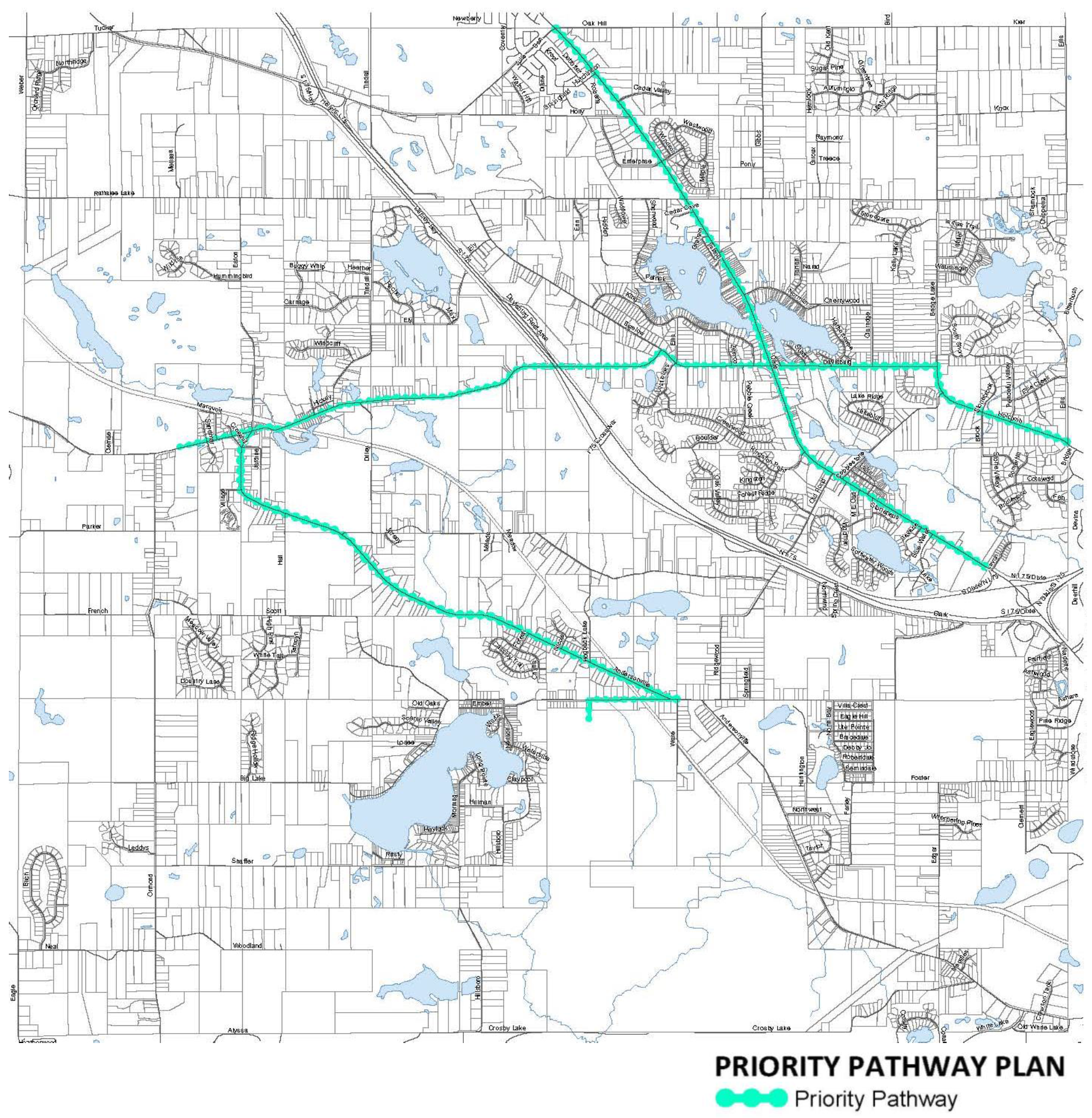
(Ord. No. 26, § 16.25, 9-13-1990; Ord. No. 2018(4), § 1, 8-9-2018)
Editor's note— Ord. No. 2018(4), § 1, adopted Aug. 9, 2018, amended § 40-851 and in so doing changed the title of said section from "Safety paths" to "Pathways," as set out herein.

