
Springfield Charter Township
City Zoning Code
City Zoning Code
ARTICLE VI
ENVIRONMENTAL PERFORMANCE STANDARDS7
State Law reference— Natural resources and environmental protection act, MCL 324.101 et seq.
Sec. 40-881.- Purpose.
No use, otherwise allowed, shall be permitted within any district which does not conform to the standards of use, occupancy, and operation in this article, which standards are hereby established as the minimum requirements to be maintained within said area.
(Ord. No. 26, § 17.01, 9-13-1990)
Sec. 40-882. - Airborne emissions.
(a)
Smoke and air contaminants. It shall be unlawful for any person, firm or corporation to permit the emission of any smoke or air contaminant from any source whatsoever to a density greater than that permitted by Federal Clean Air Standards and those standards promulgated by the Michigan Department of Natural Resources and Environment according to part 55 of Public Act No. 451 of 1994 (MCL 324.5501 et seq.). There shall not be discharged from any source whatsoever such quantities of air contaminants or other material which cause injury, detriment or nuisance to the public or which endanger the comfort, repose, health, or safety of persons or which cause injury or damage to business or property.
(b)
Odors. Any condition or operation which results in the creation of odors of such intensity and character as to be detrimental to the health and welfare of the public or which interferes unreasonably with the comfort of the public shall be removed, stopped, or so modified as to remove the odor. This requirement is not intended to interfere with the operation of a farm, as defined by this chapter, which is lawful pursuant to the Michigan Right to Farm Act, as amended.
(Ord. No. 26, § 17.02, 9-13-1990)
State Law reference— Air pollution control, MCL 324.5501 et seq.
Sec. 40-883. - Noise.
(a)
Purpose. Noise has the potential to create environments that can be harmful to the health and welfare of the people living and working in Springfield Charter Township. The purpose of this noise ordinance is to protect the health and welfare of the people who live and work in Springfield Charter Township with defined standards that can be readily implemented and enforced. This standard also sets expectations for the quality of the township environment as it continues to develop.
(b)
Noise prohibited.
(1)
It is unlawful to produce noise that exceeds the corresponding limits provided in Table 1 and Table 2 at or within the boundary of any receiving property when measured outdoors.
(2)
Sound shall not be measured within an easement area or right-of-way.
(3)
Noise containing prominent tones shall be limited to a level 5 dB lower than the limits of Table 1 and Table 2.
(4)
At locations and time periods where traffic noise exceeds the limits of Table 1 and Table 2, the average traffic sound level over a period of at least 15 minutes shall establish the noise limit.
(5)
Table 1 - Noise level limits [A-weighted].
(6)
Table 2 - Noise level limits [C-weighted].
(7)
Sound levels shall be measured with instrumentation having the following criteria:
a.
Precision of Type 2 or better according to ANSI S1.4.
b.
Accurate calibration immediately before and after the measurements.
c.
Measurement set at fast meter response.
d.
Using manufacturer approved windscreen.
e.
Microphone position at an elevation of five to seven feet above the ground or surface normally occupied, such as a deck or patio.
f.
Microphone positioned away from the influence of sound reflecting surfaces.
g.
Not improperly influenced by atmospheric conditions such as wind and rain.
(c)
Additional noise prohibited.
(1)
Construction, earth moving, land balancing, clearing or other similar land development activities shall be restricted to the hours between 7:00 a.m. and 8:00 p.m., Monday through Saturday and prohibited on Sunday and legal holidays. Farming activities and customary repairs and maintenance associated with individual dwellings shall be exempt from this requirement.
(2)
Live or reproduced music, whether indoors or outdoors, must comply with the limits of Table 1 and Table 2 and must be inaudible between the hours of 10:00 p.m. and 7:00 a.m. beyond the property boundaries from which it is played.
(3)
Idling vehicles for periods of time longer than 15 minutes is prohibited except in cases of emergency or vehicle repair.
(4)
All internal combustion engines shall employ exhaust muffling consistent with manufacturer's specifications.
(5)
Use of outdoor commercial and industrial truck loading spaces within 200 feet of a residential district shall be prohibited between the hours of 11:00 p.m. and 6:00 a.m.
(d)
Exemptions. The following activities are exempt from the noise ordinance:
(1)
Emergency warning devices such as the emergency alert system, inclement weather warning, emergency response vehicles and related equipment used solely for public purposes.
(2)
Equipment or machinery used for an emergency response where the preservation of life or property is needed. This includes the use of residential and commercial generators for temporary use during emergency power outages.
(3)
Equipment which is maintained in conditions according to manufacturer specifications and is used for normal home and property maintenance, operated between the hours of 7:00 a.m. and 9:00 p.m.
(4)
Snow removal and parking lot maintenance.
(5)
Agricultural practices permitted by the zoning ordinance.
(6)
Community and civic events approved pursuant to section 40-645 of the zoning ordinance.
(Ord. No. 26, § 17.03, 9-13-1990; Ord. No. 2016(5), § 1.2, 8-11-2016)
Sec. 40-884. - Vibration.
(a)
Purpose. Vibration can be disruptive and harmful to the health and welfare of the people living and working in Springfield Charter Township. The purpose of this vibration ordinance is to protect the health and welfare of the people who live and work in Springfield Charter Township with defined standards that can be enforced. This standard also sets expectations for the quality of the township environment as it continues to develop.
(b)
Vibration measurements requirements.
(1)
Vibration measurements of the ground shall have the vibration transducer mounted on rigid element such as a steel pipe or column that extends a minimum of one foot into the ground but no more than eight feet.
(2)
Vibrations measurements can also be conducted on foundation walls provided the foundation is a monolithic structure at least eight inches thick and extending at least 42 inches below the surface of the adjacent ground and no vibration from the supported building or structure is entering the foundation.
(3)
The source of the vibration should be identified by measurements with and without the source operating or at multiple distances away from the source showing a corresponding shift in magnitude or by narrow band frequency correlation.
(c)
Vibration prohibited.
(1)
No use shall generate any ground transmitted vibration in excess of the limits set forth in Table 1 below. Vibration shall be measured at or within the boundary of the receiving property. (Vibration shall not be measured within an active easement area or right-of-way.)
(2)
The instrument used to measure vibrations shall be a three-compartment measuring system capable of simultaneous measurement of vibration in three mutually perpendicular directions.
(3)
The vibration maximums set forth in Table 1 are stated in terms of particle velocity, which may be measured directly with suitable instrumentation or computed on the basis of displacement and frequency or acceleration and frequency. When computed, the following formula shall be used:
(4)
Table 1 - Limits for Continuous Vibration at Receiving Property Use.
(5)
Transient vibrations are limited to twice that of the limits provided in Table 1 of subsection (4) above.
(6)
Vibration containing both continuous and transient elements will be treated as continuous.
(7)
Temporary construction activities on public or private property not lasting longer than 14 days may exceed the vibration limits of Table 1 above between the hours of 7:00 a.m. and 9:00 p.m. subject to township permit though may not exceed the vibration limits provided in Table 2 below.
(8)
Table 2 - Limits for Temporary Construction Activity Vibration at Receiving Land Use.
(Ord. No. 26, § 17.04, 9-13-1990; Ord. No. 2016(6), § 1.2, 8-11-2016)
Sec. 40-885. - Waste disposal.
All solid, liquid, and sanitary wastes shall be treated and disposed in accordance with the standards of the county health department and the state department of natural resources and environment. Treatment or disposal of waste shall not create a hazard or nuisance to neighboring uses.
(Ord. No. 26, § 17.05, 9-13-1990)
State Law reference— Pollution control, MCL 324.3101 et seq.
Sec. 40-886. - Outdoor storage.
For those uses requiring site plan review, the outdoor storage of goods, materials, and equipment, except trucks operated by the principal business, shall be subject to the following conditions:
(1)
The location and size of areas for such storage, nature of items to be stored therein, and details of the enclosure, including description of materials, height, and typical elevation of the enclosure shall be provided as part of the information submitted under section 40-136, site plan review.
(2)
Such storage shall not be located within the area between the front face of the building, as extended across the entire width of the lot, and the street right-of-way, or in any required side or rear yard.
(3)
Such storage shall not be located in any required parking or loading space.
(4)
Such storage shall be strictly and clearly incidental to the principal use and only products and materials owned or produced by the principal business, and equipment owned and operated by the principal use shall be permitted for storage under this subsection. Such storage shall not be permitted as a principal use of a lot.
(5)
The area for such storage shall be screened from view on all sides in a manner as approved during the site review process.
(6)
No material or wastes shall be deposited upon a lot in such form or manner that they may be transferred off the lot by natural causes or forces.
(7)
All materials or wastes which might cause fumes or dust or which constitute a fire hazard or which may be edible by or otherwise be attractive to rodents or insects shall be stored outdoors only in closed containers.
(Ord. No. 26, § 17.06, 9-13-1990)
Sec. 40-887. - Electrical disturbance, electromagnetic, or radio frequency interference.
(a)
No use shall create any electrical disturbance that adversely affects any operations or equipment other than those of the creator of such disturbance.
(b)
No use shall cause, create, or contribute to the interference with electronic signals (including television and radio broadcasting transmission) to the extent that the operation of any equipment not owned by the creator of such disturbance is adversely affected.
(Ord. No. 26, § 17.07, 9-13-1990)
Sec. 40-888. - Exterior lighting.
(a)
Intent. The intent of this section is to protect the health, safety and welfare of the public by recognizing that buildings and sites need to be illuminated for safety, security and visibility for pedestrians and motorists. To do so, this section provides standards for various forms of lighting that will:
(1)
Minimize light pollution;
(2)
Maintain safe nighttime driver performance on public roadways;
(3)
Reserve the restful quality of nighttime by eliminating intrusive artificial light and lighting that unnecessarily contributes to "sky glow";
(4)
Reduce light pollution and light trespass from light sources onto adjacent properties;
(5)
Conserve electrical energy;
(6)
Curtail the degradation of the nighttime visual environment.
(b)
Applicability. The requirements of this section shall apply to any light source that is visible from any property line, or beyond, the site from which the light is emanating. The township may review any building or site to determine compliance with the requirements under this section. Whenever a person is required to obtain a building permit, electrical permit for outdoor lighting or signs, special land use approval, or site plan approval, the applicant shall submit sufficient information to enable the township and/or planning commission to determine whether the proposed lighting will comply with this section.
(c)
Exterior lighting—General conditions. Subject to the provisions set forth herein, all parking areas, walkways, driveways, building entryways, off-street parking and loading areas, and building complex common areas, shall be sufficiently illuminated to ensure the security of property and the safety of persons using such public or common areas.
Full cutoff shades are required for light sources to direct the light onto the site and away from adjoining properties. The lighting source shall not be directly visible from adjoining properties. Lighting shall be directed so that it does not cause glare for motorists.
(d)
Prohibited. The following types of lighting shall be prohibited.
(1)
Searchlights.
(2)
Laser source.
(3)
Animated lighting.
(4)
Building-mounted or roof-mounted lighting intended to attract attention to the building.
(e)
Exterior lighting—Specific conditions. The purpose of this section is to provide regulations to direct the location, design, illumination level and use of outdoor lighting to minimize its undesirable effects and to meet the intent of this section.
(1)
Intensity. Lighting for uses adjacent to residentially zoned or used property shall be designed and maintained such that illumination levels do not exceed 0.1 footcandle along property lines. Lighting for uses adjacent to nonresidential properties shall be designed and maintained such that illumination levels do not exceed 0.3 footcandle along property lines. The light intensity provided at ground level shall be a minimum of 0.3 footcandle anywhere in the area to be illuminated. Light intensity shall average a minimum of 0.5 footcandle over the entire illuminated area, measured at ground level, not to exceed a maximum of ten footcandles in any given illuminated area. The body making the final decision, as recommended by the planning commission may allow for an increased level of lighting above maximum permissible levels when it can be demonstrated that such lighting is necessary for safety and security purposes.
(2)
Uniformity ratios. In order to maintain uniformity in light levels across a development and prevent or minimize dark areas, the ratio of maximum to minimum lighting levels on a given lot is measured in footcandles at ground level, and shall not exceed a ratio of 15 to one (15:1). Parking lots shall maintain the same uniformity ratios as the main building or principal use served.
(3)
Height. Except as otherwise required, the mounting height of fixtures shall not exceed the following.
a.
Twenty-two feet, including base, for parking lots adjacent to property used or zoned for residential purposes.
b.
Twenty-seven feet including base, for parking lots adjacent to property zoned for nonresidential use.
c.
Where a local or primary road, except Dixie Highway, separates a site proposed to be illuminated from property zoned or used for residential use, the lighting fixture shall not exceed 22 feet. Where Dixie Highway separates a site to be illuminated from property zoned or used for residential use, the lighting fixture shall not exceed 27 feet.
d.
Fourteen feet including base for sidewalks and pathways. (Pedestrian lighting.)
(4)
Hour.
a.
All outdoor lighting fixtures shall be turned off one-half hour after the close of business, unless needed for safety and security as noted below. In such case, the lighting shall be reduced to the minimum level necessary for that purpose.
b.
Lighting required for safety and security as approved by the planning commission may be turned on daily from one-half hour after sunset to one-half hour before sunrise. Safety and security lighting shall be no more than 50 percent of the approved lighting intensity approved as part of the site plan.
All safety and security lighting shall be reviewed and approved by the planning commission as a part of the site plan review process.
(5)
Fixtures:
a.
All outdoor fixtures, including building mounted fixtures, shall be full cut-off, shielded fixtures and directed downward to prevent off-site glare and illumination.
b.
Poles for lighting fixtures shall be of a fixed height. Adjustable poles are prohibited.
(6)
Lighting plan: The following information shall be included for all site plan reviews. Where site plan review is not required, one or more of the following items may be required by the township zoning administrator prior to lighting installation.
a.
A site plan drawn to scale of one inch equaling not more than 100 feet showing the buildings, landscaping, parking and service areas, and location and type of all proposed outdoor lighting.
b.
A photometric grid overlaid on the proposed site plan.
c.
Analyses showing that the proposed installation conforms to the lighting level standards in this section. A photometric plan shall indicate lighting levels at ground level based on no greater than a 25 foot on center grid and shall project 25 feet onto adjacent properties or to the setback limit line, whichever is greater.
(7)
Light-emitting diode (LED): The improved energy efficiency of LED, coupled with modern lighting design, allows for reduced demand on electricity, better control over the color content and extremely longer life. LED sources can be dimmed and are instantly at full brightness when turned on. Lighting with lower color temperatures has less blue in its spectrum and is referred to as being "warm." Higher color temperature sources of light are rich in blue light. It is required that only warm light sources be used for outdoor lighting. Low-color-temperature LEDs are preferred choices.
a.
A warm to neutral light is the required color temperature. LED correlated color tempering (CCT) should be in the range of 2,700—4,000 kelvin (K). Color rendering index (CRI) shall be greater than 70.
b.
Blue rich white light sources over 4,000 kelvin (K) are prohibited.
(8)
Entrance lighting: One lighting structure may be provided on each side of an entrance or exit drive or street at its intersection with the public road, except where a boulevard or divided entrance/exit drive is proposed. One lighting structure may be provided in the boulevard or island areas for the purpose of illuminating the intersection.
(f)
Retrofitting existing lighting fixtures. The above sections shall be followed when retrofitting existing fixtures.
(Ord. No. 26, § 17.08, 9-13-1990; Ord. No. 2020(2), § 2, 8-13-2020)
Sec. 40-889. - Community sewer systems.
(a)
Any development in which a community sewer system is proposed shall comply with article III of chapter 36 and all other applicable county and state laws and regulations.
(b)
Any development in which a community sewer system is proposed where said system has a daily maximum discharge in excess of 10,000 gallons per day shall be allowed in any zoning district, and require special land use approval pursuant to the other applicable provisions of this chapter.
(c)
Any development in which a community sewer system is proposed where said system has a daily maximum discharge less than 10,000 gallons per day shall be permitted of right in any zoning district.
(Ord. No. 26, § 17.09, 9-13-1990)
State Law reference— Sewage disposal and waterworks systems, MCL 324.4101 et seq.
Sec. 40-890. - Hazardous substances.
Use, storage and handling of hazardous substance; storage and disposal of solid, liquid and sanitary wastes shall comply with the following:
(1)
It shall be unlawful for any person, firm, corporation or other legal entity to pollute, impair or destroy the air, water, soils or other natural resources within the township through the use, storage and handling of hazardous substances and/or wastes or the storage and disposal of solid, liquid, gaseous and/or sanitary wastes.
(2)
Any person, firm, corporation or other legal entity operating a business or conducting an activity which uses, stores, or generates hazardous substances shall complete and file an environmental permits checklist on a form supplied by the township in conjunction with the following:
a.
Upon submission of a site plan;
b.
Upon any change of use or occupancy of a structure or premises; and
c.
Upon any change of the manner in which such substances are handled, and/or in the event of a change in the type of substances to be handled.
(3)
Prior to township approval of the business or expansion which uses, stores or generates hazardous substances, the environmental permits checklist shall be reviewed by the township fire department for comment. In addition to fire department review the township may elect, at the applicant's cost, to use an independent consultant to review the environmental permits checklist. The independent consultant's review shall determine the effects of the proposal on the local environment. All business and facilities which use, store or generate hazardous substances in quantities greater than 100 kilograms per month (per the environmental permits checklist) shall comply with the following standards:
a.
Aboveground storage.
1.
Hazardous substances shall be stored only in product-tight containers.
2.
Secondary containment of hazardous substances shall be provided for all facilities. Secondary containment shall be sufficient to store the substance for the maximum anticipated period of time necessary for the recovery of any released substance.
3.
Outdoor storage of hazardous substances is prohibited except in product-tight containers which are protected from weather, leakage, accidental damage and vandalism through secondary containment. Secondary containment shall be sufficient to store the substance for the maximum anticipated period of time necessary for the recovery of any released substance, including an allowance for the expected accumulation of precipitation.
4.
State and federal agency requirements for storage, leak detection, recording keeping, spill prevention, emergency response, transport and disposal shall be met.
b.
Underground storage.
1.
State and federal agency requirements for storage, leak detection, recording keeping, spill prevention, emergency response, transport and disposal shall be met.
(Ord. No. 26, § 17.10, 9-13-1990)
State Law reference— Hazardous materials transportation act, MCL 29.471 et seq.; hazardous substances act, MCL 286.451 et seq.; hazardous waste management, MCL 324.11101 et seq.
Sec. 40-891. - Stormwater management; impervious surface mitigation.
(a)
Purpose and intent. It is the intent of this section to encourage the use of structural, vegetative, or managerial practices, commonly referred to as best management practices (BMPs), designed to treat, prevent, or reduce degradation of water quality due to stormwater runoff. All development projects subject to review under the requirements of this chapter shall be designed, constructed, and maintained using best management practices to prevent flooding, protect water quality, reduce soil erosion, maintain and improve wildlife habitat, and contribute to the aesthetic values of the project. The particular facilities and measures required on-site shall reflect and incorporate existing grade, natural features, wetlands, and watercourses on the site to the maximum extent feasible.
(b)
Stormwater drainage/erosion control. All stormwater drainage and erosion control plans shall meet the standards adopted by the township for design and construction and shall, to the maximum extent feasible, utilize nonstructural control techniques, including but not limited to:
(1)
Limitation of land disturbance and grading;
(2)
Maintenance of vegetated buffers and natural vegetation;
(3)
Minimization of impervious surfaces
(4)
Use of terraces, contoured landscapes, runoff spreaders, grass or rock-lined swales;
(5)
Use of infiltration devices.
(c)
General standards.
(1)
Stormwater management systems shall be designed to prevent flooding and the degradation of water quality related to stormwater runoff and soil erosion from proposed development.
(2)
All properties which are subject to this section shall provide for on-site storage of stormwater. Facilities shall be designed to provide a volume of storage and discharge rate which meets the standards of the township.
(3)
Priority shall be placed on site design which maintains natural drainage patterns and watercourses. Alterations to natural drainage patterns shall not create flooding or degradation in water quality for adjacent or downstream property owners.
(4)
The use of swales and buffer strips vegetated with desirable native materials is encouraged as a method of stormwater conveyance so as to decrease runoff velocity, allow for biofiltration, allow suspended sediment particles to settle, and to remove pollutants. Tolerance for water saturation, sunlight, pesticides, metals, and salts, shall be required in determining appropriate plantings in these areas.
(5)
Drainage systems shall be designed to be visually attractive. The integration of stormwater conveyance systems and retention and detention ponds in the overall landscape concept is recommended. Ponds with a naturally contoured, rather than square or rectangular, design and appearance shall be encouraged.
(6)
Where large amounts of grease and oil may accumulate, as in the case of commercial/industrial developments and large areas of pervious surfaces for parking, oil separators shall be required.
(7)
For sites that store or use chemicals, a spill response plan shall be submitted and approved by the township.
(d)
Use of wetlands. Wetlands may be used for stormwater management if all the following conditions are met:
(1)
Wetlands shall be protected from impairment due to the discharges of stormwater. Measures shall be taken to reduce erosive velocities of stormwater and to remove sediment and other pollutants prior to discharge to a wetland.
(2)
Wildlife, fish or other beneficial aquatic organisms and their habitat within the wetland will not be impaired.
(3)
The wetland has sufficient holding capacity for stormwater, based upon calculations prepared by the proprietor and reviewed and approved by the township.
(4)
On-site erosion control shall be provided to protect the natural functioning of the wetland.
(5)
Provisions approved by the township shall be established so as to ensure that the wetland is not disturbed or impaired in the future relative to the needed storage capacity.
(6)
Applicable permits from the state department of natural resources and environment are obtained.
(e)
Impervious surface reduction/infiltration enhancement.
(1)
The township recognizes that, due to the specific requirements of any given development, inflexible application of the design standards may result in development with excessive paving and stormwater runoff and a waste of space which could be left as open space.
(2)
Either through procedures prescribed by ordinance or creative land development techniques permitted by ordinance, the township may permit, during the site plan review process, deviations from requirements allowing for reduction in impervious surfaces whenever it finds that such deviations are more likely to meet the intent and standards of this section and accommodate the specific characteristics of the use in question.
(3)
The township may attach conditions to the approval of a deviation that bind such approval to the specific use in question. Measures that reduce impervious surface and increase infiltration may include, but are not limited to, the following:
a.
Streets and access.
1.
The designing of residential streets with the minimum required pavement width needed to support travel lanes, on-street parking, and emergency, maintenance, and service vehicle access and function based on traffic volumes.
2.
The reduction of the total length of residential streets by examining alternative street layouts to determine the best option for increasing the number of homes per unit length.
3.
The designing of street right-of-way widths/private road easements to reflect the minimum required to accommodate the travelway, the sidewalk, and vegetated open channels.
4.
The minimizing of the number of street cul-de-sacs and reduce the radius of cul-de-sacs to the minimum required to accommodate emergency and maintenance vehicles. Alternative turnarounds shall be considered, including the use of mountable curbing and grass shoulders for the occasional event of access by fire trucks and other large commercial trucks. Where cul-de-sacs do exist, provide landscape center islands.
5.
Where density, topography, soils, and slope permit, the use of vegetated open channels in the street right-of-way/private road easements to convey and treat stormwater runoff.
6.
The use of alternative driveway surfaces and shared driveways that connect two or more sites.
7.
Promoting more flexible design standards for residential subdivision sidewalks. Where practical, consider locating sidewalks on only one side of the street and providing common walkways linking pedestrian areas.
b.
Parking.
1.
Base the parking requirements on the specific characteristics of the use, landbanking in open space parking required to satisfy chapter requirements.
2.
Reduce the overall imperviousness associated with parking lots by providing compact car spaces, minimizing stall dimensions, incorporating efficient parking lanes, and using pervious materials in the spillover parking areas where possible.
3.
Encourage shared parking between compatible users.
c.
Site design.
1.
Direct rooftop runoff to pervious areas such as yards, open channels, or vegetated areas and avoid routing rooftop runoff to the roadway and the stormwater conveyance system.
2.
Create naturally vegetated buffer systems, which may vary in width as determined by the township, along all drainageways. Critical environmental features such as the 100-year floodplain, steep slopes, and wetlands shall be considered.
3.
Minimize clearing and grading of woodlands and native vegetation to the minimum amount needed to build lots, allow access, and provide fire protection.
4.
Conserve trees and other vegetation at each site by planting additional vegetation, clustering tree areas, and promoting the use of native plants.
(f)
Maintenance. Whenever a landowner is required to provide on-site stormwater retention and/or surface drainage to wetlands, or whenever other protective environmental measures including monitoring devices are required, such measures or facilities shall be provided and maintained at the landowner's expense. The landowner shall provide assurance to the township that the landowner will bear the responsibility and cost of providing and maintaining such methods or facilities, by written agreement, suitable for recording at the office of the county register of deeds, that will act as a perpetual restriction on the land, the form and content of which shall be approved by the township attorney. A maintenance plan shall be provided, including notation and description of maintenance requirements and timelines.
(Ord. No. 26, § 17.11, 9-13-1990)
State Law reference— Soil erosion and sedimentation control, MCL 324.9101 et seq.; soil conservation districts law, MCL 324.9301 et seq.; wetlands protection, MCL 324.30301 et seq.
Sec. 40-892. - Resource protection overlay district.
(a)
Purpose. The purpose of this section is to ensure that property is developed in a manner which is consistent with its zoning designation, meets the goals and objectives of the township master plan and the proposed physical elements are designed and arranged to protect priority resource protection areas identified by the township, both on the site and in the vicinity of the site. The overlay district establishes procedures to enable the applicant and township to achieve the mutually compatible objectives of reasonable use of land and protection of vital natural resources.
(b)
Applicability.
(1)
The township has identified areas to be protected on a priority resource protection map found at the end of this section 40-892. The areas protected by this overlay district are a result of studies conducted by the state natural features inventory as part of the Shiawassee and Huron Headwaters Resource Preservation Project, prepared in March 2000. The specific boundaries of each of the areas to be protected shall be further refined by more detailed information supplied by the applicant and confirmed by the township board.
(2)
To the maximum extent feasible, any plan submitted in accordance with section 40-136 or the township subdivision control in article III of chapter 18 which includes areas identified to be protected on the priority resource protection map, shall be subject to the requirements of this section and designed and arranged to ensure that disturbance to any priority resource protection area as a result of the development, and that impacts and disturbance to such areas and the plants and wildlife inhabiting those areas, shall be minimized through the use of natural resource buffers, conservation easements and creative land development techniques.
(c)
Ecological characterization. It is intended that these ordinance requirements be applied based upon reliable and factual data and information contained in the Shiawassee and Huron Headwaters Resource Preservation Project. Applicants are encouraged to consult the state natural features inventory data base. If a development site includes areas which have been identified on the priority resource protection map and if the township does not then possess the information required to apply review standards, then the developer shall provide to the township a report prepared by a professional or professionals qualified in the areas of ecology, botany, wildlife biology or other relevant discipline that describes, without limitation, the following:
(1)
The wildlife use and habitat showing the species of wildlife using the area, wildlife movement corridors, the times or seasons that the area is used by those species and the value (meaning feeding, watering, cover, nesting, roosting, and/or perching) that the area provides for such wildlife species;
(2)
The boundary of wetlands in the area and a description of the ecological functions and characteristics provided by those wetlands;
(3)
Any prominent views from or across the site;
(4)
The pattern, species and location of any significant native trees and other native site vegetation;
(5)
The bank, shoreline and ordinary high-water mark of any inland lake or stream on the site; and
(6)
The general ecological functions provided by the site and its features.
The township may employ their own consultants with the relevant expertise to review materials submitted by the applicant.
(d)
Establishment of priority protection.
(1)
For every development subject to this section, the applicant shall propose, subject to review and approval by the responsible township body, areas of priority protection illustrated on the site plan or subdivision plat. The site plan or subdivision plat shall establish the development capability of the site and indicate the specific area of a site which may be developed and specific areas to be preserved.
(2)
In establishing the development capability of the site, the following shall be taken into account:
a.
Visual impacts, including but not limited to ridgeline protection areas and protection of scenic views.
b.
Erosion prevention and control, and natural drainage.
c.
Preservation of significant native trees and other native site vegetation, including protection of natural resource buffer zones.
d.
Conservation of water, including increasing infiltration and recharge of groundwater.
e.
Stream corridor and wetland protection and buffering.
f.
Site topography, including but not limited to such characteristics as steepness of slopes, existing drainage patterns, ridgelines and scenic topographic features.
g.
Floodplains and floodways.
h.
Wildlife habitat and wildlife movement corridors.
i.
Natural resource buffer zones as delineated in subsection (b)(3) of this section.
j.
The practical needs of approved construction activity in terms of ingress and egress to the developed project and necessary staging and operational areas.
k.
Hydrology and groundwater flow.
(e)
Development standards and guidelines.
(1)
Priority protection areas. To the maximum extent feasible, no construction activity, including, without limitation, tree or brush removal, grading, excavation or stockpiling of fill material shall be permitted within priority protection areas except as follows:
a.
Mitigation or restoration of disturbed or degraded areas;
b.
Emergency public safety activities;
c.
Utility installations when such activities and installations shown on a plan approved by the township cannot reasonably be contained to areas outside of those identified as significant;
d.
Construction of trails or pedestrian walkways in an environmentally appropriate manner;
e.
The enhancement of the habitat values and/or other natural resource values of a natural area.
(2)
Establishment of natural resource buffer zones. Natural resource buffer zones shall be established adjacent to natural features/ecosystems intended for preservation within areas of priority protection. Such buffers shall be a minimum of 25 feet in width. The township body responsible for approval may decrease the buffer zone below the 25-foot requirement where it can be demonstrated that other means are available to provide the equivalent protection. In establishing the width of the buffer zone, the township body responsible for approval shall consider the foreseeable impacts of development on the ecological character or function of the natural feature/ecosystem to be preserved and the following:
a.
Wildlife habitat, movement corridors and use characterization of the priority protection area.
b.
Extent of floodplains, floodways, wetlands and watercourses.
c.
Type, amount and extent of existing vegetation on the site.
d.
Character of the proposed development in terms of use, density, traffic generation, quality of runoff water, noise, lighting and similar potential development impacts, on the priority protection area being buffered.
e.
Site topography, including but not limited to such characteristics as steepness of slopes, existing drainage patterns, ridgelines and scenic topographic features.
(3)
Mitigation of disturbance. The applicant shall undertake mitigation measures for any damaged or lost natural resource in priority protection areas resulting from or caused by the development activity of the applicant. Any such mitigation or restoration shall be roughly equivalent to the loss suffered by the community because of the disturbance, and shall be based on such mitigation and restoration plans and reports as have been requested, reviewed and approved by the responsible township body.
(4)
Relationship to neighboring areas. If the development site contains priority protection areas that connect to other areas of a similar nature, to the extent reasonably feasible, such connections shall be preserved. If priority protection areas lie adjacent to the development site, but are not presently connected across the development site, a connection shall be provided to the extent reasonably feasible. Such connections shall be designed and constructed to allow for the continuance of existing wildlife movement and to enhance the opportunity for the establishment of new connections between areas for the movement of wildlife.
(5)
Inland lakes or streams. If the development site contains an inland lake or stream, the development plan shall include such enhancements and restoration as are necessary to provide reasonable wildlife habitat and aesthetic quality in areas of shoreline transition and areas subject to erosion. The development plan shall include a design that requires uniform and ecologically and aesthetically compatible treatment among the lots or tracts surrounding an inland lake or stream with regard to the establishment of erosion control protection and shoreline landscaping on or adjacent to such lots or tracts.
(6)
Design and aesthetics. Projects which are subject to this section shall be designed to complement the visual context of the natural area. Techniques such as architectural design, site design, the use of native landscaping, and choice of colors and building materials shall be utilized in such manner that scenic views across or through the site are protected, and manmade facilities are screened from off-site observers and blend with the natural visual character of the area.
(7)
Consultation with neighboring jurisdiction. Certain areas designated for priority resource protection may either cross or abut jurisdictional boundaries. Upon receiving an application for a project located within the resource protection overlay district, the township clerk shall notify the clerk of the neighboring jurisdiction of the receipt of such application and provide a set of plans for review and comment.
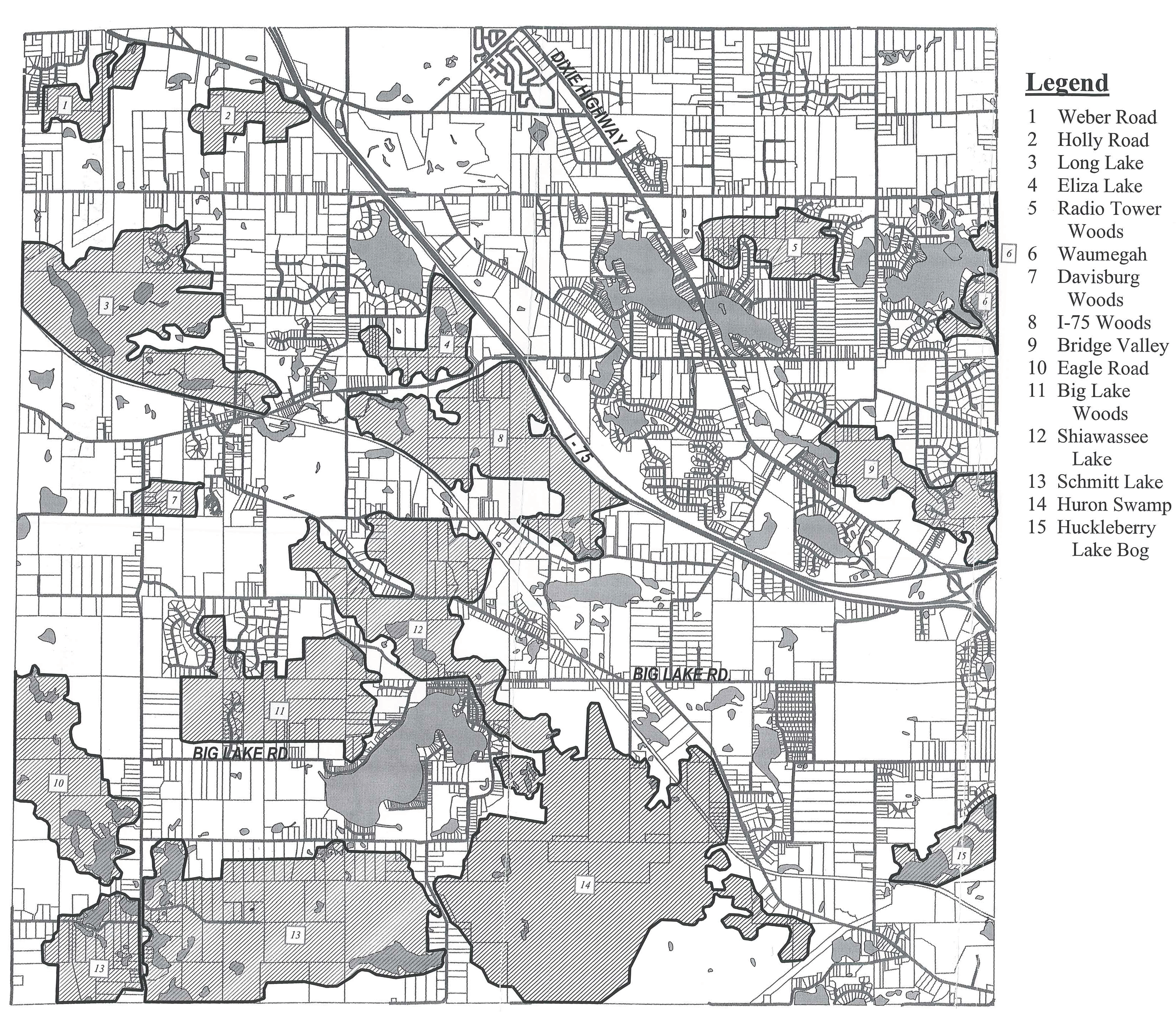
Springfield Township Priority Resource Protection Map 12-17-02
(Ord. No. 26, § 17.12, 9-13-1990)
State Law reference— Natural resources management, MCL 324.30101 et seq.
Sec. 40-893. - Glare.
(a)
Glare from any process (such as or similar to arc welding or acetylene torch cutting) which emits harmful ultraviolet rays shall be performed in such a manner as not to be seen from any point beyond the property line, and as not to create a public nuisance or hazard along lot lines.
(b)
Glare from automobile headlights or commercial or industrial vehicle headlights shall not be directed onto any adjacent property so as to become a nuisance.
(c)
Any operation which produces intense glare or heat shall be conducted within an enclosure so as to completely obscure and shield such operation from direct view from any point along the lot lines. If heat is a result of an industrial operation, it shall be so insulated as to not raise the temperature at any property line at any time.
(Ord. No. 2020(2), § 3, 8-13-2020)

