


St Bernard Parish City Zoning Code
Sec. 22-4
General provisions.
22-4-1. Applicability. This section shall apply to all properties in all zones. No building or structure shall be erected, reconstructed, structurally altered, or enlarged, nor shall any building, structure or land be used or be designed for any use other than is permitted in the zone in which such building, structure or land is located.
The subdivision of land shall be subject to the appropriate regulations herein contained for the zone shown on the zoning map.
22-4-2. General provisions.
22-4-2.1. Use of building or land. Except as hereinafter provided, no building or land shall hereafter be used or occupied and no building or part thereof shall be erected, moved or altered unless in conformity with the regulations herein specified for the district in which it is located.
22-4-2.2. Size and location of buildings. Except as hereinafter provided, no building shall hereafter be erected or altered:
(a)
To accommodate or house a greater number of families;
(b)
To exceed the height;
(c)
To occupy a greater percentage of lot area; or
(d)
To have narrower or smaller rear yards, front yards, side yards, inner or outer courts than is specified herein for the district in which such building is located.
22-4-2.3. Yard area. No part of a yard or other open space required about any building for the purpose of complying with the provisions of this chapter shall be included as a part of a yard or other open space similarly required for another building.
22-4-2.4. One (1) main building to a lot. Every building or structure hereafter erected shall be located on a lot of record and in no case shall there be more than one (1) main building on one (1) lot unless otherwise provided in this chapter. (See section 22-4-3, Exceptions and modifications to use regulations, for more than one (1) main building.)
22-4-2.5. Vacation of streets and public ways. Whenever any street, alley or other public way is vacated by official action of the governing body of the Parish of St. Bernard, the zoning district adjoining each side of such street, alley or public way shall automatically extend to the center of same and all area included therein shall then become subject to all appropriate regulations of the extended districts.
22-4-2.6. Yards on corner and through lots. On corner lots and through lots, a front yard setback shall be maintained on each street line. Lot must have full frontage along at least one (1) roadway.
22-4-2.7. Corner visibility. On a corner lot in any district, no fence, wall, hedge or other structure or planting more than three (3) feet in height shall be erected, placed or maintained within the "sight triangle" as determined in accordance with section 22-4-2.15.
22-4-2.8. Exceptions to height requirements. The height regulations as stated in this chapter shall not apply to:
(a)
Churches; schools; hospitals; sanitariums; public, semipublic or public service buildings and institutions. There shall be no restrictions on the height of such buildings provided the front, side and rear yards required in the district in which such building is to be located shall be increased an additional one (1) foot for each one (1) foot that the building exceeds the maximum height permitted in such district.
(b)
Barns, silos and other farm structures when located on farms; belfries, cupolas, domes, flagpoles and monuments; water towers, transmission towers, windmills, chimneys, smokestacks, radio towers, masts and aerials, conveyors, fire towers, and oil derricks, church spires and ornamental towers and spires.
(c)
Bulkheads, elevator penthouses, water tanks, cooling towers, stage towers or scenery lofts, and similar structures; provided, that such structures shall cover not more than twenty-five (25) percent of the total roof area of the building on which such structure is located.
(d)
In the case of cemeteries or mausoleums, no building, structure, tomb or vault may exceed thirty-five (35) feet in height regardless of the district in which it is located.
(e)
For buildings and structures outside the flood protection systems, maximum building height shall be calculated as thirty-five (35) feet plus the FEMA base flood elevation.
22-4-2.9. Solar energy systems. Solar energy systems may be located in a front yard or may project beyond a building when it can be demonstrated to the director of the department of community development that this is the only practical and feasible location for such systems and there is no detrimental effect on adjoining property.
22-4-2.10. Antennas and dishes. The provisions of these regulations limiting the maximum height of buildings shall not restrict the height of an antenna/dish that is erected solely for municipal purposes or that is clearly accessory to a permitted principal use in a residential zone, provided such antennae shall not interfere with an airport approach surface.
22-4-2.11. Two (2) contiguous nonconforming lots. Where two (2) or more such nonconforming lots are contiguous and are under the same ownership, such parcels shall be combined to provide conforming lots to the extent possible.
22-4-2.12. Applicable residential yard requirements. For existing residential dwellings on a lot of record in any residential zone the front, side and rear yard requirements which shall apply with respect to additions to the dwelling or addition of a free-standing garage, shall be the less restrictive of either:
a.
The requirements in existence when the dwelling was constructed; or
b.
The effective zone requirements.
It shall be the responsibility of the applicant for a building permit to provide sufficient specific data to justify the application of this section.
22-4-2.13. Projections into required yards.
(a)
Buildings or structures shall provide for at least three (3) feet of sky clearance. Ordinary projections such as roofs, gutters or eaves may project up to eighteen (18) inches from the building and into the required sky clearance area.
(b)
A carport or porte-cochere, attached to the main building, may be constructed in a required side yard provided that such carport or porte-cochere is at least three (3) feet removed from the nearest side lot line, and that the combined length of such carport does not exceed forty (40) feet, and that the height of such carport does not exceed fourteen (14) feet at the eave. A carport attached to the main building shall be unenclosed on the street side and on the side nearest the side lot line.
(c)
An open unenclosed uncovered porch, terrace or steps not greater in elevation than the ground floor may project into a required front yard a distance not more than ten (10) feet, but in no case no more than half the distance from the building line to the front property line, or project into a required side yard to a point not closer than three (3) feet to any side lot line. This shall not be interpreted to include or permit fixed marquees or canopies except where otherwise provided herein.
22-4-2.14. Accessory buildings and structures.
(a)
The following provisions shall regulate the location of accessory buildings with respect to required yards:
(1)
Accessory buildings shall be prohibited in any required front yard or side street side yard.
(2)
Where an accessory building is located in a zone requiring a side yard and such building is entirely to the rear of the principal structure, the accessory building shall be distant at least three (3) feet (sky clearance) from any adjoining lot line.
(3)
Where any portion of an accessory building projects between a principal structure and the side lot line, the accessory building shall comply with the required side yard restriction for a principal structure in the zone in which it is located.
(4)
Where a corner lot adjoins in the rear a lot in any residential zone, no part of an accessory building within twenty-five (25) feet of the common lot line shall extend closer to the street than the actual or required depth, whichever is less, of the front yard for the principal structure on the adjoining lot.
(b)
Accessory buildings shall not exceed fifteen (15) feet in mean height and ten (10) feet in height at the eave except for barns, boat docks and other such agricultural and fishing-related accessory structures in an A-1 Rural Zone. Detached carports shall not exceed sixteen (16) feet in height at the ridge and fourteen (14) feet in height at the eave.
(c)
Where any portion of or entire accessory building in a residential zone occupies the required rear yard, said portion or entire accessory building shall not occupy more than seventy (70) percent of the required rear yard.
(d)
Metal accessory buildings shall not exceed one hundred twenty (120) square feet and nine (9) feet in height; and shall not be located closer than fifty (50) feet to a front property line.
(e)
For purposes of this chapter, shipping containers, cargo containers, railroad cars, truck vans, converted mobile homes, trailers, recreational vehicles, bus bodies, vehicles and similar prefabricated items and structures originally built for purposes other than the storage of goods and materials are not accessory storage buildings.
(1)
A shipping container or similar items are prohibited from the following zoning districts: R-1, R-2, R-3, R-1(M), R-4, RO, C-1, C-2, C-3 and SBV.
(2)
Shipping containers or similar items are not subject to variances or waivers by the board of zoning adjustments in zoning districts where prohibited.
(3)
Shipping containers or similar items may be used for the temporary location of an office, equipment and/or materials storage structure during non-residential construction which is taking place on the property where the shipping container or similar item is located, subject to an active building permit.
(4)
The temporary placement of portable site storage containers (PODS) not exceeding one hundred fifty (150) square feet in total area on residentially zoned properties, or on properties the primary use of which is residential, for a limited purpose of loading and unloading household contents shall be permitted for a period of time not exceeding thirty (30) days in any twelve-month period. An extension is subject to the review and approval of the director of the department of community development.
22-4-2.15. Residential fences in Arabi, Chalmette, Meraux, Violet and in all R-1 Districts regardless of location.
(a)
Residential fences measuring up to thirty-six (36) inches in height shall be no closer to the inside edge of any sidewalk than one (1) foot. In instances where there is no sidewalk, or where a front property boundary is otherwise difficult to determine, residential fences measuring up to thirty-six (36) inches in height shall be no closer than twenty-one (21) feet to the center line of the street or eleven (11) feet to the edge of pavement. Fences on corner lots must conform to the guidelines in item (c) and (d) below.
(b)
Residential fences exceeding thirty-six (36) inches shall be subject to the front setback for the property upon which it is erected.
(c)
On corner lots, residential fences exceeding thirty-six (36) inches in height and erected in the side yard facing the street shall be no closer to the side property boundary line than half the distance of the side setback for the property as determined in accordance with subsection 22-4-3.3(j), and must also conform to the guidelines in item (d) below.
(d)
On corner lots, no opaque fence (i.e., fencing that cannot be seen through, such as solid wood plank, etc.) shall be erected within the sight triangles depicted in the diagram below or as determined by measuring distances from the center of the intersection (see chart below). Opaque fencing may be "angled in" to avoid encroaching into a sight triangle. (Non-opaque fencing may be erected within the sight triangle, but must still conform to the guidelines in items (a), (b), and (c) above.)
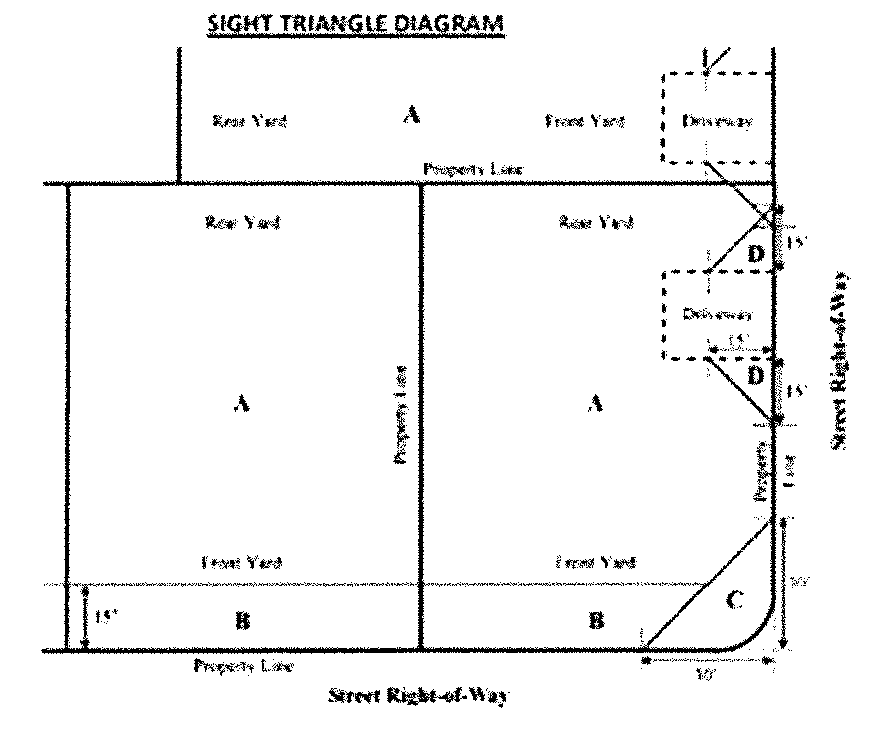
Sight Triangle Distances Chart
On corners where the guidelines cannot easily be applied, the sight triangle may be approximated in accordance with the building setbacks at said corner. Subject to the guidelines in items 1—3 [(a)—(c)], no opaque fence may be placed closer to either property boundary such that it obstructs more visibility than would a residence built in conformance with the setbacks.
(e)
Fencing material shall be made of wood plank, brick, decorative or finished (paint or stucco) block, vinyl, chain link, aluminum, metal, iron or wrought iron.
(f)
Solid metal fencing is prohibited on areas adjacent to public rights-of-way in residential districts. Prohibited fencing in residential neighborhood is as listed: solid metal, untreated wood, or any materials not specified as fencing by manufacturer without approval by the department of community development.
22-4-2.16. Fences, walls and hedges in commercial districts.
(a)
Commercial fences or walls may not exceed seven (7) feet in height unless otherwise permitted or restricted by this ordinance. A fence or wall may be erected along the boundary between a commercial district and an industrial district to a height not exceeding ten (10) feet. Fences, walls or hedges on corner lots and driveway areas must conform to the site triangle guidelines of subsection 22-4-2.15(c) and (d).
(b)
No fence or wall shall be erected on vacant commercial district lots (without a main use).
(c)
solid metal fencing is prohibited or areas adjacent to public rights-of-way.
22-4-2.17. Fences or walls in industrial districts.
(a)
Industrial fences or walls may not exceed ten (10) feet in height unless otherwise permitted or restricted by this ordinance. Fences on corner lots and driveway areas must conform to the site triangle guidelines of section 22-4-2.15(c) and (d).
(b)
No fencing or walls shall be erected on vacant industrial district lots (without a main use).
(c)
All industrial fences or walls shall be opaque, solid or sufficiently screened from adjacent public rights-of-way, subject to site triangle guidelines. Not more than two (2) feet of barbed wire shall be permitted atop of fences or walls in industrial districts and not exceeding a total of ten (10) feet in height. Razor wire or similar materials shall be prohibited. These conditions may be waived by the director of community development when required as part of safety protocols by a governmental agency.
22-4-2.18. Limitation on pavement in the required yard area. The pavement of a required front yard shall be limited to forty (40) percent of the required front yard area. The pavement of the side yard required on the side street of a corner lot shall be limited to forty (40) percent of the required yard area. Pavement includes the placement of impermeable material on the surface of the land such as brick, stone, asphalt or concrete. A green area of living planted materials shall be provided within all other areas of the required front yard area that are not paved. The area(s) utilized for a fence, chain wall or masonry fence shall be excluded.
22-4-2.19. Exterior facades on commercial structures located in C-1 and C-2 Zones and located on Highway 39, 46, and 47. Design elements for new commercial structures.
(a)
All commercial building facades (final finished exterior surface) fronting a public right-of-way shall be finished with the following:
1.
A finished brick or masonry veneer surface.
2.
A finished and stained, painted or colored stucco or patterned masonry surface.
3.
A finished and painted, stained, or colored masonry block or a finished and painted, stained, or colored concrete surface.
4.
A finished and stained or painted solid wood siding.
5.
A combination of the materials shown above.
6.
Metallic based products are prohibited as a whole or part of the final finished exterior surface on areas fronting a public right-of-way. Shall undergo a design review by community development director.
7.
Any building in commerce is exempted from the above requirements.
22-4-3. Exceptions and modifications.
22-4-3.1. Exceptions to use regulations.
(a)
Power plants, heating or refrigerating plants, or apparatus or machinery which are accessory to permitted uses in the A-1 Rural District and in the R-1, R-2, R-3 Residential Districts shall be permitted in these districts only if so placed and operated to cause the least inconvenience to owners and tenants of adjoining lots and buildings, and provided that all of the abovementioned activities comply with existing parish ordinances and do not cause serious annoyance or injury to occupants of adjoining premises by reason of the emission of odors, fumes, gases, dust, smoke, noise or vibration, light or glare, or other nuisance.
(b)
Existing railroads and utilities may continue to be operated and maintained in residential and commercial districts but no new railroad or utility structure other than the usual poles, transformers and similar appurtenances, wires, underground utilities, electric substation and gas metering and pressure-regulating stations shall be established in such districts except when so authorized by the board of zoning adjustments.
(c)
No riverboat gaming establishment may be located closer than one thousand (1,000) feet from a residence, school, or church. Riverboat gaming establishments shall be landscaped and provide buffer and/or screening and shall have adequate utility and fire protection services as per parish, state and federal regulations. Design shall be subject to approval per conditional use standards. Any proposals for riverboat gaming establishments shall include plans for docking facilities, analysis of the traffic generated on and offsite, and any other documentation required by the planning commission. No building permit shall be issued for any riverboat gaming establishment until all required state and federal permits are acquired.
(d)
Fences, not exceeding seven (7) feet in height, may be erected along the boundaries of a lot or yard area, one (1) segment of which may be erected in each required side area, in alignment approximately parallel to the front lot line and connecting the main building with a fence on or along a side lot line. However, no fence may exceed thirty-six (36) inches in height when erected along the boundary line of a required front yard. Seven-foot-high fences may be erected along the side lot line of required front yards adjacent to undeveloped tracts of land provided the fence is removed to the required front setback or thirty-six (36) inch height when the undeveloped property is subdivided or developed. In such cases the two-year prescription period shall not apply.
(e)
Temporary buildings used in conjunction with construction work only may be permitted in any district during the period the construction work is in progress, but such temporary buildings shall be removed upon completion of the construction work.
(f)
Where the boundary line of a commercial or industrial district abuts a residential district, the property within three hundred (300) feet next adjoining to either side of such commercial or industrial district may be used for off-street parking on the site of such commercial or industrial use and shall be subject to the following conditions:
(1)
This provision will not apply when the districts are on opposite sides of a street or to gaming establishments.
(2)
The parking area shall serve only the establishments abutting such parking area.
(3)
The front yard requirements of the residential district in which such off-street parking is to be provided shall be observed.
(4)
Along the lot lines of the parking area abutting on the residential district there shall be established and maintained a landscaped area having a minimum width of four (4) feet which shall be maintained in a healthy growing condition. A privacy fence which screens the parking lot from the public view shall be erected and be no less than six (6) feet nor more than seven (7) feet in height.
(5)
Lighting facilities when provided shall be so designed that light is reflected away from residential properties.
(6)
All parking areas shall be surfaced with concrete or bituminous materials and shall be maintained in a dust free condition. However, outdoor recreational facilities such as stadiums and game fields which are owned and operated by a school and which are not used on a daily basis may be constructed using an aggregate surface course provided all provisions of section 22-7-3.3(e) are met.
(7)
The director of the department of community development certifies that all requirements are satisfactorily contained on a plan submitted by the applicant.
(8)
All above requirements must remain in effect as long as the commercial and industrial uses exist for which the parking area is required.
(g)
Screening for all commercial and industrial uses or zones that abut any residential district, requires a minimum seven-foot-high opaque, solid non-transparent privacy fence.
22-4-3.2. Exceptions to area regulations.
(a)
Lots with less than a forty (40) foot frontage: Where a lot or parcel of land has an area less than the minimum requirements for the district in which it is located, but was a lot of record in separate ownership from adjacent property at the time of passage of the ordinance from which this chapter derives, such lot, tract or parcel may be used only for single-family residential purposes or for any nonresidential purposes permitted in the district in which the property is located. The proposed development shall be approved by the director of community development (design review) and then shall receive final approval from the planning commission (resolution).
(b)
Non-conforming lots with a forty (40) foot frontage or greater: Where a lot or parcel of land has an area less than the minimum requirements for the district in which it is located, but was a lot of record in separate ownership from adjacent property at the time of the building permit application, such lot, tract or parcel may be used only for single-family residential purposes or for any nonresidential purposes permitted in the district in which the property is located. The proposed development shall be approved by the director of community development (design review).
(c)
No cemetery or mausoleum may be located on a site less than fifteen (15) acres in size.
(d)
Where any lot or parcel of land located in an approved subdivision or phased subdivision which has been subdivided or resubdivided prior to December 23, 1996, and has received final approval, shall not be subdivided or resubdivided under five thousand (5,000) square feet and said lot or parcel of land shall have no less than a fifty (50) foot frontage.
(e)
Non-conforming lots in zoning districts where two-family dwellings are permitted: Where a lot or parcel of land has an area less than the minimum requirements for the district in which it is located, but was a lot of record in separate ownership from adjacent property at the time of the building permit application, such lot, tract or parcel may be used for two-family residential purposes, subject to the following:
1.
Non-conforming lots shall have a minimum frontage lot width of fifty (50) feet and a minimum lot area of five thousand (5,000) sq. ft.
2.
All new or substantially renovated development shall meet the provisions of section 22-5-3 - Residential zoning districts minimum yard requirements and section 22-7-3.2 - Off-street parking and loading requirements (number of parking spaces).
22-4-3.3. Exceptions to yard requirements.
(a)
When fifty (50) percent of a building's total floor area is occupied by dwelling units in commercial and industrial districts, no side yards are required except such side yards as may be required in the district regulations for a commercial or industrial building on the side of a lot abutting on a dwelling district. When a side yard is provided, though not required, such yard shall be not less than three (3) feet in width.
Where a rear yard is provided, though not required, such yard shall be not less than three (3) feet in depth.
Where any lot or tract of land is in a commercial or industrial district abutting a Louisiana State Highway, the structure, excepting signs, shall be set back a minimum of ten (10) feet from the property line abutting the Louisiana State Highway. Signs shall be set back so that no portion of the sign or its foundation extends beyond the property line.
Signs must also comply with all local building code regulations and Louisiana Department of Transportation and Development regulations.
(b)
More than one (1) main institutional building, public or semipublic, commercial, industrial or multiple-family buildings may be located upon a lot or tract, provided no such building or portion thereof is located outside the buildable area of the lot.
Where more than one (1) main building is located upon a lot or tract there must be a minimum ten (10) feet clearance between the furthest projections of such buildings.
Minimum lot size for property zoned R-3 Multiple-Family shall be as follows:
With a minimum lot frontage of sixty (60) feet.
(c)
For the purpose of side yard regulations, a two-family, three-family or four-family dwelling, a group of row houses, a multiple-family dwelling, electric substation or gas-pressure-regulating and metering station for public utility purposes shall be considered as one (1) building occupying one (1) lot.
(d)
Open or lattice-enclosed fire escapes, fireproof stairways and balconies opening upon fire towers, and the ordinary projection of chimneys and flues into a rear yard may be permitted by the zoning administrator for a distance of not more than five (5) feet but only when the same are so placed as not to obstruct light and ventilation.
(e)
Power plants, heating or air conditioning units, apparatus or machinery which are accessory to permitted uses in the residential districts shall be permitted in the required rear yard. They shall also be permitted in the required side yard, provided that a minimum clearance of at least two (2) feet is provided between the apparatus or machinery and the side lot line. All such apparatus or machinery shall be so placed and screened as not to cause serious annoyance to occupants of adjoining property.
(f)
In the case of cemeteries or mausoleums, a minimum fifty-foot landscaped setback shall be observed from property lines abutting streets or canals and a minimum one-hundred-foot setback shall be observed along all other property lines. Such setbacks shall be kept free of all buildings, structures and tombs, etc. However, ground interment and private roadways shall be permitted within twenty-five (25) feet of any property line. No setback is required on a side abutting another existing cemetery.
(g)
Whenever an industrial tract or site is adjacent to, abuts or is across from a residential district, no building or structure may be located closer than one hundred (100) feet to such residential district. However, where a street separates the industrial district, the setback need not exceed fifty (50) feet from the side abutting the street. This provision shall not apply to industrial sites of one (1) acre or less. In such cases the yard requirements of the residential district shall apply to the side adjacent to, abutting or across from the residential district.
(h)
When a lot in a commercial district abuts a lot in a residential district there shall be provided along such abutting lines a yard equal in width or depth to that required in the residential district.
(i)
Where the frontage on one (1) side of a street between two (2) parallel streets constituting a single block is zoned partly as residential and partly as commercial or industrial, the front yard depth in the commercial or industrial district shall be required to conform to the front yard of the residential district.
(j)
Commercial and industrial districts: On every corner lot there shall be provided on the side street a side yard equal in depth to one-half (½) the required front yard depth on the side street;
Residential and agricultural districts: On every corner lot there shall be provided on the side street a side yard equal in depth to ten (10) feet.
(k)
In the case of residential lots having a depth of eighty-five (85) feet or less, the minimum front yard shall be fifteen (15) feet.
(l)
In the A-1 Rural District all commercial or industrial uses shall provide yard areas as though they were adjacent to abutting or across from a residential district. (See subsections (g), (h), (i) and (j) above.)
(m)
All parks and playgrounds including athletic playing fields and/or courts shall comply with all setbacks and yard requirements of the district in which they are located.
(n)
In any residential district where the front setbacks of a majority of the existing residences are less than the minimum distance required for that zoning district, the front setback for new construction may be in line therewith.
(o)
All lots adjacent to a national park shall provide a forty-five-foot buffer from the property line of the park.
(Ord. No. SBPC-1698-10-15, § 1(Exh. A), 10-20-15; Ord. No. SBPC-1725-01-16, § 1(Exh. A), 1-26-16; Ord. No. SBPC-1836-11-16, § 1(Exh. A), 11-15-16; Ord. No. SBPC-1862-03-17, § 1(Exh. A), 3-21-17; Ord. No. SBPC-1872-05-17, § 1(Exh. A), 5-2-17; Ord. No. SBPC-1998-09-17, § 1 (Exh. A), 9-5-17; Ord. No. SBPC-2039-03-18, § 1(Exh. A), 3-20-18; Ord. No. SBPC-2129-01-19, § 1(Exh. A), 1-2-19; SBPC-2140-03-19, § 1(Exh. A), 3-6-19; Ord. No. SBPC-2211-11-19, § 1(Exh. A), 11-5-19; Ord. No. SBPC-2251-08-20, § 1(Exh. A) 8-4-20; Ord. No. SBPC-2403-01-22, § 1(Exh. A), 1-4-22; Ord. No. SBPC-2615-11-24, § 1(Exh. A), 11-6-24)