
St Bernard Parish City Zoning Code
Sec. 22-9
Special regulations.
22-9-1. Design Development District.
22-9-1.1. Purpose. The purpose of the Design Development District is to encourage the development of fully integrated, mixed use, pedestrian-oriented neighborhoods in specific locations within St. Bernard Parish. The Design Development District is created as a floating overlay zone that can be applied to the locations listed below. Applicants for development projects in these locations are strong encouraged to utilize the Design Development District. The final location and size of the following districts to be determined by applications for zone change to apply the Design Development District.
•
Judge Perez Drive Gateway (near Jackson Barracks).
•
Old Arabi along the river.
•
St. Claude Avenue Gateway.
•
Parish Government Complex area of Judge Perez Drive.
•
Village Square.
•
The future hospital location.
•
Paris Road Corridor.
The intent is to provide high density mixed use developments that follow the design standards of traditional neighborhood design. The Design Development District is designed to be a flexible zoning designation to accommodate growth in these specific areas. While the intent of the Design Development District is to create high density, mixed use, traditional neighborhood development, other innovative and creative developments can be considered by the commission.
In considering the appropriateness of the Design Development District, the commission shall consider the following:
a.
That the potential exists for the zone to accommodate a wide variety of mixed uses. That there be minimal restrictions on the location of these uses within the zone provided that compatibility with an adjacent development can be satisfactorily demonstrated.
b.
That all development exhibits a high standard of quality in construction detail materials, design, and appearance. That development reflects accepted professional standards of design, site and building.
c.
That site planning is an essential criterion of the Design Development District. Sites developed in the Design Development District are intended to be carefully planned, both within the sites own boundaries and in relation to surrounding properties.
d.
That all development be sensitive to environmentally regulated areas within the Design Development District. That effort be made to retain and integrate significant natural features into the development proposal wherever possible.
22-9-1.2. Permitted uses. Uses permitted in the Design Development District are residential, retail, office, professional service, personal service, hotels, conference centers, restaurants, and restaurants with outdoor dining. Residential, unless townhouse style development is prohibited from the first floor. Office uses are also prohibited from the first floor, unless a government office use. When designing the building and spaces, great consideration should be given to the location of specific spaces and uses to minimize potential conflicts between uses. The commission shall have the discretion to decide whether the mixing of uses is appropriate.
22-9-1.3. Conditional use permit. All developments and uses in the Design Development District shall be approved as part of the general development plan (GDP) conditional use process and shall require a determination by the commission and council that:
a.
Traffic or other hazards will not be created (a traffic study may be required);
b.
The mix of uses are appropriate;
c.
General property values will be conserved;
d.
There will be no adverse effects on existing uses in the area;
e.
The general welfare of the community will be served;
f.
There will be no adverse impacts on the capacity of present and proposed utilities, streets, drainage systems, sidewalks, and other infrastructure;
g.
The commission shall grant all approvals subject to such conditions and safeguards as will carry out the expressed purpose of this regulation.
22-9-1.4. Consolidated parcels. For purposes of integrated development, any number of contiguous parcels may be consolidated, and the consolidated parcel shall be construed to be one (1) lot when computing building coverage and yard requirements, and permitted uses, provided:
a.
The owner of each lot shall give to the owner of each lot in the consolidated parcel by deed, easement, or agreement filed in the office of the St. Bernard Parish Clerk of the Court, the right of entrance, exit, passage, parking and loading.
b.
The consolidated parcel is developed with an integrated plan of buildings, parking, loading and unloading.
22-9-1.5. Site appearance requirements. Development proposals for the Design Development District will be reviewed for appearance and compatibility with surrounding areas. The following are general guidelines:
a.
Development is strongly encouraged to conform to the principals of traditional neighborhood design (high density, mixed use, and pedestrian friendly). Modern architectural design will be considered when appropriate.
b.
Relationships to land uses in abutting zones and adjacent developments within the zone (compatibility) are important considerations that will be critically reviewed by the commission. Concerns in this regard will include buffers (vegetative and architectural), building scale/massing/configuration/ height, light spill, emissions (noise), use intensity/frequency, and signage.
c.
Building height, size, and scale shall be considered are part of the overall design and should be designed in such a way that is compatible with the general area, even if the buildings are taller than the surrounding properties. Building height shall not exceed five (5) stories or fifty-five (55) feet. The commission may recommend and the council may allow buildings taller than five (5) stories and fifty-five (55) feet for hospital, hotel, residential, and office buildings. However, the buildings must fit in with the overall scale of the development.
d.
The general bulk and area requirements of the existing underlying zone shall apply. However, such requirements may be modified by the commission and council to accommodate traditional neighborhood designs. The applicant shall submit proposed bulk and area requirements as part of the GDP approval process.
22-9-1.6. Signage requirements.
a.
All signage is subject to approval from the commission and must be designed as an integral part of the site plan. All sign locations shall be shown on the GDP and shall be described as to area dimensions, height, materials and purpose. A unified signage program that integrates similar sign characteristic throughout the development is recommended and may be required by the commission, whenever possible.
b.
Multiple tenant buildings will be allowed building signage for each tenant that has distinct, exclusive, building frontage with individual entrances. Separate building signage for tenants will not be allowed where tenants are sharing buildings that do not have distinct tenant space characteristics on the outside of the building. Signage must comply with the existing sign regulations.
22-9-1.7. Alcoholic beverages. Buildings and premises used for hotels, conference centers, and full service restaurants may be used for the sale of alcoholic beverages for on premises consumption.
22-9-1.8. Application procedures and requirements.
a.
Pre-application conference. Applicants are encouraged to initiate a pre-application conference with the commission and staff to discuss the conceptual aspects of the proposed development and to prepare and present a conceptual plan, for informal consideration by the commission. Neither the pre-application conference, the informal review of the concept plan, nor the commission's suggestions shall be deemed to constitute approval or denial of any portion of the application.
b.
Application for Design Development District designation. Applicants with interests in property within the locations described in section 22-9-1.1 above may apply for Design Development District designation in accordance with the provisions of section 22-10-1.5 (zoning map amendment). The commission may also require applicants to provide further documentation as may be reasonably necessary to make an adequate determination of the appropriateness of the proposal to the site and its fulfillment of the content of these regulations.
c.
Application for GDP conditional use. Simultaneous with the application for Design Development District designation, or subsequent to the commission's designation of an Design Development District, in accordance with the requirements set forth in this district and in these regulations, the applicant shall file an application for a GDP special exception for all of the property located within the proposed Design Development District. The GDP will waive and modify any provision of the underlying regulations where the GDP describes or delineates their subject matter. If the GDP does not delineate or describe the subject matter of the regulations for a Design Development District, the regulations for the underlying zone shall apply. If the application is approved, the establishment of the Design Development District shall permit the applicant to proceed with completion of the development as set forth in the GDP, subject to obtaining site plan approval in accordance with section 22-10-1.3 for the specific uses approved in the GDP.
d.
Site plan approval. After the approval of the GDP conditional use permit, no permits shall be issued for uses permitted therein until the commission has reviewed and approved site plans for the uses approved in the GDP.
e.
Subdivision application. If the GDP depicts the division of the subject property so as to create a subdivision or re-subdivision, an application shall be required prior to any conveyance of land requiring approval pursuant to such regulations.
22-9-1.9. General development plan (GDP). The GDP shall consist of one (1) or more maps at a scale of not less than one (1) inch = one hundred (100) feet, prepared by a certified design professional and accompanying documents, and shall show or indicate:
a.
Existing structures, existing topography at five (5) foot contours, existing roads and paths, major topographic features, slopes of greater than ten (10) percent grade and the location points of scenic interest, and wooded and open areas.
b.
The location of adjoining properties, the names of the owners of such properties as these appear on the latest records in the office of the assessor; and the existing structures and land uses within five hundred (500) feet of the boundaries of the proposed development.
c.
Present and proposed land uses within the boundaries of the entire proposed development, whether commercial, service, open space, or other, and the acreage assigned to each. Proposed square footage of building or floor area for all proposed uses shall be shown and described in sufficient detail to clearly indicate the nature and scale of the proposed uses. The proposed footage as shown shall establish the maximum building sizes and the areas within which it will be permissible to construct such buildings.
d.
The location of proposed major thoroughfares, and proposed vehicular and pedestrian circulation patterns, including location and dimension of private and public streets, and including proposals for linkage of roads within the zone to the town and state highway system. The commission may require a traffic impact and access analysis study.
e.
Bulk and area requirements shall be shown on the GDP and a zoning table including existing and proposed bulk and area requirements shall be provided. This shall include all parking, loading and signage requirements.
f.
Whether property within the entire zone is to be developed in phases or units, and if it is to be so developed the anticipated location and acreage of such phases or units; and a proposed timetable for development.
g.
The intended means of providing utility services to the development, including: domestic water supply and fire protection, storm drainage management (including area for detention, if applicable), sanitary sewage disposal (the applicant shall submit an estimated average daily flow rate for the proposed development to the sewer authority), and solid waste disposal. Alternative sewage disposal systems may be considered provided they can demonstrate they can adequately handle the daily flow.
h.
A map or statement indicating the projected amount and locations of open space within the entire zone, and the proposals for maintenance of buffers and open space.
i.
Such other relevant information as the applicant may wish to submit or the commission may request to be submitted.
22-9-1.10. Action on GDP. The commission shall recommend or disapprove and council shall approve, modify and approve, or disapprove the GDP. Any conditional use for any use within the approved Design Development District shall conform to the approved GDP use, except to the extent that the commission approves or requires a departure there from. No permits shall be issued, nor shall any construction activity of any kind commence, for any work depicted on an approved GDP until such time as a site plan has been approved.
22-9-1.11. Recording. The department of community development shall, within ninety (90) days of approval of any design development district, record notice thereof in the St. Bernard Parish Land Records under the name of the record owner of land affected thereby, giving a legal description of the land, and giving specific reference to the approved plan(s) and map(s); and, further, the applicant shall comply with all other applicable requirements of the St. Bernard Parish Zoning Regulations regarding the filing of approved conditional use.
22-9-1.12. Changes to GDP. An approved GDP may be changed or a conditional use may be approved with changes from an approved GDP, subject to the recommendation of the commission and approval of the council. Material changes to any plan shall require a public hearing. A material change shall be (a) any change in land use types or (b) any increase in floor area ratio, or (c) increase in traffic generated by the site uses which add more than one hundred (100) trips at a single point during peak hour. Non-material changes shall include changes in the location of buildings, parking areas, landscaped areas or open space areas provided the area, height and bulk criteria of the regulations and the approved plan are not exceeded. Non-material changes may be permitted by the commission or staff as an administrative matter provided the general intent and scope of the GDP has not been changed.
22-9-1.13. Modifications to regulations. When deemed necessary or in the best interests of the parish, the applicant can request modifications to the regulations related to any bulk, area, or requirement, other than use. If such modifications are requested, a joint hearing of the commission and the board of zoning adjustments shall be held. If the modifications are approved by the board of zoning adjustments and the commission agrees with such modifications, the commission shall recommend approval to the parish council. If the council does not agree with the commissions recommendation, a two-thirds (⅔) vote of all seated and voting council members is required to overturn the modifications. No modification shall be granted unless all the following conditions are met:
a.
There will be no significant adverse effect on public health, safety or welfare;
b.
There will be no significant adverse effect on adjacent property;
c.
The property, unlike other land in the area, is uniquely affected by features that cause exceptional difficulty or unusual hardship in meeting regulation requirements; and
d.
At least one (1) of the following conditions is also met:
1.
Compliance with regulation requirements would result in significant alteration of the natural land contour in a manner that would cause erosion or sedimentation problems;
2.
Compliance with regulation requirements would result in the alteration or destruction of a significant or unique natural or cultural feature;
3.
The granting of the modification will promote better site design and will promote the parish goal of protecting nature areas and wildlife areas.
Some sections of the St. Bernard Parish Regulations allow for the commission to modify or waive specific provisions that are minor in nature without the use of this section.
22-9-2. Traditional neighborhood design standards.
22-9-2.1. Purpose. The purpose of the Design Development District is to encourage the development of fully integrated, mixed use, pedestrian-oriented neighborhoods in specific locations within St. Bernard Parish. The traditional neighborhood design standards are provided as the design criteria for the Design Development District. The intent is to provide high density mixed use developments that follow the design standards of traditional neighborhood design.
22-9-2.2. Design goals.
1.
Traditional neighborhood design is characterized by the following design elements:
a.
Neighborhoods or developments which are limited in size and oriented toward pedestrian activity;
b.
A variety of retail, office, service, housing and public facility uses;
c.
Residence, retail, workplaces and civic buildings are interwoven within the neighborhood and are all within close proximity;
d.
A network of interconnecting streets and blocks;
e.
A coordinated transportation system with a hierarchy of appropriately designed facilities for pedestrians, bicycles, public transit and automotive vehicles;
f.
Well-configured greens, public squares, landscaped streets and parks woven into the pattern of the neighborhood and dedicated to the collective social activity, recreation and visual enjoyment of the populace;
g.
Compatibility of buildings and other improvements as determined by their arrangement, bulk, form, character and landscaping to establish a livable, harmonious and diverse environment;
h.
Buildings which form a consistent, distinct edge and define the border between the public street and the private block interior; and
i.
Architecture and landscape which respond to the unique character of the neighborhood.
2.
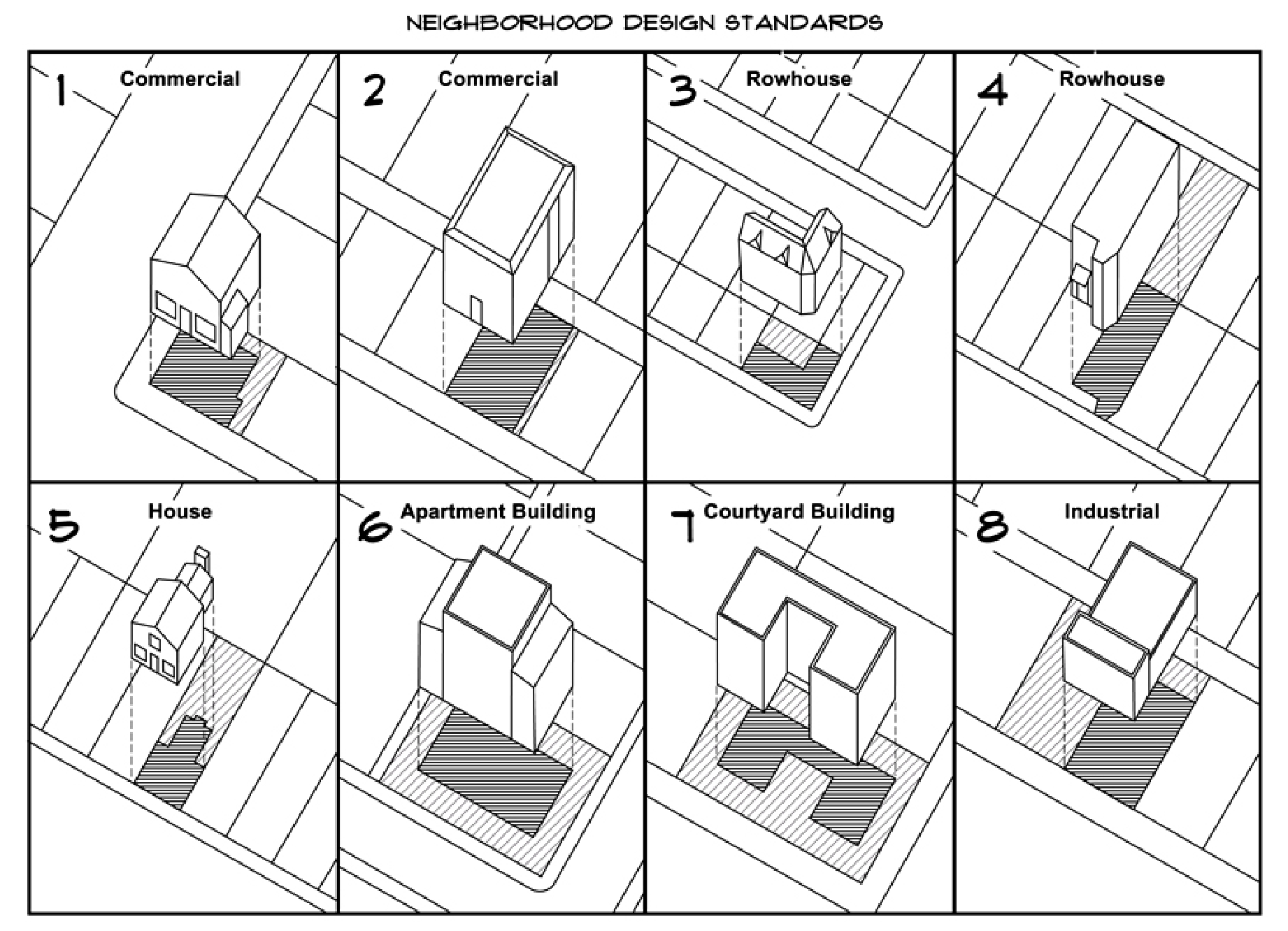
Various aspects of these design goals are demonstrated by the following building typologies, the use of which is strongly encouraged when designing new construction or expansion of existing buildings:
3.
Wherever possible the provisions of this section shall be interpreted in a manner which is consistent with these design goals and with the plan of development.
22-9-2.3. Definitions. The definitions in section 22-2-4 shall apply to this entire section. The following additional definitions shall apply to this section:
Alley: Private right-of-way dedicated for the use of pedestrians, vehicles or public utilities as a means of access to abutting property.
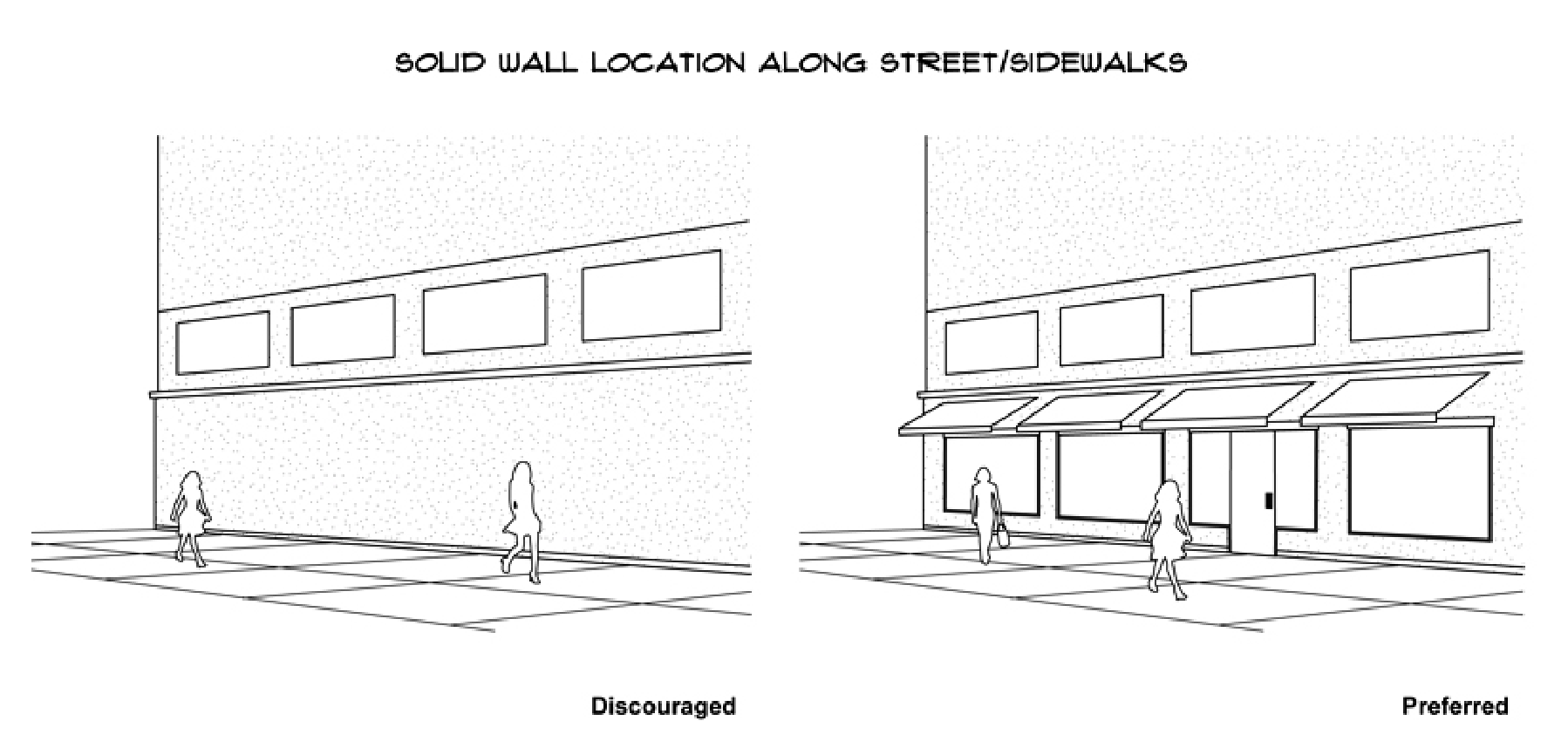
Blank wall: A wall without fenestration.
Build-to line: The front lot line.
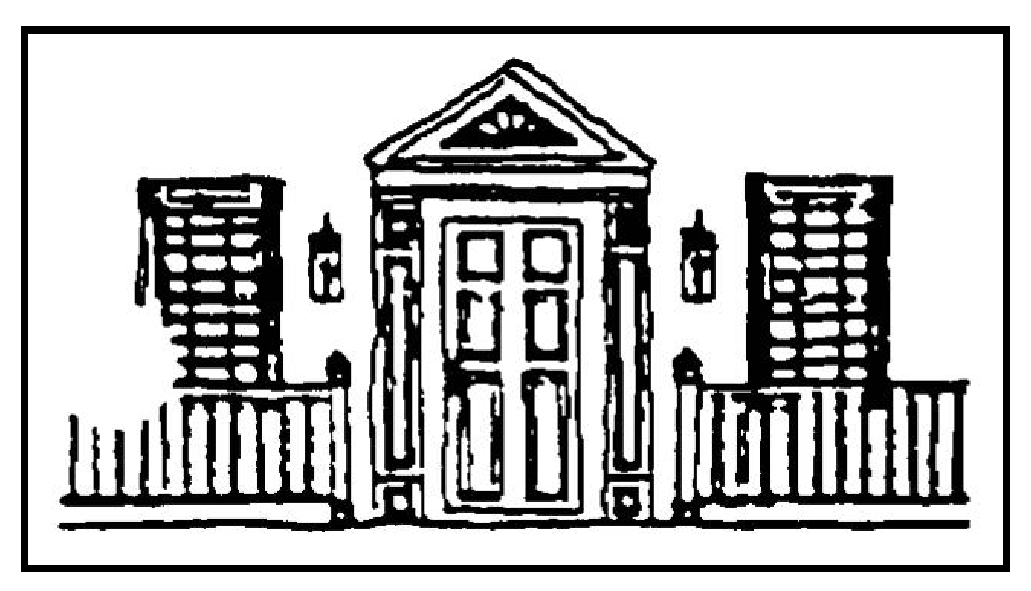
Enclosure wall: Wall, gate or door or any combination of these separating private property from public property or easement.
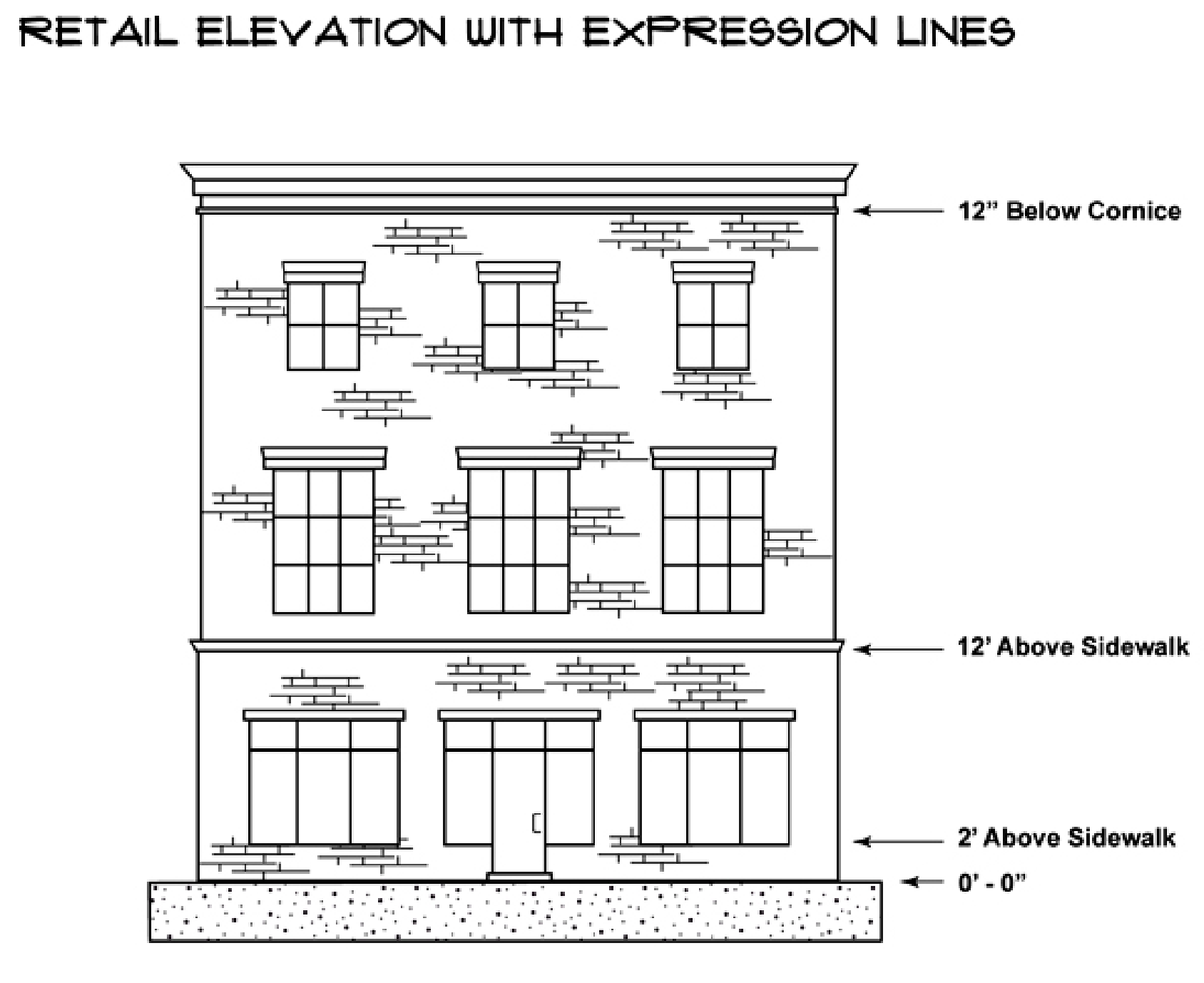
Expression line: Horizontal line or lines, running the length of the façade represented by a materials change or continuous setback no more than twelve (12) inches in depth or six (6) inches in projection.
Fenestration: Windows, doors, openings, openwork gates.
Habitable space: Building space, the use of which involves human presence within view of the public pedestrian space.
Streetscape: The area within a street right-of-way that contains sidewalks, street furniture, landscaping or trees.
22-9-2.4. Applicability. If any parcel of property within an approved Design Development District is proposed to be improved to an extent greater than fifty (50) percent of its fair market value, as determined by the St. Bernard Parish Assessor's Office, then such parcel shall be developed in compliance with the requirements of this section. All public funded projects or public buildings in these areas shall be developed in compliance with the requirements of this section.
22-9-2.5. Required development standards. Traditional neighborhood design have specific characteristics which result in compact, mixed use, pedestrian-oriented neighborhood. Development shall be consistent with the following objectives and standards:
1.
Standards for allowable land uses, lot area, coverage, density and yard requirements shall be determined by underlying base zone requirements, unless this section expressly provides otherwise.
2.
Streets/blocks and streetscape design.
a.
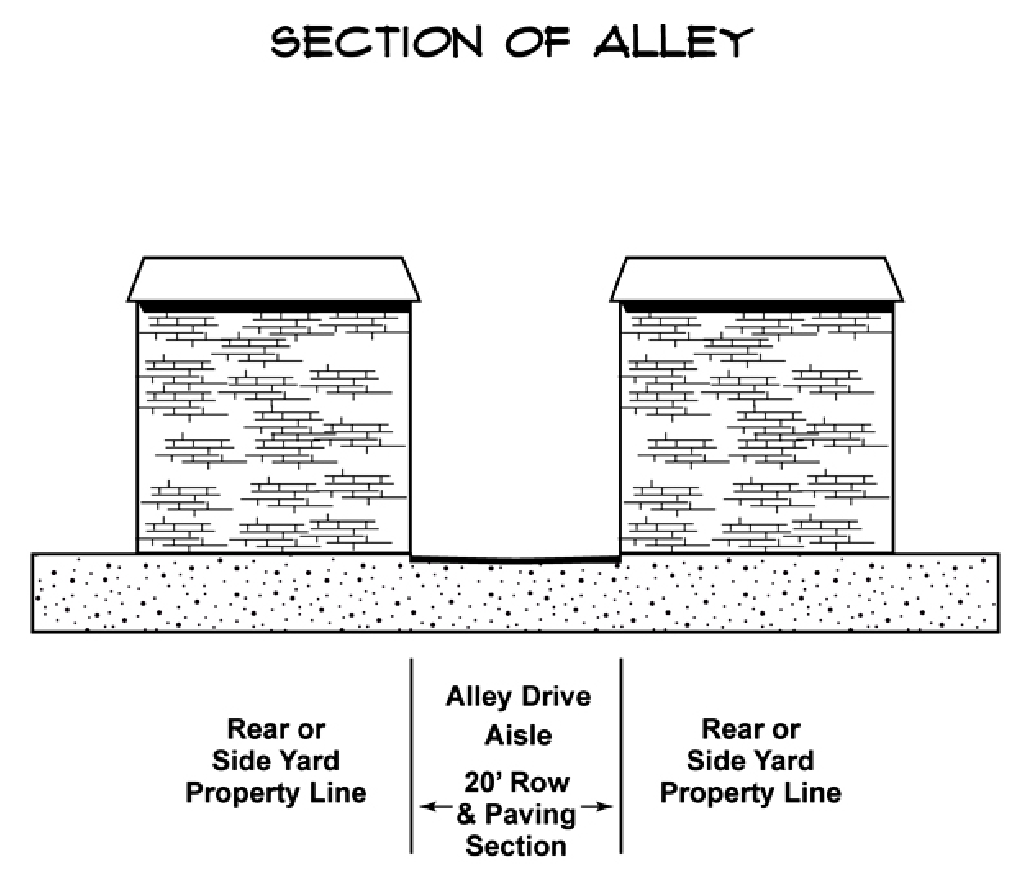
Proposed alleys shall be designed within a twenty (20) foot maximum right-of-way.
b.
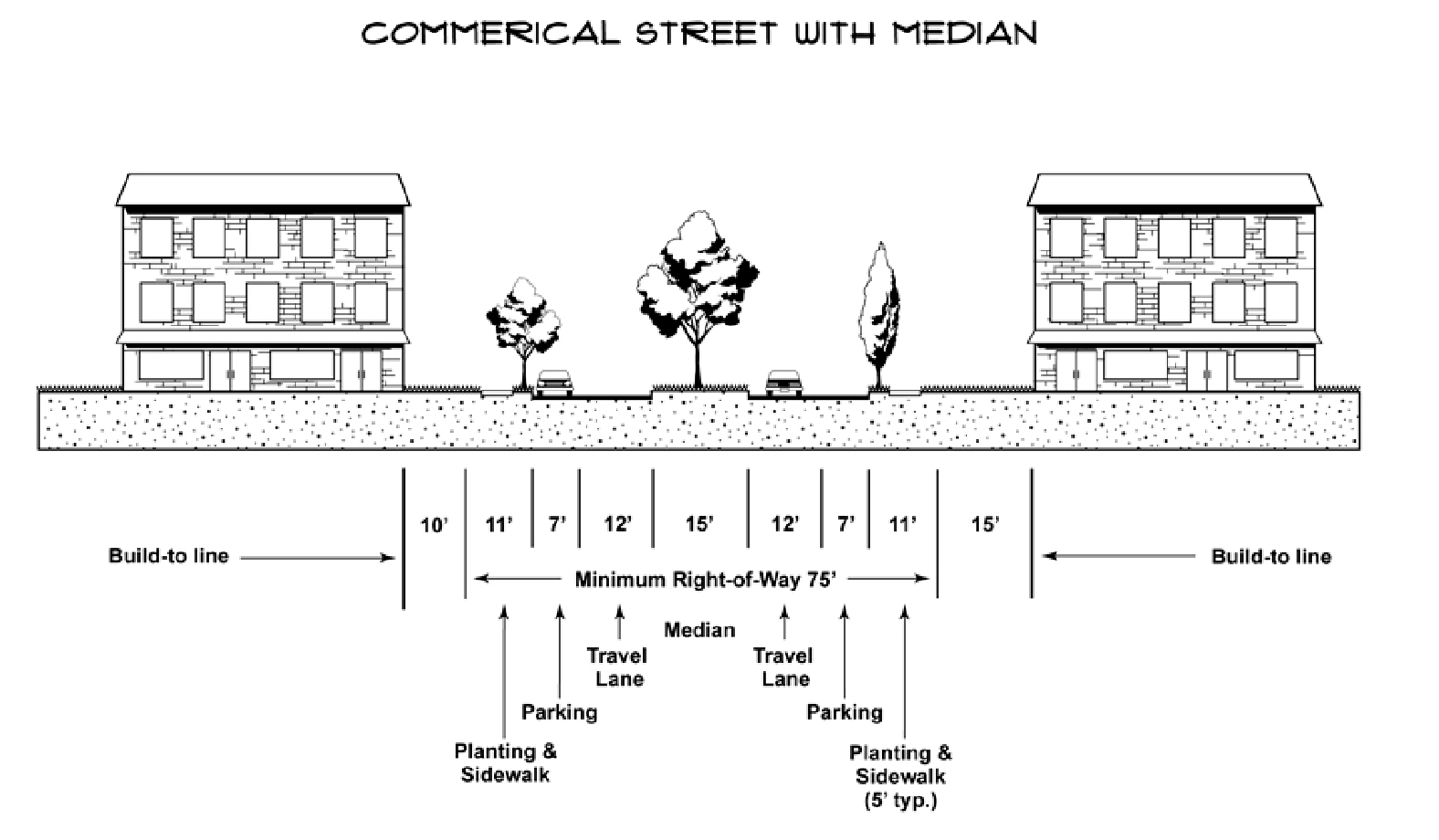
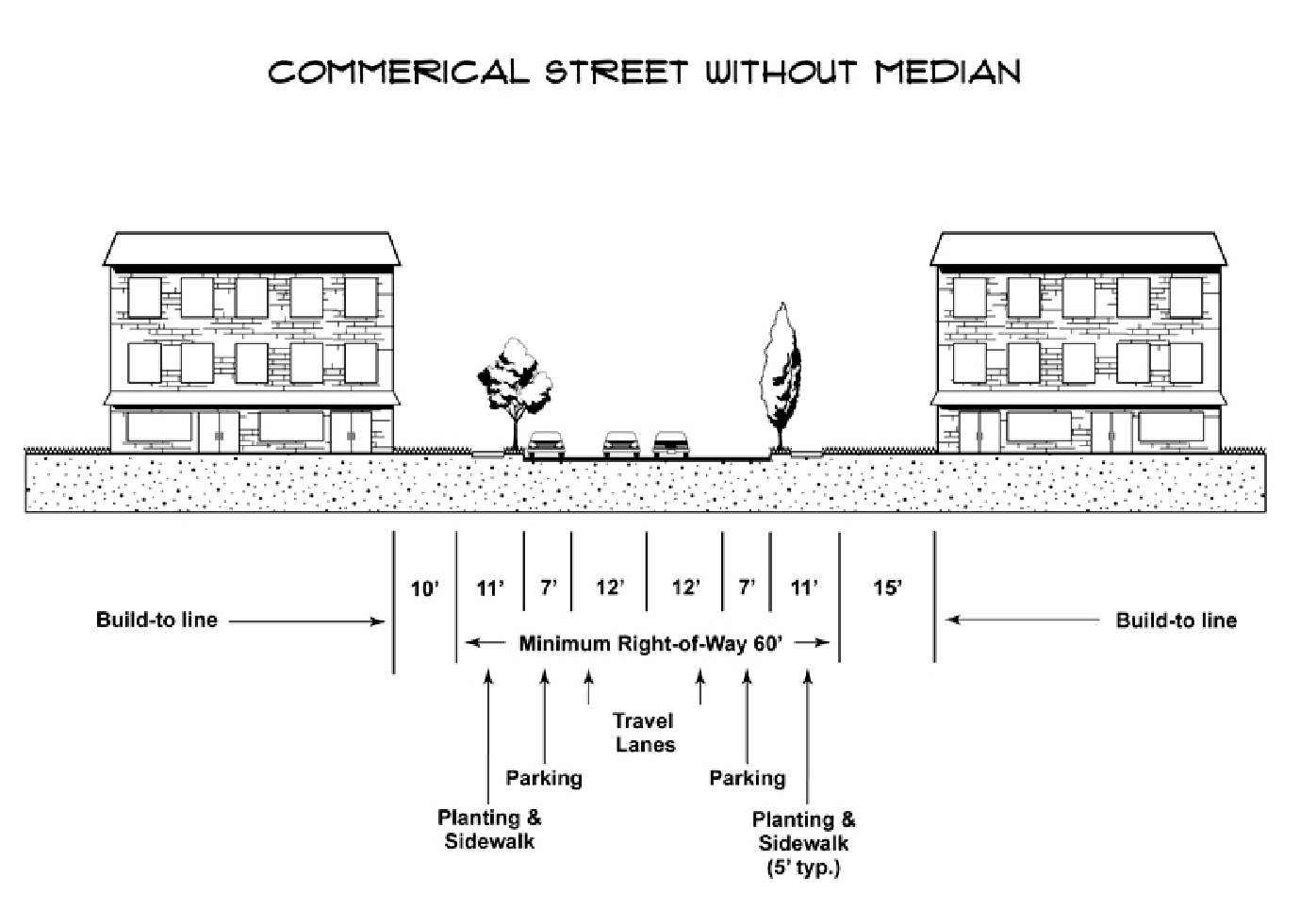
The street design used within different areas of the Design Development District may vary depending on the proposed function of the street, the anticipated adjacent land uses, the traffic load and the desired character of the area.
c.
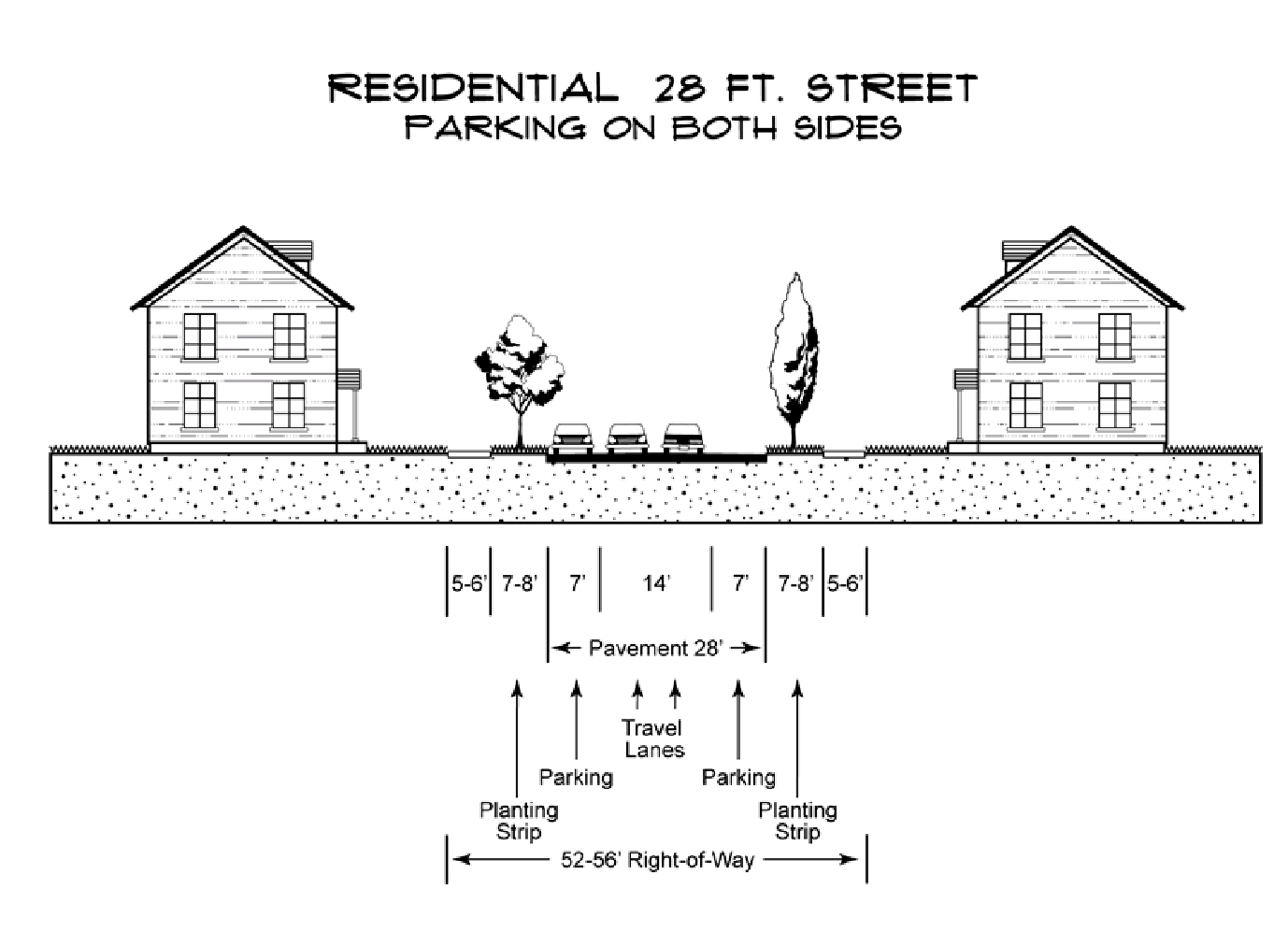
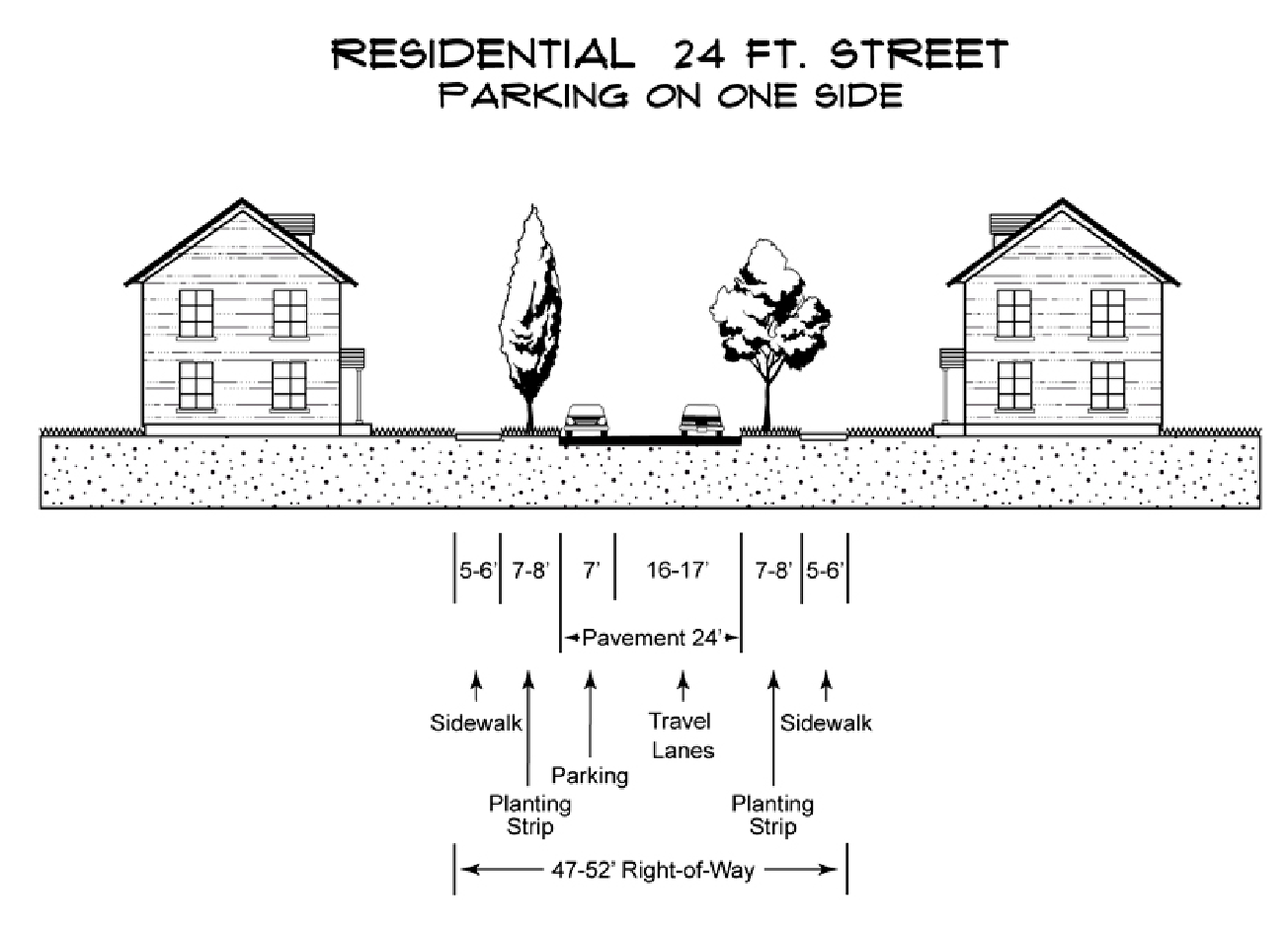
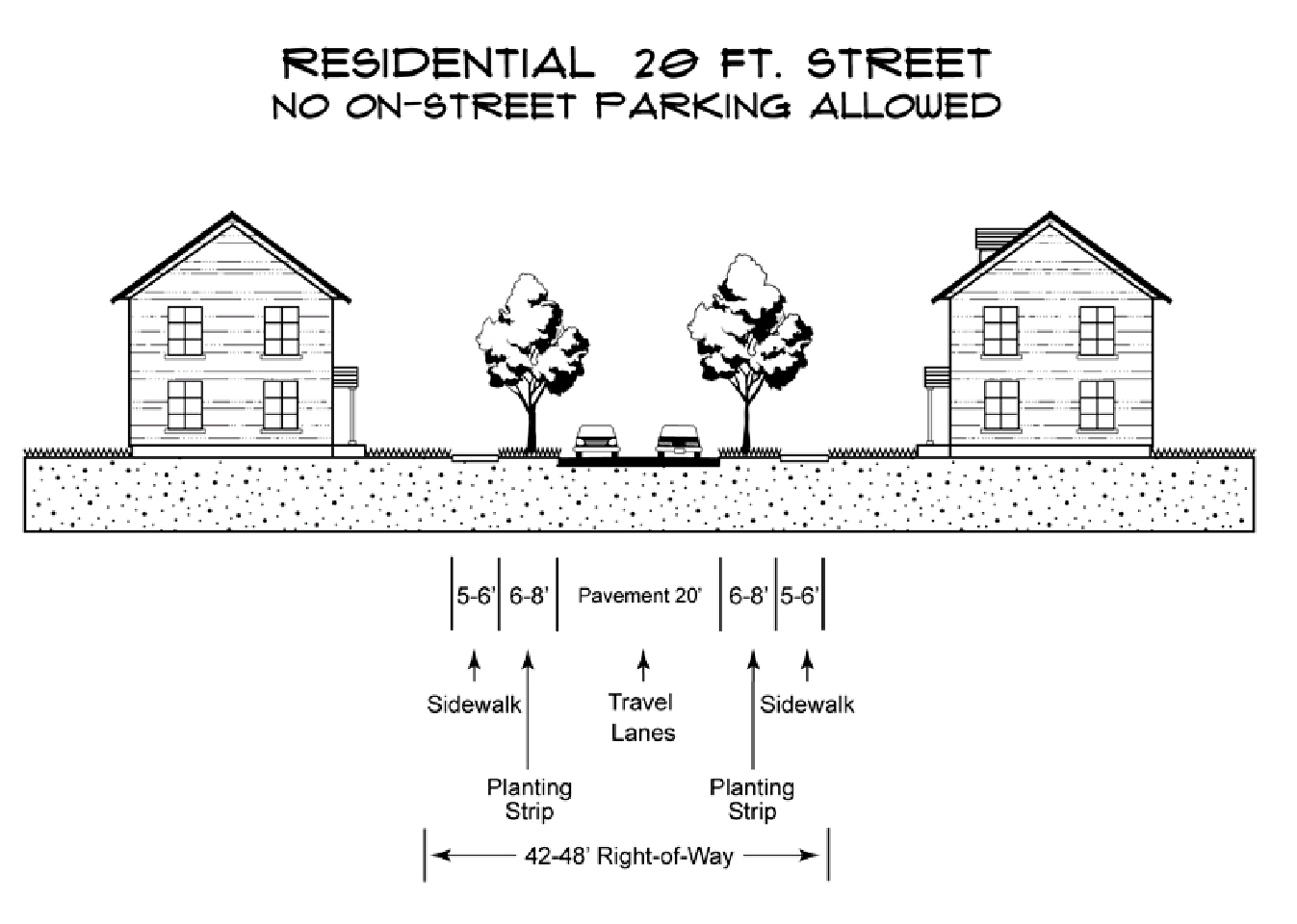
Street design shall balance the needs of all users, and streetscape design is critical to this balance. The streetscape shall consist of sidewalks and amenities, such as street trees and street furniture. Providing wide sidewalks, on-street parking and an appealing streetscape encourages pedestrian activity.
d.
Construction of public streets and walkways must conform to the parish standards. However, the commission can approve the overall design of streets, walkways, and on-street parking areas with the concurrence of the director of public works. Therefore, flexibility exists as it relates to the design of these areas. The following are recommended street design standards:
3.
Vehicular access.
a.
Access to alleys. Direct vehicular access from a lot to an alley in the district is permitted and preferred. Direct vehicular access from a lot to a street is not permitted, except as provided in this section.
b.
Exceptions. Direct vehicular access from a lot to street may be permitted in the discretion of the commission if an alley cannot reasonably be provided.
c.
Joint access driveways. If adjacent lots have direct vehicular access to a street, the commission may require that the access be through a common or joint driveway.
4.
Parking. The following parking requirements shall apply:
a.
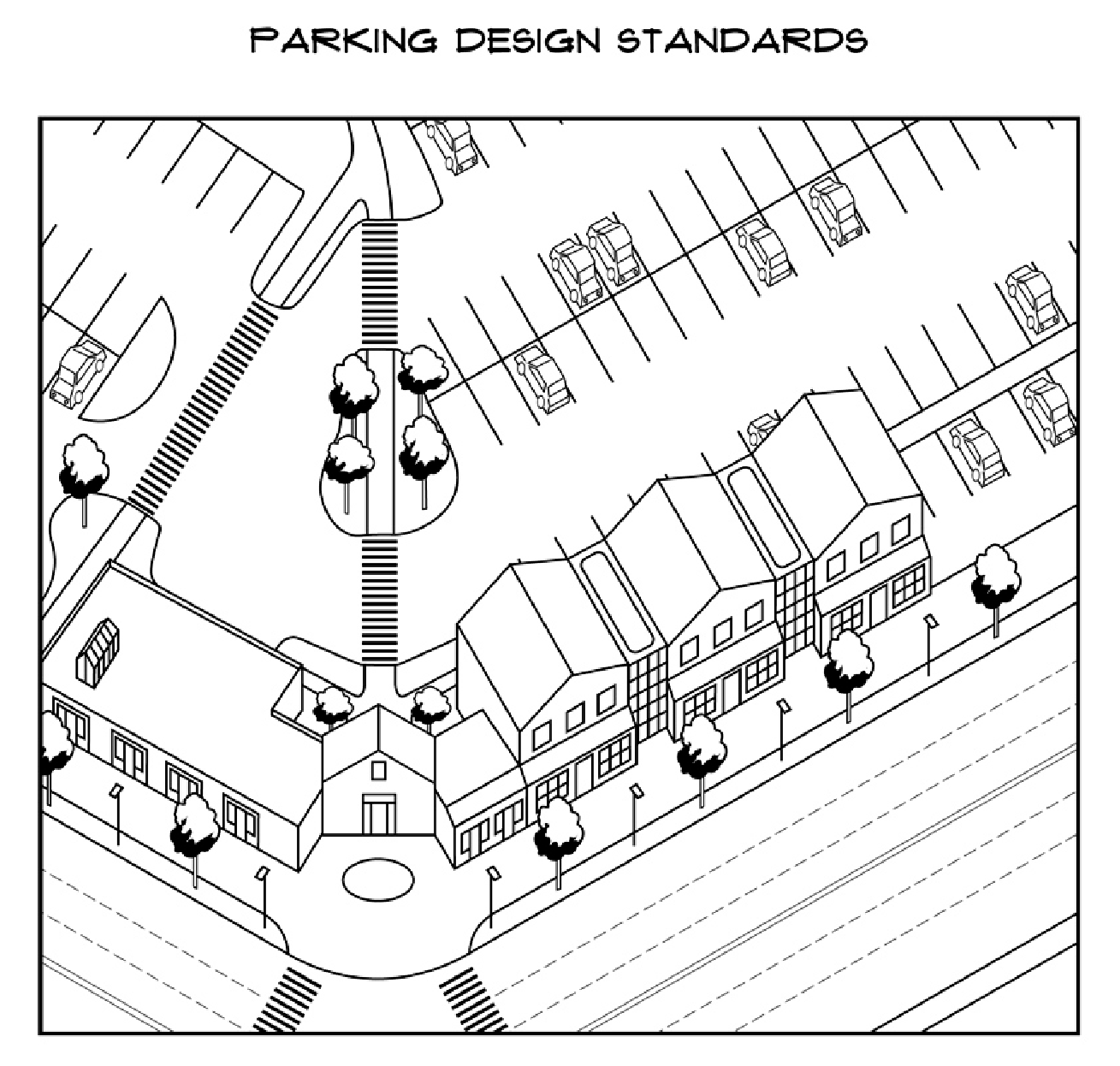
All on-site parking shall be located only at the rear of a building. In the case of corner lots, the front of a building shall mean that façade which faces the most heavily traveled street abutting the property. The commission may consider and allow front field parking if unique circumstances where no other alternative exits, where it promotes better site design, or where it may be necessary for a particular use. A two-thirds (⅔) majority vote of the commission is required to approve front field parking.
b.
There is no off-street loading requirement for a building with less than ten thousand (10,000) square feet of gross building area.
c.
Parking in alleys is prohibited.
d.
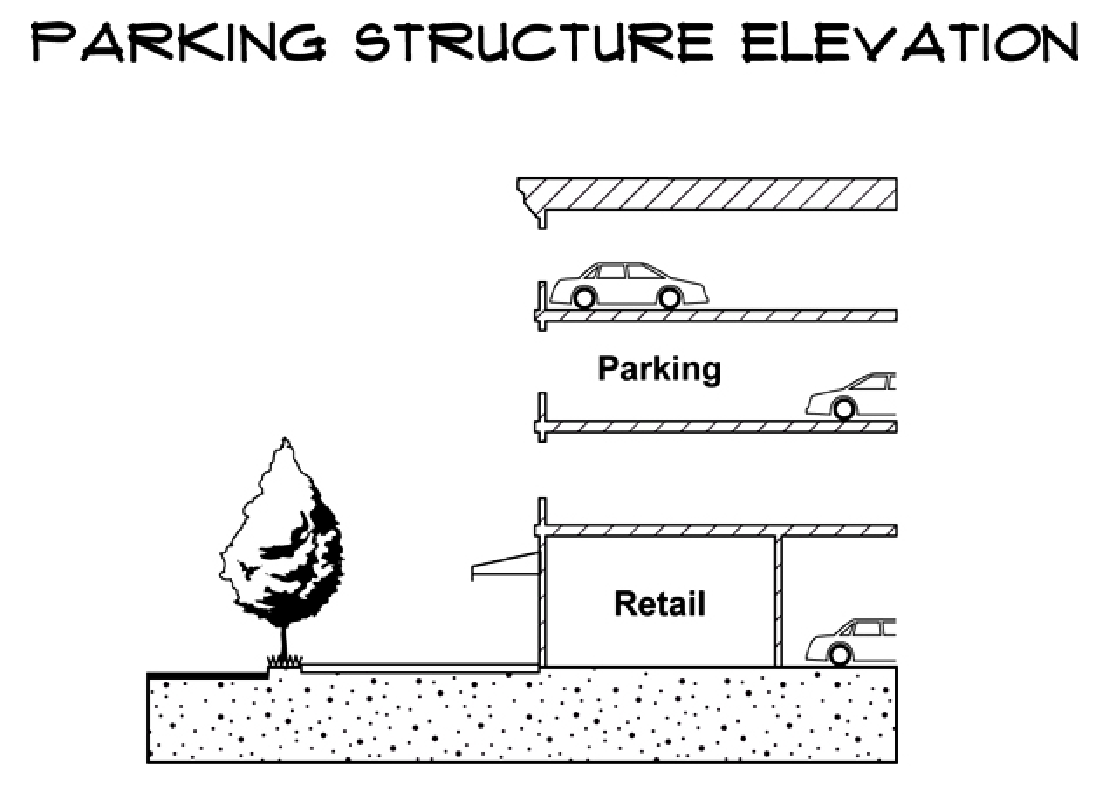
Parking structure/deck design.
e.
Minimum parking requirements are as follows:
•
Retail: Three (3) parking spaces per one thousand (1,000) square feet of gross floor area.
•
Office: One (1) parking space per five hundred (500) square feet of gross floor area.
•
Residential: One (1) parking spaces per unit.
•
Parking requirements must be met by off-street parking.
f.
Every hospital, institution, hotel, commercial or industrial building having more than ten thousand (10,000) square feet of floor area, that has a sprinkler system in place, shall provide adequate reserve parking for fire apparatus. This parking shall be within thirty-five (35) feet of the sprinkler connection on the exterior of the building and shall have a fire hydrant within fifty (50) feet of that parking space.
4.
Parking space dimensions.
•
On-street: Twenty (20) feet length when parallel to the curbline or nine (9) feet by eighteen (18) feet when diagonal to the curbline.
•
Off-street: Nine (9) feet by eighteen (18) feet.
5.
Building placement.
a.
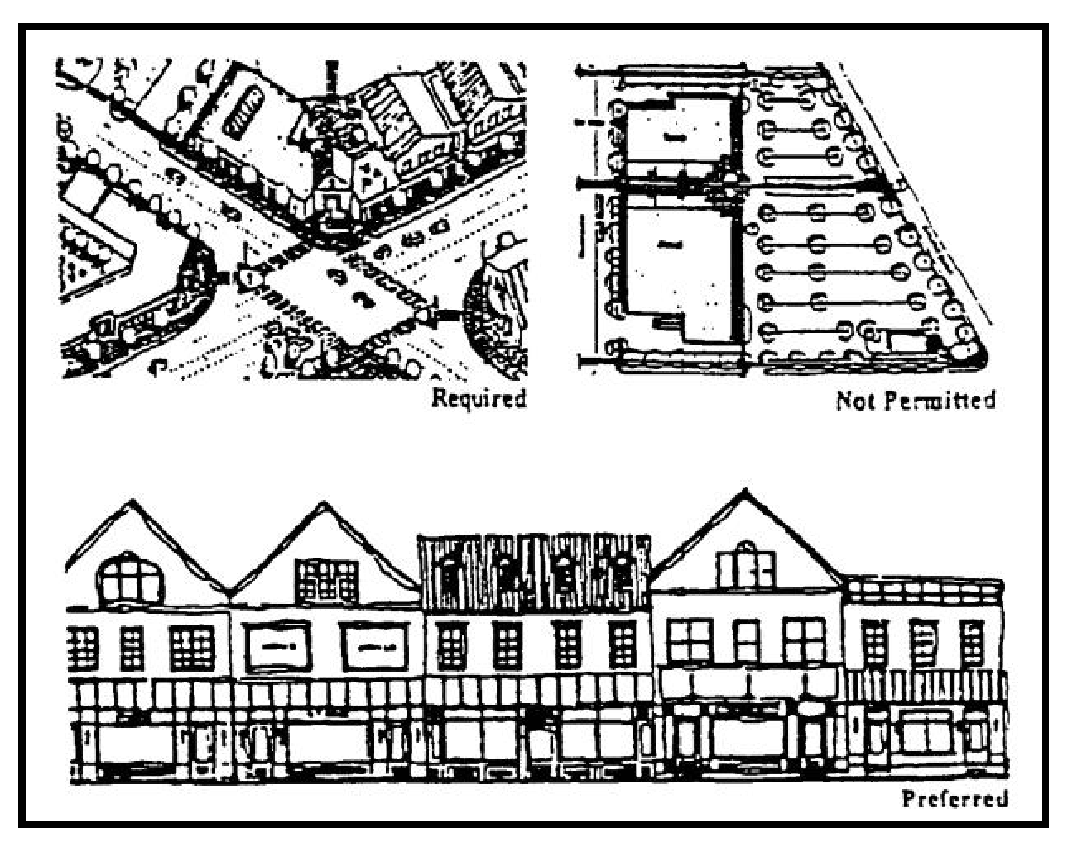
In traditional neighborhood design buildings are used to form a distinct street edge and define the border between the public space and the private space of the individual lot. This promotes active streets and provides visual interest to the pedestrians. In order to achieve this objective, new buildings in the Design District shall have a zero set back from the street right-of-way. For purposes of this subsection, the term "building" includes tenant or patron spaces outside the building which are defined by permanent structural elements such as walls or fences.
b.
New buildings shall be designed to cover at least eighty (80) percent of the lot frontage. If the remaining portion of the frontage is not required for vehicular or pedestrian access to the lot, a decorative enclosure wall or gate shall be installed along the remaining frontage. The enclosure wall or gate design shall be approved by the commission or staff and shall be designed in a manner which meets the purposes and design goals of this section.
6.
Building design and use.
a.
Buildings shall relate to and be oriented towards the street and surrounding buildings.
b.
The main entrance of a building or other structure must face the street and be clearly articulated through the use of architectural detailing. Secondary rear entrances may be permitted only if there is a main entrance from a street. Front entrances may not be closed off in favor of rear entrance. Patrons exiting an establishment shall be permitted to exit through the main entrance.
c.
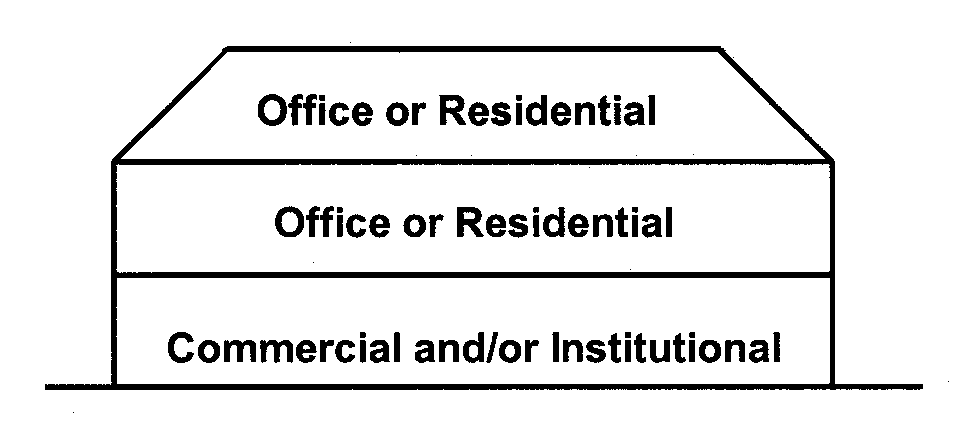
Residential and office uses may be located above the first floor of a commercial building.
d.
Service areas (loading docks, shipping/receiving) and utility service connections shall be located at the back of the building.
e.
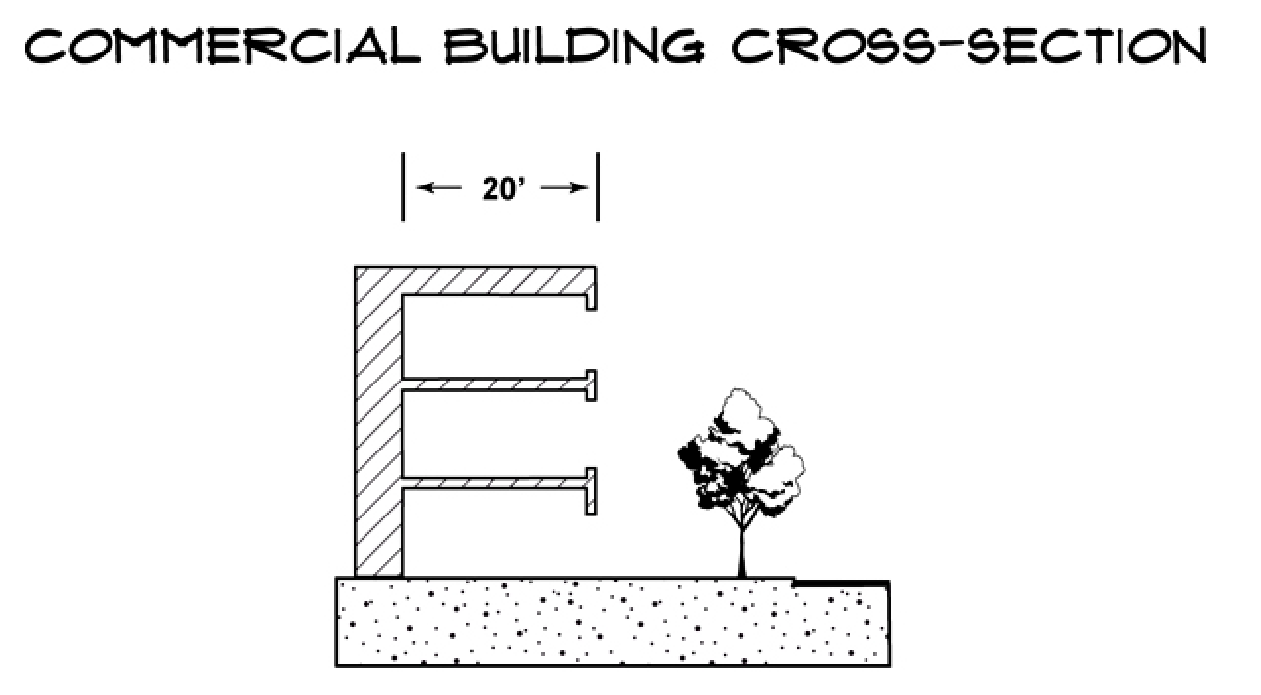
The first and second floors of all buildings shall have a habitable space within the first twenty (20) feet of building depth fronting the street.
f.
Fenestration requirements should be met with the installation of clear glass that is sufficiently transparent to provide views into the interior of buildings.
g.
Blank walls or roof planes longer than thirty (30) feet are prohibited.
7.
Additional requirements.
a.
Commercial properties shall be screened from adjacent residential properties by an enclosure wall or fence minimum six (6) feet in height.
b.
Refuse receptacles shall be located at least twenty (20) feet from adjacent residential zones and shall be located at the back of buildings.
c.
Merchandise may be displayed on the sidewalk, provided that the display area does not extend more than two and one-half (2½) feet from the building face and further providing that a minimum five (5) foot pedestrian right-of-way remains unobstructed.
d.
Outdoor dining shall be permitted in any yard area and on the sidewalk area provided that a minimum five (5) foot pedestrian right-of-way remains unobstructed on the sidewalk. All outdoor dinning areas shall be enclosed with an ornamental fence no more than three (3) feet high. Other forms of enclosures may be considered and approved by the commission or staff.
e.
Fluorescent lighting and back-illuminated awnings shall be prohibited on façades fronting a street.
22-9-2.6. Additional design standards.
1.
The following design standards shall be met within the traditional neighborhood design unless the planning and zoning commission approves a modification from these standards. In addition to the findings which must be made by the planning and zoning commission in approving a special use permit, the commission shall also consider the following criteria in approving a departure from these design standards:
a.
The nature and extent of the applicant's planned development on the site;
b.
The circumstances surrounding the applicant's reasons for submitting the development application (including the applicant's financial ability to meet these design standards);
c.
Whether compliance with any of these design standards will serve to render the property unmarketable or render its use fiscally unsound; or
d.
Whether the proposed use has been designed to permit future compliance with these design criteria.
2.
Traditional neighborhood design is pedestrian-oriented. To accomplish this goal, street pattern and design is used to reduce vehicle travel speeds and to encourage pedestrian activity. No parcel shall be developed in a manner which creates a single building site larger than four (4) acres unless that site is divided into areas of fewer than four (4) acres which are separated by streets or alleys.
a.
The perimeter of newly constructed blocks shall not exceed one thousand six hundred (1,600) linear feet. A block side shall not exceed four hundred (400) linear feet.
b.
The maximum building footprint of a parking garage shall not exceed sixty thousand (60,000) square feet.
c.
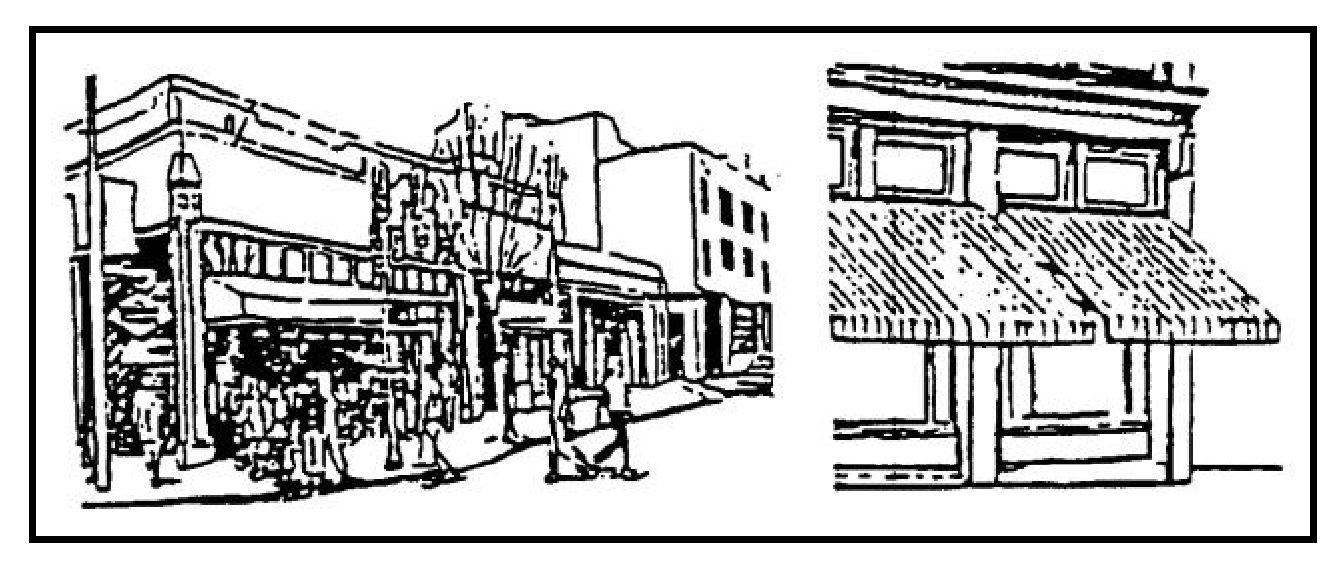
Operable covered awnings to provide for covered walkways may be provided.
d.
The distance between pedestrian entrances shall not exceed seventy-five (75) feet. On new retail street frontages, entrances shall be spaced no greater than thirty-five (35) feet apart.
3.
Architectural standards in traditional neighborhood design permit vary, yet complementary architectural design which promotes the integration and compatibility of land and building uses within the design district; ensure the design of buildings which provide human scale; and establish the importance of shared space through building location, orientation, massing and architectural design. Building designs shall achieve the following objectives:
a.
Human scale.
1.
The maximum individual tenant occupancy shall not exceed a footprint of forty thousand (40,000) square feet of gross floor area. Individual retail tenant spaces may not be interconnected through the use of interior doorways. A bonus of eighteen (18) percent may be granted to a building within a radius of two hundred fifty (250) feet of a transit terminal if one (1) floor of the building is residential.
2.
Doorways, windows and other openings in the façade of a building should be proportioned to reflect pedestrian scale and movement and to encourage interest at the street level. Buildings shall be fenestrated as follows:
3.
Sill height shall be twenty-four (24) inches from ground level for first-floor retail frontages and thirty-six (36) inches in all other locations. Glazing is required to be located between sill height and eight (8) feet above sidewalk on retail frontages.
b.
Architectural compatibility and building materials.
1.
Buildings shall be constructed of natural materials which weather gracefully over time, such as brick, stucco, stone, cast concrete, masonry and wood.
2.
Aluminum or vinyl siding, porcelain panels and imitation stucco are prohibited.
3.
The following materials can only be used in the areas described below:
[a]
Concrete may only be used for building walls, columns, pilasters and flooring.
[b]
Wood may only be used for doors, window frames, mullions, sashes, shutters, balconies, eaves, cornices, railings, columns, fences and pergolas.
[c]
Stucco may only be used for building walls and enclosure walls.
4.
Expression lines shall be designed into all new retail street buildings and shall occur at two (2) feet and twelve (12) feet above the sidewalk and twelve (12) inches below the cornice. Expression lines shall be designed to occur on other buildings at two (2) feet six (6) inches above the sidewalk and twelve (12) inches below the cornice.
22-9-3. Planned unit development (PUD). The following provisions shall apply to planned unit developments in commercial districts and less restrictive zoning districts:
22-9-3.1. PUD described. A planned unit development is where each owner owns as separate property the land beneath the dwelling acquired by a fee simple title. Also, each unit owner is a shareholder in a nonprofit, incorporated owners' association that holds title to the common areas surrounding the dwelling units.
22-9-3.2. Purpose. The purpose of the planned unit development (PUD) is to promote more economical and efficient use of land, creative design, more orderly development of the parish, improved living environments, and an improved level of amenities. It is further intended to encourage flexibility in the design and development of land in order to promote its appropriate use and harmonious variety of housing types, to facilitate the adequate and economical provisions of streets and utilities; and to preserve the natural and scenic qualities of open areas.
22-9-3.3. Permitted uses. The following uses permitted in the planned unit development upon the approval of the council:
(1)
Single-family dwellings including cluster homes.
(2)
Two-family dwellings or duplexes.
(3)
Multiple-family dwellings, townhouses, garden apartments, etc.
(4)
Private clubs, community centers, civic and social or organization facilities.
(5)
Parks, playgrounds, golf courses, tennis and racquet clubs.
(6)
Public utility buildings, structures and facilities necessary to service the surrounding neighborhood.
(7)
Houses of worship, schools, nursing homes, child care centers, hospitals.
(8)
Other uses of a nature similar to those listed above after determination and recommendation by the planning commission, and determination by the council at the time of approval that such use or uses is appropriate to the PUD development.
22-9-3.4. Location standards. In determining recommendations and making a decision as to approval of the PUD, the planning commission and council shall apply the following locational standards:
(1)
Physical characteristics of the site. The site shall be suitable for development in the manner proposed without hazard to persons on or off the tract from probability of flooding, erosion or other damage; the condition of soil, groundwater level, drainage and topography shall all be appropriate to both kind and patterns of use intended. Such determination shall be made by the department of engineering.
(2)
Relation to major transportation facilities. PUDs shall be so located with respect to arterial streets, highways, collector streets, or other transportation facilities as to provide direct access to such PUDs without creating or generating traffic along minor streets in residential areas or districts outside the PUD.
22-9-3.5. Internal PUD parameters. The following parameters apply within a PUD:
(1)
Access. Every dwelling unit or other use permitted in the PUD shall have access to a public street either directly or via an approved private road, pedestrian way, court or other area dedicated to public or private use, or common element guaranteeing access. Permitted uses may not be required to front a dedicated public road.
(2)
Lot sizes. Lot sizes conform to the requirements set forth for multifamily dwellings.
(3)
Parking requirements. Every dwelling unit shall have two (2) parking spaces.
(4)
Useable open space requirements. Useable space shall include active and passive recreation areas, such as playgrounds, golf courses, beach frontage waterways, lagoons, floodplains, nature trails, and other similar open spaces. Open water bodies beyond the perimeter of the site and street right-of-way, driveways, and parking areas shall not be included in determining useable open space. Yards and spacing within individually owned lots shall not be included in determining useable open space. However, such area commonly owned shall be considered open space.
(5)
Maintenance of common areas. Prior to final approval the continued maintenance of all common areas, including open spaces etc., shall be established and submitted to the council. The submission may include agreements, contracts, deed restrictions, sureties or other legal instruments to guarantee the installation and continued maintenance of such common areas and facilities.
(6)
Sewerage disposal. Central sewerage systems shall be provided to all structures in this district.
(7)
Water system. Central water system to provide adequate fire protection shall be provided to all structures in this district.
22-9-3.6. Plan approval.
(1)
Plans shall be submitted to the planning commission and shall conform to the subdivision regulations of St. Bernard Parish. The filing fee shall be one hundred fifty dollars ($150.00).
(2)
Planning commission findings and recommendations. After public hearing, the planning commission may recommend to the council that the PUD request be granted, subject to stated stipulations and conditions, or disapproved. In making its recommendations, the planning commission shall find that the plans, maps and documents submitted by the applicant and presented at the public hearing do or do not establish that the applicant has met the parameters and include the following:
a.
The tract for the proposed PUD is suitable in terms of its relationships to the parish comprehensive zoning ordinance and that the area surrounding the proposed PUD can continue to be developed in coordination and substantial compatibility with the PUD proposed.
b.
That the desirable modifications for general zoning or PUD regulations as applied to the particular case justify such modification of regulations and at least an equivalent degree the regulations modified, based on the design and amenities incorporated in the site development plan.
c.
That increased open space over conventional development is provided for the occupants of the proposed PUD and the general public, and desirable natural features indigenous to the site are considered in the development plan presented.
(3)
Binding nature of approval for PUD. All terms, conditions, safeguards and stipulations made at the time of approval for PUD shall be binding upon the applicant or any successors in interest. Deviations from approved plans or failure to comply with any requirements, conditions or safeguards shall constitute a violation of these zoning regulations.
(4)
Changes to the PUD. Administration approval is allowed for minor changes to the PUD, while council approval is required for major changes. Major changes are any changes which alter the use of land; the use, bulk and location of buildings and structures; the quantity and location of common open space; the intensity of use or the density of residential units. These modifications can occur only after a finding by the council after a duly advertised public hearing that the development or its environs are not adversely affected by said changes. All other changes shall be considered minor changes and may be affected only after a letter of no objection is issued by the director of the department of community development.
(5)
Appeals. Any affected party who feels aggrieved by the proposed changes either major or minor may petition for appeal before the Council within fifteen (15) days of the enactment of said changes.
22-9-4. Rural community unit plan.
22-9-4.1. Intent. It is recognized that this zoning ordinance provides zones which allow all types of residential uses and provides minimum standards in each zone to ensure the health, safety and welfare of the community. It is also recognized that such traditional zoning practices can, at times, restrict and hamper innovative but proper approaches. This section is intended to establish a zone which will allow for innovation which may not be accomplished using traditional techniques. Because customary standards are to be relaxed in this zone, close government scrutiny will be necessary to ensure that the overall standards for the health, safety and welfare of the community will be maintained. While the traditional zones will continue to be available, this section is intended to establish a rural community unit plan zone which will provide an alternative to the traditional zones.
It is further intended that the rural community unit plan zone be established so as to minimize land use conflicts and promote development compatible with surrounding land uses.
22-9-4.2. Establishment of a rural community unit plan zone. An authorized agency of the parish, state or federal government, or the private owner or all owners of any tract of land within the A-1 Rural Zone as designated by this chapter, may submit to the parish council a plan for the use and development of all of the tract of land for residential and allied purposes. This plan shall be referred to the parish planning commission for study and report and for public hearings. Notice and publication of such public hearings shall conform to the procedure prescribed in section 22-10-1.1 of this chapter. After consideration by the commission, these plans shall be submitted to the parish council for consideration and action. The recommendations of the commission shall be accompanied by a report stating the reasons for its action. If the commission gives approval, it shall submit specific evidence and facts showing that the proposed rural community unit plan meets with the following minimum conditions:
(a)
The property adjacent to the area included in the plan will not be adversely affected.
(b)
The plan is consistent with the intent and purpose of this chapter to promote public health, safety, morals and general welfare.
(c)
The plan meets the minimum use and development criteria as specified in this section.
If the parish council approves such a plan, the rural community unit plan zone designation shall be appended to the existing A-1 Rural Zone of the subject property so that the zone of the subject property would become A-1/RCUP. A copy of the approved plan and any attached conditions shall be duly recorded and filed with the title of the property in the clerk of courts' office, to be valid for the total period that the plan is in existence. A certificate of this filing shall be furnished to the zoning administrator immediately following filing. A rural community unit plan designation is not intended to substitute in any way the required subdivision process necessary for the sale of individual dwellings with land within any given rural community unit.
22-9-4.3. Minimum site and density criteria. Application for a map amendment request to a rural community unit plan zone shall be made only on property which meets the following criteria:
(1)
Location. The property must be entirely located within an A-1 Rural Zone.
(2)
Minimum size. No site may be zoned to a rural community unit plan classification unless it is one (1) property of at least five (5) acres in size.
(3)
Gross density. Gross density shall not exceed one (1) single-family dwelling per acre. There shall be a minimum of at least a twenty (20) foot clearance between the furthest projections of such dwellings.
(4)
Minimum yard requirements. Minimum yard setback requirements shall be as provided for in A-1 Rural Zone district regulations.
(5)
Approved access required. Access shall be provided every dwelling to a public or private street. Such access is to be indicated on an approved site plan for the rural community unit plan and shall have a minimum width of twenty (20) feet.
(6)
Approved sewerage disposal required. Where available, every dwelling must hook up to the public sewerage disposal system prior to occupancy of the dwelling. Where unavailable, every residence must have a private sewerage disposal system approved by the state department of health prior to occupancy of the dwelling.
(7)
Flood elevation standards. All dwellings must meet minimum required federal flood elevation standards and any other applicable flood zone requirements.
22-9-4.4. Permitted uses. The following uses shall be permitted in the rural community unit zone. All uses other than those specifically listed as permitted uses or substantially similar to the permitted uses shall be prohibited.
(1)
Principal permitted uses. The primary principal permitted uses shall be single-family dwelling units, including mobile homes.
(2)
Permitted accessory uses. The following uses are permitted when incidental and subordinate to principal permitted uses: private garages, storage sheds and parking areas; swimming pools and other private use open space and recreational areas; agricultural uses excluding commercial stock raising; and permitted home occupations. There may be one (1) accessory structure per permitted dwelling. Accessory uses shall otherwise be regulated as provided elsewhere in this section.
22-9-4.5. Required parking. A minimum of one (1) off-street parking space shall be provided for each dwelling unit.
22-9-4.6. Building permit and certificate of occupancy required. Following approval by the parish council, building permits and certificate of occupancy may be issued.
22-9-4.7. Expansion of rural community unit plan. Any proposed expansion to any rural community unit plan by the addition of any primary principal dwelling not shown in the original approved plan shall be resubmitted for review and approval according to the procedure outlined above in this section.
22-9-5. Recreational vehicle parks.
22-9-5.1. Intent. A recreational vehicle (RV) park shall be allowed as a conditional use with the criteria outlined in this section approved by the St. Bernard Parish Council as per section 22-6-2.1 permitted conditional use. No use of any recreational vehicle or travel trailer for temporary or permanent residence or recreation shall be permitted outside of a designated and permitted RV park.
22-9-5.2. Permitted zones and permitted uses.
Permitted zones. RV parks are permitted in SA, and A-1 zones pending approval by the parish council. RV parks require an occupational license and are subject to local hotel/motel taxes.
Permitted uses. A recreational vehicle shall only be used as a temporary occupancy, not to exceed thirty (30) days, for travel and recreational purposes, and when used as such, it must be located in an RV park. An RV shall be fully licensed and ready for highway use. A recreational vehicle is ready for highway use if it is on its wheels or jacking system, is attached to the site only by quick disconnect type utilities and securing devices, and has no permanently attached additions. Any owner of a recreational vehicle outside of the recognized hurricane protection system in an approved RV park shall be liable for damages to adjoining properties caused by the relocation and movement of his or her RV caused by storm surge, floodwater, strong winds, or any other disruption associated with the hurricane.
22-9-5.3. Park specifications.
a.
Minimum park size: Three (3) acres.
b.
Minimum stall size: Thirty (30) feet × sixty (60) feet.
c.
Maximum density: Twenty (20) stalls per acre.
d.
Setbacks:
1.
Minimum front yard: Twenty-five (25) feet; except when abutting a state or federal highway, then the minimum shall be fifty (50) feet.
2.
Minimum side yard: When abutting a residential district, the setback shall be fifty (50) feet; when abutting an agriculture district or public right-of-way, the side setback shall be twenty-five (25) feet; when abutting any other zoning district, the side setback shall be ten (10) feet along the interior lot line.
3.
Minimum backyard: Ten (10) feet; except when the backyard abuts a residential district or public right-of-way, then the setback shall be at least fifty (50) feet.
e.
Screening: The RV park shall be screened with a six (6) foot opaque fence from all other abutting uses, except when abutting a residential zone, and then the fence must be eight (8) feet in height. Landscaping shall be provided along any portion of the park facing the street and additionally as conditioned by the parish council and conform to parish landscaping requirements found in section 22-7-1 of the St. Bernard Parish Zoning Regulations.
f.
Signage: All proposed signage must conform to section 22-7-4.
22-9-5.4. Site improvements.
a.
RV pad. A graveled pad measuring twelve (12) feet × thirty (30) feet shall be provided at each stall. A minimum of one and one-half (1½) parking spaces shall be provided for each stall, with one (1) fifty (50) graveled space located at the stall.
b.
Roads. All roads located within an RV park shall be considered private and shall be paved. One-way streets shall be a minimum of twelve (12) feet wide. A two-way street shall be a minimum of twenty-four (24) feet wide. For dead-end roads, a turnaround of one hundred (100) feet in diameter shall be provided. All roads shall be placed at least ten (10) feet from the side and rear property lines. Materials and construction methods shall be approved by the parish engineer.
c.
Entrances and exits. No entrance or exit from the RV park shall be permitted through a residential district nor require the routine secondary movement of traffic to and from the park through a residential district. The entrance and exit shall provide such space as to easily facilitate the movement of recreational vehicles and trailers in and out of the park.
d.
Accessory uses. Structures regarded as useful and integral to the operation of an RV park, such as management offices, recreational facilities, toilet and shower facilities, dumping stations, and coin-operated laundry facilities, are permitted as accessory uses on the site. Such accessory uses shall be constructed and located from lot boundaries as determined by setback and building codes adopted by the parish for that area.
e.
Permanent structures. No permanent structures shall be attached to any RV located in the park, especially structures that may limit the vehicles ability to quickly disconnect and vacate the park. The owner/operator of the park shall have the right to establish a site built dwelling, manufactured home, or modular dwelling to accommodate the person owning, managing, or maintaining the facility. Recreational vehicles shall not be considered residential dwellings. No RV shall be used as a permanent residence, occupancy, or accommodation. No RV shall remain in the park for longer than thirty (30) consecutive days. A term of at least four (4) weeks must lapse before the RV may return to the park. The owner/operator of the park shall maintain a record identifying each vehicle showing the occupancy dates of said vehicle.
f.
Utilities. Electrical, water, sewage, and solid waste facilities shall be provided at each site. Where a connection to a public utility is available for water or sewage disposal, the park shall be connected.
1.
Sewage. If sewage connection is not available, the park shall develop an onsite treatment facility. The facility shall meet all effluent and sanitary operation requirements of state environmental and health departments.
2.
Sanitary waste disposal. A station for the disposal of sanitary waste shall be provided at parks without individual stall sewer connections. This station shall not be located within fifty (50) feet of a recreational vehicle stall, and it shall be centrally located at least one hundred (100) feet from abutting properties. One (1) station shall be provided for every one hundred (100) recreational vehicle stalls, or part thereof, on site. The disposal hatch of the sanitary waste station shall be connected directly to the park sanitary sewerage system. A flushing facility shall also be provided as a means to flush the immediate area of the sanitary waste disposal station. A flushing station shall be provided for every one hundred (100) recreational vehicle stalls, and shall not be located within fifty (50) feet of a recreational vehicle stall. A sign of durable material, not less than two (2) square feet in size, shall be placed at the station reading: "Danger - Not to Be Used for Drinking or Domestic Purposes."
3.
Water. A central water system may be provided on site as long as it meets state health department requirements. A water station for filling camping vehicle water storage tanks shall be provided at a rate of one (1) station for every one hundred (100) recreational vehicle stalls or part thereof. These water stations shall be located not less than fifty (50) feet from a sanitary station. A sign of durable material, not less than two (2) square feet in size, shall be placed at the station reading: "Potable Water - Do Not Use to Flush Waste Tanks."
4.
Conveniences. Common showers and toilets shall be installed at any park that allows recreational vehicles.
5.
Refuse disposal. The storage, collection, and disposal of refuse shall be performed so as to minimize accidents, fire hazards, air pollution, odors, insects, rodents, or other nuisance conditions. Durable, watertight, easily cleanable refuse containers shall be provided at each service building and sanitary waste station, or at a central storage area readily accessible and located not more than three hundred (300) feet from any stall, camp, or picnic site, unless provided at each site.
g.
Drainage. Storm water sewers shall be separate and apart from any sewer intended for the conveyance of sanitary sewage. All utility receptacles and facilities shall be designed in such a manner as to provide protection of the receptacle or facility from storm water damage, including damage which may result from improper runoff affecting adjoining properties.
h.
Permit approval. The granting of a conditional use for an RV park shall follow the traditional process for the awarding of such permits as directed in section 22-8 except the site plan shall include the following specific provisions produced by a State of Louisiana licensed engineer or architect:
1.
The size of the area and general dimension of the tract of land being developed.
2.
The number, location, and size of all recreational vehicle stalls.
3.
Size and location of accessory buildings, owner/operator dwellings, structures, and distinct areas (playgrounds, disposal stations, etc.).
4.
Buffer and setback distances where required.
5.
Proposed landscaping.
6.
The location and width of roadways, driveways, and walkways, including a description of materials used for construction.
7.
The number, location, and size of all off-street automobile parking spaces.
8.
The location of the park illumination.
9.
Detailed drawings of the water supply, if not public.
10.
Detailed drawings of the sanitary stations and watering stations.
11.
Detailed drawings of the sewage disposal facilities, including specifications.
12.
Detailed drawings of the refuse storage facilities.
13.
The location and size of water and sewer lines.
14.
A drainage plan for the park and immediate adjacent properties.
22-9-5.5. Recreational vehicle parks outside the federal levee protection system.
a.
Recreational vehicle parks—Exemptions. Recreational vehicle parks outside of protection shall be exempted from the minimum park size requirement of three (3) acres and the screening requirements listed in [sections] 22-9-5.3 and 22-9-5.4; subject to the requirements of the conditional use approval of the council.
22-9-5.6. Recreational vehicles for personal recreational use outside the federal levee protection system.
a.
Intent. Recreational vehicles (RV) for personal use on standalone lots shall be allowed as a permitted use. This is limited to one (1) electrical meter per lot and no more than three (3) recreational vehicles.
b.
Permitted uses. A recreational vehicle shall only be used as a temporary occupancy, not to exceed thirty (30) continuous days and one hundred eighty (180) days per year, for travel and recreational purposes. An RV shall be fully licensed and ready for highway use. A recreational vehicle is ready for highway use if it is on its wheels or jacking system, is attached to the site only by quick disconnect type utilities and securing devices, and has no permanently attached additions. Any owner of a recreational vehicle outside of the recognized hurricane protection system shall be liable for damages to adjoining properties caused by the relocation and movement of his or her RV caused by storm surge, floodwater, strong winds, or any other disruption associated with the hurricane. All RVs shall be moved offsite during a mandatory evacuation.
c.
Lot specifications. Recreational vehicle lots must meet the following conditions:
1.
Minimum lot size is six thousand (6,000) square feet.
d.
Site improvements.
1.
RV pad. A graveled pad measuring twelve (12) feet × thirty (30) feet shall be provided at each stall. A minimum of one (1) parking space shall be provided for each stall.
2.
Permanent structures and dwellings. When a permanent dwelling is present, recreational vehicles are not permitted for occupancy and no additional electrical meters shall be released. A permanent structure supporting a recreational use such as boat sheds, awnings or shelters are permitted subject to an approved building permit. These supporting structures shall be enclosed and permanently affixed to the ground. All supporting structures shall meet the minimum FEMA codes and regulations concerning coastal areas. Specifically, said structures shall only be utilized for parking, access and storage.
3.
Utilities. Electrical, water, sewage, and solid waste facilities shall be provided at each site. Where a connection to a public utility is available for water or sewage disposal, the site shall be connected.
4.
Sewage. If sewage connection is not available, the site shall develop an onsite treatment facility. The facility shall meet all effluent and sanitary operation requirements of state environmental and health departments.
22-9-6. Design development districts - Required overlays.
1.
St. Claude Arts, Culture, and Entertainment District.
a.
Purpose.
1.
The purpose of the St. Claude Arts, Culture, and Entertainment District is to encourage the development of a fully integrated, mixed use, pedestrian-oriented historic commercial corridor which promotes both standard uses in Design Development Districts and specific arts, culture, and entertainment uses. The St. Claude District is created as an overlay zone that shall be applied to all properties within the district.
2.
The St. Claude Arts, Culture, and Entertainment District is designated a Design Development District and shall conform to standards listed in section 22-9-1, Design Development District and section 22-9-2, traditional neighborhood design standards.
b.
Boundaries.
1.
All commercial and industrial zoned lots fronting on to or within two hundred (200) feet of St. Claude Ave. (LA 46) from the St. Bernard Parish line to Center Street, except Sheriff's Substation (Refer to Appendix E - Maps).
c.
Special standards.
1.
Uses.
a.
Permitted, conditional, and restrictive uses. Uses that are permitted, conditional, or restricted are listed within the schedule of use chart. Refer to section 22-9-6.9.
2.
Development standards. The design standards listed in section 22-9-2 shall apply to the St. Claude Arts, Cultural, and Entertainment District along with the following standards:
a.
Buildings. Drive-thru facilities are permitted for pharmacies and banks when located in the rear of the building and minimally obtrusive.
b.
Parking. When a building exists on the site, parking shall be grandfathered to the most intensive permitted use for the district. Permitted uses shall comply with parking regulations listed in section 22-9-2.5.4. Uses not listed in section 22-9-2.5.4 shall conform to the standards in section 22-7-3.2 and shall have a twenty-five (25) percent parking reduction.
c.
Best management practices for stormwater management is encouraged onsite.
d.
Existing parking spaces in state or parish road rights-of-way (ROW) shall not be considered permissible for required parking.
2.
Old Arabi Mixed Use and Riverfront District.
a.
Purpose.
1.
The purpose of the Old Arabi Mixed Use and Riverfront District is to encourage the development of a fully integrated, mixed use, pedestrian-oriented neighborhood which promotes views of the Mississippi River. The Old Arabi Mixed Use and Riverfront District is created as an overlay zone that shall be applied to all properties within the district.
2.
The Old Arabi Mixed Use and Riverfront District is designated a Design Development District and shall conform to standards listed in section 22-9-1, Design Development District and section 22-9-2, traditional neighborhood design standards.
b.
Boundaries.
1.
The area bounded by the centerline of Angela Street, the Mississippi River, the western boundary of the old Ford Motor Plant parcel (address 7200 North Peters Street), Bienvenue Street including the industrial zoned lots (Lot K-1 and F-B-1 SQ. F-1 Arabi Sub.) north of Bienvenue Street between Mehle Street and Aycock Street, and Pontalba Street between Angela Street and Mehle Street. (Refer to Appendix E - Maps)
c.
Special standards.
1.
Uses.
a.
Permitted, conditional, and restrictive uses. Uses that are permitted, conditional, or restricted are listed within the schedule of use chart. Refer to section 22-9-6.9.
2.
Development standards. The design standards listed in section 22-9-2 shall apply to the Old Arabi Riverfront District along with the following standards:
a.
Buildings. Drive-thru facilities are prohibited for food establishments. Drive-thru facilities are permitted for pharmacies and banks when located in the rear of the building and minimally obtrusive.
b.
Parking. When a building exists on the site, parking shall be grandfathered to the most intensive permitted use for the district. Permitted uses shall comply with parking regulations listed in section 22-9-2.5.4. Uses not listed in section 22-9-2.5.4 shall conform to the standards in section 22-7-3.2 and shall have a twenty-five (25) percent parking reduction.
c.
Best management practices for stormwater management is encouraged onsite.
d.
Existing parking spaces in state or parish road rights-of-way (ROW) shall not be considered permissible for required parking.
3.
Development standards - Height limit increases.
a.
Purpose. The purpose is to encourage development that promotes views of the river.
b.
Height limit. The boundary shall include all lots within two hundred (200) feet of the edge of right-of-way of North Peters Street in the Old Arabi Mixed Use and Riverfront District, excluding parcels between Angela Street and Mehle Street. On eligible lots, the portion of land on the riverside of Pontalba Street (between Aycock Street and Friscoville Street), drawing a line along the centerline of the street from the eastern to the western boundary of the district, buildings may be constructed not to exceed six (6) stories and ninety (90) feet. Buildings, in the remainder of the district, shall not exceed three (3) stories and fifty-five (55) feet in height.
3.
Food trucks - Secondary use.
a.
Hours of operation shall be Thursday 5:00 p.m. to Sunday 9:00 p.m.
b.
Food truck owners shall obtain an itinerant vendor permit and occupational license.
c.
Food trucks shall only be located on North Peters street between Mehle St. to Friscoville Ave.
22-9-6.4. Reserved.
22-9-6.5. Reserved.
22-9-6.6. Reserved.
22-9-6.7. Reserved.
22-9-6.8. North Arabi Resilience District.
(a)
Purpose. The purpose of the North Arabi Resilience District is to encourage the development of resilient neighborhoods through traditional design, open space and parks, and green infrastructure. While the district is created as an overlay zone over several neighborhoods, the requirements set forth in this chapter shall be applied to only residential properties within the district.
(b)
Boundaries. All lots within the parish line (west), the 40 Arpent Canal (north), Chalmette Vista Canal (east), and W. Judge Perez Highway (south). (Refer to appendix E, maps.)
(c)
Special standards.
(1)
Uses. Land uses are subject to the base zoning district per section 22-5-4. Permitted uses in residential districts.
(2)
Development standards. The following standards are required for residential buildings (new construction):
a.
Buildings shall be elevated three (3) feet above highest adjacent grade or eighteen (18) inches above base flood elevation, whichever is greater.
b.
Buildings shall be elevated on concrete/masonry piers with concrete footings or on elevated slabs subject to continuous wall along building exterior and finished with approved materials.
i.
Raised slabs shall be finished with brick, decorative block, or stucco. Alternative finishes shall be approved by the director of community development.
c.
Exposed wooden pilings are strictly prohibited.
d.
While grading is permitted, fill materials shall not be brought in to raise the highest adjacent grade (HAG).
e.
Vinyl or metal siding is strictly prohibited.
f.
A minimum nine-foot ceiling height on the first floor is required.
g.
A minimum 8/12 roof pitch is required for the main roof. Porches and additions may have a lower pitch and shall be approved during the design review.
h.
Solid metal fencing is prohibited.
i.
One (1) shade tree with a three (3) inch caliper at four (4) feet height is required. The department of community development recommends the following trees: Bald cypress, live oak, red oak, American elm, southern magnolia, sycamore, red maple, sweet bay magnolia, tulip poplar, or winged elm. Other trees may be permitted with approval from the director.
(3)
Stormwater management. Best management practices (BMPs) for stormwater management are encouraged.
(4)
Lot size. Any lot that had previously been re-subdivided through either a federal, state, or local program shall not be allowed to be decreased in either lot width or area.
(5)
[Variance(s).] A variance(s) of these requirements (BBSA or BZA) shall not be permitted. (Subject to formal legal opinion by the district attorney.)
(d)
[Permitting process.] Permitting process shall be subject to section 22-9-6.11.
22-9-6.9.Schedule use chart - Required overlays.
Notes:
P = Permitted
CU = Conditional Use
R = Not Permitted (Restrictive Use)
(1)
Bars.
a.
Only one (1) bar (primary use) per blockface.
b.
Not to exceed six (6) bars per district.
(2)
Gaming facility - Secondary use.
a.
Video poker. Not to exceed three (3) machines per establishment.
(3)
Short-term rentals (STR) shall conform to the regulations in Sec 22-9-8.
(4)
Pet day care service requirements.
a.
An exterior exercise area shall provide covered areas over a minimum of fifty (50) percent of the total area to provide shelter against weather.
b.
All animal overnight boarding facilities shall be located indoors.
c.
All animal boarding quarters and exterior exercise areas shall be kept in a clean, dry and sanitary condition. The surface of exterior runs shall be made of impervious material to permit proper cleaning and disinfecting.
d.
Fencing of exterior areas is required. A seven (7) foot solid fence is required around all exterior exercise areas. The fence shall be setback twenty (20) feet from any property line along a public right-of-way.
e.
Noise shall be mitigated so as not to create a public nuisance for adjoining properties and shall comply with all local noise regulations. This excludes typical noise from exercising while outdoors.
f.
Exercise outdoors shall be conducted between the hours of 9 a.m. and 5 p.m. No pets shall be exercised/walked in adjacent neighborhoods.
g.
Retail sales of pet supplies, grooming services, and dog-walking services are permitted as accessory to a pet day care service use. No dog walking shall take place in any adjacent residential neighborhood.
22-9-6.10. Legally nonconforming development standards, structures, and uses located in required overlays.
a.
Purpose.
1.
The purpose of this section is to efficiently and effectively address those pre-existing conditions that do not conform to the requirements set forth by the adoption date of section 22-9-6, while holding true to the purpose and intention of section 22-9. All nonconforming uses are subject to section 22-3 unless expressly superseded herein.
b.
Development standards, structures, and uses.
1.
Pre-existing site development standards, structures, and uses located within the overlay and deemed nonconforming after the date of adoption of section 22-9-6 shall be considered exempt from section 22-3-11: Amortization of Nonconforming Uses which states "Any use that becomes nonconforming as a result of a zoning district changed after January 1, 2010 shall be required to conform to the new zoning designation within two (2) years from the effective date of the zone change".
c.
Development standards.
1.
Pre-existing development standards, such as parking, signage, and landscaping, shall be legally nonconforming.
d.
Existing structures.
1.
Structures that are pre-existing and located within boundaries defined in section 22-9-6 by the date of adoption of section 22-9-6 shall be grandfathered.
2.
Any aesthetic alteration to a grandfathered structure shall be subject to the development standards set forth in section 22-9 and may not be permitted to be altered in a way to further its nonconforming design or condition.
3.
The structure's grandfathered status shall run with the land, except mobile homes and/or commercial trailers.
e.
Uses.
1.
Existing uses deemed nonconforming at the date of adoption of section 22-9-6 shall be considered legally nonconforming and grandfathered.
f.
Loss of legal nonconforming/grandfather status.
1.
Relinquishment of grandfather status of a legal nonconforming use shall be subject to section 22-3-9, which states "Whenever a building or land used in whole or in part for a nonconforming purpose becomes and remains vacant for a continuous period of six (6) months, or when the operations normally carried on in such a building or on such land have been discontinued for a period of six (6) months, such nonconforming use shall not thereafter be re-established and any future use shall be in conformity with the provisions of this chapter."
22-9-6.11. Permitting process.
a.
General development plan (GDP). A GDP is required for conditional use listed in the schedule of uses table in section 22-9-6.9.
1.
Applications and procedure. Applications shall be submitted to the department of community development and shall follow the procedure in sections 22-10-1.1 through 22-10-1.4.
2.
Approval. The parish council with a recommendation from the planning commission shall approve the plan.
b.
Design review. A design review through the department of community development shall be required for all development in the overlay.
1.
Applications and procedure. Applications shall be submitted to the department of community development. Applications shall include but are not limited to site plans, building elevations, and material specification documentation.
2.
Approval. The director of community development shall approve the plan.
3.
Appeal. Noncompliant plans may be appealed to the board of zoning adjustment.
c.
When a general development plan or design review is required.
1.
New construction.
2.
Addition to an existing building.
3.
Substantial improvement consisting of fifty (50) percent or greater of assessed building value.
4.
Reoccupation of an existing building which has been vacant for six (6) months or longer.
5.
Expansion of legally nonconforming uses and/or site standards.
6.
Change to a more intensive use.
22-9-7. Economic development areas.
22-9-7.1. Purpose. The purpose of the economic development areas (EDA) is to encourage development and redevelopment in specific target areas in St. Bernard Parish through the use of economic development districts. The areas listed below are eligible to apply for an ordinance to create an economic development district. An economic development district can be created from a portion of the EDA and multiple districts can be created within an EDA. Refer to maps in Appendix (E):
•The Old Arabi Riverfront;
•St. Claude Ave;
•Riverlands - Hospital Tract;
•Village Square.
22-9-7.2. Authority. By virtue of R.S. 33:9038.31 et seq., and other constitutional and statutory authority, the parish council is authorized to create economic development districts in unincorporated areas of the parish.
22-9-7.3. Application procedures and requirements.
a.
Pre-application conference. Applicants shall initiate a pre-application conference with the parish council and staff to discuss financial incentives, the conceptual aspects of the proposed development, and to prepare and present a conceptual plan, for informal consideration by the parish council. Neither the pre-application conference, the informal review of the concept plan, nor the council's suggestions shall be deemed to constitute approval or denial of any portion of the application.
b.
Application for Economic Development District designation. Applicants with interests in property within the locations above may apply for an Economic Development District. The council may also require applicants to provide further documentation as may be reasonably necessary to make an adequate determination of the appropriateness of the proposal to the site and the requested incentives. An economic development district shall be created when an adopted ordinance.
22-9-7.4. Types of development prioritized for economic development districts. Since financial incentives are considered when granting an economic development district, film, music, medical, technology and media developments are considered targeted industries.
22-9-7.5. Conditional use for targeted industries. When a proposed development for a targeted industry, located in an Economic Development Area, does not conform to the land use or zoning, the applicant may submit a conditional use application to the planning commission.
22-9-8. Short-term rentals.
22-9-8.1. Short-term rentals (STR) shall conform to the following standards.
a.
Short-term rentals may comprise of the entire house, a dwelling unit, or a single room.
b.
Short-term rentals guests shall not host events, receptions, or parties where other individuals are invited. A short-term rental is limited to twelve (12) guests.
c.
Short-term rentals shall conform to the site development standards in Sec. 22-7.
d.
Buffer areas for short-term rentals: When a short-term rental shares a lot line with a property zoned R-1, R-2, R-3(MD), or SA, a fifty (50) foot buffer shall be provided along the shared boundary and the following shall apply:
1.
The buffer shall include a ten (10) foot landscaped area along a fence.
2.
The buffer area shall not include swimming pools, balconies, pavilions, grills, playgrounds, tables or chairs, or any other recreational use.
3.
The remaining buffer area may include parking, dumpsters, main buildings and accessory buildings.
e.
Permit required. All short-term rentals shall be permitted by the department of community development.
1.
The permit fee shall be a yearly fee of five hundred dollars ($500.00) and shall expire on February 1. The initial fee shall be pro-rated. The property may be inspected annually.
2.
Any permit issued is non-transferable.
3.
Any change in ownership requires a new short-term rental owner permit.
4.
Existing and permitted short-term rentals, located outside of an approved zoning district, are considered grandfathered. These properties are listed in Exhibit "A" of Ordinance SBPC-2497-06-23.
5.
If a property listed in Exhibit "A" is sold or transferred it will no longer be eligible for a short-term rental permit.
f.
Permit revocation. Short-term rentals, with a history of excessive noise, unruly behavior, or illegal activity, documented by the sheriff's department or the department of community development, may have their permit revoked.
1.
The director of community development may request to revoke the permit after three (3) verified complaints. The request for a hearing shall be sent to the bureau of administrative adjudication (BAA). If revoked, the property owner must wait one (1) year before applying for a new permit. Any application for a permit that has been revoked, shall be reviewed and approved by the board of zoning adjustments.
g.
Penalties. In addition to all other available penalties, any person operating a short-term rental without a permit may be fined five hundred dollars ($500.00) per day by the bureau of administrative adjudication (BAA). Unpaid fines shall be placed as a lien against the property. Unpaid liens shall be placed on the annual ad valorem tax bill.
h.
Short-term rentals shall pay the hotel, motel and camping facilities occupancy tax. Refer to chapter 13, occupational license, taxes and regulations; article IX.
1.
Online platforms, that facilitate short-term rentals, shall charge, collect, and remit the tax directly to the parish.
22-9-9. Reserved.
22-9-10. Temporary worker housing.
22-9-10.1. Intent. Temporary worker housing shall be allowed as a conditional use with the criteria outlined in this section approved by the St. Bernard Parish Council as per section 22-6-2.1 permitted conditional use. No use of any recreational vehicle or travel trailer for temporary or permanent residence or recreation shall be permitted outside of a designated and permitted RV park.
22-9-10.2. Permitted zones and permitted uses.
Permitted zones. Temporary worker housing is permitted in an 11 zone pending approval by the parish council. Temporary worker housing require an occupational license from land owner and is subject to local hotel/motel taxes.
Permitted uses. A recreational vehicle shall only be used as a temporary occupancy for workers, not to exceed one hundred and eighty (180) days, for use as a living quarter during work related purposes, and when used as such, it must be located in a temporary worker housing area. An RV shall be fully licensed and ready for highway use. A recreational vehicle is ready for highway use if it is on its wheels or jacking system, is attached to the site only by quick disconnect type utilities and securing devices, and has no permanently attached additions. Any owner of a recreational vehicle outside of the recognized hurricane protection system in an approved RV park shall be liable for damages to adjoining properties caused by the relocation and movement of his or her RV caused by storm surge, floodwater, strong winds, or any other disruption associated with the hurricane.
22-9-10.3. Park specifications.
a.
Maximum size: Only five (5) or fewer RVs will be allowed.
b.
Minimum stall size: Thirty (30) feet x sixty (60) feet.
c.
Maximum density: Five (5) stalls per approved area.
d.
Setbacks:
1.
Minimum front yard: Twenty-five (25) feet; except when abutting a state or federal highway, then the minimum shall be fifty (50) feet.
2.
Minimum side yard: When abutting a residential district, the setback shall be fifty (50) feet; when abutting any other zoning district, the side setback shall be ten (10) feet along the interior lot line, plus or including the required landscaping.
3.
Minimum backyard: Ten (10) feet plus or including required landscaping; except when the backyard abuts a residential district or public right-of-way, then the setback shall be at least fifty (50) feet.
e.
Screening: The temporary worker housing shall be screened with an eight (8) foot opaque fence from all other abutting uses. Landscaping shall be provided along all portions of the park including all fence lines. All attempts to make the park not visible to the community must be made. Also, any additional requirements as conditioned by the parish council and must conform to parish landscaping requirements found in section 22-7-1 of the St. Bernard Parish Zoning Regulations.
f.
Signage: All proposed signage must conform to section 22-7-4.
22-9-10.4. Site improvements.
a.
The pad. A graveled pad measuring twelve (12) feet x thirty (30) feet shall be provided at each stall. A minimum of one and one-half (½) parking spaces shall be provided for each stall, with one (1) fifty (50) graveled space located at the stall.
b.
Roads. All roads located within temporary worker housing shall be considered private and shall be paved. One-way streets shall be a minimum of twelve (12) feet wide. A two-way street shall be a minimum of twenty-four (24) feet wide. For dead-end roads, a turnaround of one hundred (100) feet in diameter shall be provided. All roads shall be placed at least ten (10) feet from the side and rear property lines. Materials and construction methods shall be approved by the parish engineer.
c.
Entrances and exits. No entrance or exit from the temporary worker housing shall be permitted through a residential district nor require the routine secondary movement of traffic to and from the park through a residential district. The entrance and exit shall provide such space as to easily facilitate the movement of recreational vehicles and trailers in and out of the park.
d.
Accessory uses. Structures regarded as useful and integral to the operation of temporary housing such as management offices, recreational facilities, toilet and shower facilities, dumping stations, and coin-operated laundry facilities, are permitted as accessory uses on the site. Such accessory uses shall be constructed and located from lot boundaries as determined by setback and building codes adopted by the parish for that area.
e.
Permanent structures. No permanent structures shall be attached to any temporary housing, especially structures that may limit the vehicle's ability to quickly disconnect and vacate the park. The owner/operator of the park shall have the right to establish a site-built dwelling, manufactured home, or modular dwelling to accommodate the person owning, managing, or maintaining the facility. Recreational vehicles shall not be considered residential dwellings. No RV shall be used as a permanent residence, occupancy, or accommodation. No RV shall remain in the worker housing park for longer than one hundred eighty (180) consecutive days. An additional one hundred eighty (180) days may be approved by the office of community development This approval shall be based on proof of per diem for a temporary job in St. Bernard Parish. This additional six (6) months can be extended as long as needed provided the criteria for the extension is met. The owner/operator of the temporary working housing shall maintain a record identifying each vehicle showing the occupancy dates of said recreation vehicle for each six (6) month period. This must be turned in to community development semiannually on January 1 st and July 1 st or with any time a new lease is formed.
f.
Utilities. Electrical, water, sewage, and solid waste facilities shall be provided at each site. Where a connection to a public utility is available for water or sewage disposal, the park shall be connected.
1.
Sewage. If public sewage connection is not available, the temporary housing development shall develop an onsite treatment facility. The facility shall meet all effluent and sanitary operation requirements of state environmental and health departments.
2.
Sanitary waste disposal. A station for the disposal of sanitary waste shall be provided in the temporary worker housing without individual stall sewer connections. This station shall not be located within fifty (50) feet of a recreational vehicle stall, and it shall be centrally located at least one hundred (100) feet from abutting properties. One (1) station shall be provided for every one hundred (100) recreational vehicle stalls, or part thereof, on site. The disposal hatch of the sanitary waste station shall be connected directly to the park sanitary sewerage system. A flushing facility shall also be provided as a means to flush the immediate area of the sanitary waste disposal station. A flushing station shall be provided for every one hundred (100) recreational vehicle stalls, and shall not be located within fifty (50) feet of a recreational vehicle stall. A sign of durable material, not less than two (2) square feet in size, shall be placed at the station reading: "Danger - Not to Be Used for Drinking or Domestic Purposes."
3.
Water. A central water system may be provided on site as long as it meets state health department requirements. A water station for filling camping vehicle water storage tanks shall be provided at a rate of one (1) station for every one hundred (100) recreational vehicle stalls or part thereof. These water stations shall be located not less than fifty (50) feet from a sanitary station. A sign of durable material, not less than two (2) square feet in size, shall be placed at the station reading: "Potable Water - Do Not Use to Flush Waste Tanks."
4.
Conveniences. Common showers and toilets shall be installed at any park that allows recreational vehicles.
5.
Refuse disposal. The storage, collection, and disposal of refuse shall be performed so as to minimize accidents, fire hazards, air pollution, odors, insects, rodents, or other nuisance conditions. Durable, watertight, easily cleanable refuse containers shall be provided at each service building and sanitary waste station, or at a central storage area readily accessible and located not more than three hundred (300) feet from any stall, camp, or picnic site, unless provided at each site.
g.
Drainage. Storm water sewers shall be separate and apart from any sewer intended for the conveyance of sanitary sewage. All utility receptacles and facilities shall be designed in such a manner as to provide protection of the receptacle or facility from storm water damage, including damage which may result from improper runoff affecting adjoining properties.
h.
Permit approval. The granting of a conditional use for temporary worker housing shall follow the traditional process for the awarding of such permits as directed in section 22-8 except the site plan shall include the following specific provisions produced by a State of Louisiana licensed engineer or architect:
1.
The size of the area and general dimension of the tract of land being developed.
2.
The number, location, and size of all recreational vehicle stalls.
3.
Size and location of accessory buildings, owner/operator dwellings, structures, and distinct areas (playgrounds, disposal stations, etc.).
4.
Buffer and setback distances where required.
5.
Proposed landscaping.
6.
The location and width of roadways, driveways, and walkways, including a description of materials used for construction.
7.
The number, location, and size of all off-street automobile parking spaces.
8.
The location of the park illumination.
9.
Detailed drawings of the water supply, if not public.
10.
Detailed drawings of the sanitary stations and watering stations.
11.
Detailed drawings of the sewage disposal facilities, including specifications.
12.
Detailed drawings of the refuse storage facilities.
13.
The location and size of water and sewer lines.
14.
A drainage plan for the park and immediate adjacent properties.
i.
Revocation of permit. A temporary worker housing facility with a history of excessive noise, unruly behavior, or illegal activity, documented by the sheriff's department or the department of community development, may have its permit revoked.
1.
The director of community development may request to revoke the permit after three (3) verified complaints in a one (1) year period. The request for a hearing shall be sent to the Bureau of Administrative Adjudication (BAA). If revoked, the property owner must wait one (1) year before applying for a new permit. Any application for a permit that has been revoked, shall be reviewed and approved by the board of zoning adjustments and the council and must be approved by both.
g.
Penalties. In addition to all other available penalties, any person operating temporary worker housing without a permit may be fined five hundred dollars ($500.00) per day by the Bureau of Administrative Adjudication (BAA). Unpaid fines shall be placed as a lien against the property. Unpaid liens shall be placed on the annual ad valorem tax bill.
h.
Temporary worker housing shall pay the hotel, motel and camping facilities occupancy tax. Refer to chapter 13, occupational license, taxes and regulations; article IX. The permitting fee will be two hundred dollars ($200.00) per temporary housing unit per six (6) months of usage by a tenant with no proration.
i.
Temporary worker housing cannot abut residential districts on both sides. If one (1) adjacent property is residential all efforts must be made to move the development to the non- residential abutment. This will include any form of zoning that is being used for residential purposes.
(Ord. No. SBPC-1706-11-15, § 1(Exh. A), 11-4-15; Ord. No. SBPC-1859-03-17, § 1(Exh. A), 3-21-17; Ord. No. SBPC-1868-04-17, § 1(Exh. A), 4-4-17; Ord. No. SBPC-1883-06-17, § 1(Exh. A), 6-6-17; Ord. No. SBPC-1896-07-17, § 1(Exh. A), 7-18-17; Ord. No. SBPC-2073-06-18, § 1(Exh. A), 6-19-18; Ord. No. 2432-05-22, § 1(Exh. A), 5-3-22; Ord. No. SBPC-2447-08-22, § 1, 8-2-22; Ord. No. SBPC-2497-06-23, § 1(Exh. A), 6-6-23; Ord. No. SBPC-2591-08-24, § 1(Exh. A), 8-6-24; Ord. No. SBPC-2625-12-24, § 1(Exh. A), 12-17-24)

