
Stockbridge City Zoning Code
CHAPTER 5
SIGN STANDARDS
5.1 - Purpose.
The purpose of this chapter is set forth as follows herein:
A.
A comprehensive sign regulation is necessary because of the current burgeoning growth in Stockbridge and Henry County in general and because two (2) major interstate highways run through the city and attract numerous signs, leading to poor aesthetics and dropping property values.
B.
To prevent the further deterioration of the city and to ensure that it remains an attractive residential area as well as a viable commercial area, it is necessary to maintain a visually satisfying environment. A plethora of signs of a certain size and number, no matter how tasteful, can have an undesirable effect upon traffic safety and the well-being of the entire community. The city is more likely to attract commercial enterprises and permanent residents if it improves and maintains its appearance. City residents will ultimately benefit from enhanced retail and commercial environments and improvements in the quality of life as a result of these regulations. It is a rational desire of the community, and most specifically of those who live therein from day to day, to plan their physical surroundings in such a way that unsightliness is minimized.
C.
Further, the city has an obligation and a right to protect the rights of adjoining landowners to adequate light and air, to promote desirable living conditions and sustain stability of neighborhoods, to protect property against blight and deprivation, and to encourage the most appropriate use of land, buildings, and other structures throughout the city.
D.
Accordingly, in consideration of the city's rights and obligations to promote traffic safety, to preserve property values, to provide for the convenience and enjoyment of public travel, to eliminate annoyance to travelers, to attract tourists, residents, and industry, to serve the public health, safety and morals, to advance the general prosperity of the community, and to serve the general welfare, the city council hereby imposes the sign regulations contained in this article.
E.
The city council finds that there is a compelling State interest in the city and State being able to safely regulate the speed, direction and flow of vehicular and pedestrian traffic in and around public roads, streets and sidewalks, and quasi-public roads, streets and sidewalks in private property where the general public, invited by the owner, routinely and customarily to enters, transverses, and parks by vehicle and/or by foot. The city has a compelling State interest in the public safety and welfare of motorist and pedestrians in these areas, the safe and expedient access of public safety vehicles such as police, fire and rescue equipment to such areas. The city has a compelling State interest to regulate vehicular and pedestrian traffic such as to prevent or minimize collisions and the injury or death to persons caused thereby, or the damage to property, both public and private. Therefore, the city determines that there is a compelling State interest in the city's police chief regulating the type, traffic control message and placement of all traffic control signs and devices in the areas described above. The city also has a compelling State interest in insuring that private entities are not allowed to display in the areas described above, signs that imitate or emulate traffic instructional and control signs, devices or messages in such a way as may reasonably be mistaken by the public as true traffic control signs or devices, and thereby could reasonably be expected to cause a motorist or pedestrian to make an improper maneuver which will place the motorist or pedestrian or other motorist or pedestrian in danger of collision or injury due to such improper maneuver. Therefore, the city has a compelling State interest in regulating such signs in the areas described above which imitate or emulate a traffic instructional and control sign or device and which may reasonably be confusing to motorists or pedestrians in these areas.
F.
The city's intention in enacting sign legislation has never been directed at nor enforced against the content of the signs; but, has rather focused on the physical characteristics of the sign structures.
G.
The city finds that some signage has a single targeted function and that identification of such signage by description is impossible without referring to its function. For instance, signs at the entrances to subdivisions of developments are for the purpose of providing guidance and to enable both the traveling public and public safety personnel responding to emergencies to quickly locate entrances for the purpose of either visitation or responding to emergency calls. While such signage is referenced based upon the function it serves within the context of this chapter, the provisions of this chapter are unrelated to the content of the speech provided and allow the maximum expressive potential to sign owners. The city further finds that holiday decorations are not signs, but rather seasonal ornamentation not controlled by this chapter.
H.
The city council finds that signs provide an important medium through which individuals and entities may convey a variety of noncommercial and commercial messages. However, left completely unregulated, signs can become a threat to public safety as well as a traffic hazard. Such signs may also constitute an aesthetic nuisance and be a detriment to property values and the city's public welfare. The city council intends by enacting this chapter to:
1.
Balance the rights of individuals and entities to convey their message through signs and the right of the public to be protected against the unrestricted proliferation of signs;
2.
Protect the public health, safety, and welfare, and the aesthetics of the city;
3.
Further the objectives of the city's comprehensive plan;
4.
Reduce traffic and pedestrian hazards;
5.
Improve pedestrian and traffic safety;
6.
Maintain the historical image of the city;
7.
Protect property values by minimizing the potentially adverse effects and visual blight caused by signs;
8.
Promote economic development;
9.
Protect the public traveling along the highways from distractions, aesthetic desecration, and nuisances, all associated with the proliferation of signs in a concentrated area along the highway (Turner Communications Corp. v. Georgia Dept. of Transp., 139 Ga. App. 436, 228 S.E.2d 399 (1976)); and
10.
Ensure the fair and consistent enforcement of sign regulations.
5.2 - Definitions.
For the purposes of this article, the definitions contained in this chapter shall control. In addition, the following words and phrases shall have the meanings respectively ascribed to them below, unless the context clearly indicates a contrary meaning:
"Aerial view sign" means any sign which is designed primarily to be viewed from the sky from an airplane, helicopter, etc. This includes, but is not limited to, any sign horizontally affixed to a roof or attached to a roof such that the sign is not readily viewable from the surrounding ground.
"Aggregate signable area" means the sum total of the signable area of any and all signs, for a given lot. Street numbers assigned by the United States Postal Service shall not be considered in calculating the aggregate signable area.
"Animated sign" means a sign employing actual motion, the illusion of motion, or light and/or color changes achieved through mechanical, hand-powered, or electronic means, including wind-activated elements such as spinners and aerial devices, to depict action or create a special effect or scene.
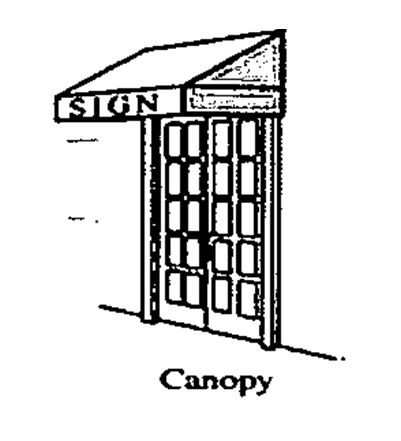
"Awning or canopy sign" means any sign on a cloth, metal, plastic, or other cover designed to shade a window or entrances and attached to any structure. See also "mounted signs."
"Back to back sign" means a sign with two (2) parallel sign faces oriented in opposite directions.
"Banner sign" means a flexible substrate on which message copies and graphics may be displayed, attached to buildings or freestanding structure. Banner signs are always temporary, for thirty (30) days. See also the definition for "temporary signs."
"Bench sign" means a sign applied or affixed to the seat or back of a bench.
"Billboard" means a sign which may be supported by a pole structure, with an area of more than seventy-two (72) square feet but not more than six hundred seventy-two (672) square feet, on parcels adjacent to Interstate 75 and/or Interstate 675 as located within the city limits of Stockbridge.
"Building facade" means the portion of any exterior elevation of a building extending vertically from grade to the top of a parapet wall or eaves and horizontally across the entire width of the building elevation.
(a)
"Primary facade" means the exterior wall of the building that faces the main parking area or street and includes the primary entrance into the building. If the building faces more than one (1) parking area or street, the largest exterior wall of the building with a primary entrance which is most nearly parallel to the widest street or largest parking area to which the building faces.
(b)
"Secondary facade" means any exterior wall of a building with street frontage that does not contain the primary entrance to the building.
"Building frontage" means the linear feet of the exterior wall of a building that faces any road or street that provides a means of direct ingress and egress to the lot.
"Business frontage" means that portion of a building frontage occupied by a single tenant space having a public entrance within the building frontage.
"Business subdivision" means a single parcel on which multiple businesses are located, or multiple connected parcels on which businesses are located and where the owners of the parcels share any common property.
"Candela" or "candle" means the basic unit of measurement of light.
"Changeable copy sign" means a sign with the capability of copy change or rearrangement by means of manual or remote input or boards or backgrounds upon which changeable letters may be placed, without altering the face or the surface of the sign, includes the following types:
(a)
"Manually activated" means changeable sign whose message copy can be changed manually on a display surface.
"Canopy" or "awning." See "awning or canopy sign."
"Copy" means the graphic content or message of a sign.
"Decal" means a picture, design or label made to be transferred (as to glass, wood, metal, or any other hard object) from specially prepared paper.
"Decision date" means the date upon which the director of community development or the designee makes a final decision on the approval or denial of a sign.
"Digital or electronic sign." See "changeable copy sign, electronically-activated" or a sign that incorporates a technology or method that allows for one (1) or multiple messages on one (1) structure without physically or mechanically replacing sign face or its components. Electronic or digital signs/message boards generally take the form of LED, LCD, plasma or other similar type panels, screens or displays, which function like TV screens, and show messages that change intermittently by computer controller, microprocessor controller or by remote control.
"Eave" means the projecting lower edges of a roof overhanging the wall of a building.
"Entrance sign" means any sign placed at the intersection of a public street and a public or private entryway into developments including, but not limited to, an apartment complex, condominium complex, office complex, industrial complex, residential subdivision, or other building or buildings with multi-family residential dwelling units or multiple commercial units.
"Erect" means to build, paint, construct, attach, hang, place, suspend, assemble, or affix.
"Externally-illuminated signs" means any sign illuminated by an external light source directed primarily toward such sign.
"Facade" means the front of a building, facing the primary or secondary street.
"Fall zone" means an area that is equal to one hundred thirty-three percent (133%) of the height of the sign in every direction.
"Feather flag sign" means a temporary banner sign in the shape of a feather or banana installed on a single post and manufactured of lightweight material designed to move with the wind. This is a type of temporary sign.
"Flag" means a usually rectangular piece of fabric or bunting containing distinctive colors, patterns, symbols or designs that is part of, or attached, to a pole.
"Flashing sign" means any sign whose message or appearance scrolls, flashes, rotates, or changes, or whose Illumination changes in intensity more often than once every fifteen (15) seconds, including, but not limited to, reader boards.
"Ground sign" means any sign principally supported by uprights or braces which are permanently placed into the ground, and not supported by or suspended from any building. May also be referenced as freestanding or monument sign.
(a)
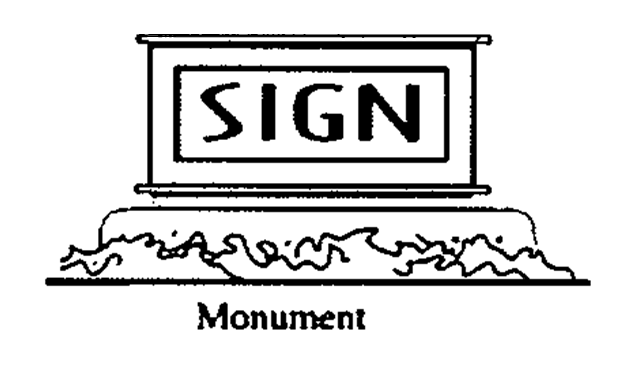
"Monument sign" means a freestanding sign of which the entire bottom of the sign is generally in contact with or in close proximity to the ground providing a solid and continuous background for the sign face from the ground to the top of the sign. The structure shall be at least as wide as the sign and shall be constructed of brick, stone, or an architectural masonry material. Does not include pole or pylon signs.
(b)
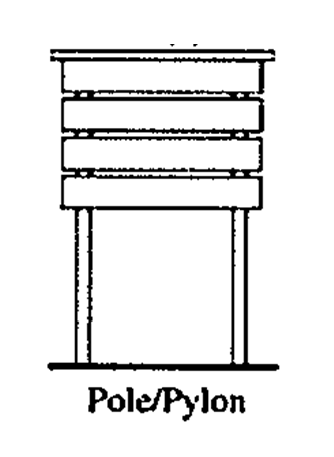
"Pylon or pole sign" means a freestanding sign, usually double-faced, mounted on one (1) or two (2) supports above ground level.
"Hand-held signs" means any sign larger than six (6) inches by six (6) inches carried by a human appendage or prosthesis. Also called portable signs.
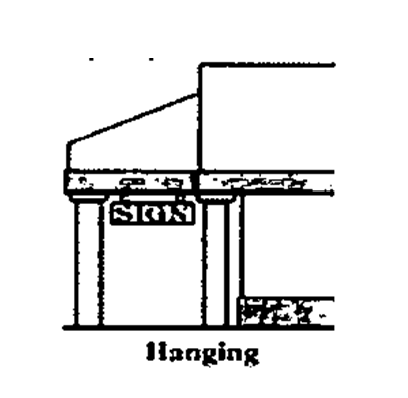
"Hanging sign" means a sign that hangs beneath a marquee, canopy, or awning and is perpendicular to the building face. Also known as a blade sign. See also "mounted signs."
"Height" means the vertical distance measured from the lowest adjacent grade to the highest point of the sign or sign structure.
"Inflatable signs" means a sign that is intended to be expanded by air or other gas for its proper display except balloons of three (3) cubic feet or less.
"Internal signs" means signs not visible from a public right-of-way and located within a development or subdivision.
"Internally illuminated signs" means any sign which has characters, letters, figures, designs or outlines illuminated by electric lights or luminous tubes located within the interior parts of the sign.
"Lot" means a single tax parcel as shown on Henry County's tax map.
"Marquee sign." See "flashing sign."
"Mobile sign" means any sign that is either part of or otherwise affixed to any trailer or vehicle, whether motorized or non-motorized.
"Monument sign" means a freestanding sign of which the entire bottom of the sign is generally in contact with or in close proximity to the ground providing a solid and continuous background for the sign face from the ground to the top of the sign. The structure shall be at least as wide as the sign and shall be constructed of brick, stone, or an architectural masonry material. Does not include pole or pylon signs. See also ground signs.
"Mounted sign" means a sign that is permanently attached to a building.
(a)
"Awning or canopy sign" means any sign on a cloth, metal, plastic, or other cover designed to shade a window or entrances and attached to any structure.
(b)
"Hanging sign" means a sign that hangs beneath a marquee, canopy, or awning and is perpendicular to the building face. Also known as a blade sign.
(c)
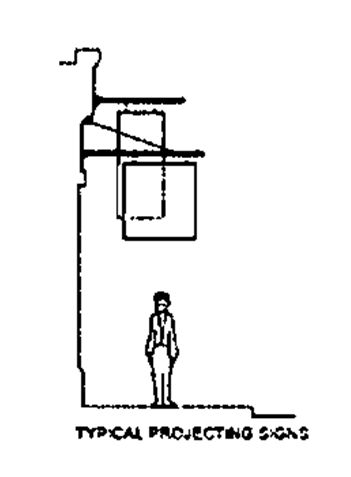
"Projecting sign" means any sign which is attached perpendicular to a building or other structure and extends beyond the line of the building or structure or beyond the surface of that portion of the building or structure to which it is attached. Also called a shingle sign.
(d)
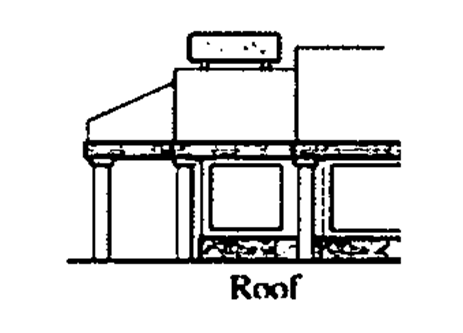
"Roof sign" means any sign that is erected upon and above a roof structure and wholly supported by the roof structure or a structure placed upon the roof.
(e)
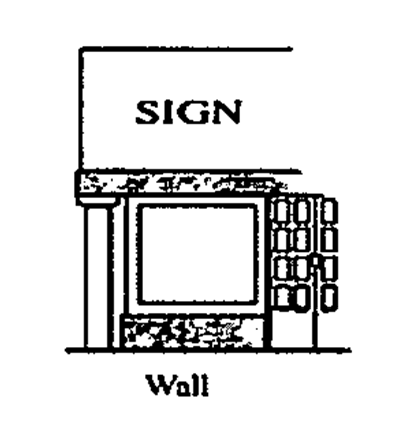
"Wall sign" means any sign which is attached parallel to or painted on an exterior building wall, which may include a door. Also called a "fascia sign."
"Multi-faced sign" means a sign with sign face surfaces that are parallel and are back to back or where the interior angle formed by the faces is forty-five (45) degrees or less.
"Non-combustible material" means any material which will not ignite at or below a temperature of one thousand two hundred (1,200) degrees Fahrenheit and will not continue to burn or glow at that temperature.
"Nonconforming sign" means signs that were approved or legally erected under previous sign restrictions, and which became or have become nonconforming to the provisions of this article at the date of adoption of same.
"Portable signs" means a sign designed to be transported or easily relocated and not permanently attached to the ground and not otherwise permanently affixed to it as otherwise required by the building code. See "temporary sign."
"Primary facade" means the exterior wall of the building that faces the main parking area or street and includes the primary entrance into the building. If the building faces more than one (1) parking area or street, the largest exterior wall of the building with a primary entrance which is most nearly parallel to the widest street or largest parking area to which the building faces. See also "building facade."
"Projecting sign" means any sign which is attached perpendicular to a building or other structure and extends beyond the line of the building or structure or beyond the surface of that portion of the building or structure to which it is attached. Also called a shingle sign. See also mounted signs.
"Pylon" or "pole sign" means a freestanding sign, usually double-faced, mounted on one (1) or two (2) supports above ground level. See ground signs.
"Reflectors" means any device created for the purpose of reflecting light directed at the device so as to render the device especially visible.
"Residence" means a home, abode, or place where an individual is actually living on a non-temporary basis.
"Roof sign" means any sign erected upon and above a roof structure and wholly supported by the roof structure or a structure placed upon the roof. See also "mounted signs."
"Secondary facade" means any exterior wall of a building with street frontage that does not contain the primary entrance to the building.
"Sidewalk sign" means a movable sign with the structure constructed in an a-frame or easel design that is not secured or attached to the ground or surface upon which it is located by a permanent foundation. Also called a sandwich sign.
"Sign" means every device, item, product, frame, letter, figure, character, mark, plane, point, design, picture, stroke, stripe, trademark, or reading matter, which is used or intended to be used to attract attention or convey information when the same is placed in view of the general public. For the purpose of determining number of signs, a single display surface or a single display device containing different elements that are organized, related, and composed to form a unit shall be considered to be one (1) sign. Where different elements are displayed in a random manner without an organized relationship to each other, or where there is reasonable doubt as to the relationship of different elements to each other, each element shall be considered to be a single separate sign.
"Signable area" means the total area upon which a message is displayed on any sign. The area of a sign shall be computed as the area within the smallest continuous polygon comprised of not more than eight (8) straight lines enclosing the limits of a sign face, together with any sign face cabinet or frame or material, texture, or color forming an integral part of the sign face used to differentiate the sign face from the structure upon which it is placed. If polygons established around wall signs located on the same street oriented wall are within twenty-four (24) inches or less of one another, then the area of the sign shall be measured within one (1) continuous polygon.
"Snipe sign" means any sign of any material whatsoever that is attached in any way to or placed upon a utility pole, tree, mailbox, or similar structure situated on public or private property.
"Specialized housing facility" means a shelter home of refuge for those in urgent need or in times of emergency. It is designed to provide temporary living accommodations to individuals or families who are experiencing homelessness in general. The facility may provide an overnight safe and secure environment for persons who may be experiencing financial difficulties, domestic abuse or other challenges. This does not include substance abuse centers, personal care homes, boarding homes and group homes. There are different types of housing shelters:
Tier 1: A shelter providing homelessness services whose primary purpose is to provide temporary shelter for no more than thirty (30) days.
Tier 2: A shelter providing homelessness services whose primary purpose is to provide temporary shelter for no more than six (6) months.
Tier 3: A shelter providing homelessness services whose primary purpose is to provide temporary shelter for no more than a year.
"Stake sign" means any temporary sign supported by at least one (1) upright placed into the ground, and not supported by or suspended from any building with signable area not greater than eight (8) square feet.
"Standard informational sign" means a sign not permanently installed in the ground with an area of not greater than four (4) square feet, with a sign face made for short term use, containing no reflecting elements, flags, or projections and which, when erect, stands at a height not greater than three (3) feet and is mounted on a stake or metal frame with a thickness or diameter not greater than one and one-half (1½) inches.
"Store front" means the primary facade of a single, undivided unit located within a commercial center or business park.
"Submission date" means the date stamped on a sign application indicating the date the application was actually received.
"Suspended sign." See "projecting sign" or "swinging sign."
"Swinging sign" means any sign which is mounted such that the sign may freely move back and forth.
"Temporary sign" means any sign or device which is not permanently attached to the ground or other permanent structure, which is designed to be mobile or is designed to remain in place for a limited time. This includes, but is not limited to, signs which are designed to be transported regularly from one (1) location to another, signs which are designed with wheels, regardless of whether the wheels remain attached to the sign, or signs tethered to an existing structure. These signs include, but are not limited to, balloons and banners.
"Tenant frontage" means the horizontal distance in feet between the left-side wall and the right-side wall or building end wall of a tenant space fronting on a street.
"Vehicular sign" means any sign placed on, mounted on, painted on or affixed to a motor vehicle, freight, flatbed or storage trailer or other conveyance when same are placed or parked in such a manner as to be viewed or intended. Also referred to as a "mobile sign."
"Wall sign" means any sign which is attached parallel to or painted on an exterior building wall, which may include a door. See also "mounted signs."
"Window sign" means any sign displayed to an outside observer on or through a window or covering a window, which may include a door.
"Zoning district" means the use classification of parcels of land as defined under the city's zoning map generally.
(Ord. No. OR24-565, § 1(Exh. A, A.), 5-13-2024)
5.3 - Applications and permits.
A.
Administration. The provisions of this article shall be administered by the director of community development of the City of Stockbridge, Georgia, or his/her designee.
B.
Application Requirements. All sign permit applications shall be submitted to the director of community development of the City of Stockbridge, rather than to Henry County. Such applications for businesses will not be processed unless the business has a current business license. All applications for sign permits must be complete and contain all required information, as is set forth in this article.
C.
Permit Application. Application for permits to erect signs shall be made upon forms that are provided by the director of community development or his/her designee and shall contain or have attached thereto the following information:
1.
Name, address, and telephone number of the applicant;
2.
Address of building, structure, or lot to where the sign is to be attached or erected, as well as the zoning district in which the proposed sign is located within and a statement of compliance of all requirements of the zoning district as stated in this chapter;
3.
The proposed sign type as defined in this chapter;
4.
Position of the sign in relation to nearby buildings or structures, property lines, and other signs located on the lot showing compliance with all setback lines required by the city;
5.
A site plan must be submitted to show the location of the proposed sign on the property.
6.
Digital copies of accurately scaled color drawings of the plans, contents, specifications, and method of construction and attachment to the building or the ground for the sign, as well as a scaled digital drawing of the site showing drives, structures, landscaping, and any other limiting site features, including the computation of total area and dimensions of the proposed sign, and an indication of whether the sign will be illuminated and description of illumination;
7.
A drawing or photograph of the primary facade of the building, showing the following measurements for the building or canopy/awning:
a.
The primary and secondary facades (heights and widths).
b.
The proposed sign structure.
c.
The proposed lettering on the sign. The lettering may be up to eighteen (18) inches high.
8.
Name of person, firm, corporation, or association erecting the sign (i.e. contractor or builder);
9.
Written consent of the owner of the building or lot upon which the sign is to be erected;
10.
A written list describing all other signs located on the lot indicating the sign type, size, and placement, including photographs of existing building frontage and signage on lot; and
11.
Such other information as may reasonably be required for the permitting process relating to the sign to be permitted, the lot upon which the sign is to be placed, and/or the placement of the sign and the effects thereof on traffic patterns, pedestrians, and/or general aesthetics.
D.
Permit Required. It shall be unlawful for any person to erect, repair, alter, relocate, or maintain any sign as defined in this article without a permit, except for those signs identified under Section 13.4.
E.
Required Fees. No permit shall be issued until the appropriate application has been filed and fees for such permit are paid, which shall be fixed from time to time by city council.
F.
Issuance and Denial of Permits.
1.
All sign permit applications shall be initially reviewed by the director of community development or his/her designee within fifteen (15) business days of the department's actual receipt of a complete and accurate application and remittance of the appropriate sign permit fees. One (1) or more resubmittals may be required thereafter.
2.
Any application that is incomplete, inaccurate, that contains false material statements or omissions, or that is submitted for a sign which would violate any standard within this article shall be rejected within thirty (30) business days of receipt of said application.
3.
The director or the designee shall give notice to the applicant of a decision to approve or deny the sign permit by hand delivery, electronic mail (email), or certified mail return receipt requested to the address on the permit sent on or before the forty-fifth business day of a complete application.
4.
Provided that the sign application is complete and accurate, all fees have been paid, and the proposed sign and the lot upon which the sign is to be placed are within all the requirements of this article and all other ordinances of the city and other applicable laws and building codes, the director or the designee shall approve the sign permit application.
5.
A rejected application later resubmitted in conformity with this article shall be deemed to have been submitted on the date of resubmission, instead of the original submission date. An application which is resubmitted shall meet all the standards for an original application.
G.
Time Period. If the work authorized under a permit has not been initiated within six (6) months of the date of issuance, or if such work does not comply with building code and construction standards listed in Title 8 of the City of Stockbridge Code, the permit shall become null and void.
H.
Display of Identification Number. Every sign constructed, erected, or maintained for which a permit is required by this article shall be plainly marked with the identification number issued by the director or the designee for the structure firmly affixed to the sign in such manner that the identification number shall be readily visible, accessible for inspection and durable.
1.
Altering identification number. Displaying an identification number that has been tampered with, altered, or mutilated, or displaying a sign without an identification number shall be a misdemeanor offense punishable in municipal court.
I.
Appeals.
1.
The grant, rejection or denial of a sign permit by the director or the designee may be appealed to the city council pursuant to Section 10.3, Appeal of Administrative Actions of this Code. Such appeal shall be in writing and shall be filed with the director of community development, within ten (10) days of the decision being appealed. The city council shall make its final determination on the appeal within ten (10) days of the close of the hearing.
2.
Any appeal of a decision of the city council under this chapter shall be via petition for a writ of certiorari to superior court within thirty (30) days after the date of the written decision.
5.4 - Signs which require no permit.
A.
The following signs shall not require a permit provided, however, that such signs shall be subject to all other provisions of this article:
1.
Wall or window signs that are one (1) square foot in size, and smaller.
2.
The replacement of removable sign panels within a sign structure, such that the sign structure is not replaced or modified in any way. This includes, but is not limited to, replacement of a panel within a multi-tenant sign, or replacement of a panel within a wall sign when the replacement of such panels does not require replacement or modification of the sign structure.
3.
Temporary stake signs not exceeding four (4) square feet.
4.
Hand held signs.
5.
Standard informational signs:
a.
Residential Lots. Each lot may display two (2) standard information signs without a permit.
b.
Nonresidential Lots. Each lot having one (1) business may display two (2) standard information signs, and each lot having more than one (1) business may display four (4) standard information signs without a permit.
B.
The following signs are exempt from all provisions of this article:
1.
Decals that are affixed to buildings or structures, or signs that are painted on equipment, fuel pumps, or other types of vending equipment that is used for dispensing retail products, provided that such decals or signs have a signable area not exceeding four (4) square feet on any single piece of equipment.
5.5 - Prohibited signs.
It shall be unlawful for any person to erect the following signs in the city:
1.
Animated signs or attention-getting devices, including flashing, action, motion, or changing color or light intensity;
2.
Signs attached to a statue, fence, wall, tree, vehicle, or other similar structure;
3.
Aerial view signs;
4.
Pole or pylon signs;
5.
Roof signs;
6.
Mobile signs that are visible from any public right-of-way;
7.
Signs which contain or are in imitation of an official traffic control sign or signal or contain the words "stop," "go," "slow," "danger," "detour," "speed limit," "yield" or similar words intended to direct or regulate traffic;
8.
Inflatable signs or objects;
9.
Snipe signs (homemade signs);
10.
Neon-illuminated signage;
11.
Any signs that are placed in, or extending into, a public right-of-way;
12.
Any abandoned or non-maintained signs in visible disrepair;
13.
Beacons, search lights, lasers;
14.
Signs located on the railroad right-of-way; or
15.
Signs not in good repair, in violation of codes, or containing or exhibiting broken panels, visible rust, visible rot, damaged support structures, or missing letters.
5.6 - Construction standards—All signs.
A.
Building Code Compliance. All signs shall be constructed and maintained in accordance with the provisions of the city's building code.
B.
Materials Required. All ground signs for which a permit is required by this article, except those otherwise referred to in this chapter and temporary signs, shall be constructed of brick, stone, stucco, or architectural masonry material.
C.
Illumination.
1.
Nonresidential districts:
a.
Types of Illumination. No sign shall be illuminated by neon lights, by lights that flash, move, change in intensity, or turn on intermittently more than once per day, except letters or numbers that are not greater than twelve (12) inches in height and do not have a display area greater than two (2) square feet which may change no more than one (1) time every sixty (60) seconds.
b.
Orientation of Illumination. To prevent glare visible from a public street or adjoining property, the beam of any light shall be directed so as not to be visible beyond the sign at which it is directed, and the light source shall not be visible from any point on an adjacent property or the public right-of-way.
c.
Brightness. Light from any illuminated sign shall not be more than 0.5 footcandles intensity or brightness which will interfere with the peace, comfort, convenience, and general welfare of residents or occupants of adjacent properties
2.
Residential districts. Signs located in residential districts shall not be illuminated other than signs at the entrance of the subdivision.
3.
Internal illumination. Signs internally illuminated shall not exceed twenty (20) footcandles of incandescent light measured at a distance of ten (10) feet from such structure.
4.
External illumination. Signs externally illuminated shall be lighted so that no lights are positioned in such a manner that light glares or shines into the eyes of motorists or pedestrians so as to create a hazardous or dangerous condition.
D.
Construction Near or on a Lot Containing an Existing Billboard or Pylon.
1.
Construction of any structure, building, or appurtenance adjacent to, or on a lot containing an interstate sign, billboard, pylon or ground sign under the standards of this provision shall require that:
a.
No buildings, structures, or appurtenances may be constructed within the "fall zone" of such sign. A "fall zone" is defined as an area equal to one hundred thirty-three percent (133%) of the height of the sign in every direction.
b.
No subdivision of a parcel containing a billboard shall be permitted unless the subdivided lot containing the billboard is large enough to encompass the "fall zone" of such billboard.
2.
Construction of any interstate sign, billboard, pylon, or ground sign on a lot containing any structure, building, or appurtenance under the standards of this provision shall require that:
a.
No sign may be constructed where a building, structure or appurtenance will be located within the "fall zone" of the sign. A "fall zone" is defined as an area equal to one hundred thirty-three percent (133%) of the height of the sign in every direction.
b.
No subdivision of a parcel containing an interstate sign, billboard, pylon or ground sign shall be permitted unless the subdivided lot containing the sign is large enough to encompass the "fall zone" of such sign.
E.
Maintenance required. All signs, together with all supports, braces, guys, and anchors shall be kept in good repair and be maintained in a safe condition. All signs and the site upon which they are located shall be maintained in a neat, clean, and attractive condition. Signs shall be kept free from excessive rust, corrosion, peeling paint or other surface deterioration. The display surfaces of all signs shall be kept neatly painted or posted. Signs which are faded, torn, damaged or otherwise unsightly or in a state of disrepair shall be immediately repaired or removed.
5.7 - Sign measurement.
A.
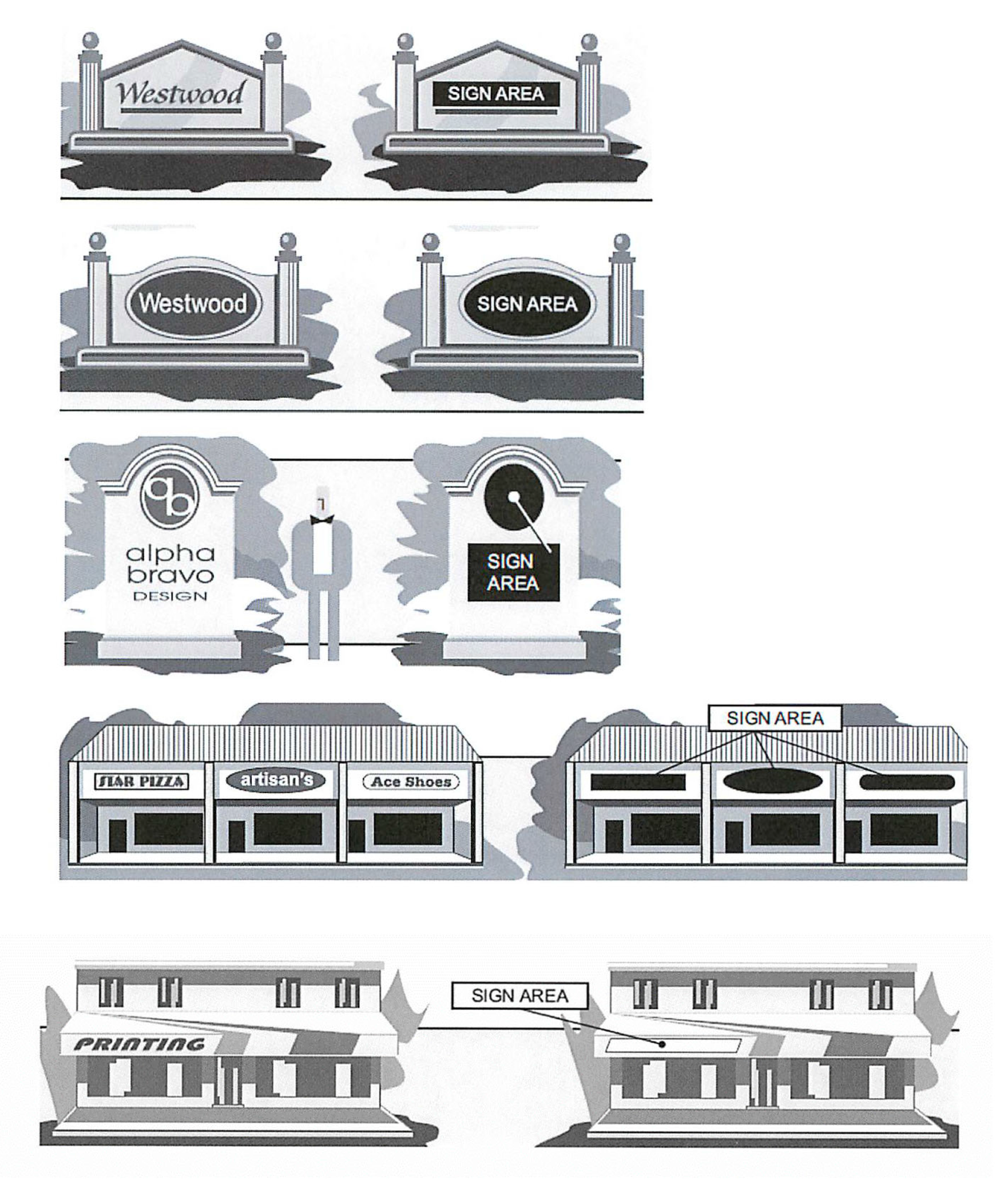
Area. The area of a sign shall be computed as the area within the smallest continuous polygon comprised of not more than eight (8) straight lines enclosing the limits of a sign face, together with any sign face cabinet or frame or material, texture, or color forming an integral part of the sign face used to differentiate the sign area from the structure upon which it is placed. If polygons established around wall signs located on the same street-oriented wall are within twenty-four (24) inches or less of one another, then the area of the sign shall be measured within one (1) continuous polygon.
B.
Height. The height of a sign shall be computed as the distance from the base of the sign structure at normal grade to the top of the highest attached component of the sign. Normal grade shall be construed to be the lower of:
1.
Existing grade prior to construction; or
2.
The newly established grade after construction, exclusive of any filling, beaming, mounding, or excavating solely for the purpose of locating the sign.
In cases in which the normal grade cannot reasonably be determined, sign height shall be computed on the assumption that the elevation of the normal grade at the base of the sign is equal to the elevation of the nearest point of the crown of a public street or the grade of the land at the principal entrance to the principal structure on the zoned lot, whichever is greater (surveyor's certificate required). Where the normal grade is below the normal grade of a public street, the sign base can be raised to the elevation of the normal grade of the street before the height limitations are applied (surveyor's certificate required). At no time shall any sign's overall height exceed the zoning district's height limitations. Any portion of such wall or other decorative structure that is discernibly devoted to the support of the sign or, by its design or architectural treatment, intended to provide a background or frame for the sign shall be included when computing sign height.
C.
Structure. The computation of the area of a sign face shall not include the structure, supports, or uprights on which the sign face is placed or any portions of a sign structure that are not intended to contain any message or idea and are purely structural or decorative in nature, other than those parts contained within the polygon that delineates the sign face.
D.
Multi-Faced Signs. For multi-faced signs, when the sign face surfaces are parallel and are back-to-back, or where the interior angle formed by the faces is forty-five (45) degrees or less, the area of the sign shall be taken as the area on the largest side. For all other multi-faced signs, the area of the sign shall be the total area on all sides that can be viewed at one (1) time from any angle.
E.
Sign Area Examples. The following illustrations show examples of the locations of the "sign area" on different types of buildings or structures.
5.8 - Special requirements; all signs.
A.
All Signs Must be Placed Upon a Lot. No sign may be placed on any lot, which lot does not meet the minimum requirements of the zoning ordinance and subdivision regulations of the Code of Stockbridge, Georgia.
B.
Obstruction to Doors, Windows, or Fire Escapes. No sign shall be erected, relocated, or maintained so as to prevent free ingress to, or egress from, any door, window, or fire escape; nor shall any sign be attached to any standpipe or fire escape.
C.
All signs located adjacent to a walkway shall be placed so that the bottom of the sign is at least eight (8) feet above the walkway on private property over which it is erected, and no sign shall extend nearer than one (1) foot from the curb line.
D.
Sign Not to Constitute Traffic Hazard. No sign or other structure regulated by this article shall be erected at the intersection of any streets in such a manner as to obstruct free and clear vision from vehicles thereupon; or be placed at any location where, by reason of the position, shape, or color, it may interfere with, obstruct the view of, or be confused with, any authorized traffic sign, signal, or device; or make use of the words "STOP," "DANGER," or any other word, phrase, symbol, or character in such manner as to interfere with, mislead, or confuse motorists.
E.
Posting on Trees, Poles, Etc. No sign shall be allowed to be tacked, painted, posted, marked, or otherwise affixed on trees, utility poles, or other similar structures, or on rocks, the ground itself, or other natural features.
F.
No Posting on Supports. No sign may be displayed on any portion of the structural supports of any sign.
G.
Maintenance. All signs regulated by this article shall be kept clean, neatly painted, and free from all electrical and mechanical hazards, including, but not limited to, faulty wiring and loose connections, and the premises surrounding the signs shall be maintained by the owner in a sanitary and inoffensive condition, free and clear of all weeds, rubbish, and debris.
H.
Special Situations. Those developments which include at least one (1) building of three (3) stories or more may be permitted wall signs in sizes not exceeding one hundred (100) square feet per primary and secondary facade. The sign allowance provided under this subsection shall be exempt from the aggregate signage allowed per lot.
5.9 - Special limitations by sign type.
In addition to the limitations set forth in the other sections of this article, the following limitations shall apply to these specific types of signs:
A.
Wall Signs. No wall sign shall cover wholly or partially any wall opening, nor project beyond the ends or top of the wall to which it is attached.
B.
Window Signs. Window signs must not exceed twenty-five percent (25%) of the total area of each window in which a sign is placed.
C.
Ground Signs.
1.
All ground signs must be constructed as a monument style sign. Pole and pylon signs are prohibited.
2.
The structure of the monument sign shall be at least as wide as the sign face.
3.
A monument sign shall have a three-foot landscape strip planted around its base.
4.
All ground signs shall be constructed of brick, stone, stucco, or architectural masonry material.
5.
For all commercial, office, industrial, and multifamily developments, address numbers shall be posted on the top of the faces of the monument signs at the main entrance of the development. For developments that contain multiple addresses and/or building numbers, the range of addresses and/or building numbers shall be on the face of the monument. The numbers shall be six (6) inches in height and the color shall contrast with the sign faces so as to be readily identifiable.
D.
Projecting Signs.
1.
No projecting sign may be placed over streets, alleys, or ways available for vehicular traffic, or extend into the public right-of-way.
2.
All projecting signs must be installed at a ninety (90) degree angle to the building facade.
3.
Projecting signs must vertically clear sidewalks by at least eight (8) feet and may project no more than six (6) feet from a building.
4.
Projecting signs must not project above the roof line, or exceed ten (10) feet in height.
E.
Temporary Signs.
1.
A permit is required for all temporary signs unless otherwise specified in Section 5.4.
2.
Temporary signs include hammer signs and feather-flag signs.
3.
Temporary signs must be removed from the premises within thirty (30) days from the date the sign is first placed on the lot.
4.
No lot may have more than two (2) temporary signs on the lot at one (1) time, subject to the maximum aggregate square footage allowed in Section 5.11.
5.
No applicant may receive more than four (4) temporary sign permits in any one (1) calendar year under this subsection.
6.
All temporary signs shall be securely installed, and shall meet all applicable safety standards as prescribed by the building code, electrical code or as promulgated by the city council or its designated representative.
7.
If any temporary sign is erected or maintained in such a manner so as to be in violation of this article or any other ordinance or law of the city, the city may give written notice to the owner thereof and to the owner of the property and premises upon which the sign is located that the sign must be removed within three (3) days.
F.
Awning/Canopy Signs.
1.
Signs must be painted or installed directly on the valances of the awning or canopy.
2.
Awning signs shall not have lettering or graphics exceeding eighteen (18) inches in height.
3.
No awning sign may be internally illuminated.
4.
The signable area of any awning sign shall not exceed twenty-five percent (25%) of the surface area of the awning or canopy.
5.
Awnings must be constructed of durable fabric or non-rigid material on a supporting framework.
6.
Awnings must vertically clear sidewalks by at least eight (8) feet and may not extend further than one (1) foot off the curb line.
G.
Entrance or Subdivision Sign. All entrance signs shall be placed on private property and may not be placed in the right-of-way.
H.
Flags.
1.
In-ground. A flag may be flown from a metal pole which is permanently placed in the ground. The pole shall not exceed two and five-eighths (2⅝) inches in diameter, nor twenty (20) feet in height. The flag flying from such pole shall not exceed three (3) feet in width and five (5) feet in length.
2.
Projecting. A flag may be flown from a metal or wooden pole attached to a bracket projecting from the side of a building or door frame. The pole shall not exceed six (6) feet in length, nor one (1) inch in diameter. The flag flying from such pole shall not exceed three (3) feet in width and five (5) feet in length. Additionally, the flag displayed in such manner shall not impede pedestrian or vehicular traffic.
3.
Limit. One (1) flag (either ground, projecting or hanging) may be flown or displayed on each property which shall not count against the allocation of the ground, projecting or window signage permitted for each property as described in Section 5.11. Any additional flags beyond the first flag flown on each property will count against the allocation of the ground, projecting, or window signage permitted for the property as described in Section 5.11.
4.
Nothing contained in this section shall be interpreted to prohibit or restrict the right to display eligible flags as banners or signs as allowed elsewhere in the Code of Ordinances of the city.
I.
Changeable Copy Signs.
1.
In districts where changeable copy is allowed, it shall be limited to the ground sign only and may incorporate up to twelve (12) square feet of the allowable sign area.
2.
A parcel or lot is limited to one (1) changeable copy sign per lot.
3.
No changeable copy sign may contain more than three (3) horizontal pieces of information that shall change. Signs must contain static messages only, and shall not have movement nor flashing on any part of the sign structure, design, or pictorial segment of the sign, nor shall such sign have varying light intensity during the display of any single message.
4.
Changeable copy shall not change more than once every twenty-four (24) hours.
J.
Hand-held Signs. All hand-held signs shall meet the following regulations:
1.
No hand-held signs shall be placed or carried which extend beyond the width of the carrier's body or that extend more than six (6) inches above the carrier's head.
2.
All persons carrying any such signs, shields or sandwich boards shall remain at least ten (10) feet apart, shall remain at least ten (10) feet away from any doorway, driveway or street intersection and shall not interfere with the general flow of traffic, whether pedestrian or vehicular.
K.
Internal Signs. A maximum of four (4) internal signs (signs not visible from a public right-of-way) are permitted adjacent to internal road(s) serving the development. Internal signs shall not exceed ten (10) square feet and four (4) feet in height except those signs associated with hospitals and emergency care facilities shall not exceed twenty (20) square feet in area.
L.
Banners on City Property.
1.
Banners shall be considered temporary signs as defined in Section 5.2 of the sign ordinance.
2.
In addition to the special limitations found in Section 5.9 of the sign ordinance, banners placed on city property shall be further regulated as follows:
a.
Banners can be displayed for no more than forty-eight (48) hours after the event;
b.
No person shall be permitted to display more than one (1) banner on the city's property, and only one (1) banner shall be displayed on the city's property at any given time; and
c.
No banner shall be any larger than sixty (60) square feet.
5.10 - Variances for signs.
This section shall provide the exclusive procedures for granting variances to the requirements of this article for signs.
This section shall provide the exclusive procedures for granting variances to the requirements of this article for signs.
A.
Limitations. The mayor and city council shall be allowed to grant variances where a hardship has been demonstrated pursuant to the city's zoning ordinance. Said variance or variances may only be granted as to number, setback, building material, size or sign style. Variances may not be granted for sign height.
B.
Timing. The city council shall hear and decide upon a variance within ninety (90) days of the submission of a complete and accurate application.
C.
The mere existence of a nonconforming sign shall not constitute a valid reason to grant a variance.
D.
The city council shall consider the following factors:
1.
The size of buildings constructed on the subject lot;
2.
The number of different tenants occupying the buildings;
3.
Whether there exist extraordinary and exceptional conditions pertaining to the property in question resulting from its size, shape, or topography that are not applicable to other lands or structures in the area;
4.
Whether granting a variance requested would confer upon the property of the applicant any significant privileges that are denied to other similar properties. Furthermore, peculiar conditions or circumstances which are the result of actions of the current or former owner(s) of the property covered by the application cannot be considered as grounds to justify a variance.
(Ord. No. OR24-559, 3-4-2024)
5.11 - Requirements by zoning classification.
In addition to all other regulations in this article, all signs must conform to the requirements and the tables which are contained in this section.
A.
All signs shall be required to be located within the required front yard of a principal structure and shall not be permitted to extend beyond the front property line into the street right-of-way. The location of signs shall not interfere with the view of a traffic signal or traffic vision. For traffic safety, signs shall not be located within the triangular area on a corner lot formed by measuring fifteen (15) feet along both street side property lines from their intersection.
B.
In order to erect a second wall sign, a use must have frontage on two (2) publicly dedicated streets (such as on a corner lot), with each street, including a legal curb cut, or be located within an end unit of a building on any lot.
C.
In order to erect a second monument/freestanding sign there must be a minimum lot area of one (1) acre to permit a second such sign to be erected. In those instances where one (1) of the street frontages is on a street serving a residential district, a second sign shall be prohibited.
D.
Lots zoned RR, SR, CCR, and MHR (where a single residence is on the lot) and MFR (where a single residence is on the lot).
1.
The total of all signs shall not exceed four (4) signs of any allowed type per residential lot;
2.
The following signs are prohibited, along with the prohibited signs designated in Section 5.5:
a.
Projecting signs;
b.
Awning signs;
c.
Changeable copy signs;
d.
Monument signs (except when used as subdivision entrance sign); and
e.
Wall signs.
Table 5.11(A): Sign Requirements for RR, SR, CCR, MHR, and MFR Zoning Districts
E.
Multi-Family Residential Lots Zoned RM.
1.
The total aggregate signable area allowed per lot must not exceed sixty-four (64) square feet.
2.
The following signs are prohibited, along with the prohibited signs designated in Section 13.5:
a.
Projecting signs;
b.
Wall signs; and
c.
Changeable copy signs.
Table 5.11(B): Sign Requirements for Multi-Family Residential Lots Zoned RM
F.
Commercial Lots Zoned C-1, C-2, and C-3 with Multiple Business Per Lot or Business Subdivision.
1.
One (1) principal freestanding sign is permitted per lot.
2.
One (1) wall sign is permitted per primary exterior entrance for each business or building per street-frontage. Businesses without a street on which there is frontage, but which have exterior entrances to the building, are entitled to one (1) wall sign on the exterior wall of the business where the primary entrance is located. For corner lots, a second wall sign may be permitted facing the side street. End units of buildings on any lot may also have a second wall sign on the side of the building.
3.
The following signs are prohibited, along with the prohibited signs designated in Section 5.5:
a.
Pole or pylon signs; and
b.
Roof signs.
4.
All panels in multi-tenant monument signs must have equal signable area.
Table 5.11(C): Sign Requirements for Commercial Lots Zoned C-1, C-2, and C-3
(Multiple Business Per Lot or Business Subdivision)
G.
Commercial Lots Zoned C-1, C-2, and C-3 with Single Business Per Lot.
1.
Each lot is permitted one (1) principle freestanding sign and one (1) wall sign for each street-facing wall.
2.
The following signs are prohibited in this district, along with the prohibited signs designated in Section 13.5:
a.
Pole or pylon signs; and
b.
Roof signs.
Table 5.11(D): Sign Requirements for Commercial Lots Zoned C-1, C-2, and C-3
(Single Business Per Lot)
H.
Industrial Lots Zoned LI and HI (Multiple Businesses per Lot or Business Subdivision).
1.
One (1) principal freestanding sign is permitted per lot, except as allowed per Subsection 5.11(C).
2.
One (1) wall sign is permitted for each business per street-frontage. Businesses without a street on which there is frontage, but which have exterior entrances to the building, are entitled to one (1) wall sign on the exterior wall of the business where the primary entrance is located. For corner lots, a second wall sign may be permitted facing the side street. End units of buildings on any lot may also have a second wall sign on the side of the building.
3.
The following signs are prohibited in industrial districts, along with the prohibited signs designated in Section 13.5:
a.
Changeable Copy Signs.
Table 5.11(E): Sign Requirements for Industrial Lots Zoned LI and HI
(Multiple Business Per Lot or Business Subdivision)
I.
Industrial Lots Zoned LI and HI (Single Business Per Lot).
1.
Each lot is permitted one (1) principal freestanding sign, except as allowed per Subsection 5.11(C) and one (1) mounted sign for each street-facing wall.
2.
The following signs are prohibited in this district, along with the prohibited signs designated in Section 5.5:
a.
Changeable copy signs.
Table 5.11(F): Sign Requirements for Industrial Lots Zoned LI and HI
(Single Business Per Lot)
J.
Office and Institutional Lots Zoned OI.
1.
One (1) principle freestanding sign is permitted per lot, except as allowed per Subsection 5.11(C).
a.
One (1) wall sign is permitted per primary exterior entrance for each business or building per street-frontage. Businesses without a street on which there is frontage, but which have exterior entrances to the building, are entitled to one (1) wall sign on the exterior wall of the business where the primary entrance is located. For corner lots, a second wall sign may be permitted facing the side street. End units of buildings on any lot may also have a second wall sign on the side of the building.
2.
The following signs are prohibited in this district, along with the prohibited signs designated in Section 5.5:
a.
Changeable copy signs.
Table 5.11(G): Sign Requirements for Office Institutional Lots Zoned OI
K.
Planned Unit Developments.
1.
Master Sign Plan. The intent of the master sign plan is to promote consistency among signs within a development and enhance the compatibility of signs with the architectural and site design features within a development.
2.
Approval Required. Approval of a master sign plan shall be required as part of the development review process in any district that is zoned 'PUD' (Planned Unite Development). All signs that are erected or maintained shall conform at all times to the approved master sign plan. The signs which are approved through the master sign plan are the only signs that are allowed; any deviations from an approved master sign plan shall be unlawful unless and until a revised master sign plan is approved.
3.
Master Sign Plan Application. An application for a master sign plan shall include the following information:
a.
All information as outlined in Section 5.3 of this article;
b.
Accurate site plan, including location of buildings, parking lots, driveways, and landscaped areas;
c.
An accurate indication of the location of each present and proposed future sign of any type, whether requiring a permit or not;
d.
An elevation drawing or photo depicting the proposed location of signs on buildings, walls or windows;
e.
Computation of the maximum total sign area. For buildings with two (2) or more separate businesses, computations shall identify the total maximum area each individual business will be allowed;
f.
Plans, including window signage should indicate the areas of the windows to be covered;
g.
Master sign plans must be signed by all owners or their authorized agents.
4.
Master Sign Plan Review. An application for a master sign plan shall be reviewed as part of the development review process.
5.
Individual Sign Permits. Individual sign permits are required for all signs contained within an approved master sign plan.
6.
Amendments. A master sign plan may be amended by filing a new master sign plan application that conforms to all requirements in this section.
7.
Significant Development Exceptions. An exception for one (1) additional freestanding sign may be granted under the master sign plan for significant developments which meet at a minimum all criteria set forth below:
a.
The development is located on a single tract, parcel, or lot;
b.
The parcel is to be used for commercial;
c.
The tract size is a minimum of fifteen (15) acres and the primary frontage of the lot is at least five hundred (500) linear feet or more; and
d.
The lot has two (2) or more entrances on the street on which it has its primary frontage.
8.
One (1) maximum sixty-four (64) square foot monument sign along the primary frontage may be substituted for two (2) single-faced freestanding signs not to exceed thirty-two (32) square feet and six (6) feet in height.
L.
Master Sign Plan for Multi-jurisdictional Developments. The intent of the master sign plan for multi-jurisdictional developments is to promote consistency among signs within a development that is situated within the City of Stockbridge and one (1) or more other municipalities or the unincorporated areas of a county and enhance the compatibility of signs with the architectural and site design features within such development.
1.
The director may authorize a master sign plan for a development that is situated within the City of Stockbridge and one (1) or more other municipalities or the unincorporated area of Henry County. All signs erected or maintained shall conform at all times to the approved master sign plan. The signs approved through the master sign plan are the only signs allowed; any deviations from an approved master sign plan shall be unlawful unless and until a revised master sign plan is approved by the city council.
2.
Master Sign Plan Application. An application for a master sign plan for a multi-jurisdictional development shall include the following information:
a.
All information as outlined in Section 5.3 of this article;
b.
Accurate site plan, including location of buildings, parking lots, driveways, and landscaped areas;
c.
An accurate indication of the location of each present and proposed future sign of any type, whether requiring a permit or not;
d.
An elevation drawing or photo depicting the proposed location of signs on buildings, walls or windows;
e.
Computation of the maximum total sign area. For buildings with two (2) or more separate businesses, computations shall identify the total maximum area each individual business will be allowed;
f.
Plans, including window signage should indicate the areas of the windows to be covered;
g.
Master sign plans must be signed by all owners or their authorized agents.
3.
The master plan may include standards for signs which deviate from the general standards provided for herein so long as each jurisdiction approves the same master plan.
4.
Individual Sign Permits. Individual sign permits are required for all signs contained within an approved master sign plan.
5.
Amendments. A master sign plan may be amended by filing a new master sign plan application that conforms to all requirements in this section.
5.12 - Unsafe and unlawful signs.
A.
If the director or the designee finds that any sign that is regulated herein is unsafe or unstable, or is a menace to the public health or safety, or is abandoned, or is maintained in a dilapidated condition, or has been constructed or erected or is being maintained in violation of the provisions of this article, the director or the designee shall notify the permittee, owner, or occupant of the property on which the sign is located by certified mail of such violation. Said notice shall include a brief and complete statement of the violations to be remedied. If the permittee, owner, or occupant of the property where the sign is located cannot be located, notice shall be provided by the director or its designee affixing the notice to the sign or to the building on which the sign is erected.
B.
If the permittee or property owner fails to remove or alter or fix the structure so as to comply with the standards herein set forth within ten (10) days after such notice, the permit for such sign shall be revoked and the permittee or property owner shall be subject to the penalties set forth in Section 5.14 of this article.
C.
In any case in which a sign is an immediate threat to the physical safety of persons or adjoining property, the director or his or her designee may cause such structure to be removed summarily and without notice and cause the cost of same to be placed as a lien on the property upon which the sign sits.
5.13 - Nonconforming signs.
A.
The following provisions shall apply to signs which, on the effective date of this article, were approved and legally erected under previous sign restrictions and which became nonconforming with respect to the requirements of this article's restrictions:
1.
No change shall be made in the size of any nonconforming sign, nor shall any structural changes be made in such a sign unless the sign is brought into compliance with the provisions of this article.
2.
Except as provided in this article, any sign that is erected on any public property or right-of-way in violation of this article may be removed therefrom by duly authorized employees of the city, and the responsible party may be cited for such violation.
3.
A nonconforming sign may not be reconstructed, replaced, or reset if it is removed by the owner or agent for the owner for any reason.
4.
No additional sign or advertising device shall be erected on the same lot with an existing nonconforming sign until the nonconforming sign has been removed or brought into conformity with this article.
5.
No sign permit may be granted to any applicant, where there exists on the subject lot a nonconforming sign, as defined in this article, an illegal sign, an unpermitted sign, a damaged sign, a sign in need of repair or painting, or a sign in violation of this article.
6.
A nonconforming sign may not be replaced by another nonconforming sign except where such sign is damaged or destroyed by act of God or changed conditions beyond the control of the owner render the sign nonconforming or warrant the sign's repair.
7.
A nonconforming sign may not be expanded or altered in any manner that increases the degree of nonconformity.
B.
The substitution or interchange of poster panels, painted boards, or dismountable material on nonconforming signs shall be permitted.
C.
Minor repairs and maintenance of nonconforming signs shall be permitted. However, no structural repairs or changes in the size or shape of the sign shall be permitted except to make the sign comply with the requirements of this article. The replacement of existing sign panels is permissible without a sign permit, provided that no changes are made to the sign structure itself.
D.
No change in location, shape, height, size, or design shall be permitted on a nonconforming sign except to make the sign comply with all requirements of this article.
E.
Grandfathering. Nonconforming signs must be removed from site when any of the following conditions occur:
1.
Ninety (90) days after a business is closed, if no new business is operating inside the same building or tenant space, non-conforming signs must be removed;
2.
The deterioration of the sign or damage to the sign makes it a hazard or renders it dilapidated, unsightly, or unkempt; or
3.
The sign has been damaged or destroyed to such extent that more than minor repairs (greater than twenty-five percent (25%) of the replacement cost of the existing sign) or a structural change is required to restore the sign. No structural repairs or change in shape or size shall be permitted except to make the sign comply with all standards of this chapter. This subsection shall not apply to signs that are located adjacent to an interstate highway, or otherwise positioned so as to be visible from the interstate highway.
5.14 - Enforcement.
A.
Enforcement Personnel. The enforcement of this article shall be within the jurisdiction of the community development director, a police officer of the city, or the city's code enforcement personnel. The enforcement personnel shall have such powers as are to enforce and give effect to this article, including, but not limited to, the issuance of citations for violations of this article.
B.
Violation Deemed Public Nuisance. Any violation of this article is hereby declared to be a public nuisance. Improperly located signs or prohibited signs are hereby determined to pose an immediate safety threat and traffic hazard to members of the public traveling on city roadways.
C.
Repair of Signs.
1.
Any sign which has become dilapidated, or any sign which, due to poor maintenance or neglect, has become a visual blight, or by its condition and state of repair is deemed to be dangerous and is deemed to be a public nuisance. Upon the above determination, the director of planning shall cause notice of the same to be mailed by written notice, registered mail return receipt requested, to the owner of the sign if the same may be determined or to the owner of the property upon which said sign is located, that the owner shall be given thirty (30) days from the date of receipt of such notice to repair the sign.
2.
If the sign owner or property owner fails to repair the sign so as to comply with the standards herein set forth within thirty (30) days after such notice, the permit for such sign shall be revoked and the permitee or property owner shall be subject to the penalties set forth in this article, including, but not limited to, the removal of the sign by the city.
D.
Removal of Signs with Notice.
1.
The enforcement personnel may order the removal of any sign that has been issued a permit and is in violation of this article, by written notice, registered mail return receipt requested, to the permit holder. The removal order shall be issued only after the appropriate party fails to comply with the terms of this article within five (5) days after the receipt of written notice of noncompliance by the city or within ten (10) days from the mailing of such notice if no receipt indicating acceptance is returned.
2.
An aggrieved party may appeal the removal order or the notice finding the sign in disrepair within ten (10) days from the date the notice was received to the director.
3.
If the sign is not removed within thirty (30) days after the order of removal or thirty (30) days after the date any appeal of the order of removal becomes final, the enforcement personnel are authorized to remove or cause to be removed the sign and to collect the costs thereof as provided in this article.
E.
Removal of Signs without Notice. The enforcement personnel or any other agent of the city having jurisdiction under the circumstances may remove or direct the removal of any sign in violation of this article without giving notice to any party, if such sign:
1.
Is upon the public right-of-way or upon other public property; or
2.
Poses an immediate threat to the life or health of any members of the public; or
3.
The sign does not have a permit and is in violation of this article.
In the event that enforcement personnel remove or cause to be removed any sign under this section, criminal charges for such violation may be issued to any one (1) or combination thereof of the following:
1.
To the owner of the sign;
2.
To the erector of the sign;
3.
To the property owner upon which such illegal sign is located; or
4.
To the person or to the business entity who procured the erection of the sign.
F.
Charges to Legal Entity. If the criminal charges shall issue to a legal entity registered to do business in any state, such as a corporation, limited liability company, partnership or the like, then in that case, the citation for such violation may be issued to both the legal entity and any or all of the officers or employees of the legal entity who are culpable of violating this article.
G.
Evidence in Prosecution. Any sign that is removed and confiscated by the enforcement personnel shall constitute evidence in any subsequent prosecution regarding the illegal sign. Each sign that is caused to be removed shall constitute a separate violation of this article.
H.
Costs of Removal. Removal of any sign as provided for in this section shall be without liability to the city, its officers, agents, servants and employees. The permit holder shall be primarily responsible for the costs of removal. If there is no permit holder, then the sign owner shall be responsible. If the sign owner cannot be found or cannot be determined, then the costs of removal shall be the responsibility of the sign erector and/or property owner or any other party that procured the erection of the sign. If payment or arrangement to make payment is not made within sixty (60) days after the receipt of such statement, the code enforcement personnel shall certify the amount thereof for collection to the city attorney. Following such removal or repair, the county may collect the costs as provided in this subsection.
I.
Invalid Permits. The enforcement personnel may issue a removal order when it has been determined that a permit was improperly issued, that the permit was issued on the basis of misstatement of fact or fraud, that the sign has not been constructed in compliance with this article or with the specifications of the application or site plans, that the sign permit has expired or that the sign is otherwise not in compliance with this article. If a sign is not removed after receipt of a removal order by the owner of such sign or property, enforcement personnel may institute legal proceedings pursuant to this article against the property owner, sign owner, lessee, sign erector or a combination thereof.
J.
Civil Actions. The enforcement personnel or any individual or entity whose property interests are directly affected may bring a civil action to seek injunctive and other relief to enforce this article.
K.
Citations. Any violation of this article may be tried upon citations issued by the enforcement personnel pursuant to O.C.G.A. § 36-32-10.2. Without limitation, sign erectors, sign owners and such other parties responsible for the violation may be cited for violation of any provisions of this article.
L.
Penalties. Any person who violates any section or provision of this article after the conviction upon a citation issued to the municipal court of the city shall be fined as per the fine schedule determined by the municipal judge, in accordance with O.C.G.A. § 36-32-5.
M.
Remedies Cumulative. All remedies and penalties specified in this article are cumulative.
5.16 - Conflict and severability.
A.
Conflict. If any part of this chapter is found to be in conflict with any other ordinance of this city, county or any State or Federal statute, the most restrictive or highest standard shall prevail. If any part of this sign ordinance is explicitly prohibited by State or Federal statute, that part shall not be enforced.
B.
Severability. This chapter is declared to be severable. In the event any section, subsection, sentence, clause or phrase of this chapter shall be declared or adjudged invalid or unconstitutional by a court of competent jurisdiction, such adjudication shall in no manner affect the validity of this ordinance as a whole, or the other sections, subsections, sentences, clauses or phrases of this chapter, which shall remain of full force and effect, as if the section, subsection, sentence, clause or phrase so declared or adjudged invalid or unconstitutional were not originally a part hereof. The city hereby declares that it would have passed the remaining parts of this chapter if it had known that such part or parts hereof would be declared or adjudged invalid or unconstitutional.

