
Sugar City City Zoning Code
9-11 DARK
SKY ORDINANCE
9-11-1 PURPOSE
The purpose of this ordinance is to establish performance standards for the design and application of efficient and effective outdoor-lighting sources and fixtures. Thereby, the intent is to provide for the nighttime use and enjoyment of property while serving the greater public interest; to benefit public health, safety, and security; to foster natural-resource protection; and to promote community aesthetics and destination tourism by enabling the designation of Sugar City, Idaho as an International Dark Sky Community. Furthermore, whereas this ordinance acknowledges and facilitates the considerable benefits of nighttime lighting, it recognizes also that particular lighting practices and applications can impair public safety, harm aging eyes, make driving more difficult, harm the natural environment, and adversely affect both nearby property owners and the general public. Therefore, the vigorous deterrence of wasteful, detrimental, and intrusive lighting practices is intended by means of practical and effective measures that:
- Protect against direct glare and excessive lighting.
- Provide safe roadways for motorists, cyclists, and pedestrians.;
- Protect and reclaim the ability to view the night sky, and help preserve the quality of life and the tourist experience.
- Moderate the night sky glow (luminous haze) that obscures astronomical observation, and diminishes access to our natural and cultural heritage of celestial awareness.
- Prevent light trespass in all areas of the city.
- Promote efficient and cost effective lighting.
- Ensure that sufficient lighting can be provided where needed to promote safety and security.
- Allow for flexibility in the style of lighting fixtures.
- Provide lighting guidelines.
- Provide assistance to property owners and occupants in bringing nonconforming lighting into conformance with this chapter.
9-11-2 DEFINITIONS
COLOR TEMPERATURE: Measure of the color spectrum of light, expressed in kelvins (K), as either its color temperature or its correlated color temperature (CCT); specified by the lamp manufacturer and displayed as “Light Appearance” on Lighting Facts packaging labels. Lamps rated at higher color temperatures (above 4000K) are perceived as “cool” or “daylight” colors, signifying a greater spectral content of blue-violet light (shorter wavelengths) and a greater contribution to sky glow, glare, and circadian interruption. Lower color temperatures (below 3000K) are perceived as “warm” colors, signifying a greater spectral content of yellow-red light (longer wavelengths) and a lesser contribution to sky glow, glare, and circadian interruption.
DIFFUSED LIGHT: Light output whose glare is softened by dispersal through a fixture’s frosted, matte, textured, translucent, or other light-diffusing lens or globe.
DIRECT LIGHT: Light emitted directly from a fixture’s light source, namely from the lamp and its diffusing, reflecting, refractive, focusing, or other integrated fixture elements designed to project and radiate light.
DIRECTIONAL AXIS OF LIGHT: For a flood or spotlight, the centerline of a beam or cone of light, normally perpendicular to the fixture lens; for an area fixture, the axis of maximum light output.
FIXTURE: Complete lighting unit consisting of one or more lamps and those components designed to energize, house, position, or protect the lamp(s), together with other integrated parts (such as a lens, reflector, refractor, globe, structural element) that function with the lamp(s) to emit, control, focus, direct, project, and disperse light. Not included is the support assembly (such as pole, armature, mounting bracket) to which the fixture is attached. Multiple fixtures when attached to a common support assembly remain as multiple, individual fixtures.
FLOODLIGHT: Fixture that projects light in a broad, directed beam, typically of two lamp types: simple lamps whose supporting optic elements are part of the fixture casement having wide beam-spread angles up to 110 degrees; or sealed-beam lamps with internal parabolic reflectors having narrower beam-spread angles of 25 to 55 degrees. Designation as a "floodlight" is ordinarily displayed on lamp packaging.
FOOT CANDLE: Measure of visible illuminance equivalent to the radiance of one lumen distributed uniformly at a distance of one foot onto a surface of one square foot, measurable by a light meter. In this ordinance, foot candle units are referenced to the initial-lumen-output rating of the fixture lamp.
GLARE: Effect caused by light sufficiently greater than that to which the eye is readily adapted such that annoyance, physical discomfort, or visual impairment is experienced by an observer.
HORIZONTAL PLANE: Parallel to the plane of the horizon, or 90 degrees above nadir as determined by an ordinary carpenter’s level.
HORIZONTALLY CUTOFF FIXTURE: Lighting fixture that is designed, constructed, and installed so as to prevent any light to project at or above the horizontal plane passing through the lowest light-emitting portion of the fixture—including from the lamp source or any integrated reflective, refractive, focusing, diffusing, or other radiating surface. Fixtures satisfying this definition as horizontally cutoff when appropriately installed include “full cutoff” as defined by the Illuminating Engineering Society of North America (IES), and “Dark-Sky Friendly” as designated by the International Dark Sky Association (IDA).
ILLUMINATION: The amount of light incident on a surface.
KELVINS (K): A unit of absolute temperature measured by the Kelvin scale. In this ordinance, kelvins (K) is the reference color temperature of the light spectrum emitted by a lamp.
LAMP: Component, tube, or bulb of a fixture that produces light when energized. Multiple lamps within a single fixture are lumen-rated additively as if a single lamp.
LAMP STRING: Multiple, interconnected lamps attached to a single electrical source, but not additionally housed as is typical within a fixture. Included are ”light strings” commonly used as Christmas lighting, “rope lights” strung within a continuous protective sheath, and similar interconnected aggregations of LED lamps integrated within individual light-dispersing refractors.
LIGHT: Radiant energy that can be sensed or seen by the human eye. Visible light is measured in lumens.
LIGHT TRESPASS: Spillage or intrusion of direct light projected beyond the property of origin.
LUMEN: Unit of luminosity (luminous flux) measuring the rate at which a lamp emits all visible light in all directions, weighted to the sensitivity of the human eye; approximated by the light produced by a standardized candle divided by 12.56. In this ordinance, lumen references are to the initial-lumen-output rating of a “new” lamp (not the mean or maintained lumen output) as specified by the manufacturer and displayed as “Brightness” on "Lighting "Facts packaging labels.
OCCASIONAL LIGHTING: Illumination that is infrequent or intermittent and controlled by a manual or timer operated switch, or motion sensor; not activated by off-property movements.
OUTDOOR LIGHTING: Illumination of an area exterior to an enclosed structure. Included are open-air spaces under a roof cover but not fully contained such as a canopy, pavilion, drive-through bay, or parking deck.
SPOTLIGHTS: Fixtures that project light in a narrow beam centered on a directional axis. Related lamps typically are sealed-beam with internal parabolic reflectors and beam-spread angles of 9 to 15 degrees. Designation as a spotlight is ordinarily displayed on lamp packaging.
TOP-SHIELDED FIXTURE: A lighting fixture that allows glare; but the fixture’s upward transmission of light above the horizontal plane is contained either by its top-most opaque shielding or by its sheltered placement under a soffit, cornice, roof, canopy, or other structural element.
TUBE LIGHTING: Gas-filled glass tube or other closed shape that, when subjected to a high voltage, becomes luminescent in a color characteristic of the particular gas used, such as neon, argon, krypton, etc,commonly known as “neon” lights. Not included as tube lighting are fluorescent lamps.
UPLIGHTING: A fixture that is placed or designed for illumination upward.
9-11-3 APPLICABILITY AND EXEMPTIONS
Illuminating Engineering Society of North America (IESNA) Guidelines: The Commission or Administrator may require that any new lighting or mixture of new and existing lighting that comes before them meet the standards for maximum illuminance output as established by IESNA.
- APPLICABILITY.
- New Fixtures. All lighting fixtures installed after the effective date of this ordinance, including those approved by Design Review prior to the effective date, shall conform to all applicable standards and requirements of this ordinance.
- Existing Fixtures. Existing fixtures shall be exempt from this ordinance unless they surpass a threshold of 150% overage from this ordinance. Any existing fixtures that are replaced will conform to the applicable standards and requirements of this ordinance.
- Immediate compliance with particular standards required. All lighting fixtures installed prior to the effective date of this ordinance shall be immediately brought into conformance with the standards and requirements of the following sections:
- Section 9-11-4 "Prohibitions"
- Section 9-11-5(E) "Lighting Curfew in Industrial and Commercial Zones"
- Section 9-11-5(D) "Nonconforming Flood and Spotlight Fixtures"
- Section 9-11-6(D) "Sign Illumination Curfew"
- Immediate compliance with particular standards required. All lighting fixtures installed prior to the effective date of this ordinance shall be immediately brought into conformance with the standards and requirements of the following sections:
- EVENTS REQUIRING FULL COMPLIANCE: All lighting fixtures installed prior to the effective date of this ordinance shall be brought into conformance with all standards and requirements contained herein upon the occurrence of any of the following events:
- When the fixture is altered structurally or electrically, replaced or relocated.
- When a permit for new construction, conditional use or subdivision is issued for the subject property.
- When a period of ten (10) years from the effective date of this ordinance has elapsed, except that this conformance event shall not apply to:
- Fixtures in use as occasional lighting in agricultural zones, or
- Fixtures that are listed in an amortization schedule approved by the Planning and Zoning Administrator.
- When a fixture becomes fully amortized according to an approved amortization schedule.
- EXEMPTIONS: Exemptions are applicable to fixtures and applications not prohibited by 9-11-4, below.
- Fixture exemptions in commercial and industrial zones. The following lighting fixtures shall be exempt from the provisions of this ordinance.
- Fixtures whose lamp output does not exceed 600 lumens.
- Top-shielded fixtures that emit diffused light and whose lamp output does not exceed 900 lumens.
- Top-shielded, linear, fluorescent fixtures whose lamp output does not exceed 2900 lumens.
- Lamp strings and bare lamps (not prohibited by 9-11-4(E) that are energized only during the operating hours of an associated use or business, and in totality do not exceed 3000 lumens per property site.
- Fixture and application exemptions in all zones. The following lighting fixtures and applications shall be exempt from the provisions of this ordinance.
- Lighting to the extent reasonably necessary to conduct constitutionally protected forms of expression, including in particular the following applications:
- Holiday lighting: for seasonal observances between Thanksgiving and January 15th or for other traditional celebrations to be extinguished between 11 p.m. and 8 a.m.
- Flags of the United States governed by the American Flag Code and the State of Idaho, provided they are illuminated by one nonconforming spotlight fixture not exceeding 1350 lumens and placed as close to the flag as reasonably possible as allowed in Idaho Code. Otherwise, the illumination of all flags is allowed consistent with the general provisions of this ordinance. This can be brought into compliance with newer fixtures that enable downward light.
- Occasional lighting by means of fixtures whose lamp output does not exceed 600 lumens, or does not exceed 1350 lumens in the following applications:
- Top-shielded fixtures that emit diffused light, and
- Downwardly aimed fixtures whose directional axis of light below the horizontal plane exceeds an inclination angle of 60 degrees for floodlights and 45 degrees for spotlights.
- Temporary lighting of locations for infrequent or irregular private events or gatherings, allowed only during times of active use and for a period not to exceed 3 consecutive days.
- Lighting of public athletic fields and sports facilities during times of active use or occupancy. City to be notified if beyond 10 p.m. or before 8 a.m.
- Safety and contingency lighting necessary for emergencies, temporary construction, or other activities authorized by a public agency
- Lighting to the extent reasonably necessary to conduct constitutionally protected forms of expression, including in particular the following applications:
- Fixture exemptions in commercial and industrial zones. The following lighting fixtures shall be exempt from the provisions of this ordinance.
9-11-4 PROHIBITIONS
Except for uses essential for public safety and regardless of the date of fixture installation, the following actions, applications, and fixtures shall be prohibited and in violation of this ordinance.
- Installation or replacement of lamps exceeding the color-temperature standard of 9-11-5(A)2.
- Fixtures with lamp outputs exceeding 50 lumens and whose light is flashing, pulsing, flickering, rotating, chasing, or rapidly changing in color or intensity.
- Searchlights, beacons, laser-source, or other high-intensity lighting fixtures.
- Installation, repair, or lamp replacement of any mercury-vapor lighting fixture.
- Bare lamps (not housed within a fixture) or lamp strings—except for holiday lighting 9-11-3(C)2(a)— with outputs exceeding 25 lumens per lamp.
- Fixtures that may be confused with or construed in context as a traffic-control or public-safety device.
- Lighting found by reason of attraction, intensity, glare, or trespass to be a significant public-safety hazard in violation of Idaho Code §§49-805 or 49-221, or that otherwise rises to the level of a public nuisance. Uplighting is prohibited in all zoning districts, except as where permitted in this chapter.
- Except as otherwise allowed by this title, any lighting that is flashing, blinking, rotating, chasing, or rapidly changing in color or intensity is prohibited.
9-11-5 AREA OF ILLUMINATION STANDARDS
- GLARE AND DIRECTIONAL-CONTROL STANDARDS
- Fixture Cutoff. All fixtures shall be horizontally cutoff or by other means comply with all glare, trespass, containment, and illumination provisions of this ordinance, except as otherwise specified herein. Any structural part providing directional shielding or alternatively enabling regulatory compliance shall be permanently attached to the lighting fixture.
- Lamp color -temperature standard. The color-temperature rating of fixture lamps shall not exceed 3200 kelvins (displayed as Light Appearance or CCT on packaging labels).
- Pole-mounted fixture height. The light-emitting surface of a pole-mounted fixture shall not exceed the following heights above grade: 20 feet in residential zones, and 25 feet in all other zones.
- AREA ILLUMINATION STANDARDS: Area illumination shall conform to the following conditions, and not exceed the standards specified in Table 1 for specific zones and classes of primary application. Lighting that is required by legal jurisdictions are exempt from this provision.
Acceptable Lighting Clarifications Type of Lighting Full Cutoff Light Fixture Light Trespass Standards Additional Requirements Canopy Lighting Required Not Exempt Shall be recessed sufficiently so as to ensure that no light source is visible from or causes glare on public rights-of-way or adjacent property Flagpole Lighting Not required Exempt Upward flagpole lighting is permitted for governmental flags only Flood Lights Not required Not Exempt Floodlights with external shielding shall not cause glare or light to shine directly on adjacent property of public rights of way Highway Lighting Required Exempt Holiday Lighting Not Required Exempt See 9-11-3 Neon Lighting Not required Not Exempt Shall be approved by City Administrator Sensor Activated Lighting Required Exempt Located so as to ensure that no light source is visible from or causes glare on public rights-of-way or adjacent property, activate/deactivate within 5 minutes, not triggered by activity off property Temporary Emergency Lighting Not required Exempt Utilized by public safety services. Exempt from provisions of this chapter Temporary Lighting Required Exempt Lumens output shall be approved by the City Administrator Motor Vehicle Fueling
Stations and Service StationsRequired Not Exempt Use recessed indirect downward lighting - Reflected light. Light reflected from any illuminated surface shall not exceed 30% of the applicable illumination standard of Table 1, when measured by a light meter along a parallel plane one foot above the reflecting surface. For snow-covered surfaces, the reflected proportion of area illumination shall be assumed to be 70%. For areas ordinarily cleared of seasonal snow, the applicable illuminated surface shall be the year-round base surface.
- Compliance confirmation of illumination levels produced by installed fixtures shall be measured by a light meter calibrated in footcandles with resolution no greater than 0.01 footcandle maximum, accuracy no greater than ±5%, and incorporating a standard CIE photopic spectral response weighted to the color sensitivity of the human eye. In use, the measurement position of the light meter shall be proximate and parallel to the illuminated surface.
- Maximum-illumination adjustments of no more than a 25% increase in the illumination standards of Table 1 may be authorized by the Planning Administrator consistent with the purposes and standards of Section 9-2-C of the Sugar City Code and Ordinances, but not in addition to any variance relief approved pursuant to the procedure of said Code Section 9-2-C.
- LIGHT-TRESPASS STANDARD: The intent of these trespass provisions is to contain on-site the direct light cast by outdoor fixtures, and to protect uses of neighboring properties from the adverse impacts of undesired, intrusive light.
- Illumination containment may be achieved by means of fixture and lamp design, attached metal shielding, fixture location and mounting height, or natural and constructed barriers on the subject property; but not the use of trees, shrubs, or other transitory means.
- Owners of adjacent properties, who prefer to benefit mutually from a common source of illumination, may be deemed exempt from this trespass provision by the Planning Administrator if a letter of consent is provided by the impacted property owner, and if all other provisions of this ordinance are met.
- The light-trespass standard shall be accomplished by satisfying either of the following options.
- Shielding option. The lighting fixture shall be shielded or located such that the source of direct light is not visible from a vantage point 4 feet above the ground at the property boundary of the site on which the fixture is located.
- Height-Distance option. The fixture shall be horizontally cutoff and its mounted height shall not exceed H = 3 + 1/4D in residential and agricultural zones, or H = 3 + 1/3D in all other property zones, where H is the height above and D is the distance along the horizontal plane intersecting the nearest property boundary, measured in feet. Equivalent expressions are D = 4H – 12 for residential and agricultural zones, and D = 3H – 9 for other zones. For example, a fixture mounted 20 feet high would comply (assuming a level surface plane) if set back from the nearest property boundary at least either 68 feet or 51 feet, depending on the property zone.
- NONCONFORMING FLOOD AND SPOTLIGHT FIXTURES: Directional adjustment standards. One of the following glare and trespass-abatement actions shall be required of existing flood and spotlight fixtures as of the effective date of this ordinance.
- Flood and spotlight fixtures that are hinged, adjustable or otherwise adaptable shall be realigned, modified, or shielded so as to comply fully with all glare and trespass standards of this ordinance.
- Alternatively, said adaptable fixtures shall be redirected, repositioned, modified, or equivalently shielded in accordance with the following angles of illumination.
- Vertical adjustment. A fixture’s directional axis of light shall be downward below the horizontal plane at an inclination angle not less than 60 degrees for floodlights, or 45 degrees for spotlights.
- Horizontal adjustment adjacent to public roadways. Adaptable fixtures within 100 feet of a public right-of-way shall also conform to either of the following glare-abatement standards:
- The light-trespass provisions of SSC 9-11-5(C).
- The fixture’s directional axis of light shall be away from the nearest public roadway and aimed at a horizontal angle from the roadway not less than 45 degrees, or 90 degrees minus the distance (in feet) between the fixture’s location and the right-of-way, whichever is greater. Where multiple roadways are impacted by a fixture’s glare, the Planning Administrator shall determine the appropriate horizontal angle, shielding, or other remedies warranted by public safety. (For example, the horizontal directional axis of a fixture located at the edge of a right-of-way must be aimed at a 90-degree angle away from (i.e. perpendicular to) the public roadway; and a 25-foot set-back location would require at least a 65-degree directional angle with respect to the roadway.)
- Alternatively, flood and spotlight fixtures without adjustment capability, or otherwise unable to meet either of the above adaption provisions, shall be operated only as occasional lighting.
- LIGHTING CURFEW IN COMMERCIAL AND INDUSTRIAL USES
- An operating-time limitation shall apply to certain outdoor-lighting applications associated with commercial and industrial uses of property, regardless of property zone or installation date, as follows;
- Nighttime illumination of buildings, parking lots, promotional displays, community landmarks, architectural or landscaping features shall be prohibited between the hours of 10 p.m., or no later than one hour after the close of business or active use, whichever is later, and 30 minutes prior to the reopening of business or active use, but shall not apply to the following applications:
- Lighting fixtures located within 10 feet of a building façade, its entryway, or its associated products for sale or customer service.
- Lighting fixtures required for property security, as embodied in a business security plan detailing demonstrable security needs and options, including effective remedies relating to surveillance, detection, and intrusion-response mechanisms, subject to approval by the Planning and Zoning Commission.
- Illuminated outdoor signs subject to the curfew standards of 9-11-6(D) below.
9-11-6 SIGN ILLUMINATION STANDARDS
The following provisions shall apply to all outdoor signs, advertising billboards, identifying icons, and other commercial or informational displays, with the intention that they be designed, installed, maintained, and operated to limit glare, trespass, and luminous haze, consistent with the regulatory purposes of this ordinance and the lamp-color-temperature standard of 9-11-5(A)2.
- EXTERNALLY ILLUMINATED SIGNS: Illumination shall be by top-mounted fixtures aimed downward, and shall not exceed 200 lamp lumens per square foot of sign face.
- INTERNALLY ILLUMINATED SIGNS: If the lamp source of illumination is housed entirely within the sign structure, the following standards shall apply.
- Size: The sign face shall not exceed 60% of the maximum face-area allowed by Title 8 Chapter 2 of the Sugar City Code and Ordinances.
- Coloration. No greater than 50% of the sign-face area shall be composed of lighter-colored surfaces (white, off-white, grey, cream, or pale shades of other colors), as opposed to opaque, darker colored, or back-lit surfaces. External sign faces that exceed this coloration standard shall be permitted, but their maximum size shall be reduced to 30% of the maximum face-area allowed by Title 8 Chapter 2 of the Sugar City Code and Ordinances.
- Illumination. Internal illumination shall not exceed 300 lamp lumens per square foot of sign face.
- TUBE-LIGHTING: Internally illuminated signs.
- ILLUMINATION CURFEW: Regardless of the date of fixture installation, the illumination of commercial signs or other displays regulated by this section shall be prohibited between the hours of 11 P.M. or the time of closing of the related business, whichever is later, and 30 minutes prior to the time of reopening.
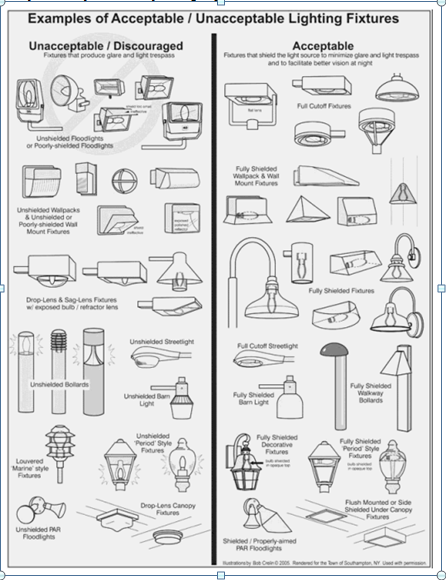
Examples of Acceptable / Unacceptable Lighting Fixtures
9-11-7 COMPLIANCE, PENALTY, EFFECTIVE DATE, AND OTHER PROVISIONS
- COMPLIANCE AS A CONDITION OF APPROVAL
- An assessment of the conformance status of all existing and planned exterior-lighting, fixtures on a property location shall be a part of any application for a building-construction permit, any submitted plan subject to design review, or any request for a change of zoning, subdivision, or conditional use.
- Accompanying said assessment shall be explicit provision for bringing all present and planned lighting fixtures into full compliance with this ordinance.
- All applications for design review, conditional use, subdivision and/or building permits shall include lighting plans showing location, type, height, color temperature, lumen output and amount of all proposed and existing fixtures. The applicant shall provide enough information to verify that lighting conforms to the provisions of this chapter. The administrator, Commission and/or Building Official shall have the authority to request additional information in order to achieve the purposes of this chapter.
- The submission of specific descriptions, specifications, photometric data, site-installation locations, lighting plans, studies, or other information may be required, as determined by the Planning and Zoning Administrator.
- Confirmation of full compliance shall be required prior to issuance or approval of any corresponding change of zoning, final-plat recordation, final inspection, or certificate of occupancy.
- An assessment of the conformance status of all existing and planned exterior-lighting, fixtures on a property location shall be a part of any application for a building-construction permit, any submitted plan subject to design review, or any request for a change of zoning, subdivision, or conditional use.
- COMPLIANCE BURDEN: The burden of compliance shall rest with the fixture's owner or the contractual designee of the fixture's owner, even if installed on the property of the fixture owner's lessee.
- PENALTY: Violations of provisions pursuant to this ordinance shall be punishable as in infraction as provided in Section 1-4a-1 of the Sugar City Code and Ordinances.
- OTHER REMEDIES: Nothing in this ordinance shall prevent relief from any protection provided by the Constitution of the United States or the State of Idaho, from other remedies pursuant to other law, or preclude pursuit of any other relief from a nuisance for intrusive lighting.
- SEVERABILITY: The provisions of this ordinance are severable, and if any provision or application thereof is held invalid, the invalidity shall not affect other provisions or applications of this ordinance.
- CONFLICTING ORDINANCES REPEALED: Ordinances or portions of ordinances in conflict with the provisions of this ordinance are hereby repealed.
- EFFECTIVE DATE: All provisions of this ordinance shall become effective on August 1, 2022.

