
Suisun City City Zoning Code
ARTICLE I
- GENERAL PROVISIONS
18.02.010 - Title adopted.
This title is enacted based on the authority vested in the city by the state. This title is an adopted zoning plan for the city.
(Ord. No. 743, § 3, 3-21-2017)
18.02.020 - Purpose and components.
The zoning plan is adopted to provide a precise plan for residential, commercial, industrial, agricultural, public, and other land uses in the city in order to:
A.
Protect the established character and social and economic values of residential, commercial, industrial, agricultural, recreational, public and other areas within the city that have developed in a healthy and orderly manner;
B.
Encourage beneficial development of those areas that have grown with conflicting or uneconomic patterns of use; and
C.
Assist in providing a definite and publicly approved plan of development to guide, control, and stimulate the future growth of the city in accordance with the needs of the city and in proper relation to other land use areas in the region.
(Ord. No. 743, § 3, 3-21-2017)
18.02.030 - Components of zoning plan.
The zoning plan consists of the establishment of various districts within the incorporated territory of the city, within some, all or none of which it is lawful, and within some, all or none of which it is unlawful, to erect, construct, alter, repair or maintain certain buildings or to carry on certain trades or occupations, or to conduct certain uses of land or of buildings within which certain open spaces shall be required about future buildings, and consists further of appropriate regulations to be enforced in such districts, all as set forth in this title.
(Ord. No. 743, § 3, 3-21-2017)
18.02.040 - Authority and relationship to general plan.
It is the policy of the city to eliminate any inconsistencies between this title and the general plan adopted by the city. Each parcel in this title shall be zoned consistent with the general plan and any applicable specific plan. Where inconsistency exists between the zoning designation for a parcel and the general plan, the general plan designation shall govern.
(Ord. No. 743, § 3, 3-21-2017)
18.02.050 - Applicability.
Except as otherwise provided in this title:
A.
No building shall be erected and no existing building shall be moved, altered, added to or enlarged, nor shall any land, building or premises be used, designated or intended to be used for any purpose, or in any manner, other than is included among the uses listed in this title as permitted in the district in which such building, land or premises is located.
B.
No building shall be erected, reconstructed or structurally altered to exceed in height the limit designated in this title for the district in which such building is located.
C.
No building shall be erected, nor shall any existing building be altered, enlarged or rebuilt, nor shall any open space be encroached upon or reduced in any manner, except in conformity to the yard, building site area and building location regulations designated in this title for the district in which such building or open space is located.
D.
No yard or other open space provided about any building for the purpose of complying with the provisions of this title shall be considered as providing a yard or open space for any other building, and no yard or other open space on one building site, shall be considered as providing a yard or open space for a building on any other building site.
(Ord. No. 743, § 3, 3-21-2017)
18.02.060 - Savings clause.
If any part of these regulations is for any reason held to be invalid or unconstitutional, such invalidity or unconstitutionality shall not affect the validity or unconstitutionality of the remaining portions of these regulations. It is hereby expressly declared that this title and each part would have been adopted irrespective of the fact that any part might be declared invalid or unconstitutional.
(Ord. No. 743, § 3, 3-21-2017)
[18.04.010] - [Definitions.]
"Accessory dwelling unit." An attached or a detached residential dwelling unit that provides complete, independent living facilities for one or more persons and is located on a lot with a proposed or existing primary residence. It shall include permanent provisions in accordance to California state building code for living, sleeping, eating, cooking, and sanitation on the same parcel as the single-family or multi-family dwelling is or will be situated. An accessory dwelling unit also includes an efficiency unit and a manufactured home but does not include trailers.
1.
Attached Accessory Dwelling Unit. An accessory dwelling unit that shares at least one common wall with the primary dwelling and is not fully contained within the existing space of the primary dwelling or an accessory structure.
2.
Detached Accessory Dwelling Unit. An accessory dwelling unit that does not share a common wall with the primary dwelling and is not fully contained within the existing space of an accessory structure.
3.
Internal Accessory Dwelling Unit. An accessory dwelling unit that is fully contained within the existing space of the primary dwelling or an accessory structure.
4.
Junior Accessory Dwelling Unit. A unit that is no more than 500 square feet in size and contained entirely within a single-family residence. A junior accessory dwelling unit may include separate sanitation facilities or may share sanitation facilities with the existing structure.
"Accessory use." A use naturally and normally incidental to and subordinate to the principal use of the land, and that does not change the character of the principal use.
"Agriculture." The science of cultivation, including harvesting of crops and rearing and management of livestock, tillage, husbandry, farming, horticulture, and forestry.
"Agricultural processing facility." An establishment that processes or packages crops to prepare them for market on- or off-site. Includes related accessory uses such as, offices, laboratories, and tasting facilities.
"Agriculture-related." Uses include agricultural product sales, roadside stands, produce stands, self-pick operations, agricultural processing, and agricultural home stays.
"Alcoholic beverage establishment." An establishment where alcoholic beverages are sold, served, or given away for consumption on the premises, excluding full-service restaurants. Typical alcoholic beverage establishments include but are not limited to bars, cocktail lounges, ballrooms, dance bars, piano bars, billiard and game parlors, bowling alleys, nightclubs, and tasting rooms.
"Alley." A passage or way open to public travel affording a secondary means of vehicular access to abutting lots and not intended for general traffic circulation.
"Alteration." Any act or process that changes one or more of the exterior architectural features of a structure, including, but not limited to, the erection, construction, reconstruction, repair, or removal of any structure.
"Amusement center." A facility wholly enclosed in a building that offers games, including one or more of the following, but not limited to, bingo, bowling, billiards, pool, ski-ball, air hockey, skating, go-karts, miniature golf, and electronic arcade games.
"Auto service and repair." A service establishment where automobiles may be disassembled and assembled to alter their appearance or improve their operation.
Include but not limited to the following:
- Auto parts, sales without repair.
- Auto parts, sales with repair.
- Auto service and repair.
- Auto detailing (full service car wash).
"Bed and breakfast inn." A single-family dwelling, which is predominantly residential in character, and containing up to six guest rooms offering overnight accommodations for rent, wherein a breakfast meal is customarily included in the lodging rate.
"Boarding and rooming house." A dwelling, other than a hotel, where lodging and/or meals for three or more persons are provided for compensation. Single-room occupancy units (see definition below) are allowed by right in residential medium, RH1, and RH2 zones (CA AB 2634). Facilities providing drug and alcohol treatment are not considered boarding and rooming houses under CA Health and Safety Code 11834.23.
"Building height." The height of the highest part of the building above the finished grade.
"Campgrounds." Land or premises used or intended to be used, let, or rented for occupancy by campers traveling by automobiles or otherwise, for temporary occupancy by tents or similar quarters.
"Convenience market." An establishment with a gross floor area of less than 6,000 square feet offering for sale a variety of fresh or prepackaged food and beverage products, alcoholic beverages for off-site consumption, household items, and similar products. This use may include a market that is combined with another use, such as an automobile service station, when the market net floor area is between 500 and 6,000 square feet. Includes liquor stores below 6,000 square feet which focus on the sale of alcoholic beverages.
"Club." An association of individuals used in the furtherance of a common purpose. Excludes clubs whose purpose is a service customarily carried on as a business (such as a health club).
"Community care facility, small." Small community care facilities are located in residential dwellings where non-medical care is provided to six or fewer persons on a 24-hour basis. Small community care facilities include foster family homes, group homes for children who are wards of the state, adult day support centers, social rehabilitation facilities, transitional care facilities, and adult residential facilities (for adults with mental disabilities). A community care facility is licensed under the State of California Health and Safety Code 1520 et seq.
"Community care facility, large." Large community care facilities are located in residential dwellings where non-medical care is provided to seven or more persons on a 24-hour basis. Large community care facilities include foster family homes, group homes for children who are wards of the state, adult day support centers, social rehabilitation facilities, transitional care facilities, and adult residential facilities (for adults with mental disabilities). A community care facility is licensed under the State of California Health and Safety Code 1520 et seq.
"Community center." A facility used for recreational, social, educational, and cultural activities open to members of voluntary associations, or to the public at large.
"Community garden." Public or private land divided into multiple plots for the growing of fruits, vegetables, flowers, nuts, seeds, culinary herbs, or other similar uses for the personal use of the growers. A community garden does not include a private garden incidental to the primary use of the lot, including lots devoted to the personal use of the occupants of residences or a lot developed with a nonresidential use.
"Community social service." Any public or private organization, providing services to the community including employment centers, food banks, and counseling services, among others.
"Complete streets." Streets designed to accommodate multiple travel modes. This means that streets would have not only travel lanes for vehicles, but also room for bicycles, sidewalks, street trees, and bus stops and pull-out lanes (along bus routes).
"Construction." Any building activity that affects the exterior appearance of a structure, including the erection, alteration, reconstruction, repair, maintenance or extension of a structure, requiring the issuance of a building permit.
"Demolition." Any act or process that destroys (in part or in whole) a structure.
"Density." The amount of residential development permitted in a given area, typically expressed as the number of dwelling units per acre (du/ac) of land.
"Development services director." The department head or other responsible city official in charge of the planning functions for the city, which for the purposes of this title, shall also be referred to as development services director. The development services director may delegate authority to planning staff.
"Duplex." A detached building occupied by two families living independently of each other in distinct units that are separated by a common wall.
"Dwelling." Includes a room or group of rooms that include cooking, eating, sleeping, and sanitation facilities and designed as an independent unit. Types of dwellings include, but are not limited to, single-family, two-family, multi-family dwellings, manufactured homes, mobilehomes, condominiums, and townhomes.
"Emergency shelter." Per California Health and Safety Code (section 50801[e]), "emergency shelter" means housing with minimal supportive services for homeless persons that is limited to occupancy of six months or less by a homeless person. Emergency shelters also include other interim interventions, including, but not limited to, navigation centers, bridge housing, and respite or recuperative care.
"Enlargement." Construction that results in the expansion of the gross floor area of a structure.
"Family." One or more persons living together in a dwelling unit, with common access to, and common use of all living, kitchen, and eating areas within the dwelling unit.
"Family day care, small." A small family day care is located in a single-family residential dwelling, where care, protection, and supervision is provided for periods of less than 24 hours while parents, guardians or authorized representatives are away. A small family day care can provide care for four infants or for up to six children if no more than three infants are under care, or for up to eight children if only two infants and two children are school age. A small family day care is considered a single-family residential use and licensed under the State of California Health and Safety Code 1597.45, which requires that it be permitted as a residential use in single-family zones.
"Family day care, large." A large family day care is located in a single-family residential dwelling where care, protection, and supervision is provided for periods of less than 24 hours while parents or authorized representatives are away. A large family day care can provide care for up to 12 children if there are no more than four infants, or for up to 14 children if two are school age and there are no more than two infants in care. An assistant must be present.
A large family day care is considered a single-family residential use and licensed under the State of California Health and Safety Code 1597.45, which requires that it be permitted as a residential use in single-family zones.
"Farm worker/employee housing for six or fewer." Farm worker/employee housing for six or fewer persons is treated as a single-family structure and residential use as described in California Health and Safety Code Sections 17021.5 and employee housing as defined in California Health and Safety Code Section 17008, including farm worker housing.
"Farm worker/employee housing, group quarters." Farm worker/employee housing consisting of no more than 36 beds in group quarters (or 12 units or less) designed for use by a single family or household to be treated as an agricultural use as described in 17021.6, and employee housing as defined in California Health and Safety Code Section 17008, including farm worker housing.
"Fence." A barrier constructed of materials such as wood, steel, iron, masonry, or hedging and located along a property or setback line, or within a setback line and acting as a deterrent to ingress or egress, a support for vegetation, or as a decorative element.
"Floor-area ratio (FAR)." The permitted gross interior building floor area (on all floors/levels of a building) divided by the area of the developable site.
"Garage, private." An accessory building for the storage of private motor vehicles.
"Home occupation." A home occupation is a business operated within a residential dwelling that is carried out by the occupants and is secondary to the primary purpose of the dwelling. See Chapter 18.50, "Home Occupation," for detailed requirements of home occupations.
"Improvement." Any building, structure, place, parking facility, fence, gate, wall, work of art, or other object constituting a physical betterment of real property or any part of such betterment.
"Junkyard." The use of more than 200 square feet of the area of any parcel, lot, or contiguous lots for the storage of junk or salvable materials, including junk metals or other scrap materials and/or for the dismantling or wrecking of automobiles or other vehicles or machinery.
"Kennel." Any lot or premises on which five or more dogs, cats, or small animals over four months old are kept, maintained, boarded, and/or offered for sale.
"Landscaping service." A business that offers landscaping installation, care, and maintenance services for hire. The business site may include equipment, plants, and materials such as mulch, gravel, stone bender board, and irrigation pipes and parts.
"Live-work unit." A building or spaces within a building that is used jointly for commercial and residential purposes, where the resident owner or employee of the business is responsible for the commercial activity performed, and where the commercial activity conducted is subject to a valid business license associated with the premises.
"Lot." A defined area of real estate that is synonymous with an assessor's parcel.
"Lot, key." The first lot to the rear of a reversed corner lot, front line of a corner lot, a line separating the narrowest street frontage on the lot from the street, except in those cases where access is prohibited to the street on the side of the normal front lot line.
"Lot, large." The site of a proposed new development that was legally created in compliance with the Subdivision Map Act.
"Lot line, front." A line separating the lot from a street or way and in the case of a corner lot, a line separating the narrowest street frontage on the lot from the street, except in those cases where access is prohibited to the street on the side of the normal front lot line.
"Lot line, rear." A line that is opposite and most distant from the front lot line and in the case of an irregular or triangular lot, a line within the lot ten feet in length, parallel to and at the maximum distance from the front lot line.
Example of Lot Definition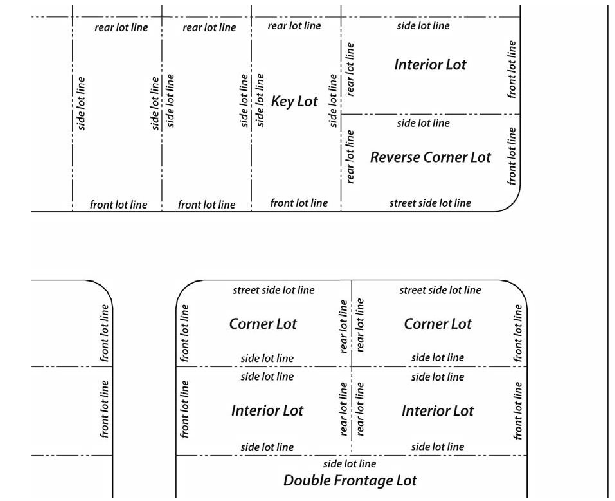
"Low barrier navigation centers." A low barrier, service-enriched shelter focused on moving people into permanent housing that provides temporary living facilities while case managers connect individuals experiencing homelessness to income, public benefits, health services, shelter, and housing. (California Government Code Section 65662a.)
"Manufacturing/processing, light." A facility engaged in the assembly, fabrication, and conversion of already processed raw materials into products, where the operational characteristics of the process and the materials uses are unlikely to cause significant impacts on surrounding land uses or the community. Examples include clothing assembly and fabric manufacturing; electronics and appliance manufacturing; food and beverage manufacturing; metal products; machine and welding shops; and handicraft industries.
"Medical, hospital." Hospitals and similar facilities engaged in providing diagnostic services, extensive medical treatment, and inpatient care; may include emergency services and a heliport pad.
"Medical, office." A medical office refers to a facility where medical, dental, mental health, surgical, urgent care, or other healthcare services are provided on an outpatient basis.
"Medical health care facility." A facility that is maintained and operated to provide medical care and includes nursing homes, intermediate care facilities, medical clinics, and home health agencies. Licensed by the California State Department of Health Services (Health and Safety Code 1200 et seq.).
"Minerals." Any naturally occurring chemical element or compound or groups of elements and compounds formed from inorganic processes and organic substances, including, but not limited to, coal, peat, and bituminous rock, but excluding geothermal resources, natural gas, and petroleum (Public Resources Code Section 2005). Gold, sand, gravel, clay, crushed stone, limestone, diatomite, salt, borate, potash, etc. are examples of minerals.
"Mobilehome (or mobile home)." Mobilehome is a structure designed for human habitation and for being moved on a street or highway under permit, pursuant to Section 35790 of the CA Vehicle Code. Mobilehome includes a manufactured home (except under specified circumstances) and does not include a recreational vehicle.
"Mobilehome park." Mobilehome park is an area of land where two or more mobilehome sites are rented, or held out for rent, to accommodate mobilehomes for human habitation.
"Mobile food vendor." Mobile food vendor means a person who sells, serves, offers for sale, or gives away only food from a mobile food vending unit, parked or located on a private parcel of property. This term does not include a person who operates a mobile food vending unit that visits multiple private property sites on a daily basis for no more than 30 minutes per site, per day.
"Mortuary, funeral home." Funeral homes and parlors, where funeral services may be conducted and the remains of the deceased are prepared for burial or cremation.
"Nursery (plants)." A commercial agricultural establishment engaged in the production of ornamental plants and other nursery plants, grown under cover on the site in containers or soil, indoors or outdoors. Also includes greenhouses and nurseries that sell these products.
"Open space." Land or water that is unimproved and devoted to managed production of resources; the preservation of natural resources; outdoor recreation; and/or public safety.
"Parking facility." Includes day-use and long-term parking lots, garages, structures, and park and ride lots, except when accessory to a primary use such as, a residential garage.
"Parking space." A usable space for parking of a motor vehicle off the street.
"Performance standards." Regulations for the control of dangerous or objectionable elements.
"Personal services." Establishments providing non-medical services to individuals as the primary use. Examples include barber and beauty shops, massage therapy, tailors, shoe repair, and dry cleaning.
"Public safety facility." A facility operated by a public agency for community welfare, which may include fire stations and firefighting and prevention facilities; police and sheriff stations; and incarceration facilities.
"Recycling collection facility (small)." A small recycling collection facility provided for the collection of recyclables within neighborhoods and may consist of drop-off centers or local transfer stations.
"Recycling collection facility (large)." A large recycling collection facility, providing for the collection, sorting, and packaging of recyclable materials, not including refuse or hazardous materials, but may include equipment to aid in the sorting and packaging processes.
"Religious facility." A permanent facility operated by a religious organization for religious activities, as well as accessory uses. Examples of religious facilities include churches, mosques, synagogues, and temples, among others. Accessory uses may include living quarters for staff, day care facilities, and kitchens for events.
"Removal." Any relocation of a structure on its site or to another site.
"Repair." Any improvement that requires the replacement of a major building element and requiring a building permit or improvement to correct deficiencies resulting from normal wear and tear of improvements and not requiring a building permit.
"Research and development." A facility for the research, design, development, and testing of components, prior to product manufacturing.
"Residential care facility." A licensed residential care facilities and unlicensed residential care facilities shall be considered a residential use of property. Residential care facilities, licensed, and unlicensed residential care facilities are permitted uses in all zones permitting residential uses, subject to compliance with the restrictions and development standards for other residential dwellings of the same type (e.g., single-family or multi-family) in the same zone. This does not include new construction of a standalone commercial residential care facility.
"Restaurant, full service." A food service establishment that is used for the serving of meals for compensation, which has a kitchen and opportunities for patrons to eat while being seated. Alcoholic beverages may be served, but are incidental to the primary food service. Full-service restaurants do not include snack bars and temporary food service.
"Shall." That which is obligatory.
"Should." A less rigid directive than "shall;" a directive to be honored and followed if possible, in the absence of compelling reasons for departure from a policy.
"Single room occupancy (SRO)." A dwelling, other than a hotel, with multiple single-room dwelling units and private or shared kitchen and bathroom facilities. Single room occupancy structures shall have units rented individually and shall accommodate a maximum of one person per unit.
"Structural alterations." Any change in the supporting members of a building such as bearing walls, columns, beams, or girders.
"Structure." Anything constructed or erected, the use of which requires location on or in the ground or attachment to something having location on or in the ground, but not including any trailer or tent.
"Supportive housing." Housing with no limit on length of stay, and that is linked to on-site or off-site services that assist resident(s) to retain the housing, maintain or improve their health status, and maximize their ability to live and, when possible, work in the community.
"Target population." Persons with low incomes who have one or more disabilities, including mental illness, HIV or AIDS, substance abuse, or other chronic health condition, or individuals eligible for services provided pursuant to the Lanterman Development Disabilities Services Act (Division 4.5 (commencing with Section 4500) of the Welfare and Institutions Code) and may include, among other populations, adults, emancipated minors, families with children, elderly persons, young adults aging out of the foster cares system, individuals exiting from institutional settings, veterans, and homeless people.
"Tract office." A temporary office used during construction and removed at the completion of a construction project.
"Transitional housing." Per California Health and Safety Code (Section 50801[i]),"transitional housing" means housing with supportive services for up to 24 months that is exclusively designated and targeted for recently homeless persons.
"Usable open space." That space upon the lot or parcel to which it is appurtenant, which can be used by inhabitants of the property for outdoor living, activity, and/or recreation and may include landscaping. All such areas shall be readily accessible to the inhabitants of the property. "Usable open space" does not include driveways, open or covered parking areas, utility space such as, trash or garbage areas or space occupied by the required front yard.
"Use." The purposes for which land or premises or a building thereon is designed; arranged or intended; or for which it is or may be occupied or maintained.
"Winery." An agricultural processing facility for the purpose of processing grapes, berries, or other fruits to produce wine or wine products. Processing includes crushing, fermentation, blending, bottling, packaging, storage, aging, handling, shipping, and receiving of such products.
"Wrecking yard." The use of a property for the storage and commercial sale of junk or salvable material, including junk metals or other scrap material and/or for the dismantling or "wrecking" of automobiles or other vehicles or machinery.
"Yard." Open space that is unoccupied and unobstructed from the ground upward, except for landscaping and as otherwise provided in Chapters 18.32, "General Development Regulations" and 18.36, "Yards," but not including any portion of any street or alley or road right-of-way.
"Yard, front." A yard, extending across the front of the lot, between the side lot lines and to a depth required by the district in which the lot is situated; provided, however, that if any building line or official plan line has been established for the street upon which the lot faces or if any future width line is specified, therefore in Chapter 18.36, then such measurement shall be taken from such building line, official plan line, or such future width line to the nearest line of the building.
"Yard, rear." A yard extending across the back of the lot between the side lot lines and to a depth required by the district in which the lot is situated.
"Yard, side." A yard between the side lot line of the lot and the building; and to a width required by the district in which the lot is situated and extending.
(Ord. No. 743, § 3, 3-21-2017; Ord. No. 748, § 4, 5-15-2018; Ord. No. 774, § 2, 8-18-2020; Ord. No. 809, § 1, 8-20-2024)

