
Suisun City City Zoning Code
ARTICLE III
GENERAL DEVELOPMENT REGULATIONS
[18.31.005] - [Table of development standards in residential zones.]
Notes:
1
Lot coverage includes primary buildings, accessory buildings, covered parking, and
covered patios.
2
Garage shall not be closer than 15 feet to the front property line.
3
Garage setback shall be no closer than three feet to the rear property line.
4
A secondary dwelling shall not exceed 20 feet in height, except when the unit is
attached to the primary unit, the maximum height shall be that established for the
primary dwelling in the underlying zoning district.
5
For courtyard and green court site plans, and to allow for paseos and other pedestrian
pathways, where included in the site design.
6
No required maximum to allow for parking lots and courtyards, as relevant to the
design of the dwelling units.
7
For junior accessory dwelling units and internal ADUs, no setbacks and height required,
other than that of the primary dwelling.
8
Conversion and replacing applies only to existing, permitted accessory dwelling units.
9
The following exceptions apply:
• A height 18 feet for a detached accessory dwelling unit on a lot with an existing
or proposed single family or multi-family dwelling unit that is within one-half of
one mile walking distance of a major transit stop or a high-quality transit corridor,
as those terms are defined in Section 21155 of the Public Resources Code. An additional
two feet in height to accommodate a roof pitch on the accessory dwelling unit that
is aligned with the roof pitch of the primary dwelling unit.
• A height of 18 feet for a detached accessory dwelling unit on a lot with an existing
or proposed multi-family, multi-story dwelling.
• A height of 25 feet or the height limitation in the local zoning ordinance that
applies to the primary dwelling, whichever is lower, for an accessory dwelling unit
that is attached to a primary dwelling.
10
The proposed increase in gross floor area of an attached or detached accessory dwelling
unit shall not exceed 50 percent of the existing living area.
11
Please refer to section 18.30.170 H., I., J.
• H. An internal ADU may be constructed regardless of whether it conforms to the
current zoning requirement for building separation or setbacks;
• I. If an internal ADU is proposed to be constructed within an existing accessory
structure, the city shall ministerially permit an expansion of the existing accessory
structure by up to 150 square feet for the purpose of accommodating ingress and egress;
• J. If an existing structure is demolished and replaced with an accessory dwelling
unit, an accessory dwelling unit may be constructed in the same location and to the
same dimensions as the demolished structure.
(Ord. No. 743, § 3, 3-21-2017; Ord. No. 774, § 3, 8-18-2020; Ord. No. 809, § 1, 8-20-2024)
18.31.010 - Usable open space in the medium-density residential zone.
A.
For the RM district, the following types of usable open space are recommended for multi-family units:
1.
To provide access to planned or existing spaces and facilities that accommodates family needs and active play areas for kids, and/or passive open space areas (such as walking trails) within one-quarter-mile of 90 percent of the multi-family units.
2.
Each multi-family unit should also have access to a combination of private open space (balconies or small patios, for example) and publicly accessible open space (common greens, community room, pool area, etc.).
B.
The method of computation of usable open space provided for multi-family units should be as follows:
1.
Private patios, when directly accessible to the dwelling unit to which it is appurtenant; such patios shall be completely enclosed on all sides by a fence which is a minimum of three feet in height.
2.
Balconies and lanais, when directly accessible to the unit to which they are appurtenant; such balconies and lanais must have a minimum dimension of five feet.
3.
Swimming pool areas, including the hard-surface deck, which normally surrounds such pools.
4.
Indoor recreation activity rooms, provided these rooms are permanently maintained for the use of tenants for various recreation activities. Such activity rooms shall not include lobbies, but may include common steam rooms, sauna baths, or the like.
(Ord. No. 743, § 3, 3-21-2017)
18.31.020 - Usable open space in the high-density residential (RH1 and RH2) and residential mixed-use zones.
A.
For the RH1, RH2, and RMU districts, the following types of usable open space are recommended for multi-family units:
1.
To provide access to planned or existing spaces and facilities that accommodates family needs and active play areas for kids, and/or passive open space areas (such as walking trails) within one-quarter-mile of 90 percent of the multi-family units.
2.
Each multi-family unit should also have access to a combination of private open space (balconies or small patios, for example) and publicly accessible open space (common greens, community room, pool area, etc.)
B.
The method of computation of usable open space provided should be as follows:
1.
The following areas should be computed at one and one-quarter times the area actually devoted to such use:
a.
Private patios, when directly accessible to the dwelling unit to which it is appurtenant; such patios shall be completely enclosed on all sides by a fence which is a minimum of five feet in height.
b.
Balconies and lanais, when directly accessible to the unit to which they are appurtenant; such balconies and lanais must have a minimum dimension of five feet;
c.
Swimming pool areas, including the hard-surface deck, which normally surrounds such pools.
d.
Indoor recreation activity rooms provided these rooms are permanently maintained for the use of tenants for various recreation activities. Such activity rooms shall not include lobbies, but may include common steam rooms, sauna baths or the like.
(Ord. No. 743, § 3, 3-21-2017)
[18.32.010] - [Table of development standards in commercial zones.]
(Ord. No. 743, § 3, 3-21-2017)
[18.33.010] - [Table of development standards in civic/park/other zones.]
(Ord. No. 743, § 3, 3-21-2017)
18.34.010 - Fence and walls by zoning district.
A.
The height of side and rear yard fences, hedges, or walls behind the front setback line in any residential district shall not exceed six feet.
B.
Fence and wall height by zoning district are shown in Table 18.34.01.
(Ord. No. 743, § 3, 3-21-2017; Ord. No. 805, § 1, 10-3-2023)
18.34.020 - Fences and walls around storage areas.
Outdoor storage yards, corporation yards or light industrial uses may be enclosed by a fence or walls not to exceed eight feet in height. The fence shall be of solid construction to adequately screen the enclosed area from view.
(Ord. No. 743, § 3, 3-21-2017)
18.34.030 - Outdoor sales, storage, or rental lot.
Outdoor sales, storage, and rental lots shall show that adequate measures and controls will be taken to prevent offensive lights, noise, odors, and dust and shall have a minimum six-foot-high solid-board fence, or equal, separating the lot from abutting residential uses. Where these activities are approved subject to a conditional use permit, the development services director or planning commission may require additional screening as deemed to be appropriate.
(Ord. No. 743, § 3, 3-21-2017)
18.34.040 - Measuring fence and wall height.
A.
Fence and wall height shall be measured from the ground level beneath the fence or wall to the top of the fence or wall.
B.
Where fences are installed on sloping property, the height of the fence can be measured from the ground level on the uphill slope or the highest parcel to the top of the fence, as shown in Figure 18.34.01.
C.
Where a fence or wall rests on a retaining wall, the overall combined height may not exceed ten feet, as measured from the ground level at the bottom of the retaining wall to the top of the fence or wall, as shown in Figure 18.34.01.
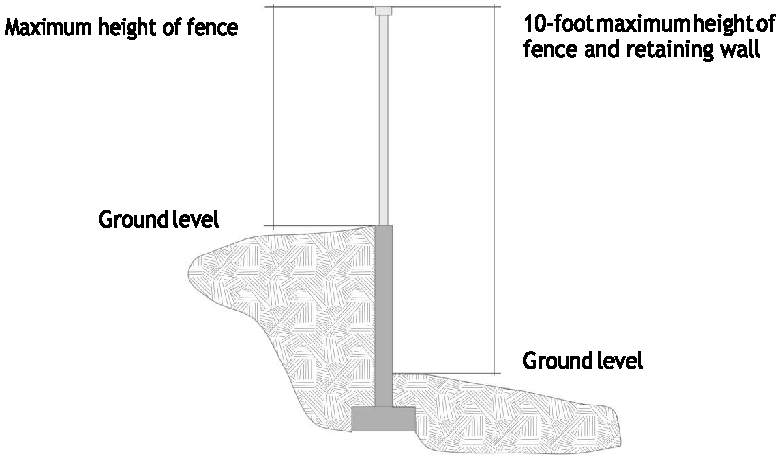
Figure 18.34.01
(Ord. No. 743, § 3, 3-21-2017)
18.34.050 - Other fence and wall standards.
A.
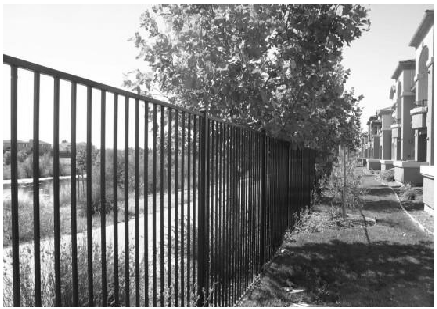
Fences and Walls within Publicly Accessible Areas. Fencing around multi-family development is intended to protect the safety of children and serve as a visual enhancement, not to screen units, which must remain visible from publicly accessible areas. Fencing for single-family rear yards adjacent to publicly accessible areas or open space, must consist of perimeter fencing that is a minimum 50 percent open. Where fences and walls are not adjacent to publicly accessible areas such as, residential dwellings adjacent to uses in the CSF zone, fencing may be solid.
B.
Swimming Pool Enclosure. Swimming pools in multi-family developments must be enclosed by a fence or wall that is a minimum six feet high to protect children.
C.
Recreational court fencing, such as tennis and basketball courts, must be constructed to conform to relevant American Society for Testing and Materials (ASTM) standards.
D.
Chain-link fences are not permitted in front, side, and rear yard residential districts.
E.
Chain-link fences are permitted on vacant commercial district properties. The following development criteria shall be met:
1.
Fences shall be placed on the perimeter of the property.
2.
Fences shall not exceed six feet in height.
3.
If property is subdivided and a remainder portion of the property remains vacant, a chain-link fence is permitted.
F.
Chain-link fences are permitted on vacant commercial/mixed use waterfront district specific plan properties. The following development criteria shall be met:
1.
Fences shall be placed on the perimeter of the property.
2.
Fences shall not exceed six feet in height.
3.
A green color mesh shall be attached to the fence and placed around the entire perimeter of the property.
(Ord. No. 743, § 3, 3-21-2017; Ord. No. 805, § 1, 10-3-2023)
18.34.060 - Soundwalls.
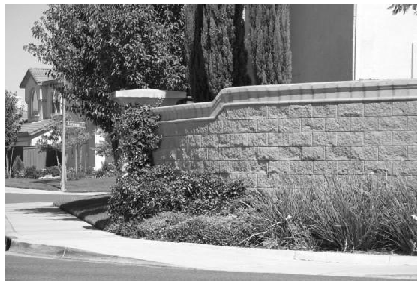
The use of soundwalls is discouraged in the city to promote continuous circulation patterns and enhanced visual accessibility. However, where soundwalls are required, they must conform to the following standards:
A.
Soundwalls must be constructed of fire-resistant materials, such as masonry, precast concrete, brick, or a similar material, and treated with a graffiti-resistant coating.
B.
Soundwalls must incorporate breaks at streets, trails, live-end cul-de-sacs, and at pedestrian access routes to schools, parks, and commercial districts. Where such pedestrian connections do not exist, soundwalls must include breaks at a minimum of every 500 feet.
C.
Soundwalls should include decorative elements, such as pilasters, posts and capitals, stamped designs, and/or landscape screening to improve their appearance from the street.
(Ord. No. 743, § 3, 3-21-2017)
18.34.070 - Prohibited materials.
It is unlawful to erect any electrically charged fence or any fence composed of barbed wire, razor wire or other material which is designed to cause injury upon contact on or adjacent to any residential use regardless of the underlying zoning.
(Ord. No. 743, § 3, 3-21-2017; Ord. No. 805, § 1, 10-3-2023)
18.36.010 - Measurement from official roadway lines.
In any case where an official plan line for a new roadway has been established as a part of a subdivision, planned unit development, specific plan, or other development project, yards adjacent to the street shall be measured from such official plan lines and shall not extend beyond measurement from such official plan line.
(Ord. No. 743, § 3, 3-21-2017)
18.36.020 - Projection of architectural features.
Architectural features, to include cornices, eaves, awnings, cantilevered walls, and fireplaces and chimneys may extend no more than two feet into the required side yard setback, provided that the distance between the projecting object and the side yard lot line is not less than five feet. The minimum side yard setback shall be measured from the wall from which the architectural feature projects.
(Ord. No. 743, § 3, 3-21-2017)
18.36.030 - Projection of porches, stairways, fire escapes, landings.
Porches, stairways, fire escapes, or landings may extend into any required front or rear yard setback no more than six feet. Porches, stairways, fire escapes, or landings may extend into any required side yard setback no more three feet, provided a minimum of five feet is maintained between the porch and the side yard lot line.
(Ord. No. 743, § 3, 3-21-2017)
18.36.040 - Front yard by average in improved areas.
In a residential district (RL, RM, RH, RMU) where 50 percent or more of the building sites on any one block in the same district have been improved with buildings, the required front yard of an infill building shall be of a depth equal to the average of the front yards of the existing buildings on that block, not exceeding the maximum specified for the zone in which the building site is located.
(Ord. No. 743, § 3, 3-21-2017)
18.36.050 - Corner lots.
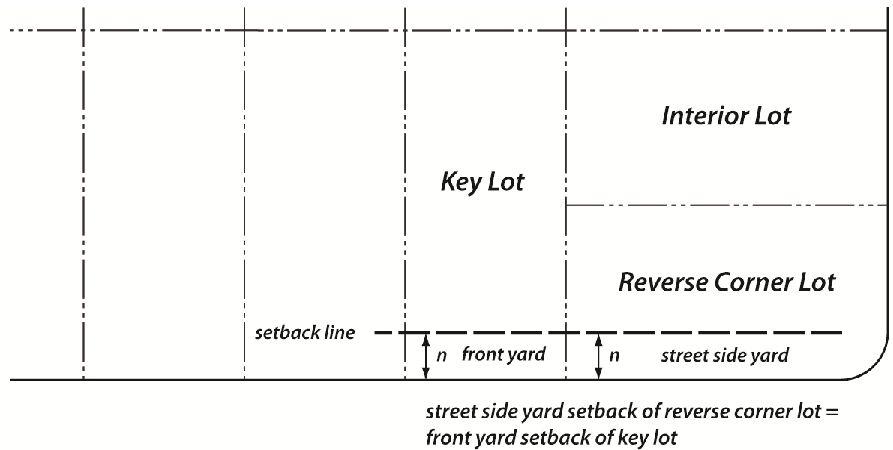
In the case of a reverse corner lot adjacent to a key lot, the required side yard on the street side for any building shall be equal to the front yard required on the key lot. On a corner lot, fences not more than six feet in height may be placed on the required street side yard setback, as depicted in the figure below.
(Ord. No. 743, § 3, 3-21-2017)
18.36.060 - Double-frontage lots.
To efficiently use space and infrastructure, double-frontage lots are not permitted. Existing double-frontage lots must be designed and maintained with front yard setbacks facing both streets.
(Ord. No. 743, § 3, 3-21-2017)
18.36.070 - Prohibited activities in front, rear, and side yards of residential properties.
A.
Definitions. For the purposes of this section, words shall have the same definitions as provided in Chapter 18.04 of this Code, except as follows:
1.
"Landscaped area" means a water-permeable area maintained to present an attractive, well-kept appearance. A "landscaped area" may consist of any combination of living plants (shrubbery, grass, trees, etc.) with or without a layer at least two inches deep of materials such as decorative bark or decorative stones with a permeable subterranean weed barrier. However, a "landscaped area," does not include dead plants, bare soil without plants, or bare soil with cut weeds. Further, "landscaped area" does not include asphalt or hardscape materials (such as pavers, bricks, and other hard surfaces), regardless of permeability.
2.
"Hardscaped area" means an area covered with semi-permeable or impermeable materials such as brick, pavers, or concrete. "Hardscaped area" does not include asphalt paving (asphalt, decomposed granite, and gravel are not permitted).
3.
"Weeds" means a valueless plant growing wild.
4.
"Recreational vehicles" mean recreational vehicles (RVs), including but not limited to motor homes, truck campers, travel trailers, fifth-wheel and pull-behind trailers, all-terrain vehicles, snowmobiles, jet skis, boats, and boat trailers.
5.
"Chain link fencing" means a fence, usually made of metal, which consists of wire loops interconnected into a series of joined links.
6.
"Driveway" means a paved portion of a private street providing an unobstructed passage from the roadway to an off-street area used for driving, servicing, parking, or otherwise accommodating motor vehicles.
7.
"Legal nonconforming use" means a use, structure, or condition that was legal and appropriately permitted at the time that it came into existence but no longer meets existing code.
8.
"Inoperative," in the context of vehicles, shall include all vehicles, including but not limited to recreational vehicles and boats, that are either (a) abandoned, wrecked, dismantled, or not in working order, or (b) lacking a current and valid department of motor vehicles registration. A vehicle that is not in working order means that it cannot be started and/or cannot move on its own power. A vehicle that has a current and valid planned non-operation registration shall not be considered inoperative for the purposes of this section.
9.
"Grandfathering" means to allow a legal nonconforming use to continue.
10.
"Minor repairs" consist of repairs that reasonably would require five hours of less to complete per established generally accepted industry published flat rate labor times.
B.
Purpose and Applicability.
1.
The requirements specified in this section are intended to preserve the residential character of streetscapes in the city's neighborhoods and to minimize excess storm water runoff as follows:
a.
The unregulated expansion of paved parking areas in front, rear, and side yards interfere with the pattern of building and open areas within neighborhoods and can increase vehicle clutter by creating small parking lots in yard areas which are intended to remain as open areas and green spaces. Excessive paving of yard areas can negatively impact the character and appearance of residential areas. Paving yard areas to add additional parking can result in the proliferation of curb cuts that can have the effect of reducing the number of on-street parking spaces available this also impacts the walkability of a neighborhood.
b.
The paving of front, rear, and side yards would potentially result in hazardous conditions on a residential property in that it could negatively impact the city's storm water management system such that a much higher amount of water runoff from such properties would negatively affect the city's storm water management system.
c.
The paving of front, rear, and side yards would result in potentially high amounts of runoff from such a property where such runoff could cause harm to adjoining properties.
d.
The paving of front, rear, and side yards would create visual blight by eliminating green space in the city's neighborhoods.
e.
The paving of front, rear, and side yards would provide substantial aesthetic conflicts that may possibly result in decreased property values for adjoining properties,
f.
The paving would result in potentially changing the use of residential properties, and it would result in less green space within the city.
2.
The requirements in this section shall apply to all residential properties and lots.
C.
Regulations and Standards.
1.
Front Yard.
a.
Walkways and Other Hardscaped Areas. The amount of paved walkways and hardscaped area, including but not limited to driveways, shall not exceed 60 percent of the front yard area.
b.
Landscaping. For all residential properties, the front yard area other than paved walkways and hardscape shall consist of a landscaped area.
c.
Property owners must maintain trees at a minimum of seven feet over the walkways, ten feet over the roadway, and hedges trimmed to the back edge of the walkway.
d.
Landscaped areas must be consistent with Chapters 8.12 and 8.13, as applicable, of this Code.
e.
Chain link fencing shall not be constructed and located such that such fencing is visible from public roads or alleyways. All chain link fencing constructed before the effective date of this section are considered legal non-conforming. Chain link fencing that is damaged shall be replaced with conforming fencing pursuant to Title 18 of this Code.
f.
No front yard driveway will be permitted without the approval and issuance of an encroachment permit from the public works director of Suisun City (if applicable) and design review and approval from the planning division. In no case shall an ADA curb ramp be used as a driveway.
g.
One tree shall be required for each residential property, on all new developments constructed after the effective date of this section. Plantings must be consistent with the approved landscape plan.
h.
An accessory building shall only be located on the rear 50 percent of a residential lot and must be consistent with Table 18.31.01 (Development standards in residential zones), as applicable, of this Code.
2.
Rear/Side Yard.
a.
Walkways and Other Hardscaped Areas. For all residential properties and lots, the amount of paved walkways and hardscape in rear and side yard areas of a property that are visible from public spaces shall not exceed 60 percent of the combined visible rear and side yard area. "Public spaces" includes, but is not limited to, streets, alleyways, public utility and access easements, and parks.
b.
Landscaping. All parts of rear and side yards that are not paved walkways or hardscape and that are visible from public spaces shall consist of landscaped area.
c.
Property owners must maintain trees at a minimum of seven feet over the walkways, ten feet over the roadway, and hedges trimmed to the back edge of the walkway.
d.
Landscaped areas must be consistent with Chapters 8.12 and 8.13, as applicable, of this Code.
e.
No side yard or rear yard driveway will be permitted without the approval and issuance of an encroachment permit from the public works director of Suisun City (if applicable) and design review approval from the planning division. In no case shall an ADA curb ramp be used as a driveway.
3.
Vehicle Storage.
a.
Driveway location and width shall be in accordance with the latest edition of the city of Suisun City engineering standards specifications.
b.
All vehicles, including recreational vehicles, shall be parked, stored or kept on a driveway being consistent with Chapter 8.12, as applicable, of this Code.
c.
If a recreational vehicle is parked or stored on a residential property, recreational vehicles must be parked on an approved driveway, and meet the following requirements if parked on a front or side yard visible to the public:
i.
Recreational vehicles shall not impede the public right-of-way.
ii.
If recreational vehicle is covered it must be with a snug fitting material free of damage and the covering must be secured so as to not come off in a storm.
iii.
In no case shall power cords or other connection(s) to the property cross a sidewalk or public right of way to prevent any tripping hazards, as to comply with the Americans with Disabilities Act.
d.
The following activities are prohibited on any driveway governed by this section:
i.
The parking, storing, or keeping for a period of time greater than 72 consecutive hours of any household appliance, equipment, furniture, construction equipment, machinery, airplane or aircraft, and materials other than that temporarily used or stored during the improvement of the lot and any associated structures or facilities;
ii.
The parking, storing or keeping in any such area, for a period of time in excess of 72 consecutive hours, of any inoperative motor vehicles. Parking, storing, or keeping of operative vehicles with a valid and current planned non-operation registration is permitted;
iii.
The parking, storing or keeping of a motor vehicle not registered with the department of motor vehicles in any such area of the driveway, or is visible to the public;
iv.
The wrecking, dismantling, disassembling, manufacturing, fabricating, building, remodeling, assembling, repairing, or painting, in any such area of any motor vehicle, boat, trailer, recreational vehicle, airplane or aircraft, machinery, equipment, appliance or appliances, furniture or other personal property. Exception to C.3.iv(4) to include minor repairs by an owner, lessee, or occupant of the lot, for a period not to exceed 48 hours.
D.
Grandfathering of Existing Uses.
1.
All legal nonconforming paving of front, side, or rear yards is grandfathered and shall not need to be brought up to code until the property owner conducts remodeling, alterations, or renovations of the property, at which time all yards must conform to the ordinance current at the time of the remodeling, alteration, or renovation.
2.
Grandfathering shall not apply to any use, structure, or condition that was illegal at the time of installation.
(Ord. No. 743, § 3, 3-21-2017; Ord. No. 770, § 2, 4-7-2020)
Editor's note— Ord. No. 770, § 2, adopted Apr. 7, 2020, repealed the former § 18.36.070 and enacted a new § 18.36.070 as set out herein. The former § 18.36.070 pertained to prohibited activities in front and street side yards, and derived from Ord. No. 743, § 3, adopted Mar. 21, 2017.
18.38.010 - Chimneys, vents, and flues.
Chimneys, vents, and flues that present a fire hazard may extend above the height limit for a specific zoning district only to the extent necessary to ensure fire safety, based on National Fire Prevention Association codes and standards, or comparable state and local codes and standards, where these apply, and subject to approval by the development services director. The required extension above the height limit will vary, depending on the chimney, vent, or flue.
(Ord. No. 743, § 3, 3-21-2017)
18.38.020 - Skylights, antennas, flagpoles, and other appurtenances.
Appurtenances affixed to the roof of a building may not exceed the height limit of the zoning district by more than ten percent of the overall building height, or four feet, whichever is less.
(Ord. No. 743, § 3, 3-21-2017)
18.38.030 - Towers, poles, and water tanks.
Towers, poles, water tanks, and similar structures not affixed to a building may be erected to a greater height than the limit established for the district in which they are to be located, based on the construction specifications of the manufacturer, and subject to approval by the development services director. Local distribution poles for public utilities shall be allowed in all districts and to greater heights than allowed for the districts.
(Ord. No. 743, § 3, 3-21-2017)
18.38.040 - Height of buildings above district limits.
Any building may be erected to a greater height than the limit established for the district in which the building is to be located, to a maximum of two additional stories, provided that the setbacks are increased proportionally.
(Ord. No. 743, § 3, 3-21-2017)
18.38.050 - Height of buildings in the PQP zoning district.
Since buildings in the PQP district are likely to be single-use, and located adjacent to other land uses, the height of buildings in the PQP district shall be based on the height of adjacent zoning districts. The height of buildings in the PQP district may exceed the height limit of the greatest height limit in an adjacent zoning district by one story. Any greater increase in height shall be subject to a CUP, provided the required setbacks are increased by five feet per additional story.
(Ord. No. 743, § 3, 3-21-2017)
18.38.060 - Communications, utility, transit structures.
Communications equipment buildings, public utility distribution and transmission substations, radio, and transmission towers, and underground transmission facilities shall be permitted in all districts without limitation as to height and without the necessity of first obtaining a use permit provided that the proposed use shall not be a nuisance or safety hazard under provisions of Chapter 18.66, "Performance Standards."
(Ord. No. 743, § 3, 3-21-2017)
18.40.010 - Lots of record.
The use of land in the zoning district in which it is located shall be permitted on a building site of less area or frontage than that required by the regulations for such district, providing such is shown as a lot on a subdivision map of record or is a parcel of land which was under one ownership on the effective date of the ordinance codified in this title and provided that in either case the owner of such lot has not owned or purchased any adjoining property since the effective date of the ordinance codified in this title.
(Ord. No. 743, § 3, 3-21-2017)
18.40.020 - Frontage on private drive.
A.
A building site may have its principal frontage on a public or private street. Land that has its principal frontage on a private street shall be considered a building site only if the land is connected by a private drive serving only one building site and meeting the following standards:
1.
If the private drive exceeds 600 feet in length, the driveway shall be at least 60 feet wide.
2.
If the private drive is more than 75 feet and less than 600 feet in length, it shall be at least 50 feet wide.
3.
If a private drive is more than 75 feet and less than 300 feet in length, it shall have at least 30 feet of paved surface, provided a 12-inch by 18-inch "No Parking at Any Time" sign is installed on each side at the entrance of the drive. The private drive shall also have installed a 24-inch by 24-inch stop sign consistent with city standard designs located on the egress side of the private drive where it enters a public street. The signs shall have a clearance of not less than seven feet to the bottom of the sign.
4.
A private driveway more than 50 feet in length and serving more than two dwelling units shall be not less than 15 feet in width.
(Ord. No. 743, § 3, 3-21-2017)
18.42.010 - Purpose.
These regulations are established to assure that parking facilities are properly designed and located to meet the parking needs of specific uses. Such uses generate vehicular traffic according to their specific characteristics and thus require differing amounts of off-street parking and loading areas. The purpose of these regulations is to ensure properly designed parking areas with adequate numbers of parking spaces in order to reduce traffic congestion, promote business, and enhance safety.
(Ord. No. 743, § 3, 3-21-2017)
18.42.020 - Applicability.
Any building and land use generating traffic shall be required to provide and permanently maintain off-street parking and loading facilities in accordance with the provisions of this chapter. Every lot shall have off-street parking spaces sufficient to provide for the uses of the property, including employee, customer, client, and supplier parking and loading needs created by the use. These parking spaces and loading spaces shall be provided, maintained, developed, and used as required by this article.
(Ord. No. 743, § 3, 3-21-2017)
18.42.030 - Basic regulations for off-street parking.
A.
Off-street parking shall be provided subject to the provisions of this chapter for:
1.
Any new building constructed;
2.
Any addition or enlargement of an existing building and use; and
3.
Any change in the occupancy of any building or the manner in which any use is constructed that would result in additional parking spaces being required.
B.
The required parking spaces or garages shall be located on the same building site or development.
C.
All off-street parking spaces and areas required by this chapter shall be designed and maintained to be fully useable for the duration of the use requiring such areas and spaces.
D.
On-street parking within public or private streets, driveways, or drives shall not be used to satisfy the off-street parking requirements, except where allowed by this chapter.
E.
Whenever the computation of the number of off-street parking spaces required by this section results in a fractional parking space, one additional parking space shall be required for one-half or more fractional space and any fractional space less than one-half of a parking space shall not be counted.
F.
Temporary use of off-street parking spaces for non-parking purposes is defined in Section 18.73.120, "Temporary Use Permits."
G.
Parking facilities constructed or substantially reconstructed subsequent to the effective date of this chapter, whether or not required, shall conform to the design standards set forth in this chapter.
(Ord. No. 743, § 3, 3-21-2017)
18.42.040 - Design standards.
The following standards shall apply to all zoning districts:
A.
Standard Stall Size. Each standard parking space shall consist of a rectangular area not less than nine feet wide by 19 feet long. All parking spaces should have a vertical clearance of not less than eight and one-half feet.
B.
Compact Stall Size. Stalls designated for use by compact cars may be reduced in size to a minimum of eight feet in width and 16 feet in length.
C.
State Law. All provisions for handicapped spaces shall conform to state law.
D.
Paving. Parking and loading facilities shall be surfaced and maintained with asphaltic, concrete, or other permanent, impervious surfacing material sufficient to prevent mud, dust, loose material, and other nuisances. Alternate porous surface materials will be considered by the development services director and public works director if shown that such material will not cause adverse effects and that it will remain in a usable condition.
E.
Drainage. All parking and loading facilities shall be graded and provided with permanent storm drainage facilities. Surfacing, curbing, and drainage improvements shall be sufficient to preclude free flow of water onto public streets or alleys, and to preclude standing pools of water within the parking facility.
F.
Safety Features. Parking and loading facilities shall meet the following standards:
1.
Safety barriers, protective bumpers or curbing, and directional markers/signage shall be provided to ensure pedestrian/vehicular safety, efficient utilization, protection to landscaping, and to prevent encroachment onto adjoining public or private property.
2.
Visibility of pedestrians, bicyclists, and motorists shall be ensured when entering individual parking spaces, when circulating within a parking facility, and when entering and exiting a parking facility.
3.
Internal circulation patterns, and the location and traffic direction of all access drives, shall be designed and maintained in accordance with accepted principles of traffic engineering and traffic safety.
G.
Lighting. Lights provided to illuminate any parking facility or paved area shall be designed to reflect away from residential uses and motorists. It is the intent to maintain light standards in a low-profile design and to be compatible with the architectural design. Light standards shall not exceed 15 feet in overall height from the finished grade of the parking facility. No lighting shall create illumination on adjacent properties which exceeds five footcandles.
H.
Noise. Areas used for primary circulation, for frequent idling of vehicle engines, or for loading activities shall be designed and located to minimize impacts on adjoining properties, including provisions for screening or noise attenuation.
I.
Screening. Unenclosed off-street parking areas shall be screened from view from public streets and adjacent more restrictive land uses. Screening may consist of one or any combination of the following methods, upon the approval of the development services director:
1.
Low-profile walls, three and one-half feet in height shall consist of stone, brick, or similar types of decorative solid masonry materials;
2.
Plant materials when used as a screen, shall consist of compact evergreen plants. They shall be of a kind, or used in such a manner, so as to provide screening, have a minimum height of three and one-half feet within 18 months after initial installation;
3.
Berms. Earthen berm at least three and one-half feet above grade;
4.
Combination of the above.
J.
Landscaping. The following basic standards shall be observed:
1.
A minimum of ten percent of the total off-street parking area shall be landscaped. Landscaping shall consist of a minimum of irrigation systems, groundcover (mulch or decomposed granite), and a tree program with the approval of the development services director. Trees shall be a minimum of 15-gallon size tree. The development services director and the chief of police, in considering the landscape plans, shall review for safety and security of pedestrian movement within the parking lot. The area shall be computed by adding the areas used for access drives, aisles, stalls, maneuvering, and landscaping within that portion of the premises that is devoted to vehicular parking and circulation.
2.
Planter required every other row of parking stalls of at least three feet in width.
3.
Such planters to contain approved trees on20-foot centers or as permitted by the standards below.
4.
Each unenclosed parking facility shall provide a perimeter landscaped strip at least five feet wide (inside dimension) where the facility adjoins a side property line, unless specifically waived by the development services director. The perimeter landscaped strip may include any landscaped yard or landscaped area otherwise required, and shall be continuous, except for required access to the site or to the parking facility.
5.
All landscaping shall be protected with curbs, wheel stops, or equivalent barriers.
6.
All landscaping shall be continuously maintained free of weeds, debris, or litter.
7.
Planters shall be separated from maneuvering and parking areas by a six-inch raised curb or equivalent barriers. The innermost two feet of each parking space (between the curb and planter, sidewalk, or bumper) may remain unpaved and planted with low groundcover to expand the planting area and reduce impervious surface area.
8.
Islands of a minimum area of 60 square feet shall be established at an average separation of ten continuous parking stalls. The islands shall be landscaped with groundcovers and at least one 15-gallon tree planted with each. Alternatively landscaped tree wells, of a minimum 25 square feet, may be provided with an average separation of five continuous parking stalls.
K.
Striping. All parking stalls shall be clearly outlined with single lines on the surface of the parking facility or any other permanent space designator (tree, shrubs, etc.), approved by the development services director. In all parking facilities, all aisles, approach lanes, and maneuvering areas shall be clearly marked with directional arrows and lines to expedite traffic movement.
L.
Maneuvering. Parking and maneuvering areas shall be arranged so that any vehicle entering a public right-of-way can do so traveling in a forward direction, except for single-family residential developments.
(Ord. No. 743, § 3, 3-21-2017)
18.42.050 - Residential.
The following design standards shall apply to residential developments:
A.
Covered off-street parking spaces in a garage or carport shall be a minimum of nine feet in width and 19 feet in depth of unobstructed area provided for parking purposes. The required minimum measurements may not include the exterior walls or support of the structure.
B.
Driveways providing access to garages, carports and parking areas serving four or less dwelling units shall be a minimum of 20 feet in width of unobstructed area. Exceptions may be approved by the development services director for individual single-family homes.
C.
Driveways providing access to garages, carports, and open parking spaces serving five or more dwelling units shall be a minimum of 24 feet wide.
D.
Notwithstanding subsections (B)(2) [(B)] and (B)(3) [(C)] of this section, all driveways and access way widths and designs must be approved by the fire department for purposes of emergency accessibility.
E.
No property owner shall sublease, subrent, or otherwise make available to residents of other properties, the off-street parking spaces required by this section.
F.
All required covered off-street parking spaces shall be located conveniently accessible to the dwelling unit served by such parking space.
G.
Residential developments which provide private streets shall be planned, designed, and constructed to meet the minimum engineering and fire department requirements for private streets.
(Ord. No. 743, § 3, 3-21-2017)
18.42.060 - Commercial, public/quasi-public facilities.
The following design standards shall apply to commercial, institutional, and community facility uses:
1.
Those areas designated for use by motorcycles shall consist of a minimum usable area of 54 square feet.
2.
Access driveways on-site shall be a minimum of 24 feet wide unless otherwise approved by the development services director and public works director.
3.
Notwithstanding subsection (2), all driveway and access way widths and designs must be approved by the fire department for purposes of emergency accessibility.
(Ord. No. 743, § 3, 3-21-2017)
18.42.070 - Special requirements.
The following parking requirements are applicable to all commercial, industrial, and office land uses. These special stalls shall be closest to the facility for which they are designated in order to encourage their use. The following standards, with the exception of the requirement for handicapped spaces, may be modified by the planning commission if the proponent demonstrates that a different standard would result in an equal or better site plan or design:
A.
Motorcycles. Facilities with 25 or more parking spaces should provide at least one designated parking area for use by motorcycles. Areas delineated for use by motorcycles shall meet standards set forth in Section 18.42.060.
B.
Compact Cars. Parking facilities may provide up to 35 percent of its parking for use by compact cars. Spaces delineated for compact car use shall meet standards set forth in Section 18.42.040.
C.
Bicycles. Bicycle parking shall be provided as required by the California building code. All commercial and office areas shall provide adequate locking facilities for bicycle parking at any location convenient to the facility for which they are designated. Whenever possible, weatherproofing or covering should be used.
D.
Universal Access. Spaces for handicapped persons shall be provided at a ratio of one space for each 40 required spaces, or portion thereof, to be located as close to the main entrance of the building as feasible.
(Ord. No. 743, § 3, 3-21-2017)
18.42.080 - Drive-through facilities.
Drive-through facilities require special consideration as their design can significantly impact the vehicular circulation on a site. The following requirements apply to any use with drive-through facilities:
A.
Each drive-through lane shall be separated from the routes necessary for ingress or egress from the property, or access to any parking space.
B.
Each drive-through lane shall be striped, marked, signed, or otherwise distinctly delineated.
C.
The vehicle stacking capacity of the drive-through facility and pick-up facilities will be determined by the development services director and public works director based on appropriate traffic engineering and planning data. The applicant shall submit to the city a traffic study addressing the following issues:
1.
Nature of the product or service being offered;
2.
Method by which the order is processed;
3.
Time required to serve a typical customer;
4.
Arrival rate of customers;
5.
Peak demand hours;
6.
Anticipated vehicle stacking required.
(Ord. No. 743, § 3, 3-21-2017)
18.42.090 - Shared parking.
Parking facilities may be used jointly with parking facilities for other uses when operations are not normally conducted during the same hours, or when hours of peak use vary. Requests for the use of shared parking are subject to the approval of the development services director and must meet the following conditions:
A.
The applicant must demonstrate to the director's satisfaction that substantial conflict shall not exist in the principal hours or periods of peak demand for the uses for which the joint use is proposed.
B.
The number of parking stalls which may be credited against the requirements for the structures or uses involved shall not exceed the number of parking stalls reasonably anticipated to be available during differing hours of operation.
C.
Parking facilities designated for joint use should not be located further than 300 feet from any structure or use served.
D.
A written agreement shall be drawn to the satisfaction of the city attorney and executed by all parties concerned assuring the continued availability of the number of stalls designated for joint use.
(Ord. No. 743, § 3, 3-21-2017)
18.42.100 - Parking structures.
Where the height of the structure is limited by other sections of this title, one additional floor or story may be allowed subject to approval by the planning commission under the following conditions:
A.
At least 75 percent of the ground floor is used for off-street parking, access and maneuvering;
B.
Use of the remaining ground floor area is limited to manager's officers, elevators, service facilities and building access facilities including entrance foyer or lobby;
C.
Ground floor parking shall be screened, insofar as practicable, from surrounding uses and from public view.
(Ord. No. 743, § 3, 3-21-2017)
18.42.110 - Parking tables.
(Ord. No. 743, § 3, 3-21-2017)
18.44.010 - Purpose.
The purpose of this chapter is to establish sign regulations that are consistent with the goals, objectives, and policies of the general plan and the city's visual and aesthetic goals and to provide adequate identification for establishments. The city recognizes that signs are an essential element of a community's visual appearance and provide a means to identify communities and promote commerce, provide useful information to the public, and should not become visual distractions along public roadways. These regulations are intended to protect the public health, safety, and welfare and provide for the integrity of the city's aesthetics.
In addition, these regulations are intended to:
A.
Promote economically stable and visually attractive communities within the city.
B.
Promote signs that are attractive, pleasing, and harmonized with the physical character of the structure and environment of surrounding properties.
C.
Prevent an inadvertent favoring of commercial speech over noncommercial speech or favoring of any particular noncommercial message over any other noncommercial message.
D.
Encourage individuality among communities and businesses through signage.
E.
Encourage consolidation of signs to reduce visual clutter.
F.
Improve traffic safety and the smooth and efficient flow of pedestrians, bicyclists, vehicles, and emergency/fire protection services to their destinations.
G.
Direct persons to various activities and enterprises, in order to provide for maximum public convenience.
(Ord. No. 743, § 3, 3-21-2017)
18.44.020 - Definitions.
As used in this chapter, the terms below are defined as follows:
"Abandoned sign." Any display or sign remaining in place or not maintained which no longer identifies an ongoing business, product, or service available on the premises where the display or sign is located or where the structure, business, or establishment to which the display or sign is related has ceased operation.
"A-frame sign." A sign made of wood, cardboard, plastic, or other lightweight and rigid material having the capability to stand on its own support(s) and being portable and movable. See Figure 18.44.01 (A-Frame Sign).
Figure 18.44.01 A-Frame Sign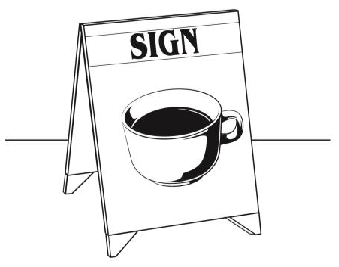
"Animated sign." Any sign that uses movement or change of lighting to depict action or create a special effect or scene.
"Awning, canopy, or marquee." Any structure made of metal or a flexible material covering a metal frame attached to a building, whether or not the same is so erected as to permit its being raised to a position flat against the building when not in use.
"Balloon sign." A flexible bag made of a material such as rubber, latex, polychloroprene, or a nylon fabric that is filled with a gas such as helium, hydrogen, nitrous oxide, or air. A balloon qualifies as a "sign" when it is larger than eight cubic feet in volume or is stationed at or above ten feet above the ground. See Figure 18.44.02 (Balloon Sign).
Figure 18.44.02 Balloon Sign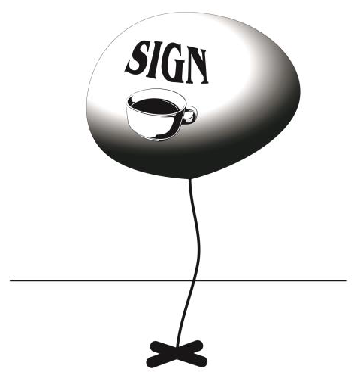
"Banner." A temporary sign (typically for grand openings or special events) composed of lightweight material either enclosed or not enclosed in a rigid frame, secured or mounted so as not to allow movement of the sign.
"Billboard." A sign which meets any one or more of the following criteria (also see off-site sign):
• A sign structure which is used for the display of off-site commercial messages.
• A sign structure which constitutes a principal, separate, or secondary use, as opposed to an accessory use, of the parcel on which it is located.
• An outdoor sign used as advertising for hire, e.g., on which display space is made available to parties other than the owner or operator of the sign or occupant of the parcel (not including those who rent space from the sign owner, when such space is on the same parcel or is the same development as the sign), in exchange for a rent, fee, or other consideration.
• An off-site outdoor advertising sign on which space is leased or rented.
"Blade sign." A small, pedestrian-oriented sign that hangs underneath an awning, canopy, or pedestrian overhang. Similar to an under-canopy sign. See Figure 18.44.14 (Under-Canopy Sign).
"Bracket sign." A small, pedestrian-oriented sign that projects perpendicular from a structure. See Figure 18.44.03 (Bracket Sign).
Figure 18.44.03 Bracket Sign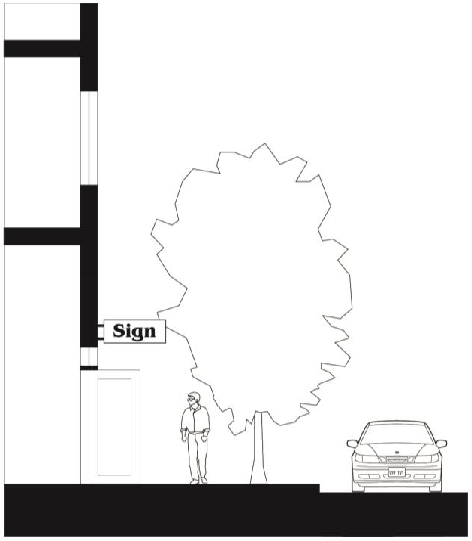
"Building-attached sign." A sign placed on a wall or canopy, projecting from a wall, or hung underneath a canopy or overhang structure, or placed in a window. This sign category includes wall signs, canopy signs, projecting signs/bracket signs, under-canopy signs/blade signs, and window signs as defined herein.
"Building frontage, primary." For the purposes of signage, refers to the building frontage that faces the street. In cases where a building has more than one street frontage, the longest of the street frontages shall be considered the primary building frontage. In cases where a business has no building frontage facing a street, the building frontage with the primary business entrance shall be considered the primary building frontage. For multi-tenant buildings, ground-floor tenants may have their primary frontage determined independently of the rest of the building based on the aforementioned rules.
"Building sign." A sign lettered to give the name of a building itself or the date constructed, as opposed to the name of occupants or services.
"Canopy sign." Any sign that is part of or attached to an awning, canopy, or other material, or structural protective cover (excluding a marquee) over a door, entrance, window, or outdoor service area.
"Can sign." A sign which contains all the text and/or logo symbols within a single enclosed cabinet that is mounted to a wall or other surface. It specifically does not include the sign cabinet that is part of a freestanding sign. See Figure 18.44.04 (Can Sign).
Figure 18.44.04 Can Sign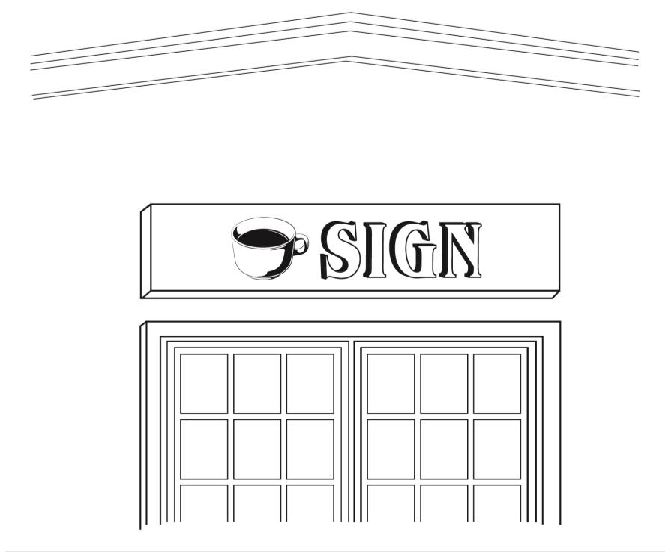
"Changeable copy sign." A sign or portion thereof with characters, letters, or illustrations that can be changed or rearranged manually without altering the face or surface of the sign. A sign on which the messages or characters change more than 12 times per day shall be considered an animated sign and not a changeable copy sign for purposes of this chapter.
"Channel letter sign." A type of sign comprising individual letters that are independently mounted to a wall or other surface with a covered face, where the "air space" between the letters is the building façade. A logo may also be considered a channel letter provided it is clearly distinguishable from other sign elements. See Figure 18.44.05 (Channel Letter Sign).
Figure 18.44.05 Channel Letter Sign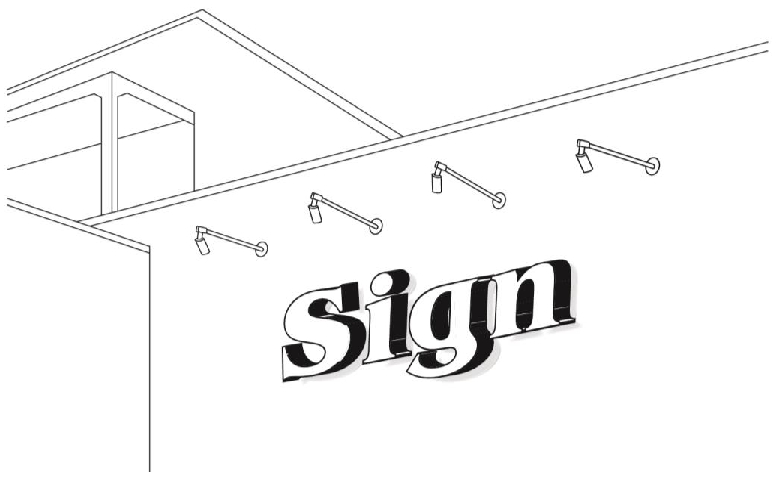
"Commercial message." Any sign, wording, logo, or other representation that names or advertises a business, product, service, or other commercial activity, primarily concerns the economic interest of the message sponsor or audience, or proposes a commercial transaction.
"Construction sign." A temporary sign mounted or displayed on the site of a construction project during the time when actual physical construction is ongoing.
"Copy." The words, letters, numbers, figures, designs, or other symbolic representations incorporated into the visually communicative elements of a sign.
"Digital display." Display methods utilizing light emitting diode (LED), liquid crystal display (LCD), plasma, projected images, or any functionally equivalent technology and which is capable of automated remote or computer control to change the image, either in a "slide show" manner (series of still images), or full motion animation, or any combination of them. Also known as dynamic signs and commercial electronic variable message signs (CEVMS).
"Digital sign." See electronic (digital) message sign.
"Directional sign." Any sign (building-attached or freestanding) intended to be permanently affixed and utilized only for the purpose of indicating the direction of any object, place, or area.
"Directory sign." A pedestrian-oriented sign that identifies or lists the names and locations of tenants at a multi-tenant site.
"Double-face sign." A single sign structure with two parallel sign faces back to back.
"Electronic (digital) message sign." A sign whose primary advertising focus is the intermittent display, stream, or movement of electronic, computerized, digital, or similarly produced letters, numerals, words, or messages as part of the advertising message. An electronic message sign is different from an illuminated sign in that the illumination of the display creates the message, rather than an internal or external light source illuminating the message.
"Figurative sign." A sign that comprises a three-dimensional object that graphically or iconically brands an establishment or development (e.g., provides a representational message rather text messages). Such signs may be used as either building-attached or freestanding signs. See Figure 18.44.06 (Figurative Sign).
Figure 18.44.06 Figurative Sign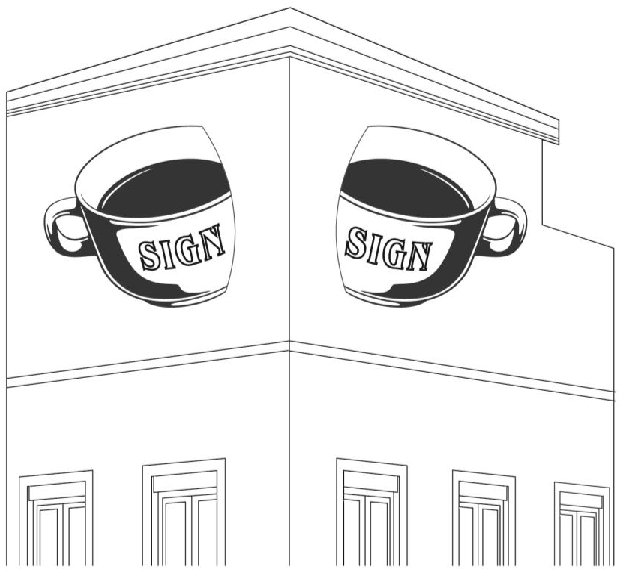
"Flag." Any fabric, banner, or bunting containing distinctive colors, patterns, or design that displays the symbol(s) of a nation, state, local government, company, organization, belief system, idea, or other meaning.
"Flashing sign." An illuminated sign that exhibits changing light or color effect by blinking or any other such means so as to provide non-constant illumination.
"Freestanding sign." A permanent sign that is self-supporting in a fixed location and not attached to a building. A freestanding sign can be connected or attached to a sign structure, fence, or wall that is not an integral part of a building. Freestanding signs include, but are not limited to, monument/pylon signs and pole signs as defined in this section.
"Garage, yard, estate, and other home-based sales signs." Signs advertising the occasional non-business public sale of secondhand household and other goods incidental to household uses by a person or persons from a residential use.
"Gas pricing sign." A sign identifying the brand, types, octane rating, etc., of gasoline for sale, as required by state law.
"Governmental/civic sign." Any temporary or permanent sign erected and maintained by or required by the city or by the city, state, or federal government for the purpose of providing official governmental information to the general public, including, but not limited to, traffic direction, city entrance, or designation of direction to any school, hospital, historical site, or public service, property, or facility.
"Highway-oriented sign." A sign located on property which is adjacent to a highway and meant to be seen from the highway.
"Illegal sign." Any sign or advertising statuary which was not lawfully erected or maintained, or was not in conformance with the ordinance in effect at the time of the erection of the sign or advertising statuary, or which was not installed with a valid permit from the city.
"Illuminated sign." A sign with an artificial light source incorporated internally or externally for the purpose of illuminating the sign. This includes signs made from neon or other gas tube(s) that are bent to form letters, symbols, or other shapes.
"Incidental sign." A sign, emblem, or decal informing the public of goods, facilities, or services available on the premises, including but not limited to restrooms, phones, credit cards, or hours of business.
"Individual business." A freestanding development that is not considered to be part of an integrated development. See Figure 18.44.07 (Integrated Development, Tenant, and Individual Business).
"Inflatable sign." Any sign which is inflated, floats, is tethered in the air, or is activated by air or moving gas, whether located in the air, on the ground, or on a building.
"Integrated development." A development consisting of three or more separate tenants/uses that share structures, public spaces, landscape, and/or parking facilities.
Figure 18.44.07 Integrated Development, Tenant, and Individual Business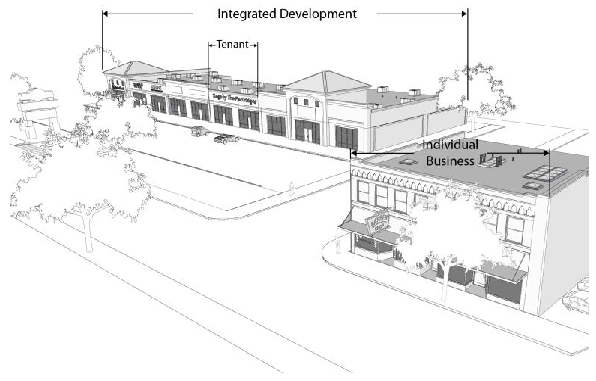
"Interior sign." A sign displayed in any fashion within a business or residence, as long as such sign meets this code's definition of an interior sign (one which is not displayed so as to be viewed from any public space).
"Legal nonconforming sign." A sign lawfully erected and legally existing at the time of the effective date of an ordinance, but which does not conform to the provisions of this chapter.
"Marquee." Any permanent roof-like structure projecting beyond a building or extending along and projecting beyond the wall of the building for a distance of five or more feet, generally designed and constructed to provide protection from the weather.
"Marquee sign." Any sign attached to, in any manner, or made a part of a marquee. See Figure 18.44.08 (Marquee Sign).
Figure 18.44.08 Marquee Sign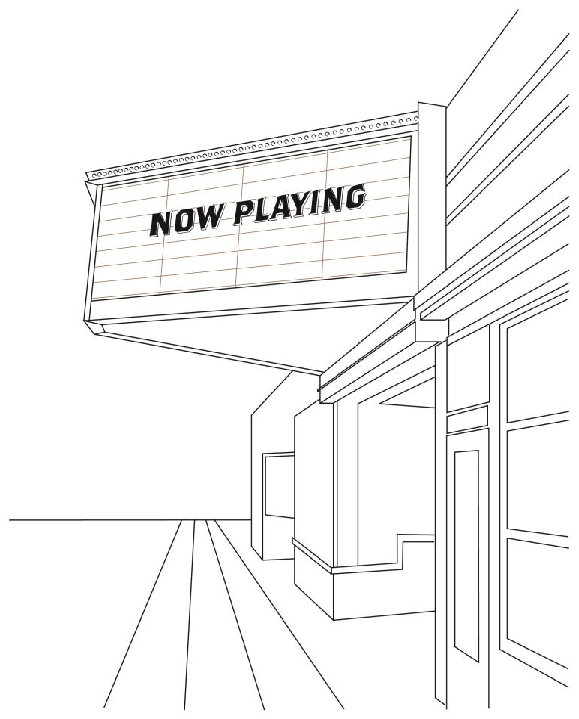
"Mobile billboard sign." An off-site, outdoor advertising sign on which space is leased or rented and is attached to a wheeled, mobile, non-motorized vehicle that carries, pulls, or transports a sign or billboard. A vehicle which advertises the company of its primary use is not considered a mobile billboard.
"Monument sign." A freestanding sign detached from a building and having a support structure that is a solid-appearing, contiguous structural base constructed of a permanent material, such as concrete block or brick. This sign type also includes multi-tenant signs as shown in Figure 18.44.09 (Monument Sign).
Figure 18.44.09 Monument Sign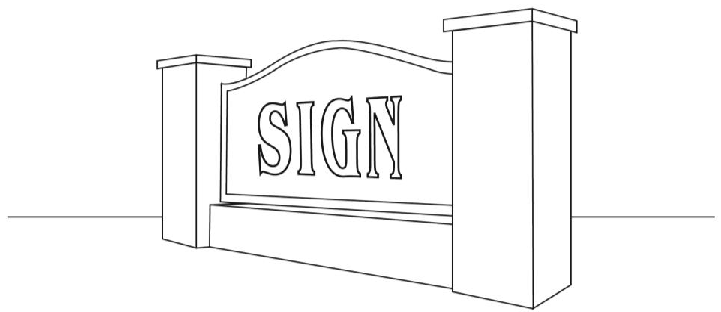
"Mural." A painted or otherwise attached or adhered image or representation on the exterior of a structure that is visible from a public right-of-way or neighboring property, does not contain commercial advertisement (is noncommercial in nature), and is designed in a manner so as to serve as public art, to enhance public space, and to provide inspiration.
"Nameplate." A sign attached to a wall that identifies the occupant.
"Noncommercial message." A message that addresses topics of public debate and concern.
"Nonstructural trim." The molding, battens, caps, nailing strips, latticing, cutouts, or letters which are attached to the sign structure.
"Off-site" or "off-premise sign." A sign that directs attention to a business, profession, commodity, service, or entertainment conducted, sold, or offered at a location other than where the sign is located. This definition shall include billboards, posters, panels, painted bulletins, and similar advertising displays. An off-site sign meets any one of the following criteria and includes only commercial messages:
• A permanent structure sign which is used for the display of off-site commercial messages.
• A permanent structure which constitutes a principal, separate, or secondary use, as opposed to an accessory use, of the parcel on which it is located.
• An outdoor sign used as advertising for hire, e.g., on which display space is made available to parties other than the owner or operator of the sign or occupant of the parcel (not including those who rent space from the sign owner, when such space is on the same parcel or is the same development as the sign), in exchange for a rent, fee, or other consideration.
"On-site" or "on-premise sign." A sign which directs attention to a business, profession, commodity, service, or entertainment conducted, sold, or offered upon the lot or parcel on which the sign is placed. In the case of multiple-tenant commercial or industrial development, a sign is considered on-site whenever it is located anywhere within the development.
"Painted sign." A sign that comprises only paint applied on a building or structure.
"Pennant." Any lightweight plastic, fabric, or other material, whether or not containing a message of any kind, attached to a rope, wire, or string, usually in a series, designed to move in the wind and attract attention.
"Permanent display case." A case or cabinet constructed of durable, permanent materials such as metal, plastic, and glass, used to display commercial messaging.
"Permanent sign." A sign that is entirely constructed of durable materials and is intended to exist for the duration of time that the use or occupant is located in the premises.
"Pole sign." An on-site freestanding sign, supported by a sign structure from the ground, which identifies businesses located on the same parcel or in the same development on which the sign is located. Generally, pole signs are supported by one or more metal or wood posts, pipes, or other vertical supports. The support structure is not integrated into the overall design of the sign. See Figure 18.44.10 (Pole Sign).
Figure 18.44.10 Pole Sign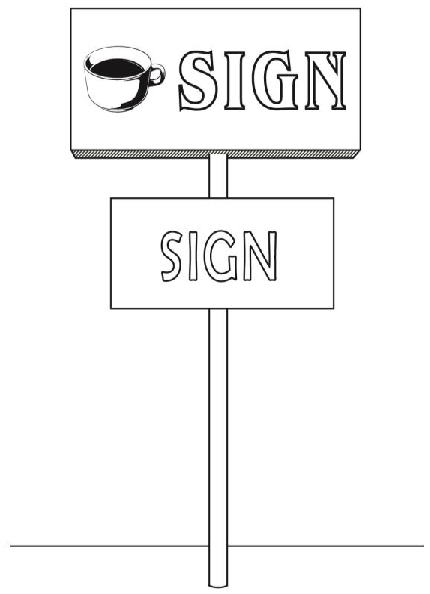
"Portable sign." Any sign not permanently attached to the ground or other permanent structure, or a sign designed to be transported. Portable signs include, but are not limited to, signs designed to be transported by means of wheels, A-frame signs, menu and sandwich board signs, and umbrellas used for advertising. Clothing or other aspects of personal appearance are not within this definition.
"Projecting sign." A sign attached to and extending outward from the face of a structure. Includes, but is not limited to, a blade/bracket sign or a marquee sign.
"Push pin letter sign." A sign made up of individual letters that are independently mounted to a wall or other surface. Such sign may be illuminated by an external light source, such as pendant lighting, where the "air space" between the letters is not part of the sign structure but rather the building façade. See Figure 18.44.11 (Push Pin Letter Sign).
Figure 18.44.11 Push Pin Letter Sign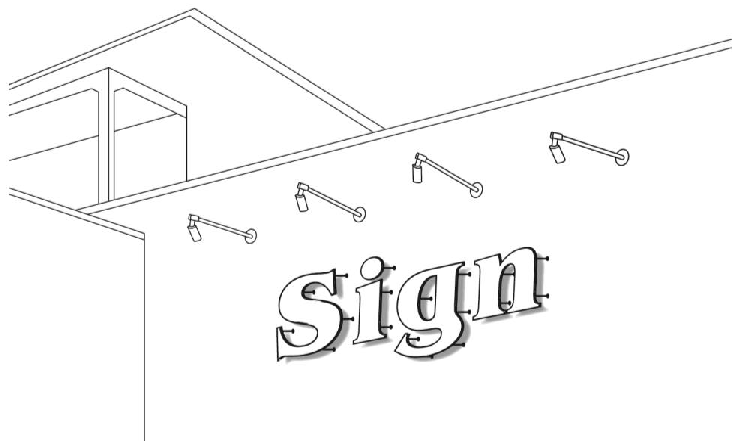
"Pylon sign." A freestanding sign detached from a building where the sign face is usually over six feet high and separated from ground level by one or more concealed supports such as poles, pole covers, or columns. See Figure 18.44.12 (Pylon Sign).
Figure 18.44.12 Pylon Sign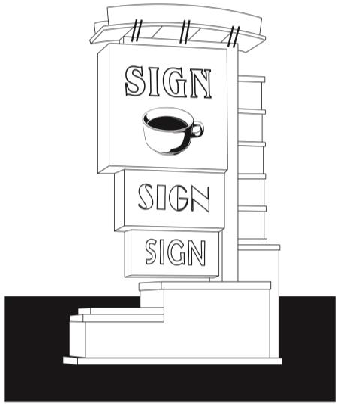
"Real estate sign." Any temporary sign advertising the sale or lease of the property upon which it is located. The sign may include the identification and contact information of the person and/or company handling such sale, lease, or rent. This definition does not include occupancy signs at establishments offering transient occupancy, such as hotels and motels.
"Reverse channel letter sign." A sign comprising individual letters that are independently mounted to a wall or other surface, with lights mounted behind the letters that face the wall behind. Lights illuminate the space around the channel letters rather than the channel letters themselves, creating a "reverse" lighting effect (e.g., halo effect). The "air space" between the letters is not part of the sign structure but rather is part of the building façade. See Figure 18.44.13 (Reverse Channel Letter Sign).
Figure 18.44.13 Reverse Channel Letter Sign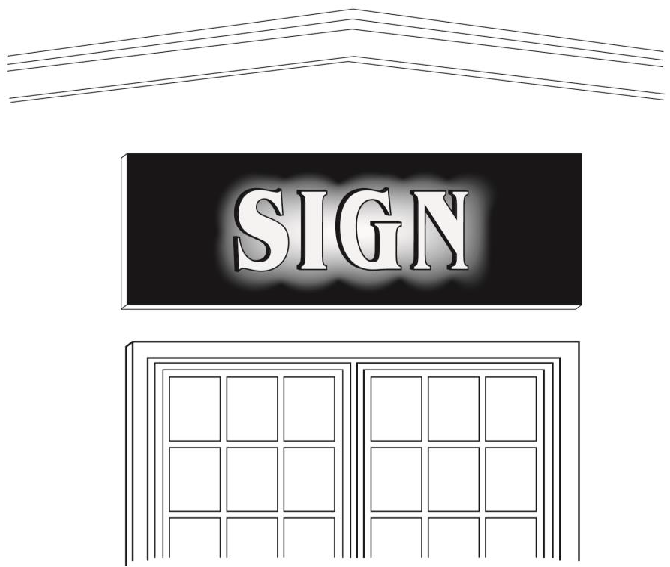
"Roof sign." A sign placed upon, projecting from, or above the eaves of the roof or the roof itself. A sign hanging from and below a roof eave is not a roof sign.
"Sign." Any medium, including its structure and component parts in view of the general public, which is used to attract attention for advertising or identifying purposes.
"Sign face." That area or portion of a sign on which copy is intended to be placed.
"Sign structure." Any structure which supports or is capable of supporting any sign as defined in this chapter. A sign structure may or may not be an integral part of the building.
"Temporary sign." A structure or device used for the public display of visual messages or images, which is easily installed with common hand tools or without tools, and which is not intended for or suitable for long-term or permanent display, due to the lightweight or flimsy construction materials. Examples include, but are not limited to, A-frame signs, banners, pennants, streamers, or similar nonpermanent sign made of paper, cloth, canvas, lightweight fabric, or other nonrigid material, with or without frames.
"Tenant." An independent business that is part of an integrated development. See Figure 18.44.07 (Integrated Development, Tenant, and Individual Business).
"Under-canopy sign." A pedestrian-oriented sign hung from underneath an awning, canopy, or overhang structure/breezeway. See Figure 18.44.14 (Under-Canopy Sign).
Figure 18.44.14 Under-Canopy Sign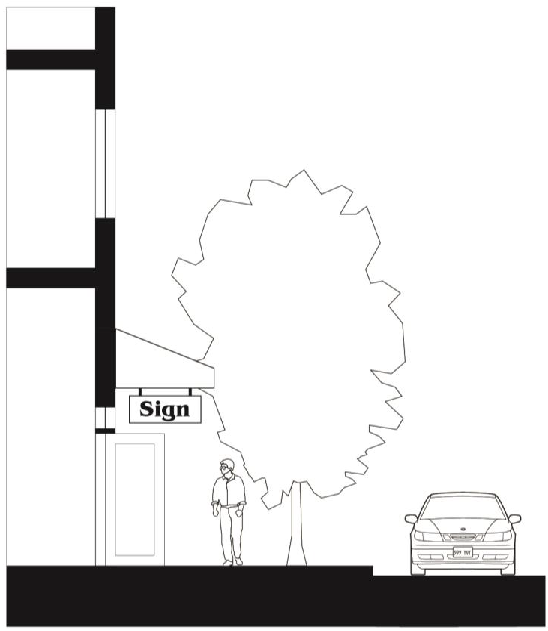
"Vehicle sign." A sign that is attached to and is an integral part of a motorized vehicle or bicycle used directly for the purpose of a particular business and not used primarily as a sign base or for general advertising.
"Wall sign." A sign attached directly to an exterior wall of a building or dependent on a building for support, with the exposed face of the sign located in such a way as to be substantially parallel to such exterior building wall to which it is attached or is supported by, and which does not extend above the roof, parapet, building façade, or any outermost edge of the building or structure.
"Window sign." Any sign, picture, letter, character, or combination thereof, designed to communicate information about an activity, business, commodity, event, sale, or service that is placed on and/or inside and/or within three feet of a window for the purpose of being visible from the exterior of the window.
(Ord. No. 743, § 3, 3-21-2017)
18.44.030 - Sign policies.
Except as otherwise specifically noted herein, the following requirements shall apply to all signage in all areas of the city:
A.
Regulatory Interpretations. The requirements of this chapter shall not be interpreted to nullify any easements, covenants, or other private agreements that provide more restrictive sign regulations than required by this chapter.
B.
Message Neutrality. In adopting this chapter, the city intends to regulate signs within the scope of this chapter in a way that does not favor commercial speech over noncommercial speech and does not regulate noncommercial speech based on message content. The message of any sign shall not be reviewed except to the minimum extent necessary to identify the type of sign.
C.
Message Substitution. Subject to the property owner's consent, a constitutionally protected noncommercial message of any type may be substituted in whole or in part for the message displayed on any sign for which the sign structure or mounting device is authorized in compliance with this chapter, without consideration of message content. Such substitution of message may be made without any additional approval or permitting. This provision is to prevent any inadvertent favoring of commercial speech over noncommercial speech or favoring of any particular protected noncommercial message over any other protected noncommercial message. In addition, any on-site commercial message may be substituted, in whole or in part, for any other on-site commercial message, provided the sign structure or mounting device is authorized in compliance with this chapter, without consideration of message content.
This provision does not create a right to increase the total amount of signage on a parcel, lot, or land use; does not affect the requirement that a sign structure or mounting device be properly permitted; does not allow a change in the physical structure of a sign or its mounting device or location; does not allow the substitution of an off-site commercial message in the place of an on-site commercial or noncommercial message; and does not authorize the conversion of an existing sign to general advertising for hire.
D.
On/Off-Site Distinction. In this chapter, the distinction between on-site and off-site applies only to commercial messages. Off-site non-commercial messages are allowed consistent with Sections 18.44.050 (Exempt Signs), 18.44.100 (Allowed Off-Site Sign Regulations), and 18.44.130 (Signs on City Property).
E.
General Prohibition. Permanent signs not expressly allowed by this chapter are prohibited.
F.
Exceptions to Limitations. Any exception to the limitations and/or sign development standards stated or shown in this chapter shall require a variance in compliance with Section 18.80 (Variance). However, consideration of the variance request shall not evaluate the message or graphic design of the sign.
G.
Indecent or Obscene Matter. To the extent allowed, indecent or obscene matter will be addressed in accordance with state law.
(Ord. No. 743, § 3, 3-21-2017)
18.44.040 - Permit requirements and review procedures.
This Section describes permit requirements and review procedures applicable to all signage in all areas of the city. Signs proposed within communities that have City-adopted local sign standards or guidelines shall conform to those standards/guidelines.
A.
Sign Permit Required. Sign permits shall be required for specified types of permanent signs prior to erection, relocation, alteration, or replacement, as listed in Table 18.44.03 (Allowed Permanent On-Site Signs by Land Use Type), unless otherwise exempted by this chapter.
1.
No planning approvals shall be required for general maintenance of existing conforming signs or replacement of a conforming sign face (including message) when the area of the sign is not being changed, subject to Section 18.44.070 (General Sign Standards).
2.
Sign permit(s) shall be required as part of the review of any discretionary application that includes proposed signage. The sign permit shall be in addition to the discretionary application or permit.
3.
Sign permits are not required for the display of temporary signs. However, temporary signs shall be consistent with the development standards and time duration limits established in this chapter.
B.
Uniform Sign Program Required. A uniform sign program shall be required for all new multi-tenant shopping centers, office parks, and other multi-tenant, mixed-use, or otherwise integrated developments of three or more separate tenants/uses that share structures, public spaces, landscape, and/or parking facilities. A uniform sign program provides a process for the city's review of, and decisions related to, requests for signs for multi-tenant projects. The uniform sign program allows the integration of a project's signs with the design of the structures to achieve a unified architectural statement and to approve common sign regulations for multi-tenant projects. The development services director is the decision-making authority for uniform sign programs. However, if part of an application is reviewed and decided by the planning commission or the city council, the uniform sign program shall be decided by same higher-level approving authority in conjunction with other entitlements. Deviations from the sign standards of this chapter of up to ten percent over maximum allowance are allowed through the uniform sign program. At a minimum, the uniform sign program shall include the type, number, size, location/placement, and general design parameters of all permanent building-attached and freestanding signs. Modifications to any uniform sign program shall be made in the same manner as the original approval. In order to approve a uniform sign program, the approving authority shall make all of the following findings.
1.
The proposed uniform sign program is consistent with the objectives of the general plan.
2.
The proposed uniform sign program is consistent with all adopted specific plans, master plans, and design guidelines applicable to the project.
3.
The proposed uniform sign program establishes a unified design theme for all permanent building-attached and freestanding signs within the project.
4.
The proposed deviations from the sign standards of this chapter contribute to the character and vitality of the project and do not negatively impact surrounding properties.
C.
Creative Sign Program Required. A creative sign program provides a mechanism that is available for the benefit of property owners and businesses to request deviation from the sign standards in this chapter for creative or unique signs that do not meet all of the specified standards in this chapter. A creative sign program is a discretionary entitlement decided by the planning commission which allows an applicant to request up to a maximum of 20 percent deviation from the specified sign standards in this chapter. Modifications to any creative sign program shall be made in the same manner as the original approval. In order to approve a creative sign program, the approving authority shall make all of the following findings.
1.
The proposed creative sign program is consistent with the objectives of the general plan.
2.
The proposed creative sign program is consistent with all adopted specific plans, master plans, and design guidelines applicable to the project.
3.
The proposed creative sign program establishes unique project signage that exhibits a high degree of imagination and visual interest, which contribute positively to the visual character of the community.
4.
The proposed deviations from the sign standards of this chapter contribute to the character and vitality of the project and do not negatively impact surrounding properties.
D.
Community Sign Program Required. The city council is the decision-making authority for all new community sign programs. All decisions of the city council are final. Three types of community sign programs are outlined below.
1.
Community Directional Sign Program. Said program shall establish directional wayfinding signs as off-site signs on public streets or public rights-of-way to encourage, facilitate, and assist visitors and residents to find points of interest, recreational and historical areas, parks, neighborhoods, lodging, and tourist industries in the city (e.g., subdivision directional signs, downtown district wayfinding signs).
2.
Community Identification Sign Program. Said program shall establish a means for individual communities within the city to designate the community's name at main point(s) of entry to the community. Such signage can be unique to each community as a means to define its character, quality, or historic contribution to the city (e.g., district or neighborhood identity signs).
3.
Community Event Sign Program. Said program shall establish general standards for both promoting and informing the public of special events within the individual communities or the city as a whole (e.g., service club signs, public parade, event signs).
E.
Highway-Oriented Sign Permit. A highway-oriented sign permit shall be required for all highway-oriented signs located within 100 feet of a designated state highway. This permit would allow consideration of freestanding signs taller and larger than otherwise permitted by this chapter and would be in addition to other permanent on-site freestanding signs allowed pursuant to Table 18.44.03 (Allowed Permanent On-Site Signs by Land Use Type). The highway-oriented sign permit also allows for the consolidation of commercial messages for businesses in a designated area proximate to the highway to collocate one or more freestanding signs for maximum highway visibility and minimal aesthetic impact. The city council is the decision-making authority for highway-oriented sign permits. All decisions of the city council are final and not subject to appeal.
(Ord. No. 743, § 3, 3-21-2017)
18.44.050 - Exempt signs.
The following sign types are expressly exempted from the permit requirements of this chapter but must satisfy any and all other applicable permit requirements when applicable (e.g., building, electrical, plumbing, grading, encroachment). These exemptions shall apply in all areas of the city.
A.
Exempt Signs Without Limitations. The following signs are exempt from sign permit requirements with no specific limitations.
1.
Conforming signs that change messages, but do not alter size, location, or illumination. This provision does not authorize the conversion of an existing legal sign to a general advertising for hire use or to a digital display.
2.
All devices which are excluded from the definition of a "sign" as set forth in this chapter.
3.
Official traffic signs or other municipal governmental signs, legal notices, advertisements, and notices prescribed by law and placed by governmental entities, and signs indicating the location of buried utility lines or any notice posted by a governmental officer in the scope of his or her duties.
4.
Direction, warning, or information signs or structures required or authorized by law, or by federal, state, county, or city authority, including, but not limited to, traffic control signs (e.g., stop, yield), railroad crossing signs, highway route number signs, and construction zone or site signs.
5.
Noncommercial utility company signs identifying cables, conduits, and dangerous situations.
6.
Holiday decorations.
7.
Street address signs on structures and building identification signs consistent with the city-adopted building code or relevant provisions of this Code. Notwithstanding anything in this section, street address signs may be illuminated and may contain reflective paint or material.
8.
Tablets and plaques installed by the city, or by a state, federal, or city recognized historical organization exempt from federal taxation under Section 501 of United States Code Title 26 (IRS Code) including names of structures and date of erection, or signs authorized and installed by city, state, or federal agencies on publicly owned lands.
9.
Gas pricing signs, as required by state law, which identify the brand, types, octane rating, etc., of gasoline for sale within the city (Sections 13530—13540 of the Business and Professions Code). This does not limit the approval and design requirement for permanent or temporary placement and approval provisions listed herein.
10.
Signs on currently registered and operable vehicles and vessels, including license plates, license plate frames, registration insignia, noncommercial messages, messages relating to the establishment for which the vehicle or vessel is an instrument or tool (not including general advertising, such as mobile billboard), and messages relating to the proposed sale, lease, or exchange of the vehicle or vessel.
11.
Signs and advertising located on buses and bus shelters.
12.
Murals on nonresidential structures.
B.
Exempt Signs with Limitations. The following sign types are expressly exempted from the permit requirements of this chapter but must meet the size, height, duration, and/or maximum number limitations listed below and satisfy any and all other applicable permit requirements (e.g., building, electrical, plumbing, grading, encroachment):
1.
A-frame, sandwich board, or similar portable signs, subject to the following:
a.
Maximum of one sign per tenant space.
b.
Maximum sign area of six square feet and a maximum height of three feet, measured from the ground to the top of the sign structure.
c.
A-frame signs are allowed in any front yard, foyer, portico, or other building entry provided they do not interfere with required pedestrian access, ingress, and egress.
d.
A-frame signs shall be placed at least five feet behind the face of curb and outside of the city right-of-way. Where there is no sidewalk or curb, A-frame signs shall be located outside of the city right-of-way.
e.
A-frame signs shall not be placed where they may obstruct vision or create other public safety hazards. A-frame signs shall comply with clearance rules under the Americans with Disabilities Act.
f.
A-frame signs may be placed in the visibility triangle area depicted below, provided they are less than three feet in height.
g.
A-frame signs may not be illuminated.
h.
A-frame signs shall be removed during all times when the business establishment is closed.
2.
Window signs that do not exceed 25 percent coverage of any window. Window signs do not count toward cumulative allowable sign area. This limitation is considered industry best practice for natural surveillance that serves to increase the risk of detection for offenders, enable evasive actions by potential victims, and facilitate intervention by police (crime prevention through environmental design and defensible space). As such, window signs that exceed 25 percent of any window are not allowed.
3.
Flags, not subject to the standards set forth in Section 18.44.080 (Allowed On-Site Sign Regulations), meeting the following requirements:
a.
Flag poles shall be located outside of the public right-of-way.
i.
The maximum height for flag poles is 30 feet.
ii.
The maximum size for any one flag is 30 square feet.
4.
Signs on property undergoing construction or remodeling not exceeding 32 square feet each in area and limited to one sign for each street frontage. Such signs shall not be illuminated. Such signs shall be removed within 30 days of the earliest of the following events: final building inspection approval, issuance of a valid certificate of occupancy, opening for business to the public, or expiration of the building permit.
5.
Signs warning against trespass on the premises not to exceed two square feet per sign.
6.
Signs on property that is currently offered for sale, lease, or rental:
a.
On residential zoned property, one sign not exceeding six square feet per face and not exceeding a height of five feet, exclusive of support structures. On weekends and holidays, up to four signs to direct traffic to the subject property are allowed, provided each sign does not exceed six square feet in area and three and one-half feet in height. A sign shall not be placed on a sidewalk, street, or public right-of-way. A sign shall not create a safety hazard. Such signs shall not be illuminated.
b.
On nonresidential zoned property, one sign per street or road frontage, not exceeding 32 square feet in area per face and 12 feet in height. The sign shall not be illuminated.
7.
Signs on private property where there is a garage, yard, or estate sale taking place. Such signs may be posted for no more than 48 hours and must be removed at the end of the sale. A maximum of six square feet is allowed per sign.
8.
On-site directional and parking signs, such as exit, entrance, or other on-site traffic directional signs. The maximum height of any directional sign shall not exceed three and one-half feet and the maximum size shall not exceed six square feet. No advertising or message other than for traffic direction shall be displayed on the signs authorized by this subsection.
9.
Professional nameplates and occupational signs denoting only the name and occupation of an occupant in a commercial or public institutional building, not to exceed three square feet in area. Signs may be externally illuminated only.
10.
Identification nameplates or signs on apartment houses, boardinghouses, rooming houses, or similar uses, not to exceed two square feet in area. Signs may be externally illuminated only.
11.
Temporary signs displaying noncommercial messages subject to:
a.
A maximum of six square feet of signage per sign, set back at least five feet from the public right-of-way, and not projecting above the roofline of any structure.
b.
During the time period beginning 90 days before a special, general, or primary election and ending three weeks after such election, the total allowed sign area for noncommercial messages may be 32 square feet in area. The same setback and height restrictions listed above shall apply to this additional area.
i.
Such signs shall not be posted on any private utility property or public property, including, but not limited to, streets, traffic signs and poles, sidewalks, parkways, medians, city parks, and trees.
ii.
Such signs shall not be located within 100 feet of a polling place, in accordance with the California Elections Code.
iii.
Such signs shall not be posted without prior written approval of the property owner.
iv.
Such signs shall not be illuminated.
12.
Home occupation signs in any residential zone for businesses with a current, valid business license are allowed a maximum sign area of three square feet. Signs shall be not be illuminated.
13.
Temporary Promotional Signs. Temporary promotional signs include, but are not limited to, commercial signs advertising a special product, sale, or event. See additional temporary sign allowance for business transitions in subsequent subsection (B)(14). Temporary promotional signs are allowed by right consistent with the following limitations:
a.
Banners made of paper, cloth, canvas, lightweight fabric, or other nonrigid material, with or without frames, may be permitted. Such signs must be adequately anchored and composed of materials durable enough to withstand exposure to the elements.
b.
Display periods for temporary promotional signs shall be limited to a maximum of 90 days per calendar year.
c.
Temporary promotional signs may be displayed in windows, attached to a building façade, or mounted in a permanent display case.
d.
A maximum of two signs are allowed with a maximum combined area consistent with the standards in Table 18.44.01 (Temporary Promotional Sign Standards).
Table Notes:
1.
Window signs are not included in the maximum allowable sign area above. Window signs fall under exempt signs with limitations (see subsection (B)).
e.
Temporary promotional signs may not be illuminated.
14.
Temporary Business Transition Signs. Temporary business transition signs include, but are not limited to, commercial signs for grand openings, change of ownership, or going out of business. Temporary business transition signs are allowed by right consistent with the following limitations:
a.
Banners, pennants, streamers, or similar nonpermanent signs made of paper, cloth, canvas, lightweight fabric, or other nonrigid material, with or without frames, may be permitted. Such signs must be adequately anchored and composed of materials durable enough to withstand exposure to the elements.
b.
Display periods for temporary business transition signs shall be limited to a cumulative maximum of 45 days per calendar year, either consecutive or intermittent.
c.
Temporary signs displaying a commercial message shall be limited to on-site signage only. Temporary off-site signage displaying a commercial message is prohibited.
d.
Temporary business transition signs shall not encroach on or above the public right-of-way or be attached to utility poles.
e.
A maximum of two building-attached signs are allowed with a maximum combined area consistent with the standards in Table 18.44.02 (Temporary Business Transition Sign Standards).
Table Notes:
1.
Window signs are not included in the maximum allowable sign area above. Window signs fall under exempt signs with limitations (see subsection (B)).
f.
Temporary business transition signs may not be illuminated.
(Ord. No. 743, § 3, 3-21-2017)
18.44.060 - Prohibited signs.
A.
General Prohibition. All off-site commercial signage on private property is prohibited unless otherwise allowed in this chapter. Existing off-site signs (e.g., billboards) are considered nonconforming signs as regulated by Section 18.44.120 (Illegal, Abandoned, and Nonconforming Signs). Off-site signs on city property are regulated by Section 18.44.320 (Signs on City Property).
B.
The signs listed in this section are prohibited in all zones. Except as otherwise specifically noted herein, these prohibitions apply in all areas of the city.
1.
Any sign not specifically allowed by this chapter.
2.
Billboards as defined herein. This does not prohibit relocation agreements as authorized by state law (California Business and Professions Code Section 5412).
3.
Roof signs or signs placed above the roofline.
4.
Animated, flashing, scrolling, digital, or video screen signs except time and temperature signs.
5.
Revolving signs.
6.
Signs placed on the public right-of-way or affixed to an element or structure on the public right-of-way, or located on a publicly owned tree, fence, or utility pole or otherwise posted on public property, except where required by a governmental agency.
7.
Inflatable balloon signs, including, but not limited to, individual balloons, balloon strings, and other inflatable objects made of a flexible material and inflated so as to be lighter than air.
8.
Signs painted on a fence or freestanding wall.
9.
Mobile billboards advertising displays traversing or parked on a public right-of-way for the primary purpose of advertising.
10.
Signs attached to light standards (poles), traffic control devices, or utility poles.
11.
Signs affixed to a structure or property not owned by the person or entity installing the signs, unless authorized by the written consent of the owner of the structure or property. For purposes of this provision, "owner" means any person or entity holding the immediate right of possession and control.
12.
Off-site signs, except as otherwise permitted by this chapter.
13.
Signs that are dilapidated, abandoned, or in disrepair or dangerous condition.
14.
Window signs that exceed 25 percent of any window.
(Ord. No. 743, § 3, 3-21-2017)
18.44.070 - General sign standards.
This section establishes standards for sign development and design, including, but not limited to, methods for measuring sign size, area and height, sign placement, construction, design, illumination, maintenance, and removal. Unless otherwise specified in this section, sign development and design standards shall apply to all signs in all areas of the city.
A.
General Sign Design Requirements for Permanent Signs. Permanent signs shall comply with the following general design requirements as well as design standards applicable to specific types of signs listed in Section 18.44.110 (Special Standards by Sign Type):
1.
Design Compatibility with Structure. Signs shall be compatible in architectural scale and bulk with the architectural style of the main structure or structures on the site where the sign is located. The applicant shall incorporate construction materials, color, letter style, and other design details in designing an architecturally compatible sign. Multiple signs on any structure, or on structures within the same development, shall have the same primary type of building-attached sign.
2.
Sign Illumination. The artificial illumination of signs, from either an internal or external source, shall be designed to prevent the casting of stray light on surrounding rights-of-way and properties. All illuminated signs shall comply with the following:
a.
External light sources shall be directed toward the sign and fully shielded to limit direct illumination of any object other than the sign.
b.
The light from an illuminated sign shall not be of an intensity or brightness that creates glare or other negative impacts on any street, alley, driveway, sidewalk, parking area, or adjacent residential property, nor into the eyes of any motorist or pedestrian.
c.
Unless otherwise allowed by another provision of this chapter, signs shall not have blinking, flashing, or intermittent lights or other illumination devices that have a changing light intensity, brightness, or color.
d.
Colored lights shall not be used at a location or in a manner so as to be confused or interpreted as traffic control devices.
e.
Light sources shall utilize energy-efficient fixtures compliant with Title 24 of the California Code of Regulations.
f.
Illuminated signs shall be permitted to be illuminated at any time unless the sign identifies a business within, or adjacent to, a residential zone. In such case, the business is required to turn off its sign(s) within two hours after the business is closed.
B.
Calculating the Area of Signs.
1.
General Area Calculation. Generally, the area of a sign shall be measured as the overall length of the sign multiplied by the overall height of each segment of copy or logo inclusive of background. Generally, all sides of a multisided sign will be included in the total area calculations; however, for double-faced (two-sided) freestanding signs, only one side of the sign shall be used to determine sign area. See Figure 18.44.15 (General Sign Area Measurement).
Figure 18.44.15 General Sign Area Measurement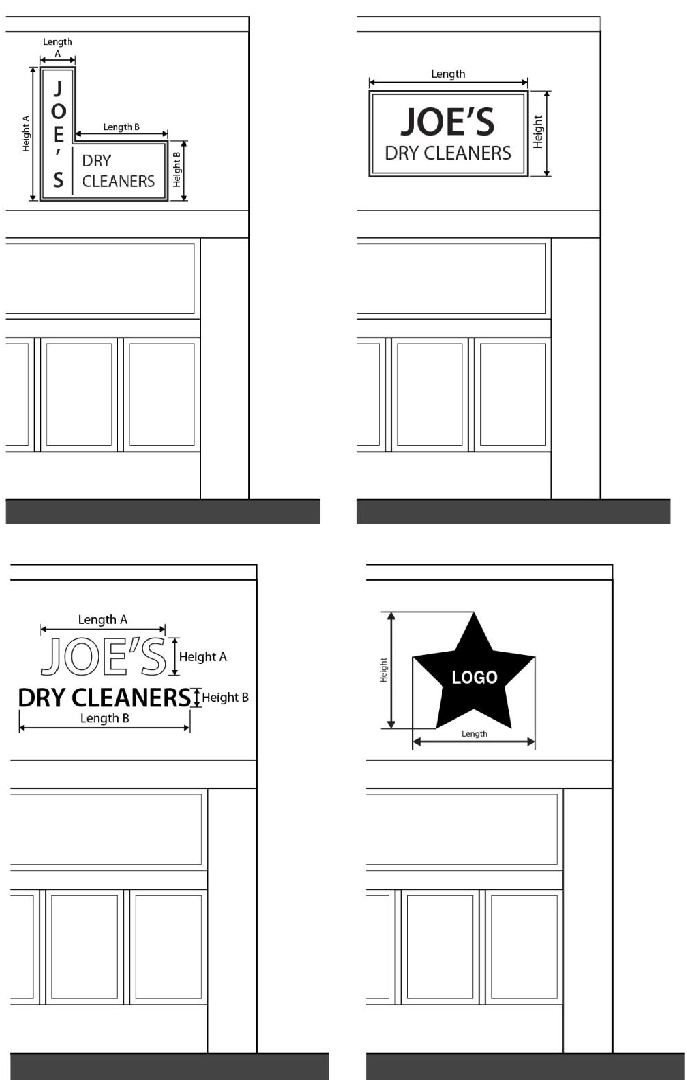
2.
Awning, Canopy, Push Pin, and Channel Letter Sign Area. Sign area for copy which is applied to an awning, canopy, or as separate lettering onto the building face shall be computed at 100 percent of the area within a single rectangle enveloping the sign copy. See Figure 18.44.16 (Awning or Canopy Sign Area).
Figure 18.44.16 Awning or Canopy Sign Area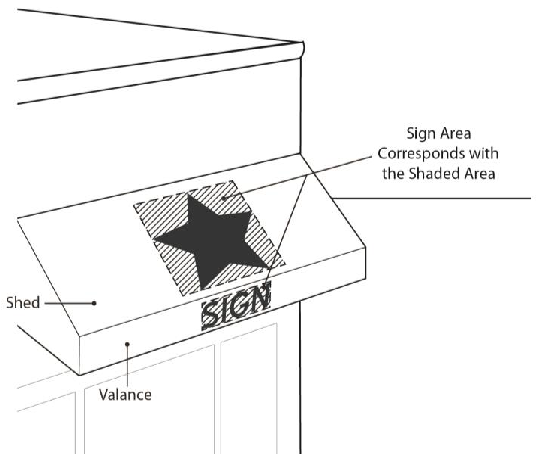
3.
Freestanding Signs. Freestanding signs are to be computed as total height by the total length of the sign excluding framework (e.g., post, masonry column, or beam). The base of a monument sign is not part of the sign. See Figure 18.44.17 (Freestanding Sign Area). For double-faced (two-sided) freestanding signs, only one side of the sign shall be used to determine sign area.
Figure 18.44.17 Freestanding Sign Area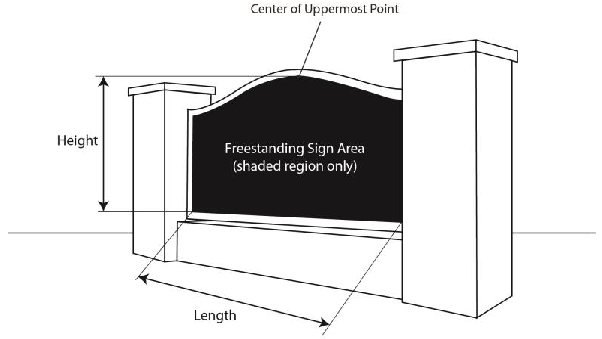
4.
Three-Dimensional Objects. Where a sign consists of one or more three-dimensional objects (e.g., balls, cubes, clusters of objects, sculptures, or statue-like trademarks), the sign area shall be measured at the maximum projection upon a vertical plane, as viewed from a position in the public right-of-way which produces the largest visual projection. See Figure 18.44.18 (Area of Three-Dimensional Objects).
Figure 18.44.18 Area of Three-Dimensional Objects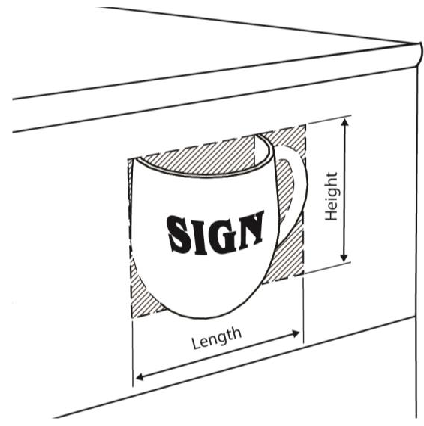
C.
Calculating the Height of Signs. Sign height shall be measured by using the vertical distance from the uppermost point used in measuring the area of a sign to the ground (existing grade) immediately below such point. The height of a monument sign (freestanding/detached) shall be measured according to the method above or from the center of the uppermost point of the sign to the ground (existing grade) immediately below such point, whichever is higher.
D.
Construction Requirements. Every sign and all parts, portions, and materials thereof shall be manufactured, assembled, and erected in compliance with all applicable state, federal, and city laws and regulations, including the city's adopted building code. All signs shall comply with the following criteria:
1.
All permanent signs shall be safely and securely attached or anchored to the ground, wall, building, or the like in accordance with the requirements and specifications in the city's building code.
2.
All transformers, equipment, programmers, and other related items shall be screened and/or painted to match the structure or shall be concealed within the sign.
3.
All permanent signs shall be constructed of quality materials such as metal, concrete, natural stone, wood, glass, and acrylic. Techniques shall be incorporated during construction to reduce fading and damage caused by exposure to sunlight or degradation due to other elements.
4.
All freestanding signs that incorporate lighting shall have underground utility service.
5.
All temporary signs and banners shall be maintained in good condition for as long as the sign is displayed.
E.
Sign Placement.
1.
General. The location of all signs shall be in compliance with the building, electrical, and fire prevention codes of the city as they now exist, and with all ordinances of the city, as they exist as of the effective date of the ordinance codified in this chapter or as thereafter amended.
2.
Location of Building-Attached Signs. Building-attached signs may be located along any frontage of a building that faces directly onto a public right-of-way, parking lot, pedestrian path, or natural waterway with public access. Such signs should be oriented toward the public right-of-way or pedestrian path and be consistent with the context, scale, and character of the location. Orientation of signs such that they face directly onto residential property is allowed only where there is no practical alternative and the visibility of the sign for the residence(s) is minimized and non-illuminated. All projecting signs shall have a minimum eight-foot overhead clearance above a walkway and a minimum 14-foot clearance above a vehicular driveway or parking area.
3.
Clearance from Public Utility Facilities. All signs shall maintain any legally required clearance from communications and electric facilities. A sign may not be constructed, erected, installed, maintained, or repaired in any manner that conflicts with a rule, regulation, or order of the California Public Utilities Commission pertaining to the construction, operation, and maintenance of public utilities facilities.
4.
Interference with Motorist Field of Vision.
5.
No sign shall be located in a manner which may obstruct or interfere with the view of a traffic signal or other traffic regulatory signs. No sign shall, as determined by the development services director, be so located as to create a hazard to the life or property of any person using the public right-of-way.
6.
Any landscaping shall be trimmed as needed to provide clear visibility of the sign or signs.
7.
Setback and Spacing of Freestanding Signs. Setback and spacing standards for freestanding signs are as follows:
a.
Generally, freestanding signs shall be set back a minimum of three feet from the public right-of-way. Exceptions may be granted through the uniform sign program, creative sign program, or variance request as outlined in this chapter.
b.
No sign shall be located within the area designated as the clear visibility area at the corner of the intersection of two streets, or the intersection of a driveway and a street, which has specific height limitations for vegetation and structures.
c.
The minimum spacing distance between permanent freestanding signs located on adjoining properties (excluding on-site directory and menu/order board signs) shall be 100 feet. However, the designated approving authority for sign approval may allow a reduction in minimum spacing requirements to ensure that a qualified business can have at least one freestanding sign as allowed in Section 18.44.110 (Special Standards by Sign Type).
F.
Maintenance Requirements. Every sign and all parts, portions, and materials thereof shall be maintained at all times in a state of safe, good repair. Good sign maintenance includes periodic repairs to prevent sign deterioration such as fading paint, fading colors, and peeling letters. The display surface of all signs shall be kept clean, neatly painted, and free from rust and corrosion. Any cracked, broken surfaces, malfunctioning lights, missing sign copy, or other non-maintained or damaged portions of a sign shall be repaired or replaced within 30 days following notification by the city. Failure to correct the cited conditions or remove the sign within 30 days following notification by the city will result in the sign being deemed abandoned, and the city may cause the sign to be removed, with the cost of such removal to be paid by the owner of the property. The chief building official or the development services director may cause any such sign causing immediate peril to person or property to be immediately abated without the necessity of prior notice to any party.
1.
Sign Removal or Replacement. When a sign is removed or replaced, all brackets, poles, and other structural elements that support the sign shall also be removed. Affected surfaces shall be restored to match the adjacent portion of the structure. This requirement does not apply to routine maintenance.
(Ord. No. 743, § 3, 3-21-2017)
18.44.080 - Allowed on-site sign regulations.
This Section establishes allowed sign types and standards for permanent on-site signs by land use type. Specifically, Table 18.44.03 (Allowed Permanent On-Site Signs by Land Use Type) lists the standards for both building-attached and freestanding signs for residential and nonresidential uses. The following rules apply:
A.
Permit Requirements. Unless otherwise exempt, permanent on-site signs require city approval of either an administrative permit (sign permit) or discretionary permit (uniform sign program, creative sign program, highway-oriented sign program) pursuant to Section 18.44.030 (Permit Requirements and Review Procedures).
B.
Building-Attached Signs. Allowed permanent on-site building-attached signs include wall signs, projecting signs/blade signs, awning or canopy signs, and under-canopy signs/bracket signs. Window signs are exempt consistent with the limitations in Section 18.44.050 (Exempt Signs). As outlined in Section 18.44.070(E) (Sign Placement), building-attached signs may be located along any frontage of a building that faces directly onto a public right-of-way, parking lot, pedestrian path, or natural waterway with public access.
C.
Freestanding Signs. Allowed permanent on-site freestanding signs include monument/pylon signs. As outlined in Section 18.44.070(E) (Sign Placement), freestanding signs shall be set back a minimum of three feet from the right-of-way, outside of the required vehicle visibility area (clear vision triangle) at driveway and street intersections, and in compliance with the spacing requirements between freestanding signs.
D.
Collective Sign Area. The total sign area allowed herein for each sign type (building-attached and freestanding) may be distributed among the maximum number of signs permitted for that sign type. For example, the maximum sign area allowance for building-attached signs may be distributed on one or more building-attached sign types in keeping with the other standards and limitations in this chapter.
E.
Sign Area Allowance. Allowable sign area either is a set square footage per establishment or is based on a ratio of allowable sign area to primary building frontage (e.g., one square foot of sign per one linear foot of primary building frontage). Where a ratio is listed, a maximum sign area also applies. The permanent sign area allowed excludes temporary signs (e.g., temporary promotional signs) and exempt signs (e.g., window signs) consistent with the standards and limitations in this chapter.
F.
Development Types. For the purposes of this chapter, integrated development shall mean three or more separate tenants/uses that share structures, public spaces, landscape, and/or parking facilities. Tenants are independent businesses that are part of an integrated development. Individual businesses are freestanding developments that are not considered to be part of an integrated development.
G.
Design Standards. Additional design standards are listed in Section 18.44.110 (Special Standards by Sign Type). Design standards include, but are not limited to, scale and proportionality standards for wall signs, design compatibility and cohesion, scale and placement of pedestrian signs, and brightness and frequency of electronic message signs.
(Ord. No. 743, § 3, 3-21-2017; Ord. No. 748, § 4, 5-15-2018)
18.44.090 - Highway-oriented signs.
Properties within 100 feet of highway may, upon issuance of a highway-oriented sign permit, establish a highway-oriented sign consistent with the following provisions, in addition to other provisions of this chapter and the regulations prescribed pursuant to the California Outdoor Advertising Act. This permit would allow consideration of freestanding signs taller and larger than otherwise permitted by this chapter and would be in addition to other permanent on-site freestanding signs allowed pursuant to Table 18.44.03 (Allowed Permanent On-Site Signs by Land Use Type). The highway-oriented sign permit also allows the consolidation of commercial messages for businesses in a designated area proximate to the highway to collocate one or more freestanding signs for maximum highway visibility and minimal aesthetic impact. The procedures for application submittal, review, and hearing/decision of a highway-oriented sign permit are as provided in Subsection 18.44.040(E) (Highway-Oriented Sign Permit).
All highway-oriented signs shall be consistent with the following standards.
A.
Number of Signs. One additional freestanding highway-oriented sign may be allowed per either an integrated development, as defined in this chapter, and/or a site with a single tenant of ten acres or more.
B.
Location of Signs.
1.
Setbacks. All signs must be set back a minimum of ten feet from the highway right-of-way or other distance as determined by the California Department of Transportation (Caltrans). All highway-oriented signs must be distanced from any residential district by a minimum of 200 feet.
2.
Spacing Between Signs. No highway-oriented sign shall be located closer than 500 feet from any other highway-oriented sign.
3.
Visibility. Highway-oriented signs shall not be located to inhibit pedestrian or vehicular visibility and more specifically shall not be located within the city's required clear visibility area. Illuminated signs shall be directed away from any residentially designated land.
C.
Sign Area. Highway-oriented signs shall comply with the following limitations on sign area:
1.
The maximum allowed sign area for single-tenant highway-oriented signs shall be 60 square feet. For multi-tenant signs, the maximum sign area shall be 150 square feet. Ancillary components of the sign, such as shopping center identification, shall not exceed 25 percent of the total sign area and shall be excluded from the calculation of the sign area.
2.
Freestanding Sign Area. The area of a highway-oriented sign shall be in addition to the allowable freestanding sign area for the underlying property that is adjacent to a highway and a local street.
D.
Sign Height. The maximum height of highway-oriented signs shall be as follows:
1.
For single-tenant signs, one and one-half times the height of an adjacent structure up to a maximum of 35 feet.
2.
For multi-tenant signs, a maximum of 60 feet.
E.
Architecture. Highway-oriented signs shall be designed as pylon signs. Pole signs are not allowed. Highway-oriented signs shall be composed of materials and design compatible with the building materials of the corresponding development.
F.
Landscaping. The sign shall be landscaped to enhance the aesthetics of the sign. Removal of existing landscaping and vegetation shall require approval by the development services director, in conformance with an approved landscaping plan submitted as part of the highway-oriented sign permit.
G.
Illumination. All highway-oriented signs must be internally lit. Illumination of the signs shall not interfere with the effectiveness or obscure any official traffic signs, devices, signals, or pavement markings. Sign illumination must be shielded to prevent glare and impairment of driver vision. Electronic (digital) changeable-copy LED lights are allowed to be incorporated into the structure consistent with restrictions listed in Subsection 18.44.070(J)(3) (Electronic (Digital) Signs).
H.
Off-Site Advertising in the Special Overlay District.
Special Sign Overlay District (SSOD) — The SSOD is an overlay zoning designation which amends the zoning map by applying the overlay zoning to commercially developed and zoned properties within and adjacent to the Highway 12 corridor.
Highway or Highway-Oriented — As applied to SSODs, the definition of the term "highway or highway-oriented" shall be consistent with the definition of a "primary highway" as provided in the California Business and Professions Code.
Highway-Oriented SSOD Sign — The highway-oriented SSOD sign is a highway-oriented, pylon-type sign that allows for displays which include off-premise advertising of businesses located within the SSOD.
SSOD Designation Application — As provided in this section, there are two methods applicable to the designation of an SSOD. In either case, an application must be submitted and processed consistent with that subsection and this Code.
SSOD Sign Permit Application — An application for an SSOD sign permit shall be submitted and processed consistent with this section.
Concurrent Applications — An SSOD Designation Application and an SSOD Sign Permit Application may be submitted and processed concurrently consistent with this section.
1.
Purpose. The special sign overlay district (SSOD) is established to increase the visibility and economic vitality of businesses within the Highway 12 corridor while at the same time ensuring public safety. The SSOD provides for the construction of one highway-oriented SSOD sign within the district that, by definition, is allowed to include off-premise advertising.
2.
Criteria for the Designation of a SSOD. The SSOD, upon application and approval as specified herein, shall be applied to commercially zoned properties within commercial areas adjacent or in proximity to Highway 12 and located on the same side of Highway 12. Up to five SSODs may be designated within the Highway 12 corridor and the boundary of one SSOD may be adjacent and/or contiguous to another SSOD. However, no highway-oriented SSOD sign proposed for construction within an SSOD shall be within 100 feet of any existing highway-oriented SSOD sign in an adjacent SSOD.
3.
Effect. The SSOD shall apply only to the allowed signage for establishments, uses, activities, or features within the SSOD. It shall not modify the regulations, permitting requirements, or other development standards for uses and structures otherwise imposed herein. It shall not modify or affect the law of fixtures, sign-related provisions in private leases, or the ownership of existing sign structures, without the express written consent of the parties to such leases or owners of such signs.
4.
Other Governmental Approvals. Nothing provided for in this section shall waive or diminish any other local permitting requirements, or any state or federal permitting requirements.
5.
Highway-Oriented SSOD Sign Development Standards.
a.
The highway-oriented SSOD sign permitted by the establishment of the SSOD shall not exceed 60 feet. However, in the event that the applicant, by means of a visual simulation and other evidence demonstrates that increased height is warranted, based upon particular circumstances within the SSOD, the city council, upon the adoption of findings, may approve a sign that exceeds 60 feet. The height of any highway-oriented SSOD shall comply with the height limitations in the Travis AFB Land Use Compatibility Plan.
a.[b.]
The highway-oriented SSOD sign shall be designed in a manner that is context-sensitive to its location within the city and within the existing commercial area, complementary to the materials and design of buildings in proximity to the sign, and landscaped to enhance the aesthetics of the sign. Removal of existing landscaping and vegetation shall require approval by the community development director, in conformance with an approved landscaping plan submitted as part of the SSOD sign permit application.
b.[c.]
Illumination shall be effectively shielded so as to prevent light from being directed at any portion of the traveled rights of way, to prevent glare, and to prevent impairment of driver vision or vehicle operation or airport flight operations at Travis AFB. Illumination shall not interfere with the effectiveness or obscure an official traffic sign, device, signal, or pavement marking.
c.[d.]
The approved SSOD shall comply with the California Business and Professions Code. If the SSOD is located within a named business center, the name of the business center shall be included on the highway-oriented SSOD sign. An application for a highway-oriented SSOD sign permit shall include a proposed signage reduction plan that ensures that the installation of the sign will result in the consolidation of allowable signage within the business center, so that less signage will be erected as a result of the installation of the highway-oriented sign in the SSOD. The permittee shall be responsible for adherence to the approved signage reduction plan.
6.
Design Intent. The establishment of an SSOD and construction of a highway-oriented SSOD sign are intended to accomplish the following goals:
a.
Increase the visibility and economic vitality of businesses within the Highway 12 corridor by providing the opportunity for off-premise advertising.
d.[b.]
Result in quality design, character, and construction of signs that are both context-sensitive, as well as complementary to the materials and design of buildings in proximity to the sign.
e.[c.]
Enhance overall property values in the city by discouraging signs which contribute to the visual clutter of the streetscape.
f.[d.]
Improve traffic safety by ensuring that signage does not distract motorists, obstruct traffic circulation, or impede pedestrian or vehicular movement.
7.
Procedures for Establishment of an SSOD.
a.
There are two application methods for the establishment of an SSOD:
i.
Any applicant may file an application for the establishment of an SSOD concurrently with the filing of an application for a sign permit. The application for an SSOD shall be made on the forms and in the manner prescribed by the development services department, shall be accompanied by fees as specified in the city's master fee schedule for staff work on a full cost recovery basis.
ii.
Alternatively, upon discussion and direction from the city council to staff to initiate the process for the establishment of one or more sign districts, staff shall prepare an application and related materials. The matter shall be placed on a planning commission agenda for public hearing. In either case, the application shall be processed consistent with the procedures set forth in this section.
iii.
Regardless of the manner in which the application is filed, whether by an applicant or by the development services director on behalf of the planning commission or city council, the planning commission shall hold at least one public hearing on the matter. Within 30 days of the close of the public hearing, the planning commission shall make findings, and shall recommend to the city council that the SSOD be approved, approved subject to specific written conditions, or to deny the application for cause. Such action shall be by resolution.
iv.
Where the planning commission has recommended approval, with or without conditions, the development services director shall transmit the record of the planning commission action to the city clerk for the purpose of setting a public hearing before the city council. The hearing shall be set in the manner prescribed by Title 7, Section 65905 of the Government Code. The city council shall hold at least one public hearing on the matter and shall render its decision to approve, approve subject to conditions, or deny the application for cause, within the time limits prescribed by Title 7, Section 65950 or Section 65952.1 of the Government Code. The council's action shall be by ordinance with such findings as are required by law.
v.
Where the planning commission has recommended denial of the application, the city council may sua sponte direct the city clerk to set a public hearing before the city council. The hearing shall be set in the manner prescribed by Title 7, Section 65905 of the Government Code. The city council shall hold at least one public hearing on the matter and shall render its decision to approve, approve subject to conditions, or deny the application for cause, within the time limits prescribed by Title 7, Section 65950 or Section 65952.1 of the Government Code. The council's action shall be by ordinance with such findings as are required by law.
8.
Procedures for the issuance of a permit for the construction of a highway-oriented SSOD sign.
a.
Any applicant may file an application for a permit to construct a highway-oriented SSOD sign. The application for such a permit shall be made on the forms and in the manner prescribed by the development services department, shall be accompanied by fees as specified in the city's master fee schedule for staff work on a full-cost recovery basis, and shall include an affidavit providing full indemnification for the city and its agents and employees, as well as insurance in an amount specified by the city which lists the city as an additional insured. Failure to maintain said insurance in full force could subject the SSOD sign permittee to loss of his/her SSOD sign permit. If the applicant is not the owner of the property on which the proposed sign would be located, the application shall also be signed by the property owner. Such application shall require environmental review, site plan review, and design review of the proposed sign and its location, initially by the planning commission, in the manner in which other signs are reviewed, and subsequently by the city council, due to the significant scale and multi-parcel purpose of the highway-oriented SSOD sign. Both the planning commission and the city council shall make findings prior to approving an SSOD sign permit. The following indemnification and insurance assurances shall be included in the application and agreed to and warranted by applicant:
i.
Indemnification. Applicant agrees to indemnify and defend the City, its officers, employees, contractors, attorneys and agents against, and shall hold and save them and each of them harmless from, any and all petitions for writ of mandate, actions, lawsuits, claims, damages to persons or property, losses, costs, penalties, obligations, errors, omissions or liabilities (herein "claims or liabilities") that may be asserted or claimed by any person, firm or entity arising out of or in connection with the project. Applicant shall defend any action or actions filed in connection with any of said claims or liabilities and shall pay all costs and expenses, including legal costs and attorney's fees incurred in connection therewith, with the city having its choice of legal counsel for itself and for any above-referenced person or entity. Applicant shall promptly pay any judgment rendered against the city, its officers, employees, contractors, attorneys and agents for any such petition for writ of mandate, lawsuit and action arising out of or in connection with the project, the work, operations and/or activities of applicant hereunder; and applicant agrees to save and hold the city, its officers, agents, contractors, attorneys and employees harmless therefrom to the fullest extent provided by this indemnity provision.
ii.
Insurance. Applicant warrants and represents that it carriers at least $2,000,000.00 in commercial general liability insurance and automobile insurance in forms that are acceptable to the city and that the applicant, within three business days of approval of its application, shall cause the city to be named as an additional insured on said policies and further applicant shall cause all contractors used by the applicant to name the city as an additional insured on all insurance policies carried by said contractors.
b.
The planning commission shall hold at least one public hearing on the matter. Within 30 days of the close of the public hearing, the planning commission shall make findings, and shall recommend to the city council that the SSOD sign permit be approved, approved subject to specific written conditions, or to deny the application for cause. Such action shall be by resolution.
[i.]
Where the planning commission has recommended approval, with or without conditions, the community development director shall transmit the record of the planning commission action to the city clerk for the purpose of setting a public hearing before the city council. The hearing shall be set in the manner prescribed by Title 7, Section 65905 of the Government Code. The city council shall hold at least one public hearing on the matter and shall render its decision to approve, approve subject to conditions, or deny the application for cause, within the time limits prescribed by Title 7, Section 65950 or Section 65952.1 of the Government Code. The council's action shall be by resolution with such findings as are required by law.
[ii.]
Where the planning commission has recommended denial of the application, the city council may sua sponte direct the city clerk to set a public hearing before the city council. The hearing shall be set in the manner prescribed by Title 7, Section 65905 of the Government Code. The city council shall hold at least one public hearing on the matter and shall render its decision to approve, approve subject to conditions, or deny the application for cause, within the time limits prescribed by Title 7, Section 65950 or Section 65952.1 of the Government Code. The council's action shall be by resolution with such findings as are required by law.
(Ord. No. 743, § 3, 3-21-2017; Ord. No. 748, § 4, 5-15-2018)
18.44.100 - Allowed off-site sign regulations.
A.
Except as otherwise allowed in Section 18.44.050 (Exempt Signs) or 18.44.090 (Highway-Oriented Signs), all new off-site commercial signage on private property is prohibited in the city. Existing off-site commercial signs (e.g., billboards) are considered nonconforming signs as regulated by Section 18.44.120 (Illegal, Abandoned, and Nonconforming Signs). Off-site signs on public property are regulated separately in Section 18.44.130 (Signs on City Property).
B.
Community Sign Programs. In an effort to encourage, facilitate, and assist visitors and residents to recognize communities, find points of interest, and be informed of community events throughout the city, the city hereby establishes community sign programs. Program descriptions, permit requirements, and procedures are listed in Section 18.44.040 (Permit Requirements and Procedures). The following development and design standards apply to community signs located on private property. Standards for community signs located on city property are listed in Section 18.44.130 (Signs on City Property).
1.
Community Directional. The community directional sign program generally includes signs placed on private property to direct residents and visitors to points of interest, recreational areas, neighborhoods, and tourist industries in the city. Where applicable, the use of pylon signs shall be required in areas with higher-density uses to reduce sign clutter. Specific development and design details will be considered and decided by the city council.
2.
Community Event. Street banners, signs, or other displays on private property for any civic or public events/activities shall be allowed to be displayed up to 30 days prior to the event and shall be removed within three days after the event has ended.
3.
Community Identification. The community identity sign program is limited to monument signs placed by an individual community at its main entry point(s). Specific development and design details will be considered and decided by the city council.
(Ord. No. 743, § 3, 3-21-2017)
18.44.110 - Special standards by sign type.
In addition to the general sign standards in Section 18.44.070, the following requirements shall apply to the specific sign types listed below:
A.
Awning and Canopy Signs. Awning and canopy signs may be allowed only as an integral part of the awning or canopy to which they are attached or applied and shall be considered wall signs for sign area calculation purposes. The following requirements apply.
1.
Location. Lettering shall be allowed on awning valances only and shall not exceed 25 percent of the total surface area. Overall sign height (single or multiple lines of copy) shall not exceed 80 percent of the height of the valance. Logos, symbols, and graphics that do not include text may be allowed on the shed (slope) portion of an awning and shall not exceed four square feet in area for each awning. All awning signage, text, and/or other graphics, whether located on the shed or the valance, shall count toward the total sign area, pursuant to the measurement rules provided in Section 18.44.070 (General Sign Standards). See Figure 18.44.19 (Awning and Canopy Sign).
2.
Sign Length. Lettering shall be located within the middle 70 percent of the valance area.
3.
Only permanent signs that are an integral part of the awning or architectural projection shall be allowed. Temporary signs shall not be placed on awnings.
4.
Awning signs shall only be allowed for first- and second-story occupancies.
5.
Illumination. Awnings shall not be lighted from under the awning (backlit) so that the awning appears internally illuminated. Lighting directed downward that does not illuminate the awning is allowed.
Figure 18.44.19 Awning and Canopy Sign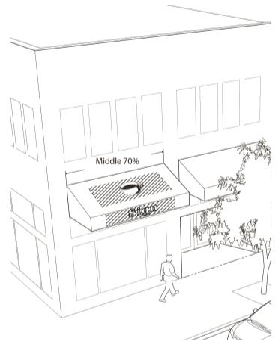
B.
Electronic (Digital) Signs. The following standards apply to electronic (digital) signs:
1.
Sign Area. Electronic (digital) changeable copy signs are limited to a maximum of 50 percent of the total sign area of a sign allowed pursuant to Section 18.44.080 (Allowed On-Site Sign Regulations).
2.
Frequency. Electronic (digital) changeable copy signs shall not change message more than one time every eight seconds.
3.
Sign Brightness. Electronic (digital) signs shall not operate at brightness levels of more than 0.3 foot-candles above ambient light, as measured using a foot-candle meter at a distance of 250 feet from the sign face. Each digital display area shall have a light-sensing device that will adjust the brightness of the sign as ambient light conditions change throughout the day.
C.
Freestanding Signs Design Compatibility. Materials and design of freestanding signs, including monument signs and pylon signs, shall be complementary to the materials and design of the buildings for the related development. For example, if the façade of the building is made of brick or brick veneer, a complementary freestanding sign would also include brick.
D.
Marquee or Changeable Copy Sign. These types of signs shall be considered to be the same as any other type of sign and shall be regulated based on their location; i.e., if located on a wall, they shall be deemed wall signs.
E.
Signs Painted Directly on Buildings. Signs painted directly on buildings shall be considered wall signs. They shall be subject to the same permit fees and regulations set forth in this chapter for signs attached to or erected against the walls of buildings and shall be included as a part of the total allowable advertising area.
F.
Projecting Signs. Projecting signs, including, but not limited to, blade signs, bracket signs, and marquee signs, shall be considered wall signs for the purposes of sign area calculation purposes. Projecting signs shall only be allowed as follows:
1.
Location. Projecting signs shall be placed only on ground-floor façades, except for businesses located above the ground level with direct exterior pedestrian access. In the case of a one-story building, the top of the sign shall, exclusive of the suspension structure, be no higher than the roof eave line.
2.
Angle of Projection. Projecting signs shall either be located at right angles to the building front along the building façade or, when located on the corner of a building, at a 45-degree angle to the corner of the building. See Figure 18.44.20 (Projecting Sign).
3.
Height. Where located above a pedestrian walkway, the lowest point of a blade or bracket sign shall be a minimum of eight feet above grade.
4.
Projection and Suspension. Any projecting or suspended signs must comply with current building code requirements.
5.
Sign structure. Sign supports and brackets shall be compatible with the design and scale of the sign.
6.
Encroachment. Blade, bracket, or marquee signs may not encroach into the public right-of-way or be located above it, or into city-owned property except with an encroachment permit.
Figure 18.44.20 Projecting Sign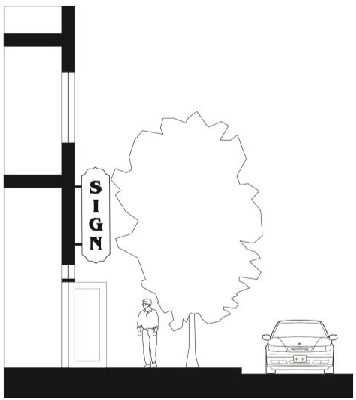
G.
Wall Signs.
1.
Design Compatibility. Wall signs shall be compatible with the predominant visual architectural elements of the building façade.
2.
Sign Type. Channel letters, reverse channel letters, and push pin letters are preferred in place of can signs.
3.
Projection. Wall signs shall not project more than 12 inches from the structure's façade.
4.
Sign Scale and Proportionality. The combined length of all wall signs on any single wall (logos and copy) shall not exceed 75 percent of the length of the building frontage for that wall. For buildings with multiple tenants, this standard applies to the length of the individual tenant frontage. Additionally, the maximum height of all portions of a wall sign (including logo and multiple lines of copy) shall not exceed 15 percent of the total wall height. See Figure 18.44.21 (Sign Scale and Proportionality).
Figure 18.44.21 Sign Scale and Proportionality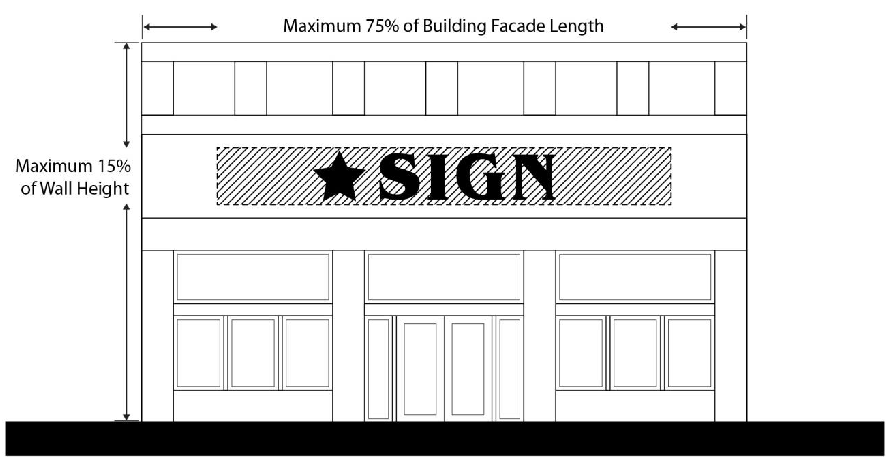
5.
Sign Cohesion. Signage containing multiple elements (e.g., logo and text) on one façade shall be designed so that the multiple elements are located and scaled with relationship to each other. See Figure 18.44.22 (Multiple-Element Signs).
Figure 18.44.22 Multiple-Element Signs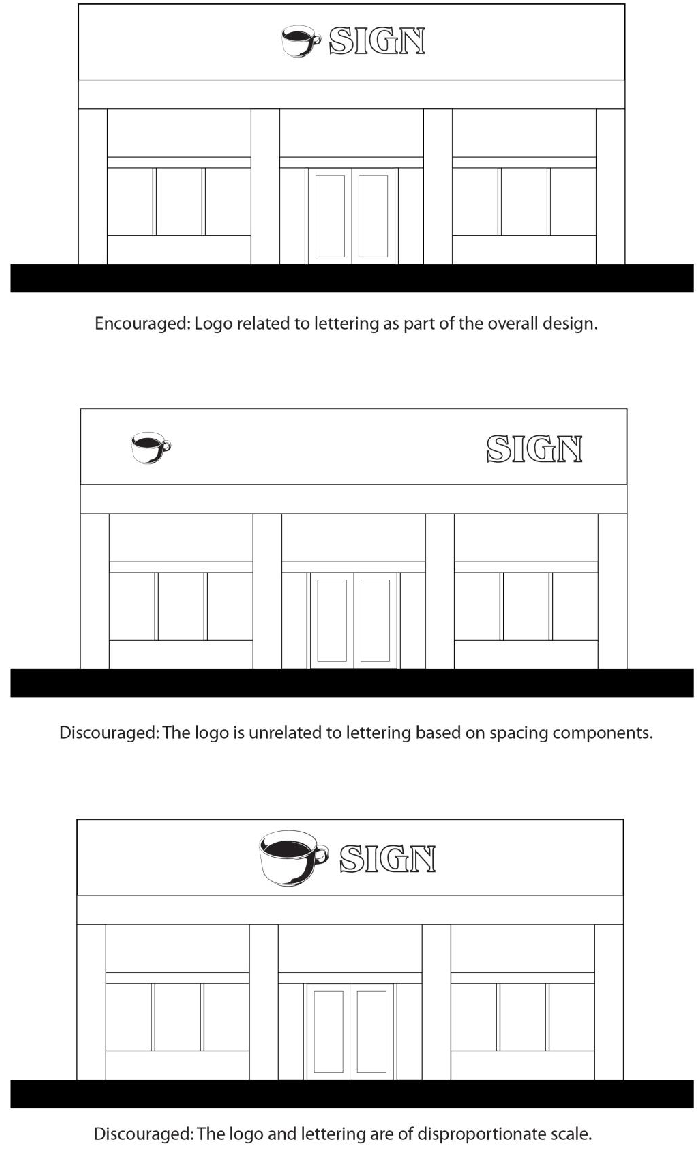
H.
Restrictions for Freeways and Interstate Highways.
1.
No signs shall be located within 660 feet of any landscaped freeway or interstate highway other than the following:
a.
Directional or other official signs or notices that are required or authorized by law.
b.
Signs advertising the sale or lease of the property upon which they are located, provided all such advertising complies with the regulations prescribed pursuant to the California Outdoor Advertising Act.
c.
Signs which advertise the business conducted, services rendered, or goods produced or sold on the property upon which the advertising display is placed, if the display is on the same side of the highway as the advertised activity, and provided all such advertising complies with the regulations prescribed pursuant to the California Outdoor Advertising Act.
2.
The exceptions set forth in this section shall not be construed as permitting billboards.
(Ord. No. 743, § 3, 3-21-2017)
18.44.120 - Illegal, abandoned, and nonconforming signs.
A.
Illegal Signs. Any sign or advertising statuary which was not lawfully erected or maintained, or was not in conformance with the ordinance in effect at the time of the erection of the sign or advertising statuary, or which was not installed with a valid permit from the city, shall be considered illegal. Illegal signs shall be abated or removed by the property owner or person responsible for installing or maintaining the sign.
1.
The duty to abate arises upon notice by the development services director or designee. Such notice shall give such parties a 30-day opportunity to cure by conformance to current law and/or current permit, to abate by removal or other remedial action. If the sign owner or property owner fails to remove or alter the sign to comply with this chapter within 30 days after such notice, such signs may be removed by the city, with the reasonable cost of abatement chargeable to the sign owner and/or property owner.
2.
Such notices may be appealed in the same manner as any other sign-related decision. However, when a sign poses a serious and immediate threat to public health or safety by virtue of its physical condition, without consideration of the message thereon, the threat may be summarily abated by court order, or an emergency abatement should be summarily abated by the city, with the reasonable cost of abatement chargeable to the sign owner and/or property owner.
B.
Abandoned Signs. The following standards shall apply to conforming and nonconforming abandoned signs:
1.
Any sign that pertains to a business or occupation which has vacated or is no longer using the particular property for a period of 30 days or more, or which relates to a time or event which no longer applies, constitutes false advertising/identification, and shall conform to the following.
a.
The structure and/or copy shall be removed within 90 days after the associated business, occupation, or event has vacated the premises. An abandoned sign is prohibited, and the removal shall be the responsibility of the owner of the sign or the owner of the premises.
b.
If a sign is maintained, the sign copy shall be replaced with blank sign copy within 90 days of the close of the operation (e.g., no utility service, not open for more than 30 days).
c.
A nonconforming sign that is maintained with blank copy shall only be allowed to remain for nine consecutive months (for a total of 12 months from closure of the establishment). At the conclusion of this time period, if a new establishment that utilizes the nonconforming sign structure has not been established, the entire sign structure shall be removed.
2.
A conforming sign not in use, but which could be reused in conjunction with the ownership or operation of a new establishment on a property, shall not fall under the definition of abandoned.
3.
Abandoned signs that are not maintained or removed consistent with the requirements of this section may be abated by the city, with the cost of abatement reimbursed by the property owner and may become a lien against the property.
C.
Nonconforming Signs.
1.
Removal/Abatement. Any sign which becomes nonconforming as a result of the provisions of this chapter shall be protected from removal by applicable provisions of state law and may be removed only as allowed by state law. The city shall order signs to be abated by the property owner and/or the person or entity responsible for sign installation and/or maintenance.
2.
Maintenance and Repair. Any sign currently in use that was legally installed but does not conform to the requirements of this chapter may continue with routine maintenance and repair, such as painting, repainting, or replacement of the sign face.
3.
Relocation and Alteration. No nonconforming sign shall be structurally altered, remodeled, or moved unless such alteration, remodeling, or relocation is required by law, or brings the sign into conformance with the provisions of this chapter. Modification of a nonconforming sign may be allowed through the plan check process (see Section 18.44.040) as long as it is determined that there is not an increase in the level of nonconformity of the subject nonconforming sign.
4.
Restoration of Damaged Signs. As determined by the development services director or designee, whenever 50 percent or less of a nonconforming sign is destroyed by fire or other calamity (not including intentional acts), the sign may be restored to its nonconforming condition and the use modified as necessary to comply with current safety code requirements. Any nonconforming sign destroyed by more than 50 percent shall not be restored unless it is brought into compliance with the provisions of this chapter.
5.
Building Façade Modifications. If a building permit is issued for major modifications to the exterior of a building façade, as determined by the city, any nonconforming building signs on the façade undergoing modification shall be brought into full conformance with the provisions of this chapter prior to approval for final occupancy.
(Ord. No. 743, § 3, 3-21-2017)
18.44.130 - Signs on city property.
This section states rules and policies for display of signs on properties owned by the city, either in fee or by holding the present right of possession and control. This section provides the process and standards for establishing signage on city property. In adopting this section, the city council acts in its proprietary capacity as to city property, as defined in this section, within the city. This section is adopted in compliance with the city's general powers, property rights, Government Code Sections 65850(b), 38774, and 38775, Business and Professions Code Section 5200 et seq., and Penal Code Section 556 et seq.
A.
Public Forum. The city declares that city property shall not function as a designated public forum, unless some specific portion of city property is designated herein, or by resolution of the city council, as a public forum of one particular type. In such case, the declaration as to public forum type shall apply strictly and only to the specified area and for the specified time period. For the purposes of this chapter, a public forum is a government-owned property that is open to public expression and assembly which is protected under the First Amendment.
B.
General Prohibition. Unless specifically authorized by this chapter, no private party signs may be displayed on city property. Any sign posted on city property in violation of this section may be summarily removed by the city as a trespass and a public nuisance.
C.
Certain Governmental Signs. The following signs may be erected and displayed on city property:
1.
Traffic control and traffic directional signs erected by the city or another governmental unit.
2.
Official notices required or authorized by law.
3.
Signs placed by the city in furtherance of its governmental functions, including the dissemination of its own speech and information to the public.
D.
Temporary Signs Displaying Noncommercial Message. In areas qualifying as traditional public forums, private persons may display noncommercial message signs thereon, provided such signs conform to all of the following:
1.
The signs must be personally held by a person or personally attended by one or more persons. "Personally attended" means that a person is physically present within five feet of the sign at all times.
2.
The maximum aggregate size of all signs held or personally attended by a single person is six square feet. For purposes of this rule, apparel and other aspects of personal appearance do not count toward the maximum aggregate sign area.
3.
The maximum size of any one sign which is held or personally attended by two or more persons acting in concert is 50 square feet.
4.
The sign must have no more than two display faces and may not be inflatable, inflated, or air-activated.
5.
In order to serve the city's interests in traffic flow and safety, persons displaying signs under this section may not stand in any vehicular traffic or bicycle lane, and persons displaying signs on public sidewalks must give at least five feet width clearance for pedestrians to pass by. Persons holding signs may not obstruct the cross visibility area, as defined in the design improvement standards manual.
(Ord. No. 743, § 3, 3-21-2017)
18.46.010 - Purpose.
This chapter provides a procedure to request reasonable accommodation for persons with disabilities seeking equal access to housing under the American with Disabilities Act, Federal Fair Housing Act, and the California Fair Employment and Housing Act (hereafter "Acts") in the application of zoning laws and other land use regulations, policies, procedures, or conditions of approval.
(Ord. No. 743, § 3, 3-21-2017)
18.46.020 - Applicability.
A.
A request for reasonable accommodation may be made by any person with disability, their representative or any entity, if the application of a requirement of this title or other city requirement, policy or practice acts as a barrier to fair housing opportunities. This chapter applies to those persons who have "disabilities" as defined under the Acts, which definitions are controlling for the purposes of this chapter. Generally, a person with a disability is a person who has a physical or mental impairment that limits or substantially limits one or more major life activities, anyone who is regarded as having such impairment or anyone who has a record of such impairment.
B.
A request for reasonable accommodation may include a modification or exception to the rules, standards and practices for the siting, development, and use of housing or housing-related facilities that would eliminate regulatory barriers and provide a person with a disability equal opportunity to housing of their choice. A request for reasonable accommodation shall comply with Section 18.46.030.
C.
A reasonable accommodation will terminate if the accommodation is no longer required, or if the recipient of the accommodation ceases to reside at the property.
D.
A reasonable accommodation may be granted in compliance with this chapter without the need for the approval of a variance otherwise required by this title.
(Ord. No. 743, § 3, 3-21-2017)
18.46.030 - Application requirements.
A.
A request for reasonable accommodation shall be submitted on an application form provided by the development services department or in the form of a letter to the director of development services, and shall contain the following information:
1.
The applicant and property owner(s), if different, name, address and telephone number;
2.
Address of the property for which the request is being made;
3.
The current actual use of the property;
4.
The basis for the claim that an individual who resides at the property has a disability protected by the Acts;
5.
The zoning ordinance provision, regulation or policy from which reasonable accommodation is being requested;
6.
Why the requested accommodation is necessary to make the specific property accessible to the individual(s) with disabilities; and
7.
Photos, site plans, drawings, and/or other graphics as may be required to clearly describe the proposed modifications to the property.
B.
If the project for which the request for reasonable accommodation is being made also requires other discretionary approval, then the applicant shall tile the information required by subsection (A) together for concurrent review with the application for discretionary approval.
C.
A request for reasonable accommodation may be filed at any time that the accommodation may be necessary to ensure equal access to housing. A reasonable accommodation does not affect an individual's obligations to comply with other application regulations not at issue in the requested accommodation.
(Ord. No. 743, § 3, 3-21-2017)
18.46.040 - Review authority.
A.
Requests for reasonable accommodation shall be reviewed by the director of development services, or designee, if no approval is sought other than the request for reasonable accommodation.
B.
Requests for reasonable accommodation submitted for concurrent review with another discretionary land use application shall be reviewed by the authority reviewing the discretionary land use application in accordance with Sections 18.59.050 and 18.59.060.
(Ord. No. 743, § 3, 3-21-2017; Ord. No. 748, § 4, 5-15-2018)
18.46.050 - Review procedure.
A.
The director of development services shall make a written determination within 45 days of the application being deemed complete and either grant, grant with modifications, or deny a request for reasonable accommodation in compliance with Section 18.46.060.
B.
If the request for reasonable accommodation is submitted for concurrent review with a discretionary land use application, the written determination on whether to grant or deny the request for reasonable accommodation shall be made by the authority responsible for reviewing the discretionary land use application. The written determination to grant or deny the request for reasonable accommodation shall be made in compliance with Section 18.46.060.
(Ord. No. 743, § 3, 3-21-2017; Ord. No. 748, § 4, 5-15-2018)
18.46.060 - Findings and decision.
A.
The written decision to grant or deny a request for reasonable accommodation will be consistent with the Acts and shall be based on consideration of the following factors:
1.
Whether the housing, which is the subject of the request, will be used by an individual with disabilities protected under the Acts;
2.
Whether the requested accommodation is necessary to make housing available to an individual with disabilities protected under the Acts;
3.
Whether the requested reasonable accommodation would impose an undue financial or administrative burden on the city;
4.
Whether the requested accommodation would require a fundamental alteration in the nature of a city program or law, including, but not limited to, building, land use, nuisance, and zoning law.
B.
The conditions shall also state whether the accommodation granted shall be removed in the event that the person for whom the accommodation was requested no longer resides on the site.
(Ord. No. 743, § 3, 3-21-2017; Ord. No. 809, § 1, 8-20-2024)
18.46.070 - Appeal of determination.
A determination to grant or deny a request for reasonable accommodation may be appealed to the planning commission, in compliance with Chapter 18.84.
(Ord. No. 743, § 3, 3-21-2017; Ord. No. 748, § 4, 5-15-2018)
18.47.010 - Purpose.
The purpose of adopting this chapter is to encourage the construction of affordable housing through density bonuses and other incentives, described in this chapter. This chapter from which this title is derived is adopted to comply with the provisions of California Code Sections 65915—65918.
(Ord. No. 743, § 3, 3-21-2017)
18.47.020 - Applicability.
This chapter applies to all multi-family residential, live-work, and mixed-use projects, consisting of five or more dwelling units, not including units granted as a density bonus.
(Ord. No. 743, § 3, 3-21-2017)
18.47.030 - Definitions.
"Affordable housing cost." Refer to the definition set forth in the California Health and Safety Code Section 50052.5.
"Affordable rent." Refer to the definition set forth in the California Health and Safety Code Section 50053.
"Child care facility." A facility other than a family day care home, including, but not limited to, infant centers, preschools, extended day care facilities, and school age child care centers.
"Common interest development." Refer to the definition set forth in the California Civil Code Section 13.51.
"Concession" or "incentive." Concession or incentive means any of the following:
A.
A reduction in site development standards or a modification of zoning code requirements or architectural design requirements that exceed the minimum building standards approved by the California Building Standards Commission, as provided in Part 2.5 (the State Building Code commencing with Health and Safety Code Section 18901) of Division 13 of the Health and Safety Code, including, but not limited to, a reduction in setback and square footage requirements, and in the ratio of vehicular parking spaces that would otherwise be required, that results in identifiable, financially sufficient, and actual cost reductions.
B.
Approval of mixed use zoning in conjunction with a housing project, if commercial, office, industrial or other land uses will reduce the cost of a housing development, and if the commercial, office, industrial or other land uses are compatible with the housing project and the existing or planned development in the area where the proposed housing project will be located.
C.
Other regulatory incentives or concessions proposed by the applicant or the city that result in identifiable, financially sufficient and actual cost reductions. This definition does not limit or require the provision of direct financial incentives for a housing development, including the provision of publicly owned land, by the city or the waiver of fees or dedication requirements.
"Density bonus." A density increase in over the otherwise maximum allowable residential density under the applicable zoning code provisions and the land use element of the general plan, as of the date of application by the applicant to the city.
"Development standard." The site or construction condition that apply to a residential development pursuant to any ordinance, general plan element, specific plan, or other city condition, law, policy resolution or regulation.
"Housing development." A development project for five or more residential units in single-use, live-work, or mixed use formats as defined in Section 1351 of the Civil Code. Also includes a subdivision or common interest development or the substantial rehabilitation of an existing multi-family dwelling where the result of the rehabilitation would be a net increase in the number of residential units.
"Lower-income household." Persons and families whose income does not exceed 80 percent of the area median income, adjusted for family size and revised annually, as defined in California Health and Safety Code Section 50079.5.
"Lower-income student." A student who has a household income and asset level that does not exceed the level for Cal Grant A or Cal Grant B award recipients as set forth in paragraph (1) of subdivision (k) of Section 69432.7 of the Education Code. The eligibility of a student to occupy a unit for lower-income students under this section shall be verified by an affidavit, award letter, or letter of eligibility provided by the institution of higher education in which the student is enrolled or by the California Student Aid Commission that the student receives or is eligible for financial aid, including an institutional grant or fee waiver from the college or university, the California Student Aid Commission, or the federal government.
"Maximum allowable residential density." The maximum number of units allowed under the zoning ordinance, specific plan, or land use element of the general plan, or, if a range of density is permitted, means the maximum number of units allowed by the specific zoning range, specific plan, or land use element of the general plan applicable to the project.
"Moderate-income household." Persons and families whose income is between 80 percent [and] 120 percent of the area median income, adjusted for family size and revised annually, as set forth in the California Health and Safety Code Section 50093(b).
"Residential care facility for the elderly" means a housing arrangement chosen voluntarily by persons 60 years of age or over, or their authorized representative, where varying levels and intensities of care and supervision, protective supervision, or personal care are provided, based upon their varying needs, as determined in order to be admitted and to remain in the facility. Persons under 60 years of age with compatible needs may be allowed to be admitted or retained in a residential care facility for the elderly. A residential care facility for the elderly shall be considered a residential use of property and shall be permitted in all zones permitting residential uses, subject to compliance with the restrictions and development standards for other residential dwellings in the same zone. This definition shall be operative only until the enactment of legislation implementing the three levels of care in residential care facilities for the elderly pursuant to Section 1569.70 of the California Health and Safety Code.
"Senior citizen housing development." A housing development, where residency is restricted to persons 62 years of age or older, or 55 years of age or older in a senior citizen housing development, as defined in Sections 51.3 and 51.12 of the California Civil Code (at the time of adoption of this section, a senior citizen housing development is a residential development that has at least 35 dwelling units and is developed, substantially rehabilitated, or substantially renovated for senior citizens).
"Shared housing building." A residential or mixed-use structure, with five or more shared housing units and one or more common kitchens and dining areas designed for permanent residence of more than 30 days by its tenants. The kitchens and dining areas within the shared housing building shall be able to adequately accommodate all residents. A "shared housing building" may include other dwelling units that are not shared housing units, provided that those dwelling units do not occupy more than 25 percent of the floor area of the shared housing building. A shared housing building may include 100 percent shared housing units.
"Shared housing unit" means one or more habitable rooms, not within another dwelling unit, that includes a bathroom, sink, refrigerator, and microwave, is used for permanent residence, that meets the "minimum room area" specified in Section R304 of the California Residential Code (Part 2.5 of Title 24 of the California Code of Regulations), and complies with the definition of "guestroom" in Section R202 of the California Residential Code. Shared housing unit for purposes of a residential care facility for the elderly includes a unit without an individual kitchen where a unit may be shared by unrelated persons, and a unit where a room that may be shared by unrelated persons meets the minimum room area requirements of "shared housing unit."
"Specific, adverse impact." Refer to the definition set forth in the California Government Code Section 65589.5(d)(2).
"Target unit." A dwelling unit within a housing development that is reserved for sale or rent to very low-, low-, and moderate-income households, or other qualifying residents.
"Very low-income household." Persons and families whose income does not exceed 50 percent of the area median income, adjusted for family size and revised annually, as set forth in the California Health and Safety Code Section 50105.
(Ord. No. 743, § 3, 3-21-2017; Ord. No. 809, § 1, 8-20-2024; Ord. No. 818, § 1, 5-20-2025)
18.47.040 - General density bonus provisions.
Density bonuses shall be subject to the provisions in this section, in accordance with California Code Section 65915.
A.
Application. Any person that desires a density bonus must make an application on a form approved by the director of development services at the time of submitting an entitlement application for the housing development for which a density bonus is requested. The density bonus provided by this chapter only applies to housing developments consisting of five or more dwelling units.
B.
Incentives and Concessions. When an applicant seeks a density bonus for a housing development of for the donation of land for housing within the city, the city must provide the applicant incentives or concessions for the production of housing units and child care facilities, as provided in this chapter.
C.
Available Density Bonus Options. The planning commission or city council will grant one density bonus, the amount of which will be as specified in Section 18.47.060, and incentives or concessions as described in Section 18.47.050, when an applicant for a housing development seeks and agrees to construct a housing development, excluding any units permitted by the density bonus awarded pursuant to this chapter, that will contain at least one of the following:
1.
Five percent of the total units of a housing development, including a shared housing building development, for very low-income households.
2.
Ten percent of the total units of a housing development, including a shared housing building development, for lower-income households.
3.
Ten percent of the total units in a common interest development for moderate-income households, provided that all units in the housing development are offered to the public for purchase.
4.
A senior citizen housing development.
5.
Donates land to the city for the construction of very low-income units.
6.
Includes a qualifying childcare facility, as described in Section 18.47.070; in addition, to providing housing as described in subsections (C)(1)—(3).
7.
Ten percent of the total units of a housing development for transitional foster youth, as defined in Section 66025.9 of the Education Code, disabled veterans, as defined in Section 18541, or homeless persons, as defined in the federal McKinney-Vento Homeless Assistance Act (42 U.S.C. § 11301 et seq.).
8.
Twenty percent of the total units for lower-income students in a student housing development that meet the requirements in Government Code Section 65915(b)(1)(F).
9.
One hundred percent of all units in the development, including total units and density bonus units, but exclusive of a manager's unit or units, are for lower-income households, as defined by Section 50079.5 of the Health and Safety Code, except that up to 20 percent of the units in the development, including total units and density bonus units, may be for moderate-income households, as defined in Section 50053 of the Health and Safety Code.
D.
Applicant's Election of Basis for Bonus. For purposes of calculating the amount of the density bonus, pursuant to Section 18.47.060, the applicant who requests a density bonus pursuant to this section must elect whether the bonus will be awarded on the basis of subsections (C)(1)—(6).
E.
Continued Affordability.
1.
An applicant must agree to the continued affordability of all low- and very low-income units that qualified the applicant for the award of the density bonus for 50 years or a longer period of time if required by any applicable construction or mortgage financing assistance program, mortgage insurance program, or rental subsidy program. Rents for the lower-income density bonus units must be set at an affordable rent. Owner-occupied units must be available at an affordable housing cost.
2.
An applicant must agree that the initial occupant of the moderate-income units that are directly related to the receipt of the density bonus in a common interest development are moderate-income households and that the units are offered at an affordable housing cost. The city will require an equity-sharing agreement, unless such an agreement would be in conflict with the requirements of another public funding source or law.
(Ord. No. 743, § 3, 3-21-2017; Ord. No. 748, § 4, 5-15-2018; Ord. No. 809, § 1, 8-20-2024)
18.47.045 - Requirements for equity-sharing agreement.
The following provisions must be included in any equity-sharing agreement required under this chapter:
A.
Upon resale, the seller of the unit may retain the value of any improvements, the down payment, and the seller's proportionate share of appreciation. The city will recapture any initial subsidy and its proportionate share of appreciation, which amount must then be used within five years for any of the purposes that promote home ownership, as described in California Health and Safety Code section 33334.2(e).
B.
If the unit is purchased or developed by a qualified nonprofit housing corporation pursuant to California Government Code Section 65915(c)(A)(ii), the local government may enter into a contract with the qualified nonprofit housing corporation under which the qualified nonprofit housing corporation would recapture any initial subsidy and its proportionate share of appreciation if the qualified nonprofit housing corporation is required to use 100 percent of the proceeds to promote homeownership for lower-income households within the jurisdiction of the local government.
C.
For purposes of this section, the city's initial subsidy will be equal to the fair market value of the home at the time of initial sale, minus the initial sale price to the moderate-income household, plus the amount of any down payment assistance or mortgage assistance. If upon resale the market value is lower than the initial market value, then the value at the time of the resale will be used as the initial market value.
D.
For purposes of this section, the city's proportionate share of appreciation will be equal to the ratio of the initial subsidy to the fair market value of the unit at the time of initial sale.
(Ord. No. 743, § 3, 3-21-2017; Ord. No. 809, § 1, 8-20-2024)
18.47.050 - Incentives and concessions.
A.
An applicant for a density bonus pursuant to Section 18.47.040 may submit proposal for the specific incentives or concessions that the applicant requests pursuant to this chapter, and may request a meeting with the director of development services.
B.
Subject to subsection (C), the applicant will receive the following number of incentives or concessions:
1.
One incentive or concession for projects that include at least ten percent of the total units for lower-income households, at least five percent for very low-income households, or at least ten percent for moderate-income households in a common interest development.
2.
One incentive or concession for projects that include at least 20 percent of the total units for lower-income students in a student housing development.
3.
Two incentive or concession for projects that include at least 20 percent of the total units for lower-income households, at least ten percent for very low-income households, or at least 20 percent for moderate-income households in a common interest development.
4.
Three incentive or concession for projects that include at least 30 percent of the total units for lower-income households, at least 15 percent for very low-income households, or at least 30 percent for moderate-income households in a common interest development.
5.
Four incentives or concessions for a project meeting the criteria of Section 18.47.040(C)(9).
6.
If the project is located within one-half mile of a major transit stop or is located in a very low vehicle travel area in a designated county, the applicant shall also receive a height increase of up to three additional stories, or 33 feet.
C.
The planning commission or city council must grant the concession or incentive requested by the applicant, unless it makes a written finding, based upon substantial evidence, that:
1.
The concession or incentive is not required in order to provide for affordable housing costs, or for rents for the targeted units to be set as specified in Section 18.47.030.
2.
The concession or incentive would have a specific, adverse impact upon public health and safety, or the physical environment, or on any real property listed in the California Register of Historical Resources, and there is no feasible method to satisfactorily mitigate or avoid the specific adverse impact without rendering the development unaffordable to low- and moderate-income households; or
3.
The concession or improvement would be contrary to state or federal law.
(Ord. No. 743, § 3, 3-21-2017; Ord. No. 748, § 4, 5-15-2018; Ord. No. 809, § 1, 8-20-2024)
18.47.055 - Waiver or reduction of development standards.
A.
An applicant may submit to the city a proposal for the waiver or reduction of development standards that the applicant believes will have the effect of physically precluding the construction of a housing development that meets the criteria of in this section at the densities or with the concessions or incentives permitted by this chapter, and may request a meeting with the director of development services. Such proposal may not increase the number of incentives of concessions that the applicant is entitled to under Section 18.47.030.
B.
The planning commission or city council must waive or reduce the development standard requested by the applicant, unless it makes a written finding, based upon substantial evidence, that:
1.
The waiver or reduction would have a specific, adverse impact upon public health and safety, or the physical environment, or on any real property listed in the California Register of Historical Resources, and there is no feasible method to satisfactorily mitigate or avoid the specific adverse impact; or
2.
The waiver or reduction would be contrary to state or federal law.
(Ord. No. 743, § 3, 3-21-2017; Ord. No. 748, § 4, 5-15-2018; Ord. No. 809, § 1, 8-20-2024)
18.47.060 - Calculation of density bonus.
A.
The applicant may elect to accept a lesser percentage of density bonus.
B.
The amount of density bonus to which the applicant is entitled will vary according to the amount by which the percentage of affordable housing units exceeds the percentage established in Section 18.47.060.
C.
For housing developments meeting the criteria of Section 18.47.010(C)(1), the density bonus will be calculated as follows:
D.
For housing developments meeting the criteria of Section 18.47.040(C)(2), the density bonus will be calculated as follows:
E.
For housing developments meeting the criteria of Section 18.47.040(C)(4), as senior housing developments, the density bonus will be 20 percent.
F.
For housing developments meeting the criteria of Section 18.47.040(C)(3), the density bonus will be calculated as follows:
G.
All density calculations resulting in fractional units will be rounded up to the next whole number. The granting of a density bonus will not be interpreted, in and of itself, to require a general plan amendment, zoning change, or other discretionary approval.
(Ord. No. 743, § 3, 3-21-2017; Ord. No. 748, § 4, 5-15-2018; Ord. No. 809, § 1, 8-20-2024)
18.47.065 - Additional density bonus through donation of land.
When an applicant for a tentative subdivision map, parcel map, or other residential development approval donates land to the city, as provided for in this section, the applicant will be entitled to a 15-percent increase above the otherwise maximum allowable residential density under the applicable zoning and the land use element of the general plan for the entire development, as follows:
A.
This increase will be in addition to any increase in density mandated by Section 18.47.040(C), up to a maximum combined density increase of 35 percent, if an applicant seeks increases required pursuant to both the section and section 18.47.040(C).
1.
All density calculations resulting in fractional units will be rounded up to the next whole number.
2.
Nothing in this section will be construed to enlarge or diminish the authority of the city to require a developer to donate land as a condition of development.
B.
An applicant will be eligible for the increased density bonus described in this section if all of the following conditions are met:
1.
The applicant donates and transfers the land no later than the date of approval of the final subdivision map or parcel map or residential development application.
2.
The developable acreage and zoning classification of the land being transferred are sufficient to permit construction of units affordable to very low income households, in an amount not less than ten percent of the number of residential units of the proposed development.
3.
The transferred land is at least one acre in size or of sufficient size to permit development of at least 40 units, has the appropriate general plan designation, is appropriately zoned for development as affordable housing, and is or will be served by adequate public facilities and infrastructure.
a.
The land must have appropriate zoning and development standard to make the development of the affordable units feasible.
b.
No later than the date of approval of the final subdivision map parcel map, or of the residential development, the transferred land must have all of the permits and approvals, other than building permits, necessary for the development of the very low income housing units on the transferred land, except that the local government may subject the proposed development to subsequent design review, to the extent authorized by California Government Code Section 65583.2(i), if the design is not reviewed by the city prior to the time of transfer.
4.
The transferred land and the affordable units will be subject to a deed restriction ensuring continued affordability of the units consistent with this section which restriction will be recorded on the property at the time of the transfer.
5.
The land is transferred to the city or to a housing developer approved by the city. The city may require the applicant to identify and transfer the land to such housing developer.
6.
The transferred land must be within the boundary of the proposed development or, if the city agrees, within one-quarter mile of the boundary of the proposed development.
(Ord. No. 743, § 3, 3-21-2017; Ord. No. 748, § 4, 5-15-2018)
18.47.070 - Additional density bonus or concession or incentive through provision of childcare facility.
A.
When an applicant proposes to construct a housing development that conforms to the requirements of this section and includes a childcare facility that will be located on the premises of, as part of, or adjacent to, the project, the planning commission or city council must grant either of the following:
1.
An additional density bonus that is the amount of square feet of residential development that is equal to or greater than the amount of square feet in the child care facility.
2.
An additional concession or incentive that contributes significantly to the economic feasibility of the construction of the child care facility.
B.
The planning commission or city council shall require, as a condition of approving the housing development that the following occur:
1.
The child care facility must remain in operation for a period of time that is as long or longer than the period of time during which the density bonus units are required to remain affordable pursuant to Section 18.47.040(E).
2.
Of the children who attend the child care facility, the children of moderate income, lower income, and very low income households must equal a percentage that is equal or greater than the percentages of the dwelling units that are required for very low income, lower income, or moderate income households, pursuant to Section 18.47.040(C).
C.
Notwithstanding any requirement of this section, the planning commission or city council is not required to provide a density bonus or concession for a child care facility if it finds, based upon substantial evidence, that the community has adequate child care facilities.
D.
For the purposes of calculating a density bonus the residential units do not have to be based upon individual subdivision maps or parcels. The density bonus is permitted in geographic areas of the housing development other than the areas where the units for the lower income households are located.
E.
The granting of a concession or incentive will not be interpreted, in and of itself, to require a general plan amendment, zoning change, or other discretionary approval.
(Ord. No. 743, § 3, 3-21-2017; Ord. No. 748, § 4, 5-15-2018)
18.47.075 - City's discretion in granting density bonus.
Nothing in this chapter will be construed to prohibit the planning commission or city council from granting a density bonus greater than what is described in this chapter for a development that meets the requirements of this chapter, or from granting a proportionately lower density bonus than what is required by this chapter for developments that do not meet the requirement of this chapter.
(Ord. No. 743, § 3, 3-21-2017)
18.47.080 - Parking requirements.
A.
Upon the request of the applicant, the city will not require a vehicular parking ratio, inclusive of handicapped and guest parking, of a development meeting the criteria of Section 18.47.040(C), that exceeds the following ratios:
1.
Zero to one bedrooms: One on-site parking space.
2.
Two to three bedrooms: Two on-site parking spaces.
3.
Four or more bedrooms: Two and one-half parking spaces.
B.
If the total number of parking spaces required for a development is other than whole number, the number will be rounded up to the next whole number. For purposes of this section, a development may provide "on-site parking" through tandem parking or uncovered parking, but not through on-street parking.
C.
This section applies to a development that meets the requirements of Section 18.47.040(C), but only at the request of the applicant. An applicant may request additional parking incentives or concessions beyond those provided in this chapter, subject to Section 18.47.050.
(Ord. No. 743, § 3, 3-21-2017)

