


Sunny Isles Beach City Zoning Code
ARTICLE VIII
Off-Street Parking, Loading and Driveway Standards
§ 265-46.- Off-street parking and loading standards.
A.
General. Every building, use or structure, constructed or altered after the effective date of LDRs shall be provided with off-street parking facilities in accordance with the provisions of this article for the use of occupants, employees, visitors or patrons. Such off-street parking facilities shall be maintained and continued as long as the main use is continued.
(1)
Existing buildings.
(a)
Where a building existed at the effective date of these LDRs such building may be modernized, altered or repaired, provided there is no increase in floor area or capacity and there is no change of occupancy, without providing additional parking spaces.
(b)
Where a building or use, which existed at the effective date of these LDRs is enlarged in floor area, capacity or space occupied, off-street parking facilities as specified herein shall be provided for the additional floor area, capacity or space so created or so occupied.
(c)
Where a building or use which existed at the effective date of these LDRs is changed in use or occupancy, additional off-street parking facilities shall be provided to the extent that the off-street parking required by this article for the new use or occupancy exceeds the off-street parking which would have been required for the previous use or occupancy had the regulations of this article been applicable thereto. For the purposes of this article a change of use or occupancy shall mean a change from one category of off-street parking requirements to another such category.
(d)
It shall be unlawful for an owner or operator of any building, structure or use affected by this article to discontinue, change or dispense with, or to cause the discontinuance or reduction of the required parking facilities apart from the discontinuance, of such structure or use, without establishing alternative vehicle parking facilities which meet the requirements of this article. It shall be unlawful for any person to utilize such building, structure or use without providing the off-street parking facilities to meet the requirements of and be in compliance with this article.
(2)
Proximity of off-street parking.
(a)
Required off-street parking spaces shall be located on the same parcel on which the principal and accessory uses exist. As an alternative and subject to the approval of the City Commission, they may be located on a separate parcel not more than 300 feet from the use they are intended to serve provided the owner of said parking areas shall enter into a written declaration unifying the two sites whereby the land providing the parking area shall be unified with the primary site by unity of title and shall not be sold or disposed of except in conjunction with the sale of the building or structure the parking area serves so long as these parking facilities are required. Said instrument shall be recorded at the expense of the owner and shall run with the land and shall bind the heirs, successors, and assigns of said owner. This instrument shall provide, among other things, that it cannot be modified or amended except with the consent and written joinder by the City so as to confirm that the parcels continue in compliance with these LDRs. In approving off-site parking, the City Commission must find that the off-site parking facility is reasonably located in relation to the use it is intended to serve, based upon such factors as the type of facility, likely purpose of the trip to the facility, distance from the use intended to be served, and any physical barriers which must be crossed to reach the use to be served. Parking spaces backing into a main drive aisle adjacent to the front of buildings shall be discouraged. (Former Subsection A(2)(b), regarding contributions to the City Off-Street Parking Trust Fund in lieu of off-street parking spaces, was repealed 2-10-2005 by Ord. No. 2005-222.)
(3)
Shared parking. Off-street parking may serve two or more uses within one site; however, in such cases the total number of spaces must equal the sum of the spaces required for each separate use except:
(a)
Properties owned by a single entity or subject to a cross access/cross parking agreement may petition the City Commission for approval of shared parking. The petition for shared parking shall include an independent parking study in a form acceptable to the City, which includes but is not limited to information indicating that the uses are such that a sufficient disparity in peak demand for parking spaces exists to support the concept of shared parking.
(b)
Required parking spaces may be permitted to be utilized for meeting the parking requirements of two or more separate permitted uses when it is clearly established by the applicant that the two or more uses will utilize the spaces at different times of the day, week, month, or year. A recordable covenant, with the correct legal description, shall be submitted by the owners of the property and the two or more businesses or tenants involved in a form acceptable to the office of the City Attorney. The covenant shall be recorded in the public records of Miami-Dade County at the applicant's expense, and shall run with the land. The covenant shall provide that the use or portion of a use that requires the shared parking in order to obtain the necessary permits or licenses shall cease and terminate upon any change in their respective schedules of operation that results in conflicting or overlapping usage of the parking facilities, and no nonresidential use may be made of that portion of the property until the required parking facilities are available and provided. The covenant shall also provide that the City may collect attorney's fees if litigation is necessary to enforce the requirements of this section.
(c)
No part of an off-street parking area required for any building or use by this section shall be included as a part of an off-street parking area similarly required for another building or use unless the type of use indicates that the periods of usage will not overlap or be concurrent with each other as determined by the City.
(d)
Combined off-street parking. Nothing in this section shall be construed to prevent collective provision for, or joint use of, off-street parking facilities for two or more buildings or uses by two or more owners or operations, provided that the total of such parking spaces when combined or used together shall not be less than the sum of the requirements of the several individual uses computed separately in accordance with this section. In such cases, a recorded agreement shall be executed at the applicant's expense.
(4)
Tandem parking. Tandem parking shall abide by the definition under Article II of this chapter. Twenty percent of the required off-street parking spaces, other than handicapped parking, may be permitted as tandem parking. If 24-hour valet service is provided in perpetuity, 100% of the required parking may be permitted as tandem. Tandem parking spaces shall meet the dimensional requirements of the chapter for standard parking spaces; the drive aisle may be reduced to 18 feet. All applications for the use of tandem parking must be approved by the City Commission, and the applicant must enter into an agreement, recorded in the public records at the expense of the owner, and shall run with the land and shall bind the heirs, successors, and assigns of said owner, which requires all developments having any tandem parking spaces to provide 24-hour valet parking service. For the purpose of this chapter, only one of the tandem spaces shall be considered as fulfilling part of the required parking. Notwithstanding any provision in this chapter, self-parking by unit owners is permitted within non-mechanical parking spaces. Self-parking is prohibited when mechanical parking lifts or any other type of mechanical parking devices are used.
(5)
Parking plan required. A parking plan shall be provided with all applications for development approval which shall clearly and accurately designate the required parking spaces, required landscaped areas and planter islands, access aisles and driveways and the relationship of the parking to the uses or structures the spaces are intended to serve.
(6)
Required handicapped spaces. Parking spaces for disabled persons shall be provided in accordance with F.S. ch. 553, pt. II, as amended from time to time.
(7)
Size and character or required parking. The following design requirements shall be observed for off-street parking:
(a)
Size; parking stalls. Each parking space required and provided pursuant to the provisions of this article shall be not less than nine feet in width and 18 feet in length for all commercial and mixed-use developments. Each parking space required and provided pursuant to the provisions of this article shall be nine feet in width and 18 feet in length for all residential only developments. Where parallel and angular parking spaces are used, each parallel and angular parking space shall be not less than nine feet in width and 23 feet in length, as set forth in Attachment "1".
(b)
Size; enclosed garage areas. All one-car garages shall provide a single parking space of 8.5 feet by 18 feet free from all obstructions. All two-car garages shall provide two parking spaces consisting of 17 feet by 18 feet unobstructed space.
(c)
Striping. All surface unenclosed parking spaces shall be divided with painted double stripe lines except for single-family homes, zero lot line developments, townhouses and duplexes where the parking spaces are on a single-family site or as otherwise permitted in this chapter.
(d)
Accessibility. In all zoning districts, the width of access aisles and driveways shall be in conformance with the standards set forth in Figure 1, which is included at the end of this chapter. Every space shall be accessible without driving over or through another parking space except for tandem parking as specifically provided herein. Parking stalls abutting the same continuous drive aisle shall have the same angle and orientation. Drive aisles shall be one-way only, which are less than 22 feet wide or which abut parking stalls with angles less than 90°. Parking stall angles and drive aisle direction of flow may change only when the drive aisle is interrupted by a circulation drive or structure.
(e)
Composition. Except where specified above, parking facilities, including access aisles and driveways, shall be surfaced with brick, asphalt or concrete surfacing maintained in a smooth, well-graded condition.
(f)
Drainage. All off-street parking facilities shall be drained so as not to cause any nuisances on adjacent or public property. Such drainage facilities shall be arranged for convenient access and safety of pedestrians and vehicles in accordance with standards set forth in these regulations.
(g)
Curbing. The use of freestanding wheel stops is prohibited in all exterior-parking areas. All exterior-parking stalls shall be fronted with a continuous Type D or Type F concrete curbing six inches high.
(h)
Parking lot islands. The islands formed by the interior of continuous curbing must be landscaped in accordance with the provisions of this chapter. Islands with impervious surfaces are prohibited, although the location of sidewalks inside of islands is allowable if an equal amount of landscaped surface is provided. Islands at the front of parking spaces must allow a clear zone of 20 inches to allow for bumper overhang. Lateral islands separating parking spaces must be provided at least every nine spaces.
(8)
Parking setback. The edge of all parking pavement and access roads (not including driveway connections to a street) shall be set back a minimum of ten feet from the right-of-way of all streets. This setback distance shall be landscaped in conformance with these regulations.
(9)
Landscaping of off-street parking. Parking structures and surface parking lots shall be landscaped in accordance with the provisions of these regulations.
(10)
Street access. All off-street parking spaces shall be provided with safe and convenient access to a street. If any such space is located contiguous to a street, the street side thereof shall be curbed and ingress and egress shall be provided only through driveway openings through the curb of such dimension, the City may approve location and construction as.
(11)
Parking space use. All off-street parking facilities shall be used solely for the parking of vehicles in operating conditions by patrons, occupants or employees of the use to which such parking is accessory. No motor vehicle repair work except emergency service shall be permitted in association with any required off-street parking facilities.
(12)
Parking lighting. All lighting fixtures used to illuminate off-street parking areas shall be designed to comply with the performance standards relative to glare of the zoning district in which such area is located. Enclosed parking garages shall be illuminated 24 hours per day.
(a)
Off-street surface parking lot areas in any commercial/retail establishment, apartment or condominium with 20 or more off-street surface parking spaces shall be provided with security lighting sufficient to provide adequate illumination for all persons, property, and vehicles on site to make clearly visible the presence of any person on or about the premises during the hours of darkness, including at a minimum the hours of 11:00 p.m. until sunrise. The security lighting required by this subsection shall be installed according to project-specific illumination levels prescribed and a security lighting plan reviewed and approved by the City of Sunny Isles Beach Police Department and the City Manager or designee. Review and approval of the security lighting shall be based upon criteria including, but not limited to:
[1]
The nature and use of the area within the commercial/retail, apartment or condominium development;
[2]
The type of area in which the commercial/retail, apartment or condominium development is located;
[3]
The hours of use of the area to be lighted;
[4]
The frequency of use of the area to be lighted;
[5]
Existing lighting in the area;
[6]
Past criminal or crime-related incidents in the area;
[7]
Physical characteristics of the structure and/or development under proposed construction;
[8]
Compliance with Florida's residential and/or commercial building energy codes and standards, where applicable; and
[9]
Design to limit light spill beyond the commercial/retail, apartment or condominium property lines.
(b)
Security lighting compliance dates. Any commercial/retail establishment, apartment or condominium with 20 or more off-street surface parking spaces in existence on the effective date of this subsection, or which begins operation within two weeks thereof, shall be in compliance with the requirements of this subsection within 120 calendar days from the effective date of this subsection, and any commercial/retail establishment, apartment or condominium with 20 or more off-street surface parking spaces which begins operating more than two weeks from the effective date of this subsection shall be in compliance with the requirements of this subsection on the first day of business.
(c)
Noncompliance penalties. If noncompliance with this subsection is corrected within ten days after receipt of a written notice of violation, no civil penalty shall be assessed. However, any person or entity in control of a commercial/retail establishment, apartment or condominium with 20 or more off-street surface parking spaces, or the owner of a commercial/retail establishment, apartment or condominium with 20 or more off-street surface parking spaces who violates any requirement of this subsection, or who fails to initially implement the requirements of this subsection shall be required to pay to the City of Sunny Isles Beach, upon notice that noncompliance remains uncorrected, a civil penalty of up to $500.00 per day for the first violation, and $750.00 per day for a repeat violation, as allowed under § 14-8 of the Code of Ordinance of the City of Sunny Isles Beach.
(d)
Enforcement. This subsection shall be enforced according to Chapter 14 of the Code of Ordinances of the City of Sunny Isles Beach.
(13)
Parking or use not specified. Where the required number of parking spaces is not set forth for a particular use in the following sections, and where there is no similar general type of use listed, the applicant shall submit a certified study to ascertain the required number of off-street parking spaces.
(14)
Accessory use parking. Off-street parking for accessory service uses as permitted in §§ 265-27 through 265-37 which are located within the building of a principal use shall be calculated in accordance with the off-street parking requirements for the specific uses.
(15)
Residential districts. No vehicles shall be permitted to park on front or side lawns of any property located in any residential district. Vehicles shall park upon an improved driveway or improved parking pad. For the purposes of this section, "improved" means surfaced with concrete, asphalt, gravel on top of hard surface, or any other material commonly used for the parking of vehicles, but not including grass or dirt. All other provisions of the City Code relating to landscape requirements for residential property shall not be affected by this section. This section shall not apply to special events involving family or social gatherings.
(16)
Publicly maintained lawns. No vehicle shall be permitted to park on lawns and landscape areas maintained by the City or any other governmental entity unless permission is granted by the City. The prohibition of this section shall not apply to vehicles owned by the City, emergency vehicles, or any vehicle owned by another governmental entity. For the purposes of this section, rights-of-way in front of residential homes are not landscaped areas maintained by the City.
(a)
Enforcement. The provisions of this subsection shall be enforced pursuant to Chapter 14 of the City's Code of Ordinances.
(b)
Penalties. Any person in violation of this subsection shall be subject to a civil penalty of $250.00 per occurrence. Vehicles parked on publicly maintained lawns are subject to towing.
(17)
Mechanical and Robotic Parking.
(a)
Definitions.
[1]
Mechanical Parking means Mechanical Parking Lifts, Robotic Parking Systems, and/or Vehicle Elevators.
[2]
Mechanical Parking Lift means an automated mechanism that lifts vehicles to make space available to park other vehicles below it in a vertical tandem fashion.
[3]
Robotic Parking System means a mechanical garage using elevator systems to hoist individual vehicles from receiving areas to separate auto storage areas.
(b)
Use of mechanical parking devices, robotic parking systems and/or vehicle elevators under any of the provisions of this section shall require review and approval by the City. The City shall consider the following review criteria when considering each application for the use of mechanical parking systems:
[1]
Whether the proposed use of mechanical parking results in an improvement of design characteristics and compatibility with the surrounding neighborhood;
[2]
Whether parking lifts or mechanisms are located inside, within a fully enclosed building, and not visible from exterior view;
[3]
The applicant must enter into an agreement, recorded in the public records at the expense of the owner, and shall run with the land and shall bind the heirs, successors, and assigns of said owner, which requires all developments having any mechanical parking spaces to provide 24-hour valet parking service;
[4]
Whether a traffic study has been provided that details the ingress, egress and circulation within the mechanical parking facility, and the technical and staffing requirements necessary to ensure that the proposed mechanical parking system does not cause excessive stacking, waiting, or backups onto the public right-of-way;
[5]
Whether a proposed operations plan, including hours of operation, number of employees, maintenance requirements, noise specifications, and emergency procedures, has been provided; and
(c)
Mechanical Parking Lifts must also satisfy the following conditions:
[1]
The parking lift platform must be fully load-bearing and must be sealed and of sufficient width and length to prevent dripping liquids or debris onto the vehicle below;
[2]
All parking lifts must be designed so that power is required to lift the car, but that no power is required to lower the car, in order to ensure that the lift can be lowered and the top vehicle can be accessed in the event of a power outage;
[3]
All parking lifts must be designed to prevent lowering of the lift when a vehicle is parked below the lift;
[4]
All parking lifts shall be operated using a spring-loaded Underwriters Laboratories (UL) approved Key Switch Control. No push button is allowed;
[5]
All electrical components of the lifts shall be Underwriters Laboratories (UL) approved;
[6]
All mechanical parking systems must be serviced every three months with an annual safety report signed by a Supplier Engineer;
[7]
Self-parking is prohibited when mechanical parking lifts or any other type of mechanical parking devices are used; and
[8]
All parking lifts shall be maintained and kept in good working order.
[9]
The size of the surface parking stalls for mechanical lifts shall be nine feet in width and 18 feet in length for all residential and commercial developments.
(18)
Valet Parking. Code Citation shall be issued against a condominium association or property owner who allows their valet service provider(s) to stop, stand, obstruct, or park any vehicle within such a specially designated and marked parking space that is a reserved Disabled Parking Spot, unless, such vehicle has a clearly visible Disabled Parking Permit displayed.
(a)
Enforcement. The provisions of this subsection shall be enforced pursuant to Chapter 14 of the City's Code of Ordinances.
(b)
Penalties. Any party found to be in violation of this subsection shall be subject to the civil penalty of $500.00 per occurrence and any other penalties set forth in the City Code and state law.
(19)
Electric car charging station incentive. In order to provide an incentive for the creation and maintenance of electric car charging stations within the City, the minimum standards for off-street parking spaces otherwise required by Subsection 265-46.B of this article shall provide for the allowance of parking spaces to be electric car charging stations provided on-site, to a maximum of six electric car charging stations. Each electric car charging station shall meet minimum safety code requirements and that adequate provision has been made for its maintenance. The allowance of regular parking spaces for electric charging stations shall not be construed as a variance under this article.
B.
Amount of off-street parking. The minimum number of off-street parking spaces to be provided and maintained for each use or occupancy shall be as follows:
C.
Calculating required parking spaces.
(1)
Fractional spaces. When units or measurements determining number of required off-street parking spaces result in the requirement of fractional space the required off-street parking shall be rounded up to the next full number.
(2)
Measurements. In stadiums, sport arenas, places of worship and other places of assembly in which occupants utilize benches, pews or other similar seating facilities where seating is not separated for each person, each 20 lineal inches of such seating shall be counted as one seat for the purpose of computing off-street parking requirements.
D.
Off-street loading.
(1)
General provisions.
(a)
Adequate space for loading and unloading of materials, goods or things, and for delivery and shipping, shall be provided and maintained on the same plot as the building, which it serves.
(b)
For the purposes of this section, an off-street loading space shall be an area at the grade level at least 10 feet wide by 25 feet long with fourteen-foot vertical clearance. Each off-street loading space shall be directly accessible from a street or alley without crossing or entering any other required loading space, and shall be arranged for convenient and safe ingress and egress by motor truck and/or trailer combination. Such loading space shall also be accessible from the interior of any building it is intended to serve.
(2)
Specifications. Off-street loading spaces shall be provided and maintained in accordance with the following schedule:
(a)
For each retail store, storage warehouse, wholesale establishment, market, restaurant, funeral home, laundry, dry cleaning establishment, commercial building, office building, or similar building or use which has an aggregate gross floor area of:
[1]
Five thousand square feet to 25,000 square feet: one space.
[2]
Twenty-five thousand one square feet to 60,000 square feet: two spaces.
[3]
Sixty thousand one square feet to 120,000 square feet: three spaces.
[4]
One hundred twenty thousand one square feet to 200,000 square feet: four spaces.
[5]
Two hundred thousand one square feet to 290,000 square feet: five spaces.
[6]
Plus for each additional 90,000 square feet over 290,000 square feet: one space.
(b)
Convenience store: one space.
(c)
For each multiple dwelling residential or apartment hotel building:
[1]
Such loading spaces shall not be located in the front yard.
(d)
For each hotel which has a number of hotel suits or room units of:
[1]
Such loading spaces shall not be located in the front yard.
(e)
The loading requirements for any unspecified use shall be that which is required for similar specified uses.
(f)
Off-street loading facilities supplied to meet the needs of one use shall not be considered as meeting off-street loading needs of any other use.
(g)
No area or facilities supplied to meet the required off-street parking requirements for a use shall be utilized for, or be deemed to meet, the requirements of this section for off-street loading facilities.
(h)
Nothing in this section shall prevent aggregation of off-street loading facilities for two or more buildings or uses, provided that such off-street loading facilities are equal in size and capacity to the combined requirements of the several buildings or uses and arranged as to be usable thereby.
(i)
Plans for buildings or uses requiring off-street loading facilities under the provisions of this section shall clearly indicate the location, dimensions, clearances and access of all such required off-street loading facilities.
E.
Drive-through service windows. Businesses that provide a drive-through service are required to provide a drive-through service lane or lanes, both for stacking or queuing, as separate and distinct lanes from the circulation lanes necessary for entering or exiting the property. Each drive-through lane shall be separated from other on-site lanes. Each such drive-through lane shall be curbed, striped, marked or otherwise distinctly delineated. A separate and distinct escape lane shall be provided. A public street or alley shall not be counted as an escape lane. Drive-through lanes and escape lanes shall not conflict, or otherwise hamper access, to or from any parking space. Pedestrian walkways shall be clearly separated from drive-through lanes.
(1)
Specifications. Stacking spaces necessary for the provisions of drive-through lanes shall be determined using the following table. Stacking area shall be provided at the first required stopping area, such as the ordering board of a restaurant. If a second stopping area is required, such as a delivery and cashiering window, auxiliary stacking area shall be provided in the indicated amounts.
(Amended 2-10-2005 by Ord. No. 2005-222; Ord. No. 2005-223, 3-10-2005; Ord. NO. 2009-318, 3-19-2009; Ord. No. 2012-383, § 2, 2-16-2012; Ord. No. 2013-402, 3-21-2013; Ord. No. 2014-423, 4-17-2014; Ord. No. 2015-455, § 1, 6-18-2015; Ord. No. 2015-459, § 2, 9-17-2015; Ord. No. 2016-490, § 2, 11-17-2016; Ord. No. 2018-519, § 1, 3-15-2018; Ord. No. 2018-525, § 2, 7-19-2018; Ord. No. 2021-562, § 34, 3-18-2021)
§ 265-47. - Driveway standards.
A.
Design. Driveway location, cross sections, grades, and traffic signs shall be installed in accordance with this section, approved engineering plans, the Florida Building Code, the U.S. Department of Transportation Manual on Uniform Traffic Control Devices for Streets and Highways, and the Miami-Dade County Department of Transportation and Public Works Standards, as amended from time to time. Driveway access to the street system shall be according to the subdivision design standards and street layout standards contained in these regulations. (See Article XI, Development Standards of General Applicability, specifically § 265-73, Subdivision design standards.)
B.
Intersection with streets. Driveways for residential lots shall not encroach into the street corner radius of two intersecting streets, or be closer than 25 feet to the intersection of extended right-of-way lines. Driveways for multifamily and nonresidential parking lots shall not intersect a street corner radius, or be closer than 50 feet to the intersection of extended right-of-way lines.
C.
Separation between driveways.
(1)
Residential lots. Driveways for single-family residential lots shall be separated by a minimum of ten feet.
(2)
Multifamily and nonresidential parcels. Driveways for multifamily residential parcels and nonresidential parcels on collector roads shall be separated by no less than 25 feet of landscaped frontage. Driveways for multifamily residential parcels and nonresidential parcels on arterial roads shall be separated by no less than 50 feet of landscaped frontage.
D.
Minimum size. Primary driveways for single-family and duplex structures in all residentially zoned districts shall have a minimum width of 18 feet and a minimum length of 20 feet, provided that such 20 feet shall be clear of sidewalks and roadway easements within the confines of the subject parcel, unless otherwise specified in these regulations. Driveways for three-car garages shall have a minimum width of 26 feet. In the event that a second driveway is installed to a single-family or duplex structure, the secondary driveway shall be required to have a minimum width of 12 feet and must meet all other driveway standards. The required minimum width for a circular driveway is ten feet. The minimum setback of driveways installed pursuant to this Section is five feet from the side property lines. A parking pad for recreational vehicle storage maybe installed contiguous to an approved driveway, provided that an enclosure is installed around the recreational vehicle to obstruct a view of the vehicle from the rights-of-way or any adjoining property. Driveways shall not be used for the parking or storage of any trailer, camper, motor home, boat or any other equipment at any time unless permitted under this Code. Recreational vehicles may be parked on a parking pad in the rear yard or in the side yard to the rear of a line established by the front building line furthest from the street. A driveway does not constitute a structure for the purpose of this section.
E.
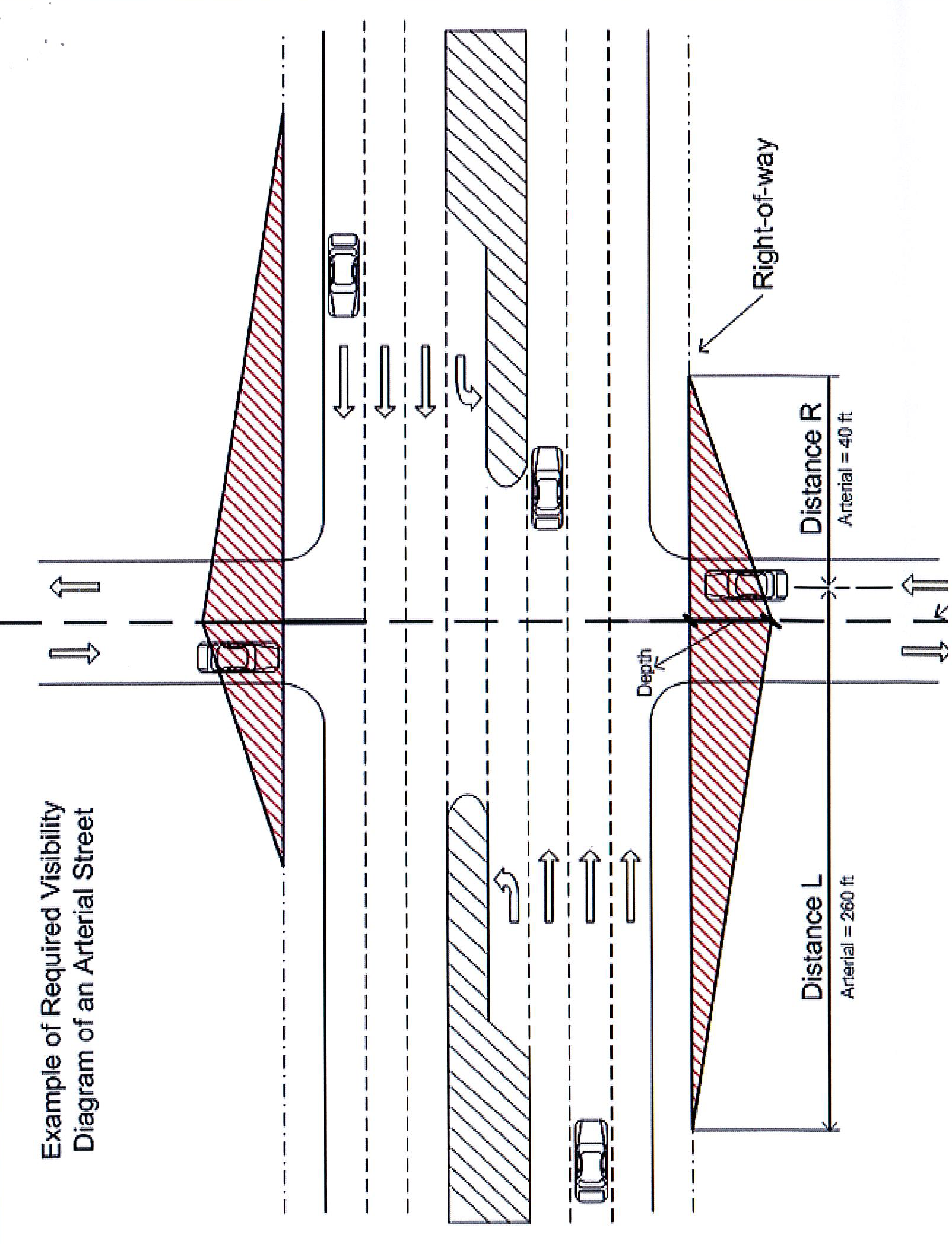
Clear sight triangles. All driveways and street intersections shall provide clear sight triangles in both directions as depicted below in the Safe Sight Distance Triangle Table:
(*) Visibility distances measured from crossroad of minor street, along right-of-way of through street. For a local street, sight triangle lies within public right-of-way.
(1)
The required dimensions for the clear sight triangle should be taken from the crossroad toward each side of the street and a line drawn to connecting points in accordance with the attached Diagram A except depth visibility on a minor street is measured from the right-of-way line through street, along centerline if minor street (public or private streets).
(2)
The clear sight triangle area shall not contain obstructions to cross-visibility at a height of 2½ feet. Fences, walls, bus shelters or hedges or other obstruction including, but not limited to, structures, grass, groundcovers, shrubs, vines shall not exceed 2½ feet or more above pavement or finish elevation of property whichever is greater.
(3)
For the purpose of this section, a local road is a road which contains 50 feet or less of right-of-way. A collector road is a road which contains a minimum of 60 feet of right-of-way. An arterial road is a road which contains a minimum of 80 feet of right-of-way.
F.
Landscaping: The area within any clear sight triangle shall be planted and maintained in a way that provides clear visibility from a height of 30 inches to a height of eight feet above the crown of the street. Vegetation shall be trimmed so that no limbs or foliage extend into the required visibility area.
G.
Maintenance of the Driveway. Once a driveway is constructed, the property owner shall be responsible for maintaining, and repairing the pavement, signing and striping and other features installed for operations on the driveway.
(Amended 1-17-2008 by Ord. No. 2008-296; Ord. No. 2011-362, § 1, 3-17-2011; Ord. No. 2018-523, § 1, 6-21-2018)