
Surprise City Zoning Code
ARTICLE X
- USE SPECIFIC STANDARDS
Sec. 106-10.1.- General standards for all use specific development.
A.
The use specific standards outlined in this article set forth specific requirements that shall be met before approval may be given for a proposed development. Theses use specific standards incorporate requirements to address uses that require additional regulations to protect public health, safety, and welfare.
B.
Specific proposals for new development may be subject to more than one (1) set of standards and shall also comply with the requirements listed elsewhere in this ordinance. In the case of conflict with a zoning district, use specific standards, or requirements of the planning and engineering design standards ("PEDs") the more restrictive requirement shall apply; unless specifically provided to the contrary and clearly intended.
C.
Nothing in these provisions shall relieve any property owner or property user from satisfying any condition or requirement associated with a previous approval, special permit, conditional use permit, variance, or other permit issued under any local, state, or federal ordinance or statute.
Sec. 106-10.2. - Reserved.
Editor's note— Ord. No. 2025-43, § 1(Exh. A), adopted Dec. 17, 2024, repealed § 106-10.2, which pertained to accessory dwelling units (ADU) and derived from Ord. No. 2022-10, § 1(Exh. A), adopted April 19, 2022; and Ord. No. 2024-03, § 1(Exh. A), adopted March 5, 2024.
Sec. 106-10.3. - Accessory uses and structures.
A.
All residential accessory uses (including ADUs), buildings, structures, and fencing shall be located on the same lot as the principal or main use and be at least five (5) feet from another structure or as required by the building and/or fire codes, except that fencing used to separate properties in a subdivision may straddle the common property line. Accessory structures in residential districts shall not be located within any easement or setback required by Table 106-10b—Accessory Structures.
B.
An accessory structure that is exempt from the building permit requirement still must comply with any other provisions, code, or regulation adopted by the city.
C.
No accessory use, building, or structure shall be constructed or developed on a lot prior to the establishment/construction of the primary uses, building, or structure; except for open-wire fencing on an otherwise undeveloped residential lot in the rural residential (RR) zoning district or retaining walls associated with site development.
D.
No accessory building shall at any time be used as a dwelling unit, unless specifically developed as an ADU in compliance with the standards outlined in Section 106-10.2 above and otherwise complies with the applicable building codes.
E.
A structure shall not be considered accessory if it is connected to the principal building by a common roof structure or covered passageway, except an ADU may be connected to the primary dwelling.
F.
With the exception of attached ADUs, and decorative shade structures such as gazebos, pergolas, and arbors, a residential accessory structure shall not be located in the front yard of a residential lot; except in the RR zoning district.ADUs and decorative shade structures, such as gazebos and arbors, may be in the front yard, but may not encroach into the minimum front or side setbacks.
G.
An accessory structure shall remain accessory to and under the same ownership as the primary uses, and shall not be subdivided or sold separately.
H.
No permit shall be issued for the construction of more than one (1) detached garage accessory structure for each dwelling.
I.
Apiaries may be permitted, provided the hives shall not be located closer than eighty (80) feet to any dwelling, lot line, or right-of-way.
J.
Development standards. Table 106-10b below identifies the dimensional standards required for an accessory structure.
K.
Accessory structures for multi-family, mixed use, commercial, and employment projects shall be included as part of an approved site plan and comply with setbacks of the zoning district.
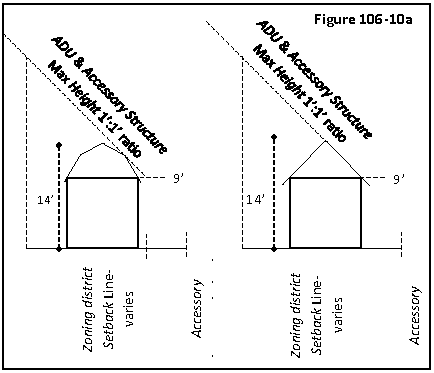
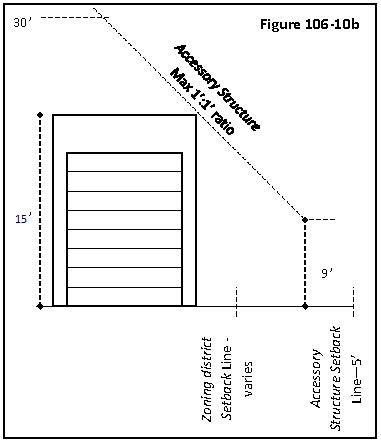
(Ord. No. 2021-17, § 1(Exh. A), 2-1-22; Ord. No. 2024-03, § 1(Exh. A), 3-5-24)
Sec. 106-10.4. - Agricultural animal keeping.
A.
When allowed, the production and sale, boarding and/or breeding of agricultural animals for commercial purposes shall meet the provisions as outlined in Section 106-10.5 below.
B.
The keeping of agricultural animals for non-commercial or personal use shall comply with Chapter 10 of this Code.
C.
Apiaries may be permitted for beekeeping, provided the structures containing the hives shall not be located closer than eighty (80) feet to any dwelling, property line or right-of-way.
D.
No shows or other activities that would generate more vehicular traffic than is normal to an area with single-family residences are permitted unless the site has direct access to an arterial or collector street. Occasional shows may be allowed provided a temporary use permit is secured and adequate parking for such shows or other special events can be demonstrated.
Sec. 106-10.5. - Agricultural operations and facilities.
A.
Agricultural operations may be permitted provided the site is a minimum of forty (40) acres.
B.
No commercial pen feeding or commercial feedlots or the commercial feeding of garbage to animals shall be allowed.
C.
Agricultural structures for storage of and maintenance of specialized machinery and equipment shall not be located closer than two hundred (200) feet from any lot line.
D.
Open outdoor storage is limited to plants, bulk organic dirt, or packaged fertilizer.
E.
All plant nursery or greenhouse enclosures, for commercial and wholesale purposes, shall be located a minimum of fifty (50) feet from any lot line.
F.
Wholesale growing of plants, trees, bushes, flowers, vegetables, and other food crops, may include limited onsite retail sales as an accessory use provided the sales areas complies with the farm stand regulations listed below.
G.
Application of pesticides shall comply with the buffer requirements of A.R.S. § 3-365 for schools, day cares, and adjacent residential uses.
H.
A farm stand may be permitted as an accessory use to agricultural operations for the purpose of selling produce or other products principally raised or produced on the premises. Exempt from the provisions in Section 106-10.5, the farm stand shall be located and constructed to meet the following requirements:
1.
The stand shall be setback a minimum of thirty (30) feet from the nearest right-of-way.
2.
The stand shall be staked or anchored in such a way as to prevent movement into the right-of-way.
3.
The site has access and off-street parking shall be provided. When a stand is located adjacent to a parkway, access shall be from a frontage road or intersecting roadway. In no case shall access be allowed from a parkway.
4.
The farm stand shall be of portable construction and shall be removed during the seasons when it is not in use.
5.
The structure shall not be more than ten (10) feet in height and not be more than four hundred (400) square feet.
I.
In addition to this section, keeping of animals shall comply with Chapter 10 of this Code.
(Ord. No. 2024-03, § 1(Exh. A), 3-5-24)
Sec. 106-10.6. - Airport or private airstrip.
A.
Privately owned or operated airports or airstrips for the landing and take-off operations of aircraft and hang gliders; including any fixed-base operations shall be subject to the following requirements:
1.
The land area shall be a minimum of twenty (20) acres.
2.
Landing areas and strips shall be setback a minimum of three hundred (300) feet from any property line.
3.
All buildings and structures shall be a minimum of one hundred (100) feet from any property line.
4.
Hours of operation for any fixed-base operation (FBO) shall not impact surrounding residential land uses.
5.
A minimum of one (1) off-street parking space per each hanger and/or tie-down space shall be required.
6.
Strobe lights shall be used only if no alternative lighting is permitted by federal regulation.
7.
Safety fencing, up to six (6) feet in height may be required around the fixed-base operations and/or landing strip areas.
8.
Must comply with all federal, state and local regulations, including licensing, and shall not interfere with any governmental or public airport operations.
Sec. 106-10.7. - Amusement/theme park.
A.
When allowed, permanent public features and structures shall be constructed.
B.
The lot area shall be a minimum of ten (10) acres.
C.
The required frontage on a public street shall be at least four hundred (400) feet in length.
D.
All points of vehicular access shall be from arterial roads, except fire-medical may take access where appropriate.
Sec. 106-10.8. - Animal hospital, clinic, shelter, grooming, or boarding facilities.
A.
A report from a qualified acoustical and/or environmental engineer, either that there are no negative impacts on neighboring residential uses or that they can be mitigated through appropriate design may be required.
B.
The building construction methods shall incorporate soundproof barriers and be designed to properly eliminate odors, waste, and other contaminants to protect adjacent properties.
C.
Activities shall be located within a fully enclosed soundproof building. No outdoor boarding shall be permitted, except in the case of animal hospital/clinics that service large agricultural animals.
D.
Outdoor exercise areas may not be placed immediately adjacent to or within one hundred (100) feet of an adjacent residential use or residentially zoned property.
(Ord. No. 2024-03, § 1(Exh. A), 3-5-24)
Editor's note— Ord. No. 2024-03, § 1(Exh. A), adopted March 5, 2024, amended the title of § 106-10.8 to include grooming facilities as herein set out.
Sec. 106-10.9. - Assisted living home.
A.
An assisted living home shall comply with the following requirements:
1.
Shall be licensed by the state and shall remain so licensed for as long as the assisted living home is in operation.
2.
An assisted living home shall not be located on a lot within one thousand two hundred (1,200) feet, measured by a straight line in any direction, from another assisted living home, as measured from property line to property line.
3.
The separation requirements shall not apply to assisted living homes separated by arterial roads.
4.
An assisted living home shall contain three hundred (300) square feet of overall living space for each resident.
5.
Shall include the installation of an automatic fire sprinkler system.
6.
In the event that the state revokes or terminates a person's license to operate an assisted living home, then the person operating the assisted living home shall immediately inform the city of such revocation or termination of their license.
B.
The above regulations are not intended to apply to the following facilities, as defined by this ordinance, provided the appropriate and/or required licensing by the state is obtained.
1.
Group home as defined by A.R.S. § 36-551.
2.
Adult development home as defined by A.R.S. § 36-551.
3.
Assisted living center.
4.
Residential care institutions as defined by A.R.S. § 36-581.
5.
Nursing care facility.
C.
An assisted living home shall not be permitted any signage, graphics, display, or other visual forms of identification, other than that permitted for a residential dwelling.
(Ord. No. 2024-03, § 1(Exh. A), 3-5-24)
Sec. 106-10.10. - Bar/nightclub.
A.
Bars and nightclubs shall comply with A.R.S. § 4-207 separation requirements.
B.
A report from a qualified acoustical and/or environmental engineer, either that there are no negative impacts on neighboring residential uses or that they can be mitigated through appropriate design may be required.
C.
Site locations and site plan design, such as but not limited to compatibility with adjacent neighborhoods and/or being developed within an established entertainment commerce center, shall be factors to be considered with the application for a CUP.
Sec. 106-10.11. - Bed and breakfast establishment.
A.
The bed and breakfast establishment shall be owner-occupied, and the guest rooms shall be part of the single-family dwelling.
B.
No more than four (4) bedrooms per residence may be used for the bed and breakfast establishment.
C.
A fire escape plan shall be developed and graphically displayed in each guest room. Such plan shall be filed with and approved by the city fire department.
D.
Maximum guest stay at a bed and breakfast establishment is limited to thirty (30) consecutive days.
E.
Meals may be served only to overnight guests and residents.
F.
No alterations to the exterior of the residence that alters the residential character, except fire escapes, accessible entrances and other features may be added to protect public safety as required by the applicable life-safety codes.
G.
There shall be one (1) off-street parking space per rental room.
Sec. 106-10.12. - Cemetery.
A.
Cemeteries intended for human burial shall contain a minimum of ten (10) acres. Cemeteries intended for small animal burial shall contain a minimum of five (5) acres. Cemeteries shall be located on a collector or arterial street.
B.
The cemetery may include accessory uses and structures such as, but not limited to, a business office, chapel, columbarium, mausoleum, and equipment storage that are incidental to the operation of a cemetery. A crematorium is not an accessory use.Accessory uses and structures shall be set back at least fifty (50) feet from any property line.
C.
No required setback shall be occupied by graves. There shall be a minimum of a fifty (50) foot landscaped buffer between the property line or roadway right-of-way; and any building, structure, or gravesite. The fifty (50) foot setback shall not apply to roads designed for internal circulation within the cemetery.
Sec. 106-10.13. - Community gardens.
A.
A fence shall be provided on the perimeter of the garden built to a height not to exceed six (6) feet along the side or rear lot lines or thirty-six (36) inches along the front property line. The fence material shall be compatible with the design style and material of all structures.
B.
The site shall be designed and maintained so that water and fertilizer will not drain to adjacent property or right-of-way.
C.
Hours of operation shall be limited to the hours between 6:00 a.m. and 8:00 p.m.
D.
Waste receptacles shall be provided and screened from neighboring properties. Refuse shall be removed so as not to be a nuisance.
E.
Composting equipment and containers, if provided, shall be specifically designed for that purpose and shall be located away from adjacent residences, businesses, and parks and screened from public view. Open composting piles are prohibited.
F.
Permitted buildings.
1.
One (1) shed limited to two hundred (200) square feet shall be permitted for the storage of any tools, fertilizers, equipment or other materials used in conjunction with the community garden. If provided it shall be adequately secured and meet setback requirements according to Section 106-10.3 of this article.
2.
Greenhouses, limited to two hundred (200) square feet, may be permitted if constructed of glass or other transparent materials and situated in compliance with all required setbacks of the zoning district in which it is located.
G.
Amenities such as raised/accessible planter beds, rain barrels, picnic tables, benches, bike racks, and garden art may be permitted.
H.
The property shall be maintained in a neat and orderly fashion as required by the city property maintenance code.
I.
Outdoor retailing of fresh produce or flowers grown on the site is permitted with a conditional use permit in accordance with subsection 106-10.5.H.
J.
The community garden signage shall comply with the Chapter 109 of this ordinance.
K.
If a community garden is no longer in operation or left fallow, for longer than one hundred eighty (180) days, the site shall be returned to its original form, unless otherwise developed in accordance with this ordinance. Any reestablishment of a community garden on the same site shall require processing and approval of a new site plan.
(Ord. No. 2024-03, § 1(Exh. A), 3-5-24)
Sec. 106-10.14. - Cottage industry.
A.
Not more than forty-nine (49) percent of the dwelling unit may be used for cottage industry. Up to one hundred (100) percent of accessory buildings may be used for a cottage industry.
B.
The aggregate building area, including portions of the dwelling together with any and all accessory buildings used in conjunction with a cottage industry, shall be limited to four thousand (4,000) square feet or not more than sixty-five (65) percent lot coverage, whichever is less.
[C.]
A cottage industry use that receives patrons, students, or any business-related individuals may only do so between the hours of 8:00 a.m. and 8:00 p.m.
[D.]
Accessory buildings and outdoor areas used for cottage industry purposes are intended to be limited to low intensity uses that produce or repair a product, and operate in such a way that they do not adversely affect adjacent properties. Parking and storage of business related commercial-rated vehicles, equipment, and products shall be limited to an enclosed building or within the rear yard and screened by an opaque fence or landscaping of approved drought-tolerant plant materials in combination with a fence.
[E.]
Outdoor dining ancillary to a cottage industry.
1.
Shall not be located within the front setback, shall be a minimum of fifteen (15) feet from an adjacent residential use, and screened by a minimum three (3) foot high opaque fence or landscaping of approved drought-tolerant plant materials in combination with the barrier.
2.
Shall not be more than fifty (50) percent of the dwelling unit's ground floor gross area.
3.
Shall not operate outside of the indoor restaurant's hours of operation.
[F.]
A cottage industry use may not change the character of the structure or alter the residential character of the neighborhood.
[G.]
Cottage industries may employ up to five (5) employees in addition to those residing in the residence.
[H.]
Signage shall be limited and shall comply with the regulations outlined in Chapter 109 of this ordinance.
Sec. 106-10.15. - Day care center.
A.
A minimum of seventy-five (75) square feet of fenced in outdoor play space per child shall be provided. Fenced-in, outdoor play space shall not include driveways, parking areas or land unsuited by virtue of other usage or natural features for children's play space.
B.
The minimum lot area shall be no less than six thousand (6,000) square feet or the minimum required by the zoning district in which the day care facility is proposed, whichever requirement is greater.
C.
Access to the day care facility shall be by means of a collector or arterial street.
D.
A minimum of one (1) drop off space per every five (5) children or a maximum of five (5) spaces, located out of the main travel way, shall be provided. A five (5) foot wide sidewalk running from the drop-off spaces to the day care entrance shall be provided.
E.
Day care uses as a home occupation are exempt from this section and shall comply with Section 106-10.23.
Sec. 106-10.16. - Donation bins.
A.
A temporary use permit ("TUP") is required, subject to the following:
1.
Donation bins may be placed with a TUP for up to twelve (12) months out of a calendar year with a TUP or prorated through the end of the calendar year.
2.
The TUP for any donation bin shall be renewed annually. Each renewal requires a new TUP application and fee. Donation bin TUPs shall be renewed within sixty (60) days prior to the first day of every calendar year. If an applicant submits for a TUP prior to the sixty (60) day renewal period, the permit shall not exceed the duration of the current calendar year and the permit fees will be prorated.
3.
The property owner will control the TUP, and as such, the owner or authorized agent may rescind their authorization by submitting a cancellation request to the city in writing. At the request of the property owner or authorized agent, the permit will be revoked.
4.
The community development director or designee may revoke the TUP issued under the provisions of this section when the TUP is issued in error or on the basis of incorrect, inaccurate, incomplete, or fraudulent information.
5.
Failure to comply with the requirements of this section may result in revocation of the TUP by the community development director or designee.
6.
A site plan shall be submitted as part of the TUP process. The site plan shall indicate the proposed location of all bins on the specific site.
B.
Arizona state law regarding drop boxes will apply to donation bins as defined in this ordinance.
C.
Donation bins within residential zoning districts may only be permitted in conjunction with places of assembly and other public facilities.
D.
Locational standards.
1.
Donation bins shall be located on a paved surface.
2.
Donation bins shall not be located within the setbacks, required landscaped areas, or within required parking spaces.
3.
Donation bins shall not obstruct pedestrian or vehicular circulation, or be located within the public right-of-way, drive aisles, fire lanes, loading zones, or any other location that may cause hazardous conditions, or constitute a threat to the public health, safety, and welfare.
E.
Size and quantity standards.
1.
There shall be no more than one (1) donation bin on properties less than one (1) acre in size, no more than two (2) donation bins on properties or commerce centers of one (1) to three (3) acres in size, and no more than four (4) donation bins on a commerce center greater than three (3) acres in size. No more than two (2) donation bins shall be clustered together and located within one thousand (1,000) feet of any other donation bin within a commerce center.
2.
Donation bins shall have a capacity no greater than seven (7) cubic yards.
F.
Appearance standards.
1.
Each donation bin shall have a firmly closing lid.
2.
Each donation bin shall be clearly marked to identify the specific items and materials requested to be collected for donation.
3.
Each donation bin shall be clearly marked to identify the City of Surprise TUP permit number with contrasting paint. The numbers shall be a minimum of two (2) inches high and located on the deposit face of the donation bin.
4.
The name and telephone number of the entity obtaining the TUP shall be affixed to the donation bin on an area no larger than one (1) foot by one (1) foot.
5.
If a donation bin is damaged or vandalized, it must be removed within five (5) business days of discovery or notification. If there is a public health, safety, or welfare concern pursuant to the authority granted to the city, the donation bin must then be removed within twenty-four (24) hours of discovery or notification.
6.
It is the responsibility of the entity obtaining the temporary use permit to maintain the donation bin painted or otherwise un-rusted and un-dented and in good repair.
7.
It is the joint responsibility of the property owner or authorized agent and the entity obtaining the temporary use permit to keep the area around the donation boxes free of litter and debris, and remove any graffiti within twenty-four (24) hours of discovery or notification, whichever occurs first.
G.
All donated items must be collected and stored in the donation bin and all contents cleared no less than once a week. Any items or materials left outside of the donation bin shall be removed within twenty-four (24) hours of discovery or notification, whichever occurs first.
H.
This ordinance authorizes the city and property owner to remove and dispose of any donation bin (including its contents) which is unauthorized, unpermitted, or is otherwise in violation of this ordinance.
Sec. 106-10.17. - Drive-through window/facilities.
A.
Drive-through facilities shall be located a minimum of twenty-five (25) feet from a public right-of-way and a minimum of seventy-five (75) feet from a residential district. The entry to each drive-through shall be separated by a minimum of three hundred (300) feet and should be separated by a drive aisle so as to avoiding stacking conflicts.
B.
Drive-through aisles shall be clearly identified through the use of striping, landscaping, and signage and shall be designed to:
1.
Contain aisles that are a minimum eleven (11) feet wide. Any curved sections shall be a minimum of twelve (12) feet wide with a minimum radius of twenty-five (25) feet on curved section;
2.
Minimize the conflict between pedestrians, parking and the building entrance. Pedestrian walkways should not intersect the drive-through aisles, but where they do; they shall have a minimum of fifteen (15) feet clear visibility and be emphasized with enhanced paving. Appropriate pedestrian crossing signs shall be visible from both the vehicle drive aisle and the pedestrian walkway; and
3.
Be integrated with the on-site circulation of the larger development.
C.
Drive-through exits shall be directly onto a public right-of-way and shall be separated by fifteen (15) feet from a parallel, main ingress/egress drive aisle to avoid conflicts with other vehicular traffic.
D.
Each drive-through lane shall have the following minimum distances:
1.
Forty (40) feet between the entry point and the ordering facility (i.e. restaurant menu board, teller machine or ordering window).
2.
One hundred (100) feet between pick-up/service window and ordering facility or entry point if no ordering facility is present.
E.
Drive-through speakers shall not be audible from the right-of way or adjacent residential uses. Additional landscaping, sound attenuation walls, or other mitigation measures may be required to reduce the sound level.
F.
Drive-through facilities shall orient pick-up/teller windows away from adjacent residential uses or from facing the arterial or collector street.
G.
Drive-through lanes shall be screened from the right-of-way and adjacent uses through the incorporation of a landscaped berm with continuous, dense landscaping at least four (4) feet in height to effectively screen the headlights of the vehicles in line. In cases when a berm may not be feasible because of space constraints, a screen fence/wall may be used in connection with landscaping.
H.
Drive-through facilities shall incorporate either an attached canopy over the drive-through window or teller area of the facility or plant shade trees within the landscape screening areas at the window location. The canopy shall not exceed fourteen (14) feet in height, measured from the ground to underside of the canopy. If canopy support pillars are used, they shall be finished with the same body and accent materials as the primary building. All lighting fixtures in the canopy area shall be fully recessed.
I.
The architecture of drive-through uses shall reflect the architecture of the principal building.
Sec. 106-10.18. - Equestrian centers and commercial stables.
A.
Shall have a minimum site area of ten (10) acres unless the site is adjacent to equestrian trails in which case the minimum site area requirement may be less; to be determined on a case-by-case basis.
B.
All livestock structures, containment areas of facilities used for the stabling, storing, showing or training of livestock and for temporary manure storage shall be set back a minimum of one hundred (100) feet from any property line. Normal setbacks apply to all other structures and uses.
C.
An attendant must be in residence on the property.
D.
All activity and pasture areas shall be grassed, sprinkled or treated with regularly tilled organic soil mix for dust suppression.
E.
All livestock turnout areas and pens shall be enclosed with fences at least five (5) feet in height. The design of these enclosures shall be shown on drawings submitted with the conditional use permit application.
F.
A specific plan for the physical containment and location of manure storage and/or disposal, which minimizes odor and fly impacts on adjacent lots or parcels, must be provided. The spreading and tilling of manure into the soil of the paddock, pasture or arena areas may be considered manure disposal.
G.
No shows or other activities that would generate more vehicular traffic than is normal to an area with single-family residences are permitted when located in a RR zone unless the site has immediate access to an arterial or collector street. Occasional small shows may be allowed per stipulations of the conditional use permit in other zones. A public address system or other means of outdoor amplification may be used as a convenience for announcements and administration during special equestrian events only.
H.
Outdoor activity shall be limited to the hours of 6:00 a.m. and 10:00 p.m. daily.
I.
A minimum of one (1) off-street parking space shall be provided for each three (3) stalls. Additional parking must be provided for shows or other special events.
J.
In the review for an equestrian center, commercial stables, and/or boarding stables, the city may also consider lighting, landscaping, signage, plan of operation, and neighborhood impact.
Sec. 106-10.19. - Farmer's market.
A.
The sales area shall be a minimum of fifty (50) feet from any residential dwelling.
B.
Outdoor display of only fresh fruits and vegetables is permitted. Seasonal sales that require additional storage area may be permitted in accordance [with] Article V. Motor vehicles, including vans, trucks, semi-trucks, mobile homes, travel trailers, and other permanent or temporary structures shall not be used for storage or display purposes.
Sec. 106-10.20. - Gated communities.
A.
The size of the gated community, or multiple adjacent gated communities, shall not exceed forty (40) acres, unless designed to properly connect with adjacent communities by both vehicular and pedestrian connections, with a minimum of thirty (30) percent of the gross land area set aside as improved open space.
B.
The planning and design of the gated community shall not impede connectivity of streets, improved open space, multi-use pathways or other public improvements from adjoining and abutting property, and in no case shall any connection be greater than one thousand three hundred twenty (1,320) feet apart. Connections shall remain open and accessible at all times.
C.
The perimeter of the gated community shall be designed with view fencing and that said view fencing is to provide continuous visual connections with open space areas of adjoining properties.
D.
There shall be a minimum of two (2) separate entry/exits to the gated community; except when constructed as an infill development.
E.
The ongoing maintenance of all private streets, water and sewer mains, fire hydrants and any other infrastructure required by the city shall comply with the city's minimum operational standards, and shall be fully maintained by the developer and/or homeowner;i§ .....i; association.
F.
The installation of drainage systems, retention basins, landscaping, multi-use pathways, street/pedestrian way lighting, screening and buffering shall comply with the city's standards set forth in the PEDS and the Parks and Trails Master Plan.
G.
A public service and emergency access easement shall be granted over all private streets.
H.
Gate designs shall include emergency hardware to ensure proper twenty-four (24) hour emergency access to the satisfaction of the city fire, police, public works, and utilities departments.
I.
A minimum of one (1) pedestrian access gate shall be provided at each gated driveway entrance.
J.
Such "anti-directional" devices as metal spikes that can cause tire damage shall not be allowed at entrances and exits.
K.
Sufficient queuing space between the gated entrance and the gate controller shall be provided such to ensure there is no conflict with adjacent public street traffic, and to avoid vehicular stacking across sidewalks, streets, bike paths and similar facilities.
L.
The gate entrance shall be designed to allow vehicles to turn around within the driveway without backing into the adjacent street.
M.
The style and color of gates and other enclosures shall be coordinated with nearby structures and approved by the community development director.
Sec. 106-10.21. - Group foster care and residential health care facilities.
A.
Registration.
a.
Prior to beginning operations, the owner or operator of a group foster care or residential health care facility shall be registered and licensed with the city.
b.
The operator of the group foster care or residential health care facility shall obtain all required inspections prior to the operation of a group foster care or residential health care facility.
B.
Registration renewal.
a.
Registration of a group foster care or residential health care facility shall be valid for one (1) year and must be renewed annually on or before the expiration date of the registration.
b.
To renew a registration, the operator of the group foster care or residential health care facility shall submit to the city an application for renewal and evidence of a current state license, or certification.
c.
The operator of the group foster care or residential health care facility shall obtain all required inspections.
C.
Changes.
The city shall be notified in the event a group foster care or residential health care facility ceases or changes operation type from which it was originally registered under.
D.
Standards.
a.
No residential health care facility or group foster care facility shall be located on a lot one thousand two hundred (1,200) feet, measured by a straight line in any direction from the lot line of another residential health care facility or group foster care facility.
b.
No identification from a public street shall be permitted by signage, graphics, display, or other visual means, except for signage otherwise permitted by Chapter 109 herein.
c.
No exterior change that would alter the building's residential character shall be made to the exterior of the building(s) and the grounds.
d.
The community development department maintains authority to approve the location of any residential health care facility or group foster care facility. An administrative record of all homes shall be maintained with the community development department.
e.
The residential health care facility or group foster care facility shall be operated and managed in compliance with the O&MP submitted with registration, a copy of which shall remain on file with the Community Development Department.
f.
The number of residents shall comply with the amount permitted under the state license and/or city business license.
g.
All administrative activities, including staff, counseling and other visitations, shall serve only the residents of the residential health care facility or group foster care facility.
h.
All residential health care facilities and group foster care facilities shall comply with all applicable codes adopted by the City of Surprise.
i.
Local, state, and federal licenses and/or certifications along with proof of city inspection shall be posted in a conspicuous place.
j.
The city is authorized to make inspections of property to determine compliance with the provisions of this section as allowable by law. An inspector may expand the scope of an inspection to include other City Code violations noted during inspection.
(Ord. No. 2023-20, § 1(Exh. A), 11-21-23)
Sec. 106-10.22. - Heliport.
A.
A heliport may be permitted as an accessory use for a hospital, medical facility, news station, emergency service, or similar use; with a conditional use permit.
B.
Helicopter landing pads shall be a minimum of six hundred (600) feet from all residentially zoned property or residential uses; and a minimum of one hundred (100) feet from property lines in all other zoning districts.
C.
All take-off, landing, and parking areas for helicopter landing facilities must be surfaced with a dust proof material.
D.
Evidence of Federal Aviation Administration approval of the air space and air traffic of the proposed operation and a planning report analyzing environmental impacts including, but not limited to, noise levels and mitigation, traffic generation, land use compatibility, number of daily operations, hours of operation, flight corridor, and the identification of any adverse impacts to the operation of other airports shall be approved and implemented prior to the issuance of any permit for a helicopter landing facility.
Sec. 106-10.23. - Home occupation.
A.
A home occupation shall be considered a permitted accessory use in all residential zoning districts provided it is operated and maintained to not interfere with the peace, quiet, and dignity of the property owners or neighbors, and if it complies with the following standards and requirements:
1.
The use of the dwelling as a home occupation location must be clearly incidental and subordinate to its use for residential purposes. A valid city business license shall be required for all home occupations.
2.
All home occupation activities shall occur entirely within the residential dwelling, garage, or accessory building unless the community development director or designee determines that the business activity conducted outside the dwelling is similar to noncommercial activities normally associated with single-family residences. Exceptions to this provision shall be made for swimming lessons or in-home day care.
3.
The use shall occupy no more than fifty (50) percent of the gross floor area of the residence or four hundred (400) square feet of a garage or accessory structure.
4.
Employees shall be limited to persons residing in the dwelling unit, immediate family members, or up to two (2) individuals who are not residents of the dwelling unit or immediate family members.
5.
A home occupation that is authorized to receive patrons, students or any business-related individuals at the home occupation location may only do so between the hours of 8:00 a.m. and 8:00 p.m., unless further regulated by a conditional use permit.
6.
There shall be no exterior displays, no outdoor storage visible from the street of equipment or goods, including equipment, materials, vehicles, trailers, or open lot storage.
7.
The home occupation shall not produce offensive noise, vibration, smoke, electrical interference or fluctuation in off-site line voltages, dust, odors, heat or other nuisances discernable beyond the property lines or beyond the common walls if the home occupation is conducted within a multiple-family unit.
8.
The home occupation shall not require structural alterations to the principal residence that would change the outside appearance of the principle residence or change the character of the property from that of a residential use.
9.
The home occupation shall not involve the use of electrical or mechanical equipment that would change the fire rating of the structure or include storage of flammable, combustible, or explosive materials. The home occupation shall not use or create any hazardous waste.
10.
The home occupation shall not require the installation of equipment or machinery creating utility demand, noise, fumes or other impacts in excess of equipment or machinery that is customarily found in a residential area.
11.
On-site advertising for the home occupation is prohibited, except a class I temporary sign as defined in Chapter 109 of this ordinance may be displayed during business hours within the property of the residence. Window areas must not purposely, intentionally or unintentionally be used as display areas or to offer merchandise for sale.
12.
No pedestrian or vehicular traffic shall be generated by the home occupation in greater volumes than would normally be expected in a residential area.
13.
No home occupation will be permitted which requires:
a.
Receipt of merchandise, goods, or equipment, by a semi-tractor/trailer truck;
b.
Delivery of merchandise, goods, or equipment, by a semi-tractor/trailer truck;
c.
Retailing conducted on the premises;
d.
Wholesaling of stocks, supplies or products conducted on the premises.
14.
No home occupation shall cause an increase in the use of any utilities (water, sewer, garbage, or electric) so that the combined total use for dwelling and home occupation purposes exceeds the average for residences in the neighborhood.
15.
The home occupation shall not be conducted in such a manner or advertised in such a way as to attract consumer traffic or other non-residential traffic. Advertisements that are displayed in any media, including telephone directories, may not give the street address of the home occupation location.
16.
All vehicles of patrons or students of the home occupation must be parked in authorized parking locations either on the lot where the home occupation is located or in the public parking adjacent to the home occupation location.
B.
In case of any question as to the suitability of a home occupation, the community development director or designee shall determine which uses may be allowed as home occupations. The following are some examples of uses, which would be acceptable as home occupations, provided they comply with the above regulations: (this list is not all inclusive and listed uses do not automatically qualify as a home occupation)
1.
Home office uses for service call establishments, mobile vending, professional occupations, and consulting services (accountant, architect, attorney, medical, dental, therapy, insurance or real estate) without client contact at the home.
2.
Art studio that includes but is not limited to painting, sculpting, writing, or composing.
3.
Home crafts such as jewelry making, pottery, weaving and rug making, woodworking, metal working, and home cooking and preserving.
4.
Off-site sales and/or the use of retail shipping services than would normally be expected in a residential area.
5.
Music lessons, swim lessons, and tutoring with no more than four (4) persons at any a time.
6.
In-home day care with no more than four (4) children or adults that are not related to the caregiver.
7.
Services such as catering, dressmaking, sewing and tailoring services, (non-vehicular) repair services, door-to-door sales, and off-premise party sales without client contact at the home.
8.
Telephone answering, message services, word processing and other computer applications.
C.
The following uses have a pronounced tendency, once started, to rapidly increase beyond the limits permitted for home occupations and thereby impair the use and value of a residentially zoned area for residential purposes. Therefore, the following uses shall not be permitted as home occupations: (this list is not all inclusive)
1.
Animal clinics, veterinary offices, and kennels or boarding facilities.
2.
Dance instruction, gymnastic instruction, and photo studios.
3.
Medical, dental, physical therapy, or psychotherapy offices, ambulance services, and mortuary.
4.
Motor vehicle repair or paint shops, storage, restoration or conversion, engine repair or similar uses; except on a vehicle personally owned by the resident.
5.
Repair shops, machine shop, furniture refinishing and upholstering.
6.
Restaurants.
7.
Private schools with organized classes.
8.
Stables or kennels for commercial purposes.
9.
Personal services.
10.
Contractor yards.
11.
Banks, credit unions or payday lending.
D.
Complaints by citizens or local residents may be cause for immediate termination of the home occupation use if appropriate measures cannot be undertaken to mitigate the complaint or violations. All complaints or violation of the above conditions shall be registered with, and reviewed by, the zoning administrator.
(Ord. No. 2021-17, § 1(Exh. A), 2-1-22; Ord. No. 2025-16, § 1(Exh. A), 10-7-25)
Sec. 106-10.24. - Live-work dwelling.
A.
The maximum size of a development designed exclusively for live-work units shall be three (3) acres.
B.
The living space must be occupied by the business owner of the work space and not separately leased.
C.
The work space shall be located within the building frontage and/or on the ground floor or may be permitted above the ground floor through a CUP process.
D.
The work space shall be limited to only the non-residential permitted uses for the specific zoning district as listed in Table 106-1c with a maximum work space size of four thousand (4,000) square feet and a maximum of two (2) employees in addition to the family members residing in the dwelling unit.
E.
A live-work unit should mirror the adjacent residential structures in mass and design to be compatible with the diverse neighborhood in which they are located.
F.
There shall be direct pedestrian access at the street frontage or near grade level to each individual live-work unit.
G.
A live-work unit that has employees or walk-in commercial trade (not just by appointment) shall be fully accessible and meet ADA requirements where these commercial activities occur.
H.
Mixed use buildings that contain residential uses may be asked to demonstrate, through a report from a qualified acoustical and/or environmental engineer, either that there are no negative impacts on residential livability or that they can be mitigated through appropriate design.
Sec. 106-10.25. - Medical hospitals.
A.
The minimum lot area shall be five (5) acres.
B.
The minimum lot frontage shall be three hundred (300) feet or the minimum requirement of the district, whichever distance is greater.
C.
Bio-hazardous waste incinerators with an allowable operating capacity equal to or less than one thousand (1,000) pounds per hour may be allowed as an accessory to a hospital use with the following use standards:
1.
An incinerator use shall be set back a minimum of five hundred (500) feet from any property line abutting a residential zoning district or use.
2.
A site plan shall be provided illustrating how the operation functions including circulation routes and the locations, square footage, height and location of buildings, incinerator and storage areas.
Sec. 106-10.26. - Manufactured homes.
A.
When permitted a manufactured home shall be designed and situated on the lot in a manner that assures similarity in exterior appearance and in keeping with, the architectural character of conventional site-built dwellings and the character of the surrounding neighborhood in general as required by the PEDS and with the additional specific standards outlined below.
B.
All manufactured homes shall be required to meet the current HUD Code standards, be certified under the National Manufactured Housing Construction and Safety Standards Act of 1974, and comply with state office of manufactured housing regulations.
C.
A manufactured home shall be both multi-sectional in design and not constructed more than ten (10) years prior to the date of application for building installation permit.
D.
A mobile home, recreational vehicle, or park model is not a manufactured home and shall not be used as or considered to be a primary residential dwelling.
E.
Foundations. The manufactured home shall be pit set and placed on an excavated foundation with a permanent masonry stem wall. Skirting material is not permitted; rather the stem wall shall be treated to have the appearance of a foundation wall similar to conventional site built homes.
F.
Exterior building materials. Reflective building materials are prohibited. Metallic surfaces, including roof materials, shall be treated to be non-reflective. The building materials shall be durable, require low maintenance, and be of the same or higher quality as the surrounding site-built homes. Acceptable siding materials include: wood, stucco, brick, stone, or other masonry materials or any combination of these materials. Other building materials may be considered on a case-by-case basis provided they meet the codes and addendums adopted by the city.
G.
Garage or carports. The design and materials of any garage or carport shall be compatible with the design and materials of the main structure.
H.
Steps. If the dwelling unit has steps leading to the front entry the steps shall be attached to a permanent foundation and designed and constructed to compliment the architectural style of the dwelling unit.
I.
Anchor ties. The structure shall be anchored to the ground, in accordance with engineered plans and/or approved manufactured home installation standards.
Sec. 106-10.27. - Marijuana facility uses.
A.
All marijuana facility uses shall comply with laws pursuant to the Arizona Revised Statutes and all regulations issued by DHS. The following provisions will not be construed as permitting any use or act which is otherwise prohibited or made punishable by law.
B.
Any marijuana facility shall meet the following requirements:
1.
Be located in a permanent building and may not be located in a trailer, cargo container, storage unit, or motor vehicle.
2.
The business location shall not exceed a maximum size of two thousand five hundred (2,500) gross square feet, except that a co-located medical marijuana dispensary and marijuana retail establishment operated by a dual licensee may be a maximum size of five thousand (5,000) gross square feet.
3.
May have a drive-through service per Section 106-10.17.
4.
Not emit dust, fumes, vapors, or odors into the environment.
5.
Not provide off-site delivery of marijuana or marijuana products.
6.
Prohibit consumption of marijuana on the premises.
7.
Not have outdoor seating areas.
8.
Disposal of marijuana remnants, by-products, and/or infused products shall not to be placed within exterior refuse containers.
9.
The secure storage area for the marijuana stored at a marijuana facility operated by a dual licensee shall not exceed twenty (20) percent of the maximum gross floor area of the marijuana facility.
10.
The permitted hours of operation of a marijuana facility operated by a dual licensee shall be limited to 8:00 a.m. to 9:00 p.m.
11.
The operator of a marijuana facility shall provide unrestricted access to city code enforcement officers or police officers who request admission for the purpose of determining compliance with these standards.
12.
Within a marijuana facility there shall be a secure storage area sufficient to deter and prevent theft.
13.
All marijuana and marijuana products shall be securely locked within the secure storage area at any time the medical marijuana dispensary or marijuana facility operated by a dual licensee is not open for business.
14.
A medical marijuana dispensary or marijuana facility operated by a dual licensee shall have only one (1) secure entrances to the building and shall be required to implement appropriate security measures to deter and prevent the theft of marijuana, and to reasonably regulate customer access to the premises including access into areas containing marijuana pursuant to A.R.S. §§ 36-2806(C) and 36-2858(D)(4).
15.
A marijuana facility shall have an alarm system with a redundant power supply and circuitry to prevent deactivation.
16.
A marijuana facility shall have a video surveillance system that at all times records all interior areas and the exterior perimeter.
17.
A marijuana facility shall have adequate exterior security light, which also complies with Chapter 107, Article 3 of this ordinance.
18.
The operator of a marijuana facility shall develop and maintain a security plan which demonstrates compliance with all of the minimum standards specified herein.
C.
Any marijuana facility shall meet the following minimum separations, measured in a straight line from the boundary of the parcel containing the marijuana facility location to the boundary of the parcel containing anyuses as listed below (see Table 106-10c). If either the marijuana facility or buffered use is in a commerce center development, the separation requirements shall be measured from the boundary of the commerce center.
D.
Marijuana retail establishments are prohibited, except that a marijuana retail establishment is permitted when it is operated in the same building on the same property with a medical marijuana dispensary by a dual licensee who has an active, valid medical marijuana dispensary registration from DHS as well as a marijuana retail establishment license issued by DHS.
E.
A marijuana facility lawfully operating is not rendered in violation of these provisions by the subsequent location of a new use established closer than the outlined below in Table 106-10c.
F.
Medical marijuana designated caregiver cultivation and qualifying patient cultivation locations shall further comply with the follow requirements:
1.
Cultivation locations will be an enclosed, locked facility such as a closet, room, greenhouse or other building that does not exceed fifty (50) square feet of cultivation space.
2.
Cultivation locations will not be visible from beyond the boundaries of the property on which the cultivation location is situated.
3.
Medical marijuanacultivation as an accessory use to the qualifying patient primary residence will only be permitted if the residence is located at least twenty-five (25) miles from a medical marijuana dispensary.
(Ord. No. 2021-24, § 1(Exh. A), 11-16-21; Ord. No. 2024-02, § 1(Exh. A), 1-16-24)
Editor's note— Ord. No. 2021-24, § 1(Exh. A), adopted November 16, 2021, changed the title of § 106-10.27 from "medical marijuana uses" to "marijuana facility uses."
Sec. 106-10.28. - Mining and mineral extraction.
A.
Extraction and processing of minerals and natural resources, such as mines, quarries and gravel pits and including concrete or asphalt batch plants as an accessory use shall comply with the following standards:
1.
No excavation or processing of excavated materials shall be permitted within thirty (30) feet to the exterior boundaries and within one hundred fifty (150) feet to any residential zoned property or existing residence.
2.
Material shall be excavated in such a manner so as to assure the convenient, efficient, and successful restoration of the land to hold to a minimum any adverse effects to adjacent and surrounding land as a result of piling or storing the overburden material.
3.
Material shall be excavated in such a manner that leaves a minimum of two (2) feet of undisturbed sand, gravel, or soil over the entire excavation tract to provide a water bearing strata for any ground water; or more if the required geological report indicates that it is necessary.
4.
The excavation operator shall maintain haul roads within the premise covered by the permit and the perimeter public roads in a dust-free condition.
5.
The hours of operation, unless otherwise specified by the city, shall not be prior to 6:00 a.m. or after 10:00 p.m. unless the city grants special permission, for temporary expansion of the hours.
6.
Operations shall be conducted in such a manner that excavated areas will not collect or permit stagnant water to remain therein.
7.
The required development plan shall indicate compliance with the above standards and shall include the following topographic information at a minimum of five (5) foot contour intervals:
a.
Pre-excavation contours;
b.
Proposed excavation contours;
c.
Degree of slope of banks for all excavations;
d.
Location of any public facilities, irrigation canals, ditches, or streambeds;
e.
Post excavation re-use and contours.
Sec. 106-10.29. - Model home complex.
A.
A site plan shall be required of all model home complexes. All requirements, (e.g. garage conversions, temporary sales trailers, landscaping, building permits, inspections), related to the construction of a model home complex shall be satisfied before a certificate of occupancy shall be issued.
1.
Sewage disposal lines and service stub to the model home lot(s) shall be installed and operable.
2.
The subdivision water mains and service stub to the model home lot(s) shall be installed and operable.
3.
Fire hydrants, as required by and in accordance with the city's fire code and the standards outlined in the PEDS, shall be installed and operable.
4.
Streets and alley improvements are complete.
B.
The model home complex shall be used only to market homes being built in the subdivision or master development in which it is located. No off-site sales are allowed.
C.
Building permits for the sales/construction office in a model home, sales trailer, or construction trailer within the model home complex can be processed before or concurrent with the model home complex application. These permits can also be processed after approval of the model home complex. The location and parking for trailers shall be included in the site plan for the model home complex application if they are to remain during the public use of the model home complex.
D.
All model home complexes shall prominently display a map identifying all existing and planned land uses and zoning within the subdivision and within a mile of the boundary of the subdivisions. The map shall also include the location of any proposed major arterials or freeways within said boundary area and the type and location of any public or private trails that will be constructed through or adjacent to the subdivision. The map shall be colored and a minimum of twenty-four (24) inches by thirty-six (36) inches in size.
E.
All model home complexes for residential developments must provide notice to prospective buyers and tenants that the project is located within the influence area of Luke Airforce Base and shall be subject to the requirements of this Code regarding the display of the Surprise/Luke Notification Map.
F.
Models shall be converted to a residential use when the last home in the development has been sold. The time limit does not apply to models located within apartment complexes or manufactured home parks, provided the residential character of the model is maintained. Prior to occupancy as a residential unit, the model home complex must remove any temporary parking, sales office, lighting, trap fencing, flagpoles, signage, and similar improvements and replace garage doors, fences, and driveways to those typically found within the residential neighborhood.
G.
All site improvements shall be completed and the complex shall have adequate access per the adopted city International Fire Code.
H.
Outdoor storage of construction materials, supplies, or equipment shall not be permitted.
I.
Where model home complexes consist of more than two (2) homes, xeriscape landscaping techniques shall be used for a minimum of one-third (⅓) of the models.
(Ord. No. 2024-03, § 1(Exh. A), 3-5-24)
Sec. 106-10.30. - Outdoor dining/seating.
A.
Outdoor dining, patios, and seating areas must be associated to and used in conjunction with a permitted use. For purposes of state liquor license spacing regulations, the outdoor dining, patio, and seating areas shall be considered part of the premises.
B.
Outdoor dining/seating shall be limited to locations on private property and may encroach into setbacks up to ten (10) feet but shall be a minimum of five (5) feet from any property line and not within the public right-of-way.
C.
Outdoor dining/seating shall not obstruct sidewalk or trail pedestrian or bicycle traffic or create public health and safety hazards.
D.
Roof material covering an outdoor dining/seating area may be temporary, fixed, or retractable and shall be opaque. Awnings, canopies, or similar protective shelter must be fire-treated or nonflammable.
E.
Any definable decorative barrier element physically separating the outdoor dining/seating area from adjacent pedestrian traffic provided shall be handicapped accessible and not exceed forty (40) inches in height. The design and materials of such barrier element shall complement and be compatible to the architectural design of the primary building façade.
F.
Decorative/accent lighting may be incorporated into the outdoor dining/seating area, landscape, awning, or canopy and shall meet all City Code requirements.
(Ord. No. 2024-29, § 1(Exh. A), 9-17-24)
Sec. 106-10.31. - Outdoor display and sales areas.
A.
When allowed as an accessory use, outdoor display areas for the sale, rental, or lease of new or used automobiles, trucks, boats, trailers, recreational vehicles, and farm and construction equipment may be permitted provided:
1.
The maximum display area, which is used to highlight sale items excluding the sales lot area, shall not exceed ten (10) percent of the total net lot area. Displays may encroach into setbacks up to ten (10) feet but shall be a minimum of ten (10) feet from any property line and not within the public right-of-way.
2.
All sales, repair, and rental activities are conducted within a building. Openings to service bays shall not face public rights-of-way and shall be designed to minimize the visual intrusion into adjoining properties.
3.
The outdoor display areas shall be included on an approved site plan and on a paved or other hard-surfaced area. Display platforms shall be a minimum of thirty (30) feet from other display platforms, not exceed four (4) feet in height and incorporate the design components of the primary building or landscape features.
4.
The sales or rental display of new or used farm and/or construction equipment shall have the equipment in the down and transportable position.
5.
The areas designated for the parking and/or storage (not display area) of all of the above vehicles and/or equipment shall be paved and properly screened with a fence/wall, hedge, or landscaped berm or combination thereof. Adequate loading areas must be allocated, specifically identified, and reserved on the site for the unloading of all such vehicles and equipment brought to the site by carriers.
6.
The installation and use of an outside public address or bell system is prohibited.
B.
Other retail businesses may be permitted outdoor display areas as an accessory use provided:
1.
The outdoor display area is only for merchandise sold on the property with the sale of the merchandise being conducted within the business building; no open outdoor sales shall be permitted.
2.
The display area is located on private property (not within the public right-of-way), not displayed within the landscaping areas, and does not displace any required parking for the permitted uses.
3.
The merchandise is displayed in a manner allowing for shopping with a clear walkway and displayed only during business hours with the merchandise being brought inside at the close of each business day, except for permanent outdoor displays.
4.
The outdoor display shall be in a manner that presents a display vignette rather than lined-up and/or chained together, and has no signage, blinking lights, movable or audible aspects to the display.
5.
The display area shall be limited to only twenty-five (25) percent of the business store frontage and located within twenty-five (25) feet of the customer entrance.
6.
Permanent outdoor display areas may be permitted as part of an approved site plan for C-3, I-1 and I-2 zoning districts.
(Ord. No. 2021-17, § 1(Exh. A), 2-1-22)
Sec. 106-10.32. - Outdoor storage and use.
A.
When allowed as an accessory use, outdoor storage and use areas may be permitted provided:
1.
Permanent outdoor storage and use areas may be permitted as part of an approved site plan.
2.
Outdoor storage of materials and use areas are not permitted in the required setbacks.
3.
Outdoor storage of materials and use areas shall be screened from residential uses and any public right-of-way.
Sec. 106-10.33. - Plant nursery.
A.
Retail plant nursery, providing all incidental equipment and supplies such as but not limited to soil, fertilizer and empty containers, shall be kept within a completely enclosed building or within an area enclosed on all sides by a solid fence/wall at least six (6) feet in height. No goods, materials, or objects shall be stacked higher than the fence/wall.
B.
A minimum setback of fifty (50) feet from abutting residential zoning district shall be maintained for structures outlined above; except sales display areas for plants and other goods may be outdoors and within setbacks.
C.
Outdoor public address systems shall not be allowed.
D.
Only low-level lighting shall be allowed.
Sec. 106-10.34. - Portable carports.
A.
Portable carports may be permitted in all residential districts, subject to the following provisions.
1.
Portable carports shall not be permanently anchored to concrete slabs or footings or otherwise anchored in a manner that would impede ready removal and portability; but shall be tied down in such a manner to prevent wind uplift.
2.
Portable carports shall remain open on four (4) sides and shall be limited to a maximum of two hundred (200) square feet in size.
3.
Portable carports shall not be located in the front yard of a residential lot.
4.
Portable carports shall be limited to one (1) per lot.
5.
Portable carports shall not encroach into required front or side setbacks when adequate area and access otherwise exist.
B.
If the lot size, area, access, or configuration limitations do not permit the installation of portable carports without encroaching into the required front, side or rear yard setbacks, the zoning administrator may authorize encroachment into the setback by issuing a conditional use permit pursuant to Chapter 102 of this ordinance.
Sec. 106-10.35. - Portable storage containers and construction trailers.
A.
The dimensions of a portable storage container shall not exceed 102 inches (eight (8) feet, six (6) inches) in height and ninety-six (96) inches (eight (8) feet) in width. Lengths may vary but shall not exceed forty (40) feet in length.
B.
The temporary placement of a portable storage container on any residential lot for the purpose of loading and unloading household contents shall be permitted for a period of time not exceeding seven (7) days in a calendar year.
C.
In all non-residential districts, portable storage containers are permitted only in accordance with the following:
1.
Portable storage containers may be a temporary use during the construction, remodeling, or redevelopment of permanent on-site building and facilities. In addition to specifying and limiting the number, size, location, and duration of the storage containers, the community development director or designee may require additional measures to ensure compatibility with adjacent land uses such as increased setbacks, screening, landscaping, exterior materials and color.
2.
Portable storage containers may be an accessory to a temporary use such as a special events or temporary retail sale that is periodic, intermittent, or isochronal. In addition to specifying and limiting the number, size, location, and duration of the storage containers, the community development director or designee may require additional measures to ensure compatibility with adjacent land uses such as increased setbacks, screening, landscaping, exterior materials and color.
3.
Portable storage containers shall not be located in landscape areas, open space, retention basins, drive aisles, fire lanes, required parking spaces, loading zones, or any other location that may cause hazardous conditions, constitute a threat to public safety, or create a condition detrimental to surrounding land uses and developments.
D.
Construction trailer shall be subject to the following requirements:
1.
The construction trailer shall remain on site only for the duration of an active permit. Abandoned trailers shall not be permitted on the site.
2.
The construction trailer, attendant parking and storage areas shall be located on site so as not to interfere with safe ingress and egress to developed areas or areas under construction.
3.
The construction trailer shall be removed prior to issuance of a final certificate of occupancy.
Sec. 106-10.36. - Racetrack.
A.
Auto racetracks and animal racetracks shall have the following requirements:
1.
The minimum lot size area shall be forty (40) acres.
2.
The site shall not be adjacent to single-family residential properties.
3.
All buildings, structures, and facilities associated with the activity shall be no closer than one hundred (100) feet from any property line.
4.
A public address system or other means of outdoor amplification may be only during race hours or special events times.
B.
In addition to the standards listed in subsection A above, animal racetracks shall have the following requirements:
1.
Exercise tracks for animal racetracks and any additional activity areas shall be maintained in non-dust condition at all times.
2.
A manure waste management plan and fly control plan shall be prepared.
3.
All buildings shall be maintained in a safe and healthy manner and applicable federal, state or local statute or ordinance.
C.
Other racetracks (e.g. bicycle, motocross) shall follow the requirements as outlined in subsection A above with the exception that the minimum lot size may be reduced to ten (10) acres.
Sec. 106-10.37. - Recreational vehicle (RV) park.
A.
A recreational vehicle (RV) park shall provide adequate streets, driveways, walkways, proper sanitary facilities, adequate fire protection, adequate water supply, adequate lighting, and adequate protection of surrounding properties. All RV parks shall be land-lease developments that comply with the following standards:
1.
No "park model", manufactured homes, or site built dwelling units shall be permitted except for that of the owner/manager.
2.
RV parks shall be a minimum of ten (10) acres in size and all spaces shall be a minimum of fifty (50) feet from the exterior recreational vehicle park exterior property lines.
3.
RV parks shall not be used as permanent residences except for that of the caretaker or manager. All recreational vehicles within an RV park shall display current license plates/tags and shall not be parked nor occupied for more than one hundred eighty (180) days per calendar year.
4.
There shall be a maximum net residential density of twenty (20) spaces per net acre.
5.
There shall be a minimum of twenty-five (25) percent open space required within the development; excluding the private streets.
6.
Dimensional requirements for each individual RV space are as follows:
a.
Minimum of two thousand (2,000) square feet.
b.
Minimum frontage/driveway shall by fifteen (15) feet and space width shall be forty (40) feet.
c.
Minimum space length shall be fifty (50) feet.
d.
The following minimum setbacks for RVs shall be required for all individual lots:
1.
Minimum front setback: fifteen (15) feet.
2.
Minimum side and setback: eight (8) feet.
7.
Each park must provide an adequate and easily identifiable office or registration area. The location of the office shall not interfere with the normal flow of traffic into and out of the RV park.
8.
RV park developments shall be improved with paved private streets built to city specifications. Private streets shall be maintained by the private owner of the RV park.
9.
No RV space within the park shall have direct access to a public street outside of the development.
10.
An approved decorative perimeter fence shall be constructed around the entire RV park.
11.
Each designated space in the park shall have a concrete slab for the parking of only one (1) RV unit per space. There shall be no RV parking other than on the paved surface area within the designated space. The concrete slab shall directly connect to the paved street system of the RV park. A minimum of one (1) off-street parking space shall be provided on or adjacent to each space.
12.
Each RV unit shall be equipped with wheels, which remain on the unit; however, the wheels may be blocked for stability.
13.
No permanent room addition shall be attached to the RV unit nor shall the unit be attached to any permanent structure.
14.
Recreational amenities such as a swimming pool, shuffle board, and tennis and/or social centers, which may be used for dancing, crafts, hobbies, games, meeting, banquets, and similar recreational uses shall be developed and may be of conventional construction.
15.
Restroom and shower facilities shall be provided separately for men and for women. A common use laundry facility shall be provided at a ratio of one (1) washer and one (1) dryer for each twenty (20) spaces or fraction thereof.
16.
Each RV park shall be master metered for both electric and water/sewer service. Individual lease spaces shall be developed with a hook-up to these utilities. If approved by the city, the park may be allowed some short-term lease spaces without utility hook-ups. Additionally, each development shall provide at least one (1) approved disposal site/pumping station for both water and sewer holding tanks for the RV units.
Sec. 106-10.38. - Recycling operations and facilities.
A.
Indoor recycling collection facilities will be subject to the following requirements:
1.
Will be located a minimum of two hundred (200) feet from any residential zoning district, measured by a straight line in any direction from property line to property line.
2.
Storage and operations will only be performed within an enclosed building.
3.
Processing operations are limited to cleaning, compacting, sorting, wire stripping, shearing, and baling.
B.
Outdoor recycling collection facilities will be subject to the following requirements:
1.
Will be located within I-1, I-2, or I-3 zoning districts and a minimum of one thousand three hundred twenty (1,320) feet from any residential zoning district, measured by a straight line in any direction from property line to property line.
2.
Processing operations are limited to cleaning, compacting, sorting, wire stripping, shearing, and baling.
3.
All operations and storage, including all equipment used in conducting such use, other than parking, will only be conducted within an enclosed building or within an area enclosed by a minimum six (6) foot high screen wall.
4.
Storage is not permitted above the height of the screen wall.
5.
All areas of the facility open to vehicular passage will be paved.
C.
Reverse vending machines will be subject to the following requirements:
1.
Will be located a minimum of two hundred (200) feet from any residential zoning district, measured by a straight line in any direction from the reverse vending machine to any residential property line.
2.
Will occupy no more than three hundred fifty (350) square feet of space.
3.
Will not reduce the number of required parking spaces for the hosting site.
4.
Will be clearly marked to identify the name and telephone number of the reverse vending machine owner and display a notice stating that no material will be left outside of the building or recycling reverse vending machine.
5.
Will be located a minimum of one hundred (100) feet from any right-of-way access point.
D.
In addition to the standards listed in subsection B above, recycling processing facilities will allow for other types of processing operations to occur.
Sec. 106-10.39. - Schools and universities.
A.
Pre-K through 12 schools shall be subject to the following requirements:
1.
School sites shall not have public access directly from a parkway or arterial.
2.
Building setbacks shall be a minimum of fifty (50) feet for front, side and rear setbacks.
3.
Maximum lot coverage shall be sixty (60) percent.
4.
Open space, including play area, shall be a minimum of twenty-five (25) percent.
5.
Designated and separate bus and parental drop off/pick up areas with separate pedestrian pathways shall be provided. The parental drop off/pick up area shall accommodate a minimum of five (5) cars at a time. The bus drop off/pick up area shall accommodate a minimum of three (3) buses at a time.
6.
Special paving, brick, striping, or other methods shall be used for pathway areas that cross vehicular use areas.
7.
Dumpster and trash receptacles shall be screened and located a minimum of seventy-five (75) feet from any residential property lines.
8.
Outdoor lighting must comply with Chapter 107, Article 3 of this ordinance.
9.
Parking may be allowed in the front setbacks of the lot for schools on a right-of-way designated as a collector or greater. There shall be a three (3) foot high landscaped berm or fence/wall or combination thereof along the street frontage where parking occurs. On all other street classifications, parking shall meet minimum setbacks. A minimum of fifteen (15) percent of all parking areas shall be landscaped. A twenty (20) foot minimum landscaped setback shall be provided where parking is adjacent to residential districts.
10.
Security fencing of the campus and/or outdoor play areas shall be view fencing and shall allow for emergency vehicle access.
11.
All buildings shall be designed in accordance with the PEDS (see Chapter 107 herein) and to be compatible with the surrounding residential neighborhood.
12.
New schools shall not be located in areas within the 65 DNL noise contours.
13.
Off-site improvements may be required to accommodate peak traffic volumes.
B.
University, college or trade schools shall be subject to the following requirements:
1.
School sites may have public access from a parkway or major arterial.
2.
The site shall have pedestrian and bicycle accessibility.
3.
Campus-like development site shall include a minimum of twenty-five (25) percent open space.
4.
New schools shall not be located in areas within the 65 LDN noise contours.
5.
School sites shall provide adequate on-site parking or participate in the improvements of off-site parking facilities or structure(s) that would adequately serve student needs without impacting the surrounding neighborhoods or uses.
6.
Outdoor lighting must comply with Chapter 107, Article 3 of this ordinance.
(Ord. No. 2023-25, § 1(Exh. A), 11-6-23)
Sec. 106-10.40. - Self-storage facilities.
A.
Self-storage facilities may be appropriate in the neighborhood, commerce and office, and employment character areas of the General Plan, except may be considered incompatible in areas within the transit-oriented development (TOD) strategic plan and scenic lands sub area.
B.
There are three (3) different "types" of self-storage facilities; each with different land use needs and varying degrees of regulations.
1.
"Garage style" with single story buildings that allow customers to drive directly up to the front of each individual roll-up door storage unit/bay.
2.
"Multi-story/climate controlled" in a single building providing access to the individual units from an interior hallway within the building.
3.
Reserved.
4.
"Portable container" is the remote facility where small roll-off containers are stored after they have been delivered to and picked up from the customer's location; with no public or customer access to the storage facility.
C.
Self-storage facilities are for storage purposes only. No on-site retail sales are permitted from a rented storage unit.
D.
Regardless of the "type" the minimum size of any storage facility site shall be one (1) acre. The site should be limited to a maximum of two (2) acres when adjacent to an entitled or existing residential use and have a fifty (50) foot buffer from residential uses.
1.
For purposes of this section "adjacent" shall mean two adjoining properties sharing a common property line or separated only by a local street or collector. Separation by an arterial, parkway, or freeway/highway shall not constitute "adjacent."
E.
The site shall be contiguous to an arterial or collector road, although access may or may not be directly onto such arterial or collector, as determined through the review process.
F.
All buildings that are visible from a public street shall exhibit architectural enhancements, including variation of rooflines, uses of multiple material types, and color variations compatible with surrounding uses as set forth in the PEDS (see Chapter 107) herein. Architectural plans, including material and color samples, shall be submitted for review at the time of application.
G.
A minimum eight (8) foot high masonry wall with architectural enhancements shall be provided around the perimeter of the property or storage area. When adjacent to a right-of way or public area, the perimeter wall or building wall will be designed in accordance with subsection F of this section.
H.
Outdoor storage shall be limited to boats, trailers, or recreational vehicles. The storage of these vehicles in conjunction with either the garage style or the "multi-story/climate controlled" storage facility shall be limited to a maximum fifteen (15) percent of the net site area. All outdoor vehicle storage shall be located in the interior of the site and shall be screened from view from surrounding properties. Garage style storage facilities shall provide an eight (8) foot decorative view-obscuring wall to screen the entire storage area. There shall be no storage of abandon, damaged, or junked boats, trailers or recreational vehicles in any storage facility.
I.
Site design for garage style facilities.
1.
Each site shall provide a minimum of two (2) exits, one (1) of which may be for emergency vehicle use only.
2.
All driveways, parking, loading, and circulation areas shall be paved with concrete, asphalt, or similar material.
3.
All one-way driveways shall provide a fifteen (15) foot travel lane. Signing and painting shall be used to designate traffic direction and parking.
4.
All two-way driveways shall meet the city standard details in the PEDS.
5.
When the main driveway directly serves storage areas or cubicles, a ten (10) foot wide parking lane shall be provided in addition to the travel lane(s).
6.
No garage style self-storage building shall be more than two hundred (200) feet long.
J.
The maximum building height adjacent to a residential zoning district or within fifty (50) feet of a residential dwelling shall be fourteen (14) feet in height.Building height may be increased one (1) foot in height for every two (2) feet of additional setback to a maximum twenty-four (24) feet in height from finished grade. The maximum building height adjacent to a non-residential zoning district shall be a maximum of thirty-five (35) feet in height from finished grade.
K.
The required landscape areas shall be provided along all street frontages between the street and sidewalk, and within areas of the site visible from public view, including areas adjacent to all perimeter fences/walls.
L.
No hazardous or flammable materials shall be stored in a self-storage development.
M.
No auctions, commercial sales/rentals, garage sales, or other activities not consistent with the approved storage use shall be conducted on the premises.
(Ord. No. 2021-17, § 1(Exh. A), 2-1-22)
Sec. 106-10.41. - Sexually oriented businesses (SOB).
A.
A sexually oriented business shall not be established or operated any closer to and shall maintain a separation from those uses as outlined in Table 106-10d below.
B.
Such distances shall be measured between subject lot lines at their closest proximity on an aerial view without regard for intervening structures, topography, political boundaries, or other objects.
C.
An SOB lawfully operating as a conforming use shall not be rendered a nonconforming use by the subsequent location of a residential district or residential use, or any of those uses previously listed in Table 106-10.41a above. If the SOB use is abandoned or the business license is not renewed, it becomes nonconforming and subject to the provisions herein.
D.
Advertisements, displays or other promotional materials displaying or depicting "specified anatomical areas" or "specific sexual activities" shall not be shown or exhibited so as to be visible or audible to the public from adjacent streets, sidewalks or walkways or from other areas outside the establishment.
E.
A map showing the particular property or properties for which the application is being requested and the adjacent properties, buildings and structures, land uses, and public streets and ways within a radius of one thousand three hundred twenty (1,320) feet of the exterior boundaries thereof shall be submitted along with the application for a conditional use permit.
F.
No sexually oriented business, except for an adult motel and adult theaters, may remain open at any time between the hours of 1:00 a.m. and 8:00 a.m.
G.
Site locations and site plan design, such as but not limited to compatibility with adjacent neighborhoods, shall be factors to be considered with the application for a CUP.
Sec. 106-10.42. - Smoking lounges.
A.
A smoking lounge is as defined in Section 101-2.2, and includes, in part, "a business establishment that is dedicated, in whole or part, to the smoking of any lighted tobacco product, including cigars, cigarettes, pipe tobacco, and any other lighted tobacco product."
B.
Non-alcoholic beverages may be served on the premises; however, alcoholic beverages shall not be sold or consumed on the premises, except when a conditional use permit is issued and in conjunction with the issuance of a liquor license.
C.
No persons under twenty-one (21) years of age shall be permitted within the business.
D.
All business-related activities shall be conducted on the premises of the business.
E.
Any outdoor patio or seating area shall be in conformance with Section 106-10.30 and this Section 106-10.42.
F.
Adequate ventilation shall be provided for the heating of coals in accordance with all requirements imposed by the city fire department, or as otherwise required by state or federal laws.
G.
The ventilation and filtration system shall also assure that smoke from the smoking lounge is incapable of migrating into any other portion of the building hosting the smoking lounge or into any other building in the vicinity of the smoking lounge.
H.
Smoke mitigation plan. A smoke mitigation plan shall be submitted to the city at the time of site plan review. Any such plan shall include all infrastructure, as well as any plans, policies, and/or procedures, that will be installed and/or implemented to minimize the impact of outdoor smoking. The smoke mitigation plan shall demonstrate that the entire smoking lounge premises is in compliance with the Smoke-Free Arizona Act, A.R.S. § 36-601.01, and addresses the elements listed below:
1.
In accordance with subsection G. herein, smoke shall not migrate or otherwise enter areas where smoking is prohibited.
2.
In accordance with subsection G. herein, ventilation infrastructure and filtration, and any other necessary measures, shall be utilized to prohibit smoke migration.
3.
The training and procedures that smoking lounge staff shall implement to effectively operate and enforce the smoke mitigation plan.
4.
Responsible party to contact for any complaints.
I.
Loitering. The smoking lounge owner or operator shall prohibit loitering by persons outside the smoking lounge either on the premises or within fifty (50) feet of the premises.
J.
The business shall also be in conformity with all other city, state and federal laws.
K.
Non-compliance with the provisions herein, including non-compliance with the approved smoke mitigation plan, will be treated as a violation of this ordinance and shall be subject to zoning enforcement, in addition to any applicable civil or criminal penalties under relevant state or local laws.
(Ord. No. 2022-21, § 1(Exh. A), 10-4-22; Ord. No. 2024-29, § 1(Exh. A), 9-17-24)
Sec. 106-10.43. - Special events and seasonal activities.
A.
Special events that necessitate additional parking, special equipment (such as generators or portable sanitation facilities), or security measures, including but not limited as those lawful temporary events listed below, shall require a temporary use permit (TUP) from the city.
1.
Carnivals, circuses, festivals, fairs, firework shows, and holiday events;
2.
Concerts, exhibitions, special performances or other outdoor live entertainment;
3.
Farmer's markets and temporary retail sales of arts, crafts, souvenirs, gifts, food, and other goods;
4.
Grand opening events, tent sales, sidewalk sales, and other events that include commercial activities or commercial related activities in areas that are not used for commercial purposes;
5.
Religious/revival gatherings;
6.
Political/organizational rallies;
7.
Parades, races, walk or bike-a-thons, and sports tournaments;
8.
School events beyond the typical use of parking or traffic congestion;
9.
Garage or yard sales held in excess of thirty-two (32) hours or two (2) times a year.
B.
Seasonal activities, as lawful temporary events those listed below, shall require a TUP from the city.
1.
Special events that exceed the time limit of seven (7) consecutive days;
2.
Temporary retail sales such as but not limited to Christmas trees, pumpkins, fireworks, or other seasonally related outdoor sales.
C.
A time limit shall be established for each event.
1.
Special events shall be no more than seven (7) consecutive days and no more than four (4) event periods during a calendar year shall be permitted on any single site.
2.
Seasonal activities shall be no more than forty-five (45) consecutive days per event, and may not occur more than ninety (90) cumulative days per calendar year per property, or in the case of a commerce center, per tenant.
D.
Other lawful temporary events that are minor and do not require additional parking, equipment (such as generators and portable sanitation facilities), or security measures such as those special events and seasonal activities listed below do not require a TUP:
1.
Sports tournaments.
2.
School events.
3.
City operated events.
4.
Garage or yard sales held for a maximum of thirty-two (32) hours or two (2) times a calendar year.
5.
Temporary use of portable storage containers in residential districts for the purpose of loading and unloading household contents is only permitted for a period of time not exceeding seven (7) days in a calendar year.
6.
Indoor live entertainment, such as ancillary to a restaurant.
7.
Peaceful assembly.
E.
Permanent facilities or structures shall not be permitted under a TUP. The site shall be cleared of all temporary facilities and uses and cleaned of trash and debris when concluded.
F.
If applicable, county health department approval shall be obtained prior to the city issuing the TUP.
G.
All parking areas must be paved or have a method of dust control. If the temporary use is within the existing parking area the number of parking spaces shall not be reduced by more than ten (10) percent of the total spaces existing.
H.
Any TUP that includes retail sales must comply with necessary business and/or vendor license. Any TUP is subject to revocation if any activities related to the TUP are in violation of this Code.
I.
A TUP may be issued for off-site active single-family residential subdivision signs.
1.
Any off-site signage shall comply with the standards outlined in Section 109-1.9(A)(11).
2.
A TUP for off-site active single-family residential subdivision signage shall be valid for one (1) year from the date of TUP issuance and shall be subject to an annual renewal so long as the associated model home complex is operational.
(Ord. No. 2022-21, § 1(Exh. A), 10-4-22; Ord. No. 2024-18, § 1(Exh. A), 6-18-24)
Sec. 106-10.44. - Sport courts.
A.
Outdoor sport courts in residential and mixed use zoning districts, including the enclosure and lighting elements, may be built as follows:
1.
Sport courts and other facilities shall not be permitted in the front yard when accessory to a dwelling unit;
2.
Sport courts other facilities without lighting shall be set back five (5) feet from all lot lines (measure from the edge of the playing surface) and when accessory to a dwelling unit shall maintain height limitations defined in Section 106-10.3;
3.
Protective fencing/netting may be allowed along the residential property line that abuts a ballfield, sport courts, or golf course.
(Ord. No. 2022-21, § 1(Exh. A), 10-4-22; Ord. No. 2023-25, § 1(Exh. A), 11-6-23)
Sec. 106-10.45. - Swimming pools.
A.
Outdoor swimming pools, in-ground or above-ground, wading pools, hot tubs, spas, or other similar pools used for swimming, wading, purposes are subject to building code requirements with the following additions:
1.
Private facilities listed above located in residential zoning districts are prohibited in the front yard. No water surface shall be closer than three (3) feet from any property line.
2.
It shall be the responsibility of both the property owner and the occupant of the premises to install and maintain the fences, locks, latches, and gates in good condition and proper working order when water is in the pool and both may be deemed in violation of this section for failure to do so.
3.
Swimming facilities listed above as ancillary or as an amenity to multi-family or non-residential uses shall comply with development standards of the zoning district.
(Ord. No. 2022-21, § 1(Exh. A), 10-4-22)
Sec. 106-10.46. - Tattoo and/or body piercing establishment.
A.
Tattoo and/or body piercing establishments shall maintain the following minimum separations, measured by a straight line in any direction:
1.
Shall not be located within one thousand (1,000) feet from the lot line of another tattoo shop or body piercing establishment.
2.
Shall not be located within five hundred (500) feet, from the lot line of a residential district.
3.
Shall not be located within five hundred (500) feet from the lot line of a school, which provides elementary or secondary education.
B.
A tattoo and/or body piercing establishment lawfully operating as a conforming use shall not be rendered a nonconforming use by the subsequent location of a residential district or residential use, or any of those uses previously listed in above. If the tattoo and/or body piercing establishment is abandoned or the business license is not renewed, it becomes nonconforming and subject to the provisions herein.
C.
Site locations and site plan design, such as but not limited to compatibility with adjacent neighborhoods commerce center, shall be factors to be considered with the application for a CUP.
D.
Permanent facial cosmetics service shall be exempted from this section.
(Ord. No. 2022-21, § 1(Exh. A), 10-4-22)
Sec. 106-10.47. - Truck stop/travel plaza.
A.
The lot or parcel for a travel plaza/truck stop use shall be no more than five hundred (500) feet from an interstate or state highway interchange right-of-way and the minimum lot or parcel size shall be twenty (20) acres.
B.
On-site improvements, including but not limited to: 1) turning radius; 2) drive aisle dimensions and; 3) parking stall dimensional standards shall be in compliance with the American Association State Highway and Transportation Officials standards (AASHTO) when not included in the city PEDS.
C.
A masonry sound attenuation wall of at least six (6) feet shall be installed along all property lines that abut or are adjacent to a residential zoning district or use.
D.
Any fuel dispenser along with underground storage tanks or pumps shall be a minimum of one hundred (100) feet from any residential zoning district and at least forty (40) feet from any property line or public right-of-way line.
E.
Amenities, such as but not limited to, shower and restroom facilities, laundry facilities, driver lounge, and restaurant or food services shall be provided.
(Ord. No. 2022-21, § 1(Exh. A), 10-4-22)
Sec. 106-10.48. - Vehicle fueling stations.
A.
All activities and operations shall be conducted entirely within an enclosed structure, except as follows:
1.
The dispensing pumps and plug-in stands, water and air facilities;
2.
Trash receptacles and windshield cleaning paraphernalia.
B.
The total site area shall not be less than twenty thousand (20,000) square feet unless it is planned to be part of a functionally integrated commercial complex.
C.
All structures shall be of a unique design character that is appropriate to the area. If present, pump island plug-in stand canopies shall be architecturally similar to and compatible with the main structure unless otherwise approved through the site plan review process.
D.
Landscaping shall account for a minimum of fifteen (15) percent of the site. For sites that are located at intersections, a landscaped area shall be provided at the intersection and shall extend a minimum of one hundred fifty (150) feet in both directions from the street corner. Paving shall be limited to functional vehicle and pedestrian areas. All unpaved areas shall be maintained with landscaping.
E.
Sites located on arterial intersections or in other areas of significant pedestrian use shall locate pump islands, plug-in stands, and queuing lines away from intersections, driveways, sidewalks and other pedestrian areas.
F.
Site improvements such as buildings or structures (permanent or temporary) shall be separated from any residential property line by a minimum of seventy-five (75) feet. Parking areas shall be separated from any residential property line by at least twenty-five (25) feet.
G.
Pump islands and plug-in stands shall be located a minimum of fifty (50) feet from a street right-of-way line or non-residential property line and seventy-five (75) feet from a residential property line.
H.
Outdoor lighting must comply with Chapter 107, Article 3 of this ordinance.
I.
No vehicle shall be parked on the premises for the purposes of offering the vehicle for sale.
J.
Noise from bells or loudspeakers shall not be audible beyond the property line at any time.
K.
Interior curbs of not less than six (6) inches in height shall be constructed to separate driving surfaces from sidewalks, landscaped areas, and street rights-of-way.
L.
Driveways for fueling stations shall be developed in conjunction with adjacent uses and shall be located as part of the total circulation element of such adjacent uses. Single use driveways for fueling station use will only be allowed when environmental or topographic constraints prohibit such shared driveway access.
M.
No existing fueling station or abandoned fueling station may be converted to any other use unless the following standards are met:
1.
All pumps, canopies, signs, insignia, and corporate trademarks, supporting structures, mountings, and foundations, and all other aboveground improvements which are uniquely associated with fueling station operations shall be taken down, dismantled, and removed from the site.
2.
All fuel storage tanks, fuel lines, pumps, and other below ground apparatus related to the delivery or disposal of fuel products shall be excavated and removed from the site or filled in accordance with the provisions of the fire code as currently adopted by the city and all other applicable law.
3.
Upon the removal of the tanks, structures, and apparatus specified in subsections 1 and 2 of this subsection, the proposed converted fuel station site shall be resurfaced and landscaped in a manner appropriate to the proposed commercial or industrial use.
(Ord. No. 2021-17, § 1(Exh. A), 2-1-22; Ord. No. 2022-21, § 1(Exh. A), 10-4-22; Ord. No. 2023-25, § 1(Exh. A), 11-6-23)
Sec. 106-10.49. - Vehicle rental facilities.
A.
The primary business of a vehicle rental/leasing facility must be the rental and leasing of automobiles and light passenger trucks.
B.
No rental or leasing of other vehicles such as utility trucks, trailers or RVs shall be allowed.
C.
No more than six (6) vehicles shall be stored on-site in cases where the rental location is located in a commerce center or commercial complex that includes other retail uses.
D.
No outside storage of any type shall be permitted, except for passenger vehicle storage.
E.
On-site service and repairs of automobiles is prohibited, except for hand washing, vacuuming, window cleaning and checking fluids. Openings to the service bays shall not face public rights-of-way and shall be designed to minimize the visual intrusion into adjoining properties.
F.
The area used for parking and/or vehicle storage shall be properly screened with a fence/wall, hedge, plantings or combination thereof.
G.
The area used for parking and/or storage shall be paved.
H.
The installation and use of an outside public address or bell system is prohibited.
I.
Site improvements such as buildings or structures (temporary or permanent) shall be separated and screened from all residential zones by a minimum of fifty (50) feet.
(Ord. No. 2022-21, § 1(Exh. A), 10-4-22)
Sec. 106-10.50. - Vehicle retail sales.
A.
The primary business of a vehicle and boat sales establishment must be the retail sale of new products, except classic cars and in C3 zoned properties.
B.
When on-site servicing and repair are permitted, the site also shall meet the requirements in Section 106-10.51.
C.
Site improvements such as buildings or structures (temporary or permanent) shall be separated from a residential zone by a minimum of one hundred fifty (150) feet.
D.
Adequate loading areas must be allocated, specifically identified, and reserved on the site for the unloading of vehicles and boats brought to the site by carriers.
E.
Outside loudspeakers shall not be permitted. Digital pagers or other means must be used to communicate between employees in the office and on the premises.
F.
The maximum area for vehicle or boat display shall not exceed twenty (20) percent of the total net lot area.
G.
Vehicle or boat display shall be limited to hard-surfaced areas and shall be incorporated into a setting of significant open space.
H.
All areas designated for vehicle or boat storage (not display area) shall be screened from view through approved landscape berms and screens.
(Ord. No. 2022-21, § 1(Exh. A), 10-4-22)
Sec. 106-10.51. - Vehicle service.
A.
Major repair. When allowed, major repair vehicle service facilities shall be subject to the following requirements:
1.
All repair and service work shall be performed within a completely enclosed building.
2.
Openings to the service bays shall not face public rights-of-way and shall be designed to minimize noise and visual intrusion into adjoining properties.
3.
No used or discarded automotive parts or equipment shall be located or stored in any open area outside of the enclosed building.
4.
No dismantling, remanufacturing, or rebuilding shall be permitted unless it is clearly incidental to the business and the product is sold at retail at the location.
5.
All disabled vehicles shall be stored in an area that is screened from view from the surrounding properties and adjoining streets. Vehicles shall not be stored on the property longer than 30 days.
B.
Minor repair. When allowed, minor repair vehicle service facilities shall be subject to the following requirements:
1.
If an installation service is offered, the service shall be restricted to the installation of minor parts only, including batteries, windshield wipers, hoses, fuses, lights, radios, tires and similar minor elements, but excluding engine, transmission and differential service, or similar installation.
2.
All repair and service work shall be performed within a completely enclosed building with the exception of gasoline sales.
3.
Service bays shall not face public rights-of-way and shall be designed to minimize the noise and visual intrusion into adjoining properties.
4.
No new stock, or used or discarded automotive parts or equipment, shall be located or stored in any open area outside of the enclosed building.
5.
No dismantling, remanufacturing or rebuilding shall be permitted.
6.
All vehicles waiting for repair shall be screened from view through the use of a landscape screen such as berms and dense landscaping.
7.
Outdoor storage and displays are prohibited.
(Ord. No. 2022-21, § 1(Exh. A), 10-4-22)
Sec. 106-10.52. - Vehicle washing facilities (also known as car washes).
A.
Vehicle washing facilities may be self-serve or full-serve as a primary or an accessory use to vehicle fueling stations or vehicle service facilities.
B.
Vehicle washing facilities shall be subject to conditions (c)—(f), (h), (j)—(l), under vehicle fueling stations as outlined in Section 106-10.48 above.
C.
Sufficient area on the premise to provide stacking shall be provided. The size of each individual stacking space shall be twenty (20) feet by nine (9) feet. When the stacking lane is adjacent to the street, is shall be screened by a landscaped berm, screen wall, or combination thereof not less than three (3) feet in height.
D.
All wash water disposal facilities including sludge, grit removal and disposal equipment shall be subject to the approval of the city engineer, and shall conform to all city ordinances regarding sewage and health and shall be designed so as not to detrimentally affect the city sewer system.
E.
The wash tunnel exit shall be oriented away from all adjacent residential uses.
F.
Self-service and accessory vehicle washing facilities. Stacking lanes shall have a minimum capacity two (2) vehicles.
G.
Full-service vehicle washing facilities. Stacking lanes shall have a minimum capacity of ten (10) vehicles.
(Ord. No. 2022-21, § 1(Exh. A), 10-4-22; Ord. No. 2024-03, § 1(Exh. A), 3-5-24)
Sec. 106-10.53. - Zoos, indigenous wildlife rescue facilities.
A.
Animals shall be confined at all times within a secured, enclosed or fenced area;
B.
Animals that are kept outdoors must be located at least two thousand six hundred forty (2,640) feet from any residential dwelling, school, or day care facility;
C.
The site must have a minimum area of six (6) acres; and all operations and activities shall be in accordance with this Code.
(Ord. No. 2022-21, § 1(Exh. A), 10-4-22)

