
Sweetwater City Zoning Code
ARTICLE IV
DEVELOPMENT DESIGN AND IMPROVEMENT STANDARDS
4.00.00.- General provisions.
4.00.01. Purpose. It is purpose of this article to provide development design and improvement standards to regulate the location of buildings or other structures, [and] regulate the height, bulk and access to light and air of buildings, the area of yards and other open spaces, the density of use, [and] the provision of proper parking, drainage, utilities and landscaping. And [this article] shall be applicable to all development activity within the City of Sweetwater. The land upon which any new residence or building is to be constructed in the city shall be graded level and fully sodded as provided in this article.
4.00.02. Responsibility for improvements. All improvement required by this article shall be designed, installed, and paid for by the developer.
4.00.03. Principles of development design. The provisions of this article are intended to ensure functional and attractive development. All development shall be designed to avoid necessary impervious surface cover; to provide adequate access to lots and sites; and to avoid adverse effects of shadow, glare, noise, odor, traffic, drainage, and utilities on surrounding properties.
(Code 1976, § 5-12)
4.01.00. - Dimensional design criteria.
All developments shall meet the requirements for minimum lot area, minimum lot width, maximum density, maximum height, minimum setbacks, minimum open space and maximum floor area ratios shown on table 4.1.
_____
TABLE 4.1. DEVELOPMENT DESIGN STANDARDS
Notes applicable to table 4.1:
1.
Lots of lesser area which were platted prior to the enactment of Ordinance No. 993, approved on 5/28/1975 shall be permitted.
2.
Lots platted or otherwise created prior to the effective date of Ordinance No. 1031, approved on 5/3/1976 shall be considered as valid so long as their width is not less than 50 feet.
3.
For corner lots, the minimum side setback along the corner lot line shall be 15 feet.
4.
For nonconforming lots permitted under the proviso clause of note (2) above the minimum side setback shall be ten percent of the lot width but not less than six feet, unless it is a corner lot in which case the minimum side setback [along] the corner lot line shall be 15 feet.
5.
For corner lots, the minimum side setback along the corner lot line shall be 20 feet.
6.
For sites between 107th and 109th Avenues, the minimum required site area shall be 8,400 square feet.
7.
For sites between 107th and 109th Avenues, the minimum open space coverage shall be 30 percent.
8.
For common zero yard side the setback shall [be] zero feet.
9.
If site has no off-street parking the minimum front setback shall be ten feet.
10.
Applies to residential mobile homes.
11.
For projects that exclusively provide Senior Housing, and set aside a minimum of 40 percent of the units for Senior Attainable Housing, a maximum density of 72 DU/acre as set forth and in-line with Policy 1.2 of the Future Land Use Element of the city's Comprehensive Master Plan, and maximum height of 95 feet or 8 stories shall be permitted. Density averaging shall be permitted when a unified development is located on one or more parcels, where the parcel(s) are under a single ownership or multiple ownerships that are legally unified. Prior to any city issuance of a certificate of occupancy, any property owner proposing density averaging on a unified development site shall execute a unity of title or a declaration of restrictive covenants in lieu of a unity of title, in a form acceptable to the city attorney.
12.
Projects greater than one acre in the University District, that provide at least 20 percenet housing as Senior housing, active-duty military and/or veteran housing, and/or workforce housing (WH), shall be permitted a density increase as set forth and in-line with Policy 1.2 of the Future Land Use Element of the city's Comprehensive Master Plan.
13.
For hotel, motel, residential mixed-use, and multi-family uses, the minimum required lot area shall be one acre (43,460 square feet).
14.
For hotel, motel, residential mixed-use, and multi-family uses, covered structure parking shall not count as part of the FAR, but shall be counted in computing building height, not exceeding 100 feet or 10 stories.
15.
For residential mixed-use and multi- family residential uses that provide affordable and/or work force housing in accordance with SB 102 (see corresponding regulation under the district).
16.
Projects in the Dolphin Community Urban Center (DCUC), that provide at least 40% housing as Senior housing and/or workforce housing (WH), shall be permitted a density increase as set forth and in-line with Policy 1.2 of the Future Land Use Element of the city's Comprehensive Master Plan.
(Ord. No. 4022, § 2(Exh. A), 4-6-2015; Ord. No. 4528, § 3(Exh. A), 6-18-2019; Ord. No. 4684, § 1(Exh. A), 12-7-2020; Ord. No. 4739, § 1(Exh. A), 7-12-2021; Ord. No. 4888, § 1(Exh. A), 11-7-2022; Ord. No. 4969, § 2(Exh. A), 7-27-2023; Ord. No. 4999, § 2(Exh. A), 10-16-2023; Ord. No. 4999, § 2(Exh. A), 10-16-2023; Ord. No. 5110, § 2(Exh. A), 9-9-2024)
_____
4.02.00. - Transportation.
4.02.01. Mandatory right-of-way dedication. Prior to their building permits being issued, all developments shall dedicate to the city any portions of their property which are needed to complete the city street right-of-way corridors as defined below:
A.
The S.W. 109th Avenue corridor shall be a minimum of 60 feet in width, 30 feet on either side of the street centerline. No building permits shall be issued for building of any nature whatsoever on S.W. 109th Avenue within the city, unless there shall be properly dedicated to the city in front of the property to be built upon, 30 feet from the centerline of S.W. 109th Avenue for road right-of-way and highway purposes, such centerline to be determined by an imaginary line drawn north from the present centerline of S.W. 109th Avenue between S.W. Seventh Terrace and S.W. Fifth Street.
B.
The S.W. 115th Avenue corridor shall be a minimum of 80 feet in width, 40 feet on either side of the street centerline.
C.
The 112 th Avenue corridor between NW 12 th Street and NW 25 th Street shall be a minimum of 80 feet in width, 40 feet on either side of the street centerline.
D.
The 112 th Avenue corridor between SW 7 th Terrace and NW 7 th Street shall be a minimum of 70 feet in width, 35 feet on either side of the street centerline.
E.
The S.W. 102nd Avenue corridor shall be a minimum of 70 feet in width, 35 feet on either side of the street centerline.
F.
All other city right-of-way corridors shall be a minimum of 50 feet in width, 25 feet on either side of the street centerline.
G.
At all intersections of right-of-way lines, there shall be dedicated that area lying between the intersecting right-of-way lines and an arc of radius 25 feet which is tangent to both right-of-way lines.
(Ord. No. 4528, § 3(Exh. A), 6-18-2019)
4.02.02. Street, sidewalk and right-of-way improvements. All developments shall be required to make the following improvements within the half right-of-way abutting the development site:
A.
Where no sidewalks exist, new concrete sidewalks five feet in width shall be constructed.
B.
Where existing sidewalks have been or are damaged in any way, those damaged portions of the sidewalks shall be replaced as directed by the city planner.
C.
Streets, parking lanes, drainage, swales, curbs and gutters shall be constructed or repaired as directed by the city planner.
D.
All improvements within the city right-of-way shall be in accordance with the Dade County public works manual.
E.
All improvements within the S.W. 107th Avenue right-of-way shall be in accordance with Florida Department of Transportation standards, and any developer connecting to or improving S.W. 107th Avenue shall obtain all necessary permits from the Florida Department of Transportation and shall provide proof to the city building department prior to issuance of building permits.
F.
All improvements within the S.W. 109th Avenue right-of-way between SW 7 th Terrace and SW 5 th Street shall be in accordance with the University District Bridge agreement, and any developer connecting to or improving S.W. 109th Avenue shall obtain all necessary permits from the City of Sweetwater Building and Zoning Department.
G.
All developments shall be reviewed by Metropolitan Dade County for roadway impact fee determination, and developers shall pay all applicable road impact fees to Metro Miami-Dade and provide proof to the city building department prior to issuance of building permits.
(Code 1976, § 5-11; Ord. No. 4528, § 3(Exh. A), 6-18-2019; Ord. No. 4999, § 2(Exh. A), 10-16-2023)
4.03.00. - Off-street parking and loading.
4.03.01. Generally.
A.
Applicability. Off-street parking facilities shall be provided for all development within the city pursuant to the requirements of this code. The facilities shall be maintained as long as the use exists that the facilities were designed to serve.
B.
Using parking areas for commercial parking lot:
1.
No area designated as a parking area in connection with any designated use or uses shall be operated as a commercial parking lot.
C.
Computation.
1.
When determination of the number of off-street spaces required by this code results in a fractional space, the fraction of one-half or less may be disregarded, and a fraction in excess of one-half shall be counted as one space.
2.
In churches, theaters, and other places of assembly in which those in attendance occupy benches, seats, pews or other similar seating facilities, and/or which contains an open assembly area, the occupancy shall be based on the maximum occupancy rating given the building by the fire marshal.
D.
Tandem/valet parking.
1.
Tandem parking shall be permitted in multifamily residential, University City, Dolphin Community Urban Center, commercial and industrial districts upon approval by the city commission and a covenant by the property owner restricting the tandem parking area and providing 24 hour valet service for the tandem spaces.
2.
Locations providing valet service shall be permitted in the districts specified under section 4.03.01(D)(2). Any development requesting valet parking services with or without tandem parking shall obtain a permit from the building and zoning department providing a plan showing the number and the location of the parking spaces used for valet. The company providing valet service shall obtain the necessary city licenses to operate.
(Ord. No. 4528, § 3(Exh. A), 6-18-2019; Ord. No. 4851, § 2(Exh. A), 8-1-2022)
4.03.02. Off-street parking requirements.
A.
Required number of spaces. All developments within the city shall provide the minimum required number of off-street parking spaces shown on Table 4.2, except as amended herein on Table 4.3 and Table 4.4.
TABLE 4.2
[Notes:]
1.
Square feet of gross floor area. All retail uses within enclosed malls in excess of 300,000 square feet shall provide parking at the rate of one parking space for each and every 350 square feet of the floor area or fractional part thereof, excluding theaters, restaurants and food courts which shall provide parking as delineated in this section. Enclosed or non-enclosed mall areas shall not count as part of the floor area, for parking, or floor area ratio computation purposes, nor as part of the lot coverage. Outdoor seating at malls in excess of 300,000 square feet shall provide parking at the rate of one parking space for each 500 square feet of outdoor gross floor area or fractional part thereof.
2.
Office/retail and wholesale showrooms in industrial districts shall provide parking for those uses as otherwise contained in this article.
3.
Such establishment shall provide safe and convenient facilities for the loading and unloading of clients, including one space for every ten clients cared for.
4.
Businesses providing truck rentals shall provide one additional parking space per truck, trailer, and towing equipment provided however that the rental truck parking spaces shall not reduce the required amount of parking spaces to be used by other businesses on the site.
5.
The rental of trucks, trailers and towing equipment as an accessory use to a gas station.
6.
The minimum number of required parking spaces shall be reduced by 60 percent for projects that exclusively provide senior housing, and that set aside a minimum of 40 percent of the units for senior attainable housing.
7.
Open lot recreational use (go-cart tracts, mini-golf courses, driving ranges and other similar outdoor uses) parking requirements shall be determined by the director and such requirements shall be based on the number of people that can reasonably be expected to be on such premises at one time. Said determination shall be calculated on a basis of one parking space for each four persons.
Table 4.3 University District
[Notes:]
1.
Notwithstanding the foregoing, new or existing University District development programs that adhere to the Community Benefits Program requirements and provide for workforce, active-duty military and/or veteran housing, and/or senior housing, shall provide the minimum required off-street parking spaces set forth in Section 2.05.12 of the Code.
Table 4.4 Dolphin Community Urban Center
(Ord. No. 4684, 1(Exh. A), 12-7-2020; Ord. No. 4851, § 2(Exh. A), 8-1-2022; Ord. No. 4999, § 2(Exh. A), 10-16-2023)
B.
Required minimum number of handicap parking spaces.
(Ord. No. 4528, § 3(Exh. A), 6-18-2019)
4.03.03. Off-street loading requirements. All development within the city shall provide the required minimum number of off-street loading spaces shown below:
A.
All buildings in excess of 25,000 square feet shall provide off-street loading berths, with a minimum dimension of 12 feet by 35 feet in size. All off-street loading berths shall be provided in accordance with the following requirements:
[Notes:]
1.
Square feet of gross floor area (typical).
B.
Service areas. All services areas shall be screened and located at the rear of the property and shall be located so as to not be visible from adjacent properties or from the street.
(Ord. No. 4528, § 3(Exh. A), 6-18-2019)
4.03.04. Design standards for vehicular use areas.
A.
Location.
1.
Except as provided herein, all required off-street spaces and the use they are intended to serve shall be located on the same lot.
2.
The zoning director may approve off-site parking facilities as part of the parking required by this code if:
a.
The location of the off-site spaces will adequately serve the use for which it is intended. The following factors shall be considered:
(1)
Proximity of the off-site spaces to the use that they will serve.
(2)
Ease of pedestrian access to the off-site parking spaces.
(3)
Whether or not off-site parking spaces are compatible with high turnover uses such as retail.
b.
The location of the off-site parking spaces will not create unreasonable:
(1)
Hazards to pedestrians.
(2)
Hazards to vehicular traffic.
(3)
Traffic congestion.
(4)
Interference with access to other parking spaces in the vicinity.
(5)
Detriment to any nearby use.
c.
The developer supplies a written agreement, approved in form by the city attorney, assuring the continued availability of the off-site parking facilities for the use they are intended to serve.
3.
All parking spaces required by this code for residential uses should be located no further than the following distances from the units they serve:
Resident parking: 150 feet.
Visitor parking: 200 feet.
Distances shall be measured from a dwelling unit's entry to the parking space. Where a stairway or elevator provides access to dwelling units, the stairway or elevator shall be considered to be the entrance to the dwelling unit. For purposes of measuring these distances, each required parking space shall be assigned to a specific dwelling unit on the development plan, whether or not the developer will actually assign spaces for the exclusive use of the specific unit.
B.
Shared parking.
1.
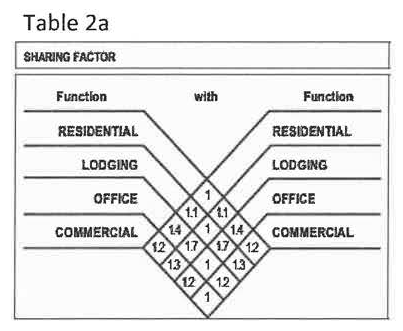
The shared parking standards table provides the method for calculating shared parking for buildings with more than one use type. It refers to the parking requirements that appear in Table 2a below.
2.
The parking required for any two functions on a lot is calculated by dividing the number of spaces required by the lesser of the two uses by the appropriate factor from this table and adding the result to the greater use parking requirement
a.
For instance: for a building with a residential use requiring 100 spaces and a commercial use requiring 20 spaces, the 20 spaces divided by the sharing factor of 1.2 would reduce the total requirement to 100 plus 17 spaces
C.
Size.
1.
Space shall be a minimum of 8.5 by 18 feet with the following exceptions:
a.
Where parking spaces for the handicapped are to [be] provided, they shall be a minimum of 18 feet long and the width and quantity shall be in accordance with the Florida Building Code.
2.
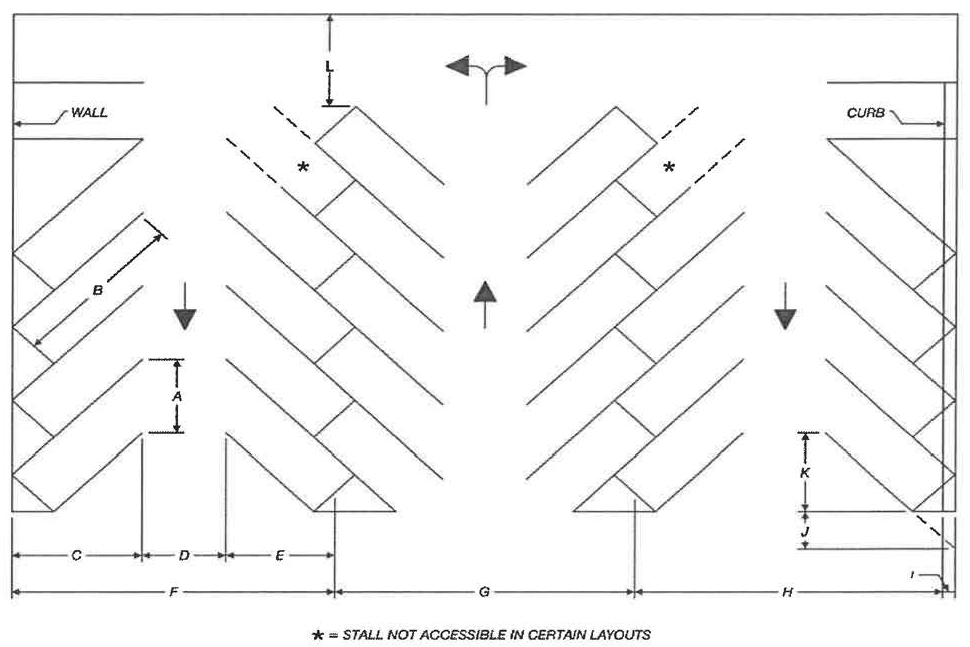
Parking stall and aisle dimensions shall conform to the requirements of Table 4.5.
3.
Bicycle and motorcycle parking.> All buildings shall have a designated area for bicycle and motorcycle parking. This area shall be in addition to the required off-street parking.
4.
Where a parking space heads into and abuts a walkway, the paved 18-foot length shall be provided [with] a wheel stop or curb at 16 feet in order to prevent extension of the vehicle over any portion of the provided walkway width.
5.
For all occupancies other than single-family and duplex residences, the parking spaces shall be marked with double striping on each side of the space to identify and facilitate their use. All striping shall be of a color (typically white) contrasting with the pavement. Dimension requirements, as noted elsewhere, shall be measured to the center point of the double stripe.
TABLE 4.5. Minimum Parking Stall dimensions (in feet) at various angles
For parallel parking minimum widths and length are 8.0′ × 23.0′.
** Driveways where there is no parking on either side shall be a minimum of 20 feet in width for two-way traffic and 14 feet for one-way traffic. Access drives between the paved portion of the right-of-way and the property line shall comply with the Miami-Dade County public works manual.
D.
Layout.
1.
Pedestrian circulation facilities, roadways, driveways, and off-street parking and loading areas shall be designed to be safe and convenient.
2.
Parking and loading areas, aisles, pedestrian walks, landscaping, and open space shall be designed as integral parts of an overall development plan and shall be properly related to existing and proposed buildings.
3.
Buildings, parking and loading areas, landscaping and open spaces shall be designed so that pedestrians moving from parking areas to buildings and between buildings are not unreasonably exposed to vehicular traffic.
4.
Landscaped, paved, and gradually inclined or flat pedestrian walks shall be provided along the lines of the most intense use, particularly from building entrances to streets, parking areas, and adjacent buildings. Pedestrian walks should be designed to discourage incursions into landscaped areas except at designated crossings.
5.
For all occupancies other than single-family and duplex residences, each off-street parking space shall open directly onto an aisle or driveway that is not a public street.
6.
Aisles and driveways shall not be used for parking vehicles, except that the driveway of a single-family or duplex residence shall be counted as a parking space for the dwelling unit, or as a number of parking spaces as determined by the director based on the size and accessibility of the driveway.
7.
The design shall be based on a definite and logical system of drive lanes to serve the parking and loading spaces. A physical separation or barrier, such as raised curbing, may be required to separate parking spaces from travel lanes.
8.
Parking spaces for all uses, except single-family and duplex residences, shall be designed to permit entry and exit without moving any other motor vehicle.
9.
No parking space shall be located so as to block access by emergency vehicles.
E.
Construction standards. All off-street parking and loading areas, including driveway and aisles, shall be constructed per the following minimum standards:
a.
Asphalt pavement:
1.
Stabilized subgrade (minimum 40 limerock bearing ratio).
2.
Six-inch limerock base (98 percent modified proctor).
3.
One-inch type S asphaltic concrete pavement.
b.
Concrete pavement:
1.
Stabilized subgrade (minimum 40 limerock bearing ratio).
2.
Six-inch concrete pavement (3,000 psi).
c.
Concrete or brick pavers:
1.
Stabilized subgrade (minimum LBR = 40).
2.
Six-inch limerock base (98 percent modified proctor).
3.
Two-inch clean sand bed.
4.
Paver stone (three-inch minimum).
d.
Gravel permitted in the following districts RS, RD and RTW districts only.
(Ord. No. 4528, § 3(Exh. A), 6-18-2019)
4.03.05. Encroachments into zoned right-of-way. No building or any other type of structure shall be permitted on or in a zoned right-of-way, except required and approved underground installations.
(1)
Height at intersection. Fences, walls, bus shelters or hedges shall not exceed two and one-half feet in height within the safe sight distance triangle, as defined below. The height of fences, walls, bus shelters and hedges shall not exceed two and one-half feet in height within ten feet of the edge of driveway leading to a public right-of-way. The safe sight distance triangle area shall not contain obstructions to cross-visibility at a height of two and one-half feet or more above pavement; potential obstructions include, but are not limited to, structures, grass, ground covers, shrubs, vines, hedges, trees, rocks, walls and fences. The following table represents minimum criteria for determining the required area of cross-visibility:
Safe Sight Distance Triangle Table
* Visibility distances measured from center line of minor street, along right-of-way line of through street.
** Depth visibility on minor street measured from right-of-way line of through street, along center line of minor street (public or private street).
Table interpretations and waivers of the above requirements shall be made in writing by the director of the public works department.
(Ord. No. 4528, § 3(Exh. A), 6-18-2019)
4.03.06 Parking trust fund. The city needs public parking resources, in particular, the University City District area. It is a policy objective of the adopted City of Sweetwater Comprehensive Master Plan to facilitate public parking to the general public and community,
a.
It is the purpose of this section to allow developments to request a reduction of the required number of parking spaces under the City of Sweetwater Land Development Code by participating in the city's parking trust fund. Funds collected from development contributions will be to fund the purchase of land and construction parking lot or garage to be used for public parking.
b.
A reduction on the number of parking spaces shall be granted for each participation unit contributed to the capital improvement fund designated for parking trust fund. A participation unit for the purpose of the public parking trust fund bonus, shall be determined by calculating the average cost of constructing a parking space per square feet (size of parking stall 18′ × 8.5′) in the Miami-Dade County area and/or the average cost of land per square foot in the Sweetwater area as per Miami Dade Property Appraiser Office whichever is greater. The total cost of a participation unit may be adjusted from time to time by the city mayor through a resolution. The city mayor and/or his designee shall review the bonus participation unit price every two years and adjust said amount accordingly.
(Ord. No. 4851, § 2(Exh. A), 8-1-2022)
4.03.07 Electric vehicle charging stations. Parking spaces specifically designed for charging of electric vehicles shall be required in accordance with the following provisions for all municipal buildings, public parks, medical campuses, public buildings, higher education institutions, mixed use centers, commercial and industrial uses, leisure destinations and public garages.
(a)
Definitions.
(1)
Dual-port charging station or EVSE means a charging station with two plugs so as to allow the charging of two vehicles simultaneously
(2)
Electric vehicle (EV) means a device which is considered a vehicle that uses electricity as its primary source of power, such as a plug-in electric vehicle or a plug-in hybrid electric vehicle.
(3)
Electric vehicle supply equipment (EVSE) means a unit of fueling infrastructure that supplies electric energy for the recharging of electric vehicles and plug-in hybrids.
(4)
EVSE-installed means A parking space having such electric vehicle supply equipment and electric vehicle supply infrastructure installed so as to be EVSE-ready, including an installed electric vehicle charging station.
(5)
EVSE-ready space means a parking space with full circuitry in accordance with the Florida Building Code and adopted reference texts (e.g., national electrical code) and ready for the charger to be connected.
(6)
EVSE Space means A space intended for future installation of EVSE and charging of electric vehicles.
(7)
Futureproofing means that the necessary electrical infrastructure such as over-sized conduit, upgraded switchgears, and utility upgraded transformers are installed while hard surfaces and trenching is open, in preparation for running heavier cable in the future to accommodate future EVSE installation.
(8)
Large commercial center means a commercial center that contains no less than 500 parking spaces.
(9)
Level 1 EVSE means an EVSE on dedicated 15 or 20 ampere circuit at 120V, which can be implemented with a dedicated hardwire unit or with a mobile charging cord plugged into an outlet.
(10)
Level 2 EVSE means an EVSE on a circuit of 40 amperes or greater at 208 or 240 Volt AC, which can be implemented with a dedicated hardwire unit or with a mobile charging cord plugged into an outlet.
(11)
Level 3 EVSE, or DCFC means a Direct Current Fast Charger, which is an EVSE that is able to deliver between 50 KW and 350 KW power, which can be implemented with a dedicated hardwire unit.
(12)
NEVI means the National Electric Vehicle Infrastructure Formula Program which funds installation of Level 3 DCFC near Interstates.
(13)
Occupancy fee means the site host may institute a fee for idle time use of the dedicated EV parking space for overstay once charging sessions have ended.
(14)
Site host means the entity, public or private, that hosts the EV charging station(s).
(15)
Substantial remodeling or renovation means any renovation or alteration of an existing development to such an extent that all or more than 90 percent (excluding the foundation, external and internal walls, floors, roof, and staircases) is removed or replaced.
(b)
Location. To the greatest extent, EVSE-ready and EVSE-installed spaces shall be installed near security stations or be monitored by camera to decrease the chance of vandalism. EVSE-ready spaces shall be located in the same lot as the principal use and located as close to a primary entrance of the principal building as possible. In order to ensure the public safety and reduce potential hazards, EVSE-ready and EVSE-installed shall not obstruct:
(1)
Building access (including ingress, egress, common path of travel, etc.);
(2)
Rights-of-way;
(3)
Sidewalks or pathways;
(4)
Bicycle areas;
(5)
Parking space and parking lanes;
(6)
The safe sight distance triangle.
(c)
Signage and markings. All electric vehicle parking spaces shall be prominently designated with a permanent above-ground sign. The bottom of the sign must be at least five feet above grade when attached to a building, or seven feet above grade for a detached sign. The parking spaces shall be marked by painted lines, indicating the individual parking spaces or stalls.
(d)
Fees. The EVSE operator may charge a fee for electric vehicle charging in accordance with local, county and/or state law.
(e)
Required number of electric vehicle charging stations.
(1)
New construction of a single-family residential building shall provide one Level 1 EVSE-ready space per dwelling unit.
(2)
New construction of a multi-family residential building containing five or more dwelling units where on-site parking is provided shall install equipment so that at least two percent, and no less than one, of the parking spaces are either Level 1 EVSE-ready or Level 2 EVSE-installed.
(3)
The number of Level 1 EVSE-ready or Level 2 EVSE-installed spaces shall be two percent of the total number of parking spaces provided for municipal buildings, public parks, medical campuses, public buildings, higher education institutions, mixed use centers, commercial centers, industrial centers, leisure destinations and public garages with 50 or more parking spaces. Fractional numbers derived from this calculation must be rounded up to the nearest whole number.
(4)
Large commercial centers in excess of 500 parking spaces, in addition to the above Level 2 EVSE requirements, shall be EVSE-ready for at least one dual-port Level 3 charging station of a 150 KW capacity or greater to comply with Federal NEVI standards. Once a Level 3 EVSE is installed, one space must be ADA compliant. Futureproofing must be in place to allow for the addition of at least one dual-port Level 3 charging station per 500 spaces in the future as demand for EV charging increases.
(5)
All substantial remodeling or renovations to existing developments including, but not limited to, municipal buildings, public parks, medical campuses, public buildings, higher education institutions, mixed-use centers, commercial uses, leisure destinations, and public garages shall install or be EVSE-ready for one dual-port Level 2 EV charging station with two dedicated parking spaces for every 20 parking spaces, unless pre-existing EV charging stations exist.
(6)
EVSE-ready or EVSE-installed spaces shall count toward the minimum required number of parking spaces.
(7)
Level 1, 2 and 3 electric vehicle charging stations are allowed in all zoning districts.
(f)
Non-electric vehicles are prohibited from stopping or parking in designated EVSE-ready and EVSE-installed parking spaces.
(g)
EVSE electrical installations must be according to the Florida Building Code and require a building permit.
(h)
Signage. All EV parking spaces shall be visibly designated with a permanent sign that may be attached to a pole that is above ground or a sign that is attached against a wall. The parking spaces shall be marked by painted lines, indicating the individual parking spaces or stalls.
(i)
ADA compliance. In order to be in compliance with the Americans with Disabilities Act (ADA), the distance from the finished floor surface to the center of the charger screen should be a maximum of 48" high and 10" or less from reach. This height and reach ensures that all drivers can interact with the charger screen. If the charger is pedestal installed and on a non-flush surface (elevated sidewalk or elevated concrete pad), the charger must be less than 10" from the face of the curb. There should be an ADA accessible path to access the charger and be within reach. To create this path, a wheel-stop must be installed 3+ feet out from the curb. If the charger is in a lot or installed on a sidewalk, there must be at least 36" behind the pedestal to the opposite end of the sidewalk.
(j)
Fees.
(1)
The EVSE operator/site host may charge a fee for electric vehicle charging in accordance with local, county, and/or state law.
(2)
Occupancy fees: the EVSE operator/site host may charge a fee for idle time use of the dedicated EV parking space for overstay once charging sessions have ended.
(3)
In accordance with chapter 18, article XIII, section 18-436 of the City Code of Ordinances, any company installing a smart EV charging station in a commercial or industrial areas defined as a charging system where electric vehicles, charging stations and charging operators share data connections within the City of Sweetwater shall pay the city a franchise fee of $250.00 per smart EV charging station prior to the installation of smart EV charging station. This article [section] excludes residential areas.
(k)
Advertising.
(1)
On-screen advertising and pedestal-wrapped advertisements on EV charging stations within the city are allowable.
(2)
Any entity seeking to advertise on EV charging stations within the city, pursuant to this article [section], shall specifically agree to not display any advertisement that contains any immoral, obscene or lascivious material. A determination as to whether particular advertising copy on any such EV charging station is prohibited by this subsection shall be made by the mayor or his designee, and such decision shall be final and binding and not subject to any appeal by the permittee.
(l)
Amortization. Uses specified in subsection (e) which are nonconforming to the requirements of this section, shall conform by no later than September 22, 2026. Such nonconforming uses shall qualify for expedited review of building permits.
(m)
Enforcement. Any deviation from or failure to adhere with the requirements of this section shall result in fines, as determined by the building department, and rejection of building permit until such requirements have been met.
(Ord. No. 4851, § 2(Exh. A), 8-1-2022)
4.04.00. - Utilities.
4.04.01. Requirements for all developments. The following basic utilities are required for all developments subject to the criteria listed herein.
A.
Electricity. Every principal use and every lot shall have available to it a source of electric power provided by a public utility adequate to accommodate the reasonable needs of such use and lot.
B.
Sanitary sewer.
1.
All developments, other than individual single-family or duplex residential dwellings, shall have adequate central sanitary sewer hookup available at the time of development, or the developer shall construct all necessary sanitary sewer improvements to provide hookup prior to issuance of certificate of occupancy.
2.
All individual single-family or duplex residential development in areas not provided central sanitary sewer services shall be governed by the provisions of F.S. § 381.0065, regulating on-site sewage disposal systems, and F.A.C. ch. 10D-6, which regulates the installation of individual sewage disposal facilities.
3.
Developers constructing sanitary sewer systems shall obtain all applicable necessary permits and approvals from Miami-Dade department of environmental resources management, Miami-Dade water and sewer authority department, State of Florida department of health and any other agency having jurisdiction and shall provide proof to the city building department prior to issuance of building permits.
C.
Potable water.
1.
All development shall have adequate central potable water available at the time of development, or the developer shall construct all necessary potable water distribution im-provements to provide hookup prior to issuance of certificate of occupancy.
2.
Developers constructing potable water improvements shall obtain all applicable necessary permits and approvals from Metro Miami-Dade department of environmental resources management, Miami Miami-Dade water and sewer authority department, [and] State of Florida department of health and rehabilitative services, and shall provide proof to the city building department prior to issuance of building permits.
D.
Fire hydrants.
1.
All development shall have adequate hydrant availability at the time of development or the developer shall construct all necessary fire hydrant and/or water main improvements to provide adequate fire hydrant availability prior to issuance of certificate of occupancy.
2.
Developers constructing fire hydrant and/or water main improvements shall obtain all applicable necessary permits and approval from Metro Miami-Dade department of environmental resources management, Metro Miami-Dade fire department, [and] any other agency having jurisdiction and shall provide proof to the city building department prior to issuance of building permits.
4.04.02. Placement of utilities underground.
A.
In all new development electric, telephone, cable television, and other communication lines (exclusive of transformers or enclosures containing electrical equipment including but not limited to switches, meters, or capacitors which may be pad mounted), and gas distribution lines shall be placed underground within easements or dedicated public rights-of-way.
B.
Lots abutting existing easements or public rights-of-way where overhead electric, telephone, or cable television distribution supply lines and service connections have previously been installed may be supplied with such services from the utilities' overhead facilities provided the service connections to the site or lot are placed underground.
C.
Screening of any utility apparatus placed above ground shall be required.
4.04.03. Utility easements. When a developer installs or causes the installation of water, sewer, electrical power, telephone, or cable television facilities and intends that such facilities shall be owned, operated, or maintained by a public utility or any entity other than the developer, the developer shall transfer to such utility or entity the necessary ownership or easement rights to enable the utility or entity to operate and maintain such facilities.
4.05.00. - Stormwater management.
4.05.01. Design criteria.
A.
All developments, other than individual single-family or duplex residential dwellings, shall construct on-site stormwater management systems to provide sufficient retention volume for the five-year, one-hour return frequency storm.
B.
All developments abutting S.W. 107th Avenue shall provide stormwater management systems in accordance with the Rules of the Department of Transportation chapter 14-86.
C.
All finish floor elevations shall be set in accordance with Metropolitan Miami-Dade County department of environmental resources management flood control criterion.
D.
All drainage systems shall be constructed in accordance with Metropolitan Miami-Dade County public works standards.
4.05.02. Drainage plans required.
A.
A drainage plan is required as part of the site plan submittal process. The drainage plan shall be on a separate sheet and shall be included in the series of sheets which compose the site plan.
B.
The drainage plan and calculations shall be prepared by and bear the seal of a registered engineer.
C.
The drainage plan shall at a minimum:
1.
Be drawn to the same scale as [the] site plan.
2.
Delineate the existing and proposed on-site buildings, sidewalks, paved areas and open space as well as all paved areas, sidewalks, curbs and gutters within any adjoining public rights-of-way.
3.
Indicate location and nature of all proposed and existing drainage improvements.
4.
Indicate sufficient existing grades.
5.
Indicate sufficient proposed grades and slopes.
6.
Indicate finish floor elevations.
4.05.03. Permits and approvals.
A.
All drainage plans shall be reviewed and approved by Metropolitan Miami-Dade County water control division and the developer shall provide proof to the city building department prior to issuance of building permit.
B.
All developments abutting S.W. 107th Avenue shall obtain a drainage connection permit or exemption from the Florida department of transportation and the developer shall provide proof to the city building department prior to issuance of building permit.
4.06.00. - Landscaping and tree preservation.
4.06.01. Short title. This section shall be known and may be cited as the "City of Sweetwater Landscaping and Tree Preservation Code."
4.06.02. Purpose. It is the intent of this section to improve and promote the community's aesthetic appearance and the improvement of environmental quality by recognizing the beneficial effects of landscaping, including: reducing air, noise, heat and chemical pollution through the biological filtering capacities of vegetation; aquifer recharge; soil conservation; energy conservation through the creation of shade; the promotion of community wildlife and the psychological benefits to human beings through the softening of the harsher aspects of urban development.
This section encourages the conservation of our limited fresh water resources through the planting of drought-tolerant native vegetation, and encourages the preservation of existing vegetation, while also encouraging the eradication of certain nuisance exotic species which disrupt and destroy native ecosystems.
4.06.03. Landscaping plans.
A.
Nature of required plan.
1.
Single-family or duplex residence. The landscape plan submitted for an individual single-family or duplex residence on its own lot may be in the form of a plot plan or drawing prepared by the owner or his agent.
2.
All other development. The landscape plan for all other development shall be prepared by and bear the seal of a landscape architect or otherwise be prepared by persons authorized to prepare landscape plans or drawings by F.S. ch. 481, pt. II (F.S. § 481.301 et seq.) (landscape architecture).
B.
Contents of landscaping plan. The landscaping plan shall:
1.
Be drawn to the same scale as site plan or plot plan.
2.
Delineate the existing and proposed on-site buildings, parking spaces, driveways or other vehicular use areas, as well as and all paved areas and sidewalks within any adjoining public right-of-way.
3.
Indicate location of any existing utility poles, overhead power lines or streetlights within the property or 30 feet from the property.
4.
Designate by name and location the plant material to be installed or preserved in accordance with the requirements of this code.
5.
Include a tabulation clearly displaying the relevant statistical information necessary for the city to evaluate compliance with the provisions of this code. This includes gross acreage, number of trees to be planted or preserved, square footage of paved areas, and any other information as the city may require.
C.
Tree survey. For those projects which have existing trees on-site or within any adjoining public right-of-way a certified transparent tree survey prepared at the same scale as the landscaping plan is required.
4.06.04. Requirements for plant material.
A.
Quality. Plant materials used in conformance with provisions of this code shall equal or exceed the standards for Florida No. 1 as given in "Grades and Standards for Nursery Plants" parts I and II, State of Florida, department of agriculture, and any amendments thereto. Grass sod shall be clean and reasonably free of weeds and noxious pests or diseases.
B.
Trees. Trees as referenced below shall have an average mature crown a minimum of 15 feet with trunks which can be maintained in a clean condition with over seven feet of clear wood.
Trees shall be a minimum of 12 feet of height and three inches DBH immediately upon planting.
The following trees are acceptable to meet the landscaping requirements of this code. Common names are used except when the scientific name is necessary for positive identification.
Small trees:
Purple tabebuia
Crape myrtle
Hawthorns
Bottlebrush
Wax myrtle
Lignum vitae
Medium trees:
Trumpet-tree, pink or silver
Milkbark
Buttonwood
Chinese fan palm
Geiger tree
Pigeon plum
Ironwood
Florida thatch palm
Large trees:
Live oak
Mahogany
Royal poinciana
Jamaican dogwood
SouthFlorida slash pine
Golden shower
Paradise tree
Coconut palm
Date palm
Pongam
Laurel oak
Gumbo limbo
Golden tabebuia
Sand pine
Red bay
Jacaranda
Royal palm
Queen palm
Ponogram
When more than five trees are required to be planted to meet the requirements of this code, a mix of species shall be provided as follows:
C.
Prohibited tree species. The following plant species shall not be planted in the City of Sweetwater and shall be removed from all sites to be developed or altered to the extent that the site's landscaping must be brought into compliance with this code.
1.
Melaleuca quinquenervia (cajeput).
2.
Casuarina spp. (Australian pine).
3.
Schinus terebinthifolius (Brazilian pepper).
4.
Scheflera actinophylla (Queensland umbrella tree).
5.
Acacia auriculaeformis (ear leaf acacia).
6.
Metopium toxiferum (poison wood).
7.
Bischofia javanica (bishopwood).
8.
Ricinus communis (castor bean).
9.
Albezzia lebbek (woman's tongue).
10.
Araucaria heterophylla (Norfolk Island pine).
11.
Ardisia solanacea (shoebutton ardisia).
12.
Cestrum diurnum (day blooming jasmine).
13.
Colubrina asiatica (colubrina).
14.
Discorea bulbifera (aerial potato).
15.
Eucalyptus camaldulensis (eucalyptus).
16.
Leucana leucocephala (lead tree).
17.
Grevillea robusta (silk oak).
D.
Controlled tree species. Ficus species can be planted as individual trees within the city, provided that they are no closer than 12 feet from any public improvement. Ficus species may be planted within 12 feet of public improvements, utility poles, overhead power lines or streetlights only if they are maintained as a hedge which is constantly cultivated and does not exceed six feet in height.
E.
Shrubs or hedges. Shrubs required to be planted by this code shall be a minimum of 24 inches in height immediately upon planting and spaced at a maximum of 24 inches on center. The following shrubs are acceptable to meet the landscaping requirements of this code. Common names are used except when the scientific have [name] is necessary for position [positive] identification.
Indian hawthorne
Jasminum multiflorum
Cocoplum
Ixora
Croton
Surinam cherry
Oleander
Pittosporum
Crown of thorns
Bougainvillea
Pineland allamanda
Hibiscus
F.
Ground covers. Ground cover required to be planted by this code shall be planted in such a manner as to present a finished appearance and reasonably complete coverage within three months after planting. The following plants are acceptable to meet the landscaping requirement of this code. Common names are used except when the scientific name is necessary for positive identification:
Liriope
Asparagus fern
Daylily
Shore juniper
Periwinkle
Beach sunflower
Wax jazmine
Dwarf carissa
Mondo grass
Wild allamanda
Cast iron plant
Gopher apple
Pineland snowberry
G.
Vines. Vines required to be planted by this code shall have a minimum of five runners 30 inches in length immediately upon planting, and may be used in conjunction with fences or walls to meet the landscape barrier requirements. If vines are used in conjunction with fences or walls, runners shall be attached to the fence or wall in a way that encourages proper plant growth. The following plants are acceptable to meet the landscaping requirements of this code. Common names are used except when the scientific name is necessary for positive identification:
Garlic vine
Flame vine
Bougainvillea
Trumpet vine
Marine ivy
Coral vine
H.
Lawn grass sod. Those areas to be landscaped with grass shall be sodded. Argentine bahia and St. Augustine varieties are the acceptable sod types within the city.
(Ord. No. 2981, § 2(4.06.04(B), (D)), 8-12-2002)
4.06.05. Planting, pruning and maintenance standards.
A.
Planting specifications. In general all plant materials shall be installed in a sound workmanlike manner and according to accepted good planting procedures; the following specific planting procedures shall be followed:
1.
Dig a hole three to five times the diameter of the root ball and the same depth as the root ball.
2.
Remove all nondegradable material from around root ball, and all material including biodegradable from upper third of ball.
3.
Position tree or shrub in center of hole.
4.
Once hole is backfilled with planting soil, water thoroughly.
B.
Planting soil. All required landscape materials shall be installed using planting soil of a type appropriate to the individual plant material and the soil conditions in which the planting is occurring.
C.
Mulching. All newly installed tree, shrub and ground cover planting areas shall be mulched with eucalyptus, melaleuca or pine bark mulch a minimum of three inches in depth.
D.
Anchoring. Wherever new trees are installed they shall be provided with anchoring for a period of at least one year in order to provide sufficient time for their roots to become established.
E.
Pruning and trimming. General: All pruning and trimming should be accomplished according to good horticultural standards. Trees shall be pruned and trimmed only as necessary to promote healthy growth. Unless special approval is provided by the building department, trees shall be allowed to attain their normal size and shall not be severely pruned or "hatracked" in order to permanently maintain growth at a reduced height. Trees may be periodically pruned or thinned in order to reduce the leaf mass in preparation for tropical storms. All pruning shall be accomplished in accordance with the National Arborist's Standards.
F.
Planting near power lines and streetlights. No large tree (mature height greater than 30 feet) shall be planted within 30 feet, measured horizontally, from any utility pole, overhead power line or streetlight. No medium tree (mature height between 20 feet and 30 feet) shall be planted within 20 feet, measured horizontally, from any utility pole overhead, power line or streetlight.
G.
Planting in easements. Landscaping may be permitted in easements only with the written permission of the easement holder. Written permission shall be submitted as part of an application for a building permit.
H.
Planting in right-of-way.
1.
Permit required. A developer or property owner may be permitted by the city engineer to landscape the swales or medians of streets as provided in this subsection.
2.
Installation standards and requirements.
a.
Unless otherwise provided in this subsection, plant material to be utilized shall comply with all applicable standards for planting and plant material included in this code.
b.
Trees shall be planted six feet from the edge of the street pavement.
c.
At the intersection of two rights-of-way, no tree shall be planted within the one [zone] extending 60 feet on either side of the centerline of each intersecting right-of-way. At the intersection of a driveway and a right-of-way, no trees shall be planted within ten feet of the driveway pavement's edges.
d.
Any shrubs planted at the intersection of two rights-of-way within the zone extending 60 feet on either side of the centerline of each intersecting right-of-way, or at the intersection of a driveway and a right-of-way within ten feet of the driveway pavement's edges, shall have a maximum mature height of 30 inches.
3.
Maintenance. The permittee, or his successor or [in] interest, shall be responsible for the proper maintenance of all landscaping and shall keep the area free from any refuse or debris.
I.
Continuing maintenance requirement. The property owner, his successors in interest, or his agent, if any, shall be jointly and severally responsible for maintaining all landscaping in good condition and in a way that presents a healthy, neat, and orderly appearance. The code enforcement official shall be responsible for ensuring the maintenance of landscaping after the issuance of a certificate of occupancy. Failure to meet this continuous maintenance requirement shall constitute a violation of the approved site plan.
J.
Replacement requirement. Vegetation which is required to be planted or preserved by this code shall be replaced with equivalent vegetation if it is not living within one year of issuance of a certificate of occupancy.
K.
Alteration of approved landscaping. If the owner of a developed site proposes to alter the approved landscaping, a drawing showing the proposed changes and an explanation of the need for the changes must be submitted to the building department for approval prior to any alteration.
4.06.06. Minimum general tree planting or preservation requirement.
A.
Minimum general requirements. In general, unless otherwise provided in this section, a minimum number of trees shall be planted or preserved upon each lot as follows:
1.
Residential lots. A minimum of one tree shall be planted or preserved for every 1,500 square feet of area of a residential lot or fraction thereof.
2.
Nonresidential lots. A minimum of one tree shall be planted or preserved for every 2,500 square feet of area of a nonresidential lot or fraction thereof.
Trees required to be planted or preserved by this subsection (4.06.06(A)) may be used to satisfy the landscaping requirements for interiors of vehicular use areas, [or] the perimeters of lots, but not the street tree landscaping requirements.
The requirements of subsections 4.06.06(B) and 4.06.06(C) shall not be applicable to lots or parcels of land on which a single-family or duplex dwelling unit is used as a residence.
B.
Perimeter landscaping.
1.
Perimeter landscape strips.
a.
A landscape strip a minimum of five feet in width is required between any vehicular use area and property lines as measured from the face of curb or edge of pavement.
b.
A landscape strip a minimum of 15 feet in width is required to serve as a buffer yard along a property line where a new multifamily residential development abuts a commercial zoned property or where a new commercial development abuts a residential zoned property.
2.
Minimum perimeter tree planting requirements. One tree shall be planted or preserved for each 30 lineal feet (or fraction thereof) of a perimeter landscape strip as described above. These trees may be planted singly or in clusters, however the maximum spacing of planted trees shall be 50 feet.
3.
Landscape barrier requirement.
a.
In general a hedge, wall, fence or other landscape barrier shall be located within the perimeter landscape strip. Unless otherwise provided in this land development code, the barrier shall be no less than three feet and no more than 12 feet in height within a maximum of two years after installation.
b.
Perimeter landscape strips serving as buffer yards (as described in 4.06.06(B)(1)(b)) shall have a continuous concrete wall of at least six feet in height.
c.
If walls or fences are used as elements of a landscape barrier, one shrub or vine shall be planted for each ten lineal feet of landscape barrier.
4.
Ground cover requirement.
a.
The entire area of the perimeter landscape strip, as described in 4.06.06(B)(1)(a), which is not dedicated to trees or landscape barrier shall be planted with ground cover in lieu of grass sod.
b.
A minimum of 50 percent of the area of a perimeter buffer landscape strip, as described in 4.06.06(B)(1)(b), which is not dedicated to trees or landscape barrier shall be planted with ground cover in lieu of grass sod.
5.
Protection of perimeter landscaping.
a.
When a landscape strip abuts parking spaces, hedges and trees shall be installed a minimum of three feet from the face of curb or edge of pavement to allow for vehicle overhang.
b.
Raised curbing shall be required to provide protection from vehicular encroachment into perimeter landscape strips.
c.
No accessory structures, garbage or trash collection points or receptacles, parking or any other functional use contrary to the intent and purpose of this code shall be permitted in a perimeter landscape strip.
C.
Landscaping the interiors of vehicular use areas.
1.
Landscape islands requirements. Aisles within the vehicular use areas of all developments shall be defined by landscape islands. These islands shall be located at the ends of all interior parking space rows, and at interior driveway intersections, and shall be a minimum of five feet in width (face of curb to face of curb) with the length equal to that of the abutting parking space. There shall be a minimum of two medium or small trees, or one large tree, planted within each island. The remainder of the island shall be planted with ground cover in lieu of grass sod.
2.
Additional islands. To provide relief from the expanse of paving, the following shall be required in addition to the requirement set forth in paragraph 1 above:
a.
For every ten off-street parking spaces, including perimeter parking spaces, there shall be a minimum of one landscape island within the parking area. These islands shall be a minimum of five feet in width (face of curb to face of curb) with the length equal to that of the abutting parking space. There shall be a minimum of one large tree planted within each island. The remainder of the island shall be planted with ground cover in lieu of grass sod.
3.
Landscape separators. An applicant may propose double-loaded interior parking spaces with a landscape separator. This separator shall be a minimum of seven feet in width (face of curb to face of curb). A minimum of one large tree shall be planted within the separator for each 40 lineal feet (or fraction thereof) of separator length. The remainder of the separator shall be planted with ground cover in lieu of grass sod.
4.
Curbing requirement. All landscape islands and separators shall be raised and curbed to provide protection from vehicle encroachment.
D.
Street tree landscaping. The developer of any new development or existing site to be altered to the extent that a landscaping plan is required shall plant street trees within the public rights-of-way adjoining the property as follows:
1.
One tree shall be planted for every 40 lineal feet (or any fraction thereof) of property right-of-way frontage.
2.
The trees shall be planted six feet from the edge of the street pavement and on the subject property's side of the right-of-way, and shall be spaced at approximately 30 to 50 feet.
3.
At the intersection of two rights-of-way, no trees shall be planted within the zone extending 60 feet on either side of the centerline of each intersecting right-of-way.
4.
Once the required street trees are planted, inspected by the city and found to be in compliance with the requirement of this section, the city shall be responsible for the maintenance of those street trees.
5.
Where trees which meet the requirement of this section are existing in the public rights-of-way adjoining a property at the time of development or alteration, the provisions of this subsection shall be waived.
6.
The species of the required street trees to be planted shall be as follows:
a.
On even-numbered streets or terraces: Mahogany.
b.
On odd-numbered streets or terraces: Live oak.
c.
S.W. 112th, 104th and 102nd Avenues: Royal poinciana.
d.
S.W. 113th and 110th Avenues: Pink trumpet tree.
e.
All other avenues: Royal oak.
7.
If the half right-of-way adjoining a subject property contains a longitudinal overhead power line, the species of the required street trees to be planted in that half right-of-way shall be as follows:
a.
All avenues: Bottlebrush.
b.
All streets: Silver buttonwood.
8.
A developer may elect to make a contribution in the amount of $175.00 to the City of Sweetwater street tree trust fund for each and every tree required to be planted by the provisions of this subsection in lieu of planting said trees.
9.
If the street swales in the right-of-way adjoining a property at the time of development are paved to the extent that street trees cannot be planted, the developer shall make a contribution in the amount of $175.00 to the City of Sweetwater street tree trust fund for each and every tree required to be planted by the provisions of this subsection.
10.
A developer shall make a contribution in the amount of $175.00 per tree to the City of Sweetwater street tree trust fund in lieu of providing trees, as required to be planted by the provisions of this subsection, within the West Flagler Street or S.W. 107th Avenue rights-of-way.
(Ord. No. 2981, § 2(4.06.06(D)), 8-12-2002)
4.06.07. City of Sweetwater street tree trust fund.
A.
Creation of street tree trust fund. There is hereby created a street tree trust fund in the City of Sweetwater, the purpose of which is to plant trees in the rights-of-way of streets within the city.
B.
Disbursements and maintenance of street tree trust fund. Monies obtained from the street tree trust fund shall be disbursed only for the acquisition and planting of trees within the city's street rights-of-way. Such monies may be used as a matching fund contribution towards governmental grants for the planting of street trees. Said trust fund shall be kept and maintained in trust by the city commission solely for the purpose set forth in this section in a separate and segregated fund of the city which shall not be commingled with other city funds until disbursed for an authorized purpose pursuant to this subsection. Disbursement from the street tree trust fund shall require approval by resolution of a majority of the city commission. The finance director is hereby authorized to establish a street tree trust fund and to receive and disburse monies in accordance with the provisions of this subsection.
C.
Sources of monies for the street tree trust fund. Said street tree trust fund shall consist of the following monies:
1.
Contributions in lieu of, or in conjunction with, the street tree planting requirements delineated in section 4.06.06(D) of this code.
2.
Grants and donations. All monies offered to and accepted by the City of Sweetwater for the street tree trust fund in the form of federal, state, or other governmental grants, allocations or appropriations, as well as foundation or private grants and donations, shall be disbursed strictly in accordance with the terms and conditions of the grant, allocation, appropriation or donation and shall be earmarked accordingly.
D.
Interest. Unless otherwise restricted by the terms and conditions of a particular grant, gift, appropriation or allocation, all interest earned by the investment of all monies in the street tree trust fund shall be disbursed by resolution of the city commission for any project authorized consistent with this section. Trust fund monies shall be invested only in accordance with the laws pertaining to the investment of city funds.
4.06.08. Tree preservation and protection.
A.
Credit for existing trees. When an existing healthy tree of any species, except those listed in section 4.06.04(C), which meets the requirements for plant material (section 4.06.04) is preserved under a development plan, the tree will be credited towards the landscape requirements (section 4.06.06) as follows:
B.
Tree protection standards. Sections 24-60 through 24-60.9 of the Code of Metropolitan Miami-Dade County, Florida, as amended from time to time, relating to tree protection and removal are hereby incorporated into and made part of this code.
4.06.09. Irrigation.
A.
Irrigation systems. Irrigation systems can be beneficial in efficiently adding water to cultivated landscape. The following recommendations shall be implemented by those developing or maintaining irrigation installations.
1.
Small irrigation systems. Small residential and commercial developments may be irrigated with a manually controlled irrigation system if sufficient time and labor is available for its operation. Landscape plantings and lawns shall be watered on an as-needed basis only.
2.
Large irrigation systems. If irrigated, landscaped areas in larger residential, commercial and industrial developments shall be irrigated by the use of an automatic irrigation system with controllers set to apply water as noted in this section. Irrigation controllers shall be switched to manual operation during periods of increased rainfall. When technically feasible, rainfall or moisture sensing devices should be used to avoid operation of the system during periods of increased rainfall.
B.
Zoning of irrigation systems. The water demand of lawn areas is significantly greater than the water demand of most shrubbery or ground cover areas. Typical residential irrigation system design does not provide for the option of irrigating lawn or other high water demand areas on a separate schedule from that of shrubbery or other reduced water demand areas. This results in the irrigation of the entire controlled area at the rate that the most water-demanding plant material requires. Therefore, the following standards shall be considered the minimum requirements for landscape irrigation design within the City of Sweetwater.
1.
Sprinkler zoning. Wherever feasible, sprinkler heads irrigating lawns or other high water demand landscape areas shall be circuited so that they are on a separate zone or zones from those irrigating trees, shrubbery or other reduced water requirement areas.
2.
Control systems. Automatically controlled irrigation systems shall be operated by an irrigation controller that is capable of watering high water requirement areas on a different schedule from low water requirement areas.
C.
Use of nonpotable water. Use of nonpotable water for the irrigation of lawn and plant material is required when determined to be available.
D.
Water application rates. Since deep watering promotes deep root growth and healthier plant material, water shall not be applied at a precipitation rate of less than one-half inch per application.
E.
Operation of automatic irrigation system. Automatic irrigation systems should be operated between the hours of midnight and six a.m. Irrigating during these hours reduces fungus growth and loss of water due to evaporation.
F.
Maintenance of irrigation systems. Irrigation system shall be constantly maintained to eliminate waste of water due to loss of heads, broken pipes or misadjusted nozzles.
(Ord. No. 2981, §§ 2(4.06.04(B), 4.06.04(D), 4.06.06(D)), 8-12-2002)
4.07.00. - Child care facilities, nonpublic.
4.07.01. Applicability and definitions. Provisions of this article relating to day nurseries, kindergartens and after school care as defined herein shall be applicable in the City of Sweetwater. The City of Sweetwater shall adopt physical standards governing day nurseries, kindergartens or after school care that are in conflict with or in addition to the standards contained in Chapter 33 Article XA of Miami Dade County [Code], whether more or less restrictive than the standards contained herein.
As used in this article, the term "private school" or "nonpublic educational facility" shall mean an institution which provides child care and/or instruction from the infant level through the college level and which does not come under the direct operation and administration of the Miami-Dade County School Board or the State of Florida; only such uses are intended to be controlled by this article and include, but are not limited to, the following:
(a)
Day nurseries: Child care for infants and children up to and including age six.
(b)
Kindergartens: Child care and preschool programs for children ages four through six.
(c)
After-school care: Child care and recreation for children above the age of five when no formal schooling program is conducted and where the care provided is generally after school, on weekends, school holidays and vacations.
(d)
Babysitting service for shoppers: Child care for limited time periods (maximum three hours) provided within a shopping center solely for the convenience of the patrons, and limited to not more than 40 children at any one time.
(e)
Private college/university: An institution of higher learning beyond the high school level.
(f)
Family day care homes: Child care and recreation with a maximum of five children including the day care operator's own children.
(g)
Private school: This term as used herein refers to any private institution providing child care and/or instruction at any level from infants through the college level.
(h)
Child, student, pupil: The terms "child," "student," "pupil," and their plurals are used interchangeably in this article.
(i)
Elementary, junior and senior high schools: References to these schools are to be loosely interpreted to encompass any schools, graded or ungraded, whose students are within the age ranges typically found at these school levels.
4.07.02. Religious activities. This article shall not be applicable to facilities used principally for weekend or intermittent nonacademic religious instruction or for the care of children whose parents or guardians are attending religious services or meetings on the premises.
4.07.03. Zoning district requirements.
(a)
All day nurseries, after-school centers, kindergartens and private schools shall meet the requirements included herein and the requirements of the particular zoning district in which they are permitted.
4.07.04. Private colleges and universities.
(a)
Main campus requirements. Private colleges and universities with sites of 30 acres or less shall meet the minimum standards established herein for high school facilities.
(b)
Exception for satellite classroom facilities. The requirements set forth in subsection (a) above or any other section of this section shall not apply to satellite facilities either owned or leased by private colleges or universities located in either in a commercial districts, industrial districts or an urban center as defined in the Future Land Use Map of the City of Sweetwater Comprehensive Master Plan.
(c)
Exception for commuter colleges/universities. The requirements set forth in subsection (a) above or any other section of this article shall not apply to commuter colleges/universities.
4.07.05. Required information. All nonpublic educational facilities, as defined in this article, shall submit the following applicable information to the department for review by the department.
(A)
Written information.
(1)
Total size of the site;
(2)
Maximum number of students to be served;
(3)
Number of teachers and administrative and clerical personnel;
(4)
Number of classrooms and total square footage of classroom space;
(5)
Total square footage of nonclassroom space;
(6)
Amount of exterior recreational/play area in square footage;
(7)
Number and type of vehicles that will be used in conjunction with the operation of the facility;
(8)
Number of parking spaces provided for staff, visitors, and transportation vehicles, and justification that those spaces are sufficient for this facility;
(9)
Grades or age groups that will be served;
(10)
Days and hours of operations;
(11)
Means of compliance with requirements by the Miami-Dade County Fire Department, Miami-Dade County Department of Public Health, the Department of Health and Rehabilitative Services, and any federal guidelines applicable to the specific application.
(B)
Graphic information, less than 50 students.
(1)
A detailed plot use plan shall be submitted to the department of planning and zoning, and the same shall be drawn to scale and include dimensions to indicate lot size, street rights-of-way and pavement measured from center line, size of building or buildings, interior floor layout and interior uses, location and size of recreation and/or play areas, location of fences and/or walls that shall enclose recreation and/or play areas; said plans shall include, but not be limited to, off-street parking areas and driveways, walls, fences, signs and landscaping. Landscaping and trees shall be provided in accordance with chapter 18A of this Code. The plot use plan shall include a title block giving the name of the project, the title of the person preparing the plan, the date of preparation of the plan and scale of drawings.
(2)
Other data shall be furnished as requested by the director where such data may be needed in order to determine that standards as specified in this article have been met.
(C)
Graphic information, 50 or more students. The following graphic information shall be prepared by design professionals, such as registered Florida architects and landscape architects, for proposed facilities with 50 or more students.
(1)
A plan indicating existing zoning on the site and adjacent areas.
(2)
A site plan indicating the following:
(a)
Location of all structures;
(b)
Parking layout and drives;
(c)
Walkways;
(d)
Location of recreation areas and play equipment which shall include surrounding fences and/or walls;
(e)
Any other features which can appropriately be shown in plan form.
(3)
Floor plans and elevations of all proposed structures.
(4)
Landscape development plan listing quantities, size, and names of all plants in accordance with chapter 18A of this Code.
4.07.06. Calculation of physical space requirements for multiple-use facilities. Where a private educational facility is to be operated in a structure simultaneously used as a residence, church or other facility, the area which will be specifically used for a private school or child care facility during the hours of operation shall be clearly defined. The area so delineated shall be used as the basis for determining physical space requirements as provided in this article. No physical space credit will be given for interior or exterior areas that are not restricted to the school or child care use during the hours of operation of said facility.
4.07.07. Combination of residential and nonpublic educational facilities. No combination of residential use and nonpublic educational facility will be permitted on the same property except as follows:
(a)
A single-family residential use will be permitted in the same building with a nursery or kindergarten use, where the same is used only by the nursery-kindergarten operator.
(b)
In connection with day nursery and kindergarten facilities, a residential unit for a caretaker may be permitted only when the facility operator does not reside on said premises.
(c)
Nonpublic educational facilities may be incorporated into a proposed mixed use complex, provided said schools are included in the plans submitted for approval at public hearing.
4.07.08. Physical standards.
(a)
Outdoor areas. Outdoor recreation/play areas shall be in accordance with the following minimum standards, calculated in terms of the proposed maximum number of children for attendance at the school at any one time unless otherwise indicated.
Minimum Standards for Outdoor Recreation Playground/Play Areas
Where there are category combinations, each classification shall be calculated individually.
(b)
Signs. Signs shall comply with district regulations as contained in Article VI 'Signs' of the Land Development Code of the City of Sweetwater; provided, however, that the total square footage of all freestanding signs in any residential district shall not exceed six square feet in size.
(c)
Auto stacking. Stacking space, defined as that space in which pickup and delivery of children can take place, shall be provided for a minimum of two automobiles for schools with 20 to 40 children; schools with 40 to 60 [children] shall provide four spaces; thereafter there shall be provided a space sufficient to stack five automobiles.
(d)
Parking requirements. Parking requirements shall be as provided in the Article IV, Section 4.02 'Transportation' of the Land Development Code of the City of Sweetwater.
(e)
Classroom size. All spaces shall be calculated on the effective net area usable for instruction or general care of the group to be housed. This space shall not include kitchen areas, bathrooms, hallways, teachers' conference rooms, storage areas, or any other interior space that is not used for instruction, play or other similar activities. The minimum classroom space shall be determined by multiplying the maximum proposed number of pupils for attendance at any one time by the minimum square footages, [subsections] (1) through (4) below. Where a private educational facility is nongraded, calculations shall be based on the age level that corresponds to the grade level in the public school system. Where a school includes more than one of the following categories, each category shall be individually computed:
(1)
Day nursery and kindergarten, preschool and afterschool care, 35 square feet per pupil.
(2)
Elementary (grades 1—6), 30 square feet per pupil.
(3)
Junior high and senior high (grades 7—12), 25 square feet per pupil.
(4)
Baby-sitting service, 22 square feet of room area per child.
(f)
Height. The structure height shall not exceed the height permitted for that site by the existing zoning.
(g)
Trees. Landscaping and trees shall be provided in accordance with Chapter 18A of Miami Dade County and Article IV, Section 4.01 'Landscaping' of the City of Sweetwater Land Development Code.
(h)
Exemptions. Baby-sitting services are exempted from the requirements of subsections (a), (c), (d) and (g), "outdoor areas," "auto stacking," "parking" and "trees,"
(i)
Child care facilities shall be prohibited from operating on property abutting or containing a water body such as a pond, lake, canal, irrigation well, river, bay, or the ocean unless a safety barrier is provided which totally encloses or affords complete separation from such water hazards. Swimming pools and permanent wading pools in excess of 18 inches in depth shall be totally enclosed and separated from the balance of the property so as to prevent unrestricted admittance. All such barriers shall be a minimum of 48 inches in height and shall comply with the following standards:
(1)
Gates shall be of the spring back type so that they shall automatically be in a closed and fastened position at all times. Gates shall also be equipped with a safe lock and shall be locked when the area is without adult supervision.
(2)
All safety barriers shall be constructed in accordance with the standards established by the Florida Building Code. and Article V Section 5.04 of the City of Sweetwater Land Development Code, except that screen enclosures shall not constitute a safety barrier for these purposes.
(j)
Location requirement for outdoor recreation playground/play areas for child care facilities. Where the front or side street property line of a child care facility abuts a section line or half section line right-of-way, no outdoor recreation playground/play area shall be located between the right-of-way and the building line parallel to the right-of-way.
(1)
All existing child care facilities shall either comply with the foregoing requirement or install an anti-ram fixture with a minimum department of state protection rating of K4 or a safety barrier from vehicular traffic designed by a professional engineer and approved by the department of transportation and public works. The safety barrier shall be installed along the entire length of the playground/play area that abuts the right-of-way.
(2)
For any existing child care facility which is required to either relocate its outdoor recreation playground/play area or provide a safety barrier, any resulting reduction in outdoor recreation playground/play area shall be deemed in compliance with the minimum playground/play area requirements of section 4.07.09(a) Any such reduction shall also be deemed to be in substantial compliance with any site plan previously approved at public hearing. In the event that such a child care facility whose site plan was approved at public hearing seeks to relocate its playground/play area, such relocation shall be subject to approval after public hearing upon appropriate application. No fee shall be charged for such application.
(3)
This subsection shall not be deemed to allow the future expansion of any child care facility to occur without complying with the requirements of section 4.07.09(a).
(4)
Notwithstanding anything in the Code to the contrary, the provisions of this subsection (j) shall also apply to child care facilities operated by Miami-Dade County or City of Sweetwater.
(5)
Variances of the location requirements of this subsection (j) shall only be approved with a condition requiring the installation of a safety barrier meeting the requirements set forth above.
4.07.09. Review standards. The following review standards shall be utilized by the building and zoning department, and, where a hearing is required, by the public hearing body.
(a)
Study guide. The study entitled "Physical Standards for Proposed Private Educational Facilities in Unincorporated Miami-Dade County," dated 1977, shall be used as a general guide in the review of proposed nonpublic educational facilities; provided, however, that in no case shall the educational philosophy of a school be considered in the evaluation of the application.
(b)
Planning and neighborhood studies. Planning and neighborhood studies accepted or approved by the city commissioners that include recommendations relevant to the facility site shall be used in the review process.
(c)
Scale. Scale of proposed nonpublic educational facilities shall be compatible with surrounding proposed or existing uses and shall be made compatible by the use of buffering elements.
(d)
Compatibility. The design of the nonpublic educational facilities shall be compatible with the design, kind and intensity of uses and scale of the surrounding area.
(e)
Buffers. Buffering elements shall be utilized for visual screening and substantial reduction of noise levels at all property lines where necessary.
(f)
Landscape. Landscape shall be preserved in its natural state insofar as is practicable by minimizing the removal of trees or the alteration of favorable characteristics of the site. Landscaping and trees shall be provided in accordance with the City of Sweetwater Land Development Code and Chapter 18A of Miami Dade County.
(g)
Circulation. Pedestrian and auto circulation shall be separated insofar as is practicable, and all circulation systems shall adequately serve the needs of the facility and be compatible and functional with circulation systems outside the facility.
(h)
Noise. Where noise from such sources as automobile traffic is a problem, effective measures shall be provided to reduce such noise.
(i)
Service areas. Wherever service areas are provided they shall be screened and so located as not to interfere with the livability of the adjacent residential properties.
(j)
Parking areas. Parking areas shall be screened and so located as not to interfere with the livability of the adjacent residential properties.
(k)
Operating time. The operational hours of a nonpublic educational facility shall be such that the impact upon the immediate residential neighborhood is minimized.
(l)
Industrial and commercial. Where schools are permitted in industrial or commercial areas it shall be clearly demonstrated in graphic form how the impact of the commercial or industrial area has been minimized through design techniques.
(m)
Fences and walls. Recreation and/or play areas shall be enclosed with fences and/or walls.
4.07.10.Certificate of use and occupancy. The certificate of use and occupancy shall be automatically renewable annually by the building and zoning department upon compliance with all terms and conditions including maintenance of the facility in accordance with the approved plan.
4.07.11. Grandfather clause. It is not the intention of this article to require any changes in any nonpublic educational facilities already in existence at the time of the adoption of this section, so long as said uses had been legally established in accordance with existing regulations.
Any nonpublic educational facilities which have heretofore been approved through a public hearing, and are subject to plot use (or site) plan approval, but on which construction has not been commenced, shall have six months from the date of this section to commence construction; otherwise, compliance with this section shall be required.
With the exceptions noted above, all nonpublic educational facilities shall comply with the requirements of this section upon the effective date thereof.
Any proposed minor changes to existing schools that were approved prior to the adoption of this article may be approved by the building director or designee, provided that such modifications do not violate the resolution approved as part of the plan. Such minor changes shall include, but not be limited to, enlargement of the play area, additions, such as storage areas, additional restrooms, and expansion of kitchen facilities.
(Ord. No. 4528, § 3(Exh. A), 6-18-2019)
4.08.00. - Adult day care and group homes.
4.08.01. Definitions
(1)
Adult day care center. As defined in Chapter 429, Florida Statutes, an adult day care center shall include a facility that provides, for a part of a day, care services to three or more persons who are 18 years of age or older, who are not related to the owner or operator by blood or marriage, and who require such services. Said care services may include, but are not limited to, providing a protective and non-institutional setting with therapeutic programs of social and health activities and services; leisure activities; self-care training; rest; nutritional services; and respite care. Care services shall not include regular physician visits or treatment programs for alcohol or substance abuse addiction or impairment. On-site supportive and optional services provided at an adult day care center may include, but are not limited to, speech, occupational, and physical therapy; legal consultation; consumer education; and referrals for follow-up services. Overnight stay or overnight care is not permitted. A valid Certificate of Use shall be obtained and renewed annually. Adult day care centers shall be licensed in accordance with Chapter 429, Florida Statutes, and proof of such license shall be provided to the County prior to issuance of a certificate of use.
(2)
Adult group home shall mean a nursing home facility, adult congregate living facility or adult family-care home facility licensed pursuant to Chapter 400 of the Florida Statutes, Parts II, III and VII, respectively.
(3)
Aged person means any person age sixty (60) or over who is currently a resident of the State and who, because of a functional impairment, requires personal assistance with the activities of daily living but does not require nursing home or institutional care.
(4)
Group home [means] a dwelling unit licensed by the State of Florida Department of Health and Rehabilitative Services which is licensed to serve resident clients and which provides a living environment for not more than six unrelated residents who operate as a functional equivalent of a family. Supervisory and supportive staff as may be necessary to meet the physical, emotional, and social needs of the resident clients shall be excluded in said count.
(5)
Incapacitated person shall mean a person who has been judicially determined under Chapter 744 of the Florida Statutes to lack the "capacity to travel," "determine his (or her) residence" or "to make decisions about his (or her) social environment or other social aspects of his (or her) life."
4.08.02. Legislative intent, findings and purposes.
(1)
Adult group homes provide elderly persons and adults with disabilities alternative living arrangements to meet their special needs; and the Florida legislature in Chapter 400 of the Florida Statutes encourages group homes to provide for elderly persons and adults with disabilities "the least restrictive and most homelike environment to encourage the dignity, individuality, privacy, and decision-making ability of such persons;" and certain residents of adult group homes are mentally incapacitated such that they are unable to identify themselves or accurately communicate their place of residence; and these individuals pose a threat to themselves when they become lost and unable to find their way back to their residence; and an additional burden is placed on law enforcement and other county agencies in attempting to locate, care for and return these individuals to their residence; and this burden on the county is exacerbated by law enforcement or other county agencies' inability to readily locate the adult group home in the absence of an exact address; and the county desires to provide additional means for safeguarding the health, safety and welfare of these individuals while preserving their ability to function in a least restrictive environment; and for the benefit of these individuals, the county intends this ordinance to facilitate and encourage the use of a nonintrusive method of identification.
(2)
The statements aforesaid made are declared to be the legislative intent, findings and purposes of the board of county commissioners and are hereby adopted and made a part hereof.
4.08.03. Identification requirements.
(1)
Each adult group home, within the incorporated and unincorporated areas of Miami-Dade County, shall provide to its incapacitated residents, who are not permanently bedridden, a form of identification which is easily observable, capable of being securely fastened to the incapacitated resident's person or clothing and capable of withstanding daily wear and tear for extended periods of time, including, but not limited to, an identification bracelet.
(2)
The form of identification shall contain the name of the incapacitated person and the phone number and address of the adult group home in which the incapacitated person resides.
(3)
The adult group home shall regularly ascertain whether the incapacitated resident continues to possess a form of identification in suitable condition and promptly replace lost or worn forms of identification as necessary.
4.08.04. Group homes. A group home shall be permitted in a dwelling unit provided:
(a)
That the total number of resident clients on the premises not exceeds six in numbers.
(b)
That the operation of the facility be licensed by the State of Florida Department of Health and Rehabilitative Services and that said department or sponsoring agency promptly notify the City of Sweetwater Building and Zoning Department by letter or email of said licensure no later than the time of home occupancy.
(c)
That the structure used for a group home shall be located at least 1,000 feet from another existing and/or abandoned legally established group home. The 1,000-foot distance requirement shall be measured by following a straight line from the nearest portion of the structure of the proposed use to the nearest portion of the structure of the existing use.
(d)
That the operator provides an application to the city's building and zoning department for the proposed use together with a signed and sealed survey showing that the proposed group home meets the minimum distance requirement from another legally established group home.
(e)
That upon approval of said application, the applicant obtains a certificate of use and a local business tax license from the city in order to operate the adult group home.
4.08.05. Signage requirements. In addition to Health and Rehabilitative Services ("HRS") requirements and notwithstanding any other provisions of the Code of the City of Sweetwater, Florida ("Code"), all adult group homes shall have at a minimum the term "Adult Congregate Living Facility" or "ACLF"; "Adult Family Care Home" or "AFC Home"; or "Nursing Home," as applicable, located on and oriented to the frontage on the street which provides actual and direct access to the front or principal entrance of the place of residence or facility in letters of no less than six inches high and no more than what article VI of the land development code permits for the district in which the adult group home is located.
(Ord. No. 4528, § 3(Exh. A), 6-18-2019)
4.09.00. - Public charter school.
4.09.01. Applicability, purpose and definitions. Provisions of this article relating to public charter school facilities as defined herein shall be applicable in the City of Sweetwater.
The purpose of this article is to provide standards for approval of public charter school facilities, pursuant to agreement with the School Board of Miami-Dade County pertaining to siting of such facilities. Any use proposed for a charter school site other than the charter school facility use provided in this article shall be subject to all other applicable provisions of this chapter.
As used in this article, the term "public charter school" or "charter school" shall mean an educational institution which is authorized and maintained in accord with the provisions of Chapter 1002, Florida Statutes, as same may be amended from time to time. All such public charter schools shall be additionally authorized locally by the Miami-Dade County School Board through a process established by that entity for the approval of the charter. The terms "child," "student," "pupil," and their plurals are used interchangeably in this article. For purposes of this article, student educational opportunities within a public charter school shall include one or more of the following:
(a)
Kindergarten: Preschool programs for children ages four through six.
(b)
Elementary school: Educational programs for children in grades one through five.
(c)
Middle school: Educational programs for children in grades six through eight.
(d)
Senior high school: Educational programs for children in grades nine through 12.
4.09.02. Public hearing required in all districts. The establishment, expansion or modification of a charter school facility is permitted in any zoning district after public hearing upon demonstration that the standards established in this article have been met. Any existing covenant or declaration of restrictions relating to an existing charter school facility shall be modified or deleted only in accordance with the provisions of article XXXVI of this Code.
4.09.03. Limitations on the siting of public charter school facilities.
(a)
New kindergarten, elementary, middle and senior high charter school facilities as well as the expansion of existing charter school facilities shall be prohibited on sites located outside the urban development boundary (UDB), as established in the comprehensive development master plan.
(b)
Except as provided in subsection (c) below, the following new charter school facilities and the expansion of such facilities shall be located inside the UDB and spaced from the UDB as follows:
(1)
Kindergarten, elementary school: At least one-fourth mile inside the UDB
(2)
Middle school: At least one-half mile inside the UDB
(3)
Senior high school: At least one mile inside the UDB.
(c)
A proposed new kindergarten, elementary, middle, or senior high charter school facility, or the expansion of an existing charter school site, inside but closer to the UDB than indicated in (b) above, may be approved at public hearing, when it is demonstrated that within a one-half mile radius of the outer boundaries of the proposed new charter school or charter school expansion site:
(1)
That the majority of the lots, parcels or tracts lying within the radius are developed or approved for development; and
(2)
There are no other lots, parcels or tracts within the radius that are available for development that meet the requirements of subsection (b) above and that meet all the requirements of this article.
Approval of such a site shall require that the majority of the subject site and the proposed buildings' ground floor square footage be located in accordance with (b) above, and that the principal buildings and entrances be placed as far from the UDB as possible.
(d)
For purposes of establishing the distances provided by this section, the applicant shall furnish a certified survey from a registered surveyor, as well as a proposed site plan, which shall indicate that the distance requirements of this section have been met.
4.09.04. Required information. All public charter school facilities, as defined in this article, shall submit the following applicable information to the department in accordance with the filing provisions of the land development code for review by the department and for consideration at public hearing:
(A)
Written information.
(1)
Total size of the site.
(2)
Maximum number of students to be served.
(3)
Maximum number of teachers and administrative and clerical personnel.
(4)
Maximum number of classrooms and total square footage of classroom space.
(5)
Total square footage of non-classroom space.
(6)
Amount and location of exterior recreational/play area in square footage.
(7)
Maximum number and type of vehicles that will be used in conjunction with the operation of the facility.
(8)
Number of parking spaces provided for staff, visitors, and transportation and operation vehicles, and justification that those spaces are sufficient for this facility.
(9)
Grades or age groups that will be served.
(10)
Days and hours of operation, weekly and annually.
(11)
An explanation of any such activities anticipated to be conducted in association with the charter school but typically conducted outside of the hours of operation of the charter school.
(12)
Means of compliance with requirements by the Miami-Dade County Fire Department, Miami-Dade County Department of Public Health, the department of health and rehabilitative services, and any federal or state regulations applicable to the specific application.
(13)
A copy of the site-specific charter application as approved by the Miami-Dade County Public School Board (school board). It is provided, however, that no certificate of use shall be issued until the department reviews the executed charter contract approved by the school board to confirm that the contract's permitted grade levels, number of students, and school location conform to the public charter school facility approved pursuant to this article. In lieu of an executed charter application or contract as required above, the department shall accept the school board clerk's official copy of the school board resolution approving the required application or contract and a copy of the application or contract presented to the school board.
(B)
Graphic information. The following graphic information shall be prepared by design professionals, such as registered Florida architects and landscape architects:
(1)
A plan indicating existing zoning on the site and adjacent areas.
(2)
A site plan indicating the following:
(a)
Location of all structures.
(b)
Parking layout, automobile stacking area and drives.
(c)
Walkways.
(d)
Location of recreation areas and play equipment which shall include surrounding fences and/or walls.
(e)
Any other features which can appropriately be shown in plan form.
(3)
Floor plans and elevations of all proposed structures.
(4)
Landscape development plan listing quantities, size, and names of all plants in accordance with chapter 18A of this Code.
4.09.05. Charter school within multiple-use facility. Where a charter school facility is to be operated in a structure simultaneously used as a residence, religious facility or other type of facility, the area which will be specifically used for the charter school facility during the hours of operation shall be clearly defined. As specified in section 4.09.04 above, the applicant for charter school approval shall additionally provide explanation regarding any activities anticipated to be conducted in conjunction with the charter school, including, but not limited to, adult education classes, community outreach facilities, and civic building use. Such uses not determined by the director to be directly associated with the charter school operation shall require approval as otherwise specified within this Code.
4.09.06. Physical standards. All charter school facilities shall meet the minimum requirements included herein.
(a)
Outdoor areas. Outdoor recreation/play areas are not required. Where same are provided the outdoor recreation/play area shall, wherever possible, be located so that the recreation/play area is not immediately adjacent to single-family residences or section line roads, nor create incompatible impacts on other immediately adjacent properties. Adequate screening in the form of a wall, fence and/or landscaping shall be provided wherever the outdoor/play area abuts a property under different ownership.
(b)
Signs. Signs shall comply with district regulations as contained in the land development code; provided, however, that the total square footage of all freestanding signs in any residential district shall not exceed six square feet in size.
(c)
Auto stacking. Stacking space, defined as that space in which pickup and delivery of children can take place, may be provided in the form of specified parking stalls and/or areas clear of vehicular drive aisles. Stacking space shall be provided for a minimum of two automobiles for charter schools with 20 to 40 children; schools with 41 to 60 children shall provide four spaces; thereafter there shall be provided a space sufficient to stack five automobiles.
(d)
Parking requirements. Parking requirements shall be as provided in section 4.03.02 of this Code.
(e)
Height. The structure height shall not exceed the height permitted for that site by the existing underlying zoning district.
(f)
Trees. Landscaping and trees shall be provided in accordance with chapter 18A of this Code.
(g)
[Prohibited.] Charter school facilities as described herein shall be prohibited from operating on property abutting or containing a water body such as a pond, lake, canal, irrigation well, river, bay, or the ocean unless a safety barrier is provided which totally encloses or affords complete separation from such water hazards.
(h)
Lot coverage and floor area ratio. The charter school facility shall not exceed the lot coverage and floor area ratio allowed by the underlying zoning district.
(i)
Building setbacks. The charter school facility shall comply with the following setbacks.
(1)
Setback minimum of 25 feet from property lines abutting public right of way.
(2)
Setback minimum of 50 feet from property lines abutting lot under different ownership.
(3)
Setback minimum of 75 feet from property lines abutting an existing residential building.
4.09.07. Cessation of charter school operation. The owners of property where a charter school facility is proposed to be located shall, at time of public hearing application, submit a document in a form approved by the director suitable for recording in the public records and assuring the following:
If the charter school facility is constructed but fails to begin operation and/or the charter school fails after establishment, that the property owner, within 36 months of the facility's failure to begin operation or closure shall cause:
(a)
The facility to be in full compliance with all zoning regulations applicable to the property on which the charter school is located and allowing a use other than the charter school use, or
(b)
The operation of the charter school facility to be transferred to another charter school operator or the school board, approved through applicable processes of the Miami-Dade County School Board, or
(c)
The charter school facility to be converted to an allowable use within the zoning district, provided said allowable use has first been authorized through the issuance of the appropriate permits, or
(d)
Authorization to be obtained at public hearing by the appropriate zoning board to convert the charter school facility to a use not otherwise allowable within the zoning district.
4.09.08. Plan review standards.
(a)
Scale. The scale of proposed public charter school facilities shall be compatible with the scale of surrounding proposed or existing uses and shall be made compatible by the use of buffering elements.
(b)
Compatibility. The design of public charter school facilities shall be compatible with the design, kind and intensity of uses and scale of the surrounding area.
(c)
Buffers. Buffering elements shall be utilized for visual screening and substantial reduction of noise levels at all property lines where necessary.
(d)
Landscape. Landscape shall be preserved in its natural state insofar as is practicable by minimizing the removal of trees or the alteration of favorable characteristics of the site. Landscaping and trees shall be provided in accordance with chapter 18A of this Code.
(e)
Circulation. Pedestrian and auto circulation shall be separated insofar as is practicable, and all circulation systems shall adequately serve the needs of the facility and be compatible and functional with circulation systems outside the facility.
(f)
Noise. Effective measures shall be provided to keep noise at acceptable levels.
(g)
Service areas. Wherever service areas are provided, they shall be screened and so located as to be compatible with the adjacent properties.
(h)
Parking areas. Parking areas shall be screened and so located as to be compatible with the adjacent properties.
(i)
Operating time. The operational hours of a public charter school facility shall be compatible with the activities of other adjacent properties.
(j)
Industrial and commercial. Where schools are proposed in or adjacent to, industrial or commercial areas it shall be clearly demonstrated in graphic form and otherwise, how the impact on the commercial or industrial area has been minimized through site design techniques and/or operational modifications.
(k)
Fences and walls. Outdoor recreation and/or play areas shall be enclosed with fences and/or walls.
4.09.09. Certificate of use. The certificate of use shall be automatically renewable annually by the department upon compliance with all terms and conditions including maintenance of the facility in accordance with the approved plan and adopted zoning resolution. Said certificate of use is subject to cancellation upon violation of any of the conditions contained in this article or upon notification from the school board of revocation of the charter of the public charter school.
4.09.10. Previously approved public charter schools. It is not the intention of this article to require any changes in any public charter school facilities that prior to the effective date of this article have received final approval from the School Board of Miami-Dade County of a final charter contract specifying the charter school's site. Further, the provisions of this article shall not be applicable to the establishment of any new charter school upon demonstration of the following circumstances: (a) prior to the effective date of this article the proposed new charter school was presented during a public zoning hearing as a part of a development plan to the zoning appeals board and the board of county commissioners; (b) prior to or at the public hearing, the zoning applicant presenting such development plan provided a declaration of restrictive covenants or other recordable assurances binding the applicant or successor to provide a charter school at a specified location, with a specified maximum number of students and specified grade levels; and (c) within two years after the effective date of this article, the proposed new charter school receives a favorable recommendation for site plan approval from the developmental impact committee and a final charter contract from the School Board of Miami-Dade County approving the charter school at substantially the site specified at the zoning public hearing.
Any charter school lawfully established prior to the effective date of this article and any charter school established pursuant to this article, which ceases operations for 36 months or longer, shall be re-established only upon approval after public hearing in accordance with this article. Any expansion or modification of the previous approval for any charter school lawfully established prior to the effective date of this article and any charter school established pursuant to this article shall only be approved after public hearing in accordance with this article.
With the exceptions noted above, all public charter school facilities shall comply with the requirements of this article.
4.09.11. Enforcement. The provisions of this article shall be enforced by the building and zoning department and code compliance department.
(Ord. No. 4680, § 2(Exh. A), 12-7-2020)
4.10.00. - Urban design and architectural standards.
The intent of this section is to provide design and architectural guidelines for development within the City of Sweetwater. The guidelines contained herein are provided as an aspirational framework to the design professional in order to keep a unified vision of the development within the City of Sweetwater.
4.10.01. In general.
A.
Architecture style. All new buildings must incorporate a recognized architecture style. A recognized architectural style should be one which is recognized by design professionals as having basis in classical, historical or academic architectural design philosophies. The following should not be considered recognized architectural styles:
(1)
Corporate signature or commercial prototype architecture, unless such is consistent with other requirements of this chapter.
(2)
Any architecture having a historical reference which is so unique and different from current design philosophy that such reference is inconsistent and incompatible with surrounding structures. Examples of such include igloos, tepees, medieval castles, caves and the like.
(3)
Any kitsch architecture which does not resemble a typical structure, but resembles an exaggerated plant, animal, fish, edible food or other such item such as giant oranges, ice cream cones, dinosaurs and the like.
B.
Ancillary design regulations.
(1)
Mechanical equipment should be screened with either landscaping or wall. All wall mounted mechanic equipment must be painted to match the building and should be placed on the side and/or rear of the building. Any mechanical equipment on the rooftop shall be screened from the right-of-way using architectural features such as parapets etc. Townhomes should meet the provisions in this section.
(2)
All mechanical equipment for townhomes, surface and wall mounted, should be placed on the side of the building which should be screened with either landscaping or wall.
(3)
All downspouts should be architecturally compatible with the building.
(4)
Dumpster enclosures should be architecturally compatible with the principal building, and must include an opaque gate.
(5)
All electrical installations between the Florida Power and Light transformer and the service side of the metering device should be installed underground. No overhead installation of electrical services should be allowed in any district. Existing services/meter undergoing replacement or repairs should comply with this requirement.
(6)
The installation of centralized distribution is required for video and internet satellites, terrestrial antenna, cable TV provider, and wireless signal in new residential and commercial developments, as well as in restoration work comprising of more than 50 percent of the building value.
(7)
All buildings and associated landscaping must be oriented and placed to minimize direct daily sunlight on walls and windows during the May—October period, and maximize solar exposure of the roof area year-round.
4.10.02. Building architecture regulations.
A.
Visual division of facade.
(1)
To prevent long stretches of repetitive and undifferentiated wall planes, a building should be designed in a manner that reduces its apparent bulk by visually dividing the facade into smaller segments that create a complementary pattern or rhythm and divide large buildings into smaller identifiable pieces. Building proportions with strong vertical emphasis that exaggerates building height are to be avoided.
(2)
At least two of the following methods should be used on all facades of a building:
a.
A minimum step back (recess) or projection of the facade three feet or more for at least 25 percent of the facade area.
b.
Architectural design elements, such as porches, canopies, towers, dormers, bay windows, balconies, and distinctive entry features that provide depth to the facade by breaking up a minimum of 25 percent of the facade area.
c.
Variation of roof and/or roof wall height to visually break up at least 25 percent of the facade, such as by use of multiple roof, roof pitches, dormers, and/or parapet heights.
d.
Horizontal and/or vertical variation in texture, or materials and architectural detailing with elements, such as cornices, friezes, reliefs, dentils, architraves, pediments, pilasters, frest, quoins, corbels, to distinguish floors and adjoining units or to signify various elements of the building.
B.
Facade treatments.
(1)
Building facades facing major roadways and pedestrian corridors should incorporate appropriate architectural features to enhance the aesthetic environment.
(2)
These features must conform to the chosen style of the building, and must include cornice detailing, ornamentation, moldings, changes in materials and textures, color variations, and other architectural sculpting that enhances the ground level and adds interest and appeal to the building's exterior.
(3)
Architectural detailing is highly desired and recommended.
C.
Facade materials.
(1)
Building facades should incorporate architectural features that enhance the aesthetic quality of the built environment.
(2)
Materials used should complement the architectural style of the building.
(3)
City highly encourages facade materials that vary in texture and type to accentuate entrances, exits, windows, comers, level changes, and other architectural features.
D.
Building entrance and parking.
(1)
Building entrances or entry features should be easily identified/visible from the major street and proportionate to the scale of the building design through the use of building elements such as:
a.
Recessed or projected entryways, canopies, porches, or porticos.
b.
Varying roof lines.
c.
Changes in material and/or color.
(2)
Building entrances should provide a pedestrian connection (sidewalk, paved crosswalks) to the adjoining public sidewalk or street and the private parking area.
E.
Windows and doors. Windows and doors should be defined with decorative details such as frames, sills, lintels, shutters, planters, relief trims, or moldings. Trim or molding should be at least four inches of nominal width to qualify as a special element.
F.
Building envelope.
(1)
All buildings above five stories should be visually organized with three basic elements:
a.
The base;
b.
The middle; and
c.
The top.
(2)
The base is generally two to five stories high and is scaled and detailed for appreciation by the pedestrian. The base includes the building entries, retail facades and show windows, awnings and porte-cocheres designed together to anchor the building to the ground.
(3)
The middle of the building contains the building's primary uses and generally visually repeats an architectural theme or rhythmic patterns.
(4)
The top terminates the building at the sky with an architectural cornice or special building elements.
G.
Prohibited features. Horizontal uninterrupted or continuous banding of windows and/or a regular horizontal expression of floor slabs should be avoided.
4.10.03. Creative excellence.
A.
Purpose. Creative excellence standards should be applied to development proposals that are proposing additional density and height for medium multi-family, mixed-use residential/commercial future land use categories.
B.
Creative excellence standards. In order for development proposals to obtain the aforementioned density and height bonuses, the project must exhibit and comply with the standards below, which should be demonstrated by the applicant at the time of initial site plan approval and approval of any major site plan modification pursuant to the applicable provisions of the Land Development Code. In the case of major modifications, the creative excellence standards will only apply to the project areas subject to modification.
(1)
Urbanism.
a.
The project should contribute to creating a neighborhood that is diverse, compact and pedestrian friendly.
b.
The project should create opportunities for daily living activities within walking distance.
c.
The project should include a civic and/or cultural component reinforcing the community identity.
d.
Within one-quarter mile of major intersections (section line and half section line roads), buildings six stories or higher are strongly encouraged, but not required, to preserve as much of the site as possible for ground level spaces and activities, such as improved plazas, active and passive recreation, shaded walkways and sitting areas, bike paths, and community agriculture.
(2)
Design excellence.
a.
Design and material must be selected that fit with South Florida's natural and urban environment. Building architecture should be creative and distinctive with site development incorporating sustainable design concepts. Buildings fronting on public streets should have an inviting frontage conducive to pedestrian interaction and activities.
b.
Materials must contribute to the longevity of the project.
c.
The project should contribute to the encouragement of public art in a substantial manner by fully complying with the city's public arts program.
d.
The project must demonstrate innovation with respect to architecture, green design, landscaping and urban form. All buildings should be designed and constructed to the meet, at a minimum, Florida Green Building Coalition (FGBC) Silver, Green Globe "One Globe" Silver. Leadership in Energy and Environmental Design (LEED) Silver, or an equivalent standard of another recognized green building rating certification approved by the Building Official. Owner will install well-designed landscaping in rights-of-way and easements abutting all internal and adjacent public streets (exclusive of medians) to the project, at no cost to the city. The landscaping plan for these areas must be approved by the public agency with ownership of the subject right-of-way or control of the easement use.
e.
Project should contain recreation, health and fitness areas (RHF). RHF features may include, but are not limited to, walkways, bike paths, community gardens, passive recreation, swimming pools, plazas, and fitness courses and centers.
f.
If a project contains retail uses, they are encouraged to be located on, and serve to activate, the street frontage.
(3)
Scale, connections and context.
a.
The project must integrate into the existing neighborhood by providing vehicular, bicycle and pedestrian connections. At no cost to the city, dedicate rights-of-way and/or grant easements, and construct bicycle and/or pedestrian facilities contained in approved city plans to be located within or abutting the project.
b.
The project must incorporate opportunities for public transportation enhancement and connections. At no cost to the city or Miami-Dade County, grant easements and dedicate rights-of-way, as necessary, and/or construct a spacious, lighted, weather-resistant and attractive transit and/or trolley shelter at or near the subject project, if requested by Miami-Dade Transit or the City of Sweetwater, and provided site conditions allow for proper shelter placement.
c.
The overall scale of the development should be consistent with the existing land use patterns or future land uses for the neighborhood.
d.
To the greatest extent possible, the project should connect to the existing ecology, and provide for logical interconnections.
e.
Any roadway, transit, and/or beautification rights-of-way or easements to be dedicated or granted should be without cost to the city.
(Ord. No. 4988, § 2(Exh. A), 9-25-2023)

