
Sweetwater City Zoning Code
ARTICLE V
ACCESSORY STRUCTURES AND ANCILLARY USES1
Editor's note—Ord. No. 4877, § 2(Exh. A), adopted September 26, 2022, amended the title of Article V to read as herein set out. The former Article V title pertained to Accessory Structures.
5.00.00.- Purpose.
It is the purpose of this article to regulate the installation, configuration, and use of accessory structures, in order to ensure that they are not harmful either aesthetically or physically to residents and surrounding areas.
5.01.00. - General standards and requirements.
Any number of different accessory structures may be located on a lot. In addition to meeting all other requirements set forth in the code, accessory structures shall meet the following requirements:
A.
There shall be a permitted principal development on the lot, located in full compliance with all standards and requirements of this code.
B.
All accessory structures shall comply with standards pertaining to the principal use, unless exempted or superseded elsewhere in this code.
C.
Accessory structures shall be counted as part of the overall permitted lot coverage on a parcel.
D.
Accessory structures shall not be located in a required landscape buffer.
E.
Accessory structures shall be included in all calculations of impervious surface and stormwater runoff.
F.
Minimum setback distance for all accessory structures shall be five feet from the front property line, five feet from a rear property line and the side setbacks shall be as per article IV, unless otherwise provided in this article.
(Ord. No. 4626, § 2(Exh. A), 6-3-2020)
5.02.00. - Towers, poles, satellite dishes and wireless support services.
The following standards and regulations are limited to private property. For structures or wireless support services within the right-of-way refer to chapter 22 of the City Code.
(Ord. No. 4626, § 2(Exh. A), 6-3-2020)
5.02.01. Compliance with section.
(a)
Before erection of a water tower, standpipe, windmill, tower or mast for any purpose, over ten feet in height above the roof of a structure or over 20 feet in height if erected on natural ground, the requirements of this article and the construction requirements of the South Florida Building Code shall be observed. All towers, poles, and masts requiring notice to the Federal Aviation Administration (FAA) as prescribed in Federal Aviation Regulations (FAR) Part 77, shall be lighted as specifically recommended by the FAA in the determination rendered to the proponent's notice of proposed construction. In addition, for all towers, poles, and masts not requiring notice to the FAA which are 150 feet or higher above grade in height, one flashing red beacon safety light will be required for each 150 feet in height. The peak effective intensity of said lights should not be less than 1,500 candles (in red) when measured at any horizontal angle. The flashing mechanism should not permit more than 40 nor less than 20 flashes per minute. The beacons shall conform to Federal Aviation Administration type L-866 (red) or Military Specification L-6273. All existing towers, poles, and masts, which are 150 feet or higher above grade shall be made to conform with those requirements by May 1, 1989. This section shall be applicable and enforceable in the incorporated and unincorporated areas of Miami-Dade County.
(b)
Until December 31, 2008, telecommunications antennas owned and operated by a telecommunications company providing services to the public for hire attached to any pole or H-frame or lattice structure owned by a utility which is used in and is part of the utility's network for the provision of electric services, shall be permitted in any zoning district, provided that (a) equipment appurtenant to the antenna is maintained on the utility pole or structure, (b) the utility pole or structure does not exceed 125 feet in height above ground unless the utility pole or structure is located in an easement or right-of-way which is greater than 50 feet in width or, if less than 50 feet in width, such easement or right-of-way is adjacent to and parallel with road right-of-way which is 100 feet or greater in width, and (c) the antenna was attached to the utility pole or structure prior to January 1, 1997.
(Ord. No. 4626, § 2(Exh. A), 6-3-2020)
5.02.02. Plans and specifications to accompany application for permit. Plans and specifications for the structures provided in this section shall be submitted to the director showing all dimensions, size and kind of members, footings, guy wires; locations, depth and type of guy anchors and footings, type and weight of antenna, apparatus or structures to be attached to or supported by the structure, and application made for permit.
(Ord. No. 4626, § 2(Exh. A), 6-3-2020)
5.02.03. Height and setback. No part of any tower, pole or mast shall be higher than 90 percent of the horizontal distance from its foundation at ground elevation to the nearest point on adjacent property under another ownership or to the nearest edge of a highway right-of-way. It is provided, however, that in the commercial (C-1, C-2, C-3) or industrial (I-1, I-2, I-3) zoning districts, the following structures 150 feet or less in height above ground elevation shall not be subject to the required setback: (a) radio towers where incidental to a business or industrial use on the premises, or (b) wireless supported service facilities whether a principal or incidental use; provided, however, that such installation under (a) or (b) shall conform to the provisions of all airport zoning regulations contained herein.
(Ord. No. 4626, § 2(Exh. A), 6-3-2020)
5.02.04. Antennas for amateur radio stations. Poles, masts and towers for supporting antenna used in the operation of amateur radio stations licensed by the Federal Communications Commission shall be excepted from the above regulations and shall be governed by the following requirements:
(a)
Location on property. All such poles, masts and towers shall be placed no closer than five feet to an official right-of-way line or to property under different ownership, or closer than one foot to an easement. If beam (array) type of antenna installed, no element or part of such beam type array antenna shall extend closer than five feet to an official right-of-way line and/or the property under different ownership or closer than one foot to an easement.
(b)
Compliance with electrical codes and federal regulations. All such installations shall conform to the requirements of the National Electrical Code and the F.C.C. regulations, Part 12, Section 12.60 governing amateur radio services. National Electrical Code installation must maintain a minimum of eight feet clearance from power lines over 250 volts and all high voltage primary lines, and this includes the beam elements or any part thereof.
(c)
Permits. Permits shall be required for installation of any poles, masts or towers over 20 feet above the roof of any structure to which they may be attached, and for any installation over 35 feet in height when erected on natural ground. Where permits are required, they shall be obtained from the department; and applications for permits shall be accompanied by plans and specifications, three copies, showing all dimensions, size and kind of members, footings and guy wires, if any; locations, depth and type of guy anchors and footings, if any, and showing the type and weight of antenna, apparatus or structure to be attached to or supported by the structure.
(d)
Poles, type. Poles shall be of the approved creosoted type or treated or painted with a chemical preservative and an outer coat of oil base paint before installation (Color to match surrounding development).
(e)
Holes. Recommended sizes and depths of holes for various type poles subject to good engineering standards:
If the earth is damp or soggy, the depth of hole is to be increased by one foot. If the pole is guyed in accordance with American Standards Association standards, the depth of hole as listed in Code can be decreased by one foot. If carrying a beam, poles must be properly guyed, as is the case where pulling effect of wire antenna or weight of other installations will require guying.
(f)
Masts. Masts constructed of wood (2″ × 2″ or 4″ × 4″ for either the "A" frame type construction or straight masts) shall be properly chemically treated, painted with an outside coat of oil base paint and be properly guyed both at the top and middle in at least three different directions, approximately 120 degrees apart, or otherwise suitably guyed. Masts to support a beam, whether of wood or metal pipe, must comply with all the regulations applicable in regard to location, guying, etc., and the maximum allowable weight of antenna, rotator and components shall not exceed 150 pounds.
(g)
Towers. Towers of steel, iron or aluminum, whether of the rigid nondemountable type or the rigid, demountable type with the crank-up, crank-down and either the hinged base or swivel crank-over features shall carry no more weight on the top than specified by the manufacturers' specifications.
(h)
Waiver of objection for certain structures; servicing; removal. All poles, masts or towers, and other structures used for antennas under this section, which exceed 35 feet in height above grade elevation, or which exceed 20 feet in height above the roof of any structure shall be subject to the following requirements:
If the top of such poles, masts or towers are higher above their foundation, or the foundation of the structure on which they are erected, than 90 percent of the horizontal distance from its base or projected base to the nearest point on adjacent property under different ownership or to the nearest edge of an official right-of-way, then no permit shall be issued for such installation unless a waiver is obtained from each and every owner of adjacent property that the structure could fall upon.
In calculating the height of demountable type towers, the top of the lower rigid section shall be considered the top for the purpose of this subsection.
Beam array antenna shall be so mounted so as to provide easy servicing and easy access for removal at approach of hurricanes, or provide for the lowering of such beam.
(Ord. No. 4626, § 2(Exh. A), 6-3-2020)
5.02.05. Satellite dish antennas. The standards of this section pertain to privately owned satellite dish antennas and are intended to enable clear television reception for the private use and enjoyment of the dish owner. The standards for commercial telecommunications facilities and antennas associated therewith are enumerated in 5.02.06.
(a)
Definition. A satellite dish antenna (SDA) shall be defined as a device incorporating a reflective surface that is solid, open mesh, or bar configured and is in the shape of a shallow parabolic dish, cone, horn, or cornucopia. Such device is used to transmit and/or receive radio or electromagnetic waves between terrestrially and/or arbitrarily based uses. This definition is meant to include but not be limited to what are commonly referred to as satellite earth stations and satellite microwave antennas.
(b)
Measuring an SDA. The diameter of an SDA shall be measured to the outermost part of the SDA. The height of an SDA shall be measured from natural grade to the top of the SDA fastened in a vertical position. The setback of an SDA shall be measured from the property line to the nearest portion of the SDA fastened in a horizontal position.
(c)
Permits and exceptions. Unless preempted by federal law, no SDA shall be erected unless a building permit is first obtained from the building department. Under current federal law no permit is necessary for SDA's measuring less than one meter (39.37 inches) in diameter when placed as an accessory use to any single-family residence, duplex or townhouse unit, or less than two meters (78.74 inches) in diameter when placed as an accessory use to any permitted business, industrial, office or multi-family use.
(d)
As an accessory use to any single-family residence, duplex or townhouse, one ground-mounted SDA is permitted per dwelling unit subject to all the following conditions:
(1)
No installation shall exceed a total of 15 feet in height; including the SDA diameter.
(2)
SDA's must be located behind the front and side street building line of the principal building and a minimum of 75 feet from the front property line. SDA's are to be setback from the interior side property lines a minimum of seven and one-half feet in RS, RD and RTW districts. The minimum rear setback is seven and one-half feet.
(e)
As an accessory use to any single-family residence, duplex or townhouse, one roof-mounted or wall-mounted SDA is permitted per dwelling unit in lieu of a ground mounted SDA, subject to all the following conditions:
(1)
A certified engineer's report reflects that clear reception of all satellite transmissions is not possible with a ground mounted SDA under paragraph (e) above;
(2)
The SDA shall be mounted on the rear or interior side wall of the principal building or on the roof to the rear of the actual front building line;
(3)
The SDA shall not exceed ten feet in diameter;
(4)
The height of the proposed installation shall not exceed the maximum height restriction imposed upon principal uses within the underlying zoning district.
(f)
As an accessory use to any business, office or multi-family use, ground-mounted SDA's are permitted subject to all the following conditions:
(1)
The ground mounted SDA shall not exceed 16 feet in diameter;
(2)
All installations shall comply with the principal building setback requirements specified within the underlying zoning district. The ground mounted SDA shall be located behind the actual front and side street building line;
(3)
No ground mounted SDA shall project beyond the height of the tallest principal building on the lot on which it is erected.
(g)
As an accessory use to any business, office or multi-family use, roof or wall-mounted SDA's are permitted, in lieu of ground-mounted antennas, subject to all the following conditions:
(1)
The SDA shall not exceed 16 feet in diameter;
(2)
Each SDA must be mounted on the roof to the rear of the front building line or on the rear or non-street side wall of the principal building;
(3)
The height of the SDA shall not exceed 17 feet above the height of the principal building on which it is placed.
(h)
SDA's are permitted as an accessory use in any industrial district (IU) subject to compliance with the principal building setback requirements within the underlying zoning district. In industrial districts (IU) abutting or across the street from a residential district, SDA's must also comply with all conditions of paragraphs (f) and (g) above.
(i)
Signage of any type is prohibited on SDA's.
(j)
Nothwithstanding the provisions contained in this section to the contrary, the director shall have the discretion to administratively modify setback requirements when it can be demonstrated through a certified engineer's report that compliance with such setback requirements would hinder clear reception of signals. In such instances, the director:
(1)
May require that the SDA be buffered with landscaping or screened from view, providing such buffering or screening does not interfere with clear reception;
(2)
Shall ensure that the modification is within the spirit and intent of this section; and
(3)
To the extent possible shall ensure that the SDA installation is compatible with the appearance and character of the neighborhood.
(Ord. No. 4626, § 2(Exh. A), 6-3-2020)
5.02.06. Wireless supported service facilities.
(a)
Permitted districts and criteria for antennas.
(1)
Permitted districts. Antennas used as part of a wireless supported service facility which are mounted on existing structures shall be permitted in the following zoning districts subject to the criteria outlined below.
(A)
In hotels, motels, and apartment hotels in an industrial (I-1, I-2), commercial (C-2, C-3), Dolphin community urban center district.
(B)
On multi-family residential buildings in an RM-24, University District, Dolphin community urban center districts.
(C)
In any district on any structure lawfully being used for any of the following purposes, where the site is located at the intersection of section-line roads, a transition area, or abutting a major roadway as depicted on the land use plan map of the comprehensive development master plan, or section center: public or private/nonpublic educational facilities on a site of ten or more gross acres, hospitals, race tracks, stadiums, or public or private utilities.
(2)
Criteria. Antennas may be located on existing structures with a height of 30 feet or greater, so long as the antennas do not extend more than 13 feet above the highest point of the roof of a building the highest point on the structure as measured from the average elevation of the finished building site to the top of the structure.
(A)
Except for cylinder type antennas, antennas shall be screened from view or wall mounted and shall not exceed nine sectors.
(B)
Where wall mounted, antennas shall not extend above the wall where located and shall be painted to match the supporting structure. Wall mounted antennas shall be limited to one Sector per building elevation.
(C)
Wall mounted antennas not exceeding the height of the wall where located and painted to match the supporting structure will be allowed on rooftop elevator bulkheads, rooftop enclosures for mechanical equipment, and rooftop.
(D)
Where roof mounted:
1.
Requests to install roof mounted antennas shall be accompanied by a line of sight analysis for each building elevation. The line of sight analysis shall be as provided for in the sketches shown below as figures 5.02.06(a)(2)(D)i and ii. In conducting such analysis, the width of the right-of-way shall be equal to the width of the right-of-way fronting the particular elevation.
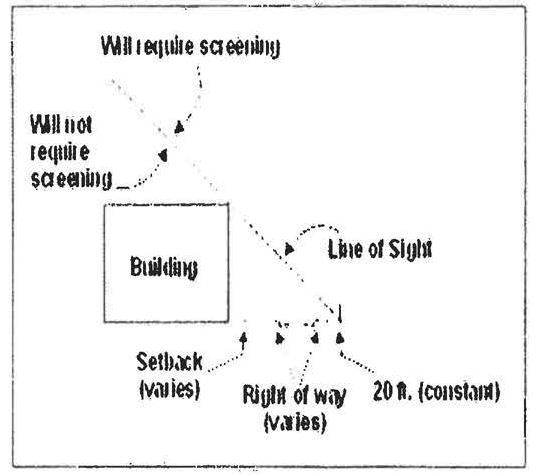
Figure 5.02.06(a)(2)(D)i
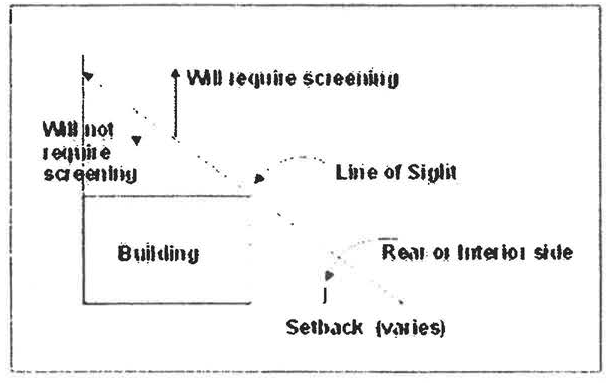
Figure 5.02.06(a)(2)(D)ii
2.
Any antennas or portion thereof above the line of sight will require screening. All required screening used in conjunction with such rooftop installations shall be architecturally compatible and harmonious in color and materials with the supporting structures and any existing or approved screening on the structure. Screening materials at corners shall be the same length and height on all corners.
(i)
An initial antenna installation within 13 feet of the corner of a structure shall require screening along the rooflines of both sides of the corner to a distance of 13 feet.
(ii)
An initial antenna installation more than 13 feet from the corner of a structure, or the installation of any antenna subsequent to a prior antenna installation, shall provide screening along the entire rooflines from which the line of sight analysis shows that the antenna can be seen.
3.
Cylinder type antennas shall be limited to three per structure and shall be painted to match the structure.
4.
No sign shall be allowed on an antenna.
5.
No signals, lights, or illumination shall be permitted on an antenna, unless required by any applicable federal, state or local rule, regulation or law.
6.
Accessory wireless equipment buildings used in conjunction with antennas, if located on the ground, shall comply with the minimum principal building setback requirements of the zoning district in which they are located. Self-standing, non sheltered equipment cabinet(s) used in conjunction with antennas, if located on the ground shall be deemed mechanical equipment similar to air conditioning units and shall be limited to a height not to exceed eight feet and an area not to exceed 80 square feet. There shall be no minimum spacing between accessory wireless equipment buildings and the building located on the property.
(c)
Permitted districts and criteria for antenna support structures.
(1)
Permitted districts. Wireless supported service facilities including antenna support structures of 100 feet or less in height used in connection with a wireless supported service facility shall be permitted in the commercial (C-2, C-3) and in all industrial districts. For antenna support structures greater than 100 feet in height in the industrial (I-2, I-3) districts, except antenna support structures for police and fire services, broadcast radio, television; a public hearing is required pursuant for antenna support structures in any other district.
(2)
Criteria.
(A)
Signage.
(1)
No advertising signs, including commercial advertising, logo, political signs, flyers, flags or banners, whether or not posted temporarily, shall be permitted on any part of the antenna support structures or antenna with the exception of the following:
a.
Warning, danger or other sign designed to maintain public safety;
b.
Any federal, state or municipal flags located on such facilities designed to look like a flagpole; or
c.
Permitted signage associated with the principal use on the property where the principal use incorporates a camouflaged antenna support structure.
(3)
No signals, lights, or illumination shall be permitted on the antenna support structure or the antennas, unless required by any applicable federal, state or local rule, regulation or law.
(4)
Accessory wireless equipment buildings used in conjunction with antenna support structures and antennas, if located on the ground, shall comply with the minimum principal building setback requirements of the zoning district in which they are located. Self-standing, non sheltered equipment cabinet(s) used in conjunction with antenna support structures or antennas, if located on the ground shall be deemed mechanical equipment similar to air conditioning units and shall be limited to a height not to exceed eight feet and an area not to exceed 80 square feet. There shall be no minimum spacing between accessory wireless equipment buildings and the building located on the property.
(Ord. No. 4626, § 2(Exh. A), 6-3-2020; Ord. No. 4999, § 2(Exh. A), 10-16-2023)
5.02.07. Co-location. To encourage co-location and the use of sites, which already have wireless supported service facilities, additions to such facilities may occur as follows:
(a)
The addition of antennas, cables, and/or accessory wireless equipment building to an existing wireless supported service facility shall be permitted in any district regardless of whether the wireless supported service facility is legally conforming or non-conforming and regardless of any limitations placed by any resolution approving the wireless supported service facility.
(Ord. No. 4626, § 2(Exh. A), 6-3-2020)
5.03.00. - Storage buildings, patios, utility buildings, carports, greenhouses.
A.
Storage buildings, patios, utility buildings and greenhouses shall be allowed only in side and rear yards. Carports shall be allowed in side or front yards.
B.
Vehicles, including manufactured housing and mobile homes, shall not be used as storage buildings, utility buildings, or other such uses.
5.04.00. - Swimming pools, hot tubs, and similar structures.
A.
Setbacks for swimming pools and similar structures shall be measured horizontally from the pool's water edge.
B.
Swimming pools shall be constructed no closer than five feet to any building foundation unless otherwise provided for by the Florida Building Code.
C.
Swimming pools shall have the same setbacks as accessory building from the sides and rear property lines. Swimming pools shall be located behind the front building line.
D.
All pools shall be completely enclosed with an approved wall, fence, screen enclosure or other similar structure not less than four feet in height. The enclosure shall completely surround the pool and shall be of sufficient density to prohibit unrestrained admittance to the enclosed area through the use of self-closing and self-latching doors.
E.
No overhead electric power lines shall pass over any pool nor shall any power line be nearer than ten feet horizontally or vertically from the pool's water edge.
F.
Excavations for pools to be installed for existing dwellings shall not exceed a two to one slope from the foundation of the house, unless a trench wall is provided.
(Ord. No. 4626, § 2(Exh. A), 6-3-2020)
5.05.00. - Walls, fences and hedges.
1.
General standards.
a.
All walls and fences to be built shall comply with the Florida Building Code. They must be resistant to decay, corrosion, and termite infestation, and shall be constructed either of concrete block, ornamental masonry, ornamental metal, decorative wood or chain link.
b.
Walls, fences and hedges may be located in front, side and rear yard setback areas. They shall not exceed six feet in height when placed in the front yard or within 20 feet of a property corner adjacent to an intersection along a corner lot's side property line, provide that said fence or hedge meet the clear sight distance as specified under section 5.05(2) of the land development code. The overall fence height shall not exceed the height of six feet, except a fence or wall having an ornamental feature such as decorative lights or decorations to an ornament fence at separate intervals shall not be exceed 12 inches above the permitted height. Additionally, any fence within the front yard shall provide total visibility to the residence and property. Chain link fences within the front yard shall not exceed four feet in height. A fence when serving as a landscape barrier within a perimeter landscape buffer strip between residential and commercial properties, in which case they shall not exceed the height of eight feet.
c.
Any fence located adjacent to a public right-of-way or private road shall be placed with the finished side facing that right-of-way. A fence with a finished and unfinished side shall be erected so that the unfinished side and supporting members face inward toward the interior of the property. Furthermore, all fences shall have the finished side facing the neighboring property or street (outward).
d.
A wall or fence required, by another public agency, for safety or protection may not be subject to the height limitations above. Approval to exceed maximum height standards may be given by the zoning director upon receipt of satisfactory evidence of the need to exceed height standards.
e.
No wall, fence or hedge shall be constructed or installed in such a manner as to interfere with drainage on the site.
f.
All property owners shall maintain any walls, fences or hedges within their property in a clean and safe manner including the elimination of any graffiti.
g.
Hedges must be kept in presentable condition, properly maintained, and the owner of said hedge or hedges shall make every reasonable effort to care for all sides of the hedge or hedges in a like manner.
h.
Continuous wall or fence that is owned by multiple property owners or held in common ownership shall be of uniform construction and materials and its exterior shall also be maintained in good, clean and finished condition for the entire length of said wall or fence. Concrete block fence wall shall be completely finished with stucco and paint; however, walls comprised of decorative brick and natural stone may be left unpainted provided the cement and grout are finished on both sides.
i.
If a wall is to be placed on a shared property line, consent for access must be obtained from the adjoining property owner(s) prior to finishing the opposite side of the wall. If such consent cannot be obtained, the property owner erecting the wall must present proof that a request for access approval was mailed to every adjacent property owner, by certified mail, return receipt requested, to the mailing address(es) as listed in the most current Miami-Dade County tax roll, and the mailing was returned undeliverable or the adjacent property owner(s) failed to respond to the request within 30 days after receipt. Upon such a showing, the property owner erecting the wall shall not be required to finish the opposite side of the wall.
j.
Where a business or industrial lot abuts residential zoned property, a decorative masonry wall at least six feet maximum ten feet in height shall be erected on the business lots along the common property line separating the two districts. Where a dedicated alley separates the two districts, the six-foot decorative masonry wall shall be erected along the business lots adjacent to the alley, permitting only openings for egress and ingress purposes with the smallest width possible for this purpose. Where the business or industrial property is a through lot, and the rear of the business lot lies across the street right-of-way from residential zoned property, said wall shall be located on the business lot ten feet in from the official right-of-way line at the rear of the lot, and the ten-foot strip shall be substantially landscaped.
k.
Fences or walls for tennis courts or other recreational uses. Fences for tennis courts may be erected up to 14 feet in height if such fence conforms to accessory use setbacks. Fences and/or walls in connection with other permitted recreational uses. such as baseball backstops, handball courts, and the like, shall be permitted of a height necessary for the particular use if required accessory use setbacks are observed.
l.
Cloth, fabric, canvass, silt screens, mesh, or other such material shall not be utilized as a fence unless otherwise required by law or unless being utilized for the protection of construction sites or vacant lots.
2.
Fence height at intersection.
a.
Fences, walls, bus shelters or hedges shall not exceed two and one-half feet in height within the safe sight distance triangle, as defined below. The height of fences, walls, bus shelters and hedges shall not exceed two and one-half feet in height within ten feet of the edge of driveway leading to a public right-of-way. The safe sight distance triangle area shall not contain obstructions to cross-visibility at a height of two and one-half feet or more above pavement; potential obstructions include, but are not limited to, structures, grass, ground covers, shrubs, vines, hedges, trees, rocks, walls and fences. The following table represents minimum criteria for determining the required area of cross-visibility:
Safe Sight Distance Triangle Table
* Visibility distances measured from center line of minor street, along right-of-way line of through street.
** Depth visibility on minor street measured from right-of-way line of through street, along center line of minor street (public or private street).
Table interpretations and waivers of the above requirements shall be made in writing by the director of the public works department.
3.
Measuring height of wall, fence or hedge. The height of a wall, hedge or fence shall be the vertical distance measured from the average elevation of the finished building site to the top of the wall, hedge or fence. The average elevation shall be measured along both sides of the wall, hedge or fence line. Virgin land may not be increased or decreased to affect the permitted (or required) height of a wall, hedge or fence unless the entire building site is graded to even out the level of the site or to increase it to the required Miami-Dade County flood criteria elevation. Average elevation shall be determined by taking elevations along both sides of the wall, hedge or fence line, at five-foot intervals and totaling the same and then dividing the total by the number of stations at which the elevations were taken.
4.
Height between different districts. Notwithstanding any provisions in this chapter to the contrary, where an RU District abuts another district, a fence, wall or hedge on the RU property may be erected or maintained on the common property line of the height permitted in the abutting district.
5.
Permits shall be required for all walls and fences, and except as may be approved as a result of public hearings, walls, fences, which obscure or obstruct vision, and hedges shall be restricted to the height, location and type as indicated hereinafter, and except when a higher wall, fence or hedge is required as a visual screening buffer at the rear of double frontage lots under this Code.
6.
Except as hereinafter restricted, all walls, fences and hedges may be placed on the property lines. This section, however, shall not be construed to permit such walls, fences and hedges to extend beyond the official right-of-way lines or property lines.
(Ord. No. 4259, § 1, 11-7-2016; Ord. No. 4528, § 3(Exh. A), 6-18-2019; Ord. No. 4626, § 2(Exh. A), 6-3-2020)
5.05.01. - Construction fencing.
A.
Temporary construction fencing. No person or entity shall install or construct a temporary construction fence in this city without first obtaining a permit from the city's building department. Each fence constructed or maintained shall be constructed and anchored in accordance with the Florida Building Code.
B.
Permitted temporary construction fences.
1.
The following temporary construction fences are permitted in all the zoning districts:
a.
Wrought iron or blackened aluminum.
b.
Stucco and stone match main structure.
c.
Wood pickets.
d.
Frame plywood panel.
e.
However, chain-link fences with canvas (or similar material) backing or meshing may be permitted on all sides. Chain-link fences with canvas (or similar material) backing or meshing may be permitted to be utilized as a temporary construction fence, provided they are neatly designed and maintained as approved by the building and zoning departments. At no time shall the parcel remain without a protective barrier.
C.
Demolition fences.
1.
Chain-link fences with canvas (or similar material) are permitted if the property owner or agent has obtained a demolition permit from the building department. The chain-link fence shall be permitted to be utilized as a demolition fence for a period of no longer than two months or until expiration of the demolition permit, whichever occurs first. However, such demolition fence shall not be removed until the installation of a permitted construction fence, as defined in this section. The permitted construction fence shall be installed immediately upon removal of the temporary demolition fence. Any person or entity found to be in violation of this subsection shall be subject to a fine of $500.00 per day.
D.
Prohibited fences.
1.
The following fences are not permitted, except as otherwise provided herein:
a.
Barbed-wire fences.
b.
Fences made of canvas material.
c.
Any fences that fail to meet the requirement of the Florida Building Code.
E.
Maximum and minimum height. A temporary construction fence is permitted a maximum height of eight feet and a minimum height of six feet.
F.
Expiration of permit. A temporary construction fence permit issued under this chapter shall expire upon the issuance of a temporary certificate of occupancy. The temporary fence shall remain on the property until the completion of construction, provided that it shall be removed in accordance with the terms of the Florida Building Code.
G.
Murals and graphics. Graphics and murals on temporary construction fencing are prohibited unless approved by the building and zoning department. Murals and graphics will not be permitted on demolition fences. The building and zoning department, in its discretion, may permit graphics and painted murals on temporary construction fences for aesthetic enhancement of the fence and advertisement of the project to be constructed at site plan review. The applicant shall submit mural and graphic design for approval by the building and zoning department with the temporary construction fence permit.
H.
Fees. The demolition fence and temporary construction fence with accompanying mural and graphic shall obtain the required building permits.
I.
Access gates. All temporary construction fences shall contain access gates with a minimum clear opening width of 12 feet.
J.
Temporary construction signs. Construction, erection, and maintenance of temporary construction signs shall be governed by Florida Building Code and Development Regulations.
K.
Appeals. Any decision made by the city manager or designee regarding graphics, advertisement, and murals on a temporary construction fence may be appealed to the city commission.
L.
Enforcement and penalties. The code enforcement and building department shall be responsible for the enforcement of the provisions of this section. Any person or entity found to be in violation of this section shall be subject to a $500.00 fine per day.
(Ord. No. 4403, § 2, 5-7-2018)
5.06.00. - Towers, poles and masts.
All installations of this nature shall be in accordance with the provisions of the Metropolitan Miami-Dade County Code, chapter 33 (Zoning) as amended from time to time.
5.07.00. - Temporary structures and uses.
(a)
Temporary accessory buildings, tents, out-buildings, and other similar structures are prohibited for residential use whether on a temporary or permanent basis. Permanent accessory buildings, at the discretion of the director, may be constructed and used as a temporary residence prior to erection of permanent or main residence under conditions herein specified and a portion of a main residence, at the discretion of the director, may be used and occupied as a temporary residence under the same and following conditions:
(1)
Where application is made and permit is issued for a permanent residential structure on the site to be used for a temporary residence.
(2)
Sanitary facilities approved by the director and health department are provided.
(3)
Waivers of objection are secured from all residents and property owners within a radius of 75 feet of the proposed building site as described on the application for building permit, unless upon sufficient proof, it is clearly shown that upon diligent search, the applicant was unable to ascertain the name and whereabouts of the owner of property within the radius specified.
(4)
That the applicant execute a cash escrow agreement in a sum not less than $100.00 (at the discretion of the director) guaranteeing reasonable progress in the construction of a permanent residential structure and its completion within the time specified in the permit and according to its terms.
(5)
Where reasonable progress is made and justifiable reasons shown, satisfactory to the director, he may grant an additional maximum of 90 days for compliance with the terms of the agreement and building permit.
(6)
The cash escrow agreement will be released and escrow refunded upon completion of the main residence and in the case where an accessory building has been used for the temporary residential purposes, where said accessory is converted to its proper use as permitted under applicable district.
The foregoing provisions shall not be construed to mean that residential uses, either on a temporary or permanent basis, will be permitted in I-2 or I-3 districts.
(Ord. No. 4877, § 2(Exh. A), 9-26-2022)
5.08.00. - Boat storage.
Boats may be stored and/or temporarily parked in the residential zoning districts on lots developed with a residential structure subject to the following conditions:
(1)
Boats and place of storage or temporary parking shall be kept in a dean, neat and presentable condition.
(2)
No major repairs or overhaul work shall be made or performed on the premises.
(3)
The boats shall not be used for living or sleeping quarters, and shall be placed on and secured to a transporting trailer.
(4)
The parking of a boat in front of the front building line, side or rear of the property is permitted. Under no circumstances shall any part of the boat or trailer extend beyond the property line. The boat or trailer shall not be parked or encroached in the public right-of-way, including the swale area and sidewalk of a right-of-way.
(5)
Commercial boat parking shall be prohibited.
[6]
All boats stored on the property shall be owned or registered to the property owner or authorized tenant/lessee and displaying the register license number and tag.
(Ord. No. 4877, § 2(Exh. A), 9-26-2022)
5.09.00. - Recreational and camping equipment.
Recreational and camping equipment in the form of travel and camping trailer, truck trailer and motor travel home, on residential zoning districts subject to the following conditions:
(1)
Recreational and camping equipment shall be owned or registered to the property owner or tenant/lessee of the site concerned.
(2)
The location to such parked recreational or camping equipment may be in the front yard, side yard or rear yard. Under no circumstances shall any part of the recreational or camping equipment extend beyond the property line. The recreational or camping equipment shall not be parked or encroached in the public right-of-way, including the swale area and sidewalk of a right-of-way.
(3)
Such equipment and area of parking shall be maintained in a clean, neat and presentable manner and the equipment shall be in a usable condition at all times.
(4)
Such equipment shall, at all times, have a current vehicle registration license plate.
(5)
No major repairs or overhaul work on such equipment shall be made or performed on the site, (or any other work performed thereon which would constitute a nuisance under existing ordinances).
(6)
When parked on the site, such equipment shall not be used for living or sleeping quarters, or for housekeeping or storage purposes and shall not have attached thereto any service connections lines, except as may periodically be required to maintain the equipment and appliances.
(7)
Such equipment shall be so secured so that it will not be a hazard or menace during high winds or hurricane.
(Ord. No. 4877, § 2(Exh. A), 9-26-2022)
5.10.00. - Outdoor boat and RV storage area on private residential condominium association, homeowner's association or multi-family tenant community property.
The term "boat" as used in this subsection shall include every description of watercraft or airboat used or capable of being used as a means of transportation on water. The term "RV" shall mean recreational and camping equipment in the form of travel and camping trailer, swamp buggy and other off-road vehicles and motor travel home.
Conditions and limitations. An outdoor storage area designated for residents' parking of boats and RV's shall be permitted, subject to compliance with the following:
(1)
The private storage area is an accessory use for a residential condominium, homeowner's association or multi-family tenant association and shall be located on the residential condominium, homeowner's association or multi-family tenant association property.
(2)
Each boat and RV stored in the designated area shall be registered to a resident or tenant/lessee of the subject condominium, homeowner's or tenant's association community. In no event shall non-residents' recreational vehicles or boats be parked in the storage area. Each boat shall be secured to a transporting trailer in compliance with all applicable regulations.
(3)
In no event shall the storage area count toward required landscaped open space.
(4)
The storage area shall be enclosed by a five-foot decorative masonry wall or a five-foot high chain link fence with hedges a minimum of three feet in height when measured immediately after planting and maintained to form a visual screen around the site within one year after the time of planting, except that gated openings shall be permitted for ingress and egress.
(5)
The storage area shall either be paved or shall be hard-surfaced.
(6)
The boats, RV's and place of storage shall be kept in a dean, neat condition.
(7)
Where required under Florida Statute, all RV's, boats and trailers for transporting same shall have and display a current Florida registration or license plate.
(8)
No major repairs or overhaul work shall be made or performed on the premises; and no flushing of outdrive or outboard motors shall be permitted from sunset to sunrise.
(9)
Neither the boats nor the RV's shall be used for living or sleeping quarters while parked in the storage area.
(10)
Common open space on residential condominium property may be utilized for such a storage area, all subject to the conditions enumerated herein.
[11]
Maintenance of the storage area shall either be provided through (i) a multi-purpose special taxing district, (ii) through the associations execution of a declaration of restrictions, or (iii) other maintenance provisions acceptable to the City of Sweetwater in recordable form approved by the county attorney, accepting responsibility for the maintenance of the storage area and ensuring continued compliance with the conditions enumerated herein.
(Ord. No. 4877, § 2(Exh. A), 9-26-2022)
5.11.00. - Permanently installed generators.
A permanent generator installation shall be permitted as an ancillary use in all zoning districts, after obtaining the proper building permits and subject to the following conditions:
(a)
Setback for residential districts. Permanently installed generators fueled by propane gas or natural gas not exceeding five feet in height from finished grade to the top of the generator shall be permitted as an accessory use in conjunction with a permitted residential use in accordance with the following setback requirements:
(1)
Front—Behind the front building line.
(2)
Rear—Minimum five feet.
(3)
Interior and side street—Minimum ten feet
[4]
Spacing—There shall be 10′ spacing requirement between the principal building and the permanently installed generator.
(b)
Number permitted in residential districts. A maximum of one permanent generator shall be permitted as an ancillary use to a single-family residence, duplex unit or townhouse unit. A maximum of one generator per structure shall be permitted for multi-family developments, with the exception of condominium units, which shall be permitted one permanent generator per condominium unit.
(c)
In all residential districts, a permanent generator shall be screened from view by a wall or hedge.
(d)
There shall be no variance from the provisions of this section.
(e)
Setback for commercial and/or industrial districts. Permanently installed generators fueled by propane gas or natural gas shall be permitted as an accessory use in conjunction with a permitted commercial and/or industrial use in accordance with the following setback requirements:
(1)
Front—Behind the front building line.
(2)
Spacing—There shall be 3′ spacing requirement between the principal building and the permanently installed generator.
(Ord. No. 4877, § 2(Exh. A), 9-26-2022)

